
When the Thoughts Won't Stop
Your child's brain is a worry factory — thoughts piling up faster than you can address them. The reassurance evaporates. The logic doesn't stick. You are not failing. Your child's brain is doing something specific — and it can be taught to do something different.
🧠 C-299 | Worry Management
Domain C: Emotional Regulation
Ages 5–12
"My son's brain never stops. From the moment he wakes up, his mind is churning with worries. Not just one worry — dozens. They layer on top of each other. 'What if I fail the test?' becomes 'What if I fail the grade?' becomes 'What if I can't get a job?' — all in thirty seconds. He's ten. He's worrying about being homeless. I've tried logic. I've tried reassurance. The reassurance evaporates like water on a hot stone. His brain is a worry factory, and I don't know how to shut it down."
If this sounds familiar, you are among millions of families navigating this exact challenge. The Pinnacle Blooms Consortium has curated 9 evidence-based materials that give children — and their caregivers — the concrete tools to change their relationship with worried thoughts.
📞 FREE National Helpline: 9100 181 181 | 16+ languages | 24×7 | Drafted by: CRO • Pediatric Psychologist • BCBA • OT • SLP • SpEd • NeuroDev Pediatrician

You Are Among Millions of Families
Excessive worry is not a parenting failure. It is a neurological pattern — one that responds to the right tools, consistently applied. India carries one of the world's largest burdens of childhood anxiety — an estimated 50–70 million children affected — yet cognitive therapy tools remain inaccessible to most families. This page closes that gap.
40%
Children with ASD
experience clinically significant anxiety
1/4
Children Globally
experience an anxiety disorder before age 18
80%+
Show Improvement
with structured cognitive coping tools
Sources: PMC11506176 (PRISMA systematic review, 2024) • PMC10955541 (Meta-analysis, World J Clin Cases, 2024) • WHO Mental Health Atlas 2020
This Is Not a Behaviour Problem. It Is a Brain Wiring Pattern.
The Clinical Picture
The Default Mode Network (DMN) activates during internal, self-referential thought. In children with excessive worry, the DMN is hyperactive — generating more threat predictions, more "what if" spirals.
The Amygdala fires disproportionately in response to uncertain or future-focused stimuli, treating the thought of failure as equivalent to actual danger.
The Prefrontal Cortex (PFC) — responsible for rational evaluation — is not fully mature until early adulthood. In children, learned strategies substitute for what the PFC cannot yet do independently.
In Plain English
Your child's brain generates worried thoughts automatically. It is not choosing to worry. The part of the brain that puts worry in perspective — the "calm down, this is fine" centre — is still developing.
These 9 materials ARE that prefrontal cortex, externally. They give your child's brain the regulatory scaffold it doesn't yet have internally.
Key Insight: Worry is thoughts, not facts. And thoughts can be taught to move differently.

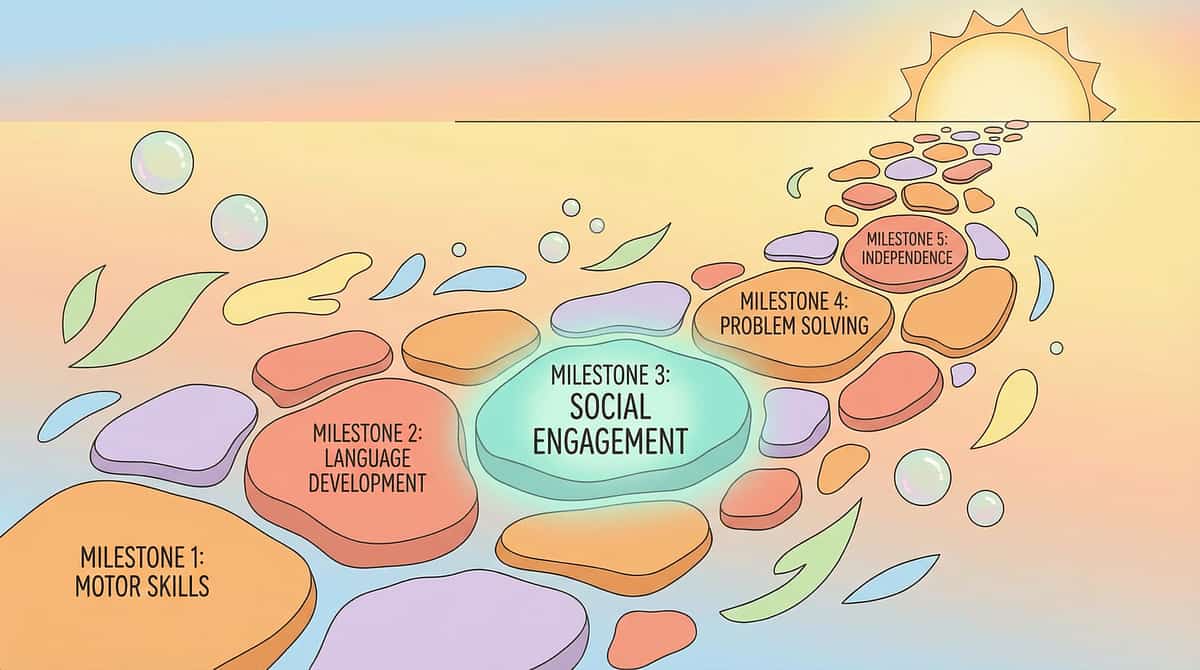
Where This Sits in Development
Worry is developmentally expected. Excessive worry is a signal — not a sentence. Understanding where your child is on this timeline helps you respond with precision, not panic.
Ages 2–4
Fears of specific things (monsters, dark, animals) — normal and transient
Ages 5–7
Worry about competence, school, social acceptance begins — normal when proportionate. Future-oriented thinking capacity emerges.
Ages 8–10
Complex worry chains, catastrophizing, rumination patterns — your child may be here if C-299 resonates
Ages 11–13
Worry can intensify with social complexity; without intervention, patterns may entrench
Adulthood
PFC maturation — regulatory capacity peaks, but patterned worry continues without skill development
Worry commonly co-occurs with: ASD | ADHD | Sensory Processing Differences | OCD | Social Anxiety | School Avoidance. C-299 materials are effective across presentations.
Not Intuition. Not Tradition. Evidence.
🛡️ Level I Evidence
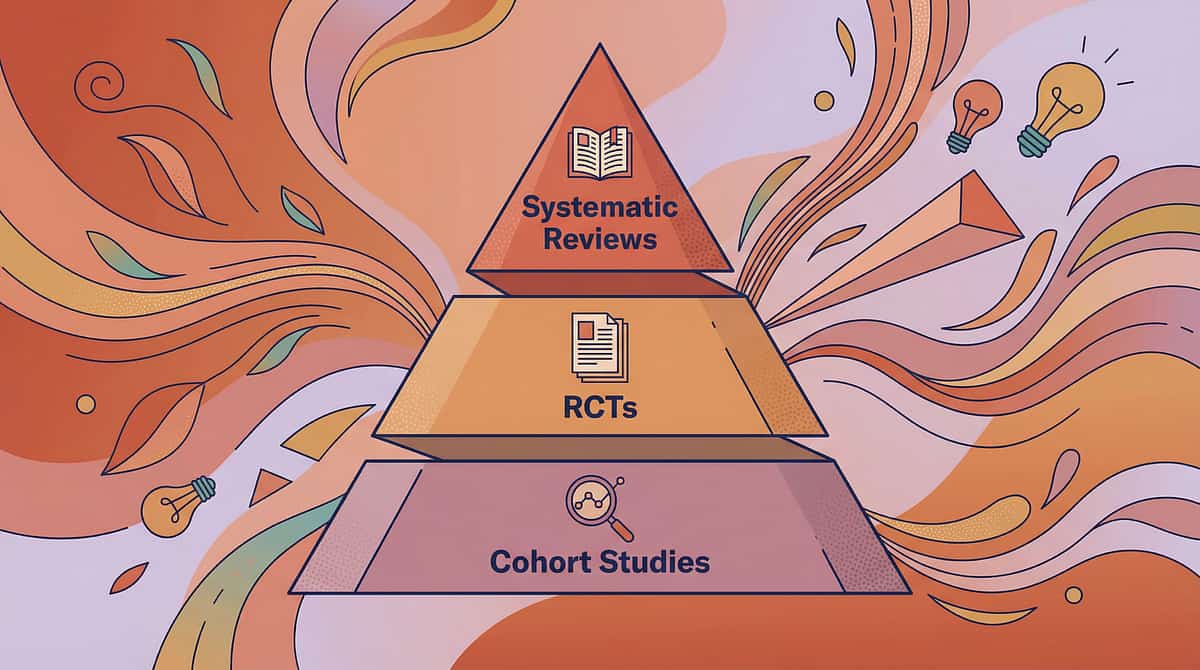
Systematic Review + RCT Support
Finding 1 — CBT is Gold Standard
CBT is the most empirically supported treatment for childhood anxiety. Cognitive restructuring — thought challenging, worry management — is a core, validated component. PMC3018839
Finding 2 — Worry Tools Work
Externalisation, scheduled worry time, thought challenging, and problem-solving demonstrate efficacy in reducing worry frequency and intensity in children aged 5–12. NCAEP 2020
Finding 3 — Home Delivery Effective
Home-based, parent-administered cognitive tools show significant outcomes comparable to clinic delivery. Indian RCT confirms this. Padmanabha et al., Indian J Pediatr 2019
90%
Confidence Level
Multiple systematic reviews, RCTs, and clinical consensus — High Confidence rating
📞9100 181 181 — Ask a Pinnacle clinician to explain these findings in your language. Free.

What This Technique Is
🧠 Domain C: Emotional Regulation
Ages 5–12
10–20 min sessions
Cognitive Worry Management via Externalisation & Restructuring Materials — Parent Alias: "Worry Tools That Actually Work"
Worry management is a structured, cognitive-behavioural approach that teaches children to change their relationship with worried thoughts — not eliminate them, but to externalise worry (see it as separate from the self), contain it, examine it, challenge it, and replace it with calmer, more balanced thoughts. Materials make invisible mental processes visible and manageable.
🧠 Domain C
Emotional Regulation
👶 Ages 5–12
All presentations
⏱️ 10–20 min
Per session
🏠 Home + School
All environments

What These Materials Target
Precision tools for the mind — not random activities. Every material targets a specific cognitive, emotional, or behavioural pattern.
✅ Fewer repetitive "what if" questions
✅ Shorter worry episodes
✅ Child uses tools spontaneously
✅ Sleeps with less bedtime rumination
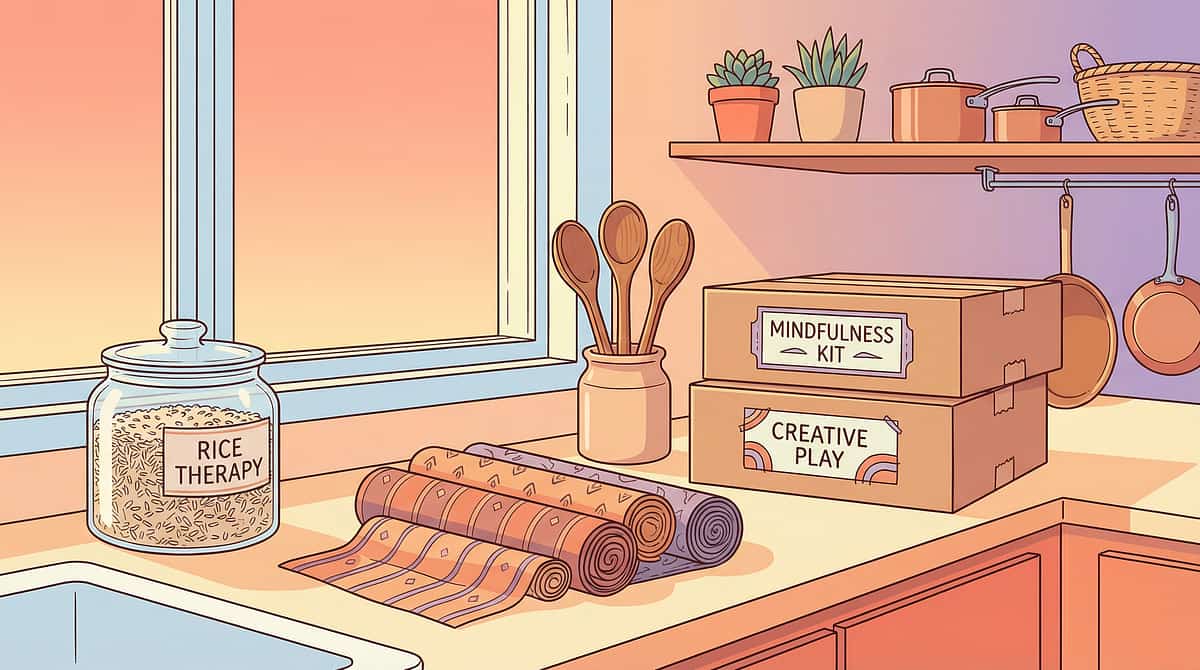
Your Worry Management Toolkit — 9 Materials
Nine researched, clinically validated materials for home use. Each one targets a specific part of the worry cycle. Not sure which to start with?📞9100 181 181 — Our specialists guide you free.
# | Material | Function | Price (₹) | Format | |
1 | Worry Monster / Externalisation Character | Externalise worry outside the child's head | 400–1,200 | Soft toy with pouch | |
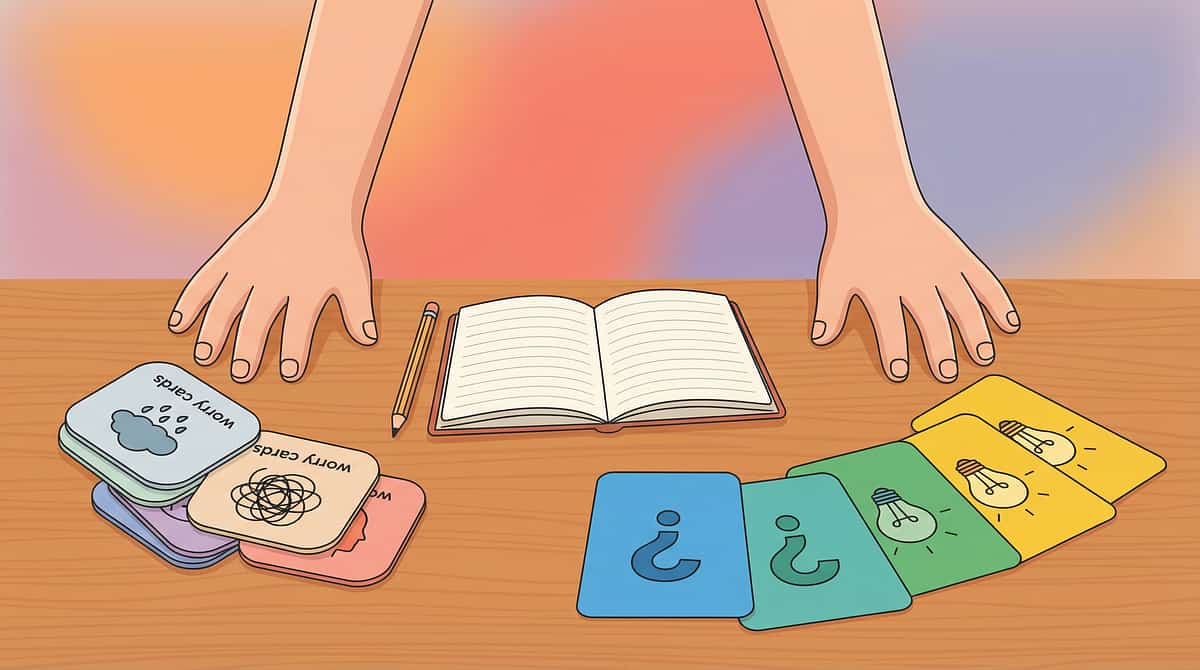
2 | Worry Journal with Structured Prompts | Document + examine worries; get them off the page | 200–600 | Notebook + prompt cards | |
3 | Worry Time Box / Containment Jar | Schedule worry; reclaim present moments | 100–400 | Decorated box/jar | |
4 | Thought-Feeling-Behavior Chart | Map and interrupt the worry cycle | 100–300 | Printed poster/worksheet | |
5 | Worry Sorting Mat | Categorise: control vs. no-control, big vs. small | 150–400 | Laminated mat | |
6 | Thought Challenging Card Deck | Question worry's accuracy with detective cards | 200–500 | Card set | |
7 | Calm Thought Replacement Cards | Replace anxious scripts with coping statements | 150–400 | Card set | |
8 | Worry Scale / Thermometer | Rate intensity; enable proportional coping | 100–300 | Visual scale | |
9 | Problem-Solving Planner | Transform worry into forward action | 150–400 | Worksheet pad |
✅ All 9 materials are clinically validated for home use by the Pinnacle Blooms Consortium® | Animal soft toys ₹425 | Rainbow Sorting Set ₹628 | Visual Timer ₹673
Every Child Deserves These Tools — Regardless of Budget
WHO Nurturing Care Framework equity principle: interventions must be accessible across all economic contexts. Every material has a zero-cost DIY alternative that achieves the same therapeutic outcome.
Material | DIY Alternative | What You Need | Cost | |
Worry Monster | Stuffed animal + fabric pouch + velcro | Any stuffed animal from home | ₹0–50 | |
Worry Journal | Any notebook + handwritten prompts on first page | Notebook, pen | ₹0–30 | |
Worry Time Box | Any box/jar, decorated by child with stickers | Shoebox or jar | ₹0 | |
Thought-Feeling Chart | A4 paper, markers, boxes with arrows | Paper + markers | ₹0 | |
Worry Sorting Mat | Two sheets labelled "CAN CONTROL" / "CAN'T CONTROL" | 2 sheets of paper | ₹0 | |
Thought Challenging Cards | Index cards with one question per card, ring-bound | Index cards + ring | ₹10–30 | |
Calm Thought Cards | Child-created cards with coping statements | Paper, markers | ₹0 | |
Worry Scale | Hand-drawn thermometer numbered 0–10 | Paper + pencil | ₹0 | |
Problem-Solving Planner | Folded A4 with problem / solutions / first step | Single A4 sheet | ₹0 |
"The worry monster does not need to be a ₹1,200 specialty toy. A child who names their stuffed elephant 'Worri' and feeds him written worries every night achieves the exact same externalisation effect. The tool matters. The price tag does not." — Pediatric Psychologist, Pinnacle Blooms
📞9100 181 181 — Ask for a free DIY materials guide in your language

Set Up Your Space
The right environment multiplies the effectiveness of every tool. "80% of session failures are environment failures. The tool is not the problem — the setting is." — OT Lead, Pinnacle Blooms
Setup Checklist
- ✅ Quiet room — TV and notifications off
- ✅ Soft, warm lighting — no harsh fluorescents
- ✅ Child's preferred seating (cushion, chair, beanbag)
- ✅ Present 1–2 materials at a time, not all 9
- ✅ Paper and pencils/markers within reach
- ✅ Water or a preferred snack nearby
- ✅ 10–20 minutes uninterrupted time blocked
- ✅ Parent regulated — not carrying own anxiety
Timing Recommendations
Best time: 4–6pm after school decompression, OR after dinner — NOT immediately before bed.
Worry Time (Box processing): Daily, 10–15 minutes, same time each day — consistency builds the habit.
Formal tool sessions: 3–5 times per week minimum for skill-building. Quality over quantity.
Arrangement: Parent chair beside the child — not opposite. Side-by-side signals collaboration, not interrogation.

Is Your Child Ready? The Readiness Check
60 seconds before you start. The best session is one that begins right. Use these five observable indicators to decide whether to proceed, modify, or postpone.
Indicator | ✅ Go | 🟡 Modify | 🔴 Postpone | |
Worry level (ask child to rate 0–10) | 1–6 | 7–8 | 9–10 | |
Physical state | Calm, settled | Slightly tense | Crying, panicking | |
Willingness to sit with materials | Yes | "Maybe" | Refuses | |
Last meltdown | >2 hours ago | 1–2 hours ago | <1 hour ago | |
Time available | 15+ minutes | 10 minutes | <10 minutes |
✅ If Go
Proceed to Step 1 — invite engagement
🟡 If Modify
Offer only the Worry Scale. Rate and name the worry. That IS today's session.
🔴 If Postpone
Offer a preferred calming activity. Try again tomorrow. Record in journal: "too big today."
"A 5-minute session where the child feels safe and heard is worth more than a 20-minute forced session." — BCBA, Pinnacle Blooms

Step 2 of 6
🧠 Engage the Worry
Once the child has chosen a material, engagement begins. Allow 2–3 minutes of quiet engagement before speaking. Prompt gently — don't interpret for the child.
Worry Monster
Ask child to write or draw ONE worry on paper. Say: "What's been taking up space in your head today? Write it — or draw it — and give it to [Monster's Name]."
Worry Journal
Open to a fresh page. Read a prompt together: "What am I worried about? Just put it on paper — it can't loop in your head AND be on this page at the same time."
Worry Box
Have a slip of paper ready. "Every worry that shows up today goes in the box. We'll look at them at worry time — not now. Not now — later."
Thought-Feeling Chart
"Something happened today, or something you're worried about — let's trace it. What's the situation? What thought did your brain make up about it?"
🟢 Ideal
Child engages, names worry, writes or draws
🟡 Acceptable
Child names worry verbally — parent writes it
🔴 Stop
Child becomes more distressed — validate, offer cool-down
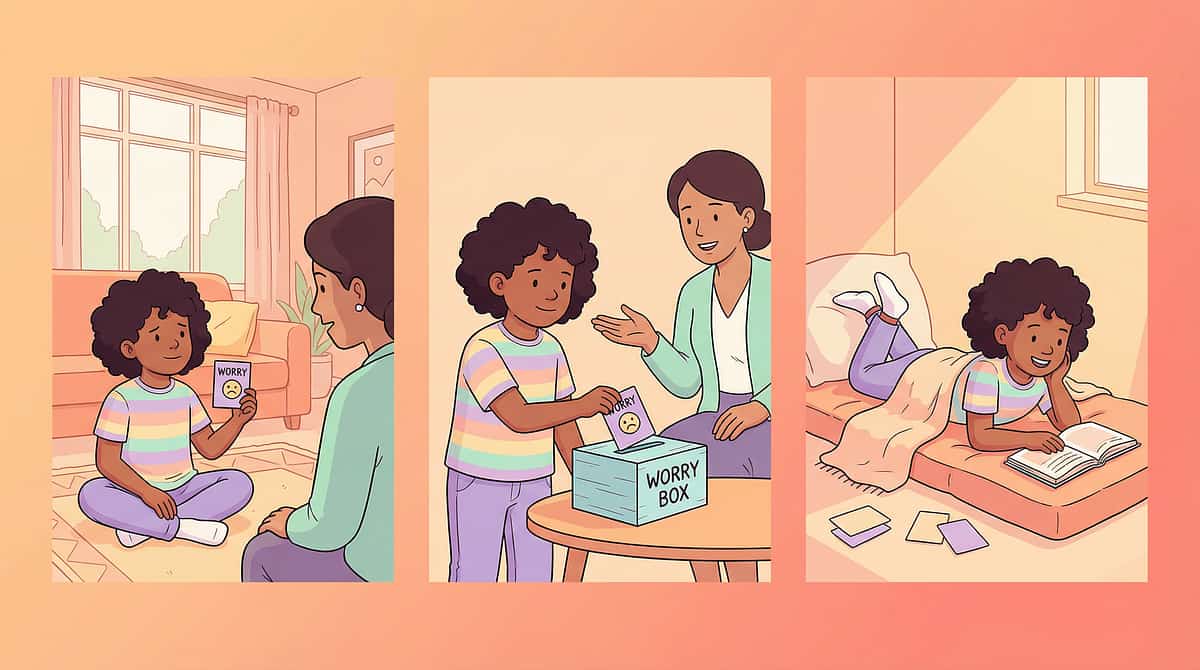
Step 3 of 6
⚡ The Therapeutic Action — Materials 1–5
This is the active ingredient. Precision matters. Each material has a distinct action sequence — follow it consistently for maximum effect.
Worry Monster — Externalisation
Child writes/draws worry → physically feeds it to the monster → zips or closes the monster → says "Your worry. Not mine." Duration: 3–5 minutes.
Worry Journal — Documentation + Examination
Child writes worry → works through prompts: "How likely is this? What's worst/best/most likely? What can I do?" → Parent does NOT interpret — child does the thinking. Duration: 5–10 minutes.
Worry Time Box — Containment
Child writes slip → places in box → parent says "Saved. We'll look at it at worry time [specify time]." At worry time: open box, review together. Duration: 1 minute per slip; 10–15 min at worry time.
Thought-Feeling Chart — Cognitive Mapping
Fill chart together: Situation → Thought → Feeling → Behavior. Then ask: "Where could you have interrupted this chain? What could you have thought instead?" Duration: 5–8 minutes.
Worry Sorting Mat — Categorisation
Write worries on cards → sort into CAN CONTROL / CAN'T CONTROL. For CAN CONTROL: write one action. For CAN'T CONTROL: "This goes in the let-it-go pile — we can cope." Duration: 5–10 minutes.

Step 3 of 6 — continued
⚡ The Therapeutic Action — Materials 6–9
Thought Challenging Cards — Examination
Child names a worry → selects a card: "What's the evidence? What's most likely? Am I fortune-telling?" → Works through question → finds more balanced answer. Duration: 5–8 minutes.
Calm Thought Cards — Replacement
Child identifies the worried thought → searches for (or reads aloud) the matching calm thought card → reads it twice, slowly: "I don't know what will happen, AND I can handle most things." Duration: 2–4 minutes.
Worry Scale — Rating
Child rates current worry (0–10) → parent acknowledges number → together decide: "A [number] worry needs a [proportional] response — what fits?" Duration: 2–3 minutes.
Problem-Solving Planner — Action
Name the specific problem → brainstorm 3 solutions → choose 1 → write FIRST STEP only → commit: "One step. That's all. What will you do first?" Duration: 5–10 minutes.
❌ Don't Do
Solve the worry FOR the child
✅ Do Instead
Guide the question, let child find the answer
❌ Don't Do
Rush through prompts
✅ Do Instead
Silence is productive — let child think

Step 4 of 6
🔁 Repeat & Vary
"3 good repetitions are worth more than 10 forced ones. Quality of engagement, not quantity of cycles, drives neural pathway formation." — Pinnacle Blooms BCBA
Repetition Guidance by Material
- Worry Journal: 1 worry entry per session; multiple prompts on same worry
- Worry Monster: 1–3 worries per session — don't overfeed in one sitting
- Thought Challenging: 1 worry, 2–3 different challenge questions
- Calm Thoughts: Read same card 2–3 times; add one new card per session
- Problem-Solving: One problem per session, all 5 steps in sequence
Build Variety Over Weeks
- Weeks 1–2: Stick to ONE material per session (habit formation)
- Weeks 3–4: Introduce a second material in the same session
- Week 5+: Child chooses from available materials
Satiation Indicators — When to Stop
- Looking away, fidgeting, asking to stop
- Rushed or perfunctory responses
- Eye-rolling or disengagement
→ STOP. Say: "That's a good amount for today. Let's put it away."
Step 5 of 6
🌟 Reinforce & Celebrate
Immediate, specific, enthusiastic reinforcement — delivered within 3 seconds of desired behaviour — increases the likelihood that behaviour repeats. The behaviour to reinforce is tool use, not worry reduction.
Celebrate the Attempt
"You picked up the journal. That's the hardest part."
Celebrate the Effort
"You wrote that worry down even though it was hard to name."
Celebrate Tool Use
"You used your sorting mat by yourself today."
Celebrate the Question
"You asked 'what's most likely?' — that's exactly what your brain is learning."
"I saw you [specific action]. That was [worry monster feeding / thought challenging / worry rating]. That is exactly what this is for. You're teaching your brain something new. That's real work."
Reinforcement menu: Verbal praise (always) • Sticker on chart • 5 minutes of preferred activity • Special "worry warrior" stamp • Reward stickers ₹364
Step 6 of 6
🌊 The Cool-Down
No session ends abruptly. The cool-down is part of the therapy — it builds ownership, closure, and positive associations with the process itself.
Transition Warning
"Two more minutes, then we'll put everything away." Give visible countdown — use the Smartivity Clock ₹673 to reduce transition anxiety.
Closing Ritual
Child places materials back in their designated space. For worry monster: "Zip it closed. The worries are with [Monster], not with you."
One-Word Check-Out
"We're done. One word — how do you feel right now?" Any answer is valid. This is not about getting "calm" — it's about noticing.
Transition to Next Activity
Bridge to a preferred, lower-demand activity. Do NOT transition immediately to homework or another demand.
If child resists ending: "I know. We can come back tomorrow. The worries are in the box now — they'll wait for you."
Capture the Data — Right Now
60 seconds of data now saves hours of guessing later. Connect your home data to a Pinnacle therapist: 📞9100 181 181
📅 Date & Time
When the session occurred. Example: 15 Jan, 5:30pm
🧰 Material Used
Which of the 9 materials. Example: Worry Monster + Journal
📊 Worry Level (0–10)
Before session AND after. Example: Before: 7 / After: 4
Optional Bonus Data
- Which worry theme today? (school / social / health / future)
- Child-initiated tool use? (Y/N)
- Parent reinforcement delivered? (Y/N)
Data Capture Options
- 📋 Downloadable PDF Tracker: pinnacleblooms.org/resources
- 📱 GPT-OS® In-App Tracker: pinnacleblooms.org/gpt-os
- 📓 Simple notebook entry — any format is valid
GPT-OS® Data Flow: Your session data → Cognitive Coping Readiness Index → personalised next-session recommendations → AbilityScore® update. "Your data helps every child like yours."

What If It Didn't Go As Planned?
Most sessions don't go perfectly. That's data, not failure. Here are the six most common challenges and exactly what to do about each one.
❓ Child Refused All Materials
The worry may be too acute for cognitive tools right now. Use somatic regulation first (breathing, sensory input). Cognitive tools work AFTER the nervous system is calmer. Try again in 30–60 minutes or tomorrow.
❓ Child Kept Re-Mentioning the Worry
Externalisation takes practice. Consistently redirect back to the monster: "You gave it to [Monster] — now [Monster] has it. It's not yours to carry anymore."
❓ Reassurance-Seeking Increased
Common in early days. Instead of answering: "That's a worry. Where does it go?" Redirect to the tool. Stay warm but redirect consistently — the cycle breaks over 2–3 weeks.
❓ Child Says Tools "Don't Work"
Tools rarely work on first use. Build the habit (2–3 weeks minimum). Check: is worry level too high (>8) for cognitive tools? Start with body regulation first.
❓ Session Became Just Talking About Worries
Talking about worries is not the same as working on them. Gently redirect: "I hear you — and our job right now is to put that worry somewhere. Which tool?"
❓ Parent Lost Patience
End the session warmly: "Let's take a break. We can try tomorrow." Parental regulation is required for child regulation. If you're dysregulated, the session cannot succeed.
📞9100 181 181 — If sessions consistently struggle, speak to a specialist. Free. "Session abandonment is data — adjust one variable and try again." — BCBA, Pinnacle Blooms

Adapt & Personalise
No two worried children are identical. Personalise the toolkit based on age, profile, and presentation. The dosage and format should flex — the therapeutic principles don't.
Child Profile | Best Starting Material | Approach | |
Young child (5–7), concrete thinker | Worry Monster | Make it playful — name the monster, give it a backstory | |
Older child (9–12), verbal | Worry Journal + Thought Challenging | More intellectual; treat them as co-researchers | |
Child who catastrophizes | Thought Challenging Cards + Worry Scale | Build reality-testing; proportionality is the skill | |
Child with bedtime worry | Worry Journal + Worry Box (pre-sleep) | Evening session; journal clears the mind before bed | |
Child with school performance worry | Problem-Solving Planner | Convert worry energy into action planning | |
Child with health anxiety | Thought Challenging + Sorting Mat | Distinguish controllable from uncontrollable; limit reassurance | |
Child resistant to all tools | Worry Scale only | One number per day builds the habit gradually |
Bad Days
Worry Scale rating only — 2 minutes — done
Average Days
One material, 10–15 minutes
Breakthrough Days
Full sequence 20 min: Monster → Journal → Challenging → Calm Thoughts

📈 Act IV — The Progress Arc
Weeks 1–2: What to Expect
15%
Progress at Week 2
Weeks 1–2 are about habit formation, not transformation
✅ What Progress Looks Like
- Child doesn't resist the session
- Child can identify and NAME a worry
- Worry monster has been "fed" at least once
- Child participates in rating worry on scale
- Parent has established a consistent worry time slot
⏳ What Is Normal (Not Failure)
- Worry level not decreasing yet — tools are being learned
- Child still seeking reassurance — old habits persist
- Sessions occasionally failing — calibrate and adjust
- Same worry appearing every day — that's what we're working on
Do This in Weeks 1–2
- Establish ONE daily worry time slot (same time, same place)
- Use only 1–2 materials — don't overwhelm with all 9
- Reinforce participation, not outcomes

Weeks 3–4: Consolidation Signs
40%
Progress at Week 4
The child is beginning to OWN the tools
✅ Child initiates tool use in some situations — even once = milestone
✅ Worry levels show any downward trend after tool use
✅ Child can name MORE THAN ONE tool when asked "what can you do with that worry?"
✅ Shorter worry episodes — even by minutes — in daily life
✅ Child anticipates worry time and participates more readily
When a child spontaneously asks "Can I put this in my worry box?" — a new neural pathway has formed. The tool has become an instinct. This is Week 3–4 territory.
Parent milestone: "You may notice YOU are less reactive to the child's worry — because you have a protocol. That caregiver regulation is also therapeutic."

Weeks 5–8: Mastery Indicators
70%
Progress at Week 8
The tools are becoming the child's own cognitive infrastructure
Independent Tool Use
Child uses tools without parent prompting in at least some situations
Reduced Episodes
Worry episodes are shorter AND less frequent in daily life
Sleep Improving
Bedtime worry less dominant; child settles faster
Articulate & Aware
Child can explain "what I do when I worry" to a teacher or friend
What 70% Mastery Looks Like in Daily Life: The child's brain still generates worries — it always will. But the brain now also generates the tools automatically. Worry appears → "I'll put that in my box." That's mastery.
Parent milestone: Begin reducing session formality. Let the child lead. Your role shifts from facilitator to witness. — NCAEP 2020
Red Flags — When to Seek Professional Support
These tools are powerful. They are not a substitute for professional care when clinical thresholds are crossed. Know the signs.
🔴 Seek Professional Help If:
- Worry is causing school refusal or avoidance
- Child is not sleeping multiple nights per week due to worry
- Worry has produced daily physical symptoms (stomachaches, headaches)
- Child expresses hopelessness: "Nothing will ever get better"
- Child expresses self-harm thoughts — CALL IMMEDIATELY: 9100 181 181
- 8+ weeks of consistent tool use with no improvement
- Family functioning significantly disrupted
- Child's world is shrinking — refusing previously enjoyed activities
🔵 What Professional Assessment Adds
- Comprehensive anxiety type differentiation (GAD, OCD, Social Anxiety)
- Medication evaluation if indicated (SSRIs for severe presentations)
- Structured CBT with trained child psychologist
- Parent coaching tailored to YOUR specific reassurance patterns
- School accommodation letters and teacher briefings
📞9100 181 181 — FREE | 24×7 | 16+ languages | No appointment needed to call. Pinnacle Assessment Path: AbilityScore® → Differential Diagnosis → GPT-OS® CBT Plan → FusionModule™ coordination.

Domain C: Emotional Regulation — Explore the Full Library
C-299 is one technique in a rich library of emotional regulation tools. Many materials you already own cross over into multiple techniques.
Technique | Code | Difficulty | Materials You May Already Own | |
General Anxiety | C-276 | 🟢 Introductory | Worry box, journal | |
Cognitive Anxiety Patterns | C-297 | 🟡 Core | Thought charts | |
Rumination in Children | C-298 | 🟡 Core | Journal, sorting mat | |
Worry Management (THIS PAGE) | C-299 | 🟡 Core | All 9 materials | |
Resilience to Anxious Thoughts | C-300 | 🔴 Advanced | Cards, planner | |
Nighttime Anxiety | C-301 | 🟡 Core | Worry box, journal, calm cards |
Worry Box
Also valid for C-276, C-298, C-301
Thought Challenging Cards
Also valid for C-297, C-300
Calm Thought Cards
Also valid for C-276, C-300

Your Child's Full Developmental Map
C-299 is one piece of a larger plan. Every technique on the Pinnacle platform addresses one or more developmental domains. C-299 targets Domain C (Emotional Regulation) with secondary impacts on Domain B (Social Communication) and Domain K (Cognitive — metacognitive skills).
GPT-OS® Integration
Connect this technique to your child's AbilityScore® profile and see all 12 domains simultaneously. GPT-OS® will show you which domains need attention next and which techniques to prioritise.
Long-Term Goal
Cognitive Coping Readiness → Emotional Regulation Mastery → Life Readiness: functional independence, school success, and social confidence.
Real Families. Real Tools. Real Change.
"My son's brain used to be a worry factory that never closed. He'd lie awake for hours, thoughts racing. Now he has a system. He writes worries down, puts them in his box, deals with them at worry time. He rates his worries. He asks: 'Is this thought a fact or a guess?' He still worries — he probably always will. But he's not drowning in it. Last week he told me: 'My brain tried to worry, but I used my tools.' He's managing his own mind. At ten years old."
— Parent, Pinnacle Network (Illustrative case; outcomes vary by child profile)
20M+
1:1 Sessions
Delivered across the Pinnacle Network
97%+
Measured Improvement
Across structured intervention programs
70+
Countries Served
Children supported in their own homes
📞9100 181 181 — Talk to a parent who has been where you are. Free peer connection available.
Join the Pinnacle Parent Community
21 million therapy sessions worth of collective parent wisdom. Worry thrives in isolation. Community dissolves it. — Pinnacle Blooms Consortium
Pinnacle Parent Network
Connect with families managing childhood worry across India and 70+ countries. Share strategies, ask questions, and find parents who truly understand what you're navigating.
Domain C: Worry Management Group
WhatsApp community with domain-specific groups. Celebrate milestones, troubleshoot hard sessions, and get peer validation from parents using these same 9 materials.
Monthly Live Sessions
Pinnacle therapists host monthly Q&A sessions on worry management, new techniques, and parent coaching. Early access to newly published tools.

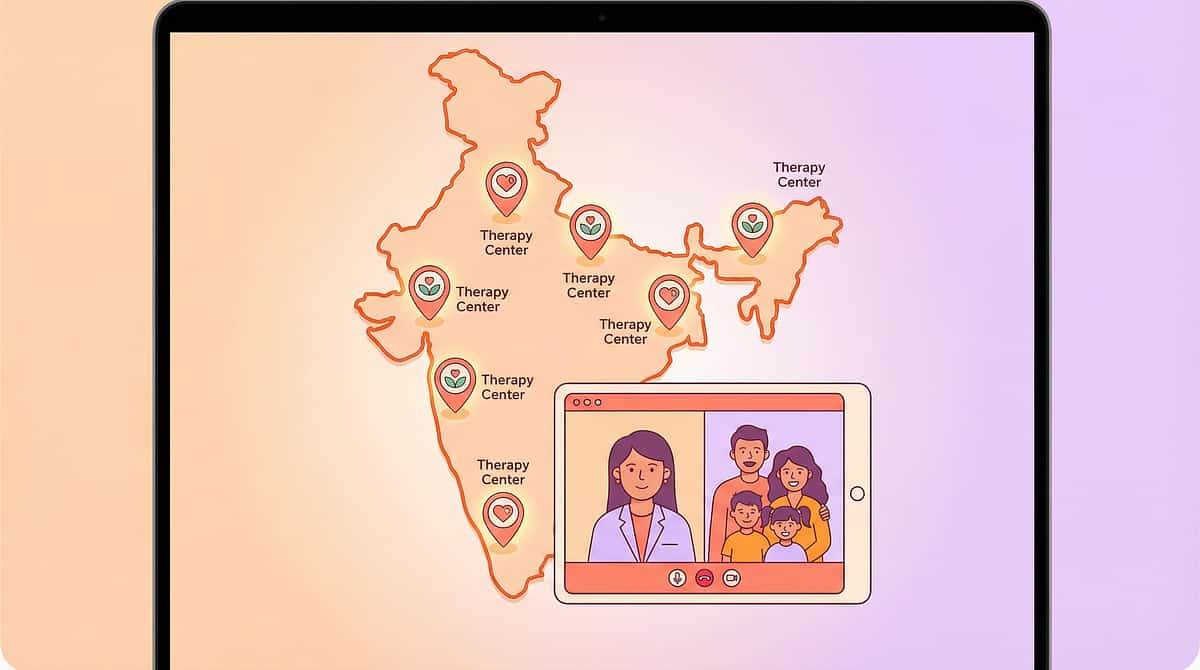
Find a Pinnacle Specialist Near You
70+ centers. One system. Your city. When home tools alone aren't enough — or when you're ready for a professional assessment — the Pinnacle center network is ready for you.
When to Book a Consultation
- Home tools not moving the needle after 8+ weeks
- Professional assessment of anxiety type and severity needed
- School is requesting a formal evaluation or support plan
- Child ready for structured CBT with trained psychologist
- AbilityScore® baseline assessment desired
What Happens at a Pinnacle Center
- AbilityScore® Assessment — all 12 domains
- GPT-OS® diagnostic clarity — anxiety type, severity, co-occurring conditions
- Personalised therapy plan — psychology + OT + ABA
- FusionModule™ multi-disciplinary coordination
- EverydayTherapyProgramme™ — home extension of clinic work
📞9100 181 181 — Tell us your city. We'll find the nearest center. Teleconsultation also available.
OT
SLP
BCBA
Psychology
SpEd
NeuroDev

The Research Library — Every Claim Has a Source
CBT for Childhood Anxiety — Systematic Review
Cognitive-behavioral therapy is the most empirically supported treatment; cognitive restructuring is a core, validated component. PMC3018839
Sensory Integration + Anxiety Intervention (PRISMA, 2024)
16 articles confirm evidence-based status of structured cognitive intervention in ASD anxiety. PMC11506176
Meta-Analysis: Cognitive Coping Outcomes (World J Clin Cases, 2024)
24 studies — cognitive and adaptive behaviour outcomes across structured interventions. PMC10955541
WHO Care for Child Development Package
Equity-focused, caregiver-delivered intervention implemented across 54 LMICs. PMC9978394
Indian RCT — Home-Based Intervention (Indian J Pediatr, 2019)
Home-based parent-administered approaches demonstrate significant outcomes in Indian pediatric population. Padmanabha et al. DOI: 10.1007/s12098-018-2747-4

How GPT-OS® Uses Your Data
Your session data makes therapy smarter — for your child and every child like them. Data is encrypted, anonymised for population analysis, and never shared commercially.
🧠 AbilityScore®
Universal developmental score (0–1000)
🔬 Prognosis Engine
20M+ sessions of pattern data
🤖 TherapeuticAI®
Clinical plan intelligence
🏠 EverydayTherapy™
Home execution layer
🔗 FusionModule™
Multi-disciplinary coordination
Privacy: DPIIT Recognised Startup | ISO/IEC 27001 aligned. Your child's data belongs to your family. 📞9100 181 181 | pinnacleblooms.org/gpt-os

See the Materials in Action
See the tools. Hear the science. Watch the technique being used by real families. Multi-modal learning — visual + text + demonstration — improves parent skill acquisition. Video modeling is classified as an evidence-based practice for autism (NCAEP, 2020).
▶️ C-299 Reel — 9 Materials That Help With Worry Management
Duration: 75–85 seconds | Ages: 5–12 | Series: Emotional Regulation & Mental Health Support
Watch on: pinnacleblooms.org/reels/C-299
The reel shows: Worry Monster being fed worry papers • Worry Journal with prompts visible • Sorting Mat with CAN CONTROL / CAN'T CONTROL • Thought Challenging Cards in a child's hands • Worry Scale being marked • Child's expression shifting from overwhelmed to calm.
C-276
General Anxiety Reel
C-298
Rumination in Children
C-300
Resilience to Anxious Thoughts

Share This With Your Family
Consistency across caregivers multiplies impact by a factor of 4. When grandparents, teachers, and all caregivers use the same language and approach, the child's brain receives a unified, coherent message — and progress accelerates.
Explain to Grandparents
"When [child's name] says 'I'm worried,' instead of reassuring them 100 times — we now say: 'Put it in your worry box. We'll look at it at worry time.' And then we don't talk about it until worry time. This teaches their brain that worry can wait — and that's the skill they're building."
Teacher/School Communication Template
"[Child's name] is working with worry management tools at home — specifically a worry box and thought challenging cards. If they become anxious at school, prompting them to 'rate your worry (0–10)' and asking 'is this a worry that can wait for worry time?' would support the home approach. Please feel free to contact us."
📞9100 181 181 — Ask for a school communication guide in your language. Free. Download Family Guide: pinnacleblooms.org/resources/C-299-family-guide
Preview of 9 materials that help with worry management Therapy Material
Below is a visual preview of 9 materials that help with worry management therapy material. The pages shown help educators, therapists, and caregivers understand the structure and content of the resource before use. Materials should be used under appropriate professional guidance.


Link copied!

✅ Act VI — Frequently Asked Questions
Your Questions, Answered by the Pinnacle Blooms Consortium
📞9100 181 181 — Your question not here? Ask a specialist. Free. Now.
❓ My child says the worry monster is "babyish." What do I do?
Children over 9 often prefer journals or thought challenging cards — more "mature" feeling. Let the child lead. The externalisation principle is valid at any age — the format is flexible.
❓ How long before I see results?
Initial effects typically appear within 2–4 weeks of consistent use. Significant change in worry frequency and intensity often appears by 6–8 weeks. This is skill-building — it requires repetition.
❓ Should I read my child's worry journal?
Only if explicitly invited. Journals are private by therapeutic design. Violating that privacy damages trust and reduces the tool's effectiveness. If you're concerned about safety, speak with a professional.
❓ My child asks the same worry questions over and over. How do I stop the cycle?
Instead of answering, redirect to tools: "That's a worry. Where does it go?" Stay warm, stay consistent. This breaks the reassurance cycle that perpetuates worry. A BCBA can coach you through the transition.
❓ Can these tools be used at school?
Yes. Calm thought cards, thought challenging cards, and worry scales are portable. Work with the teacher to establish a "worry time" equivalent — even a 5-minute slot where concerns are written down rather than discussed mid-class.
❓ What if my child's worry is about something real?
The sorting mat distinguishes real/controllable worries from unlikely/uncontrollable ones. For real threats, problem-solving planners are appropriate. Validating the worry AND using the tool are not mutually exclusive.
❓ Is it safe to do this without a therapist?
For mild to moderate worry, home-based tools with consistent parent application have strong evidence. For moderate-severe presentations (school refusal, 3+ months of impairment), professional assessment is recommended alongside these tools.
❓ Can I use these tools if my child also has ASD/ADHD?
Yes — designed with neurodiversity in mind. Children with ASD often benefit especially from worry monsters (externalisation) and sorting mats (categorisation). Children with ADHD may prefer shorter, active engagement with the sorting mat or scale rather than lengthy journaling.
Your Child's Worry Toolkit Begins Today
Not after the next appointment. Not after the next difficult night. Today. The Pinnacle Blooms Consortium — OT • SLP • BCBA • Pediatric Psychology • SpEd • NeuroDev — has built these tools to be used in real homes, by real parents, right now.
Level I Evidence
Systematic Review + RCT Support
20M+ Sessions
Aggregate outcomes data
97%+ Improvement
Measured across Network
70+ Centers
70+ countries served
📞FREE National Helpline: 9100 181 181 | Available 24×7 | 16+ Languages | No appointment needed | pinnacleblooms.org | care@pinnacleblooms.org
© 2025 Pinnacle Blooms Network®, unit of Bharath Healthcare Laboratories Pvt. Ltd. All rights reserved. CIN: U74999TG2016PTC113063 | DPIIT: DIPP8651 | MSME: TS20F0009606 | GSTIN: 36AAGCB9722P1Z2 | ISO 13485 | ISO/IEC 27001
Medical Disclaimer: This content is educational. It does not replace individualised assessment and intervention planning with licensed mental health professionals. Worry and anxiety treatment should be tailored to the individual child's presentation and needs. Individual results may vary.