

School Readiness — 30 Evidence-Based Interventions for Autistic Children
From preschool preparation to social skills at school — every technique your child needs to thrive. Pinnacle Blooms Network® | Subdomain H1 | 21M+ Sessions
Why School Readiness Matters
School Is the Hardest Thing You Will Ask Your Child to Do
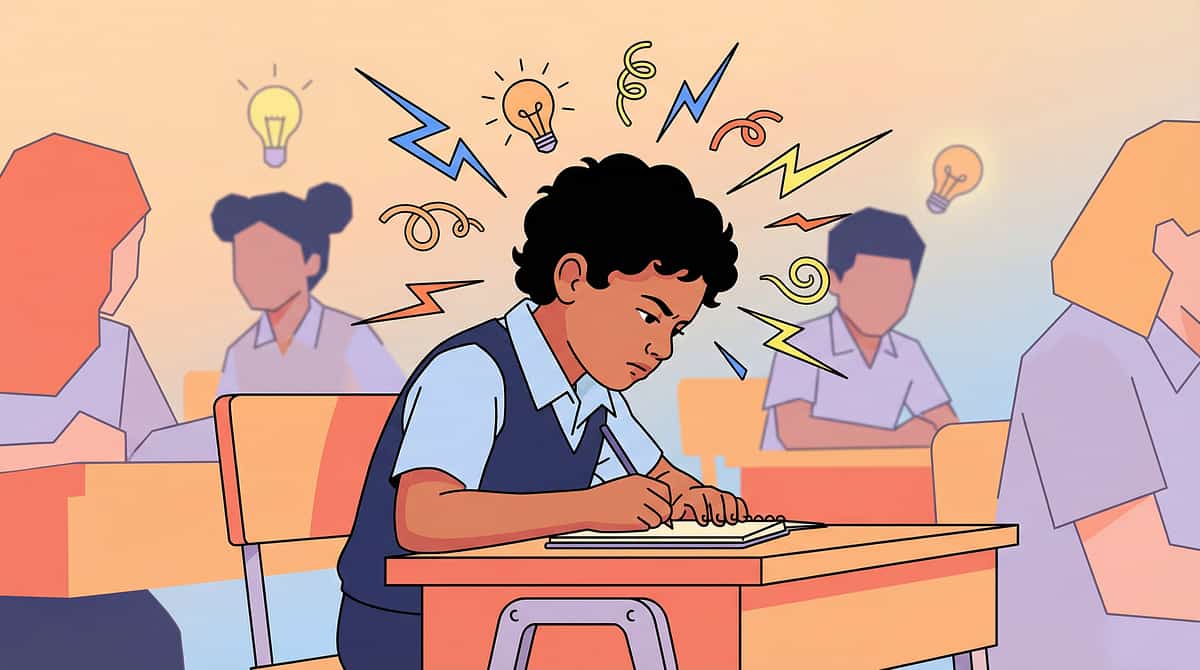
School demands sustained attention for 6–8 hours, sensory regulation in noisy and crowded environments, social communication with peers and teachers, executive function for rules and transitions, motor skills for writing and self-care, and continuous cognitive processing — every ASD challenge activated simultaneously, for the entire school day. No other environment places this much demand on every system at once.
🧠 Executive Function
Managing transitions, multi-step directions, impulse control, and organisation — PFC at maximum load all day.
⚡ Amygdala Alert
Unpredictability, social threat, sensory assault, and performance pressure keep the amygdala at elevated alert continuously.
👁️ Sensory Systems
Fluorescent lights, classroom noise, crowded hallways, cafeteria smells, hard chairs — continuous multi-sensory bombardment.
👥 Social Brain
Reading teacher cues, navigating peer dynamics, understanding unwritten rules — social demand is constant and exhausting.
Section 1 of 4
Entering School — Cards 01–06
Entering School: The First Six Steps
The journey into school begins months before the first day. This section covers the six foundational interventions every autistic child and family needs before and during those critical early weeks — from school selection right through to mastering the daily classroom routine.
H-701 — Preparing for Preschool
3–6 month readiness programme covering school selection, skill-building, and home preparation.
H-702 — First Day Preparation
Pre-exposure strategies to convert novelty into familiarity before day one.
H-703 — Drop-Off Separation
Graduated separation and transition objects to reduce daily gate distress.
H-704 — Circle Time
Seating support and graded participation for the first group activity.
H-705 — Sitting in Chair at School
Seating accommodations and movement breaks for 5–6 hours of sustained posture.
H-706 — Classroom Routines
Visual schedules and explicit routine teaching for predictable, safe school days.
H-701 · Entering School
Preparing for Preschool
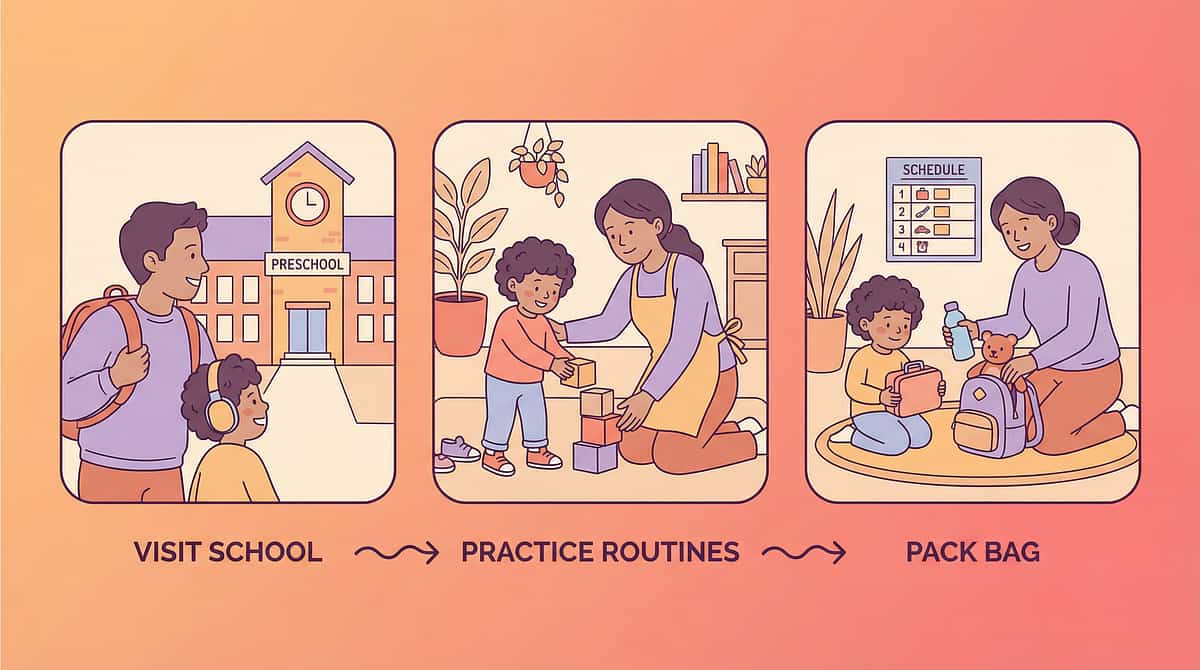
The decision is made — they're going to school. The question isn't if but how. Preschool preparation for an autistic child isn't simply buying a uniform and a tiffin box. It is a 3–6 month systematic readiness programme that builds every system — attention, sitting, communication, self-care, social tolerance, and sensory regulation — to functional level, then practises them together.
School readiness requires multiple neural systems functioning at minimum threshold simultaneously. Preparation means building each system and then rehearsing them in combination. The child who walks in on day one with these foundations is set up for success, not trauma.
- School selection: small class, trained staff, sensory-friendly, inclusive attitude, willing to accommodate
- 3-month plan: visit school multiple times, practise uniform, practise tiffin eating, rehearse school routine at home
- Key readiness skills: sitting 15 min, 2-step directions, communicating needs (toilet, water, help), separating from parent
- School information pack: child's profile, strengths, challenges, triggers, and strategies that work
- Indian context: Anganwadi, Montessori, mainstream, or special school — choosing the right setting matters enormously
📊Level I Evidence — Structured school readiness programmes for ASD. NCAEP 2020 | PMC10955541
9 Canon Materials
Lead: SpEd · ABA · Psychology | OT · SLP · NeuroDev

H-702 · Entering School
First Day Preparation
The day. Social story read ten times. Uniform tried on. Tiffin packed. Visual schedule in the bag. And still — the unknown. First day preparation works by reducing the novelty that triggers anxiety. The more familiar the school environment is before day one, the lower the amygdala activation on day one. Pre-exposure converts novel stimuli into familiar, safe ones.
Pre-Visits (3–5)
Empty classroom → with teacher → with a few children → orientation day. Each visit weakens the novelty-threat response.
Personalised Social Story
"My First Day at School" — built with photos of their actual school, their classroom, their teacher.
Practise the Routine
Wake at school time, dress in uniform, eat breakfast on schedule, practise the drop-off location and route — before day one.
Meet the Teacher
Share the child's profile in advance. This teacher is now a known person, not a stranger, before school begins.
📊Level I Evidence — Transition preparation for ASD. NCAEP 2020
H-703 · Entering School
Drop-Off Separation
The screaming at the gate. Clinging. Crying. Begging not to go. Drop-off separation is a daily crisis for many ASD families — and it can persist for weeks or months. The parent walks away carrying guilt; the child enters school carrying distress. Neither can function at their best.
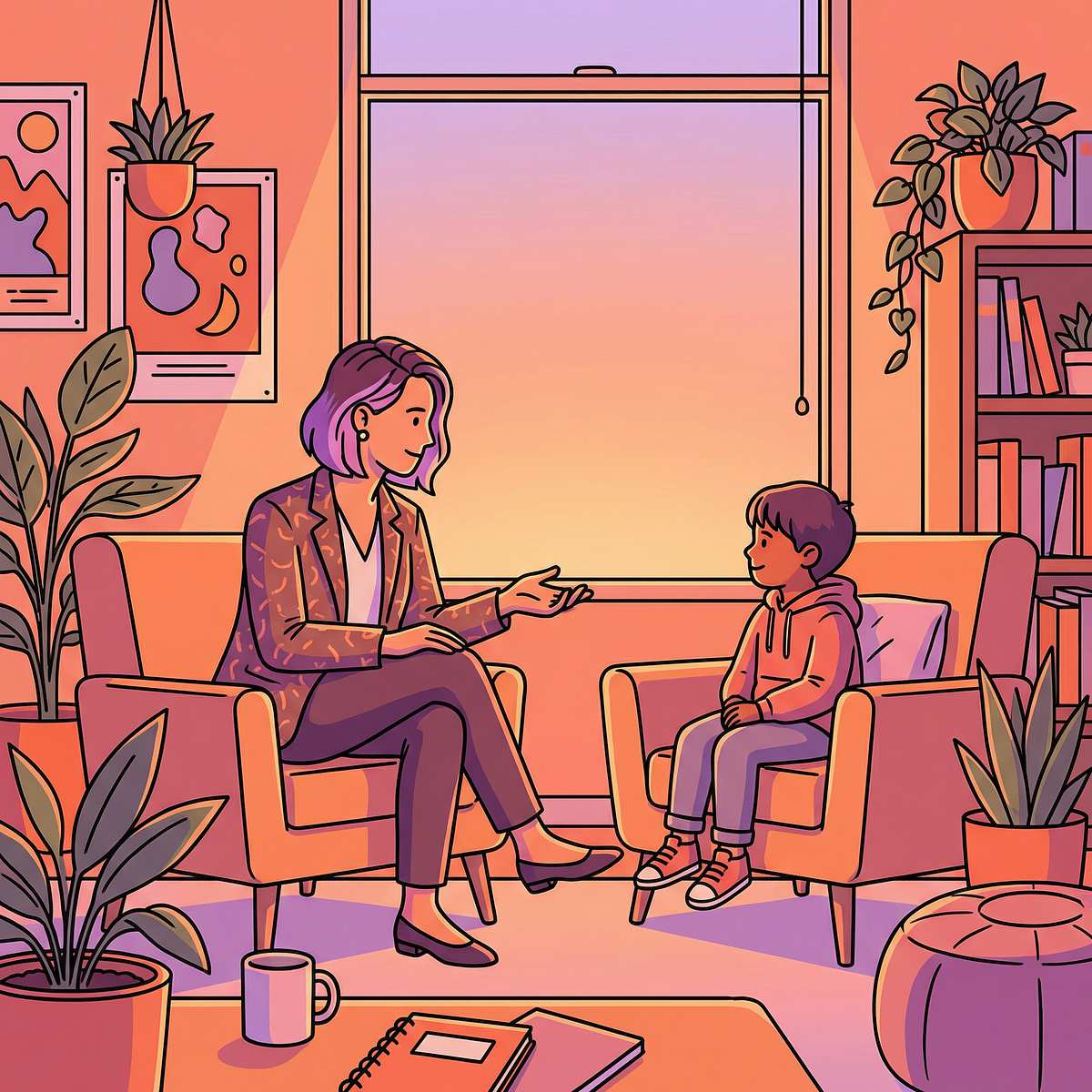
Separation anxiety is an amygdala threat response — the attachment figure is leaving, cortisol surges, panic follows. In autism this is compounded by an inability to understand that parent will return (an abstract time concept), sensory overwhelm without a safe person present, and difficulty expressing distress verbally. The separation must be gradual, and the child must develop trust that the parent always comes back.
⚠️Never sneak away. Always say goodbye. Sneaking teaches the child that a parent disappears unpredictably — and dramatically increases anxiety over time.
Graduated Separation Steps
- Parent in classroom with child
- Parent waits at classroom door
- Parent waits in hallway
- Parent waits in school office
- Parent drops off and leaves
Key Strategies
- Transition object: something from home the child keeps ("Amma's magic stone", a photo, a keychain)
- Consistent script: same words every drop-off — "I love you, I'll pick you up after lunch"
- Visual reassurance: parent photo in the child's pocket
- Social story: "Amma Always Comes Back" — read nightly
📊Level I Evidence — Graduated separation + transition objects. NCAEP 2020

H-704 · Entering School
Circle Time
Sit on the floor. In a circle. With 20 children. Listen to the teacher. Raise your hand. Sing a song. Wait your turn. Circle time is the first group activity — and it simultaneously demands sitting tolerance, social awareness, auditory attention, turn-taking, and impulse control. Every sensory and social channel is engaged at once.
Seating Support
Sit on a defined cushion or mat that marks personal space clearly. Positioning near the teacher improves attention; sitting at the edge reduces sensory crowding from nearby peers.
Build Sitting Duration
Practise circle sitting at home — start at 2 minutes and gradually extend. The goal is reaching the classroom duration before school begins, so it feels achievable, not overwhelming.
Grade Participation
Present but not participating → participating with a prompt → independent participation. Never demand full participation immediately — earned comfort builds genuine engagement.
📊Level I Evidence — Group participation skills. NCAEP 2020
H-706 · Entering School
Classroom Routines
Enter class. Bag on hook. Sit down. Take out books. Morning work. Circle time. Snack. Lunch. Pack up. Go home. School runs on routine — and routine is an ASD strength when it is explicitly learned. The problem is that school routines are rarely taught step-by-step; they are assumed. For autistic children, every routine must be taught deliberately, then maintained consistently.
Once learned, routines are processed by the basal ganglia — running automatically without PFC effort, freeing the brain to focus on learning. Predictable routines reduce anxiety, smooth transitions between activities, and dramatically reduce behavioural challenges. Routine disruptions are the number-one school behaviour trigger.
The visual classroom schedule — posted on the wall and as a personal desk strip — is the single most impactful classroom accommodation available. Transition warnings ("5 minutes until circle time") with a visual timer allow the child to mentally prepare rather than be abruptly interrupted.
📊Level I Evidence — Visual schedules + structured routines. NCAEP 2020
Section 2 of 4
School Challenges — Cards 07–14
School Challenges: When the Day Gets Hard
Even with thorough preparation, school presents ongoing daily challenges. This section covers the eight most significant challenge areas — from group participation and meltdowns to school refusal and the cafeteria. Each technique maps neuroscience to practical, evidence-based strategy.
1
H-707
Group Participation
2
H-708
School Meltdowns
3
H-709
After-School Exhaustion
4
H-710
School Refusal
5
H-711
School Transitions
6
H-712
Unstructured Time
7
H-713
Recess Challenges
8
H-714
Lunch Challenges
H-707 · School Challenges
Group Participation
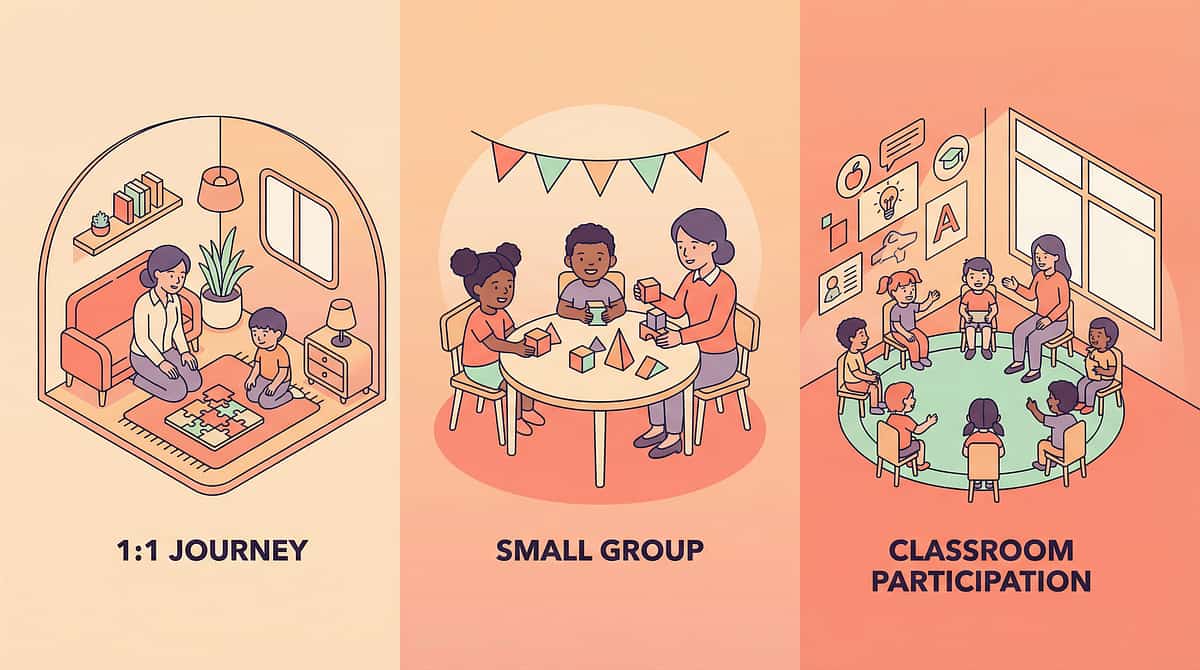
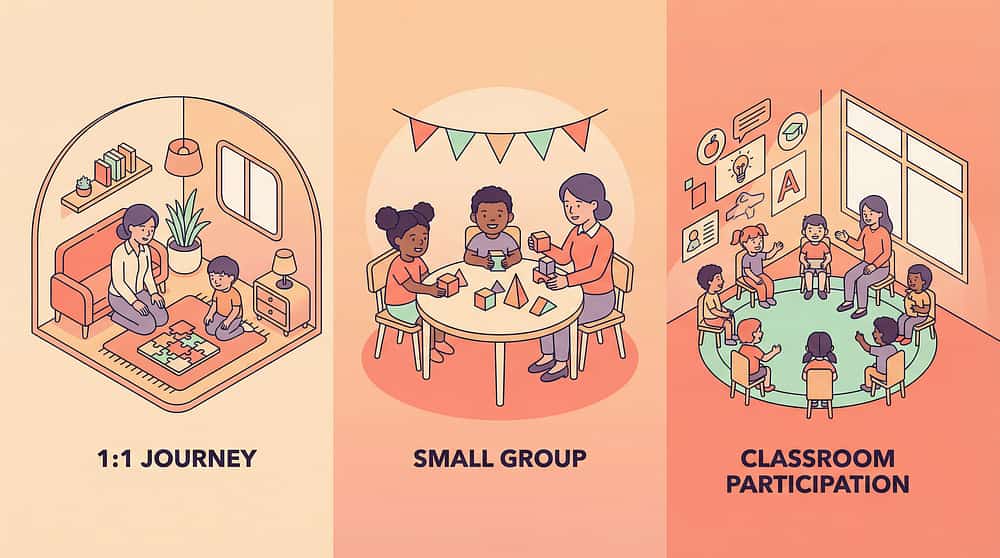
School is a group environment — group instruction, group activities, group transitions, group games. The child must process their own learning while simultaneously managing social awareness of 20 to 40 other humans. The cognitive load of group learning is exponentially higher than 1:1 instruction, and it is the default mode of every classroom.
1:1 Mastery First
Establish skill in an individual setting before expecting group performance. The skill must be solid before the social load is added.
Small Group (2–3)
Introduce the skill in a minimal-peer setting. Proximity to peers is gradually normalised without the full sensory and social load of the classroom.
Larger Group
Expand participation with continued support. Preferential seating near the teacher, away from windows, with a clearly defined personal space reduces sensory and social overwhelm.
Full Class
Independent participation in the mainstream classroom — supported by visual cues, a break card, and faded aide support as skills consolidate.
📊Level I Evidence — Small group → large group progression. NCAEP 2020
H-708 · School Challenges
School Meltdowns
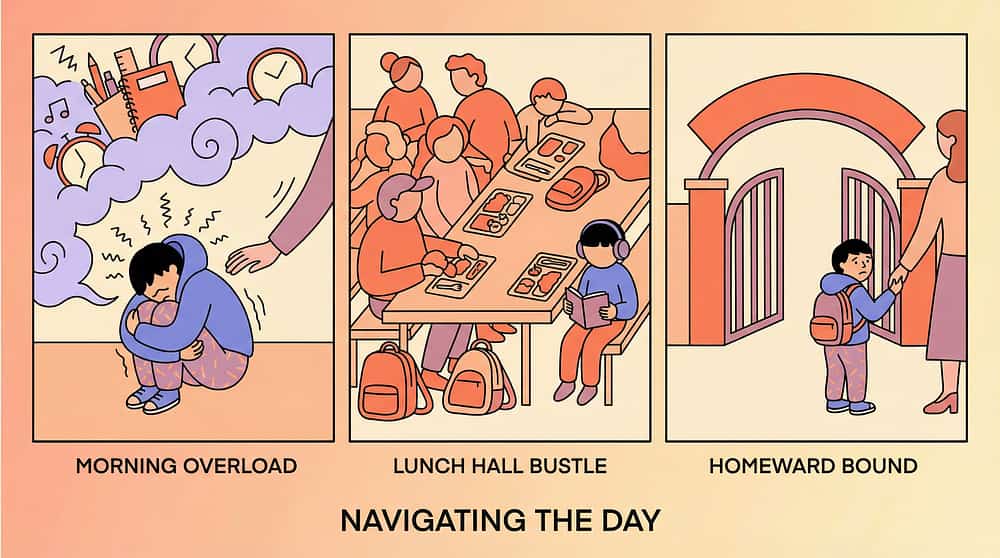
A meltdown at school — in front of everyone. The teacher is frightened. The children are staring. The principal is called. Parents receive the phone call. School meltdowns are the number-one reason autistic children lose placements. They are not behavioural — they are neurological overload.
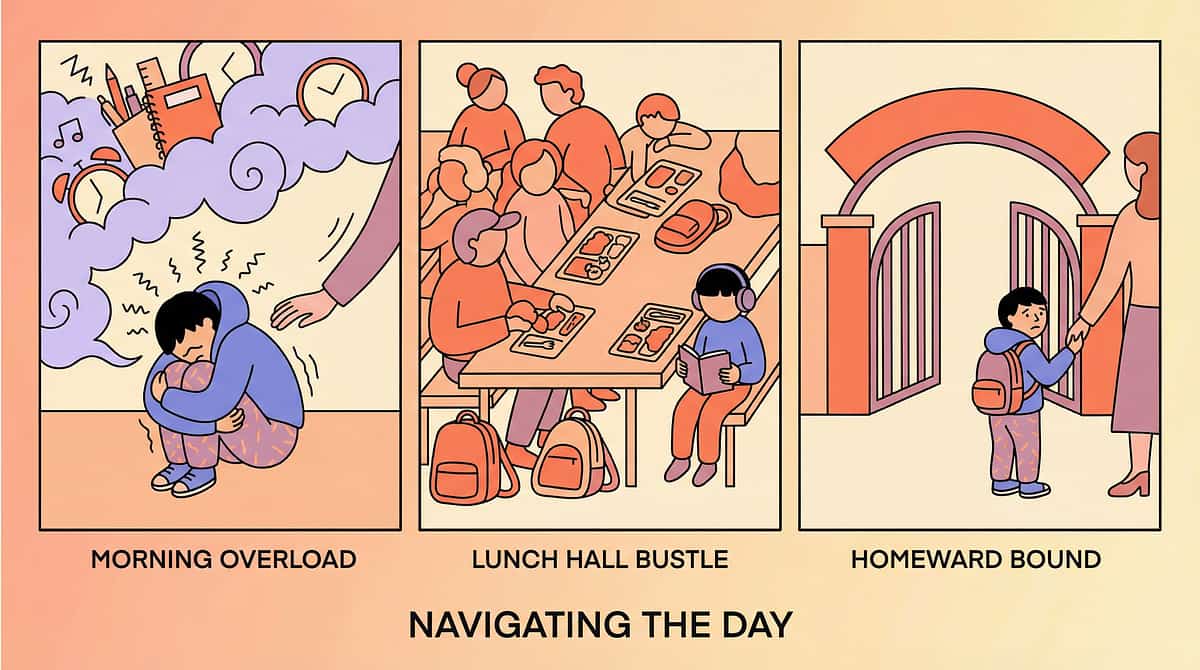
The meltdown has been building all morning. The child was "holding it together" — masking enormous sensory, social, cognitive, and emotional load. The trigger that finally "caused" the meltdown was the last straw, not the cause. Understanding this changes everything about how schools and families respond.
⚠️ Restraint or seclusion is never appropriate for an ASD meltdown. Both are traumatic and counterproductive — they increase, not decrease, future meltdown risk.
Prevention First
- Identify triggers via sensory audit and schedule pinch points
- Teach child and teacher to recognise escalation on a 1–5 scale
- Break card: immediate access to calm-down space, no questions asked
- Designated calm-down space in school — quiet, sensory-friendly, accessible
During a Meltdown
Safety only. No talking, no consequences, no audience. Remove other children calmly. Wait.
After Recovery
Recovery time, not punishment. Analyse what escalated. Adjust the prevention plan accordingly. The goal is fewer meltdowns next week, not consequences for today's.
📊Level I Evidence — Prevention-based meltdown management. NCAEP 2020

H-712 · School Challenges
Unstructured Time
The teacher says "free time" — and the child freezes. Structured activities have rules. Unstructured time has none — and that is genuinely frightening. What do I do? Where do I go? Who do I talk to? Unstructured periods — recess, free period, before and after school — are when autistic children are most vulnerable to anxiety, social isolation, and bullying.
Structured Choice
Offer 2–3 specific options for free time rather than unlimited open choice. Constraint is supportive, not restrictive — it provides the scaffolding the brain needs.
Activity Menu Card
A visual list of "things I can do during free time" — kept in the child's pocket or on the desk. The decision is already made; the child simply follows the menu.
Buddy System
A designated, trained, kind peer who is with the child during unstructured periods. Structure through relationship when environmental structure is absent.
Quiet Space Access
Library or resource room access during recess when the sensory-social load is too high. This is a valid accommodation, not avoidance.
📊Level I Evidence — Structured choice during unstructured time. NCAEP 2020
H-713 · School Challenges
Recess Challenges
Recess is the social arena of school. For neurotypical children: freedom, fun, friendship. For many autistic children: the most stressful part of the day. Maximum sensory input, maximum social demand, zero adult structure — the precise opposite of what the autistic brain needs to thrive. The child standing alone at the edge of the playground is not indifferent to friendship. The social entry system is simply invisible to them.
Structured Recess Options
Adult-organised game, buddy walk, library access, or small-group activity room. At least one structured option should always be available alongside free play.
Peer Buddy Programme
A trained, kind peer who actively includes the child. Pre-teach one social entry phrase — "Can I play?" — to give the child a concrete, usable tool.
Sensory Preparation
Brief heavy work before recess — wall push-ups, carrying books — calms the nervous system before the sensory onslaught of the playground begins.
📊Level I Evidence — Structured recess + social facilitation. NCAEP 2020

H-714 · School Challenges
Lunch Challenges
The school cafeteria: loud, smelly, and crowded. Opening the tiffin box, eating familiar food while peers watch, cleaning up, and transitioning back — all within a 20-minute window. Lunch combines feeding challenges, sensory overwhelm, social demand, and self-care skills simultaneously. Many autistic children do not eat at school at all, returning home famished — which directly fuels after-school meltdowns (H-709).
The cafeteria hits every sensory channel: olfactory assault from other children's food, auditory overload at 75–85 dB, crowded table proximity, feeding motor demands under time pressure, and impaired interoception (hunger and fullness signals dampened by stress). Lunch accommodation is not a luxury — it is essential for afternoon functioning.
Key Accommodations
- Quiet eating space option — separate from the main cafeteria when needed
- Familiar food only in tiffin — lunchtime is never the moment to introduce new foods
- Easy-open containers — practise at home before expecting success under time pressure
- Seat near a preferred peer, or alone if the social load is too high
- Child helps pack their own tiffin — ownership builds familiarity with what's inside
📊Level I Evidence — Lunchtime accommodation. NCAEP 2020
Section 3 of 4
School Environment — Cards 15–22
The School Environment: Making Every Space Work
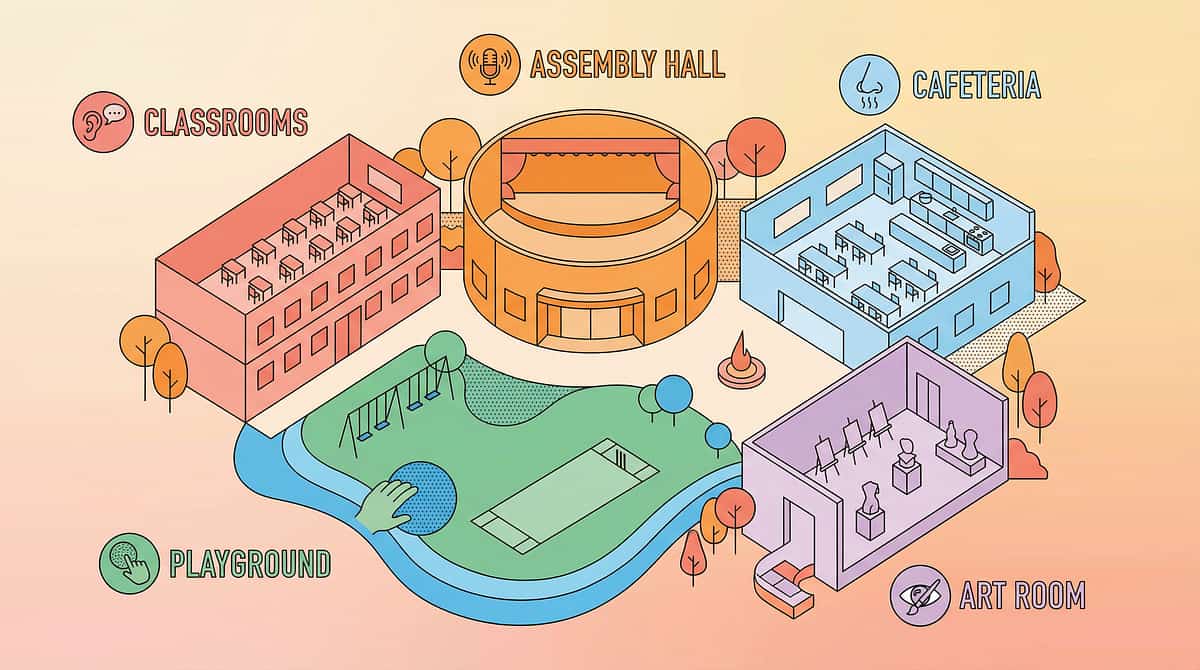
The school building contains dozens of distinct environments — each with its own sensory profile, social demands, and routine expectations. This section covers the eight school environment interventions, from special classes and assembly through to the desk, backpack, and every physical system the child navigates daily.
H-715
Special Classes
H-716
Assembly Overwhelm
H-717
Field Trip Prep
H-718
Substitute Teachers
H-719
School Sensory Needs
H-720
Classroom Visuals
H-721
Desk Organisation
H-722
Backpack Organisation

H-715 · School Environment
Special Classes
Art. Music. PE. Library. Computer lab. Every special class brings a different teacher, a different room, different rules, and different expectations. For some children, special classes are the highlight of the week — preferred activities in novel environments. For others, they are a source of dread: unpredictable, sensorily different, with an unfamiliar authority figure and an unknown routine.
Art Class
Texture-sensitive children may resist art materials. Offer adapted materials (brushes instead of hands, gloves available). Pre-visit the art room; show what it looks and smells like before attending.
Music Class
The music room can be extremely loud. Noise-cancelling headphones or earplugs are valid accommodations. Prepare the child for instruments, singing, and the reverberant acoustics before first attendance.
PE Class
Modified participation is entirely valid. Motor planning, proprioceptive differences, and fear of failure in a performance context all affect PE. Adapted activities build confidence before full participation.
Computer Lab
Many autistic children excel in computer sessions. Use this as a motivating context. Prepare for the different seating arrangement, peer proximity, and the noise of multiple keyboards and monitors.
📊Level I Evidence — Transition support for varied environments. NCAEP 2020
H-716 · School Environment
Assembly Overwhelm
The Sensory Reality
500 children in a hall. Loudspeakers. Clapping. Standing for 30 minutes. The national anthem. Announcements. Assembly is the maximum sensory load event in the school day — and in many Indian schools, it happens every single morning.
Every sensory channel is at maximum simultaneously: auditory overload from amplified sound and 500 voices, visual overload from crowd movement, proprioceptive discomfort from standing on a hard floor, and social demand from maintaining line behaviour for extended duration. The child who manages classroom sensory input adequately may completely decompensate in assembly — and this is entirely predictable from their sensory profile.
Graduated Exposure Strategy
- Start outside: Child attends the last 5 minutes only, standing at the back near the exit — build duration over weeks
- Noise-cancelling headphones: A valid, non-stigmatising accommodation — normalise their use from day one
- Designated position: Same spot every day — edge of line, near exit, next to a known adult
- Fidget tool: Something to hold during standing — reduces proprioceptive discomfort and provides sensory anchor
- Exit plan: Child knows they can leave with a trusted adult if overwhelmed — having the option reduces anxiety even when unused
- Indian context: Morning prayer and national anthem are non-negotiable in most schools — work with the school on position and sensory accommodations rather than exemption
📊Level I Evidence — Sensory accommodation for large group events. NCAEP 2020 | PMC10955541
9 Canon Materials
Lead: SpEd · OT · SLP | ABA · Psychology · NeuroDev
H-722 · School Environment
Backpack Organisation
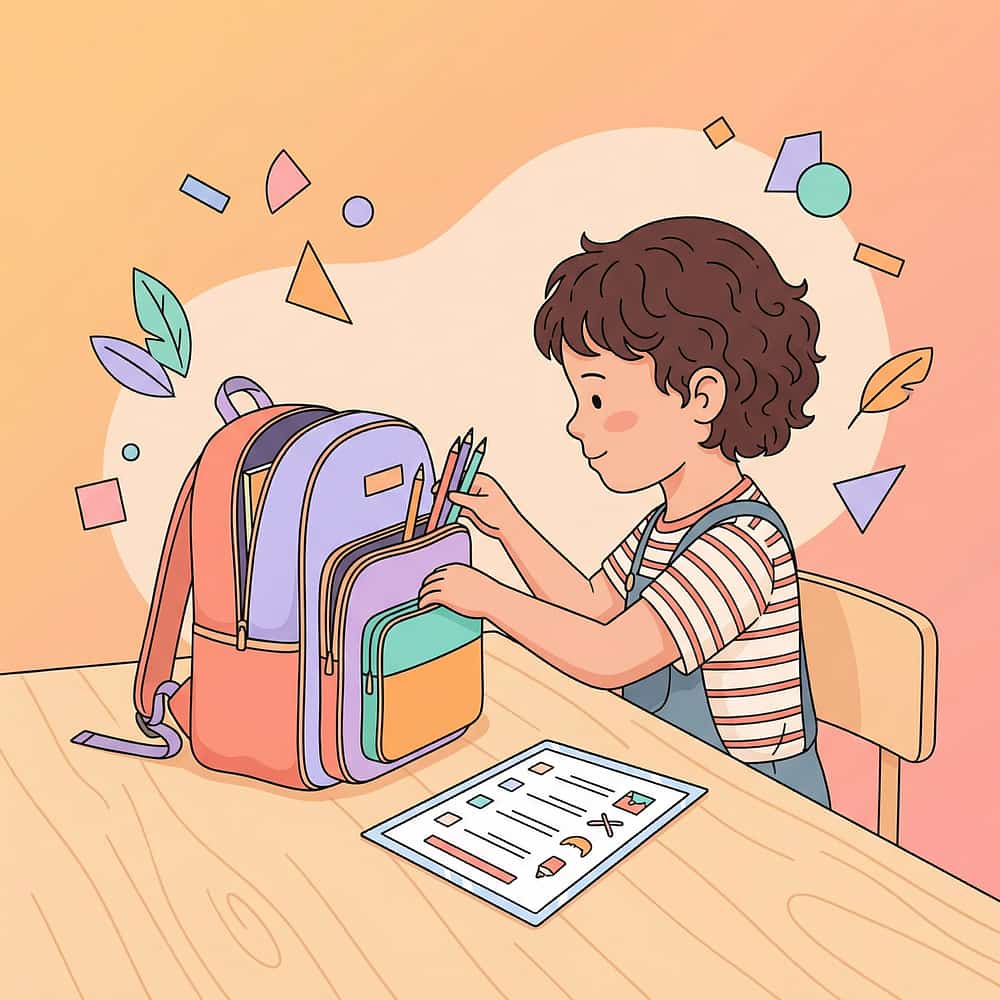
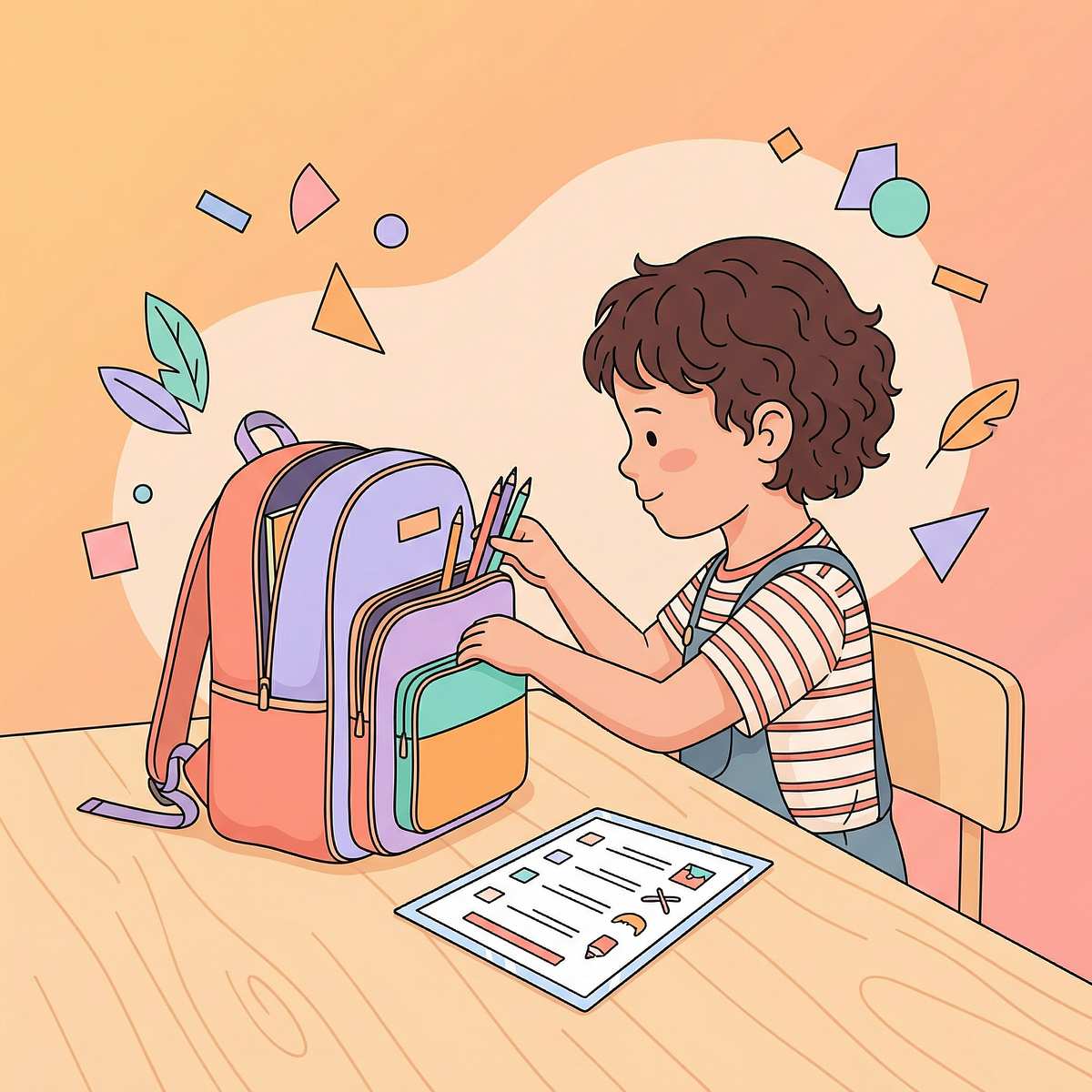
The backpack is the child's portable world — and for many autistic children, it is a daily source of anxiety. What's in it? Where is it? Did I pack everything? The backpack that is disorganised, overstuffed, or unpredictable becomes a trigger before the school day even begins. Backpack organisation is not a minor life skill — it is a daily regulation tool that reduces cognitive load at the most vulnerable moments: morning departure and school arrival.
The autistic brain under stress cannot simultaneously manage emotional regulation AND locate a missing homework book. Reducing the organisational demand frees executive resources for the harder work of being at school. A predictable, consistent backpack system — packed the same way, every day — becomes an anchor of certainty in an uncertain environment.
Key strategies
- Fixed zones: Every item has a designated pocket — water bottle always left side, tiffin always main compartment, books always in order
- Visual packing checklist: Laminated card inside the bag lid — child checks off each item before closing
- Pack the night before: Morning is too dysregulated for reliable packing — evening packing is calmer and more accurate
- Colour-coded folders: Each subject a different colour — reduces visual search time and decision fatigue
- Minimal contents: Only what is needed for that day — reduce the cognitive map required to navigate the bag
- Indian context: Heavy school bags are a known stressor — advocate for locker use or subject-specific days where possible
📊Level I Evidence — Executive function supports for school organisation. NCAEP 2020 | PMC10955541
9 Canon Materials
Lead: SpEd · OT · ABA | Psychology · SLP · NeuroDev
Section 4 of 4
School Support Systems — Cards 23–30
School Support Systems: Building Your Child's Team
School success for an autistic child is never achieved alone. Behind every child who thrives is a coordinated team — teachers who understand, parents who advocate, therapists who translate, and systems that flex. This final section covers the eight support system interventions: from teacher communication and IEP planning to peer relationships, homework support, and the critical transition to a new school year.
H-723
Teacher Communication
H-724
IEP / Support Planning
H-725
Peer Relationships
H-726
Homework Challenges
H-727
Parent–School Partnership
H-728
Therapist–School Coordination
H-729
New School Year Transition
H-730
Long-Term School Success
H-723 · School Support Systems
Teacher Communication
The teacher is the most powerful person in your child's school day. A teacher who understands autism — who knows your child's triggers, strengths, and communication style — transforms the school experience. A teacher who doesn't can inadvertently cause daily harm. Teacher communication is not a one-time meeting. It is an ongoing, structured relationship built on mutual respect, shared language, and regular information exchange.
Most teachers in India have received little or no autism-specific training. They are not failing your child out of indifference — they are working without a map. Your job as a parent is to become the map. Provide clear, practical, written information. Celebrate what works. Solve problems collaboratively. Build the relationship before a crisis, not during one.
What to Share With the Teacher
- Child profile document: One-page summary of strengths, challenges, triggers, and what helps — given at the start of every year
- Communication log: Brief daily or weekly written exchange — what happened at school, what happened at home
- Preferred communication channel: WhatsApp message, notebook, or brief end-of-day verbal check-in — agree on one system
- Early warning signs: What does the child look like when they are about to struggle? Teacher needs to know before the meltdown
- What NOT to do: Equally important — the well-meaning responses that make things worse (e.g., forcing eye contact, public correction)
📊Level I Evidence — Parent–teacher collaboration for ASD. NCAEP 2020 | PMC10955541
The Neuroscience
The autistic child's nervous system is exquisitely sensitive to the emotional tone of authority figures. A calm, predictable, understanding teacher activates the social engagement system (ventral vagal). A frustrated, unpredictable, or punitive teacher activates the threat response — and a child in threat response cannot learn, socialise, or regulate. Teacher understanding is not a soft skill. It is a neurological prerequisite for school functioning.
Indian Context
In Indian schools, the class teacher changes every year — sometimes mid-year. Build the communication system so it is transferable: a written child profile that can be handed to any new teacher, a school-level understanding (not just one teacher), and a relationship with the school coordinator or principal who provides continuity across teacher changes.
📊Level I Evidence — Teacher training and collaboration. NCAEP 2020
Preview of school readiness Therapy Material
Below is a visual preview of school readiness therapy material. The pages shown help educators, therapists, and caregivers understand the structure and content of the resource before use. Materials should be used under appropriate professional guidance.
Link copied!
H-724 · School Support Systems
IEP / Support Planning
An Individualised Education Plan is the most powerful document in your child's school life. It is a legally binding (in many jurisdictions) or formally agreed written plan that specifies your child's needs, goals, accommodations, and the support the school will provide. In India, the Rights of Persons with Disabilities Act 2016 mandates inclusive education and reasonable accommodation — the IEP is the mechanism through which this becomes real, specific, and accountable.
Most parents receive an IEP as a document to sign, not a plan to co-create. This is wrong. You are the expert on your child. The IEP meeting is the one moment in the year when every professional sits at the same table — and your voice is the most important one in the room.
What a Strong IEP Contains
- Present levels: Honest, specific description of current functioning across academic, social, communication, and self-care domains
- Measurable goals: Not "will improve communication" but "will use 2-word requests to communicate needs in 4 out of 5 opportunities"
- Accommodations: Extended time, preferential seating, visual supports, reduced homework load, sensory breaks — written in, not verbal promises
- Support services: OT, SLP, shadow teacher, resource room — frequency, duration, and provider specified
- Review schedule: Goals reviewed termly — not annually — with data, not impressions
- Indian context: Under RPwD 2016, every child with a disability is entitled to reasonable accommodation in mainstream schools — know your rights before the meeting
📊Level I Evidence — Individualised planning for ASD outcomes. NCAEP 2020 | RPwD Act 2016 | PMC10955541
9 Canon Materials
Lead: SpEd · Psychology · ABA | OT · SLP · NeuroDev