
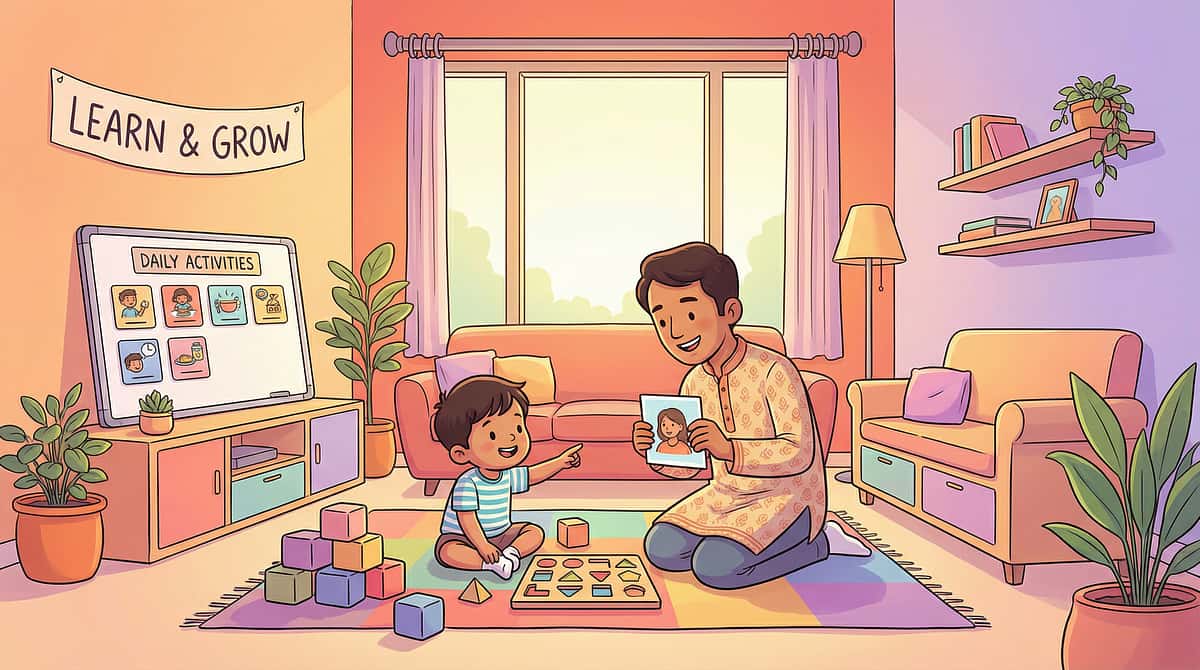
Therapy Strategies at Home
40 Evidence-Based Strategies for Parent-Implemented Therapy — Your home is the most powerful therapy centre in the world. This is the technical manual: every strategy professional therapists use, simplified, demystified, and placed in your hands.
Subdomain L1
Domain L: Home Therapy Toolkit
Pinnacle Blooms Network®

Why Home-Based Therapy Works
The neuroscience is clear: your home delivers more therapy dosage, better generalisation, and stronger learning than any clinic. Here's why.
⏱ Frequency Beats Intensity
2 clinic hours/week vs. 30+ embedded practice hours/week at home. The brain learns through repetition — more trials = faster neural pathway formation.
🏠 Natural Generalisation
Skills learned AT HOME, during REAL activities, with REAL people, are already generalised. No transfer needed — the basal ganglia encodes the skill in the context where it's used.
💡 Built-In Motivation
Natural reinforcers at home are MORE powerful: the child asks for juice and gets juice. Real-life outcomes beat tokens and stickers every time.
❤️ Relationship-Based Learning
Mirror neurons fire stronger with trusted caregivers than with therapists. Your face, voice, and responses carry maximum neural weight.
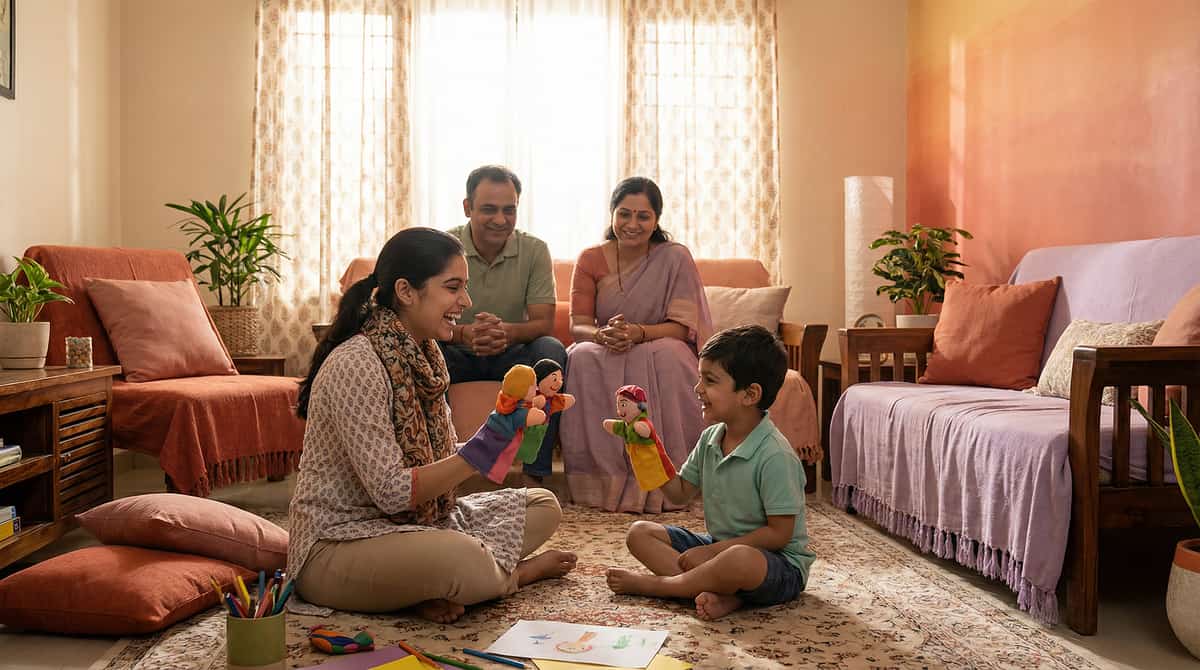
The Parent-as-Therapist Equation
You Are Not Replacing the Therapist — You're Multiplying Their Impact
The Therapist's Role
- Assesses and diagnoses
- Designs intervention programmes
- Teaches new skills
- Adjusts complex clinical decisions
- Coaches the parent
The Parent's Role
- Practices what the therapist teaches
- Creates opportunities for skill use
- Provides the daily REPETITION
- Embeds learning into every routine
- Delivers 700–1,750 practice trials/week
Different roles. Both essential. WHO Caregiver Skills Training (CST) evidence: trained parents produce outcomes equal to professional-delivered therapy for core targets.
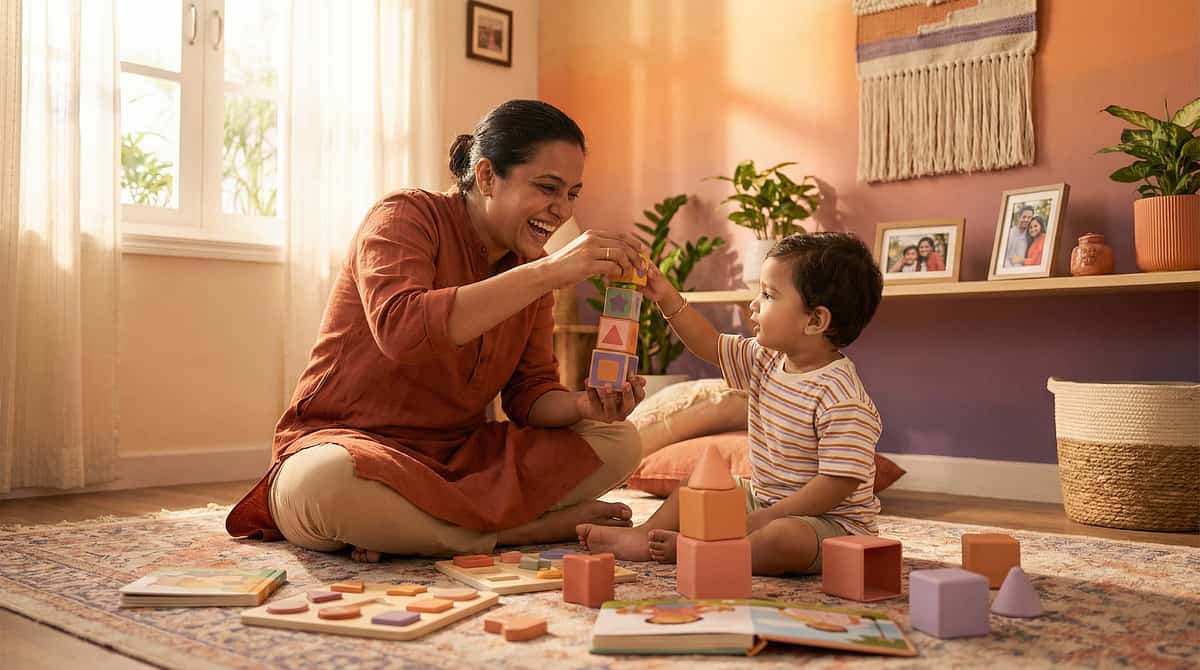
Section 1 of 4
Cards 1–7
The bedrock of everything. Before you learn any specific technique, these seven cards establish the philosophy, the neuroscience, and the mindset that make home therapy work.
L-921 + L-922 | Teaching Foundations
Early Intervention & Parent-Implemented Therapy
The foundational pair. Early intervention leverages peak neuroplasticity — synaptic density peaks at age 2–3, and the brain prunes connections based on USE. Every month of early action strengthens the right synapses before pruning removes them. Parent-implemented therapy delivers the DOSAGE that makes those early months count: 700–1,750 practice trials per week vs. 200 from clinic sessions alone.
Early Intervention
Start NOW — whatever age your child is. The next best time is today. Focus on communication, social engagement, and play as first targets. The window doesn't close completely — but early leverage is enormous.
Evidence level: Level I — NCAEP 2020 | WHO CST | Lancet series | PMC10955541
Parent-Implemented Therapy
You don't need a degree — you need training + practice + support. Pinnacle Blooms therapists train you, you implement at home, therapists coach you through challenges. WHO CST evidence confirms: trained parents produce outcomes equal to professional-delivered therapy.

L-923 + L-924 | Teaching Foundations
Naturalistic Teaching & Incidental Teaching
The teaching philosophy. Naturalistic Developmental Behavioural Interventions (NDBI) show that the brain learns fastest when the child is motivated, the context is meaningful, reinforcement is natural, and learning is embedded in real life. Dinner isn't dinner — it's a communication, motor, social, and sensory learning opportunity.
Naturalistic Teaching (L-923)
Follow the child's LEAD — observe what they're interested in, then teach WITHIN that interest. Use natural reinforcers. Embed teaching in routines: bath (body parts, requesting, sensory), meal (requesting, choosing, self-help), play (turn-taking, language, social).
Incidental Teaching (L-924)
Arrange the environment so the child NEEDS to communicate or act to get what they want. Put the favourite toy in sight but out of reach → the child must REQUEST → you respond → they learn: communication works. NDBI produces the same outcomes as structured ABA with higher generalisation and higher family satisfaction.
L-925 | Teaching Foundations
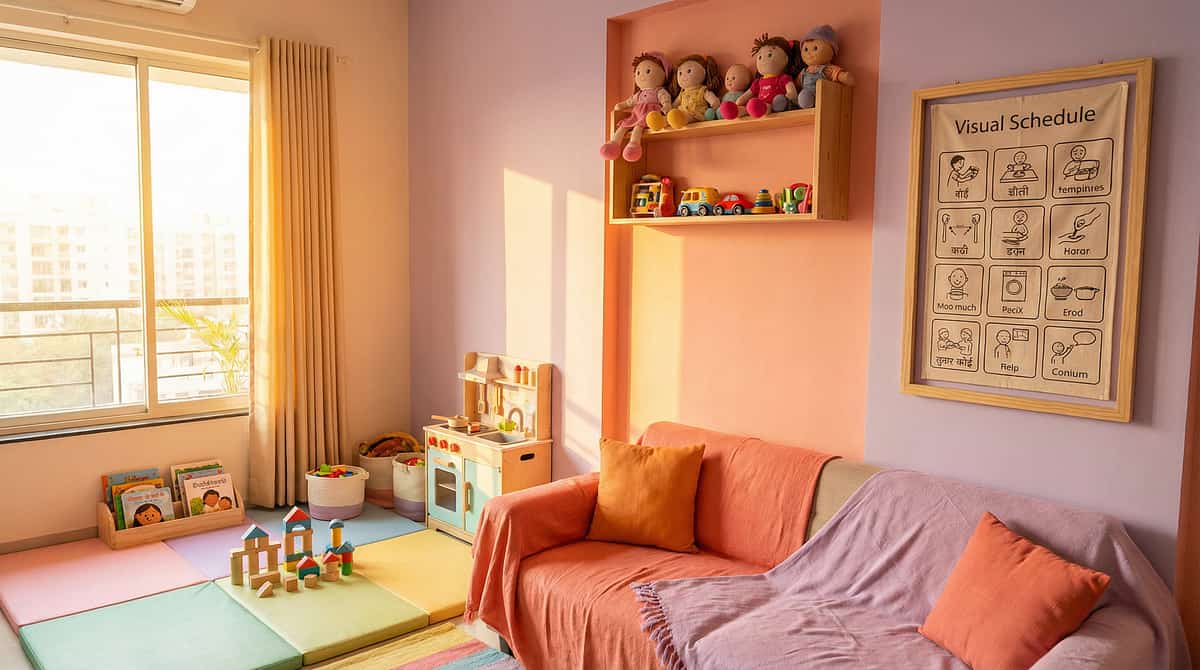
Environmental Setup — The Silent Therapist
Before you teach a single skill, arrange the environment so that learning happens naturally. The basal ganglia responds to environmental cues — when the environment consistently presents the same cues (visual schedule on the wall, shoes by the door, snack at the table), the brain automates the response. The environment does the prompting, reducing demand on both parent and child.
Preferred Items in Sight
Place desired items visible but out of reach to create natural communication opportunities. The child SEES the item → wants it → MUST communicate to get it.
Defined Spaces
Clearly defined play area, work area, and eating area provide spatial cues for behaviour. Reduced visual clutter = more focus and less distraction.
Organised Materials
Materials in labelled containers allow independent access and return. Visual supports posted at point of use — schedule by the door, rules at the table.
Indian Home Tip: Small apartment strategies, balcony as sensory space, joint family shared spaces — every home can be engineered for learning, regardless of size or budget.

L-926 | Teaching Foundations
Communication Temptations — The Most Powerful Naturalistic Strategy
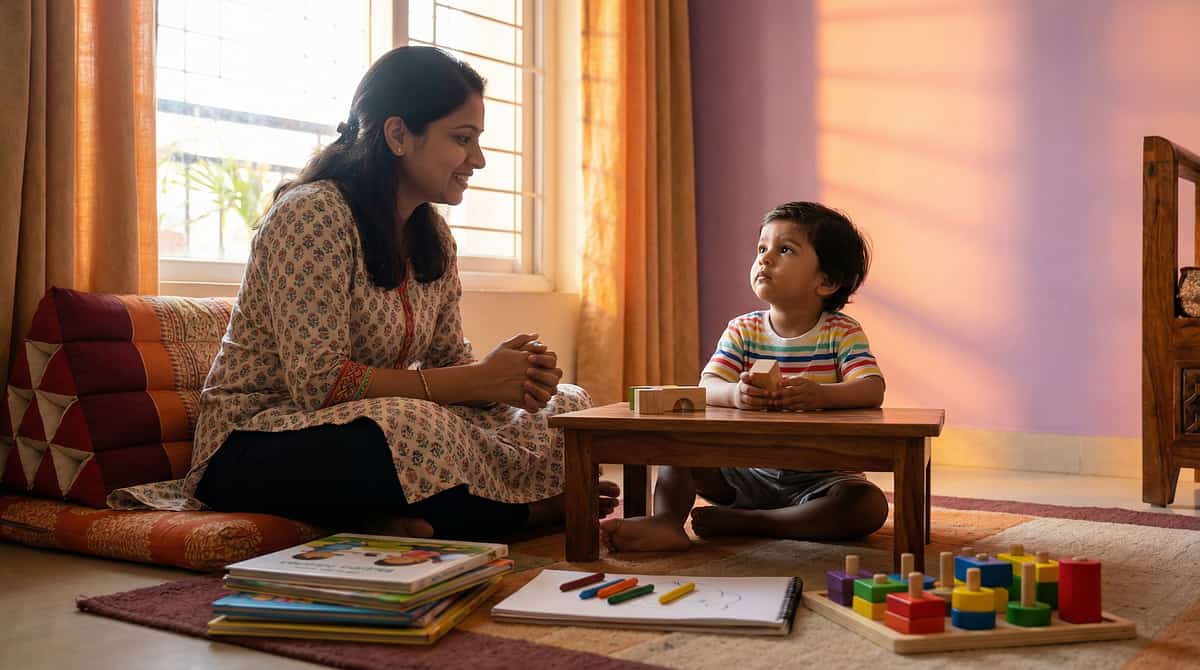
Deliberately arrange the environment so the child is motivated to communicate. Put the biscuit in a clear container they can't open. Give juice without a straw. Start a favourite game and PAUSE. The child WANTS something → they MUST communicate → you RESPOND → they learn: communication works.
The child SEES the desired item → dopamine anticipation → the brain is primed for effortful behaviour. When communication succeeds → reward received → dopamine reinforcement → communication pathway strengthened. This is the brain's natural learning system — consciously harnessed for therapy.
Sabotage
Give cereal without spoon, chapati without dal
Incomplete
Start puzzle, hold back pieces
Out of Reach
Favourite toy on high shelf — visible, not accessible
Inadequate Portion
Give 1 chip — they want more
Pause
Blow bubbles → stop → WAIT for request
Key Rule: ALWAYS honour the communication attempt — even an imperfect approximation is sufficient initially. Never withhold the item after a genuine attempt.
L-927 | Teaching Foundations
Wait Time — The Hardest Parent Skill
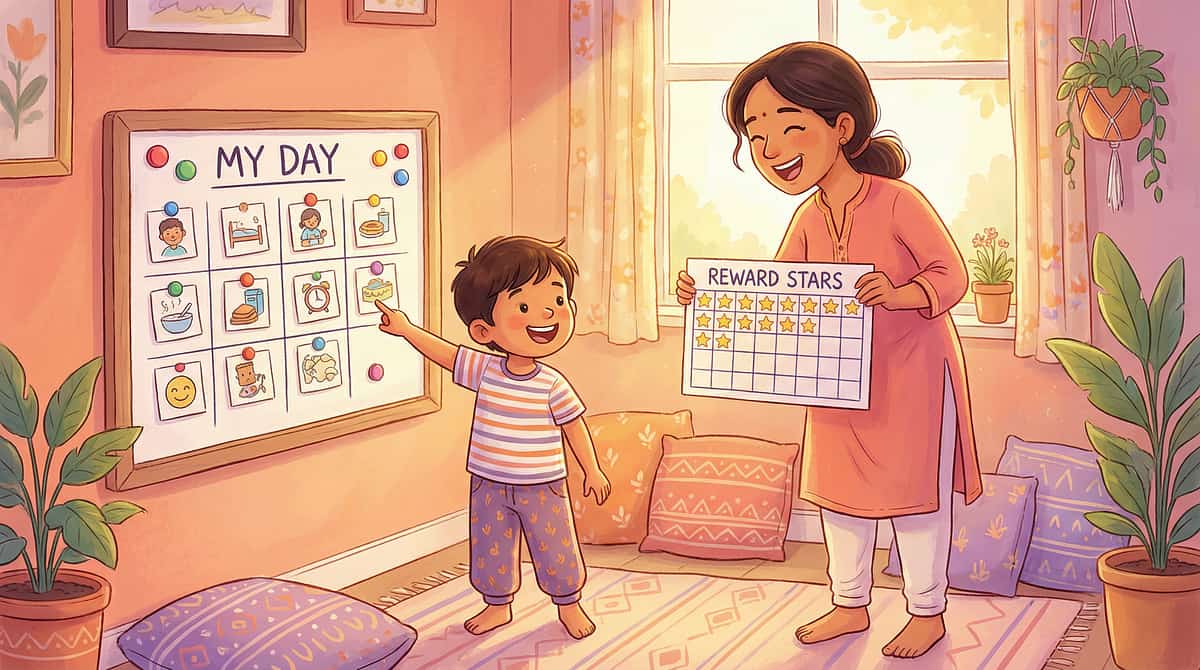
After asking a question, after presenting a temptation, after giving an instruction — WAIT. Count silently to 10. The child needs processing time. Most parents jump in after 2 seconds with a repeat, a prompt, or by doing it for the child. Every time you jump in, you steal the child's learning opportunity.
The Neuroscience
Auditory input travels: auditory cortex → Wernicke's area (comprehension) → PFC (formulation) → Broca's area (production) → motor cortex. This pathway takes longer in ASD — not because it's broken, but because processing speed is slower. Giving TIME is giving the neural pathway the space to complete its circuit.
The Protocol
- Present stimulus → WAIT 5–10 seconds
- Look expectant — lean in, raise eyebrows
- Count silently to 10
- If no response after 10 seconds → provide prompt
- If child responds during wait → CELEBRATE immediately
Tip: Set a phone timer for 10 seconds when you first start — you'll be shocked how long it feels. The discomfort is yours, not theirs.

L-928 | Teaching Foundations
Modeling Strategies — Show, Don't Tell
Demonstrate the target skill for the child to observe and imitate. The child sees you do it → mirror neurons fire → the child's brain rehearses the action internally → with practice, they reproduce it. Modeling is how humans naturally learn — and it works in ASD when done correctly. The mirror neuron system in ASD is different, not absent — modeling with exaggeration compensates for reduced automatic activation.
Model at the Child's Level
Not beyond their current ability — match your demonstration to where they are, not where you want them to be.
Model Slowly and Repeatedly
Exaggerate the action. Narrate as you go: 'Watch! I'm putting the block ON TOP.' Not once — many times.
Use Multiple Modelers
Live modeling (you), peer modeling (sibling), video modeling (L-936). Joint family = multiple modelers — consistency across all caregivers is key.
Model the Language
Say what the child SHOULD say — 'I want juice' — rather than 'Say I want juice.' Model the TARGET utterance directly.

L-929 + L-930 | Teaching Foundations
Prompting & Prompt Fading — The Inseparable Pair
Prompting without fading creates prompt dependency. Prompting provides the scaffolding while the neural pathway is being built. Fading removes that scaffolding progressively as the pathway strengthens — like training wheels that are gradually raised, then removed entirely.
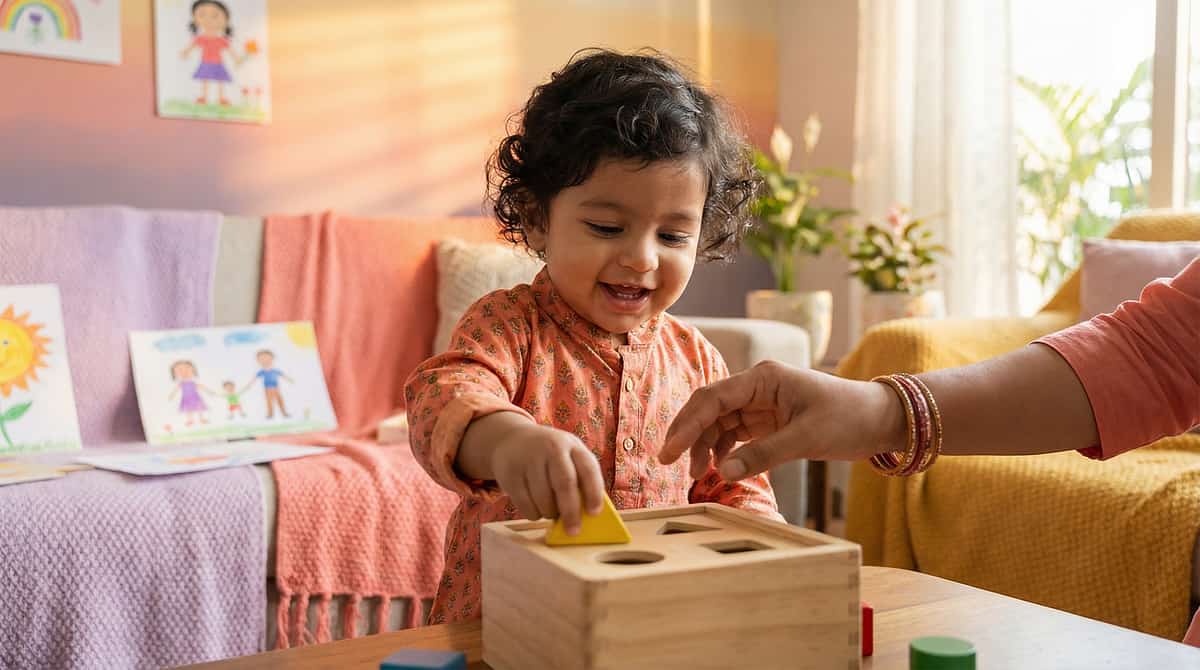
Full Physical
Hand-over-hand guidance — most support
Partial Physical
Gentle touch or guiding nudge
Gestural
Pointing toward the target
Verbal
"Put the block in the box"
Natural Cue
The situation itself prompts — no adult support needed
Golden Rule: Always provide the LEAST amount of help needed. Once a child succeeds 3–5 times at one level, reduce to the next. Watch for prompt dependency — child waits for help instead of trying independently.
Section 2 of 4
Cards 8–14
Reinforcement & Visual Tools
The engine of learning paired with the most powerful category of ASD interventions. Reinforcement tells the brain what to repeat. Visual tools give the brain the external scaffolding it needs to predict, process, and succeed.
L-931 + L-932 | Reinforcement
Reinforcement & Finding Reinforcers — The Engine of Learning
Reinforcement: anything that happens AFTER a behaviour that makes it more likely to happen again. Without it, no skill sustains. With it, any skill can be built. But the reinforcer must be immediately delivered (within 1–3 seconds), matched to the specific child, and genuinely motivating — not what you think should motivate them.
Reinforcement Rules
- Immediate — within 1–3 seconds
- Specific — "Great asking for juice!"
- Consistent initially, then intermittent
- Matched to effort — big achievement = big reward
- Natural reinforcers > artificial (real juice > sticker)
Finding Reinforcers (L-932)
Observe free-choice behaviour — what the child chooses when given full freedom is a reinforcer. Use preference assessment: offer 2 items → which do they choose? Rotate reinforcers to maintain novelty and motivation.
Categories: edible, sensory, activity, social, tangible. In Indian homes: preferred snacks, screen time, outdoor play, swing time, favourite songs are powerful natural reinforcers.
L-933 | Reinforcement
When Reinforcement Fails — Troubleshooting the Engine
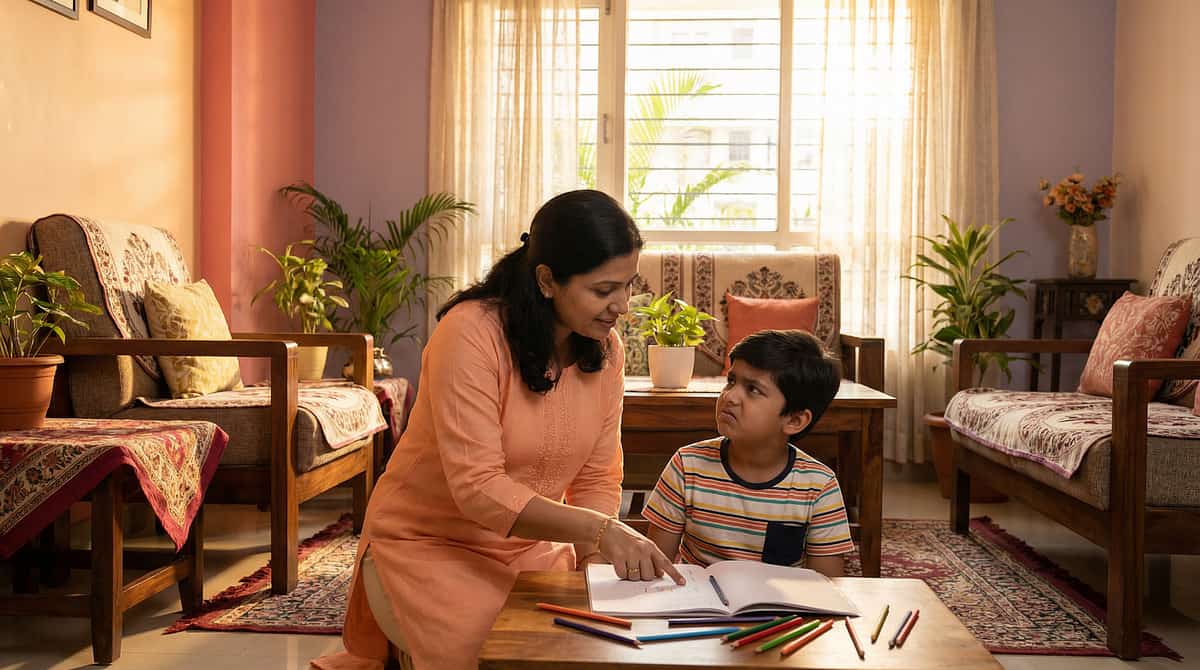
"I've tried rewards and they don't work." Reinforcement always works — but it might not be working for you right now because of a fixable reason. The dopamine prediction error is negative — the effort exceeds the expected reward, so the brain reduces the behaviour. The fix is systematic troubleshooting.
1
Is it actually preferred?
Re-assess. Don't assume — observe free choice behaviour and confirm.
2
Is timing right?
Must be delivered within 3 seconds of the behaviour. Delayed reinforcement = weaker learning.
3
Is the task achievable?
Reduce difficulty until the child can earn the reward successfully and consistently.
4
Is it freely available?
Restrict access. If screen time is given freely, why work for it? Make it ONLY available contingently.
5
Is the child satiated?
Too much of the same reward → switch. Novelty maintains motivational value.
6
Is the effort-reward ratio fair?
Small task = small reward. Big task = big reward. If all else fails, consult your BCBA.
L-934 | Visual Tools
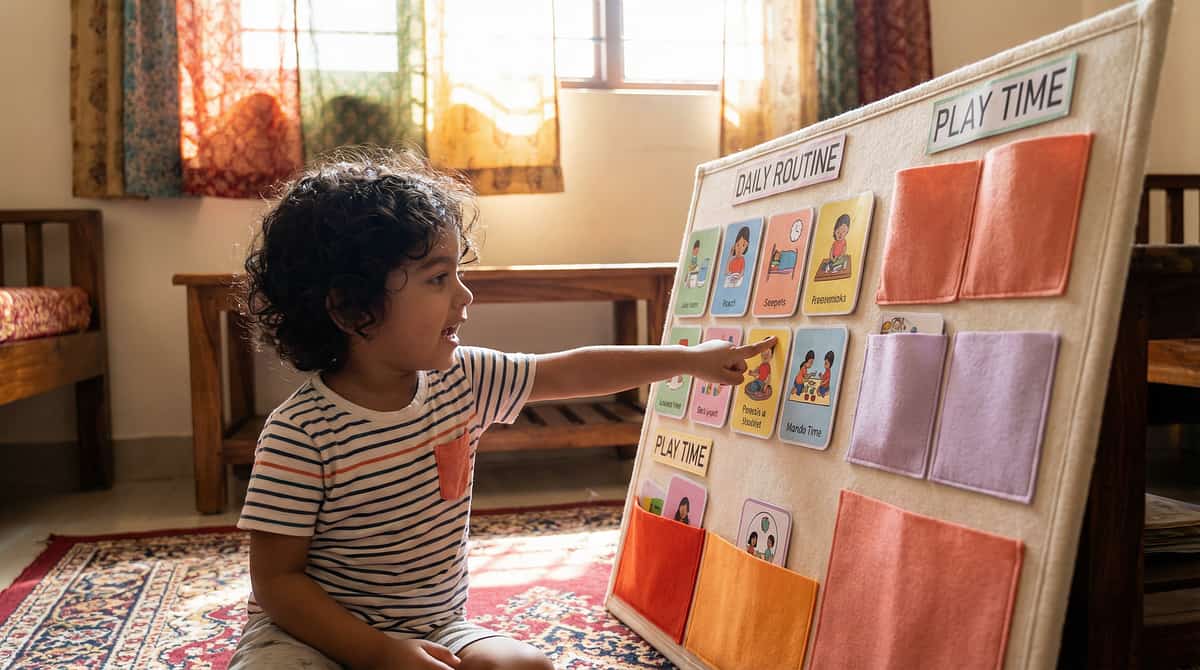
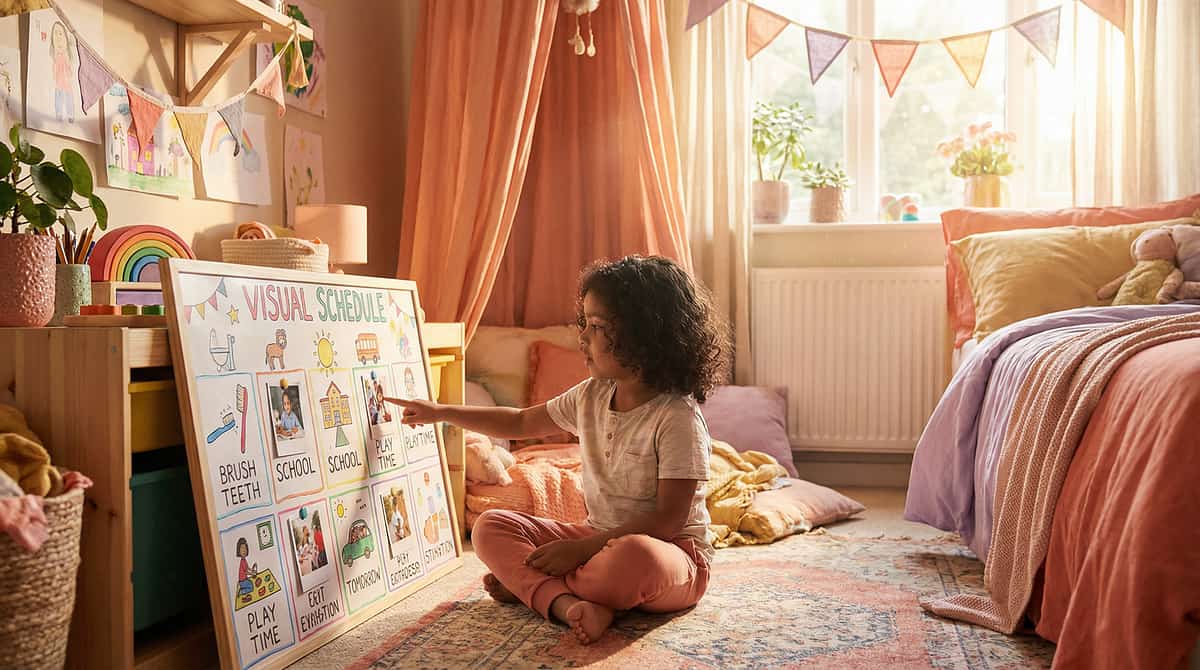
Visual Supports — The Umbrella Strategy
Visual processing is typically an ASD strength. Verbal information disappears the moment it's spoken. Visual information persists — the child can look at it again, process at their own speed, and refer back. Visual supports bypass auditory processing challenges and leverage visual processing strength, reducing working memory load by externalising information.
The core principle: if you're SAYING it, also SHOW it. Every verbal instruction should have a visual partner.
Schedules & Boards
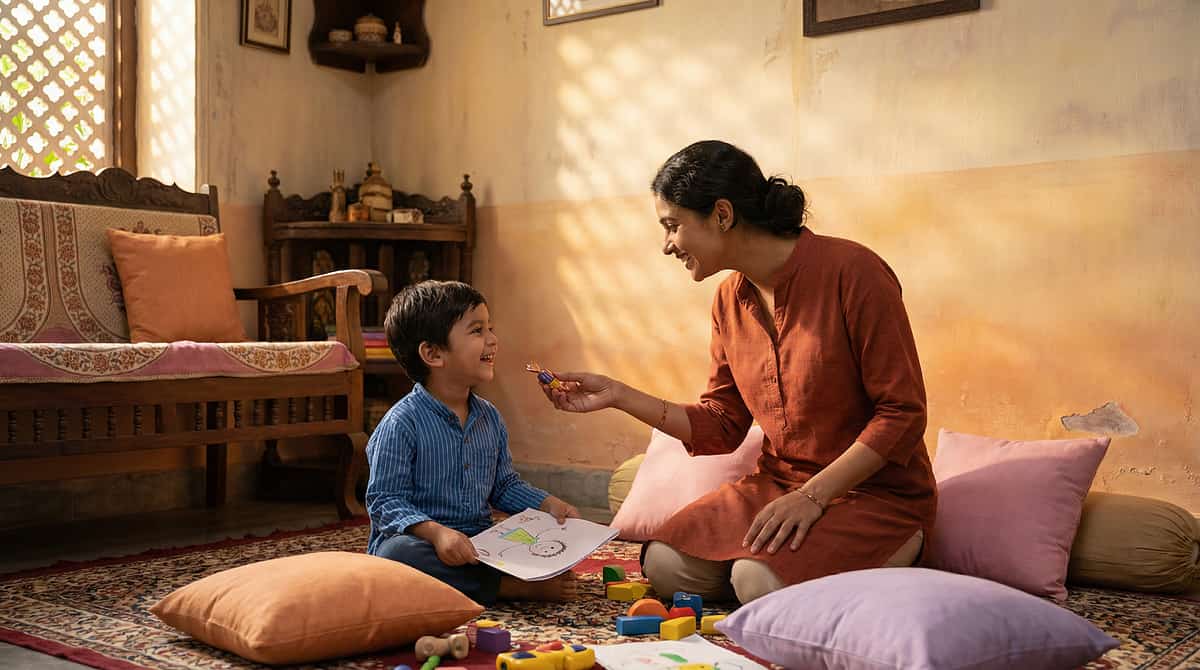
Visual schedules, First-Then boards, choice boards — externalise the structure of time and decision-making.
Stories & Models
Social stories, video models — pre-load the brain with scripts for challenging situations.
Motivation Tools
Token boards, reward charts, emotion charts — make internal states and progress visible and concrete.
Regulation Tools
Visual timers, rule cards, cue cards — reduce anxiety by making time and expectations transparent.
DIY: All visual supports can be made at home with paper, a printer, a laminator (₹500), and velcro (₹100). Cost is not a barrier.
L-935 + L-936 | Visual Tools
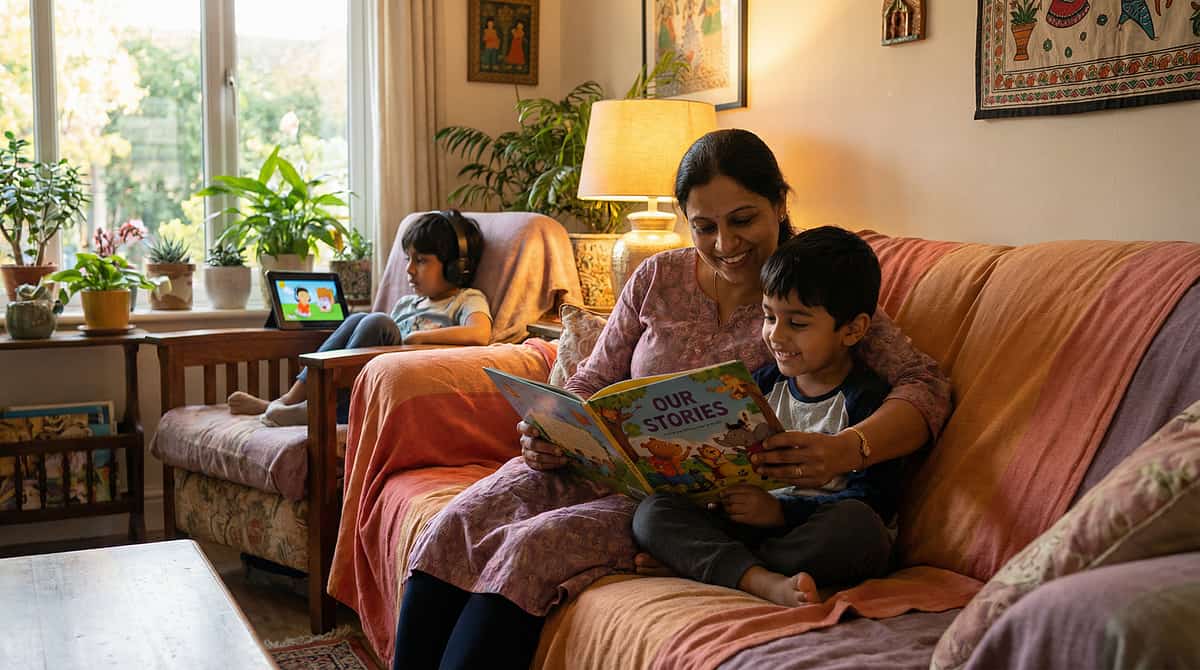
Social Stories & Video Modeling — Pre-Load and Watch to Learn
Two powerful visual strategies that prepare the brain BEFORE the moment arrives. Social stories pre-load the PFC with scripts for challenging situations. Video modeling leverages the ASD visual processing strength to teach skills through observation — removing social complexity for a clearer learning signal.
Social Stories — Pre-Loading the Brain
Short, visual narratives that explain a social situation from the child's perspective — what will happen, how people might feel, and what the child can do. Created by Carol Gray. Instead of computing social situations in real-time, the child arrives with a neural template.
- First person, positive language
- Descriptive sentences (what happens)
- Perspective sentences (how people feel)
- Directive sentences (what I can do)
- Child's reading level + pictures/photos
Indian context: Write stories in Hindi or your regional language. Include culturally familiar situations — temple visit, Diwali, family gatherings, school assembly.
Video Modeling — Learn by Watching
The child watches a video of someone performing a skill, then imitates. Some children with ASD learn from video faster than from live demonstration — removing social noise creates a clearer signal.
Self-Modeling
video of the CHILD performing the skill successfully. Most powerful type.
Peer Modeling
another child (sibling, classmate) demonstrating the target skill
Adult Modeling
parent or therapist demonstrates clearly, slowly, repeatedly
Point-of-View
camera shows exactly what the child would SEE — maximum transfer
Your smartphone is your video modeling studio. Record during successful therapy sessions and build a personal video library. 1–3 minutes, clear demonstration, minimal background distraction.
L-937 + L-938 | Visual Tools
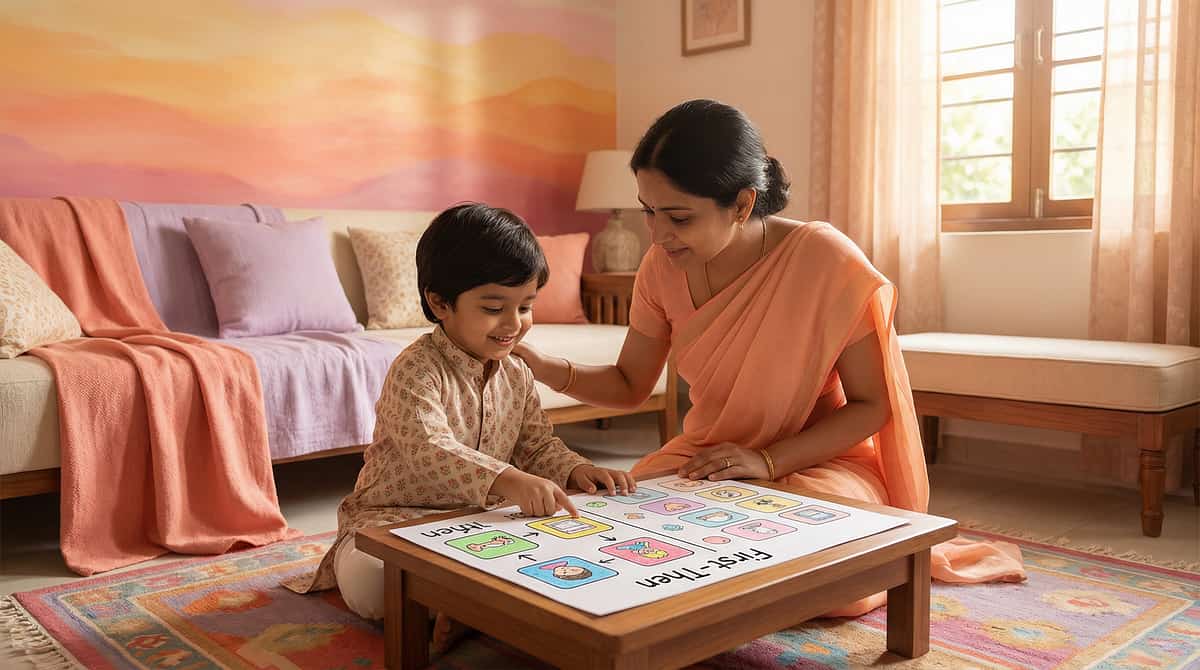
First-Then Boards & Visual Schedules — The Two Core Visual Tools
First-Then: externalises motivation structure — the THEN item is visible, so dopamine anticipation carries the child through the FIRST task. Visual Schedule: externalises the day's structure — reduces uncertainty, reduces anxiety, reduces meltdowns. Both tools offload cognitive work from the child's PFC to the environment.
First-Then Board (L-937)
- DIY cost: ₹50 (cardboard + velcro + 2 picture spaces)
- Child SEES both activities simultaneously
- ALWAYS follow through — complete FIRST → deliver THEN
- Use for EVERY non-preferred task
- Never use as threat — always use as information
Visual Schedule (L-938)
- DIY cost: ₹100 (strip + velcro + picture cards)
- Child INTERACTS — moves cards to "done" pocket
- Update DAILY, post at child's eye level
- Create portable version for outings
- Give warning before schedule changes
L-939 + L-940 | Visual Tools
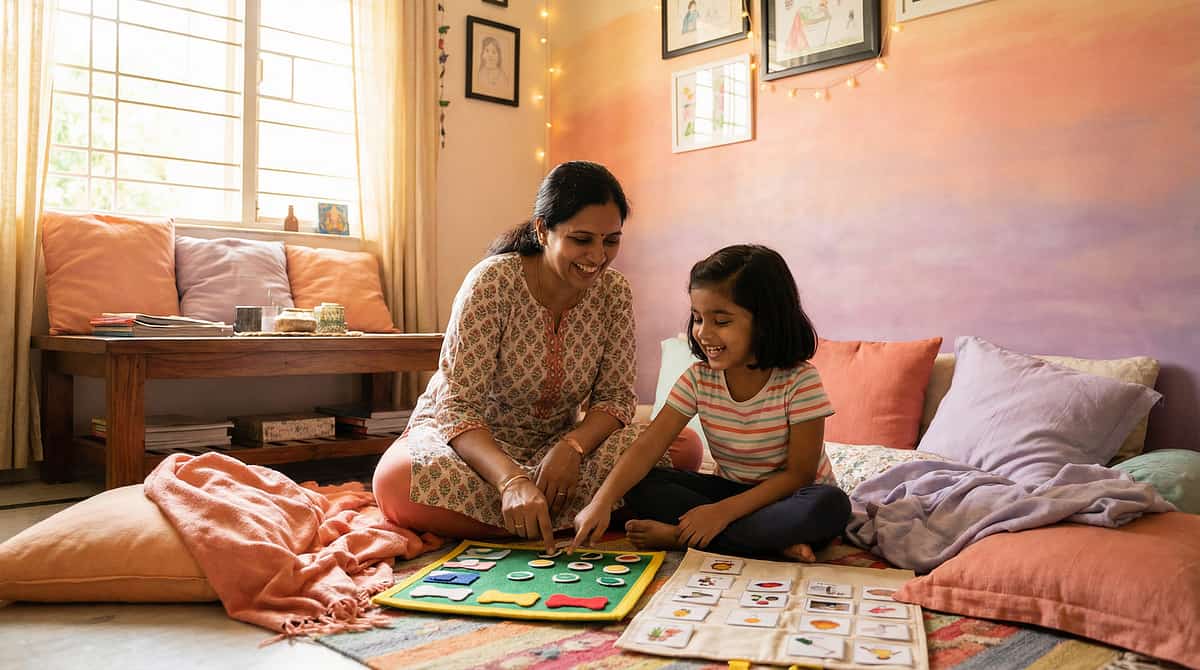
Token Systems & Choice Boards — Motivation and Agency
Token systems bridge the gap between behaviour and a delayed reinforcer. Choice boards give children CONTROL — and choosing is itself rewarding. Both tools activate the PFC and reward system simultaneously, building the very executive function skills that underlie independence.
Token System (L-939)
Earn tokens for desired behaviour → exchange for reward when board is full. Each token is a visual marker of progress → maintains dopamine anticipation → teaches delayed gratification.
- Start with 2–3 tokens (quick success)
- Match token count to delay tolerance
- Tokens: stars, velcro pieces, coins in jar
- DIY: under ₹200
Choice Board (L-940)
Visual display of 2–4 options. Choice reduces challenging behaviour — the child has CONTROL. The act of choosing is itself rewarding: it's agency.
- Start with 2 choices → expand to 3–4
- Present BEFORE demanding
- Use for: activity, snack, reward, break
- Let the child's choice stand — always honour it
Section 3 of 4
Cards 15–24
Sensory Strategies
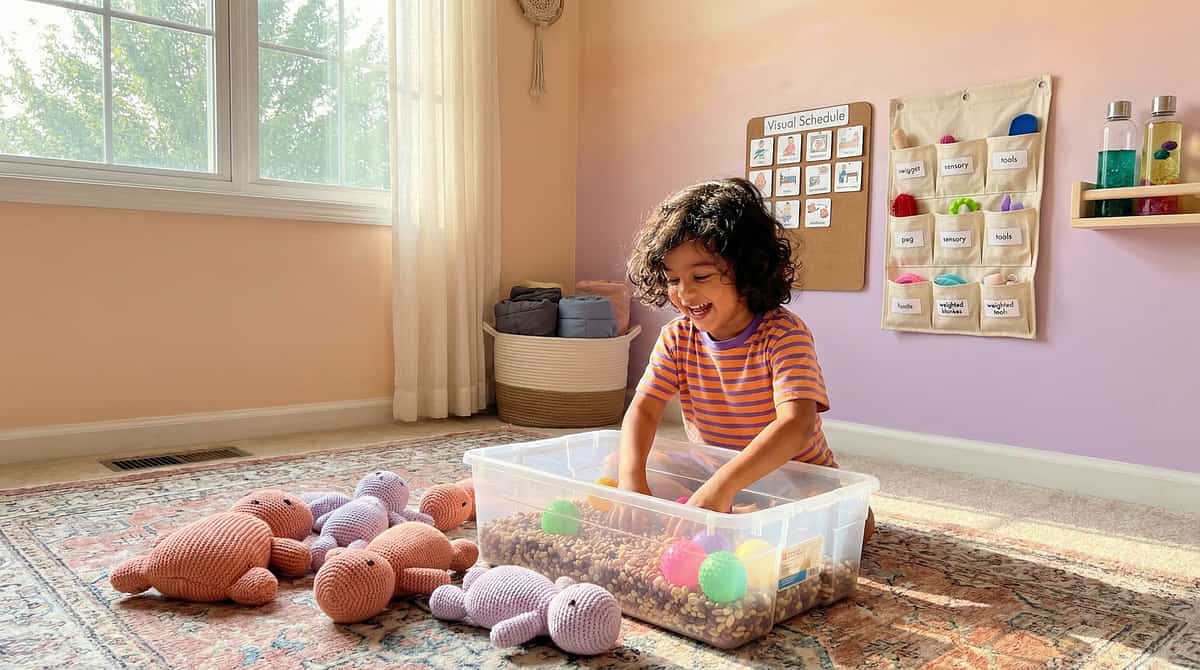
Ten cards covering the full sensory toolkit — from regulation tools that make the invisible visible, to specific input strategies for every sensory system, to systematic desensitisation for children who experience the world too intensely.
Regulation Tools
Visual timers, emotion charts, calm-down kits — make internal states concrete and manageable
Sensory Scheduling
Sensory diets, sensory breaks, movement breaks — proactive regulation through planned input
Sensory Input
Heavy work, proprioceptive, vestibular, oral motor — targeted input for each sensory system
Desensitisation
Tactile, auditory, visual — gradual, child-paced exposure to build tolerance
L-941 + L-942 | Sensory Strategies
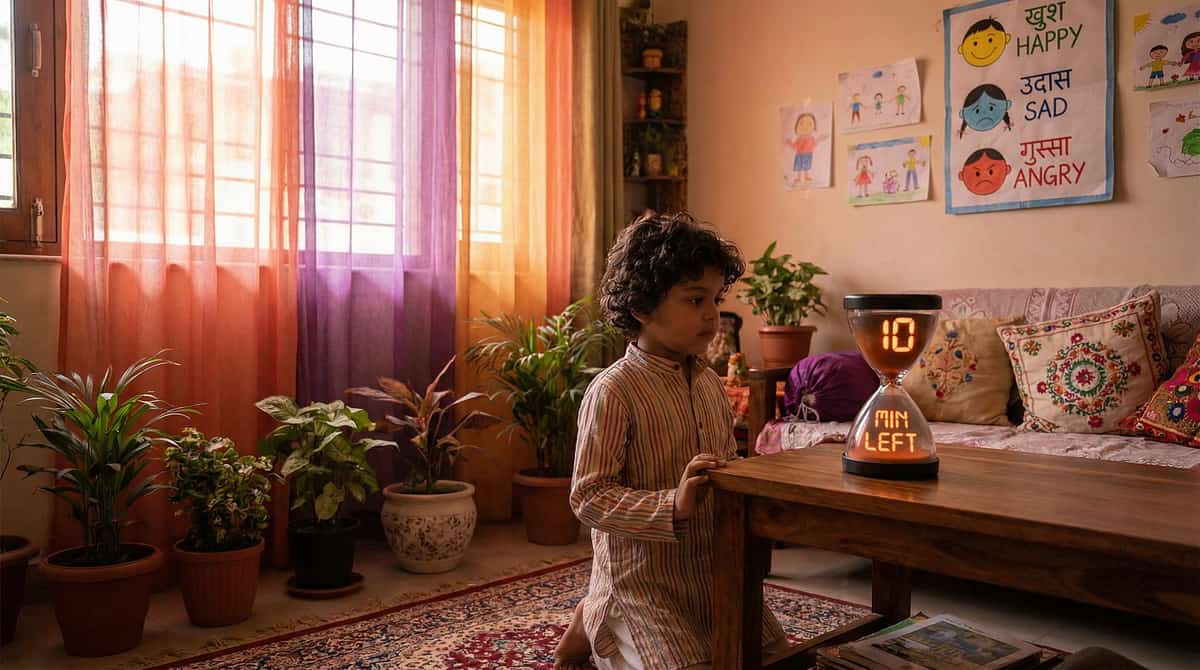
Visual Timers & Emotion Charts — Making the Invisible Visible
Both tools follow the same core principle: externalise invisible internal states — time and emotion — making them concrete, manageable, and shareable. Visual timers bypass abstract time processing with concrete visual representation. Emotion charts bypass alexithymia (difficulty identifying feelings) with external labels for internal states.
Visual Timers (L-941)
- Timer for transitions (5-minute warning)
- Timer for non-preferred tasks (shows the end is coming)
- Timer for preferred activity duration
- Timer for waiting periods
Free phone timer apps work perfectly. No equipment purchase required.
Emotion Charts (L-942)
- Emotion thermometer on the fridge (5-point scale)
- Daily emotion check-in — point to how you feel
- During difficult moments: "I see you're at RED. Let's use our calm-down tools."
- Hand-drawn emotion faces on paper cost ₹0

L-943 | Sensory Strategies
Calm-Down Kits — A Regulation Tool, Not a Punishment
A portable collection of sensory and emotional regulation tools, always accessible, always ready. When dysregulation begins, the child goes to the kit. Each item targets a specific sensory-emotional pathway, providing EXTERNAL regulation input when the child's INTERNAL regulation system is overwhelmed.
Fidgets & Tactile
Fidget toy (₹50–200), stress ball (₹50), mini weighted lap pad — tactile and proprioceptive input for grounding.
Auditory Reduction
Noise-cancelling headphones or earplugs — reduce auditory overload during high-stimulation moments.
Visual Calming
Glitter jar (DIY: jar + glitter + water + glycerin = ₹100), kaleidoscope — slow visual input to calm the nervous system.
Breathing Tools
Pinwheel (₹20), bubbles — visual breathing tools that make slow exhalation concrete and engaging.
Critical: Teach how to use each tool DURING CALM TIMES, not during crisis. The child must know how to use the kit before they need it. Keep one at home, one in the bag, one at school.
L-944 + L-945 | Sensory Strategies
Sensory Diets & Sensory Breaks — Proactive Regulation
Like a food diet prevents hunger, a sensory diet prevents sensory dysregulation. It's a planned schedule of sensory input throughout the day, designed to keep the child's nervous system at optimal arousal — not too activated, not too sluggish. It's always easier to MAINTAIN regulation than to RECOVER from dysregulation.
Sensory Diet (L-944) — OT Designs, Parent Implements
- Morning heavy work → mid-morning vestibular
- Before-lunch proprioceptive → afternoon sensory break
- Evening calming input (dim lighting, slow rocking)
- Proprioceptive input every 1–2 hours keeps the system regulated
- Review with OT monthly and adjust
Sensory Breaks (L-945) — Physiological Necessities
Scheduled pauses in demand for the child to receive needed sensory input. Every 20–30 minutes during demanding tasks. Break activities: jumping, swinging, crash play, deep pressure, fidget, quiet space. 3–5 minutes duration.
Give your child a visual break card they can show when they need a break — on-demand regulation builds self-advocacy skills.

L-946 | Sensory Strategies
Movement Breaks — Movement IS Regulation
When the child is fidgety, inattentive, or escalating — the answer is often not "sit still" but MOVE. Movement activates the cerebellum, provides vestibular and proprioceptive input, releases endorphins, and optimises the Reticular Activating System for improved attention. Post-movement, the brain is simply in a better state for learning.
Animal Walks
Bear walk (heavy work), crab walk (core), frog jump (vestibular)
Jumping & Running
Jumping jacks, running in place, trampoline bouncing
Dance Break
30-second favourite song — joyful, motivating, regulating
Wall Push-Ups
Chair push-ups, wall push-ups — heavy proprioceptive input in minimal space
Yoga Poses
Surya namaskar as movement break — culturally familiar, space-efficient, calming
Duration: just 2–3 minutes between tasks, when attention fades, before difficult activities, or when behaviour escalates. Small investment, large regulatory return.
L-947 + L-948 | Sensory Strategies
Heavy Work & Proprioceptive Input — The Universal Regulator
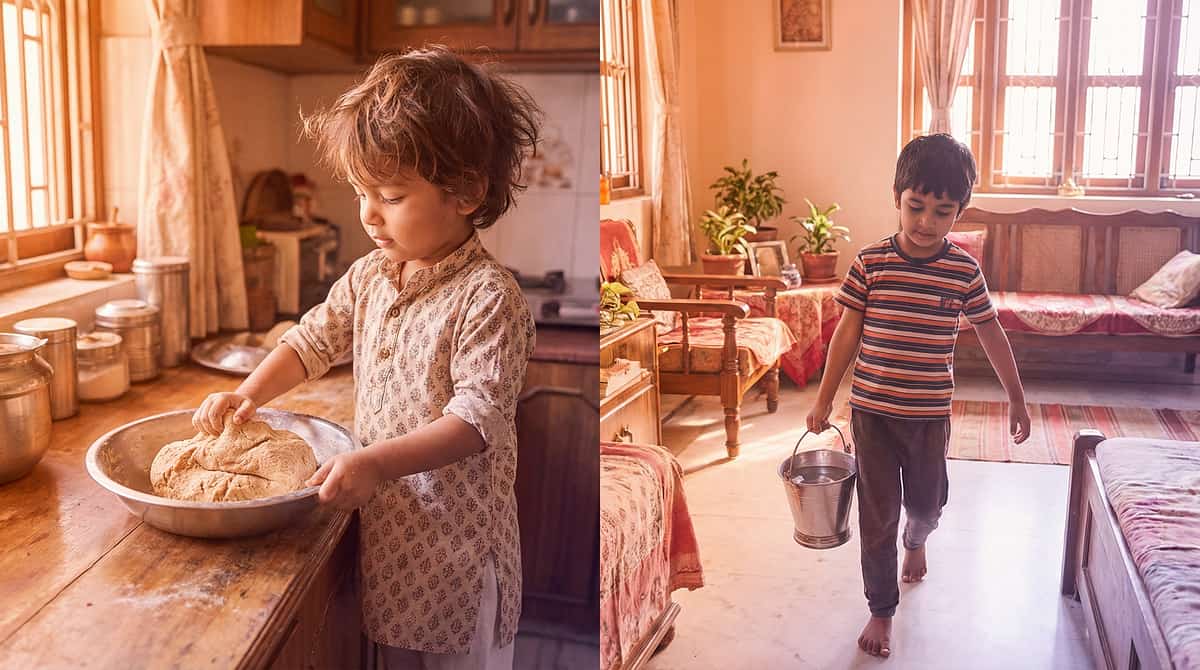
Proprioceptive input (muscles and joints working against resistance) is the single most regulating sensory input. Virtually always calming. Virtually never overstimulating. It works for hyper-aroused AND hypo-aroused children. In Indian homes, traditional daily activities ARE proprioceptive therapy — kneading roti dough, carrying water, sweeping with a heavy broom.
Heavy Work Activities
- Carrying groceries, pushing laundry basket
- Stacking books, digging in garden
- Kneading dough — roti-making IS therapy
- Mopping floor, carrying water buckets
Proprioceptive Input
- Joint compressions, bear hugs
- Weighted backpack during walks
- Resistance bands, wall push-ups
- Climbing, crawling through tunnel
When to Schedule
- Before demanding academic tasks
- During transitions between activities
- When signs of dysregulation appear
- As part of daily sensory diet

L-949 + L-950 | Sensory Strategies
Vestibular Input & Oral Motor Input — Two Powerful Sensory Channels
Vestibular input through movement in space is powerful but variable — direction and speed matter. Oral motor input is deeply calming through rhythmic jaw proprioception and is always available — in every kitchen, at every meal.
Vestibular at Home (L-949)
Linear = calming. Back-and-forth swing, rocking chair, therapy ball bouncing → parasympathetic system activation. Rotational = alerting. Spinning → use carefully, watch for nausea.
- Doorway swing (₹1,500), jhula, hammock
- Rocking chair, therapy ball
⚠️ Start slow. Watch for nausea or pallor. Never spin without supervision.
Oral Motor at Home (L-950)
Oral cavity is densely innervated — strong sensory input per small movement. Chewing provides rhythmic proprioceptive input through jaw muscles → calming.
- Chewy: dried mango, gum
- Crunchy: carrots, papad, murukku
- Blowing: bubbles, whistle, pinwheel
- Sucking: thick shake through narrow straw

L-951 + L-952 + L-953 | Sensory Strategies
Tactile, Auditory & Visual Desensitisation
Desensitisation = graded exposure → neural habituation. The brain learns "This input is SAFE" through repeated, non-threatening experience. Each tolerated exposure weakens the amygdala's alarm response. The critical rule for all three types: exposure must be child-paced and NEVER FORCED. Forced exposure causes sensitisation — it makes the problem worse.
Tactile Desensitisation (L-951)
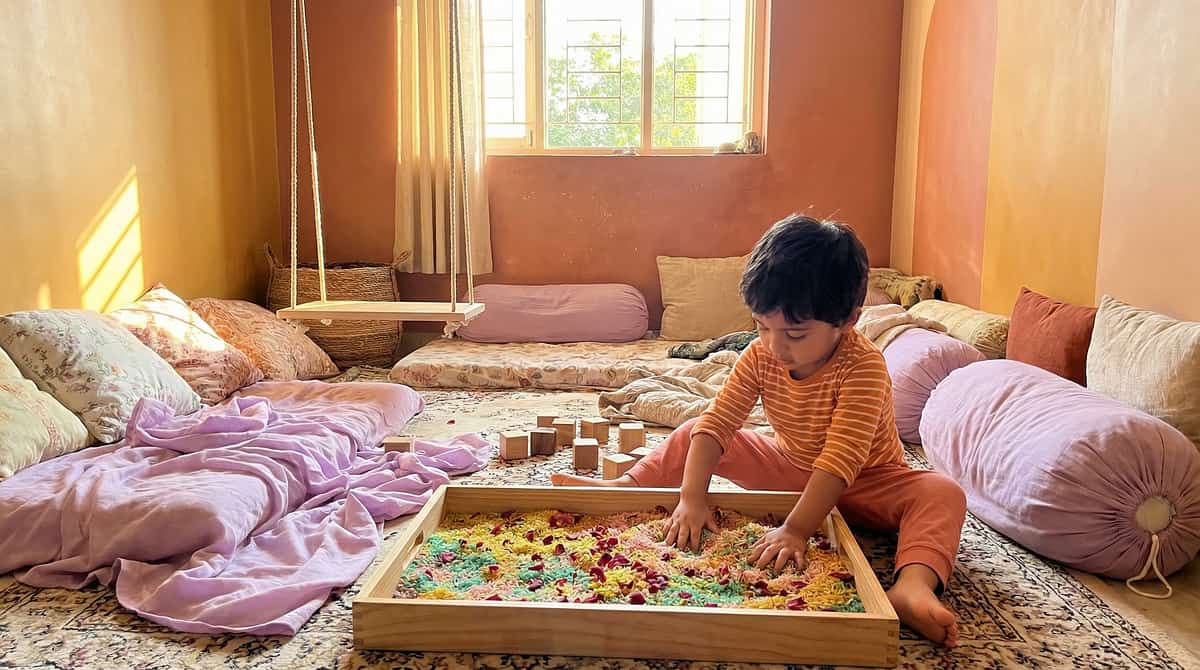
Hierarchy: dry textures before wet, firm before light, familiar before novel, hands before face. Activities: play-doh, rice bins, water play, sensory bins. Indian: atta dough, rice sorting, rangoli powder, wet mud play.
Auditory Desensitisation (L-952)
Record feared sound → play at whisper volume during preferred activity → gradually increase over days → real-life exposure at distance → gradually closer. Indian sounds: mixer, pressure cooker whistle, auto horn, Diwali crackers — each has a specific plan.
Visual Desensitisation (L-953)
Reduce visual clutter at baseline → introduce complexity gradually. Sunglasses for brightness, gradual fluorescent exposure. Indian: manage Diwali lights by starting with one diya, not a hundred. Prepare for market visual overload progressively.
Section 4 of 4
Cards 25–29
L-954 + L-955 | Skill Building Mastery
Routine Building & Skill Embedding
The final section addresses the deepest question: how do skills go from learned to automatic, generalised, and lasting? These strategies ensure therapy produces permanent change — not temporary performance.
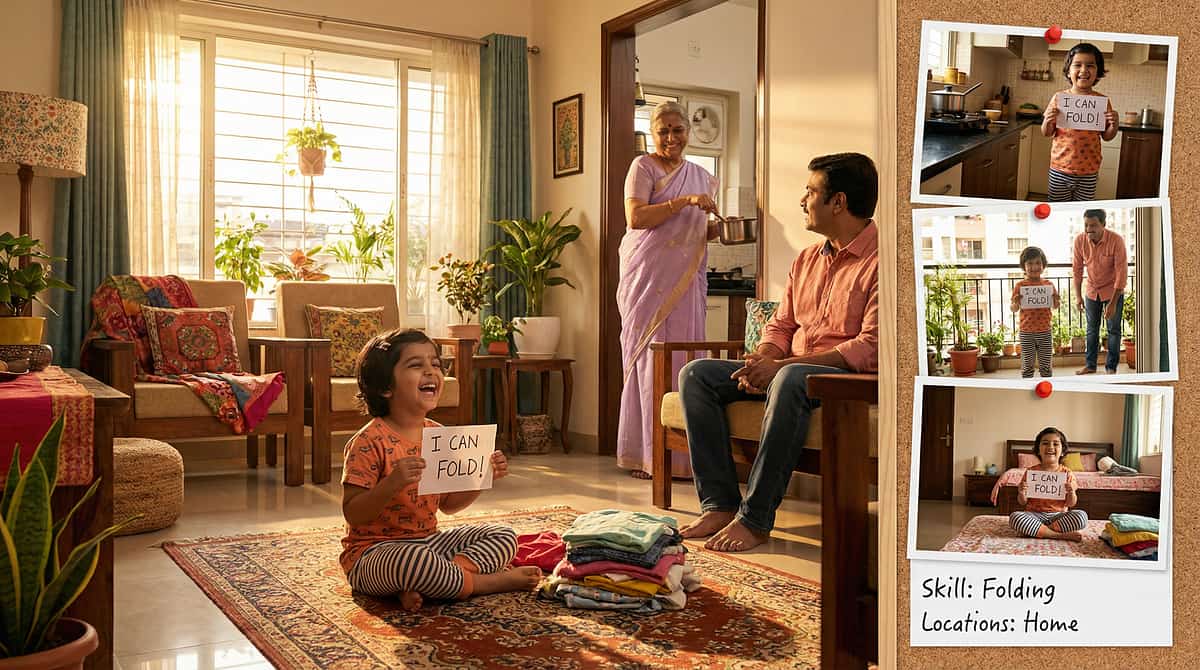
Routines automate through the basal ganglia over approximately 3–6 weeks of consistent repetition. Embedded skills — learned IN real-life contexts — require no transfer because they were never decontextualised in the first place. Both strategies eliminate "therapy fatigue" by making learning indistinguishable from living.
Routine Building (L-954)
- Design the routine with a visual schedule
- Teach each step (task analysis)
- Practice with full prompts
- Fade prompts over 2–4 weeks
- Maintain consistency for 6 weeks
- Routine is automated — basal ganglia takes over
After disruption (holiday, illness) → re-teach. Always faster the second time.
Skill Embedding (L-955)
Weave therapy targets INTO daily activities. Create an embedding map: take each therapy goal → identify 5 daily opportunities to practice it naturally.
Example: Goal = labelling objects. Embedded in: bath (soap, towel, water), cooking (spoon, pot, rice), dressing (shirt, shoes, socks), mealtime (cup, plate, fork). The child isn't doing therapy — they're living life where learning happens.
L-956 + L-957 | Skill Building Mastery
Generalisation & Maintenance — Making Skills Last
Generalisation and maintenance are the two skills that determine whether therapy truly lasts. Without both, even a well-taught skill fades or remains locked to a single context. These are not afterthoughts — they must be planned from the very first teaching session.
Generalisation (L-956)
Using a skill in NEW situations, with NEW people, and in NEW settings. Promoted by teaching with multiple examples across multiple contexts.
If the child does it with Amma but not Appa → Appa practices too. If the child does it at home but not school → practice AT school. Teach broadly from day one.
Maintenance (L-957)
Keeping a skill AFTER teaching stops. Promoted by intermittent reinforcement (occasional, not every time), regular use in daily life, and overlearning — practising beyond mastery until the basal ganglia owns the skill completely.
If a skill weakens → run a brief "booster" practice cycle. Skills rarely need relearning from scratch.
L-958 + L-959 | Skill Building Mastery
Skill Chaining & Task Analysis — The Inseparable Teaching Pair
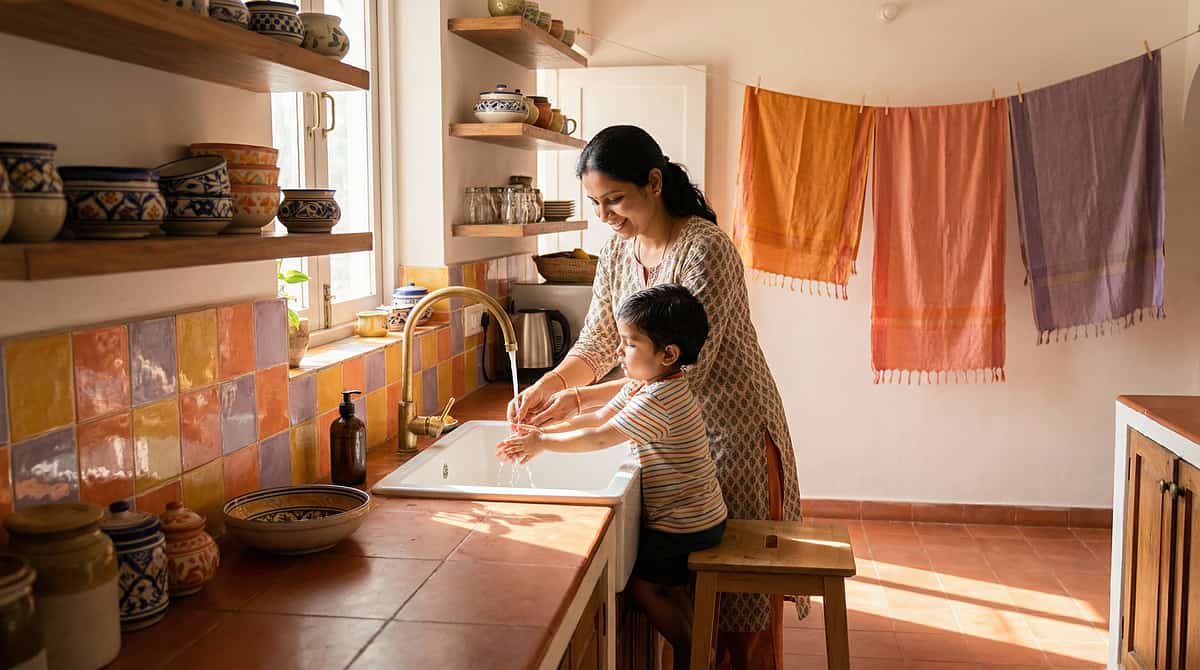
Task analysis breaks a complex skill into small, teachable steps. Chaining links those steps into a sequence the child performs independently. Every self-care skill, every daily routine, every multi-step task is taught this way. The basal ganglia links chunks into an automatic sequence: completion of step 1 cues step 2, and so on.
Task Analysis Example: Handwashing
1. Turn on water → 2. Wet hands → 3. Get soap → 4. Rub hands → 5. Rinse → 6. Turn off water → 7. Dry hands. Seven discrete, teachable steps.
Forward Chaining
Teach step 1, do rest for child → teach steps 1+2, do rest → add one step at a time. Best for children who are eager to start.
Backward Chaining
Do steps 1–6 for child, child does step 7 (dry hands — success!) → add steps backward. Best for children who need immediate success to stay motivated.
L-960 | Skill Building Mastery
Errorless Teaching — Build a History of Success
Structure the learning so the child always succeeds. The prompt is provided BEFORE the child can make an error → the child performs correctly → correct response is reinforced → prompts are faded gradually. The brain only encodes ONE pathway — the right one. No competing incorrect neural pathways are formed.
1
Present Task
"Touch the dog"
2
Immediate Prompt
Physically guide hand to dog picture BEFORE error occurs
3
Reinforce Correct Response
"Great! That's the dog!" — celebrate the success
4
Fade Prompt
Next trial: gesture → then wait → then natural cue → independence
When NOT to use errorless teaching: Skills where trial-and-error learning is appropriate — flexible thinking, problem-solving, creative play. Use errorless teaching for new skills, skills where errors cause frustration, and skills with safety implications.
Preview of therapy strategies at home Therapy Material
Below is a visual preview of therapy strategies at home therapy material. The pages shown help educators, therapists, and caregivers understand the structure and content of the resource before use. Materials should be used under appropriate professional guidance.
Link copied!
Subdomain L1 | Capstone
Your Home IS the Therapy Centre
You now hold the professional's toolkit — simplified, practical, and adapted for home use. 40 strategies across four categories. Backed by Level I evidence. Designed for the Indian home, the joint family, and the parent who is already showing up every day.
Teaching Foundations
Early intervention · Parent-implemented therapy · Naturalistic teaching · Incidental teaching · Environmental setup · Communication temptations · Wait time · Modeling · Prompting · Prompt fading
Reinforcement & Visual Tools
Reinforcement · Finding reinforcers · Troubleshooting · Visual supports · Social stories · Video modeling · First-Then boards · Visual schedules · Token systems · Choice boards · Timers · Emotion charts
Sensory Strategies
Calm-down kits · Sensory diets · Sensory breaks · Movement breaks · Heavy work · Proprioceptive input · Vestibular input · Oral motor · Tactile desensitisation · Auditory desensitisation · Visual desensitisation
Skill Building Mastery
Routine building · Skill embedding · Generalisation · Maintenance · Skill chaining · Task analysis · Errorless teaching
Professional therapy (clinical expertise) × Parent implementation (daily dosage + natural environment + relationship) = MAXIMUM OUTCOME.
Your home is not a substitute therapy centre. It is BETTER — because it is where LIFE happens. And life is where skills must work.
9 Canon Materials:Visual Schedule · First-Then Board · Communication Board · Social Stories · Reward Charts · Visual Timer · Emotion Cards · Calm-Down Kit · Video Modeling
ABA
SLP
OT
SpEd
Psychology
NeuroDev