
Pre-Verbal & Early Communication
30 evidence-based interventions for children who aren't yet speaking — no words, no pointing, no waving, doesn't respond to name. Each technique is grounded in neuroscience, built for real families, and backed by Level I research. Subdomain B1 | Domain B: Communication | Pinnacle Blooms Network®
The Science Behind the Silence
Before Words Come Foundations
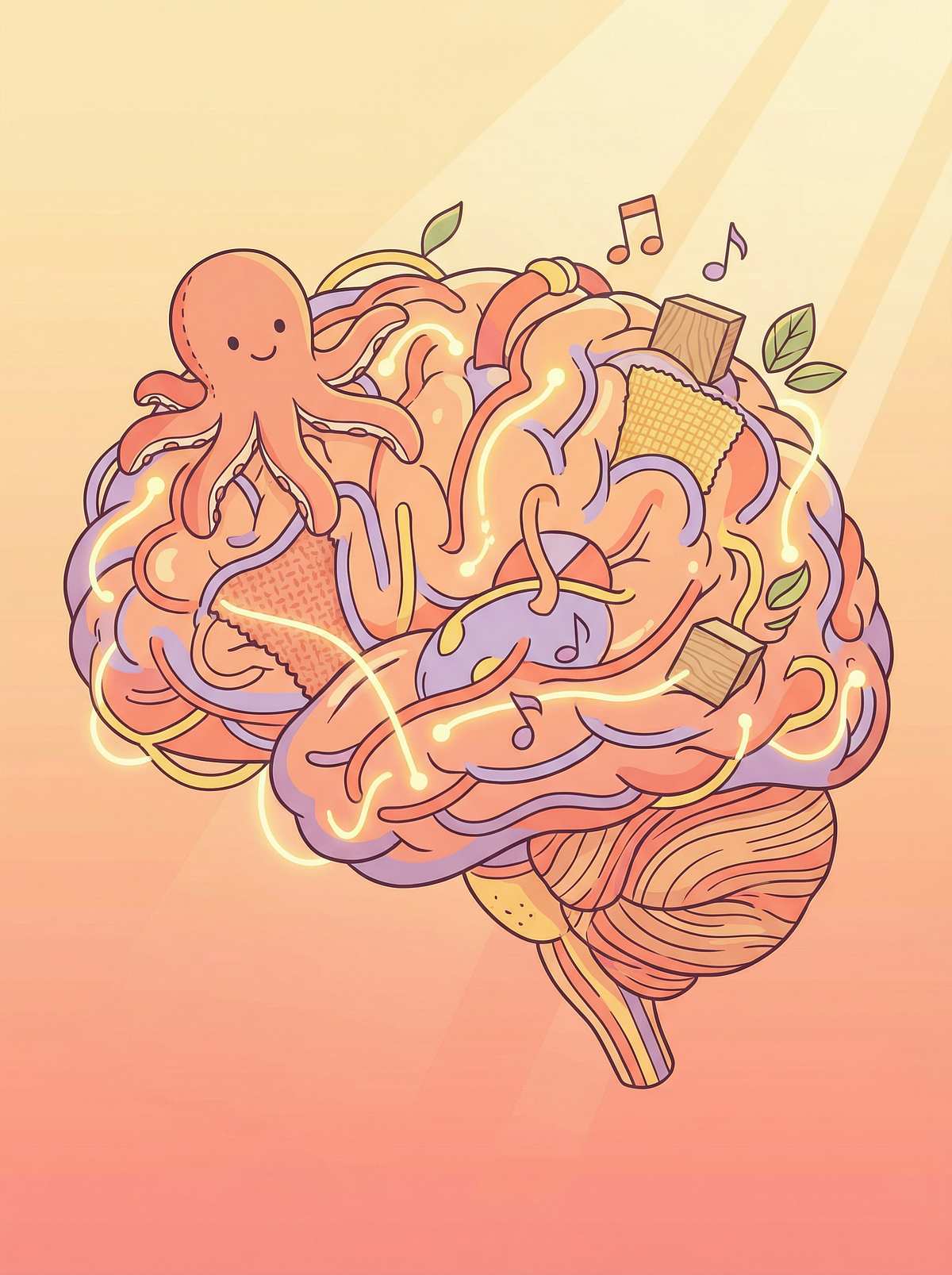
Pre-verbal communication is not the absence of language — it is the foundational architecture upon which all language is built. In autism, this developmental sequence may be disrupted at any stage. The child is not "choosing" silence — their brain's communication architecture is developing along a different timeline.
Early intervention during the pre-verbal stage produces the strongest outcomes of any period in child development. The 18–36 month window of neuroplasticity is the most powerful time to act. Every technique in this subdomain targets a specific rung on this developmental ladder.
Evidence Base
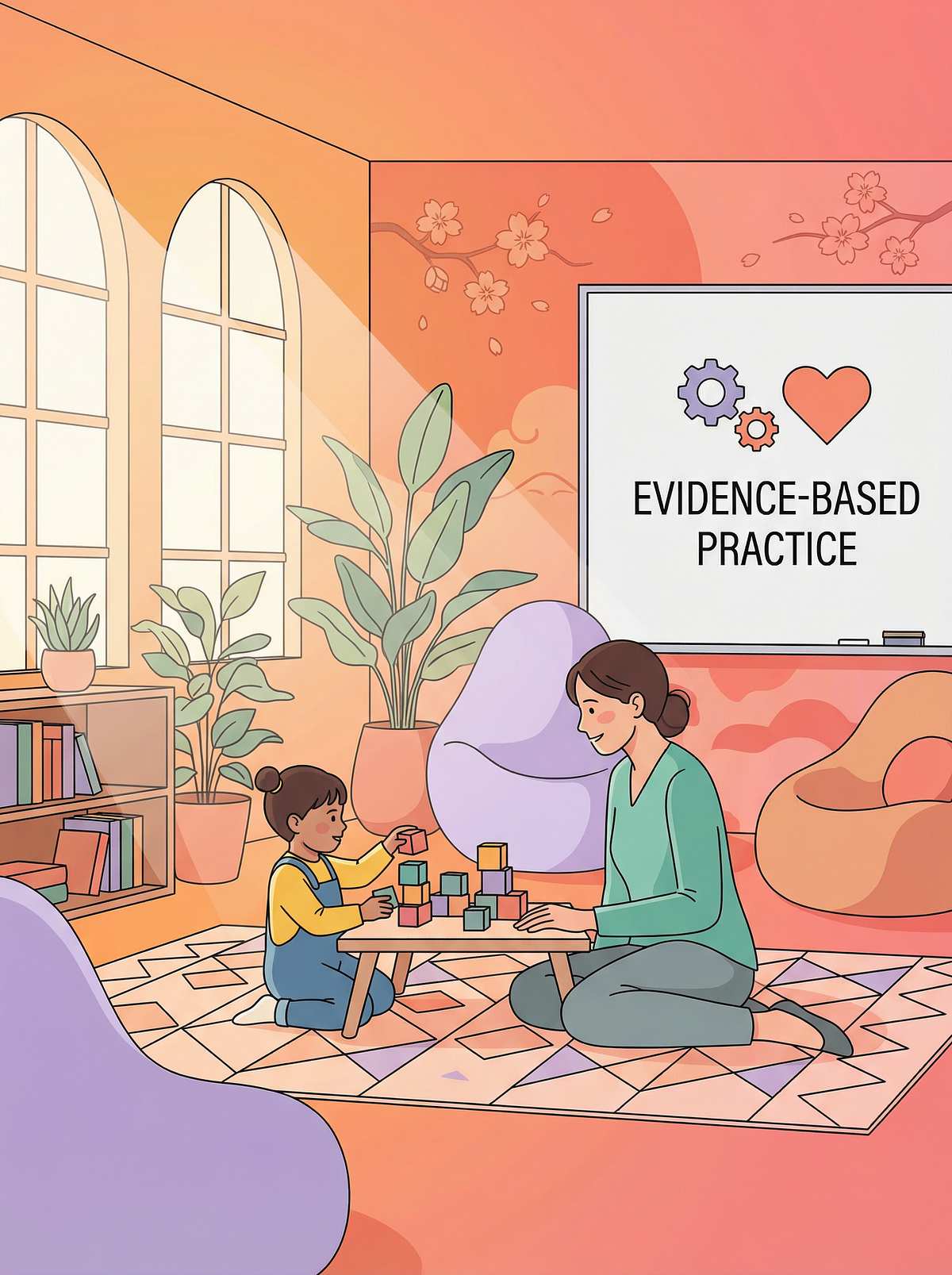
Why These 30 Interventions Work
21M+
Therapy Sessions
Delivered across the Pinnacle Blooms Network®
97%+
Improvement Rate
Families report measurable communication gains
30
Techniques
Each with 9 canon therapy materials
Level I
Evidence
ESDM · NCAEP 2020 · Lancet Commission · ASHA
B-121
Doesn't Respond to Name
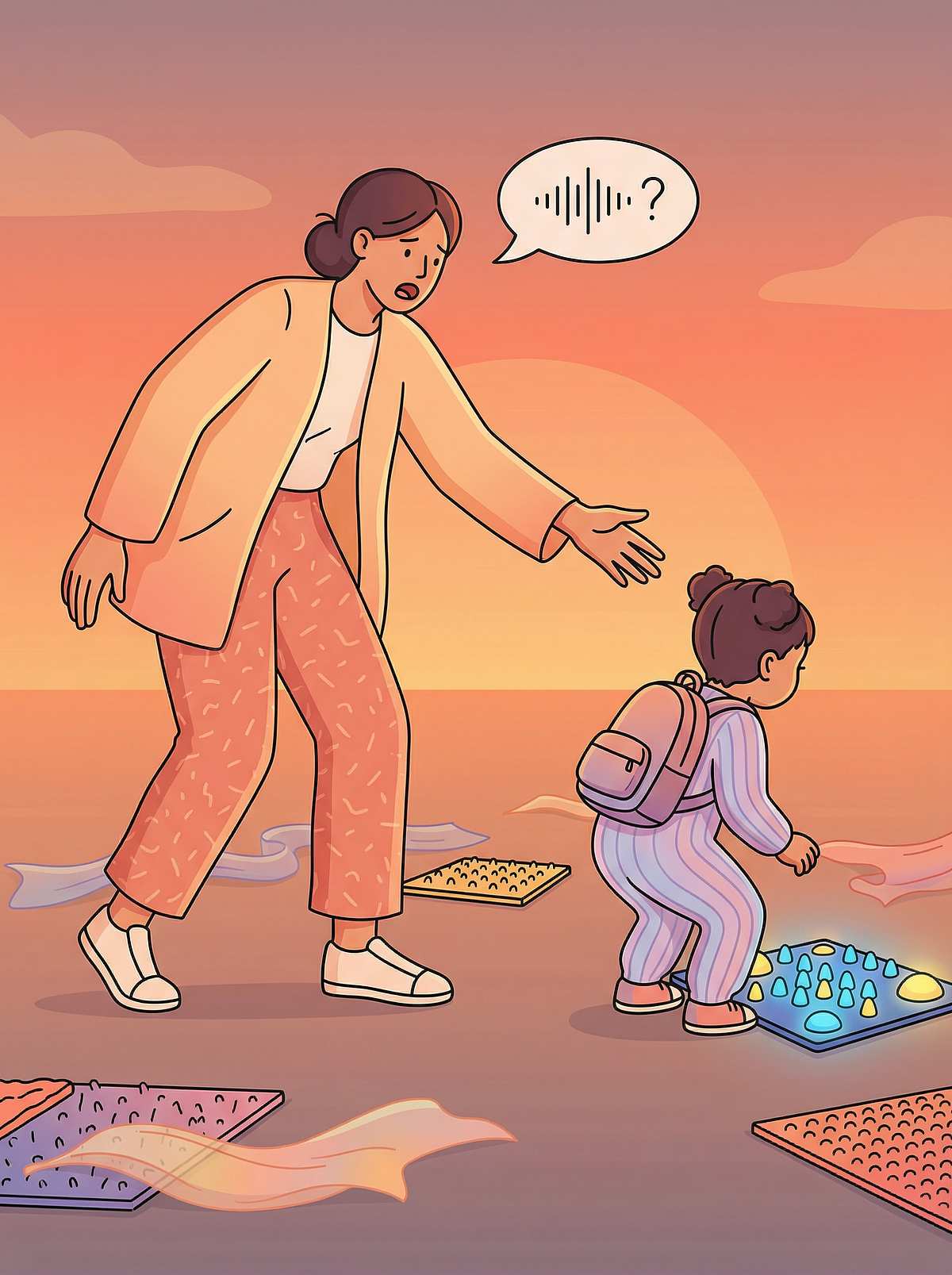
"Arjun." Nothing. "Arjun!" Nothing. "ARJUN!" You're standing a metre away and your child doesn't turn. The paediatrician ordered a hearing test — it came back normal. But you've seen it clearly now: your child lives in a world where their own name doesn't register. This is often the first sign parents notice. This is when everything changes.
The Neuroscience
Name response requires auditory processing, auditory discrimination, social salience, and a motor response. In ASD, failure typically occurs at the social salience stage — the auditory system hears the name, but the temporal-parietal junction doesn't flag it as socially important. The child hears. They just don't turn.
What You'll Learn
- Why name response fails — processing, not defiance
- Structured name-response training (prompt → respond → reinforce)
- Reducing competing stimuli before calling the name
- Pairing name with preferred activities and items
- Building from quiet room to busy environment
- When to reassess hearing and auditory processing

B-122
No Babbling
Other babies their age are filling the house with sound experiments — "ba-ba-ba," "ma-ma-ma." Your child is silent. No consonant-vowel combinations. No vocal play. No musical experimentation with their voice. The house is quiet in a way that makes your chest tighten. You've played videos of "what babbling sounds like" and realized you've never heard those sounds from your child.
The Neuroscience
Babbling is the motor rehearsal of speech. Broca's area generates syllable patterns, the supplementary motor area sequences them, and auditory feedback loops refine the output. The child must attend to speech sounds, map them to mouth movements, and be motivated to produce sound. In ASD, any of these stages may be delayed or disrupted.
What You'll Learn
- Vocal imitation games — parent copies child's sounds first
- "Serve and return" vocal interaction rhythms
- Oral motor stimulation to activate speech musculature
- Environmental enrichment for vocalization
- When silence may indicate apraxia of speech
- Celebrating ALL vocalizations as communication victories
B-123
Doesn't Point
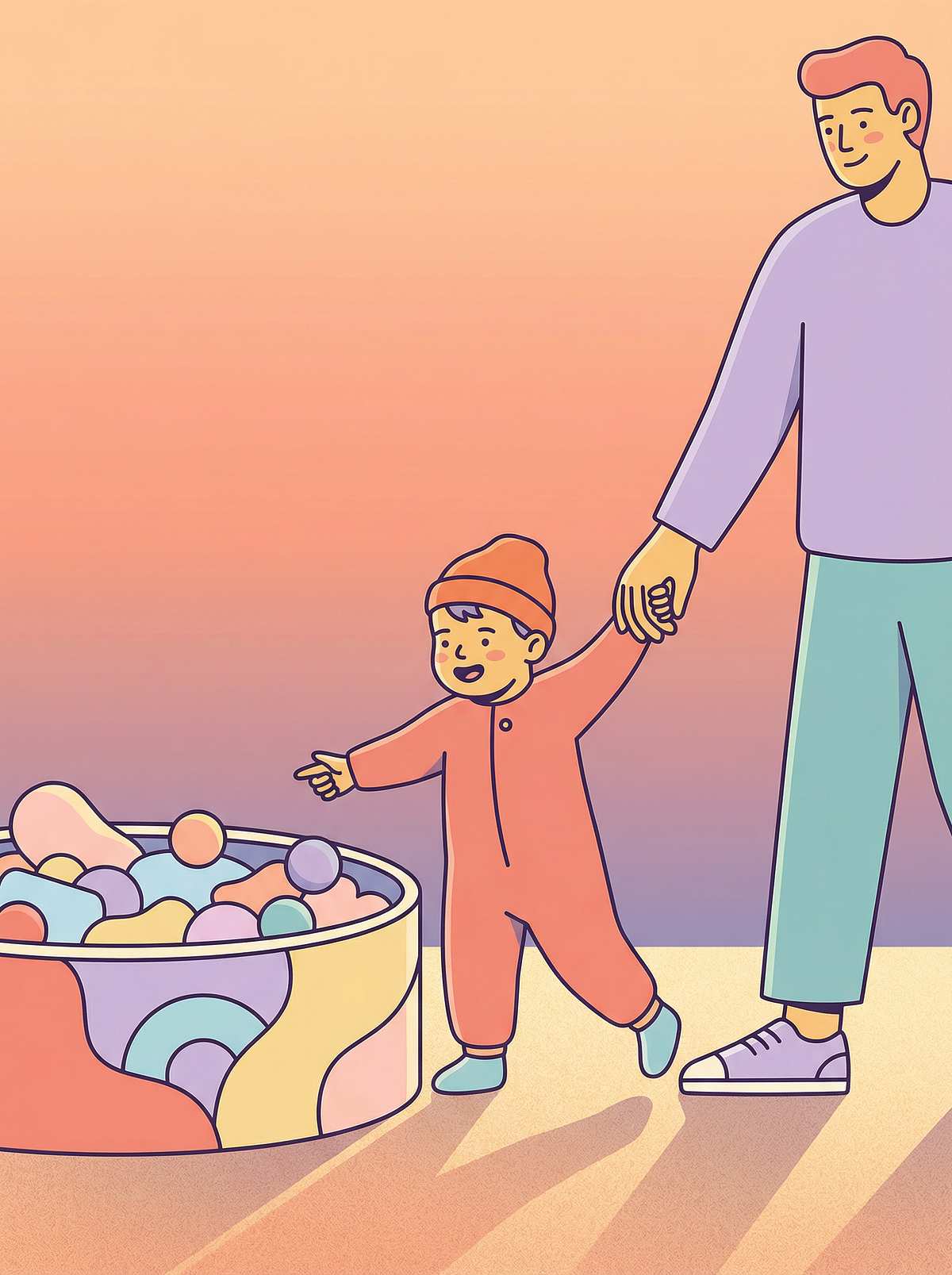
They want the biscuit on the shelf. Instead of pointing, they scream. Or cry. Or take your hand and physically drag you to it and place your hand on the shelf. The pointing finger — the simplest, most universal human gesture — doesn't exist in their communication vocabulary yet. And without pointing, a thousand daily requests become meltdowns.
The Neuroscience
Pointing demonstrates communicative intent, joint attention, and a theory-of-mind precursor: "I understand you don't know what I want, so I need to show you." The mirror neuron system drives gesture imitation; the prefrontal cortex drives intentional communication. When either system is delayed, pointing doesn't emerge spontaneously.
What You'll Learn
- Hand-over-hand pointing teaching protocol
- Motivational pointing (at preferred items)
- Proto-declarative pointing (pointing to share)
- Environmental sabotage to create pointing opportunities
- Reaching → hand-leading → pointing progression
- Pointing as the gateway to all further communication
Evidence: Level I — Pointing is a core M-CHAT-R/F screening item (97% sensitivity). Structured gesture training produces pointing in 80%+ of pre-verbal children with ASD within 12 weeks. NCAEP 2020 | M-CHAT validation | ESDM
B-124
Doesn't Wave
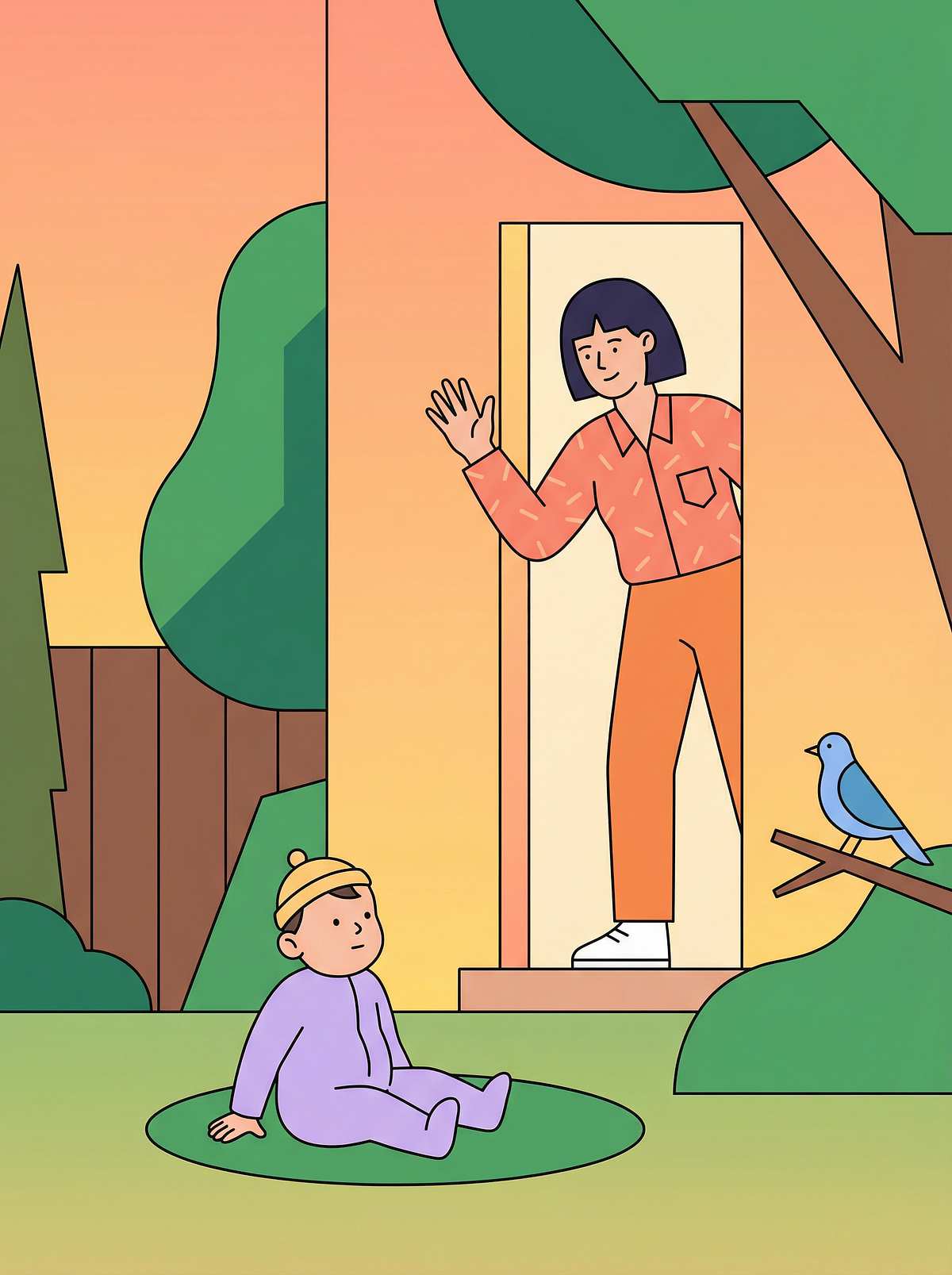
Relatives arrive and everyone says "wave bye-bye!" Your child stares blankly, looks away, or continues what they're doing. You wave their hand for them. It seems small — just a wave. But it represents a universe of social communication that hasn't yet clicked: I see you, I understand this ritual, I can use my body to mean something in our shared world.
The Neuroscience
Waving requires four simultaneous neural computations: imitation of a learned gesture (mirror neuron system), social understanding (this gesture means greeting), motor planning (sequenced hand movement), and social motivation (I want to participate). Each is separate — and waving demands all of them at once.
What You'll Learn
- Hand-over-hand wave teaching in natural contexts
- Pairing the wave with doorbell and departure moments
- Video modeling for gesture learning
- Prompted → independent wave progression
- Expanding from wave to all social gestures
- Family coaching: celebrating approximations joyfully
B-125
No Gestures
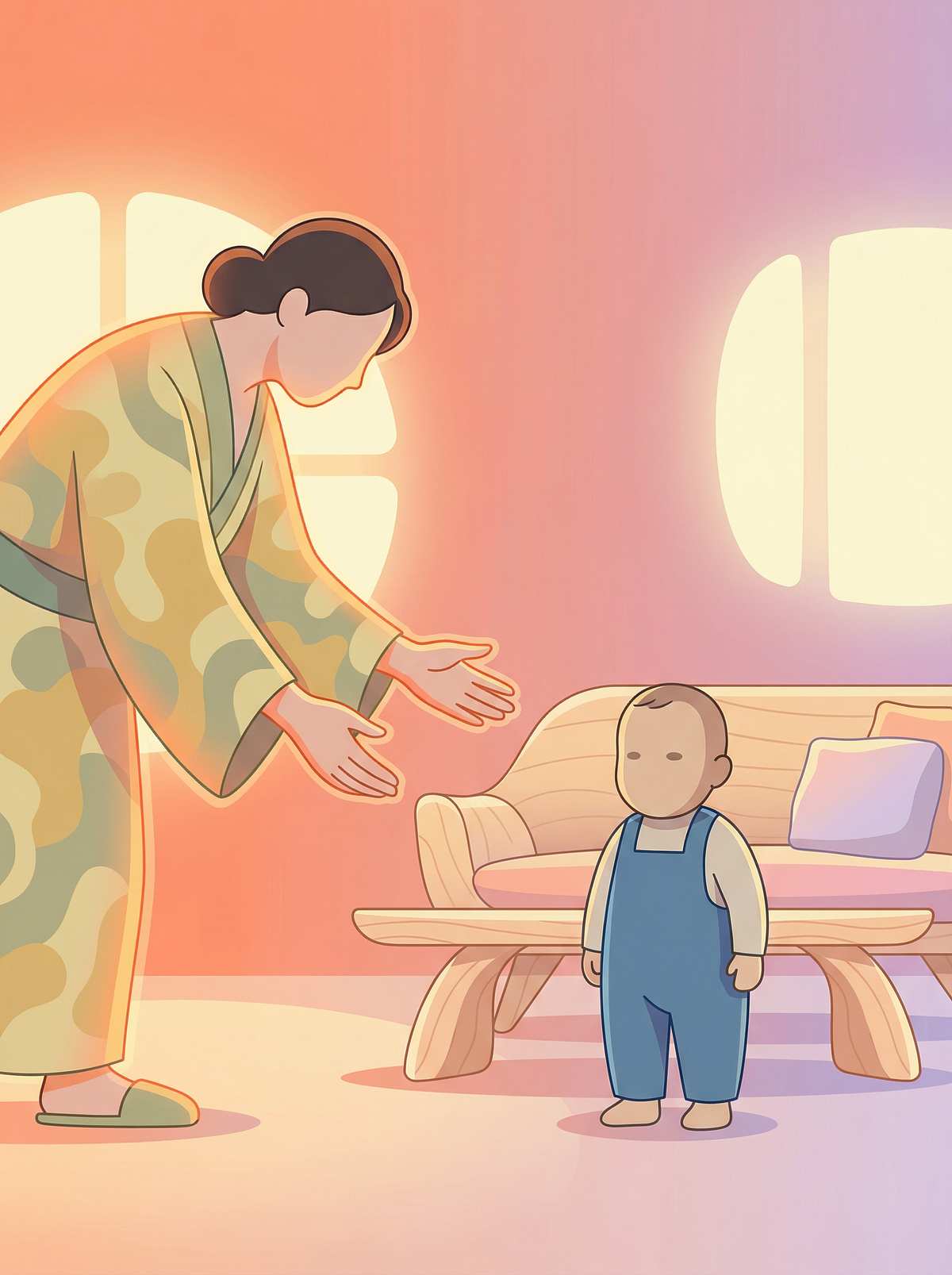
No pointing. No waving. No head shake for "no." No nod for "yes." No reaching up to be picked up. No showing objects. Their body is entirely silent — every message must be decoded from behavior, crying, or physical manipulation of your body. Communication becomes a guessing game that both of you are losing, all day, every day.
The Neuroscience
Gestures are the body's first language — emerging before words in ALL typically developing children at 8–12 months. The entire gestural repertoire relies on the mirror neuron system for acquisition and the prefrontal cortex for intentional deployment. When gesture development is globally delayed, the foundation for all symbolic communication — words, signs, AAC — is missing.
What You'll Learn
- Gesture hierarchy: which gestures to teach first and why
- Total communication approach (gestures + vocalizations + visuals)
- Environmental arrangement to create gesture opportunities
- Parent interaction style that naturally elicits gesture
- Exaggerated parent gesture modeling
- Transition pathway: gesture → sign → word
B-126
Doesn't Show Objects
A neurotypical 12-month-old finds a leaf and runs to show you — "Look!" Your child finds something fascinating and keeps it entirely to themselves. They don't bring you the toy. They don't hold up the picture. They don't share their discovery. It isn't selfishness — sharing an experience with another human simply isn't in their communication repertoire yet. That shared world is waiting to be built.
The Neuroscience
Showing objects is proto-declarative communication — "I want to share my experience with you." It requires theory-of-mind precursors: understanding that you have a separate mind, and that sharing an object creates a shared experience. This is qualitatively different from requesting. Proto-declarative showing is one of the most reliable early markers of social communication development.
What You'll Learn
- Difference between requesting and sharing experiences
- Creating "wow moments" that motivate showing
- Modeling showing behavior with high enthusiasm
- Responding with high affect when child approaches with any object
- Building the giving → showing → commenting chain

B-127
Doesn't Follow Your Point
You point at the airplane in the sky. They look at your finger. You point at the dog across the road. They look at your hand. The ability to follow a point — to understand "I'm directing your attention somewhere else" — is missing. Every "look at that!" falls into a void. This skill, called Responding to Joint Attention, is one of the strongest predictors of future language development.
The Neuroscience
Following a point requires gaze-following (tracking from your eyes/hand to the target), social referencing (understanding your gesture has communicative intent), and disengagement from current focus. The posterior superior temporal sulcus processes gaze direction; the intraparietal sulcus processes spatial pointing vectors. Both must coordinate seamlessly.
What You'll Learn
- Point-following training: close range → far range
- Pairing pointing with sound and movement to attract gaze
- Using preferred items as first pointing targets
- Graduating from touch-pointing to distal pointing
- Why gaze-following predicts language outcomes
B-128
No Words by 18 Months
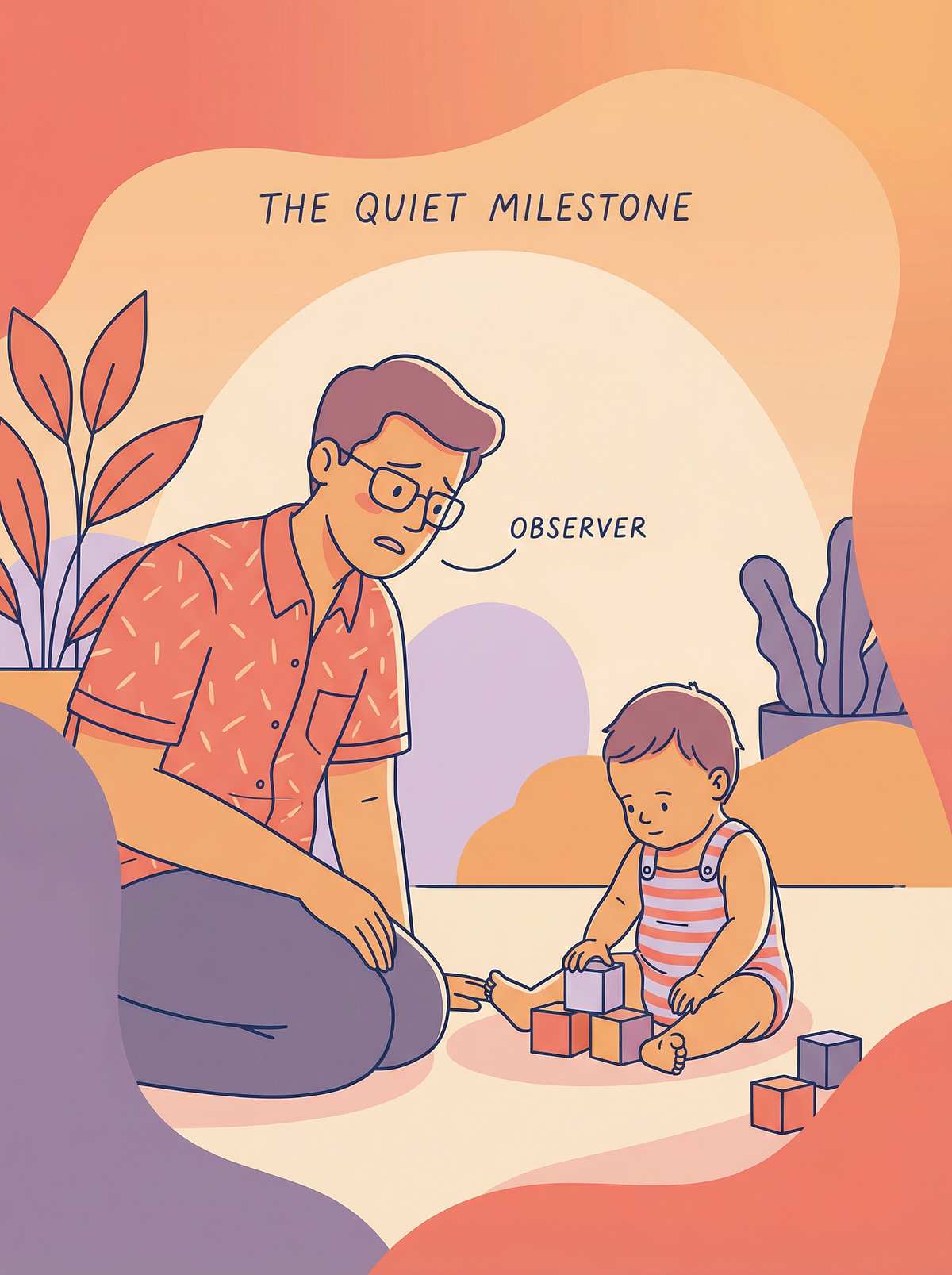
The 18-month milestone. The paediatrician asks "how many words?" and you say zero. Not delayed words. Not unclear words. Zero words. The silence is deafening. The comparison with every other toddler in the park, the temple, the family WhatsApp group — it's crushing. You've Googled "no words at 18 months" a hundred times. You know what the results say. This is the moment to act — not wait.
The Neuroscience
First words require the complete pre-verbal stack: joint attention + communicative intent + vocal imitation + phonological memory + motor speech planning. If any foundation is missing, words cannot emerge. The absence of words at 18 months doesn't mean silence forever — it means the foundational architecture needs direct intervention NOW, during the peak neuroplasticity window of 18–36 months.
What You'll Learn
- What "no words" actually means developmentally
- Immediate action plan — NOT "wait and see"
- Building the pre-verbal foundation stack step by step
- Parent-implemented communication strategies for daily life
- When to introduce AAC as a bridge to speech
- Why early intervention now is the most important decision
Evidence: 90%+ of children receiving intensive early intervention before age 3 develop functional communication. The Lancet Commission, ESDM RCTs, and NCAEP 2020 all confirm: earlier is stronger. PMC10955541 | Lancet | NCAEP 2020

B-129
Word Regression
They had words. "Mama." "Papa." "Ball." Maybe 10, maybe 20 words. And then — they disappeared. One by one, the words stopped. By the time you noticed, the silence was complete. This is regression, and it is among the most terrifying experiences a parent can have. You had your child's voice. And then you lost it. But the evidence is clear: the voice can be rebuilt.
The Neuroscience
Language regression occurs in approximately 25–30% of ASD cases, typically between 15–24 months. Current theories include atypical synaptic pruning patterns, immune-mediated neuroinflammatory processes, and failure of emerging language networks to consolidate. Critically, regression does NOT mean language capacity is "gone" — the neural substrate can be rebuilt with intensive intervention.
What You'll Learn
- Understanding regression — neurological, not your fault
- Immediate action: assessment + intervention, not "wait and see"
- Rebuilding from the last retained communication level
- Medical workup criteria (EEG to rule out Landau-Kleffner syndrome)
- Parent emotional support during regression
- The evidence for recovery: regression doesn't predict outcome

B-130
Doesn't Imitate
You clap — they don't clap. You wave — they don't wave. You say "ma-ma" — they don't try. You make a funny face — they don't copy. Imitation, the engine that drives all childhood learning, isn't firing. Without imitation, every skill — language, play, self-care, social behavior — must be taught one piece at a time instead of being absorbed naturally from the world.
The Neuroscience
The mirror neuron system fires both when performing an action AND when observing someone else perform it — creating the neural bridge for imitation. In ASD, mirror neuron activation during observation may be reduced or atypical. Without this automatic "copy" mechanism, learning shifts from observational (effortless) to instructional (effortful), requiring deliberate teaching of every skill.
What You'll Learn
- Imitation hierarchy: object → body movement → oral motor → vocal
- Reciprocal Imitation Training basics (adult imitates child first)
- Using preferred activities as imitation context
- Motor imitation as the foundation for verbal imitation
- Celebrating approximations at every step
- Generalization from structured to natural contexts
B-131
Limited Pretend Play
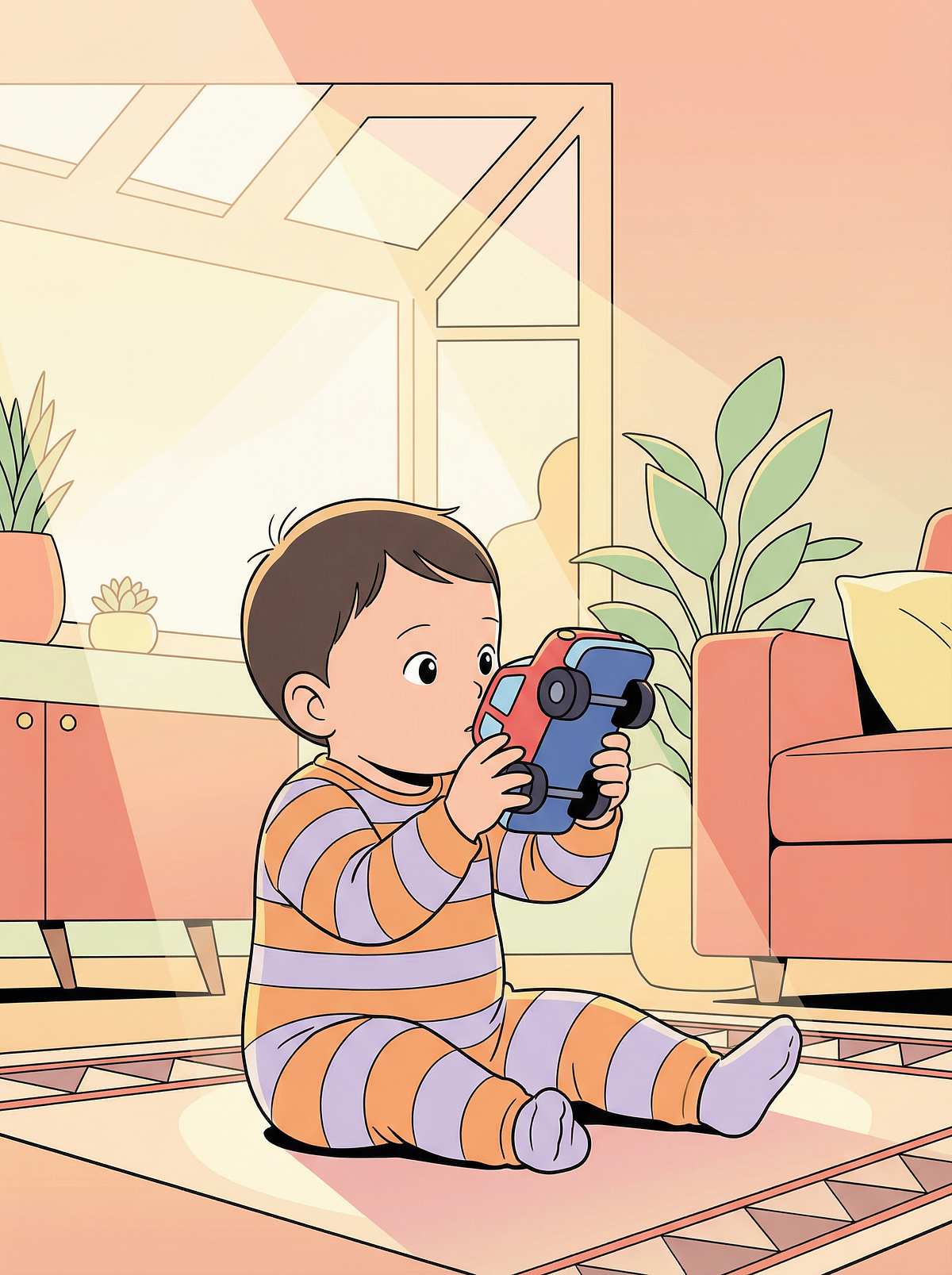
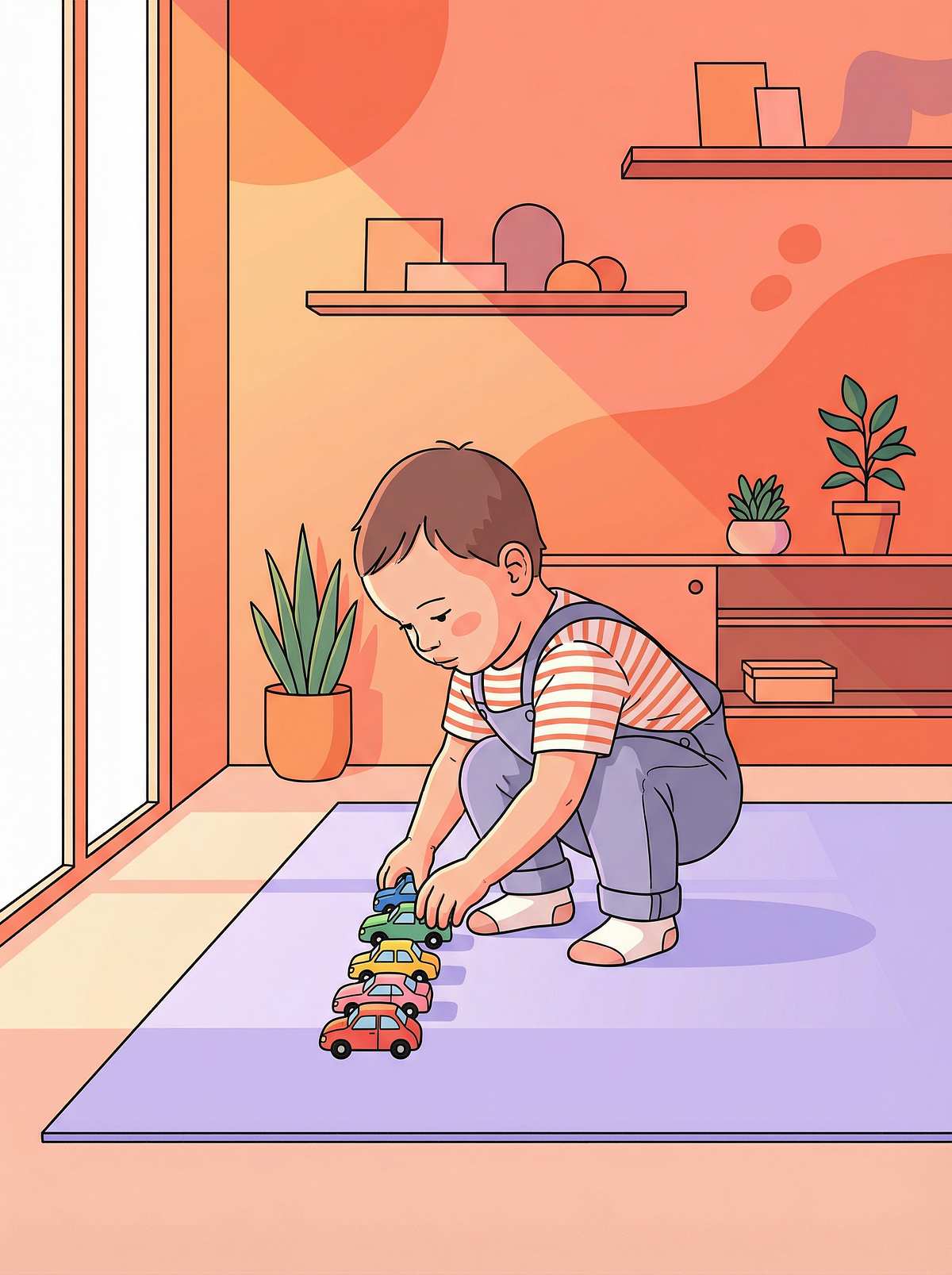
They line up the tea set instead of hosting a tea party. They spin the toy car wheels instead of driving it to the shop. They stack the dolls instead of tucking them in. Pretend play — the magical leap from concrete to symbolic — hasn't emerged. Without symbolic thinking, symbolic language (words representing things) is significantly harder to develop. Play and language share the same neural circuitry.
The Neuroscience
Pretend play requires symbolic representation — using one thing to stand for another (banana = telephone). This same cognitive capacity underlies language (word = object). Both are mediated by the left prefrontal cortex and temporal-parietal regions. Pretend play delay predicts language delay — and pretend play intervention measurably improves language outcomes.
What You'll Learn
- Play hierarchy: sensorimotor → functional → symbolic → pretend
- Scaffolding pretend play from the child's current level
- Using preferred objects to enter the pretend world
- JASPER strategies for joint engagement in play
- Play as a direct language intervention tool
- When functional play is the appropriate target
B-132
Uses Hand as Tool
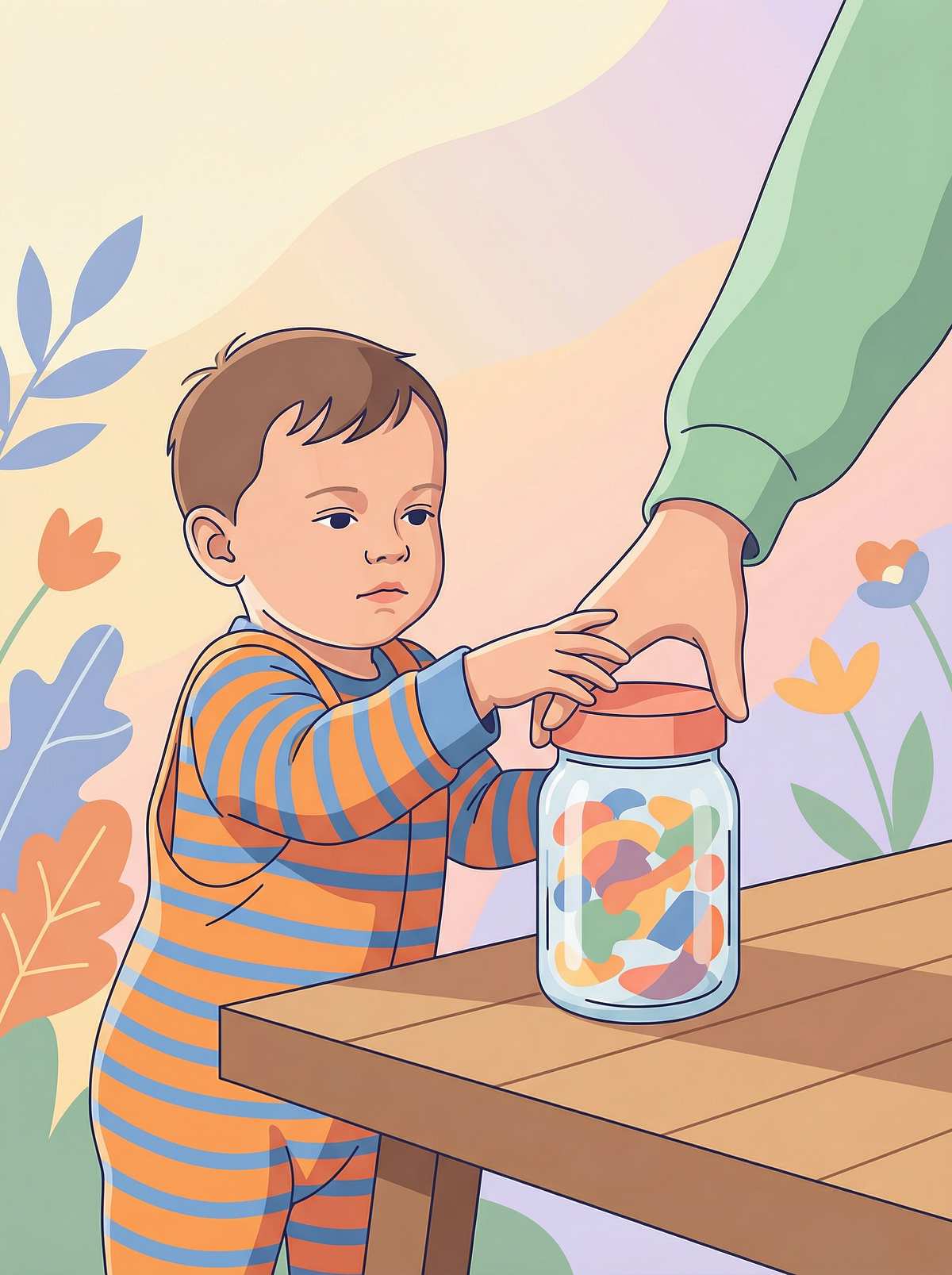
They take your hand and place it on the jar lid. On the door handle. On the toy button. They don't look at you — they look at your hand. You're not a person to communicate with — you're a tool with useful appendages. It's heartbreaking because the interaction looks purposeful but is missing the human connection at its core. The intention to communicate is present. The social dimension is the target.
The Neuroscience
Hand-leading is instrumental communication without social referencing. The child understands cause-and-effect (your hand opens the jar) but hasn't developed joint attention (looking at you as a communicative partner). The INTENTION to communicate is good news — it means the communication drive exists. The goal: add the social layer that transforms a tool-use into a true communicative act.
What You'll Learn
- Why hand-leading is good news (communicative intent is present!)
- Inserting eye contact into hand-leading sequences
- Pausing to create communication pressure naturally
- Transitioning: hand-leading → pointing → verbalizing
- Building social referencing during all requests

B-133
Leads You to Objects
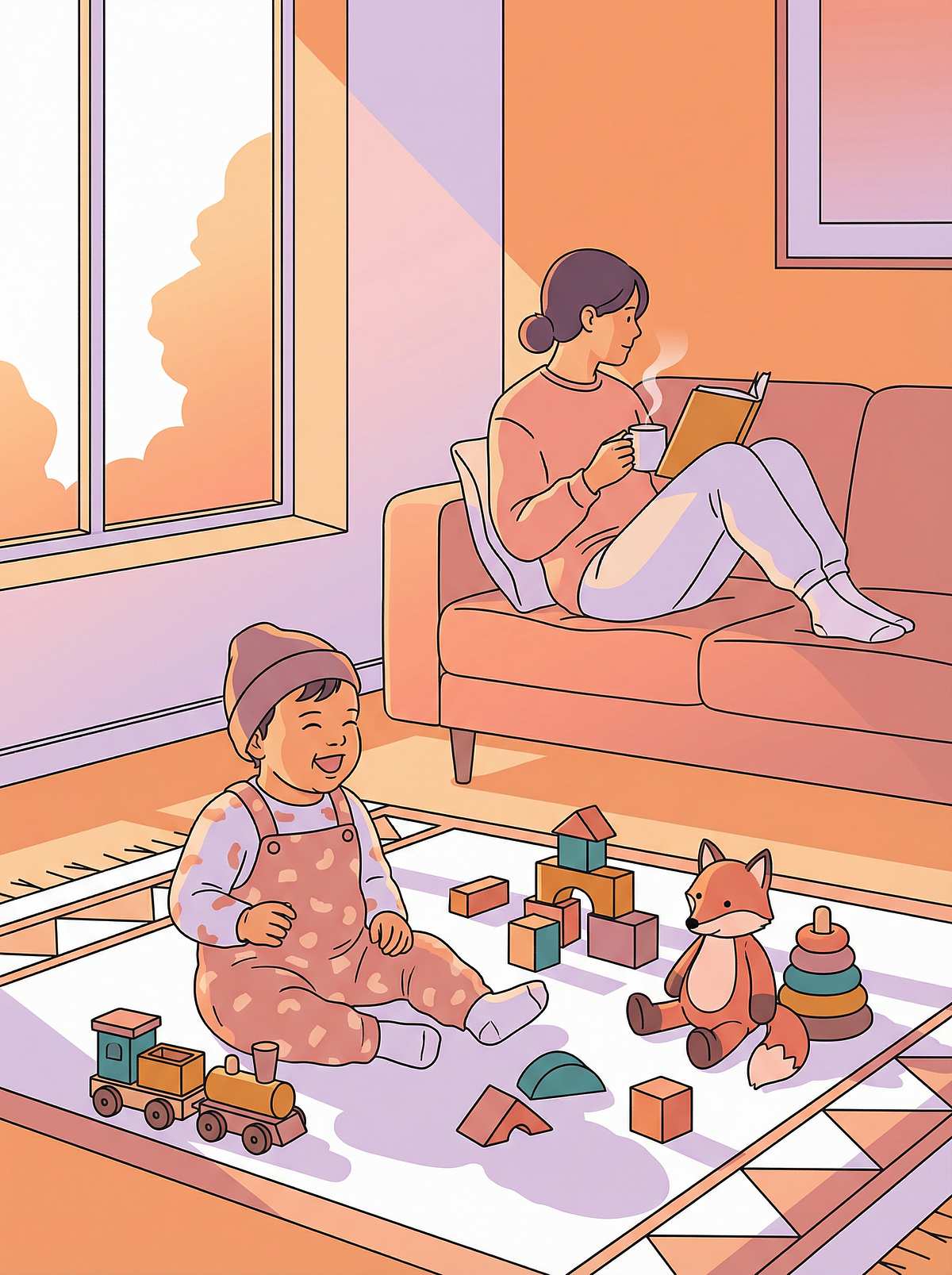
They grab your sleeve and pull you to the kitchen — to the fridge, the snack shelf, the tap. They can't tell you what they want, but they can take you there. It's exhausting and frustrating for both of you. But this is communication — the most physical, body-driven form of "I need something." Honoring that attempt is the first step to transforming it.
The Neuroscience
Leading is more advanced than hand-as-tool: the child is directing your entire body to a location, demonstrating spatial planning and intentional communication. The gap is that they're taking you, not telling you. The intervention goal is inserting symbolic communication — gesture, sign, word, or picture — into this existing intentional sequence at the critical moment of need.
What You'll Learn
- Honoring the communication attempt (don't extinguish it)
- "Stop and wait" technique: pause mid-leading to create opportunity
- Modeling language during leading ("You want WATER!")
- Offering picture or sign option at the destination
- Building from leading → pointing → requesting
B-134
Limited Communicative Intent
They don't seem to want to communicate. Not with words. Not with gestures. Not with crying for specific things. They exist contentedly in their own world, meeting their own needs where possible, and simply waiting or becoming distressed when they can't. The drive to connect — to share, request, protest, comment — is muted. But this drive can be kindled through the right environment.
The Neuroscience
Communicative intent is the motivational engine of all communication. It emerges from the brain's social reward system (ventral tegmental area → nucleus accumbens) — the circuit that makes human interaction feel rewarding. In ASD, social stimuli may not activate this circuit as strongly. This is not apathy — it is a difference in what the brain finds rewarding, and it is directly targetable.
What You'll Learn
- Creating communication NEED through environmental arrangement
- Making communication REWARDING with immediate natural reinforcement
- Following child's lead to find motivating contexts
- Communication temptations that create organic opportunities
- Pivotal Response Treatment motivation procedures
- The "1000 opportunities a day" home programme

B-135
Building Joint Attention
You're playing with a ball. You look at the ball, then at your child, then back at the ball. Your child looks at the ball but never looks at you. The triangle of shared attention — me, you, and the thing we're both interested in — has only two sides. Joint attention is the single strongest predictor of language outcomes in ASD — stronger than IQ, stronger than diagnosis severity.
The Neuroscience
Joint attention is the triadic coordination of attention between self, other, and object. It requires the posterior superior temporal sulcus (gaze direction), medial prefrontal cortex (understanding others' attention), and intraparietal sulcus (directing spatial attention). JA intervention has the strongest evidence base of ANY early autism intervention — the JASPER model demonstrates medium-to-large effect sizes.
What You'll Learn
- Responding to JA (RJA) vs. Initiating JA (IJA) distinction
- JASPER strategies adapted for home daily routines
- Creating joint attention opportunities throughout the day
- Gaze-shift training: object → person → object
- Why JA is the gateway skill to language
- Measuring and tracking joint attention progress

B-136
Teaching First Communication
You want to help but don't know where to start. They don't talk, don't gesture, don't point. The gap between "silence" and "first word" feels infinite. What IS the first step? What do you teach a child who has no communication system at all? The answer begins smaller than you think — and every single signal counts as a victory.
The Neuroscience
First communication is any intentional signal — a look, a reach, a sound, a touch — directed at another person to achieve a goal. The brain must learn: my action → your response → my need met. This contingency loop (prefrontal cortex + basal ganglia learning circuits) is the seed from which all communication grows. Once that loop fires, it accelerates everything that follows.
What You'll Learn
- The communication ladder: first rung is any intentional signal
- Choosing the right communication modality for this child
- Total communication approach across modalities
- Parent interaction style that elicits communication naturally
- The power of waiting: the 3-second pause
- From accidental to intentional communication
B-137
From Crying to Signals
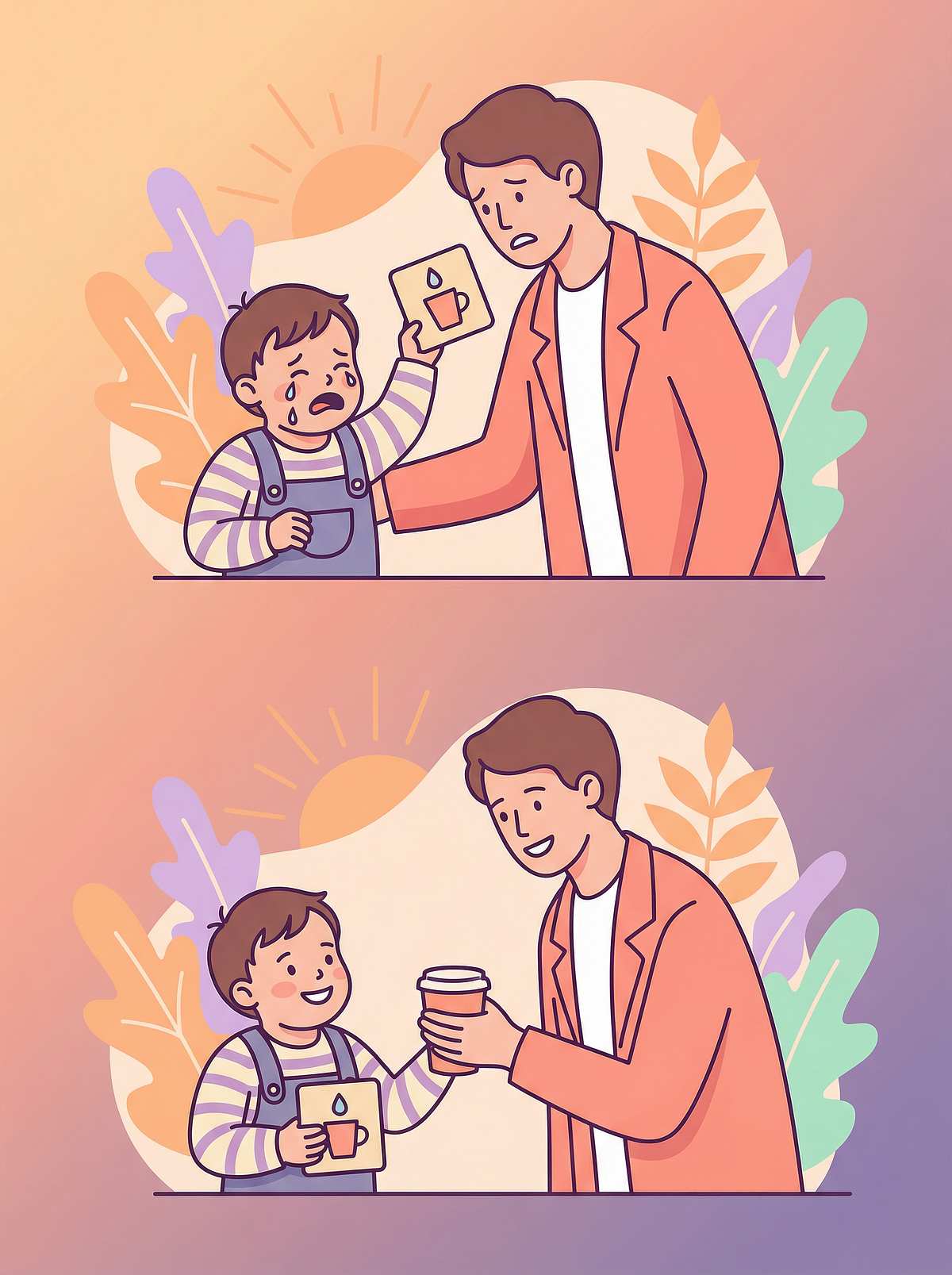
Their only communication tool is crying. Hungry = crying. Thirsty = crying. Bored = crying. Overwhelmed = crying. Every need sounds the same to you. You've become an exhausted detective, decoding the same distress signal for twenty different meanings. Functional Communication Training (FCT) replaces the single cry with a library of clear, specific signals — one for each need.
The Neuroscience
Crying is reflexive communication — undifferentiated distress signaling from the limbic system. The developmental leap is from reflexive (automatic) to intentional (purposeful) signaling. This requires the prefrontal cortex to override the limbic "cry" default and deploy a specific, differentiated signal. The child needs to learn: specific signal → specific response → need met faster than crying.
What You'll Learn
- Functional Communication Training basics (FCT)
- Choosing a replacement signal that's easier than crying
- Teaching the replacement during calm — not during meltdown
- Honoring the new signal IMMEDIATELY to build trust
- Progressive signal upgrading: gesture → picture → sign → word
- Family consistency protocol across all caregivers

B-138
Teaching Requesting
They want the cookie. They can see it. They need you to get it. But they can't ask. The frustration builds. The meltdown erupts. If only they could say — or show, or sign, or point to — "cookie," the meltdown would never need to happen. Requesting is the most motivating skill to teach because the child already wants the outcome. The motivation is already there. We just need to channel it.
The Neuroscience
Requesting (manding in ABA terminology) is the first functional communication skill — a signal that produces a specific, motivating consequence. The neural circuit: motivation (nucleus accumbens) → action selection (prefrontal cortex) → signal production (Broca's/motor cortex) → consequence (reward). This is the easiest communicative function to teach because motivation is already powerfully present.
What You'll Learn
- Identifying the child's strongest motivators precisely
- Choosing the right requesting modality (verbal, PECS, sign, AAC)
- Creating requesting opportunities throughout every day
- The "communication temptation" technique in practice
- Fading prompts to fully independent requests
- Expanding from single-item to multi-item requesting

B-139
Teaching Rejecting
You offer food they hate — meltdown. You put on the wrong video — meltdown. You try to dress them — meltdown. They can't say "no." They can't shake their head. They can't push away. Every unwanted experience has one response: full-body distress. If they could signal "no thank you" — even just push the plate away — half the daily meltdowns would simply vanish.
The Neuroscience
Rejecting is the second essential communicative function. It is harder than requesting because the child must produce a signal during emotional arousal. The amygdala drives the distress; the prefrontal cortex must override that distress long enough to deploy a communicative signal instead of a full meltdown. Teaching rejection signals during calm builds this regulatory capacity.
What You'll Learn
- Teaching "no," "stop," and "all done" in the child's modality
- Head shake teaching protocol
- Push-away as an acceptable, legitimate rejection signal
- Accepting rejection immediately to build communication trust
- Preventing escalation from "no" to full meltdown
- Differentiating "I don't want this" from "I can't cope"
B-140
Communication Temptations
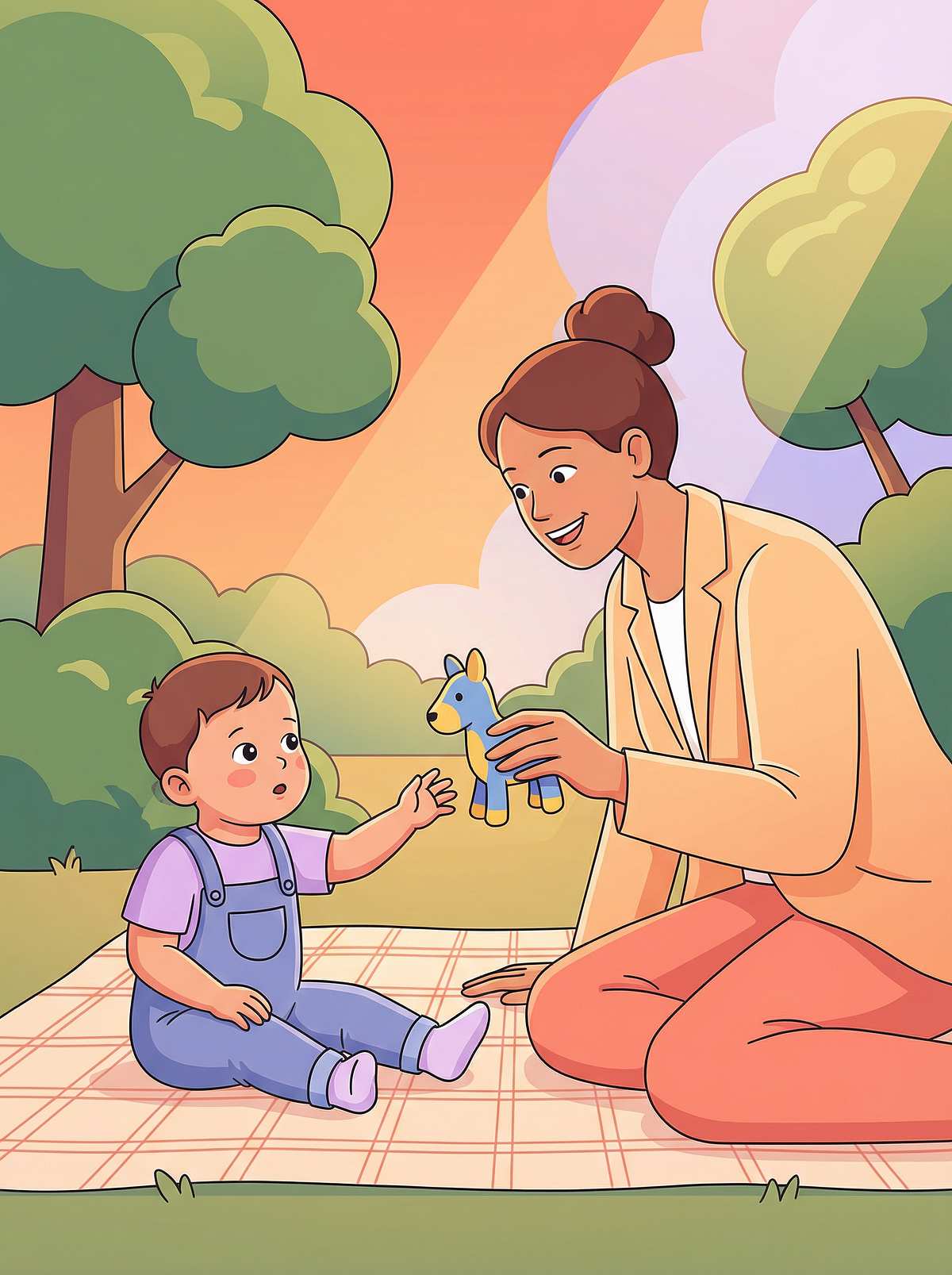
If you anticipate every need, they never need to communicate. So now you need to stop anticipating — and create situations where communication is the only way to get what they want. It feels counterintuitive. It might feel mean. But communication temptations are among the most powerful strategies in early communication intervention, and they work within ordinary daily routines.
The Neuroscience
Communication temptations exploit the brain's motivational circuits by creating a gap between want and have that can only be bridged by communication. The dopamine system (wanting) drives the prefrontal cortex (planning) to activate the communication system (signaling). Without this gap, the brain has no reason to invest the enormous effort that communication requires.
What You'll Learn
- 10 classic communication temptation setups
- Placing preferred items in sight but out of reach
- Giving tiny portions to create "more" requests naturally
- Offering the wrong item on purpose
- Stopping a favourite activity mid-way to elicit a signal
- Balancing temptation with appropriate frustration tolerance
B-141
Only Cries for Needs
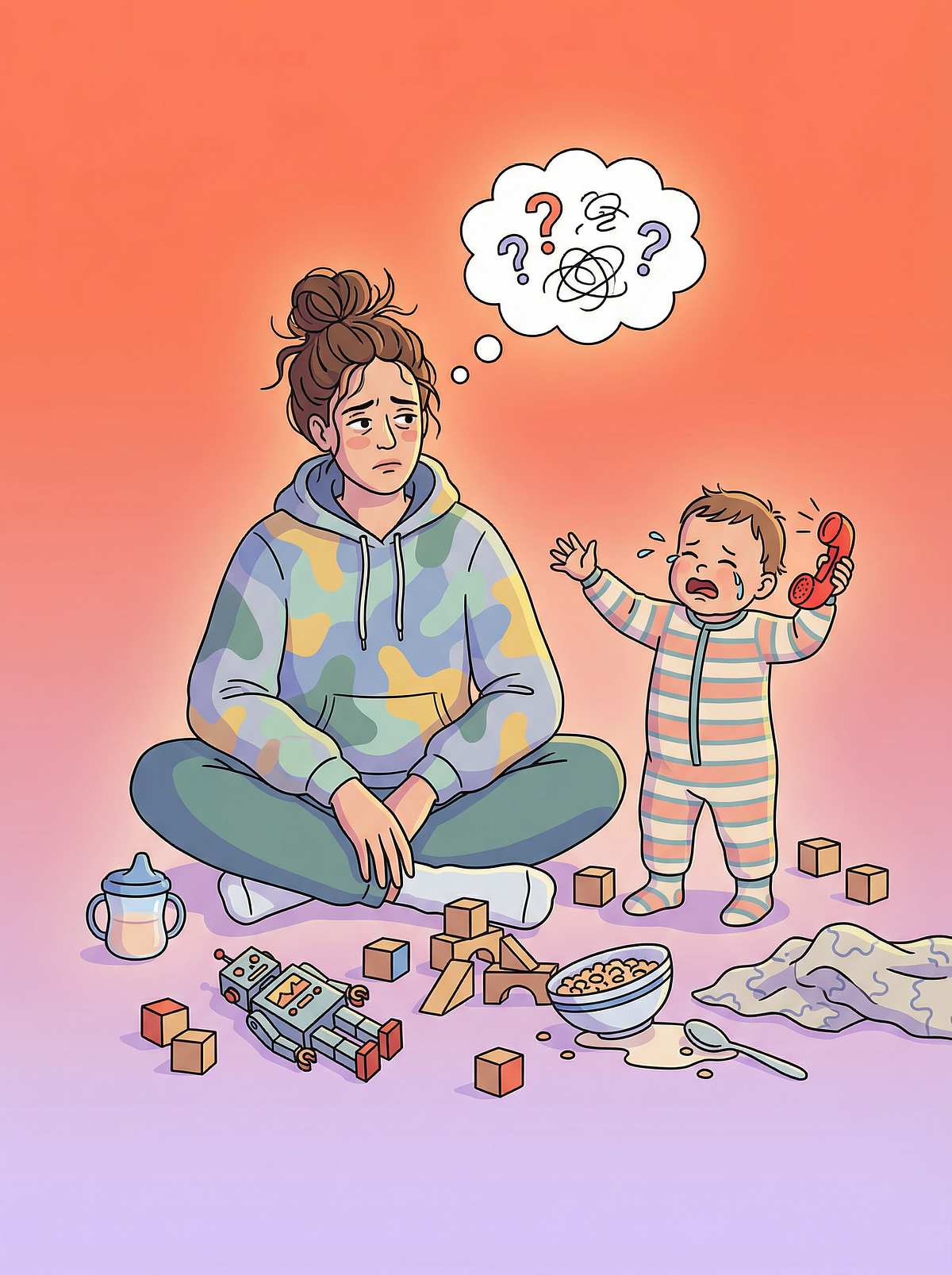
The child whose entire communication system is crying. Hungry, thirsty, in pain, wanting a toy, wanting attention, wanting to escape — every need produces the same signal: tears. Building a differentiated communication system means replacing that single cry with a library of clear signals, one for each category of need. This transforms daily life for the whole family.
The Neuroscience
The goal is the limbic-to-prefrontal transition: from undifferentiated distress to differentiated, intentional signals. Critically, this requires building not just one replacement signal, but a library of signals mapped to the full range of needs. Each new signal strengthens the prefrontal-limbic regulatory connection that makes communication possible even during emotional arousal.
What You'll Learn
- Need-by-need signal mapping (food, activity, comfort, escape)
- Visual communication board introduction for daily use
- Category-based teaching: food → activity → comfort signals
- Family training on reading and honoring early signals
- Building a complete personal communication system from scratch
B-142
Eye Gaze Development
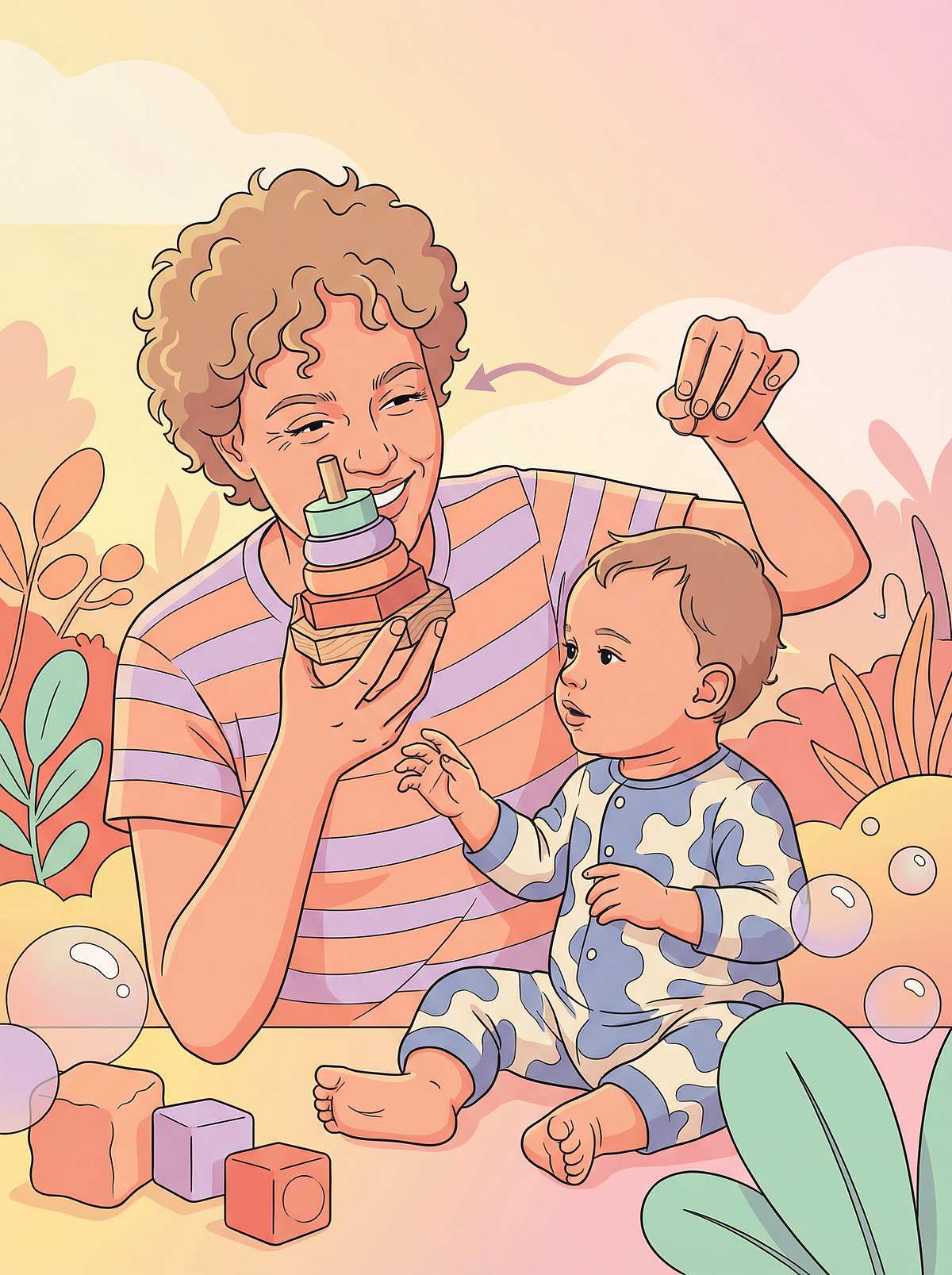
They don't look at you when you talk. They don't look at objects you're showing them. Their eyes don't "dance" between you and items the way other toddlers' do. The gaze — the most basic and primal communication channel — is quiet. But gaze is a skill that can be built gradually, gently, and without ever forcing uncomfortable direct eye contact that creates stress.
The Neuroscience
Eye gaze is the foundation of joint attention. The superior temporal sulcus processes gaze direction. The fusiform face area processes facial identity. The amygdala processes social-emotional significance of faces. All three must coordinate. In ASD, gaze patterns show reduced fixation on eyes and increased fixation on mouths or objects — a difference in social salience processing.
What You'll Learn
- Gaze-following activities for daily routines
- Face-to-face interaction games: peek-a-boo, face songs
- Using preferred objects held near your face
- Building gaze shifts: object → face → object
- Building comfortable gaze, not stressful staring
- Teaching eye-pointing as a communication tool
B-143
Social Smile
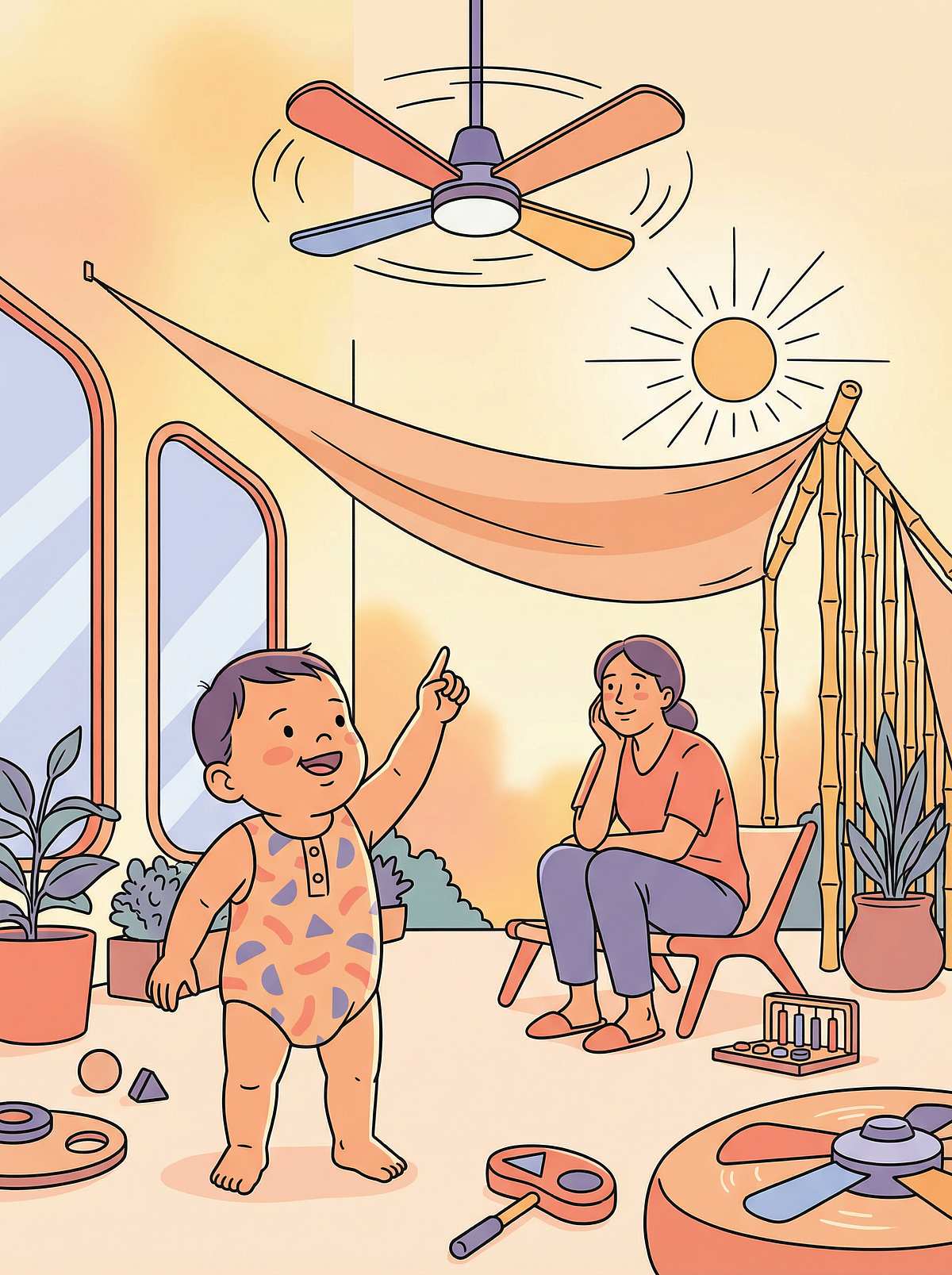
They smile — but at the ceiling fan. At the light pattern on the wall. At their own hands. They rarely smile at you. The social smile — the smile that says "I see you and I'm happy you're here" — is absent or rare. You would give anything for one smile directed at your face. And with the right sensory social routines, those smiles begin to emerge, one joyful moment at a time.
The Neuroscience
The social smile is triggered by the social reward system recognizing a familiar, safe, pleasurable stimulus. In ASD, the smile motor pattern may be intact — the brain produces it — but it isn't yet linked to social engagement. The target is building the connection between social interaction and the genuine Duchenne smile, through repeated positive shared experiences.
What You'll Learn
- Sensory social routines that reliably elicit smiling
- Imitating the child's own expressions to create reciprocity
- High-affect play that connects social interaction with joy
- Peek-a-boo variations for all ages and sensory preferences
- Tickle games with anticipation buildup
- Celebrating and extending every socially-directed smile
B-144
Turn-Taking Foundation
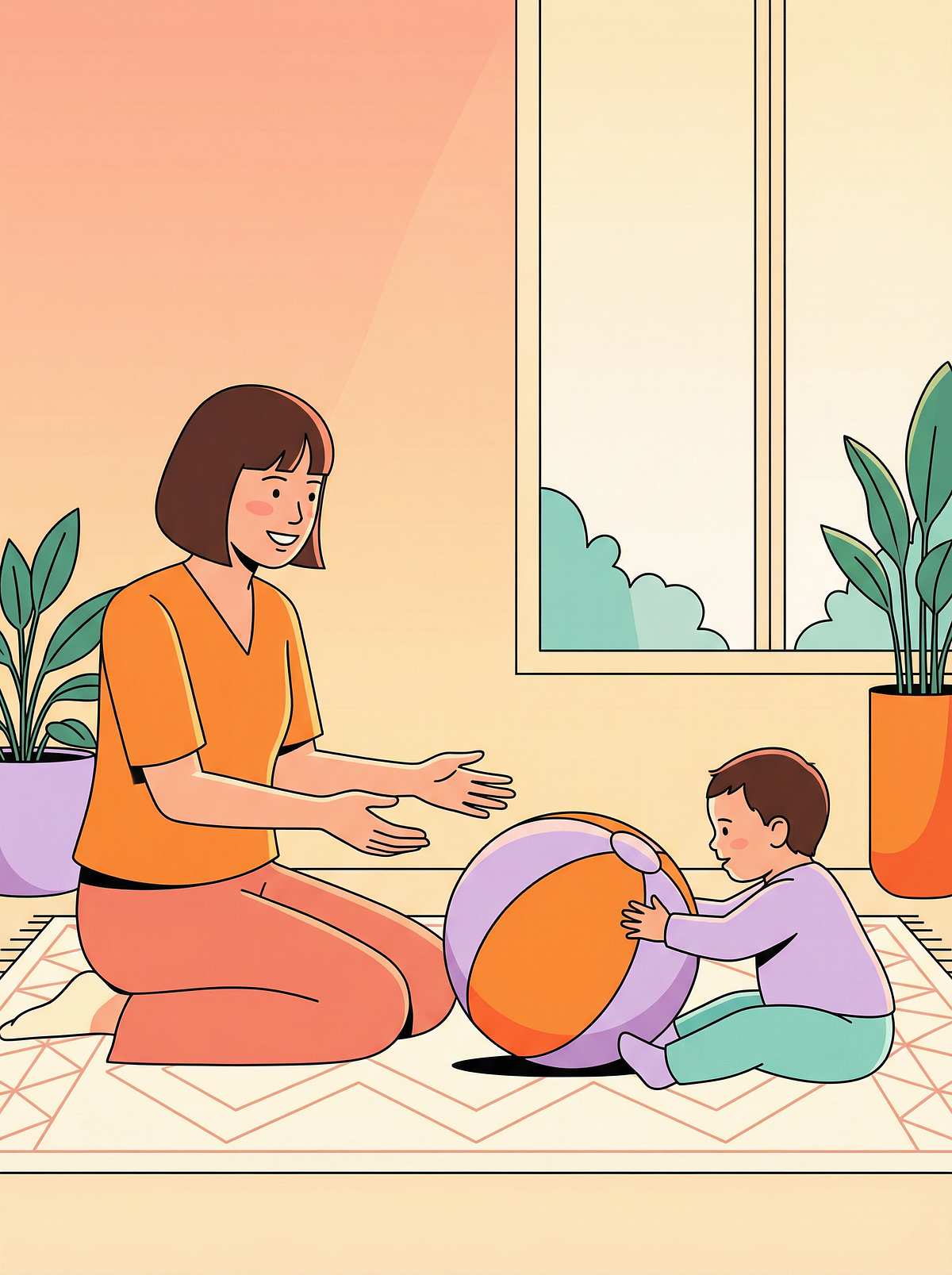
Conversation is turn-taking. So is play. So is every meaningful social interaction. But your child doesn't take turns — not with objects, not with sounds, not with actions. They play alone, in parallel, or take without giving back. The back-and-forth rhythm that all communication and relationship requires hasn't developed. Turn-taking is where conversational competence is born.
The Neuroscience
Turn-taking requires temporal prediction (knowing WHEN it's your turn), inhibition (waiting during the other person's turn), and action planning (preparing your response). The supplementary motor area and prefrontal cortex coordinate this social timing. In ASD, the temporal prediction of social exchanges is often atypical — and directly trainable through structured turn routines.
What You'll Learn
- Object turn-taking: rolling ball back and forth
- Vocal turn-taking: make sound → pause → child makes sound
- Action turn-taking: you stack, I stack
- Using "my turn / your turn" visual supports
- Building from 1 exchange to sustained, playful turns
- Turn-taking as the foundation for future conversation
B-145
Shared Attention
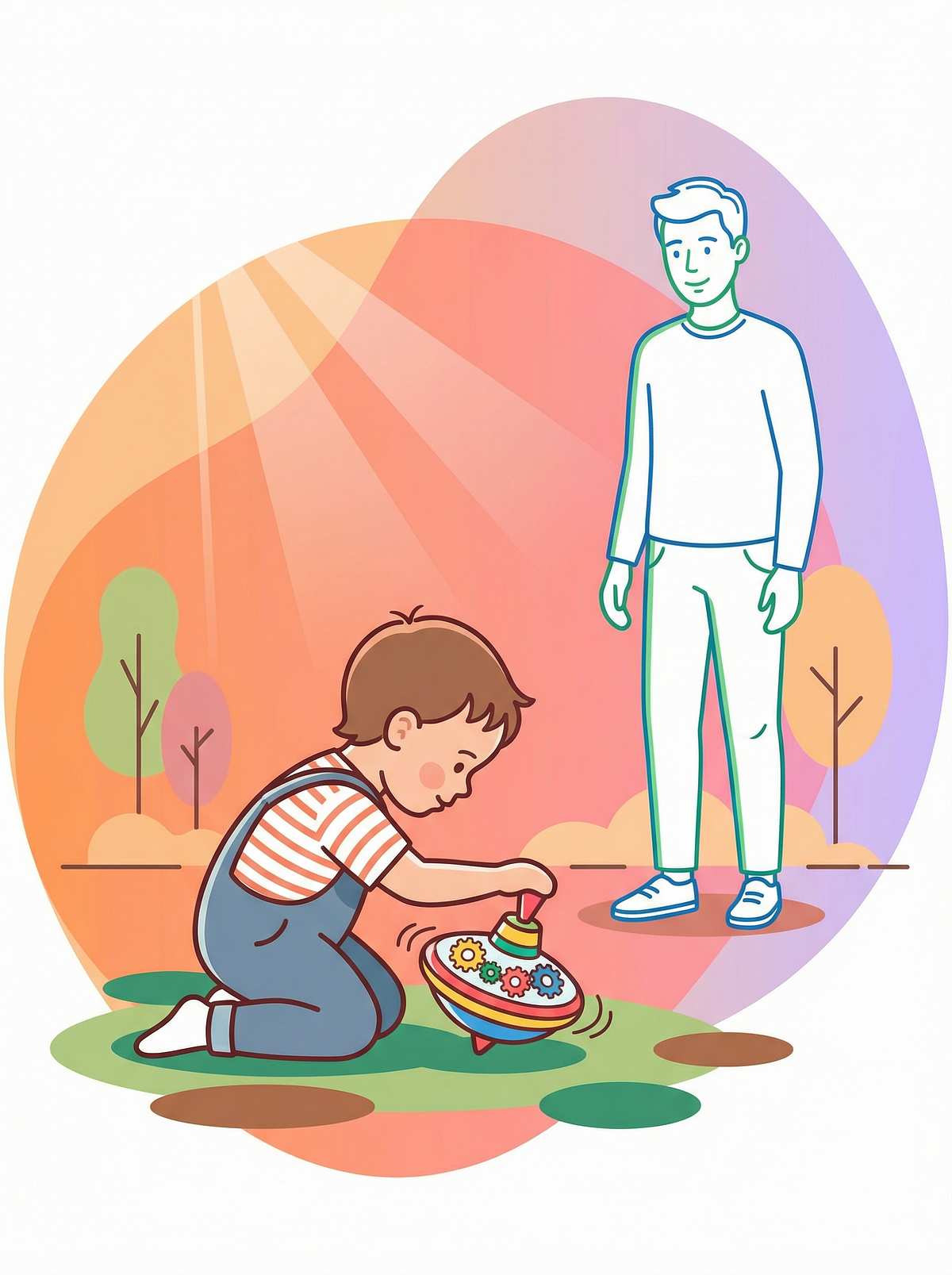
They enjoy things — but alone. They don't check if you're watching. They don't share the joy of a discovery. They don't look at you when something funny happens. The experience of sharing a moment with another person — the social glue of human connection — isn't part of their world yet. Building it starts with entering their world, not redirecting them to yours.
The Neuroscience
Shared attention is the emotional dimension of joint attention — not just looking at the same thing, but feeling something together about it. The medial prefrontal cortex and temporoparietal junction process the shared experience. Oxytocin release during shared positive experiences reinforces the reward value of social sharing, making each successful moment build toward the next.
What You'll Learn
- Creating "shared wow" moments in daily life
- Entering the child's interest world: joining, not redirecting
- Affect mirroring: showing your excitement about their discovery
- Building from parallel to shared experience gradually
- Narrating shared moments: "WE are building!"
- Why shared attention predicts long-term social development
B-146
Object Permanence
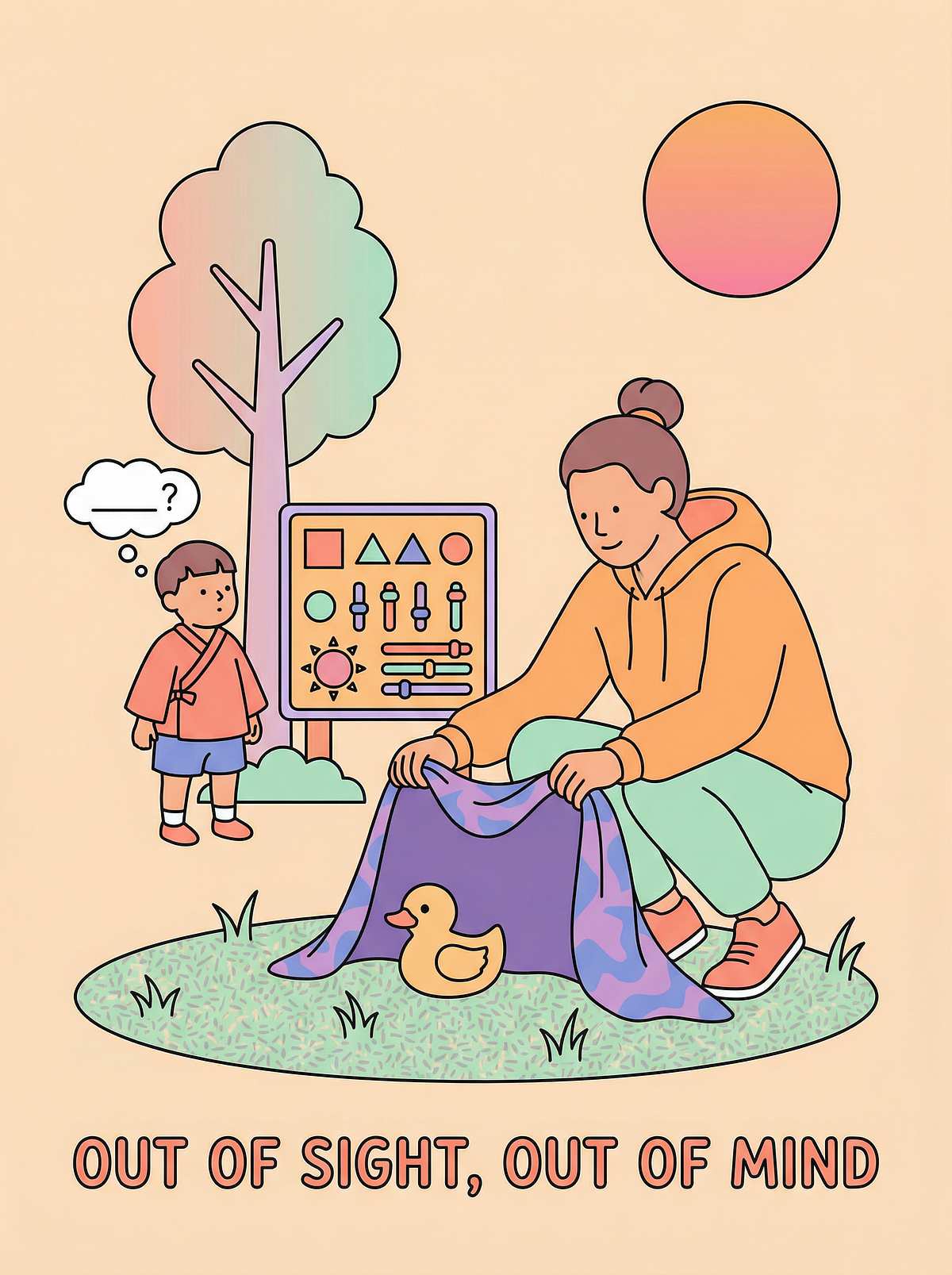
Out of sight, out of mind — literally. When a toy disappears under a blanket, they don't search for it. They move on. This means: when you leave the room, you may cease to exist in their world. Object permanence is the cognitive foundation for requesting absent items, recalling familiar people, and maintaining social bonds across distance and time.
The Neuroscience
Object permanence requires the hippocampus (maintaining mental representations) and prefrontal cortex (working memory to "hold" the image of a hidden object). Typically emerging at 8–12 months, a delay signals working memory and representational thinking differences that will affect language (words represent absent things) and social development (people exist when not visible).
What You'll Learn
- Peek-a-boo as foundational object permanence training
- Progressive hiding games to build mental representation
- "Where did it go?" search activities with preferred objects
- Linking object permanence to requesting absent items
- When delay indicates broader cognitive concerns requiring evaluation
Preview of pre verbal early communication Therapy Material
Below is a visual preview of pre verbal early communication therapy material. The pages shown help educators, therapists, and caregivers understand the structure and content of the resource before use. Materials should be used under appropriate professional guidance.
Link copied!

Where to Go Next
Your Child's Communication Journey Continues
Pre-verbal foundations are the beginning — not the limit. Once these 30 building blocks are in place, the pathway to expressive language, social communication, and full conversation opens wide. Explore the full Domain B roadmap and connect with Pinnacle Blooms Network® for personalized guidance.
← Domain A: Sensory Processing
Sensory foundations that support communication readiness. Start here if sensory differences are affecting engagement.
↑ Domain B: Communication
The full Communication domain with all four subdomains — pre-verbal, receptive, expressive, and social communication.
B2: Receptive Language →
25 interventions for understanding language — following instructions, comprehending words, and processing what they hear.
Pinnacle Blooms Network® | GPT-OS® | 21M+ Sessions | 97%+ Improvement Rate
📞9100 181 181 | interventions.pinnacleblooms.org/communication/pre-verbal-early-communication
📞9100 181 181 | interventions.pinnacleblooms.org/communication/pre-verbal-early-communication