

Vestibular Challenges — 20 Evidence-Based Movement & Balance Interventions
Subdomain A4 | Pinnacle Blooms Network® — When your child's brain misreads gravity, every swing, slide, and car ride becomes a crisis. These 20 evidence-based interventions — grounded in Ayres Sensory Integration theory and NCAEP 2020 — give you the tools to help your child move through the world with confidence. 21M+ therapy sessions. Powered by GPT-OS®.
Vestibular Neuroscience
Ages 2–6
Level I Evidence

Vestibular Neuroscience Primer
How the Vestibular System Works — And Why It Goes Wrong
Located in the inner ear, your child's vestibular apparatus contains two specialized motion-sensing systems working in constant partnership with the brain. Understanding this system is the first step toward understanding why your child reacts the way they do to movement.
The Two Sensor Types
- Semicircular canals (3 pairs): Detect rotational movement — spinning, turning, head tilting
- Otolith organs (utricle + saccule): Detect linear acceleration and head position relative to gravity
Together, these sensors send continuous signals to the brainstem, cerebellum, and beyond — forming your child's internal GPS for movement.
The Vestibular Pathway
Inner ear → Vestibular nerve (CN VIII) → Vestibular nuclei (brainstem) → Cerebellum → Thalamus → Vestibular cortex
This pathway also connects to: the oculomotor system (eye stability), the spinal cord (postural control), the autonomic nervous system (nausea, heart rate), and the limbic system (fear and anxiety).
Hypersensitivity (Gravitational Insecurity)
The brain over-interprets movement as threatening. Gentle swinging feels like freefall. Tilting backward triggers panic. This is NOT timidity — it's the brain misreading gravity.
Hypo-sensitivity (Movement Seeking)
The brain under-registers movement, driving the child to spin, crash, jump, and rock. They need more movement data than typical to feel oriented in space. They're not "hyper" — they're hungry for input.
A-076
Movement Sensitivity
9 Materials That Help With Movement Sensitivity
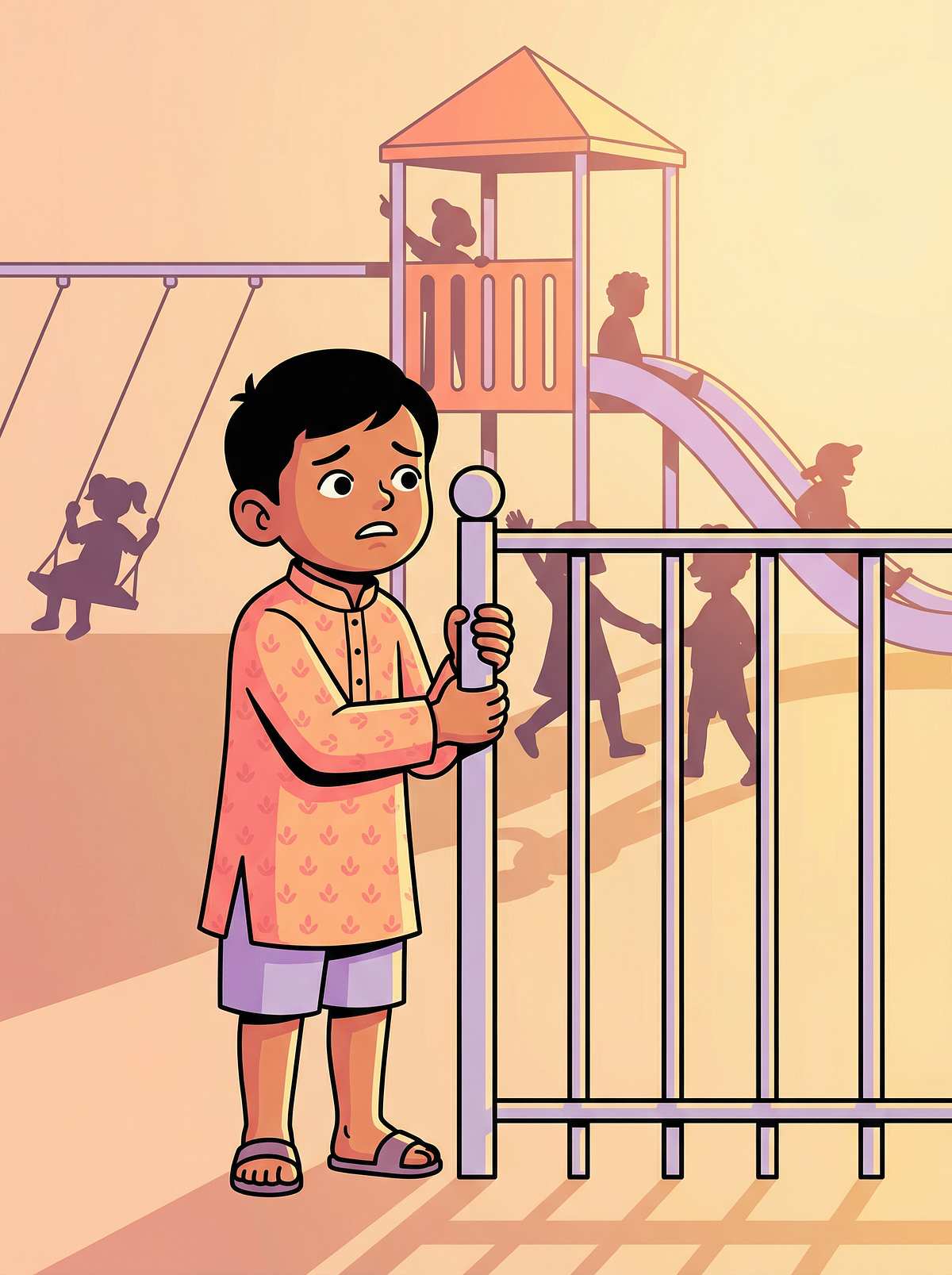
Every other child runs, jumps, and climbs without thinking. Yours stands frozen at the edge of the playground, gripping your hand, refusing to step onto anything that moves. The merry-go-round is terrifying. The see-saw is unthinkable. Even being picked up and swung by a relative triggers screaming. Movement — the most natural thing in childhood — has become their greatest fear.
The Neuroscience
The vestibular nuclei in the brainstem are over-interpreting signals from the semicircular canals and otolith organs. Ordinary movements that neurotypical brains classify as "safe" are processed as vestibular emergencies. The limbic system activates fear responses; the autonomic nervous system triggers nausea, sweating, and heart-rate spikes. This is vestibular hypersensitivity — the brain's gravity-detection system is calibrated too high.
📊Level I Evidence — Sensory integration therapy with vestibular components meets evidence-based criteria (PRISMA 2024, NCAEP 2020). Graded vestibular input protocols show measurable reduction in movement avoidance. PMC11506176 | NCAEP 2020 | DOI: 10.3389/fnint.2020.556660
What You'll Learn
- Vestibular sensitivity profiling — which movements, which intensities
- Child-controlled movement introduction (they control speed and duration)
- Linear-before-rotational progression (swinging forward/back BEFORE spinning)
- Safe vestibular input at home: rocking chair, hammock, gentle swinging
- Playground equipment hierarchy: least threatening → most
- Daily vestibular sensory diet for gradual tolerance building
Lead: OT (Sensory Integration Certified) | Physiotherapy · ABA
9 Canon Materials
A-077
Fears Swings
9 Materials That Help When Your Child Fears Swings
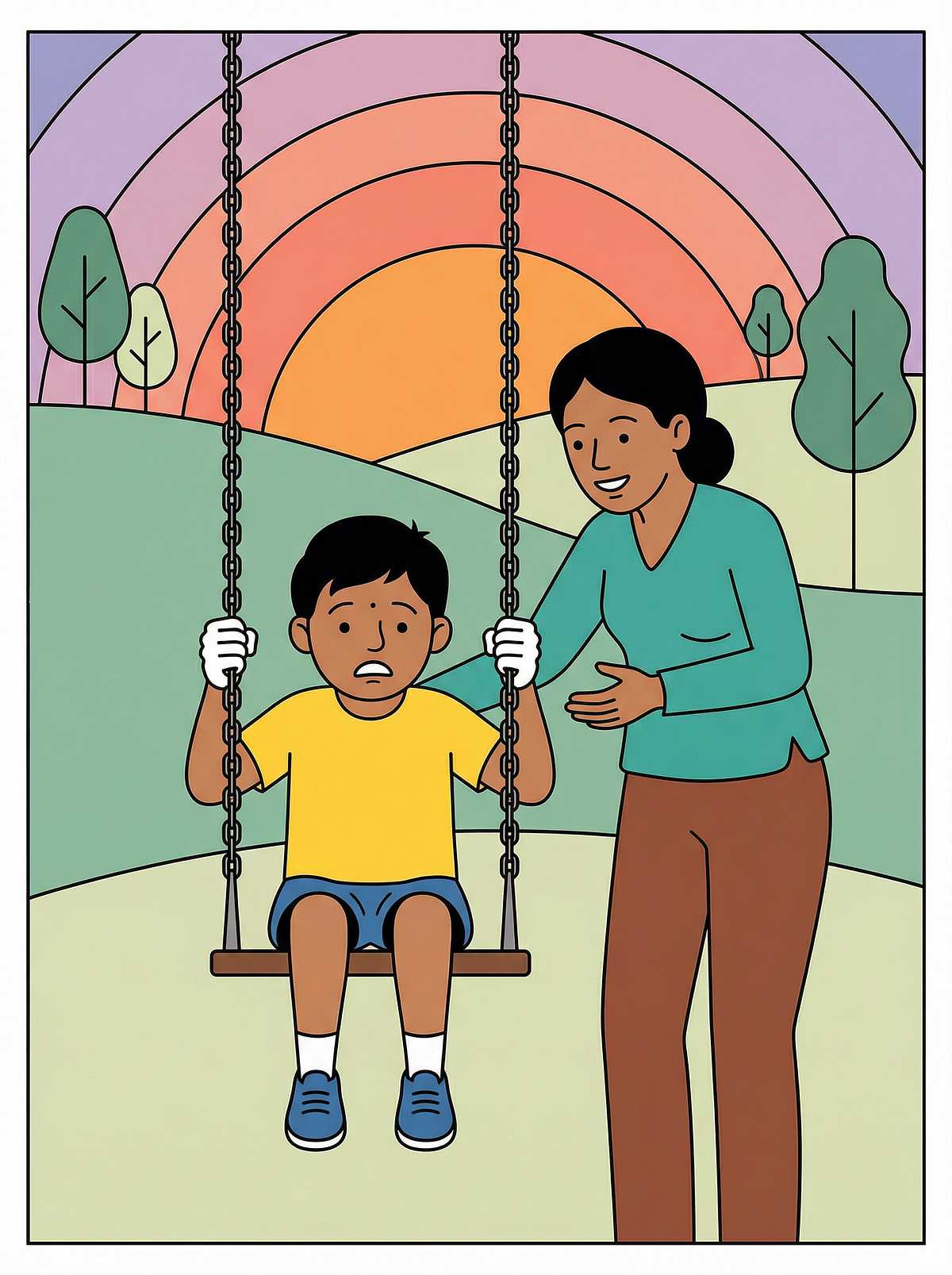
The park swing — every child's first taste of flight. For yours, it's a panic trigger. They refuse to sit on it. If you gently push them, they scream and grip the chains with white knuckles. Other parents give you questioning looks. You've started going to the park during off-peak hours just to avoid the stares. This is not stubbornness — it is a genuine neurological response.
The Neuroscience
Swinging produces rhythmic pendular vestibular input — alternating acceleration and deceleration with changing head position relative to gravity. In vestibular hypersensitivity, each arc of the swing is a gravitational "drop" that the otolith organs report as falling. Your child isn't afraid of the swing itself — they are experiencing repeated sensations of freefall with every gentle push.
📊Level I — Graded vestibular exposure: child-initiated, slow, linear movement first. PMC11506176 | NCAEP 2020 | Ayres SI
Swing Progression Hierarchy
01
Lap Sitting
Child sits on caregiver's lap on the swing — full body support
02
Platform / Bucket Swing
More body contact and enclosure reduces gravitational threat
03
Belt Swing → Standard
Child controls speed by pushing with feet — ownership builds safety
9 Canon Materials

A-078
Motion Sickness
9 Materials That Help With Motion Sickness
Car trips are a nightmare. They vomit within 20 minutes. Auto-rickshaws are worse — the jerking, the exhaust fumes, the unpredictable swerving. Family road trips to the grandparents' house require multiple stops, changes of clothes, and plastic bags always within reach. You've cancelled vacations because of travel sickness. There IS a neurological reason — and there are real strategies that help.
The Neuroscience
Motion sickness occurs when three systems send conflicting signals: the vestibular system reports movement, the visual system sees a stationary interior, and proprioception reports sitting still. The brainstem interprets this mismatch as potential neurotoxin ingestion — an evolutionary defence — and triggers nausea via the area postrema and vagus nerve. In vestibular hypersensitivity, this mismatch is detected at far lower thresholds.
📊Level I — Vestibular habituation + environmental strategies. Vestibular rehabilitation research | NCAEP 2020
What You'll Learn
- Seating position optimization: front-facing, window seat, slightly elevated
- Visual anchoring techniques — fix gaze on the horizon, not the interior
- Pre-travel vestibular preparation routine
- Indian-specific strategies: auto-rickshaw, bus, and train adaptations
- When medication is appropriate — pediatrician consultation criteria
- Gradual travel tolerance building: 5 min → 10 → 20 → longer

A-079
Feet Off Ground Fear
9 Materials That Help When Feet Off the Ground Scares Your Child
Being lifted onto a chair. Sitting on a high stool. Being carried on someone's shoulders. Climbing stairs without gripping the railing with both hands. Anything that removes their feet from solid ground triggers visible panic — clutching, crying, and complete freezing. They NEED constant contact with the earth beneath them, and this need is real and neurologically grounded.
The Neuroscience
This is gravitational insecurity in its purest form. The saccule (one of the otolith organs) detects the absence of ground contact and interprets it as a gravitational emergency. The limbic system fires as though the child is falling — even when they are safely seated on a chair, held securely in an adult's arms. The vestibular signal overrides all rational reassurance: no ground contact = danger.
📊Level I — Graded elevation exposure with deep pressure support. Ayres SI theory | NCAEP 2020
Ground-to-Elevation Hierarchy
Floor → Low Step
Always start with maximum ground contact
Stool → Standard Chair
Deep pressure before each elevation attempt
High Surface
Child chooses when feet leave the ground — always
A-080
Height & Climbing Fear
9 Materials That Help With Height and Climbing Fear
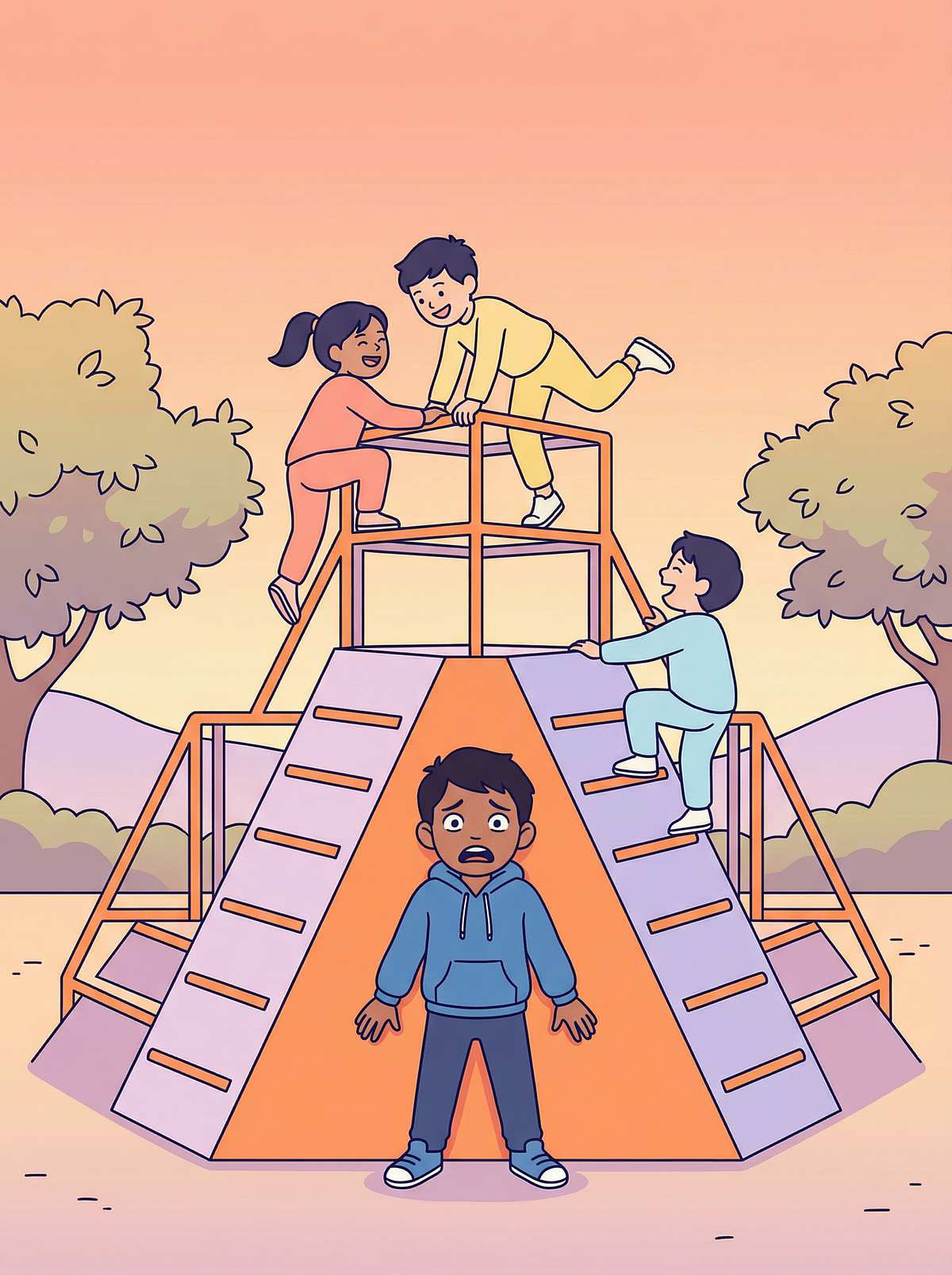
Playground climbing frames — impossible. Stairs without a rail — terrifying. Standing on a low garden wall that peers walk along effortlessly — causes freezing and tears. They won't even climb onto their own bed unaided. Any elevated surface produces visible distress, and no amount of encouragement or gentle pushing seems to make a difference. Here's why — and what actually works.
The Neuroscience
Height amplifies gravitational insecurity by increasing the distance-to-ground signal. The visual system (looking downward) and vestibular system (detecting elevation) combine to generate an exaggerated threat signal. The cerebellum cannot calculate a safe motor plan for the height, so it inhibits all movement — producing the classic "freeze" response your child exhibits at the top of even small climbing structures.
📊Level I — Graduated height exposure within OT-led sensory integration. NCAEP 2020 | PMC11506176
What You'll Learn
- Height hierarchy: 1 step → 2 steps → low platform → climbing frame
- Supported climbing with adult body as safety anchor
- Visual markers that define "safe height" boundaries
- Climbing gyms as controlled, scaffolded practice environments
- Celebrating small elevation gains — every centimetre counts

A-081
Excessive Spinning
9 Materials That Help When Your Child Spins Excessively
They spin. And spin. And spin. Round and round in circles — at home, at school, at the park, in the middle of a shopping mall. They don't get dizzy. They don't stop voluntarily. They spin until you stop them. Other children watch in confusion. You wonder whether it's harmful. Understanding why they spin — really understanding the neuroscience — changes everything about how you respond.
The Neuroscience
This is vestibular seeking. The semicircular canals are UNDER-registering rotational input, requiring extended or intense spinning to reach the brain's activation threshold. Post-rotary nystagmus (the eye movement after spinning that indicates vestibular processing) is often reduced or absent — meaning the brain barely registers the spinning that would make a neurotypical child dizzy in seconds. They spin because their brain is hungry for rotational vestibular data.
📊Level I — Structured rotational input + vestibular sensory diet. PMC11506176 | NCAEP 2020 | Ayres SI
What You'll Learn
- Understanding spinning as vestibular hunger — not "weird behaviour"
- Scheduled spin time: sit-and-spin, office chair, merry-go-round
- Safety parameters: duration limits, supervision, safe surfaces
- Alternative rotational input: log rolls, somersaults, barrel rolls
- When spinning indicates a medical concern: atypical nystagmus → neurology referral criteria
A-082
Crashing Into Things
9 Materials That Help When Your Child Crashes Into Things
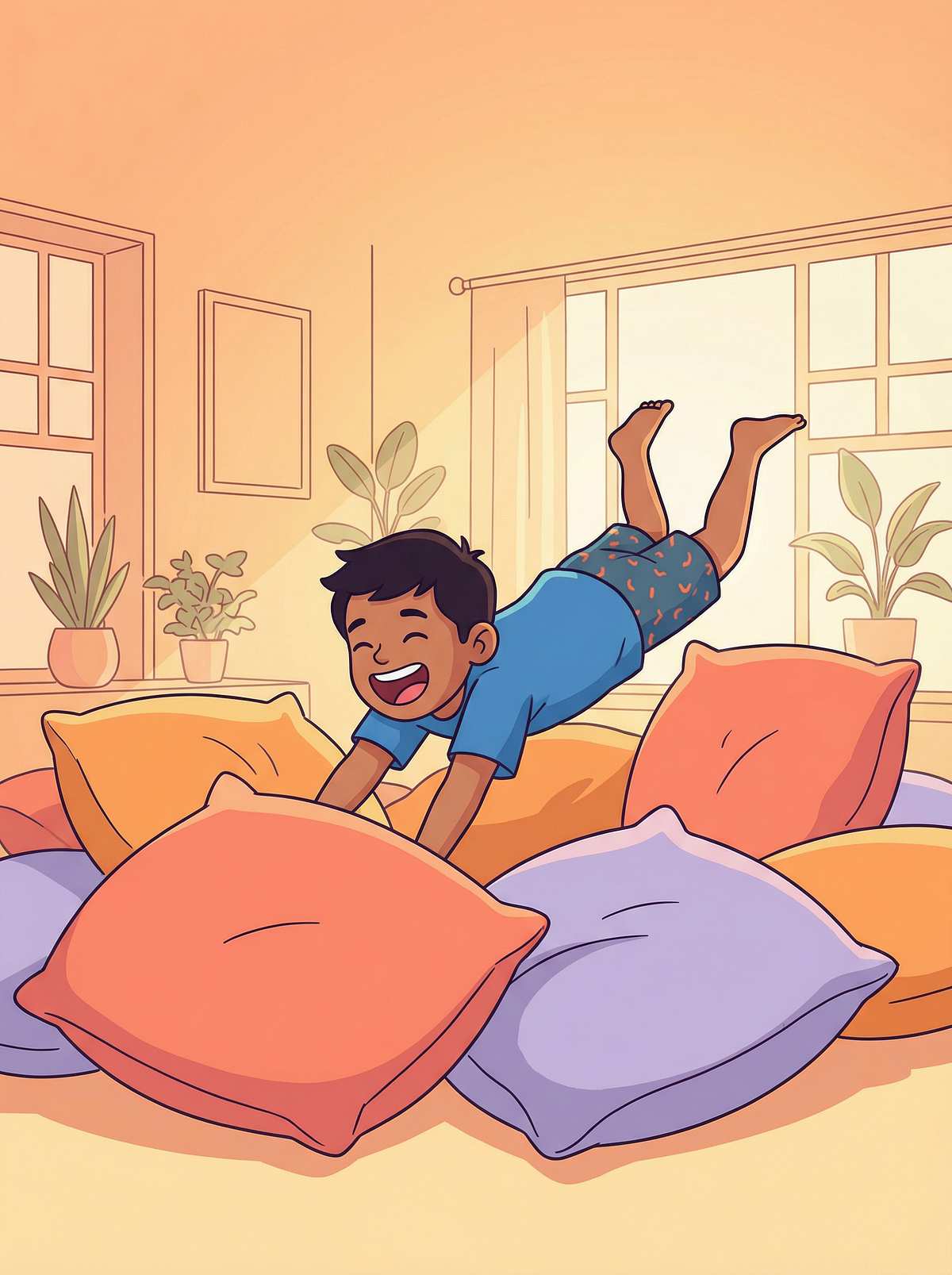
They throw themselves onto furniture. Slam into walls. Crash into people. Dive onto beds from standing. Run full-speed into cushions. It looks reckless — even aggressive. But watch their face: they're not angry. They're seeking. The impact is precisely what their nervous system needs, and understanding that changes your entire approach to managing it safely.
The Neuroscience
Crashing provides a triple sensory hit: vestibular (acceleration/deceleration on impact), proprioceptive (joint compression), and tactile (deep pressure). When both the vestibular AND proprioceptive systems are under-registering, the child needs high-intensity, multi-sensory input to achieve the activation threshold their brain requires. Crashing is the most efficient delivery system the child has independently discovered.
📊Level I — Heavy work / crash-and-bump protocols within a structured sensory diet. PMC11506176 | NCAEP 2020 | Ayres SI
What You'll Learn
- Crash pad and pillow pit creation — budget-friendly Indian guide
- Structured "crash time" built into the daily schedule
- Safe crashing alternatives: pillow mountains, bean bags, crash corners
- Obstacle courses with designated crashing stations
- When crashing is unsafe: head involvement → safety protocol
A-083
Can't Sit Still
9 Materials That Help When Your Child Can't Sit Still
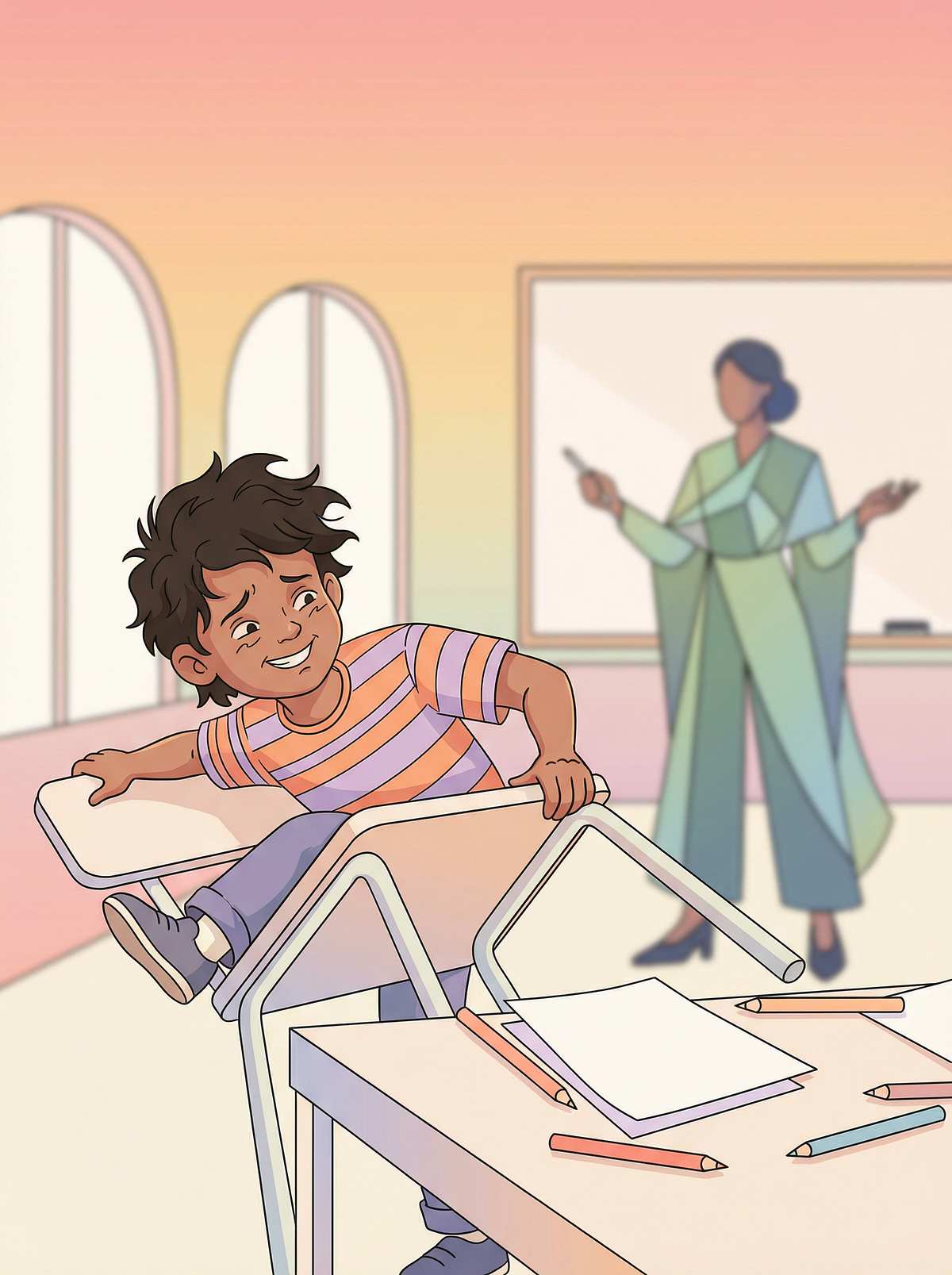
The teacher says: "Your child can't sit still." They wiggle, squirm, lean, tip the chair, stand up, sit down, and shift positions every 30 seconds. Mealtimes are identical. Homework is the same. Temple visits are the same. Everyone calls it "hyperactivity" or "ADHD." But there is a precise neurological explanation — and it is their vestibular system, not their character, asking for help.
The Neuroscience
Sitting still is NOT the absence of movement — it is the brain's ability to maintain posture through continuous micro-adjustments using vestibular and proprioceptive feedback loops. When the vestibular system under-registers, the brain doesn't receive the postural stability data it needs from the sitting position. The child moves because movement generates the vestibular input required to feel oriented in space. Sitting still actually deprives their brain of critical sensory data.
📊Level I — Movement-based seating solutions + vestibular breaks. NCAEP 2020 | Classroom sensory accommodation research
9 Canon Materials
Lead: OT | ABA · SpEd · Physiotherapy

A-084
Constant Rocking
9 Materials That Help With Constant Rocking
Back and forth. Back and forth. While watching TV. While eating. While sitting in class. Standing, sitting, lying down — the rocking never stops. Grandparents are alarmed. Teachers are concerned. Strangers stare. You've been told "it's stimming." But nobody tells you what the rocking is actually doing for your child's brain — and that explanation is both scientifically sound and deeply reassuring.
The Neuroscience
Rhythmic rocking provides predictable, self-controlled linear vestibular input at a frequency that activates the parasympathetic nervous system. It is neurologically calming — the same principle behind rocking a newborn to sleep. The child rocks because their vestibular system requires this rhythmic input to maintain regulation. Removing the rocking without providing an alternative is like removing a thermostat without fixing the heating system — the problem doesn't disappear, it escalates.
📊Level I — Replace-not-remove: alternative vestibular input strategies. PMC11506176 | NCAEP 2020
What You'll Learn
- Understanding rocking as self-regulation — not a "behaviour problem"
- Rocking chair as an "approved" and socially appropriate rocking tool
- Context scaffolding: rocking at home/break time, alternatives in classroom
- Alternative rhythmic vestibular input: swing, bouncing, walking rhythms
- Recognising when rocking signals distress vs. regulation

A-085
Escalator Fear
9 Materials That Help With Escalator Fear
Indian malls, metro stations, airports — escalators are everywhere. Your child freezes at the top. The moving surface, the height, the step-on timing, the flowing handrail — it's a vestibular, visual, and motor-planning nightmare packed into one machine. You carry them. Or you find the lift. Or you quietly avoid upper floors entirely. This technique gives you a structured pathway back.
The Neuroscience
Escalators demand simultaneous processing from multiple systems: visual-vestibular calibration (moving surface + stationary surroundings create sensory conflict), motor planning (timing the step-on to a moving target), gravitational security (progressive height change with each step), and proprioceptive adaptation (standing on a continuously moving surface). For a child with vestibular hypersensitivity, this multi-system demand is genuinely overwhelming — not irrational.
📊Level I–II — Graduated exposure + motor planning support. NCAEP 2020
Escalator Desensitization Hierarchy
Watch First
Observe the escalator moving — no pressure to step on
Stationary Practice
Step on/off a still escalator (when available outside hours)
Going Up (with adult)
Hand-held, specific foot positioning, predictable steps
Independent Riding
Full escalator ride both directions without support
A-086
Elevator Fear
9 Materials That Help With Elevator Fear
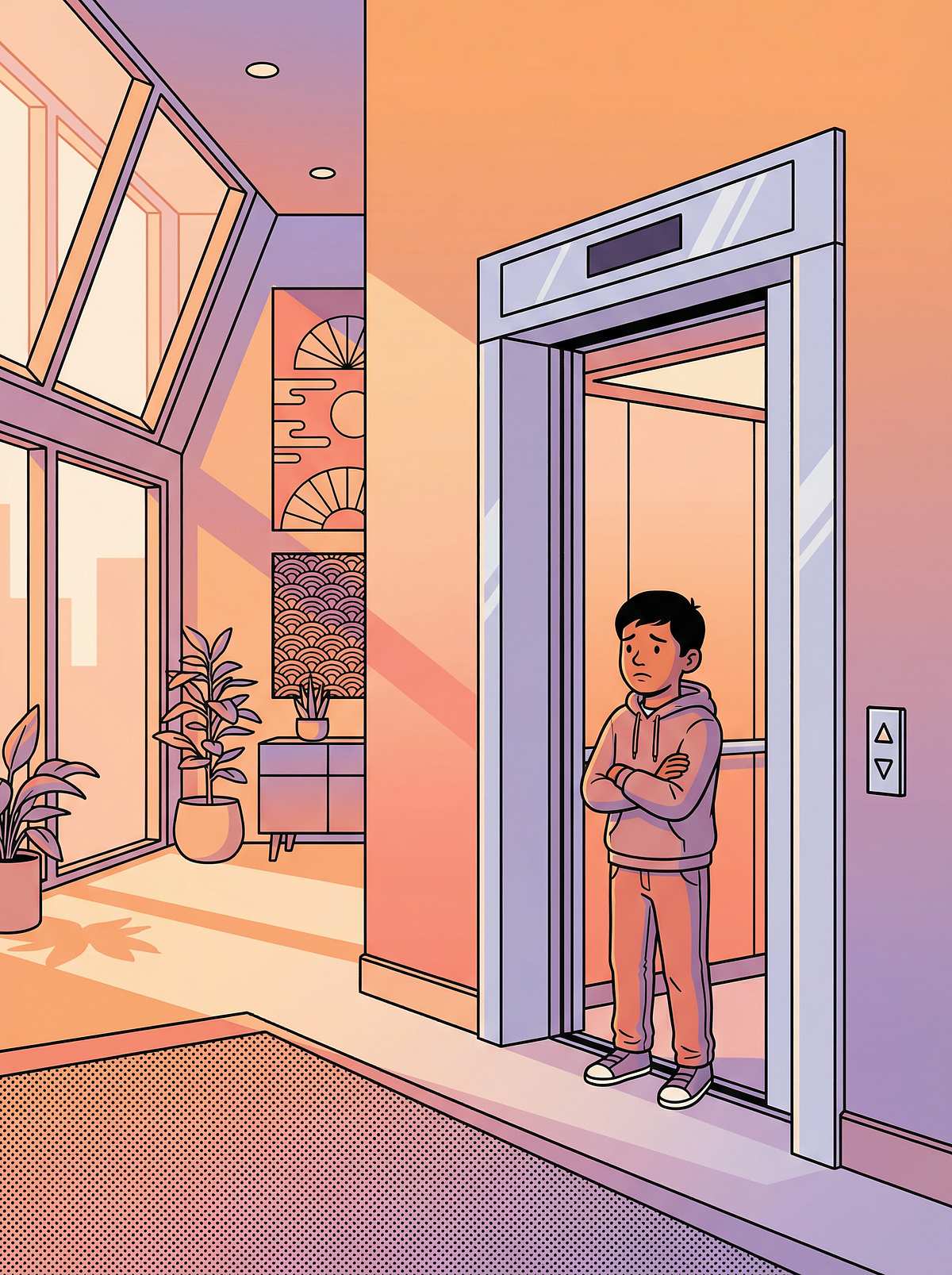
The elevator doors open and they refuse to enter. The enclosed space, the upward lurch, the stomach-drop sensation, the door closing behind them — it's a multi-system assault. Indian apartment buildings above three floors rely on elevators as the only option. Hospital visits, mall trips, office buildings — all require elevator access. This is one of the most practically disabling vestibular fears families face.
The Neuroscience
Elevators produce vertical linear acceleration — directly stimulating the saccule (the gravity and vertical motion detector). The initial upward lurch and the stopping deceleration create brief vestibular signals that the brain interprets as "falling" or "floating." Combined with the enclosed space (no visual horizon reference) and the loss of ground-floor security, the vestibular, visual, and anxiety systems all activate simultaneously — a perfect neurological storm.
📊Level I–II — Elevator-specific desensitization protocol. NCAEP 2020
What You'll Learn
- Social story preparation specifically for elevator trips
- One-floor-only initial exposure — always start minimal
- Deep pressure (compression vest) worn during all elevator rides
- Counting floors aloud as a predictability and grounding anchor
- Elevator vs. stairs decision framework for different buildings
- Tolerance building: 1 floor → 5 floors → full building ride
A-087
Tilting Backward Distress
9 Materials That Help When Tilting Backward Distresses Your Child
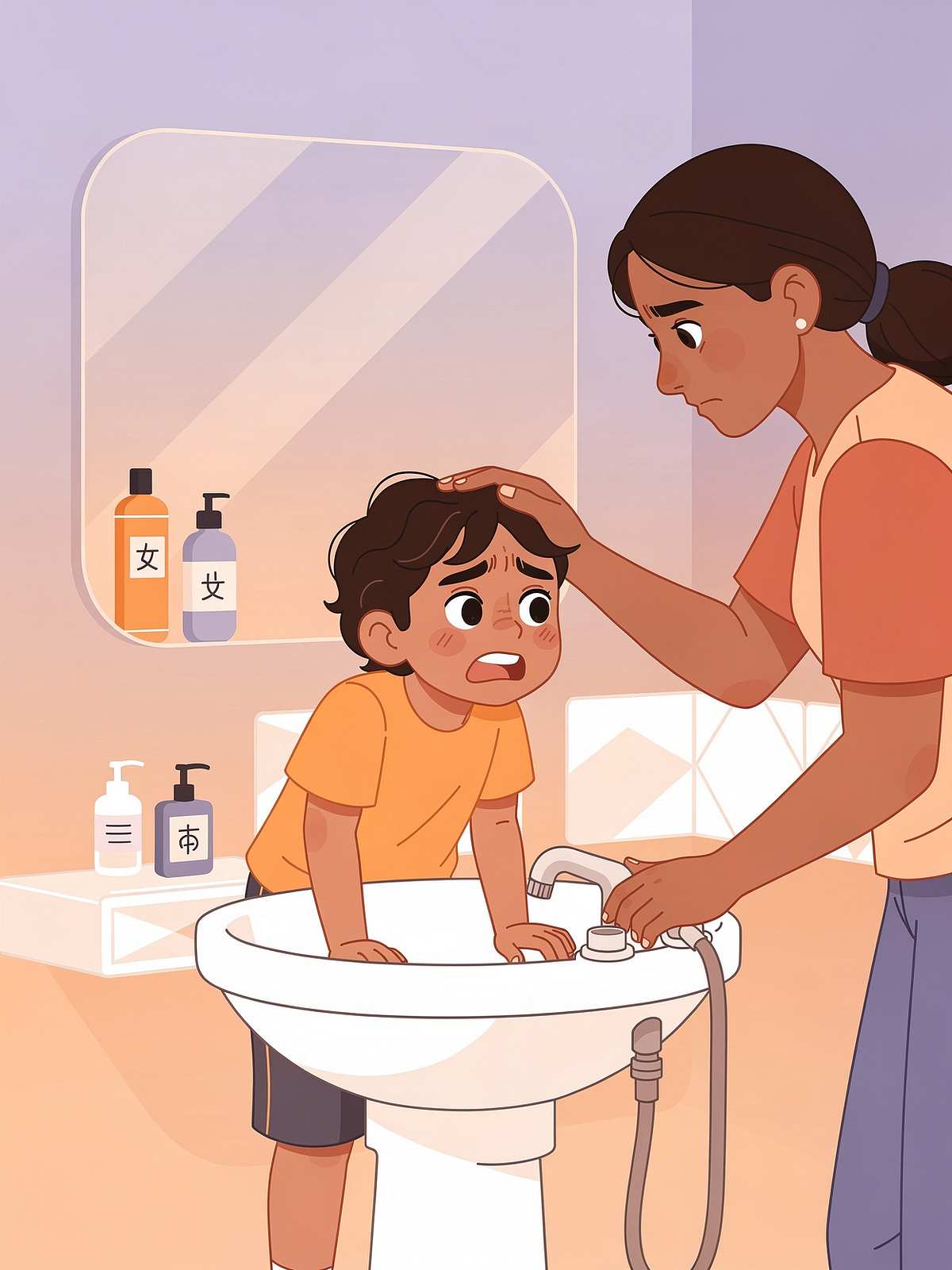
Reclining a chair — panic. Tilting their head back for hair washing — screaming. Lying down for a diaper change — intense resistance. The dentist chair reclining — completely impossible. Any movement that takes their head backward triggers profound distress. Hairwash time has become the most dreaded part of your family's day, and dental visits have stopped altogether.
The Neuroscience
Posterior head tilt activates the otolith organs — particularly the utricle — in a pattern the brain associates with falling backward. The visual system simultaneously loses the horizon reference. The anterior neck muscles engage defensively. This is the most primitive gravitational insecurity response: the brain's oldest fear system detecting what it processes as an uncontrolled backward fall, even when the child is perfectly safe in your arms or in a chair.
📊Level I — Graduated backward tilt with proprioceptive support before each step. Ayres SI | NCAEP 2020
Recline Hierarchy + Hair Washing Fix
01
5° → 15° Recline
Start with barely perceptible tilt, deep pressure first
02
30° → 45° Recline
Visual anchor point during each increase
03
Full Recline
Hair washing adaptation: forward lean, seated, cup method
A-088
Seeks Jumping
9 Materials That Help When Your Child Seeks Jumping
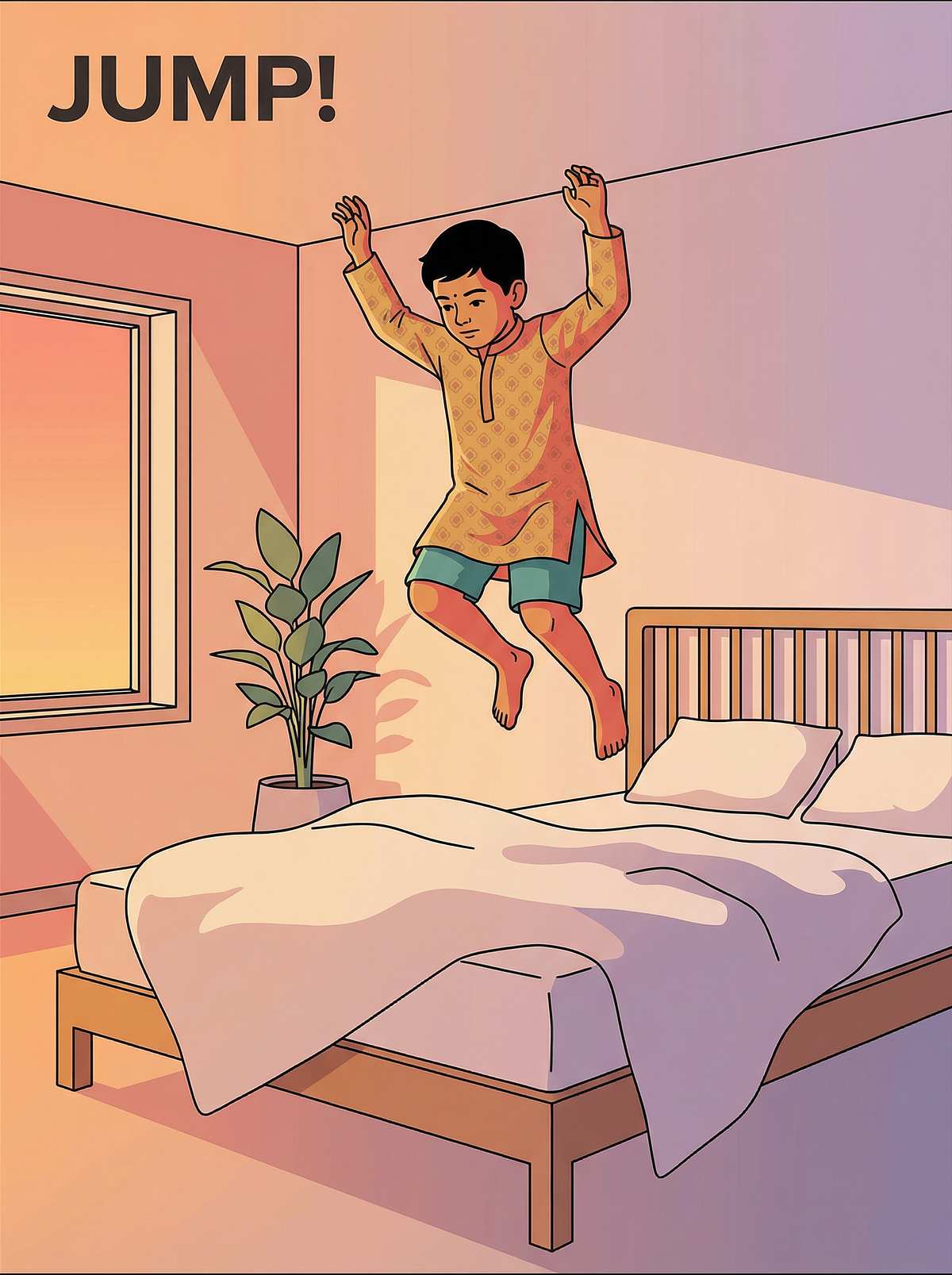
They jump on the bed. They jump on the sofa. They jump off tables. They jump in place — for 20 minutes straight. The trampoline is the only thing that keeps them regulated for the afternoon. Without jumping, they escalate into distress. You worry about injuries, but you know with certainty that they need it. You're right — and here is the science to prove it.
The Neuroscience
Jumping provides powerful vestibular input (vertical linear acceleration and deceleration on each bounce) combined with proprioceptive input (joint compression on landing). Each jump is a full-body vestibular reset. The rhythmic, repetitive nature also activates parasympathetic calming. For the vestibular-seeking brain, jumping is literally medicine — structured, prescribed, and timed jumping is a therapeutic tool, not a reward.
📊Level I — Trampoline and jumping protocols within vestibular sensory diet. PMC11506176 | NCAEP 2020
What You'll Learn
- Safe jumping setup: trampoline with enclosure net, crash mat below
- Scheduled jump breaks integrated into daily routine
- Jumping as pre-task regulation: jump BEFORE homework, not after
- Indoor alternatives: mini trampoline, jumping cushion, crash pad
- Jump-based learning activities that double as therapy
- Safety rules for committed jumping seekers

A-089
Bouncing Seeking
9 Materials That Help With Bouncing Seeking
They bounce on every surface. Therapy balls, beds, car seats, your lap. If they're sitting, they're bouncing. The couch springs are failing. The mattress is sagging in one spot. They bounce while eating, while watching TV, while trying to fall asleep. It is constant — and it is purposeful. Understanding why changes everything about how you respond and what tools you reach for.
The Neuroscience
Bouncing is a lower-intensity version of jumping — rhythmic vertical vestibular input with less impact force per cycle. The repetitive up-down motion creates a metronome-like vestibular rhythm that actively regulates arousal levels throughout the day. For a hypo-responsive vestibular system, bouncing is the minimum effective dose of movement input needed to maintain baseline regulation between more intense input opportunities.
📊Level I — Vestibular sensory diet: structured bouncing access at scheduled intervals. NCAEP 2020
What You'll Learn
- Therapy ball as a designated "approved" bouncing station for home and school
- Bouncing seat or chair for mealtimes and homework — keeping them at the table
- Bounce breaks timed with activity transitions for smooth schedule flow
- Converting bouncing energy into functional, purposeful exercise
- Bounce-based calming routines specifically designed before sleep

A-090
Poor Balance
9 Materials That Help With Poor Balance
They stumble on flat ground. They cannot stand on one foot for even a second. Walking on uneven surfaces — temple stairs, park trails, rocky beaches — is genuinely hazardous. They look "clumsy" compared to peers. Sports are humiliating. They avoid any activity that requires balance, which steadily narrows the world of childhood experiences available to them. Evidence-based balance training can change this trajectory.
The Neuroscience
Balance requires real-time integration of three input streams: vestibular input (head position and movement), proprioceptive input (joint angles and muscle tension), and visual input (spatial orientation). The cerebellum synthesizes all three and generates continuous postural corrections. When vestibular input is unreliable, the entire balance triad collapses — the child has no stable internal GPS and cannot predict or correct their own body's movement through space.
📊Level I — Balance training within OT/physiotherapy motor programmes. NCAEP 2020 | Developmental Motor research
Balance Progression Framework
Wide Base
Feet apart, flat stable surface
Narrow Base
Feet together, flat surface
One Foot
Single-leg stance, 1–2 seconds
Unstable Surface
Wobble board, grass, sand

A-091
Frequent Falling
9 Materials That Help With Frequent Falling
They fall. A lot. Tripping over nothing. Missing steps. Losing balance when turning corners. Knee bruises are permanent fixtures. You've childproofed the house thoroughly but they still find ways to fall. School sends weekly injury reports. You worry constantly about a serious head injury. Understanding that this is a timing issue — not a strength issue — opens up a completely different set of solutions.
The Neuroscience
Frequent falling results from delayed vestibular-motor corrective responses. When the body tilts beyond the centre of gravity, the vestibular system must detect the deviation and trigger corrective muscle contractions within milliseconds. If vestibular processing is slow, the correction arrives after the fall has already begun — too late to recover. This is a processing timing issue. Targeted vestibular-motor reaction time training directly addresses the root cause.
📊Level I — Vestibular-motor reaction time training. NCAEP 2020 | Physiotherapy evidence
What You'll Learn
- Fall-risk environmental audit — identify and modify highest-risk areas
- Protective gear strategies that protect without stigmatizing
- Reaction time training activities appropriate for ages 2–6
- Surface-awareness training: curbs, steps, uneven ground navigation
- Strengthening activities that support faster vestibular corrections
- Medical referral criteria: ruling out neurological causes
A-092
Slide Fear
9 Materials That Help With Slide Fear
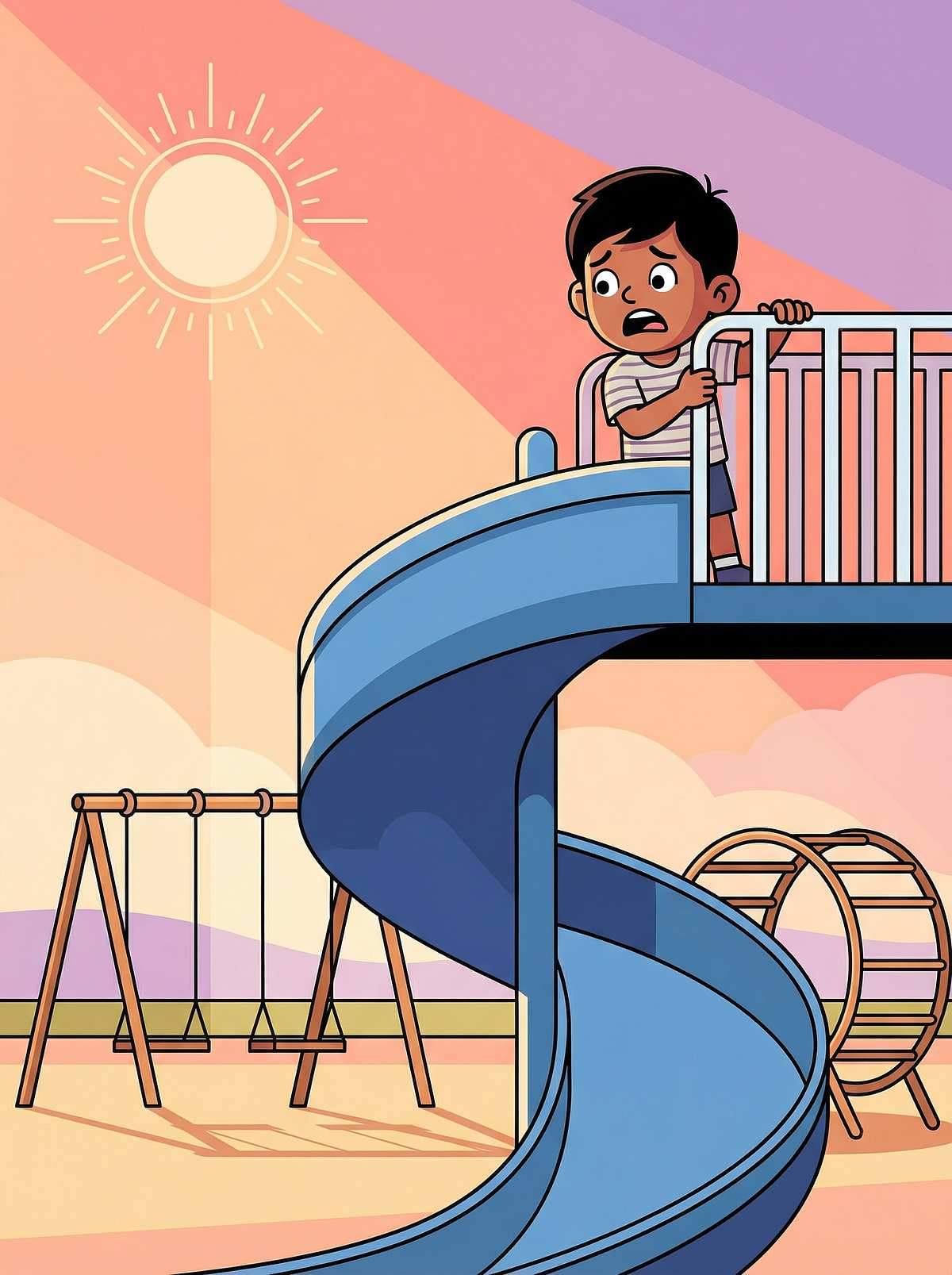
They climb to the top of the slide and freeze. They scream at the top. They refuse to come down. The downward acceleration, the visual rush, the loss of control — it's a vestibular nightmare wrapped in colourful playground equipment. You stand at the bottom calling encouragement while every other child zooms past. Slides pack three major vestibular triggers into one brief, unavoidable experience.
The Neuroscience
Slides produce gravitational acceleration in a downward direction — the exact stimulus that triggers the strongest gravitational insecurity response in the vestibular system. Three compounding factors: the child cannot control the speed (gravity decides), the visual field rushes upward rapidly, and the body is in a semi-reclined position (backward tilt). Three distinct vestibular triggers fire simultaneously during every slide descent.
📊Level I — Graded slide exposure within OT-led sensory integration. NCAEP 2020 | Ayres SI
Slide Desensitization Steps
- Slide hierarchy: small/gentle slope → tall/fast slide
- Lap-sliding on parent's lap for full-body security
- Prone (belly-first) sliding — less gravitational threat than upright
- Speed control strategies: leg braking, textured slide surfaces
- Building from incline ramps to actual playground slides
A-093
Hangs Upside Down
9 Materials That Help When Your Child Hangs Upside Down
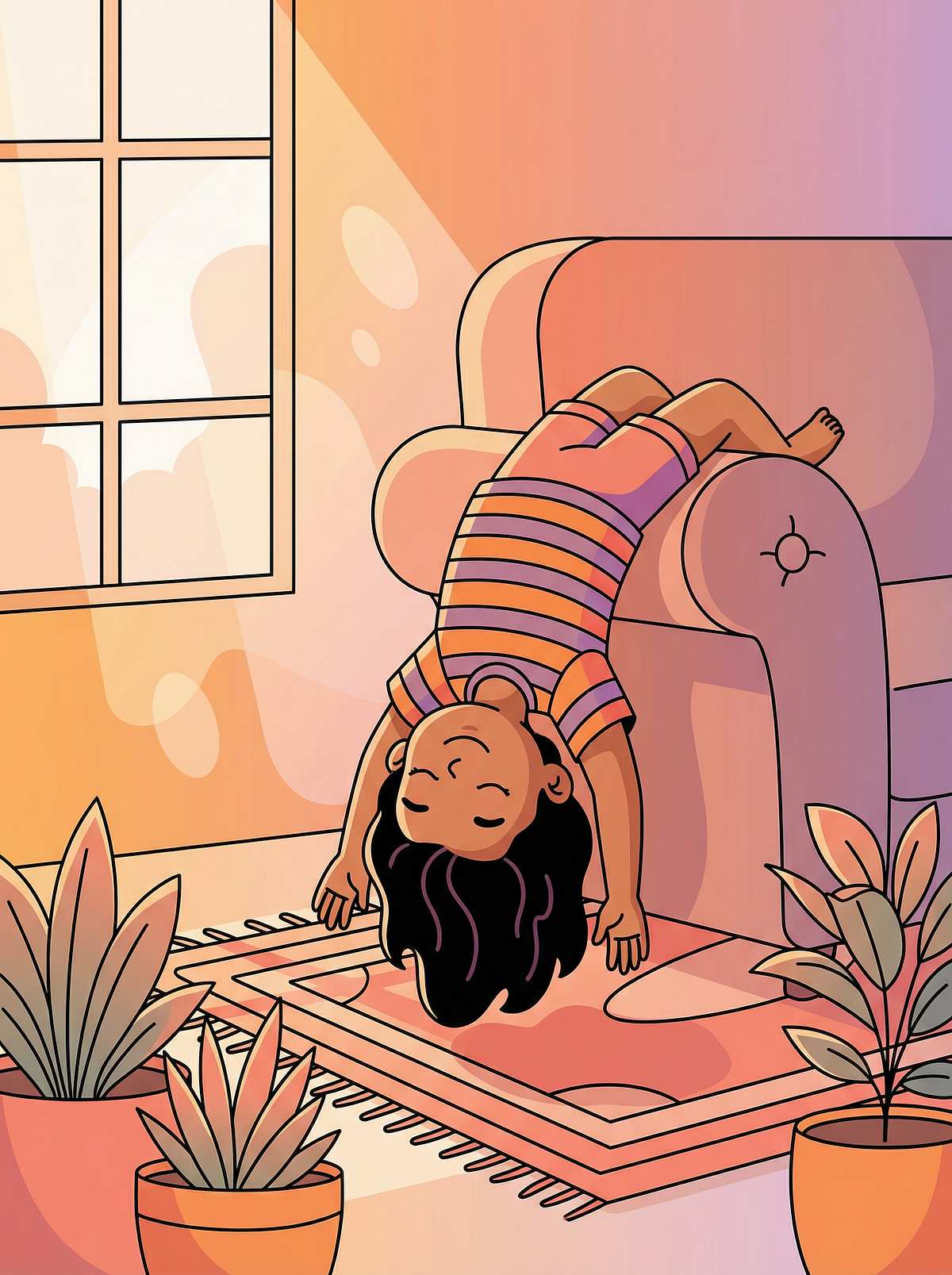
They hang upside down from furniture, monkey bars, your arms. They drape themselves over the sofa arm with head below heart. They LOVE the inverted position that would make most children dizzy and nauseous within seconds. They seek it constantly and resist being righted. Far from being dangerous or bizarre, inversion seeking has a clear and fascinating neurological explanation.
The Neuroscience
Inversion provides the most intense vestibular input available — complete reversal of the gravity signal to the otolith organs. For vestibular seekers, inversion floods the system with maximum stimulation, delivering the "vestibular feast" their under-registering system craves. Additionally, inversion increases cerebral blood flow and triggers baroreceptor reflexes that many children experience as profoundly calming — which is why they seek it when dysregulated.
📊Level I — Structured inversion within sensory diet with clear safety parameters. PMC11506176 | NCAEP 2020
What You'll Learn
- Safe inversion positions: supported, supervised, time-limited
- Duration guidelines: 30 seconds on, rest, repeat — never extended
- Inversion equipment: trapeze bar, therapy swing, safe inversion setups
- When inversion seeking is benign vs. when to consult neurology
- Converting inversion seeking into gymnastics or yoga engagement

A-094
Car Ride Distress
9 Materials That Help With Car Ride Distress
Getting into the car already triggers crying. Within five minutes, they're fully distressed. In Indian traffic — the constant stopping, starting, swerving, honking, and speed bumps — it's a multi-sensory assault unlike anything in a Western clinical study. Auto-rickshaws are even worse: open-sided, bouncing, tilting on every turn. School commutes, hospital visits, family trips — every car journey is dreaded by the whole family.
The Neuroscience
Vehicular motion creates complex, unpredictable vestibular input: linear acceleration/deceleration (traffic starts/stops), lateral forces (turns and lane changes), and vertical displacement (potholes, speed bumps) — all uncontrolled by the child. Indian road conditions amplify every vestibular challenge with irregular surfaces, sudden braking, and aggressive driving patterns. Add visual motion, auditory assault (horns, engine noise), and olfactory triggers (exhaust, fuel) — and the car becomes a total sensory environment the child cannot escape.
📊Level I — Multi-sensory travel preparation + vestibular habituation. NCAEP 2020 | Motion sickness research
9 Canon Materials
Lead: OT | ABA · NeuroDev

A-095
Gravitational Insecurity
9 Materials That Help With Gravitational Insecurity
This is the umbrella challenge — the child who is afraid of ALL movement. Not just swings. Not just heights. Not just cars. All of it. They cling to the ground, refuse to be picked up, panic when tilted, won't use stairs, avoid every piece of playground equipment, and live in a world where gravity itself feels like a relentless threat. They trust only flat, stable, solid, predictable ground. Everything else is terror. This requires the most sophisticated, carefully paced intervention in the vestibular repertoire.
The Neuroscience
Gravitational insecurity is the most pervasive form of vestibular hypersensitivity — a global pattern where the otolith organs over-interpret any change in head position relative to gravity as a life-threatening event. The vestibular-limbic connection (vestibular nuclei → parabrachial nucleus → amygdala) fires fear responses at threshold levels far below what would alarm a neurotypical brain. The child is not being dramatic or manipulative. Their brain is running a constant survival programme against gravity — the one force they can never escape.
📊Level I — Ayres Sensory Integration (ASI) with vestibular components is the gold standard. Systematic reviews confirm significant improvement in gravitational insecurity with OT-led SI intervention. PMC11506176 | NCAEP 2020 | Ayres SI Fidelity Measure | DOI: 10.3389/fnint.2020.556660
The Core Protocol Principles
- Comprehensive gravitational insecurity profile mapping
- The "safe base" principle — always return to stability before progressing
- Micro-progression: the smallest possible increment of movement challenge
- Child-directed pace — THEY decide when to move forward
- Full-body deep pressure BEFORE any vestibular input
- Home programme: 10 minutes daily, graded over 12 weeks
- OT SI-certified specialist is essential for severe cases
- Family education: pushing harder makes it measurably worse
9 Canon Materials
Lead: OT (ASI Certified — essential for this technique) | Physiotherapy · NeuroDev · Psychology

A-096
Head Tilting Avoidance
9 Materials That Help When Your Child Avoids Tilting Their Head
They refuse to tilt their head sideways. Looking at something on the floor means turning their whole body. Reading tilts their head — they hold the book up instead. Hairdressers are impossible. Yoga poses that involve lateral neck movement cause panic. Even answering "maybe" with a head wobble is absent from their repertoire. You've noticed they hold their neck rigid, like a soldier, in every situation. This is not stubbornness — it is a vestibular system that treats lateral head tilt as a threat signal.
The Neuroscience
Lateral head tilt activates the semicircular canals — specifically the anterior and posterior canals — in a pattern that signals rotational movement to the brainstem. In a hypersensitive vestibular system, even a small lateral tilt triggers a disproportionate alarm response. The brain interprets the shift in otolith organ loading as the beginning of a fall to the side. The neck muscles engage defensively, creating the characteristic rigid posture. This is a canal-dominant hypersensitivity pattern, distinct from the otolith-dominant gravitational insecurity seen in A-095.
📊Level I — Lateral vestibular desensitisation within ASI framework. Graded neck mobility combined with proprioceptive anchoring. Ayres SI | NCAEP 2020
Lateral Tilt Hierarchy
01
Supported Lateral Tilt 5°–15° — Deep pressure to neck and shoulders before each increment
02
Lateral Tilt 30°–45° — Visual anchor (fixed point on wall) during each step
03
Full Lateral Range — Functional integration: reading, hairdresser prep, yoga
9 Canon Materials
Lead: OT (SI) | PT · NeuroDev

A-097
Dizziness After Spinning
9 Materials That Help When Your Child Gets Dizzy After Spinning
Most children spin, get dizzy, laugh, and recover in seconds. Yours spins once and is floored — pale, nauseous, unable to walk straight for minutes. Or the opposite: they spin endlessly and never seem dizzy at all, which worries you just as much. Both patterns signal vestibular processing differences. The child who gets excessively dizzy is over-responding; the child who never gets dizzy may have a hypo-responsive vestibular system that craves more and more input to feel anything. Both need structured intervention.
The Neuroscience
Post-rotary nystagmus (PRN) — the eye movement that follows spinning — is the gold standard clinical measure of vestibular canal function. Children with vestibular hypersensitivity show prolonged PRN and intense dizziness from minimal rotation. Children with vestibular hyposensitivity show shortened or absent PRN — their canals are under-responding, so the brain demands more spinning to achieve the same neural signal. Both patterns are measurable, both are treatable, and both respond to structured vestibular input programmes delivered by a qualified OT.
📊Level I — Post-rotary nystagmus assessment and graded rotational input protocols. Ayres SI | Southern California Sensory Integration Tests (SCSIT)
Dizziness Response Protocol
01
Baseline PRN Assessment — OT measures nystagmus duration; establishes hyper vs hypo profile
02
Graded Rotational Input — Controlled spinning in therapy swing; duration and speed titrated to response
03
Functional Integration — Playground spinning, fairground rides, sports with rotational components
9 Canon Materials
Lead: OT (SI) | PT · Pediatric Neurologist

A-098
Walking on Uneven Surfaces
9 Materials That Help When Your Child Struggles on Uneven Surfaces
Flat ground is manageable. The moment the surface changes — grass, gravel, sand, temple steps, a slight slope — they freeze, grab your hand with white-knuckle force, or refuse to walk at all. Beach trips are a battle. Hiking is impossible. Even the slight camber of a pavement sends them off-balance. Other children run barefoot across the same terrain without a second thought. Your child is not clumsy — their vestibular and proprioceptive systems are not integrating surface information quickly enough to keep them stable.
The Neuroscience
Walking on uneven surfaces requires continuous, rapid integration of vestibular input (head position changes), proprioceptive input (ankle and foot joint feedback), and visual input (terrain preview). In children with vestibular processing differences, this multi-sensory integration is delayed or inaccurate. The brain cannot predict the next surface change quickly enough, so the postural response arrives late — causing stumbling, freezing, or compensatory over-gripping. This is a vestibular-proprioceptive integration deficit, not a strength or coordination problem.
📊Level I — Sensory integration therapy with graded terrain exposure. Proprioceptive-vestibular co-treatment protocols. Ayres SI | PMC11506176
Terrain Progression Protocol
Stable Textured Surfaces — Foam mats, carpet, grass with shoes; proprioceptive input first
Unstable Controlled Surfaces — Balance boards, wobble cushions, sand tray with support
Real-World Terrain — Gravel, slopes, temple steps, beach sand; graduated independence
9 Canon Materials
Lead: OT (SI) | PT · NeuroDev
A-099
Fear of Falling Backwards
9 Materials That Help When Your Child Fears Falling Backwards
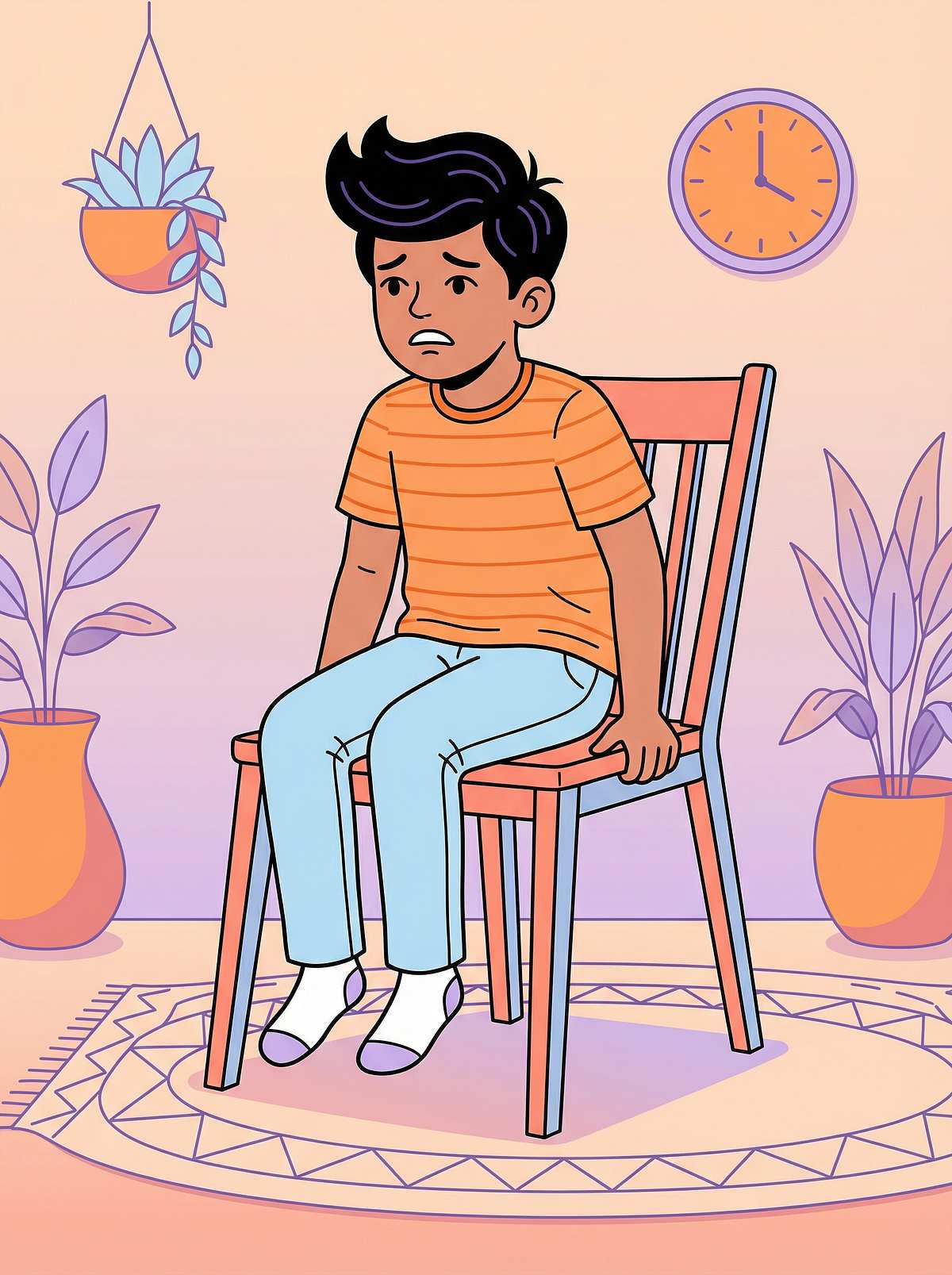
They will not sit on a chair without a back. They refuse to lean back against anything. Being pushed — even gently — from behind sends them into panic. Sitting on the floor and being asked to lean back is impossible. They sleep only on their side or stomach, never on their back. Any situation where they might fall backward — even theoretically — is avoided with fierce determination. This is one of the most disabling vestibular fears because it affects sitting, sleeping, dressing, and every daily routine that involves any backward weight shift.
The Neuroscience
Backward fall fear is driven by the utricle — the otolith organ that detects linear acceleration in the horizontal plane and head tilt. When the head moves backward, the utricle signals a posterior displacement that the hypersensitive brain interprets as an uncontrolled fall. Unlike the A-087 tilting backward pattern (which is about head tilt), this fear is about the whole body's centre of gravity shifting backward. The vestibular-limbic pathway fires a survival response: the child must not fall backward. The response is ancient, powerful, and completely involuntary.
📊Level I — Posterior weight-shift desensitisation within ASI framework. Graded backward lean with proprioceptive anchoring. Ayres SI | NCAEP 2020
Backward Fear Hierarchy
Supported Backward Lean 5°–10° — Wall support, deep pressure to back before each step
Unsupported Lean 20°–30° — Proprioceptive anchor (hands on knees), visual horizon fixed
Full Backward Sit/Recline — Chair with back, floor sitting, eventually lying supine
9 Canon Materials
Lead: OT (SI) | PT · Psychology

A-100
Poor Postural Control
9 Materials That Help When Your Child Has Poor Postural Control
They slump. They drape themselves over the desk. They cannot sit upright for more than a few minutes without collapsing sideways or forward. Their core seems to have no "on" switch. Teachers report they're always leaning on something. They prop their head up with their hand constantly. Sitting cross-legged on the floor is exhausting for them. This is not laziness, poor posture habits, or weak muscles in the conventional sense — it is a vestibular system that is not providing the continuous background signal the postural muscles need to maintain upright position automatically.
The Neuroscience
Postural control depends on a continuous stream of vestibular input to the brainstem, which then drives tonic postural muscle activation — the background muscle tone that keeps us upright without conscious effort. When the vestibular system under-processes, this tonic drive is reduced. The child's postural muscles receive insufficient activation signals, so they fatigue rapidly or fail to engage at all. This is called vestibular-based postural hypotonia. It is distinct from neurological hypotonia and responds specifically to vestibular input programmes, not just core strengthening exercises.
📊Level I — Vestibular input to improve postural tone and core activation. Linear vestibular input (swinging, rocking) is most effective for postural drive. Ayres SI | PMC11506176 | NCAEP 2020
Postural Control Programme
Vestibular Activation — Linear swinging and rocking to prime postural tone before seated tasks
Dynamic Seating — Wobble cushion, therapy ball chair; unstable surface activates postural muscles
Functional Integration — Upright sitting for 5 → 10 → 20 minutes; desk height and chair optimisation
9 Canon Materials
Lead: OT (SI) | PT · SpEd
A-101
Vestibular-Visual Mismatch
9 Materials That Help When Your Child Has Vestibular-Visual Mismatch
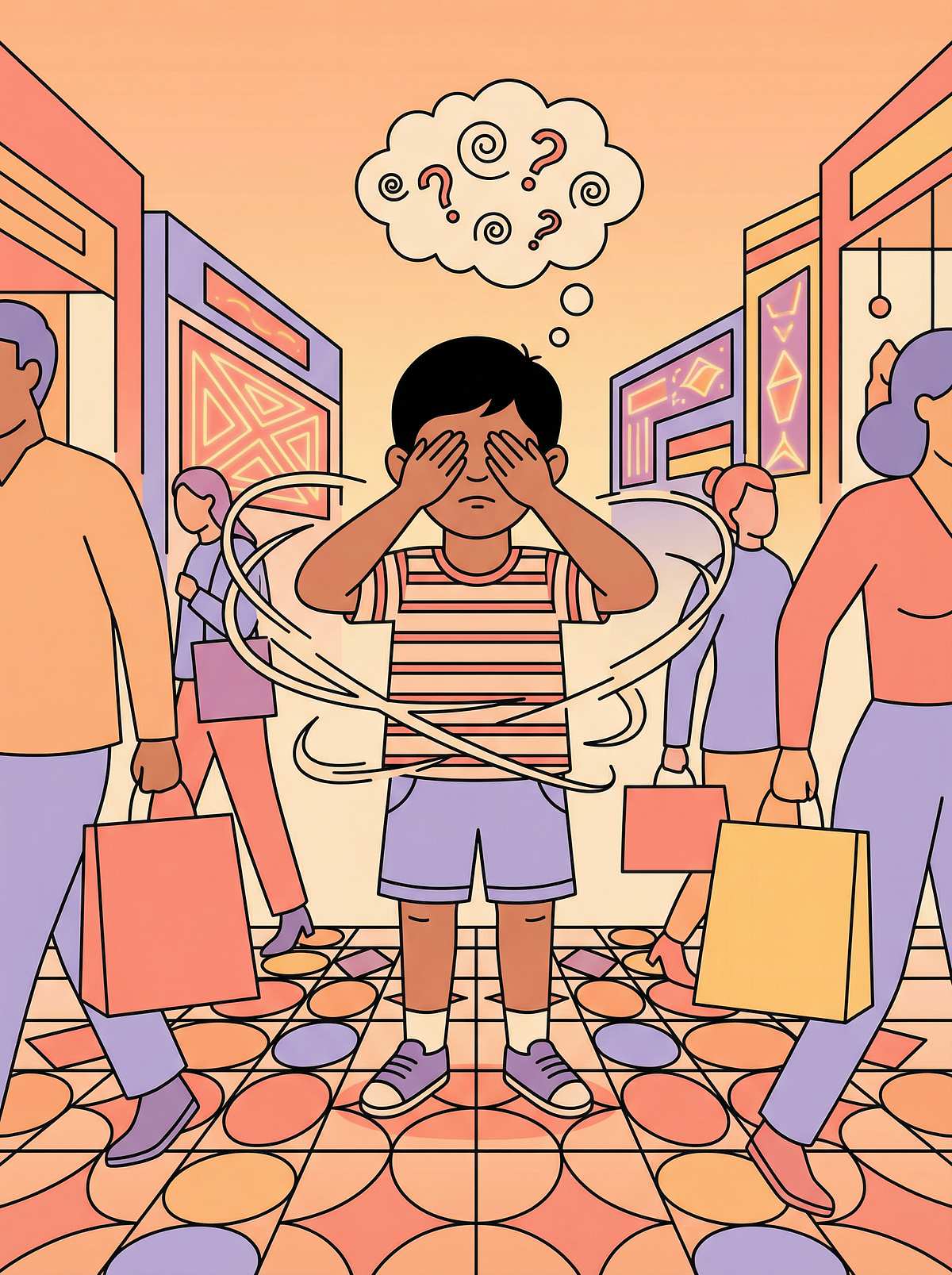
They feel sick in busy visual environments — shopping malls, crowded markets, moving traffic seen from the pavement. Watching fast-moving screens makes them dizzy. They cannot track a moving object without losing balance. Reading in a moving car is impossible. They feel unsteady in rooms with strong visual patterns — striped floors, busy wallpaper, flickering lights. The world looks like it's moving when it isn't. This is vestibular-visual mismatch: the brain is receiving conflicting signals from the eyes and the inner ear, and cannot resolve them into a stable perception of the world.
The Neuroscience
The vestibulo-ocular reflex (VOR) stabilises vision during head movement by generating compensatory eye movements. When the vestibular system processes inaccurately, the VOR is miscalibrated — the eye movements don't match the head movements, so the visual world appears to move or blur. Simultaneously, the visual system may be over-relied upon for balance (visual dependence), making the child extremely sensitive to visual motion. This creates a vicious cycle: the more the visual environment moves, the more the vestibular system is overwhelmed, and the more unstable the child feels.
📊Level I — VOR calibration through vestibular-ocular integration therapy. Gaze stabilisation exercises combined with vestibular input. Ayres SI | PMC11506176 | Vestibular Rehabilitation Therapy (VRT)
VOR Calibration Protocol
Gaze Stabilisation Exercises — Head movement with fixed visual target; VOR calibration baseline
Graded Visual Motion Exposure — Slow-moving visual environments, gradually increasing complexity
Functional Integration — Shopping centres, moving vehicles, sports tracking; real-world VOR demands
9 Canon Materials
Lead: OT (SI) | Developmental Optometrist · PT · NeuroDev

All 26 Vestibular Techniques at a Glance
Complete Subdomain A4 — Vestibular Challenges Index
Every technique below links to a full 40-card evidence-based protocol with 9 canon materials, clinical rationale, home strategies, and practitioner guidance. Select the challenge that most closely matches what you observe in your child today.
Code | Challenge | Core Pattern | Lead Discipline | |
A-076 | Avoids all movement, freezes at playground | OT (SI) | PT · ABA | ||
A-077 | White-knuckle panic on any swing | OT | PT | ||
A-078 | Vomiting/nausea in cars and transport | OT | Pediatrician | ||
A-079 | Panic when feet leave the floor | OT | PT | ||
A-080 | unknown link | Cannot climb or tolerate elevation | OT | PT | |
A-081 | Constant spinning, no dizziness | OT | ABA | ||
A-082 | Seeks impact with furniture, people | OT | PT | ||
A-083 | Constant wiggling, chair tipping | OT | SpEd · ABA | ||
A-084 | Self-regulating rhythmic rocking | OT | ABA | ||
A-085 | unknown link | Freezes at moving stairs in malls/metro | OT | PT | |
A-086 | unknown link | Refuses to enter enclosed vertical lifts | OT | PT | |
A-087 | Panic at any posterior head tilt | OT | PT | ||
A-088 | Compulsive jumping on all surfaces | OT | PT · ABA | ||
A-089 | Constant rhythmic bouncing on surfaces | OT | ABA | ||
A-090 | Stumbles, can't stand on one foot | OT | PT | ||
A-091 | Falls constantly, delayed corrections | OT | PT | ||
A-092 | unknown link | Freezes at top of slides, refuses descent | OT | PT | |
A-093 | Seeks intense inversion constantly | OT | PT | ||
A-094 | Distress in all vehicular transport | OT | ABA · NeuroDev | ||
A-095 | Global movement avoidance, fears gravity itself | OT (ASI Certified) | ||
A-096 | unknown link | Rigid neck posture, refuses lateral head tilt | OT (SI) | PT · NeuroDev | |
A-097 | Excessive or absent dizziness post-rotation | OT (SI) | PT · Pediatric Neurologist | ||
A-098 | Freezes or falls on grass, gravel, slopes | OT (SI) | PT · NeuroDev | ||
A-099 | Refuses to lean back, panic at backward weight shift | OT (SI) | PT · Psychology | ||
A-100 | unknown link | Constant slumping, cannot sit upright independently | OT (SI) | PT · SpEd | |
A-101 | unknown link | Dizziness in busy visual environments, VOR deficit | OT (SI) | Dev. Optometrist · PT |
Preview of vestibular challenges Therapy Material
Below is a visual preview of vestibular challenges therapy material. The pages shown help educators, therapists, and caregivers understand the structure and content of the resource before use. Materials should be used under appropriate professional guidance.
Link copied!

Take the Next Step With Pinnacle Blooms
You've read the science. You understand your child's brain in a new way. Now it's time to act. Every technique above links to a full 40-card evidence-based protocol designed for parents, caregivers, and therapists to implement together — at home, in school, and in the clinic. Powered by GPT-OS® and backed by 21M+ therapy sessions across India.
Evidence-Based Protocols
Every technique meets NCAEP 2020 or PRISMA 2024 evidence standards. Level I research, clearly cited, applied practically for Indian families.
India-Specific Context
Auto-rickshaws, temple stairs, Indian apartment elevators, joint-family dynamics — our protocols are built for real Indian life, not Western clinic assumptions.
Family-First Approach
Every protocol includes a home programme, caregiver education, and school accommodation guidance. Therapy doesn't stop when the OT session ends.
21M+
Therapy Sessions
Powering our evidence base
20
Vestibular Techniques
This subdomain alone
9
Canon Materials
Per technique, curated and priced for India
40
Cards Per Protocol
Deep, actionable guidance
Breadcrumb:Home → Sensory Processing (A) → Vestibular Challenges (A4) | Contact: 9100 181 181 | interventions.pinnacleblooms.org/sensory-processing/vestibular-challenges