
Daily Transitions — 30 Evidence-Based Interventions
Every shift from one activity, place, person, or state is a neurological event. For children with autism, each of the 50–100 daily transitions can be a potential crisis — or, with the right support, a moment of quiet success. This subdomain delivers 30 evidence-based techniques to make every transition smoother.
Subdomain I1
Domain I: Transitions & Change
Pinnacle Blooms Network®
Section 1 of 4
Cards 01–10 · Daily Routine Transitions
I-781 · I-782 · Daily Routine Transitions
9 Materials That Help With All Transitions + Morning Transitions
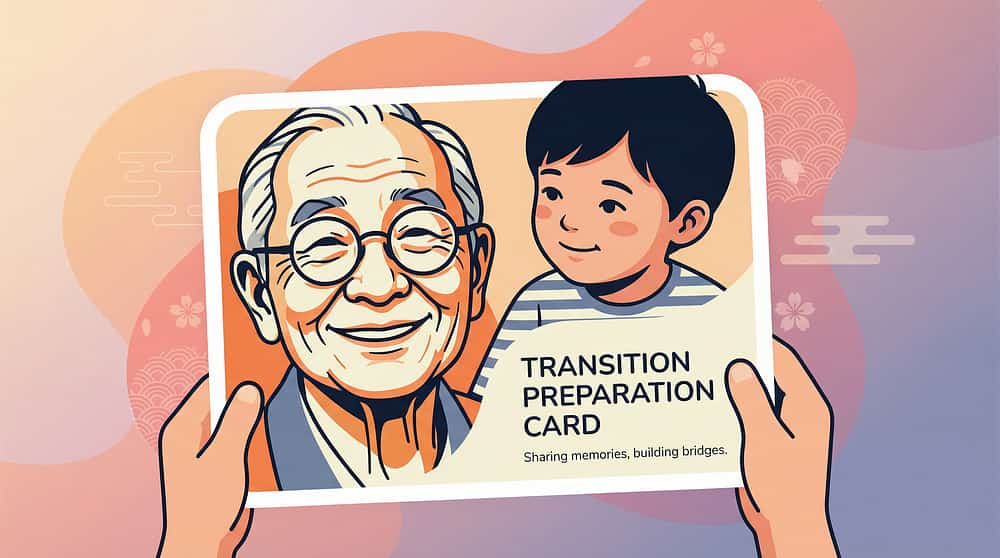
The universal transition card. Every shift — from one activity, place, person, or state to another — follows the same neurological pattern: stop → shift → start. This card teaches the framework that applies to all 29 techniques that follow. Supporting any of the four neural stages reduces transition difficulty for every child, every time.
This 4-step protocol is the backbone of every technique in Subdomain I1. Master these four steps and you have the scaffolding that makes every other intervention more effective.
Evidence Level & Lead Disciplines
📊Level I — Transition support as core ASD intervention. NCAEP 2020 | Visual support research | PMC10955541
📋 ABA · 🧠 Psychology · SpEd | OT · SLP · NeuroDev
I-782 · Morning Transitions
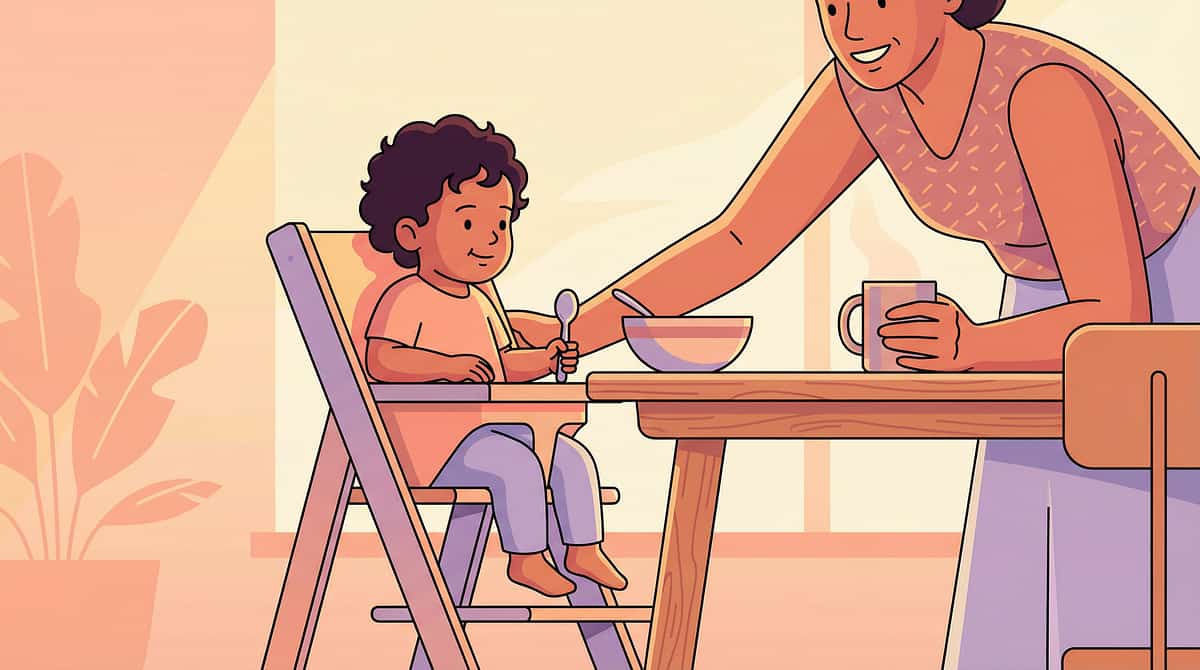
The day's first transition sets the tone for everything that follows. Wake up → toilet → dress → eat → prepare to leave: six transitions before the child even steps outside. If morning goes badly, the cascade of cortisol colors the entire day. If morning goes smoothly, the child arrives at school regulated and ready to learn.
The brain shifts from sleep state (parasympathetic, reduced arousal) to active state (sympathetic, full arousal) — a shift that is slower in many ASD children. Rushing a brain that isn't fully 'online' triggers dysregulation before breakfast.
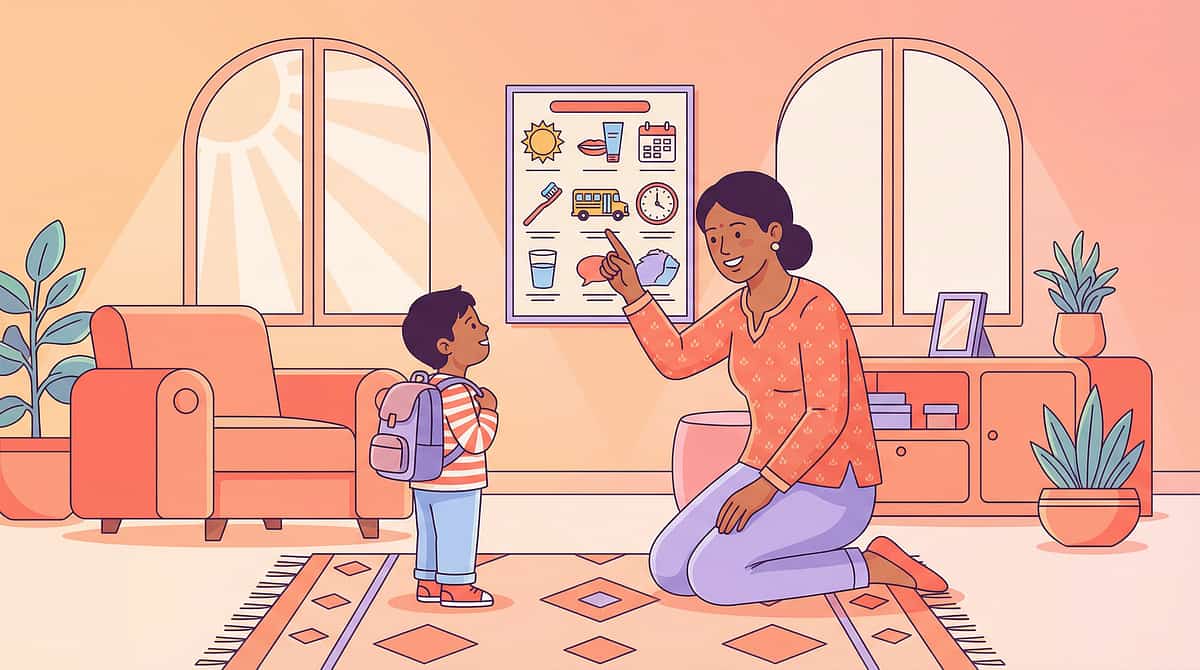
Morning Visual Schedule
Wake up → toilet → brush → dress → eat → bag → shoes → go. Pictures on velcro — child moves each to "done."
Prepare the Night Before
Clothes laid out, bag packed, tiffin prepped. Eliminating morning decision-making reduces cognitive load dramatically.
Gentle Wake-Up Ritual
Consistent time, light + soft music (not alarm shock), 10 minutes of quiet waking before any demands. Protect the routine even in joint family morning chaos.

I-783 · Daily Routine Transitions
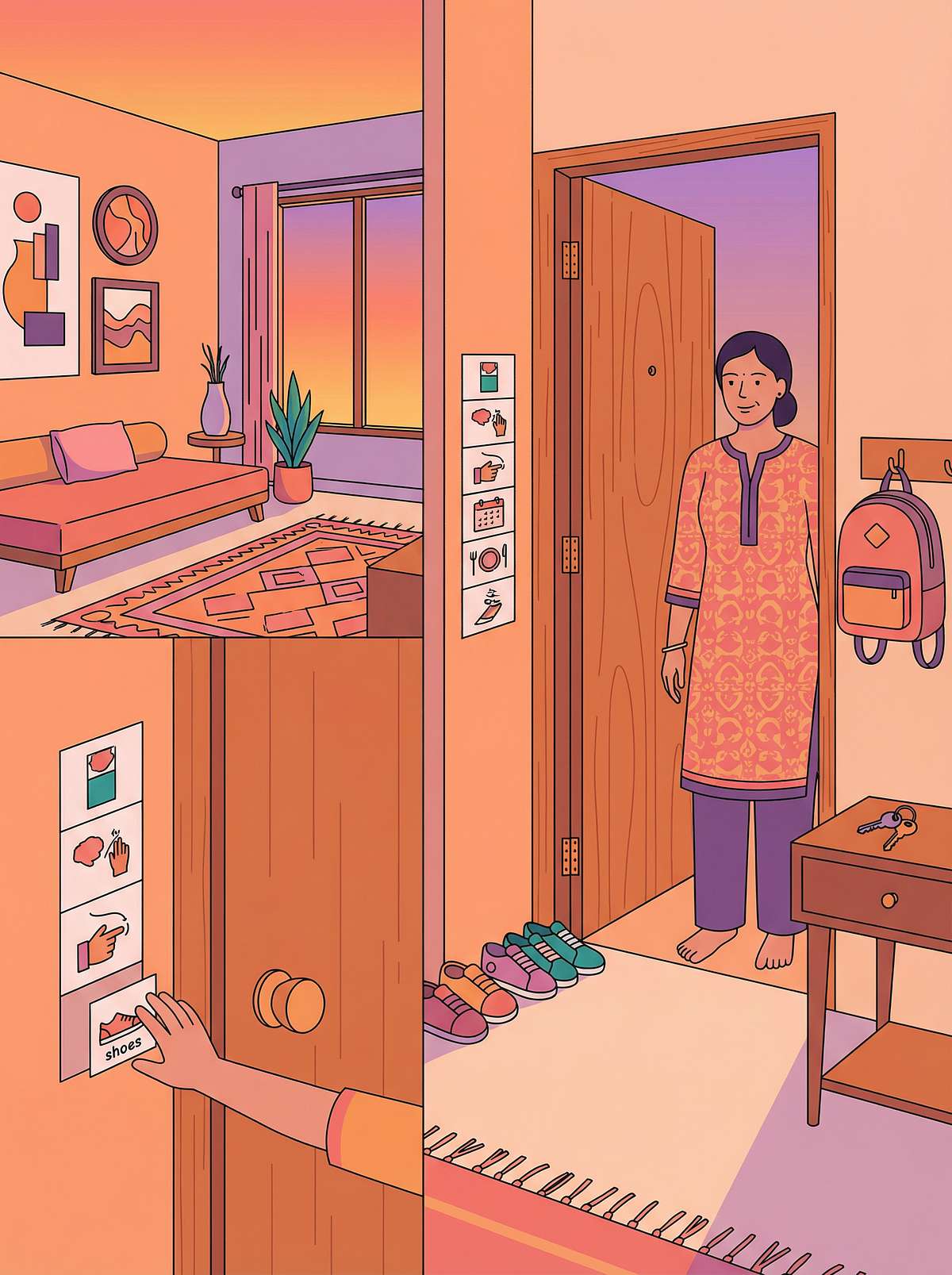
9 Materials That Help With Leaving the House
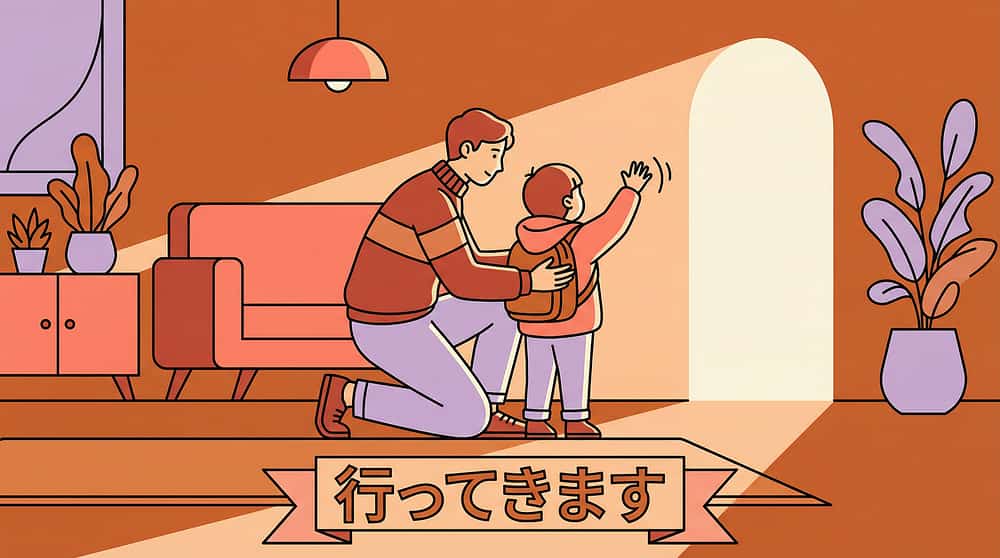
Home is safe. Outside is not. Leaving the house is a transition from maximum sensory-social comfort to an unpredictable, uncontrolled environment. The threshold of the door is the boundary between two worlds — and crossing it requires deliberate preparation.
The brain moves from a low-demand, familiar environment to a high-demand external one. Amygdala activation at the leaving point is anticipatory — the child's brain is already processing the expected demands of outside before stepping through the door.
Consistent Leaving Sequence
Shoes → bag → jacket → goodbye ritual → door. The same sequence every time becomes its own calming structure.
Where-Are-We-Going Visual
Show a photo of the destination before leaving. No surprises about what comes next.
Sensory Preview
Prepare the child for what to expect — loud? Crowded? Hot? Forewarned is forearmed.
Indian Context
Chappals at the door, pooja before leaving — cultural rituals serve as natural, calming transition markers.
I-784 · Daily Routine Transitions
9 Materials That Help With Car Transitions
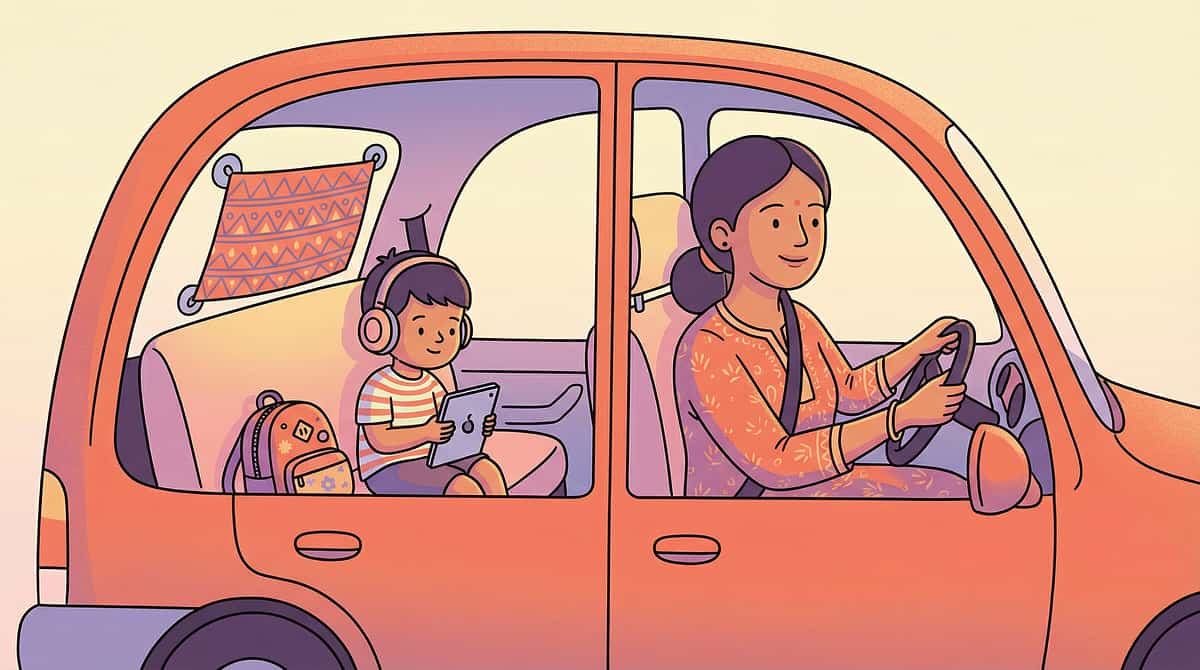
Getting in the car. Being in the car. Getting out of the car. Three transitions in one journey. The car is a sensory capsule: enclosed space, engine vibration, visual motion, heat, and the unpredictability of Indian traffic duration. Long, unpredictable commutes extend sensory exposure and increase uncertainty — "When will we arrive?"
Car Comfort Setup
Preferred seat position, sunshade, temperature control, seatbelt comfort pad. Make the physical environment predictable before the journey begins.
Car Activity Bag
A dedicated bag — fidget, book, small toy — used only in the car. This makes car time special, not dreaded.
Music as Regulation
Preferred playlist as auditory regulation. Songs also work as a duration cue: "We'll be in the car for 3 songs."
Indian Traffic Tip
Unpredictable journey times → focus on WHAT not WHEN: "When we get there, we'll do [X]." Reduce uncertainty about destination, not duration.

I-785 · Daily Routine Transitions
9 Materials That Help With Arriving at School
The school gate. Even after successful adjustment, daily arrival anxiety may persist — lower than the first day, but never fully zero. Arrival at school is a daily transition from safe (car/parent) to demanding (school environment). The child must shift from "parent-regulated" mode to "self-regulated in school" mode.
Same Sequence, Every Day
Car stops → bag → hug → goodbye words → walk to class → greet teacher → sit → check schedule. Consistency makes arrival automatic.
Consistent Handoff Point
Teacher greets at the same spot every morning. The handoff is a ritual, not a scramble.
Calming Arrival Activity
First 5 minutes: a preferred, calming activity at the desk — drawing or a puzzle. This helps the child land before demands begin.
Auto/Van Drop-Off
For children without parent handoff — prepare an independent arrival sequence rehearsed at home beforehand.
I-786 · Daily Routine Transitions
9 Materials That Help With Activity Changes
The most frequent transition type — happening 20 to 30 times per day. Activity A to Activity B. Each change requires stopping, shifting, and starting. Difficulty scales with how preferred the current activity is, how non-preferred the next is, and how much warning was given. Set-shifting is one of the most impaired executive functions in ASD — the brain perseverates on the current activity because the basal ganglia resists stopping an ongoing programme.
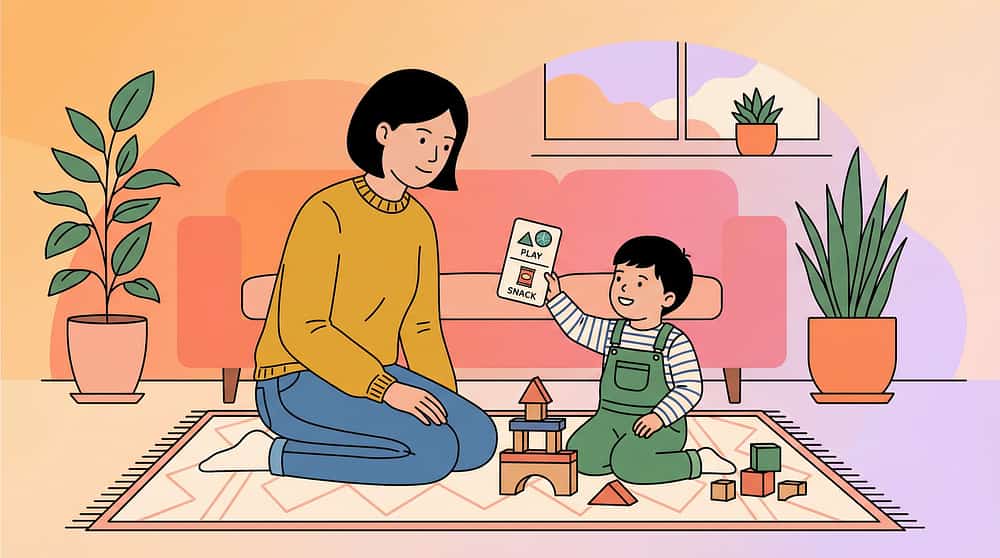
Always Warn First
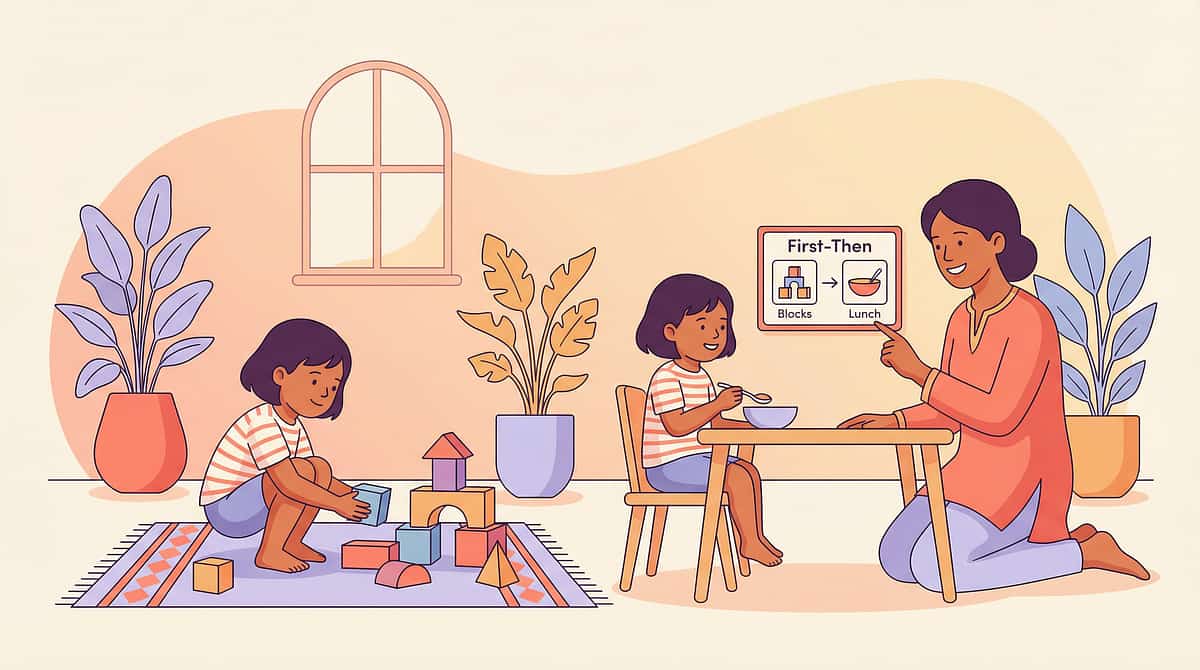
"In 5 minutes, we finish blocks and start lunch." Never surprise. Always prepare.
Visual + Verbal Together
Show the visual schedule AND say it aloud. Dual-channel preparation is twice as effective as either alone.
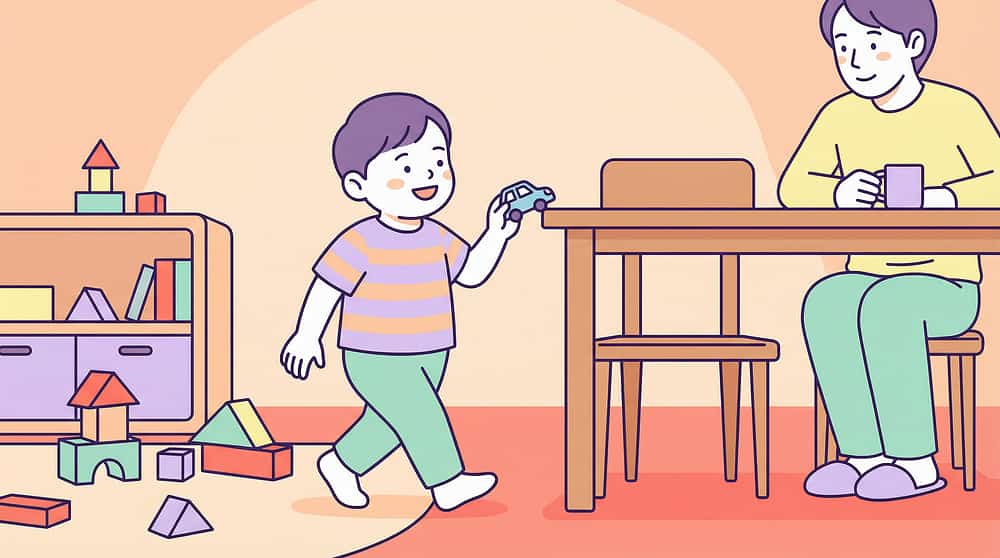
Transition Bridge
"Bring your car to lunch." One item from the current activity travels to the next — creating a physical link between activities.
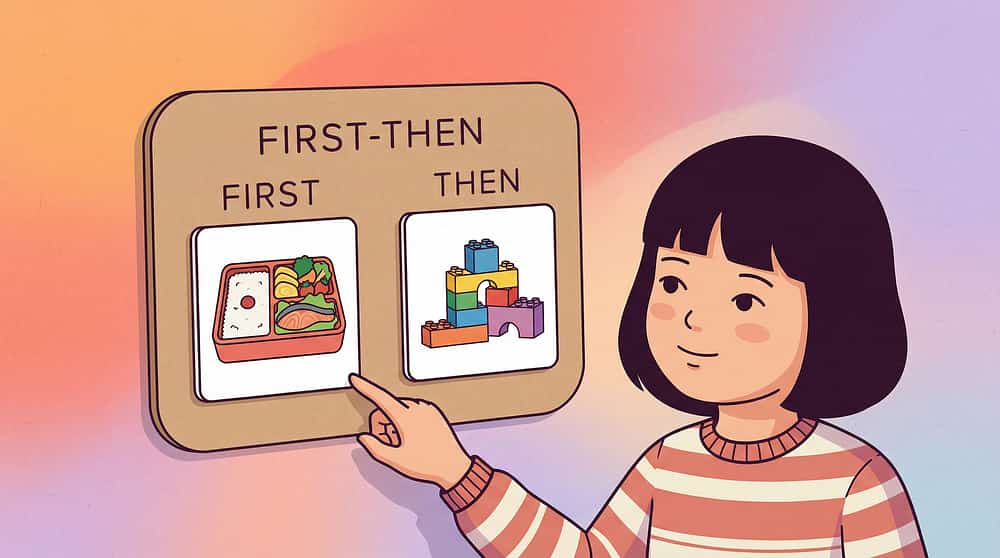
First-Then Framing
"FIRST lunch, THEN blocks again." The preferred activity as a reward maintains motivation through the transition.
I-787 · Daily Routine Transitions
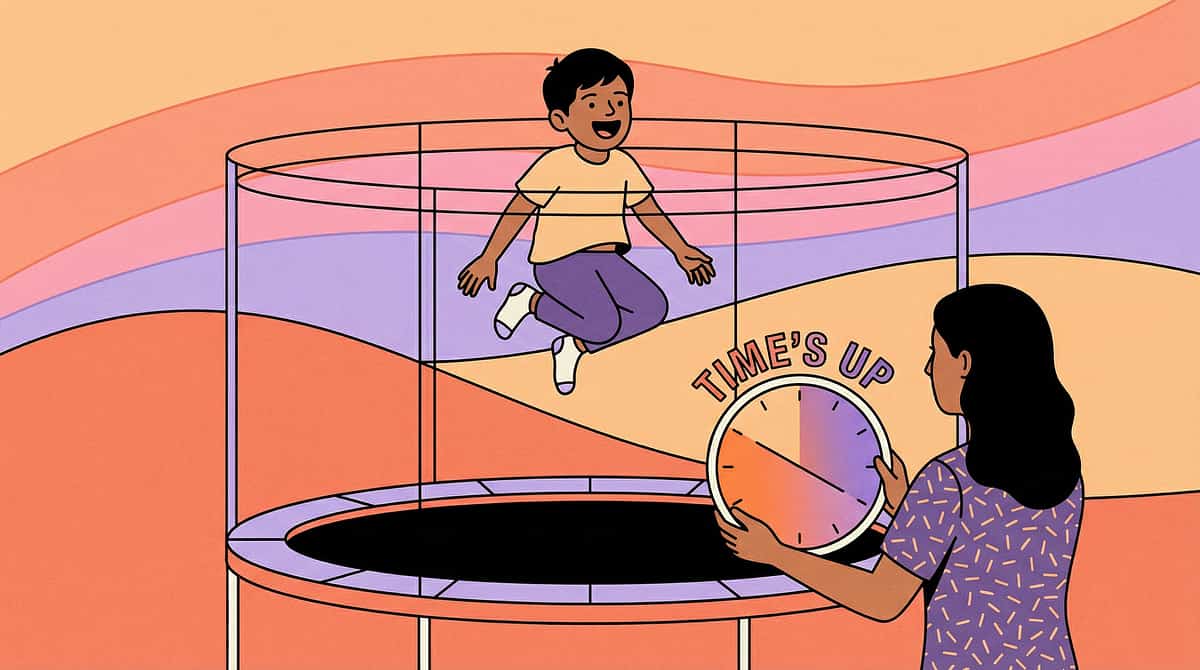
9 Materials That Help With End of Preferred Activity
The hardest transition. Stopping something they love — trampoline, Lego, the park. Ending a preferred activity is dopamine withdrawal. The reward system was running at full intensity; sudden stop equals emotional crash. The more they love it, the harder it is to stop. This is biology, not defiance.
1
10 min warning
"Ten more minutes of trampoline!"
2
5 min warning
"Five more minutes — keep jumping!"
3
2 min warning
"Almost time — two more minutes."
4
"Last one!"
Give the child one final, chosen experience before ending.
5
Done ritual
"Hands up — ALL DONE!" Specific words + action marks the endpoint clearly.
⚠️Never end abruptly without warning — ever. Save-and-return works: "We'll save your Lego tower and come back tomorrow." The activity is preserved, not destroyed.

I-788 · Daily Routine Transitions
9 Materials That Help With Screen to Non-Screen
The modern parent's #1 transition battle. Screen provides maximum dopamine with minimum effort — everything that follows is, by comparison, under-stimulating. The screen-to-real-world transition is a dopamine cliff.
High-frequency reward (rapid visuals, sound effects, instant feedback) drops sharply when the screen is removed. The real world feels flat, boring, and slow by comparison. The meltdown is the brain's response to sudden reward loss — not a character flaw.
Pre-Screen Agreement
"You get 20 minutes. When the timer goes, screen goes off. What do we do after?" Child states the next activity before screen starts — commitment reduces resistance.
Natural Stopping Point
End at the end of an episode or level — not mid-stream. Mid-stream endings feel more abrupt and unfair to the child's brain.
After-Screen Activity
High-dopamine alternative ready: trampoline, water play, snack. NOT homework immediately after screen.
Indian Context
Mobile phone as primary screen (always accessible) → charging station where phone "sleeps" after screen time. The phone has a bedtime too.
I-789 · Daily Routine Transitions
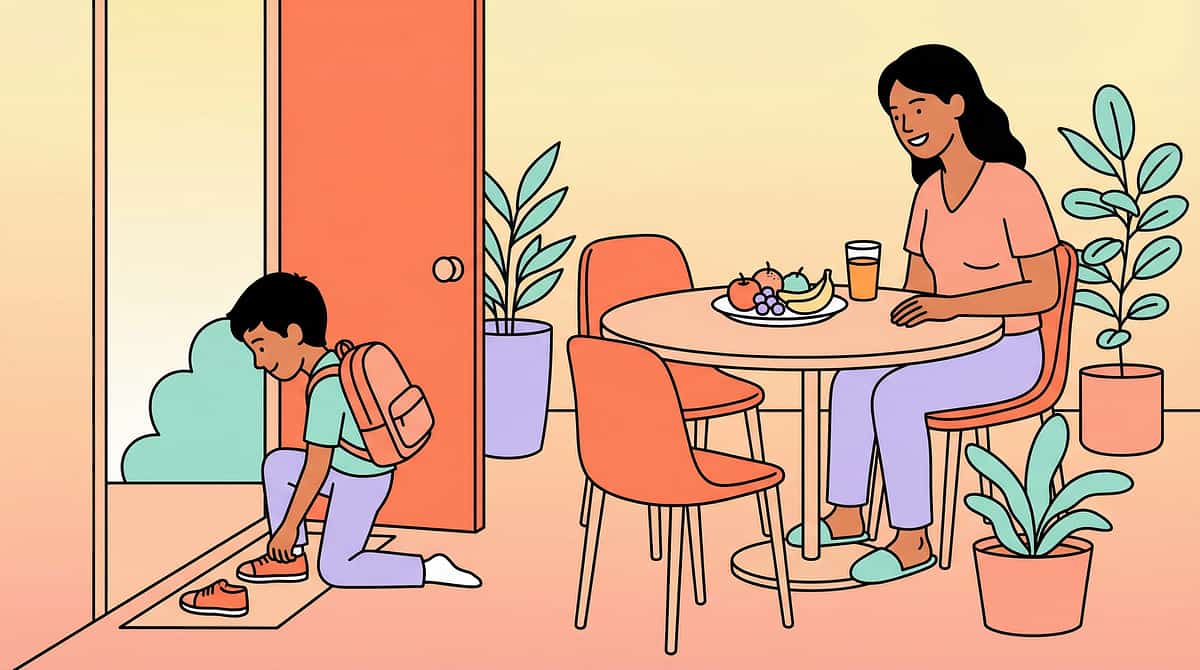
9 Materials That Help With Coming Home
Arriving home after school: the child is depleted. Home equals safe. Safe equals release. The coming-home transition must be treated as a decompression event — not a "now do more things" moment. All suppressed sensory-emotional responses from school surface when the child crosses the threshold.
Coming-Home Sequence
Shoes off → snack → preferred activity (30–60 min) → THEN anything else. Protect this sequence every day.
Snack Ready on Arrival
Blood sugar + comfort. A simple, predictable snack waiting reduces the decompression time needed.
No Questions Immediately
"How was school?" can wait 30 minutes. Let the child land before the social demands of conversation begin.
Indian Joint Family
Multiple people greeting → keep it calm: one person, low demand, low volume. The joint family warmth is wonderful — pace it for the child's nervous system.
I-790 · Daily Routine Transitions
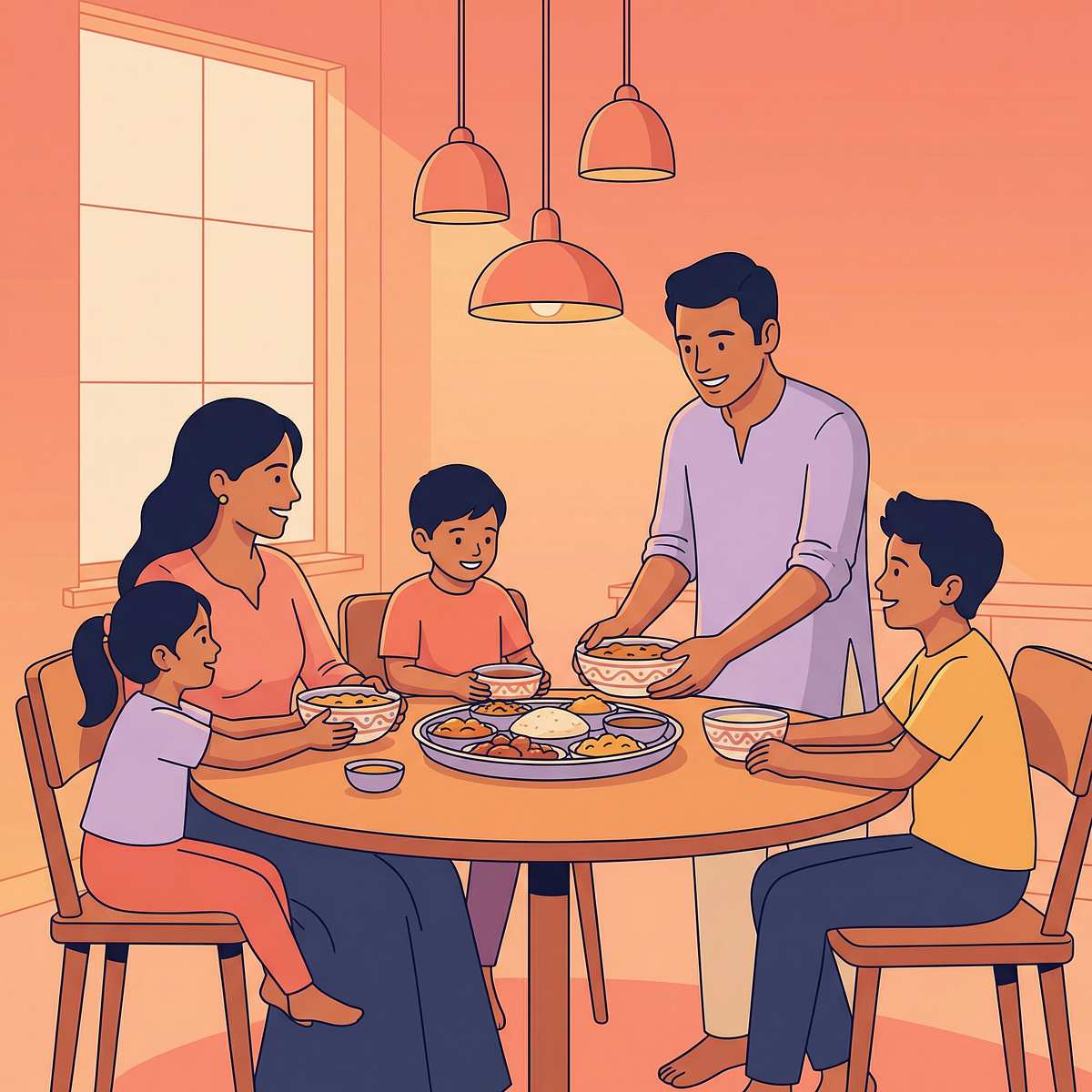
9 Materials That Help With Dinner Time Transition
Play → dinner. Screen → dinner. The family dinner is actually a high-demand situation: sustained sitting, social reciprocity, sensory management of food smells and textures, and fine motor demands of utensils — all layered on top of leaving a preferred activity.
10-Minute Warning
"Almost dinner time" — consistent language, every evening. Never surprise a child with dinner.
Involve in Setup
Child helps set the table — transitioning into dinner through participation, not abrupt arrival at the table.
No Surprise Menu
What's for dinner? Tell them in advance. Sensory preparation includes knowing what foods will appear.
Realistic Duration
10 minutes at the table for young children — build gradually. The goal is presence and regulation, not full meal completion.
Section 2 of 4
Cards 11–18 · Evening Transitions & Tools
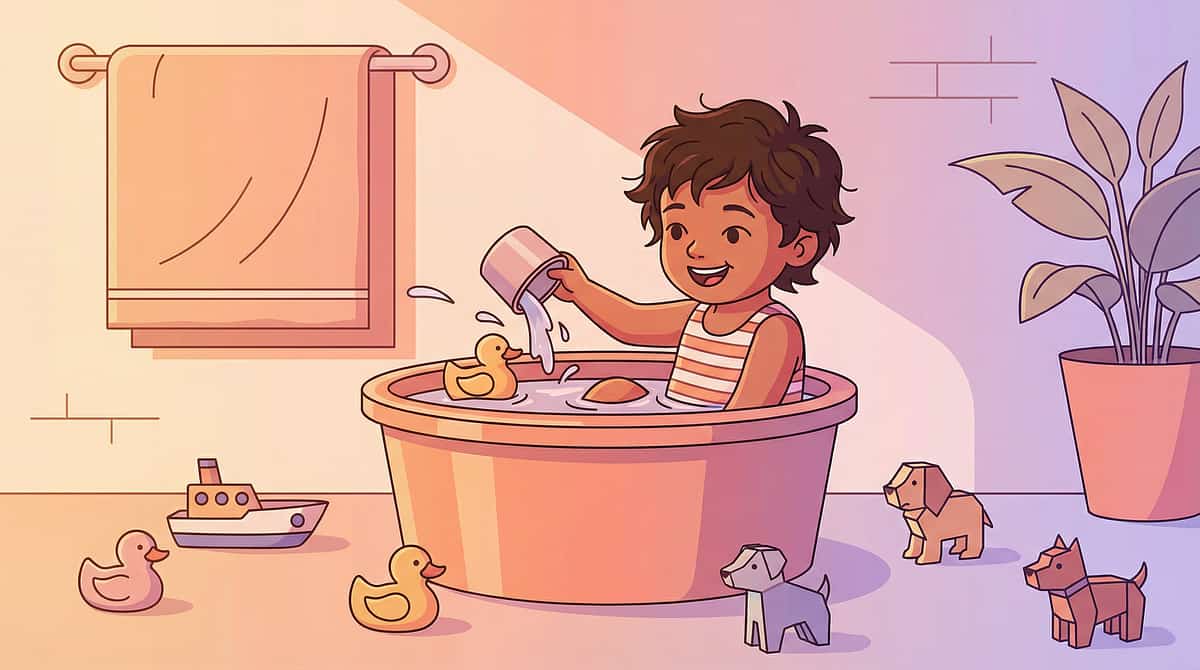
I-791: 9 Materials That Help With Bath Time Transition
For some children, bath time is sensory heaven — water play, warmth, proprioceptive input. For others, it is overwhelming — temperature, wet texture, soap smell, hair washing. The transition difficulty depends entirely on which camp the child is in: approaching preferred, or approaching aversive.
Bath-Averse Child
Gradual desensitization: sponge bath → partial bath → full immersion. Child-preferred water temperature. Unscented products. Hair washing strategies: visor shield, cup pouring, child controls the water. Each step earns the next level of comfort.
Bath-Loving Child
Easy to transition TO, hard to transition FROM. Use a visual timer for bath duration. Place bath after a less preferred task — motivation through anticipation of the preferred sensory experience.
Consistent Bath Sequence
Undress → water → wash body → wash hair → rinse → dry → dress. The same sequence, every time, removes the uncertainty from the routine. Indian context: bucket bath option is often less overwhelming than full immersion or shower.
I-792 · Evening Transitions & Tools
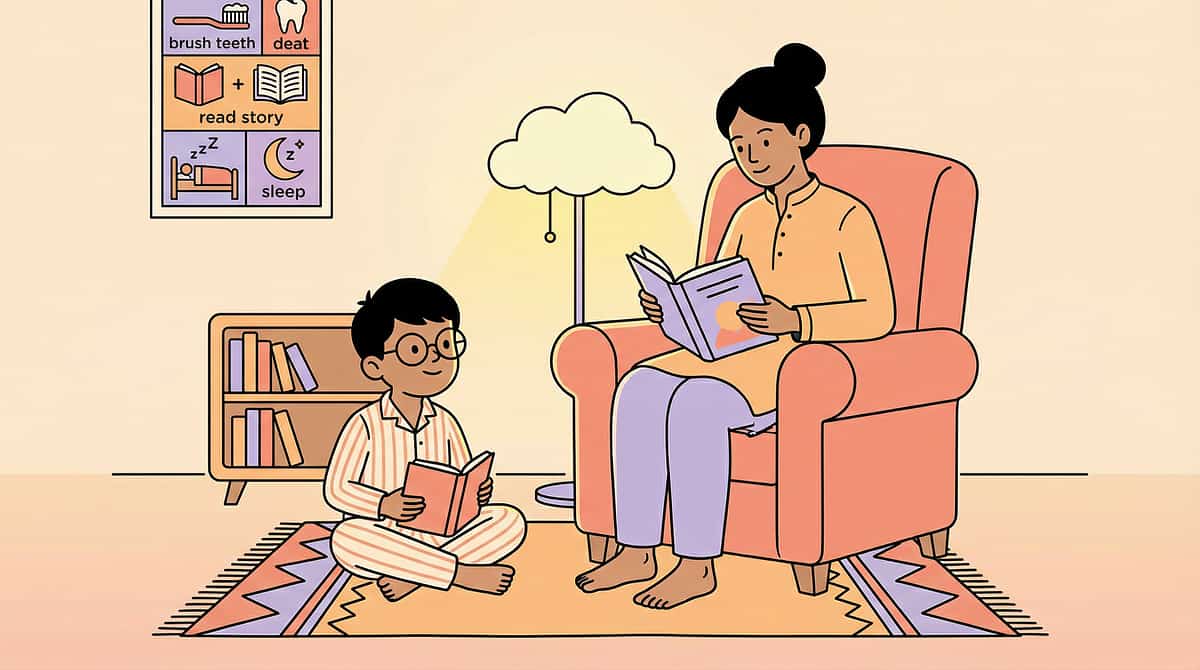
9 Materials That Help With Bedtime Transition
The most important transition of the day. A failed bedtime cascades into a disrupted next morning, a dysregulated school day, and a family in crisis. The brain must shift from alert (sympathetic) to sleep (parasympathetic) — a shift that takes 30–60 minutes and cannot be rushed.
45-Min Wind-Down Begins
Dim lights, quiet activities, warm milk, calming sensory input — massage, deep pressure, or gentle rocking.
Screens Off
60 minutes before bed — non-negotiable. Blue light blocks melatonin production and keeps the brain in alert mode.
Bedtime Visual Schedule
Bath → pyjamas → teeth → story → prayer or song → lights out → sleep. The routine IS the wind-down.
Consistent Time
Same bedtime ±15 minutes every night — including weekends. Consistency trains the circadian rhythm over weeks.
I-793 · Evening Transitions & Tools
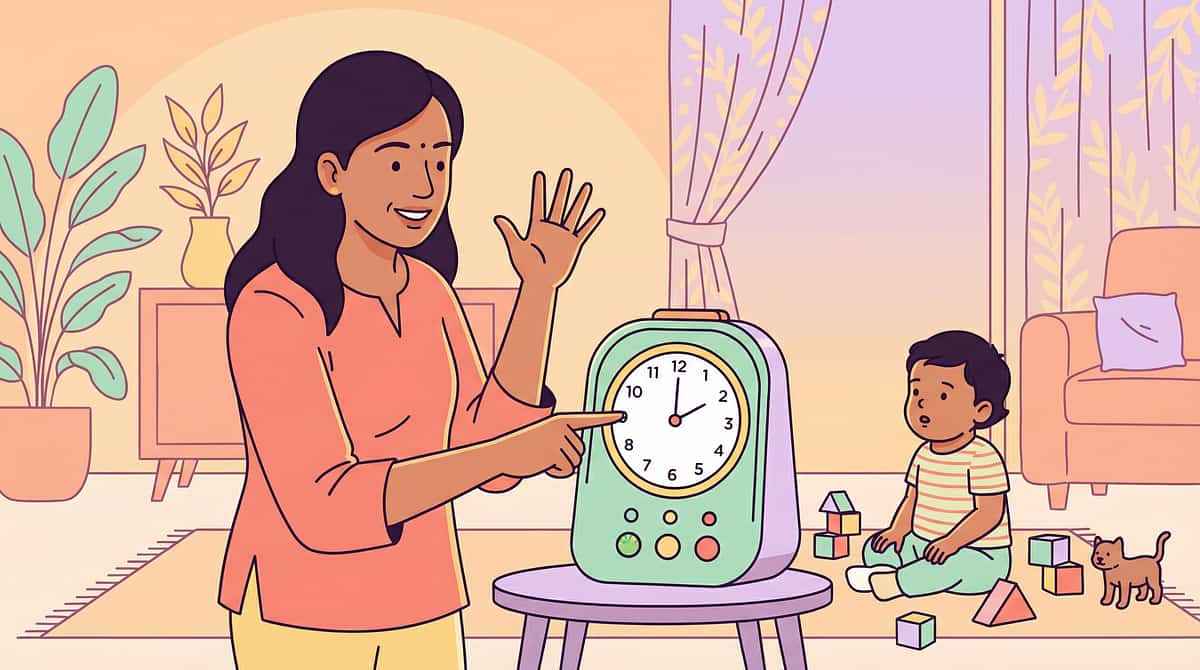
9 Materials That Help With Transition Warnings
The #1 transition tool. Warnings before transitions reduce surprise → reduce amygdala activation → reduce meltdowns. A child warned 5 minutes before a change processes the upcoming shift before it happens. An unwarned child is ambushed — and ambush triggers fight-or-flight every time.
Pre-announcement gives the PFC time to begin disengaging from the current activity and orient toward the next. By the time the transition occurs, the brain is already partially shifted. Without warning, the transition is a sudden interruption — and the amygdala treats interruptions as threats.
Warning Timing Sequence
10 min → 5 min → 2 min → 1 min → now. Adjust based on the child — some need longer preparation windows, some shorter.
Multi-Modal Warning
Verbal + visual (timer or fingers) + auditory (specific sound or song meaning "almost time"). Three channels are better than one.
Consistent Language
SAME words every time: "In 5 minutes, we will finish [current] and start [next]." Predictable phrasing reduces processing demand.
📊 Evidence Level
Level I — Transition warnings appear across ALL ASD intervention research as a core, non-negotiable strategy.
NCAEP 2020 | PMC10955541
⚠️ Over-Warning
If warnings cause MORE anxiety (child starts distressing at the 10-minute mark), shorten the warning period. Calibrate to the individual child's window.
I-794 · Evening Transitions & Tools
9 Materials That Help With Visual Timers
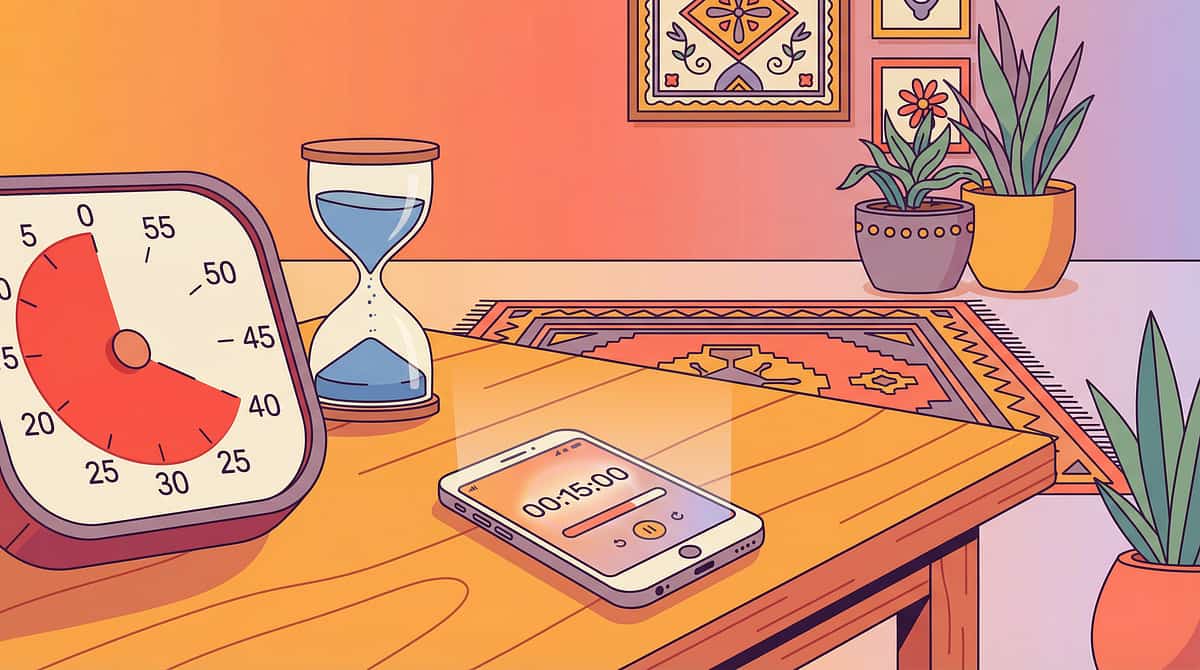
Time is invisible. "5 minutes" means nothing to a child who can't see time passing. Many children with ASD have impaired time perception — 5 minutes can feel like 30, or 30 can feel like 5. Visual timers make time concrete, watchable, and real: "When the red is gone, we change."
Time Timer
Red disc that visually shrinks as time passes. ₹1,500–3,000. The gold standard for visual time representation — widely used across ASD settings.
Sand Timer
Hourglass style. ₹100–300. Affordable, portable, durable. Visual and tactile — the child can watch (and feel) time running out.
Phone Timer App
Free. Always available. Pair with a visual display mode so the countdown is easy to read at a glance from a distance.
Stoplight Timer
Green → yellow → red. Intuitive color-coding that children understand quickly. Works well in classroom settings with multiple children.
⚠️Never extend time after the timer ends. The timer is the authority — not the parent. Consistency with the timer is the entire mechanism of the tool.
I-795 · Evening Transitions & Tools
9 Materials That Help With Transition Objects
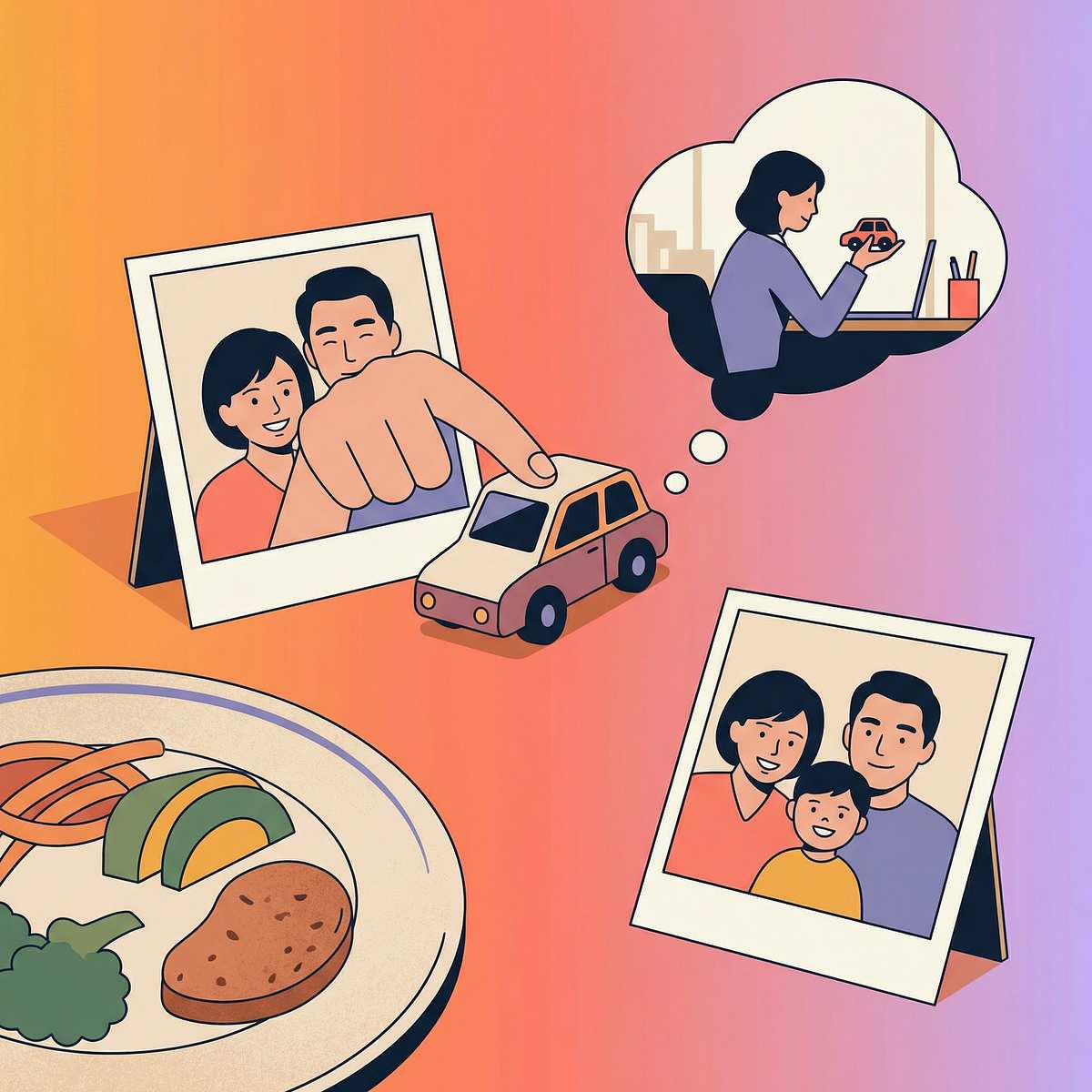
A child carries a small car from the play area to the dining table. A keychain from home to school. A parent's photo from the car to the classroom. Transition objects are portable pieces of safety — physical items that travel with the child across transition boundaries, providing continuity when everything else changes.
The amygdala processes familiar objects as safe stimuli. When the environment shifts (transition), the familiar object remains constant — giving the brain one stable input amidst uncertainty, reducing the threat response.
Object Selection
Small, portable, meaningful — not necessarily a toy. A rubber band, smooth stone, keychain, or photo works perfectly. Meaning matters more than size.
Object as Bridge
"Carry this to [next activity]." The physical object links current to next — a tangible bridge across the transition gap.
If Fixation Develops
⚠️ If the child refuses to function without it, introduce a gradual fading programme. The tool should support — not replace — internal regulation.
I-796 · Evening Transitions & Tools
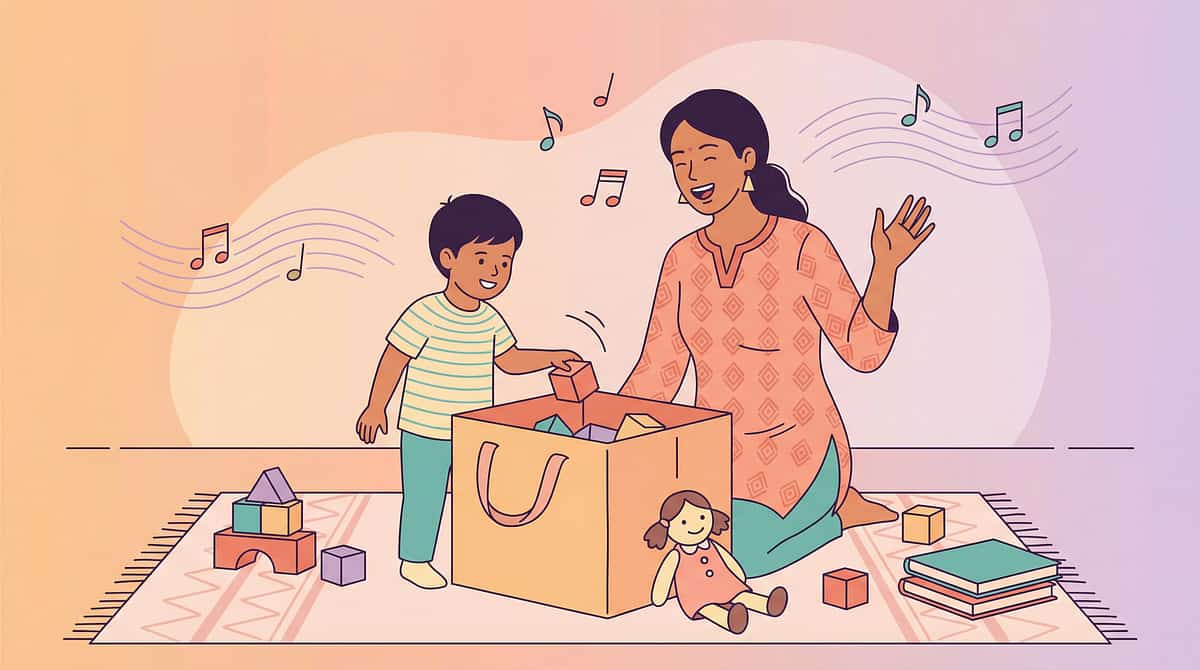
9 Materials That Help With Transition Songs
"Clean up, clean up, everybody everywhere..." A simple song — and the child knows: this activity is ending, clean-up is happening, something new is coming. Transition songs are auditory cue systems that signal change through melody rather than verbal instruction.
Music processing activates reward circuits, making the transition cue pleasant rather than threatening. Familiar melody = known pattern. When a specific song is always paired with a specific transition, hearing the song automatically begins neural preparation for the change. Song outperforms verbal instruction because melody is processed differently than speech — it is emotionally regulating and predictably rhythmic.
One Song Per Transition
Clean-up song, goodbye song, line-up song, wash-hands song, bedtime song. Each transition owns its melody — consistent pairing builds automatic cueing.
Song as Timer
Song duration = transition duration. "When the song ends, we're done." Music becomes both cue AND countdown simultaneously.
Creating Your Own
Simple melody + simple words describing the transition. The tune matters less than the consistency. Familiar Bollywood melodies or nursery rhymes in Hindi or regional languages work beautifully.
I-797 · Evening Transitions & Tools
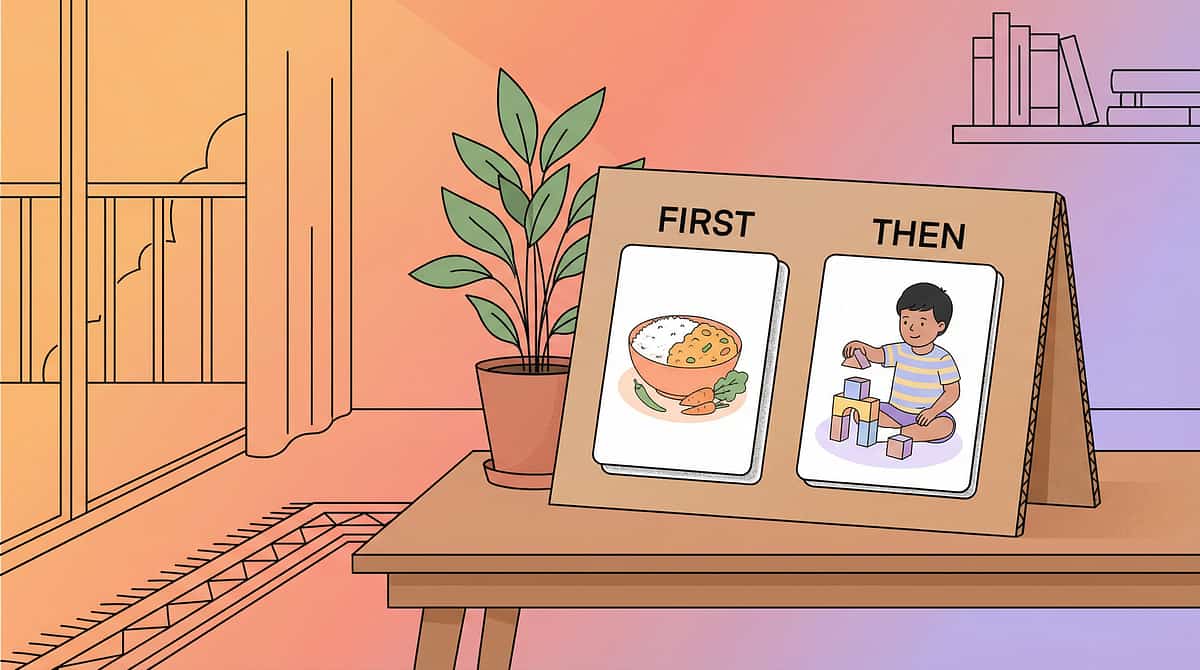
9 Materials That Help With First-Then Boards
The single most-used ASD visual tool. FIRST [non-preferred task picture] — THEN [preferred activity picture]. Two images. One board. The First-Then board answers the brain's two transition questions simultaneously: "What do I have to do?" and "What do I get after?" Both questions answered — both uncertainties resolved.
1
FIRST
Non-preferred task. Picture card on the left velcro spot. Clear, simple image of the expected activity. No ambiguity.
2
THEN
Preferred reward activity. Picture card on the right. The dopamine anticipation bridge — carries the child through the non-preferred FIRST task.
Keep It Portable
Small board travels everywhere — school, therapy, home, car. The tool is only useful if it's present at the moment of transition.
Progression Path
2-item → 3-item (First-Then-Then) → full visual schedule. Build complexity as the child's comfort with the format grows.
DIY Affordable
₹50 DIY: cardboard + printed pictures + velcro dots. Laminated cards with Hindi + English labels for Indian families.
I-798 · Evening Transitions & Tools
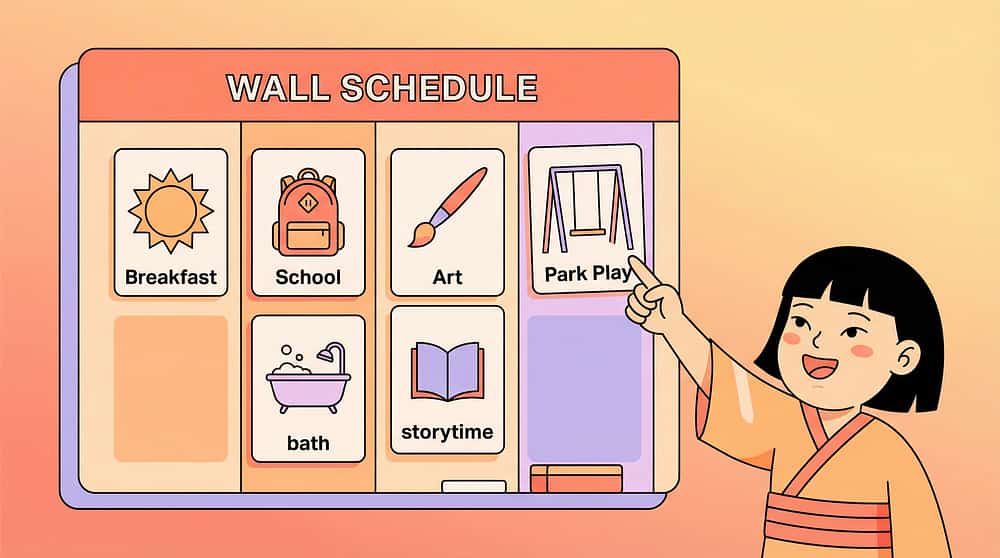
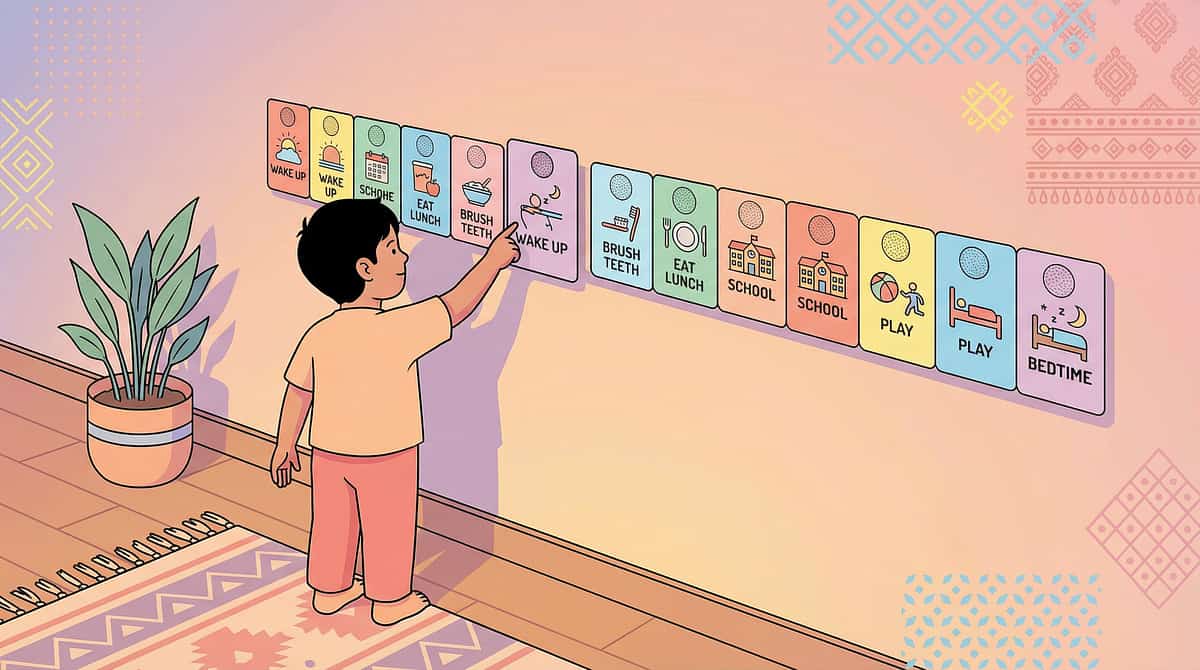
9 Materials That Help With Visual Schedules
The Master Transition Tool
The visual schedule shows the entire sequence of activities — past, present, and future — making the whole day visible. Every transition is pre-announced because the child can look ahead. It answers the question driving most ASD anxiety: "What happens next?"
📊Level I — THE most evidence-supported ASD intervention tool. NCAEP 2020
Schedule Types — Build the Ladder
Written Words
For readers — clean, fast, discreet.
Picture Symbols
Standard AAC-style images.
Photo Schedule
Real photos of child's own environments.
Object Schedule
Real objects — earliest learning level.
💡The child must USE the schedule — not just look at it. Have them point, move cards to "done," and check off items. Active engagement with the schedule is what builds independence over time. ₹100 DIY: cardboard strip + printed pictures + velcro.

Section 3 of 4
Cards 19–24 · Strategies & Flexibility
I-799: 9 Materials That Help With Countdown Strategies
"5… 4… 3… 2… 1… done!" Countdowns externalize the approach of a transition — the child hears and sees the endpoint arriving. Sequential processing (the basal ganglia counts automatically once learned) combined with auditory rhythm creates a bridge across the transition rather than an abrupt push.
Verbal Countdown
5-4-3-2-1 at a consistent pace with a calm voice. The rhythm itself is regulating — predictable and finite.
Visual Countdown
Finger countdown, number cards flipped one by one, or traffic light (green → yellow → red). Visual + verbal together doubles the preparation effect.
Activity Countdown
"5 more pushes on the swing… 4… 3… 2… 1… all done!" The activity itself counts down to a natural, chosen ending point.
Always Follow Through
Zero equals transition — no extensions. Consistency transforms the countdown from a warning into an authority. Hindi counting: "paanch, chaar, teen, do, ek, bas!"
I-800 · Strategies & Flexibility
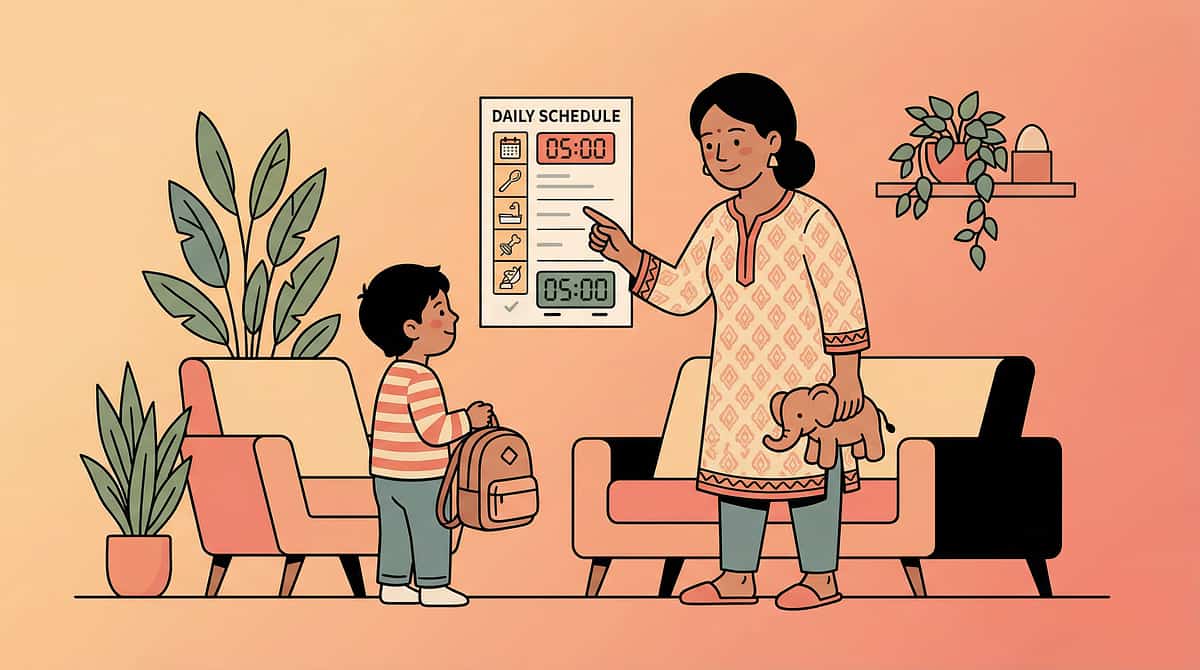
9 Materials That Help With Transition Preparation
Preparation is everything. The child who knows what's coming, what to expect, and what happens after transitions more smoothly than the child who is surprised. This card consolidates all preparation strategies into a unified Transition Preparation Protocol — the 7-step sequence that works across every context.
The preparation investment: 2 minutes of preparation saves 20 minutes of meltdown. Every minute spent preparing is returned tenfold in smoother transitions and a more regulated child.
Use social stories for novel transitions, rehearsal for new environments, and visual preview for unfamiliar activities. The more thoroughly the brain is prepared, the smaller the neural "gap" at the transition point — and the smaller the gap, the lower the anxiety.

I-801 · Strategies & Flexibility
9 Materials That Help With Unexpected Transitions
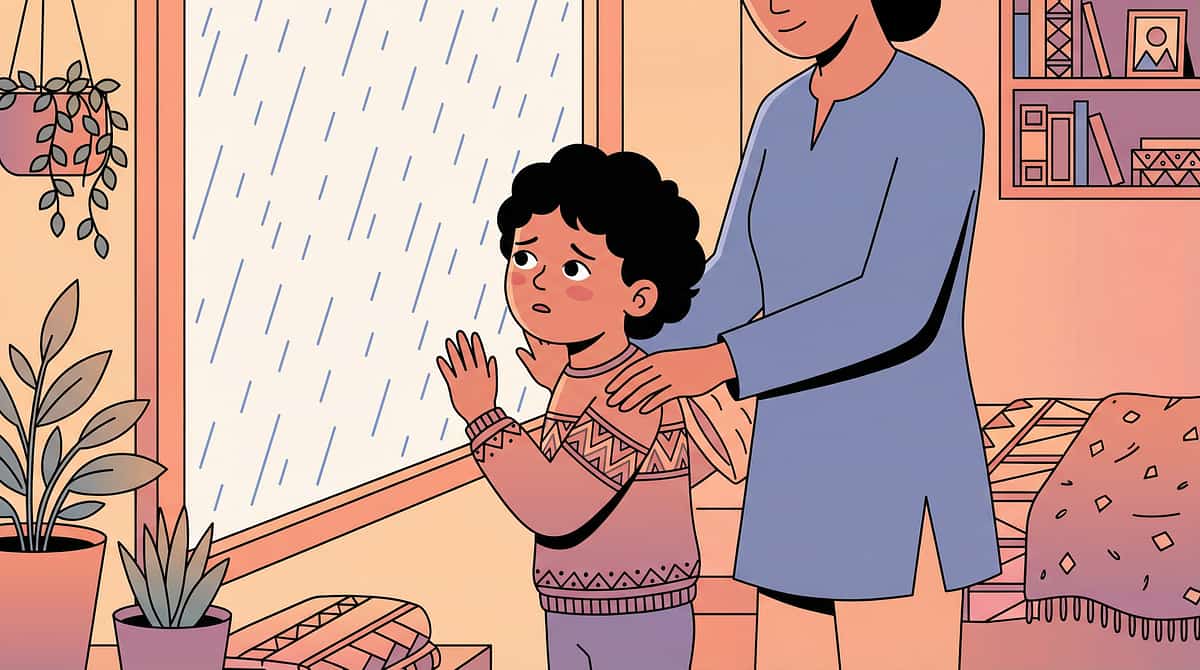
⚠️The hardest card. Everything above assumes transitions can be planned. But life is unpredictable: fire alarm, power cut, car breakdown, cancelled class, unexpected guest, rain cancelling outdoor play. Unexpected transitions have zero preparation time — and they trigger the maximum anxiety response.
Without preparation, the amygdala receives no advance notice, the PFC cannot pre-load the next activity, and the child is neurologically blank about what is happening. The ONLY preparation for unexpected transitions is building general flexibility — the topic of I-802 and I-803.
"Change Happens" Social Story
Pre-taught and rehearsed. Pull it out during unexpected changes — familiar narrative reduces novelty of the moment.
Change Card
A visual card showing "CHANGE" — a consistent signal meaning "the plan is different now, and that is okay." Familiarity of the signal reduces impact of the content.
Calm First, Explain Second
Regulate → THEN provide new information. An unregulated brain cannot process new plans. Sequence matters.
Practice Small Surprises
Deliberately introduce ONE low-stakes surprise change daily. Build tolerance at low intensity before life provides high-intensity practice.
I-802 · Strategies & Flexibility
9 Materials That Help With Flexibility Building
External tools manage transitions. Internal flexibility reduces the need for tools over time. Flexibility — the ability to adapt when things change — is the long-term solution to transition difficulty. It is a PFC skill that develops with practice, not instruction. Each successful experience of handling change strengthens the flexibility circuitry — next change is slightly easier.
Flexibility is a muscle. It builds through graded exposure to change, not through flooding with overwhelming change. The goal is gradual, supported expansion of the child's tolerance window.
Tiny Changes
Different cup at breakfast. Different sock color. Different chair at the table. Changes that are low-stakes but real.
Medium Changes
Different route to school. Different order of morning tasks. A new food on the plate (not required to eat).
Large Changes
Schedule changes, cancelled plans, new person in the routine. Only approached after success at smaller levels.
🎉Celebrate flexibility explicitly: "The plan changed and you handled it! That is FLEXIBLE thinking!" Naming and celebrating the skill accelerates its development. Indian context: festival schedule changes, guest arrivals, and power cuts are natural, built-in flexibility practice opportunities.
I-803 · Strategies & Flexibility
9 Materials That Help With Change Tolerance
Beyond flexibility (cognitive skill) to tolerance (emotional capacity). Change tolerance is the ability to experience change without emotional collapse. The child may not like the change — but can manage it without crisis. Tolerance is the emotional companion to cognitive flexibility.
Change tolerance builds through amygdala desensitization — repeated, supported exposure to change. Each tolerated change sends the message: "Change happened → I survived → change is survivable." Over time, the baseline response decreases. Tolerance builds through successful experience, not through instruction.
Grade by Intensity
Tiny → small → medium → large changes. Never skip levels. Earn each step through demonstrated success at the level below.
Support During Change
"I know this is different. That feels hard. You're doing it." Acknowledge the discomfort — don't dismiss it.
Post-Change Reflection
"The plan changed. You managed it. How do you feel now?" Build awareness of resilience after the fact.
Tolerance ≠ Enjoyment
The child doesn't have to like change. The goal is to survive it without crisis — not to love it. That is a realistic and achievable bar.
Build a Change History
"Remember when the class changed and you were okay?" A portfolio of survived changes becomes evidence of capability.

I-804 · Strategies & Flexibility
9 Materials That Help With New Environment Entry
Restaurant, hospital, relative's house, shopping mall, temple, new therapy center. Every new environment is a transition from known to unknown — and every sensory channel must recalibrate simultaneously: new visual layout, new sounds, new smells, new textures, new temperature, new people. Processing time needed: 5–15 minutes for most new environments. Don't rush this.
Pre-Visit Preparation
Photos or video of the destination, a social story, and a description of what to expect sensorily. The more familiar the unknown, the smaller the adjustment demand.
Arrival Protocol
Pause at the entrance. Sensory scan — let the child look before entering. Gradual entry: edge of the room first, then deeper. Never rush in.
Escape Plan
"If it's too much, we can step outside for a break." Knowing the exit exists reduces the need to use it. Safety is regulatory.
Indian New Environments
Temple (incense, bells, crowd), wedding hall (noise, lights, food), hospital (smells, waiting), relative's home (cooking smells, children, unexpected questions). Each has a specific preparation profile.
Section 4 of 4
Cards 25–30 · People Transitions & Mastery
I-805: 9 Materials That Help With Leaving Preferred Places
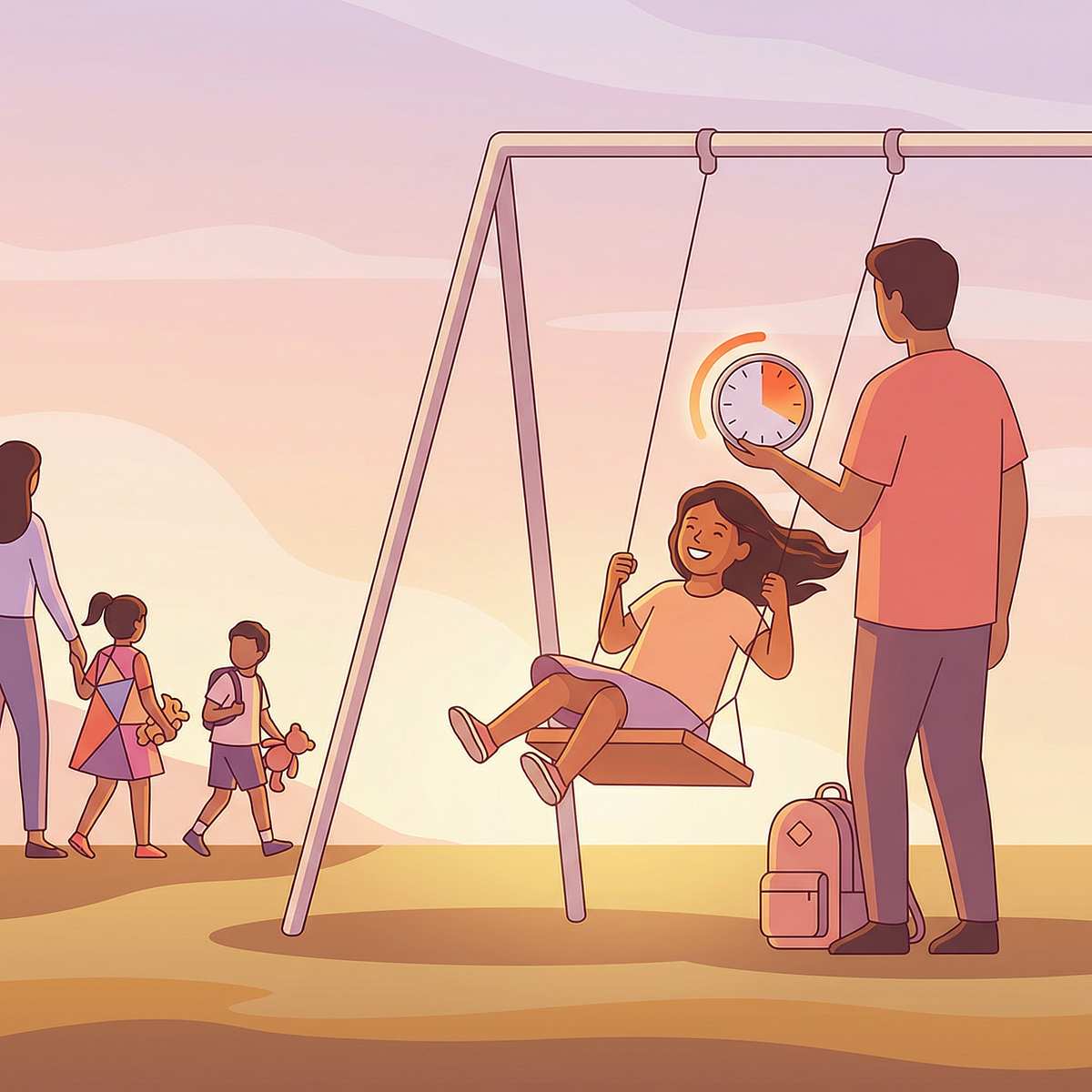
The park. The play area. Grandma's house. The pool. Leaving a place the child loves is the spatial equivalent of ending a preferred activity — except the entire environment must be left behind simultaneously. Swings, friends, space, freedom — all gone at once. The brain processes this as a bigger loss, potentially triggering a bigger emotional response.
Warning Sequence for Places
"In 10 minutes we leave the park." Same protocol as preferred activity endings — applied to the whole environment.
"Last Thing" Ritual
"One more slide, then we leave." Give the child agency in choosing their final experience. Choice reduces loss.
After-Departure Preferred
"When we leave the park, we get ice cream on the way home." Leaving leads to something good — not just loss.
Return Promise
"We will come back to the park on Saturday." Show it on a calendar. The place is not lost — just paused.

I-806 · People Transitions & Mastery
9 Materials That Help With People Transitions
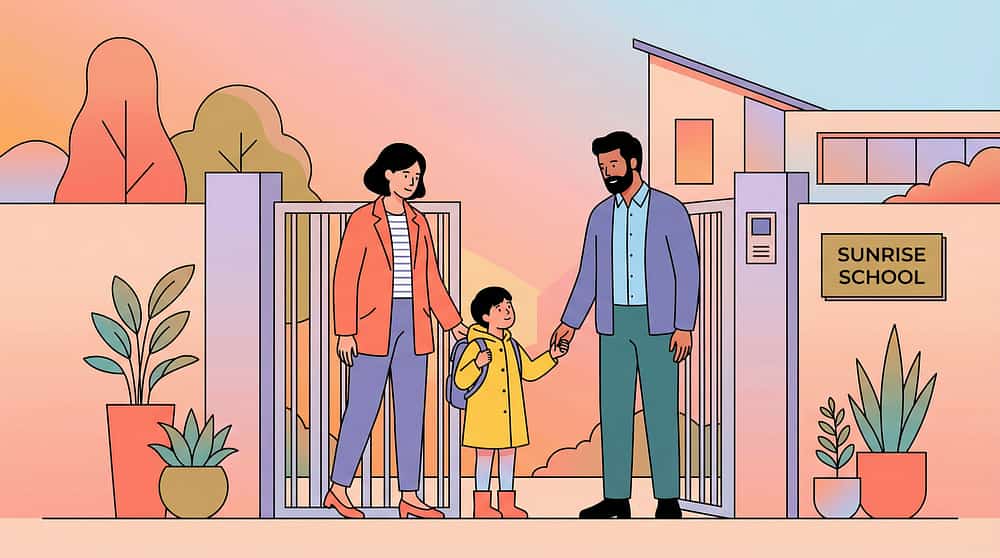
The social transition. Moving from one person to another: parent to teacher, parent to grandparent, parent to babysitter, one therapist to another. People transitions combine attachment (leaving a safe person), social recalibration (adjusting to a different communication style), and trust (will this new person understand me?). Each person has a different style — the child's brain must rebuild its social model each time.
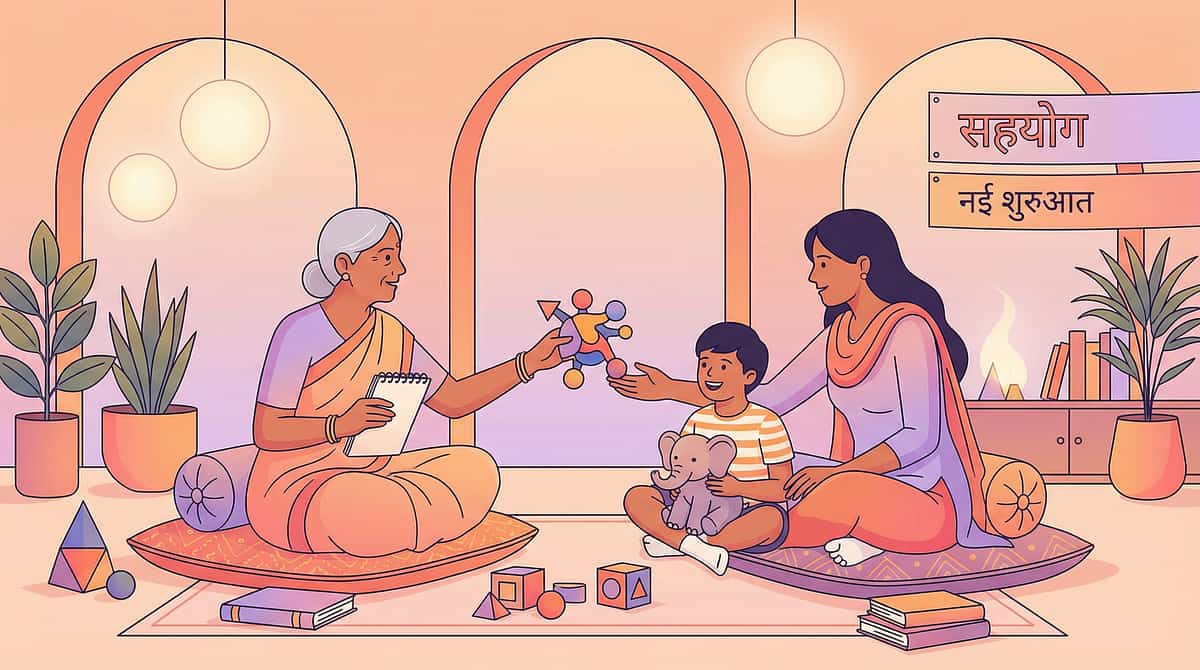
Gradual Handoff Protocol
Both present → safe person steps back → safe person leaves. Never a sudden hand-off. The presence of the safe person is the bridge across which trust transfers to the new person.
Person-Specific Visual
Photo of who's coming + what to expect with them. Known face, known activities — reduce the unknowns before the person arrives.
Consistent Goodbye Ritual
Same words and actions with every departure from every person. Predictable goodbyes reduce the emotional weight of each separation over time.

I-807 · People Transitions & Mastery
9 Materials That Help With Caregiver Changes
The maid leaves. Grandma goes home. The babysitter changes. Caregiver changes disrupt the child's daily routine and their attachment system simultaneously. The replacement caregiver doesn't know the child's quirks, triggers, or calming strategies — everything starts from zero. The child grieves the lost caregiver and struggles with the new one at the same time.
Overlap Handover
Outgoing caregiver trains incoming ideally over 3–5 sessions with both present. Knowledge transfer is as important as person transfer.
Written Child Profile
Daily routine, preferences, triggers, calming strategies, food preferences, communication style. The incoming caregiver should know the child on paper before meeting them in person.
Allow Grieving
"I know you miss Lakshmi aunty. It's okay to feel sad. Meena aunty will take good care of you." Name the feeling — don't dismiss it.
I-808 · People Transitions & Mastery
9 Materials That Help With Therapist Changes
The person who understood them, who knew exactly how to approach them, who had built trust over months — gone. Therapist transitions can set progress back significantly if not managed thoughtfully. The child has learned a social model specific to this therapist — their voice, pace, expectations, and reinforcement style. Rebuilding this model with someone new takes time and deliberate structure.
1
Comprehensive Handover
Current goals, programme details, reinforcers, triggers, rapport-building tips — all documented and transferred. Nothing lost between therapists.
2
Overlap Sessions
Old + new therapist together → new observes → new co-leads → new leads while old observes → new independent. Gradual transfer of the therapeutic relationship.
3
Child Preparation
Social story, photo of new therapist, visit to new room before first session. Familiar face + familiar space = reduced first-session anxiety.
4
Video Learning
Outgoing therapist records session for incoming therapist to study. Rapport nuances that can't be written down can be shown on video.
🌟Pinnacle Blooms Protocol: Structured therapist transitions with full data continuity maintained through GPT-OS®. No progress is lost when personnel change.
I-809 · People Transitions & Mastery
9 Materials That Help With Teacher Changes
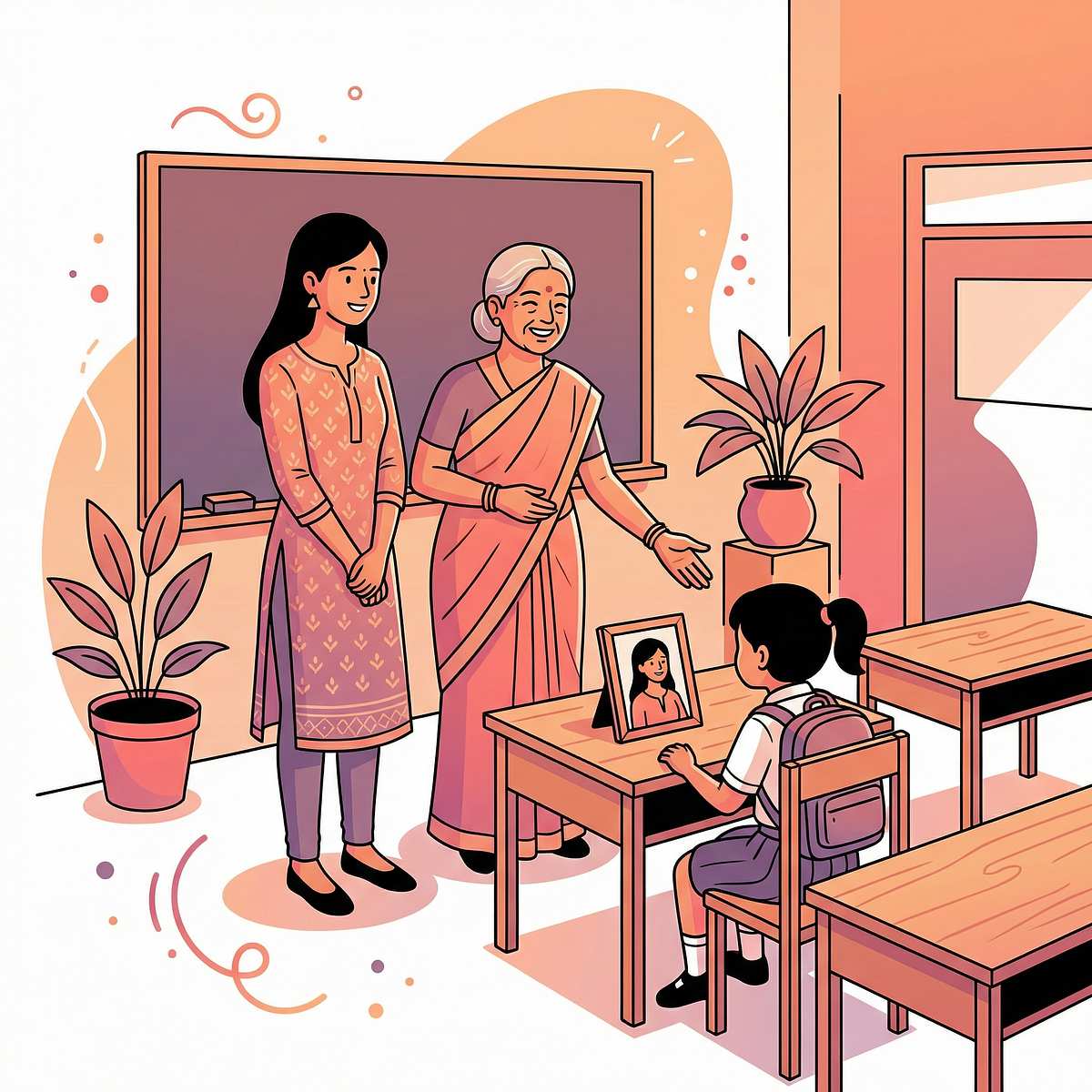
Whether a mid-year substitute or annual rotation, the child loses their school anchor. The familiar teacher is the primary social reference point at school — their voice, face, style, and expectations form the child's "school safety" model. Change the teacher, disrupt the model, and expect 4–8 weeks of adjustment: increased anxiety, behaviour changes, and temporary academic dip.
Maximum Advance Notice
"Next week, Mrs. Sharma will be your teacher." As much notice as possible. The longer the preparation window, the smaller the adjustment required.
One-Page Teacher Guide
Stays in the classroom file — handed to any new adult. Visual schedule, behaviour plan, sensory plan, communication approach. All supports continue regardless of teacher change.
Meet Before First Day
Brief meeting with new teacher before the first official day. Known face = reduced first-day anxiety.
Indian Annual Rotation
Teacher rotation is standard practice. Systematize the handover annually — a prepared file, a scheduled meeting, a smooth transition every year without crisis.
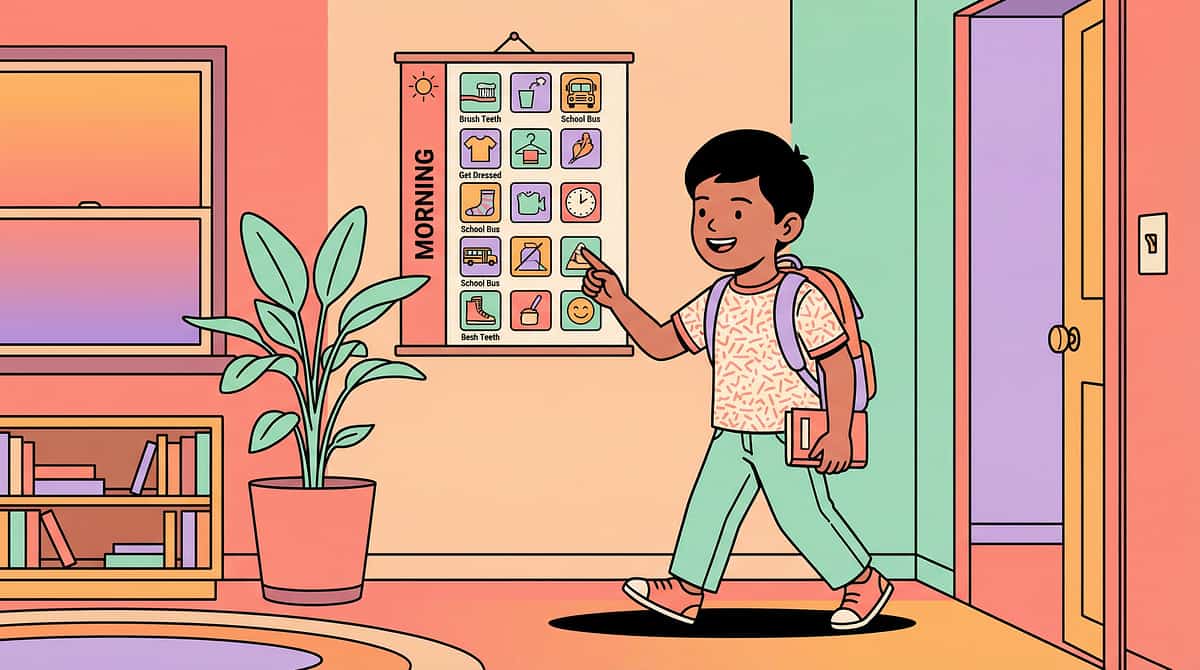
Preview of daily transitions Therapy Material
Below is a visual preview of daily transitions therapy material. The pages shown help educators, therapists, and caregivers understand the structure and content of the resource before use. Materials should be used under appropriate professional guidance.
Link copied!
I-810 · Subdomain I1 Capstone
9 Materials That Help Building Transition Tolerance
The long-term goal of Subdomain I1: moving from a child who needs every transition externally supported to a child who can internally manage most transitions independently. The tools — timers, schedules, warnings — are scaffolding. The goal is for the brain to internalize what the tools externalize.
Fading External Supports
Visual timer → verbal warning only → self-managed transitions. Fading is gradual, data-driven, and reversed immediately if the child struggles.
Self-Monitoring
"Am I ready for the change?" Internal checklist. The child begins to do what the schedule and timer once did for them — automatically.
Track and Celebrate Growth
Document the child's transition tolerance progress. Share it with them. A visible record of growth is motivating evidence of capability.
Realistic Expectations
Some transitions will always be hard. The goal is MOST transitions managed independently — not ALL. That is a realistic, achievable, meaningful bar.
The Subdomain I1 Message
Transitions are the invisible thread connecting every activity, every place, and every person in a child's life. Making transitions smooth doesn't just prevent meltdowns — it gives the child freedom. A child who can transition is a child who can move through the world.
📋 ABA · 🧠 Psychology · SpEd | OT · SLP · NeuroDev
📊Level I — Longitudinal transition skill development. NCAEP 2020