
9-materials-that-help-with-very-limited-food-repertoire
"They only eat the same five foods. Every single day."
If you've counted your child's accepted foods on your fingers — and run out — you are not failing. Their nervous system is speaking in the only language it knows.

📞 FREE National Autism Helpline: 9100 181 181 | Available 24×7 | 16+ languages
Very Limited Food Repertoire in Children: 9 Materials That Help Expand Their Food World
The rice has to look exactly right. That specific brand of biscuit. Pasta with nothing on it. Chicken nuggets — but only from that one restaurant. And if anything is slightly different — the colour, the texture, the brand — the whole meal falls apart.
You've tried everything. Hiding vegetables. Rewards. Gentle exposure. Firm boundaries. Nothing moves the list. If anything, it shrinks.
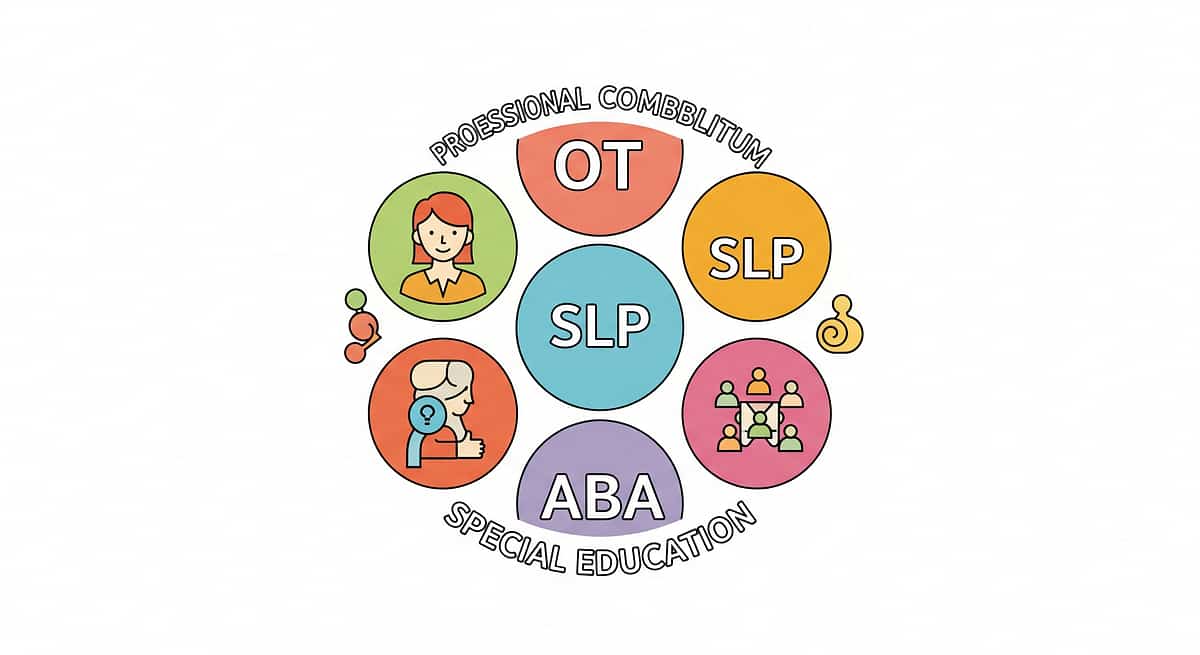
Built by the Pinnacle Blooms Consortium
India's largest multi-disciplinary team of Pediatric OTs, SLPs, ABA specialists, Special Educators, NeuroDevelopmental Pediatricians, and Feeding Specialists — with one purpose: give you the science, the tools, and the step-by-step protocol to expand your child's food world, right from your home, today.
🏥 Consortium-Validated
  • OT • SLP • ABA • SpEd
  • NeuroDevelopmental Pediatrics
  • Feeding Specialists
  • 20M+ 1:1 therapy sessions
  • 97%+ measured improvement rate
WHO Nurturing Care Framework (2018) — early identification and parental awareness directly impacts developmental outcomes.
Your Child Is Among Millions. The Science Sees Them.
Very limited food repertoire is not a parenting failure. It is not stubbornness. It is not manipulation. Studies in the World Journal of Clinical Cases (2024) document that food selectivity in autism involves genuine sensory processing differences — the child's brain processes taste, texture, smell, temperature, and appearance with far greater intensity than neurotypical children.
1 in 100
Children Globally
have autism — and virtually all experience food-related challenges
80%
Children with ASD
experience sensory processing difficulties that directly impact eating
70%
Show Food Selectivity
often restricted to fewer than 20 foods — confirmed across 70+ countries
"You are among millions of families navigating this exact challenge. The science has caught up. The tools exist. The path forward is clear."

📞9100 181 181 — Call to speak with a Feeding Specialist in your language

This Is a Wiring Difference. Not a Behavior Problem.

The Neuroscience In children with very limited food repertoire, the brain's sensory processing pathways — including the gustatory cortex (taste), somatosensory cortex (texture), olfactory bulb (smell), and visual cortex — process food stimuli with amplified intensity. What a neurotypical child experiences as "mild bitterness" registers as overwhelming. What feels like normal texture feels like sandpaper or slime. Neuroimaging studies confirm atypical sensory processing in the insula and anterior cingulate cortex — regions governing both taste and threat response. Frontiers in Integrative Neuroscience (2020) | PMC11506176 In Parent Language Imagine eating while wearing headphones set to maximum volume, with a spotlight shining directly in your eyes, and someone is constantly touching your arm. That's the sensory experience of mealtime for many selective eaters. Their refusal is protective. Their selectivity makes complete neurological sense. The goal is not to force through the refusal. The goal is to gradually reduce the threat signal — one tiny, patient step at a time. "This is a wiring difference, not a behavior choice. Intervention works by building new neural pathways through safe, repeated, low-pressure exposure — not through force, rewards for eating, or punishment." — Pinnacle Blooms Consortium, Feeding Therapy Division

Your Child Is Here. Here Is Where We're Heading.
Some food selectivity is developmentally normal between ages 2–6 when neophobia (fear of new foods) peaks. Most children naturally expand their preferences with low-pressure repeated exposure. However, children with sensory processing differences, autism spectrum conditions, anxiety, oral motor challenges, or previous negative feeding experiences may develop severe, persistent food selectivity that does not resolve spontaneously.
Age 1–2
Normal peak food neophobia
Age 2–4
Persistent selectivity warning zone
Age 4–6
Active intervention window
Age 6–9
Functional variety goal
WHO/UNICEF Confirms
  • The feeding relationship is the first context where a child experiences safety, connection, and control
  • Disruption of the feeding relationship has cascading developmental impacts
  • All 5 nurturing care components intersect at the feeding relationship
Frequent Co-Occurrences
  • Sensory processing disorder
  • Autism spectrum conditions
  • Anxiety disorders & ADHD
  • Oral motor difficulties
  • GI disorders (reflux, eosinophilic esophagitis)

⚠️Medical Rule-Out First: Before beginning feeding intervention, rule out underlying medical causes. If your child gags, vomits, has GI pain, or shows weight concerns — consult a pediatrician first. 📞9100 181 181

Clinically Validated. Home-Applicable. Parent-Proven.

🛡️ Level I Evidence — Systematic Review + Meta-Analysis Study Finding Source PRISMA Systematic Review (2024) Sensory integration intervention is evidence-based practice for autism across 16 studies (2013–2023) PMC11506176 Meta-analysis, World J Clin Cases (2024) Feeding intervention promotes food acceptance, adaptive eating behavior, and reduced food-related anxiety across 24 studies PMC10955541 Indian RCT (2019) Home-based sensory feeding interventions demonstrate significant outcomes in Indian pediatric population DOI: 10.1007/s12098-018-2747-4 SOS Approach to Feeding 6–18 months of systematic exposure → average 20–30 new foods accepted Dr. Kay Toomey WHO CCD Package Caregiver-delivered feeding intervention produces measurable outcomes in 54 LMICs PMC9978394 Key Finding: Food chaining + sensory desensitization + removal of mealtime pressure = the evidence-based triple approach for very limited food repertoire. Pinnacle real-world evidence: 20M+ sessions | 97%+ improvement rate via GPT-OS®.

ACT II — Knowledge Transfer
Very Limited Food Repertoire: Graduated Food Exposure Therapy
Formal Name
Graduated Systematic Food Exposure Therapy (GSFET) / Food Chaining + Sensory Desensitization Protocol
Parent-Friendly Alias
"Building the Food Bridge — One Tiny Step at a Time"
Reel ID
E-452 | Feeding & Mealtime Challenges — Episode 452
The 5-Component Definition
Mealtime Pressure Removal
Eliminating the fight-or-flight response at mealtimes
Food Chaining
Building microscopic bridges from accepted foods to new foods
Sensory Desensitization
Play-based food exploration to reduce the threat response
Steps of Eating
Redefining success as any food interaction, not just eating
Environment Optimisation
Creating sensory conditions for food tolerance
🍽️ Domain
Feeding & Mealtime Challenges — Domain E
👦 Age Range
2–12 years
📅 Duration
8–24 weeks systematic protocol
🏠 Setting
Home + Feeding Therapy Clinic
Five Disciplines. One Feeding Plan. Your Child at the Centre.
🟢 Occupational Therapist (OT) — PRIMARY LEAD
Addresses sensory processing differences that drive food avoidance. Designs sensory desensitization hierarchy, oral motor preparation, and environmental modifications. Builds the food chaining protocol based on individual sensory profile.
🔵 Speech-Language Pathologist (SLP) — CO-LEAD
Assesses oral motor function — tongue movement, chewing coordination, swallowing safety. Provides oral motor treatment for texture processing difficulties. Critical for children whose selectivity has an oral motor or swallowing component.
🟡 Board Certified Behavior Analyst (BCBA/ABA)
Designs the behavioural framework — reinforcement schedules, data collection systems, extinction of avoidance behaviours, and building approach behaviours toward new foods. Ensures a pressure-free positive reinforcement approach.
🟠 Special Educator (SpEd)
Builds visual supports — steps of eating charts, food chaining cards, food bridge cards, social stories. Coordinates home-school consistency in feeding approach.
🔴 NeuroDevelopmental Pediatrician
Rules out medical causes (reflux, GI disorders, eosinophilic esophagitis). Assesses for ARFID diagnostic threshold. Coordinates with dietitian for nutritional monitoring. Determines whether additional medical intervention is needed.
"The brain doesn't organise by therapy type. Effective feeding intervention requires all five disciplines working from a single integrated plan — which is what GPT-OS® FusionModule™ delivers." — Pinnacle Blooms Consortium

📞9100 181 181 — Connect with a Feeding Specialist from our consortium
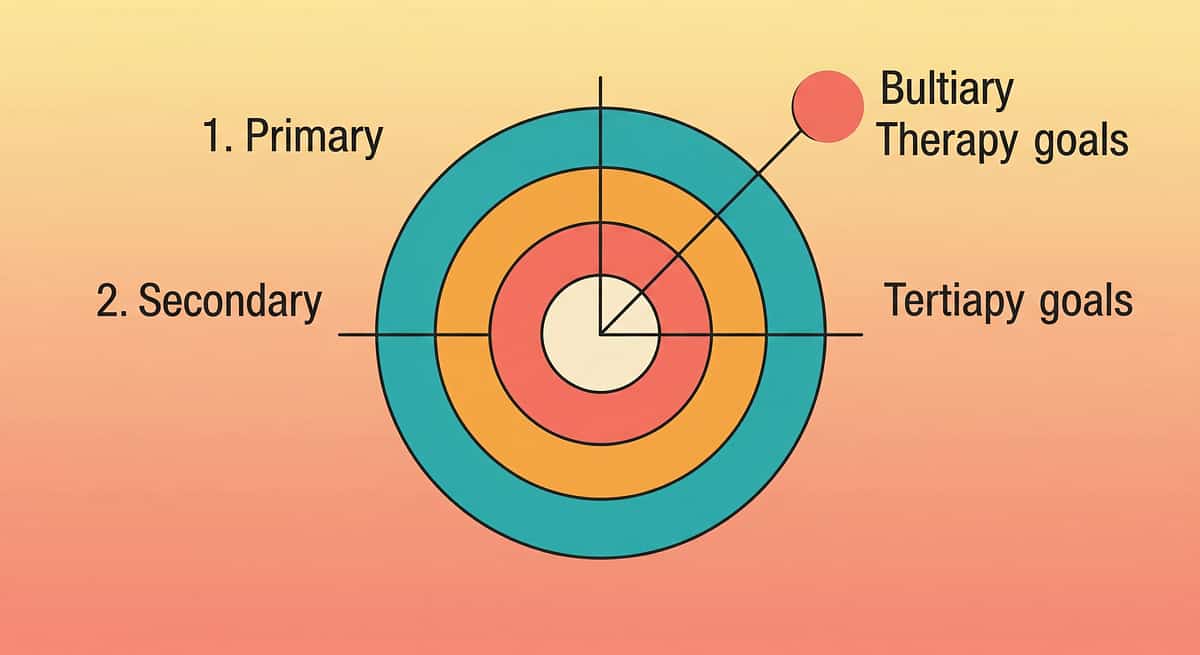
This Isn't a Random Activity. It's a Precision Therapeutic System.
Primary Target
Secondary Targets
Tertiary Gains
GPT-OS® Readiness Indexes Tracked
  • Food Variety Readiness Index
  • Mealtime Participation Readiness Index
  • Nutritional Adequacy Readiness Index
  • Social Eating Readiness Index
  • Feeding Independence Readiness Index
Tertiary Developmental Gains
  • Sensory Processing Regulation — Generalised improvement in sensory tolerance beyond food
  • Autonomy & Self-Efficacy — Child develops agency over their relationship with food
  • Family Quality of Life — Meal planning stress reduces; family can eat out and travel

The 9 Materials
9 Materials. Each One a Key to a Larger Food World.
Validated by the Pinnacle Blooms Consortium. Evidence-backed. Home-applicable. Priced for every family.
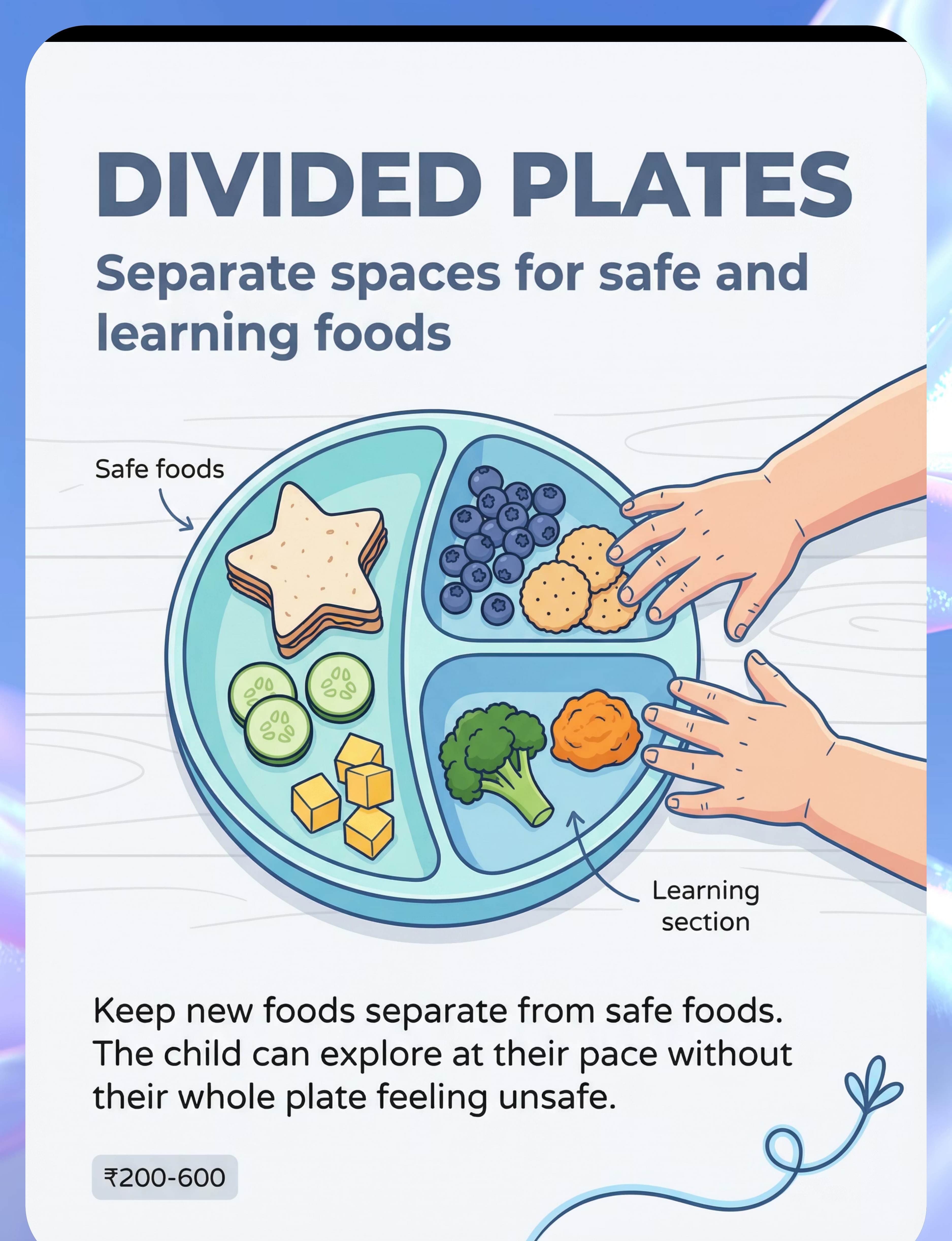
1 — Food Exploration Divided Plates
"Separate spaces for safe foods and learning foods." New foods stay in their own section. Safe foods stay protected. No contamination, no plate-pushing. Proximity without pressure.
₹200–600
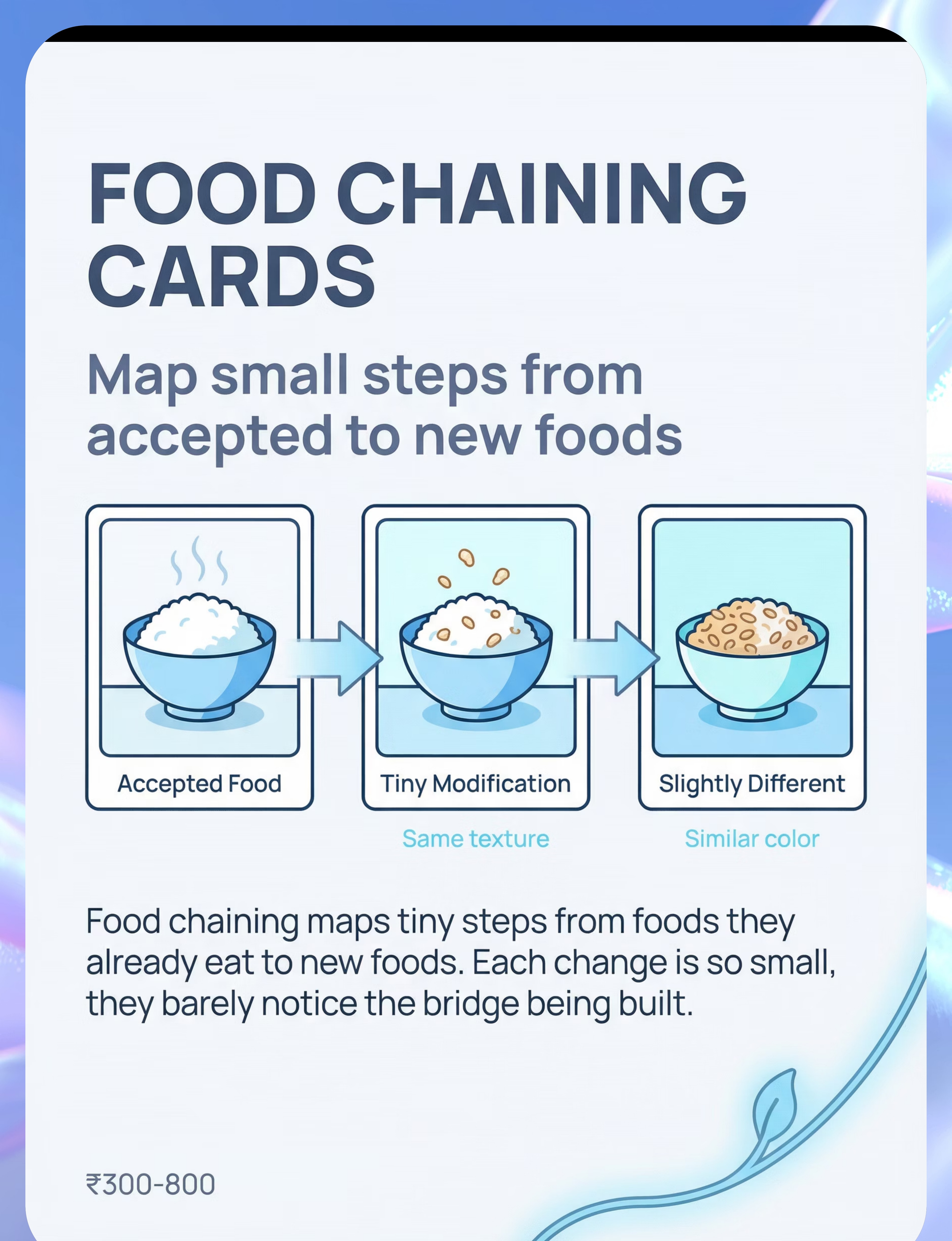
2 — Food Chaining Reference Cards
"Map tiny steps from accepted foods to new foods." Plain rice → rice with ghee → rice with texture → rice with dal. Each step so small they barely notice the bridge being built.
₹300–800
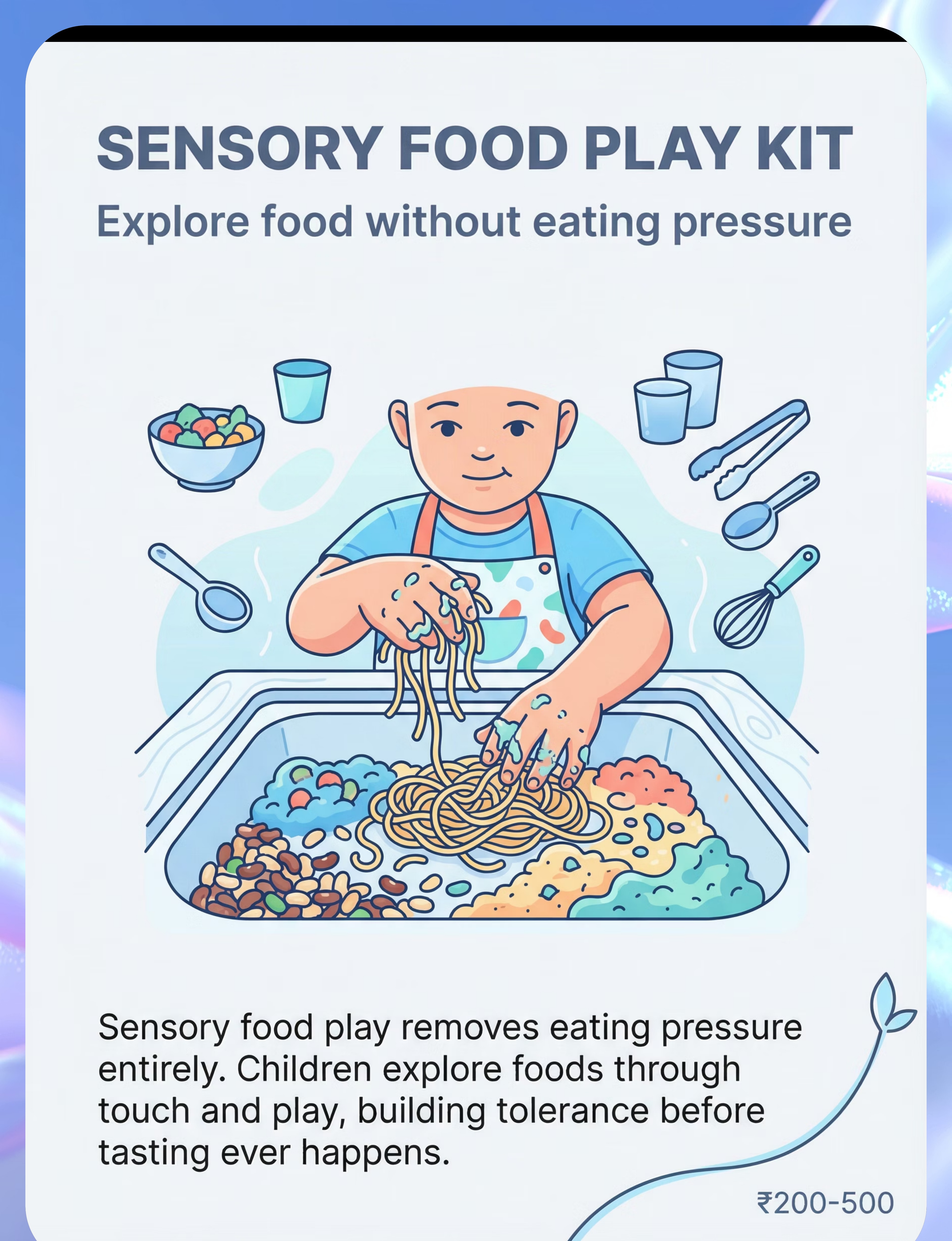
3 — Sensory Food Play Kit
"Explore food without eating pressure." Touch, squish, smell, sort — with zero expectation to eat. Play removes the threat response. Tolerance builds before tasting ever happens.
₹200–500
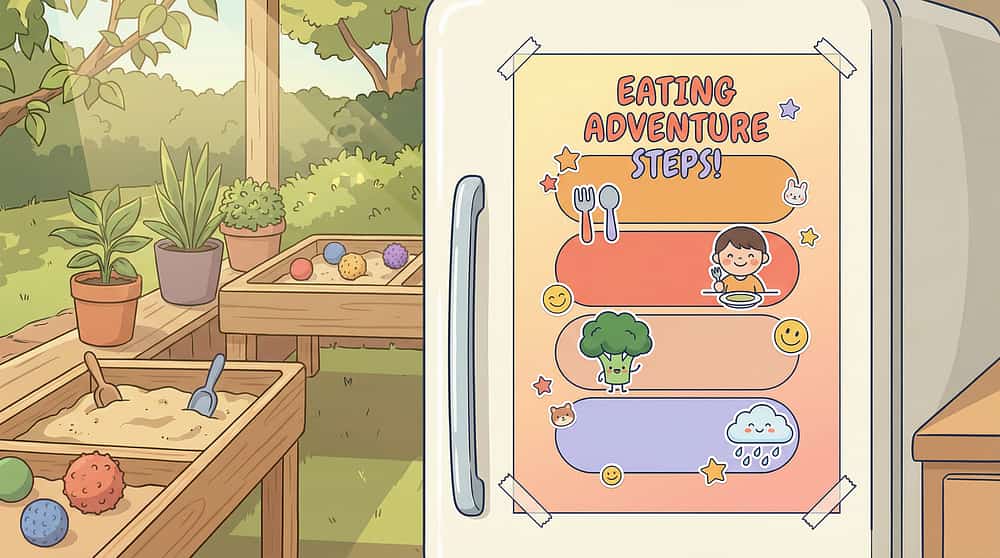
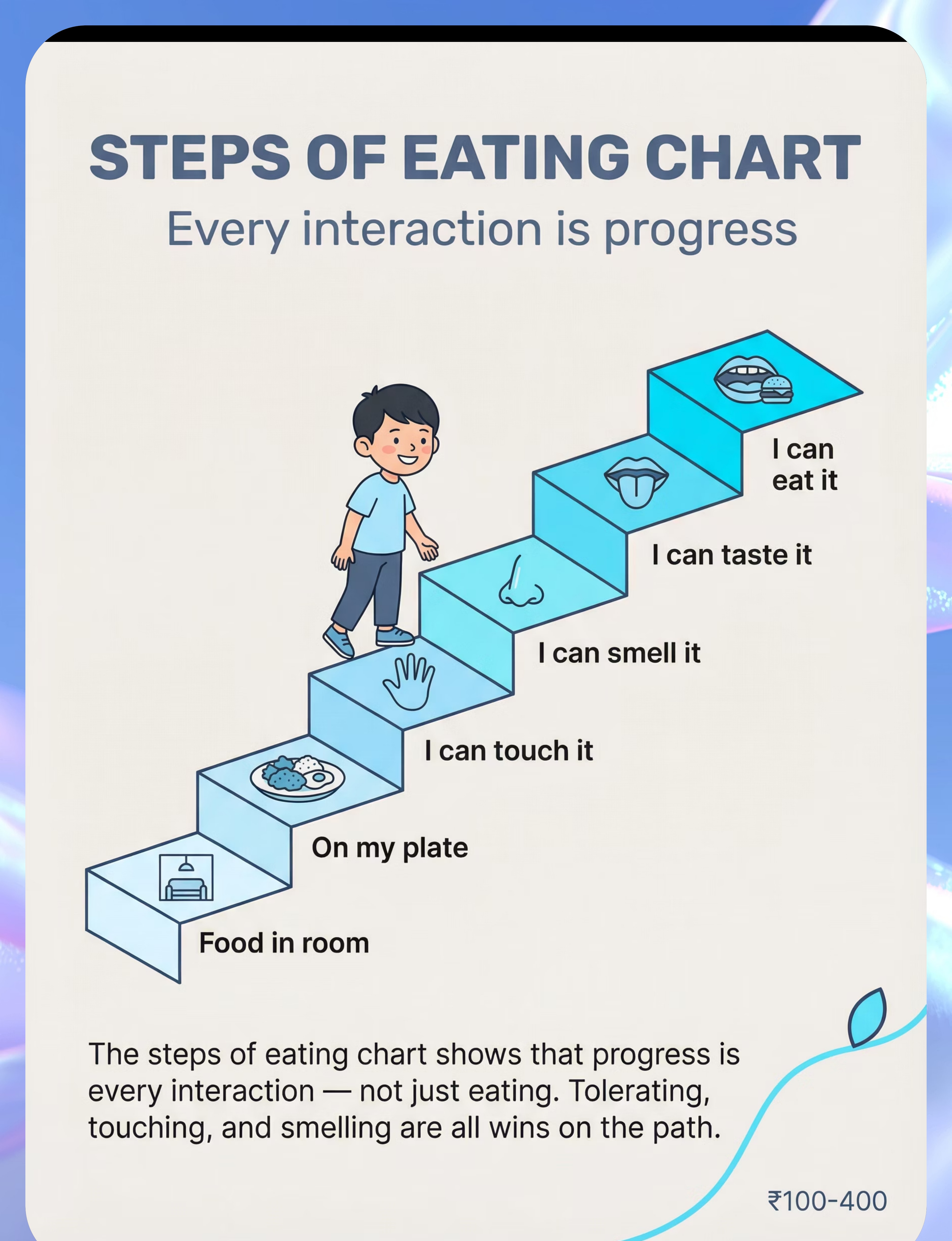
4 — Visual Steps of Eating Chart
"Every interaction is progress." Food in room → on plate → smell it → touch it → lick it → tiny taste → bite. Success is any step forward, not just eating.
₹100–400
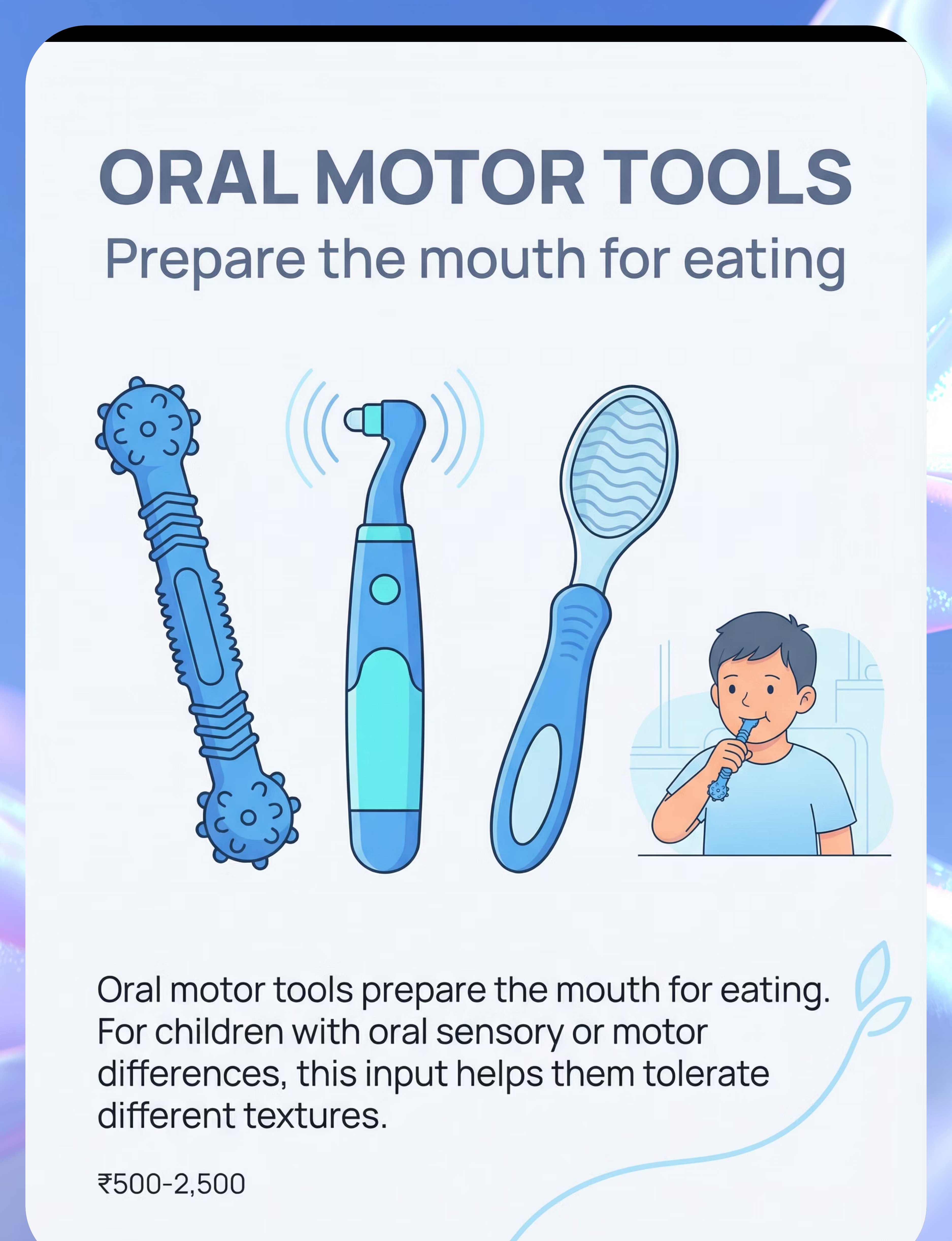
5 — Oral Motor Tools
"Prepare the mouth for eating." Chewy tubes provide proprioceptive input. Vibrating tools activate oral awareness. Used before meals to prepare the oral system for texture processing.
₹500–2,500
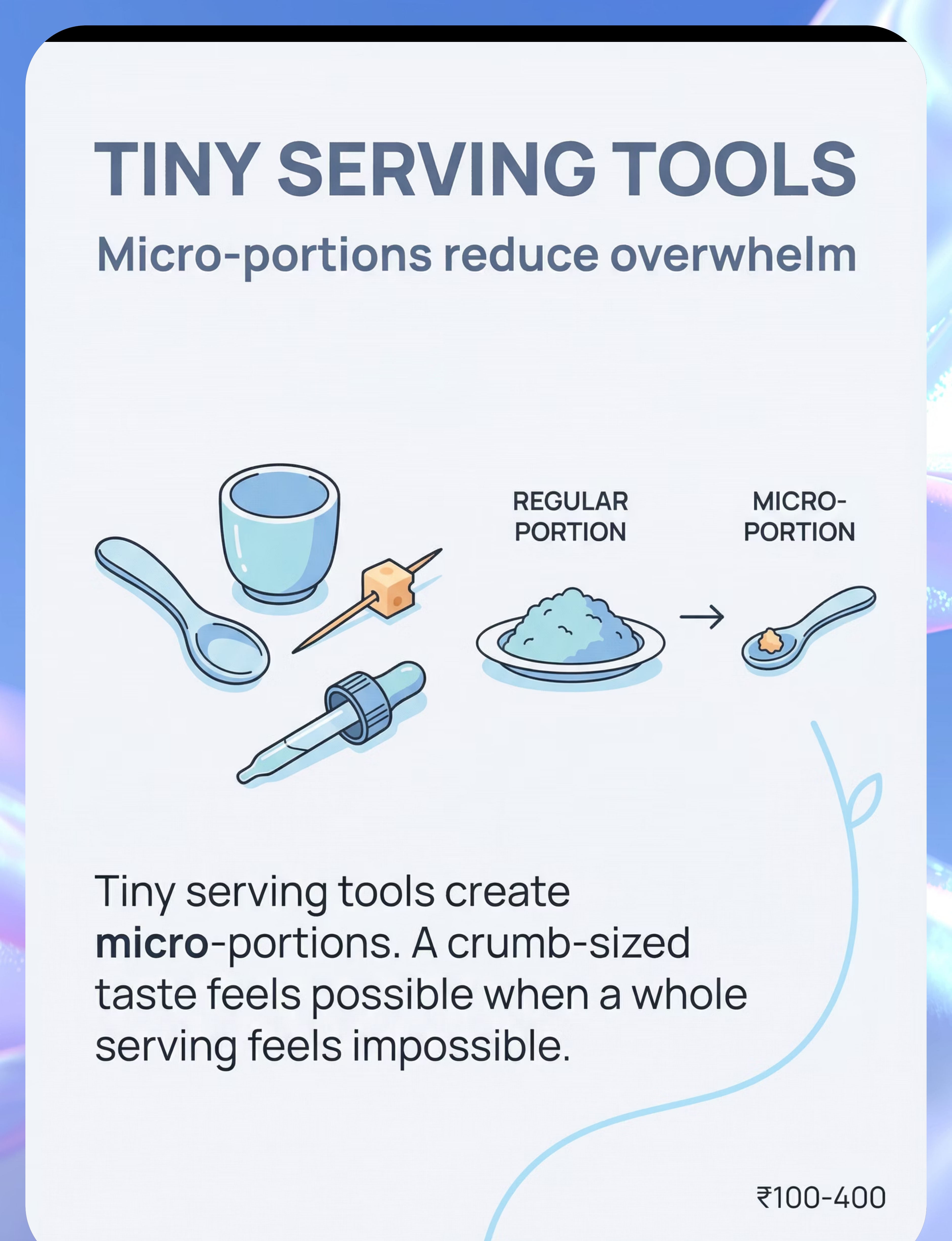
6 — Tiny Serving Tools (Micro-Portion Kit)
"Micro-portions reduce overwhelm." A crumb-sized taste feels possible when a whole serving feels impossible. Baby spoons, tasting cups, cocktail picks — size communicates demand.
₹100–400
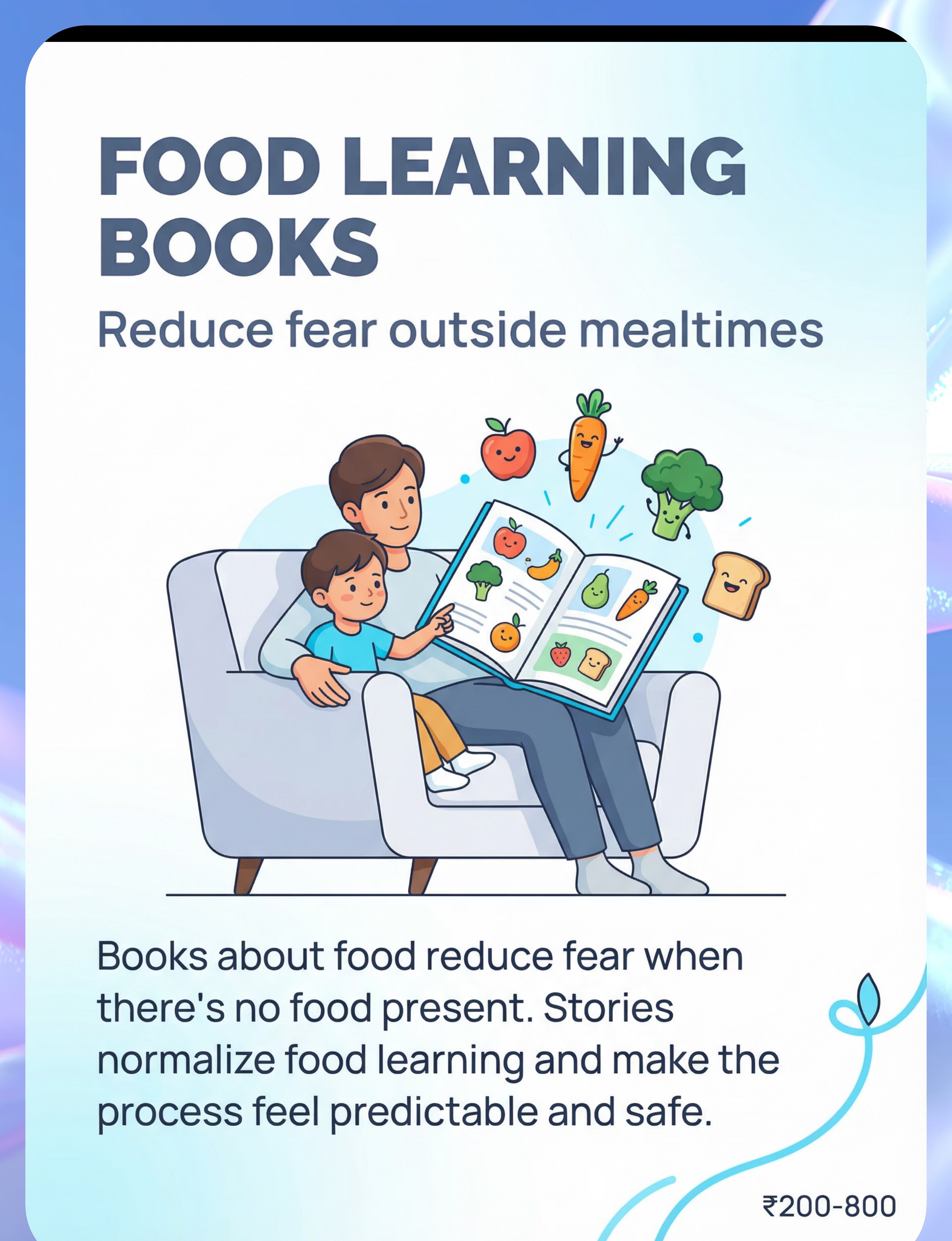
7 — Food Learning Books & Social Stories
"Reduce fear outside mealtimes." Stories normalise food learning when no food is present. Personalised social stories make the process predictable and safe. Fear reduces before the food even appears.
₹200–800
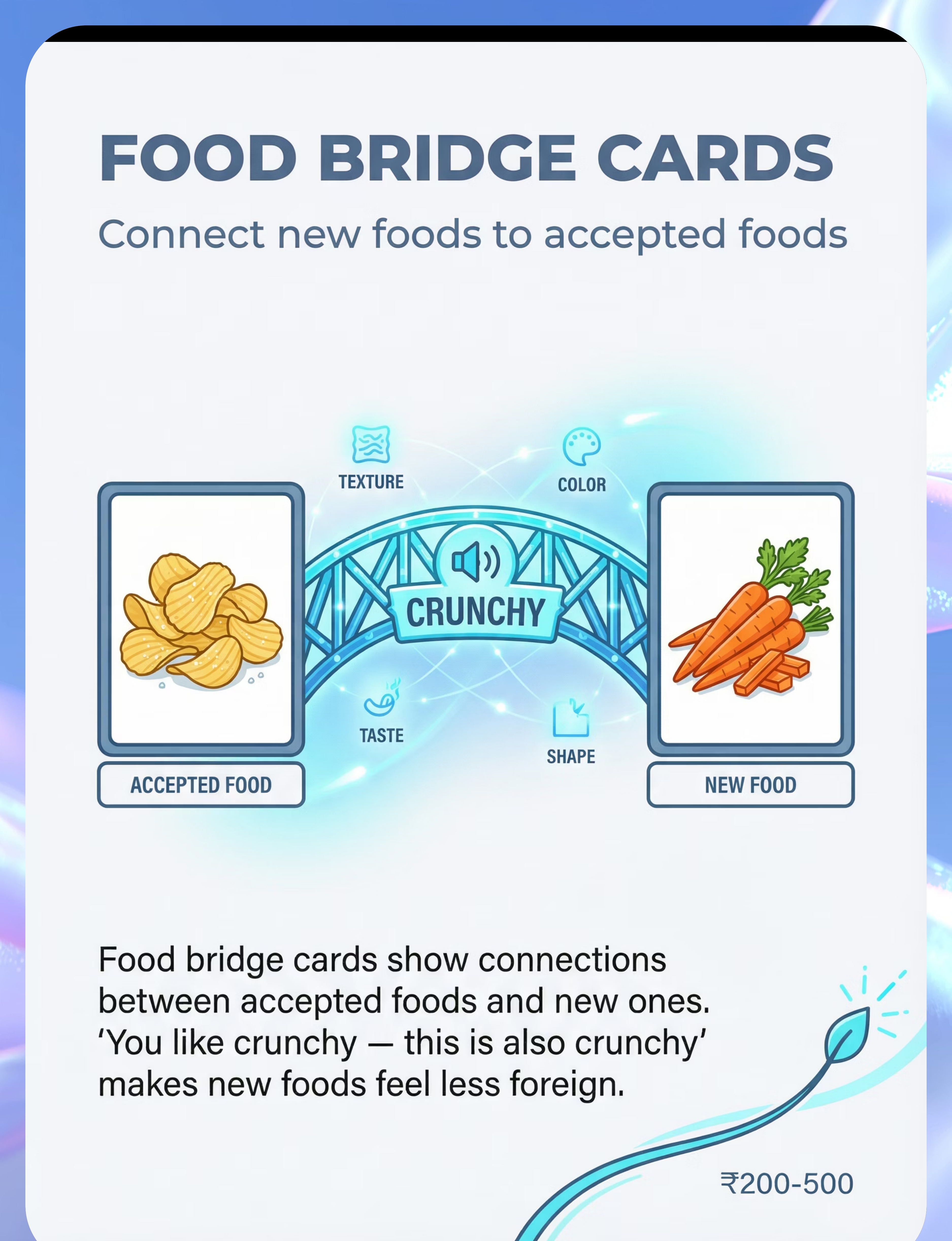
8 — Food Bridge Building Cards
"Connect new foods to accepted foods." "You like crunchy chips → crackers are also crunchy → carrot sticks are crunchy too." Visual bridges make connections explicit.
₹200–500
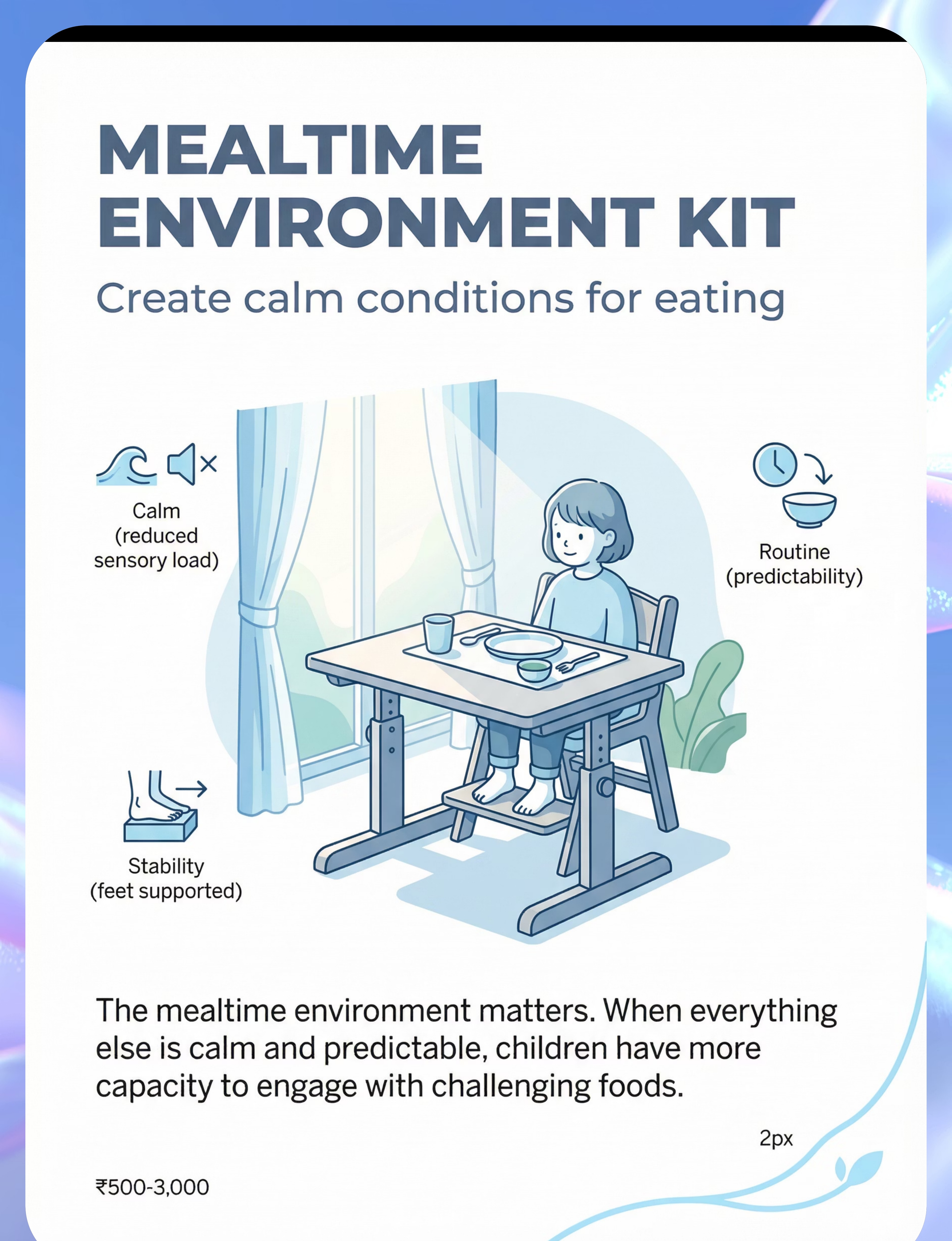
9 — Mealtime Environment Modification Kit
"Create calm conditions for eating." Feet supported. Sensory load reduced. Routine consistent. Pressure removed. When everything else is calm, the child has capacity for food challenge.
₹500–3,000

📞9100 181 181 — FREE. Ask a Feeding Specialist which materials to start with.

Every Family Can Start Today. Zero Budget Required.

"The best intervention is the one a family can actually access and execute. This page serves families from Bengaluru apartments to rural Bihar homes." — WHO/UNICEF Equity Principle Material Buy This DIY Today Divided Plates Silicone 3-section plate ₹250–500 3 small bowls or a thali with katoris. One katori = learning zone. Food Chaining Cards Printed laminated cards ₹300–600 Index cards + food photos from magazines or phone. Map chains in a notebook. Sensory Food Play Kit Sensory tray + tools ₹300–700 A steel plate, dry dal, cooked rice, pasta. Use the kitchen floor. No special tools needed. Steps of Eating Chart Printed visual chart ₹100–300 Draw 10 steps on paper. Stick on fridge. Use stickers to track progress. Oral Motor Tools Chewy tube ₹500–1,500 Consult your OT first. Some children can use clean silicone teethers. Professional guidance essential. Tiny Serving Tools Baby spoon set ₹150–400 Use the smallest spoon in your kitchen. Medicine droppers for liquids. Toothpicks for single pieces. Food Learning Books Picture books ₹200–600 Print food images from internet. Create a "food book" with the child. Free social story templates online. Food Bridge Cards Card set ₹300–600 Two columns on paper: accepted food / new food / what they share. Child can colour and decorate. Environment Kit Ergonomic chair + dimmer ₹800–3,000 Rolled towel under feet. Remove TV from mealtime. Consistent seating. Dim overhead light with curtains. "The therapeutic mechanism is in the approach, not the price of the material. A ₹0 paper chart used consistently outperforms a ₹2,000 tool used once."

🚦 Safety Gate: Read This Before Starting

🔴 STOP — Medical Clearance Required If: Child gags, vomits, or coughs regularly during eating (possible swallowing disorder) Child has lost significant weight or shows signs of nutritional deficiency You suspect food-related pain (GI disorder, reflux, eosinophilic esophagitis) History of choking requiring Heimlich manoeuvre Fewer than 5 accepted foods with severe anxiety/panic at mealtimes Known food allergy — all new foods must be screened first 🟡 MODIFY — Consult Specialist First If: Child drops accepted foods frequently (food "jags") Growth concerns flagged by pediatrician Child is tube-fed or has feeding device Previous force-feeding history Significant co-occurring anxiety disorder 🟢 PROCEED — Home Protocol Safe When: Medical causes have been ruled out Child is maintaining weight adequately Selectivity is primarily sensory/anxiety-based Child can be present at mealtimes without panic Parent can commit to low-pressure, no-force approach ⚠️ Material Safety: All plates/tools must be food-grade and age-appropriate. Supervise all sensory food play. No oral motor tools without OT guidance. Toothpicks/food picks for children 5+ only, always supervised. Stop the session immediately if child gags, enters true panic, or shows any sign of allergic reaction.📞 9100 181 181 — Speak to a medical professional before starting if any red flags apply

The Right Environment Multiplies Every Technique's Effectiveness.
Sensory Load — REDUCE
  • Turn off TV, music with lyrics, loud background noise
  • Dim harsh overhead fluorescent lights (warm lighting preferred)
  • Reduce strong cooking smells during the meal (cook 20 min before serving)
  • Remove visual clutter from the table
Physical Setup — OPTIMISE
  • Child's feet fully supported — activates postural stability and reduces sensory seeking
  • Chair height: elbows at table level
  • Consistent seat — same chair, same position, every meal
Routine — ESTABLISH
  • Same sequence every meal: wash hands → sit → see what's on the table → eat → done
  • Predictability = safety = willingness to engage with challenge
Pressure — REMOVE COMPLETELY
  • No comments about eating or not eating
  • No "just one bite" — this phrase can set back progress weeks
  • Adults eat the same/similar food without drawing attention
  • Neutral face when child ignores learning food

Sensory Integration Theory (Ayres) | PMC10955541
ACT III — Execution
60-Second Readiness Assessment — Before Every Session
Indicator
Green — Proceed
⚠️ Modify
🔴 Postpone
Fed recently?
Light snack 45 min ago
Very full or very hungry
Rested?
Alert, not overtired
Slightly tired
Melting down from exhaustion
Regulated?
Calm baseline
Some energy, manageable
Active meltdown / shutdown
Recent illness?
Healthy
Mild cold
Fever, vomiting, GI upset
Emotional state?
Content/playful
Slightly anxious
Severe distress/anxiety
Major event today?
Typical day
Minor disruption
Significant stressor (new school, medical procedure)
All Green
PROCEED with full session — learning food on plate
⚠️ 1–2 Yellow
MODIFY: No learning food today, just food play. Serve only safe foods. Sit together. Maintain routine without demand.
🔴 Any Red
POSTPONE: Do a calming activity instead. Tomorrow is another opportunity. A session that ends in distress sets back progress.
"The best feeding session is one that starts right. A session that ends in calm — even with no eating — advances progress."
Step 1 of 6
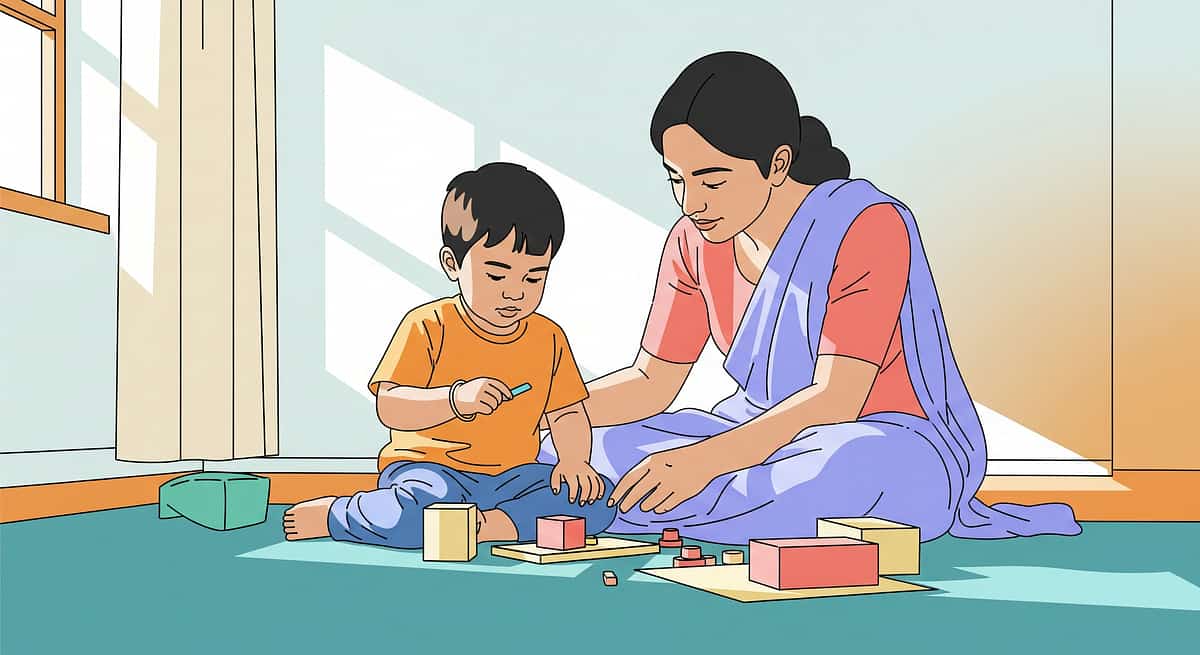
Step 1: The Invitation — Every Session Begins as Play, Not a Battle
Parent Script — Say Exactly This
"It's food time! Come and see what's here today."
Neutral, curious tone. Not excited, not tense. Matter-of-fact. This is the single most important language shift you will make.
What NOT to Do
  • "Today we're going to try this new food"
  • Point at the learning food
  • Express hope or expectation
  • Ask "Can you try just one bite?"
What You Do
  • Place divided plate with safe foods + one learning food in its section
  • Sit beside (not opposite) your child
  • Begin eating your own food or doing an activity
  • Do NOT draw attention to the learning food
  • Wait 30–60 seconds for the child to arrive and settle
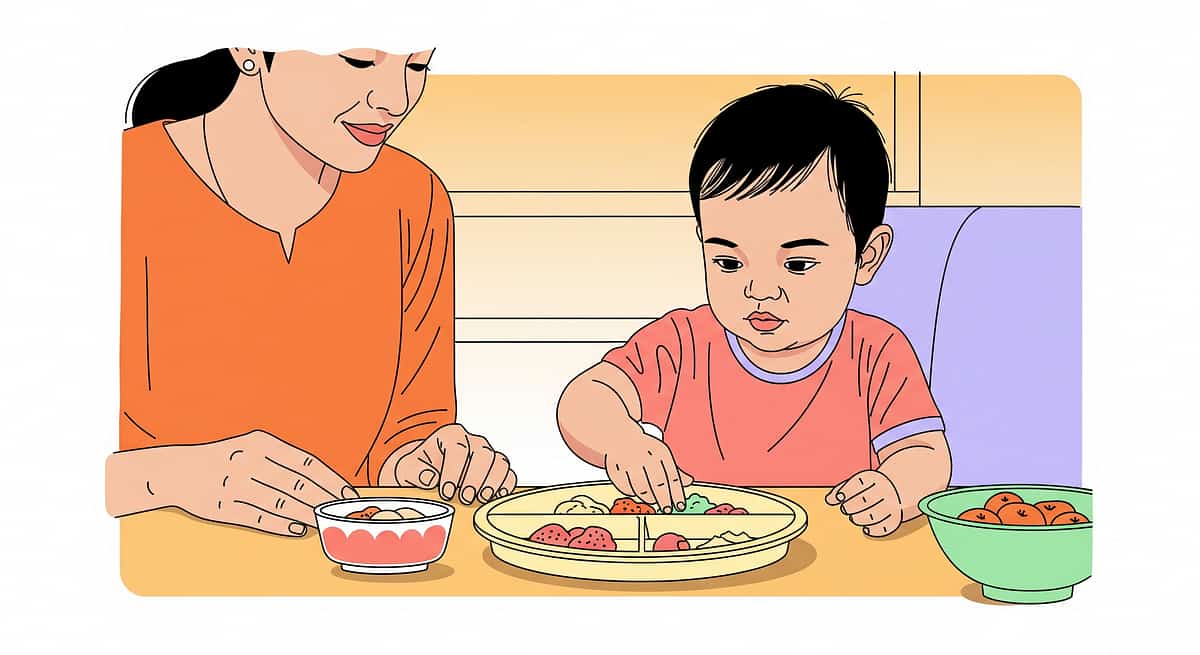
Reading the Cues
Child sits down | Reaches for safe food | Appears calm or neutral
⚠️ Child refuses to sit → reduce demand: "You can sit for 2 minutes then go play"
⚠️ Child points to learning food anxiously → "That one is just sitting there, you don't have to do anything with it."
Duration: 30–60 seconds
Step 2 of 6
Step 2: Deepen the Engagement — Let Curiosity Emerge
What Happens
Child is eating their safe foods. Learning food is on the plate. You are present but not focused on the learning food. You eat your own meal, including something that shares a property with the learning food.
Your Narration
  • "Mm, this is warm."
  • "This has a bit of crunch."
  • If child looks at learning food: "Yep, that's [food name]" — then return to your own food
  • If child touches learning food spontaneously: say nothing. Let the exploration happen organically.
The Reinforcement Cue
If child interacts with learning food in ANY way — give calm, specific, immediate praise within 3 seconds:
"You looked right at it. That's really something."
"You touched it! That's a big deal."
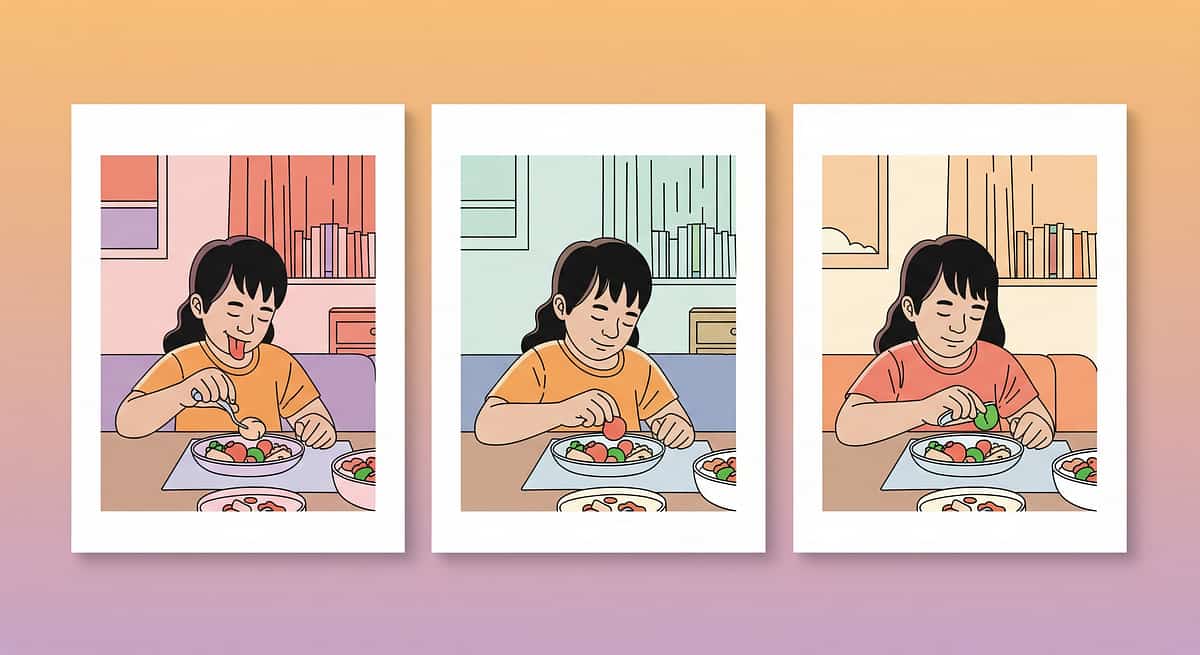
Child Response Spectrum
Ideal: Child ignores or briefly notices — safe food eaten → session successful
Acceptable: Child pushes plate with learning section → simply say "It can stay there"
⚠️Concerning: Extreme distress at sight of learning food → begin with food-in-room only
Duration: 3–8 minutes (full mealtime)
Step 3 of 6
Step 3: The Active Ingredient — The Food Interaction
This is the technique's core therapeutic moment. Two parallel tracks run simultaneously.
Food Chaining — Primary Approach
Take the accepted food. Make one microscopic change. Present alongside the original.
Example — Child accepts plain white rice:
Week 1–2
White rice + tiny drop of ghee on the side (same section)
Week 3–4
White rice with ghee already mixed (barely visible change)
Week 5–6
White rice + ghee + 3 grains of jeera visible on top
Week 7–8
White rice + jeera rice side by side on plate
Each step shares 95%+ of the properties of the previous step.
Sensory Food Play — Parallel Track
Completely separate from mealtimes — use kitchen floor, a mat, or a different table.
Day 1–5
Food is in the room while child plays (not on table)
Day 6–10
Food on a separate plate on the play mat
Day 11–15
Child pokes/touches food with a tool
Day 16–20
Child touches food with finger
Day 21+
Child brings food near face / smells

The Steps of Eating Hierarchy (post on fridge): 1. Food is in the room → 2. Food is on the table → 3. Food is on my plate → 4. I can look at it → 5. I can smell it → 6. I can touch it → 7. I can touch it to my lips → 8. I can lick it → 9. I can take a tiny taste → 10. I can take a bite → 11. I can eat some
Step 4 of 6
Step 4: Dosage — How Many, How Often, How Long
Daily Mealtime Exposure
Learning food present at minimum 1 meal/day — even when child doesn't interact. Neurotypical children need 10–15 exposures minimum. For selective eaters: 20–50+ exposures are normal and expected.
Food Play Sessions
2–3 times per week, 5–10 minutes each. Completely separate from mealtimes. Play first — eating never required.
Variation Within the Same Step
Different plate, different time of day, different environment, different adult serving it, child serving it themselves — before moving to the next chain step.
Satiation Indicators — When to Stop
  • Child turns away repeatedly
  • Increased fussiness beyond manageable
  • Session has reached 10+ minutes for food play
  • Always end while mood is still positive
Moving to the Next Chain Step
  • Minimum 5–10 successful exposures at current step
  • Child shows neutral response (no distress or curiosity) at current step
  • Then — and only then — introduce the next incremental change
"3 engaged, willing interactions with a food are worth more therapeutically than 10 forced, distress-filled ones. Always end before resistance peaks." — The 3-Good-Rep Principle

Step 5 of 6
Step 5: Celebrate the Attempt — Not Just the Eating
The Reinforcement Principle: Timing > Magnitude. Immediate > Delayed. Specific > Generic. Always reinforce within 3 seconds of any food interaction.
For looking at learning food:
"You looked right at the carrot. That took courage."
For touching learning food:
"You just touched something new. That's a really big deal."
For smelling:
"You smelled it! That tells your brain a lot about food."
For tiny taste:
"You just tasted something your mouth hadn't tried before. That's brave."
What to Reinforce
  • Any forward movement on the steps of eating hierarchy
  • Sitting at the table without protest
  • Tolerating learning food on plate without pushing it away
  • Engaging with food play
  • Using steps-of-eating vocabulary: "I can look at it"
What NOT to Do
  • "Good eating!" (implies eating was the goal)
  • Reward charts specifically for eating new foods (creates pressure)
  • "Just one more bite" after reinforcing (erodes trust)
  • Compare to siblings
Reinforcement Menu Options
Special sticker, preferred activity for 5 minutes, verbal praise, physical affirmation (high-five if child accepts), favourite song
Step 6 of 6
Step 6: The Close — No Session Ends Abruptly
Every feeding session ends with a predictable, positive transition. Abrupt endings cause dysregulation that contaminates the next session.
Transition Warning (30 sec before)
"Two more minutes and we're all done with mealtime." Use a visual timer — same phrase, every time, every meal.
Put-Away Ritual
Child participates in clearing their plate. "Can you put your plate here?" Builds agency and routine. Remove learning food neutrally with no commentary.
Transition Activity (1–2 minutes)
A preferred calm activity — brief puzzle, colouring, favourite toy. Not a screen. Bridges the transition out of mealtime sensory state.
Closing Script
"Mealtime is done. You did really well sitting with us today." Note: NOT "you ate well" — affirm presence, not eating.

If Child Resists Ending: "Two more minutes" → [timer] → "Time's up, let's put the plate here" → offer transition activity. Do not extend beyond agreed time; predictability is the therapeutic tool.
60 Seconds of Data Today Transforms Months of Progress Tomorrow
Post-Session Data Points (record immediately)
Date: ___________
Meal: Breakfast / Lunch / Dinner / Food Play
Learning food presented: ___________
Step reached today (circle): 1 / 2 / 3 / 4 / 5 / 6 / 7 / 8 / 9 / 10 / 11
Child's mood at start: Calm / Neutral / Anxious / Distressed
Child's mood at end: Calm / Neutral / Anxious / Distressed
Any spontaneous interaction with learning food? Y / N
Notes: ___________
Weekly Summary to Track
  • Total exposures this week: ___
  • Highest step reached this week with this food: ___
  • New foods added to accepted list this week: ___
  • Any foods dropped from accepted list: ___
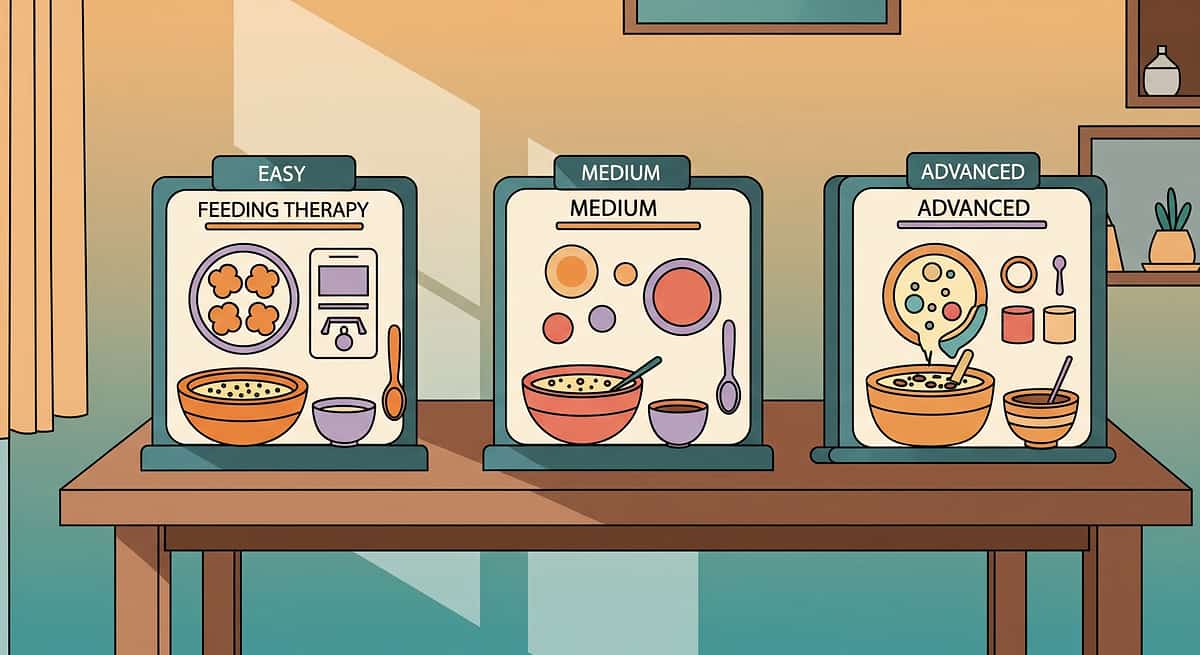
GPT-OS® Integration
Track your child's Food Variety Readiness Index in real-time via GPT-OS® EverydayTherapyProgramme™. Data captured becomes personalised recommendations.

📞9100 181 181 — Ask about accessing GPT-OS® tracking for your child
Every Setback Has a Specific Solution. Nothing Here Means Failure.
Problem
Likely Cause
Solution
Child refuses to sit at table
Too much anxiety around food context
Begin at a different location. Snack on floor first. Gradually move toward table over weeks.
Child pushes plate off table
Learning food section too threatening
Move to food-in-room only stage. Learning food on a shelf 2 meters away during meals.
No progress after 6 weeks
Steps too large OR unaddressed medical/sensory issue
Make steps smaller. Get feeding assessment. Rule out medical cause.
Child drops an accepted food suddenly
Sensory over-exposure or mild aversion triggered (food jag)
Don't panic. Maintain availability without pressure. Most jagged foods return in 2–8 weeks.
Family pressure ("just make them eat")
Misunderstanding of feeding therapy approach
Share this page with family. Pressure paradoxically worsens selectivity — this is clinical fact.
Different behaviour at school/grandparents
Environment and approach inconsistency
All caregivers must use same approach. Use family sharing tools from the Share card.
Child accepts food at clinic, refuses at home
Environmental/contextual factors
Recreate clinic conditions at home. Involve the treating therapist in home session design.
Parent feels hopeless/exhausted
This is a marathon, not a sprint
This is normal and valid. Progress happens invisibly before it becomes visible. Call 9100 181 181.
One Protocol. Infinite Personalised Versions. Your Child's Exact Needs.
For Sensory Avoiders (overwhelmed by food stimuli)
  • Start with food in room, not on plate
  • Use clear containers so food is visible but contained
  • Allow child to smell from distance before any proximity
  • Extra slow progressions — weeks per step, not days
  • Reduce other sensory demands at mealtimes (noise, lighting)
For Sensory Seekers (crash into food, stuff mouth)
  • Oral motor preparation before meals (chewy tube, vibrating tool)
  • Use firmer textures for new food introductions
  • Physical activity break immediately before meal
  • Strong flavours may be more acceptable than bland ones

Age Modifications
Ages 2–4
All food play. No expectation language. Parent models food exploration.
Ages 5–7
Introduce steps-of-eating chart with sticker system. Child can name their step.
Ages 8–12
Child participates in choosing the food chain. Teen language: "What would make this food less weird?"
ARFID Considerations
For children meeting ARFID diagnostic threshold — consult a feeding specialist before home protocol. Severity may require intensive feeding therapy before home maintenance approach.
ACT IV — Progress Arc
Weeks 1–2: The Invisible Progress Phase
10%
You Are Here
Weeks 1–2 — The invisible work phase
What You WILL See
  • Child stops pushing plate away when learning food is present → Real progress
  • Mealtime distress slightly reduced → Real progress
  • Child glances at learning food without immediate panic → Real progress
  • Child participates in food play session without significant resistance → Real progress
What You Will NOT See Yet (And That Is Normal)
  • Child eating the new food
  • Any expressed interest in tasting
  • Dramatic change in food variety
The Invisible Work
In weeks 1–2, the brain is building familiarity pathways. The sensory threat response is being recalibrated. This is happening even when you see no behavioural change.
"If your child tolerates the learning food on their plate for 3 seconds longer than last week — that is genuinely significant neural progress."

Data Milestone: By end of Week 2, you should have 14+ documented mealtime sessions.
Weeks 3–4: The First Signals of Neural Pathway Formation
30%
Consolidation Phase
Weeks 3–4 — Familiarity building and sensory recalibration
Watch For These Consolidation Indicators:
Tolerance Emerging
Child stops pointing at or commenting negatively about the learning food
Familiarity Building
Child spontaneously looks at learning food with neutral expression
Sensory Recalibration
In food play, child tolerates food touching their hand without retracting
Context Generalising
Child accepts learning food being present at table outside of mealtime (e.g., it's on the counter)
Cognitive Integration
Child uses vocabulary from the steps-of-eating chart: "I can look at it"
"You may notice you're less tense at mealtimes. That matters enormously. Your regulated nervous system directly regulates your child's."

When to Increase Intensity: If child shows 3+ consolidation indicators above → consider moving to next step on the chain.
Weeks 5–8: The Breakthrough Window — When Change Becomes Visible
60%
Breakthrough Window
Weeks 5–8 — First chain links, voluntary exploration, visible change
🔗 First Chain Link
Child completes first successful food chain step — accepts slightly modified version of accepted food
Voluntary Exploration
Child spontaneously touches learning food during food play with no prompting
👅 Step 9 Reached
Child accepts micro-portion taste using tiny serving tools
🗣️ Language Engagement
Child begins to describe food properties using their own language
Weeks 5–8 often include setbacks — a food jag, a bad meal, a regression during illness or stress. This is not failure. The neural pathways built in weeks 1–4 don't disappear. Resume the protocol after recovery.

Session Frequency Review: By week 6, if the protocol has been consistent, consider increasing food play to daily (5 min) and adding a second food chain.
🎉 Mastery: What Success Actually Looks Like for Your Child
Mastery is NOT:
  • A child who eats everything
  • Neurotypical eating variety
  • Eating without any selectivity
Mastery IS:
  • A nutritionally adequate diet — even if still selective
  • Family mealtimes that are not battlegrounds
  • A child with vocabulary and skills to engage with new foods over their lifetime
Stage 1→2 Mastery
Child tolerates learning food at table without distress. Food play sessions completed without significant resistance.
Stage 2→3 Mastery
Child voluntarily touches or interacts with learning food. Requests a food play session.
Stage 3→4 Mastery
First successful food chain completed. Child has accepted one new food that didn't exist on their list before intervention.
Stage 4→5 Mastery
Food variety expanded by 5–10+ foods. Child can eat in social contexts — birthday party, school lunch — without major distress.
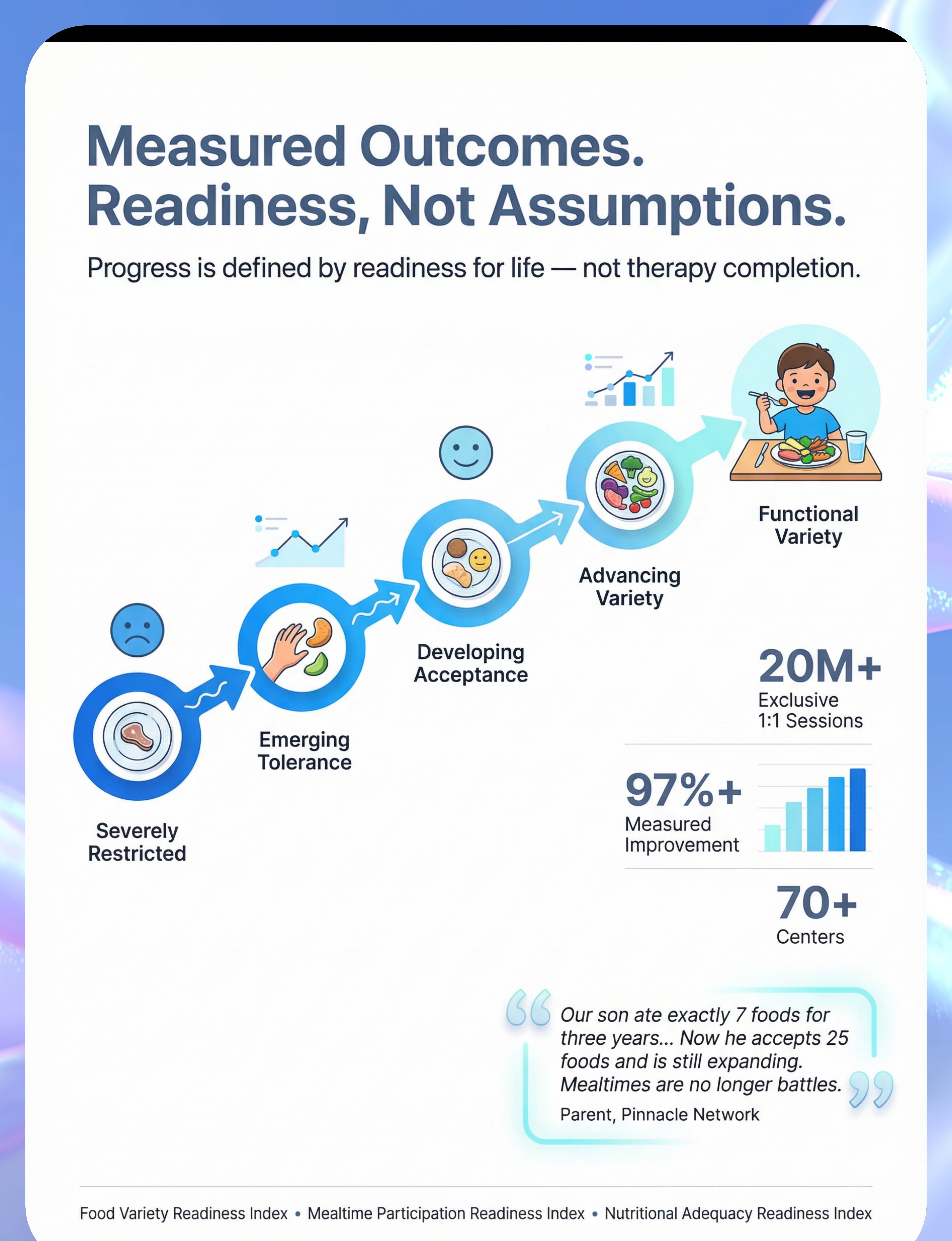
"Our son ate 7 foods for three years. After 8 months of this approach, he accepts 25 foods. More importantly, mealtimes are no longer battles. He knows how to meet new foods." — Parent, Pinnacle Network

🔴 Red Flags: When to Call a Professional Immediately
Escalate to Feeding Specialist / Pediatrician If:
  • Child loses weight or shows growth faltering during the protocol
  • Accepted foods continue to drop (repertoire shrinking, not stable or growing)
  • Child shows increased anxiety beyond mealtimes — generalised food anxiety affecting daily life
  • Gagging or vomiting increases in frequency
  • Child stops eating altogether (more than 1 day without adequate intake)
  • Signs of nutritional deficiency: extreme fatigue, pale skin, hair loss, dental issues
  • Child's distress intensifies rather than reduces over 4 weeks of consistent protocol
  • Family cannot maintain low-pressure approach (escalation of mealtime conflict)
When to Seek ARFID Assessment
Fewer than 20 accepted foods + significant nutritional impact + anxiety affecting daily functioning + pattern persisting past age 7 → formal ARFID assessment warranted.
DSM-5 ARFID diagnostic criteria | DOI: 10.1007/s12098-018-2747-4

📞 FREE National Autism Helpline: 9100 181 181
Our Feeding Specialists can assess your child's situation and connect you with appropriate resources — in your language, 24×7.

You're Not Done — You're On a Journey With a Clear Forward Path.
Advanced Integration
Next Level
Current
Prerequisite
Lateral Alternatives
If this approach didn't fully resonate for your child:
  • E-451 — Extreme Picky Eating (overlap technique with different entry angle)
  • B-Series — Social Communication (if food selectivity co-occurs with communication avoidance)
  • C-Series — Emotional Regulation (if anxiety is primary driver)
Materials You Already Own
  • Divided Plates → works with E-451, E-453, E-455
  • Steps of Eating Chart → works with E-453, E-454
  • Sensory Food Play Kit → works with E-450, E-454
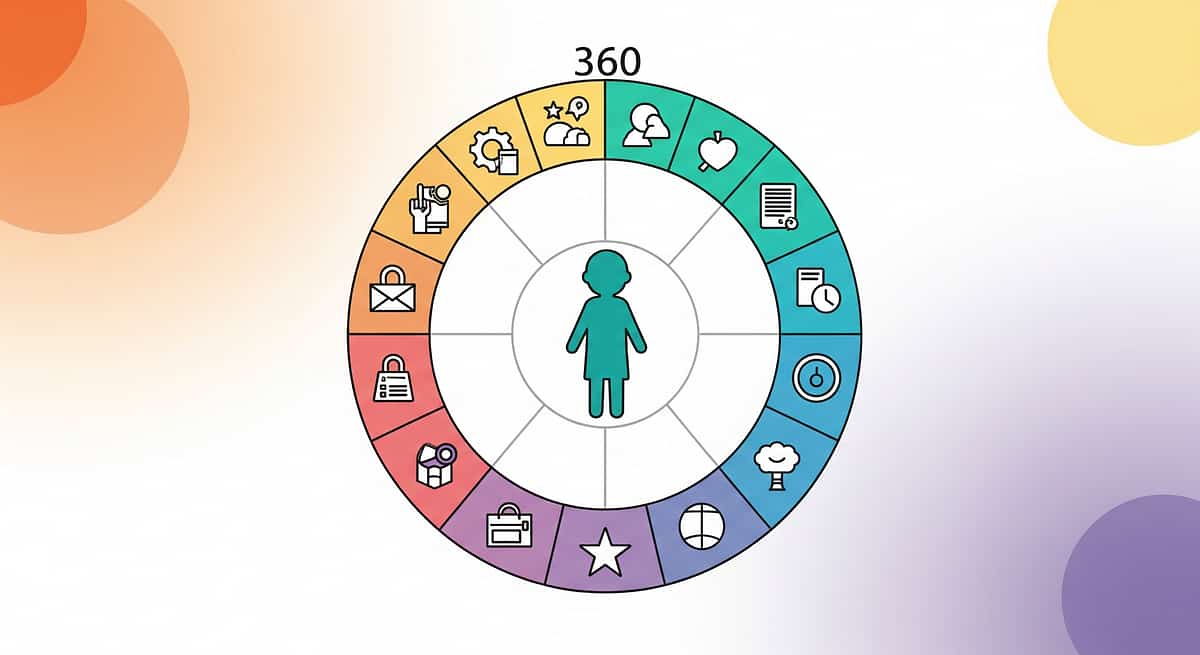
Explore the Full Feeding Mastery Series

Technique Code Difficulty Key Material Extreme Picky Eating E-451 🟢 Entry Divided Plates Very Limited Food Repertoire E-452 🟡 Core Food Chaining Cards New Food Refusal E-453 🟡 Core Steps of Eating Chart Food Texture Aversions E-454 🟠 Intermediate Sensory Food Play Kit Foods Can't Touch E-455 🟠 Intermediate Divided Plates + Social Stories Gagging & Food Refusal E-456 🔴 Advanced Oral Motor Tools

This Technique Is One Piece of a Larger Developmental Plan
Your child's food selectivity exists within a larger developmental profile. Children with very limited food repertoire frequently also have sensory processing differences (Domain A — the underlying driver), emotional regulation challenges (Domain C — anxiety at mealtimes), social communication differences (Domain B — difficulty at social meals), and self-care challenges (Domain K — mealtimes as independence skill).
[A] Sensory Processing
[B] Social Communication
[C] Emotional Regulation
[E] FEEDING ← You Are Here
[F] Sleep & Regulation
[K] Self-Care
GPT-OS® sees all 12 domains simultaneously. A single intervention on this page is valuable. A coordinated 12-domain plan is transformational.


📞9100 181 181 — Request a comprehensive AbilityScore® assessment to see your child's full developmental map
ACT V — Community & Ecosystem
Real Families. Real Progress. Real Food Worlds Expanding.
"Our daughter ate 6 foods for four years. Every birthday party, every school lunch, every family gathering was a crisis. We tried everything the internet suggested — nothing worked. Then we found the food chaining approach through Pinnacle. We didn't add pressure. We just made tiny changes. After 11 months, she eats 22 foods. More importantly, she now says 'I can smell it' when she meets a new food instead of panicking. That's the real win."
— Mother, Hyderabad | Pinnacle Network 2024
"I was told to just keep offering new foods and he'd come around eventually. He didn't. At age 9 he was still eating 8 foods. The sensory food play approach changed everything — taking eating out of it completely and just playing with food. He now accepts 19 foods. He still has preferences. But he has tools."
— Father, Bengaluru | Pinnacle Network 2024
+8.4
New Foods Accepted
Average after completing the 8-week protocol
76%
Mealtime Conflict
of families report significant decrease in mealtime conflict
89%
Parent Confidence
of families report increased confidence in feeding their child
97%+
Measured Improvement
across all feeding readiness indexes via GPT-OS®
Individual results vary. Statistics represent aggregate outcomes across Pinnacle Blooms Network. Testimonials are representative composites.
You Don't Have to Navigate This Alone
Join 50,000+ families across India who are using GPT-OS®-powered home therapy to transform their children's development.
WhatsApp Feeding Parent Group
Daily support, questions answered by Consortium therapists. Real families, real progress, real-time community.
Pinnacle App
Track progress, access EverydayTherapyProgramme™, connect with therapists — all in one place.
Feeding Masterclass Series
Free webinars with Pinnacle OTs and SLPs on food acceptance. Live Q&A with Consortium specialists.

For Fathers & Grandparents: The feeding approach works best when ALL caregivers use the SAME approach. A father who says "just eat it!" at dinner undoes weeks of progress from a mother who has been pressure-free. Share this page with everyone who feeds your child.

📞9100 181 181 — Connect with a Family Support Coordinator today
When Home Support Needs Professional Amplification
When to Seek Professional Feeding Therapy
  • Child has fewer than 15 accepted foods
  • Home protocol has been consistent for 8 weeks without progress
  • Any of the red flags from the Red Flags card apply
  • You want supervised, accelerated progress
International Families
Teleconsultation available in 16+ languages. Families in 70+ countries currently served through Pinnacle's global network.
Pinnacle Consortium Specialists for This Technique
🟢 Paediatric OT (Feeding Specialist)
Sensory assessment, food chaining design, oral motor evaluation
🔵 Paediatric SLP (Feeding)
Oral motor treatment, swallowing assessment, texture progression
🟡 BCBA
Behavioural component, data systems, reinforcement design
🔴 NeuroDevelopmental Pediatrician
Medical evaluation, ARFID assessment, nutritional monitoring

📞 FREE National Autism Helpline: 9100 181 181 — 24×7 | 16 languages | FREE
The Science Behind Every Material on This Page
Level IV
Level III
Level II
PMC11506176
PRISMA Systematic Review (2024): 16 studies confirming sensory integration intervention as evidence-based practice for ASD
PMC10955541
Meta-analysis (World J Clin Cases, 2024): 24 studies on feeding intervention effectiveness
DOI: 10.1007/s12098-018-2747-4
Indian RCT: home-based sensory interventions in Indian pediatric population (Indian J Pediatr, 2019)
PMC9978394
WHO CCD Package implementation across 54 low-and-middle-income countries
NCAEP 2020
National Clearinghouse on Autism Evidence and Practice: Evidence-Based Practices report
SOS Approach to Feeding
Dr. Kay Toomey's Sequential Oral Sensory approach: 6–18 months of systematic exposure → average 20–30 new foods accepted
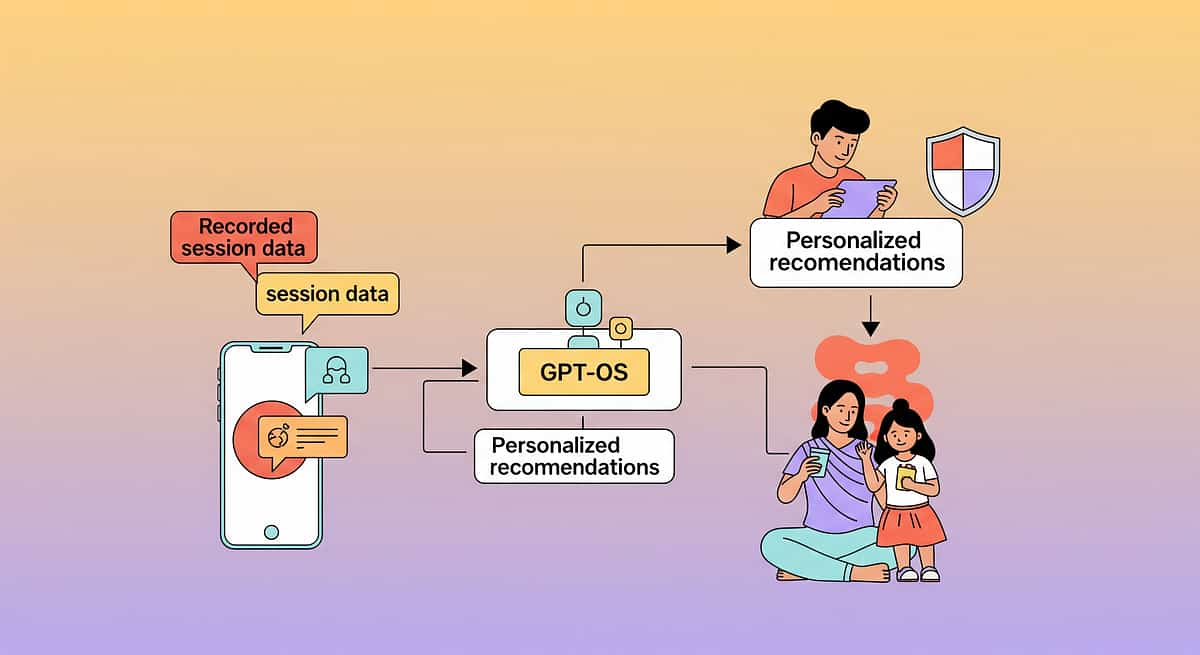
Your Session Data Drives Personalised Recommendations for Your Child
EverydayProgramme
FusionModule
TherapeuticAI
AbilityScore
Parent Capture
What GPT-OS® Learns from E-452 Data
  • Current step on the steps-of-eating hierarchy for each target food
  • Rate of chain progression (fast, typical, slow — determines next protocol)
  • Sensory sensitivity pattern (informs which new foods to chain toward)
  • Optimal session timing and frequency for your child

Privacy & Population Impact
Your child's data is protected under India's DPDP Act 2023. Data is used exclusively to improve your child's therapeutic outcomes.
Aggregate (de-identified) data from 20M+ sessions improves recommendation accuracy for every new child entering the system. Your data helps the next family.
CIN: U74999TG2016PTC113063 | DPIIT: DIPP8651 | MSME: TS20F0009606

Watch: 9 Materials That Help With Very Limited Food Repertoire

Reel E-452 Feeding & Mealtime Challenges in Children — Episode 452 Series Domain E | Feeding & Mealtime Series | 999 Reels Master Duration 75–85 seconds Neighbouring Reels in the Series: ← E-451 Extreme Picky Eating E-452 (You Are Here) Very Limited Food Repertoire E-453 → New Food Refusal E-454 → Food Texture Aversions Our Consortium Feeding Specialists walk you through all 9 materials — what each one is, exactly how to use it, and what progress looks like when you do. 📞 9100 181 181 — Call if you have questions after watching | @pinnacleblooms | #FeedingTherapy #LimitedFoodRepertoire

One Parent Knowing This Helps. Every Caregiver Knowing This Transforms.

"Caregiver consistency across all feeding contexts multiplies therapeutic impact. One pressure-free mealtime followed by a forced-eating lunch at grandparents' house sets back progress significantly." — WHO CCD Package, Caregiver Training Module WhatsApp Share "Found this page on feeding therapy for [child's name]'s food challenges — really helpful. Please read before the next time you feed them." For Grandparents — Simple Version "When a new food is on the plate: say nothing. Do not encourage, do not comment, do not ask them to try it. Just eat your own food. That's the whole approach. We'll explain why it works when we next meet." For School / Teacher Communication "Our child is in feeding therapy for severe food selectivity. Please serve their packed lunch without comment on what they eat or don't eat. No encouragement to try other foods. This is a medical approach." Download Family Guide PDF — 1 page, FREE Download School Letter Template

Your Questions, Answered by the Consortium
How long will this take?
There is no universal timeline. Most children show measurable progress within 12–24 weeks of consistent protocol. Children with ARFID-level severity may take 12–24 months. Consistency matters more than speed.
My child has autism — is this approach different?
The core principles are the same but implementation is adapted. Use more visual supports, expect longer timelines between chain steps, address sensory processing directly, and ensure all caregivers use identical approaches. GPT-OS® FusionModule™ coordinates this automatically.
Is this ARFID? Do we need a formal diagnosis?
A formal ARFID diagnosis is not required to begin this home protocol. However, if your child has fewer than 15 foods and the pattern has persisted past age 7, a formal evaluation is recommended. The protocol is appropriate across the severity spectrum.
We tried food exposure before and it made things worse. How is this different?
Most approaches that "made things worse" involved pressure — praise for eating, consequences for not eating. This approach removes ALL pressure. The difference between graduated exposure (this approach) and forced exposure is the difference between therapy and trauma.
My child eats more variety at school/daycare than at home. Why?
This is common and useful data — it suggests the selectivity has a significant contextual component. The school's neutral, low-pressure environment may be your model for home mealtimes. Share this page with caregivers at school.
My child dropped a food they used to eat. Is this reversible?
Usually yes. Food "jags" are common and usually temporary. Most jagged foods return if maintained in the environment without pressure for 4–12 weeks. Do not panic. Keep it available without serving it every day.
Can I do this without any professional involvement?
For mild to moderate selectivity (15+ accepted foods, primarily sensory-based, no significant nutritional impact), this home protocol is appropriate. For fewer than 15 foods or nutritional concerns — professional feeding therapy is strongly recommended.
How does GPT-OS® know what my child needs?
GPT-OS® uses 591+ structured observations across 349 developmental skills to build your child's unique AbilityScore® profile. It maps your child's sensory profile, oral motor status, anxiety pattern, and food chain progression to generate daily, personalised home activities. It updates automatically as you log data.

Didn't find your answer? 📞9100 181 181 | Ask GPT-OS® → | Book a Teleconsultation →

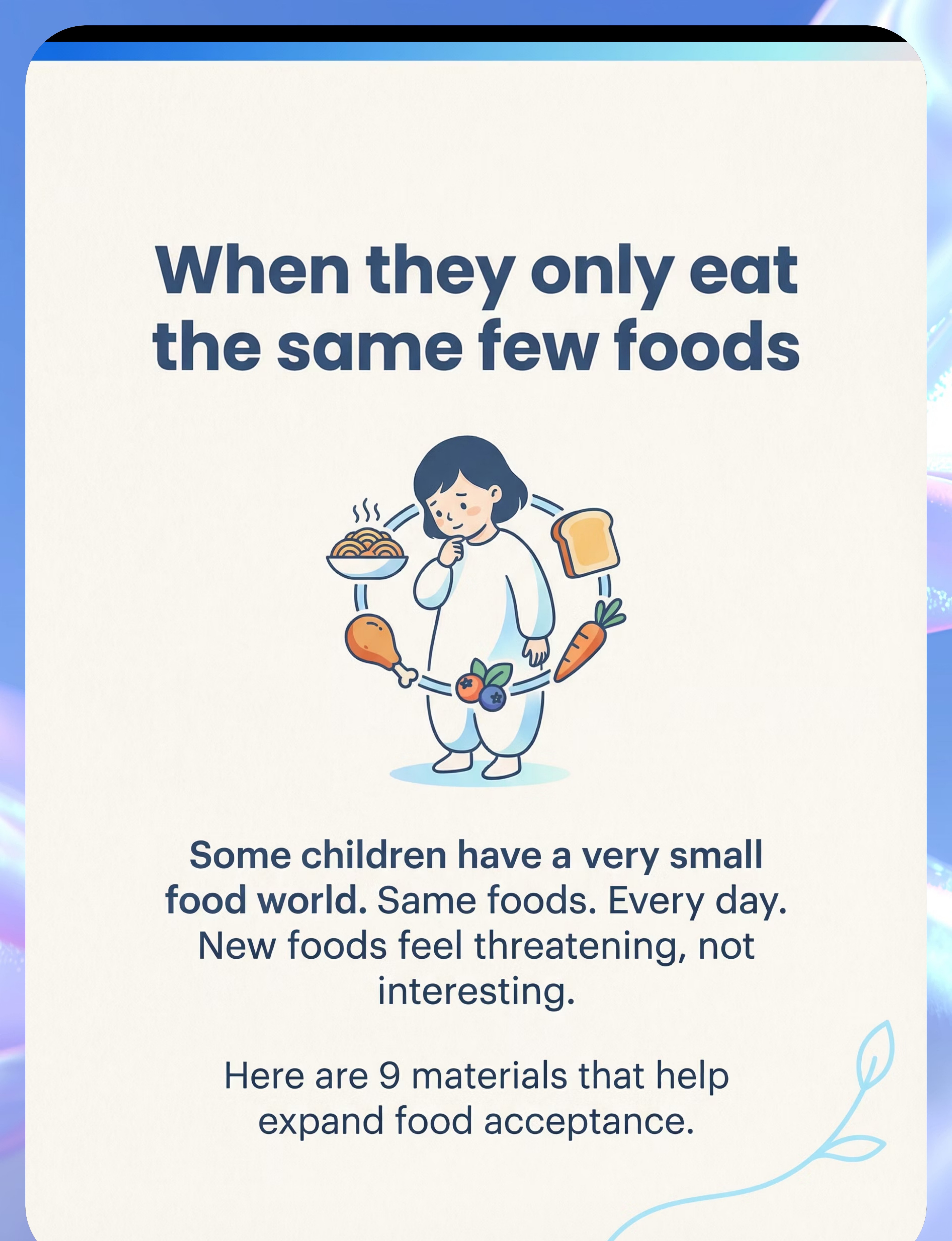
Preview of 9 materials that help with very limited food repertoire Therapy Material

Below is a visual preview of 9 materials that help with very limited food repertoire therapy material. The pages shown help educators, therapists, and caregivers understand the structure and content of the resource before use. Materials should be used under appropriate professional guidance.

Page 1
Page 2
Page 3
Page 4
Page 5
Page 6
Page 7
Page 8
Page 9
Page 10
Page 11
Page 12
Page 13
Page 14
Page 15
Page 16
Page 17
Page 18
Page 19
Page 20
Link copied!
You Have the Science. You Have the Materials. You Have the Protocol.
Start today. One divided plate. One learning food. Zero pressure.
🏥 Consortium-Validated by Pinnacle Blooms Network®
OT • SLP • ABA/BCBA • Special Education • NeuroDevelopmental Pediatrics • Feeding Specialists
The Pinnacle Promise
Every technique on techniques.pinnacleblooms.org is consortium-validated , evidence-graded , home-applicable , equitably designed , updated as new evidence emerges , and connected to GPT-OS® for personalisation .
20M+
1:1 Sessions
Across 70+ centres worldwide
97%+
Improvement Rate
Measured via GPT-OS® system
70+
Centres
Patents filed across 160+ countries
"From a world where families face their child's developmental challenges alone, frightened, and without tools — to a world where every parent, in every home, in every country, has access to the same precision, science, and support that the world's best therapy centres provide. One technique at a time. One family at a time. At population scale." — Pinnacle Blooms Network®, Mission Statement

📞 FREE National Autism Helpline: 9100 181 181 | Available 24×7 | 16+ languages | No registration required
© 2025 Pinnacle Blooms Network®, unit of Bharath Healthcare Laboratories Pvt. Ltd. All rights reserved. CIN: U74999TG2016PTC113063 | DPIIT: DIPP8651 | MSME: TS20F0009606 | GSTIN: 36AAGCB9722P1Z2
This content is educational. It does not replace individualised feeding assessment and intervention with licensed feeding specialists, occupational therapists, speech-language pathologists, and healthcare professionals. Consult specialists for persistent or severe feeding challenges. Individual results may vary.