B-188-9 Materials That Help With Verb Tense Difficulty

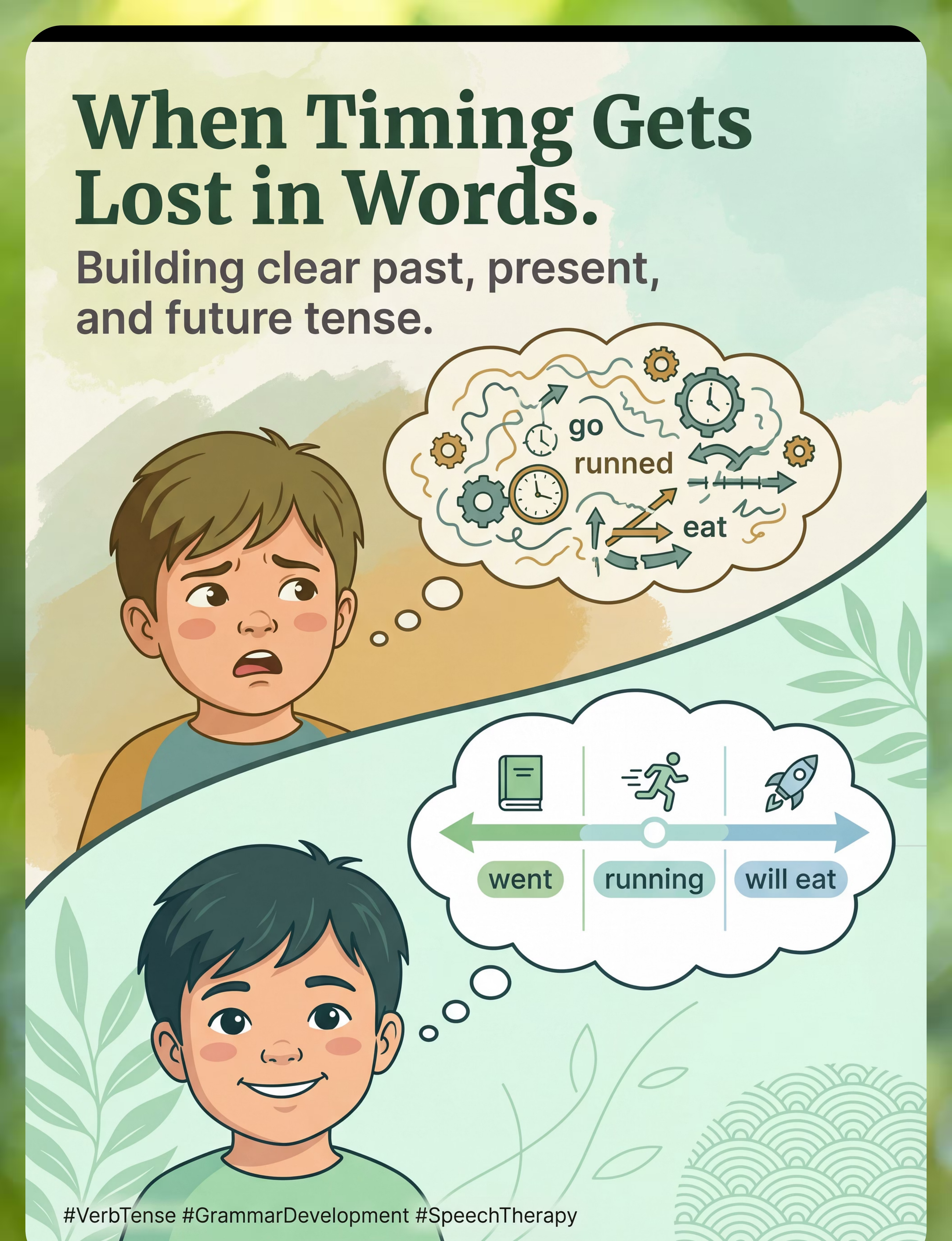
"Yesterday I go to park. He runned really fast. Tomorrow she eat cake."

Your child is working hard to tell you when things happen. The timing is there. The grammar isn't clicking yet — and that's exactly what we're here to help with. Start This Technique Today Book a Consultation
B-188 · Language Foundations Series
The Recognition Moment
It's Sunday morning. Your child is breathlessly recounting yesterday's trip to the park — "We goed on the big slide! I runned so fast! Mama catched me!" Every detail is vivid. Every verb is wrong. You understand every word. But something tells you this isn't just a phase anymore.

Verb Tense Difficulty — B-188
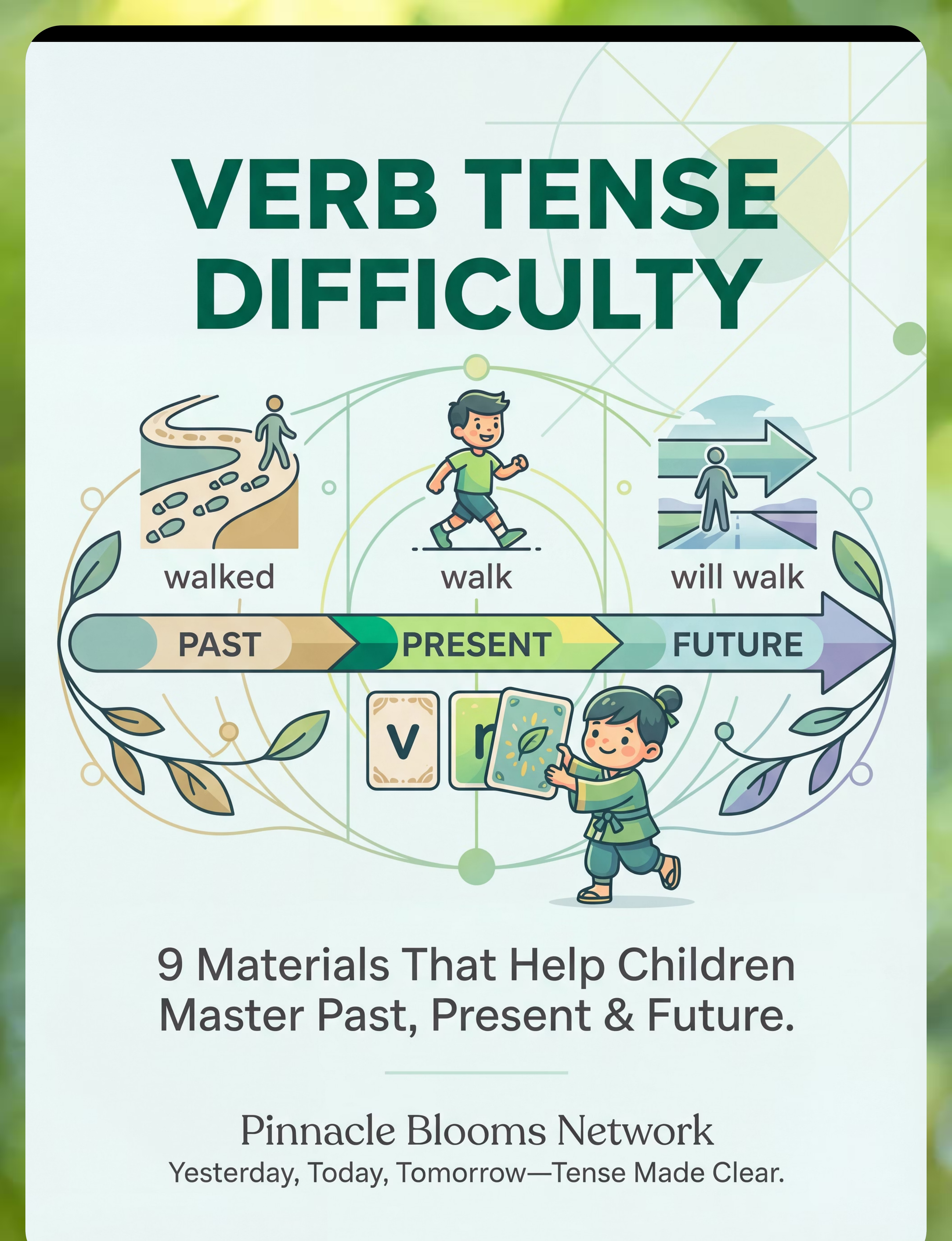
9 Materials That Help Children Master Past, Present & Future
Validated by the Pinnacle Blooms Consortium | SLP · OT · ABA · SpEd · NeuroDev
You Are Not Failing as a Parent
Your child's grammatical system is mid-construction. And that means there is everything still to build. The timing concept is present — your child knows yesterday was in the past. The grammar encoding is what's still developing.
WHO Nurturing Care Framework (2018): Parental awareness and early identification directly transform developmental outcomes.
Millions of Families Are Navigating This. Right Now.
1 in 14
Children Worldwide
Meet criteria for Developmental Language Disorder
280M
People Globally
Live with language disorders (WHO, 2023)
~18M
Children in India
Estimated with grammar or morphology difficulty
Verb tense difficulty is among the most consistent markers of Developmental Language Disorder (DLD) — a condition affecting 7.5% of children worldwide. Overgeneralizing the -ed rule ("runned," "goed," "eated") is not carelessness. It is your child proving they have learned the rule. They just haven't met the exceptions yet.
"You are among millions of families navigating this exact challenge. The grammar will click. Science shows us how."

Research: Rice ML & Wexler K (1996): Tense marking as a clinical marker of SLI/DLD. Journal of Speech and Hearing Research. | PMC11506176 | PMC10955541 | Leonard LB (2014): Children with Specific Language Impairment, MIT Press.
Act I · Understanding
This Is a Wiring Pattern, Not a Behaviour Problem
Clinical Explanation
Verb morphology is processed across Broca's area (inferior frontal gyrus) and the left temporal lobe. For children with DLD or morphological delays, the neural processing speed for rapid grammatical inflection — attaching "-ed" to the correct verb at the right moment in real-time speech — is slower than in typical peers.
The challenge is not conceptual understanding of time. Most children who say "yesterday I go" know yesterday was in the past. The disconnect is in the automatic morphological encoding — translating the concept of "past" into the grammatical form "-ed" or "went" during spontaneous speech production.
Why Irregular Verbs Are Harder: Regular verbs follow a rule (walk→walked). Irregular verbs require memorised lexical entries (go→went, run→ran). Children with slower morphological processing must hold more information in working memory simultaneously, making irregular past tense forms particularly vulnerable to error.
🧠 In Plain Language
Your child's brain is running two programs at once — what to say and how to conjugate it — and the second program is still installing.
When your child says "runned," their brain did something remarkable: it applied the rule correctly. Run is a verb. Verbs get -ed for past tense. Rule applied. The only gap is that English has exceptions — 180 of them — that simply have to be memorized.
This is a processing pattern, not an intelligence indicator.
With the right materials and consistent structured practice, these neural pathways strengthen measurably over 8–12 weeks.
Frontiers in Integrative Neuroscience (2020): Neural basis for morphological processing differences. DOI: 10.3389/fnint.2020.556660
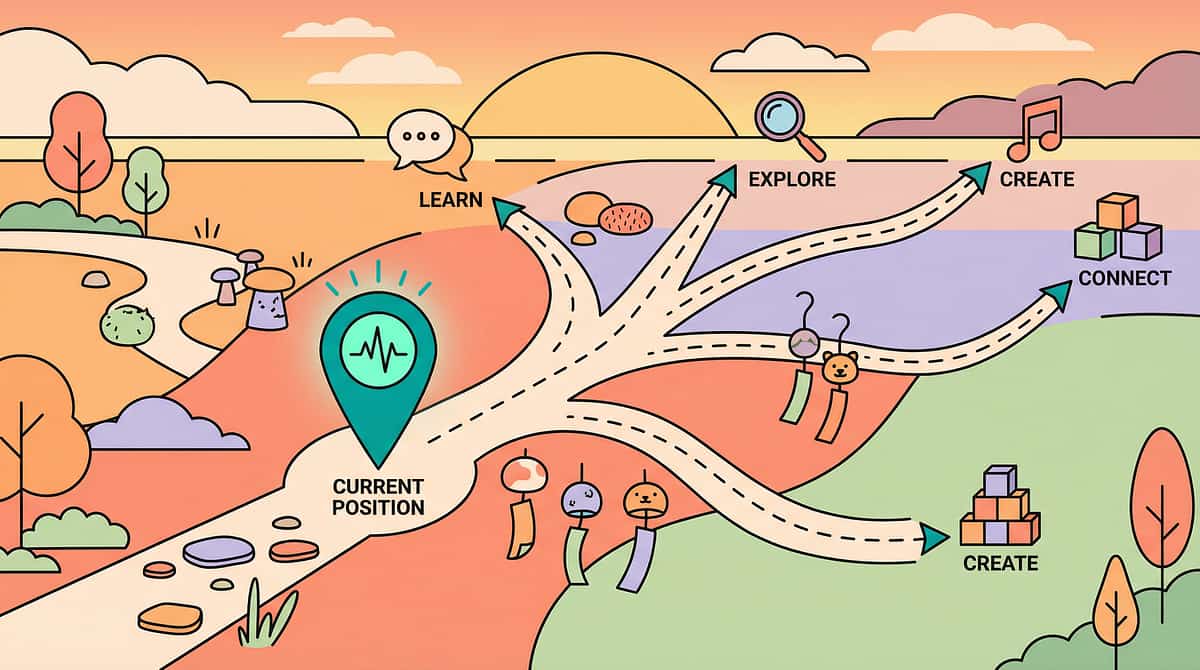
Your Child Is Here. Here Is Where We Are Heading.
Mastery
Overgeneralization
Consolidation
Emergence
The B-188 intervention window spans ages 3–8 — precisely the window when overgeneralization peaks and irregular verb memorization becomes teachable. Knowing where your child sits on this map transforms anxiety into a clinical roadmap.
Ages 2–3
First regular past tense (-ed) emerges. B-188 targets: foundation concepts of time as past/present/future.
Ages 3–4
Regular -ed more consistent; irregular errors begin. B-188 targets: visual timeline anchoring; regular verb patterns.
Ages 4–5
Overgeneralization peaks ("runned," "goed"). B-188 targets: high-frequency irregular verb pairs (go/went, run/ran).
Ages 5–6
Irregular verbs gradually mastered. B-188 targets: sorting, fill-in-the-blank, narrative consistency.
Ages 6–8
Consistent tense across narratives. B-188 targets: story retelling; academic grammar generalization.

What commonly co-occurs with verb tense difficulty: Difficulty with plural marking (B-186) · Article omission (B-187) · Pronoun confusion (B-185) · Subject-verb agreement errors (B-189) · Narrative skill difficulty (B-195). This is why Pinnacle's FusionModule™ addresses morphological difficulties across SLP, SpEd, and ABA simultaneously.
Clinically Validated. Home-Applicable. Parent-Proven.
Evidence Confidence
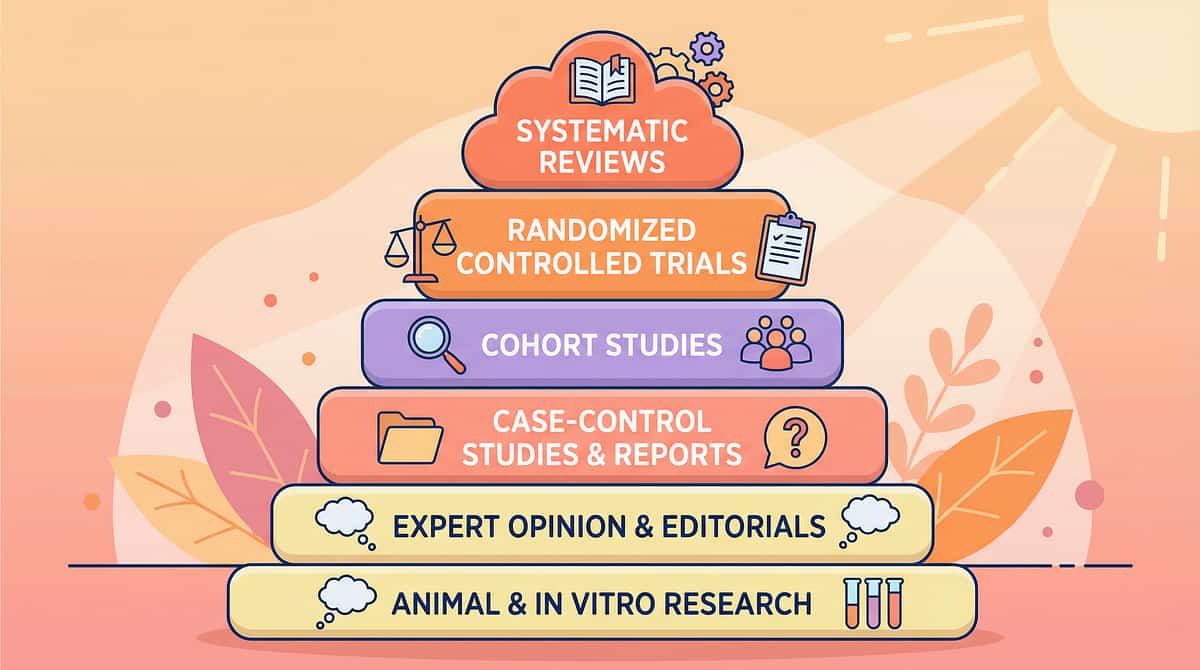
Strong Clinical Support — Level II Evidence | Multiple Systematic Reviews
Effect Size
Verb tense intervention effect sizes d=0.72–1.04 (Leonard LB, 2014)
Rice & Wexler (1996) — Journal of Speech and Hearing Research
"Tense marking is a clinical marker of Specific Language Impairment in English-speaking children" — established that verb tense marking difficulty is one of the strongest clinical indicators for DLD, validating targeted morphological intervention as a priority.
Leonard LB (2014) — MIT Press
Comprehensive meta-evidence demonstrating that explicit, structured morphological intervention improves verb tense accuracy in children with DLD with effect sizes of d=0.72–1.04.
ASHA Clinical Practice Guidelines
"Recasting, focused stimulation, and explicit instruction approaches all demonstrate significant gains in verb morphology."
Padmanabha et al. — Indian Journal of Pediatrics (2019)
Home-based language interventions in Indian pediatric populations demonstrate statistically significant outcomes when caregiver-executed with structured materials. DOI: 10.1007/s12098-018-2747-4
"The question is not WHETHER these materials work. It is HOW CONSISTENTLY you use them."
PubMed: PMC11506176 | PMC10955541 | PMC9978394 | ASHA.org | WHO NCF 2018 | NCAEP 2020

Verb Tense Mastery Through Structured Material Intervention

Act II · Learning the Technique 🌸 B-188 | Language Foundations Series Episode 188 of 999 | Grammar & Morphology "Making Time Visible in Language" Domain & Classification 🗣️ Primary Domain: Speech-Language 📋 Category: Grammar & Morphology 👶 Age Range: 3–8 years ⏱️ Session Duration: 15–20 min 🔁 Frequency: 3–5×/week What This Technique Is Verb Tense Mastery Intervention is a structured, material-supported speech-language technique that helps children aged 3–8 develop consistent, accurate grammatical marking of time in spoken language. By making the abstract concept of "past, present, and future" visually concrete through timelines, picture sequences, matching games, and narrative retelling, this intervention directly addresses the core morphological deficit underlying verb tense errors — without ever making the child feel corrected or wrong. The technique works by systematically building: (1) temporal concept understanding, (2) regular past tense patterns, (3) high-frequency irregular verb memorization, and (4) sustained tense consistency in narrated stories — the same progression a child's grammar follows in typical development, accelerated with purposeful structure. Classification per Pinnacle 128 Canon Materials System & GPT-OS® 20-Category Taxonomy | ASHA Morphological Intervention Guidelines
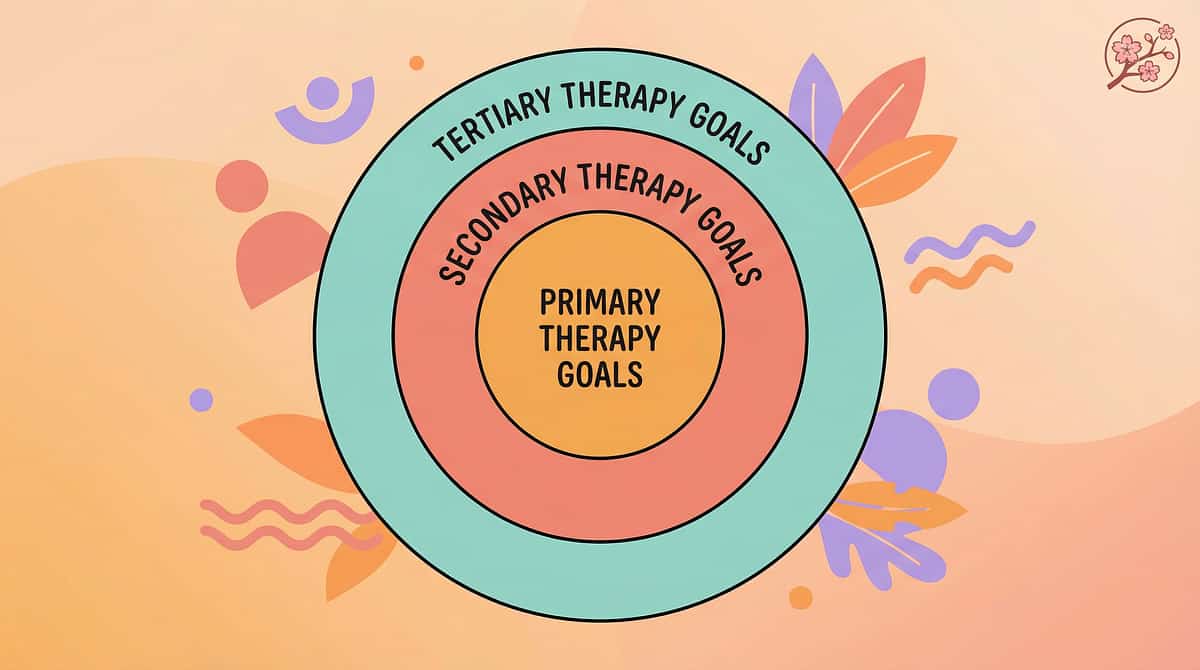
This Technique Crosses Therapy Boundaries — Because Grammar Lives Everywhere

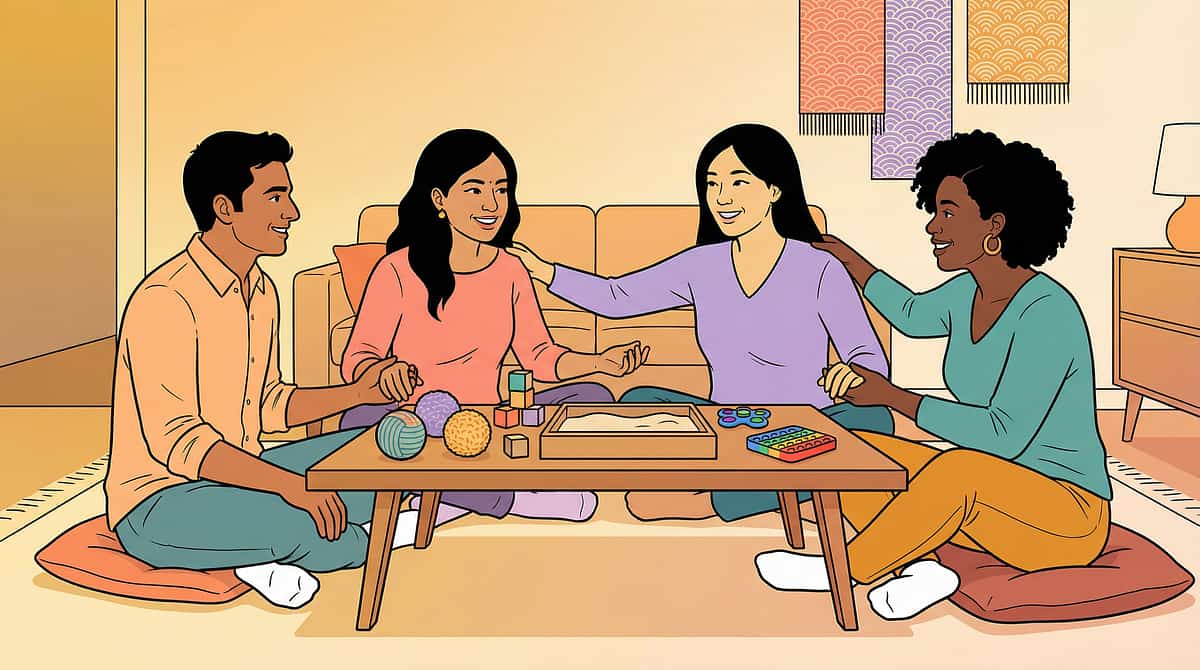
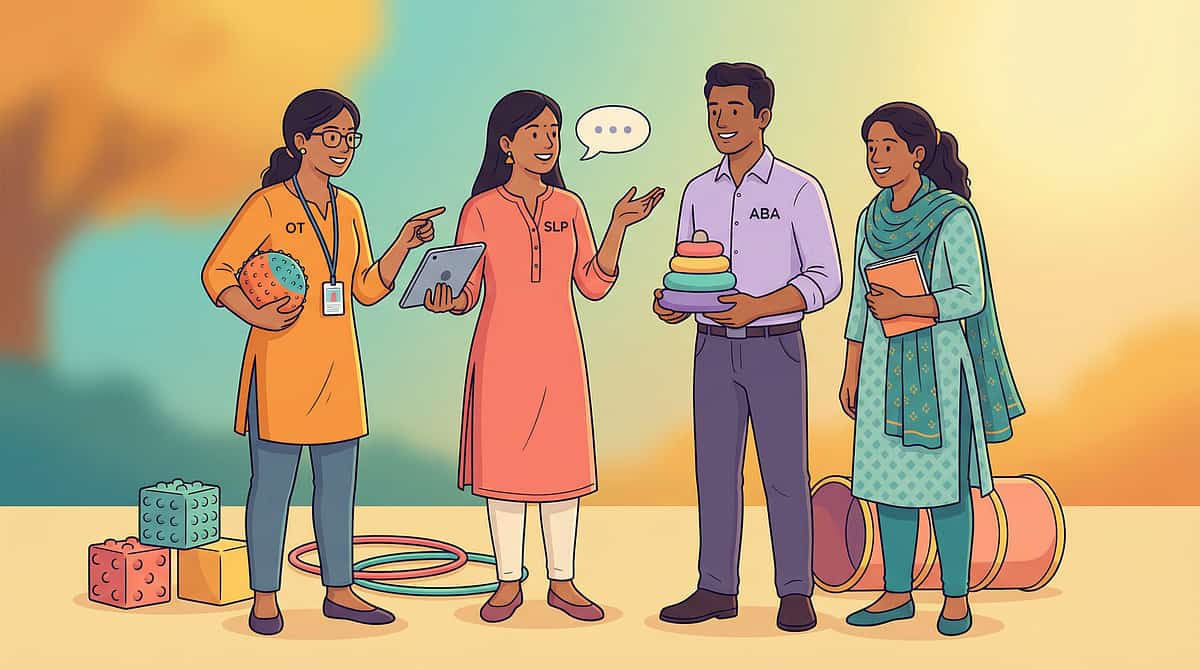
Speech-Language Pathologist (PRIMARY LEAD) Primary architect of verb tense intervention. The SLP identifies specific error types, selects the correct materials sequence, establishes the morphological teaching hierarchy, and monitors generalization to conversational speech. Special Educator (SECONDARY) Extends verb tense work into academic contexts: reading comprehension, written grammar exercises, and classroom communication. Bridges therapy goals into school curriculum requirements. ABA / BCBA (TERTIARY) Structures the reinforcement schedule for verb practice sessions. Designs the discrete trial format for irregular verb memorization. Tracks data on correct vs. incorrect verb forms using frequency recording. NeuroDevelopmental Pediatrician (OVERSIGHT) Rules out hearing loss, articulation difficulties, or broader language processing concerns. Ensures the morphological profile aligns with the child's overall neurodevelopmental picture before initiating intensive intervention. "The grammar system doesn't organize by therapy type. The child's brain doesn't know which session belongs to which therapist. Pinnacle's FusionModule™ coordinates SLP, SpEd, and ABA goals into one integrated morphological development plan — so every professional pushes in the same direction." — Int J Speech-Lang Pathol (2022). DOI: 10.1080/17549507.2022.2141327

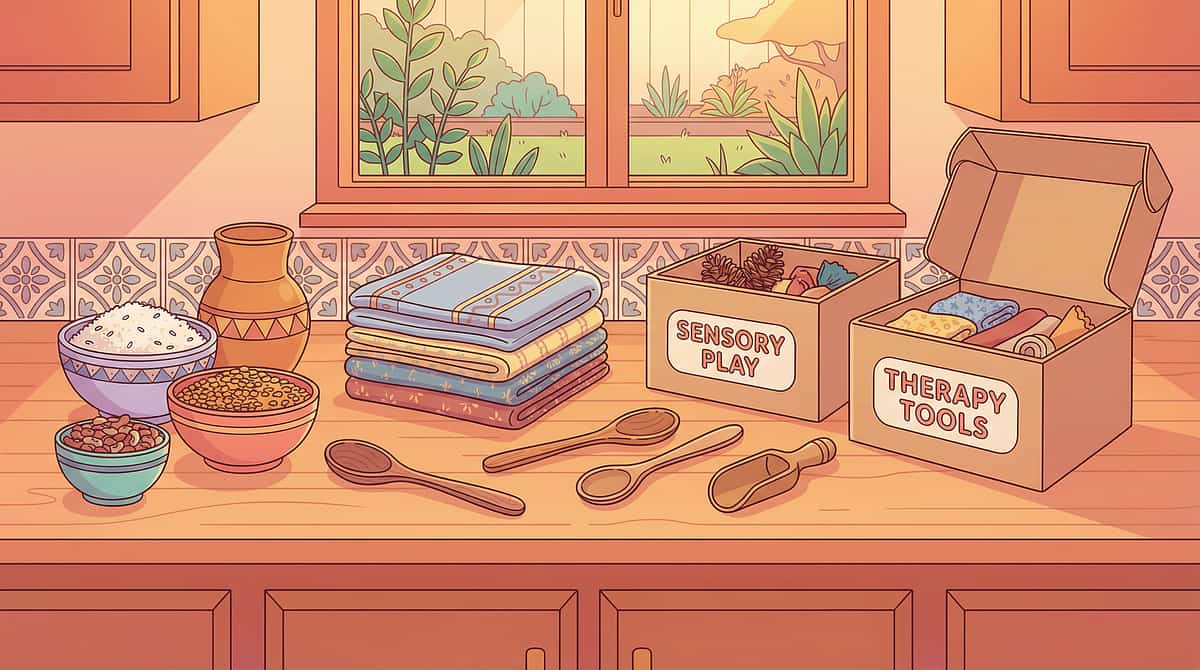
This Is Not a Random Activity. It Is a Precision Linguistic Tool.
Observable mastery indicator for the primary target: child correctly marks past tense in 80%+ of obligatory contexts in structured activities. Secondary gains include stories with clear temporal structure where the listener understands "when" without asking. Long-term: teacher reports improved classroom language and written work shows tense consistency.
Meta-analysis (World J Clin Cases, 2024): Language interventions targeting morphology promoted communication, academic readiness, and social participation across 24 studies. PMC10955541
9 Materials. Your Home Becomes a Grammar Clinic.
Every material below is clinically mapped, parent-executable, and sourced for Indian families. You do not need all 9. Start with Materials 1, 2, and 3. Build from there.
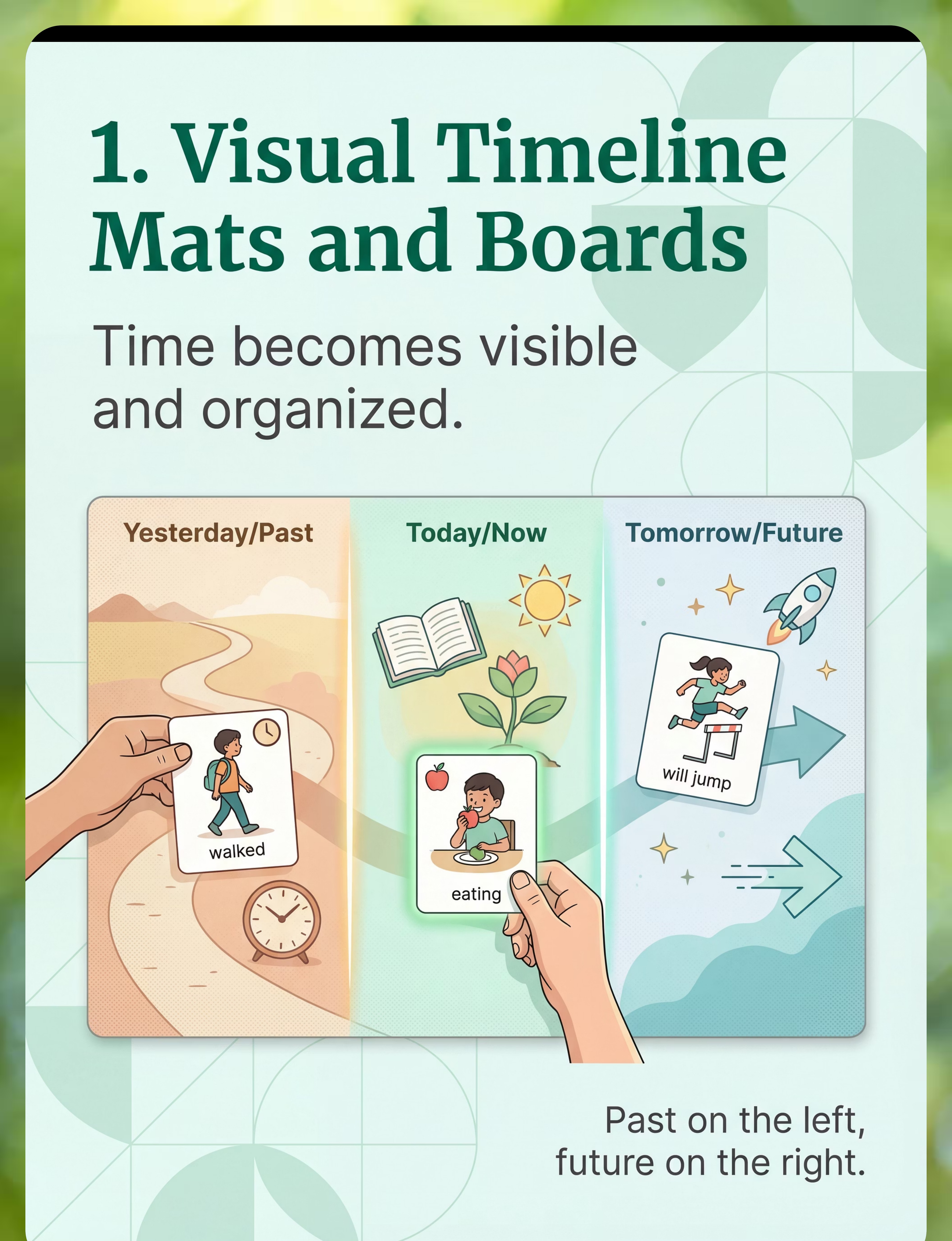
Visual Timeline Mats and Boards
Canon: Sorting Activities / Categorization
Past → Present → Future made spatially visible. The single most important foundation material. DIY: ₹0 (paper + 3 labelled boxes) | Commercial: ₹300–800
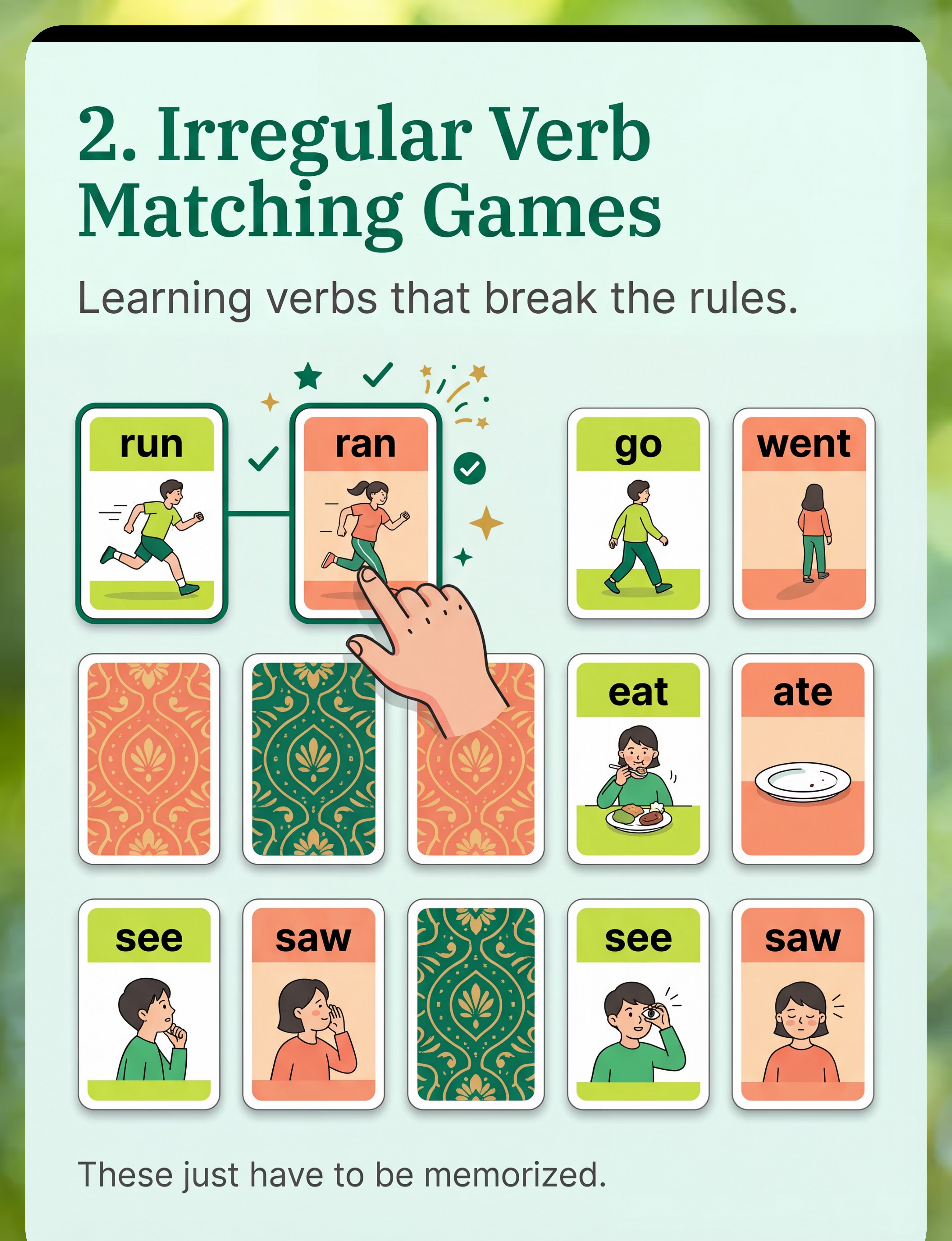
Irregular Verb Matching Games
Canon: Matching Games / Memory Games
run/ran · go/went · eat/ate · see/saw. The 10 pairs that matter most, in game format. DIY: ₹0 (handwritten cards) | Commercial: ₹200–500
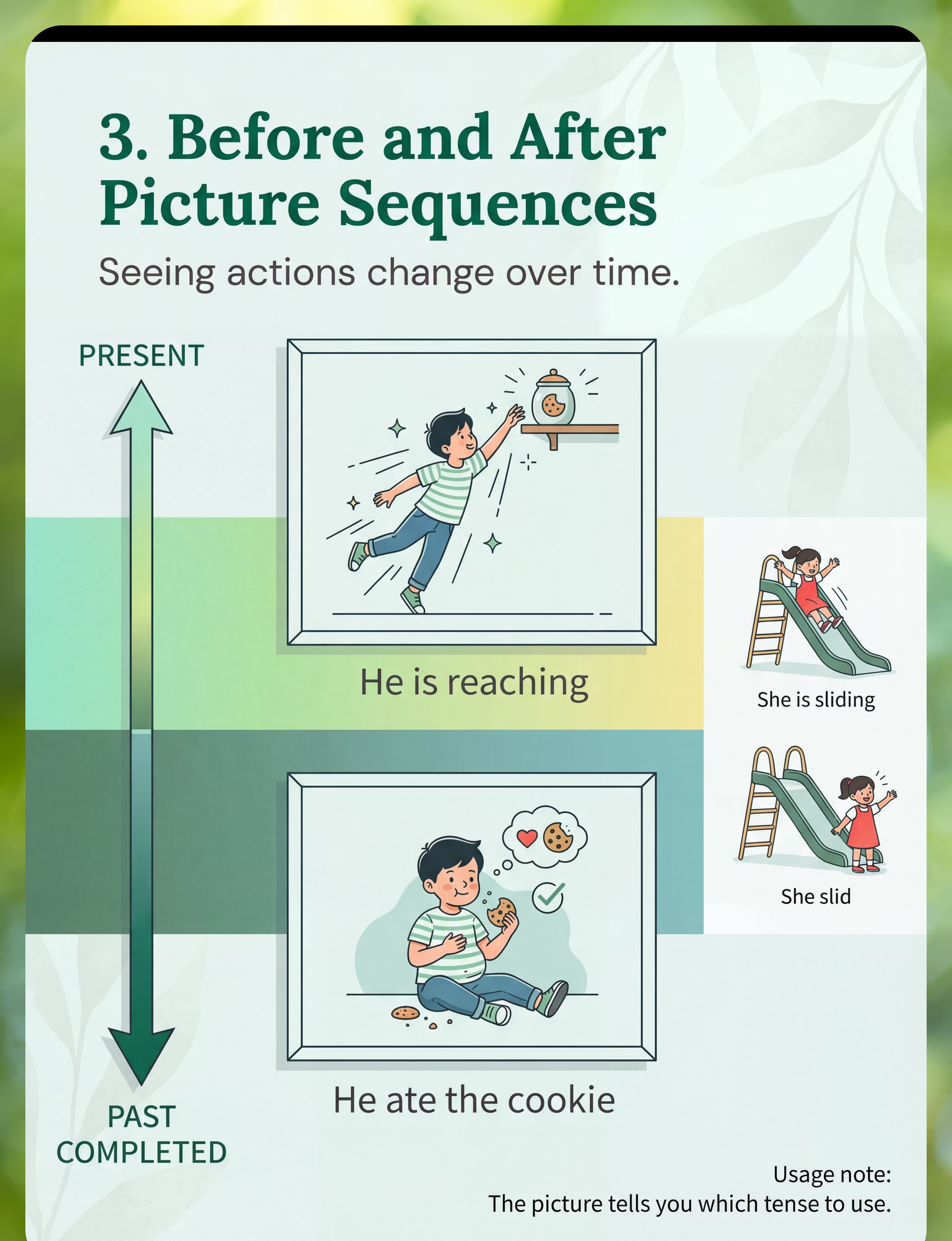
Before and After Picture Sequences
Canon: Sorting Activities / Categorization
He is reaching / He ate the cookie. Visual contrast teaches grammatical contrast. DIY: ₹0 (photos from phone) | Commercial: ₹250–600
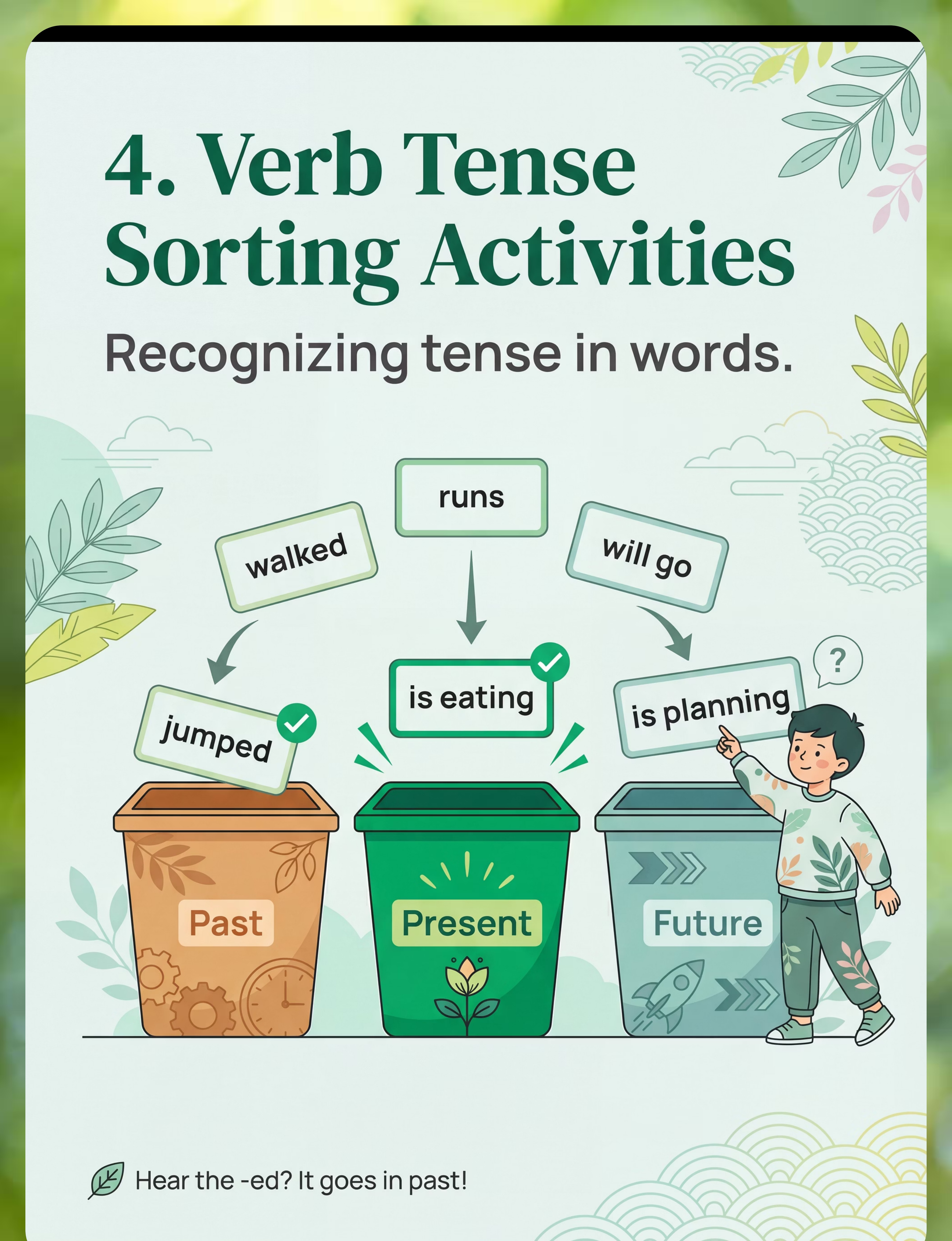
Verb Tense Sorting Activities
Canon: Sorting Activities / Categorization
Three bins: PAST · PRESENT · FUTURE. Sort verb cards. Name the rule. DIY: ₹0 (any 3 containers + written cards) | Commercial: ₹150–400
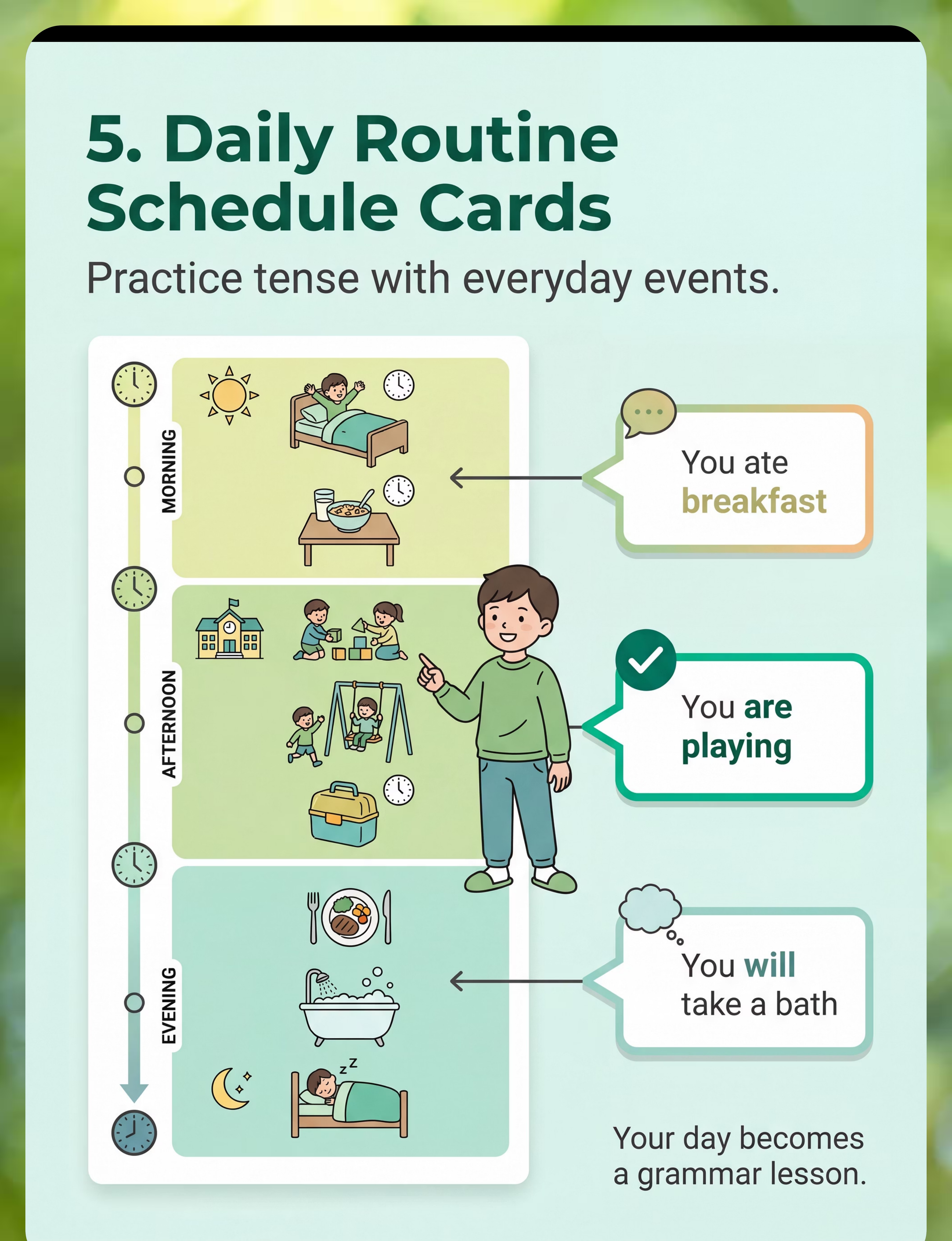
Daily Routine Schedule Cards
Canon: Sorting Activities / Categorization
Your child's actual day becomes a living grammar lesson. Morning = future tense. Evening = past tense. Same pictures, different words. DIY: ₹0 | Commercial: ₹200–500
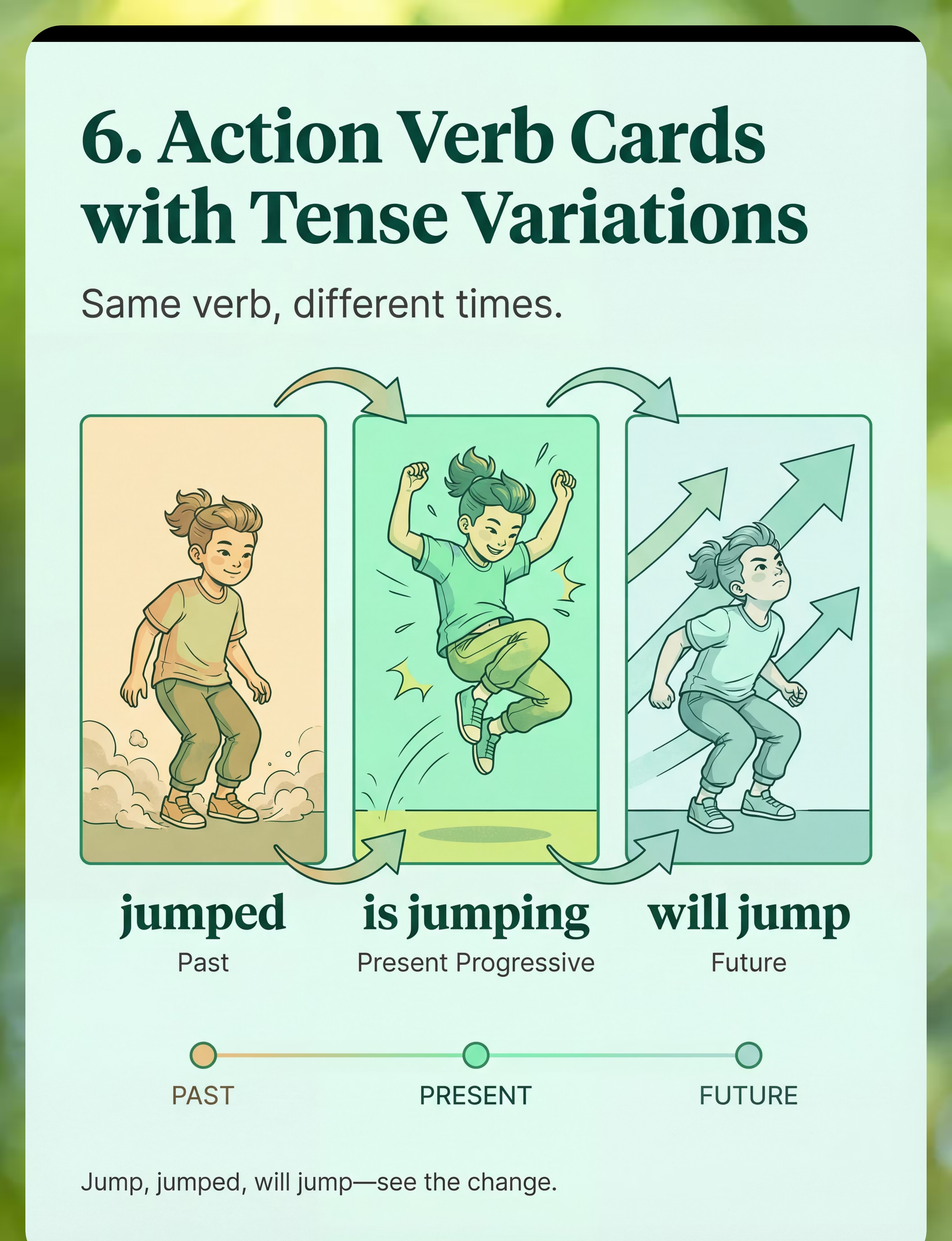
Action Verb Cards with Tense Variations
Canon: Sorting Activities / Categorization
One action in three photos: about to jump / jumping / already jumped. Same verb, three forms. DIY: ₹0 (phone photos) | Commercial: ₹300–700
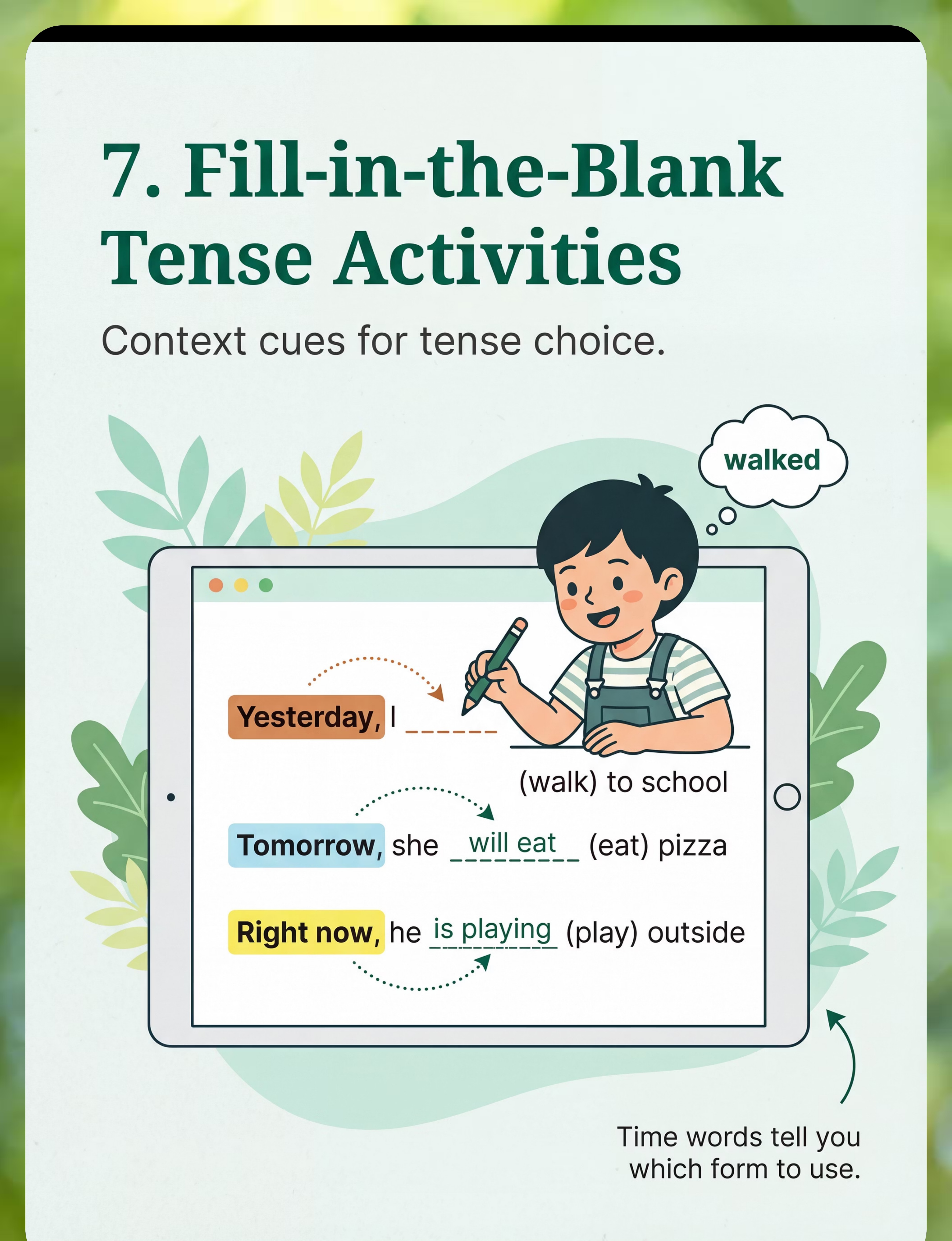
Fill-in-the-Blank Tense Worksheets
Canon: Problem-Solving Toys
"Yesterday I ___ (walk) to school." Time words are tense signals. Context teaches grammar. DIY: ₹0 (handwritten sentences) | Commercial: ₹100–300
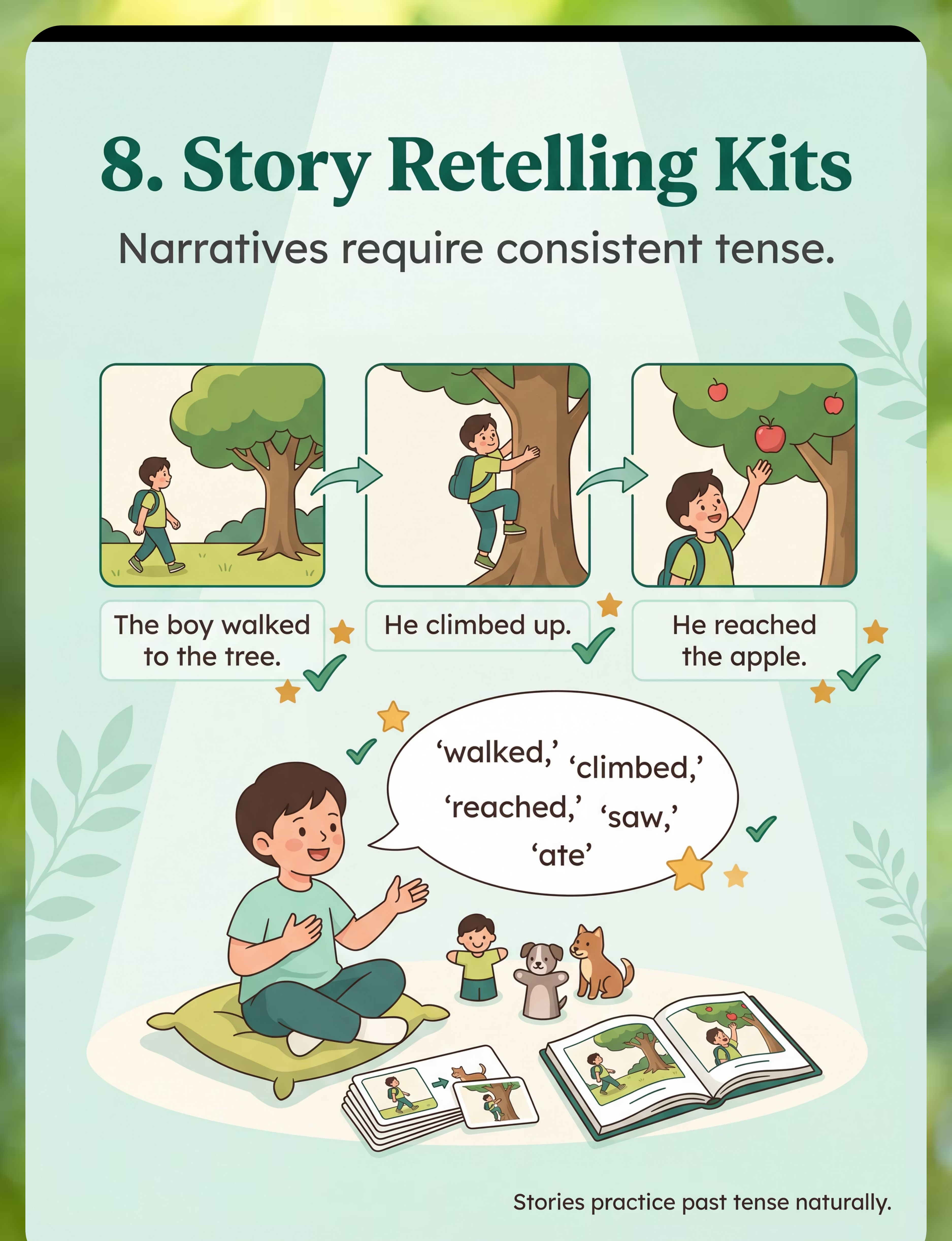
Story Retelling Kits
Canon: Problem-Solving Toys
Narratives require sustained past tense. Story retelling is the most natural grammar practice. DIY: ₹0 (favourite picture books) | Commercial: ₹300–800
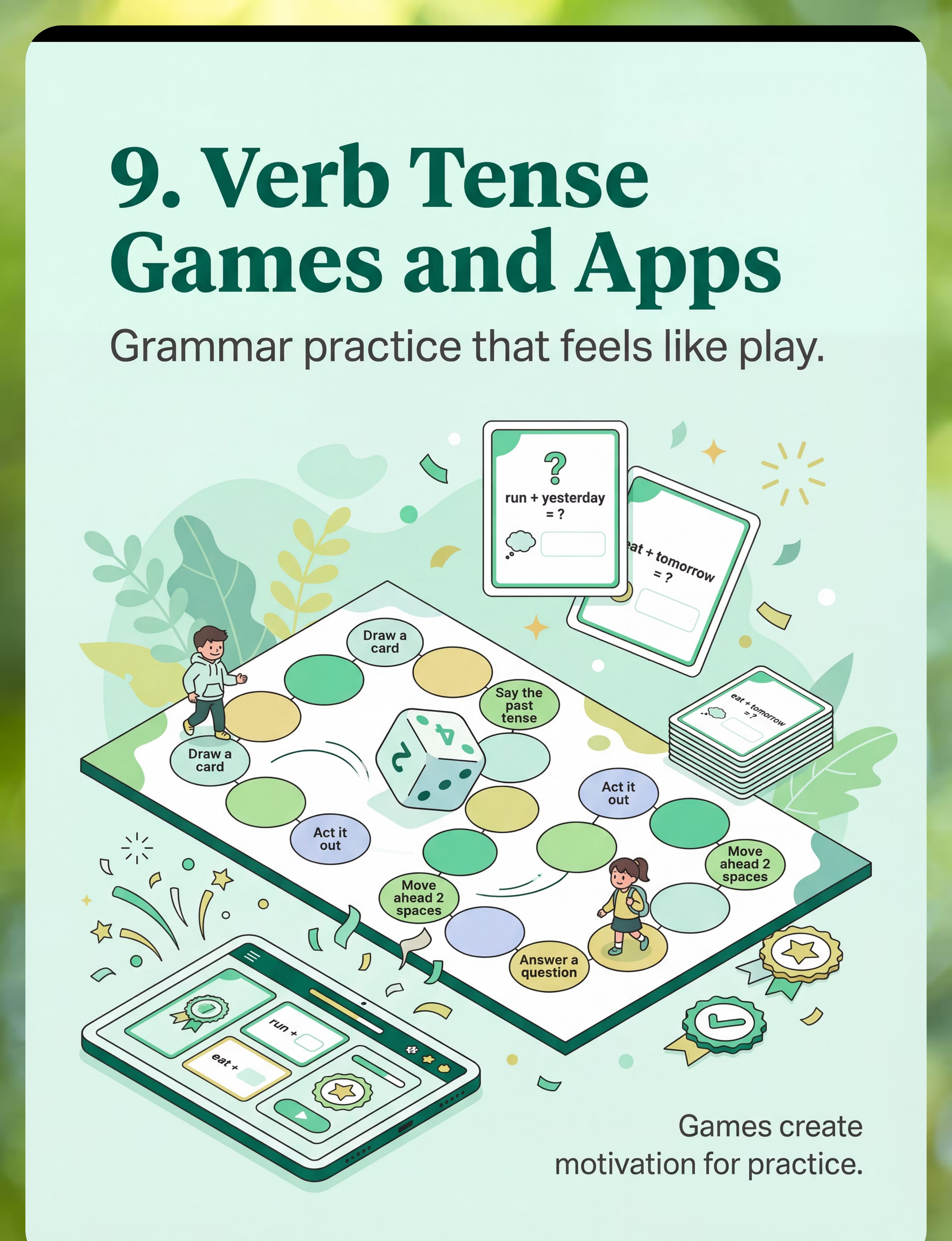
Verb Tense Board Games and Apps
Canon: Matching Games / Memory Games
Grammar drill is boring. Games are not. Repeat correctly to advance on the board. DIY: ₹0 (adapt any board game) | Commercial: ₹400–1,200

Investment Range & Reinforcement Materials

Total Investment Range 🟢 Starter Kit (Materials 1–3): ₹0 DIY → ₹1,200 commercial 🟣 Complete Kit (All 9): ₹1,750–5,300 Reinforcement Materials For positive session endings: 🏆 Rosette Reward Jar ₹589 — Buy → ⭐ 1800+ Reward Stickers ₹364 — Buy → The Equity Principle Every material on this page has a ₹0 DIY alternative. No family is excluded from this intervention due to budget. This is the WHO inclusion principle in practice. The WHO Nurturing Care Framework is explicit: effective intervention must reach every family, regardless of economic access. Every material can be executed with household items — with equal therapeutic benefit when used consistently. WHO NCF Handbook (2022): Household-material-based intervention efficacy confirmed across 54 LMICs. PMC9978394
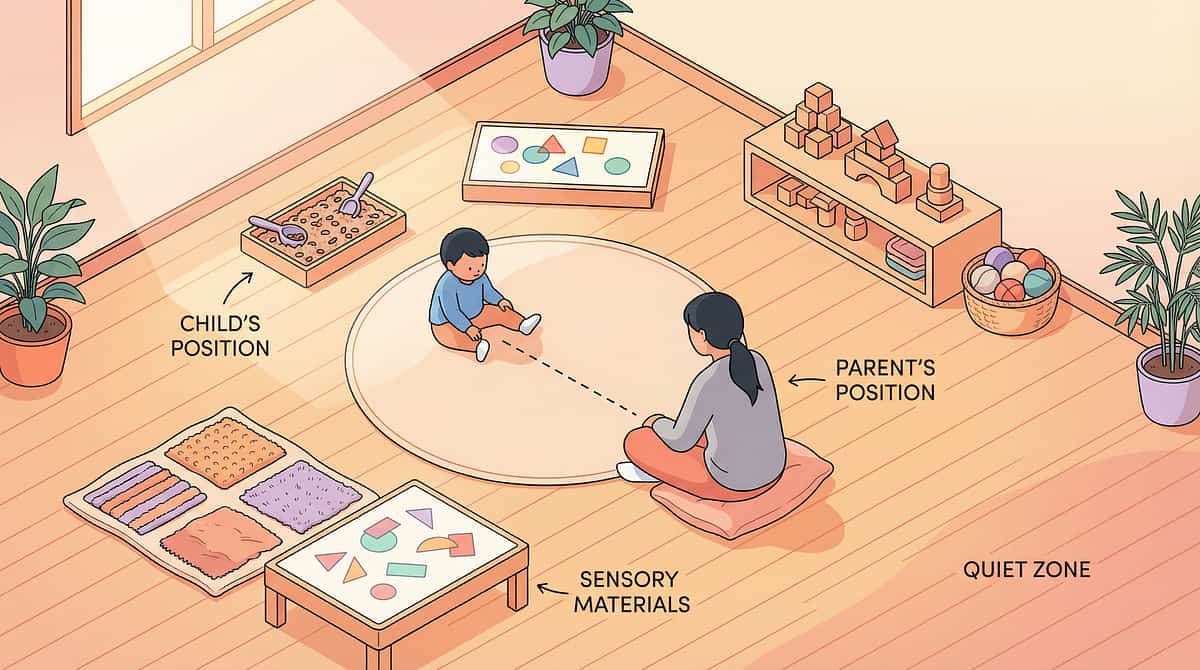
Every Material Has a ₹0 Version. Start Today.
Material
Buy (Commercial)
Make (Household)
Why the DIY Works
1. Timeline Mat
₹300–800 sorting mat
3 sheets labelled Yesterday/Today/Tomorrow in different colors
Same spatial anchoring principle; color coding provides identical visual cues
2. Irregular Verb Matching
₹200–500 card game
Index cards, pen, draw simple stick figure actions
Memory game mechanics identical; brain doesn't care if cards are handwritten
3. Before/After Sequences
₹250–600 picture sets
Phone photos of your child doing actions + completed actions
Personal relevance actually increases therapeutic value
4. Tense Sorting
₹150–400 sorting bins
3 labeled containers + handwritten verb cards
Sorting mechanism is identical
5. Schedule Cards
₹200–500 visual schedule
Drawn or printed daily routine icons on paper
Personal schedule increases motivation and relevance
6. Verb Transformation Cards
₹300–700 card sets
3-photo sequences using phone camera; print or use screen
Personal photos add engagement
7. Fill-in-the-Blank
₹100–300 worksheets
Handwritten sentences on notebook paper
Paper and pencil identical to printed worksheet
8. Story Retelling Kit
₹300–800 commercial kit
Any picture book from home
Books are inherently story retelling kits
9. Board Game
₹400–1,200
Adapt Snakes & Ladders: say a correct past tense verb to roll
Game mechanics identical; any board game works

⚠️When the clinical-grade material IS recommended over DIY: If your child is in intensive SLP intervention (3+ sessions/week), structured commercial materials provide higher trial density and consistency. Consult your Pinnacle SLP before substituting in intensive protocols.
Safety First
Read This Before You Begin. Every Time.
🔴 RED — DO NOT PROCEED
  • Child has had a meltdown in the past 2 hours and has not returned to full baseline
  • Child shows signs of illness: fever, fatigue, obvious distress
  • Child refuses engagement after two gentle invitations — do not push into refusal
  • Any materials contain small pieces with a child who still mouths objects (choking risk — use digital or oversized versions only)
  • Session is occurring during a transition (school pickup, just before meal, just before sleep)
🟡 AMBER — MODIFY the Session
  • Child is in mildly elevated sensory or emotional state: reduce session to 5 minutes, use only Material 5
  • It's a new material being introduced: use only one new item; keep 2 familiar items for comfort
  • Child shows resistance at Step 3: pause, re-invite, reduce demand to the single easiest verb pair
  • Parent is stressed or time-pressured: postpone to avoid rushing — rushed sessions produce negative associations
🟢 GREEN — PROCEED with Full Confidence
  • Child is fed, rested, and in regulated state
  • At least 30 minutes since last screen time
  • Parent has 20 uninterrupted minutes
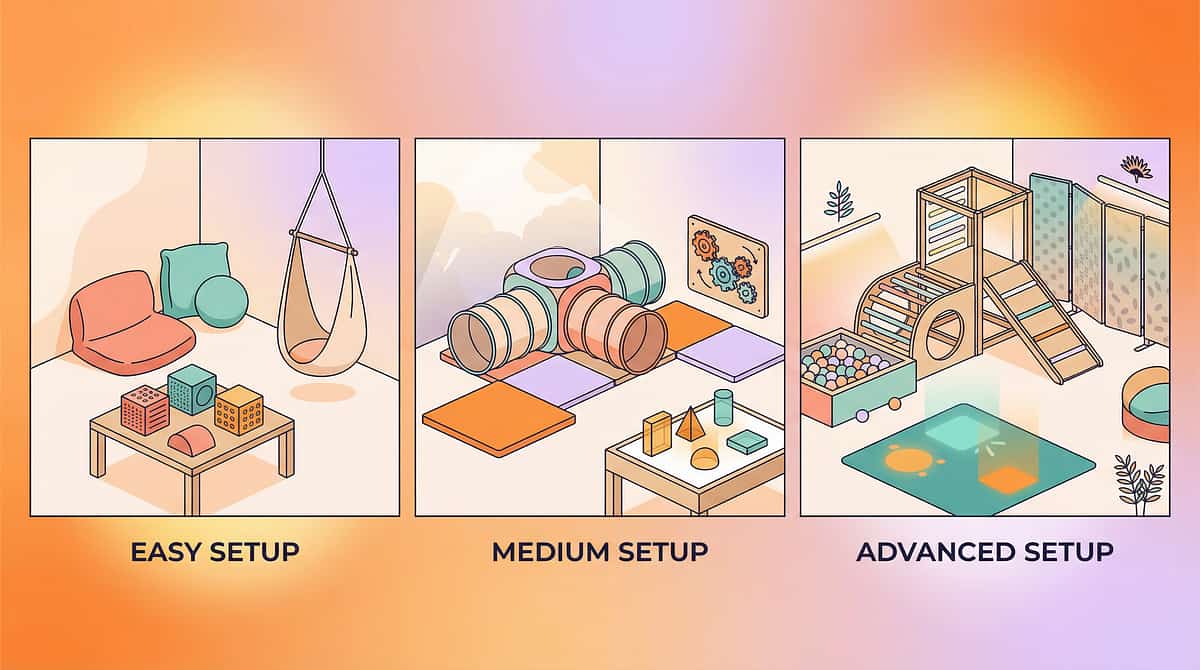
  • Space is set up per the Space Setup card
  • Child has had at least one success with any of these materials before

🛑STOP IF: Child begins self-injuring, becomes inconsolable, develops respiratory distress, or shows any acute medical symptom. This technique does NOT require modification for ASD, DLD, late talkers, bilingual children, or children with phonological disorders alongside grammar delays.
📞If you are unsure: Call 9100 181 181 — FREE National Autism & Child Development Helpline | 24×7 | 18+ Languages
Spatial Precision Prevents 80% of Session Failures
Setting Up Your Space
Position 1 — Child's Seat: Stable chair at appropriate table height. Child facing away from TV and window distractions. If child uses a sensory cushion or movement seating, use it consistently for all sessions.
Position 2 — Parent's Seat: Beside or at a 90° angle to child — NEVER directly opposite. Same-level eye contact. You are a learning partner, not an evaluator across a table.
Position 3 — Active Materials: Today's materials only. Maximum 2–3 items visible. More than 3 creates choice overload.
Position 4 — Reinforcement Reserve: Reward jar/stickers — visible but not immediately accessible. Within 2 seconds reach for delivery.
Position 5 — Timer (if used): Visual timer (hourglass) on table — child can see time passing. Removes "when is this over?" anxiety. Smartivity DIY Interactive Clock ₹673 →
Remove From Space
  • All other toys and games
  • Screens and devices (unless using therapy app)
  • Younger siblings during session
  • Food (unless used as reinforcement per BCBA plan)
  • Background TV/music

Environment Specs
💡Lighting: Bright natural light or warm white overhead
🔇Sound: Quiet — no background noise above 50dB
🌡️Temperature: 22–26°C; child in comfortable clothing
Ayres Sensory Integration Theory: Environmental structure is a core clinical principle. PMC10955541
Act III · Execute
60-Second Pre-Flight Check. The Best Session Starts Right.
#
Check
YES → Proceed
NO → Action
1
Child has eaten in the last 2 hours
Green light
Feed first; 15-min minimum post-meal wait
2
Child slept adequately last night
Green light
Shorten to 10 min; use Materials 5 or 7 only
3
No meltdown in past 2 hours
Green light
Postpone; offer quiet sensory calming activity first
4
Child is in eye-contact range
Green light
Try 2-minute joining activity; if not engaging, postpone
5
Parent has 20 uninterrupted minutes
Green light
Reschedule; partial sessions create worse outcomes than no session
6
Space is set up (Space Setup complete)
Green light
Set up first (5 min); do not start in unprepared space
7
At least one familiar material is in today's session
Green light
Pull out a known material; don't start with only new items
ALL 7 GREEN
FULL SESSION — 20 minutes, all materials as planned
🟡 5–6 GREEN
MODIFIED SESSION — 10 minutes, familiar materials only, no new introductions
🔴 FEWER THAN 5
POSTPONE — This is not failure — this is data. Note what was off. Rest together instead.
"A session that doesn't happen because you read the child correctly is worth more than a forced session that creates a negative association with the materials."

Step 1 of 6 — The Invitation
⏱️ 60–90 seconds
ABA Pairing Principle: No demands placed until the child associates the materials with positive outcomes. The invitation is therapeutic even before any language production begins.
🗣️ Say this (or your natural language equivalent): "[Child's name], I found something cool — look at this! Want to see? This is our time machine — see? This side is Yesterday, this is Today, and this is Tomorrow. You're the time machine driver today. Want to try?"
Body Language Guidance
  • Sit beside child, not opposite
  • Timeline Mat already on table — child sees it before you say anything
  • Voice: curious and warm, not instructional
  • Eyes: on the mat, not on the child's face — remove evaluation pressure
  • Body: leaning slightly forward, relaxed
Child Acceptance Cues
  • Child looks at the mat (any duration)
  • Child reaches toward mat or any material
  • Child echoes any word you said
  • Child sits or remains seated
  • Child makes eye contact with you (even briefly)
⚠️ Resistance & Modifications
  • Child turns away: Reduce to physical proximity only — don't speak yet
  • Child pushes mat away: Remove mat, offer just one familiar picture card
  • Child leaves space: Follow calmly, join their activity for 2 minutes before re-inviting
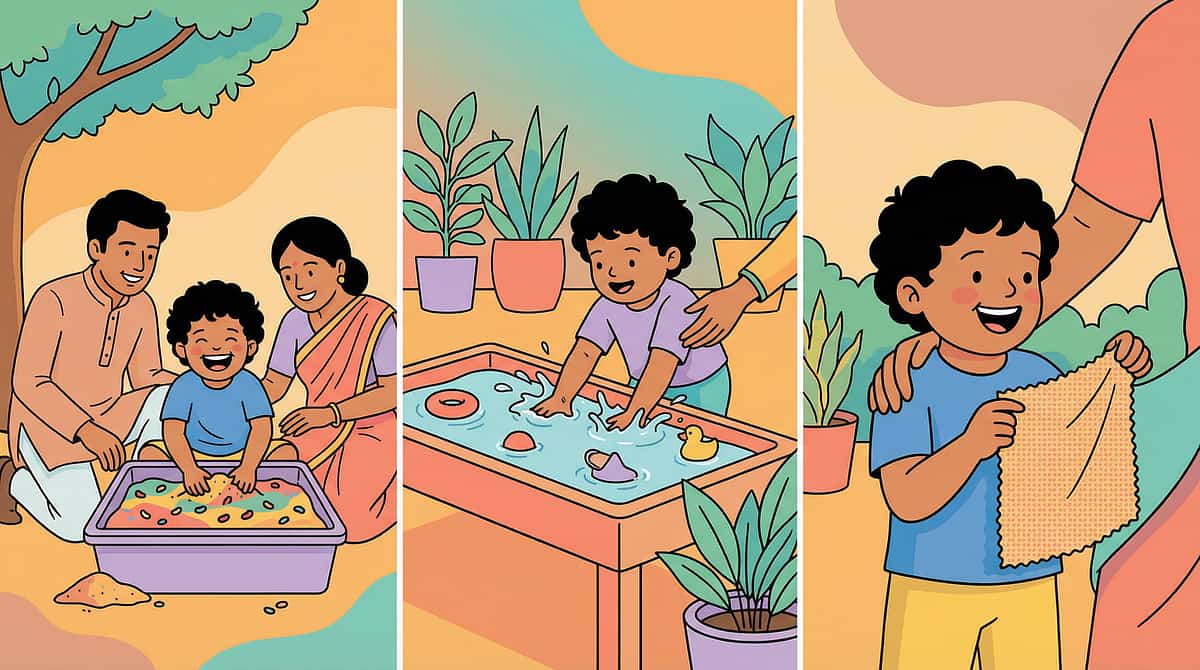
Step 2 of 6 — The Engagement
⏱️ 2–4 minutes
OT "Just-Right Challenge" + SLP Focused Stimulation: Introduce the material at sub-mastery level first — the most familiar verb pair you know your child can succeed at. First success sets the neurological tone for the session.
🗣️ Material Introduction — Timeline Mat: "See this? Yesterday is here on the left — that's where things already happened. Today is in the middle — that's right now. And Tomorrow is over here — that's what's coming. Let me show you — [place picture card of eating breakfast on 'Today']. What's happening in this picture? He is... [pause, wait 5 seconds]"

If child responds
"YES! He is eating! And if I put it HERE [move to 'Yesterday'] — guess what? Now he... ATE! He ate breakfast! Different time, different word!"
If no response in 5 seconds
Model yourself: "He is eating. That's today. Yesterday, he ATE. Ate. Let's say it together — ATE."

REINFORCE IMMEDIATELY (within 3 seconds) when child: names any part of the picture · attempts any verb form (correct or not) · places a card anywhere on the timeline (even wrong placement) · maintains attention for the full instruction
🟢 Engagement
Child places card independently, says a verb
🟡 Tolerance
Child watches, points, doesn't speak — continue with parallel talk
🔴 Avoidance
Child turns away, hands flap distress — return to Step 1 invitation
Step 3 of 6 — The Therapeutic Action
⏱️ 5–10 minutes · Core of Session
This is the active ingredient. The specific therapeutic input that — with repetition across sessions — creates the morphological automaticity that resolves verb tense errors. Duration: 40–60% of total session time.
Choose ONE of these action protocols per session (rotate across sessions):
Protocol A: Timeline Placement
Best for temporal concept foundation
  1. Place 6–8 action picture cards face-down; child draws a card
  1. Read action together ("He is sleeping")
  1. Ask: "Did this already happen, is it happening NOW, or will it happen later?"
  1. Child places card in Past / Present / Future section
  1. Together say the correct verb form: "He slept / He is sleeping / He will sleep"
  1. Reinforce: "That's exactly right! Yesterday he SLEPT. S-L-E-P-T."
Protocol B: Irregular Verb Matching
Best for memorizing specific pairs
  1. Lay out 5 verb pairs face up: run/ran, go/went, eat/ate, see/saw, come/came
  1. Shuffle and mix; turn all face down
  1. Child turns over 2 cards; if they match, child must say BOTH forms to keep the match
  1. If they don't match: parent says both forms before turning back over
  1. Session ends when all pairs found; count pairs as reward
Protocol C: Before-After Picture Narration
Best for present progressive vs. past
  1. Show "before" picture: "What is she doing?" → "She is reaching for the cookie"
  1. Turn to "after" picture: "Now what happened?" → "She ate the cookie"
  1. Extend: "So first she WAS reaching. Then she ATE. Tell me the whole story..."
  1. Child narrates both pictures using correct tenses

Step 3 — Execution Errors & In-Session Fixes
Common Error
Why It Happens
In-Session Fix
Child says "runned"
Rule overgeneralization
Recast warmly: "Yes! He ran so fast! RAN." Never say "wrong"
Child omits -ed: "Yesterday I walk"
Tense marker omission
Focused stimulation: repeat target form 3× in your next utterance
Child reverses Past/Future
Temporal concept gap
Return to Timeline Mat Protocol A before Protocol B or C
Child becomes distracted
Satiation or wrong difficulty
Switch protocols; reduce to 3 familiar verb pairs
⏱️ Duration Guidance
Optimal: 5–10 repetitions per session with high engagement quality
3 excellent repetitions > 10 forced ones
📊 Core Session Principle
This step should occupy 40–60% of total session time. It is the active ingredient — prioritize quality over quantity at every turn.
Meta-analysis (World J Clin Cases, 2024): Core therapeutic action 40–60% of session time. PMC10955541 | Recasting evidence: ASHA systematic review on focused stimulation.
Step 4 of 6 — Repeat & Vary
⏱️ 3–5 minutes
"3 excellent repetitions with full attention and immediate reinforcement produce more neural consolidation than 15 half-engaged repetitions."
Repetition Targets
  • Per verb pair per session: 3–8 correct productions (not attempts)
  • Session-level: 10–20 total verb tokens across all materials
  • Weekly target: 50–100 verb tense productions in structured practice

Variation A — Raise Difficulty
Add less familiar irregular verbs. Use past tense in complete sentences, not single words.
Variation B — Reduce Difficulty
Return to 3 most mastered verb pairs only. Use timeline mat as scaffold even if child was working without it.
Variation C — Change Modality
If child is tiring of cards: act it out. Parent says "run" → child runs → parent says "What did you do? You RAN!"
Variation D — Narrative Extension
Take 3 verb pairs practiced today and build a story: "Yesterday I ran to the park. I ate an apple. I saw a dog."

⚠️Satiation Indicators: Child begins incorrect responses after previously correct ones → reduce demand · Eye contact decreases significantly → schedule cool-down in 2 minutes · Child requests different activity → honor it; end with one final success
Step 5 of 6 — Reinforce & Celebrate
⏱️ 30 seconds per reinforcement delivery

Immediate reinforcement (within 3 seconds of target behavior) is 4× more effective than delayed reinforcement, regardless of reward size. A small sticker given in 2 seconds outperforms a large toy given in 2 minutes.
For correct verb production
"YES! He RAN! That's past tense! You got it!" → Sticker immediately
For correct timeline placement (even without verbal)
"Perfect — you put it in Yesterday. That's right! Yesterday he SLEPT." → High-five + sticker
For a correct story narration
"That was a beautiful story! I understood everything — I knew exactly when each thing happened!" → Reward jar token
For an attempt (even if incorrect)
"I love how you tried — you're a grammar scientist!" → Verbal praise immediately
Reinforcement Menu
  • Sticker from 1800+ Reward Sticker Book ₹364
  • 🏆 Token into Rosette Reward Jar ₹589
  • 🎉 Verbal: "Grammar Champion!" / "Past Tense MASTER!"
  • 🤗 Physical: high-five, fist bump, shoulder squeeze (if child accepts touch)
  • 🎮 Activity: 2-minute choice activity as session reward
The Core Principle
"Celebrate the attempt, not just the success. 'Runned' shows your child learned the rule — that IS worth celebrating while we teach the exception."
Step 6 of 6 — The Cool-Down
⏱️ 2–3 minutes · No Session Ends Abruptly
The Cool-Down IS therapy. A structured ending prevents protest behaviors, builds session closure schema, and conditions your child to associate the materials with safe, predictable endings.
Final Success
Pack‑Away Ritual
Advance Warning
3-Minute Warning Script
"Two more turns, then we're all done for today. Two more!" Use visual timer — child watches the last 2 minutes run out.
Pack-Away Ritual
"Now let's put the time machine to sleep! Help me put the cards in the box." Child participates in put-away. If child uses a comfort object during transitions, bring it out as the session-end object.
If Child Resists Ending
Offer: "One more turn. Then completely done." Never negotiate past one extension. If distress: "I know, it's hard to stop when it's fun. We'll do it again tomorrow."
Post-Session Affirmation
"[Child's name], you worked so hard today. I am so proud of your grammar brain."
NCAEP Evidence-Based Practices (2020): Visual supports and structured transition scripts are classified as evidence-based practice for autism. ncaep.fpg.unc.edu
Act IV · Progress
60 Seconds of Data Now Saves Hours of Guessing Later
⏱️Complete within 60 seconds of session ending. Memory decays fast. Data captured now is data that drives progress.
B-188 Session Tracker
Date: ________ | Session #: ________
1. Correct Past Tense Forms Produced: ___ (count only spontaneous + elicited)
2. Irregular Verb Pairs Correct Today:
go/went □ run/ran □ eat/ate □ see/saw □ come/came □ get/got □
3. Child Engagement Level: 1 / 2 / 3 / 4 / 5
1=refused · 3=moderate · 5=fully engaged
Notes: _________________________
Data Interpretation Guide
  • Sessions 1–5: Baseline; expect high error rates. Do not be discouraged.
  • Sessions 6–15: First consistent patterns emerge. Look for 1–2 verb pairs going "automatic."
  • Sessions 16–30: Mastery criteria approach. Regular verbs should be >80% correct; target 5+ irregulars.
  • Sessions 31+: Generalization phase. Measure spontaneous speech, not just structured sessions.

BACB Standards: Continuous measurement (frequency, duration) + discontinuous measurement (interval recording) as applied behavior analysis practice standards.

Real Sessions Are Messy. Here Is Your Fix Kit.

"A stopped session is not a failed session. It is a data point that tells you exactly what to adjust tomorrow. The parent who reads their child well enough to stop is doing sophisticated clinical work." Problem 1: Child refused to touch the Timeline Mat Why: New material + uncertain expectations. Fix: Introduce the mat with a character your child loves. Put a photo of their favourite activity first. Reduce to "just point" — no verbal required. Problem 2: Correct verbs in session but wrong tense in conversation Why: Generalization gap — completely expected at sessions 5–15. Fix: Add Material 5 (Daily Routine Cards). Use recasting in conversation: Child: "We goed." Parent: "Yes! We WENT to the park!" Problem 3: Child says "walked" for everything — even future tense Why: Overgeneralization of the -ed rule to all tenses. Temporal concept may need reinforcement. Fix: Return to Timeline Mat Protocol A. Focus only on Yesterday/Tomorrow distinction. Pause irregular verb work temporarily. Problem 4: Mastered pairs in session 8 but "forgotten" in session 9 Why: Normal consolidation curve — this is the "progress cliff" most parents mistake for regression. Fix: Re-test at beginning of next session with the most supportive scaffold. If correct with scaffold: it's not forgotten, it needs the cue removed gradually. Problem 5: Sibling interrupt caused session breakdown Why: Antecedent disruption. No fault of the technique. Fix: Establish a "therapy room" boundary even temporarily — same chair, same mat, close door. Sibling management is a session prerequisite. Problem 6: Parent ran out of things to say — conversation died Why: Over-reliance on scripted language without natural scaffolding. Fix: Print the scripts from Steps 1–3 on a reference card. There is no shame in reading a script while learning. Therapists use manuals too. Problem 7: Child became severely distressed — crying, hitting Why: Demand was too high, session too long, or child not in regulated state. Emergency Fix: Stop immediately. Do NOT attempt to complete the session. Offer comfort object. Note what happened on your tracker. 🚨 If this happens repeatedly: Call 9100 181 181 for clinical guidance before next session.

No Two Children Are the Same Grammar Learner
Dimension
Easier
Standard
Harder
Notes
Verb pairs per session
2 most familiar
4–6
8–10 including novel verbs
Build gradually
Timeline support
Always visible
Visible at start
Removed — verbal only
Fade supports
Prompt level
"Say 'went'"
"Go or went?"
No prompt — spontaneous
Prompt hierarchy
Session duration
8 minutes
15–20 minutes
25 minutes
Follow child's lead
Error response
Immediate model
Recast
Wait 5 seconds first
Build self-correction
🔵 Profile A — Irregular Verbs Challenging
Regular -ed mastered. Focus 80% of sessions on Materials 2 (Irregular Matching) and 6 (Verb Transformation Cards). Regular verb timeline work only for warm-up.
🟢 Profile B — Temporal Concept Gap
Spend 3–4 sessions exclusively on Material 1 (Timeline Mat) and Material 5 (Routine Cards). No morphological drilling until concept is solid.
🟡 Profile C — Grammar Correct But Narratives Inconsistent
Focus exclusively on Materials 8 (Story Retelling) and narrated daily events. Structured drilling no longer needed — natural narrative practice is the priority.
🟠 Profile D — Bilingual Home
Use only English-context materials for school interactions. Don't expect tense transfer from other languages — English tense must be learned in English contexts. Call 9100 181 181 for bilingual SLP matching.

Age Modifications: Ages 3–4: Materials 1 & 5 only, no written materials, maximum 10 minutes. · Ages 5–6: All 9 materials applicable, 15-minute sessions optimal. · Ages 7–8: Add Material 7 (Fill-in-blank) in written form. Story retelling with written sentences.

Weeks 1–2: Calibrate Your Expectations Right

████░░░░░░░░░░░░ 15% · Building the Foundation ✅ What Progress Actually Looks Like Child tolerates Timeline Mat for 3+ minutes (up from initial resistance) Child can point to "Yesterday," "Today," "Tomorrow" on request (without verbal) Child begins to anticipate the session routine (pulls out the mat themselves once) Even ONE correct production of a target verb in structured context Child sits through a full 10-minute session without abandonment ⚠️ What Is Not Progress Yet Spontaneous correct verb use in conversation — not expected until week 4–6 Consistent correct production across all irregular verbs — this is a month 2+ milestone Self-correction of errors — metalinguistic awareness develops after production mastery Carryover to school or peer interactions — generalization comes last "If your child tolerates the timeline mat for 30 seconds longer than last session — that is real neurological progress. The grammar changes come second. The engagement changes come first." Sessions 1–3 Material 1 (Timeline Mat) only. Temporal concepts first. Sessions 4–6 Add Material 2 (Irregular Matching) — 3 pairs maximum. Sessions 7–10 Introduce Material 5 (Routine Cards) — connect to daily life. Track Every Session Your data IS the evidence. Review every 2 weeks. Systematic review (Children, 2024): Early-phase morphological intervention indicators focus on tolerance and participation. PMC11506176
Weeks 3–4: The Grammar Is Beginning to Wire
████████░░░░░░░░ 40% · Consolidation Phase
Consolidation Indicators
  • Child anticipates the session — may bring out materials independently
  • 2–3 irregular verb pairs consistently correct in structured activities (>80% accuracy)
  • First instances of correct verb form in spontaneous conversation (even 1–2 times!)
  • Child corrects their own errors occasionally (metalinguistic awareness emerging)
  • Story retelling beginning to show consistent tense within one section
  • Timeline placement correct without prompting for familiar verb pairs
🧠 Neural Pathway Formation Signal
When you see your child pause mid-sentence and then produce the correct form — that's the neural pathway consolidating. The "lag" before correct production is not hesitation; it's the new pathway activating. It will get faster.
"You may notice by week 4 that you feel more confident too. You know the scripts. You know your child's engagement signals. That parent confidence is therapeutic data — consistent execution predicts outcome."
Data Condition
Action
Correct irregular verbs: 3+ pairs at >80%
Introduce 2 new pairs
Correct irregular verbs: fewer than 3 pairs at 80%
Stay with current set
Timeline placement strong but verbal weak
Move to fill-in-the-blank (Material 7)
Verbal strong but narrative weak
Increase story retelling (Material 8)
Weeks 5–8: The Grammar Is Becoming Automatic
████████████████ 75–100% · Mastery Phase 🏆
Regular Verb Mastery (Target: Session 20–30)
  • 10+ regular verbs marked correctly with -ed at >90% accuracy in structured activities
  • Regular -ed emerging in spontaneous sentences without prompting
Irregular Verb Mastery (Target: Session 25–40)
  • The Core 10 pairs at >80% accuracy in structured activities: go/went, run/ran, eat/ate, see/saw, come/came, get/got, make/made, say/said, take/took, give/gave
  • 3–5 pairs emerging in spontaneous use
Narrative Mastery (Target: Sessions 30+)
  • 3-sentence story told with consistent past tense throughout
  • No tense shifts within a narrative without communicative reason
🌟 Generalization Indicators
  • Verb form appearing correctly at school (teacher reports)
  • Correct tense in conversations with unfamiliar adults
  • Child uses past tense in written communication (older children)
🏆 B-188 Mastery Unlocked When:
"Child produces 8+ core irregular verbs correctly in spontaneous connected speech across 3 consecutive sessions without any structured prompt."
You Did This. Your Child Grew Because You Showed Up.
Every session you ran when you were tired counted. Every "he ran!" you celebrated when they said "runned" — that was the correction that worked. Every Timeline Mat you set up on a Tuesday morning while managing everything else — that was a therapy session your child needed.
From "Yesterday I go" → "Yesterday I went."
From "He runned" → "He ran."
From a story that lost its time → A story with a clear yesterday, today, and tomorrow.
🎉 Tonight: Tell a Family Story Together
Ask your child to tell everyone what they did yesterday. Listen for the past tense. When they get it right — don't point it out. Just smile and listen. The correct grammar will land in the room like quiet fireworks.
📓 Document This Moment
"Write the first sentence you heard your child say correctly in past tense — the verb, the day, the look on their face. This is data. And it is a memory."
Research: Parental self-efficacy is the strongest predictor of continued home-based intervention implementation. Celebration rituals reinforce parental commitment cycles.
Safety Alert
Trust Your Instincts. When Something Feels Wrong — Pause and Ask.
🚨 Red Flag 1: No improvement in regular -ed production after 20+ sessions
Still omitting -ed entirely even in the most familiar, highly practiced verbs. May indicate hearing loss (audiological evaluation needed), oral motor planning difficulty, or broader language processing concern requiring formal assessment.
🚨 Red Flag 2: Tense errors are worsening rather than improving
More overgeneralizations, new error types appearing that weren't there before. Could indicate fatigue from too-intense a schedule, or a poorly matched material sequence — needs SLP review.
🚨 Red Flag 3: Child develops school avoidance or increased communication anxiety
Refusing to speak in class, stopping previously spontaneous conversation. Sometimes intervention pressure creates communication avoidance — requires immediate clinical reassessment.
🚨 Red Flag 4: Verb tense errors accompanied by comprehension gaps
Child doesn't understand past tense questions even in simple contexts ("What did you eat for breakfast?"). Receptive-expressive gap is a different clinical profile requiring formal differential diagnosis.
🚨 Red Flag 5: No change after 8 weeks of consistent 3×/week practice
Tracking data shows flat line from session 1 to session 24. Formal assessment needed — may require direct clinic-based SLP with specialized morphological intervention protocol.
🚨 Red Flag 6: Self-injurious behavior or regression in other domains
Biting, head-banging, or skills that were present now absent during the intervention period. Possible co-occurring concern requiring full multidisciplinary evaluation.
In‑Person Eval
Teleconsult SLP
Monitor 3 Sessions
Red Flag Observed
📞Call 9100 181 181 — FREE National Helpline | 24×7 | 18+ Languages. If you see any of these red flags, call before the next session. Not after.

You Are Not Done. You Are on a Journey. Here Is the Map.

If regular -ed fully mastered → B-189 Subject-Verb Agreement (builds on morphological foundation) If narrative tense still inconsistent → B-195 Narrative Skill Difficulty (extends into storytelling and discourse) If school grammar is primary concern → B-210 Written Grammar Errors (academic application) If tense mastery opens communication broadly → Continue Language Foundations Series B-189 → B-190 → B-191 B-188 contributes to: Communication Readiness Index → Grammatical Development component → Academic Language Foundation → Independent communication in all social, academic, and professional contexts. WHO Developmental Milestones Framework + GPT-OS® progression algorithm.

Grammar & Morphology Series — Techniques You May Already Need
Technique
Code
Level
Materials You Already Own
Pronoun Confusion
B-185
🟢 Intro
Timeline Mat, Picture Cards
Plural Marking Difficulty
B-186
🟢 Intro
Sorting Activities
Article Omission
B-187
🟡 Core
Fill-in-the-Blank Worksheets
Verb Tense Difficulty
B-188
🟡 Core
← You Are Here
Subject-Verb Agreement
B-189
🟡 Core
Verb Cards, Matching Games
Question Formation
B-190
🟠 Advanced
Story Retelling Kit

💡Good news: 7 of 9 materials from B-188 are directly reusable in B-185, B-186, B-189, and B-195. Your investment in this kit covers 5+ techniques.
B-188 Is One Piece of a Larger Plan
What B-188 Unlocks
Grammar accuracy in Domain B feeds narrative skill (B-195), which feeds reading comprehension (Domain K: Academics), which feeds classroom participation (Domain I: Social Skills). Nothing in development is siloed.
Verb tense difficulty sits within Domain B: Communication — one of 12 developmental domains that Pinnacle's GPT-OS® monitors continuously across 591+ observations, 349 skills, and 79 abilities.
See Your Child's Full Profile
Your child's development exists across all 12 domains simultaneously. The AbilityScore® Assessment measures the full picture in one standardized score.
WHO/UNICEF Nurturing Care Framework (2018): Five nurturing care components require holistic monitoring across all domains.

From "Yesterday I Goed" to "Yesterday I Went." Real Families. Real Progress.

Act V · Community Arjun's Story | Age 4.5 | Hyderabad | 9 Weeks Before: "Every sentence was a guessing game," his mother told us. "He'd say 'We buyed groceries yesterday' and 'She holded the bag.' I understood him perfectly — but his preschool teacher asked me if something was wrong with his language." Arjun began B-188 with the Timeline Mat alone for the first three sessions. He refused the matching games entirely. His SLP noted: "No irregular verbs yet. Temporal concept first." By week 4, Arjun had three pairs. Go/went was first. "He went to park!" — correct. Spontaneous. First time. After: "By week 9, his teacher sent me a message saying his stories in class were 'so detailed and clear.' That message. I cried." Therapist's Note: "Arjun's profile was a classic temporal concept gap — once the Timeline Mat anchored the concept, irregular verb memorization took half the time we expected." Priya's Story | Age 6 | Maharashtra | Remote Access Before: "We had no SLP within 80km. I found the B-188 page after searching 'why does my child say goed.' I read every card. I made the DIY timeline from paper bags." 3 sessions per week, 15 minutes each, tracked on the PDF form. Session 14: Priya narrated an entire story about her grandfather's visit. Past tense throughout. "He came to our house. We ate together. He told stories. He went home." After: "She did it. She told the whole story correctly. And she did it with paper bags and a pen." Clinical Note: Illustrative case representing EverydayTherapyProgramme™ remote execution. Outcomes vary by child profile. Individual SLP assessment recommended for persistent difficulties. Qualitative research: Peer narratives are the strongest motivator for home-based intervention adherence. Pinnacle centre outcome data. Outcomes are individual; always consult a licensed SLP.

Isolation Is the Enemy of Adherence. You Don't Have to Do This Alone.
Grammar & Language Parents WhatsApp Group
Technique-specific group for families working on Grammar & Morphology (B-Series)
Pinnacle Parent Community Forum
Questions, tracking victories, material recommendations — 24×7 parent-led community
Peer Mentoring Program
Matched with a parent who completed B-188 successfully — same language profile, similar age child
Local Pinnacle Parent Meetup
Hyderabad, Bangalore, Chennai, Mumbai, Delhi, Pune, and 60+ more cities
"Your experience helps other families. When you are ready — consider sharing your B-188 journey. The parent whose child said 'he goed' last month, who now says 'he went' — that story is the most powerful intervention advertisement on earth."
WHO NCF (2018): Community engagement principle — parent support networks improve intervention outcomes.
Home + Clinic = Maximum Impact. Your Professionals Are Here.
📞9100 181 181 — FREE National Autism & Child Development Helpline · 24×7 · 18+ Languages · No appointment needed to call
Service
Who Provides
How to Access
SLP Assessment for Grammar
Speech-Language Pathologist
AbilityScore® Diagnostic
GPT-OS® + Clinical Team
FusionModule™ Program
SLP + SpEd + ABA Team
EverydayTherapyProgramme™
GPT-OS® + Parent
Teleconsultation (Remote)
SLP via Video
Home-Visit Assessment
Senior SLP
🗺️ Find Your Nearest Pinnacle Center
70+ centers across India | SLP specialists available | Specialized Grammar & Morphology programs
🌍 Global Access
Families outside India: Pinnacle's EverydayTherapyProgramme™ and teleconsultation services are available to families in 70+ countries. Materials guidance adapted for your context.
WHO NCF Progress Report (2023): Primary health care as key platform for reaching all families with essential ECD interventions.

Consistency Across All Caregivers Multiplies Impact By 3×

Share This Resource 📱 Share on WhatsApp 📧 Share by Email 📥 Download Family Guide PDF → 📋 For Grandparents & Extended Family — One Page Summary [Child's name] is learning to use the right verb forms for past, present, and future. When they say "runned" instead of "ran," that's because they learned the rule but haven't memorized the exceptions yet. Please: ✅ DO: When they say "He runned," respond naturally: "Yes, he ran fast!" ✅ DO: Use the Timeline Mat with them — even 5 minutes helps ❌ DON'T: Correct them by saying "that's wrong" or "say it again properly" ❌ DON'T: Repeat the incorrect form back to them 📬 For School Teacher: "Our child is currently working on verb tense accuracy as part of their speech therapy program (B-188, Pinnacle Blooms Network). We'd appreciate if you could: (1) Recast errors naturally rather than correcting; (2) Notice and briefly note any tense errors or improvements in classroom speech; (3) Contact us if you observe significant changes. Thank you for being part of their team." WHO CCD Package: Multi-caregiver training critical for generalization and maintenance. PMC9978394

FAQ
Your Questions. Answered by the Consortium.
Q1: My child says "runned" and "goed" — is that normal for their age?
Overgeneralization errors are completely normal up to age 4–5 and indicate healthy grammar learning — your child has learned the rule and is applying it consistently. The issue is that English has 180+ irregular verbs that don't follow the rule. If errors persist beyond age 6–7 or are accompanied by other language difficulties, a formal SLP assessment is recommended.
Q2: How many sessions per week should we do?
3–5 sessions per week of 15–20 minutes each is the optimal research-supported frequency. Quality matters more than quantity — 3 excellent, engaged sessions outperform 7 rushed ones. Track consistently and review data every 2 weeks.
Q3: My child did activities correctly in the session but keeps making errors in normal conversation. Why?
This is the structured-practice to spontaneous-use gap — completely expected and normal. Generalization to spontaneous speech typically emerges 4–8 weeks into intervention. Material 5 (Daily Routine Cards) and Material 8 (Story Retelling) specifically target this gap. Continue sessions while also recasting in daily conversation.
Q4: Can I do this in our home language (Telugu/Hindi/Tamil) instead of English?
B-188 is specifically designed for English morphology. If English is the primary concern (school, peer interactions), conduct sessions in English. A bilingual SLP can advise on how home language tense systems interact. Call 9100 181 181 for bilingual SLP matching.
Q5: My child's SLP says they don't need this because the errors are developmental. Should I still do the program?
If a licensed SLP has evaluated your child and assessed the errors as within normal developmental range for their age, trust that assessment. B-188 is most indicated when errors persist beyond expected developmental windows. Home reinforcement via natural recasting (not drilling) is appropriate for all children regardless.
Q6: How do I know when my child has "mastered" verb tense?
Mastery is defined as: 8+ core irregular verb pairs used correctly in spontaneous connected speech across 3 consecutive sessions without any structural prompt. For regular verbs: -ed applied correctly in 90%+ of obligatory contexts in spontaneous speech. Your tracking data from the Session Tracker will show you when these criteria are met.
Q7: We missed 2 weeks of sessions due to travel. Do we start over?
No. Morphological learning is highly resistant to short-term gaps — the neural pathways don't "delete." Resume where you left off. Expect session 1 back to feel like you've regressed slightly (this is normal — it's retrieval practice, not re-learning). Within 2–3 sessions you'll return to the level you left.
Q8: My child's error type changed — now they're omitting -ed entirely where they used to overgeneralize. Is this regression?
This is not regression — it may actually indicate a shift in error strategy. Some children move through an omission phase before achieving production accuracy. Note this change in your tracker and bring it to your SLP. It may indicate readiness to advance the protocol.
Act VI · Start Now
Your Child's Grammar Journey Starts Today.
Not When You're More Ready. Today.
"You have read every card. You understand the technique. You have the materials (or you know how to make them for free). The only variable left is the first session."
▶️ Start This Technique Today
Launch your first B-188 session with GPT-OS® guidance
📞 Book a Consultation
Speak with a Pinnacle SLP about your child's specific profile
🗺️ Explore Next Technique
Continue to B-189: Subject-Verb Agreement Errors
unknown link
🌸Validated by the Pinnacle Blooms Consortium — SLP · OT · ABA · SpEd · NeuroDev · Pediatrics · Families
21M+ 1:1 Therapy Sessions · 97%+ Measured Improvement · 70+ Centers · 70+ Countries
📞9100 181 181 — FREE | 24×7 | 18+ Languages

Preview of 9 materials that help with verb tense difficulty Therapy Material

Below is a visual preview of 9 materials that help with verb tense difficulty therapy material. The pages shown help educators, therapists, and caregivers understand the structure and content of the resource before use. Materials should be used under appropriate professional guidance.

Page 1
Page 2
Page 3
Page 4
Page 5
Page 6
Page 7
Page 8
Page 9
Page 10
Page 11
Page 12
Page 13
Page 14
Page 15
Page 16
Page 17
Page 18
Page 19
Page 20
Link copied!
From Fear to Mastery. One Technique at a Time.
A parent arrived on this page concerned. A child said "yesterday I goed." A parent searched at midnight. They landed here. By this card, they understand the neuroscience. They have the materials. They have the safety protocols. They have the scripts. They have the data tracker. They have the professional support pathway. They have the community. They are not alone. Their child will learn past tense. The grammar will click. The story will have a clear yesterday, today, and tomorrow. This is what Pinnacle Blooms Network® exists to do — at population scale, for every family in every language in every country where a child says "he runned" and a parent wonders what to do next.

🗣️ Speech-Language
🧩 Occupational Therapy
🔄 Applied Behavior Analysis
📚 Special Education
🧠 NeuroDevelopmental
👶 Pediatrics
This content is educational and informational. It does not replace assessment, diagnosis, or treatment by a licensed speech-language pathologist or other qualified health professional. If you have concerns about your child's language development, please consult a qualified professional. Individual results may vary. Case illustrations are representative and outcomes depend on individual child profile, consistency of implementation, and co-occurring conditions. © 2026 Pinnacle Blooms Network®, a unit of Bharath Healthcare Laboratories Pvt. Ltd. All rights reserved. GPT-OS®, AbilityScore®, TherapeuticAI®, EverydayTherapyProgramme™, and FusionModule™ are proprietary trademarks.
CIN: U74999TG2016PTC113063 | DPIIT: DIPP8651 (Govt. of India) | MSME Registered | GSTIN: 36AAGCB9722P1Z2 | ISO 13485 Medical Device QMS | ISO/IEC 27001 Information Security
🔝Return to Top | ➡️unknown link | 🏠Browse All Techniques →
📞9100 181 181 | 🌐pinnacleblooms.org | 📧care@pinnacleblooms.org
techniques.pinnacleblooms.org/speech-language/verb-tense-difficulty-B-188