
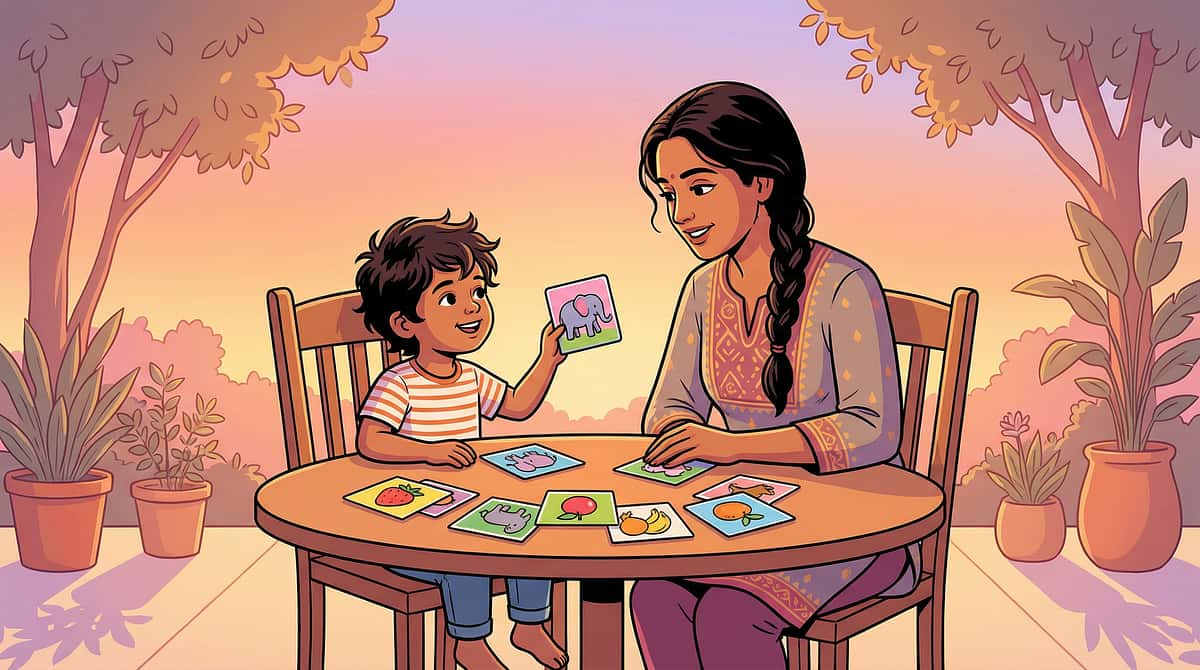
When Stories Don't Connect
"What happened in the story?" The ending comes first. The beginning is forgotten. The middle is a mystery.
You've watched it happen. You read your child a beautiful story — a cat, a tree, an adventure. Then you ask: "What happened?" And the ending tumbles out first. The beginning vanishes. The middle is a jumble of disconnected details. Their brain processes narrative differently. The invisible thread that connects "first, then, next, finally" — the thread that most children weave without thinking — your child needs help building. You are not failing. And there is a way to build that narrative thread, one story card at a time.
Pinnacle Blooms Network® Consortium
SLP • SpEd • ABA • OT • NeuroDev
You Are Not Alone: The Numbers
You are among millions of families worldwide navigating this exact challenge. Story sequence difficulty is not rare, not unusual, and — critically — not permanent. It is one of the most responsive language skills to structured, visual intervention.
50–80%
Narrative Deficits in Autism
Of children with autism show measurable deficits in narrative comprehension and retelling ability, with story sequencing among the most commonly affected language skills.
7in10
Parents Report This Challenge
Parents of children with developmental differences report their child struggles to retell even simple stories in order — yet most don't know this is a treatable skill.
54
Countries Implement WHO CCD
Implement the WHO Care for Child Development Package, which identifies narrative understanding as a critical developmental milestone requiring targeted support when delayed.
Source: PMC9978394 | WHO/UNICEF CCD Package (2023) | Systematic reviews on narrative development in ASD
What's Happening in Your Child's Brain
The Neuroscience
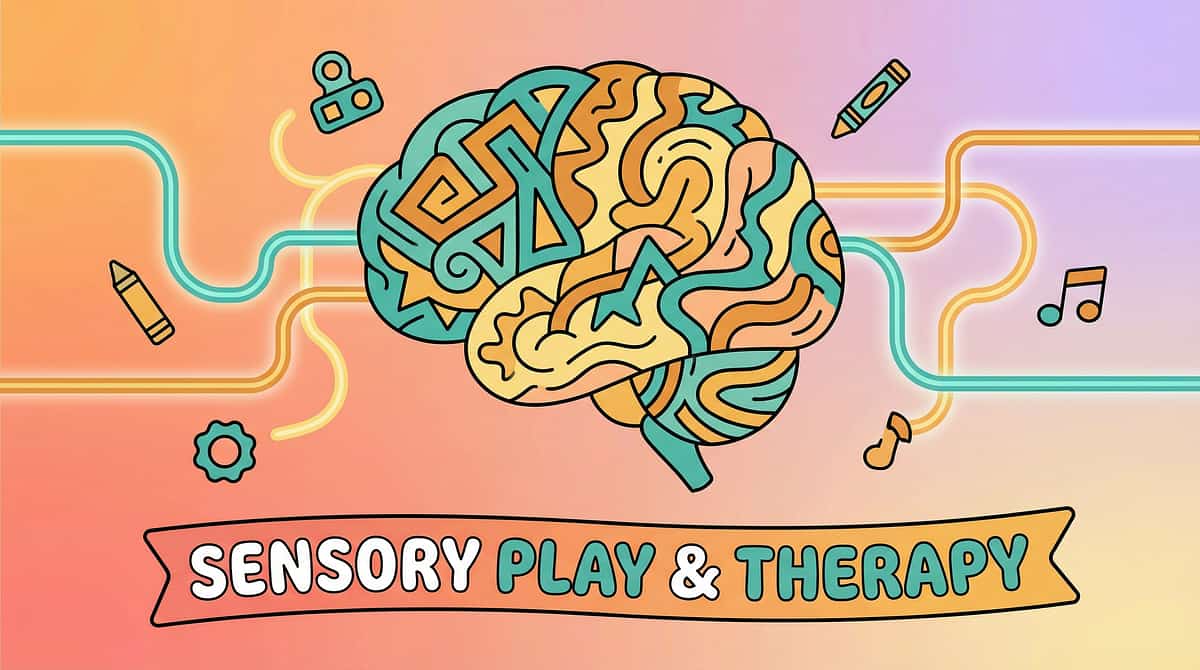
Multiple brain regions must work together simultaneously when your child hears a story. For children with autism and developmental differences, this connection often processes differently.
In Plain English
The temporal lobe processes words and their meaning — your child hears the language just fine.
The prefrontal cortex must organise these events into a sequence — first, then, next, finally — and hold them in working memory.
The connection between these regions is where narrative comprehension lives. The words arrive, but they don't automatically arrange themselves into a logical story thread.
This is a wiring difference, not an intelligence difference. Your child may remember every detail of the story — but the order of those details doesn't organise itself the way it does for neurotypical peers.
The intervention: make the invisible sequence visible. Give the brain an external scaffolding system — picture cards, story maps, graphic organizers — until the internal narrative thread strengthens.
Reference: Frontiers in Integrative Neuroscience (2020) — DOI: 10.3389/fnint.2020.556660
Where This Sits in Development
Children with autism often show 2–4 year delays in narrative sequencing — a child of 6 may process stories like a typically developing 3-year-old. This is not a ceiling. With explicit visual teaching, these skills build systematically.
1
Ages 2–3
Simple two-part sequences ("first-then"). Understands "what happened" in familiar routines.
2
Ages 4–5
Beginning-middle-end understanding emerges. Can retell simple stories with prompting.
3
Ages 5–6
Cause-effect connections in stories. Understands "why" characters act as they do.
4
Ages 6–7
Complex plot comprehension. Multiple character perspectives begin to emerge.
5
Ages 7–8
Inferencing and prediction. Story grammar fully operational.
6
Ages 8–12
Abstract narrative understanding. Personal narrative construction.
Reference: WHO Care for Child Development (CCD) Package | PMC9978394 | UNICEF MICS developmental monitoring indicators

The Evidence Behind This Technique
★★★★☆ Strong Evidence — Level I–II
Key Finding: Systematic reviews confirm that narrative-based language interventions using visual supports significantly improve story comprehension, sequencing ability, and retelling accuracy in children with autism spectrum disorder. Multiple RCTs demonstrate that explicit teaching of story grammar through visual scaffolding produces measurable, lasting gains.
PRISMA Systematic Review (2024)
16 articles from 2013–2023 confirm structured language interventions meet evidence-based practice criteria for children with ASD. PMC11506176
Meta-Analysis (World J Clin Cases, 2024)
Intervention effectively promoted social skills, adaptive behaviour, and language processing across 24 studies. PMC10955541
Indian RCT (2019)
Home-based structured interventions demonstrated significant outcomes when parents were trained in delivery protocols. DOI: 10.1007/s12098-018-2747-4
WHO CCD Package (2023)
Caregiver-mediated interventions identified as the delivery model with strongest evidence for developmental skill building. PMC9978394
Clinically validated. Home-applicable. Parent-proven.
The Technique: Story Sequence Understanding
Parent-Friendly Alias: "Building the Story Thread"
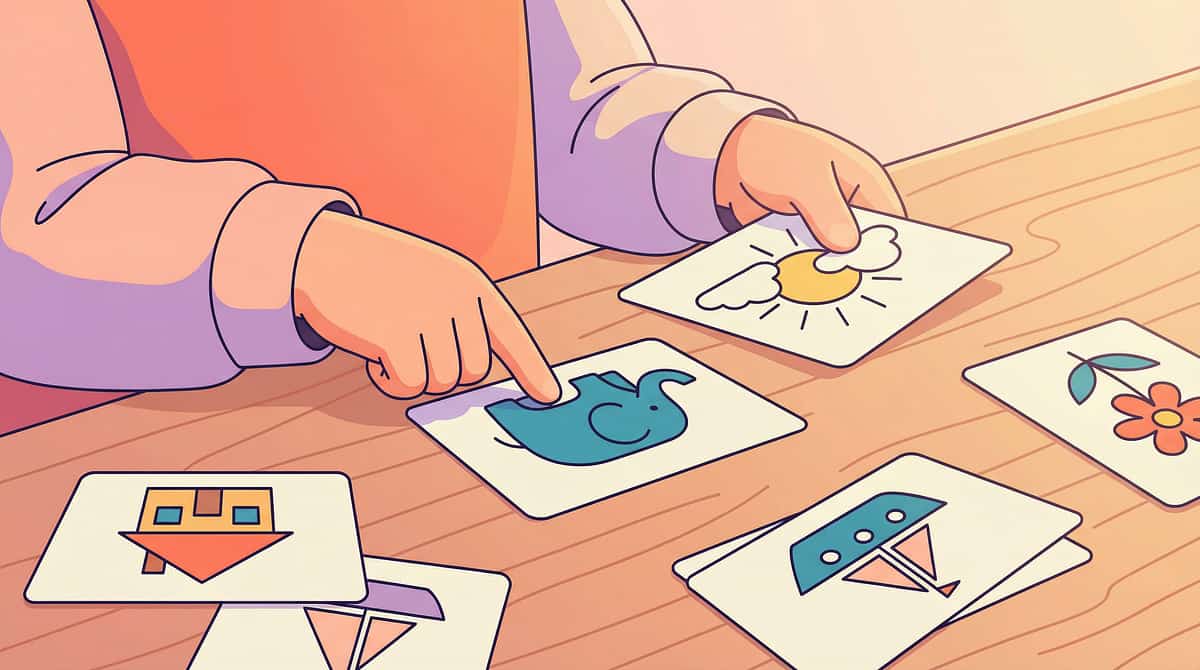
Story Sequence Understanding is a structured language and cognitive intervention that teaches children to recognise, order, and retell narrative events in their logical sequence. Using visual supports — picture cards, story maps, graphic organisers, props, and sorting activities — the invisible structure of narrative becomes visible and manipulable.
Children learn to identify beginning, middle, and end; understand cause-and-effect within stories; recognise character motivations; and construct their own coherent narratives. This is not reading instruction. This is comprehension architecture — building the mental framework that organises language into meaning.
1
Domain
B: Language & Cognition — Narrative Sequencing Materials
2
Age Range
3–12 years
3
Session Duration
10–20 minutes
4
Frequency
3–5× per week
Series: Language & Literacy Development Solutions — Episode B-163 | Domain Code: LANG-NARR
Who Uses This Technique
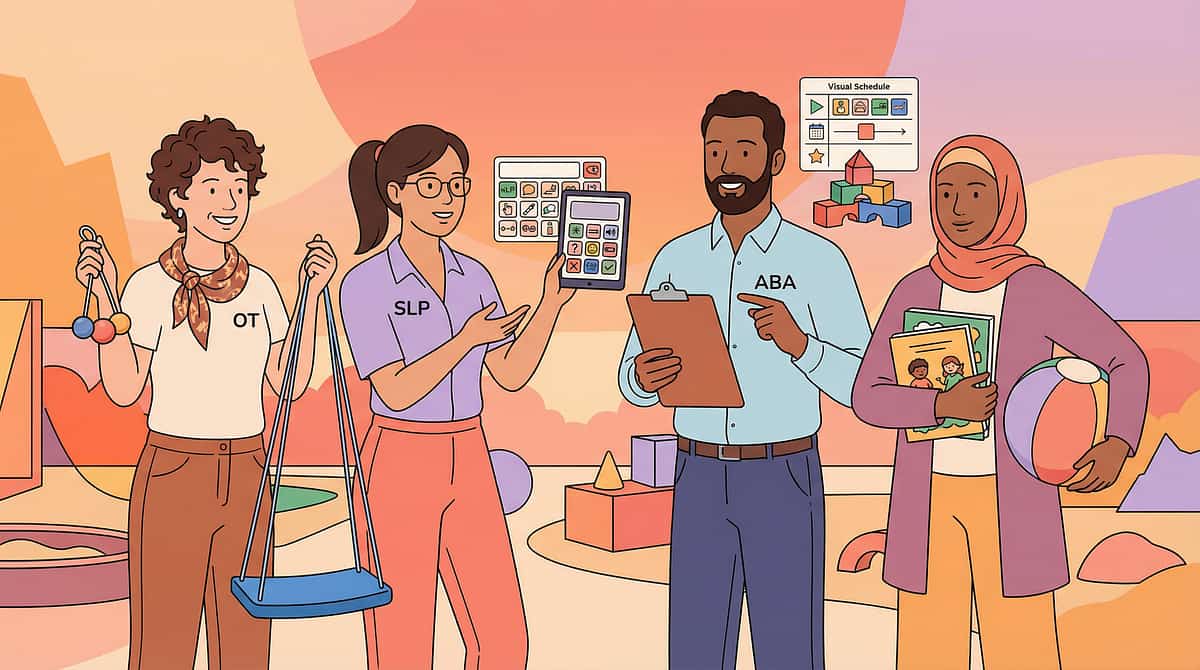
This technique crosses therapy boundaries because the brain doesn't organise by therapy type. Four disciplines collaborate to deliver complete narrative intervention.
Speech-Language Pathologist (SLP)
Primary Lead. Story comprehension and retelling are core SLP targets. SLPs use narrative-based interventions to build story grammar, sequencing vocabulary ("first," "then," "next," "finally"), and connected discourse.
Special Educator (SpEd)
Secondary. Uses story sequencing as a bridge to reading comprehension, written expression, and academic language. Story maps become tools for literature analysis and content understanding.
Board Certified Behaviour Analyst (BCBA)
Secondary. Applies discrete trial training and chaining procedures to teach sequencing steps. Uses reinforcement strategies to motivate story retelling and shape increasingly complex narratives.
Occupational Therapist (OT)
Supporting. Addresses fine motor and visual-perceptual components of card manipulation, sorting activities, and graphic organiser completion. Integrates sensory regulation during story-based sessions.
Reference: Adapted UNICEF/WHO Nurturing Care Framework for SLPs (2022) — DOI: 10.1080/17549507.2022.2141327
What This Technique Targets
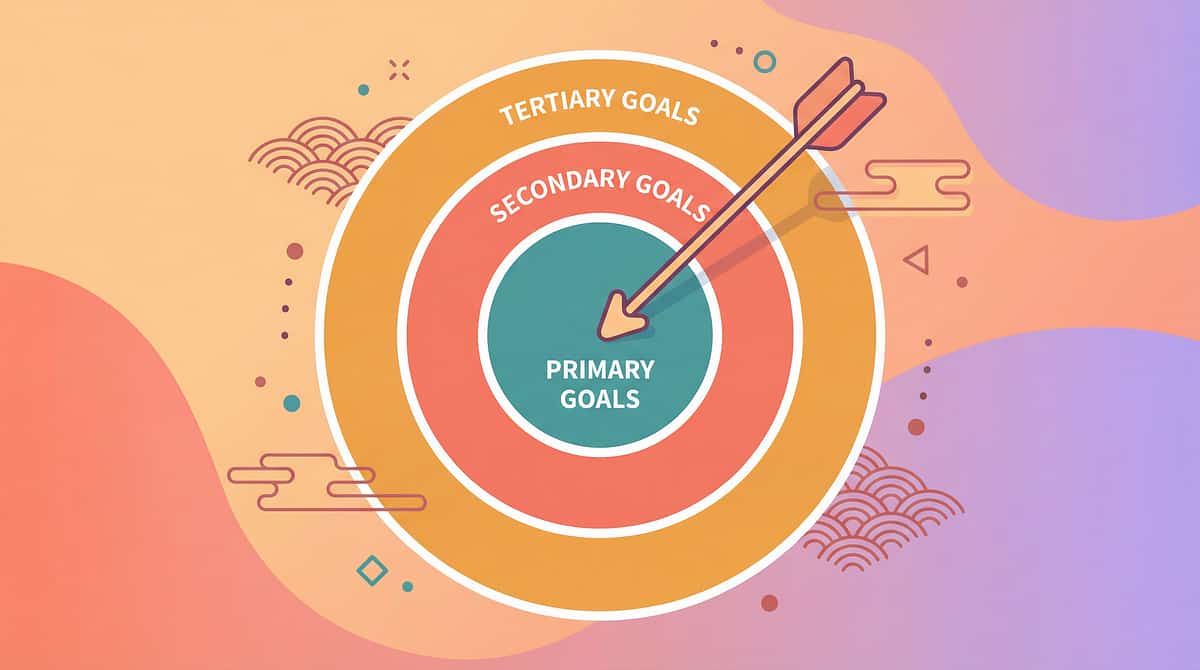
🎯 Primary Target
Narrative Sequencing — The ability to understand and retell story events in their correct temporal order. Observable indicator: child arranges 3–6 picture cards in correct sequence and verbalises the story.
Secondary & Tertiary Gains
- Story comprehension: who, what, where, when, why
- Cause-effect reasoning within stories
- Temporal language: first, then, next, after, finally
- Retelling fluency with adequate detail
- Reading comprehension across all subjects
- Social understanding and working memory
- Executive function and personal narrative construction
Reference: PMC10955541 — Meta-analysis confirming multi-domain developmental gains from structured language intervention
The 9 Materials: Overview
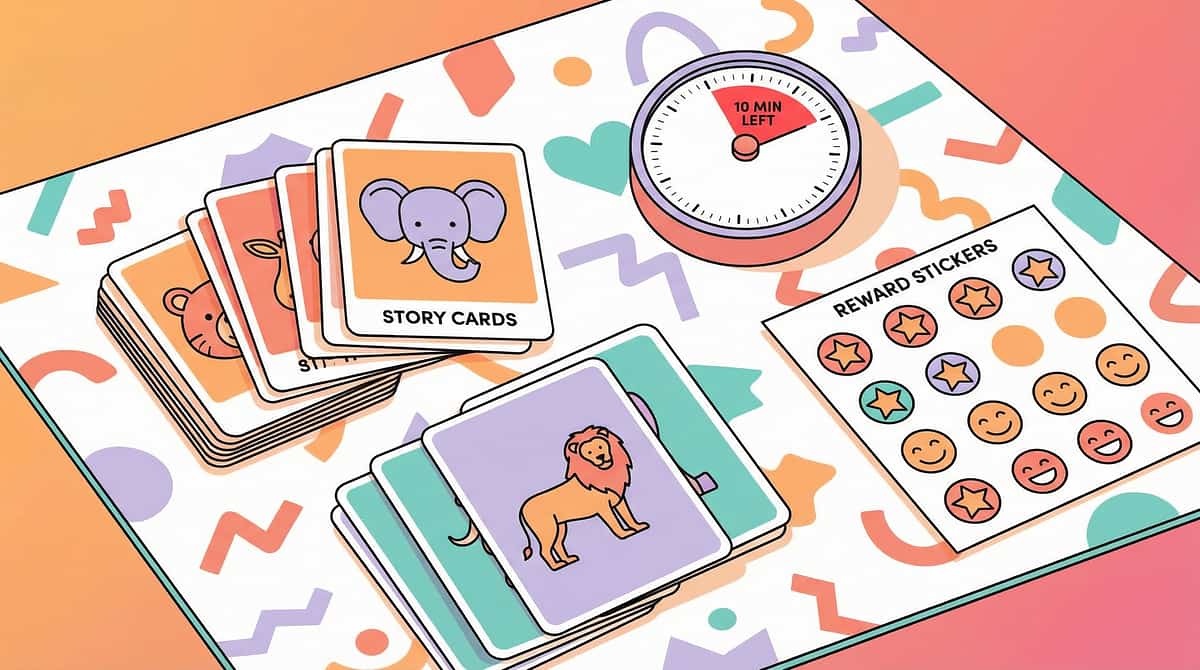
Nine carefully chosen materials form the complete Story Sequence Understanding toolkit. Together they create a comprehensive visual scaffolding system that externalises narrative structure for your child's developing brain.
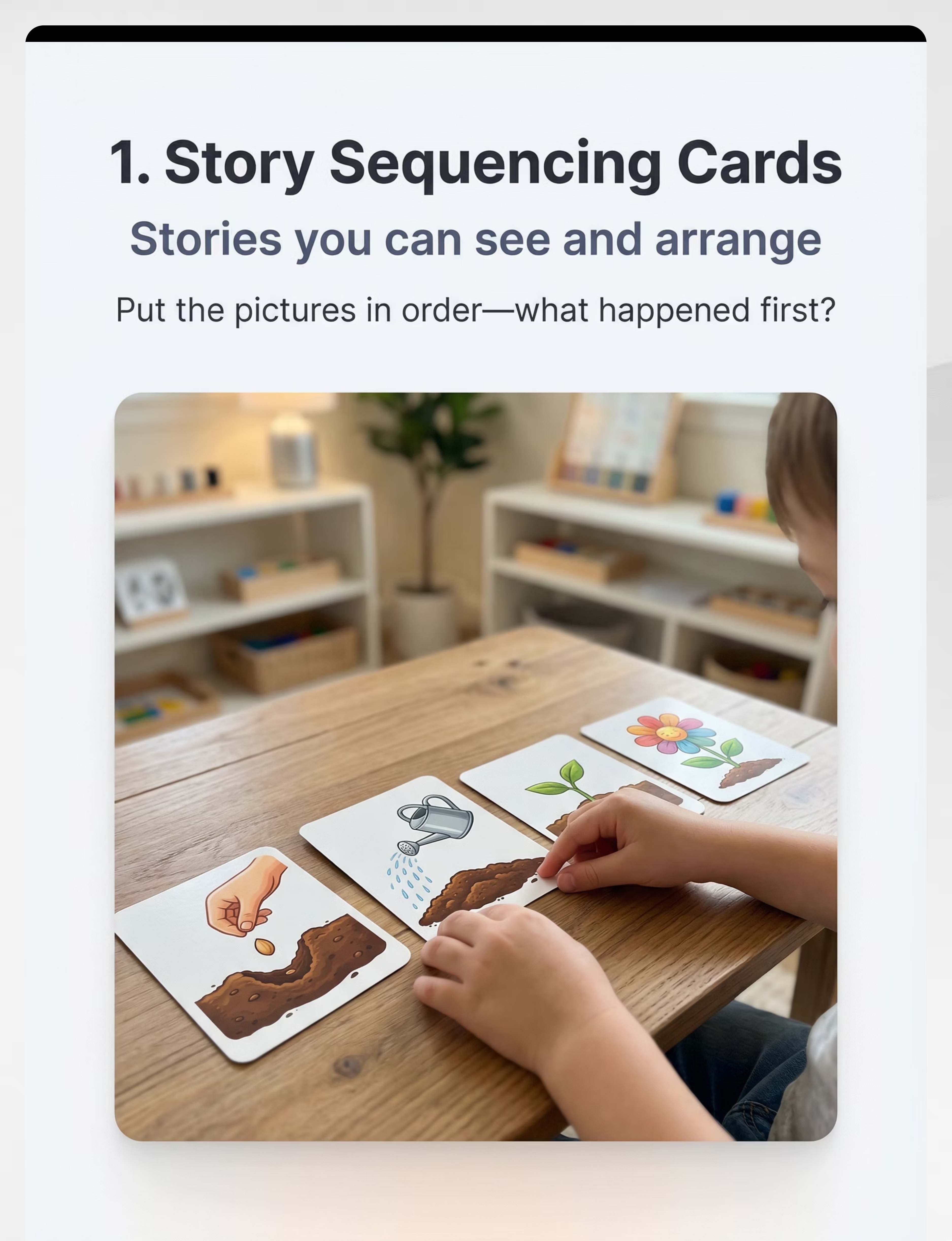
#1 Picture Story Sequencing Cards
₹400–1,500 | Visual story events children arrange in order — first, then, next, last.
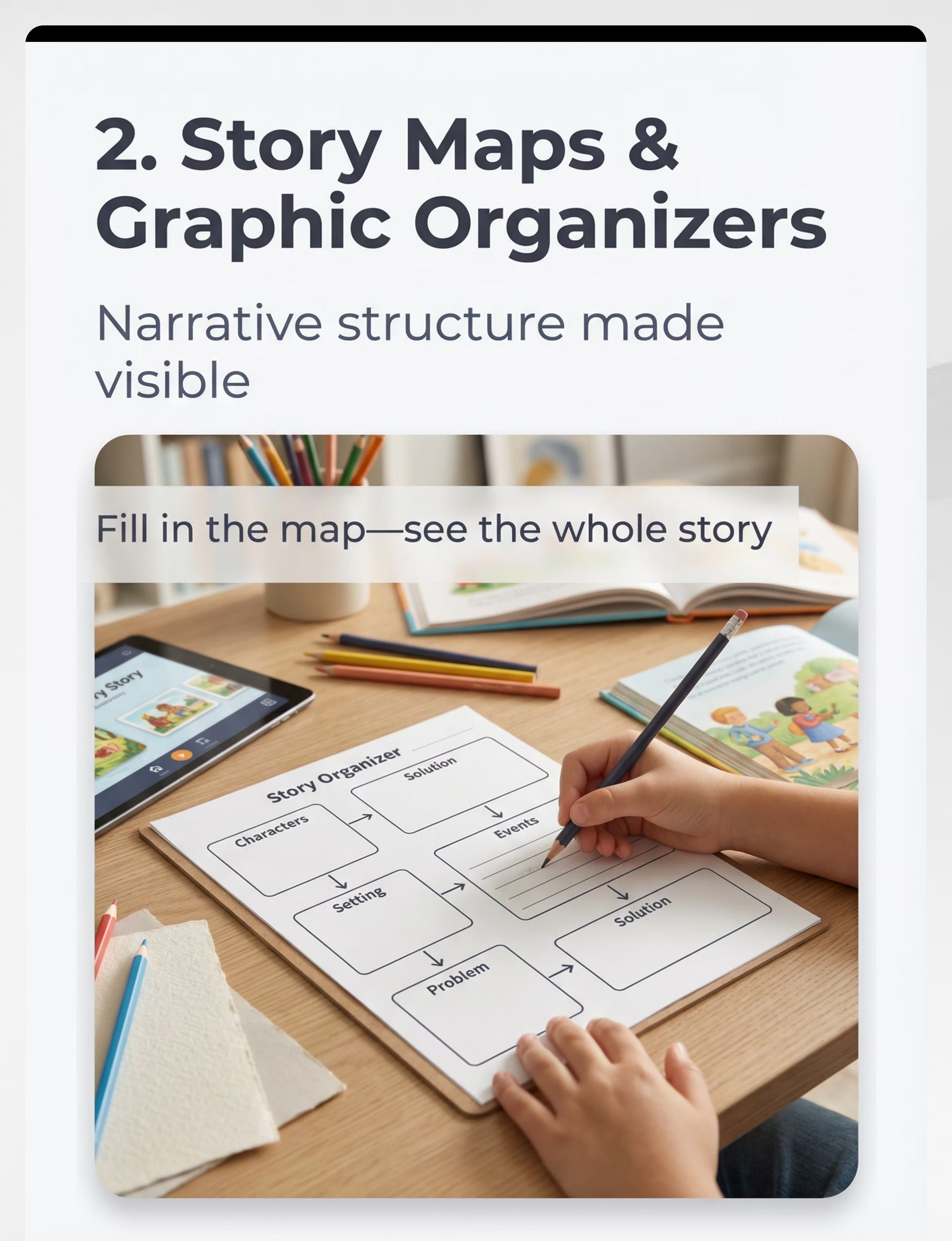
#2 Story Maps & Graphic Organisers
₹200–800 | Visual templates showing story parts — who, where, what happened, how it ended.
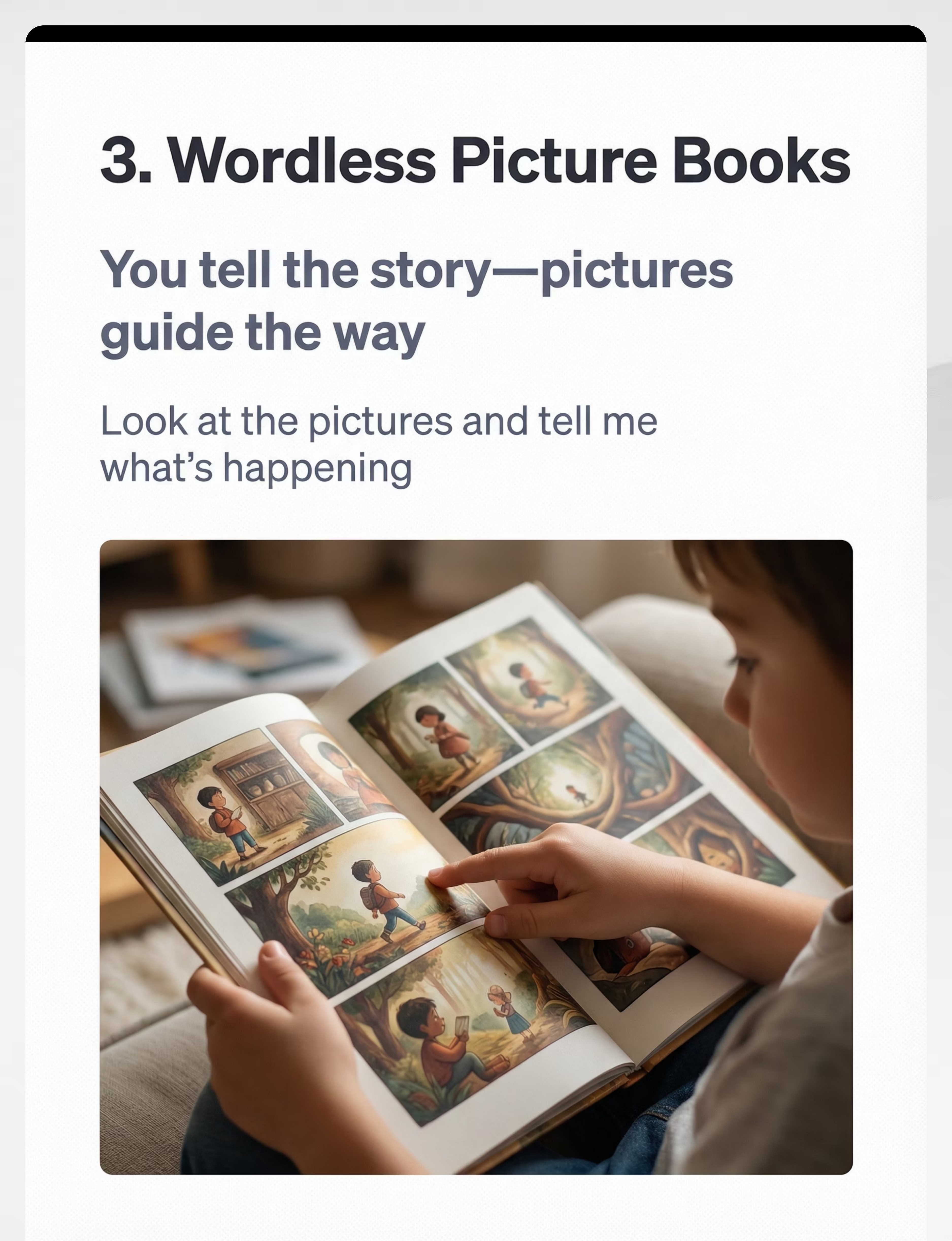
#3 Wordless Picture Books
₹300–1,000 | Image-only books where children become the storytellers.
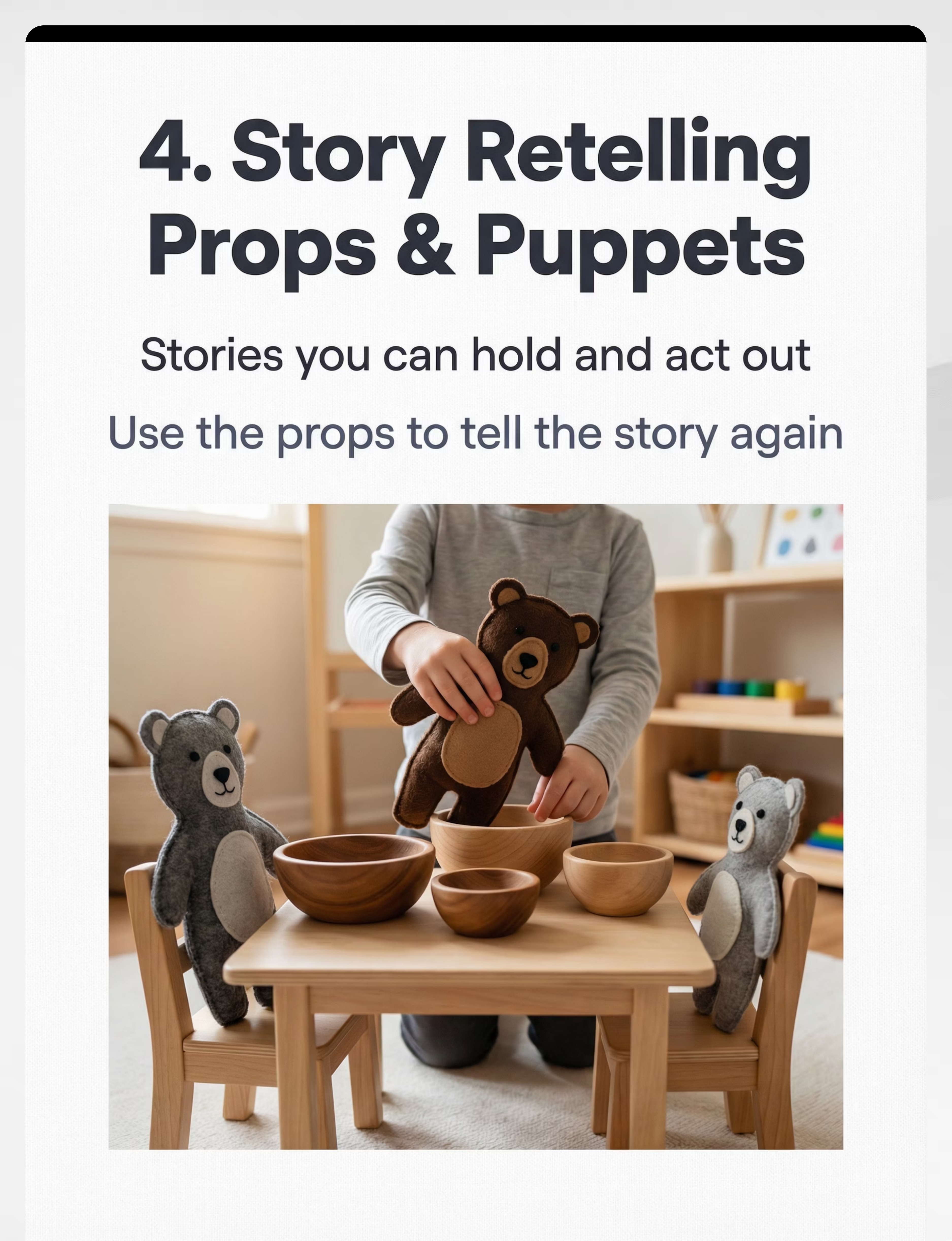
#4 Story Retelling Props & Puppets
₹500–2,000 | Tangible props for acting out familiar tales through play.
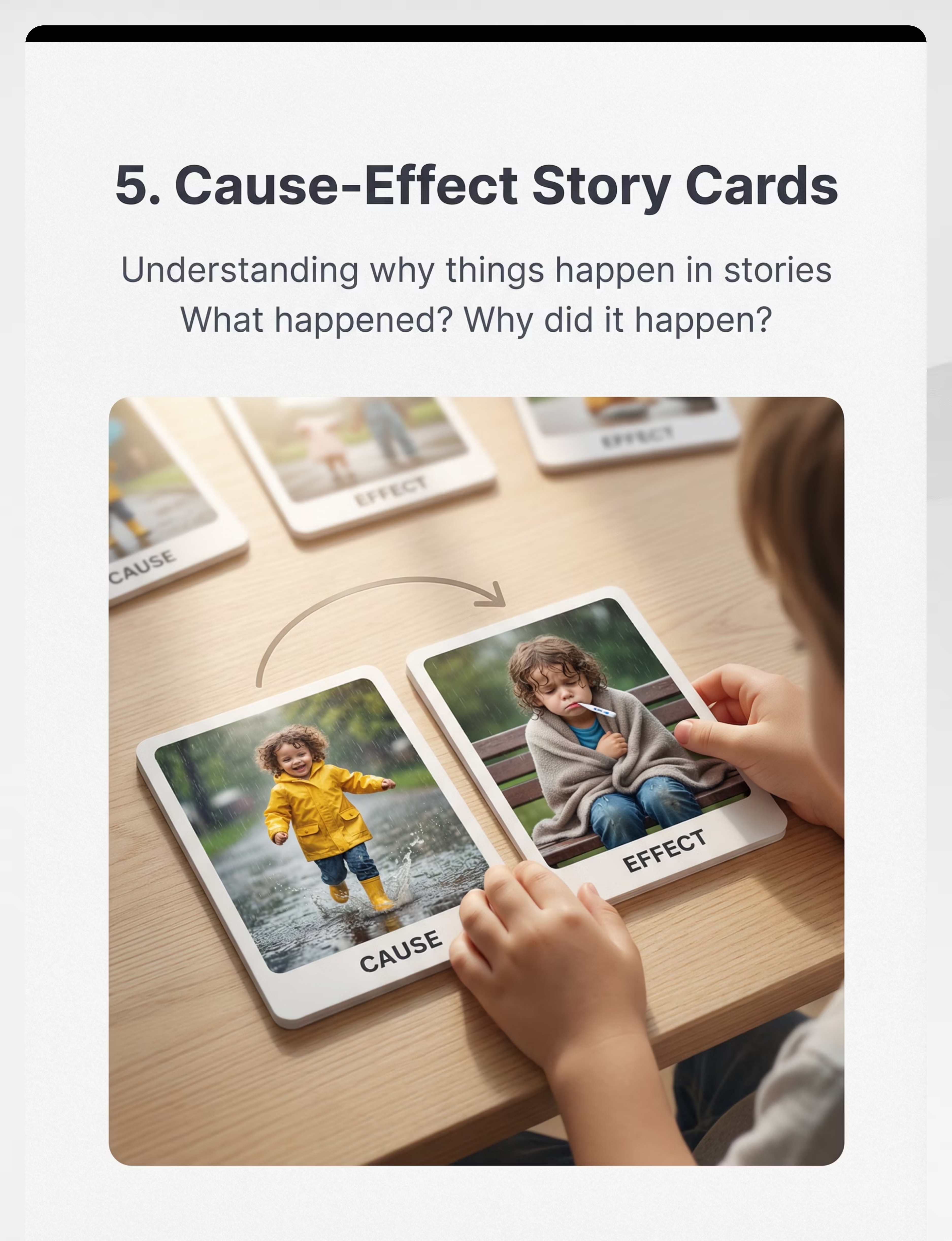
#5 Cause-Effect Story Cards
₹400–1,200 | Paired cards showing causes and their effects in visual format.
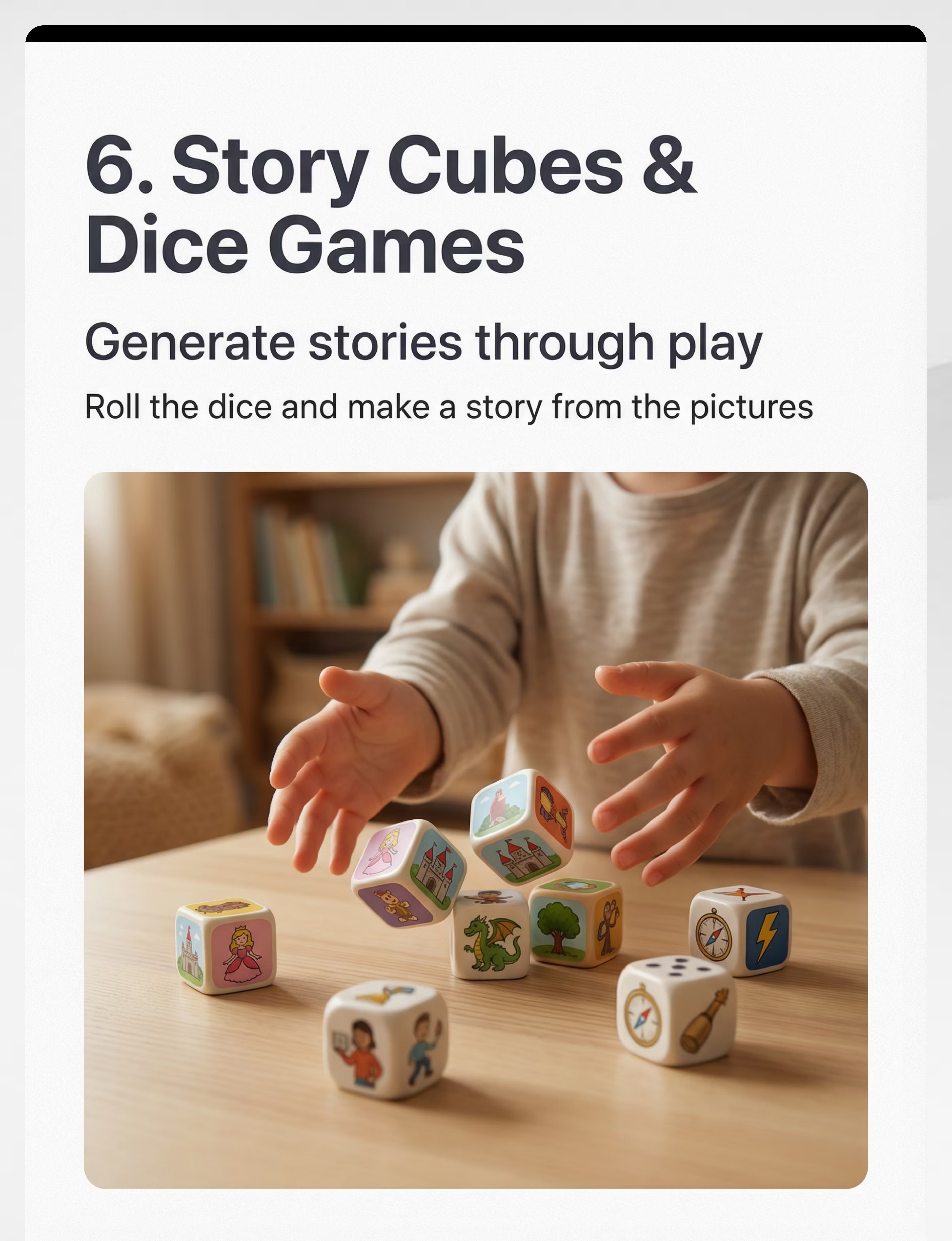
#6 Story Cubes & Dice Games
₹300–900 | Dice with story elements — roll and create a tale from what appears.
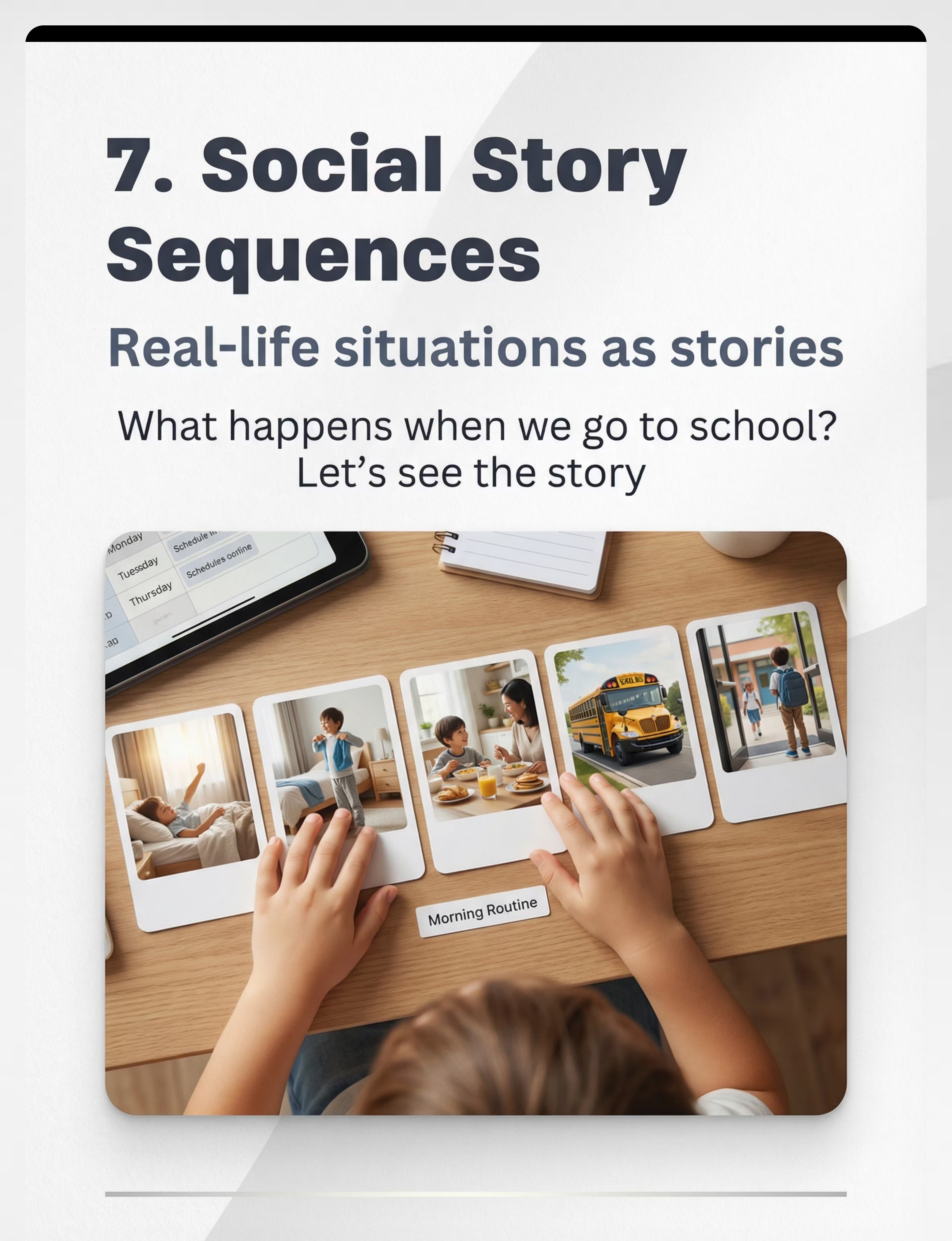
#7 Social Story Sequences
₹400–1,200 | Everyday social situations presented as sequenceable stories.
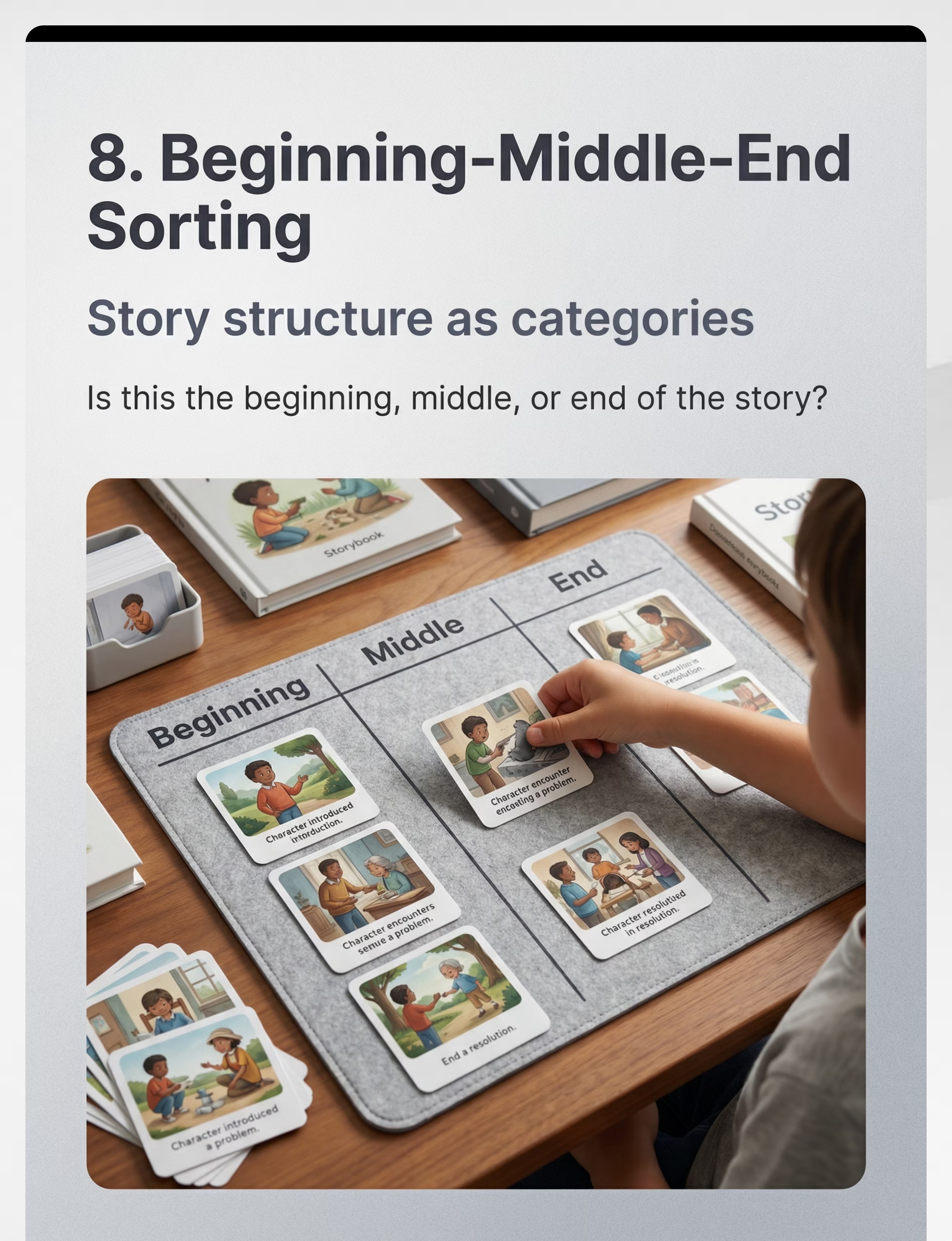
#8 Beginning-Middle-End Sorting
₹300–900 | Sorting games for categorising story events into structural parts.
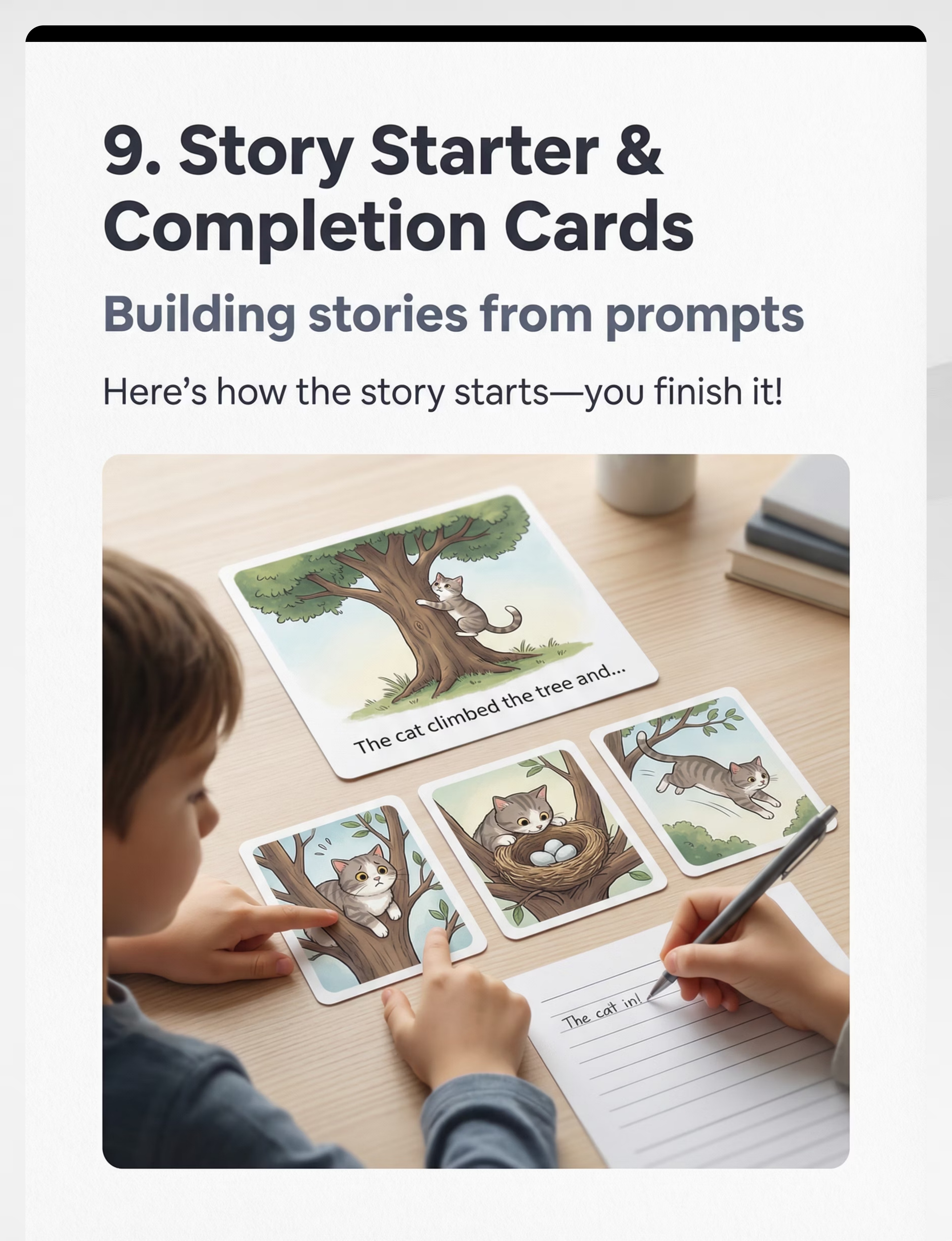
#9 Story Starter & Completion Cards
₹300–800 | Story beginnings that children complete — building narrative continuation.
Total Setup: ₹3,100–10,300 for a comprehensive kit. Essential Starters: Picture Sequencing Cards + Story Maps + BME Sorting = ₹900–3,200.
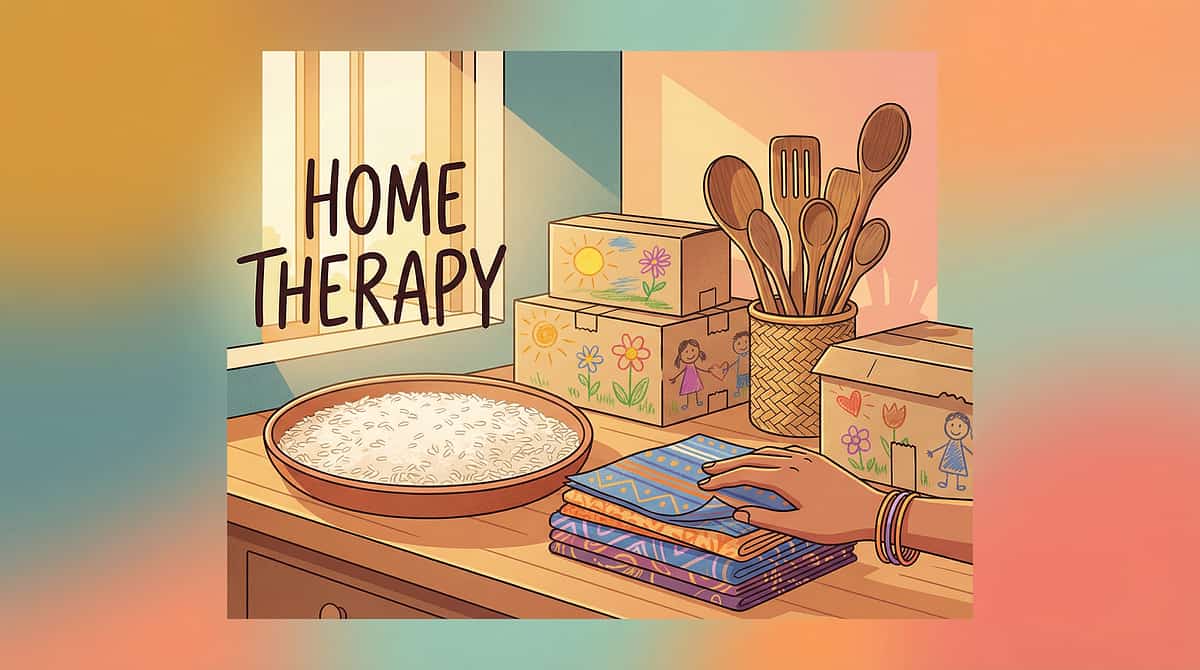
DIY & Zero-Cost Alternatives
Not every family can order from Amazon. Not every village has same-day delivery. Every parent, regardless of economic status, can execute this technique TODAY with household items. This is the WHO/UNICEF inclusion principle in action.
Buy This | Make This (Zero Cost) | |
Picture Sequencing Cards | Print photos of familiar daily routines — morning sequence, cooking, going to the park. Cut into cards. | |
Story Maps & Graphic Organisers | Draw on chart paper: boxes labelled "Who?" "Where?" "What Happened?" "How Did It End?" Fill in together after any story. | |
Wordless Picture Books | Photograph your child's day in 4–6 sequential photos. Print as a mini book. Child narrates each picture. | |
Story Retelling Props & Puppets | Gather household items matching familiar stories. Make sock puppets. Use kitchen utensils as props. | |
Cause-Effect Story Cards | Create photo pairs: one showing action (dropping a glass), one showing result (broken glass on floor). | |
Story Cubes | Draw pictures on paper cubes — characters on one, places on another, actions on a third. Roll and build. | |
Social Story Sequences | Photograph actual routine steps — getting ready for school, visiting grandparents. Create sequence strips. | |
BME Sorting Activities | Make three columns on paper: Beginning, Middle, End. After any story, sort what happened into the right column. | |
Story Starter Cards | Write story starters on index cards: "One day a cat found a magic box..." Have child tell what happens next. |
Why substitutes work: The therapeutic principle is the visual externalisation of sequence — whether the cards cost ₹1,500 or ₹0, the brain processes the organisational scaffolding the same way.
Reference: PMC9978394 | WHO NCF Handbook (2022) — equity-focused, context-specific intervention design
Safety First: Before You Begin
A safe, well-prepared session is the foundation of effective intervention. Review these indicators before every session — they take less than 60 seconds and prevent the majority of session failures.
1
🔴 Do NOT Use When
- Child is in active meltdown or sensory overload
- Child has not eaten in 3+ hours or shows fatigue
- Child is ill, in pain, or on new medication affecting alertness
- Major routine disruption within 24 hours
2
🟡 Material Safety
- Choking hazard: supervise children under 4 with small cards and dice
- Laminate homemade cards or use cardstock with rounded edges
- Start with 3-step sequences — overwhelm kills engagement
- Present only 3–4 cards at a time for young children
3
🟢 Environmental Requirements
- Quiet space with minimal distractions
- Flat table surface at child's comfortable height
- Parent seated beside child, not across
- Good lighting on the cards and materials
🔴 Stop Immediately If: Child begins crying, hitting, or throwing materials | Child covers ears or eyes | Regression in previously mastered skills | Persistent refusal across 3+ sessions.
Reference: DOI: 10.1007/s12098-018-2747-4 — Home-based intervention safety protocols
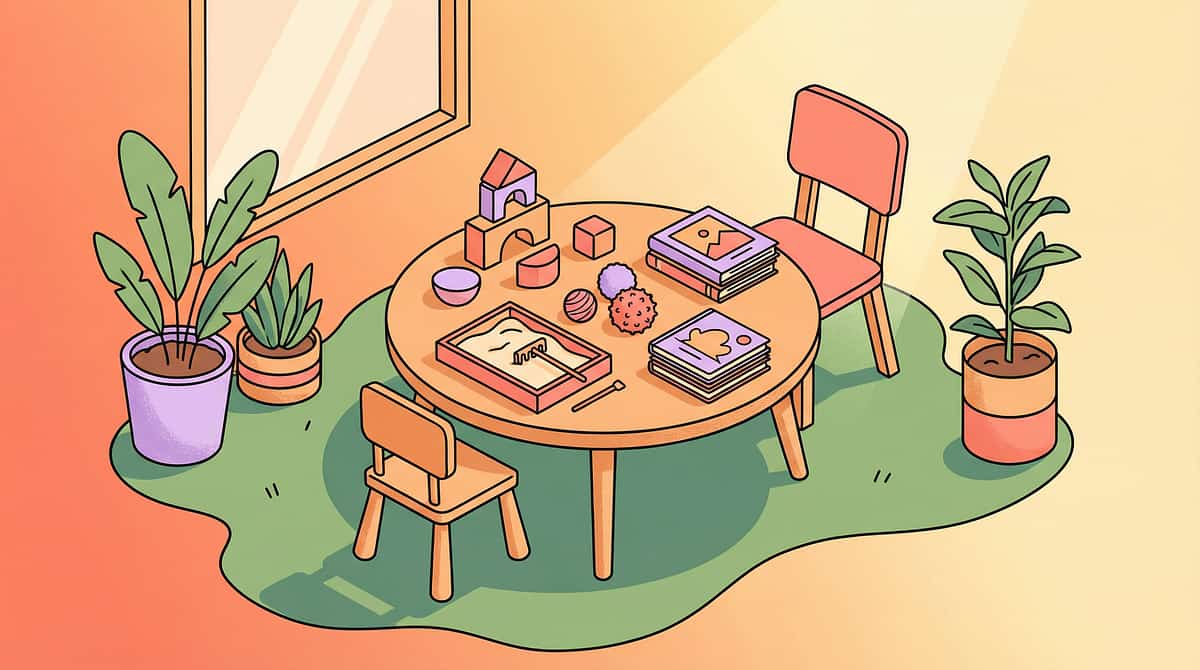
Set Up Your Space
Spatial precision prevents 80% of session failures.
1
Child's Position
Seated comfortably at table, feet touching floor or footrest. Eye-level with the cards.
2
Parent's Position
Beside the child (NOT across). Same viewing angle. Close enough for gentle hand-over-hand prompting if needed.
3
Materials Centre
Story cards face-down in a pile. Only the cards needed for THIS session — remove extras.
4
Story Map in Front
If using a graphic organiser, place it where both parent and child can see and reach it easily.
5
Props Accessible
If using puppets or retelling props, keep in a basket to the side. Introduce only when the protocol calls for them.
Remove From Space: Other toys, tablets, screens, siblings (unless participating), food, loud appliances, TV, radio.
Reference: PMC10955541 — Meta-analysis confirming structured environment as critical for intervention effectiveness
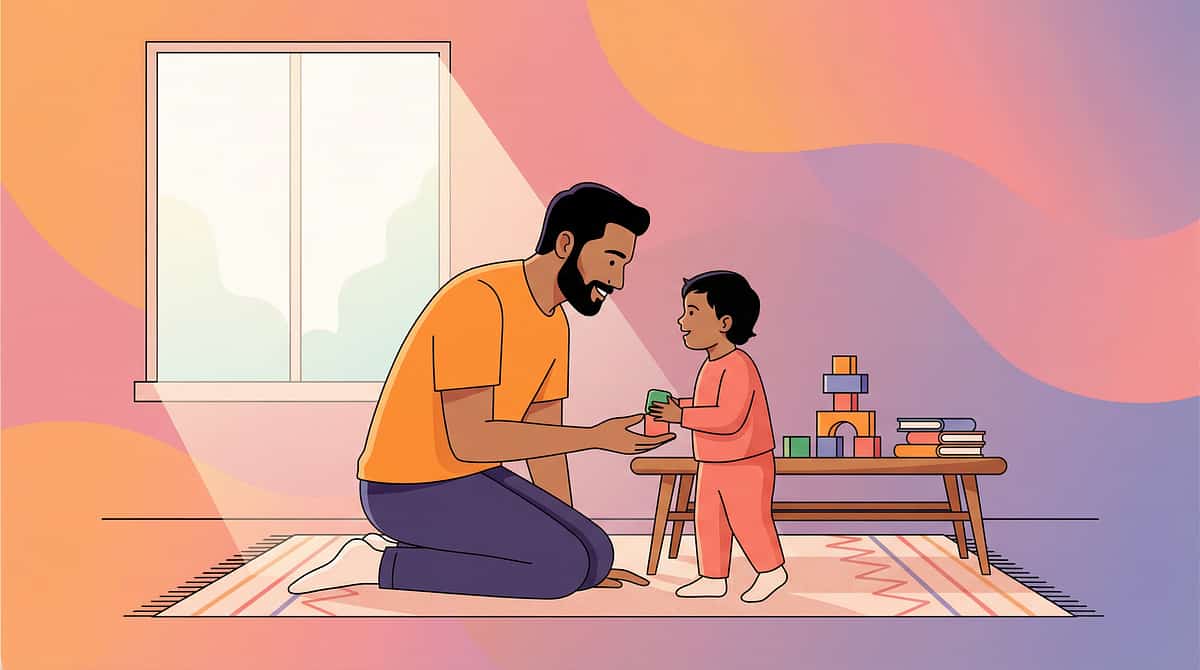
Is Your Child Ready? Pre-Flight Check
Run this 60-second assessment before every session. The right moment matters more than the right materials.
# | Indicator | Check | |
1 | Child has eaten within the last 2 hours | ✅ / ❌ | |
2 | Child has slept adequately — no visible fatigue | ✅ / ❌ | |
3 | Child is in a regulated state: calm, alert, not agitated | ✅ / ❌ | |
4 | No meltdown in the last 30 minutes | ✅ / ❌ | |
5 | No signs of illness or physical discomfort | ✅ / ❌ | |
6 | Child shows willingness to come to the table (not forced) | ✅ / ❌ | |
7 | Environment is set up per the Space Setup card | ✅ / ❌ |
All ✅ → GO
Begin with Step 1: The Invitation.
1–2 ❌ → MODIFY
Start with only 2 cards (first/last). Keep session under 5 minutes. Increase reinforcement frequency.
3+ ❌ → POSTPONE
Offer a preferred calming activity instead. Try again tomorrow. A postponed session is wisdom, not failure.
"The best session is one that starts right." — Reference: ABA antecedent manipulation principles | Pinnacle clinical session protocols
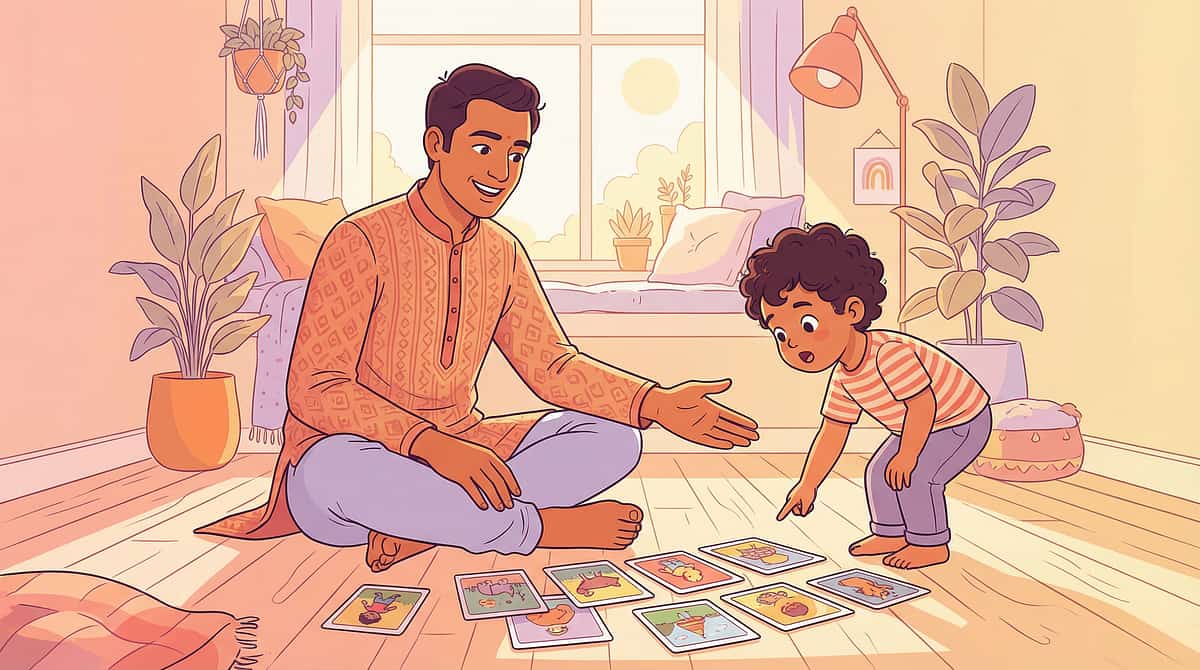
Step 1: The Invitation
STEP 1 of 6
Timing: 30–60 seconds
Say This: "Look what I have! A story puzzle! Let's see if we can figure out what happens. Want to look at the pictures with me?"
Body Language
- Smile. Lean in slightly toward the child.
- Hold the first card up with genuine curiosity — like YOU want to discover the story too.
- Place cards face down with a sense of playfulness.
- Do NOT instruct. Invite.
What Acceptance Looks Like
- Child reaches for a card
- Child looks at the cards with interest
- Child moves closer to the table
- Child says "okay" or any affirmative response
What Resistance Looks Like & How to Modify
- Looks away → Place one interesting card face-up and describe it excitedly
- Pushes cards away → Use a puppet instead: "Mr. Bear wants to tell you a story..."
- Says "no" → Respect it. "Okay! Maybe later." Try again in 30 minutes.
Reference: ABA pairing procedures + OT "just-right challenge" principle
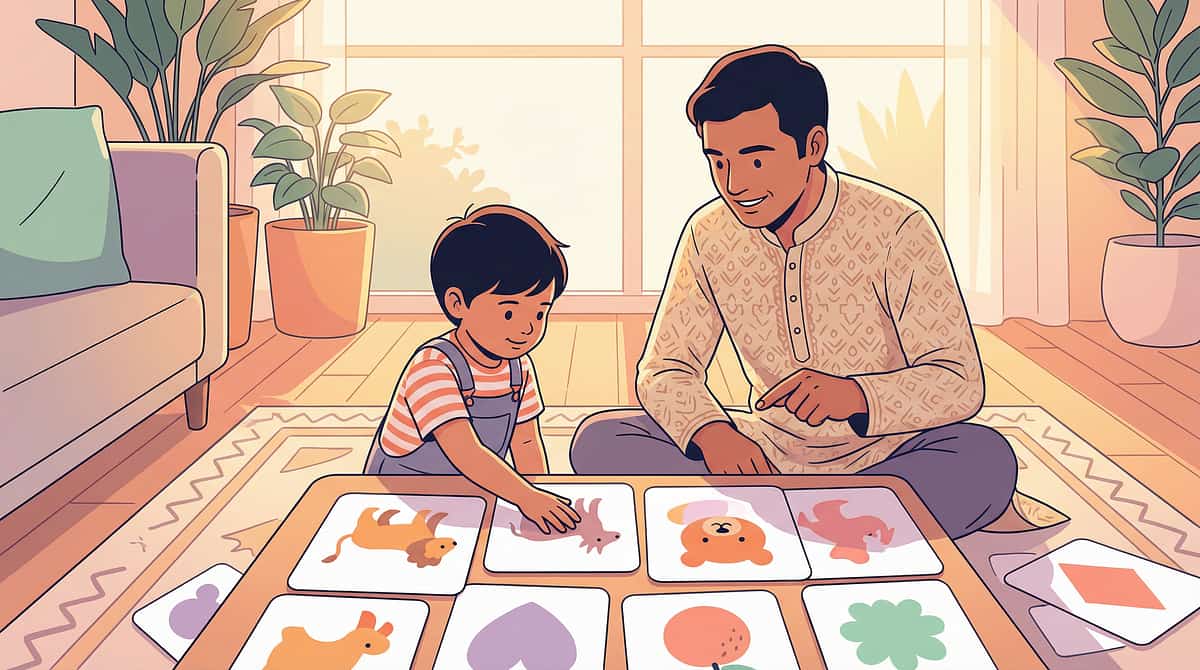
Step 2: The Engagement
STEP 2 of 6
Timing: 1–3 minutes
Say This: "Let's turn over the first card together! What do you see? [pause] Wow! A boy is planting a seed! What do you think happens next?"
Turn Over ONE Card at a Time
Not all at once. Hold the card at the child's eye level. Point to key details. Use an animated voice — this is discovery, not testing.
Read the Child's Response Spectrum
Engaged: Child looks, points, labels, attempts to narrate → Continue. Tolerating: Brief looks, no speech but no resistance → Describe the card yourself. Avoiding: Looks away or starts a different activity → Pause and re-engage with the most interesting card.
Reinforce Immediately
When the child says ANYTHING about a card: immediate specific praise. "Yes! You're right, he IS planting a seed! Great looking!"
Reference: PMC11506176 — Structured material introduction meets evidence-based practice criteria
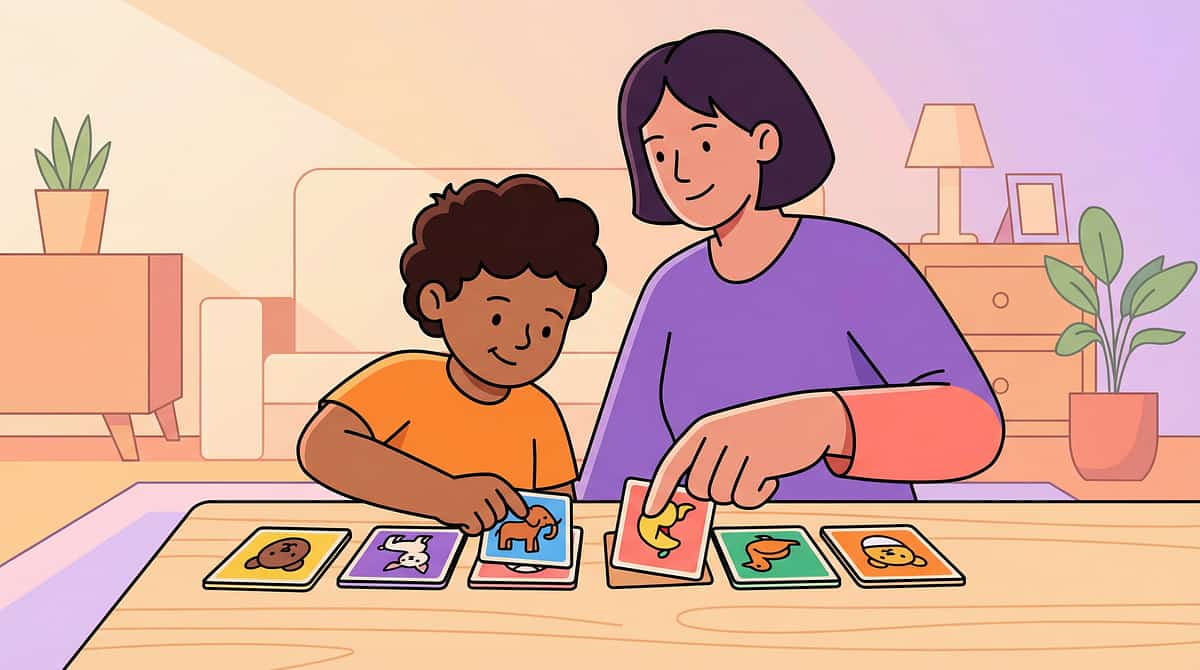
Step 3: The Therapeutic Action
STEP 3 of 6
Duration: 5–10 minutes
The core sequencing activity forms 40–60% of session time. Adjust the protocol level to your child's current stage.
1
Ages 3–5: 3-Step Sequences (Beginners)
- Place 3 cards face-up in RANDOM order
- Point to each card and name what's happening
- Ask: "Which happened FIRST?" Guide child to place it on the left
- Ask: "What happened NEXT?" Guide to the middle position
- Retell together: "FIRST the boy planted. THEN he watered. LAST the flower grew!"
2
Ages 5–8: 4–6 Step Sequences (Intermediate)
- Introduce sequence words: "First, Then, Next, After that, Finally"
- Lay out all cards randomly
- Ask child to find the beginning: "What happened at the very start?"
- Build the sequence left to right
- Child retells the full story using sequence words
3
Ages 6–12: Story Map Integration (Advanced)
- Read or tell a short story together
- Open the story map template
- Fill in: Characters → Setting → Problem → Events → Solution
- Child retells using only the story map as a guide
Common Errors & Corrections: Cards placed randomly → Point to two and ask "Which happened first?" | Child gets stuck → Offer two choices. | Retelling with missing events → Point to the skipped card: "What about this part?"
Reference: PMC10955541 — Session structure efficacy from meta-analysis
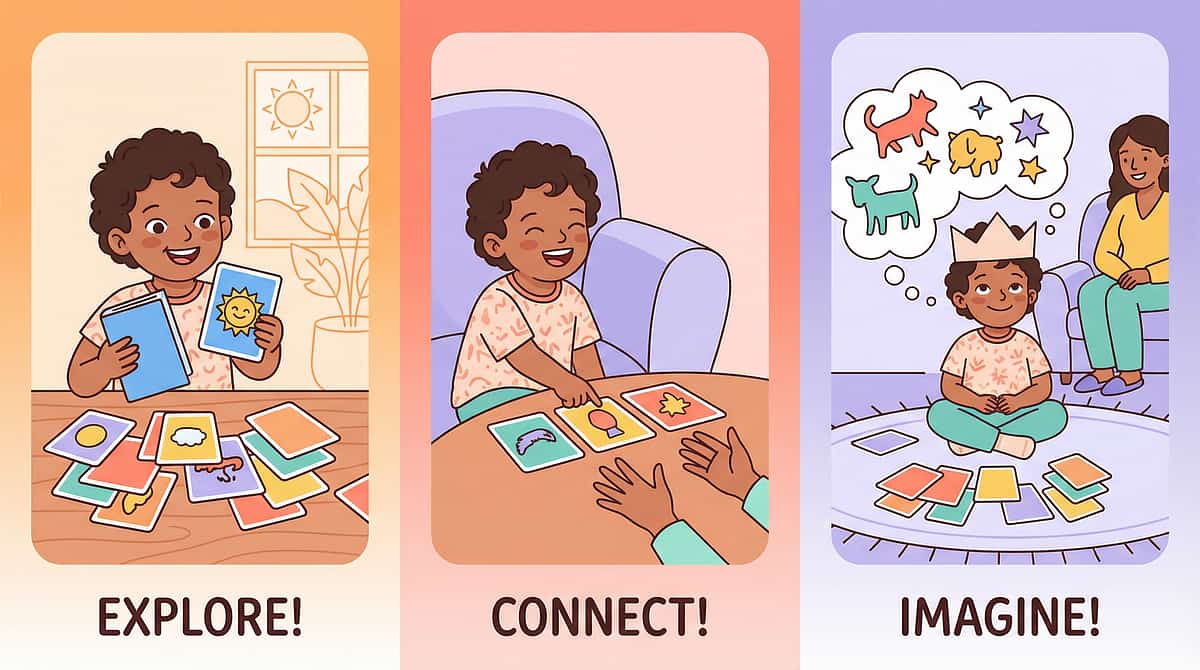
Step 4: Repeat & Vary
STEP 4 of 6
Timing: 3–5 minutes
Target: 2–4 different sequences per session (not the same story 4 times). Variation maintains engagement and builds generalisation.
Variation A — Switch Materials
First sequence with picture cards → Second with story cubes → Third with retelling props. Different tactile experiences engage different sensory pathways.
Variation B — Switch Modality
Sequence 1: child arranges → Sequence 2: child narrates while parent arranges → Sequence 3: parent narrates wrong order, child corrects.
Variation C — Difficulty Ladder
Start with a familiar 3-step → Progress to unfamiliar 3-step → Attempt a 4-step → Return to familiar for confidence.
Satiation Indicators — Stop When You See: Responses becoming shorter or stopping | Child fidgeting or looking away repeatedly | Quality of sequencing degrading | Child says "all done" or "no more."
"3 good repetitions are worth more than 10 forced ones."
"3 good repetitions are worth more than 10 forced ones."
Reference: Sensory integration dosage research — 2–3 sessions/week for 8–12 weeks as typical protocol
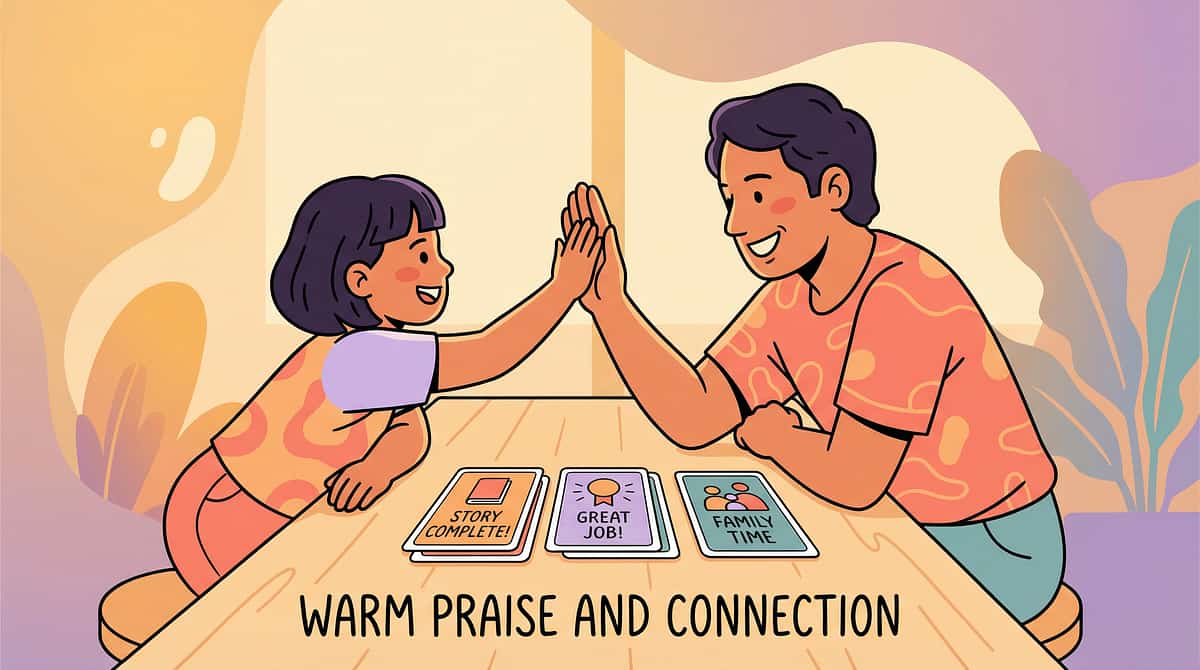
Step 5: Reinforce & Celebrate
STEP 5 of 6
After EACH correct placement:"You found what happened first! Amazing detective work!"
After completing a full sequence:"You told the WHOLE story! First [X], then [Y], then [Z]! You're a story builder!"
After retelling with sequence words:"Listen to you using 'first' and 'then' — that's exactly how storytellers tell stories!"
Timing
Within 3 seconds of the desired behaviour
Specificity
Name exactly what the child did right — not just "good job"
Celebrate the Attempt
Praise effort even when the order is wrong: "You're really thinking about this story!"
Reference: ABA reinforcement principles | BACB ethical guidelines
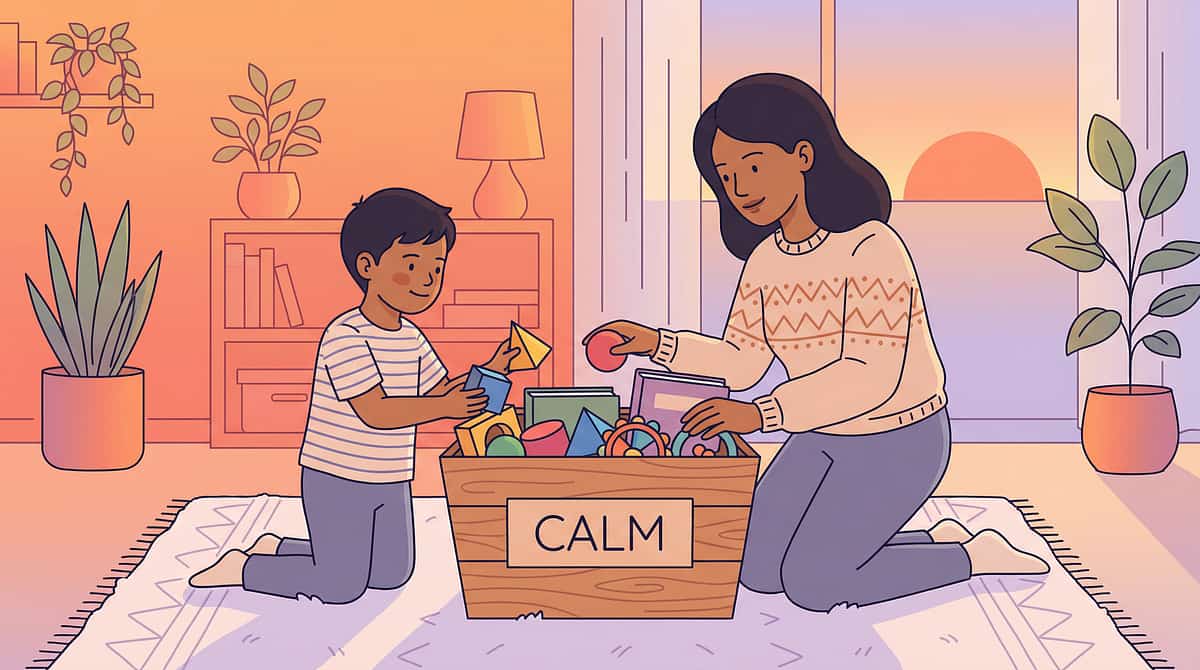
Step 6: The Cool-Down
STEP 6 of 6
A predictable, calm ending teaches the child that sessions have a safe, comfortable conclusion — making them more willing to start the next one.
Transition Warning
"Two more cards, and then our story time is all done for today!"
If the Child Resists Ending
"I know — stories are fun! We'll do more tomorrow. Which story do you want to start with tomorrow?" Offer a transition object: the child can carry one favourite card to the next activity.
Material Put-Away Ritual
Child participates in putting cards in the box. This is part of the sequence itself: Beginning (take out cards), Middle (tell stories), End (put cards away). The session itself becomes a sequencing lesson.
Complete the current sequence before stopping — never end mid-story.
Reference: NCAEP Evidence-Based Practices Report (2020) — Visual supports and transition strategies
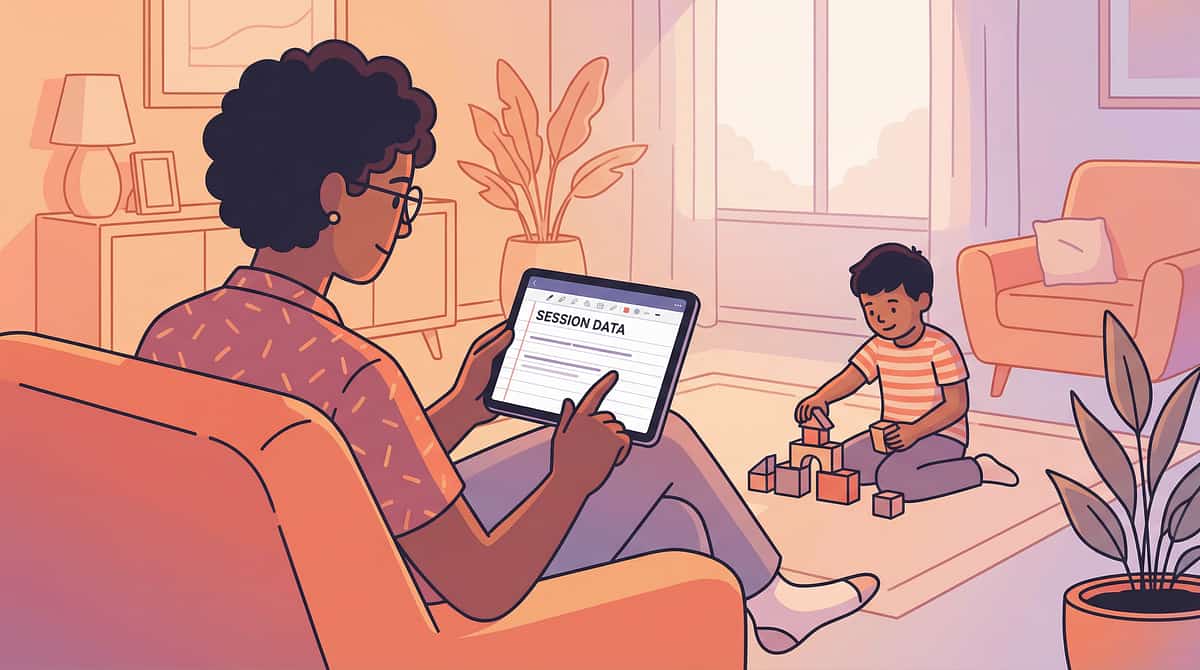
Capture the Data: Right Now
Within 60 seconds of session end, record these three data points. This transforms anecdotal impressions into measurable progress evidence.
Data Point | How to Record | Example | |
Number of sequences attempted | Tally marks | III (3 sequences) | |
Longest correct sequence | Card count | 4 cards in correct order | |
Level of prompting needed | Rate 1–5 | 1=Independent, 5=Full hand-over-hand |
Optional Bonus Data
- Sequence words used spontaneously (first, then, next, last)
- Retelling attempts (how many sentences)
- Engagement level (1=resistant, 3=tolerated, 5=enthusiastic)
Tracking Tools
📄 Downloadable PDF Tracking Sheet → techniques.pinnacleblooms.org/trackers/B-163
📱 GPT-OS® In-App Tracker → Session logger in your dashboard
"60 seconds of data now saves hours of guessing later."
Reference: BACB data collection guidelines | Cooper, Heron & Heward — Applied Behavior Analysis

What If It Didn't Go As Planned?
Every session that provides information is a successful session. Use these troubleshooting pairs to adapt immediately — session abandonment is not failure, it is data.
Problem: Child refuses to come to the table
Why: Task demand is too high, or previous session was frustrating.
Fix: Start at the child's preferred location. Bring 2 cards to the floor, the couch, wherever they're comfortable. Just look at pictures together — no demand.
Fix: Start at the child's preferred location. Bring 2 cards to the floor, the couch, wherever they're comfortable. Just look at pictures together — no demand.
Problem: Child places all cards randomly
Why: Task is too difficult or they don't understand the goal.
Fix: Reduce to 2 cards only (first/last). Model the sequence yourself first. Use hand-over-hand to place the first card together.
Fix: Reduce to 2 cards only (first/last). Model the sequence yourself first. Use hand-over-hand to place the first card together.
Problem: Repeated wrong sequences
Why: Story is too complex or visual cues aren't clear enough.
Fix: Switch to real-life photo sequences of THEIR actual routine. Familiar content is always easier to sequence than fictional stories.
Fix: Switch to real-life photo sequences of THEIR actual routine. Familiar content is always easier to sequence than fictional stories.
Problem: Child loses interest after 2 minutes
Why: Session is too long or too repetitive.
Fix: Do ONE sequence. Celebrate hugely. End on success. Gradually extend over weeks.
Fix: Do ONE sequence. Celebrate hugely. End on success. Gradually extend over weeks.
Problem: Child becomes distressed or cries
Why: Frustration threshold exceeded.
Fix: Stop immediately. No consequences. Offer comfort. "It's okay — this is hard! Let's do something you love instead." Return in 2–3 days with easier materials.
Fix: Stop immediately. No consequences. Offer comfort. "It's okay — this is hard! Let's do something you love instead." Return in 2–3 days with easier materials.
Problem: Child sequences but won't retell verbally
Why: Expressive language challenge separate from sequencing ability.
Fix: Accept non-verbal retelling — pointing, gestures, acting with props. The sequencing IS the primary win. Verbal retelling is secondary.
Fix: Accept non-verbal retelling — pointing, gestures, acting with props. The sequencing IS the primary win. Verbal retelling is secondary.
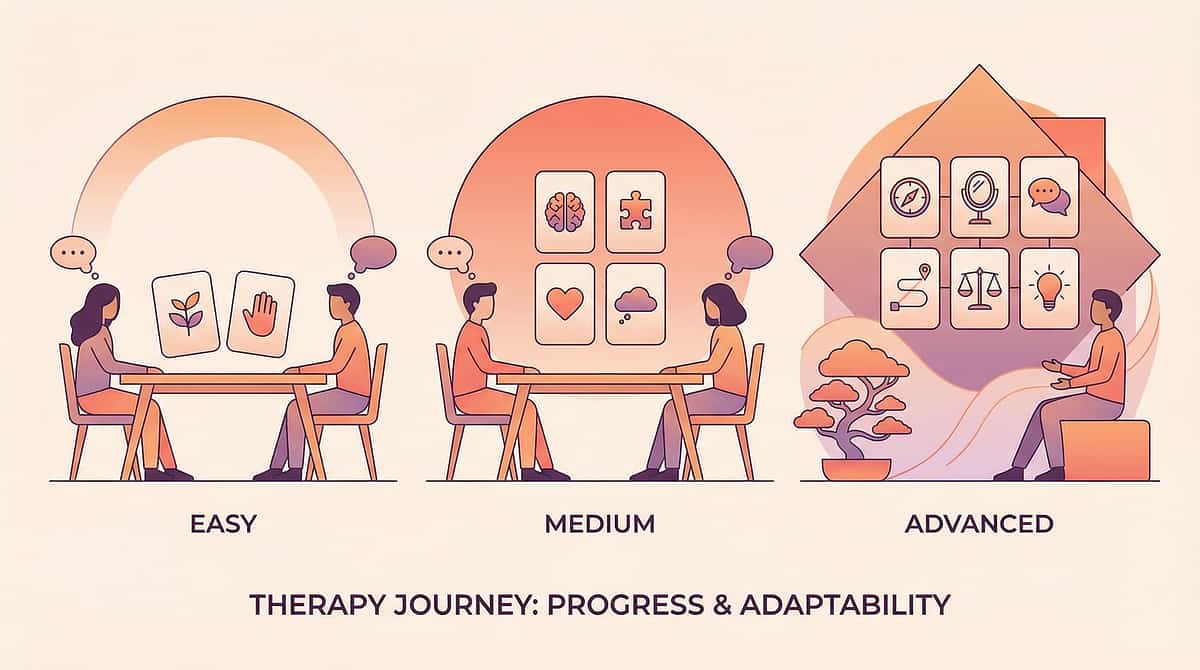
Adapt & Personalise
No two children are identical. Use this difficulty framework to meet your child exactly where they are today — not where you wish they were.
1
Easier Version
2-card sequences only | Real-life photo sequences | Heavy prompting | 3-minute sessions | Maximum reinforcement, minimal demand
2
Standard Protocol
3–4 card sequences | Mix of familiar and unfamiliar stories | Moderate prompting with fading | 10–15 minute sessions | Balanced reinforcement
3
Advanced Version
5–6 card sequences with complex plots | Full story maps | Minimal prompting, child leads | 15–20 minutes | Child retells to a family member
Profile-Based Adaptations
High Verbal Child
Emphasise retelling and story creation — Story Cubes, Story Starters.
Visual Learner
Focus on Story Maps and Graphic Organisers.
Kinesthetic Learner
Prioritise Props, Puppets, and physical sorting activities.
Ages 3–4
Start with Social Story Sequences of daily routines.
Ages 8–12
Use cause-effect cards and complex plot analysis.
Reference: Individualised intervention planning across OT, ABA, and SLP clinical practice

Weeks 1–2: What to Expect
Progress Arc
~15% Complete
These two weeks test patience. You are building a foundation that is invisible. The neural pathways are forming. Keep going.
What You'll See
- Child tolerates sitting at the table with story cards for 3–5 minutes
- Child looks at picture cards when presented (even briefly)
- Child may attempt to place ONE card in position with heavy prompting
- Child begins recognising the "story time" routine
- Resistance may increase before it decreases — this is normal
What You Won't See Yet
- Independent sequencing (this comes later)
- Verbal retelling (this develops over weeks)
- Transfer to new or unfamiliar stories
What "Progress" looks like now: If your child picked up a card and looked at it for 5 seconds longer than last week — that's real progress. If they came to the table without crying — that's progress.
Reference: PMC11506176 — Early-phase indicators focus on tolerance and participation

Weeks 3–4: Consolidation Signs
Progress Arc
~40% Complete
Something shifts in weeks three and four. You'll notice it before you can explain it — your child is beginning to own the story structure.
Consolidation Indicators
- Child anticipates story time — may ask for it or bring materials
- Correct placement of "first" card without prompting
- Beginning to use sequence words occasionally ("then...")
- Engagement time increases to 8–12 minutes
- Child spontaneously points out story elements during book reading
Neural Pathway Signals
- Child corrects YOU if you describe events out of order
- Spontaneous sequencing outside sessions (describing their day in order)
- Interest in "what happens next" during daily activities
When to Increase Difficulty
- Move from 3-card to 4-card sequences
- Introduce unfamiliar stories
- Begin reducing prompting — offer choices instead of direct guidance
Parent Milestone: You may notice you're more confident too. You're reading your child's cues better. You know when to push and when to pause. That's mastery.
Reference: Neuroplasticity evidence — synaptic strengthening timelines in paediatric populations

Weeks 5–8: Mastery Indicators
Progress Arc
~75% Complete
4+
Cards Sequenced
Independently, in correct order, across 3 different stories
2+
Sequence Words
Used spontaneously during retelling ("first," "then," "because")
3
Consecutive Sessions
All mastery criteria met before advancement
Generalisation Indicators (The Real Victory)
Child spontaneously narrates events in order during daily life. Child begins predicting "what happens next" in new stories. Child asks "why did that happen?" — cause-effect curiosity emerging. Other family members notice improved story comprehension.
Maintenance Check
Does the skill persist when you skip 2–3 days? If yes → mastery confirmed. If skill degrades → continue at current level for 2 more weeks before advancing.
🏆 MASTERY UNLOCKED when all criteria met across 3 consecutive sessions
Reference: PMC10955541 — Mastery criteria derived from behavioural measurement standards | BACB mastery criteria

You Did This.
Your child grew because of your commitment. Five to eight weeks of sitting at that table. Days when it worked beautifully. Days when nothing went right. Days when you wanted to quit. You didn't quit.
And now your child can look at a jumbled story and build it into something that makes sense. That skill — the ability to organise chaos into narrative — is one of the most powerful cognitive tools a human brain can develop.
Then → Now
Scattered story fragments → Coherent narrative retelling
Then → Now
"I don't know what happened" → "FIRST the boy planted, THEN he watered, LAST the flower grew!"
Then → Now
Resistance at the table → Anticipation of story time
Then → Now
Confusion about narrative → Story comprehension and curiosity
Celebrate as a Family: Let your child retell their favourite story to a grandparent. Create a "Story Builder" certificate together. Take a photo with their story cards — this is a milestone worth documenting.
Reference: Parental self-efficacy research — parent confidence is the strongest predictor of continued home intervention

Red Flags: When to Pause
Trust your instincts. If something feels wrong, pause and ask. These specific indicators signal that professional consultation is needed — not more home sessions.
🚩 Red Flag 1
No understanding of simple 2-card sequences after 4 weeks of consistent practice.
May indicate: Receptive language delay requiring professional SLP assessment.
May indicate: Receptive language delay requiring professional SLP assessment.
🚩 Red Flag 2
Child becomes increasingly distressed across sessions despite modifications.
May indicate: Underlying anxiety, sensory processing issue, or task demand mismatch.
May indicate: Underlying anxiety, sensory processing issue, or task demand mismatch.
🚩 Red Flag 3
Skills acquired in sessions never transfer to any other context after 6+ weeks.
May indicate: Generalisation difficulty requiring professional ABA/SLP strategy adjustment.
May indicate: Generalisation difficulty requiring professional ABA/SLP strategy adjustment.
🚩 Red Flag 4
Regression in previously mastered skills.
May indicate: Medical, emotional, or environmental change requiring professional evaluation.
May indicate: Medical, emotional, or environmental change requiring professional evaluation.
🚩 Red Flag 5
Child cannot identify ANY story elements after 3 weeks.
May indicate: Comprehension deficit deeper than sequencing — full language evaluation needed.
May indicate: Comprehension deficit deeper than sequencing — full language evaluation needed.
Reference: WHO NCF Progress Report 2018–2023 — Early identification and referral pathways
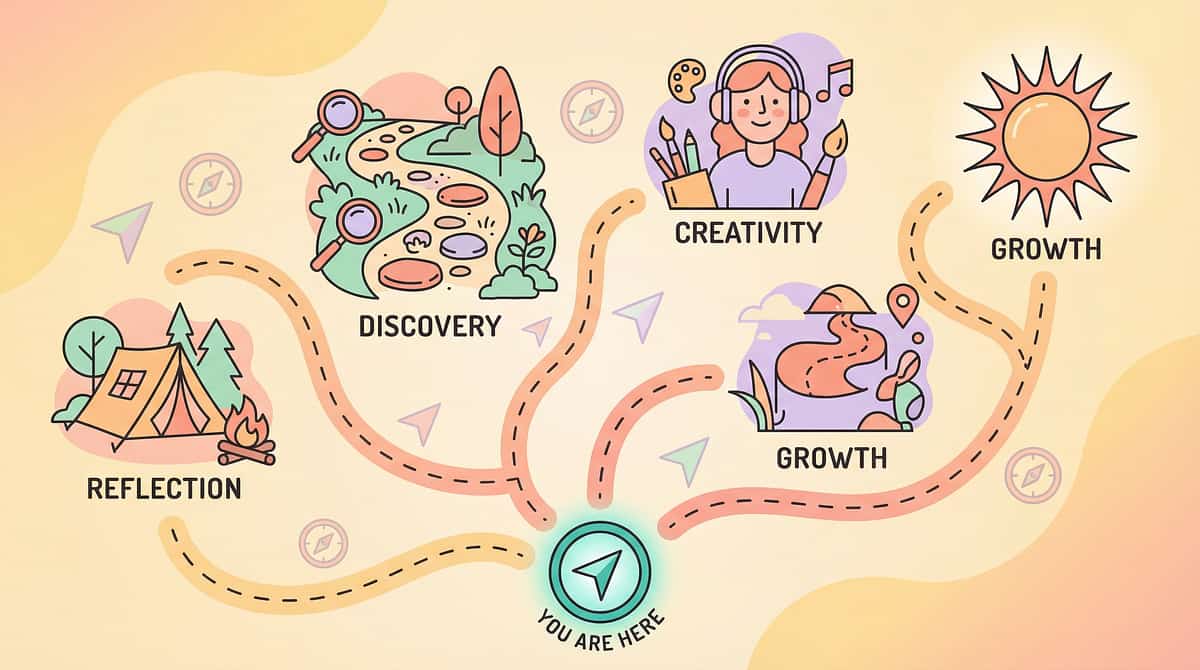
The Progression Pathway
Story Sequence Understanding sits within a carefully designed developmental architecture. Knowing where you've been and where you're heading transforms isolated sessions into a coherent long-term plan.
1
B-161
Object Identification (Prerequisite)
2
B-162
Time Concept Understanding (Prerequisite)
3
★ B-163
Story Sequence Understanding — YOU ARE HERE
4
B-164
Problem-Solving Skills — if child excels at sequencing
5
B-165
Following Multi-Step Directions — if expression is the challenge
Long-Term Developmental Goal: This technique feeds directly into Reading Comprehension → Written Expression → Social Communication → Academic Success across all subjects.
Reference: WHO Developmental Milestones Framework | Domain B progression architecture
Related Techniques in This Domain
The 9 materials you've gathered for Story Sequence Understanding serve as the foundation for at least 4 other techniques in Domain B. You are already equipped.
Technique | Difficulty | Key Material | You Already Own? | |
B-161: Object Identification | ⭐ Intro | Picture Cards | ✅ Yes — your sequencing cards work | |
B-162: Time Concept Understanding | ⭐⭐ Core | Visual Timers + Sequence Strips | Partial — sequence strips apply | |
B-164: Problem-Solving Skills | ⭐⭐ Core | Cause-Effect Cards | ✅ Yes — Material #5 from this page | |
B-165: Following Multi-Step Directions | ⭐⭐ Core | Visual Instruction Cards | Partial — story maps adapt | |
Reading Comprehension Strategies | ⭐⭐⭐ Advanced | Story Maps + Graphic Organisers | ✅ Yes — Material #2 | |
Personal Narrative Construction | ⭐⭐⭐ Advanced | Story Starters + Props | ✅ Yes — Materials #4 & #9 |
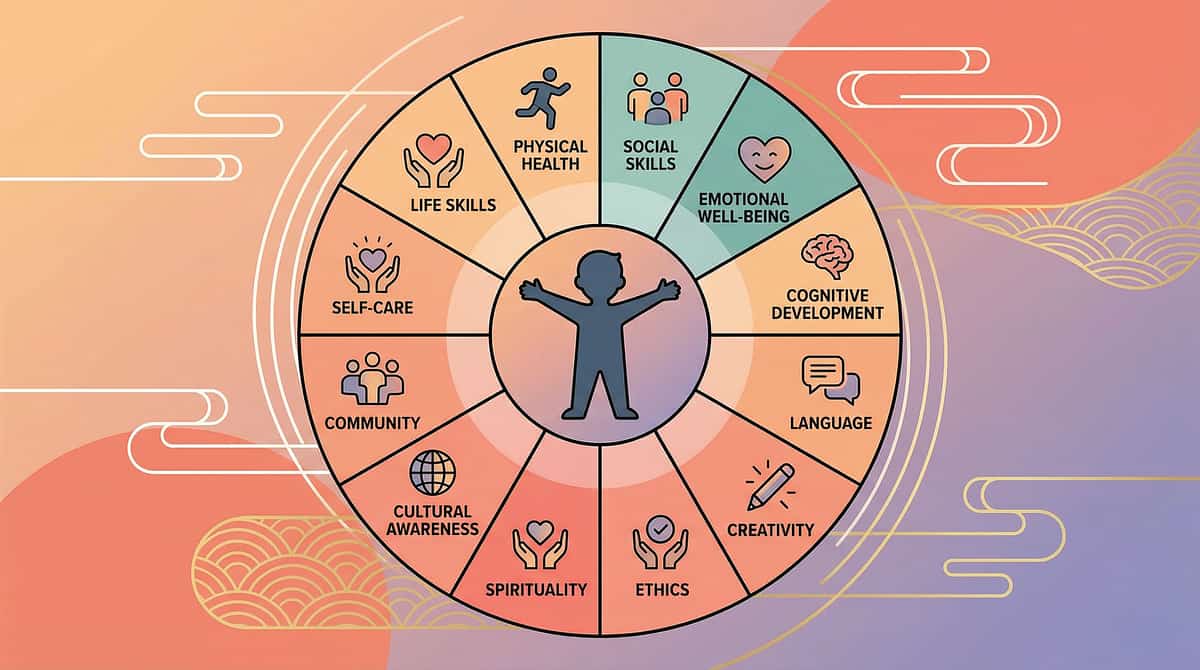
Your Child's Full Developmental Map
Story Sequence Understanding is one technique within a 12-domain developmental architecture. Its impact radiates across multiple areas of your child's growth simultaneously.
→ Domain C
Social stories ARE social communication training
→ Domain G
Story comprehension IS academic readiness
→ Domain H
Narrative play IS play skill development
→ Domain I
Flexible thinking about story possibilities builds behavioural flexibility
Reference: WHO/UNICEF Nurturing Care Framework — holistic developmental monitoring across five components
Parent Stories: From Fear to Mastery
Priya, Mother — Hyderabad
"My son is 5. Every night I'd read him a story and ask what happened. He'd say the last sentence of the book. That's it. I started with 3 picture cards of his morning routine. Within 2 weeks, he was arranging them himself. Within 6 weeks, he retold the entire Panchatantra story of the crow and the fox. In order. With 'first' and 'then.' I cried."
"My son is 5. Every night I'd read him a story and ask what happened. He'd say the last sentence of the book. That's it. I started with 3 picture cards of his morning routine. Within 2 weeks, he was arranging them himself. Within 6 weeks, he retold the entire Panchatantra story of the crow and the fox. In order. With 'first' and 'then.' I cried."
Rajesh, Father — Bangalore
"My daughter could READ the words perfectly but couldn't tell you what the story was about. Her teacher called it 'word calling without comprehension.' We started using story maps. She fills them in now after every story. Her reading comprehension scores went from 35% to 72% in one semester."
"My daughter could READ the words perfectly but couldn't tell you what the story was about. Her teacher called it 'word calling without comprehension.' We started using story maps. She fills them in now after every story. Her reading comprehension scores went from 35% to 72% in one semester."
Anita, Grandmother — Mumbai
"My grandson's parents work long hours. I do the therapy at home. I was scared I'd do it wrong. But the DIY cards — made from photos of our daily life — were so simple. Even I could do it. He now tells me stories about his day at school. In order. Beginning, middle, end. He never did that before."
"My grandson's parents work long hours. I do the therapy at home. I was scared I'd do it wrong. But the DIY cards — made from photos of our daily life — were so simple. Even I could do it. He now tells me stories about his day at school. In order. Beginning, middle, end. He never did that before."
These are composite stories representative of outcomes reported across Pinnacle Blooms Network centres. Individual results vary.

Connect With Other Parents
You are not doing this alone. The Pinnacle Blooms parent community connects thousands of families navigating the same journey — sharing successes, troubleshooting challenges, and lifting each other forward.
WhatsApp Parent Groups
"Language & Narrative Skills" Parent Community available in 16+ languages. Regional parent groups connect you with families in your area navigating the same technique.
Online Forum
Pinnacle Parent Community at pinnacleblooms.org/community — post questions, share wins, and access technique-specific discussion threads.
Local Meetups
Find your nearest Pinnacle Blooms centre parent group at pinnacleblooms.org/centers — in-person community across 80+ locations.
Peer Mentoring
Connect with an experienced parent who has already completed this technique journey. Their lived experience is irreplaceable guidance.
"Your experience helps others — consider sharing your journey."
Reference: WHO NCF community engagement principles — parent support networks improve outcomes.
Reference: WHO NCF community engagement principles — parent support networks improve outcomes.
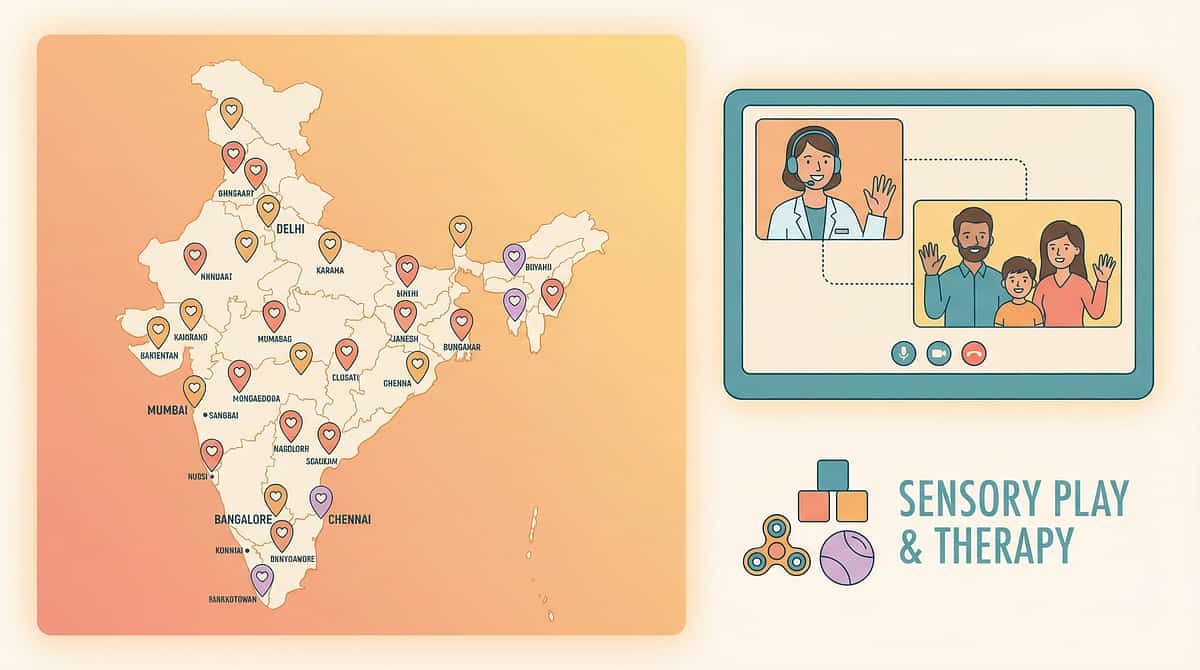
Your Professional Support Team
Home + Clinic = Maximum Impact. Home practice builds the repetition. Professional guidance builds the precision. Together they produce the fastest, most durable gains.
Find Your Nearest Centre
Interactive Centre Locator Map at pinnacleblooms.org/centers
80+ centres across India serving families from 70+ countries.
Therapist Matching
Primary: Speech-Language Pathologist (SLP) specialising in narrative intervention.
Supporting: Special Educator for academic integration.
Supporting: Special Educator for academic integration.
Teleconsultation — For Remote Families
Book a video consultation with a Pinnacle SLP. Available in 16+ languages. No travel required.
Insurance & Funding
Check coverage options at pinnacleblooms.org/funding — our team will help you navigate your options.
Reference: WHO NCF Progress Report 2018–2023 — primary health care as platform for reaching all families
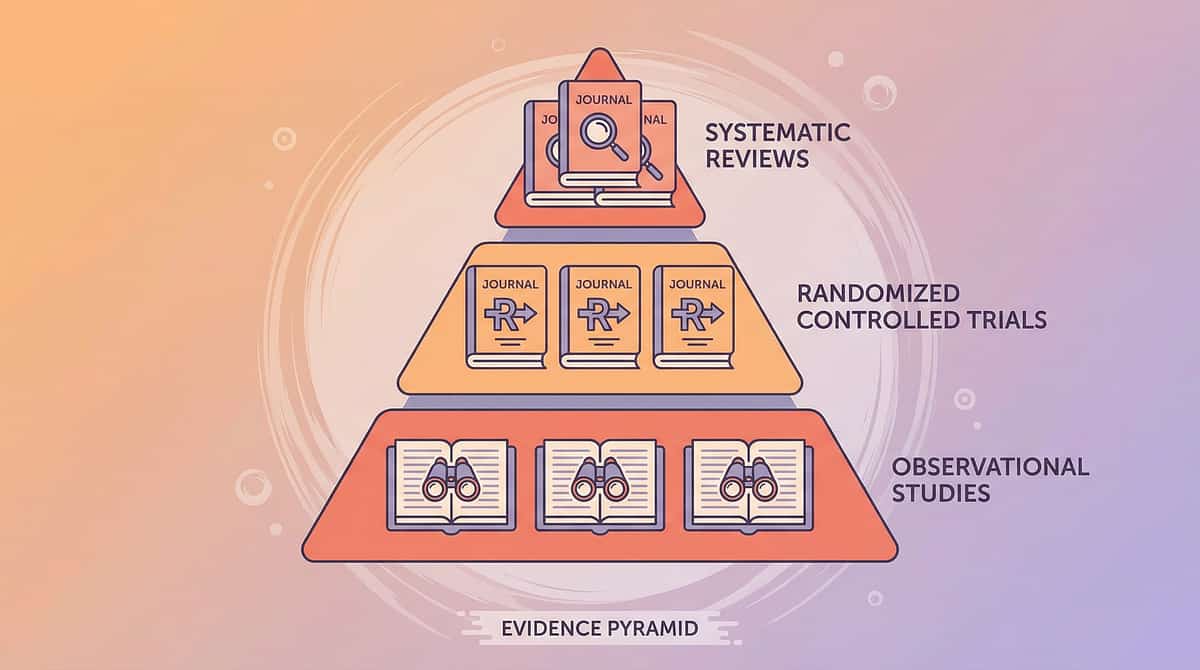
The Research Library
For clinicians, programme leads, and curious parents who want to go deeper. Every technique in the Pinnacle Blooms system is anchored to peer-reviewed evidence.
Study 1: PRISMA Systematic Review (2024)
PMC11506176 | 16 articles, 2013–2023 | Level I Evidence
Structured interventions meeting systematic review criteria are classified as evidence-based for children with ASD.
Structured interventions meeting systematic review criteria are classified as evidence-based for children with ASD.
Study 2: Meta-Analysis (World J Clin Cases, 2024)
PMC10955541 | 24 studies | Level I Evidence
Structured therapy effectively promotes social skills, adaptive behaviour, language processing, and motor skills.
Structured therapy effectively promotes social skills, adaptive behaviour, language processing, and motor skills.
Study 3: Indian Paediatric RCT (2019)
DOI: 10.1007/s12098-018-2747-4 | Level II Evidence
Parent-delivered structured interventions produce significant measurable outcomes when protocols are followed.
Parent-delivered structured interventions produce significant measurable outcomes when protocols are followed.
Study 4: WHO CCD Package Implementation (2023)
PMC9978394 | 54 countries | WHO Recommendation
Caregiver-mediated, evidence-based developmental interventions are the WHO-recommended model for early childhood development.
Caregiver-mediated, evidence-based developmental interventions are the WHO-recommended model for early childhood development.
Study 5: Multi-Disciplinary Nurturing Care Framework (2022)
DOI: 10.1080/17549507.2022.2141327 | Int J Speech-Lang Pathol
Multiple therapy disciplines contribute synergistically to developmental outcomes through integrated care models.
Multiple therapy disciplines contribute synergistically to developmental outcomes through integrated care models.
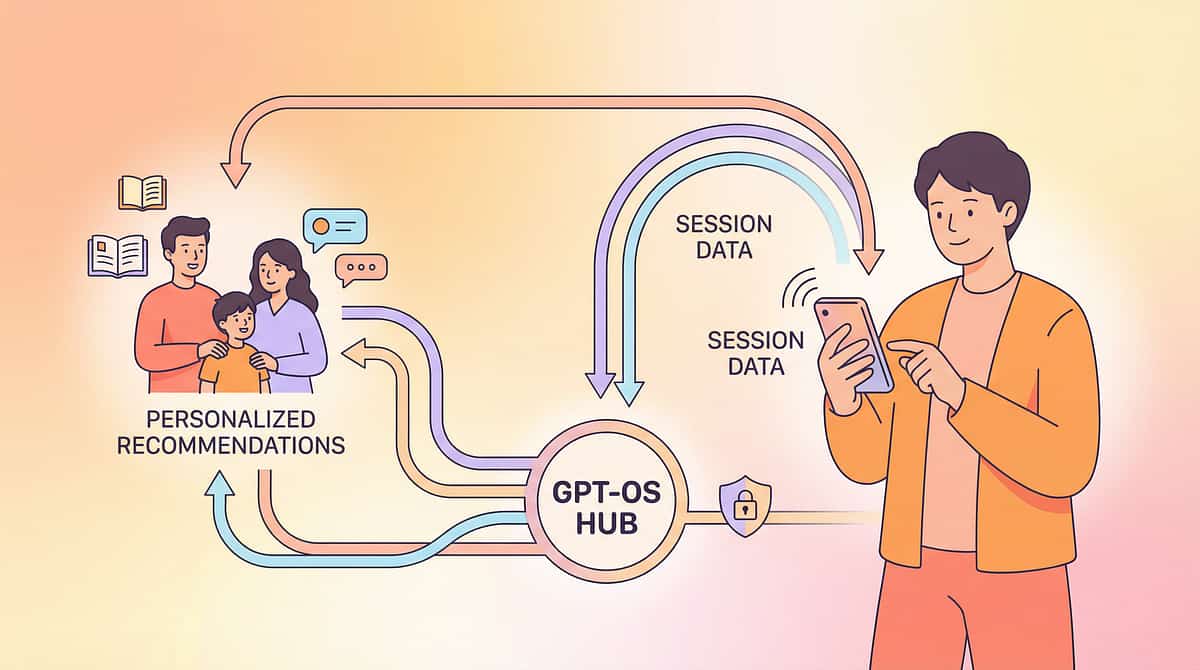
How GPT-OS® Uses Your Data
Every data point you record (Card 20) feeds into GPT-OS® to generate personalised, evolving recommendations — transforming your individual sessions into a dynamic clinical picture.
1
You Record
Session data entered after each session — sequences, prompting level, engagement
2
GPT-OS® Processes
Algorithm analyses patterns across sessions — duration, material type, difficulty progression
3
Recommendations Generated
Adjust difficulty, suggest next technique, flag for professional review if needed
4
Progress Report
Ready for your next professional consultation — no guessing, all evidence
🔒 Encrypted
All data encrypted in transit and at rest
🔒 Private
Used only for YOUR child's recommendations unless you opt into anonymised research
🔒 Compliant
Indian DPDP Act 2023 and international data protection standards
🔒 Yours
You own your data — export or delete at any time
Reference: Digital health intervention evidence — 21 RCTs, 1,050 participants (2024 meta-analysis)
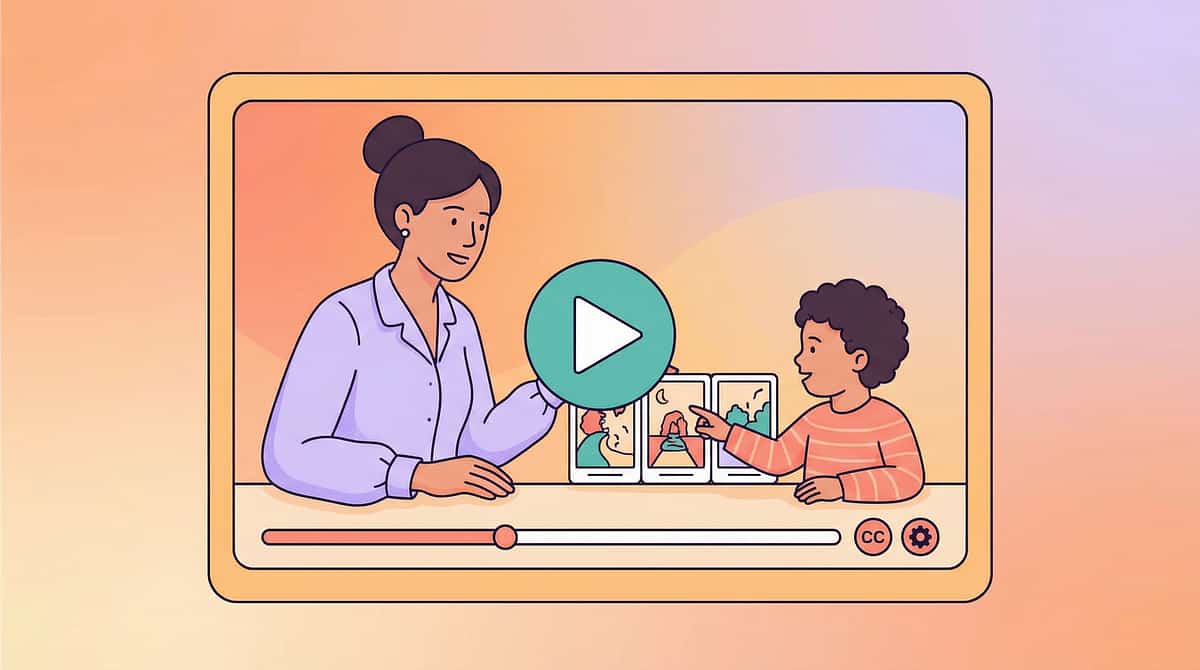
Watch the Reel
▶ Reel B-163
75 seconds
Language & Literacy — Episode 163
Watch a Pinnacle Blooms therapist demonstrate each of the 9 materials in action. See how picture sequencing cards, story maps, and retelling props transform narrative confusion into coherent storytelling — in 75 seconds.
What You'll See
Each material introduced with a real child demonstration. The "before and after" transformation. Quick tips for immediate home implementation.
Watch On
Instagram | YouTube | techniques.pinnacleblooms.org/reels/B-163
Therapist Note: This reel is a 75-second overview. The page you're reading now is the FULL protocol. Use them together for best results.
#StorySequencing #NarrativeSkills #AutismTherapy #ReadingComprehension #StoryMaps #LanguageDevelopment #AutismParenting #SpecialNeedsTools #PinnacleBlooms #StoryTelling #SequencingCards #LiteracySkills #SpeechTherapy #VisualLearning #EarlyIntervention
Reference: NCAEP Evidence-Based Practices Report (2020) — Video modelling as evidence-based practice for autism
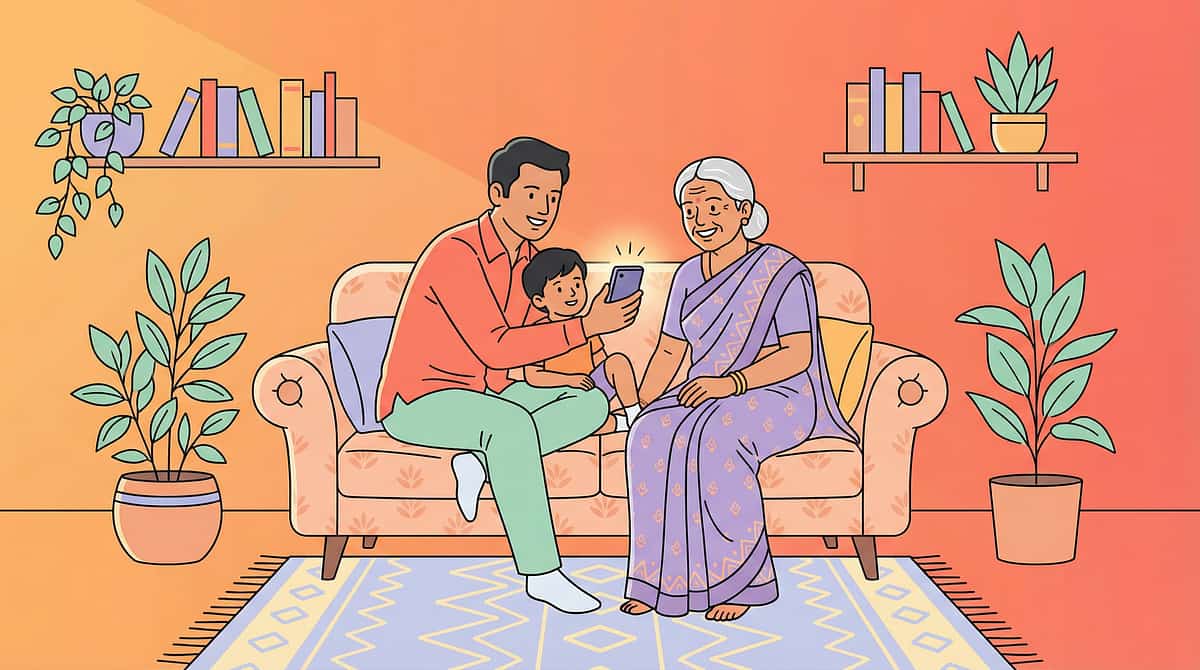
Share This With Your Family
If only one parent executes this technique, it's limited. Consistency across caregivers multiplies impact. Every adult in your child's life who understands the protocol is a therapeutic ally.
Share This Page
📱 Share via WhatsApp
✉️ Share via Email
🔗 Copy Link
✉️ Share via Email
🔗 Copy Link
Downloadable Family Guide
1-Page PDF: "Story Sequence Understanding — Quick Guide for Families." Simplified version with materials list, 6-step protocol summary, do's and don'ts, and emergency stop signs.
"Explain to Grandparents" Version
A simplified guide for extended family: "Your grandchild is learning to tell stories in order. Here's how you can help: When they tell you something, ask 'What happened first? Then what?' Use these picture cards together. Praise every attempt."
Teacher/School Communication Template
A ready-to-send note: "[Child's name] is working on story sequencing skills at home. They respond best to visual supports. Could you use 'first, then, next, finally' vocabulary when giving instructions? A story map posted at their desk would help enormously."
Reference: PMC9978394 — WHO CCD Package emphasises multi-caregiver consistency for intervention maintenance

Frequently Asked Questions
The questions parents, carers, and clinicians ask most — answered honestly, with the evidence behind each response.
How long before I see results?
Most parents notice increased engagement and tolerance within 1–2 weeks. Meaningful sequencing improvement typically emerges by weeks 3–4. Independent retelling usually develops by weeks 5–8. Every child's timeline is different — and all of these timelines are valid.
My child can sequence cards but can't retell verbally. Is that okay?
Absolutely. Sequencing ability and verbal expression are separate skills that develop at different rates. If your child can arrange cards correctly, the comprehension is there. Verbal retelling will follow. Celebrate the sequencing win today.
Should I use the same stories or switch?
Both. Start with the SAME familiar stories — repetition builds schema. Once mastered, introduce new stories — generalisation builds flexibility. Aim for 70% familiar / 30% new as your ongoing ratio.
My child only wants one specific set of cards. Is that a problem?
Not initially. Restricted interest in one set is common in autism. Use it as your engagement anchor. Gradually introduce one new card at a time alongside the preferred set. Don't force variety — add it gently, over weeks.
Can siblings participate?
Yes — with guidelines. Siblings can be "story partners" who take turns sequencing. This builds social interaction AND generalisation. Ensure the sibling doesn't take over or correct harshly.
What if my child is non-verbal?
This technique works for non-verbal children. Sequencing is a visual-motor task that doesn't require speech. Use pointing, gestures, and picture exchange. The story map becomes a communication board. The sequencing IS the therapeutic win.
Is this effective without professional supervision?
Evidence supports parent-delivered interventions when protocols are followed (DOI: 10.1007/s12098-018-2747-4). However, professional guidance accelerates progress and catches issues early. We recommend combining home practice with periodic professional consultation.
How does this help with school performance?
Story sequencing is the foundation of reading comprehension, written expression, science experiment reporting, history timeline understanding, and mathematical word problem solving. This skill transfers to virtually every academic domain.

Every Story Has a Beginning. This Is Yours.
You have the evidence. You have the protocol. You have the materials — or the knowledge to make them from what you have at home. All that remains is the first card, the first session, the first "first."
▶ Start This Technique Today
Launch GPT-OS® guided session for Story Sequence Understanding — personalised to your child's age, level, and available materials.
📞 Book a Consultation
Connect with a Pinnacle Blooms SLP near you. FREE National Autism Helpline: 9100 181 181 (24/7, 16+ languages).
→ Next Technique: B-164
Explore Problem-Solving Skills — the next step in your child's Language & Cognition development pathway.
✅ Validated by the Pinnacle Blooms Consortium
SLP • SpEd • ABA • OT • NeuroDev • CRO
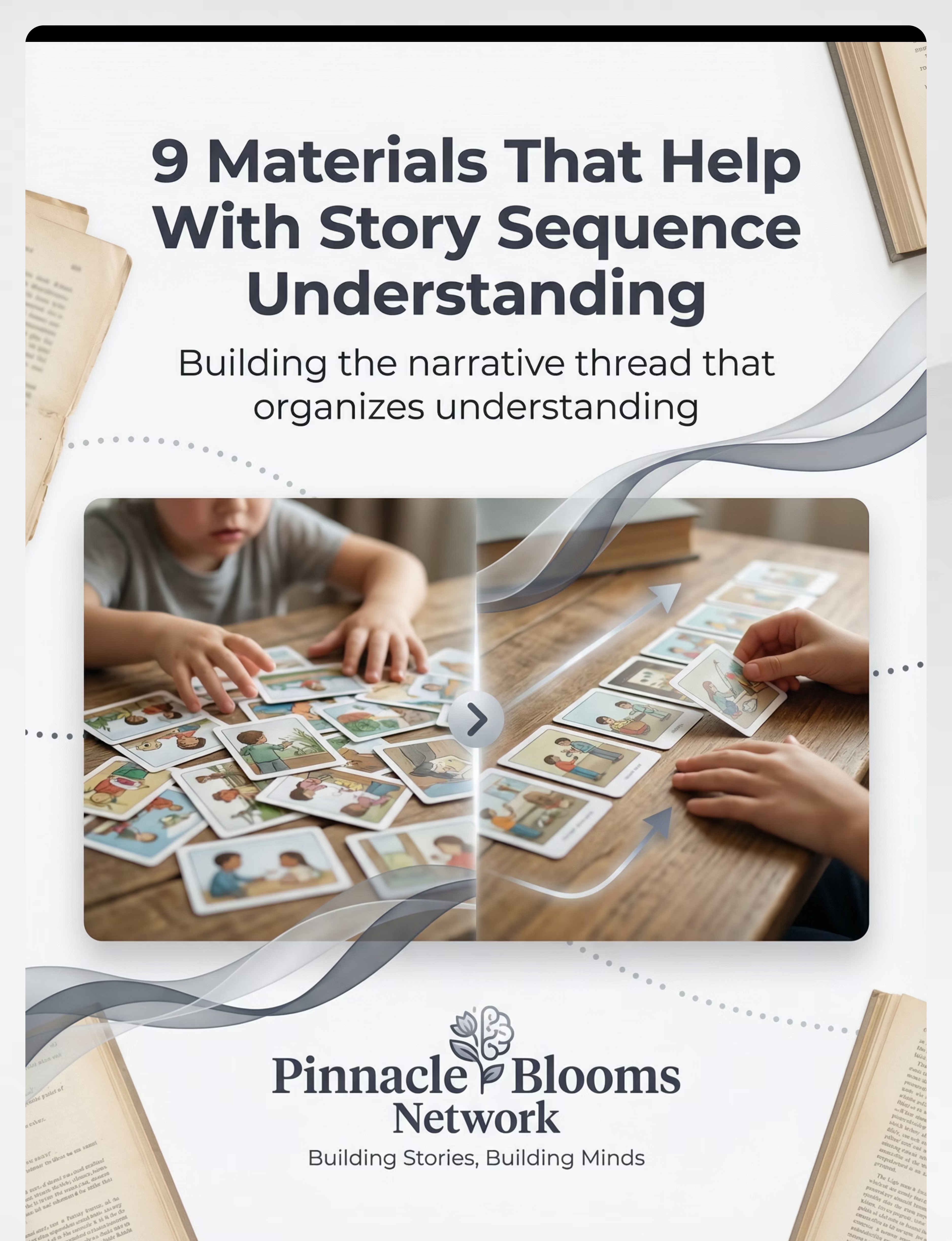
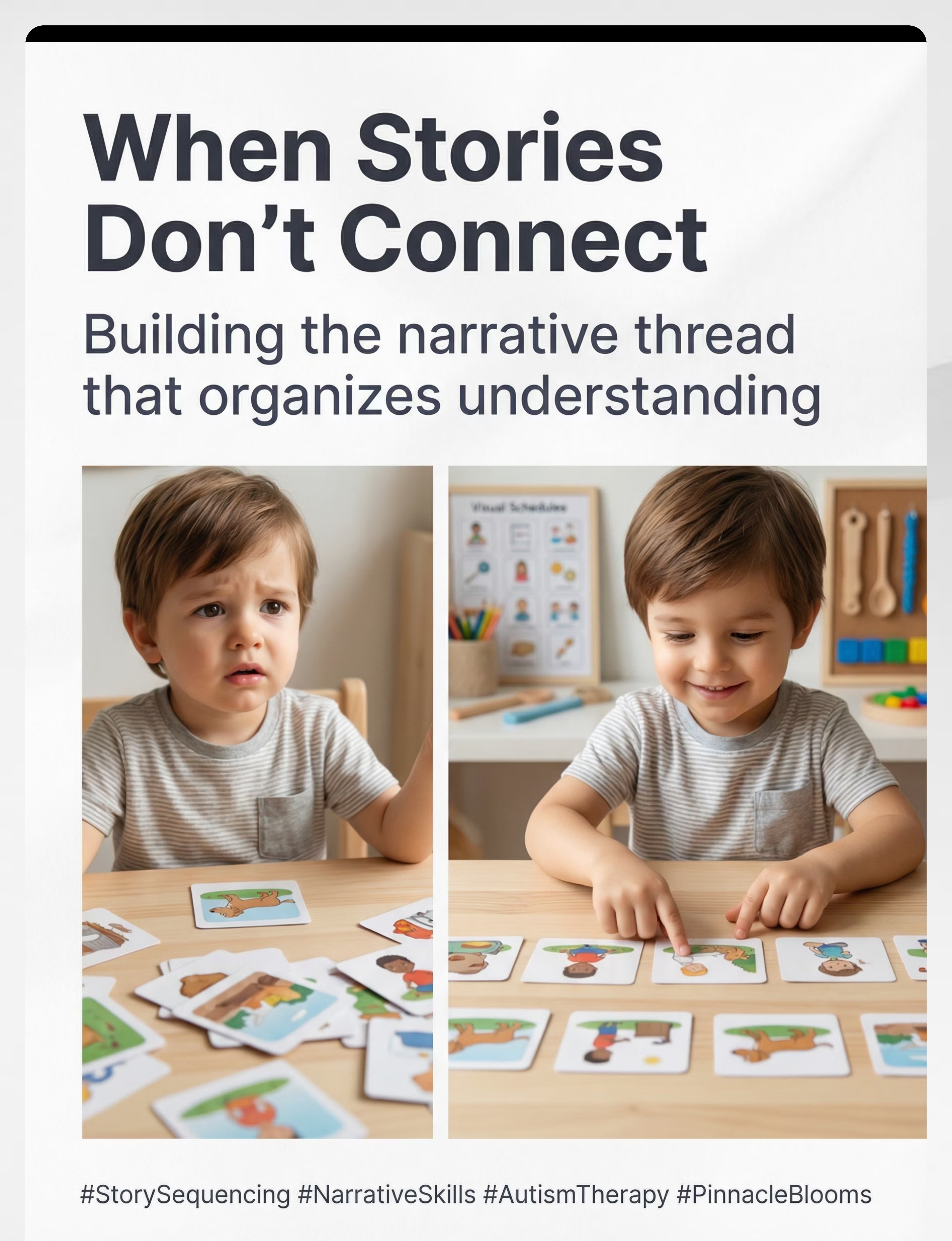
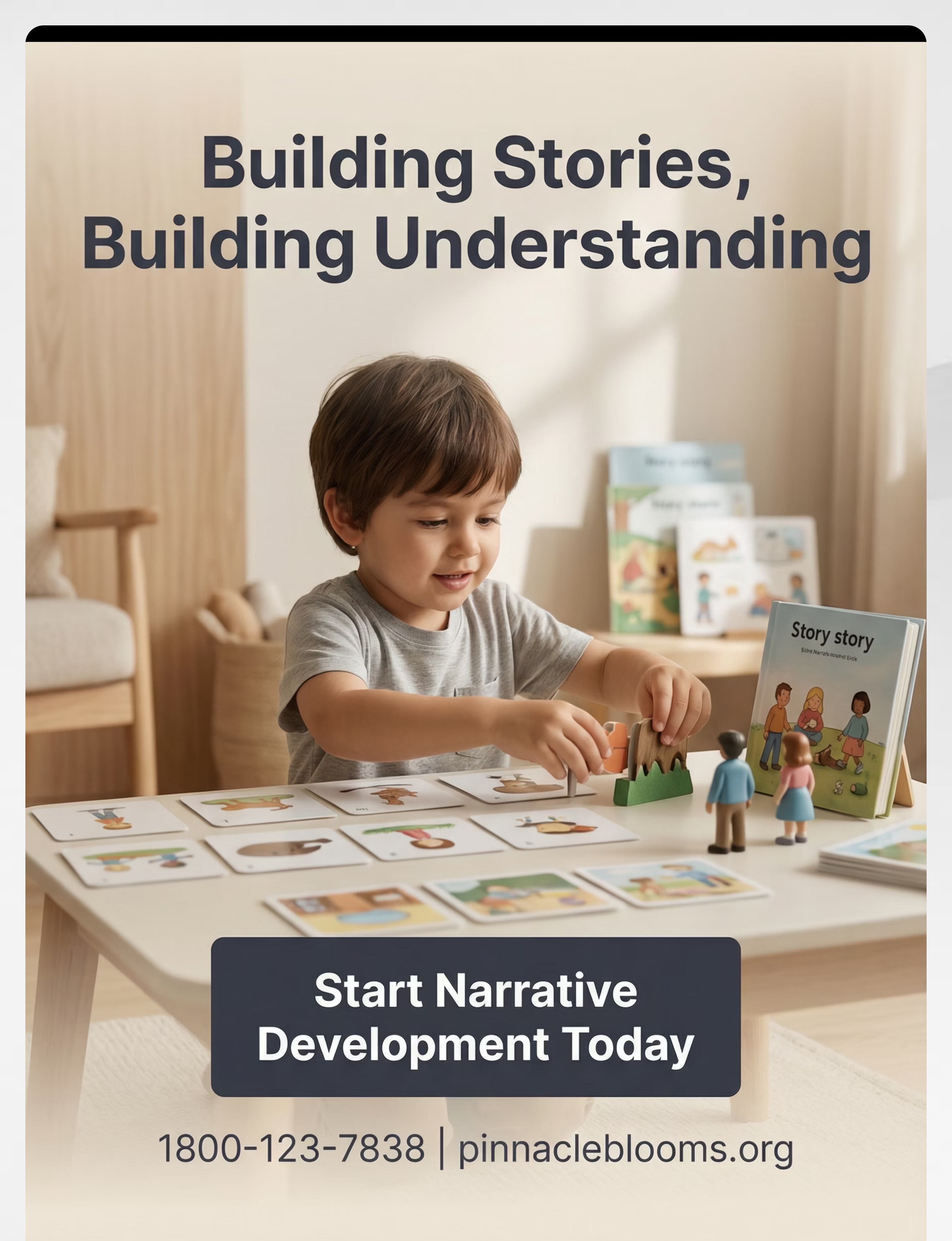
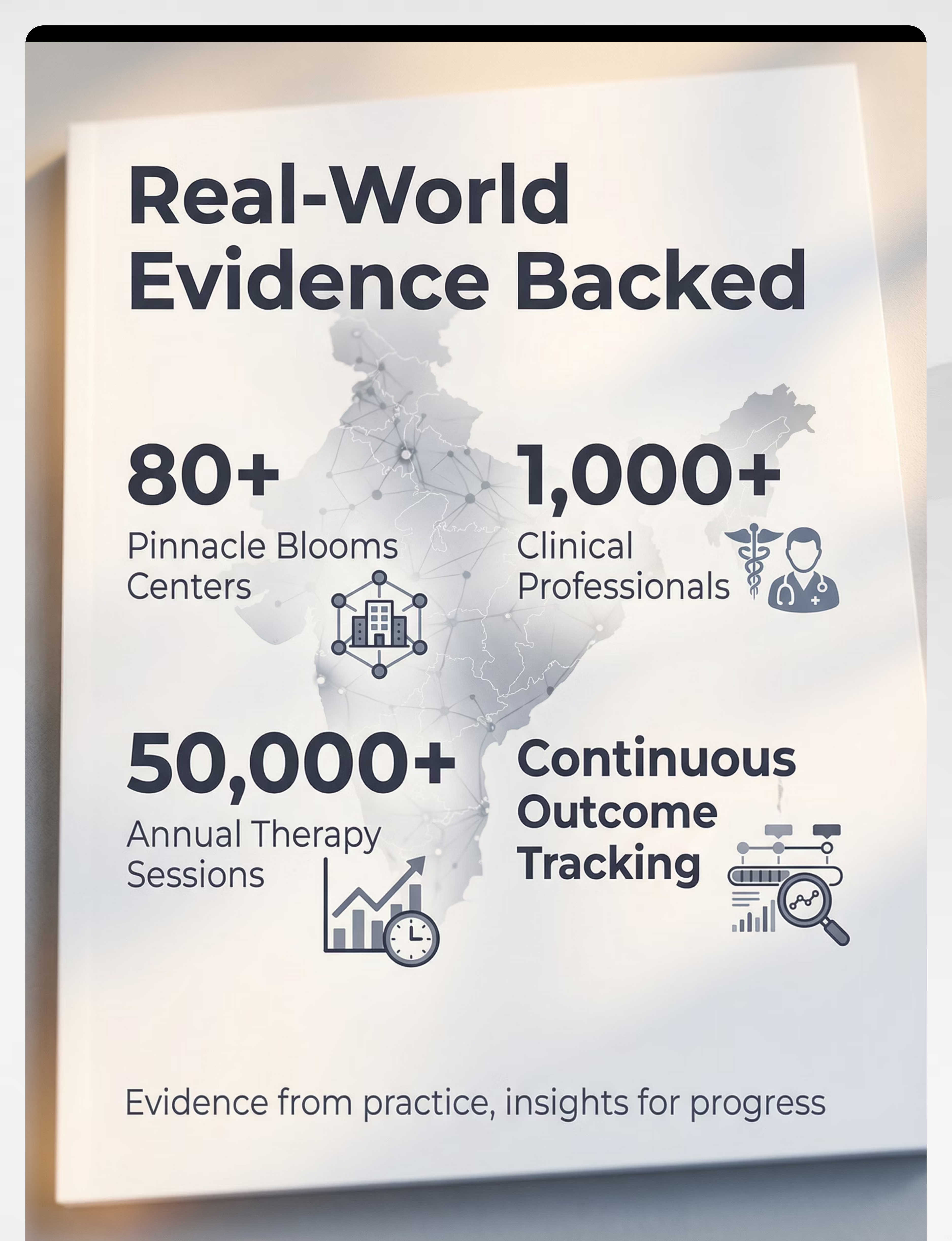
Preview of 9 materials that help with story sequence understanding Therapy Material
Below is a visual preview of 9 materials that help with story sequence understanding therapy material. The pages shown help educators, therapists, and caregivers understand the structure and content of the resource before use. Materials should be used under appropriate professional guidance.



Link copied!
From Fear to Mastery. One Technique at a Time.
80+
Centres Across India
Serving families from 70+ countries
1,000+
Clinical Professionals
SLP • SpEd • ABA • OT • NeuroDev
20M+
Exclusive 1:1 Sessions
Delivered and documented
97%+
Measured Improvement
Across enrolled families
Medical Disclaimer: This content is educational and is designed to supplement, not replace, professional clinical assessment and treatment. The techniques described are evidence-based and consortium-validated, but individual outcomes vary based on the child's unique profile, consistency of implementation, and the presence of co-occurring conditions. If you have concerns about your child's story comprehension, narrative skills, or overall development, please consult a qualified speech-language pathologist, developmental paediatrician, or contact Pinnacle Blooms for a comprehensive assessment.
Explore More Techniques
techniques.pinnacleblooms.org
Find a Centre
pinnacleblooms.org/centers
Book a Consultation
pinnacleblooms.org/book
24/7 Helpline
📞 9100 181 181 — FREE, 16+ languages
© 2026 Pinnacle Blooms Network®. All rights reserved. GPT-OS® is a registered trademark of Blooms Health Care Limited. Content developed by the Pinnacle Blooms Consortium: Clinical Research Organisation (CRO), Speech-Language Pathologists (SLP), Occupational Therapists (OT), Board Certified Behaviour Analysts (BCBA), Special Educators (SpEd), and NeuroDevelopmental Paediatricians.
Built by Mothers. Engineered as a System.