

"He Can Count to 100. He Doesn't Know How Many Is 'Some.'"
Quantity Isn't Just Numbers — It's the Entire Language of How Much and How Many
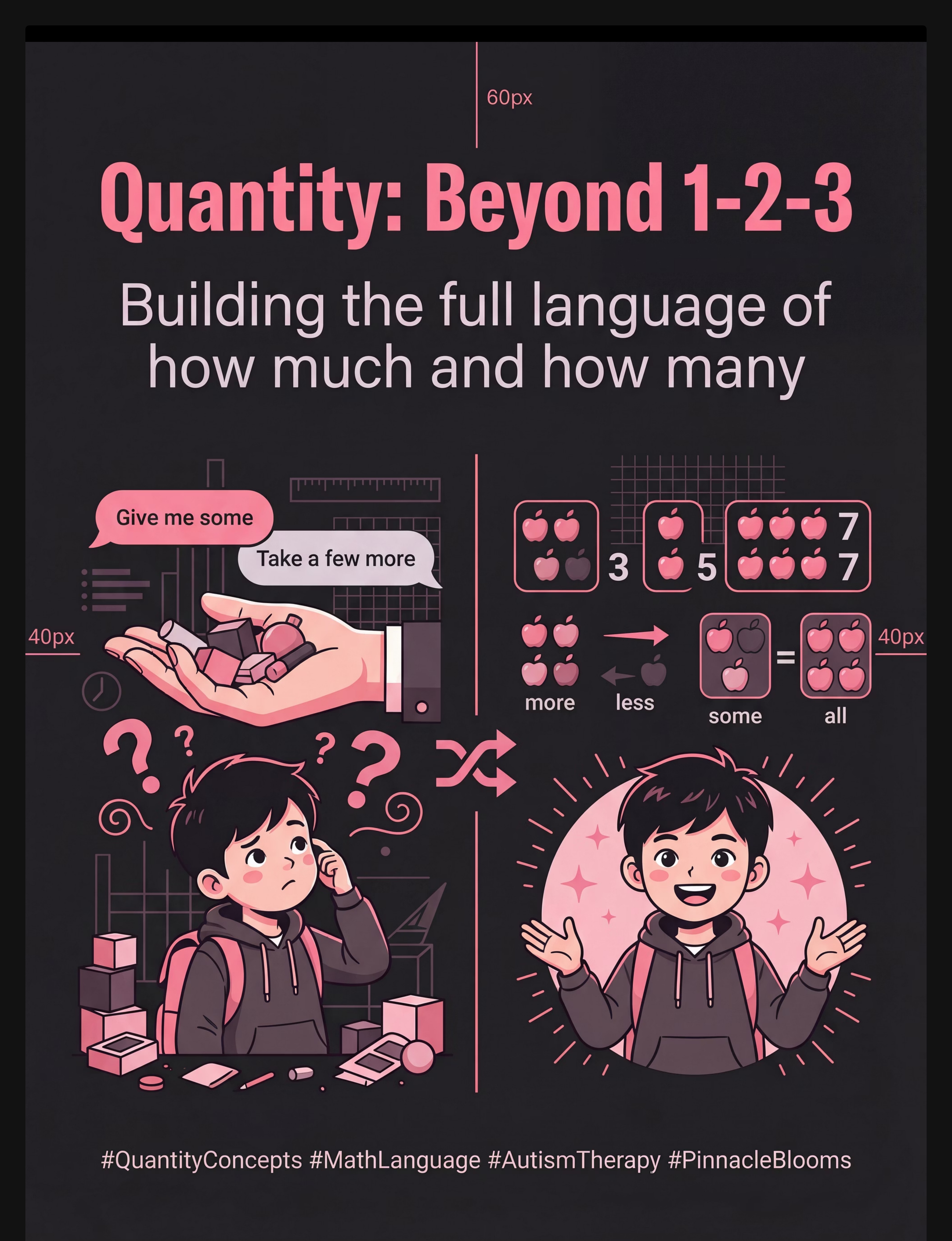
"Give me some cookies." He stood there paralyzed. 'How many is some, Mama?' He can recite numbers to 100 but 'a few,' 'enough,' 'most' — they're a foreign language to him. I watch him count every single pea on his plate while his sister just grabs 'some.' I don't know how to teach something I've never had to think about."
You are not failing. Your child's brain hasn't yet built the bridge between numbers and the language of amount. This is a precise, teachable gap — and there are 9 tools that close it.
🏆 Pinnacle Blooms Consortium
SLP • SpEd • ABA • OT • NeuroDev

How Many Families Are Navigating This Exact Challenge?
You are among millions of families worldwide navigating this exact challenge. The confusion you see is real, validated — and critically — treatable. Children with autism often show a paradoxical profile: strong counting but weak quantity language.
1 in 36
Children with ASD
Diagnosed globally (CDC, 2023)
~65%
Specific Language Concept Gaps
Children with ASD showing concept gaps beyond vocabulary
2–4yr
Typical Development Gap
Lag between rote counting mastery and flexible quantity language in ASD
"Children with autism often show a paradoxical profile: strong counting but weak quantity language. They can recite numbers but struggle with 'some,' 'enough,' and 'about.' This isn't a math problem. It's a language-of-quantity problem." — Pinnacle Blooms SLP Consortium Clinical Synthesis, 2024
In India's 70+ Pinnacle Blooms centres, quantity concept gaps rank among the top 10 language intervention targets in children aged 3–8 with ASD.
Research: PMC11506176 | PMC10955541 | CDC Autism Prevalence Data (2023)

The Neuroscience of Quantity Language — Elevated for Parents
Understanding what's happening in your child's brain transforms frustration into strategy. This is a precision-to-flexibility gap. It's neurological, it's real, and it's teachable.
The Clinical Picture
- Number Sense (Intraparietal Sulcus): In many children with ASD, this region shows atypical activation for approximate rather than exact quantities.
- Language-Quantity Bridge (Angular Gyrus): Where number symbols connect to quantity language — often requires explicit, structured teaching in ASD profiles.
- Cognitive Flexibility (Prefrontal Cortex): Vague quantifiers like "some" and "few" require flexible thinking — accepting a range rather than a precise answer.
- Working Memory: Comparative quantity ("more than what?") requires holding a reference point simultaneously with the current quantity.
In Plain Language for Parents
- 🔢"Your child's brain counts brilliantly in exact mode — 1, 2, 3, 4. But 'some' lives in approximate mode, and that switch hasn't fully connected yet."
- 🔄"'More' requires comparing two things at once. 'Enough' requires knowing a goal. 'Some' means accepting a range. Each of these is a separate brain skill — and each can be built."
- 💡"This is a wiring difference, not a character flaw. The brain can learn this — with the right materials and the right approach."
Research: Frontiers in Integrative Neuroscience (2020) DOI: 10.3389/fnint.2020.556660 | Butterworth B, The Mathematical Brain (1999)

Your Child's Quantity Language Journey — On the WHO Developmental Map
Many children with ASD master counting words but show gaps at cardinality, quantifiers, and comparative quantity — skills that typically develop ages 3–5. The gap is teachable at any age.
1
Birth–18 Months
Quantity Sensitivity — Notices "more" vs. "less" without words
2
18–24 Months
'More' Emerges — First quantity word: requesting more food or play
3
2–3 Years
Counting Words — One, two, three — with or without understanding
4
3–4 Years
Cardinality + Basic Quantifiers — Last number = how many; All, none (clear extremes)
5
4–5 Years
Comparative Quantity + Ordinals — More, less, same; First, second, last
6
5–7 Years
Complex Quantifiers + Part-Whole — Few, many, most; Half, part of
7
6 Years+
Estimation — About, roughly — accepting approximation
Quantity concept gaps often co-occur with: literal language processing, rigidity/preference for exactness, executive function differences, and working memory challenges. WHO Care for Child Development (CCD) Package — implemented in 54 LMICs (PMC9978394)

Clinically Validated. Home-Applicable. Parent-Proven.
🛡️ LEVEL I — SYSTEMATIC REVIEW + RCT SUPPORTED
The evidence is not emerging. It is established. The question is not whether structured quantity concept intervention works — it is how soon you start.
📊 Systematic Review 2024
PMC11506176 — PRISMA review: 16 studies (2013–2023) confirm language-based concept interventions meet criteria for evidence-based practice in ASD. Effect sizes: 0.6–1.2.
"Over 16 rigorous studies confirm this works. The effect is strong — not marginal."
📊 Meta-Analysis 2024
PMC10955541 — World J Clin Cases: Structured therapeutic intervention effectively promotes academic readiness including mathematical language (24 studies, n=1,847 children).
"Nearly 2,000 children. Consistent results. Multiple countries."
📊 Indian RCT 2019
Padmanabha et al., Indian J Pediatr DOI: 10.1007/s12098-018-2747-4 — Home-based structured intervention demonstrated significant outcomes for concept development in Indian children with ASD.
"This works in Indian homes, with Indian families, with accessible materials."
🏆 Pinnacle Blooms Consortium | OT • SLP • BCBA/ABA • SpEd • NeuroDev Pediatrics
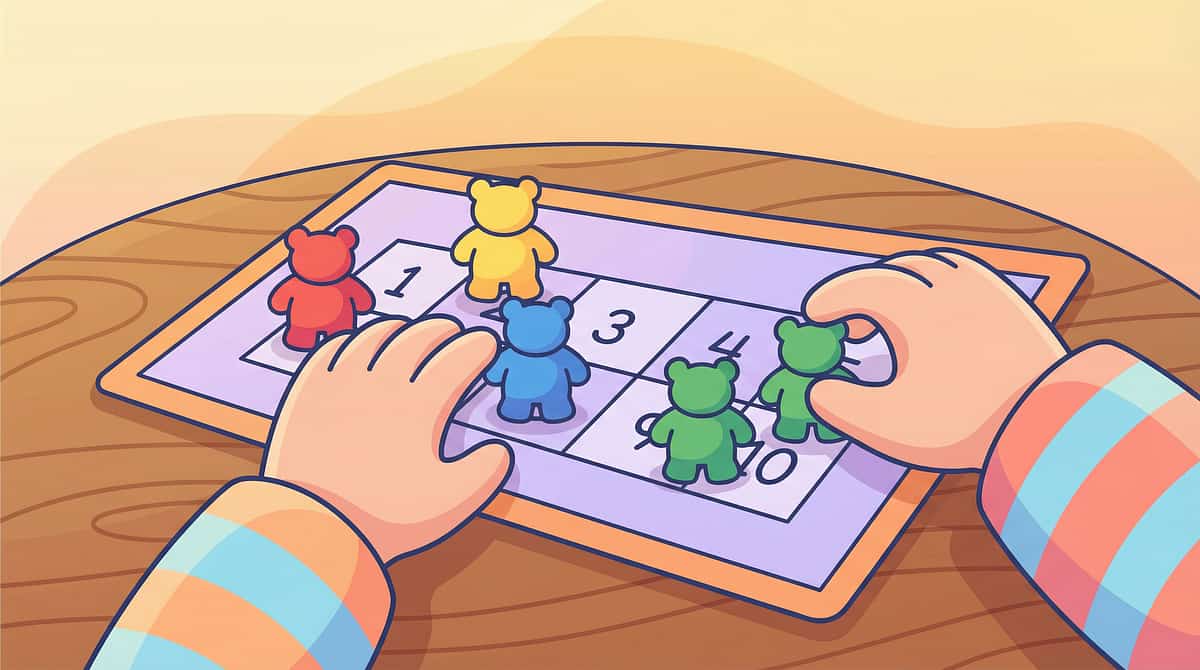
Technique B-171 | Quantity Concept Development
🔢 B-171
Cognitive-Language
Mathematical Language
Social Communication
Parent alias: "Building the Complete Language of How Much and How Many"
Quantity Concept Development is a structured, multi-material intervention that builds the complete vocabulary of amount — from precise counting through vague quantifiers (some, few, many), comparative language (more, less, equal), part-whole relationships, ordinal positions, estimation, and equal distribution. Unlike rote counting practice, this technique targets the bridge between number knowledge and flexible quantity language.
The gap in one sentence: Your child knows numbers. They don't yet know the language of amount. These are different skills — and both matter.
👶 Ages
2–10 years
⏱ Session
10–20 min/day
📅 Frequency
Daily embedding
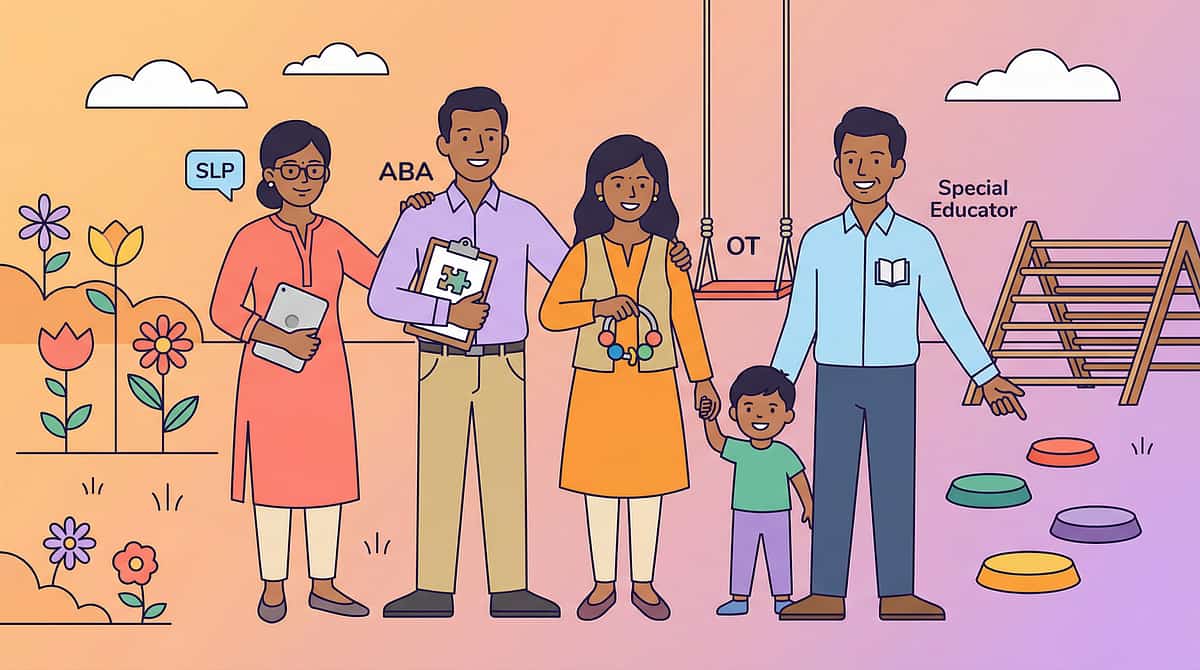
This Technique Crosses Therapy Boundaries — Because Quantity Language Lives Everywhere
Speech-Language Pathologist (Lead)
Primary role: Targets the language of quantity — vocabulary, comprehension of quantifiers, and flexible use of amount words in communication. Quantity language is embedded in conversation, directions, requests, and academic language. SLP owns the language scaffold.
Special Educator
Primary role: Embeds quantity concepts in academic tasks — maths readiness, literacy (ordinal story sequences), and classroom direction-following. Quantity concept gaps are the primary barrier to early mathematics and multi-step academic tasks.
BCBA/ABA Therapist
Primary role: Structures the reinforcement schedule, teaches discrimination (all vs. none vs. some), and builds flexible responding to vague quantifiers through systematic teaching. The precision of behavioural teaching — errorless learning, stimulus discrimination — is ideal for abstract quantifiers.
Occupational Therapist
Primary role: Addresses the sensory-motor components of hands-on quantity work — handling manipulatives, pouring, distributing, and the fine motor demands of counting activities. Many quantity materials require fine motor manipulation that OT can adapt.
"The brain doesn't organise by therapy type. Quantity language appears in OT (distribute these blocks), SLP (tell me 'some'), ABA (pick the tray with more), and SpEd (first step, then second). This technique is everyone's tool."
🏆 Pinnacle Blooms Multi-Disciplinary Consortium

Precision Targeting — What These 9 Materials Actually Change
Each of the 9 materials in this toolkit is selected to address a specific layer of quantity language development — from foundational counting to flexible estimation.
✅ Observable Behaviour Indicators
- Child uses "some" and "more" spontaneously
- Child can distribute items fairly to multiple people
- Child estimates without distress
- Child understands "first, then" in daily routines
- Child no longer insists on counting everything exactly
🌱 Long-Term Developmental Gains
- Mathematical readiness (early addition, subtraction, fractions)
- Academic direction-following
- Social fairness reasoning
- Flexible thinking and tolerance for ambiguity
- Generalisation of quantity language to novel contexts

Your 9-Material Quantity Language Toolkit — Research-Selected, Home-Ready
Every material in this toolkit targets a specific layer of quantity language development. Start with Materials 1, 2, and 3 — the foundation trio. Total investment: ₹1,600–5,000 for a comprehensive setup.
🏅 Pinnacle Recommends
Research-Selected
Home-Ready
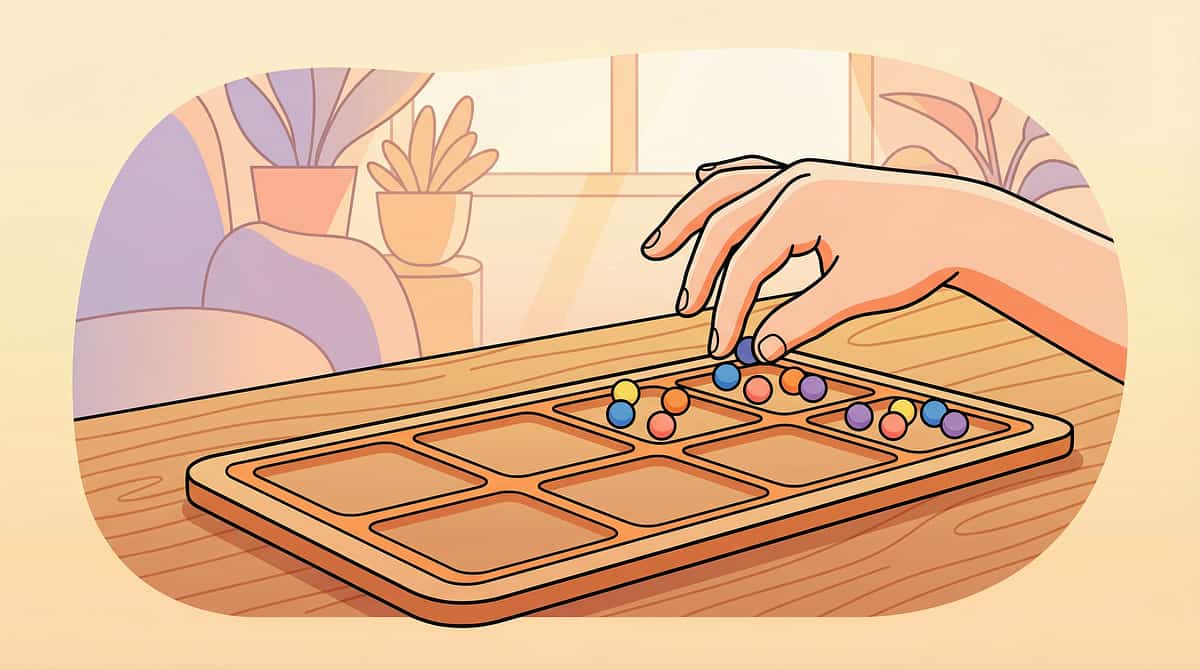
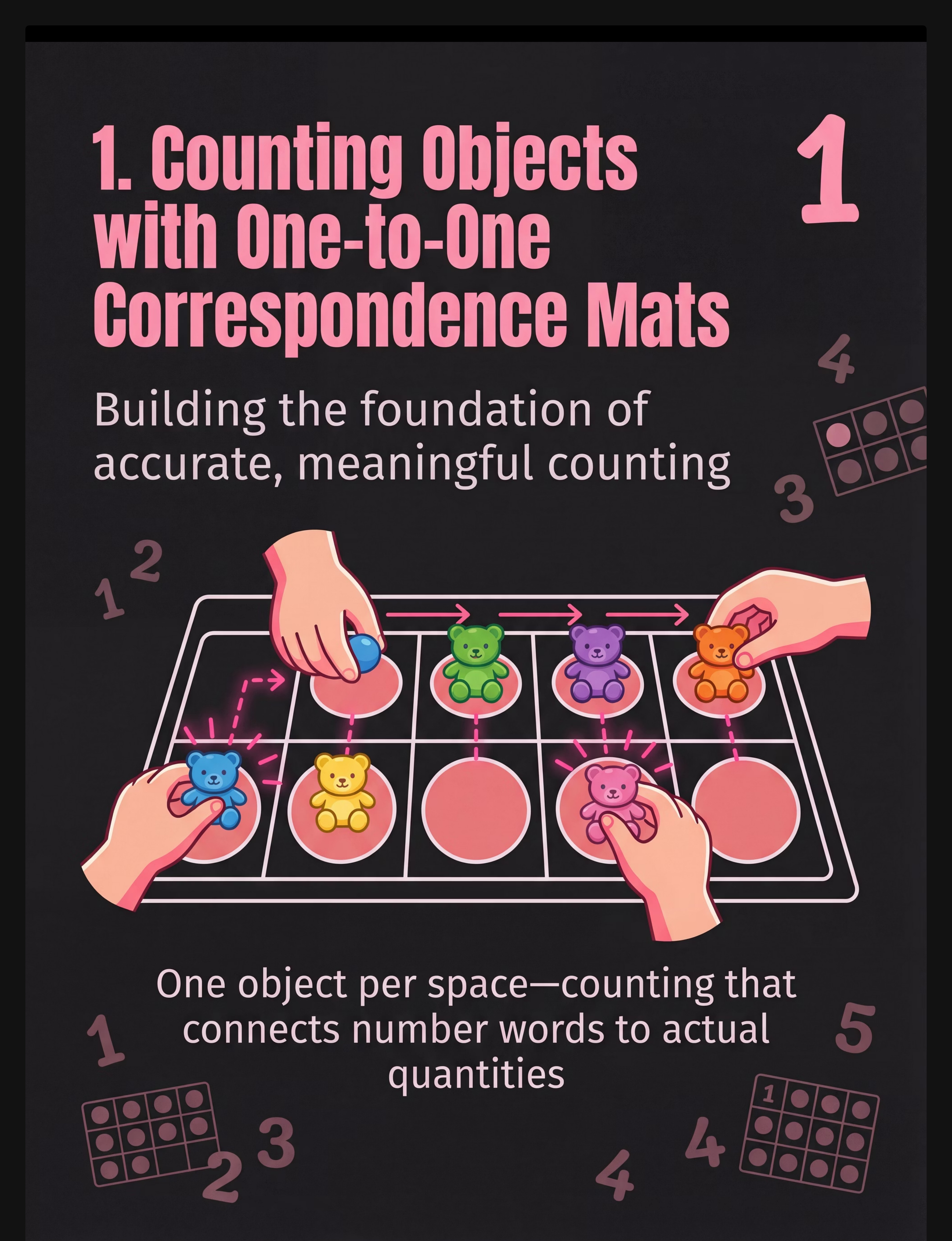
Material 1 — Counting Objects with One-to-One Correspondence Mats
Canon: Number/Counting Materials
Foundation Trio
Products: Ten-frame mats, counting grids, one-to-one correspondence boards, touch-counting sets
Price range: ₹200–600 | Browse on Amazon.in →
🎯Why it works: Builds the foundation of cardinality — each object gets exactly one count. This is the essential prerequisite for all other quantity language. Without it, "how many?" remains unanswerable.
What It Targets
One-to-one correspondence, cardinality (last number = total), precise counting foundation
Best For
Ages 2–5, all profiles, especially precision-preferring children who benefit from clear structure
Start Here If
Child recites numbers but cannot answer "how many?" after counting a set of objects
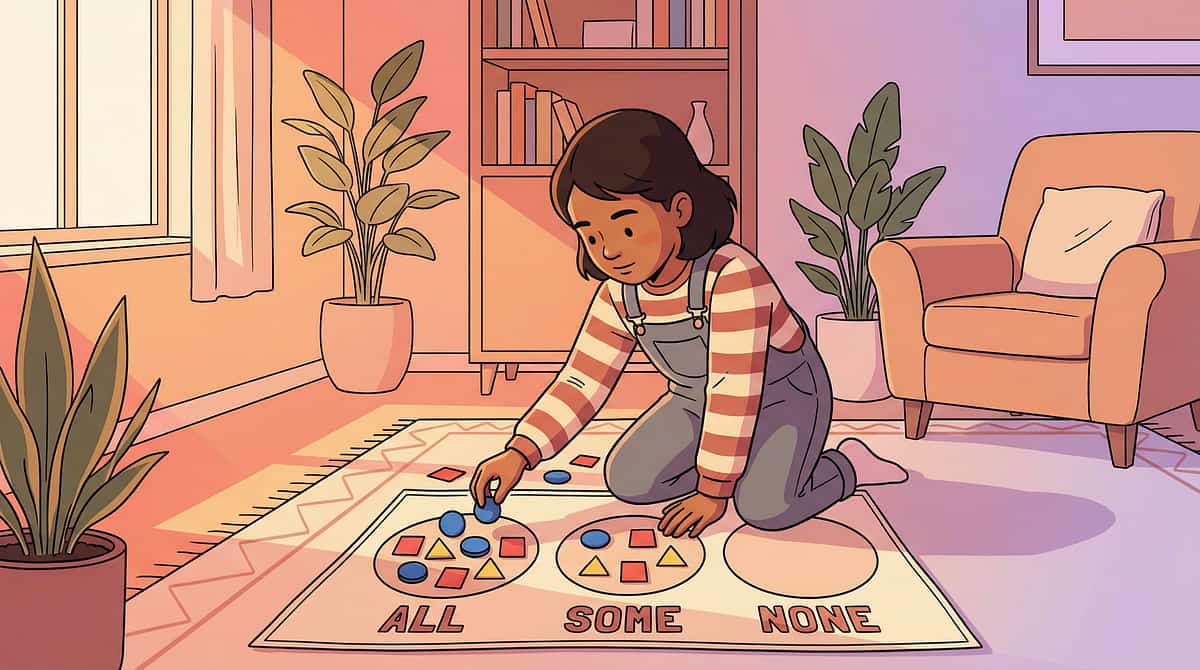
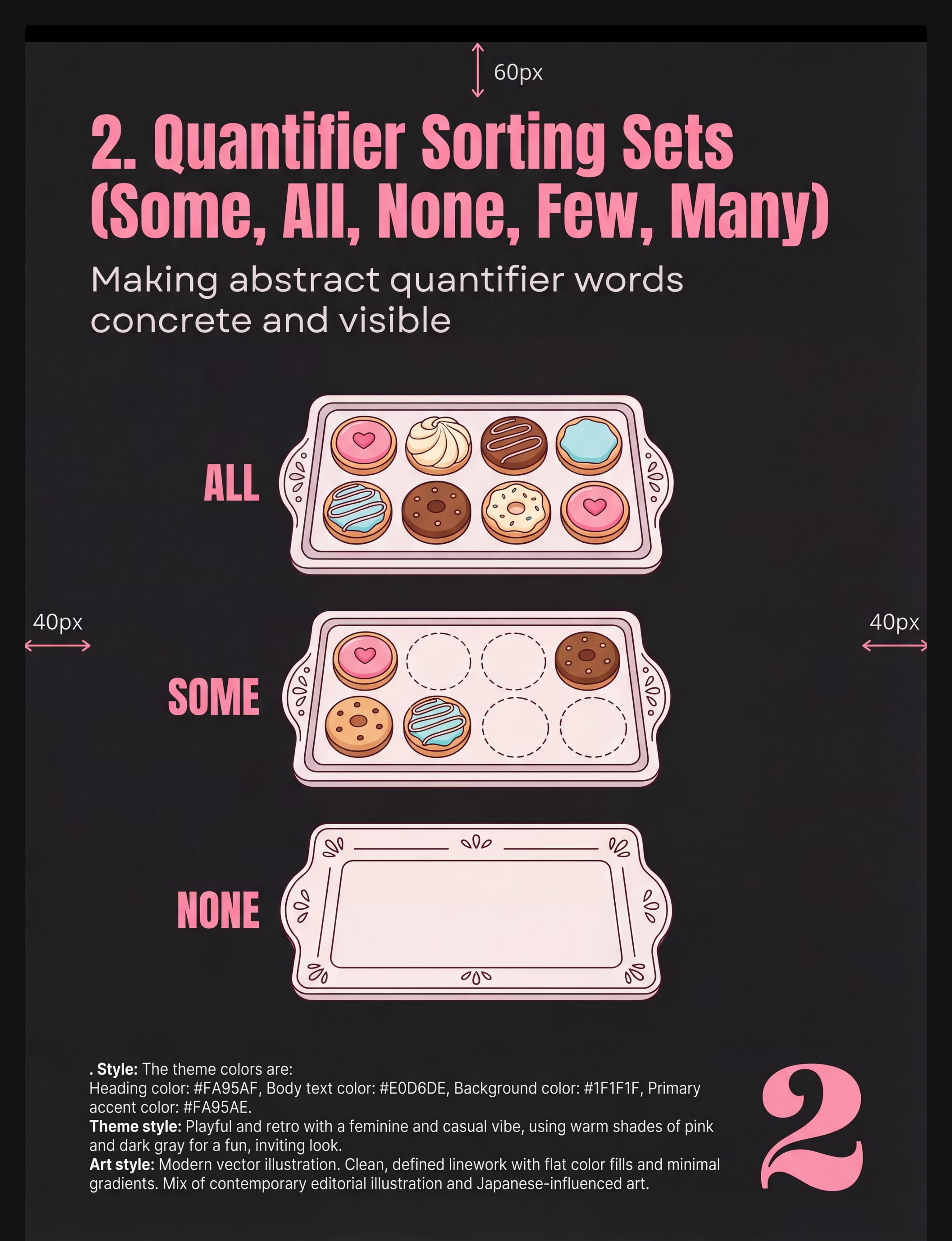
Material 2 — Quantifier Sorting Sets
Canon: Sorting Activities / Categorisation
Foundation Trio
Products: Sorting activity sets, colourful counters for quantifier demonstration, sorting trays
Price range: ₹628 | Browse on Amazon.in →
🎯Why it works: Makes abstract quantity words physically visible and sortable. "Some," "all," and "none" become containers you can see and touch — not invisible concepts you must imagine.
NONE
Empty tray — nothing at all. The clearest extreme.
SOME
Any non-zero, non-all amount. The flexible middle.
ALL
Every single one. The full tray. The other extreme.
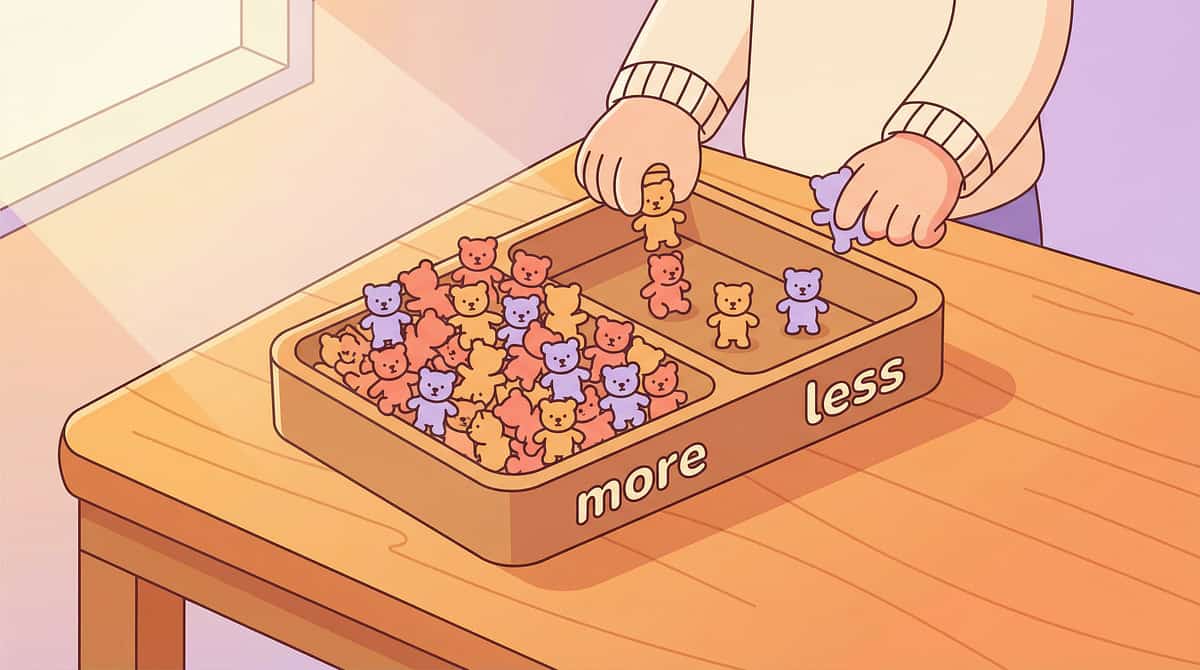
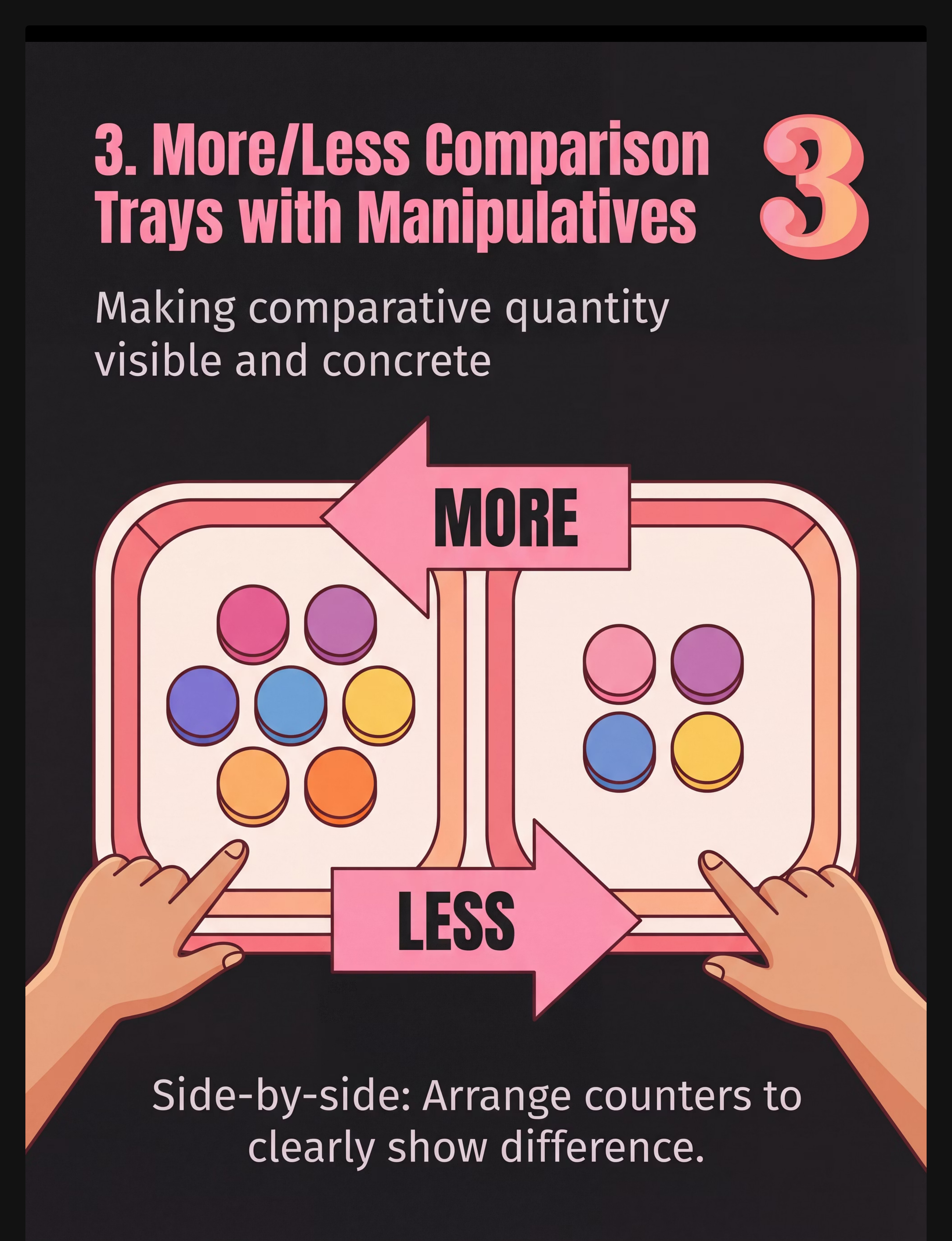
Material 3 — More/Less Comparison Trays with Manipulatives
Canon: Number/Counting Materials
Foundation Trio
Products: Two-sided sorting trays, counting bears, colourful counters, comparison boards
Price range: ₹200–500 | Browse on Amazon.in →
🎯Why it works: Makes comparative quantity (more than what?) concrete and visual. Comparison always requires a reference point — this material makes both points simultaneously visible and tangible.
Core Language Targets
- More / Less / Fewer
- Equal / Same amount
- Which has more? Which has less?
- How can we make them equal?
Session Script
"Two trays with different quantities. 'Which tray has MORE? Which has LESS? Point.' Then: 'How can we make them EQUAL?' Child adds or removes to balance."
🏆 Pinnacle Blooms Consortium Validated
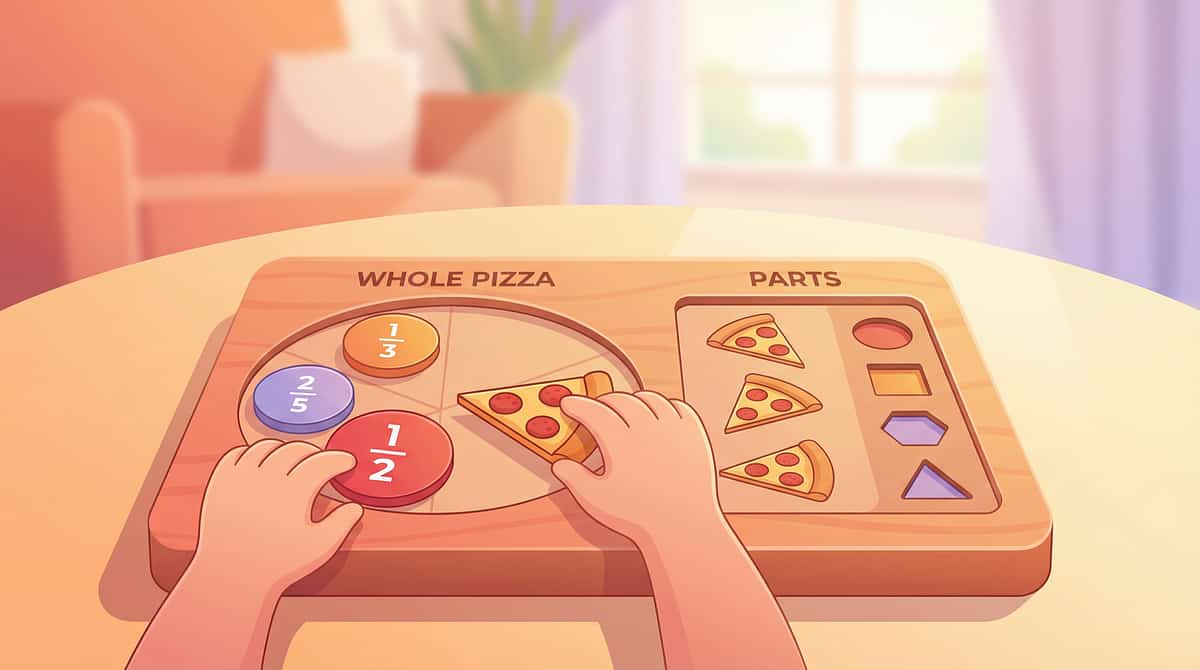
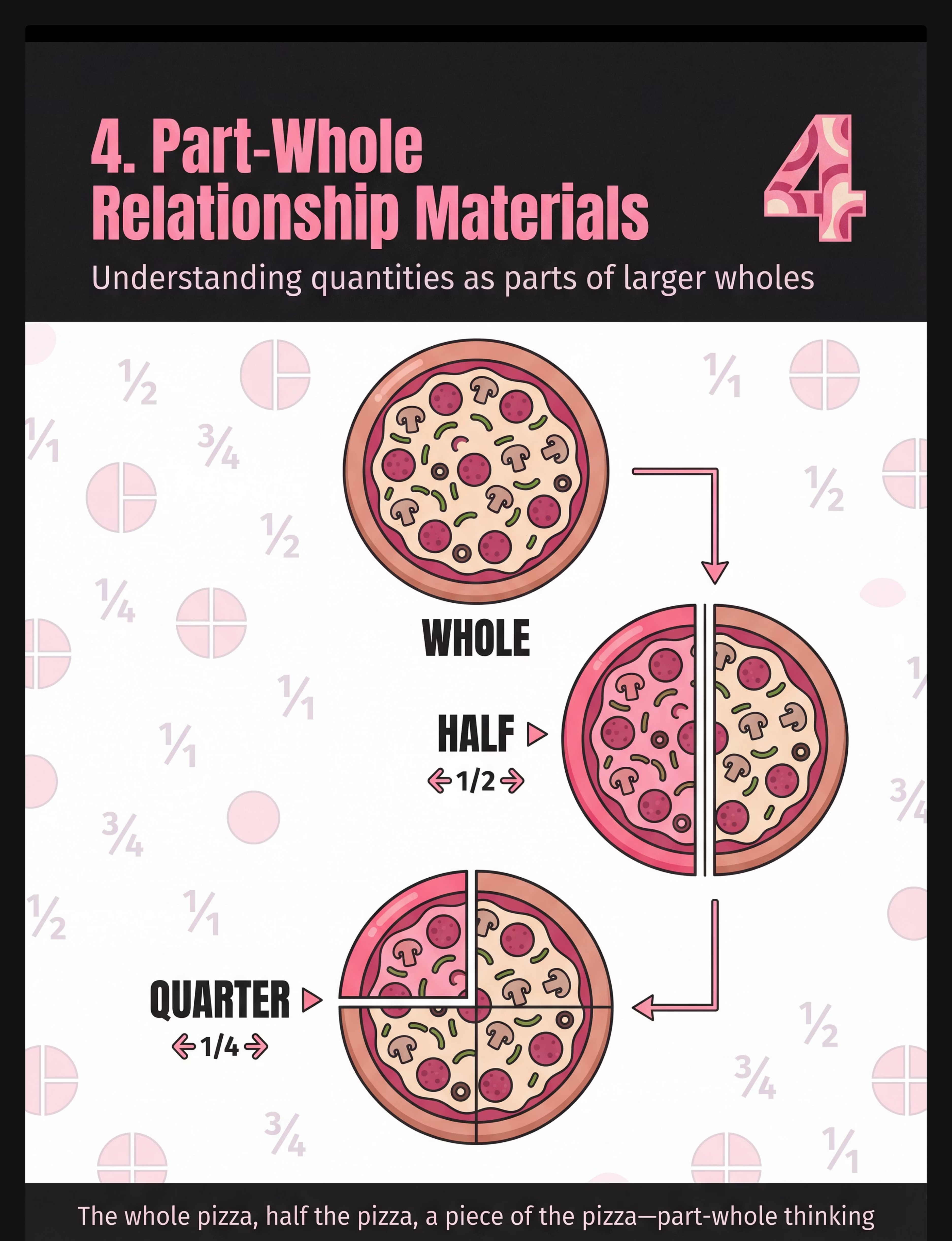
Material 4 — Part-Whole Relationship Materials
Canon: Sorting Activities / Categorisation
Products: Fraction circles, pizza sorting sets, part-whole boards, equal-parts kits
Price range: ₹300–800 | Browse on Amazon.in →
🎯Why it works: Builds "some of," "half," and fraction language from real, touchable materials. When a child can physically separate a circle into two equal parts, "half" transforms from an abstract word into a lived experience.
Half of
Two equal parts — the most foundational fraction concept
Part of
Some, but not all — bridging quantifiers and fractions
The rest of
What remains after taking part — completing the whole
DIY alternative: Real food works brilliantly — cut chapati, pizza, or a biscuit together. Real food IS a part-whole material.
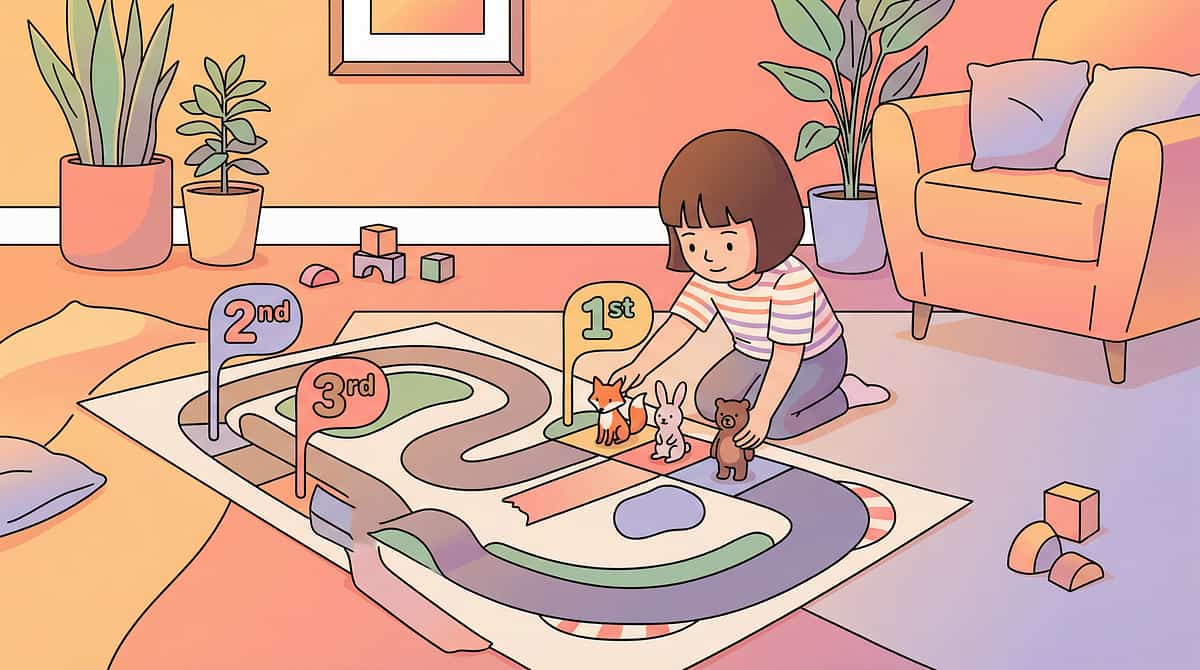
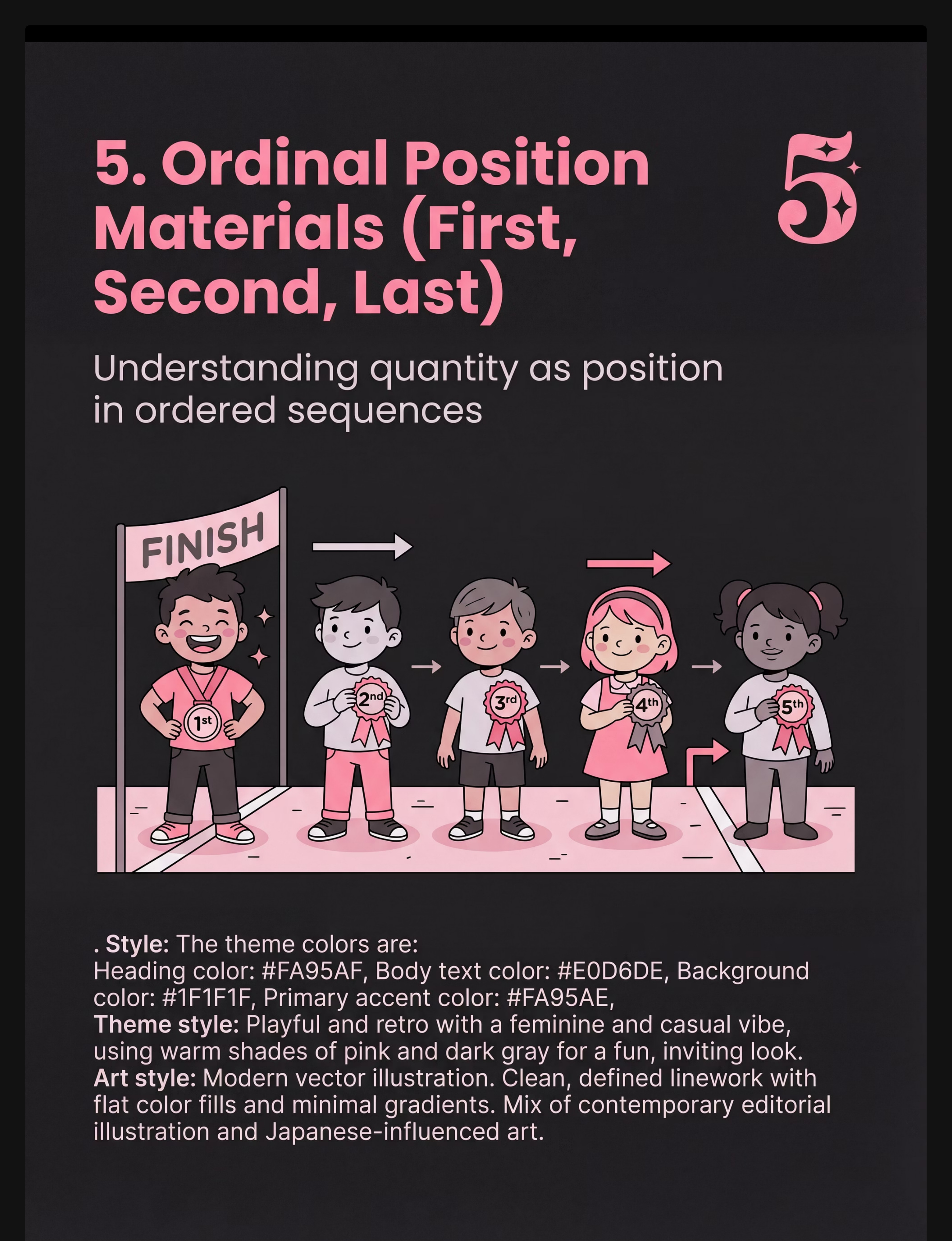
Material 5 — Ordinal Position Materials
Canon: Number/Counting Materials
Products: Position/sequence cards, ordinal number sets, race track ordering games
Price range: ₹200–500 | Browse on Amazon.in →
🎯Why it works: Teaches "first, second, last" — quantity as position, not just amount. Ordinal language is everywhere: first in line, second turn, last piece. It bridges quantity concepts with social routines and academic sequencing.
Natural Embedding Opportunities
- Race track games: "Who is FIRST? Who is LAST?"
- Snack serving: "I'll give you FIRST, then Mama"
- Story time: "Who came SECOND in the story?"
- Daily routines: "FIRST shoes, THEN we go"
Language Targets
- First / Second / Third
- Last / Final
- Next / Before / After
- Position words in daily routines
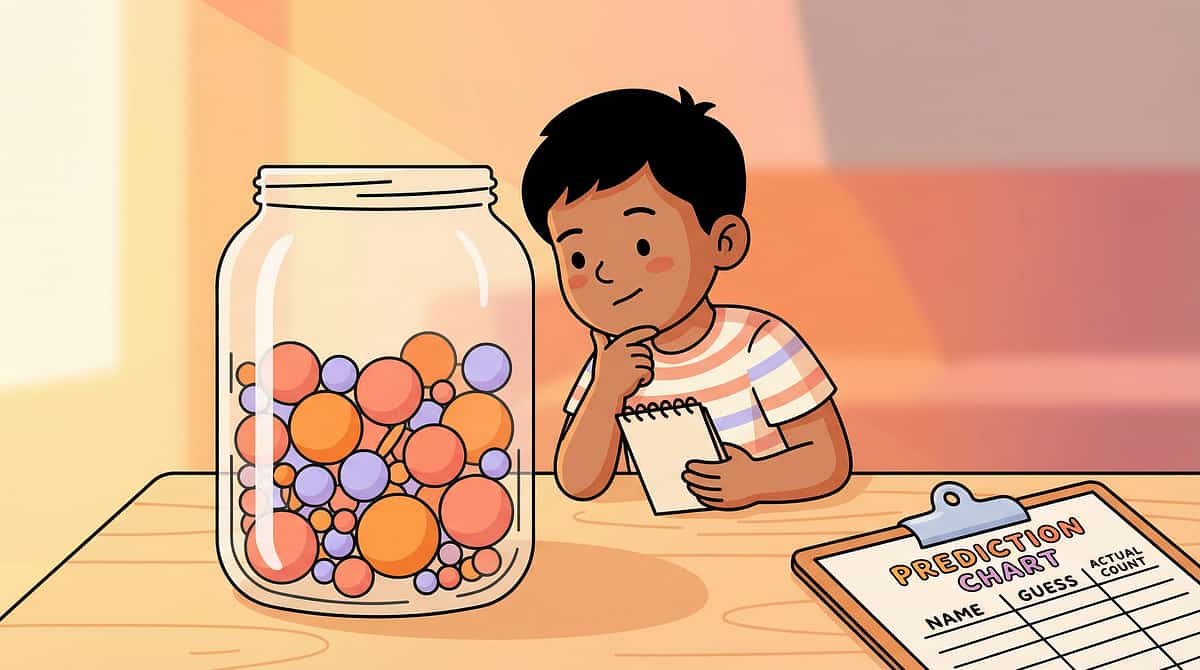
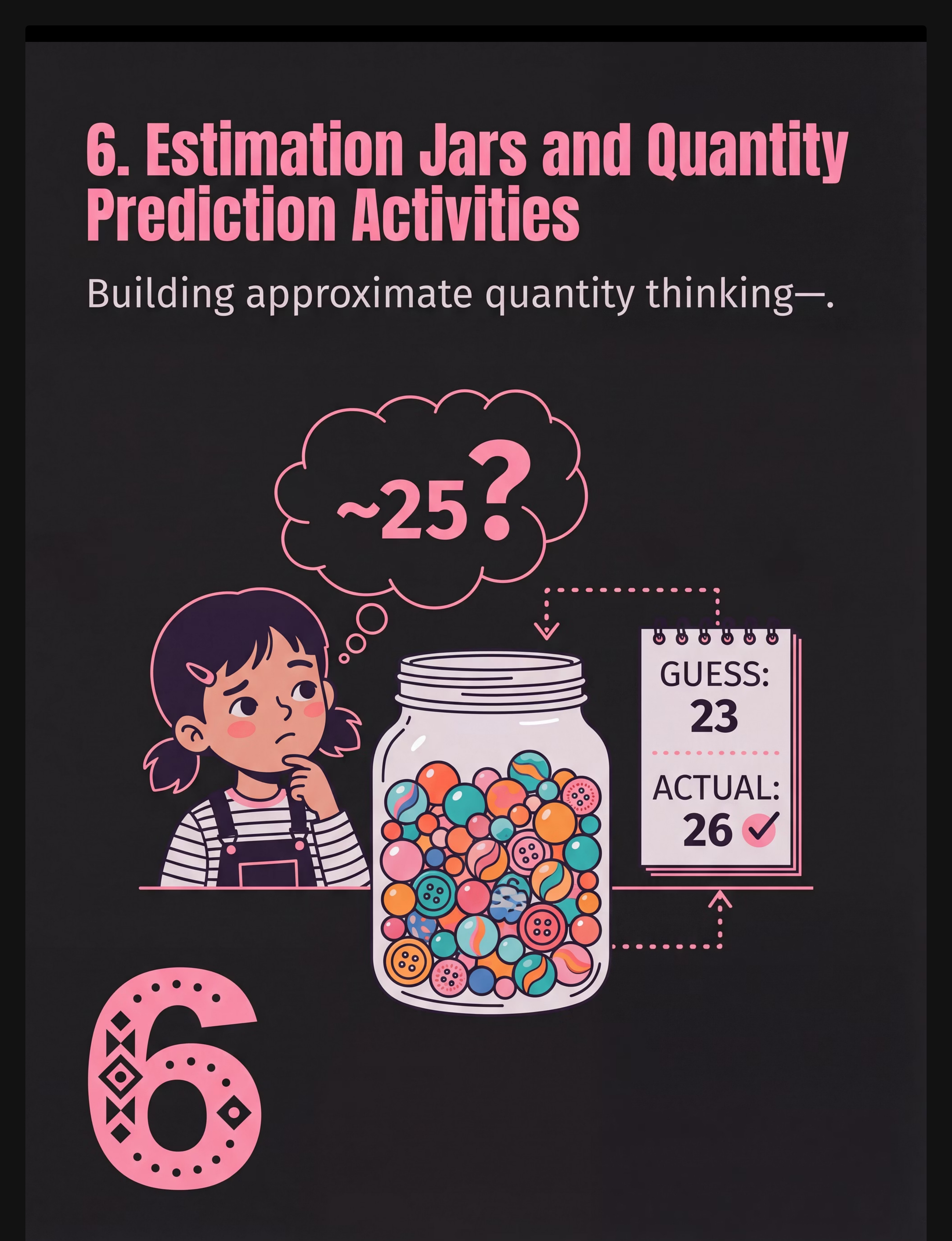
Material 6 — Estimation Jars and Prediction Activities
Canon: Problem-Solving Toys
Products: Clear jars, counting collections, prediction recording charts, benchmark sets
Price range: ₹150–400 | Browse on Amazon.in →
🎯Why it works: Builds tolerance for approximate thinking. "About 10" is a valid answer. Many children with ASD have a profound need for exactness — estimation activities gently stretch this tolerance in a low-stakes, playful context. Important: Introduce this material only after 6–8 weeks of successful quantifier and comparison work.
Step 1: Look
Show the sealed jar. "Don't count — just LOOK. About how many?"
Step 2: Guess
Child makes a prediction. Accept any number without correction.
Step 3: Count and Celebrate Proximity
"You guessed 8 — it was 10! That's SO close! Great estimating!"
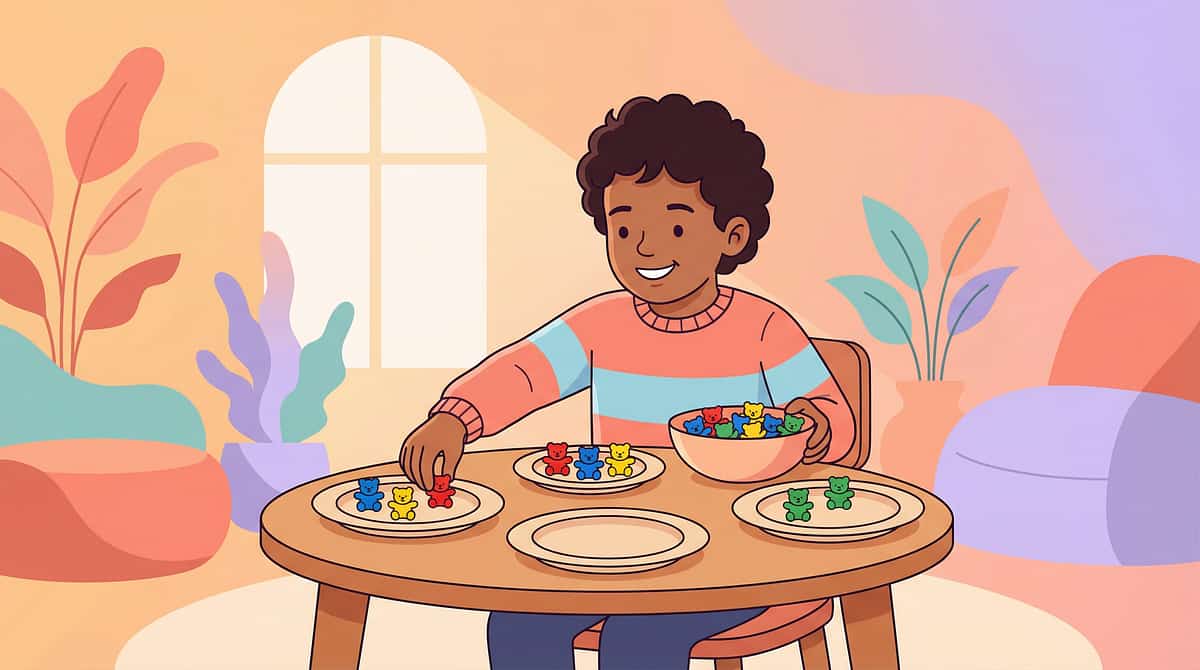
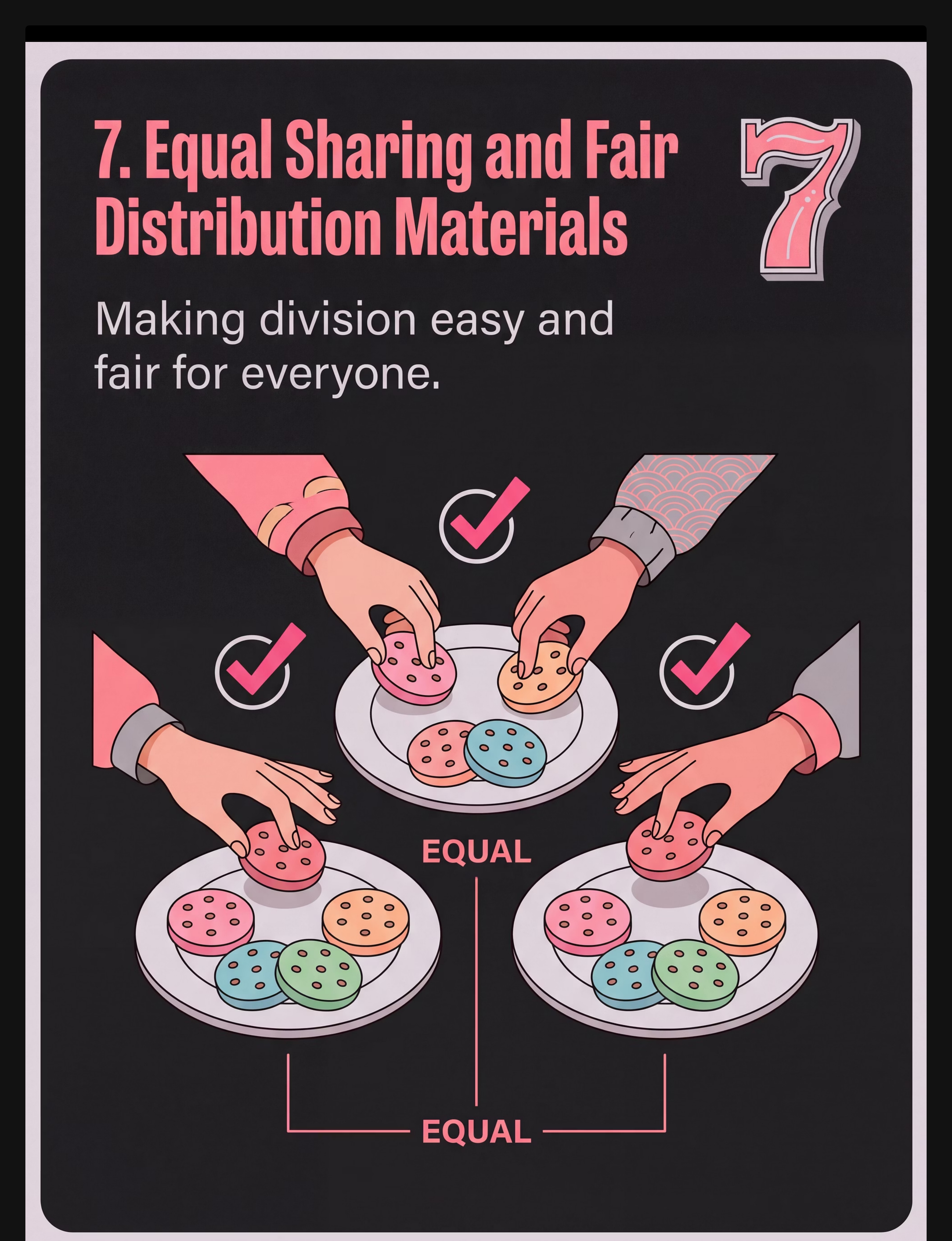
Material 7 — Equal Sharing and Fair Distribution Sets
Canon: Sorting Activities / Categorisation
Products: Sorting mats, plate sets for distribution, sharing activity kits, counting bears
Price range: ₹200–500 | Browse on Amazon.in →
🎯Why it works: Makes fairness concrete — equal means same amount for everyone. This material bridges mathematical quantity language with social understanding. Children who master fair sharing begin to apply fairness reasoning on the playground, at the dinner table, and in turn-taking games.
Session Script
"Set out plates for family members. 'Let's give everyone the SAME. One for you, one for me, one for Mama...' Check: 'Is it FAIR? Does everyone have the SAME amount?'"
Language Targets
- Equal / Same
- Fair / Unfair
- More for / Less for
- Everyone gets the same

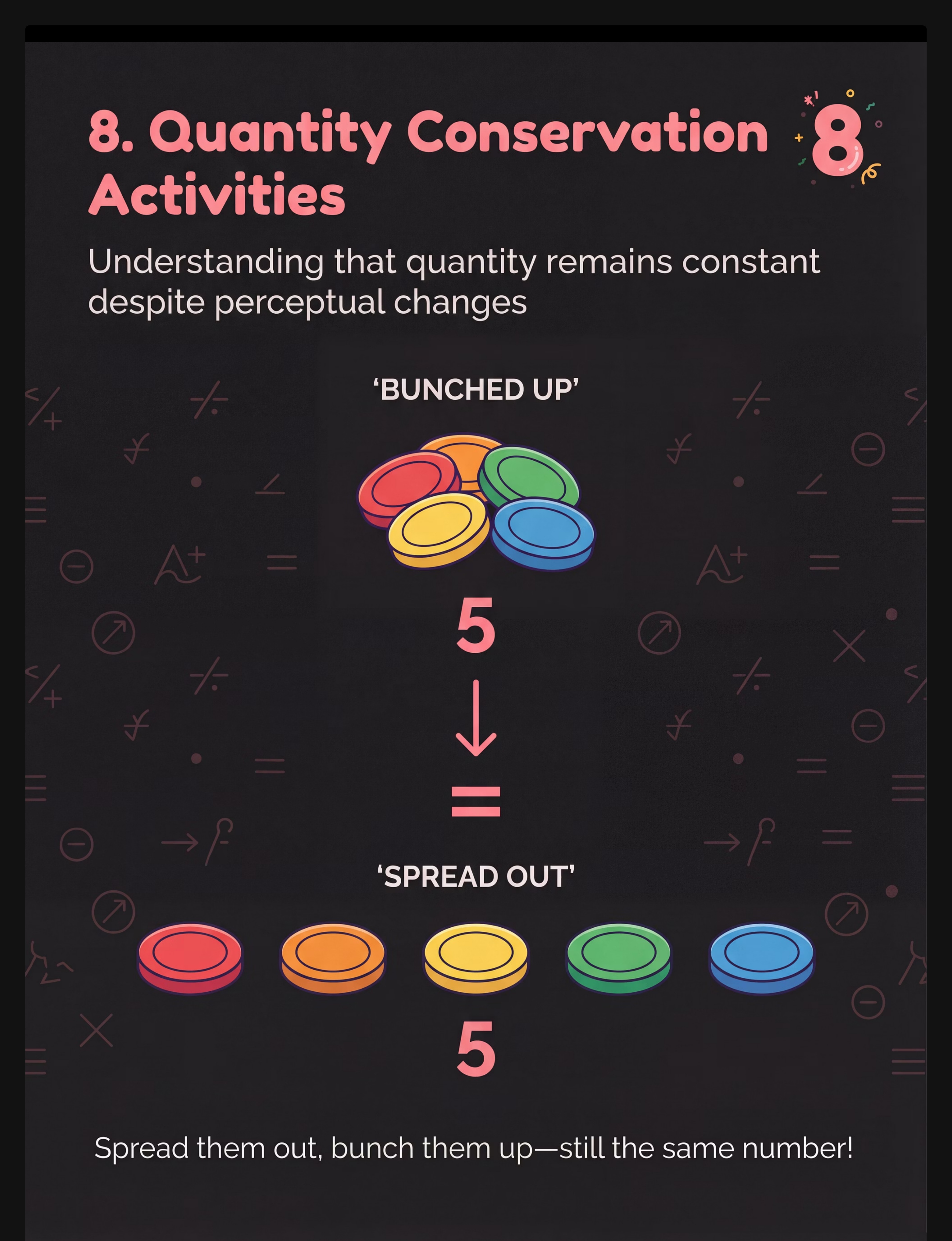
Material 8 — Quantity Conservation Activity Sets
Canon: Number/Counting Materials
Products: Counting coins/counters, transformation demonstration sets, same-amount kits
Price range: ₹150–400 | Browse on Amazon.in →
🎯Why it works: Teaches that quantity stays the same even when arrangement changes. This is Piaget's classic conservation principle — a child who thinks a spread-out row has "more" than a bunched group is still pre-conservation. This material builds the understanding that appearance ≠ amount.
Arrange
5 counters in a long spread-out row
Transform
Bunch them together into a tight cluster
Ask
"Do I have MORE now, LESS now, or the SAME?"
Confirm
"Count them — still 5! Arrangement changes. Amount stays the same."
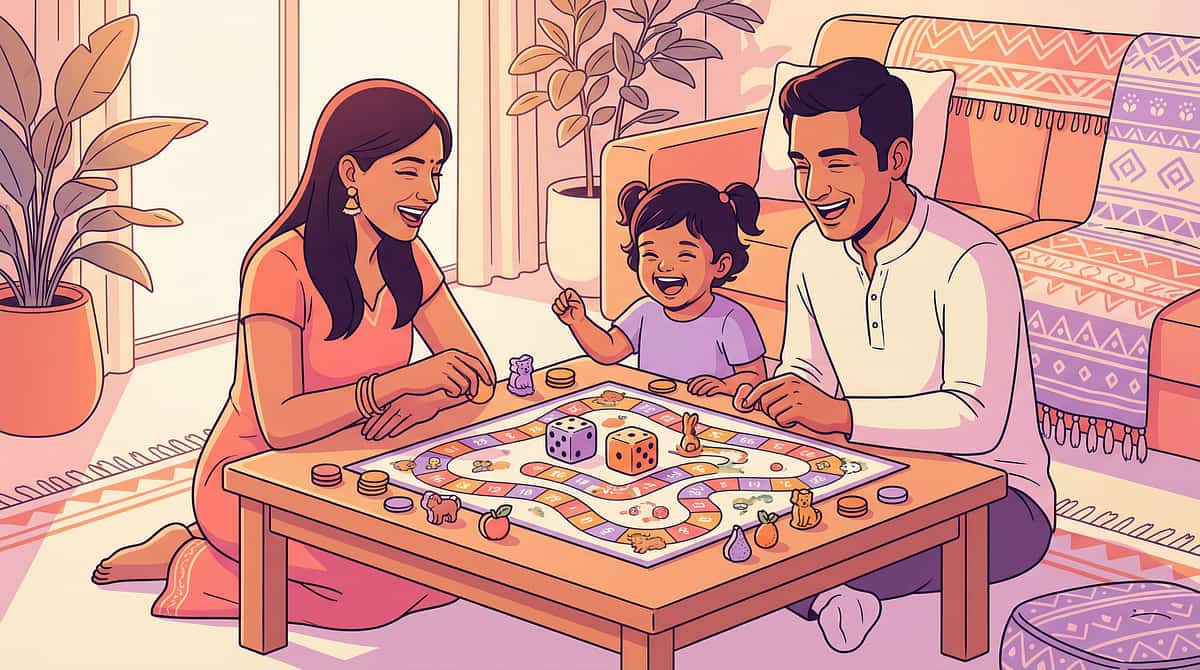
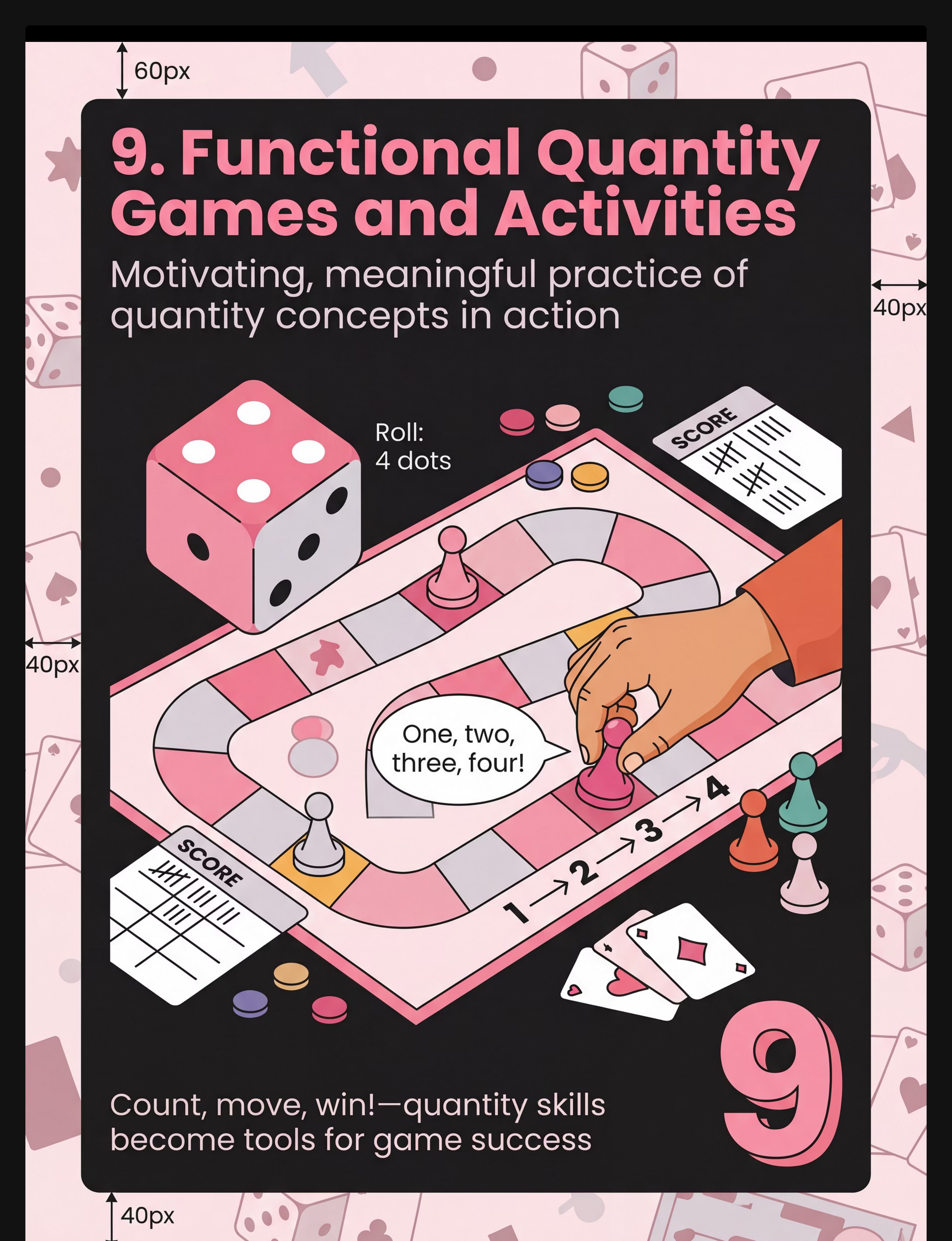
Material 9 — Functional Quantity Games
Canon: Problem-Solving Toys
Products: Dice games, board games with counting, card games for early maths
Price range: ₹428 | Browse on Amazon.in →
🎯Why it works: Quantity counts when it matters — correct counting means winning. Games embed quantity language in a motivating, emotionally engaging context. This is the most powerful generalisation vehicle in the toolkit: a child who counts to win is practising cardinality and comparison without knowing it's therapy.
More/Less in Action
Dice rolls create natural more/less comparisons every turn
Counting in Context
Counting spaces on a board gives cardinality a purpose
Fair Turn-Taking
"Everyone gets the same number of turns" — ordinal and equal language
Total toolkit investment: ₹1,600–5,000 for comprehensive setup. Start with Materials 1, 2, and 3 — the foundation trio.

Every Material Has a Zero-Cost Home Version — WHO Equity Principle
The Pinnacle Blooms SLP-SpEd-ABA Consortium confirms: household materials are clinically equivalent for most quantity concept teaching. The therapeutic ingredient is the structured interaction and language — not the commercial product.
Material | Commercial | Zero-Cost DIY | |
Counting Mats | Ten-frame boards | Draw circles on paper; use muffin tin | |
Quantifier Sets | Sorting sets | Any household objects (crackers, blocks, coins) | |
Comparison Trays | Two-sided tray | Two plates or containers from kitchen | |
Part-Whole Materials | Fraction circles | Real food — pizza, chapati, cookie — cut together | |
Ordinal Cards | Sequence cards | Line up toys; use daily routines | |
Estimation Jars | Clear jars + counters | Any container; fill with beads, buttons, seeds | |
Sharing Sets | Activity kits | Snack time — deal crackers to family plates | |
Conservation Sets | Counter kits | 5 coins — spread out, bunch together, still 5 | |
Quantity Games | Board games | Dice + any homemade board with numbered spaces |
"A kitchen muffin tin IS a counting mat. Real chapati IS a part-whole material. Your dining table IS the therapy space." — Pinnacle Blooms SLP-SpEd-ABA Consortium
WHO Nurturing Care Framework (2018) — equity-focused interventions. CCD Package efficacy in 54 LMICs with household materials. PMC9978394
Safety Gate — Read Before Every Session
🔴 STOP — Do Not Proceed If:
- Child is dysregulated; meltdown recovery within past 30 min
- Child is sick, overtired, or significantly hungry
- Child shows active distress escalating beyond 30 seconds
- Choking hazard: Small counters/coins with children who mouth objects without direct supervision
- Child has known anxiety around academic tasks — begin with play-framing ONLY
🟡 MODIFY — Proceed With Adjustments If:
- Child is mildly fussy → Start with preferred materials (snacks, favourite toys)
- Child refuses commercial materials → Switch to 100% DIY/household equivalent
- Child insists on exact counting → Honour this while gently introducing "about" framing
- Session in noisy environment → Move to quieter space; reduce to 5 minutes
🟢 GO — Session Ready When:
- Child is calm, alert, and regulated ✓
- Environment is quiet, distraction-minimised ✓
- Materials are prepared and accessible ✓
- You have 10–20 uninterrupted minutes ✓
- Child has eaten within 1–2 hours ✓
🚨RED LINE — STOP SESSION IMMEDIATELY IF: Child shows self-injurious behaviour | Child is crying inconsolably for more than 60 seconds | Child shows signs of choking | Child's distress is escalating despite de-escalation attempts. Small counters are choking hazards for children under 3 or those who mouth objects — use larger manipulatives (bears, blocks, soft fruits).
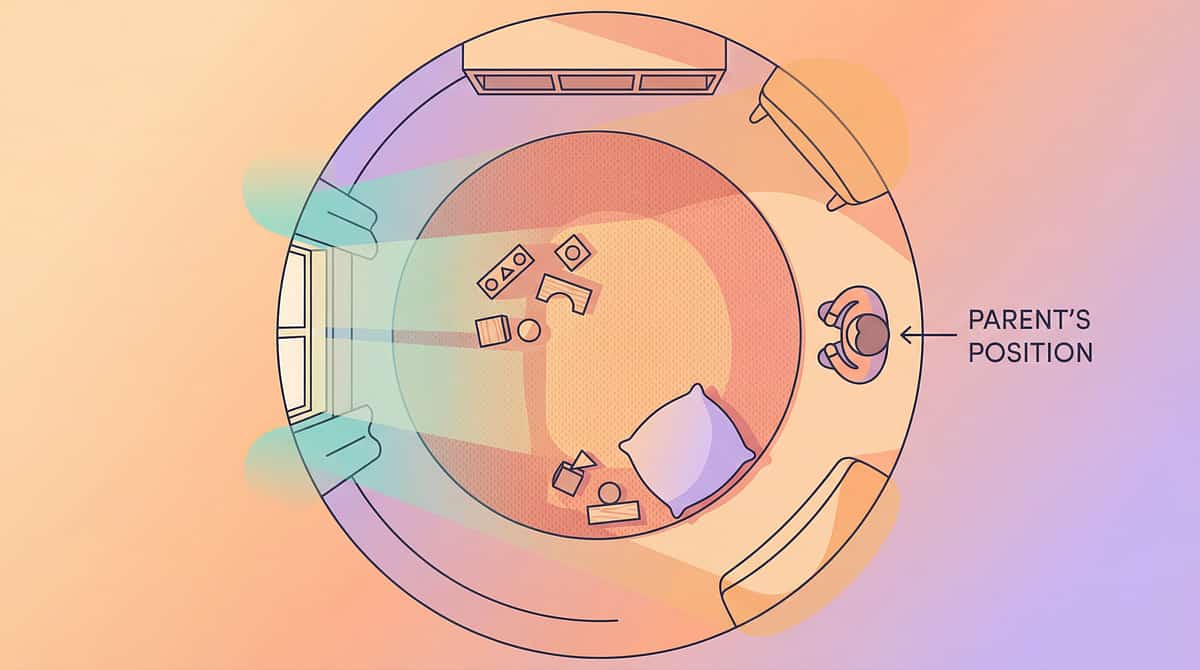
The Right Environment Is 80% of Session Success
A child who can see 6 activities will demand all 6. Spatial precision prevents session failures — present one material at a time. The following setup makes sessions run smoothly and prevents the most common causes of session breakdown.
1
Child's Seat
Low table or floor mat; child faces materials — comfortable and grounded
2
Parent's Position
Beside child — not across. Side-by-side is collaborative, not confrontational
3
Materials Area
Within child's reach but not all visible at once — prevents overwhelm
4
"Done" Container
Clear box for completed/counted items — provides visual closure
5
Data Tracker
On parent's side, ready to mark — 60 seconds of data = hours of clarity
6
Transition Object
Child's comfort item within reach for session-end transition
✅ Environmental Checklist
- TV off | Phones silenced
- Lighting: moderate (not harsh overhead fluorescents)
- Sound: quiet or soft background music
- Surface: low table, floor mat, or cleared kitchen table
🕒 Time of Day Guidance
- Best: Post-nap / mid-morning when alert
- Avoid: First 30 minutes after school
- Embed: Snack time = perfect natural quantity session
🏆 Pinnacle Blooms Consortium
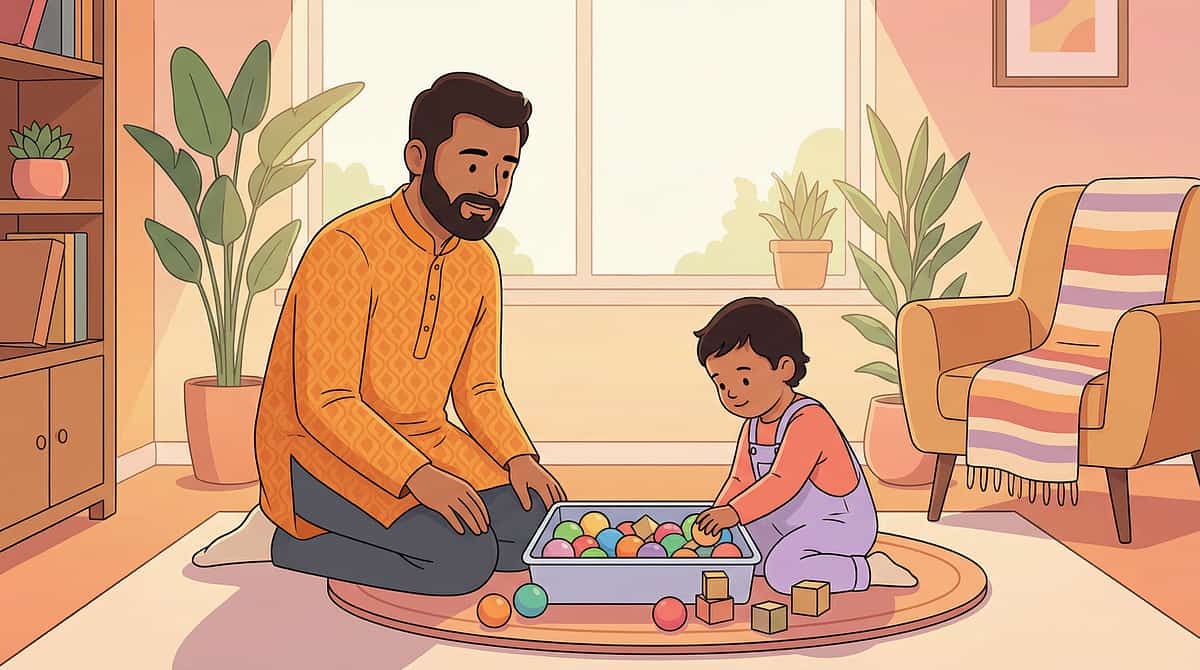
60-Second Pre-Flight Check — Do Not Skip This
The best session is one that starts right. A 5-minute perfect session outperforms a 20-minute forced one. Antecedent manipulation — setting events determine session success. This is standard in evidence-based ABA session protocols.
☐ Child has eaten within 2 hours
☐ No meltdown or significant distress in past 45 minutes
☐ Child is in a regulated state (not bouncing off walls OR shut down)
☐ Child is not sick or showing signs of illness
☐ No major schedule disruption still causing distress
☐ You have 15+ uninterrupted minutes
☐ Materials are already prepared
7/7 ✓ → GO
Full session as designed
5–6/7 ✓ → MODIFY
Reduce to 8–10 min; use preferred materials; lower difficulty
<5/7 ✓ → POSTPONE
Skip today. Try: "How many strawberries do you want? Some? Or all of them?"

Step 1: The Invitation — How You Enter Determines Everything
Never say "It's time for therapy" or "Let's do your exercises." Frame every session as play, discovery, or helping. The child sees ONE material — not the whole setup. Parent is excited first — curiosity is contagious.
1
Option A — Game Framing
"I found something really cool to show you. Want to see if we can trick these bears?"
2
Option B — Helper Framing
"I need your help with something important. Can you be my counting helper?"
3
Option C — Curiosity Framing
"Guess what I have? It's a jar with something in it — can you guess how many?"
Motivation check: What is most motivating for your child today? Food/snacks | Specific toy | Social praise | Stickers | Screen time later. Use the most motivating item as your manipulative whenever possible — crackers are perfect counting AND quantifier materials.
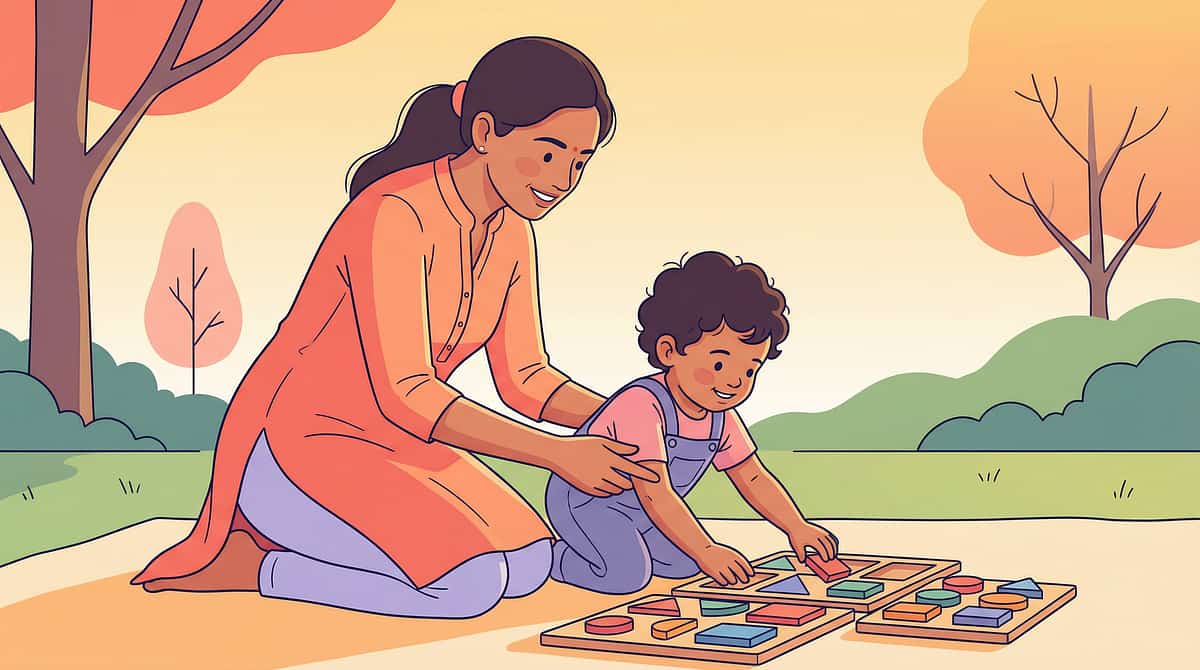
Step 2: Engagement — The 3-Phase Entry From Watching to Participating
The child self-selects into participation. No compliance demand. No failure. Just curiosity and language. The session is running by the time comparative quantity language enters naturally.
Phase 1 — Observe (0–30 seconds)
Parent manipulates materials while narrating: "Look — I'm putting ONE bear in each circle. One... two... three. How many circles do I have left?" Child watches. No demand. No "your turn" yet.
Phase 2 — Parallel (30–90 seconds)
Give child identical materials. Work side by side: "You have some bears too! I'm going to put mine here. You can put yours anywhere you want." Match whatever they do with language.
Phase 3 — Joint (90s+)
Create a natural joint engagement point: "Wait — which one of us has MORE? Let me look... you have 1, 2, 3, 4 — and I have 1, 2 — oh! You have MORE! Is that fair?" Natural comparative language has entered.

Step 3: The Core Therapeutic Action — 6-Step Sequence
Each sub-step takes 2–3 minutes. A full rotation runs 10–18 minutes. Stop before satiation. Quality over duration — structured 10–20 minute home sessions show significant outcomes (PMC10955541).
01
Step A — Counting Foundation (Material 1)
Place counting mat. Count objects into spaces together. After counting: "How many altogether? Count with me — and then STOP. How many?" Builds cardinality — last number = total.
02
Step B — Quantifier Sorting (Material 2)
Set out all bears. "ALL go here. NONE go here. And SOME go here — not all, not none. You pick some." Accept any non-zero, non-all selection as correct.
03
Step C — More/Less Comparison (Material 3)
Two trays with different quantities. "Which tray has MORE? Which has LESS? How can we make them EQUAL?" Child adds or removes to balance.
04
Step D — Ordinals in Sequence (Material 5)
Line up 3–5 objects or family members. "Who is FIRST? Who is LAST? Who is SECOND?" Use races, stories, snack serving.
05
Step E — Estimation (Material 6)
Show sealed jar. "Don't count — just LOOK. About how many? Make a guess." Count to verify. Celebrate proximity: "You guessed 8 — it was 10! That's SO close!"
06
Step F — Equal Sharing (Material 7)
Set out plates for family members. "Let's give everyone the SAME. One for you, one for me, one for Mama..." Check: "Is it FAIR? Does everyone have the SAME amount?"
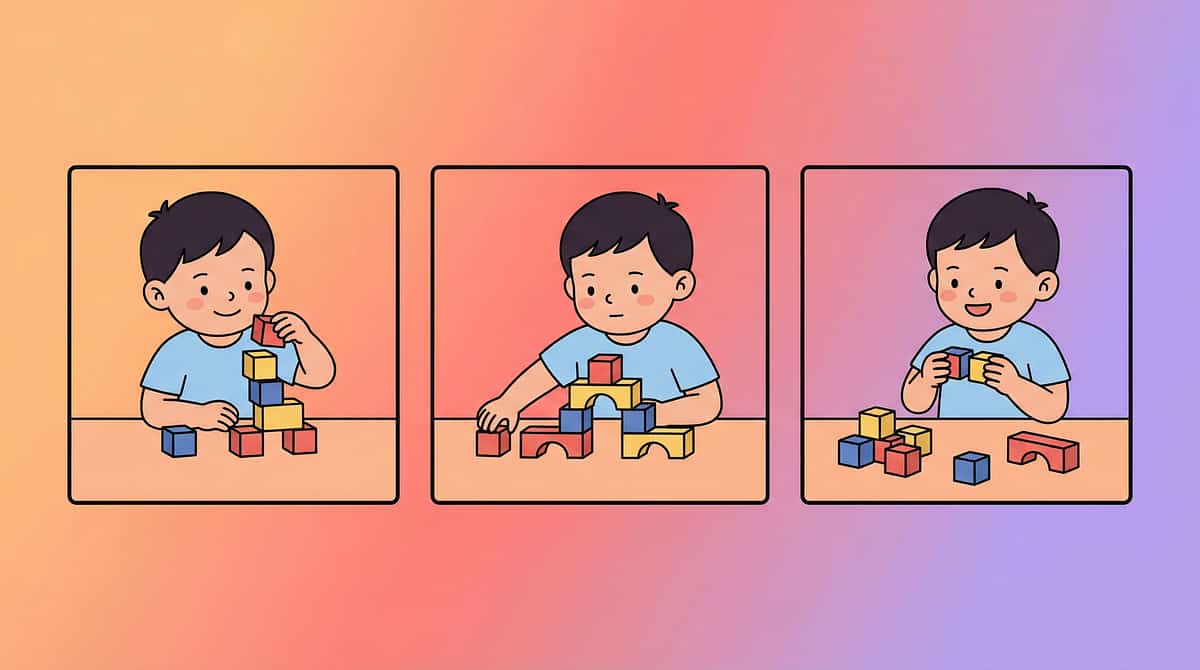
Step 4: Repeat and Vary — Dosage and Variation Guide
Three perfect repetitions beat ten forced ones. The goal is meaningful engagement, not maximum repetition. Watch for satiation signals and stop before the child pushes materials away.
Material | Day 1 | Day 3 | Day 7 | |
Counting | Counting bears | Counting crackers | Counting people | |
Quantifier Sort | Sort: some/all/none | Sort: few/many | Sort: most/least | |
Comparison | Trays with counters | Trays with fruit | Trays with toys |
Counting
3–5 counting sequences per session
Quantifier Sorting
4–6 sort cycles (different objects)
More/Less
3–4 comparison pairs
Estimation
2–3 estimation rounds
Satiation signals — stop when you see: Child pushes materials away | Child starts stacking instead of counting | Child begins scripting or shutting down | Child looks away consistently for 5+ seconds. "Satiation is information — your child just told you they've had enough for today. That's productive session management, not failure."

Step 5: Reinforce and Celebrate — Reinforce the Attempt, Not Just the Success
Reinforce within 3 seconds of any correct or approximate response. Reinforce attempts too — if the child gives any reasonable response to a quantity question, that deserves celebration.
Verbal Praise (Always)
"YES! You found the tray with MORE! That's exactly right!"
"You shared fairly! Everyone has the SAME amount!"
"You guessed 8 and it was 10 — that's SO close! Great estimating!"
"You shared fairly! Everyone has the SAME amount!"
"You guessed 8 and it was 10 — that's SO close! Great estimating!"
Token Economy (Optional)
Place a star/sticker on a chart for each good attempt. After 5 stars → preferred activity for 5 minutes. Consistent, predictable reinforcement builds motivation for the next session.
Natural Consequence (Most Powerful)
"You shared fairly — so now you can eat yours!"
"You estimated first and then counted — great maths thinking!"
"You estimated first and then counted — great maths thinking!"
What NOT to do:❌ Don't correct vague quantifier responses unless clearly wrong | ❌ Don't say "That's wrong" for any approximation attempt | ❌ Don't delay reinforcement beyond 5 seconds. If child guesses "100" for 8 objects: "I love that you made a guess! Let's count and see how close."

Step 6: The Cool-Down — No Session Ends Abruptly
The cool-down prevents dysregulation at session end. The transition OUT of the session is as therapeutically important as the session itself. Always warn — never abruptly end.
1
2 Minutes Before
"Two more turns, then all done." Show visual timer or finger count.
2
1 Minute Before
"One more. After this, we put the materials away together."
3
End
"All done! You were such a great quantity helper today! Let's put these away."
4
Put-Away Ritual
Child helps put materials away. This IS also a quantifier moment: "Put ALL the bears away / Some bears are still out — can you find them?"
If child resists ending: "I know you want to keep going. We'll do more bears tomorrow. Right now it's time for [preferred next activity]." Cool-down activity options: 2 minutes of free play with preferred toy | Child's choice activity | Sensory calming input if needed.

Capture the Data — Right Now
60 seconds of data now = hours of clarity later. Data from today tells tomorrow's therapist where to focus. This is the most efficient therapy investment you'll make in each session.
1
Date + Duration
Date picker | Session duration: 5 / 10 / 15 / 20 min+
2
Materials Used
Checkboxes: Materials 1–9 used today
3
Cardinality
No response | Approximate | Accurate
4
Quantifiers
None | With prompting | Spontaneous
5
More/Less
Confused | With modelling | Independent
6
Engagement
Mood/engagement: 1–5 | Free notes field
1
Level 1
Rote counting only — no cardinality
2
Level 2
Counting with cardinality ("how many?" answered correctly)
3
Level 3
Understands all/none (extremes)
4
Level 4
Uses more/less comparisons
5
Level 5
Understands some/few/many (middle quantifiers)
6
Level 6
Understands ordinals (first/last)
7
Level 7
Tolerates estimation
8
Level 8
Applies quantity language flexibly

What If It Didn't Go as Planned? — Most Sessions Don't Go Perfectly
Session abandonment is not failure — it's data. It tells you the level was too high, the motivation was wrong, or the timing was off. Every "failed" session teaches you something. Here are the six most common challenges and their solutions.
🔴 "My child refused after 3 minutes."
Why: Demand too high, material not motivating, or satiation faster than expected.
Fix: Switch to 100% DIY with food. Start with only Material 9 (games). Reduce demand to observation only.
Fix: Switch to 100% DIY with food. Start with only Material 9 (games). Reduce demand to observation only.
🔴 "My child insists on giving the exact number for 'some.'"
Why: Precision preference — a genuine cognitive style. Honour it while expanding.
Fix: Accept exact answers AND narrate vague language: "You gave me 3 — and 3 is some. 'Some' can be any small amount."
Fix: Accept exact answers AND narrate vague language: "You gave me 3 — and 3 is some. 'Some' can be any small amount."
🔴 "My child understands 'all' and 'none' but refuses 'some.'"
Why: 'Some' has no fixed value — it genuinely has no single correct answer.
Fix: Show three trays: ALL (full), NONE (empty), SOME (medium). Make 'some' visible as a range between the two extremes.
Fix: Show three trays: ALL (full), NONE (empty), SOME (medium). Make 'some' visible as a range between the two extremes.
🔴 "Estimation activities cause meltdowns."
Why: Estimation tolerance is hard for precision-preferring children. Don't start here.
Fix: Begin estimation after 6–8 weeks of successful quantifier and comparison work.
Fix: Begin estimation after 6–8 weeks of successful quantifier and comparison work.
🔴 "Child distributes but doesn't say 'equal' or 'fair.'"
Why: Behaviour precedes language — normal developmental sequencing.
Fix: Continue narrating: "You gave everyone the same! That's EQUAL. That's FAIR." The word follows the concept.
Fix: Continue narrating: "You gave everyone the same! That's EQUAL. That's FAIR." The word follows the concept.
🔴 "Skills at home don't appear at school."
Why: Generalisation — a known challenge in autism intervention.
Fix: Ask the school SLP/SpEd to use the same quantity language and materials. Generalisation is a separate teaching target.
Fix: Ask the school SLP/SpEd to use the same quantity language and materials. Generalisation is a separate teaching target.
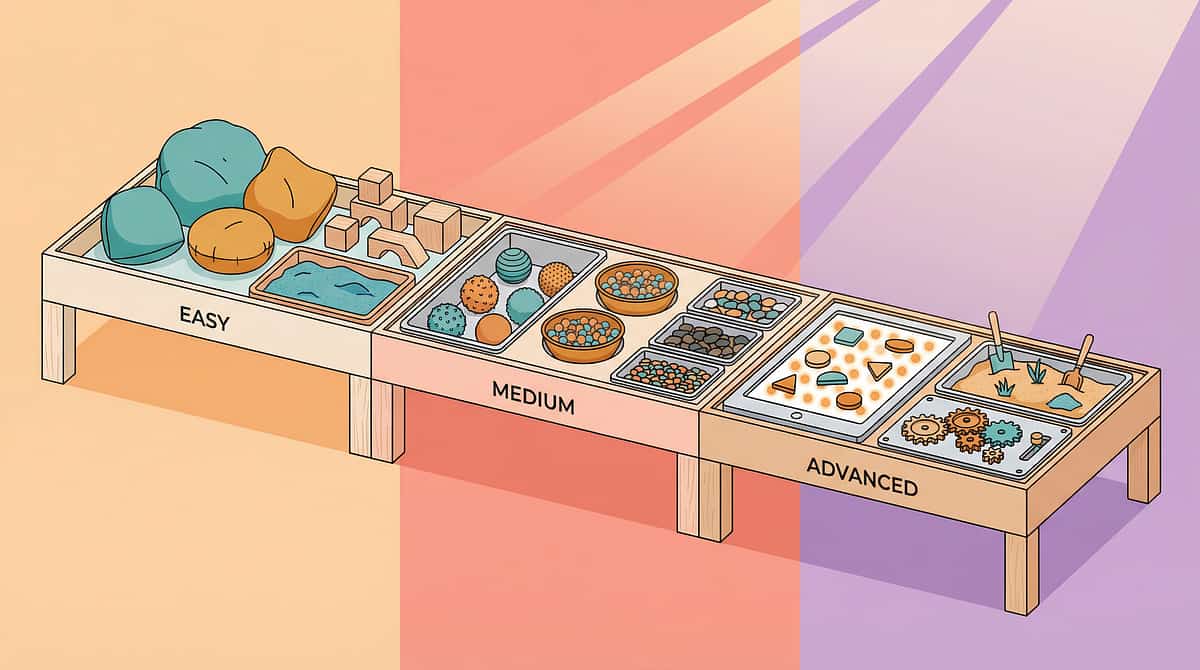
Adapt and Personalise — No Two Children Are Identical
The 9 materials work across a wide range of profiles, but how you use them should reflect your child specifically. Use this guide to calibrate difficulty and approach for your child's individual profile.
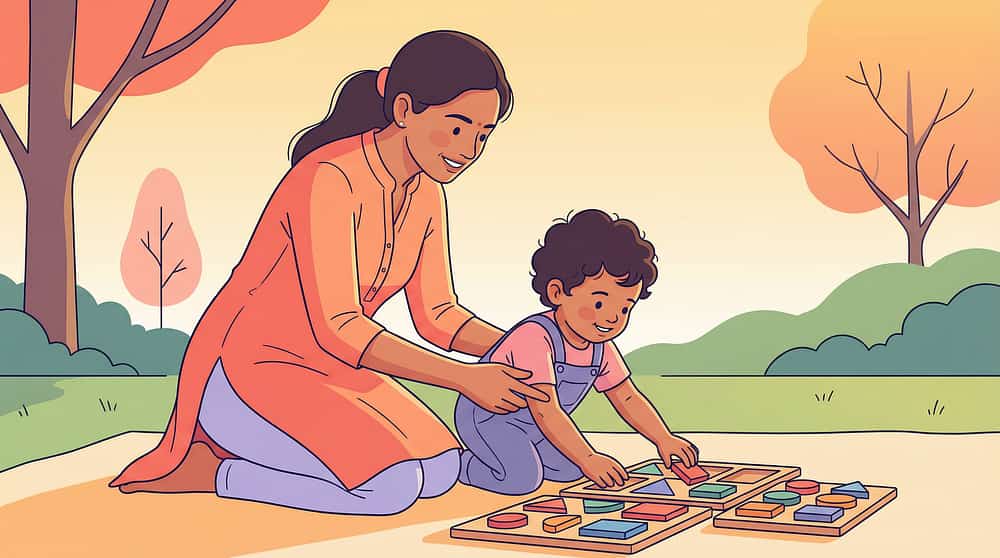
👤 Profile A: Precision-Preferring
Start: Accept exact counting; narrate vague language alongside. Build: Gradually introduce "about" as a valid answer TYPE. Key: Never force approximation — introduce it as an additional skill. Materials: Start with 1 → 2 → 3 before 6 (estimation).
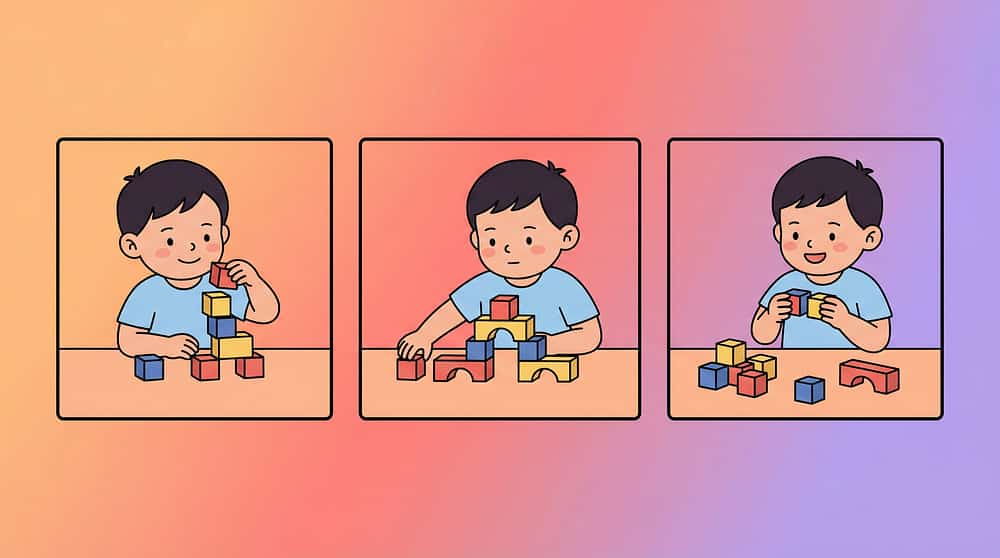
👤 Profile B: Language-Strong, Concept-Weak
May USE quantity words without understanding them. Check: Can they demonstrate (not just say) "some"? "more"? "equal"? Build: Heavily physical demonstrations before language practice. Lead with Materials 2, 3, 7.

👤 Profile C: Young (2–4 Years)
Focus: Only Materials 1 (counting) and informal Material 7 (sharing snacks). Language targets: "more" and "all done" only. Keep sessions: 5–8 minutes maximum. Simple, joyful, and embedded in daily routines.
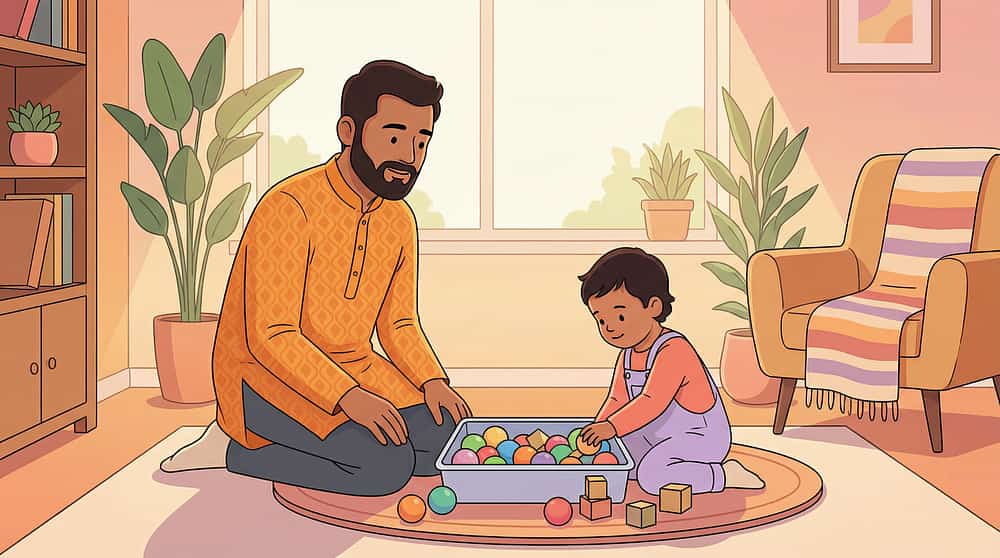
👤 Profile D: Older (7–10 Years)
Introduce formal fraction language alongside Material 4. Add written recording for data capture. Connect to school maths: "This is the same as what you do in class." Bridge home practice to academic context.

📈 Progress Arc — Week 1–2
Week 1–2: The Foundation Phase — Patience Is Therapeutic
Week 1–2 is the hardest. The child is calibrating to a new routine. Stay consistent. Short sessions beat long resistance. If your child tolerates the counting mat for 2 minutes longer than last week — that's real, measurable progress. The neural pathways are forming.
✅ What You WILL See
- Child engages with materials for longer before disengaging
- Child begins to say "all done" or gesture when session should end (celebrate this — it's communication!)
- Child starts to distinguish ALL from NONE reliably
- Child stops resisting placement of objects in counting mat spaces
- Parent begins to recognise child's specific quantity strengths and gaps
❌ What You Will NOT See Yet (Normal)
- Spontaneous use of "some" or "few" in conversation — too early
- Independent estimation — not the focus yet
- Carryover to school — generalisation takes longer
- Perfect session behaviour — variability is expected
15%
Progress Bar
Foundation phase — tolerance and participation are the goals
📈 Progress Arc — Week 3–4
Week 3–4: The Neural Pathway Formation Phase
Around Week 3–4, most parents report noticing quantity language in their own daily speech — "we have some time," "give me a few more." The technique is changing how you model language too. Watch for these consolidation signals.
🔔 Child ANTICIPATES the session — asks for "the bears" or points to materials
🔔 Child begins self-correcting: "Wait — that's ALL. I want SOME."
🔔 Child uses quantity language organically during play (not prompted)
🔔 Child accepts "good guess!" as praise without needing to know the exact answer
🔔 Sessions run more smoothly — fewer transitions required to engage
🔔 Parent feels more confident — less improvisation required
When to increase intensity: Child consistently succeeds at current level for 3+ consecutive sessions → move one step harder on the difficulty slider. Generalisation seeds to watch for: Child uses "more" at snack time spontaneously | Child lines up toys and uses "first" and "last" | Child distributes items fairly without being asked.
40%
Progress Bar
Neural pathway formation — consolidation signs emerging
📈 Progress Arc — Week 5–8
Week 5–8: The Mastery Phase — Flexibility Is the Goal
Mastery in the autism context does not mean perfection. It means flexible, functional use of quantity language in everyday situations — sharing snacks, following directions, playing games — without distress.
1
⭐ Quantifiers
Uses all, none, some correctly in spontaneous speech
2
⭐ Comparison
Identifies more/less without counting first (perceptual comparison)
3
⭐ Estimation
Estimates with reasonable proximity; accepts a range of answers
4
⭐ Sharing
Distributes items fairly without adult modelling
5
⭐ Ordinals
Uses "first, then" language in daily routines
6
⭐ Conservation
Doesn't think spread-out = more; understands arrangement ≠ amount
75%
Progress Bar
Mastery phase — flexibility and generalisation emerging
B-171 Is One Step in Your Child's Complete Language Journey
The long-term developmental goal: academic readiness, mathematical language, and social fairness reasoning — the three pillars B-171 builds toward.
Natural Next Steps
- → B-172: Temporal Concepts — "before," "after," "soon," "yesterday"
- → B-173: Spatial Concepts — "in," "on," "under," "beside"
Quantity Concepts Is One Piece of Your Child's Complete Developmental Plan
B-171 connects to all 12 developmental domains. When you build quantity language, you are simultaneously strengthening sensory tolerance, social fairness reasoning, self-regulation, and academic readiness. GPT-OS® session data automatically tracks: Learning and Academic Readiness Index | Communication Readiness Index.
Domain B — Social Communication
Cognitive-Language Cluster
How GPT-OS® Uses Your Session Data
When 70,000+ families track B-171 progress, GPT-OS® develops the world's largest dataset on quantity concept acquisition in autism. That data makes every recommendation smarter — for your child and for all children.
Rate of Acquisition
How quickly quantifiers are understood
Material Response
Which material type yields highest response
Precision Preference
Whether rigidity is reducing over time
Generalisation Rate
Home → school → community transfer
🔒Privacy assurance: All data encrypted | No personally identifiable data sold | DPIIT-registered | Indian data sovereignty compliant
Watch the Reel — 9 Materials in Action
📺 Reel ID: B-171
Language and Concept Development Series — Episode 171
Title: 9 Materials That Help With Quantity Concepts | Presented by: Pinnacle Blooms SLP-SpEd Consortium | 75-second reel showing all 9 materials in action with a real child.
"Reading about materials is good. Seeing them used with a real child is better. Video modelling is an evidence-based practice for autism — watching a therapist demonstrate builds parent confidence and child familiarity." — NCAEP Evidence-Based Practices Report, 2020
▶️ B-169
9 Materials for Action Word Understanding
▶️ B-170
9 Materials for Adjective Understanding
▶️ B-172
9 Materials for Temporal Concepts
Frequently Asked Questions — Answered by the Pinnacle Consortium
These are the questions most frequently asked by families across Pinnacle's 70+ centres and online community. If your question isn't answered here, ask GPT-OS® or book a teleconsultation.
"My child CAN count. Why does he still need this?"
Counting and quantity language are different skills. Counting is reciting a memorised sequence. Quantity language means understanding that 'some' means a non-specific partial amount, that 'more' requires comparison, that 'equal' means same for everyone. Many children with ASD have advanced counting with limited quantity language. B-171 closes that gap.
"At what age should I start these materials?"
Quantity sensitivity begins at 18 months (requesting 'more'). Formal quantifier teaching is appropriate from age 3+. One-to-one correspondence mats can start at age 2. There is no upper age limit — adult learners benefit from structured quantity language teaching too.
"How many times a week should we practise?"
Daily embedding (natural language moments at snack time, distribution, games) is more powerful than formal sessions. For formal material-based practice: 3–5 times per week for 10–20 minutes. Consistency matters more than intensity.
"My child insists 'some' is a specific number. How do I handle this?"
Honour the precision while expanding. Say: "You're right that 3 is some! Some can be 3, or 4, or 2 — it's any amount that isn't all and isn't none. You just showed me some!" Over time, introduce the idea that the RANGE is the answer, not the exact number.
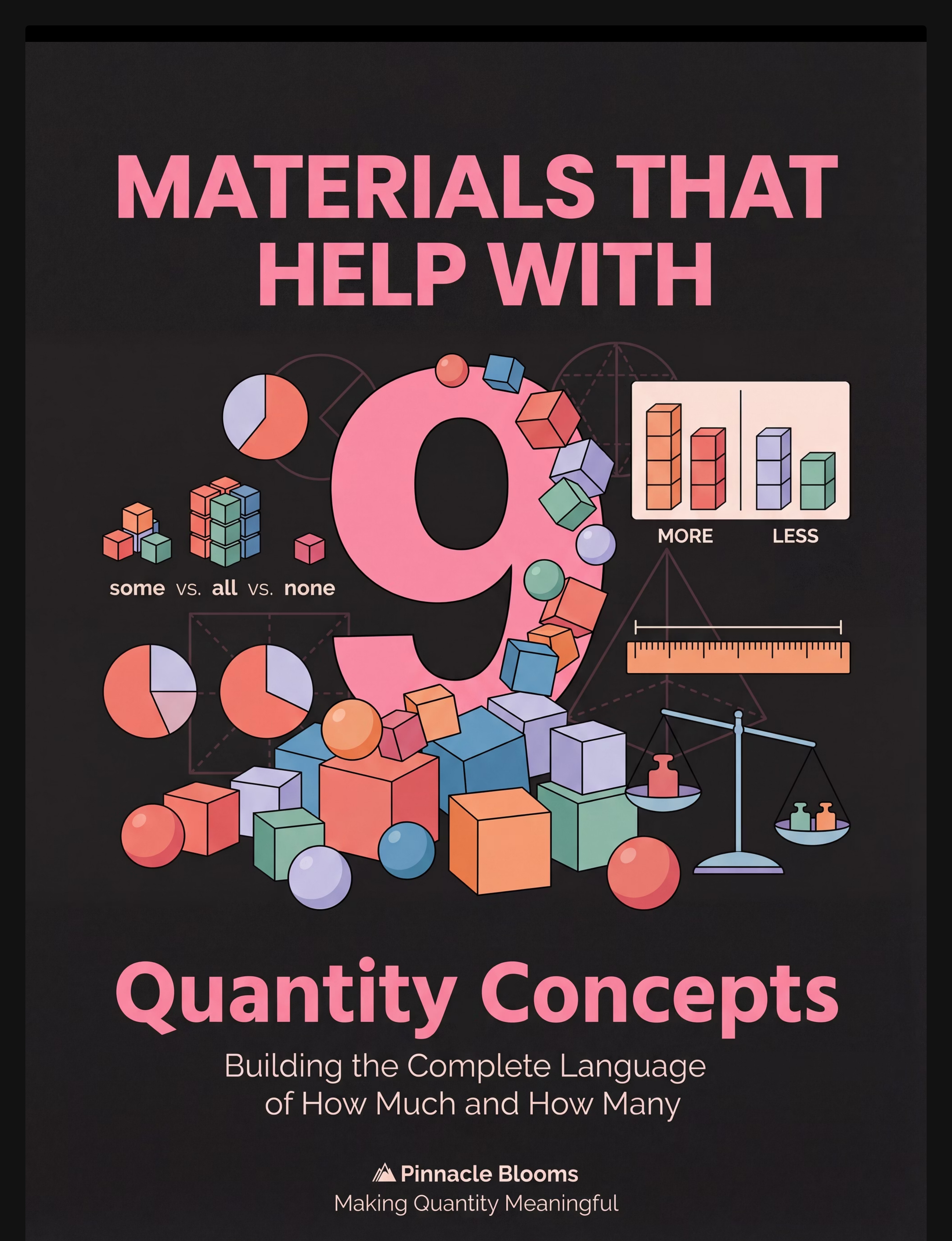
Preview of 9 materials that help with quantity concepts Therapy Material
Below is a visual preview of 9 materials that help with quantity concepts therapy material. The pages shown help educators, therapists, and caregivers understand the structure and content of the resource before use. Materials should be used under appropriate professional guidance.



Link copied!
The Pinnacle Promise
🏆 PINNACLE BLOOMS CONSORTIUM
"From fear to mastery. One technique at a time."
Pinnacle Blooms Network® exists to transform every home into a 24×7, personalised, multi-sensory, multi-disciplinary therapy environment for every child who needs it — regardless of geography, income, or access.
This technique page is one of 70,000+ evidence-based intervention resources published at techniques.pinnacleblooms.org — the world's most comprehensive library of home-applicable paediatric therapeutic techniques, powered by GPT-OS® and validated by the Pinnacle Blooms Consortium across 21 million therapy sessions.
Paediatric CRO
Clinical Research Organisation
SLP • OT • BCBA/ABA
Speech, Occupational, Behaviour
SpEd • NeuroDev
Special Education & NeuroDevelopmental Paediatrics
WHO • UNICEF
Global framework alignment
Medical Disclaimer: This content is educational and does not replace assessment or treatment by a licensed speech-language pathologist, special educator, occupational therapist, or developmental specialist. If you are concerned about your child's development, please consult a qualified professional. Individual outcomes vary by child profile, consistency, and support intensity.
© 2025 Pinnacle Blooms Network®, a unit of Bharath Healthcare Laboratories Pvt. Ltd. All rights reserved. CIN: U74999TG2016PTC113063 | DPIIT: DIPP8651 (Govt. of India) | GSTIN: 36AAGCB9722P1Z2
© 2025 Pinnacle Blooms Network®, a unit of Bharath Healthcare Laboratories Pvt. Ltd. All rights reserved. CIN: U74999TG2016PTC113063 | DPIIT: DIPP8651 (Govt. of India) | GSTIN: 36AAGCB9722P1Z2
techniques.pinnacleblooms.org | Canonical: /social-communication/quantity-concepts-materials-b171