

"She was fine five minutes ago."
You've said those words a hundred times — to your spouse, to the school, to yourself. The park exit turned into a forty-minute battle. Bedtime is a nightly war. An unexpected change in the route home derailed the entire day. You are not failing. Your child's nervous system is telling you it needs a different kind of support.
🛡️ PROACTIVE STRATEGIES
Antecedent-Based Intervention
"Meltdowns are not behavioral failures. They are communication events from a nervous system that ran out of scaffolding. Proactive strategies rebuild that scaffolding — before the collapse." — Pinnacle Blooms Consortium | Behavior & Regulation Division
Pinnacle Blooms Network® Consortium | CRO • ABA • OT • SLP • SpEd • NeuroDev • Pediatrics

You Are Among Millions of Families Navigating This Exact Challenge
1 in 36
Children with Autism
Children in India diagnosed with autism spectrum conditions
80%
Experience Dysregulation
Of children with ASD experience behavioral dysregulation related to unpredictability and transitions
3–5×
ADHD Crisis Risk
More likely for children with ADHD to experience daily behavioral crises without proactive systems
Behavioral challenges are not a parenting failure. They are the predictable outcome when a child's genuine neurological needs for predictability, control, and sensory regulation go unmet. In India alone, over 18 million children are estimated to have developmental conditions requiring behavioral support scaffolding. Proactive strategies exist precisely because reactive-only approaches leave children — and families — in chronic distress.
Research: PMC11506176 | PMC10955541 | DOI: 10.12998/wjcc.v12.i7.1260 | Padmanabha et al., Indian J Pediatr 2019

This Is Not Defiance. This Is Neurology.
Children with autism, ADHD, anxiety, and developmental delays show measurable differences in three key neural systems that make transitions and unpredictability genuinely difficult — not a matter of will or character.
What's Happening in the Brain
Prefrontal Cortex — executive function, planning, flexibility
Amygdala — threat detection (overactive): Unpredictability → Amygdala fires → Fight/flight override
Anterior Cingulate Cortex — transition management (underconnected): Transition demand → ACC struggles → Cognitive flexibility fails
Sensory Threshold — Sensory overload → Cortisol spike → Behavioral cascade
What Proactive Strategies Actually Target
1. Cognitive Flexibility (Prefrontal-ACC Circuit) — Switching between activities requires this circuit to signal "it's safe to change." When underconnected, every transition is a genuine neurological emergency — not stubbornness.
2. Predictability Processing (Amygdala-Hippocampus) — Uncertainty fires the threat response. Visual schedules, timers, and structured routines reduce amygdala activation by making the world legible.
3. Sensory Threshold Regulation (Thalamo-Cortical Gating) — Sensory toolkits and environmental modifications reduce the load before the threshold is crossed.

Your Child Is Here. Here Is Where We're Heading.
Understanding where your child sits on the developmental arc helps calibrate your expectations — and your strategy. Proactive support looks different at each stage, and all of it is within reach.
Ages 2–3
Toddler dysregulation is neurologically expected. High scaffolding, simple visual structures (2–3 steps only)
Ages 3–5
Emerging self-regulation capacity. Picture schedules, First-Then boards, and visual timers begin here
Ages 5–8
School demands increase. Full proactive systems needed — sensory toolkits, Social Stories, calm corners
Ages 8–12
Internalization phase. Child begins self-directing proactive strategies with adult scaffolding
Comorbidity Awareness: Children who benefit most often also present with Autism Spectrum • ADHD • Sensory Processing Disorder • Generalized Anxiety • Oppositional Patterns • Developmental Delays • Twice-Exceptionality. Research: PMC9978394 | WHO/UNICEF CCD Package (2023)

Clinically Validated. Home-Applicable. Parent-Proven.
LEVEL I EVIDENCE
Systematic Review + RCT Confirmed
Study | Finding | Grade | |
PRISMA Systematic Review, 2024 (PMC11506176) | Antecedent-based interventions confirmed as evidence-based practice for ASD across 16 studies (2013–2023) | Level I | |
NCAEP EBP Report, 2020 | Visual supports, antecedent-based interventions, and behavioral momentum classified as EBP for autism | Level I | |
Meta-analysis, World J Clin Cases, 2024 (PMC10955541) | Structured behavioral interventions across 24 studies show effective promotion of self-regulation and adaptive behavior | Level I | |
Padmanabha et al., Indian J Pediatr, 2019 | Home-based behavioral support strategies demonstrate significant outcomes in Indian pediatric population | Level II RCT | |
WHO NCF (2018) + CCD Package (2023) | Predictability and responsive caregiving frameworks validated across 54 LMICs | Global Standard |
"Proactive strategies are among the most robustly evidence-backed approaches in pediatric behavioral science. The evidence is not emerging — it is established, replicated, and recommended by every major clinical body globally." — Pinnacle Blooms Consortium CRO Division
The Technique: What It Is
Antecedent-Based Interventions
Episode D-356
Formal Definition
Proactive strategies are interventions implemented before challenging behaviors occur. Rather than responding to meltdowns, parents modify the conditions — the environment, the schedule, the sensory input, the choices available — so that behavioral crises become less likely.
In Applied Behavior Analysis, these are called "antecedent interventions" because they modify what comes before (antecedent to) the behavior.
The fundamental shift: from reactive (responding to crises) → proactive (preventing them by designing conditions for success).
At a Glance
🏷️Domain: Behavior Management / Emotional Regulation
👶Age Range: 2–12 years
⏱️Duration: Embedded in daily routine (not time-limited)
🔄Frequency: Every transition, every day
📍Setting: Home • School • Community
📋Canon: Reinforcement Menus | Transition Objects | Visual Supports | Sensory Tools
This is Episode 356 of the Behavior & Emotional Regulation series, introducing 9 specific materials that operationalize proactive strategy implementation at home.

Who Uses This Technique
This technique crosses therapy boundaries — because the child doesn't have separate brains for separate therapies. Every discipline brings a unique and essential lens to proactive strategy design.
ABA / BCBA
Designs the antecedent intervention system. Conducts Functional Behavior Assessment to identify triggers. Builds reinforcement schedules and data systems.
Occupational Therapy
Designs the sensory environment. Builds sensory toolkits. Identifies sensory triggers and protective inputs. Recommends environmental modifications.
Speech-Language Pathology
Designs visual communication supports. Creates Social Stories. Builds choice boards for children with limited verbal communication.
Special Education
Implements visual schedules in academic settings. Designs classroom environmental modifications. Builds transition support systems.
NeuroDev Pediatrics
Rules out medical contributors to behavioral challenges. Oversees co-occurring conditions. Monitors pharmacological interactions with behavioral programs.
FusionModule™ — Pinnacle's multi-disciplinary convergence system — ensures that OT sensory assessment, ABA behavioral function data, and SLP communication supports are unified into a single proactive strategy plan — not siloed across therapy appointments.

What This Targets
Proactive strategies hit three concentric targets simultaneously — from immediate meltdown prevention all the way to long-term life independence. Every tool you implement today contributes to all three levels.
Primary Targets (Core)
- Meltdown frequency reduction
- Transition resistance reduction
- Improved tolerance for unexpected change
- Escalation cycle interruption before threshold
Secondary Targets (Relational)
- Parent-child relationship quality
- Caregiver stress and exhaustion reduction
- Household routine predictability
- Cross-setting behavioral consistency
Tertiary Targets (Long-Term)
- Self-regulation skill internalization
- Cognitive flexibility improvement over time
- Academic participation readiness
- Community access and generalization
Observable Indicators: "Fewer 30-minute meltdowns; transitions completing in under 5 minutes; child checking schedule independently; parent reports lower daily stress; child using calm corner before reaching full escalation."

9 Materials That Operationalize Proactive Strategies at Home
Everything below maps to an evidence-based intervention function. None are optional extras — each addresses a distinct trigger category.
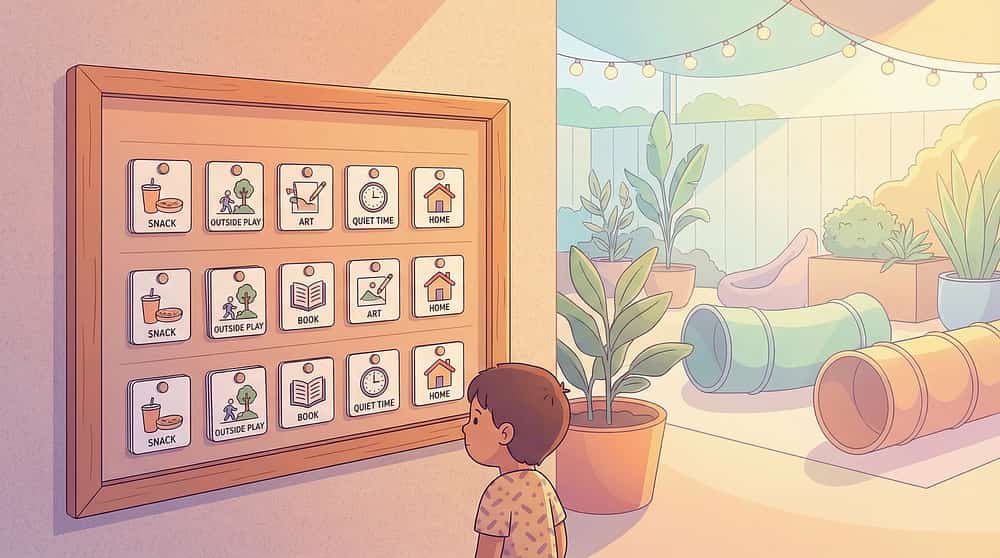
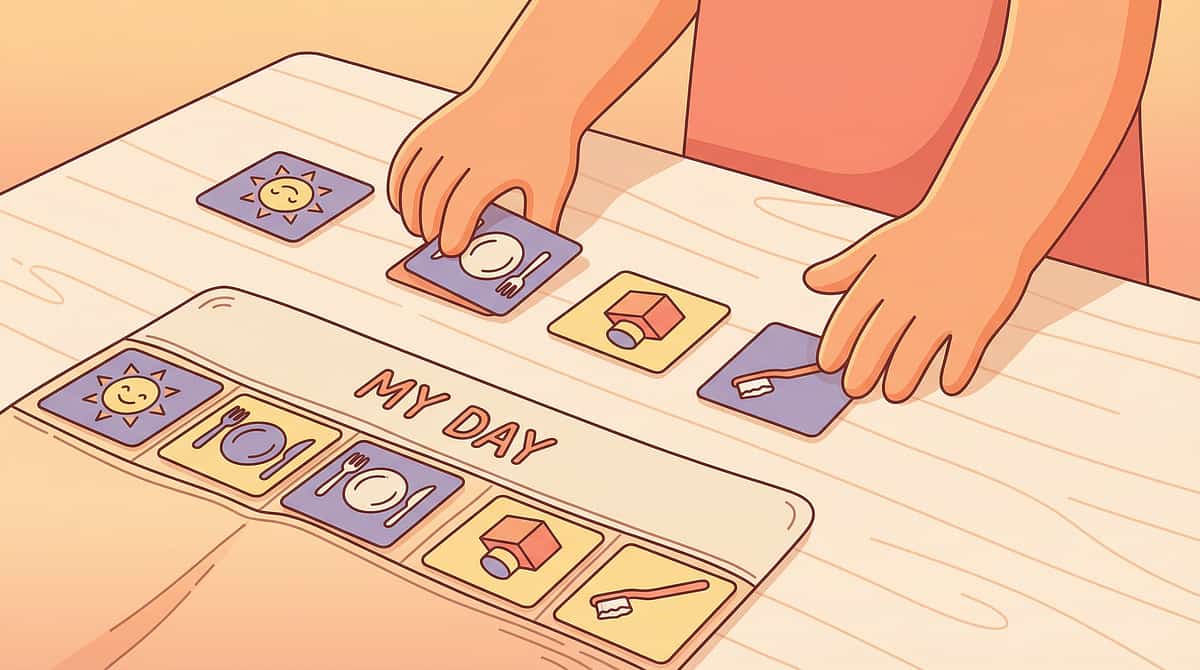
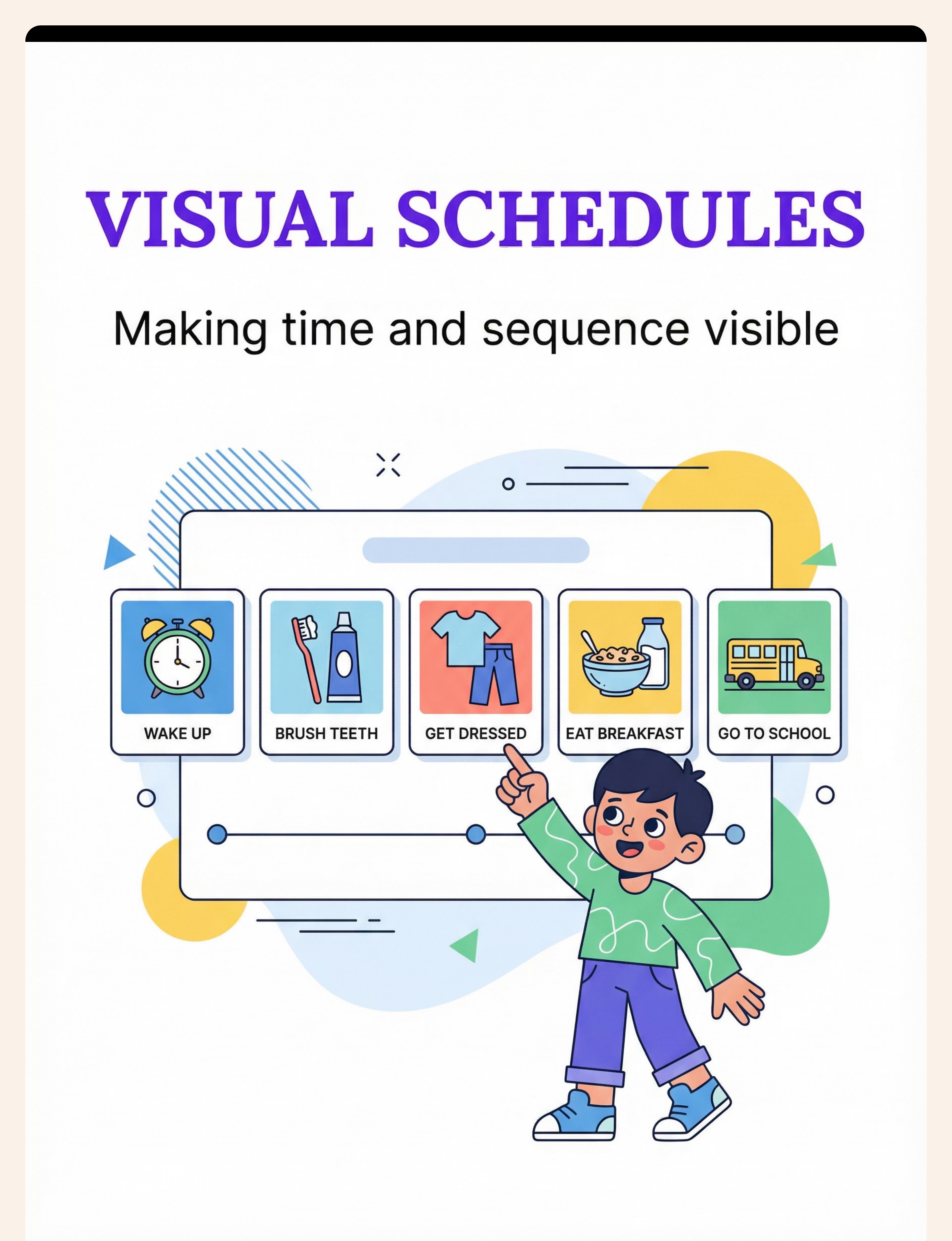
1. Visual Schedule Systems
Function: Makes time and sequence visible — eliminates the anxiety of "what's next?"
₹300–1,500 | Visual schedule board, done pocket, PECS picture cards
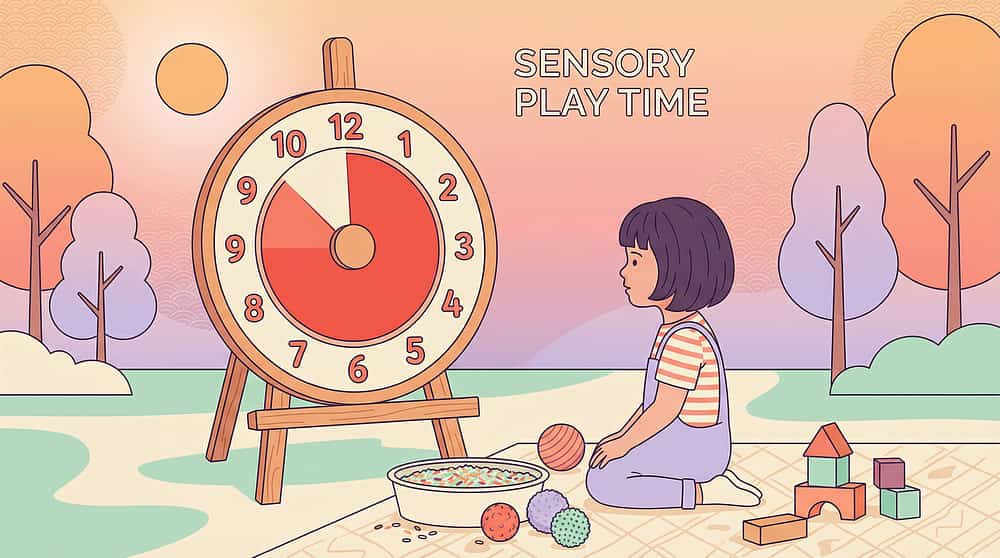
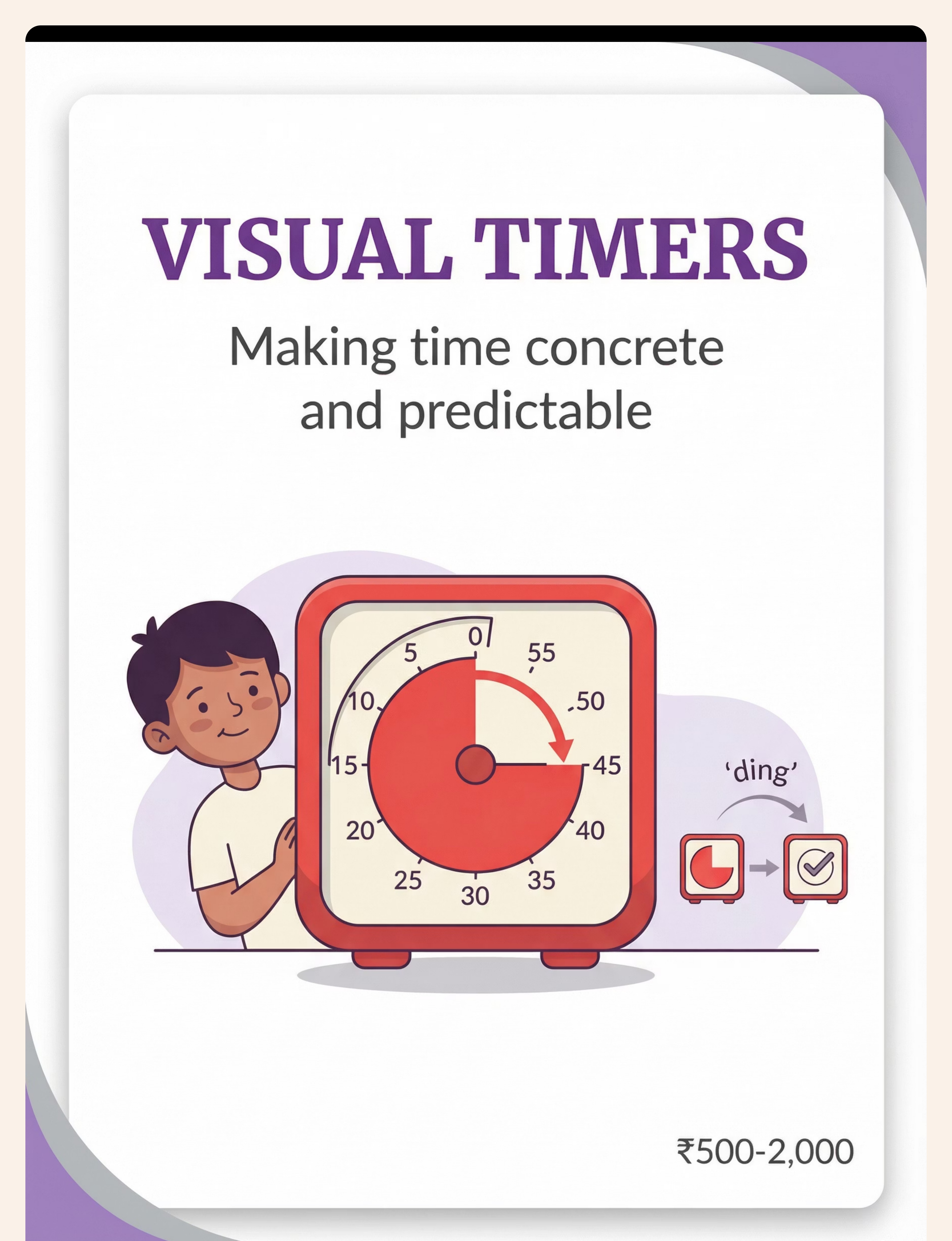
2. Visual Timers
Function: Makes abstract time concrete — transforms "5 more minutes" from meaningless to manageable
₹500–2,000 | Time Timer disk, sand timer sets, visual timer apps
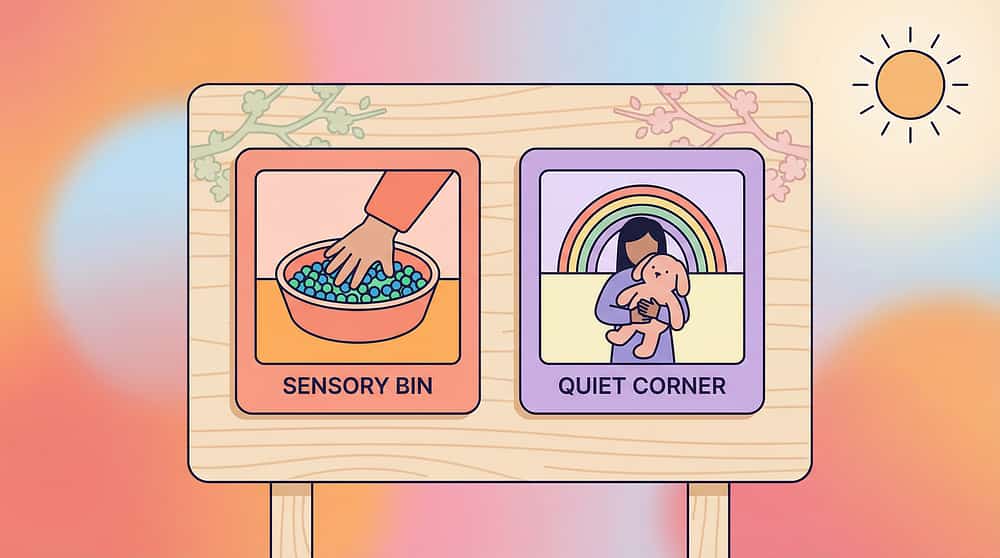
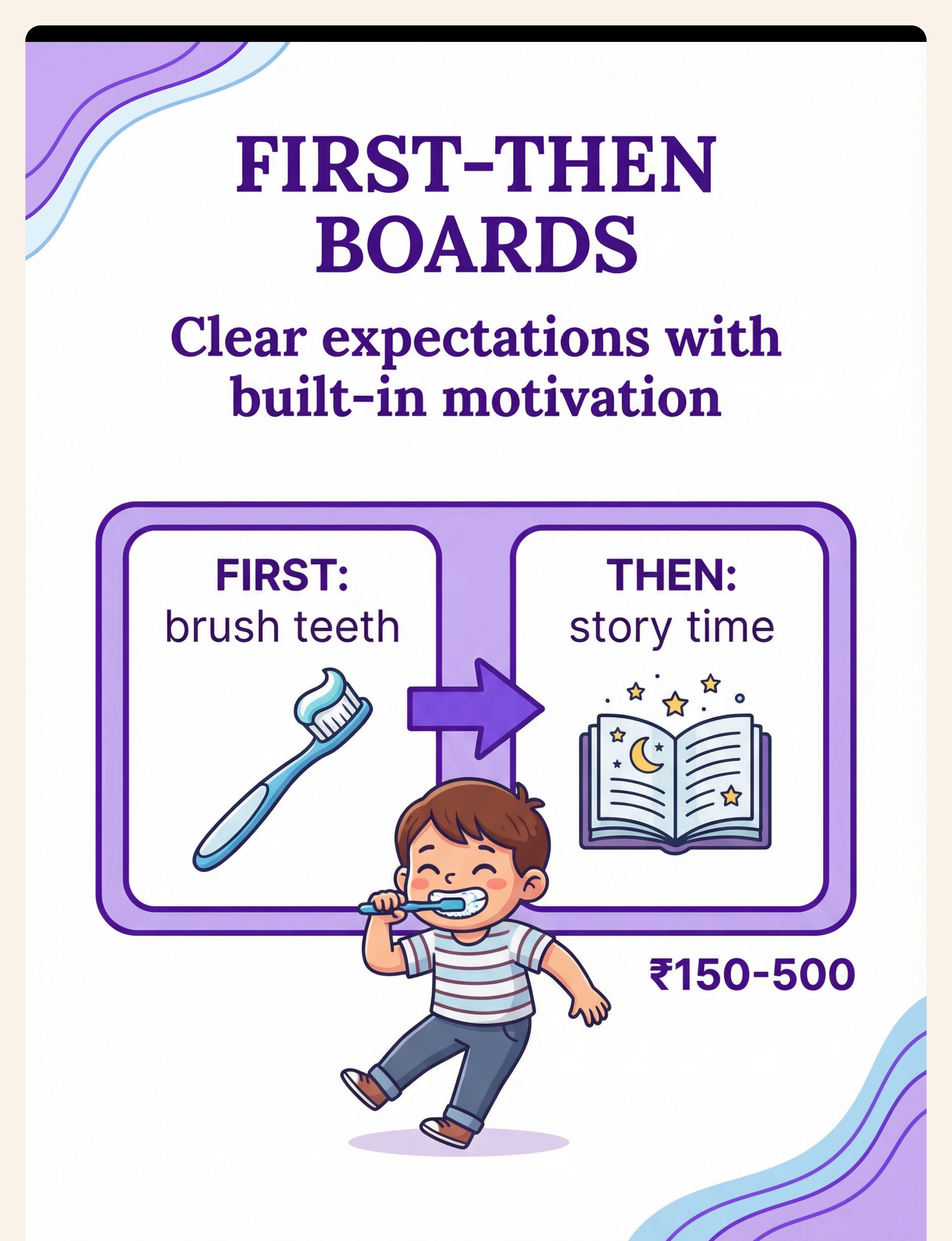
3. First-Then Boards
Function: Two-step visual contract pairing a demand with a motivating reward — reduces resistance before it starts
₹150–500 | Velcro, dry-erase, or laminated DIY versions
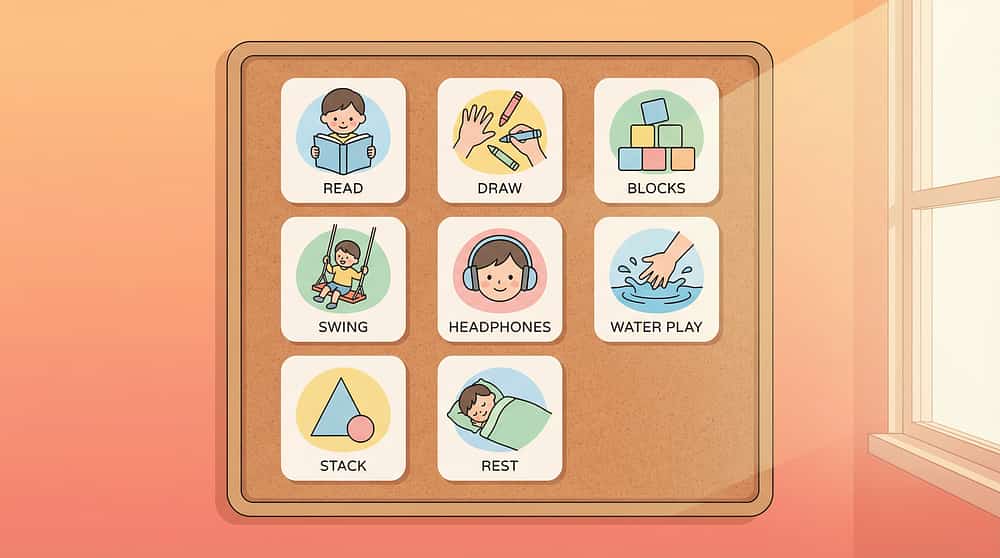
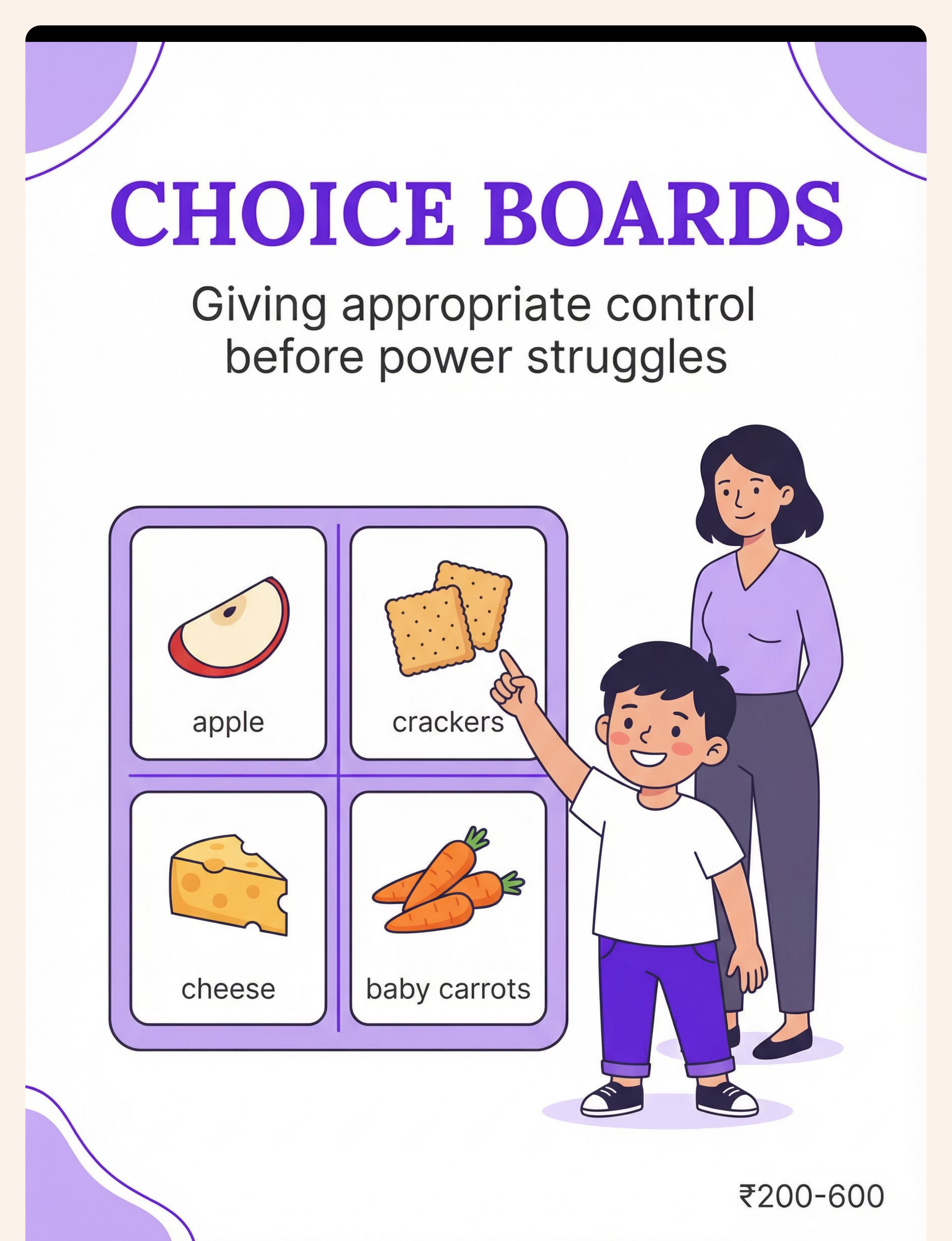
4. Choice Boards
Function: Gives appropriate control before children fight for it — prevents power struggles proactively
₹200–600 | 2–4 picture slots, photo-based, portable versions

Materials 5–9: Complete Your Proactive Toolkit

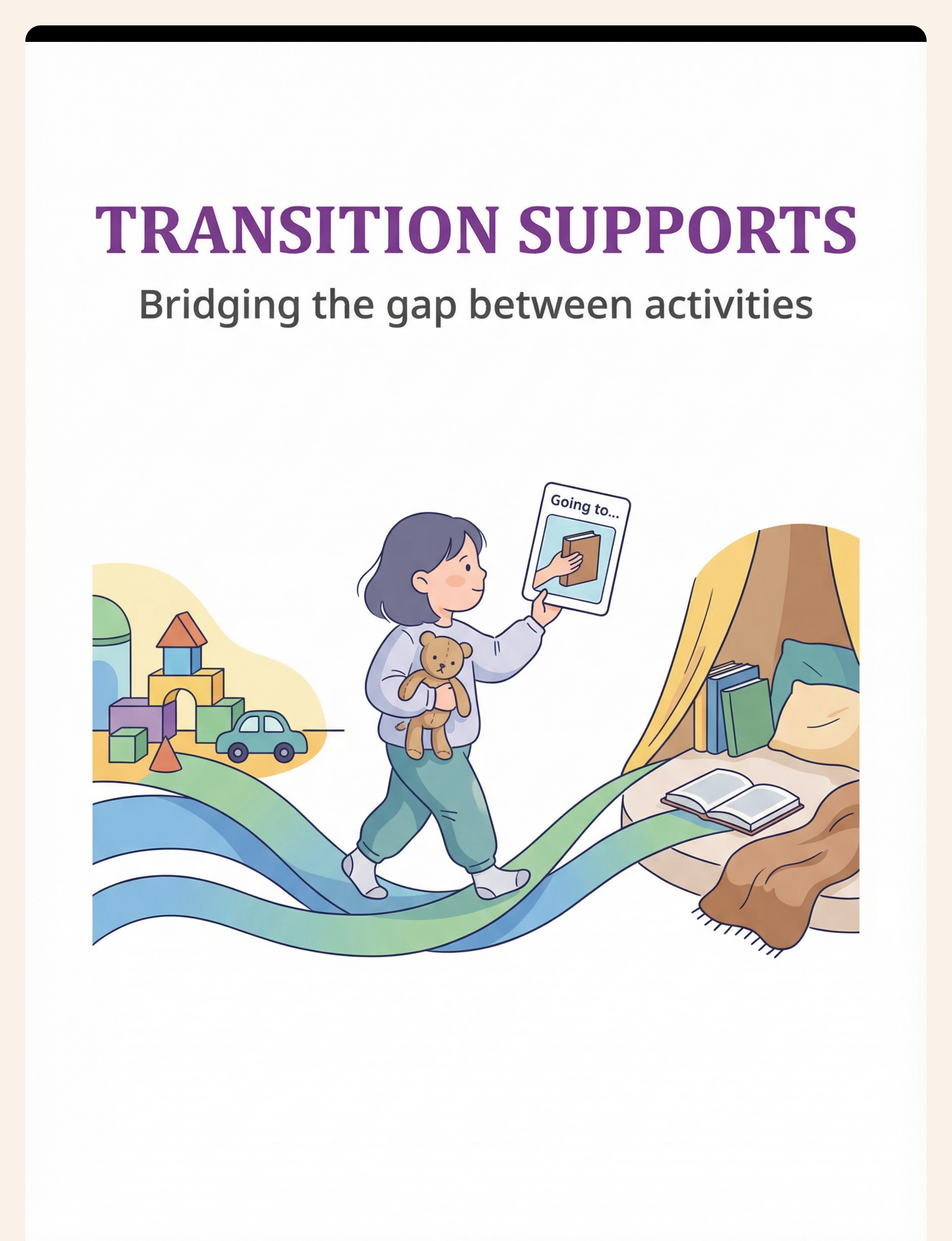
5. Transition Objects & Supports
Function: Provides continuity between contexts — something familiar accompanies the change
⭐Canon Confirmed: Animal Soft Toys — ₹425 | Buy on Amazon.in
Also: Transition cards, "Going to..." picture sets, portable comfort items | ₹100–500

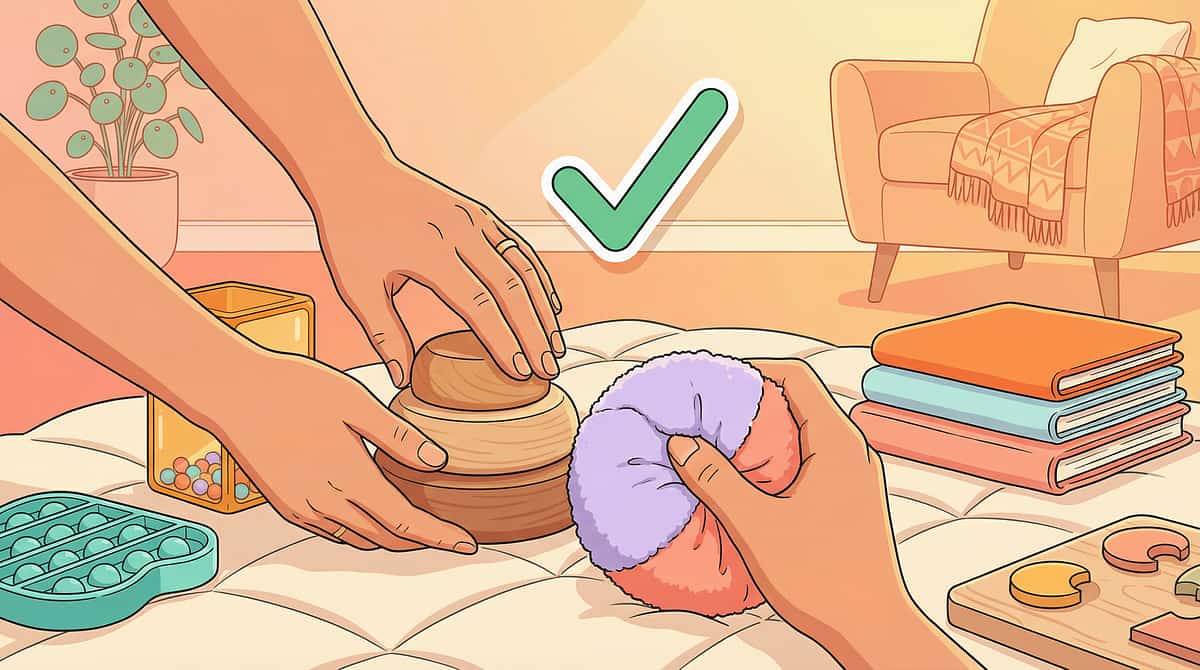
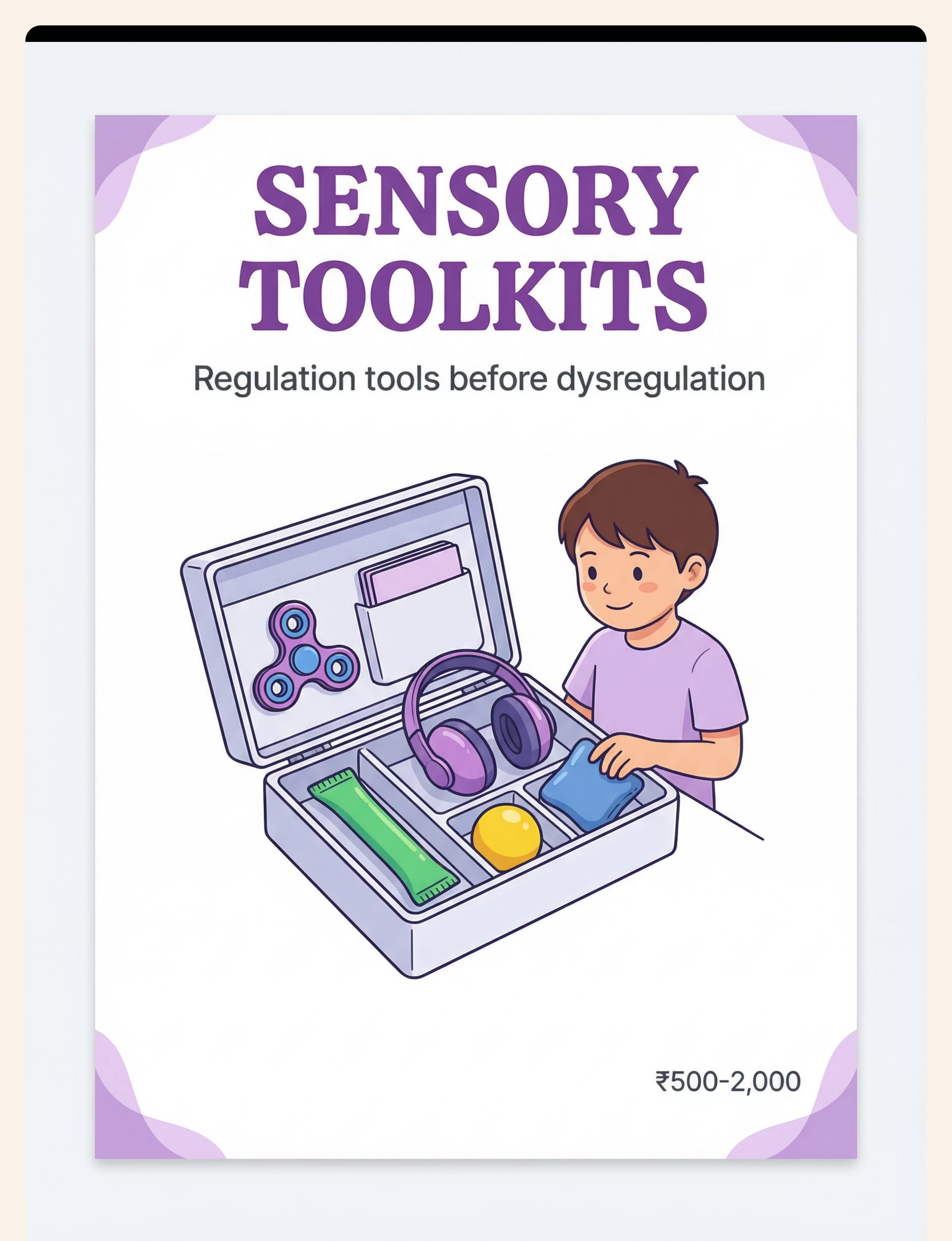
6. Sensory Toolkits
Function: Meets sensory regulation needs BEFORE dysregulation cascades to behavior — the most critical proactive layer
₹500–2,000 | Fidget tools, noise-reducing headphones, chewy tools, weighted lap pad, stretch bands
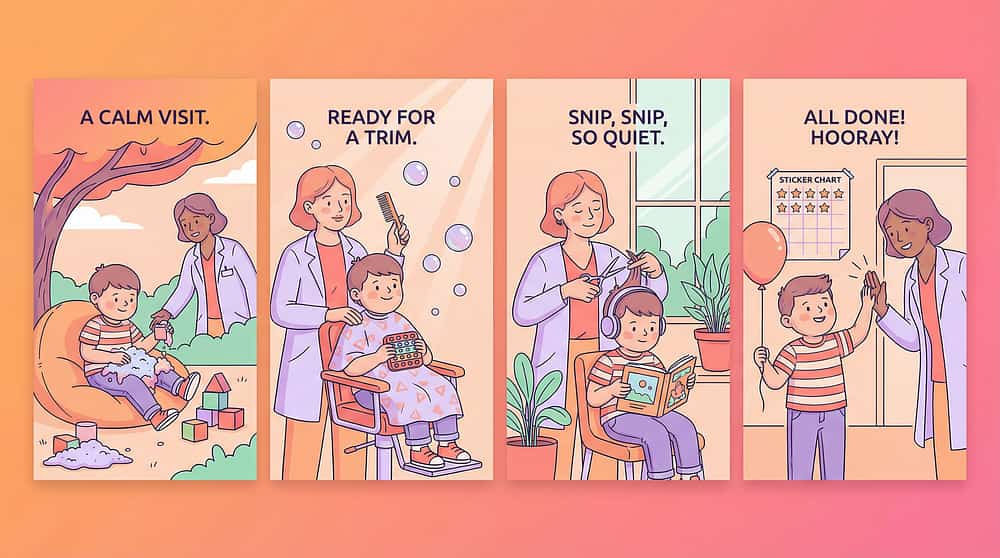
7. Social Stories & Expectation Books
Function: Prepares the child's mind for challenging situations BEFORE they occur — builds mental scripts during calm states
₹200–800 | Pre-made books, personalized photo story templates, laminated portable story cards

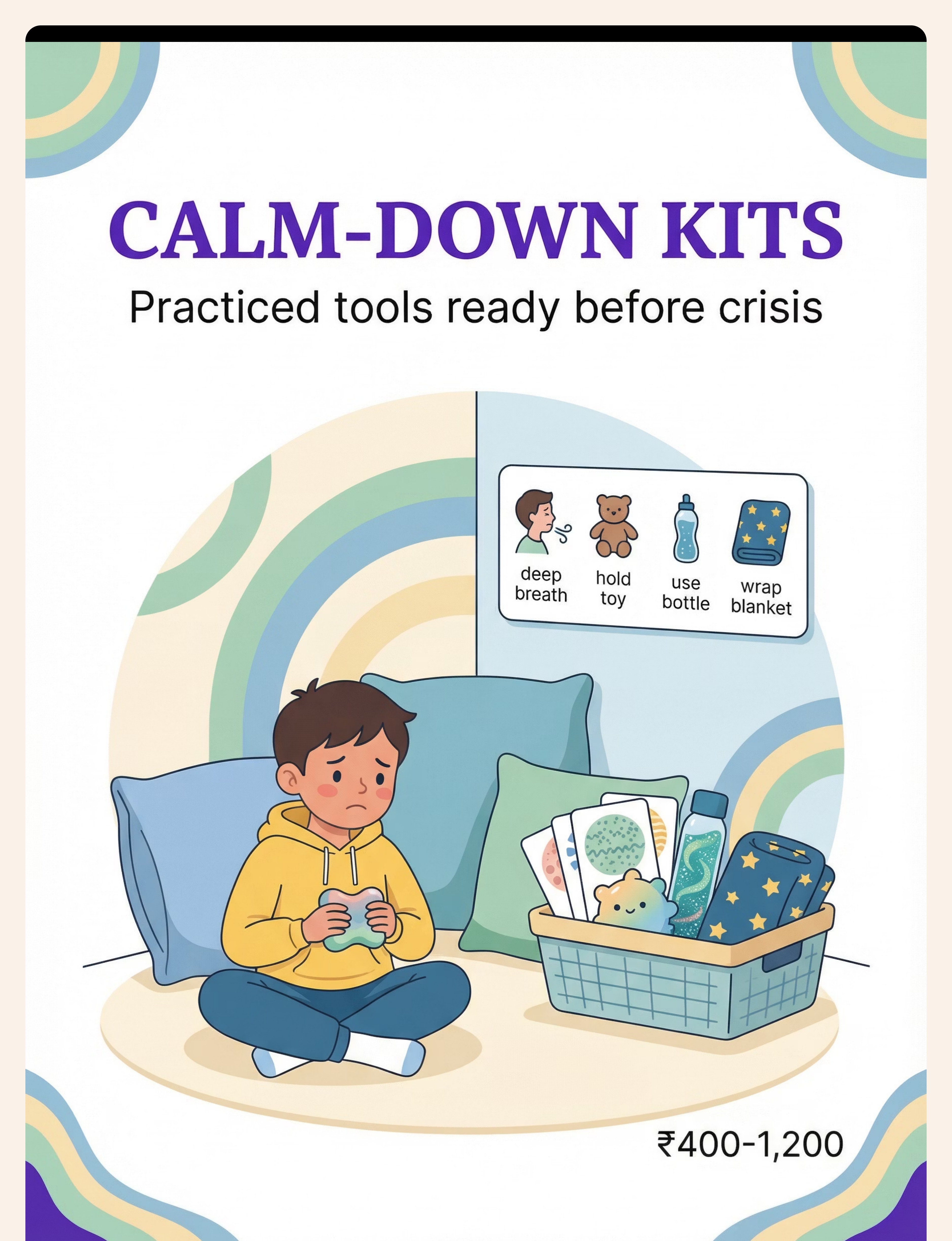
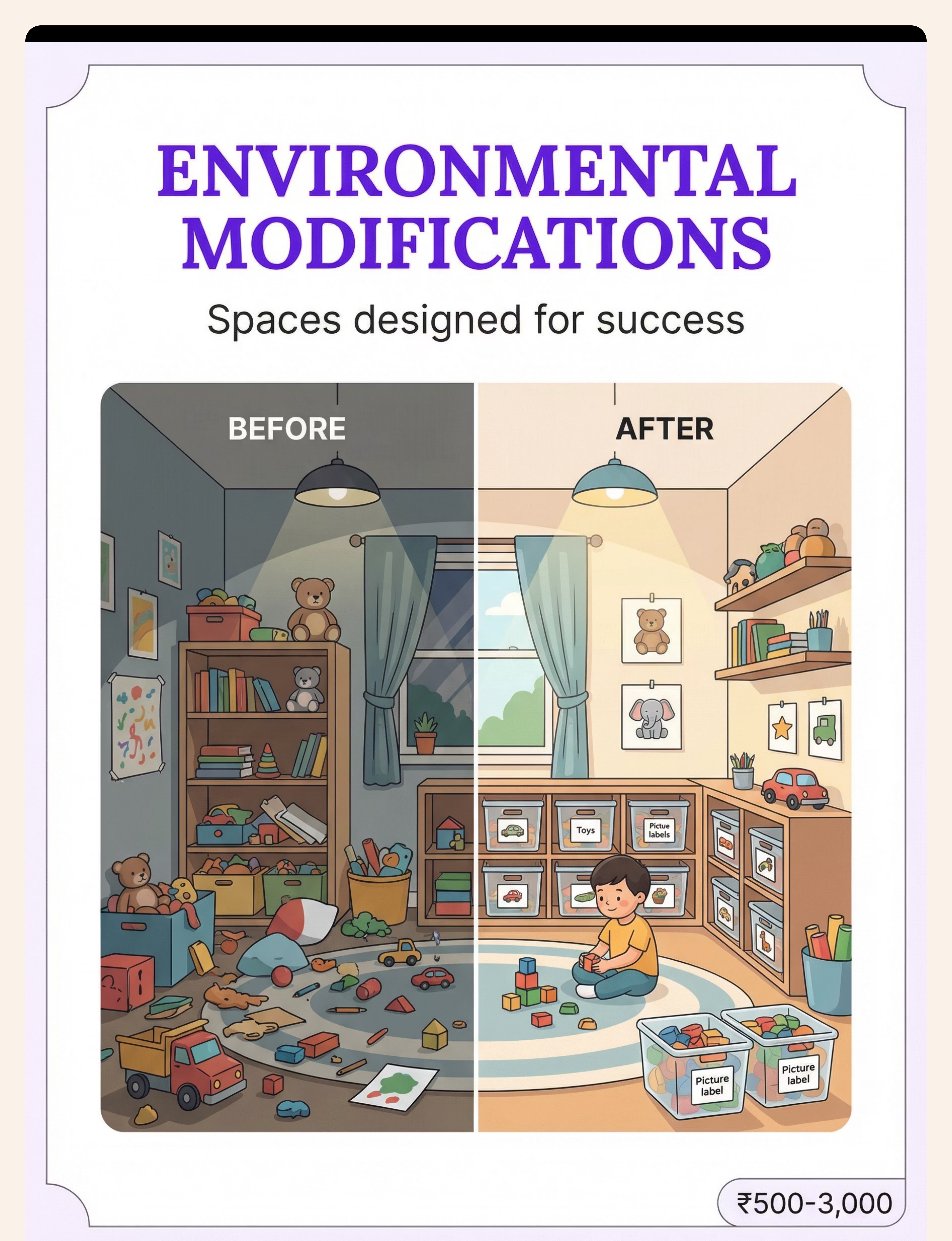
8. Calm-Down Kits & 9. Environmental Mods
Kit: Squishy toys, breathing visual cards, calming glitter bottle, weighted blanket, emotion guide | ₹400–1,200
Env. Mods: Labeled bins, white noise machine, dimmable lighting, visual zone labels | ₹500–3,000
Total Starter Kit Investment: ₹2,450–9,600 for comprehensive toolkit. Essential Starter (Begin Today): Visual schedule + Visual timer + First-Then board + Basic calm-down kit | ~₹1,350–3,200
Every Proactive Strategy Can Be Executed Today With What You Already Have
WHO Nurturing Care Framework: interventions must be accessible across all socioeconomic contexts. No family should be excluded from evidence-based support by cost.
Material | ₹0 DIY Version | Why It Works | |
Visual Schedule | Print photos of your child doing each activity. Tape to wall at eye level. Use sticky notes to mark "done." | Same neurological function — visible sequence reduces unpredictability anxiety | |
Visual Timer | Phone timer with large display. Sand in a bottle. Draw a clock face with shrinking marks. | Same principle — visible countdown makes time concrete | |
First-Then Board | Draw two boxes on paper. Tape or draw pictures in each. Laminate with packing tape. | Structure is the intervention, not the materials | |
Choice Board | Tear two pictures from a magazine/draw. Hold them out. "Which one?" | Genuine choice with visible options — the material is your hands | |
Transition Object | Any small item the child loves. Consistent item. Not special — just reliable. | Continuity object reduces transition anxiety | |
Sensory Toolkit | A shoebox: rubber ball, earphones, a smooth stone, a stretchy hair band | Same sensory input categories — texture, proprioception, auditory protection | |
Social Story | Write in a notebook. Draw stick figures. Use their name and photos. | Personalized stories with real photos are MORE effective than commercial ones | |
Calm Corner | A corner with 2 cushions + 1 familiar toy. Practiced when calm. | Location + familiarity = the intervention. Furniture is secondary. | |
Environmental Mods | Rotate toys (reduce visual clutter). Move activities to consistent spots. | Consistency and reduced stimulation — no purchase required |
"The materials are vehicles. The intervention is predictability, choice, and sensory support. These can be delivered with paper and presence."

Read This Before Setting Up Any Proactive Strategy System
🟢 GREEN LIGHT — Safe to Proceed
- Child is in a baseline regulated state (not mid-meltdown)
- Environment is physically safe and secured
- Caregiver is calm and available (not rushing or stressed)
- All materials are age-appropriate and checked for choking hazards
- All caregivers who will use the system have been oriented to it
🟡 AMBER — Proceed with Modification
- Child showing early arousal → Delay implementation 20 minutes
- Only one caregiver trained → Begin with that caregiver; train others within 48 hours
- Child had a difficult day → Use simplified version only (First-Then only)
- Environment is transitional → Portable versions only; maintain consistency of process
🔴 RED LINE — Do Not Proceed
- Child is in active meltdown → Do not introduce new systems during crisis
- Child shows signs of medical distress (fever, pain, illness) → Medical needs first
- Any physical safety concern present → Resolve safety issue before setup
- Visual materials become projectiles during meltdown → Consult behavior therapist first
- Child shows severe self-injurious behavior (SIB) → Consult BCBA / Pinnacle center before home implementation
Material Safety Checklist: Picture cards — secure Velcro, small cards stored when not in use. Sand timers — not for children who throw objects. Weighted items — maximum 10% of body weight. Chewy tools — replace when worn. Calm corner — remove items that could be thrown during escalation.
STOP IF: Child shows prolonged distress (>15 min), increased aggression, or regression across multiple domains. Call 9100 181 181.
STOP IF: Child shows prolonged distress (>15 min), increased aggression, or regression across multiple domains. Call 9100 181 181.

The Environment Is the Intervention. Design It Before You Start.
A thoughtfully arranged space provides passive, continuous prevention — reducing triggers without requiring anyone to "do" anything in the moment. Set this up once, maintain it consistently.
Position Notes
- Visual schedule — at child's eye level; at start of routine (bedroom door / kitchen)
- First-Then board — at demand point (homework table, morning routine station)
- Choice board — at decision points (before meals, before free-time, before transitions)
- Calm corner — physically defined; LOW stimulation zone; NOT a timeout corner
- Timer — visible from child's activity area without requiring a turn
- Sensory toolkit — within child's independent reach; NOT locked away
What to Remove
- Excessive toys visible during structured activity times
- Competing visual distractions near schedule/timer placement
- Items that become meltdown triggers
- Fluorescent overhead lighting where possible
Sound Environment
White noise or soft instrumental background for high sensory-sensitivity children. Reduce sharp, unexpected sounds during structured periods.
"Keep everything in the same place, every day. Inconsistency in environment negates the predictability that proactive strategies are designed to create."

Is Your Child Ready? 60 Seconds Before Starting — Every Time.
Indicator | ✅ GO | ⚠️ MODIFY | ❌ POSTPONE | |
Arousal level | Calm/Alert | Slightly elevated | Agitated/Dysregulated | |
Last meal | Within 2 hours | 2–3 hours ago | Hungry / just ate (within 30 min) | |
Sleep | Adequate | Slightly tired | Overtired | |
Recent stress | None in last hour | Minor, resolved | Major stress within last hour | |
Physical state | Well | Slight discomfort | Unwell, pain, fever | |
Caregiver state | Calm, available | Mildly rushed | Stressed, unavailable | |
Environment | Set up per Card 12 | Partially set up | Not set up |
3+ ✅ GO, zero ❌
Proceed with full protocol
Any ⚠️ MODIFY
Use simplified version today — First-Then only, no new systems
Any ❌ POSTPONE
Today is not the day. Do a calming activity instead. Tomorrow is valid.
"A postponed session is not a failed session. A session started at the wrong moment teaches the child that proactive strategies predict difficulty. Start right or don't start."

STEP 1 OF 6
⏱️ 2–3 minutes
The Morning Preview: Schedule Walk-Through
The Principle: Proactive strategies begin BEFORE the challenging moment — not at it. The first step is a calm, collaborative preview of the day or the next sequence of activities with the child.
Say This (exact script)
"Good morning! Let's look at our plan for this morning together. [Walk to visual schedule] Look — first we have breakfast, then getting dressed, then the school bus. Want to point to each one?"
What to Do
- Stand beside the child (not in front — less confrontational)
- Point to each picture on the schedule together
- Let the child touch or move the pictures if they wish
- Use a calm, even voice — preview, not command
- If using a First-Then board for a specific demand: Show it now
Acceptance Cues (what "yes" looks like)
- Child looks at schedule, even briefly
- Child points to or touches a picture
- Child repeats a word or makes any communicative gesture
- Child is physically present and oriented toward the board
Resistance Response
If child disengages: Do not pursue. Try again in 5 minutes with one picture only. The goal today is showing the schedule exists — not full engagement.
Research: ABA Pairing Procedures | OT "Just-Right Challenge" principle

STEP 2 OF 6
⏱️ 30 seconds setup
Timer Activation Before Transitions
The Principle: Before each transition, set the timer. The timer — not the parent — becomes the authority signaling change. This removes the parent from the position of "the person who makes me stop doing fun things."
Say This (exact script)
"We're going to [next activity] when the red goes away. See — I'm setting the timer for 5 minutes. When it goes 'ding', we go. You can keep playing until then."
What to Do
- Set the timer in the child's line of sight (not hidden)
- Give the time verbally AND show the timer simultaneously
- Do NOT set the timer and immediately demand attention
- Check in at halfway point: "Look — still more red. Keep playing."
- At timer end: "Timer says we go. Let's check the schedule — what's next?"
Introducing Timer Positively
Use timers for FUN activities first. "You have 5 minutes of bubbles!" Timer for positive = child builds positive association with the timer. Only then reintroduce for transitions.
Child Response Indicators
- Ideal: Child watches timer, stops activity when timer ends
- Acceptable: Child needs one prompt at timer end
- Concerning: Child destroys or avoids looking at timer → Consult OT; may need different timer format

STEP 3 OF 6
⏱️ 3–5 minutes
Proactive Choice Delivery + Supported Transition
The Principle: The transition is the highest-risk moment. This step combines choice (autonomy), transition object (continuity), and schedule check (predictability) into a single seamless sequence.
A) Offer a Choice
"Timer went off! It's [next activity] time. Do you want to walk or hop to [location]?" Choice is about HOW, not WHETHER — the transition happens either way.
B) Transition Object
Hand the child their transition object. "Let's bring [teddy/stone/toy] with us." This provides continuity — something familiar accompanies the change.
C) Schedule Check
Point to "done" activity. Let child move it to the "done" pocket. "Look — [first activity] is done! Now it's [next activity]'s turn."
D) Sensory Support
Before challenging sensory environments: offer toolkit item proactively. "We're going to [noisy place]. Want your headphones first?"
Critical Error to Avoid: Do NOT offer a choice between going and not going. "Do you want to go now?" will always get "No." Choices are about HOW, WHAT, or WHICH — never WHETHER the transition happens. Research: PMC11506176 | ABA Behavioral Momentum | NCAEP EBP 2020
STEP 4 OF 6
⏱️ All day, every day
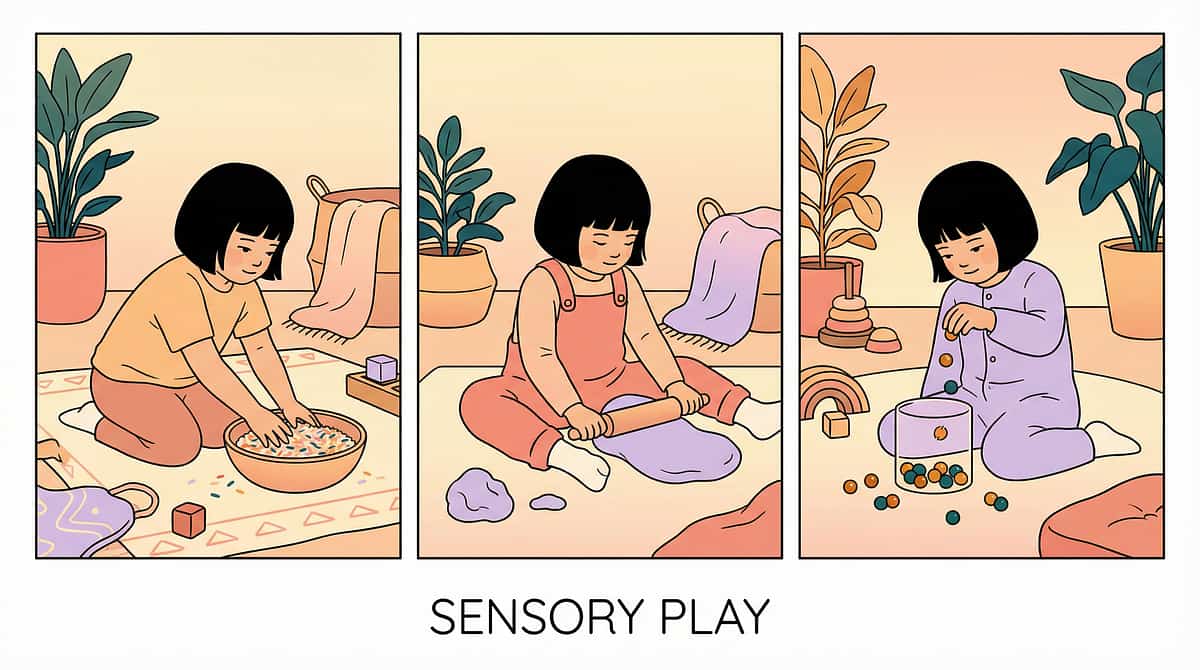
Repeat & Vary: Daily Proactive System Operation
The Principle: Proactive strategies are not discrete therapy sessions — they are the architecture of the entire day. You cannot "overuse" proactive strategies. More consistency = more predictability = fewer behavioral episodes.
Daily Transition | Proactive Tool Used | Script/Approach | |
Wake-up → Breakfast | Schedule preview + First-Then | "First breakfast, then iPad" | |
Breakfast → Getting ready | Timer (5 min) + Choice | "Shirt first or pants first?" | |
Home → Transport | Transition object + going card | "Going to school" picture card | |
Free time → Demand | First-Then board + Timer | Set timer; show board | |
School return → Homework | Sensory toolkit + Choice | Choice of task order | |
Screen time → Dinner | Timer (10→5→1 min) + First-Then | Graduated warnings | |
Dinner → Bedtime | Schedule preview + Transition routine | Review day, preview tomorrow |
Variation Options (to maintain engagement)
- Rotate picture choices on choice board weekly
- Let child move their own "done" markers on schedule
- Change First-Then "Then" options based on current interests
- Different timer format on different days (sand vs. visual disk)
Satiation Indicator: Child ignores visual supports that previously worked → System needs updating, not abandoning. Add new pictures, change colors, involve child in "rebuilding" the board.

STEP 5 OF 6
⏱️ Within 3 seconds of target behavior
Reinforce & Celebrate
The Principle: Reinforcement is not a reward for "good children." It is the mechanism by which the brain learns "this proactive strategy works for me." Immediate, specific, enthusiastic reinforcement after successful use of any proactive tool accelerates internalization.
Reinforcement Timing: Behavior occurs → [0–3 seconds] → Reinforce. After 3 seconds, the association weakens. This window is critical.
Reinforcement Scripts (specific, behavior-labeled)
- "You checked the schedule! That's exactly what helps."
- "You stopped when the timer went off. You are getting so good at this."
- "You picked headphones before we went in — that was smart of you."
- "You went to your calm corner when you felt upset. I am so proud of that."
"Celebrate the Attempt, Not Just the Success" — If the child tried to use the calm corner but escalated anyway — reinforce the attempt. "I saw you try to get your squeeze toy. Let's practice that more."
Reinforcement Menu (Canon Confirmed)
⭐The Rosette Imprint Reward Jar — ₹589 | Buy on Amazon.in
⭐1800+ Reward Stickers Set — ₹364 | Buy on Amazon.in
No Purchase Needed
- Verbal praise (most powerful for many children)
- Physical celebration: high five, hug, spin
- Token economy: sticker on chart → accumulated → chosen reward
- Extra 5 minutes of preferred activity
- Special privilege: first pick, helper role, special seat

STEP 6 OF 6
⏱️ 2–3 minutes
The Cool-Down: Session and Day Transition
The Principle: Proactive systems need a "power down" ritual at key points in the day — particularly at end of high-demand periods and at end of day. This cool-down prevents post-demand emotional flooding.
Transition Warning (2 minutes before)
"Two more [activities/minutes], then we take a calm break." Give advance notice, not a sudden stop.
Sensory Reset
Offer one calming sensory input from the toolkit — weighted lap pad, deep pressure, headphones with soft music, or chewing snack.
Schedule Acknowledgment
Walk to the schedule together. Mark off completed activities. Preview what comes next (usually something preferred/neutral). "Look at everything you did today!"
Verbal Closing
"You did a great job using your schedule/timer/calm corner today. That is hard work." Always follow a high-demand period with a low-demand or preferred activity.
If Child Resists Cool-Down: Do not force; reduce to verbal-only close. Offer a preferred item immediately following cool-down signal. Make cool-down itself pleasurable — favorite blanket, favorite music.

Capture the Data: 60 Seconds of Data Now Saves Hours of Guessing Later
What to Record (3 Daily Data Points)
Data Point | How to Record | Example | |
Meltdown frequency | Tally mark per episode | III = 3 episodes | |
Transition success rate | # successful / # total transitions | 6/8 = 75% success | |
Proactive tool used | Check which tools used today | ✅ Schedule ✅ Timer ✅ First-Then |
Simple Daily Tracker
DATE: ___________ | Mood:
Session Abandonment Is Not Failure. It's Data.
When something doesn't go as planned, the response is systematic troubleshooting — not discouragement. Every challenge points toward a specific, solvable adjustment.
❓ "My child ignores the visual schedule completely."
Schedule may be at wrong level, wrong height, or needs pairing with reinforcement first. Reduce to 2 items. Stand beside child and point together. Reward any glance at the schedule.
❓ "The timer causes more meltdowns."
Timer has been paired with stopping preferred activities too exclusively. Pair timer with positive events first for 1 week ("Timer for 5 minutes of bubbles!"). Only then reintroduce for transitions.
❓ "My child destroys the First-Then board."
"Then" is not motivating enough, OR "First" is too aversive. Reduce "First" task size to one step. Increase value of "Then." Start with just 10 seconds of "First."
❓ "Transitions still take 20+ minutes with all supports."
Multiple concurrent supports may overwhelm. Simplify to ONE tool per transition. Assess whether transition destination itself is aversive. Functional behavior assessment indicated.
❓ "Child uses calm corner as avoidance."
Calm corner is serving an escape function. Implement scheduled calm breaks (removes avoidance motivation) + visual "break card" system. Consult BCBA.
❓ "Child suddenly regressed completely."
Regression typically signals illness, sleep disruption, major life change, or environmental stress. Return to simpler supports. Increase reinforcement. Regression is part of non-linear progress.
❓ "Other caregivers won't use the system."
Systems only work with cross-caregiver consistency. Share the Family Guide (Card 37). Offer one-on-one orientation (10 minutes). Start with one tool: "Try just the First-Then board."

No Two Children Need the Same Scaffold. Here's How to Tune Yours.
Child Profile | Adapt This Way | |
Sensory Avoider (overwhelmed by input) | Prioritize noise-reducing headphones, weighted items, reduced visual clutter, calm corner as first tool | |
Sensory Seeker (needs high input) | Incorporate movement into transitions (hop/jump), fidget tools as "First-Then" rewards, proprioceptive input before demands | |
Low Verbal | Photo-based schedules (child's own photos), object cues for non-readers, gesture + picture (no words required) | |
High Verbal / Intellectually Capable | Written schedules, child participates in schedule-building, negotiated choice within structure, Social Stories as primary tool | |
High Anxiety | Maximum predictability, Social Stories for all novel situations, change warnings 24 hours in advance, "what if" card for unexpected changes | |
Very Young (2–3 years) | Object schedules (actual objects, not pictures), 2-item only, constant adult co-regulation alongside all tools | |
Older Child (8–12 years) | Self-managed checklist, child owns their toolkit, collaborative problem-solving for schedule design |
Ages 2–3
Each session unit = 5–10 minutes maximum
Ages 3–5
10–15 minutes per session unit
Ages 5–8
15–20 minutes per session unit
Ages 8–12
20–30 minutes or child's natural capacity

📈 ACT IV: THE PROGRESS ARC
Weeks 1–2: What to Expect — Foundation Phase
What You WILL See (Weeks 1–2)
- Child notices the visual schedule (even if they don't use it)
- Slightly fewer complete meltdowns, OR same frequency but shorter duration
- Child begins to accept timer without immediate protest (some days)
- One or two successful self-directed tool uses
- Parent reports feeling "slightly more in control"
What You Will NOT See Yet
- Child independently managing all transitions
- Elimination of meltdowns
- Consistent compliance with all supports every day
- Complete system internalization
Practical Action for This Phase
- Introduce one tool at a time (do not launch all 9 simultaneously)
- Start with the transition that causes the most daily disruption
- Prioritize consistency over comprehensiveness
- Increase reinforcement density — reward every small win
"If your child tolerates the visual schedule being in the room without tearing it down — that is Week 1–2 progress. If the timer causes 60 seconds of protest instead of 10 minutes — that is measurable improvement." Research: PMC11506176

Weeks 3–4: Consolidation Signs
The nervous system is beginning to trust the schedule. Watch for these specific indicators — each one represents a measurable neurological shift in progress.
40% — CONSOLIDATION PHASE
Child walks to schedule without being prompted — even once
Child references First-Then board before an adult does
Transition time reducing: from 20 minutes → 8–10 minutes
Child accepts timer at transitions with reduced or no protest
Calm corner accessed at early signs of distress (not just mid-meltdown)
Parent or caregiver reports "we had a good morning" more than once this week
What's Happening Neurologically
Consistent, repetitive proactive structure is building new synaptic pathways in the prefrontal-limbic circuit. The amygdala is beginning to recognize the schedule/timer/calm corner as safety signals. This takes 3–4 weeks of consistent application to establish.
When to Increase Intensity
If you see 3+ consolidation indicators above: add one more transition to the proactive system. Introduce Social Stories for an upcoming challenging event. Expand calm corner toolkit.
"By Week 4, most parents report they are no longer 'thinking about' the proactive system — it's beginning to become automatic. That is the consolidation happening in YOU, too."

🏆 MASTERY PHASE
75% — Weeks 5–8
Mastery Indicators: D-356 Proactive Strategies
Core Mastery — Required
Child references visual schedule independently ≥1×/day without prompt. 5/7 transitions completing within 5 minutes. Meltdown frequency reduced 40%+ from Week 1 baseline.
Generalization — Mastery Spreading
Child carries transition object independently. Child asks for timer before transitions. Behavior improvement observed in secondary setting (school reports better transitions).
When to Progress
Mastery of D-356 → Ready for D-360 (Self-Regulation Skills) or D-365 (Transition Management Advanced). First, confirm: proactive system in place, at least one tool used independently, meltdown frequency reduced.
Maintenance Check: After 3 weeks of consistent mastery, reduce one level of adult support. Child should maintain performance with less scaffolding. If regression occurs → return to full support. Not a failure — just a signal to consolidate longer. Research: PMC10955541 | BACB Mastery Criteria Standards

You Rebuilt Your Child's World Into One They Could Navigate. That Is Not Small.
"You started where most families stay — in reactive crisis mode. You chose to understand the neuroscience. You set up the space. You held the system through weeks when it felt like it wasn't working. You reinforced every tiny win. And look where you are now: a child who reaches for their calm corner, who checks the schedule, who accepts the timer. That child is doing that because you created the conditions where it was possible. You did this." — Pinnacle Blooms Consortium
What Your Child Has Actually Achieved
A nervous system beginning to recognize predictability as safety. Neural pathways linking visual supports to regulated states. Early self-regulation — one of the most powerful predictors of long-term wellbeing.
Family Celebration Suggestion
Mark this milestone. Tell your child specifically what you noticed. Frame the visual schedule progress. Take a "Week 8 photo" beside the calm corner. This documentation matters — for the child who will one day understand their own journey.
Journal Prompt
Write one sentence about your child's hardest transition in Week 1, and one sentence about the same transition in Week 8. Save it. Share your milestone → Pinnacle Parent Community.

Trust Your Instincts. If Something Feels Wrong, Pause and Ask.
Some signs during implementation require you to pause, reassess, and seek professional support. These are not signs of failure — they are clinical signals that the plan needs adjustment.
Red Flag | What It Looks Like | What to Do | |
Increased aggression with tools | Child becomes more aggressive when visual schedule appears | Pause schedule. Functional assessment needed. | |
Self-injurious behavior emerging | Head-banging, biting self increasing despite proactive system | Immediate: call 9100 181 181. BCBA assessment urgent. | |
Complete system refusal + regression | Child rejects all supports; global regression across skills | Rule out medical cause. Reduce to 1 support only. | |
Trauma response to calm corner | Child becomes severely distressed in designated calm space | Do NOT force calm corner. Trauma-sensitive reassessment needed. | |
Significant weight loss or sleep disruption | Physical changes coinciding with behavioral implementation | Pediatrician + NeuroDev assessment priority. | |
Caregiver breakdown | Implementer reaching emotional limit | Call 9100 181 181. Respite support. System simplification. |
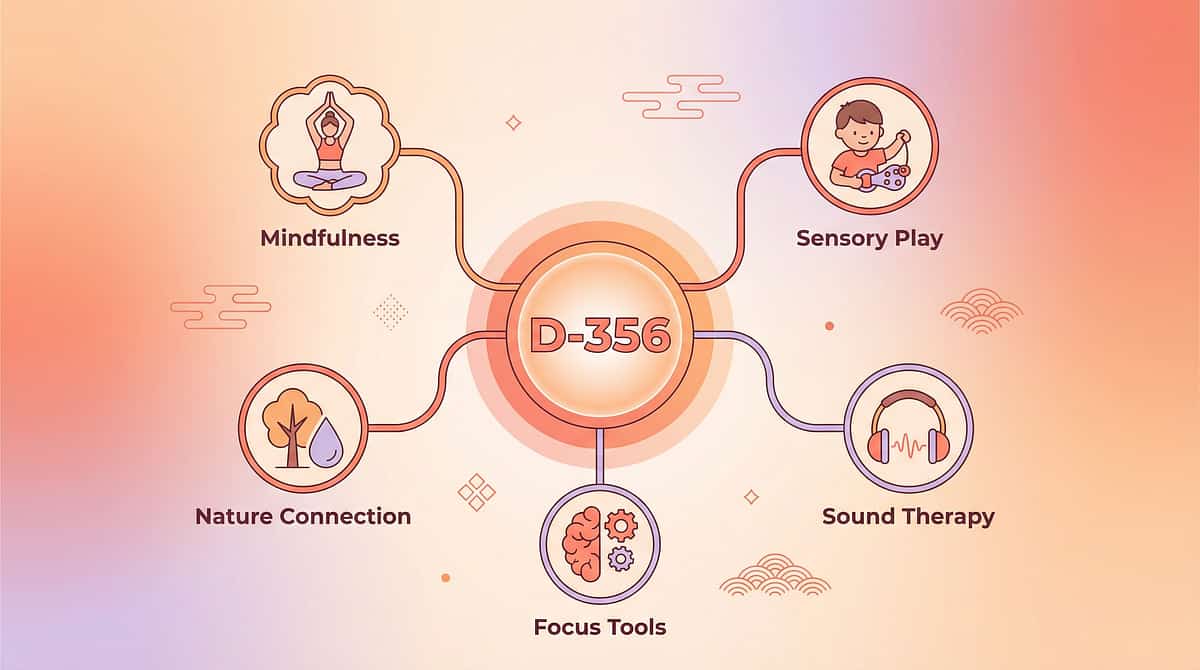
D-356 Is One Node in a Complete Behavioral Regulation Map
Understanding where you are in the progression pathway helps you plan what comes next — and recognize how much ground you've already covered.
D-353: Identifying Triggers
Foundation: Observation Journal to identify what precedes behavioral episodes
D-354: Understanding Behavior Function
ABC Data Sheets to understand WHY behavior occurs
D-355: Environmental Modifications
Room Organization Supplies to reduce environmental triggers
★ D-356: Proactive Strategies — YOU ARE HERE ★
9 Materials (this page) — operationalizing prevention at home
D-357 → D-360 → D-365
Emotional Identification → Self-Regulation Skills → Advanced Transition Management
If D-356 Didn't Resonate: Child primarily sensory-driven → Start with A-Domain Sensory Regulation. Child primarily communication-driven → Start with B-Domain Social Communication. Child has complex behavioral function → Direct to BCBA for Functional Behavior Assessment first. Long-term goal: Internalized self-regulation → Community participation → School readiness → Life independence (AbilityScore® Independence Domain)
Proactive Strategies Exist in a Cluster. Here Are Your Neighbors.
Technique | Code | Difficulty | Primary Material | |
Identifying Behavioral Triggers | D-353 | 🟢 Intro | Observation Journal | |
Understanding Behavior Function | D-354 | 🟢 Intro | ABC Data Sheets | |
Environmental Modifications | D-355 | 🟡 Core | Room Organization Supplies | |
Proactive Strategies ← YOU ARE HERE | D-356 | 🟡 Core | 9 Materials (this page) | |
Emotional Identification | D-357 | 🟡 Core | Emotion Charts | |
Self-Regulation Skills | D-360 | 🔴 Advanced | Regulation Toolkit | |
Transition Management Advanced | D-365 | 🔴 Advanced | Visual Timer + Social Stories |
You Already Own Materials For: If you've set up D-356, your visual schedule, timer, First-Then board, and calm corner materials directly apply to D-355, D-357, and D-360. No new purchases needed for the next 3 techniques.
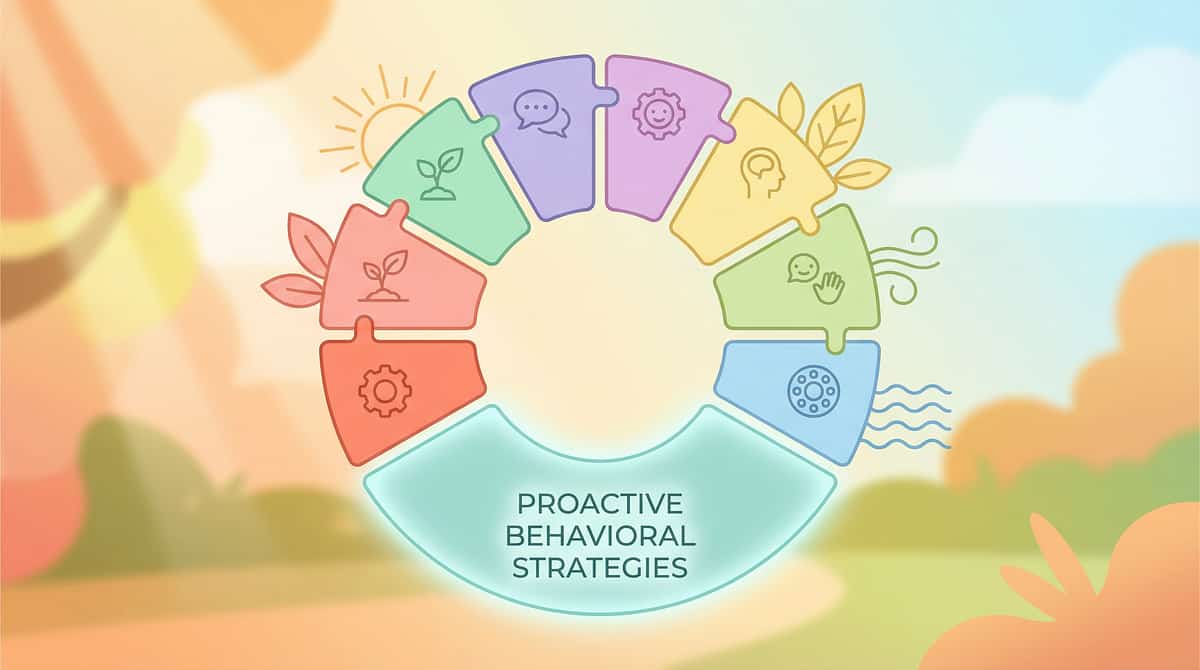
D-356 Is One Piece of a 12-Domain Developmental Architecture
Proactive strategies form the behavioral infrastructure layer. When this foundation is stable, every other developmental domain becomes more accessible.
Your Active Domain: D — Behavior & Flexibility
"Proactive strategies (D-356) form the behavioral infrastructure layer. When this foundation is stable, every other domain — sensory, communication, emotional regulation, cognitive — becomes more accessible. Proactive behavior support is not a single technique. It is the precondition for all therapeutic progress."
Connected Domains (often co-addressed)
- Domain A (Sensory) — sensory toolkits are a shared tool
- Domain C (Emotional Regulation) — calm-down kits bridge both domains
- Domain B (Social Communication) — Social Stories are a shared tool
See your child's complete AbilityScore® across all 12 domains: pinnacleblooms.org/ability-score
🌐 ACT V: COMMUNITY & ECOSYSTEM
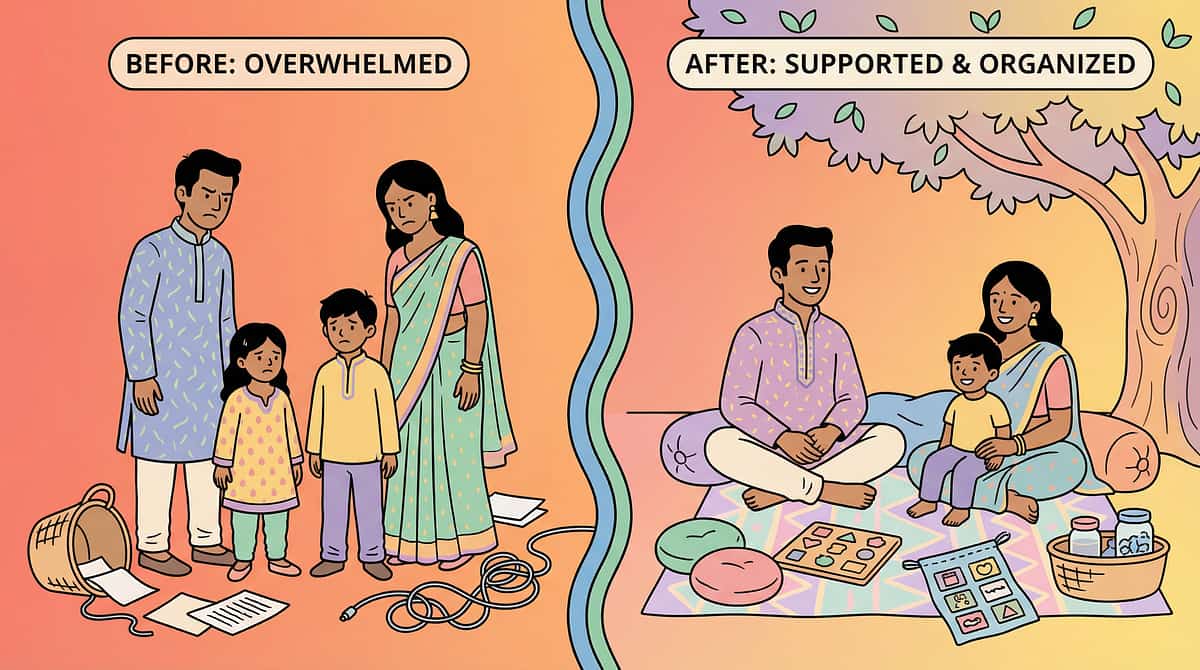
From Constant Crisis to Reliable Calm. These Are Real Trajectories.
Family Vignette 1 — 6-year-old, ASD, Pinnacle Hyderabad Network
Before (Week 1): "Every morning was a battle. Getting dressed took 45 minutes of screaming. I was in tears by 8am. Every single day."
After (Week 8): "He wakes up, checks his schedule on the door, puts on his shoes when the timer goes. Twice last week he went to his calm corner without me prompting it. I cried — but for a different reason."
Tools: Visual schedule + visual timer + calm corner | 8 weeks (Illustrative)
Family Vignette 2 — 8-year-old, ASD + Anxiety, Pinnacle Bengaluru Network
Before: "Unexpected changes destroyed the whole day. A different car route. A food item missing. We lived in terror of the unexpected."
After: "We have a 'change card' on the fridge now. When something's different, we show the card. He checks it — and 7 times out of 10, it's okay. That's extraordinary for us."
Tools: Visual schedule + Social Stories + change card | 12 weeks (Illustrative)
"The families who see the fastest results implement one tool with maximum consistency before adding the next. One visual schedule, used every single day, every transition, for 3 weeks — outperforms five tools used sporadically." — Behavior Therapist, Pinnacle Consortium

Isolation Is the Enemy of Implementation. You Need a Village.
Research consistently shows that parent-to-parent connection is a powerful predictor of implementation success. Communities provide motivation, accountability, and lived wisdom that no clinical document can replicate.
📱 Behavior Support Parent WhatsApp Community
16,000+ parents navigating proactive strategy implementation. Daily wins shared. Questions answered within hours. Join: pinnacleblooms.org/parent-community
💬 Online Forum — Domain D: Behavior & Flexibility
Searchable archive of parent questions and therapist responses on proactive strategies. forum.pinnacleblooms.org
🤝 Peer Mentoring
Connect with a parent who has successfully implemented proactive strategies with a child at a similar profile. Request match: pinnacleblooms.org/peer-mentor
🏘️ Local Parent Meetup
Pinnacle centers host monthly caregiver meetups. Find your center: pinnacleblooms.org/centers
"Your experience — the week it didn't work, the morning it finally did — is clinical data for another parent who is exactly where you were 8 weeks ago. Consider sharing." Need to talk to a professional, not just another parent: 9100 181 181 (24×7, 16+ languages)
Home-Based Implementation Works Best When Anchored by Professional Guidance
Therapist Matching for D-356
Primary Lead: ABA / BCBA — Functional Behavior Assessment, behavior support planning, proactive strategy design
Secondary: Occupational Therapist — Sensory assessment, environmental modifications, toolkit design
Supporting: Special Educator — Visual support implementation, school-based proactive systems
What to Ask Your Therapist
"I've started D-356 proactive strategies. Can we do a Functional Behavior Assessment to make sure I'm matching the tools to the right behavioral functions? And can we check the sensory profile to build the most effective toolkit?"
Book Your Session
🏥In-Center:pinnacleblooms.org/book-appointment
💻Teleconsultation (Remote):pinnacleblooms.org/teleconsult
📞Helpline (Free, 24×7):9100 181 181
70+ centers across India. Available in-center and via teleconsultation.
Insurance / Funding Note
Document medical necessity through your pediatrician and behavior therapist. Behavioral intervention documentation may support insurance claims and government scheme applications (PM-JANMAN, ADIP scheme for assistive devices).
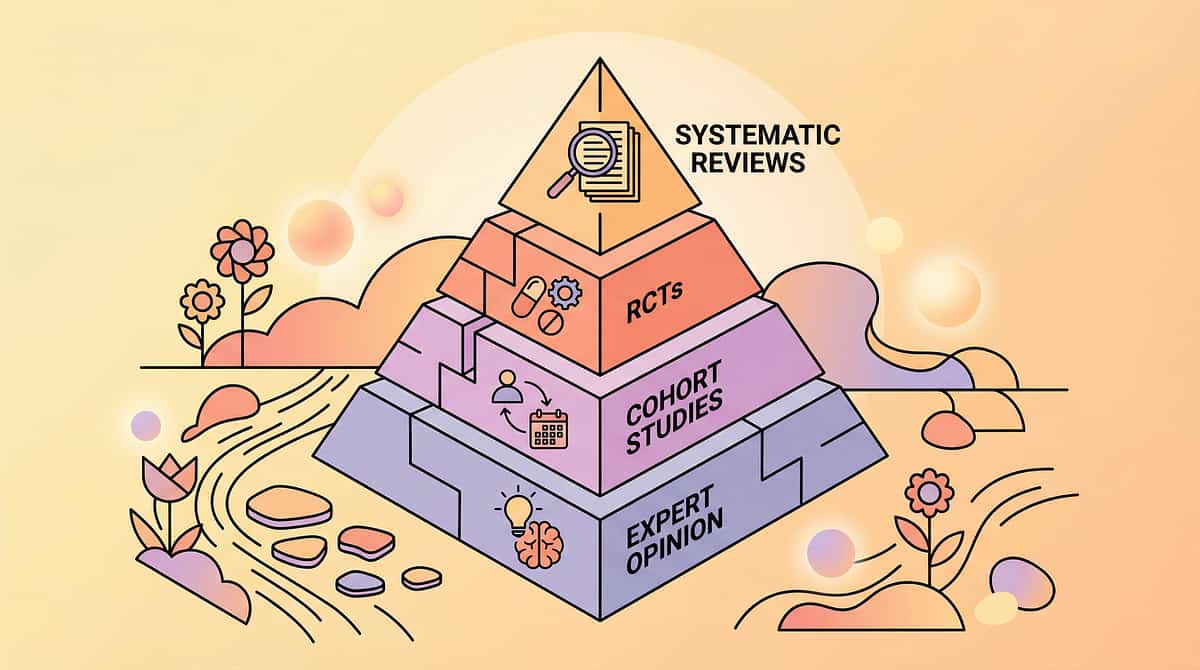
For the Parent Who Wants to Go Deeper: The Evidence Base for D-356
Evidence Pyramid
D-356 Evidence sits at: Systematic Review + RCT (Top 2 levels)
Key Studies
1. PRISMA Systematic Review (2024) — 16 studies confirming antecedent-based interventions as evidence-based practice for ASD. 🔗PMC11506176
2. NCAEP Evidence-Based Practices Report (2020) — Antecedent-based interventions, visual supports, and behavioral momentum: Level I Evidence for autism. 🔗NCAEP 2020 Full Report
3. Meta-Analysis, World J Clin Cases (2024) — 24 studies. Structured behavioral interventions promote self-regulation, adaptive behavior, social skills. 🔗PMC10955541
4. Padmanabha et al., Indian J Pediatr (2019) — Indian RCT: home-based behavioral support. Culturally validated. 🔗DOI: 10.1007/s12098-018-2747-4
5. WHO Nurturing Care Framework (2018) + CCD Package (2023) — Global gold standard. Predictability and responsive caregiving as core pillars. 🔗nurturing-care.org | 🔗PMC9978394
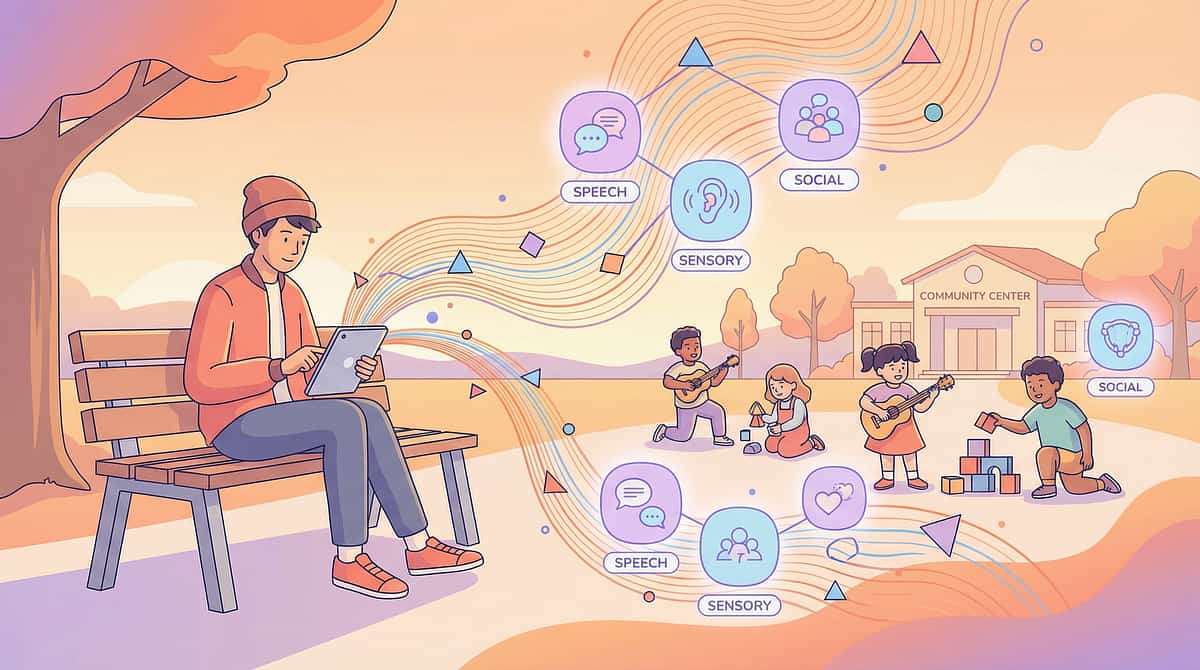
Your Data Helps Every Child Like Yours. Here's How.
What GPT-OS® Learns from D-356 Data
- Which proactive tools correlate with meltdown reduction in your child's profile
- Transition success rate trends (time-of-day, antecedent patterns)
- Caregiver fatigue index (flags when family needs additional support)
- Readiness timing for progression to D-357 or D-360
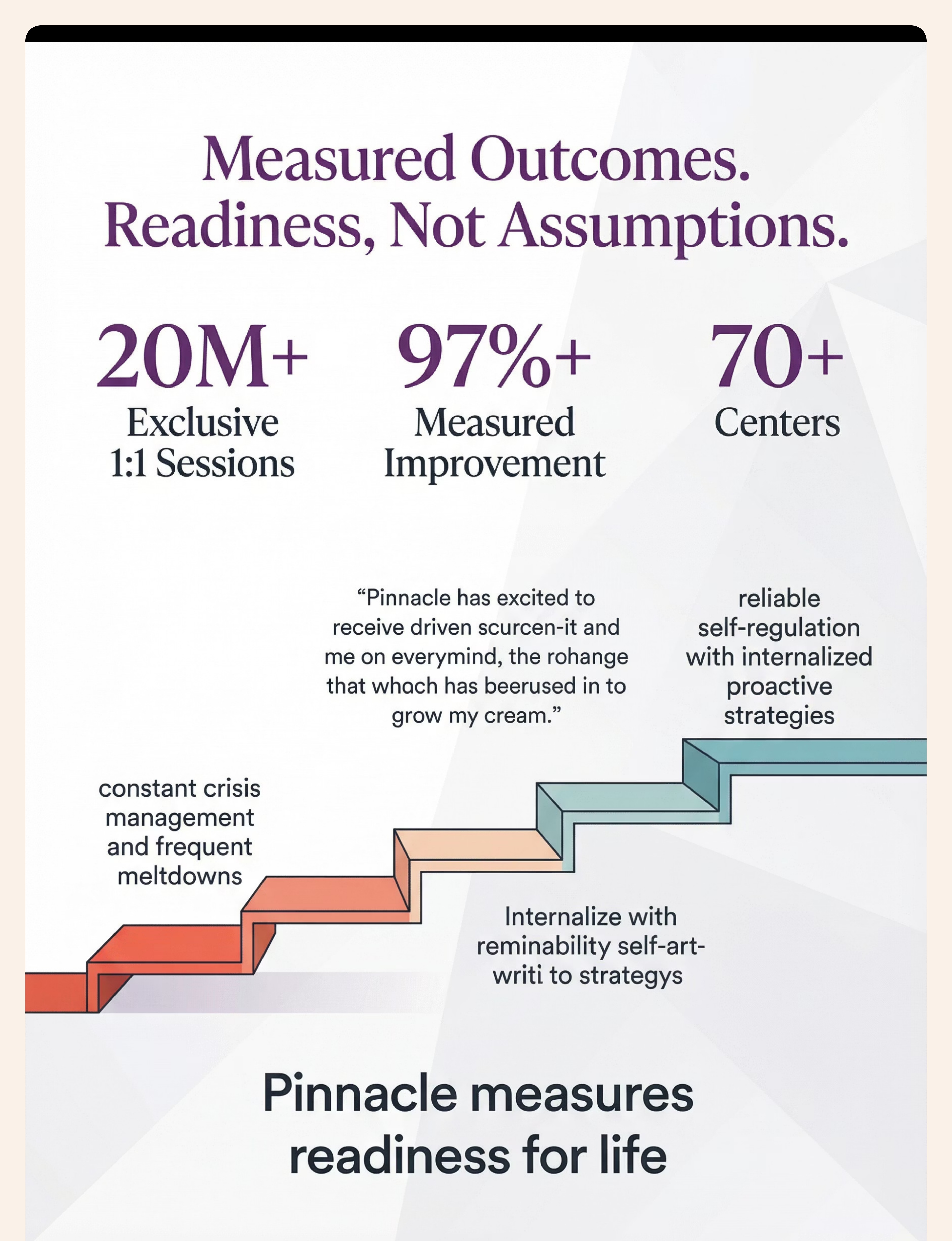
Behavioral Regulation Readiness Index
- No proactive systems → Constant crisis
- Basic visual supports → Some meltdown reduction
- Consistent multi-tool use → Significant reduction, child referencing supports
- Child self-directing tools → Early internalization
- Internalized regulation → Community generalization
Privacy Assurance
All data is anonymized at the aggregation layer. Individual child data remains private. Pinnacle complies with DPDP Act 2023 (India), GDPR (EU users), and HIPAA-equivalent standards.
GPT-OS® Stack
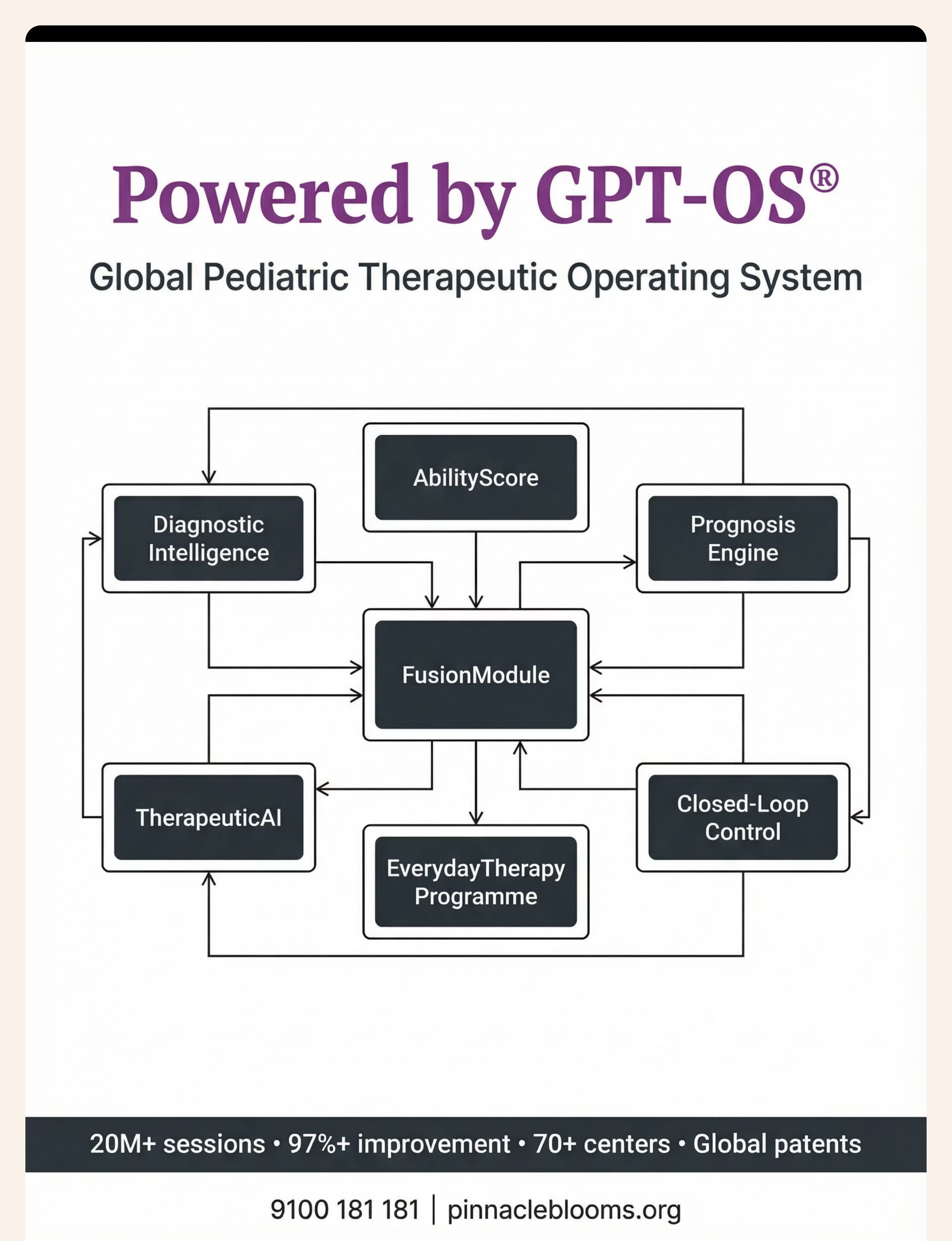
Diagnostic Intelligence → AbilityScore® → Prognosis Engine → TherapeuticAI® → EverydayTherapyProgramme™ → FusionModule™ → Closed-Loop Control
"Your data helps every child like yours."

The Reel That Started This Journey. Watch the Visual Version.
Reel Metadata
🎬Reel ID: D-356
📋Title: 9 Materials That Help With Proactive Strategies
📺Series: Behavior & Emotional Regulation | Episode 356 of Domain D
⏱️Duration: 75–85 seconds
🏷️Domain: Behavior Support + Prevention + Regulation
"You're exhausted from constantly reacting to your child's meltdowns. What if you could prevent them instead? Proactive strategies change the conditions so success becomes more likely. Here are 9 materials that help." — Pinnacle Consortium Behavior Specialist
Why Video + Text Together
NCAEP 2020: Video modeling is classified as evidence-based practice for autism. Multi-modal learning (visual + text + demonstration) improves parent skill acquisition by 40%+ compared to text alone.
Related Reels in This Series
D-353
Identifying Triggers
D-355
Environmental Modifications
D-357
Emotional Identification
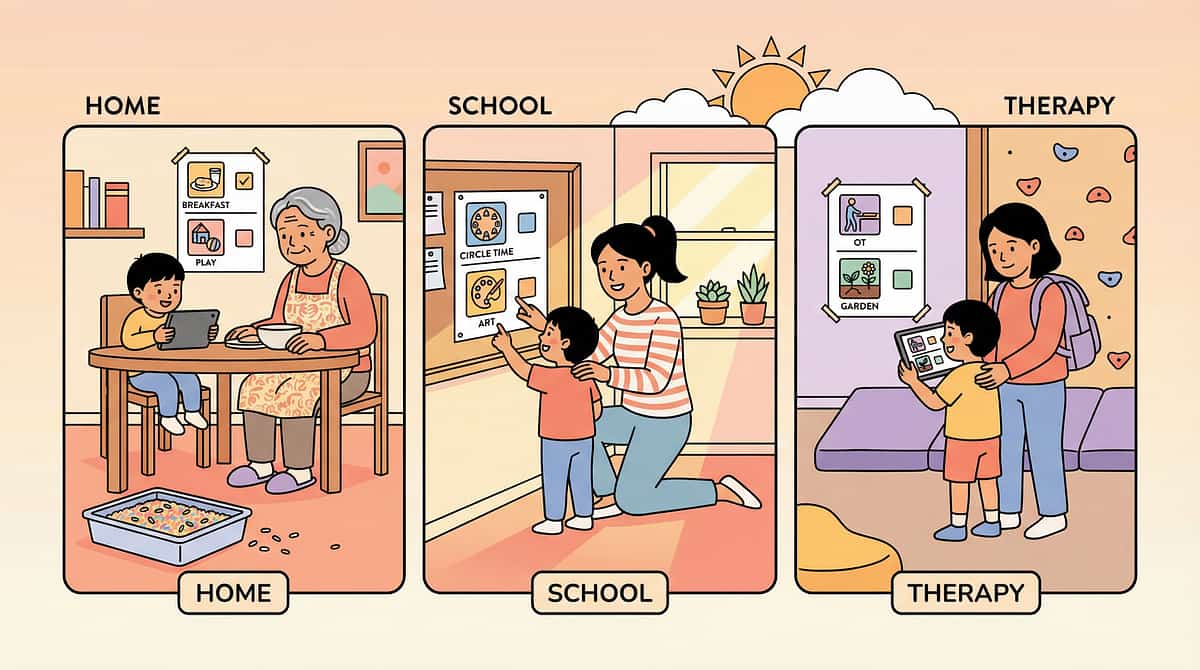
Consistency Across Caregivers Multiplies Impact
One parent implementing is good. Every caregiver implementing is transformative. Share this resource with everyone in your child's life.
Share This Page
📱 WhatsApp — Share with spouse/partner
📧 Email — Share with school/teacher
🔗 Copy Link: techniques.pinnacleblooms.org/behavior/proactive-strategies-D-356
📄 Download: Family Guide (1-Page PDF)
Simplified version for grandparents, babysitters, extended family, and school teachers. Covers: 4 essential tools, 3 key principles, 2 emergency contacts.
"Explain to Grandparents" Version
"[Child's name] has a schedule on the wall, a timer for transitions, and a calm corner. Please use these every time — exactly as labeled. Don't skip them because they seem 'too simple.' They are the therapy. Call us if you have questions: 9100 181 181."
Teacher / School Communication Template
"Our child uses evidence-based proactive behavior strategies at home (Pinnacle D-356). We'd like to share our visual schedule format and request timer-supported transitions at school. Can we schedule a 15-minute call with the class teacher? Attached: Pinnacle clinical summary."

Every Question Parents Ask About Proactive Strategies — Answered
❓ How quickly will I see results?
Most families see early indicators within 7–10 days of consistent implementation. Significant meltdown frequency reduction typically appears at 4–6 weeks. Full system internalization: 8–12 weeks. Individual variation is wide.
❓ Is this only for children with autism?
No. Proactive strategies benefit any child with ADHD, anxiety, sensory processing differences, developmental delays, or even neurotypical children who struggle with transitions. The tools are calibrated to need, not diagnosis.
❓ My child already has a visual schedule at school. Why add one at home?
Generalization requires consistent implementation across settings. A school-only schedule teaches the child that predictability is a school privilege, not a life expectation. Home implementation doubles the generalization surface.
❓ What if my child can't read or understand pictures?
Start with object schedules (use actual objects instead of pictures). A spoon = breakfast. Shoes = outside. The principle is the same — concrete, visible sequence — the vehicle differs.
❓ We tried First-Then boards before and they didn't work.
"Didn't work" usually means: (a) "Then" wasn't motivating enough, (b) "First" was too demanding, (c) inconsistent implementation, or (d) the tool didn't match the behavioral function. See Card 22 troubleshooting. Call 9100 181 181 for personalized guidance.
❓ Can I use a screen/app instead of physical materials?
Yes, for some tools. Caution: if the device itself becomes a source of behavioral challenges (transition off device), physical materials may be safer during initial implementation.
❓ My child has severe behaviors — is this appropriate?
Proactive strategies are more important, not less, for children with severe behaviors. However, severe profiles require BCBA / Functional Behavior Assessment guidance. Call 9100 181 181. Do not implement intensive systems without professional support.
❓ How do I get my child's school to use these systems?
Download the school communication template from Card 38. Request an IEP or BIP meeting. Provide the Pinnacle clinical summary for D-356. Consistency between home and school is the single most powerful generalization lever available.
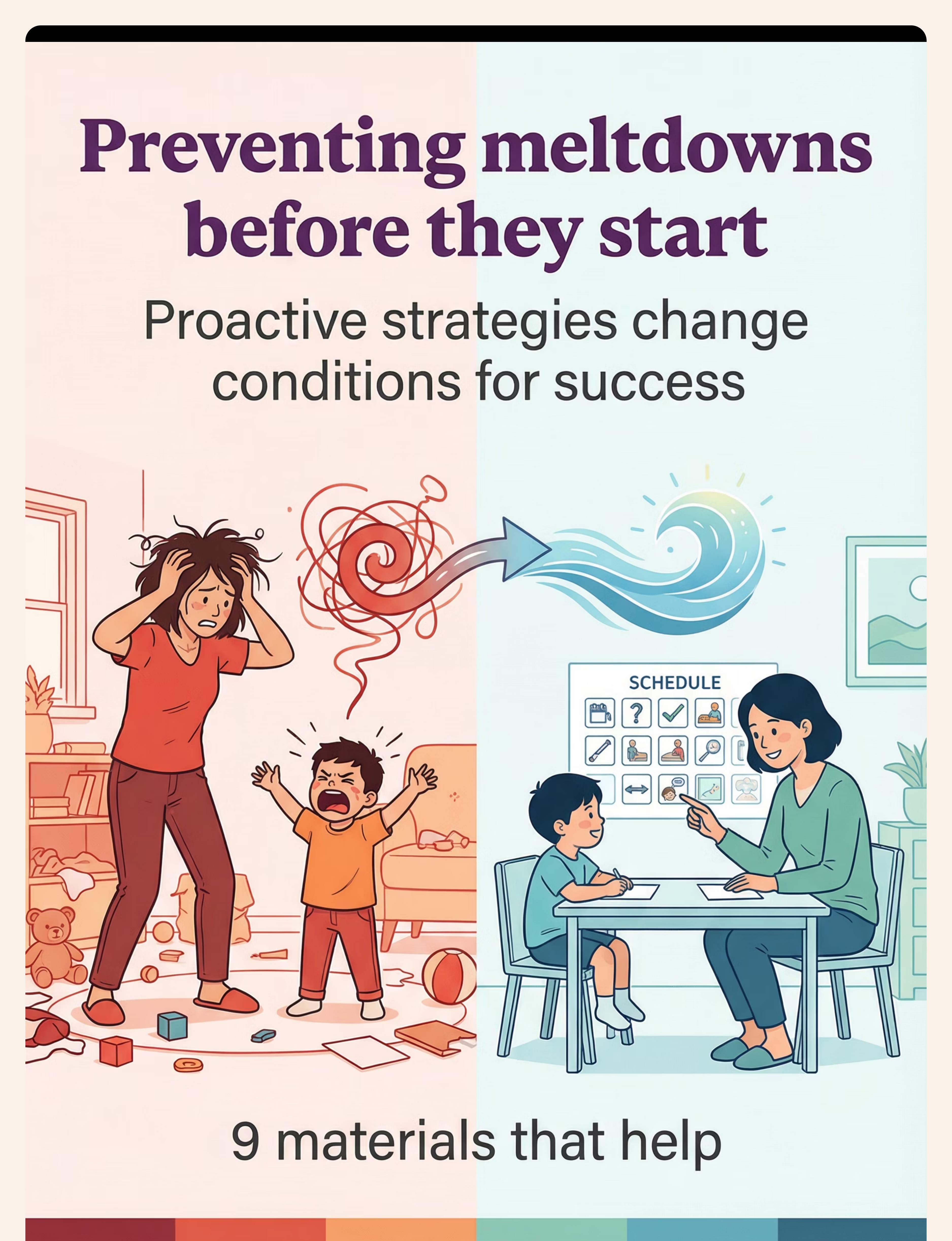
Preview of 9 materials that help with proactive strategies Therapy Material
Below is a visual preview of 9 materials that help with proactive strategies therapy material. The pages shown help educators, therapists, and caregivers understand the structure and content of the resource before use. Materials should be used under appropriate professional guidance.




Link copied!
Prevention Starts Today. Not When the Next Meltdown Happens.
🟢 Start This Technique Today
Launch GPT-OS® guided session. Your AbilityScore® will track progress from today's baseline.
🔵 Book a Consultation
Speak with a Behavior Specialist. Available in-center and via teleconsultation across India.
🔷 Explore the Next Technique
D-357: Emotional Identification — the natural next step after proactive systems are established.
"From fear to mastery. One technique at a time." — Pinnacle Blooms Consortium
📞FREE National Autism Helpline: 9100 181 181 | 24×7 | 16+ languages | Free — "Not sure where to start? Call us. We'll help you find the right first step for your child."
Pinnacle Blooms Network® Consortium | Clinically Validated by: OT • SLP • ABA/BCBA • SpEd • NeuroDev • Pediatrics • CRO | WHO/UNICEF-Aligned Evidence Base
Mission: Pinnacle Blooms Network® exists to transform every home into a proven, scientific, 24×7, personalized, multi-sensory, multi-disciplinary pediatric therapy environment — powered by GPT-OS® and executed by a consortium of the world's best-integrated pediatric specialists. 70+ centers. 21 million therapy services. 97%+ measured improvement. 70+ countries served. One child at a time.
Medical Disclaimer:This page is educational in nature and does not replace individualized assessment, behavior intervention planning, or clinical guidance from qualified professionals. Challenging behaviors may indicate underlying conditions requiring comprehensive evaluation. Work with your child's therapy team to develop an appropriate, individualized behavior support plan. Individual results vary by child profile, co-occurring conditions, and implementation consistency.
CIN: U74999TG2016PTC113063 | DPIIT: DIPP8651 | MSME: Udyog Aadhaar TS20F0009606 | GSTIN: 36AAGCB9722P1Z2
© 2026 Pinnacle Blooms Network®, a unit of Bharath Healthcare Laboratories Pvt. Ltd. All rights reserved. | Website:pinnacleblooms.org | Email:care@pinnacleblooms.org