

"She Heard 'Touch the Stove.'"
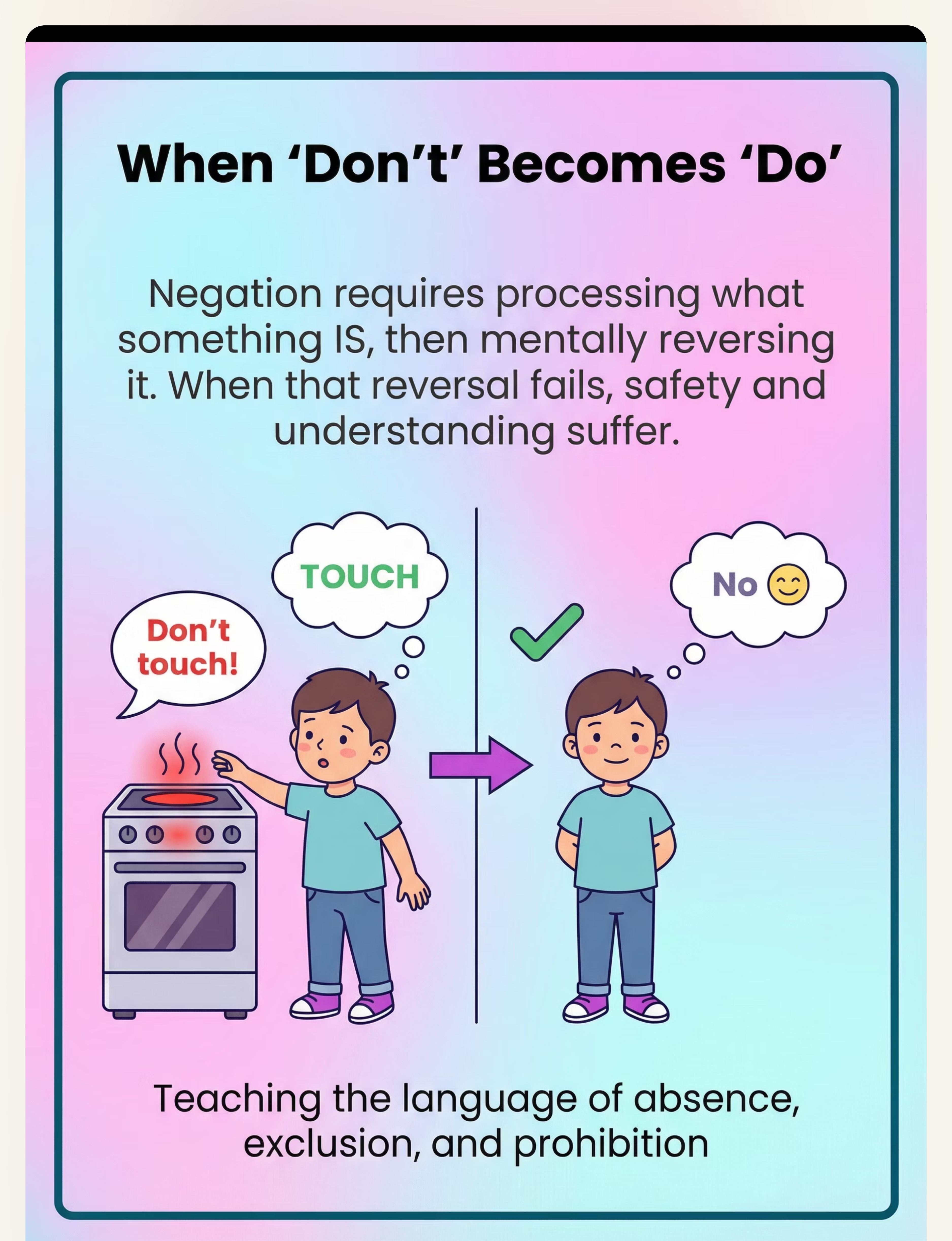
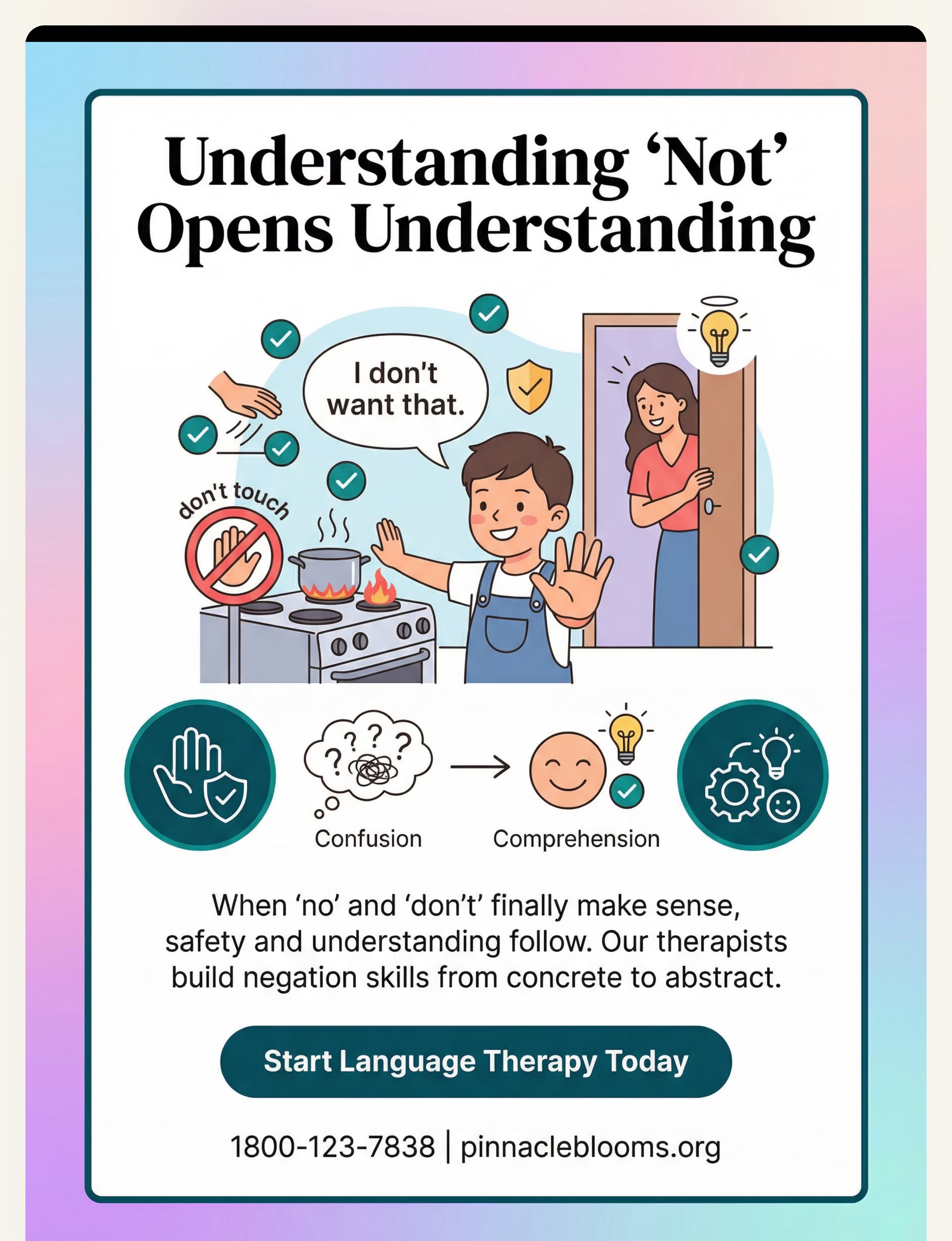
I said DON'T touch! — She reached for it anyway. She wasn't defiant. She wasn't ignoring me. Her brain heard "touch the stove" and lost the "don't." That single missing word is not a behaviour problem. It is a language processing challenge — and it has a name, a science, and a solution.
You are not failing as a parent. Your child's language system is navigating one of the most cognitively demanding tasks in human language — and you just found the roadmap.
B-167
Language & Comprehension Series — Episode 167
Ages 2–10
Negation Understanding + Safety Language
8-Week Protocol
Home-executable, evidence-grounded, clinically validated

ACT I — RECOGNITION
You Are Not Alone — The Numbers
Before we show you the solution — look at how many families are navigating this exact challenge right now.
1 in 36
Children on the Spectrum
Children in India are diagnosed on the autism spectrum (INCLEN Trust, 2023). Language comprehension difficulties including negation processing affect the majority.
80%
Display Language Difficulties
Of children diagnosed with autism display language processing difficulties. Negation comprehension is among the most cognitively demanding language targets. (PRISMA Systematic Review, 2024 | PMC11506176)
21M+
Therapy Sessions Delivered
Therapy sessions delivered by Pinnacle Blooms Network® across 80+ centres — one of the largest real-world evidence bases for paediatric language intervention in South Asia.
You are among millions of families worldwide navigating this challenge. The difference is: you now have a systematic, evidence-based path to address it — at home, today. Indian families face unique challenges: joint household structures, multilingual environments, limited specialist access outside metro cities. Pinnacle's 80+ centres and GPT-OS® platform are specifically designed for this context.

ACT I — THE SCIENCE
What's Happening in Your Child's Brain
The Two-Step Mental Reversal Your Child's Brain Must Perform
The Neuroscience
To understand "NOT red," your child's brain must:
- First construct a full mental representation of RED
- Then mentally reverse it — excluding red from the concept space
- This is called a negation operation — requiring working memory, inhibitory control, and linguistic abstraction simultaneously
Brain regions involved:
- Left inferior frontal gyrus (Broca's area): Processes linguistic negation structure
- Prefrontal cortex: Manages inhibition required to "cancel" the positive concept
- Working memory network: Holds the concept while applying the negative operation
Parent Translation
When you say "Don't touch the stove," your child's brain must activate "touch the stove," apply a mental reversal (inhibition), then suppress the "touch" action. For children with language processing differences, this two-step reversal places enormous demands. The positive action fires — the negative modifier gets lost in processing.
This is a wiring difference — not a behaviour choice. Not defiance. Not disobedience.
Negation forms that require different neural pathways:
- "No" Rejection: "No more milk"
- "Not" Denial: "That's not mine"
- "Don't" Prohibition: "Don't run"
- "Can't" Inability: "Fish can't fly"
- "Gone/Empty" Nonexistence: "The juice is gone"
- "Missing" Implicit negation: "Something's missing"
Science source: Papeo L & de Vega M (2020): The neuroscience of negation. | Nordmeyer & Frank (2014): Foundational research on negation comprehension development in children. Frontiers in Integrative Neuroscience (2020): DOI: 10.3389/fnint.2020.556660


ACT I — EVIDENCE
This Is Not Opinion. This Is Evidence.
LEVEL I Evidence Grade
Systematic Review + RCT + Meta-Analysis Support — the top two tiers of the Oxford Centre for Evidence-Based Medicine framework.
PRISMA Systematic Review (Children, 2024)
16 studies, 2013–2023. Structured language and communication interventions for ASD meet criteria for evidence-based practice. → PMC11506176
Meta-Analysis (World J Clin Cases, 2024)
Multiple RCTs. Language interventions significantly promote adaptive behaviour, communication, comprehension in children with ASD. → PMC10955541
Indian RCT (Padmanabha et al., 2019)
Home-based intervention programmes demonstrated significant outcomes for Indian children. Establishes home-applicability of structured protocols. → DOI: 10.1007/s12098-018-2747-4
Clinically validated. Home-applicable. Parent-proven. This intervention draws from the same evidence base used by paediatric SLPs, ABA therapists, and special educators worldwide. NCAEP 2020: Language-based intervention and visual supports recognised as evidence-based practices for autism. → NCAEP Evidence-Based Practices
ACT II — THE TECHNIQUE
Technique B-167: What It Is
Negation Comprehension Intervention — Systematic Visual-Linguistic Approach
Parent-Friendly Alias: "Teaching Your Child What 'No' Actually Means"
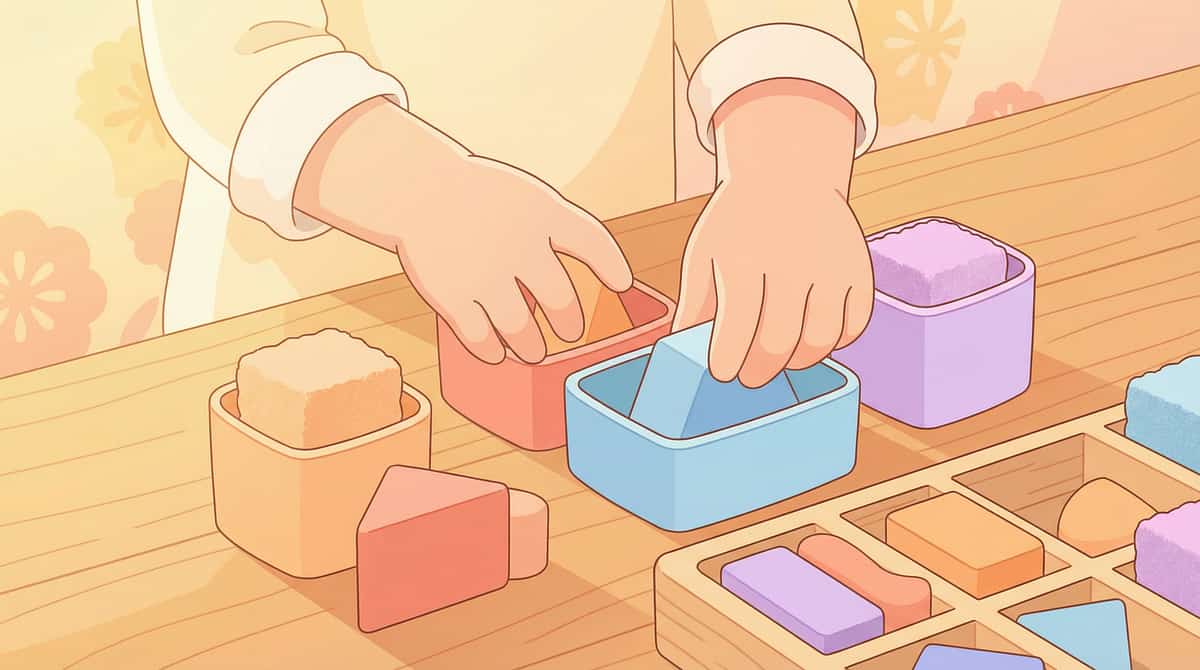
Negation Comprehension Intervention is a structured, multi-layered speech-language and behavioural approach to teaching children the full range of negative language — no, not, don't, can't, won't, gone, missing, empty, and excluded. It progresses from the most concrete forms (empty containers, hidden objects) through intermediate forms (sorting mats, prohibition signs) to the most abstract (negative commands in complex sentences). By building each form systematically with visual supports, physical materials, and repetitive practice in low-stakes game contexts, children develop reliable negation processing that generalises to safety-critical real-world situations.
Age Range
2–10 years (adapt for developmental level)
Session Duration
10–20 minutes per session, 3–5 sessions per week
Protocol Length
8 weeks (progress review at Week 4)
Primary Lead
Speech-Language Pathology (SLP)
What this technique teaches:
- Nonexistence negation ("gone," "empty," "all done")
- Prohibition negation ("don't," "not allowed," "stop")
- Ability negation ("can't," "impossible")
- Categorical exclusion ("not part of the group")
- Safety language ("don't touch," "no running," "stay back")

ACT II — WHO USES THIS
Five Disciplines. One Converged Goal: Safety and Understanding.
Speech-Language Pathology (SLP) — PRIMARY LEAD
SLPs target negation comprehension as a core receptive language goal. They systematically teach each negation type using linguistic hierarchies — starting with concrete absence, progressing to abstract prohibition.
Applied Behaviour Analysis (ABA)
ABA targets negation as a receptive language programme. DTT is used to teach "not" as a discriminative stimulus — when the instruction contains "don't," a different response is required.
Special Education (SpEd)
Special educators embed negation teaching into functional classroom and home routines. "Which one is NOT food?" becomes a sorting activity. Academic concepts are negation-loaded.
Occupational Therapy (OT)
OT uses sensory-motor negation games ("Don't touch the red — touch the green!") to practise response inhibition. Don't Touch/Do Touch game sets target the behavioural inhibition component.
NeuroDevelopmental Paediatrics
NeuroDev physicians monitor negation comprehension as a safety marker. A child who cannot reliably process "don't touch," "stop," and "not allowed" faces genuine safety risks — documented in developmental assessment to prioritise SLP targets.
The Pinnacle Consortium FusionModule™ Advantage: At Pinnacle Blooms centres, all five disciplines review each child's negation profile together within the FusionModule™ — ensuring SLP targets are reinforced in ABA sessions, carried into SpEd classrooms, and practised in OT motor activities. This convergence drives measurable outcomes.
ACT II — TARGETS
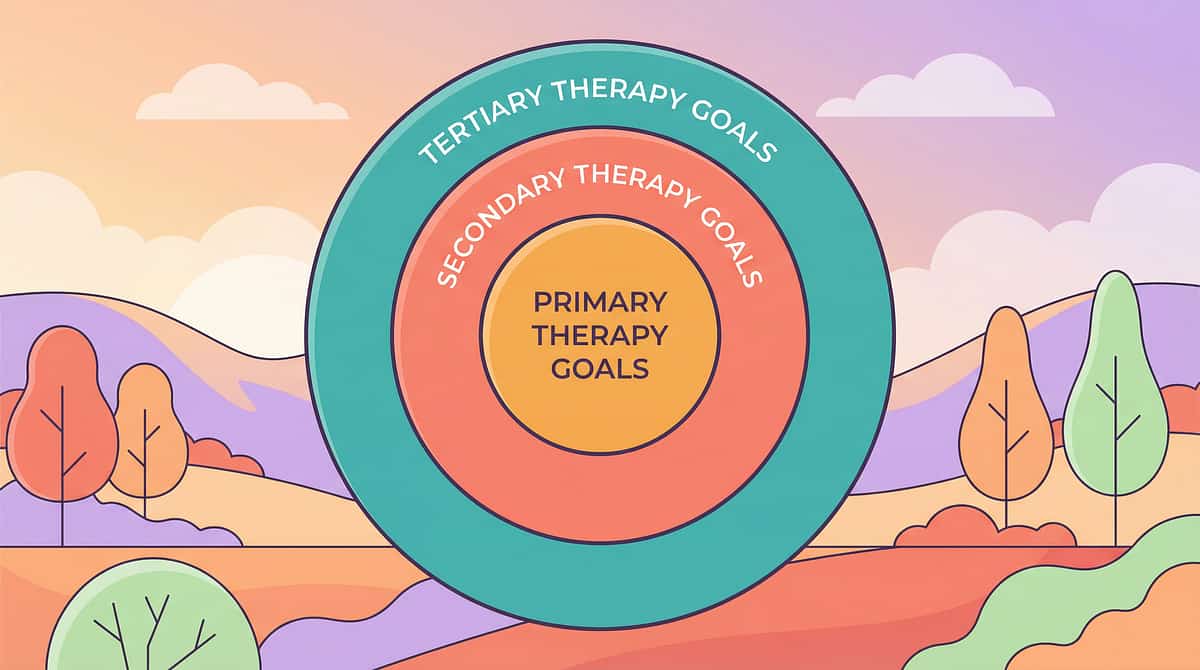
Precise Targets. Observable Behaviours. Measurable Mastery.
Target Area | What We're Building | Mastery Indicator | |
Nonexistence | Child understands "empty," "gone," "all done" as absence | Points to empty container when asked "Where is none?" | |
Simple Prohibition | Child follows "don't" commands in game context | Stops action within 2 seconds of "don't" in 8/10 trials | |
Prohibition Signs | Child recognises visual "not allowed" symbols | Identifies 5+ prohibition signs by meaning | |
Ability Negation | Child understands "can't" as impossibility | Correctly sorts 10 can/can't picture pairs | |
Category Exclusion | Child identifies what does NOT belong | Names excluded item + explains why | |
Semantic Contrast | Child uses opposites to define "not" | Correctly answers 5 "what's NOT hot?" questions | |
Safety Negatives | Child responds correctly to safety "don't" | Stops at "don't go" in 4 out of 5 real-world trials | |
Expressive Negation | Child produces negation expressively | Spontaneously uses "not mine," "can't do it," "no more" |
Your child's current stage is measured through AbilityScore® assessment at any Pinnacle Blooms centre. → AbilityScore® Assessment

ACT II — MATERIALS OVERVIEW
9 Evidence-Grounded Materials That Make 'Not' Make Sense
Each material targets a different layer of negation — from the most concrete (empty containers) to the most abstract (ability and category). All 9 can be purchased or made at home for ₹0.
# | Material | Negation Type | Price Range | |
1 | Empty/Full Container Sets | Nonexistence | ₹150–500 | |
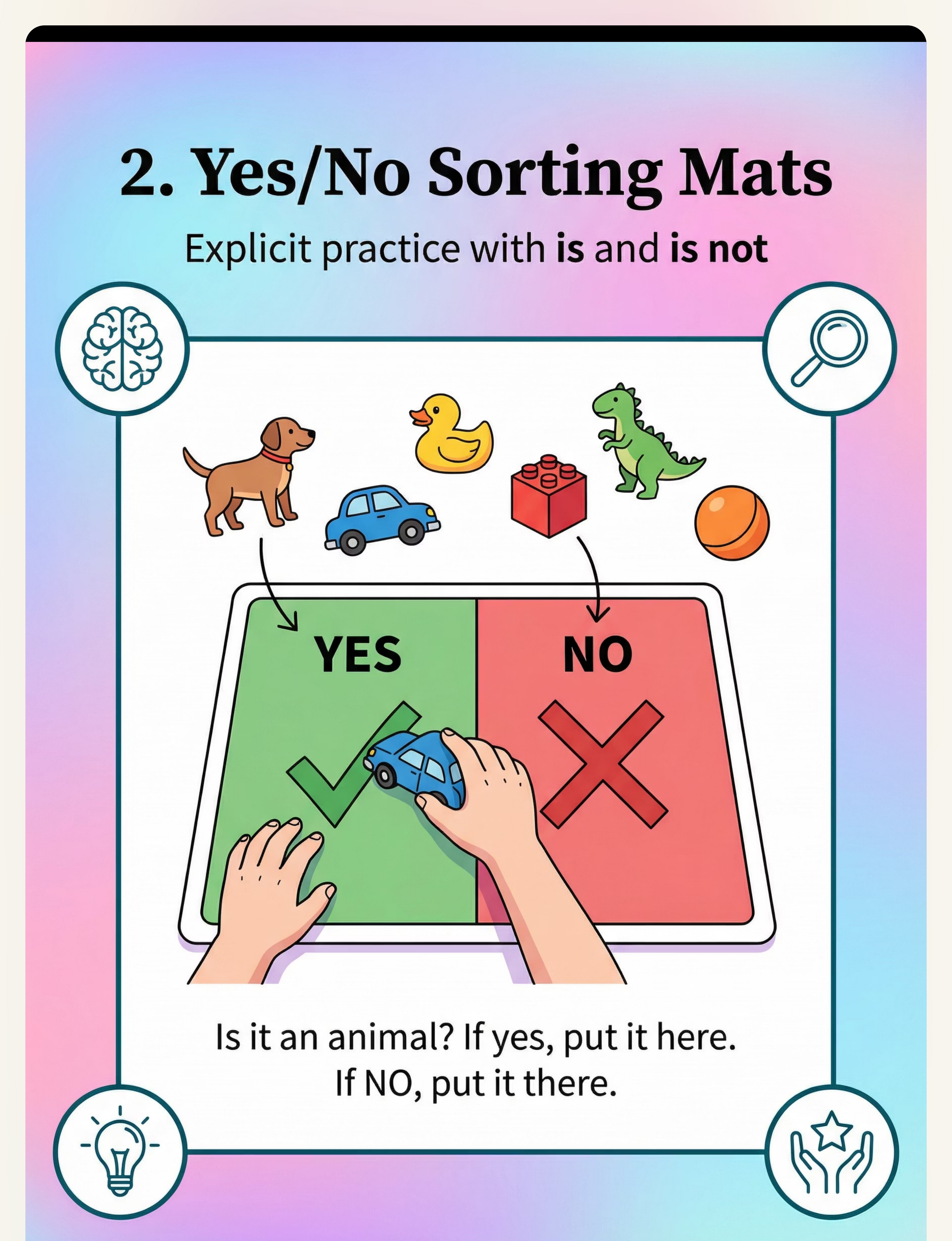
2 | Yes/No Sorting Mats | Categorical | ₹200–600 | |
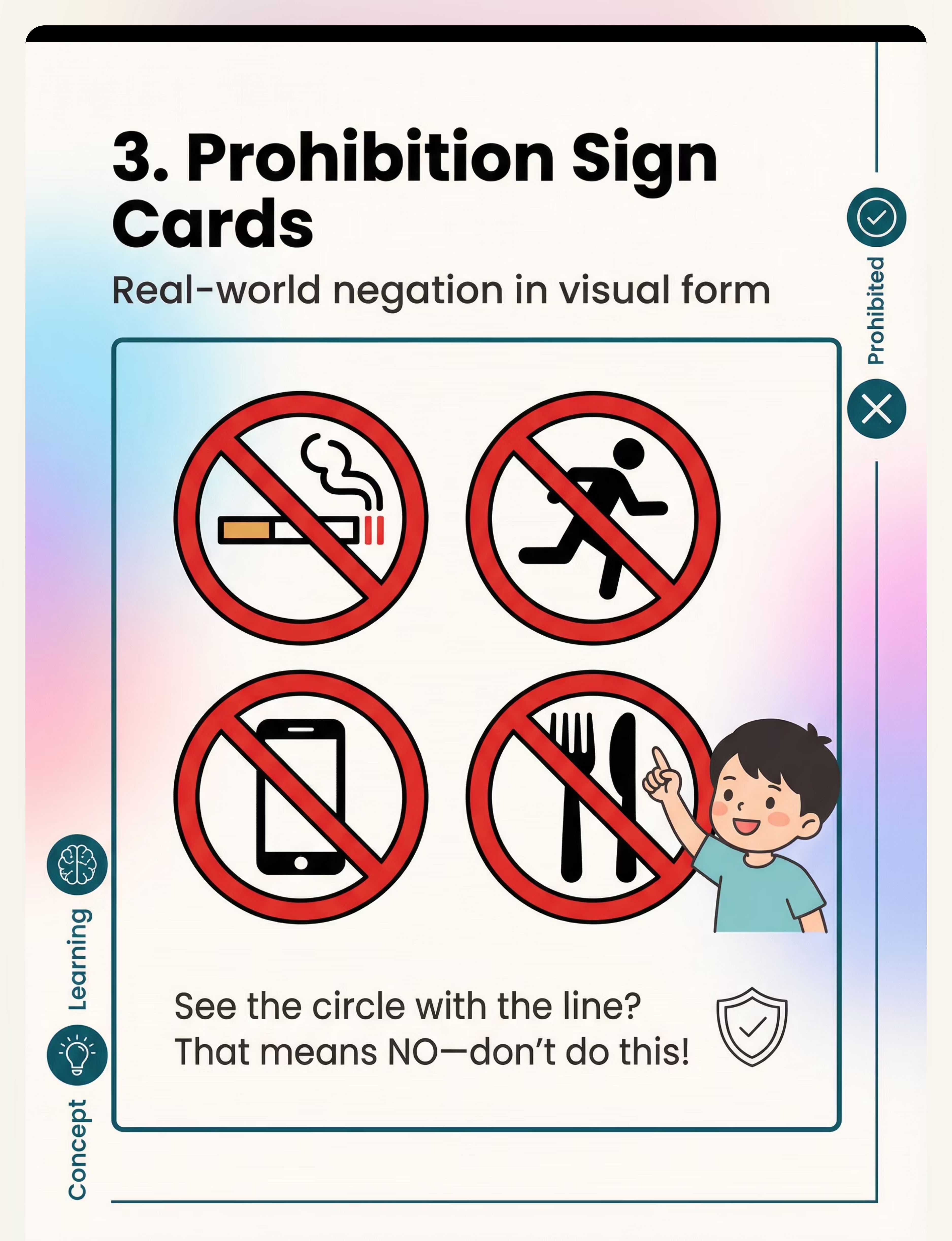
3 | Prohibition Sign Cards | Prohibition | ₹100–400 | |
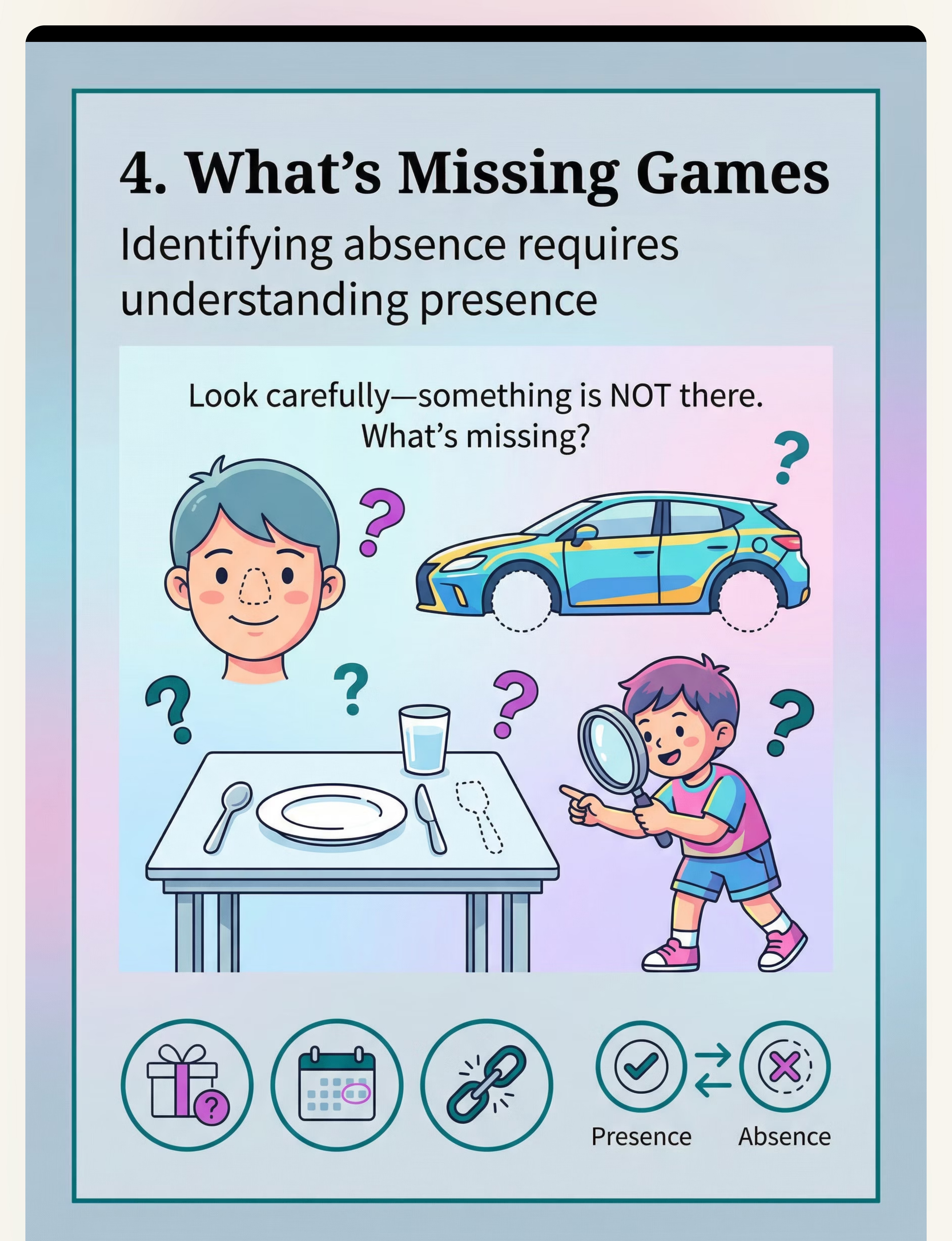
4 | What's Missing Games | Absence Detection | ₹200–700 | |
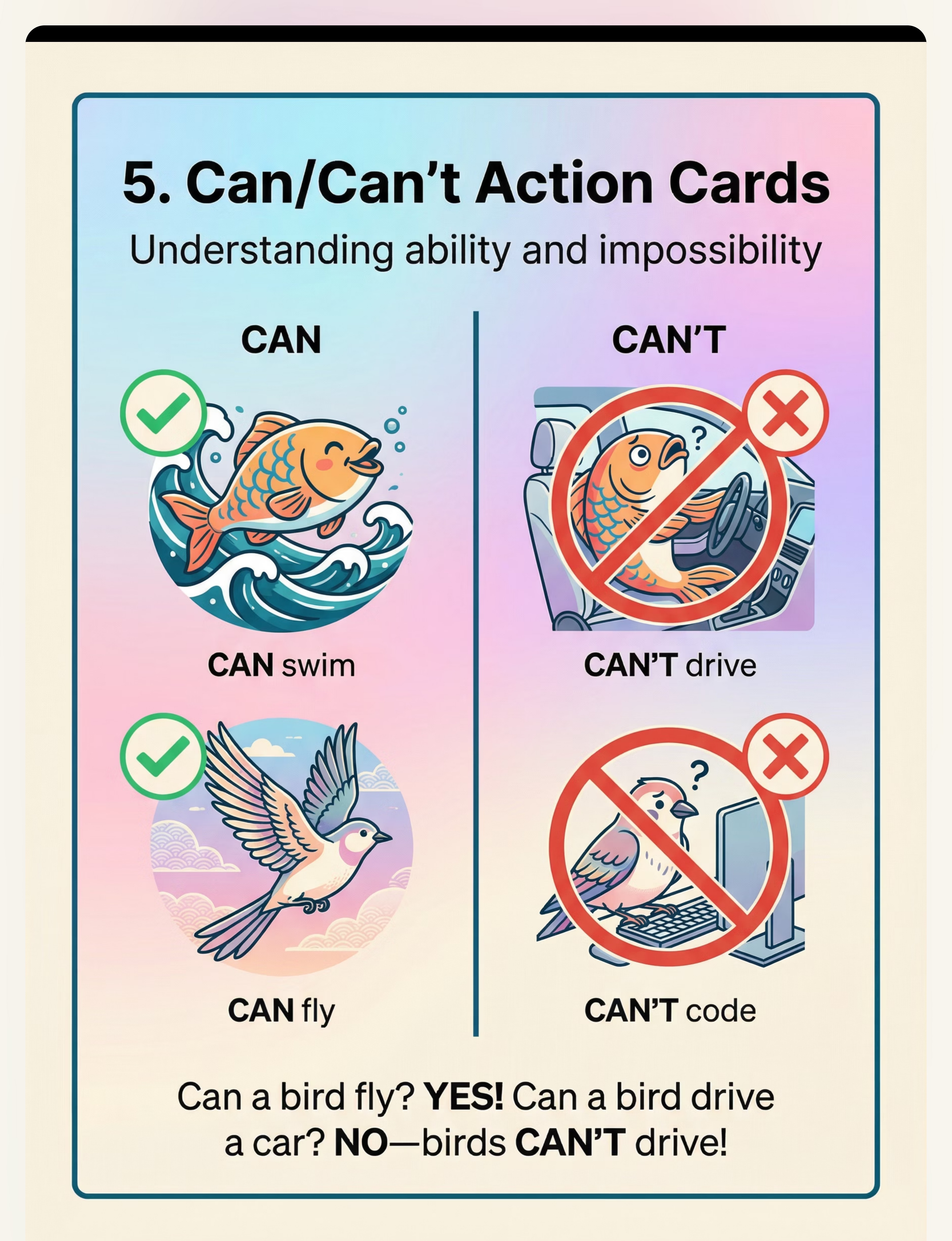
5 | Can/Can't Action Cards | Ability | ₹250–800 | |
6 | Exclusion Sorting Activities | Group Exclusion | ₹200–600 | |
7 | Opposite Concept Cards | Semantic Contrast | ₹150–500 | |
8 | Don't Touch/Do Touch Sets | Prohibition + Inhibition | ₹200–700 | |
9 | Gone/Still Here Object Games | Temporal Absence | ₹100–400 |
WHO Equity Principle: Access to therapeutic tools should not depend on household income. The science works whether the container costs ₹500 or is a repurposed steel dabba from your kitchen. Commercial full set: ₹1,400–5,200 | DIY (all 9): ₹0
MATERIAL 1 OF 9
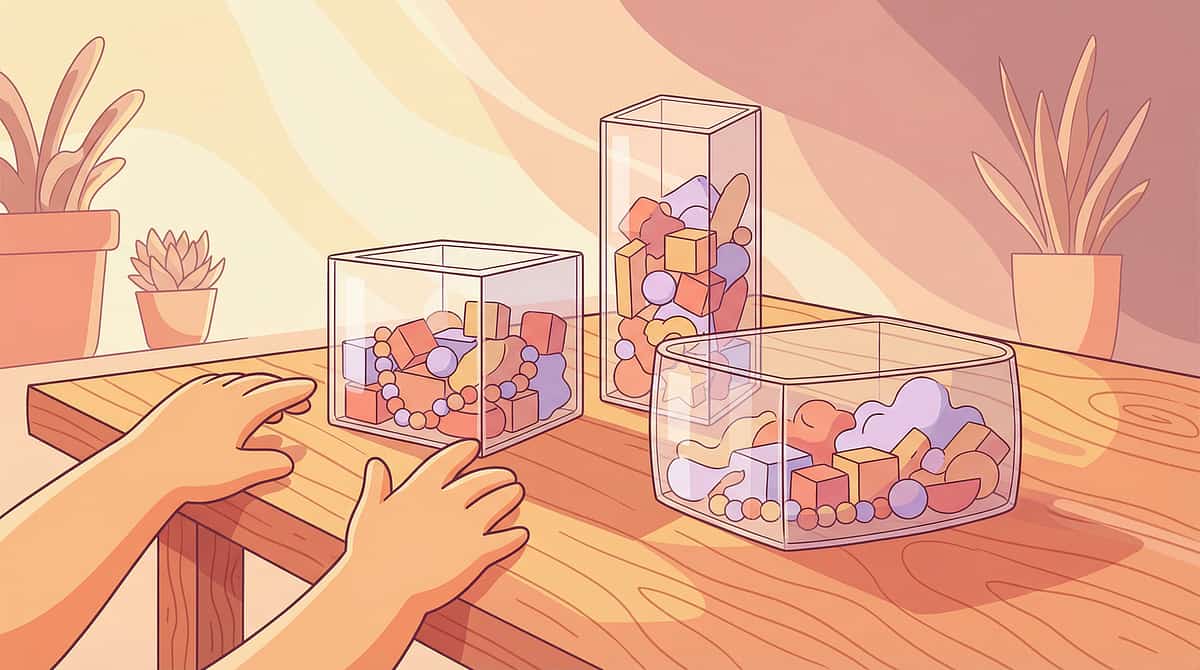
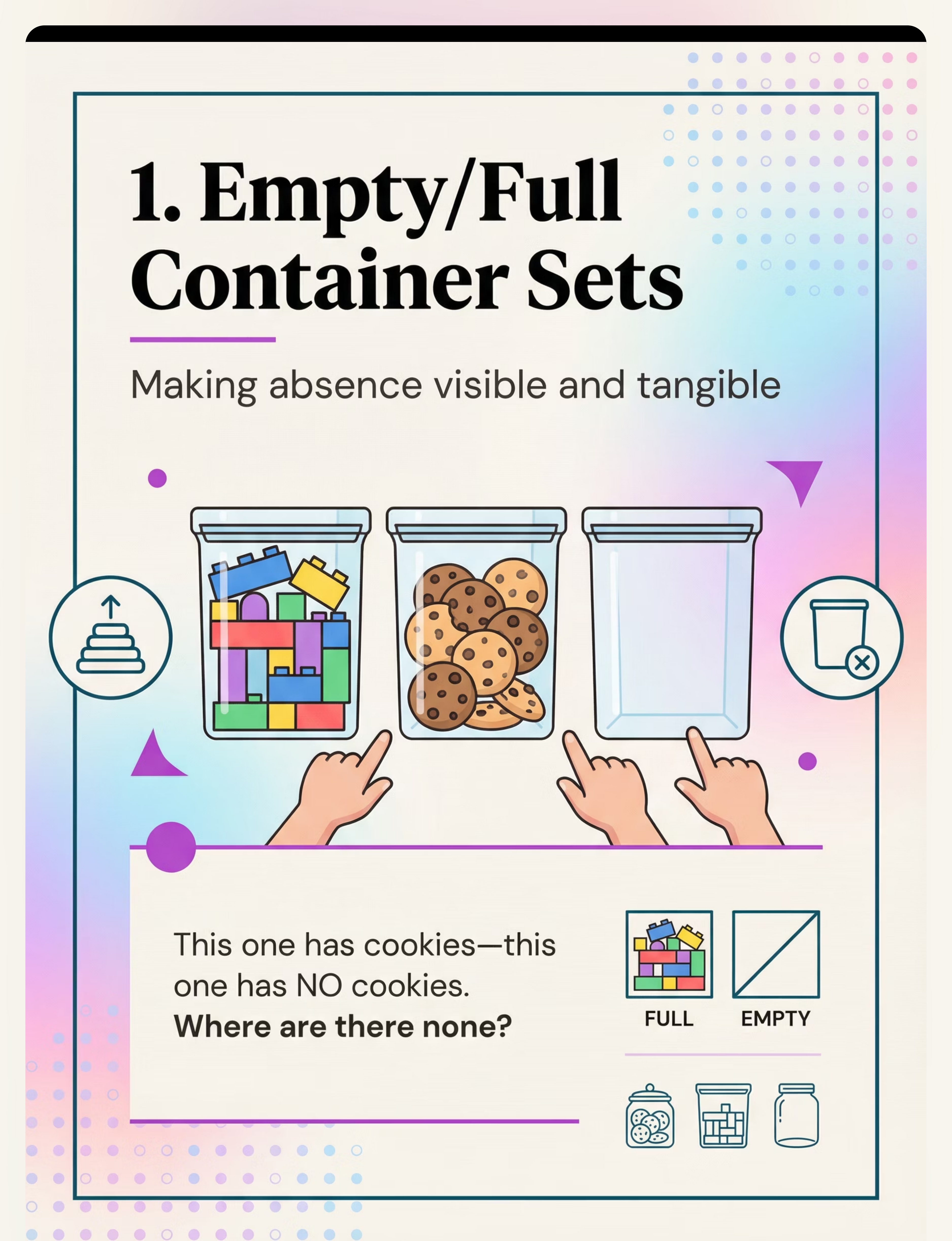
Empty/Full Container Sets
Making absence visible and tangible
WHAT
Clear transparent containers — some filled with objects, others completely empty. Child sees, touches, and manipulates the physical reality of presence vs. absence.
WHY (Science)
Makes the abstract concept of nonexistence concrete and observable. When a container is empty, the child sees AND feels the absence. This provides a physical referent for "no," "none," "not any," and "nothing." We are building object permanence for the negation concept itself.
HOW (Protocol)
- Place 3 containers on the table — 2 filled, 1 empty
- Point to filled: "This one HAS blocks. There ARE blocks here."
- Point to empty: "This one has NO blocks. There are NONE. It is EMPTY."
- Child's task: "Find the one with NO [item]." "Show me where there is nothing."
- DIY: Use steel dabbas, plastic bowls, or clear bottles from your kitchen
- Language to use: "Empty! None! No more! Nothing there!"
WHEN & WHERE
Start with this material — it is the foundation. Natural opportunities: after finishing snack ("All gone! None left!"), empty water bottle, bare plate after meals. Use in kitchen, bathroom, or play area.
Price: ₹150–500 commercial | ₹0 DIY
MATERIAL 2 OF 9
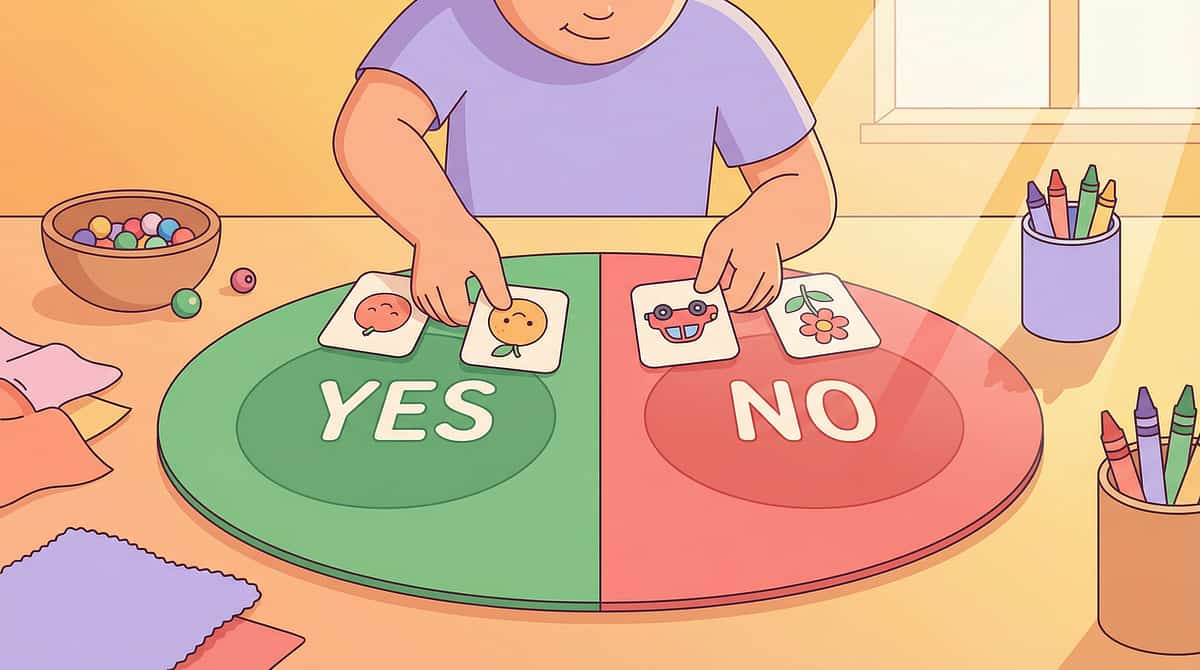
Yes/No Sorting Mats
Explicit practice with 'is' and 'is not'
WHAT
A sorting mat divided into two clear zones — YES (green) and NO (red). Objects or picture cards are sorted based on whether they DO or DO NOT have a named feature.
WHY (Science)
Externalises the logical operation of negation through physical sorting. The spatial separation — YES on one side, NO on the other — makes abstract logical distinction concrete, visible, and kinaesthetically experienced. The physical act of placing items creates a motor-memory anchor for the abstract concept.
HOW (Protocol)
- Set up the mat: GREEN side = YES (has the feature), RED side = NO (does not)
- Choose a clear feature: "Does it have wheels?" "Is it an animal?" "Is it red?"
- "Does this have wheels? YES — put it here. Does this have wheels? NO — put it there."
- Child takes over: hold item → child places on YES or NO side
- DIY: Coloured paper (green + red) divided into sections, or two containers labelled YES/NO
- Language: "It does NOT have wheels." "It is NOT an animal." "NO — it doesn't belong here."
WHEN: After child has mastered empty/full containers. 3–4 times per week, 5-minute targeted sessions.
Price: ₹200–600 commercial | ₹0 DIY
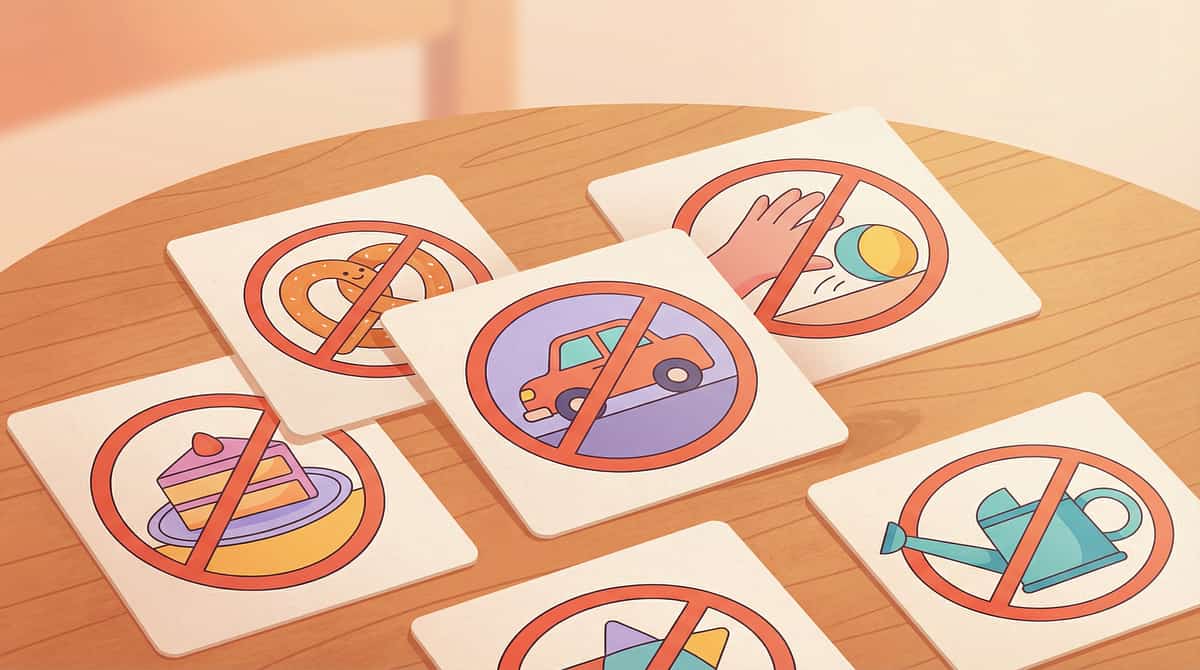
MATERIAL 3 OF 9
Prohibition Sign Cards
Real-world negation in visual form
WHAT
Collection of prohibition sign images — the universally recognised red circle with diagonal line — applied to familiar contexts: no running, no phones, no eating, no touching.
WHY (Science)
Connects negation to real-world visual symbols the child encounters every day. The prohibition symbol is a consistent, culturally universal visual anchor for "don't" and "not allowed." Visual supports are evidence-based practice for autism (NCAEP, 2020). By teaching the symbol, we give the child a visual shorthand for prohibition negation.
HOW (Protocol)
- Introduce 3–4 signs relevant to your home (no hitting, no shoes inside, no touching the stove)
- Explain the symbol: "See the circle with the line? That means NO — DON'T do this."
- Practice: Show sign → child identifies what's prohibited → parent confirms
- Community practice: Find real signs in shops, hospitals, parks — practise reading them
- DIY: Print prohibition signs from free online sources, or draw red circle-slash on card stock
WHEN & WHERE
Use once child understands basic empty/full. Post in relevant locations at home. Community practice happens naturally on outings.
Price: ₹100–400 commercial | ₹0 DIY (print at home)

MATERIAL 4 OF 9
What's Missing Games
Identifying absence requires understanding presence
WHAT
Pictures or objects where something is deliberately removed — a face with no nose, a car with no wheels, a table setting with no fork. Child identifies what is NOT there, what is absent.
WHY (Science)
Requires the child to perform the negation operation in pure cognitive form: hold a mental representation of the complete object, compare to the incomplete version, identify what is NOT present. This mirrors the exact cognitive process required for linguistic negation — represent → compare → negate.
HOW (Protocol)
- Start with familiar complete objects the child knows well
- Present the incomplete version: "Look carefully. What's NOT there? What's MISSING?"
- When child identifies: "Yes! The nose is MISSING. There IS no nose. NOT there!"
- Increase complexity: more subtle missing elements, less familiar objects
- DIY: Draw simple objects with parts deliberately left out
- Real-world: Set a plate with fork deliberately missing. "What's NOT here?"
Price: ₹200–700 commercial | ₹0 DIY
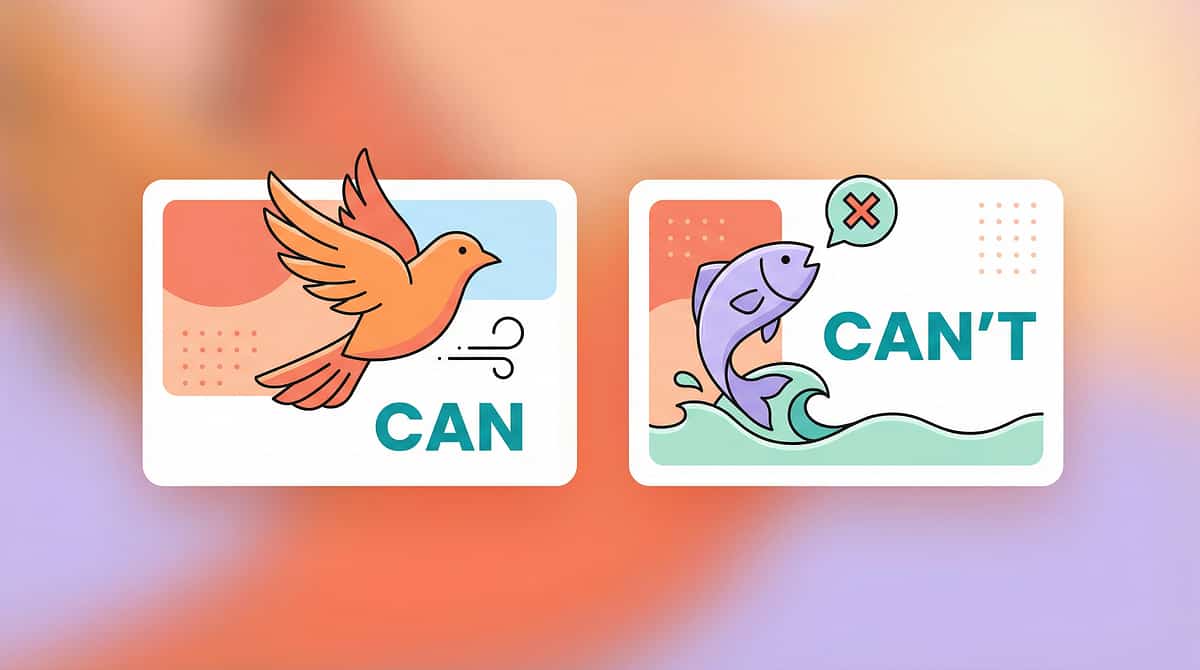
MATERIAL 5 OF 9
Can/Can't Action Cards
Understanding ability and impossibility
WHAT
Picture cards showing animals or people paired with actions — some possible (fish swimming, bird flying), some impossible (fish driving a car, bird typing). Child sorts or identifies what CAN and what CANNOT be done.
WHY (Science)
Teaches ability negation — understanding that "can't" describes impossibility. Using humour (the silly fish trying to drive!) makes the concept engaging and memorable. CAN/CAN'T is among the most functionally important negation forms for social communication.
HOW (Protocol)
- Present a card: "Can a fish swim? YES — fish CAN swim!" (checkmark card)
- Present impossible card: "Can a fish drive a car? NO — a fish CAN'T drive!" (X card)
- Sort into CAN pile and CAN'T pile
- Progress to personal: "Can YOU fly? No — you CAN'T fly! Can you walk? YES!"
- DIY: Draw simple ability/impossibility cards or use magazine pictures
Safety Note: Help child distinguish between "can't" (unable) and "not allowed" (prohibited) — these are different negation forms.
Price: ₹250–800 commercial | ₹0 DIY
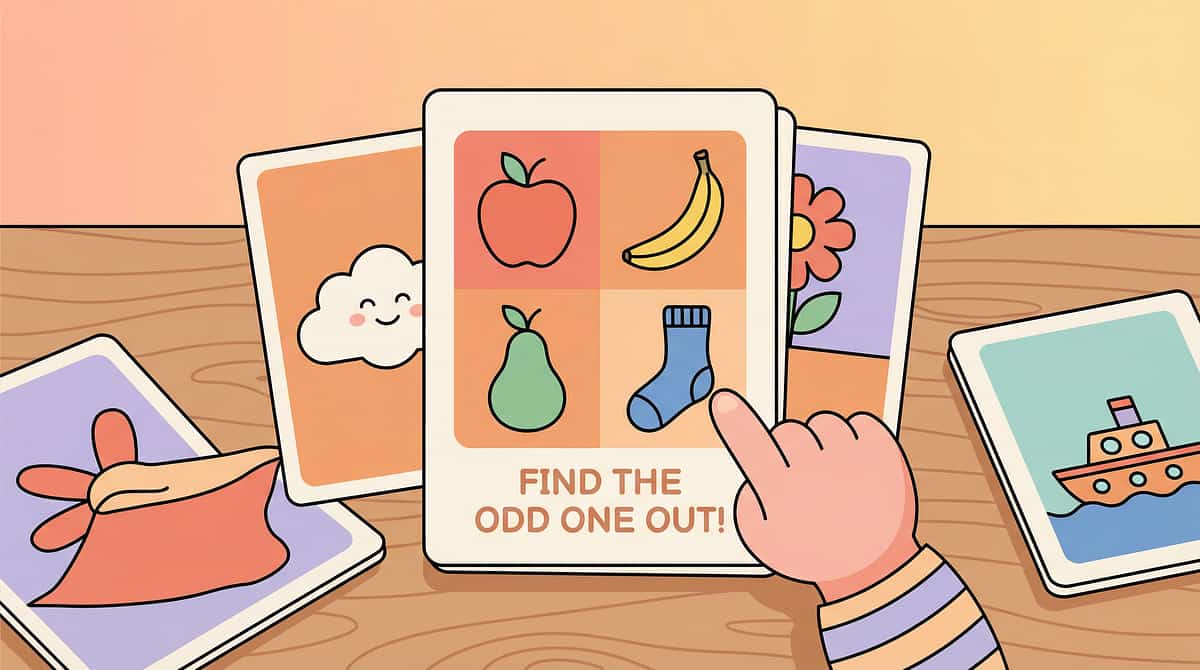
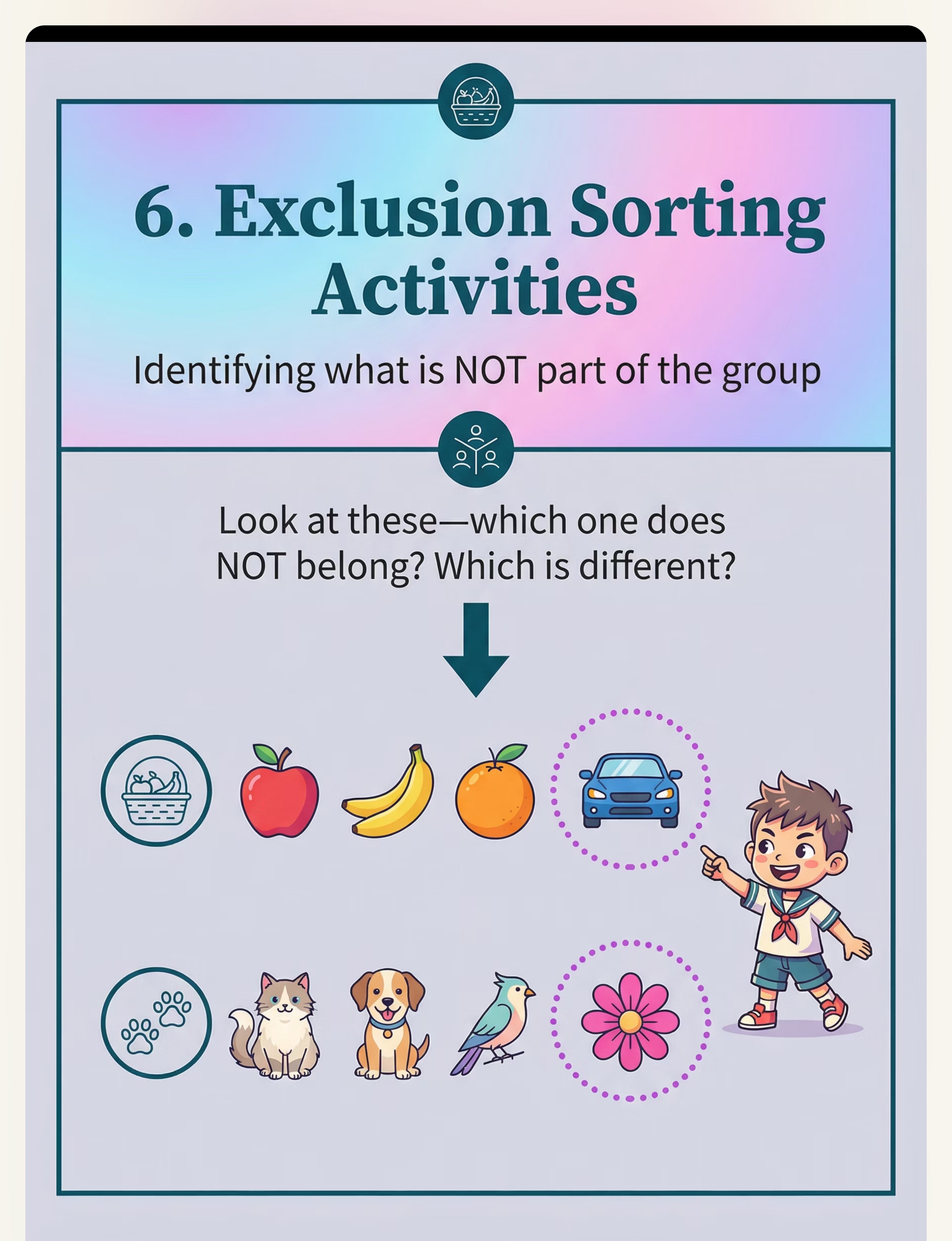
MATERIAL 6 OF 9
Exclusion Sorting Activities
Identifying what is NOT part of the group
WHAT
Sets of 4 items where 3 belong to a category and 1 does not — three fruits and a car, three animals and a flower. Child identifies the "odd one out" — the item that is NOT like the others.
WHY (Science)
Teaches negation through categorical membership. The child must identify the common category (fruits), then recognise which item is NOT in that category (the car). This builds understanding that negation can define group boundaries — "NOT a fruit" means something specific and categorically meaningful.
HOW (Protocol)
- Present 4 items: "Look at these. Three belong together. One does NOT belong."
- Child identifies: "Which one is NOT an animal?" → "The flower is NOT an animal!"
- Confirm: "Yes! The flower does NOT belong. It's NOT in this group."
- Progress: household objects → pictures → abstract categories
- Daily life: "Three vegetables and a cookie — which one is NOT a vegetable?"
Price: ₹200–600 commercial | ₹0 DIY (use household items)
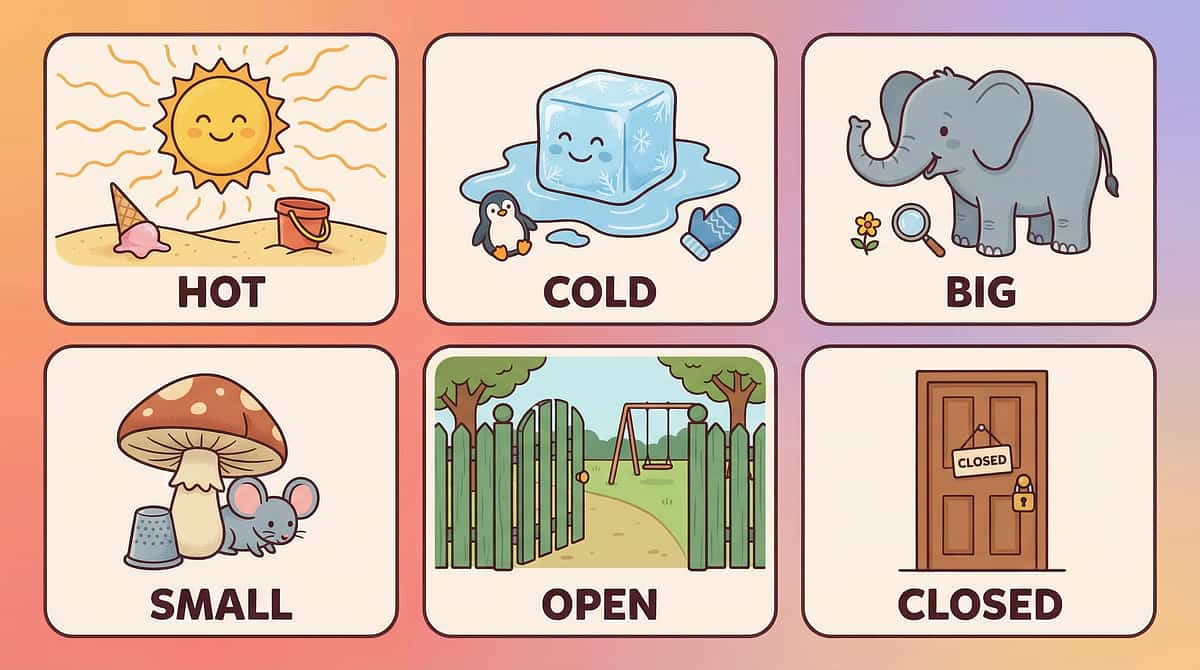
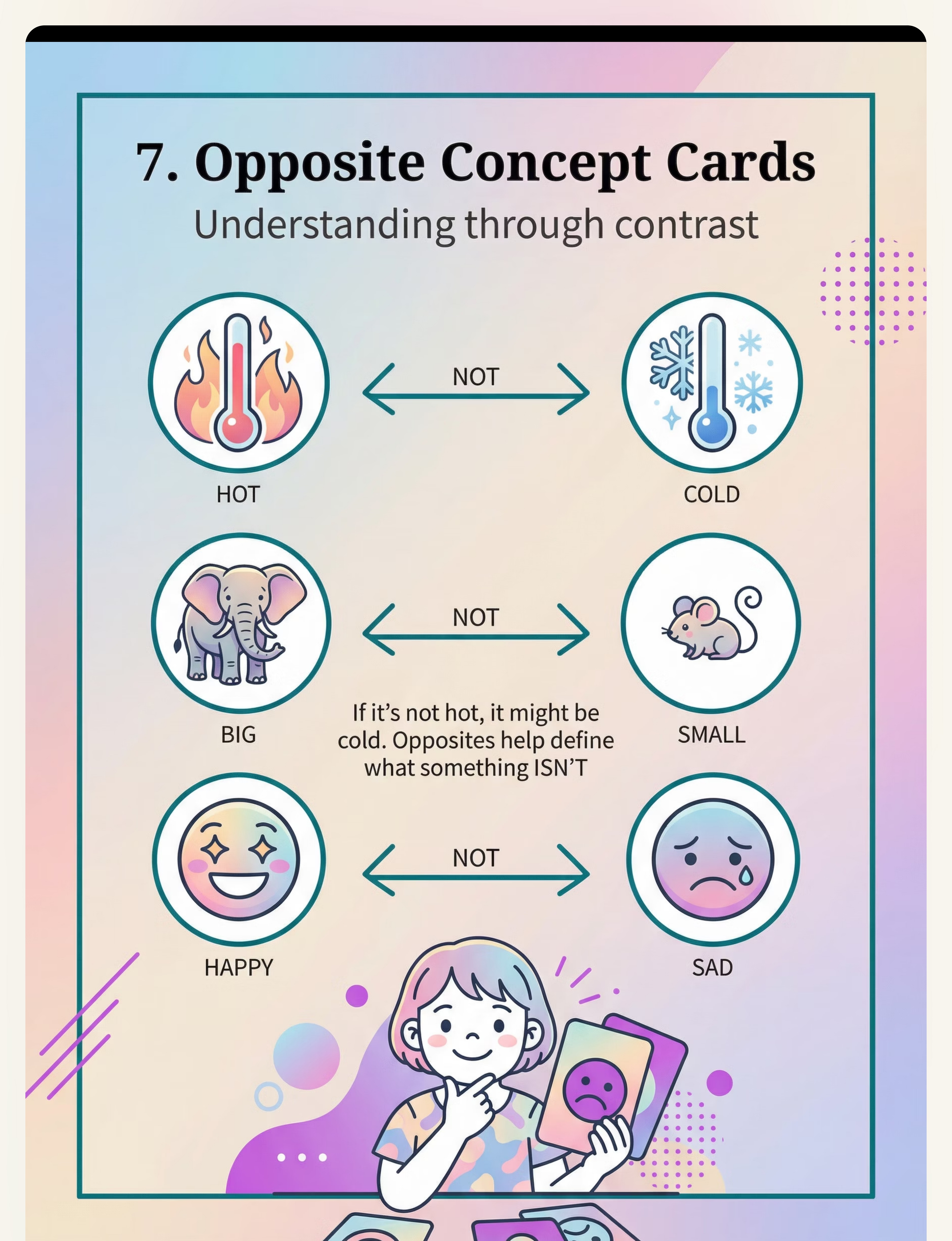
MATERIAL 7 OF 9
Opposite Concept Cards
Understanding through contrast
WHAT
Paired picture cards showing semantic opposites — hot/cold, big/small, happy/sad, wet/dry, fast/slow. Each pair explicitly demonstrates that concepts are partly defined by what they are NOT.
WHY (Science)
Teaches negation through semantic contrast — the most abstract form. Every concept is partly defined by what it is NOT: hot is not cold, up is not down. By teaching opposites explicitly, children learn that negation creates meaningful semantic boundaries. "If it's NOT hot, it might be cold."
HOW (Protocol)
- Present the pair: "Hot — NOT hot. What's the opposite of hot? COLD!"
- Child matches opposite pairs
- Introduce in daily life: "The soup is hot. The ice cream is NOT hot — it's COLD."
- Ask negation questions: "What's NOT happy? What's NOT big?"
- DIY: Draw simple paired illustrations or use real temperature contrasts
Safety Note: Don't imply "not X" ALWAYS means the opposite — build from clear binary opposites before more complex negation.
Price: ₹150–500 commercial | ₹0 DIY
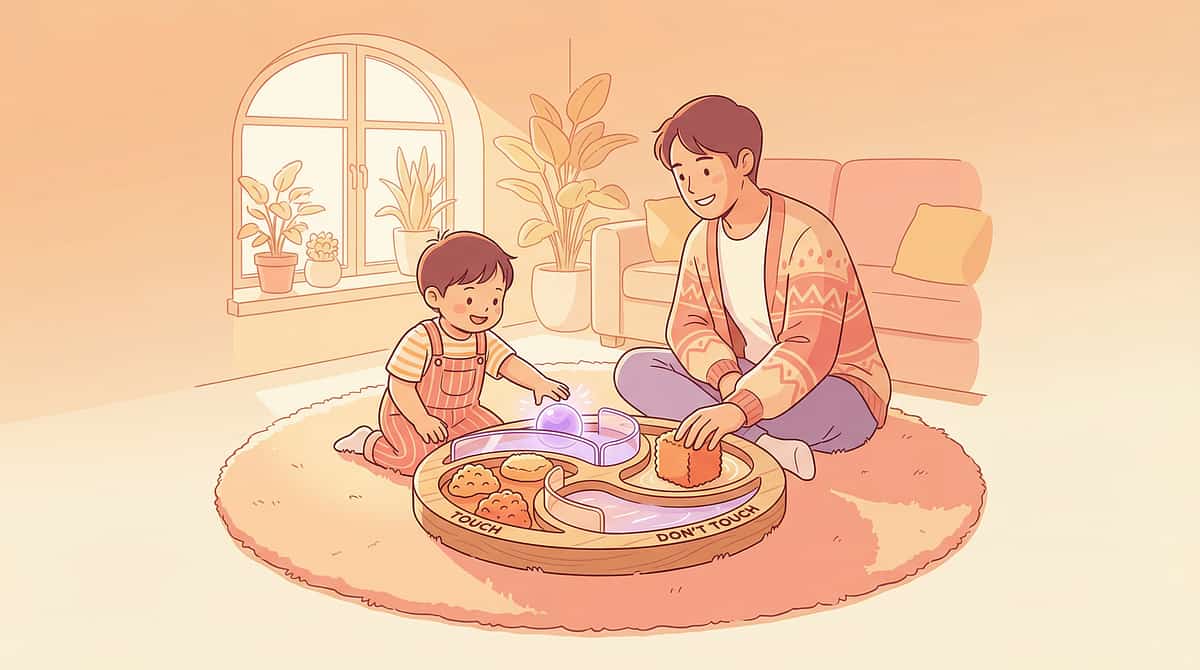
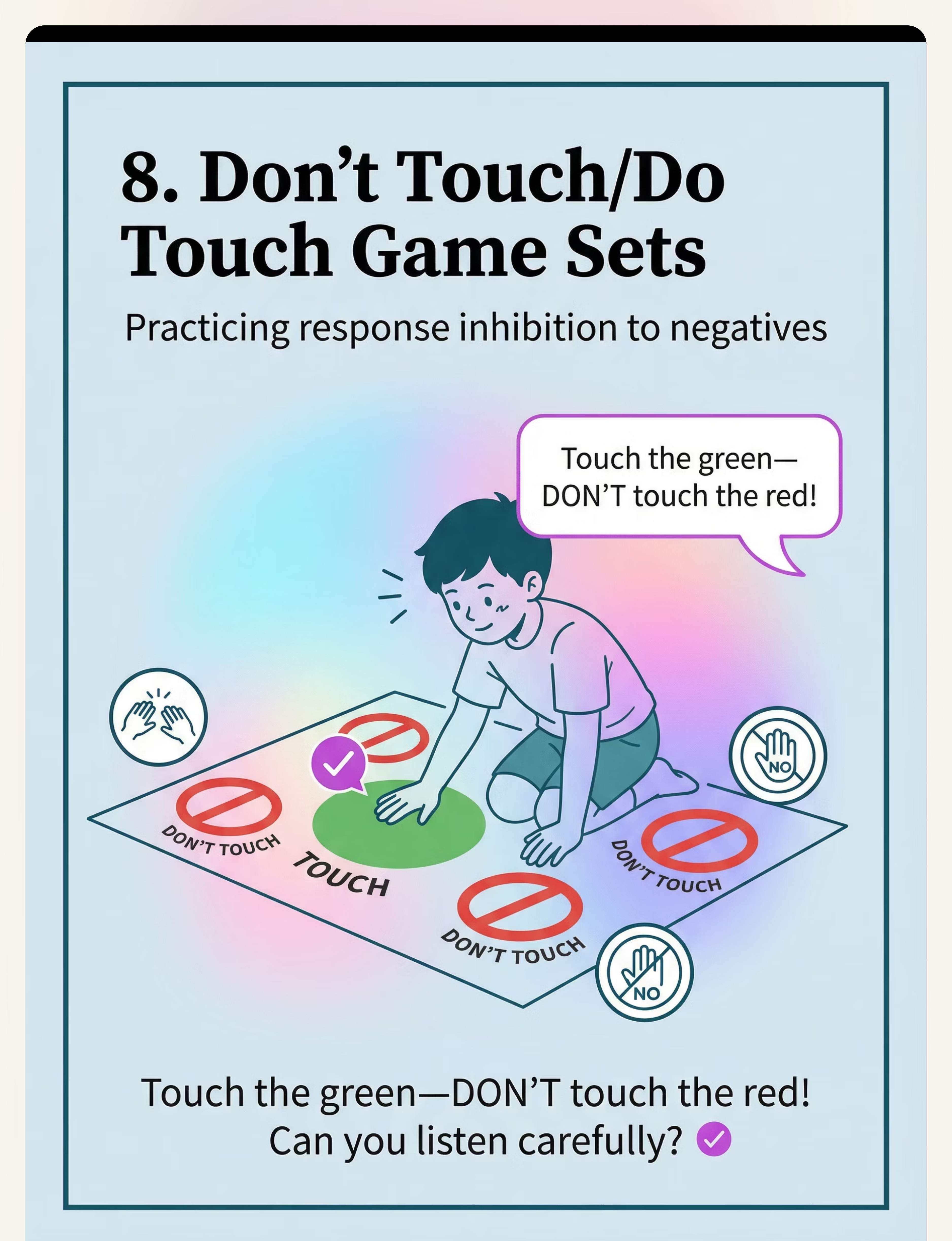
MATERIAL 8 OF 9
Don't Touch / Do Touch Game Sets
Practising response inhibition to negatives
WHAT
A game mat or board with designated "touch" zones (green) and "don't touch" zones (red). Parent gives commands: "Touch the green — DON'T touch the red!" Child must listen, process the positive or negative modifier, and respond correctly.
WHY (Science)
Provides direct practice in following negative commands — the most functionally and safety-critical skill. This material requires the full negation operation under time pressure: hear → identify positive or negative → inhibit or execute action. The game format makes safe practice of "don't" processing possible BEFORE the child encounters dangerous real-world situations.
HOW (Protocol)
- Set up: green spots = TOUCH, red spots = DON'T TOUCH
- Start slowly: "Touch the green one." (positive only, establish compliance)
- Introduce negative: "DON'T touch the red. Touch the green." (emphasise DON'T)
- Increase complexity: mixed commands, faster pace, multiple targets
- Celebrate successful inhibition: "You heard DON'T and you stopped! Amazing!"
- DIY: Coloured paper circles on floor; red and green cups
Safety Note: Start very slowly. Make "DON'T" audibly prominent. This is the bridge to real-world safety.
Price: ₹200–700 commercial | ₹0 DIY

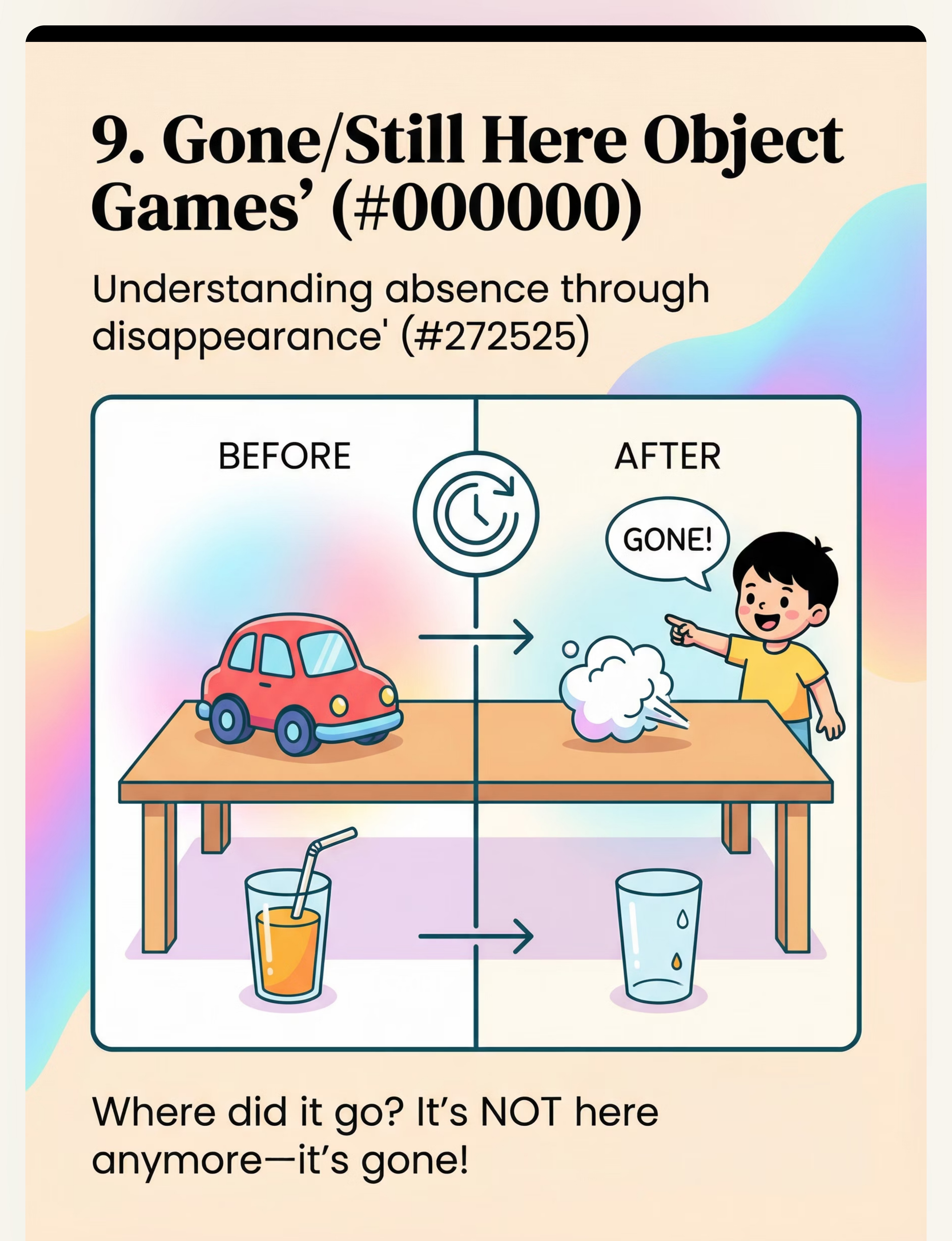
MATERIAL 9 OF 9
Gone/Still Here Object Games
Understanding absence through disappearance
WHAT
Hide-and-reveal games with objects the child knows — a favourite toy is present, then hidden under a cloth, behind a box, or put away. Child tracks the shift from "here" to "gone."
WHY (Science)
Teaches temporal negation — understanding that something present can become absent. The dramatic, visible transformation from "here" to "gone" makes change in state salient and memorable. "All gone" is typically the EARLIEST negation form children acquire — we build on this developmental foundation and extend it to more complex absence language.
HOW (Protocol)
- Show a favourite object: "Ball is HERE! We can see it. Ball IS here."
- Dramatically hide it: "[hide] Ball is GONE! NOT here anymore! All gone!"
- Child's language: model "Gone! Not here! Where is it? All gone!"
- Reveal: "There it is! Ball IS here again! It was gone — now it's BACK!"
- Natural opportunity: snacks "All gone! No more! None left!"
- Peek-a-boo: classic early negation game — name the "gone/here" states explicitly
Safety Note: Match to developmental level. Always emphasise "it comes back" to reduce potential distress about absence.
Price: ₹100–400 commercial | ₹0 DIY
ACT II — SAFETY
Safety Is Not a Checklist. It Is the Foundation.
🔴 RED — STOP: Do Not Proceed If:
- Child is in active meltdown or post-meltdown window (within 30 minutes)
- Child showing signs of illness, fever, or pain
- Child has had significant sleep disruption (< 6 hours)
- Child is severely dysregulated (aggressive, self-injurious, highly anxious)
- Materials include small objects and child is in a mouthing phase
- YOU (the parent/caregiver) are in emotional distress — your regulation state is transmitted
🟡 AMBER — MODIFY If:
- Child is mildly elevated in arousal — use 5-minute calming first
- Session falls during a hungry or tired window — feed first, session after
- Child shows avoidance of a specific material — offer choice of alternative
- Sibling distraction present — modify to shorter session (5 minutes) in quieter space
🟢 GREEN — PROCEED When:
- Child is fed, rested, regulated
- Environment is prepared (see Space Setup card)
- You have 10–20 uninterrupted minutes
- Child has recently had a positive interaction with you
Negation itself is a safety skill. Every minute you invest in teaching "don't" and "no" in the safety of your home prepares your child for "don't cross the road," "don't touch the power socket," "don't go with strangers." This is not just language therapy. This is safety infrastructure.
ACT II — ENVIRONMENT
Set Up Your Space
The Right Environment Makes the Technique Work. Spatial Precision Prevents 80% of Session Failures.
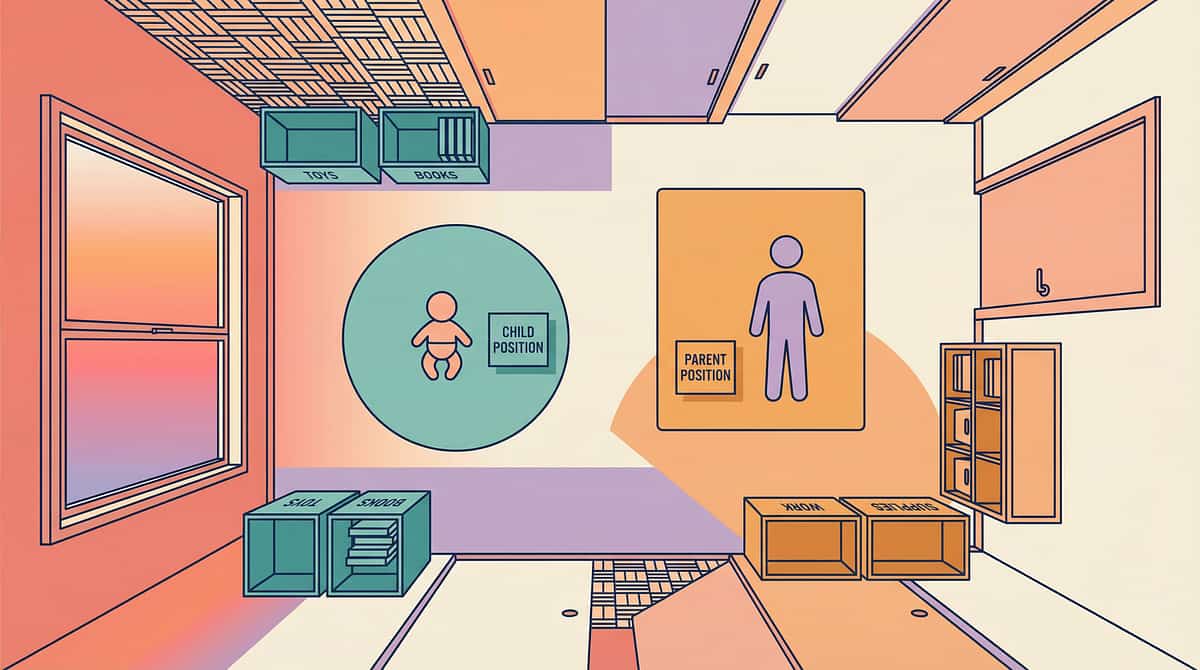
Room Setup
- Natural light preferred (window or lamp, avoid glare on materials)
- Clear surface: 60×90cm minimum (table or floor mat)
- CHILD: seated comfortably at table or on floor mat
- PARENT: seated at child's eye level, slightly to side (0.5m)
- MATERIALS: organised on tray to parent's side — NOT in child's direct reach
- Remove screens, loud toys, competing visual stimuli
- Door closed or entry managed to prevent interruption
Space Preparation Checklist
- Clear surface prepared
- Child seating at comfortable height
- Lighting adequate without glare
- Screens and competing toys removed
- Materials organised in sequence
- Visual timer visible (evidence-based for autism)
- Reinforcers identified and ready
- Data sheet or GPT-OS® tracker open
Timing Recommendations
- Morning: After breakfast, 30–90 minutes post-waking (alert window)
- Afternoon: After rest/nap, mid-afternoon alert window
- Avoid: Immediately before/after meals, within 1 hour of bedtime, during high household activity
Indian Household Note: Joint family homes, small spaces, and shared rooms are reality for most Indian families. You do not need a dedicated therapy room. A cleared kitchen table after dinner, a mat in the corner of the bedroom, a quiet 10-minute window — these work. The technique travels with you.
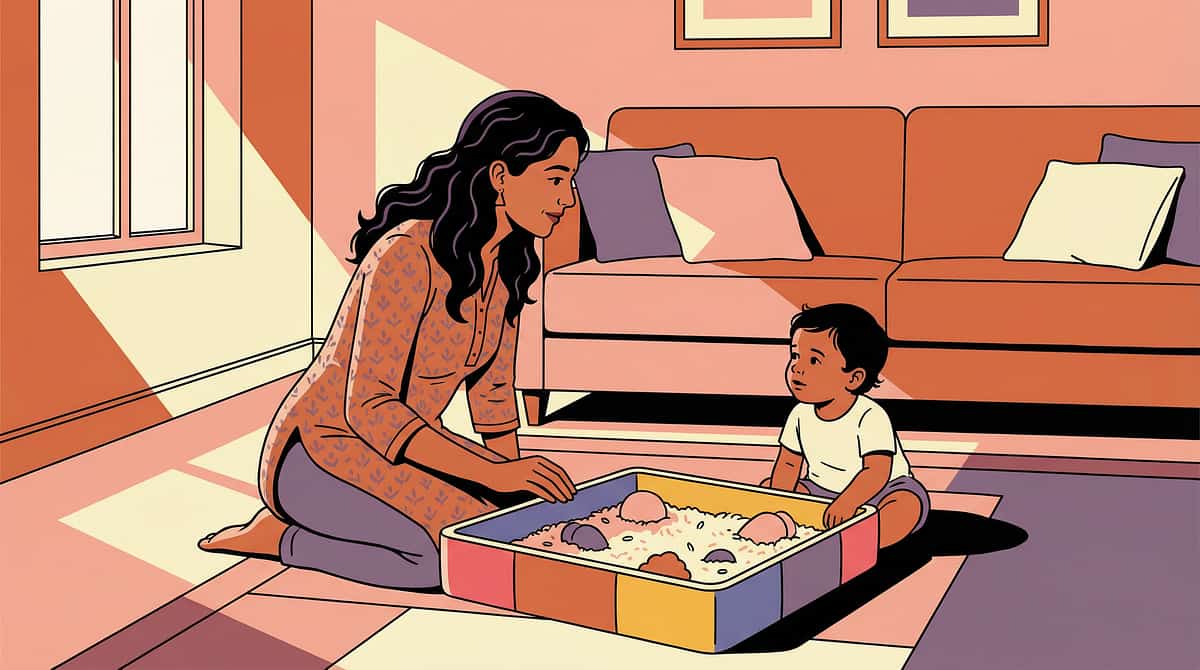
ACT III — STEP 0
Is Your Child Ready? Readiness Check
60-Second Pre-Flight Check. The Best Session Is One That Starts Right.
Indicator | Green (Go) | Amber (Modify) | Red (Postpone) | |
Fed | Yes, within 1–2 hours | Slightly hungry | Very hungry/just ate heavily | |
Rested | Adequate sleep | Slightly tired | Significant sleep loss | |
Regulated | Calm, alert | Mildly elevated | Dysregulated | |
Health | No illness signs | Mild fatigue | Fever, pain, illness | |
Environment | Prepared | Minor distractions | Major distractions | |
You (parent) | Regulated, patient | Mildly stressed | Significantly stressed |
ALL GREEN
Proceed to Step 1: The Invitation
ANY AMBER
Implement modifications: 5-min calming, simplify, shorter session
ANY RED
Postpone: "Not today — we'll try tomorrow. That's wise parenting, not giving up."
3 Quick Calming Activities (5 minutes each): 1) Slow deep breathing together (3 in, 3 out, 5 times) 2) Proprioceptive input: bear hug, wall push-ups, carrying something heavy 3) Rhythmic movement: gentle rocking, walking a short path together
Three well-executed 10-minute sessions weekly outperform seven forced sessions.

ACT III — STEP 1
Step 1: The Invitation
Every Protocol Begins With Consent, Not Command
The ABA Pairing Principle: Before placing any demand, establish yourself as a positive presence. Spend 30–60 seconds being fun, warm, and low-demand. You are earning the child's willingness to participate.
Script A
"Oooh, look what I found! Want to see something COOL? [Hold up container set] Come check this out with me!"
Script B
"Hmm, I wonder what's in HERE and what's NOT in here. Let's find out together!"
Script C
"Want to play the YES/NO game or the GONE game today? Your choice!"
Body Language Guidance
- Get at child's eye level
- Warm, relaxed facial expression (not intense/anxious)
- Slightly animated but calm tone
- Hold material WITH interest — let your curiosity model theirs
- NO demands in the first 60 seconds
Reading the Response
Acceptance cues (child is ready): Moves toward material | Makes eye contact | Reaches for object | Vocalises toward activity
Resistance cues (modify): Turns away | Increased stimming | Cries or protests → Reduce demand; show material without engaging; wait 2–3 minutes; try again.

ACT III — STEP 2
Step 2: The Engagement
Introduce the Material, Watch Their Response
1
For Early-Stage Children (Nonexistence Focus)
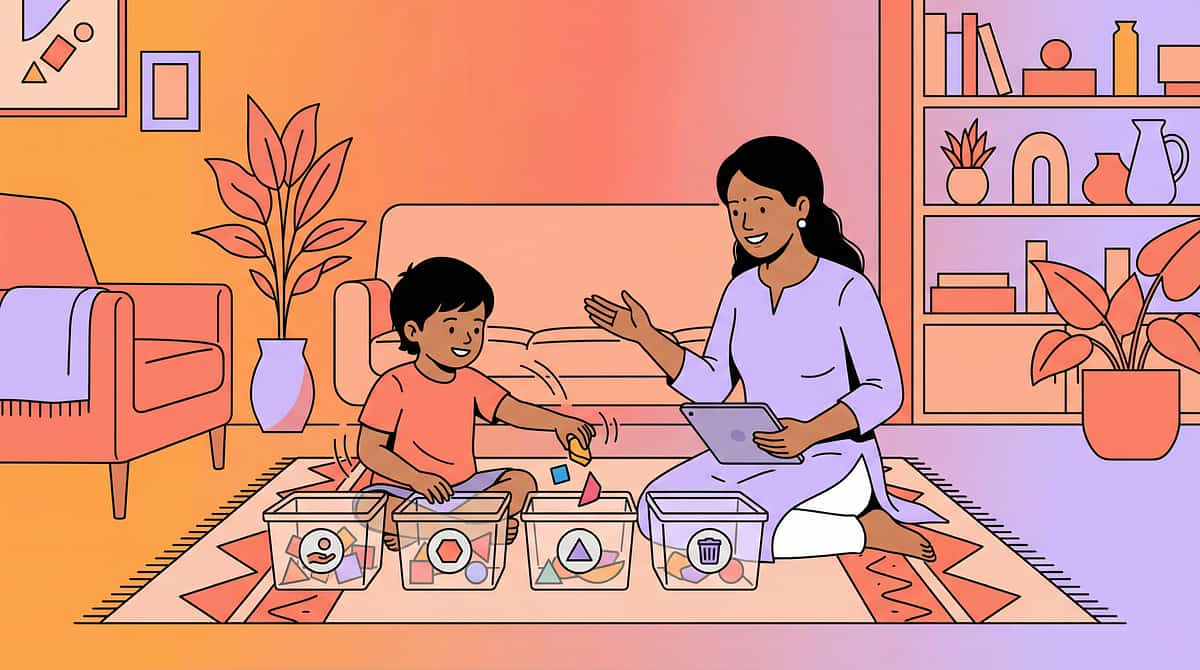
Show the container slowly: "Look! This one has [item]. See? [item] IS here." [pause] Then: "Now this one... [open empty container] Nothing! EMPTY. No [item]! None here!" Let child explore both containers physically for 30 seconds.
2
For Intermediate Children (Prohibition Focus)
Lay out the yes/no sorting mat: "This side says YES. This side says NO." "I'm going to show you things. We decide — YES or NO."
Response | What It Looks Like | What To Do | |
Full Engagement | Reaches for material, vocalises | Continue — escalate slightly | |
Tolerance | Present but passive | Continue — warm narration | |
Avoidance | Pushes material away, protests | Reduce exposure — label from distance |
"Yes! You're looking! Great job looking!" — every moment of engagement earns a brief positive response. Timing: 1–3 minutes for this step.
ACT III — STEP 3
Step 3: The Therapeutic Action
This Is Where Negation Learning Happens
Using Empty/Full Containers
- "FULL. There ARE blocks here. Yes — blocks!"
- "EMPTY. There are NO blocks. NONE. Not any. ZERO."
- "Show me where there are NO blocks." (child points to empty)
- "Show me where blocks ARE." (child points to full)
- Expand language: "You found the empty one! None there! Good noticing!"
Using Yes/No Sorting Mats
- Present first item + criterion: "Does this have wheels? YES → this side."
- Second item: "Does this have wheels? NO — NO wheels → this side."
- Child takes over: hold item → child places on YES or NO side
- Language model: "This one does NOT have wheels. It goes on the NO side."
Using Don't Touch / Do Touch
- Slow command: "TOUCH the green." [wait for child response]
- "DON'T touch the red." [emphasise DON'T — slight pause before and after]
- Celebrate correct inhibition: "You heard DON'T and you stopped! That's amazing!"
Rule 1: EMPHASISE
"DON'T touch" not "don't touch" — auditory salience of the negative marker IS the intervention
Rule 2: SLOW DELIVERY
Speak at 70% of normal speed during negation instruction
Rule 3: CONSISTENT LANGUAGE
Use same words across sessions — variation creates confusion
ACT III — STEP 4
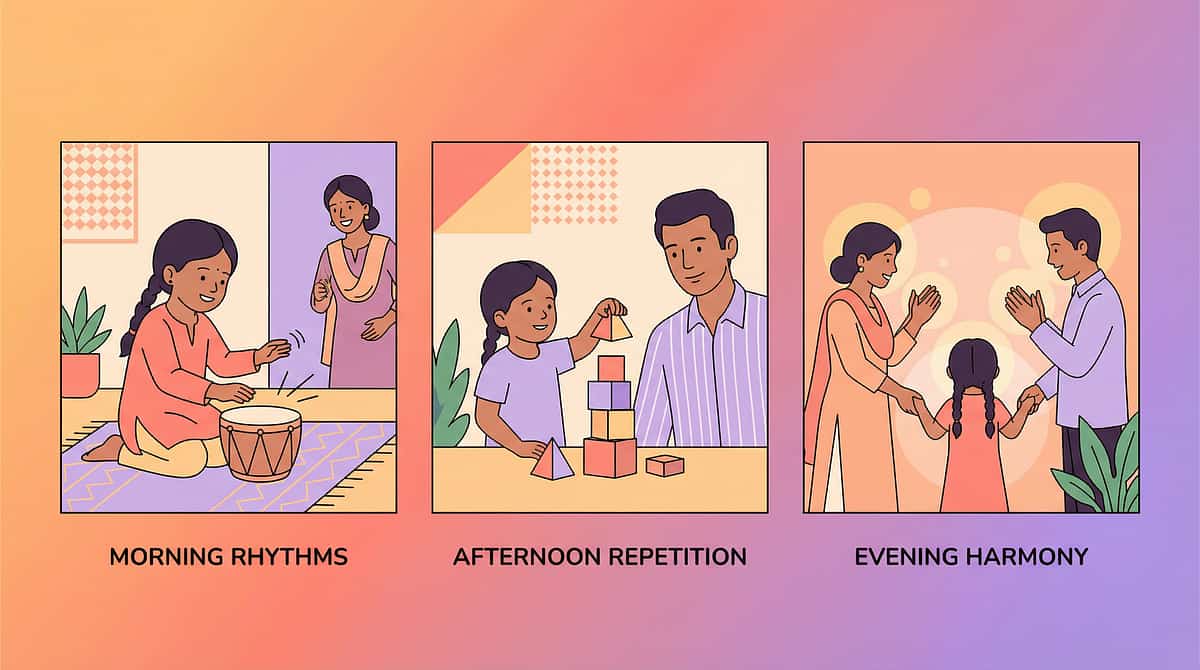
Step 4: Repeat and Vary
3 Good Repetitions > 10 Forced Ones
Material | Target Reps | Satiation Signs | |
Empty/Full Containers | 4–6 containers | Stops reaching, looks away | |
Yes/No Sorting | 6–10 items | Stops placing, seeks other activity | |
Prohibition Signs | 3–5 signs | Rote guessing, no engagement | |
Can/Can't Cards | 5–8 card pairs | Stops sorting, picks up to examine | |
Don't Touch Game | 5–8 command sets | Stops complying, distractibility increases |
How to Introduce Variation (to Maintain Engagement and Build Generalisation)
Change the objects but keep the negation form: "Different things — same game"
Change the language: "EMPTY" → "NOTHING THERE" → "NONE" → "ALL GONE" — all mean the same
Change the role: child gives the command, parent responds
Change the context: move from table to floor
Change the reinforcer: different reward for same correct response
Always end on a SUCCESS: The last response in every session should be correct. Simplify the final trial if needed to guarantee success.

ACT III — STEP 5
Step 5: Reinforce and Celebrate
Timing Matters More Than Magnitude
The Three-Second Rule: Deliver reinforcement within 3 seconds of the desired behaviour. A "great job!" delivered 10 seconds later reaches a different behaviour than the one you intended to reinforce.
Verbal Reinforcement Scripts
- "YES! You heard DON'T and you stopped! That is INCREDIBLE!"
- "EMPTY! You found the empty one — amazing job!"
- "That's NOT in the group — you got it! You're so smart!"
- "You said CAN'T — YES! That is NOT possible and you knew it!"
Specific > generic: "You heard the word DON'T" beats "Good boy/girl"
Token Economy Integration
1 token per correct response. After 3–5 tokens, child earns preferred activity: 5 minutes preferred play, small snack, sensory break, favourite song.
Natural Consequence Reinforcers
Prohibition sign correctly identified → "Now we can walk through safely!" (natural safety consequence)
"Don't touch" followed correctly → Offer the alternative touch target with enthusiasm
Celebrate the attempt, not just the success: "You tried to find the empty one — great trying!" is appropriate for error responses. Never use negative reinforcement — this creates avoidance of the learning context.

ACT III — STEP 6
Step 6: The Cool-Down
No Session Ends Abruptly
1
Warning (30 seconds before end)
"2 more tries, then we're ALL DONE!" Show 1 minute remaining on visual timer.
2
Final Trial
Give one final, easily achievable trial to guarantee the session ends on success.
3
Transition Ritual (1 minute)
"All done with the negation game! Let's put the materials away together." Child participates in putting materials away — creates closure and ownership.
4
Sensory Calming Activity (1–2 minutes)
Choose one: 3 slow deep breaths together | gentle bilateral tapping (alternate tapping knees) | a short walk to the water | 2-minute preferred activity as transition.
If Child Resists Ending
"I know — it was fun! It will be here tomorrow. [Child's name] can play the [game] again tomorrow."
What NOT to Do
- Don't abruptly remove materials mid-trial
- Don't end session when child is mid-response
- Don't end session in response to challenging behaviour (this reinforces the behaviour)

ACT III — DATA
Capture the Data — Right Now
60 Seconds. 3 Data Points. This Is How Progress Gets Measured.
The 3-Field Session Log
SESSION LOG — B-167 NEGATION UNDERSTANDING
Date: ___________ | Material Used: ___________ | Duration: _____ min | Session Rating (1–5): _____
FIELD 1 — TRIALS: Total trials: ___ | Correct responses: ___ | Accuracy %: _____ (correct ÷ total × 100)
FIELD 2 — NEGATION TYPES PRACTISED: □ Nonexistence (empty/gone) □ Prohibition (don't) □ Ability (can't) □ Exclusion (not in group) □ Semantic contrast (opposites)
FIELD 3 — OBSERVATIONS: Best response today: _____________ | Difficulty today: _____________ | Emotional tone: Positive / Neutral / Struggled | Ready for next level? YES / NOT YET / REVIEW NEEDED
GPT-OS® Integration
Log your session at pinnacleblooms.org/gpt-os-tracker — your data feeds the Communication Readiness Index, tracking your child's progression through the 6 negation mastery stages.
When to Review With a Professional
- Accuracy < 50% after 2 weeks → Review with SLP
- No progress across 3 consecutive weeks → Contact Pinnacle: 9100 181 181
- Regression from previous performance → Urgent review

ACT III — TROUBLESHOOT
6 Common Problems — Exactly What to Do
Problem 1: Child always does the OPPOSITE of what I say
What's happening: Child is processing the positive content and acting on it — the negative marker is being dropped. This is classic negation processing difficulty — not defiance.
Solution: Emphasise the negative marker audibly. Say "STOP — DON'T touch" with a 0.5 second pause before the negative word. Simultaneously use a visual stop signal (hand up, red card). Reduce sentence complexity: "STOP" works before "Don't touch the red one."
Problem 2: Child doesn't engage with the materials at all
What's happening: Materials are not yet motivating enough, or demand level is too high, or arousal state is not optimal.
Solution: Start with the most motivating materials (containers with child's FAVOURITE objects). Make the activity seem like play. Back up to the readiness check and invitation script.
Problem 3: Child was doing well but has stopped making progress
What's happening: Likely at a skill plateau — the current level has been mastered and generalisation to the next level hasn't begun.
Solution: This is actually PROGRESS. Move to the next material in the hierarchy. The plateau IS the mastery signal.
Problem 4: Child gets frustrated mid-session
What's happening: Session is too long, material demand is too high, or satiation has been reached.
Solution: Shorten to 7 minutes. Reduce the difficulty by one level. Implement the cool-down immediately.
Problem 5: Other family members are undermining the work
What's happening: Inconsistency in how "don't" and "no" are delivered across caregivers.
Solution: Key message for family: make "DON'T" audibly prominent, give a pause before and after the negative word, respond consistently. Share the Family Guide PDF.
Problem 6: Child understands in the session but not in real life
What's happening: Generalisation has not yet occurred — skill is present in learning context but not transferred to functional contexts.
Solution: Practise negation deliberately in multiple real-world contexts — kitchen, outdoor play, community. Practise "don't touch" during actual situations in slow, calm moments BEFORE an emergency.
If problems 1, 3, or 6 persist beyond 3 weeks → Contact Pinnacle: 9100 181 181 (FREE, 24×7, 16+ languages) or book a consultation
ACT III — ADAPT
Adapt the Technique
No Two Children Are the Same. Here Is How to Personalise This Technique.
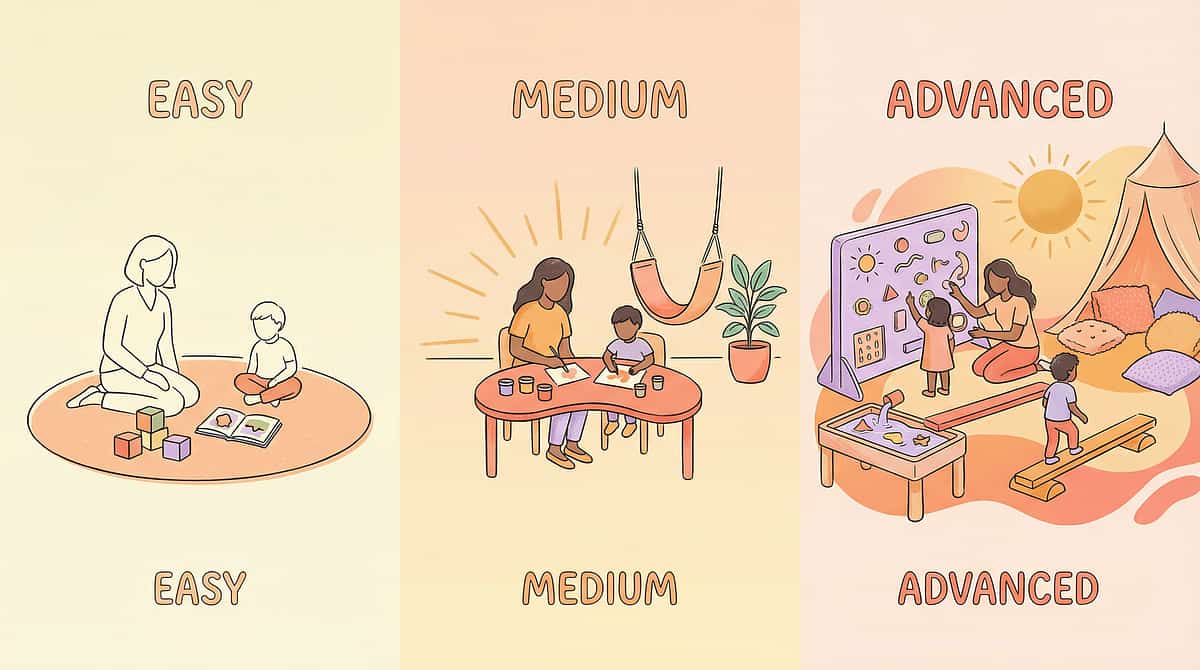
EASIER — Early Stages or Difficult Days
- Use only nonexistence forms (empty/full, gone/here) — no prohibition yet
- Reduce to 3 containers/3 trials per session
- Physical demonstration first: YOU find the empty one while narrating
- Use food items (motivation is maximum)
- Accept pointing or eye gaze as response (no verbal required)
HARDER — Mastery or Challenge Ready
- Introduce complex sentences: "The one that does NOT have red AND does NOT have wheels"
- Speed up command delivery (approach real-world speed)
- Practise in full real-world contexts (kitchen, community, school)
- Add expressive demand: child must SAY the negation, not just respond to it
Ages 2–4
Focus exclusively on nonexistence (empty/full/gone). Use highly motivating objects. Short sessions (5–8 min). Physical manipulation emphasis.
Ages 4–7
Full protocol including prohibition and ability negation. Introduce written prohibition signs. Begin discussing "what CAN'T happen."
Ages 7–10
Academic integration: "Name 3 things that are NOT mammals." Real-world safety applications emphasised.
Indian Household Adaptations: Use steel dabbas and spice containers for empty/full games (₹0). Use roti tray with and without roti (all-gone concept at every meal). Practice in multiple languages: "nahi," "mat," "na," "illa," "kadu" alongside English negation forms.

ACT IV — PROGRESS
Weeks 1–2: You Are Laying Neural Groundwork
It Won't Look Like Much Yet — And That's Completely Normal.
Child tolerates session duration (even without full engagement) — this IS progress
Child begins to orient toward the materials when they appear
Child shows any correct response to "empty/full" or "gone/here" — even inconsistently
Resistance to sessions decreasing from Day 1 → Day 7
Child begins vocalising "gone!" or "no more!" in natural contexts
What Is NOT Expected Yet
- Consistent correct responses to "don't" commands
- Generalisation to real-world negation
- Expressive use of multiple negation forms
Data Target — Weeks 1–2
Complete 6+ sessions
Accuracy target: 40–60% on primary material
Log every session.
If your child tolerated the material for 3 seconds longer on Day 7 than Day 1 — that is real, measurable progress. The brain is building new pathways.

ACT IV — PROGRESS
Weeks 3–4: The Neural Pathways Are Forming
Watch for These Consolidation Signs.
Anticipation
Child ANTICIPATES the activity — moves toward materials before invitation
Accuracy
Accuracy improves to 60–75% on primary material; response speed increases
Spontaneous Use
Child spontaneously uses "gone!" or "empty!" in daily life beyond sessions
Prohibition Response
Child begins to respond correctly to simple "don't" commands in low-stakes game contexts
"When your child says 'all gone!' at the end of their snack without being prompted — the negation concept has moved from the session into their lived vocabulary. This is the first sign of mastery."
When to increase intensity: Accuracy consistently above 70% across 3 sessions → move to next material or difficulty level. Child showing boredom → mastery signal — time to advance. You may notice YOU are becoming more confident too — more precise in how you deliver "don't" commands, more patient, more observant.

ACT IV — MASTERY
Weeks 5–8: From Learning to Knowing
Negation Becomes Reliable. Celebrate These Milestones.
1
Accuracy Milestone
Accuracy reaches 80%+ across all 9 materials at appropriate level
2
Real-World Response
Child responds correctly to "don't" commands in real-world contexts — at least 4 out of 5 trials
3
Expressive Negation
Child uses negation expressively: "Not mine!" "Can't do it!" "Gone!" "That one doesn't belong!"
4
Community Recognition
Child recognises prohibition signs in community without prompting
5
Safety Language Integration
Child responds correctly to "don't touch," "stop," "no" in safety-relevant situations
The 8-Week Outcome Target: By Week 8, the goal is reliable, consistent negation processing across 3+ material types, with generalisation beginning in real-world and safety contexts. This is NOT the end — it is the foundation on which the next level is built.

ACT IV — CELEBRATE
Celebrate Relentlessly. Every Correct 'Don't' Is a Safety Victory.
Week 1–2 Milestone
First "all gone!" in daily life → negation generalisation has begun
Early Game Milestone
First correct "don't touch" game response → Prohibition processing beginning
Expressive Milestone
First "not mine!" expressed spontaneously → Expressive negation has emerged
Community Milestone
First recognition of a prohibition sign in the community → Real-world transfer
The Ultimate Safety Milestone
First time child STOPS at "don't go" near a road or danger → Your work has protected their life
"When your child stops at 'don't go' near a road — in that moment, your hours of work with containers and sorting mats and don't-touch games have literally protected their life. That is not hyperbole. Negation understanding is one of the most safety-critical language skills a child can develop."
Take a video of milestone moments. Share with your Pinnacle therapist team. Share with family to inspire other caregivers on the same journey.
ACT IV — RED FLAGS
Know These Signs. Act on Them Immediately.
🚨 URGENT — Contact Pinnacle Helpline 9100 181 181 Today
- Child is in danger because of negation failures (going near roads, touching dangerous items repeatedly)
- Child shows significant regression from previously established negation skills
- Child has 0% accuracy after 4 weeks of consistent protocol implementation
- Child shows distress, anxiety, or aggression in response to materials
⚠️ REVIEW NEEDED — Schedule Assessment Within 2 Weeks
- No progress after 4 weeks of consistent implementation
- Accuracy has plateaued below 50% for more than 3 weeks
- Child's negation difficulty appears to be worsening across all contexts
- Significant discrepancy between session performance and real-world performance
✅ MONITOR AND ADJUST
- Slow progress but positive trend — continue with adaptations
- Inconsistent sessions due to family schedule — normalise consistency
FREE National Autism Helpline
9100 181 181 | Available 24×7 | 16+ Languages | No cost. A qualified SLP or ABA specialist reviews your child's progress and provides guidance.
In-Person Assessment
80+ centres across India — find your nearest Pinnacle Blooms location.
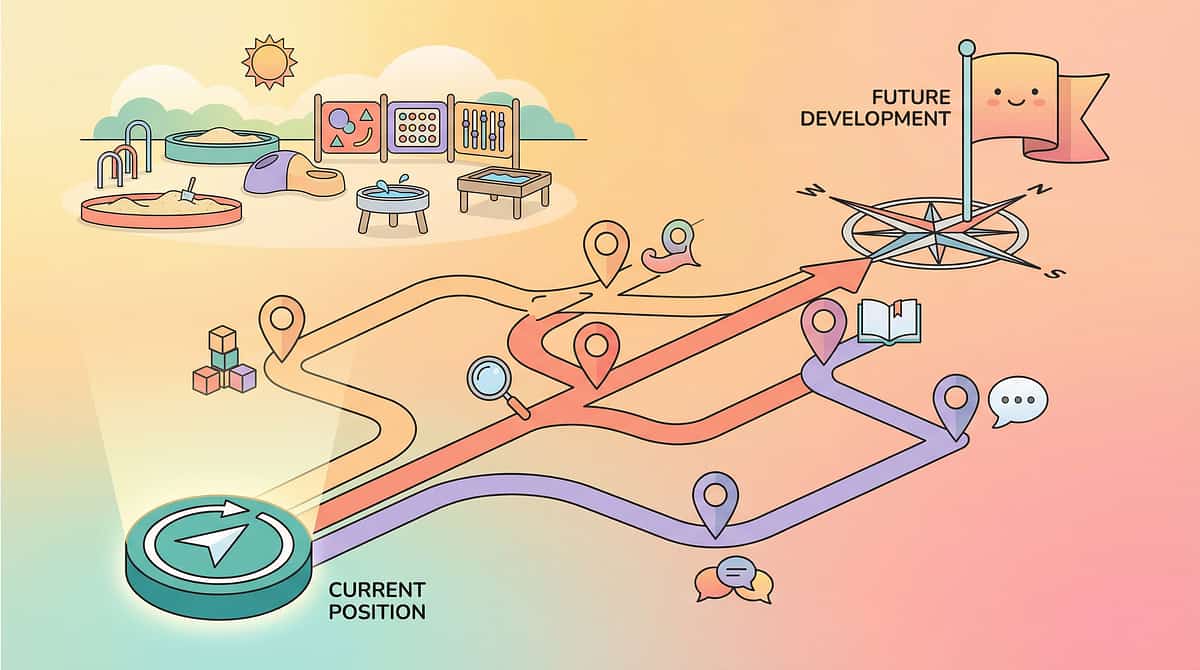
ACT IV — PATHWAY
Your Child's Pathway Forward
B-167 Is One Point on a Larger Journey.
1
B-165
Problem-Solving Skills
2
B-166
Comparative Concepts
3
★ B-167
Negation Understanding (You Are Here)
4
B-168
Temporal Concept Confusion
5
B-169
Question Comprehension
"When your child masters 'not,' 'don't,' and 'can't,' they unlock: clearer understanding of comparative language ('NOT bigger'), better question comprehension ('What is NOT allowed here?'), more accurate multi-step directions, and stronger safety awareness across all environments."
GPT-OS® Pathway Recommendation: Your child's AbilityScore® assessment determines exactly where on this pathway to focus, in what sequence, and at what intensity. The system adapts as progress data is entered. → Full B-Domain Technique Browser
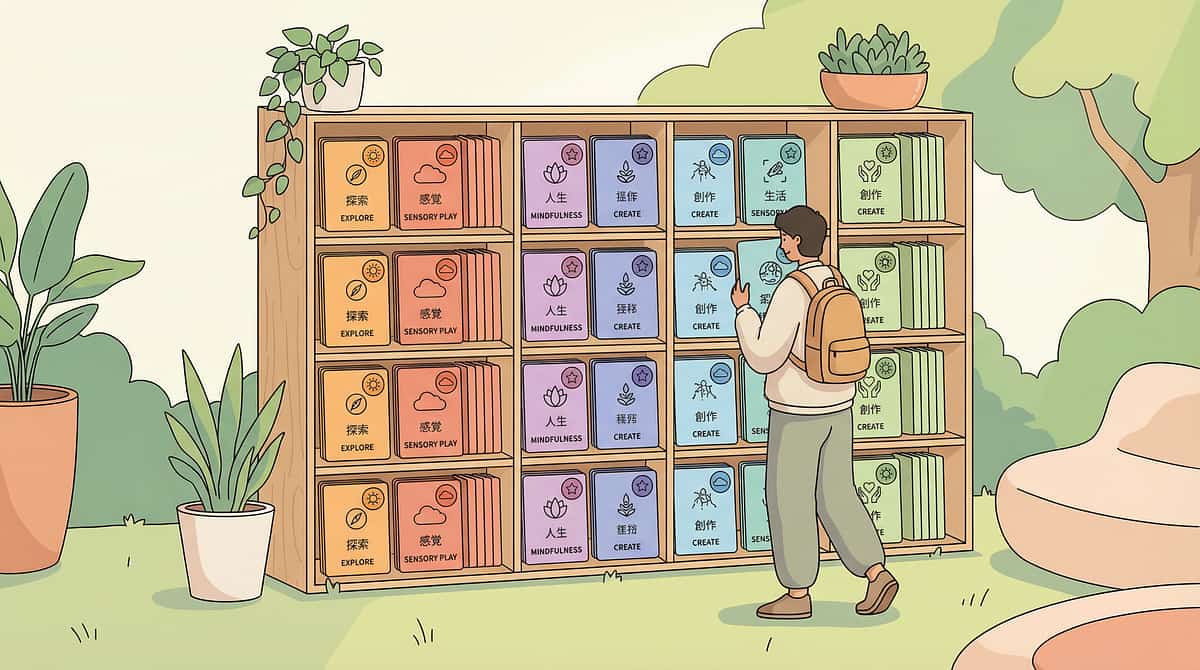
Preview of 9 materials that help with negation understanding Therapy Material
Below is a visual preview of 9 materials that help with negation understanding therapy material. The pages shown help educators, therapists, and caregivers understand the structure and content of the resource before use. Materials should be used under appropriate professional guidance.



Link copied!
ACT IV — RELATED TECHNIQUES
Negation Understanding Works Best Within a Network of Related Skills

B-166 | Comparative Concepts
More/less, bigger/smaller — comparative concepts use negation as their logical foundation. "Not as big as" requires the same cognitive operation as "not." → B-166
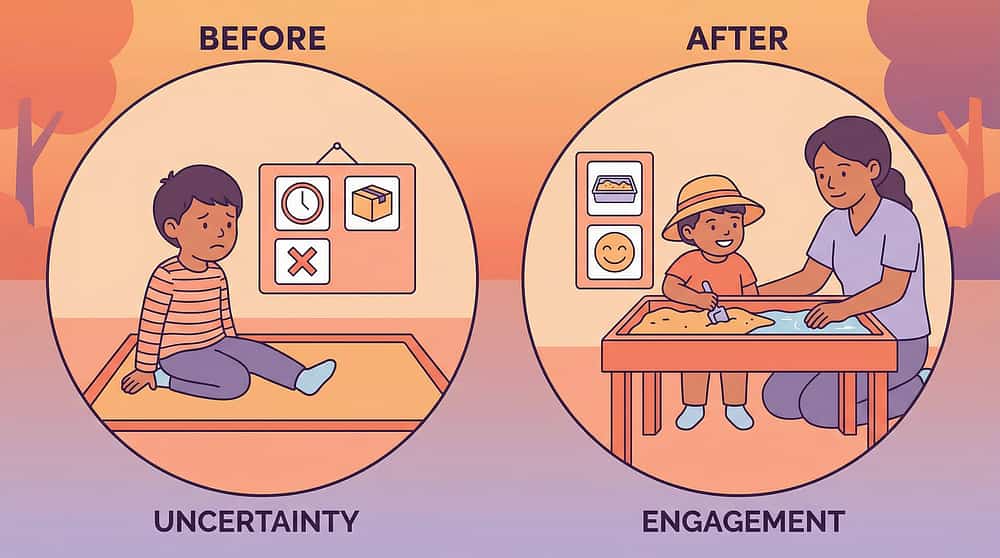
B-168 | Temporal Concept Confusion
Before/after/when/then — temporal language is the next step. Mastering negation prepares the child for the additional cognitive demands of time-based language. → B-168

B-175 | Following Multi-Step Directions
Multi-step directions frequently include negative elements: "Do X, then DON'T do Y, THEN do Z." Negation mastery is a prerequisite. → B-175

B-180 | Safety Awareness
The safety skill application of negation mastery. When "don't" is reliably processed, safety language becomes effective in real-world danger situations. → B-180