

"They Have the Words. But the Story Won't Come."
You sit down to hear about your child's day — and what comes back are fragments. "Park. Fell. Boy." Beautiful pieces, but the story stays locked inside. You're not imagining this. And your child is not failing.
B-204 | Narrative Skills | Domain B: Social Communication
"You are not failing as a parent. Your child's brain is still building the architecture that organizes experience into story."
DOMAIN B | PREVALENCE DATA
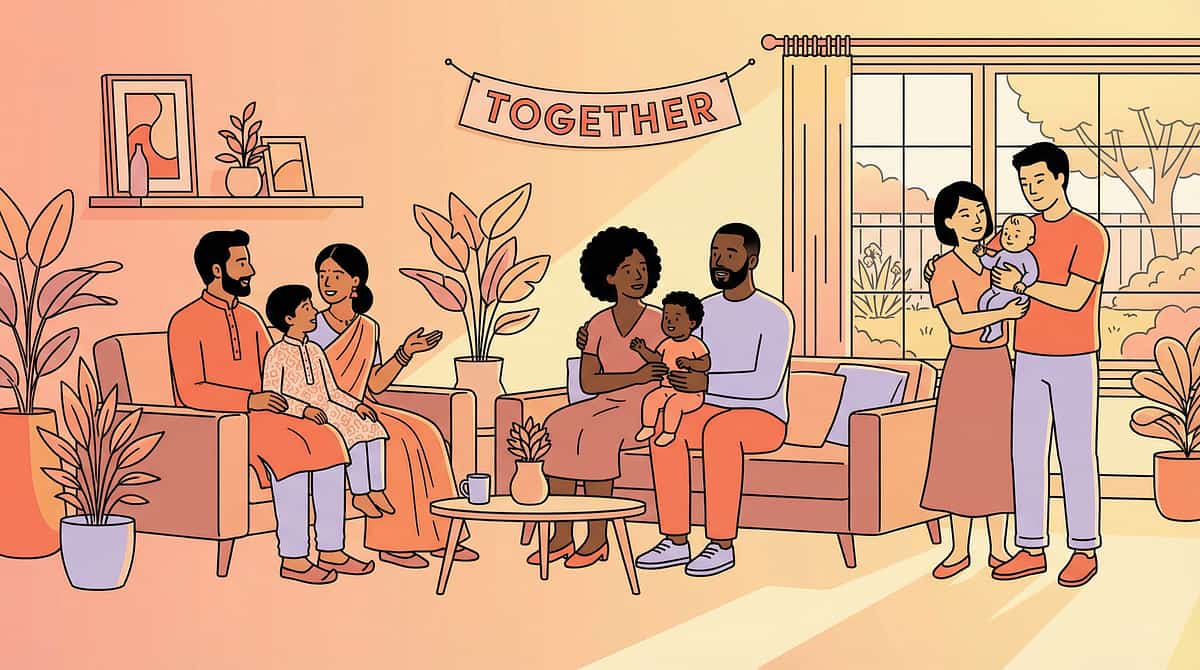
Millions of Families Are Navigating This Exact Challenge
Narrative difficulty is one of the most consistent and underrecognized challenges in children with autism, language delays, and developmental language disorder (DLD). It is not rare. It is not unique to your child.
70–80%
Children with ASD
have measurable narrative skill deficits (Norbury & Bishop, 2003; Westerveld et al., 2020)
1 in 14
Indian Children
show language developmental delays affecting narrative formation (INCLEN Trust 2019; ICMR data)
3–4x
Academic Difficulty
greater in children with untreated narrative deficits by age 8 (Justice et al., 2006; Ukrainetz, 2006)
You are among an estimated 18–22 million Indian families navigating some form of pediatric language or communication challenge. The isolation you feel is real — but you are not alone.
NEUROSCIENCE | IN PLAIN ENGLISH
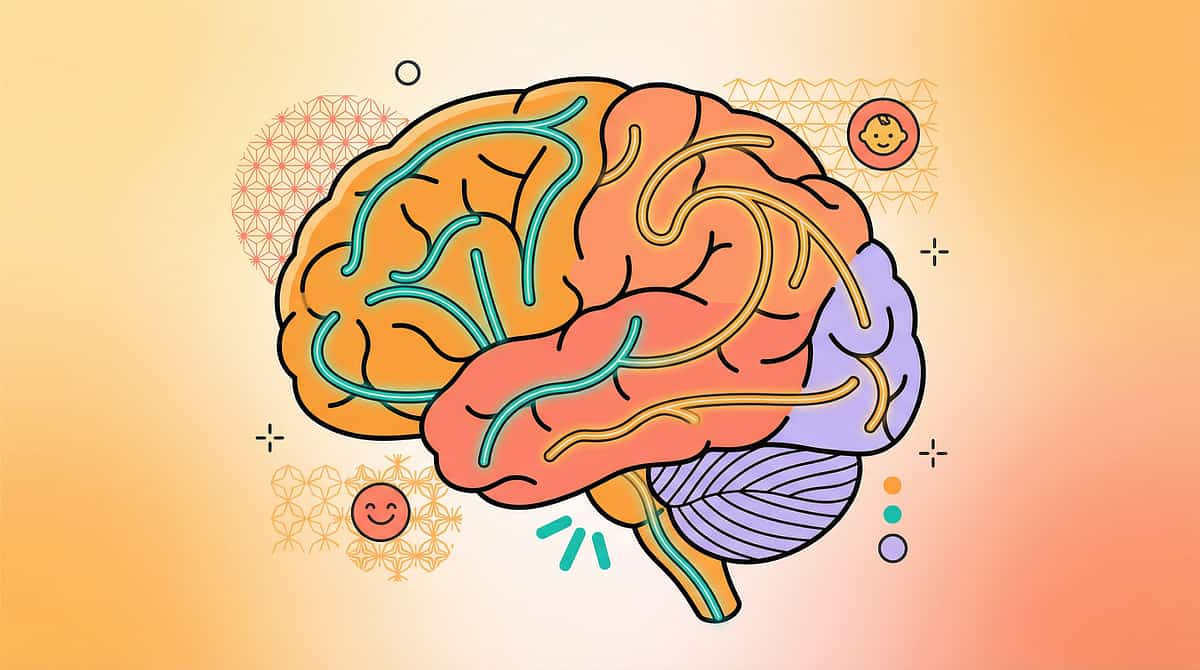
Narrative Isn't Just Language. It's Executive Architecture.
What's Happening in the Brain
Working Memory Circuit: Before a child can tell a story, they must hold the beginning in mind while building the middle — and anticipate the end. Many children with autism, ADHD, or DLD have reduced working memory capacity — stories collapse in the middle because the beginning has already faded.
Story Grammar Schema: Neurotypically, children internalize "story grammar" — the invisible template (Character → Problem → Action → Resolution) — through thousands of exposures by age 4. Children with language processing differences may need this schema made explicit and visible through physical scaffolding.
Temporal Sequencing: The hippocampus binds events to time. "First this, then that, finally this" requires the brain to sequence episodic memories into a causal chain. Sequencing cards externalize this brain function until the internal circuit strengthens.
"This is not a speech problem. It is a brain architecture challenge — and architecture can be built."
Broca's Area handles language production. The Working Memory Loop (dorsolateral prefrontal cortex) holds the story sequence. The Hippocampus manages temporal sequencing and episode memory. The Default Mode Network supports self-referential and autobiographical narrative. All four regions must work in concert for a story to flow.
Source: Frontiers in Integrative Neuroscience 2020, DOI: 10.3389/fnint.2020.556660
WHO/UNICEF DEVELOPMENTAL FRAMEWORK
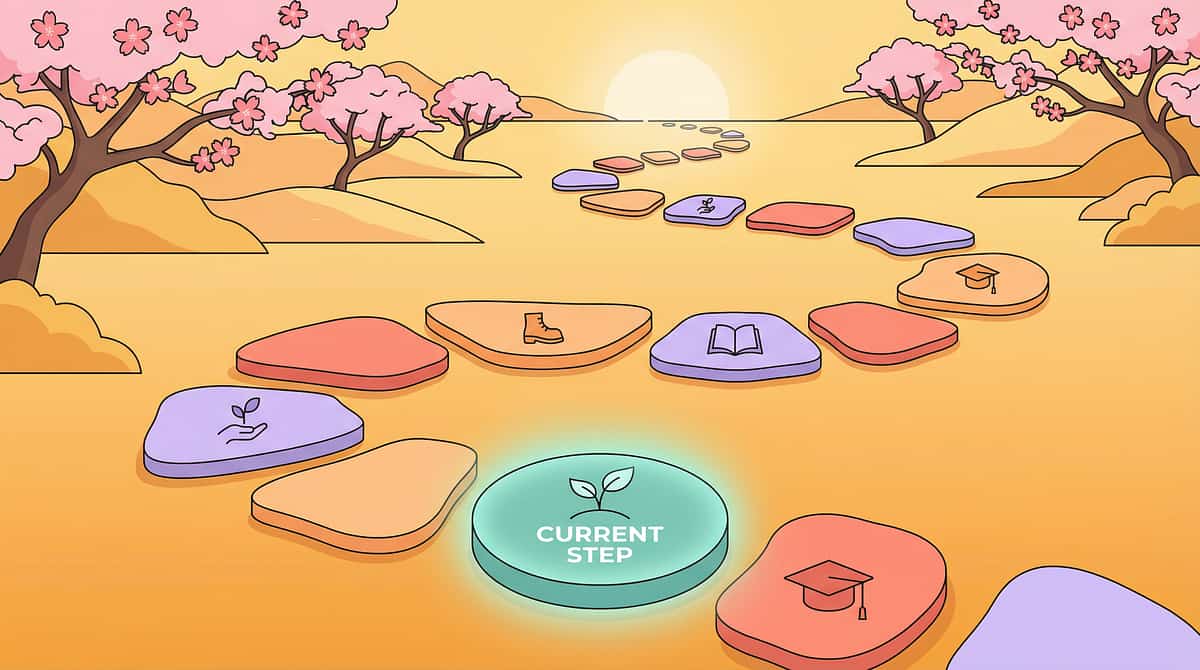
Your Child's Narrative Development: A WHO-Mapped Journey
18–24 months
"More juice" / "Daddy go" — two-word combinations; proto-narratives begin
2–3 years
Three-event sequences; beginning narrative schemas emerge
3–4 years
Basic story structure: Character + Action + Outcome; imaginative play narratives
4–5 years
Initiating events + character motivations appear; "because" and "so" connectors emerge
★ 5–7 years
FULL STORY GRAMMAR expected — Setting + Problem + Action + Resolution + Ending
7–9 years
Complex, multi-episode narratives with character internal states
9–12 years
Abstract narrative (inference, theme, moral) — academic writing prerequisite
Most families engaging this technique have children presenting at the 2–5 year narrative stage, regardless of chronological age. This is your starting point — not a judgment. Narrative challenges commonly co-occur with: Autism Spectrum Disorder | DLD | ADHD | Intellectual Disability | Selective Mutism | Hearing Loss

CLINICAL EVIDENCE GRADE
Clinically Validated. Home-Applicable. Parent-Proven.
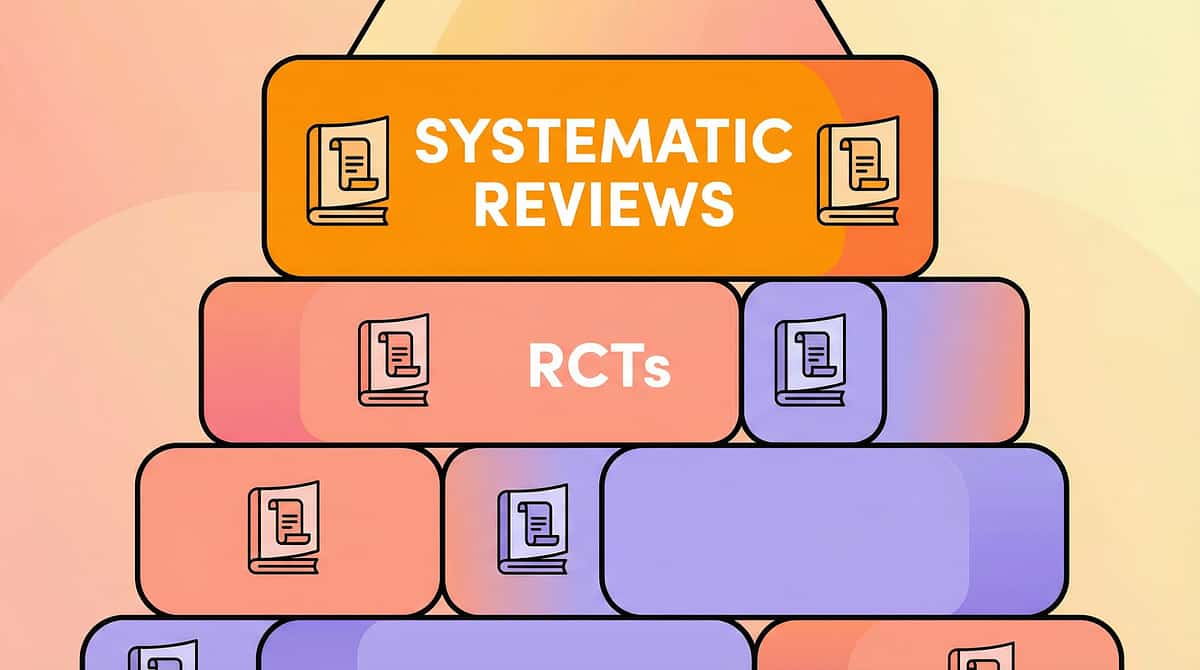
LEVEL I EVIDENCE — Systematic Review + RCT Support
ASHA (American Speech-Language-Hearing Association) classifies narrative intervention as a Recommended Practice. RCSLT (UK) and Speech Pathology Australia endorse structured story grammar approaches. This technique is not experimental — it is established clinical science.
PRISMA Systematic Review, 2024
16 studies, 2013–2023. "Narrative intervention meets evidence-based practice criteria for children with ASD, DLD, and language delays."
Meta-Analysis, World J Clin Cases, 2024
24 studies. "Story grammar instruction significantly improves both narrative production AND comprehension across pediatric populations."
Indian J Pediatr RCT — Padmanabha et al., 2019
Indian home-based sample. "Structured narrative intervention delivered by trained caregivers showed significant language gains at 8 weeks."
DOI: 10.1007/s12098-018-2747-4
TECHNIQUE DEFINITION | DOMAIN B
Story Grammar Intervention
"The Story Architecture Technique"
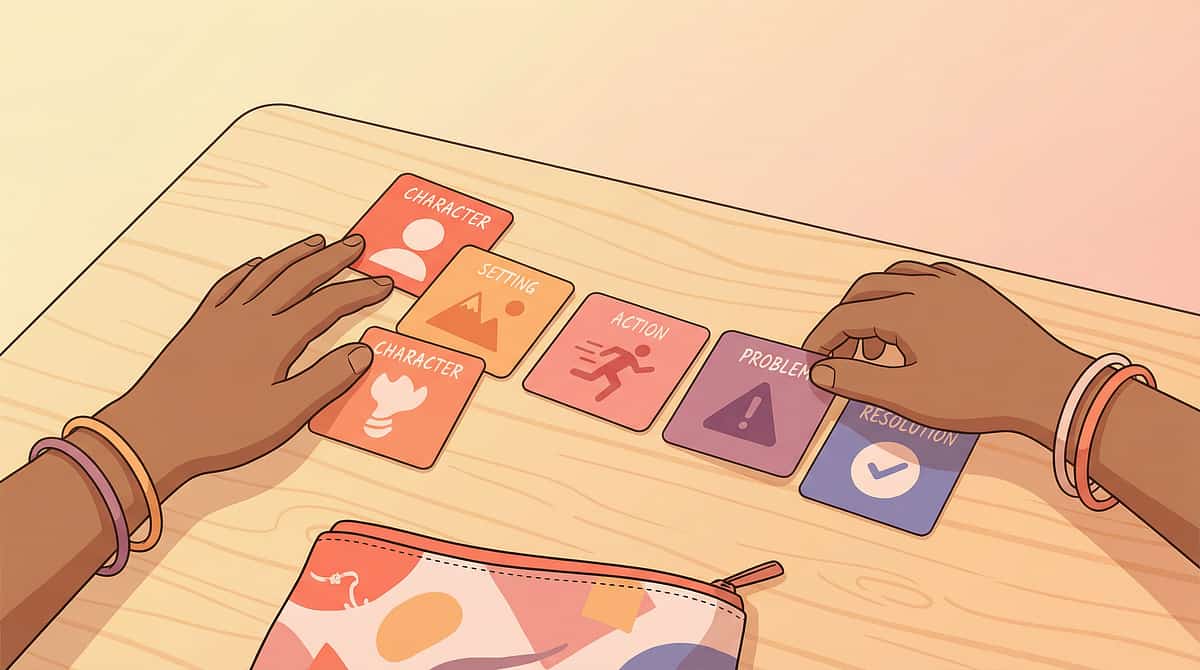
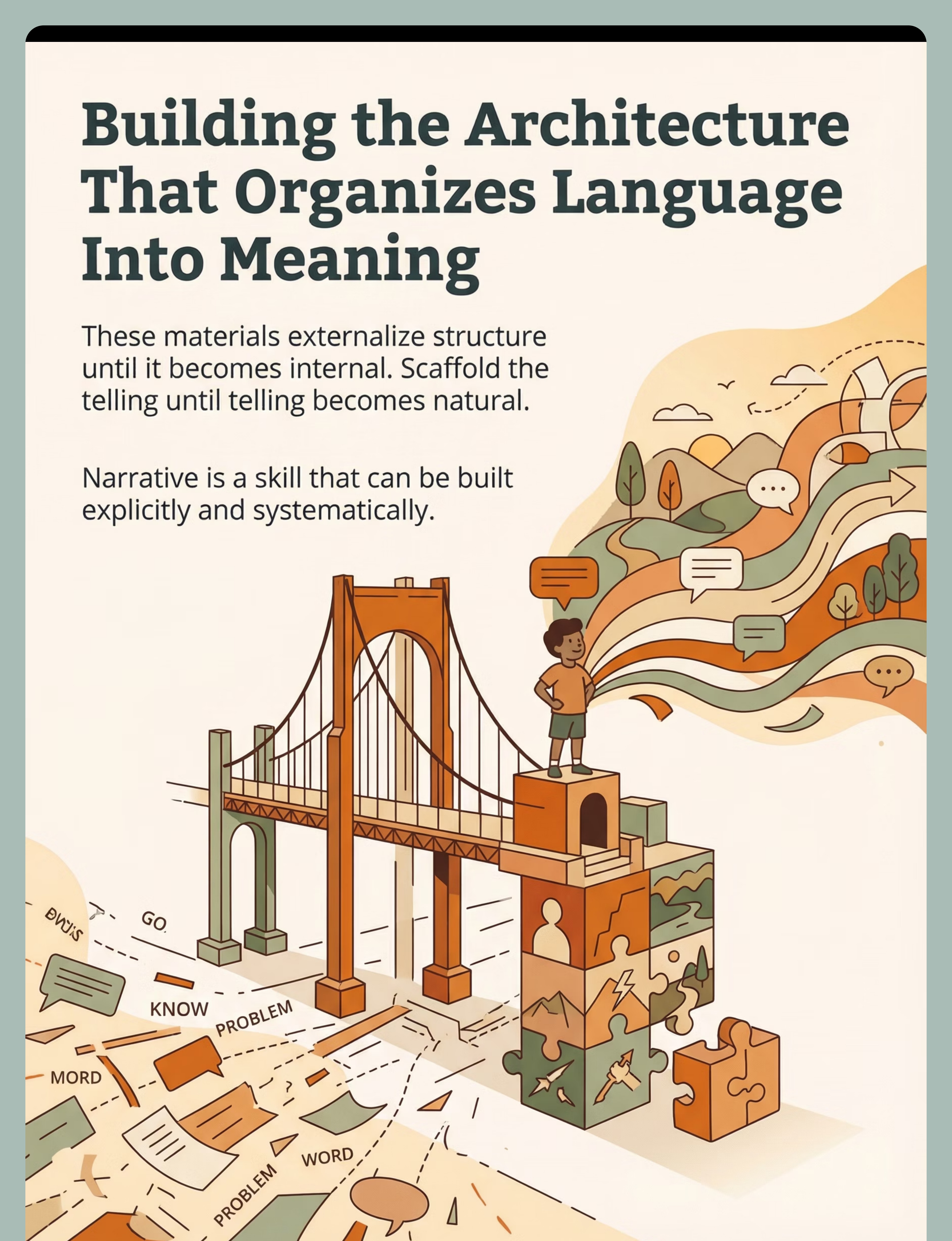
Story Grammar Intervention is a structured, evidence-based approach in which the invisible framework of a story — its Characters, Setting, Problem, Actions, and Ending — is made physically visible and tangible using materials a child can touch, move, and arrange. Rather than asking a child to hold narrative structure in their working memory, this technique externalizes it onto the table, the floor, or the wall, building the internal architecture through repeated external scaffolding. It is used with children who have words, but whose stories fall apart before they reach the listener.
🗂 Domain B: Social Communication
🎯 Ages: 3–12 years
⏱ Session: 10–15 min
🔁 Frequency: 4–5x/week
📊 Evidence: Level I
MULTIDISCIPLINARY APPROACH
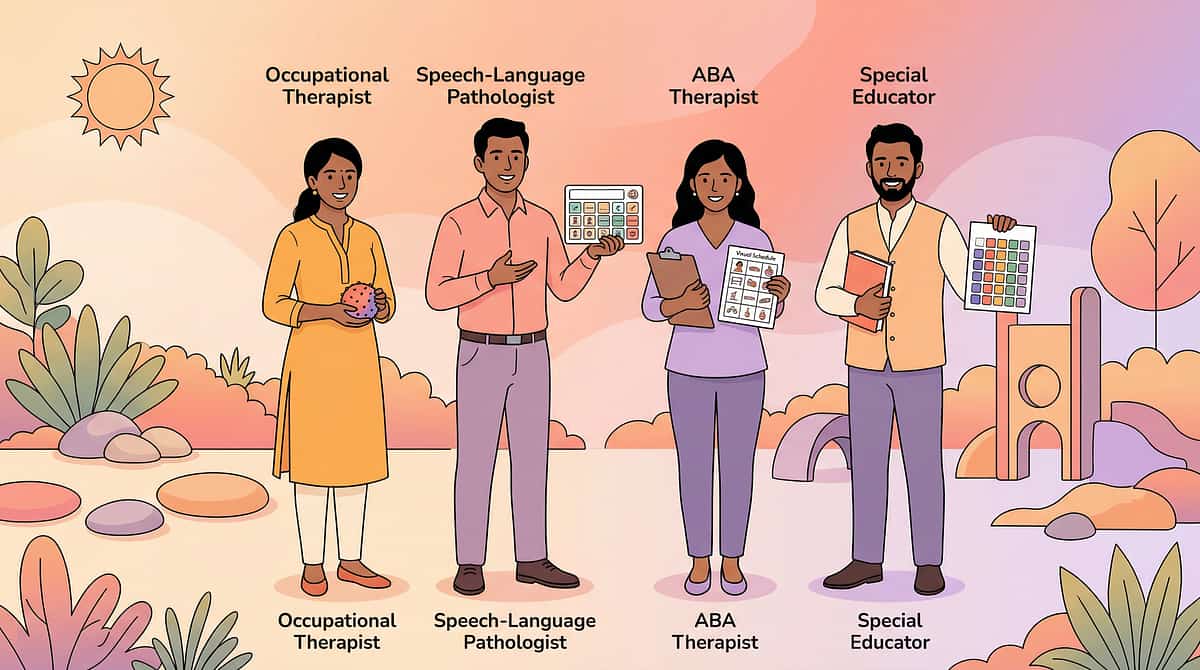
A Technique That Crosses Every Therapy Boundary
The brain doesn't organize itself by therapy type. Neither does this technique.
🗣 Speech-Language Pathology — PRIMARY LEAD
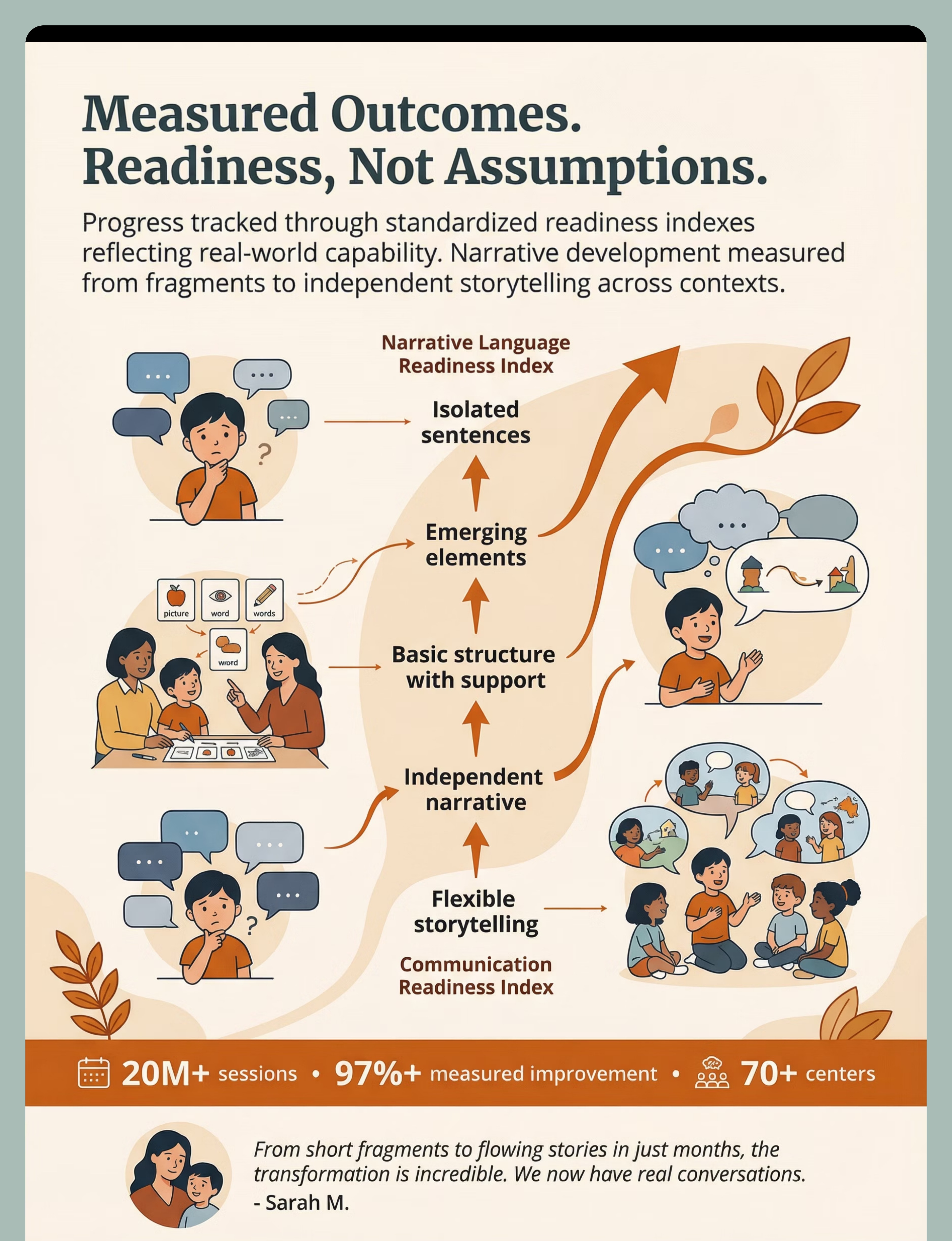
SLPs use Story Grammar Intervention as the cornerstone of narrative language therapy. They assess story grammar complexity level (isolated sentences → basic structure → independent narrative), set targets, and train caregivers to deliver home sessions with precision.
⚡ Applied Behavior Analysis (ABA)
BCBAs embed narrative targets within DTT and NET. Story sequencing becomes a reinforced skill chain. Visual supports are introduced as antecedent prompts. Data collection tracks story grammar element production per session.
🎓 Special Education
SpEd specialists use story grammar maps as pre-writing organizers, comprehension scaffolds for reading, and communication supports across all subjects. Narrative ability is foundational to academic participation.
🧩 Occupational Therapy
OTs address sensory-motor prerequisites: fine motor skills for card manipulation, visual tracking for left-to-right story sequence, and sensory regulation so the child is available for narrative learning. Co-sessions with SLP are common.
CLINICAL TARGETS
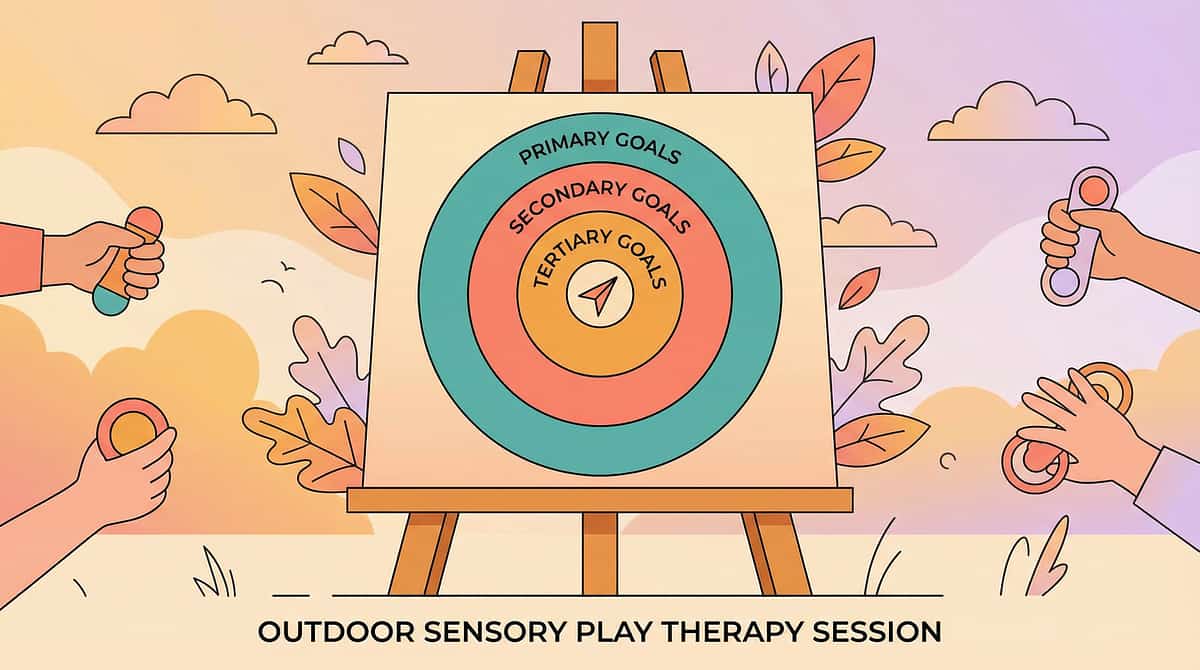
Precision Targets: What This Technique Actually Changes
At the core, this technique builds Story Grammar Production — the child narrates a 4–5 element story with 80% accuracy using the story grammar scaffold. Secondary targets include temporal sequencing ("first, then, finally"), comprehension of causal questions, and sentence complexity with connectives. Tertiary gains reach into reading comprehension, social communication, academic writing, and emotional literacy.
Target | Starting Point | Mastery Indicator | |
Story Grammar | Single word + gesture | 4+ grammar elements in sequence | |
Sequencing | Random order | Correct temporal order 4/5 trials | |
Comprehension | Cannot answer "why" | Answers causal questions 80% | |
Connectives | No use | Uses "because/so/then" spontaneously |
CANON MATERIALS | 9 CLINICALLY VALIDATED TOOLS
9 Clinically Validated Materials for Narrative Skills
Every material below is part of the Pinnacle 128 Canon. Sourced from India. Priced for every family. Total Investment Range: ₹1,650 – ₹7,800 for a complete narrative skill kit.
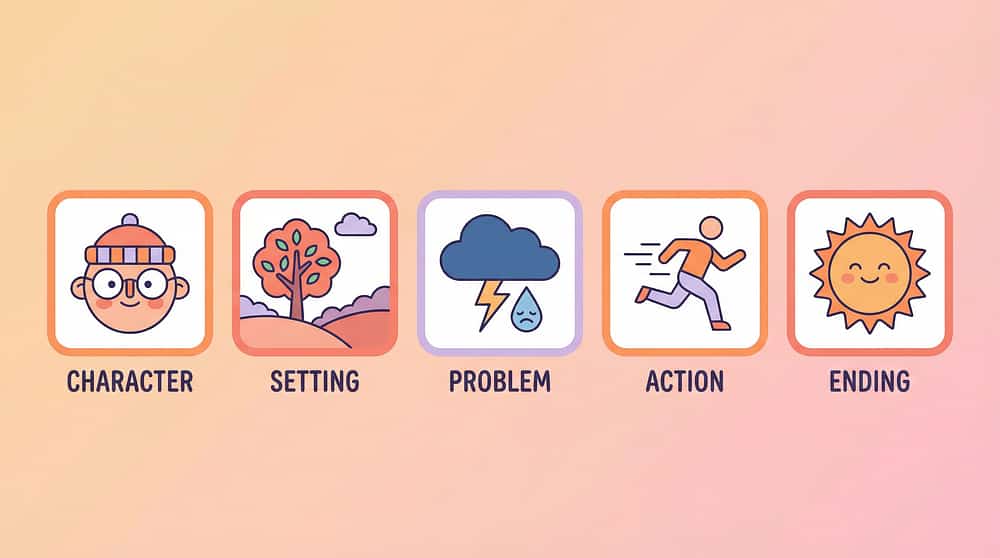
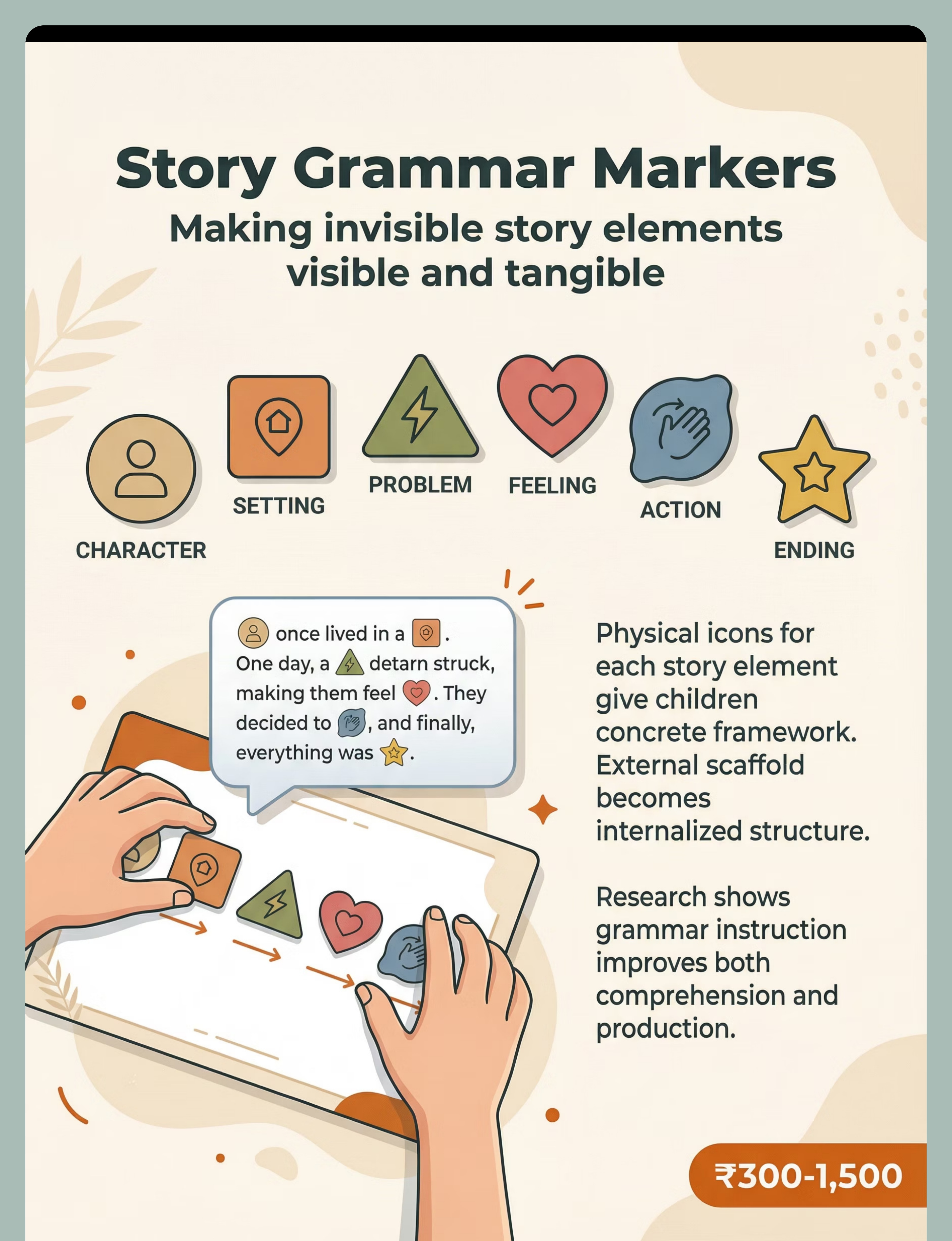
📦 Story Grammar Markers / Role-Play Icons Set
Canon: Social Stories / Narrative Supports | SLP + SpEd
Physical icons make invisible story elements tangible. Research confirms grammar instruction improves both comprehension and production.
₹300–1,500 ✓ Pinnacle Recommends
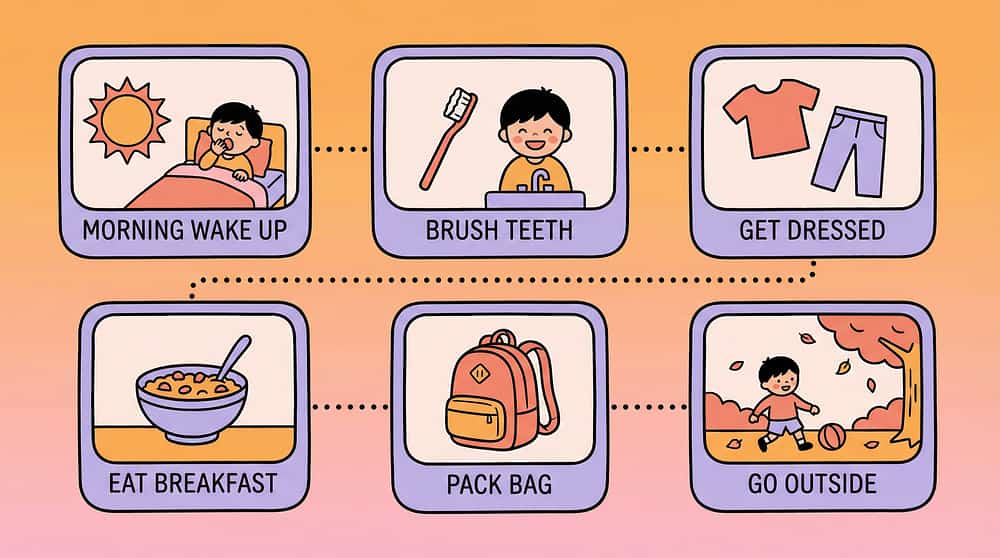
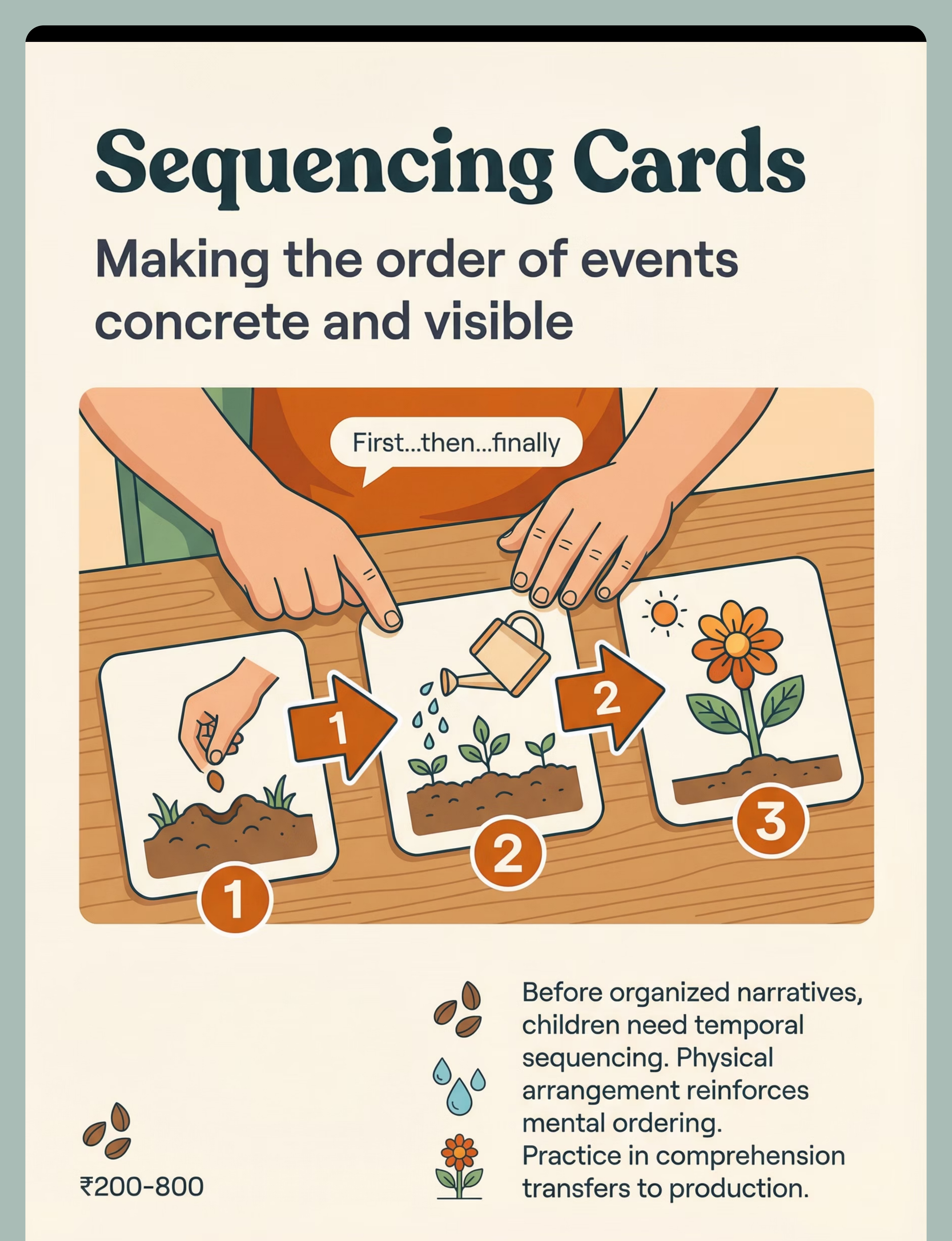
📦 Sequencing Cards (3–6 step sets)
Canon: Sequencing Cards / Pattern Activities | SLP + ABA + SpEd
Before organized narratives, children need temporal sequencing. Physical arrangement reinforces mental ordering.
₹200–800 | Creative's What's Next -2
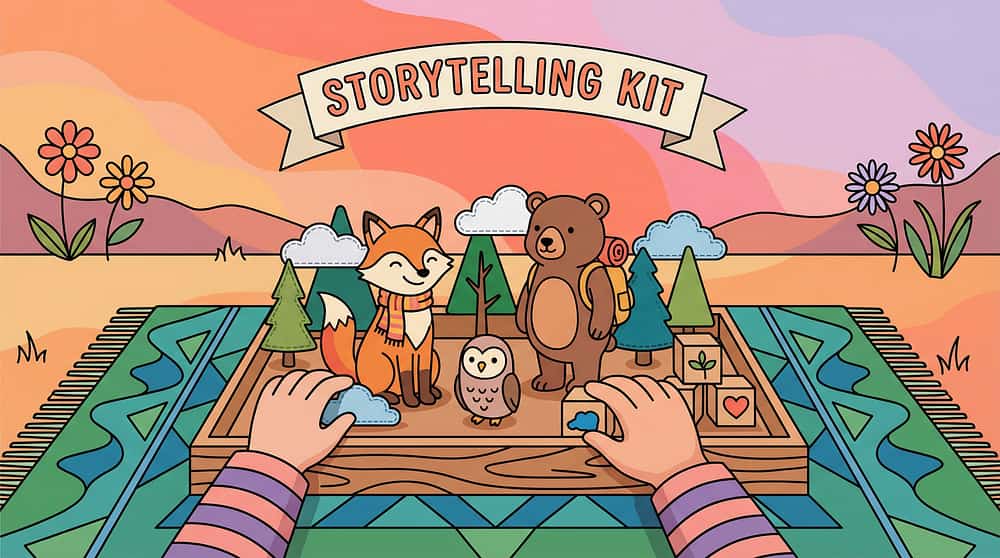
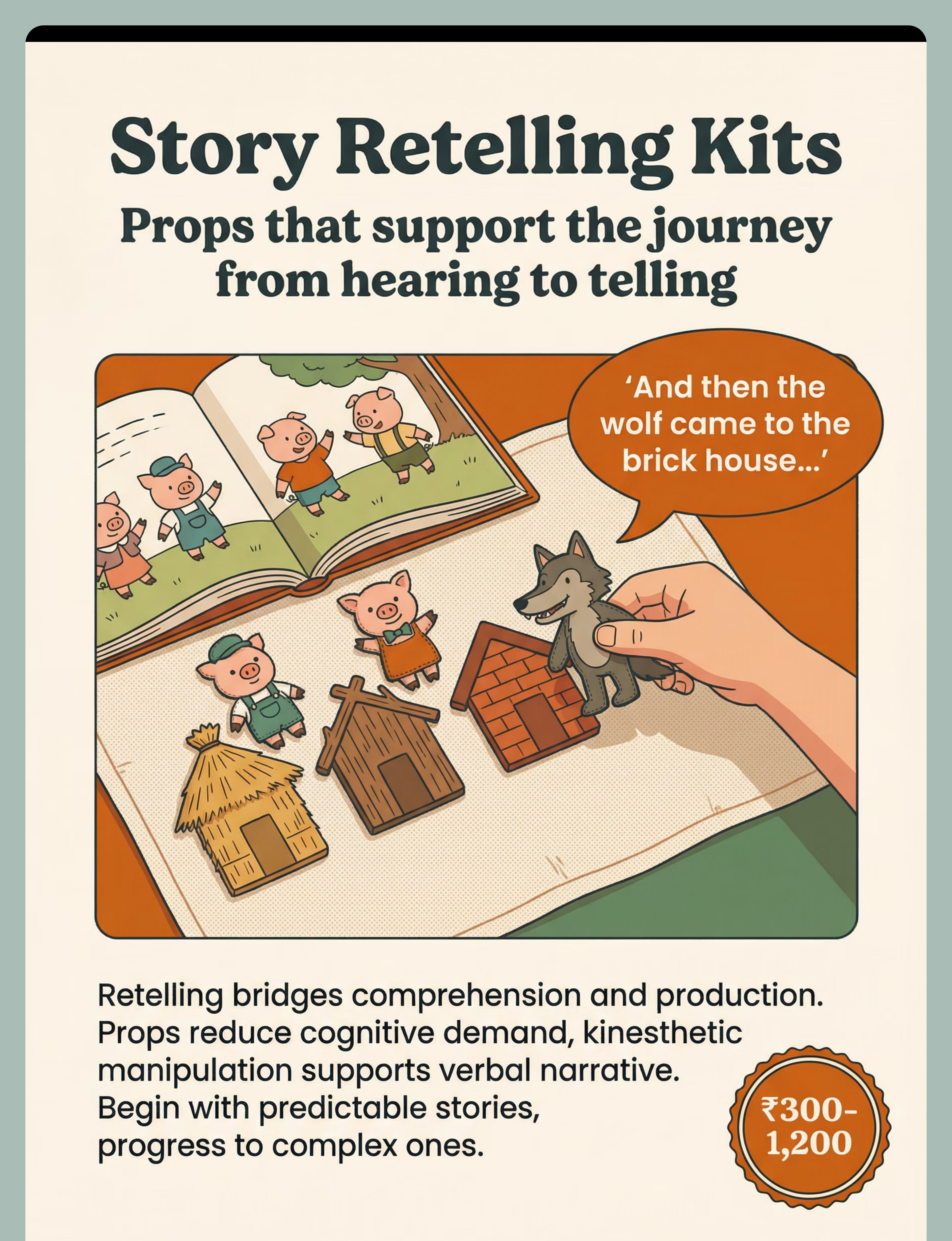
📦 Story Retelling Kit / Figurine Props
Canon: Role-Play / Pretend Play Props | SLP + OT
Retelling bridges comprehension and production. Props reduce cognitive demand; kinesthetic manipulation supports verbal narrative.
₹300–1,200
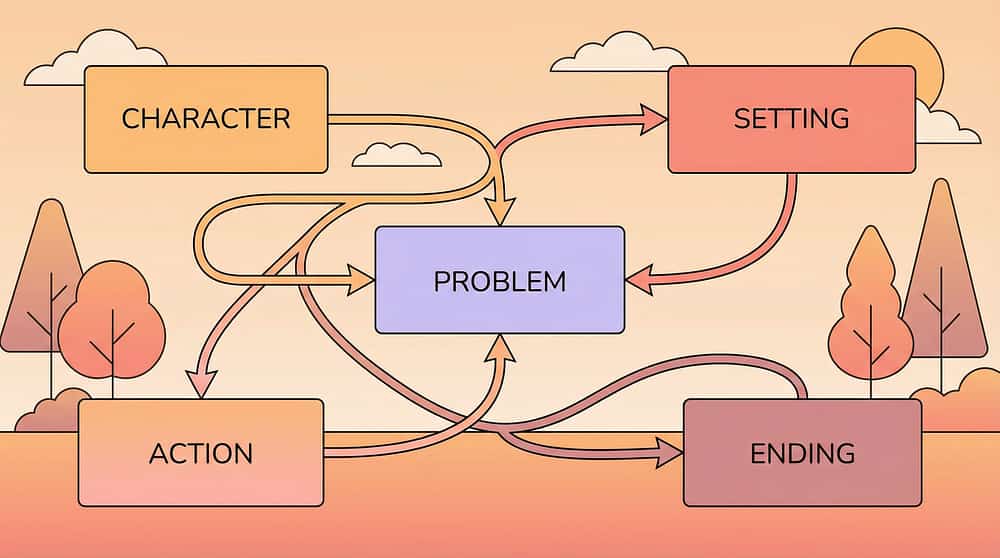
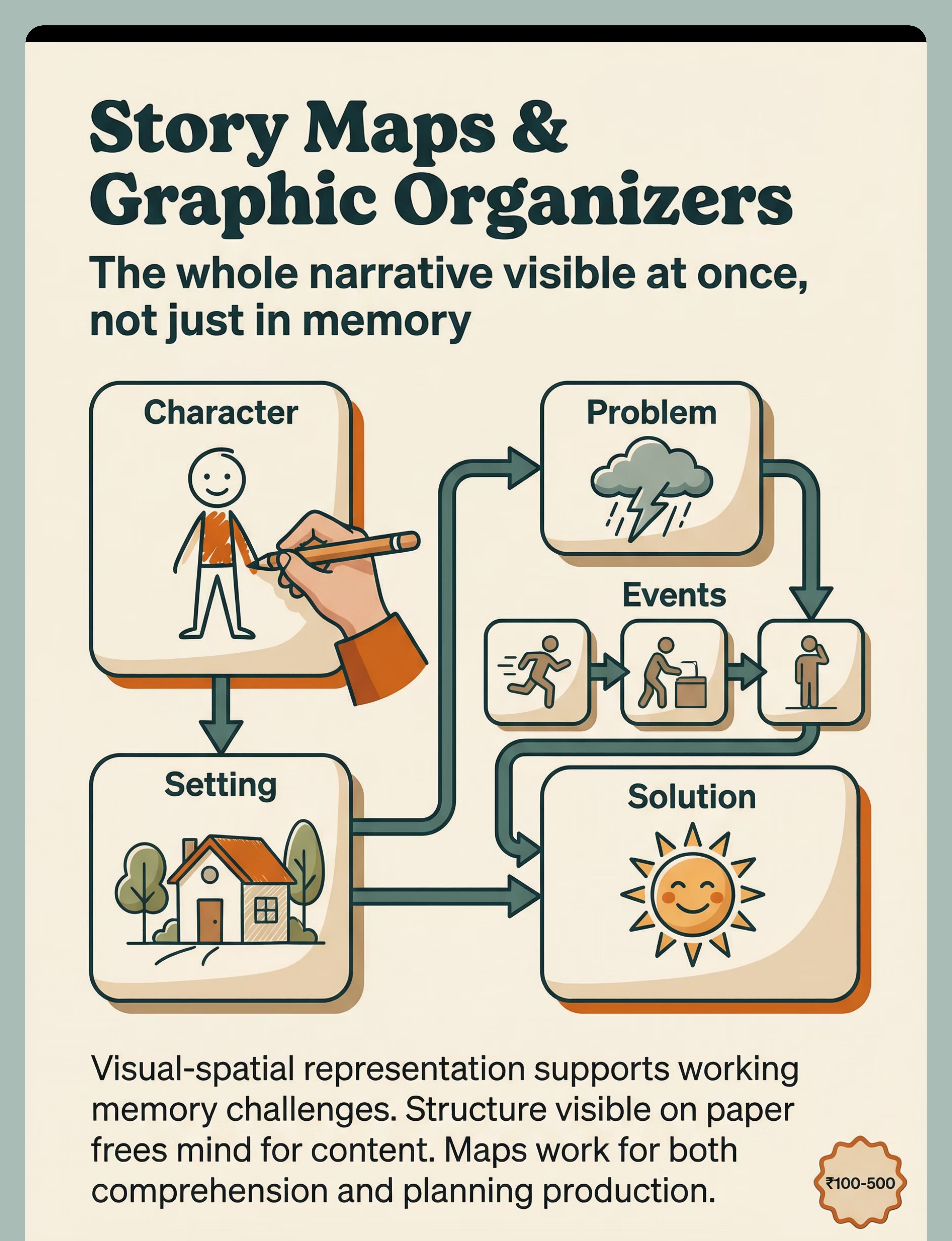
📦 Story Maps & Graphic Organizers
Canon: Early Reading Materials | SLP + SpEd
Visual-spatial representation supports working memory challenges. Structure visible on paper frees the mind for content.
₹100–500
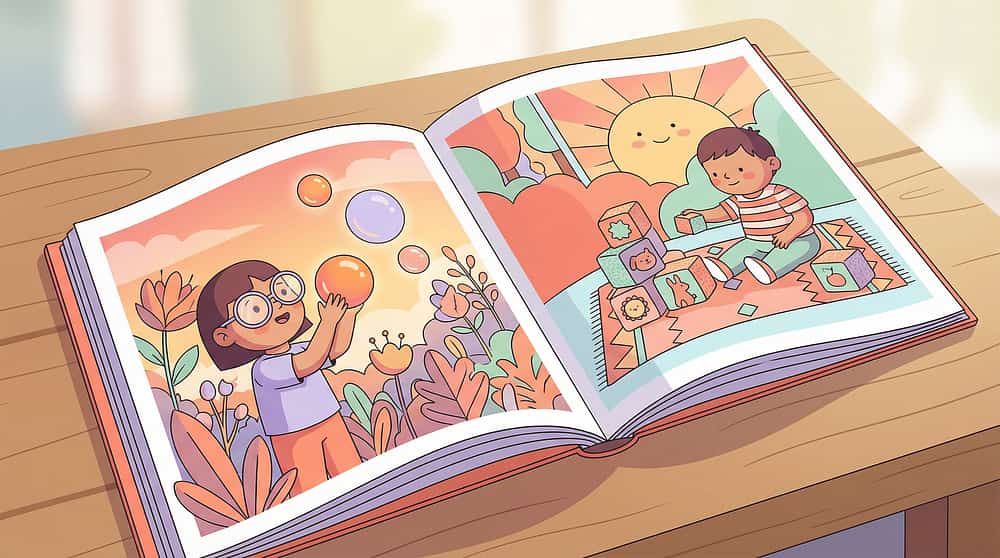
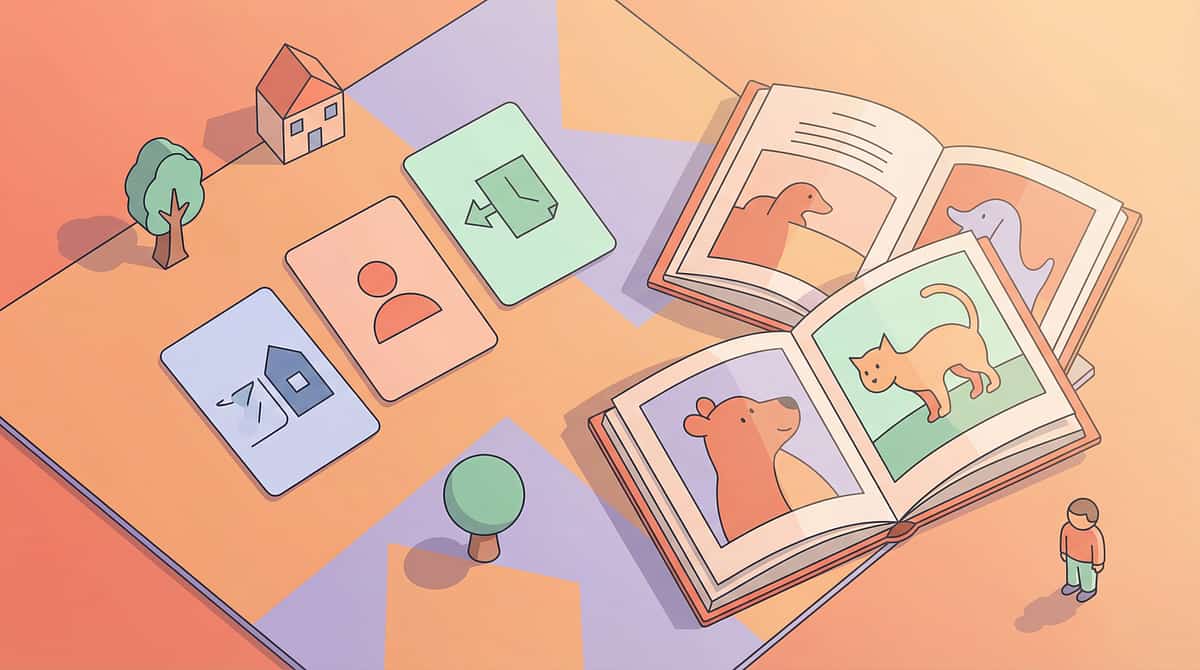
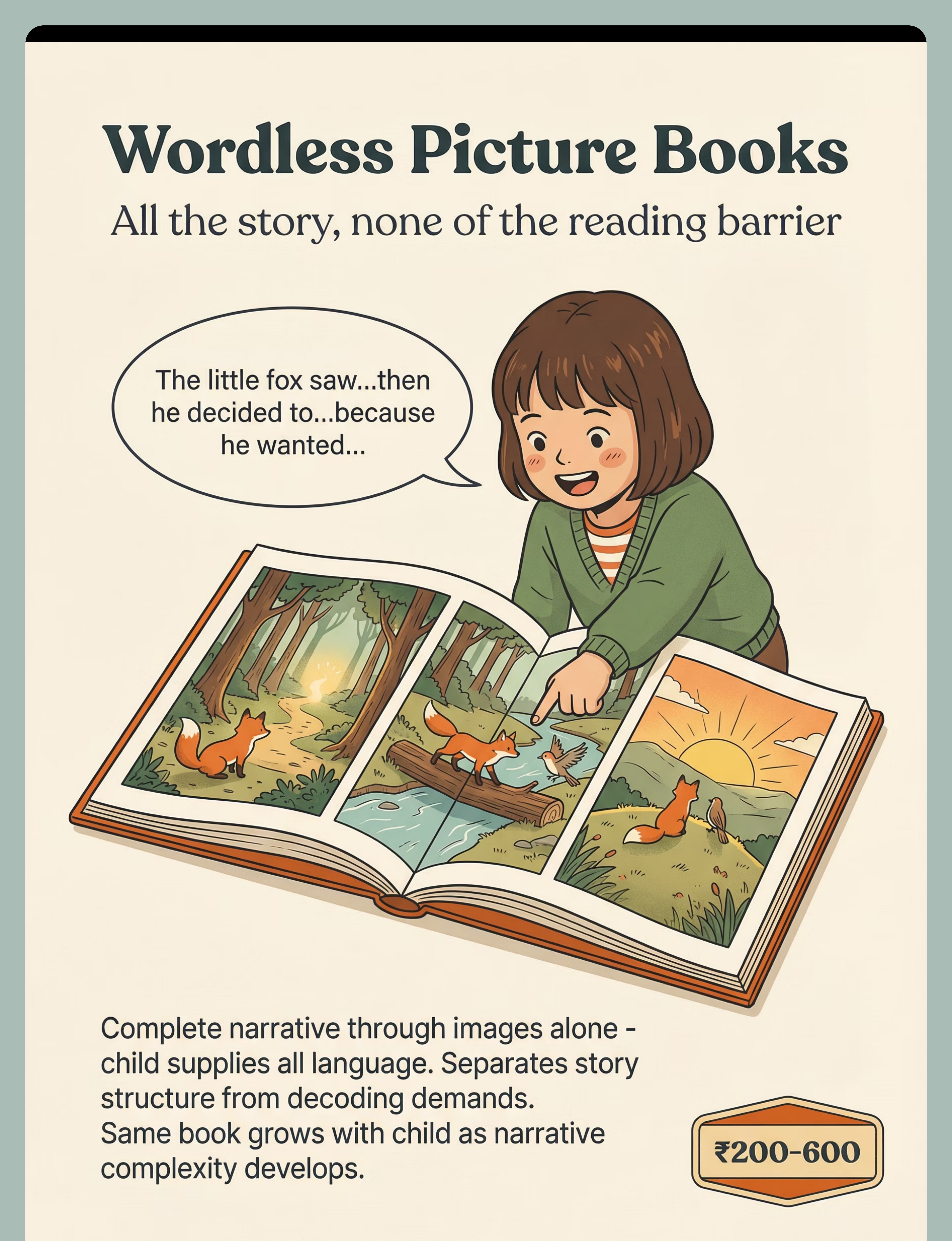
📦 Wordless Picture Books
Canon: Language Expansion / Vocabulary Building | SLP
Child supplies all language. Separates story structure from decoding demands. Same book grows with child as narrative complexity develops.
₹200–600
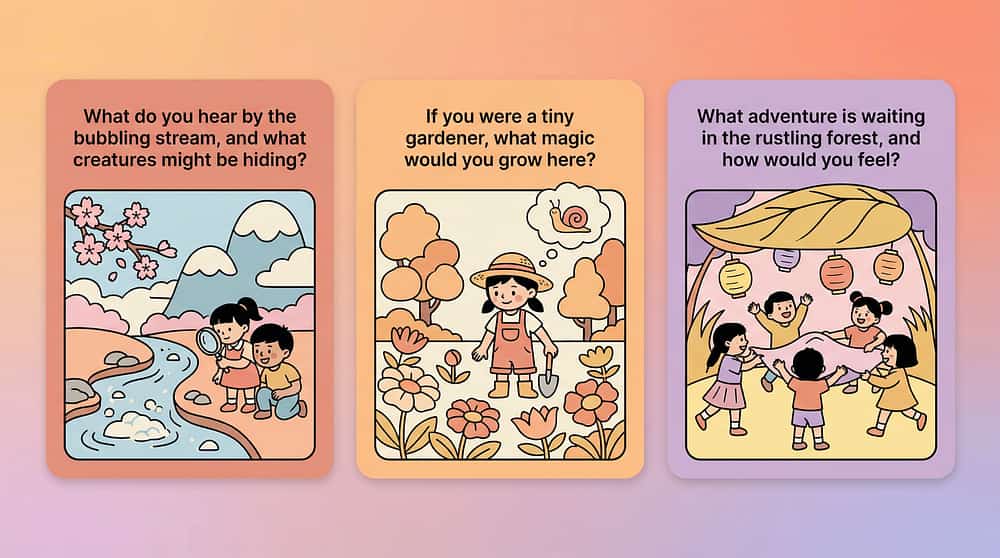
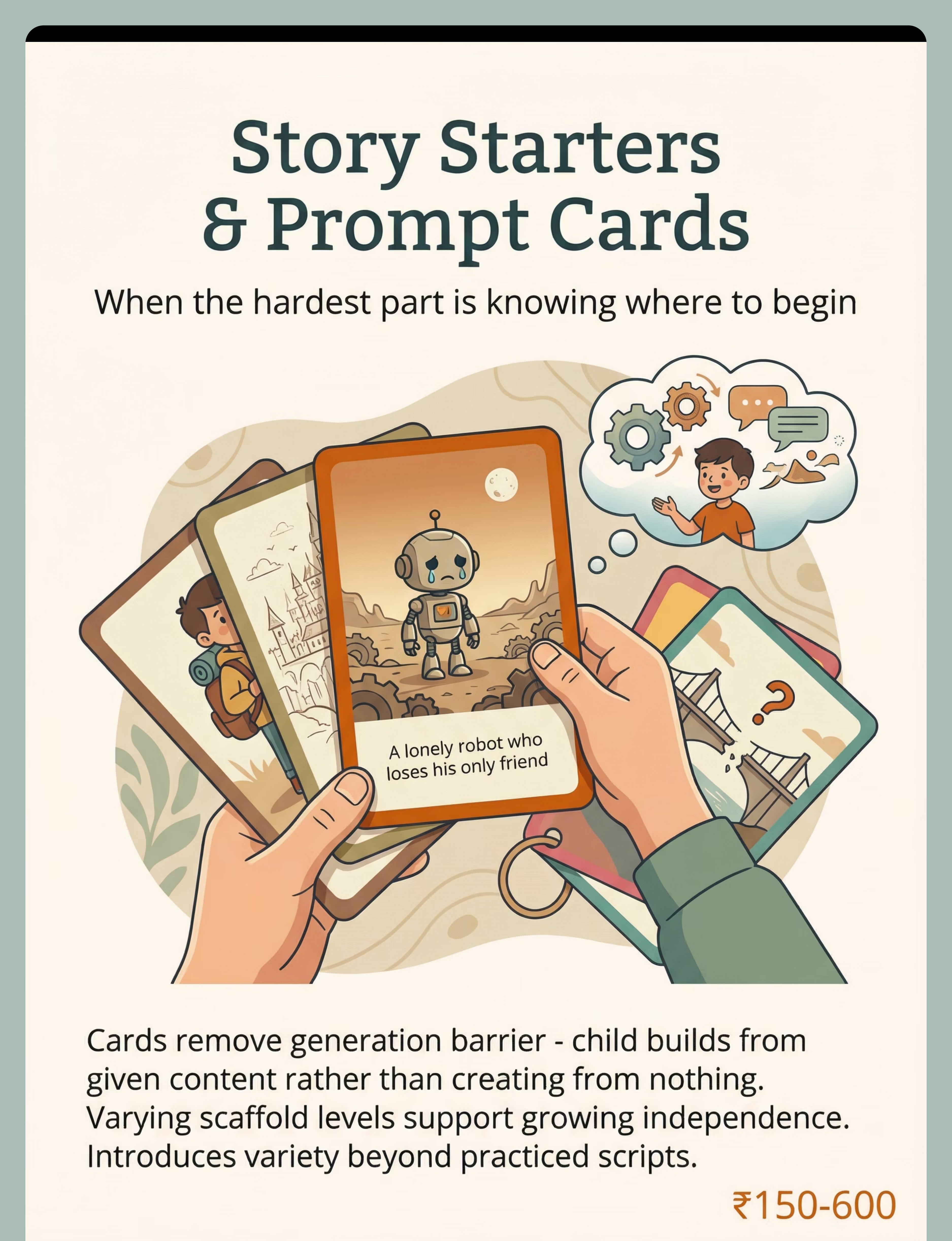
📦 Story Starter & Prompt Cards
Canon: Conversation Visual Supports | SLP + ABA
Cards remove the generation barrier — child builds from given content rather than creating from nothing. Varying scaffold levels support growing independence.
₹150–600
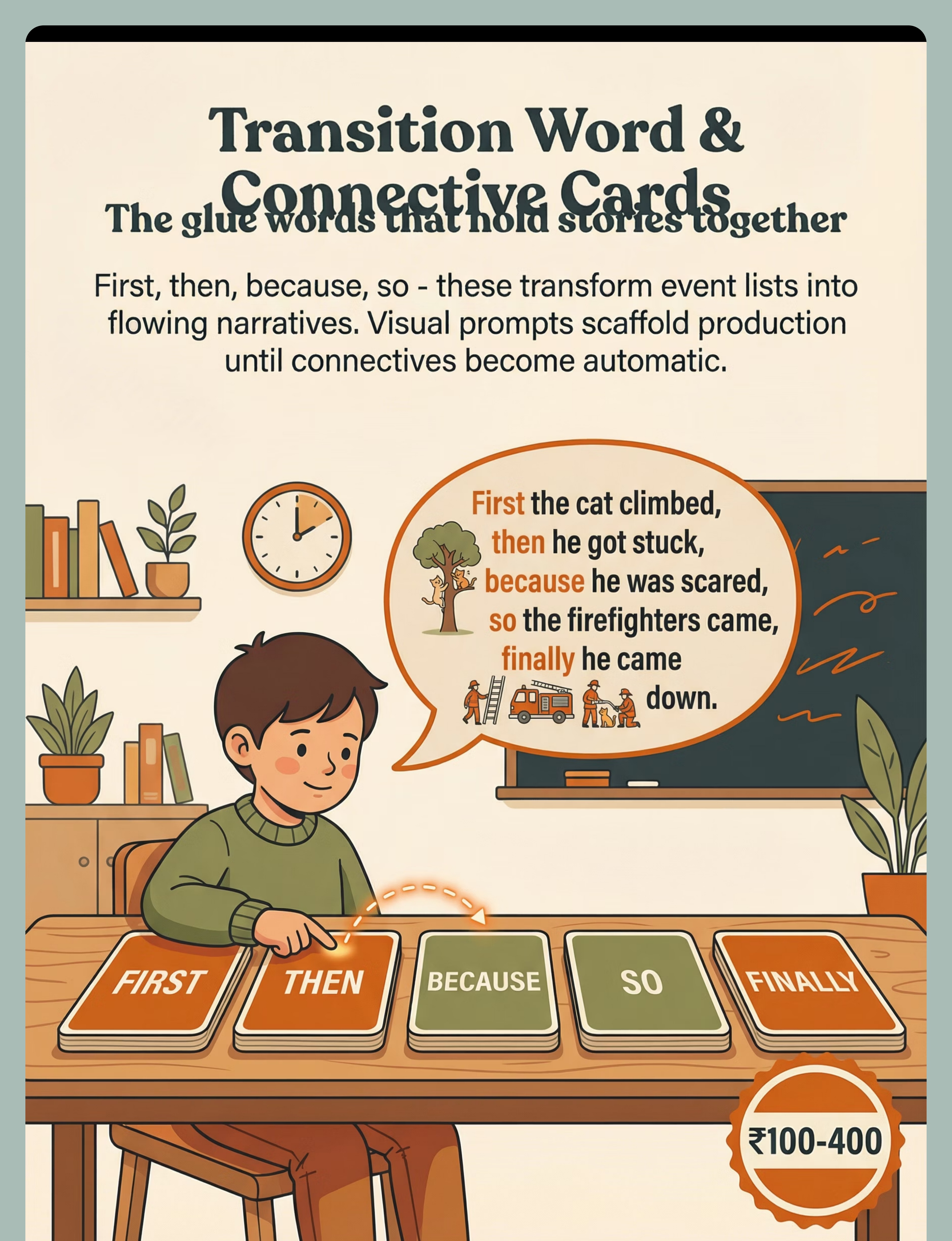
📦 Transition Word Cards
"First, then, because, so, finally" — visual prompts scaffold production until connectives become automatic. | ₹100–400
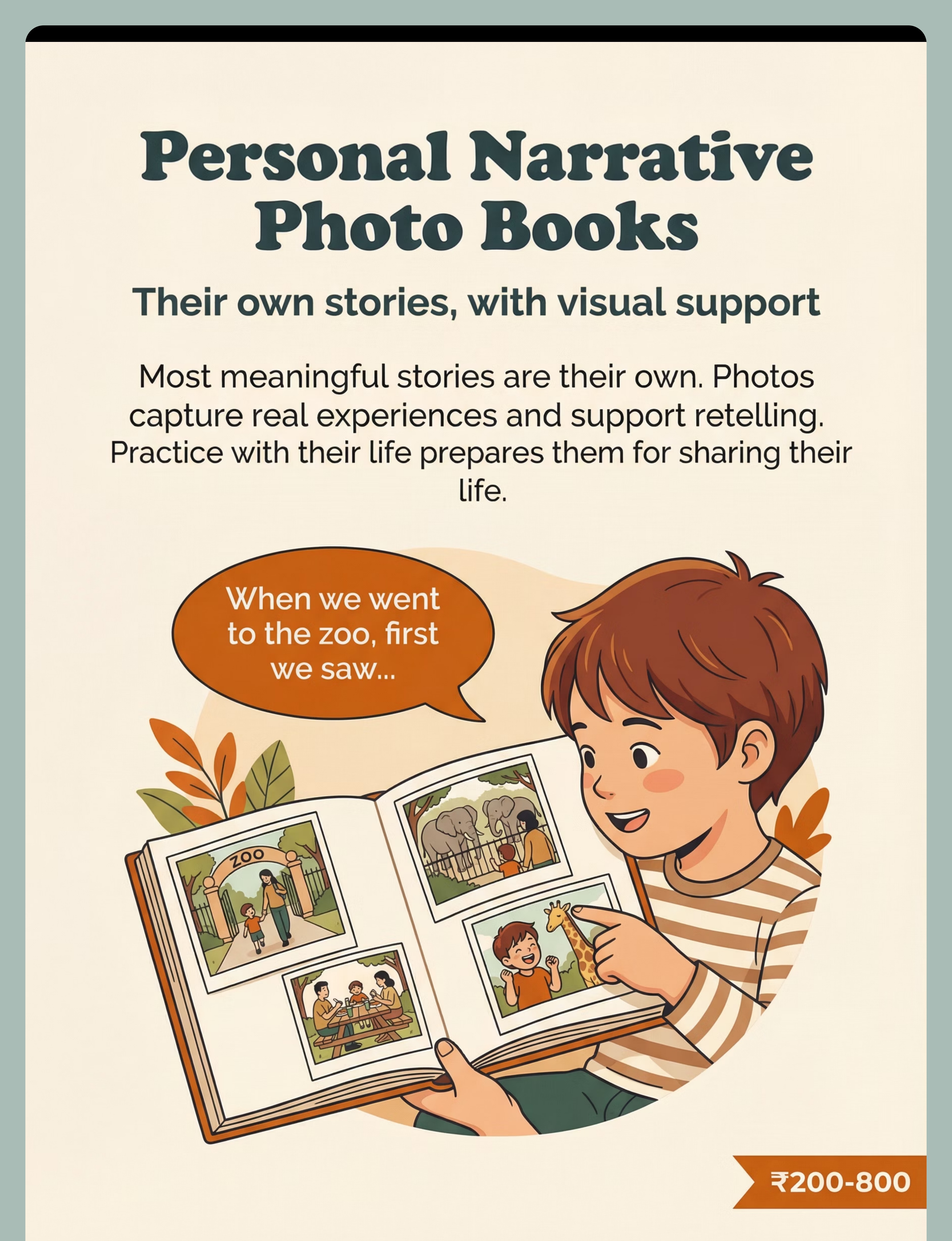
📦 Personal Narrative Photo Book
Photos capture real experiences and support retelling. Practice with their life prepares them for sharing their life. | ₹200–800
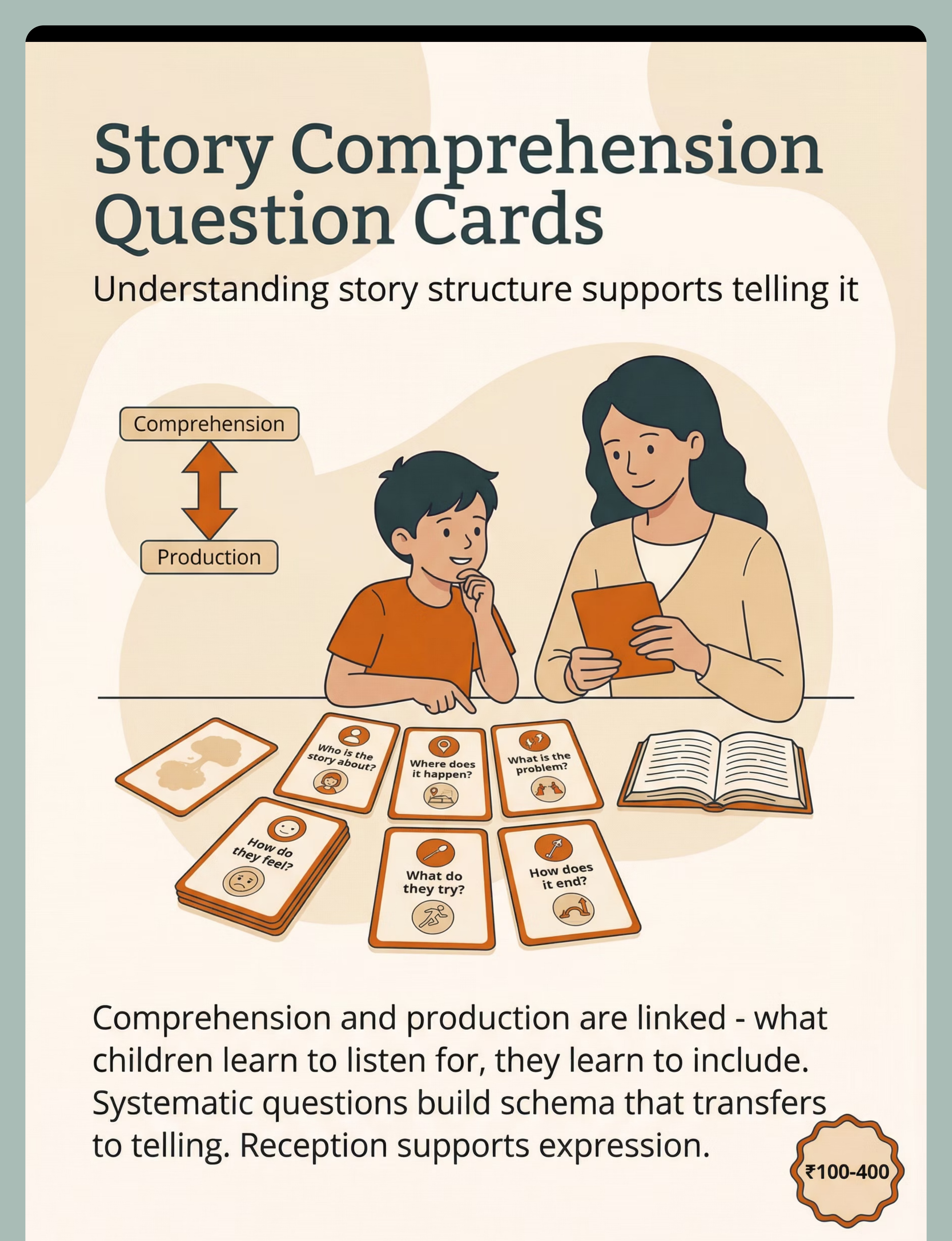
📦 Story Comprehension Question Cards
What children learn to listen for, they learn to include. Reception supports expression. | ₹100–400
ZERO-COST PATHWAY | EQUITY ACCESS
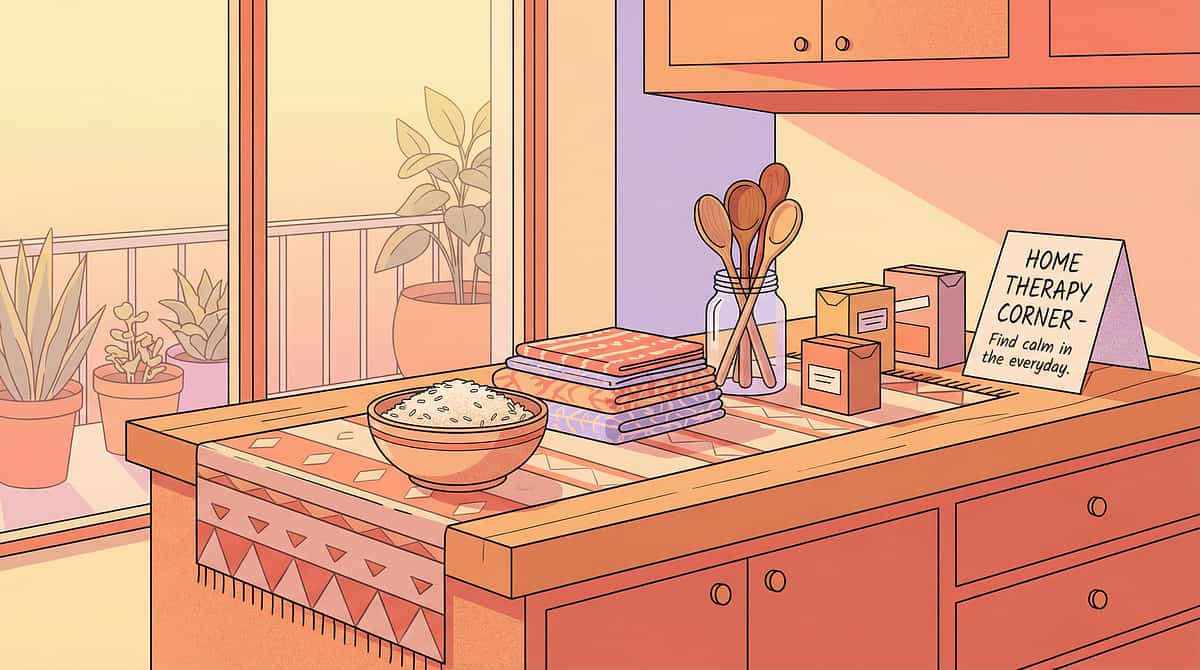
Zero Budget? Zero Problem. Every Child Deserves Access.
WHO/UNICEF Nurturing Care Framework Principle: No intervention should be inaccessible due to economic status. Every technique in this library has a zero-cost pathway.
Clinical Material | DIY Alternative | Why It Works | |
Story Grammar Marker icons | Cut cardboard shapes: circle (character), house (setting), lightning bolt (problem), arrow (action), star (ending) — color with crayons | Same visual schema, identical cognitive function | |
Sequencing Cards | Print 3–6 family photos from WhatsApp, laminate with clear tape, number on back | Personal photos increase motivation; sequencing function identical | |
Story Retelling Kit props | 4–5 household objects (toy car, cup, spoon, doll) as story characters and props | Kinesthetic manipulation principle unchanged | |
Story Map Graphic Organizer | Fold A4 paper into 5 boxes, draw: face, house, cloud, shoe, star in sequence | Works identically to commercial version |
Complete B-204 can be executed with: family photos + paper + markers + household objects = ₹0

SAFETY GATE | READ BEFORE EVERY SESSION
Pre-Session Safety Gate — Read Before Every Session
🔴 STOP — Do Not Begin If:
- Child is in active meltdown, tantrum, or extreme dysregulation
- Child shows signs of illness (fever, fatigue, pain)
- Child has had a major sensory overload in the past 2 hours
- You (the caregiver) are in significant emotional distress
- Physical space contains known triggers that cannot be removed
🟡 MODIFY SESSION IF:
- Child seems restless but engaged — shorten to 5 minutes, use higher-interest material
- Child had a difficult day at school — begin with preferred storybook before introducing grammar markers
- A new family member is present — allow child to settle first
🟢 PROCEED IF:
- Child is fed, rested, calm (within 2 hours of eating)
- Child is showing joint attention cues (eye contact, pointing, orientation)
- Environment is prepared per Space Setup card
- You feel calm and present
- At least 3 hours since last therapy session
Stop Session Immediately If: Child becomes physically aggressive toward self or others | Child shows signs of extreme distress (self-injurious behavior, full shutdown) | Child's engagement drops to zero and cannot be recovered in 60 seconds. All recommended materials are paper-based or toy-standard. No choking hazards above age 3. Prefer soft figurines for children under 4.
ENVIRONMENT SETUP
The Right Space Makes the Technique Work
Child Position
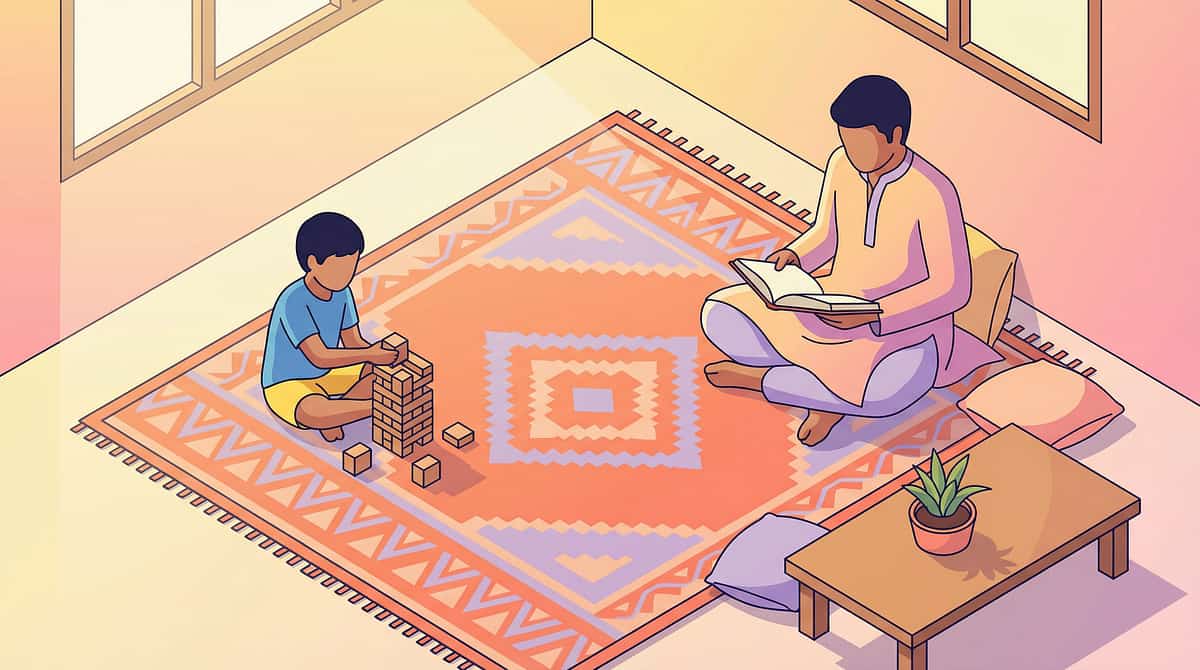
Floor mat or small table, facing wall (not window)
Caregiver Position
Seated at child's side — not directly opposite. Reduces confrontational dynamic.
Materials Position
On a tray to the left within reach, not all visible at once
Story Display Area
Blank wall space or easel board for attaching cards
Visual Timer + Exit Route
Timer visible within child's sightline. Exit route clear, no obstacles.
Setup Checklist: ☐ Low table or floor mat (child chooses) ☐ Soft, diffuse lighting ☐ TV/ambient sound off ☐ Distractions removed ☐ Visual timer set for 10 minutes ☐ Transition object ready ☐ Data sheet ready
Indian Home Context: In joint-family households, coordinate with elders that session time (10–15 minutes) should be uninterrupted. Sessions on the floor on a durrie/chatai are equally effective as table sessions.
Indian Home Context: In joint-family households, coordinate with elders that session time (10–15 minutes) should be uninterrupted. Sessions on the floor on a durrie/chatai are equally effective as table sessions.
ACT III: THE EXECUTION
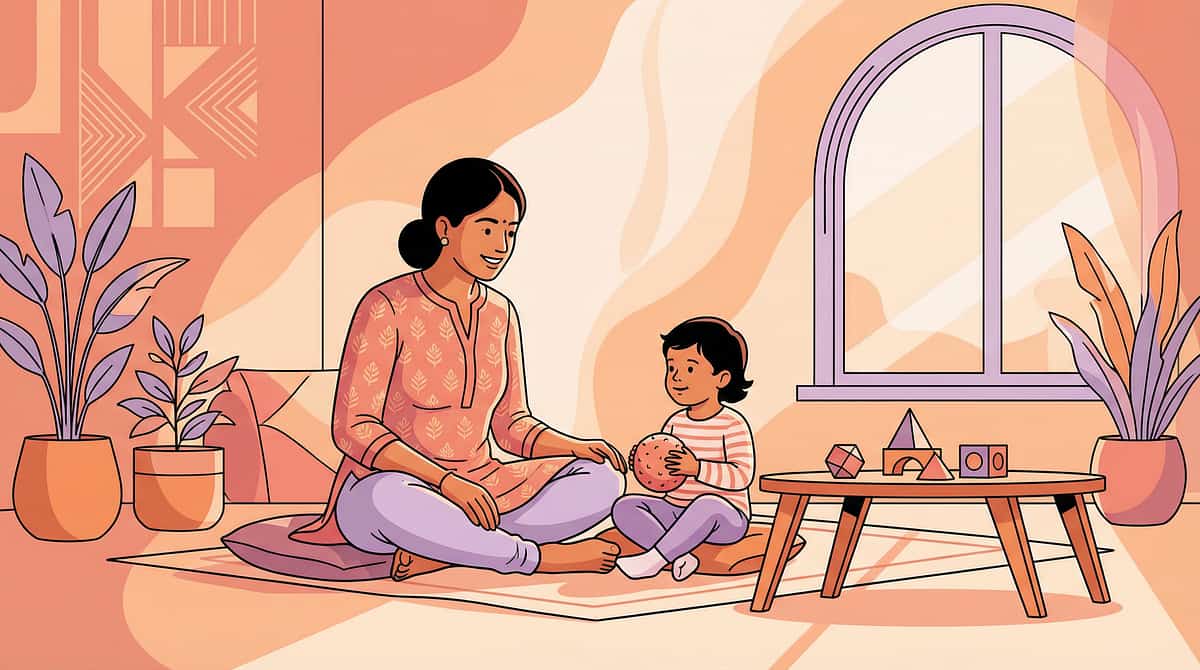
60-Second Readiness Check — Before Every Session
Child is calm
Not post-meltdown within 2 hours
Child has eaten within the last 2 hours
Child shows at least one attention signal
Eye contact OR pointing OR vocalizing in response to you
Preferred session material is visible and accessible
Space is set up, visual timer is visible and set
You (caregiver) are present, not distracted by phone/task
🟢 5–6 checked: GO
Proceed to Step 1 — The Invitation
🟡 3–4 checked: MODIFY
Reduce to 5 minutes. Use only highest-interest book. No grammar markers today — just retelling.
🔴 0–2 checked: POSTPONE
Today is not the day. Offer 5 minutes of preferred play instead. No guilt. Data note: "Session postponed — regulatory state."
"The best session is one that starts right. A postponed session is never a failed session — it is clinical judgment in action."
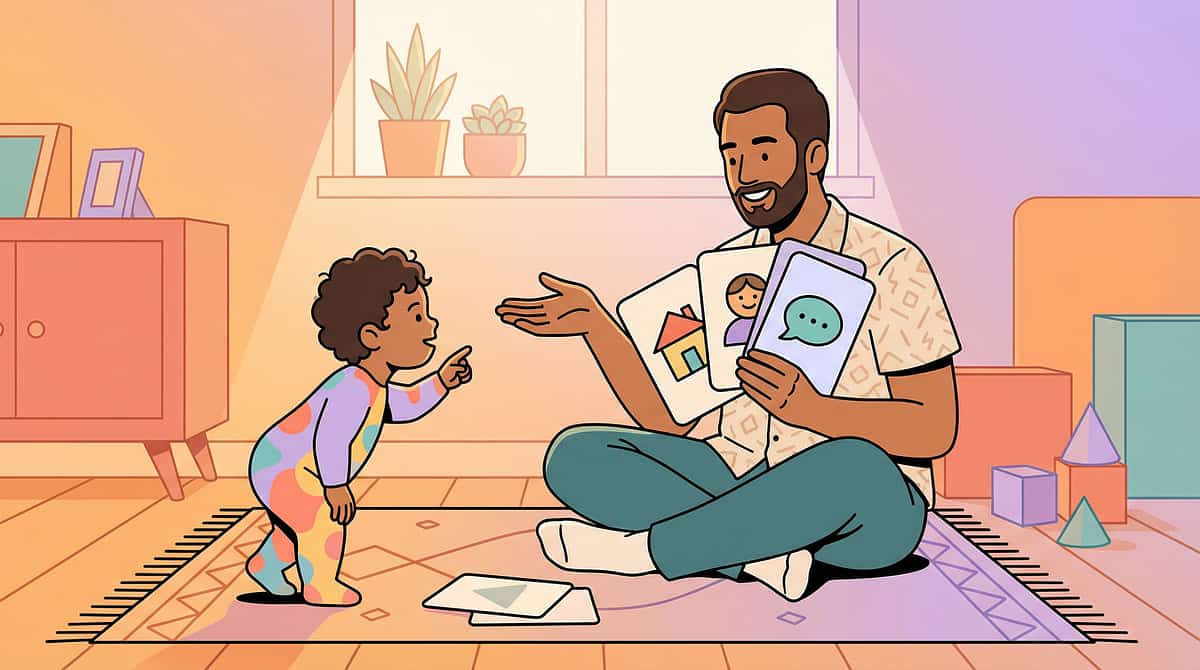
Step 1 | ⏱ 30–60 seconds
Every Story Begins With an Invitation, Never a Command
"[Child's name], I have something really cool to show you. Look — these are story pieces. Want to make a story together?"
Alternative for non-verbal or low-verbal child: Pick up the Character icon. Hold it up. Wait 3 seconds. Point to the story mat. Wait. Do not demand verbal response.
Acceptance Cues — What to Look For
- Child looks at the material (even briefly) ✓
- Child reaches toward it ✓
- Child makes a sound, babble, or word ✓
- Child moves toward the story mat ✓
Resistance Response
If child pushes away or turns: "That's okay. We can try the [preferred book] first." Offer the book for 2 minutes, then re-invite once.
⏱ Maximum 30–60 seconds for the invitation phase. Keep the energy warm, never pressured.
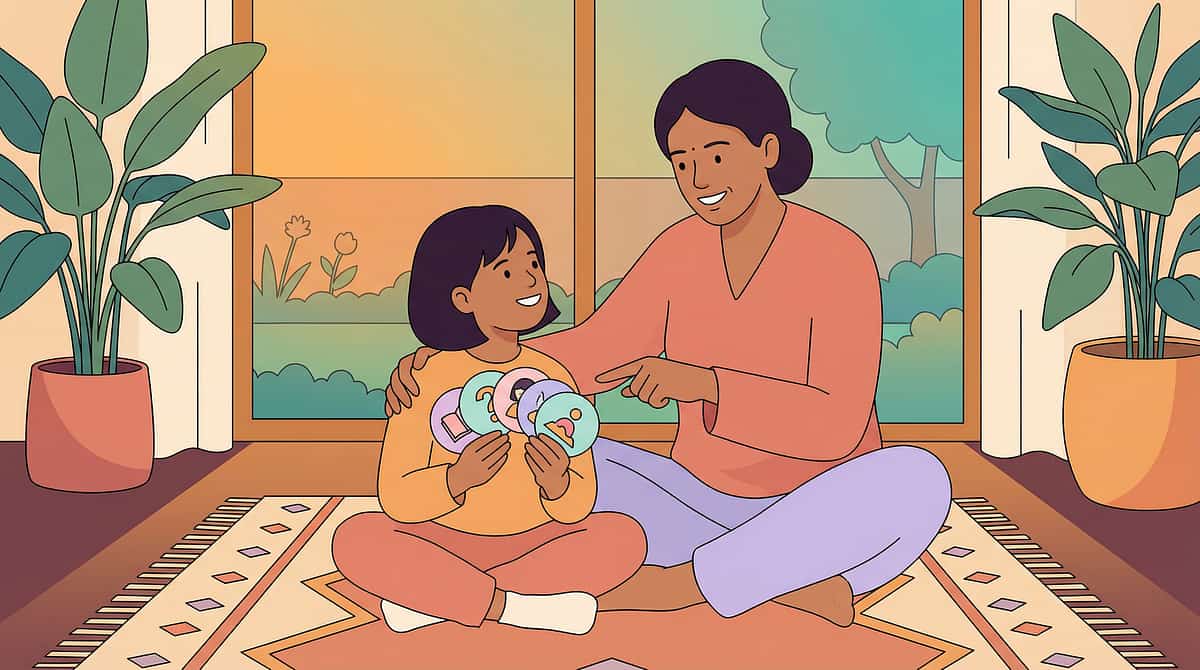
Step 2 | ⏱ 1–3 minutes
Child In. Materials Out. Keep the Energy Warm.
"Okay, here's our Character [place Character icon]. Who do you think this could be? A boy? A dog? A rocket? [Wait. Accept any answer or point.] Perfect — [Child's answer] it is."
Place only the Character icon first — not all icons at once. One element at a time reduces overwhelm and maintains the "just-right challenge" threshold.
✅ Engagement
Picks up icon, names character, looks at you expectantly
⚠️ Tolerance
Looks briefly, doesn't touch, but isn't refusing — continue gently
🛑 Avoidance
Pushes away, leaves, escalates — go to Troubleshooting card
Reinforcement Cue: The moment the child engages (even glances): "Yes! That's it! Great idea!" Deliver immediately and specifically.
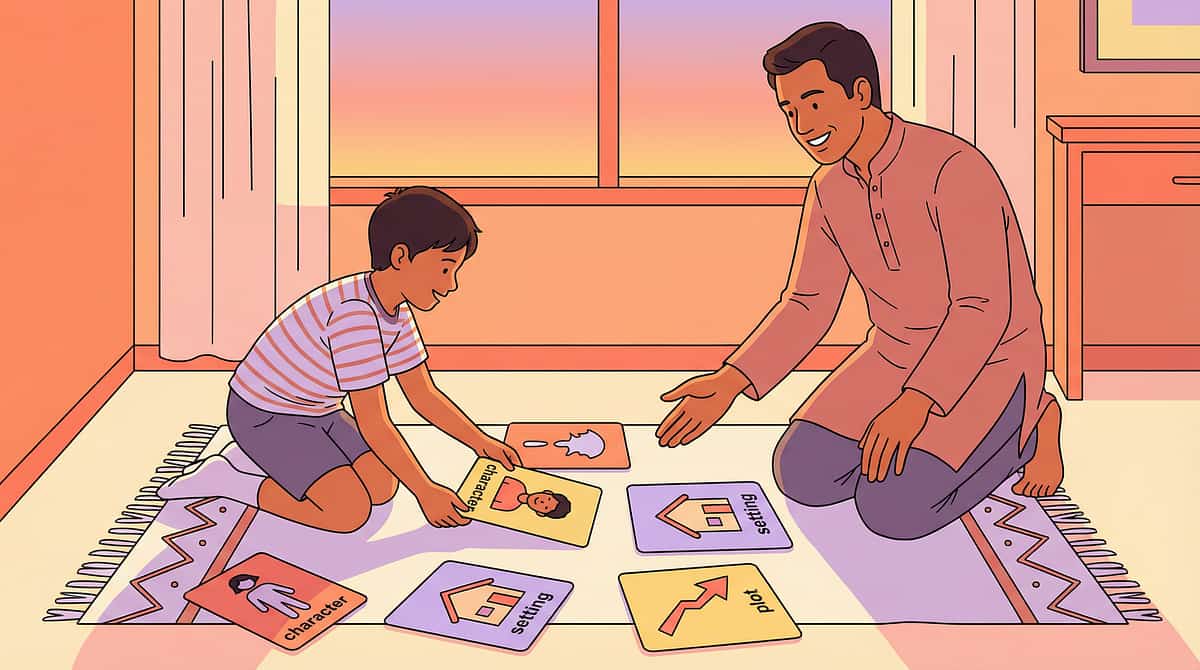
Step 3 | ⏱ 5–8 minutes — Core of Session
Building the Story Architecture — Piece by Piece
Lay a horizontal story mat — or simply 5 squares of paper in a row — labeled: WHO | WHERE | WHAT HAPPENED | WHAT DID THEY DO | HOW DID IT END. Place one icon at a time, building the story together. At each slot, wait 5–10 seconds before prompting — wait time is therapeutic, not passive.
⚠️ Common Execution Errors: Don't rush through slots — each slot is a target. Don't fill slots for the child without waiting. Don't require full sentences at start — accept icons, points, and single words. The "Problem" slot is the narrative crux — many children jump to action before establishing the problem. This step builds causal reasoning.
After all five elements are placed, point to each icon from left to right: "[Character] was in [Setting]. One day [Problem] happened. [Character] felt [emotion]. They decided to [Action]. And finally, [Ending]." Then ask child to tell it back. Accept partial retelling with joy.
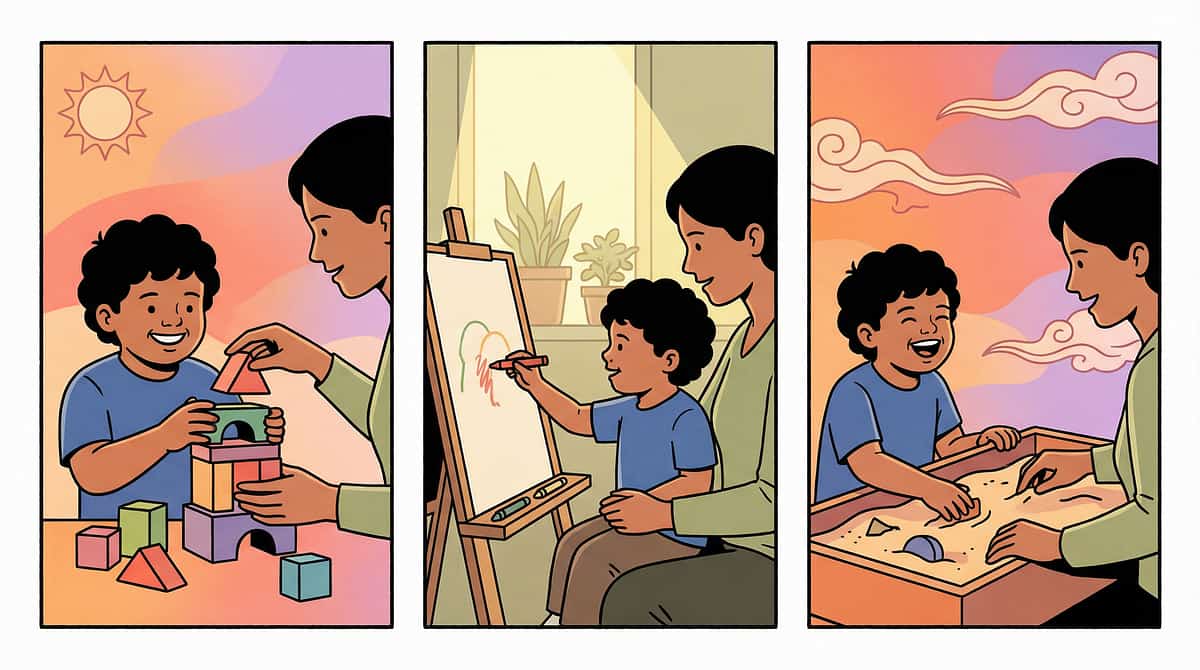
Step 4 | ⏱ 3–5 minutes
3 Good Reps Beat 10 Forced Ones
1
Round 1
Caregiver tells the story using icons. Child watches.
2
Round 2
Caregiver and child tell together (co-construction). Cue each slot.
3
Round 3
Child tells alone with icons visible. Caregiver only prompts if stuck.
Variation A
Wordless picture book — child applies story grammar to book pages
Variation B
Family photos — tell a real family story from the photo book
Variation C
Role reversal — child is the "teacher," caregiver makes deliberate mistakes for child to correct
Variation D
Draw-and-tell — child draws in each box instead of placing icons
"If you have 3 good reps with full engagement — stop. End on success, not endurance."
Satiation Indicators (when to stop): Child looks away for >5 seconds per slot | Stimming at higher intensity than baseline | Child makes bid to leave | Affect becomes flat
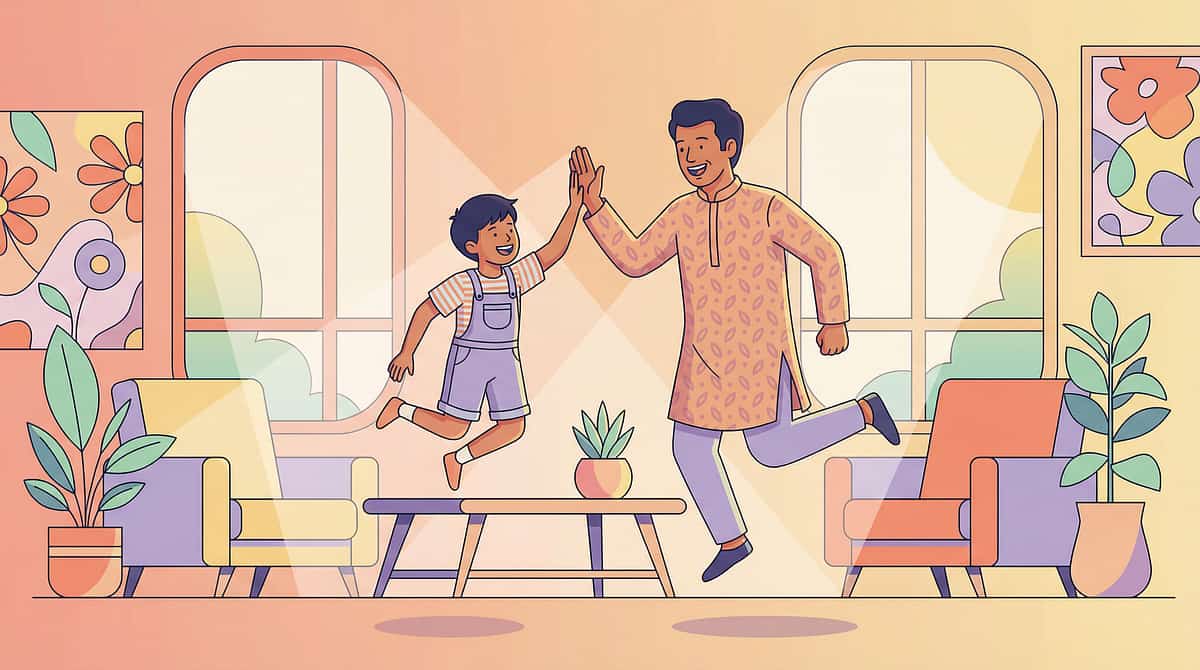
Step 5 | Reinforce & Celebrate
Immediate. Specific. Enthusiastic. That's Reinforcement.
"You told the WHOLE story! [Child's name], that was AMAZING — I heard the character, the problem, AND the ending! You are a storyteller!"
Timing Rule: Deliver reinforcement within 3 seconds of story completion. Every second of delay reduces reinforcement power.
Verbal Praise
Always included. Specific, enthusiastic, immediate.
Sticker Chart
Canon: 1800+ Reward Stickers (₹364, Sno: 390)
Preferred Activity
30 seconds of preferred activity immediately after
Physical Celebration
High five, hug — if child accepts touch
Celebrate the Attempt: If child only completed 2/5 story elements: "You found the character AND the setting — that's the beginning of a story! Beautiful!" Never withhold all reinforcement for incomplete attempts.
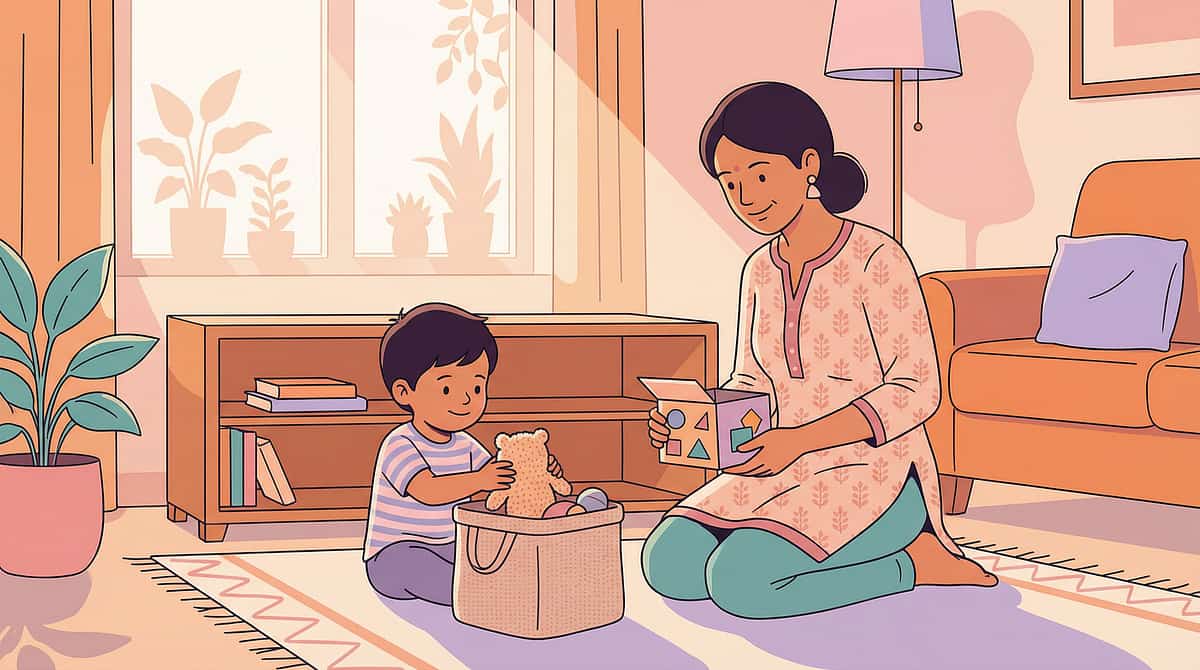
Step 6 | ⏱ 1–2 minutes
No Session Ends Abruptly. We Land Gently.
"2 more, then all done. [Count down with fingers visible] 2... 1... All done! Great work today. [Let child place icons back in box — participation in closure builds routine]."
Option A
Child puts story icons back in their box, one at a time
Option B
Caregiver re-reads one page of a preferred book — low demand, high comfort
Option C
60 seconds of free play with one preferred toy — no direction
Transition Cue: Use a consistent phrase every session: "Story time all done. [Next activity] time." Visual schedule card helps.
If Child Resists Ending: Give one extra retelling: "Tell me one more time — just the ending. Then all done." This meets child's momentum while closing the session.
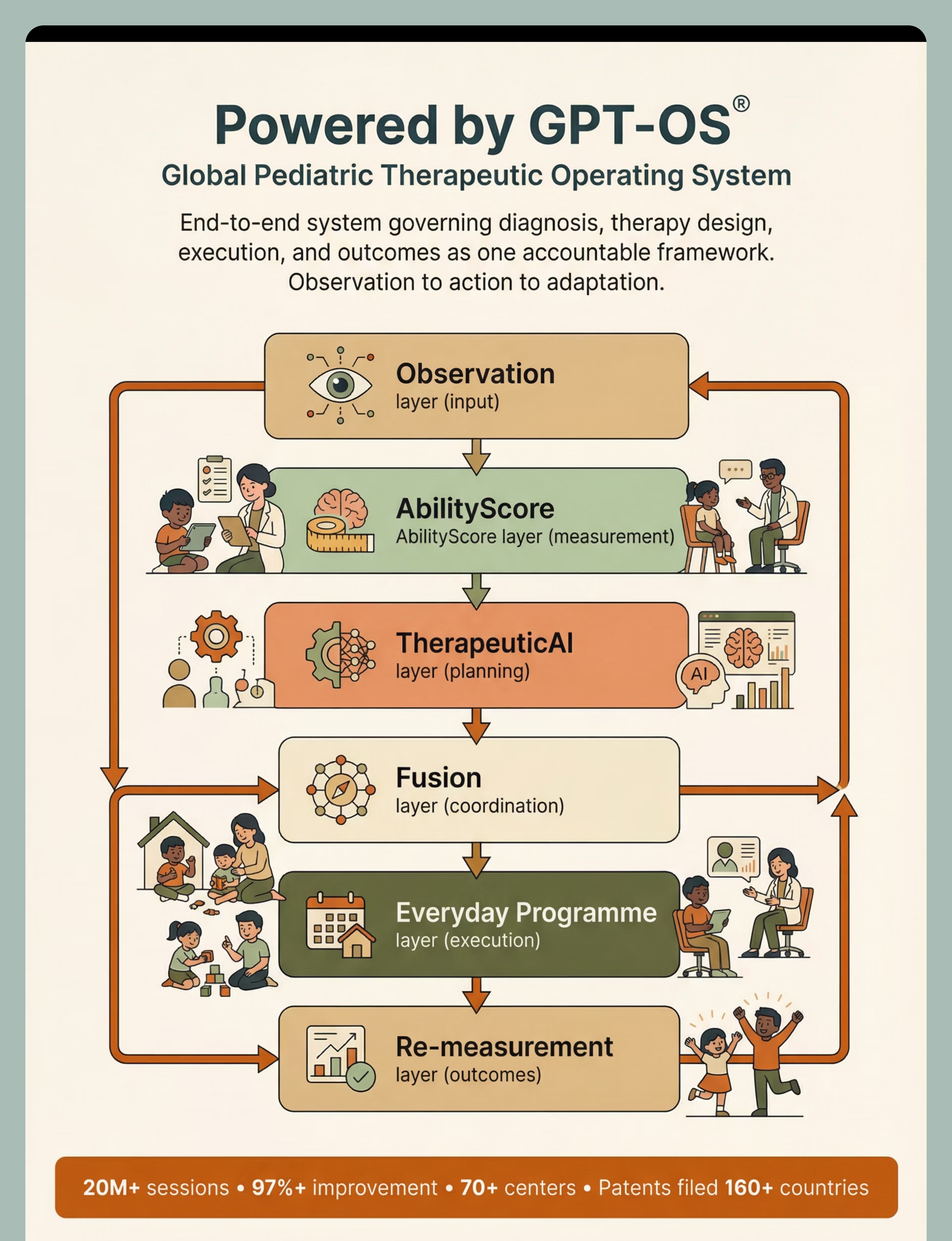
DATA CAPTURE | GPT-OS® INTEGRATION
60 Seconds. 3 Data Points. That's All It Takes.
1
Story Grammar Elements Produced Today
Circle: 0 / 1 / 2 / 3 / 4 / 5 elements. Track which elements the child used independently vs. with prompting.
2
Session Engagement Level
Circle: Full engagement / Moderate / Minimal / Refused. Tracks regulatory readiness patterns over time.
3
Connective Words Used
Note any spontaneous use: first / then / because / so / finally. Tracks linguistic generalization.
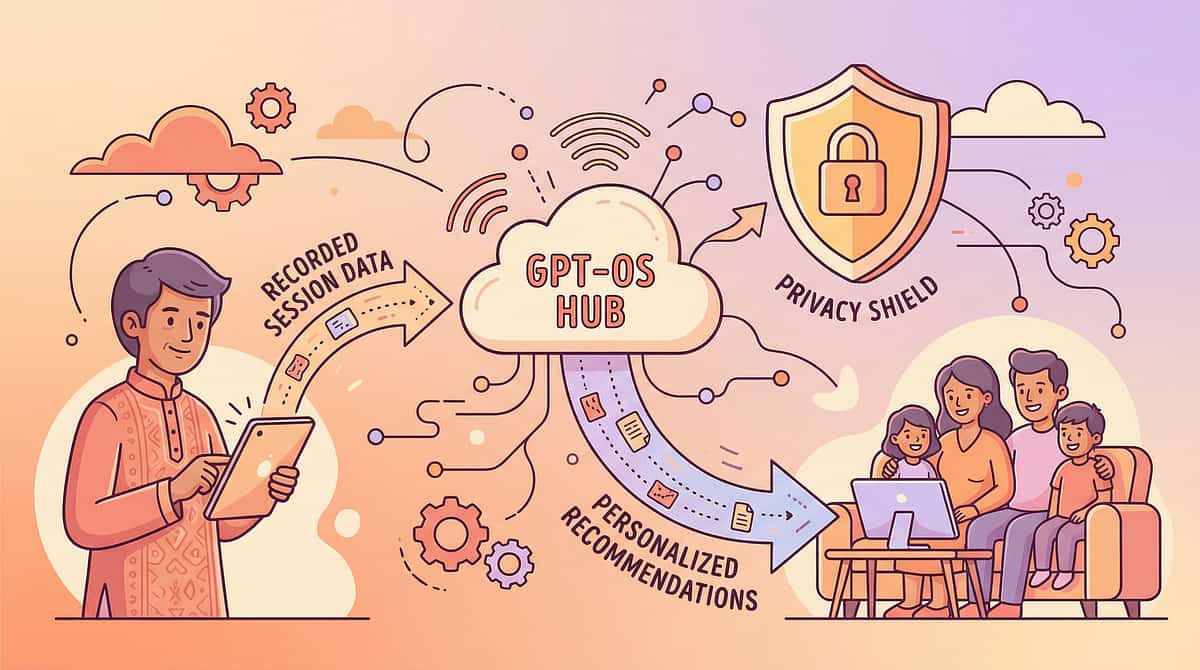
Data is not for the therapist. Data is for your child's future. The algorithm that predicts which technique to try next runs on the data you collect today. Your data feeds your child's personalized TherapeuticAI® plan.

TROUBLESHOOTING | 6 COMMON SCENARIOS
It Won't Always Go Perfectly. Here's What to Do.
Child refuses to touch the icons
Don't force. Place them on the mat and tell the story yourself. Children often watch first for 3–7 sessions before initiating. Your modeling is therapeutic even without their physical participation.
Child lines up icons in a rigid pattern, not a story sequence
Go with it for 30 seconds, then introduce: "And what if the character went HERE? What would happen?" Redirect toward narrative use gently.
Child can sequence but can't add character feelings
Feelings are a separate target. Use emotion cards as an add-on after basic grammar is established. "How did they feel when the problem happened?"
Child tells the same story every session (no variation)
This is a success — the child has internalized one narrative schema. Introduce a new wordless picture book to broaden the template.
Siblings or grandparents interrupt the session
Involve them. "Thatha/Paati, can you listen to [Child's name]'s story?" Audience presence increases communicative motivation.
Child performs perfectly but shows zero generalization to real conversation
This is a clinical red flag requiring professional SLP review. Generalizing from structured tasks to naturalistic storytelling requires a specific phase of intervention. Contact your Pinnacle SLP.
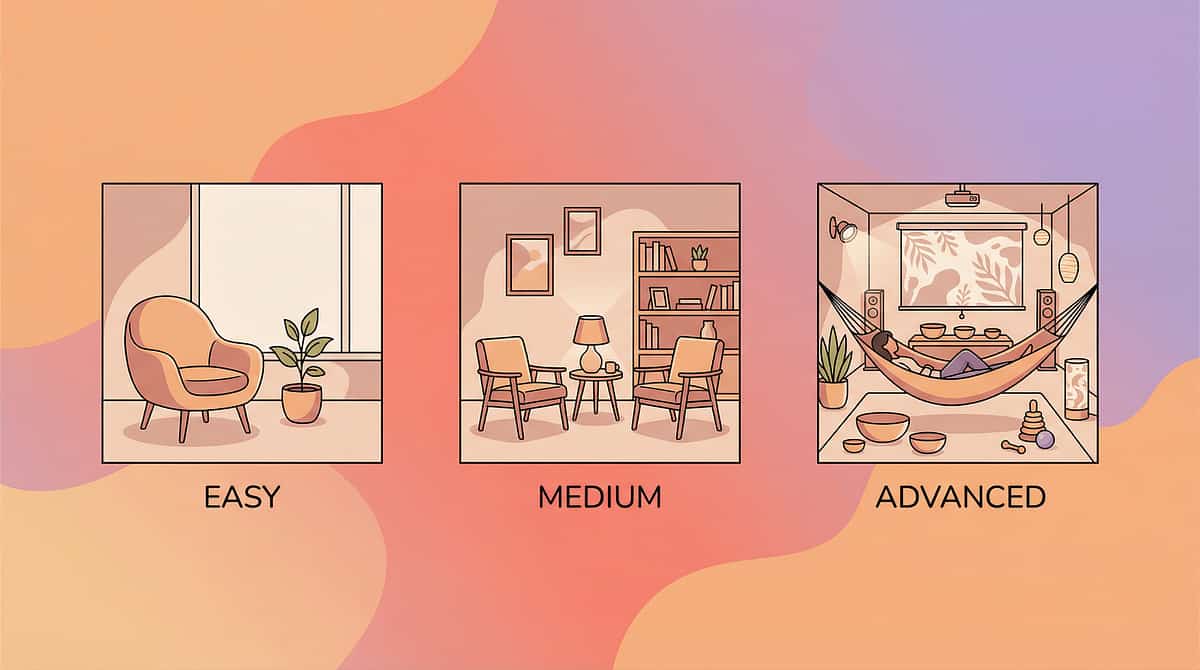
PERSONALIZATION | ADAPT FOR YOUR CHILD
Every Child Is a Different Narrative Learner. Here's How to Calibrate.
Axis 1: Difficulty
- Easier: Use only 3 grammar elements (Character / Problem / Ending). Use personal photo sequences. Caregiver tells, child echoes.
- Standard: Full 5-element story grammar with icons
- Harder: Introduce emotional states, causality, multiple characters. No icons — verbal narrative only.
Axis 2: Sensory Profile
- Sensory Avoider: Use laminated cards (no texture variation), soft voice, dim lighting, minimal props
- Sensory Seeker: Add tactile story icons (foam, texture materials), encourage physical acting out of story elements
Axis 3: Age-Based Adaptation
- 3–5 years: 3-element grammar, personal photo narratives, puppet props
- 6–8 years: Full 5-element grammar, wordless books, transition word focus
- 9–12 years: Multi-episode narratives, writing as output, peer storytelling
Neurodiversity Note: For children with autism who have hyperlexia: Use written word cards alongside icons. For children who love trains, dinosaurs, or specific topics — ALL story grammar can be applied to their preferred topic first before generalizing.

ACT IV: THE PROGRESS ARC | Week 1–2
Week 1–2: Familiarity, Not Mastery
Progress: ████░░░░░░░░░░ 15%
✅ What You WILL See
- Child tolerates icons being on the table (even without engaging)
- Child allows 1–2 icons to be placed by caregiver
- Reduced resistance compared to first session
- Child may begin echoing 1 element of the story
⚠️ What You Will NOT See Yet
- Child independently building stories — not yet
- Spontaneous use of story grammar in conversation — not yet
- Consistent engagement every session — variability is normal at this stage
Data Target for Week 2
Average story elements per session: 0–1 (at prompting). Session engagement: "Tolerance" is a pass at this stage.
"If your child tolerates story time for 2 minutes longer than last week — that is measurable progress. Neural pathways are forming even when you cannot see the output."
PROGRESS ARC | Week 3–4
Week 3–4: The Architecture Is Starting to Hold
Progress: ████████░░░░░░ 40%
Child initiates approach to story mat (even once)
Child places 1–2 icons independently
Child can complete story with full caregiver support
Child begins using "then" or "and" to connect story elements
Milestone Moment to Celebrate: The first time your child looks at a picture in a book and says "The dog has a problem!" unprompted — that is story grammar schema activating. It will happen. Celebrate loudly.

PROGRESS ARC | Week 5–8
Week 5–8: Independent Stories Are Emerging
Progress: ████████████░░ 70%
Icon Independence
Child independently uses 3–4 story grammar elements with icon support
Connective Language
Child begins using "because," "so," and "finally" spontaneously
Retelling Emerges
Child can retell a familiar story with minimal prompting
Play Generalization
Stories begin appearing in play: "And then the car had a problem!"
Research Note: Meta-analysis (PMC10955541) confirms 8-week narrative intervention produces significant improvements in both story production and comprehension measures in pediatric populations.

Mark Every Milestone. They Are Real Achievements.
First Character Icon
Child placed a Character icon independently
First Connection
Child said "and then" to connect two story events
First Book Story
Child told a 3-element story from a wordless book
First Real Story
Child told you about their school day with a beginning and ending
First Correction
Child corrected YOU when you told the story wrong
First Sharing
Child explained to Grandparent what happened in their day
"Milestones are not benchmarks against other children. They are your child's personal victories. Every single one matters."
CLINICAL ALERT | WHEN TO SEEK HELP
When to Call Your SLP or Pinnacle Helpline
🚩 After 8+ weeks of consistent practice
Zero story grammar elements produced even with full support — requires professional evaluation
🚩 Language Regression
Child is using fewer words or sentences than 4 weeks ago — report immediately
🚩 Expressive-Receptive Dissociation
Child understands stories perfectly in comprehension but produces nothing — indicates a pattern requiring formal assessment
🚩 Persistent Distress
Child shows significant frustration or emotional distress during every session despite all modifications
🚩 Sudden Narrative Loss
Child's narrative ability was present and has suddenly disappeared — urgent evaluation needed
Red flags are not failures. They are clinical signals that the intervention needs professional calibration. This is exactly what the Pinnacle Consortium SLPs are here for.
TECHNIQUE PATHWAY | WHERE YOU ARE
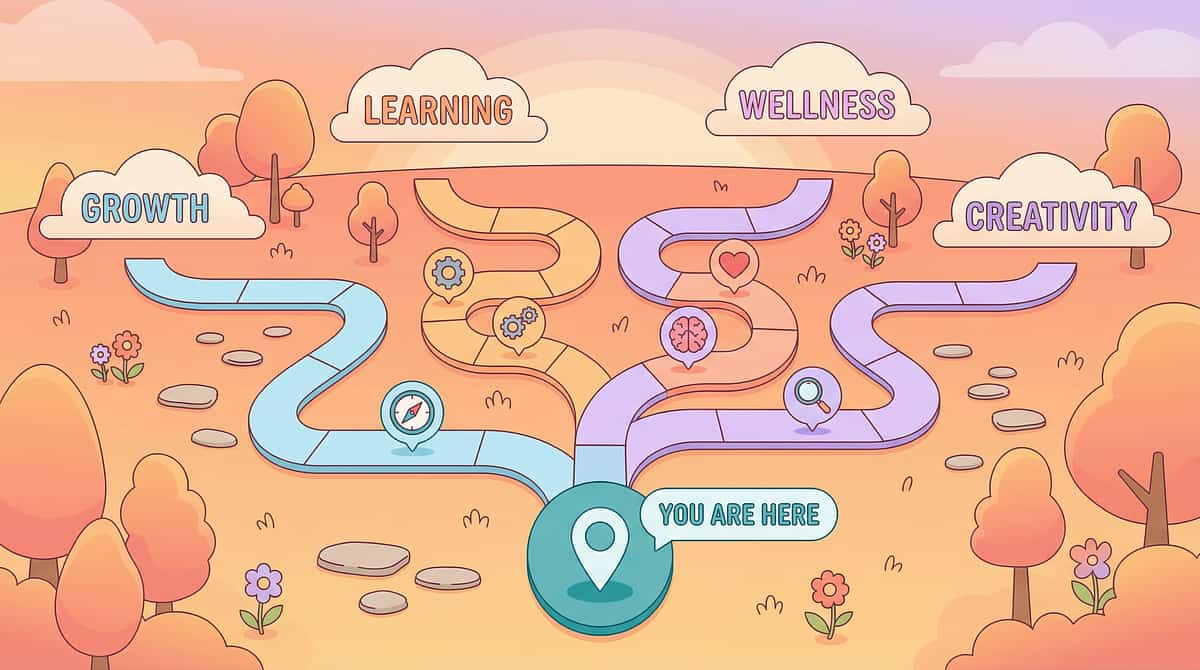
B-204 in Your Child's Language Development Journey
B-198
Turn-Taking in Conversation
B-202
Sequencing Events
★ B-204
Narrative Skills — YOU ARE HERE
B-206
Retelling Stories
B-210
Conversation Maintenance
B-215
Academic Narrative
Prerequisite Check
Before B-204 works optimally, your child should have:
- B-198 (Turn-taking): 80% mastery ✓
- B-202 (Event sequencing): Emerging to mastery ✓
Next Level After B-204
Once child narrates independently with story grammar:
- → B-206: Story Retelling from Text
- → B-208: Emotional States in Narrative
- → B-210: Conversation Narrative
RELATED TECHNIQUES | DOMAIN B
Other Techniques That Build Narrative Skills
B-198 | Turn-Taking in Conversation
🔁Prerequisite to B-204 | Intro level | Builds the conversational foundation that makes narrative exchange possible
B-202 | Event Sequencing
📦 Uses same Sequencing Cards | Core level | Temporal ordering of events — the scaffold B-204 builds upon
B-205 | Question Comprehension
📦 Story Comprehension Cards | Core level | Answering "who, what, why, when" — feeds directly into story grammar understanding
B-206 | Story Retelling
📦 Uses Story Retelling Kit | Advanced level | Next step after B-204 mastery — retelling from text with fading support
B-208 | Emotional States in Narrative
📦 Emotion + Story Grammar Cards | Advanced level | Adding character feelings and motivations to the story architecture
A-088 | Visual Processing Support
📦 OT Foundation | Prerequisite for icon use | Ensures visual tracking and visual discrimination are ready for card-based work
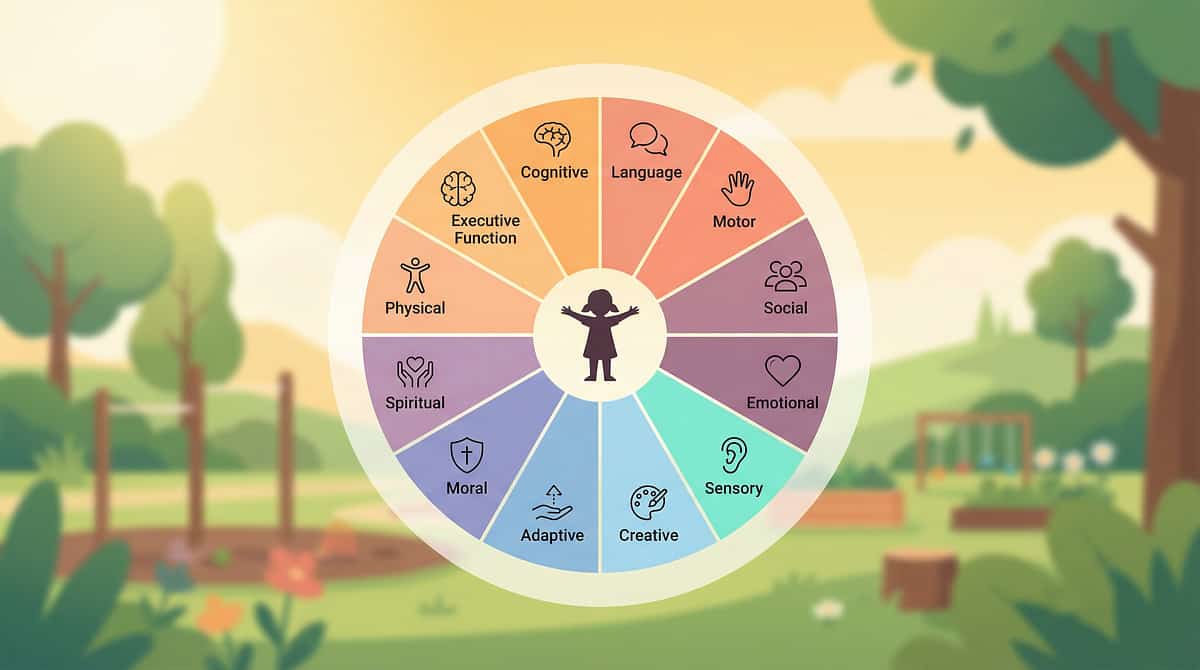
B-204 Is One Piece. Here Is the Whole Picture.
This technique is one node in a 999-technique network, all connected, all calibrated to your child's AbilityScore®.
Domain B: Social Communication is where B-204 lives — but your child's narrative development connects to sensory regulation (Domain A), emotional literacy (Domain C), motor skills for card manipulation (Domain E), and academic readiness (Domain H). The whole child develops together.
ACT V: COMMUNITY & ECOSYSTEM | FAMILY STORIES
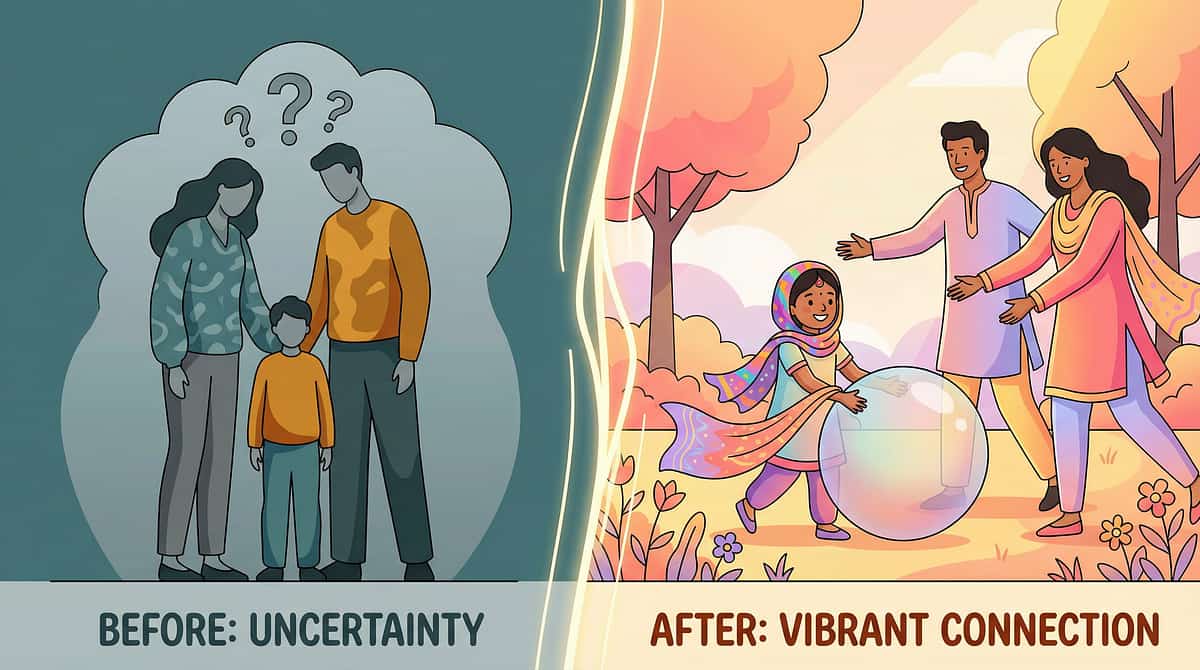
From Fragments to Flowing Stories
Lakshmi, Mother | Bengaluru | Age 6 | ASD
"Arjun was 6 and could name things — colors, animals, toys — but when I asked him what happened at school, I got three words. After 6 weeks of the story grammar technique with sequencing cards, he told me a story with a beginning, a problem, and an ending. I actually cried."
Priya & Rajan, Parents | Chennai | Age 8 | DLD
"We thought the storytelling books were too hard for Kavya. But the wordless picture books changed everything — she could tell the story without being blocked by reading. Now she makes up stories at bedtime."
Shweta, Mother | Delhi | Age 9 | Autism + ADHD
"My son's school teacher said he couldn't participate in 'show and tell.' After 8 weeks at home with the story maps, he told his class about our trip to Shimla. His teacher called me to tell me. I will never forget that call."
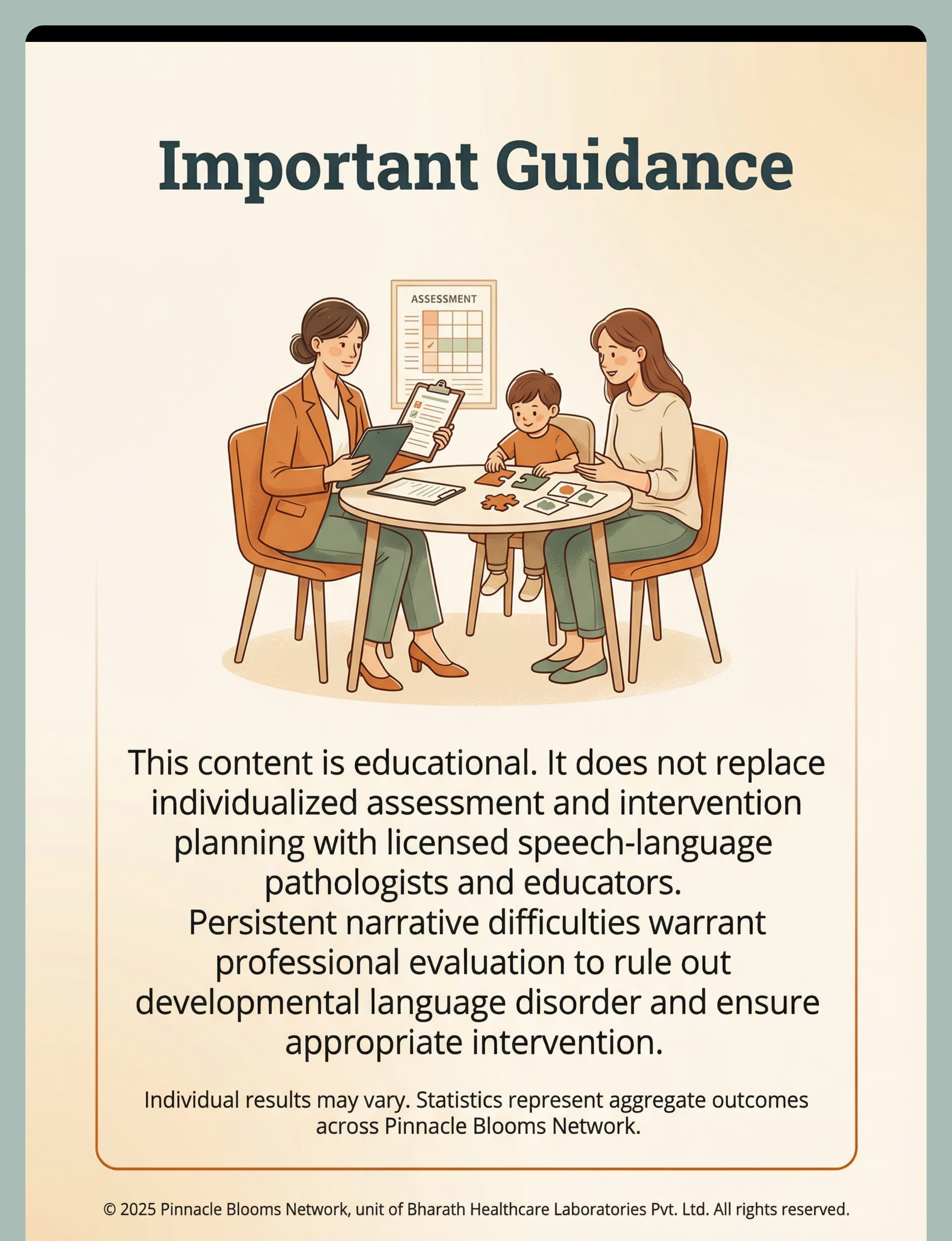
Individual results may vary. Statistics represent aggregate outcomes across Pinnacle Blooms Network. Names changed for privacy.
COMMUNITY | 10,000+ FAMILIES
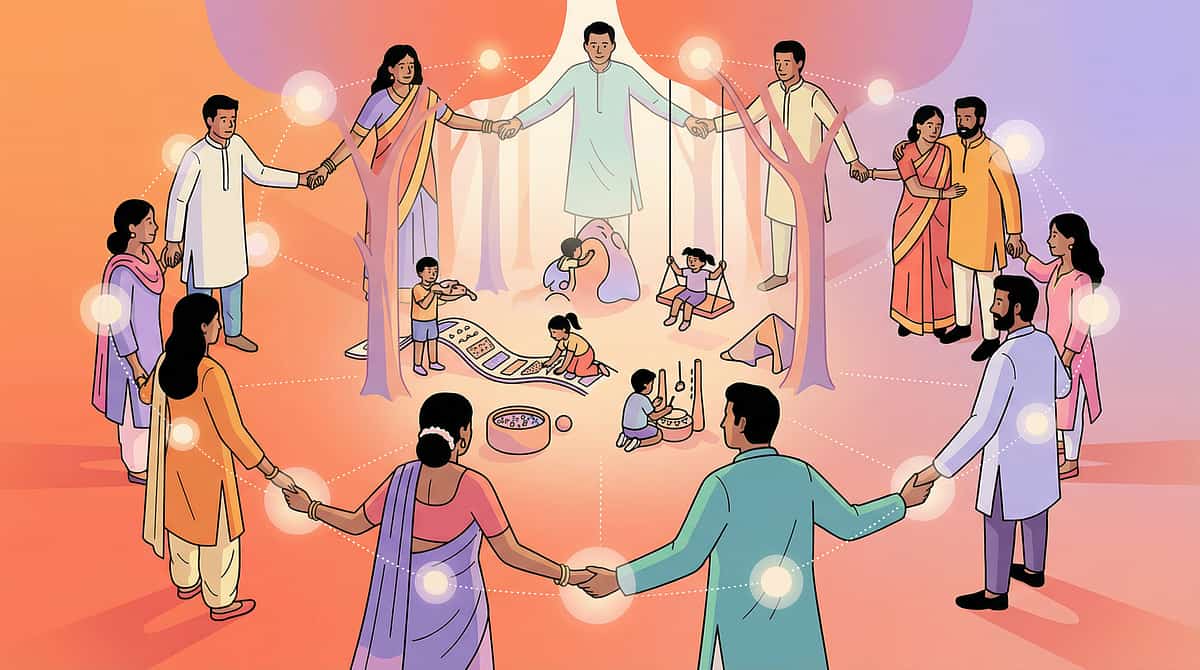
10,000+ Families Are Already Practicing This Technique
WhatsApp Community
Join Pinnacle Parents WhatsApp Group — Domain B: Language. Share experiences, ask questions, celebrate milestones together.
Online Forum
Pinnacle Community Forum: Narrative Skills. Moderated by Consortium SLPs. In 16+ languages.
Success Stories on YouTube
Watch parent success stories and technique demonstrations from Pinnacle SLPs.
Share Your Milestone
Share your child's story milestone on Instagram #PinnacleNarratives. Your story inspires other families.
Monthly Live Session: Pinnacle SLPs host a live Q&A for B-Domain techniques every 2nd Saturday. Free for all families. Register to secure your spot and bring your questions directly to the Consortium team.
PROFESSIONAL SUPPORT | THREE PATHWAYS
When You Need More Than a Technique Page
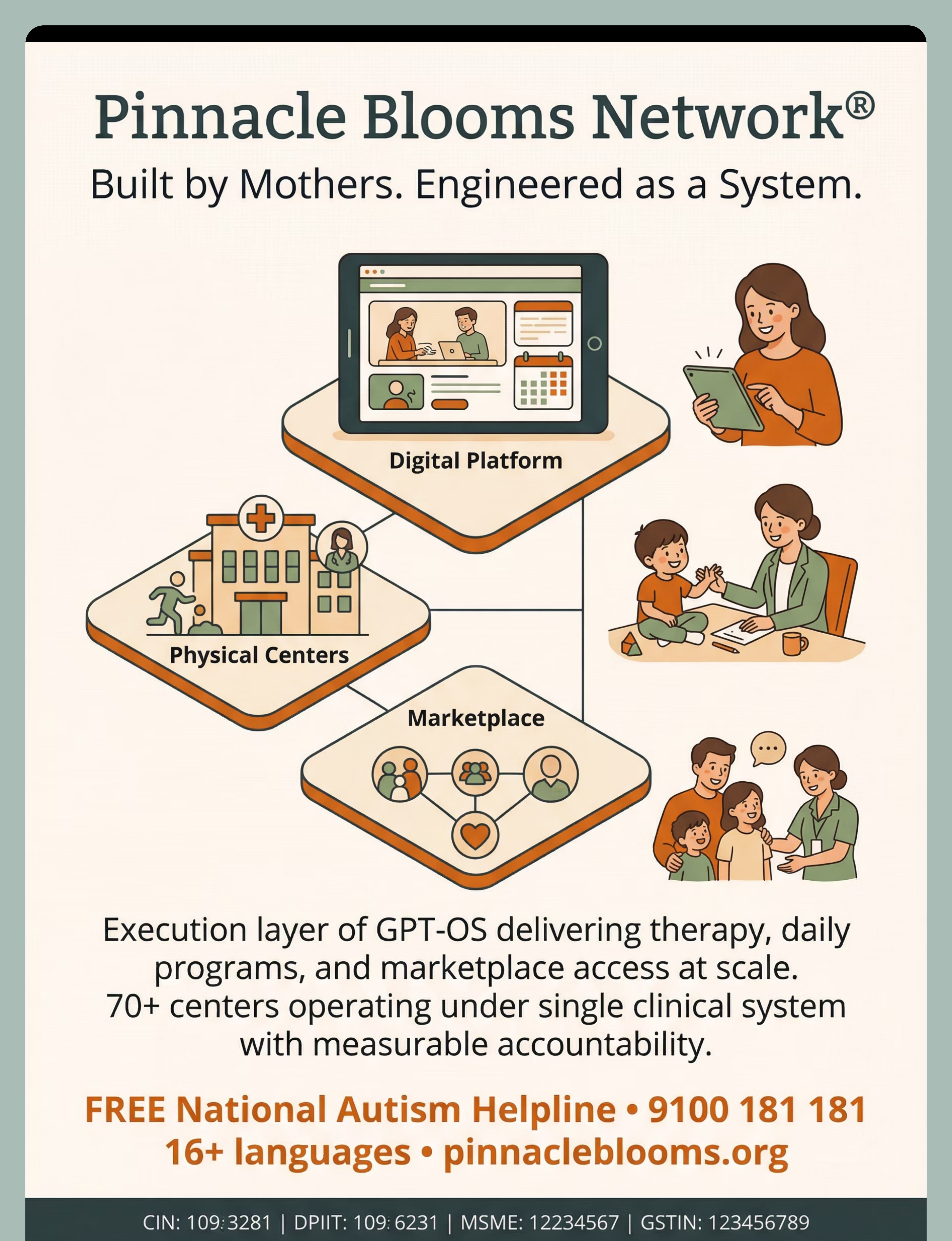
📞 Pathway 1: Home Practice Support
FREE National Autism Helpline: 9100 181 181
16+ languages | 9 AM–9 PM | Staffed by trained Pinnacle advisors. For questions about any step in this technique, anytime.
16+ languages | 9 AM–9 PM | Staffed by trained Pinnacle advisors. For questions about any step in this technique, anytime.
🏥 Pathway 2: In-Center Assessment & Therapy
70+ Pinnacle Blooms Network centers across India. Specialties: SLP, OT, ABA, SpEd, NeuroDev Pediatrics.
Find your nearest center →
Find your nearest center →
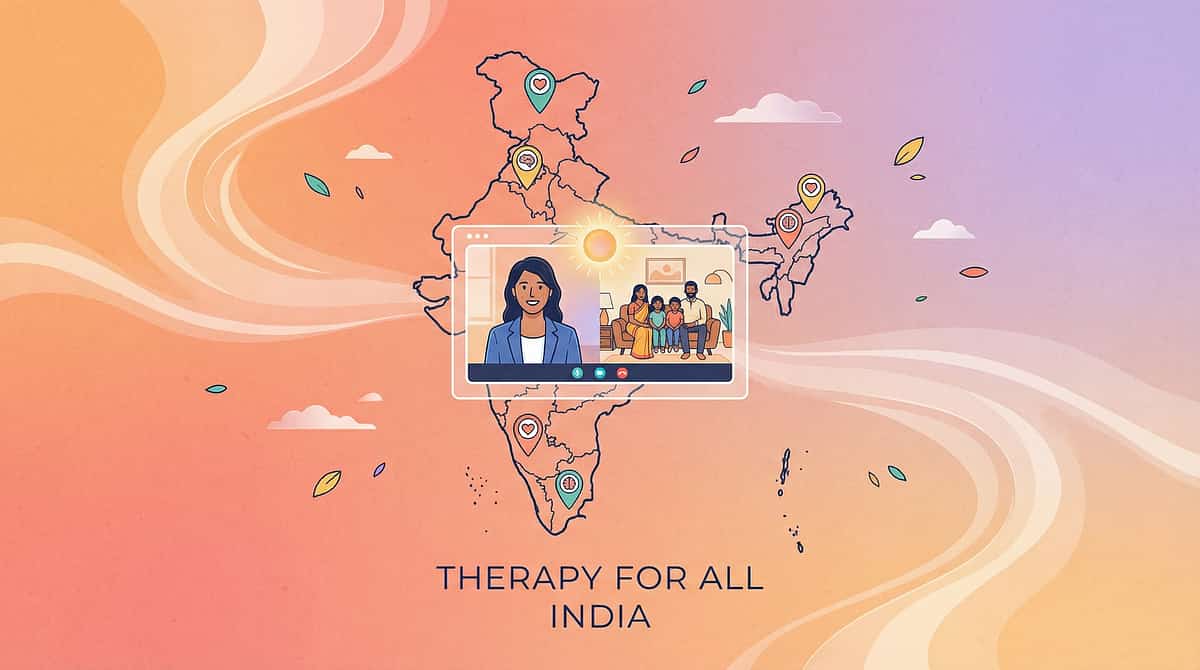
💻 Pathway 3: Teleconsultation
Can't reach a center? Book a 45-minute video consultation with a Pinnacle SLP from anywhere in India or internationally.
Book teleconsultation →
Book teleconsultation →
International Families: Pinnacle serves families in 70+ countries via teleconsultation. Our SLPs are experienced with Indian-origin families globally and can deliver sessions in 16+ languages.
RESEARCH LIBRARY | EVIDENCE BASE
The Science Behind B-204: For the Curious Mind
Key Studies
- PMC11506176 — PRISMA review, 2024: Narrative intervention EBP confirmation
- PMC10955541 — Meta-analysis, 24 studies
- Padmanabha et al., Indian J Pediatr, 2019 — DOI: 10.1007/s12098-018-2747-4
- Justice et al. (2006) — Narrative predictors of literacy
Deeper Reading (For Professionals)
- Frontiers in Integrative Neuroscience (2020) — DOI: 10.3389/fnint.2020.556660
- Int J Speech-Lang Pathol (2022) — DOI: 10.1080/17549507.2022.2141327
GPT-OS® | TECHNOLOGY INTEGRATION
Your Sessions Power a Living System
Privacy Assurance
🔒 ISO 27001 Certified
DPDP Act 2023 Compliant
Your data belongs to you
DPIIT Registered
DPDP Act 2023 Compliant
Your data belongs to you
DPIIT Registered
Population Impact
Every data point from every family across 70+ centers and 70+ countries improves the algorithm for every child like yours. "Your data helps every child like yours."
WATCH THE REEL | EPISODE 204
Watch Before You Practice: 9 Materials Demonstrated
🎬Play: Episode 204 — 9 Materials That Help With Narrative Skills
Runtime: ~4 minutes | Language: English (Hindi / Telugu / Tamil captions available)
Presented by: Pinnacle SLP Consortium Team
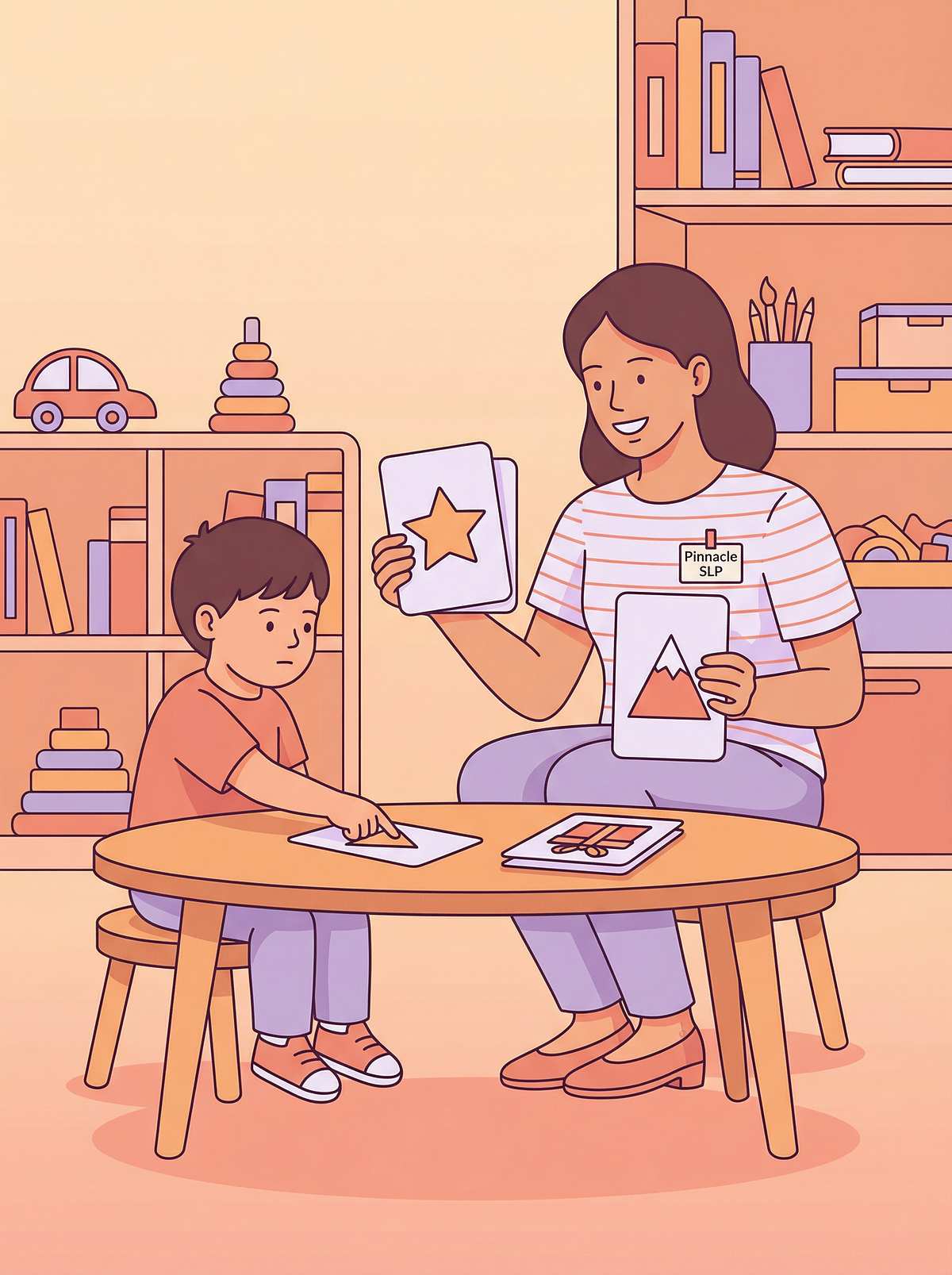
What to Look For: How the SLP introduces each icon to the child | The pace of icon placement | How they handle refusal at 1:42 | The reinforcement delivery at 2:55
Runtime: ~4 minutes | Language: English (Hindi / Telugu / Tamil captions available)
Presented by: Pinnacle SLP Consortium Team
What to Look For: How the SLP introduces each icon to the child | The pace of icon placement | How they handle refusal at 1:42 | The reinforcement delivery at 2:55
← Reel 202
9 Materials That Help With Event Sequencing
📍 Reel 204
9 Materials That Help With Narrative Skills — You Are Here
→ Reel 205
9 Materials That Help With Question Comprehension
SHARE WITH YOUR FAMILY | CONSISTENCY MULTIPLIES IMPACT
Consistency Across Caregivers Multiplies Impact
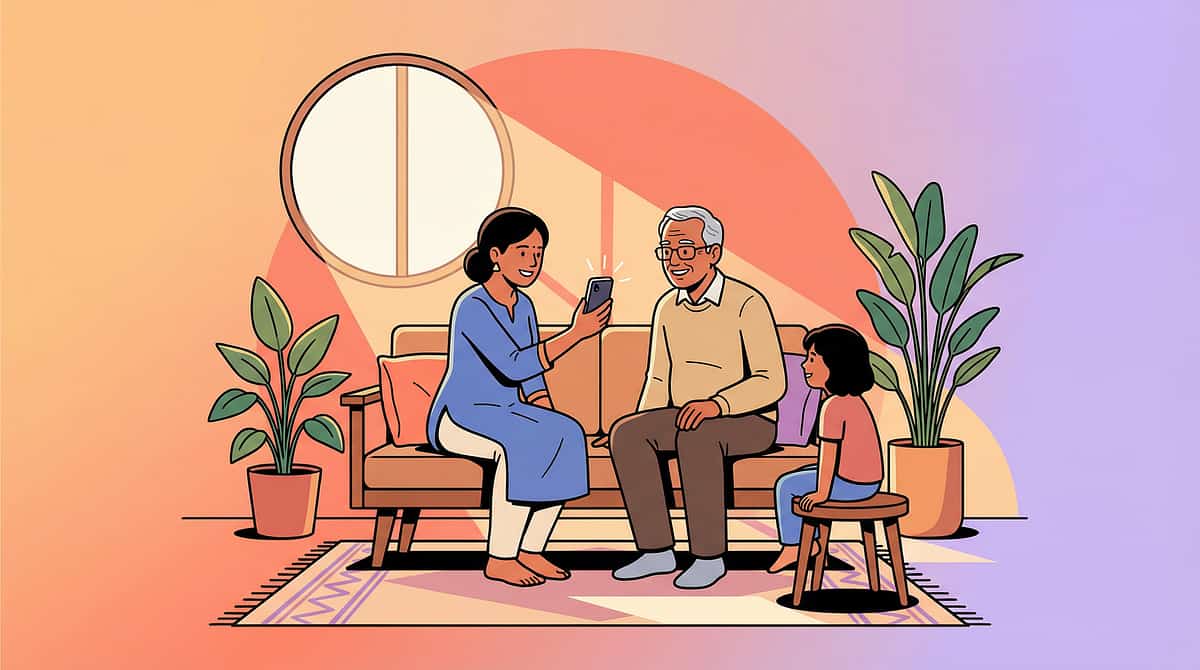
When grandparents, aunts, teachers, and parents all respond to narrative attempts the same way — with encouragement and structure — the child's brain generalizes the skill 3–4x faster. This is not optional. This is science.
B-204 Family Guide
1 page, printable, Hindi + English. Everything a grandparent or aunt needs to support story time.
Weekly Data Sheet
Simple home tracker. Print and stick on the fridge. 3 data points per session.
"Explain to Grandparents"
Story grammar in simple, warm language. Written for elders to read and understand their role.
School Communication Template
Share the approach with your child's teacher. Aligns home and school practice.
"We're using a technique called Story Grammar Intervention with [child's name]. When they try to tell a story, please help them by asking: 'WHO is in the story? WHAT happened? HOW did it end?' Even partial answers get celebrated! 📖✨ More info: techniques.pinnacleblooms.org/social-communication/narrative-skills-B-204"
ACT VI: THE CLOSE | FREQUENTLY ASKED QUESTIONS
Your Questions, Answered
My child loves stories when I read to them but can't tell any themselves. Why?
Comprehension and production use overlapping but distinct neural systems. A child can understand narrative structure without yet being able to generate it. This technique directly builds the production pathway. This gap is common and addressable.
My child is 9 years old. Is it too late to start?
Narrative intervention shows meaningful outcomes across all ages studied (up to 12+). Neuroplasticity supports skill building well beyond early childhood. The technique adapts to age. It is never too late.
My child has a lot of words but can't put a story together. Is that a speech problem?
It is a language organization problem, not a speech or vocabulary problem. This is sometimes called Developmental Language Disorder (DLD). B-204 directly targets this. If persistent, formal assessment with an SLP is recommended.
How many times a week should we practice?
Research recommends 4–5 sessions per week for optimal outcomes. Each session is 10–15 minutes. Consistency matters more than session length.
What if my child makes up completely nonsensical stories?
Celebrate this. Nonsensical stories still contain story grammar elements. Engage with the content: "So the flying pickle had a PROBLEM? What was the problem?!" You're building the architecture regardless of the content.
My child's SLP doesn't use these materials. Should I tell them?
Yes. These materials are all clinically validated. Share this page URL with your SLP. This is designed to complement — not replace — professional therapy. Most SLPs will appreciate the structured home carryover materials.
Can I use this with my child who doesn't have autism but has a language delay?
Yes. Story grammar intervention is effective across all causes of narrative difficulty — autism, DLD, intellectual disability, ADHD, and developmental delay. The technique is disability-neutral.
When should I upgrade to the next technique?
When your child can independently produce a 4–5 element story using the icons in 4/5 sessions over 2 consecutive weeks. That is your mastery criterion for B-204.

Your Child's Story Is Waiting to Be Told.
You have the evidence. You have the technique. You have the materials. The only thing left is the first session.
20M+
Sessions Delivered
97%+
Measured Improvement
70+
Centers Across India
70+
Countries Served
Validated by: SLP • OT • ABA • SpEd • NeuroDev Pediatrics • CRO • GPT-OS®
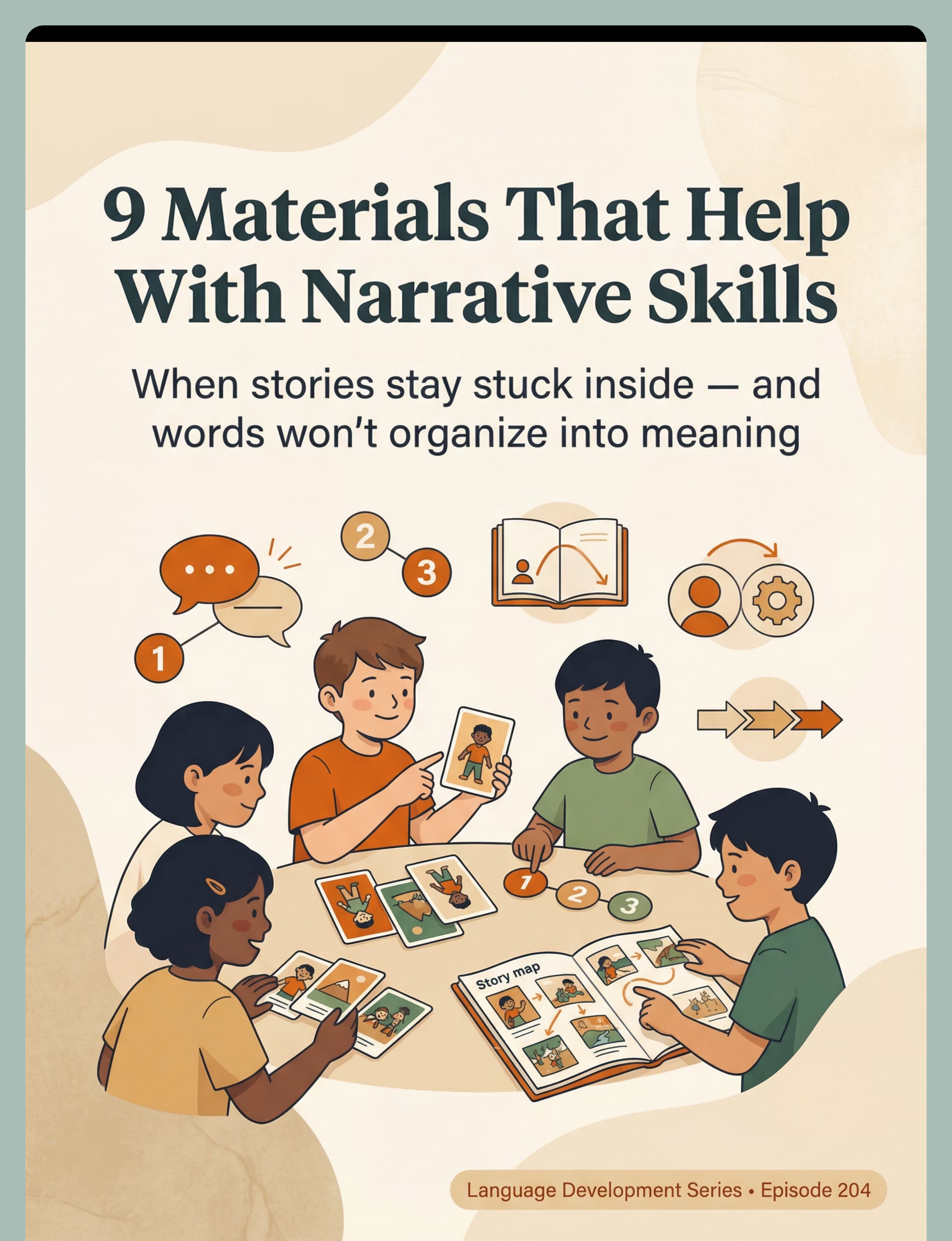
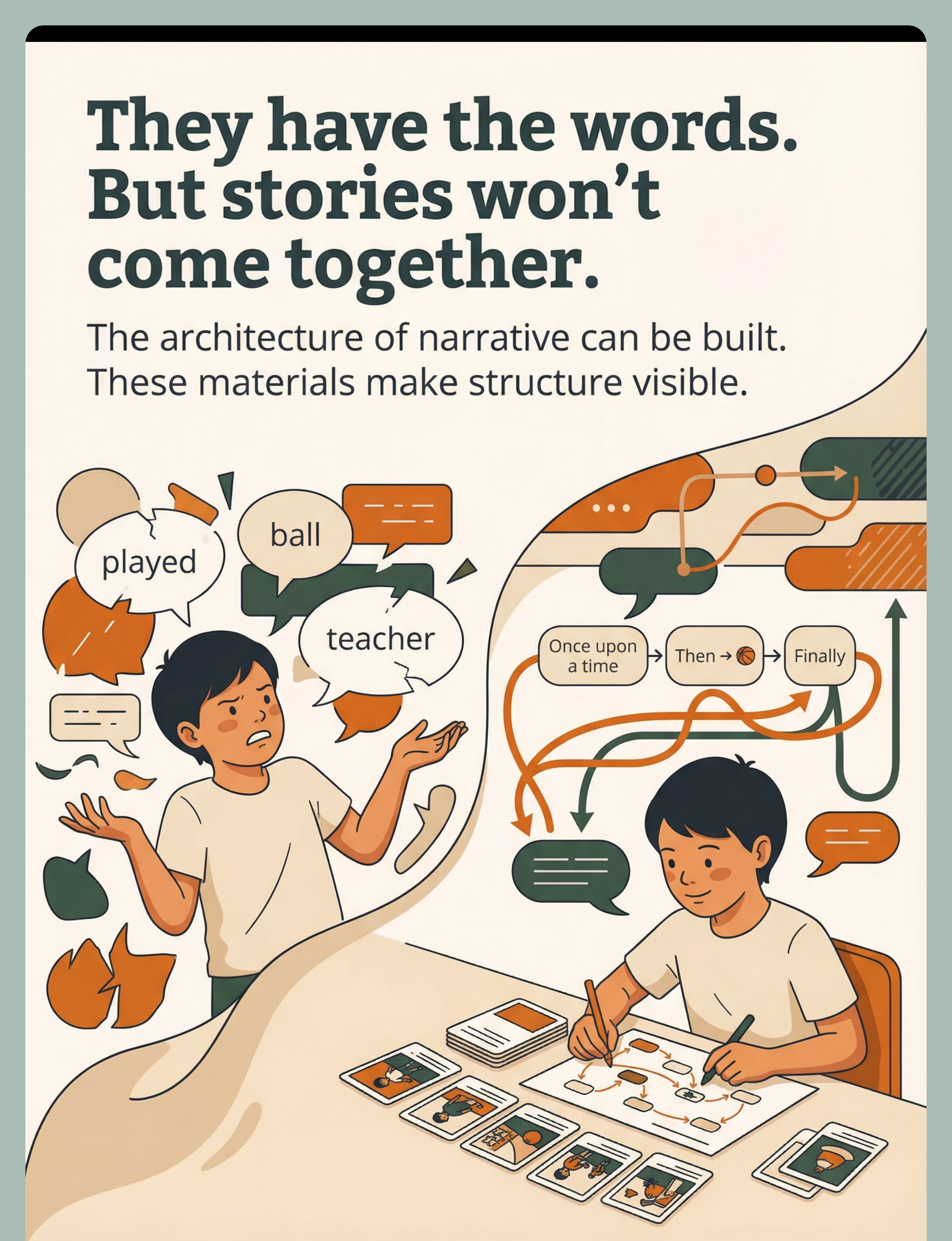
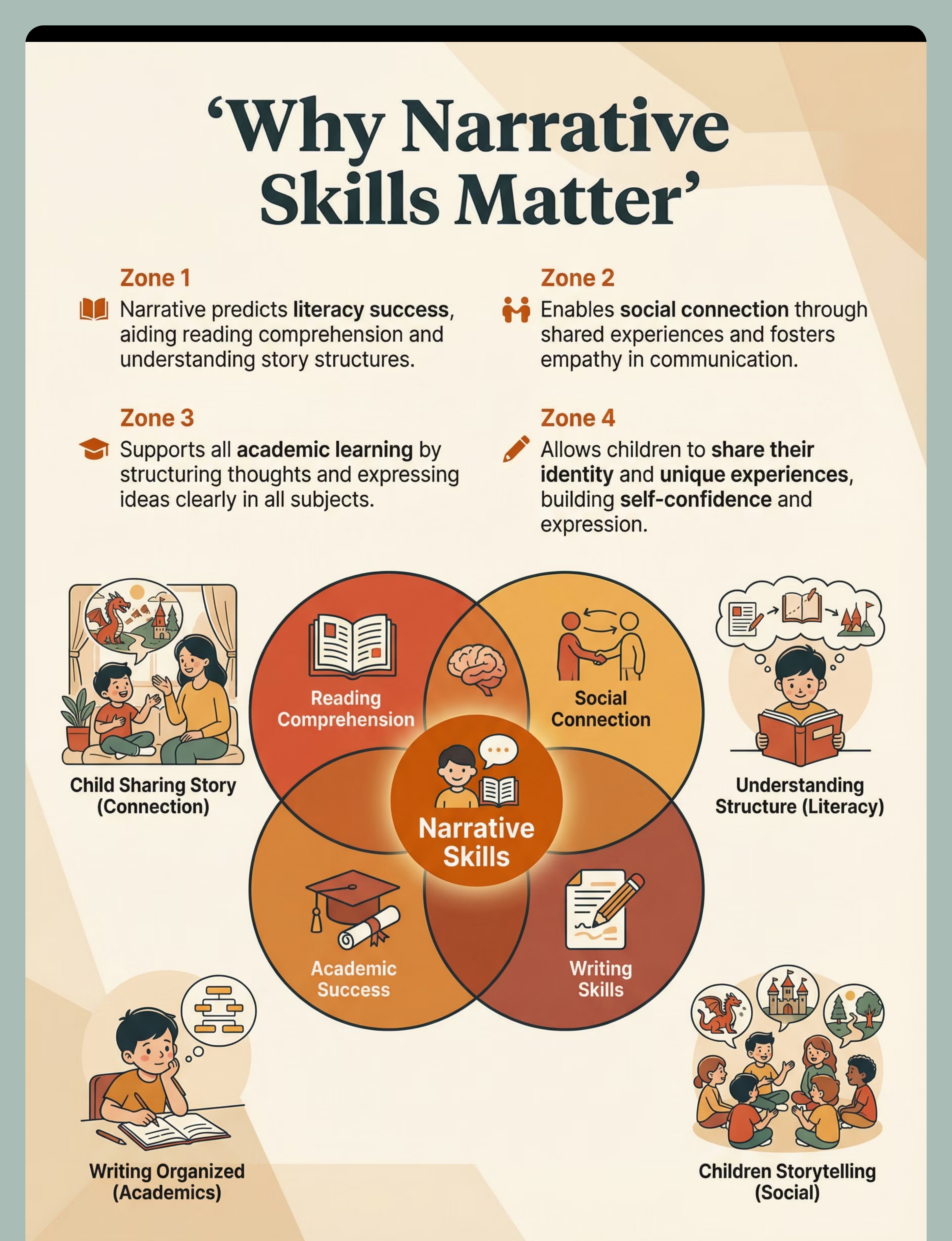
Preview of 9 materials that help with narrative skills Therapy Material
Below is a visual preview of 9 materials that help with narrative skills therapy material. The pages shown help educators, therapists, and caregivers understand the structure and content of the resource before use. Materials should be used under appropriate professional guidance.
Link copied!
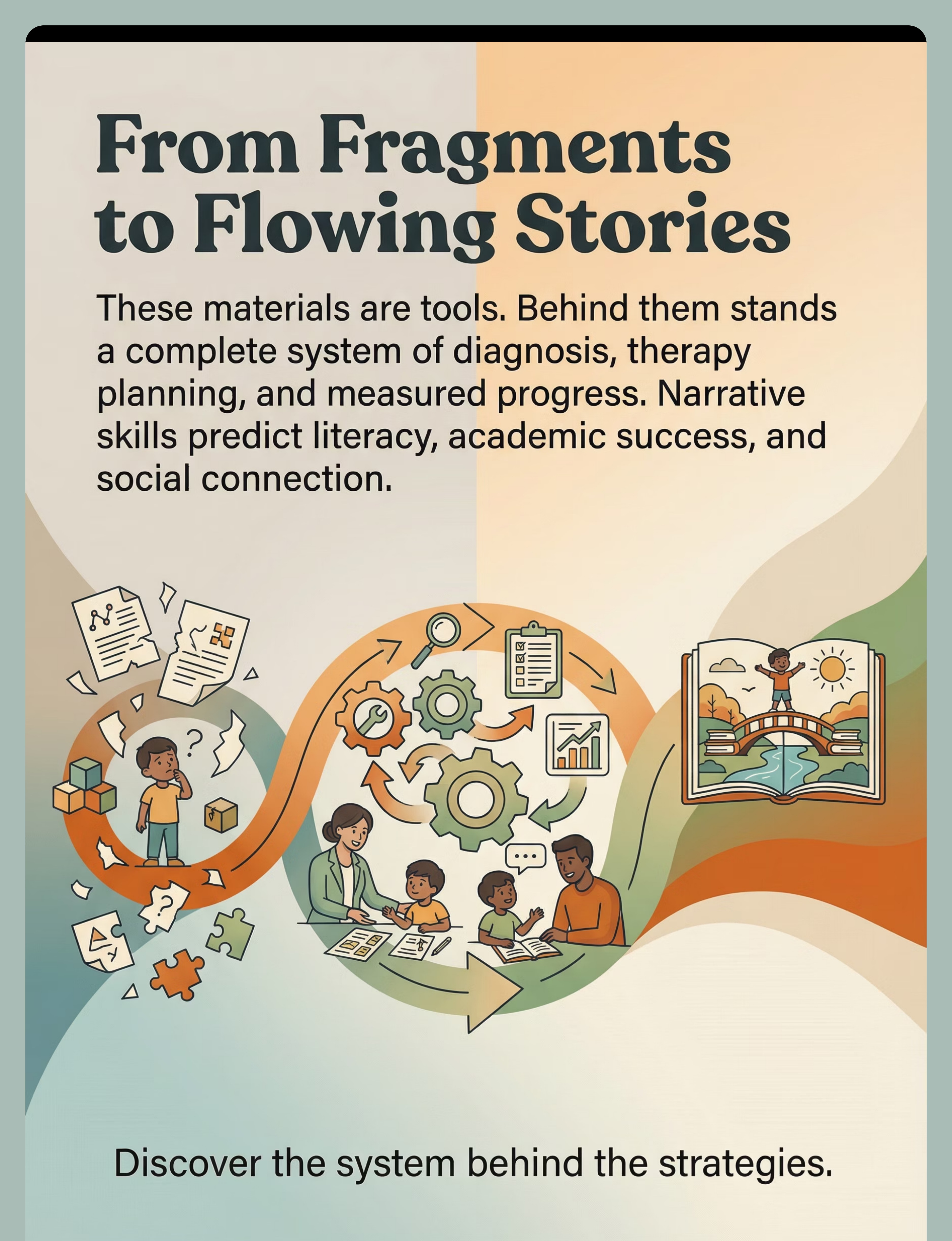
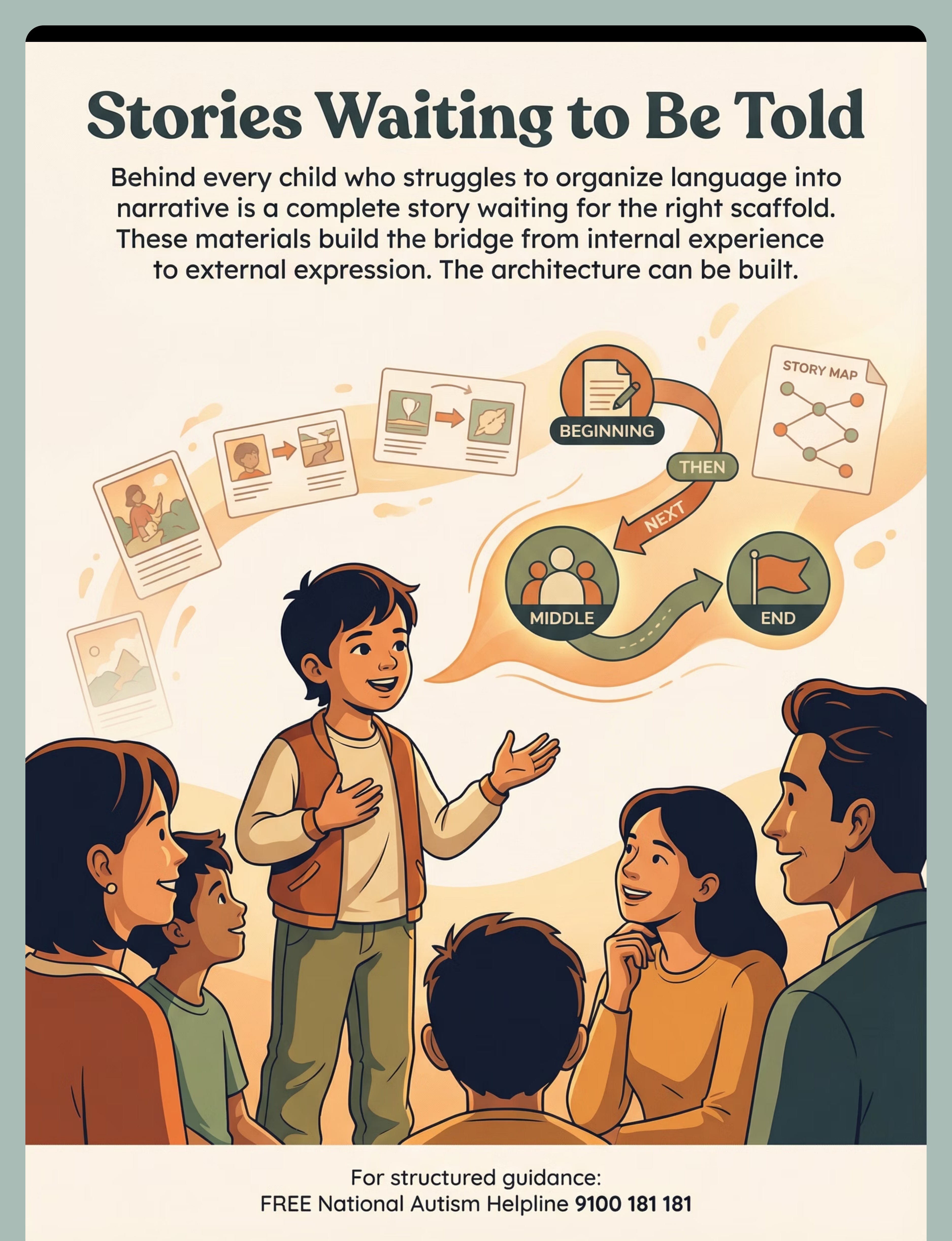
"From fragments to flowing stories — and from fear to mastery. One technique at a time."
🗣 SLP
Speech-Language Pathology
🧩 OT
Occupational Therapy
⚡ ABA
Applied Behavior Analysis
🎓 SpEd
Special Education
🧠 NeuroDev
Neurodevelopmental Pediatrics
🔬 CRO
Clinical Research Operations
This content is educational and is prepared by the Pinnacle Blooms Consortium of licensed speech-language pathologists, occupational therapists, BCBAs, special educators, and neurodevelopmental pediatricians. It does not replace individualized assessment and intervention planning by licensed professionals. Persistent narrative difficulties warrant professional evaluation to rule out Developmental Language Disorder (DLD). Individual results may vary. Statistics represent aggregate outcomes across Pinnacle Blooms Network centers. Full disclaimer
CIN: 109:3281 | DPIIT: 109:6231 | MSME: 12234567 | GSTIN: 123456789
© 2025 Pinnacle Blooms Network®, unit of Bharath Healthcare Laboratories Pvt. Ltd. All rights reserved. Powered by GPT-OS® — Global Pediatric Therapeutic Operating System
📞FREE National Autism Helpline: 9100 181 181
16+ languages | 9 AM–9 PM | India & International
🌐pinnacleblooms.org | techniques.pinnacleblooms.org
16+ languages | 9 AM–9 PM | India & International
🌐pinnacleblooms.org | techniques.pinnacleblooms.org