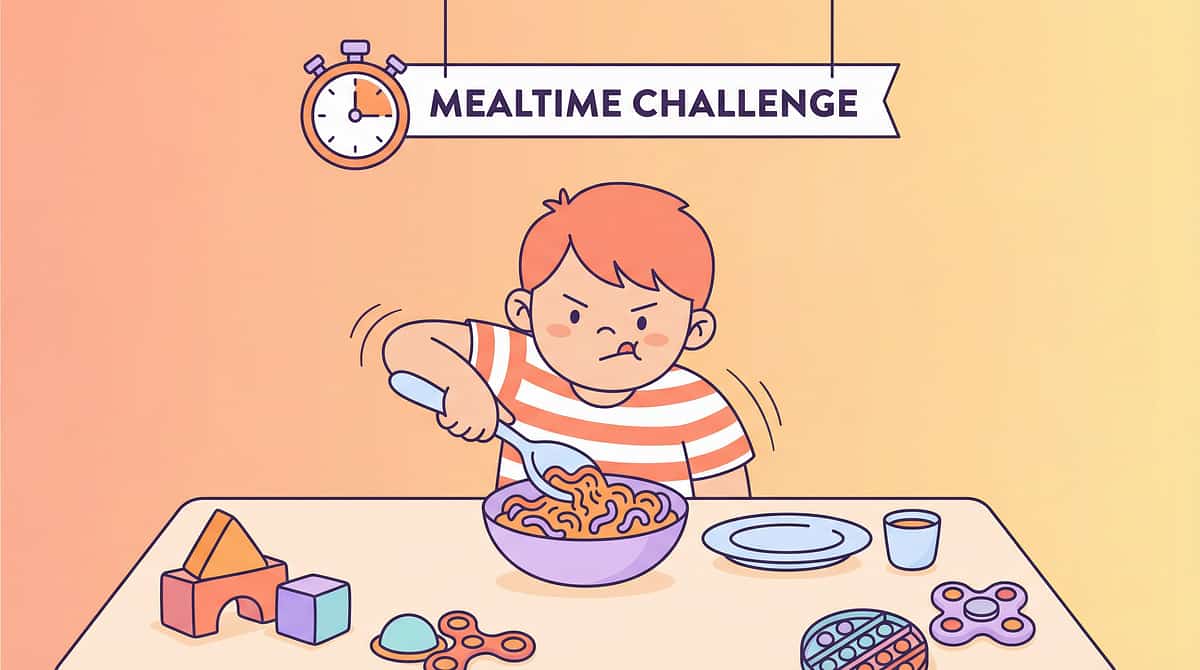


E-462-9-Materials-That-Help-With-Messy-Eating
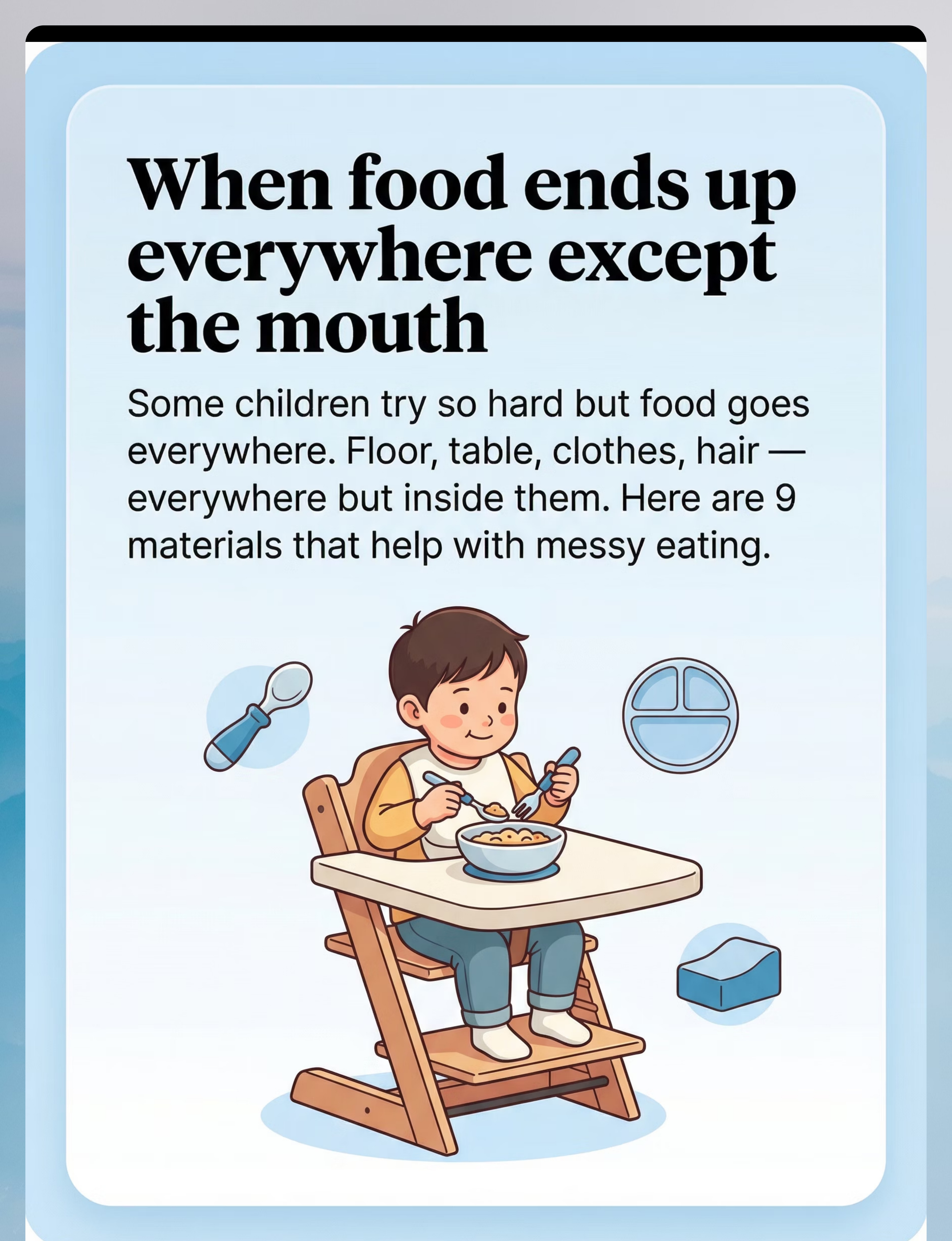
Every meal ends the same way. Food everywhere except inside them.
You watch them concentrate, trying so hard with that spoon. And still — the floor gets more than they do. This isn't their fault. And it isn't yours.

🍽️9 Materials That Help With Messy Eating — A complete home-based adaptive feeding guide from the Pinnacle Blooms OT Consortium. Ages 18m–10y.
Feeding
Fine Motor
Self-Feeding Independence
OT
Ages 18m–10y
"You are not failing. Your child's motor system is still developing — and there is a precise path forward."
📞 FREE National Autism Helpline: 9100 181 181 | 16+ languages | pinnacleblooms.org
ACT I · NORMALIZATION
You are among millions navigating this exact challenge.
Messy eating beyond age-appropriate levels affects millions of families worldwide. In India alone, with 1 in 125 children estimated to have autism and millions more with fine motor developmental differences, the dining table becomes a daily challenge for hundreds of thousands of families — every single morning, every evening. This is not a parenting failure. This is a motor coordination challenge that science has mapped, and that therapy has proven it can address.
70–80%
Motor Differences in ASD
Children with ASD show motor coordination differences that directly affect self-feeding
1 in 36
Autism Prevalence (US)
Children diagnosed with autism in the US (CDC 2023) — global prevalence rising
62%
DCD & Mealtime Mess
Children with Developmental Coordination Disorder show persistent mealtime mess — often co-occurs with ASD
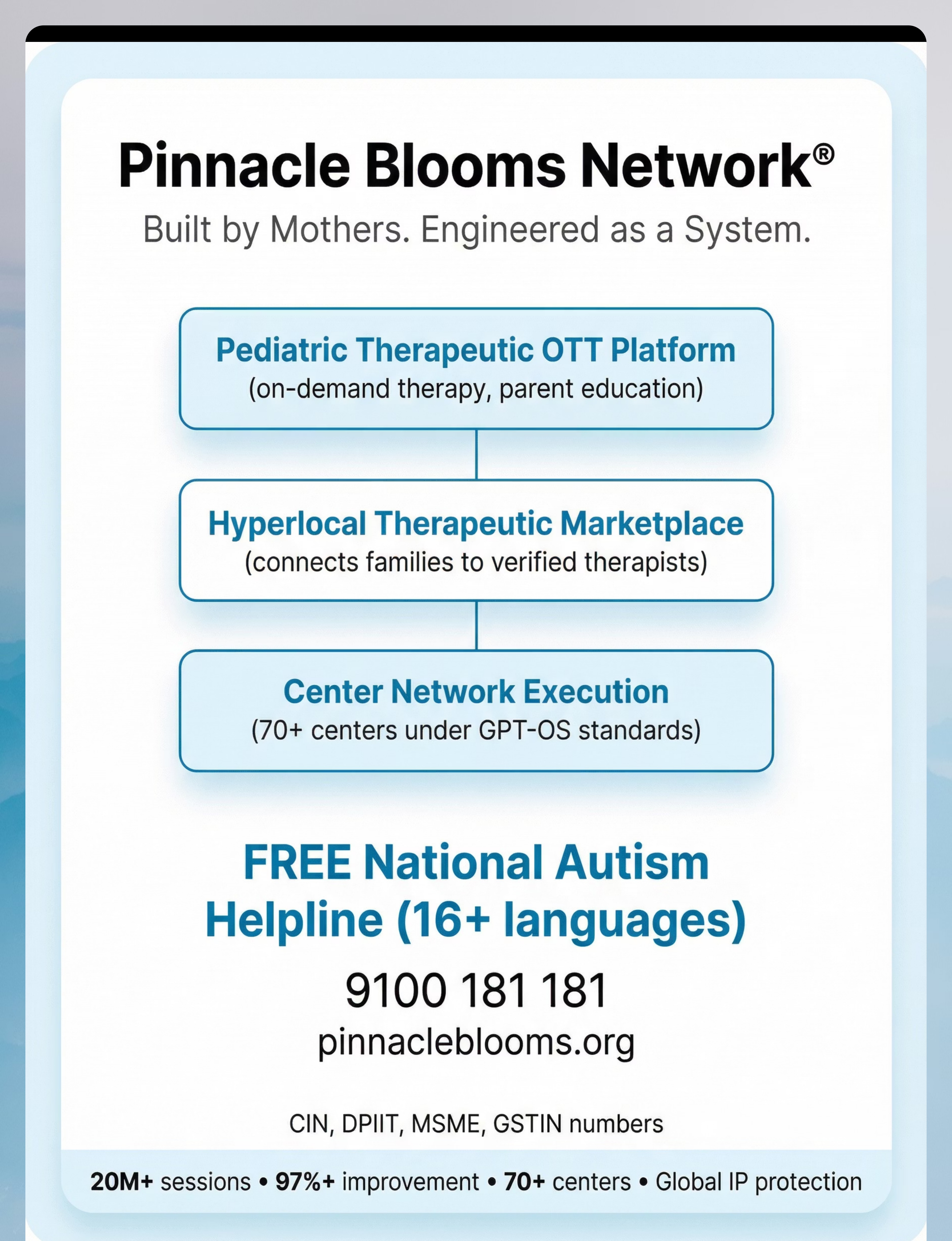
India: Estimated 10 million+ children with developmental differences | Pinnacle Network: 70+ centers | 20M+ therapy sessions delivered
ACT I · UNDERSTANDING
What's Happening in Your Child's Motor System
The Motor Pathway
When your child brings a spoon to their mouth, multiple systems fire simultaneously:
  • Proprioceptive sensors in hand
  • Spinal cord relay
  • Cerebellum coordination
  • Motor cortex command
  • Arm movement execution
  • Spoon-to-mouth delivery
Self-feeding is one of the most complex motor tasks a young child attempts.
When your child brings a spoon to their mouth, their brain must simultaneously sense where the spoon is in space (proprioception), calculate the force needed to hold it (force grading), plan the sequence of movements (motor planning), coordinate what eyes see with what hands do (visual-motor integration), and maintain stable posture as a base for arm control.
When any one of these systems is underdeveloped, food misses the mouth. The spoon tips. The plate slides. Drinks spill. This is a wiring difference — not a behavior choice.

🧠 The cerebellum coordinates timing and precision of eating movements. In children with developmental differences, cerebellar-cortical connections mature on a different timeline — not broken, just developing.
ACT I · DEVELOPMENTAL CONTEXT
Every Child Reaches Mealtime Independence on Their Own Timeline
Here is the developmental map — and where your child may be right now.
Age
Typical Milestone
What "Messy" Means Here
6–9 months
Hand-to-mouth with fingers
Very messy — completely normal
12–15 months
Begins spoon use (fist grip)
Significant spilling — expected
18–24 months
Improving spoon aim, fork introduction
Moderate mess — still normal
2–3 years
Proficient spoon/fork
Minor mess, mostly contained
3–4 years
Refined, neat eating
Minimal mess
4+ years
Age-appropriate independence
Occasional spills only

📍 If your child's mealtime mess is significantly beyond the expected range for their age, this is a signal their motor system needs targeted support — not more practice with standard equipment.
Messy eating commonly co-occurs with: Fine motor delays · Hypotonia (low muscle tone) · Autism Spectrum Disorder · Developmental Coordination Disorder (DCD/Dyspraxia) · Sensory Processing Differences
ACT I · EVIDENCE GRADE
The Evidence Behind This Approach
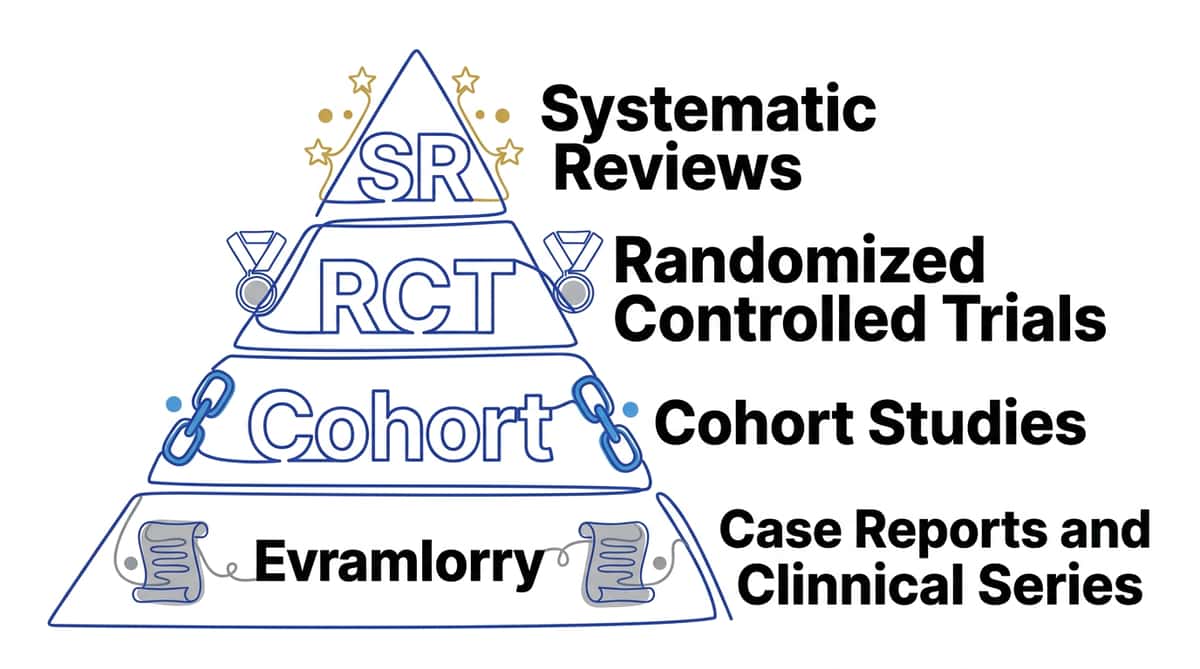
🛡️ LEVEL I EVIDENCE
Systematic Reviews + RCTs + Multi-center Clinical Data confirm this approach works
📊 PRISMA Review (2024)
16 studies confirm sensory integration + adaptive equipment is evidence-based practice for ASD children. PMC11506176
📊 Meta-analysis (2024)
24 studies: Sensory integration therapy promotes fine motor skills, adaptive behavior, and self-care independence. PMC10955541
📊 Indian RCT (2019)
Home-based motor interventions with adaptive equipment demonstrate significant outcomes in Indian pediatric populations. DOI: 10.1007/s12098-018-2747-4
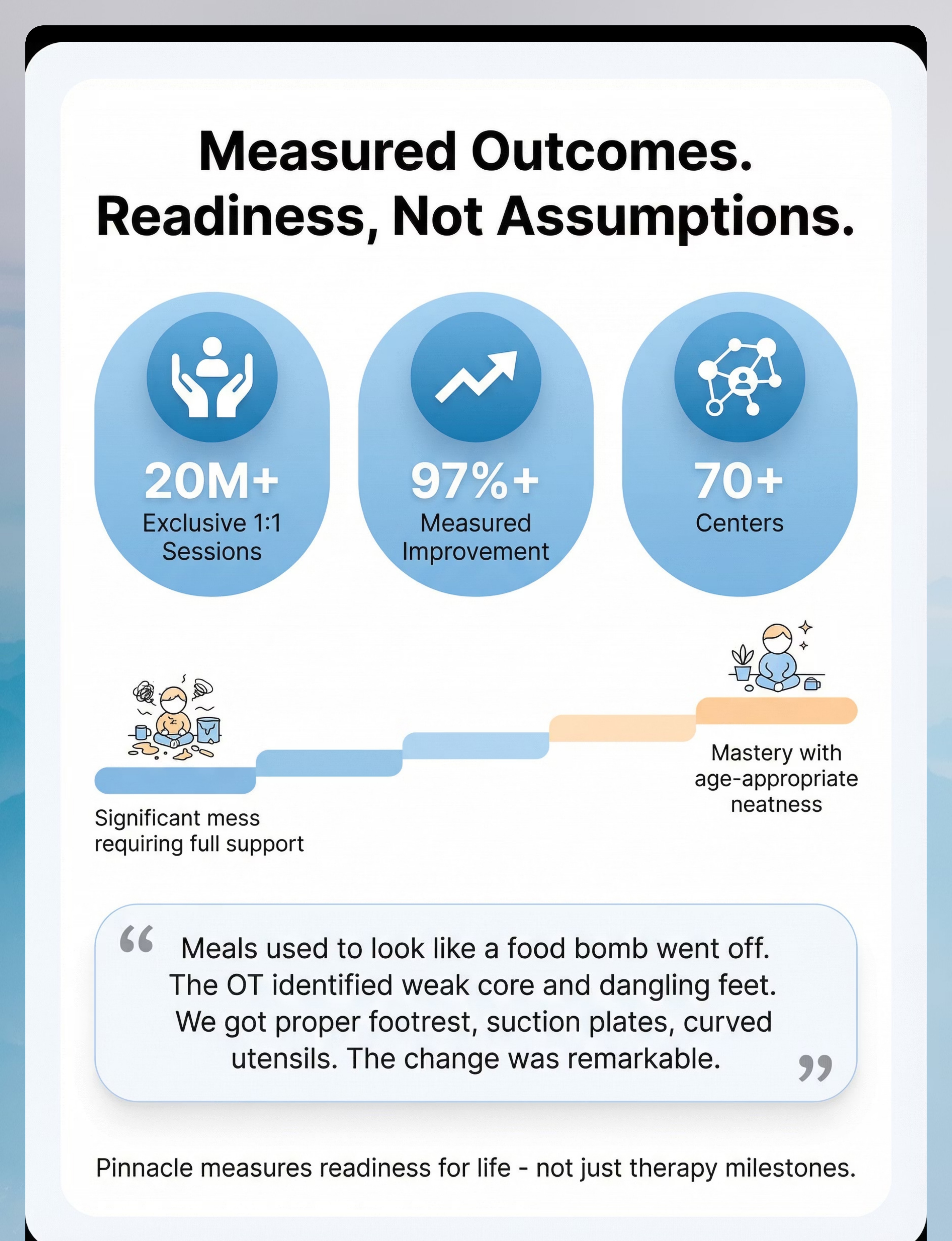
"Clinically validated. Home-applicable. Parent-proven." | Pinnacle Network Real-World Evidence: 20M+ therapy sessions | 97%+ measured improvement | 70+ centers
ACT II · DEFINITION
The Technique: Adaptive Mealtime Equipment Selection & Positioning Protocol
"Setting up your child for eating success — from the chair up"

This technique identifies the specific motor barriers preventing neat self-feeding in your child — poor proprioception, weak grip, inadequate wrist control, unstable posture, or dish movement — and matches each barrier to the specific adaptive tool that removes it. The result: your child can practice eating successfully while underlying motor skills develop in parallel, through the home environment as a therapy extension.
Domain
Age Range
Frequency
Duration
Lead Discipline
Feeding + Fine Motor
18 months–10 years
Every mealtime
Ongoing
Occupational Therapy
Technique Code: E-462 | Series: Feeding & Mealtime Independence | Episode 462 | AOTA Pediatric Feeding & Adaptive Equipment Guidelines | Pinnacle 128 Canon Materials System
ACT II · DISCIPLINES
This Technique Crosses Therapy Boundaries — Because Eating Involves Every System
Occupational Therapist (Lead)
Primary lead. Assesses fine motor, postural stability, grip patterns, sensory processing. Selects and calibrates adaptive equipment. Designs the home mealtime environment.
Pediatric Feeding Therapist (SLP)
Addresses oral motor component — lip closure, tongue control, jaw grading. Works in tandem with OT when oral motor mess (food falling from mouth) is the primary concern.
ABA/BCBA Therapist
Designs reinforcement schedules for successful eating attempts. Implements token economy for mealtime cooperation. Reduces mealtime avoidance and behavioral resistance.
Special Educator
Coordinates school mealtime accommodations. Trains lunchroom staff on adaptive equipment use. Ensures consistency between home and school eating setup.
NeuroDevelopmental Pediatrician
Rules out underlying neurological contributors. Prescribes formal OT/feeding therapy referral. Monitors nutritional status where severe mess affects intake.
"The brain doesn't organize by therapy type. Eating involves sensory, motor, behavioral, oral, and postural systems simultaneously — which is exactly why our consortium approach works." — Pinnacle Blooms OT + Feeding Consortium

ACT II · THERAPEUTIC TARGETS
What This Technique Targets
Observable Primary Indicators
  • Food consistently reaching mouth
  • Plate remaining on table during scooping
  • Clothes remaining relatively clean by meal end
Observable Secondary Indicators
  • Spoon held with 3-finger or palm grip
  • Wrist not rotating excessively mid-arc
  • Cup held without spilling
  • Child eating at school without shame

ACT II · PRIMARY MATERIALS
9 Adaptive Materials — Each One Removes a Specific Motor Barrier
Start with what matches your child's pattern. Each material below is clinically matched to a specific feeding challenge.
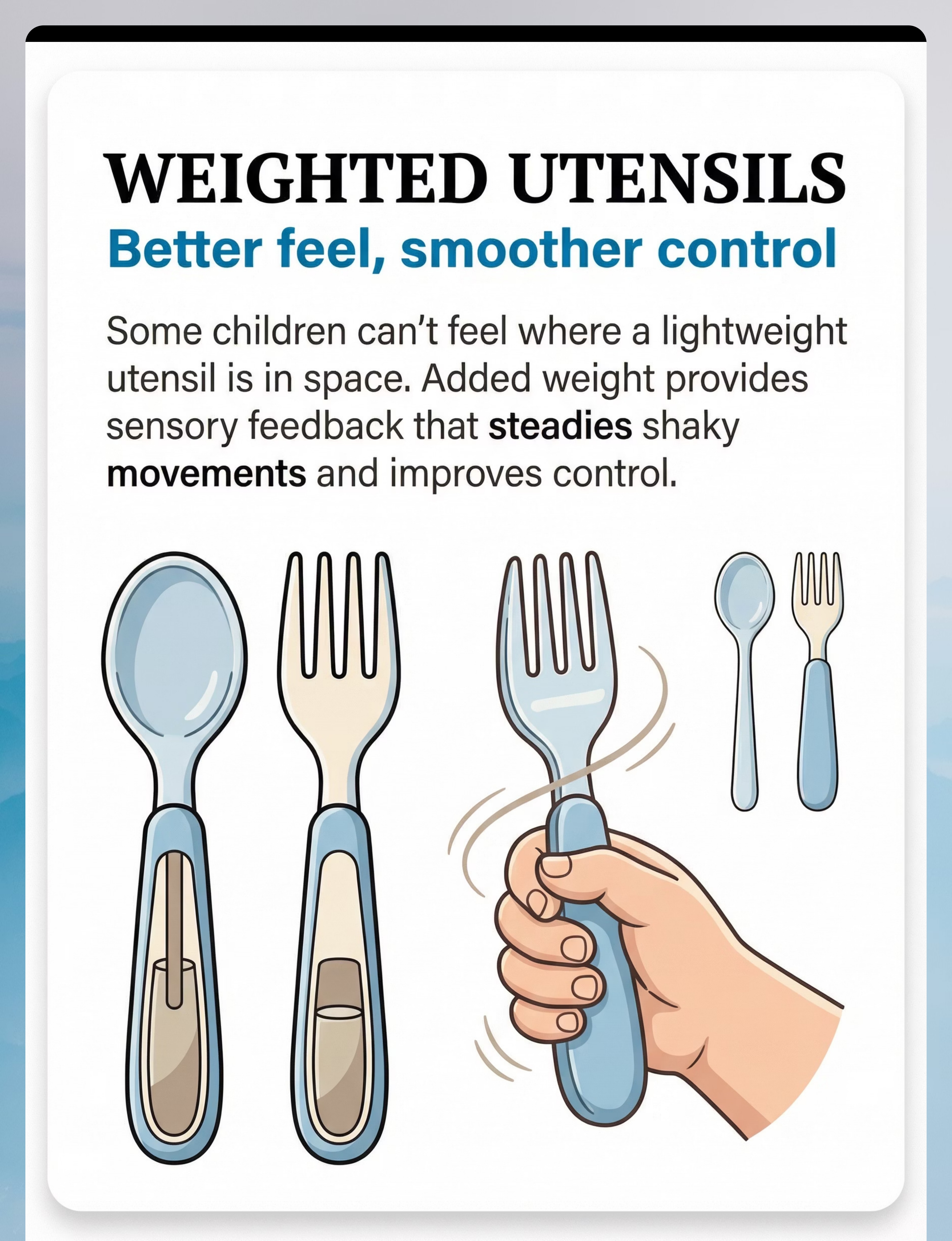
Weighted Utensils
For: Poor proprioception, shaky movements. Added weight provides sensory feedback — helps child feel where the spoon is in space, steadies tremors. ₹400–1,200 Pinnacle Recommends
Built-Up Handle Utensils
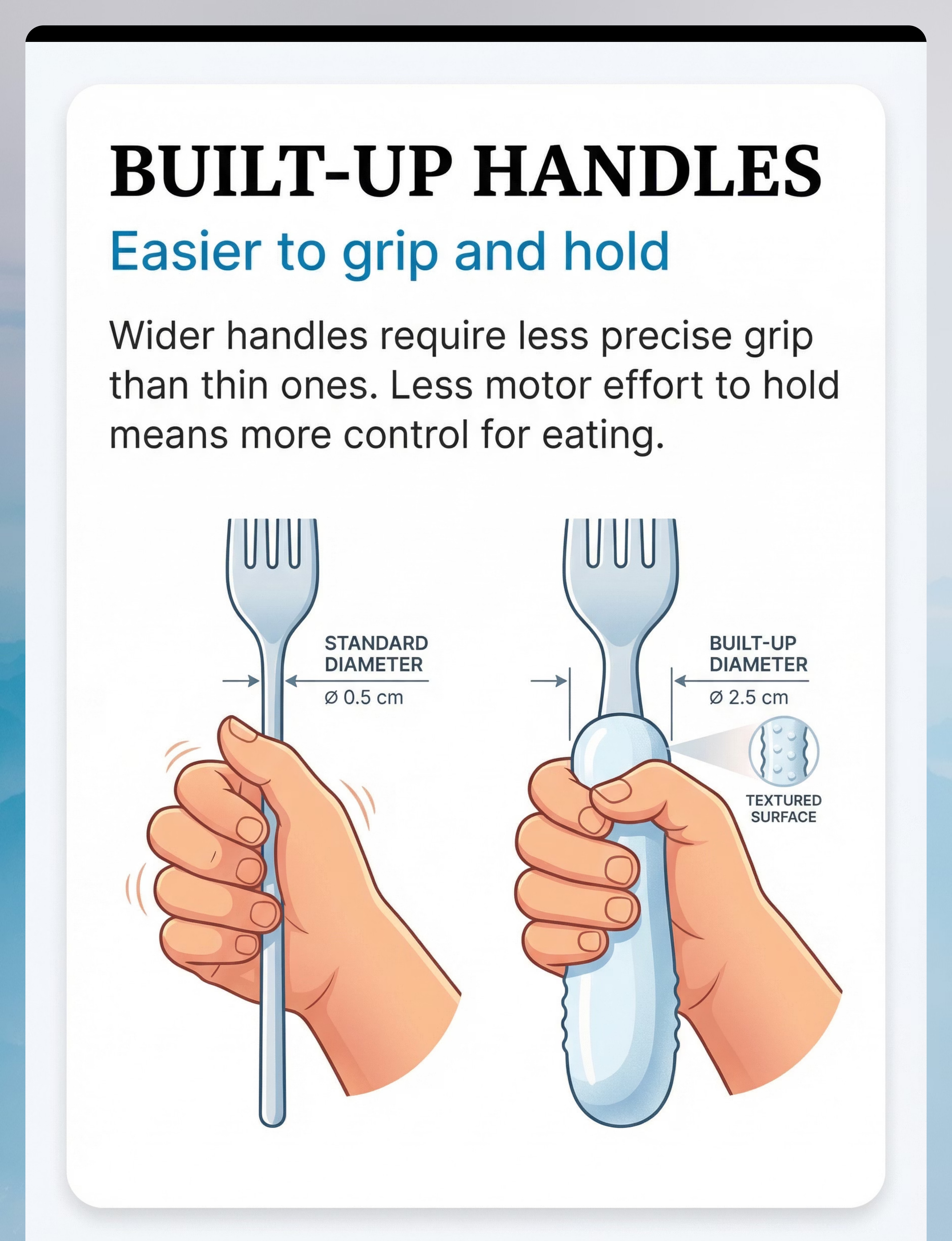
For: Weak grip, immature grip patterns. Wider handles require less precise grip — less motor effort to hold = more control for eating. ₹200–800 Pinnacle Recommends
Curved/Angled Utensils
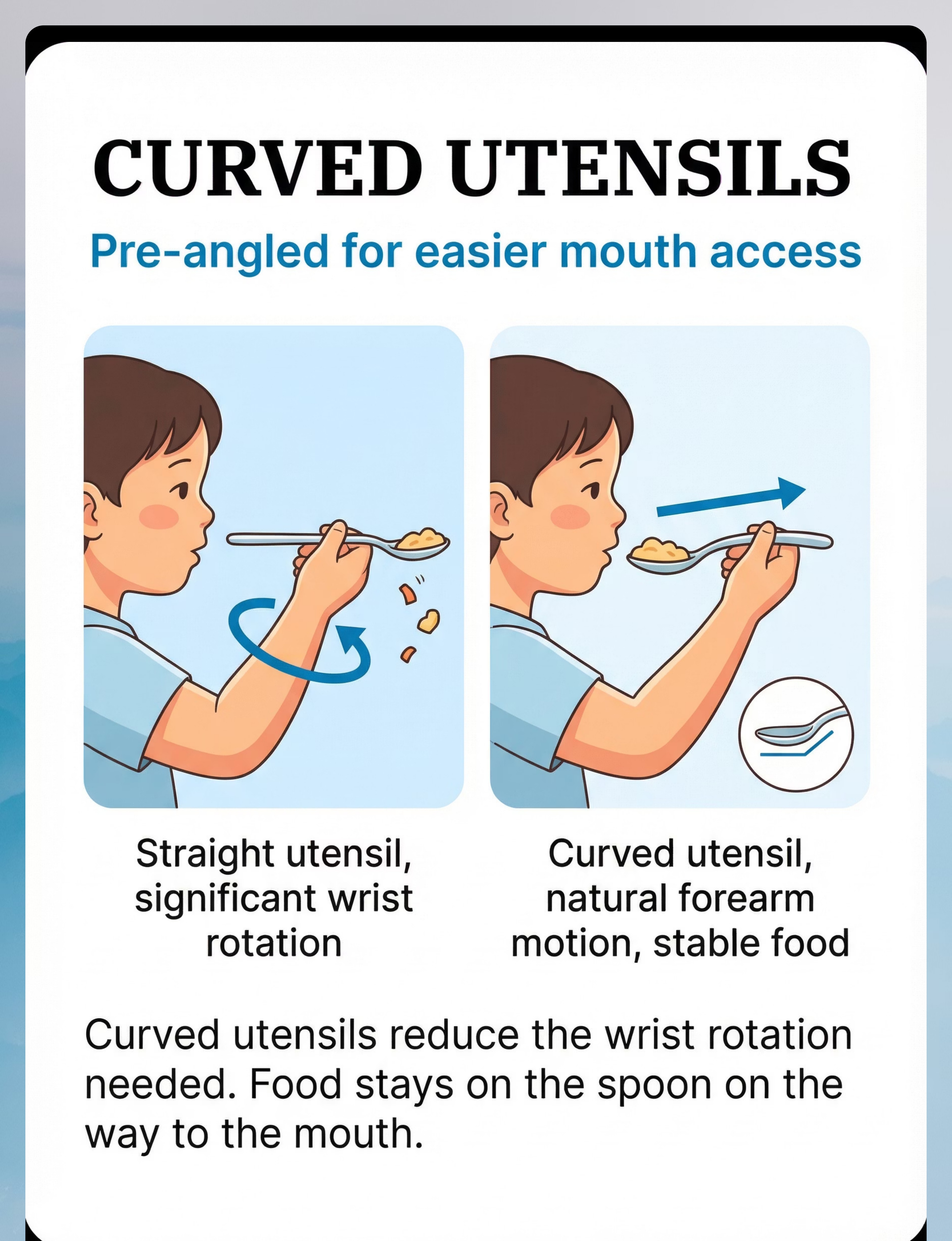
For: Poor wrist rotation control. Pre-angled curve eliminates need for wrist twist — food stays on spoon throughout the plate-to-mouth arc. ₹300–900 Pinnacle Recommends
Suction Plate/Bowl
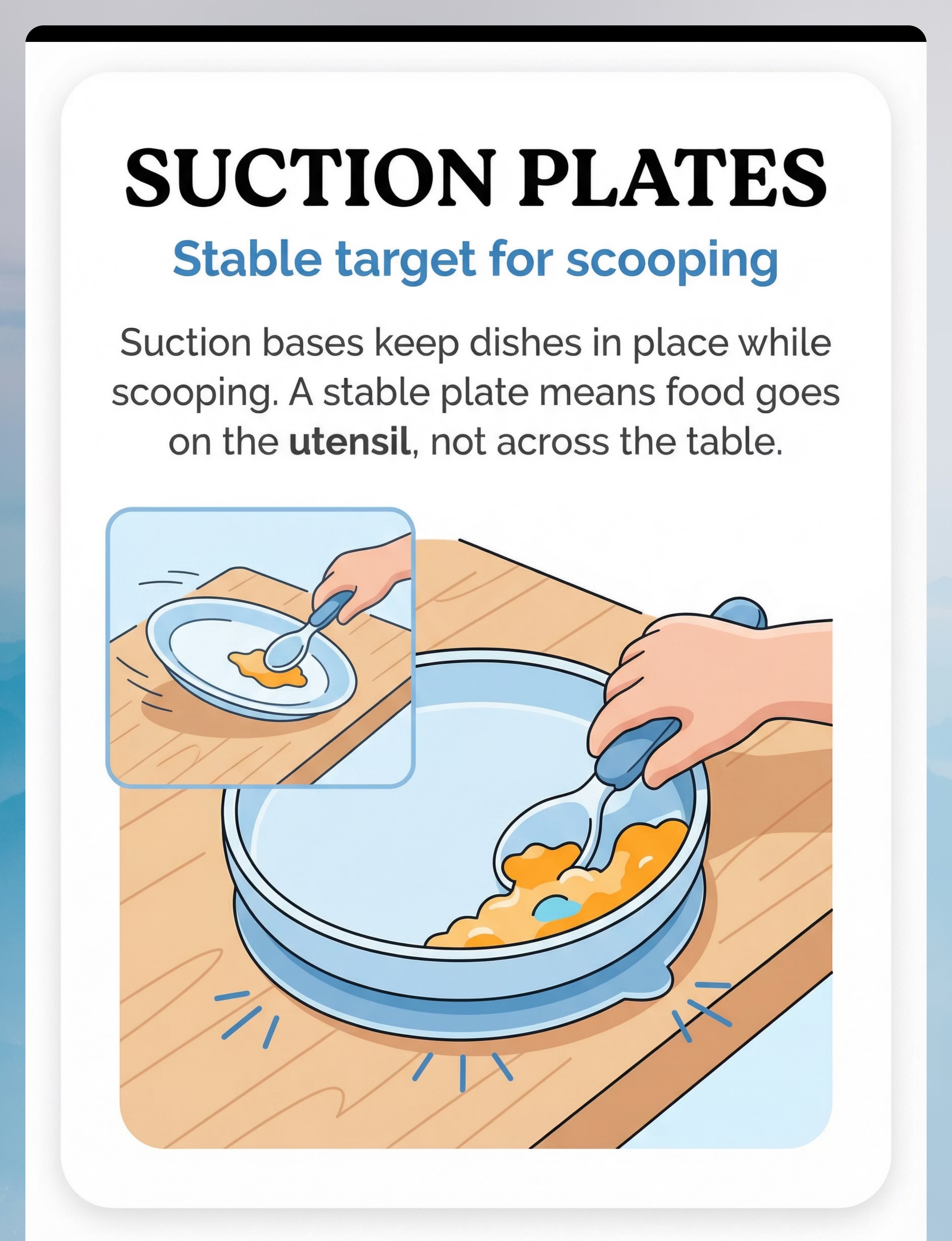
For: Dish movement, plate pushing during scooping. Suction base anchors dish to table surface — one less variable in the complex eating task. ₹300–1,000 Pinnacle Recommends
High-Sided Plate/Bowl
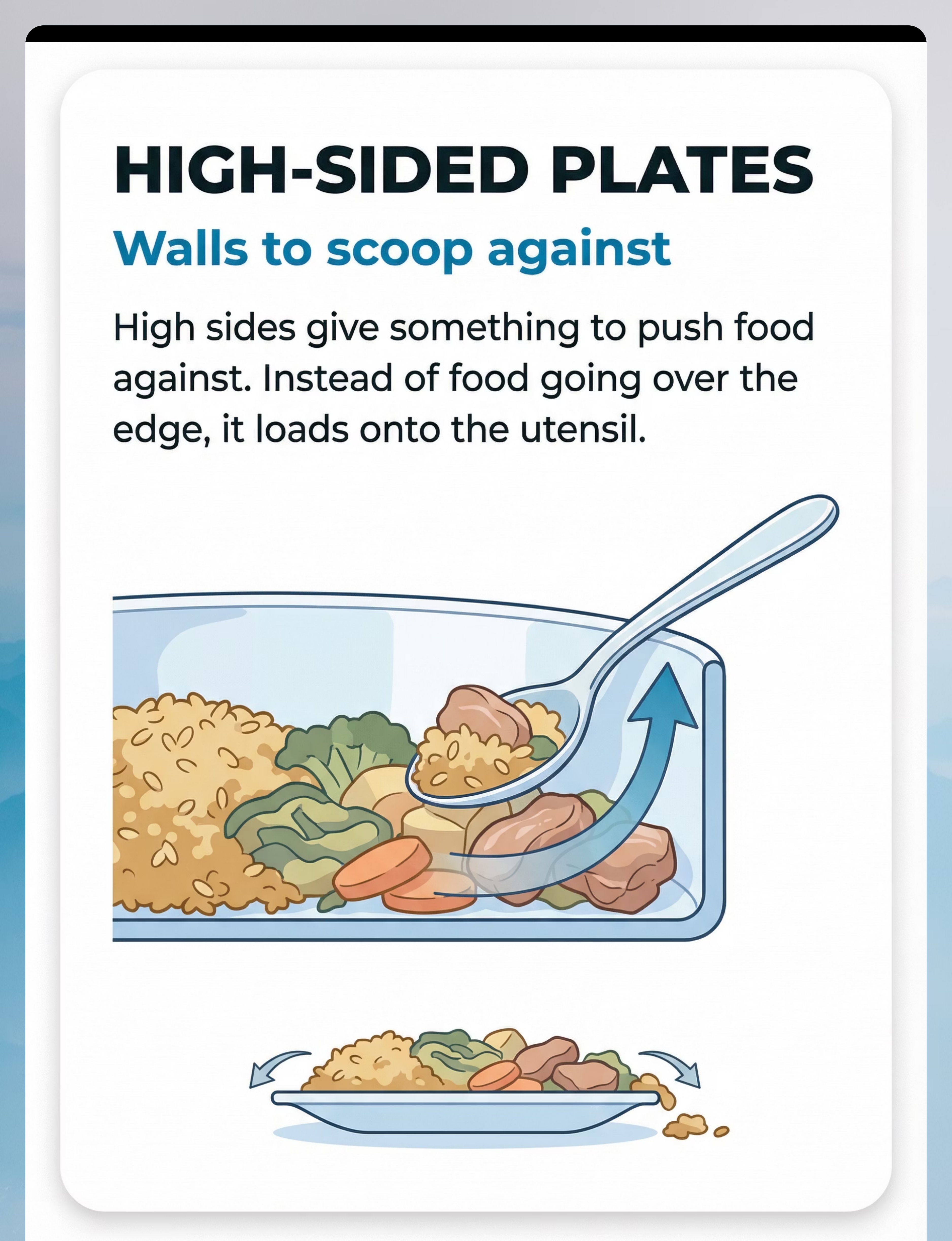
For: Scooping difficulty, food escaping plate edge. Vertical walls provide a "scoop target" — food loads onto utensil instead of going over the edge. ₹200–700
Non-Slip Placemat
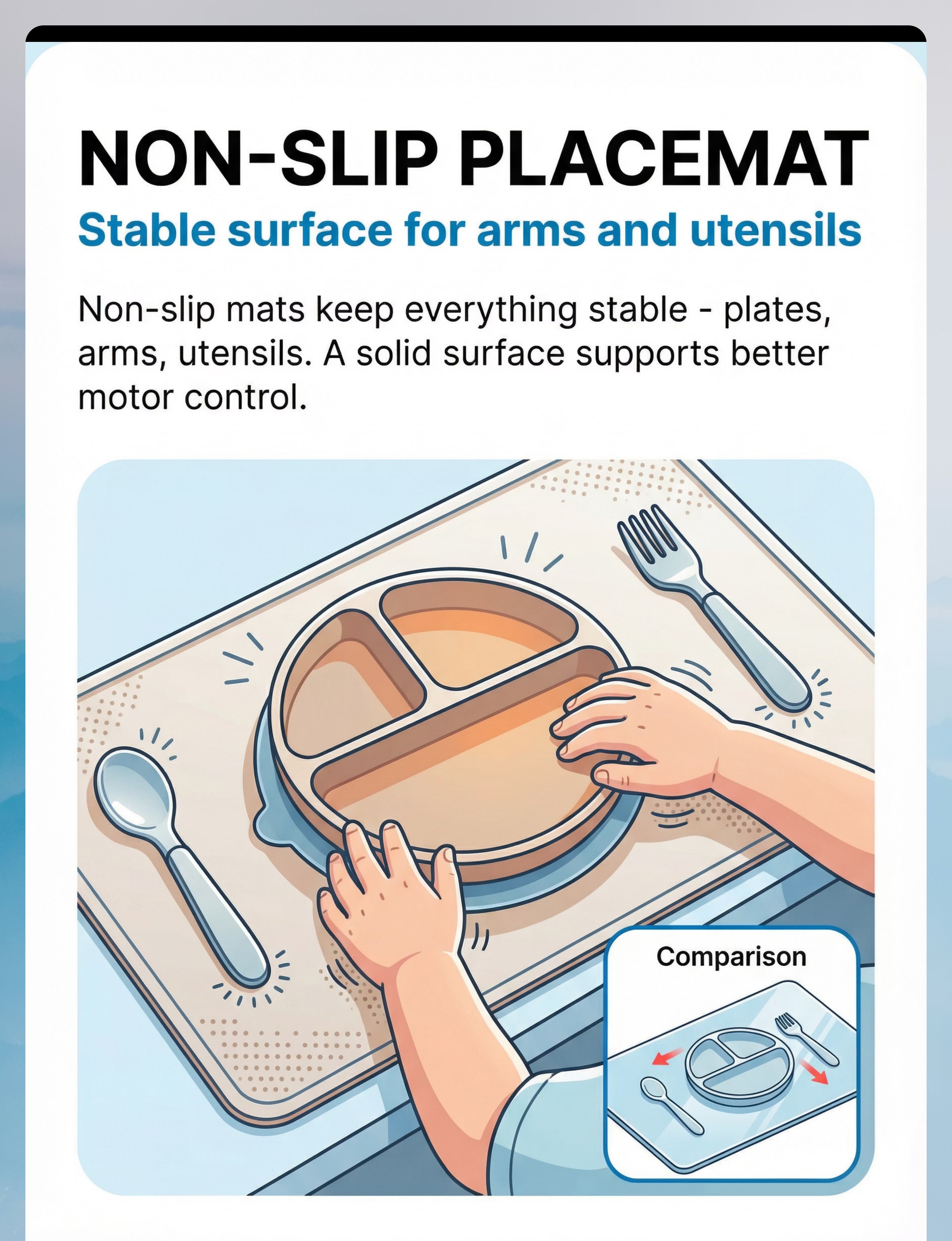
For: Sliding arms/dishes, unstable surface. Non-slip surface stabilizes everything — plate, arms, utensils — supporting better motor control. ₹200–600
ACT II · PRIMARY MATERIALS (CONTINUED)
Materials 7–9: Foundation, Drinks & Containment
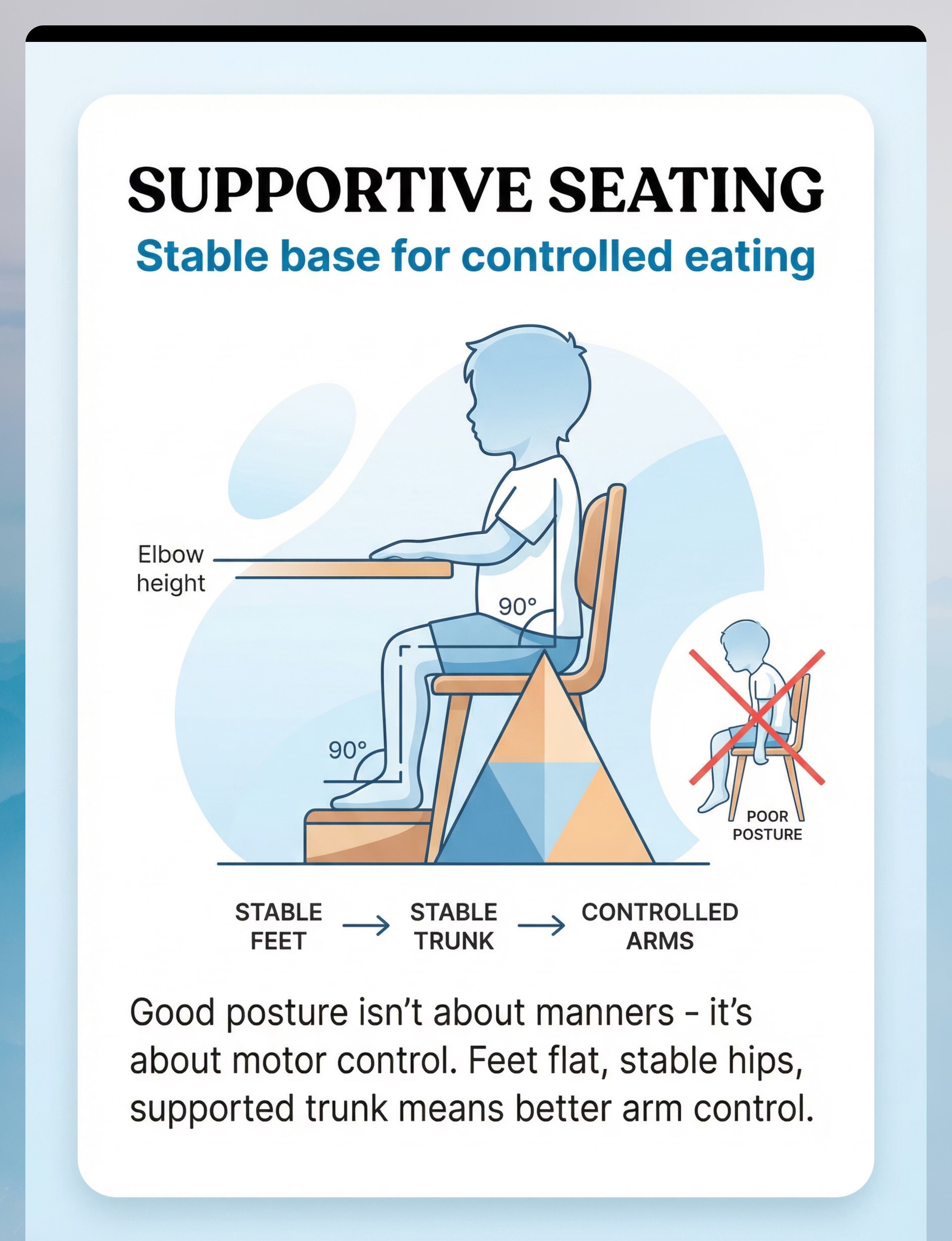
Supportive Seating + Foot Support — Start Here
For: Postural instability — the foundation of ALL arm control. Feet flat → stable pelvis → stable trunk → controlled arms → food reaches mouth. Fix seating first. ₹500–3,000
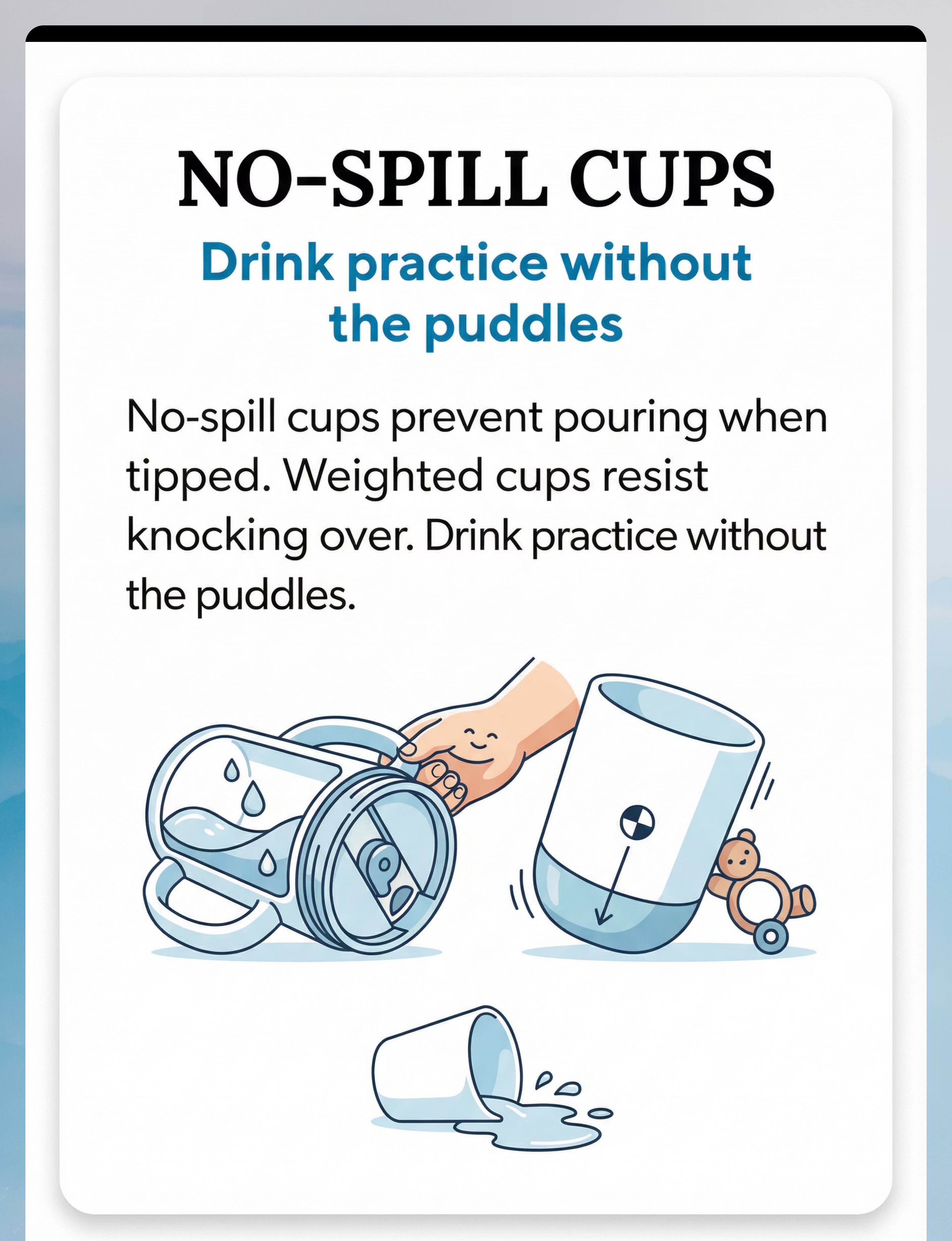
No-Spill / Weighted Cup
For: Drink spills. Valve or weighted base prevents tipping spills — drink practice without the cleanup and frustration. ₹200–800
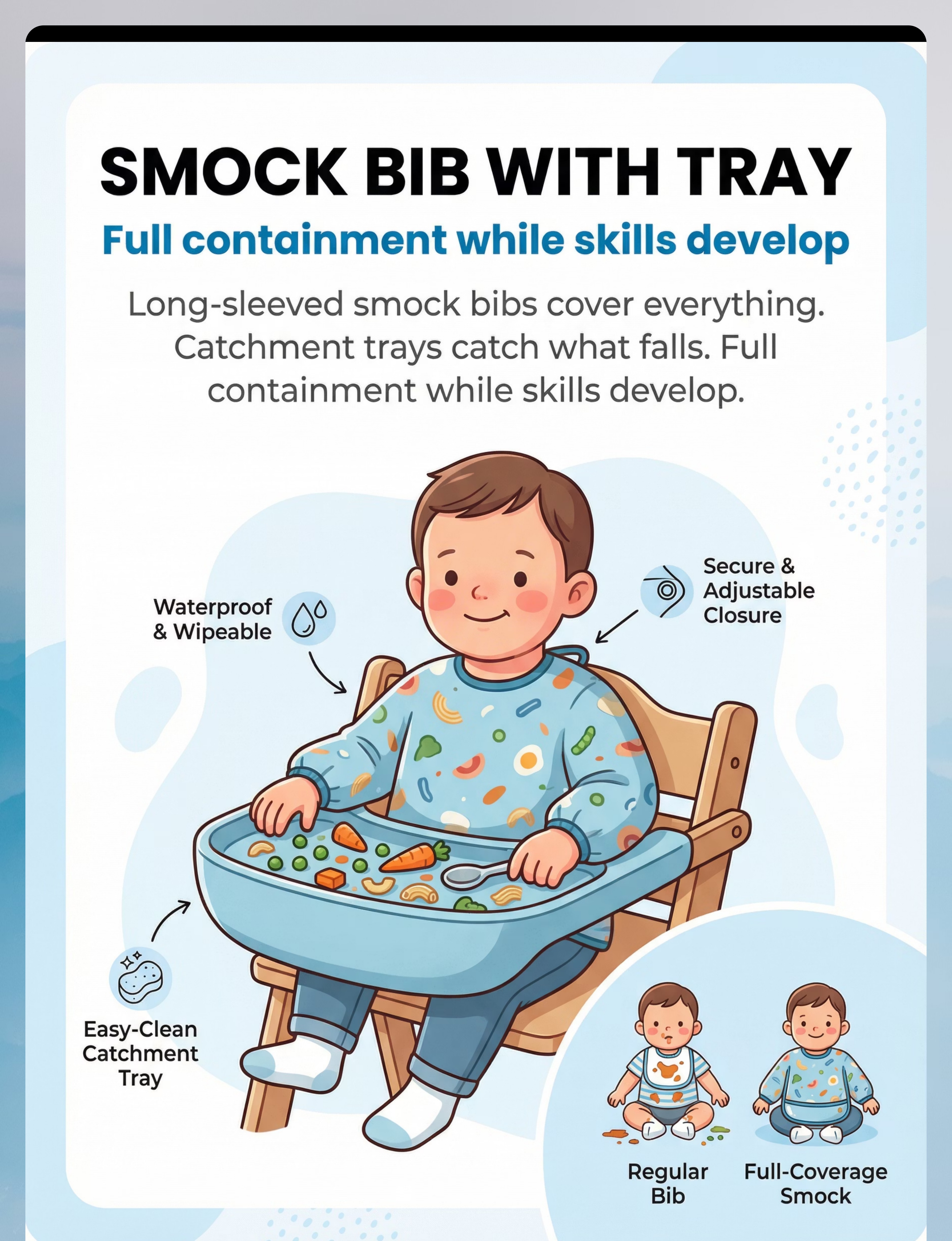
Long-Sleeve Smock Bib with Tray
For: Mess containment while skills develop. Full-coverage smock + catchment tray makes mealtimes sustainable during the skill-development phase. ₹300–1,200

🚀Start with these 3: 1) Supportive Seating/Footrest (the foundation) 2) Suction Plate or High-Sided Bowl 3) Adaptive Utensil matched to your child's specific challenge
ACT II · EQUITY ACCESS
Every Family Deserves These Tools — Regardless of Budget
Here are household alternatives that use the same therapeutic principles. The therapeutic principle is the same: proprioceptive feedback, stability, friction, containment. The specific brand or material matters less than applying the correct biomechanical principle.
Commercial Option
Zero-Cost DIY Alternative
Weighted utensils (₹400–1,200)
Wrap handle of regular spoon with wet sand-filled tape OR use a stainless steel heavy ladle — the weight principle is identical
Built-up handle (₹200–800)
Wrap regular spoon handle tightly with several layers of rubber band or cloth tape until diameter fills child's palm
Suction plate (₹300–1,000)
Place regular plate on damp non-slip rubber mat (same fixation principle) OR use heavy steel thali
High-sided bowl (₹200–700)
Use any deep kadai/steel bowl rather than a flat plate — same "wall to scoop against"
Non-slip placemat (₹200–600)
Lay a damp kitchen towel or yoga mat piece under the plate
Foot support (₹500–3,000)
Stack 2–3 firm cushions or books under feet — measure to ensure hips at 90°
Smock bib (₹300–1,200)
Use an old adult T-shirt worn backwards as full-coverage protection

🌱 These DIY alternatives are effective, especially as you assess which tools your child responds to before investing in commercial options. This page is designed for families across all income levels, following the WHO Nurturing Care Framework principle that every child deserves access to evidence-based intervention.
ACT II · SAFETY GATE
Safety First: Before You Begin
RED: Do NOT Proceed If
  • Child has dysphagia (swallowing disorder) — seek SLP assessment first
  • Child recently had a severe mealtime meltdown (within last 2 hours) — wait for regulated state
  • Child has significant hypotonia — consult OT before introducing weighted utensils (increased fatigue risk)
  • Any choking incident in last 72 hours — seek medical evaluation first
⚠️ AMBER: Modify If
  • Child has oral motor challenges — add SLP coordination
  • Child has strong sensory aversion to specific textures — pair with desensitization protocol
  • Child is under 18 months — use age-appropriate modifications only
  • Weighted utensils: watch for arm fatigue in children with low tone; start with 5-minute use windows
GREEN: Proceed When
  • Child is in a calm, regulated state
  • Not within 30 minutes of a recent meal
  • Materials are clean, food-safe, and age-appropriate
  • Parent/caregiver is calm and non-reactive to mess during the learning phase

🛑Stop immediately if: Child begins choking | Severe distress/panic response to materials | Signs of fatigue or arm weakness with weighted utensils | Any behavior escalation that feels unsafe. All materials should be BPA-free, food-grade, dishwasher-safe.
ACT II · ENVIRONMENT SETUP
Set Up Your Mealtime Space
Seating Setup Checklist
  • Feet flat on floor or footrest (not dangling)
  • Hips at approximately 90°
  • Table surface at elbow height when arms are relaxed
  • Trunk supported — not slumping into table
  • Chair pulled in close — no leaning forward
Table Positioning
  • Suction plate/high-sided bowl on non-slip mat
  • Cup at 2 o'clock position (dominant side)
  • Parent seated at 90° to child, not directly opposite
  • Smock bib and backup utensils within parent's reach
Environmental Factors
  • Lighting: Bright, natural light preferred. No flickering fluorescent. Reduce glare from windows.
  • Sound: Calm background. No TV during early skill-building phase.
  • Temperature: Comfortable. Avoid distracting cold/heat.
  • Remove from space: TV/screen, distracting toys, excessive background noise

💡 Before every mealtime using adaptive equipment, spend 60 seconds checking the seating checklist. Correct posture alone often produces noticeable improvement before any other tool is introduced.
ACT III · READINESS CHECK
Is Your Child Ready? Check These 7 Indicators Before Serving
The best mealtime session starts right. These seven readiness indicators protect the nervous system and ensure every mealtime builds confidence rather than eroding it.
Child is in a regulated, calm state
No recent meltdown in the last 60–90 minutes
Child is hungry but not in extreme hunger distress
Mild hunger is motivating; extreme hunger triggers dysregulation
No signs of illness
Fever, ear pain, or GI discomfort significantly reduce participation capacity
Seating is correctly set up
Card 13 checklist verified — feet flat, hips at 90°, table at elbow height
Adaptive materials are clean and in place
All 9 materials appropriate to today's meal are ready before child sits down
Parent/caregiver is calm and not rushed
Children mirror mealtime anxiety — your regulated state is the first tool
Preferred food is available
For initial mealtime success focus — motivation reduces resistance to new equipment
GO (5–7 ticks)
Proceed with full setup and full adaptive support
⚠️ MODIFY (3–4 ticks)
Favorite food only, fewer demands, no new materials introduced today
🔴 POSTPONE (0–2 ticks)
Simple finger food without pressure. Regulated state is non-negotiable.

Step 1: The Invitation (30–60 Seconds)

ACT III · STEP 1 Parent Script "[Child's name], it's lunchtime! Look, I have your special [spoon/bowl] ready. Come sit in your chair." Display the adapted material casually — not with excessive emphasis. Let the child see it as a normal part of the mealtime routine, not a medical device. Body Language Guidance Relaxed, open posture At child's eye level where possible Warm, matter-of-fact tone — not anxious or performatively cheerful Move slowly near the materials — no sudden movements ✅ Acceptance Cues — What to Look For Child moves toward chair Looks at materials with curiosity Sits down willingly Reaches for food or utensil ⚠️ Resistance Cues — What to Do Child refuses chair → Offer choice: "Do you want to sit here or here?" (2 acceptable options) Child grabs/throws material → Calmly retrieve. "The spoon stays on the table." Crying/avoidance → Assess if hunger-related or anxiety. If anxiety, use Modify protocol. Do not rush this phase. A child who arrives regulated at the table eats better — every time.
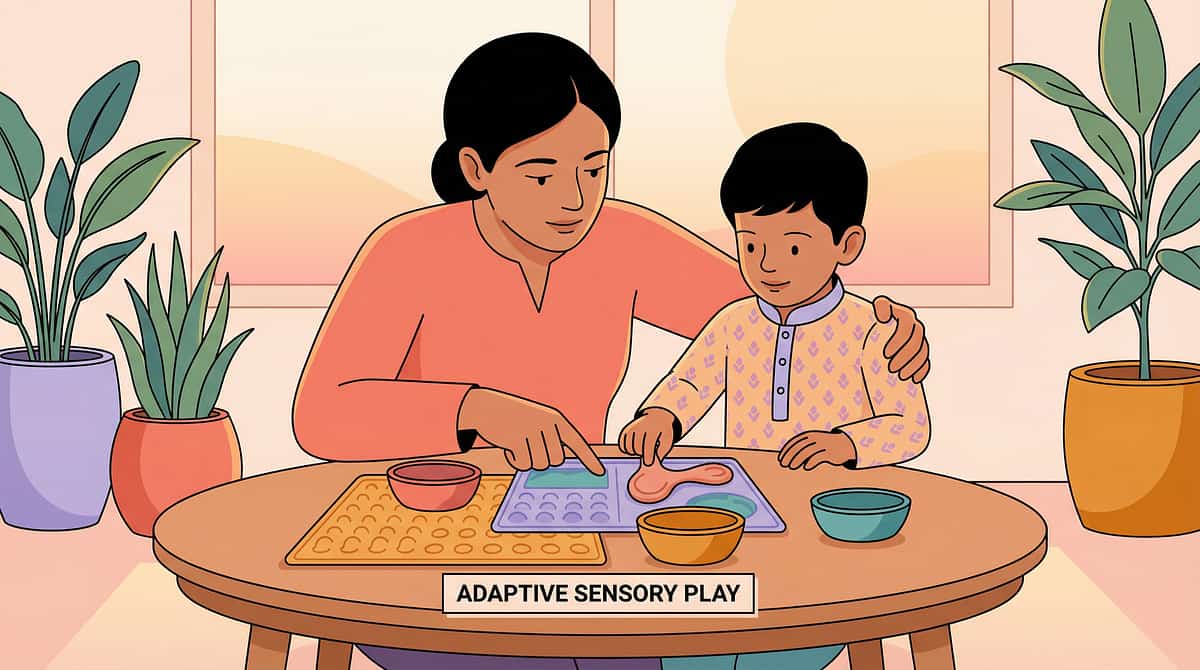
ACT III · STEP 2
Step 2: The Engagement (1–3 Minutes)
Material Introduction Script
"Look at your special spoon — feel how it feels different in your hand. Now let's try scooping your [food]."
How to Present the Material
  • Place utensil handle-first, close to dominant hand
  • Do not force grip — let child pick up naturally
  • For suction plate: press down in child's view so they see it "sticking" — demystifies the mechanism
  • For smock bib: put on before food arrives, make it part of the pre-meal routine, not a reactive response to mess

Child Response Spectrum
🟢 Engagement
Child picks up utensil, attempts scooping → Proceed with Step 3
🟡 Tolerance
Child accepts materials but is passive → Continue, provide gentle physical guidance prompt
🔴 Avoidance
Child pushes away, distressed → Revert to finger food for today, reintroduce material tomorrow

When child first picks up adaptive utensil: "Yes! Great holding!" — immediate, specific, warm reinforcement within 3 seconds.
ACT III · STEP 3 — CORE
Step 3: The Therapeutic Action (10–20 Minutes)
The child uses the adaptive materials throughout the mealtime. This IS the therapy. Each successful bite is a motor learning event. Each spill the equipment prevents is one fewer failed motor pattern reinforced in the nervous system.
Weighted Utensil
Let child use independently. If arm fatigue is visible after 5 minutes, offer finger food break. Monitor for increasing control over 2–4 weeks.
Suction Plate
Do not hold or steady the plate — let the suction do the work. Child should experience the plate staying still without parent assistance.
Built-Up Handle / Curved Utensil
If child defaults to old grip, gently shape hand (hand-over-hand for 2–3 scoops, then fade). Do not enforce — model and invite.
Supportive Seating
Check feet every 3–5 minutes during early implementation. Calmly reposition without making it behavioral: "Feet on the step, like this."
No-Spill Cup
Place cup close, on dominant side. Only fill 1/3 for early practice — reduces magnitude of any spill that occurs.
Common Execution Errors
  • Parent holding plate steady (defeats the purpose of suction) → Remove hands
  • Wiping child's face mid-bite (disrupts motor flow) → Wait for natural pauses
  • Rushing child → Adaptive equipment use takes longer initially — this IS the practice

ACT III · STEP 4
Step 4: Repeat & Vary (Ongoing)
Adaptive equipment is not a "therapy session" — it's the new mealtime normal. Consistency across every meal is what drives motor learning.
Frequency
Every mealtime (breakfast, lunch, dinner) — adaptive equipment is not optional on some days
Consistency Period
4–8 weeks before judging effectiveness. Motor learning is cumulative and non-linear.
Variation Introduction
Once child is comfortable with one material, introduce the next tool in the sequence
Weeks
Equipment Combination
Challenge Level
1–2
Suction plate + Smock bib + Supportive seating
Foundation
3–4
Add appropriate utensil (built-up OR curved OR weighted)
Add 1 tool
5–6
Add no-spill cup
Add drink management
7–8
Begin fading smock bib for 1 meal/day
Begin independence
"3 successful bites with the adaptive spoon > 10 unsuccessful attempts with a standard spoon. Every successful repetition trains the motor pathway. Every failed one does the opposite."

ACT III · STEP 5
Step 5: Reinforce & Celebrate
The Timing Rule: Deliver reinforcement within 3 seconds of the target behavior — successful bite, stable grip, food reaching mouth without spill.
Reinforcement Scripts
For verbal children:
  • "You got the food all the way to your mouth — that was great holding!"
  • "Look, your plate didn't move at all when you scooped!"
For non-verbal/limited verbal children:
  • Immediate thumbs-up with eye contact
  • Clap once + big smile
  • Token/star on visual chart
Reinforcement Menu
  • Sticker chart (immediate visual token) — ₹364–589 on Amazon.in
  • Preferred food as natural reinforcer (next bite of favorite item)
  • Praise + physical comfort (high-five, shoulder squeeze) for children who enjoy touch
  • Break card redemption if token economy is in place

"I saw you try to hold the spoon that way — that's the right idea!" Celebrate effort, not just outcome. Motor learning requires hundreds of attempts before mastery.
ACT III · STEP 6
Step 6: The Cool-Down (2–3 Minutes)
Cool-Down Activity
Put-Away Ritual
Transition Warning
Predictable endings reduce mealtime anxiety. Children with developmental differences benefit enormously from knowing "all done" is coming before it arrives.
Transition Warning Scripts
  • "Two more bites, then all done."
  • "One more bite, then we clean up."
  • "All done! Great eating today."
Material Put-Away Ritual
  • "Can you put the spoon on the plate?"
  • "Let's take off your bib together"
  • Suction plate: let child "pop" the suction — often motivating proprioceptive feedback
If Child Resists Ending
  • "Five seconds on the timer, then all done" — use visual timer
  • Do not extend mealtime indefinitely — this creates negotiation patterns
  • Natural consequence: "When the timer beeps, mealtime is over"
Cool-Down Activity (1–2 minutes)
  • Hand washing with warm water (proprioceptive + calming)
  • Quiet preferred activity at table
  • Gentle cleanup together
ACT III · DATA CAPTURE
Capture the Data: Right Now
Record these 3 data points within 60 seconds of mealtime ending. This is how progress becomes visible — and how invisible improvements become undeniable evidence.
Data Point
What to Record
Options
Mess Level Today
How much mess relative to without equipment?
1 (same) → 5 (much less)
Tool That Helped Most
Which material had most visible effect?
[List all 9]
Child Regulation
Child's emotional state at end of meal
Calm / Neutral / Distressed

"Without data, progress is invisible. When you track mess level from 5 to 3 to 2 over 6 weeks, you see the motor learning happening. This data also feeds into GPT-OS® to personalize your child's entire developmental plan."
📄 Download E-462 Paper Tracker PDF — for offline use or school sharing | GPT-OS® EverydayTherapyProgramme™ session tracker

Troubleshooting: When It's Not Working

ACT III · TROUBLESHOOT Nine specific problems and their evidence-based solutions. Every challenge has a reason — and a fix. Problem Why It's Happening Solution Child refuses adaptive utensil Novelty aversion / sensory difference Introduce alongside preferred food. Let child hold it without eating for 3 days first. Suction plate immediately removed Exploration instinct / frustration Use stronger suction. Introduce during snack (less pressure). Pair with preferred food. Weighted utensil causes fatigue Weight too heavy / low muscle tone Switch to lighter option. Use only for first 5 minutes of meal. Feet come off footrest constantly Habit / not attending to body position Use visual marker on footrest. Physical prompt to replace feet calmly. Smock bib resisted Tactile sensitivity / routine disruption Introduce before meal for 5 days without food. Use preferred design. No improvement after 3 weeks Underlying cause not yet addressed Get OT assessment — may be postural or oral motor issue requiring targeted therapy. Works at home, not at school Generalization failure Send equipment to school. Coordinate with teacher using sharing templates. Child getting worse with equipment Wrong tool for this child's pattern Reassess which specific motor barrier is primary. Consult OT. Parent burning out Over-structured approach Simplify to 1–2 tools for 4 weeks. Reduce sessions. Sustainable > perfect.
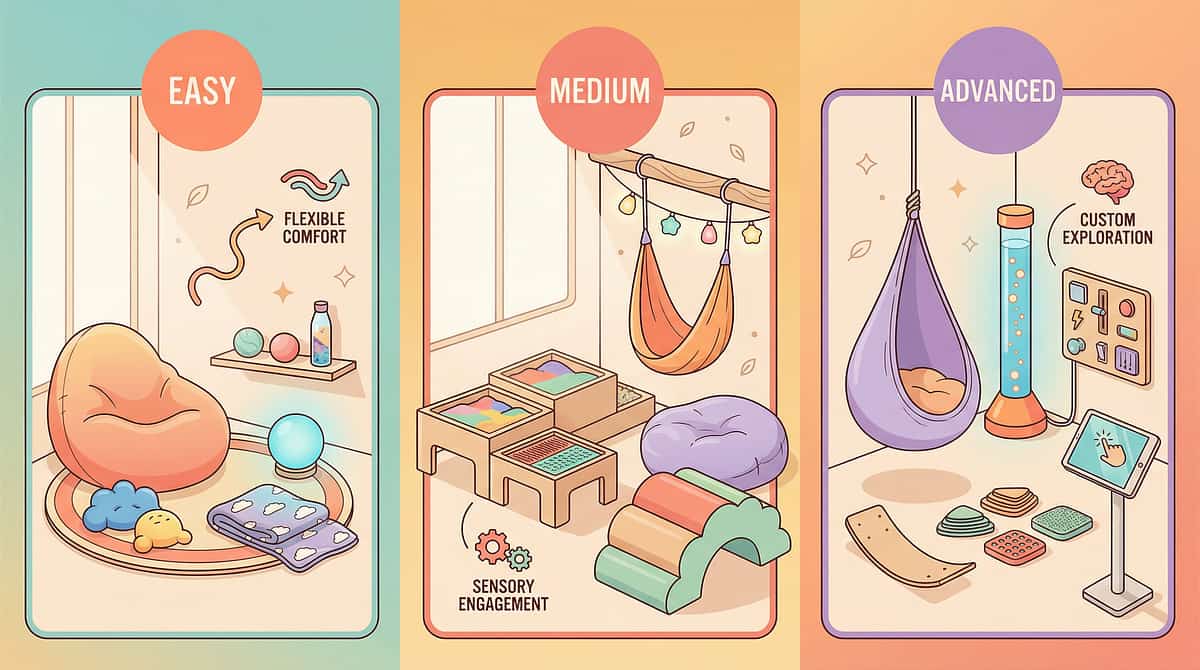
Personalizing This for Your Child

ACT III · ADAPTATION Every child's messy eating has a different root cause. Match the tool to the cause — not to what's most popular or most recommended in general. If your child... Primary tool to start Has shaky, uncontrolled movements Weighted utensils (proprioceptive feedback) Drops utensils / can't maintain grip Built-up handle utensils (grip support) Tips food off spoon mid-arc Curved/angled utensils (reduce wrist rotation) Pushes plate while scooping Suction plate (anchors dish) Can't load spoon — food escapes plate High-sided bowl (scooping wall) Slumps, unstable at table Foot support + seating adjustment FIRST Spills drinks more than food No-spill cup + weighted cup General mess while skills develop Smock bib with catchment tray Age Adaptations 18 months–2 years: Focus on seating + suction plate. Utensils are secondary. 2–4 years: Introduce adaptive utensils once seating is optimized. 4–6 years: Begin systematic fading of supports as motor skills develop. 6–10 years: Focus on specific remaining barriers (often wrist control or proprioception). Sensory Profile Adaptations Sensory Seeker: Weighted utensils often very effective immediately. More proprioceptive feedback = better control. Sensory Avoider: Introduce materials gradually. Novelty aversion is real — don't force. Build tolerance with slow, low-pressure exposure. Difficulty Scaling ← Easier: Start with smock bib + suction plate only (containment + stability) → Harder: Remove smock bib for 1 meal/day, begin with open cup for 1 drink/day

ACT IV · WEEK 1–2
Week 1–2: What to Expect
020406080Progress (%)Progress (%)Week 1Week 1Week 2Week 2Week 4Week 4Week 6Week 6Week 8Week 8WeekWeek
10
20
40
60
80
What You WILL Likely See (Weeks 1–2)
  • Child accepts adaptive materials without major resistance (3–5 days in)
  • Plate remains in place more consistently (suction plate immediate effect)
  • Slightly less food on floor (containment tools working)
  • Child may eat more slowly — this is fine; they are using more cognitive attention for the motor task
⚠️ What You WON'T See Yet
  • Dramatically neater eating across the board
  • Independent, fluent utensil use
  • Generalization to other settings

"If your child tolerates the adaptive spoon for 30 seconds longer this week than last week — that is real motor learning. Measure tolerance, not perfection."
ACT IV · WEEK 3–4
Week 3–4: Consolidation Signs
The child's nervous system is forming new motor pathways. Look for these neural consolidation signals — they confirm the adaptive equipment is doing its job.
Anticipates the Setup
Child moves toward chair with less prompting — the mealtime routine is becoming familiar and predictable
Reaches for Adaptive Utensil First
Preference forming over standard utensil — the brain is connecting this tool with success
Food-to-Mouth Accuracy Improving
Spoon arriving at mouth 50–60% of attempts (up from 20–30%) — motor pathway strengthening
Posture Self-Correcting
Child occasionally repositions feet without prompting — proprioceptive body awareness developing
Mealtime Duration Normalizing
Meals ending closer to 20 minutes rather than 45 — less struggle, more success per bite

Parent Milestone: "You may notice you're less anxious at mealtimes. This is because you're seeing the tools working. Your confidence transfers directly to your child." If 3–4 consolidation signs are present: introduce one new adaptive tool OR begin fading the least necessary tool.

Week 5–8: Mastery Indicators

ACT IV · WEEK 5–8 For E-462 Adaptive Mealtime Protocol, mastery is defined by observable, measurable outcomes — not impressions or feelings. Food Reaches Mouth Successful bite rate at mastery threshold Cleanup Time Reduced Mealtime cleanup time reduced compared to pre-intervention baseline Consecutive Mealtimes Mastery criteria met for 5 consecutive mealtimes before beginning tool fading 🏆 Full Mastery Criteria Food reaching mouth successfully in 70–80% of attempts Child accepts all adaptive materials without resistance Meals completed without parent intervention on equipment Some spontaneous generalization (eating neatly at grandparent's house or school) When to Move vs. Stay ✅ Mastery met for 5 consecutive mealtimes → Begin systematic fading of one tool ✅ Mastery across 2 settings → Technique generalized, consider progression to E-463 ⏸️ Inconsistent mastery (good week/bad week) → Continue 2 more weeks before fading

ACT IV · CELEBRATION
You Did This. Your Child Is Eating More Independently Because of Your Commitment.
You Set Up the Environment
Adaptive mealtime environment at every meal, consistently, even when it was hard
You Learned the Pattern
Read your child's motor profile and matched tools to specific barriers — a clinical-level skill
You Stayed Consistent
Through the messy early weeks when nothing seemed to work — this is the hardest part
You Built Motor Pathways
Hundreds of successful motor practice opportunities your child would not have had without you
🎉Celebrate: Have a meal at a restaurant you previously avoided — and bring your starter kit.
"The motor pathways your child built at this table are permanent. They took 5–8 weeks to form and will last a lifetime. This is what real therapy looks like."
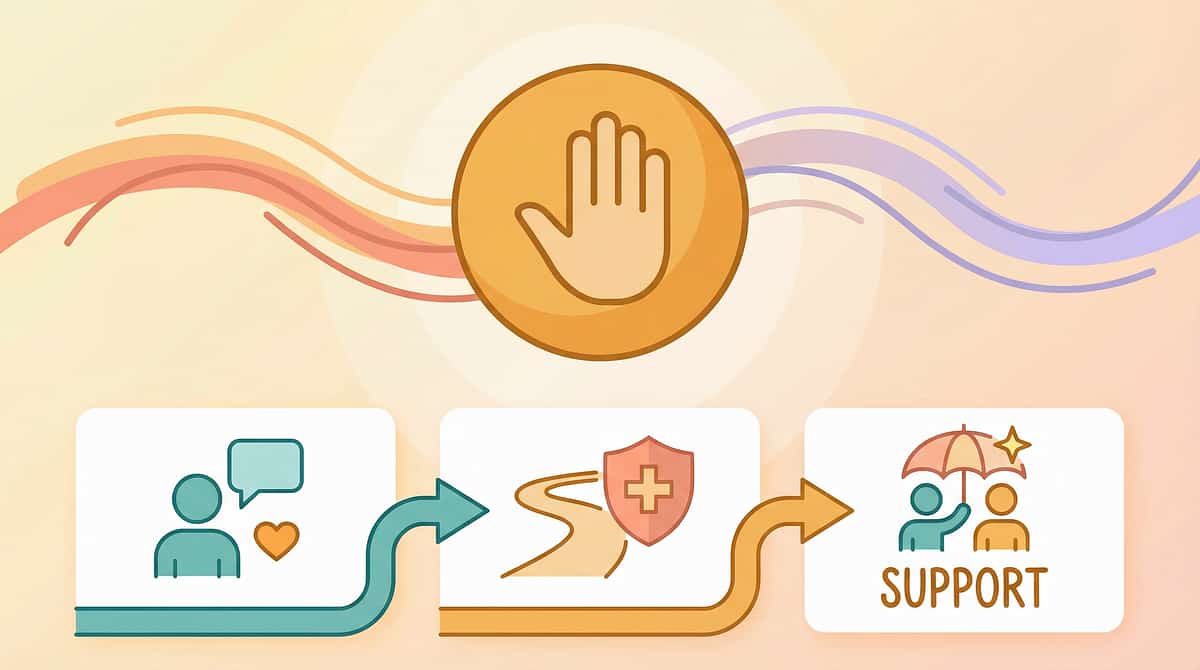
ACT IV · RED FLAGS
Red Flags: When to Pause and Seek Professional Guidance
Trust your instincts. These six signs mean pause, reassess, and contact your care team.
🚨 No improvement after 8 full weeks
Why: May indicate underlying motor issue (hypotonia, DCD, neurological factor) requiring OT assessment. Do: Contact Pinnacle or local pediatric OT for formal evaluation.
🚨 Extreme mealtime anxiety or food refusal developing
Why: Equipment may be creating performance pressure; or feeding anxiety needs separate SLP intervention. Do: Immediately reduce mealtime demands; seek feeding therapy assessment.
🚨 Weight loss or significant reduction in food intake
Why: Motor challenges making eating so effortful that caloric intake is compromised. Do: Urgent pediatrician consult for nutritional assessment.
🚨 Choking incidents (even minor) increasing
Why: Possible oral motor or swallowing issue unrelated to adaptive equipment. Do: Immediate SLP/feeding specialist assessment.
🚨 Child showing new signs of pain in arms or hands
Why: Weighted utensils may be too heavy; or underlying joint hypermobility issue. Do: Pause weighted utensils; OT assessment for appropriate weighting.
🚨 No progress despite OT guidance
Why: May need specialist feeding evaluation beyond standard adaptive equipment. Do: Referral to specialist feeding clinic.
Escalation Pathway: Self-monitor → 📞9100 181 181 (teleconsult) → Pinnacle center visit → Specialist referral
ACT IV · PATHWAY
The Progression Pathway: Where You Are, and Where You're Going
E-470 Independence
E-462 Messy Eating
E-461 Texture Sensitivity
E-460 Overstuffing
📍 You Are Here: E-462
Foundation level | Adaptive equipment + positioning | Building the base for all advanced feeding skills
Next-Level Options
  • E-463 (Eating Too Fast) — If mealtime speed becomes next primary challenge
  • E-466 (Utensil Use Difficulties) — For advanced utensil refinement after basic mess is controlled
  • E-470 (Self-Feeding Independence) — Full independence sequence
Lateral Alternatives
  • If E-462 approach didn't resonate → Try E-461 (texture sensitivity may be driving avoidance)
  • Or E-460 (overstuffing may be a linked motor pattern)
Long-Term Goal
Age-appropriate independent eating in all social contexts (home, school, restaurants) without adaptive equipment — typically achievable by 4–6 years for most children with appropriate intervention.
ACT IV · RELATED TECHNIQUES
Other Techniques in the Feeding & Mealtime Independence Series
E-460: Mouth Overstuffing
Intro level · Sensory + Motor · Materials you already own · techniques.pinnacleblooms.org/feeding/mouth-overstuffing-E460
E-461: Food Texture Sensitivity
Core level · Sensory Processing · Textured materials · techniques.pinnacleblooms.org/feeding/food-texture-sensitivity-E461
E-463: Eating Too Fast
Core level · Behavioral + Motor · Visual timers · techniques.pinnacleblooms.org/feeding/eating-too-fast-E463
E-464: Slow Eating / Prolonged Meals
Core level · Behavioral · Prompting systems · techniques.pinnacleblooms.org/feeding/slow-eating-E464
E-466: Utensil Use Difficulties
Advanced level · Fine Motor · Adaptive utensils (advanced set) · techniques.pinnacleblooms.org/feeding/utensil-use-difficulties-E466
ACT IV · FULL MAP
Your Child's Full Developmental Map
Messy eating is one node in your child's developmental map. Here is the full picture of what GPT-OS® tracks across 12 domains.
"This technique is one piece of a 12-domain developmental plan. GPT-OS® maps your child's entire profile — showing which domains need attention, which are strengths, and which technique to work on next."
Get Your Child's Full Profile
🔗 See your child's full developmental profile on GPT-OS® at pinnacleblooms.org
📞 Call 9100 181 181 to request an AbilityScore® assessment — free, in 16+ languages
ACT V · COMMUNITY STORIES
Stories From Families Like Yours
Parent, Pinnacle Network
"Meals used to look like a food bomb went off. Food on the floor, the table, her clothes, her hair — everywhere. The OT identified that her core was weak and her feet were dangling, so she had no stable base for arm control. We got a proper footrest, suction plates, and curved utensils. The change was remarkable. Not perfect overnight, but dramatically better within weeks. Now she eats with just a small mat under her plate for easy cleanup. She's proud of eating 'like a big girl.'"
Child: 4.5 years, ASD + fine motor delay | Timeline: 6 weeks to significant improvement
Parent, Pinnacle Network
"I was skeptical that a different spoon could make such a difference. But the OT explained the proprioception thing — that our son literally could not feel where the spoon was. The weighted spoon changed that immediately. He was more accurate within the first meal. The weighted spoon was the piece I didn't know was missing."
Child: 6 years, ASD + sensory processing differences | Timeline: Weighted utensil showed effect within first meal
Illustrative cases. Outcomes vary by child profile, underlying causes, and intervention specificity. Pinnacle Network clinical outcome data | Real-World Evidence framework.
ACT V · COMMUNITY
Connect With Other Families
You are not a solo operator. 70,000+ families are on this journey with you — and the collective wisdom of that community is one of your most powerful tools.
Pinnacle Parent WhatsApp Community
Mealtime & Feeding support group — tips, wins, troubleshooting with experienced parents. Join at pinnacleblooms.org/community
Pinnacle Online Parent Forum
Searchable discussion threads on specific feeding challenges, organized by technique code. forum.pinnacleblooms.org
Peer Mentoring
Connect with a parent who has completed E-462 with their child. Real-world guidance, 1:1. Request at pinnacleblooms.org/mentoring
Local Pinnacle Parent Meetup
In-person parent groups at Pinnacle centers across India. Find your nearest center at pinnacleblooms.org/centers
"Your experience with E-462 helps the family who finds this page next week. Consider sharing your journey." → Submit your story at pinnacleblooms.org

ACT V · PROFESSIONAL SUPPORT
Your Professional Support Team
Home-based intervention works best when backed by professional guidance. Here's how to connect with the right specialist for your child's specific pattern.
Therapist Matching for E-462
For messy eating intervention, you need:
  • 🔵Pediatric Occupational Therapist — primary lead: fine motor, postural, adaptive equipment
  • 🟢Pediatric Feeding Therapist (SLP) — if oral motor component is significant
  • 🟡BCBA/ABA Therapist — if behavioral resistance to mealtimes is primary
Book a therapist matching session: pinnacleblooms.org/book
Can't Visit a Center?
Get expert guidance remotely via teleconsultation.
📱Book Teleconsultation — 9100 181 181
Available in 16+ languages | Monday–Saturday
FREE National Autism Helpline
📞9100 181 181 | 24x7 | 16+ languages | Zero cost to family

"Home + clinic = maximum impact. What we teach in 50 minutes, you practice 3 times daily at home. That combination is where transformation happens." — Pinnacle Blooms OT Team
ACT V · EVIDENCE BASE
The Research Library
9-materials-that-help-with-messy-eating therapy material
📄 PRISMA Systematic Review (2024) — Level I
16 articles confirm sensory integration + adaptive equipment is evidence-based practice for ASD children with fine motor differences. PMC11506176
📄 Meta-analysis, World J Clin Cases (2024) — Level I
24 studies demonstrate sensory integration therapy promotes fine motor skills, adaptive behavior, and self-care independence. PMC10955541
📄 Indian RCT, Padmanabha et al. (2019) — Level II
Home-based motor interventions with adaptive equipment show significant outcomes in Indian pediatric populations. First major Indian RCT. DOI: 10.1007/s12098-018-2747-4
📄 Frontiers in Integrative Neuroscience (2020) — Level II
Comprehensive neurological framework for why adaptive equipment works: proprioceptive feedback pathways and cerebellar motor coordination. DOI: 10.3389/fnint.2020.556660
📄 WHO Nurturing Care Framework (2018) — Policy Evidence
Global evidence framework validating early intervention and adaptive home equipment as components of nurturing care for every child. nurturing-care.org/ncf-for-ecd/
ACT V · TECHNOLOGY LAYER
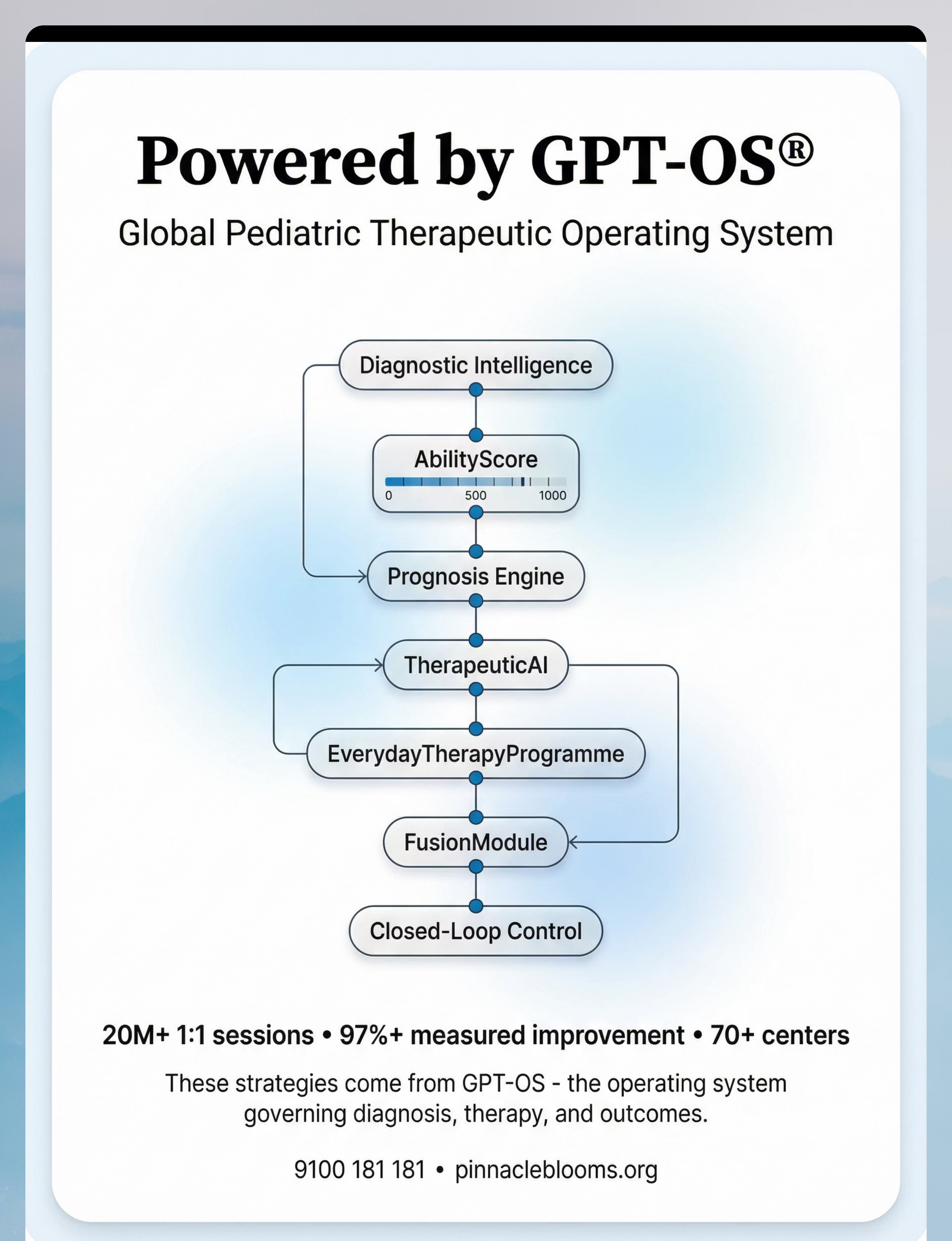
How GPT-OS® Uses Your Mealtime Data
TherapeuticAI Rec
AbilityScore Update
GPT-OS Prognosis
E-462 Session
What GPT-OS® Learns From E-462 Data
  • Rate of mess reduction → calibrates motor intervention dosage
  • Which tools worked → refines adaptive equipment recommendations for similar children
  • Timeline to consolidation → improves population-level prognosis accuracy
  • Parent adherence patterns → adjusts recommendation complexity

🔒Privacy Assurance: DPDP Act compliant | Anonymized for population learning | Individual data never shared | Parent controls data access
"Your child's data helps every child like yours. 20M+ sessions across 70+ centers make our recommendations more accurate for each new family."
ACT V · VIDEO CONTENT
Watch the Reel: E-462 in 60 Seconds
▶️ E-462: 9 Materials That Help With Messy Eating | Feeding & Mealtime Independence Series | Episode 462 | Duration: 60–75 seconds
This short reel walks you through all 9 adaptive materials in 60 seconds — the same materials covered in depth throughout this page. Watch the Pinnacle OT team demonstrate each tool and its therapeutic function. Visual learning accelerates practical implementation.
Presented By
The Pinnacle Blooms Occupational Therapy Team — certified pediatric OTs with combined 200+ years of clinical experience in adaptive equipment and feeding intervention.
Series Navigation
  • ← E-461: Food Texture Sensitivity
  • → E-463: Eating Too Fast

"Video modeling is an evidence-based practice for autism (NCAEP, 2020). Watching before doing improves motor learning by 30–40%."
ACT V · FAMILY SHARING
Share This With Your Family
Consistency across caregivers multiplies impact. Share this with everyone who feeds your child — grandparents, school teachers, babysitters, and extended family all benefit from understanding the why behind the tools.
Share on WhatsApp
Opens WhatsApp with a pre-written message about E-462 and your child's mealtime setup
Share by Email
Opens email with page link and brief explanation of the adaptive equipment approach
Download Family Guide PDF
One-page summary of all 9 materials — printable for school bags and refrigerator doors
School Communication Letter
Pre-written letter explaining E-462 adaptive equipment needs for school mealtime, signed with Pinnacle medical authority

"Explain to Grandparents" Card:"[Child's name] uses special plates and spoons at mealtimes because their hands are still learning the coordination needed for eating. Please use the setup below when you care for them. It isn't spoiling them — it's supporting their motor development."
Sibling Communication:"[Sibling's name], your brother/sister's brain is learning to control their hands at mealtimes. Their special spoon helps them practice. Maybe you can be their helper today?"
ACT VI · FAQ
Frequently Asked Questions
At what age should I be concerned about messy eating?
If mess is significantly beyond the age norms on the developmental timeline — particularly after age 3 for basic utensil use and after age 4 for general neatness — it warrants assessment. Persistent mess at school age often indicates an underlying fine motor or sensory processing difference.
Will my child become dependent on adaptive equipment forever?
No. Adaptive equipment is a scaffold, not a permanent replacement. As underlying motor skills develop (often 4–12 months with targeted intervention), tools are systematically faded. Most children ultimately eat without adaptive equipment.
Which tool should I buy first?
Start with seating optimization (cheapest, highest impact), then suction plate or high-sided bowl, then the specific utensil that matches your child's primary challenge (see the motor profile guide).
My child's school won't allow special equipment. What do I do?
Use the school communication template. Frame it as a medical accommodation. Most schools comply when a therapist letter accompanies the request. Contact 9100 181 181 for a formal OT recommendation letter if needed.
Can I use these tools for a non-autistic child with messy eating?
Absolutely. These tools support motor development in any child with fine motor delays, hypotonia, DCD, or simply developmental lags in self-feeding. The motor principles apply regardless of diagnosis.
How do I know if we need a full OT assessment vs. home-based tools?
If mess is causing nutritional concerns, affecting school or social participation, or showing no improvement after 8 weeks of consistent adaptive equipment use — seek formal OT assessment.
My child won't tolerate any of the 9 materials. What now?
This may indicate tactile sensitivity requiring a desensitization protocol before adaptive equipment introduction. Contact a Pinnacle OT for a full sensory profile assessment.
Can I combine this with other Pinnacle techniques simultaneously?
Yes. GPT-OS® is designed for multi-technique implementation. E-462 pairs well with fine motor strengthening techniques (Domain F) and postural core work (Domain G). The 12-domain wheel shows the full picture.

Preview of 9 materials that help with messy eating Therapy Material

Below is a visual preview of 9 materials that help with messy eating therapy material. The pages shown help educators, therapists, and caregivers understand the structure and content of the resource before use. Materials should be used under appropriate professional guidance.
Page 1
Page 2
Page 3
Page 4
Page 5
Page 6
Page 7
Page 8
Page 9
Page 10
Page 11
Page 12
Page 13
Page 14
Page 15
Page 16
Page 17
Page 18
Page 19
Page 20
Link copied!
ACT VI · CLOSE
Your Child's Mealtime Can Be Different — Starting Today.
You have the knowledge. You have the tools. One step to begin.
20M+ Sessions
Delivered across 70+ centers in India and beyond
97%+ Improvement
Measured across readiness indexes with OT + Feeding integration
16+ Languages
Free National Autism Helpline: 9100 181 181 | 24x7
160+ Countries
Patents filed | GPT-OS® powered global pediatric therapeutic system
🏥Validated by the Pinnacle Blooms Consortium — OT · SLP · ABA · SpEd · NeuroDev · CRO

This content is educational. It does not replace individualized assessment and intervention with licensed occupational therapists or feeding specialists. Persistent messy eating may indicate underlying motor, sensory, or developmental differences requiring professional evaluation.
© 2025 Pinnacle Blooms Network®, unit of Bharath Healthcare Laboratories Pvt. Ltd. | CIN: U74999TG2016PTC113063 | DPIIT: DIPP8651 | MSME: TS20F0009606 | GSTIN: 36AAGCB9722P1Z2 | techniques.pinnacleblooms.org | E-462
Return to Top | → unknown link
80