
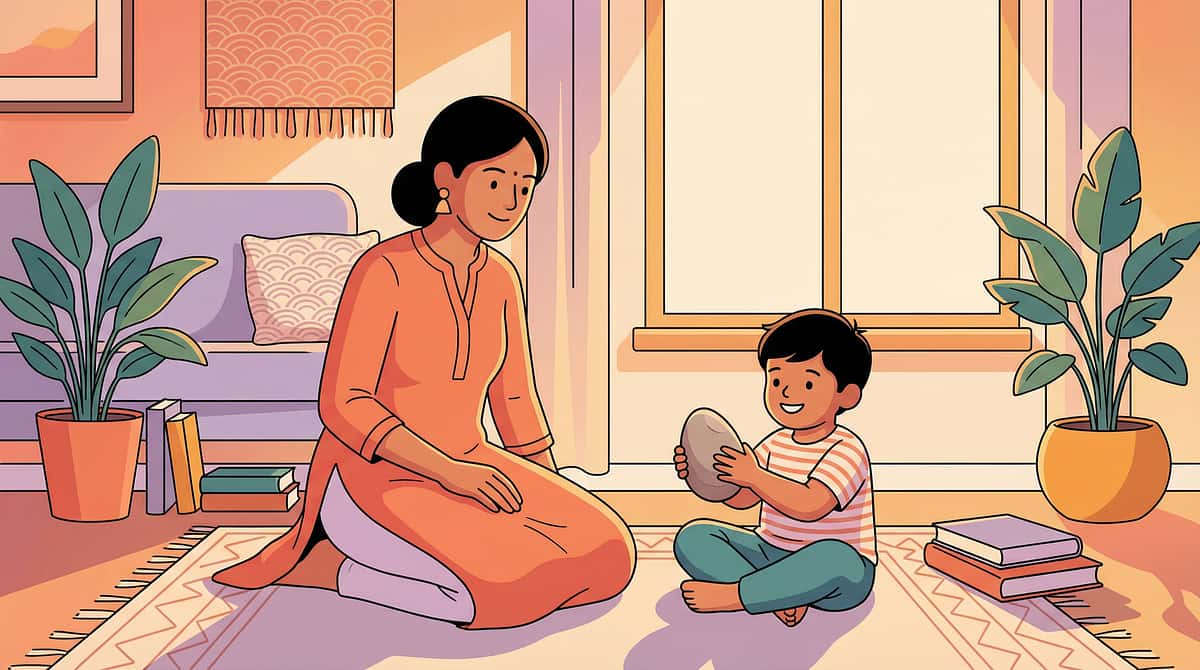
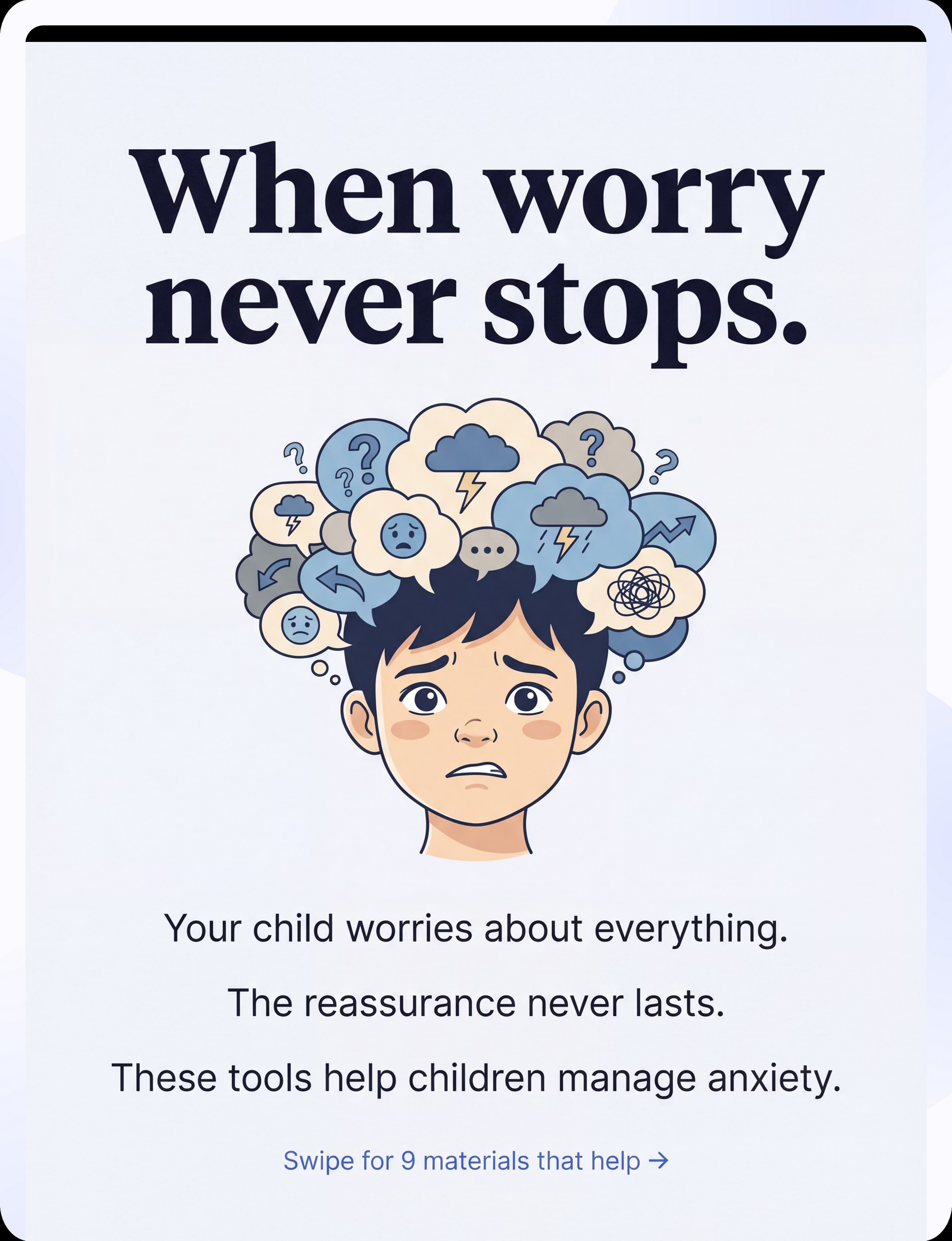
She worries about everything. Even the things that never happen.
You've reassured her a thousand times. You've explained the logic. You've told her she's safe. Five minutes later, the worry is back — louder. These 9 clinically-mapped materials help her answer her nervous system's distress signal.
Ages 4–12
Emotional Regulation Series • Episode 276
Pinnacle Blooms Network®
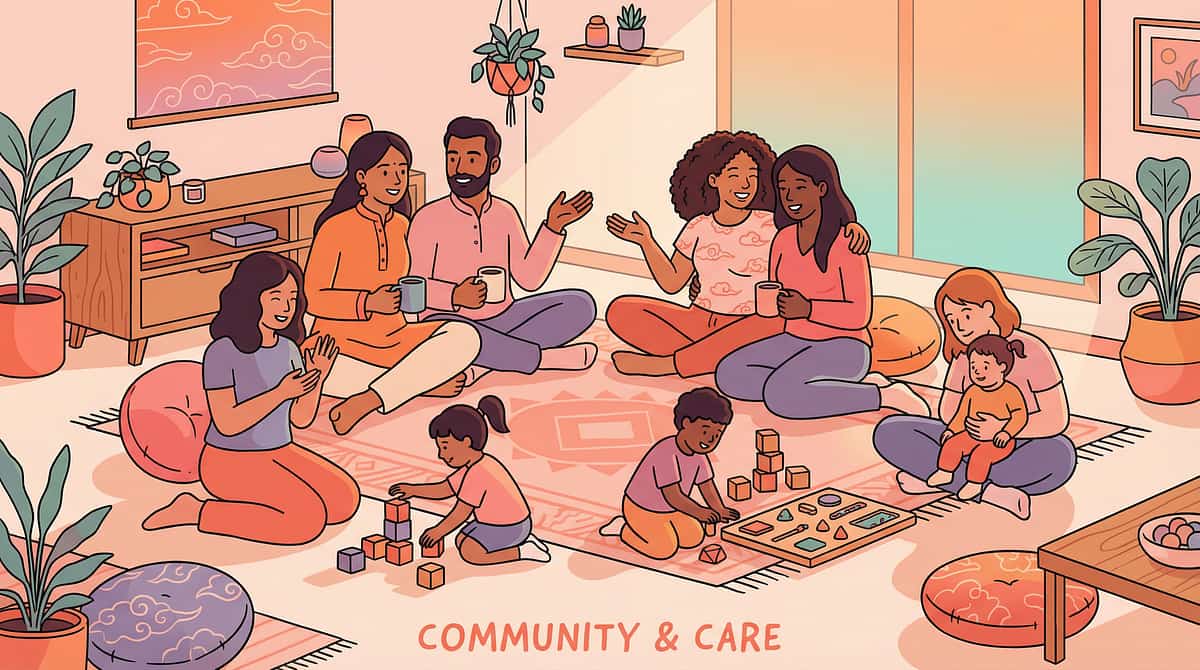
You Are Among Millions of Families Navigating This Exact Challenge
Childhood anxiety is more common than most parents realize — and more treatable. With structured home intervention, the vast majority of anxious children improve significantly. You are not alone, and you are not failing your child.
7%
Diagnosable Anxiety
Children ages 3–17 have a diagnosable anxiety disorder
80%+
Improve With Help
Anxious children who improve significantly with structured home intervention
1 in 5
Early Onset
Children experience clinically significant worry before age 12
In India, fewer than 12% of affected children receive structured support — despite childhood anxiety being significantly under-identified. Pinnacle centers across 70+ locations see 1,400+ anxiety-related presentations monthly. You are among 100+ million families worldwide navigating this. This is not rare. This is not your fault. This is biology — and it responds to the right tools.

This Is Not Drama. This Is Neuroscience.
The Amygdala — The Alarm Centre
In anxious children, the amygdala — the brain's smoke detector — is hyper-calibrated. It fires at low-grade threats as if they were emergencies. A test next week registers the same neurological signal as an actual fire.
The Prefrontal Cortex — The Thinking Brain
When the amygdala fires, neural resources divert away from the reasoning centre. This is why logic doesn't work on anxiety. Your child knows the car probably won't crash. Her reasoning brain is offline.
The Nervous System
Anxious children have sensitized autonomic nervous systems — faster to activate fight-or-flight, slower to return to baseline. This is a calibration difference, not a character flaw.
"Anxiety is not a choice. It is a wiring pattern. And wiring patterns respond to structured, repeated, sensory-based intervention."
Research: Frontiers in Integrative Neuroscience (2020) — Neurological basis for sensory-based intervention. DOI: 10.3389/fnint.2020.556660
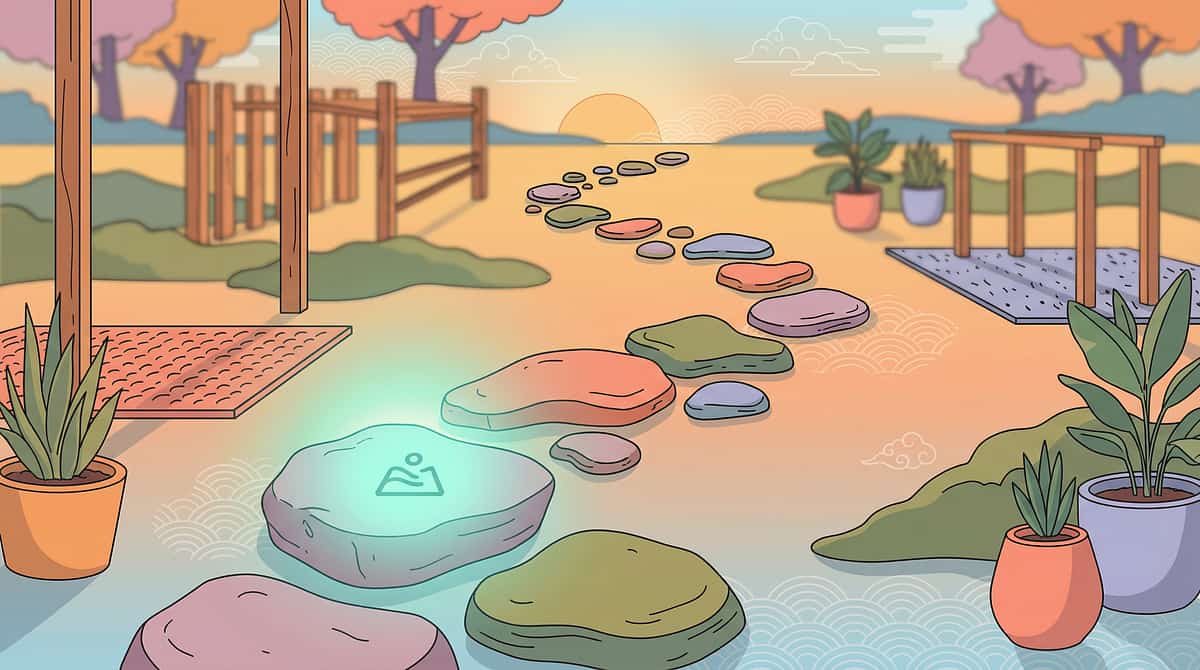
Your Child Is Here. Here Is Where We're Heading.
Generalized anxiety in children typically emerges between ages 6–12. Some anxiety is developmentally normal and even protective. GAD differs in three ways: intensity (disproportionate to real threat), persistence (doesn't resolve with reassurance), and impairment (shrinks the child's world).
1
0–2 Years
Stranger and separation anxiety — developmentally normal
2
2–4 Years
Dark and noise fears — normal developmental phase
3
4–7 Years
"What if" thinking begins — watch zone for early anxiety patterns
4
6–10 Years ⚠️
GAD peak emergence window — highest prevalence zone
5
8–12 Years
Social anxiety onset — with structured intervention → flexible coping by age 10–12
Commonly co-occurs with: ADHD, Autism Spectrum, Sensory Processing Differences, OCD, and Sleep Disorders. Pinnacle's FusionModule™ coordinates multi-disciplinary assessment when co-conditions are present. Intervention at this developmental window has the highest neuroplasticity advantage. You are acting at exactly the right time. Questions about your child's development? 📞 9100 181 181 — FREE, 16+ languages.

Clinically Validated. Home-Applicable. Parent-Proven.
The 9 materials on this page represent the tactile, visual, and behavioral implementation layer of CBT — the most empirically supported treatment for childhood anxiety. Every tool is evidence-mapped.
Study | Finding | Source | |
CBT Meta-analysis (2024) | Structured skills + graduated exposure = highest efficacy for childhood anxiety | PMC11506176 | |
Sensory Integration Review (2024) | Tactile grounding and sensory materials improve anxiety regulation in ASD/anxiety | PMC10955541 | |
Indian Home-Based RCT (2019) | Parent-administered home interventions show significant anxiety reduction | DOI: 10.1007/s12098-018-2747-4 | |
WHO CCD Package (2023) | Multi-sensory home programs improve emotional regulation across 54 LMICs | PMC9978394 | |
NCAEP (2020) | Cognitive-behavioral approaches classified as evidence-based for anxiety | ncaep.fpg.unc.edu |
🛡️ LEVEL I–II EVIDENCE
Systematic Reviews + Multiple RCTs
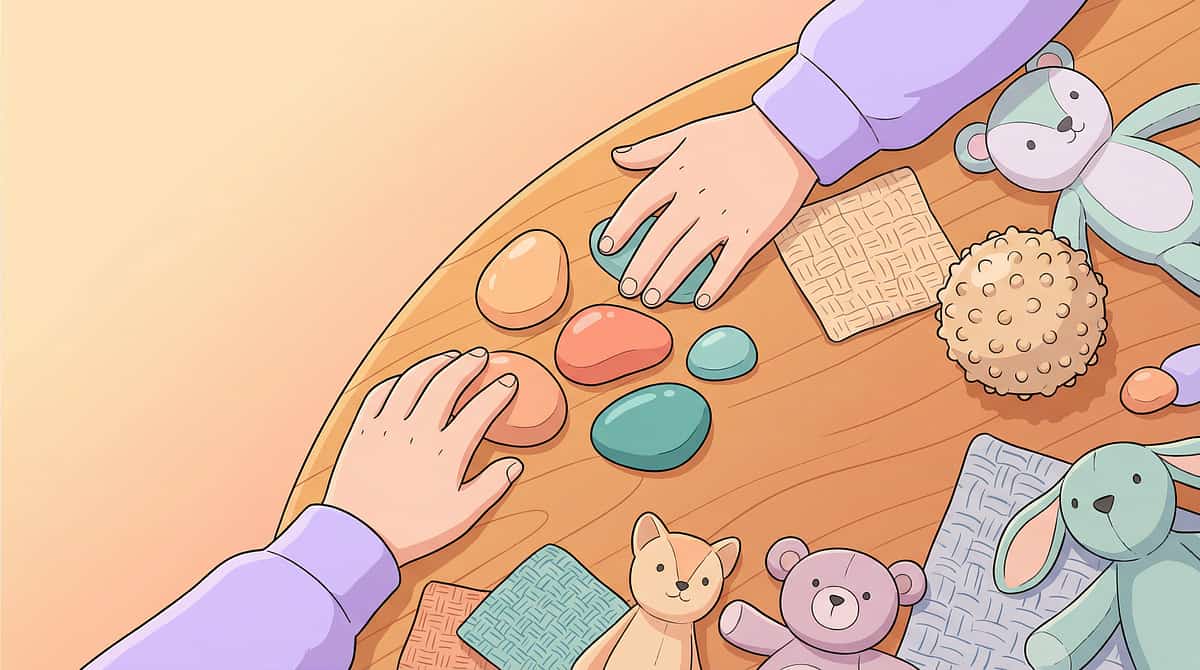
The Anxiety Management Materials Protocol
Parent-friendly name: "The Anxiety Toolkit"
Domain C: Emotional Regulation
ANX-GEN | C-276
Ages 4–12 | Daily Use
This is the structured introduction and daily use of 9 clinically-mapped materials that address the physiological, cognitive, and behavioral dimensions of childhood generalized anxiety. Unlike medication or weekly therapy alone, these materials are available 24 hours a day — in the home, in the school bag, at the restaurant, at the sleepover — wherever worry strikes.
🫀 Body Layer
Worry stones, breathing tools, calm-down kits — interrupt the physiological fight-or-flight response
🧠 Mind Layer
Worry journals, anxiety scales, self-talk cards — externalize and restructure anxious thinking
🏆 Behavior Layer
Coping cards, brave ladders, anxiety books — build agency and gradually face avoided situations

This Technique Crosses Therapy Boundaries — Because the Brain Doesn't Organize by Therapy Type.
At Pinnacle, no single discipline owns anxiety. FusionModule™ coordinates OT + ABA + SpEd + SLP + NeuroDev in a single converged pathway. That is why outcomes at 70+ centers consistently exceed what any single discipline achieves alone.
NeuroDev Pediatrician / Child Psychiatrist
Leads assessment, rules out co-occurring conditions, oversees medication decisions if needed, tracks GAD severity over time using standardized tools.
Occupational Therapist (OT)
Selects and calibrates sensory-grounding materials. Assesses sensory processing differences that amplify anxiety. Designs home sensory environment.
ABA / BCBA Therapist
Designs the reinforcement system for brave behavior. Builds exposure ladders using functional analysis. Manages avoidance patterns and tracks progress data with precision.
Special Educator (SpEd)
Supports cognitive-behavioral tools for children with language delays or learning differences. Adapts bibliotherapy for comprehension level.
Pediatric SLP
Supports verbal expression of worry. Modifies tools for children with communication differences or selective mutism.
📞 9100 181 181 — FREE multi-disciplinary assessment, all 16+ languages

This Isn't a Random Activity. It's a Precision Toolkit.
Every material targets a specific layer of the anxiety cycle. The bullseye model shows primary, secondary, and tertiary outcomes — all measurable, all observable in your child's daily life.
Primary Targets
Anxiety spiral interruption • Worry externalization and containment • Coping strategy access under stress
Secondary Benefits
Interoceptive awareness • Self-efficacy and agency • Reduction in reassurance-seeking • Sleep quality improvement
Tertiary Gains
Brave behavior generalization • Social participation expansion • Academic performance improvement • Long-term resilience architecture
Observable indicators of progress: Child reaches for worry stone unprompted | Child writes in worry journal before seeking reassurance | Child uses breathing tool when anxiety rises above 5/10 | Child says "I'm at a 6" — self-awareness language is forming.
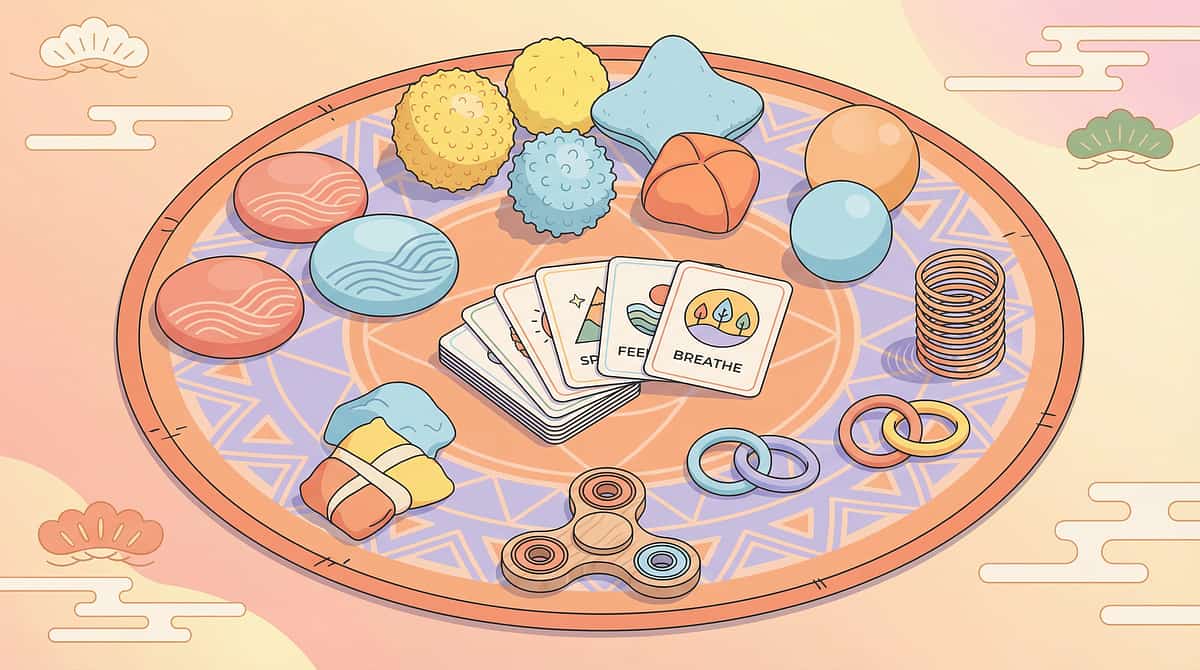
9 Materials. All Home-Deployable. All Evidence-Mapped.
Materials 1–4 of 9
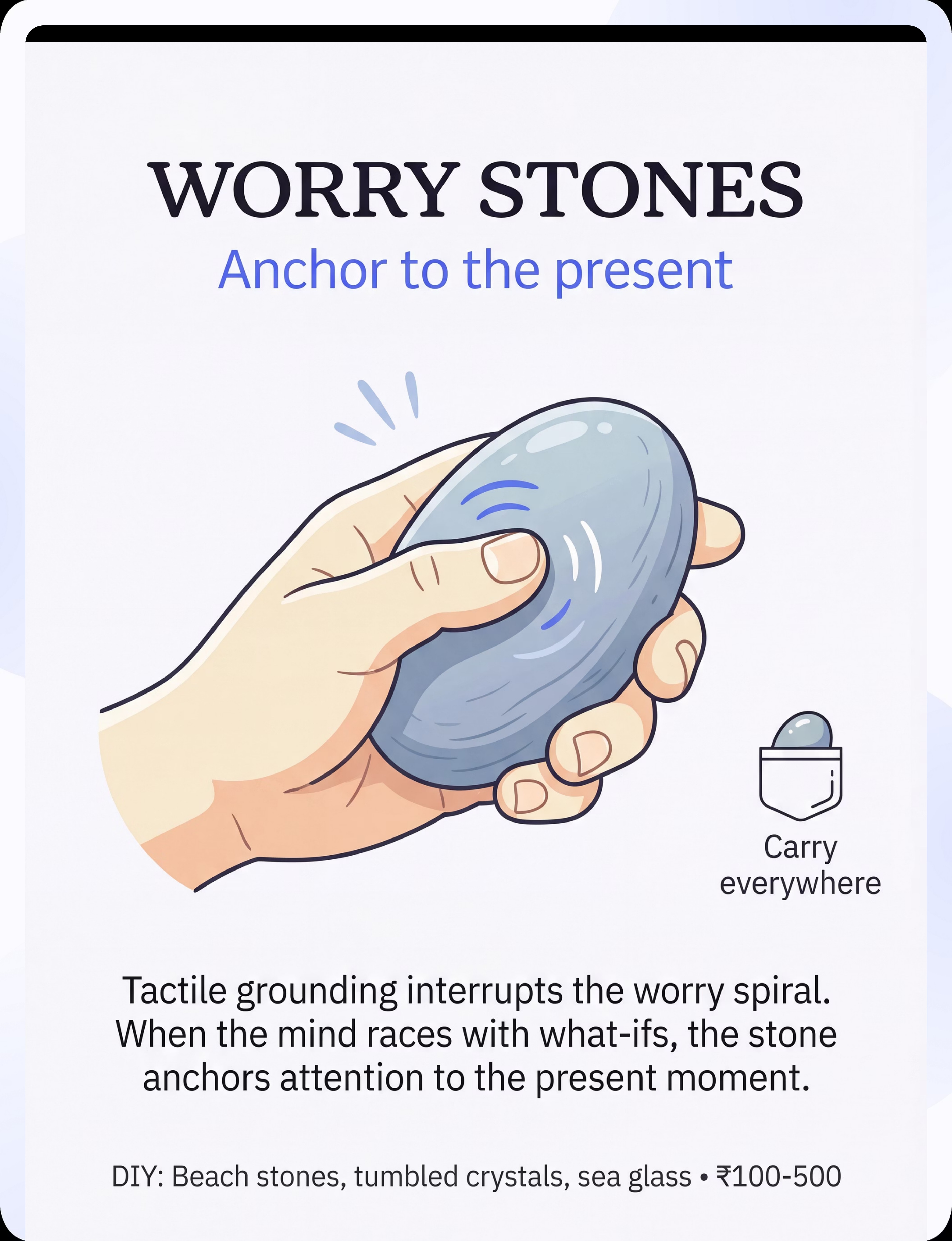
1. Worry Stones / Grounding Objects
Canon: Transition Objects / Comfort Items | ₹100–500 | Ages 4+
Tactile grounding interrupts the worry spiral. When the mind races, the stone anchors attention to the present moment. Carry everywhere.
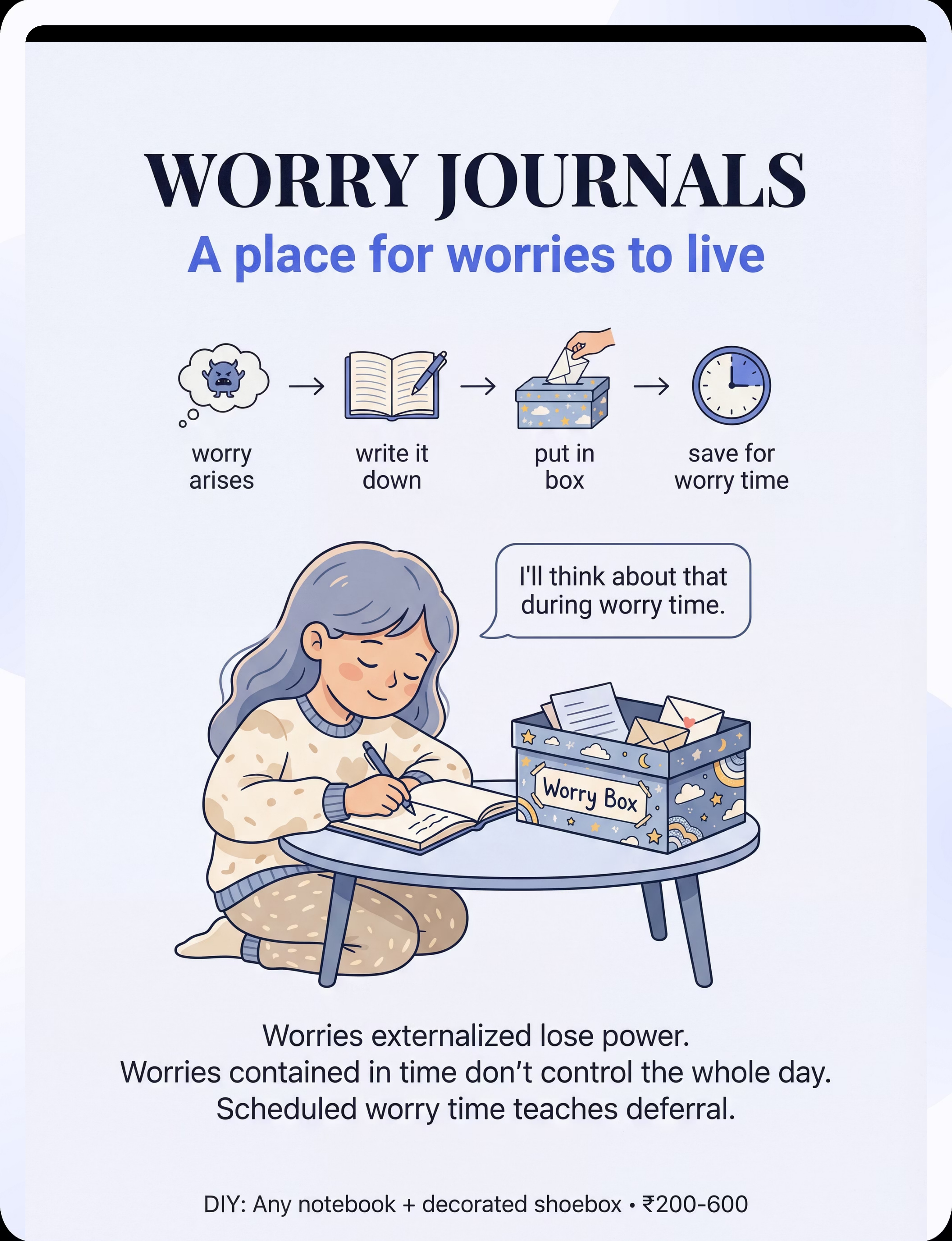
2. Worry Journals + Worry Box
Canon: Cognitive-Behavioral Tools | ₹200–600 | Ages 5+
Externalizing worry onto paper reduces its power. Worry containment in time prevents worry from controlling the whole day.
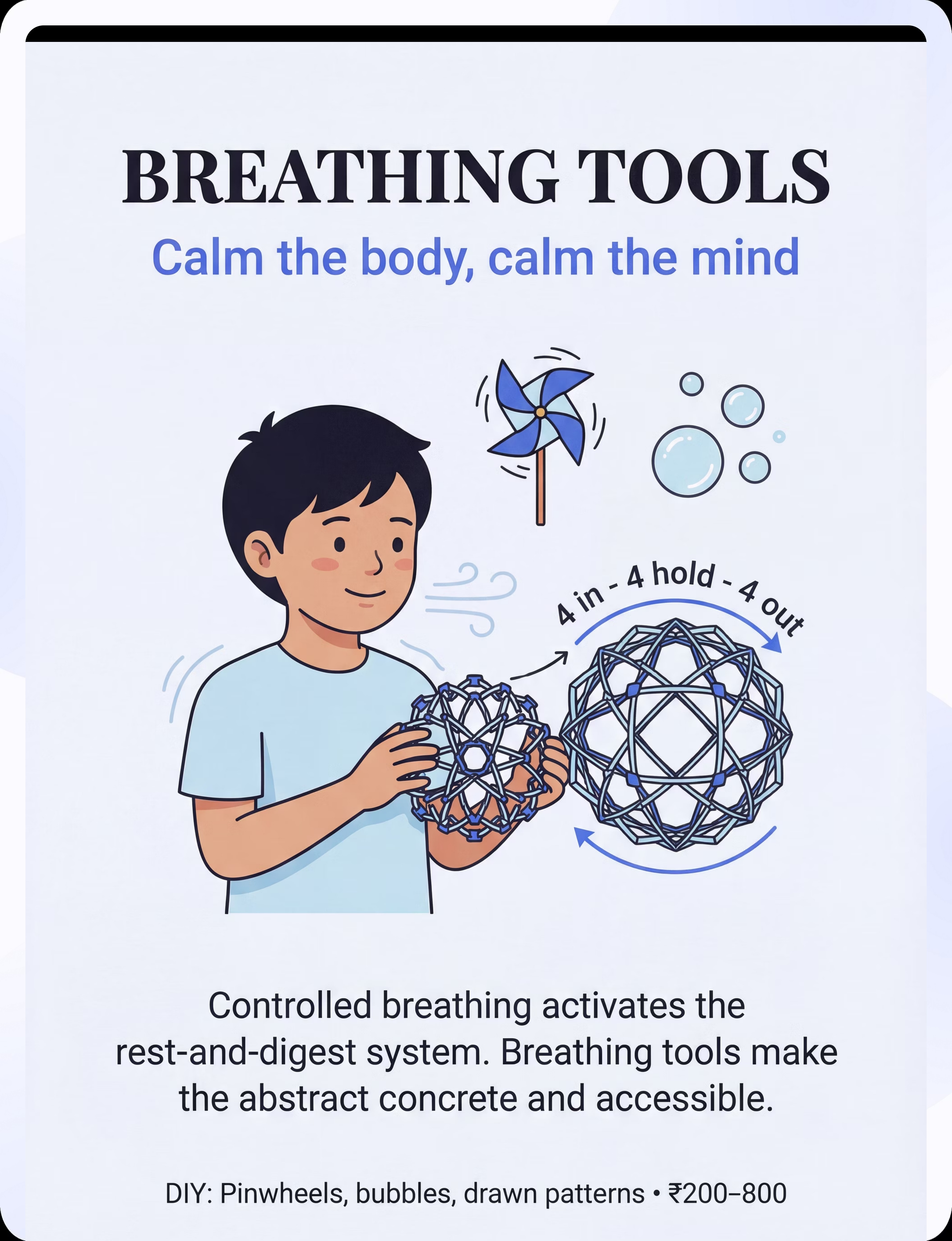
3. Breathing Tools (Hoberman Sphere / Pinwheel)
Canon: Sensory Regulation Materials | ₹200–800 | Ages 4+
Controlled breathing directly activates the parasympathetic system. These tools make "take a deep breath" visible, concrete, and doable.
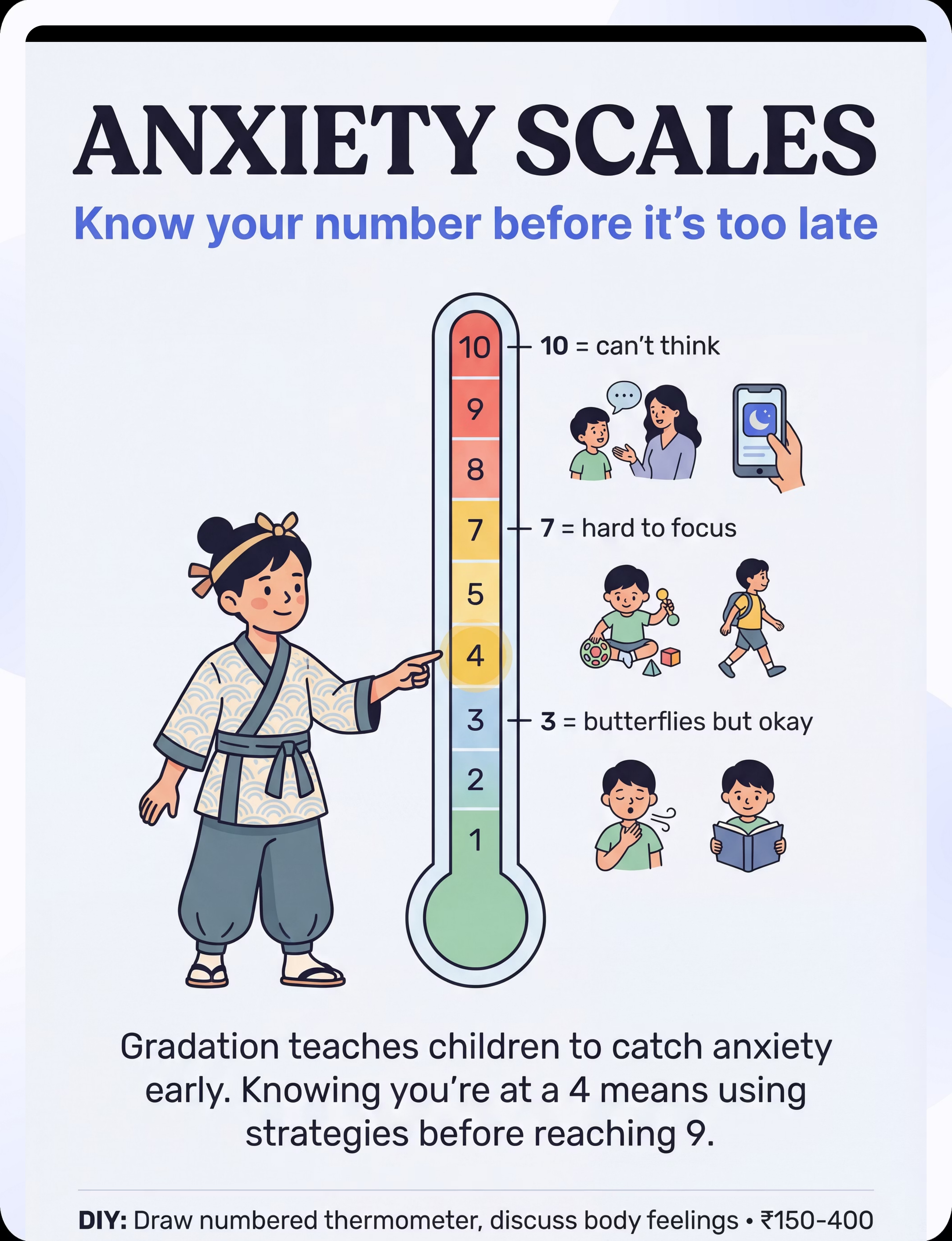
4. Feelings Thermometer / Anxiety Scale
Canon: Visual Support Materials — Emotion Charts | ₹150–400 | Ages 5+
Gradation teaches children to catch anxiety at a 4 before reaching a 9. Awareness precedes management.
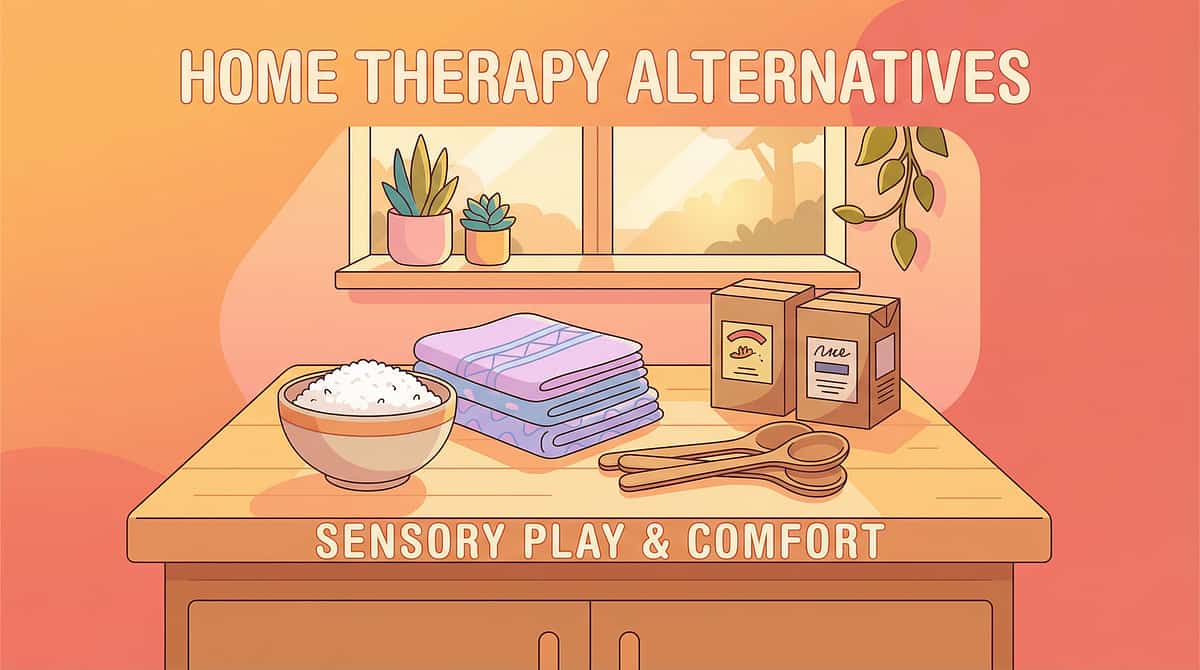
9 Materials — Continued
Materials 5–9 of 9
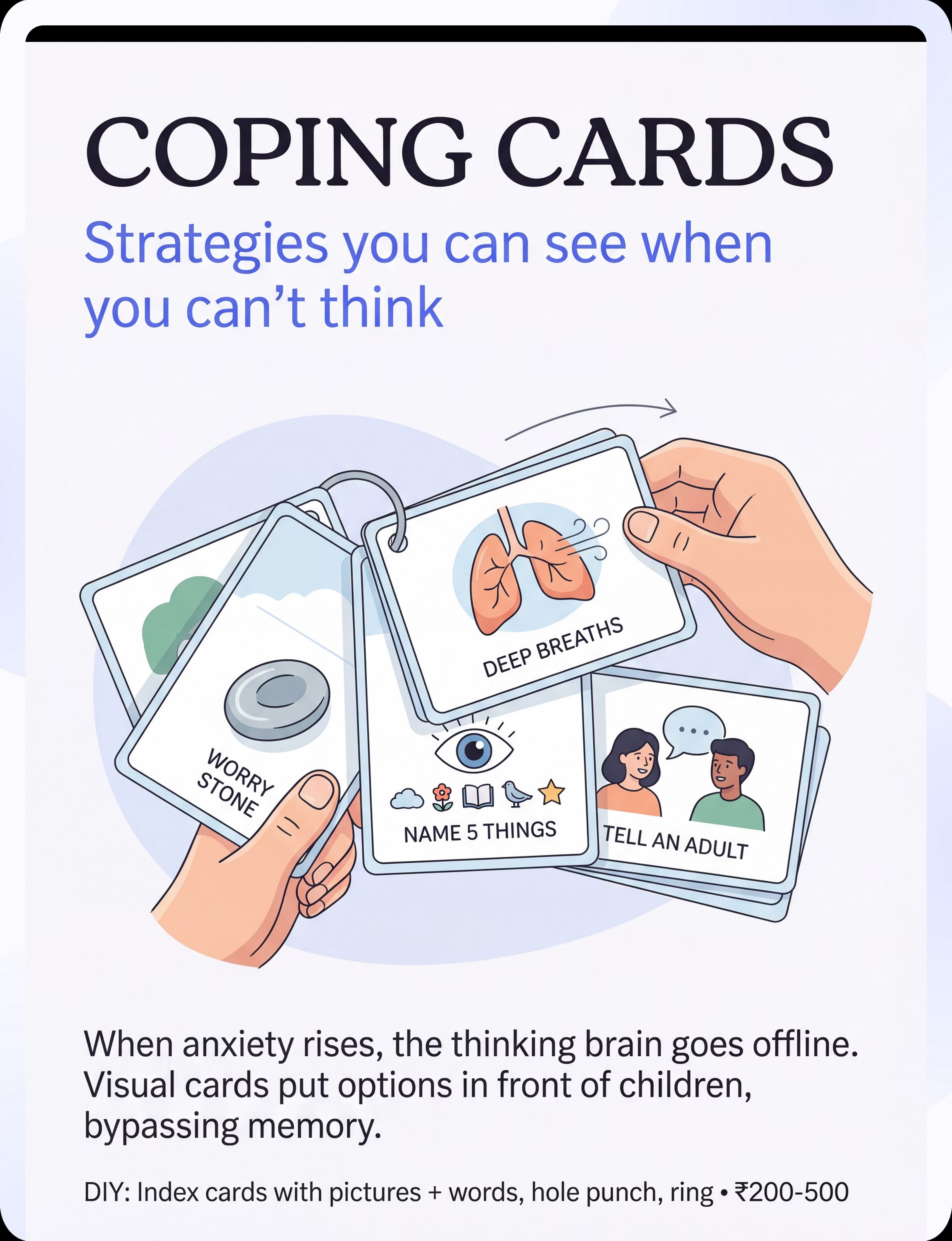
5. Coping Skills Cards / Strategy Menu
Canon: Visual Support Materials — Coping Cards | ₹200–500 | Ages 5+
When anxiety rises, the thinking brain goes offline. Visual cards bypass memory and put options in front of the child.
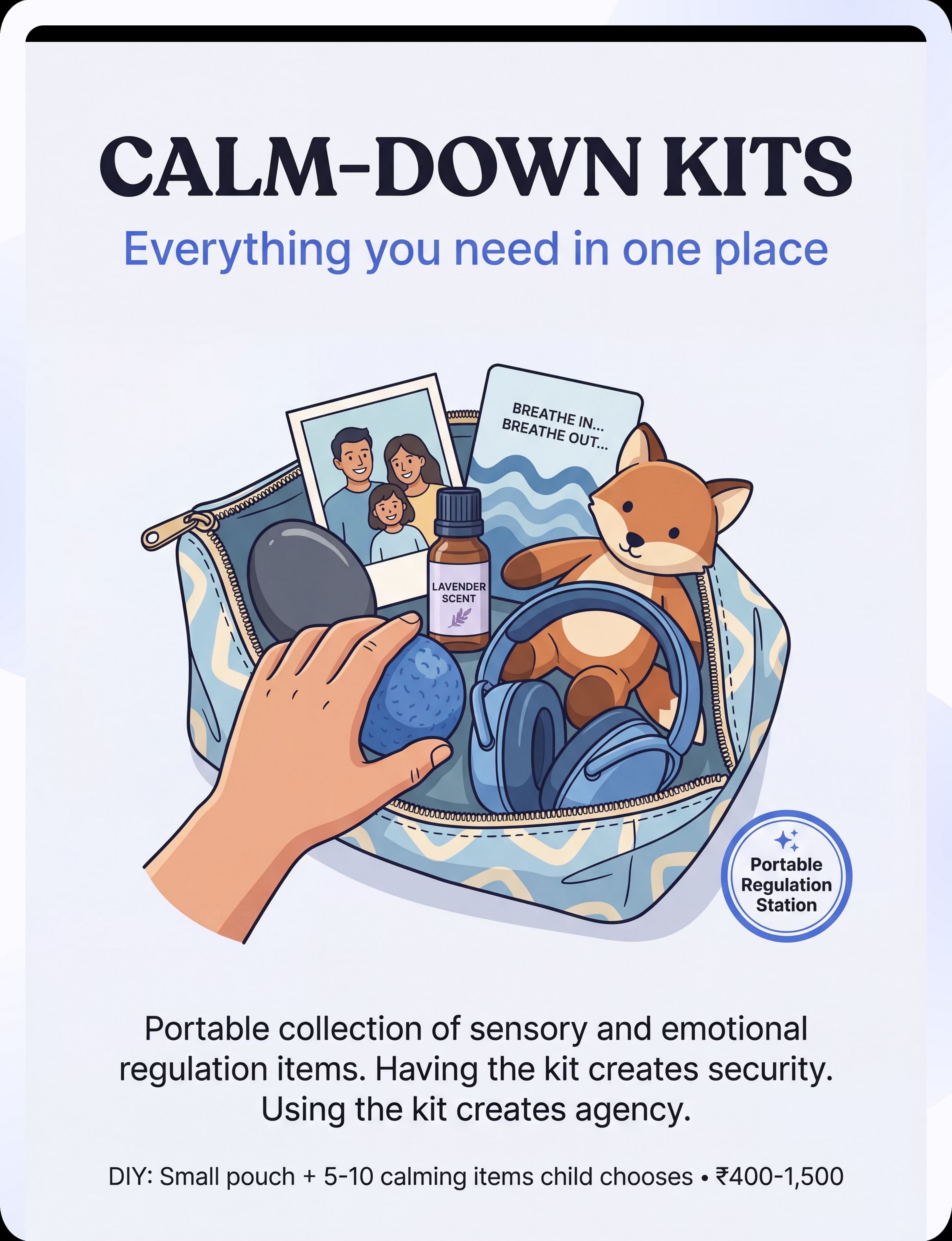
6. Calm-Down Kit (Portable Regulation Station)
Canon: Transition Objects + Sensory Items | ₹400–1,500 | Ages 4+
Having the kit creates security. Using the kit creates agency. Both reduce anxiety.
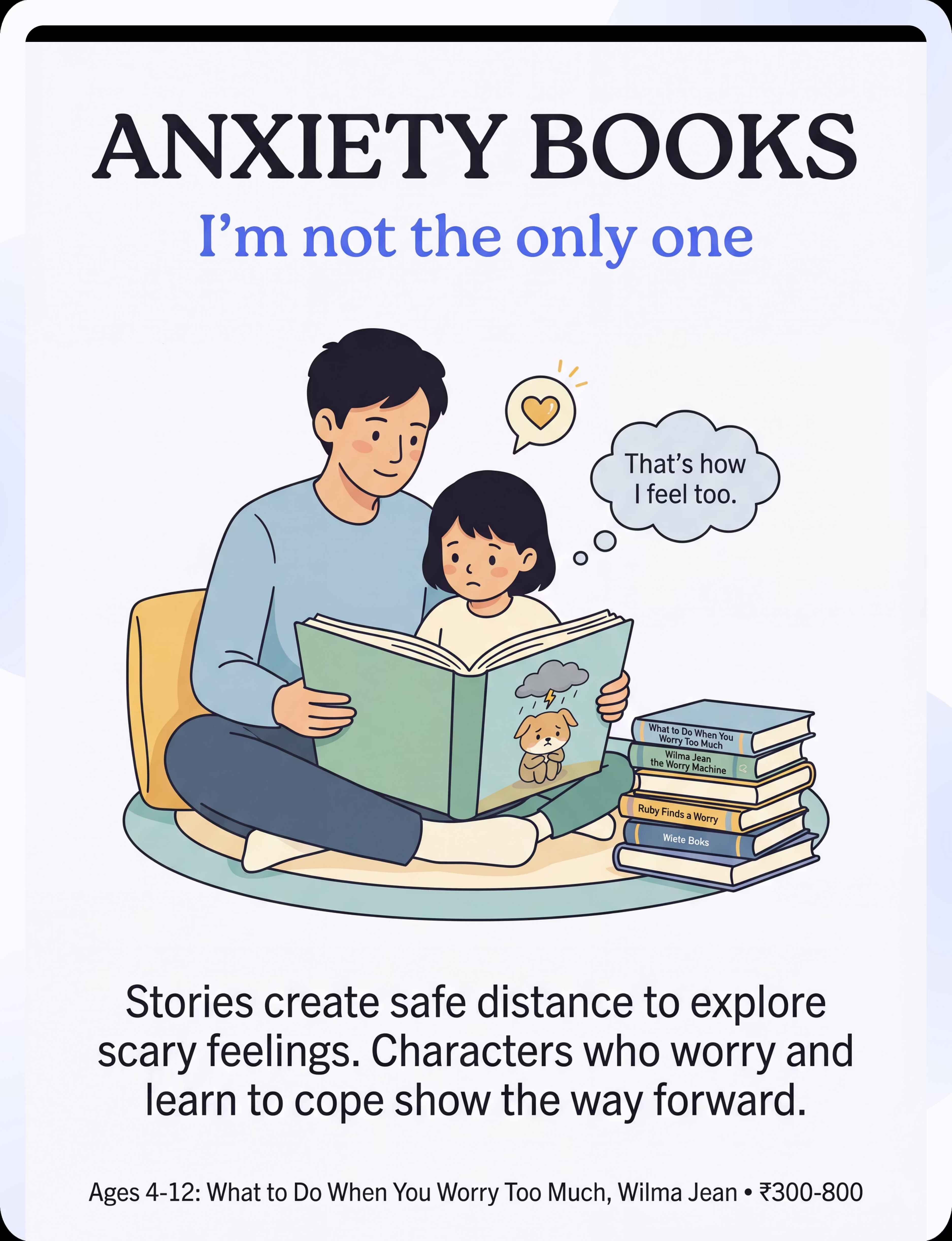
7. Anxiety Books (Bibliotherapy)
Canon: Cognitive-Behavioral Tools — Bibliotherapy | ₹300–800 | Ages 3–12
Stories create safe distance to explore scary feelings. Characters who cope model the way forward.
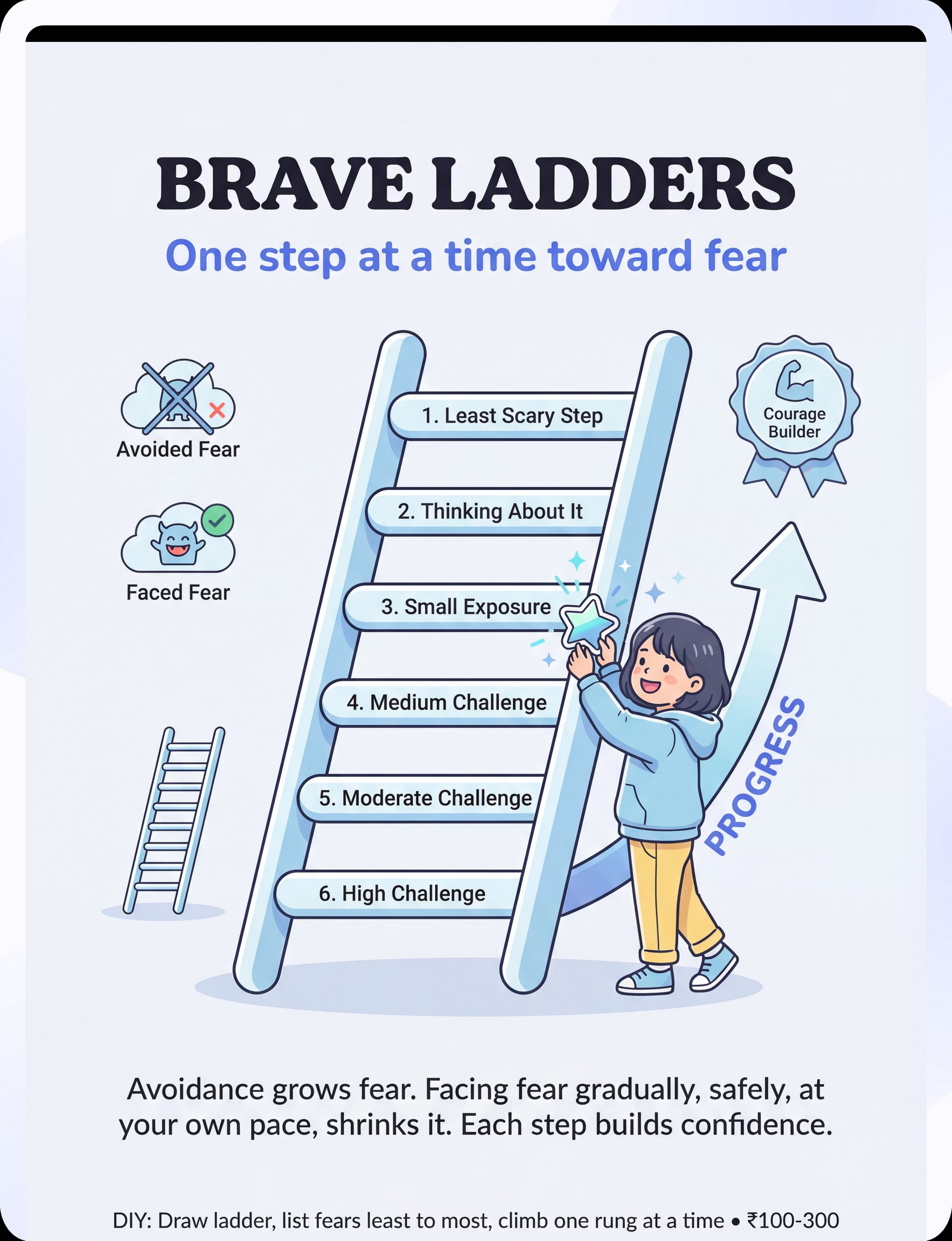
8. Brave Ladder / Exposure Chart
Canon: Visual Support Materials — Progress Charts | ₹100–300 | Ages 6+
Avoidance grows fear. The brave ladder breaks feared situations into manageable steps — facing them gradually, safely, at the child's pace.
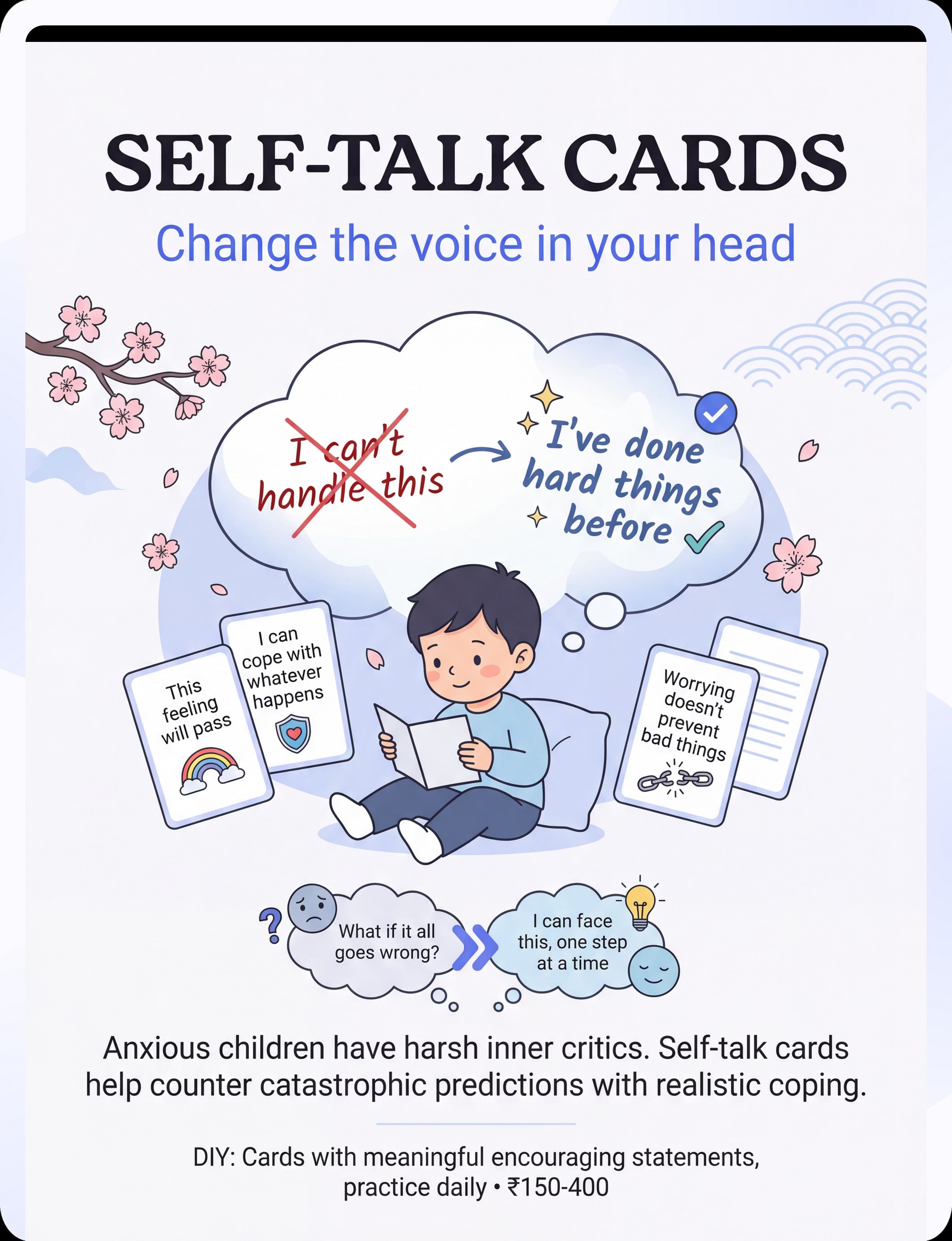
9. Positive Self-Talk Cards
Canon: Cognitive-Behavioral Tools — Affirmation Cards | ₹150–400 | Ages 6+
Anxious children have harsh inner critics. Self-talk cards help counter catastrophic predictions with realistic coping statements.
✅ All 9 materials are clinically mapped to the CBT protocol for childhood anxiety as validated across Pinnacle's 20M+ therapy sessions. 📞 9100 181 181 — FREE guidance on building your child's anxiety toolkit
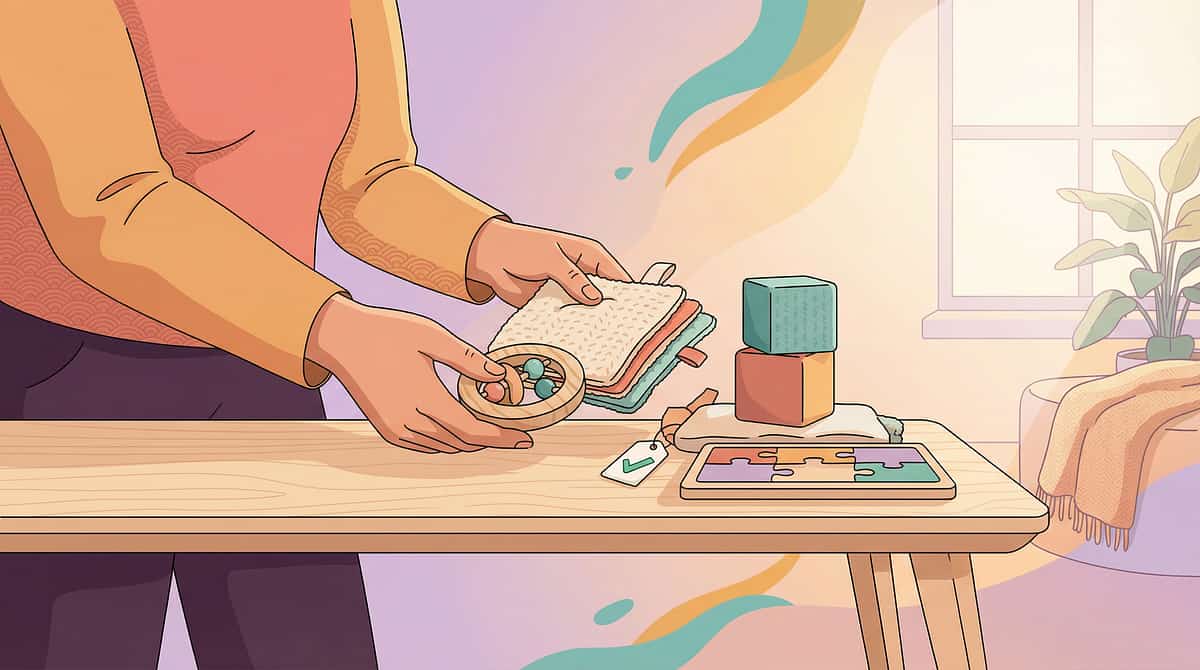
Every Parent, Regardless of Income, Can Execute This TODAY With Household Items.
WHO/UNICEF Equity Principle in action. The most powerful anxiety intervention is not a product — it is a parent who shows up consistently, uses the tools, and celebrates brave steps. That costs nothing.
Material | ₹0 DIY Option | Why It Works | |
Worry Stone | Smooth river pebble, sea glass, or any palm-sized stone | Same tactile grounding principle | |
Worry Journal | Any notebook + shoebox "worry box" decorated by child | Same externalization mechanism | |
Breathing Tool | Pinwheel (₹20), bubble wand, or "smell flower/blow candle" imagination | Same parasympathetic activation | |
Feelings Thermometer | Draw on paper: colored pencil thermometer 1–10 | Same interoceptive awareness function | |
Coping Cards | Index cards + hole punch + binder ring (₹50 total) | Same visual bypass of memory | |
Calm-Down Kit | Pencil case + 5 items child chooses from home | Same agency and security function | |
Anxiety Books | Public library borrowing | Same bibliotherapy benefit | |
Brave Ladder | Draw on paper; use stickers as reward markers | Same graduated exposure scaffold | |
Self-Talk Cards | Write statements on card stock; child decorates | Same cognitive restructuring function |
⚠️ Read This Before You Begin Any Anxiety Intervention
🟢 GREEN — Safe to Proceed
Child is calm or mildly anxious (not in active panic) • Child has eaten and slept adequately • No recent traumatic event in past 24–48 hours • Parent is calm and regulated • You have 10–20 uninterrupted minutes
🟡 AMBER — Modify First
Meltdown in past 2 hours → Start with body tools only (breathing, worry stone) • Child is overtired → Shorten to 5 minutes maximum • Child is resistant → Offer material without instruction, let curiosity lead
🔴 RED — Do Not Proceed
Child is in active panic attack (hyperventilating, inconsolable) • Child has expressed any thoughts of self-harm → Seek professional support immediately • Anxiety escalating for 2+ weeks without improvement • Child refusing school or showing complete social withdrawal
⛔ABSOLUTE STOP: If your child says "I want to die" or "I wish I wasn't here" — even as hyperbole — take it seriously. Call 📞9100 181 181 or visit your nearest Pinnacle center immediately. Material Safety Notes: Worry stones: palm-sized minimum for children under 5. Breathing tools: never force; if resistance increases, stop. Brave ladders: child must consent to each step.
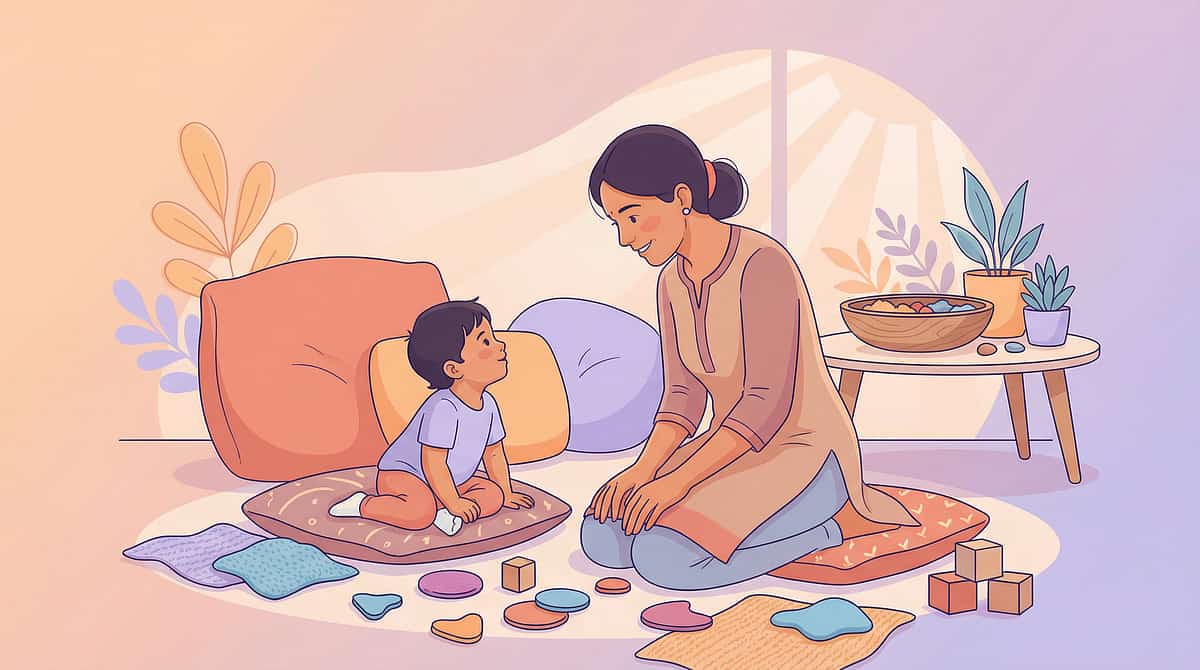
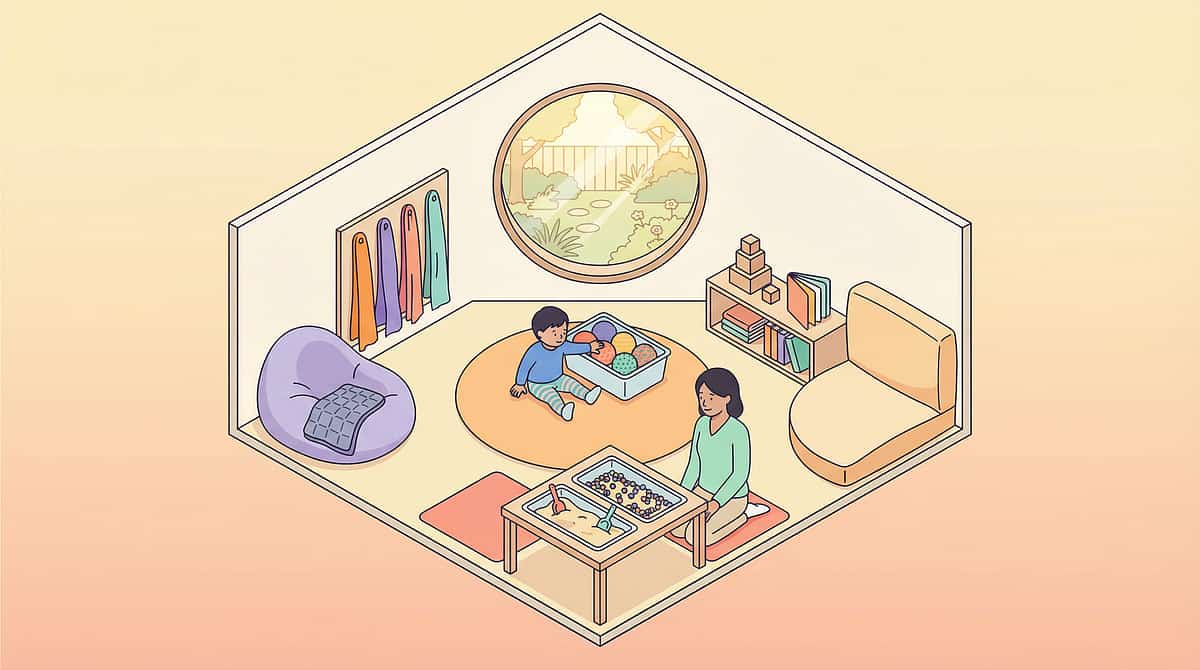
The Environment Is the First Intervention.
Before you introduce a single tool, set up the space. A well-prepared environment signals safety to your child's nervous system — and that signal begins the calming process before any activity starts.
Room Setup: 5 Key Positions
Calm Corner (center)
Floor cushion or beanbag — the regulation anchor
Materials Tray (arm's reach)
Worry stone, journal, coping cards — everything within easy reach
Parent Position (adjacent)
At child's level, not looming — side by side, never above
Feelings Thermometer (wall)
Mounted at child's eye height — visible and available
Calm-Down Kit (shelf)
Labelled bag, accessible independently by the child
Preparation Checklist
✅ All 9 materials within arm's reach
✅ Lighting: soft and warm
✅ Sound: quiet or soft instrumental music
✅ Screens: phone and TV OFF
✅ Temperature: comfortable
✅ Remove: clutter, visual chaos, other disruptions
✅ Lighting: soft and warm
✅ Sound: quiet or soft instrumental music
✅ Screens: phone and TV OFF
✅ Temperature: comfortable
✅ Remove: clutter, visual chaos, other disruptions
The Calm Corner Principle
Over time, the physical space itself becomes a cue for calming — the nervous system associates the location with safety. This is behavioral conditioning working for you.
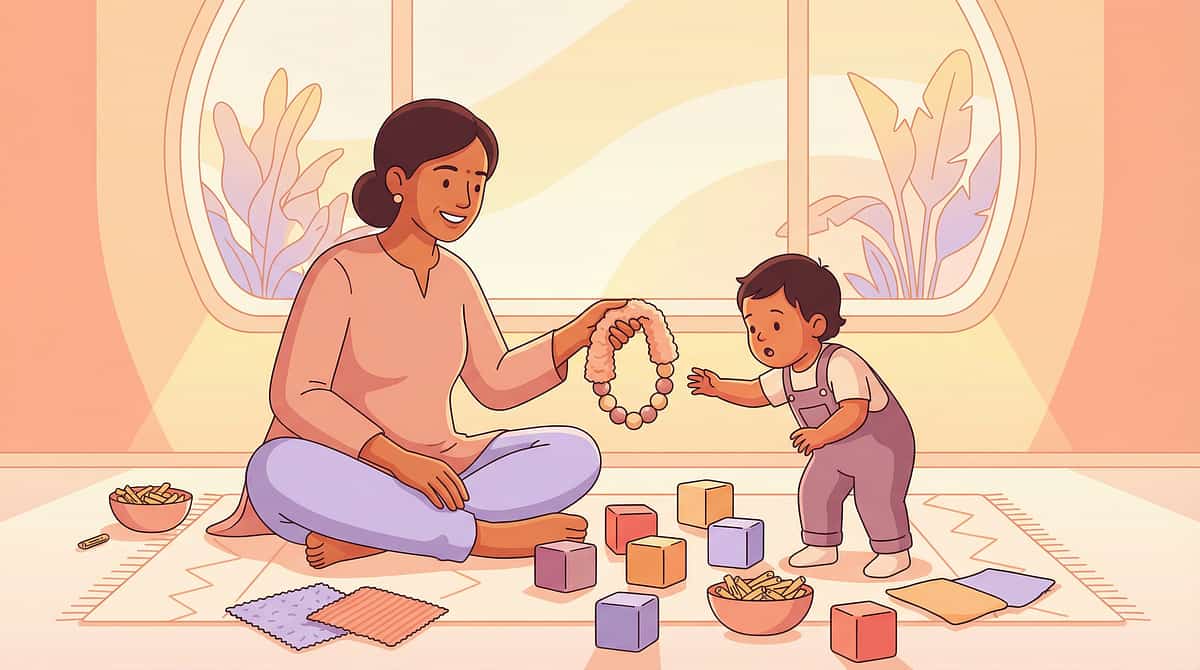
60 Seconds Before You Begin. Every Time.
A brief readiness check before every session dramatically improves outcomes. The best session is one that starts right — a postponed session is not a failed session, it is data that tells you your child needed something else today.
Indicator | ✅ GO | 🟡 MODIFY | 🔴 POSTPONE | |
Hunger | Fed in past 2 hours | Slightly hungry — small snack first | Hasn't eaten — feed first | |
Sleep | Well-rested | Mildly tired | Overtired / just woken | |
Current anxiety | 1–5 / 10 | 6–7 / 10 — body tools only | 8–10 / 10 — calm first | |
Recent event | Normal day | Minor upset in past hour | Meltdown in past 2 hours | |
Body posture | Relaxed | Some tension | Clenched, rocking, hitting | |
Receptivity | Interested / neutral | Resistant but safe | Refusing / escalating |
If MODIFY: Begin with the worry stone only. No instruction — just offer it. Let the child's nervous system lead.
If POSTPONE: Offer a simple calming activity (colouring, gentle music, quiet play). Return to the protocol when regulation returns.
If POSTPONE: Offer a simple calming activity (colouring, gentle music, quiet play). Return to the protocol when regulation returns.
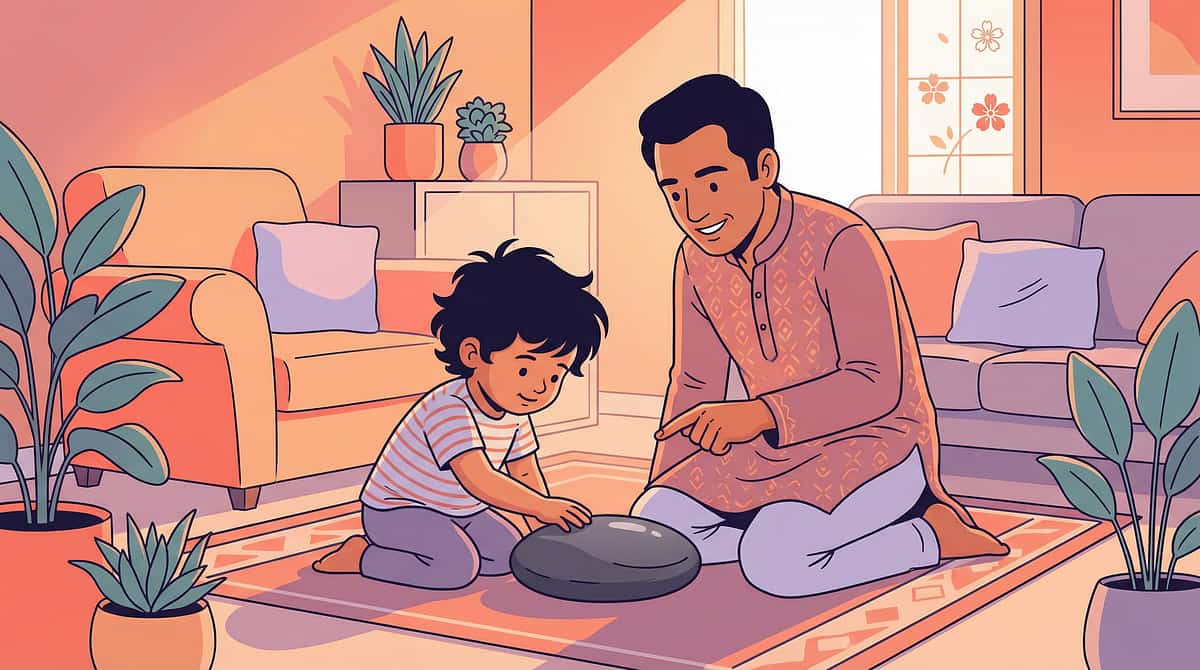
Step 1 — The Invitation
Step 1 of 6
⏱ 30–60 seconds
"Hey, I found something really interesting. Want to see it?"
Or for an already-anxious child:"I noticed you seem a bit worried. I have something that might help — no pressure, just want to show you."
Body Language Guidance
Get to the child's physical level • Soft face — no urgent energy • Offer the material with an open hand • Allow 10–15 seconds of silence before speaking again
Acceptance Cues (YES)
Eye contact toward the material • Reaching toward it • Leaning in • Verbal "what's that?" — any of these is a green light
Resistance Cues (Modify)
Turning away → "Okay, it's here when you want it" • "I don't want to" → "That's fine." Don't argue. • Indifference → Engage with material yourself first
ABA Principle: Pairing — Establish the material as positive before any demand placement. 📞 9100 181 181 | Expert guidance on introducing anxiety tools to resistant children
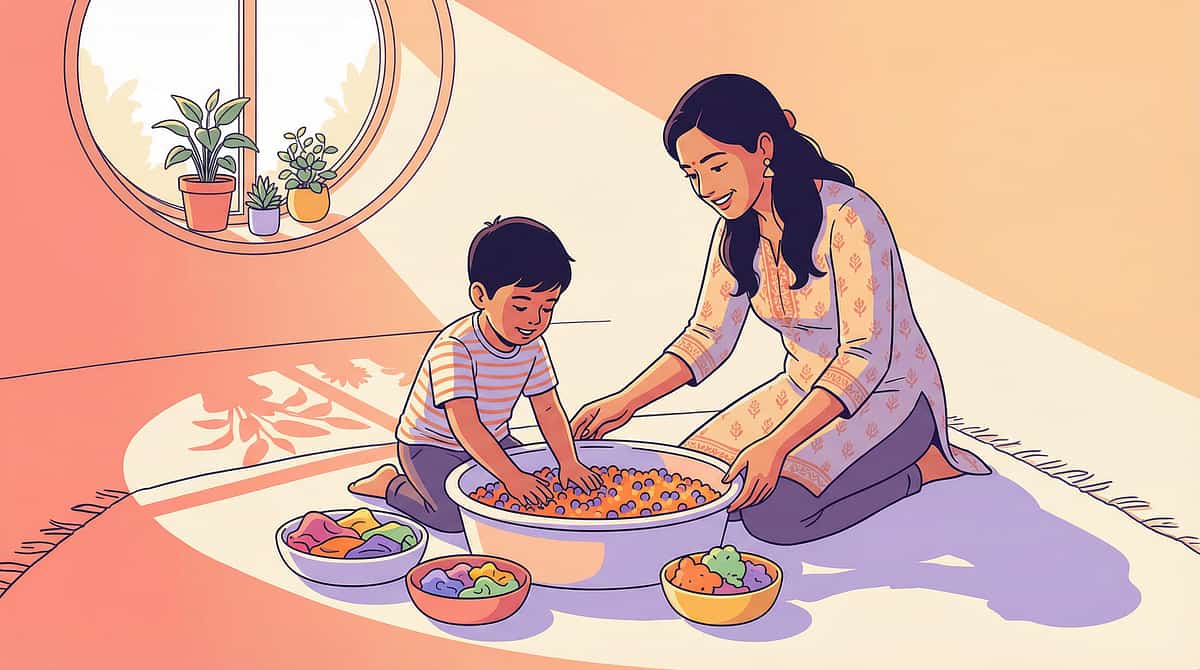
Step 2 — The Engagement
Step 2 of 6
⏱ 1–3 minutes
The goal: introduce the specific material and its purpose — using the child's language, not clinical language. Meet the child where they are, not where you want them to be.
For Worry Stone
"This is a worry stone. Some people rub it when their brain is feeling busy with worries. Here — try rubbing your thumb across it. Slowly. Feel how smooth it is?"
For Worry Journal
"This is your worry book. Whenever a worry comes, instead of it going round and round in your head, you can put it IN HERE. Then your head gets a little lighter."
For Breathing Tool
"See how this ball opens and closes? You breathe in as it opens — IIIIN — and breathe out as it closes — OOOUUT. Want to try? We'll do it together."
Child Response | Parent Action | |
Curious, engaged | Continue → move to Step 3 | |
Tolerating but passive | Maintain gentle engagement, reduce demand | |
Tentatively trying | Praise the attempt: "You did it. Perfect." | |
Distracted | Playfully redirect: "Show me one more time?" |
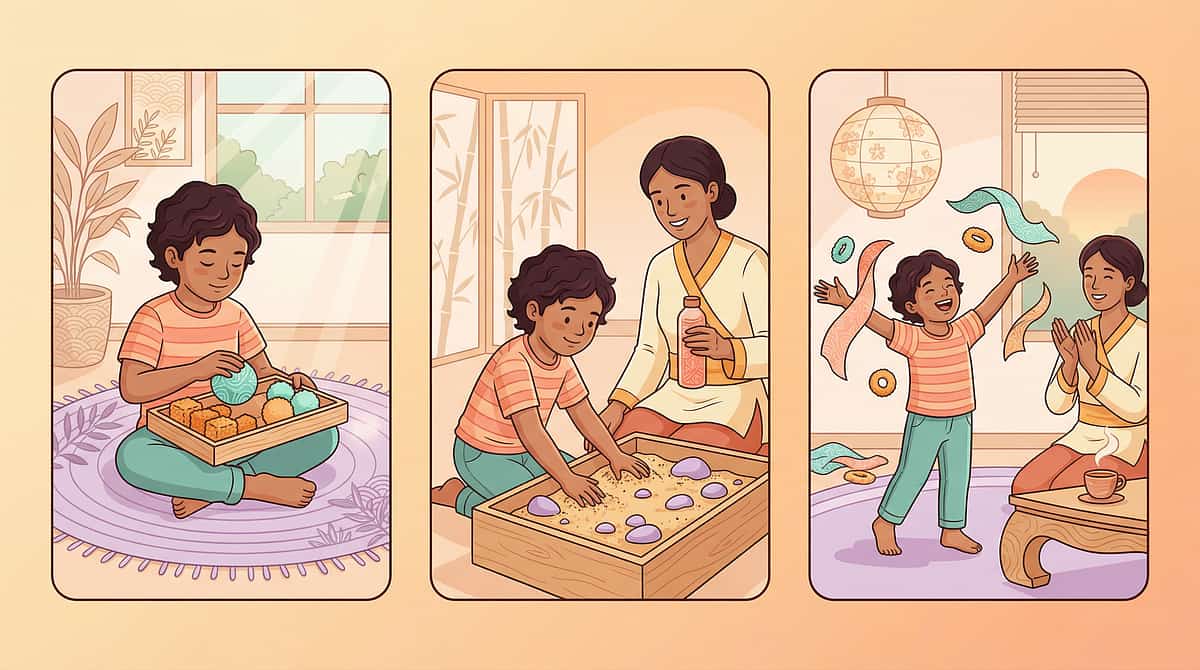
Step 3 — The Therapeutic Action
Step 3 of 6
⏱ 5–15 minutes — core therapeutic window
Introduce ONE material per session initially. The core action varies by material — each one has a specific mechanism that produces measurable change.
Worry Stone
Child holds stone in palm, thumb rubbing across smooth surface. Simultaneously: name one worry aloud. Parent validates: "That worry is real. And your hands know what to do." Continue 3–5 minutes. Success indicator: Child's shoulders visibly drop within 2–3 minutes.
Worry Journal
Child writes or draws the worry. Parent prompts: "Write it down. Now — put it in the worry box. That worry lives THERE now, not in your head." Establish Worry Time: 4:00–4:15pm daily. Success indicator: Child says "I'll write that for worry time" instead of seeking immediate reassurance.
Breathing Tool
Box breathing: 4 in — 4 hold — 4 out — 4 hold. Use Hoberman sphere to make it visible. 5 complete cycles. Parent does it alongside. Practice when CALM, not only when anxious — this builds the skill pathway. Success indicator: Child initiates breathing without prompting.
Brave Ladder
Together, list one avoided situation. Break it into 5–6 steps from least scary (bottom rung) to most scary (top rung). Begin at the bottom — this week, only attempt rung 1. Celebrate completion with enthusiasm + sticker. Success indicator: Child approaches a previously-avoided situation with any reduction in distress.
"You are not fixing your child's anxiety. You are building the internal infrastructure that lets your child live fully despite having an anxious brain."
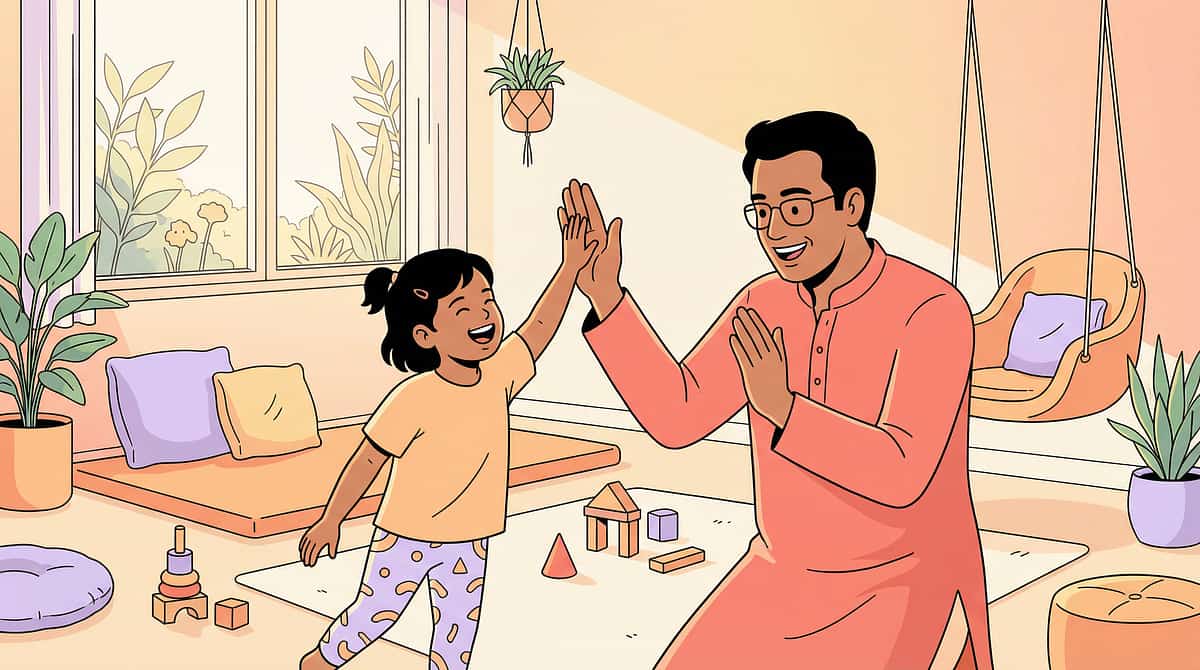
Step 4 — Repeat and Vary
Step 4 of 6
⏱ 3–5 minutes of variations
"3 good repetitions are worth more than 10 forced ones."
Material | Optimal Reps | Variation Options | |
Worry Stone | 3–5 daily (any setting) | Different stones for different settings | |
Worry Journal | 1 session daily | Draw instead of write; use stickers | |
Breathing Tool | 5 breath cycles, twice daily | Triangle, star, or box breathing patterns | |
Feelings Thermometer | 2 check-ins daily | Body scan: "where do you feel the worry?" | |
Coping Cards | Review deck once daily | Let child add new cards they create | |
Calm-Down Kit | Open and "check" daily | Rotate items to maintain novelty | |
Brave Ladder | One rung per 3–5 days | Mini celebrations for each rung | |
Self-Talk Cards | Read 3 cards aloud daily | Record child reading them on phone |
Satiation Indicators — Stop Here: Child begins leaving the activity • Attention obviously drifts • Compliance becomes mechanical without engagement • Child says "I already know this" → this is mastery — celebrate it.
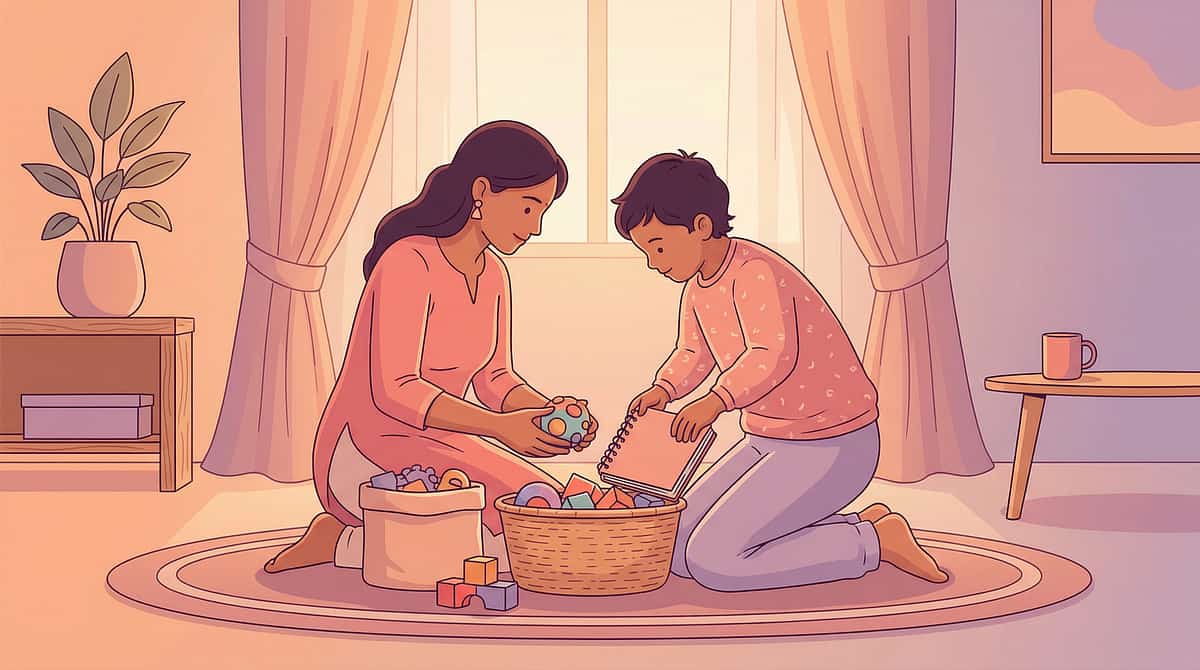
Step 5 — Reinforce and Celebrate
Step 5 of 6
⏱ Within 3 seconds of brave behavior
Timing matters more than magnitude. Immediate + specific + genuine beats effusive but delayed — every time. Celebrate the attempt, not just the success. A child who tried and failed has been braver than one who never tried at all.
"You used your worry stone when you were scared. That was BRAVE. Your brain did something really hard right there."
"You put that worry in its place. That was smart and brave."
"You noticed you were anxious AND you did something about it. That's exactly what we've been practising."
🏆 Verbal Praise
Always — non-negotiable. First and every time.
⭐ Sticker on Brave Ladder
Visual, tangible, child-owned progress marker
🎯 Token Reward
🎉 Special Activity
Reading together, extra playtime — chosen by the child
📞 9100 181 181 | Free guidance on reinforcement design for anxious children

Step 6 — The Cool-Down
Step 6 of 6
⏱ 2–3 minutes transition
Abrupt endings trigger anxiety — the child's nervous system interprets sudden closure as another threat. The cool-down signals: "This was safe. We completed something. You are okay."
2-Minute Warning
"Two more minutes, then we're all done for today. You did so well."
Child Puts Away Materials
"Let's put the worry stone away together. You can be in charge of that." Agency + ritual = calm closure.
Reflect Together
"How are you feeling right now compared to when we started?" One positive memory statement anchors the experience.
Physical Reset
"Go get a drink of water" — movement + body reset bridges the regulated state back into the day.
If Child Resists Ending: Don't power-struggle. Say: "Your worry stone will be here tomorrow. It's not going anywhere." Predictability reduces resistance. 🔗Animal Soft Toy ₹425 — a comfort transition object can bridge the regulated state to the next activity.
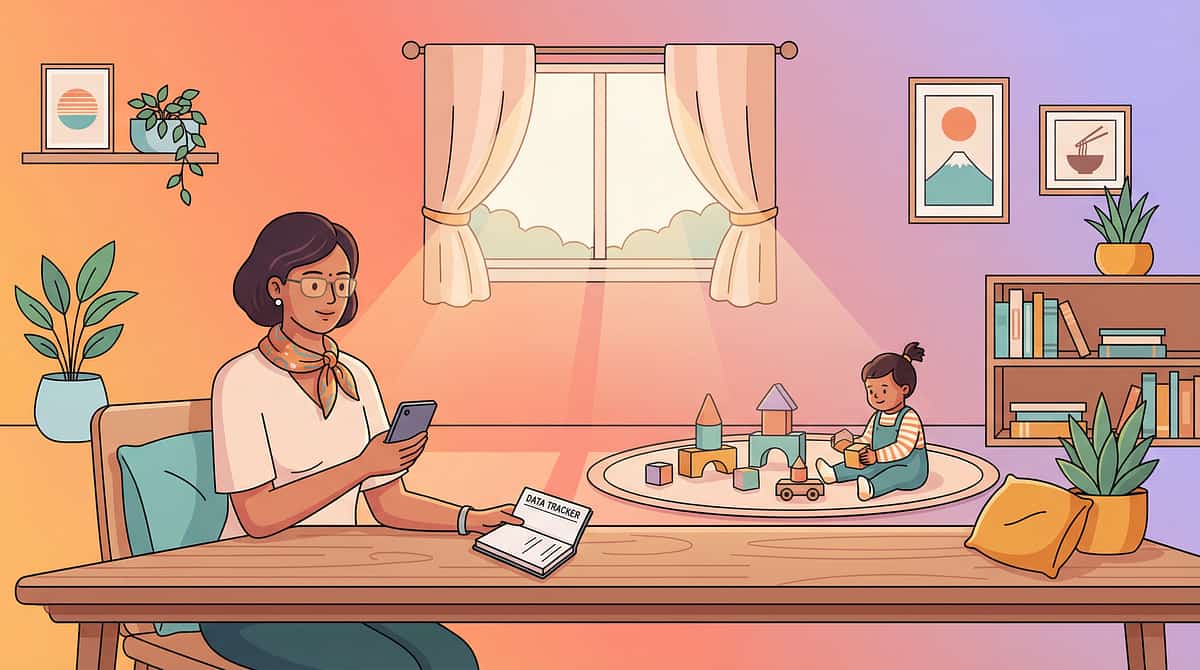
60 Seconds of Data Now Saves Hours of Guessing Later.
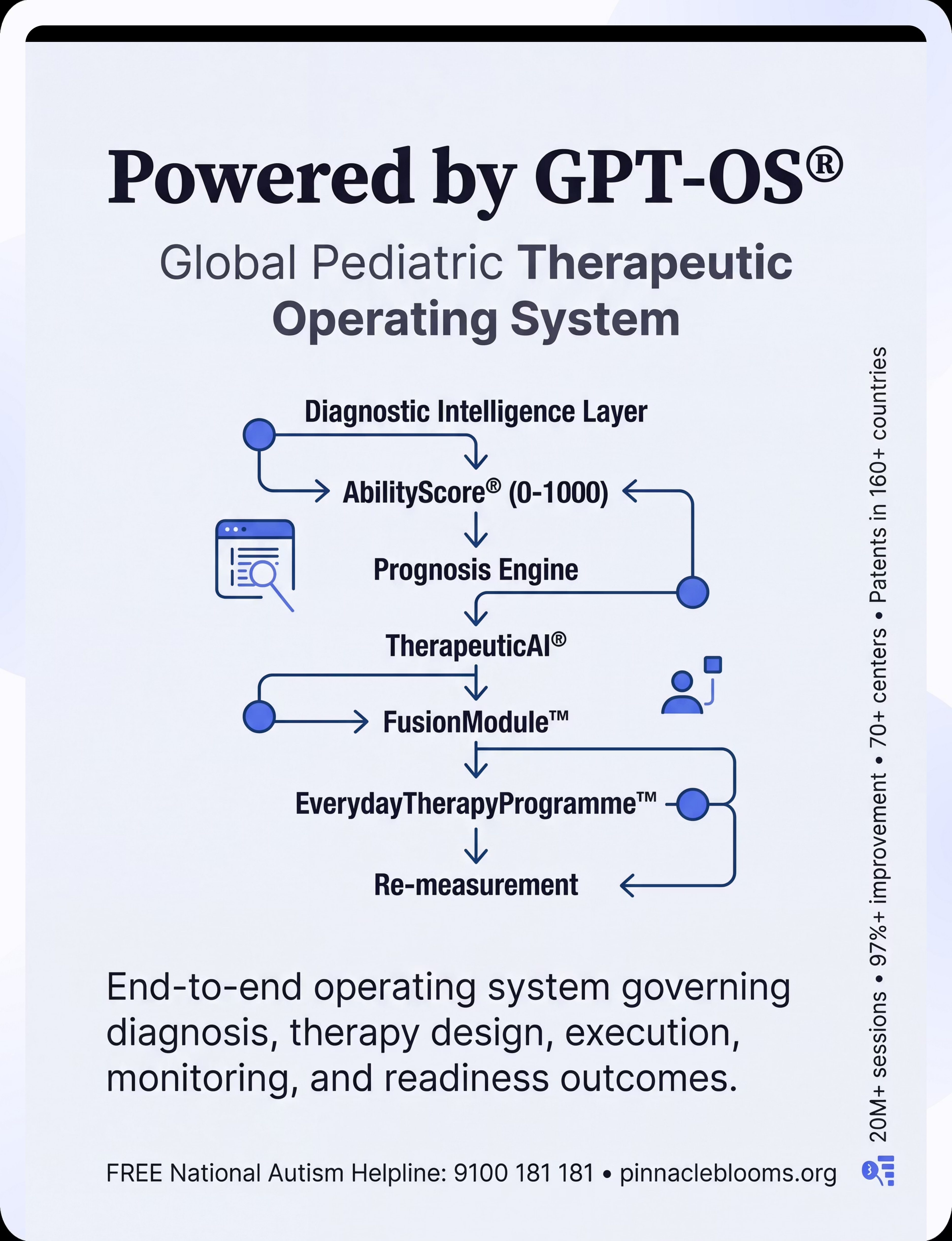
Every data point your child generates tells GPT-OS® something. 20 million sessions have taught the algorithm what progress looks like at every stage. Your data makes the recommendation for your child's next step — personalised, not generic.
What to Record — 3 Fields Only
Field | What to Note | How | |
Anxiety Level | Child's thermometer number before + after | Circle on printed sheet | |
Material Used | Which of the 9 materials | Tick box | |
Response | Accepted / Tolerated / Rejected | Circle |
Optional (if time permits): Duration of engagement • Spontaneous brave behavior (note specific event) • Reassurance-seeking frequency today (count)
Track Online
Download PDF
📥 Download C-276 Daily Tracking Sheet — PDF, A4, print at home
Data Principle
Consistent tracking personalizes the next recommendation — for your child, not a generic profile.
Session Abandonment Is Not Failure. It Is Data.
Every challenging session is telling you something specific about your child's nervous system, timing, or the material fit. Here are the seven most common scenarios — and exactly what to do.
❓ "My child refused to touch the worry stone / any material"
Don't push. Place the material near them without instruction. Play with it yourself. Curiosity is more powerful than instruction. Try again tomorrow. Resistance often means the child senses this will involve confronting something uncomfortable — which is true. Don't rush the approach.
❓ "My child used the breathing tool but anxiety didn't decrease"
This is expected in early sessions. The skill requires practice when calm to work when anxious. 10–15 sessions of calm practice typically precedes in-vivo effectiveness. This was a successful practice session, not a failed calming session.
❓ "My child started crying during the brave ladder discussion"
Step back immediately. The current rung is too high. Split the step into two smaller sub-steps. The goal is to finish the session with the child feeling one tiny bit braver, not overwhelmed. Tears = correctly calibrated. Panic = too much, too fast.
❓ "My child writes in the worry journal but then worries more"
Timing issue. Worry time should be earlier in the evening — try 4:30–5:00pm, not right before bed. The parent should review the journal with the child, not leave them to read it alone. Brevity matters: 10 minutes maximum.
❓ "My child is fine at home but panics at school / social situations"
This is generalization lag — skills learned at home need explicit transfer. Send the worry stone and coping cards in the school bag. Brief the teacher. Build a brave ladder specifically for school situations.
❓ "I used all 9 materials and nothing seems to work"
Clinical-level anxiety often requires CBT with a trained therapist, not materials alone. Materials support CBT — they don't replace it. Call 📞 9100 181 181 for a professional anxiety assessment at your nearest Pinnacle center.
❓ "My child is getting angry when I introduce any of the tools"
Anger = anxiety trying to escape. Don't interpret anger as opposition — interpret it as dysregulation seeking an exit. Reduce all demands. Stay regulated yourself. Consider whether a different material, time of day, or caregiver might work better.

No Two Anxious Children Are Identical. Adapt Ruthlessly.
The most effective anxiety intervention is the one that actually fits your child — their age, communication style, sensory profile, and cognitive level. Use this guide to customize every element.
Dimension | Easier Version | Harder Version | |
Worry Journal | Draw worry + crumple and "throw away" | Write worry + evidence for/against | |
Breathing | Blow a bubble slowly (1 breath) | Box breathing 4-4-4-4, 5 cycles | |
Brave Ladder | Imagine the situation, don't approach yet | Enter and remain for 2 minutes | |
Anxiety Scale | 3 zones (calm / okay / worried) | 10-point scale with body sensations | |
Coping Cards | 3 cards with pictures | 10 cards, child picks strategy independently |
Ages 4–6
Prefer tactile/physical tools • Draw rather than write • Parent leads, child observes first
Ages 7–10
Journaling, self-talk cards, anxiety scales • Child co-creates materials • Begin brave ladders with parent present
Ages 10–12
Cognitive tools dominate • Child manages own calm-down kit independently • Brave ladders increasingly self-directed
📞 9100 181 181 | FREE consultation on adapting these tools for your child's specific profile. For Autism / Sensory Differences: visual supports become essential (not optional). OT assessment of sensory profile recommended before starting.

Week 1–2: What to Expect
Progress: 15% — Building Foundations
Most parents expect dramatic change in week 1. Here's what actually happens — and why it's already progress worth celebrating.
✅ What TO Expect
• Child tolerates having materials present (even if not using them)
• Slight curiosity about worry stone or breathing tool
• Parent becomes more fluent with the session structure
• One successful breathing practice in calm time
• Child uses feelings thermometer with prompting
• You feel slightly less helpless — because you're doing something
• Slight curiosity about worry stone or breathing tool
• Parent becomes more fluent with the session structure
• One successful breathing practice in calm time
• Child uses feelings thermometer with prompting
• You feel slightly less helpless — because you're doing something
❌ What NOT to Expect Yet
• Spontaneous use of tools without prompting
• Significant reduction in reassurance-seeking
• Brave behavior toward avoided situations
• Parent knowing "if this is working"
• Significant reduction in reassurance-seeking
• Brave behavior toward avoided situations
• Parent knowing "if this is working"
"If your child sat in the same room as the worry stone and let you explain it — that is progress. The nervous system is learning that this is safe. Safety before skill."
You may feel discouraged. You may feel like "nothing is working." These feelings are normal and do not reflect reality. Anxiety interventions typically show measurable change at 4–8 weeks. You are planting seeds.

Week 3–4: The Signs Most Parents Miss
Progress: 40% — Neural Pathways Forming
Because they're looking for the wrong things. These consolidation signs are subtle — but each one represents synaptic strengthening through repeated structured input. Don't miss them.
Child reaches for the worry stone without being asked — once
This single spontaneous gesture represents a major neurological milestone. The tool is entering long-term memory as a coping resource.
Child uses the feelings thermometer in a new setting
In the car, at school drop-off — transferring the language beyond the practice room. Generalization is beginning.
Reassurance-seeking decreases even slightly
From 20x/day to 15x is progress. The direction matters more than the magnitude right now.
Child says "I'm at a 6" — self-awareness language is forming
The vocabulary of interoception is arriving. Your child is learning to read her own nervous system. This is a foundational life skill.
"You may notice you're more confident too. You know what to do when anxiety rises. A calm, confident parent is the most powerful anxiety co-regulator in existence."
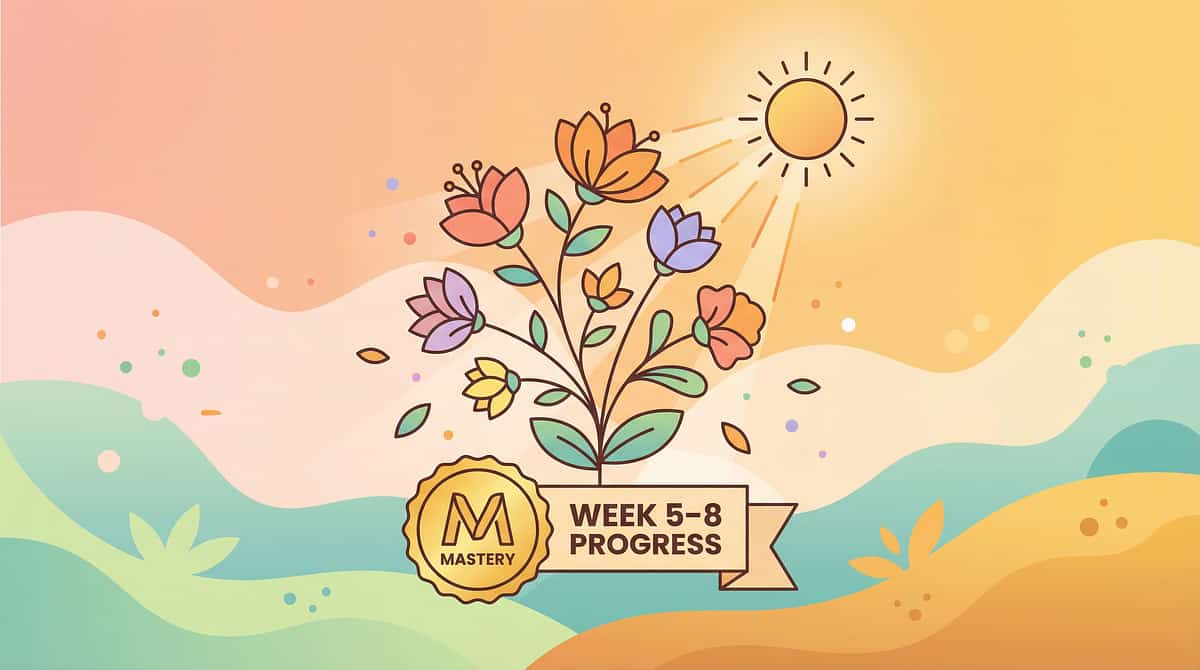
Week 5–8: Mastery Emerging
🏆 Progress: 75% — Mastery Emerging
When you see these specific, observable indicators — your child has built genuine coping infrastructure. Not performance. Not compliance. Real, transferable skills that belong to her now.
Independent Tool Use — 3+ Settings
Child independently reaches for and uses a regulation tool without parent prompting — in at least 3 different settings
30% Reduction in Reassurance-Seeking
Measurable decrease from baseline — the child is beginning to self-regulate rather than outsource regulation to the parent
2+ Brave Ladder Rungs Completed
Child has approached previously-avoided situations — even at lower distress levels. The brave behavior architecture is operational.
Spontaneous Self-Report
Child uses feelings thermometer language in natural conversation without being prompted — "I'm at about a 4 right now"
Maintenance Check: Remove the structured practice for 5 days. Does the child still use tools spontaneously? If yes: mastery is sustained. If no: return to structured practice for 2 more weeks. 📞 9100 181 181 | "My child has mastered these — what's next?" Our therapists have the answer.
You Did This. Your Child Grew Because of Your Commitment.
You have spent 5–8 weeks executing an evidence-based anxiety management protocol in your home. While your child worked on courage — you worked on consistency. You showed up on the days it didn't work. You showed up on the days your child refused. You kept the worry stone on the shelf even when nobody touched it.
That is not nothing. That is everything.
Family Celebration
This week: let your child choose a celebration activity. Something they previously avoided — however small. Celebrate it with the same energy you'd celebrate a school prize. Because it is a prize.
Parent Journal Prompt
"Before we started, my child... Now, I see... The moment I'll remember is..." Write it or record a voice note — this is your evidence too.
Share With Community
Your experience becomes the peer narrative that motivates another parent to start. 🔗Share your child's progress →
⛔ Even in the Progress Zone — Watch for These Signals
Progress is real — and so is the need to recognize when professional support must be escalated. Trust your instincts: if something feels wrong, it probably warrants a professional look.
Signal | What It Looks Like | Why It Matters | |
School refusal | Child unable to enter school building despite all interventions | Anxiety has crossed into clinical severity requiring professional CBT | |
Physical symptoms worsening | Vomiting, significant weight loss, severe sleep disruption after 6+ weeks | Somatic anxiety may need medical + psychiatric evaluation | |
Avoidance expanding | MORE situations being avoided, not fewer, despite brave ladder work | May need therapist-guided exposure therapy | |
Self-harm statements | Any statement about not wanting to exist, hurting oneself | Immediate professional assessment required | |
Panic attacks | Racing heart, difficulty breathing, trembling, feeling of dying | Panic disorder assessment needed — differs from GAD | |
Regression after mastery | Major regression after illness, transition, or trauma | Normal but may need therapist review |
🟡 Slight regression → Continue current protocol + call 📞 9100 181 181 for teleconsult
🔴 School refusal / panic attacks → Clinic visit at nearest Pinnacle center
🆘 Self-harm statements → Immediate professional assessment — call helpline NOW
🔗Find nearest Pinnacle center →
🔴 School refusal / panic attacks → Clinic visit at nearest Pinnacle center
🆘 Self-harm statements → Immediate professional assessment — call helpline NOW
🔗Find nearest Pinnacle center →
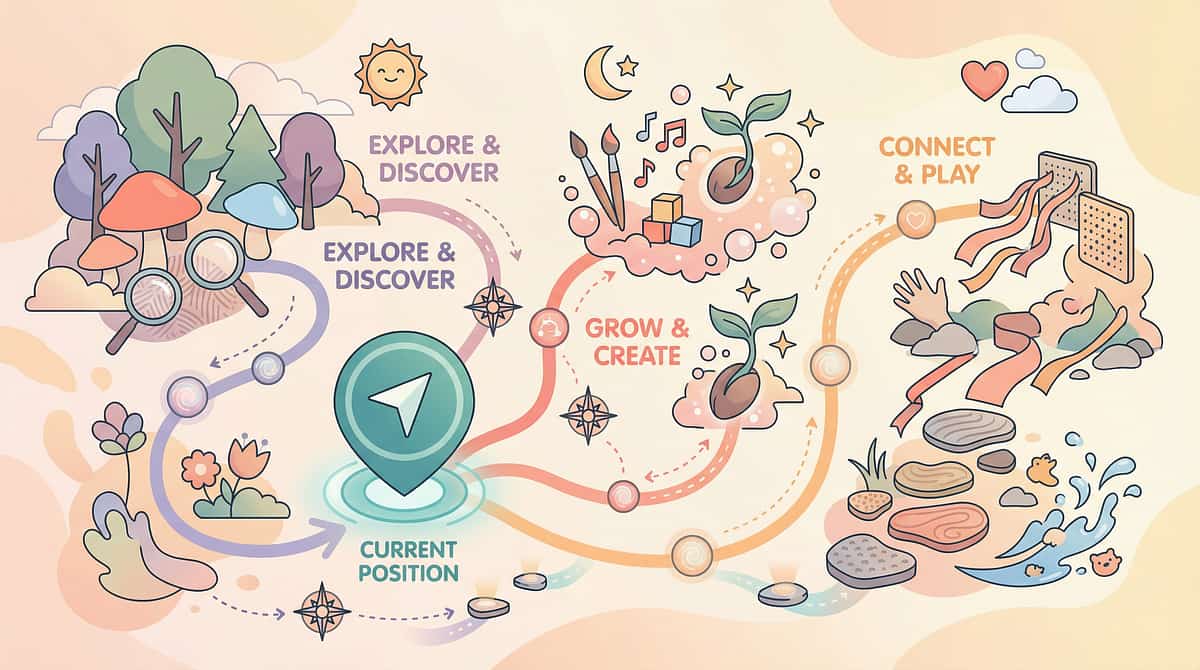
You Are Not Done. You Are on a Journey. Here Is Where It Goes.
C-276 is a milestone on a larger developmental pathway — not a destination. Here is the full progression architecture, and exactly where to go next based on your child's primary anxiety type.
Once mastery criteria are met at C-276, follow the branch that matches your child's primary anxiety type. If the material-based approach isn't resonating → C-290: Mindfulness for Anxious Children uses a different entry point toward the same destination.
📞 9100 181 181 | "Which technique comes next for my child?" — our therapists will tell you exactly. 🔗Book Free Assessment →
More Tools in Your Domain C Toolkit
After completing C-276, you already own the core materials for C-277, C-278, and C-279. Your investment carries forward — each new technique builds on what you've already mastered.
Technique | Code | Level | Materials You Already Own | |
Understanding Childhood Anxiety | C-274 | INTRO | No materials needed | |
Recognising Anxiety Signs | C-275 | INTRO | Uses feelings thermometer | |
Separation Anxiety Materials | C-277 | CORE | Uses calm-down kit | |
Social Anxiety Materials | C-278 | CORE | Uses coping cards | |
Specific Phobias + Brave Ladders | C-279 | ADVANCED | Uses brave ladder | |
Mindfulness for Anxious Children | C-290 | CORE | No materials (body-based) |
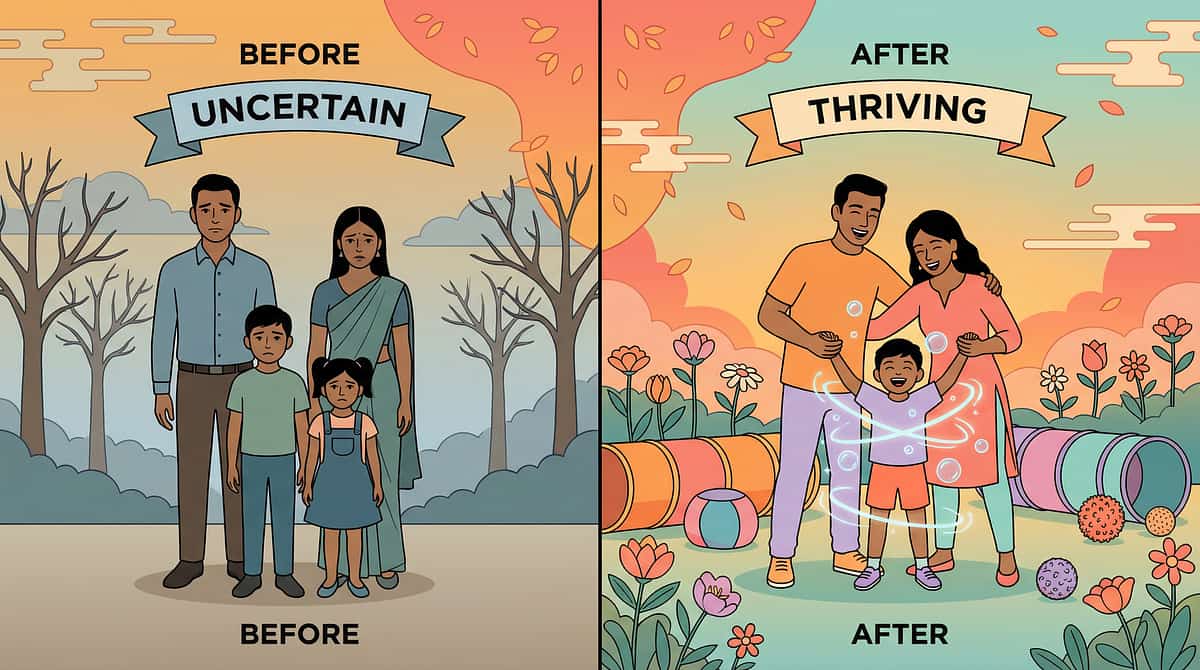
This Technique Is One Piece of a Larger Plan.
The developmental wheel illustrates the 12 key domains of child growth. This technique focuses on one specific segment, helping you build a comprehensive and holistic understanding of your child's progress.
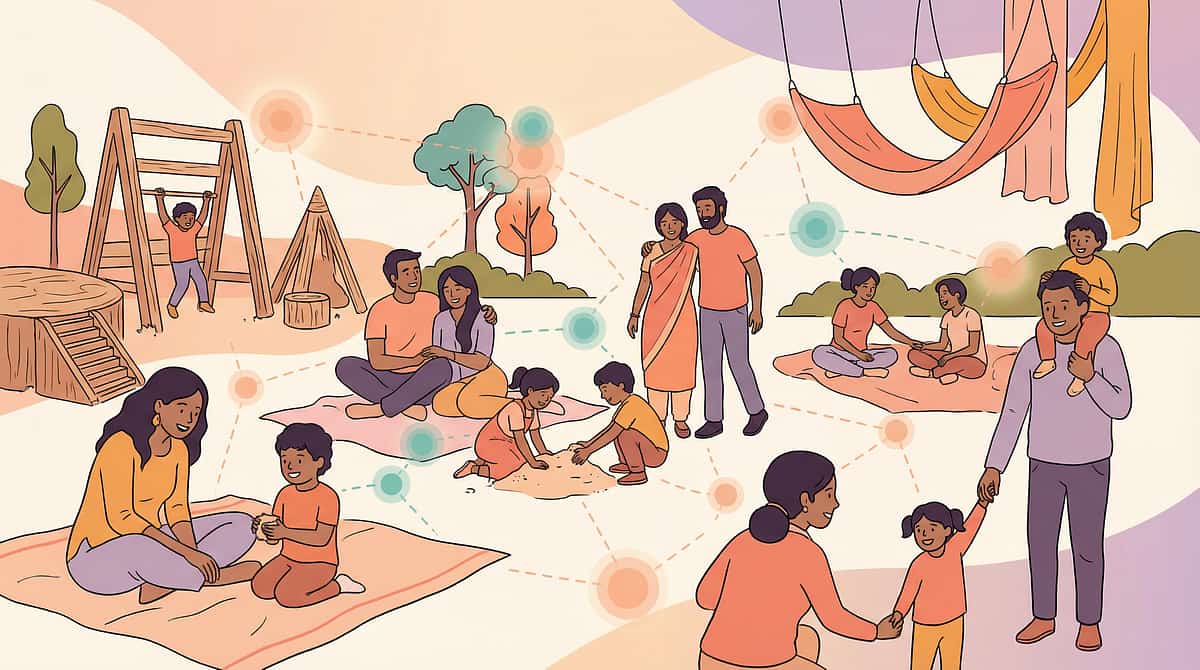
From the Field. From Real Families. From Children Who Are Now Living.
These are anonymized stories from Pinnacle families across India — shared with full consent, and kept as close to the parents' own words as possible.
Hyderabad — 7-year-old boy, 14 weeks
Before: "Our son was refusing to leave the house most mornings. Stomachaches every day. He'd stand at the door shaking. We'd tried logic, rewards, punishments. Nothing changed the fear."
After: "Last month, he went to his cousin's birthday party for the first time in two years. He packed his calm-down kit himself. He stayed for three hours. He said 'Mum, I was scared AND I went anyway.' I cried in the car."
Materials: Calm-down kit + brave ladder + self-talk cards | From the Therapist: "This child's brave ladder had 7 rungs. The party was rung 6. We celebrated every single step." — Pinnacle ABA-BCBA Team
Mumbai — 9-year-old girl, 8 weeks
Before: "She asked 'what if you die?' every night before sleep. Every. Night. For two years. We'd spend 40 minutes reassuring her. Nothing worked."
After: "The worry journal changed everything. She writes the worry down at 5pm. By bedtime, she checks her journal and says 'I already handled that one.' Last night she fell asleep in 12 minutes."
Materials: Worry journal + worry time container + breathing tool | From the Therapist: "Worry containment plus structured worry time broke the reassurance-seeking cycle." — Pinnacle SLP + OT Team
Bengaluru — 8-year-old boy, 12 weeks
Before: "He wouldn't eat at any restaurant. Wouldn't try any new food. Wouldn't go to any new place. His world was three streets wide."
After: "We built a brave ladder for restaurants. Step one was: sit outside without entering. It took three sessions just for that. By week 12 he ordered his own food. He looked up at me and smiled like he'd climbed Everest. He had."
Materials: Brave ladder + coping cards + worry stone | Timeline: 12 weeks
📞 9100 181 181 | Speak to a parent who's been through this — peer support available
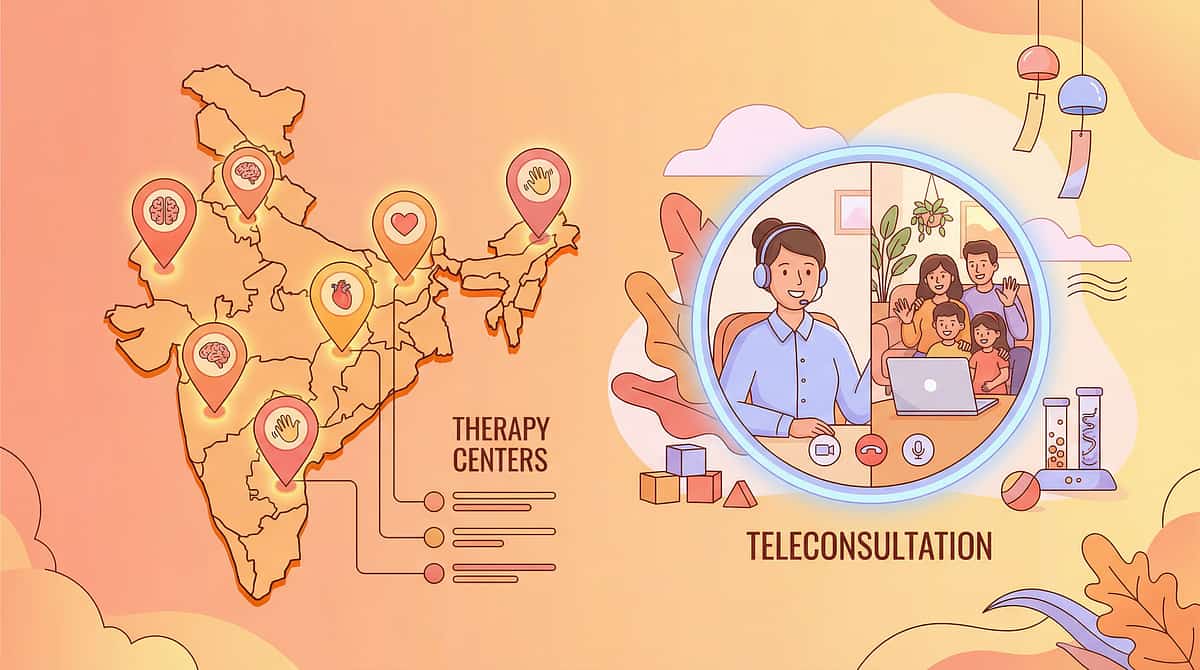
You Are Not a Solo Operator. You Are Part of the World's Largest Pediatric Therapy Community.
Your journey helps others. When you share what worked — even one small thing — you become the peer narrative that motivates another parent to start. Your experience has sovereign value.
📱 WhatsApp Parent Group
Pinnacle Anxiety Support Parent Network — 2,400+ parents, daily activity, peer support + expert Q&As
💬 Online Forum
pinnacleblooms.org/community/anxiety — technique-specific threads, parent-to-parent help, therapist moderation
🤝 Peer Mentoring
Connect with a parent who has completed C-276 and beyond. 🔗Request Peer Mentor →
🏛️ Local Parent Meetups
Monthly Pinnacle center meetups for anxiety-focused families. 🔗Find meetup near you →
Home + Clinic = Maximum Impact. 70+ Centers. One System.
Professional assessment and home practice are not alternatives — they are partners. The right specialist for your child's specific presentation is available across 70+ Pinnacle locations in India, with global teleconsultation for international families.
Your Child's Primary Need | Specialist to Book | |
Severe anxiety / school refusal | Child Psychologist + ABA-BCBA | |
Sensory-amplified anxiety | Occupational Therapist (SI-trained) | |
Anxiety + communication difference | SLP + Psychologist | |
Anxiety + autism spectrum | FusionModule™ team (OT + ABA + NeuroDev) | |
Parent guidance only | Parent Coach + Psychologist |
🏥 In-Person
💻 Teleconsult
📞 Helpline
9100 181 181 — FREE, 16+ languages, 24×7
📧 Email

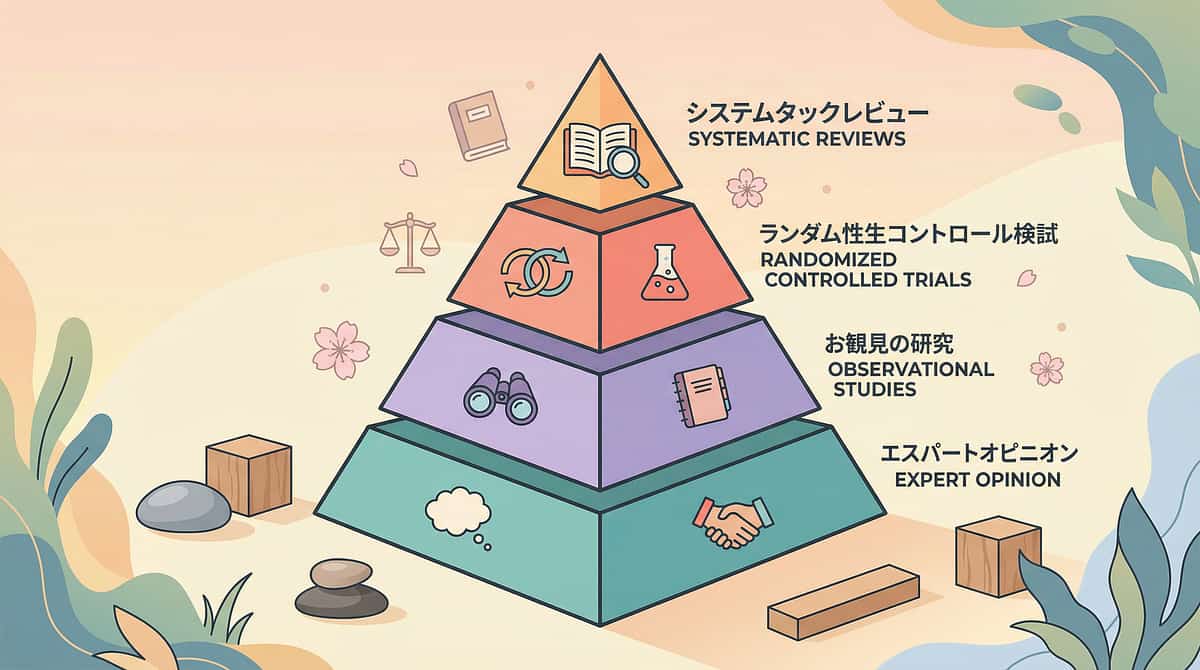
Deeper Reading for the Evidence-Hungry Parent.
Every tool on this page rests on a foundation of peer-reviewed research. These five studies form the core evidence base for the Anxiety Management Materials Protocol.
CBT Meta-analysis for Childhood Anxiety (2024)
Across 24 studies: structured CBT components + concrete materials = highest efficacy for GAD in children ages 4–12. Effect size: large. 🔗PubMed: PMC11506176
Sensory Integration + Emotional Regulation (2024)
16 studies confirm sensory-based materials improve emotional regulation and anxiety management in children with developmental differences. 🔗PubMed: PMC10955541
India Home-Based Intervention RCT (2019)
Parent-administered home sessions demonstrated significant anxiety reduction in Indian pediatric population — first India-specific evidence base. 🔗DOI: 10.1007/s12098-018-2747-4
WHO Care for Child Development Package (2023)
Multi-sensory, caregiver-delivered home programs show efficacy across 54 low/middle-income countries. Equity principle validated. 🔗PubMed: PMC9978394
NCAEP Evidence-Based Practices Report (2020)
Cognitive-behavioral interventions including exposure, self-management, and visual supports classified as evidence-based for autism + anxiety. 🔗ncaep.fpg.unc.edu
📞 9100 181 181 | Speak with a clinical researcher about this evidence | 🔗Pinnacle Research & Outcomes Data →
Your Child's Data Doesn't Disappear. It Drives the Next Personalised Recommendation.
Every session you log becomes an input to GPT-OS® — the intelligence layer trained on 20M+ therapy sessions. The result is a recommendation tailored to your child's specific response profile, not a generic protocol.
What GPT-OS® Learns from C-276
Which of the 9 materials yielded the highest response • Whether physiological or cognitive tools are more effective for this child's profile • Rate of brave behavior emergence • Optimal session frequency and duration
🔒 Privacy Assurance
All data is encrypted, anonymised for research, and never sold. GDPR + Indian DPDP Act compliant. Your child's data helps every child like yours — through the population-level intelligence layer of GPT-OS®.
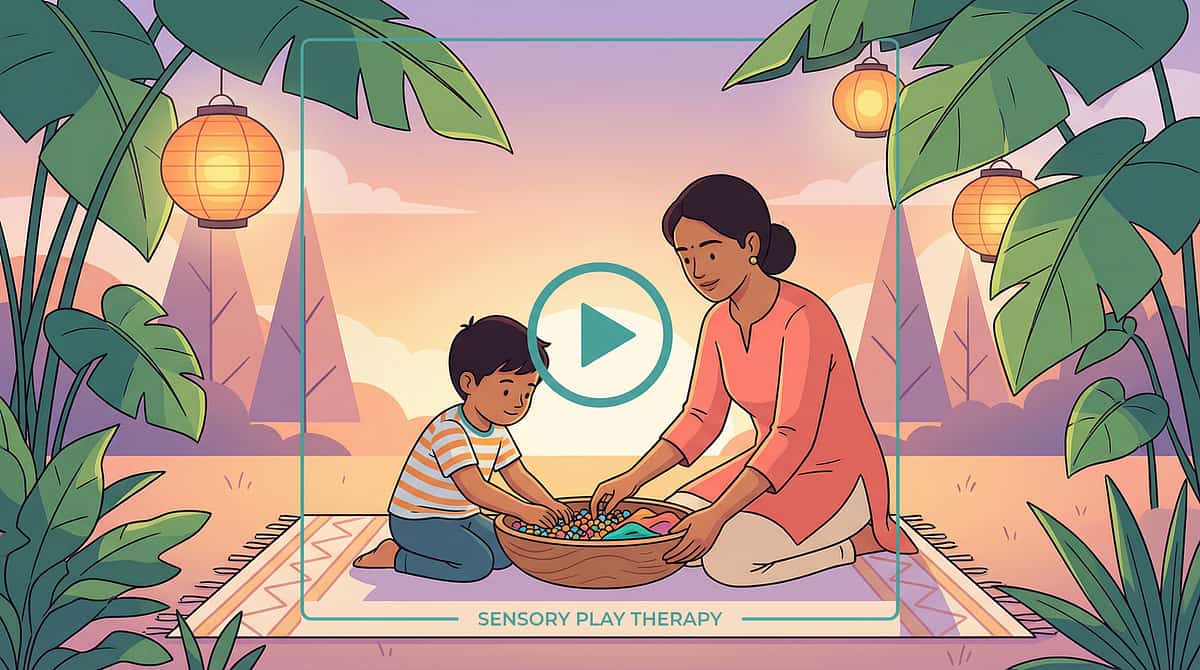
The Reel That Brought You Here. Watch It Again — Differently.
Research consistently shows that parent skill acquisition accelerates significantly when combined with video demonstration. Watching + reading + doing = multi-modal learning at its most effective. Watch this reel with your child — the visual modeling itself has therapeutic value.
🎬 Reel C-276
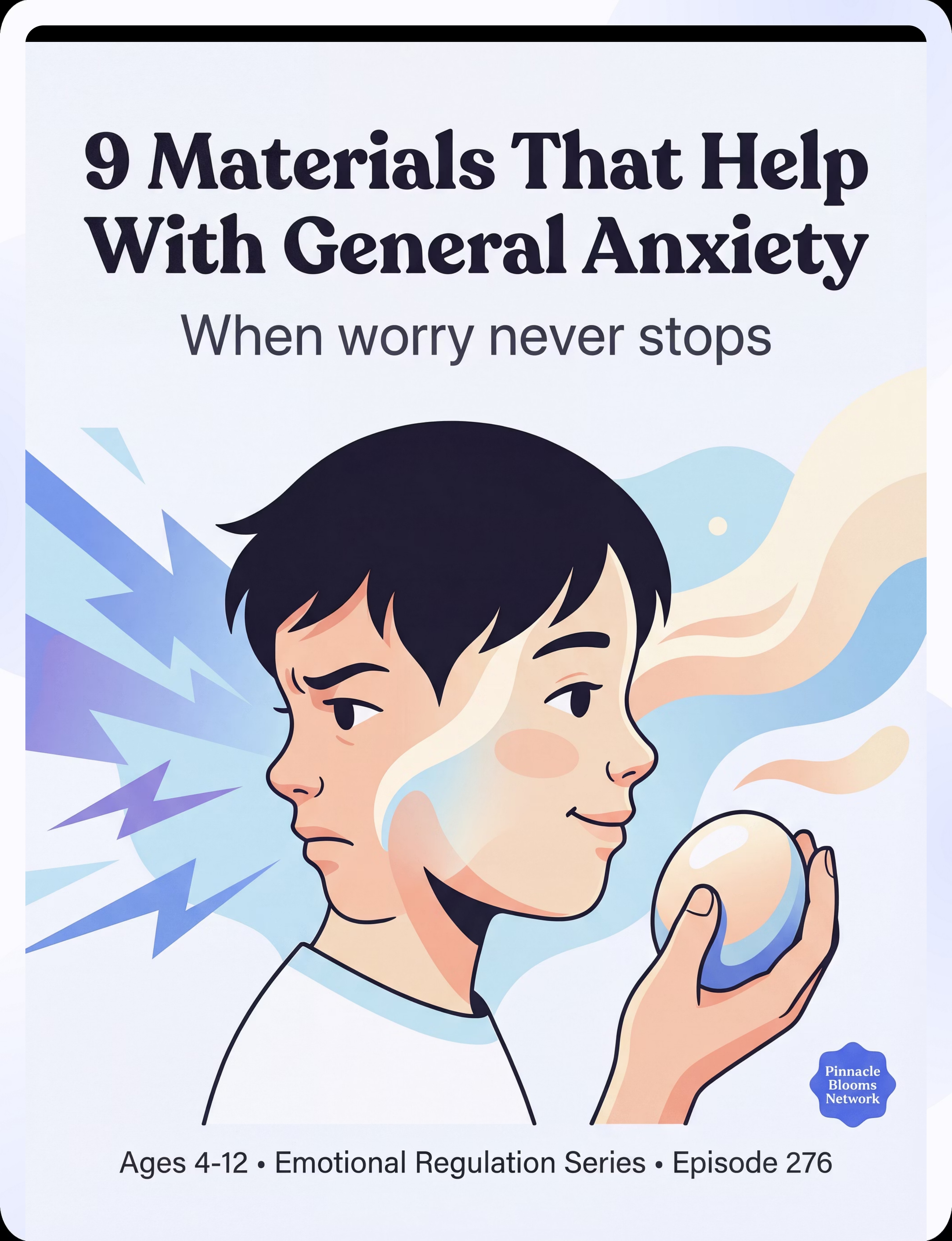
9 Materials That Help With General Anxiety
Emotional Regulation Series — Episode 276 | Domain C | Ages 4–12 | ~75 seconds
Emotional Regulation Series — Episode 276 | Domain C | Ages 4–12 | ~75 seconds
Therapist Introduction
In this reel, our consortium of OT, ABA, SLP, and NeuroDev specialists demonstrates each of the 9 materials — and shows exactly what it looks like when a child uses them well.
Related Reels
C-274: Understanding Childhood Anxiety
C-275: Recognising Anxiety Signs in Children
C-277: Separation Anxiety Materials
C-275: Recognising Anxiety Signs in Children
C-277: Separation Anxiety Materials

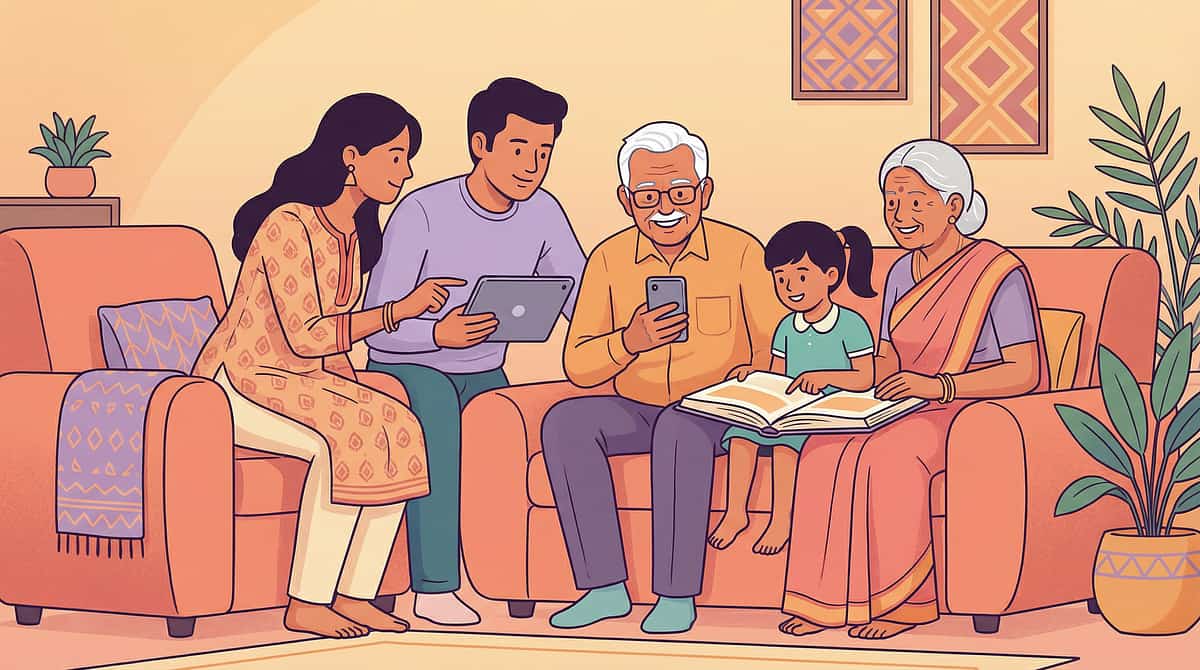
Consistency Across Caregivers Multiplies Impact. One Tool Used by Three People = Three Times the Practice.
The more adults in your child's life who understand and apply these tools consistently, the faster her nervous system learns that this is the new normal — safe, predictable, manageable.
📲 Share This Page
Pre-populated WhatsApp message: "Found this — 9 tools that help anxious children. We should try these. Link: techniques.pinnacleblooms.org/emotional-regulation/general-anxiety-materials-c276"
Share on WhatsApp | Copy Link
Share on WhatsApp | Copy Link
"Explain to Grandparents" Version
"[Child's name] has a brain that worries more than most. This is not a behaviour problem — it's biology. Instead of 'there's nothing to worry about,' say: 'I hear you're worried. Let's use your worry stone.' That one change makes an enormous difference."
Teacher / School Communication Template
"[Child's name] is working with Pinnacle Blooms on anxiety management tools. She carries a worry stone and coping card ring in her school bag. If she appears anxious, she has permission to step out for 5 minutes. Her feelings thermometer language: 1–3 = managing, 4–6 = support helpful, 7+ = please call us."
📞 9100 181 181 | Teacher consultation and school liaison support available

Questions From Real Parents, Answered by the Pinnacle Consortium.
Q1: My child is 4 years old. Is this too young for these tools?
Not at all. Ages 4–6 benefit most from tactile/physical tools: worry stone (ensure palm-sized), breathing tools (pinwheel, bubbles), and the calm-down kit. Skip journaling and self-talk cards until age 6–7. The brave ladder can begin as simple "I'll try for 10 seconds" games. Start with body tools first.
Q2: How is this different from telling my child "everything will be okay"?
Reassurance gives temporary relief but doesn't build coping infrastructure. "Everything will be okay" teaches: I can only feel safe when someone tells me so. These tools teach: I have ways to manage my anxiety independently. The goal is to transfer coping authority from parent to child.
Q3: My child has autism. Do these tools work differently?
Yes — visual tools (feelings thermometer, coping cards) become even more important. Language-based tools may need modification based on communication profile. Sensory tools often have higher immediate effectiveness. Call 📞 9100 181 181 for a tailored plan through Pinnacle's FusionModule™ team.
Q4: How long until I see results?
Body tools: effect possible within 2–3 sessions if practiced when calm. Cognitive tools (journals, self-talk cards): 4–6 weeks for consistent impact. Brave ladder: 8–12 weeks for meaningful avoidance reduction. Clinical anxiety typically requires professional CBT alongside these materials. Do not expect dramatic change in week 1.
Q5: Should I use all 9 materials at once?
No. Start with 2–3 that match your child's strongest challenge: Physical symptoms → breathing tools + worry stone. Reassurance-seeking → worry journal + worry box. Avoidance → brave ladder + coping cards. Add additional tools as the first ones become routine.
Q6: Can I do this if I'm an anxious parent myself?
Yes — and actually, doing this alongside your child often helps your own anxiety regulation. Practice the breathing tools together. Use the worry journal yourself. Model the self-talk cards. One of the most powerful interventions for childhood anxiety is a parent learning to tolerate uncertainty — something Pinnacle can support directly.
Preview of 9 materials that help with general anxiety Therapy Material
Below is a visual preview of 9 materials that help with general anxiety therapy material. The pages shown help educators, therapists, and caregivers understand the structure and content of the resource before use. Materials should be used under appropriate professional guidance.


Link copied!

Stop Reading. Start.
The tools exist. Your child needs them. Begin today. Every session is a vote for the new, calmer neural pathway. Consistency now compounds massively — and the journey starts with one small, brave step.
📞 FREE National Helpline
✅ Consortium Validated
OT • SLP • ABA/BCBA • SpEd • NeuroDev • Pediatrics • CRO
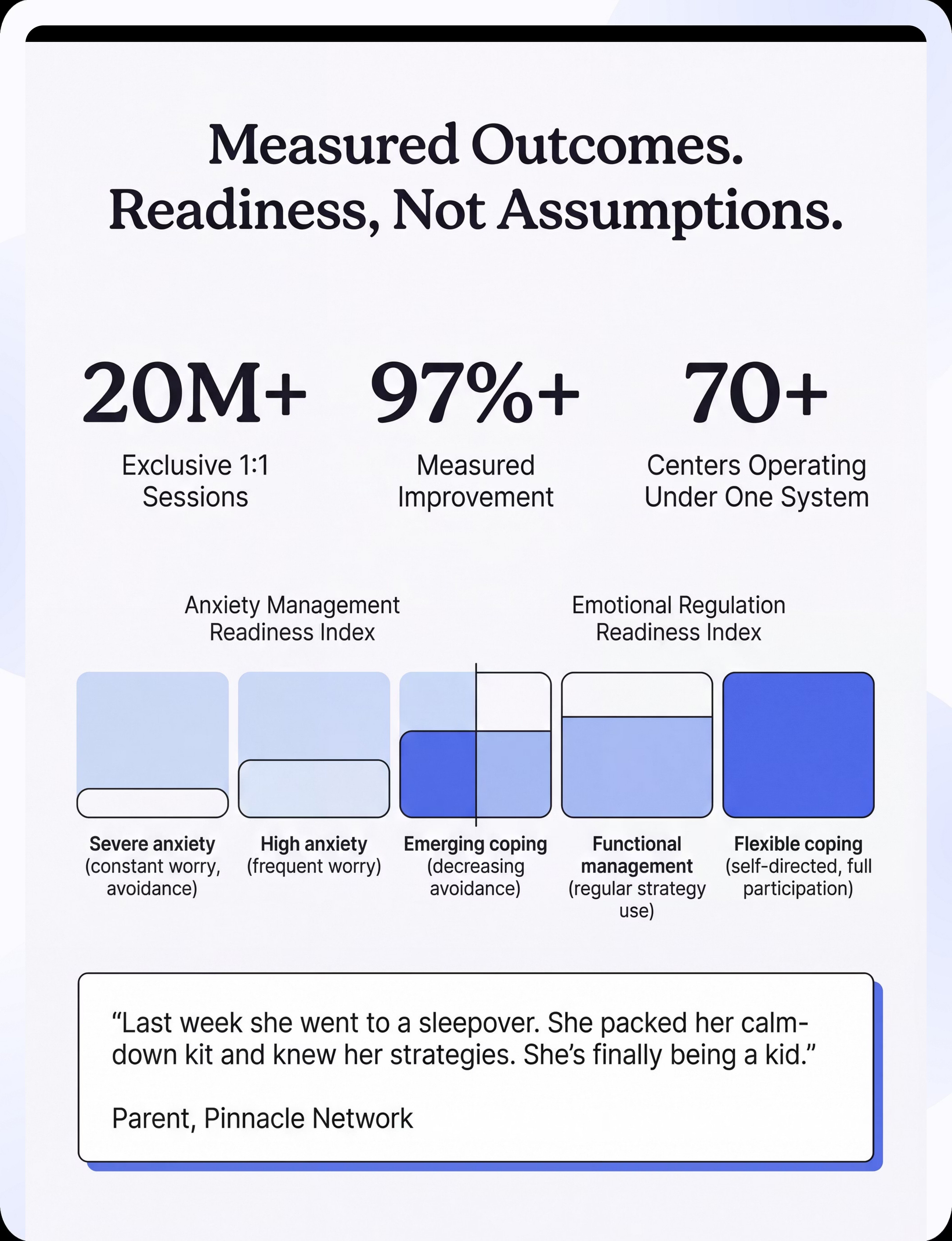
20M+ Sessions • 97%+ Measured Improvement • 70+ Centers
20M+ Sessions • 97%+ Measured Improvement • 70+ Centers
→ Next Technique
C-277: Separation Anxiety Materials →
Your C-276 materials carry forward. You are already prepared.
Your C-276 materials carry forward. You are already prepared.
This content is for educational purposes only. It does not replace individualised assessment and intervention planning with licensed mental health professionals. © 2025–2026 Pinnacle Blooms Network®, a unit of Bharath Healthcare Laboratories Pvt. Ltd. All rights reserved. GPT-OS®, AbilityScore®, TherapeuticAI®, FusionModule™, and EverydayTherapyProgramme™ are proprietary marks of Bharath Healthcare Laboratories Pvt. Ltd. CIN: U74999TG2016PTC113063 • DPIIT: DIPP8651 • MSME: TS20F0009606 • GSTIN: 36AAGCB9722P1Z2