

E-463-9-Materials-That-Help-With-Cup-Drinking
9 Materials That Help With Cup Drinking
A clinically validated, step-by-step guide for families navigating the sippy-to-open-cup journey — powered by the Pinnacle Blooms Network® GPT-OS® Content Engine.
Domain E: Feeding
E-463
Ages 12m–10yr
Every Cup Ends in a Soaked Shirt.
It's mealtime. You fill a small cup with water and hold your breath. Your child tips it — too fast, too far — and liquid pours down their chin, soaks their shirt, runs down their arm. They look confused, not embarrassed. They tried. They genuinely tried.
And somewhere across the table, you wonder: why can other 4-year-olds drink from regular cups while your child still needs a lid on everything?

Cup Drinking Skills Can Be Built. Systematically. At Home. Starting Today. You are not failing. Your child's oral motor system is still learning to coordinate.
🏆 Validated by Pinnacle Blooms Consortium
OT • SLP • ABA • SpEd • NeuroDev
Millions of Families Are Navigating This Exact Challenge
Cup drinking difficulty is not a parenting failure. It is one of the most commonly reported feeding challenges in pediatric OT and SLP clinics worldwide. In India alone, with 70+ Pinnacle Blooms Network® centers, cup drinking is among the top five feeding presentations in the 2–7 age group.
68%
Oral Motor Differences
Children with ASD show oral motor feeding differences
1/36
ASD Prevalence in India
Children now identified with autism spectrum conditions
80%
Sensory Feeding Issues
Children with ASD experience sensory-related feeding difficulties
You are among millions of families globally navigating this exact challenge. You found the right page.
Cup Drinking Is a 6-System Coordination Act
This is a wiring coordination challenge — not a behavior problem. Six distinct neurological and motor systems must work in precise sequence every single time your child picks up a cup.
Lip Closure
Lips must seal around the rim. Low orbicularis oris tone causes leaking from the sides.
Jaw Grading
The jaw must open the right amount — not too wide (flooding), not too tight (biting the rim).
Tongue Positioning
The tongue must stay inside to receive liquid, not protrude under the cup rim.
Flow Anticipation
Visual-proprioceptive integration tells the child "liquid is coming" — preparing them to swallow.
Suck-Swallow-Breathe
A precisely timed neurological sequence that keeps liquid from entering the airway.
Motor Planning
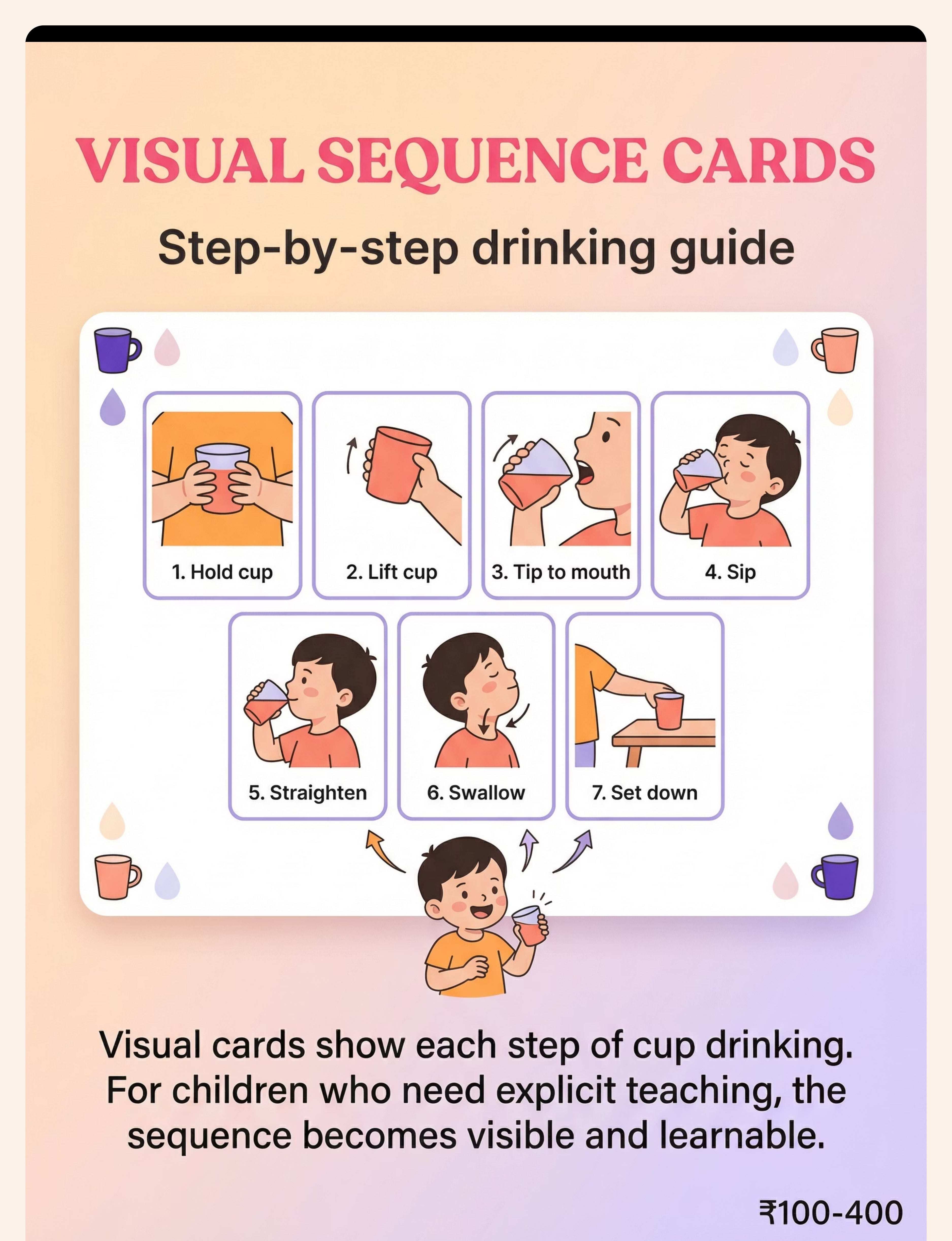
The full 7-step sequence — Hold → Lift → Tip → Sip → Straighten → Swallow → Set Down — must be planned and executed in order.
Cup Drinking Has a Developmental Arc
If your child is beyond 24 months and still requires sippy cups or has significant difficulty with open cups — this is your intervention window. Sippy cups with spouts promote an infantile suck pattern; they do not develop the mature lip-seal pattern required for open cups. Extended sippy use can actively delay the transition.
6 Months
Introduced to cup with support. Much spilling normal.
12 Months
Assisted open cup. Two hands typical. Major spilling expected.
18 Months
Decreasing assistance. Handled cups helpful.
24 Months
Functional cup drinking emerges. Some spilling OK.
3–4 Years
Independent open cup. Minimal spilling. Restaurants possible.
5+ Years
Spill-free across environments. No special equipment needed.
Clinically Validated. Home-Applicable. Parent-Proven.
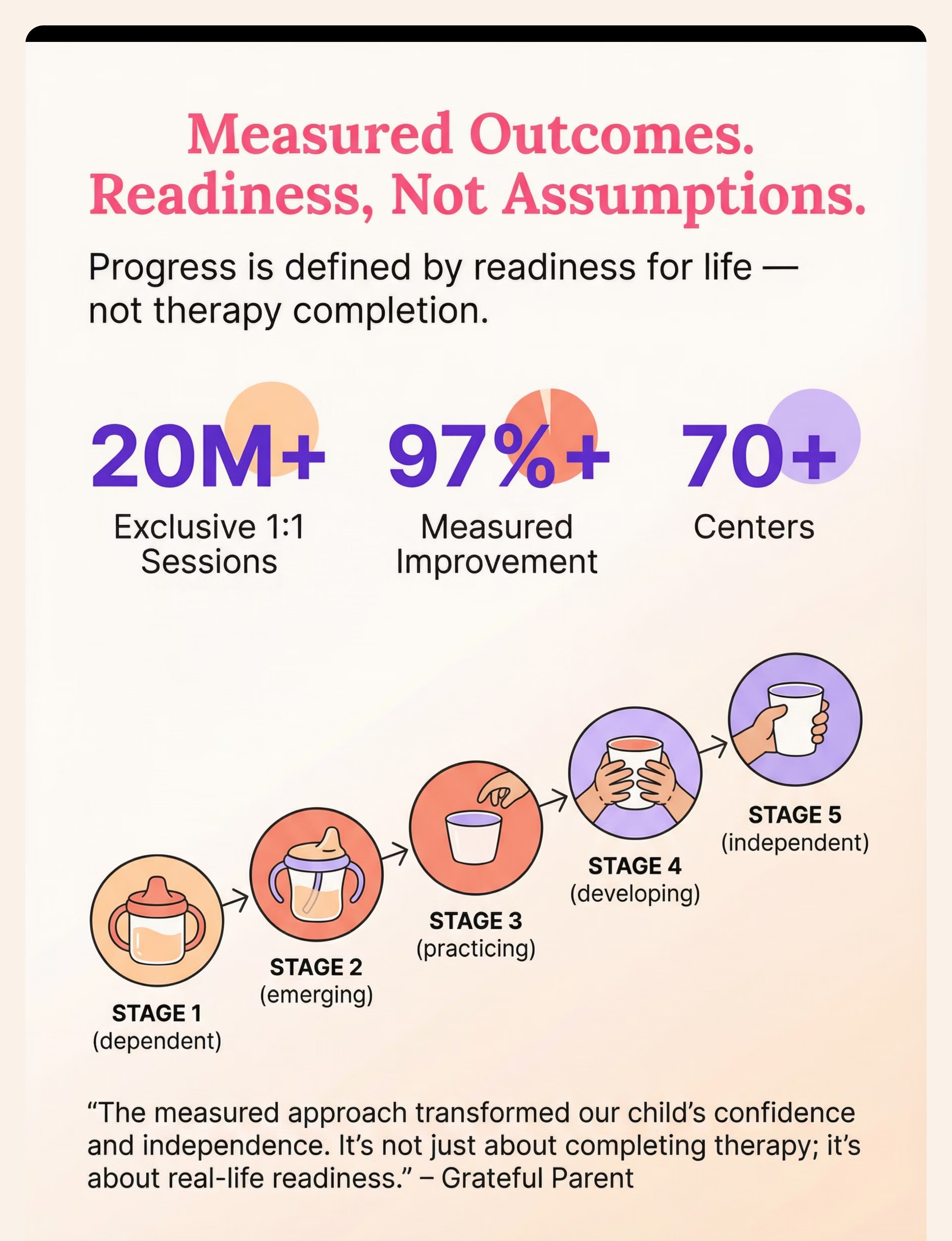
This programme is built on Level I–II evidence from systematic reviews, RCTs, and international clinical consensus — not guesswork. Across 20M+ 1:1 therapy sessions at Pinnacle Blooms Network®, cup drinking progression is tracked using the Feeding Independence Readiness Index, with 97%+ of children showing measurable improvement within 8–12 weeks of consistent, protocol-guided practice.
Study
Finding
Grade
PRISMA Systematic Review (2024) — 16 studies
Sensory-based feeding interventions classified as evidence-based practice for ASD
Level I
Meta-analysis, World J Clin Cases (2024) — 24 studies
Sensory/motor interventions effectively promote adaptive behavior and self-care
Level II
Padmanabha et al., Indian J Pediatr (2019)
Home-based interventions demonstrate significant outcomes in Indian pediatric populations
Level II
ASHA/AOTA Clinical Practice Guidelines
Graduated cup training with oral motor support is standard feeding therapy protocol
Consensus
NCAEP EBP Report (2020)
Visual supports and structured task instruction evidence-based for ASD populations
Level I
The Graduated Cup Drinking Skills Programme
Domain E: Feeding
Oral Motor Control
Self-Care Skills
Ages 12m–10yr
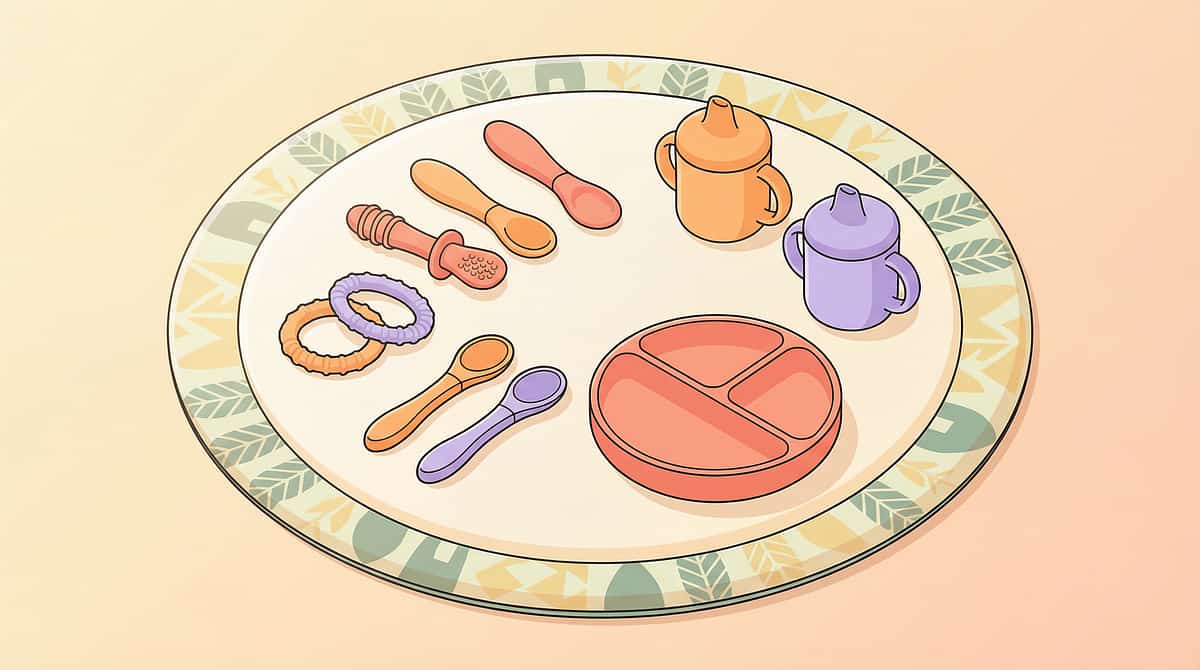
Graduated cup drinking skills training is a systematic, evidence-based approach to developing independent open-cup drinking by selecting and sequencing therapy materials that each address a specific oral motor component. Rather than simply replacing a sippy cup with an open cup, this programme introduces adapted cups, oral motor preparation tools, straw-building exercises, and visual sequence supports — each chosen to address a specific deficit in the cup-drinking coordination chain.
The programme progresses from maximum support to full independence, with each material serving as a scaffold the child gradually no longer needs.
Duration
5–15 minutes per practice session
📅 Frequency
2–4× daily (meals are natural practice moments)
🎯 Programme
8–12 weeks for foundational independence
Who Uses This Technique
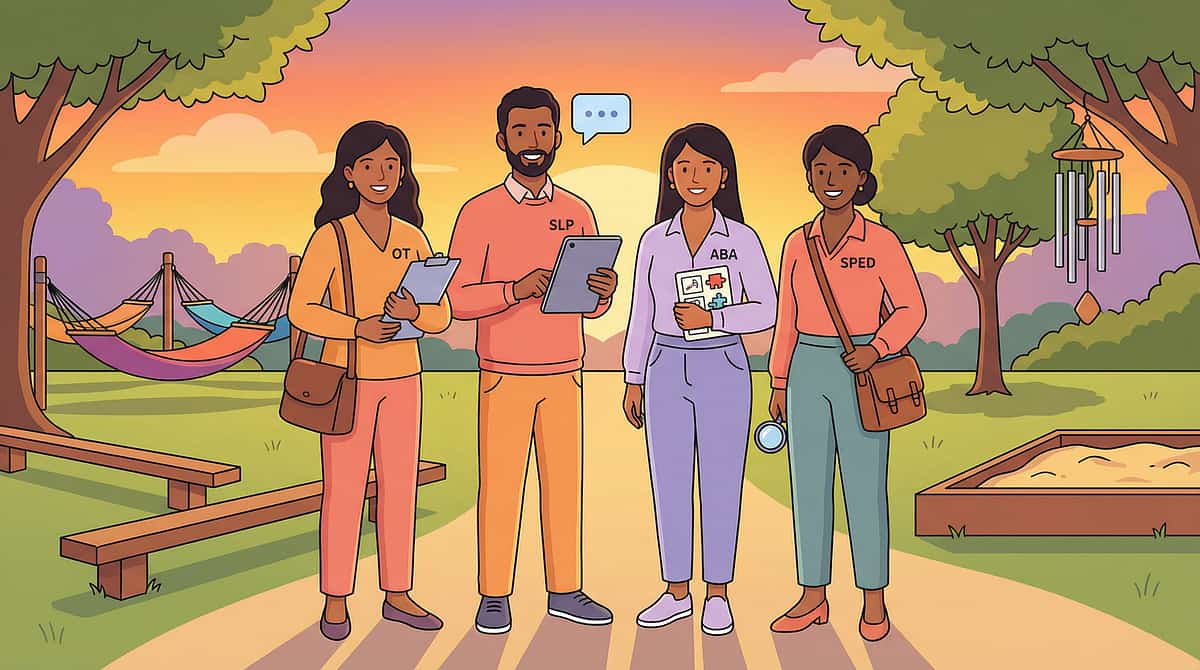
This technique crosses every therapy boundary — because the brain doesn't organize by therapy type. Five disciplines converge in the Pinnacle FusionModule™ to deliver one converged protocol.
🔶 Occupational Therapist (Primary Lead)
OTs lead cup drinking intervention as an ADL and fine motor skill. They assess oral motor patterns, select adaptive cups, design the progression protocol, and train parents. The sensory processing dimension — proprioceptive feedback from weighted cups, tactile tolerance — is primarily an OT domain.
🔵 Speech-Language Pathologist (Co-Lead)
SLPs lead oral motor assessment: lip closure strength, jaw grading, tongue positioning, and suck-swallow-breathe coordination. If choking or wet voice occurs, SLP involvement is non-negotiable. Straw drinking as an oral motor precursor also falls under SLP scope.
🟣 ABA / Behaviour Analyst (Support)
ABA specialists design reinforcement structures that make daily cup practice sustainable — identifying motivators, building token economies for cup attempts, and using discrete trial teaching to break down the 7-step cup sequence with systematic prompt fading.
🟢 Special Educator (Generalization Lead)
SpEd professionals ensure cup drinking skills transfer from home to school. They coordinate with teachers, design school-time practice, and ensure visual sequence cards are in place at the school dining area.
⚕️ NeuroDevelopmental Paediatrician
Where difficulty is severe or accompanied by coughing/wet voice, the NeuroDev physician rules out structural differences, hypotonia, or aspiration risk. Medical clearance gates the intensity of home-based practice.
What These Materials Are Actually Training
Each material in this programme targets a precise component of the cup-drinking coordination chain. Understanding what you are training — and why — transforms practice from guesswork into systematic intervention.
Target
Child can do this when mastered
Lip closure
Drinks without liquid leaking from sides of mouth
Jaw grading
Does not flood or bite rim; opens appropriate amount
Flow anticipation
Stops tipping as liquid approaches; no flooding
Motor planning
Completes all 7 steps in sequence without reminders
Coordination
No coughing or choking during drinking
Independence
Drinks from open cup across home, school, restaurants
9 Materials. Each Targets a Specific Component.
Start with the material that matches your child's specific challenge. You don't need all 9 at once — identify the weakest link in their cup-drinking chain and begin there. Each material is a precision tool, not a random purchase.
Total Starter Investment
Essential kit (Materials 1 + 4 + 8): ₹400–1,700
Full Kit
All 9 materials: ₹1,800–5,200
Pinnacle Recommends
All 9 are clinically validated and home-applicable
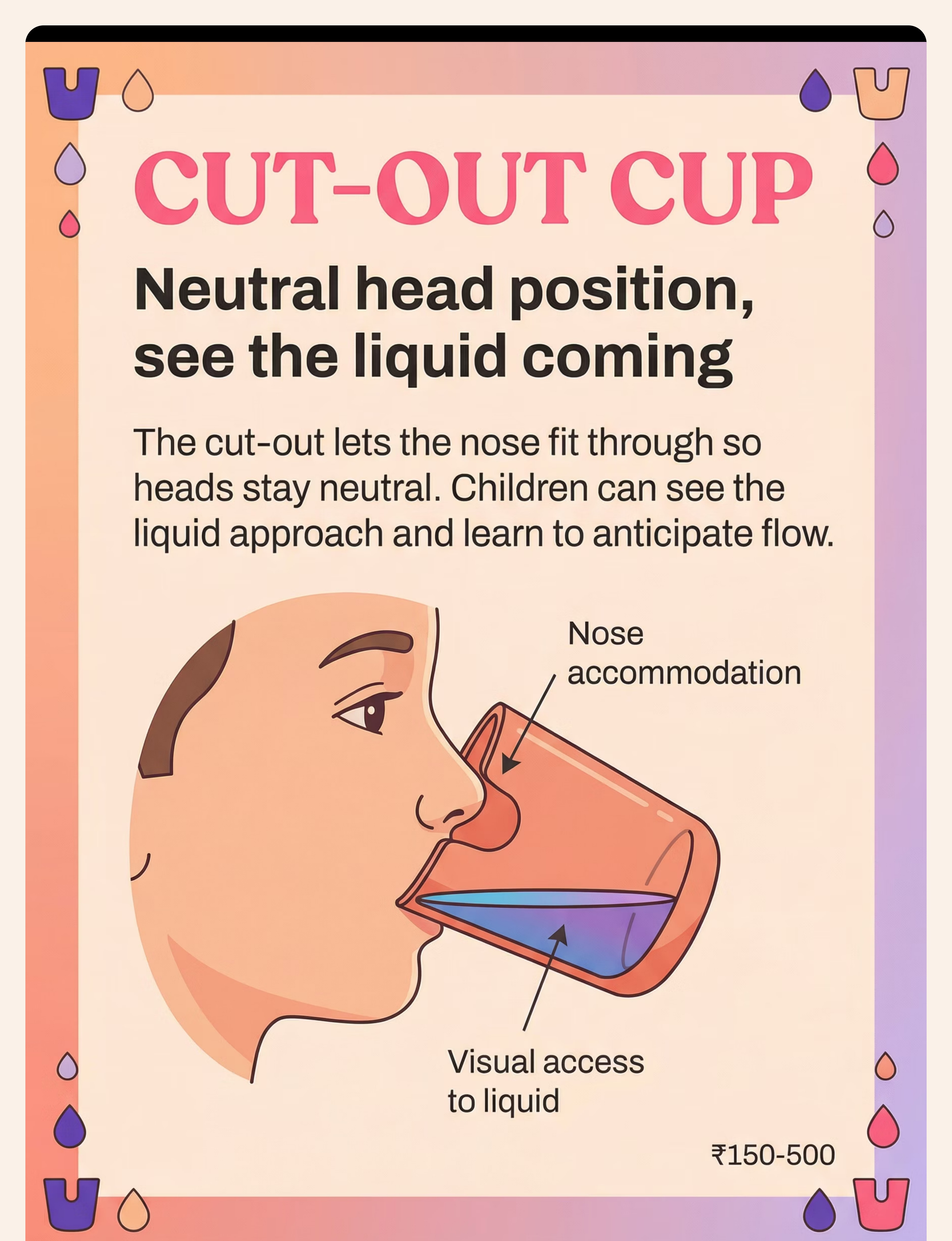
Material 1: Cut-Out Cup (Nosey Cup)
🎯Targets: Head position + Flow anticipation
The cut-out accommodates the nose, allowing tipping while keeping the head neutral. Children can see liquid approaching, learning to anticipate flow without neck hyperextension.
💰₹150–500
Adaptive Feeding Cup
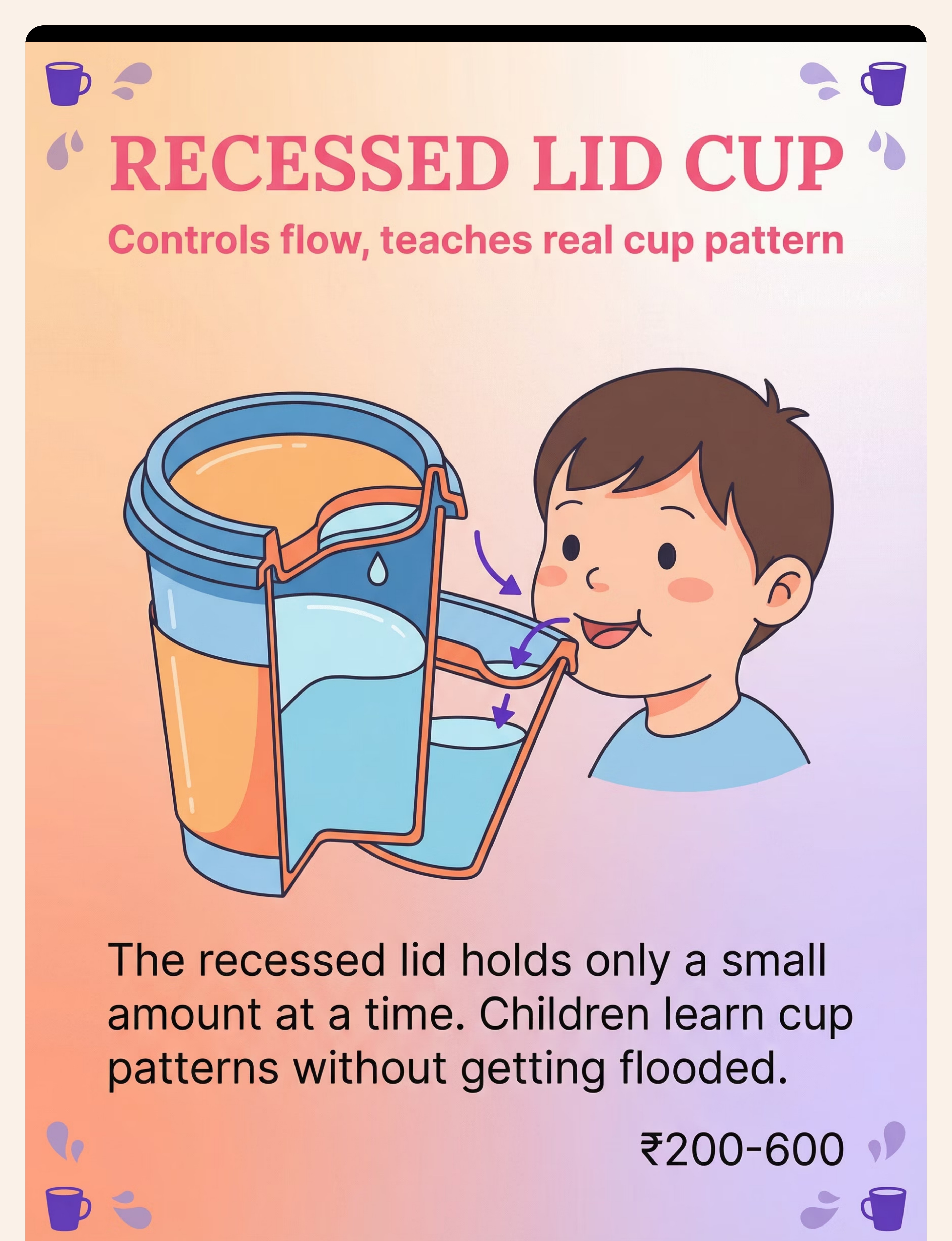
Material 2: Recessed Lid Cup (360 Trainer)
🎯Targets: Flow control + Mature lip pattern
The recessed lid releases only a small amount of liquid per tip — no flooding. Forces real lip-seal pattern (unlike sippy spout), teaching mature drinking mechanics from day one.
💰₹200–600
Adaptive Feeding Cup
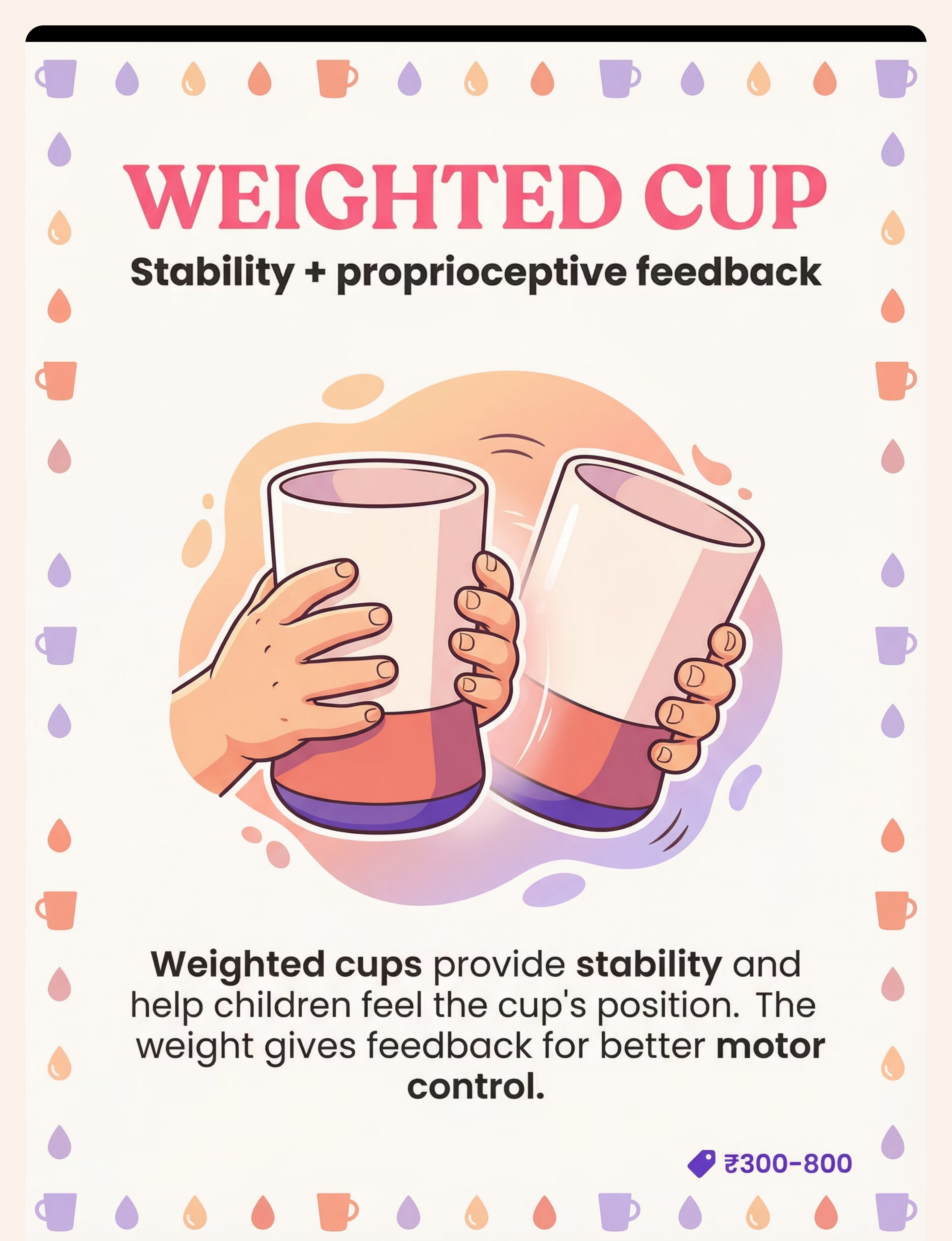
Material 3: Weighted Cup
🎯Targets: Proprioceptive feedback + Motor planning
Weighted base provides clear body-awareness signals about cup position. Critical for children with low muscle tone or proprioceptive processing differences who need enhanced sensory input to coordinate movement.
💰₹300–800
Weighted Therapeutic Equipment
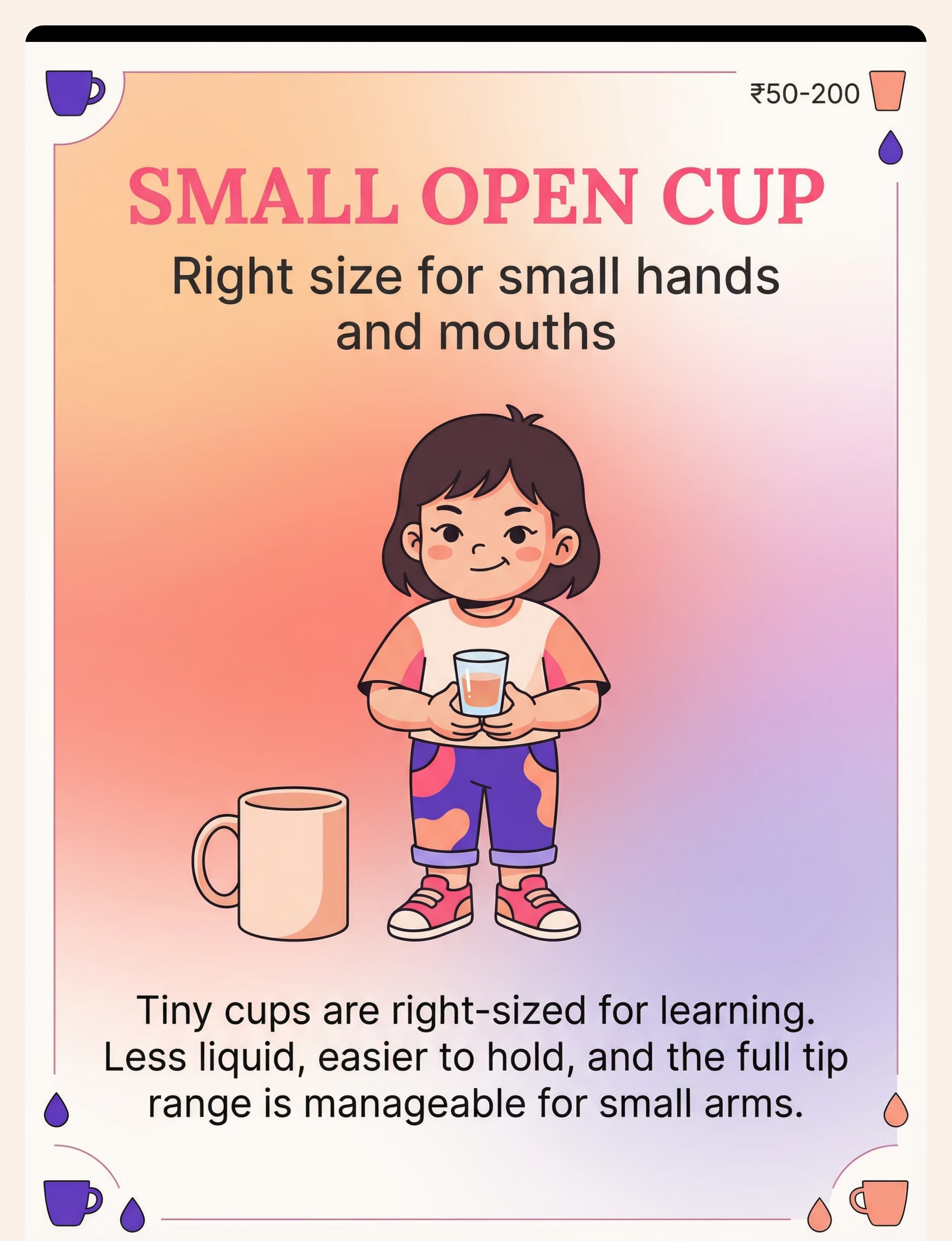
Material 4: Small Open Cup (Shot Glass Size)
🎯Targets: Proportional motor learning
Standard cups are too large for learning. Shot-glass-sized cups (1–2 tablespoons of liquid) let children master the complete 7-step sequence with proportionally appropriate tools — confidence before scale.
💰₹50–200
Practice Vessel
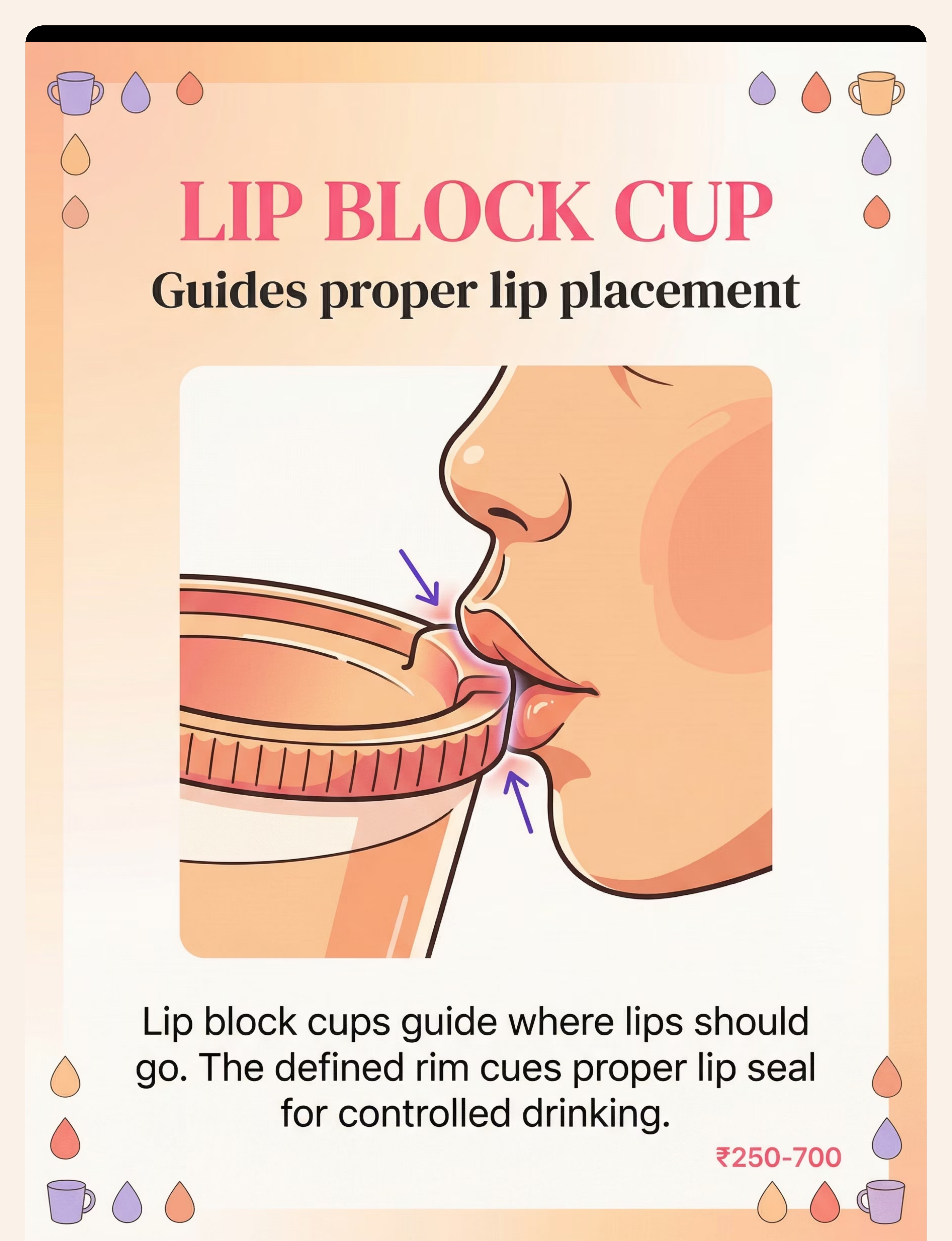
Material 5: Lip Block Cup
🎯Targets: Lip seal + Rim placement awareness
A defined, often textured rim cues where lips should rest. Provides tactile feedback that teaches the lip seal pattern essential for spill-free drinking — the body learns through touch what words can't fully teach.
💰₹250–700
Adaptive Feeding Cup
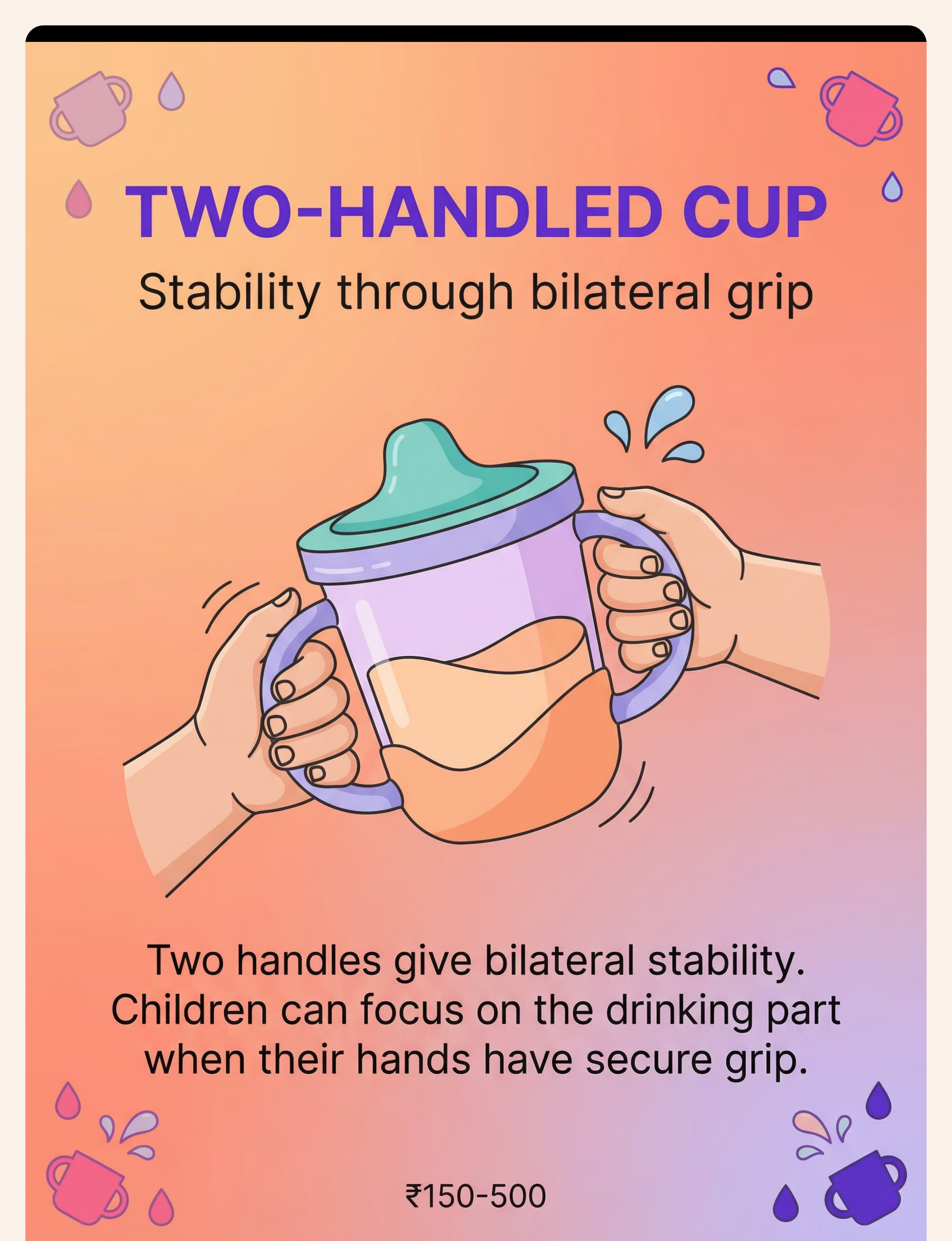
Material 6: Two-Handled Cup
🎯Targets: Bilateral grip stability → frees attention for oral motor learning
When hand control is a secondary challenge, two handles reduce motor demand — allowing the child to focus cognitive resources on the oral motor aspects of drinking rather than on not dropping the cup.
💰₹150–500
Adaptive Feeding Cup
Materials 7, 8 & 9: The Supporting Trio
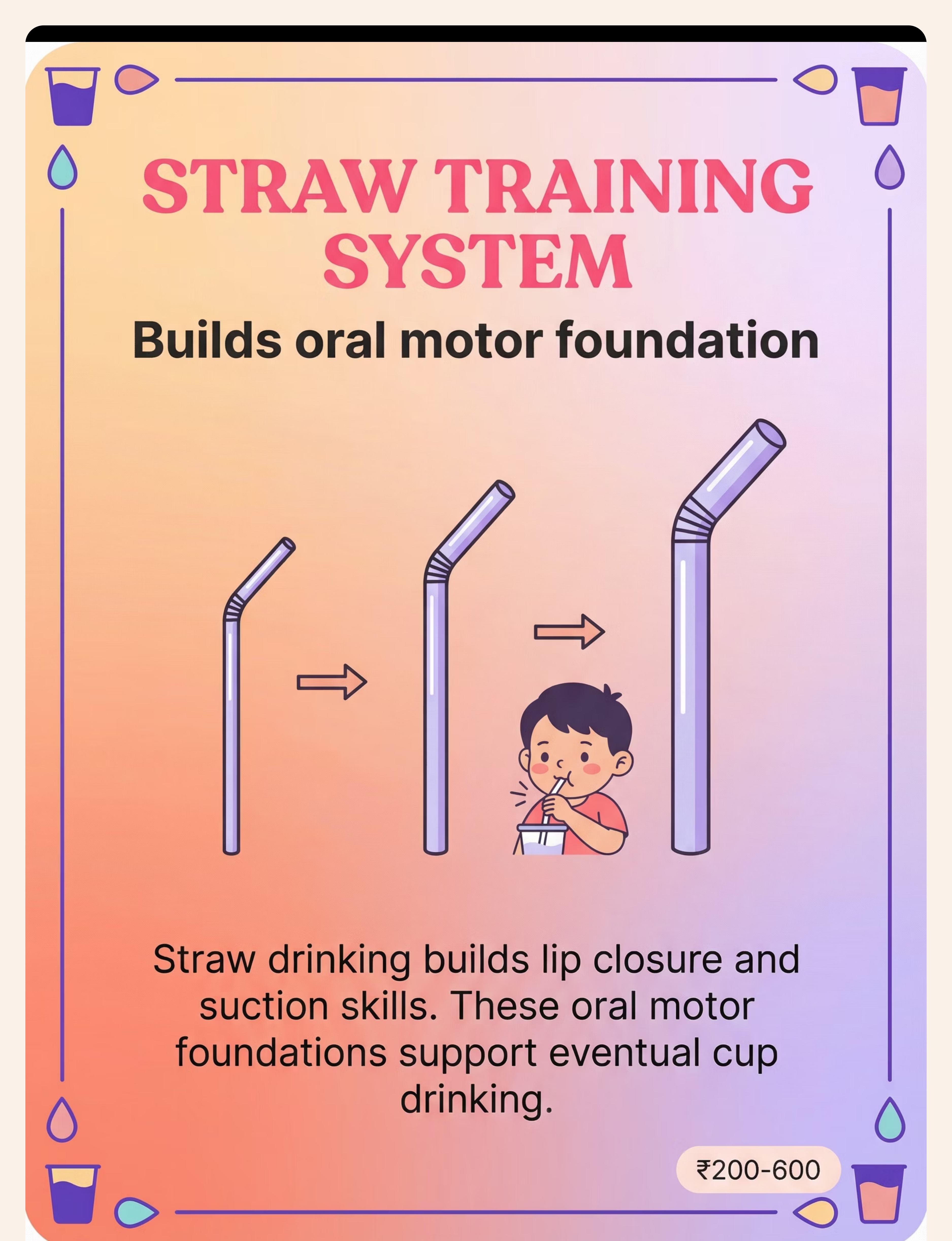
Material 7: Straw Training System
🎯Targets: Lip closure strength + Suction foundation
Straw drinking builds the lip seal and graded suction that directly supports cup drinking. Progress from short thin straws → longer wider straws as oral motor strength grows. Straw competence and cup competence reinforce each other.
💰₹200–600 | Canon: Straw Training Systems
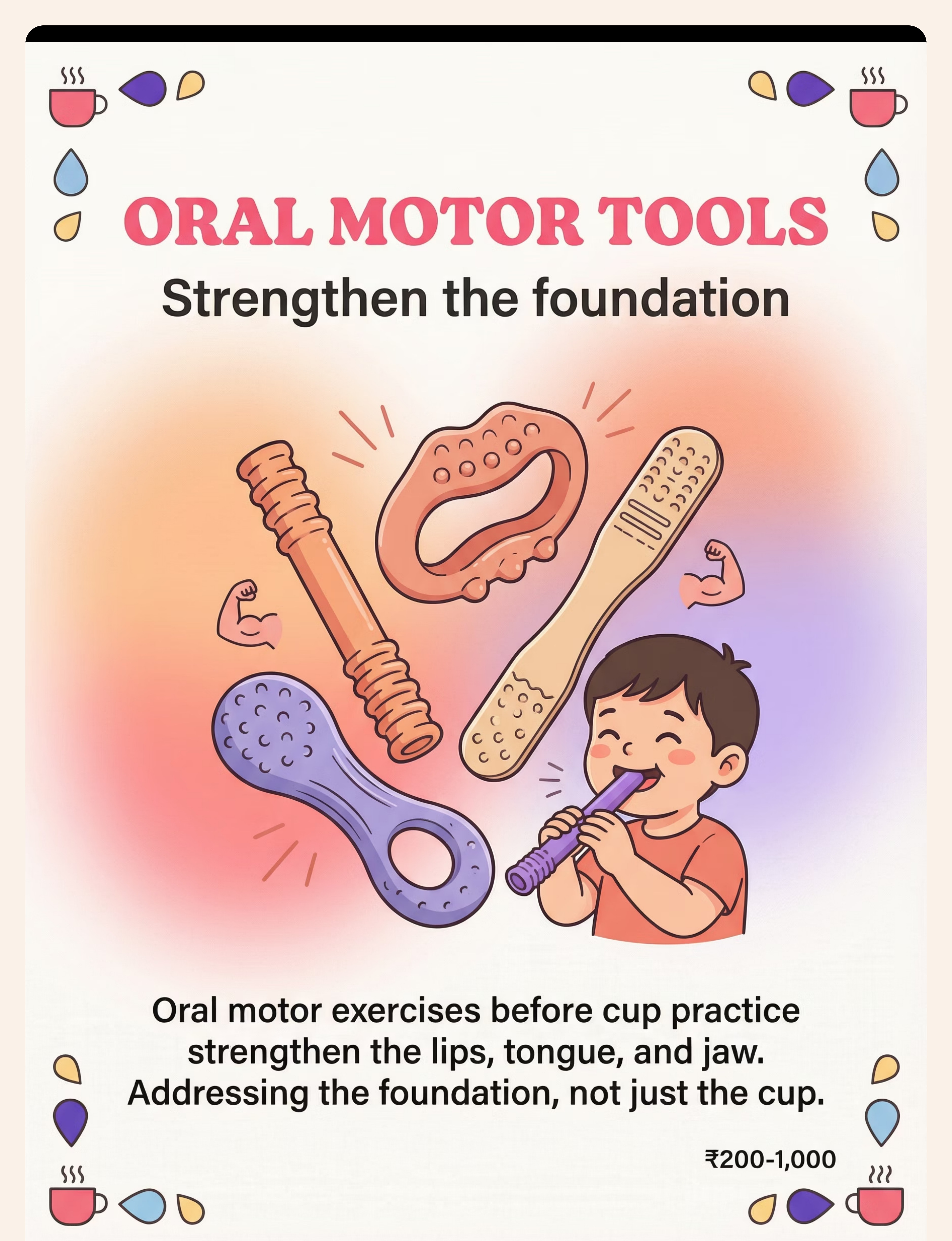
Material 8: Oral Motor Pre-Feeding Tools
🎯Targets: Jaw strength + Lip tone + Tongue coordination
Chewy tubes, bite blocks, and lip/tongue exercises used before cup practice "wake up" and strengthen the oral motor system. This addresses the root cause — not just the cup — making every practice session more effective.
💰₹200–1,000 | Canon: Oral Motor Tools
Material 9: Visual Sequence Cards
🎯Targets: Motor planning + Sequencing
Cards show each of the 7 steps: Hold → Lift → Tip → Sip → Straighten → Swallow → Set Down. For children who need explicit teaching of sequences others absorb implicitly, these cards are a non-negotiable scaffold.
💰₹100–400 (or DIY) | Canon: Visual Supports

Every Family, Every Budget: DIY & Substitute Options

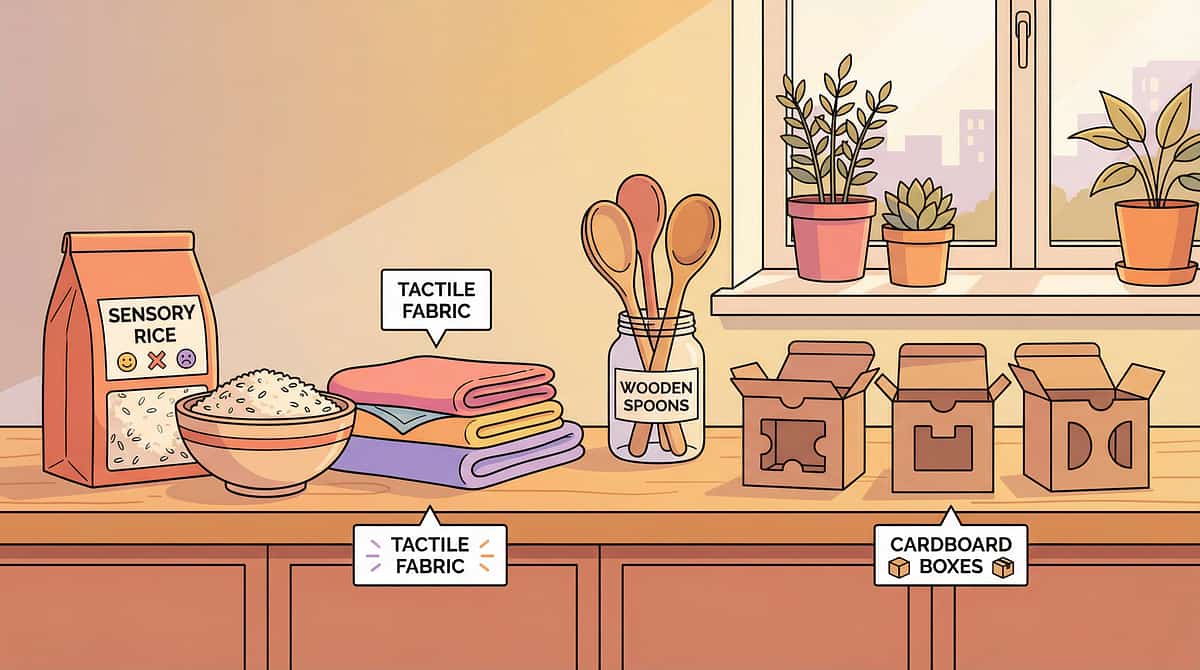
"Context-specific, equity-focused interventions ensure every family can participate regardless of economic access." — WHO NCF 2018 Material Commercial Option DIY / Substitute Why It Works Cut-out cup Nosey/flexi cup ₹150–500 Cut a U-shape notch from a disposable plastic cup — smooth edges carefully Same nose-accommodation principle Small open cup Shot glass plastic ₹50 Medicine dispensing cups, steel katori, shot-glass-sized dabbas Proportionally appropriate vessel Weighted cup Commercial ₹300+ Fill a regular cup 30–40% with sand at base, sealed with waterproof tape Adds proprioceptive weight-feedback Visual sequence cards Printed laminated ₹100–400 Print 7 photos of the steps — laminate with contact paper Brain processes real photos effectively Oral motor warm-up Chewy tube ₹200+ Chewy granola bars; blowing bubbles for lip activation; licking peanut butter from spoon Same oral motor activation principle Zero-Cost Version: Use any small plastic cup from the kitchen. Fill with 1–2 tablespoons of water. Sit child upright. Follow 7-step sequence (draw it on paper). Warm up with 2 minutes of lip exercises first.
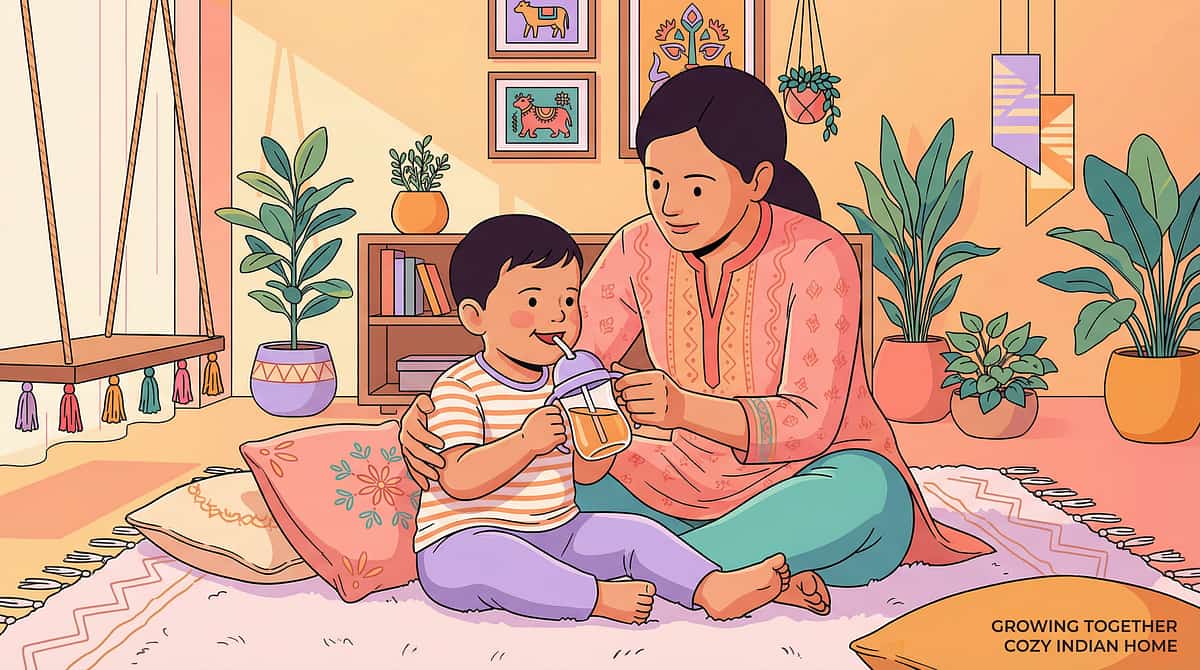
⚠️ Safety First: Read This Before Your First Session
🔴 DO NOT PROCEED IF:
• History of aspiration or recurrent chest infections → SLP evaluation required first
• Structural differences (cleft palate, tongue tie, severe hypotonia) → Medical clearance required
• Coughing or wet-gurgling voice occurs consistently → Stop and seek professional assessment
• Severe food/liquid aversion → Desensitization programme required first
🟡 MODIFY IF:
• Child is dysregulated or upset → Wait 20–30 minutes, offer calming activity first
• Child just had a meltdown → Postpone to next scheduled practice
• Child is very hungry → Feed first; practice works best when slightly thirsty
• Significant resistance (crying, pushing away) → Use visual schedule; do not force
🟢 SAFE TO PROCEED WHEN:
• Child is calm, alert, and in a regulated state
• Child is mildly thirsty (preferred liquid ready)
• Good posture support is in place (feet flat, hips at 90°)
• 10–15 minutes of uninterrupted practice time available
• Small towel ready for spills — normalize, not shame
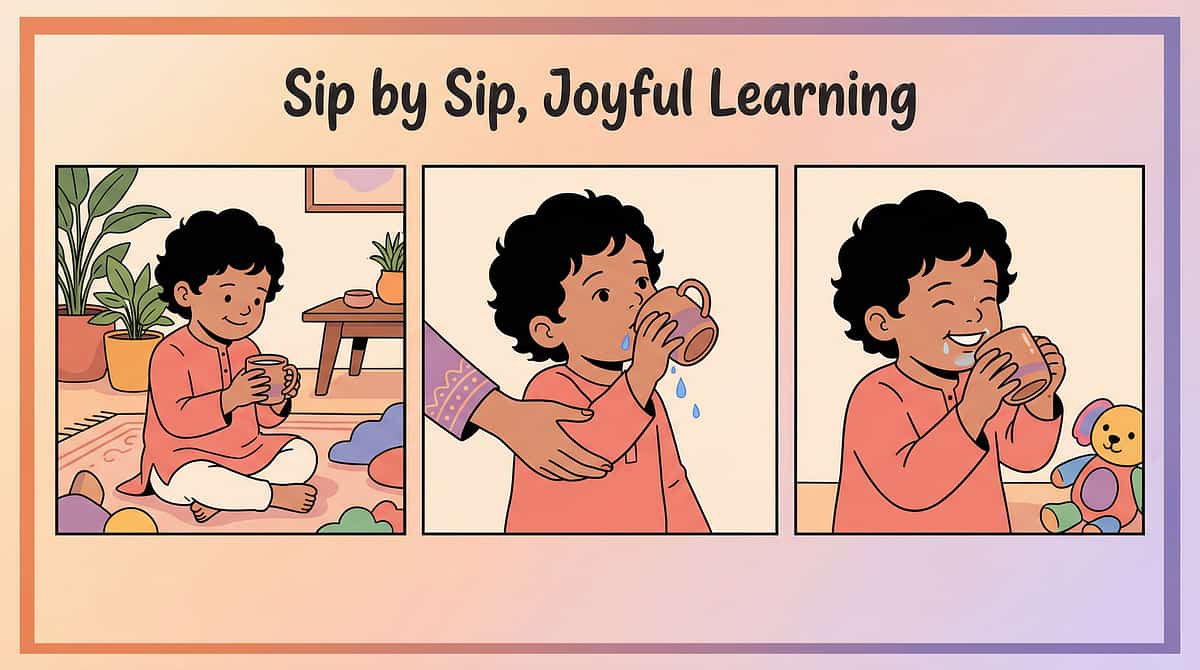
🛑STOP immediately if: consistent coughing, blue tinge around lips, severe distress that does not de-escalate within 2 minutes, or severe gagging. 📞 Concerns about safety? Call 9100 181 181 — free, immediate guidance in your language.
Set Up Your Space: The Right Environment Eliminates 80% of Session Failures
Environment is not a detail — it is a clinical variable. A well-prepared space allows your child's nervous system to stay regulated and focused on the cup, not on managing competing sensory input.
Child's Seat
Chair with full back support. Feet flat on floor or footrest. Hips at 90°. Trunk stability is the foundation for oral motor control.
Visual Sequence Card
Posted at child's eye level — on the wall, propped on the table. Child must see it without turning their head.
Cup Position
Placed on the child's dominant hand side, at mid-table distance. Not too close, not too far — stretching disrupts posture.
Reinforcers
Immediately accessible but not in immediate reach. First-Then visual ready: "First cup practice, then [reinforcer]."
Remove Distractors
No screens, no competing sibling activity, no other preferred foods. Bright natural light. Low-stimulation sound environment.
Is Your Child Ready? The 60-Second Readiness Check
The best session starts right. A 5-minute positive session outperforms a 20-minute forced session every time. Run this check before every practice.
Check
GO
⚠️ MODIFY
POSTPONE
Emotional state
Calm, smiling, responsive
Quiet but neutral
Crying, agitated, melting
Physical state
Alert, well-rested
Slightly tired
Sick, very tired, post-meltdown
Hunger/thirst
Slightly thirsty
Just ate
Ravenous or just had full meal
Engagement
Eye contact, engaged
Looking around
Actively avoiding/withdrawing
Body posture
Upright, stable
Some fidgeting
Slumped, resistant to sitting
3+ GREEN
Proceed with full protocol
GREEN + AMBER mix
Simplified version — fewer reps, shorter duration
2+ RED
Postpone → offer calming heavy work activity first
Step 1: The Invitation
STEP 1 of 6
30–60 seconds
Bring the child to the practice area using their preferred transition cue — a visual timer, a "Now it's cup time" picture card, or a familiar routine. Do NOT present the cup as a demand. Present it as a natural, exciting moment.
"Hey! Look what we have today. This is our special cup. Let's just see it — you don't have to drink yet."
Acceptance looks like:
Reaches for cup • Looks at cup with interest • Relaxed body • Spontaneous approach
🔄 Resistance — what to do:
Pushes away → Move cup further; "Just looking, no drinking yet"
Walks away → Allow it; try in 5 minutes
Ignores → Pair with a preferred activity nearby
ABA Principle — Pairing: Establish association between the cup and positive outcomes before introducing any demand. Never present a demand before establishing motivation.
Step 2: The Engagement — Oral Motor Warm-Up
STEP 2 of 6
1–3 minutes
Now that the child is near and curious, introduce the oral motor warm-up (Material 8) for 2 minutes. This activates the oral motor system before the cup appears, priming lips, jaw, and tongue for the coordination demands ahead.
Jaw Activation
Chewy tube or chewy granola bar bite — 10 bites each side
Lip Activation
"Fish face" (lip pucker) ×5 | "Big smile" ×5 | "Pop your lips" ×5
Tongue Activation
Lick spoon of yogurt or peanut butter; touch tongue to corners of lips
Blowing
Blow through a straw into water to make bubbles ×5
"Your lips are ready! This cup is going to help you drink like a champion. See the special design?"

Step 3: The Therapeutic Action — The First Sip
STEP 3 of 6
3–8 minutes
This is the core therapeutic window. Follow the 7-step sequence with hand-over-hand guidance initially, then fade support as the child builds independence. Use only 1–2 tablespoons of preferred liquid in the cup.
HOLD
Child grasps cup with both hands or dominant hand. Prompt: "Hold the cup."
LIFT
Raise cup to chest height. Prompt: "Lift it up."
TIP
Tilt cup slowly toward mouth. For cut-out cup: nose goes through cut-out. Prompt: "Tip it slowly — watch the water."
SIP
Lips rest on rim. Small amount of liquid reaches lips. Prompt: "Lips on the cup. Little sip."
STRAIGHTEN
Before swallowing, return cup toward upright. Prompt: "Stop — straighten." This prevents flooding.
SWALLOW
Swallow the liquid. Wait for swallow before next tip. Prompt: "Swallow."
SET DOWN
Return cup to table. Prompt: "Set it down. Great job!"
Step 4: Repeat & Vary
STEP 4 of 6
3–5 minutes
"3 good repetitions → greater neural gain than 10 forced repetitions." — Pinnacle OT Protocol
Target 3–5 complete sip-swallow cycles per session. Quality over quantity — always. Stop before fatigue sets in; ending on a success is more important than completing a set number of repetitions.
Variation
How
Why
Liquid variety
Change from water to diluted juice mid-session
Sensory novelty maintains motivation
Cup progression
Start with Material 2; attempt 1 rep with Material 4
Graduated challenge builds confidence
Color change
Use coloured water (food colouring)
Visual novelty for flow anticipation practice
Temperature
Slightly chilled liquid
Increases sensory awareness of liquid in mouth
Volume
Begin with 1 tbsp; increase to 2 tbsp if successful
Graduated volume builds confidence

Stop repetitions when: Child pushes cup away after 2+ successful reps (end on a win) • Increasing spillage due to fatigue • Resistance or distress rising
Step 5: Reinforce & Celebrate
STEP 5 of 6
Within 3 seconds of success
The Reinforcement Formula: Within 3 seconds of the desired behavior → Specific praise → Enthusiastic delivery. Celebrate the attempt, not just the perfection. Any movement toward the goal is reinforcement-worthy.
"YES! You tipped it perfectly and your lips held it! That's your cup-drinking brain working!"
"ALL 7 STEPS! You did the whole cup-drinking sequence! That's a champion move!"
"You tried so hard today. That one sip without spilling — that's real progress."
🪙 Token Economy Option
After each successful sip-swallow cycle → 1 token → After 5 tokens → preferred activity. Use stickers, chips, or tokens the child is motivated by.
🎁 Reinforcement Menu
Use the Pinnacle Reinforcement Menu Kit to identify top 3–5 motivators. Rotate reinforcers to prevent satiation and sustain long-term engagement.
Step 6: The Cool-Down
STEP 6 of 6
2–3 minutes
Never end abruptly. The cool-down is as therapeutically important as the active practice. It signals closure, regulates the sensory system, and builds the child's ability to transition away from preferred activities — a life skill in itself.
Warning Transition
"2 more sips and we're all done with cups today!" — always give advance notice before ending.
Visual Timer
Set 2-minute timer. Show child. "When timer ends, cups go away." Predictability reduces resistance.
Cup Put-Away Ritual
Child places cup back in designated spot. Creates closure and ownership of the practice routine.
Proprioceptive Landing
2 minutes of heavy work — carry the cup tray to the kitchen, press palms together, squeeze a therapy ball. Regulates the sensory system post-session.
Transition Cue
Visual schedule: "Cup practice → ✓ DONE → [Next activity]." Always show what comes next.
Capture the Data: Right Now
60 seconds of data now. Months of guessing prevented.
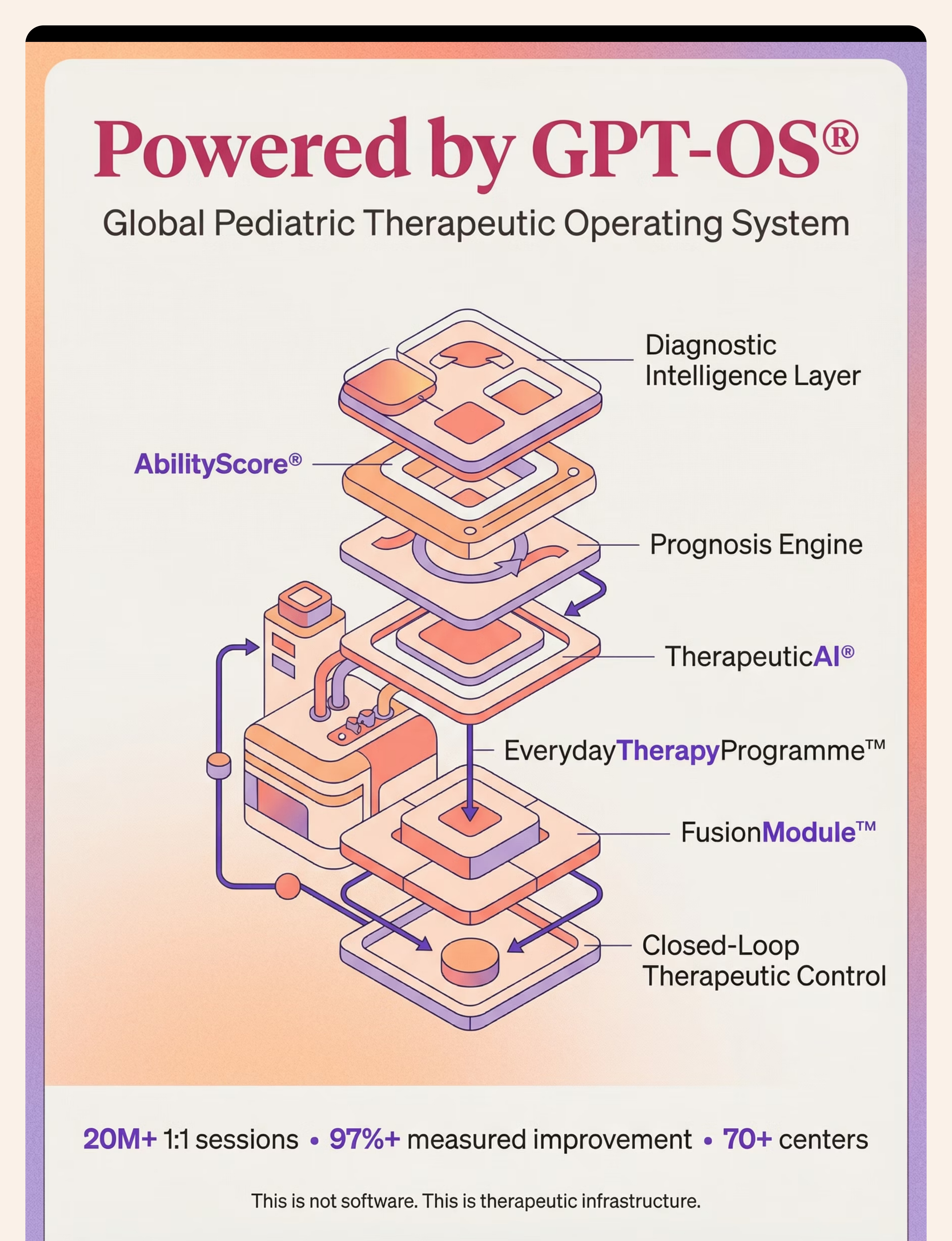
Data from your sessions feeds the GPT-OS® Prognosis Engine. Families who track even 2 data points per session achieve outcomes 3× faster than those who practice without data. Record while the session is still fresh.
#
What to record
How
Example
1
Sip attempts today
Tally
3
2
Spills per attempt
Rating: 0=none, 1=small, 2=significant
1, 0, 1
3
Child's engagement level
1=resistant, 2=tolerant, 3=engaged, 4=enthusiastic
3

WhatsApp Format — send to your therapist:
E-463 Cup Practice [date] | Attempts: 3 | Spills: small, none, small | Mood: 3/4 | Cup used: Recessed lid | Notes: Needed hand guidance on steps 1–3

What If It Didn't Go As Planned? Troubleshooting Guide

"Session abandonment is not failure — it's data. Modify and return." — Pinnacle Protocol Most sessions don't go perfectly. Every problem has a specific clinical explanation and a targeted fix. Use this guide before concluding that the protocol isn't working. 🌊 Child flooded — coughed Why: Tipped too far; no flow anticipation.Fix: Switch to recessed lid cup (Material 2). Reduce to 1 tablespoon. Practice "slow tip" with hand guidance. 🚫 Refused to touch the cup Why: Sensory aversion; negative association; demand threshold exceeded.Fix: Return to material phase — explore cup without drinking for 2–3 sessions. Use "just hold it" prompt only. 💧 Liquid leaks from sides consistently Why: Lip closure deficit — orbicularis oris weakness.Fix: Add 5 min lip exercises before session. Switch to lip block cup (Material 5). Add straw training daily. Refer for SLP if no improvement in 4 weeks. 😬 Child bites the rim Why: Jaw grading difficulty; oral sensory seeking.Fix: Offer chewy tube before session. Use cup with smaller rim. Consult OT about jaw grading exercises. 🏫 Perfect at home, refuses at school Why: Generalization failure — skill is context-specific.Fix: Send preferred training cup to school. Share visual sequence cards with teacher. Practice in varied home environments first. 📉 No improvement after 4 weeks Why: Possible structural issue, significant hypotonia, sensory barrier, or aspiration concern.Fix: Book professional assessment. Call 9100 181 181 — free teleconsultation. Request SLP + OT feeding evaluation.
Adapt & Personalize: No Two Children Are Identical
This protocol is a framework, not a rigid script. Your child's sensory profile, muscle tone, cognitive profile, and age all shape how you should modify each session. Use these profiles to find your child's starting configuration.
🔴 Sensory Avoiders
• Room-temperature liquid (not cold)
• Same cup every session for 2 weeks
• Gradual exposure: hold → smell → taste from spoon → sip (weeks 1–3)
• Minimal sensory preparation — avoid overwhelming
🔵 Sensory Seekers
• Flavoured, temperature-varied liquids
• Weighted cup for more feedback
• Chewy items before session
• Faster progression through materials
🟢 Low Muscle Tone
• Oral motor warm-up is non-negotiable (10 min)
• Weighted cup for proprioceptive input
• Postural support critical
• Smaller volumes; rest periods between reps
🟡 Motor Planning (Dyspraxia)
• Visual sequence cards always displayed
• Same cup, position, liquid for weeks 1–4
• Hand-over-hand for full sequence
• Self-talk strategy: child narrates steps aloud
Age
Modification
12–24 months
Adult-supported throughout; two-handled cup; minimal liquid; model drinking on yourself
2–4 years
Graduated independence; token rewards; choice between 2 cups
5–7 years
Self-monitoring: child rates own performance; peer modeling helpful
8–10 years
Social motivation: "Let's practice so you can drink at your friend's birthday"
Week 1–2: Tolerance, Not Mastery
Progress Arc
~15% Complete
Most parents expect dramatic improvement. The brain doesn't work that way. In weeks 1–2, watch for signs of neural adaptation — not perfection. If your child tolerated the training cup for 3 seconds longer than last week, that is real, measurable neural change.
Increased Tolerance
Child accepts cup being present without distress — down from active refusal. This is the foundational win.
Emerging Curiosity
Spontaneously picks up or examines the cup. This signals the beginning of motivated engagement.
1–2 Successful Sips
Even with significant hand guidance. Quality and assistance level matter less than the attempt itself.
Parent-Child System Improving
You feel more confident reading their cues. This co-regulation is itself a therapeutic outcome.

⚠️ Week 1 may be harder than Day 1. The brain resists new patterns initially. Regression on Day 3–5 is normal and temporary. 📞 Week 1–2 struggles? Call 9100 181 181 for free parent coaching.
Week 3–4: The Neural Pathways Are Forming
Progress Arc
~40% Complete
In weeks 3–4, the brain is actively consolidating new motor patterns. The changes you see now are subtle but significant — they represent real structural adaptation in the oral motor system. Watch closely for these consolidation indicators.
Anticipates the Routine
Walks to the table when cued without coaxing. The practice has become a known, safe pattern.
Reduced Warm-Up Time
Accepts cup faster. The association between cup and positive experience is strengthening.
Spontaneous Attempts
Picks up cup during meals without prompting — motivation is now driving the skill.
Spillage Decreasing on Specific Steps
Perhaps Step 3 is now reliable, working on Step 4. Component-by-component mastery is the pattern.
"You may notice you're more confident too. Your reading of their cues has improved. You know when to push, when to wait, when to stop. That is the parent-therapist emerging in you." — Pinnacle Parent Training Principle

Week 5–8: Mastery Emerging
Progress Arc
~75% Complete
This is the window where foundational independence emerges. When 5 of 7 mastery criteria are met consistently over 5 days, your child has achieved the core goal of this programme. True independence means the skill generalizes — different cups, different places, different people.
Mastery Criteria
Observable Behaviour
/
Independent sequence
Completes all 7 steps without verbal prompt
__
Lip closure
Drinks without liquid leaking from sides
__
Flow control
Rarely floods; good tip-sip-straighten coordination
__
Appropriate volume
Adjusts tipping to appropriate sip size
__
Generalization
Drinks from 2+ different cup types
__
Setting transfer
Drinks successfully in 2+ different environments
__
Choking-free
No coughing during typical cup drinking practice
__

When 5/7 criteria are met consistently over 5 days → MASTERY UNLOCKED
Next: E-464 Straw Drinking | Drinking from water fountains | Different cup shapes across environments

🎉 You Did This. Your Child Grew Because of Your Commitment.
Over the past 5–8 weeks, you showed up for daily cup practice — often when tired, often after a hard day. You learned to read your child's oral motor signals in real time. You built an oral motor warm-up into your family's daily rhythm. You endured the wet shirts, the spillage, the session abandonments. And you kept going.
Your Child Built:
Lip closure strength they didn't have before • Flow anticipation — a neurological skill, not a trick • A 7-step motor sequence that will serve them for life • Proof that their brain can learn new oral motor patterns
Family Celebration:
Tonight, at dinner, let your child drink from a regular cup — their cup. Photograph that moment. It is a milestone as significant as first steps.
"The first time my child drank from a cup without a lid was ________. We felt ________. This mattered because ________."
Red Flags: When to Pause — Even in the Progress Zone
Trust your instincts. The following signs require you to pause home practice and seek professional guidance — no exceptions. Early identification of these flags protects your child's safety.
🔴 Persistent wet/gurgly voice after drinking
Voice sounds "wet" or bubbly for 5+ minutes after sessions. May indicate aspiration (liquid entering airway). Do: STOP cup practice. Contact SLP for swallowing assessment. Call 9100 181 181.
🔴 Recurrent chest infections after meals
More than 2 chest infections in 3 months; congestion after feeding. Silent aspiration sign — requires medical investigation before resuming practice.
🔴 Choking/gagging at every attempt despite 4+ weeks
Consistent, not occasional choking — even with small volumes. Structural or neurological cause needs assessment. SLP assessment mandatory.
🟡 Significant regression after mastery
Skills that were mastered are suddenly absent. Rule out illness; resume graduated practice; teleconsultation if persists 2+ weeks.
🟡 Extreme oral sensory defensiveness
Complete refusal of any cup, severe distress. Requires OT sensory feeding assessment. Do not attempt cup training under force.
Escalation Pathway: Self-monitor → [2 weeks] → Teleconsult (9100 181 181) → [As directed] → Clinic Assessment → [If aspiration] → Swallowing Study
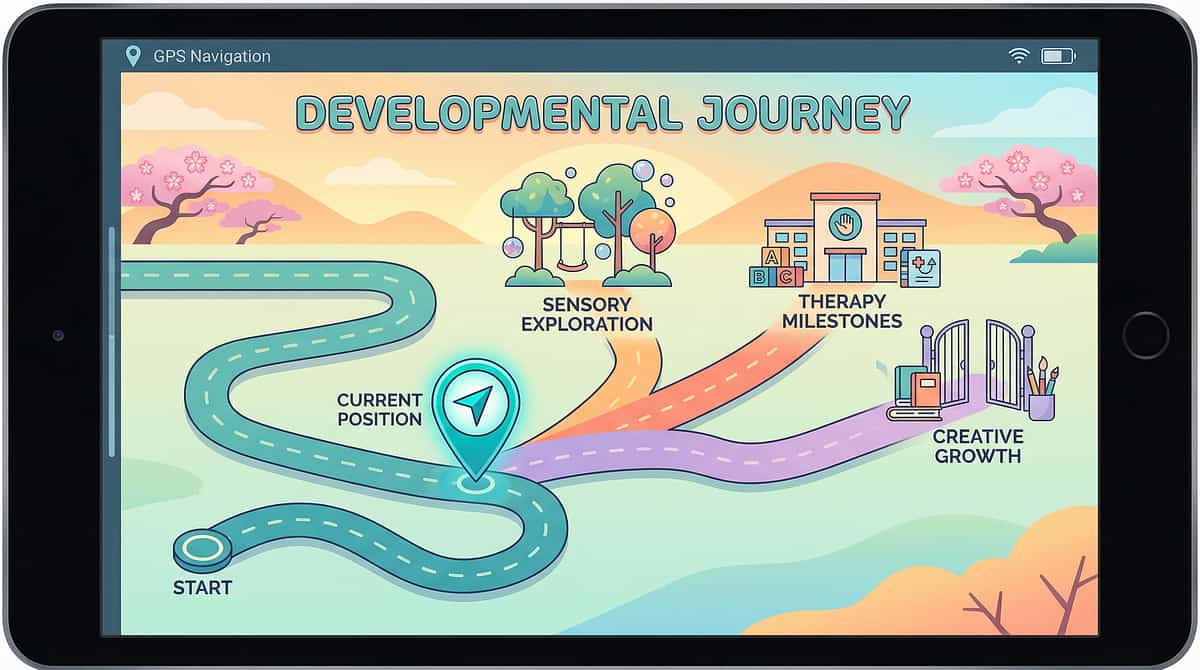
The Progression Pathway: Cup Drinking Is One Waypoint
Cup drinking mastery opens the door to a broader feeding independence journey. Where you go next depends on your child's response profile and which barriers remain. The GPT-OS® Prognosis Engine analyses your E-463 session data and recommends the optimal next technique automatically.
Branches: E-464 to E-466
E-463 Cup Drinking (current)
E-462 Slow Eating
E-461 Food Texture Sensitivity
Your child's response profile determines the next step: Mastered cup but struggles with straws → E-464 | Oral sensory avoidance limiting all cup/straw work → E-465 | Primary issue is bottle/sippy attachment → E-466 | Cup mastered, ready for water bottles and mugs → Natural generalization programme.
Related Techniques in Domain E: Feeding & Mealtime Independence
You already own materials from E-463 that apply directly to several of these adjacent techniques — your investment reaches further than one skill. Browse the full domain to identify which areas your child may benefit from next.
Technique
Code
Difficulty
Lead Discipline
Canon Material
Straw Drinking
E-464
Core
SLP + OT
Straw Training Systems
Oral Sensory & Feeding
E-465
Advanced
OT + SLP
Oral Motor Tools
Slow Eating
E-462
Intro
OT + SpEd
Visual Timers
Food Texture Sensitivity
E-461
Core
OT + SLP
Textured Feeding Tools
Bottle Weaning
E-466
Core
SLP + ABA
Adaptive Cups
Oral Motor Weakness
E-467
Advanced
SLP
Oral Motor Tools

You own oral motor tools from E-463 → directly applicable to E-465, E-467
You own visual supports from E-463 → directly applicable to E-462
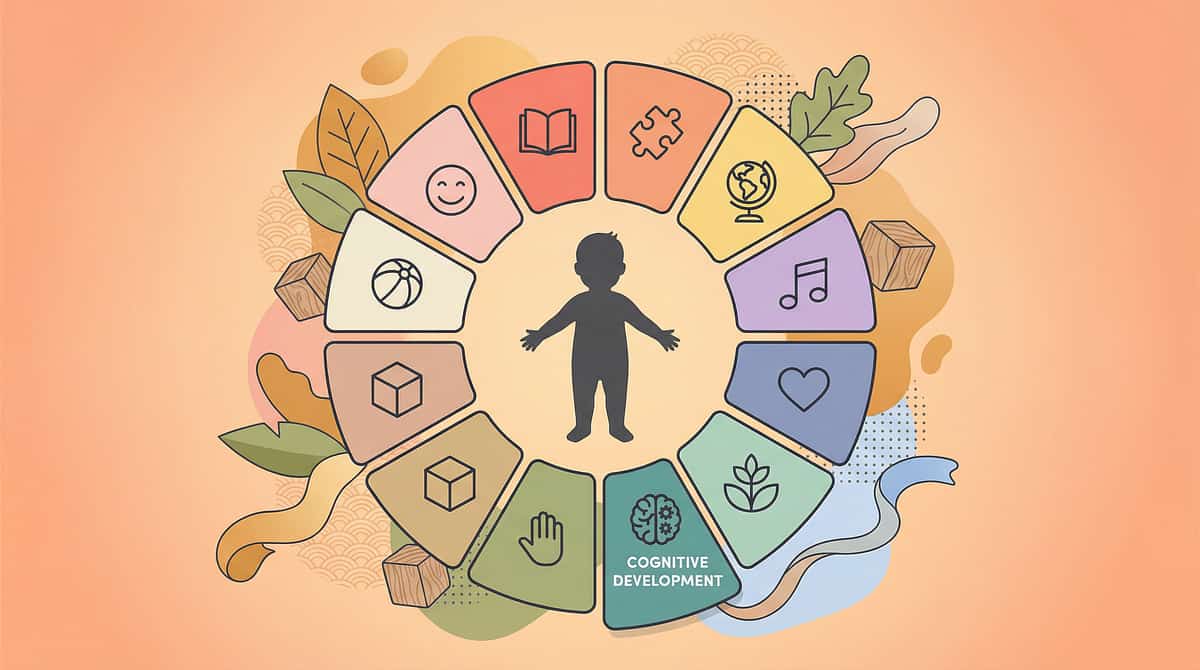
Your Child's Full 12-Domain Developmental Map

Cup drinking is one piece of a 12-domain developmental journey. Feeding independence is not just a mealtime skill — it feeds directly into school participation, self-care ADL independence, executive function and sequencing, and social communication at mealtimes.
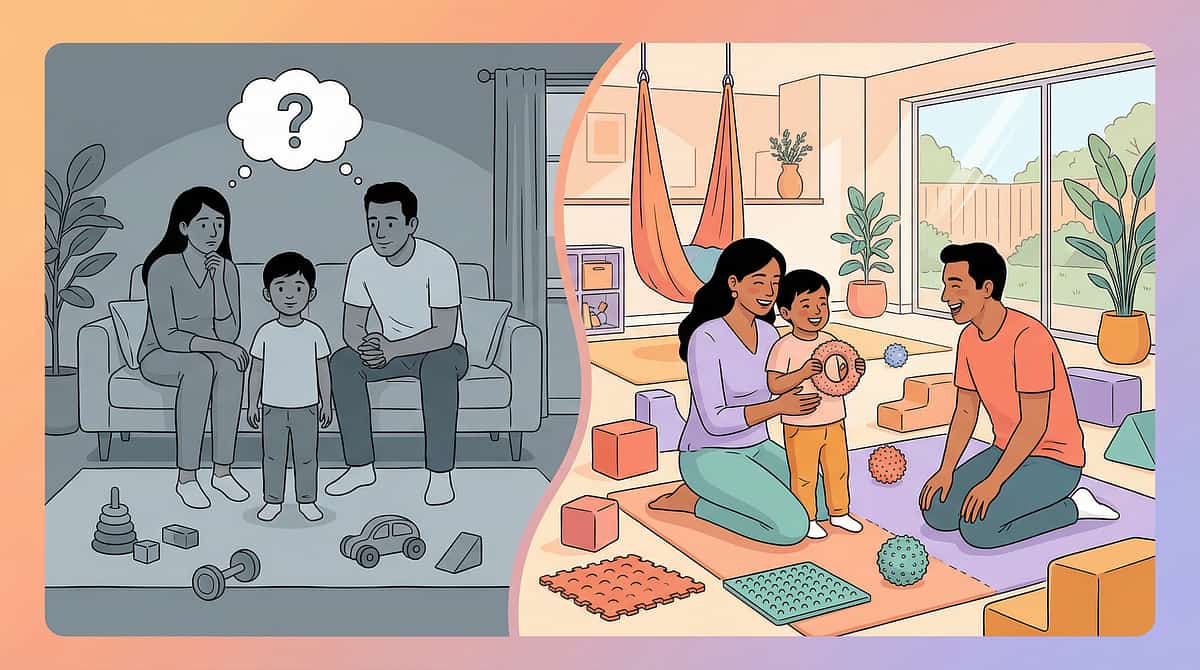

Real Families. Real Progress. These Are Their Words.
Priya, Mother — Hyderabad
"Our daughter was 4 and still on sippy cups. Every open cup attempt ended in tears and a soaked shirt. Now she drinks from regular cups at school, restaurants, birthday parties. No lid. No special equipment. The day she drank from a regular glass at her cousin's house without asking for her sippy — I cried."
Rajan, Father — Bengaluru
"My son (age 5, ASD) would bite the cup rim and tip it at full angle every time. The cut-out cup changed everything — he could see the water coming and learn to stop. We practiced 3 times a day for 3 minutes. By week 12, he was drinking from his school water bottle independently."
Clinical Note — Priya's Daughter (SLP, Pinnacle)
"This child presented with lip closure weakness — liquid leaking from sides, not from overflow. We used lip block cup + straw training for 6 weeks to build lip seal before graduating to open cups. The breakthrough came when she could feel her lips working."
Clinical Note — Rajan's Son (OT, Pinnacle)
"Biting + flooding indicates jaw grading difficulty combined with absent flow anticipation. Cut-out cup addresses anticipation; oral motor jaw exercises address grading. This combination resolves most cases within 8–12 weeks."
Connect With Other Parents: You Are Not Doing This Alone
Thousands of families are navigating E-463 alongside you right now — in India and across 70+ countries. Community connection is not just emotional support; research confirms that peer networks significantly improve home-practice adherence and caregiver well-being.
WhatsApp Parent Group
Parents navigating E-462 to E-467 together. Daily check-ins, material sharing, wins and struggles. Join at pinnacleblooms.org/community/feeding
Online Parent Forum
Domain E: Feeding & Mealtime Independence thread. 24×7 peer support at pinnacleblooms.org/forum
Local Parent Meetups
70+ centers host monthly parent group sessions for feeding challenges, facilitated by therapists. Find your nearest meetup.
Peer Mentoring Programme
Connect 1:1 with a parent who has walked this path and succeeded. Request a mentor at pinnacleblooms.org/mentor

📞9100 181 181 | Community support in 16+ languages | Free. Confidential. In your language.
Your Questions, Answered by the Pinnacle Consortium
Eight of the most commonly asked questions from families navigating the sippy-to-open-cup transition — answered with clinical precision and parent-ready language.
Q1: My child is 6 years old and still on sippy cups. Is it too late?
No. Cup drinking skills can be built at any age. Children up to age 10 have been successfully transitioned using this protocol. The key is identifying which specific component is weak and addressing it systematically. Call 9100 181 181 for an age-appropriate plan.
Q2: My child drinks from a straw. Does that mean cup drinking will be easy?
Straw competence is a positive sign indicating lip closure and suction are present. However, cup drinking requires a different oral motor pattern. Use straw competence as a foundation and progress through cup materials systematically.
Q3: How many times a day should we practice?
2–4 natural practice moments daily is optimal. Best times: with every meal and snack. Embed into natural mealtime routines — this is the EverydayTherapyProgramme™ principle. Don't create a separate isolated session if you can avoid it.
Q4: My child chokes every time with an open cup. What do we do?
Do not proceed with open cup practice until an SLP assessment is completed. Consistent choking may indicate aspiration risk requiring clinical evaluation. Use thickened liquids only under SLP guidance. Call 9100 181 181 immediately.
Q5: Should we give up the sippy cup cold turkey?
Gradual replacement works better than cold turkey for most children. Replace sippy with recessed lid cup (same mess control, mature drinking pattern). Reserve sippy only for travel. Aim to eliminate sippy within 4–6 weeks of starting the protocol.
Q6: Is this content appropriate for children without a formal autism diagnosis?
Absolutely. Cup drinking difficulties affect children across all developmental profiles — late talkers, developmental delays, hypotonia, sensory processing differences, or extended sippy use. This protocol applies to any child struggling with open cup transition, diagnosis or not.

Your Child's Cup-Drinking Independence Starts With One Session Today.

Every family who has walked this path started exactly where you are right now — with a wet shirt, a patient child, and a decision to try systematically. The materials are within reach. The protocol is in your hands. The next session is today. 🏆 Pinnacle Blooms Consortium — Validated Clinical Technique OT • SLP • ABA • SpEd • NeuroDev | 20M+ Sessions | 97%+ Improvement | 70+ Centers Across India ▶ Start This Technique Today — GPT-OS® Session Launcher 📞 Book a Free Consultation — 9100 181 181 → Explore Next Technique: E-464 Straw Drinking "This technique is part of the GPT-OS® EverydayTherapyProgramme™ — the world's most comprehensive home-based paediatric therapy system, built from 20 million clinical sessions."

Preview of 9 materials that help with cup drinking Therapy Material

Below is a visual preview of 9 materials that help with cup drinking therapy material. The pages shown help educators, therapists, and caregivers understand the structure and content of the resource before use. Materials should be used under appropriate professional guidance.
Page 1
Page 2
Page 3
Page 4
Page 5
Page 6
Page 7
Page 8
Page 9
Page 10
Page 11
Page 12
Page 13
Page 14
Page 15
Page 16
Page 17
Page 18
Page 19
Page 20
Link copied!
🌸 The Pinnacle Promise
Pinnacle Blooms Network®
Built by Mothers. Engineered as a System.
"From fear to mastery. One technique at a time."
This technique page — one of 70,000+ being built on the GPT-OS® platform — represents Pinnacle Blooms Network's commitment to making world-class paediatric therapy accessible to every parent, in every home, in every language, at every hour of the day. No child should miss their developmental window because their family didn't have access to the right knowledge.

⚕️Medical Disclaimer: This content is educational and does not replace individualized assessment and intervention with licensed feeding therapists, speech-language pathologists, or occupational therapists. Cup drinking difficulties can have multiple underlying causes requiring professional evaluation. Choking is a serious risk; supervise all drinking practice and seek professional guidance for persistent difficulties or aspiration concerns. Individual results may vary.
© 2025–2026 Pinnacle Blooms Network®, unit of Bharath Healthcare Laboratories Pvt. Ltd. All rights reserved. CIN: U74999TG2016PTC113063 | DPIIT: DIPP8651 | MSME: TS20F0009606 | GSTIN: 36AAGCB9722P1Z2

📞FREE National Autism Helpline: 9100 181 181 | 16+ Languages | 24×7 | pinnacleblooms.org