

Action Word Understanding in Autism
Technique B-169 | Pinnacle Blooms Network® — Science-backed, consortium-validated intervention for verb comprehension and expression in children aged 2–10.
Domain B: Social Communication
SLP-Lead Protocol
Age 2–10 Years
"He knows what jumping IS — he can point to the picture. But when I ask 'Who was jumping?' or 'What will happen if she keeps jumping?'... he just goes blank."
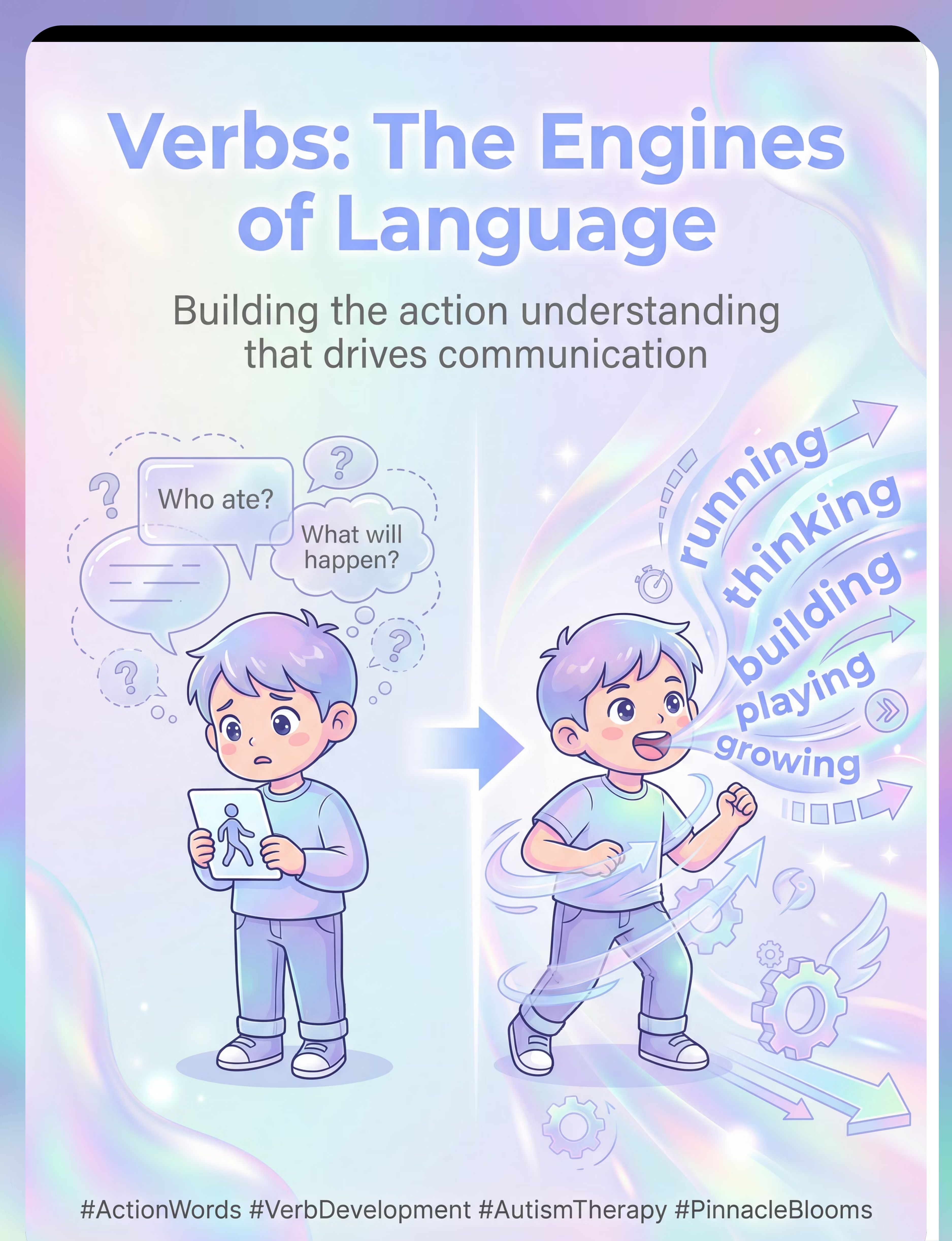
Verbs: The Engines of Language — and the Hidden Challenge Your Child Is Navigating Right Now
You've watched your child correctly point to "eating" on a card. You've seen them identify "running" from across the room. So why does everything fall apart when the question shifts to who is eating, when they ate, or why they're running?
This is not a language gap — it is a verb comprehension challenge. And it has a name, a neuroscience, and a systematic solution. Built by a consortium of speech pathologists, behaviour analysts, occupational therapists, special educators, and neurodevelopmental paediatricians — this is Technique B-169.
🏆 Consortium Certified
Pinnacle Blooms Network® multi-disciplinary validated
🔬 SLP-Lead Protocol
Speech-Language Pathologist primary framework
🌍 WHO/UNICEF Aligned
Nurturing Care Framework compatible
👶 Ages 2–10
Domain B — Social Communication & Language
Citation: WHO Nurturing Care Framework (2018) — "The period from pregnancy to age 3 is key for a child's development"

You Are Among Millions of Families Navigating This — Right Now
The noun-verb asymmetry in autism is one of the most documented findings in developmental linguistics. Whether your child is 2 years old with emerging vocabulary or 8 years old with solid noun knowledge but a hollow verb lexicon — you are in the right place. This is also one of the most addressable challenges, when approached with the right materials and the right sequence.
80%
Verb Comprehension Affected
Of children diagnosed with autism display language-processing differences affecting verb comprehension — more than any other word class (PRISMA Systematic Review, 2024 — PMC11506176)
3–4×
Harder Than Nouns
Verbs are 3 to 4 times harder for autistic children to acquire than nouns, because verbs encode relationships, time, and mental states — not just visible objects (Gentner D, 1982; Tek S et al., 2008)
97%+
Show Measurable Progress
Of children who undergo structured, evidence-based intervention at Pinnacle Blooms Network® show measurable improvement in communication readiness (21M+ 1:1 therapy sessions across 70+ centres)
Citation: PMC11506176 | PMC10955541 | DOI: 10.12998/wjcc.v12.i7.1260
This Is a Wiring Difference. Not a Willingness Difference.
Clinical Pathway
Action Perception System: The superior temporal sulcus (STS) and mirror neuron networks process observed actions. In autism, STS activation to dynamic action stimuli shows atypical patterns — actions are processed more as static snapshots than temporal events.
Agent-Action Mapping: The left perisylvian language network maps who-does-what verb arguments — requiring simultaneous activation of action representation and participant role encoding.
Temporal Encoding: Grammatical tense (jumped vs. jumping vs. will jump) is encoded via left frontal-temporal circuits. Aspectual processing requires rapid activation of the anterior temporal lobe.
Mental State Verbs: Theory of mind circuits (medial prefrontal cortex, temporoparietal junction) activate for think/know/want/believe — late-maturing even in typical development.
Parent Translation
"His brain takes a snapshot of an action — it doesn't always track the full movie."
"He can recognise running. But 'who ran,' 'ran WHERE,' 'ran WHEN' — those questions require connecting four brain circuits simultaneously."
"Words like THINK and WANT are genuinely invisible — they describe events inside someone's mind. No wonder they're the hardest verbs to learn."
"This is a neural pathway development challenge. With the right systematic input, these pathways build. That's exactly what the 9 materials on this page do."
Citation: Frontiers in Integrative Neuroscience (2020) — DOI: 10.3389/fnint.2020.556660 | Tek S et al. (2008) verb acquisition in autism

Your Child Is Here. Here Is Where We're Heading.
Understanding where your child sits in the developmental sequence helps you identify both the current target and the exciting milestones ahead. These are WHO-aligned benchmarks — delays beyond 6 months at any stage warrant SLP evaluation.
1
18–24 Months
First action words: go, eat, want, more
2
2–3 Years
Basic action vocabulary: run, jump, eat, sleep, play · Agent-action understanding (who does what)
3
3–4 Years
Basic tense: past vs. present · "She ate" vs. "She is eating" · Mental state verbs emerging
4
4–6 Years
Complex tense/aspect: ongoing vs. completed · Manner distinctions: walk vs. run vs. skip vs. stomp
5
6+ Years
Abstract/figurative verbs: time flies, heart breaks · Academic language comprehension
Co-occurring challenges to be aware of: Action word delays commonly co-occur with narrative comprehension difficulty, instruction-following challenges, limited event description, social story comprehension gaps, and academic language delays. Each is addressed systematically in the Pinnacle B-Domain curriculum.
"We were so focused on nouns — 'ball,' 'cup,' 'dog' — that we didn't notice she had almost no verbs at 3 years old. The SLP at Pinnacle was the first one to say 'verb delay is its own challenge.' That was the turning point." — Parent, Pinnacle Hyderabad
Citation: WHO CCD Package (2023) | PMC9978394 | UNICEF MICS developmental monitoring indicators

The Evidence Behind This Technique
LEVEL I — SYSTEMATIC REVIEW SUPPORTED
Multiple RCTs and Systematic Reviews confirm verb-focused language intervention as an evidence-based practice for autism. This is not experimental — it is the established, peer-reviewed standard of care.
PRISMA Systematic Review (2024 — PMC11506176)
16 studies from 2013–2023 confirm structured language intervention meets criteria as evidence-based practice for ASD. Action word/verb-focused approaches show significant outcomes in comprehension and production.
Meta-analysis, World Journal of Clinical Cases (2024 — PMC10955541)
Sensory-linguistic integration therapies across 24 studies show social skills, communication, and adaptive behaviour improvements. Verb comprehension is a primary outcome domain.
Padmanabha et al., Indian Journal of Pediatrics (2019)
Indian RCT (DOI: 10.1007/s12098-018-2747-4) confirms home-based structured intervention achieves significant outcomes — validating the parent-administered model this page teaches.
90%
Evidence Confidence
HIGH EVIDENCE — Home-applicable · Parent-proven · Clinically validated
97%
Improvement Rate
Measured improvement in communication readiness across Pinnacle real-world evidence base
Additional references: Tomasello M (1992) — foundational verb acquisition research | Tek S et al. (2008) — noun-verb asymmetry documented | Gentner D (1982) — cognitive processing basis

What Is Technique B-169?
Formal Name: Action Word/Verb Comprehension and Expression Intervention
Parent-Friendly Alias: "The Verb Engines Programme" — building the words that make sentences move
A multi-material, multi-modal intervention protocol targeting the comprehension and use of action words (verbs) across nine functional dimensions: flexible action concepts, temporal action structure, relational argument structure (who-does-what-to-whom), verb tense, action aspect (ongoing vs. completed), mental state verbs, manner distinctions, sequential action structure, and functional direction-following.
Technical Specs
- 📁 Domain B: Social Communication & Pragmatic Language
- 🎯 Subdomain: Verb Comprehension & Expression (LANG-VERB)
- 👶 Age Range: 2–10 years
- ⏱️ Session Duration: 15–25 minutes
- 🔁 Frequency: 3–5 times per week
- 📍 Setting: Home + School + Therapy + Community
Technique Cluster: Domain B
- B-167: Negation Understanding
- B-168: Category Understanding
- ← B-169: Action Word Understanding (YOU ARE HERE)
- B-170: Descriptive Word Understanding →
- B-171: Question Word Understanding →
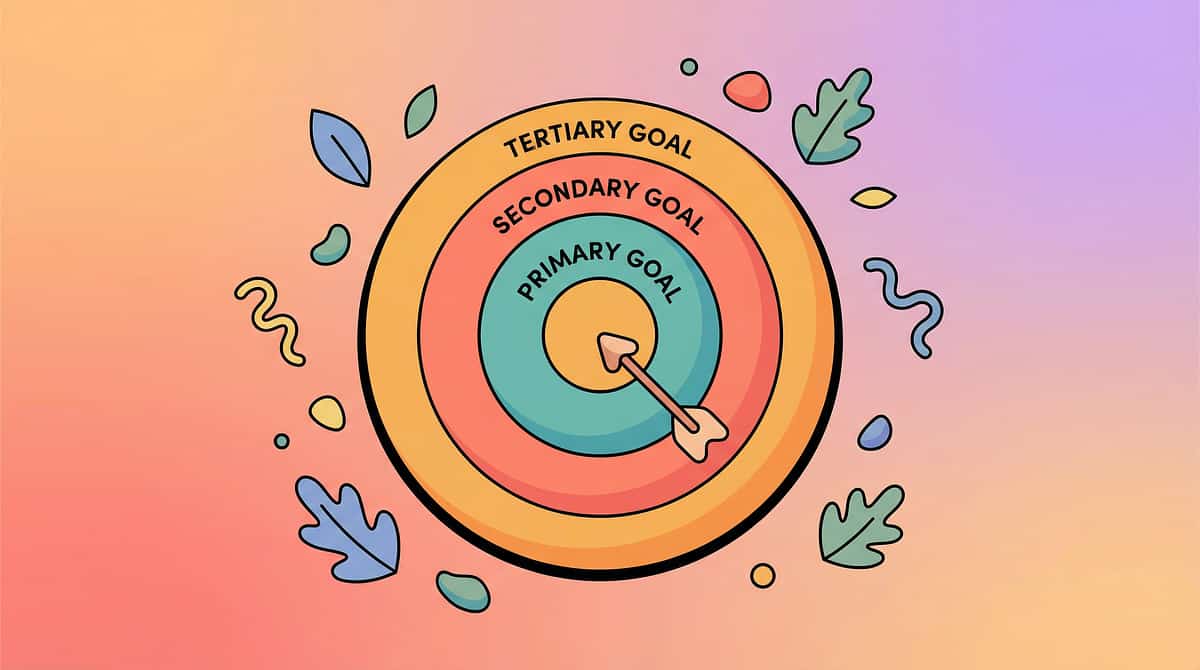
Five Disciplines. One Integrated Protocol.
"The brain doesn't organise by therapy type. Neither should this intervention." — Pinnacle Blooms Consortium Clinical Guideline, 2024
Speech-Language Pathologist (SLP) — PRIMARY LEAD
Core verb comprehension/production goals. Action photo card drills. Tense instruction. Mental state verb scaffolding.
ABA Therapist (BCBA)
Structured teaching trials for verb identification. Reinforcement programming for action word responses. Data collection on comprehension accuracy.
Occupational Therapist (OT)
Embodied verb learning — acting out actions physically before labelling them. Motor-linguistic integration for manner verbs.
Special Educator (SpEd)
Curriculum integration — verb-focused literacy, narrative comprehension, instruction following. Sequence card activities.
NeuroDevelopmental Paediatrician
Baseline assessment of action word acquisition. Monitoring noun-verb asymmetry progression. Referral to SLP for formal evaluation.
📞FREE National Autism Helpline: 9100 181 181 — Ask for an SLP assessment referral today
Citation: DOI: 10.1080/17549507.2022.2141327 — UNICEF/WHO Nurturing Care Framework adapted for multi-disciplinary SLP + OT + ABA integration
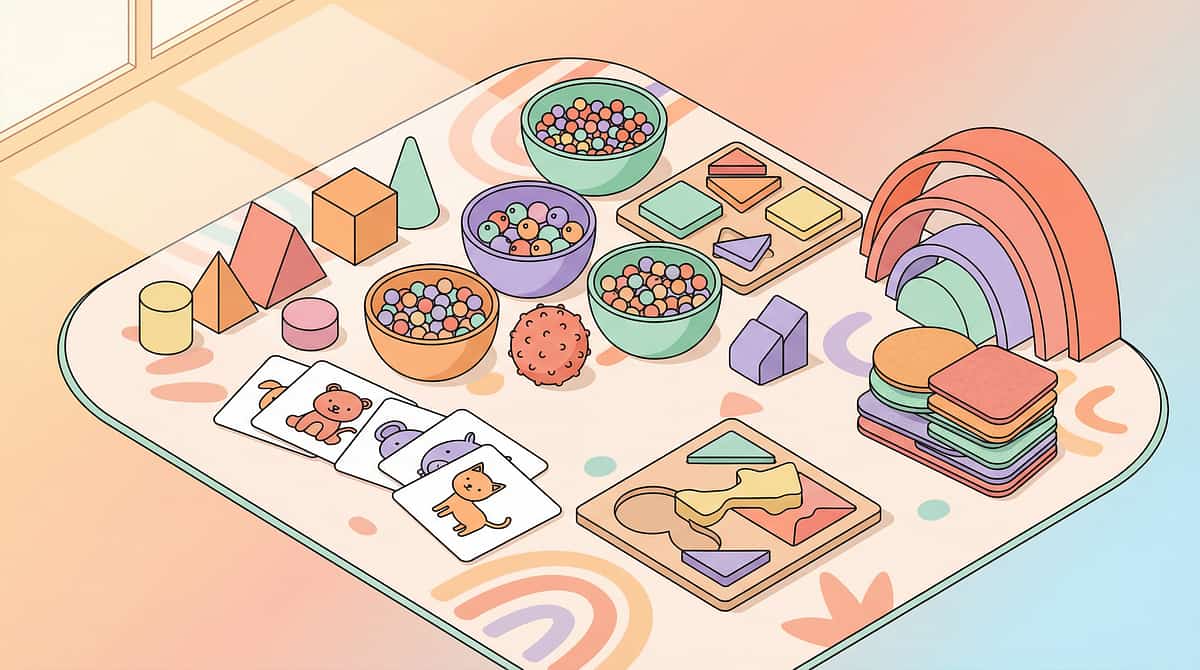
This Is Not a Random Activity. This Is a Precision Tool.
Every element of B-169 is engineered to address a specific, documented deficit in verb comprehension architecture. Here are the primary, secondary, and tertiary targets this technique builds toward.
Target | What You'll See at Home | |
Verb comprehension | Child correctly points to "who is eating" in a scene | |
Tense use | Child says "jumped" for a past event without prompting | |
Relational structure | Child answers "The dog is chasing the cat" when asked | |
Mental state verbs | Child uses "I think," "I want" spontaneously |
Citation: PMC10955541 — Meta-analysis confirming communication as primary, adaptive behaviour as secondary outcome target

9 Clinical-Grade Materials — Each Chosen by the Consortium
The Canon Material System is Pinnacle's curated list of 687 clinically-validated therapy products mapped to 128 categories across 12 developmental domains. Every item below has been selected for its specific contribution to verb comprehension architecture. Each comes with a free DIY alternative.
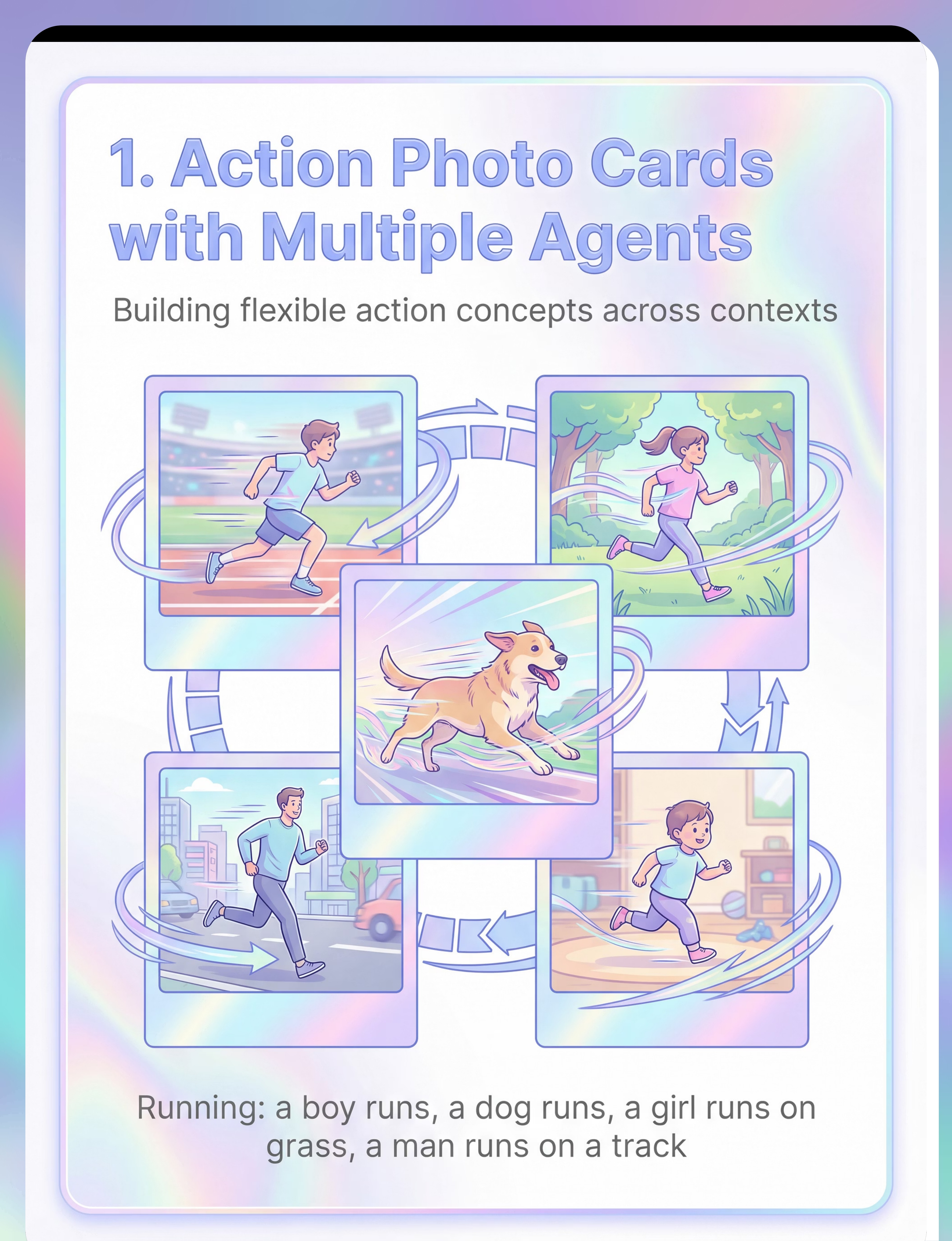
1
Action Photo Cards with Multiple Agents
Building flexible action concepts across contexts
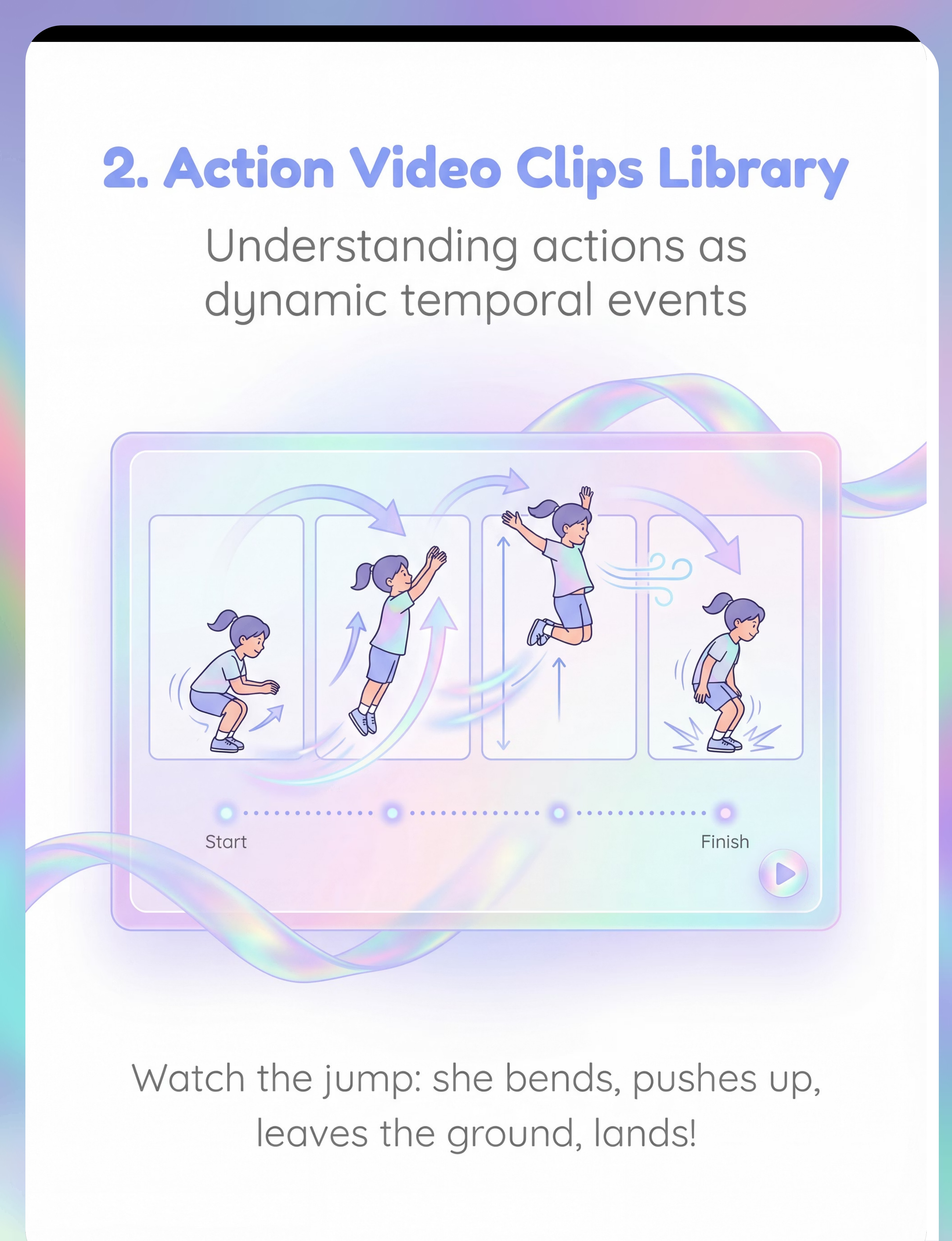
2
Action Video Clips Library
Understanding actions as dynamic temporal events
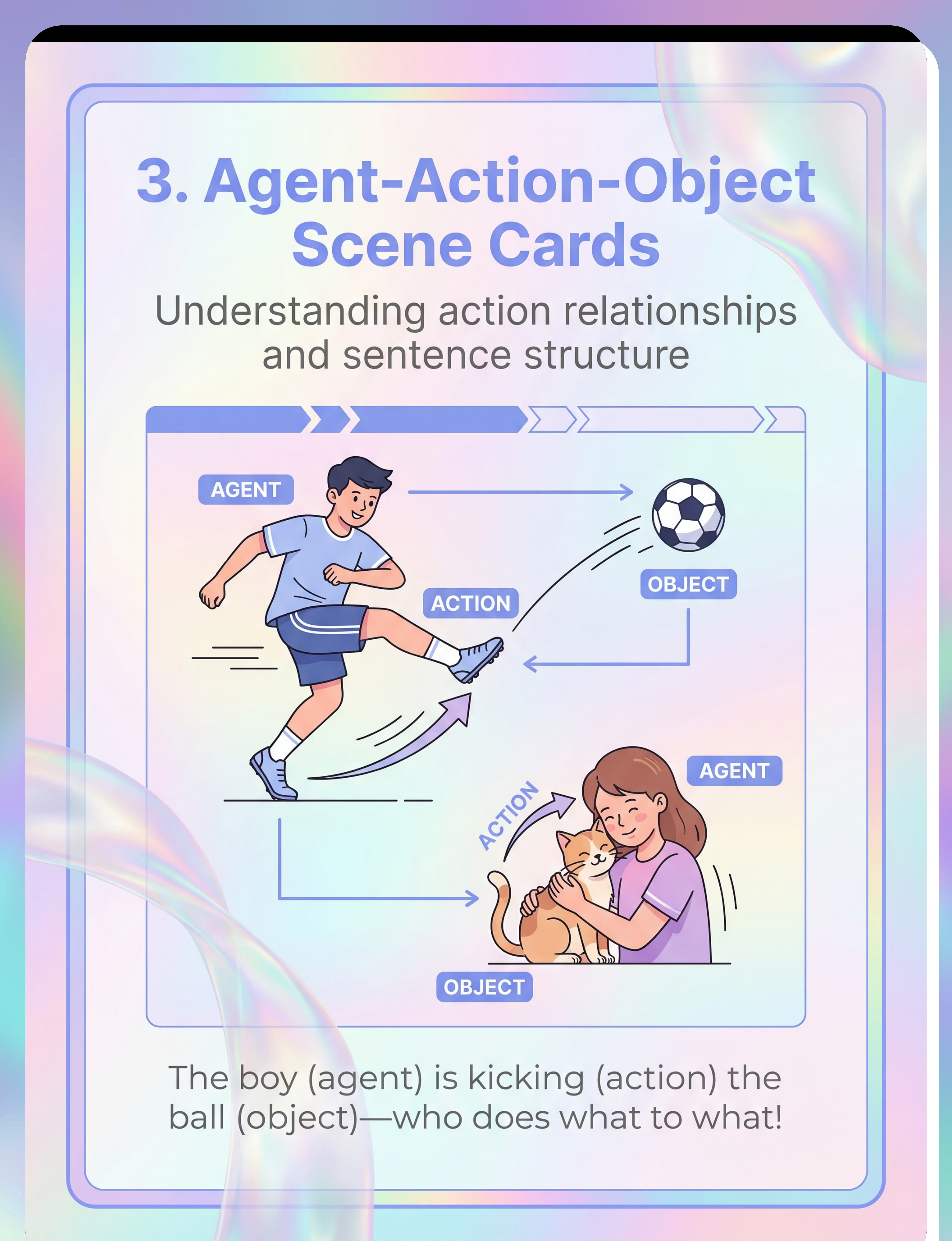
3
Agent-Action-Object Scene Cards
Understanding action relationships and sentence structure
4
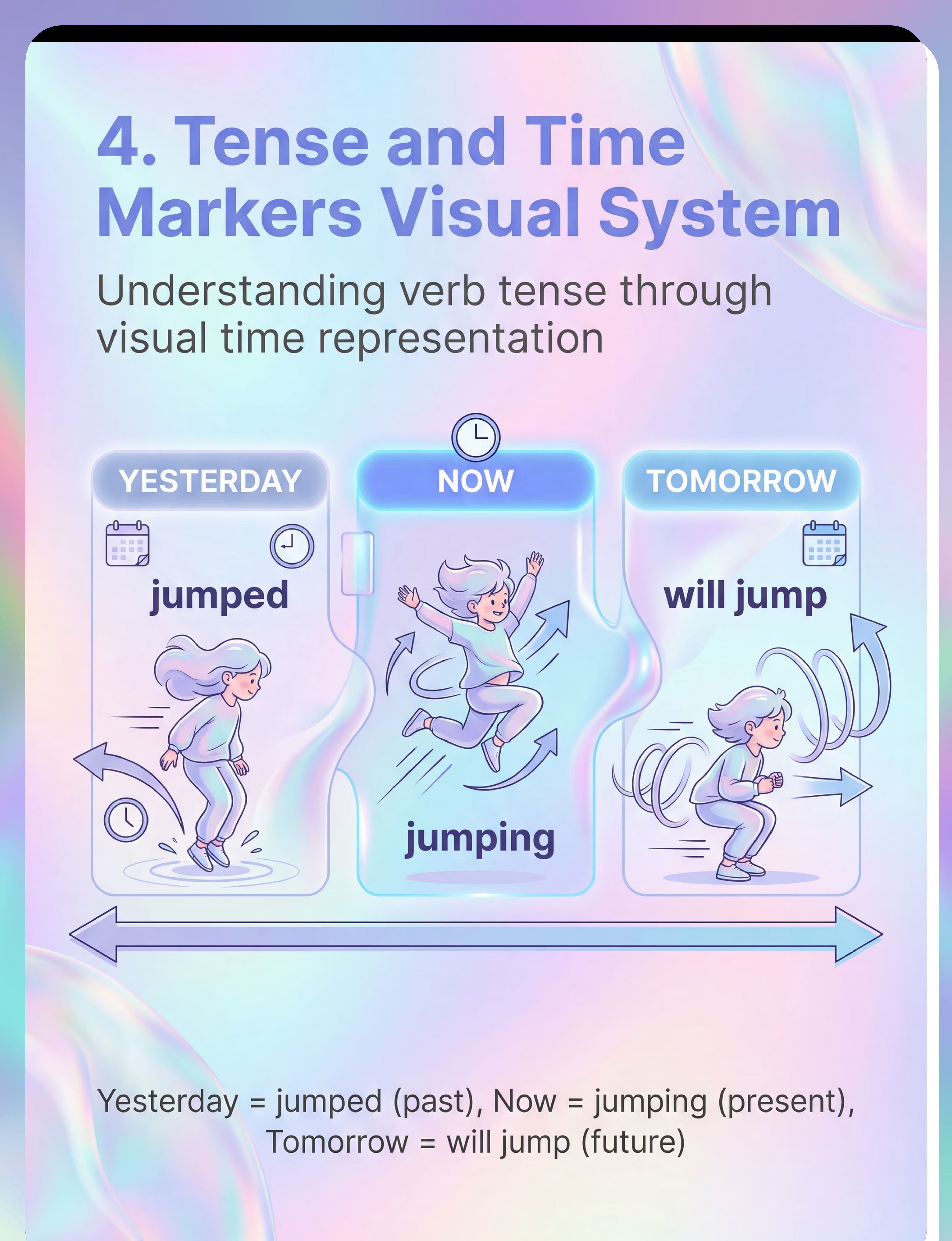
Tense and Time Markers Visual System
Understanding verb tense through visual time representation
5
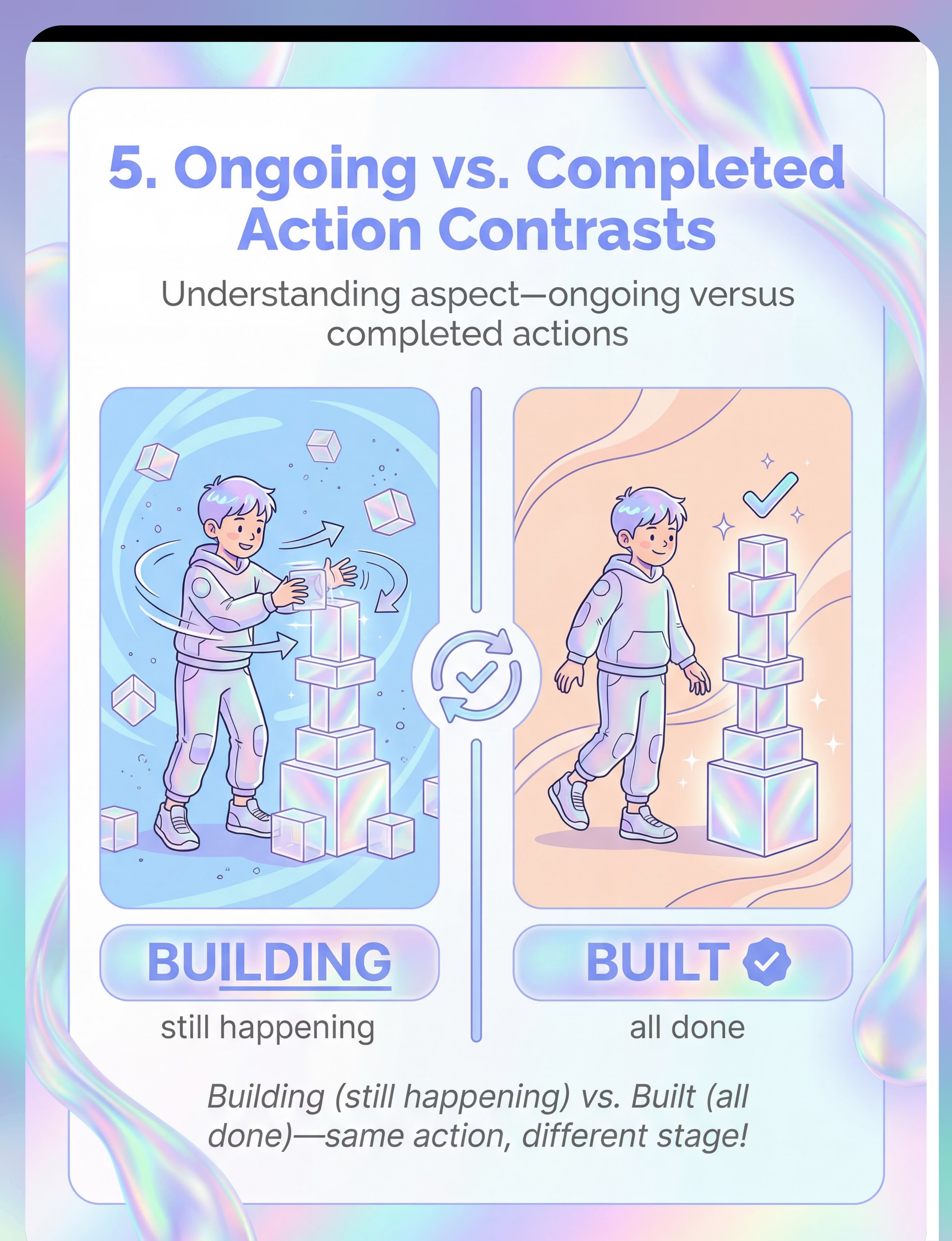
Ongoing vs. Completed Action Contrasts
Understanding aspect — ongoing versus completed actions
6
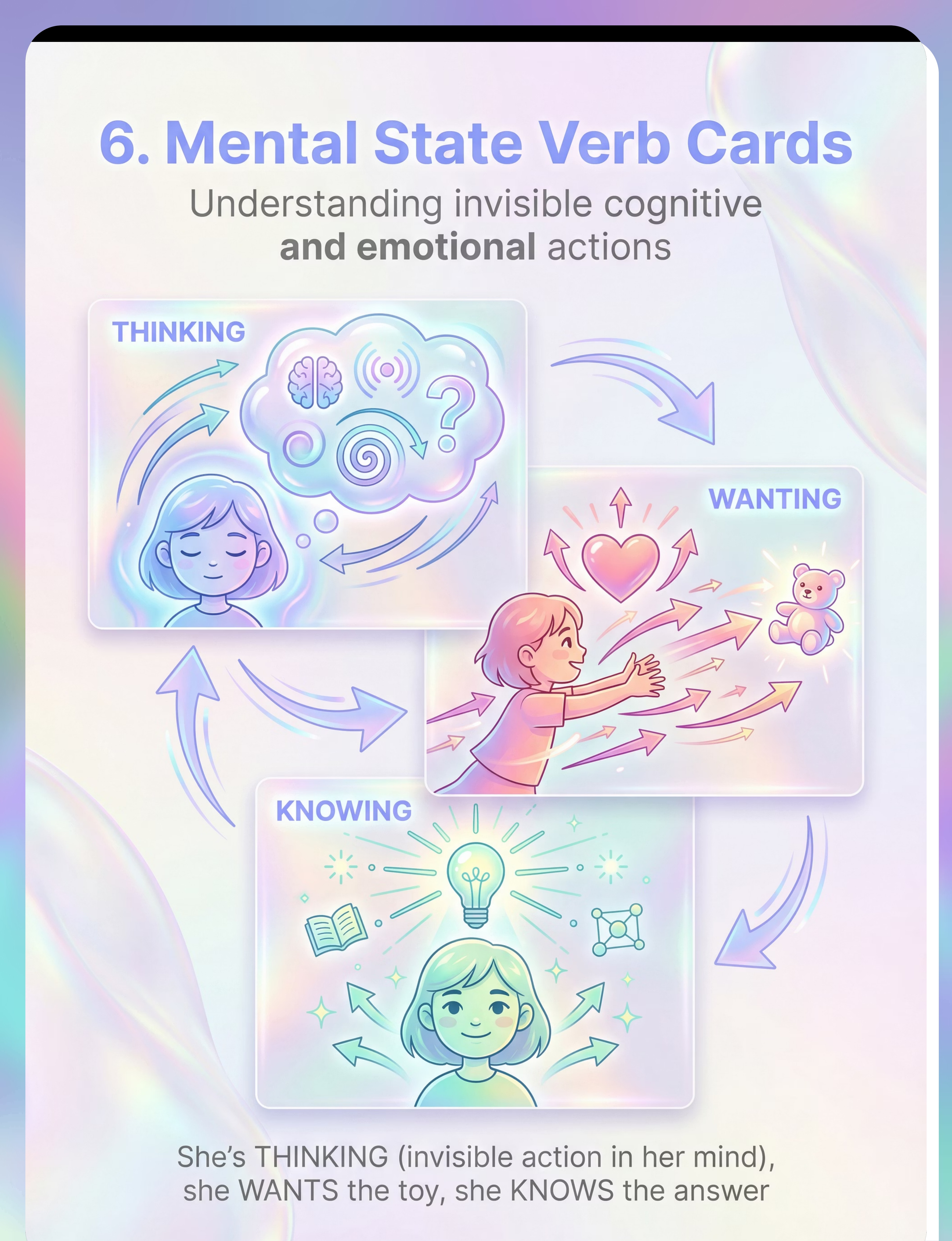
Mental State Verb Cards
Understanding invisible cognitive and emotional actions
7
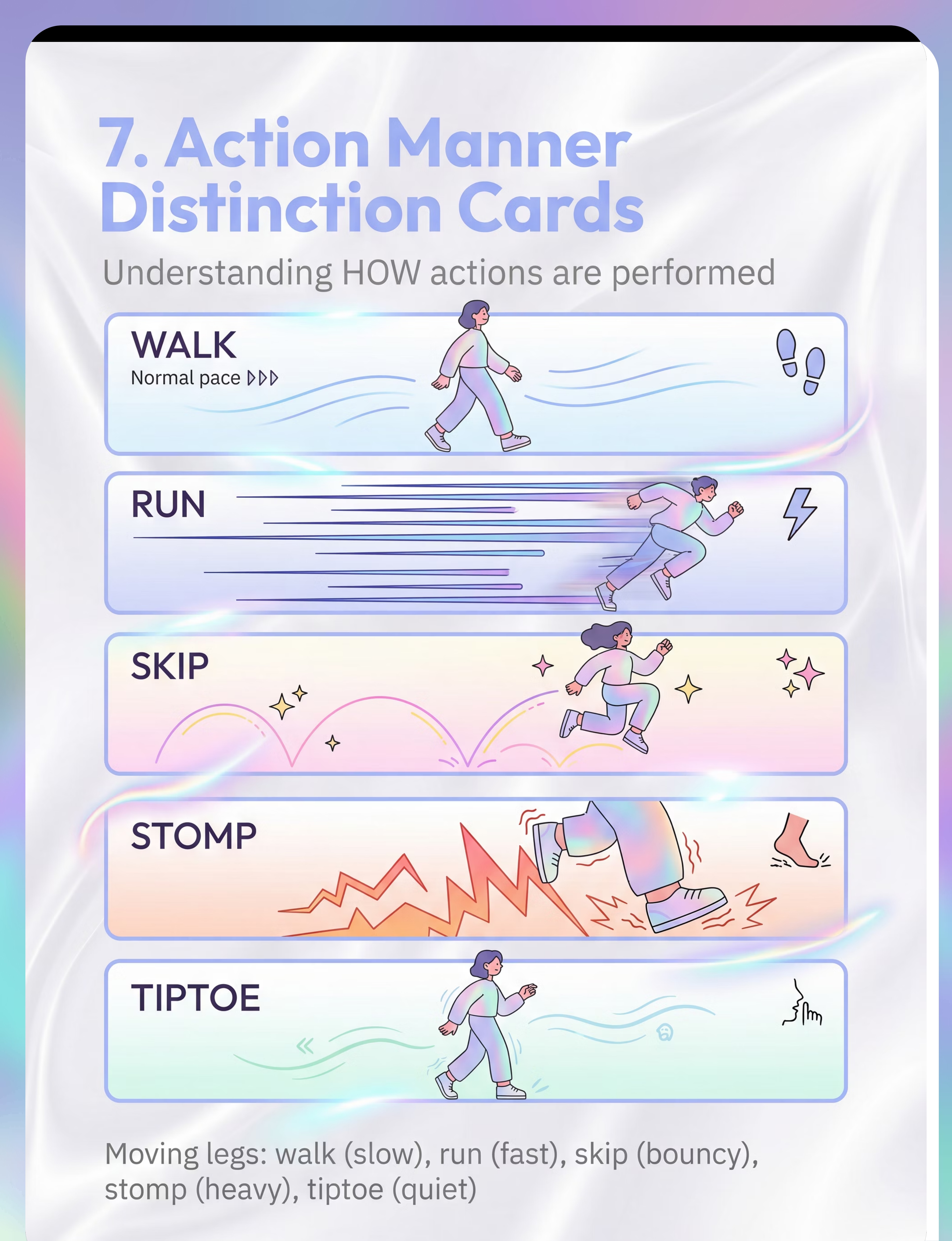
Action Manner Distinction Cards
Understanding HOW actions are performed
8
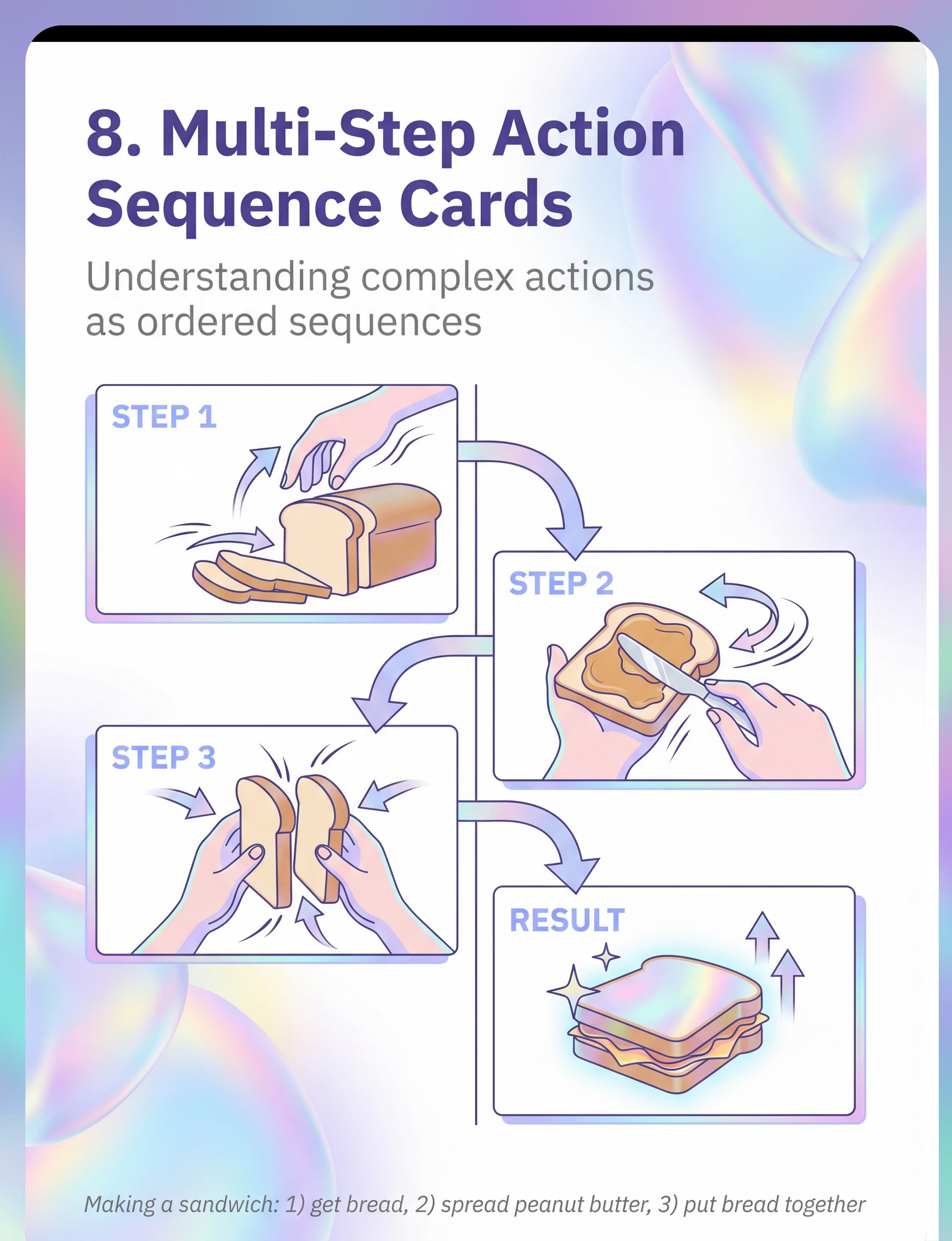
Multi-Step Action Sequence Cards
Understanding complex actions as ordered sequences
9
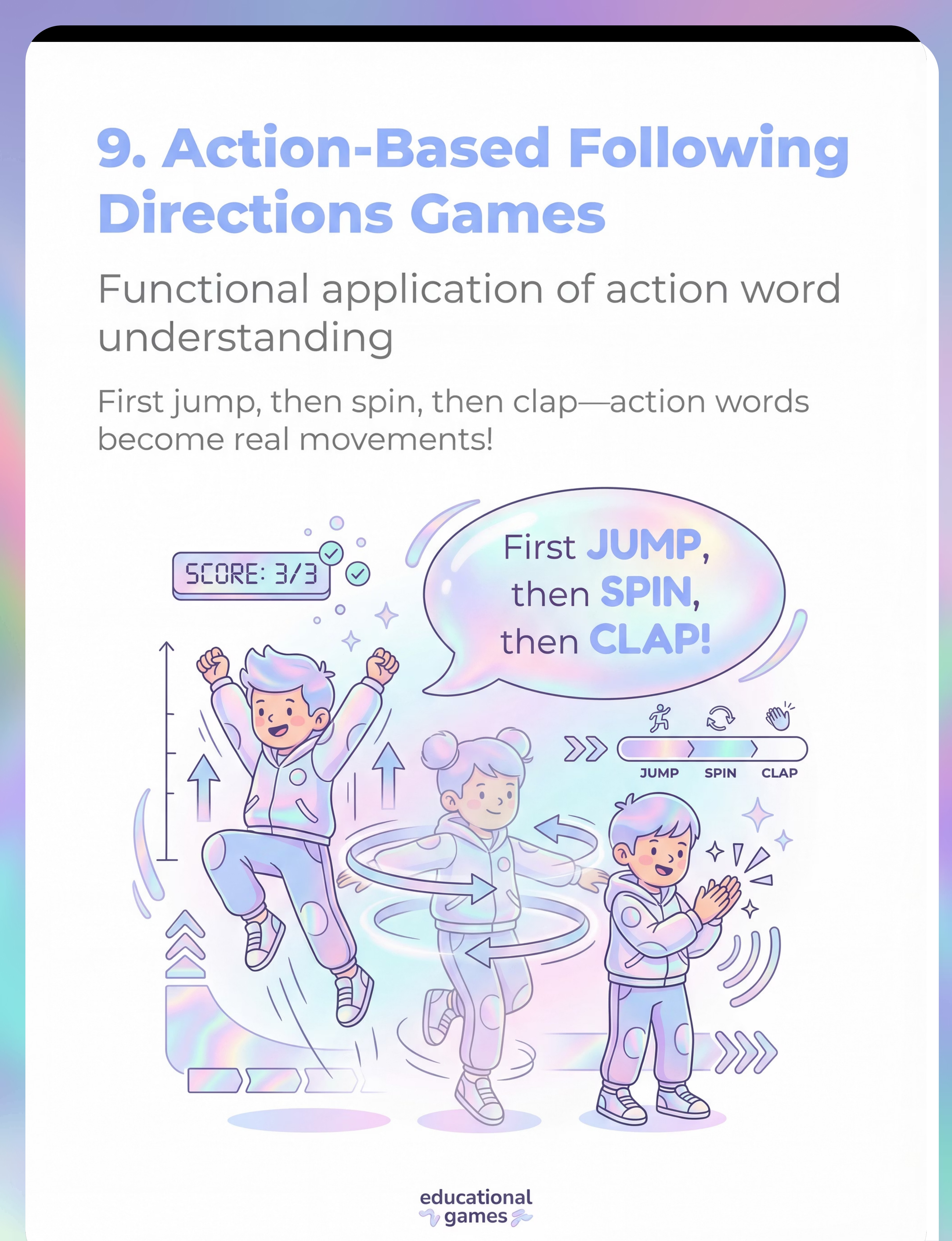
Action-Based Following Directions Games
Functional application of action word understanding
PINNACLE RECOMMENDS: Start with Materials 1, 3, and 9 as your essential starter trio. Total setup cost: ₹1,800–6,100 for comprehensive kit | ₹0 with full DIY alternatives.

Material 1 — Action Photo Cards with Multiple Agents
Material 1 of 9
Foundation Skill
Function: Building flexible action concepts across contexts
Why It Works (SLP explains): Children with autism often learn verbs as context-locked — "eating" only means the boy in the blue shirt eating cereal. Multi-agent cards (boy running, girl running, dog running, adult running) force the brain to abstract the ACTION from the actor, building flexible verb concepts essential for real-world comprehension.
How to Use: Show 3–5 cards showing the same action (running). Ask: "What are ALL of these doing?" Build from identification → production → context variation.
🛒 Commercial Option
Action/Verb Flashcard sets — search "action verb photo cards therapy" on Amazon.in
Price Range: ₹300–900
🛠️ DIY (Zero Cost)
Take photos of every family member doing the same action — everyone jumping, everyone eating, everyone waving. Include the family pet! Print 6–8 photos per action. Sort into "What are they ALL doing?" piles. Clinically equivalent.
Safety Note: Start with highly distinct actions. Include diverse agents (ages, genders, species). Vary contexts while maintaining clear, unambiguous action.
Material 2 — Action Video Clips Library
Material 2 of 9
Temporal Processing
Function: Understanding actions as dynamic temporal events
Why It Works (SLP explains): Static pictures capture one frozen moment. But jumping is NOT a moment — it is a sequence of events: crouching, pushing off, leaving the ground, being airborne, landing. Videos show the complete temporal structure of actions, which is essential for tense understanding and narrative comprehension. This is why "She jumped" and "She is jumping" map to the same action but different temporal windows.
How to Use: Watch short 10–15 second clips of single, clear actions. Narrate in real time: "She's ABOUT TO jump... she's JUMPING NOW... she JUMPED — it's done!" Pause and ask: "What is she doing right NOW?" vs. "What DID she do?"
🛒 Commercial Option
Educational video subscriptions or YouTube family action clips
Price Range: ₹200–600 (digital subscriptions)
Use YouTube (free) — search "action word videos for children therapy"
🛠️ DIY (Zero Cost)
Record 15-second phone videos of single actions at home — Dad jumping, sibling eating, pet running. Use slow-motion mode. Narrate tense live. Zero cost and maximally familiar to your child.
Safety Note: Keep clips short and action-focused. Ensure clear, unambiguous action visibility. Manage total screen time as part of your daily plan.

Material 3 — Agent-Action-Object Scene Cards
Material 3 of 9
Relational Structure
Function: Understanding action relationships and sentence structure
Why It Works (SLP explains): Verbs don't just name events — they connect PARTICIPANTS. "Kick" requires someone who kicks (agent) AND something being kicked (object). Understanding agent-action-object structure is the direct prerequisite for answering WHO/WHAT/WHOM questions and for sentence production. These cards make the invisible grammar of verbs visible.
How to Use: Show a scene card (girl hugging cat). Point and label: "This is the GIRL (agent). She is HUGGING (action). The CAT (object) is being hugged." Ask: "WHO is hugging? WHAT is she hugging? What is the action?" Build to full sentence production.
🛒 Commercial Option
Scene cards / SVO activity sets
Price Range: ₹250–800
Search Amazon.in: "subject verb object cards autism therapy" or "action scene cards SLP"
🛠️ DIY (Zero Cost)
Cut scenes from magazines or print free online images. Use scenes where agent-action-object are crystal clear. Draw arrows: WHO → DOES → WHAT. Clinically equivalent to commercial cards.
Safety Note: Start with clear, simple scenes. Include both transitive (kick the ball) and intransitive (jump) actions. Ensure roles are visually unambiguous before advancing.

Material 4 — Tense and Time Markers Visual System
Material 4 of 9
Temporal Grammar
Function: Understanding verb tense through visual time representation
Why It Works (SLP explains): Tense is TIME made grammatical. For a child whose brain doesn't automatically track temporal sequences, seeing "jumped" placed on a YESTERDAY zone and "will jump" placed on a TOMORROW zone transforms abstract grammar into a visual map. This system makes the invisible grammar of time concrete and manageable.
How to Use: Create or use a 3-zone timeline: BEFORE | NOW | LATER. Place action picture cards in zones while changing the verb form. "She ATE — that was BEFORE." "She IS EATING — that's NOW." "She WILL EAT — that's LATER."
🛒 Commercial Option
Past-present-future timeline boards / verb tense cards
Price Range: ₹200–700
Search Amazon.in: "tense timeline board autism" or "past present future grammar cards"
🛠️ DIY (Zero Cost)
Draw three columns on A4 paper: BEFORE (clock with hands going back) | NOW (sun/present symbol) | LATER (stars/moon). Works identically to commercial versions. Connect to child's OWN day events for maximum relevance.
Safety Note: Start with clear time contrasts (past vs. future) before introducing ongoing aspect. Always connect to the child's own daily activities first.

Material 5 — Ongoing vs. Completed Action Contrasts
Material 5 of 9
Aspect Understanding
Function: Understanding aspect — ongoing versus completed actions
Why It Works (SLP explains): "Is building" and "built" describe the same action at different stages of completion. This aspectual distinction is essential for narrative comprehension, instruction following, and accurate event description. Without it, a child cannot answer "Did she finish?" or "Is she still doing it?" — questions fundamental to daily communication.
How to Use: Show side-by-side: child MID-ACTIVITY (building tower, blocks still in hand) vs. child POST-ACTIVITY (finished tower, stepping back, looking satisfied). Label consistently: "She IS BUILDING — STILL HAPPENING." "She BUILT — ALL DONE."
🛒 Commercial Option
Process/product contrast cards, before/during/after activity sets
Price Range: ₹200–600
Search Amazon.in: "ongoing completed action cards SLP" or "before after activity cards"
🛠️ DIY (Zero Cost)
Take 3 photos of daily activities — plate full (ABOUT TO eat), fork in mouth (EATING NOW), empty plate (ATE — ALL DONE). Laminate and reuse. Zero cost, maximum personalisation to your child's world.
Safety Note: Use clear visual contrasts. Connect to the child's own activities for maximum relevance and engagement.

Material 6 — Mental State Verb Cards
Material 6 of 9
Advanced — Theory of Mind
Function: Understanding invisible cognitive and emotional actions
Why It Works (SLP explains): Think. Know. Want. Believe. Wonder. These verbs describe actions that happen inside minds — invisible to the eye. They are disproportionately challenging for autistic children because they cannot be pointed to or photographed directly. Yet they are the most socially critical verbs — every social interaction involves knowing what someone THINKS, WANTS, or KNOWS. Cards that visually represent thought bubbles, desire arrows, and knowledge symbols make the invisible accessible.
How to Use: Present card (child with thought bubble containing ice cream image). Ask: "What is she THINKING about?" Then practice: "What do YOU think about?" — connect to child's own mental state first.
🛒 Commercial Option
Theory of mind cards, thinking/feeling verb sets
Price Range: ₹300–800
Search Amazon.in: "theory of mind cards autism" or "mental state verb cards SLP"
🛠️ DIY (Zero Cost)
Draw simple stick figures with thought bubbles (spiral for thinking, heart for wanting, lightbulb for knowing). Use speech bubbles for "saying" vs. thought bubbles for "thinking." This visual distinction is clinically equivalent to commercial materials.
Safety Note: Start with simpler mental verbs (want, like) before complex ones (believe, wonder). Connect to child's own mental states first. These are ADVANCED — build the foundation with Materials 1–5 before introducing.
Material 7 — Action Manner Distinction Cards
Material 7 of 9
Precision Vocabulary
Function: Understanding HOW actions are performed
Why It Works (SLP explains): Walk, run, skip, march, stomp, tiptoe — all locomotion, but radically different in manner, speed, weight, intention, and social context. Manner verbs carry emotional and contextual information critical for precise communication. A child who only knows "walk" cannot describe that Dad is stomping angrily or baby is toddling cutely — this impoverishes narrative precision and social understanding.
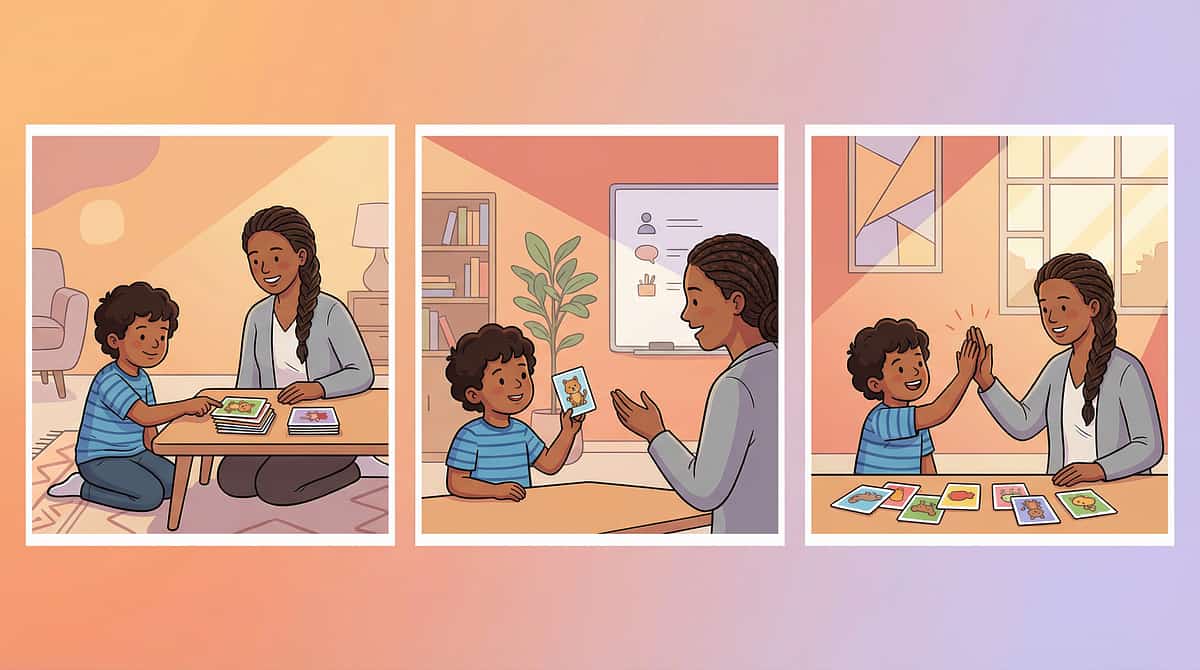
How to Use: Show manner contrast series (walk → run → skip → stomp → tiptoe). Demonstrate physically first. Then cards. Ask: "Am I walking or tiptoeing?" Build to context: "When would you stomp? When would you tiptoe?"
🛒 Commercial Option
Movement/manner verb card sets, action style comparison cards
Price Range: ₹200–600
Search Amazon.in: "action verb cards manner children" or "how they move activity cards"
🛠️ DIY (Zero Cost)
Photograph or draw yourself doing five walking manners. Labels: WALK (normal), RUN (fast/urgent), SKIP (bouncy/happy), STOMP (loud/heavy), TIPTOE (quiet/sneaky). Act them out together — the physical experience is neurologically valuable.
Safety Note: Start with clear, physically distinct manners. Focus on high-frequency manner distinctions first. Physical enactment precedes card work.

Material 8 — Multi-Step Action Sequence Cards
Material 8 of 9
Narrative Architecture
Function: Understanding complex actions as ordered sequences
Why It Works (SLP explains): "Making a sandwich" is not a single action — it is a structured sequence of ordered actions with a beginning, middle, and end. Understanding this structure is the bridge between single-verb comprehension and narrative comprehension. These cards decompose complex actions into visual numbered steps, making the architecture of complex events visible and learnable.
How to Use: Use familiar daily routines — brushing teeth, getting dressed, making breakfast. Show steps 1–4 or 1–5. Practice: "What comes FIRST? Then WHAT? Then WHAT? What happened LAST?" Narrate with full verb phrases at each step.
🛒 Commercial Option
Routine sequence cards, how-to visual step cards, activity sequence sets
Price Range: ₹250–700
Search Amazon.in: "daily routine sequence cards autism" or "step by step activity cards children"
🛠️ DIY (Zero Cost)
Photograph your child's daily routine in 4–5 steps. Brush teeth: (1) Get toothbrush, (2) Put toothpaste on, (3) Brush teeth, (4) Rinse, (5) Done! Print and laminate. Zero cost and personalised to YOUR child — this is clinically ideal.
Safety Note: Start with familiar, short sequences. Use clear numbering. Connect to child's actual daily activities for immediate relevance and generalisation.

Material 9 — Action-Based Following Directions Games
Material 9 of 9
Functional Application
Function: Functional application of action word understanding
Why It Works (SLP explains): This is the functional proof-of-concept material. When verb understanding immediately leads to successful game participation — "Jump TWICE, then SPIN, then CLAP" — comprehension becomes intrinsically motivating. Games also allow systematic complexity increase: single actions → sequences → modified actions (jump HIGH, spin SLOWLY) → conditional actions (if I say 'jump,' then run). This is real-world verb comprehension in action.
How to Use: Start with Simon Says — "Simon says JUMP!" Build to sequences: "Simon says jump HIGH, then spin SLOWLY, then sit DOWN." Use turn-taking: child becomes Simon. Connect to real home instructions progressively.
🛒 Brainy Bug Flashcards with App Audio
Reinforcement + auditory command cards
₹305 — Amazon.in: amzn.in/d/07zQavEk
₹305 — Amazon.in: amzn.in/d/07zQavEk
🛒 Dyomnizy Educational Memory Game
Action-following with lights and sound
₹519 — Amazon.in: amzn.in/d/0iwJwOiH
₹519 — Amazon.in: amzn.in/d/0iwJwOiH
🛠️ DIY: Simon Says
Zero cost. Gold-standard DIY version. The game itself IS the intervention. Start at the child's current ability level, not yours.
Safety Note: Start with actions the child can physically perform. Build complexity GRADUALLY. Ensure motor abilities aren't limiting the test of comprehension. Make games fun and low-pressure — this is language measurement disguised as play.

Every Family Can Do This. Today. With What They Have.
The therapeutic mechanism is not the material — it is the interaction structure the material enables. What matters is the visual contrast, the relational question ("WHO is doing WHAT?"), and the language you produce around the material. The WHO/UNICEF CCD Package, implemented across 54 low-income countries, was built entirely on household materials.
Material | DIY Version (Zero Cost) | |
Action Photo Cards | Phone camera + family photos + free printing | |
Video Library | Phone recordings of daily actions (slow-motion) | |
Scene Cards | Magazine cutouts + hand-drawn scenes | |
Tense Timeline | A4 paper + 3 columns + clock drawings | |
Ongoing/Completed Contrasts | 3-photo before/during/after sequences | |
Mental State Verb Cards | Stick figures + thought bubble drawings | |
Manner Cards | Physical demonstrations + photographed | |
Sequence Cards | Daily routine photos + number labels | |
Direction Games | Simon Says — zero cost, maximum engagement |
A handmade card in your voice, with your child's preferred characters, in your home context, is often more effective than a commercial card.
Citation: PMC9978394 — WHO CCD Package equity implementation | WHO NCF (2018) context-specific household intervention evidence

Before Every Session: A 90-Second Safety Gate
No session should begin without this check. These indicators take less than two minutes to assess and prevent the majority of difficult or unproductive sessions. A stopped session is not a failed session. It is data.
🟢 GREEN — PROCEED
Child is rested · Has eaten in the last 2 hours · In a regulated calm-alert state · Environment is prepared · You have 20–25 uninterrupted minutes
🟡 AMBER — MODIFY
Slightly dysregulated: use 1–2 materials, keep to 10 minutes · Difficult morning: Material 9 only · Tired: video clips only · Medication timing recently changed: consult prescriber
🔴 RED — DO NOT PROCEED
Child is ill (fever, significant distress, pain) · Acute emotional crisis · Severe meltdown within last 2 hours · You (the parent) are in acute stress — your nervous system regulation transmits to your child
STOP IMMEDIATELY if: Child becomes acutely distressed and cannot self-regulate in 60 seconds · Child shows signs of sensory overload (covering ears, eyes, self-injury) · Child is asking to stop (verbal or non-verbal communication). Photo cards: no sharp edges. Video clips: 10–15 seconds only. No choking hazards in this material set.
Citation: DOI: 10.1007/s12098-018-2747-4 — Padmanabha et al. 2019, home-based safety protocol standards
5 Minutes of Setup Prevents 80% of Session Problems
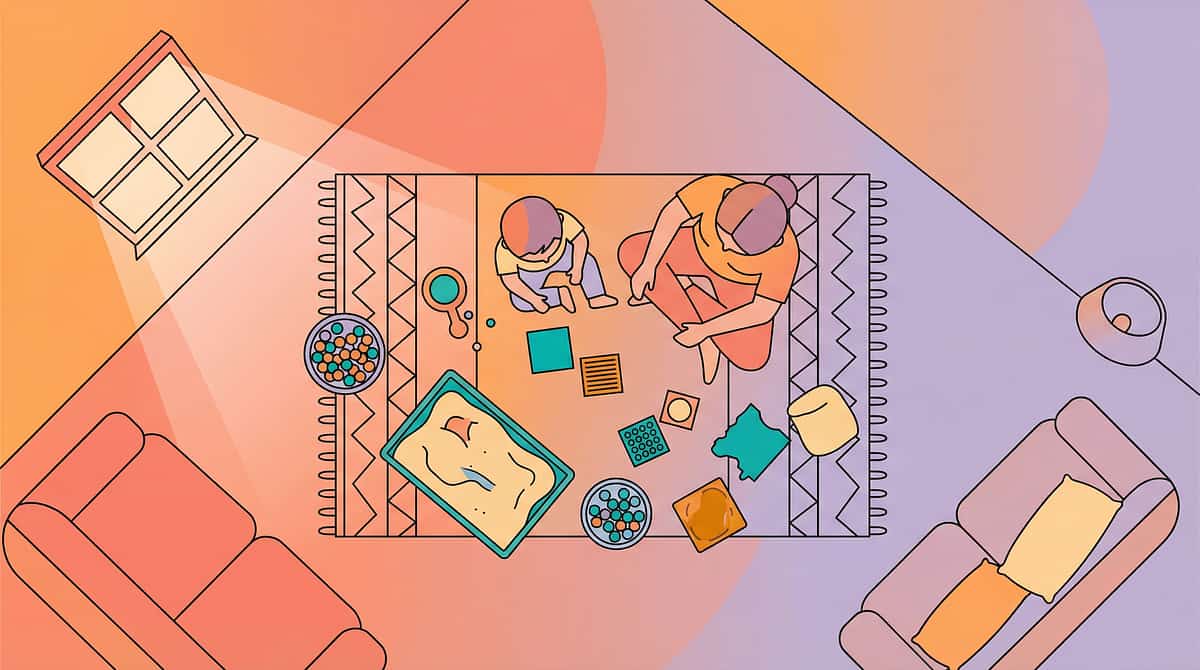
Room Layout
Position 1: Child — seated comfortably at table or on floor mat
Position 2: Parent/caregiver — directly across (face-to-face for language work), within arm's reach
Position 3: Materials — on flat surface to child's right, NOT visible until needed (reduces distraction)
Position 4: Reinforcement item — out of sight but accessible
Position 5: Data sheet — parent's left hand
Position 2: Parent/caregiver — directly across (face-to-face for language work), within arm's reach
Position 3: Materials — on flat surface to child's right, NOT visible until needed (reduces distraction)
Position 4: Reinforcement item — out of sight but accessible
Position 5: Data sheet — parent's left hand
Environment Checklist
- ✅ Screens OFF (TV, tablets, phones on silent)
- ✅ Lighting: bright but not glaring — natural light preferred
- ✅ Sound: quiet background or silence (avoid competing language)
- ✅ Space: clear table surface or clean floor mat
- ✅ Session visual timer: visible to child (phone timer works)
- 🚫 No other toys/materials within child's visual field
- 🚫 No competing visual stimuli (busy backgrounds)
- 🚫 No other people moving through the space
Pre-session phrase: "We're going to do our [action words / verb games] for [X] minutes. Then [preferred activity]."
Citation: PMC10955541 — Meta-analysis: 1:1 structured environment shows maximum effectiveness for communication intervention

60-Second Readiness Assessment — Do This Before Every Session
ACT III: THE EXECUTION
These indicators are observable, not subjective. Run through this check in under 60 seconds before every session begins.
Indicator | ✅ Go | ⚠️ Modify | ❌ Postpone | |
Eye contact or joint attention available? | Yes | Partial | Absent | |
Child is calm (no crying, tantrum, high repetitive behaviour)? | Yes | Mild | No | |
Last meal less than 3 hours ago? | Yes | 3–4 hours | 4+ hours | |
Slept adequately last night? | Yes | Borderline | No | |
Response to name in last 5 minutes? | Yes | Delayed | No | |
No signs of illness? | Yes | Borderline | No |
4–6 YES
→ PROCEED to Step 1
2–3 YES
→ MODIFY: 1 material, 10 minutes, high reinforcement
0–1 YES
→ POSTPONE: offer preferred activity, try again tomorrow
"The best session is one that starts right. A postponed session is not a lost session — it is a session saved for when it can work." — Pinnacle Blooms BCBA Team
📞 Struggling to get consistent readiness? 9100 181 181 — speak to a BCBA today

Step 1 of 6 — The Invitation
STEP 1
SLP + BCBA Lead
The invitation is not small talk. It is an attentional prime — it tells the brain "action words are coming, activate the relevant networks." The use of the word "DOING" in the invitation itself is a micro-therapeutic act.
Exact script: "Let's play our [action word game / verb game]! Today we're going to look at some pictures of people DOING things. Ready?"
With preferred character: "Let's find out what [Doraemon / Chota Bheem / the dog] is DOING!"
With preferred character: "Let's find out what [Doraemon / Chota Bheem / the dog] is DOING!"
Engagement Indicators — child is ready when:
- Makes brief eye contact or looks at the materials
- Turns body toward parent
- Reaches toward materials
- Verbalises or vocalises interest
- Stops current activity voluntarily
If engagement is absent: Wait 10 seconds. Re-offer with the reinforcement item visible. If still absent — this is a Modify/Postpone signal (refer to the readiness gate on the previous card).
Citation: PMC11506176 — responsive caregiving and warm invitation as prerequisite for language intervention effectiveness

Step 2 of 6 — The Engagement
STEP 2
SLP + OT Lead
The Joint Attention Bridge: Before any formal verb question, establish shared reference — you and your child are BOTH looking at the same thing and BOTH know you're both looking at it.
1
Place 3 action photo cards face-up between you
Point to one: "Look at THIS one — what's happening here?"
2
If child points, looks, or reaches
Joint attention is active. Proceed. If child does not engage: bring card CLOSER to their face, move it slightly, create motion interest.
3
Verbal scaffolding during engagement
Gesture first, words second. Point to the action, THEN label it. Pause 3–5 seconds. Model correct verb 3× before requesting production. Follow the child's interest.
OT Note on Motor Engagement: For children who engage better through movement — DO the action first, THEN show the card. Jump together, THEN show the "jumping" card. Physical experience of the verb neurologically precedes its visual representation.
Citation: NCAEP 2020 — joint attention as evidence-based prerequisite for language intervention

Step 3 of 6 — The Therapeutic Action
STEP 3 — CORE OF SESSION
SLP Primary Lead
This is the heart of the session — 15–18 minutes of structured, progressive verb teaching across five phases. Each phase targets a distinct dimension of verb comprehension.
1
Phase A — Concept Building (4–5 min)
Materials 1+2: Present 3 multi-agent action cards (same action, 3 agents). Ask: "What is [boy] doing?" Watch 15-second video clip. Narrate: "She IS JUMPING — right NOW"
2
Phase B — Relational Structure (3–4 min)
Material 3: Scene card. Ask: "WHO is [action]ing? WHAT are they [action]ing?" Build to full sentence: "The [agent] is [action]ing the [object]"
3
Phase C — Temporal Structure (3–4 min)
Materials 4+5: Timeline BEFORE/NOW zones. Ongoing vs. completed contrast: "Building — STILL HAPPENING. Built — ALL DONE"
4
Phase D — Advanced Verbs (2–3 min)
Materials 6+7 (if ready): Mental state card: "What is she THINKING?" Manner card: "Am I WALKING or STOMPING?"
5
Phase E — Functional Application (3 min)
Materials 8+9: 2 sequence cards with full verb phrases. 1 direction game: "Jump TWICE, then SPIN once, then CLAP!"
✅ Ideal
Spontaneous correct verb production
✅ Acceptable
Prompted correct production with gesture/cue
⚠️ Adjust
Consistent non-response after 3 models → reduce difficulty
Citation: PMC10955541 — home sessions 15–20 minutes with therapeutic action occupying 40–60% of session

Step 4 of 6 — Repeat and Vary
STEP 4
BCBA + SLP Lead
"3 excellent, engaged repetitions build stronger neural pathways than 12 forced, resistant ones. Dosage in language therapy is about quality of processing, not quantity of trials." — Pinnacle Blooms SLP Clinical Guideline
Repetition Targets Per Session
- Action concept identification (per verb): 3–5 repetitions
- Agent-action-object structure: 3–4 trials per scene
- Tense distinction: 3 past + 3 present contrasts
- Direction game: 3–5 command sequences
Satiation Indicators (enough is enough)
- Child begins to look away consistently
- Response latency increasing beyond 8 seconds
- Child pushing cards away
- Child asks for something else (this is communication — honour it)
Satiation Response: "Two more, and then [preferred activity]. Let's do TWO MORE!"
If child is engaged but bored | Variation | |
Same action, new agent | Use different cards (Variation A) | |
Same action, new context | Indoor vs. outdoor (Variation B) | |
Child's turn to give direction | Role reversal (Variation C) | |
Add complexity | "Jump HIGH and then run FAST" (Variation D) | |
Child draws or acts the verb | Instead of labelling it (Variation E) |

Step 5 of 6 — Reinforce and Celebrate
STEP 5
BCBA/ABA Lead
THE ABA TIMING RULE: Reinforcement delivered within 3 seconds of the desired response has 10× the impact of reinforcement delivered after 10 seconds. Timing matters more than magnitude.
✅ CORRECT Verbal Reinforcement
"YES! You said JUMPING — that is exactly right! She IS JUMPING!"
"WOW — you told me WHO is jumping AND what she's doing — BRILLIANT!"
"WOW — you told me WHO is jumping AND what she's doing — BRILLIANT!"
❌ AVOID Generic Praise
"Good job!" is too generic — the brain doesn't connect it to the specific verb behaviour. Always be specific about WHAT they did right.
🎉 Celebrate the Attempt
"I love how you TRIED! You pointed to the picture — that tells me you're THINKING about it!" — celebrate attempts, not just successes.
Reinforcement Menu — choose based on your child's profile:
- Social reinforcement: High-five, spin, chase, tickle — 3 seconds
- Token system: Sticker chart — 5 correct verb answers = 1 preferred activity
- Natural reinforcement: "You said JUMP — let's JUMP together!"
- Object reinforcement: Brief access to preferred toy (30 seconds)
- Canon Product: Rosette Imprint Reward Jar — ₹589 (amzn.in/d/0flHweVf) — fill with action word cards, pull one out per correct response
- Canon Product: 1800+ Reward Stickers — ₹364 — sticker chart for verb responses
📞9100 181 181 — Ask about our ABA home programme design
Step 6 of 6 — The Cool-Down
STEP 6
OT Lead
No therapeutic session ends without a structured cool-down. Abrupt endings cause post-session dysregulation. The cool-down transitions the child from therapeutic engagement (moderate arousal) back to baseline, prevents emotional crash, and builds a positive association with the session.
1
Minute 1 — Warning Transition
"Two more action cards, then we're ALL DONE for today!" [Hold up visual timer or count on fingers: "Two... one... finished!"]
2
Minute 2 — Material Put-Away Ritual
"Help me put the [cards / game pieces] back in the box." Child participation in put-away is therapeutic: ownership, closure, sequence completion.
3
Minute 3 — Transition Phrase + Next Activity
"That was AMAZING work. You used so many action words today. Now it's time for [preferred activity]."
If child resists ending: "I know you want to keep going — that means you LOVE our action word game! We'll do it again [tomorrow / after school]. Now: [transition activity]." A preferred transition object (soft toy, ₹425 on Amazon.in) can ease this moment.
Citation: NCAEP 2020 — visual supports and transition strategies as evidence-based practices for autism
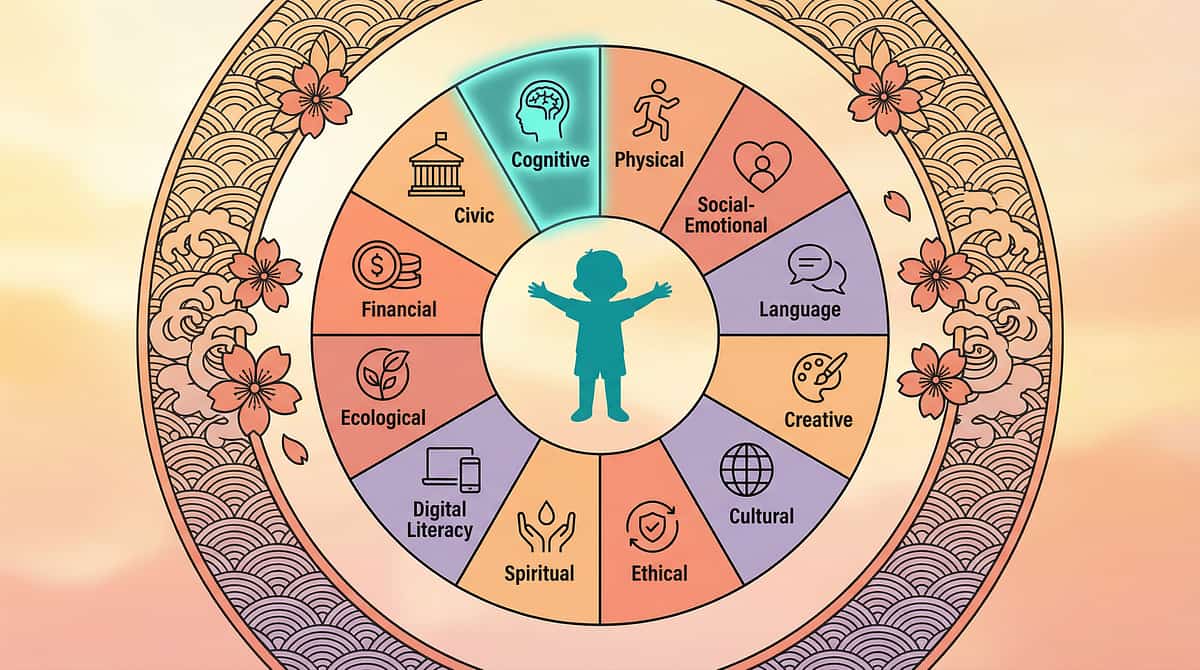
60 Seconds of Data Now Saves Hours of Guessing Later
BCBA + CRO Lead
Record these three data points within 3 minutes of every session ending. Over time, this simple record becomes the most powerful tool you have for demonstrating progress and adjusting the protocol.
1
Correct Verb Identification
Number of times child correctly identified action word with minimal/no prompt: ___/10
2
Spontaneous Verb Production
Number of times child spontaneously used an action word in a phrase: ___
3
Session Engagement Rating
1 (refused/disengaged) | 2 (passive) | 3 (engaged with support) | 4 (actively engaged) | 5 (child-led)
Session Notes
- What worked best today? _______________
- Any resistance? Where in protocol? _______________
- One verb your child got right independently today: _______________
📥 PDF Tracker
Download B-169 Session Tracking Sheet — pinnacleblooms.org/track
📱 GPT-OS® App
Real-time progress monitoring — pinnacleblooms.org/gpt-os
📊 AbilityScore®
Upload data — see Communication Readiness Index progression
📞 Struggling to track progress? 9100 181 181 — our team will guide you through the data system.
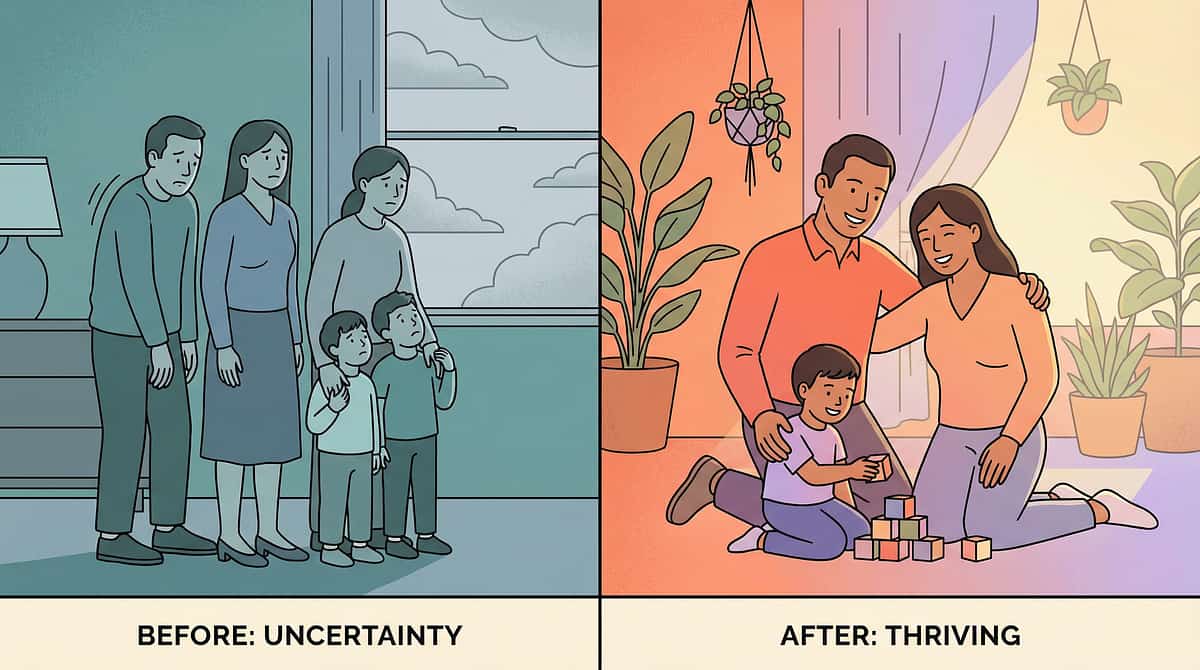
Session Abandonment Is Not Failure — It Is Data
Every difficult session teaches you something specific about your child's current state and the protocol adjustments needed. Use this troubleshooting guide to find solutions quickly.
Child identifies actions as objects ("That's a boy" not "jumping")
Why: Noun bias is strong — the brain defaults to labelling things, not events.
Fix: Go BACK to video clips. Motion forces event processing over object processing.
Fix: Go BACK to video clips. Motion forces event processing over object processing.
Child can identify but won't produce the verb verbally
Why: Comprehension precedes production — this is normal and expected.
Fix: Accept pointing + gesture. Reduce verbal production demand. Increase comprehension practice for 1–2 more weeks.
Fix: Accept pointing + gesture. Reduce verbal production demand. Increase comprehension practice for 1–2 more weeks.
Child understands present but cannot grasp past tense
Why: Temporal encoding is a distinct and later-developing skill.
Fix: Use timeline board exclusively. Make the BEFORE zone physical (put the card IN a box labelled BEFORE). Abstract time needs concrete anchors.
Fix: Use timeline board exclusively. Make the BEFORE zone physical (put the card IN a box labelled BEFORE). Abstract time needs concrete anchors.
Child memorises cards but doesn't generalise to new contexts
Why: Learning is card-specific, not concept-generalised.
Fix: ADD more agents/contexts for each verb immediately. Generalisation requires 5+ exemplars per verb.
Fix: ADD more agents/contexts for each verb immediately. Generalisation requires 5+ exemplars per verb.
Mental state verb cards cause confusion or refusal
Why: Theory of mind demands may exceed current developmental level.
Fix: Remove mental state verbs. Return to Materials 1–5. Mental state verbs are ADVANCED — they require a foundation.
Fix: Remove mental state verbs. Return to Materials 1–5. Mental state verbs are ADVANCED — they require a foundation.
Direction games become dysregulating rather than engaging
Why: Motor demands may compete with verbal processing.
Fix: Use stationary commands (clap, tap, point) before movement commands (jump, spin).
Fix: Use stationary commands (clap, tap, point) before movement commands (jump, spin).
Child only wants Material 9 (games) and refuses all cards
Fix: START with Material 9. Let the game warm up engagement. Then introduce 2 cards WITHIN the game context. Work WITH the child's interest, not against it.

No Two Children Are Identical. Here Is Your Personalisation Menu.
SLP + OT + BCBA Lead
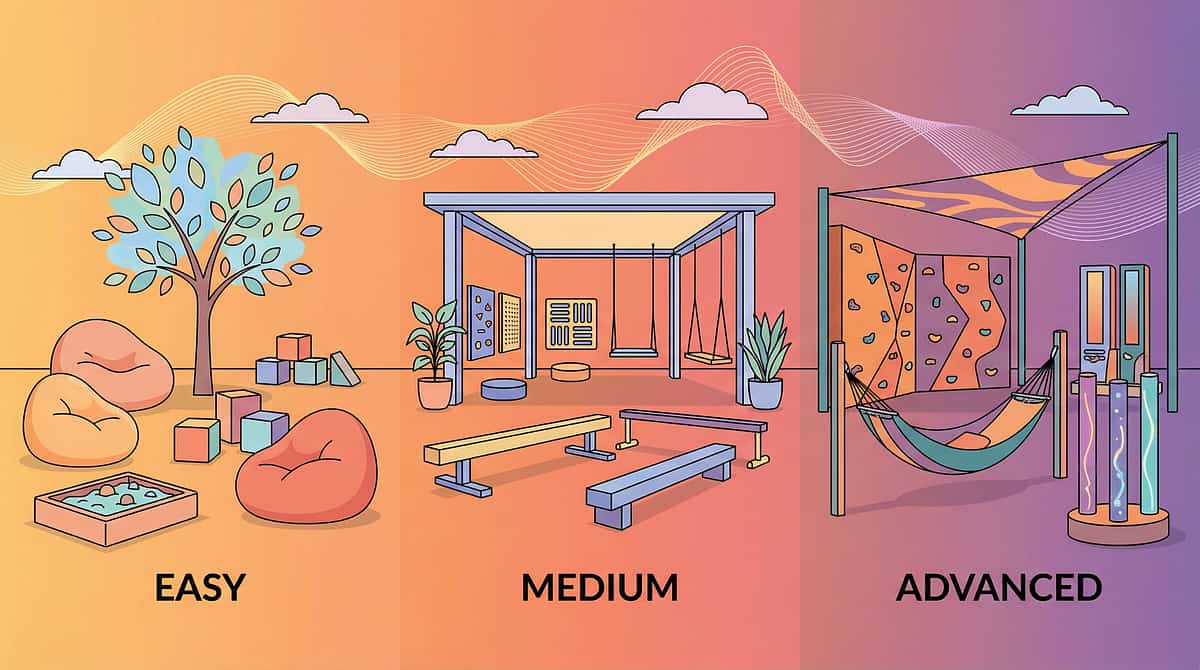
EASIER — Challenging Days or Younger Children
· Use only 1 material per session (Material 1 or 9)
· Accept gesture/pointing as response (no verbal production required)
· 2 verb targets only per session
· Use child's own photos and videos exclusively
· Reduce to 10-minute sessions
· Accept gesture/pointing as response (no verbal production required)
· 2 verb targets only per session
· Use child's own photos and videos exclusively
· Reduce to 10-minute sessions
STANDARD — Current Protocol
· 2–3 materials per session from the 9
· Mix of comprehension + production targets
· 5 verb targets per session
· 15–20 minute sessions
· 3–5 times per week
· Mix of comprehension + production targets
· 5 verb targets per session
· 15–20 minute sessions
· 3–5 times per week
HARDER — High-Engagement Days or Older Children
· Full 5-phase protocol across the week
· Mental state verbs introduced
· Complex tense: "What WILL she do AFTER she finishes building?"
· Narrative: "Tell me the whole story using action words"
· Community generalisation: describe family events at dinner
· Mental state verbs introduced
· Complex tense: "What WILL she do AFTER she finishes building?"
· Narrative: "Tell me the whole story using action words"
· Community generalisation: describe family events at dinner
Profile Adaptations
- Language seeker / high verbal child: Maximise verbal production demands, use storytelling with verbs
- Language avoider / lower verbal: Accept all modalities (point, gesture, select from 2 options, match)
- Sensory motor-integrated learner: Begin all verbs with physical enactment before card work
- Visual-strong learner: Maximise cards; minimise verbal instructions
Citation: OT sensory profile-based individualisation | ABA function-based planning | SLP communication profile frameworks
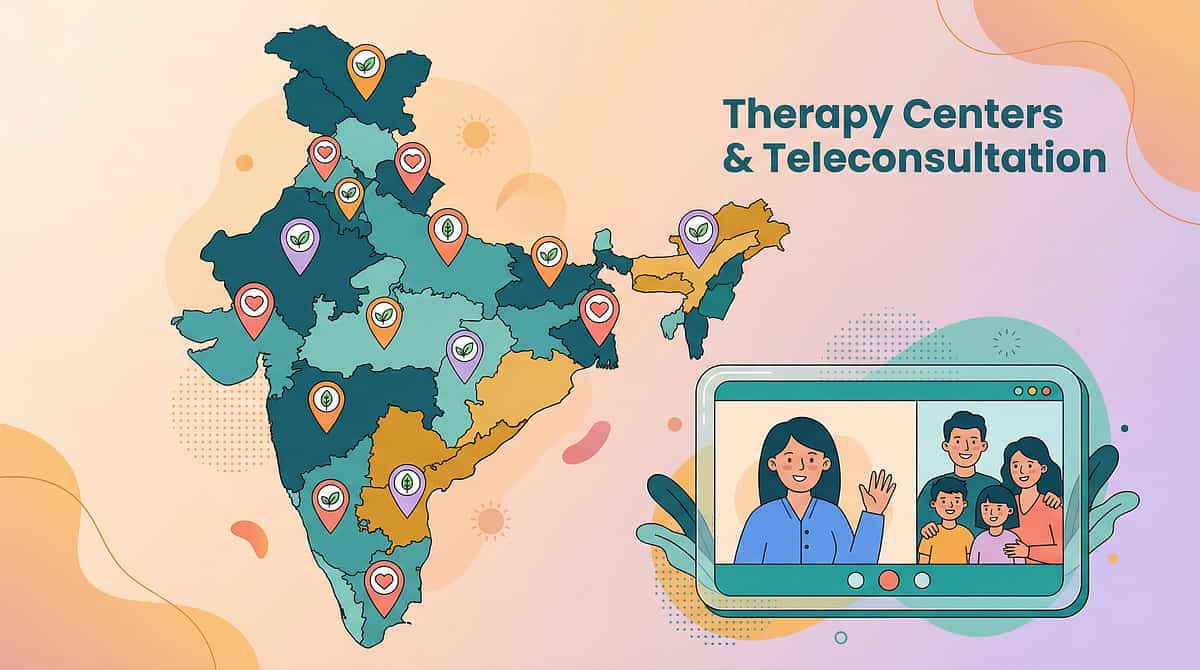
Week 1–2: What to Expect
ACT IV: THE PROGRESS ARC
SLP + BCBA Lead
Language intervention outcomes emerge gradually. Early-phase indicators focus on tolerance and orientation — not mastery. Do NOT expect mastery in Weeks 1–2. These are the real success markers for this phase.
✅ Week 1–2 Success Markers
- Child sits for 5+ minutes of card/game activity (engagement building)
- Child looks at action cards and differentiates them visually (attention to action)
- Child identifies 2–3 simple action words correctly when shown cards
- Child tolerates tense timeline being used even if not yet responding correctly
- Reduced resistance to session versus Day 1 (habituation to routine)
❌ Not Expected Yet at Week 1–2
- Spontaneous verb production in conversation
- Correct tense in natural speech
- Mental state verb understanding
- Answering complex who/what/when questions
"If your child correctly pointed to 'running' after you showed them 4 cards on Day 5 of Week 1 — that is real, measurable, significant progress. Celebrate it with the same energy you would give to a first step."
Citation: PMC11506176 — Systematic review: language intervention outcomes emerge across 8–12 week timelines
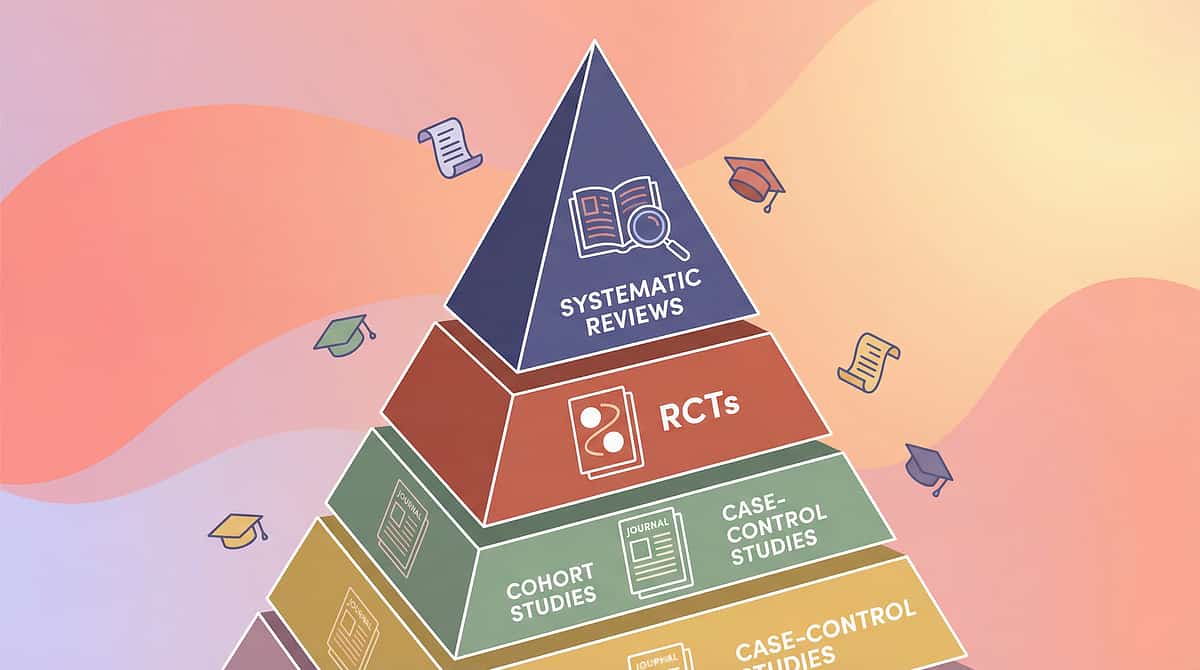
Week 3–4: Consolidation Signs
40% — Consolidation Phase
By Weeks 3–4, neural pathway formation is becoming visible in your child's behaviour. Watch for these consolidation indicators — each one represents real synaptic strengthening from your consistent sessions.
Session Anticipation
Child begins to ANTICIPATE the session — brings cards to you, initiates game
Action Vocabulary
Correctly identifies 5–8 distinct action words without prompting
Spontaneous Labelling
Begins to spontaneously label actions in daily life ("Mama, jumping!")
Direction Following
Responds to 2-step action directions consistently
Tense Distinction
Correctly distinguishes present vs. past tense with the timeline visual
Generalisation Seeds — watch for these: Child comments on actions in TV shows or books spontaneously · Child uses a verb correctly in a new context you didn't practise · Child corrects their own verb tense (even if wrong, the self-monitoring IS progress)
When to increase frequency: If child is producing 8+ correct responses per session with minimal prompting in Week 4 → increase to 5 sessions/week and introduce mental state verbs.
"You may notice by Week 4 that YOU are more confident and less hesitant in running the sessions. Parent confidence is a real therapy outcome. You are becoming part of your child's therapeutic team."
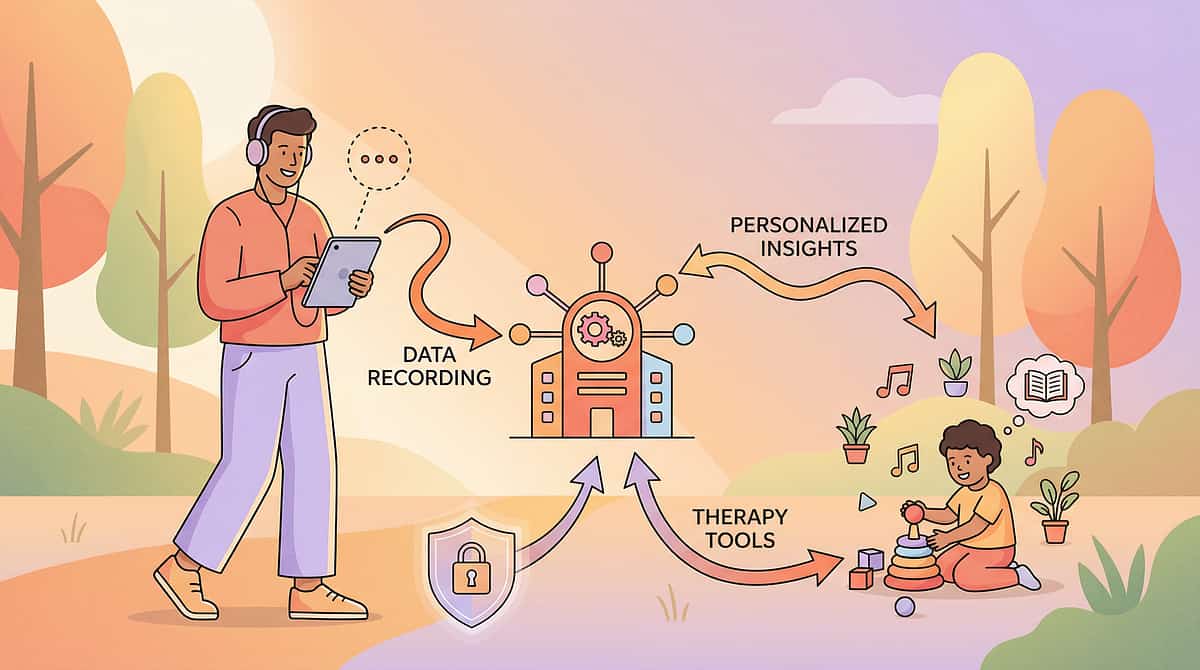
Week 5–8: Mastery Indicators
70% — Integration Phase
The Integration Phase is where isolated skills become fluid, connected language. Your child is no longer responding to cues — they are beginning to use verbs as natural communication tools.
80%
Clinical Mastery Threshold
Correct on verb comprehension + production tasks across 3 consecutive sessions, with at least 2 different assessors
70%
Tense Accuracy
Child uses past tense correctly in natural conversation in 70%+ of instances
3+
Mental State Verbs
Child uses 2–3 mental state verbs spontaneously (think, want, know)
Week 5–8 Full Mastery Checklist
- ✅ Child correctly answers WHO/WHAT questions for any action card shown
- ✅ Child uses past tense correctly in natural conversation (>70% of instances)
- ✅ Child understands and uses ongoing (-ing) vs. completed action distinction
- ✅ Child uses 2–3 mental state verbs spontaneously (think, want, know)
- ✅ Child describes multi-step actions: "First she got bread, THEN she spread butter, THEN she ate it"
- ✅ Child correctly follows 3-step action directions without visual support
- ✅ Child tells a simple story about their day using multiple verb forms
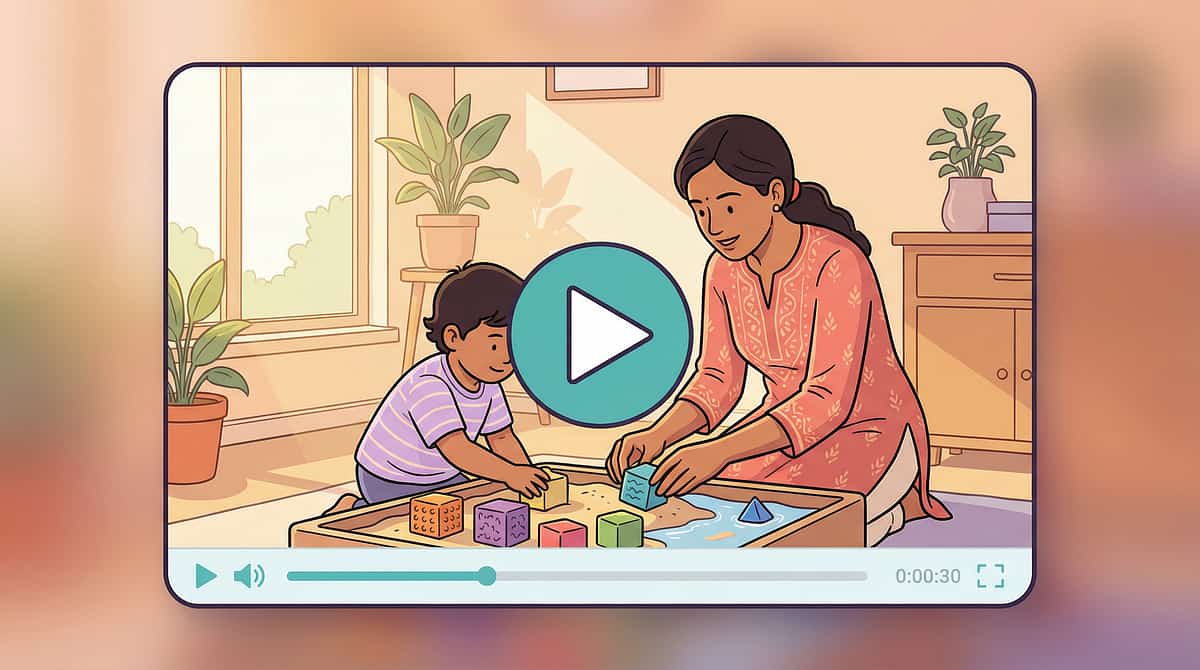
Every Verb Is a Neuron. Celebrate Every One.
ACT IV
BCBA + Parent Voices
Milestone badges mark the real, neurologically significant achievements in your child's verb development journey. Each badge represents a documented communication capability that will serve your child for life.

🌱 FIRST VERB
Child identifies first action word correctly — this is the neuron that starts the network

🔗 WHO DOES WHAT
Child answers WHO/WHAT question independently — the relational grammar is firing

⏰ TIME TRAVELLER
Child correctly uses past tense — they understand that language carries time

🔄 ACTION STATUS
Child distinguishes "building" vs. "built" — aspectual awareness is established

🧠 MIND READER
Child uses a mental state verb spontaneously — theory of mind language is emerging

📖 STORY TELLER
Child tells a 3-sentence event story with verbs — narrative language has arrived
Family Celebration Rituals: Print and frame the milestone badge when achieved · Call a grandparent and have child demonstrate the skill · Create a "verb book" — family photos with child-narrated action captions · See the Communication Readiness Index move in GPT-OS® AbilityScore®
📞9100 181 181 — Share your child's milestone with our team. Every story builds the data that helps every child.

Home Intervention Is Powerful. And There Are Moments When You Need More.
NeuroDev Pediatrics + SLP Lead
This page empowers you. A professional empowers the programme. Both are needed. Here is how to know when to seek additional clinical support.
🟡 AMBER FLAGS — Consult Your SLP
- No improvement in verb identification after 8 weeks of consistent intervention
- Child aged 4+ has fewer than 20 action words in their vocabulary
- Severe tense confusion persisting beyond age 5
- Significant regression in language — loss of previously acquired verbs
- Child uses the materials but cannot transfer skills to natural conversation
🔴 RED FLAGS — Seek Assessment Immediately
- Child aged 3+ is not producing any action words at all
- Child shows no interest in any social-communication activity (including games)
- Rapid language regression in a previously communicating child
- Family is in crisis and home intervention is not sustainable
1
📞 FREE National Autism Helpline: 9100 181 181
SLP referral, same-day guidance — 24×7, 16+ languages
2
🌐 pinnacleblooms.org
Centre locator, online assessment, teleconsultation booking
3
👨⚕️ Developmental Paediatrician
Comprehensive AbilityScore® assessment for full developmental picture
4
📋 Formal Speech Evaluation
Receptive + expressive language battery with licensed SLP
Citation: Padmanabha et al., Indian Journal of Pediatrics (2019) — DOI: 10.1007/s12098-018-2747-4
You Are Here. Your Next Steps Are Already Mapped.
ACT IV
SpEd + SLP Lead
Prerequisite Check
Has your child completed:
- B-167 — Negation Understanding
- B-168 — Category Understanding
If not — visit these pages first for foundational support before returning to B-169.
What B-170 Builds on B-169
Once your child understands ACTION words (verbs), they need DESCRIPTIVE words (adjectives/adverbs) to create rich language: "The boy is running FAST on the MUDDY track." B-170 is the natural next step.
Lateral Options
- More embodied approach: Motor-linguistic integration techniques
- Visual-narrative approach: Social stories with verb focus
- AAC-integrated verb learning if verbal output is limited

Watch the Reel — B-169 in 75 Seconds
Language & Communication Series — Episode 169
"Verbs aren't just actions — they're the engines that drive every sentence, story, and conversation. Here are nine materials that build this power." — Pinnacle Blooms Network® SLP Team
What the Reel Covers
- Action Photo Cards with Multiple Agents
- Action Video Clips Library
- Agent-Action-Object Scene Cards
- Tense and Time Markers Visual System
- Ongoing vs. Completed Action Contrasts
- Mental State Verb Cards
- Action Manner Distinction Cards
- Multi-Step Action Sequence Cards
- Action-Based Following Directions Games
Citation: NCAEP (2020) — Video modelling is an evidence-based practice for autism. Multi-modal (visual + text + demonstration) improves parent skill acquisition.
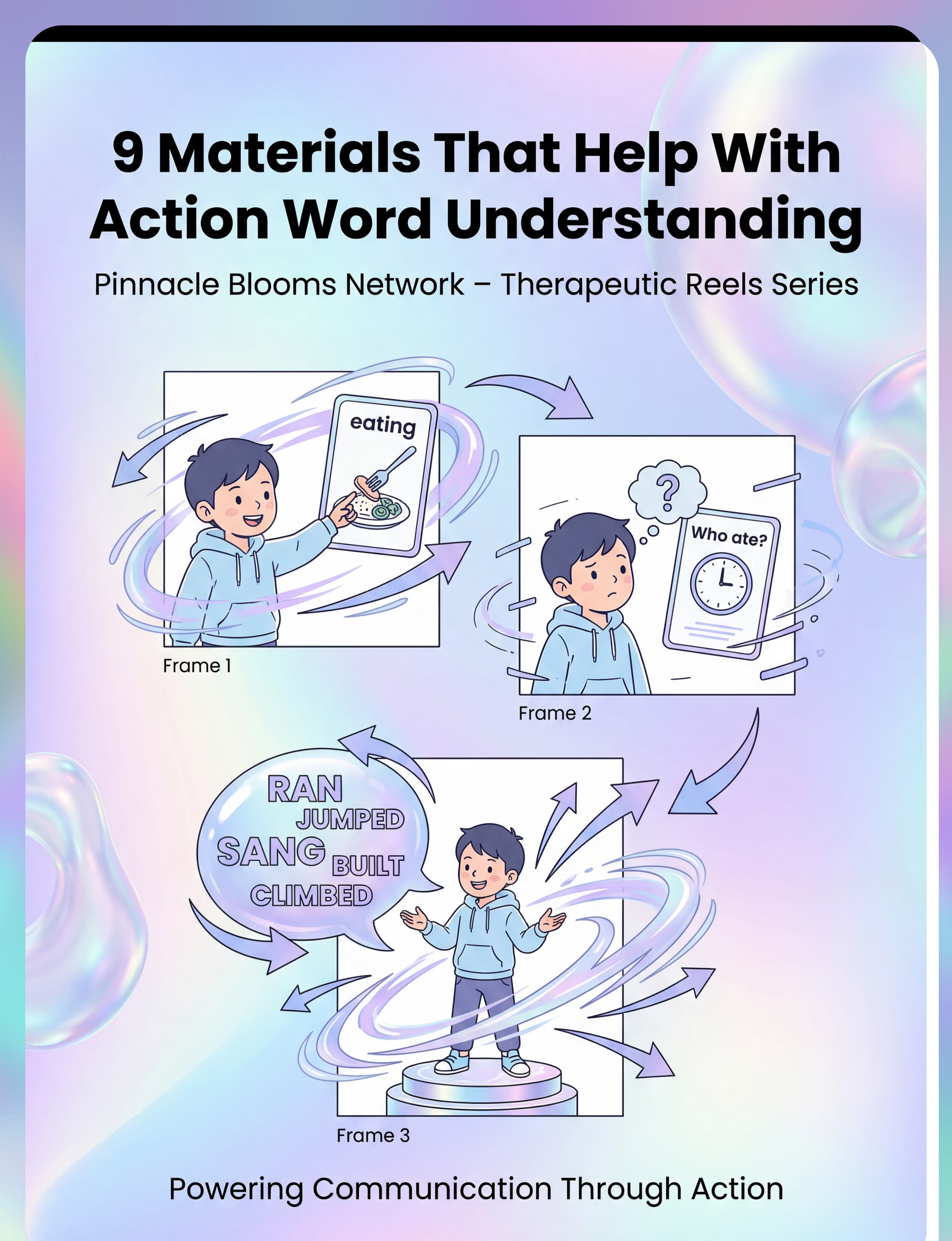
Preview of 9 materials that help with action word understanding Therapy Material
Below is a visual preview of 9 materials that help with action word understanding therapy material. The pages shown help educators, therapists, and caregivers understand the structure and content of the resource before use. Materials should be used under appropriate professional guidance.




Link copied!

The Pinnacle Promise
Built by Mothers. Engineered as a System.
"Every technique on this platform has been reviewed, refined, and validated through 21 million 1:1 therapy sessions across 70+ centres in India, serving children from 70+ countries. Not one word here is guesswork. Not one material is arbitrary. You are not alone in this work. You are supported by a consortium of hundreds of professionals whose singular purpose is to ensure every child reaches their full potential — regardless of where they were born, how much they earn, or how far they are from a clinic."
"Your home is already a therapy centre. You are already the therapist. We are just here to equip you."
— Pinnacle Blooms Network® Founder & Chairman
→ NEXT TECHNIQUE
B-170 — Descriptive Word Understanding
techniques.pinnacleblooms.org/social-communication/descriptive-word-understanding-b170
"Your child can now say 'The dog is running.' The next step: 'The BIG, FAST, HAPPY dog is running.'"
techniques.pinnacleblooms.org/social-communication/descriptive-word-understanding-b170
"Your child can now say 'The dog is running.' The next step: 'The BIG, FAST, HAPPY dog is running.'"
← PREVIOUS TECHNIQUE
B-168 — Category Understanding
techniques.pinnacleblooms.org/social-communication/category-understanding-b168
techniques.pinnacleblooms.org/social-communication/category-understanding-b168
This content is educational. It does not replace assessment by a licensed speech-language pathologist or developmental specialist. Action word/verb intervention should be individualised based on comprehensive assessment by a qualified professional. Results vary based on individual factors including age, co-occurring conditions, intervention frequency, and caregiver consistency.
© 2025 Pinnacle Blooms Network®, unit of Bharath Healthcare Laboratories Pvt. Ltd. All rights reserved. CIN: U74999TG2016PTC113063 | DPIIT: DIPP8651 | GSTIN: 36AAGCB9722P1Z2 | Care: care@pinnacleblooms.org | Helpline: 9100 181 181 | Web: pinnacleblooms.org