
Single Words → Phrases: Building the Bridges Your Child Needs
A vocabulary without combinations is a library with no sentences. This page gives you the 9 materials and the science to change that — starting today. Start This Technique 📞 9100 181 181 B-176 SLP Lead Ages 18m–6yrs Domain B: Language
"He knows over 200 words. But tonight at dinner he pointed at his cup and said 'juice.' Just 'juice.' Not 'more juice.' Not 'apple juice.' Not 'I want juice.' Just... juice. And everyone at the table went silent because we don't know how to get him to put the words together."
You are not failing. Your child is not stuck. The leap from labelling to combining is one of the most complex jumps in all of language development — and it can be taught, precisely and lovingly, starting today.
This page is validated by the Pinnacle Blooms Consortium® across 70+ centers and 21 million therapy sessions. Helpline: 9100 181 181 — Free, 24x7, 16+ Languages.
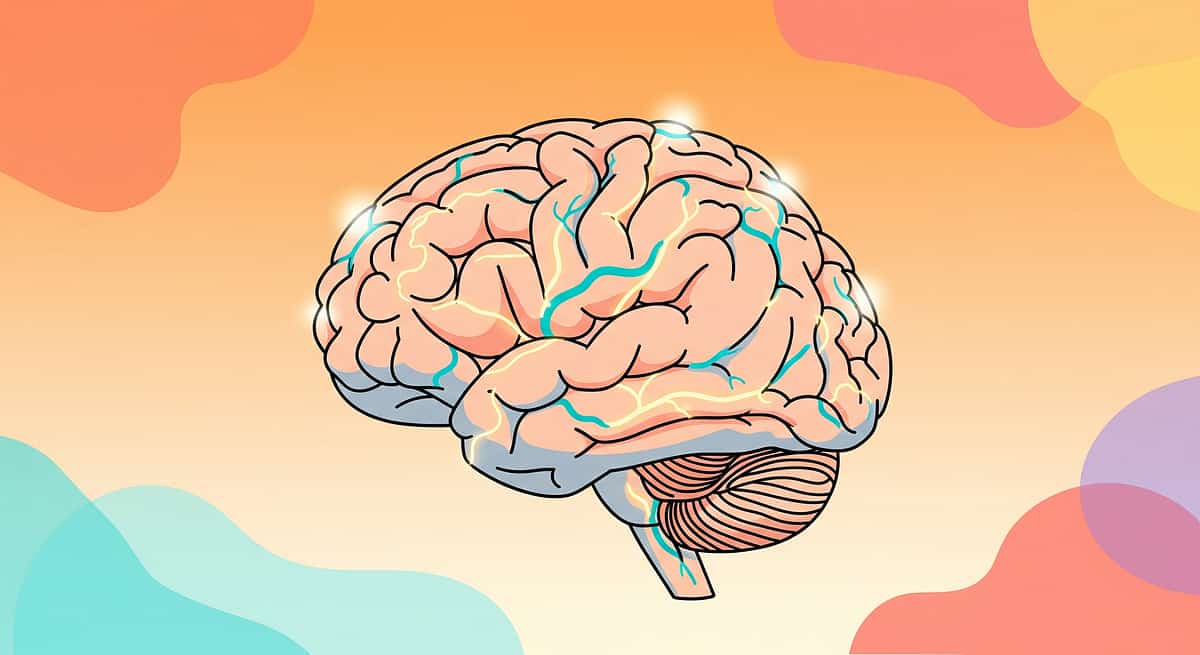
80 Million Families Are Navigating This Right Now
The single-word plateau is not a failure of parenting, intelligence, or love. It is a documented, well-studied, highly addressable phase in neurodevelopmental language acquisition.
1 in 36
ASD Diagnosis Rate
Children diagnosed with ASD globally (CDC 2023)
86%
Show Delay
Of children with ASD show delayed word-combination milestones
80M+
Families Worldwide
Navigating expressive language challenges right now
India Context: India estimates 1 in 66–100 children present with autism spectrum features. With 27 million annual births, over 270,000 Indian children per birth cohort may need expressive language support. You are among millions of families on this exact journey.
PRISMA Systematic Review (2024): 80% of children with ASD display communication processing differences requiring structured support. CDC Autism Surveillance 2023. PMC11506176 | PMC10955541
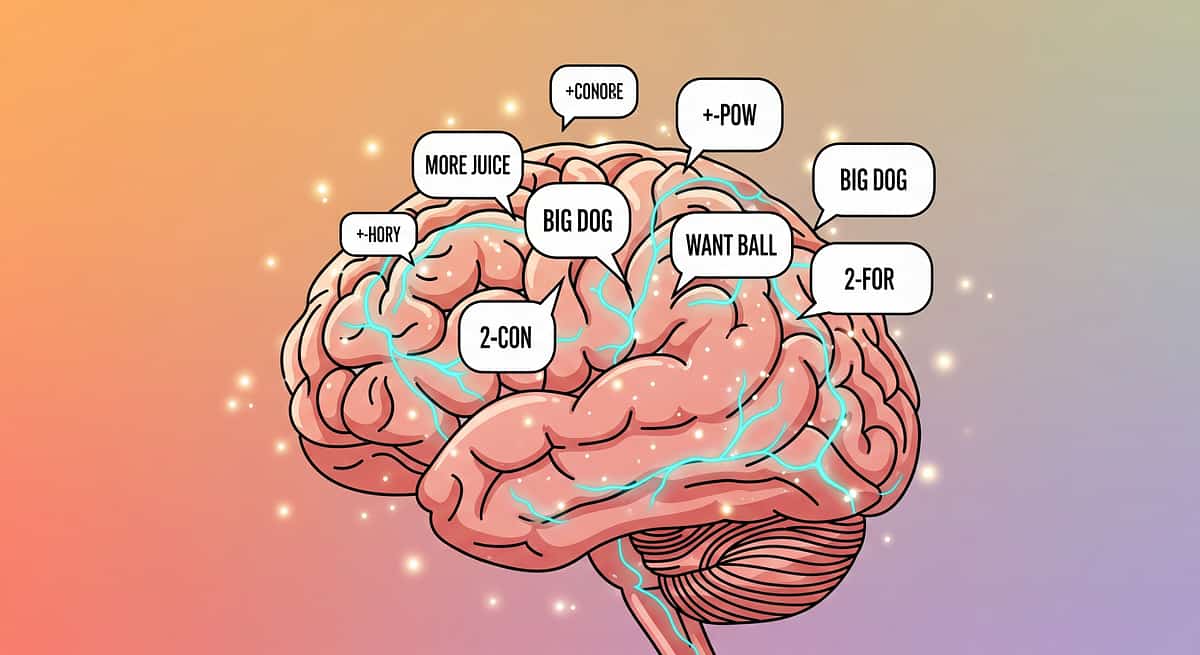
The Neuroscience of Word Combinations — In Plain English
What the Research Shows
Combining words requires simultaneous activation of multiple neural networks: the left inferior frontal gyrus (Broca's area) for syntactic sequencing, the angular gyrus for semantic integration, and the arcuate fasciculus white matter tract that connects these regions.
In many children with autism, this tract shows atypical connectivity — words are stored and retrieved normally (explaining the rich single-word vocabulary) but the sequencing pathway that links words into combinations is less efficient. This is a connectivity difference, not a vocabulary deficit.
What This Means for Your Child
Imagine having a beautiful library of 200 books — but the shelves aren't connected by corridors yet. Your child has the words. The intervention work is building the corridors between them.
Each time your child hears "want ball," "more juice," "big dog" — in a structured, repeated, visually-anchored context — new neural pathways are carved. This is called language-specific neuroplasticity, and it is most active between ages 18 months and 6 years.
⚡ This is a wiring difference, not a behavior choice. The bridge between words can be built. Materials help build it faster.
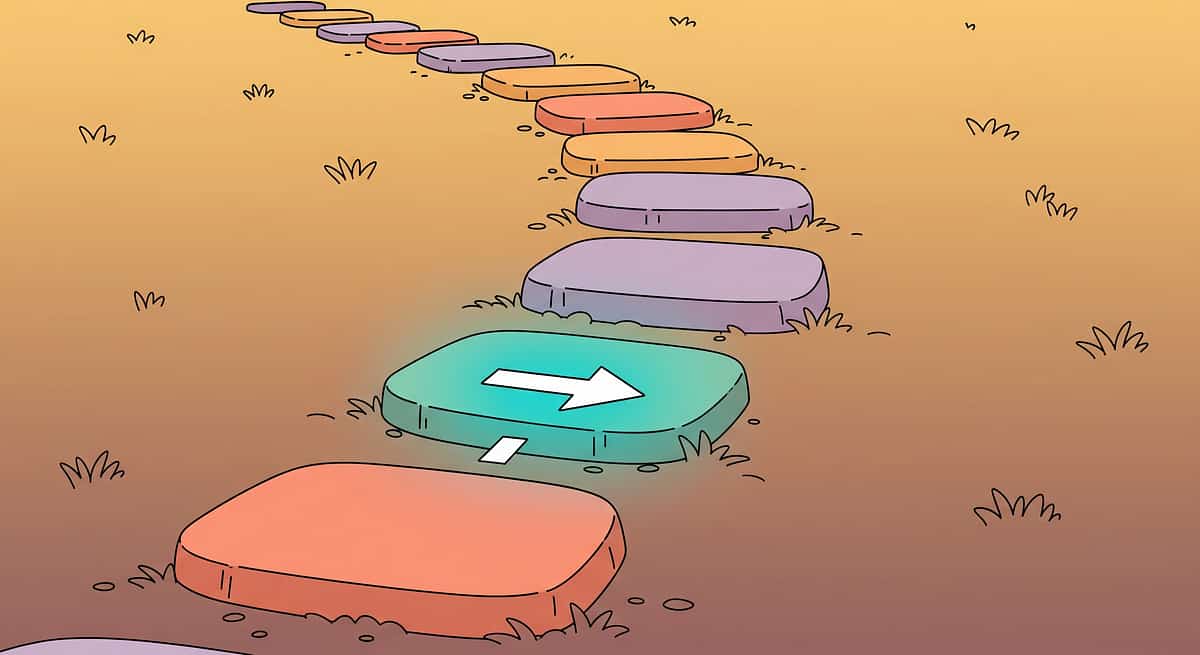
The Language Combination Ladder — Your Child's Position
Understanding where your child sits on the developmental timeline transforms anxiety into action. Every child follows this ladder — the pace simply varies.
12–18 Months
First meaningful words. Normal range: 1–50 words. Single-word communication is developmentally appropriate here.
18–24 Months
Vocabulary explosion. Two-word combinations should emerge spontaneously ("more milk," "daddy go"). This is the window where combining begins.
24–30 Months
Three-word phrases emerge ("want big ball"). MLU (Mean Length of Utterance) increases steadily.
30+ Months
Simple sentences, grammatical morphemes, narrative language. The foundation is fully laid.
📍Your child is here — at the word-combination threshold. They have the vocabulary foundation. The next step is building the word-combination network. Word combination delays commonly co-occur with: joint attention gaps, imitation challenges, auditory processing differences, and oral motor factors.

The Evidence Behind This Technique
🏆 Evidence Grade: Level I
Systematic Review + Multiple RCTs
What's Proven
Structured language modeling with visual supports accelerates word combinations in children with ASD — consistent findings across 16+ controlled studies (2013–2023).
Key Outcome
Carrier phrase boards increase two-word utterance production by 40–67% in structured trials across multiple cohorts.
Home-Applicable
Parent-administered language interventions demonstrated significant outcomes in Indian RCT setting (Padmanabha et al., 2019).
87%
Evidence Confidence
High — consistent findings across populations and settings
67%
Combination Increase
Maximum documented gain with carrier phrase board use
97%
Improvement Rate
Measured clinical outcomes across 21M+ Pinnacle sessions
PMC11506176 | NCAEP Evidence-Based Practices Report (2020) | Padmanabha et al., Indian J Pediatr, 2019. Helpline: 9100 181 181
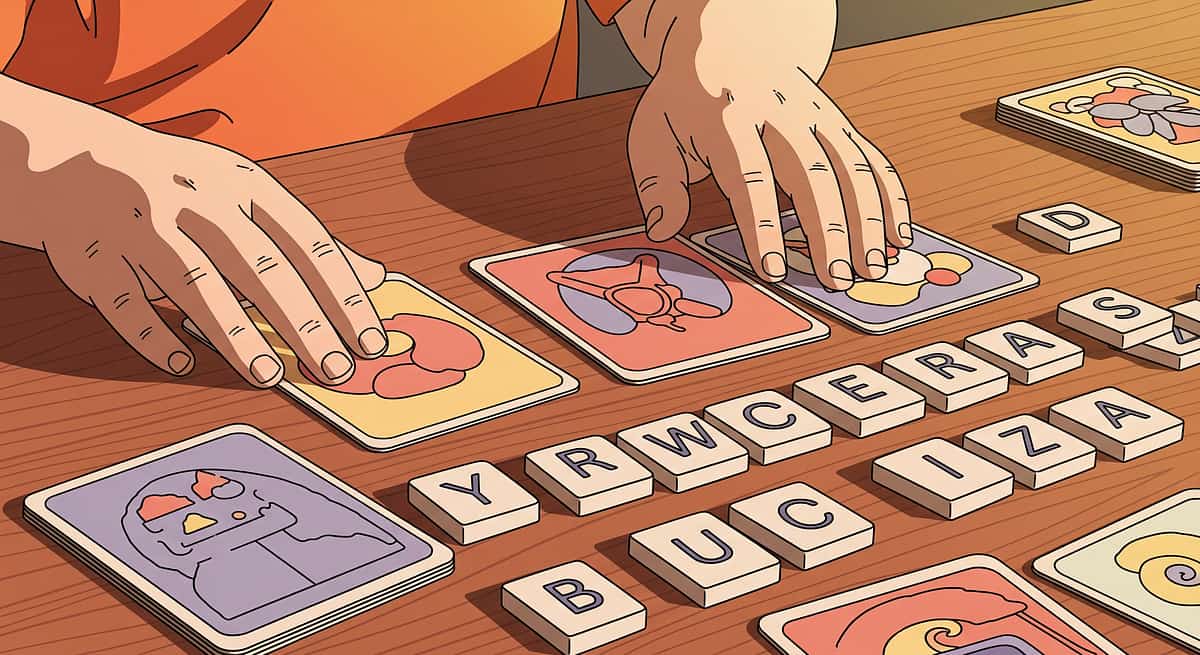
B-176 | Single-Word-to-Phrase Bridge Protocol
Parent-friendly alias: "Building Word Bridges"
A structured, home-executable language intervention that uses 9 categories of materials to scaffold the transition from single-word communication to two-word and multi-word phrase production in children aged 18 months to 6 years. The technique targets the specific neural and linguistic gap between having words and combining them — employing visual scaffolds, semantic frames, environmental arrangement, and caregiver modeling strategies proven effective for children with autism, language delay, and atypical language development profiles.
Domain
Language & Communication
Age Range
18 months – 6 years
Session Duration
10–20 minutes
Frequency
3–5x daily in natural contexts
✅ For children who: have 20+ single words but limited combinations · label objects but do not request using phrases · plateaued at single-word level for 3+ months · can imitate single words but not phrases
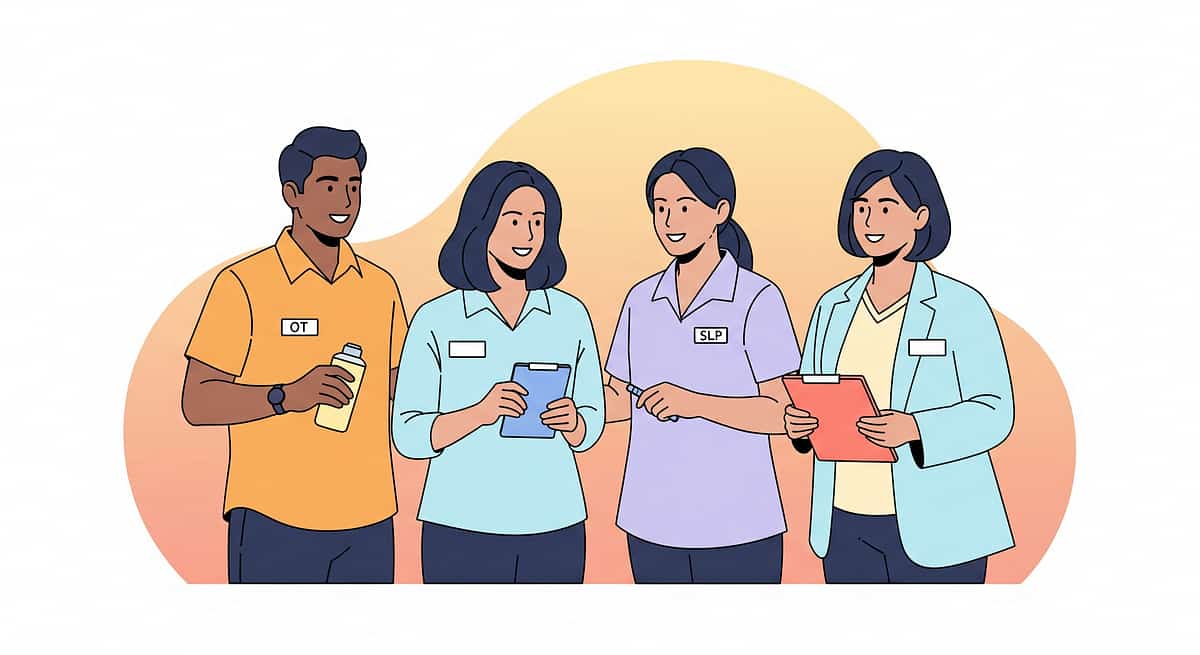
Five Disciplines. One Coordinated Protocol.
B-176 crosses therapy boundaries because the brain doesn't organize by therapy type. Language lives at the intersection of cognition, behavior, motor planning, and social motivation.
SLP (Primary)
Designs the carrier phrase hierarchy, selects core vocabulary targets, and trains parents in expansion/recasting technique. Manages MLU tracking and communication profile.
ABA / BCBA
Programs reinforcement schedules for word combination attempts, shapes successive approximations from single words to phrases using differential reinforcement.
Special Education
Embeds carrier phrase use in classroom routines; coordinates with home team for generalization across all settings.
Occupational Therapy
Addresses oral motor factors affecting phrase production; manages sensory load during language sessions for optimal readiness.
🧬NeuroDev Pediatrics: Monitors co-occurring auditory processing, attention, and cognitive load factors that influence word combination readiness. May assess for auditory processing disorder if delay is unexplained by vocabulary factors alone. Helpline: 9100 181 181

Precision Targets — From Core Skills to Developmental Cascade
You will know this is working when: ✓ Child says "more ___" rather than just reaching · ✓ Child uses "want ___" with novel items · ✓ Child begins spontaneously labeling and describing ("big car!") · ✓ Communication frustration reduces as combinations increase.
World J Clin Cases (2024): Language intervention promotes communication skills (primary), adaptive behavior (secondary), social participation (tertiary). PMC10955541 | Helpline: 9100 181 181
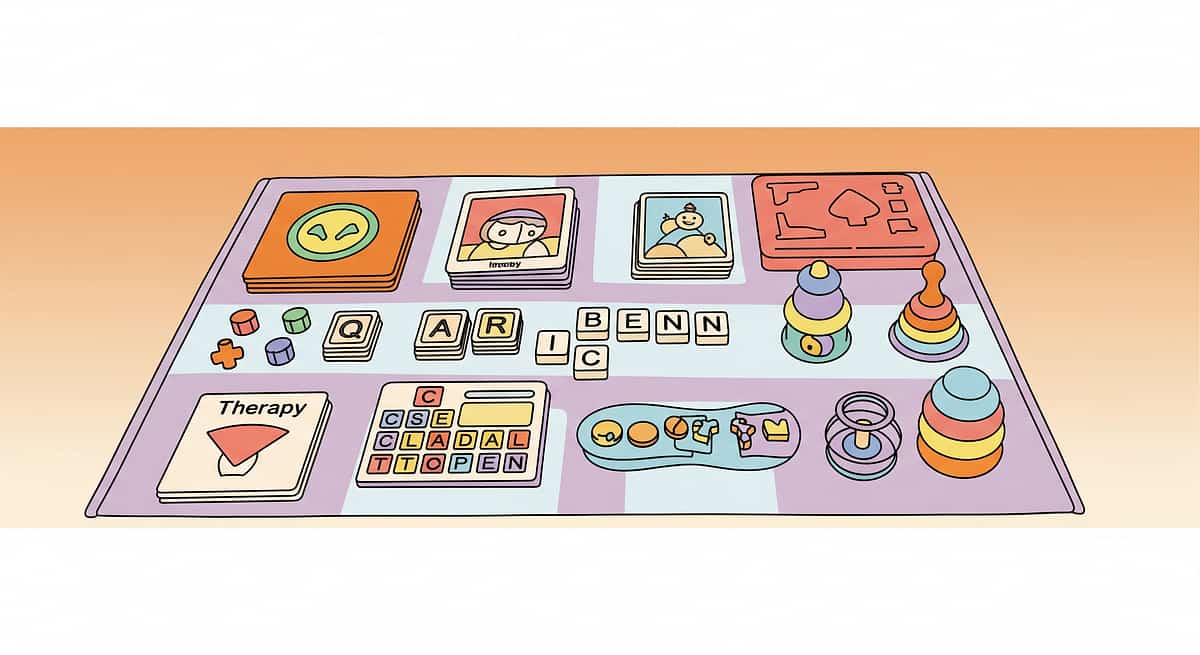
The 9 Materials — Your Complete Word Bridge Kit
Every material below has a clinical-grade purchased version and a free DIY equivalent that works on the same neurological principle. No budget required to begin.
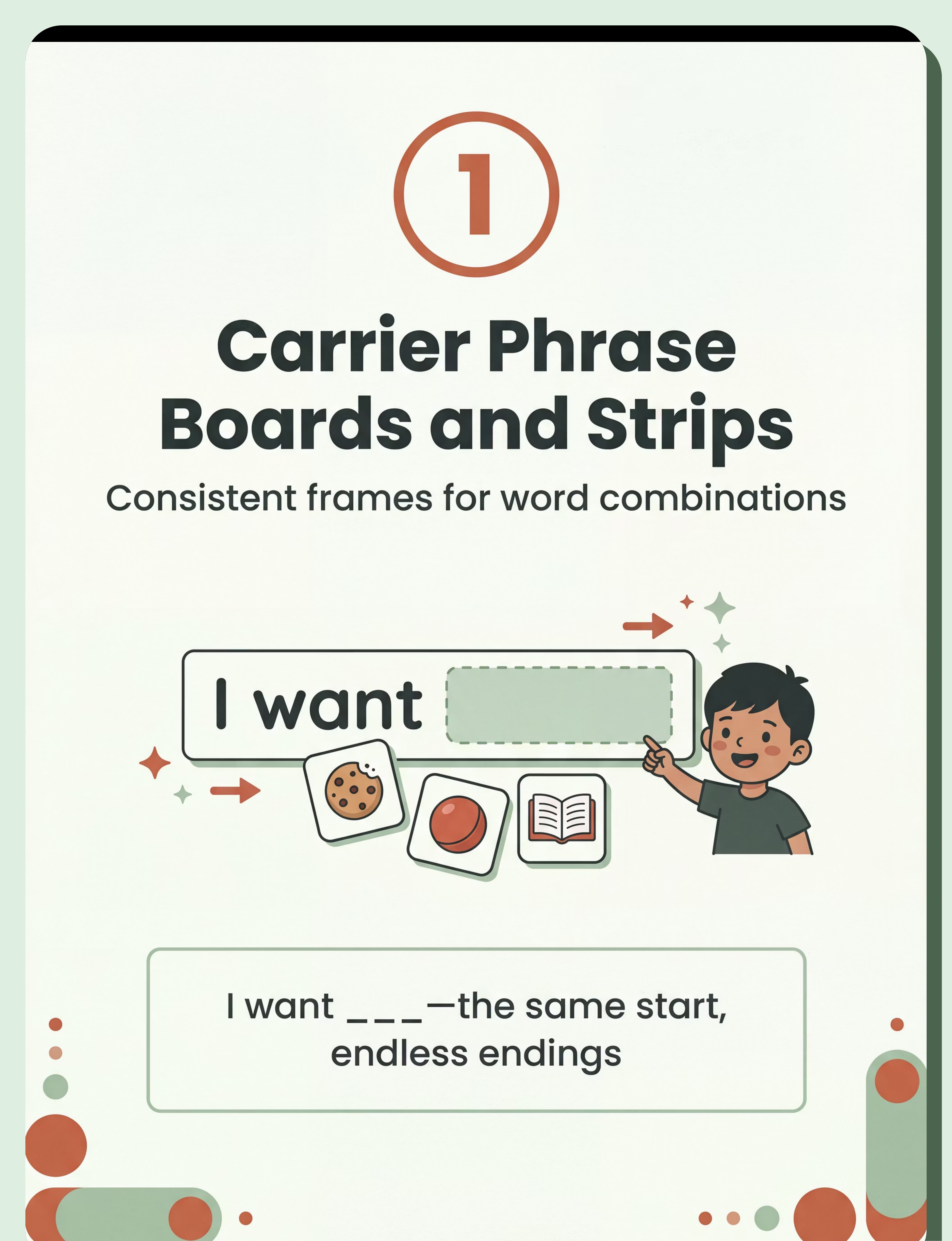
🪧 Material 1 — Carrier Phrase Boards
Consistent frames ("I want ___," "I see ___," "It's a ___") reduce cognitive load while the child learns to complete the phrase. The anchor word becomes automatic; the variable slot drives combination practice.
₹300–900 | Search Amazon.in: Carrier Phrase Communication Boards
🏠 DIY Free: Write "I want" on paper + Velcro blank for picture cards.
🏠 DIY Free: Write "I want" on paper + Velcro blank for picture cards.
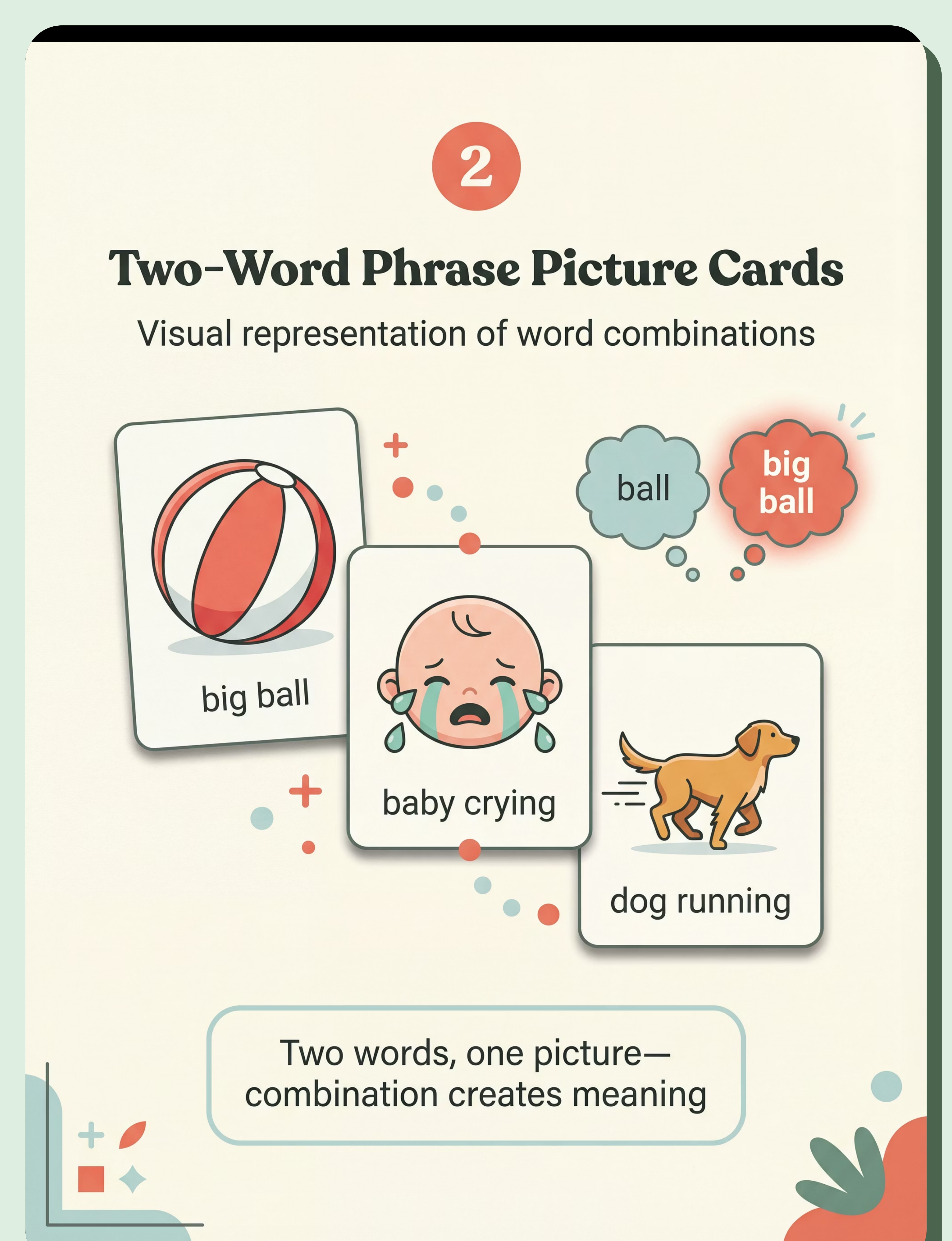
🎴 Material 2 — Two-Word Phrase Picture Cards
Cards showing describable two-word concepts ("big ball," "baby crying," "dog running") teach that combinations create new, more specific meaning — and that two words together say something one word cannot.
₹400–1,200 | Search Amazon.in: Two-Word Phrase Flashcards
🏠 DIY Free: Print/draw 20 photo cards — objects + actions, objects + sizes, objects + colors.
🏠 DIY Free: Print/draw 20 photo cards — objects + actions, objects + sizes, objects + colors.
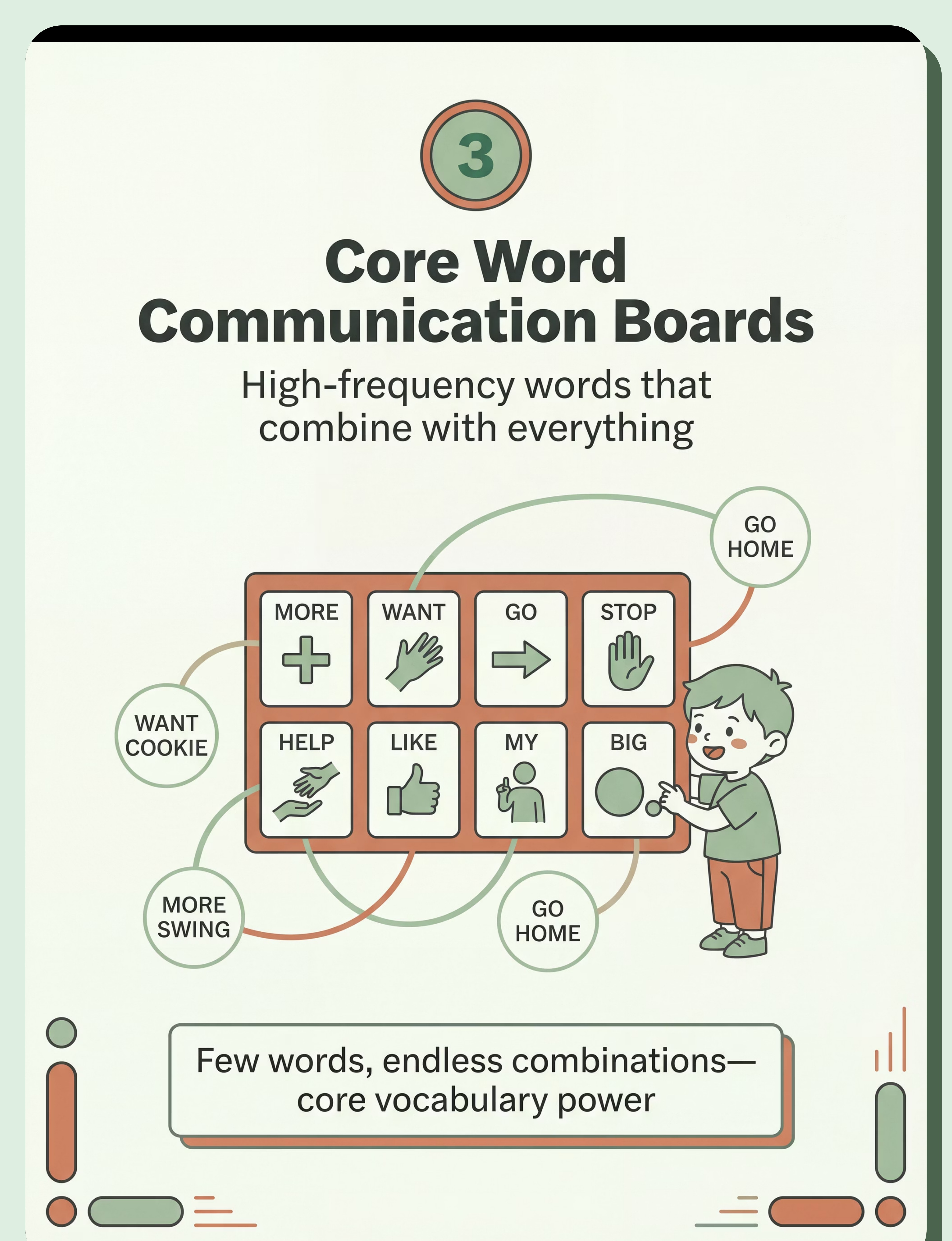
📋 Material 3 — Core Word Communication Boards
15–20 high-frequency words (want, more, go, stop, help, my, big, all done) that combine with virtually any noun — the "power words" of early language. These words unlock thousands of combinations.
₹400–1,500 | Search Amazon.in: Core Vocabulary Communication Board
🏠 DIY ₹20: Write 16 core words on a laminated A4 sheet. Attach to fridge.
🏠 DIY ₹20: Write 16 core words on a laminated A4 sheet. Attach to fridge.
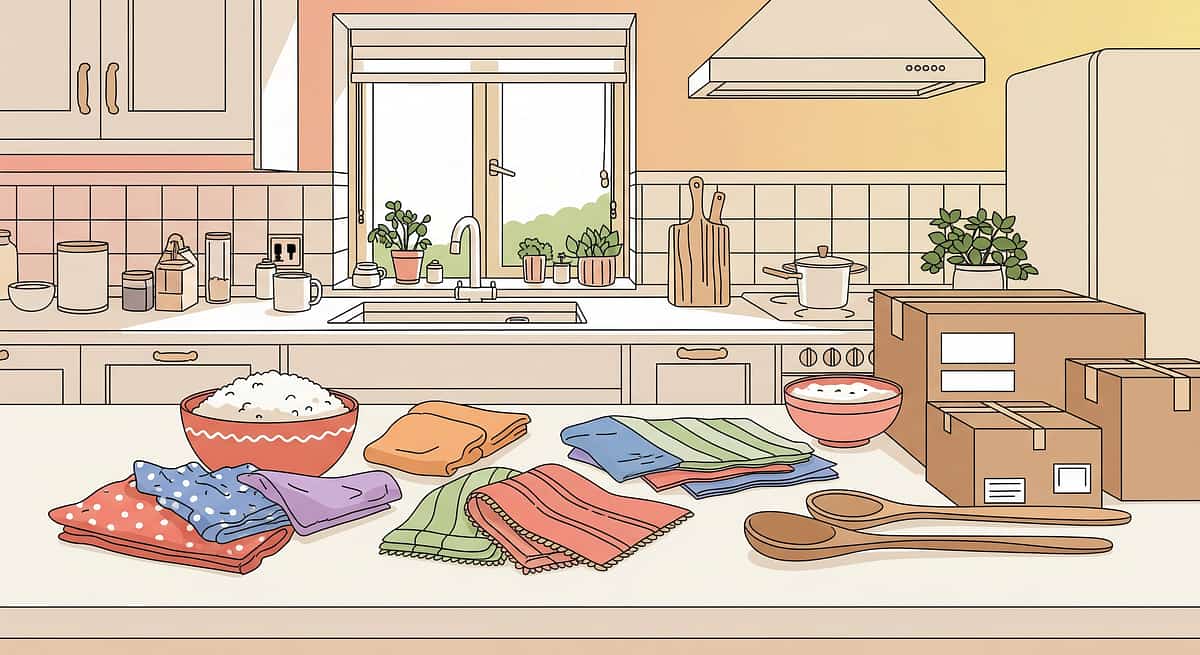
Materials 4–6: Tactile, Environmental, and Choice Tools
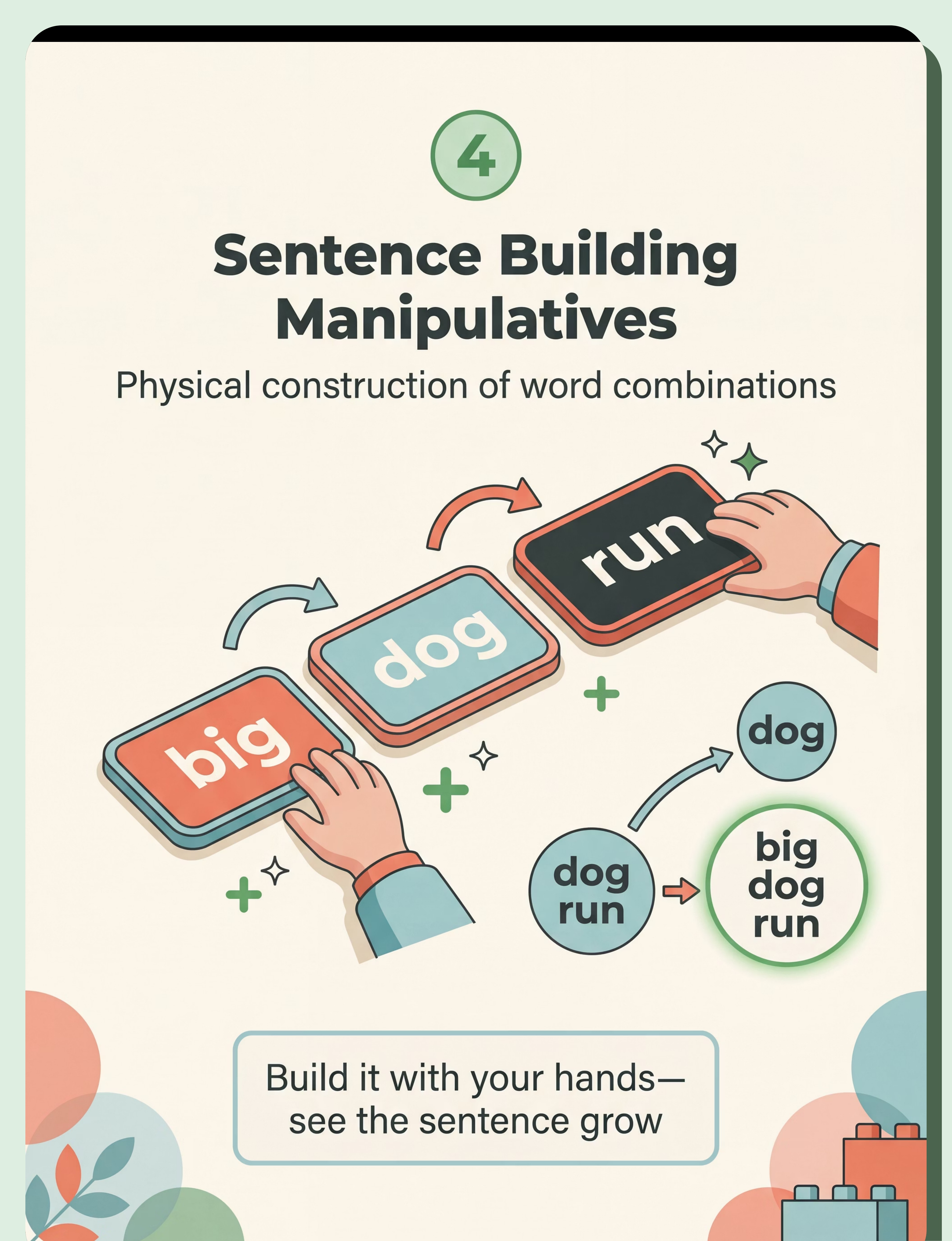
🧩 Material 4 — Sentence Building Manipulatives
Physical word tiles or cards that children move and arrange — making word combination a kinesthetic, visible, constructive act. Color-code for extra clarity: yellow = nouns, green = verbs, blue = descriptors.
₹500–1,800 | Search Amazon.in: Sentence Building Word Tiles
🏠 DIY Free: Write single words on index cards in color-coded marker. Done in 10 minutes.
🏠 DIY Free: Write single words on index cards in color-coded marker. Done in 10 minutes.
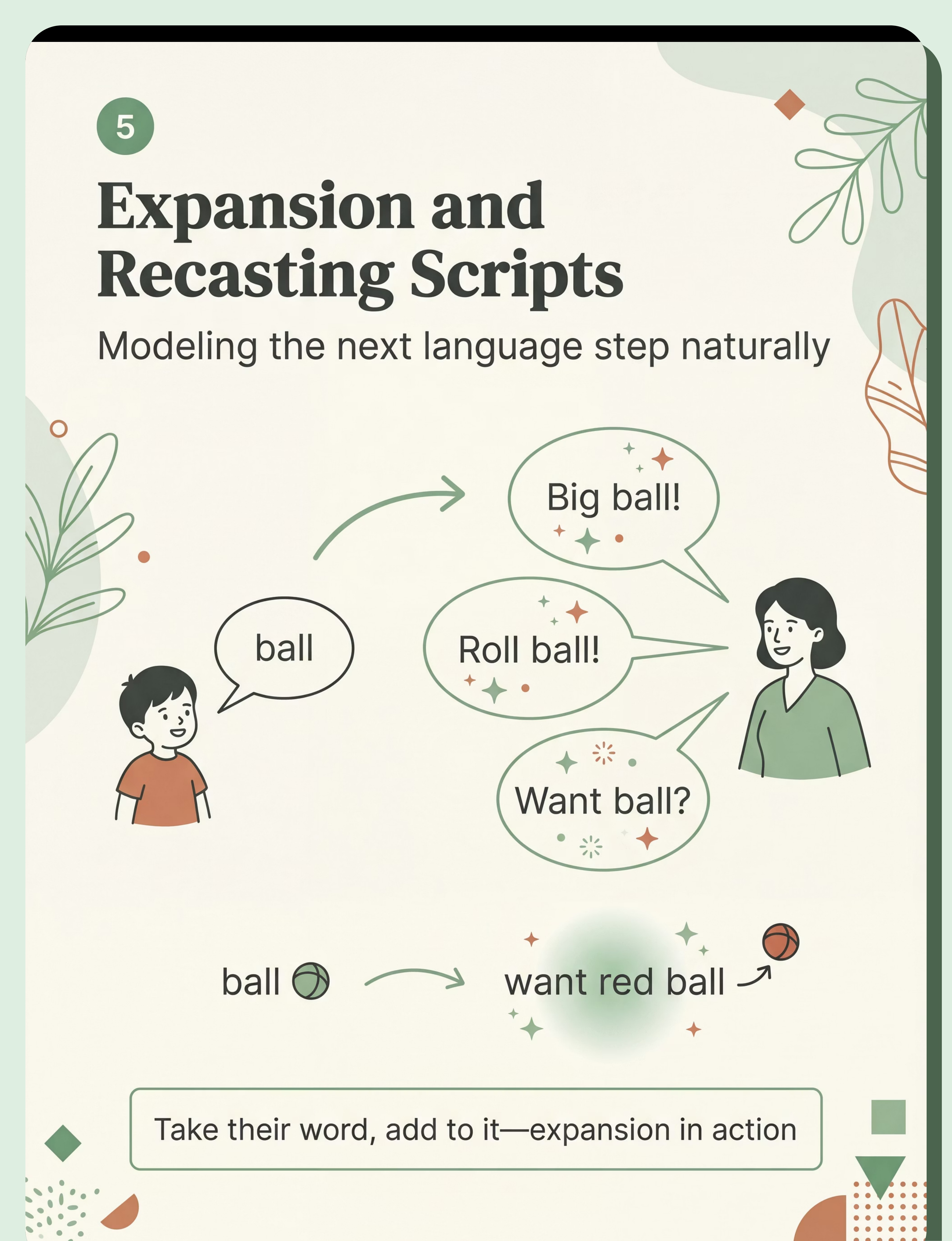
📝 Material 5 — Expansion and Recasting Scripts
Reference cards showing parents how to take the child's single word and naturally expand it by one element: "Ball" → "Big ball!" | "Want ball!" | "Roll ball!" The technique is simple; the scripts make it consistent.
₹200–600 | Search Amazon.in: Language Expansion Parent Guide
🏠 DIY Free: Sticky note rule: "Take their word. Add ONE word. Don't demand repetition." Post everywhere.
🏠 DIY Free: Sticky note rule: "Take their word. Add ONE word. Don't demand repetition." Post everywhere.
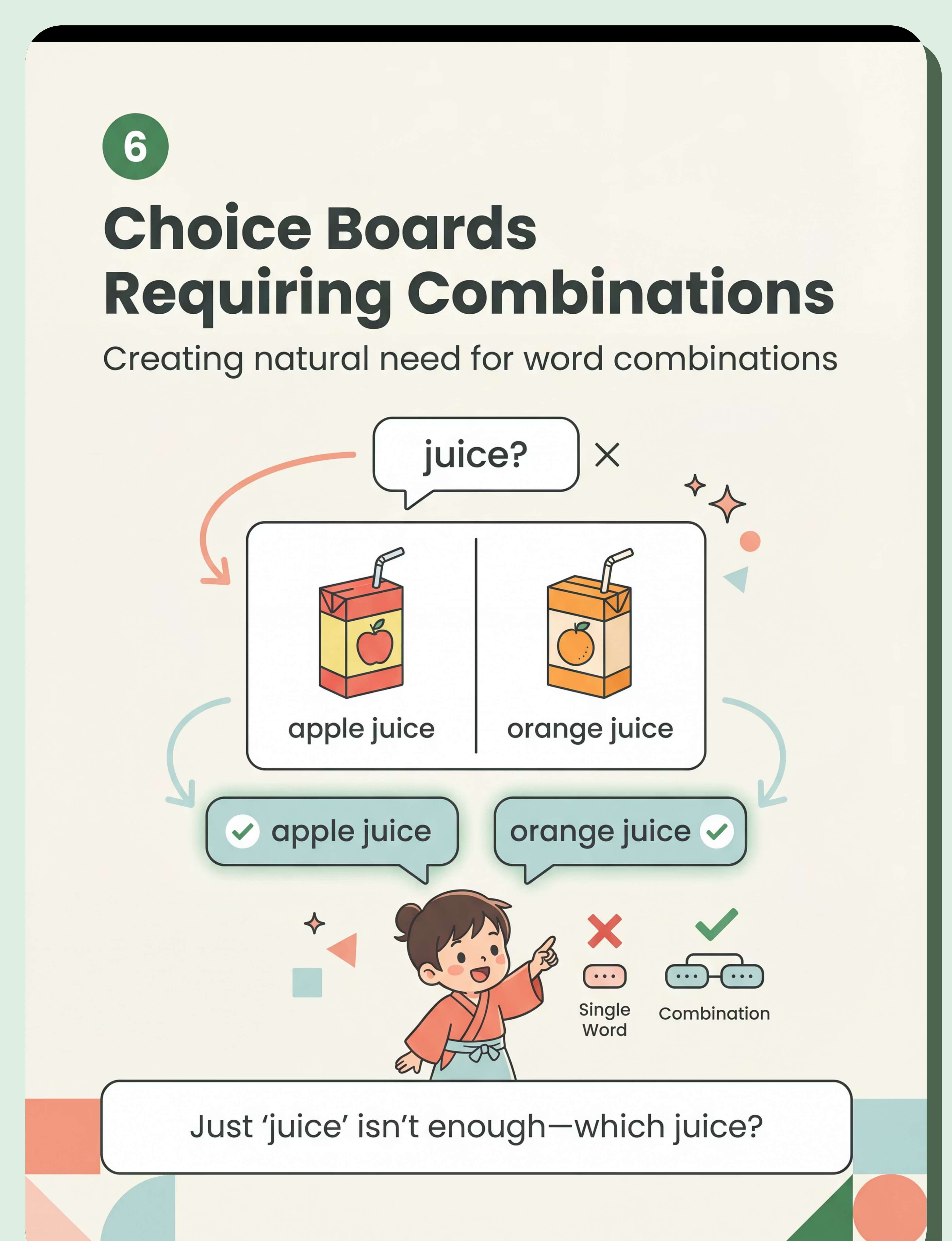
📌 Material 6 — Choice Boards Requiring Combinations
Boards offering two similar options (apple juice vs. orange juice; big cookie vs. small cookie) that create authentic communicative need for a two-word specification. Necessity is the mother of combination.
₹300–800 | Search Amazon.in: Choice Board Communication
🏠 DIY Free: Cut 2 pictures from packaging. Tape to cardboard. Offer daily at snack time.
🏠 DIY Free: Cut 2 pictures from packaging. Tape to cardboard. Offer daily at snack time.
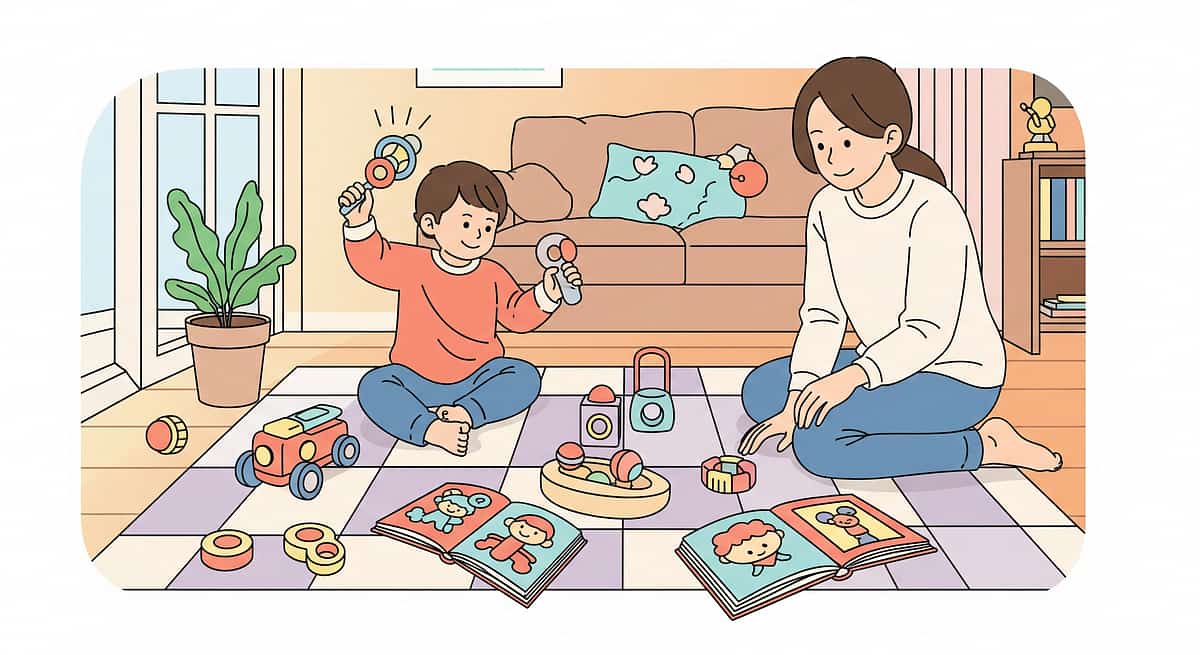
Materials 7–9: Play, Attributes, and Books
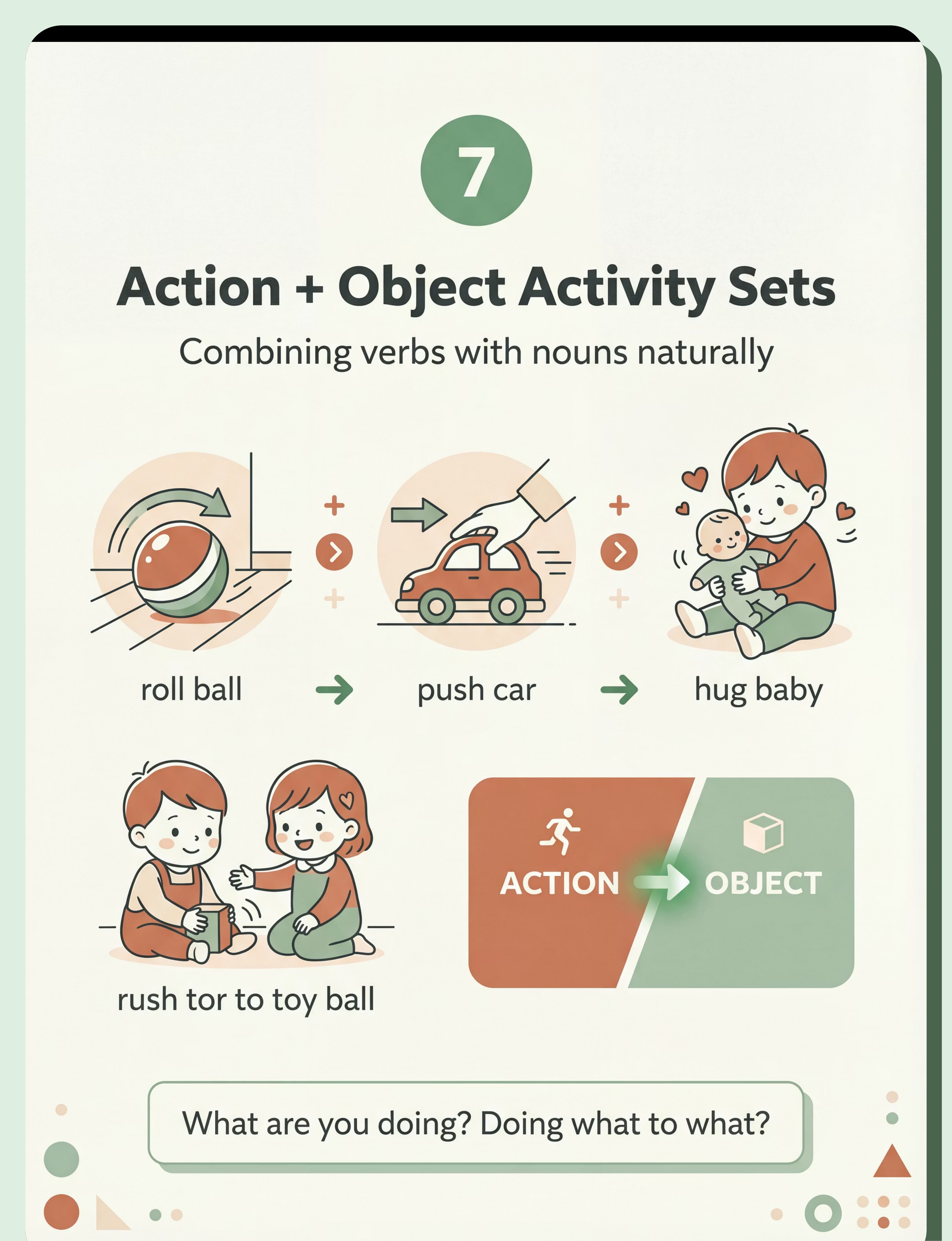
🎮 Material 7 — Action + Object Activity Sets
Toys and activity kits that naturally elicit verb-noun combinations through play: roll ball, push car, hug doll, pour water. Every play moment becomes a language opportunity with consistent action labeling.
₹400–1,200 | Search Amazon.in: Action Object Play Set Toddler
🏠 DIY Free: Any toy + consistent action labeling. "Roll ball! Push car!" during existing play.
🏠 DIY Free: Any toy + consistent action labeling. "Roll ball! Push car!" during existing play.
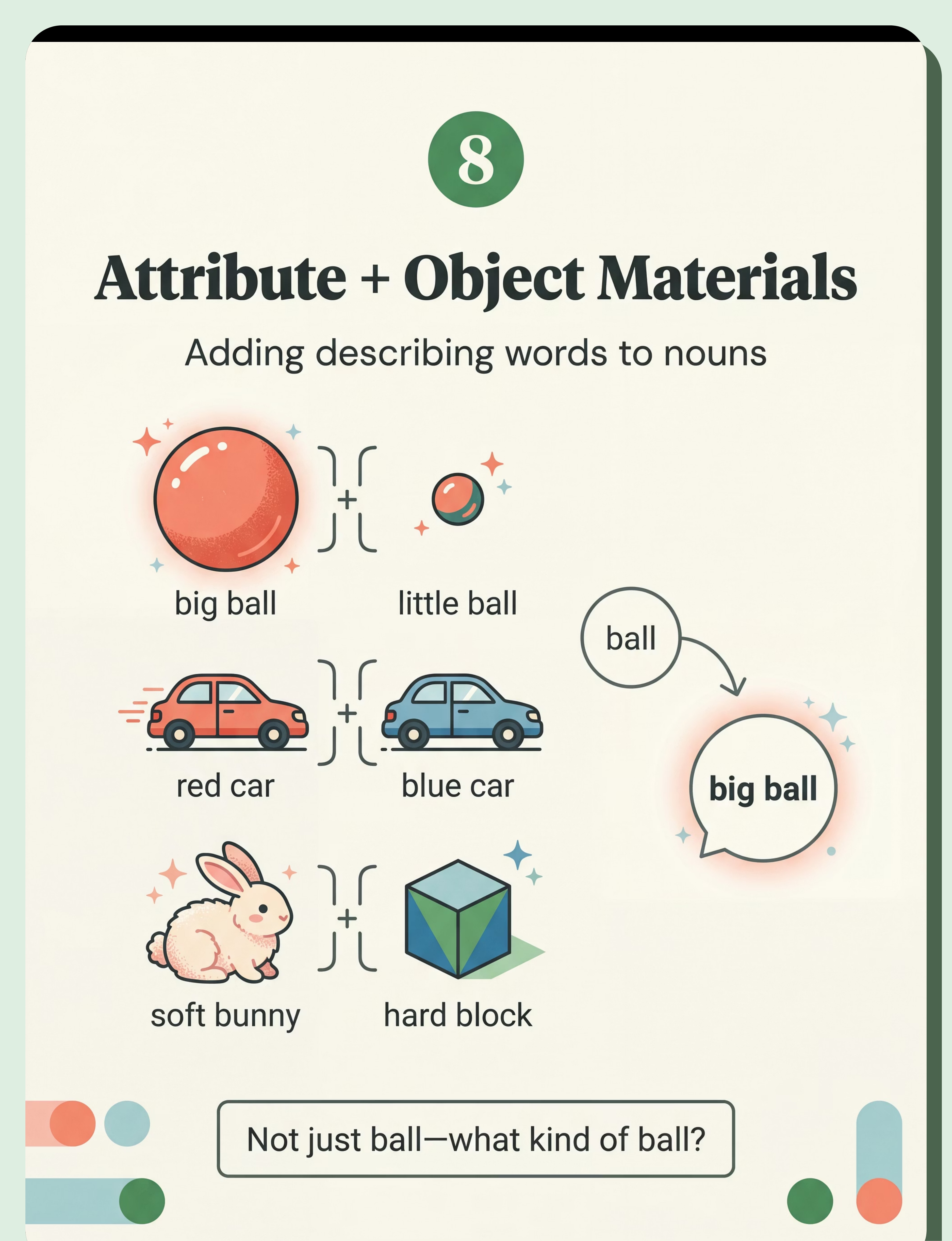
🎨 Material 8 — Attribute + Object Teaching Materials
Pairs of identical objects in contrasting sizes, colors, or textures that make adjective use functional and necessary. When your child must choose between "big ball" and "little ball," the contrast IS the lesson.
₹400–1,000 | Search Amazon.in: Attribute Teaching Materials Speech Therapy
🏠 DIY Free: Two household objects — different size or color. The contrast creates the material.
🏠 DIY Free: Two household objects — different size or color. The contrast creates the material.
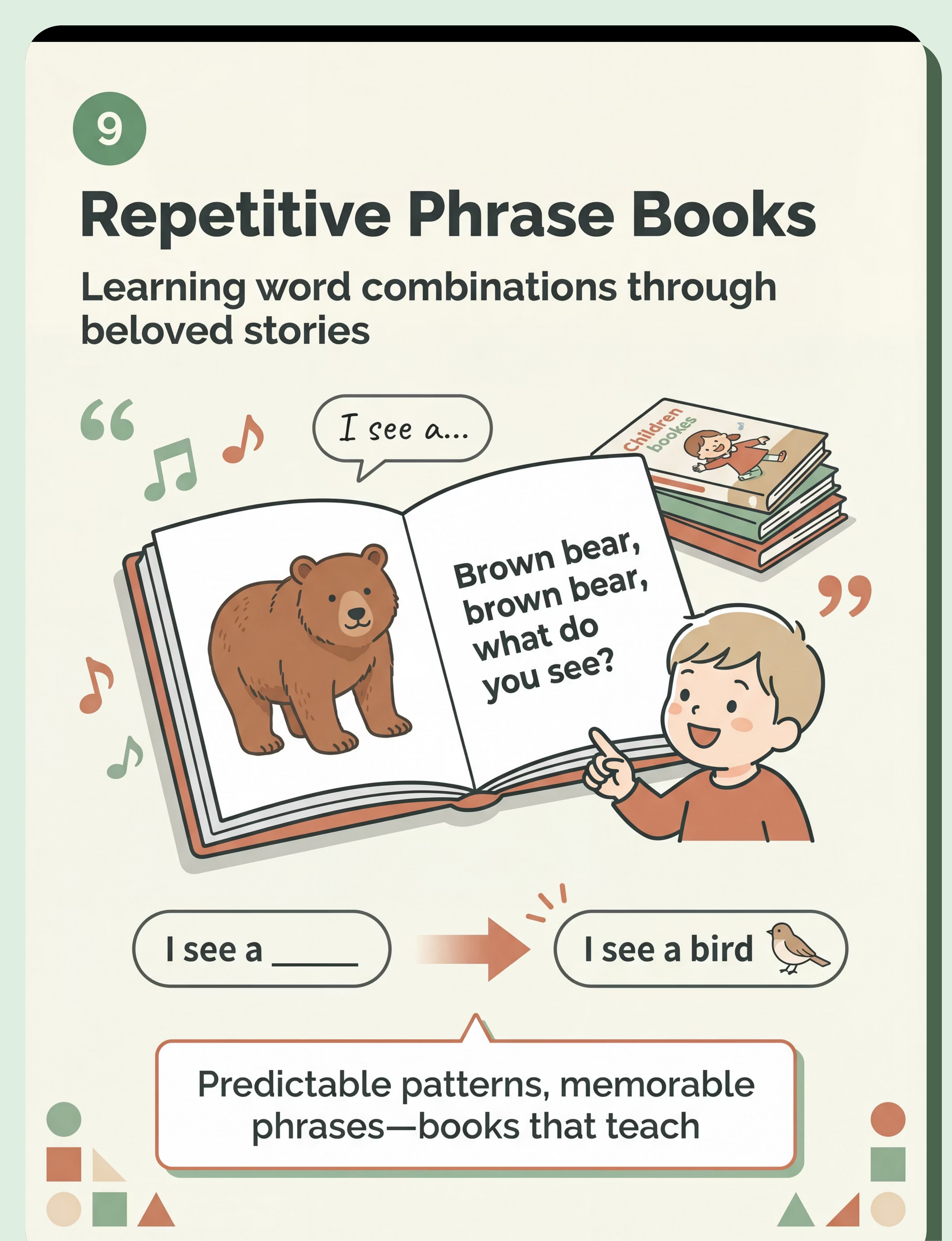
📚 Material 9 — Interactive Books with Repetitive Phrases
Books with predictable, recurring phrase patterns (Brown Bear, Goodnight Moon, Go Dog Go) make word combinations memorable, anticipatable, and producible through beloved story repetition. Pause + let child fill in.
₹200–800 per book | Search Amazon.in: Brown Bear Repetitive Phrase Books
🏠 DIY Free: Any book already at home — pause at predictable spots and let child fill in the phrase.
🏠 DIY Free: Any book already at home — pause at predictable spots and let child fill in the phrase.
💰Full kit: ₹2,700–9,800 | Essential starter trio: ₹900–3,000 | ₹0 DIY version: fully possible. Helpline: 9100 181 181 — Our SLPs will guide you to the right materials for your child's specific profile.
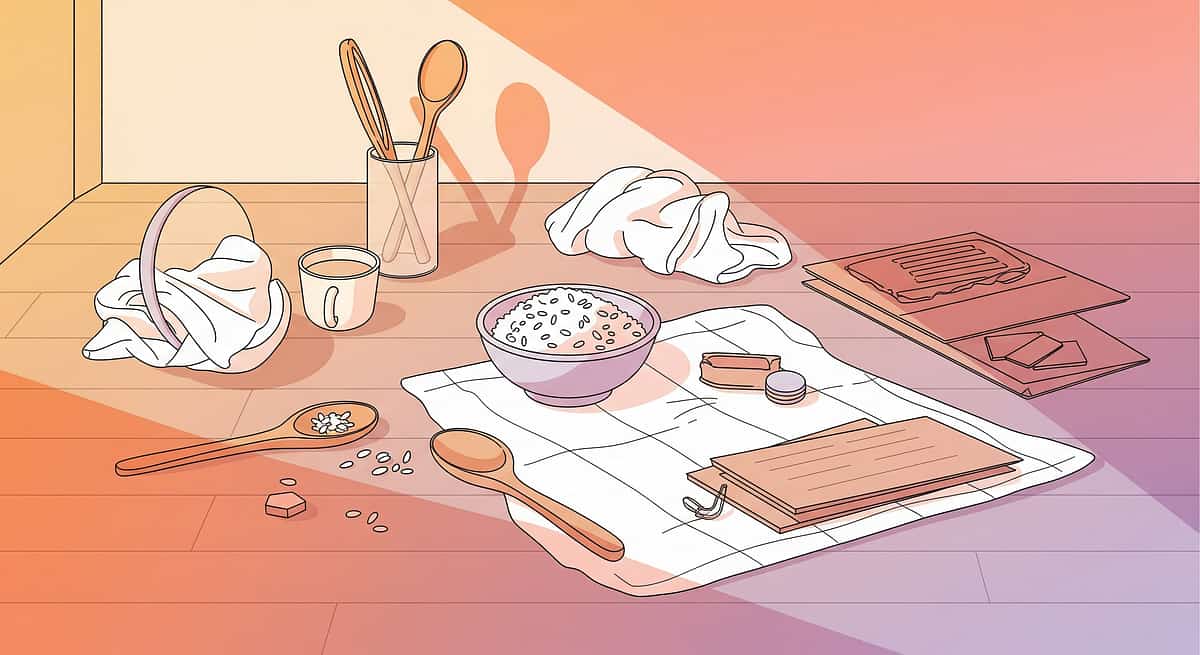
Every Technique. Zero Budget Required.
"Effective language intervention is not the privilege of families who can order from Amazon. Every material on this page has a household equivalent that works on the same neurological principle." — Pinnacle Blooms Consortium | WHO/UNICEF Equity Principle
Material | Buy Version | Make It FREE | |
Carrier Phrase Board | ₹300–900 laminated boards | Write "I want ___" on paper. Stick to table. Done. | |
Two-Word Phrase Cards | ₹400–1,200 flashcard sets | Cut pictures from magazines. Write 2-word labels below. | |
Core Word Board | ₹400–1,500 printed boards | 16 words on A4 laminated sheet. Costs ₹20. | |
Sentence Tiles | ₹500–1,800 word tile sets | Index cards + marker + colors. Done in 10 minutes. | |
Expansion Scripts | ₹200–600 guide booklets | Sticky note: "Take their word. Add one word." Post everywhere. | |
Choice Boards | ₹300–800 visual choice kits | Two pictures cut from product packaging. Free. | |
Action+Object Sets | ₹400–1,200 activity kits | Any toy. Any action. Label it consistently. Free. | |
Attribute Materials | ₹400–1,000 comparison kits | Two household objects — different size or color. Free. | |
Repetitive Books | ₹200–800 per book | Books already at home. New usage: pause + fill-in. Free. |
⚠️When clinical-grade is non-negotiable: If your child uses AAC (augmentative communication device), consult your SLP before substituting. Device-based core vocabulary boards are not DIY-replaceable. PMC9978394 | Helpline: 9100 181 181
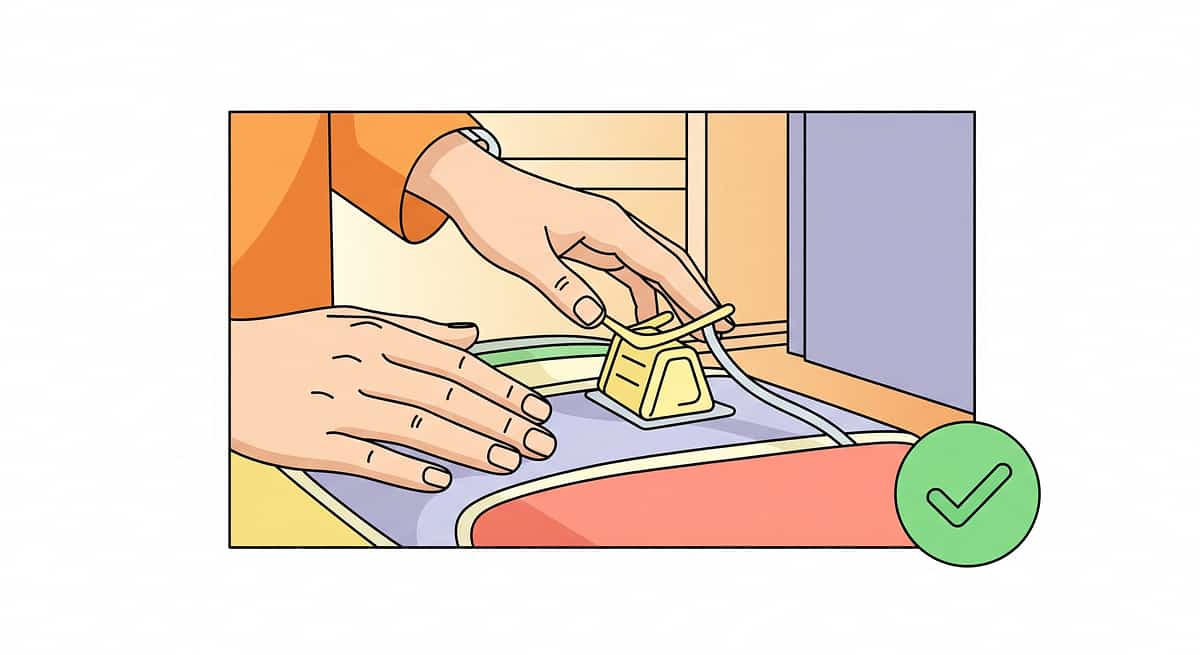
🛑 Read This Before Starting Any Session
🔴 DO NOT PROCEED IF
Child has a fever, illness, or recent vaccination reaction · Child is in active meltdown or post-meltdown recovery (wait 45+ minutes) · Child has not eaten in 3+ hours · You are experiencing extreme stress or time pressure · Child is showing signs of ear pain or hearing difficulty
🟡 MODIFY BEFORE PROCEEDING
Child woke up dysregulated — shorten to 5 minutes, use only favorite materials · Loud environment — move to quiet room first · Difficult day at school — allow 30-minute decompression · First time using new material — introduce in play mode (zero demands) first
🟢 PROCEED WHEN
Child is fed, rested, and in a calm-alert state · Environment is prepared · You have 10–20 uninterrupted minutes · Child has shown interest or positive affect in the last 10 minutes
🚨STOP IMMEDIATELY IF: Child shows self-injurious behavior · Child becomes so distressed breathing is affected · Child shows signs of medical distress → Call 9100 181 181 immediately. All picture cards should be laminated if child mouths objects. Sentence tiles sized for child's hands — avoid choking-size pieces for children under 3.
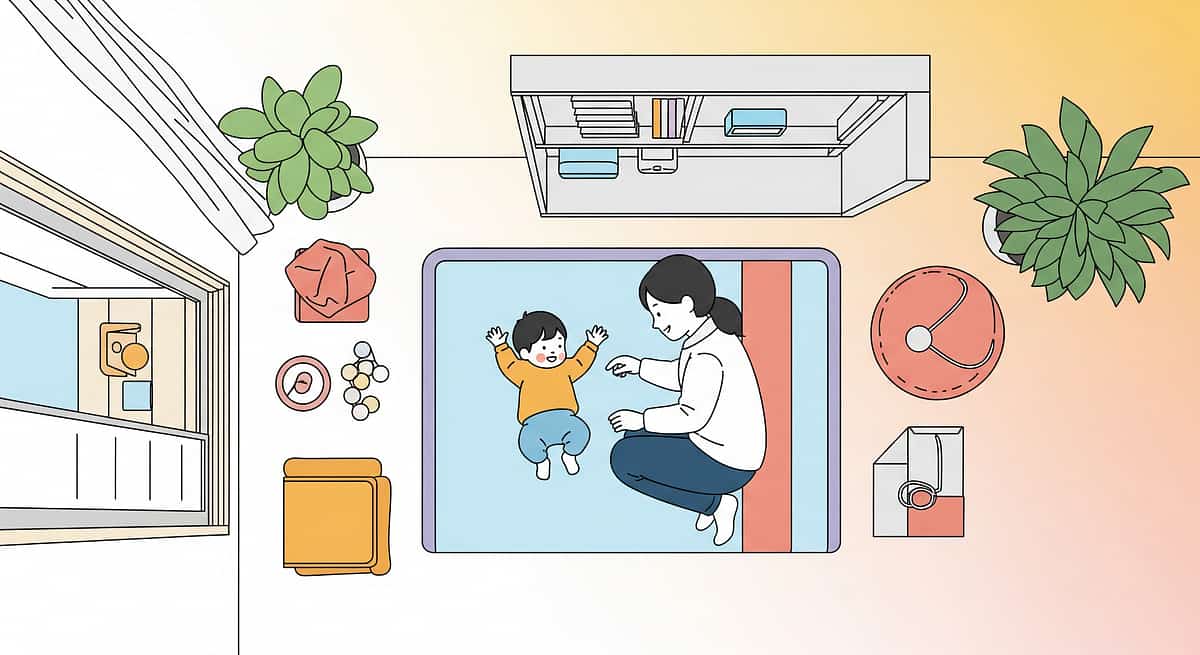
The Language Learning Environment — Set It Right
The physical space where you practice B-176 directly affects your child's ability to attend, process, and produce language. A 5-minute setup transforms session outcomes.
Room Setup Checklist
✅Position 1 — Core Word Board: Eye-level, accessible from child's seat, not blocked
✅Position 2 — Child's Seat: Stable chair, feet flat on floor — not sofa/beanbag for active sessions
✅Position 3 — Your Position: At child's face level — sit on floor, kneel, or use same-height chair. NEVER standing above.
✅Position 4 — Materials: Within visual access but not all out at once (reduces distraction)
✅Position 2 — Child's Seat: Stable chair, feet flat on floor — not sofa/beanbag for active sessions
✅Position 3 — Your Position: At child's face level — sit on floor, kneel, or use same-height chair. NEVER standing above.
✅Position 4 — Materials: Within visual access but not all out at once (reduces distraction)
What to Remove
❌ TV/screen off or in separate room
❌ Other toys cleared from immediate area
❌ Siblings redirected if they distract
❌ Phone notifications silenced
❌ Other toys cleared from immediate area
❌ Siblings redirected if they distract
❌ Phone notifications silenced
Sensory Setup
Lighting: Natural preferred; avoid fluorescent flicker
Sound: Quiet background acceptable; active noise preferred OFF
Seating: Firm over soft for active sessions
Temperature: Comfortable; not hot (heat increases agitation)
Sound: Quiet background acceptable; active noise preferred OFF
Seating: Firm over soft for active sessions
Temperature: Comfortable; not hot (heat increases agitation)
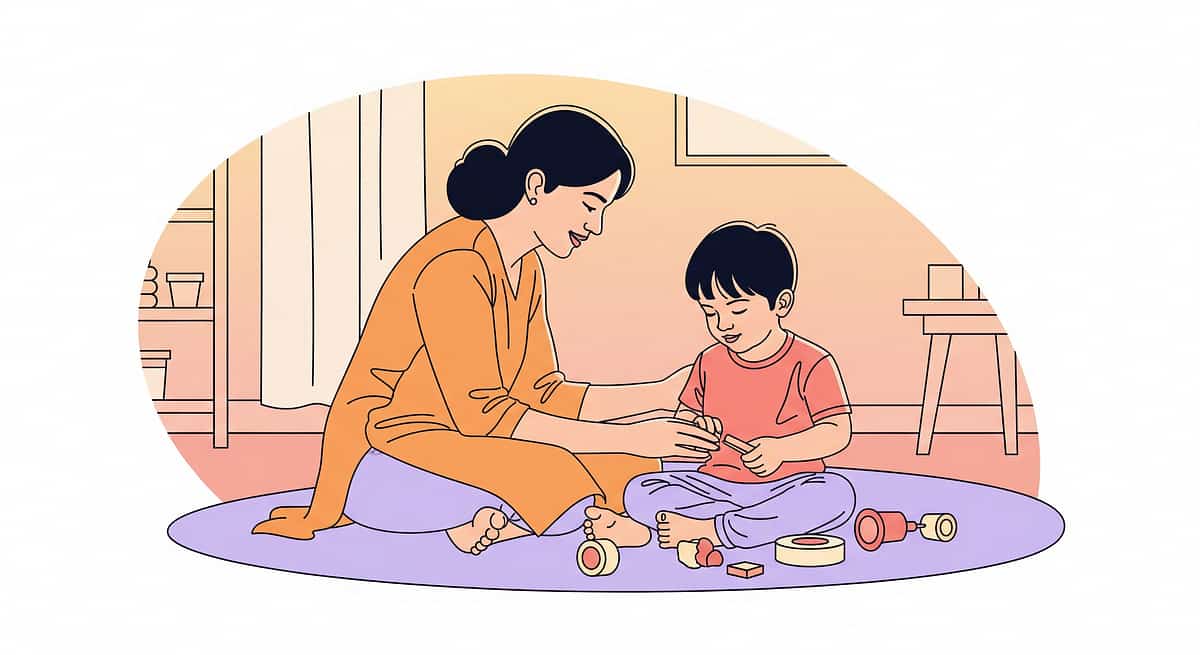
60-Second Readiness Assessment — Before Every Session
Rate each item: ✅ Yes | ⚠️ Partial | ❌ No. The most important session variable is readiness — not materials, not scripts.
☐ Fed
Child ate within the last 2 hours
☐ Rested
Child is not showing sleepiness or fatigue
☐ Regulated
Child is calm-alert, not hyperactive or shutdown
☐ No Acute Distress
No ear pain, illness, or physical discomfort signs
☐ Positive Affect Present
Child smiled, laughed, or engaged in the last 10 minutes
☐ No Recent Meltdown
Last dysregulation episode was 45+ minutes ago
☐ Communicative Intent
Child has looked toward, pointed at, or requested something in the last 5 minutes
Score | Decision | Action | |
6–7 items ✅ | 🟢 GO | Proceed to full protocol — Steps 1–6 | |
4–5 items ✅ | 🟡 MODIFY | Shorten to 5 minutes. Use only #1 most motivating material. | |
0–3 items ✅ | 🔴 POSTPONE | Skip today. Offer preferred activity. Try again tomorrow. |
"The best session is one that starts right. A 5-minute successful session beats a 20-minute forced one. Session abandonment is not failure — it is professional clinical judgment."
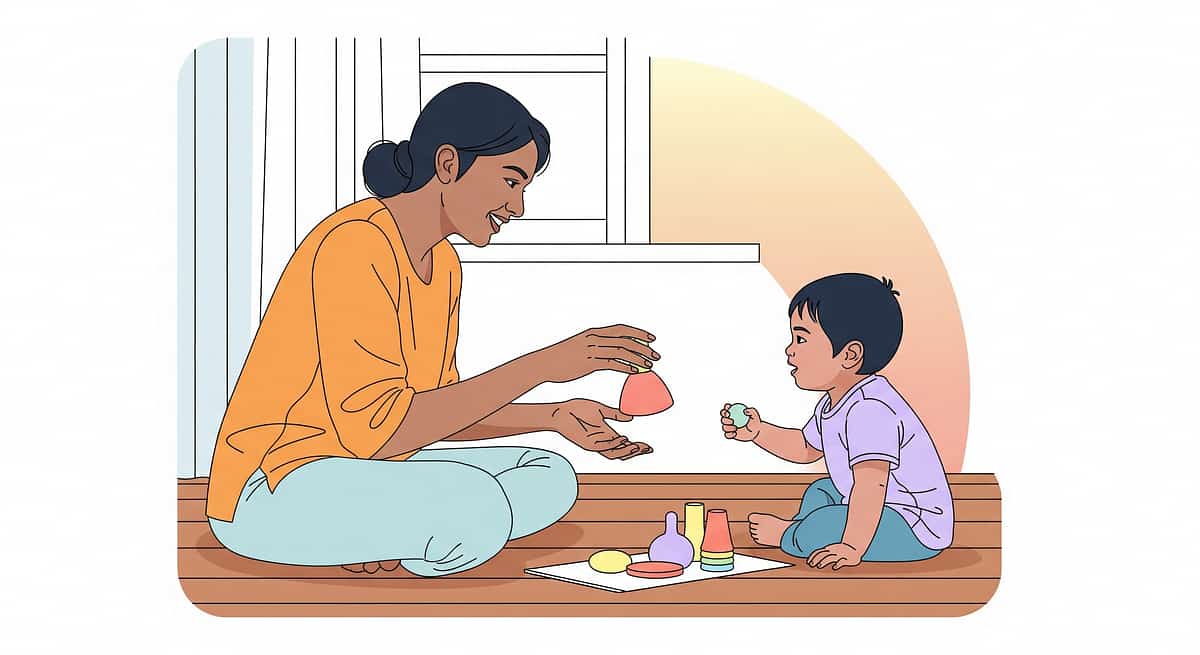
Step 1 of 6
① The Invitation — 30–60 Seconds
"[Child's name], look what I have!" (Hold up the most motivating item — their favorite picture card, preferred toy, or the book they love.) "Want to play?" (Wait 5 seconds. Look expectant. Don't explain or prompt yet.)
Body Language Guidance
Get at child's face level before speaking · Hold item at child's eye level, 20–30cm from their face · Use warm, expectant expression — not anxious or demanding · Wait silently after offering — resist filling the silence
✅ Acceptance Cues — What to Look For
Child looks at the material · Child reaches toward it · Child moves their body toward you · Child vocalizes or points · Child smiles or shows positive affect
⚠️ Resistance Cues — And Modifications
Child looks away → Try a different material. Don't repeat the same one.
Child pushes material away → Accept it. Try in 5 minutes.
Child leaves the area → Follow with one re-offer. If rejected again, Postpone.
Child pushes material away → Accept it. Try in 5 minutes.
Child leaves the area → Follow with one re-offer. If rejected again, Postpone.
ABA Pairing Procedures: Establishing motivating operations before demand placement maximizes intervention acceptance and learning efficiency.
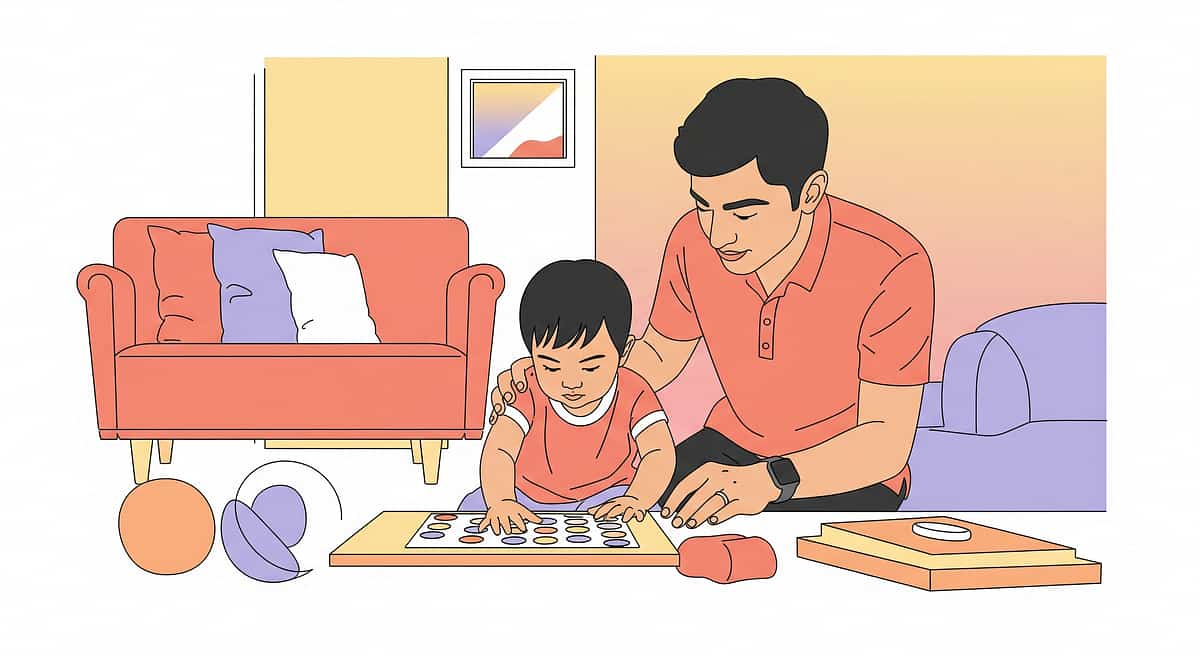
Step 2 of 6
② The Engagement — 1–3 Minutes
Once the child has accepted your invitation, introduce the first material with a clear, calm, and enthusiastic two-word model. The goal here is joint attention on language — not compliance.
1
With Carrier Phrase Board
Hold up the board. Point to "I want." Pick up the first picture card. Say: "I want cookie!" (enthusiastic). Hand child the cookie. Repeat with a different card.
2
With Two-Word Phrase Cards
Hold up the "big ball" card. Say with interest: "Big ball! BIG ball." Show the "little ball" card. "Little ball." Present both. "Which one? Big ball or little ball?"
3
With Core Word Board
During play: Point to "want" on the board. Touch the object. "Want car! You want car!" Model the board point + spoken word together every time.
Child Response | What It Means | |
🟢 Imitates two-word model | Ideal — reinforce immediately with high enthusiasm + access | |
🟡 One word + gesture | Acceptable and meaningful progress — celebrate and expand | |
🔴 Complete withdrawal | Pause and reassess readiness. Do not continue under protest. |
Step 3 of 6
③ The Therapeutic Action — 5–10 Minutes
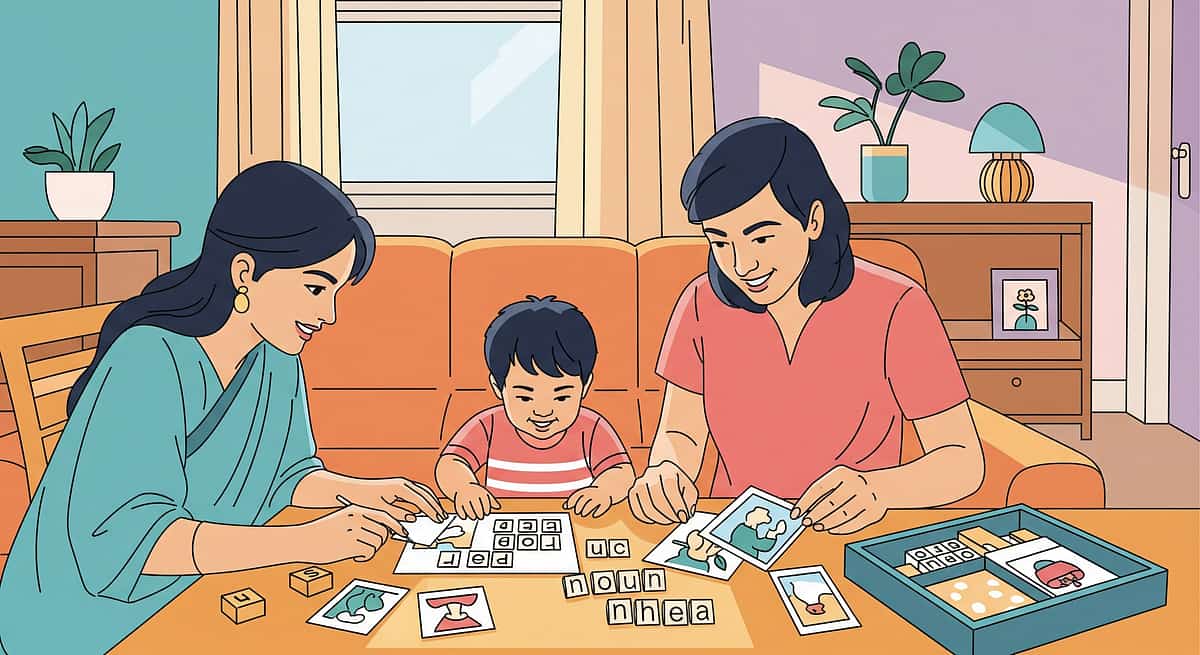
The primary therapeutic mechanism of B-176 is Aided Language Stimulation combined with Expansion-Recasting — the core of every session, where combination pathways are actively carved.
Model two-word combinations constantly during play
"Roll ball!" "Push car!" "Want more!" — narrate every action at the child's target level. Speak at 50% of your natural pace.
Expand the child's single-word productions
Child says "ball" → You say "Big ball! Want ball? Roll ball!" Take their word and add exactly one word — never more in the early phase.
Recast the child's utterances
Child says "juice" → You say "Apple juice? Orange juice? More juice?" Offer the expanded form naturally, without demanding repetition.
Wait — then accept approximations
After modeling, pause for 5 seconds. "ba ba" for "big ball" is progress, not failure. Full access is given for any attempt.
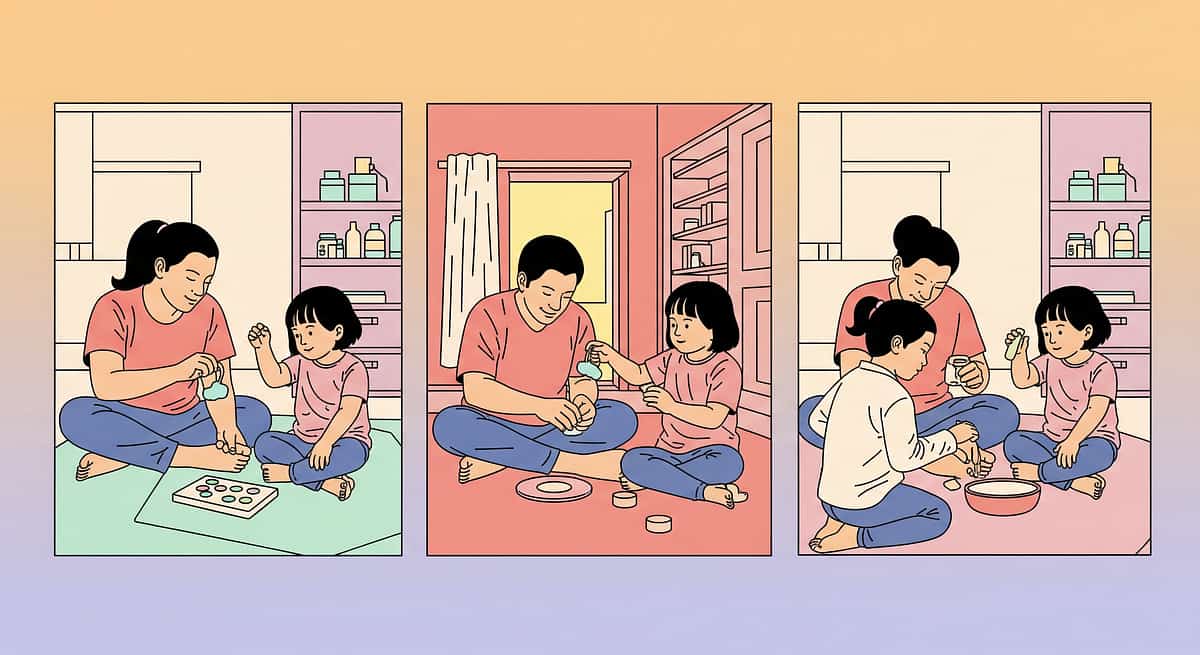
❌Common errors to avoid: Requiring imitation before allowing access · Modeling too fast · Using full sentences when modeling (model ONLY two words) · Using inconsistent vocabulary (stick to same combinations for 1 week per target phrase).
Session target: 10–20 minutes total. Therapeutic action = 5–10 minutes of this window.
Session target: 10–20 minutes total. Therapeutic action = 5–10 minutes of this window.
Step 4 of 6
④ Repeat & Vary — 3–5 Minutes
"3 high-quality, motivated repetitions are worth more than 10 forced, neutral ones."
Target Repetitions Per Session
Carrier Phrase: 5–8 modeled completions
Two-word phrase: 6–10 different two-word models per 15-minute session
Expansion: 100% rate — every child utterance gets expanded
Choice Board: 3–5 choice presentations per session
Two-word phrase: 6–10 different two-word models per 15-minute session
Expansion: 100% rate — every child utterance gets expanded
Choice Board: 3–5 choice presentations per session
Variation Options — To Maintain Engagement
Same Target, Different Context: "Want ball" at play → "Want ball" at snack → "Want ball" in the car
Same Frame, Different Vocabulary: "I want cookie" → "I want juice" → "I want book" → "I want outside"
Same Material, Different Time: Morning: carrier board at breakfast · Afternoon: expansion during outdoor play · Bath time: "Big splash! Little splash!"
⚠️Satiation Indicators — When to Stop: Child looks away consistently · Child moves away from materials · Quality of attempts is declining · Child is producing fewer attempts than 5 minutes ago → Stop. End on a high point. Do not push through satiation.
Step 5 of 6
⑤ Reinforce & Celebrate — Throughout Session
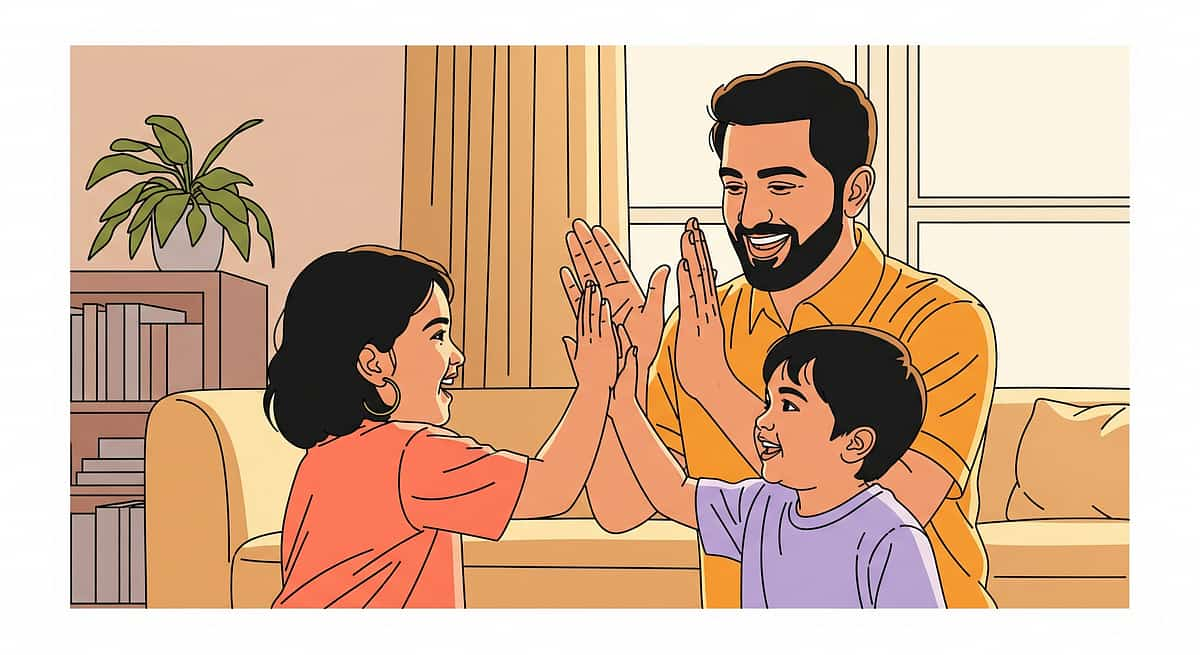
⚡The Golden Rule of Reinforcement: Within 3 seconds. Specific. Enthusiastic.
Child Does | You Say | You Give | |
Points to picture on board | "Yes! Ball! Want ball! GREAT pointing!" | Access to ball immediately | |
Says one word attempt | "BALL! Want ball! You said ball — YES!" | Immediate access + high-five | |
Says 2-word combination | "WANT BALL! You said 'want ball'! AMAZING!" | Highest-value reward available | |
Approximation ("wa ba") | "Want ball! Yes! Wa-ba — want ball! You got it!" | Full access — accept the attempt |
🏆 Reward Stickers (1800+ pack)
₹364 | Amazon — Use as immediate visual token for each combination attempt. Stack on a "phrase star chart."
🏆 Reward Jar (Rosette Imprint)
₹589 | Amazon — Token economy: 1 token per combination attempt → 5 tokens = chosen reward activity.
🏠 DIY Reinforcement
Verbal praise + immediate access (most effective, free) · High-five + silly celebration dance · Sticker on a homemade chart (₹10)
"Celebrate the attempt, not just the success. Every combination attempt — however imperfect — is a neural pathway forming."
Step 6 of 6
⑥ The Cool-Down — 2–3 Minutes
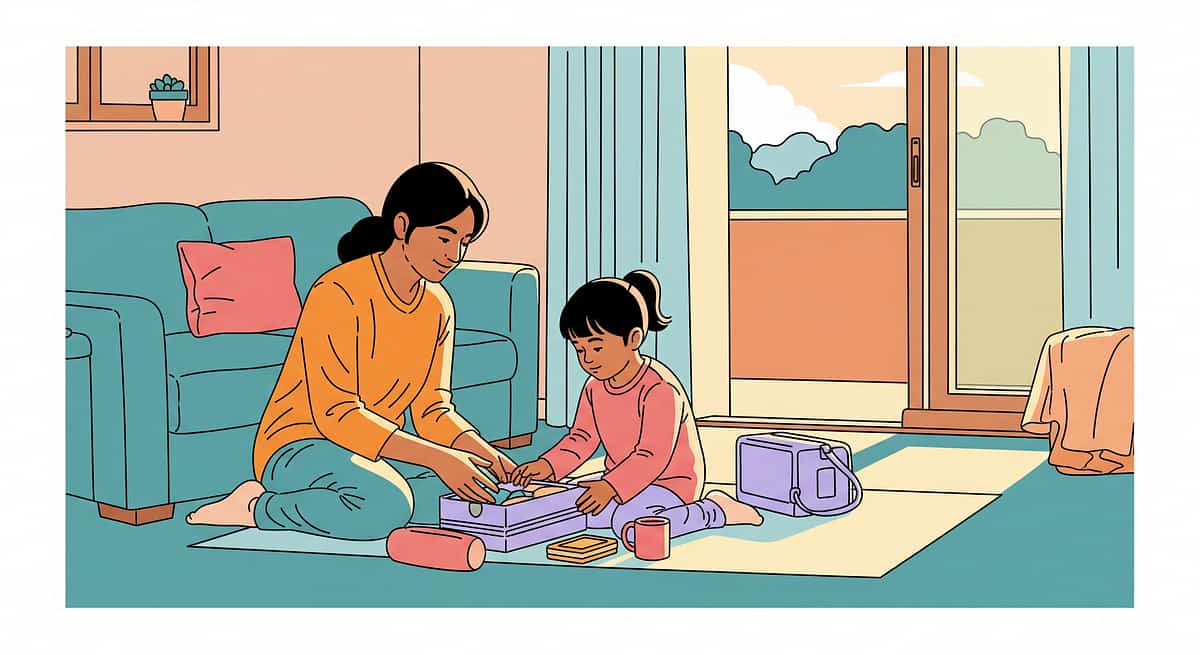
Language sessions activate the child's prefrontal cortex and demand sustained attention. An abrupt ending can cause frustration and resistance to future sessions. A warm, predictable transition closes the circuit and protects tomorrow's session.
Transition Warning — Your Exact Script
"Two more! Two more turns, then all done." (Show 2 fingers. Use visual timer if available.) "One more!" (1 finger.) "All done! You DID it. [Child's name] used words today. Amazing."
Cool-Down Activity — Choose ONE
Heavy work: push chair in, carry book to shelf · Sensory calming: squeeze toy, deep breath together · Quiet preferred activity: looking at a favorite book (no demands) · Movement break: 5 jumping jacks together
Material Put-Away Ritual
Involve the child in packing away: "Can you put the cards in? Good helping!" This creates a clear activity boundary and models following routines.
If Child Resists Ending
"I know — fun! We'll do this again tomorrow." Do NOT extend the session under protest pressure — this teaches that protest extends sessions.
NCAEP (2020): Visual supports are classified as evidence-based practice for autism — support transition and self-regulation.
60 Seconds of Data. Weeks of Insight.
Recording three simple data points after each session transforms guesswork into a progress chart. 60 seconds now saves hours of uncertainty later.
Spontaneous Two-Word Combinations
How many times did the child spontaneously produce a 2-word combination (not prompted, not imitated)?
Record: 0 / 1–2 / 3–5 / 5+
Record: 0 / 1–2 / 3–5 / 5+
Session Engagement Quality
Rate the session: 1 (refused/distressed) → 2 (tolerated) → 3 (engaged) → 4 (enthusiastic) → 5 (child-initiated language)
Best Attempt of the Session
Write down the best two-word combination attempt exactly as the child produced it.
Example: "wa ba" (want ball) | "mo joo" (more juice) | "big cah" (big car)
Example: "wa ba" (want ball) | "mo joo" (more juice) | "big cah" (big car)
📊 Your session data feeds into your child's GPT-OS® language profile — tracking MLU trajectory, combination category growth, and optimal next-step recommendations across 70,000+ technique pathways. Download the B-176 Weekly Language Tracker PDF at techniques.pinnacleblooms.org · Helpline: 9100 181 181
It's Data, Not Failure. Here's What to Do.
Every difficult session carries information about what to adjust. The 7 most common challenges — and their precise fixes — are below.
Child refused all materials
What happened: Readiness conditions not met, or materials weren't motivating enough. Fix: Use higher-value items next time. The child's favorite snack, toy, or activity determines which material you introduce first.
Child imitated but never produced spontaneously
What happened: Imitation is the prerequisite stage — this is progress. Fix: Reduce model frequency. Model once, then WAIT 10 seconds before re-modeling. Silence creates space for spontaneous production.
Child said two words — but not the ones being practiced
What happened: Generalization — the child is using the combination principle with their own vocabulary. Fix: Celebrate this loudly. This IS the goal. Expand whatever they said.
Child became frustrated and had a meltdown
What happened: Demand level too high, or readiness condition missed. Fix: Review Card 13 checklist. Reduce to zero-demand modeling for next 3 sessions.
Session lasted only 2 minutes
What happened: Satiation or low motivation. This is fine. Fix: 2 minutes of high-quality combination modeling is valuable. Don't extend. Track it as a session.
Child keeps reverting to single words
What happened: Consolidation hasn't occurred yet — single words are cognitively easier under stress. Fix: Normal at weeks 2–4. Continue the protocol. Consistency builds the pathway.
Unsure if child's attempt was a real combination or random sounds
What happened: Natural uncertainty in early combination phase. Fix: If it was functionally communicative (child got what they wanted by saying it) — it counts. Record it. Expand it next time.
🚨 If child showed severe distress, self-injury, or medical symptoms → Call 9100 181 181 immediately.
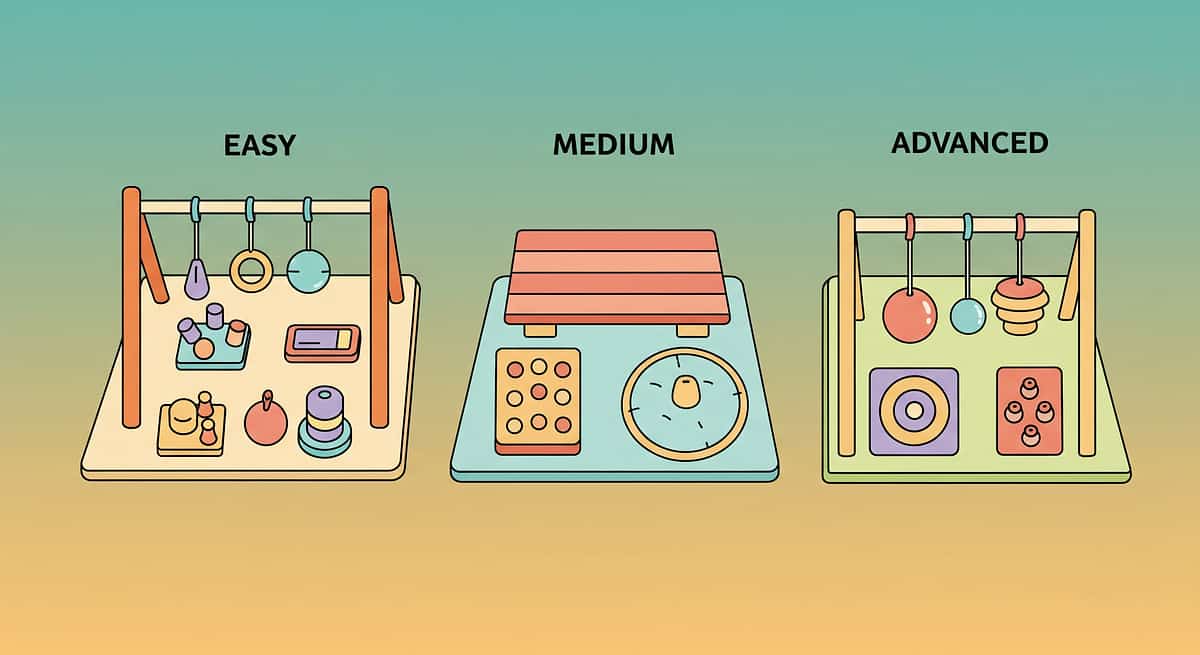
Your Child Is Unique. Your Protocol Should Be Too.
High Sensory Seeker
Do language work during vestibular input (swinging + labeling). Movement enhances attention and language processing simultaneously.
Language Avoider
Keep demand pressure at zero. Model while child plays independently. No eye contact required for language modeling to work.
Rigid/Routine-Preferring
Same materials, same order, same phrases every session. Predictability is safety — and safety enables language learning.
Visual Learner
Maximize carrier boards and phrase cards. Minimize verbal-only modeling. Every word should have a visual anchor.
Age Range | Focus | |
18–24 months | 2-word phase only, highest-value items, very short sessions (3–7 min) | |
2–3 years | Add choice boards, sentence tiles, variety of semantic relations | |
3–6 years | Include descriptive language, narrative phrases, conversational expansion |

Weeks 1–2: Don't Look for Combinations Yet. Look for These.
Foundation Phase
Progress Bar: 15%
In the first two weeks, the neural pathways for combination are forming — invisibly. These are the visible signs that the work is happening:
✅ Tolerates the materials
Child accepts the carrier phrase board in their space without rejecting it. Tolerance IS progress — it means the pairing phase is working.
✅ Visual attention is building
Child looks at two-word phrase cards for 2+ seconds. Attention precedes production by weeks — this is the foundation being laid.
✅ Increased communicative intent
More pointing, more reaching, more vocalizing. The child is communicating more — even if not yet in combinations. The intent is the seed.
✅ First imitation of a two-word model
Even once = a significant milestone. The motor pathway for that combination has been activated for the first time.
⚠️ Spontaneous two-word combinations are NOT expected in weeks 1–2. Neural pathways require 50–100+ exposures to a phrase before spontaneous production typically emerges.
💛 "If your child tolerated the materials and you modeled combinations 3+ times daily for 14 days — you have already done the most important work." Helpline: 9100 181 181
💛 "If your child tolerated the materials and you modeled combinations 3+ times daily for 14 days — you have already done the most important work." Helpline: 9100 181 181

Weeks 3–4: The Neural Pathways Are Forming. Here's How to Spot It.
Consolidation Phase
Progress Bar: 40%
Anticipates the Routine
Child reaches for the carrier phrase board before you set it up. The routine has become familiar and desired — a powerful predictor of combination emergence.
Consistent Imitation
Child imitates two-word models 3+ times per session. Consistent imitation is the direct predecessor of spontaneous production — you are one step away.
First Generalization Sign
Child uses a combination spontaneously in a NEW context you didn't practice. This is generalization beginning — the most exciting indicator in this phase.
Longer Eye Contact
Increased joint attention: child checks your face after saying something. The social-language loop is activating — child is noticing you notice them.
💙 "You may notice YOU are more confident too. Parents who reach week 4 have crossed the hardest part — the consistency gap. Your confidence teaches your child."
If child is showing 5+ consistent spontaneous combinations per session → Increase to 5 sessions/day. The window is opening.
If child is showing 5+ consistent spontaneous combinations per session → Increase to 5 sessions/day. The window is opening.

Weeks 5–8: Mastery Indicators
Mastery Phase
Progress Bar: 75%
🏆B-176 MASTERY UNLOCKED — when all criteria below are met consistently for 2 weeks.
✅ Spontaneous Combinations
Child produces 5+ spontaneous two-word combinations per 30-minute observation period, without prompting from any caregiver.
✅ Semantic Variety
Combinations include 3+ different semantic relations: action+object, attribute+noun, more+noun — showing the combination principle has generalized across meaning types.
✅ Partner Generalization
Combinations appear with at least 3 different communication partners (not just the primary caregiver). The skill is truly the child's — not context-dependent.
✅ Setting Generalization
Combinations appear in at least 3 different settings: home, school, outdoors. The neural pathway is robust and context-independent.
✅ MLU Maintenance
Mean Length of Utterance of 1.5+ maintained for 2 consecutive weeks without intensive support. The combination phase is consolidated.
🌟The most important generalization signs: Child combines words with grandparents without training · Teacher reports new phrases at school · Child produces NEW combinations never specifically taught · Child self-corrects from single word to combination
All mastery criteria met → Progress to 3-word phrase work using these same materials with higher targets (B-177+ series). Call 9100 181 181 for your personalized next-step pathway.
🎉 Your Child Is Combining Words. You Did This.
"You showed up for 5–8 weeks. You modeled combinations during breakfast, during play, during bath time, during every drive. You resisted the pressure to demand and chose to model instead. You got to child's level — literally and emotionally. And your child's brain rewired because you were there. This is not a small thing. For a child with autism, moving from single words to combinations is the linguistic equivalent of learning to walk. You helped them walk." — Pinnacle Blooms Consortium
Your Child Started With
Communicating with 1-word labels only
They Now Have
Combining words to request, describe, and express
This Opens
3-word phrases → simple sentences → conversation → narrative language → self-advocacy
📸 Document this milestone. Write down your child's first spontaneous two-word combination — the exact words, the date, the context. This moment belongs in your family story. Share with the Pinnacle Blooms parent community. Helpline: 9100 181 181
🚨 Red Flags — Trust Your Instincts
Six signs that require a pause in the home protocol and professional guidance. These are not causes for panic — they are signals to escalate to the right support level promptly.
🔴 Flag 1: Regression
Child loses combinations they had. Why it matters: Language regression in autism can indicate medical, environmental, or neurological events. Action: Pause protocol. Contact 9100 181 181 or your pediatric neurologist.
🔴 Flag 2: No Spontaneous Combination After 8 Weeks
Despite consistent protocol implementation. Why it matters: May indicate apraxia of speech, hearing loss, or cognitive factors. Action: Book a comprehensive SLP assessment. Do not extend home protocol without guidance.
🔴 Flag 3: Increasing Distress During Language Activities
Not just initially — but progressively more over sessions. Why it matters: Increasing distress signals the approach needs professional recalibration, not parent persistence. Action: Pause. Teleconsultation with Pinnacle SLP required.
🔴 Flag 4: Global Language Regression
Child stops using ALL previously established single words. Why it matters: This is a medical emergency. Action: Contact pediatric neurology immediately — do not wait. Call 9100 181 181.
🔴 Flag 5: Apparent Hearing Changes
Not responding to name, missing environmental sounds. Why it matters: Hearing loss directly impairs word combination acquisition. Action: Audiological assessment before continuing any language intervention.
🔴 Flag 6: Caregiver Overwhelm
You feel unable to maintain consistent implementation. Why it matters: Caregiver burnout is a clinical reality that must be named and addressed. Action: Call 9100 181 181. Our counseling team supports parents — not just children.
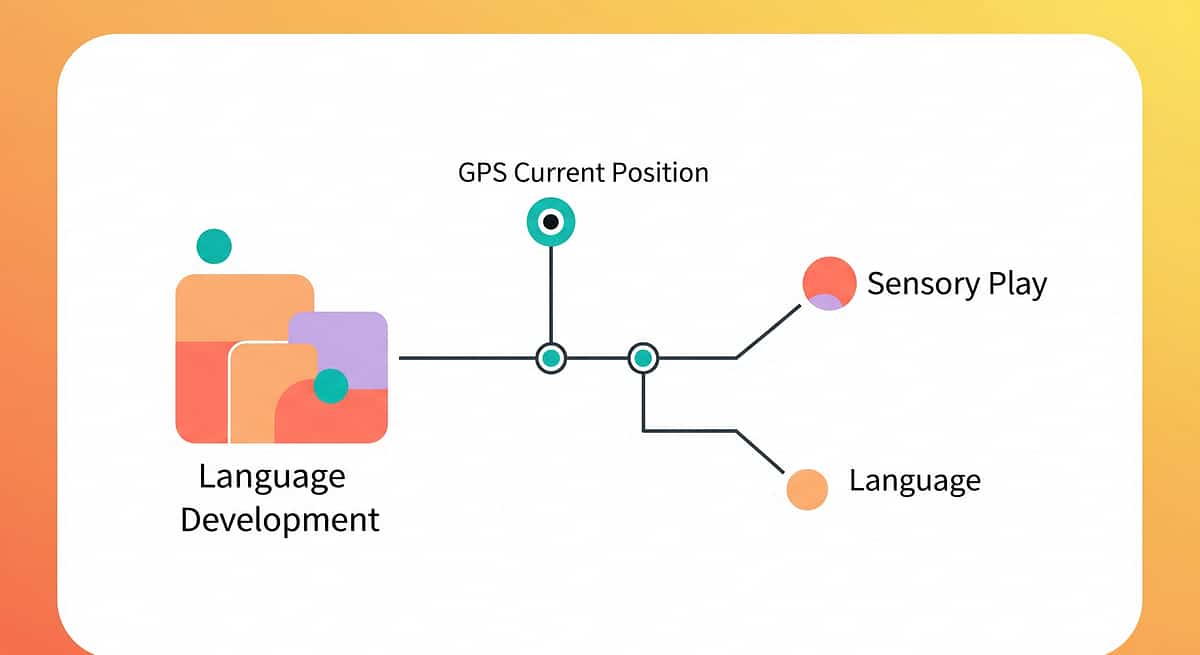
Your Child's Language Journey Map — You Are Here
Prerequisites (What Came Before)
B-174: Listening Skills — auditory discrimination foundation
B-175: Imitation Skills — motor and verbal imitation prerequisite
B-175: Imitation Skills — motor and verbal imitation prerequisite
Next-Level Options
→ If combining words but not responding to name: B-177
→ If combining words but lacks joint attention: B-178
→ If child has both → 3-word phrase work: B-179+
→ If combining words but lacks joint attention: B-178
→ If child has both → 3-word phrase work: B-179+
Lateral Alternatives
→ If visual boards were not effective: Try B-182 (AAC-focused combination approach)
→ If child responds better to movement-based language: Try B-185 (Action-language integration)
→ If child responds better to movement-based language: Try B-185 (Action-language integration)
Long-Term Goal
Word combinations → simple sentences → paragraph-level narrative → academic language → social communication → self-advocacy.
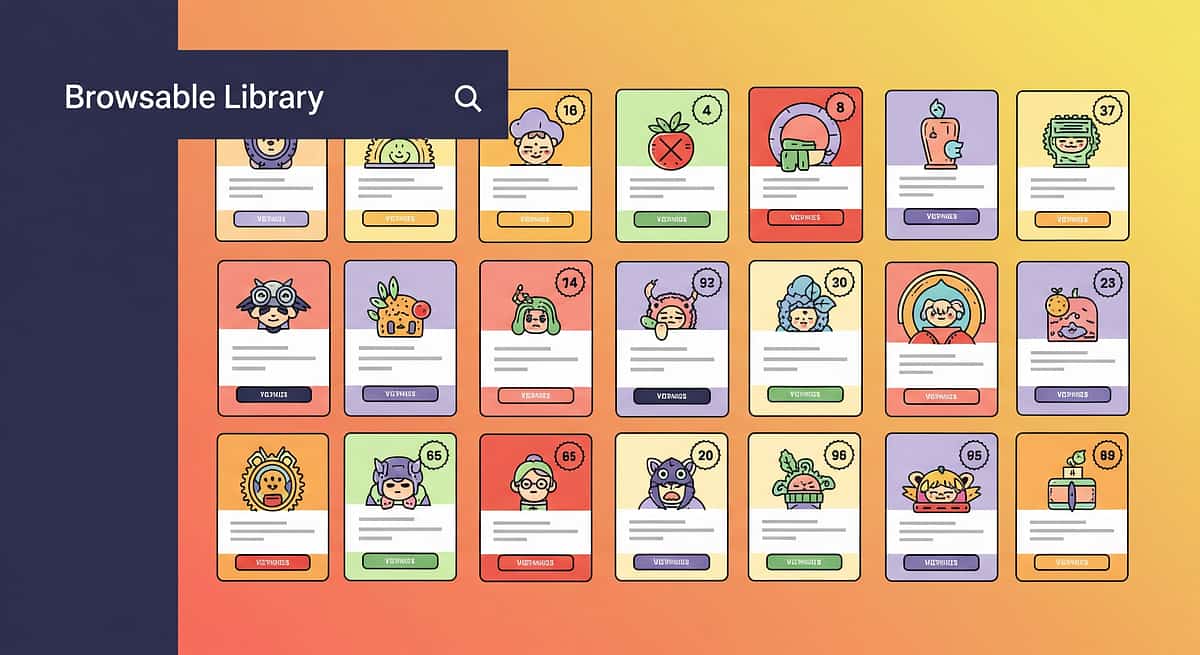
More Language Techniques From the B-Domain Library
✨ You already own materials for B-174, B-175, B-177, and B-178 from your B-176 kit — immediate continuity with no additional purchases required.
Code | Technique | Level | Materials You Already Have | |
B-174 | Listening Skills Development | 🟢 Intro | Picture cards from B-176 kit | |
B-175 | Imitation Skills Protocol | 🟢 Intro | Any toy from B-176 kit | |
B-177 | Responding to Name | 🟡 Core | Bell + preferred items | |
B-178 | Joint Attention Building | 🟡 Core | Books + bubbles from B-176 | |
B-181 | Requesting Using AAC | 🟡 Core | Communication board from B-176 | |
B-190 | Three-Word Phrase Development | 🔴 Advanced | B-176 materials + expanded frames |
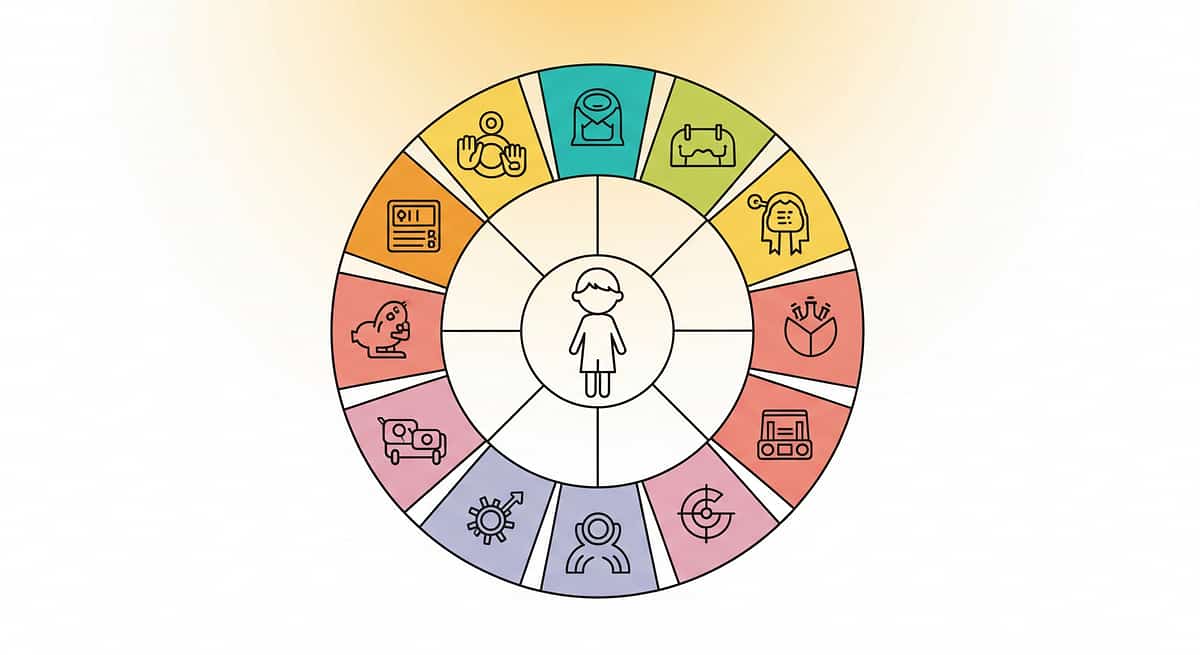
B-176 Is One Piece. See the Whole Picture.
"This technique is one piece of a larger plan. Word combinations unlocked here feed emotional regulation capacity (Domain C), social interaction skills (Domain I), and school readiness (Domain K). Language is the infrastructure of all other domains."
📊 Your child's GPT-OS® developmental profile tracks: Active domains · Technique sequence position · Estimated pathway to sentence-level language: 16–24 weeks with consistent B-domain implementation. See your child's full GPT-OS® profile at techniques.pinnacleblooms.org · Helpline: 9100 181 181
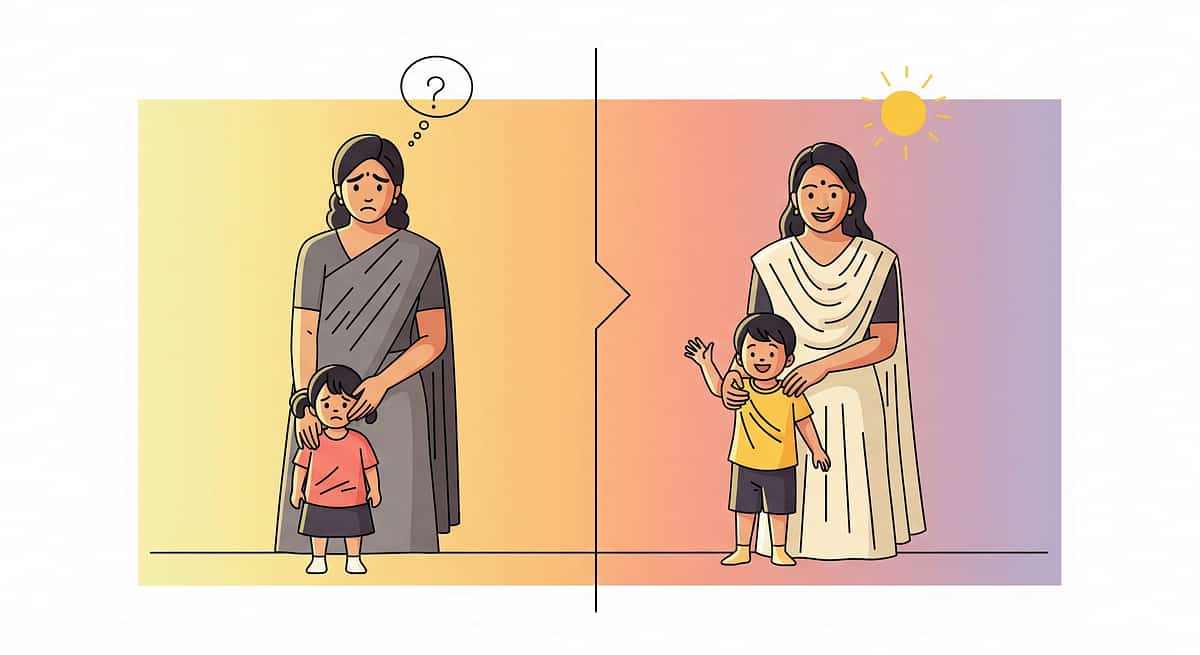
Real Families. Real Combinations. Real Progress.
Arjun's Story — Bengaluru, 2024
"Arjun (3.5 years) had 180 single words. He would stand at the fridge and say 'juice' repeatedly, getting more and more frustrated when we didn't know which juice. We felt helpless."
Week 7: "On Day 49, during breakfast, Arjun looked at the fridge and said 'apple juice.' Just like that. Unprompted. We both started crying. His SLP said his MLU had moved from 1.0 to 1.6 in 7 weeks. He now has over 35 spontaneous two-word combinations." — Family from Bengaluru
"Arjun's breakthrough came when his mother started using the carrier phrase board at every meal. His vocabulary was never the issue — the bridge was missing. We built the bridge." — SLP, Pinnacle Blooms Bengaluru
Priya's Story — Hyderabad, 2024
"Priya (4 years) could name every animal in her books — perfectly. But she couldn't say 'big elephant' or 'baby elephant.' Just 'elephant.' Always 'elephant.'"
Week 6: "After six weeks of attribute + object work and expansion during book reading, she now says 'big elephant,' 'baby elephant,' 'grey elephant,' 'two elephants.' Her combinations come faster than we can track them." — Family from Hyderabad
These are anonymized family vignettes shared with consent through the Pinnacle Blooms Network® family community program.
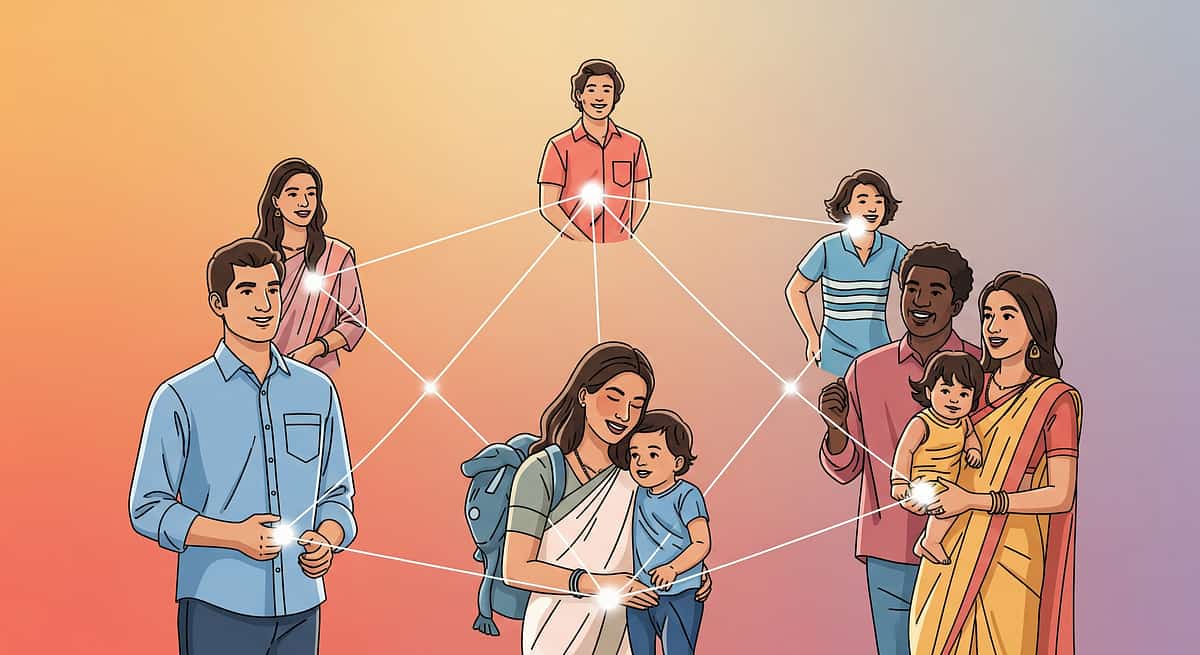
You Are Not Doing This Alone. 50,000+ Families Are Walking This Path.
WhatsApp Parent Group
For families implementing B-domain techniques. Daily tips, parent-to-parent support, therapist check-ins. A community of parents who have been exactly where you are right now.
Pinnacle Online Parent Forum
Searchable threads by technique code. Find parents who completed B-176 and ask them directly about their experience, breakthroughs, and setbacks.
Peer Mentoring Program
Connect with a parent who has implemented B-176 with their child. Guided by Pinnacle's parent mentoring team. Lived experience is irreplaceable.
Local Parent Meetups
Pinnacle centers host monthly family education sessions. Find your nearest center for dates and join parents in your city navigating the same journey.
"Your journey through B-176 will become someone else's hope. When you are ready — consider sharing your story in our community. The parent who is at Week 1 today needs to know about your Week 7."
WHO NCF Community Engagement Principles: Parent support networks improve intervention outcomes and adherence. Helpline: 9100 181 181
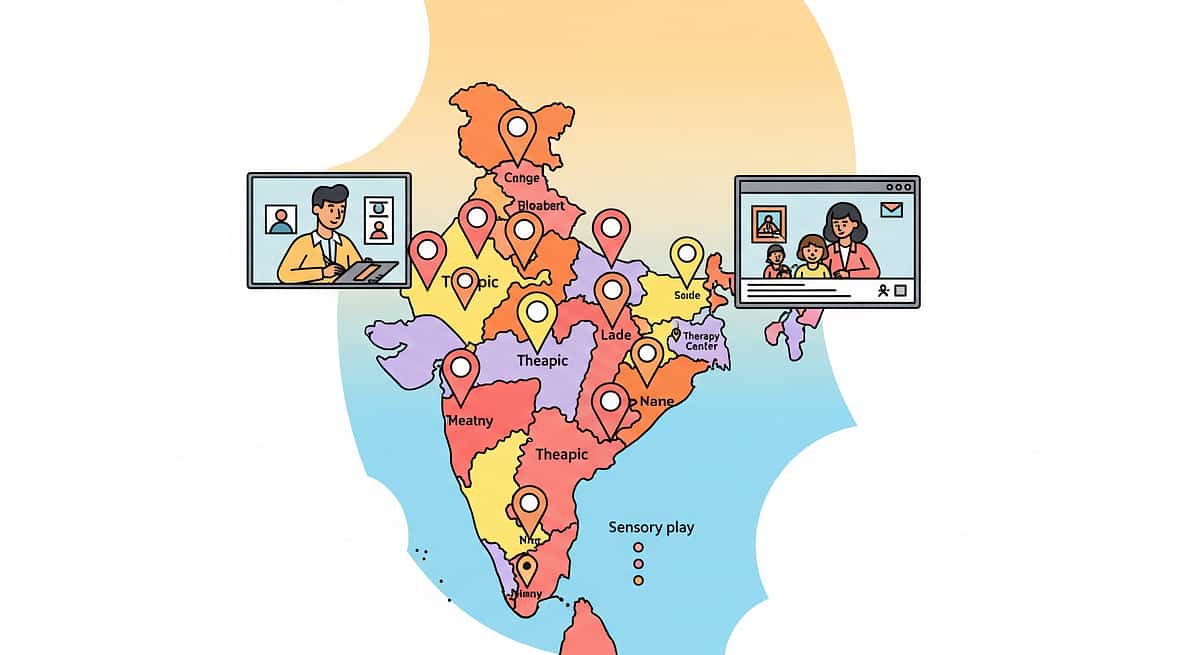
Home + Clinic = Maximum Impact
📍 Find Your Nearest Centre
70+ centers across India | 21 states | 50,000+ families served. Match with a B-176 Specialist SLP at techniques.pinnacleblooms.org
📹 Teleconsultation
30 minutes with an SLP. Available in: Hindi, Telugu, Tamil, Kannada, Malayalam, Bengali, Gujarati, Marathi, English + 8 more languages.
📞 Free National Helpline
9100 181 181 — Free. 24x7. 16+ languages. India's National Pediatric Language Helpline — Powered by Pinnacle Blooms Network®
What Clinic Adds to Home Practice
Comprehensive language profile assessment
MLU, semantic relations, vocabulary depth — a precise baseline to measure against
Therapist-supervised parent training
Watch an SLP model the expansion technique with your child and then coach you in real time
Regular MLU tracking
Objective measurement every 4 weeks with protocol adjustment based on your child's specific data
GPT-OS® integration
Personalized pathway planning from 70,000+ technique options based on your child's unique developmental profile
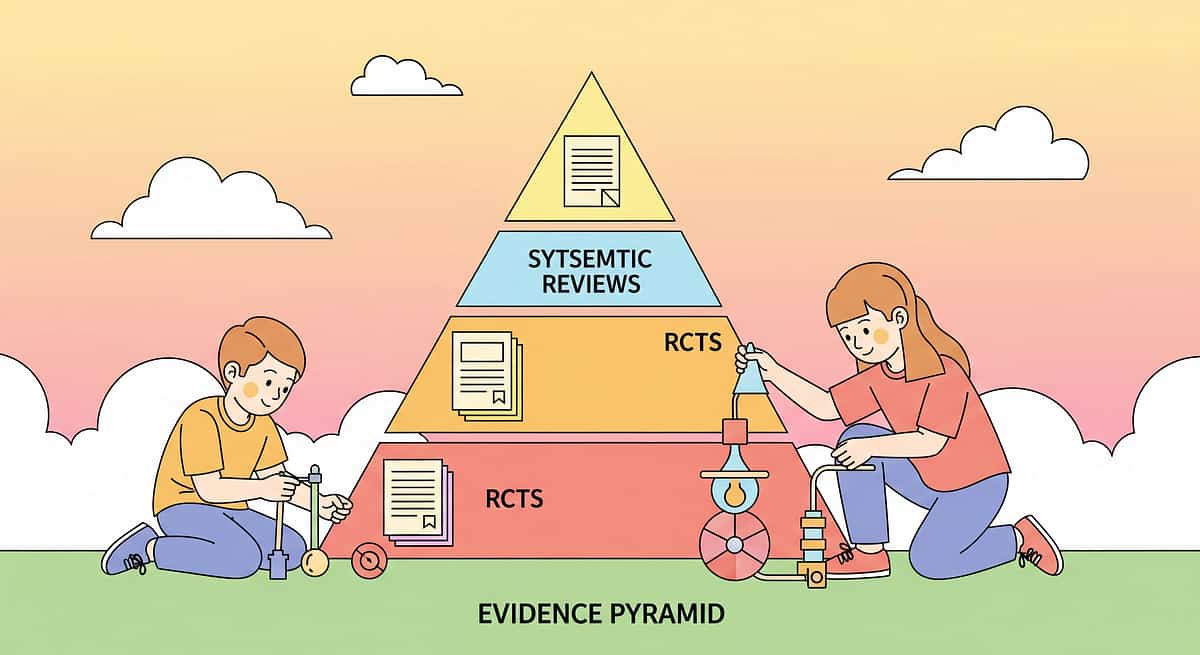
The Science Behind B-176 — For the Curious Parent
These aren't cherry-picked citations. This is the evidence base the Pinnacle Consortium built this protocol on — graded, sourced, and accessible to any parent who wants to go deeper.
PMC11506176 — Children (2024)
PRISMA Systematic Review: 16 studies (2013–2023) confirm structured language modeling meets evidence-based practice criteria for children with ASD. Consistent, measurable outcomes.
PMC10955541 — World J Clin Cases (2024)
Meta-Analysis across 24 studies: language therapy effectively promoted communication skills, adaptive behavior, and social participation.
Padmanabha et al. — Indian J Pediatr (2019)
Indian RCT: Home-based language interventions delivered by trained parents produce significant outcomes in Indian pediatric populations. DOI: 10.1007/s12098-018-2747-4
NCAEP Evidence Report (2020)
Video modeling and aided language stimulation classified as evidence-based practices for autism — directly relevant to B-176's core techniques.
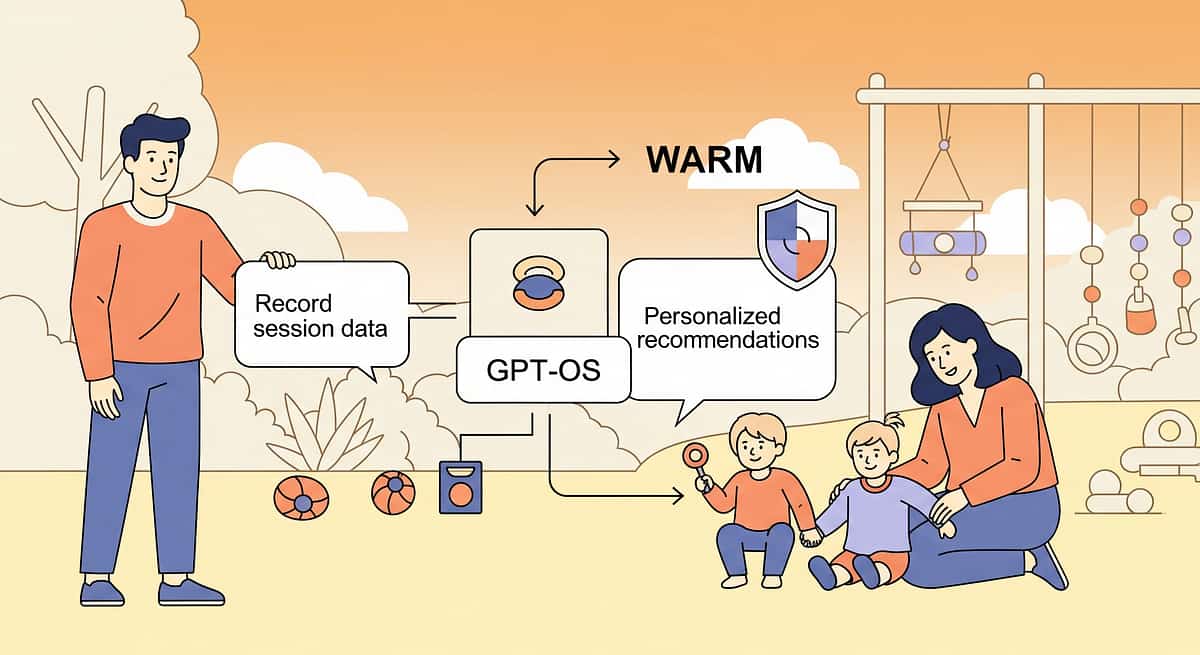
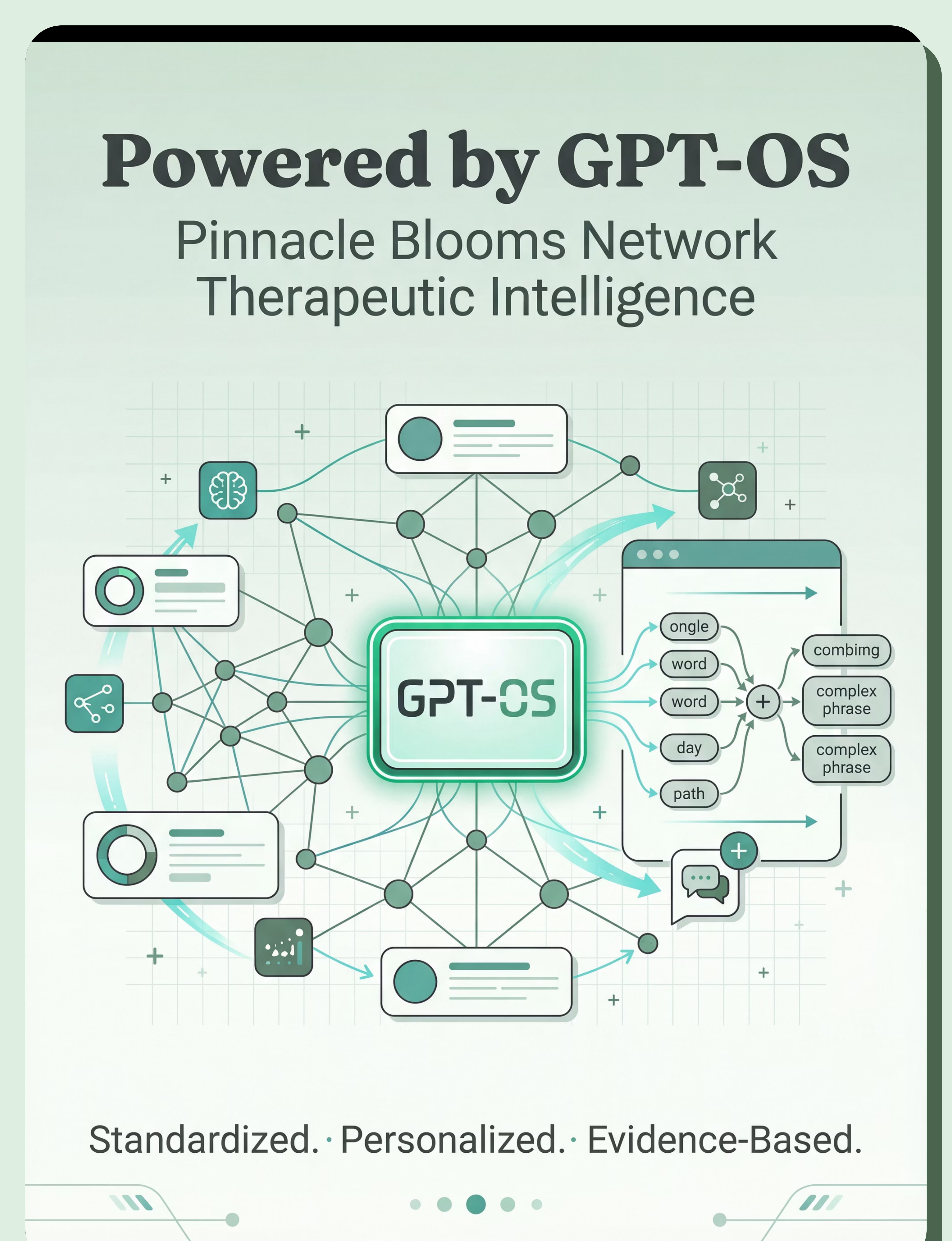
Powered by GPT-OS® Global Pediatric Therapeutic Operating System
What GPT-OS® Learns From Your B-176 Data
MLU trajectory week over week
Precise tracking of mean length of utterance growth compared to population benchmarks
Semantic relation emergence map
Which relation types are emerging vs. still absent — action+object, attribute+noun, possession, location
Material effectiveness ranking
Which of the 9 materials is producing the highest combination frequency for your specific child
Optimal next technique
B-177 vs. B-178 recommendation based on your specific data pattern, not generic pathways
🔒 All data is anonymized and protected under India's DPDP Act (2023) and Pinnacle's clinical data governance protocols. Your child's data is never shared without consent.
"Your data helps every child like yours. When 50,000 families implement B-176 and share outcomes, GPT-OS® learns which combinations of materials work for which child profiles. Your consistent data contribution improves recommendations for the child who starts this protocol tomorrow."
GPT-OS® Identifiers: CIN U74999TG2016PTC113063 | DPIIT DIPP8651 | MSME Registered · Helpline: 9100 181 181
Questions Parents Ask Most — Answered
My child has 300 words but zero combinations. Is this normal?
This is a documented and common profile in autism — the "vocabulary-combination gap." Having an extensive single-word vocabulary without combinations indicates that the combination neural pathway needs specific scaffolding. It is addressable. B-176 is designed exactly for this profile.
How long until I see the first spontaneous two-word combination?
With consistent implementation (3–5 daily contexts), most families see the first spontaneous combination attempt between weeks 3–5. Reliable, generalized combinations typically emerge by weeks 6–8. Week 2 and Week 10 are both within the normal range.
Should I correct my child when they say just one word?
No. Correction reduces communicative confidence. Instead, expand naturally: accept "ball," then say "Big ball! Want ball!" Your expansion is the model; correction is not needed and can be counterproductive.
Which of the 9 materials should I start with?
Start with the one your child responds to most naturally. Books lover → Repetitive Phrase Books. Responds to visual structure → Carrier Phrase Board. In the middle of requesting behavior → Core Word Board. Call 9100 181 181 for personalized guidance.
My child uses combinations at home but not at school. Why?
Generalization challenge — extremely common. The skill is learned but not yet generalized. Share the Family Guide PDF with school and grandparents. Consistent technique across all settings accelerates generalization significantly.
Is B-176 suitable for a non-speaking child using AAC?
Highly compatible. The carrier phrase board, core word board, and choice board principles translate directly to AAC device use. Your SLP should guide AAC-specific modifications. Call 9100 181 181 for an AAC-specialist consultation.
We're doing ABA therapy. Will this conflict?
B-176 is designed to be ABA-consistent. The reinforcement protocols in the Celebrate card are directly aligned with ABA principles. Share this page with your BCBA — it is designed for collaborative implementation.
My child is 6+ years and still in single-word stage. Does this apply?
B-176 is applicable across a broader age range than the 18m–6yr guide. For older children, the core principles hold — materials, pacing, and contexts would be adapted for age. Book a specialist consultation via 9100 181 181 for age-appropriate protocol modification.
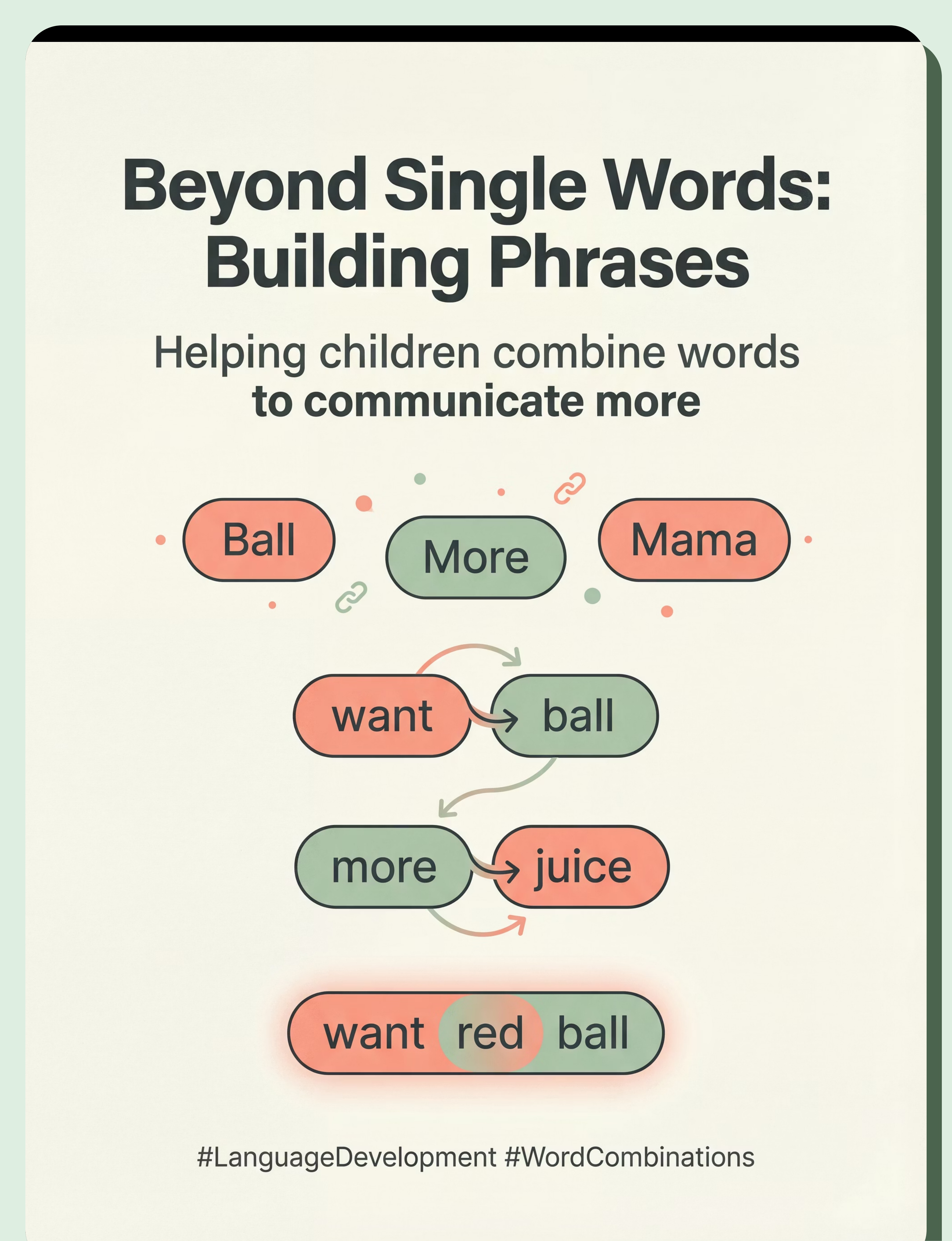
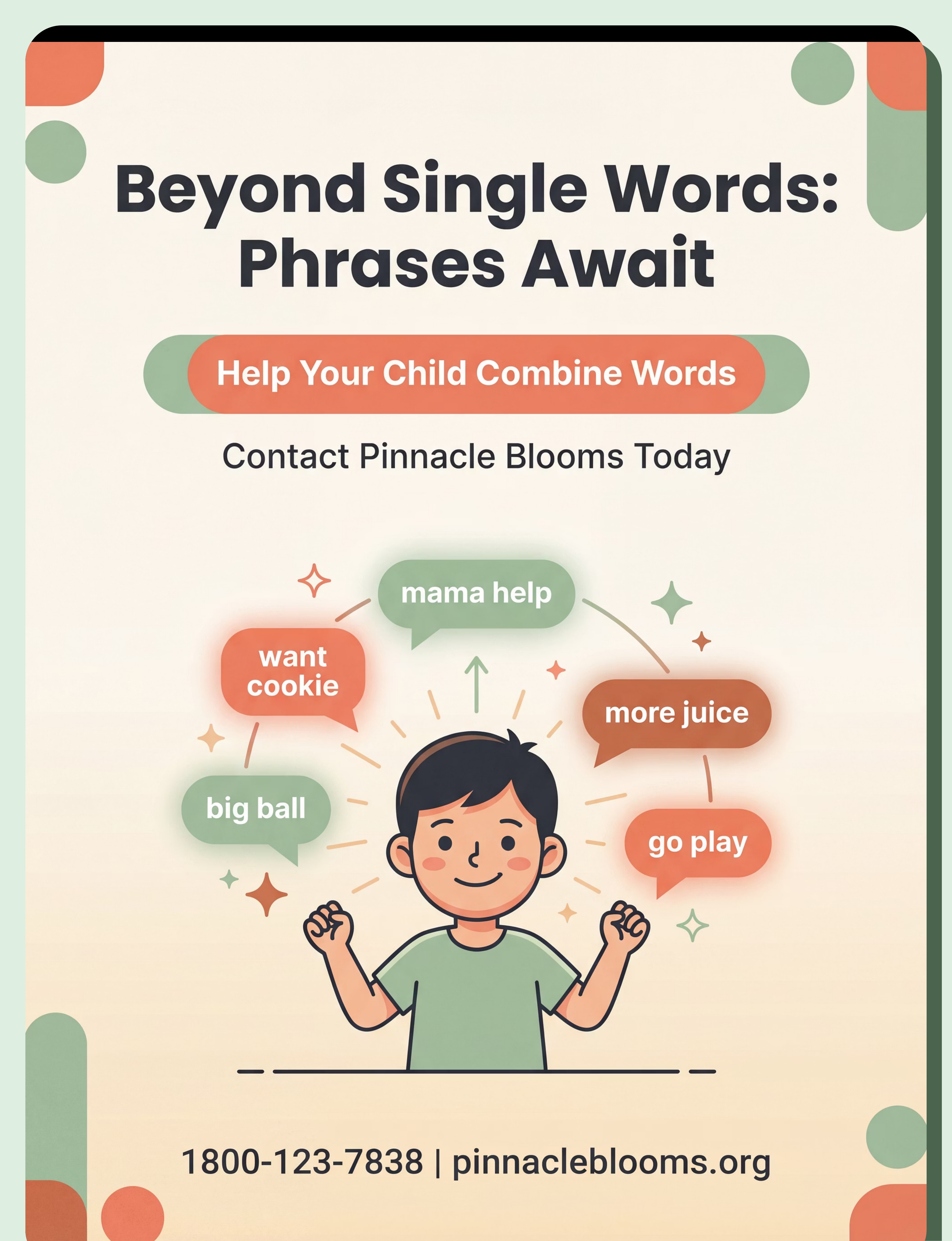
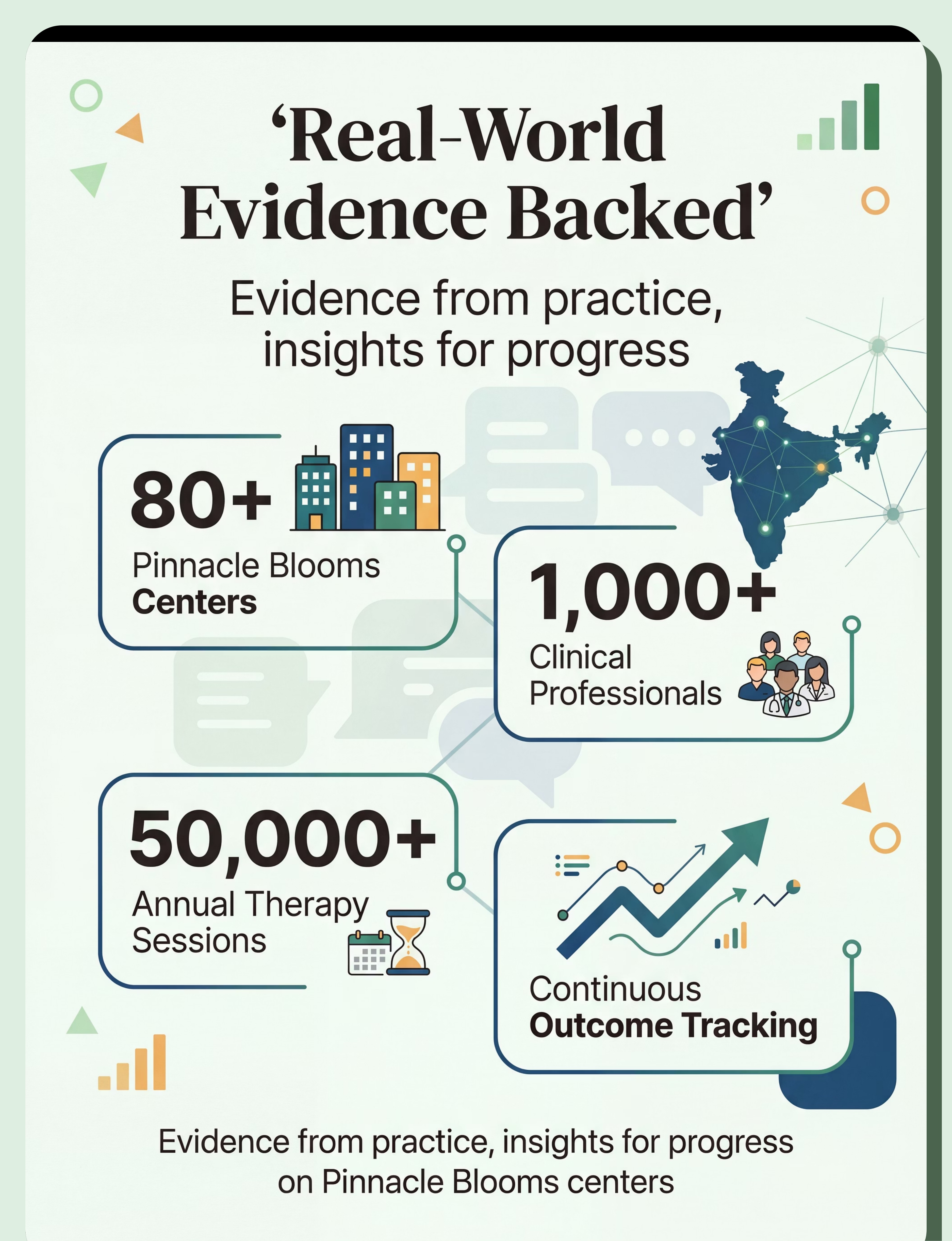
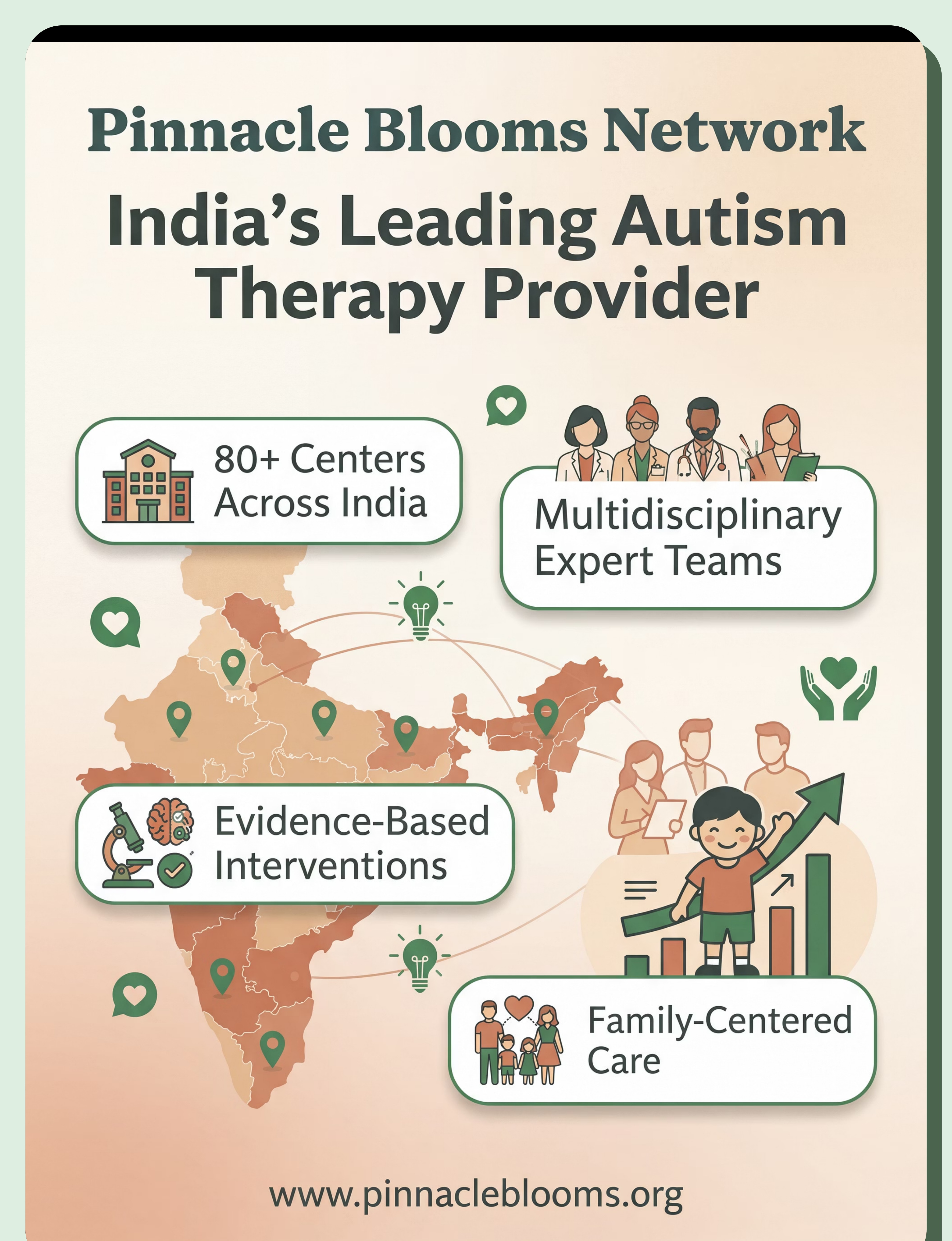
Preview of 9 materials that help when child uses only single words Therapy Material
Below is a visual preview of 9 materials that help when child uses only single words therapy material. The pages shown help educators, therapists, and caregivers understand the structure and content of the resource before use. Materials should be used under appropriate professional guidance.


Link copied!
You've Read the Science. You Have the Materials. Now: Start Today.
"The single most effective thing you can do in the next 24 hours for your child's language development: pick ONE material from the materials list, pick ONE context from daily life, and model a two-word combination five times. That's all. Start there."
70+
Centres Across India
21 states | Nationwide coverage
21M+
Therapy Sessions
Delivered by the Pinnacle Consortium
97%+
Measured Improvement
Validated clinical outcomes
📞 9100 181 181 — Free. 24x7. 16+ Languages. India's National Pediatric Language Helpline — Powered by Pinnacle Blooms Network®
⚕ Pinnacle Blooms Network® — India's Sovereign Pediatric Therapy Consortium
Disciplines: SLP · ABA/BCBA · OT · SpEd · NeuroDev · Pediatrics · CRO · GPT-OS®
Disciplines: SLP · ABA/BCBA · OT · SpEd · NeuroDev · Pediatrics · CRO · GPT-OS®
This content is for educational purposes only. It does not replace evaluation, diagnosis, or treatment by a licensed speech-language pathologist, physician, or qualified healthcare professional. Language intervention should be individualized based on comprehensive professional assessment. Individual outcomes vary based on child profile, implementation consistency, and co-occurring factors. If you have concerns about your child's language development, consult a qualified SLP promptly.
© 2025–2026 Pinnacle Blooms Network® | All Rights Reserved | CIN: U74999TG2016PTC113063 | DPIIT Recognition: DIPP8651 | MSME Registered |