
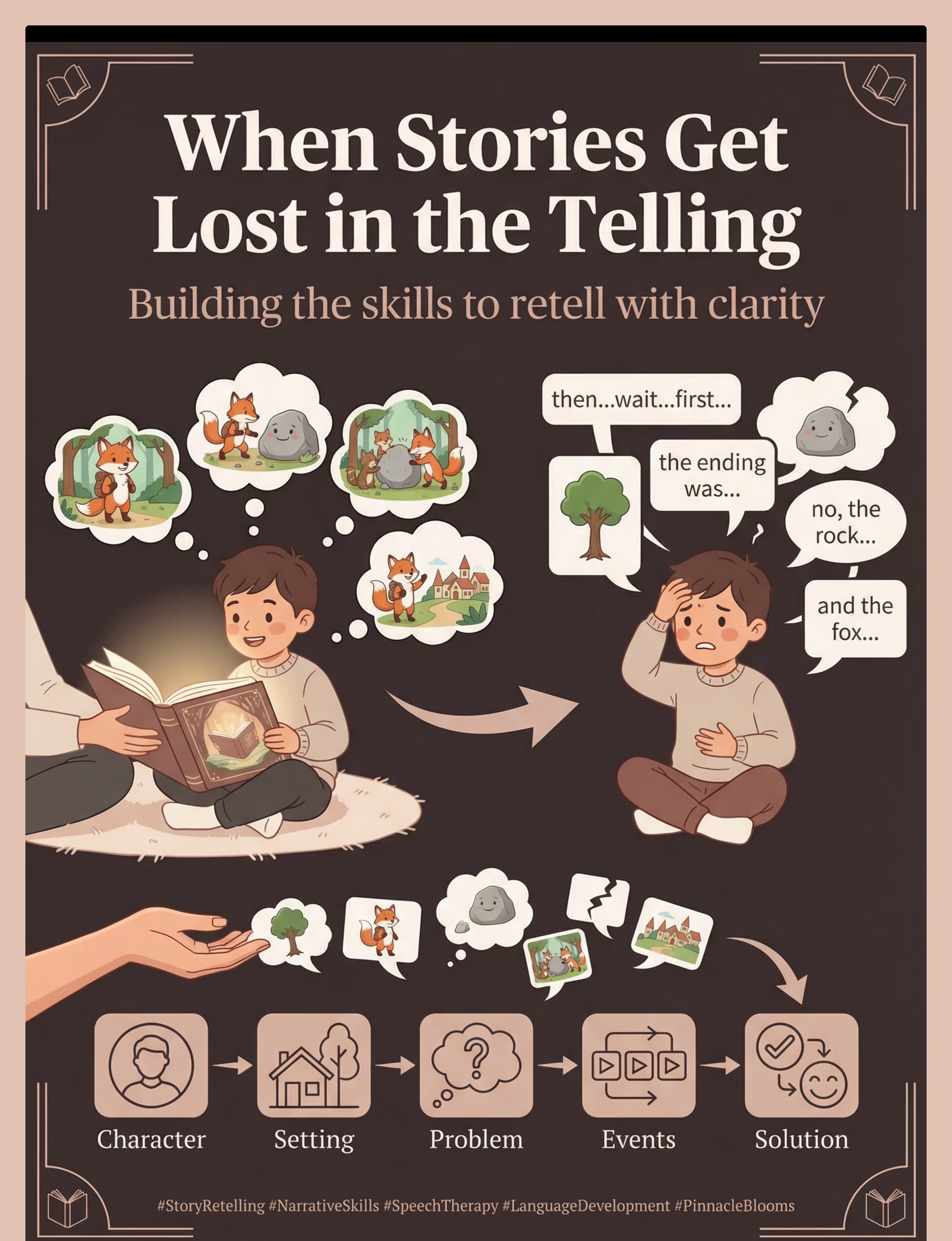
"He heard every word of that story. But when I asked what happened — it came out like a scrambled puzzle."
You are not failing as a parent. Your child's narrative system is learning to do something deeply complex.
9 Materials That Help When Child Can't Retell Stories
Language Solutions Series · B-195 · Ages 3–10
Pinnacle Blooms Consortium — SLP Lead | OT + ABA + SpEd Supporting · WHO Nurturing Care Framework (2018)
You Are Among Millions of Families Navigating This Exact Challenge
Across India and around the world, families are sitting in the same moment you're in right now — watching a child who clearly loves stories struggle to find the words to tell one back. You are not alone, and there is a clear, proven path forward.
1 in 3
Children Affected
Children with language and communication differences show measurable narrative skills deficits — affecting their ability to retell, recount, and share experiences coherently.
68%
ASD + Narrative
Of children diagnosed with autism spectrum disorder present with narrative language difficulties as a core feature — not a secondary concern. Narrative skills are foundational to academic and social readiness.
21M+
Therapy Sessions
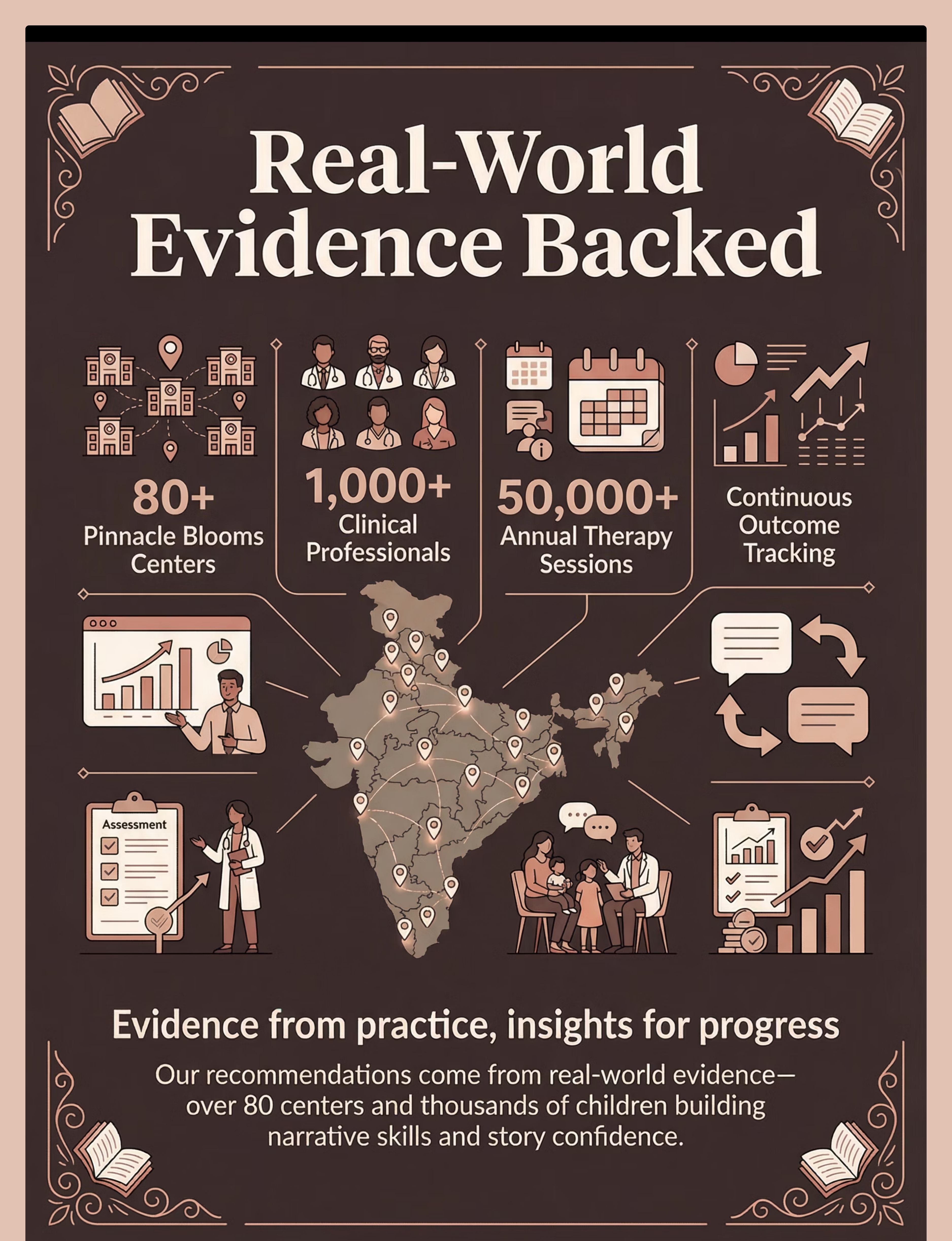
Sessions delivered by Pinnacle Blooms Network® across 70+ centers in India, generating real-world evidence on narrative intervention outcomes.
"She knows the story. I can see it in her eyes. But the moment she tries to tell it back, the beginning appears at the end, the main character disappears, and she's describing the color of a leaf while the whole plot collapses. I thought she wasn't paying attention. The SLP explained: she was paying perfect attention. Retelling is a separate, learnable skill." — Parent, Pinnacle Network, Hyderabad
Sources: PMC11506176 (PRISMA 2024) · PMC10955541 (Meta-analysis 2024) · Pinnacle Network Real-World Evidence: 97%+ measured improvement across language domains.

What's Happening in Your Child's Brain
Story retelling is not simply "remembering what happened." It is one of the most cognitively demanding language tasks a child can perform — requiring three brain systems to work together simultaneously.
The Three Brain Regions Involved
Broca's Area
Assembles language for output — translating stored narrative into spoken words.
Hippocampus
Sequences and retrieves events in order — the brain's internal timeline keeper.
Prefrontal Cortex
Organizes the narrative plan before speaking — the executive director of the story.
Five Skills Required Simultaneously
Auditory Comprehension
Understanding the story as it's heard.
Working Memory
Holding multiple characters, events, and sequences simultaneously.
Narrative Schema Knowledge
Knowing every story has a skeleton: character → setting → problem → events → solution.
Expressive Language Formulation
Assembling stored knowledge into fluent, organized speech.
Executive Function
Suppressing irrelevant details, maintaining order, monitoring coherence.
"This is a wiring difference, not an attention problem." Your child heard the story perfectly. Their executive-narrative integration system is still developing.
Sources: Frontiers in Integrative Neuroscience (2020) DOI: 10.3389/fnint.2020.556660 · Peterson & McCabe (1983) · Stein & Glenn (1979) Story Grammar Framework.

Narrative Development Follows a Predictable Arc — Here Is Where Your Child Is
Every child moves through the same narrative development stages — but at their own pace. Understanding where your child sits on this arc removes the guesswork and focuses your energy precisely where it's needed most.
Age | Stage | What It Looks Like | |
2–3 yrs | Heaps | Disconnected statements, no sequence, random associations | |
3–4 yrs | Sequences | Events linked by "and then... and then..." — no plot structure | |
4–5 yrs | Primitive Narratives | Central character, partial structure, incomplete endings | |
5–7 yrs | True Narratives | Problem → attempts → resolution structure emerging | |
7+ yrs | Complex Narratives | Multiple episodes, subplots, themes, perspective-taking |
Current Challenge Zone (Ages 4–9): If your child is 4–9 years old and not yet producing True Narratives — with problem-resolution structure, character consistency, and event sequencing — targeted narrative intervention is indicated.
Story retelling difficulties frequently co-occur with: Expressive language delays (B-201) · Working memory challenges (B-205) · Sequencing difficulties (B-210) · Reading comprehension difficulties (B-198) · Scripted-only speech patterns (B-193).
Sources: WHO Care for Child Development Package (2023) · PMC9978394 · UNICEF MICS developmental monitoring indicators.

The Evidence Behind This Technique
Narrative Intervention is among the best-evidenced language therapies available for children. This is not an experimental technique — it is established, reproducible, and effective when consistently applied.
Level I–II Evidence
Spencer & Slocum (2010) — American Journal of Speech-Language Pathology. Narrative intervention significantly improved story retelling in children ages 4–8. Effect sizes were large and durable at 3-month follow-up. DOI: 10.1044/1058-0360(2009/09-0003)
PRISMA Systematic Review 2024
Children (MDPI) — PMC11506176. 16 studies (2013–2023) confirm narrative language intervention meets criteria as evidence-based practice for children with ASD and co-occurring language differences.
India-Specific RCT
Padmanabha et al. (2019) — Indian Journal of Pediatrics. Home-based language interventions in Indian pediatric populations demonstrated significant outcomes when parent training was embedded. Narrative was a core target domain. DOI: 10.1007/s12098-018-2747-4
Pinnacle Real-World Evidence
21M+ exclusive 1:1 therapy sessions · 70+ centers · 97%+ measured improvement across language and communication readiness indexes via GPT-OS® therapeutic system. pinnacleblooms.org
"This is not an experimental technique. Narrative intervention is established, reproducible, and effective when consistently applied. The materials on this page have been selected by Pinnacle's multi-disciplinary consortium because they directly address the specific sub-skills where story retelling breaks down." — Pinnacle Blooms Consortium
Story Retelling Intervention — What It Is
Technique B-195
Language Domain · Narrative Skills
Ages 3–10
Story Retelling Intervention is a structured, evidence-based set of techniques and materials designed to teach children the cognitive architecture of narrative — enabling them to listen to, hold, organize, and recount stories with coherence, sequence, and completeness.
Rather than simply asking a child to "tell the story," this intervention explicitly teaches the underlying structure that all stories share: who, where, what happened, what was the problem, and how it ended. Using visual scaffolds, physical props, graphic maps, and guided prompting, this intervention makes the invisible skeleton of stories visible and learnable for children aged 3–10.
📋 Sequencing & Ordering
📚 Literacy & Language Tools
🎴 Visual Communication
🗂 Graphic Organizers
Ages 3–10
10–20 min/session
Daily or 5×/week
Home-Executable
Technique Series: B-193 (Scripted Speech) → B-194 (Speech Rate) → B-195 (Story Retelling) ← YOU ARE HERE → B-196 (Following Directions) → B-197 (Vocabulary)
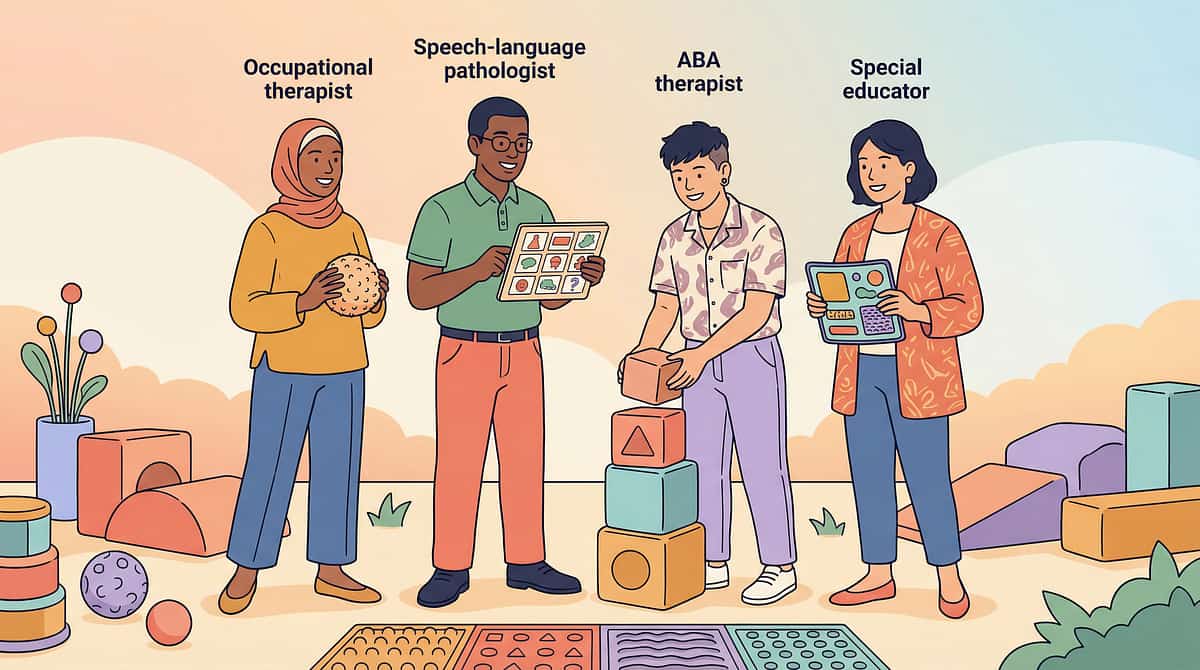
Who Uses This Technique
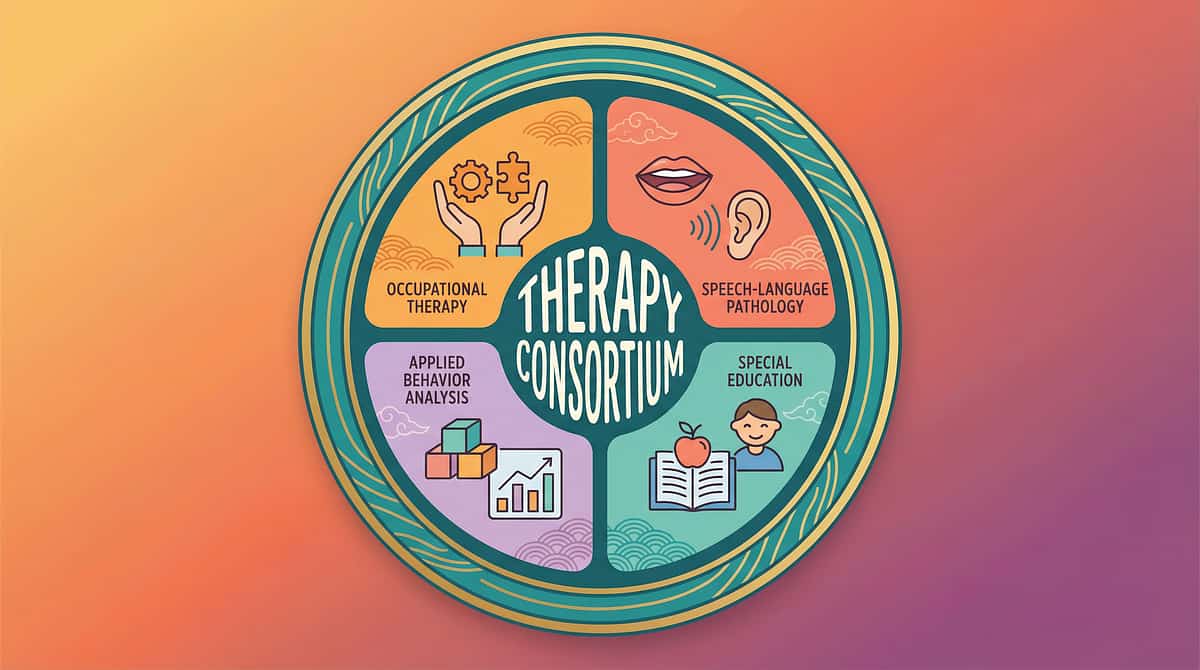
This technique crosses all therapy boundaries because stories live in every part of the brain.

🟣 Speech-Language Pathologist (Lead)
The SLP leads narrative intervention — directly targeting expressive language, narrative schema development, syntactic organization, and discourse-level communication. The SLP assesses where the breakdown occurs and selects the appropriate material tier.
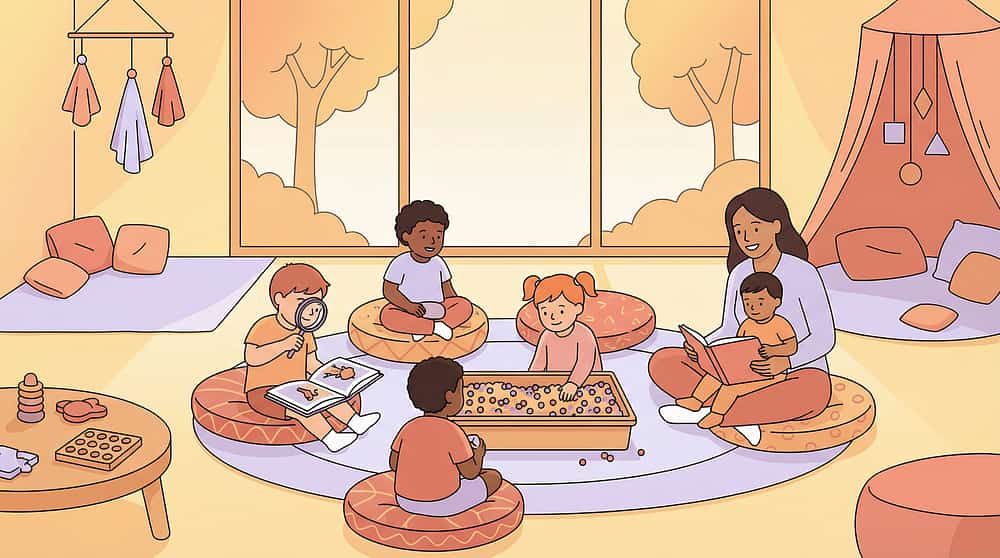
🔵 Special Educator (Strong Support)
The SpEd specialist integrates narrative intervention with academic literacy — linking story retelling to reading comprehension, written expression, and classroom participation through story grammar in lessons and routines.
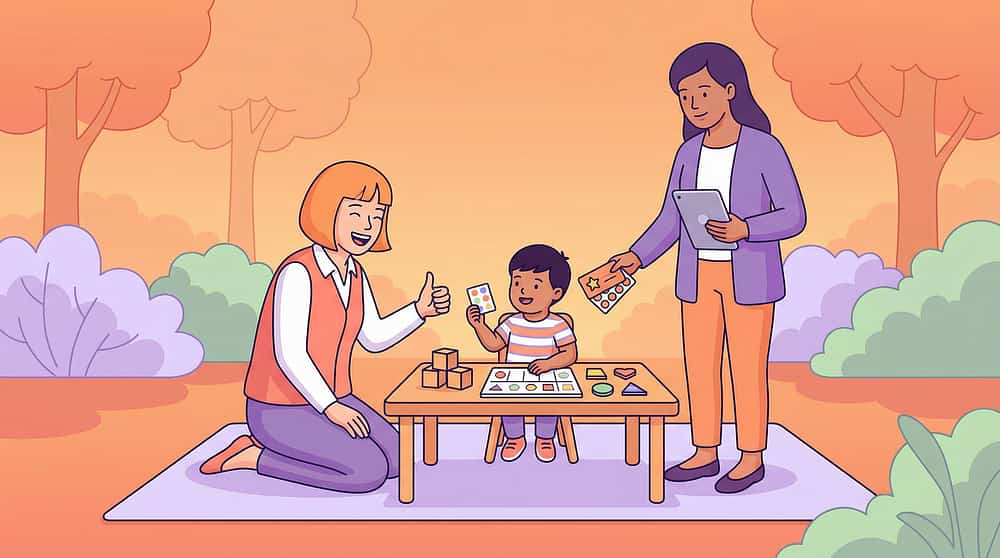
🟠 ABA / BCBA (Supporting Role)
The ABA practitioner applies behavioral principles: systematic prompting hierarchies, reinforcement schedules for retelling attempts, and data collection on retelling accuracy across all five story grammar components.
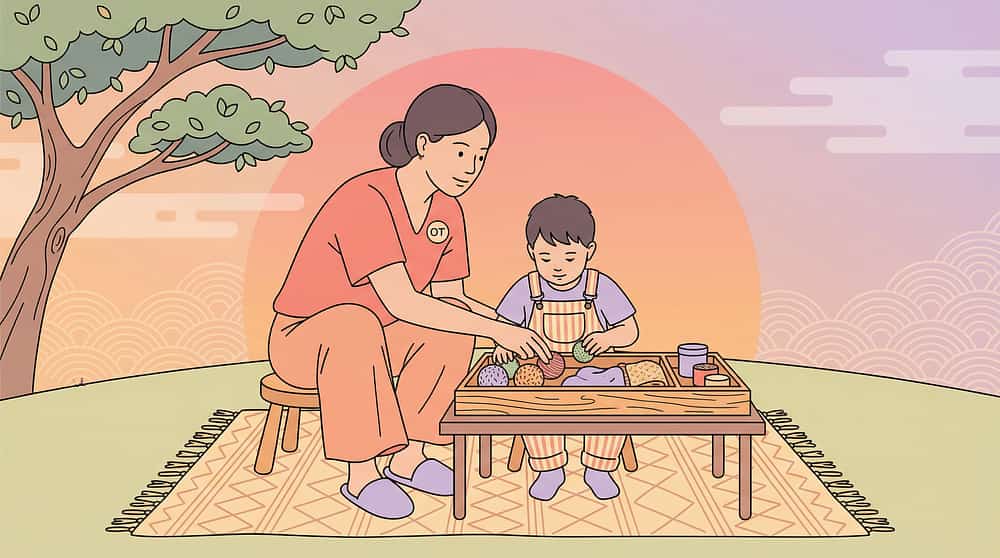
🟢 Occupational Therapist (Supporting)
The OT addresses sensory and motor foundations supporting focused listening and seated engagement. Children who struggle with sustained attention during story time often have underlying sensory processing differences the OT can address.
"The brain does not organize by therapy type. A story is heard through auditory processing (SLP territory), organized in working memory (OT/SpEd), sequenced through temporal reasoning (SpEd/ABA), and expressed through language (SLP). This is why narrative intervention is a consortium activity — no single discipline owns it." — Pinnacle Blooms Consortium, Multi-Disciplinary Clinical Board
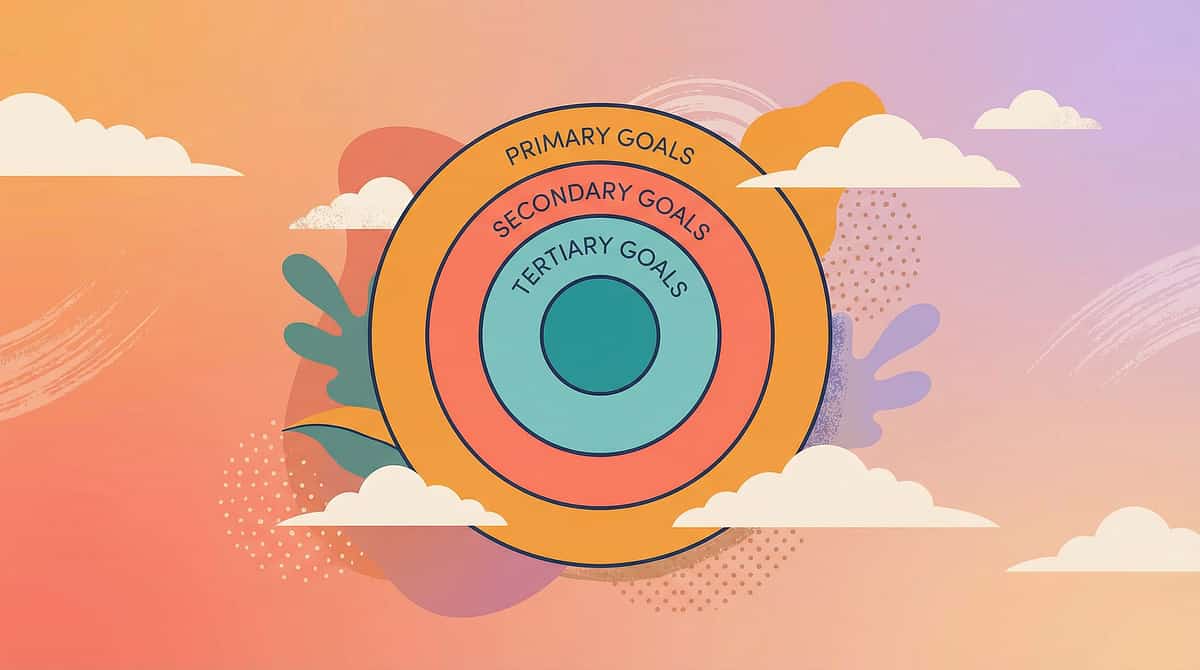
What This Technique Targets — A Precision Intervention
Narrative intervention is not a general "language activity." It is designed to hit specific, measurable targets in a defined hierarchy. Here is exactly what it addresses and how you will know it's working.
Primary Target Observable Indicators
- Child identifies the main character without prompting
- Events retold in chronological order (not random)
- The "problem" of the story is mentioned spontaneously
- Child can say what happened "first, then, last"
- Retelling includes more than 3 story elements
Secondary & Tertiary Targets
Secondary: Expressive language fluency · Syntactic organization with temporal connectors · Working memory for multiple story elements · Listening comprehension depth
Tertiary: Academic readiness (reading comprehension, written expression) · Social communication (sharing experiences with peers) · Emotional literacy · Self-regulation during story sessions
Source: PMC10955541 (Meta-analysis, World J Clin Cases, 2024: narrative targets across language, social, academic domains)
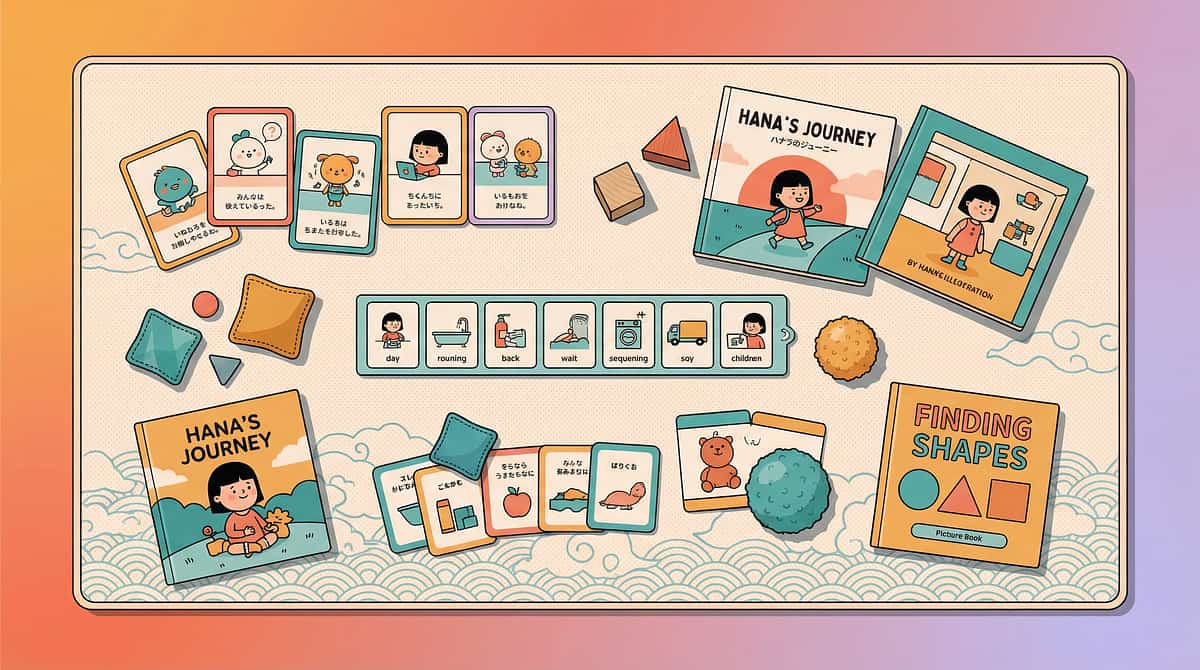
9 Materials — From Zero Cost to Fully Equipped
Every family can start today. Each of the nine materials below addresses a specific breakdown point in the narrative skill chain. Together, they form a complete home-executable intervention toolkit — with every item available as a free DIY version.
Complete Toolkit
₹0 to ₹4,600
All 9 materials listed below
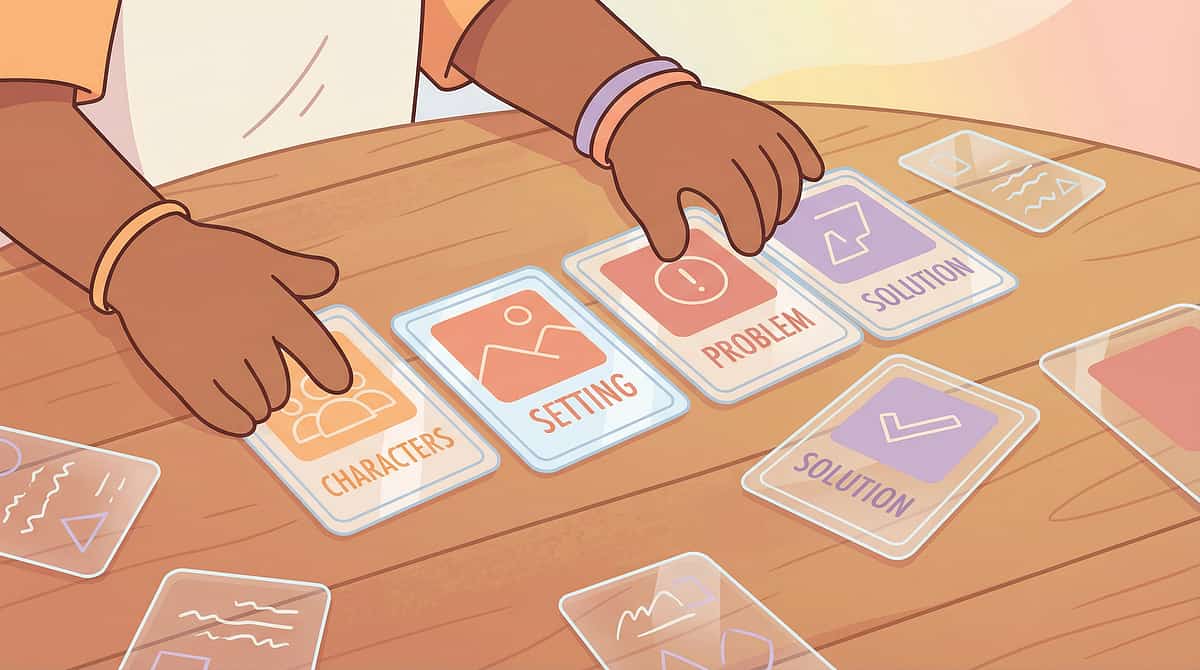
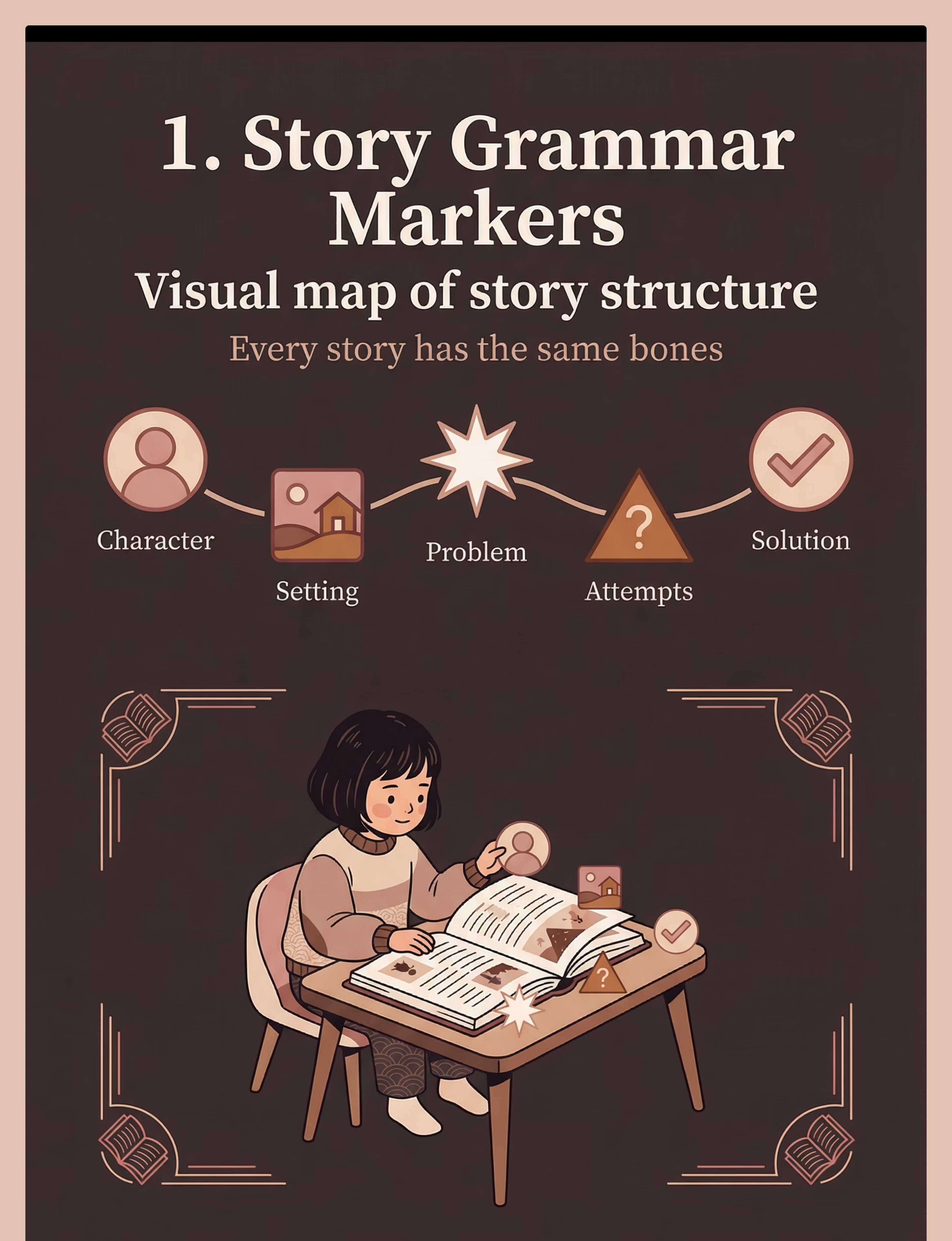
1. Story Grammar Markers & Story Structure Visuals
Visual icons for each story element — Character, Setting, Problem, Events, Solution — making the invisible skeleton of stories visible and learnable.
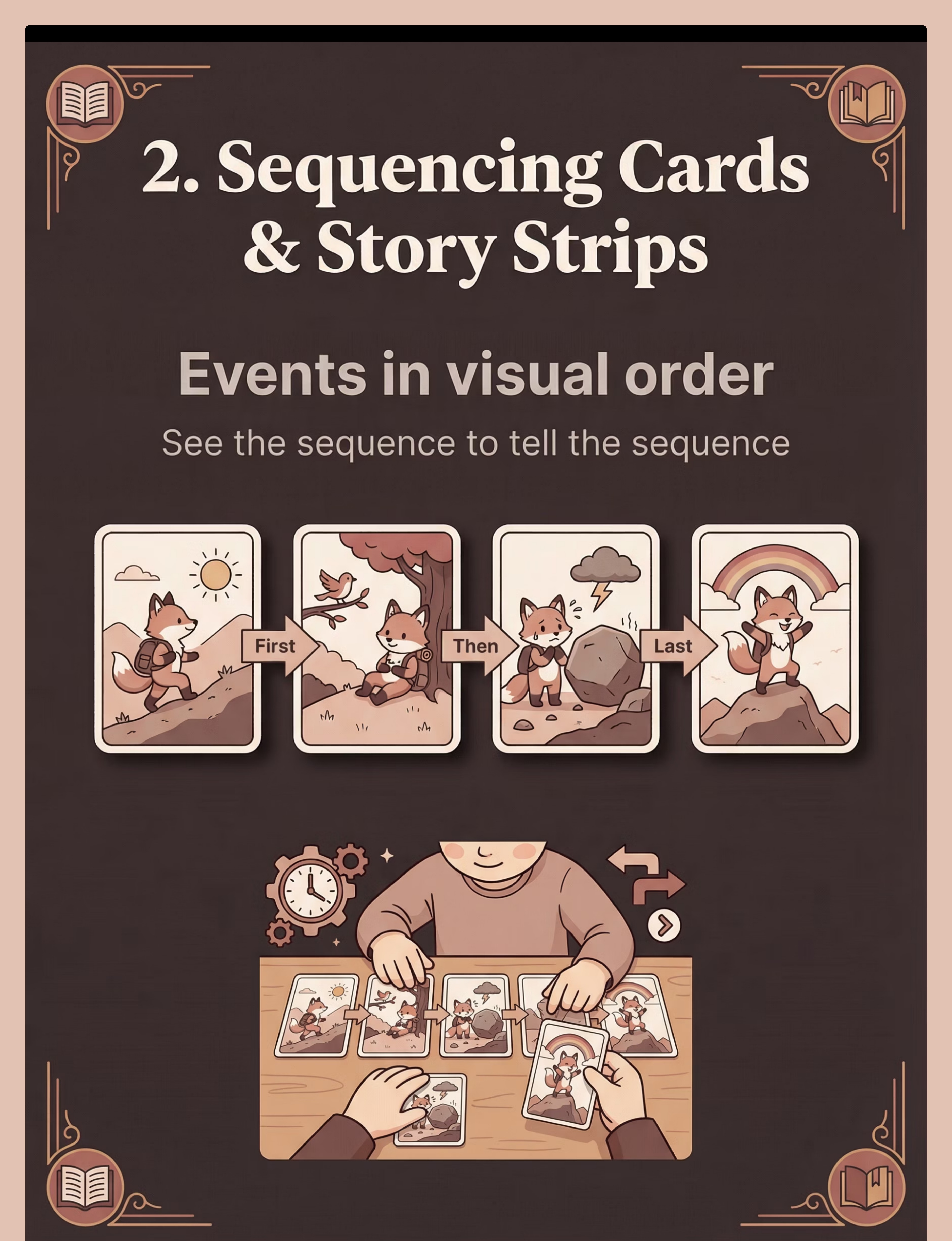
2. Sequencing Cards & Story Strips
Illustrated cards depicting story scenes in jumbled order. Child physically arranges them, then uses the visual sequence to guide retelling.
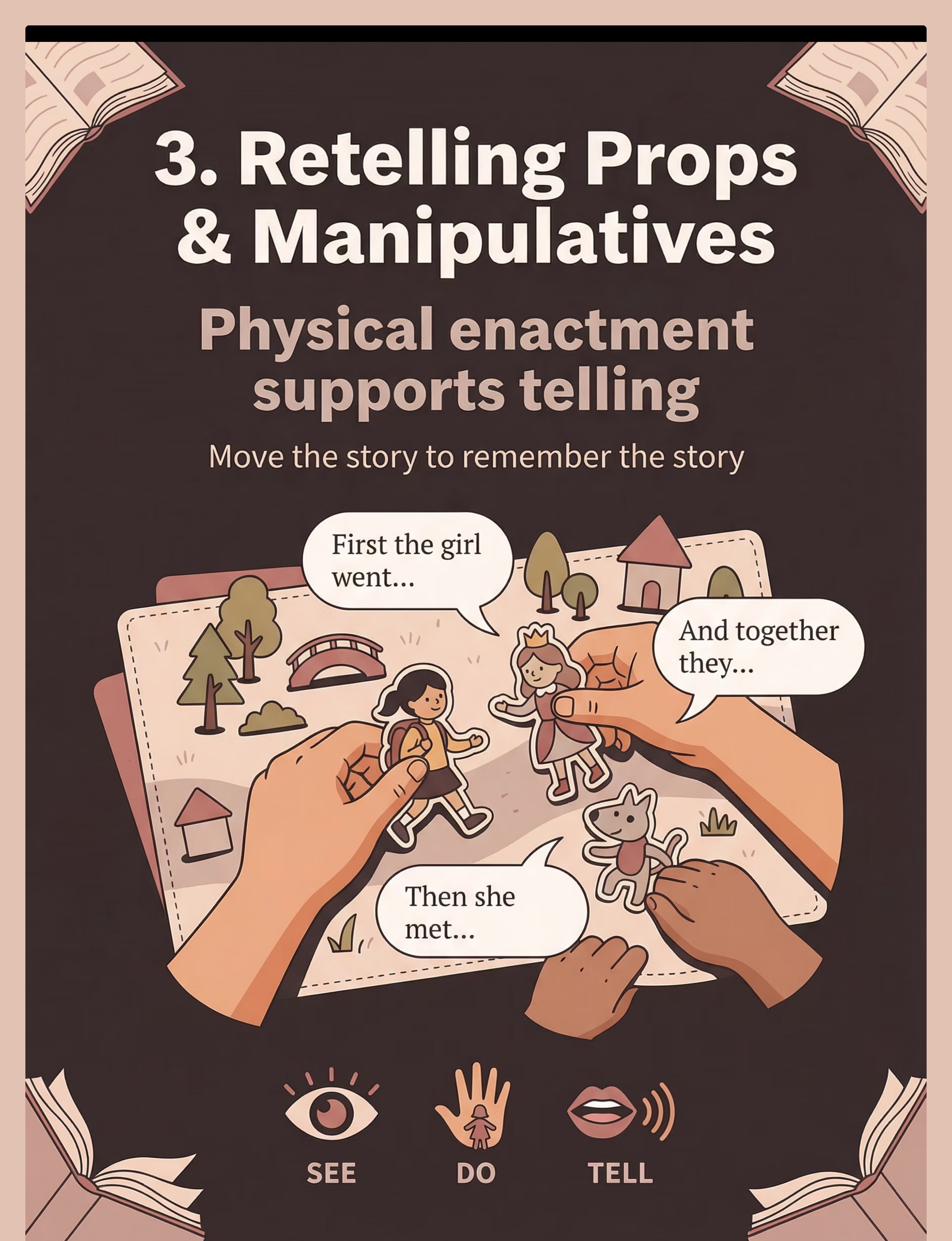
3. Story Retelling Props & Manipulatives
Small figures, puppets, or felt-board pieces. Child acts out the story physically while narrating — movement supporting memory.
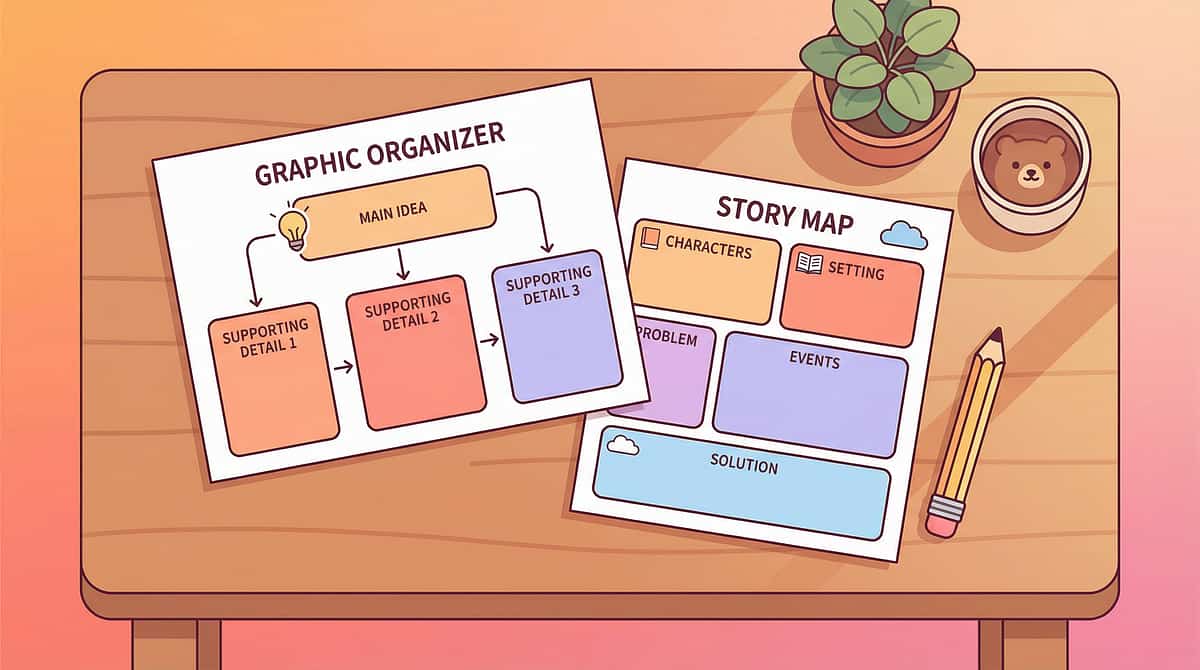
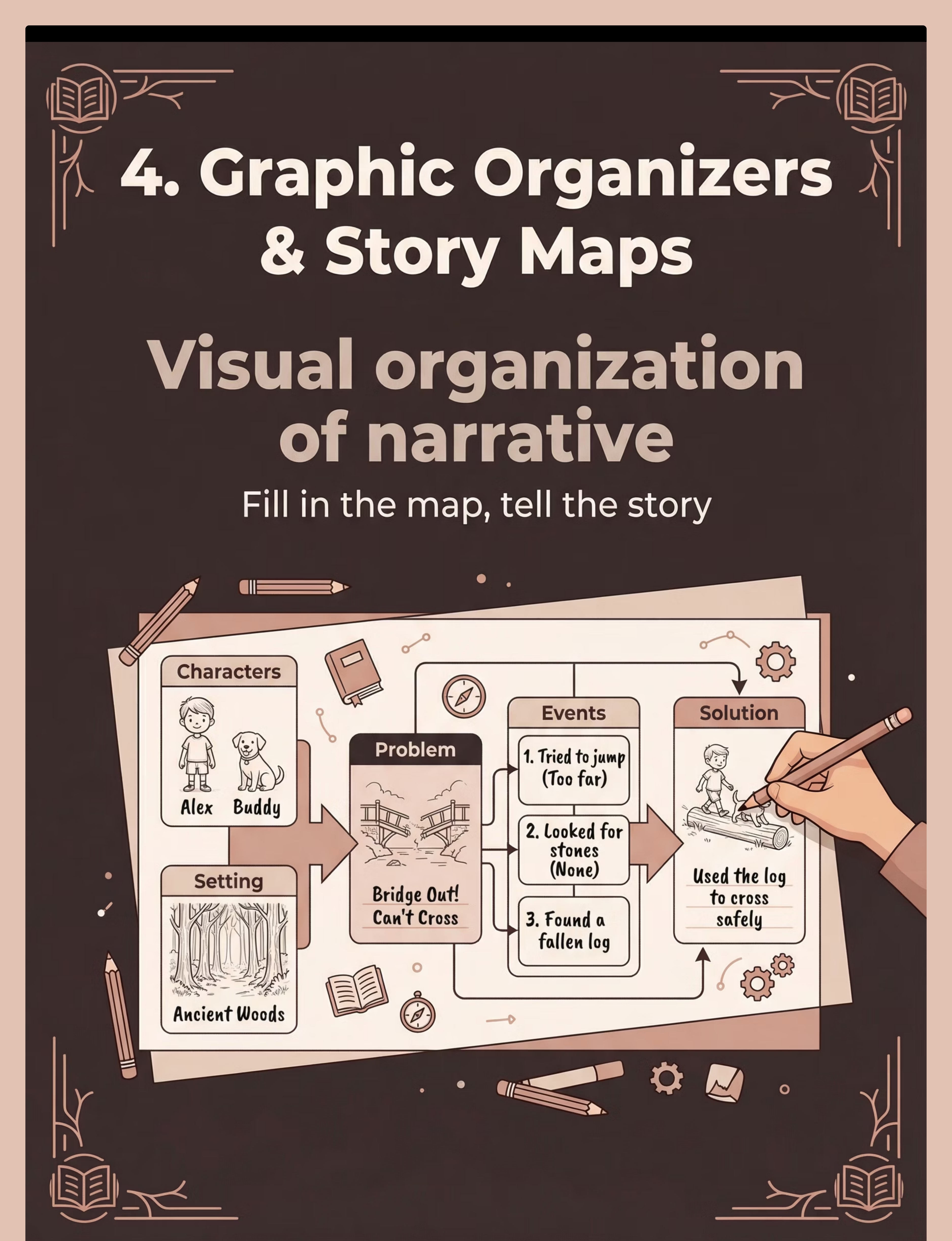
4. Graphic Organizers & Story Maps
Structured paper frameworks with labeled boxes for story information — offloading working memory to paper so the brain can focus on language production.
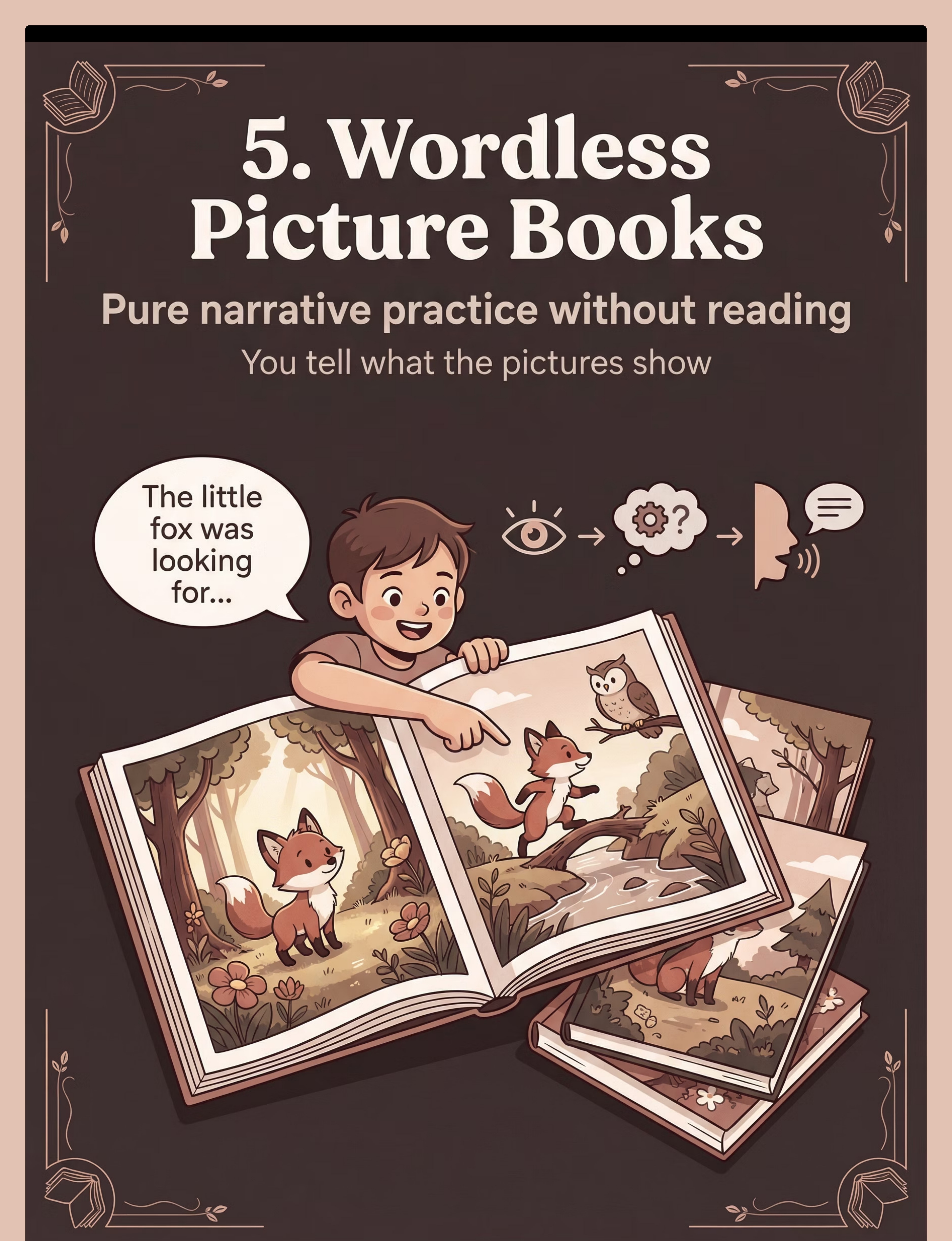
5. Wordless Picture Books & Visual Narratives
High-quality illustrated books with no words. Child "reads" from images — constructing narrative, choosing words, building the story without text pressure.
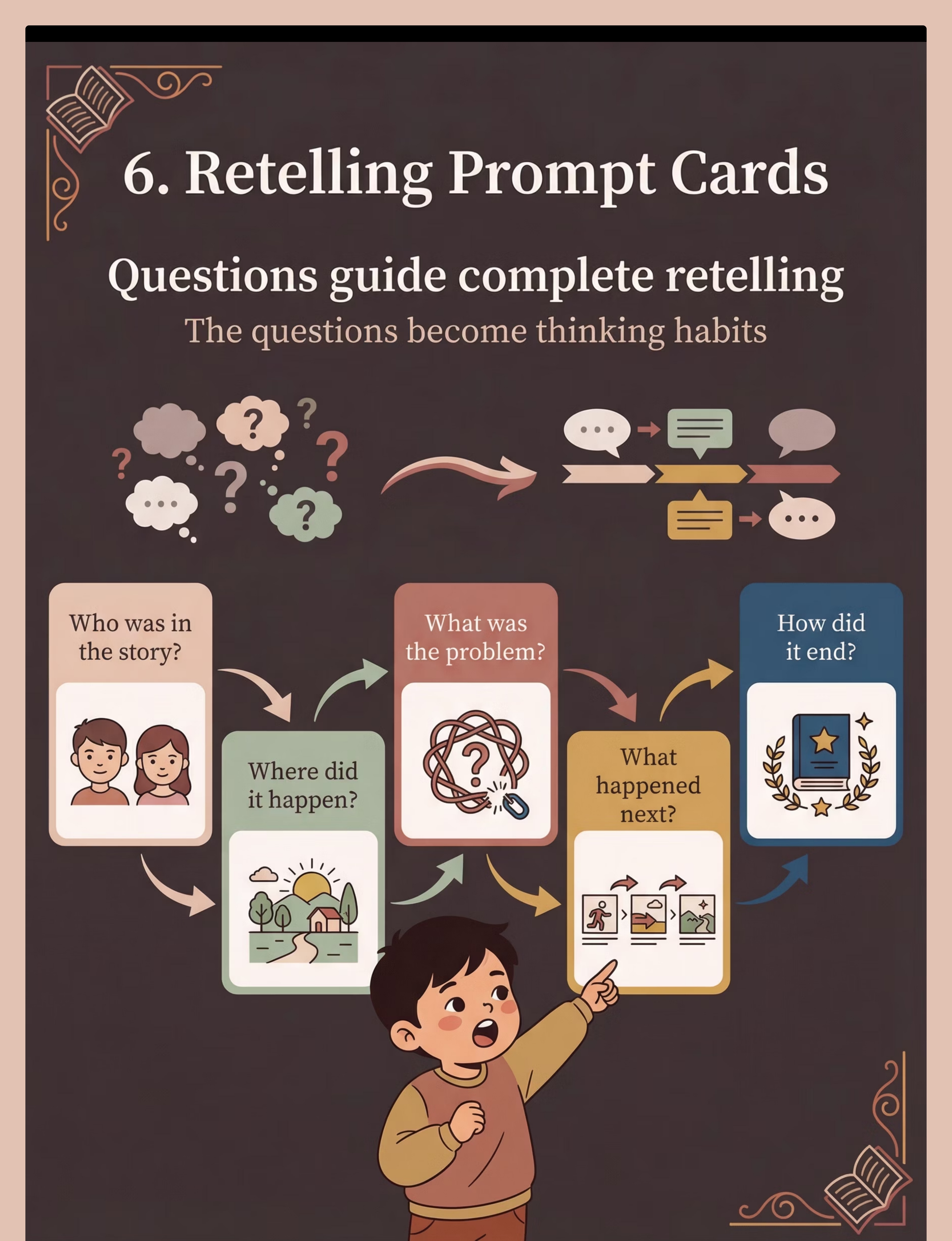
6. Retelling Prompt Cards & Question Cues
Cards with guiding questions for each story element — systematically scaffolding complete retelling until the structure becomes internalized.
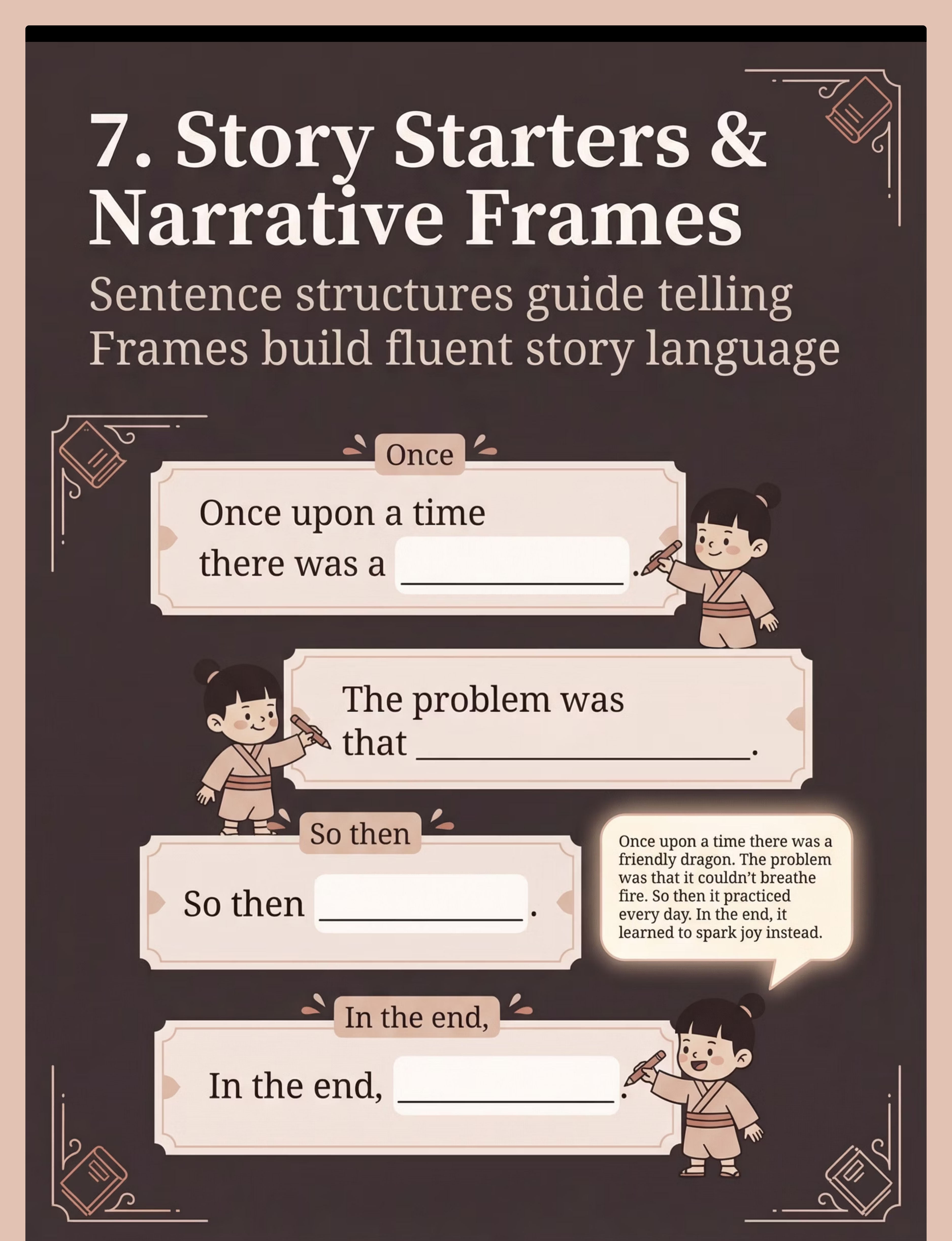
7. Story Starter Sentences & Narrative Frames
Printed sentence frames with blanks to complete — providing syntactic structure while the child supplies narrative content.
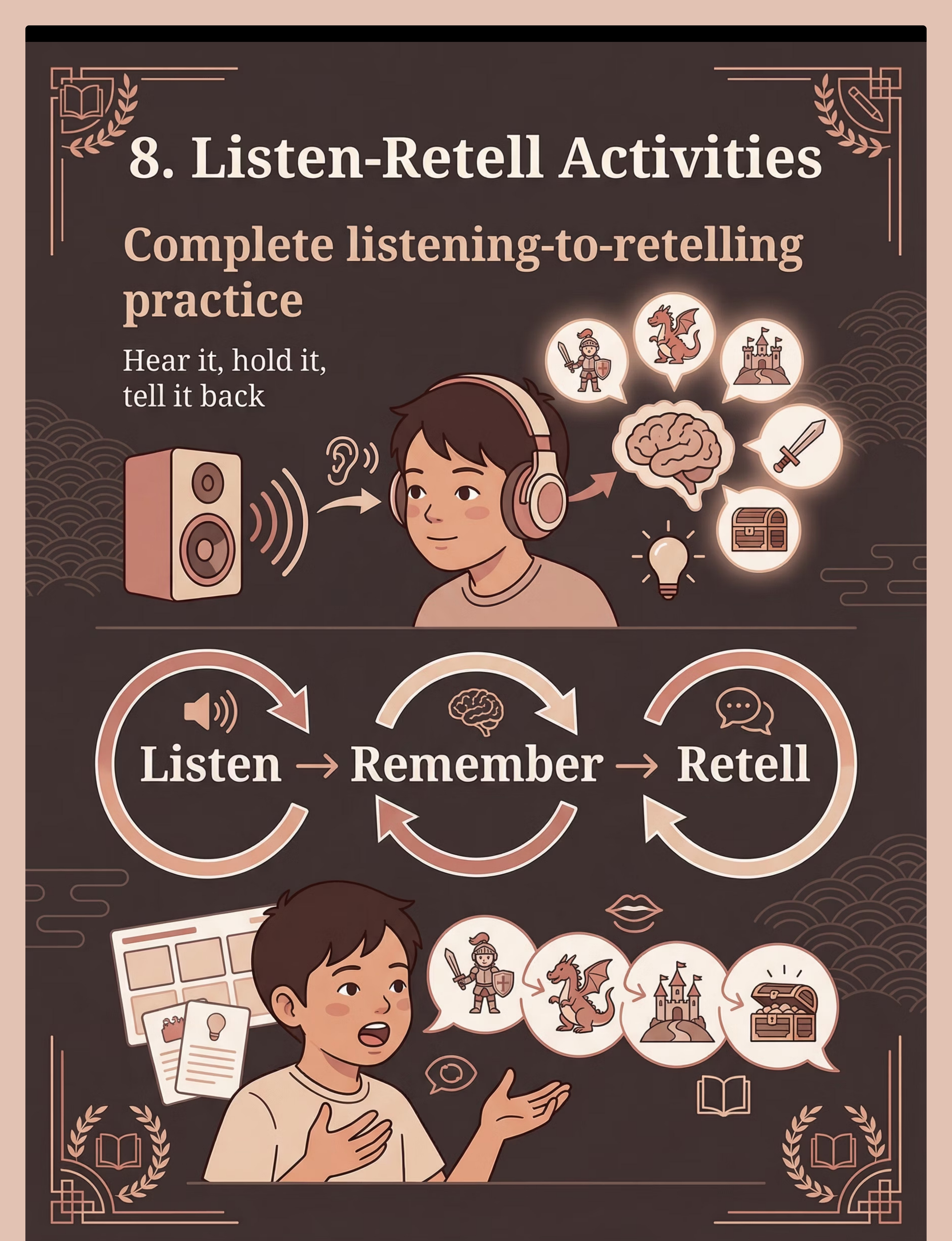
8. Recorded Stories & Listen-Retell Activities
Short recorded stories the child listens to then retells — practicing the complete real-world skill chain: hear → hold → tell back.
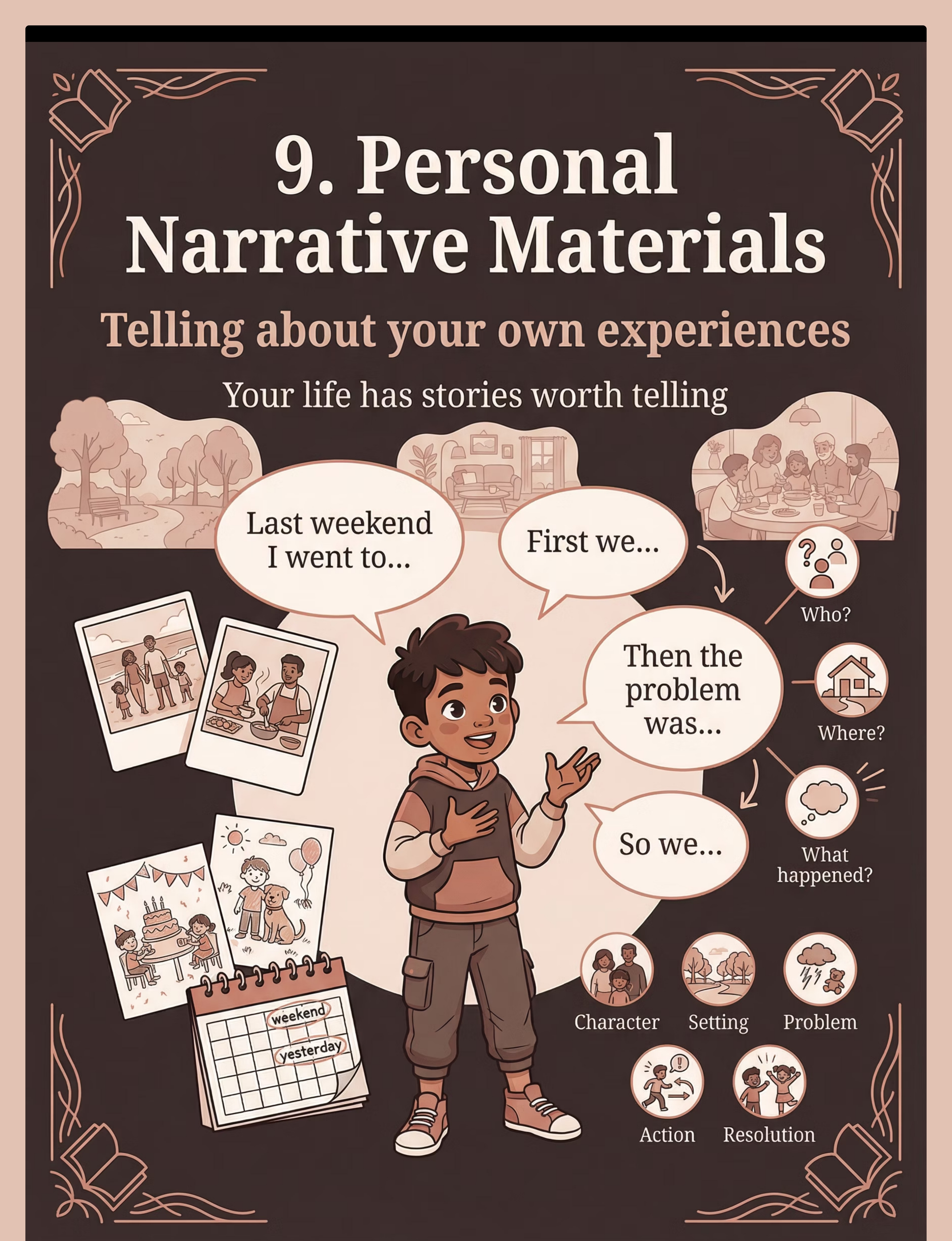
9. Personal Narrative & Experience-Sharing Materials
Photos, "my day" books, experience cards prompting children to retell their own experiences using the same story grammar structure.
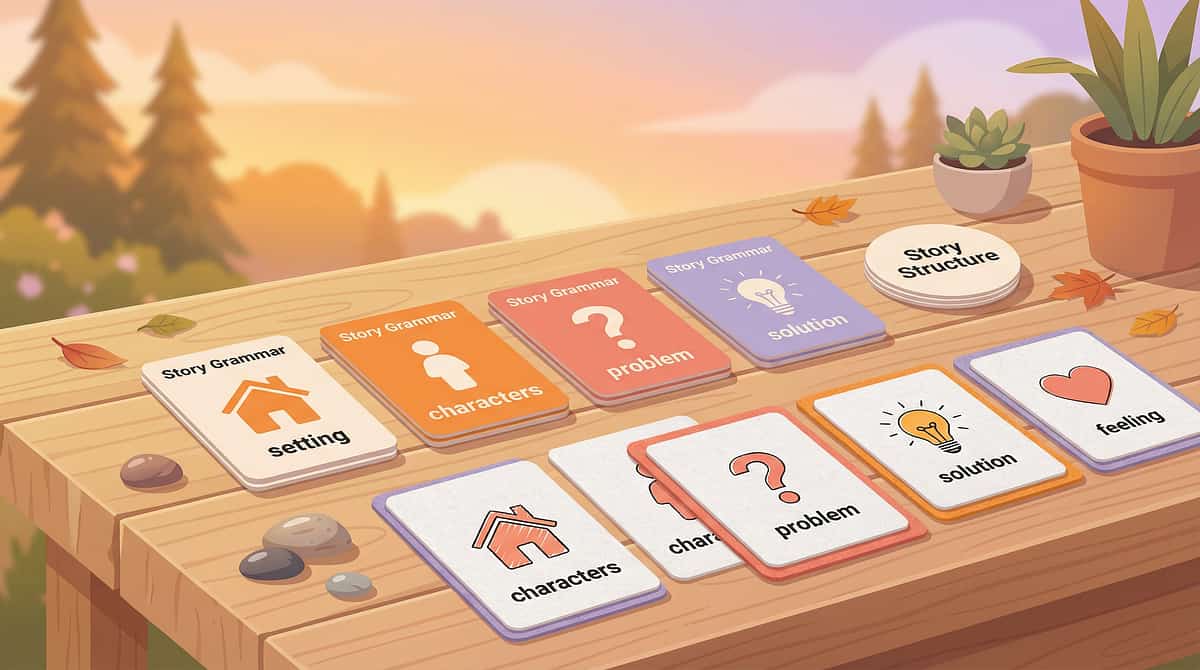
Material 1: Story Grammar Markers & Story Structure Visuals
🔵 Pinnacle Recommends
Visual Communication Supports
₹0 DIY · ₹300–700 Commercial
A set of visual icons — each representing a story element — that make the invisible skeleton of every story visible and learnable. Story grammar visuals externalize the narrative template, giving the child a visual cue for each element. The brain's visual processing system supports the language system by providing an external organizational scaffold.
WHAT
Visual icons for each story element: Character (person icon), Setting (house), Problem (lightning bolt), Events (arrow sequence), Solution (star/checkmark).
WHY
Makes narrative structure concrete and visible — reduces working memory load. Research on visual supports confirms evidence-based practice for autism (NCAEP 2020).
WHEN
During and after story reading; during retelling practice sessions. Introduce one element at a time — build over 2–3 weeks.
HOW
Present each icon as you encounter that element in the story — "Who is this? This is our CHARACTER." After the story, lay out all icons and reconstruct the story together.
DIY Version (₹0): Draw 5 simple icons on index cards: stick figure (Character), house (Setting), lightning bolt (Problem), three arrows (Events), star (Solution). Laminate with tape. The symbol matters less than the consistency.
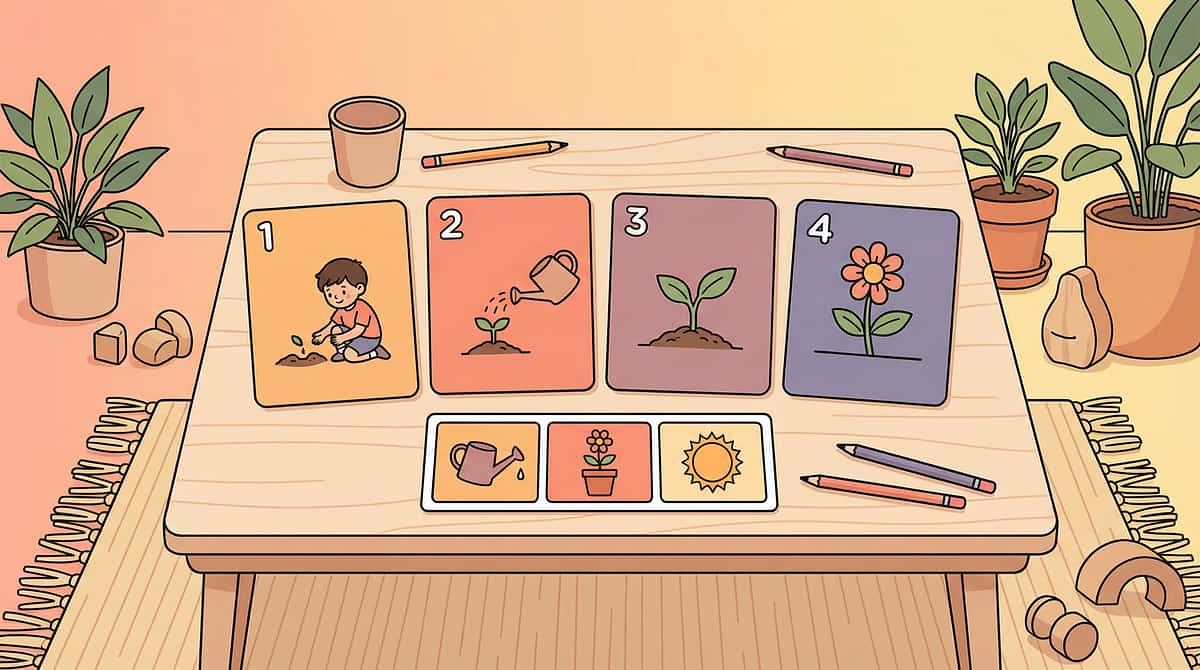
Material 2: Sequencing Cards & Story Strips
Cognitive & Learning / Sequencing Activities
₹0 DIY · ₹200–500 Commercial
🔵 Pinnacle Recommends
Illustrated cards depicting scenes from a story in jumbled order. The child physically arranges them into the correct narrative sequence, then uses the visual order to guide retelling. The physical act of arranging cards activates both motor planning and narrative memory systems simultaneously — "see the sequence to tell the sequence."
Why It Works
Temporal sequencing — understanding that events have a fixed order in time — is a foundational cognitive skill that many children with language and developmental differences struggle with. Sequencing cards externalize time, making the abstract concept of "what happened first" physically visible and manipulable.
SLP + SpEd Consortium Science: Embodied cognition research shows physical manipulation activates both motor planning and narrative memory systems simultaneously.
What / When / How
WHAT: Picture card sets showing 3–6 story events out of order.
WHEN: After reading a story; during structured retelling sessions; as a game.
WHERE: Table, floor — anywhere the child can spread and arrange cards freely.
HOW: Read the story. Mix the cards. Say "Can you put these in order? What happened first? What came next?" Child arranges. Child retells pointing to each card.
DIY (₹0): Print or draw 3–4 scenes from a favourite book. Mix them up. Have child arrange. Progress from 3-card sequences to 6-card sequences over weeks.
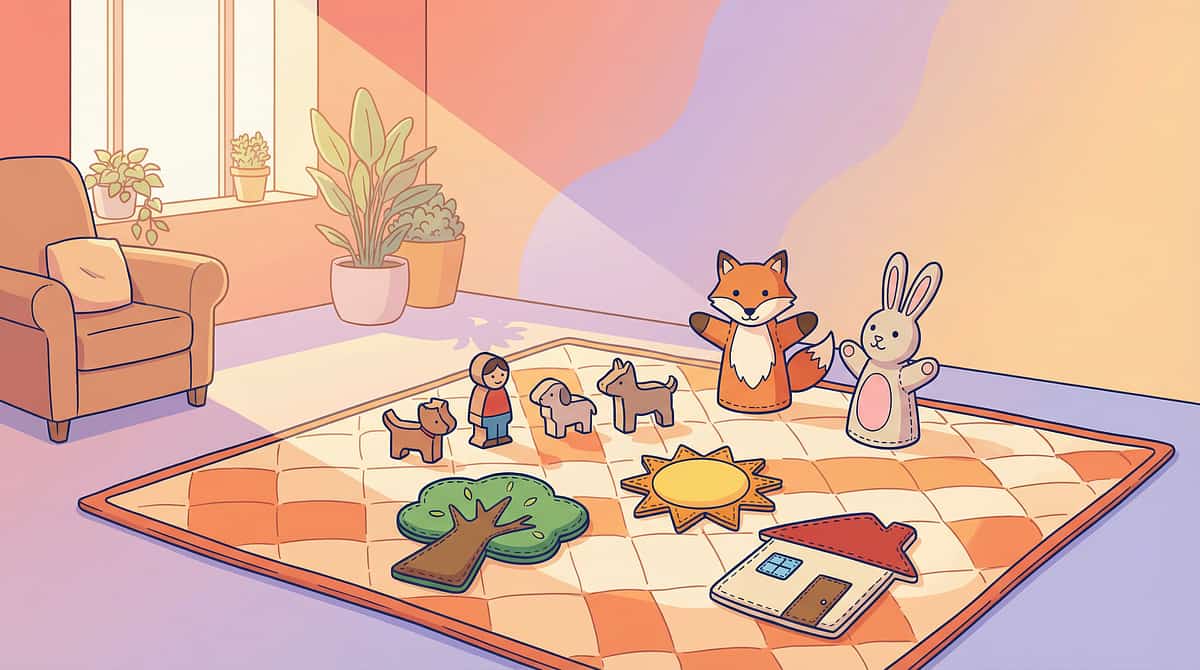
Material 3: Story Retelling Props & Manipulatives
Play & Social / Pretend Play Materials
₹0 DIY · ₹400–900 Commercial
Small physical figures, puppets, or felt-board pieces representing story characters. The child acts out the story physically while narrating — movement supporting memory. Physical enactment activates procedural memory (motor system) alongside narrative memory (language system), making this "embodied storytelling" especially powerful for kinesthetic learners.
WHAT
Puppets, small figures, felt board characters representing story roles — any physical object the child can move through a story's events.
WHY IT WORKS (OT + SLP Science)
When a child moves a character figure through story events, multiple brain regions encode the sequence — not just auditory-language areas. This is especially powerful for children with proprioceptive and kinesthetic learning strengths. "Move the story to remember the story."
HOW
Read the story. Give child character figures. "Can you show me what happened?" Child enacts, parent prompts: "Now what happened? Move the character..." Progress to: child enacts AND narrates simultaneously.
DIY (₹0)
Draw characters on thick paper and cut out. Attach a small piece of tape or blu-tack to stand them up. Any toy animals or figures the child already owns work perfectly. Focus on consistent use, not material quality.
Material 4: Graphic Organizers & Story Maps
Cognitive & Learning / Visual Organization Tools
₹0 DIY · ₹150–400 Commercial
Structured paper frameworks with labeled boxes and arrows for capturing story information — Characters box, Setting box, Problem box, Events sequence, Solution box. Graphic organizers function as external working memory, offloading the cognitive burden to paper so the child's brain can focus on language production rather than memory maintenance.
Why It Works (SpEd + SLP Science)
Children with working memory limitations cannot simultaneously hold all story elements while speaking. The graphic organizer offloads this cognitive burden — research on graphic organizers for narrative shows significant improvements in retelling completeness and organization.
The completed map becomes a visual retelling script — the child traces from box to box, using each label as a prompt to produce the next narrative element.
What / When / How
WHAT: Template sheets with boxes for each story element — labeled WHO, WHERE, PROBLEM, WHAT HAPPENED, HOW IT ENDED.
WHEN: During or immediately after story reading.
HOW: Read the story. Fill in the map together: "Who was in the story? Let's write it here." Completed map becomes the retelling guide: "Now tell me the story using your map."
DIY (₹0): Draw a simple map on any paper: five boxes connected by arrows. One page, made in 2 minutes. Laminate for reuse with a dry-erase marker.

Material 5: Wordless Picture Books & Visual Narratives
Books & Literacy / Wordless Picture Books
₹0 DIY · ₹250–600 Commercial
High-quality illustrated books with no words. The child "reads" the story from the images — constructing the narrative, choosing the words, building the story. Pure narrative generation without the reading demand. Wordless picture books remove the decoding burden entirely and isolate the pure narrative generation skill — especially powerful for children who find text-heavy books intimidating.
WHAT
Beautifully illustrated books with no text — pictures tell the complete story.
WHY
Isolates narrative generation; removes reading pressure; builds creative language. Child must observe, infer sequence, assign language — all generative skills.
WHEN
Story time, anytime — especially when transitioning from supported to independent narrative production.
WHERE
Anywhere — reading corner, bed, car, waiting rooms. These books travel well and work in any setting.
HOW: Open the book. "Let's read this together — you tell me what's happening!" Follow child's lead. Prompt: "What's the fox doing?" "What happens next?" "Oh no — what's the problem?" Celebrate all narrative attempts.
DIY (₹0): Take any picture book and cover the text with a strip of paper. Or print free illustrations from public domain children's books online. The narrative conversation matters more than the material.
Material 6: Retelling Prompt Cards & Question Cues
Visual Communication Supports / Prompt & Cue Systems
₹0 DIY · ₹150–350 Commercial
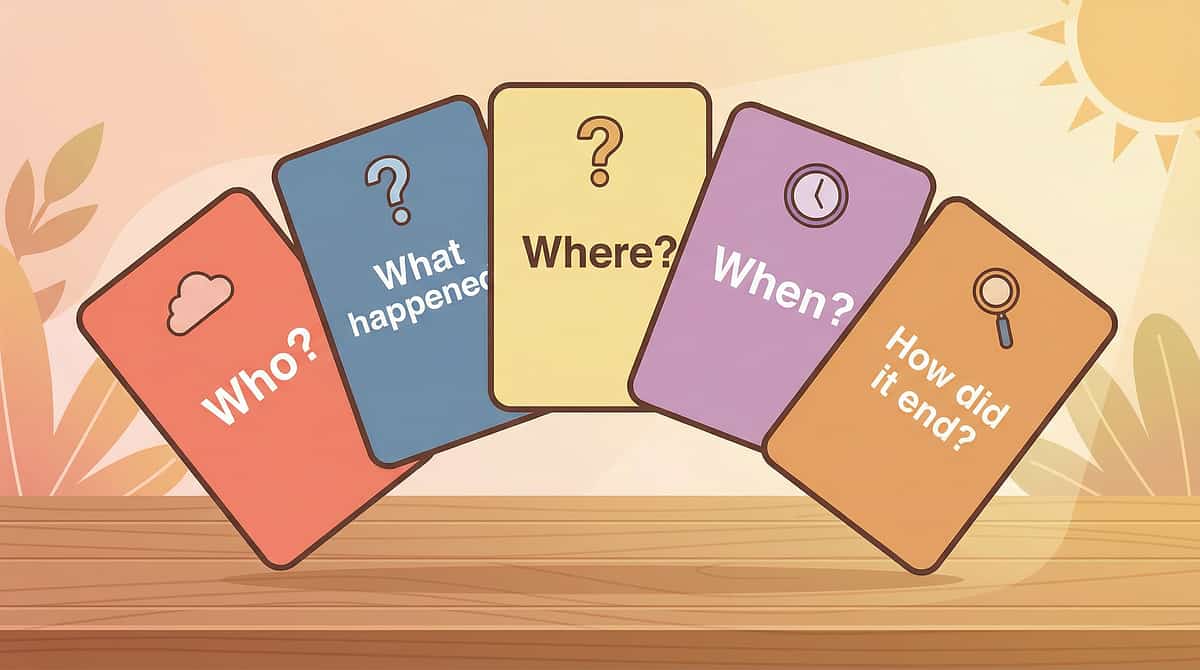
A set of cards, each containing a guiding question for a different story element. Child works through cards in order to produce a complete retelling. Prompt cards apply ABA's systematic prompting principles to narrative production — as the structure becomes internalized through repeated practice, prompts are faded until the child self-generates independently. The questions become thinking habits.
"Who was in the story?"
Character identification — the most concrete element and usually the first to emerge independently.
"Where did it happen?"
Setting identification — builds spatial-temporal grounding of the narrative.
"What was the problem?"
Problem identification — often the hardest element; scaffold heavily here initially.
"What happened next?"
Event sequencing — temporal linking is where sequencing cards pair beautifully.
"How did it end?"
Solution — completes the narrative arc and the most satisfying element for children to produce.
HOW: Read story. Lay out prompt cards. "Let's answer these cards together." Over weeks: remove one card at a time as child demonstrates independence for that element — this is prompt fading in action.
DIY (₹0): Write 5 questions on index cards: "Who?" / "Where?" / "What problem?" / "What happened?" / "How did it end?" Color-code them. Done.
DIY (₹0): Write 5 questions on index cards: "Who?" / "Where?" / "What problem?" / "What happened?" / "How did it end?" Color-code them. Done.
Material 7: Story Starter Sentences & Narrative Frames
Literacy & Language Tools / Sentence Frame Materials
₹0 DIY · ₹150–400 Commercial
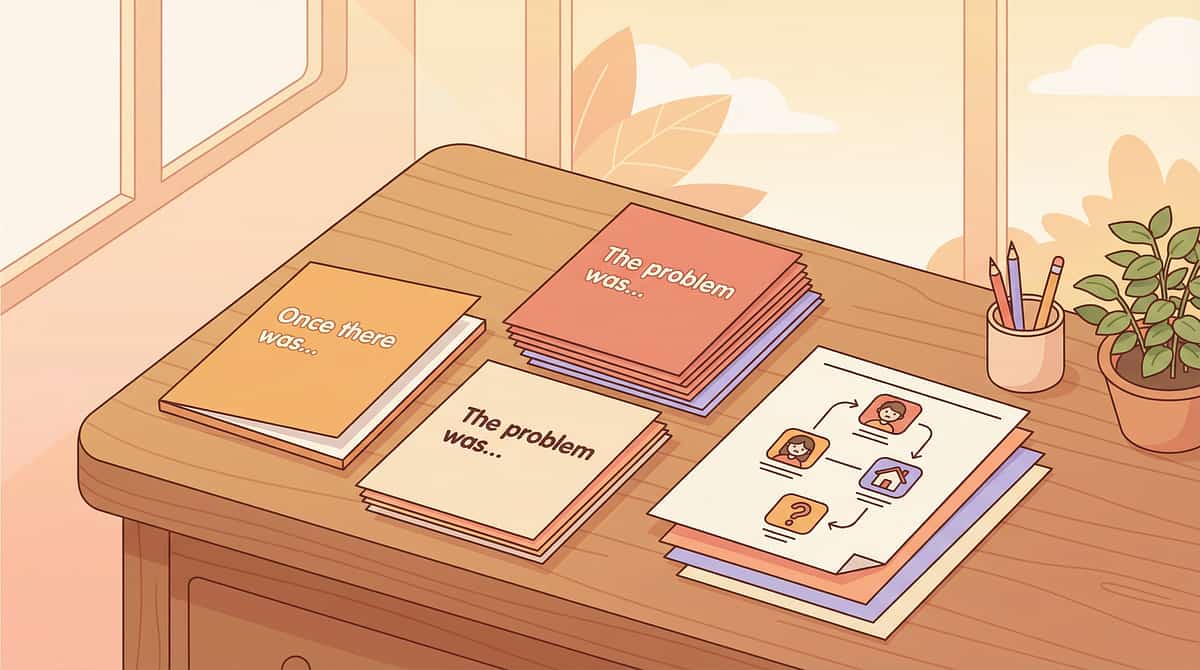
Printed sentence frames with blanks for the child to complete. The frame provides the syntactic structure; the child fills in the narrative content. Narrative frames reduce formulation demand — one of the most common bottlenecks in story retelling. Many children know what happened but cannot organize the language structure to express it. Frames build fluent story language.
"Once upon a time there was a ___."
Opens the narrative — establishes character and sets up the world.
"The problem was ___."
Names the central conflict — the hardest element made approachable through syntactic scaffolding.
"So then ___."
Links events causally — builds the "because-so" language of narrative.
"In the end ___."
Closes the narrative arc — child learns that stories have a defined ending structure.
Why It Works (SLP Science): Over time, the frame language ("first," "then," "the problem was") becomes internalized as spontaneous narrative connectors. The child stops needing the card because the structure is now part of their language system.
DIY (₹0): Write sentence starters on separate strips of paper: "First..." / "Then..." / "The problem was..." / "So they..." / "Finally..." Arrange in order. Child completes each strip. Laminate for reuse.

Material 8: Recorded Stories & Listen-Retell Activities
Audio & Technology Learning Tools / Story Comprehension
₹0 DIY · ₹200–500 Commercial
Short recorded stories the child listens to and then retells — practicing the complete real-world skill chain: hear → hold → tell back. Listen-retell activities practice the authentic skill sequence in its real-world form. Recording the child's retelling over time creates a measurable progress archive you can actually hear growing week by week.
Why It Works (SLP + SpEd Science)
In daily life, children must hear something (classroom instruction, peer conversation, family news), hold it in working memory, and then express it. Recorded stories allow controlled, repeatable practice at appropriate complexity levels — you can replay the same story multiple times without fatigue, adjusting complexity week by week.
"Hear it, hold it, tell it back." This is the authentic skill sequence.
What / When / How
WHAT: Short recorded stories (2–4 min) followed by structured retelling prompts.
WHEN: Daily — 10-minute cycles; morning story time works well for many families.
HOW: Play short story. Pause. Prompt: "Can you tell me what happened?" Use prompt cards alongside if needed. Record retelling on phone. Compare week 1 vs. week 4 — the growth is audible.
DIY (₹0): Record yourself reading a favourite 3-minute story on your phone. Play it back. Prompt retelling with 5 questions. Record their retelling. Free, infinitely repeatable, and creates a priceless progress record.
Material 9: Personal Narrative & Experience-Sharing Materials
Literacy & Language Tools / Personal Narrative Supports
₹0 DIY · ₹100–300 Commercial
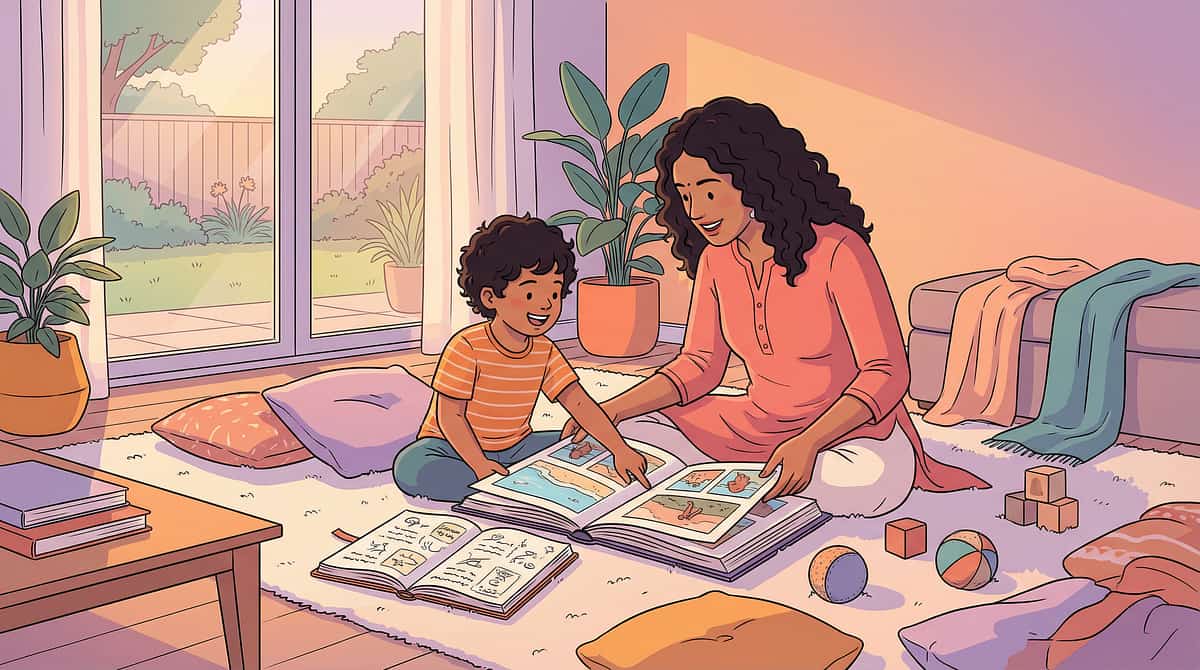
Materials that prompt children to retell their own experiences — photos from family outings, "my day" books, experience sharing cards — applying the same story structure to real life events. Personal narrative is the most motivating and meaningful form of narrative for children because the content is their own lived experience. This is also where story skills connect directly to social participation and friendship formation.
WHAT
Photo books, experience cards, "my day" journals, family photo albums with story prompts — anything rooted in the child's own lived experience.
WHY IT WORKS (SLP + OT + ABA Science)
The emotional salience of real events supports memory encoding. Using story grammar structure for personal narratives generalizes the skill from "school stories" to "real life communication" — the ultimate functional goal.
WHEN & WHERE
After outings, events, school days — "Tell me about what happened today." Kitchen table, car, bedtime — naturally embedded in daily family rhythm.
HOW
Take photos during outings. Print or show on phone. "Tell me the story of our trip. Who was there? Where did we go? What was the challenge? How did it end?" Apply story grammar to real life.
DIY (₹0)
Use your phone's photo library from this week. Pick 3–4 photos from an outing. Display on screen. Ask: "Tell me the story of these photos." ₹0, maximum motivation, immediate practice.
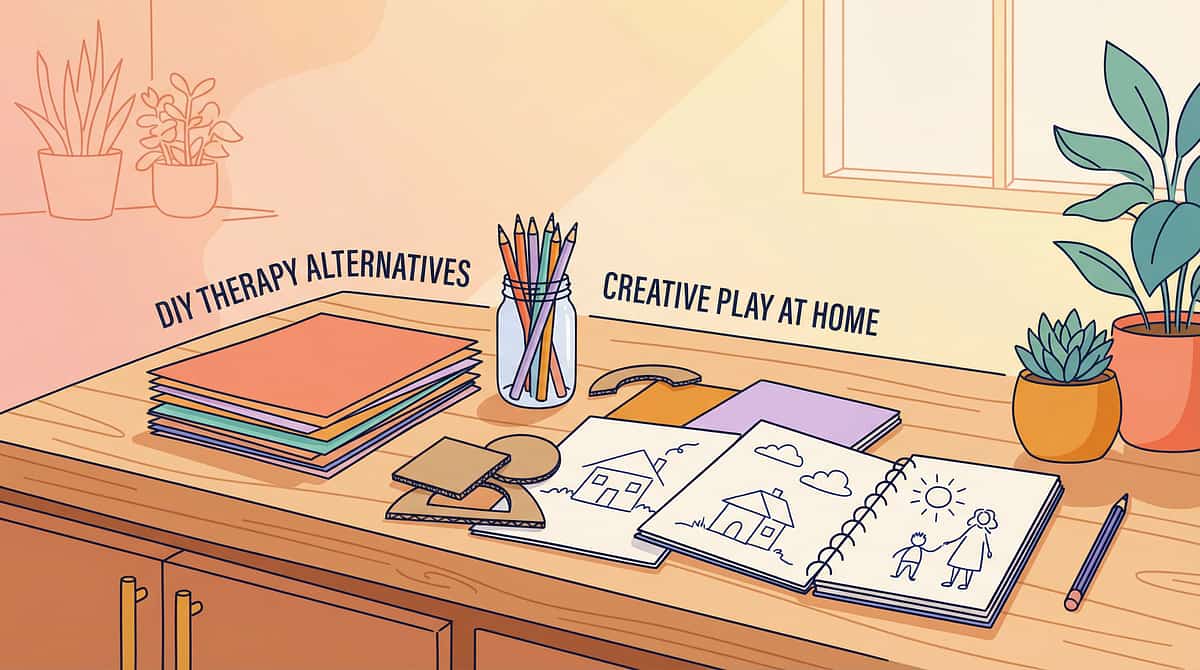
Every Material Has a ₹0 Version — No Budget Required to Start Today
"The therapeutic principle is the scaffold — not the product. A hand-drawn story map on notebook paper achieves the same neurological outcome as a laminated commercial product when used consistently and correctly. WHO/UNICEF equity principles demand that no family is excluded from evidence-based intervention due to cost." — Pinnacle Blooms Consortium
Material | Commercial | DIY Version | Core Principle | |
Story Grammar Markers | ₹300–700 | 5 icons drawn on index cards | Visual externalization of story structure | |
Sequencing Cards | ₹200–500 | 3–4 drawn/printed scenes | Temporal order externalization | |
Retelling Props | ₹400–900 | Any toy figures or paper cutouts | Embodied narrative encoding | |
Graphic Organizers | ₹150–400 | 5 boxes on any paper | External working memory scaffold | |
Wordless Picture Books | ₹250–600 | Cover text in any picture book | Pure narrative generation | |
Prompt Cards | ₹150–350 | 5 index cards with questions | Systematic narrative scaffolding | |
Narrative Frames | ₹150–400 | Sentence strips on paper | Syntactic scaffold for formulation | |
Listen-Retell | ₹200–500 | Parent-recorded stories on phone | Authentic skill chain practice | |
Personal Narrative | ₹100–300 | Phone photo library | High-motivation narrative practice |
Total DIY Cost
₹0 — requiring only paper, pen, and 20 minutes of setup
Total Commercial Cost
₹1,600–4,600 for comprehensive full setup
Recommended Starter Set
Story Grammar Markers + Sequencing Cards + Prompt Cards ≈ ₹650–1,550
Source: PMC9978394 | WHO Nurturing Care Framework: context-specific, equity-focused interventions across 54 LMICs using household materials.
Safety First: Read This Before Every Session
Two minutes that protect your child and your progress.
🔴 DO NOT PROCEED if:
- Child is currently in distress, meltdown, or high dysregulation
- Child has not eaten in the past 2 hours or is in physical discomfort
- A significant emotional event occurred in the past 30 minutes
- Child is showing signs of illness (fever, lethargy, unusual irritability)
- Child is strongly refusing — forced participation destroys future willingness
🟡 MODIFY THE SESSION if:
- Child is mildly fatigued — shorten to 5 minutes, use only the most motivating material
- Child shows mild reluctance — begin with preferred activity first
- Child's attention is scattered — reduce story complexity, skip graphic organizers today
🟢 PROCEED when:
- Child is fed, rested, and in a calm-alert state
- No upcoming demands or transitions in the next 20 minutes
- Environment is quiet — noise is one of the top disruptors of narrative learning
- Parent is present, calm, and has 15–20 uninterrupted minutes
- Materials are prepared and ready before the child enters the space
STOP AND CALL if you observe: Extreme distress that doesn't resolve within 5 minutes · Any physical self-harm · Complete communication shutdown with signs of pain · Regression in skills previously established.
Source: DOI: 10.1007/s12098-018-2747-4 (Indian RCT: home-based intervention safety protocols for parent-administered sessions)
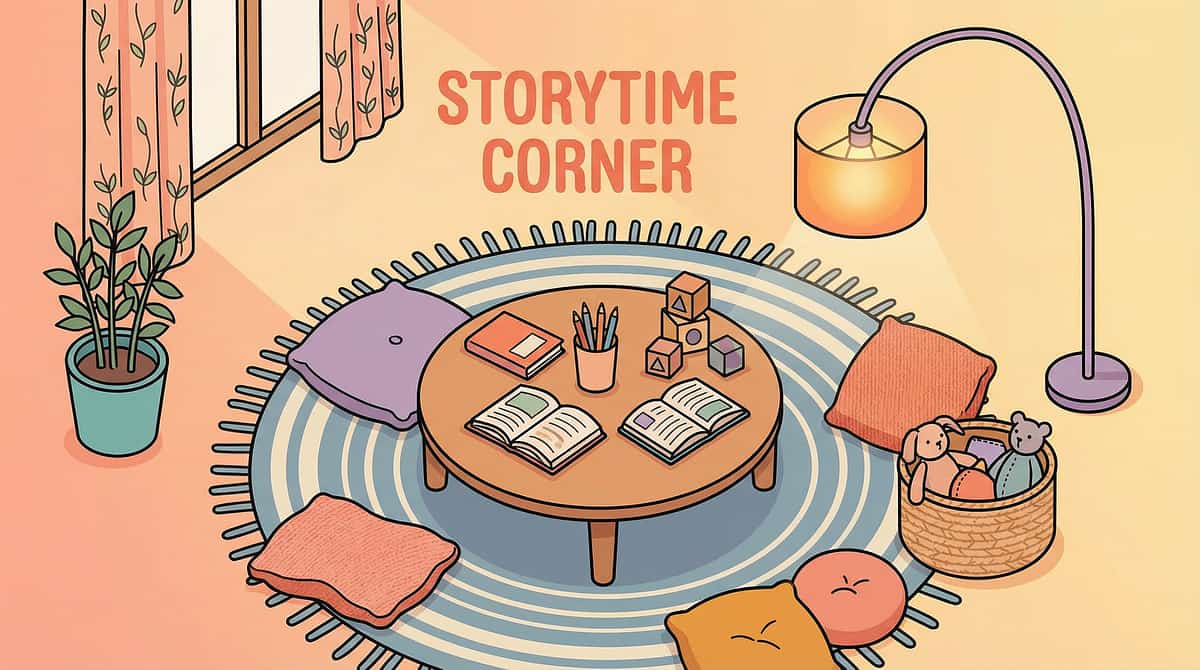
Set Up Your Story Corner
The right environment makes narrative learning 3× more effective.
Story Corner Setup Checklist
Materials prepared first
Before child enters — surprises and searching destroy narrative flow
Screen devices removed
Faced away from story area — visual distraction disrupts narrative attention even when off
Warm or natural lighting
Harsh overhead fluorescents increase arousal; warm light supports calm-alert state
Background noise: none or white noise
TV/music in background is clinically documented to reduce story comprehension
Child's position: comfortable and stable
Floor cushion, small chair, or lap. Child should not be standing during retelling practice
Parent at eye-level or lower
Reduces power differential; increases conversational narrative engagement
Timing & Duration
Best Time of Day: Post-snack, pre-screen time is the highest-yield narrative practice window for most children aged 4–8. The child is fed (reduces cortisol), engaged (not fatigued), and the narrative practice can replace or delay screen time as part of a structured routine.
Session Length: Start with 10–12 minutes. Build to 20 minutes over 3–4 weeks. Never extend beyond the child's engagement window — a short, positive session is worth more than a long, forced one.
Materials within reach of child: They should be able to pick up and manipulate without asking for help. Autonomy over materials increases engagement and reduces demand perception.
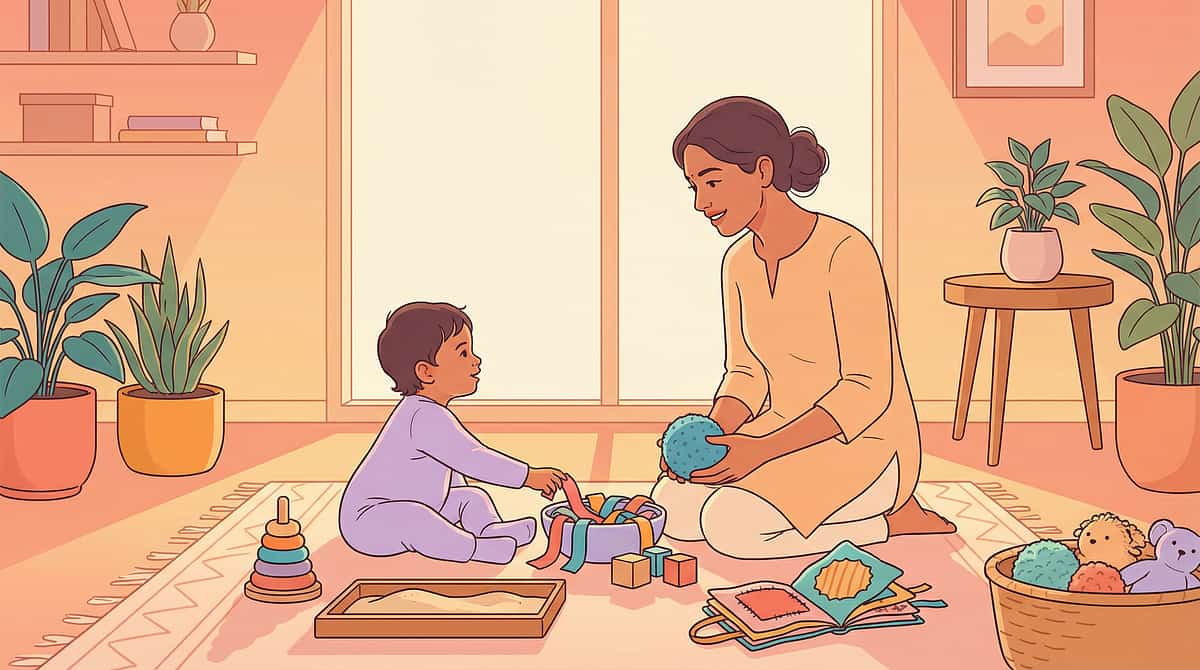
Is Your Child Ready? The 60-Second Pre-Session Check
The best session starts right. Use this quick readiness check before every narrative practice.
Indicator | ✅ GO | 🟡 MODIFY | 🔴 POSTPONE | |
Eye contact / responsiveness | Responds within 3 seconds | Delayed but present | No response | |
Postural tone | Upright, stable | Some slumping | Lying down, very low tone | |
Vocalizations | Any positive sounds | Neutral/quiet | Whining, crying, heavy scripting | |
Receptive response | Follows simple instructions | Needs 2 prompts | Does not follow | |
Last meal | Within 2 hours | 2–3 hours ago | More than 3 hours ago | |
Recent emotional event | None in past hour | Minor event, resolved | Major event, unresolved |
✅ If GO
Proceed to Step 1: The Invitation. Full protocol applies.
🟡 If MODIFY
Use only 1 material. Shorten to 5–8 minutes. No data collection today — observation only. Celebrate participation, not performance.
🔴 If POSTPONE
Offer a calming activity. Do not force narrative practice. Record: "Postponed — [reason]." 3+ consecutive postponements = contact Pinnacle.
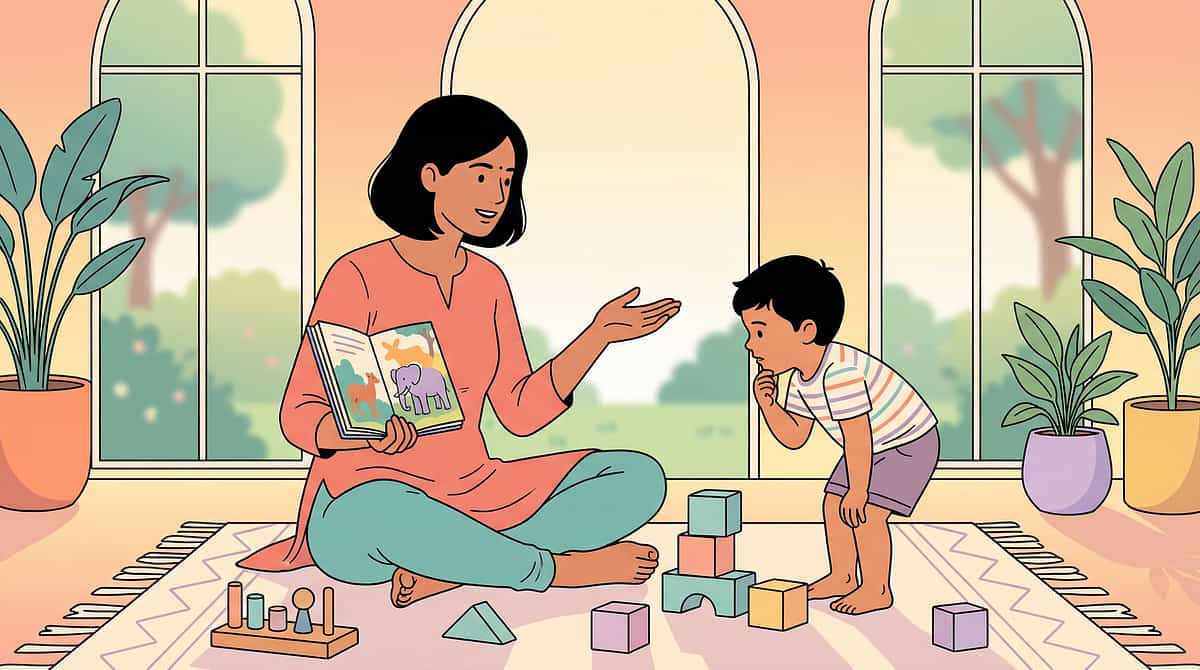
Step 1 of 6: The Invitation
⏱ 1–2 Minutes
Begin Here · Every Session
The Principle: Every narrative session begins with invitation, not instruction. The child's willingness is the most important variable in the room. Pairing before demanding is the single most powerful thing you can do to build lasting engagement with narrative materials.
"Hey — I found this story. Do you want to come and look at it with me? I bet there's something really interesting in it..."
"Look what I brought — these cards have pictures of a story all mixed up. Want to see if we can figure out the right order?"
Body Language Guidance
- Get DOWN to the child's level — floor or small chair, not towering above
- Face the materials together — side-by-side, not face-to-face
- Let the child touch and explore materials first — this is pairing, not instruction
- Relax your own posture — the child reads your body before your words
Reading the Child's Response
Acceptance cues: Moves toward the material area · Makes eye contact with materials · Any vocalization that is not protest
Resistance response: Child moves away → "No problem, I'll be here when you're ready" → wait 30–60 seconds
Strong protest: Respect it. Note it. Today is not the day. Move to calming activity.
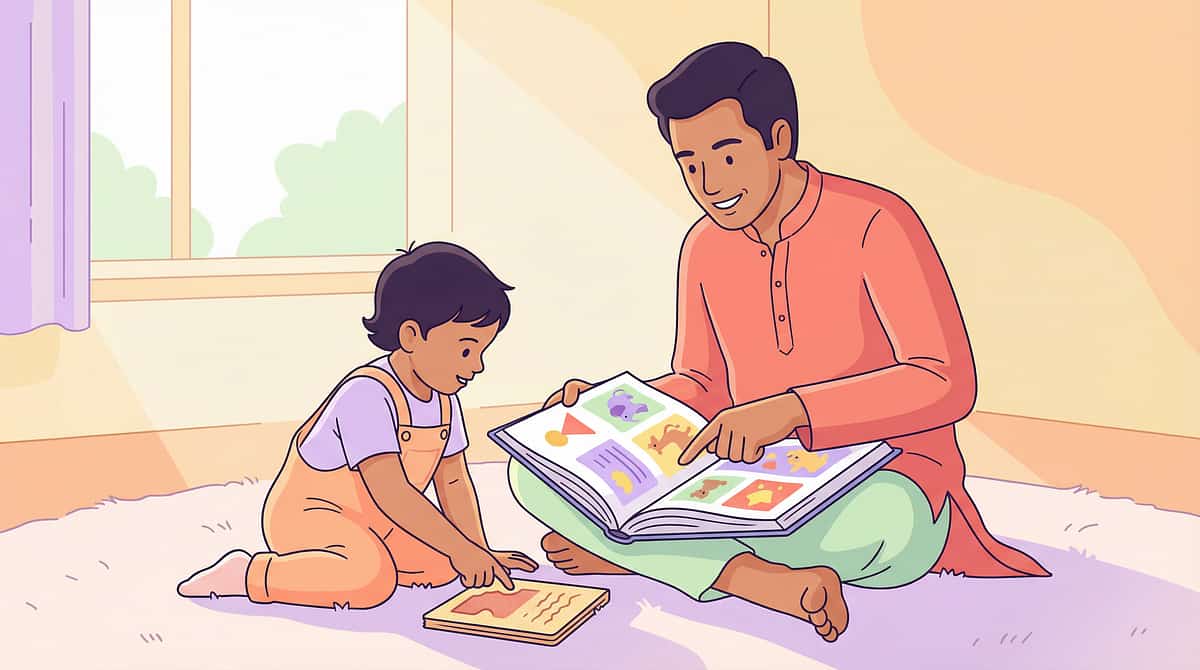
Step 2 of 6: The Engagement
⏱ 2–4 Minutes
Build the Narrative World Together
The Principle: Child is now with you. Introduce the story and build the narrative world together before any retelling is required. The engagement phase is about creating a positive, low-demand story experience first — the retelling comes after.
For Reading-Based Sessions (Most Common)
Read the chosen story FIRST — completely, without stopping to quiz or test. The child should experience the full story in an enjoyable, low-demand way. No "what's going to happen?" interruptions. Just a good story, well-told.
For Sequencing Card Sessions
Spread the cards face-down. Turn them over one at a time together. "Oh look — what's happening here?" Build curiosity about each scene before asking for order.
For Wordless Picture Book Sessions
Open to the first page. Pause. Wait 5 seconds. Let the child respond first. If silent: "What do you see?" Accept any response. Build from there.
Material Introduction Script: "Okay — now that we've read it, let's use these [icons / cards / map] to remember what happened. This symbol means [Character] — who do you think the character was?"
Child Response Indicators: Engagement → child looks at materials, reaches for them, vocalizes, points. Tolerance → child is present and quiet but not active → use "I wonder" language. Avoidance → child turns away → return to story reading without tools, try tools next session.
Reinforcement cue: ANY participation (eye contact, pointing, one word) gets immediate, specific praise: "Yes! You found the character — that's exactly right!"
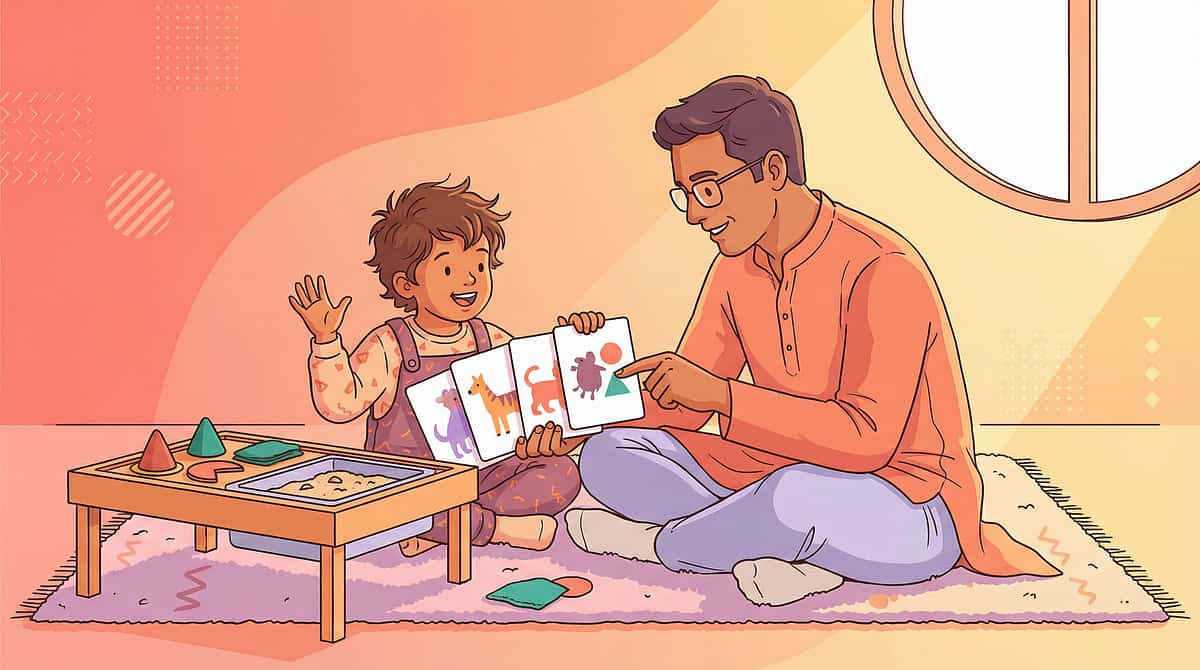
Step 3 of 6: The Therapeutic Action — The Retelling
🔴 Core Step
⏱ 5–10 Minutes
This Is Where the Skill Is Built
The Principle: Supported retelling — scaffolded by visual materials — is the therapeutic active ingredient. This is not a test. It is a practice. The child retells using whatever supports are in front of them, and every attempt builds the skill.
CHARACTER (Person Icon)
"Who was in this story? [Point to character icon.] Who was our character?" Accept: name, gesture toward picture, "the fox" — any identification counts.
SETTING (House/Location Icon)
"Where did the story happen? [Point to setting icon.] Where were they?"
PROBLEM (Lightning Bolt Icon)
"What was the problem? What went wrong?" This is often the hardest element. Scaffold heavily: "Remember when... that was the problem."
EVENTS (Arrow Sequence Icon)
"What happened? What did they do first? Then what?" Use sequencing cards if available — child points to each card in order.
SOLUTION (Star Icon)
"How did it end? Was the problem fixed? What happened at the end?"
✅ DO
Let the child lead · Accept incomplete retelling as success · Keep voice warm and conversational · Allow 5–10 seconds of silence — that's processing
❌ AVOID
Rushing through elements · Answering for the child · Moving to next element before child has responded · Correcting errors during retelling
Source: PMC11506176 (Systematic review: structured narrative retelling protocol components)
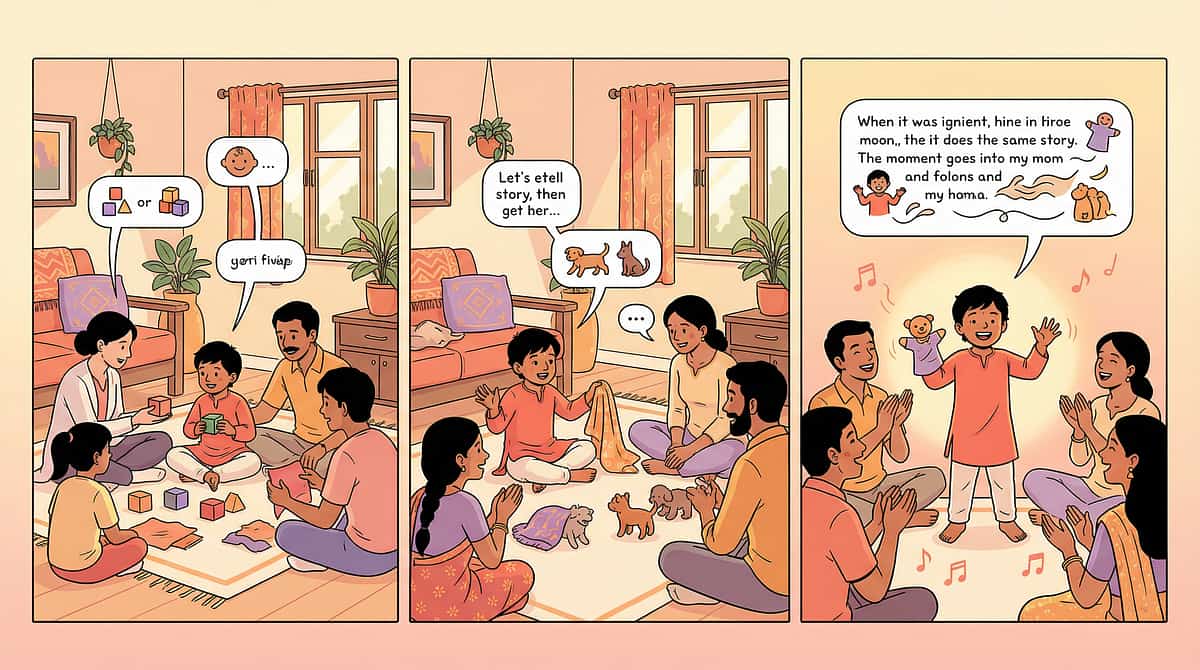
Step 4 of 6: Repeat & Vary
⏱ 3–5 Minutes
Three Good Passes Build Neural Consolidation
The Principle: Three good retelling passes with slight variation builds stronger narrative memory than ten identical repetitions. Repetition with variation = neural consolidation.
These three passes move the child systematically from full scaffolding to independent recall — each session advancing the neural pathway formation one step further.
Variation Options to Maintain Engagement
Use a Different Story
Same structure, different content — generalization practice is built right in.
Child Becomes the Teacher
Child uses the icons to explain the story to a toy or stuffed animal — massive engagement boost.
Record the Retelling
Children love hearing their own voice — and it creates a priceless progress archive.
Draw the Retelling
Child sketches the 5 elements instead of speaking — great for highly visual children.
Satiation Indicators (child has had enough): Scripting instead of retelling · Increasing physical movement or restlessness · Shorter responses than earlier in the session · Turning away from materials repeatedly. The Rule: Three good repetitions beat ten forced ones. Quality over quantity, always.

Step 5 of 6: Reinforce & Celebrate
🟡 Critical Step
⏱ 1–2 Minutes
The Principle: What you celebrate, you get more of. Narrative retelling is hard work. Celebrate every attempt, not just perfect performances. Reinforcement must occur within 3 seconds of the desired behavior — delayed praise loses its behavior-reinforcing power entirely.
For CHARACTER identification:
"YES! You knew exactly who the character was — that's story retelling skill right there!"
For PROBLEM identification (often the breakthrough moment):
"Oh WOW. You found the problem. That's the hardest part of a story — and you got it!"
For COMPLETE retelling (all 5 elements):
"You just told me the WHOLE story — beginning, middle, end. Do you know how impressive that is?!"
Reinforcement Menu — Select Based on Your Child's Motivators
Verbal Praise
Specific, enthusiastic, immediate — works for most children. Name exactly what they did.
Physical Celebration
High five, fist bump, hug (if the child welcomes touch) — connection reinforces motivation.
Token / Sticker Chart
Place a sticker/token on a visible chart for each retelling attempt — Sticker Charts on Amazon | Reward Sticker Sets
Photo of Completed Map
"Let's photograph your work to show Dad/Grandma" — creates a pride artifact and social sharing opportunity.
Step 6 of 6: The Cool-Down
🟢 Final Step
⏱ 2–3 Minutes
Never Skip This Step
The Principle: No narrative session ends abruptly. The transition is a therapeutic moment — it builds predictability, reduces post-session dysregulation, and reinforces the positive association with story work.
Step A — The 2-More Warning (60 seconds before end)
"Two more, then all done. Last one — which story element do you want to end on?" This gives the child agency and a predictable transition point.
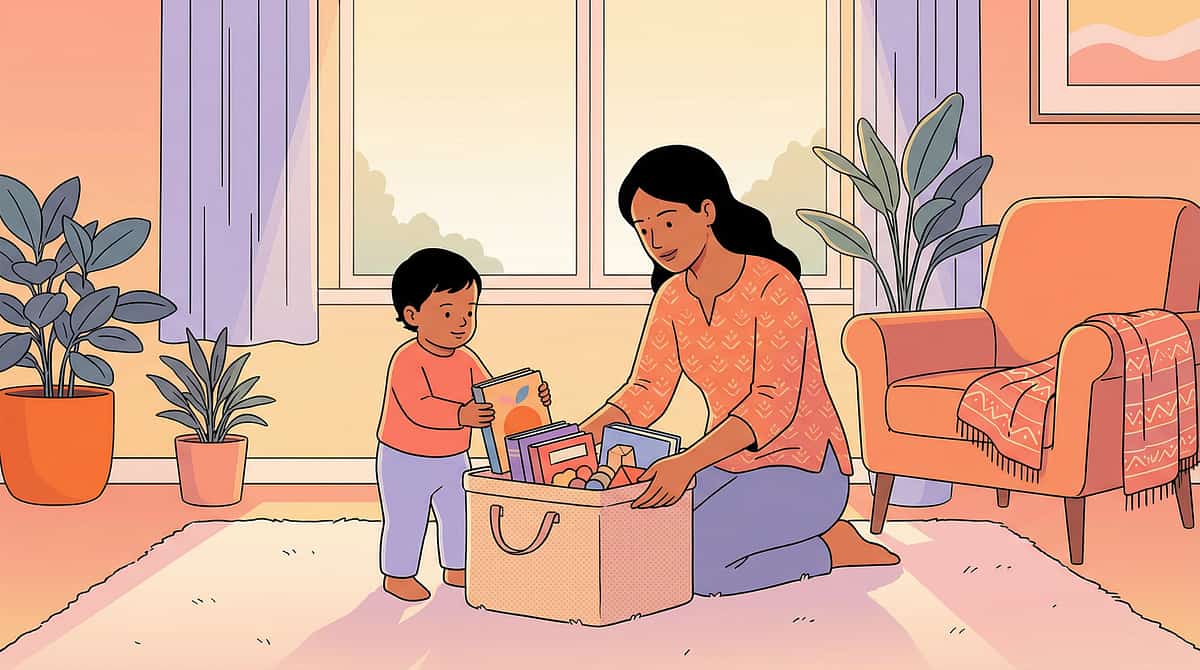
Step B — Material Put-Away (with child participating)
"Can you help me put the story cards back in the box? Which ones did we use today?" This is a review moment — child handles each material briefly, reinforcing what they did.
Step C — The Transition Cue (mark the close)
"Story time is done — great work today. [State one specific thing they did well.]" Then transition directly to a preferred or neutral activity.
If Child Resists Ending: "I know — stories are great! We'll do another one [tomorrow / after dinner]. Let's take a photo of our work so we remember it." Photo ritual creates positive closure and a memory artifact.
Source: NCAEP Evidence-Based Practices Report (2020): Visual supports and predictable transitions are evidence-based practices for autism.
Capture the Data: 60 Seconds Now = Months of Evidence
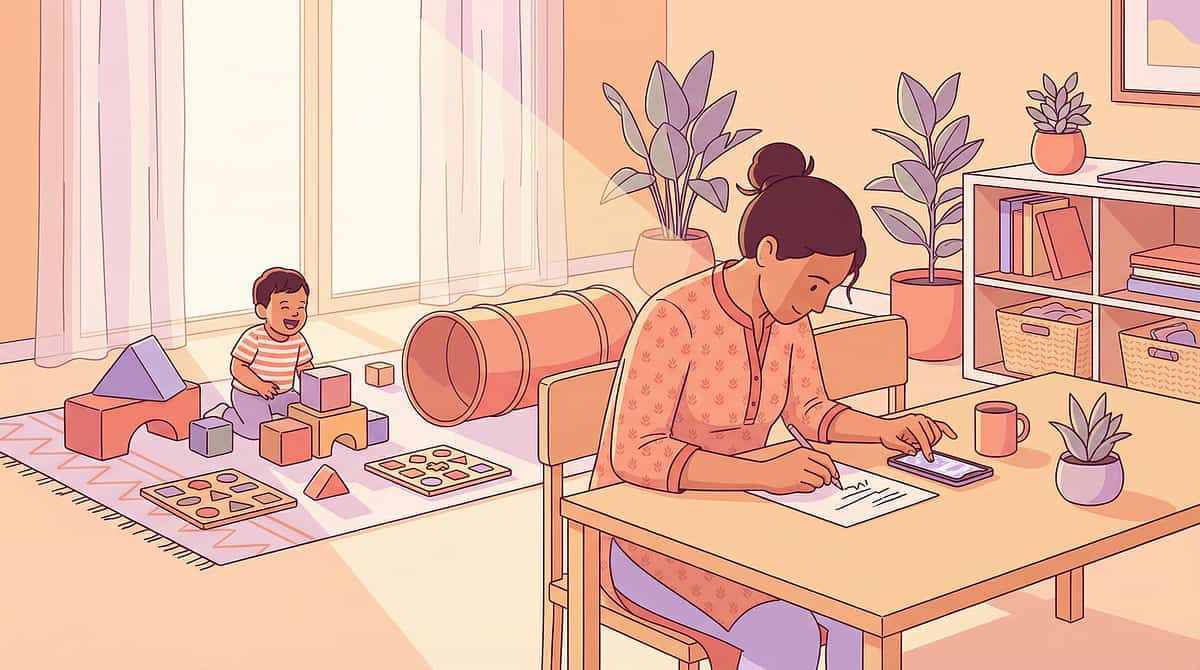
Simple, consistent data collection transforms your home sessions from anecdotal to evidence-based. Three data points — nothing more — is all you need to track meaningful progress over time.
Date & Story Used
Date · Story title · Material used today (story grammar / sequencing cards / props / graphic organizer / wordless book / prompt cards / frames / listen-retell / personal narrative)
Story Elements Retold
Tick which elements the child produced today: ☐ Character · ☐ Setting · ☐ Problem · ☐ Events (in sequence) · ☐ Solution. Total elements today: ___ / 5
Support Level Required
☐ Full support (parent supplied all elements) · ☐ Partial support (1–2 elements independent) · ☐ Mostly independent (3–4 elements) · ☐ Independent (all 5 elements)
Minimal Viable Tracking: If the full form feels like too much — simply write the date and the number of story elements retold (0–5) in any notebook. Dated numbers over 8 weeks tell you more than any formal assessment.
Source: BACB Guidelines + Cooper, Heron & Heward (Applied Behavior Analysis, 8th ed.) — continuous measurement standards for behavioral intervention tracking.
What If It Didn't Go as Planned? The 7 Most Common Problems
Every parent has sessions that don't go as planned. Here are the 7 most common and exactly what to do next time.
Problem 1: Child refused to participate entirely
Why: Insufficient pairing with materials; time of day mismatch; prior negative association; current dysregulation.
Fix: Spend 2 sessions doing nothing but playing near the story materials with zero demands. Let the child handle materials freely. Pair before demanding.
Fix: Spend 2 sessions doing nothing but playing near the story materials with zero demands. Let the child handle materials freely. Pair before demanding.
Problem 2: Child could only name the character — nothing else
Why: Normal at the beginning. Character is the easiest element — the remaining elements are abstractions.
Fix: Celebrate the character. Add setting only when character is consistent. Build one element per week.
Fix: Celebrate the character. Add setting only when character is consistent. Build one element per week.
Problem 3: Events retold in completely random order
Why: Temporal sequencing is a separate skill from narrative language — the child knows the content but not the order.
Fix: Introduce sequencing cards specifically. Practice ordering before integrating with retelling.
Fix: Introduce sequencing cards specifically. Practice ordering before integrating with retelling.
Problem 4: Child added irrelevant details endlessly
Why: Child is producing language but not filtering for narrative relevance — actually a positive sign.
Fix: Use story grammar icons as a filter: "That's interesting — but is it the Character? The Problem? Let's find which box it fits in."
Fix: Use story grammar icons as a filter: "That's interesting — but is it the Character? The Problem? Let's find which box it fits in."
Problem 5: Child became very distressed when unable to remember
Why: Demand-induced anxiety — the retelling task felt like a test.
Fix: Remove ALL demand language. Replace with "let's figure it out together." Parent models the retelling first.
Fix: Remove ALL demand language. Replace with "let's figure it out together." Parent models the retelling first.
Problem 6: Child retolds perfectly at home but can't retell to others
Why: Skill has not yet generalized from the practice context to novel communication contexts — normal and expected.
Fix: Deliberately practice retelling to different people in different locations. "Tell Grandma what we read."
Fix: Deliberately practice retelling to different people in different locations. "Tell Grandma what we read."
Problem 7: No progress after 3 weeks
Why: Breakdown may be occurring earlier in the skill chain — possibly at comprehension, auditory processing, or working memory level.
Fix: Contact Pinnacle for SLP assessment to identify exactly where the narrative breakdown is occurring.
Fix: Contact Pinnacle for SLP assessment to identify exactly where the narrative breakdown is occurring.
Adapt & Personalize: Calibrate for Your Child
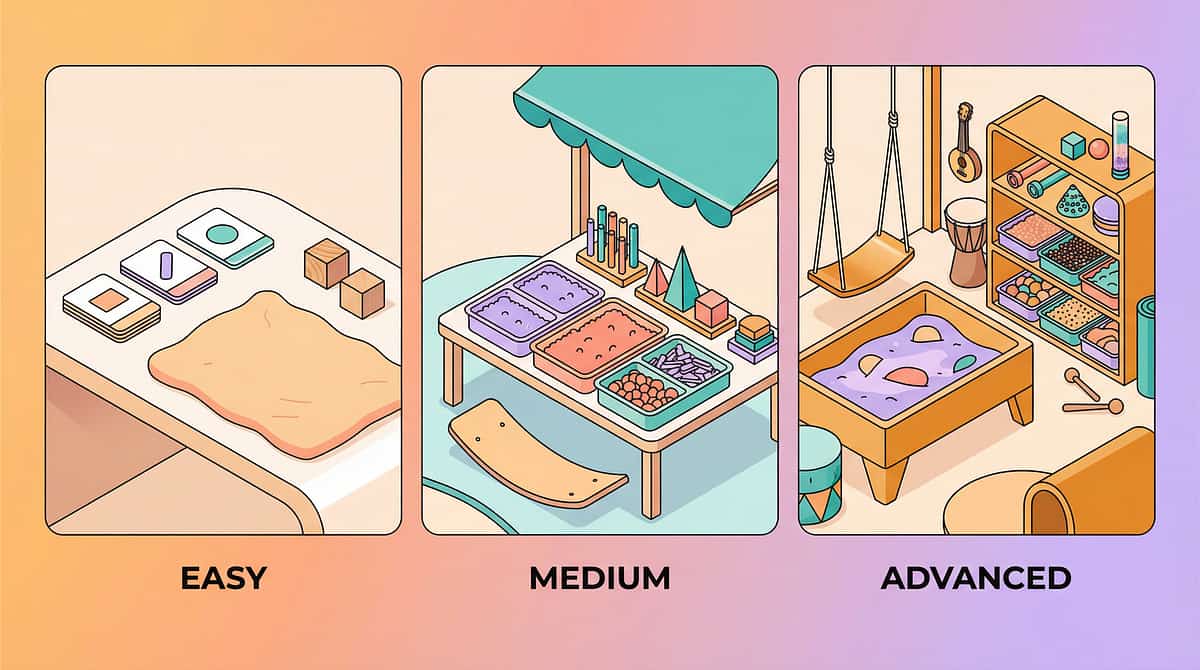
No two children learn narrative skills the same way. Here is how to make the protocol work for your child's unique profile.
⬅ EASIER (Beginners / Young / Difficult Days)
- Use only 3-picture sequencing cards (not 5–6)
- Target only 2 story elements (Character + Solution)
- Parent models full retelling first; child adds single words
- Use personal narrative (child's own experiences) instead of fiction
- Use props/puppets instead of verbal retelling
- Session = 5 minutes only
➡ HARDER (When Basics Are Mastered)
- Remove all visual supports; retelling from memory only
- Target all 5 elements independently
- Use longer, more complex stories with multiple characters
- Add temporal language targets: "first," "because," "so then," "however"
- Request retelling in full sentences
- Generalize to multiple family members, teachers, peers
Child Profile Adaptations
The Highly Visual Child
Use wordless picture books and graphic organizers primarily. Verbal retelling follows visual mapping.
The Kinesthetic / Movement Child
Use props and manipulatives as primary medium. Allow movement during retelling. Standing card arrangement on the floor.
The Language-Rich but Disorganized Child
Focus on sequencing and story grammar structure. Child has the language — they need the organizational framework.
The Anxious Child
Remove ALL demand language. Collaborative co-narration: parent and child tell together. No performance pressure whatsoever.

Ages 3–5
3-card sequences, 2 story elements, heavy visual/prop support

Ages 5–7
Full 5-element protocol with visual supports

Ages 7–10
Independent retelling with complexity increases; personal and fictional narratives

Weeks 1–2: You Are Planting, Not Harvesting
Progress Arc
~15% Complete
Weeks 1–2 are the hardest weeks for parents because the effort is high and the visible progress is small. Trust the architecture. The neural pathways are forming even when the output doesn't yet reflect it.
Progress Achieved
Foundation phase — tolerance and participation are the measurable outcomes right now
✅ Child tolerates story materials without protest
This IS progress. Material tolerance is the prerequisite for all subsequent learning.
✅ Child begins to identify character when prompted with icon
The most concrete element emerging first — exactly as expected.
✅ Child participates in 3-card sequencing with moderate support
Physical engagement with sequencing materials is genuine skill-building.
✅ Reduced resistance to the story corner routine
Habituation beginning — the routine itself becomes familiar and predictable.
✅ Parent begins to feel the protocol flow more naturally
Your precision with the protocol is also developing — this is a two-person skill.
What is NOT expected yet: Independent retelling · Problem and solution identification without heavy scaffolding · Narrative coherence without cards · Generalization to other settings or family members.
"If your child tolerates the material for 3 seconds longer than last week — that is real, measurable progress."
"If your child tolerates the material for 3 seconds longer than last week — that is real, measurable progress."
Source: PMC11506176 — systematic review confirms narrative intervention outcomes emerge across 8–12 week timelines; early-phase indicators focus on tolerance and participation.

Weeks 3–4: The Neural Pathways Are Forming
Progress Arc
~40% Complete
Progress Achieved
Consolidation phase — structure is internalizing and the first spontaneous elements are emerging
✅ Child begins to anticipate the session
Moves toward story corner when materials appear — the routine has become a positive expectation.
✅ Child independently identifies Character and Setting
Without prompting — the first two elements are consolidating into independent recall.
✅ Child can arrange a 4–5 card sequence with minimal guidance
Temporal sequencing skill is developing — the cognitive foundation for ordered retelling.
✅ Child begins to produce "and then" connectors spontaneously
Temporal linking language is emerging — a significant linguistic milestone.
✅ Child mentions the Problem element when heavily prompted
The hardest element showing first signs — celebrate this heavily when it appears.
"I'm noticing they're using story structure words in normal conversation." — Parent report, Weeks 3–4, Pinnacle Network
Behavioral signals of neural pathway formation: Spontaneous story talk during pretend play · Asking "what happened next?" during unfamiliar stories · Recounting experiences to family members in a slightly more organized way.
When to increase intensity: If all 5 indicators above are present, add a second daily retelling session and increase story complexity.
When to increase intensity: If all 5 indicators above are present, add a second daily retelling session and increase story complexity.

Weeks 5–8: Mastery Is Defined by Independence, Not Perfection
Progress Arc
~75% Complete
🏆 Mastery Zone
Progress Achieved
Mastery phase — independence across all 5 elements with generalization emerging
Mastery Criteria (Specific, Observable, Measurable)
5-element retelling with ≤3 prompts
Across 3 consecutive sessions — consistency matters as much as accuracy.
All 5 story grammar elements in 70%+ of retellings
Not perfection — consistent, reliable inclusion across most sessions.
Events in chronological order 80%+ of sessions
Temporal sequencing has become an internalized narrative habit.
Retells a novel story not previously practiced
Generalization — the skill is transferring to new content independently.
Retells to at least 2 different communication partners
Not just the primary parent — the skill is generalizing across people and contexts.
Maintenance Check: After mastery, reduce scaffolding gradually over 2 weeks. Does the skill persist without materials? If yes → ready for B-196 or narrative complexity increase. If skill fades → maintain current level for 2 more weeks, then retry.
Sources: PMC10955541 · BACB mastery criteria standards for behavior-analytic skill acquisition.
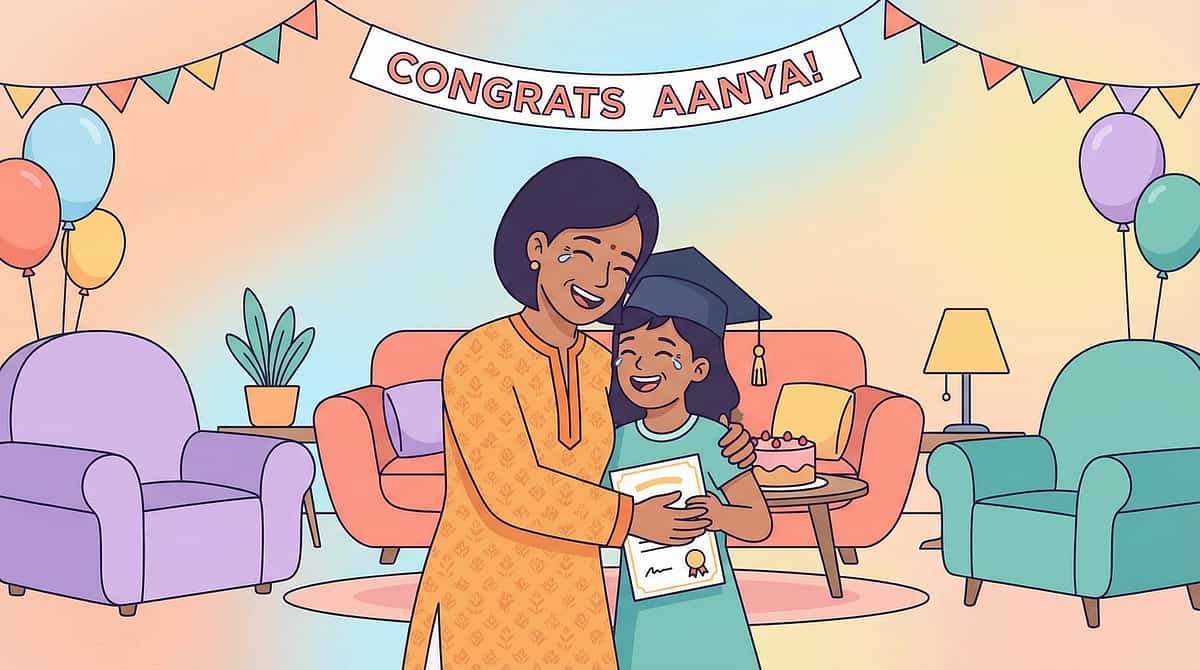
Celebrate This Win — You Did This
"Eight weeks ago, your child heard every story but couldn't find the words to tell it back. Today, they can find the beginning, the problem, and the ending — and they are learning that their own stories matter enough to be told clearly. That happened because you sat down, every day, in the story corner, and gave your child the tools to organize what they already knew. This is what it looks like when love becomes science." — Pinnacle Blooms Consortium
✅ Materials Mastered
Story Grammar Markers + Sequencing Cards + your chosen supporting materials
✅ Story Elements Retold
Character · Setting · Problem · Events · Solution — all five, independently
✅ Weeks of Practice
___ weeks of showing up in the story corner, every day
Family Celebration Suggestion: Let your child tell you a brand new story — one they make up entirely. With no prompts, no materials. Just their voice. Listen. Celebrate every element they include. This is their narrative voice, growing clearer every day.
Photo/Journal Prompt: Take a photo of your completed story map. Date it. Write: "This is when [name] learned to tell stories." File it where you keep milestones.
Red Flags: When to Pause — Not Push
These specific signs mean: pause, don't push. You are not failing — you are being appropriately cautious.
🔴 Red Flag 1: No tolerance for story materials after 3 weeks
What it looks like: Child actively avoids, destroys, or becomes significantly distressed at the introduction of any narrative materials after 3 full weeks of low-demand exposure.
Why it matters: May indicate an underlying auditory processing, anxiety, or sensory issue requiring professional assessment.
Action: Contact Pinnacle for SLP + OT co-assessment.
Why it matters: May indicate an underlying auditory processing, anxiety, or sensory issue requiring professional assessment.
Action: Contact Pinnacle for SLP + OT co-assessment.
🔴 Red Flag 2: Regression — skill present, then absent
What it looks like: Child was retelling 3–4 elements but has dropped to 0–1 across 3+ sessions without a clear illness or significant life event explanation.
Why it matters: Regression in language skills can signal changes in neurological state, increased anxiety, or an emerging co-occurring challenge.
Action: Book a consultation within 2 weeks.
Why it matters: Regression in language skills can signal changes in neurological state, increased anxiety, or an emerging co-occurring challenge.
Action: Book a consultation within 2 weeks.
🔴 Red Flag 3: Complete inability to sequence any 3 events by age 5
Why it matters: This is a developmental red flag independent of this specific technique.
Action: Comprehensive SLP assessment for narrative language development.
Action: Comprehensive SLP assessment for narrative language development.
🔴 Red Flag 4: Story retelling consistently triggering meltdowns
Why it matters: May indicate the task is encountering a sensory processing, executive function, or anxiety barrier requiring specialist assessment.
Action: Stop narrative-specific practice, maintain story reading only, consult Pinnacle immediately.
Action: Stop narrative-specific practice, maintain story reading only, consult Pinnacle immediately.
🔴 Red Flag 5: No emerging spontaneous narrative language by age 7
Why it matters: Spontaneous narrative (not just prompted retelling) should be emerging by age 7. Absence warrants SLP assessment.
Action: Book a comprehensive language assessment.
Action: Book a comprehensive language assessment.
1️⃣ Self-resolve
Modify and retry with easier protocol — use Card 31 adaptations
2️⃣ Teleconsult
📞9100 181 181 — free, 16 languages, 24×7
3️⃣ Clinic Visit
"Trust your instincts. If something feels wrong, pause and ask. That's not worry — that's wisdom."
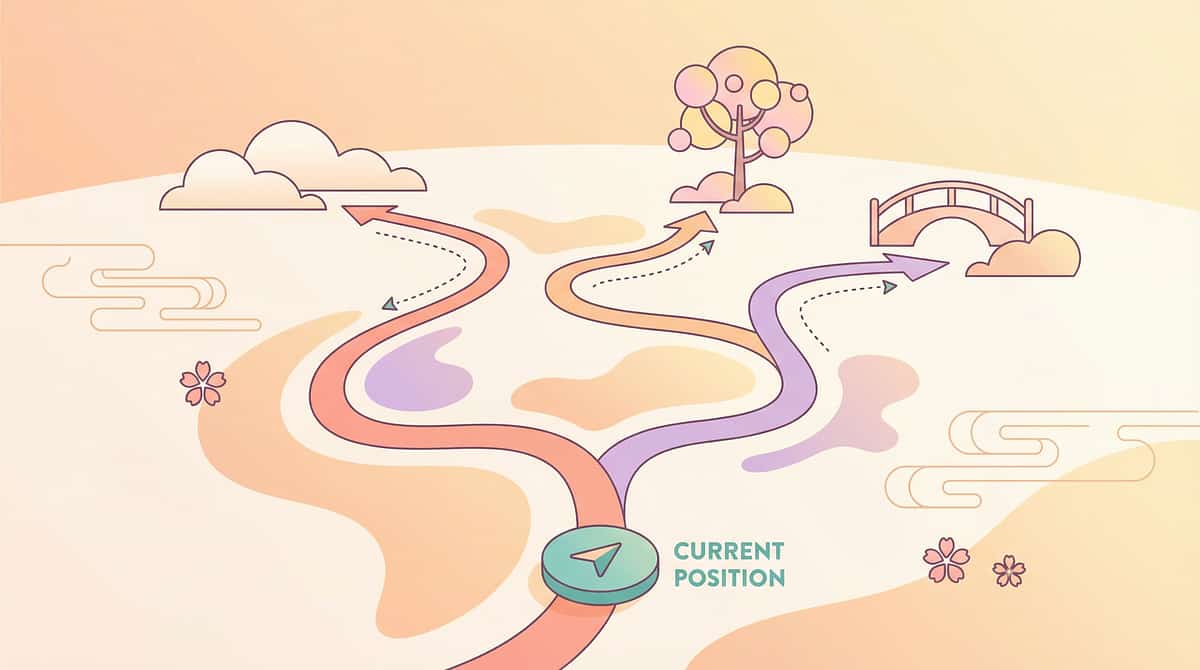
The Progression Pathway — You Are on a Journey
B-195 is a milestone, not a destination. Here is the full map of where you came from and where you are heading.
If B-195 Worked Well → Advance To:
- B-196: Following Complex Directions — builds auditory processing and sequential instruction following
- B-198: Reading Comprehension — applies narrative skills to written text comprehension
If Fiction Was Difficult → Try:
- Personal Narrative first — apply story grammar to child's own experiences, then transfer to fiction
- B-210: Sequencing Difficulties — address the sequencing foundation before narrative language
Long-Term Developmental Goal
Narrative competence → Academic literacy → Social communication fluency → Self-advocacy and personal story ownership
Related Techniques in the Language Domain
You already know the foundation. These related techniques build from the same principles — each addressing a specific connected skill.
🟢 Intro
Precedes narrative — the foundation for flexible, generative language that story retelling requires.
🟡 Core
Auditory sequencing — a parallel skill to narrative sequencing, both requiring temporal order in working memory.
🟡 Core
Vocabulary is the content of narrative — richer vocabulary makes story retelling more complete and nuanced.
🔴 Advanced
Narrative skills transfer directly to written text comprehension — the academic application of story grammar.
🟡 Core
Broader expressive language framework — the wider context in which narrative skills develop.
🟢 Intro
Foundational sequencing skill underlying narrative — address this first if temporal ordering is the core barrier.

Your Child's Story Is Waiting to Be Told Clearly
Everything you need is on this page. The only step that remains is the first one.
Everything you need
The neuroscience, the materials, the protocol, the progress arc, the community — all here
Zero budget required
Every material has a ₹0 DIY version — you can start today with paper and a pen
10 minutes a day
Consistent daily practice of even 10 minutes produces measurable outcomes over 8 weeks
🔵Validated by the Pinnacle Blooms Consortium · OT • SLP • ABA/BCBA • SpEd • NeuroDev Pediatrics • CRO · 21 Million+ Sessions · 70+ Centers · 97%+ Measured Improvement
Preview of 9 materials that help when child cant retell stories Therapy Material
Below is a visual preview of 9 materials that help when child cant retell stories therapy material. The pages shown help educators, therapists, and caregivers understand the structure and content of the resource before use. Materials should be used under appropriate professional guidance.



Link copied!
The Pinnacle Promise — From Fear to Mastery, One Technique at a Time
You arrived on this page holding a question: "Why can't my child tell a story back?" You are leaving with the answer — and the tools to do something about it.
The neuroscience of why
Three brain systems, five simultaneous skills, and a wiring difference — not an attention problem
Nine materials with ₹0 alternatives
Directly addressing the root causes of story retelling breakdown — from visual scaffolds to personal narrative
A complete six-step protocol
Invitation → Engagement → Therapeutic Action → Repeat & Vary → Reinforce → Cool-Down
An eight-week progress arc
Specific, observable milestones with realistic expectations at every stage
A community, professional network, and research library
200+ active parents, 70+ centers, Level I–II evidence — you are not alone
"Your child's narrative voice is in there. These tools help it find its shape." — Pinnacle Blooms Consortium
Loop Navigation:⬆ Return to Top | ➡ Next Technique: B-196 Following Complex Directions | 🗂 Browse All Language Techniques | 🏠 Pinnacle Blooms Network®
Medical Disclaimer:This content is for educational purposes only. It does not replace assessment, diagnosis, or treatment by a licensed speech-language pathologist. Story retelling difficulties may reflect various underlying conditions requiring differential diagnosis. Narrative intervention should be individualized based on comprehensive assessment. If you are concerned about your child's language development, consult a qualified professional. Individual outcomes vary. Statistics represent aggregate outcomes across the Pinnacle Blooms Network. © 2025 Pinnacle Blooms Network®, unit of Bharath Healthcare Laboratories Pvt. Ltd. All rights reserved.
Statutory Identifiers: CIN: U74999TG2016PTC113063 | DPIIT: DIPP8651 (Govt. of India) | MSME: Udyog Aadhaar TS20F0009606 | GSTIN: 36AAGCB9722P1Z2
Technique URL: techniques.pinnacleblooms.org/language/cant-retell-stories-B-195 · Language Solutions Series · Episode 195 · Narrative Skills · Ages 3–10 · Generated by GPT-OS® Content Engine