
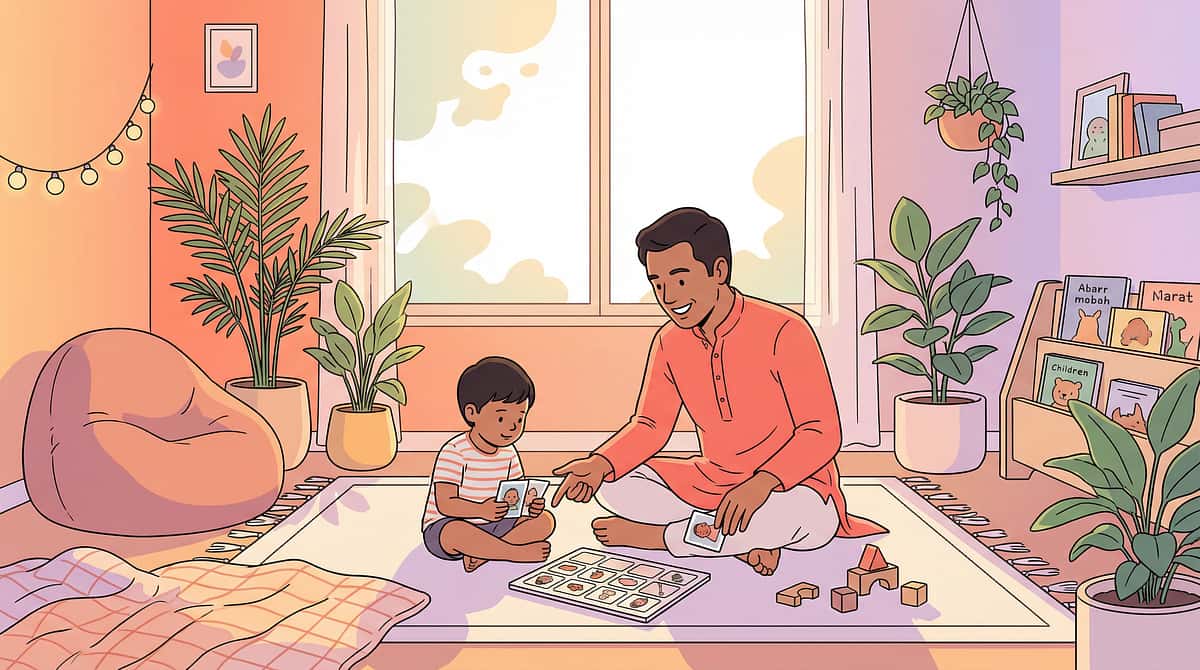
"She's clearly upset about something. But I have no idea what she wants. We both end up in tears."
This is not a parenting failure. This is a communication gap — and it is closable. There are 9 proven materials that can give your child a functional voice starting today.
Communication Solutions Series • Episode B-189
Age: 18 months – 8 years
Expressive Communication / AAC

📊 Prevalence & Scale
Every Need That Cannot Be Expressed Is a Child Waiting to Be Heard
You are among millions of families navigating this exact challenge — right now, in homes exactly like yours. Expressive communication deficits are the #1 presenting concern for families accessing pediatric SLP services in India across 70+ Pinnacle centers.
1 in 36
Children Globally
Identified with autism spectrum disorder (CDC, 2023)
1.3Cr+
Children in India
Living with developmental communication challenges
80%
ASD & Expression
Of children with ASD have significant expressive communication deficits at initial presentation
70-80%
AAC Success Rate
Reduction in frustration-related challenging behavior within 8 weeks of consistent AAC implementation (ASHA, 2023)
Research confirms: AAC does NOT inhibit speech development. In most cases, it accelerates it. India's pediatric SLP workforce covers less than 2% of the population requiring services — home-based AAC implementation is the scalable solution. PMC11506176 | PMC10955541 | CDC ADDM Network 2023

🧠 The Neuroscience
What's Happening in Your Child's Brain
Why Your Child CAN'T Say It
Your child's brain has a clear communication intention — they know what they want. The disconnect occurs in the pathway from intention to speech output. Broca's area or the motor speech planning circuits may be developing more slowly, processing differently, or temporarily overwhelmed by sensory and emotional load.
PATH A (Speech): Intention → Broca's Area → Motor planning → Oral output (disrupted / under-developed)
PATH B (AAC/Alternative): Intention → Prefrontal Cortex → AAC tool selection → Communication delivered (FUNCTIONAL — use this now)
The Solution: Pathway Substitution
Your child is NOT choosing silence. They are NOT being defiant. Their intent to communicate is real and urgent — they simply lack a functional output channel for speech in this moment.
AAC tools — picture symbols, communication boards, sign language, voice-output devices — create an alternate neural pathway that bypasses the disrupted speech circuit.
"Using AAC does not teach the brain to avoid speech. It teaches the brain that communication works — and that understanding accelerates speech development, not impedes it." — ASHA Position Statement on AAC (2023)
When a child's need goes unmet, the resulting stress further impairs communication circuits. Breaking this cycle by providing functional AAC is both clinically urgent and emotionally necessary.
📅 Developmental Context
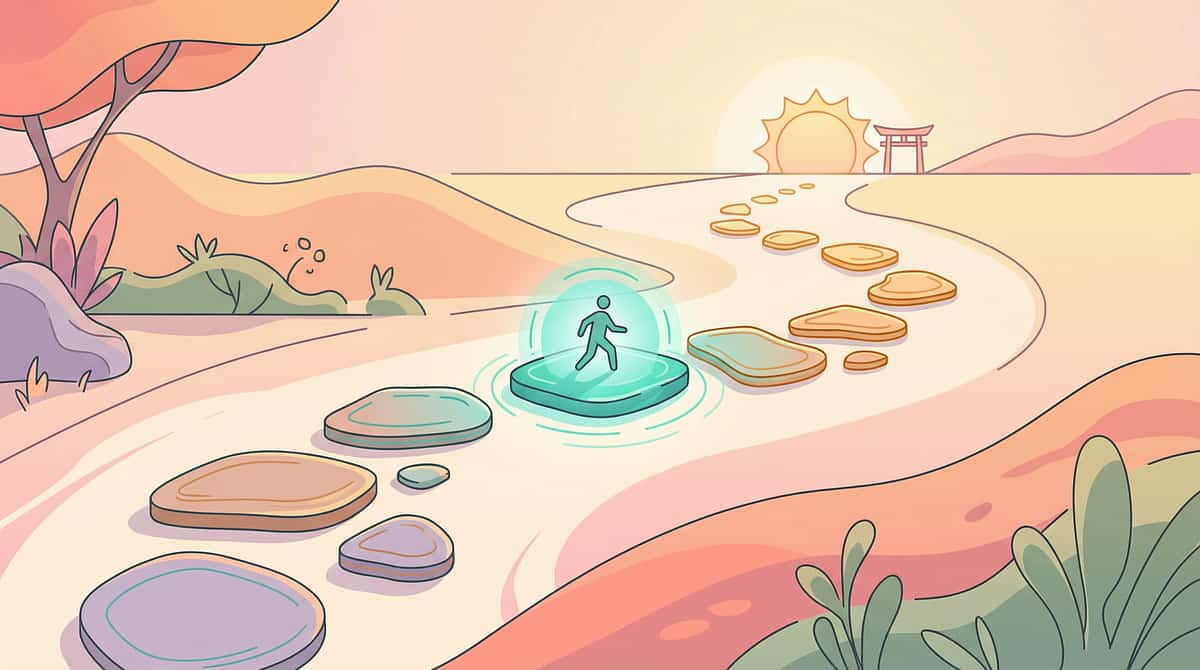
Understanding Where Your Child Is — And Where They're Heading
1
0–12 Months
Cooing, babbling, joint attention, pointing, signs emerging
2
12–18 Months
First words, gestures, naming objects
3
18–24 Months
2-word combinations, requests — ⚠️ Challenge zone begins here
4
2–3 Years
Simple sentences, questions, social conversation
5
3–5 Years
Complex sentences, narrative, literacy foundations
6
5–8 Years
Full discourse, literacy, academic communication
⚠️Challenge Zone: Expressive communication deficit for functional requesting typically becomes clinically evident between 18 months and 3 years — when peers are combining words and expressing needs but your child is not.
Expressive communication deficits commonly co-occur with: Autism Spectrum Disorder, Childhood Apraxia of Speech, Global Developmental Delay, Hearing Impairment (screen for this first), Developmental Language Disorder, and Down Syndrome.
"Your child is here. This page is the bridge to there. The path is mapped, the tools are ready, and the evidence is clear."

🏅 Clinical Evidence Grade
5 Decades of Research. One Clear Verdict: Give Children a Voice Now.
Evidence Grade: IA
Systematic Review + Meta-Analysis
Level IA = Highest level of clinical evidence (multiple systematic reviews + RCTs)
95% Clinical Confidence
Evidence-Based Practice Status — confirmed across 5 decades of research and dozens of independent studies.
Key Studies
PRISMA Systematic Review (Children, 2024): 16 articles confirm AAC meets evidence-based practice criteria for ASD. Effect sizes: moderate to large. PMC11506176
Meta-Analysis (World J Clin Cases, 2024): 24 studies confirm AAC promotes social participation, adaptive behavior, and independence. PMC10955541
NCAEP Report (2020): AAC, PECS, and FCT independently classified as evidence-based practices for autism across all age groups.
Indian RCT (Indian J Pediatrics, 2019): Home-based parent-delivered interventions demonstrated significant functional communication gains within 8–12 weeks. Padmanabha et al.
Beukelman & Light (AAC, 5th Ed., 2020): AAC is a fundamental human right. Multi-modal systems consistently outperform single-modality approaches.
"Clinically validated. Home-applicable. Parent-proven. The evidence says: do not wait for speech. Give your child a functional voice today." — Pinnacle Blooms Network® Consortium SLP Lead
📖 Definition
Functional Expressive Communication via Multi-Modal AAC Systems
"Giving Your Child a Voice — Right Now"
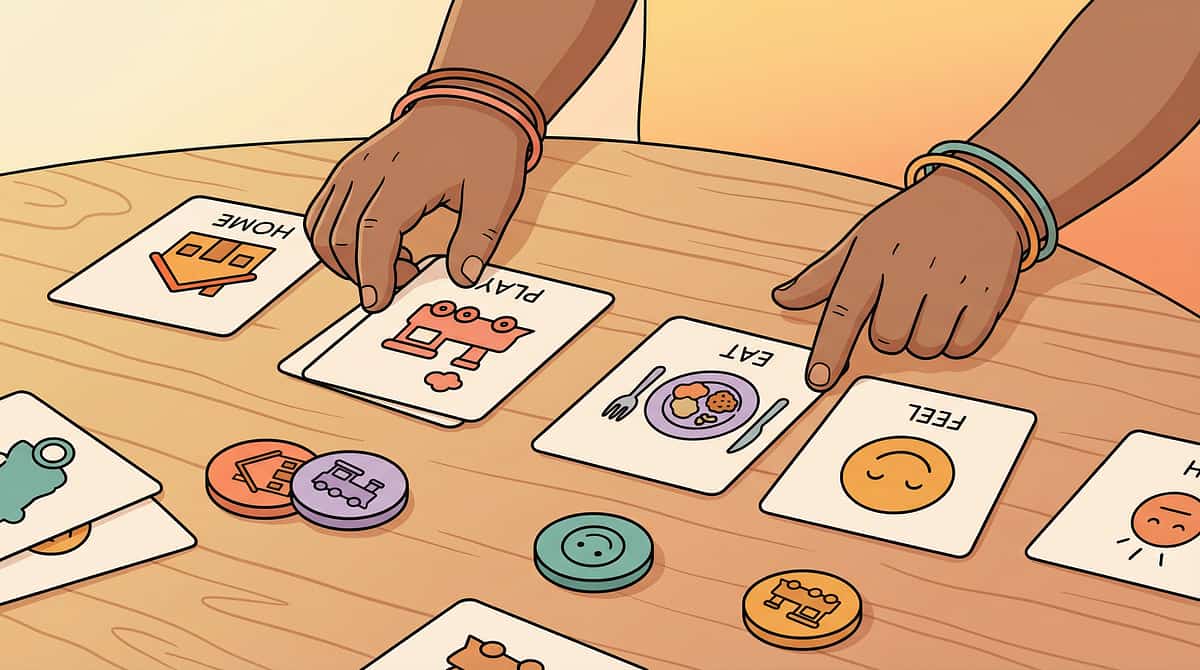
An evidence-based intervention approach that provides children with immediate, functional tools to communicate their basic needs, wants, and emotional states — using any combination of picture symbols, communication boards, sign language, voice-output technology, or structured exchange systems. The goal is not to replace speech — it is to ensure that no child's need goes unheard while speech develops.
The core principle: Every child has something to communicate. Our job is to find the channel that works — and remove every barrier to its use.
🏷️ Domain
Communication (Domain B)
🎯 Target Age
18 months – 8 years
⏱️ Session
5–15 min, embedded in daily routines
📅 Frequency
Multiple times daily — all waking hours ideally
🏠 Setting
Home — all rooms and routines
👥 Lead
Pediatric Speech-Language Pathology (SLP)
This is Episode B-189 in the Communication Solutions Series. It follows B-188 (Verb Tense Difficulty) and precedes B-190 (Limited Pretend Play Skills). Browse the full library at techniques.pinnacleblooms.org/domain/communication.

👥 Consortium Disciplines
Five Disciplines. One Child. One Voice.
Pediatric SLP — Primary Lead
Conducts AAC feature matching assessment; selects and customizes the communication system; teaches parents symbol-by-symbol; monitors expressive output growth and plans progression toward natural speech.
Occupational Therapist — Co-Lead
Assesses motor demands of each AAC modality; positions materials for maximum motor efficiency; addresses sensory processing factors that impact communication attempts.
ABA/BCBA — Behavioral Partner
Structures Functional Communication Training (FCT) protocols; replaces challenging behavior with functional AAC requests using differential reinforcement; implements manding programs across all AAC modalities.
Special Educator — Generalization Lead
Ensures AAC use generalizes across school, home, and community; trains teachers and aides; embeds AAC into academic routines; builds literacy connection between symbols and written words.
Neuro-Developmental Pediatrician — Medical Oversight
Screens for hearing impairment (mandatory first step); rules out medical causes; monitors developmental trajectory; coordinates multi-disciplinary approach under GPT-OS® diagnostic framework.
"Communication is not a speech therapy target. Communication is a human imperative. Every discipline that touches this child — every caregiver in the home — is a communication partner. When everyone uses the system, the system works."
🎯 Therapeutic Targets
Precision Targets. Measurable Outcomes.
Target | Observable Indicator | Measurable? | |
Functional requesting | Child points to/exchanges picture to get item | Yes — frequency count | |
Frustration reduction | Duration and frequency of meltdowns decreasing | Yes — duration data | |
Intentional communication | Child initiates AAC use without prompt | Yes — independent vs prompted ratio | |
Rejection | Child uses "no/stop/all done" symbol appropriately | Yes — correct rejection % | |
Vocabulary growth | Number of symbols used meaningfully per day | Yes — symbol vocabulary count |
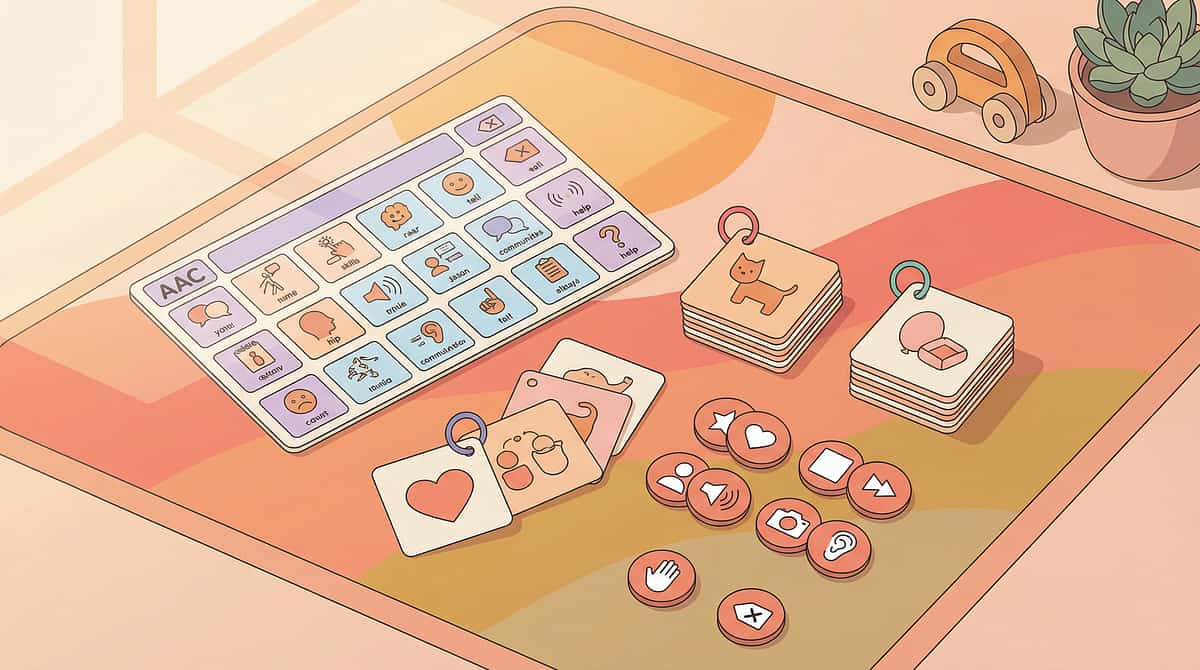
📦 9 Canon Materials
🛒 Procurement-Ready
9 Materials. Every Child's Voice Has a Path. Here Are the Tools.
These 9 materials map directly to the materials featured in Reel B-189 of the Pinnacle 999 Reels Master (Communication Solutions Series). Select the system that fits your child's current abilities — or layer multiple systems together for maximum impact.
1
First Words Communication Boards
2
PECS Materials
3
Choice Boards for Daily Routines
4
Speech-Generating Devices & AAC Apps
5
Sign Language Visual Guides
6
Portable Request Cards & Symbol Sets
7
Big Button Voice Recorders
8
Visual Emotion & Needs Charts
9
Aided Language Modeling (ALgS) Materials
Level | Materials | Description | Cost | |
🆓 Zero-cost | DIY starter | Printed board + 3 priority signs + feelings chart | ₹0 | |
💚 Home kit | Choice board + cards + chart | Choice board + portable cards + emotion chart | ₹300–800 | |
💙 Full low-tech | PECS + board + portable | PECS + communication board + portable + chart | ₹1,000–3,000 | |
💜 Tech-enabled | All above + device | All above + tablet AAC app | ₹8,000–20,000 |
For material guidance specific to your child's profile, call FREE: 9100 181 181
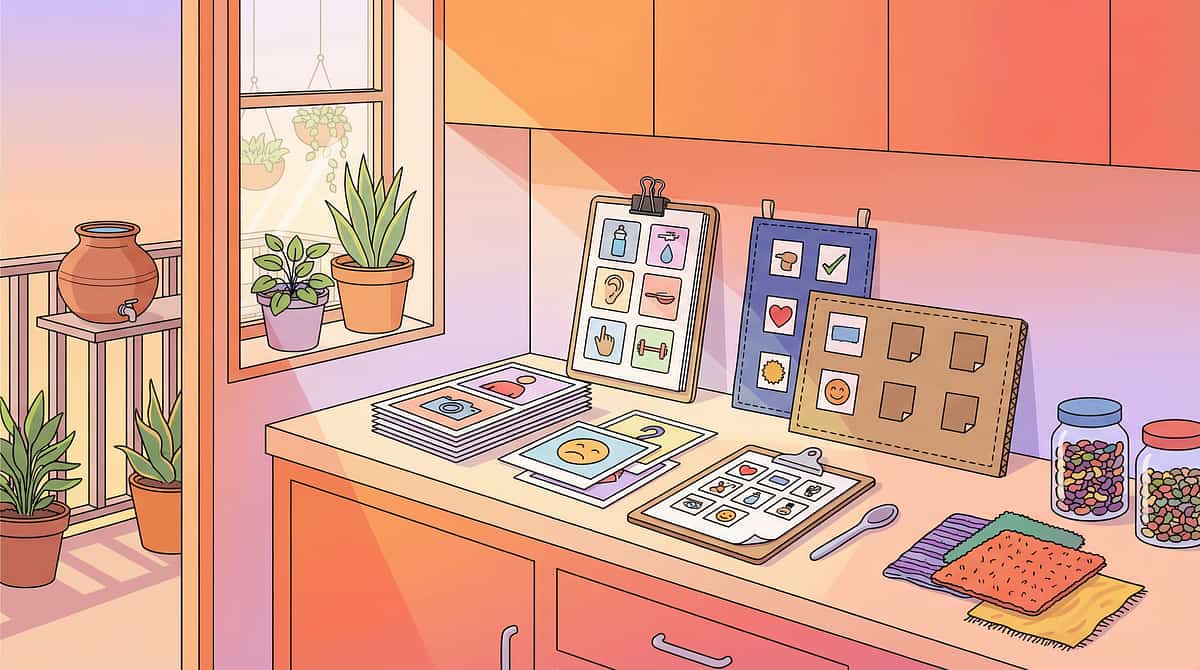
Material 1 of 9
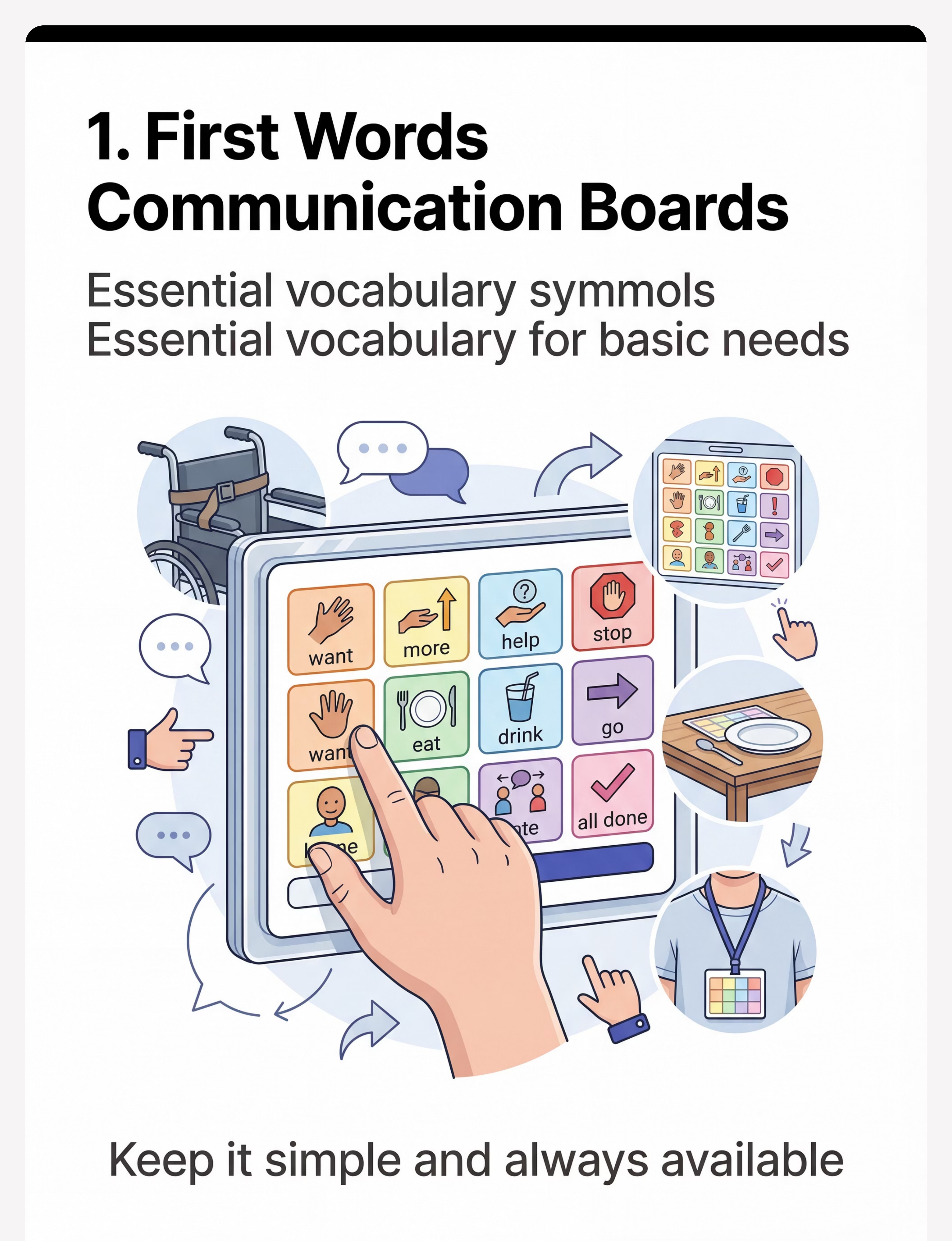
First Words Communication Boards
Canon Category: Communication Boards / Visual Supports
A laminated board displaying 12–20 core vocabulary symbols — want, more, help, stop, eat, drink, go, all done, yes, no, hurt, sleep — that covers 80% of daily communication needs with a small vocabulary set.
Why It Works
Core vocabulary research (Beukelman & Mirenda) confirms that 50 words account for over 40% of what we say daily. Communication boards give children immediate access to these highest-frequency words.
Price Range: ₹200–500 (commercial) | ₹0–50 (DIY)
Get Started
🛒Brainy Bug Flashcards with Audio → ₹305 (adapt for symbol cards)
🏠DIY (₹0–80): Print core vocabulary symbols free from boardmakeronline.com, laminate with self-adhesive film, mount on cardboard. Always available means always within reach.
⚠️Safety: The board must be accessible at ALL times. Honor every communication attempt immediately.
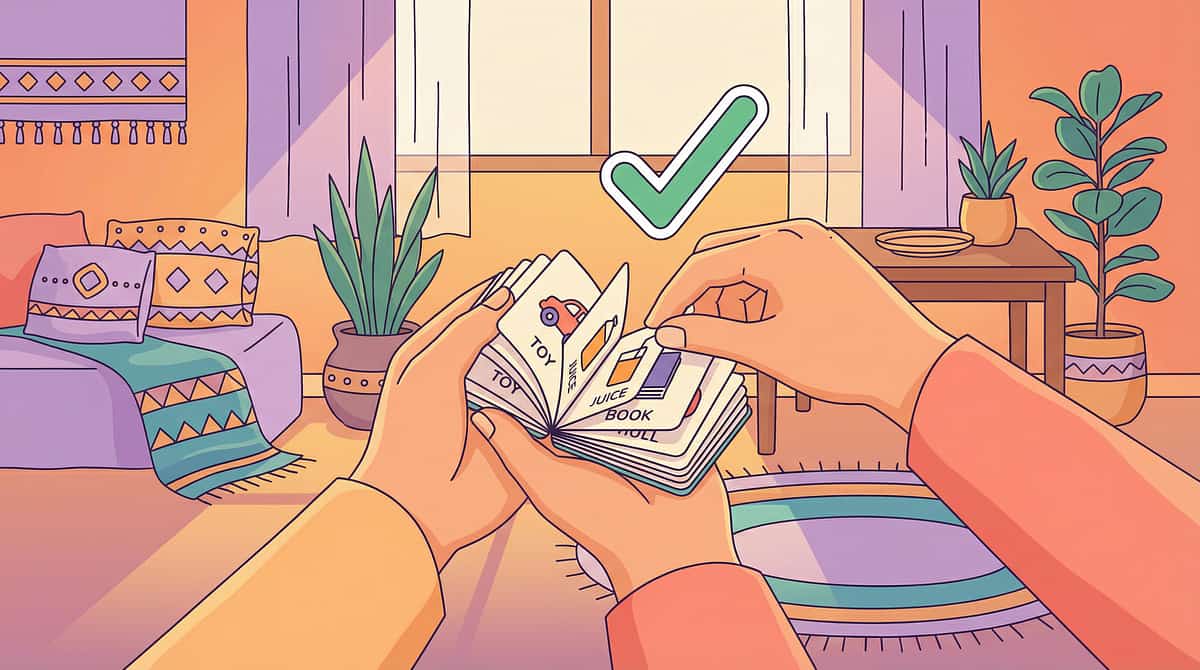
Material 2 of 9
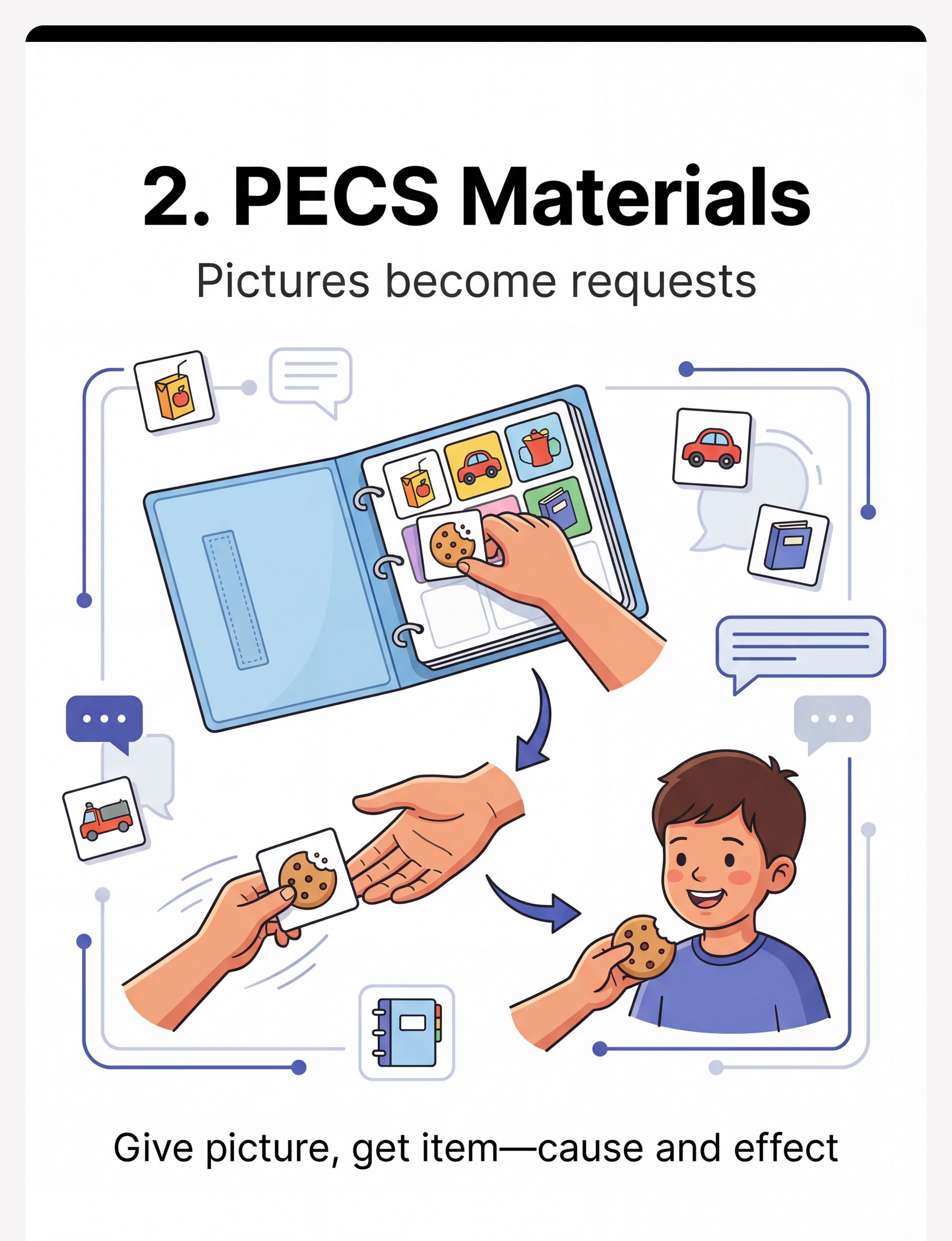
PECS — Picture Exchange Communication System
Canon Category: Communication Boards / Structured Exchange Systems
A binder-based system where the child physically hands a picture card to a communication partner to request a desired item. The physical exchange teaches that "giving a picture = getting what I want."
Why It Works
PECS builds intentional, socially-directed communication through a clear cause-and-effect chain. Phase 1 requires no prior skills — just motivation for a desired item.
Price Range: ₹500–1,500 (DIY) | ₹3,000–8,000 (professional kit)
Get Started
🛒Rhyming Words Card Set (Monkey Minds) → ₹296 (use as DIY PECS card format reference)
🏠DIY (₹100–300): Photograph child's 10 most desired items. Print 5×5cm. Laminate. Velcro to a ring binder. Follow PECS Phase 1: physical exchange first, always with a communication partner.
⚠️Safety: Use genuinely motivating items only. Never withhold a preferred item as punishment after a PECS exchange.
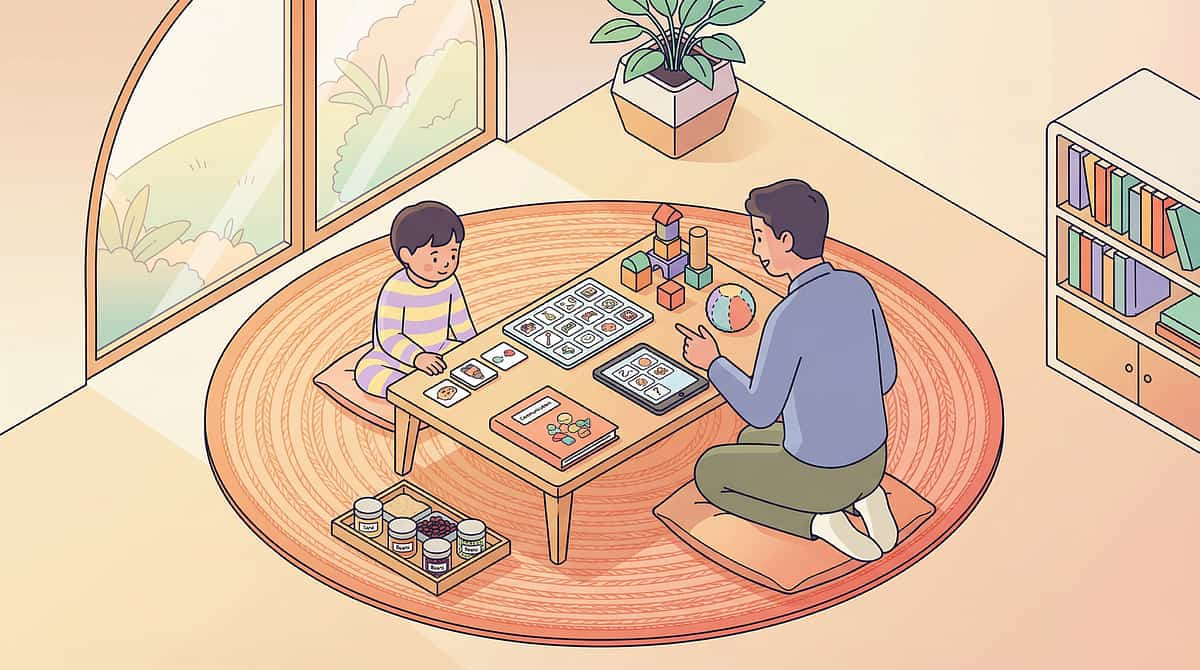
Material 3 of 9
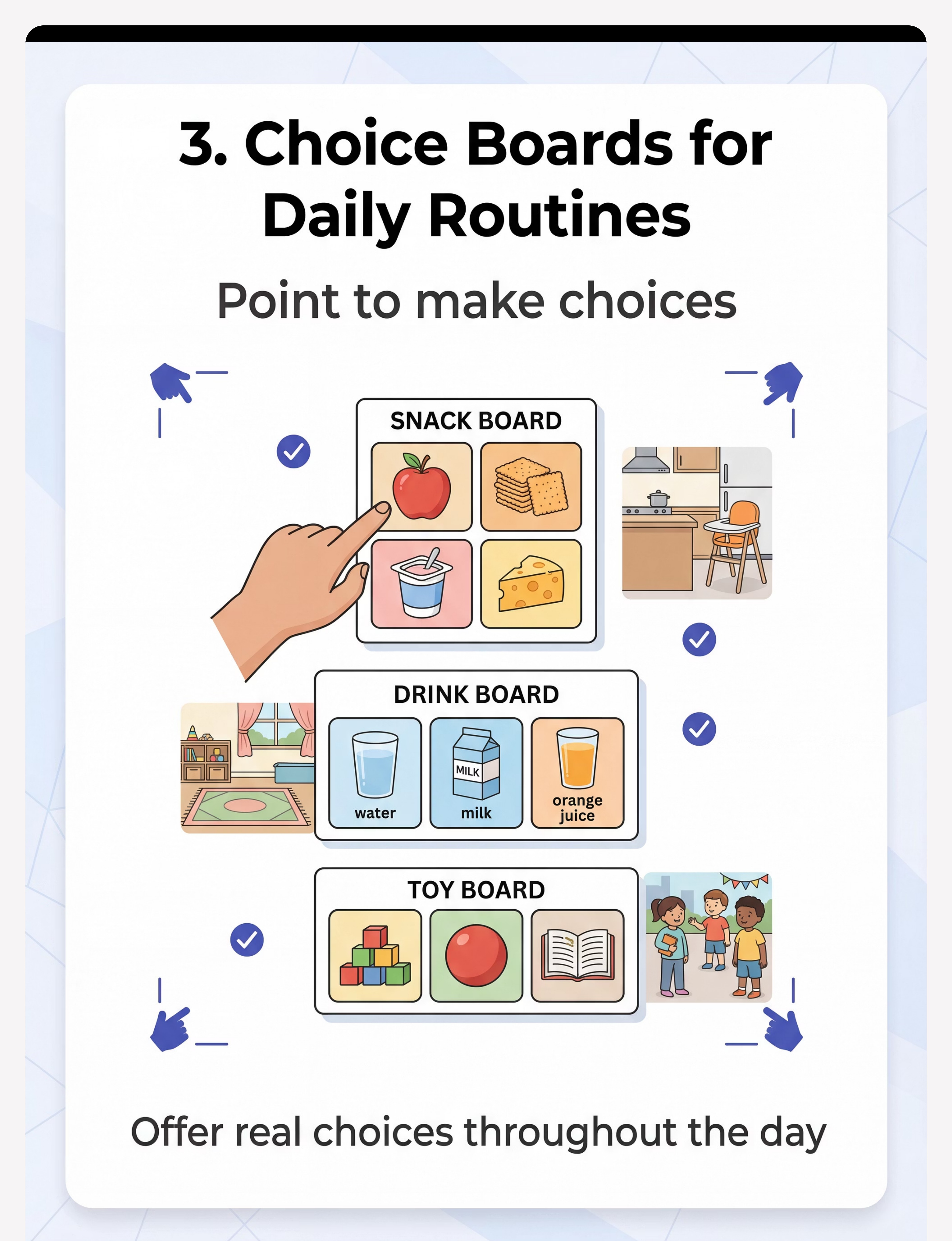
Choice Boards for Daily Routines
Canon Category: Visual Supports / Communication Boards / Daily Schedule Systems
A small laminated board showing 2–4 pictures of available choices at decision points: snack choices, drink choices, toy choices, activity choices — placed at every natural decision point throughout the day.
Why It Works
Reduces cognitive and linguistic demand — the child recognizes and selects rather than generating language from scratch. Provides real agency and predictability, reducing anxiety-related communication breakdown.
Price Range: ₹150–400
Get Started
🛒Lattooland Rainbow Sorting Set → ₹628 (sorting boards model the choice-board format)
🏠DIY (₹0–100): Photograph actual preferred items (not clip art initially). Two laminated photos. Post at snack location, toy shelf, bathroom. "Which one?" while pointing. Honor immediately.
⚠️Safety: Only offer genuine choices — both options must truly be available.

Material 4 of 9
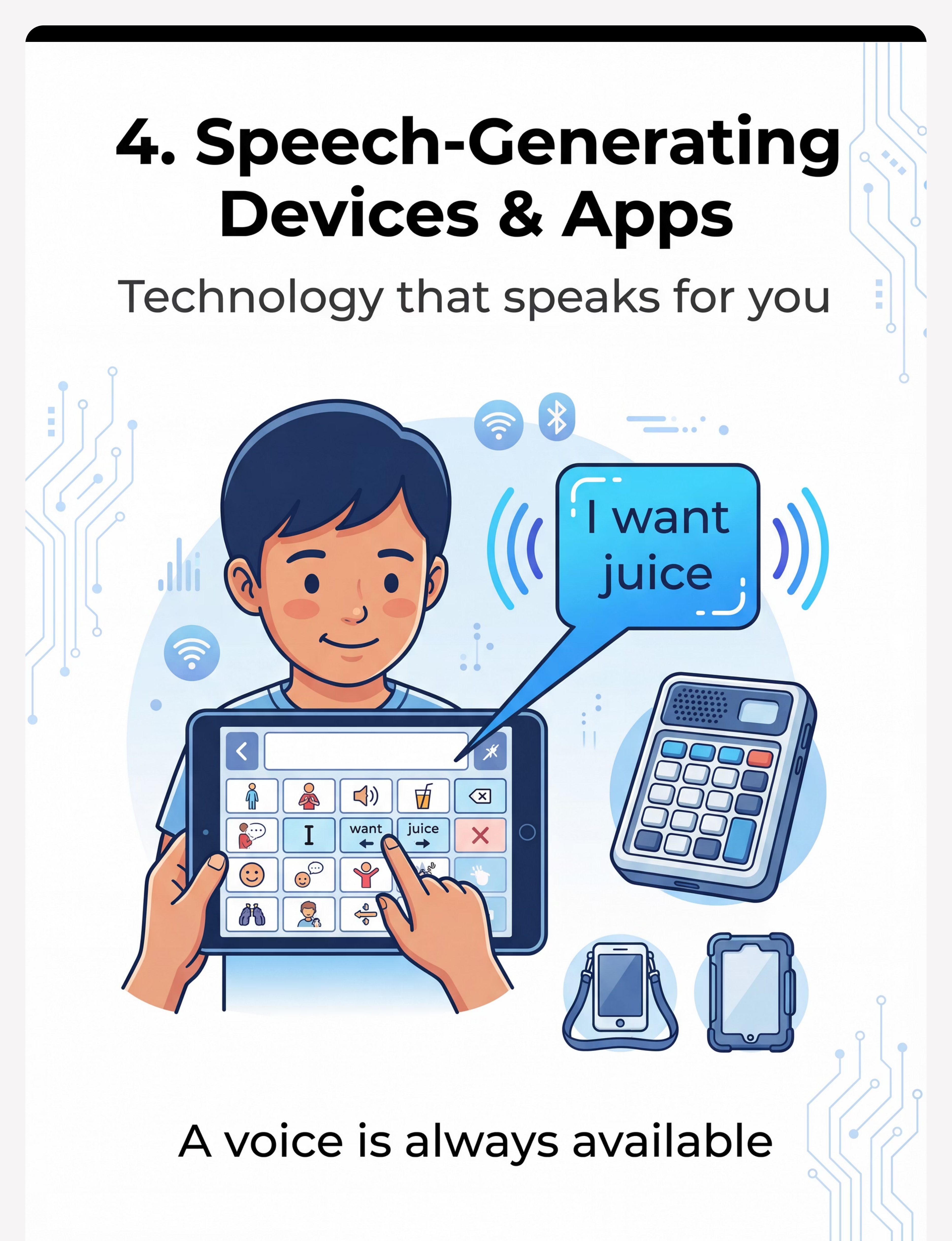
Speech-Generating Devices (SGDs) and AAC Apps
Canon Category: High-Tech AAC / Speech-Generating Devices
A tablet or dedicated device running an AAC application — the child touches a symbol and the device speaks the word or phrase aloud, giving the child a voice output that others can hear and understand.
Why It Works
Voice output confirms to the child that their communication attempt was received. Auditory feedback accelerates learning. Multiple studies confirm SGDs increase functional communication in minimally verbal children.
Price Range: ₹0 (free apps) → ₹8,000–15,000 (tablet) → ₹80,000+ (dedicated SGD)
Get Started
📱Recommended Apps:LetMeTalk (Android — Free) | Snap Core First (iOS/Android) | Proloquo2Go (iOS, premium) | Search "AAC app Hindi Kannada Telugu" for regional language support
🏠DIY Option: Free apps + existing tablet = functional SGD immediately. Zero cost to start today.
⚠️Safety: Device must be available at ALL times. Model constantly. Train all family members on the vocabulary layout.
Material 5 of 9
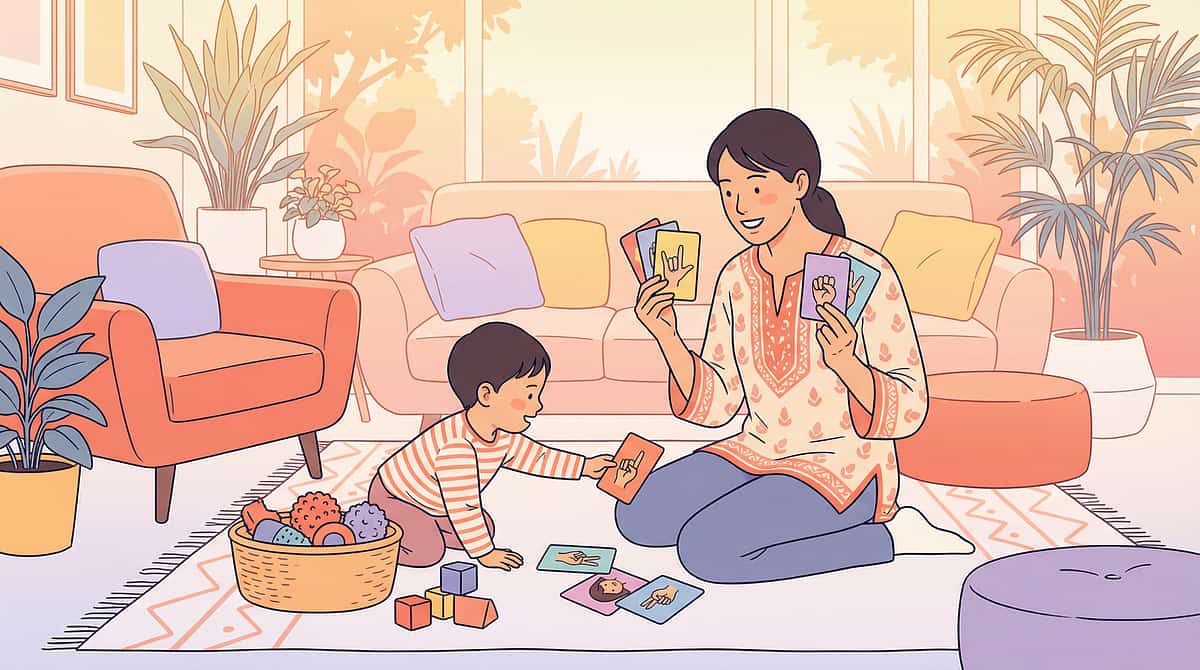
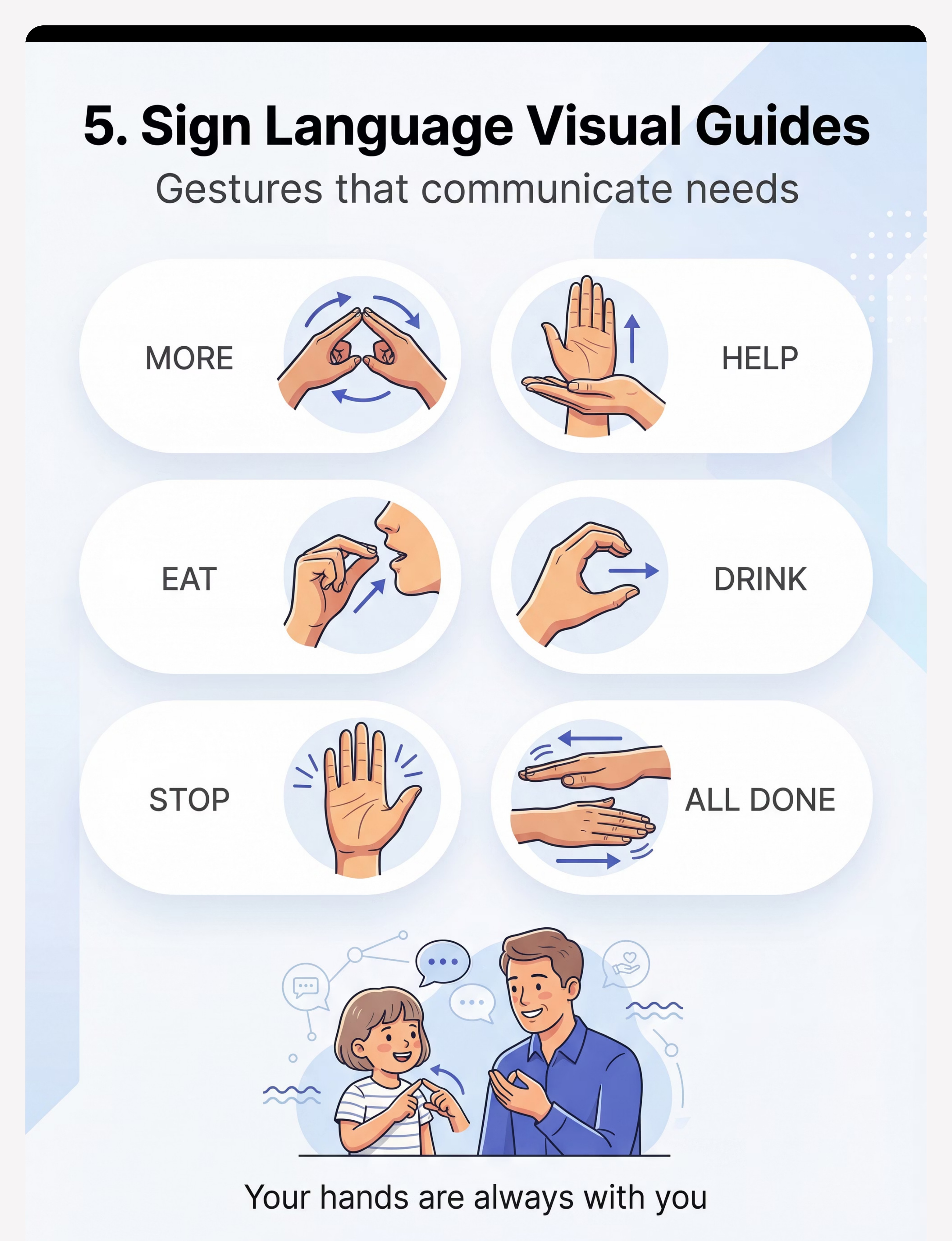
Sign Language Visual Guides and Flashcards
Canon Category: Unaided AAC / Sign Language Supports / Visual Guides
Visual reference cards and posters showing 10–20 functional signs for basic needs: MORE, HELP, EAT, DRINK, STOP, ALL DONE, PLEASE, YES, NO, HURT, SLEEP, TOILET, PLAY. Signs are always available — no materials needed.
Why It Works
Research confirms simultaneous signing (spoken word + sign together) supports speech development. Signs are often the fastest AAC entry point for young children — because they require zero materials and are impossible to leave behind.
Price Range: ₹150–400 (flashcard sets) | ₹0 (online printable)
Get Started
🛒Visual Reference Activity Set → ₹199 | Download Makaton visual guides free
🏠DIY (₹0): Learn 5 priority signs from YouTube ("Baby Sign Language India"). Post visual guide at child's eye level on refrigerator. Always say the word while signing. Never sign without also speaking.
⚠️Safety: Teach the same signs to ALL communication partners. Accept motor approximations.

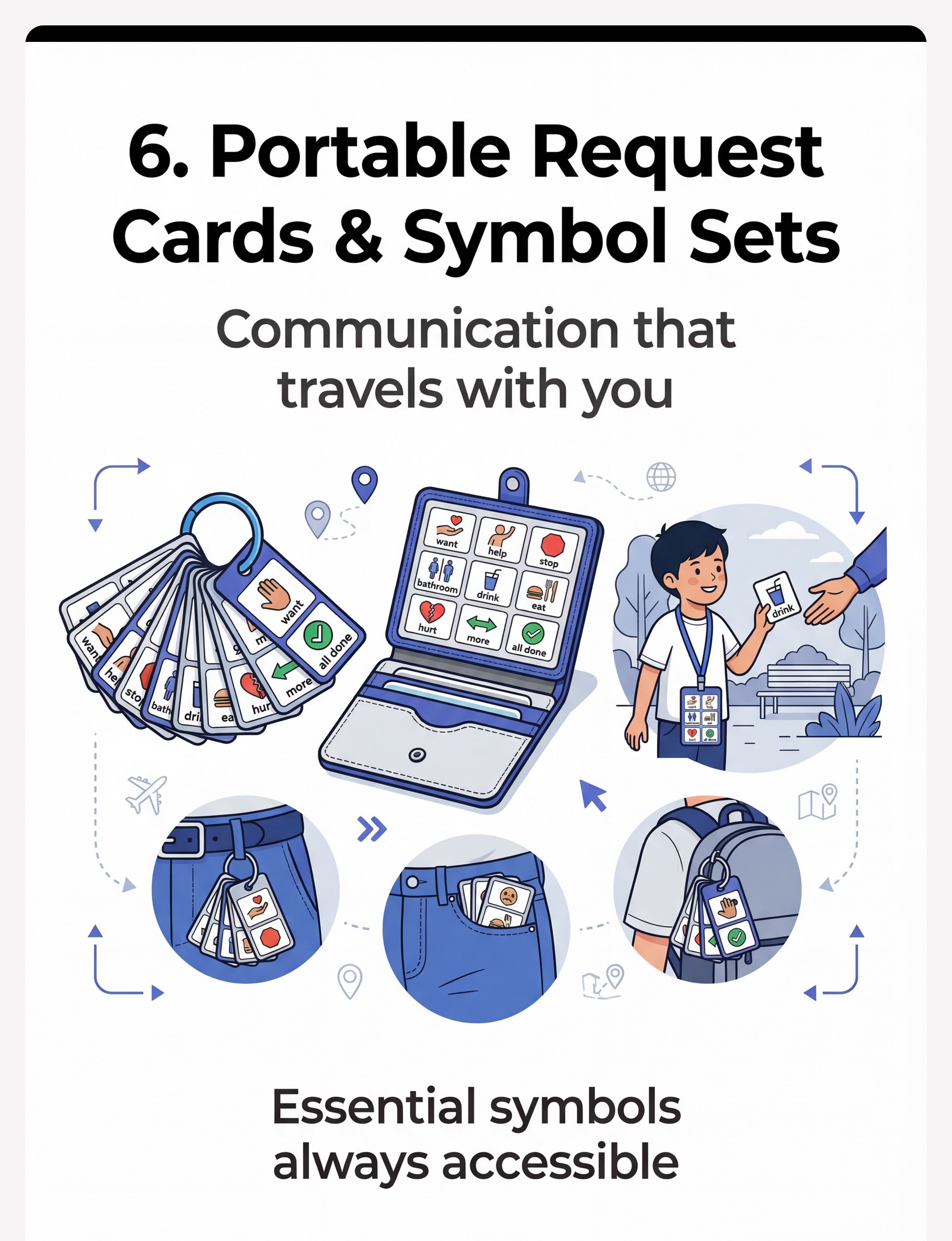
Material 6 of 9
Portable Request Cards and Symbol Sets
Canon Category: Portable AAC / Communication Wallets / Symbol Card Sets
A compact set of 10–20 symbol cards on a key ring, in a wallet holder, or on a lanyard — portable communication that travels everywhere the child goes. Communication must work everywhere — not just at home.
Why It Works
Portable systems ensure the child always has a voice, preventing the "I forgot the board at home" communication gap in the community. A child who can communicate at the restaurant, at school, and at grandma's house has true functional communication independence.
Price Range: ₹100–300 (materials) | ₹0 DIY
Get Started
🛒Reward Sticker Book → ₹364 (pocket-size card format reference)
🏠DIY (₹50–100): Print 20 priority symbols (passport photo size). Laminate. Punch hole. Ring binder clip. Attach to school bag strap or belt loop. Must be waterproof and not too bulky.
⚠️Safety: Attach where the child — not just the adult — can access it independently.
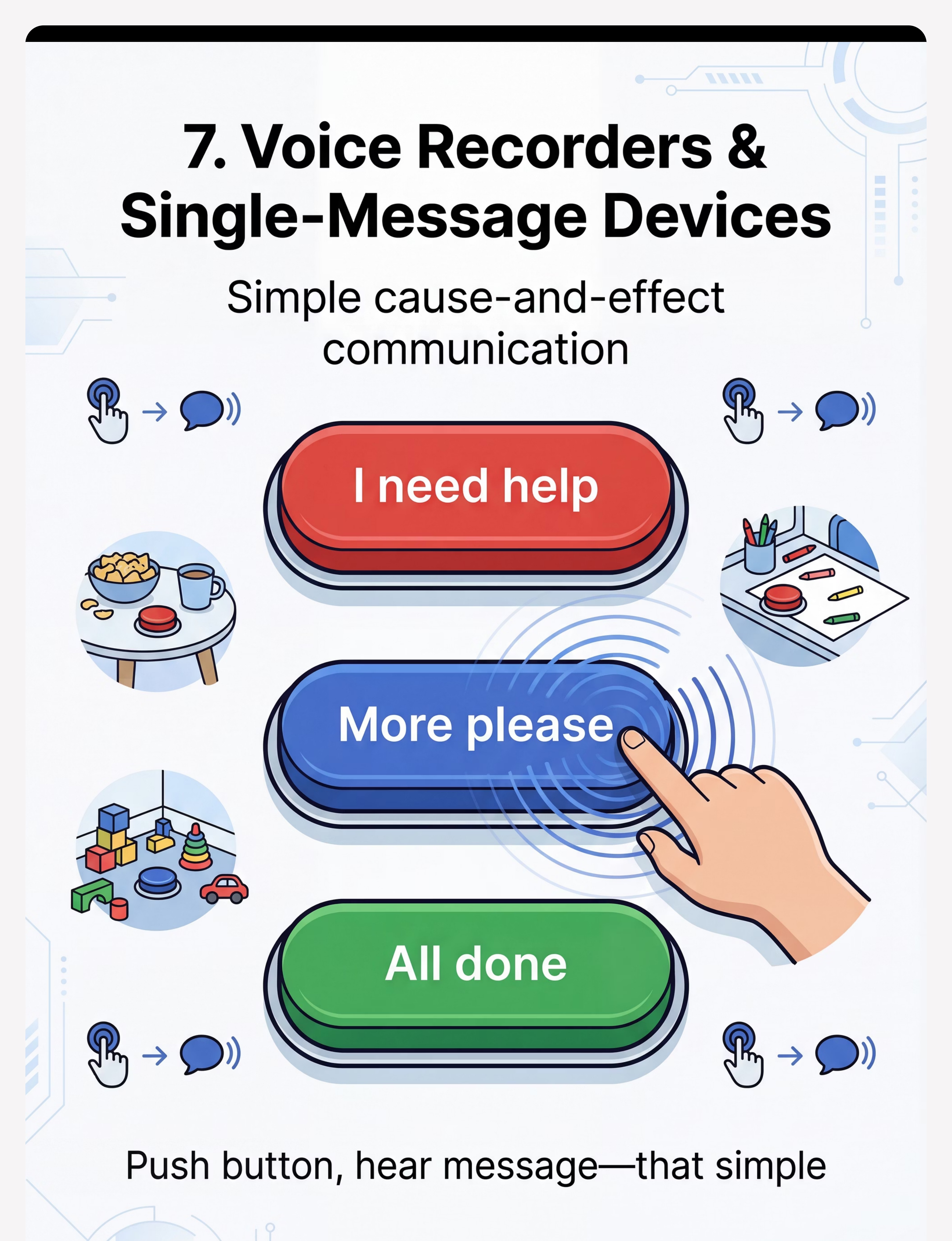
Material 7 of 9
Big Button Voice Recorders and Single-Message Devices
Canon Category: Low-Tech Voice Output / Cause-Effect Communication Devices
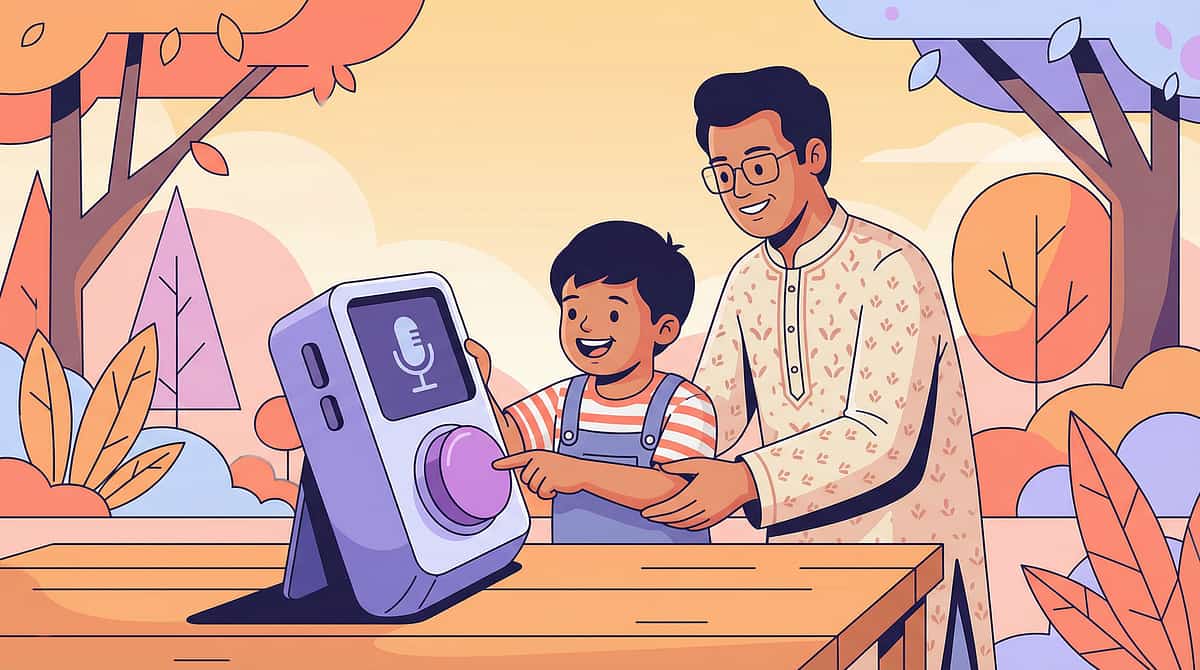
Large, colorful push buttons that play a pre-recorded spoken message when pressed. One button = one message (e.g., "More please," "I need help," "All done"). The simplest possible voice output — any child who can press a button can communicate.
Why It Works
Teaches cause-and-effect communication with minimal cognitive and motor demands. Used to scaffold toward multi-symbol systems. Every press is a complete, successful communication act — building confidence and communicative intent from day one.
Price Range: ₹500–2,000 (recordable buttons)
Get Started
🛒 Search "recordable talking button India" or "BigMack communicator" on Amazon.in
🏠DIY Option: Free smartphone apps (e.g., "Tap to Talk") function as single-message devices. Record parent's voice saying "more please" — child touches screen.
⚠️Safety: Messages must match available responses. Don't place the "more food" button where food isn't present. Model before expecting independent use.
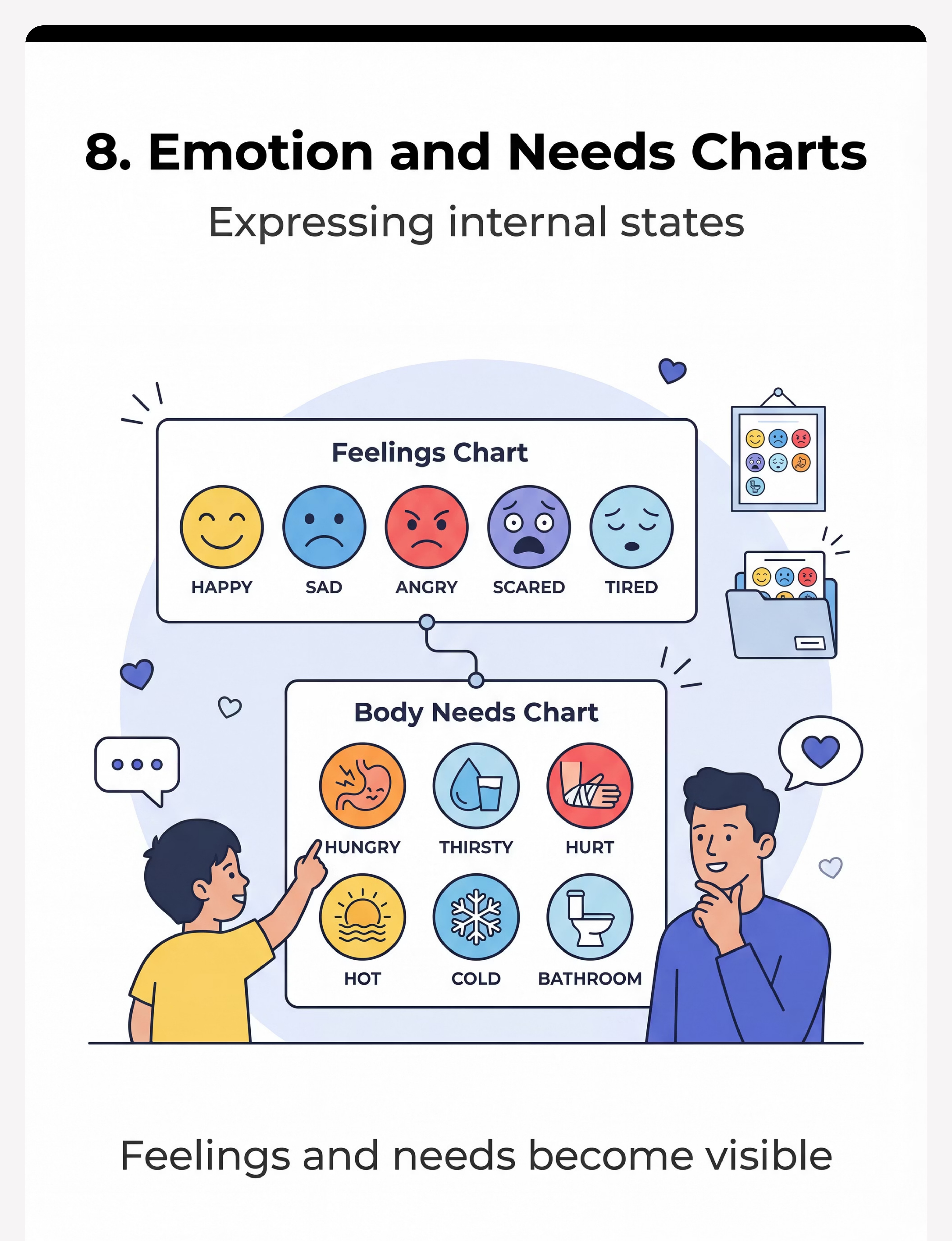
Material 8 of 9
Visual Emotion and Needs Charts
Canon Category: Visual Supports / Emotion Recognition Materials / Needs Charts
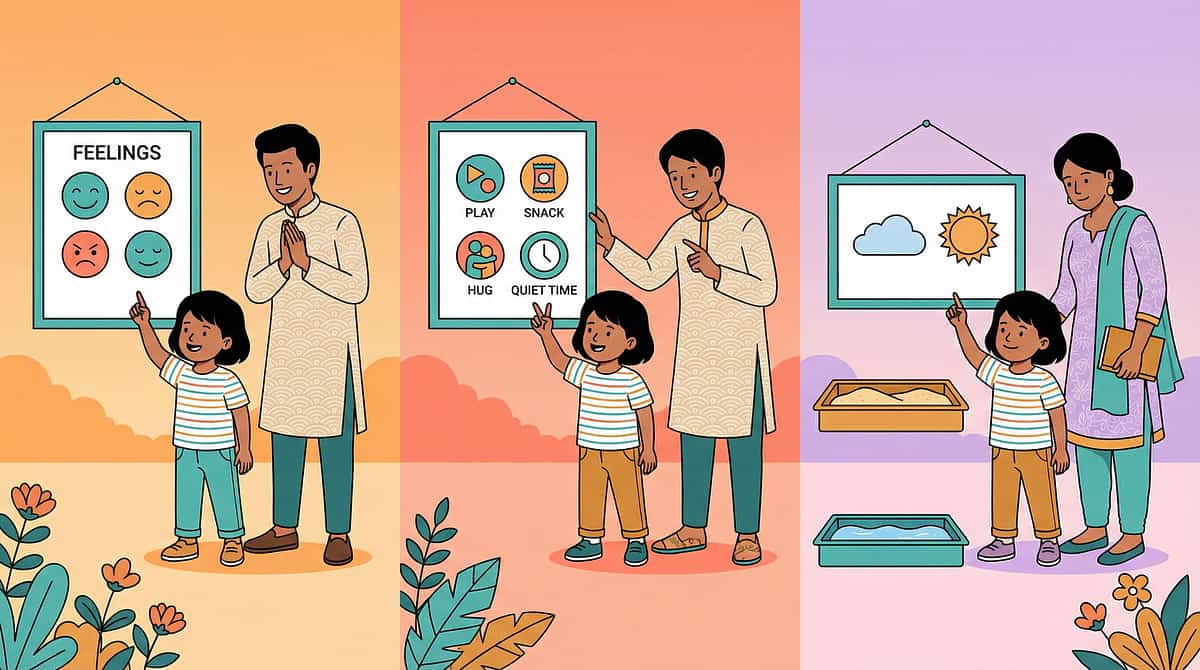
Two charts posted at child height: (1) Feelings chart with 5–8 facial expressions (happy, sad, angry, scared, tired, frustrated, sick); (2) Body Needs chart with symbols for hungry, thirsty, hurt, hot, cold, toilet, tired. Internal states are invisible and unexpressible without externalizing tools.
Why It Works
Children who cannot say "I'm tired" or "my tummy hurts" will show these states through behavioral escalation. Charts make the invisible visible and pointable — transforming a meltdown trigger into a communication opportunity.
Price Range: ₹100–300 | ₹0 DIY
Get Started
🛒Dyomnizy Educational Memory Game → ₹519 (adapt emotion images) | Search "feelings chart autism India"
🏠DIY (₹0–50): Print from Canva free templates. Post at toilet, bedroom door, kitchen. Build a "check-in ritual." Start with concrete body states (hungry, hurt) before abstract emotions.
⚠️Safety: Teach the connection between the chart image and the bodily sensation explicitly — never assume self-identification.

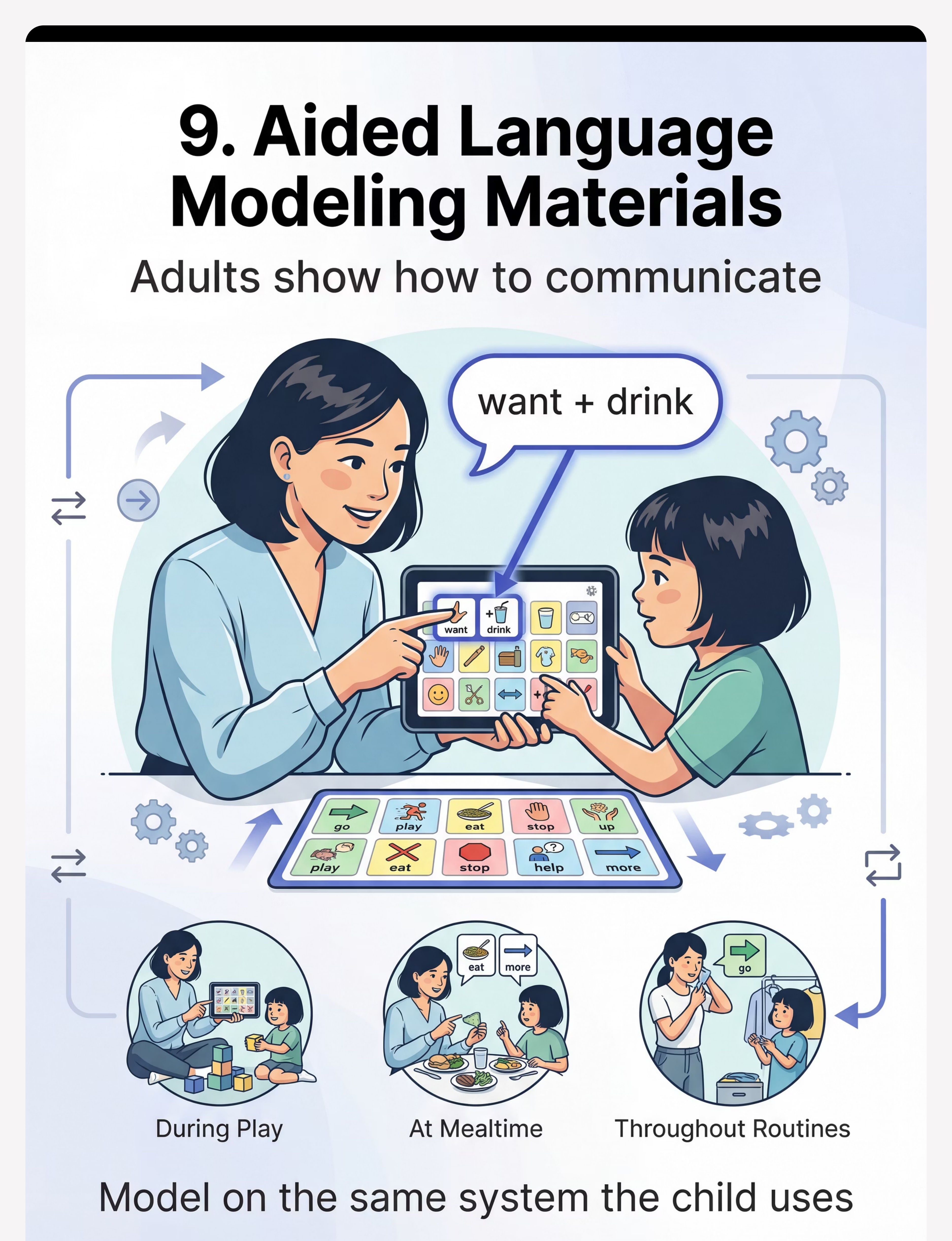
Material 9 of 9
Aided Language Modeling (ALgS) Materials and Partner Training Guides
Canon Category: Communication Boards / Modeling Materials / Partner Training Resources
An adult-sized version of the child's AAC system, plus a partner training guide showing caregivers HOW to use the child's system themselves — pointing to symbols while speaking throughout the day, modeling language through the AAC tool every waking hour.
Why It Works
Children learn to use AAC by watching adults use it. "Input before output" is the governing principle. A child who has never seen their communication board used by a fluent speaker cannot learn to use it independently. The parent IS the most powerful AAC model.
Price Range: ₹200–500 (modeling mat) | ₹0 DIY
Get Started
🌐 Download free core vocabulary modeling mats from unknown link or LAMP Words for Life resources
🏠DIY (₹0–100): Create a wall-sized version of the child's communication board. Practice touching symbols while talking BEFORE any session. "Want + eat" → touch both symbols while saying "want eat."
⚠️Safety: Model, never test. Involve ALL caregivers. Continue modeling for months before expecting independent use.
🏠 WHO/UNICEF Equity Principle
₹0 Version. Full Therapeutic Value. Starts Right Now.
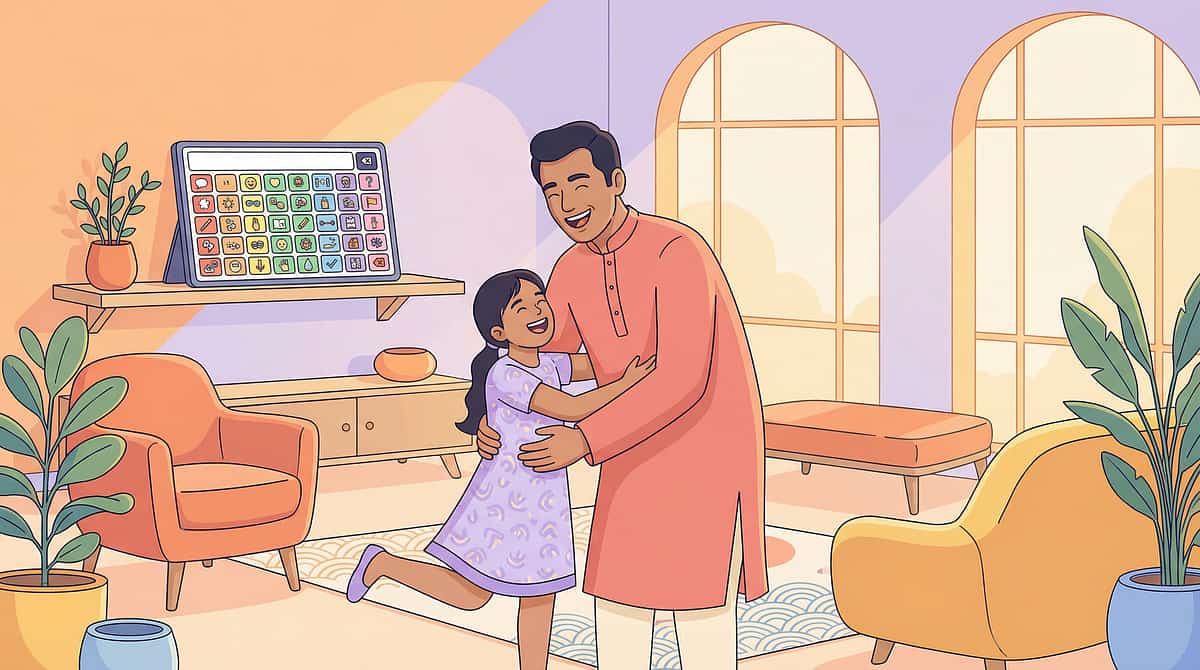
"Access to communication tools is a child's right — not a luxury. The WHO/UNICEF Care for Child Development Package is explicitly designed for implementation with household materials across 54 low- and middle-income countries. Your home already contains everything needed to begin."
🛒 Purchase Option | 🏠 DIY/Substitute (₹0–100) | |
Communication Board (₹200–500) | Print free symbols from Boardmaker Online. Laminate with book-covering film. Done in 30 minutes. | |
PECS Book (₹500–1,500) | Photograph preferred items with phone. Print. Laminate. Paper clip to a small notebook. | |
Choice Board (₹150–400) | Two actual objects or photos placed side by side. "Which one?" — any flat surface works. | |
AAC App (₹0–15,000) | LetMeTalk (Android, free). Snap Core First (free tier). Cboard (free, web-based). | |
Sign Language Cards (₹150–400) | YouTube: "Baby Sign Language India" — free. Learn 5 signs. Post paper illustration on fridge. | |
Voice Recording Button (₹500–2,000) | Free Android apps — "Big Button" style. Or record voice on any phone app with a large screen shortcut. | |
Emotion Chart (₹100–300) | Draw 5 faces (circle + expression). Label. Laminate. Post at toilet and bedroom. Perfectly functional. | |
Modeling Materials (₹200–500) | Print child's communication board at A3 size. Use as your own modeling display. The parent IS the modeling material. |
Zero-Cost Full System — Start in 60 Minutes: (1) Print 20 AAC core symbols free → (2) Watch 10-min YouTube: "PECS Phase 1 tutorial" → (3) Learn 5 signs: MORE, HELP, EAT, DRINK, STOP → (4) Draw 5 feelings faces on paper → (5) Post everything at child's eye height → (6) Begin modeling today.

⚠️ Clinical Safety Protocols
Read This Card Completely Before Starting. Non-Negotiable.
🔴 RED — STOP. Seek Professional Help First.
- No prior hearing screen: Up to 30% of expressive communication deficits have hearing loss as a primary cause. Hearing screen is the mandatory first step.
- Recent seizure activity: Do not conduct structured AAC sessions within 24 hours of a seizure event.
- Acute medical illness: Child is unwell, febrile, or in pain. Wait for structured teaching sessions.
- Severe self-injury during communication attempts: Requires immediate BCBA consultation before home-based AAC introduction.
🟡 AMBER — Modify Approach. Proceed With Caution.
- Existing challenging behavior patterns: Implement AAC alongside — not after — behavioral support. Call 9100 181 181.
- Multiple caregivers with inconsistent approaches: Establish consistency before full implementation.
- Child recently transitioned to new environment: Give 2–3 weeks settling time before introducing new systems.
- Very young child (under 18 months): Focus on joint attention and pointing as AAC foundations.
🟢 GREEN — Proceed. Standard Precautions Apply.
- Materials are age-appropriate (no small detachable parts for children under 3)
- All symbols are clearly recognizable to this specific child
- All communication partners have been briefed
- Hearing has been screened or confirmed unimpaired
- Child is fed, rested, and in a regulated state
- You have committed to model the system yourself before expecting the child to use it
CRITICAL RULE — NEVER: Withhold a desired item to "make" the child use AAC | Demand verbal speech before honoring an AAC attempt | Restrict access to communication tools as a consequence | Give up on AAC because "it's not working" within the first 4 weeks.

🏠 Environment Setup
Right Environment = 80% of Session Success
Before every session ask: "Can my child reach their communication tool from where they're sitting right now?" If no — reposition.
Material Placement
All AAC materials at child's eye and reach level. Communication board at torso height, in line of sight. NEVER behind the parent's back.
Lighting
Natural light preferred. Avoid glare on AAC devices. Backlit device screens may need brightness adjustment for sensory-sensitive children.
Sound Environment
TV off. Reduce background noise. One communication partner at a time for learning sessions; additional partners for generalization.
Seating
Child at stable, supported seated position. Feet flat on floor or footrest. Parent at same eye level — crouch, sit on floor, or use a low chair.
Motivation Visible
Place 2–3 desired items slightly out of reach but visible. The child's motivation to request is the engine of AAC learning.
Distraction Removal
All non-relevant toys stored. Only the current choice/request options visible. Reduce visual clutter around the communication board.
Kitchen/Snack
Choice board on fridge at child height | Drink request symbols on table
Toy Shelf
PECS book adjacent to preferred toys | "I want ___" prompt visible
Bedroom
Feelings chart at child's eye height | Calming request symbols on bedside
Bathroom
Needs chart (toilet, cold, hot, help) at child's sight level
On-the-Go
Portable key ring symbols in pocket/bag of the supervising adult
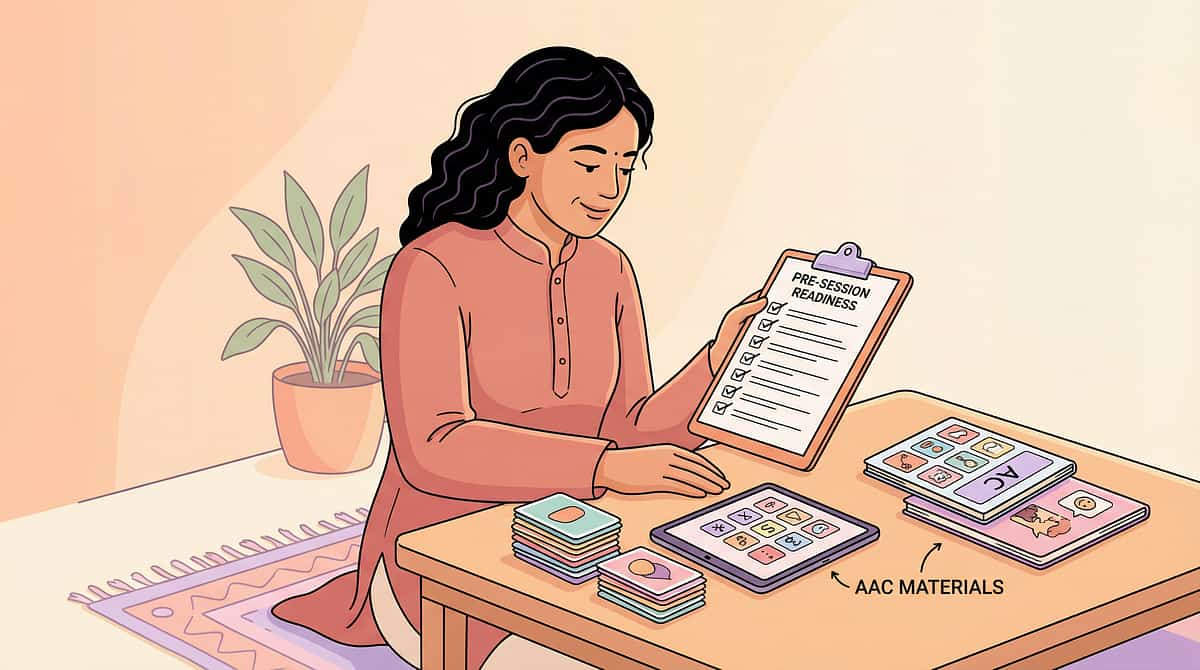
✅ Pre-Session Readiness Check
60 Seconds Before You Begin. Every Time.
Check | 🟢 GO | 🟡 MODIFY | 🔴 POSTPONE | |
🍽️ Fed & hydrated | Last meal <2 hrs | Hungry: offer food first | Very hungry: meet need first | |
😴 Rested | Alert, engaged | Slightly tired: shorten session | Overtired/just woken: postpone 30 min | |
🧘 Regulated | Calm, neutral affect | Mildly excited: calming input first | Post-meltdown (<20 min): postpone | |
🤒 Health | No signs of illness | Mild cold: shorten + soften | Fever/pain: postpone entirely | |
👀 Attention | Makes brief eye contact | Distracted: reduce stimuli | Completely disengaged: revisit later | |
😊 Motivation | Preferred items present | No clear preference: discover new motivator | No interest in anything: not an AAC session day |
If AMBER: Shorten to 2–3 minutes | Use only highest-motivation vocabulary | Reduce environmental demands | Focus on 1 exchange only.
If RED: Use this time for calming together, following child's lead in play, basic needs meeting. The next natural opportunity IS the session.
If RED: Use this time for calming together, following child's lead in play, basic needs meeting. The next natural opportunity IS the session.
"The best AAC session is one the child participates in willingly. Forced exposure to communication tools creates aversion. Wait for the window."
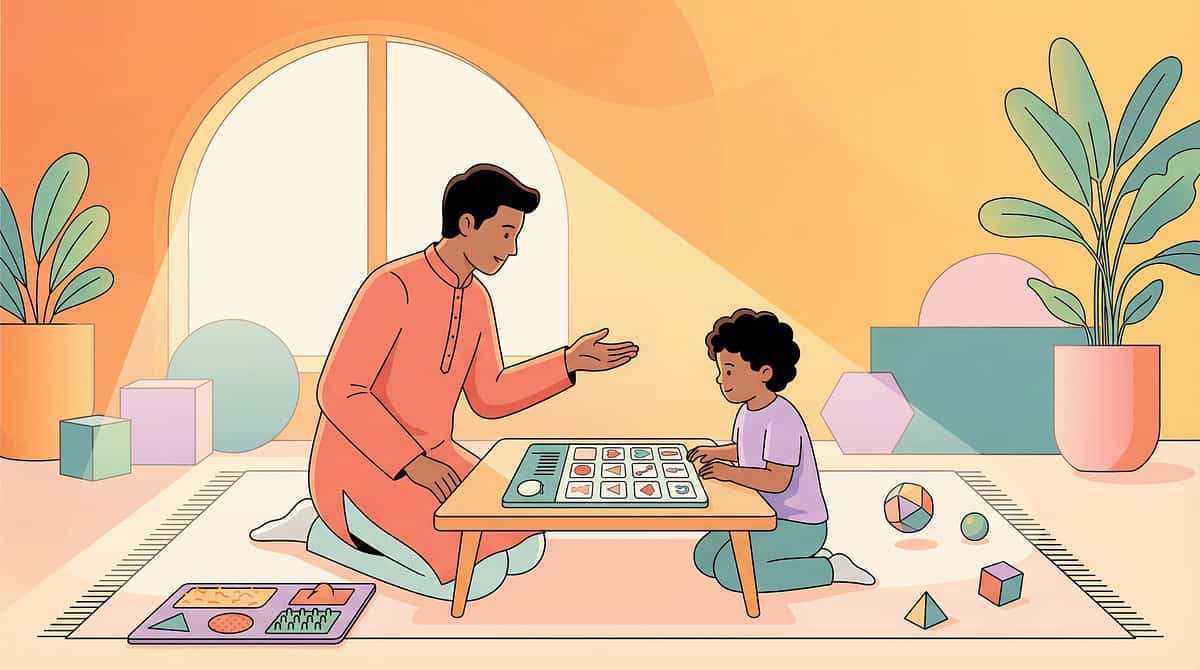
▶ Step 1 of 6
⏱️ 30–60 seconds
Step 1: Begin With Invitation. Never With Command.
"[Child's name], let's see what you want today." (While pointing to the communication board or PECS book — not handing it to the child yet.)
Body Language Guidance
- Get to child's eye level (crouch or sit on floor)
- Open, relaxed body posture — no hovering
- Shared gaze toward the AAC materials, not demanding eye contact from the child
- Speak in a warm, unhurried voice. No urgency in your tone.
Reading Your Child's Response
✅ Acceptance cues (child is ready): Brief glance toward material | Any approach movement | Relaxed body | Picking up a picture card
⚠️ Resistance cues (modify approach): Turning or walking away | Tensing body | Pushing materials away | Immediate distress vocalization → Reduce demand entirely. Sit beside child. Follow their lead for 2 minutes. Re-offer naturally.
The ABA Principle: This step implements Pairing — associating the adult and the AAC material with positive, low-demand experiences BEFORE placing any communication demand. Rushing this step is the #1 cause of AAC refusal.
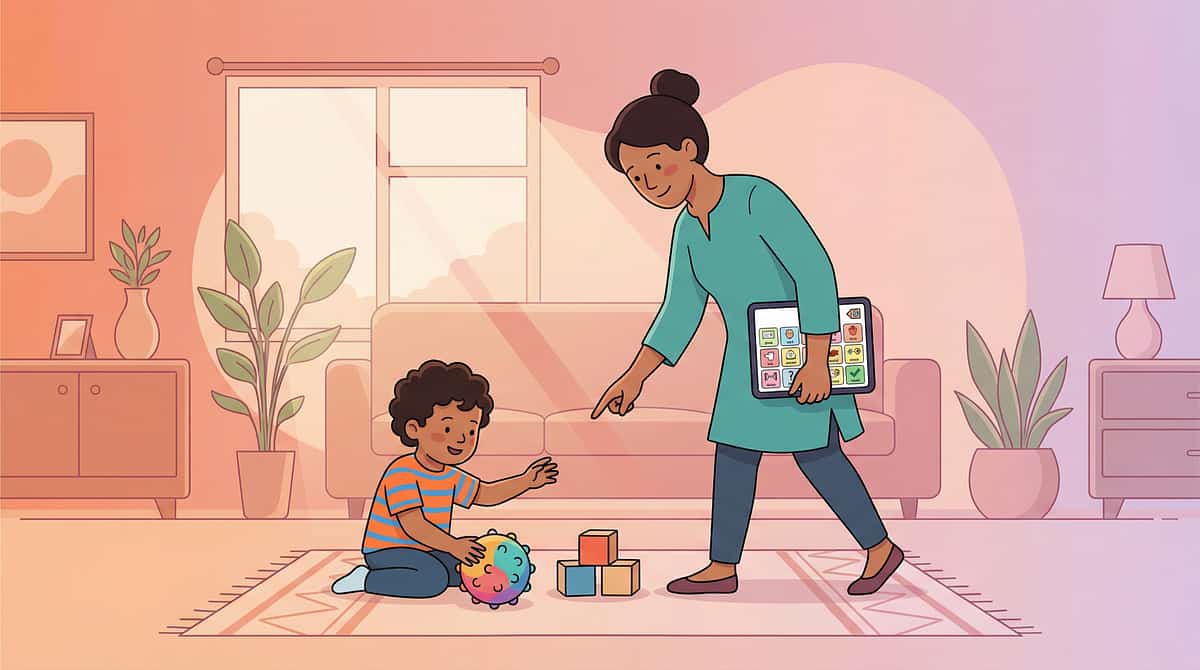
▶ Step 2 of 6
⏱️ 1–3 minutes
Step 2: The Child Leads. You Follow — With the AAC System.
Wait for the child to show interest in a desired item (even a glance is enough). Then engage using the AAC material as your bridge.
This sequence — curiosity, naming, pause, attempt — is the core learning loop for AAC engagement. The motivated pause is the most critical moment: it creates the space for communication to emerge.
Child Response | What It Means | Your Action | |
Points to symbol/picture | Engaged + communicating | Honor immediately + celebrate enthusiastically | |
Looks at board then at you | Engaged, understanding the purpose | Help them point + honor + celebrate | |
Ignores board, reaches for item | Pre-intentional communication | Gently redirect hand to board, then honor immediately | |
Vocalizes without AAC | Communication attempt | Honor AND model the AAC simultaneously |
Reinforcement Rule: First appearance of any intentional communication attempt = IMMEDIATE reward. No delay. This is the most critical moment in AAC learning.
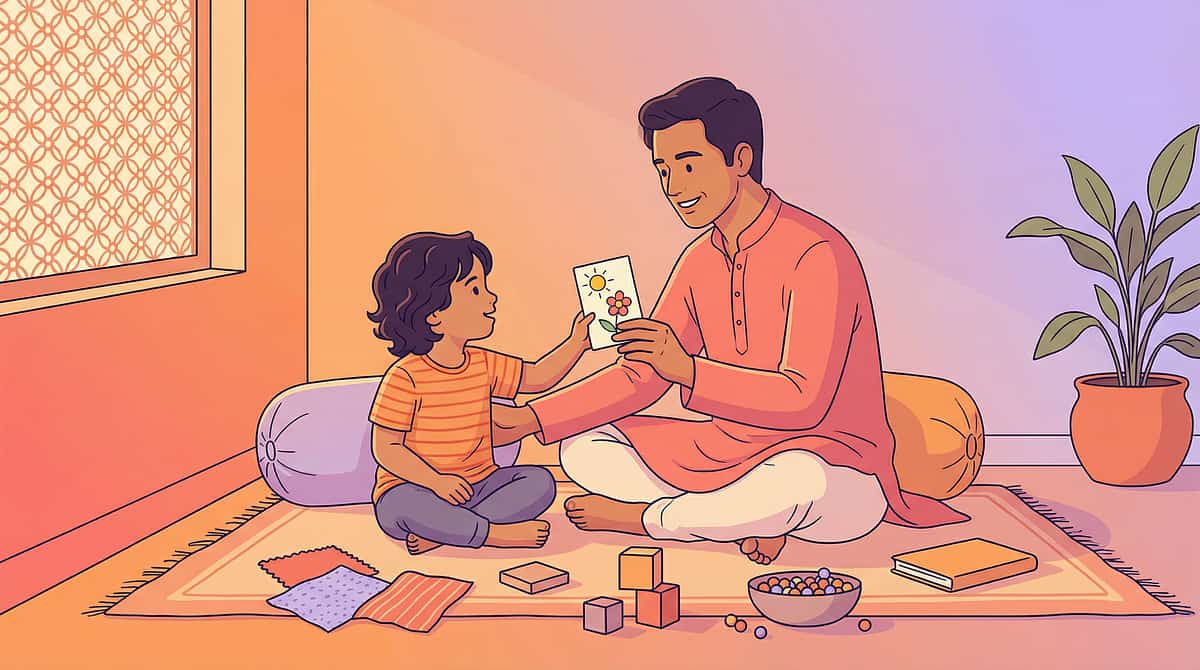
▶ Step 3 of 6
⏱️ 3–10 minutes
Step 3: The Exchange. The Moment Everything Changes.
The child selects a symbol, exchanges a picture, presses a device button, or produces a sign — and receives the desired item or response within 3 seconds. This is the learning event.
Child Need
Internal motivation, desire, or discomfort requiring expression
AAC Attempt
Child points, exchanges, signs, or presses button using AAC system
Adult Honors
Parent responds within 3 seconds with the requested item or action
Need Met
Child learns: "This works." Neural pathway reinforced.
Common Error | Why It Happens | Correction | |
Waiting for "better" communication before honoring | Perfectionism | Honor ANY attempt. Shape it later — never on Day 1. | |
Honoring the reaching behavior instead of the AAC | Habit | Gently block reaching. Redirect to board. Then honor immediately. | |
Testing without support | Impatience | Model first. Expect output after weeks of consistent input. | |
Inconsistent honoring | Tiredness | Build into daily routines — not separate scheduled sessions. |
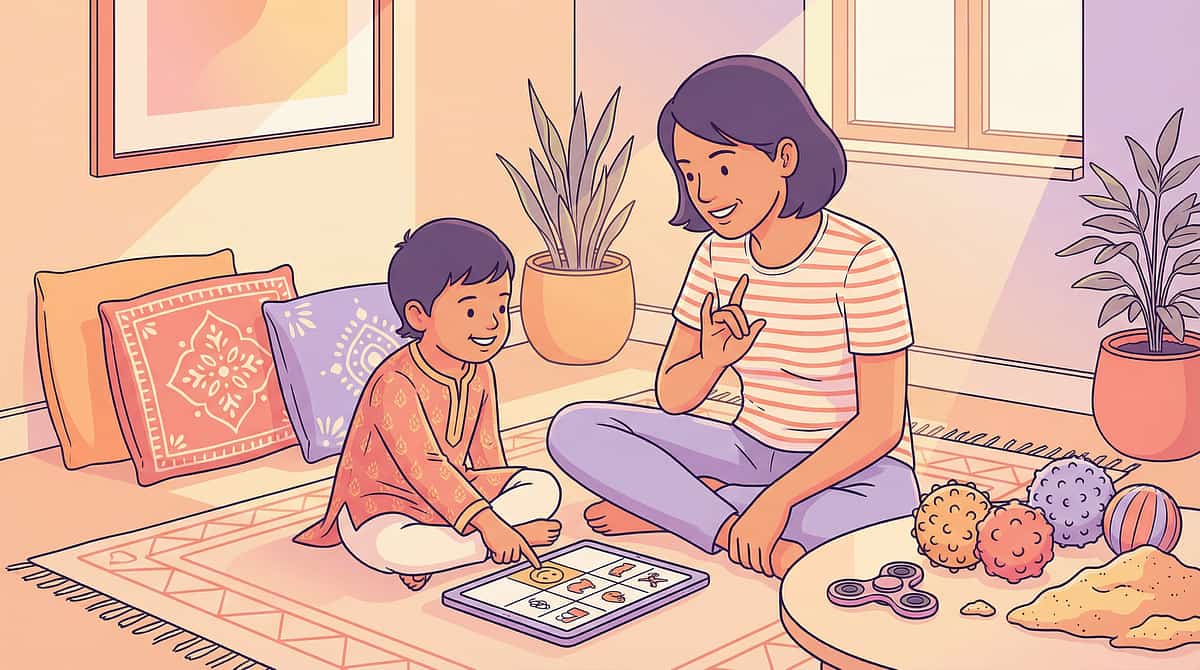
▶ Step 4 of 6
⏱️ 3–5 minutes
Step 4: 5 Good Exchanges Beat 20 Forced Ones. Every Time.
Target: 5–10 functional communication exchanges per session | Frequency: Multiple natural opportunities throughout the day, not scheduled sessions alone.
Vary the Motivator
Use 3–4 different preferred items across exchanges. Motivation must stay genuinely high throughout the session.
Vary the Context
Same symbol, different location. "More" works at snack, at play, at bath time. Generalization requires varied context exposure.
Vary the Partner
Grandparent, sibling, parent — all should conduct exchanges. Different partners = faster generalization.
Vary the Modality
In multi-modal systems: same request can be modeled across board + signs + device in the same session.
"3 successful exchanges with high motivation = more neural learning than 15 forced exchanges with zero motivation. Read your child's satiation. Stop before they're done."
Natural Opportunity Embedding — The most powerful AAC learning happens: At every mealtime | At every toy request moment | At every transition ("all done" + "go") | At every moment of difficulty ("help") | At every emotional state shift (feelings chart check-in)

▶ Step 5 of 6
⏱️ Immediate — within 3 seconds
Step 5: Celebrate the Attempt. Not Just the Success.
Reinforcement delivered within 3 seconds of the communication attempt has 10× the learning impact of reinforcement delivered 10 seconds later. Immediacy is everything.
The Reinforcement Script: (Child points to "more" symbol) → "MORE! Great asking! Here's more! You TOLD me what you wanted! That's amazing!"
Natural Reinforcers (Highest Value)
The requested item itself — immediate delivery of what was requested. Rosette Reward Jar → ₹589 | 1,800+ Reward Sticker Book → ₹364
Social Reinforcers
Enthusiastic verbal praise (specific, not generic): "You POINTED to help! I understood you!" | High-five, shared excitement, brief hug if tolerated.
Activity Reinforcers
30 seconds of preferred play immediately after a successful exchange. Access to desired toy as the natural consequence of functional requesting.
Celebrate the ATTEMPT — not just the perfect execution. A child who tries and gets no response learns: "This doesn't work." Every attempt, every approximation, every partial success = immediate, enthusiastic response.

▶ Step 6 of 6
⏱️ 1–2 minutes
Step 6: Never End Abruptly. The Transition Is Part of the Therapy.

📊 Session Data Capture
⏱️ 60 seconds after session ends
60 Seconds of Data Now = Months of Insight Later.
Three data points. Sixty seconds. Captured after every session. This is how progress becomes visible — and how your child's GPT-OS® Communication Readiness Index stays current.
📊 Data Point 1 — Frequency
How many independent AAC attempts (without physical prompting) did your child make this session?
0 | 1–2 | 3–5 | 5+
📊 Data Point 2 — Prompted vs Independent
Of those attempts, how many required adult physical guidance (hand-over-hand)?
All prompted → Most prompted → Half-half → Mostly independent → Fully independent
📊 Data Point 3 — Session Tone
Overall session tone:
Meltdown/abandoned | Resistant but completed | Neutral | Engaged | Highly motivated
Week | What the Data Shows | Stage | |
Week 1–2 | Mostly prompted → baseline established | Foundation | |
Week 3–4 | Prompted → independent ratio improving | Consolidation | |
Week 5–8 | Mostly independent → mastery threshold approaching | Mastery | |
Week 8+ | Generalization across partners and contexts | Graduation |

🔧 Troubleshooting
Most Sessions Have Bumps. Here's the Fix for Each One.
"Session abandonment is not failure — it is data."
Child refuses to touch the board / throws it
Why: The system was introduced with demand before pairing. Fix: Return to pure pairing for 3–7 days. Place the board near preferred activities. Use it yourself. Reintroduce as a "magic thing that gets you what you want."
Child points to same symbol for all needs
Why: Symbol vocabulary is too limited. Fix: Immediately expand vocabulary by 3–5 symbols. Add specific symbols for their most common needs. Symbol restrictions slow communication — expand, don't restrict.
AAC works at home but not at school/grandma's
Why: Generalization hasn't occurred yet. Fix: Send the identical system (same symbols, same board format) to every setting. Brief each partner with a 5-minute orientation. Generalization is a teaching target, not a natural consequence.
Challenging behavior increases after AAC introduction
Why: Normal response — the child is testing whether ALL attempts will be honored. Fix: This is a positive sign. Increase honor rate to 100%. Behavior escalation with new AAC typically peaks at Week 2–3 then declines sharply.
Child loses interest in AAC after initial engagement
Why: Motivators have become satiated or the system has become rote. Fix: Conduct a new preference assessment. Add 5 new symbols of current high-interest items. Refresh the system quarterly.
Family members won't use the system
Why: Insufficient training. Fix: Reduce to 3 symbols for each partner. Teach only: WANT, HELP, ALL DONE. Post these prominently everywhere. Consistency in 3 words > inconsistency across 30.
Child understands but still doesn't initiate independently
Why: Output emerges after extensive input. 50–200 hours of modeling exposure is typical. Fix: Track your modeling rate. Are YOU touching the symbols every time you speak? Stay the course.
Emergency Response: If the child becomes severely distressed (inconsolable, self-injuring) during an AAC session — stop all communication demands immediately, offer calming input, call Pinnacle Helpline: 9100 181 181 for same-day guidance.
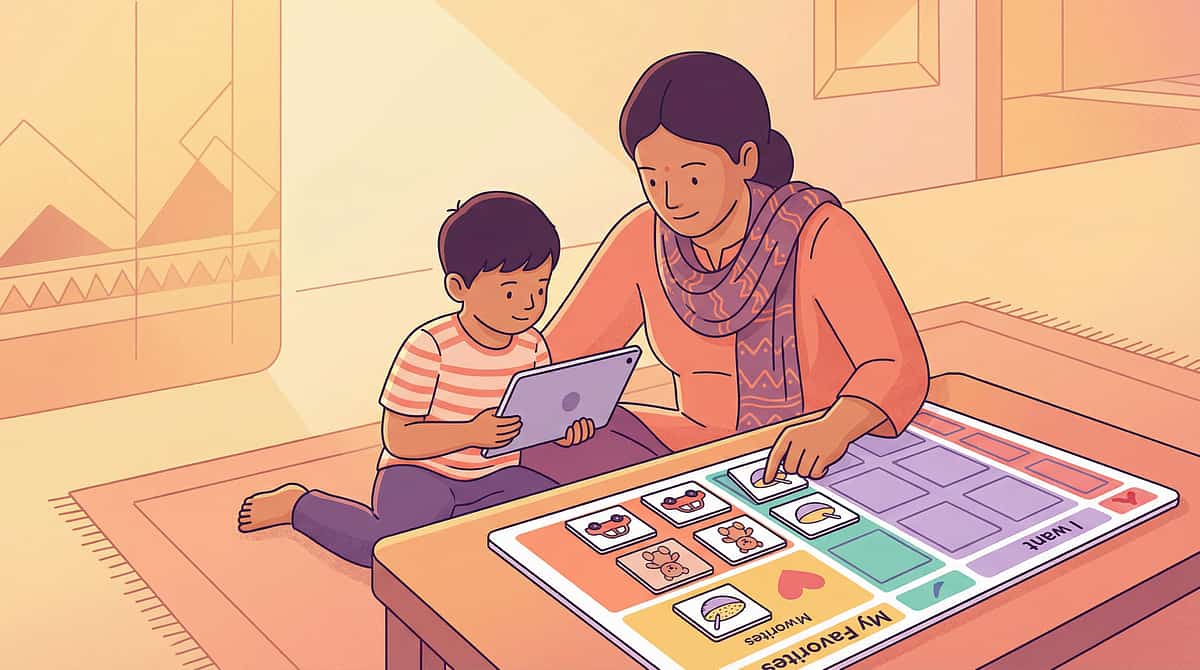
🎛️ Personalization
No Two Children Use the Same Voice. Customize for Yours.
Easier: New AAC Users / Very Young / Difficult Days
Reduce to 2 symbols only (want + all done) | Use real objects instead of pictures | Physical guidance for every exchange | Single-message device only | One modality only to reduce cognitive load
Standard: Typical Protocol
12–20 symbol communication board | PECS Phase 1–2 + choice boards + signs | Prompted → independent fading across 4–8 weeks
Advanced: Emerging Vocabulary
Two-symbol combinations: "want" + "eat" | Attribute expansion: "big" + "ball" | Question words | Transition to full AAC app (TouchChat, Proloquo2Go)
Sensory-Sensitive
Matte lamination, fewer symbols per board, real photos not clip art, child carries their board (ownership = acceptance)
Motor-Challenged
Large symbols (10×10cm min), non-slip surface, eye-gaze frames, switch access, consult OT for optimal access method
Highly Visual
Symbol-heavy boards, color coding by category, photographic symbols of actual items
Social Children
Prioritize social vocabulary: "play with me," "look at this," "my turn" — in addition to needs vocabulary
Age Range | Modifications | |
18 months–2 years | 2–4 symbols max | Real objects | Signing focus | |
2–4 years | 12–20 symbols | PECS Phase 1–4 | Choice boards everywhere | |
4–6 years | 20–60 symbols | Two-symbol combinations | Device introduction | |
6–8 years | Full vocabulary AAC | Multi-symbol phrases | Literacy integration |

📈 Progress Timeline — Phase 1
Weeks 1–2
You're Planting Seeds You Cannot Yet See Growing.
85
75
60
70
40
Weeks 1–2 are the hardest. The system is new, your modeling feels awkward, and your child may resist. This is normal. The families who push through Weeks 1–2 are the ones who describe AAC as "life-changing" by Week 6. Your persistence is the therapy.
📊Data Benchmark: Track number of prompted exchanges per session. If this number is consistent (even if low), the baseline is established. Progress is happening in the neural pathways before it is visible in the behavior.
"If your child tolerates the AAC material for 3 seconds longer this week than last week — that is measurable neural progress. The pathway is forming. Trust the process."
"If your child tolerates the AAC material for 3 seconds longer this week than last week — that is measurable neural progress. The pathway is forming. Trust the process."
📈 Progress Timeline — Phase 2
Weeks 3–4
The Neural Pathway Is Forming. You'll See It in the Details.
Anticipation
Child moves toward the communication board when a desired item is visible — before being prompted. This is the first sign of internalized communicative intent.
Reduced Resistance
Earlier sessions required redirection; now the child approaches AAC materials more willingly. The pairing work from Weeks 1–2 is paying off.
Prompted → Independent Shift
Some exchanges beginning to occur with partial prompting rather than full physical guidance. This ratio shift is the core progress metric.
Spontaneous Vocalization with AAC
Child may begin vocalizing simultaneously with pointing — this is a speech emergence signal. Celebrate it vigorously.
Behavioral Improvement
Frustration meltdowns reducing in frequency or duration as communication succeeds more often. The needs-behavior connection is breaking.
"You may notice that YOU are more confident — that modeling feels natural rather than effortful, and that you're spotting communication opportunities throughout the day that you would have missed before. This parent growth is as important as the child's growth."
When to increase: If child is achieving 5+ independent exchanges per session consistently → expand vocabulary by 3–5 new symbols. The vocabulary ceiling is the growth limiter.

📈 Progress Timeline — Phase 3
Weeks 5–8
Mastery Is Not Perfection. Mastery Is Reliable Functional Communication.
Different Needs
Child initiates AAC for 3+ different needs without physical prompting, across 3 consecutive sessions
Communication Partners
AAC communication occurring with at least 2 different partners (not only the primary caregiver)
Day Break Test
AAC use persisting at the end of a 3-day "break" from structured practice — true internalization
🏅B-189 Communication Milestone Achieved
Functional Requesting — Independent + Generalized
Date Achieved: ___________ | Witnessed by: ___________
Functional Requesting — Independent + Generalized
Date Achieved: ___________ | Witnessed by: ___________
Generalization Checklist | Status | |
Works at home with primary caregiver | ✅ Achieved at mastery | |
Works at home with secondary caregiver | ☐ Next target | |
Works in community (restaurant, store) | ☐ Next target | |
Works at school / therapy center | ☐ Next target | |
Works with peer / sibling | ☐ Next target |
When mastery criteria are met: progress to B-190: Limited Pretend Play Skills → or to two-symbol combinations in the same AAC system.
🎉 Milestone Achieved
You Did This. Your Child Found Their Voice Because You Showed Up Every Day.
You spent 5–8 weeks modeling symbols your child hadn't used yet. You honored attempts that looked nothing like success. You sat on the floor when you were exhausted. You stayed consistent when it felt pointless. And now — your child is communicating.
The Transformation
Then (Week 1): "She's clearly upset about something. But I have no idea what she wants. We both end up in tears."
Now (Week 8): Your child points, exchanges, signs, or touches a button — and is heard.
Family Celebration Ritual — Choose One
- 📸 Document the milestone: video of first independent AAC exchange — date it, save it, share it
- 🎂 A small family celebration acknowledging the child's growth
- ✍️ Journal entry: "The first time [child's name] independently pointed to ___ without being prompted."
"From the Therapist's Notes: What this family has achieved is not small. Establishing functional requesting in a child who had no functional communication — using parent-led home implementation — is one of the most powerful clinical outcomes we witness. This is the GPT-OS® EverydayTherapyProgramme™ in action." — Pinnacle Blooms Network® Consortium SLP Team

🔗 Communication Domain Browser
You Already Have the Materials. Here Are More Techniques That Use Them.

🟢 Intro | Uses: Communication board ✓
🔵 Core | Uses: Picture cards ✓

🔵 Core | Uses: Choice board ✓

🔵 Core | Uses: Reinforcement system ✓
Based on materials purchased for B-189, you can implement B-187, B-188, B-190, and B-192 with zero additional material investment.
Browse all 250+ Communication Techniques →
Browse all 250+ Communication Techniques →
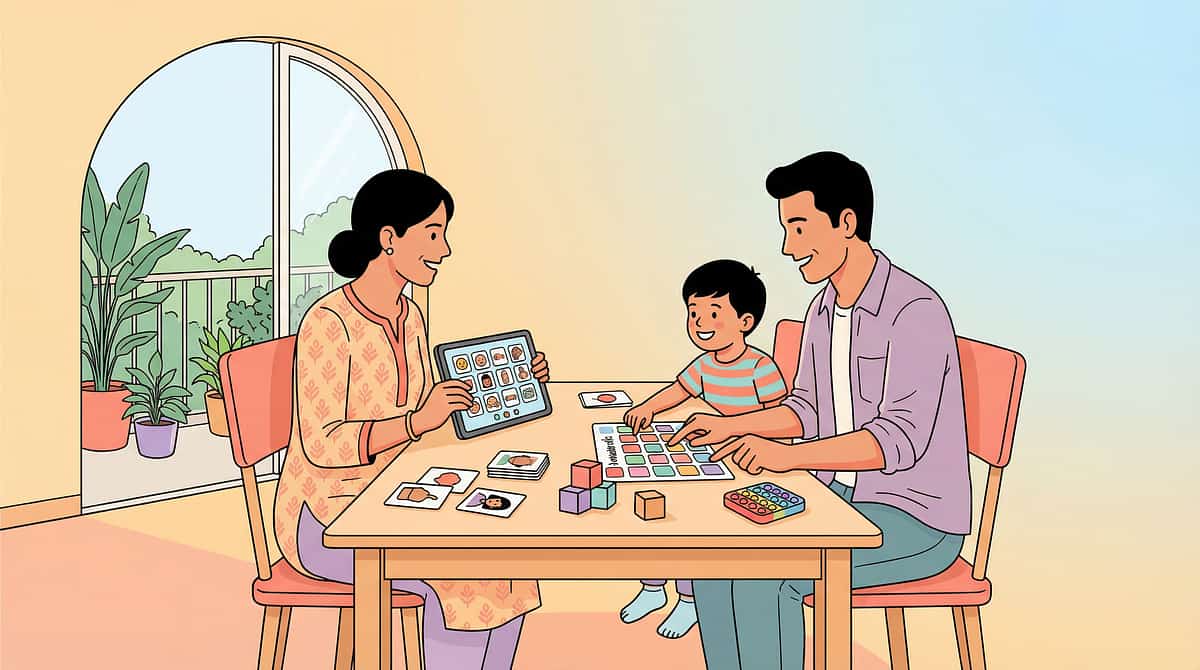
🏥 Professional Backup
Home + Clinic = Maximum Impact. Here's How to Access the Clinical Layer.
🆓 Path 1 — FREE National Helpline
📞9100 181 181
Available: 24×7 | Languages: 16 | Response: <2 minutes
Services: AAC guidance, technique clarification, crisis support, center referral, AbilityScore® scheduling
Available: 24×7 | Languages: 16 | Response: <2 minutes
Services: AAC guidance, technique clarification, crisis support, center referral, AbilityScore® scheduling
💻 Path 2 — Teleconsultation
Book a FREE 30-min teleconsult with a Pinnacle SLP →
For: AAC system selection, PECS phase guidance, device recommendations, plateau troubleshooting
For: AAC system selection, PECS phase guidance, device recommendations, plateau troubleshooting
🏥 Path 3 — In-Center Assessment
Book AbilityScore® AAC Evaluation →
Includes: Functional communication assessment, AAC feature matching, FCT protocol design, FusionModule™ integration (SLP + OT + BCBA in one session)
Includes: Functional communication assessment, AAC feature matching, FCT protocol design, FusionModule™ integration (SLP + OT + BCBA in one session)
Therapist Matching for This Technique: Primary: Pediatric SLP with AAC specialization | Secondary: BCBA for FCT integration | OT for motor access
Match me with an AAC specialist →
Match me with an AAC specialist →
Research consistently confirms: home-based intervention PLUS clinic-based professional guidance produces outcomes 2–3× better than either alone. The home is not a substitute for the clinic. The clinic is not a substitute for the home. Together, they are unstoppable.

❓ FAQs Continued
More Answers to Your Most Important Questions
My child uses PECS at school but won't use it at home — why?
Generalization doesn't happen automatically. The school system must be replicated at home: same symbol set, same exchange procedure, same response from the communication partner. Ask your child's school SLP to share the exact PECS vocabulary set and procedural guidelines, then implement identically at home.
My child is 7 — is it too late for AAC?
No. There is no age limit for AAC. The principle "there are no prerequisite skills for AAC" (ASHA) means AAC is appropriate for any child, at any age, who has a functional communication need. Adults with complex communication needs use AAC effectively their entire lives. Earlier is better — but it is never too late.
My child knows how to communicate but still has meltdowns — why?
First: verify whether the communication system is consistently meeting the need (is the request always honored?). Second: check whether the vocabulary covers this specific trigger (can the child say "I need a break" or "this is overwhelming me"?). If both are in place — consult a BCBA, as there may be a behavioral function separate from communication.
Can I use sign language AND picture symbols AND an AAC app simultaneously?
Yes — absolutely. Multi-modal AAC is the clinical gold standard. Research on total communication confirms that providing multiple modalities simultaneously gives children the most communication opportunities and produces the fastest functional communication outcomes. Use all three. The child will select and combine modalities organically.
🚀 Take Action
Your Child's Voice Is Waiting. Here Are Your Next 3 Steps.
▶ Step 1 — Start Today
Open the GPT-OS® Session Launcher for personalized step-by-step guidance tailored to YOUR child's profile.
pinnacleblooms.org/gpt-os → | Free for Pinnacle families
📞 Step 2 — Book a Free Consultation
Talk to a Pinnacle SLP about your child's specific AAC needs. Free. 16 languages. 24×7.
Call: 9100 181 181 | Book teleconsult online →
→ Step 3 — The Next Technique
You've mastered the foundation. Here's the next step in your child's communication journey.
🆓FREE National Autism Helpline: 9100 181 181
Available: 24×7 | Languages: 16 (Hindi, Telugu, Tamil, Kannada, Malayalam, Marathi, Bengali, Gujarati, Punjabi, Odia, Assamese, Urdu, English + more)
Available: 24×7 | Languages: 16 (Hindi, Telugu, Tamil, Kannada, Malayalam, Marathi, Bengali, Gujarati, Punjabi, Odia, Assamese, Urdu, English + more)
🗣️ SLP
🖐️ OT
📊 ABA/BCBA
📚 SpEd
🧠 NeuroDev
🌍 WHO/UNICEF
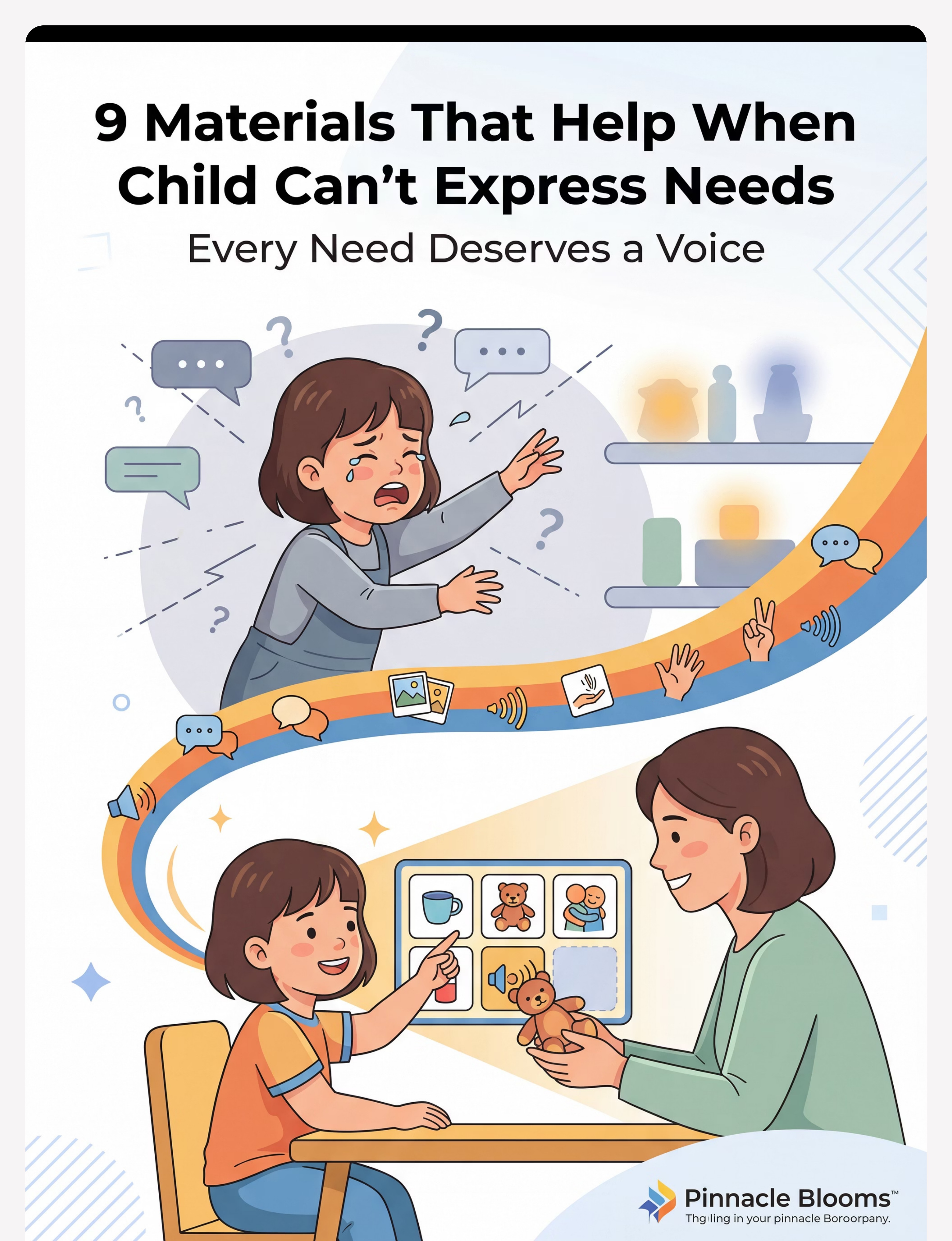
Preview of 9 materials that help when child cant express needs Therapy Material
Below is a visual preview of 9 materials that help when child cant express needs therapy material. The pages shown help educators, therapists, and caregivers understand the structure and content of the resource before use. Materials should be used under appropriate professional guidance.







Link copied!
🏛️ Institutional Closure
"From fear to mastery. One technique at a time."
— The Pinnacle Blooms Network® Consortium
Pinnacle Blooms Network® is India's largest multi-disciplinary pediatric therapy consortium — 70+ centers, 20 million+ exclusive 1:1 therapy sessions, 97%+ measured improvement rate across the GPT-OS® readiness framework. This technique page is one of 70,000+ evidence-linked intervention resources at techniques.pinnacleblooms.org — the largest structured pediatric intervention knowledge base on Earth.
Medical Disclaimer: This content is educational and informational. It does not constitute medical advice, diagnosis, or treatment recommendation. AAC implementation should be individualized based on comprehensive assessment by a licensed speech-language pathologist and interdisciplinary team. If your child has no functional way to communicate basic needs — contact a qualified professional immediately. Do not delay.
← Previous
🏠 Domain
🌐 All Domains
Next →
© 2025–2026 Pinnacle Blooms Network®, a unit of Bharath Healthcare Laboratories Pvt. Ltd. All rights reserved. GPT-OS®, AbilityScore®, TherapeuticAI®, FusionModule™, EverydayTherapyProgramme™, and Pinnacle Blooms Network® are registered/proprietary marks. CIN: U74999TG2016PTC113063 | DPIIT: DIPP8651 | MSME: Udyog Aadhaar TS20F0009606 | GSTIN: 36AAGCB9722P1Z2
📞9100 181 181 | techniques.pinnacleblooms.org
40