

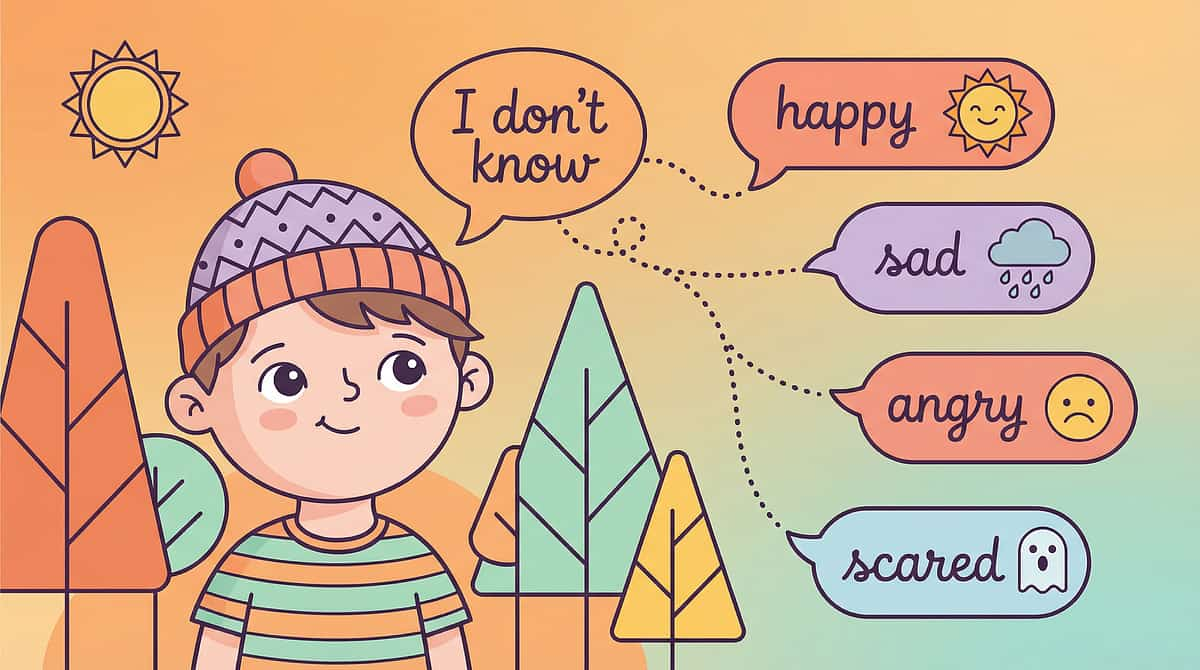
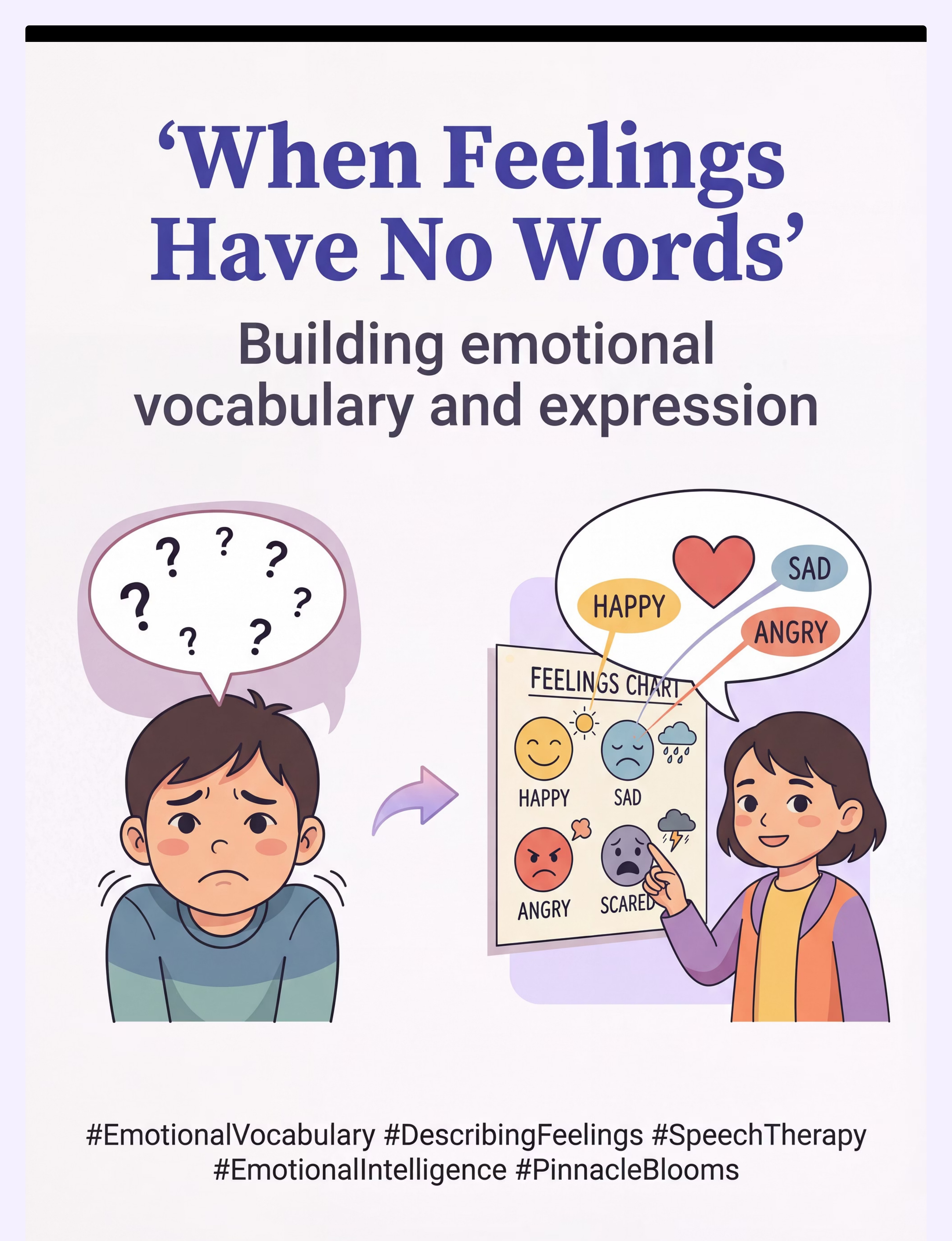
She's Clearly Upset. You Ask "What's Wrong?" She Says: "I Don't Know."
The feeling is real. The words haven't arrived yet. This is not stubbornness — this is a brain still learning its own language. Discover 9 clinician-validated materials that build the bridge between what your child feels and what they can say.
B-192
Social-Emotional
Ages 3–10
SLP × Psychology × ABA × OT

ACT I — THE EMOTIONAL ENTRY
You Are Not Alone
"He had a complete meltdown at dinner. Nothing was 'wrong' — the food was fine, his sister hadn't touched him, no one had said anything harsh. But he was clearly in agony about something. When I knelt down and asked what he was feeling, he just stared at the floor and said 'I don't know, Amma.' I believed him. He genuinely didn't know. That was the hardest part."
— Parent, Pinnacle Network, Hyderabad
This moment — a child in visible distress, unable to name what they're experiencing — is one of the most common and most heartbreaking experiences parents describe. And the hardest truth is this: when your child says "I don't know," they almost certainly mean it. The feeling is real and physical. The word simply hasn't arrived yet.
You are not failing. Your child's brain is learning the language of feelings — and it needs the right tools. The 9 materials in B-192 are exactly those tools, validated by a consortium of SLPs, psychologists, ABA therapists, OTs, and special educators.
🌸Pinnacle Blooms Network® | Validated by the GPT-OS® Consortium
Helpline: 9100 181 181 — Free | 24×7 | 18+ Languages
Helpline: 9100 181 181 — Free | 24×7 | 18+ Languages

CARD 02 — THE NUMBERS
70–80% of Children With Autism Struggle to Identify and Verbally Express Their Own Emotions
1 in 36
Global ASD Rate
Children diagnosed with autism spectrum condition worldwide
1 in 8
India Language Delay
Children in India show signs of developmental language delay affecting emotional expression
3
Emotion Words
Active vocabulary of 65%+ of children with autism under age 7 — only happy, sad, mad
18M+
Families in India
Navigating this exact challenge — the gulf between felt experience and ability to name it
Children who cannot name emotions are 3× more likely to express them through behavioral outbursts, aggression, or withdrawal. "Name it to tame it" is neurologically literal — affect labeling disrupts amygdala hyperactivation.
📄 PMC11506176 (2024): 80% of children with ASD display emotional processing differences
📄 PMC10955541 (2024): Emotional vocabulary intervention promotes social skills and adaptive behavior
📄 Lieberman et al. (2007): Affect labeling disrupts amygdala activity — Psychological Science
📄 PMC11506176 (2024): 80% of children with ASD display emotional processing differences
📄 PMC10955541 (2024): Emotional vocabulary intervention promotes social skills and adaptive behavior
📄 Lieberman et al. (2007): Affect labeling disrupts amygdala activity — Psychological Science
CARD 03 — THE NEUROSCIENCE
The Neuroscience of "I Don't Know"
What Happens in Your Child's Brain
Step 1 — The feeling starts in the body: The amygdala fires an alarm — stress hormones release, heart rate changes, muscles tighten. The emotion is real and physical.
Step 2 — The signal needs translation: For a word like "frustrated" to appear, the brain must route through the insula (reads the body), then the prefrontal cortex (labels it), then Broca's area (produces language).
Step 3 — The pathway is underdeveloped: In many children with autism, alexithymia, or limited emotional coaching, these neural connections are thin and slow. The child genuinely cannot access the word. It's a routing problem — not defiance.
Step 4 — Materials build the neural highway: Every time a child points to an emotion face, uses a word card, or draws in a feelings journal, new synaptic connections form.
🧠Alexithymia — difficulty identifying and describing one's own emotions — is present in approximately 50% of autistic individuals. This is a neurological trait, not a personality flaw or parenting failure.
📄 Frontiers in Integrative Neuroscience (2020): Neurological basis for emotional processing differences in ASD
📄 Mahler K (2017): Interoception — The Eighth Sensory System
📄 Mahler K (2017): Interoception — The Eighth Sensory System
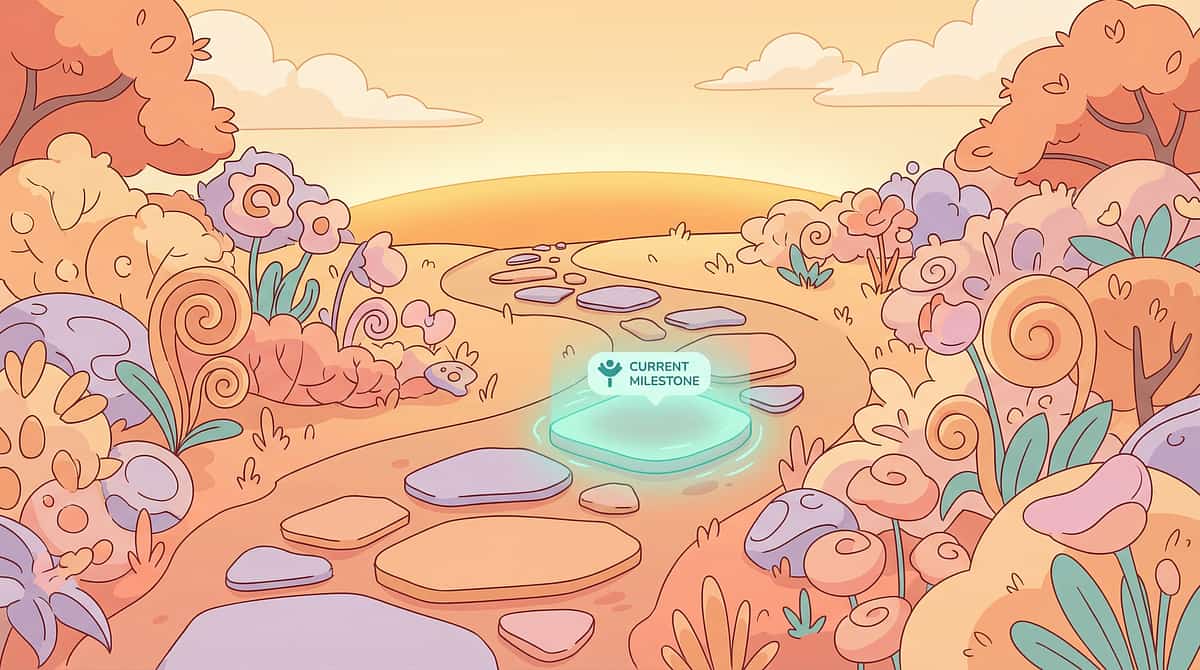
CARD 04 — DEVELOPMENTAL TIMELINE
Your Child's Emotional Vocabulary Journey
Where They Are. Where They're Heading.
1
Age 2–3
Basic 4 emotions: happy, sad, mad, scared
2
Age 3–5
6–8 emotions: adds scared, worried, excited, frustrated
3
Age 5–7
12–15 emotions: adds embarrassed, disappointed, overwhelmed, proud
4
Age 7–10
25+ emotions: adds jealous, anxious, conflicted
5
Age 10+
Nuanced emotional intelligence — full emotion families
📍Your child may be here — experiencing emotions but lacking the vocabulary to name them. With the right materials and consistent practice, emotional vocabulary expands predictably — often 15–20 new emotion words within 8–12 weeks of structured intervention. — Pinnacle Blooms Consortium Clinical Data | 20M+ therapy sessions
Commonly co-occurring with emotional vocabulary challenges: Autism Spectrum Condition • Developmental Language Disorder • Anxiety Disorders • ADHD • Trauma history • Sensory Processing Differences

CARD 05 — THE EVIDENCE
Level I–II Evidence
This approach is validated. These materials work.
PMC11506176 (2024)
16 studies, 2013–2023: Emotional vocabulary and sensory-social interventions for ASD meet criteria for evidence-based practice. Structured training showed measurable gains in identification, labeling, and expression.
Lieberman et al. (2007)
Landmark neuroimaging: Affect labeling disrupts amygdala hyperactivation. "Name it to tame it" is mechanistically confirmed. Emotional vocabulary literally regulates the fear/stress response.
Padmanabha et al. (2019)
Indian RCT: Home-based structured interventions for Indian children with ASD demonstrated significant, measurable gains. Parent-administered protocols matched clinical outcomes. DOI: 10.1007/s12098-018-2747-4
Parent-Executable Efficacy
Population Match (Indian Families)
Measured Improvement
Across 20M+ real-world sessions
✓ NCAEP Evidence-Based Practices (2020) ✓ WHO Nurturing Care Framework aligned ✓ Pinnacle GPT-OS® Clinical Consensus ✓ DPIIT DIPP8651 recognized
ACT II — KNOWLEDGE TRANSFER | CARD 06
The Technique: What It Is
🏷️ Formal Name
Structured Emotional Vocabulary Intervention with Multi-Modal Material Supports
💬 Parent-Friendly Name
"Giving Feelings a Name" — the 9 materials that build the bridge between what your child feels and what they can say
Emotional Vocabulary Intervention is a structured, evidence-based approach that systematically teaches children to identify, label, and verbally express internal emotional states using visual, tactile, and narrative supports. Unlike general social skills training, this approach specifically targets the feeling → word connection — building the neural pathway between a child's lived emotional experience and their ability to communicate it.
"Name it to Tame it" — Dr. Dan Siegel
When children label their emotions, the prefrontal cortex activates to regulate the amygdala response. Emotional vocabulary is not just communication — it IS regulation.
When children label their emotions, the prefrontal cortex activates to regulate the amygdala response. Emotional vocabulary is not just communication — it IS regulation.
Technique Badges
🧩 Domain: Social-Emotional | Emotional Expression
📚 Categories: Emotional Vocabulary | Social Communication | Storybooks
🎯 Age: 3–10 years
⏱️ Session: 10–20 min
📅 Frequency: Daily practice recommended
🏆 Lead: SLP × Psychology
🤝 Support: ABA × OT × SpEd
📚 Categories: Emotional Vocabulary | Social Communication | Storybooks
🎯 Age: 3–10 years
⏱️ Session: 10–20 min
📅 Frequency: Daily practice recommended
🏆 Lead: SLP × Psychology
🤝 Support: ABA × OT × SpEd
📞 FREE Helpline
9100 181 181
24×7 | 18+ Languages
pinnacleblooms.org
Not sure if your child needs this technique? Our consortium specialists will guide you.
24×7 | 18+ Languages
pinnacleblooms.org
Not sure if your child needs this technique? Our consortium specialists will guide you.
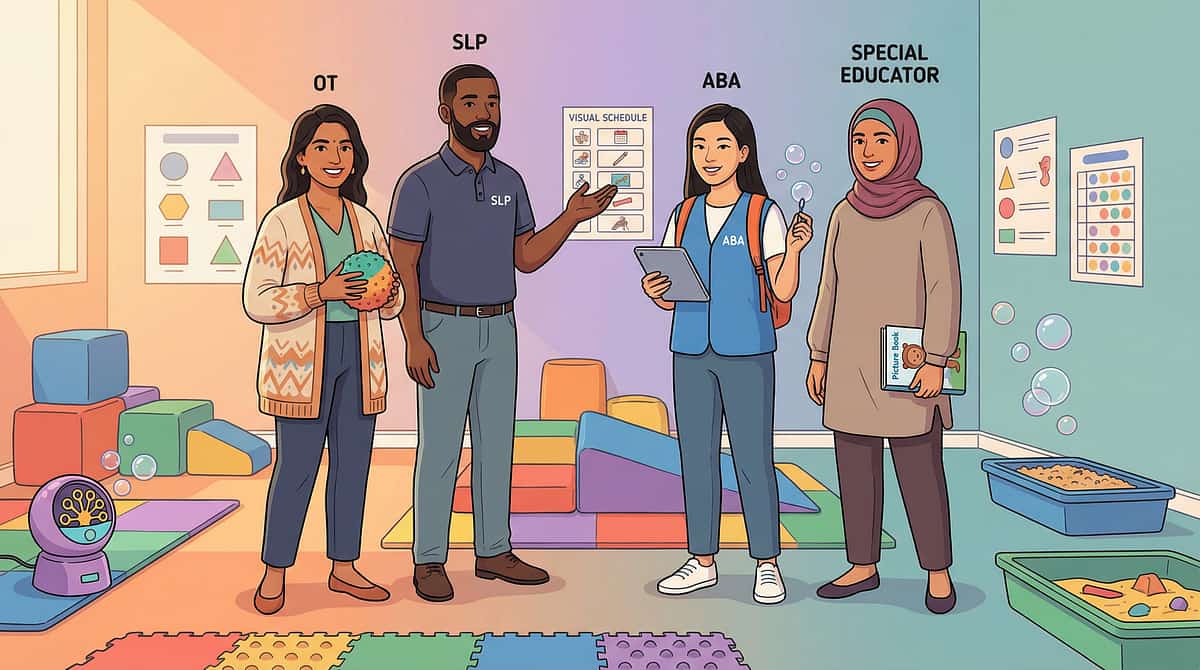
CARD 07 — THE CONSORTIUM
The Consortium Behind This Technique
5 Disciplines. One Child. One Integrated Plan.
Speech-Language Pathologist — PRIMARY LEAD
Builds the vocabulary architecture. Works on word retrieval, emotion labeling, pragmatic language, and the syntax of emotional expression ("I feel ___ because ___"). Designs the word card system and graduated vocabulary ladder.
Psychologist / Counselor
Addresses the emotional processing layer — alexithymia traits, emotional avoidance, and the cognitive-affective connections underlying vocabulary development. Leads bibliotherapy and projective play approaches.
ABA / BCBA Therapist
Creates structured teaching trials for emotion identification. Uses discrete trial teaching, errorless learning, and reinforcement schedules to systematically build the emotion → label repertoire. Tracks data on identification accuracy.
Occupational Therapist (OT)
Addresses interoceptive awareness — the body's ability to sense its own internal states. If a child can't feel their emotions in their body, they can't name them. OT builds the proprioceptive and interoceptive foundation.
Special Educator (SpEd)
Integrates emotional vocabulary into classroom learning, social stories, and academic materials. Ensures generalization from therapy room to school environment.
"This technique crosses therapy boundaries because the brain doesn't organize by therapy type. Feelings live everywhere — in language, behavior, body, and learning. So does the intervention."
CARD 08 — WHAT THIS TARGETS
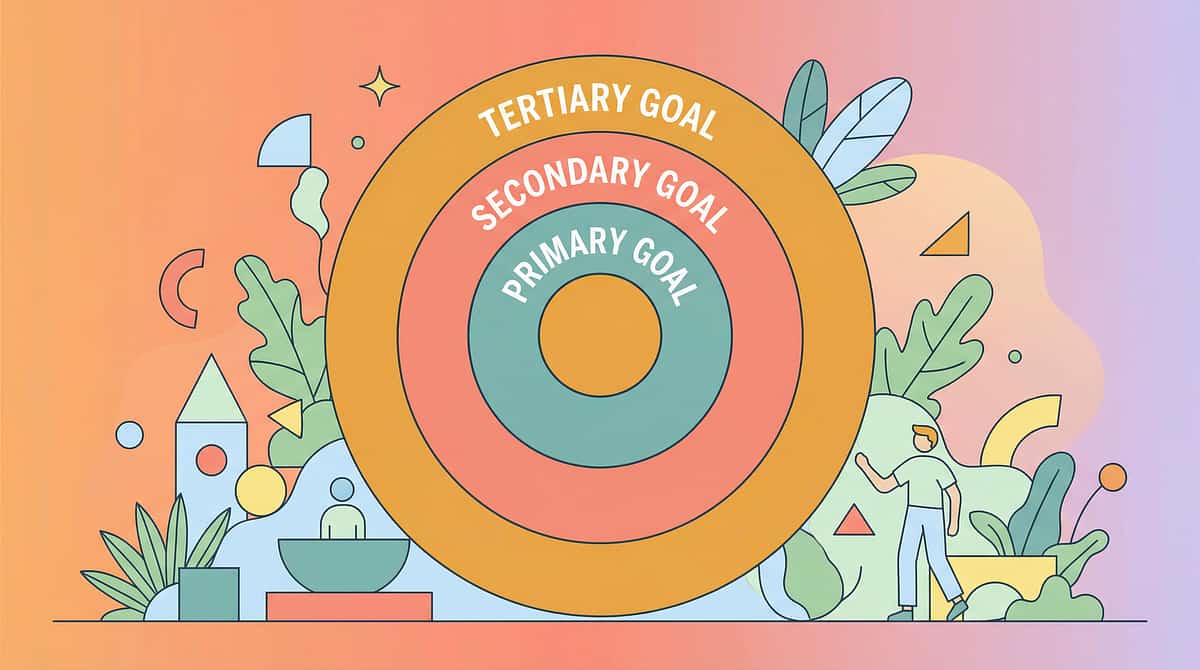
Precision Targets
This Technique Is Not a General Activity — It Is a Precision Tool
🎯 PRIMARY TARGET
Emotional Identification and Labeling
Can identify an emotion from a visual cue (face chart, picture). Can verbally label their own current emotion using at least one specific word.
Baseline → Mastery: From 0 emotion words used spontaneously → 5+ emotion words used accurately per week
Can identify an emotion from a visual cue (face chart, picture). Can verbally label their own current emotion using at least one specific word.
Baseline → Mastery: From 0 emotion words used spontaneously → 5+ emotion words used accurately per week
🟣 SECONDARY TARGETS
• Emotional Intensity Recognition: Understanding feelings come in sizes
• Body-Emotion Connection: Linking physical sensations to emotion labels
• Cause-Effect Understanding: Knowing WHY a feeling happened
• Reduced Behavioral Expression: Fewer tantrums as words become available
• Body-Emotion Connection: Linking physical sensations to emotion labels
• Cause-Effect Understanding: Knowing WHY a feeling happened
• Reduced Behavioral Expression: Fewer tantrums as words become available
🔵 TERTIARY TARGETS
• Emotional Regulation: Named emotions are regulated emotions
• Social Cognition: Reading emotions in others improves
• Language Development: Emotional vocabulary expands overall semantics
• Family Relationship Quality: Parent-child attunement deepens
• Social Cognition: Reading emotions in others improves
• Language Development: Emotional vocabulary expands overall semantics
• Family Relationship Quality: Parent-child attunement deepens
Observable Behavior Milestones
Week 2
Points to feeling face reliably
Week 4
Uses 3+ distinct emotion words spontaneously
Week 6
Says "I feel [word] because [cause]" at least occasionally
Week 8+
Emotion vocabulary appearing in everyday conversation without prompting
Research: PMC10955541 | PMC11506176
CARD 09 — THE 9 MATERIALS
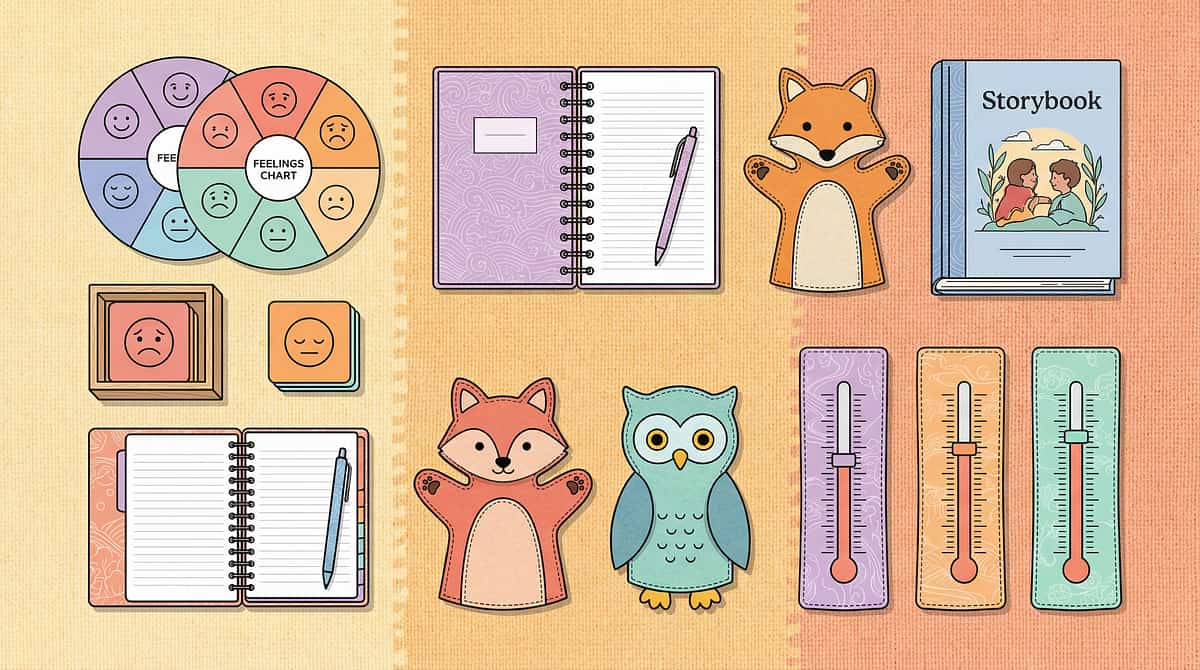
The 9 Materials
Each One a Key. Feelings Have Many Doors.
The 9 materials from B-192, ordered by impact and accessibility. Start with Material 1 — it changes everything.
Why 9 Materials?
Emotional vocabulary lives in multiple brain systems — visual, tactile, narrative, and play. Each material activates a different neural pathway. Using all 9 creates a full-spectrum intervention.
How to Use This Section
Each material card below includes: The Science (why it works neurologically), Home Use instructions (exactly what to say and do), Canon product recommendations with Amazon.in links, and a ₹0 DIY alternative.
Where to Start
Start with Material 1 (Feelings Faces Chart). Post it today. It costs ₹0 to DIY. Within 48 hours, you will have your first data point. Then add one material per week.
9
Materials in this protocol
₹0
Minimum cost to start
15 min
Daily practice time needed
8–12 wks
For measurable vocabulary expansion
🧠 You do NOT need all 9 materials to start. Material 1 alone — used consistently for 2 weeks — produces measurable change in 80%+ of children. Add materials progressively as your child's engagement grows. — Pinnacle SLP Consortium
Material 1 of 9
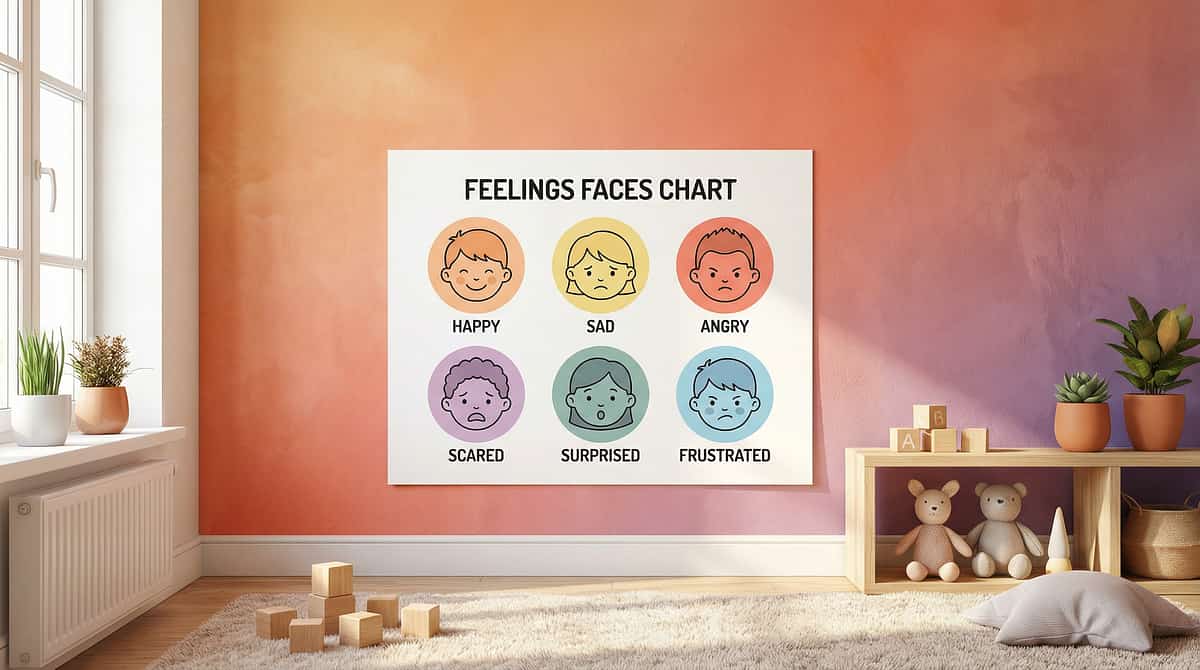
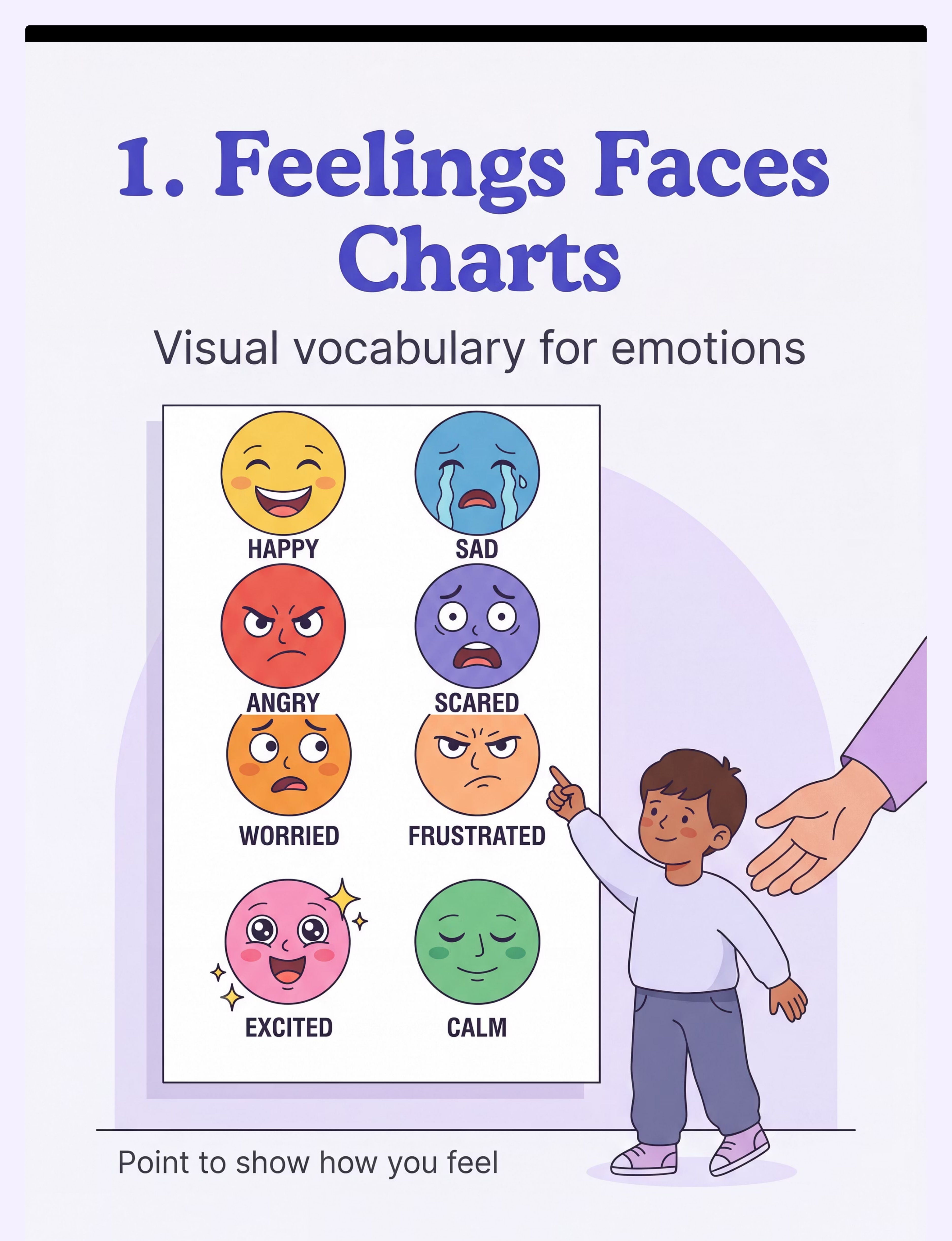
🟡 Feelings Faces Charts & Emotion Posters
The Science
Provides visual vocabulary for emotions. Children can point when words won't come — every point builds the neural bridge between internal state and label.
Home Use
Post at child's eye level. Morning check-in: "Find the face that shows how you feel today." Accept pointing as complete communication.
Safety Note
Include diverse range of emotions — not only positive ones.
Canon Category
Social Communication Materials | Emotional Vocabulary
Price Range
₹150–400 commercial
🖨️DIY (₹0): Print emotion faces with labels — include 8+ emotions beyond happy/sad/mad. Laminate with tape-covered paper. Post at 90cm height.
🖨️DIY (₹0): Print emotion faces with labels — include 8+ emotions beyond happy/sad/mad. Laminate with tape-covered paper. Post at 90cm height.
🔗 Buy on Amazon.in
Material 2 of 9
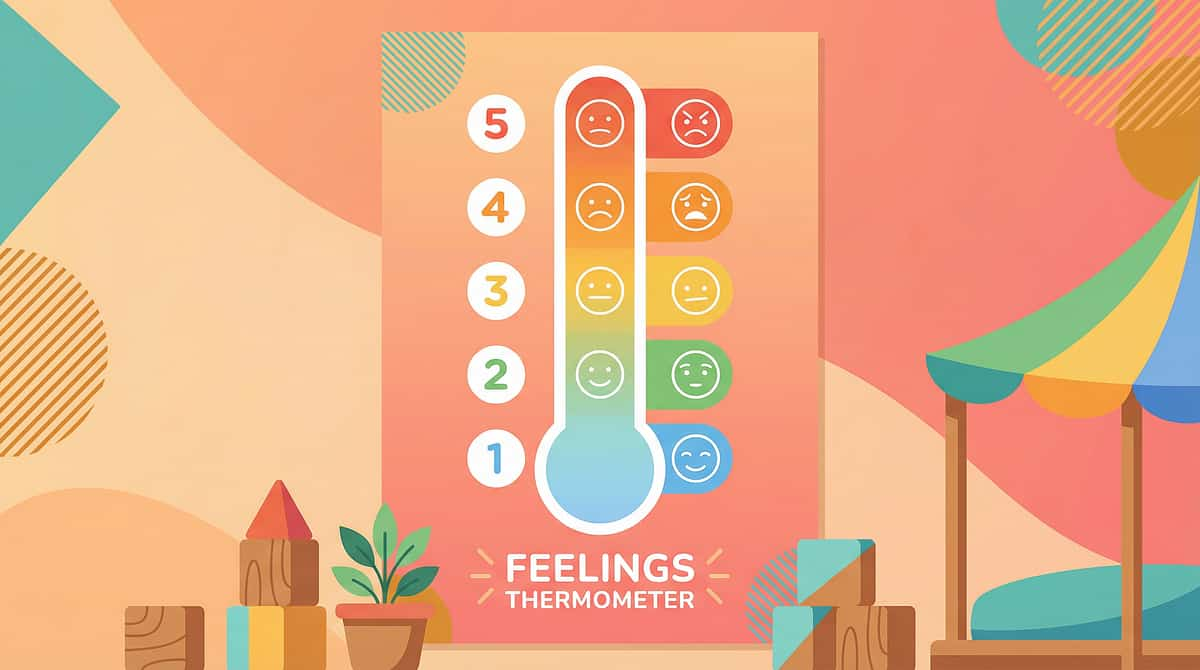
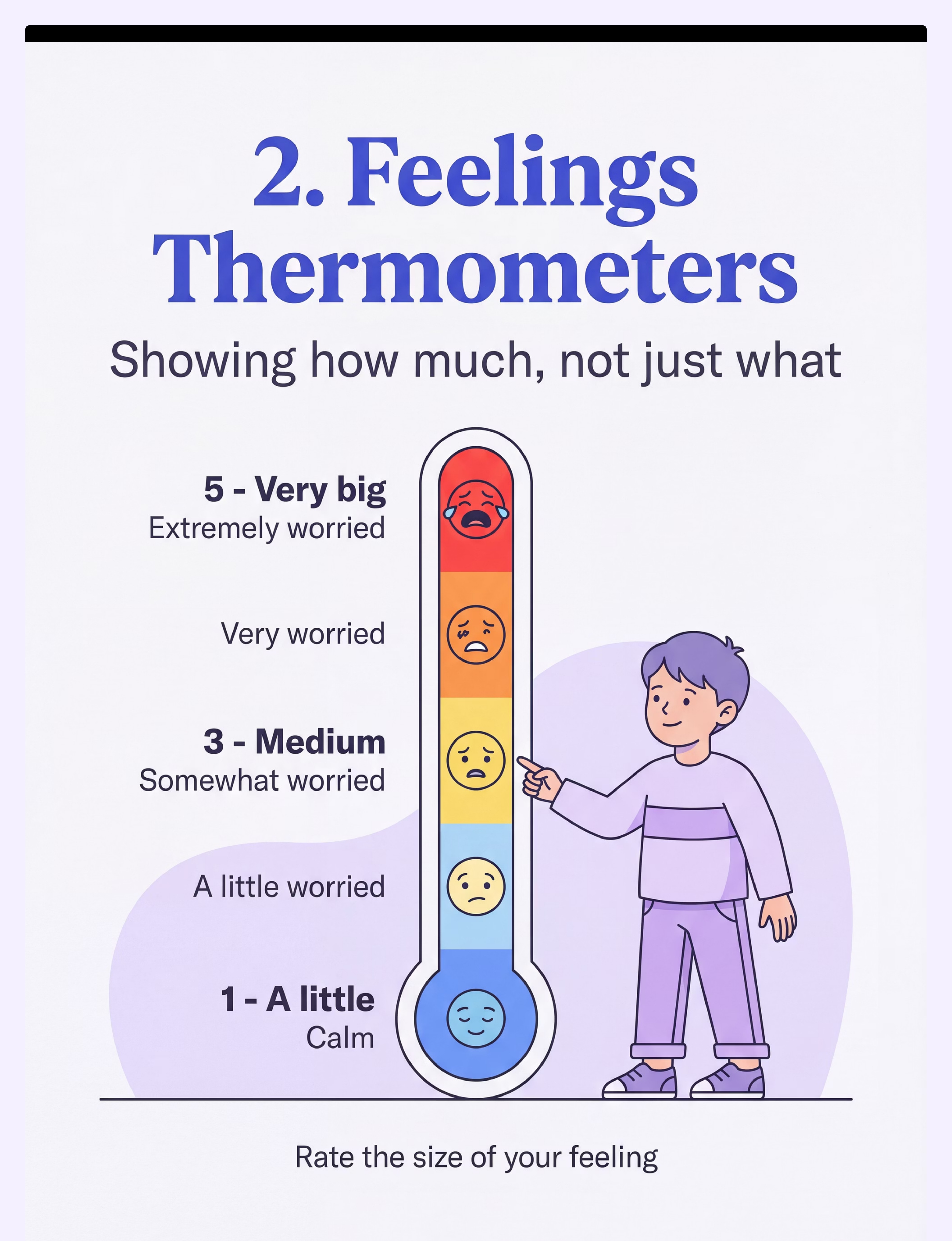
🌡️ Feelings Thermometers & Intensity Scales
The Science
Adds the dimension of intensity — not just WHAT emotion but HOW BIG. "A 2 is different from a 5." Intensity awareness is the precursor to self-regulation.
Home Use
"On a scale of 1 to 5, how worried are you right now?" Introduce during calm times first. Never debate the child's rating.
Canon Category
Emotional Vocabulary | Regulation Tools
Price Range
₹100–300 commercial
🖨️DIY (₹0): Draw thermometer on A4, color-code 1–5 from cool blue to hot red. Attach emotion faces at each level.
🖨️DIY (₹0): Draw thermometer on A4, color-code 1–5 from cool blue to hot red. Attach emotion faces at each level.
🔗 Buy on Amazon.in
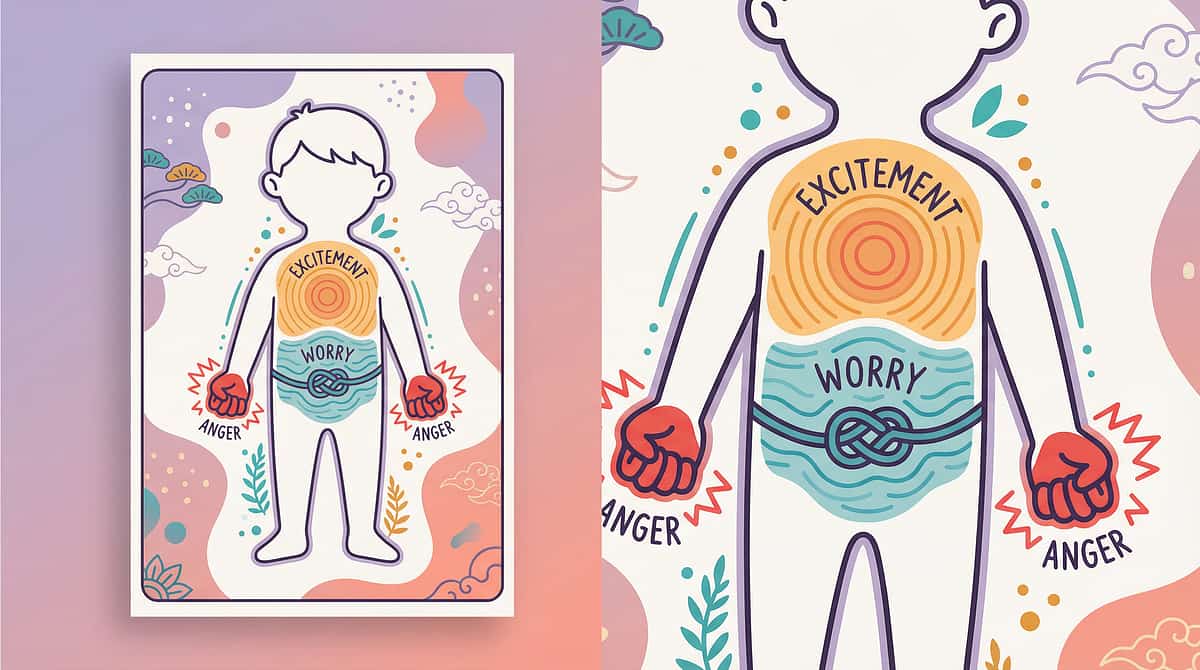
Material 3 of 9
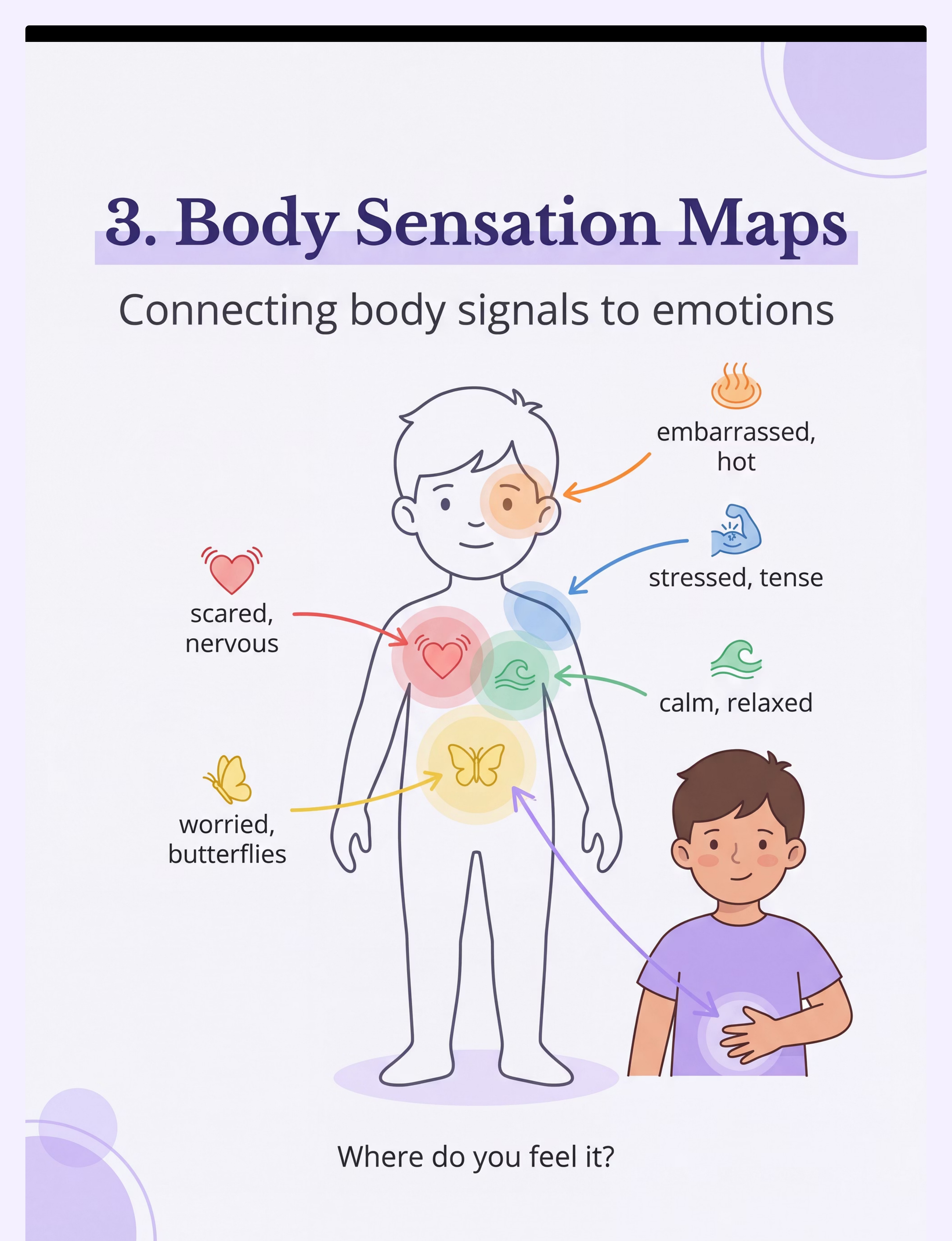
🗺️ Body Sensation Maps & Interoception Materials
The Science
Connects physical sensations to emotions — racing heart = scared, tight stomach = worried. Many children with autism have reduced interoceptive awareness. Body maps build a second pathway to emotion identification.
Home Use
"When you feel worried, where does your body feel different?" Create a personalized body-emotion map together.
Canon Category
Interoception Materials | OT Supports
Price Range
₹100–350 commercial
🖨️DIY (₹0): Trace child's body outline on large paper. Color-code body zones with the emotions they feel there.
🖨️DIY (₹0): Trace child's body outline on large paper. Color-code body zones with the emotions they feel there.
🔗 Buy on Amazon.in
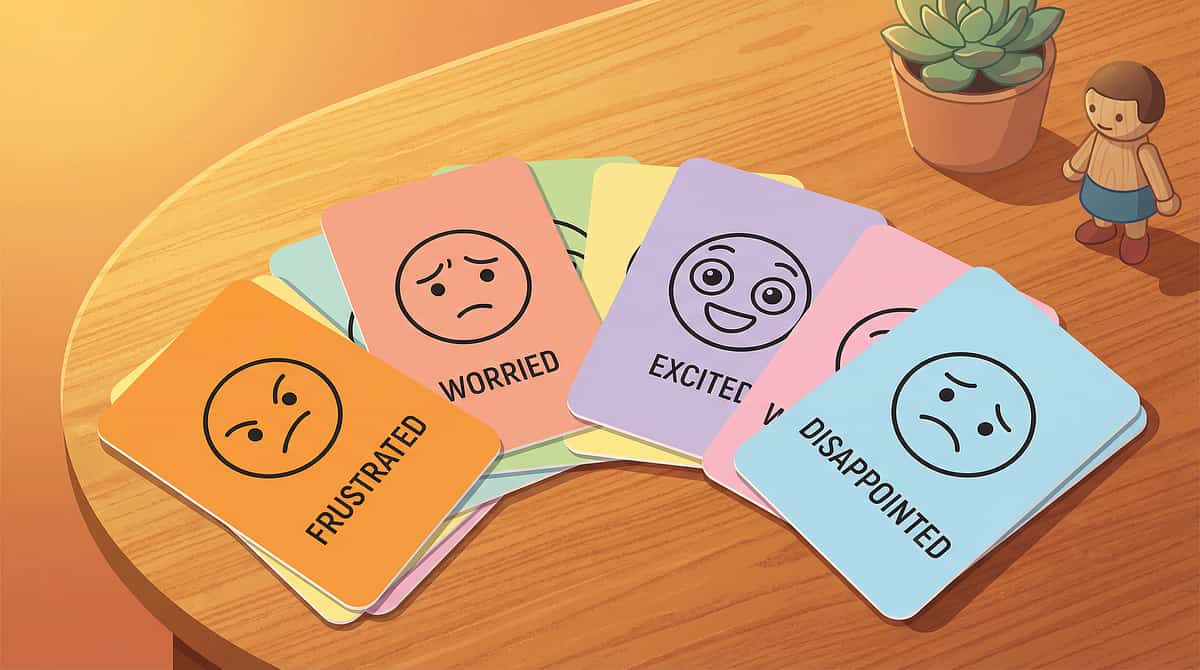
Material 4 of 9
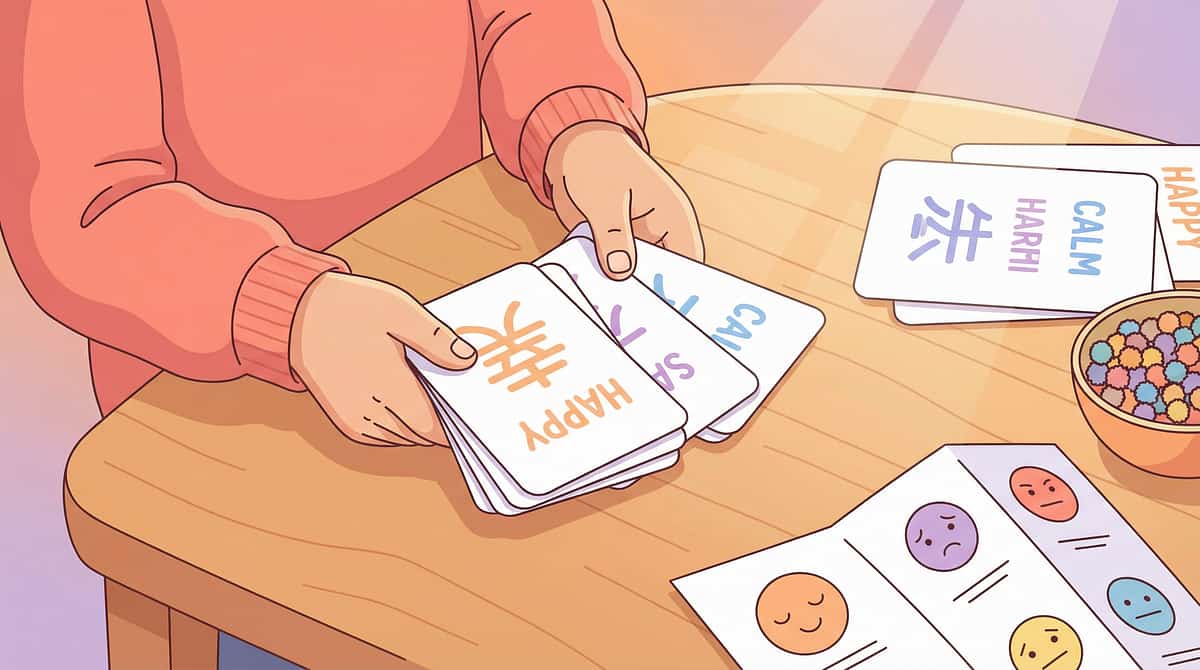
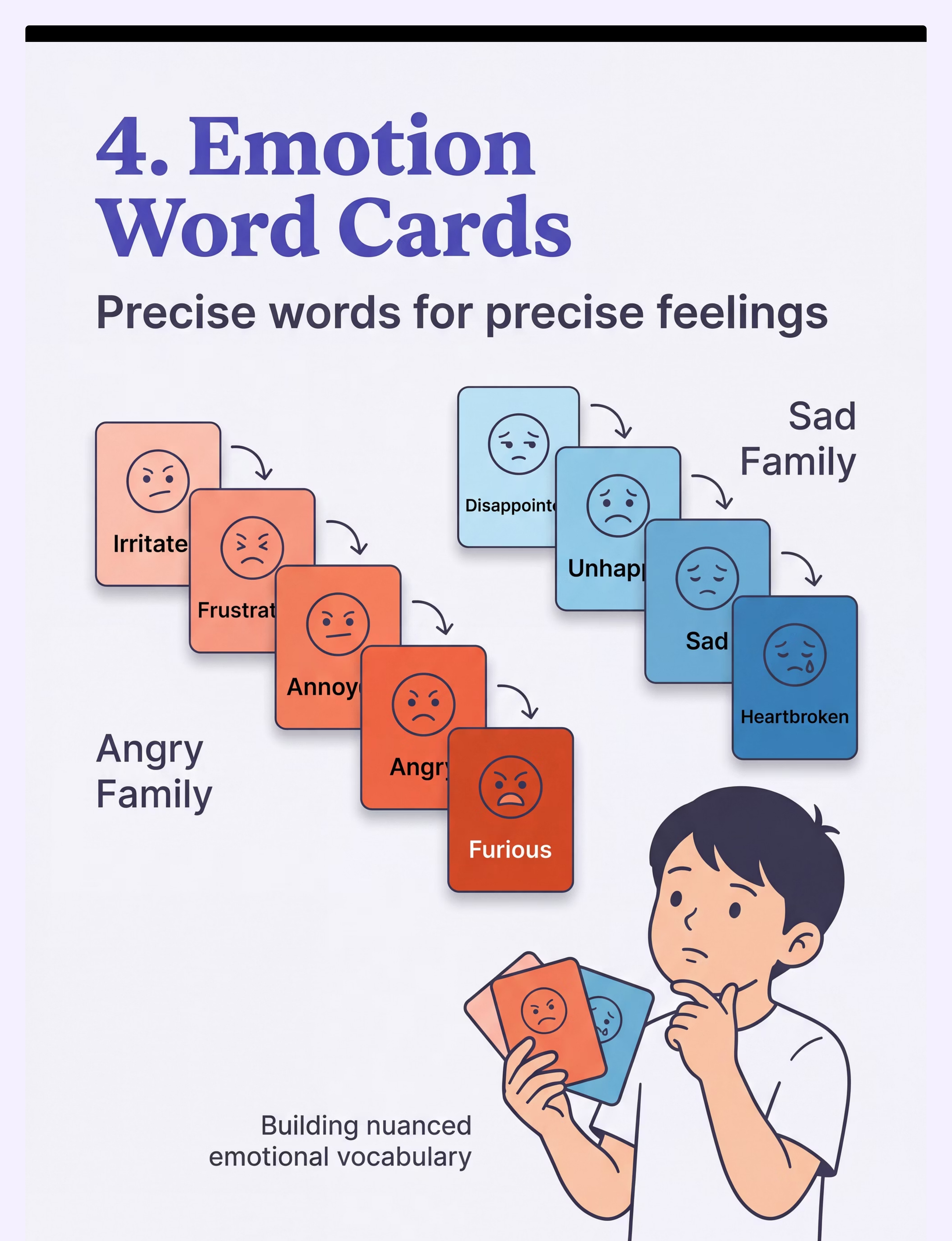
🃏 Emotion Word Cards with Graduated Vocabulary
The Science
Expands beyond basic 3-word vocabulary. Introduces emotion families: Angry Family (irritated → frustrated → annoyed → angry → furious). Precise words = precise regulation.
Home Use
Start with child's current vocabulary level and expand by 1–2 words per week. Always connect new words to real experiences.
Canon Category
Language Cards | Emotional Vocabulary | Flashcards
Price Range
₹200–500 commercial
🖨️DIY (₹0): Index cards with emotion word + drawn face. Group into "families." Discuss differences during calm moments.
🖨️DIY (₹0): Index cards with emotion word + drawn face. Group into "families." Discuss differences during calm moments.
🔗 Buy on Amazon.in
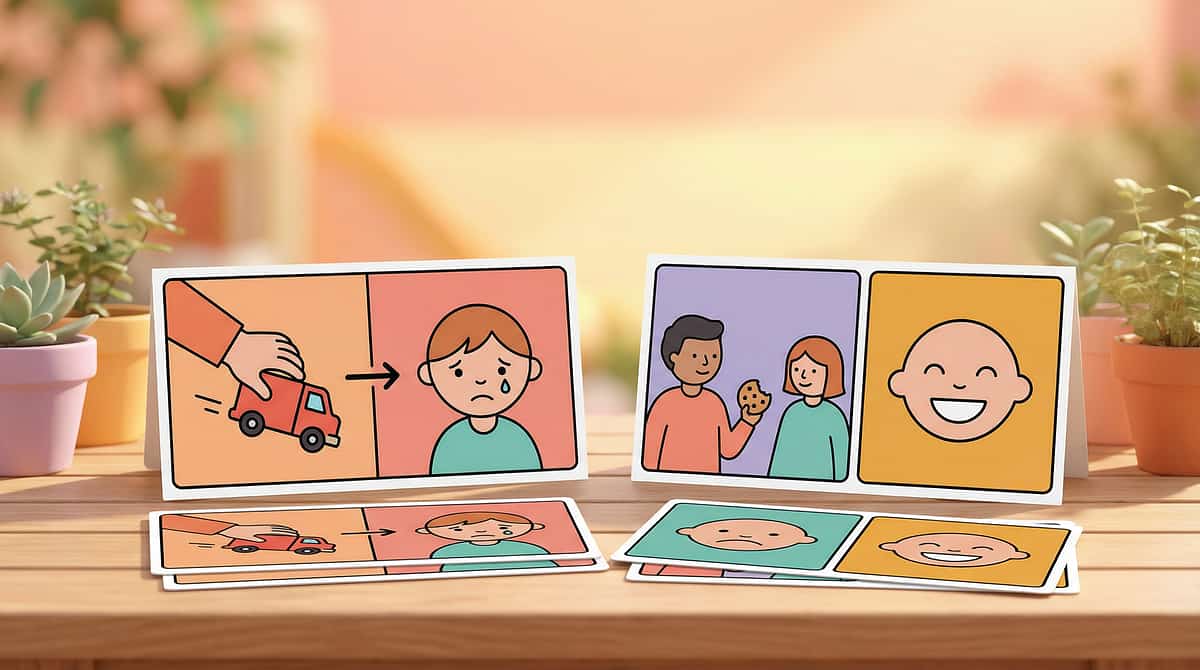
Material 5 of 9
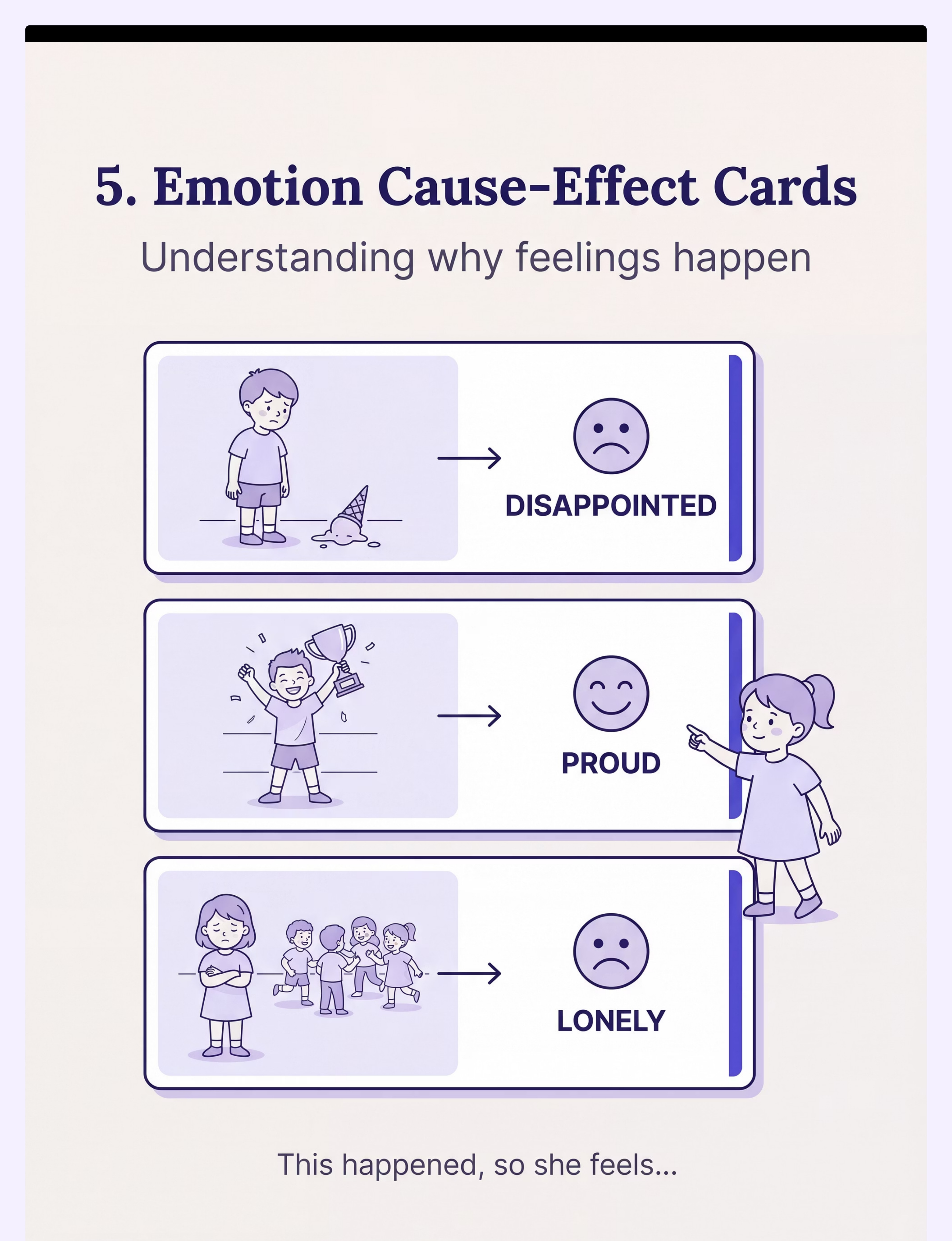
🔗 Emotion Cause-Effect Cards & Scenario Materials
The Science
Teaches WHY feelings happen. "She lost her toy → she feels disappointed." Situation-emotion reasoning builds emotional intelligence and reduces social confusion.
Home Use
Show card: "What happened? How might she feel?" Connect to child's own experiences: "Remember when YOUR toy broke? What did YOU feel?"
Canon Category
Social Scenarios | Problem-Solving Toys
Related Canon Product
Dyomnizy Educational Memory Game | ₹519
Buy on Amazon.in
Buy on Amazon.in
Price Range
₹200–450 commercial
🖨️DIY (₹0): Draw simple 2-panel cards: situation → emotion face. Use real photos from family life.
🖨️DIY (₹0): Draw simple 2-panel cards: situation → emotion face. Use real photos from family life.
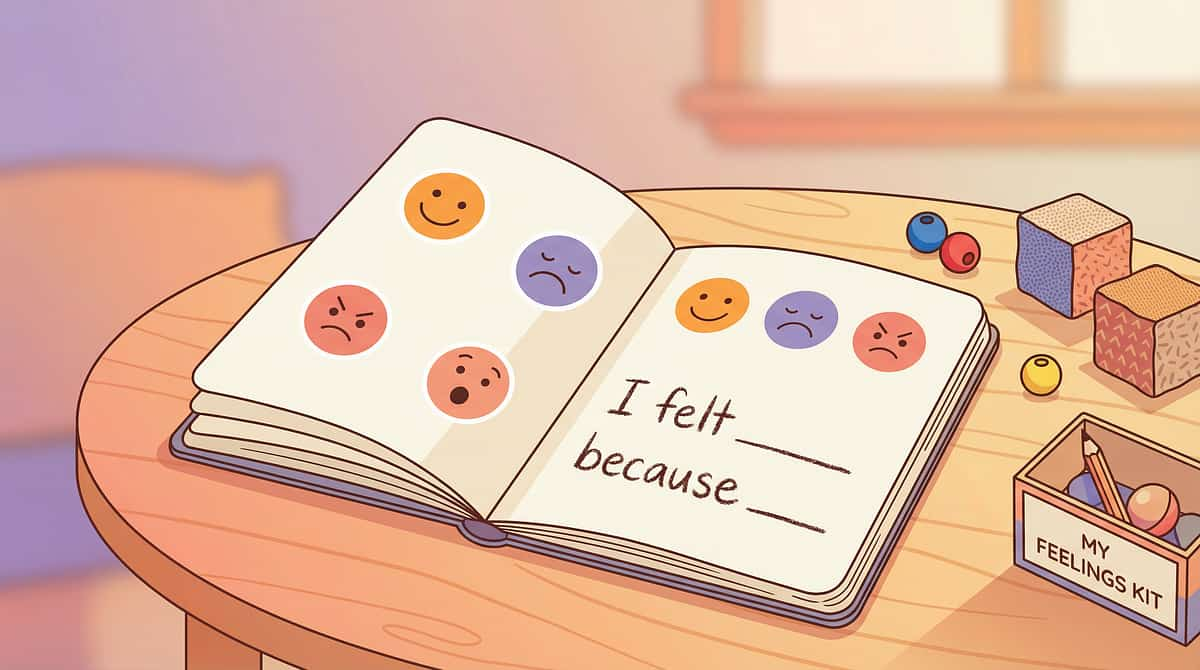
Material 6 of 9
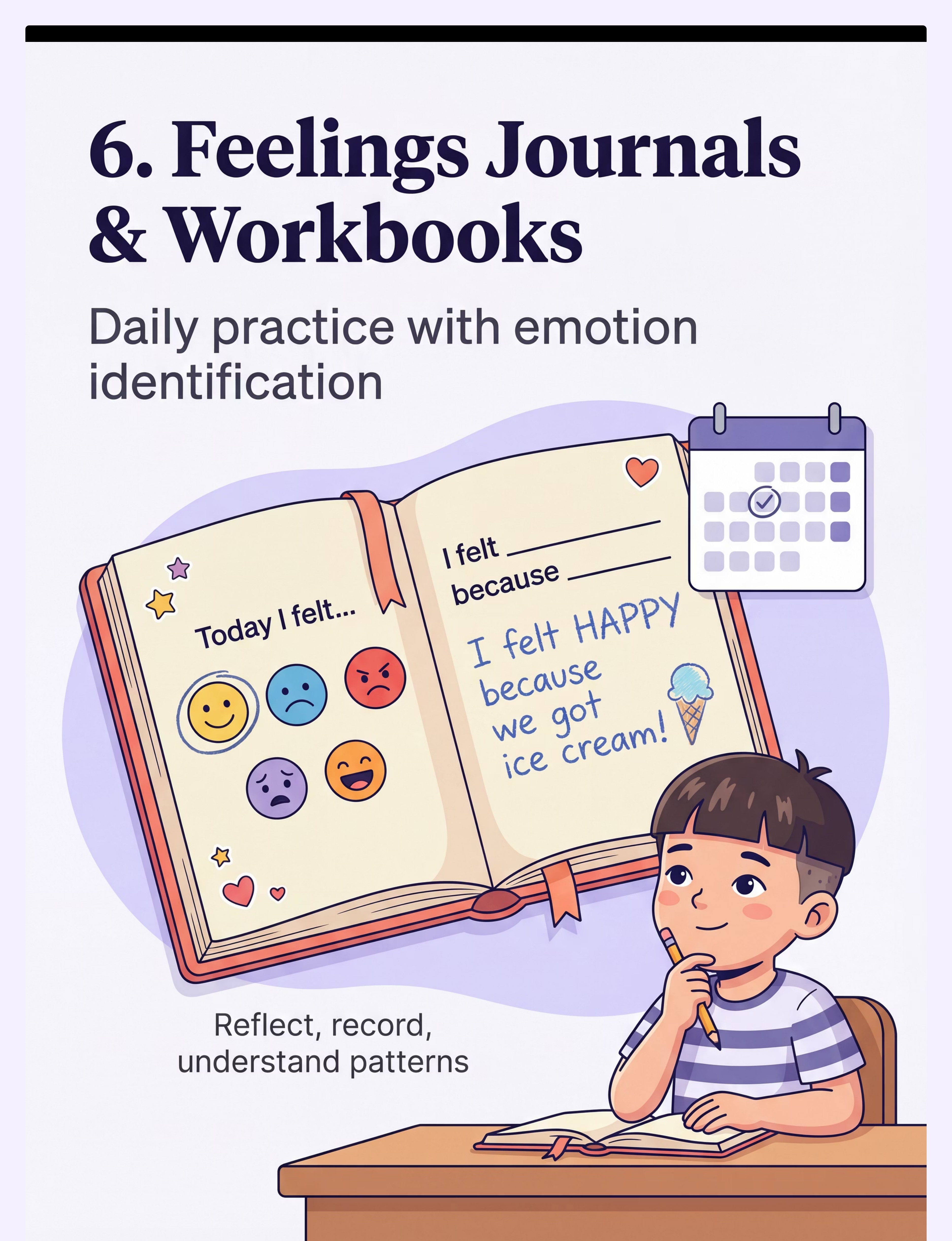
📓 Feelings Journals & Emotion Tracking Workbooks
The Science
Daily emotion identification practice builds the habit of noticing and naming. Pattern recognition emerges over weeks — "I notice I always feel worried on Sunday evenings."
Home Use
Evening routine: "Today I felt ___ because ___." Use face stickers to circle emotion if writing is hard. Never force — flexibility prevents resistance.
Canon Category
Workbooks | Daily Practice Tools
Price Range
₹150–400 commercial
🖨️DIY (₹0): Staple 7 pages. Each page: 6 emotion faces to circle + "I felt ___ because ___" fill-in.
🖨️DIY (₹0): Staple 7 pages. Each page: 6 emotion faces to circle + "I felt ___ because ___" fill-in.
🔗 Buy on Amazon.in

Material 7 of 9
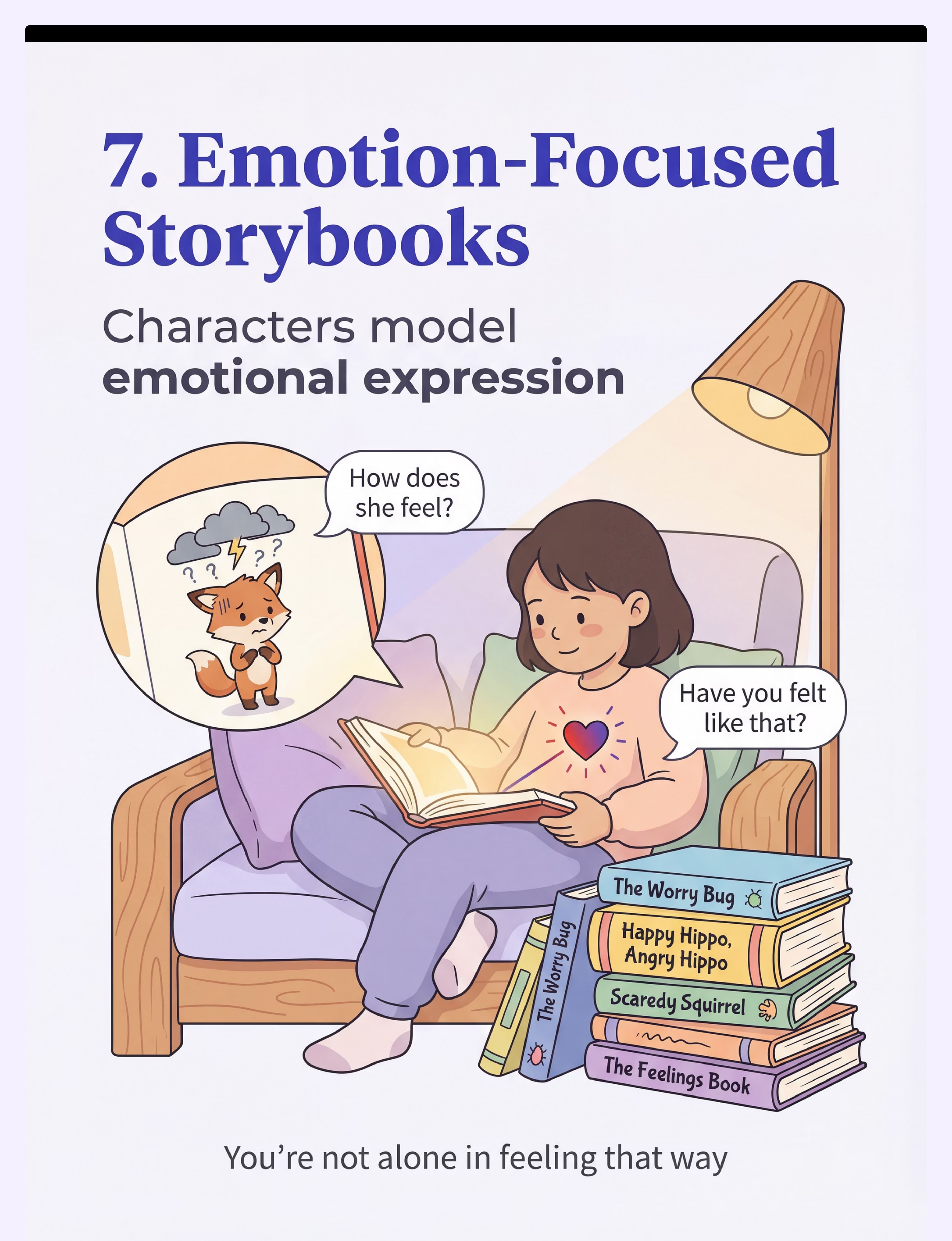
📚 Emotion-Focused Storybooks & Bibliotherapy
The Science
Story characters model emotional expression — showing children they are not alone in their feelings and providing narrative words for shared experiences. Bibliotherapy is classified as evidence-based for emotional development.
Home Use
Read together. Pause at emotional moments: "How is she feeling? Have YOU ever felt like that?" Let the child make connections naturally.
Canon Category
Books | Bibliotherapy | Social Stories
Related Canon Product
A Visit to the Hospital Activity Book | ₹199
Buy on Amazon.in
Buy on Amazon.in
Recommended Titles
The Worry Bug | Happy Hippo Angry Hippo | Scaredy Squirrel | The Feelings Book (Todd Parr)
Price Range
₹200–600 commercial
🖨️DIY (₹0): Create simple "social stories" about family emotional moments using photos + handwritten text.
🖨️DIY (₹0): Create simple "social stories" about family emotional moments using photos + handwritten text.
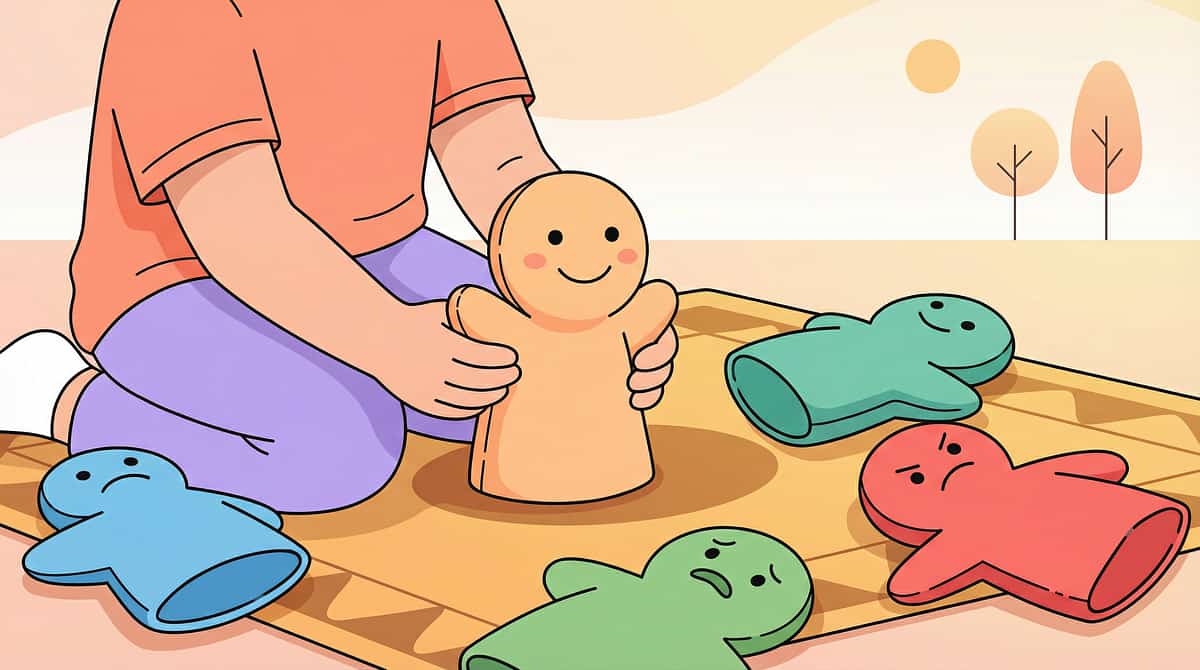
Material 8 of 9
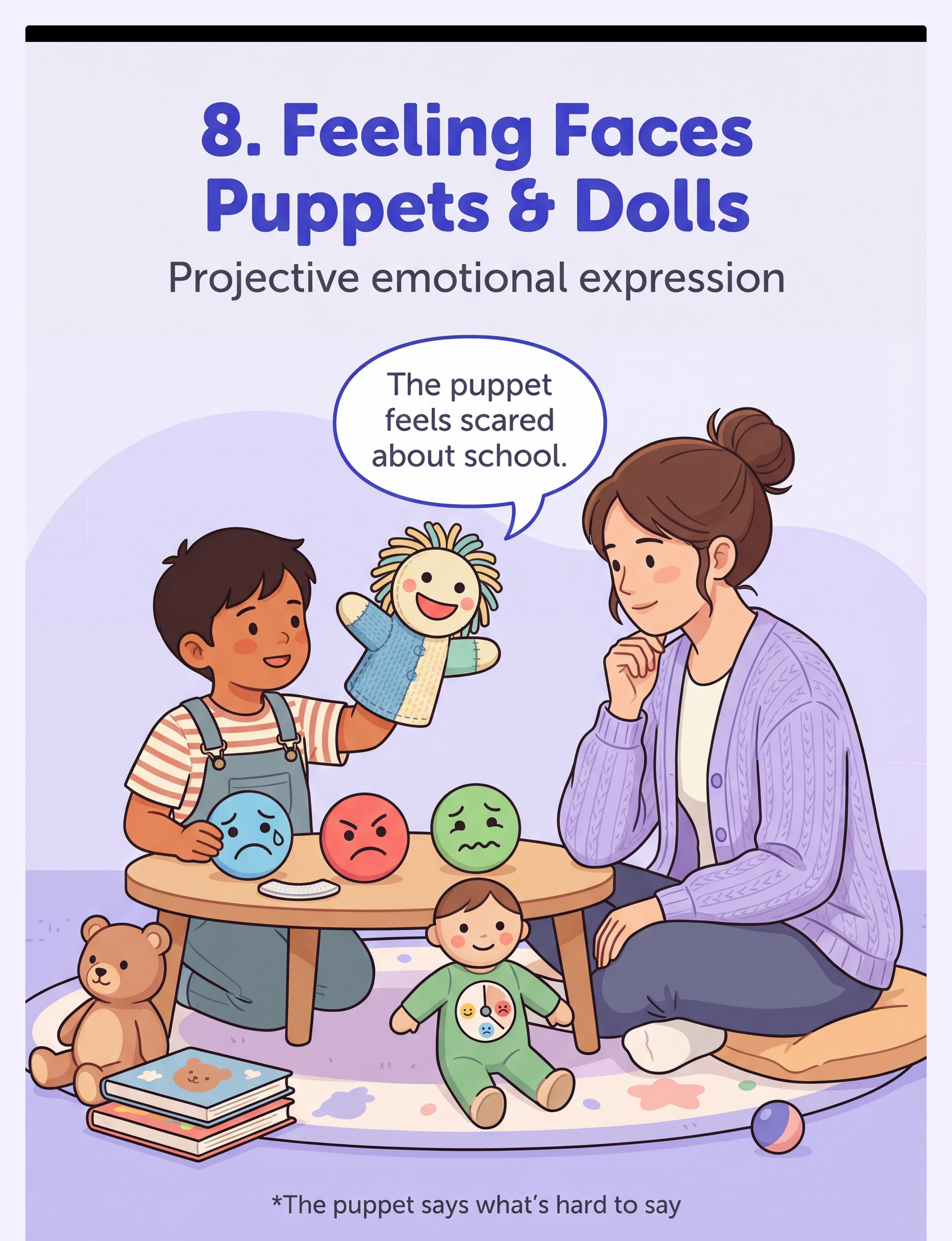
🪆 Feeling Faces Puppets & Emotion Expression Dolls
The Science
Puppets create projective distance — "The puppet feels scared" is dramatically easier to say than "I feel scared." What the puppet expresses is almost always what the child is experiencing. Projective communication is emotionally safer.
Home Use
Use soft toy or puppet: "How is Teddy feeling right now?" Never rush to "but what about YOU?" — the puppet's expression IS the child's expression.
Canon Category
Puppets | Projective Play Tools | Soft Toys
Related Canon Product
Animal Soft Toys | ₹425
Buy on Amazon.in
Buy on Amazon.in
Price Range
₹300–800 commercial
🖨️DIY (₹0): Paper bag puppet with interchangeable drawn emotion faces (Velcro or paper clip attachment).
🖨️DIY (₹0): Paper bag puppet with interchangeable drawn emotion faces (Velcro or paper clip attachment).
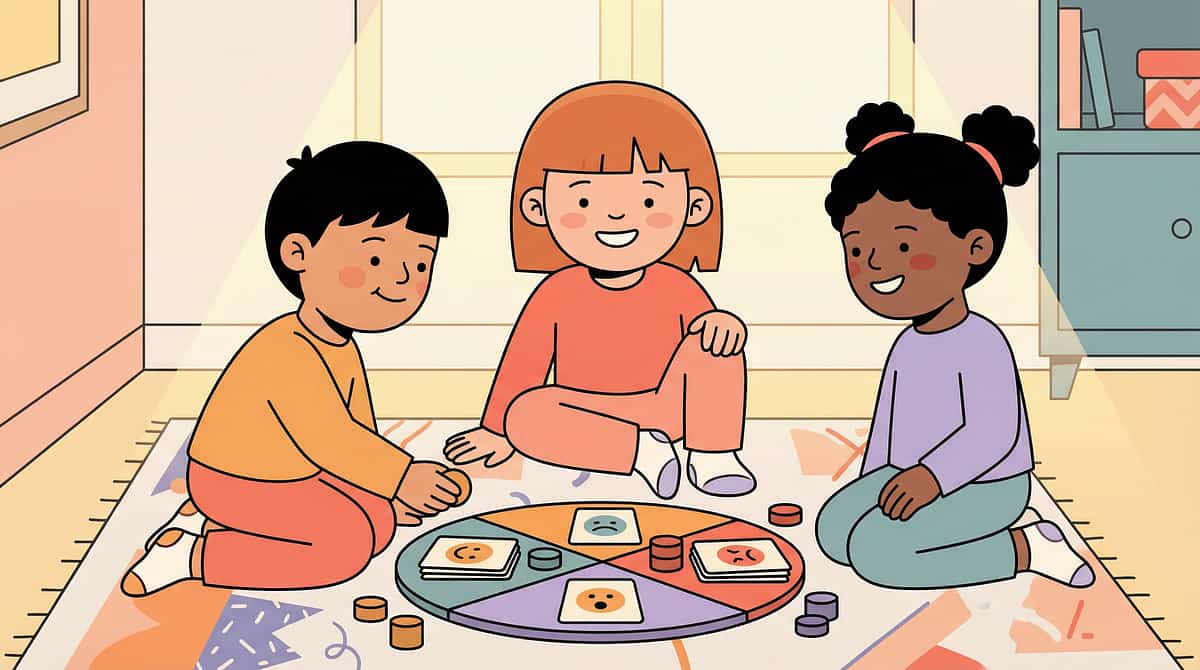
Material 9 of 9
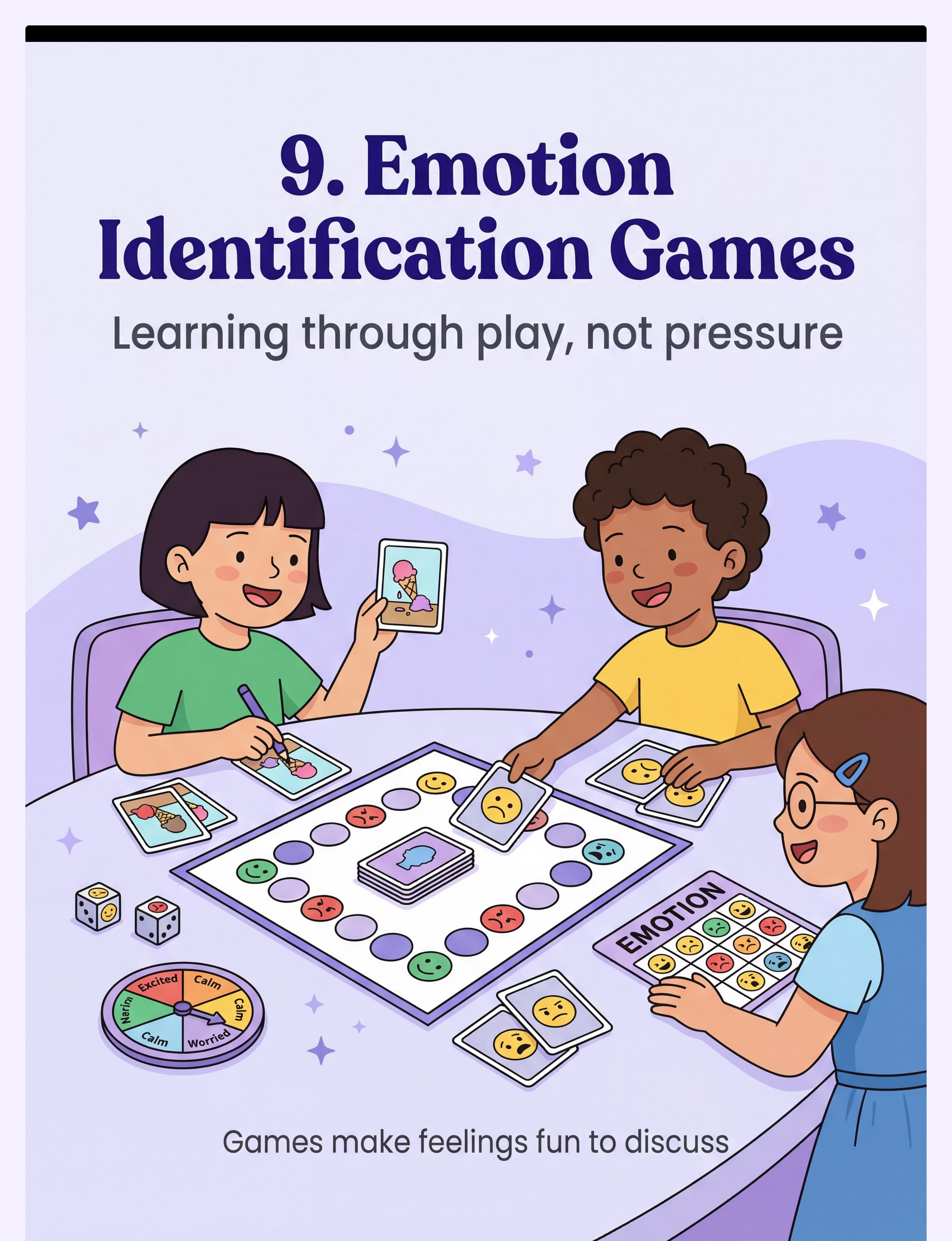
🎲 Emotion Identification Games & Feelings Matching Activities
The Science
Gamified emotion practice reduces pressure and increases engagement. When emotion words are part of play, children practice without the performance anxiety of being "tested." Play is the natural learning modality for this age band.
Home Use
Emotion bingo, feelings charades, matching scenarios to faces. Play regularly — repetition builds vocabulary. Keep it fun. Let the child win sometimes.
Canon Category
Matching Games | Memory Games | Educational Games
Related Canon Product
Dyomnizy Educational Memory Game | ₹519
Buy on Amazon.in
Buy on Amazon.in
Price Range
₹250–700 commercial
🖨️DIY (₹0): Feelings bingo (3×3 grid of emotion faces, parent calls them out). Emotion charades (act out a feeling — no words). Feelings snap (two matching emotion cards = snap!).
🖨️DIY (₹0): Feelings bingo (3×3 grid of emotion faces, parent calls them out). Emotion charades (act out a feeling — no words). Feelings snap (two matching emotion cards = snap!).
🌟Essential Starter — 3 Materials First: (1) Feelings Faces Chart — post today, ₹0 DIY (2) Emotion Word Cards — 3 emotion families, ₹0 DIY (3) Feelings Thermometer — one scale, ₹0 DIY
Total for full 9-material set: ₹1,500–4,500 commercial | ₹0 DIY versions for all 9
📞 Need help choosing where to start? Call 9100 181 181 — Free consultation with our SLP team.
Total for full 9-material set: ₹1,500–4,500 commercial | ₹0 DIY versions for all 9
📞 Need help choosing where to start? Call 9100 181 181 — Free consultation with our SLP team.
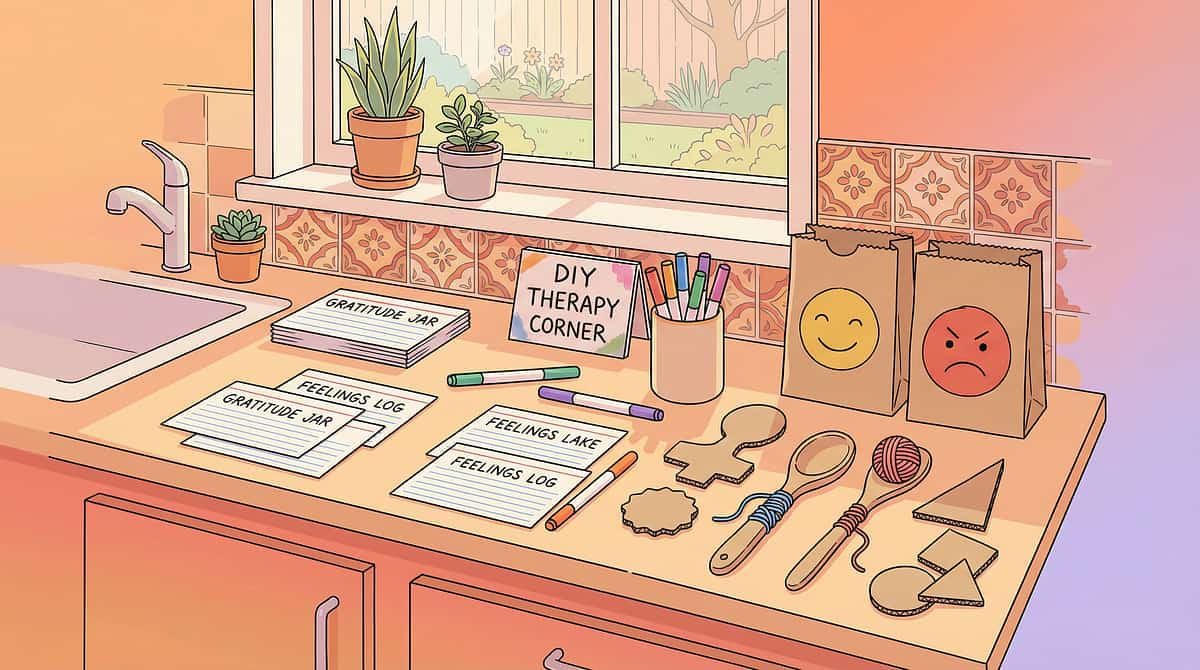
CARD 10 — DIY & SUBSTITUTES
Every Child Deserves This — Regardless of Budget
9 Zero-Cost Alternatives. Backed by the Same Science.
WHO Nurturing Care Framework (2018): Effective early interventions must be accessible across economic contexts. The therapeutic principle — not the price — drives the outcome.
Material | Buy This | Make This (₹0) | Same Principle? | |
Feelings Faces Chart | ₹150–400 commercial poster | Print + laminate 8 emotion faces at eye level | ✅ Visual vocabulary pathway identical | |
Feelings Thermometer | ₹100–300 scale tool | Hand-draw 1–5 thermometer, color-code | ✅ Intensity rating mechanism preserved | |
Body Sensation Map | ₹100–350 interoception worksheet | Trace child on large paper, family colors emotions together | ✅ Body-emotion connection building works equally | |
Emotion Word Cards | ₹200–500 card set | Index cards + drawn faces, grouped by family | ✅ Vocabulary expansion pathway intact | |
Cause-Effect Cards | ₹200–450 scenario set | Draw 2-panel scenarios from family life, add photos | ✅ Situation-emotion reasoning identical | |
Feelings Journal | ₹150–400 printed workbook | 7 stapled pages, morning + evening check-ins | ✅ Daily practice habit = same neural pathway building | |
Emotion Storybooks | ₹200–600 published books | Photo-story of family emotions, parent-narrated | ✅ Bibliotherapy mechanism preserved | |
Feeling Puppets | ₹300–800 therapeutic set | Paper bag + clip-on drawn faces | ✅ Projective distance mechanism fully preserved | |
Emotion Games | ₹250–700 board games | Bingo grid + charades on paper | ✅ Gamified low-pressure practice identical |
⚠️Prefer commercial materials when: Child requires high-durability laminated cards (frequent handling, oral stimming) | Diverse representation matters (varied skin tones, cultural faces) | Consistency of visual design supports child with OCD/rigidity | School/clinic coordination requires standardized materials
🖨️Free Printables: Download Pinnacle's 9-material DIY starter pack → pinnacleblooms.org/free-materials
🖨️Free Printables: Download Pinnacle's 9-material DIY starter pack → pinnacleblooms.org/free-materials
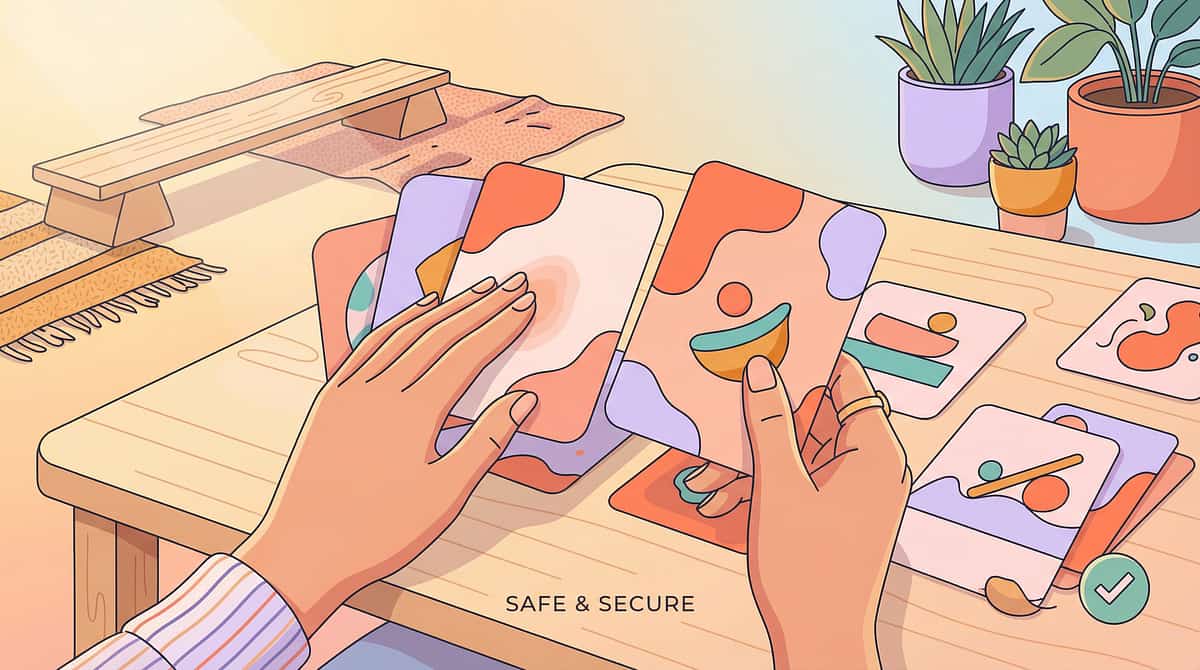
CARD 11 — SAFETY FIRST
🔴 Read Before Using Any Material in This Technique
🔴 ABSOLUTE STOP SIGNS
Do NOT proceed if:
• Child is in active meltdown or significant distress
• Child has just experienced a sensory crisis in the last 30 minutes
• Child shows signs of illness, fatigue, or significant hunger
• Child has known trauma history with specific emotional triggers — consult therapist first
• Any session has previously resulted in self-harm or severe aggression — seek professional assessment
• Child is in active meltdown or significant distress
• Child has just experienced a sensory crisis in the last 30 minutes
• Child shows signs of illness, fatigue, or significant hunger
• Child has known trauma history with specific emotional triggers — consult therapist first
• Any session has previously resulted in self-harm or severe aggression — seek professional assessment
🟡 MODIFY THE SESSION IF
• Child is mildly dysregulated (use thermometer only — 1-minute check-in)
• Child resists the specific material (switch to puppet or games)
• Child uses only pointing (accept this — never force verbal labeling)
• Session falls during a transition or preferred activity time (reschedule or reduce to 2 minutes)
• Child resists the specific material (switch to puppet or games)
• Child uses only pointing (accept this — never force verbal labeling)
• Session falls during a transition or preferred activity time (reschedule or reduce to 2 minutes)
🟢 IDEAL CONDITIONS
• Child is calm-alert (not sleepy, not over-stimulated)
• 30+ minutes since last meal
• Low-stimulus environment
• Child has had physical activity beforehand
• Time is predictable and consistent (same time each day)
• 30+ minutes since last meal
• Low-stimulus environment
• Child has had physical activity beforehand
• Time is predictable and consistent (same time each day)
🛑 Red Line Behaviors — Stop Immediately If Observed
- Severe self-injurious behavior triggered by emotional content
- Complete emotional shutdown lasting more than 10 minutes
- Signs of trauma response (freezing, dissociation, hyperventilation)
- Regression beyond usual baseline lasting more than 3 days after sessions
📞Pinnacle Clinical Helpline: 9100 181 181 — Available 24×7 for safety concerns
Research: DOI: 10.1007/s12098-018-2747-4 (Padmanabha et al.)
Research: DOI: 10.1007/s12098-018-2747-4 (Padmanabha et al.)
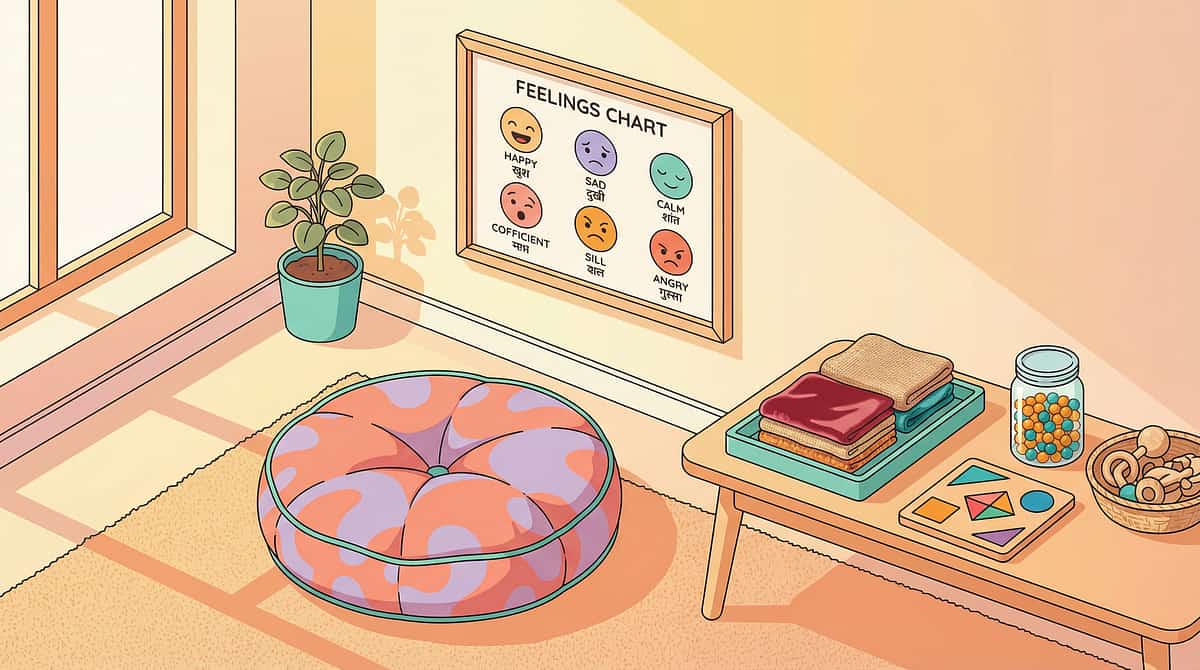
CARD 12 — SET UP YOUR SPACE
Your Emotional Vocabulary Corner
3 Minutes of Setup. Sessions That Actually Work.
"The emotional vocabulary corner becomes a cue — when the child enters this space, their brain prepares for feeling-words. Environmental anchoring is as powerful as any material." — Pinnacle SLP Consortium
Wall Setup
- Feelings Faces Chart posted at 90cm (child eye level)
- Feelings Thermometer beside it
- Body Sensation Map within reach
Floor/Table (Pre-Laid)
- Session's specific material ready (one at a time, others face-down)
- Child's preferred reinforcer visible but not accessible (motivating)
- Journal open to today's page
- Pencils/stickers available
Environment
- Screen devices off or in another room
- Lighting: moderate (dimmer or natural light preferred)
- Sound: quiet (soft instrumental music acceptable)
- Temperature: comfortable
- Siblings/pets: managed for 15-minute session
⏰ Time Commitment
Setup: 3 min | Session: 10–15 min | Pack-down: 2 min
Total: Under 20 minutes. Daily.
Total: Under 20 minutes. Daily.

ACT III — THE EXECUTION
Is Your Child Ready? 60-Second Readiness Check
The Best Session Is One That Starts Right
Indicator | ✅ GO | ⚠️ MODIFY | 🛑 POSTPONE | |
Alertness | Calm-alert, makes eye contact | Slightly sleepy but responsive | Drowsy, post-meltdown, ill | |
Fed/Hydrated | 30+ min since meal, not hungry | Mild hunger — offer snack first | Actively hungry or overfull | |
Recent distress | No meltdown last 2+ hours | Minor upset 1–2hr ago | Meltdown in last 60 minutes | |
Physical state | Settled, not over-stimulated | Slightly wound up — do 5 min proprioception first | Hyperactivated or shut-down | |
Willingness | Moves toward activity space | Hesitant — use motivating opener | Active refusal | |
Environment | Space set, distractions removed | Minor noise/interruption likely | Chaotic household moment | |
Parent state | Calm, unhurried | Slightly stressed — take 2 minutes first | Parent in crisis — skip today |
✅ ALL GREEN
Full session — 15 minutes
⚠️ 1–2 AMBER
Modified session — 5 min, one material only
🛑 ANY RED
Postpone. Try a 2-minute body check-in instead.
"A session you skip because you read the signals correctly is better clinical practice than a session you push through. Your instincts are data."

STEP 1
The Invitation
Duration: 30–60 seconds | Demand level: ZERO
Move toward the materials space in a relaxed, unhurried way. No announcement of "therapy time." Make it feel like you're both discovering something interesting together.
"Hey, want to see something? I found this chart — it has all different feelings on it. Look, there's a 'worried' face and an 'excited' face and even a 'bored' face! I wonder which one I feel right now..."
(Parent models: looks at chart, taps a feeling, says "I think I feel... curious! What about you?")
Body Language Guidance
- Crouch to child's eye level — never stand over
- Relaxed shoulders, open posture, soft face
- Look at the material, not at the child (reduces evaluative pressure)
- Speak at 60–70% of normal volume
✅ Acceptance Cues — What to Look For
- Child looks at the material
- Child moves toward the material
- Child points, grabs, or vocalizes about the material
- Child physically moves closer to parent
⚠️ Resistance Cues — What to Do
- Child moves away: "Okay, no problem. I'm just going to look for a minute." (Don't follow — let curiosity build)
- Child says "no": "Alright. I'll just look myself." (Modeling invitation remains open)
- Child ignores: Wait 30 seconds. Try once more. If still no — postpone.
ABA Principle — Pairing: Establish yourself and the materials as conditioned reinforcers before placing any demand. Zero-demand first contact = 5× better session outcomes.
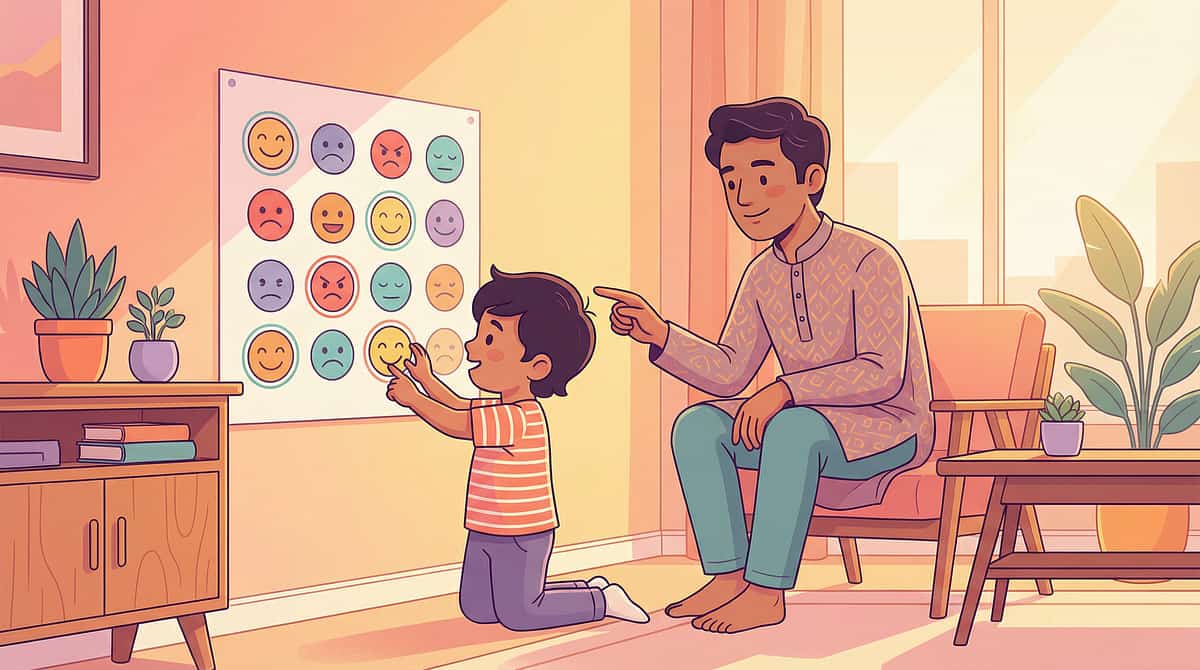
STEP 2
The Engagement
Duration: 1–3 minutes | Demand level: LOW (choice-based)
Introduce today's primary material using joint attention — look at it together, comment, wonder aloud. Offer choice, never directive. Place material in child's visual field at 45° angle. Comment enthusiastically but briefly. Pause after each comment — space is an invitation to engage.
For Feelings Faces Chart
"Look at all these faces — can you find the sad one? Oh there it is. And the angry one — his eyebrows are really down! I wonder if I ever make that face..." (Parent makes exaggerated "angry face" — invite laughter, lower defenses)
For Emotion Word Cards
"These cards have feeling words on them. Some I know — 'happy', 'frustrated'. But some are new — what's 'melancholy'? That's like a really quiet kind of sad. Interesting, right?"
For Feelings Journal
"I got a special book — it's just for feelings. I thought we could each write in it. I'll do mine first." (Parent writes/draws their own feeling — models vulnerability)
✅ Engagement Indicators
Child reaches toward material | Child asks a question | Child points or labels something unprompted | Child copies parent's verbal model ("I feel..." echoed) | Child makes eye contact about the material
Reinforcement Cue — Start Here: When ANY engagement indicator appears, immediately deliver specific, enthusiastic praise: "Oh! You found the worried face — that's exactly right. The worried face has the wrinkly forehead!"
Research: PMC11506176 | ABA pairing + reinforcement scheduling
Research: PMC11506176 | ABA pairing + reinforcement scheduling
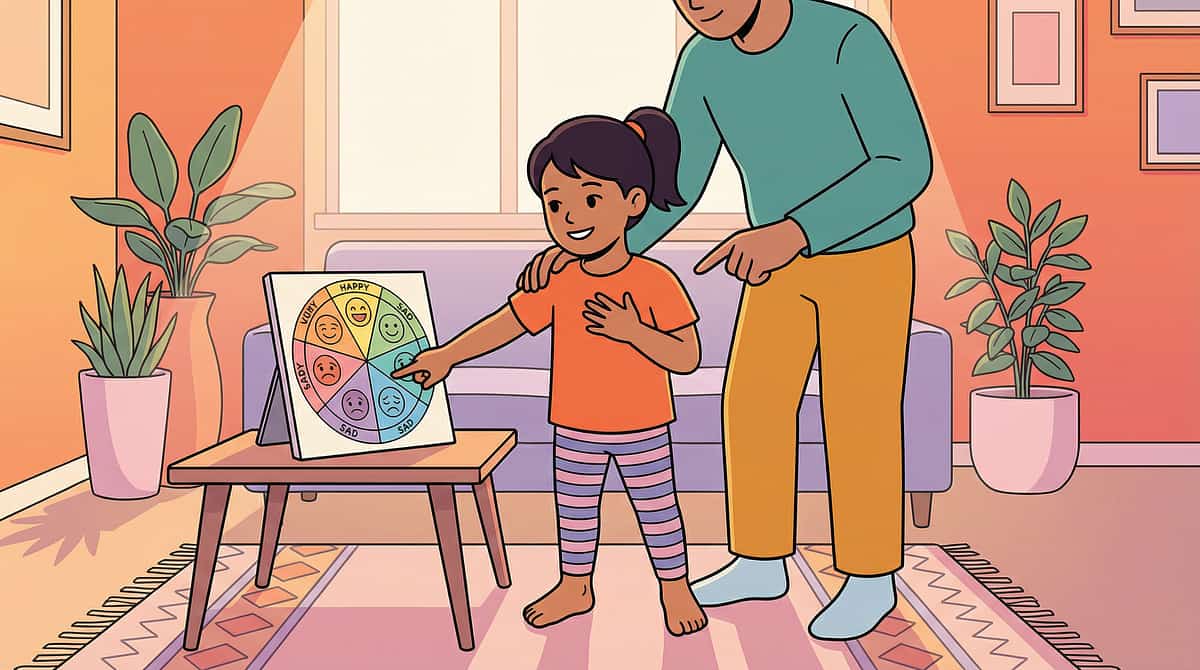
STEP 3
The Therapeutic Action
Duration: 5–10 minutes | This is the active ingredient.
Phase A — Recognition (2–3 min)
Using Feelings Faces Chart or Emotion Word Cards, go through 3–4 emotions together. Point to the face/word → Name it aloud → Make the face together → Connect to experience: "When did YOU feel this way this week?"
Phase B — Self-Identification (2–3 min)
"Look at all these feelings. Which one is closest to how you feel RIGHT NOW?" Accept: a point ✅, a word ✅, a thermometer number ✅, or no response ✅ ("That's okay — sometimes feelings are hard to find. Shall we check your body?")
Phase C — Body Check (1–2 min)
Using the Body Sensation Map: "Where do you feel the [emotion] in your body? Show me on the map." Validate whatever they show: "Your tummy? Yes! When people feel nervous, lots of people feel it in their tummy. Me too."
Common Execution Errors
- ⚠️Over-prompting: Use wait time — count silently to 10
- ⚠️Correcting responses: Never say "No, you're not angry, you're frustrated" — accept the child's label
- ⚠️Rushing Phase B: Most children need 20–30 seconds to identify an emotion — wait
- ⚠️Requiring words: Pointing, drawing, or nodding IS emotional vocabulary in early stages
Child Response Spectrum
- 🌟 Ideal: Child identifies emotion and connects to body sensation
- ✅ Acceptable: Child points to face or nods to parent's guess
- ⚠️ Concerning: Child becomes significantly more agitated during Phase B → move to cool-down immediately
Research: PMC11506176 | PMC10955541 | Lieberman et al. (2007)
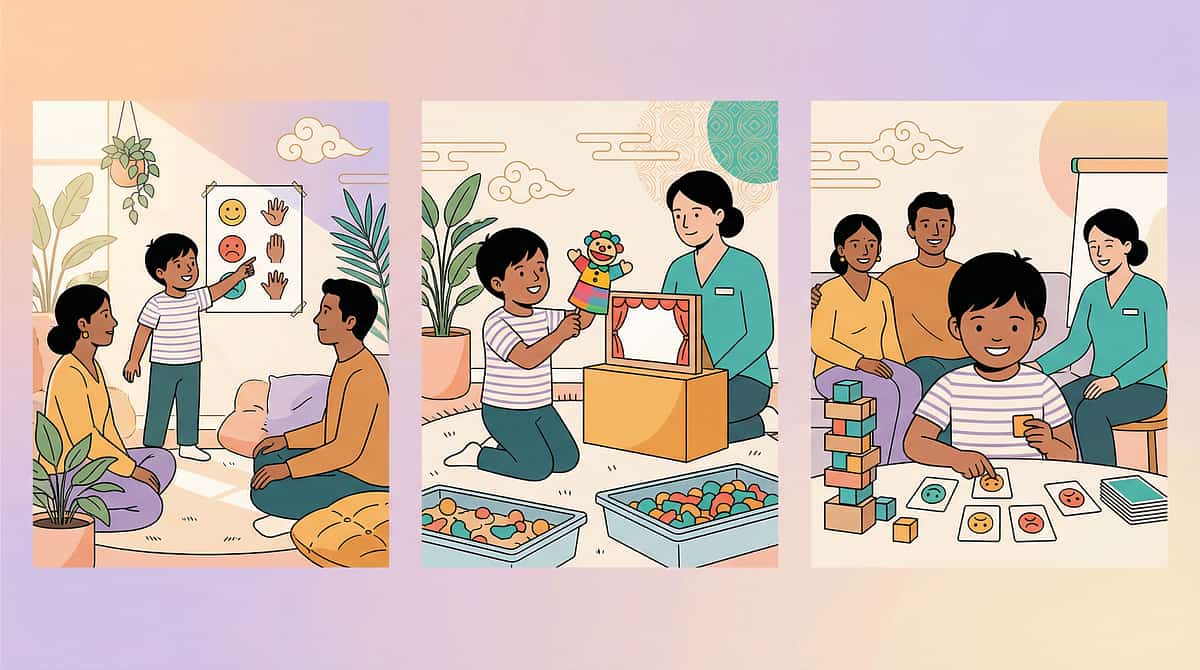
STEP 4
Repeat & Vary
Duration: 2–4 minutes | Dosage is everything.
3–5 cycles/session
One cycle = recognition → identification → body check
Daily practice
Not 3× per week — emotional vocabulary builds on daily repetition
8–12 weeks
For measurable vocabulary expansion
1–2 new words/week
Target after Week 2 of practice
"3 good repetitions > 10 forced repetitions." A child who names 3 feelings with genuine engagement has accomplished more than one who names 10 with zero intrinsic connection.
🔄 Switch Materials Mid-Session
If attention flags after Feelings Chart → switch to Puppet. "The puppet also wants to show a feeling — which face shall we put on it?"
🔄 Parent-First Modeling
Parent goes first, models vulnerability: "I'm going to check what I'm feeling... I think I'm feeling TIRED. A 2 on the thermometer. Now you."
🔄 Character-Based (Storybook)
Read 2 pages from emotion storybook. Pause at emotional moment: "How does she feel? Find it on the chart."
🔄 Game Format (Days 5+)
Emotion bingo, feelings charades, or matching game for days when structured protocol creates resistance.
Satiation Indicators — know when to stop: Child looks away from material | Responses become monotone or mechanical | Child repeats same emotion regardless of prompt | Physical restlessness increases significantly. At first satiation sign: complete one final cycle, then close warmly.

STEP 5
Reinforce & Celebrate
Timing: WITHIN 3 SECONDS of desired behavior. Always.
Emotional vocabulary is hard work. Every attempt — every point, every word, every body check — is the brain building new infrastructure. Reinforce the attempt, not just the perfect response.
For pointing to a feeling face
"Yes! You found WORRIED on the chart — you showed me how you feel. That's incredible. I understand you now."
For using a new emotion word
"FRUSTRATED! That's such a specific word. I know exactly what you mean now — frustrated when something doesn't work. Perfect."
For completing body check
"You said your tummy feels tight — that's your body telling you something. That is amazing self-awareness."
For any attempt (even "I don't know" after trying)
"You tried to find the word — I saw that. That trying IS the work. Well done."
Reinforcement Menu
- Verbal praise (specific, enthusiastic, immediate)
- Physical affirmation (high five, hug if welcome, thumbs up)
- Token/sticker on feelings chart (one per named emotion)
- 2-minute preferred activity access
- "Feelings Champion" badge sticker for the journal
⚡ The 3-Second Rule
The neural connection between the behavior (naming a feeling) and the reward (your celebration) must be immediate. Delayed reinforcement loses most of its power.
What NOT to Do
- ❌ "Good job" (non-specific)
- ❌ "You should do this all the time" (adds pressure)
- ❌ Bigger rewards for same behavior (creates inflation)
STEP 6
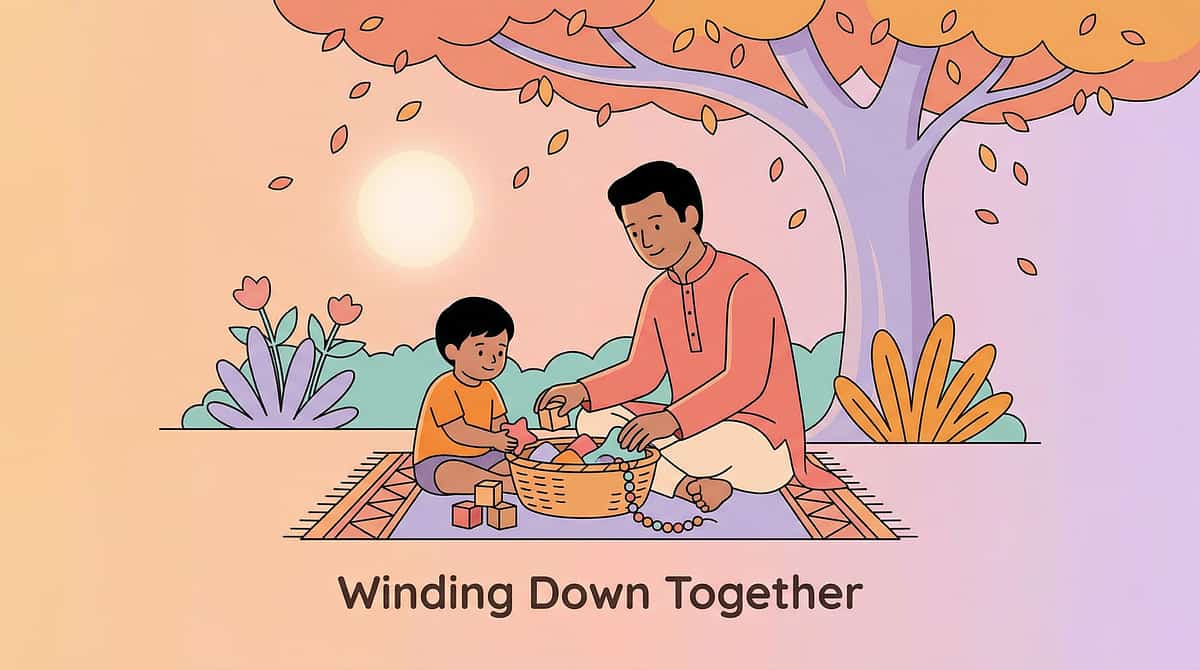
The Cool-Down
Duration: 1–2 minutes | No session ends abruptly.
2-Minute Warning
Use visual timer if helpful: "We're going to do one more feelings check, and then we're done for today."
Final Emotion Check (30 seconds)
"Before we finish — how are you feeling RIGHT NOW? Same as before, or changed?" This shows the child that emotions shift and naming them is not permanent labeling.
Material Put-Away Ritual (1 minute)
Child participates in putting materials away — builds ownership: "Can you put the feelings chart back on the wall? And the cards in their box?"
Transition Out
"Good work today. You named [X emotion] — I'm going to remember that. Let's go have [preferred activity]."
If Child Resists Ending
Don't force. Use: "One more card, and then we're done. Your choice — which one?" This gives autonomy while maintaining the close.
🕐Visual Timer: Smartivity DIY Interactive Clock | ₹673 | Amazon.in
Visual timers are evidence-based practice for autism per NCAEP 2020.
Visual timers are evidence-based practice for autism per NCAEP 2020.
Post-Session Parent Self-Care Note: Emotional vocabulary sessions require you to be emotionally present. After each session, take 60 seconds for yourself: "I showed up. I did this for my child." That matters.

STEP 7 — DATA
60 Seconds of Data Now Saves Hours of Guessing Later
Complete within 60 seconds of session end
Data Point 1 — Emotion Words Used
How many distinct emotion words/points/identifications did the child produce?
☐ 0 ☐ 1 ☐ 2 ☐ 3 ☐ 4+
☐ 0 ☐ 1 ☐ 2 ☐ 3 ☐ 4+
Data Point 2 — Independence Level
How much prompting was needed?
☐ Full prompt (parent guessed, child confirmed)
☐ Partial prompt (parent gave choices)
☐ Minimal prompt (parent asked open-ended)
☐ Independent (child identified without prompt)
☐ Full prompt (parent guessed, child confirmed)
☐ Partial prompt (parent gave choices)
☐ Minimal prompt (parent asked open-ended)
☐ Independent (child identified without prompt)
Data Point 3 — Session Quality
☐ Excellent — engaged, responsive, 3+ cycles
☐ Good — some resistance, 2 cycles
☐ Partial — brief session, 1 cycle only
☐ Abandoned — safety/readiness issue
☐ Good — some resistance, 2 cycles
☐ Partial — brief session, 1 cycle only
☐ Abandoned — safety/readiness issue
🔗Session Tracker:pinnacleblooms.org/track/B-192
📥Download: B-192 4-Week Tracking Sheet (PDF):unknown link
📥Download: B-192 4-Week Tracking Sheet (PDF):unknown link
What to do with the data: Week 2: Is independence level improving? (should trend upward) | Week 4: How many distinct emotion words vs. Week 1? | Week 8: Is emotional vocabulary appearing outside sessions? | Flat data after 4 weeks: Contact Pinnacle helpline for protocol review.
📞9100 181 181 — Bring your tracking data to any Pinnacle consultation. Your data is your child's clinical story.
📞9100 181 181 — Bring your tracking data to any Pinnacle consultation. Your data is your child's clinical story.

TROUBLESHOOTING
Reality Check: Most Sessions Don't Go Perfectly. That's Normal.
Problem 1: "My child points to random faces without meaning"
Why: Child is performing for attention/reinforcement without genuine identification — common in early stages.
Fix: Slow down. Use only 3 emotion faces total (happy, sad, mad to start). Connect each to a real recent event before asking for identification.
Fix: Slow down. Use only 3 emotion faces total (happy, sad, mad to start). Connect each to a real recent event before asking for identification.
Problem 2: "My child always says 'happy' no matter what"
Why: 'Happy' is a safe, learned response — avoids perceived wrong answers.
Fix: Remove the pressure to be correct. "There's no wrong answer here. Even 'I don't know' is allowed." Introduce body check as alternative pathway.
Fix: Remove the pressure to be correct. "There's no wrong answer here. Even 'I don't know' is allowed." Introduce body check as alternative pathway.
Problem 3: "My child becomes more agitated during the feelings chart"
Why: Emotional awareness can INCREASE distress before it reduces it — normal in early weeks.
Fix: Switch to games format (Emotion Bingo) — lower demand while maintaining vocabulary practice. Reduce session to 5 minutes.
Fix: Switch to games format (Emotion Bingo) — lower demand while maintaining vocabulary practice. Reduce session to 5 minutes.
Problem 4: "Child can identify emotions in characters but not in themselves"
Why: Third-person emotional perspective is neurologically easier than first-person. This IS progress!
Fix: Keep using books and puppets. "The character feels sad — do YOU ever feel like that?" (no pressure for yes). Transfer will come.
Fix: Keep using books and puppets. "The character feels sad — do YOU ever feel like that?" (no pressure for yes). Transfer will come.
Problem 5: "My child says words but doesn't seem to understand them"
Why: Rote labeling precedes genuine understanding — this is normal vocabulary acquisition.
Fix: Build experiential connections. Use the word in daily life moments: "Oh, I notice you look FRUSTRATED right now — your hands are clenching." Over time, the word gets filled with meaning.
Fix: Build experiential connections. Use the word in daily life moments: "Oh, I notice you look FRUSTRATED right now — your hands are clenching." Over time, the word gets filled with meaning.
Problem 6: "We haven't done it in 5 days — I feel like a failure"
The most common challenge. Life interrupts.
Fix: Today, do one 2-minute emotion check-in. That's your restart. Perfection is the enemy of consistency. A week with 4 sessions beats a week of zero after missing 3 days.
Fix: Today, do one 2-minute emotion check-in. That's your restart. Perfection is the enemy of consistency. A week with 4 sessions beats a week of zero after missing 3 days.
Problem 7: "My child became severely distressed during the session"
Fix: Stop immediately. Return to safe sensory baseline (known calming strategy). Document what triggered the response. Contact Pinnacle helpline before next session.
📞9100 181 181 — We will help you adapt the approach.
📞9100 181 181 — We will help you adapt the approach.
ADAPT & PERSONALIZE
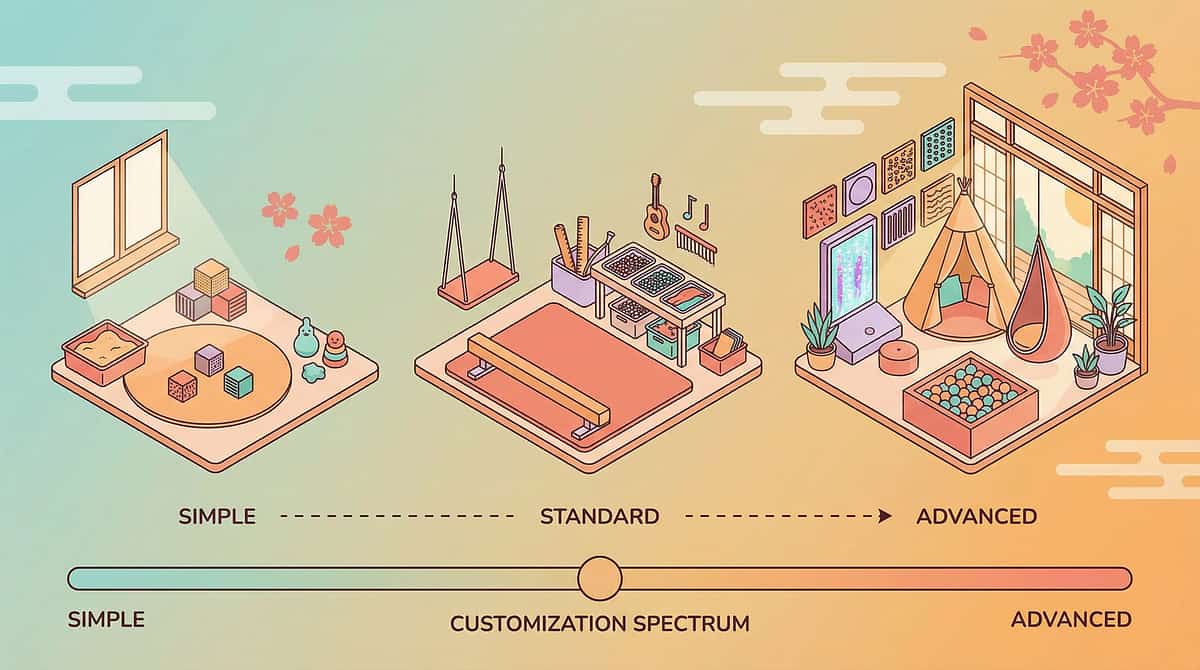
No Two Children Are Identical
Adjust Until It Fits YOUR Child Perfectly
Child Profile | Material Emphasis | Session Length | Demand Level | Pathway | |
Minimal verbal language | Body maps + puppets + pointing only | 5–8 min | Zero verbal demand | Body-first | |
Strong visual learner | Feelings charts + cause-effect cards | 12–15 min | Visual ID first, verbal optional | Visual-first | |
High anxiety | Games only (bingo, charades) | 5–10 min | Zero performance pressure | Play-first | |
Sensory seeker | Body sensation maps (tactile) | 10–15 min | Physical-first pathway | Tactile-first | |
Strong echolalic speaker | Word cards + scripts | 10–12 min | Scripted responses accepted | Language-first | |
Neurotypical sibling involved | Group games format | 15 min | Natural social motivation | Social-first |
Ages 3–5
Only 4 emotion faces (happy, sad, mad, scared). No journals — sticker-based check-in only. Maximum 5-minute sessions.
Ages 6–8
Standard protocol. Introduce cause-effect cards. Begin feelings journal with drawing option.
Ages 9–10
Full vocabulary ladder. Introduce nuanced emotion families. Peer role-play scenarios. Self-monitoring using app or journal.
🧪Want a personalized adaptation plan? Our SLP-ABA-Psychology team reviews your child's profile and creates a customized B-192 protocol.
📞9100 181 181 | Get your AbilityScore® Assessment → pinnacleblooms.org/assessment
📞9100 181 181 | Get your AbilityScore® Assessment → pinnacleblooms.org/assessment

ACT IV — THE PROGRESS ARC | WEEKS 1–2
Weeks 1–2: The Foundation Phase
What You WILL Likely See ✅
- Child tolerates the session without active refusal
- Child looks at the Feelings Faces Chart when prompted
- Child begins to use 1–2 emotion words (even "happy" and "sad" used more deliberately)
- Reduced resistance to session compared to Day 1
What You WON'T See Yet ❌ (and that's normal)
- Spontaneous emotion labeling in daily life
- Complex vocabulary (frustrated, disappointed, anxious)
- Self-initiated emotional sharing
- Dramatic behavioral improvement (the words are just being formed)
"If your child tolerates the materials and engages for even 30 seconds longer than Day 1 — that's real progress. Neural pathways are forming under the surface."
Week 1–2 requires the most patience. The child is building comfort with an entirely new kind of conversation. You are essentially teaching a new language — and beginners make slow, invisible progress before sudden leaps. Track: Number of emotion identifications per session (even points count). If this number increases over 10 sessions, the technique is working. Research: PMC11506176

WEEKS 3–4 — CONSOLIDATION
Weeks 3–4: The Consolidation Phase
These are the "neural pathway forming" signals most parents miss because they look subtle:
🔹 Anticipation
Child moves toward the materials space without being invited
🔹 Preference
Child has a "favorite" material (always wants the puppet, always goes to the chart first) — this IS engagement
🔹 Reduced Resistance
Previous refusal behaviors are decreasing in intensity or duration
🔹 Vocabulary Bridge
The same word the child used in session appears in a non-session context ("Amma, I'm frustrated")
🔹 Body Awareness
Child spontaneously touches their stomach or chest before saying "I feel..."
🔹 Question Asking
Child asks "What does [emotion word] mean?" — vocabulary curiosity is emerging
In Weeks 3–4, you may not see dramatic behavioral change — but inside your child's brain, the synaptic connections between internal emotional states and their linguistic labels are actively strengthening. What you're witnessing in their small behavioral shifts is literally neural architecture being constructed.
Parent milestone: Parents who teach emotional vocabulary to their children consistently report expanded personal emotional intelligence. This technique works on multiple people simultaneously.
Parent milestone: Parents who teach emotional vocabulary to their children consistently report expanded personal emotional intelligence. This technique works on multiple people simultaneously.

WEEKS 5–8 — MASTERY
Weeks 5–8: The Mastery Phase
Mastery Level 1 — Recognition (Week 5–6)
☐ Child correctly identifies 8+ emotions from visual cues with 80%+ accuracy
☐ Child uses body sensation map to locate at least 3 emotions in their body
☐ Child uses body sensation map to locate at least 3 emotions in their body
Mastery Level 2 — Labeling (Week 6–7)
☐ Child spontaneously uses 5+ distinct emotion words in daily life without prompting
☐ Child uses "I feel [word]" constructions at least 3× per week outside sessions
☐ Child can differentiate between emotion families ("that's annoyed, not angry")
☐ Child uses "I feel [word]" constructions at least 3× per week outside sessions
☐ Child can differentiate between emotion families ("that's annoyed, not angry")
Mastery Level 3 — Expression (Week 7–8)
☐ Child communicates emotional state to get needs met ("I feel worried — I need a hug")
☐ Child uses intensity language ("I'm really frustrated right now")
☐ Child connects emotions to causes ("I feel sad BECAUSE...")
☐ Child uses intensity language ("I'm really frustrated right now")
☐ Child connects emotions to causes ("I feel sad BECAUSE...")
Generalization Checklist — When Mastery Is Real
- ✅ Emotion vocabulary appearing with OTHER caregivers (grandparents, teachers)
- ✅ Emotion vocabulary appearing in NEW contexts (school, playground, not just home)
- ✅ Child uses emotion words during actual distress (not just during calm sessions)
🏆Mastery Unlocked when: 5+ spontaneous emotion words used in daily life, 2+ sessions per week sustained for 8 weeks, and emotion vocabulary emerging in at least one new generalized context.
Progression Decision: After mastery, move to B-193 (Following Directions) or B-194 (Emotional Dysregulation — using vocabulary FOR regulation).
Research: PMC10955541 | BACB mastery criteria
Progression Decision: After mastery, move to B-193 (Following Directions) or B-194 (Emotional Dysregulation — using vocabulary FOR regulation).
Research: PMC10955541 | BACB mastery criteria

🏆 You Did This.
Your Child Has a Language for Their Inner World. That changes everything.
Before B-192
Your child had 3 emotion words and expressed feelings entirely through behavior.
After B-192
Your child has 8–15 distinct emotion words, can locate feelings in their body, can name what happened to cause a feeling, and has begun to use emotional language to get their needs met.
That is not a small achievement. That is the neural architecture of emotional intelligence, built by YOU, at home, in 15 minutes a day.
🎉 Celebrate This Milestone
Create your child's "Feelings Champion" page in their journal — list all the emotion words they've learned. Date it. Sign it together.
📸 Photo Prompt
Take a photo of your child pointing to the feelings chart today. In 3 months, take another one. The journey from that first photo to the second is visible in their face.
💬 Share Your Story
Your child's journey is someone else's hope.
WhatsApp: pinnacleblooms.org/community
Instagram: @pinnacleblooms
WhatsApp: pinnacleblooms.org/community
Instagram: @pinnacleblooms
You arrived at Card 01 because your child said "I don't know." You arrive here because they have found the words. That journey from silence to language — you made that happen.
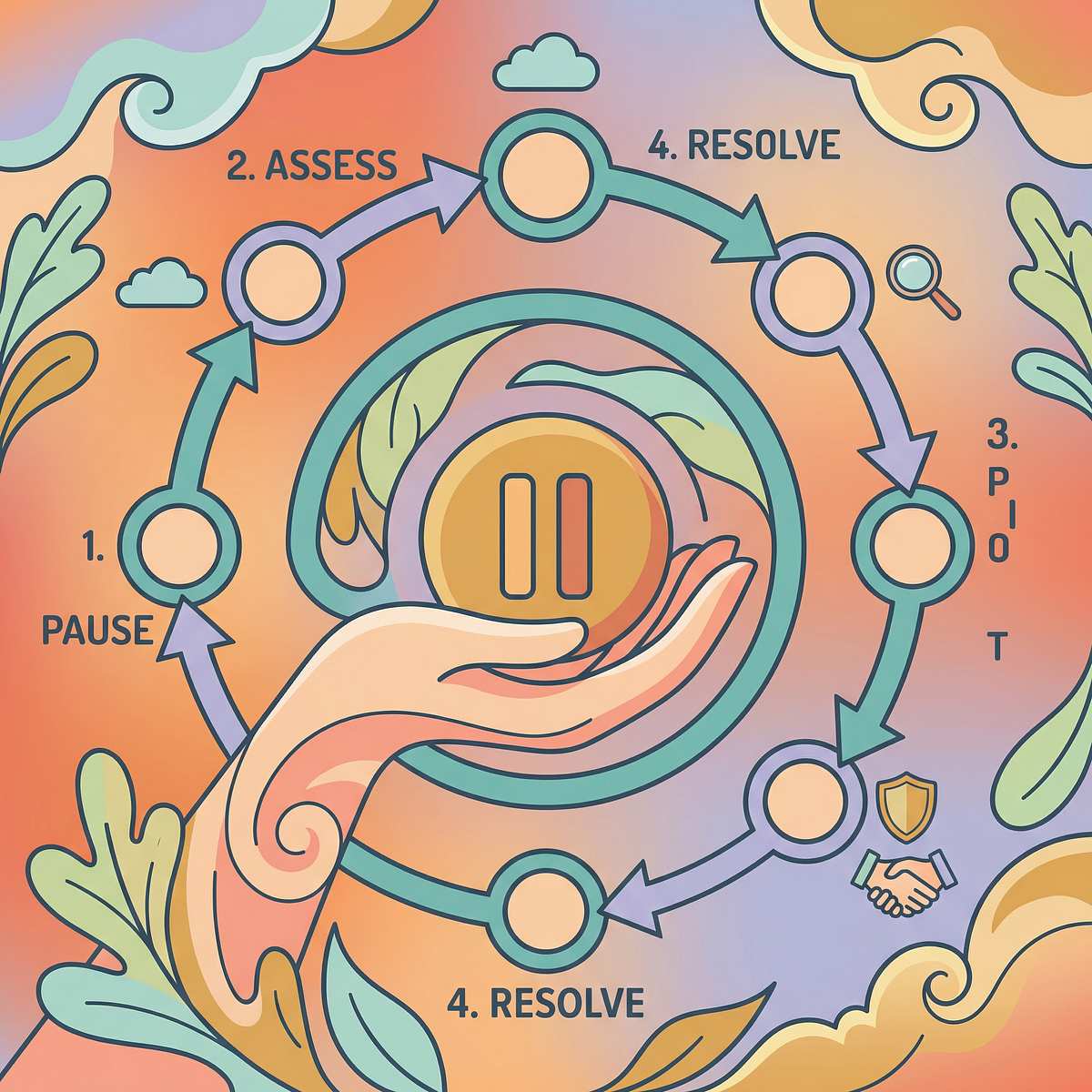
CLINICAL GUARDRAILS — READ EVEN AFTER SUCCESS
🔴 Red Flags: When to Pause
🚩 Red Flag 1: Complete Inability
Child shows absolutely zero improvement in emotion identification after 4+ weeks of consistent daily practice.
→ Action: Contact Pinnacle for formal alexithymia screening. This may need a different clinical pathway.
→ Action: Contact Pinnacle for formal alexithymia screening. This may need a different clinical pathway.
🚩 Red Flag 2: Self-Harm as Expression
Child has begun self-injurious behavior during or after sessions, or uses self-harm to express emotions that have been surfaced.
→ Action: STOP sessions immediately. Call 9100 181 181. Clinical assessment required before resuming.
→ Action: STOP sessions immediately. Call 9100 181 181. Clinical assessment required before resuming.
🚩 Red Flag 3: Severe Regression
Previously acquired emotional vocabulary has significantly decreased. Child who used 8 emotion words now uses 2.
→ Action: Assess for trauma, illness, major environmental change. Clinical consultation within the week.
→ Action: Assess for trauma, illness, major environmental change. Clinical consultation within the week.
🚩 Red Flag 4: Emotional Flooding
Emotional vocabulary practice consistently triggers severe dysregulation lasting 30+ minutes.
→ Action: Sessions too intense. Switch to games-only format. Consult OT for nervous system regulation work first.
→ Action: Sessions too intense. Switch to games-only format. Consult OT for nervous system regulation work first.
🚩 Red Flag 5: Dissociative Response
Child "goes blank" or appears to dissociate when asked about feelings — not zoning out, but a qualitatively different absence.
→ Action: Trauma-informed assessment required. Do not continue sessions until cleared.
→ Action: Trauma-informed assessment required. Do not continue sessions until cleared.
🚩 Red Flag 6: Selective Mutism Worsening
Child who previously spoke now becomes more selectively mute during emotional content.
→ Action: SLP + Psychology dual assessment required. Emotional vocabulary work may be triggering rather than building.
→ Action: SLP + Psychology dual assessment required. Emotional vocabulary work may be triggering rather than building.
📞Pinnacle Clinical Helpline: 9100 181 181 — Available 24×7 for safety concerns
Research: WHO NCF Progress Report 2018–2023 | Pinnacle clinical protocols
Research: WHO NCF Progress Report 2018–2023 | Pinnacle clinical protocols

ACT VI — THE CLOSE | FAQ
8 Questions Every Parent Asks
About Teaching Children to Describe Their Feelings
Q1: My child can name emotions in others but not in themselves. Is this technique wrong for them?
This is a developmental stage, not a technique mismatch — and it's excellent news. Third-person emotional perspective is the natural on-ramp to first-person labeling. The storybook and puppet approaches in B-192 are designed exactly for this profile. Keep using bibliotherapy and projective play — transfer to self-identification typically follows within 2–6 weeks. [→ See Step 3, Phase B]
Q2: How do I know if my child has alexithymia?
Alexithymia is a trait, not a diagnosis, characterized by difficulty identifying and describing internal emotional states. Signs include consistently answering "I don't know" or "I'm fine" across all emotional contexts, disconnected emotional expression (laughing when in pain), and inability to locate emotions in the body. Present in approximately 50% of autistic individuals. Formal assessment includes validated tools (TAS-20 adapted versions). Contact 9100 181 181 for referral. [→ See Card 03]
Q3: My child uses emotion words in the wrong situations. Are they faking understanding?
Not faking — learning. Rote labeling (using words without genuine internal connection) typically precedes genuine understanding in vocabulary acquisition, especially in children with autism. This is progress, not deception. Continue enriching the words with experiential connections. Gradually, the words fill with meaning. [→ See Troubleshooting, Problem 5]
Q4: Is 15 minutes daily really enough? Should we do longer sessions?
For ages 3–8, 10–15 minutes of quality, engaged practice outperforms 45-minute sessions with reduced engagement. The emotional vocabulary brain circuit is being built through repetition, not duration. Daily brief sessions beat weekly long sessions by a significant margin. After Week 4, you can introduce a second mini-session (5-minute evening check-in). [→ See Step 4]
Q5: We've been doing this for 4 weeks and I see no change. Should I stop?
Before stopping: (1) Confirm daily consistency — was it truly daily? (2) Review session quality — was the child engaged or just present? (3) Check data — has independence level changed even if vocabulary hasn't? (4) Consider profile match — is a different pathway needed? If genuine 4-week plateau with daily quality practice: contact 9100 181 181 for protocol review. Don't stop — adapt. [→ See Troubleshooting, Adapt & Personalize]
Q6: My child says "I don't know" even when I can clearly see they feel something. Is this avoidance?
"I don't know" is often genuine — not avoidance. The feeling exists; the neural pathway to the word does not. However, in some children, especially after trauma or with high anxiety, "I don't know" can also be protective avoidance. If the child consistently says "I don't know" while appearing distressed AND resists all materials, a psychology consultation is recommended. For most children: it simply means the vocabulary isn't there yet. Keep building it. [→ See Cards 03, 11]
Q7: Should I use the same technique at school?
Yes, strongly recommended. Consistency across environments is a core principle of emotional vocabulary generalization. Share the downloadable Family Guide with the classroom teacher. The Feelings Faces Chart is appropriate for classroom walls. The school need not run formal sessions — passive exposure to the materials and using emotion words when talking to the child is sufficient to support generalization. [→ See Share Card]
Q8: My child is now 11 years old — is this too late to start?
It is never too late to build emotional vocabulary. The approach adapts for older children: more nuanced emotion families, journal-based reflection, social scenario role-play, and peer context use. Research confirms emotional vocabulary development continues into adulthood. For ages 10+, a psychologist-led bibliotherapy + journaling protocol is most effective. Contact 9100 181 181 for an age-appropriate protocol design. [→ See Adapt & Personalize]

Today Is the Day.
Your Child's Emotional Vocabulary Journey Starts With One Feelings Chart on One Wall.
20M+
Sessions
Real-world therapy sessions validated
97%+
Improvement
Measured outcomes across protocol completers
70+
Centers
Across India | 70+ countries served
70K+
Techniques
Evidence-linked techniques in the ecosystem
🌸Validated by the Pinnacle Blooms Consortium
🗣️ SLP | 🧠 Psychology | 📋 ABA/BCBA | 📚 SpEd | 🦾 OT | 👶 NeuroDev | 🏥 CRO
The optimal window for emotional vocabulary development is ages 3–8. Your child is in this window now. Every week of consistent practice adds measurable vocabulary. The first session is the hardest. After that, it becomes the best part of your day.
🗣️ SLP | 🧠 Psychology | 📋 ABA/BCBA | 📚 SpEd | 🦾 OT | 👶 NeuroDev | 🏥 CRO
The optimal window for emotional vocabulary development is ages 3–8. Your child is in this window now. Every week of consistent practice adds measurable vocabulary. The first session is the hardest. After that, it becomes the best part of your day.
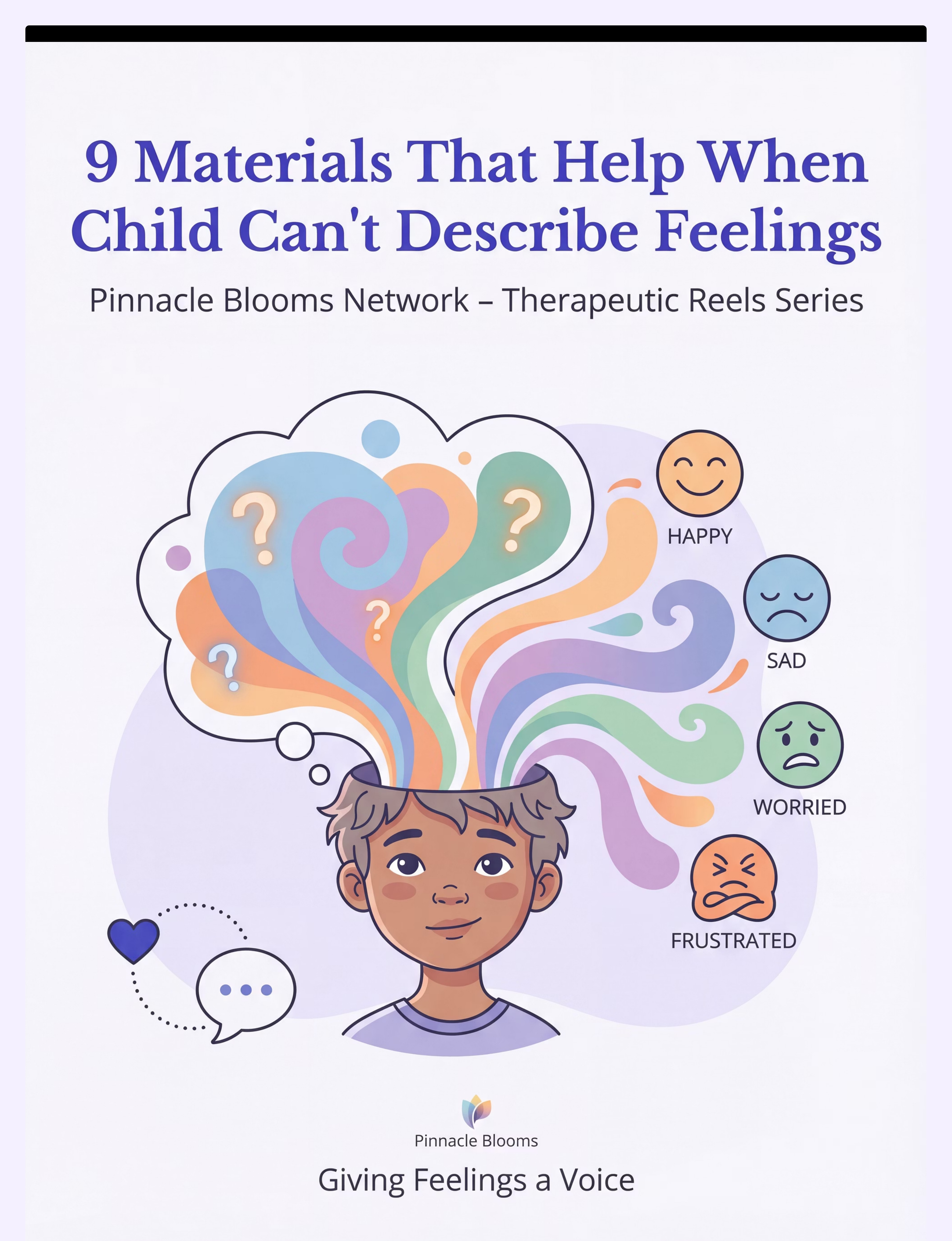
Preview of 9 materials that help when child cant describe feelings Therapy Material
Below is a visual preview of 9 materials that help when child cant describe feelings therapy material. The pages shown help educators, therapists, and caregivers understand the structure and content of the resource before use. Materials should be used under appropriate professional guidance.



Link copied!

From Fear to Mastery. One Technique at a Time.
— The Pinnacle Blooms Consortium
🌸 Pinnacle Blooms Network®
India's Largest Pediatric Therapy Consortium
Integrating: Clinical Research (CRO) • Speech-Language Pathology • Occupational Therapy • Applied Behavior Analysis (ABA/BCBA) • Special Education • Neuro-Developmental Pediatrics • Child Psychology • WHO/UNICEF-aligned Evidence Standards
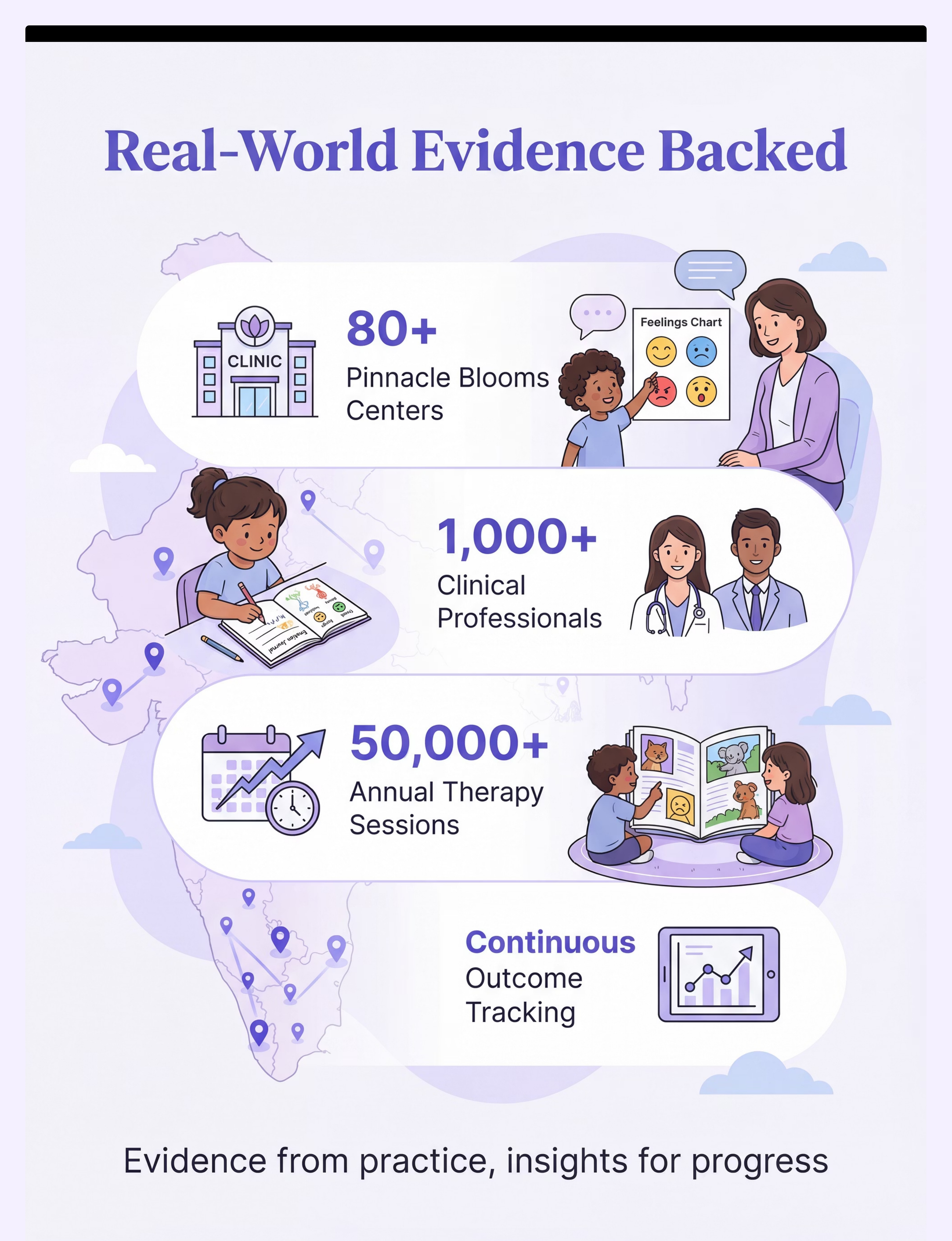
70+ Centers Across India | 21M+ Therapy Services | 97%+ Measured Improvement | 70+ Countries Served
📞9100 181 181 — Free | 24×7 | 18+ Languages
🌐techniques.pinnacleblooms.org
📧care@pinnacleblooms.org
📱pinnacleblooms.org/app
🌐techniques.pinnacleblooms.org
📧care@pinnacleblooms.org
📱pinnacleblooms.org/app
Loop Navigation
Legal / Statutory Identifiers
CIN: U74999TG2016PTC113063 | DPIIT Recognition: DIPP8651 (Govt. of India) | MSME Registered | GSTIN: 36AAGCB9722P1Z2 | ISO 13485 (Medical Device QMS) | ISO/IEC 27001 (Information Security)
This content is educational and informational. It does not constitute medical advice, diagnosis, or replace assessment by a licensed psychologist, speech-language pathologist, occupational therapist, or physician. If you are concerned about your child's emotional development, please consult a qualified professional. Individual results vary based on child profile, consistency of practice, clinical context, and other factors.
© 2025–2026 Pinnacle Blooms Network®, a unit of Bharath Healthcare Laboratories Pvt. Ltd. All rights reserved. Technique B-192. GPT-OS® is a registered trademark. This content is human-consortium drafted, AI-indexed, and SEO-prioritized under the EverydayTherapyProgramme™ framework.