

He can answer any question. He just can't ask one.
Your six-year-old answers every question you ask — but he has never asked you "Why?" His curiosity is there. You can see it in his eyes. The words for asking just don't come out right. You are not failing. Your child's language system is navigating one of the most complex structures in any language — and it can be taught.
B-203
Speech-Language · Syntax · Pragmatics
Ages 3–10

You Are Among Millions
Question formation difficulties are not rare — they are one of the most common and most impactful language challenges in pediatric populations. The comprehension-production gap you observe in your child is a recognized clinical pattern documented across thousands of research studies.
40–60%
Children with ASD
demonstrate specific difficulties with interrogative syntax and question formation, even when receptive language appears intact.
1 in 36
ASD Prevalence
children are diagnosed with ASD globally (CDC, 2024), and question formation difficulties affect the majority of this population.
7.5%
Developmental Language Disorder
of all children experience DLD, with question syntax being among the most commonly impaired structures.
Approximately 15–20 million families worldwide are navigating this exact challenge — a child who understands questions perfectly but cannot generate them. You are not alone. Science understands this. And science has answers.
Source: CDC Autism Prevalence Data (2024) | ASHA Clinical Practice Guidelines | Systematic Reviews on Interrogative Syntax in ASD (PMC11506176)
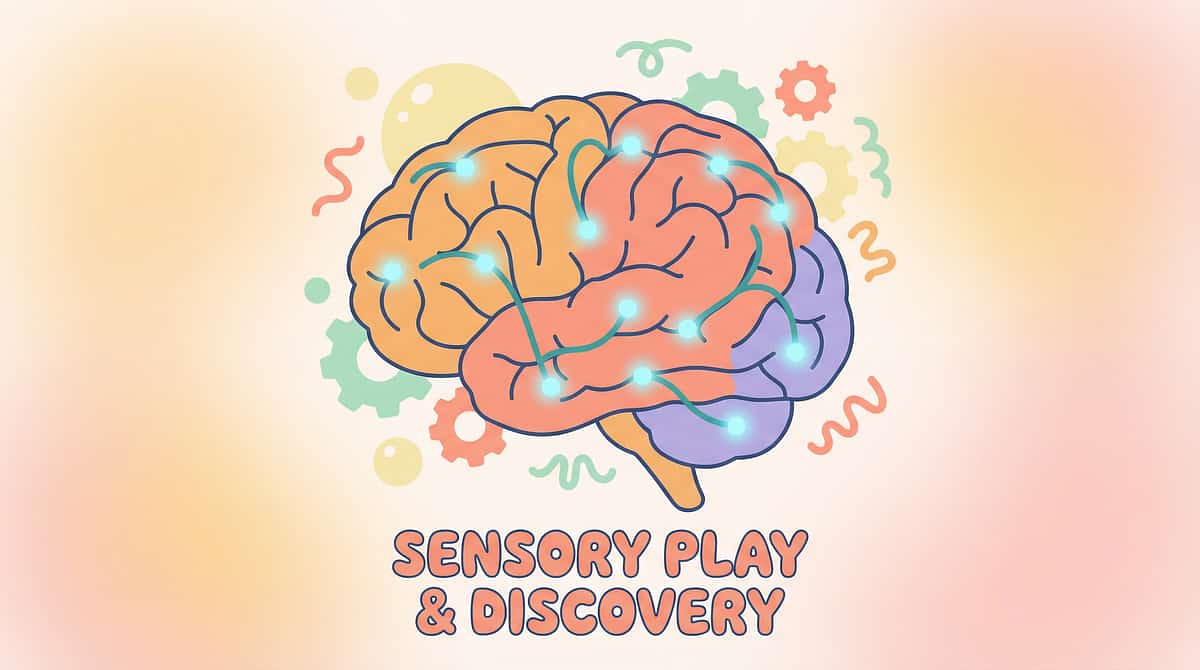
The Neuroscience of Asking
Question formation is one of the most syntactically complex operations the human brain performs. Understanding why your child can answer questions but not ask them starts here.
What Happens in the Brain
Wh-Word Selection (Prefrontal Cortex)
The brain selects the correct question word from six options based on the type of information needed.
Wh-Movement (Broca's Area)
The question word moves to the front of the sentence. "The ball is where" must transform into "WHERE is the ball."
Auxiliary Inversion (Broca's Area + Working Memory)
Subject and auxiliary verb swap positions — a demanding executive function task requiring multiple elements in working memory simultaneously.
Integration & Prosody (Multiple Regions)
Rising intonation, appropriate verb forms, and pragmatic understanding must all coordinate at the same time.
This Is a Wiring Difference, Not a Behavior Choice
Your child's brain processes incoming questions through Wernicke's area (comprehension) using a different pathway than the one required to generate questions through Broca's area (production). This is why answering and asking are fundamentally different skills.
When any of these operations is disrupted — and in children with ASD, DLD, or developmental delay, multiple operations are often affected simultaneously — questions emerge jumbled, incomplete, or not at all.
Comprehension ≠ Production. Answering a question and asking one activate entirely different neural circuits.
Reference: Frontiers in Integrative Neuroscience (2020) — DOI: 10.3389/fnint.2020.556660
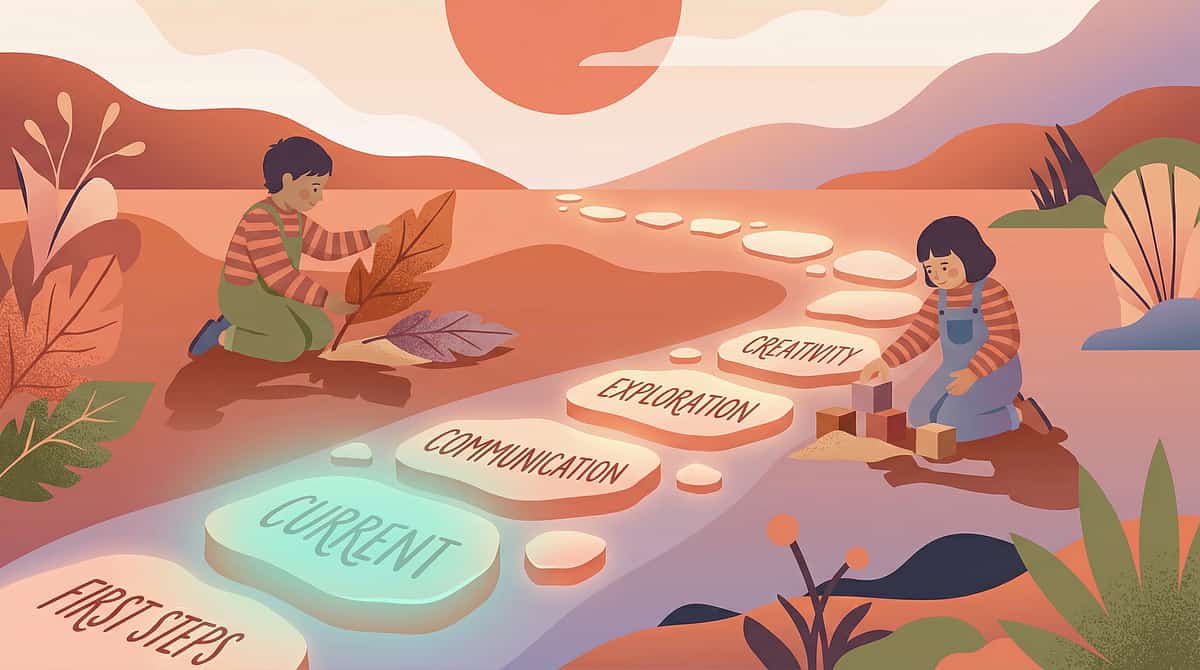
The Question Development Timeline
Your child is at a specific point on a well-mapped developmental trajectory. This is not a dead end — it is a waypoint. Here is the full picture of where questions come from, and where you're heading.
1
18–24 months
Rising intonation on single words to indicate questions ("Mama?" "Doggy?")
2
24–30 months
Early "what" and "where" questions with simplified structure ("What that?" "Where daddy?")
3
30–36 months
"Who" questions emerging; yes/no questions with auxiliary inversion beginning ("Can I?" "Is it?")
4
36–42 months ⚠️
"Why" questions emerging; more consistent auxiliary use. Common Challenge Zone.
5
42–60 months 🎯
"When" and "how" questions developing; most wh-question types present. Target Zone.
6
60+ months 🏆
Question forms mostly adult-like; complex embedded questions and tag questions emerging. Long-Term Goal.
Common Co-occurring Patterns: Question formation difficulties frequently co-occur with pronoun confusion (B-204), sentence length limitations (B-202), narrative language challenges (B-205), and pragmatic communication differences. The Pinnacle FusionModule™ addresses all co-occurring patterns simultaneously.
Reference: WHO Care for Child Development (CCD) Package (2023) | UNICEF MICS developmental indicators | PMC9978394

Evidence Grade: Level I–II (Strong)
This technique is not experimental. Explicit teaching of interrogative syntax using visual supports, structured practice frameworks, and functional communication contexts produces significant improvement in question formation across children with ASD, DLD, and developmental delay. Effect sizes range from moderate to large (d = 0.6–1.2) across systematic reviews.
50+ Peer-Reviewed Studies
Supporting question formation intervention in pediatric populations, including ASHA Evidence-Based Practice Guidelines and NCAEP (2020) classifications.
20M+ Clinical Sessions
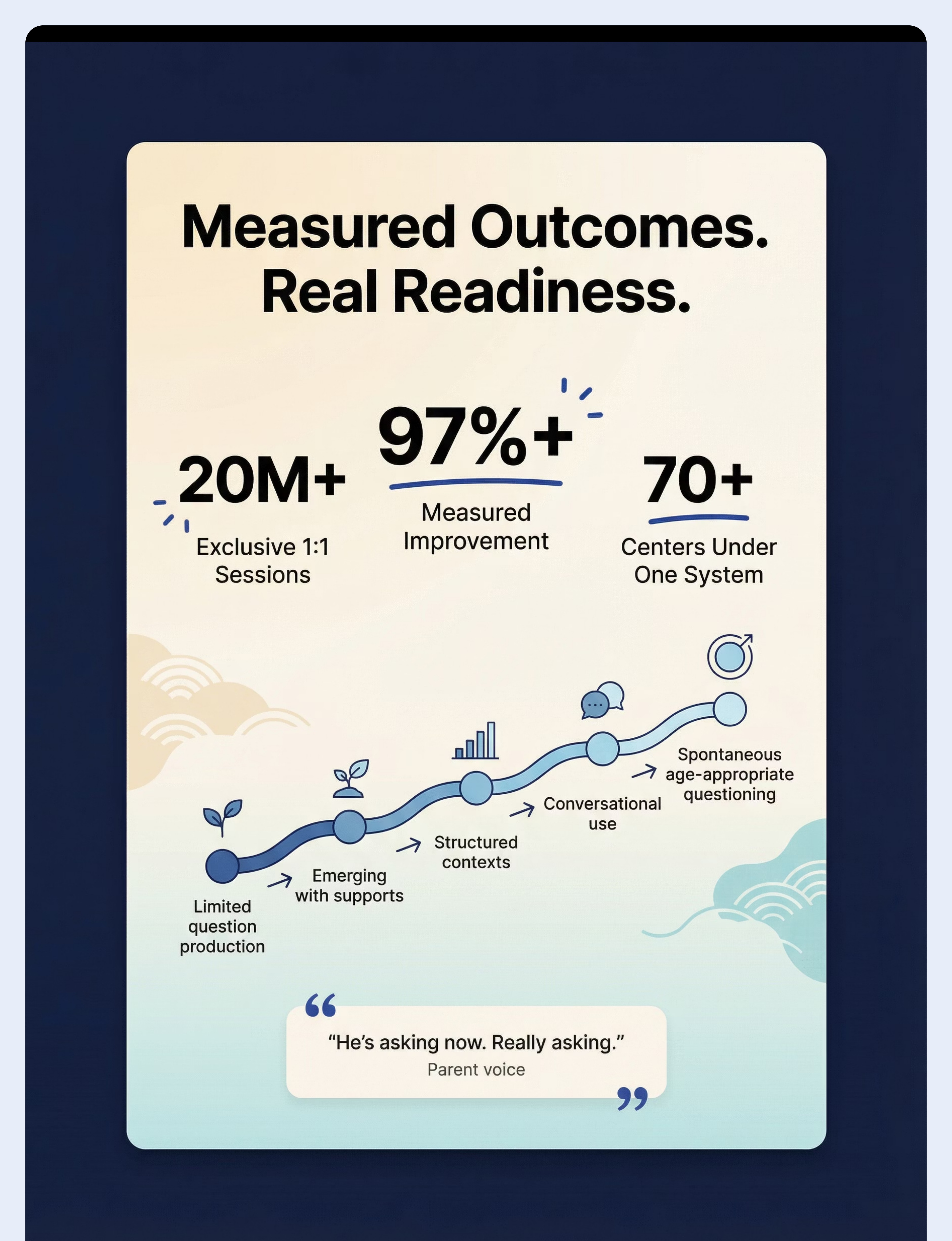
Pinnacle Blooms Network® clinical data shows 97%+ measured improvement across language domains, validated across 70+ centers.
Indian Research Context
Indian Journal of Pediatrics (2019): Home-based structured language interventions demonstrated significant outcomes in Indian pediatric populations. AIIMS and NIMHANS research collaborations validate culturally adapted protocols.
Clinically validated. Home-applicable. Parent-proven.
References: PMC11506176 | PMC10955541 | NCAEP Evidence-Based Practices Report (2020) | ASHA Practice Portal: Spoken Language Disorders
Teaching Question Forms (Interrogative Syntax Intervention)
Parent-Friendly Name: "Learning to Ask"
Definition: Teaching question forms is a structured language intervention that explicitly teaches children how to construct grammatically correct questions. It addresses the specific syntactic operations required — wh-word selection, wh-movement to sentence-initial position, subject-auxiliary inversion, and appropriate verb form adjustment — using visual supports, manipulable materials, game-based practice, and functional communication contexts.
The technique progresses from awareness of question structure through supported production to spontaneous, flexible questioning in everyday life.
🏷️ Domain
B — Communication & Language
Expressive Language · Syntax · Pragmatics
Expressive Language · Syntax · Pragmatics
📅 Age Range
3–10 years
⏱️ Session Duration
10–20 minutes (home sessions); formal sessions 3–5x/week; daily practice recommended
📈 Difficulty Levels
Intro → Core → Advanced
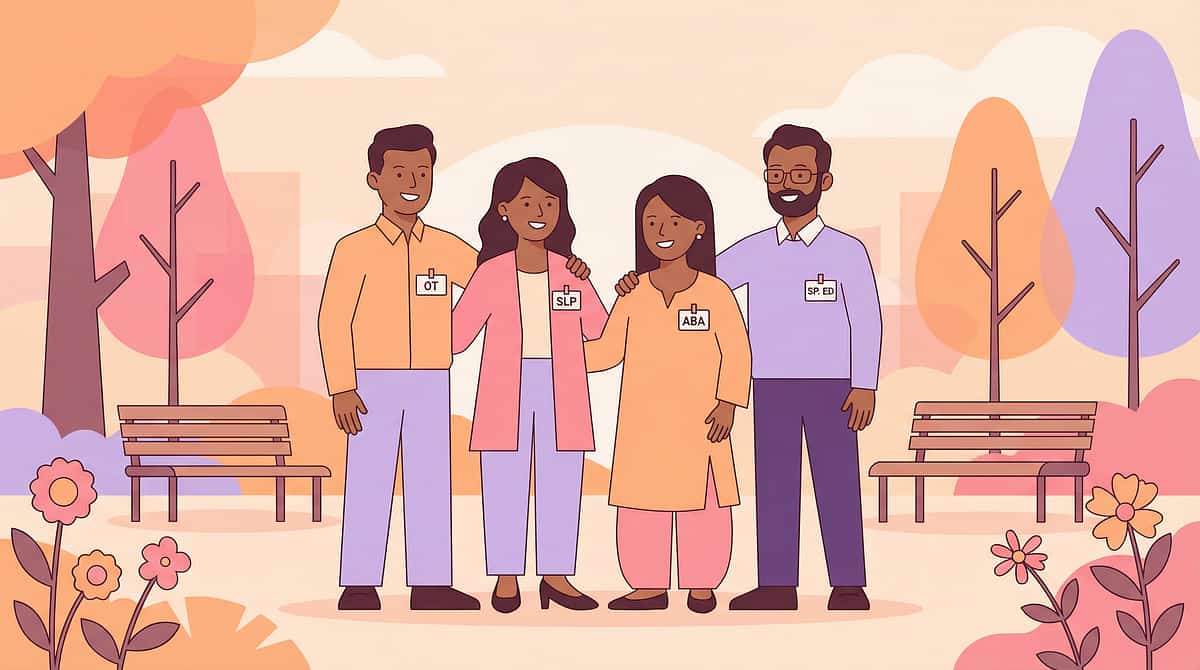
Cross-Disciplinary Deployment
Question formation intervention crosses therapy boundaries because the brain doesn't organize by therapy type. Here's how each discipline contributes to your child's success.
Speech-Language Pathologist (Lead)
Designs the syntactic intervention protocol. Identifies specific error patterns. Selects appropriate question types for systematic teaching. Monitors grammatical accuracy progression.
Board Certified Behavior Analyst (BCBA)
Structures reinforcement schedules. Designs barrier games and information-gap activities that create functional motivation to ask. Implements prompt hierarchies and tracks data on question frequency, accuracy, and spontaneity.
Occupational Therapist
Addresses sensory and motor components of speech production. Ensures regulatory readiness for language-intensive sessions. Contributes fine motor activities — manipulating cards, flip books — that support engagement.
Special Educator
Integrates question practice into academic contexts. Creates classroom opportunities for question-asking. Develops IEP goals and bridges therapy room skills to school-based generalization.
NeuroDevelopmental Pediatrician
Evaluates neurological contributors to language processing difficulties. Rules out hearing impairment, cognitive contributors, and co-occurring conditions. Monitors developmental trajectory within the broader clinical picture.
Reference: Adapted UNICEF/WHO Nurturing Care Framework for SLPs (2022) — DOI: 10.1080/17549507.2022.2141327

Precision Targeting
This technique is designed with layered precision — from core syntactic goals to the broader developmental gains that ripple outward when a child learns to ask.
🎯 Primary Target: Interrogative Syntax Production
Correct wh-word selection (who, what, where, when, why, how) · Wh-movement to sentence-initial position · Subject-auxiliary inversion ("Can I" not "I can") · Appropriate auxiliary verb selection and use.
Observable indicator: Child forms grammatically correct questions independently.
🎯 Secondary Targets: Pragmatic Question Use
Asking to get information, request permission, seek clarification · Question variety using multiple question types · Conversational participation through question-asking.
Observable indicator: Child spontaneously asks questions during play, meals, and routines.
🎯 Tertiary Developmental Gains
Academic readiness · Social communication and peer interaction · Cognitive development and expressed curiosity · Self-advocacy for needs and confusion.
Observable indicator: Teacher reports increased question-asking in classroom; peer interactions improve.
Reference: PMC10955541 — Meta-analysis confirming multi-domain outcomes from structured language intervention
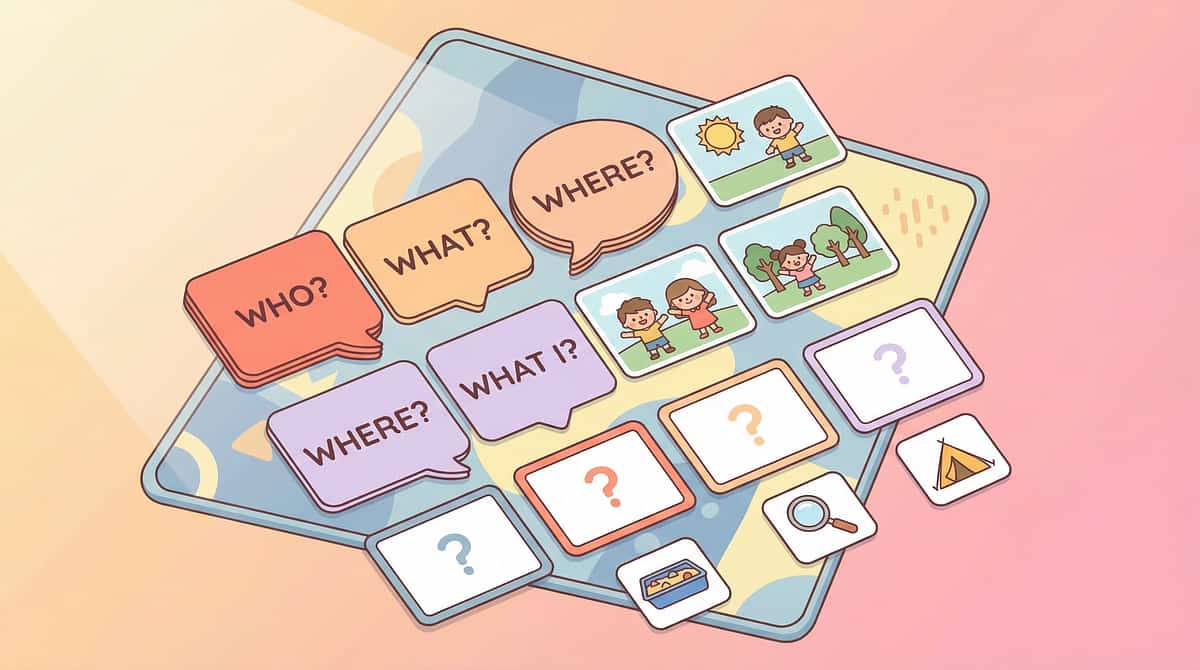
The 9 Essential Materials
Each of these materials targets a specific aspect of question formation. You don't need all nine — start with one or two that resonate most with your child's learning style. Most can be purchased affordably or made at home for free.
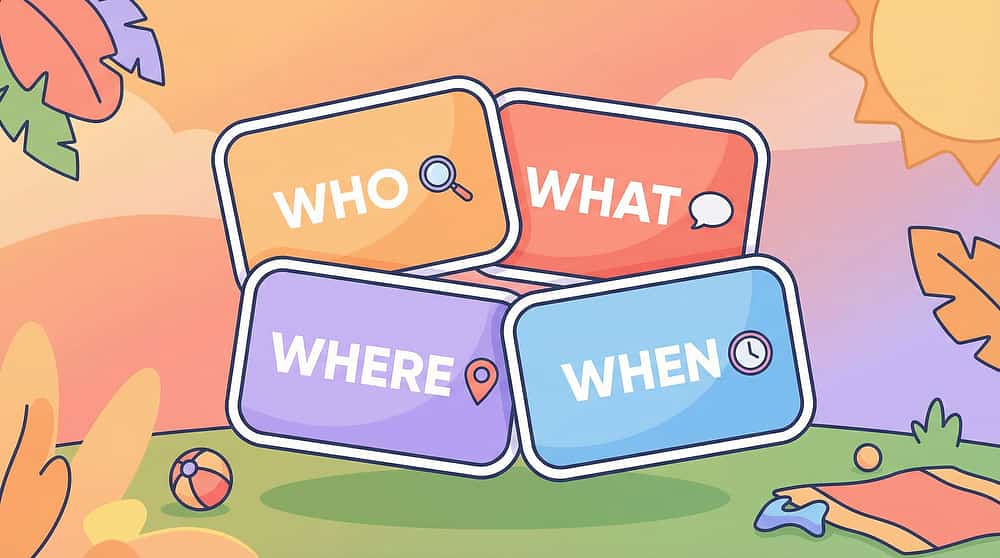
1. Wh-Question Word Cards with Visual Cues
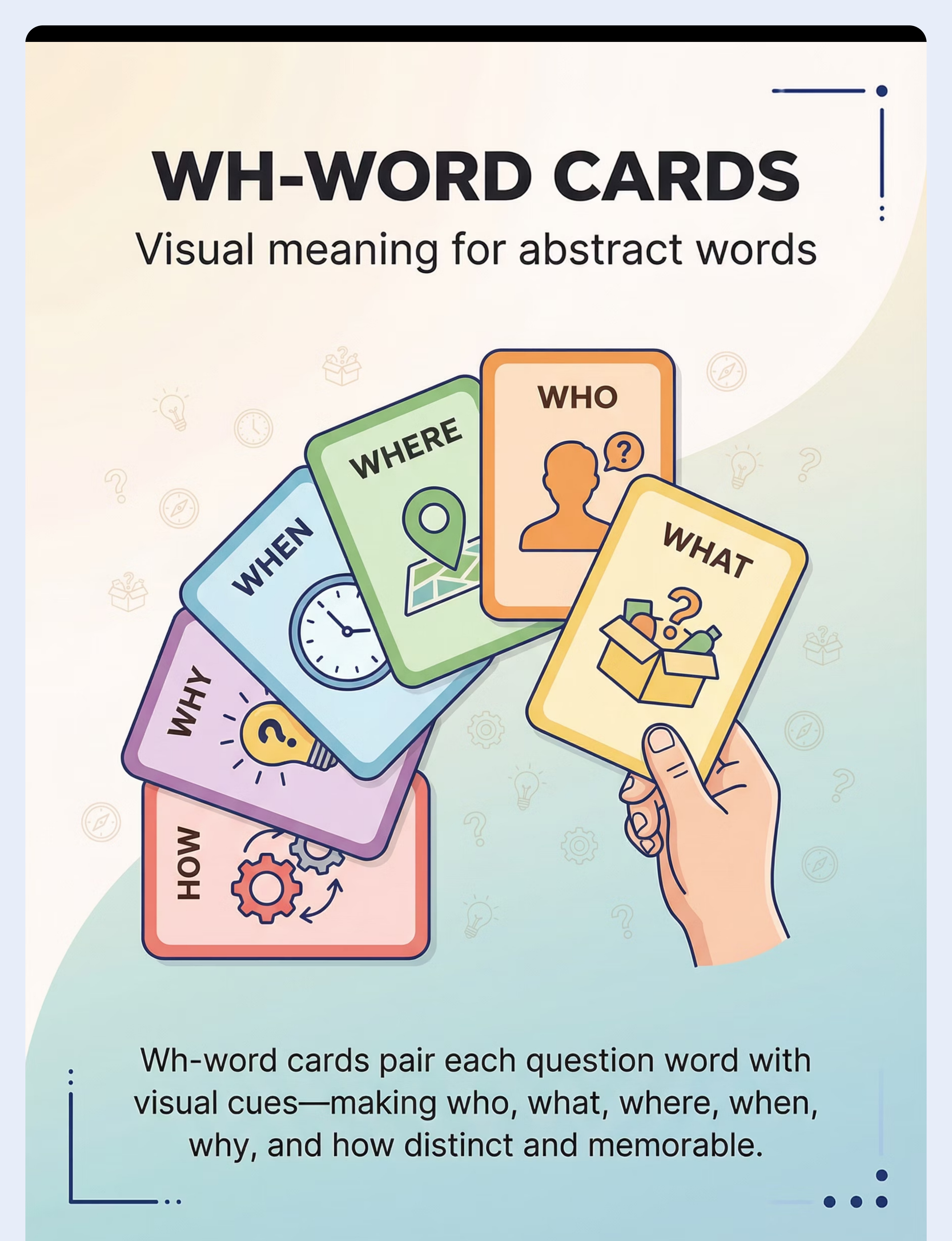
Makes abstract question words concrete with visual symbols — person icon for WHO, location pin for WHERE, clock for WHEN. Price: ₹100–500
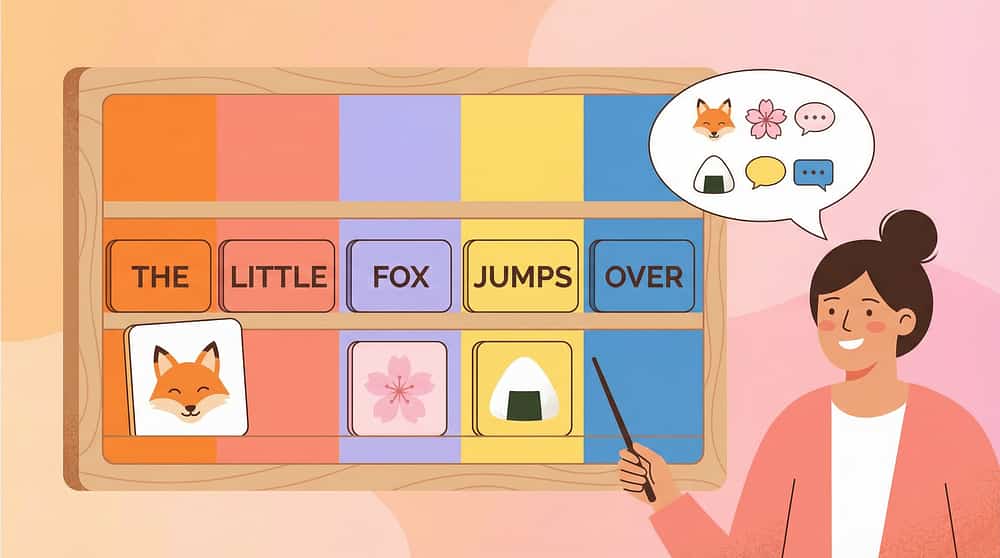
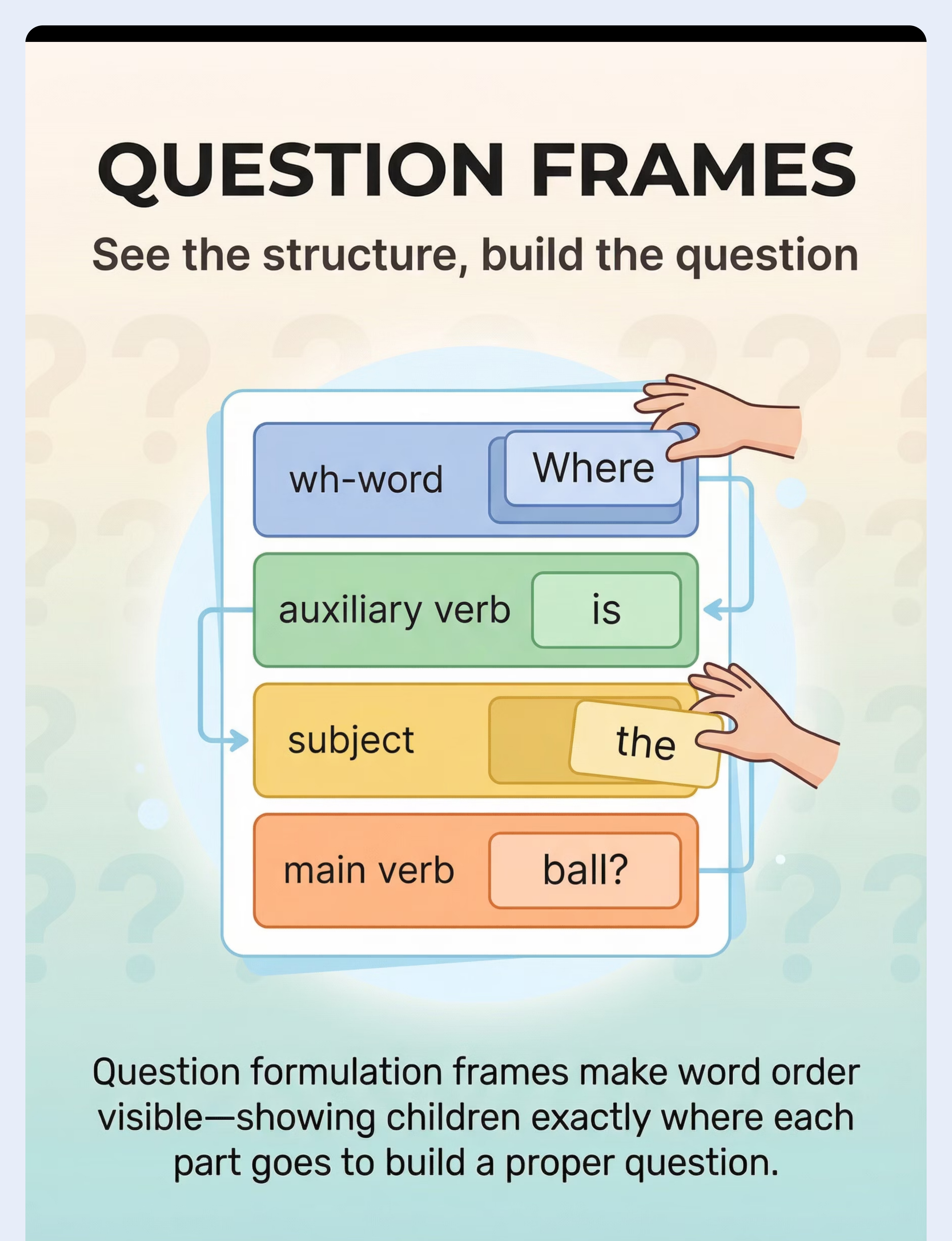
2. Question Formulation Frames & Sentence Strips
Visual templates showing [Wh-word] + [auxiliary] + [subject] + [verb] structure. Teaches the invisible grammar rule visibly. Price: ₹200–800
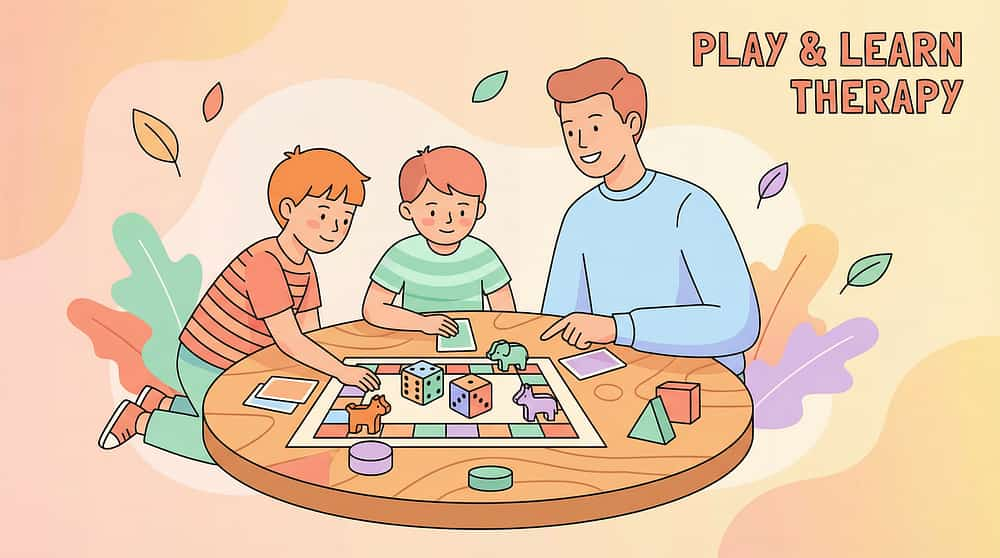
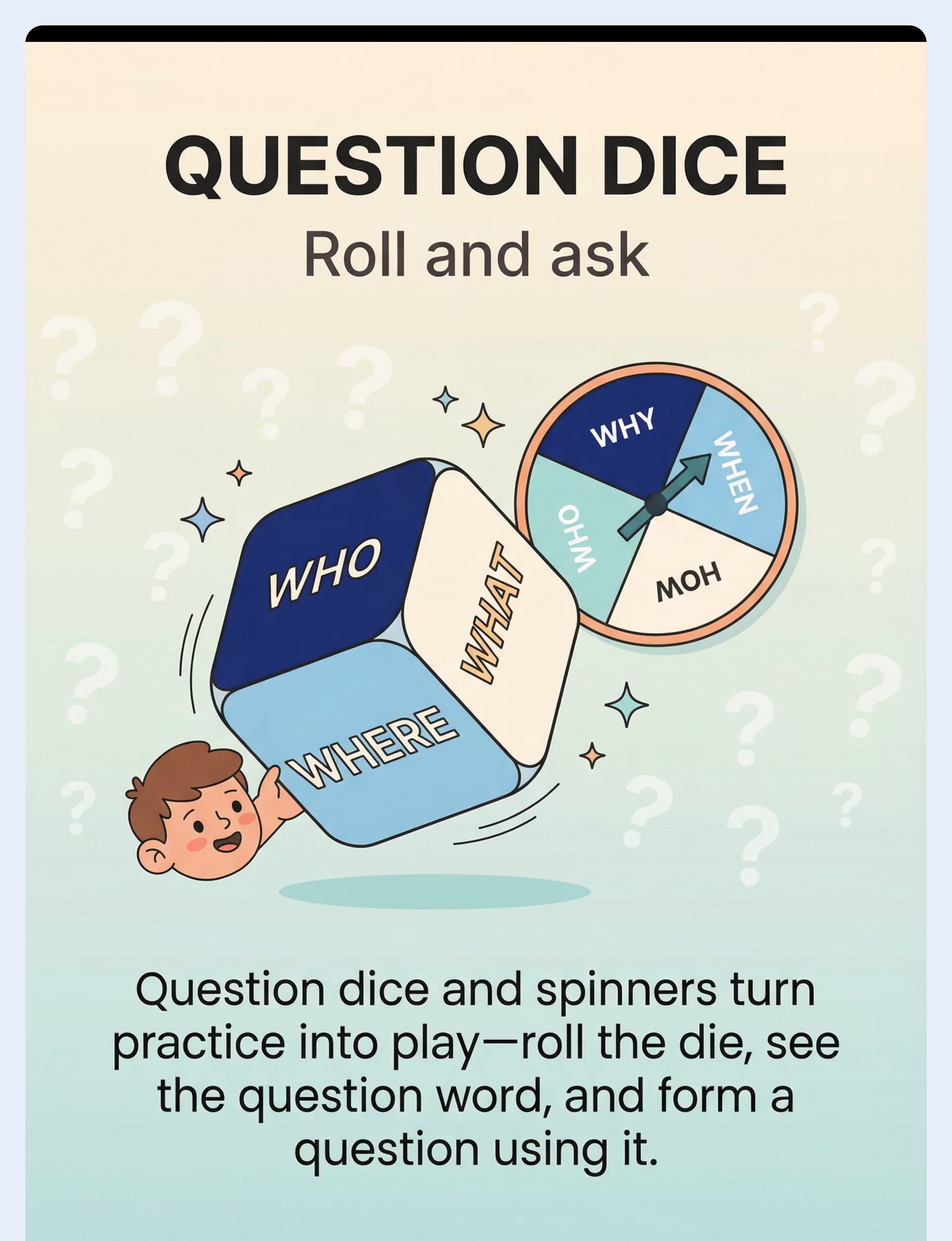
3. Question Dice & Spinners
Gamified randomized practice — roll the die, ask a question with that word. Reduces pressure, increases engagement. Price: ₹150–600
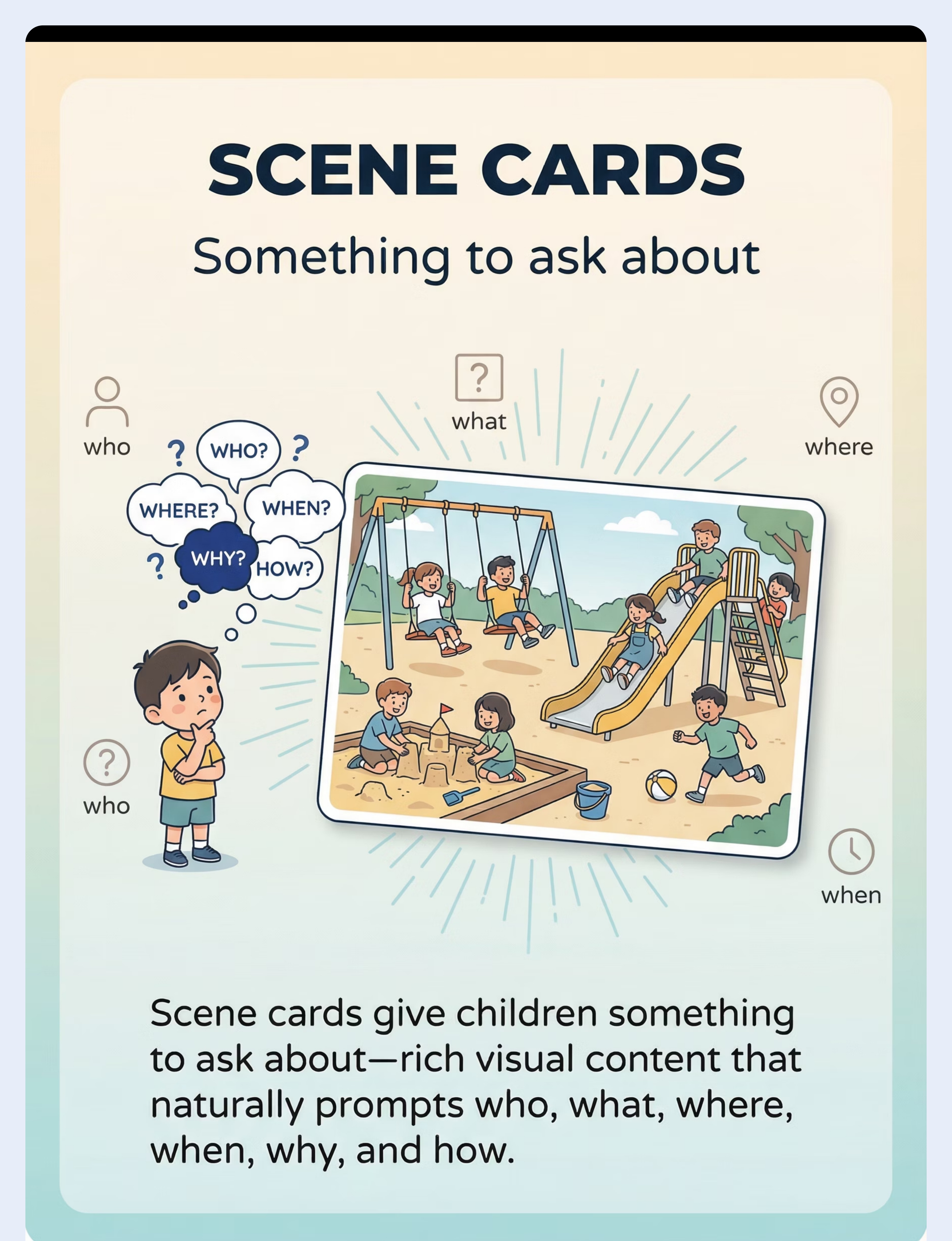
4. Scene Cards & Picture Sequences
Rich visual content that naturally prompts who/what/where/when/why/how questions. Family photos work brilliantly. Price: ₹200–1,000
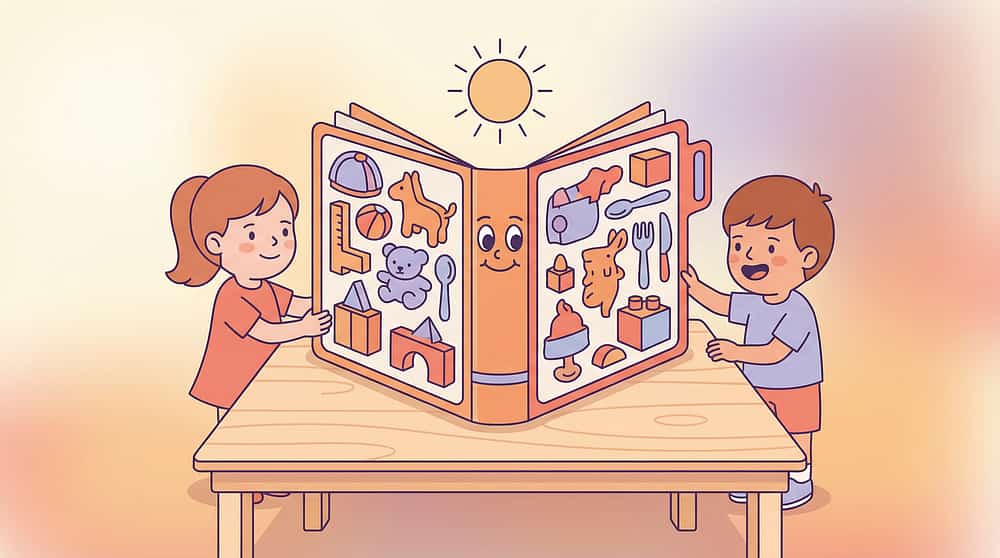
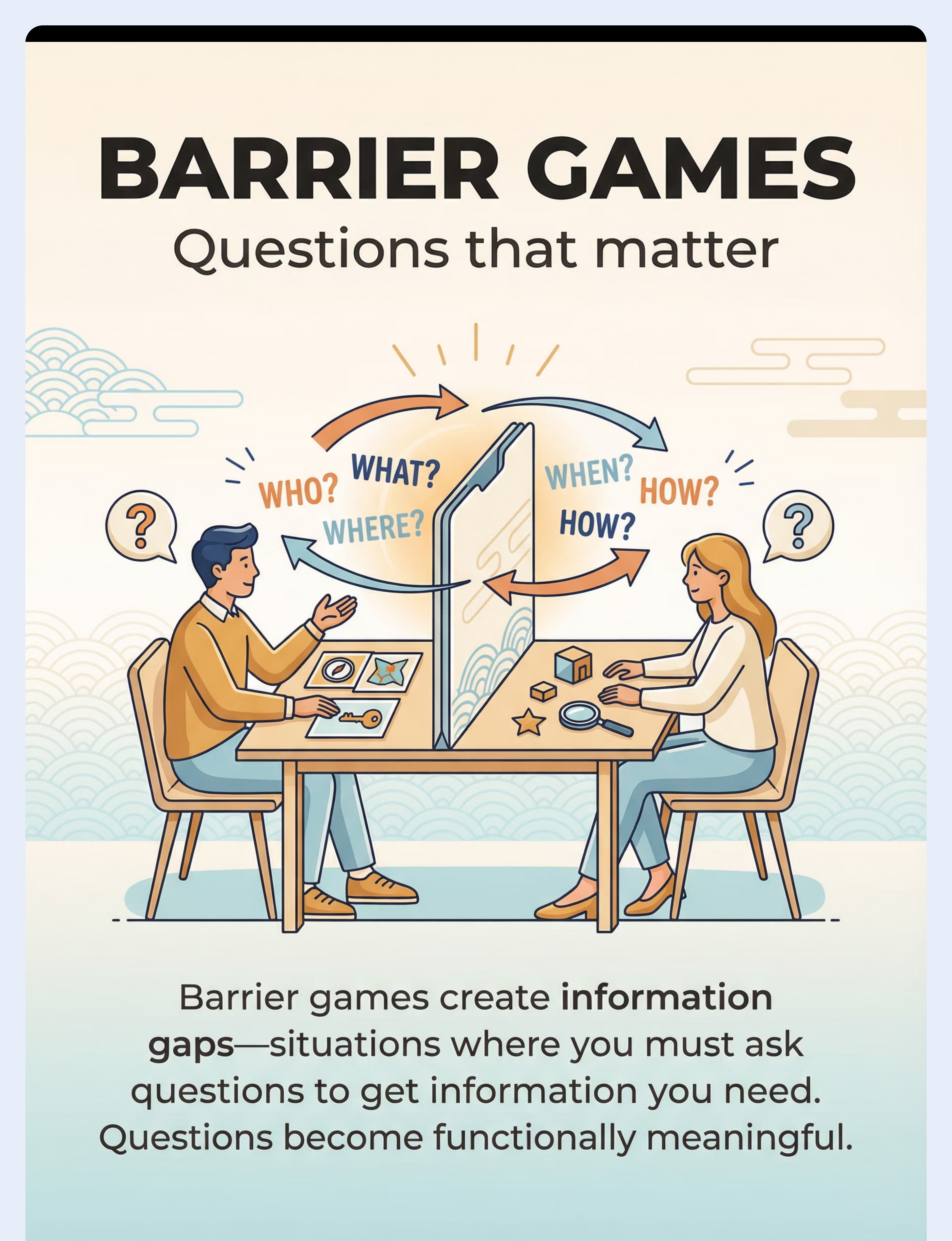
5. Barrier Games for Information-Gap Questioning
Creates real need to ask — you MUST ask to get hidden information. Functional communication at its most motivating. Price: ₹300–1,200
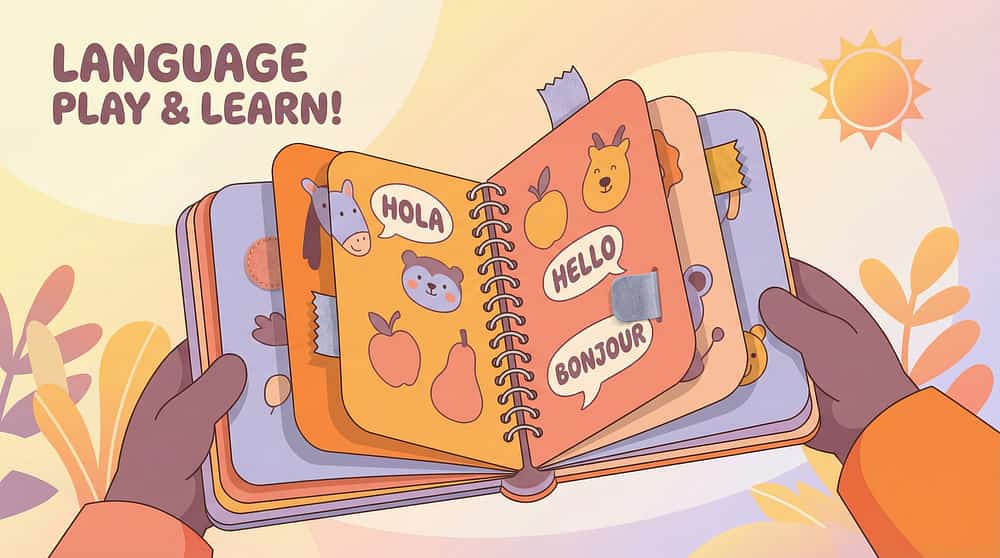
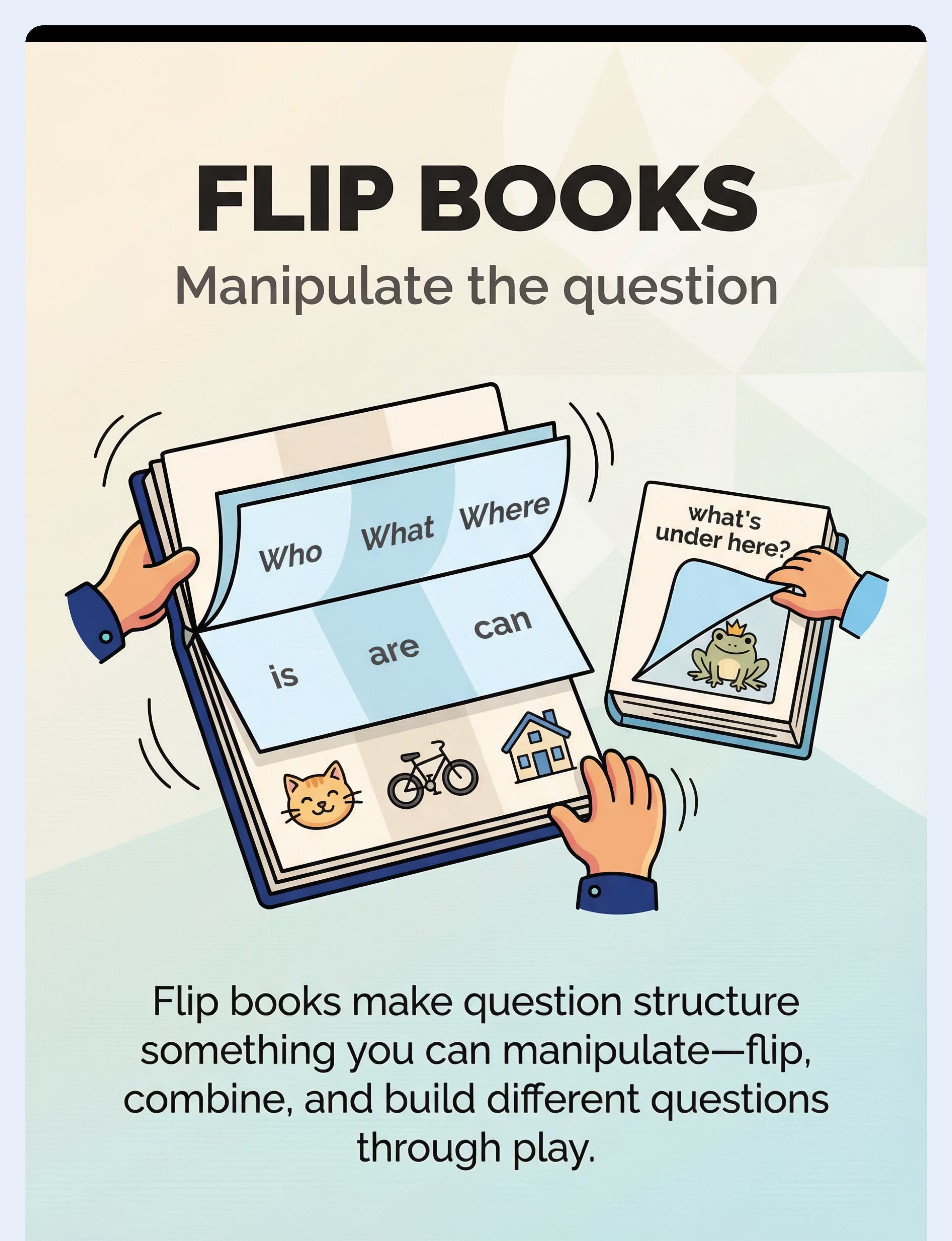
6. Flip Books & Interactive Question Books
Manipulable question structure — flip sections to create different question combinations. Hands-on and self-directed. Price: ₹200–800
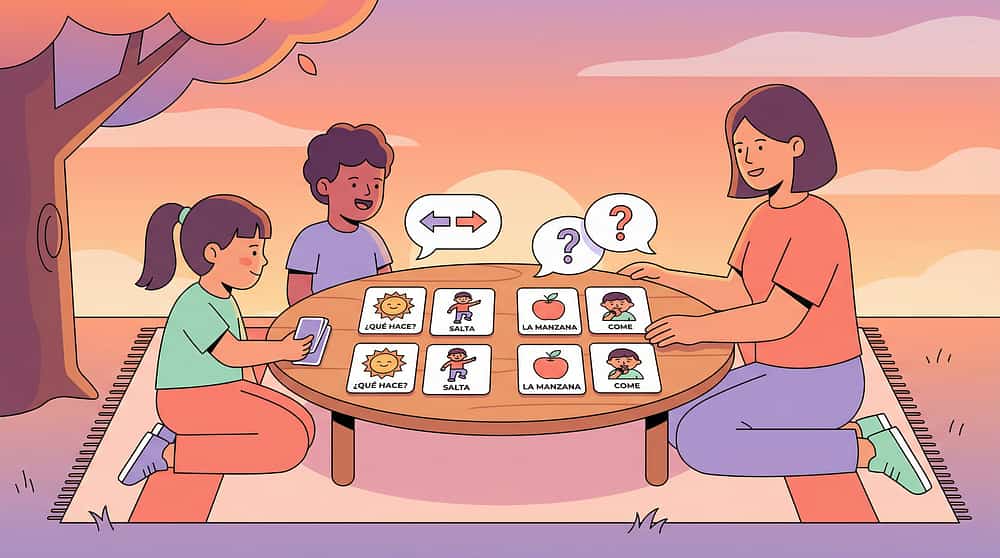
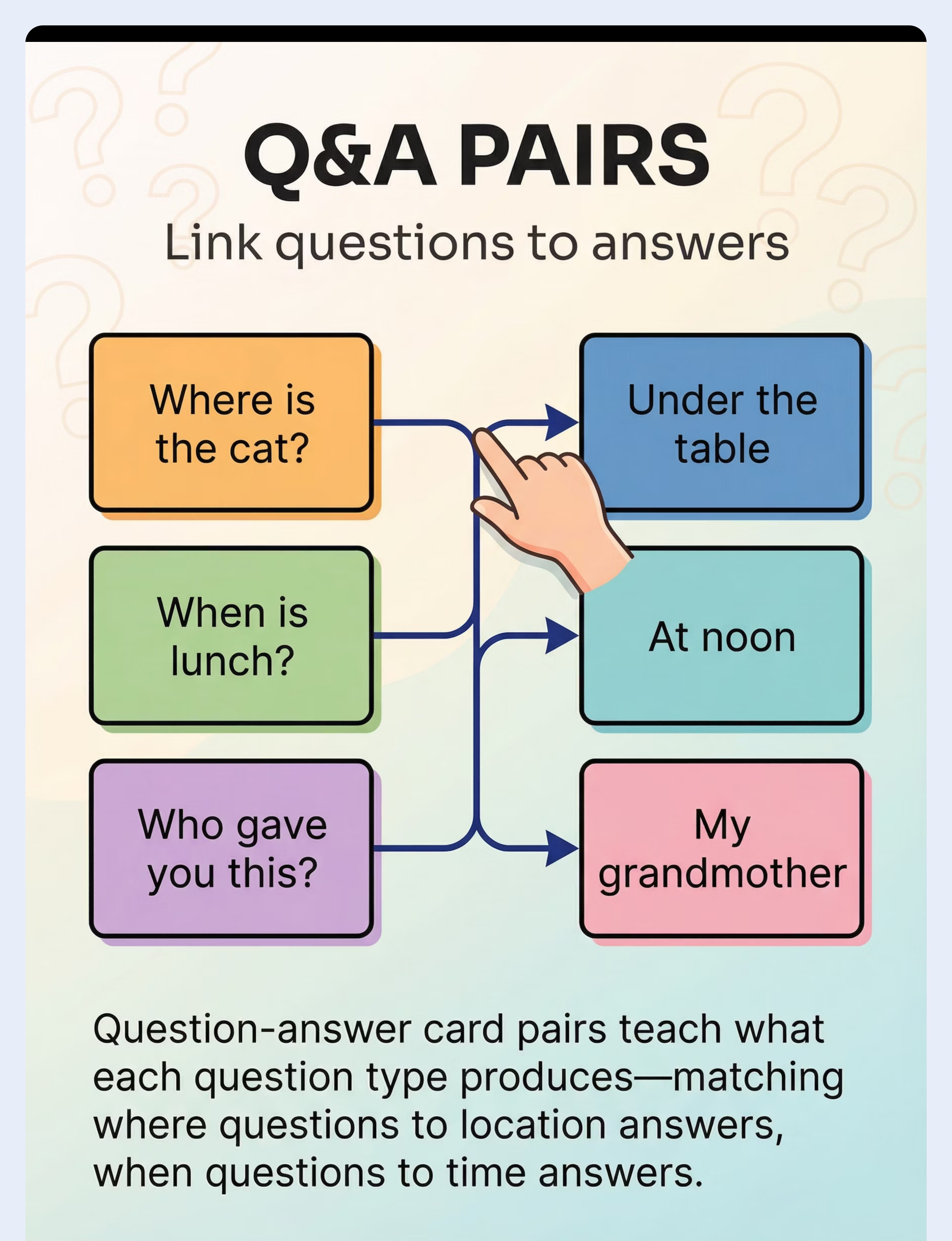
7. Question-Answer Card Pairs & Matching Games
Links questions to expected answer types — "where" gets locations, "when" gets times. Builds comprehension-production connection. Price: ₹150–600
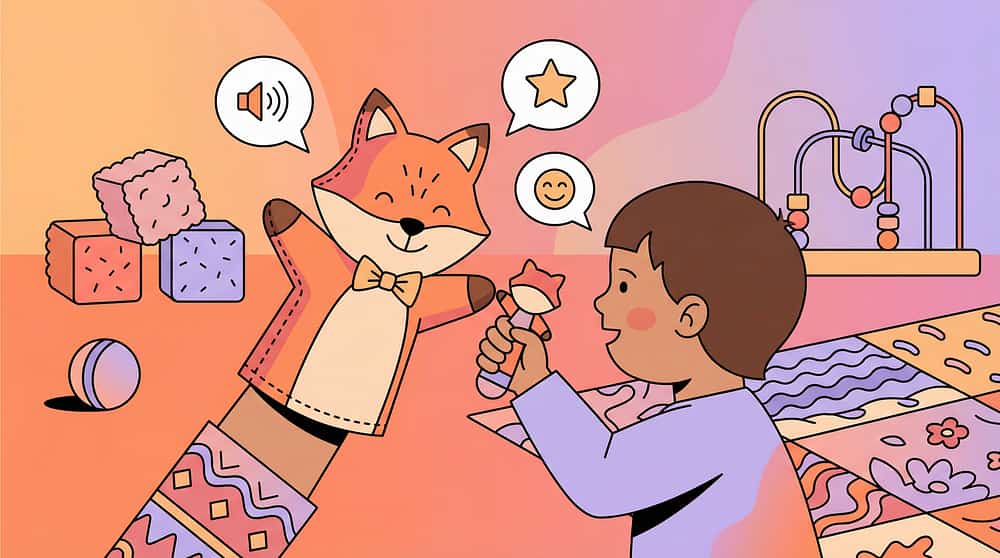
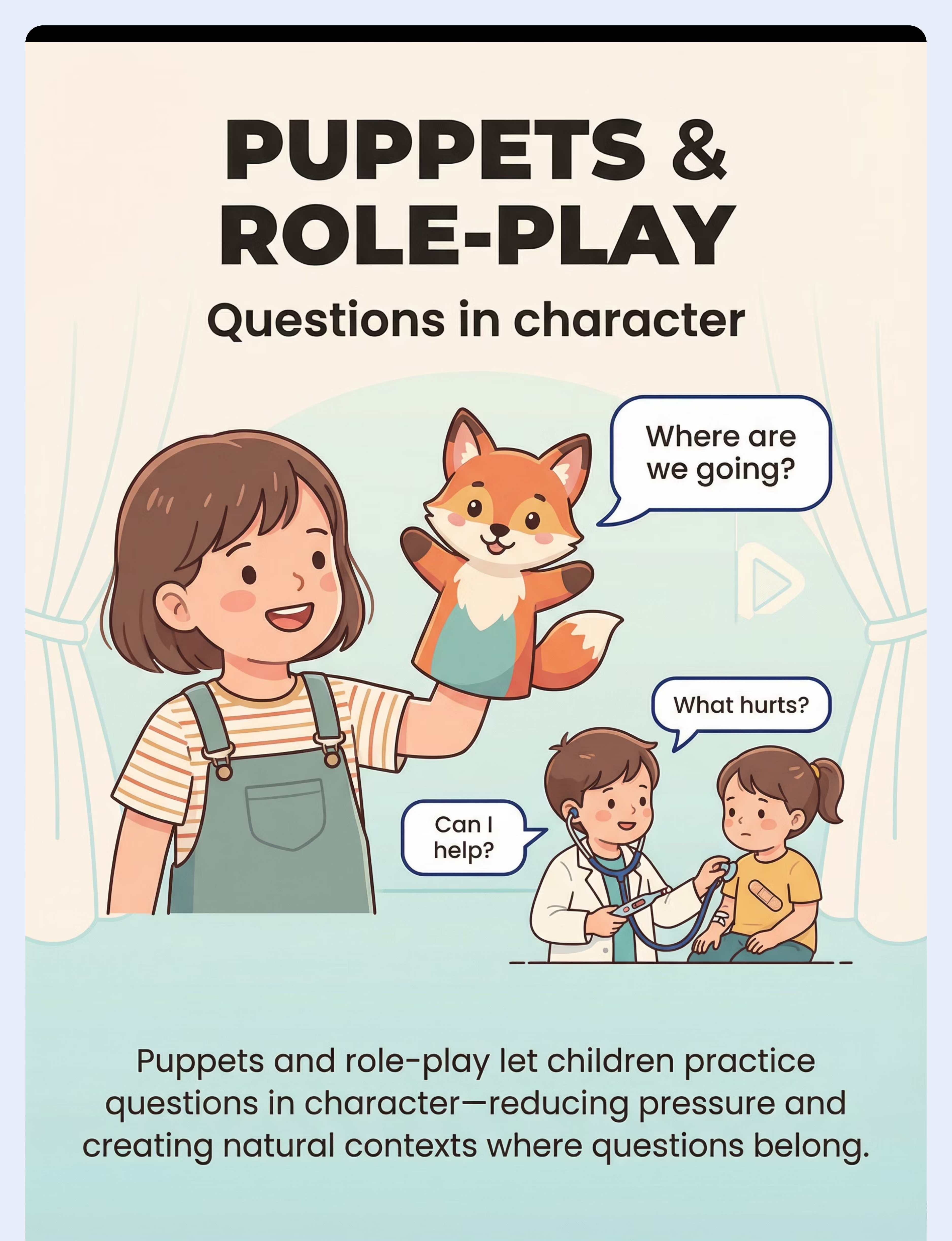
8. Puppets & Role-Play Materials
Low-pressure practice — the puppet asks the question, reducing the child's performance anxiety. Any stuffed animal works. Price: ₹200–1,000
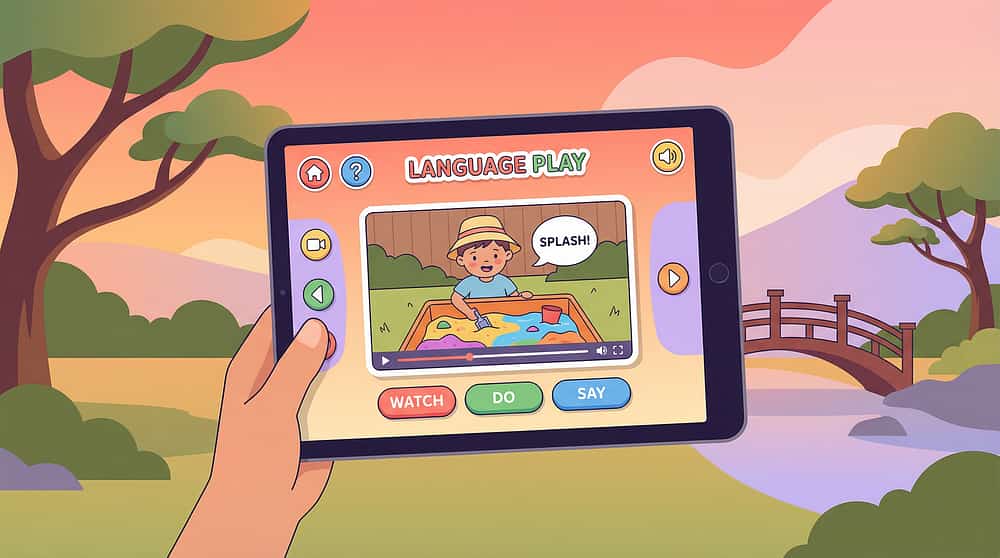
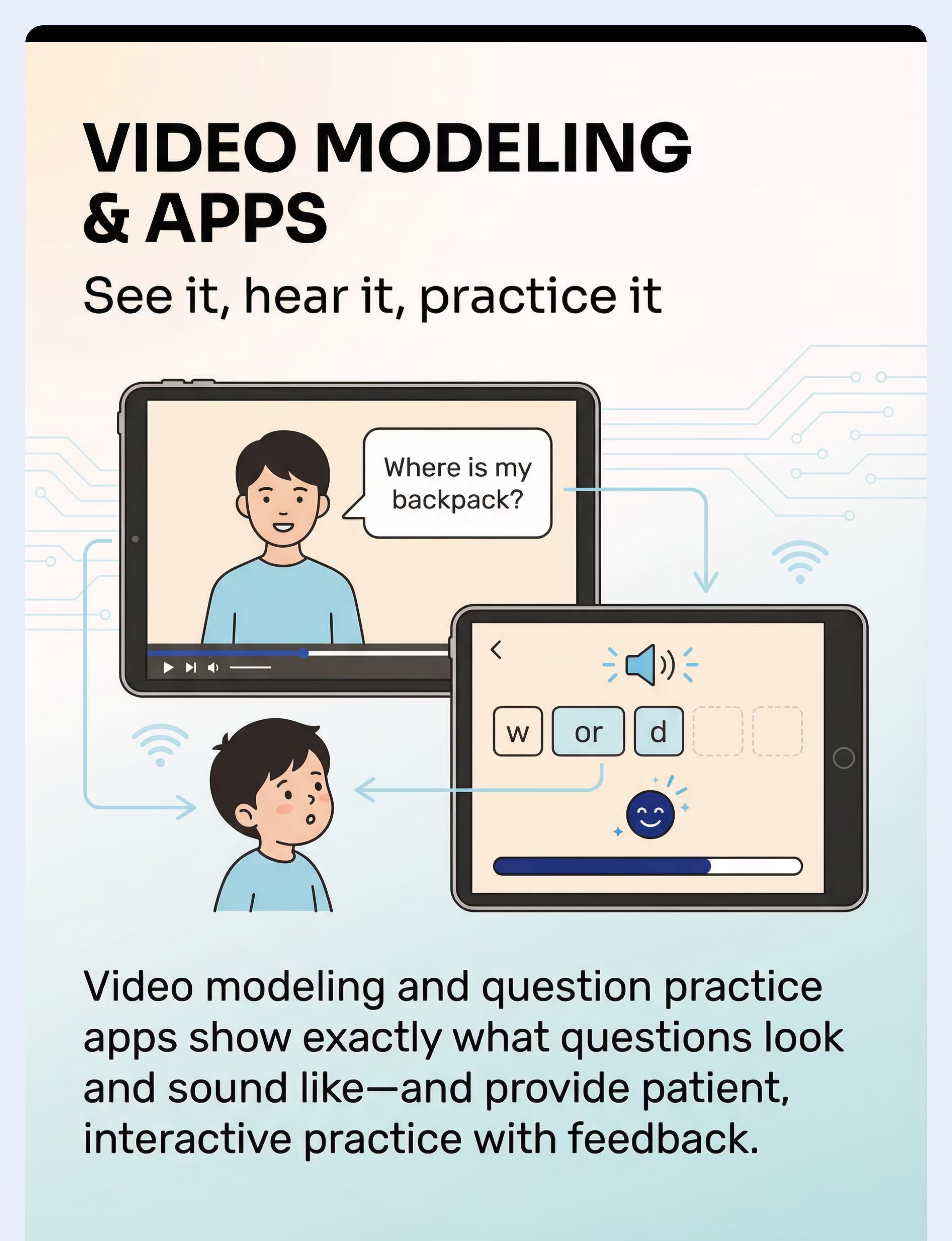
9. Video Modeling & Question Practice Apps
Shows exactly what questions look and sound like; provides interactive practice with feedback. Many free options available. Price: ₹0–2,000
Total Investment Range: ₹0–2,000. Most materials can be made at home with cardboard, markers, and imagination. The clinical principle is identical whether you buy or build.
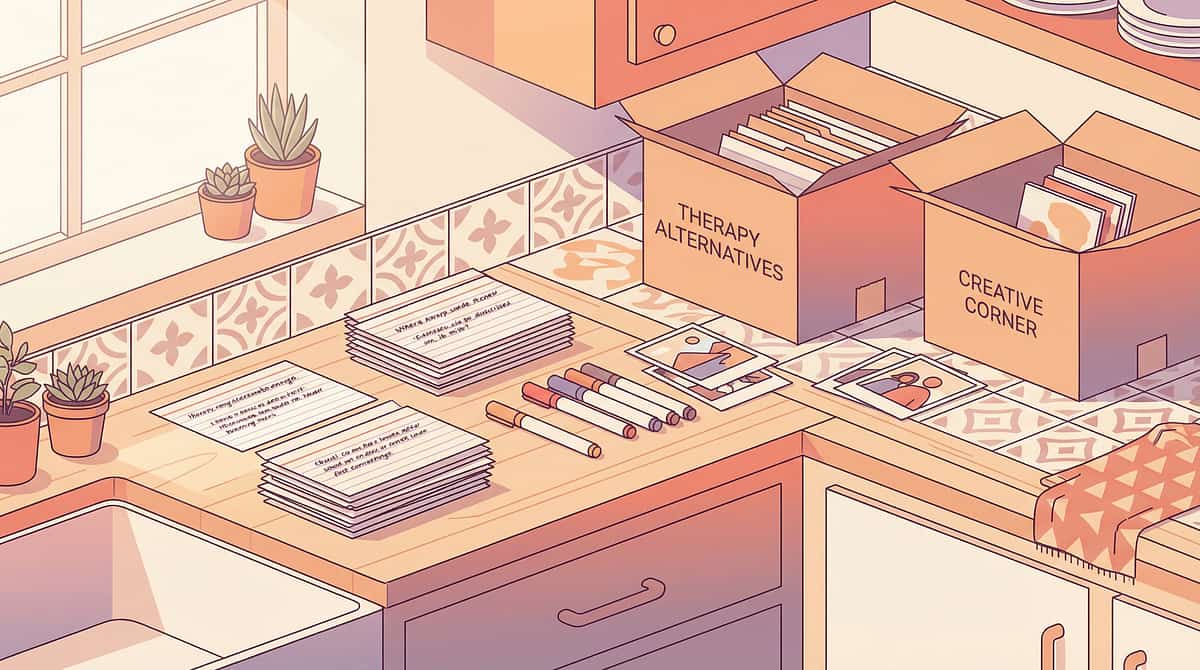
Zero-Cost Alternatives — Every Family Can Start TODAY
WHO/UNICEF Equity Principle: No child should be denied intervention because of economic circumstance.
Buy This | Make This (₹0) | |
Wh-Word Cards (₹100–500) | Write question words on cardboard. Draw a person for WHO, a pin for WHERE, a clock for WHEN, a lightbulb for WHY. Laminate with clear tape. | |
Question Frames (₹200–800) | Cut a cardboard strip into 4 color-coded slots. Blue = wh-word, Green = auxiliary, Yellow = subject, Orange = verb. Use paper pockets for word cards. | |
Question Dice (₹150–600) | Use a cardboard box or wooden block. Write one question word on each face. Spinner: draw a circle, divide into 6 sections, pencil through a paper fastener. | |
Scene Cards (₹200–1,000) | Cut detailed pictures from magazines. Family photos work brilliantly — personal relevance increases engagement enormously. | |
Barrier Games (₹300–1,200) | Use any folder, large book, or cardboard box. Each person places different objects behind the barrier. Must ask questions to discover what the other person has. Cost: ₹0. | |
Flip Books (₹200–800) | Stack index cards, cut into 3 horizontal sections. Top: question words. Middle: verbs. Bottom: subjects/objects with pictures. Staple at top. Flip independently. | |
Q&A Card Pairs (₹150–600) | Write questions on one set of cards, matching answers on another. Color-code by type. Play memory, go-fish, or matching games. | |
Puppets (₹200–1,000) | Sock with button eyes, stuffed animal, or a face drawn on a paper bag. Any character can be the "curious one who always asks questions." | |
Video Modeling Apps (₹0–2,000) | Record videos on your phone of yourself or family members asking questions in everyday situations. Free language apps available on all platforms. |
The clinical principle is identical whether you buy or build. The visual structure, the game-based practice, the information gap — these are what matter, not the production quality of the material.
Safety Gate — Read Before Every Session
The most effective session is one that starts right. Use this traffic-light check before every practice — your emotional state and your child's regulatory state are as important as the materials you've prepared.
🟢 GREEN — Proceed When:
Child is fed, rested, and emotionally regulated · Environment is quiet with minimal distractions · Materials are prepared and within reach · You have 10–20 minutes of uninterrupted time · Child shows willingness to engage
🟡 AMBER — Modify When:
Child is mildly tired or slightly distracted → Shorten to 5 minutes, use only dice or puppet · Child had a difficult day → Play-based materials only · Sibling interruptions likely → Involve siblings as question-asking partners
🔴 RED — Stop If:
Child shows significant distress, crying, or meltdown · Child is ill, in pain, or had a seizure in past 24 hours · Child exhibits self-injurious behavior → Stop immediately · You as the parent feel frustrated or overwhelmed → Skip a day. That's okay.
Material Safety
- Small word cards and dice can be choking hazards for children under 3 or those with oral-seeking behaviors — supervise at all times
- Ensure card edges are not sharp; laminate or round corners
- Spinner arrows must be secure and not pointed
- Screen time for video modeling should be limited and balanced with interactive practice
- All images on scene cards should be age-appropriate and culturally sensitive
⚠️ Professional Training Note: This technique does NOT require specialized certification to implement at home. However, if your child shows no progress after 4–6 weeks of consistent practice, or if difficulties are severe, comprehensive evaluation by a licensed speech-language pathologist is essential.
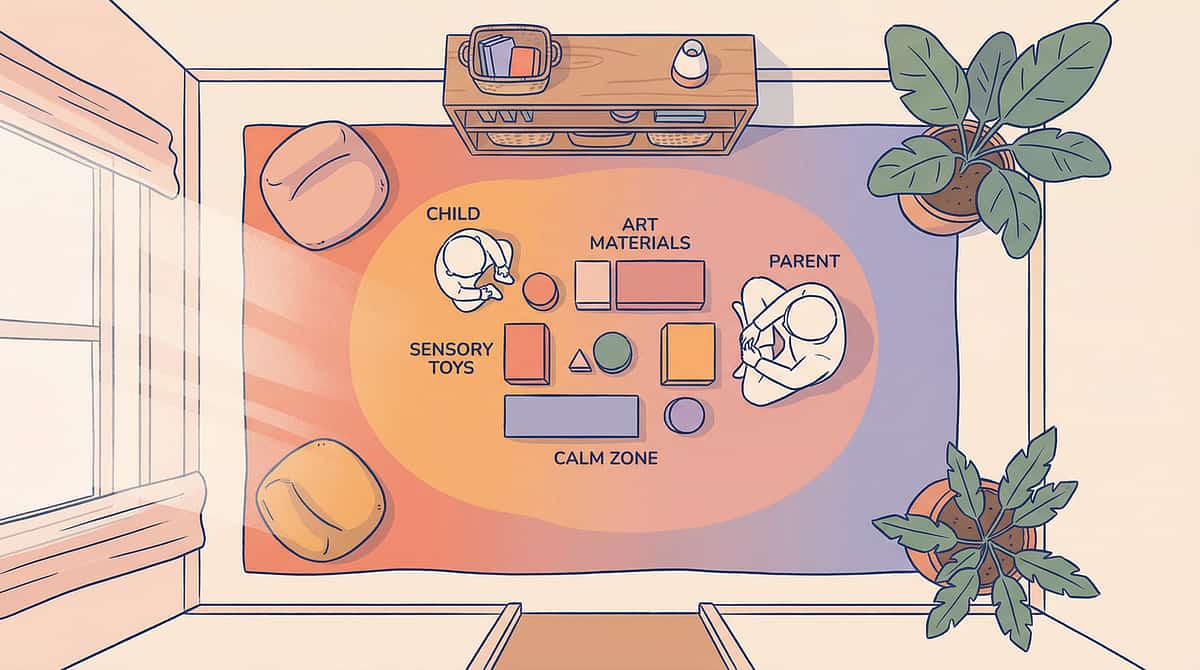
Environment Configuration
Where you practice matters almost as much as how you practice. The right environment reduces competing demands on your child's working memory — the same resource they need to construct questions.
Child Position
Seated comfortably at table or on floor, eye-level with materials, facing parent — not side-by-side. Face-to-face enables modeling of mouth movements and facial expressions for question intonation.
Parent Position
Directly across from child. Within arm's reach of materials. Able to model question forms with visible face and mouth. Today's specific materials only between you.
Materials Placement
Centered between parent and child. Remove everything else from the workspace. If using a barrier game, barrier goes between the two positions.
Optimal Conditions
Natural lighting · Comfortable room temperature · Child's preferred seating (floor, chair, beanbag) · A visual timer visible to both parent and child · TV off, phone notifications silenced.
Reference: PMC10955541 — Structured environment as a core principle for session efficacy

Pre-Session Readiness Assessment
60 seconds · Before every session
Run through this checklist before you begin. Starting a session when the conditions aren't right wastes your time and may create resistance. Postponing is not failing — it is clinical judgment.
# | Readiness Indicator | ✅ / ❌ | |
1 | Child is fed (not hungry or just finished eating) | ||
2 | Child appears rested (not drowsy, not hyperactive from missed nap) | ||
3 | Child is in a regulated emotional state (no recent meltdown, crying, or tantrum) | ||
4 | Child shows some willingness to sit/engage (even briefly) | ||
5 | No signs of illness, pain, or physical discomfort | ||
6 | Parent/caregiver is calm and emotionally available | ||
7 | Environment is set up (Card 12 complete) |
✅ 5–7 checks
GO — Proceed to Step 1: The Invitation
🟡 3–4 checks
MODIFY — Shortened 5-minute session using only the most engaging material. Skip structured frames. Puppet or dice only.
🔴 0–2 checks
POSTPONE — Do a calming activity instead: sensory play, reading a favorite book, quiet music. Try again later today or tomorrow.
"The best session is one that starts right."
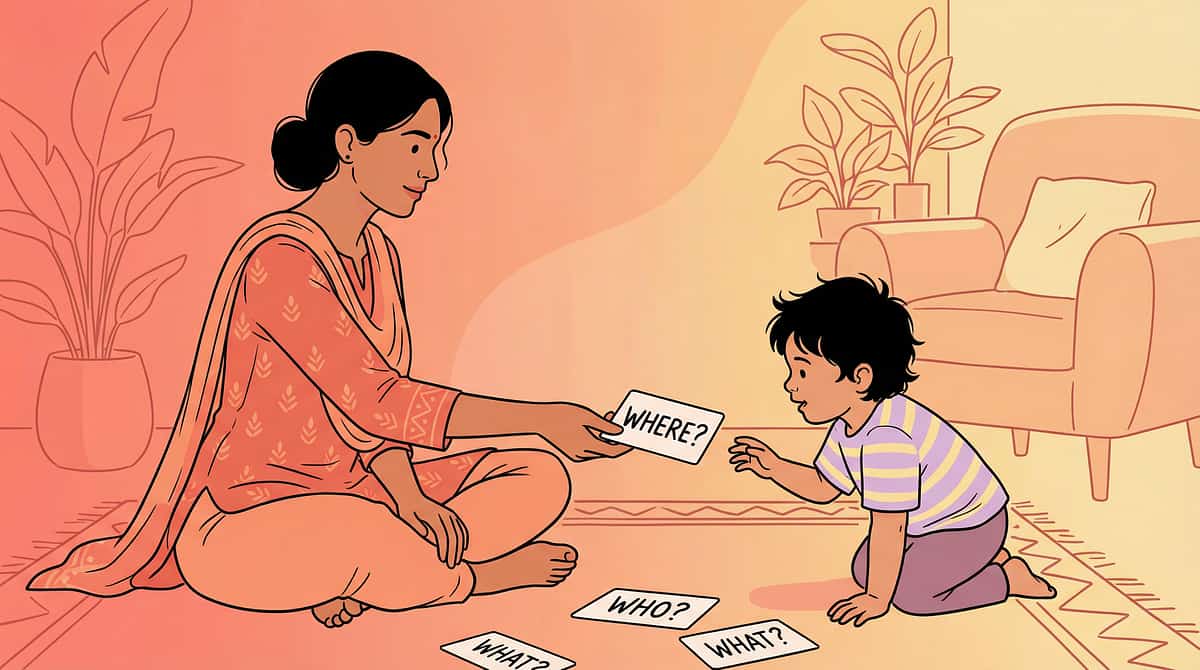
Step 1: The Invitation
30–60 seconds
The very first moment sets the emotional tone for everything that follows. Your goal is simple: make the materials irresistible, and make yourself a safe, enthusiastic partner.
"Hey [child's name], I have something fun! Look what I found — [show the material]. Want to play a game with me? We're going to be question detectives today — we're going to learn how to ask really good questions!"
What Acceptance Looks Like
- Child looks at the material or reaches for it
- Child nods, says "okay," or moves toward you
- Child smiles or shows interest
- Child touches or manipulates the material
What Resistance Looks Like & How to Modify
- Child turns away → Place material near their current activity; let them discover it
- Child says "no" → "That's okay! The puppet was asking about you. Should we see what he wants to know?"
- Child is absorbed elsewhere → "Can I play this game next to you? You don't have to stop what you're doing."
Timing: 30–60 seconds. If no engagement in 60 seconds, modify approach or postpone the session.
Reference: ABA Pairing Procedures — establishing motivating operations before demand placement | OT "Just-Right Challenge" principle
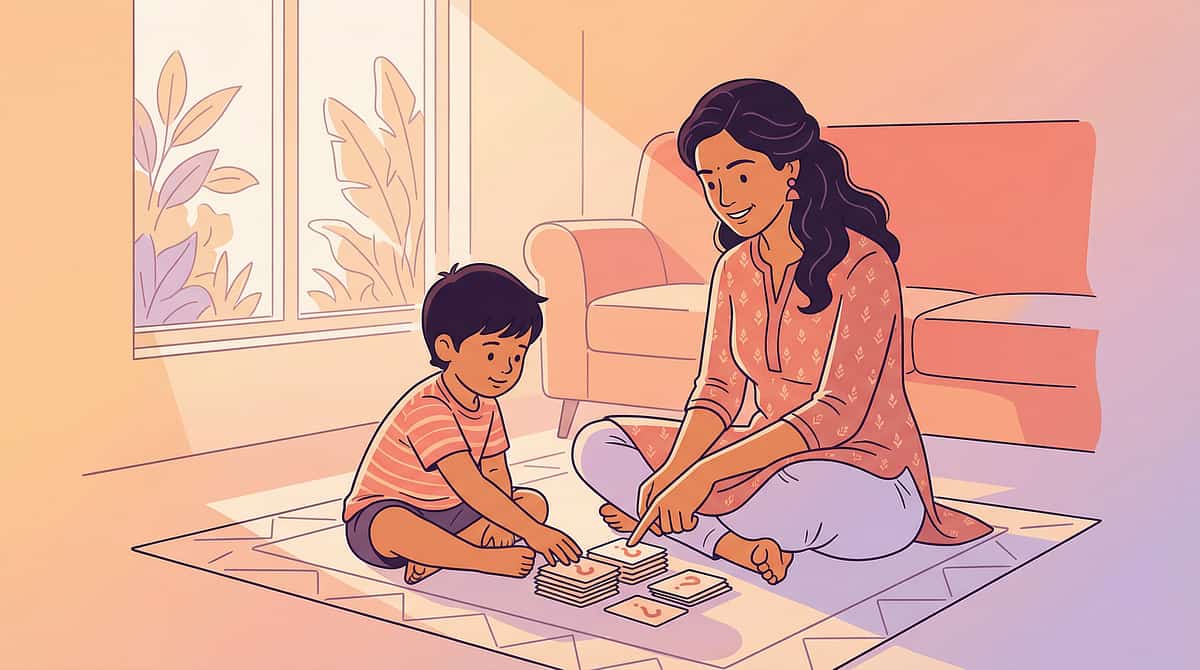
Step 2: Introduce the Material
1–3 minutes
Choose ONE material per session. Introducing multiple materials at once fragments attention. Today's example uses Wh-Word Cards — adapt the protocol for whichever material you've selected.
"Look at these cards! Each one has a special question word. This one says WHO [hold up card with person icon]. WHO asks about people. Like — WHO is at the door? WHO gave you this? Now you try — can you think of a WHO question?"
Present ONE card/material at a time
Not all nine simultaneously. Naming the question word clearly, with emphasis, before anything else.
Give 2 examples
Model two questions using that word so your child hears what it sounds like in real sentences.
Invite an attempt with full support
You can model and they imitate. Any attempt — even a single word with rising intonation — is a win.
Celebrate immediately
"You're asking! That's amazing!" Specific, enthusiastic praise within 3 seconds of any attempt.
Reference: PMC11506176 — Structured material introduction in evidence-based language intervention
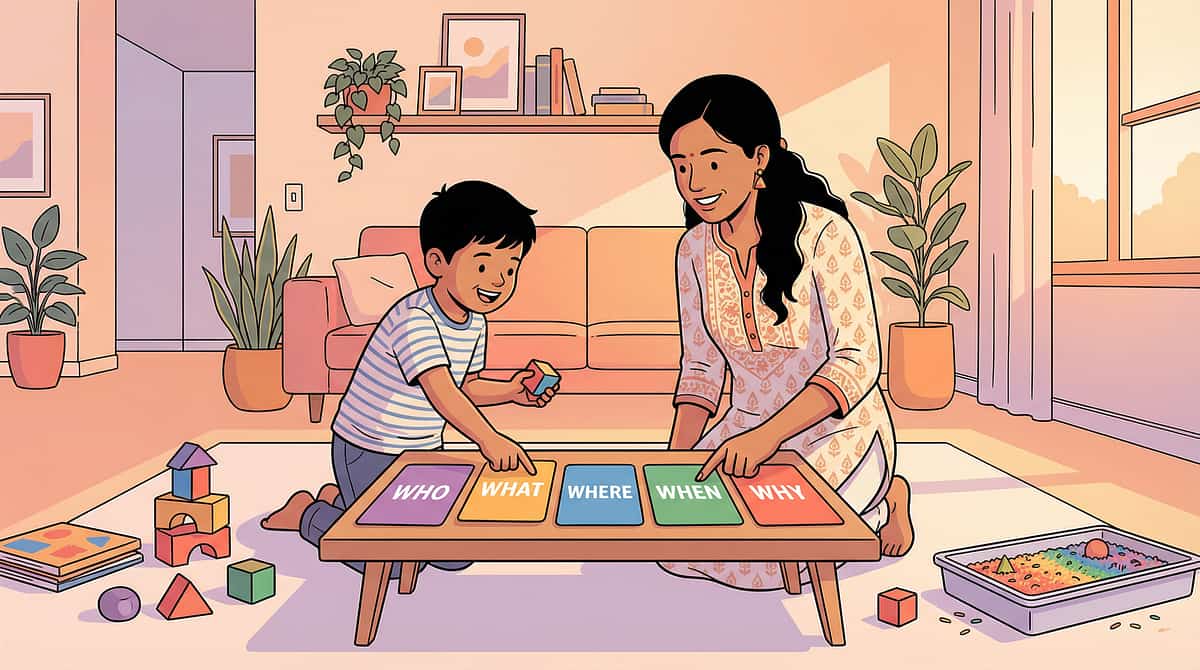
Step 3: Building Questions
3–5 minutes · Core Therapeutic Action
This is the heart of the session. The child is now actively constructing questions using the material — not just imitating, but building. Here is how to execute with three of the most versatile materials.
Using Wh-Word Cards
Lay out 3 cards (WHO, WHAT, WHERE — easiest first). Show a picture or object. Point to the WHO card: "Let's ask a WHO question." Model, then invite child to attempt. Accept any approximation and recast errors naturally.
Using Question Frames
Place frame in front of child. Model building a question slot by slot: "WHERE [slot 1] + IS [slot 2] + THE [slot 3] + BALL [slot 4]? WHERE IS THE BALL?" Child builds the next question with your guidance. Gradually reduce support.
Using Barrier Games
Place barrier between you and child. Tell child: "I have something hidden. You need to ASK me questions to find out what it is!" Offer wh-word cards as prompts if child struggles. Child asks → You answer → Child narrows down.
Common Errors & Natural Corrections
Error | Example | How to Respond | |
Wh-word in wrong position | "You going where?" | Show the frame: "The question word goes FIRST. WHERE are you going?" | |
Missing auxiliary | "What you doing?" | Model with emphasis: "What ARE you doing? We need the helper word — ARE." | |
No inversion | "Why you are sad?" | "Listen to the flip — Why ARE YOU sad? The helper word flips with the person word." | |
Wrong wh-word | "What is the park?" (meaning where) | Show both cards: "WHAT asks about things. WHERE asks about places. Which one do we need?" |
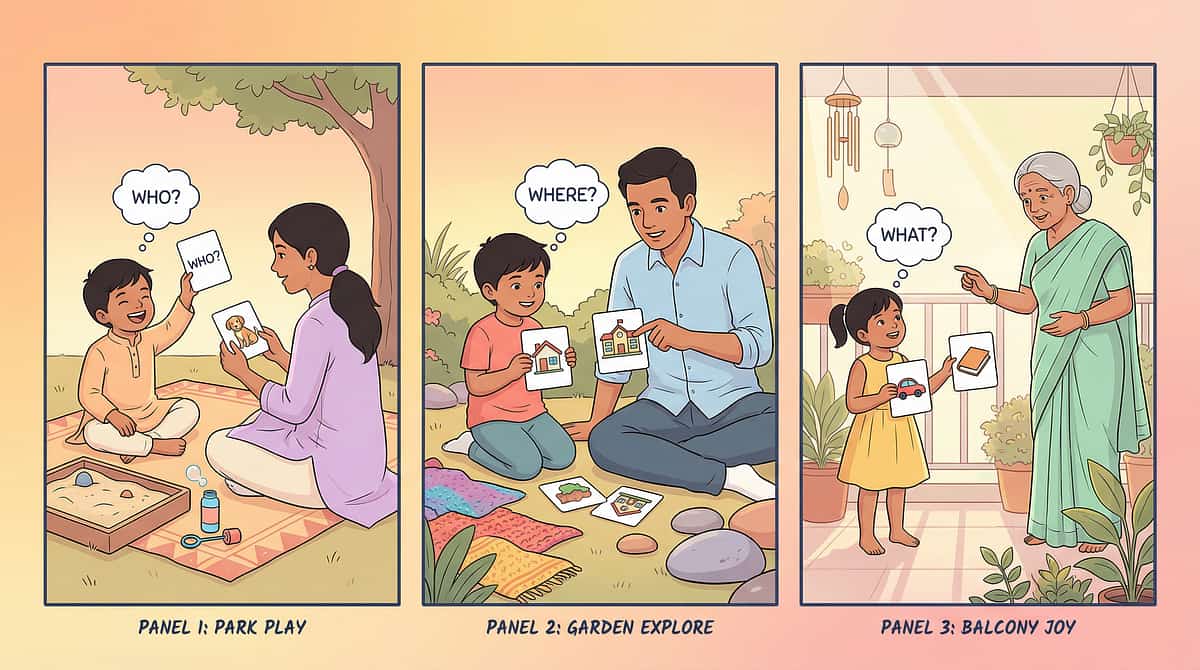
Step 4: Practice with Variety
3–5 minutes · Target: 5–10 question attempts
Repetition builds neural pathways, but mindless repetition builds resistance. Vary the context while keeping the same skill target — this is how the brain generalizes learning.
Switch the picture/context
Same question type, different content: "Where is the dog?" → "Where is the spoon?" Same cognitive demand, fresh engagement.
Switch the question type
Same picture, different question word: "WHO is in the picture?" → "WHAT are they doing?" Builds flexibility across question types.
Add the dice element
Roll the question die → whatever word lands, ask that type of question. Randomness reduces anticipation and increases genuine cognitive work.
Puppet takes a turn
"Now Mr. Fox wants to ask a question. What should he ask?" Allows child to be the expert — a powerful confidence builder.
Reverse roles
Parent gives wrong answers on purpose; child must ask the RIGHT question to get the right answer. Playful, functional, and highly motivating.
Weeks 1–2
3–5 attempts with full support (modeling, frames, cards)
Weeks 3–4
5–8 attempts with partial support (just the wh-word card as reminder)
Week 5+
8–10 attempts with minimal support (child generates independently)
"3 good attempts are worth more than 10 forced ones." Quality over quantity. Every successful question builds a neural pathway. Every frustrated attempt can build resistance.
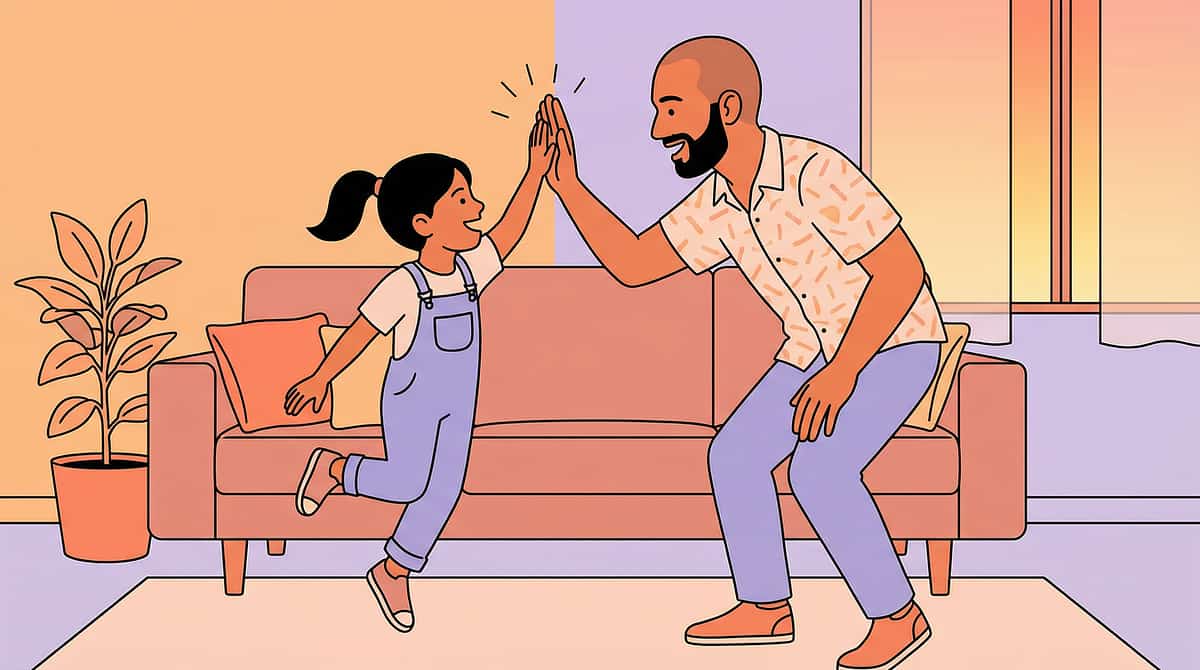
Step 5: Reinforce Every Question
Ongoing · Within 3 seconds
Reinforcement is not optional — it is the mechanism by which learning is encoded. The most powerful reinforcer of all is simple: answer the question enthusiastically. Asking works. That's the lesson.
Child Does | You Say | |
Asks a perfect question | "WOW! You just asked 'Where is the cat?' — that was a PERFECT question! The question word went first, the helper word was there — amazing!" | |
Asks with minor errors | "You asked a question! You said 'What you doing?' — I love that you're asking! Let me show you — 'What ARE you doing?' — so close!" | |
Uses rising intonation on a statement | "I heard you asking! You're turning your voice up like a question. Let's add the question word — WHERE are we going?" | |
Points or gestures instead of asking | "You want to know something! Let's use our question words — which card do you need? [offer wh-word cards]" | |
Asks spontaneously (not in a session) | "You just asked me a question! You said 'Can I have water?' — that's EXACTLY how you ask! I'm so proud of you!" |
Reinforcement Menu
Verbal Praise
Primary — use every time. Specific and enthusiastic.
Physical Celebration
High-five or fist bump — immediate physical connection.
Token/Sticker Chart
If using token economy — visual progress for visual learners.
Natural Consequence
Answer the question enthusiastically. The most powerful reinforcer: asking WORKS.
"Celebrate the attempt, not just the success."

Step 6: Gentle Ending
1–2 minutes · Transition Protocol
How a session ends shapes how the next one begins. A consistent, warm close creates safety around the routine — your child learns that sessions are predictable and bounded. That predictability itself reduces resistance over time.
Two-Minute Warning
"Two more questions, and then we're all done with our question game!"
One-Minute Warning
"One more question! Make it a good one!"
Close the Session
"All done! You asked SO many questions today. Let's put our cards away together. What should we play now?"
Material Put-Away Ritual
Child helps place cards back in the bag/box. Creates a consistent session boundary and builds executive function skills alongside language.
Cool-Down Options
- Read a favorite book together (model questions about the story casually — no pressure)
- Quiet sensory activity: coloring, playdough
- Preferred activity as natural reward for session completion
- Simply move to the next routine with a calm, consistent transition
If child resists ending: offer a "last turn" — one final question roll of the dice. A visual timer helps the child see the session ending before it happens.
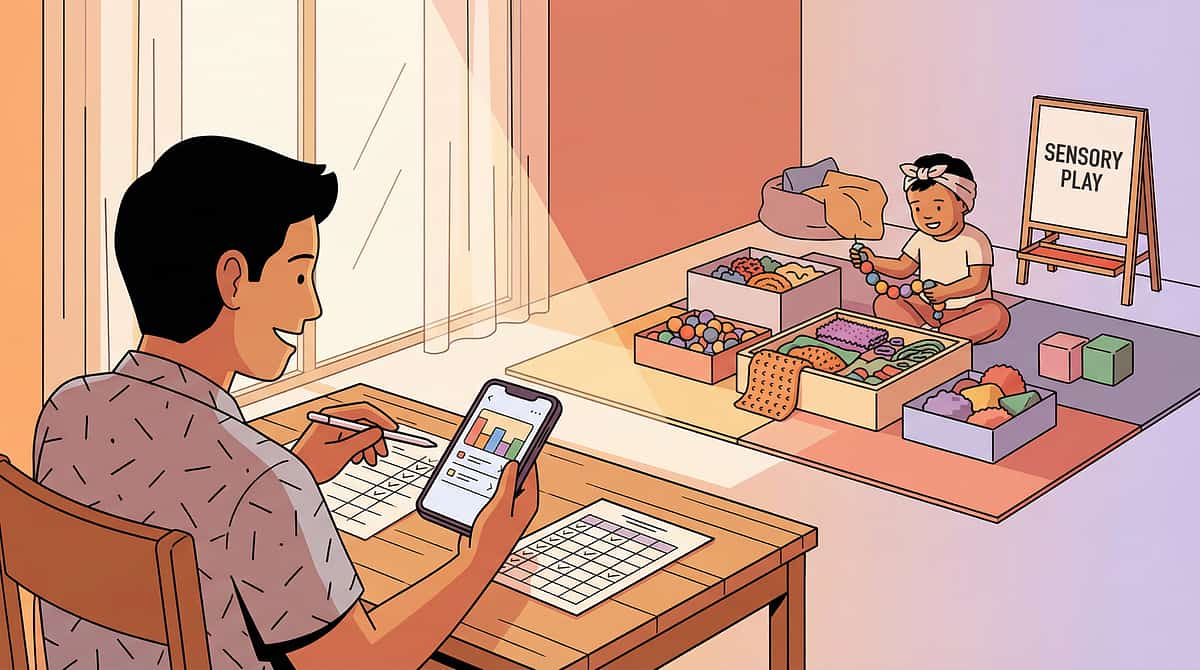
Capture the Data: Right Now
60 seconds · While the session is fresh
Data collection doesn't need to be complicated. Three fields, captured immediately after each session, give you and your therapist a clear picture of trajectory over time. This is what turns daily practice into evidence-based progress.
Number of Questions Attempted
Simple tally count during the session. Don't wait — memory degrades fast. Example: 7 attempts
Best Question of the Session
Write the exact words the child used. This is your most motivating data point. Example: "Where is ball?"
Support Level Needed
Circle one: FULL support / PARTIAL support / INDEPENDENT. This single metric tracks the most important dimension of progress. Example: Partial
Optional Additional Data
- Question types used today (circle): WHO / WHAT / WHERE / WHEN / WHY / HOW / YES-NO
- Specific errors observed: Word order / Missing auxiliary / Wrong wh-word / Other
- Child's engagement level: High / Medium / Low
- Session duration: ___ minutes
GPT-OS® Integration: Upload session data through the Pinnacle app for personalized recommendations and readiness tracking via the Expressive Language Readiness Index.
"60 seconds of data now saves hours of guessing later."

Common Challenges & Immediate Fixes
Every family hits roadblocks. These are the seven most common — each with a tested, specific solution you can try today. If a challenge isn't on this list, consult your SLP or the GPT-OS® support chat.
Problem 1: "My child won't sit down to do this."
Fix → Don't sit. Walk around the house playing "I Spy Questions" — "What is THAT? Where did THAT come from?" Movement + questions = engagement.
Problem 2: "My child just repeats my questions (echolalia)."
Fix → This is echolalia serving a communicative function — the child IS trying. Start with fill-in-the-blank: "WHERE is the ___?" and let them complete. Gradually transfer ownership.
Problem 3: "My child gets frustrated and shuts down when corrected."
Fix → Stop correcting directly. Use RECASTING instead: Child says "You going where?" → You respond naturally: "You want to know WHERE I'M GOING? I'm going to the kitchen!" Correct form modeled, no correction delivered.
Problem 4: "My child only asks 'what' and nothing else."
Fix → Celebrate the "what"! Now introduce ONE new question word (usually "where" is easiest next). Use contrast cards side by side: "WHAT asks about things. WHERE asks about places. Let's try WHERE."
Problem 5: "My child uses questions at therapy but not at home."
Fix → Use the same materials at home that the therapist uses. Create the same question-rich opportunities (barrier games, mystery objects). Generalization requires consistency across settings.
Problem 6: "No progress after 2 weeks."
Fix → Look for MICRO-progress: Is the child more willing to try? Are errors slightly different (evolving)? Is imitation improving? If truly no change after 4–6 weeks, consult your SLP for protocol adjustment.
Problem 7: "My child became very upset during the session."
Fix → Stop immediately. Provide comfort. Note what triggered the upset. Discuss with your therapist. Some children need gentler entry points — start with puppets only, or embed questions into preferred activities.
"Session abandonment is not failure — it's data."
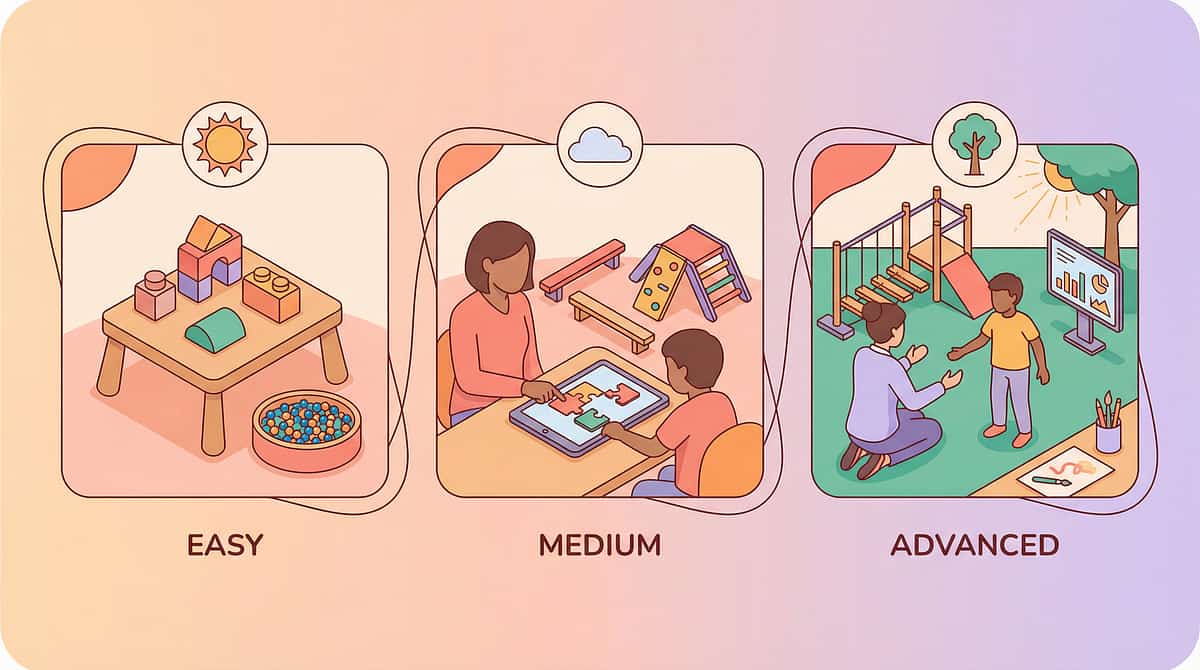
Make It Your Child's
The protocol is a framework, not a script. Every child's sensory profile, age, personality, and developmental level calls for personalization. Here is how to dial the approach to fit your specific child.
1
Easier
2 question types (what, where) · Imitation only · Binary choice · Single-word attempts accepted · 3–5 minute sessions
2
Standard
4 question types · Supported production with visual frame · Open generation with picture prompt · Phrase-level questions · 10–15 minute sessions
3
Advanced
All 6 types including WHY and HOW · Independent generation · Spontaneous questioning in conversation · Full grammatically correct questions · 15–20 minute sessions
Sensory Profile Adaptations
- Sensory Seeker: Use dice games, physical card manipulation, movement-based question activities. Let the child throw the die, spin the spinner, and physically build questions.
- Sensory Avoider: Quiet, predictable materials — flip books, picture cards. Dim lighting. No time pressure. Puppet can mediate the interaction.
Personality Adaptations
- Competitive child: Turn it into a game with points — "Who can ask the most questions?"
- Creative child: Scene cards with story-building — questions drive the narrative
- Tech-oriented child: Apps and video modeling as primary materials
- Social child: Barrier games with siblings or peers
Age Adaptations
- Ages 3–4: WHAT and WHERE only. Real objects, not pictures. Puppet-led. 5-minute sessions.
- Ages 5–6: Add WHO, WHEN. Picture cards, question frames. 10-minute sessions.
- Ages 7–10: All types including WHY and HOW. Barrier games, academic contexts. 15–20 minutes.

Weeks 1–2: The Foundation
Progress: ~15%
The first two weeks are about establishing safety, routine, and the very first flickers of question structure. Do not measure this phase against the end goal — measure it against yesterday.
✅ What You WILL See
- Increased willingness to sit with the materials (even briefly)
- Beginning to recognize wh-word cards visually
- Attempting to imitate your modeled questions (even imperfectly)
- Some correct question forms when heavily prompted and supported
- Growing familiarity with the session routine
❌ What You Will NOT See Yet
- Spontaneous questioning throughout the day
- Consistent correct question forms
- Use of all question types
- Generalization to school or other settings
What "Progress" Looks Like
If your child imitates "Where is the ball?" correctly after you model it three times — that's real progress. If they point to the right wh-word card when you say "which word asks about places?" — that's real progress. If they willingly sit for 5 minutes of question practice when they wouldn't before — that's massive progress.
"If your child attempts one more question this week than last week — the neural pathways are forming."

Weeks 3–4: The Patterns Emerge
Progress: ~40%
By weeks 3 and 4, you'll begin to see the architecture of question formation taking shape. Error patterns may shift — and that shift is a good sign. The brain is reorganizing, not regressing.
📈 Consolidation Indicators
Child begins to anticipate the session · Questions using 1–2 supported types (WHAT, WHERE) becoming more consistent · Child may start labeling wh-word cards independently · Some question attempts outside of sessions
🧠 Neural Pathway Signs
Child reaches for a wh-word card before you prompt · Errors become more sophisticated: "What is you doing?" (auxiliary present but not inverted) is PROGRESS from "What you doing?" (auxiliary absent) · Child self-corrects occasionally — even once is significant
📊 When to Increase
If the child consistently forms 2+ question types with only partial support → add one new question type. WHO or WHEN are typically easiest after mastering WHAT and WHERE.
👩👦 Parent Milestone
You may notice YOU are more confident modeling questions, spotting errors, and using recasting naturally. Your fluency in the protocol is a real outcome too.

Weeks 5–8: The Breakthrough Zone
Progress: ~75%
This is where the work pays off visibly. Spontaneous questions begin to emerge — not just during sessions, but in the kitchen, at bedtime, on the way to school. These are the moments you have been working toward.
Mastery Criterion | Measured By | Achieved? | |
Correctly forms 3+ question types independently | Session data | ||
Asks questions outside of structured sessions | Parent observation log | ||
Uses questions to get real information (not just during practice) | Functional communication check | ||
Can request clarification when confused ("What do you mean?") | Natural observation at home/school | ||
Errors reduced to less than 30% of attempts | Session data comparison | ||
Willingly engages in question practice without resistance | Session engagement rating |
🏆 Mastery Unlocked
When your child spontaneously uses 3+ question types across 2+ settings with less than 30% error rate — mastery has been achieved. Celebrate this milestone. It is real.
When to Move Forward: If mastery criteria are met → Progress to B-204 (Pronoun Use) or increase question complexity. If not yet at mastery → Stay at the current level. Mastery takes as long as it takes. Increase session variety, not pressure.

You Did This.
To the parent reading this card — you sat with your child when they couldn't ask a single question. You held up card after card, modeled question after question, played game after game — not knowing if it was working. You chose patience when frustration was easier. You chose consistency when skipping a day was tempting. You chose to believe that somewhere inside your child, the questions were forming — even when you couldn't hear them yet.
"And now you can hear them. Every 'Where is my toy?' that comes out right. Every 'What are you doing?' with the words in the right order. Every spontaneous 'Why?' that shows your child's curiosity has found its voice. That is your achievement. Your child grew because of your commitment."
🎉 Celebration Suggestion
Mark this milestone. Take a video of your child asking a question. Write down the first spontaneous question they asked and the date. Share it with your family. This moment matters.
📸 Journal Prompt
"The first question my child asked spontaneously was: _______________ on [date]. I felt: _______________"

Clinical Guardrails: When to Pause
Important · Read This Card
Home practice is powerful — but it has boundaries. If you observe any of the following, pause your sessions and contact a professional. Trust your instincts: if something feels wrong, it probably warrants attention.
🔴 Complete Regression
Child was asking questions and has stopped entirely → May indicate a medical, emotional, or environmental change requiring professional evaluation.
🔴 Severe Frustration / Behavioral Escalation
Sessions consistently trigger meltdowns, self-injurious behavior, or extreme distress → The approach may need modification by a professional. Stop immediately.
🔴 No Progress After 6+ Weeks
Zero change in question attempts, accuracy, or willingness after consistent daily practice → Comprehensive language evaluation is recommended to identify underlying factors.
🔴 Hearing Concerns
Child doesn't respond to questions, seems not to hear, or has frequent ear infections → Audiology assessment is essential before continuing language intervention.
🔴 Loss of Other Language Skills
While working on questions, child appears to lose vocabulary, sentence length, or communication willingness → Comprehensive reassessment needed immediately.
🔴 New Concerning Behaviors
Onset of repetitive behaviors, loss of eye contact, social withdrawal alongside language difficulties → NeuroDevelopmental pediatric consultation recommended.
Self-Resolve
Minor session difficulties → Review Card 21 troubleshooting
Teleconsultation
Persistent challenges → Book a Pinnacle teleconsult: 9100 181 181
Clinic Visit
Significant concerns → Visit nearest Pinnacle center for comprehensive evaluation

Your Developmental GPS
B-203 Teaching Question Forms does not stand alone. It sits within a carefully sequenced curriculum of language development techniques. Here is exactly where you are, what came before, and where you're headed next.
Prerequisites
- Basic vocabulary (50+ words)
- Simple sentence production (2–3 word combinations)
- Understanding of question words when asked by others
Next-Level Options
- Questions emerging but pronouns confused →B-204: Pronoun Use
- Questions forming but conversation skills limited → C-301: Pragmatic Language
- Questions strong but narrative language weak → B-205: Narrative Language
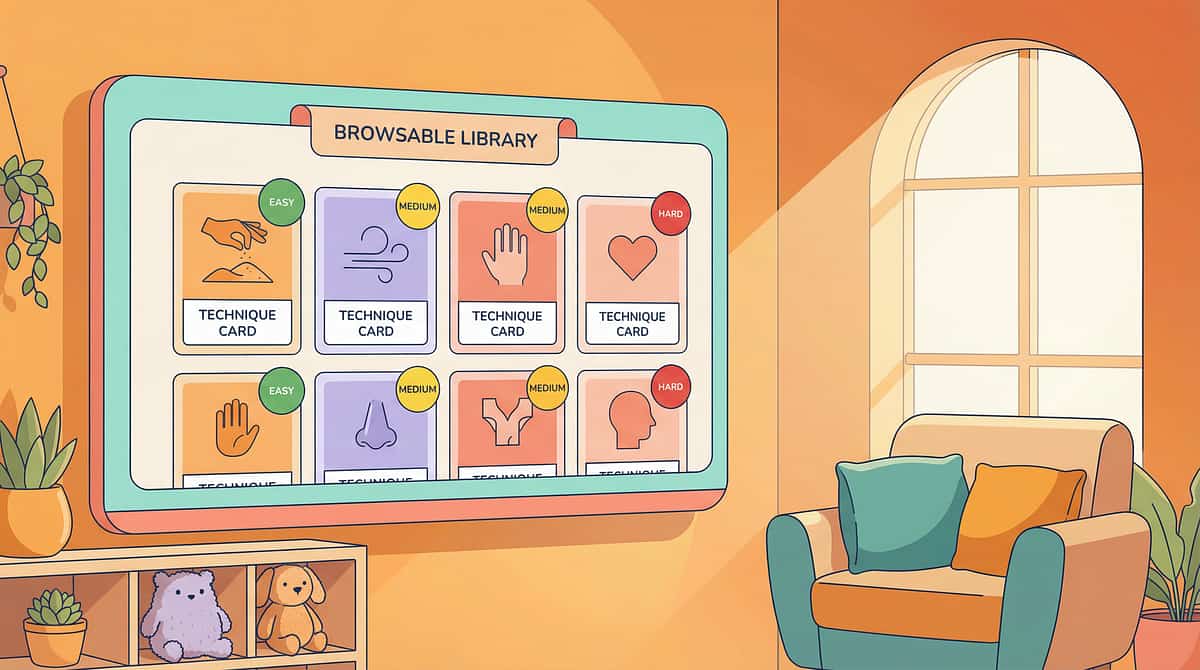
Explore Communication Domain Techniques
Your wh-word cards, question frames, scene cards, and barrier games serve across multiple communication techniques. Maximum return on your material investment — and a clear pathway forward as your child grows.
Technique | Difficulty | Materials You Already Own | |
B-201: Teaching Verb Tenses | Core | Sentence strips, picture sequences ✅ | |
B-202: Building Sentence Length | Intro | Word cards, picture cards ✅ | |
B-203: Teaching Question Forms | Core | ← YOU ARE HERE | |
B-204: Teaching Pronoun Use | Core | Sentence frames, picture cards ✅ | |
B-205: Narrative Language Building | Advanced | Scene cards, sequence cards ✅ | |
B-206: Following Directions | Intro | Barrier games, picture cards ✅ |
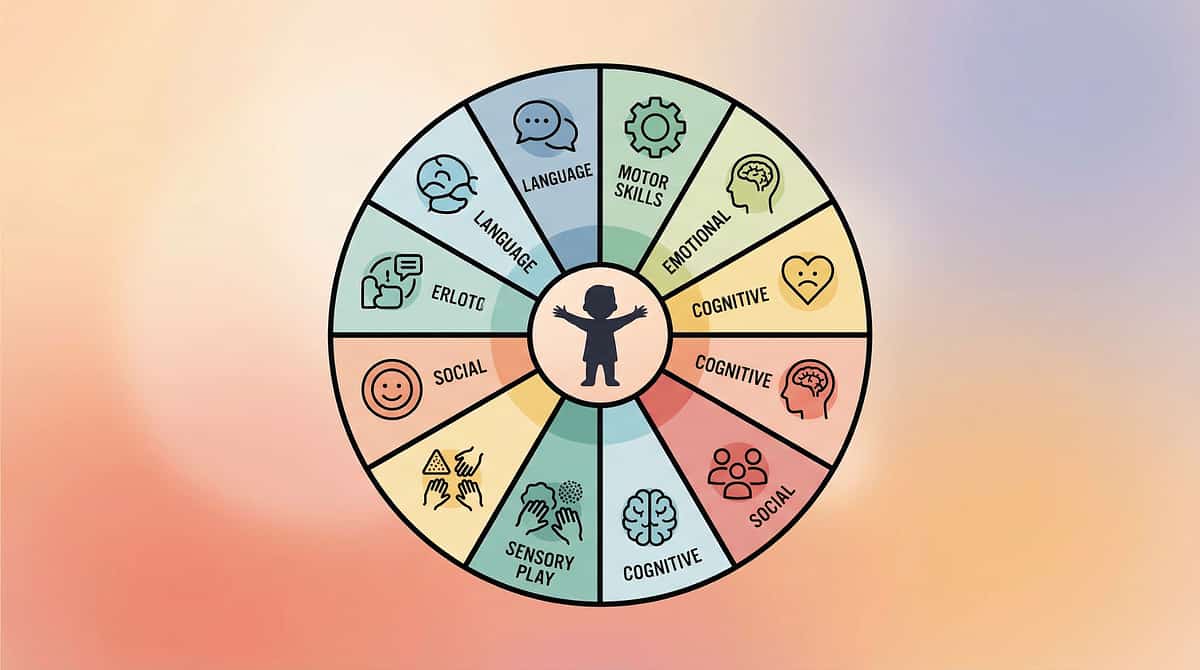
The Bigger Picture: Your Child's Full Developmental Map
Question formation is one piece of a larger, interconnected developmental plan. When your child learns to ask questions, the impact cascades across every domain — better social interactions, reduced frustration behaviors, improved academic participation, and greater independence.
"This technique is one piece of a larger plan." When your child learns to ask questions, it cascades across every domain — better social interactions, reduced frustration behaviors, improved academic participation, greater independence.
Real Families. Real Outcomes.
These are the outcomes that matter most. Every number in our evidence base represents a child who now asks questions — and a family that found the path.
Ravi, age 6 — Hyderabad
Before: Ravi answered every question but never asked one. When curious, he would point or state: "I want to know about the train." His teacher reported he never raised his hand in class.
After 12 weeks: Using wh-word cards and barrier games daily, Ravi asked his first "Why" question by week 8: "Mom, why do butterflies have spots?" His teacher now reports he asks for help in class.
"He's asking now. Really asking." — Ravi's mother
Ananya, age 4 — Bangalore
Before: Ananya's only question form was rising intonation on statements: "I can have juice?" "We going park?" Comprehension was intact; structure was not.
After 8 weeks: Color-coded sentence strips taught the auxiliary inversion rule. Puppet play reduced her anxiety about getting it wrong. She now asks "Can I?" and "Where is?" consistently.
Dev, age 8 — Pune
Before: Dev never asked clarifying questions at school. When confused, he would sit silently or guess. Academic performance suffered.
After 10 weeks: Information-gap games at home translated directly to classroom questioning. Dev now raises his hand to ask "What does that mean?" His grades improved as his ability to seek information grew.
Note: Illustrative cases from the Pinnacle clinical network. Individual outcomes vary by child profile, severity, and consistency of implementation.
You Are Not Doing This Alone
The families who navigate this journey most successfully are the ones who find each other. Peer support — from parents who have already walked this path — is one of the most powerful resources available to you.
WhatsApp Group: "Question Builders"
Parents sharing daily wins, strategies, and support for children learning to ask. Real-time encouragement from families navigating the exact same journey.
Pinnacle Parent Forum
Language & Communication section — ask questions to therapists and other parents. Searchable archives of thousands of conversations about question formation challenges.
Local Pinnacle Parent Meetups
Connect with families at your nearest Pinnacle center. In-person connection with parents who understand what you're navigating — because they're navigating it too.
Peer Mentoring
Connect with an experienced parent who has already navigated question formation intervention with their child. Their perspective can be invaluable during challenging weeks.
"Your experience helps others — consider sharing your journey."
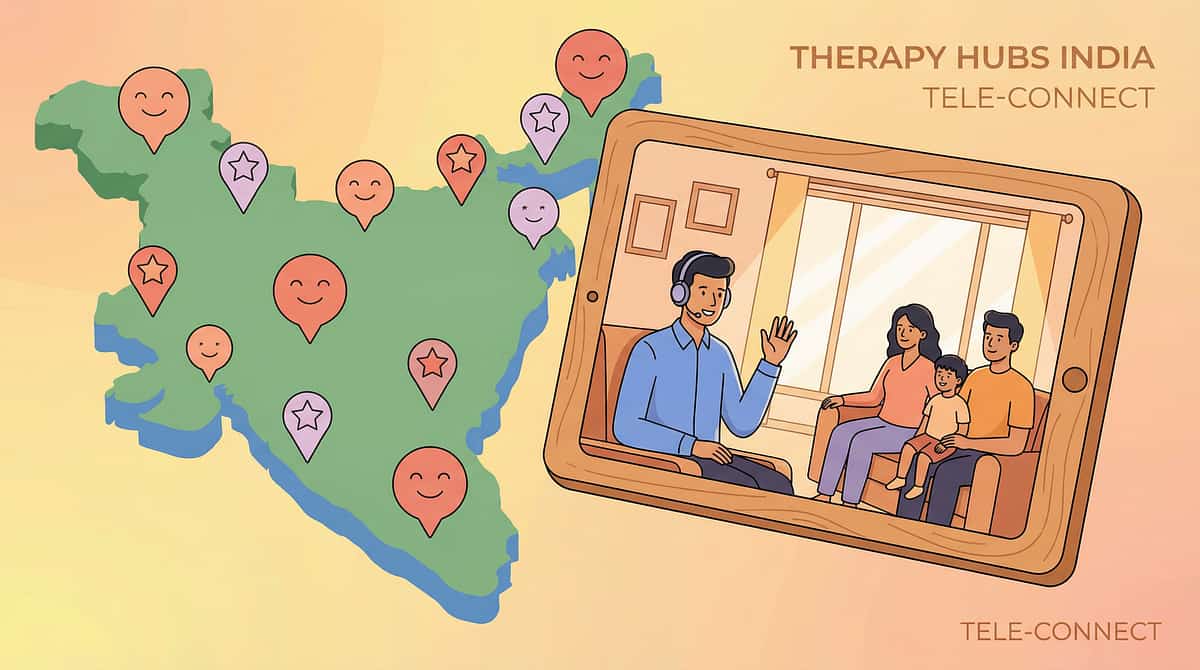
Professional Backup — When You Need It
"Home + Clinic = Maximum Impact." Home-based practice builds frequency; professional sessions build precision. Together they accelerate outcomes far beyond what either can achieve alone.
Pinnacle Blooms Network®
70+ Centers Across India
Find your nearest Pinnacle center for:
- Comprehensive speech-language evaluation
- AbilityScore® assessment
- Therapist-guided question formation intervention
- Parent coaching for home protocol optimization
- Teleconsultation for remote families
Therapist Matching: We match your child to an SLP with specific expertise in interrogative syntax intervention and your child's developmental profile.
Contact Us
📞FREE National Autism Helpline: 9100 181 181
16+ languages, available 24/7
16+ languages, available 24/7
Evidence Base — For the Curious Parent
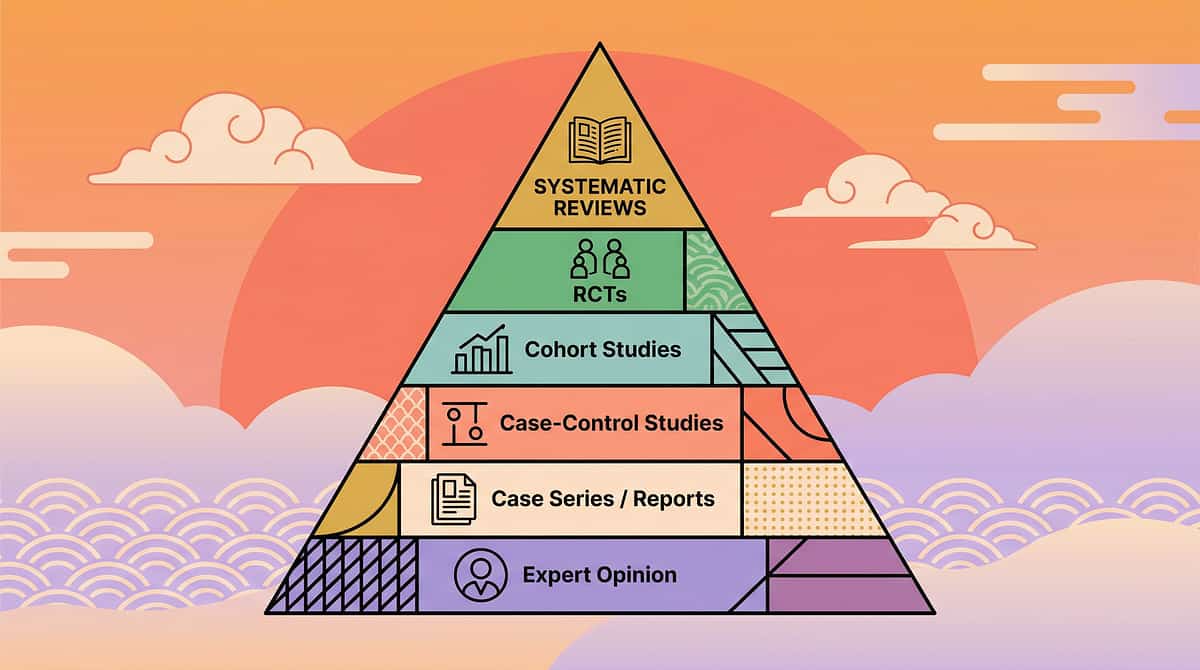
Every recommendation in this guide is anchored in peer-reviewed research. Here is the hierarchy of evidence supporting teaching question forms — organized from the strongest to the most contextually applied.
Level | Study Type | Relevant Studies | |
I | Systematic Reviews & Meta-Analyses | PRISMA systematic review on language intervention for ASD (2024, Children journal — PMC11506176); Meta-analysis on structured language therapy outcomes (World J Clin Cases, 2024 — PMC10955541) | |
II | Randomized Controlled Trials | Indian home-based intervention RCT (Indian J Pediatrics, 2019 — DOI: 10.1007/s12098-018-2747-4); Multiple RCTs on visual support-based language intervention | |
III | Cohort & Clinical Studies | Pinnacle Blooms Network® longitudinal outcome data (20M+ sessions, 97%+ improvement); Multi-site clinical effectiveness studies | |
IV | Expert Consensus & Guidelines | ASHA Evidence-Based Practice Portal; NCAEP Evidence-Based Practices Report (2020); WHO Nurturing Care Framework (2018) |
Key References
- PMC11506176 — Systematic review confirming evidence-based status of structured language intervention for ASD
- PMC10955541 — Meta-analysis: language therapy promotes syntactic skills, pragmatic communication, and adaptive behavior
- PMC9978394 — WHO/UNICEF CCD Package implementation across 54 countries
- DOI: 10.1080/17549507.2022.2141327 — Adapted UNICEF/WHO Framework for speech-language pathology
- DOI: 10.3389/fnint.2020.556660 — Neurological basis for language-based interventions in ASD
- NCAEP (2020) — Visual supports and video modeling as evidence-based autism practices

How GPT-OS® Uses Your Data
When you record session data in Card 20 and upload it to the Pinnacle platform, you're not just tracking progress — you're contributing to an adaptive intelligence system that personalizes every future recommendation for your child.
GPT-OS® learns which question types are easiest and hardest for your child, the optimal session duration before fatigue sets in, the most effective materials for your child's specific sensory and cognitive profile, and rate of progress compared to similar developmental profiles across 20 million sessions.
Privacy & Data Protection: All data is encrypted in compliance with Indian IT Act and DPDP Act 2023. Your child's data is never shared without your explicit consent. You can request data deletion at any time. De-identified population data improves recommendations for all families.
"Your data helps every child like yours."

Watch: 9 Materials That Help Teaching Question Forms
Reel ID
B-203
Series
Language & Communication Solutions — Episode 203
Domain
Speech-Language · Expressive Language · Syntax · Pragmatics
Duration
75–85 seconds
In this Reel, a Pinnacle speech-language pathologist demonstrates:
- Each of the 9 materials in action with a real child
- How to model question forms so your child can see the structure
- The barrier game technique for functional questioning that creates real communicative need
- Common error patterns and how to rcast them naturally — without correction or pressure
- The progression from supported to spontaneous questioning across a session
Presented by the Pinnacle Blooms Network® Clinical Consortium

Consistency Across Caregivers Multiplies Impact
The most powerful variable in your child's progress is consistency — not perfection. When grandparents, teachers, and siblings all understand the approach, your child gets question-rich opportunities every waking hour, not just during formal sessions.
Share This Page
📱 WhatsApp — Share directly to your family group
📧 Email — Send to spouse, grandparents, teacher
Downloads
📄 1-Page Family Guide PDF — Print for the refrigerator
📄 Question Tracking Sheet PDF — Print multiple copies
"Explain to Grandparents" Version
"[Child's name] is learning how to ask questions. When they try to ask something, even if the words come out wrong, please be encouraging and answer their question. You can help by asking them lots of questions and showing them how questions work. Please don't correct them harshly — just model the right way by repeating their question correctly."
Teacher Communication Template
"[Child's name] is working on question formation skills. They are learning to ask who, what, where, when, why, and how questions. They may use visual supports (question word cards). Please create opportunities for them to ask questions in class and reinforce any question attempts, even imperfect ones."

Your Questions, Answered
The most common questions parents ask about teaching question forms — answered with clinical accuracy and the warmth of someone who knows how much is riding on this.
Why can my child answer questions but not ask them?
Comprehension and production use different neural pathways. Understanding question structure (receptive) is processed in Wernicke's area. Generating question structure (expressive) requires Broca's area to perform complex operations — selecting the right question word, moving it to the front, and inverting word order. Answering and asking are fundamentally different skills.
How long until my child asks questions spontaneously?
Most children show emerging question use with supports within 3–4 weeks of consistent daily practice. Spontaneous, independent questioning typically develops over 8–16 weeks depending on severity, consistency, and developmental profile. Some children progress faster; some need longer. All timelines are valid.
Should I correct my child when they get word order wrong?
Do NOT correct directly. Instead, use RECASTING — naturally repeat their intended question with the correct structure. Child: "You going where?" → Parent: "You want to know WHERE I'M GOING? I'm going to the store!" This models correct form without creating anxiety or shame.
My child only asks one type of question. Is that enough?
It's a great START. Celebrate the question type they have and systematically introduce new types one at a time. Typical progression: WHAT → WHERE → WHO → WHEN → WHY → HOW. Don't rush — each type builds on the foundation of the previous one.
Can this technique work for non-verbal or minimally verbal children?
Visual supports (wh-word cards, question frames) can be adapted for AAC users. Question words can be programmed into communication devices. Barrier games work with any communication modality. Consult your SLP for AAC-specific adaptations.
How is this different from what happens in therapy sessions?
Professional sessions provide assessment, precision targeting, and clinical expertise. Home practice provides frequency, generalization, and real-world functional context. Together they are far more effective than either alone. This page provides the home practice component designed to complement professional therapy.
My child is older (8–10). Is it too late?
Neuroplasticity continues throughout childhood. While earlier intervention often yields faster results, children ages 8–10 can and do learn question formation skills. The materials and approach may need age-appropriate adaptation — more sophisticated games, academic contexts, and peer practice settings.
What if my child has co-occurring conditions (ADHD, intellectual disability)?
Question formation techniques can be adapted for many co-occurring conditions. Session length, complexity, and reinforcement may need adjustment. A multidisciplinary team (the Pinnacle FusionModule™ approach) ensures all contributing factors are addressed simultaneously.

Your Next Step
You have everything you need. The science is clear. The protocol is in your hands. Your child is ready — and so are you. Choose your starting point below.
🟢 Start This Technique Today
Launch a GPT-OS® Guided Question Formation Session — a 10-minute guided session with real-time prompts, data capture, and personalized feedback.
🔵 Book a Consultation
Book a FREE consultation with a Pinnacle Speech-Language Pathologist who specializes in interrogative syntax intervention.
📞9100 181 181 — FREE National Autism Helpline, 16+ languages, 24/7
🟡 Explore the Next Technique
Ready to expand beyond question forms? B-204 Teaching Pronoun Use builds naturally on the syntactic foundations you've just established.
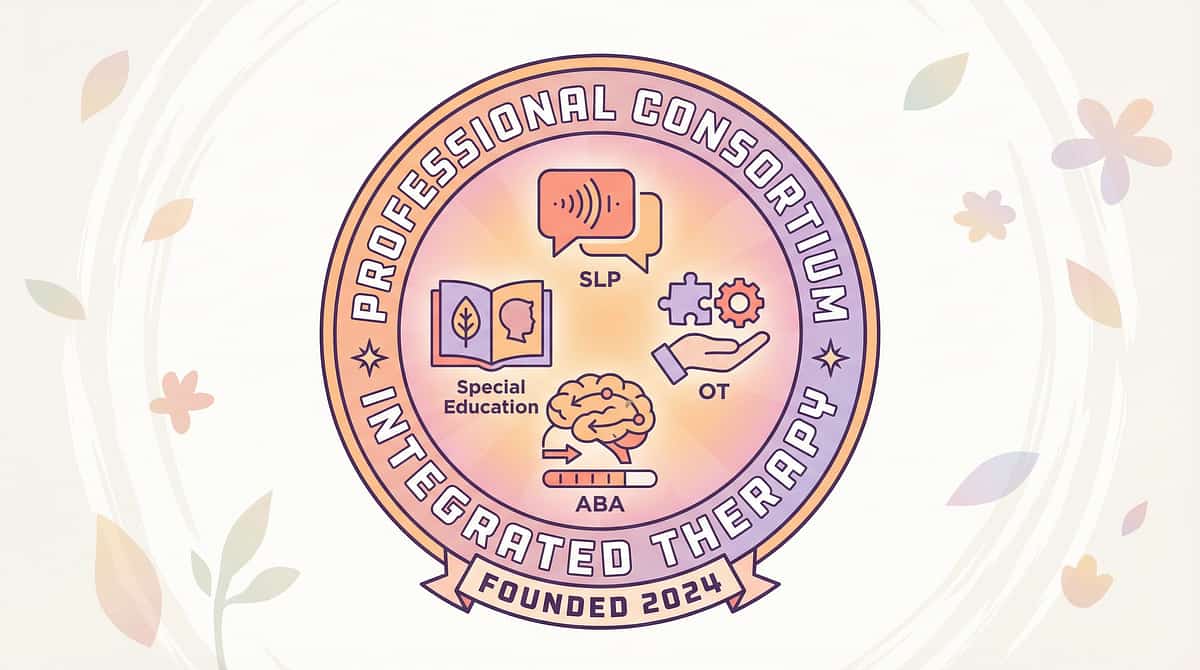
Validated by the Pinnacle Blooms Consortium:🗣️ SLP · 🧩 BCBA · 🎨 OT · 📚 SpEd · 🩺 NeuroDev · 🔬 CRO
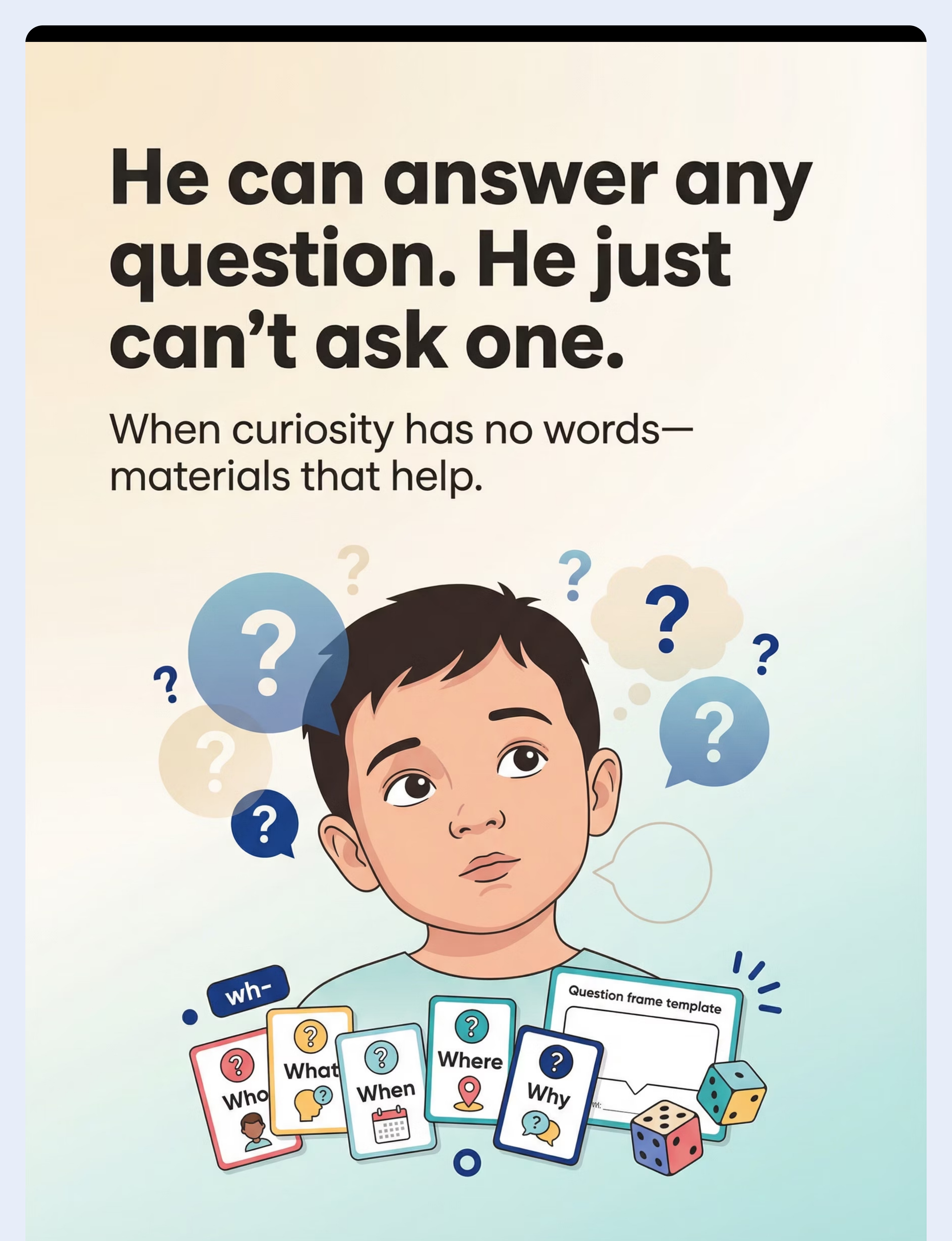
Preview of 9 materials that help teaching question forms Therapy Material
Below is a visual preview of 9 materials that help teaching question forms therapy material. The pages shown help educators, therapists, and caregivers understand the structure and content of the resource before use. Materials should be used under appropriate professional guidance.


Link copied!
From Fear to Mastery. One Technique at a Time.
🗣️ Speech-Language Pathologists
Lead clinical protocol design and accuracy monitoring
🧩 Board Certified Behavior Analysts
Reinforcement architecture and functional motivation
🎨 Occupational Therapists
Sensory and regulatory readiness for language sessions
📚 Special Educators
Academic integration and IEP goal development
🩺 NeuroDevelopmental Pediatricians
Neurological evaluation and developmental trajectory monitoring
🔬 Clinical Research Organization
Evidence validation and population-level outcome analysis
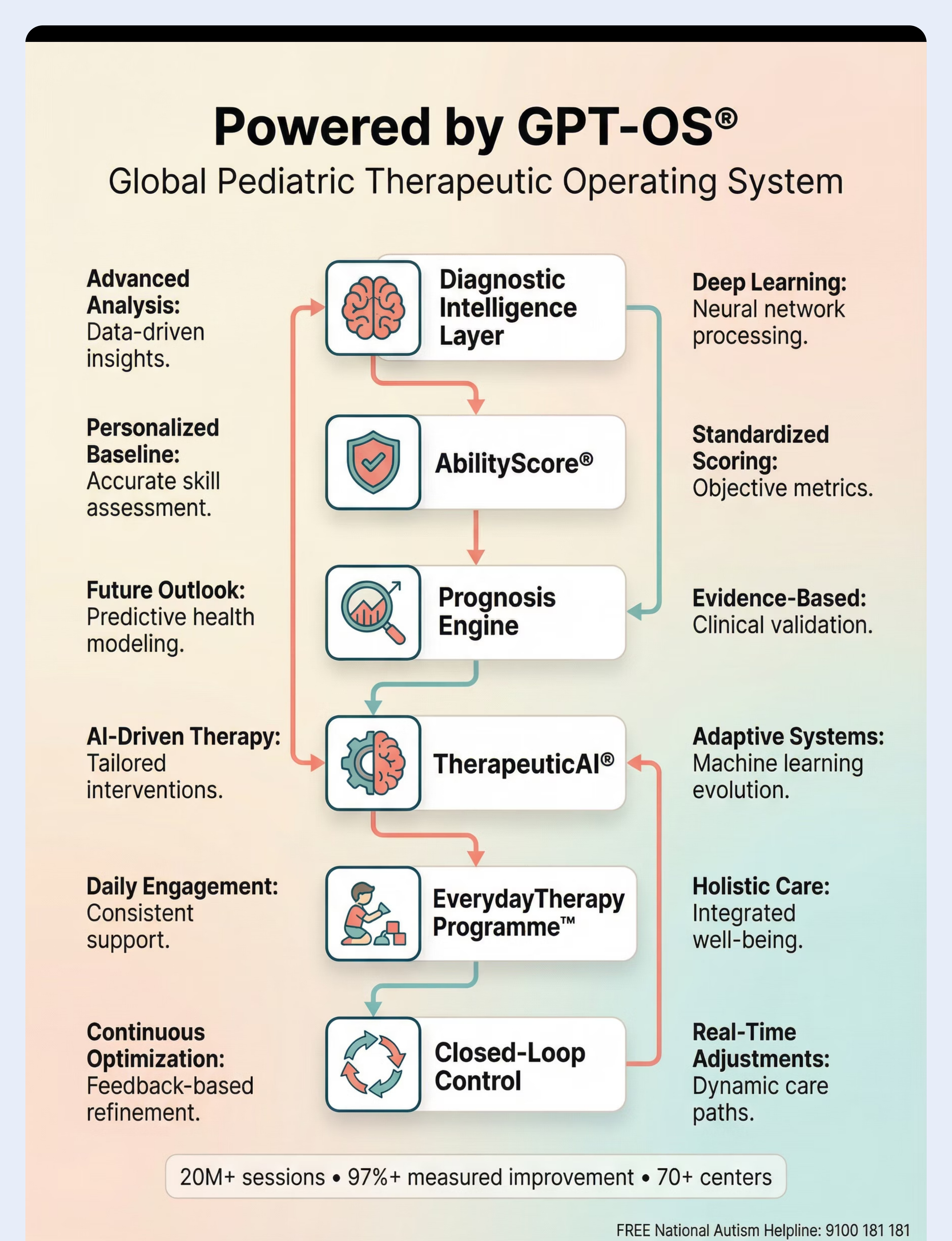
Powered by GPT-OS®
Global Pediatric Therapeutic Operating System
20M+ exclusive 1:1 sessions · 97%+ measured improvement · 70+ centers · Patents filed across 160+ countries
Medical Disclaimer: This content is educational and does not replace assessment by a licensed speech-language pathologist. Significant or persistent difficulties with question formation should be evaluated comprehensively. Individual results may vary. Statistics represent aggregate outcomes across the Pinnacle Blooms Network.
© 2025 Pinnacle Blooms Network®, unit of Bharath Healthcare Laboratories Pvt. Ltd. All rights reserved.
CIN: U74999TG2016PTC113063 | DPIIT: DIPP8651 | MSME: TS20F0009606 | GSTIN: 36AAGCB9722P1Z2
techniques.pinnacleblooms.org — Built by Mothers. Engineered as a System.
CIN: U74999TG2016PTC113063 | DPIIT: DIPP8651 | MSME: TS20F0009606 | GSTIN: 36AAGCB9722P1Z2
techniques.pinnacleblooms.org — Built by Mothers. Engineered as a System.