

"I Point to the Bird. He Looks at My Finger."
You're at the window. A beautiful bird lands on the branch right outside. You point excitedly — "Look! A bird!" — and your child stares at your hand. Or looks at your face. Or turns away entirely. You try again with his favorite toy across the room. Same thing.
"You are not failing. Your child hasn't yet learned that your pointing leads somewhere wonderful. This is a learnable skill — and you're about to learn exactly how to teach it."
Responding to Joint Attention (RJA): 9 Materials That Build the Bridge of Shared Attention
SOC-JA-RJA
Joint Attention Development · Episode 127
GPT-OS® Validated

ACT I — THE EMOTIONAL ENTRY
You Are Among Millions
The difficulty your child has following your point is one of the most documented, most studied, and most teachable early developmental challenges in the world. You are not alone — and science is firmly on your side.
70–80%
Children with autism
show reduced responding to joint attention — difficulty following another person's point or gaze to a shared target. Source: Mundy et al., 2007; Bottema-Beutel, 2016
9–12 mo
Typical emergence
Point-following typically emerges at 9–12 months. Persistent absence by 18 months is one of the earliest and most reliable markers in autism screening. Source: Brooks & Meltzoff, 2005
1 in 36
Children globally
are diagnosed with autism spectrum disorder (CDC, 2024). In India, estimates range from 1 in 68 to 1 in 100 — millions of families navigating this exact challenge.
Parent-mediated joint attention intervention shows consistent, measurable improvements in RJA skills in young children with ASD — confirmed across 11 studies using PRISMA methodology (DOI: 10.1080/07317107.2024.2338741) and a 2026 meta-analysis (DOI: 10.1007/s10803-025-07195-y).

ACT I — NEUROSCIENCE
What's Happening in Your Child's Brain
The Neural Pathway
When you point, your child's brain must: See the pointing gesture → Understand that your finger means "look there" → Shift attention from you to the distant target → Connect the target with your communication.
Two regions must work together: the Superior Temporal Sulcus (STS), which processes social cues like gaze direction, and the Temporoparietal Junction (TPJ), which handles perspective-taking — understanding that YOU are trying to show THEM something.
A Difference, Not a Deficiency
In children with autism, eye-tracking and neuroimaging research has found that the STS and TPJ show different activation patterns during joint attention tasks. The neural pathway for following points is wired differently — not broken, but taking a different route.
With the right materials and systematic practice, these neural pathways strengthen. Early intervention RCTs have confirmed that structured RJA practice increases reactive joint attention in autistic preschoolers — with arousal regulation as a key mediator (DOI: 10.1007/s00787-025-02738-1).
"This is a wiring difference, not a behavior choice. Your child isn't ignoring you — their brain processes your pointing gesture differently."
ACT I — DEVELOPMENT
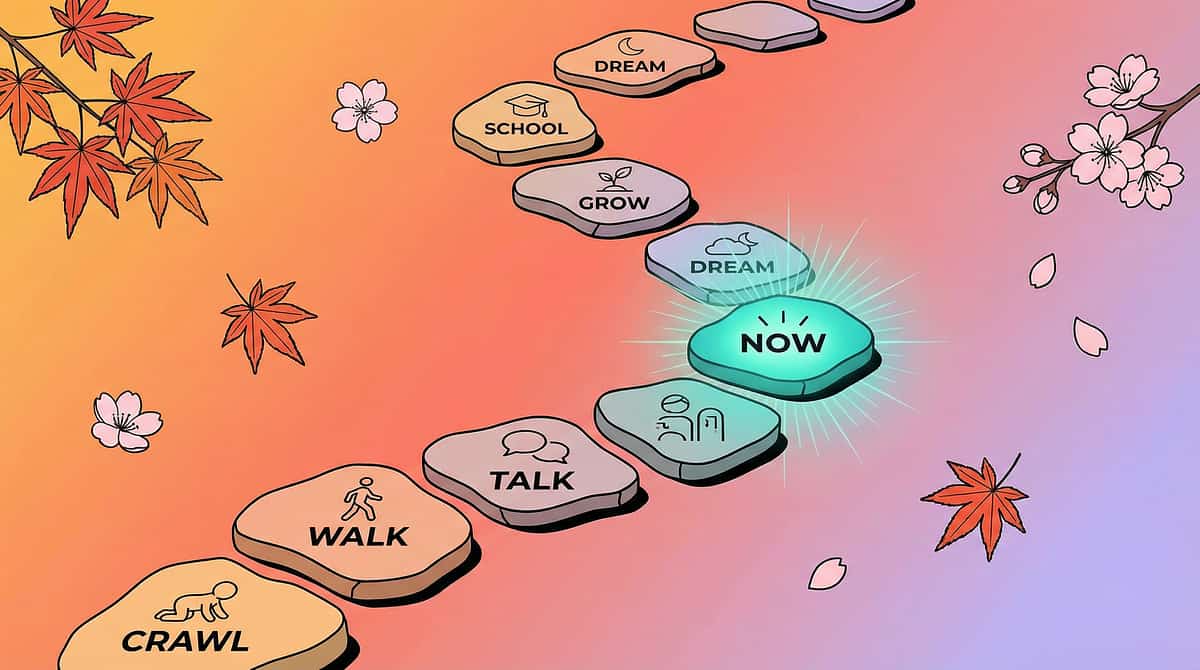
The Developmental Timeline of Point-Following
Understanding where this skill fits in your child's developmental arc helps you set realistic expectations — and recognize real progress when it happens.
6–9 Months
Beginning gaze following — child starts tracking faces and broad head turns
9–12 Months
Following points to nearby objects — the skill emerges with high-motivation targets close by
12–14 Months
Consistent near-distance point-following — reliable for preferred objects within 1–2 meters
14–18 Months
Following distant points — expanding to 3+ meters; environmental pointing begins
18–24 Months
Spontaneous point-following — supporting incidental learning across natural environments
Why this skill is a gateway skill: Joint attention (responding to points) opens the door to word learning, instruction following, classroom participation, and social learning. Children who follow points connect words to objects — without this bridge, thousands of word-referent connections are missed daily. Source: Morales et al., 2000; Brooks & Meltzoff, 2005

ACT I — EVIDENCE
The Evidence Behind This Technique
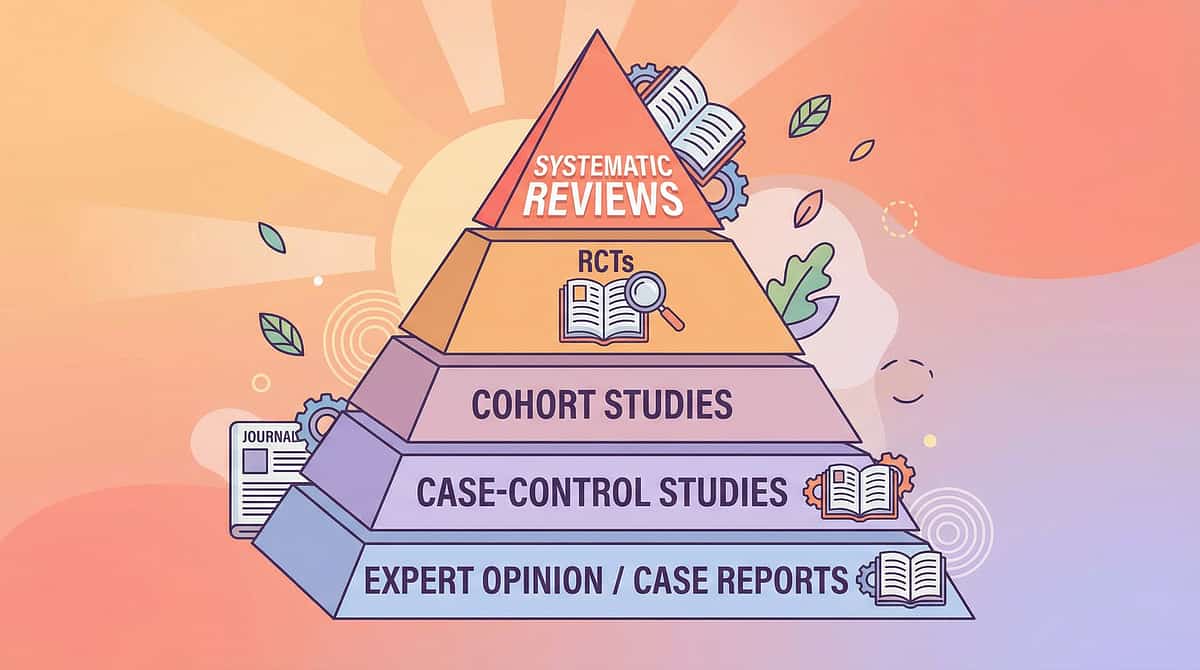
LEVEL I–II: STRONG EVIDENCE
Systematic Reviews + RCTs
Systematic Reviews
4+ major reviews confirm parent-mediated JA intervention consistently improves RJA skills in young children with ASD
Randomized Controlled Trials
11+ RCTs in PRISMA review show significant improvements in joint attention following structured intervention
Meta-Analysis (2024/2026)
Effect sizes significant for RJA specifically; RJA more strongly related to language than other JA types
Pinnacle Network Data
20M+ therapy sessions; 97%+ measured improvement on Social Participation Index
"Joint attention interventions, particularly parent-mediated approaches, produce statistically significant improvements in responding to joint attention — and RJA is the strongest predictor of language development among all joint attention types."
Key sources: DOI: 10.1080/07317107.2024.2338741 · DOI: 10.1007/s10803-025-07195-y · Bottema-Beutel (2016), Autism Research, PubMed: 27059941 · DOI: 10.1007/s00787-025-02738-1 · PMC5683273
ACT II — KNOWLEDGE TRANSFER
The Technique — What It Is
Responding to Joint Attention (RJA) Training Through Multi-Sensory Point-Following Materials
Parent-Friendly Name:"Teaching Your Child to Look Where You Point"
This technique uses 9 carefully selected materials — light, sound, high-motivation objects, books, and environmental tools — to systematically teach your child that when you point, something interesting, exciting, or important is in that direction. By placing rewarding targets where you point, you create hundreds of natural practice opportunities. Over time, your child learns that following your point leads somewhere wonderful — unlocking word learning, instruction following, and shared experience.
Domain
Social Communication (SOC-JA-RJA)
Age Band
9 months – 3 years
Session Duration
5–15 minutes, 3–5× daily
Difficulty
Introductory → Core (progressive)
ACT II — DISCIPLINES
Five Disciplines. One Technique.
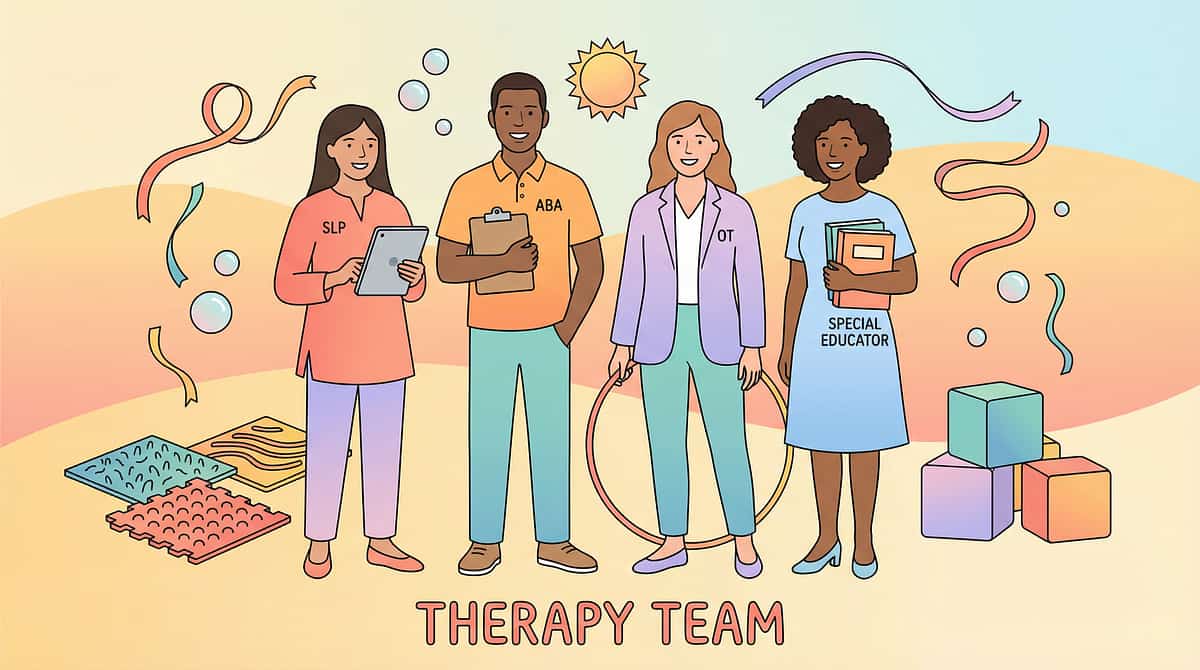
Because the brain doesn't organize by therapy type, five distinct professional disciplines all use variations of this same approach. That convergence is the power.
ABA Therapist (BCBA)
Uses systematic pairing and reinforcement to teach point-following as a discrete, measurable skill — breaking gaze-shift into attending, shifting, locating, and social referencing.
Speech-Language Pathologist
Targets point-following as a prelinguistic communication foundation — integrating it into book reading, labeling, and conversation to feed language development directly.
Occupational Therapist
Addresses visual tracking, gaze-shifting speed, and multi-sensory integration — ensuring the sensory environment supports rather than competes with the child's ability to follow points.
Special Educator
Embeds point-following into structured learning activities where following a teacher's gesture is critical for classroom participation and accessing curriculum content.
NeuroDev Pediatrician
Monitors developmental trajectory, screens for co-occurring conditions (hearing, vision, attention), and calibrates intervention intensity based on the child's overall neurodevelopmental profile.

ACT II — TARGETS
Precision Targets — This Is Not a Random Activity
Primary Target — The Core Skill
Responding to Joint Attention (RJA): Following another person's point to shift gaze toward a distal target — the foundational social-communication skill that connects children to the learning world.
Observable indicator: Child shifts gaze from parent's face/hand → follows finger direction → locates pointed target → may look back to parent (triadic gaze shift).
Secondary Targets
- Gaze Following: Tracking another person's eye direction to identify their focus of attention
- Attention Shifting: Disengaging from current focus and redirecting visual attention to a new target on cue
- Social Referencing: Looking back to the communicative partner after locating the target — the "checking" behavior
- Receptive Understanding of Gestures: Comprehending that pointing is a communicative act with directional meaning
Tertiary Targets
- Incidental Language Learning — connecting words to referents
- Classroom Readiness — following teacher gestures
- Social Participation — shared experiences and joint play
- Cognitive Flexibility — disengaging to attend to another's interest
Research: Bottema-Beutel (2016): RJA is more strongly related to language in children with ASD than other joint attention types. Autism Research, 9:1021–1035. PubMed: 27059941
ACT II — MATERIALS
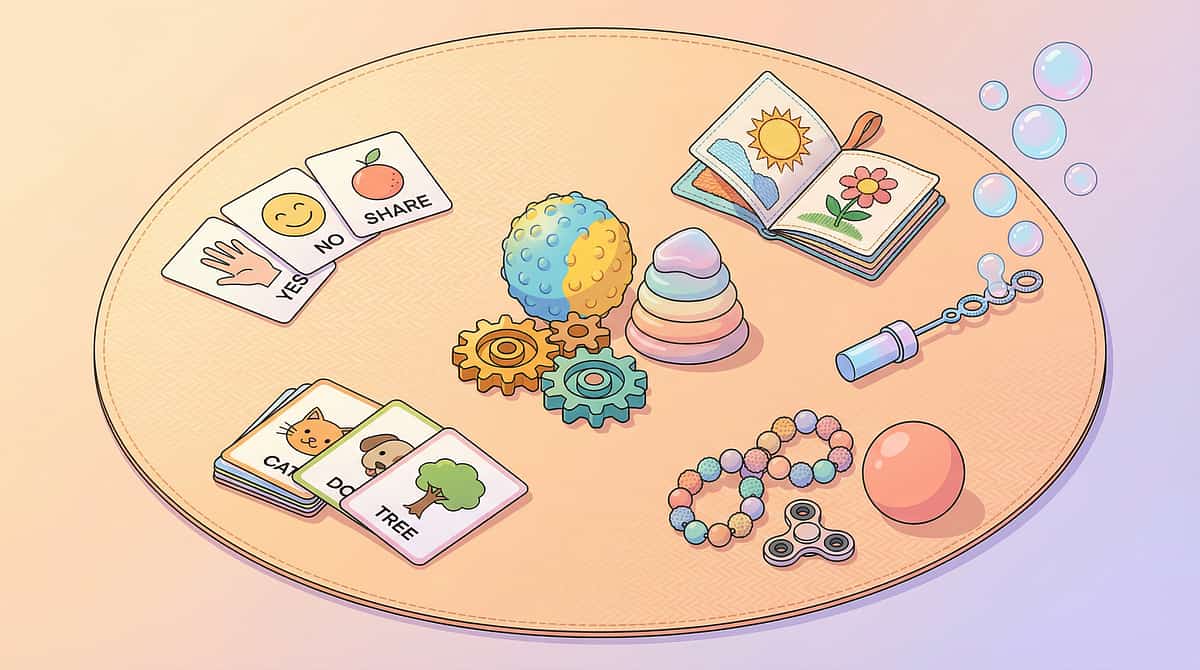
Your Therapeutic Materials Kit — All 9 Materials
These 9 materials form the evidence-based toolkit for RJA training. Each is selected for its ability to draw a child's attention to the pointed target, creating the gaze-shift moment that strengthens the joint attention neural pathway.
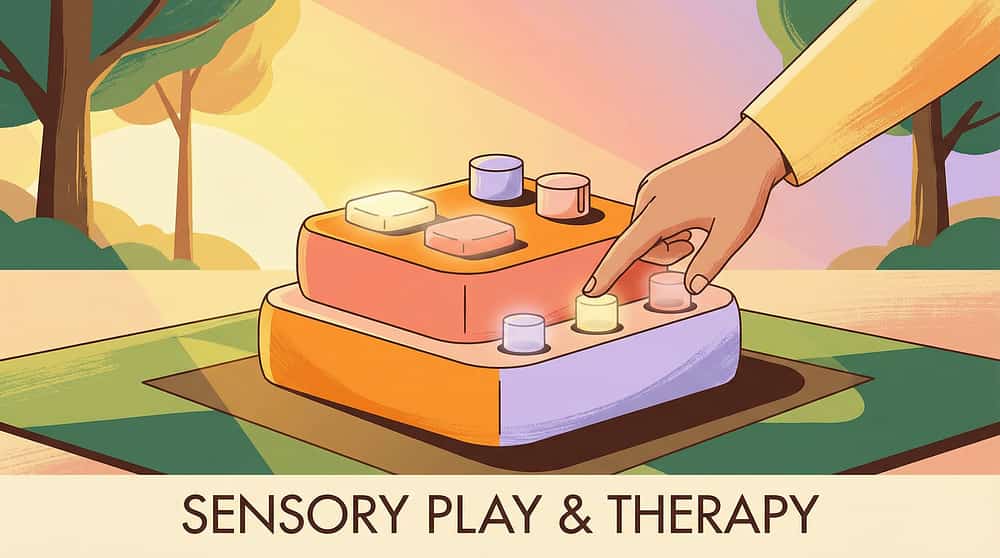
1. Light-Up Target Toys
Remote-controlled LED lights, tap lights, light-up toys with switches. ₹300–1,200 | Canon: Light-Up / Cause-Effect Toys

2. Sound-Making Target Items
Musical toys with buttons, sound-making stuffed animals, chime toys. ₹200–800 | Canon: Sound Toys / Musical Instruments

3. Favorite Character Figures
Character figurines, favorite stuffed animals, special interest items. ₹200–1,000 | Canon: Role Play Props / Reinforcement Items

4. Bubble Wands & Machines
Bubble wands, bubble machines, no-spill containers, touchable bubbles. ₹100–600 | Canon: Sensory Play / Cause-Effect

5. Hidden Picture Books
Where's Waldo–type books, I Spy books, search-and-find board books. ₹200–600 | Canon: Books / Cognitive Materials

6. Window Clings & Wall Decals
Reusable window clings, removable wall decals, gel decorations. ₹150–500 | Canon: Visual Environment / Attention Tools

7. Flashlight or Light Pointer
Child-safe flashlights, LED finger lights, color-changing flashlights. ₹100–500 | ⚠️NEVER use laser pointers — child-safe flashlights ONLY
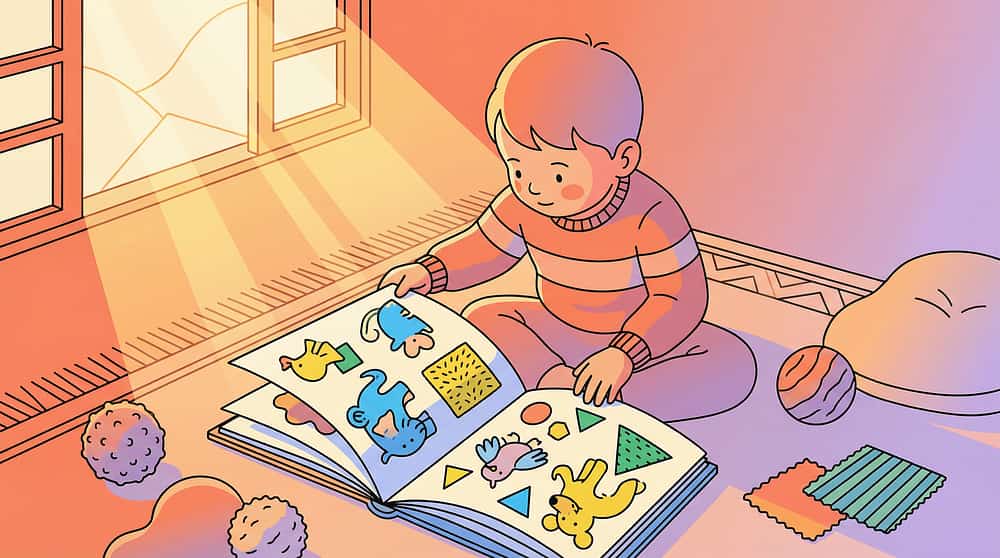
8. Rich Picture Books
Detailed picture books, wordless picture books, busy scene books. ₹200–800 | Canon: Books / Early Reading
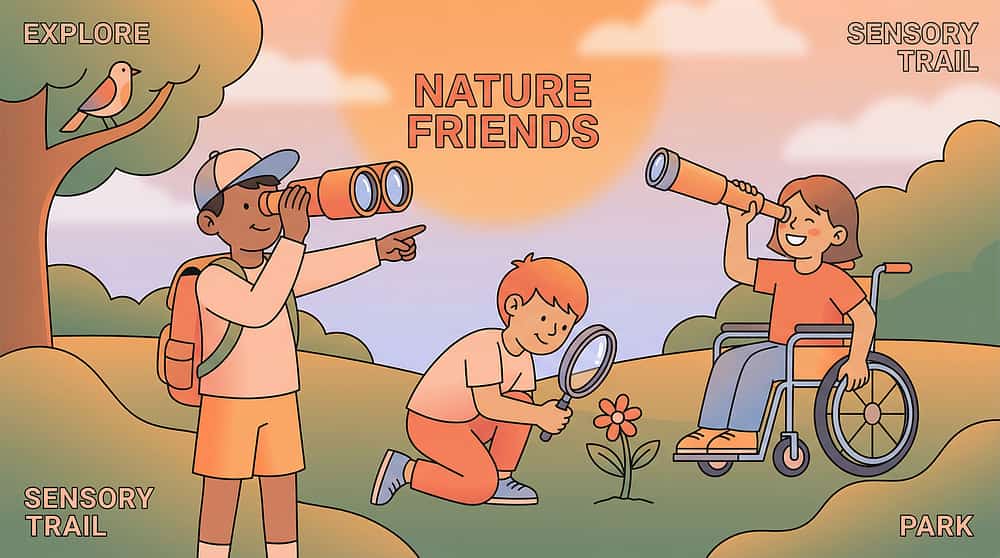
9. Animal & Nature Viewers
Kid-friendly binoculars, nature explorer viewers, toy telescopes. ₹300–1,000 | Canon: Problem-Solving / Attention Tools
Total Kit Investment: ₹1,550–6,000 for all 9 materials. Essential starters: Bubbles + picture books you already own + favorite character placed across the room — possibly ₹0 if you have these at home.
ACT II — DIY ALTERNATIVES
Every Family Can Start TODAY — Zero Cost Alternatives
Not every family can order from Amazon. Not every village has same-day delivery. The WHO/UNICEF Nurturing Care Framework emphasizes equity-focused interventions — and so do we. Every material below has a household substitute that works on the same therapeutic principle.
Buy This | Make This (₹0) | Same Principle | |
Light-Up Target Toys | Phone with bright screen placed at target; switch on a lamp where you point | Visual reward at point destination | |
Sound-Making Targets | Music box or phone playing music at point location | Auditory orienting to pointed direction | |
Favorite Character Figures | Any beloved toy/object placed around the room | Motivation-driven following | |
Bubble Wands/Machine | Homemade: dish soap + water | Moving visual targets | |
Hidden Picture Books | Any magazine/newspaper — point to pictures in it | Guided visual search | |
Window Clings/Decals | Sticky notes or tape pictures/drawings around room; change positions daily | Environmental point targets | |
Flashlight | Phone flashlight or any household torch | Visual trace from point to target | |
Rich Picture Books | Family photos, old calendars, food packages with images | Shared pointing + naming | |
Viewers/Binoculars | Paper towel roll "telescope" — child looks through tube where you point | Directed looking tool |
Zero-Cost Session: With a paper towel roll telescope, a phone flashlight, sticky notes around the room, and household items at point locations — you have a complete RJA training session. The science works the same way. Source: WHO Nurturing Care Framework (2018), PMC9978394
ACT II — SAFETY
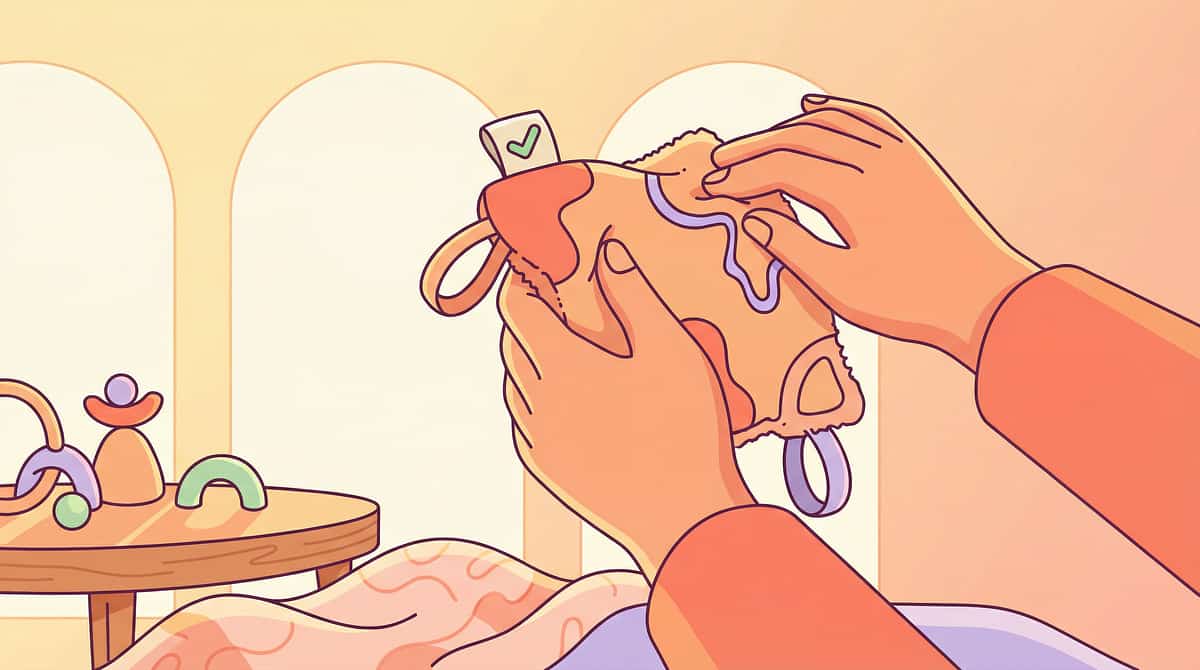
Safety Gate — Read This Before Your First Session
🔴 DO NOT PROCEED IF:
- Child has known seizure disorder AND you are using flashing/light-up materials — consult neurologist first
- Child is acutely ill, in pain, or has fever
- Child has had a meltdown in the last 30 minutes — wait for regulation
- Child has uncorrected vision problems — get ophthalmology clearance
- You are using a laser pointer (NEVER — flashlights only)
🟡 MODIFY IF:
- Child is sensitive to sounds — use visual materials only; skip sound-making targets initially
- Child is light-sensitive — dim flashlight; use character figures and books instead
- Child is in a crowded/noisy environment — move to a quiet room
- Child just woke up or is tired — shorter, lower-demand sessions with high-motivation materials only
🟢 PROCEED WHEN:
- Child is fed, rested, and in a calm-alert state
- Environment is quiet with minimal distractions
- Materials are ready and positioned before bringing the child in
- You have 5–15 uninterrupted minutes
- Another adult is NOT competing for the child's attention
🛑STOP THE SESSION IMMEDIATELY IF: Child becomes severely distressed (inconsolable crying >2 minutes) · shows signs of physical discomfort · demonstrates self-injurious behavior · has a seizure or seizure-like episode · light/sound materials trigger extreme sensory aversion. All materials must be age-appropriate: no small parts for children under 3; bubble solution must be non-toxic; flashlights soft-light only — never shine toward eyes.
ACT II — SETUP
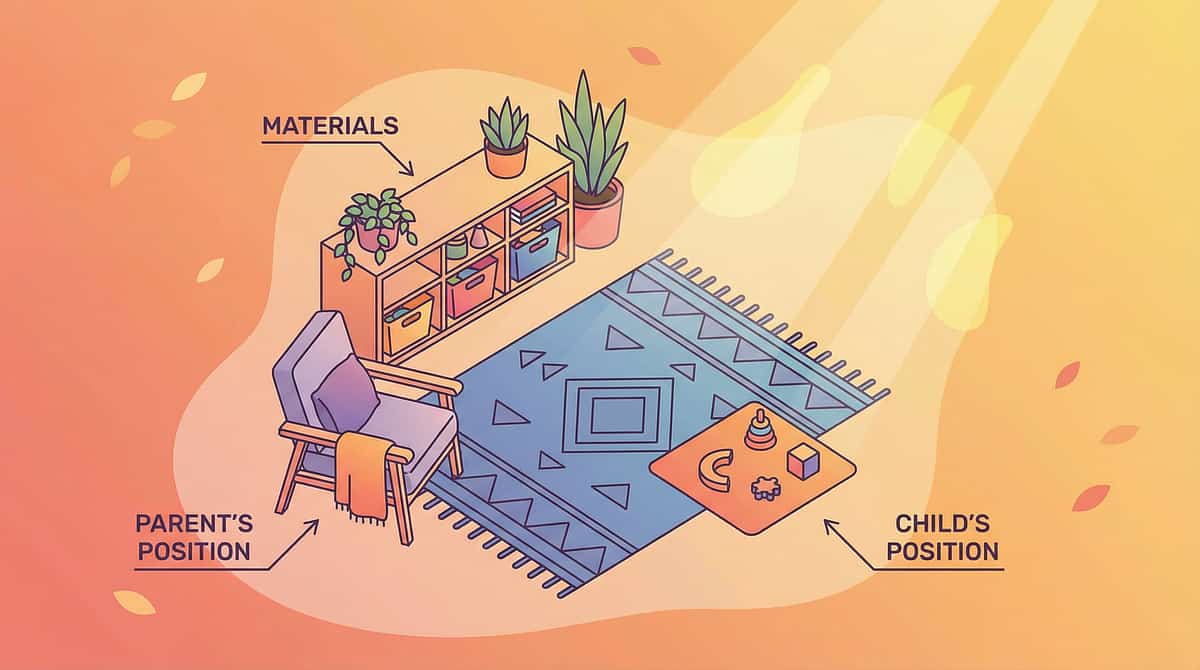
Your Pointing Practice Space — 3 Minutes to Set Up
Room Setup — 7 Steps
- Choose a room with minimal distractions — turn off TV, remove other toys from view
- Place 3–4 target materials at various heights and distances (start close: 1 meter; build to 3+ meters)
- Position yourself at child's level (kneel or sit on floor)
- Child sits beside you or on your lap — both facing the same direction
- Keep your materials basket behind you — out of child's view but accessible to you
- Lighting: bright enough to see targets; for flashlight activities, dim the room slightly
- Temperature: comfortable; remove heavy clothing that restricts head movement
What to Remove
- Other screens (tablets, phones not being used as targets)
- Other toys not being used as point targets
- Background noise (TV, music, other family conversations)
- Pets that might compete for attention
Ideal Layout
Position targets at different directions from where you and your child sit together: left target (light/sound toy), right target (favorite figure), ahead/up (window cling), near (bubbles within reach). This creates natural variety in pointing direction and distance within a single session.
Structured environments for 1:1 sessions demonstrate maximum effectiveness. Source: Sensory Integration Theory (Ayres), PMC10955541

ACT III — EXECUTION
60-Second Pre-Flight Check
The best session is one that starts right. A 3-minute session with a regulated child teaches more than a 15-minute session with a distressed one. Run through this checklist before every session.
1
Child has eaten within the last 2 hours (not hungry)
2
Child has slept adequately (not overtired)
3
No meltdown or crying episode in the past 30 minutes
4
Child is in a calm or playful state (not agitated)
5
No signs of illness (fever, runny nose, earache)
6
Child is not fixated on another activity they'll resist leaving
7
Environment is set up per Card 12 guidelines
✅ All GREEN → GO
Begin with Step 1: The Invitation
🟡 1–2 AMBER → MODIFY
Use simplified version: high-motivation materials only, 3 minutes, lower demand
🔴 Any RED → POSTPONE
Do a calming activity instead. Try again later. Postponing is not failure — it's precision.

ACT III — STEP 1
Step 1: The Invitation — Not a Command
What to Say
"Hey [child's name]! I have something SO cool to show you! Want to see something amazing?"
Sit beside your child. Get at their eye level. Say this warmly. Then wait and watch. Do they look at you? Smile?
Body Language
- Get at or below the child's eye level
- Use animated, excited facial expressions
- Lean slightly forward — signal something exciting is coming
- Have your pointing hand ready but don't point yet
What Acceptance Looks Like
- Child looks at your face (even briefly)
- Child leans toward you
- Child shows a calm/curious expression
- Child vocalizes or smiles
What Resistance Looks Like
- Child turns away
- Child fusses or pushes away
- Child is fixated on something else
If resistance: Don't force. Wait 30 seconds. Try with their absolute favorite item visible first. Still resisting? → Modify or Postpone (Card 13). Timing: 30–60 seconds.

ACT III — STEP 2
Step 2: The First Point — Making It Irresistible
Choose your highest motivation material first. Favorite character or bubbles work best for the first attempts. Place the target at 1 meter — close enough for success.
Place the Target
Position your highest-motivation material where child can see it but at a distance (start with 1 meter). Both of you face the same direction.
Point with Exaggeration
Full arm extension, index finger clear. Don't be subtle. Big, animated, unmistakable pointing gesture.
Add Your Voice
Say excitedly: "LOOK! Look over there! It's [character name / bubbles]!" Your excitement IS the reward signal.
Activate Multi-Sensory Cue
If using light/sound targets: activate simultaneously as you point. The multi-sensory cue guides their gaze to the destination.
✅ Engagement
Child shifts gaze toward target → CELEBRATE (Step 5)
🟡 Tolerance
Looks briefly in general direction → Good start! Try closer/bigger target
🔴 Avoidance
Looks away entirely → Switch to highest preference; reduce distance; try again

ACT III — STEP 3
Step 3: The Therapeutic Action — Point → Follow → Discover → Joy
The Active Ingredient: The moment your child shifts their gaze from your hand/face to the pointed target — THAT is the therapeutic action. Every time this happens, the neural pathway for responding to joint attention strengthens.
1
Get Attention
Say child's name or touch arm gently to ensure they're attending to you first
2
Point + Say "LOOK!"
Clear, exaggerated gesture toward target. Use excited voice. Full arm extension.
3
WAIT 3–5 Seconds
Give child time to shift gaze. Do not rush. Silence is okay — the pause is part of the teaching.
4
Gaze Shift → CELEBRATE
If they look at target: immediate, explosive celebration (Step 5 protocol)
If No Shift — Add a Second Cue:
- Move the target (wiggle, flash, or activate sound)
- Move your point closer to the target
- Physically guide their chin gently toward the target direction (only if they tolerate touch)
- Walk toward the target while pointing, bringing child along
❌ Common Errors
- Pointing from too far away — start at 1 meter
- Not waiting — give 3–5 seconds
- Flat affect — be animated
- Pointing when child isn't attending to you
- Same target repeatedly — rotate materials
🎯 Response Spectrum
- Ideal: Follows point, looks at target, looks BACK at you (triadic gaze!) 🎉
- Acceptable: Follows to target area — strong progress
- Emerging: Glances in general direction — real progress
- Concerning: Distress, covering eyes, leaving — reduce demand
ACT III — STEP 4
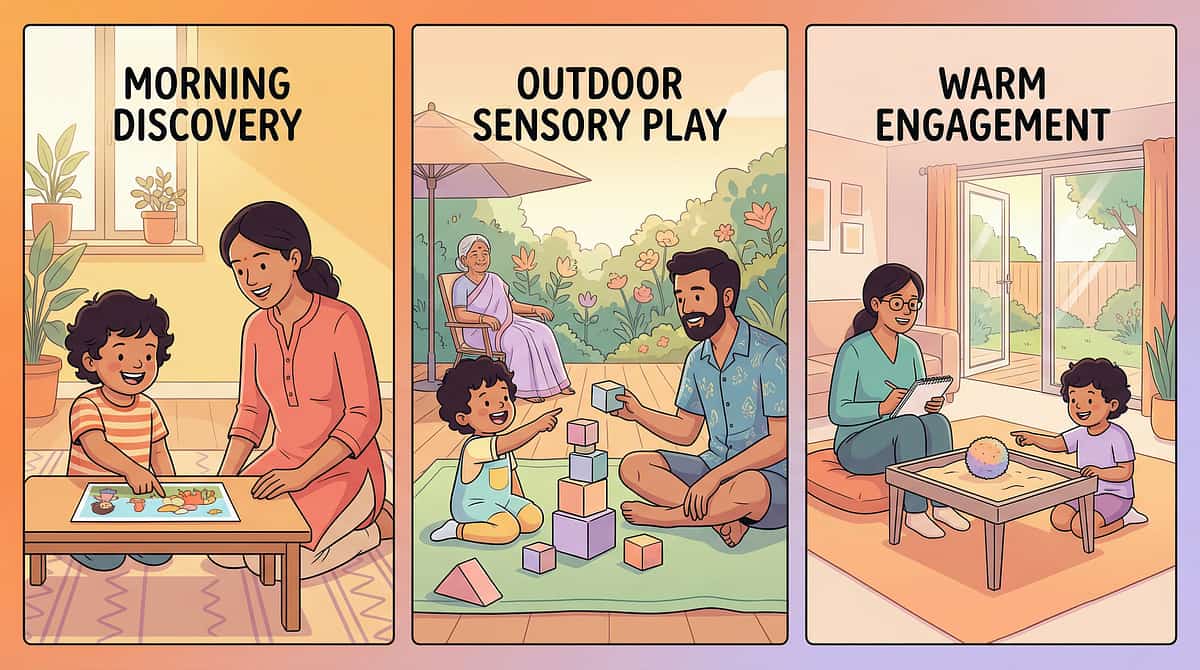
Step 4: Repeat & Vary — 3 Good Follows Beat 10 Forced Ones
Aim for 5–10 point-following attempts per session, across different materials and locations. The goal is quality engagement — not volume.
Change Targets Every 2–3 Attempts
Rotate: light → character → bubbles → book. Variety maintains engagement and builds generalization across material types.
Vary Distance Progressively
Near (1m) → Middle (2m) → Far (3m+). Always return to near distance after difficulty. Distance is your main difficulty dial.
Vary Direction and Height
Left, right, behind (turn and point), up, down. Floor level → eye level → above head. Different directions build a complete gaze-shifting skill.
Combine Materials
Point to flashlight beam landing on favorite character. Point to bubbles near a window cling. Combinations create richer learning moments.
"3 good reps > 10 forced reps. If your child beautifully followed your point 3 times and then started losing interest — that was a perfect session. Stop while it's still positive."
Satiation Indicators — When to Stop: Child starts looking away consistently · becomes restless or fidgety · yawns or rubs eyes · responses getting slower, not faster · 3+ consecutive "no follow" attempts after initial success. Timing: 3–5 minutes total.

ACT III — STEP 5
Step 5: Reinforce & Celebrate — Every Single Time
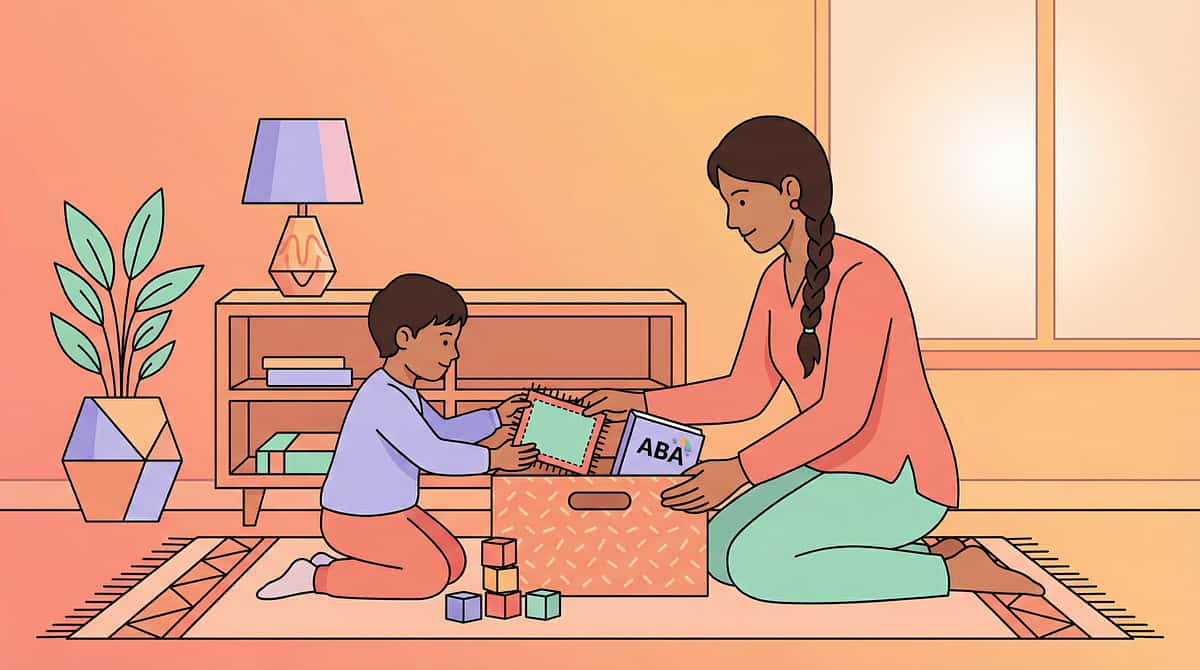
Timing is everything. Reinforcement must come within 3 seconds of the gaze shift. Not 10 seconds later. Not after you finish your sentence. The instant their eyes move toward the target — EXPLODE with celebration.
"YES! You LOOKED! You saw the [target]! That's SO amazing!"
Combine verbal praise with: high-five, clap, squeeze, tickle — whatever your child loves most.
Verbal Praise
"YES! You looked! Amazing!"
Physical
High-five, tickle, squeeze, swing them up
Natural Consequence
They GET the object they looked at — access to the character, bubbles, toy
Token (if applicable)
Deliver token immediately if using a structured token economy system
What NOT to Do
- Don't withhold the target as "bait" — always let them access it
- Don't say "no, not at my finger — THERE" with frustration
- Don't compare ("Your sister could do this at 6 months")
- Don't test ("Okay, WHERE am I pointing?") — this is practice, not an exam
Celebrate the ATTEMPT, not just the success. If your child's eyes moved even slightly in the right direction — that's progress. Reinforce it.
ACT III — STEP 6
Step 6: The Cool-Down — End on a High Note
How you end a session matters as much as how you begin. A consistent, positive ending builds routine and ensures your child is excited to return.
Give a Warning
"Two more points, then all done!" (Hold up 2 fingers.) Predictability reduces resistance at endings.
Last Point = Best Point
Use their absolute favorite target for the final attempt. Set up for success. End on a win.
Celebrate the Finale
"You did such a great job looking where I pointed today!" Use the same enthusiastic tone as during the session.
Cool-Down Activity (1–2 min)
Free play with one session material · gentle sensory activity (slow rocking, back rub, quiet music) · simple transition ritual: "Put the flashlight in the basket — all done!"
Transition Cue
"Pointing time is all done! Now it's [next activity] time!" Consistent language bridges to the next routine.
If child resists ending: Stay calm. Use visual timer if available. Say "One more point, then all done!" — and follow through. Don't extend just because it's going well. Consistent endings build routine. Source: NCAEP Evidence-Based Practices Report (2020)

ACT III — DATA
Capture the Data — Right Now
60 seconds of data now saves hours of guessing later. Record these three data points immediately after every session — before you move on to the next activity.
1
Total Pointing Attempts
Count how many times you pointed during the session. Example: "8 pointing attempts"
2
Successful Follows
Count how many times child shifted gaze toward target. Example: "3 out of 8 followed"
3
Best Material
Which material got the most follows? Example: "Bubbles — followed 2/3 times"
10–20%
Week 1 Success Rate
Expected range when starting out — any gaze shift counts
40–50%
Week 4 Success Rate
Consolidation phase — reliable following for preferred targets
70%+
Week 8 Mastery Zone
Generalized point-following across materials, distances, and people
"Your data is your evidence. When you show the pediatrician a chart of 10% → 50% → 80% point-following over 8 weeks — that is clinical-grade proof that this technique is working." Track via GPT-OS® In-App Tracker, printed Pinnacle RJA Tracking Sheet (PDF), or a simple voice note after each session.
ACT III — TROUBLESHOOTING
What If It Didn't Go As Planned? — Top 7 Solutions
Every problem has a solution. Session abandonment is not failure — it's data. If your child couldn't engage today, write down why (tired? sick? wrong time of day?) and that information makes tomorrow's session better.
"My child only looks at my finger, never at the target"
Start with CLOSE targets (within arm's reach). Literally touch the target while pointing. Gradually increase distance. Use light/sound activation AT the target to draw attention away from your hand.
"She follows for one material but nothing else"
That's actually great — she CAN follow. Start with that material every session, then introduce new materials gradually. Place new material NEXT to the preferred one initially.
"He only follows when the target makes noise or lights up"
Perfect first step. Scaffolding works. Gradually reduce the multi-sensory cue over weeks, not days: bright light → dim light → no light. Sound → soft sound → silent. Fade the prompt slowly.
"Sessions last 2 minutes then she loses interest"
Two minutes of engaged practice is worth more than 10 minutes of forced attention. Build gradually: 2 min → 3 → 5 → 8 → 15 over weeks. Quality always beats quantity.
"He gets upset when I interrupt his play"
Don't interrupt. Embed pointing INTO his play. Playing with trains? Point to a new train across the room. Watching a bird outside? Point to it naturally. Pointing practice lives inside daily routines.
"She follows my point but doesn't look back at me"
Looking back (triadic gaze shift) is an advanced skill that develops AFTER basic point-following. Celebrate the follow. The look-back will emerge naturally as the skill matures.
"It worked once but now he completely ignores my pointing"
Check: Has novelty worn off? Rotate materials. Is environment too stimulating? Simplify. Is he overtired/hungry? Check readiness. Are you pointing too often? Space sessions — don't turn every moment into therapy.
ACT III — ADAPT
Adapt & Personalize — No Two Children Are Identical
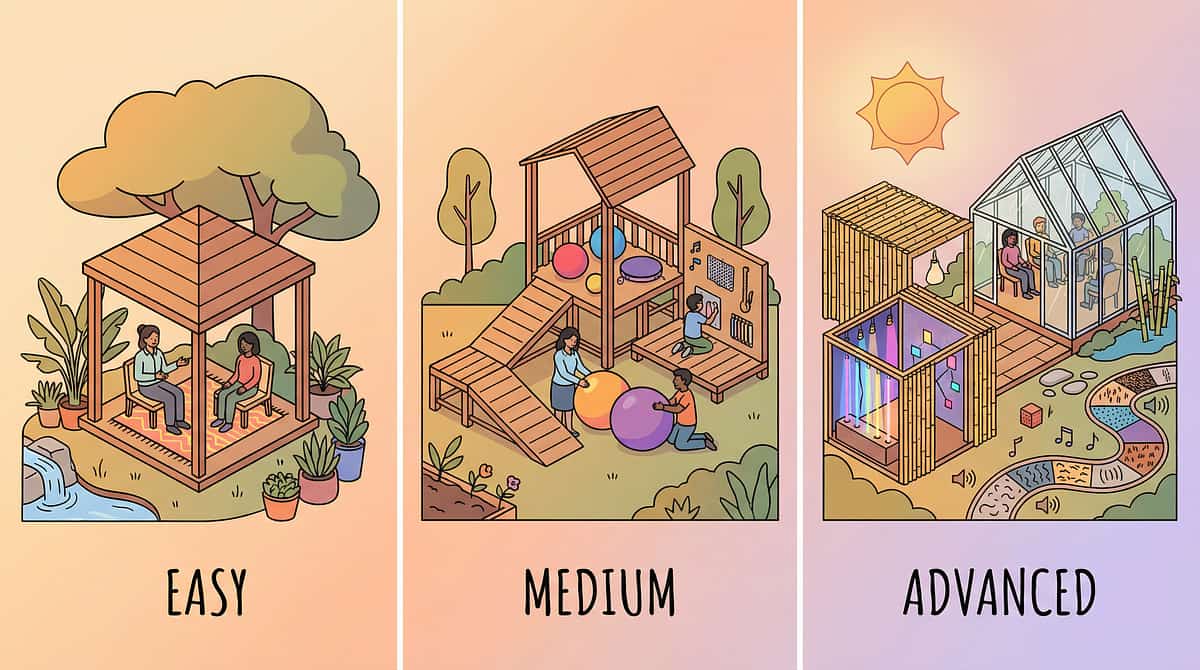
Calibrate the difficulty to your child's current level. Use the progression below as your guide — always seek the level where your child succeeds more than they struggle.
⬅ Easier Modifications
- Targets within arm's reach
- Light + sound + verbal cue together
- Only 1 material type per session
- Child on your lap, facing same way
- 2–3 minute sessions
- Touch the target while pointing
- Only favorite character targets
Standard Protocol
- 1–3 meter distance
- Verbal cue + point
- 3–4 materials rotated
- Sitting side by side
- 5–10 minute sessions
- Point from distance
- Mixed materials
➡ Harder Progressions
- Across the room (5m+)
- Point only (no verbal)
- All 9 materials + environmental
- Standing across from each other
- 15+ minutes with natural transitions
- Point to things in a picture/book
- Novel/unfamiliar targets
Sensory Seeker
Use MORE light, sound, movement targets. Bubbles, flashlight chase, musical toys. These children WANT input — harness it for point-following.
Sensory Avoider
Use QUIET, still targets. Favorite characters, picture books, gentle window clings. No sudden sounds or bright lights. Build slowly over weeks.
Age Notes
- 9–12 months: Very close targets; on-lap; voice + touch + point together
- 12–18 months: Expand to 1–2m; begin books and environmental targets
- 18–24 months: Full distance; hidden picture games; consistent near-follows
- 2–3 years: Complex environments; outdoor pointing; classroom-style targets
ACT IV — PROGRESS ARC
Weeks 1–2: The Foundation Phase
15%
Foundation Progress
Where most children are at the end of Week 2 — tolerance established, occasional gaze shifts emerging
What You'll Observe in Weeks 1–2 (and It IS Progress):
Child begins to tolerate the pointing game without resisting or becoming distressed
Occasional gaze shifts toward targets — even if only for high-motivation items
Child starts to look at your face when you get excited (social referencing emerging)
Light/sound targets get more consistent follows than static targets
Not yet expected in Weeks 1–2: Consistent following across all materials · following in noisy/complex environments · triadic gaze (looking back after target) — that comes in Week 5+ · following another person's point (generalization still building).
"If your child follows your point ONE time this week — even once, even for their absolute favorite — you have proof that the neural pathway exists. Now you're strengthening it."
Average sessions before first consistent follow: 5–10 sessions. Some children respond in session 1; others in session 15. Both are completely normal.

ACT IV — PROGRESS ARC
Weeks 3–4: "Wait — Did She Just Follow My Point on Her Own?"
40%
Consolidation Progress
Reliable near-distance following for 2–3 materials; emerging spontaneous generalization
Consolidation Indicators — Watch for These:
Multi-Material Following
Child follows points for 2–3 different materials — not just their one favorite
Faster Response
Following speed increases — less delay between your point and their gaze shift
Anticipation Emerging
Child sees you positioning materials and gets excited before the session starts
Real-Life Generalization Seeds
Child begins following your natural, everyday points outside structured sessions
Spontaneous Generalization Seeds — Watch for these signs the skill is leaving the session and entering real life: Child follows your point during mealtime · follows pointing in a book you haven't used in sessions · follows another family member's point (not just yours).
"You may notice you're pointing more naturally now — at birds, at dogs, at airplanes. And sometimes... your child follows. That moment? That's shared attention. That's the bridge being built."

ACT IV — PROGRESS ARC
Weeks 5–8: The Connection Is Live
75%
Mastery Progress
Consistent following across materials, distances, environments, and people
Mastery Criteria — Observable & Measurable:
Child follows points to distant targets (3+ meters) reliably
Following occurs across multiple environments — home, outdoors, car, grandparents' house
Child follows points from multiple people — not just primary caregiver
Triadic gaze shift emerges — child looks at target → looks back at you with shared expression
Point-following supports incidental learning — you point and label, child follows and absorbs
Success rate consistently above 70% across materials
🏆 Mastery Unlocked
When 4 of 6 mastery criteria are met for 2 consecutive weeks → "Point-Following Mastery" badge earned in GPT-OS®
Ready to Progress?
Move to: Initiating Joint Attention (IJA) — teaching your child to MAKE points to show YOU things. See Card 28 for the pathway.
Stay and Strengthen If:
Following is reliable at home but not in complex environments (mall, park, classroom) — continue environmental generalization for 2–4 more weeks.

ACT IV — CELEBRATE
You Built This Bridge. Your Child Crossed It.
"Remember Card 01 — when you pointed at the bird and your child stared at your finger? Look where you are now. Your child follows your point, discovers what you're sharing, and looks back at you with wonder. You did this. Your commitment, your patience, your daily 5-minute sessions built a neural pathway that will serve your child for life."
What Every Gaze Shift Now Means:
Word Learning
You pointed at a dog and said "dog" — that word-referent connection was made because your child followed your point
Instruction Following
When a teacher says "look at the board," your child can follow that directional gesture — classroom readiness is here
Shared Experience
You point at the sunset — they see it too. That is shared attention. That is the beginning of shared life.
Curiosity Grows
They follow a point to something unexpected — and wonder grows. Curiosity fueled by shared discovery is the engine of learning.
Family Celebration: Take a photo of a pointing moment. Tell grandparents: "She follows points now!" Document in GPT-OS®: the date of first consistent follow. Share with your therapy team — they need to know what's working at home.

ACT IV — RED FLAGS
Clinical Guardrails — Know When to Seek Support
Red flags are not stop signs — they're detour signs. They redirect you to the right professional support. Awareness is empowerment.
🔴 No Change After 4 Weeks
If following 10+ sessions with no observable gaze shift toward any target with any material, request professional evaluation. May indicate underlying vision, hearing, or attention issue needing assessment.
🔴 Regression
Child was following points and has stopped entirely for more than 2 weeks. Regression warrants immediate professional consultation — do not wait and hope it returns.
🔴 New Concerning Behaviors
Child develops new repetitive behaviors, increased sensory seeking/avoiding, or loss of other skills during this period — these patterns need professional evaluation.
🔴 Consistent Distress
Despite modification, lower demand, and preferred materials — if the activity itself triggers anxiety, professional guidance is needed before continuing.
🔴 Hearing or Vision Concerns
Child doesn't orient to sounds or squints/turns head unusually when trying to see targets — get hearing and ophthalmology evaluation first.
🔴 Combined Screening Alert
14–18 months with zero point-following + no pointing + reduced eye contact + limited social responsiveness = screening-level concern for ASD. Request comprehensive developmental evaluation.
📞Call Pinnacle FREE National Autism Helpline: 9100 181 181 (24/7, 16+ languages) · Request an AbilityScore® Assessment · Book a teleconsultation with a NeuroDevelopmental Pediatrician at pinnacleblooms.org/teleconsult

ACT IV — PATHWAY
Where You Were. Where You Are. Where You're Going.
This technique sits at the heart of the joint attention sequence. Mastering RJA (responding to points) directly enables Initiating Joint Attention (IJA) — your child learning to MAKE points to show YOU things. That is the next milestone on the social communication journey.
Long-Term Developmental Goal:
Joint Attention Mastery → Incidental Language Learning → Receptive/Expressive Language Growth → Classroom Readiness → Social Participation
Lateral Alternatives
Environmental pointing practice (outdoor walks) · Technology-assisted gaze-following · Peer-mediated (sibling models point-following)
Related Techniques
B-123: Teaching Pointing · B-124: Building Waving · B-125: Developing Gestures · B-126: Showing Objects · B-128: Sharing by Bringing · B-129: Building Eye Contact
ACT IV — RELATED TECHNIQUES
More Techniques in Joint Attention & Social Communication
You already own the materials for these related techniques — your investment in this kit works across the entire joint attention domain. Browse the full library at techniques.pinnacleblooms.org/social-communication/
B-123: Teaching Pointing
Challenge: Child doesn't point to things · Level: Core · Materials you already own: Character figures, bubbles
B-124: Building Waving
Challenge: Child doesn't wave bye-bye · Level: Introductory · Materials you already own: No additional materials needed
B-125: Developing Gestures
Challenge: Child uses no gestures at all · Level: Introductory · Materials you already own: Visual clings, picture books
B-126: Showing Objects
Challenge: Child doesn't show you things · Level: Core · Materials you already own: Favorite characters, books
B-128: Sharing by Bringing
Challenge: Child doesn't bring things to share · Level: Core · Materials you already own: Favorite characters, toys
B-129: Building Eye Contact
Challenge: Limited eye contact during interaction · Level: Introductory · Materials you already own: Light targets, bubbles
ACT IV — THE BIG PICTURE
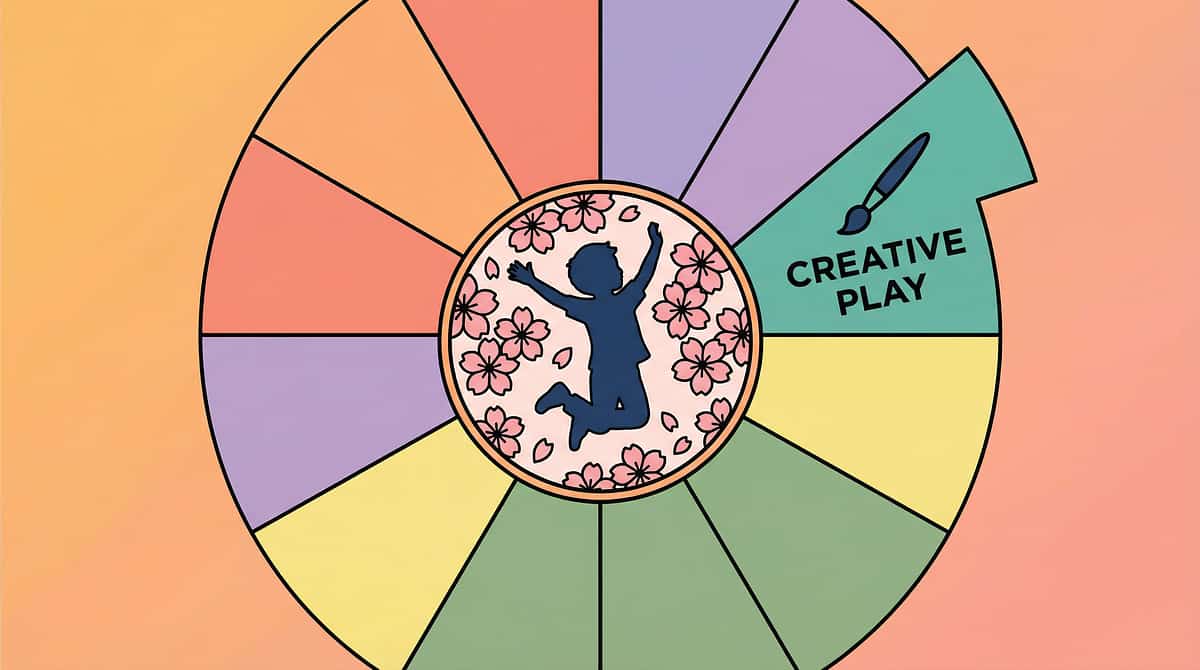
One Technique. Twelve Domains. Your Child's Full Map.
RJA is one piece of a larger developmental picture. Understanding how it feeds into other domains shows you the full impact of every pointing practice session you complete.
→ Expressive Language (C)
Word learning through point-following + labeling
→ Receptive Language (D)
Instruction following through gesture comprehension
→ Cognitive (H)
Learning from others' discoveries; environmental awareness
→ Play Skills (J)
Shared play, cooperative games, showing and telling
→ Academic Readiness (L)
Classroom attention, following teacher gestures, board work
GPT-OS® tracks your child's progress across all 12 domains and personalizes recommendations based on your session data. See your child's full developmental profile at pinnacleblooms.org/gptos
ACT V — COMMUNITY
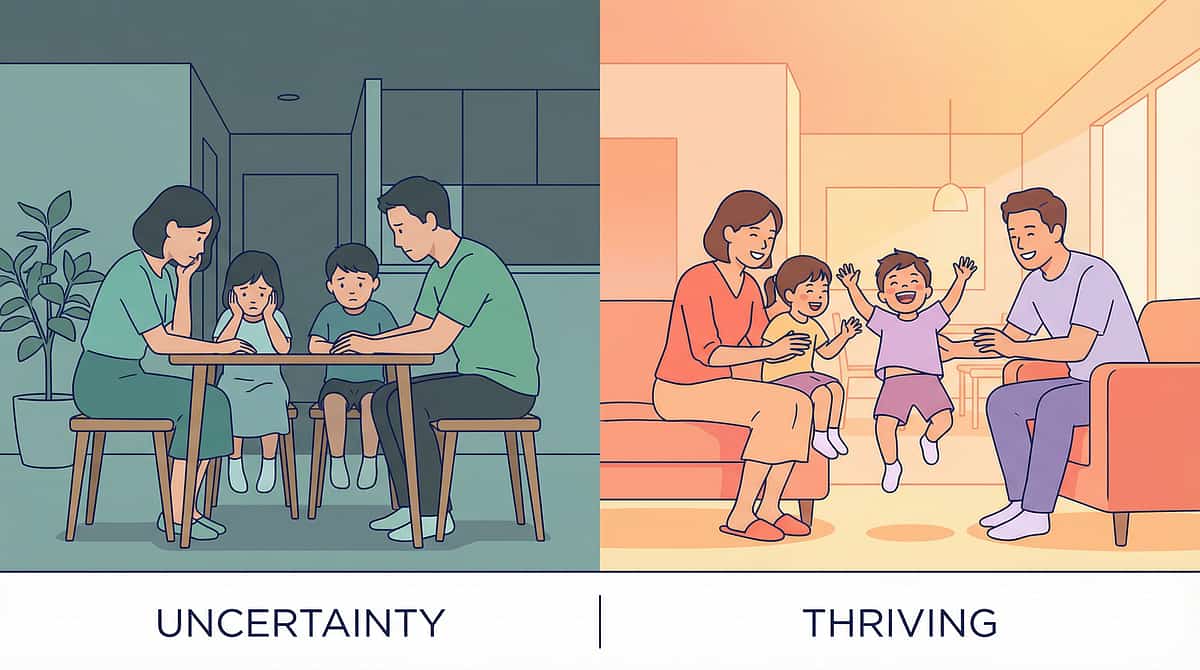
Real Families. Real Progress. Real Hope.
Arjun, 18 months — 12 weeks
Before: Never followed a single point. Parents felt like they were "talking to a wall" when trying to show him things. Used bubbles, light-up targets, and favorite dinosaur figures.
After: Follows points across the room to new objects. Beginning triadic gaze. Vocabulary jumped from 5 words to 30+ — because he's now connecting words to what parents point at.
After: Follows points across the room to new objects. Beginning triadic gaze. Vocabulary jumped from 5 words to 30+ — because he's now connecting words to what parents point at.
"He never looked where we pointed — just at our fingers or away. After 4 months of targeted practice, he follows points across the room. Now he's learning words because he sees what we're talking about."
Meera, 2 years — 8 weeks
Before: Would follow points ONLY for her one favorite stuffed animal. Nothing else. Started with favorite stuffy, added window clings, graduated to picture books.
After: Follows points for 5+ different targets. Started following grandmother's points too — generalization achieved. Can now find items in books when parent points.
After: Follows points for 5+ different targets. Started following grandmother's points too — generalization achieved. Can now find items in books when parent points.
Rohan, 14 months — 6 weeks
Before: Flagged at well-baby checkup for not following points. Parents were anxious. Used flashlight games, bubble pointing, and everyday environmental pointing during walks.
After: Reliably follows points to nearby objects. Starting to follow distal points. Pediatrician noted significant improvement at follow-up.
After: Reliably follows points to nearby objects. Starting to follow distal points. Pediatrician noted significant improvement at follow-up.
Clinician's Note: "Joint attention responds exceptionally well to systematic parent-mediated practice. In our clinical experience at Pinnacle, families who practice 5–10 minutes daily using the multi-material approach see measurable gains within 4–8 weeks." Names changed. Outcomes illustrative. Individual results vary by child profile.

ACT V — CONNECT
You're Not Doing This Alone
Thousands of families across India and globally are working on exactly the same skills with their children right now. Community amplifies commitment — and your experience helps others who are just starting.
Joint Attention Parent Support Group
WhatsApp community of parents working on joint attention skills. Share wins, ask questions, find encouragement from families who understand exactly what you're navigating.
Pinnacle Parent Forum
Online community for families across India and globally. Moderated by Pinnacle therapists. Evidence-based discussions and real-time parent support. pinnacleblooms.org/community
Local Parent Meetups
Monthly gatherings at your nearest Pinnacle center. Meet families face-to-face, see techniques demonstrated live, and build your local support network.
Peer Mentoring
Connect with an experienced parent who has walked this path. A mentor who is 6 months ahead of you is often more valuable than any clinical resource.
"Your experience helps others — consider sharing your journey. A parent 3 months behind you right now needs to hear that it gets better." Follow for daily tips and community stories: @pinnacleblooms
ACT V — PROFESSIONAL SUPPORT
Home + Clinic = Maximum Impact
Home practice creates hundreds of natural opportunities daily. Clinical sessions build systematic skill structure. Together, they produce results neither achieves alone.
Your Therapy Team for Joint Attention
- Primary: ABA Therapist (BCBA) — systematic skill building
- Support: SLP — language integration with point-following
- Support: OT — sensory-attention foundations
When requesting: "I need a therapist experienced in joint attention intervention for my [age] child."
Find Your Nearest Center
70+ Pinnacle Blooms centers across India. pinnacleblooms.org/centers
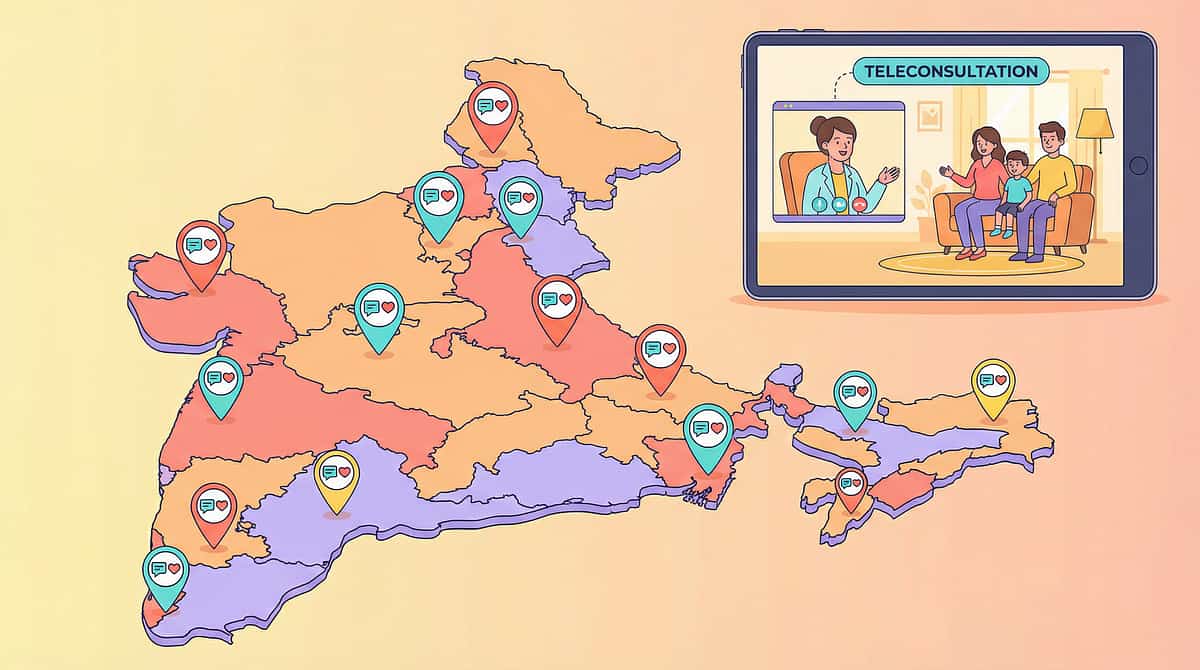
Teleconsultation
For families not near a Pinnacle center — video consultation with a Pinnacle developmental specialist. pinnacleblooms.org/teleconsult
Contact
📞FREE National Autism Helpline: 9100 181 181
(24/7, 16+ languages)
(24/7, 16+ languages)
AbilityScore® Assessment available through teleconsultation — a comprehensive developmental profile that maps your child across all 12 domains and generates a personalized intervention priority sequence.
ACT V — RESEARCH
The Research Library — Deeper Reading for the Curious Parent
Systematic Review (2024) — Parent-Mediated JA Intervention
11 studies, PRISMA methodology — consistent improvements in RJA skills in young children with ASD. DOI: 10.1080/07317107.2024.2338741
Meta-Analysis (2026) — Effects of JA Interventions
Significant post-intervention effects on children's JA skills across multiple studies. DOI: 10.1007/s10803-025-07195-y (J Autism Dev Disord)
RCT (2025) — A-FFIP Naturalistic Developmental Behavioral Intervention
Increased RJA in autistic preschoolers; arousal regulation identified as mediator. DOI: 10.1007/s00787-025-02738-1 (European Child & Adolescent Psychiatry)
Bottema-Beutel (2016) — RJA and Language
RJA more strongly related to language than other JA types in ASD. Autism Research, 9:1021–1035. PubMed: 27059941
Neural Correlates Review (2026)
Right TPJ as core region for partnered interactions; STS involved in gaze processing. DOI: 10.1016/j.dcn.2024.101321
WHO Nurturing Care Framework (2018)
Foundational framework for early child development interventions across 54 LMICs. nurturing-care.org/ncf-for-ecd/ · WHO CCD Package: PMC9978394
ACT V — GPT-OS®
How GPT-OS® Uses Your Data — For Your Child and Every Child Like Yours
What GPT-OS® Learns From This Technique
- Your child's response rate across materials — which multi-sensory cues work best
- Optimal session time and frequency for your child's profile
- Environmental conditions that support or hinder performance
- Generalization trajectory: home → other settings → other people
Privacy Assurance
- All data encrypted end-to-end
- You own your child's data — delete anytime
- No data shared without explicit consent
- Compliant with Indian IT Act and DPDP Act, 2023
"Your data helps every child like yours. When 1,000 families record their RJA sessions, GPT-OS® learns which materials work best for which child profiles — making recommendations more precise for every family that comes after you."

ACT V — WATCH THE REEL
Watch: 9 Materials That Help When Your Child Doesn't Look Where You Point
Reel ID
B-127
Series
Joint Attention Development Series — Episode 127
Domain
Social Communication (SOC-JA-RJA)
Duration
75 seconds
See each of the 9 materials demonstrated in action with real-time pointing practice techniques — presented by a Pinnacle Blooms Network licensed therapist. Watch how exaggerated pointing, multi-sensory activation, and immediate celebration work together in a live parent-child session.
Why video matters: Video modeling is classified as an evidence-based practice for autism (NCAEP, 2020). Visual + text + live demonstration accelerates parent skill acquisition significantly faster than text alone. You've read the technique — now watch it come alive. Available at pinnacleblooms.org and all Pinnacle social channels.

ACT V — SHARE
Consistency Across Caregivers Multiplies Impact
Every adult in your child's life is a potential practice partner. When grandparents, teachers, and family members all respond the same way to your child's gaze shifts — the learning multiplies. Share this page and the guides below to align everyone in your child's world.
Share This Page
Download: 1-Page Family Guide (PDF) — Print and stick on the fridge. "Joint Attention: How to Help [Child's Name] Follow Your Point — A 1-Minute Guide for Every Caregiver."
Explain to Grandparents:
"When you point at something, [child] doesn't look where you're pointing. We're practicing to teach them. Here's what YOU can do: Point with big gestures, say 'LOOK!', and if they look where you point — celebrate! That's it."
Teacher Communication Template
"Dear [Teacher's name], [Child] is working on following pointing gestures (joint attention). During class, when you point to the board or to an object, [child] may need: your voice prompt 'Look' + touching the target initially + 3–5 seconds extra time to shift gaze. Reinforcing any gaze shift toward the pointed target supports our home practice. Thank you."
Research confirms that consistency across environments is the single most powerful predictor of generalization speed. When home, school, and family all align — children progress 2–3× faster.
ACT VI — FAQ
Frequently Asked Questions
At what age should I be concerned about my child not following points?
Following points typically emerges by 9–12 months and becomes consistent by 14–18 months. Persistent absence by 18 months, especially combined with limited pointing by the child, reduced eye contact, or limited social responsiveness, warrants a developmental evaluation.
Is this only for children with autism?
No. Any child delayed in following points can benefit — including children with general developmental delay, attention challenges, or hearing/vision difficulties. However, difficulty following points IS one of the earliest markers of autism, so professional evaluation is recommended.
How many times a day should I practice?
3–5 micro-sessions of 5–15 minutes throughout the day is ideal. Quality matters more than quantity. Even one high-quality 5-minute session daily will produce results over 4–8 weeks.
Can I use a tablet or phone screen as a pointing target?
Yes, but sparingly. Screens are highly motivating, making them good initial targets. However, the goal is following points to real-world objects. Use screens as a scaffold, then fade to non-screen targets.
My child follows points at home but not at grandparents' house. What do I do?
Generalization takes time. Practice at grandparents' house with the same materials. Have grandparents do the pointing too. New environments are harder — expect temporarily lower success rates and rebuild systematically.
Is this something my therapist should be doing, or should I?
Both. Your therapist uses structured JA intervention in sessions. YOUR role is creating hundreds of natural practice opportunities daily — at meals, during walks, at bath time, during book reading. Home practice multiplies the clinical work.
How long until I see results?
Most families see initial gaze shifts within 1–2 weeks of consistent practice. Reliable following for preferred targets typically emerges by Week 3–4. Generalized point-following across materials, distances, and people usually takes 6–8 weeks.
What if my child only follows points for food?
Start there! Food is a powerful motivator. Use pointing during meals and snacks. Then gradually introduce non-food targets alongside food. The neural pathway for point-following is the same regardless of what's at the target.
Didn't find your answer? Ask GPT-OS®: pinnacleblooms.org/gptos · Book a teleconsultation: pinnacleblooms.org/teleconsult · Call FREE helpline: 9100 181 181

ACT VI — TAKE ACTION
You've Read the Science. You Have the Materials. Your Child Is Waiting.
Every day of consistent practice is a day of neural pathway strengthening. Every gaze shift your child makes toward your pointed target is a connection being built. You have everything you need to start today.
✅ Clinically Validated
OT · SLP · ABA · SpEd · NeuroDev Pediatrics
CRO-Standard Evidence
WHO/UNICEF-Aligned
GPT-OS® Governed
Validated by the Pinnacle Blooms Consortium. GPT-OS® Governed. Parent-Proven. Consortium-Validated. Clinically validated. Home-applicable.
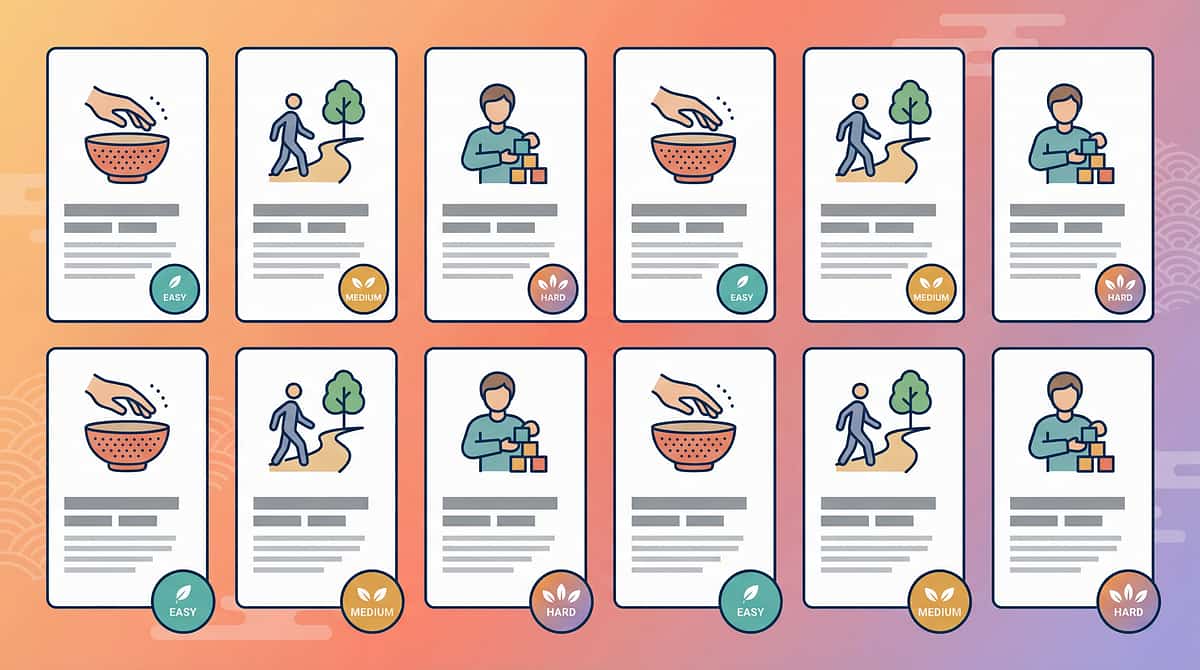
Preview of 9 materials that help when child doesnt look where you point Therapy Material
Below is a visual preview of 9 materials that help when child doesnt look where you point therapy material. The pages shown help educators, therapists, and caregivers understand the structure and content of the resource before use. Materials should be used under appropriate professional guidance.


Link copied!
THE PINNACLE PROMISE
"From Fear to Mastery. One Technique at a Time."
"You arrived scared that your child would never share your world. You now understand the neuroscience, own the materials, know the protocol, and can track your child's progress. The bridge of shared attention is being built — one point, one gaze shift, one moment of wonder at a time."
🔹 OT
Occupational Therapy
🔹 SLP
Speech-Language Pathology
🔹 ABA
Applied Behavior Analysis
🔹 SpEd
Special Education
🔹 NeuroDev
NeuroDevelopmental Pediatrics
🔹 CRO
Clinical Research Operations
Medical Disclaimer: This content is for educational and informational purposes only. It does not constitute medical advice, diagnosis, or treatment. Please consult qualified healthcare professionals — including developmental pediatricians, psychologists, speech-language pathologists, and behavior analysts — for proper evaluation and individualized recommendations. Individual results vary. Statistics represent aggregate outcomes across the Pinnacle Blooms Network.
© 2026 Pinnacle Blooms Network®, unit of Bharath Healthcare Laboratories Pvt. Ltd. All rights reserved. CIN: U74999TG2016PTC113063 · DPIIT: DIPP8651 · MSME: TS20F0009606 · Powered by GPT-OS® · Patents filed across 160+ countries
techniques.pinnacleblooms.org · pinnacleblooms.org · FREE National Autism Helpline: 9100 181 181 · care@pinnacleblooms.org