9 Materials That Help When Your Child Doesn't Respond to Their Name
Evidence-based guide from India's largest autism therapy network — step-by-step home implementation with free DIY alternatives included.
Consortium-Validated
Technique B-121
Ages 12 months – 8 years

Act I: The Emotional Entry
You Call Their Name Again and Again. Nothing.
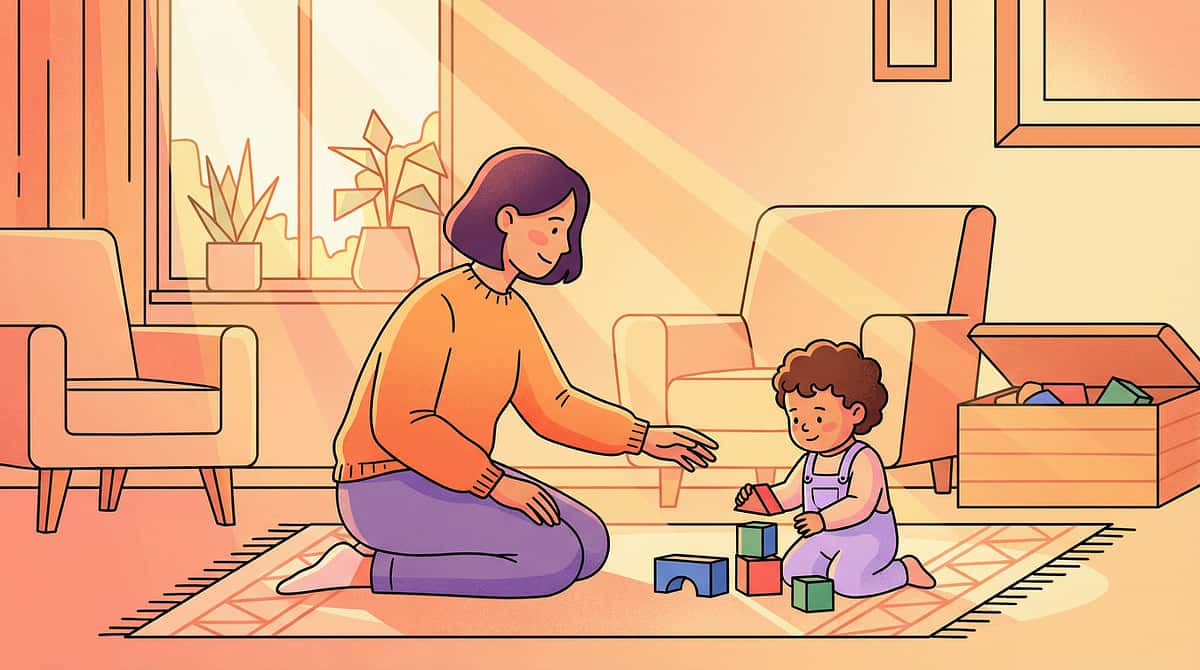
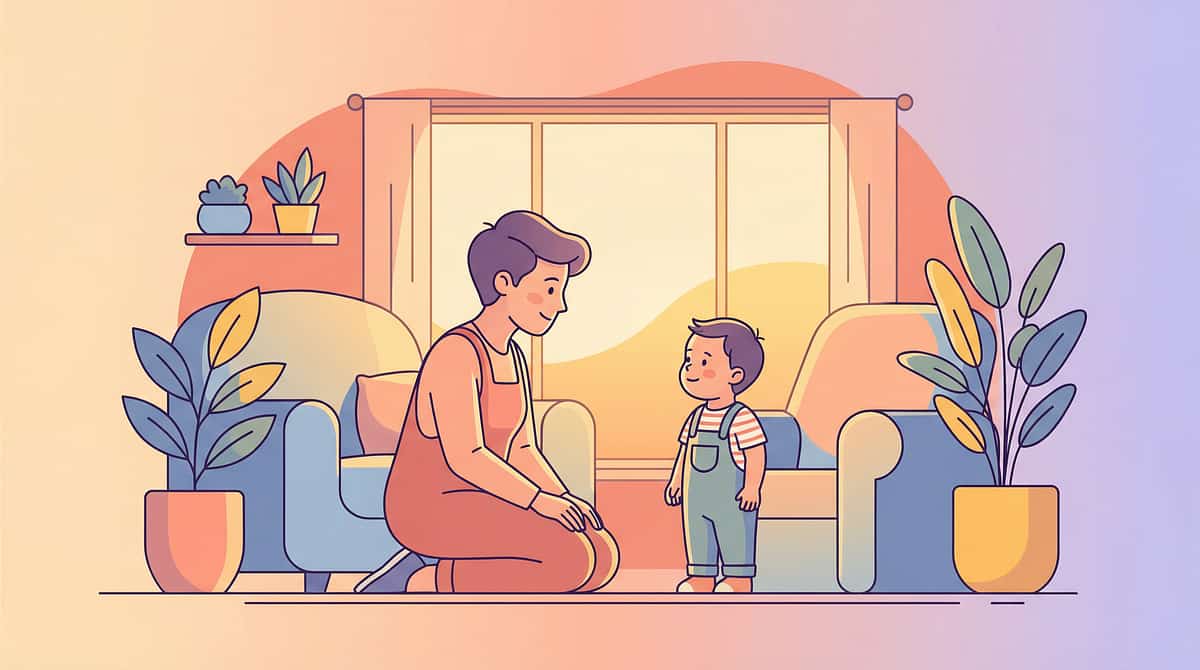
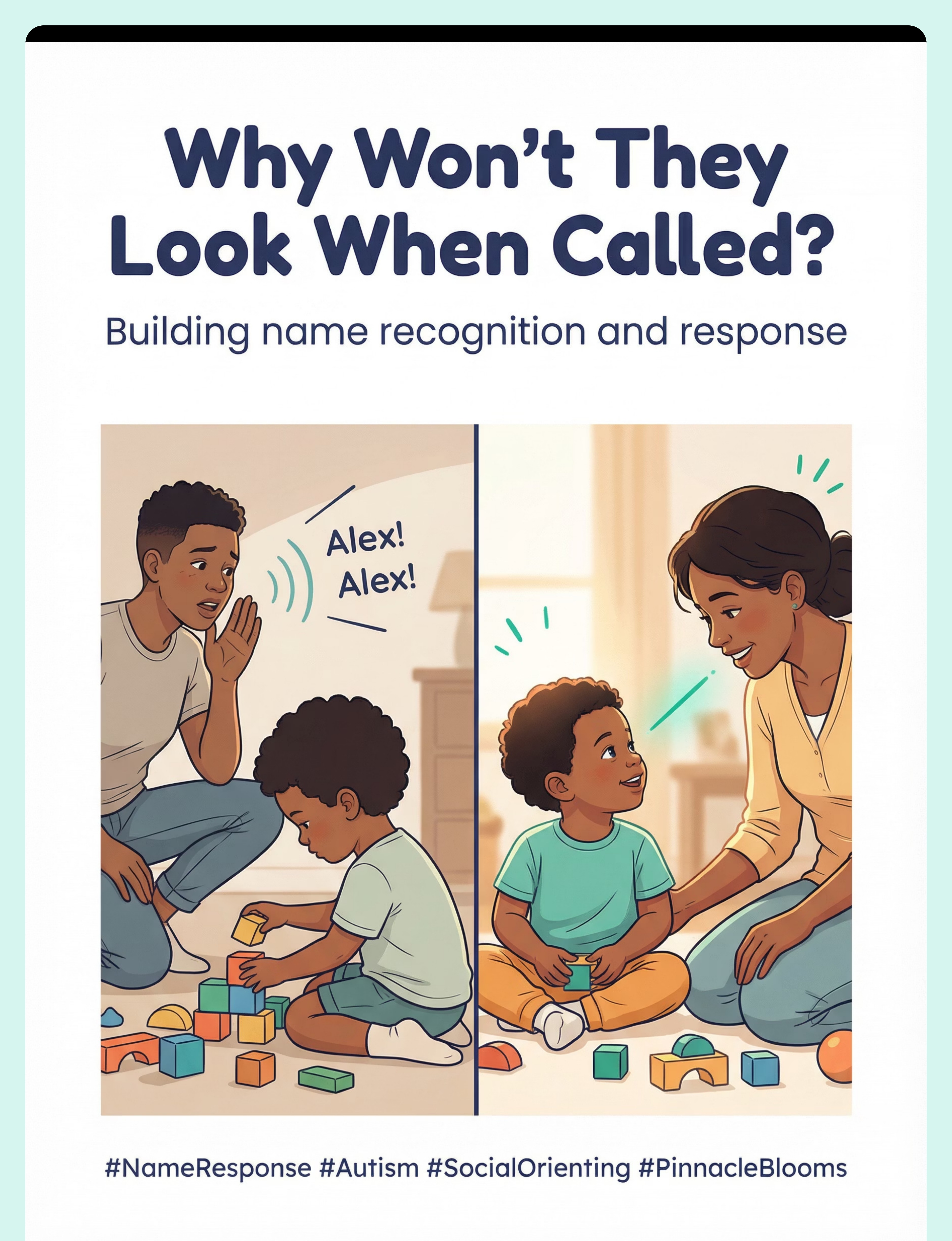
It's 7:30 AM. Breakfast is getting cold. You say their name — once, twice, five times. They don't flinch. They don't look up. They don't turn around. But the moment you unwrap a snack, they sprint across the room. They hear the TV theme song from two rooms away. They hear the neighbor's dog. They hear everything — except you calling their name.
You are not failing. Your child's brain hasn't yet learned that their name is the most important sound in their world. And that is a teachable skill.
"You are not invisible. Your child's auditory processing system simply hasn't prioritized social sound over environmental sound — yet. Neuroscience shows us exactly how to change that."
Name Response Training Through Systematic Pairing — 9 evidence-based materials that build the bridge between your voice and your child's attention. Built by mothers. Engineered as a system.
SLP
BCBA
OT
SpEd
NeuroDev
You Are Among Millions
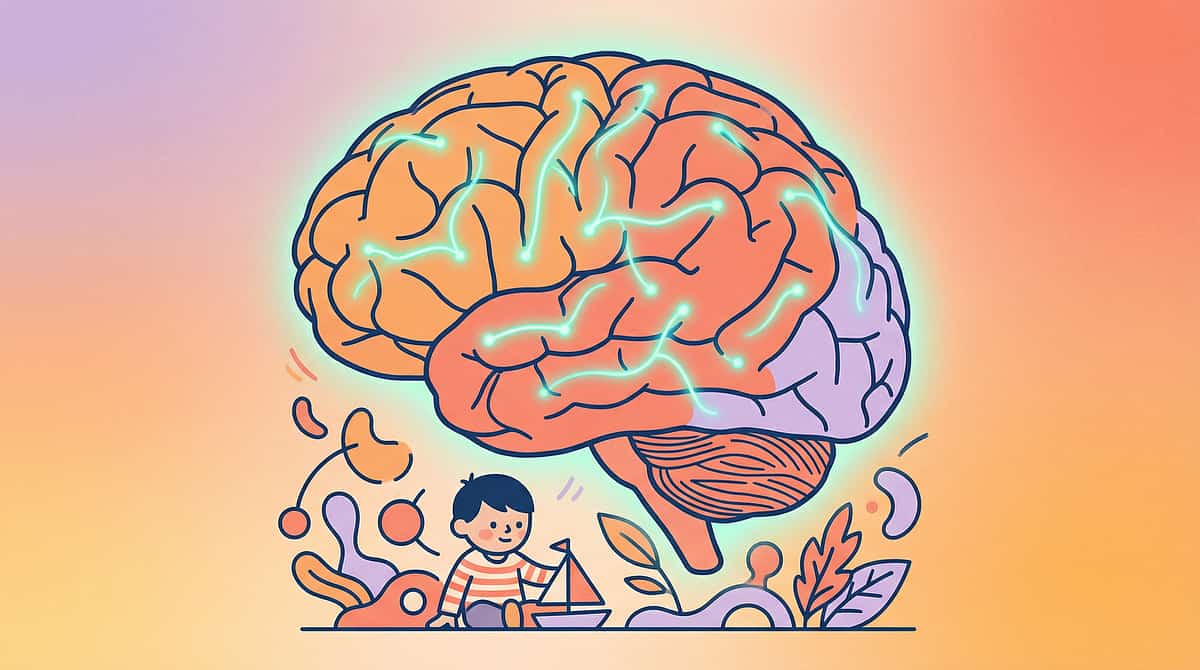
If you've felt alone in this experience — standing in your living room, calling your child's name, feeling invisible — know that millions of families worldwide share this exact moment. The data is clear: this is common, this is not your fault, and this is absolutely addressable.
37-40%
Primary Concern
Of children referred for autism evaluation show absent or reduced response to name as a leading concern (Nadig et al., 2007; Osterling & Dawson, 1994).
12mo
Earliest Red Flag
Failure to respond to name is identified by the American Academy of Pediatrics as one of the earliest red flags for autism spectrum disorder — yet intervention can begin immediately.
1 in 100
Global Prevalence
Children globally are estimated to have autism (WHO, 2023). In India, with 26+ million births annually, hundreds of thousands of families navigate this moment every year.
Across Pinnacle Blooms Network's 70+ centers serving families from 70+ countries, name response training is one of the five most commonly initiated intervention pathways — reflecting both the prevalence of this challenge and the effectiveness of systematic approaches.
References: Osterling J & Dawson G (1994) — First birthday home videotapes. | Nadig AS et al. (2007) — Prospective study of response to name. | WHO Fact Sheet on Autism (2023).

The Science of Why They Don't Turn Around
When you call your child's name, their brain must execute a complex chain of events in milliseconds. Understanding where the chain breaks is the key to knowing how to fix it.
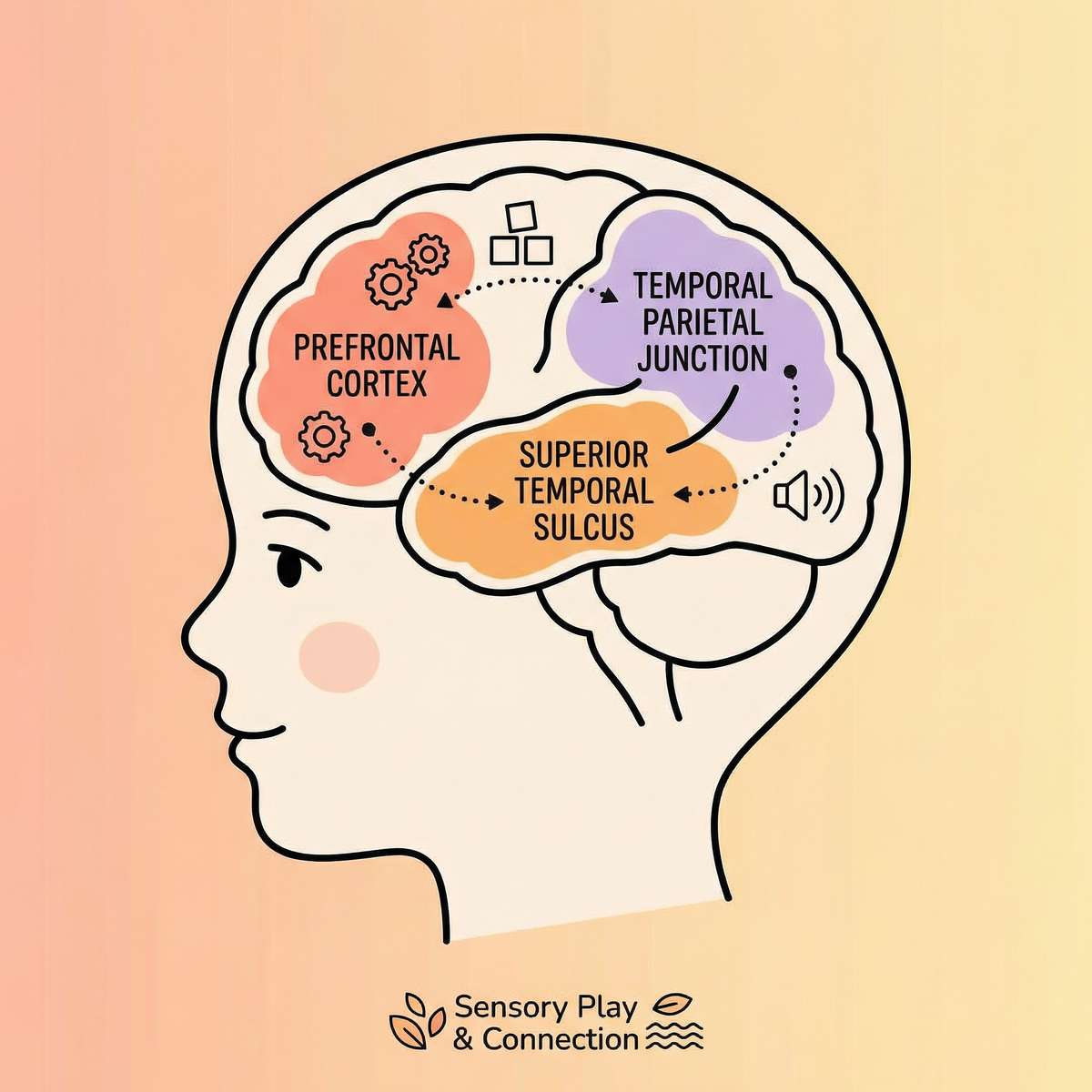
Three key regions: Superior Temporal Sulcus (social voice processing) → Temporal-Parietal Junction (social orienting) → Prefrontal Cortex (salience assignment — deciding what's "important" enough to attend to).
The Chain of Events
First, the auditory cortex must separate your voice from background noise. Then the superior temporal sulcus must recognize that specific sound pattern as personally relevant. Next, the temporal-parietal junction must initiate an attention shift — literally commanding the head and eyes to orient toward the source. Finally, the prefrontal cortex must assign enough "importance" to override whatever the child is currently focused on.
In autism, research consistently shows that the social salience assignment step is where the chain breaks. Your child's brain processes the sound — it literally hears "Alex" or "Priya" — but doesn't yet categorize that sound as more important than the block they're holding or the pattern they're watching.
Key Insight: This is a wiring difference in salience assignment — not a hearing problem and not defiance. The auditory pathway works. The social prioritization pathway needs to be built through systematic experience — and that's exactly what these 9 materials do.
References: Dawson G et al. (2004) — Neural correlates of face and object recognition in ASD. | Kuhl PK et al. (2005) — Brain responses to speech in autism. | Webb SJ et al. (2006) — ERP evidence for neural underpinnings of name recognition.

The Developmental Map: Name Response Across Ages
Name response doesn't emerge in isolation — it follows a predictable developmental trajectory. Understanding where your child sits on this map helps you meet them exactly where they are.
0–3 Months
Startles to loud sounds, calms to familiar voices. Auditory foundation forming.
4–6 Months
Turns toward familiar voices, begins showing preference for caregiver voice. Social auditory preference emerging.
6–9 Months
⭐ Begins responding to own name consistently. Typical milestone window.
9–12 Months
Responds to name reliably across settings, starts following simple verbal cues. Social orienting established.
12–18 Months
⚠️Red Flag Zone — If not responding to name by 12 months, developmental evaluation warranted.
18 Months – 8 Years
🟢Active Intervention Window — With systematic training, name response can be established at any point in this range.
Children who don't respond to their name often also show challenges in joint attention, eye contact during social interaction, following simple verbal directions, and social engagement and motivation. These are addressed in related techniques B-122 through B-125.
References: WHO Care for Child Development (CCD) Package. | UNICEF MICS indicators. | AAP developmental milestone framework. | PMC9978394.
Clinically Validated. Home-Applicable. Parent-Proven.
Level I–II Evidence
Systematic Reviews + Prospective Studies + RCTs
Name response training through systematic pairing with reinforcement is supported by converging evidence from three research streams:
Early Detection Research
Prospective studies (Nadig et al., 2007; Osterling & Dawson, 1994) established that reduced name response is one of the earliest and most reliable behavioral markers of autism, detectable by 12 months — confirming this as a clinically significant intervention target.
ABA Intervention Research
Multiple controlled studies demonstrate that systematic pairing of name with reinforcement combined with differential reinforcement of orienting behavior produces reliable, generalizable name response. Koegel & Koegel (2006) established Pivotal Response Treatment protocols for naturalistic name response training.
Multi-Sensory Learning Research
Using visual, auditory, and tactile materials simultaneously increases learning acquisition speed in children with developmental differences (Ayres Sensory Integration theory; meta-analysis PMC10955541).
Across 21 million+ exclusive 1:1 therapy sessions at 70+ Pinnacle Blooms centers, name response training has achieved 97%+ measured improvement on the Communication Readiness Index when families engage in both clinic and home-based practice using the EverydayTherapyProgramme™.
References: PMC11506176 | PMC10955541 | Koegel LK & Koegel RL (2006) | Nadig AS et al. (2007) | Osterling & Dawson (1994) | Pinnacle Blooms Network® Clinical Outcomes Data.
Act II: The Knowledge Transfer
The Technique: What It Is
Formal Name: Systematic Name-Reinforcer Pairing for Social Orienting
Parent-Friendly Alias:"Teaching Your Child That Their Name Means Something Wonderful"
Name response training is a structured intervention technique that systematically pairs the sound of your child's name with immediate access to highly preferred items, activities, or sensory experiences. Through repeated pairing, the child's brain learns that hearing their name predicts something positive, gradually building an automatic orienting response — looking toward the speaker — when their name is called. This technique uses 9 categories of materials to create multiple learning pathways simultaneously.
Domain
Social Communication → Joint Attention & Social Orienting
Age Range
12 months – 8 years
Session Length
5–15 minutes per practice session
Frequency
3–5x daily, woven into natural routines
Reinforcer Kits
Personalized Books
Musical Materials
Visual Attention Tools
Digital Apps
Social Games
Environmental Mods
Multi-Sensory Materials
Progress Tracking

Precision Targets — What You're Building
Every effective intervention needs clearly defined, measurable targets. Here is the bullseye your child is aiming for — and the ripple effects that follow when they hit it.
Observable Behavior Indicators
Primary
Child turns head and makes eye contact within 3 seconds of name being called.
Secondary
Child pauses current activity when name is called. Looks toward speaker even with moderate distractions.
Tertiary
Child anticipates social interaction when name is heard. Shows positive affect (smile, approach) when name is called.
GPT-OS® Readiness Tracking: Communication Readiness Index → Social Orienting & Joint Attention. Progression: Awareness → Emerging → Developing → Established → Generalized. Reference: Koegel LK & Koegel RL (2006).

Your 9 Materials — Everything You Need
Each material targets a different learning pathway. Together, they surround your child's brain with converging evidence that their name means something wonderful. Below is your complete shopping list with pricing, recommendations, and DIY alternatives.

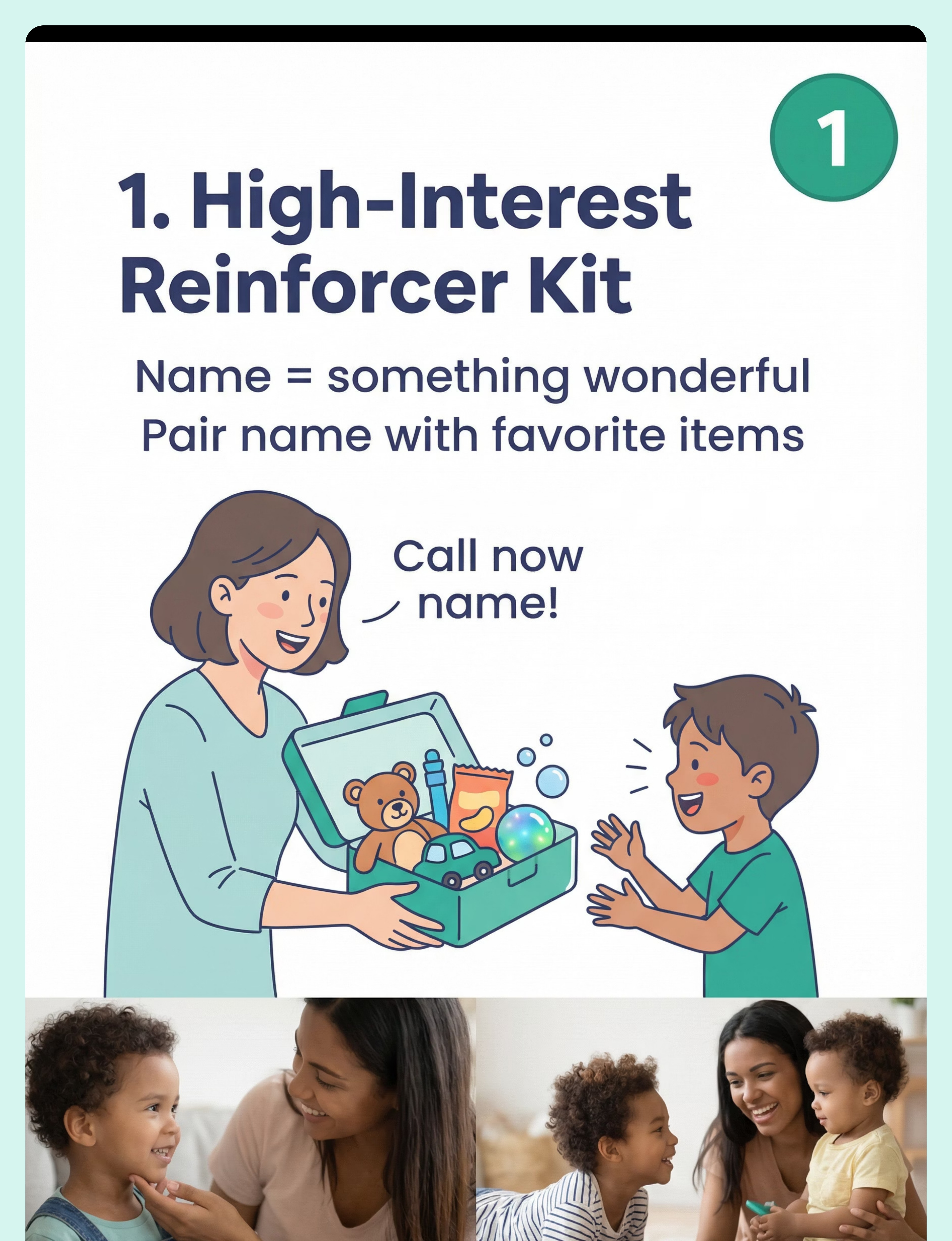
1. High-Interest Reinforcer Kit
₹200–1,000 | ⭐ Pinnacle Recommends
Portable container with child's top 3–5 most motivating items (toys, snacks, sensory items) reserved ONLY for name response training.
Portable container with child's top 3–5 most motivating items (toys, snacks, sensory items) reserved ONLY for name response training.
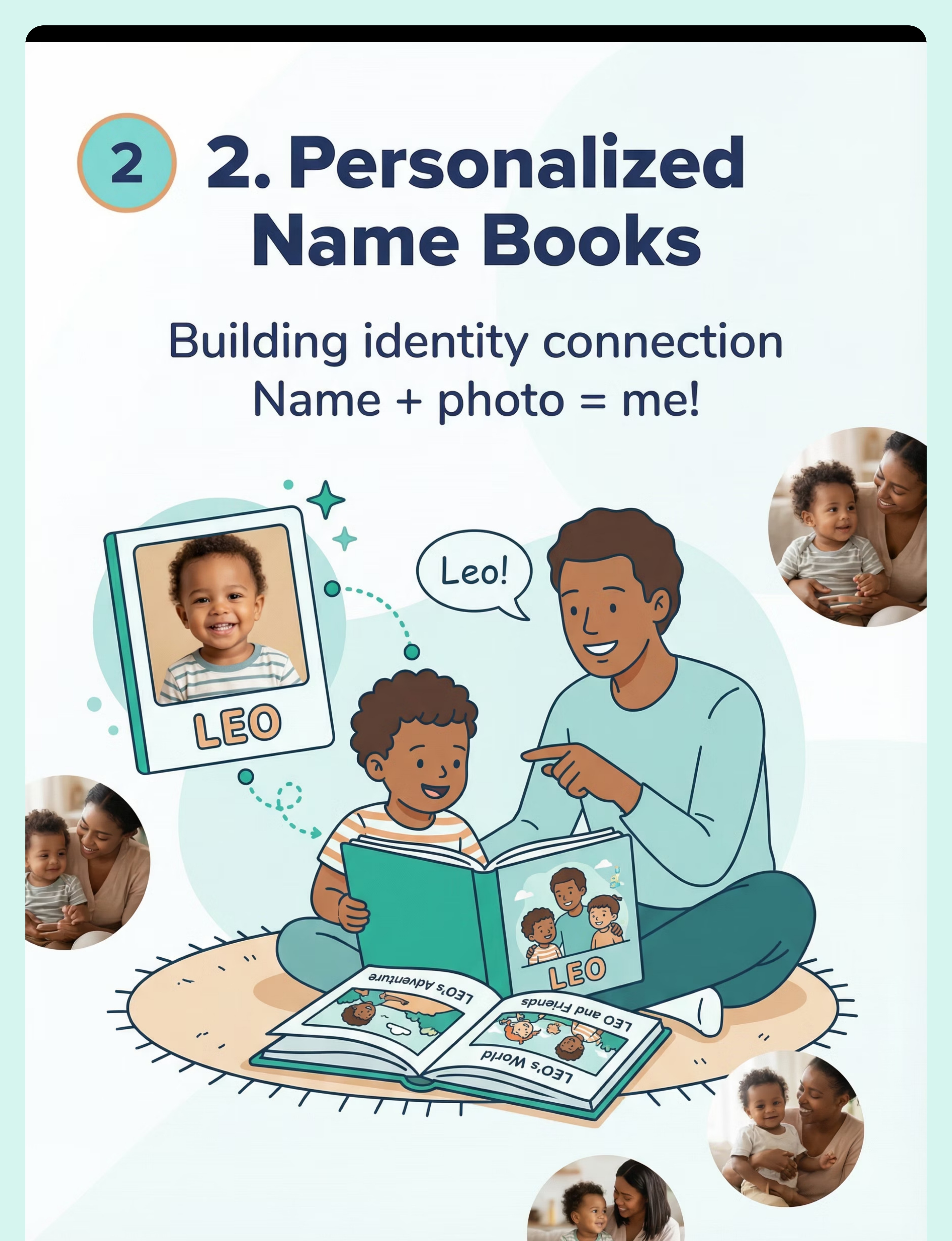
2. Personalized Name Books
₹300–1,500 | DIY Available ✅
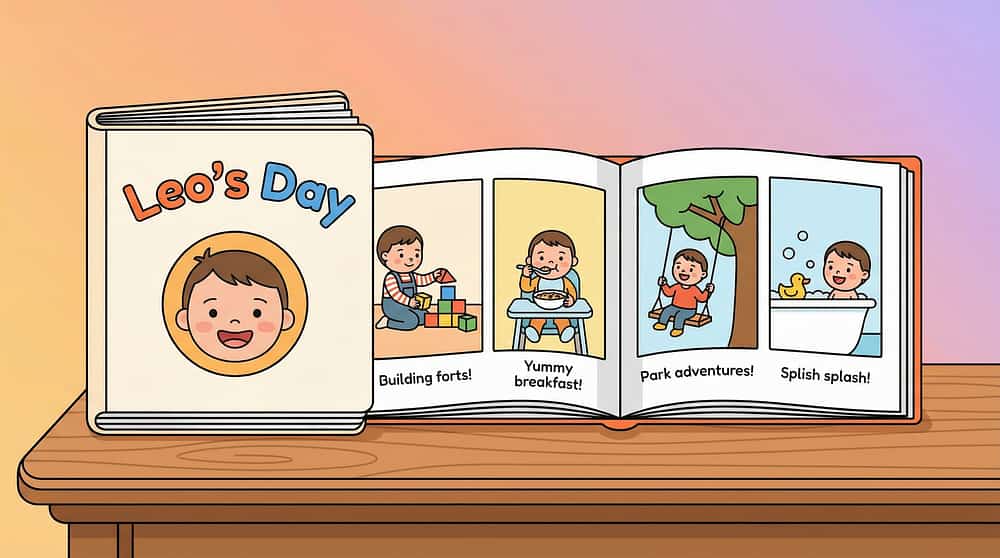
Custom photo books, DIY laminated albums, personalized board books, and "All About Me" templates featuring your child's name on every page.
Custom photo books, DIY laminated albums, personalized board books, and "All About Me" templates featuring your child's name on every page.

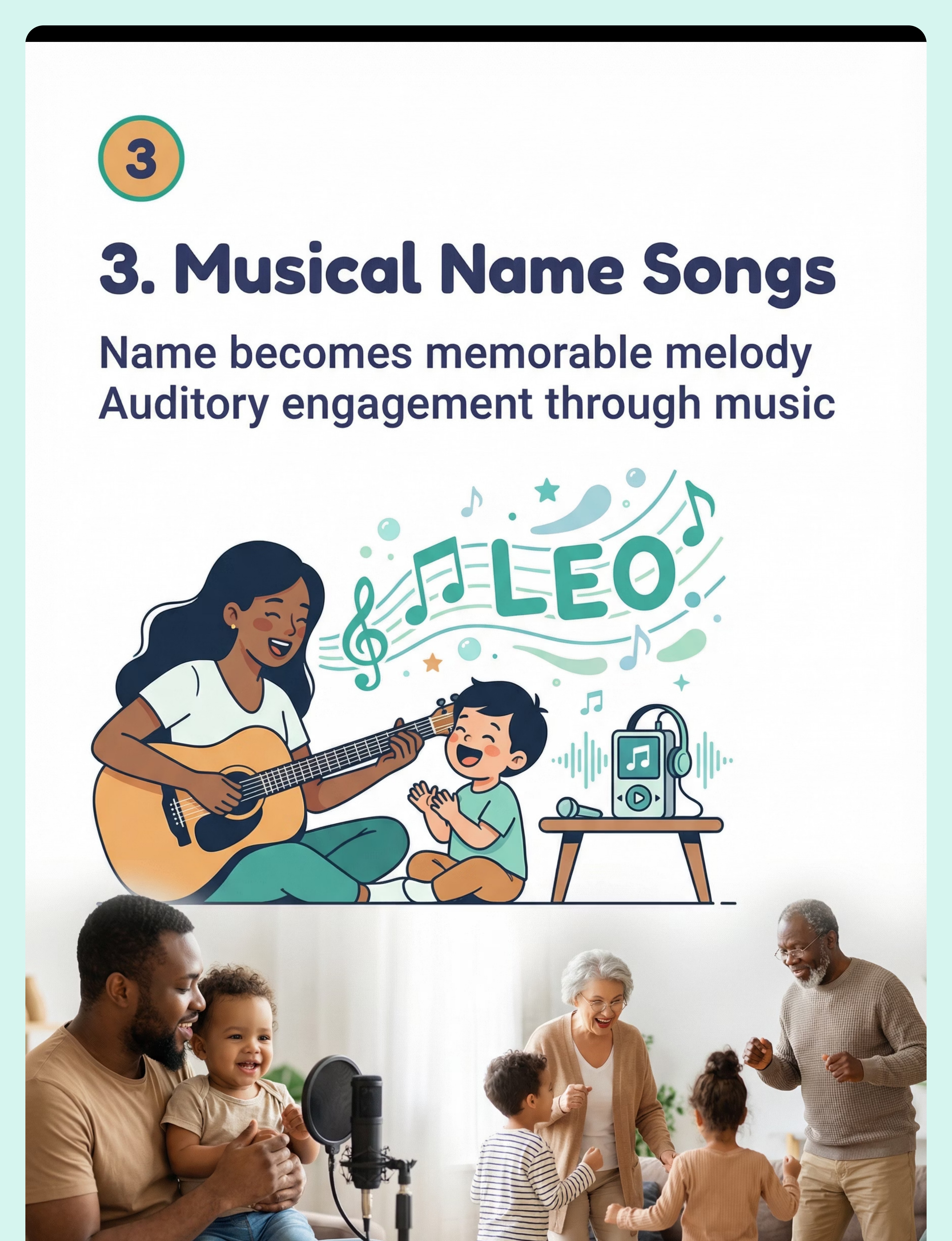
3. Musical Name Songs
₹0–500 | DIY Priority ✅
Custom name song recordings, music creation apps, adapted nursery rhymes with your child's name inserted into familiar melodies.
Custom name song recordings, music creation apps, adapted nursery rhymes with your child's name inserted into familiar melodies.
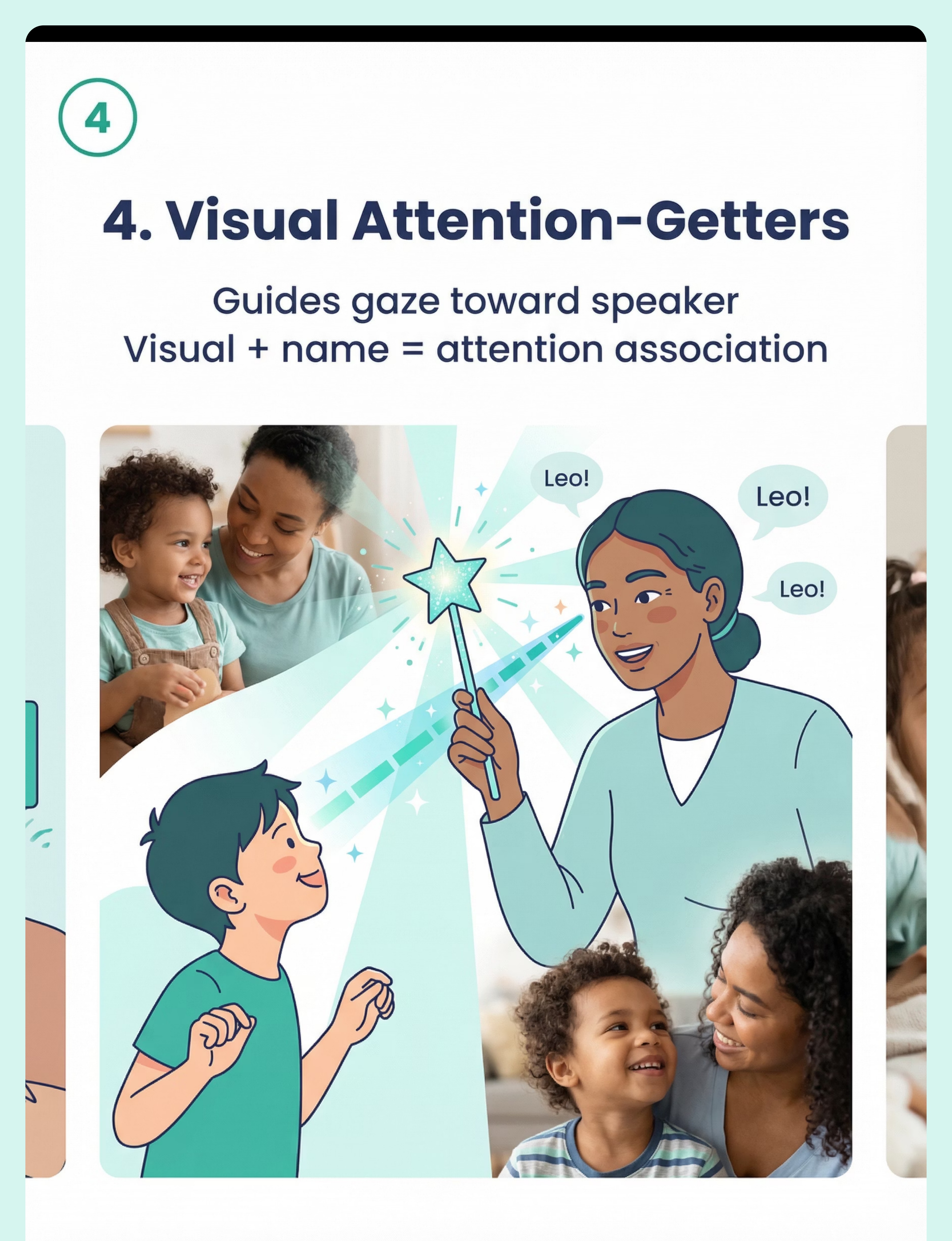
4. Visual Attention-Getters
₹100–600
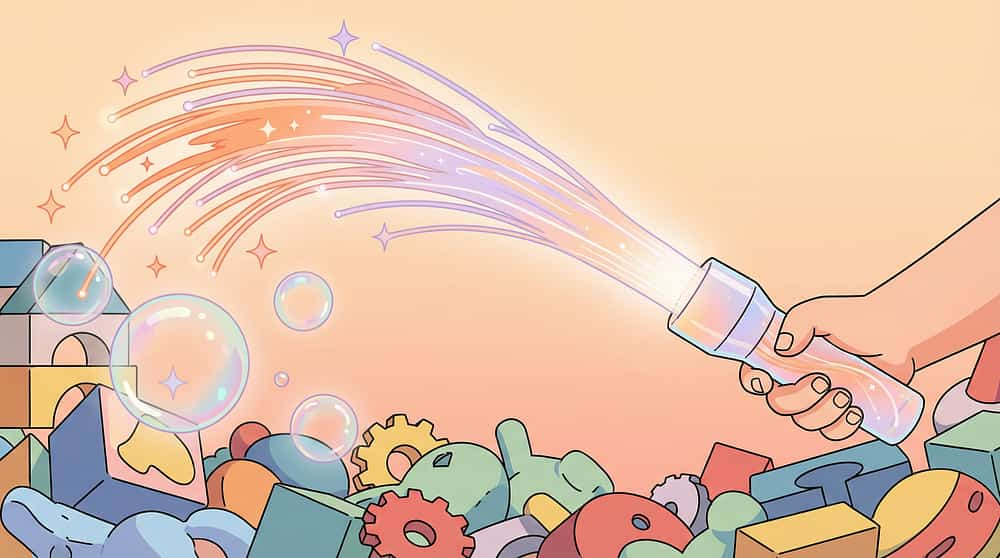
Light-up wands, sparkly objects, fiber optic wands, spinning light toys, bubbles, and novel puppets that draw the child's gaze toward your face.
Light-up wands, sparkly objects, fiber optic wands, spinning light toys, bubbles, and novel puppets that draw the child's gaze toward your face.
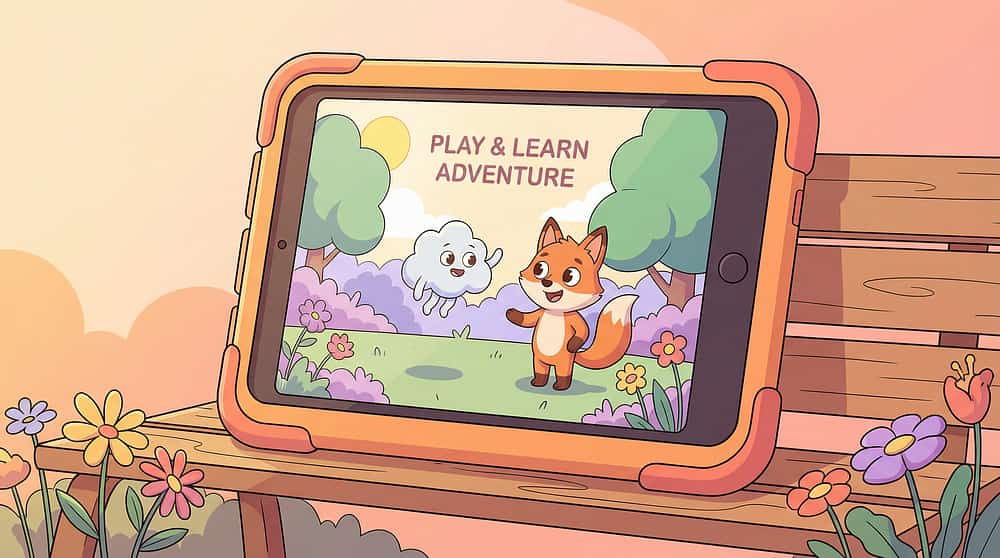
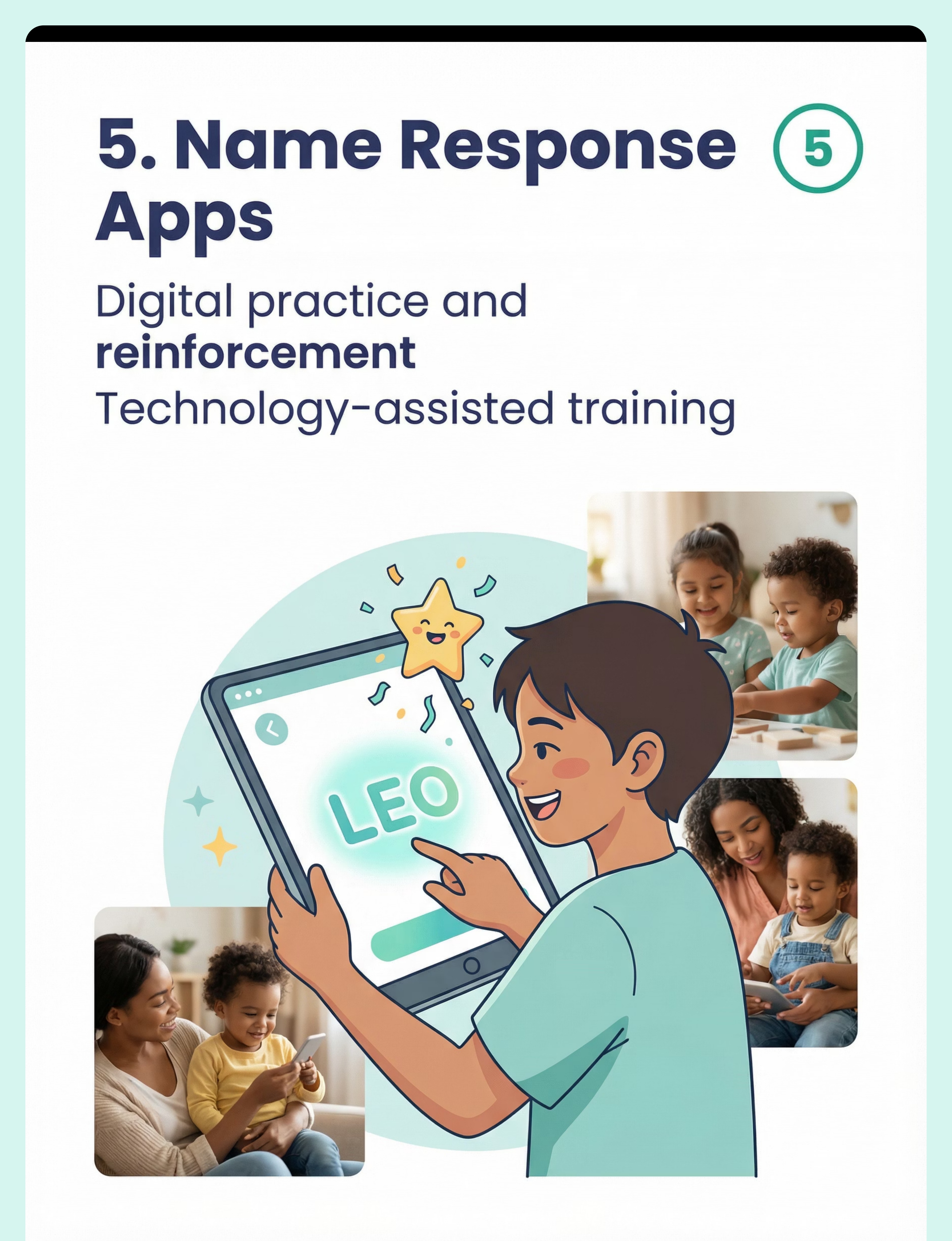
5. Name Response Apps
₹0–2,000
Autism-specific name response apps, attention training apps, customizable therapy apps, and video modeling apps on tablet or phone.
Autism-specific name response apps, attention training apps, customizable therapy apps, and video modeling apps on tablet or phone.

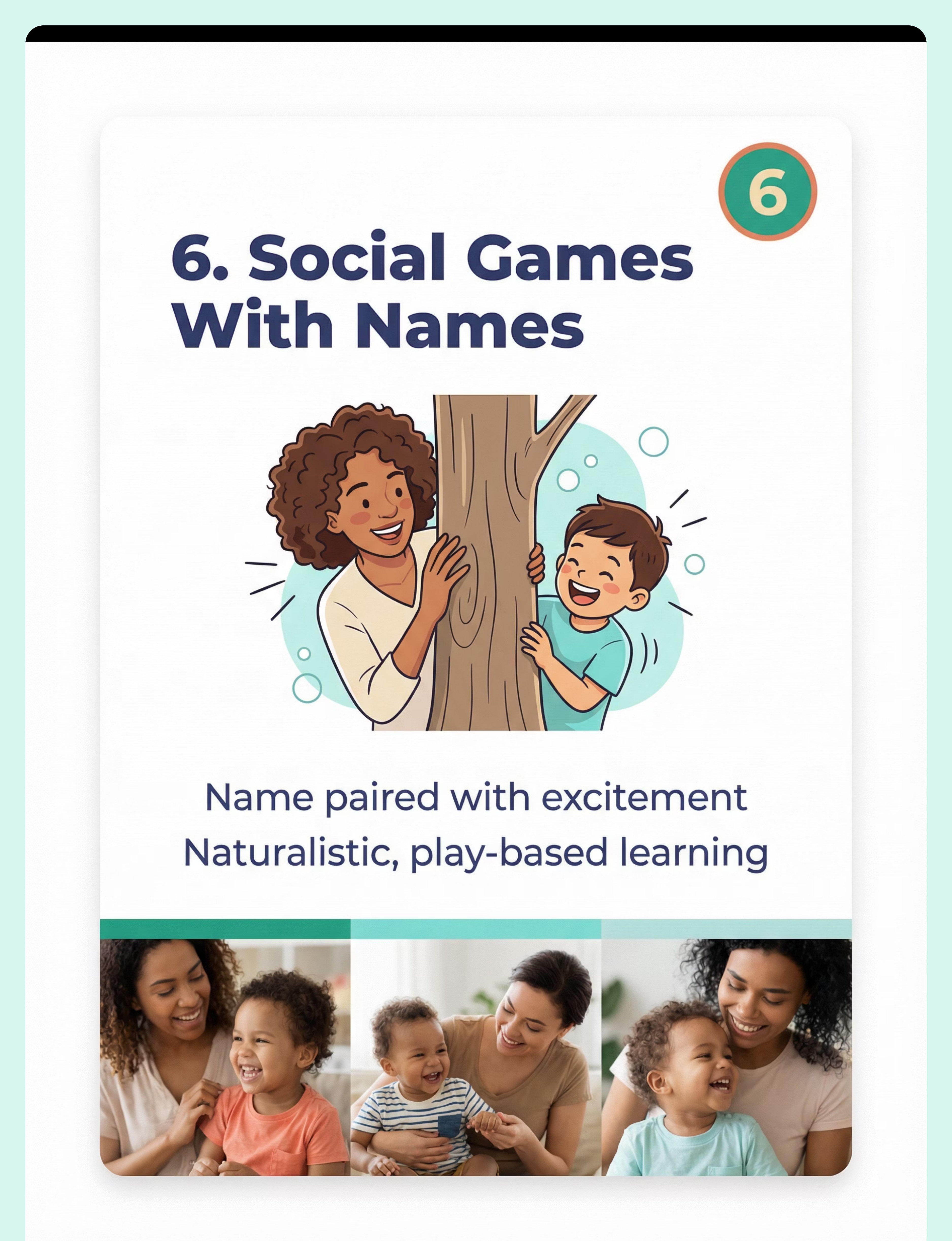
6. Social Games
₹0–200 | DIY Priority ✅
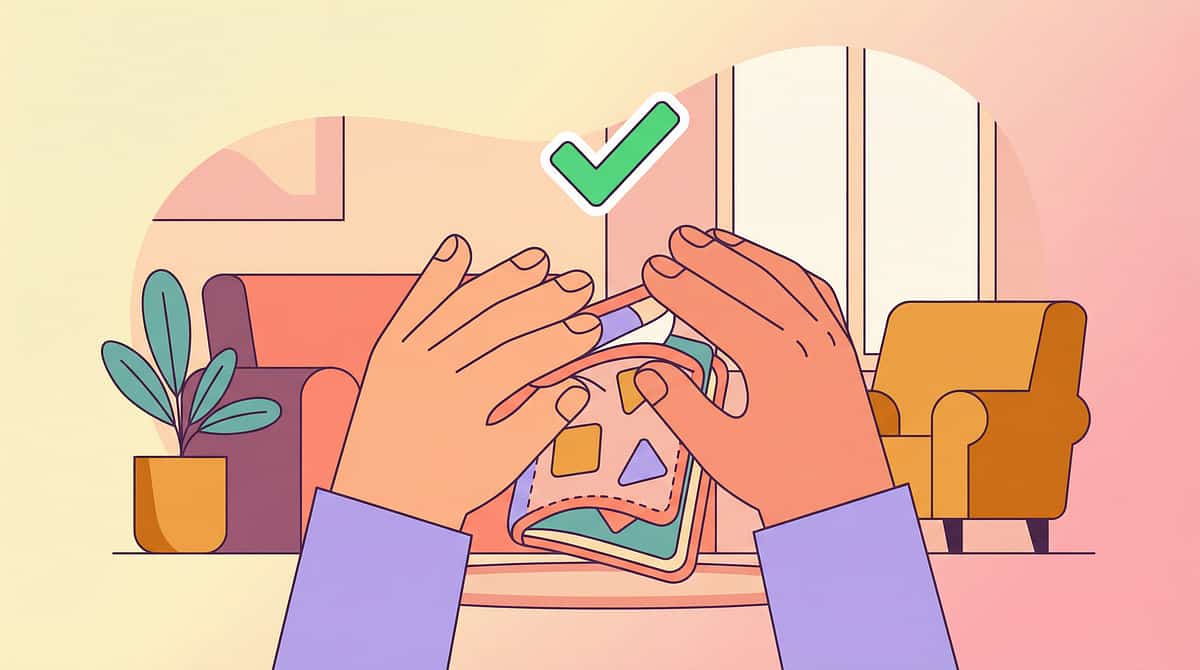
Peek-a-boo cloths, chase game prompts, tickle games, swing activities, and anticipation games that embed the child's name into joyful interaction.
Peek-a-boo cloths, chase game prompts, tickle games, swing activities, and anticipation games that embed the child's name into joyful interaction.

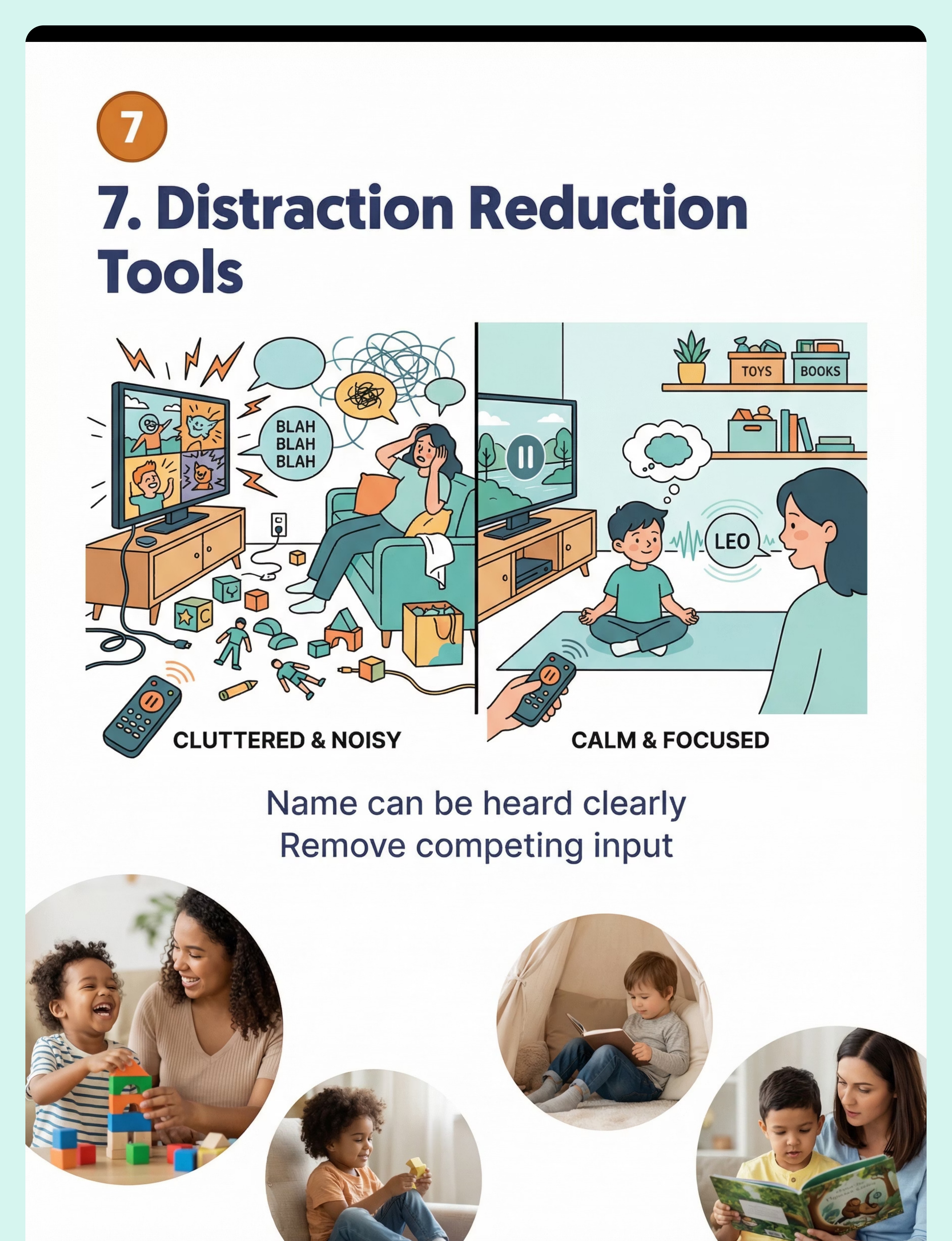
7. Distraction Reduction Tools
₹0–500 | DIY Priority ✅
Remote controls for quick TV pausing, organizational containers, room dividers, and timers for electronics pauses to create an optimal learning environment.
Remote controls for quick TV pausing, organizational containers, room dividers, and timers for electronics pauses to create an optimal learning environment.
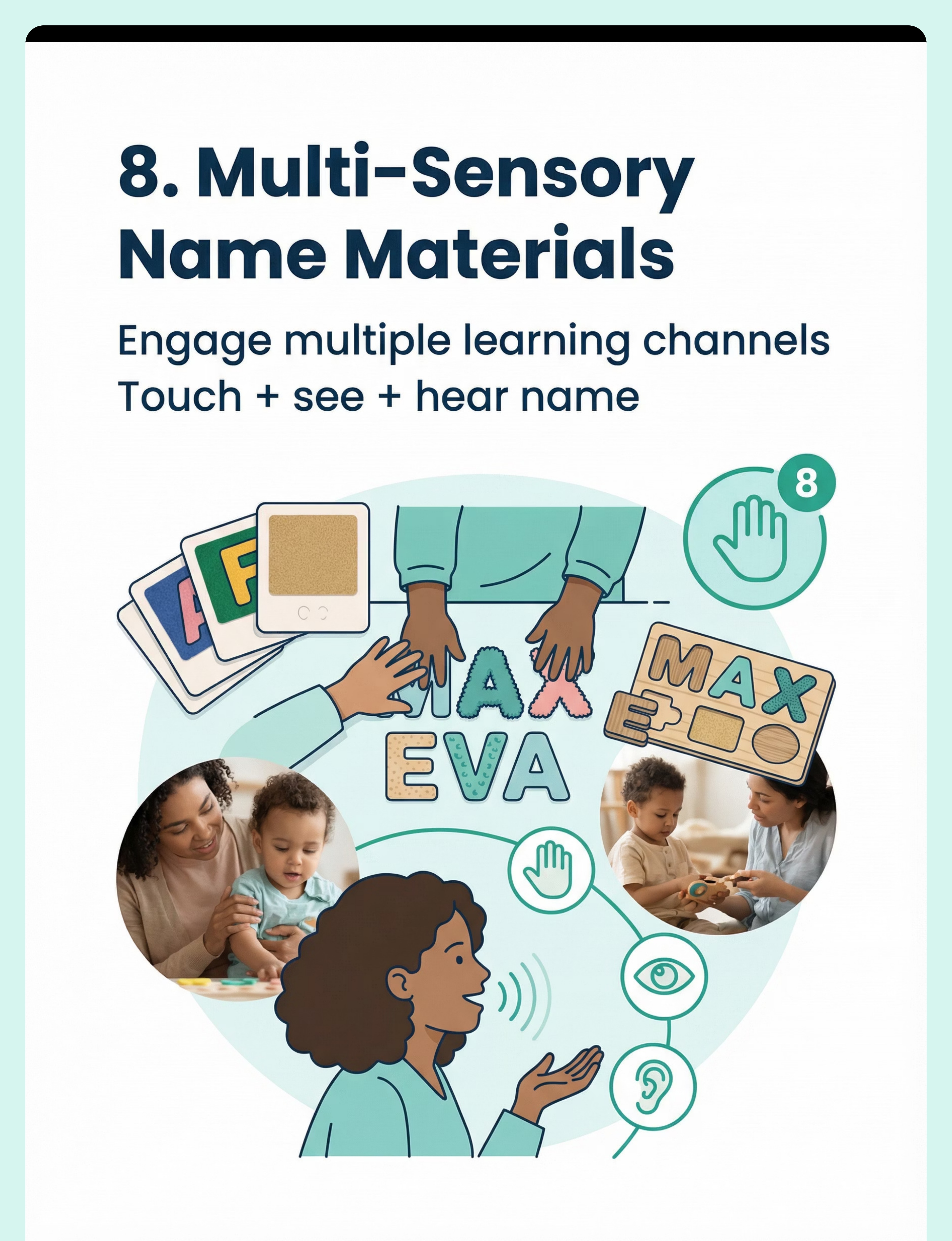
8. Multi-Sensory Name Materials
₹200–800 | DIY Available ✅
Sandpaper name letters, textured name cards, wooden name puzzles, raised letter name boards, and tactile letter sets engaging multiple senses.
Sandpaper name letters, textured name cards, wooden name puzzles, raised letter name boards, and tactile letter sets engaging multiple senses.
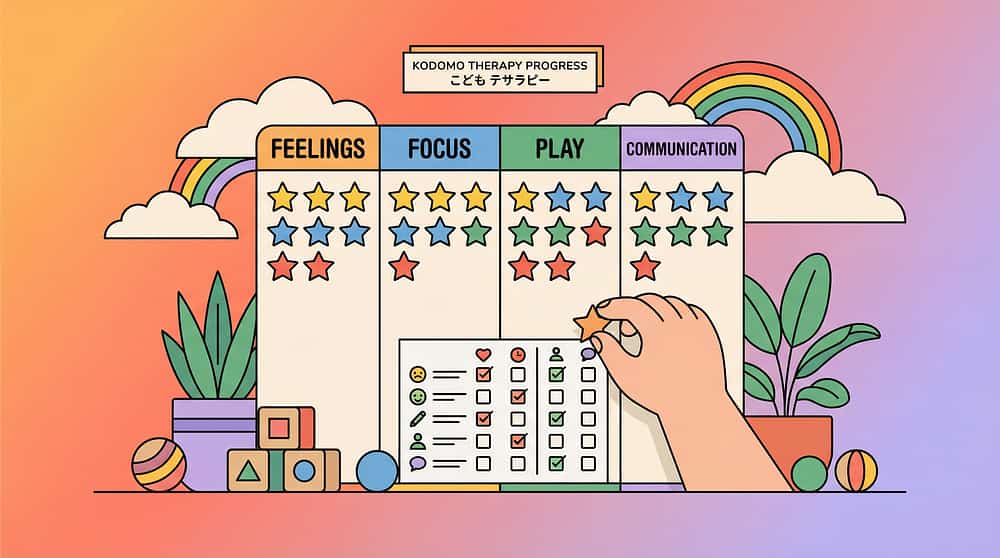
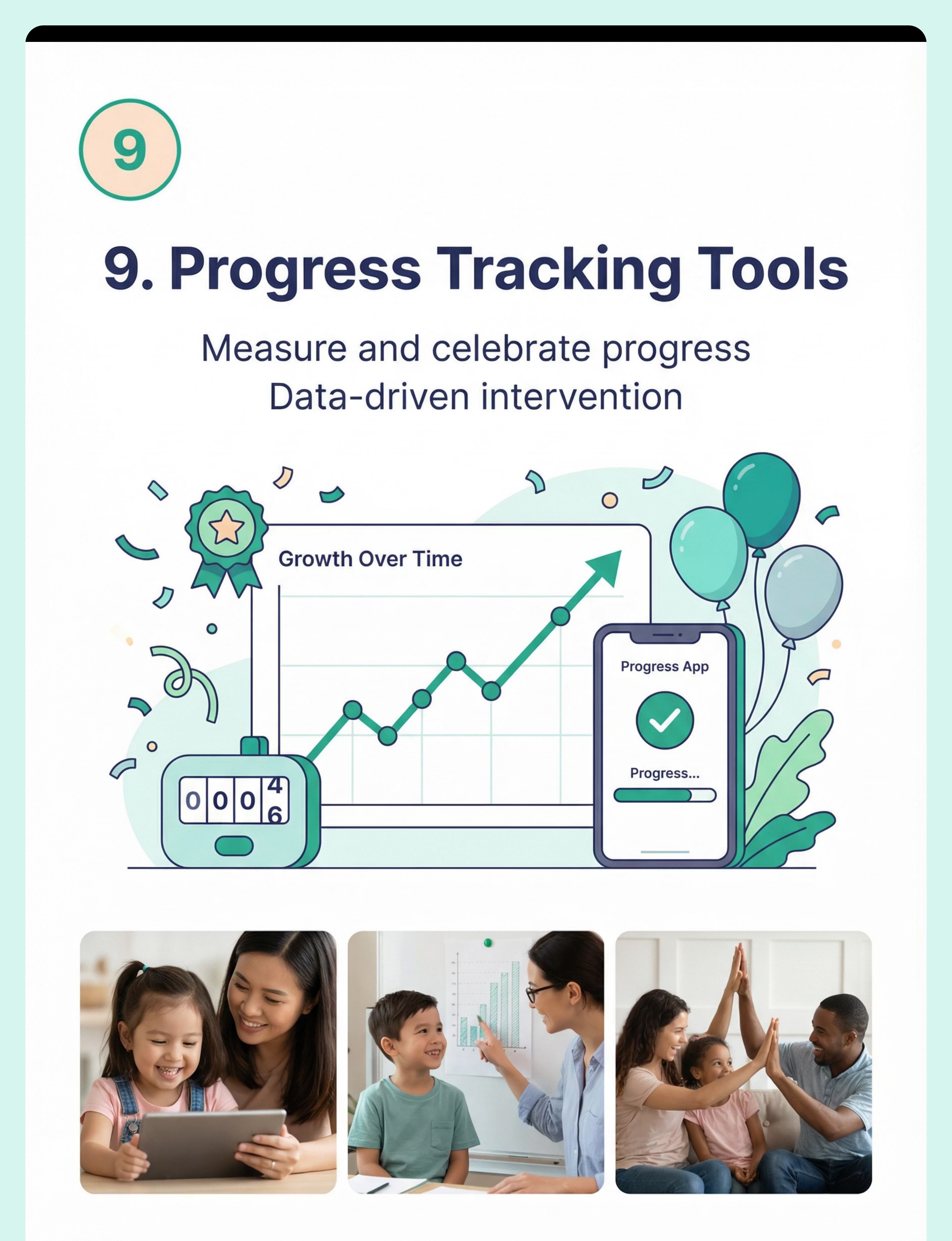
9. Data Collection Tools
₹0–300 | DIY Priority ✅
Tally counter, downloadable data sheets, progress tracking apps, visual graphing tools, and milestone celebration charts.
Tally counter, downloadable data sheets, progress tracking apps, visual graphing tools, and milestone celebration charts.
Total Investment
₹800–5,500 for comprehensive setup
Essential Starters
Items 1, 4, 9 — approx. ₹300–1,900
No Budget? No Problem. Start Today With What You Have.
The WHO Nurturing Care Framework emphasizes that effective interventions must work in ANY home, regardless of economic resources. The therapeutic principle — pairing name with positive experience — is what matters, not the price of the tool. Here is your complete DIY guide.
# | Material | Buy Option | Make-It-at-Home (₹0–30) | |
1 | Reinforcer Kit | Therapy container (₹200–1,000) | Any small box + child's top 3–5 most exciting items (specific spoon, crinkly wrapper, favorite small toy). Reserve exclusively for name training. ₹0. | |
2 | Name Books | Custom photo book (₹300–1,500) | 10–15 photos of child printed at any shop (₹5–10 each). Laminate, punch holes, tie with ribbon. Write name on every page. ₹50–150. | |
3 | Musical Songs | Custom recordings (₹0–500) | Adapt ANY tune your child loves. "Twinkle Twinkle" becomes "Hello Hello [Name] dear." Record on your phone. ₹0. | |
4 | Visual Cues | Light-up wands (₹100–600) | Aluminum foil on a stick for sparkle. Small flashlight. Blow soap bubbles near your face. Steel spoon catching light. ₹0–20. | |
5 | Apps | Premium apps (₹0–2,000) | Free cause-and-effect apps. Record yourself saying the name using voice recorder. Play at random intervals. ₹0. | |
6 | Social Games | Game kits (₹0–200) | Peek-a-boo with a dupatta/towel. Chase around the room. Tickle games. Swing in a bedsheet. All free and deeply effective. ₹0. | |
7 | Distraction Reduction | Room dividers (₹0–500) | Turn off the TV. Close the door. Move to the quietest room. Face child away from windows. You already own everything. ₹0. | |
8 | Multi-Sensory | Textured sets (₹200–800) | Write name with white glue on cardboard, sprinkle sand/salt/rava (semolina). Once dry, child traces textured letters while you say the name. Rice tray writing. ₹0–30. | |
9 | Tracking | Apps/tools (₹0–300) | Notebook with two columns: Date | Responded (Yes/No/Partial). Star stickers on wall chart. Tally marks. ₹0–20. |
Zero-Cost Total Setup: All 9 materials can be implemented for ₹0–100 using household items. The therapeutic principle is what produces the results — not the packaging.
References: WHO Nurturing Care Framework (2018). CCD Package implemented across 54 LMICs. PMC9978394 | WHO NCF Handbook (2022).
Safety Gate — Read Before You Start
Your child's safety and emotional wellbeing come first — always. Review these traffic-light guidelines before every session to ensure conditions are right.
🔴 DO NOT PROCEED IF
- Child has NOT had a hearing evaluation — audiological assessment must be completed first (non-negotiable)
- Child is in active distress, illness, pain, or post-seizure state
- Child has a known aversive reaction to their name — name has been paired with scolding or punishment (seek BCBA guidance to "rehabilitate" the name first)
- You are feeling frustrated, angry, or desperate — your emotional state transfers directly
🟡 MODIFY IF
- Child is tired, hungry, or approaching a difficult transition — shorten to 1–2 pairings only
- Environment is noisy or chaotic — move to a quieter space or wait
- Another child or pet is competing for attention — find a 1:1 moment
- Child is deeply engaged in a preferred activity — wait for a natural break rather than interrupting
🟢 PROCEED WHEN
- Child is fed, rested, and in a calm-alert state
- Environment is reasonably quiet with minimal distractions
- You have the reinforcer kit ready within arm's reach
- You have 5–15 minutes of uninterrupted time
- You are feeling calm, patient, and ready to celebrate small wins
Critical Safety Rules
- NEVER call the child's name repeatedly without pairing — every unanswered name call teaches the brain that the name can be ignored. If they don't respond, DO NOT keep calling. Approach, pair, then try again later.
- NEVER punish or scold for not responding — negative consequence creates name aversion.
- Choking hazards: If using snacks as reinforcers, ensure age-appropriate size. Supervise ALL small item use for children under 3.
- Screen time limits: If using apps (Material 5), limit to 5–10 minutes per session. Apps supplement human interaction; they do not replace it.
- Light-up toys: Avoid strobe-effect items for children with seizure history or photosensitivity.
References: Indian Journal of Pediatrics RCT (2019) — Home-based intervention safety protocols. DOI: 10.1007/s12098-018-2747-4.
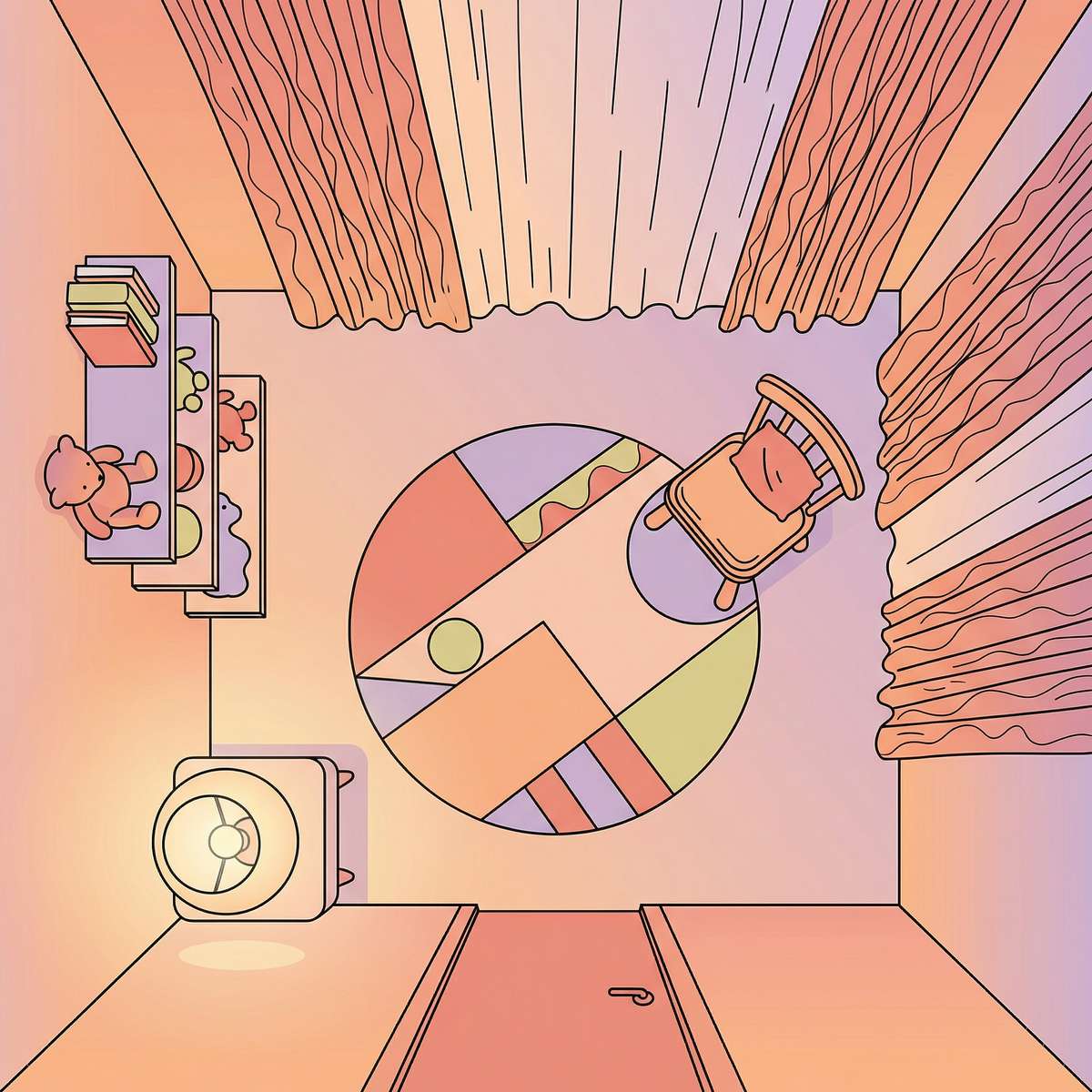
Your Training Space — Set It Right
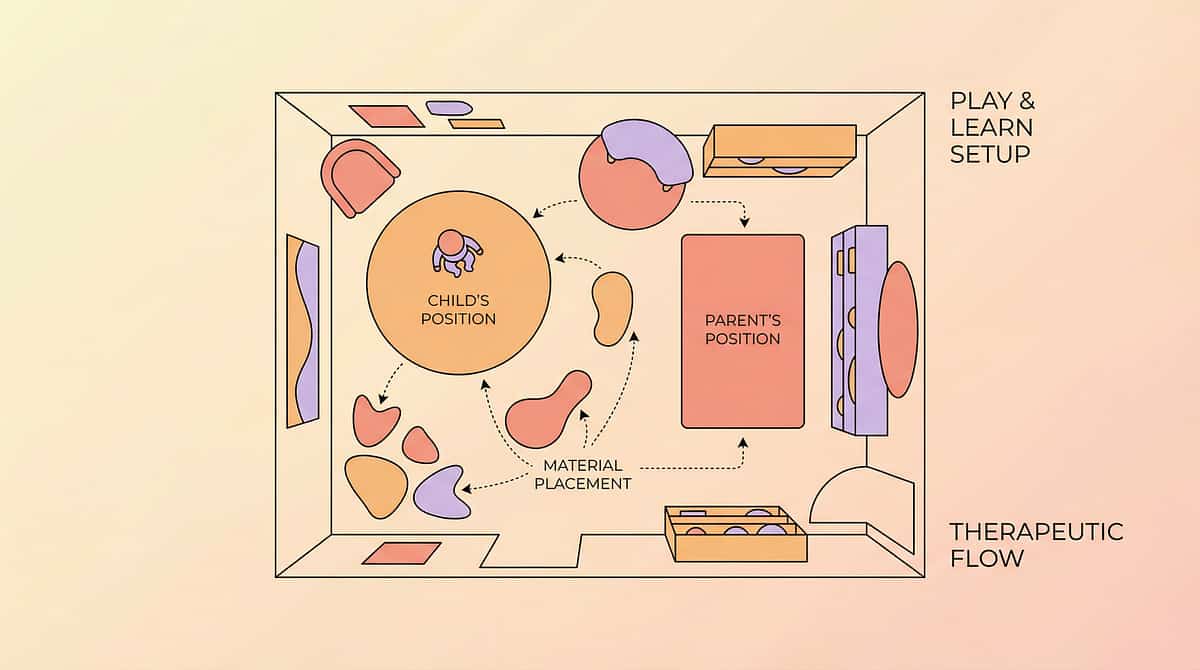
Spatial precision prevents 80% of session failures. Set the space right and the technique practically runs itself. Here is your bird's-eye setup guide.
Setup Checklist
- Choose your room: Smallest, quietest room available. Fewer visual distractions = better.
- Electronics: TV off. Tablet physically removed from sight. Phone on silent.
- Sibling/pet management: Arrange for them to be in another room if possible.
- Positioning: Child seated comfortably. Parent at child's eye level, 3–4 feet away. NOT standing over the child.
- Materials staged: Reinforcer kit within arm's reach but NOT visible to child. Visual cue ready but hidden.
- Lighting: Natural, moderate. Not dim (child needs to see your face), not harsh.
- Time of day: When your child is typically most alert. Many parents find mid-morning or after afternoon rest works best.
Golden Rule: If the child can see their reinforcers, they'll reach for them instead of orienting. If you're standing above them, eye contact becomes physically effortful. If the TV is "paused" but visible, the frozen screen competes. Environment shapes behavior.
References: Ayres Sensory Integration Theory — Environmental setup as core principle. PMC10955541.

Act III: The Execution Protocol
Pre-Flight Checklist — 60 Seconds to Go/No-Go
Before every session, run through this rapid readiness check. It takes 60 seconds and saves you from unproductive sessions.
Child has eaten within 1–2 hours
Not hungry — hunger competes with attention and makes reinforcers unpredictable.
Child has slept adequately
Not overtired — fatigue reduces orienting capacity and increases frustration.
Calm-alert state confirmed
Not crying, not in meltdown recovery, not immediately post-transition.
No illness symptoms
No fever, pain, or congestion that could affect hearing or attention.
10+ minutes of free play completed
Unstructured play since last demand — reduces behavioral resistance.
Reinforcers confirmed motivating TODAY
Preferences shift — check that today's items genuinely excite your child.
Parent is calm and regulated
Your emotional state transfers. Calm confidence enables connection.
All 7 Green → GO
Begin the full protocol.
5–6 Green → MODIFY
Shortened version: 2–3 pure pairings only, no demands.
4 or Fewer → POSTPONE
Not today. Do a calming activity instead. Try again later.
"The best session is one that starts right. There is no award for forcing through a bad session. Tomorrow is another day — and a well-rested, well-fed child tomorrow will make more progress than a miserable one today."
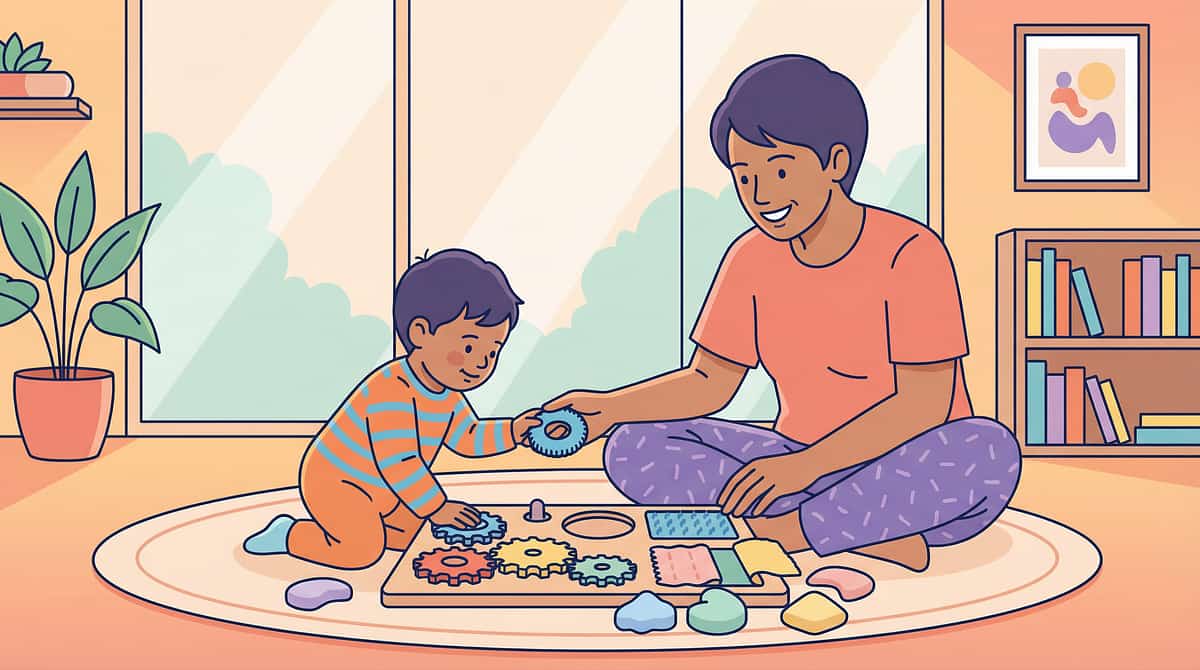
Step 1: The Invitation (Pairing Phase)
① The Invitation
Duration: 30–60 seconds
Do NOT start by calling the child's name. Instead, enter their space gently. Sit nearby. Observe what they're doing. Show genuine interest in THEIR activity for 30 seconds. You are joining their world before inviting them into yours.
Then — when they happen to glance in your direction even briefly — immediately say their name warmly while simultaneously presenting a preferred item from the reinforcer kit:
"[Name]!🎁 Here you go!"
If they don't glance naturally, use the visual attention-getter (sparkly wand, light-up toy) held near your face to draw their gaze. The MOMENT their eyes track toward your face area, say their name and deliver the reinforcer.
Your Body Language
- Seated at their level — never looming above
- Relaxed, open posture with warm facial expression
- Voice: musical, warm, slightly higher pitch
- Volume: clear but not loud — don't startle them
Reading Your Child's Response
- Acceptance: Takes or engages with item (even without looking at you — this is FINE in early stages)
- Tolerance: Allows your proximity without moving away
- Resistance: Moves away or protests → give more space, try again in 5–10 minutes
CRITICAL: This phase is PAIRING, not DEMANDING. You are NOT waiting for the child to respond. You are CREATING the positive association: Name + Wonderful Thing. Think of it as depositing into a bank account. You must make many deposits before you can expect a withdrawal.
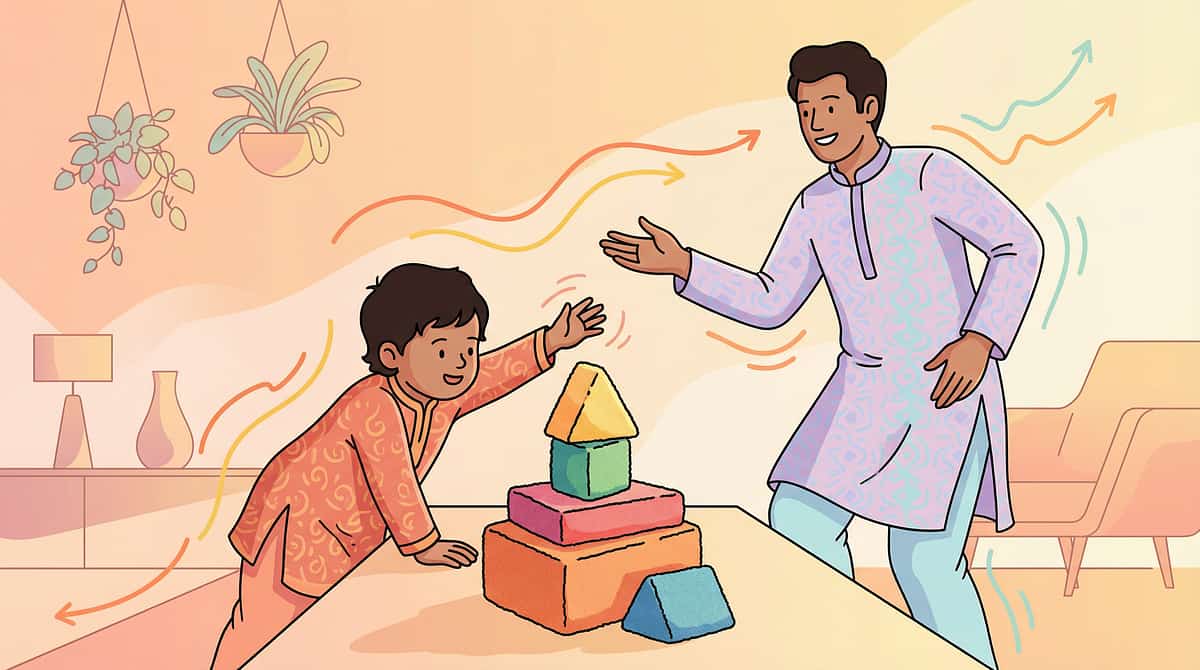
Step 2: The Engagement (Building the Association)
② The Engagement
Duration: 1–3 minutes
Now that the child has accepted the first pairing, repeat 3–5 more times within this session. Each time, wait for a natural moment when the child is between activities or showing reduced engagement. Hold a NEW preferred item (variety prevents satiation), say their name in a warm, musical tone, and IMMEDIATELY deliver — within 1–2 seconds, regardless of whether they look at you.
The 9-Material Rotation
This is where you begin rotating through your materials to create multiple learning pathways:
Pairing 1
Name + snack from reinforcer kit
Pairing 2
Name + personalized name book page
Pairing 3
Name + sing their name song (3-second snippet)
Pairing 4
Name + sparkly visual cue near your face
Pairing 5
Name + peek-a-boo game
In this early phase, you reinforce EVERY name call with something positive. No demands. No expectations. Just: Name → Good Thing. Name → Good Thing. Name → Good Thing. The neural pathway is being built with each pairing.
Reference: Systematic review (Children, 2024) — PMC11506176. Structured material introduction with reinforcement scheduling produces measurable engagement gains.
Step 3: The Therapeutic Action (Capturing the Orienting Response)
③ The Therapeutic Action
Duration: 3–5 minutes
After 1–2 weeks of pure pairing, you now begin to capture the emerging orienting response. This is the moment the child's brain starts to connect "that sound" with "something good is coming."
1
Call Once
Ensure child is in a low-demand activity. From 3–4 feet away, call their name ONCE in a clear, warm tone.
2
Wait 3 Seconds
Count silently. Give their brain the full processing time it needs to orient.
3
Respond to What Happens
IF they orient (head turn, glance, eye shift) → IMMEDIATELY deliver reinforcer with celebration: "[Name]! YES! You looked!"
IF no response in 3 seconds → Use visual prompt near your face, say name again, deliver reinforcer when eyes arrive. Do NOT repeat name more than twice.
IF no response in 3 seconds → Use visual prompt near your face, say name again, deliver reinforcer when eyes arrive. Do NOT repeat name more than twice.
4
Record the Trial
Mark: Responded independently / Responded with prompt / No response. This data drives every decision.
The Crucial Rule: ONE NAME CALL — NOT TEN. Every time you call your child's name without a positive outcome, you train them that their name can be ignored. One call. Wait 3 seconds. Then prompt or deliver. Never call more than twice per trial.
Common Execution Errors to Avoid
- ❌ Calling from across the room (too far — stay within 3–4 feet initially)
- ❌ Calling while child is absorbed in screens (impossible competition)
- ❌ Waiting for "perfect" eye contact (a head turn or glance counts — celebrate it!)
- ❌ Delivering reinforcer BEFORE saying name (name must come first)
- ❌ Using a stern or demanding tone (name must sound like an invitation)

Step 4: Repeat & Vary
④ Repeat & Vary
Duration: 3–5 minutes
Quality over quantity. Aim for 5–10 trials per session with 30–60 second gaps between trials, allowing the child to re-engage in their activity naturally. Spread 3–5 mini-sessions throughout the day, woven into natural routines.
Variation Keeps the Brain Learning
Rotate BOTH the reinforcer and the material category across trials to maintain engagement and build generalization:
Vary the Reinforcer
- Trial 1: Favorite snack
- Trial 2: Peek-a-boo game
- Trial 3: Name book page
- Trial 4: Musical name song
- Trial 5: Spinning light toy
Vary the Context
- Distance: Close (2 ft) → Medium (4 ft) → Far (6+ ft)
- Position: In front → Beside → Behind
- Caller: Mom → Dad → Grandparent → Sibling
- Setting: Quiet room → Living room → Kitchen → Outdoors
When to STOP a Session
- 🛑 Child actively avoids or moves away
- 🛑 Child shows distress or agitation
- 🛑 Response rate drops within the session (first trials good → last trials no response = satiation)
- 🛑 Parent feels frustrated (your regulation matters too)
"3 good reps > 10 forced reps. End every session while the child is still willing. Leave them wanting more."
Step 5: Reinforce & Celebrate
⑤ Reinforce & Celebrate
Timing is everything. Deliver reinforcement within 1–3 seconds of the desired behavior. Delayed reinforcement doesn't work — the child won't connect "looking" with "getting." Be specific, enthusiastic, and immediate.
Reinforcement Scripts — Exact Words
Early Phase: Any Head Turn
"[Name]! You looked! That was AMAZING! Here — this is for you!" [deliver preferred item]
Developing Phase: Full Eye Contact
"[Name]! Oh wow, there you are! Those beautiful eyes! Let's play!" [engage preferred activity]
Advanced Phase: Distance/Distractions
"[Name]! You heard me all the way from over there! You are getting SO good at this! Come — I have something special!" [high-value reinforcer]
Your Reinforcement Menu
Tangible
Preferred snack, special toy access, sensory item (3–5 seconds)
🎮 Activity
Brief game turn, tickle, swing, chase
🗣️ Social
Enthusiastic praise, high-five, hugs, singing
🌟 Token
Star on chart, bead in jar, check mark
Key ABA Principle: "Celebrate the ATTEMPT, not just the success. A child who turns their head halfway is working harder than one who turns fully — reinforce the effort. The full turn will come."
Step 6: The Cool-Down
⑥ The Cool-Down
Duration: 1–2 minutes
Every good session has a clear, calm ending. The cool-down creates a boundary between "training time" and "regular time" and leaves your child with a positive final impression.
Transition Warning
"[Name], two more, then all done!" Use a visual timer if available. Complete 2 final pairings.
Closing Cue
"[Name], all done! Great job today! Let's put the box away." Involve the child if able — this creates a clean ritual boundary.
Cool-Down Activity
Offer a calming sensory item, 30 seconds of deep pressure, quiet book reading, or simply sitting together with no demands.
Transition Out
"Now let's go [next enjoyable activity]." Move smoothly into the rest of the day. Do NOT continue name-calling during cool-down.
If the child resists ending: This is a GOOD sign — it means sessions are positive! Use "first-then" language: "First we close the box, then we can [preferred activity]." Offer one bonus pairing as a reward for helping clean up, then firmly transition.
Reference: Visual supports and transition cues are classified as evidence-based practice for autism (NCAEP, 2020).
Capture the Data — Right Now
60 seconds of recording now saves hours of guessing later. Within 60 seconds of session end, while the details are fresh, capture three simple data points.
Date & Time
When did this session happen? Context matters for identifying your child's best alert windows.
Trial Count
Total trials: ___ | Independent responses: ___ | Prompted responses: ___ | No response: ___
Best Moment
One sentence describing today's highlight. These notes become your story of progress.
Quick Calculation: Response Rate = (Independent responses ÷ Total trials) × 100%
Example: 3 independent out of 8 trials = 37.5% response rate
Example: 3 independent out of 8 trials = 37.5% response rate
What Good Data Looks Like Over Time
Every child's curve is different. An upward trend = success. A flat line for 2+ weeks = time to review and adjust (see Card 22).
"The families who track data see their child's progress more clearly, adjust faster, and celebrate sooner. 60 seconds of recording today gives you proof of tomorrow's breakthrough."
It's Not Failure — It's Data
If a session didn't go as planned, you haven't failed. You've gathered critical information. Here are the most common challenges and their evidence-based fixes.
"My child doesn't care about ANY of the reinforcers."
Why: Preference shifts — what was motivating last week may not be today.
Fix: Conduct a quick preference assessment. Lay out 5–6 items. Observe which the child reaches for first. THAT is today's reinforcer. Update weekly.
Fix: Conduct a quick preference assessment. Lay out 5–6 items. Observe which the child reaches for first. THAT is today's reinforcer. Update weekly.
"They respond during training but NOT at other times."
Why: The child learned the association in one context only.
Fix: This is normal — you're in the "generalization gap." Begin practicing in different rooms, at different times, with different callers. See adaptation strategies on the next card.
Fix: This is normal — you're in the "generalization gap." Begin practicing in different rooms, at different times, with different callers. See adaptation strategies on the next card.
"They turn their head but don't make eye contact."
Why: Head turn is the FIRST milestone. Eye contact is a LATER milestone.
Fix: Celebrate the head turn! Reinforce it consistently. Do not withhold reinforcement waiting for "perfect" eye contact — you'll extinguish the head turn.
Fix: Celebrate the head turn! Reinforce it consistently. Do not withhold reinforcement waiting for "perfect" eye contact — you'll extinguish the head turn.
"I keep missing the moment — reinforcer isn't ready."
Why: A 5-second delay makes the reinforcer meaningless.
Fix: Prep the reinforcer kit BEFORE calling name. Keep items in your pocket during natural opportunities. Stage small bags of reinforcers in each room.
Fix: Prep the reinforcer kit BEFORE calling name. Keep items in your pocket during natural opportunities. Stage small bags of reinforcers in each room.
"My child cries when I call their name."
Why: The name may have been paired with scolding or demands. The child learned: name = something bad is coming.
Fix: STOP all non-essential name-calling immediately. For 1–2 weeks, ONLY use the name when delivering something wonderful. Consult a BCBA for a name-rehabilitation protocol.
Fix: STOP all non-essential name-calling immediately. For 1–2 weeks, ONLY use the name when delivering something wonderful. Consult a BCBA for a name-rehabilitation protocol.
"Other family members call the name without pairing."
Why: Every unpaired name call undermines your work.
Fix: Brief everyone: "For the next few weeks, only call [Name] when you have something good to offer. No exceptions." Share the family guide (Card 37).
Fix: Brief everyone: "For the next few weeks, only call [Name] when you have something good to offer. No exceptions." Share the family guide (Card 37).
"4 weeks with no improvement."
Why: Multiple possibilities — reinforcer value, distractions, inconsistency, or auditory processing factors.
Fix: Book a teleconsultation with a Pinnacle BCBA (9100 181 181) for session observation and protocol adjustment. 4 weeks without improvement warrants professional input.
Fix: Book a teleconsultation with a Pinnacle BCBA (9100 181 181) for session observation and protocol adjustment. 4 weeks without improvement warrants professional input.
"The session that tells you your reinforcer isn't working is worth more than 10 sessions of going through the motions."

Adapt & Personalize — Your Child Is Unique
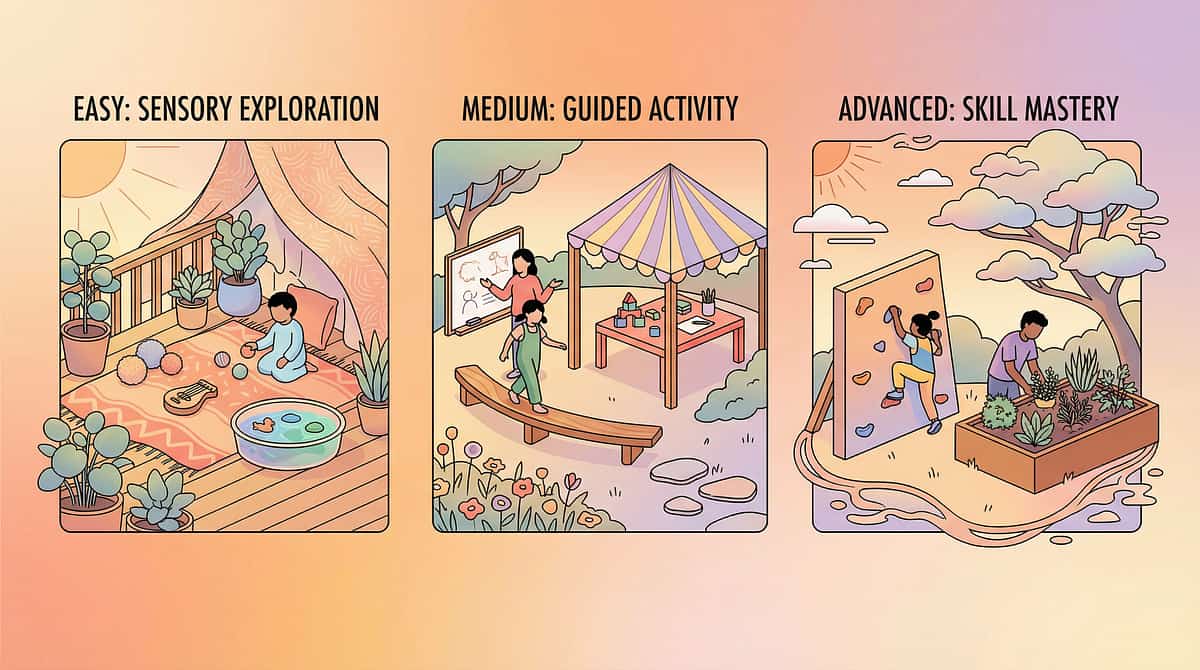
No two children learn the same way. Use this difficulty slider to match the protocol to your child's needs on any given day.
Easier Version
Distance: 1–2 ft. Zero distractions. Pure pairing only, no expectations. 3–5 trials. Highest-value reinforcer. 2–3 minutes max. For bad days or early stages.
Standard Protocol
Distance: 3–4 ft. Minimal distractions. Wait 3 seconds for response. 5–10 trials. Rotating menu. 5–15 minutes. Core daily practice.
Harder Version
Distance: 6–10 ft, different rooms. Moderate distractions. Wait 5 seconds, expect head turn + eye contact. Natural opportunities throughout the day. Social praise primarily. For breakthroughs and generalization.
Profile-Based Modifications
Sensory Seeker
Use high-intensity reinforcers — bouncing, spinning, deep pressure. Pair name with movement activities. Use musical name songs with rhythm instruments.
Sensory Avoider
Keep voice calm and moderate. Use visual materials more than auditory. Ensure the environment is sensory-comfortable before adding demands.
Older Children (4–8 yrs)
Add cognitive components — name spelled out, name recognition games. Use multi-sensory name materials and name response apps.
Minimally Verbal
Focus on orienting response (looking/turning) rather than verbal acknowledgment. Integrate AAC — when child orients, model a communication response on their device.

Act IV: The Progress Arc
Weeks 1–2: Building the Foundation
15%
Progress
You are here — building the invisible neural pathway beneath the surface.
What You WILL See
- Child accepts reinforcers when name is said
- Increased awareness of your approach (subtle head orientation)
- Brief glances in your direction during or after pairing
- Tolerance of the structured practice sessions without distress
What You Will NOT See Yet
- Consistent independent head turn (this comes later)
- Response in noisy or distracting environments
- Response from different rooms or distances
- Eye contact upon hearing name
"If your child is tolerating the sessions and accepting the reinforcers, you are succeeding. The roots grow before the sprout appears."
Week 1–2 Benchmarks: Independent response rate: 0–20% (entirely normal). Prompted response rate: 30–60%. What matters most: willingness to participate and positive affect during sessions.

Weeks 3–4: The Neural Pathway Is Forming
40%
Progress
Consolidation phase — the association is strengthening.
Consolidation Indicators
- Child begins to anticipate the reinforcer when they hear their name (shows excitement, reaches toward you)
- Head turns become more frequent — even partial turns count
- Child may begin orienting in SOME environments but not others (context-specific learning is normal)
- First "magic moments" — spontaneous responses that surprise you
- Child may start responding to name from family members who have been consistently pairing
Spontaneous Breakthroughs You Might Notice
- Looking toward the door when they hear a familiar person's voice
- Turning toward sound sources with social relevance
- Showing interest in the name practice "routine" — approaching the box, sitting in the spot
Parent Milestone: "You may notice you're more confident too. The fear that your child would never respond is being replaced by data showing they're learning. That shift in YOUR emotional state matters — children read parental confidence, and your growing belief feeds their growing response."
Week 3–4 Benchmarks: Independent response rate: 20–50%. Prompted response rate: 50–70%. What matters: upward trend in independent responses.
Weeks 5–8: Mastery Emerging
75%
Progress
Mastery phase — the response is becoming automatic.
Mastery Criteria (Observable & Measurable)
70%+ Independent Response
Child responds to name independently on 70%+ of trials in the training environment.
Multiple Callers
Responds to name from at least 2 different callers — not just the primary trainer.
Distraction Tolerance
Responds with moderate distractions present — background noise, other activities visible.
Distance
Responds from distances of 6+ feet consistently.
Positive Affect
Shows smile, approach, or vocalization upon hearing name — name has become a conditioned positive stimulus.
🏆 Mastery Unlocked Badge Criteria
80%+ independent response rate across 3 consecutive sessions | Response from 2+ callers | Response in 2+ settings | Maintained with social reinforcement only for 5+ sessions.
Maintenance Check: If you gradually fade the tangible reinforcer (replacing with social praise), does the response persist? If yes → established. If no → continue intermittent reinforcement for 2–4 more weeks.
You Did This. Celebrate.
You arrived at this page watching your child ignore their name, feeling invisible, wondering if they'd ever turn around when you called. You set up the space. You gathered the materials. You sat on the floor, day after day, pairing their name with joy. You tracked the data. You adapted when it didn't work. You kept going.
And now — they look up. They turn toward you. They know their name. They know it means something wonderful.
That head turn? It's not just a head turn. It's the first rung on the ladder of social communication. Joint attention, shared interest, language, friendship — it all starts with this: the ability to hear your name and know it matters.
📸Record a video of your child responding to their name today. Date it. Save it. On hard days in the future, watch it. Proof that progress is real.
Mark this milestone however your family celebrates — a special outing, a favorite meal, a photo documenting the first reliable name response. This is a developmental achievement that deserves recognition.
"From fear to mastery. One technique at a time."

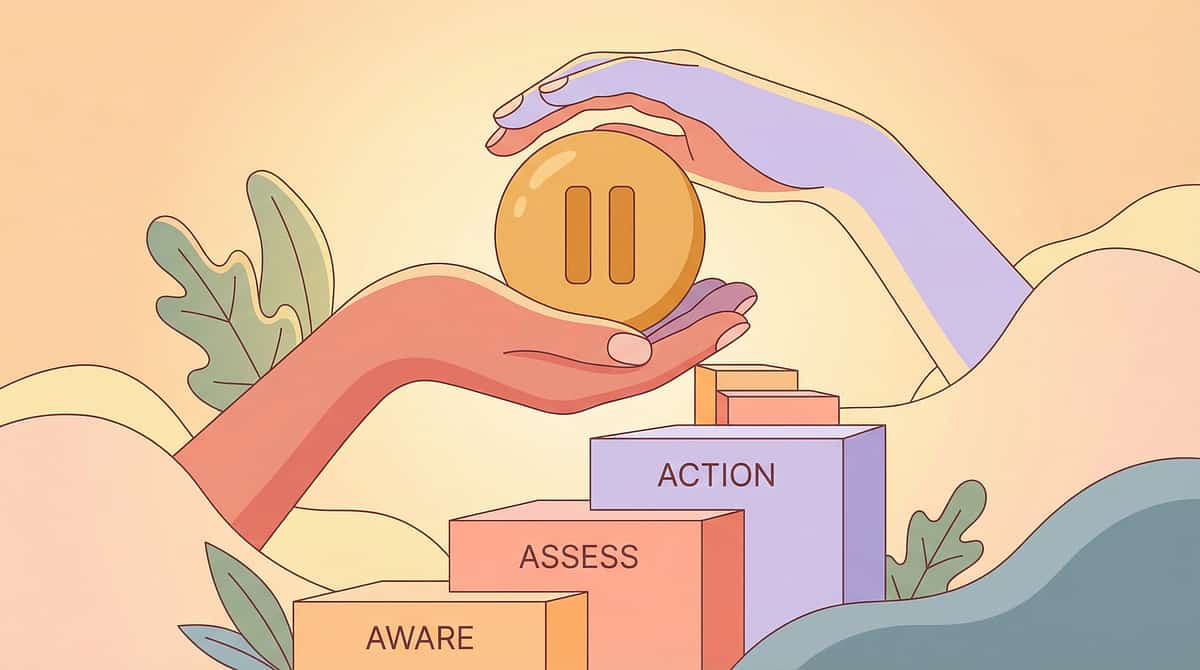
Clinical Guardrails — When to Pause and Seek Guidance
Your child's wellbeing is the top priority. If you notice any of the following red flags, pause training and seek professional guidance immediately.
🚩 No Response to ANY Sound
If child doesn't respond to sounds, music, TV, snack wrappers, OR name → hearing evaluation is URGENT. Contact an audiologist immediately.
🚩 Regression
If your child WAS responding to name and has STOPPED → this may indicate developmental regression warranting immediate developmental pediatric evaluation.
🚩 No Improvement After 3+ Months
Despite consistent daily practice with confirmed-motivating reinforcers → protocol may need professional adjustment or underlying factors require assessment.
🚩 Screen-Only Response
If child responds to name only through a screen/app but never to a human voice → screen-dependent auditory processing requires professional intervention.
🚩 Associated Concerning Behaviors
If name training coincides with increased self-injury, severe anxiety, sleep disruption, or food refusal → pause and consult your Pinnacle team immediately.
🚩 Fear or Distress When Name Is Called
Name has been paired with aversive experiences. Stop all name-calling immediately and consult a BCBA for name-rehabilitation protocol.
Level 1: Self-Resolve
Review troubleshooting (Card 22), adjust per adaptation guide (Card 23) → Resume
Level 2: Teleconsult
📞 9100 181 181 (FREE Helpline, 16+ languages, 24x7)
Level 3: Clinic Visit
In-person assessment at nearest Pinnacle center
"Trust your instincts. If something feels wrong, pause and ask. No training protocol is more important than your child's wellbeing."
The Progression Pathway
Name response is a foundational skill that opens doors to everything that follows. Here's where you've been, where you are, and the paths you can take next.
Name response feeds into the Social Communication Readiness pathway — leading to joint attention → social referencing → shared affect → conversational turn-taking → peer interaction → friendships. Each step builds on the one before.
Lateral Alternatives
- If reinforcer-based pairing wasn't effective → Try naturalistic/incidental teaching approach
- If your child is older (5+) and verbal → Try cognitive name-identity approach
- If sensory factors dominate → Consult OT for sensory-first protocol before name response
Related Techniques in Social Communication
Your child's growth doesn't stop here. Explore these companion techniques that build directly on the name response foundation you've established.

B-122: Teaching Pointing
Joint Attention — Your child responds to their name. Now build the next social bridge: pointing to share interest with others.

B-123: Building Eye Contact
Social Attention — Strengthen the visual connection that name response initiated. Eye contact deepens every social interaction.

B-124: Following Simple Directions
Receptive Language — Name response + direction following = the foundation of receptive language comprehension.

B-125: Social Engagement
Social Motivation — Build the desire to interact that makes name response meaningful and self-sustaining.

B-126: Joint Attention
Shared Attention — The pinnacle of early social communication. Shared focus between you, your child, and the world.

K-881: Supporting Parents
Parent Support — Emotional and practical guidance for the journey you're on. You matter in this process too.
Materials You Already Own: If you gathered the materials from this technique, you already have items that work for B-122, B-123, and B-125. The reinforcer kit, visual attention-getters, and progress tracking tools are shared across the entire Social Communication domain.
This Technique Is One Piece of a Larger Plan
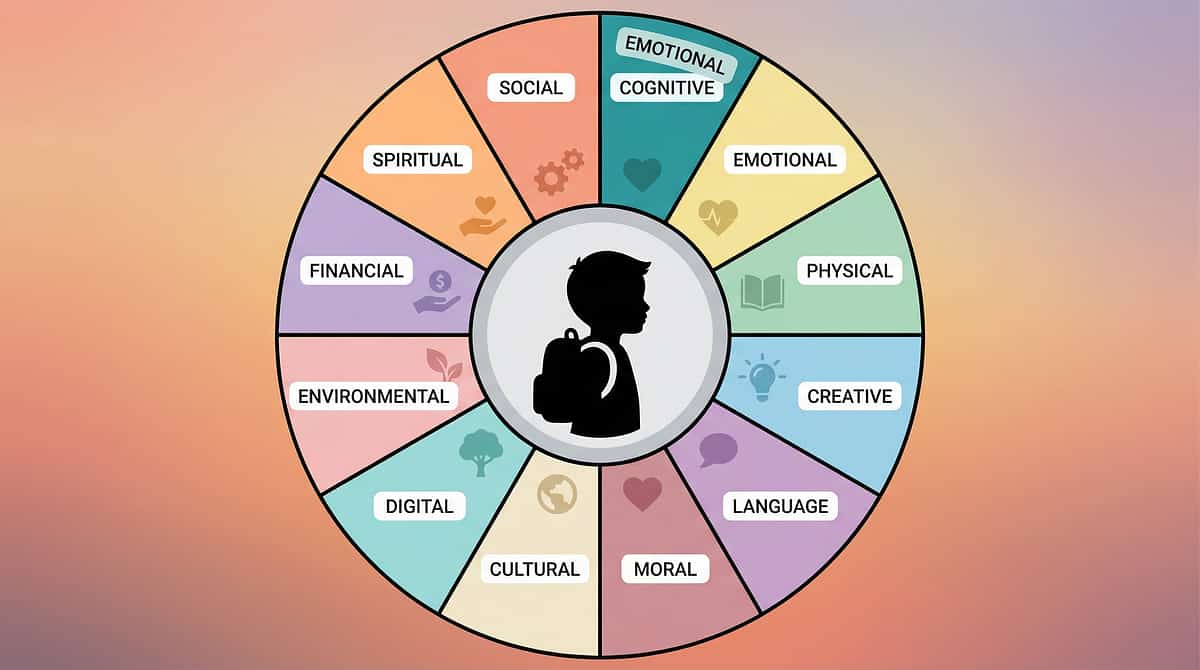
Your child is a whole person, developing across many domains simultaneously. Name response sits within Social Communication — one of 12 interconnected developmental domains. Here's the big picture.
How B-121 Connects to Other Domains
→ Domain D: Receptive Language
Understanding verbal cues begins with attending to voice. Name response is the gateway to receptive language.
→ Domain L: Social Interaction
Initiating and maintaining social exchanges requires name awareness as the entry point.
→ Domain I: Behavioral Regulation
Responding to name is often a precursor to responding to behavioral cues and safety instructions.
Through GPT-OS®, your child's progress on name response feeds into the Communication Readiness Index, which adjusts recommendations across all 12 domains. References: WHO/UNICEF Nurturing Care Framework (2018) | UNICEF 2025 Country Profiles.
Act V: Community & Ecosystem
Real Families. Real Progress. Real Hope.
Arjun's Story — "The First Time He Turned Around"
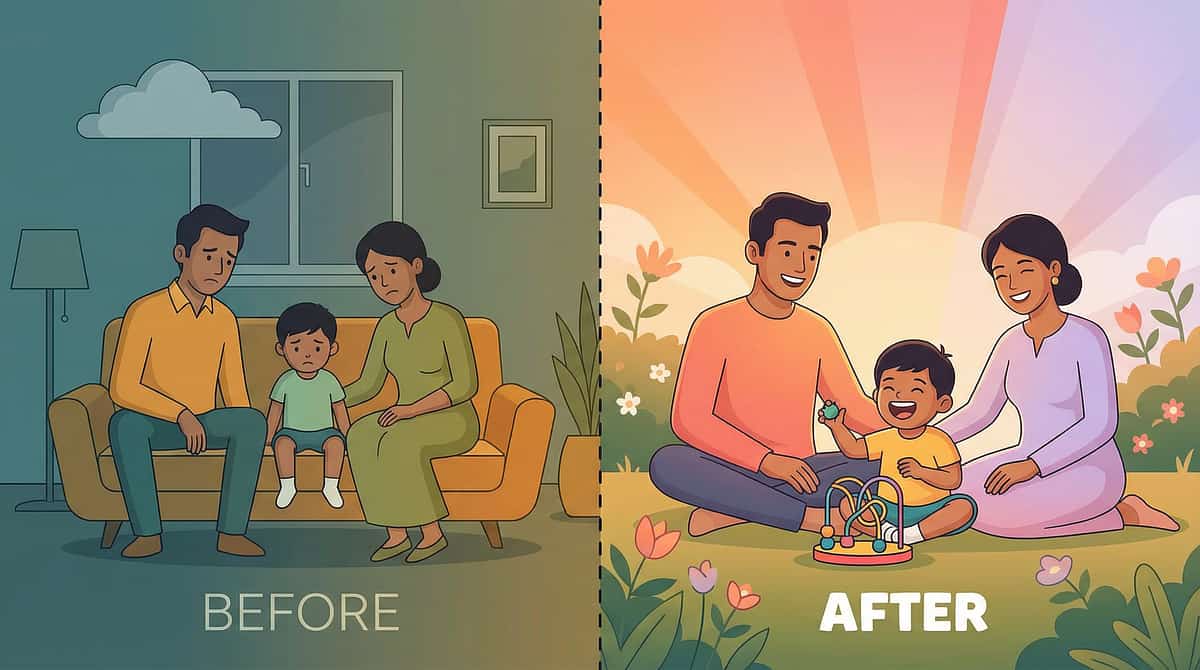
Before: Arjun, 2.5 years old. Parents called his name 20+ times a day without a single response. Father had begun to accept that "maybe he just can't hear us." Audiological evaluation: hearing normal.
Intervention: Name-reinforcer pairing initiated with bubbles (his absolute favorite). Started with pure pairing — name + bubbles, no expectation. Week 3: First head turn during pairing session. Mother recorded it on video and cried. Week 8: Consistent response from both parents. Emerging response from grandmother.
"The first time he turned around when I called his name, I cried. He heard me. He knows his name. He knows he's Arjun." — Arjun's mother
Meera's Story — "She Responds to Everyone Now"
Before: Meera, 4 years old. Responded to her name only when her mother held a specific toy. No response to father, grandparents, or therapist.
Intervention: Multi-caller generalization protocol. Mother paired initially, then systematically transferred to father, then grandmother, then therapist. Week 6: Responding to all four callers at home. Week 10: Responding at the park from 15 feet away.
"I was the only one she'd respond to. Now her grandmother calls her from the kitchen and she comes running. Our whole family feels connected to her." — Meera's mother
Illustrative cases; outcomes vary by child profile.
You Are Not a Solo Operator — Join Your Community
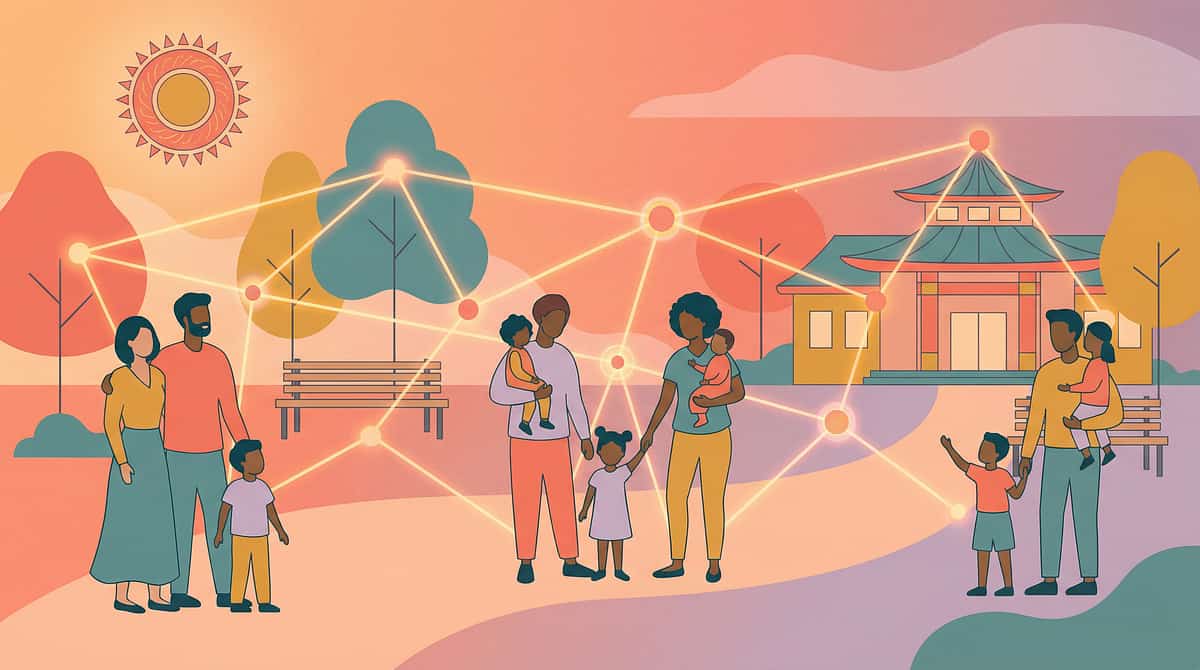
The journey is lighter when shared. Connect with families who understand exactly what you're going through — and who are celebrating the same small victories.
WhatsApp Parent Group
"Name Response Training — Parent Support" — Join families across India navigating the same challenge. Share tips, celebrate wins, ask questions in real time.
Online Forum
pinnacleblooms.org/community — Moderated by the Pinnacle clinical team. Safe space for questions, experiences, and peer learning.
Local Parent Meetups
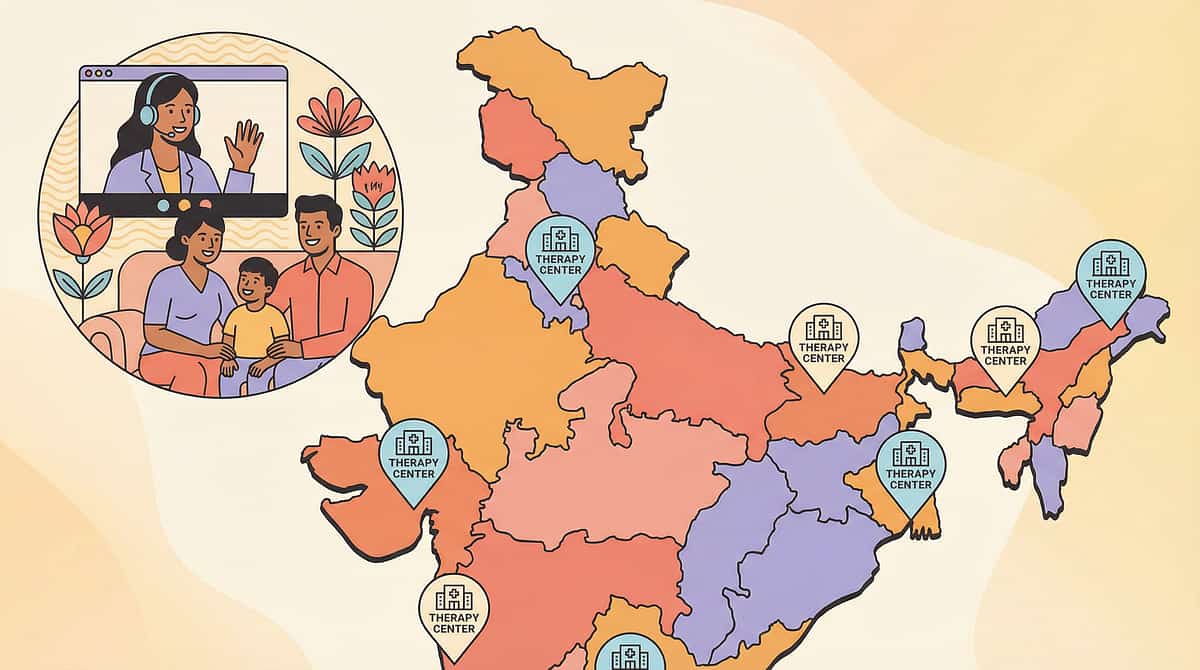
Monthly meetups organized at Pinnacle centers across 70+ locations. Connect face-to-face with families in your area.
Peer Mentoring
Connect with an experienced parent who's been through name response training and can guide you through the early weeks.
"Your experience helps others. The family just starting out tonight needs to hear from someone who's been where they are."
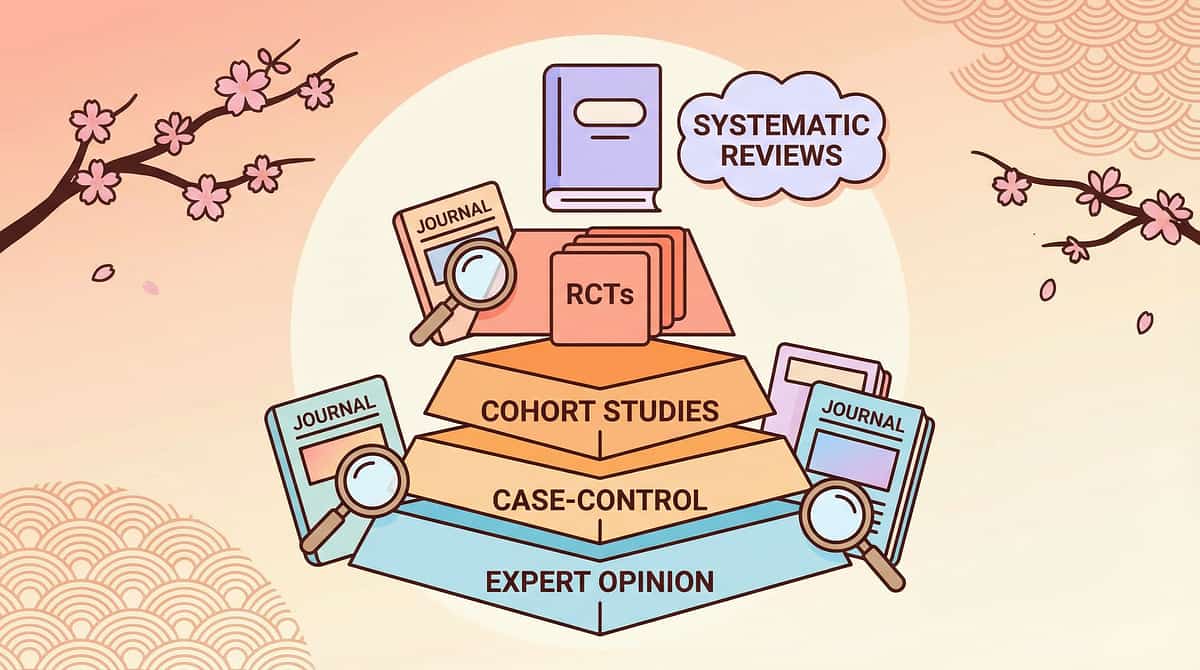
Home + Clinic = Maximum Impact
Home-based practice produces the volume of repetitions. Clinical guidance ensures the quality and direction. Together, they produce outcomes neither achieves alone.
📞 FREE National Autism Helpline
9100 181 181
16+ languages | Available 24x7
Immediate guidance from trained professionals.
16+ languages | Available 24x7
Immediate guidance from trained professionals.
💻 Video Teleconsultation
Book a session with a Pinnacle BCBA or SLP specializing in social communication and name response training.
Your Assessment Path
- AbilityScore® Assessment — Baseline measurement across all 12 domains
- Audiological Evaluation — Essential to rule out hearing loss (required before training)
- Communication Readiness Index — Tracking social orienting and joint attention
- EverydayTherapyProgramme™ — Your daily home plan via GPT-OS®
Therapist Matching for B-121
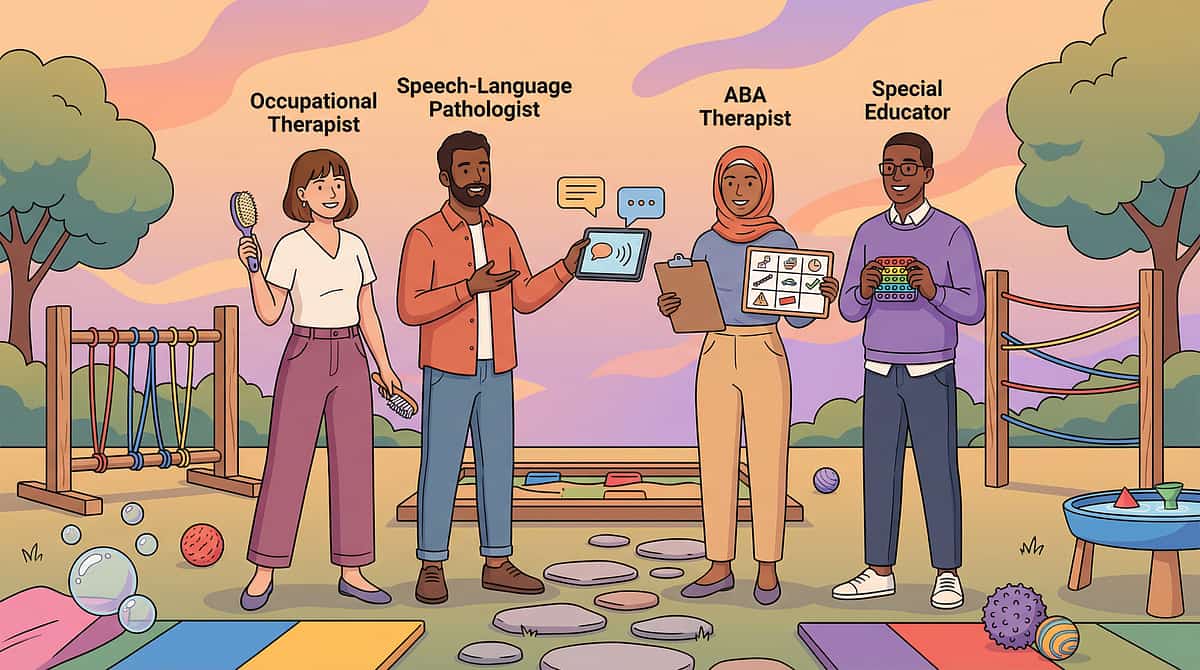
- Primary: Board Certified Behavior Analyst (BCBA)
- Secondary: Speech-Language Pathologist (SLP)

The Evidence — For Parents Who Want to Go Deeper
This technique draws from the highest levels of clinical evidence. Below are the key studies for those who want to explore the science behind the method.
1
Systematic Review (Highest Level)
"Sensory Integration Intervention for ASD: PRISMA Systematic Review" (Children, 2024) — 16 articles from 2013–2023 confirm sensory-based interventions meet evidence-based practice criteria for ASD. 🔗 PubMed: PMC11506176
2
Meta-Analysis
"Sensory Integration Therapy for ASD: Social Skills, Adaptive Behavior, Sensory Processing" (World J Clin Cases, 2024) — 24 studies demonstrating effective promotion across multiple domains. 🔗 PMC10955541 | DOI: 10.12998/wjcc.v12.i7.1260
3
Prospective Study
Nadig AS et al. "A Prospective Study of Response to Name in Infants at Risk for Autism" (2007) — Prospective evidence establishing name response as early predictive indicator.
4
Foundational Research
Osterling J & Dawson G. "Early Recognition of Children with Autism: First Birthday Home Videotapes" (1994) — Demonstrated name response deficits in first-year home videos.
5
Intervention Framework
Koegel LK & Koegel RL. "Pivotal Response Treatments for Autism" (2006) — Evidence for naturalistic name response training within PRT framework.
WHO/UNICEF Publications
- WHO Nurturing Care Framework (2018) → nurturing-care.org
- WHO Care for Child Development Package (2023) → PMC9978394
- UNICEF Early Childhood Development resources → unicef.org/early-childhood-development
Indian Research: Padmanabha et al. "Home-based Sensory Interventions in Indian Pediatric Population" (Indian J Pediatr, 2019). DOI: 10.1007/s12098-018-2747-4.
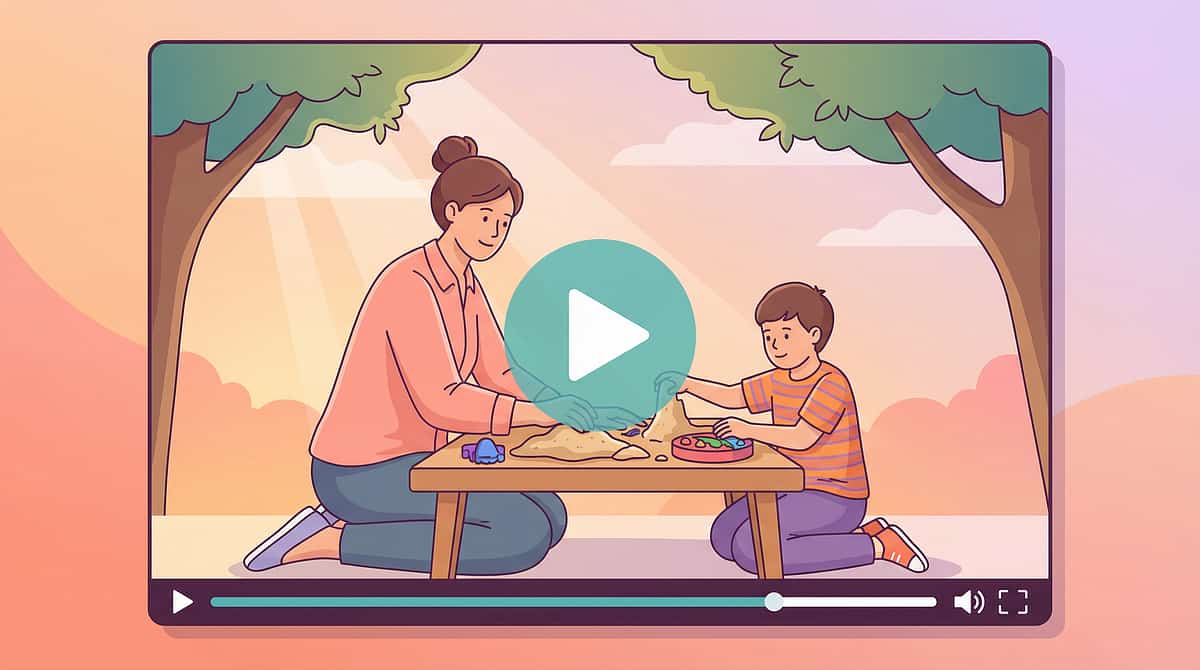
How GPT-OS® Uses Your Data
Your session data doesn't just sit in a notebook — it powers a learning system that improves recommendations for your child and every family working on name response.
What GPT-OS® Learns From B-121
Reinforcer Insights
Which reinforcer categories produce fastest name response acquisition.
Dosage Optimization
Optimal number of daily trials for different age groups.
Mastery Benchmarks
Average time-to-mastery for name response by profile.
Material Combos
Which of the 9 materials produce best generalization outcomes together.
🔒Privacy: All personal data is encrypted under Indian data protection regulations. Population analytics use ONLY anonymized, aggregated data. Your child's data is accessible only to you and your authorized clinical team.
"Your data helps every child like yours. Every session you record contributes to the largest pediatric intervention outcome database in India."
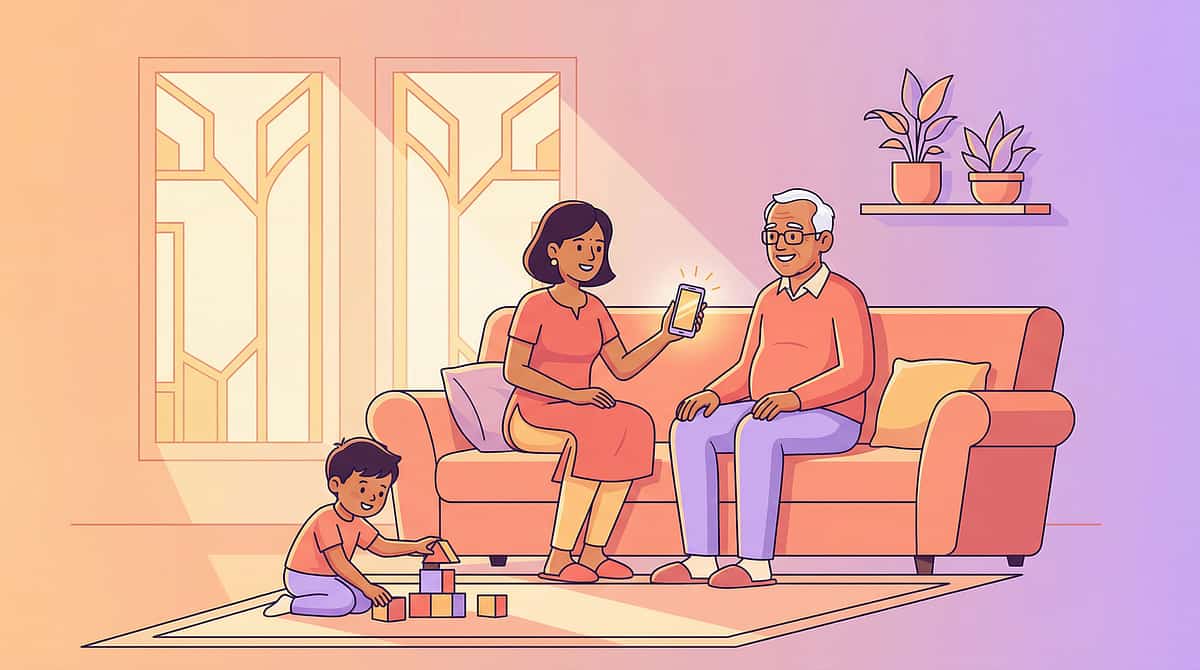
Watch the Reel — See These Materials in Action
B-121
Social Communication Solutions — Episode 121
75 seconds
"9 Materials That Help When Child Doesn't Respond to Name" — presented by a Pinnacle Blooms Network licensed therapist specializing in social communication intervention. Watch as each of the 9 materials is demonstrated with real techniques, showing you exactly how to use them in your home environment.
Save it, share it, reference it during practice sessions. Video modeling is classified as an evidence-based practice for autism (NCAEP, 2020) — watching the technique performed correctly enhances your own implementation.
Consistency Across Caregivers Multiplies Impact
If only one caregiver trains name response, progress stays in one room. When every caregiver follows the same principles, your child's brain gets the message from every direction: my name matters.
Simplified Guide for Grandparents & Extended Family
- Only call [Name] when you have something nice to offer (a toy, a snack, a hug)
- Say the name ONCE — don't repeat it 10 times
- If they look at you, celebrate! Say "You looked! Great job!"
- If they don't look, it's okay — try again later with something they love
- Don't scold them for not responding — we're building positive associations
References: WHO CCD Package — Multi-caregiver training as critical for intervention generalization. PMC9978394.

Act VI: The Close & Loop
Frequently Asked Questions
Is not responding to name always a sign of autism?
No. Reduced name response can occur in typical development (especially highly absorbed toddlers), hearing impairment, auditory processing difficulties, and attention challenges. However, persistent failure to respond by 12 months IS a red flag warranting evaluation. Always rule out hearing impairment first.
My child responds sometimes but not others. Is that normal?
Yes — inconsistent response is actually encouraging. It means the pathway exists but isn't automatic yet. Track WHEN they respond (quiet vs. noisy, close vs. far, who's calling) to identify patterns and systematically address gaps.
How long will this take?
Most children show emerging response within 2–4 weeks of consistent daily practice. Consistent response across settings typically develops over 6–12 weeks. Your data gives you a personalized timeline.
Should I stop calling my child's name?
Do NOT stop. But ensure every name call is paired with something positive. Reduce "empty" name calls and increase "rich" name calls. Quality over quantity.
Can I use this with hearing aids or cochlear implants?
Yes, with modifications. Ensure devices are functioning. Start at close range in quiet environments. Work with your audiologist and SLP. The pairing principle works regardless of auditory pathway.
They respond to nicknames but not their actual name. Why?
This means the orienting mechanism works — they've learned the nickname signals relevance. Extend that association: say the nickname first, then immediately follow with the formal name + reinforcer.
Will they become dependent on rewards?
Tangible reinforcers are the starting fuel. Once response is established, you systematically fade to social reinforcers (praise, shared joy). The fading is built into the protocol. Eventually, responding to one's name becomes its own reward.
Can older children (5–8 years) still learn?
Absolutely. Neuroplasticity allows name response training at any childhood age. For older children, materials shift toward cognitive and multi-sensory approaches alongside the core pairing protocol. The principle is identical.

You've Read the Page. You Have the Knowledge. Now Act.
Everything you need is in your hands. The materials, the protocol, the troubleshooting guide, the benchmarks, the community — they're all here. The only thing left is to start.
🟢 Start This Technique Today
Launch GPT-OS® for a guided first session on B-121: Name Response Training. Step-by-step prompts, data capture, and personalized scheduling.
🔵 Book a Consultation
Connect with a Pinnacle BCBA or SLP specializing in social communication.
📞9100 181 181 — FREE National Autism Helpline (16+ languages, 24x7)
📞9100 181 181 — FREE National Autism Helpline (16+ languages, 24x7)
⚪ Explore the Next Technique
B-122: 9 Materials for Teaching Pointing — build on the name response foundation. Or browse the full Social Communication domain.
Validated by Pinnacle Blooms Consortium
SLP • BCBA • OT • SpEd • NeuroDev
Preview of 9 materials that help when child doesnt respond to name Therapy Material
Below is a visual preview of 9 materials that help when child doesnt respond to name therapy material. The pages shown help educators, therapists, and caregivers understand the structure and content of the resource before use. Materials should be used under appropriate professional guidance.





Link copied!
The Pinnacle Promise
Pinnacle Blooms Network®
Built by Mothers. Engineered as a System.
"From fear to mastery. One technique at a time."
You arrived at this page scared, confused, and exhausted. You leave with 9 evidence-based materials, a step-by-step protocol, progress benchmarks, troubleshooting guidance, community support, and professional backup. Your child's name will become the most meaningful sound in their world. You will build that bridge.
Medical Disclaimer: This content is for educational and informational purposes only. It does not constitute medical advice, diagnosis, or treatment. Please consult with qualified healthcare professionals, including developmental pediatricians, behavioral analysts, and speech-language pathologists for proper evaluation and individualized recommendations. Hearing should be evaluated by an audiologist to rule out hearing impairment. Intervention should be individualized based on thorough professional assessment. Results vary by individual. Statistics represent aggregate outcomes across the Pinnacle Blooms Network.
Copyright & Attribution: © 2026 Pinnacle Blooms Network®, unit of Bharath Healthcare Laboratories Pvt. Ltd. All rights reserved. Powered by GPT-OS® — Global Pediatric Therapeutic Operating System. Patent protection filed across 160+ countries.
CIN: U74999TG2016PTC113063 | DPIIT: DIPP8651 (Govt. of India) | MSME: Udyog Aadhaar TS20F0009606 | GSTIN: 36AAGCB9722P1Z2