
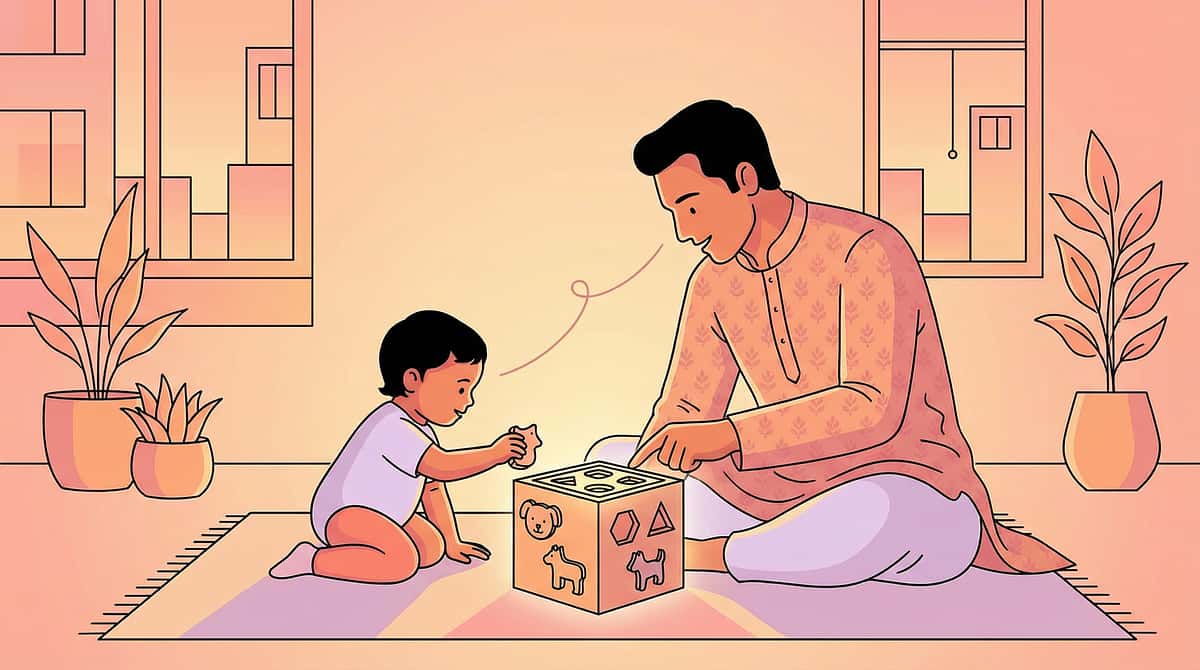
When Your Child Doesn't Show You Things: Building the Bridge of Shared Discovery
You are not failing. Your child's nervous system is processing the world — it just hasn't yet learned to say "Look at this!" to the people who love them most. This is your complete guide to building the showing gesture — the first way children invite us into their world.
Pinnacle Blooms Network®
India's Largest Autism Therapy Provider
70+ Centers | 21M+ Sessions
Drafted by the Pinnacle Blooms Consortium: Speech-Language Pathologists • Occupational Therapists • Board Certified Behavior Analysts • Special Educators • NeuroDevelopmental Pediatricians

Act I — The Emotional Entry
You Are Among Millions of Families Navigating This Exact Moment
Across 70+ countries, families connected to the Pinnacle Blooms Network have turned this exact concern into a structured, measurable pathway forward. The numbers tell a story of shared experience — and shared hope.
1 in 100
Children Globally
are diagnosed with autism spectrum disorder, where absent showing gesture is a core early marker (WHO, 2023)
70-80%
Show Reduced Showing
of children later diagnosed with ASD show reduced or absent protodeclarative gestures before 18 months (Mundy et al., 2007)
23.4M+
Families in India
are estimated to be navigating developmental differences in their children (UNICEF India, 2024)
21M+
Therapy Sessions
delivered exclusively 1:1 by Pinnacle Blooms Network with 97%+ measured improvement rate
You are not alone. Every statistic above represents a real family — real parents who sat exactly where you're sitting, feeling exactly what you're feeling. This is a navigable path.
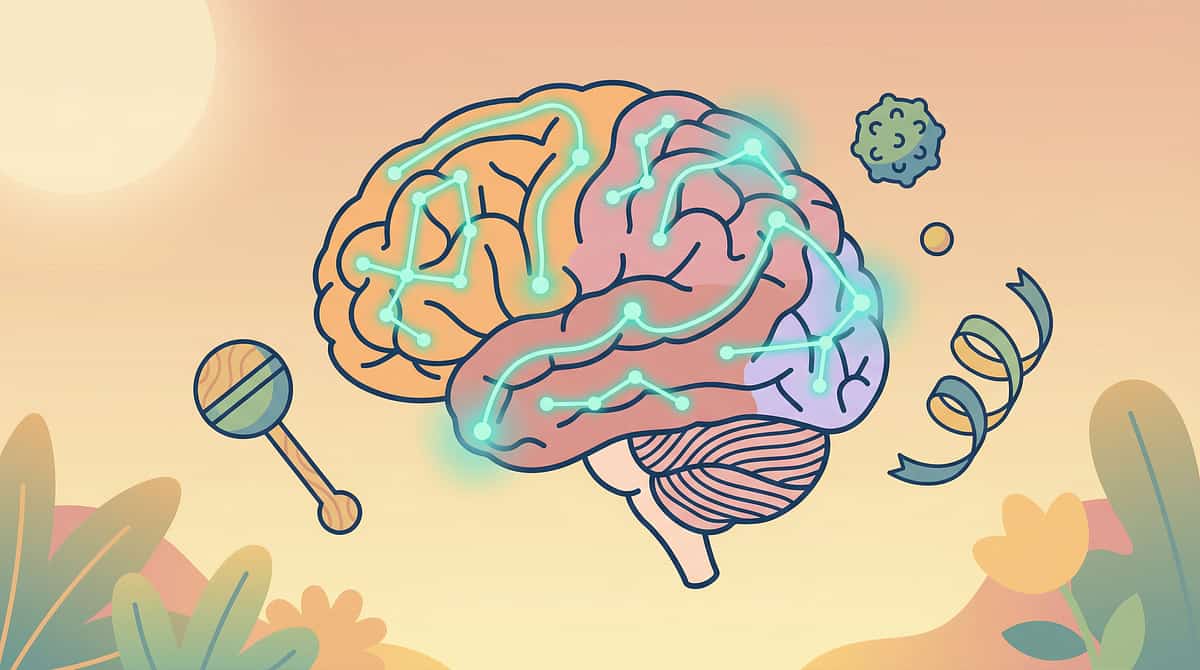
What's Happening in Your Child's Brain
When a child shows you an object, three neural networks fire simultaneously. Understanding this isn't just fascinating — it's the key to knowing exactly what we're building during every session.
The Brain Regions Involved
1
Superior Temporal Sulcus (STS)
Processes social gaze and understands that other people have their own perspective — the "you see things too" center
2
Prefrontal Cortex
Governs the intention to share an experience with another person — the "I want you to know this" center
3
Mirror Neuron System
Creates the internal model: "If this excites me, it might excite YOU" — the empathy and imitation center
What This Means in Plain Language
Showing an object is not a single skill — it is the convergence of three brain systems working together. The child must recognize the object is interesting, understand that you are a separate person with your own perspective (a theory of mind precursor), and want you to share in their experience.
In children with developmental differences, one or more of these systems may need targeted support to connect. The beautiful truth is this: wiring differences can be strengthened. Neural pathways are built through repeated, rewarding experience — and that is exactly what this protocol creates.
This is a wiring difference, not a behavior choice. And wiring can be strengthened.

Where This Sits in Development
Showing objects emerges in a precise developmental sequence. Knowing where your child is — and where they're heading — transforms uncertainty into a clear roadmap.
6–8 Months
Beginning shared attention — baby follows your gaze to objects
8–10 Months
Follows pointing — looks where you point
⭐ 9–12 Months
SHOWING EMERGES — child holds up objects to share interest. This is your target zone.
12–14 Months
Frequent spontaneous showing with social referencing — looking between object and your face
14–18 Months
Showing combined with words — "Look! Doggy!"
18–24 Months
Showing becomes natural, frequent, and integrated into all social interaction
What commonly co-occurs when showing is delayed: Limited protodeclarative pointing • Reduced response when others redirect attention • Preference for solitary exploration • Limited triadic gaze (looking between object and caregiver's face)

The Evidence Behind This Technique
🛡️ Evidence Grade: Level I
Systematic Reviews + RCTs
Joint attention intervention is classified as an evidence-based practice for autism by the National Clearinghouse on Autism Evidence and Practice (NCAEP, 2020). This is not anecdotal — it is among the most rigorously studied early interventions in pediatric developmental science.
Kasari et al. (2006) — Landmark RCT
Joint attention targeted intervention produced significant increases in showing, pointing, and following gaze behaviors compared to control group. Journal of Child Psychology and Psychiatry.
Kasari et al. (2012) — 5-Year Follow-Up
Children who received joint attention intervention maintained gains at 5-year follow-up and showed significantly better expressive language outcomes. JAACAP.
NCAEP Evidence Report (2020)
Joint attention intervention meets criteria as evidence-based practice across 14+ studies with positive outcomes for initiating joint attention behaviors including showing.
Pinnacle Blooms Network Real-World Data
21M+ exclusive 1:1 therapy sessions with 97%+ measured improvement rate across Social Participation Index and Communication Readiness Index.
Clinically validated. Home-applicable. Parent-proven.
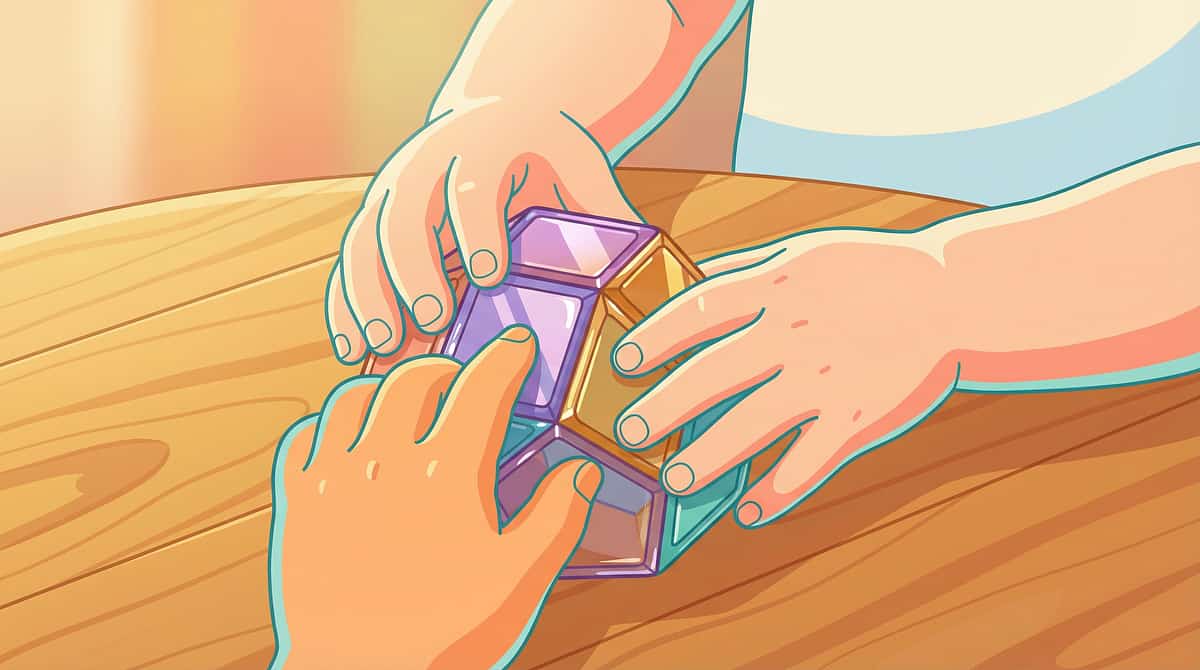
Act II — Knowledge Transfer
The Technique: Showing Object Elicitation Through Material-Mediated Joint Attention
Parent-Friendly Name: "The Show Me! Game"
What It Is
A structured yet naturalistic intervention using carefully selected materials — objects designed to create excitement, wonder, pride, or curiosity — to elicit the showing gesture. The child is motivated to hold up or extend an object toward a caregiver purely to share their experience. This is protodeclarative communication — the developmental precursor to all social sharing.
What It Does
Builds the neural pathway from internal excitement → social awareness → sharing intention → motor execution → social reward.
Session Details
Age Range
9–30 months
Duration
10–15 minutes
Frequency
2–3x daily
Setting
Home & Therapy
Domain
🧩 Social Communication
🤝 Joint Attention
SOC-JA-SHOW
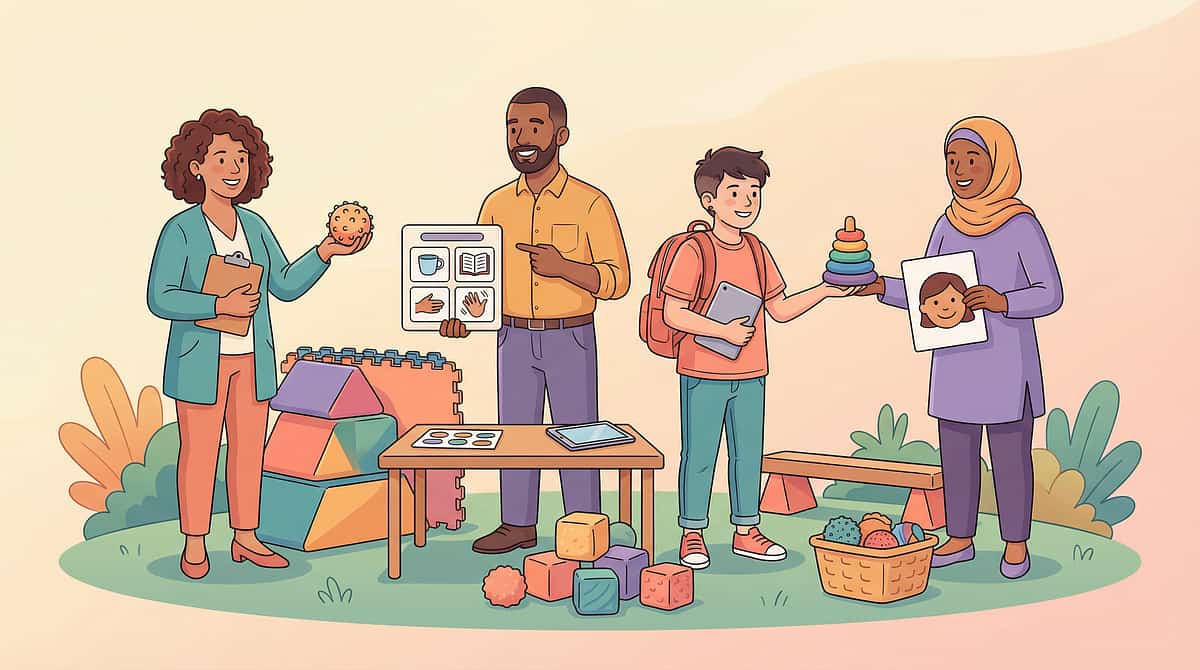
Who Uses This Technique
The showing gesture sits at the intersection of communication, behavior, sensory processing, and social development. This technique crosses therapy boundaries — because the developing brain doesn't organize itself by therapy type.
Speech-Language Pathologist (SLP) — Lead Discipline
Targets showing as protodeclarative communication — the foundation for all intentional social communication. The SLP focuses on the communication intent behind showing: the child's message of "I want you to attend to this with me."
Board Certified Behavior Analyst (BCBA)
Uses ABA principles to increase showing frequency through reinforcement scheduling. Structures the environment to create motivating operations that make showing more likely. The enthusiastic caregiver response serves as a natural reinforcer.
Occupational Therapist (OT)
Selects materials based on the child's sensory profile — ensuring objects are sensorily motivating and supporting the motor planning component of extending an object outward. Integrates sensory processing with social communication goals.
Special Educator & NeuroDev Pediatrician
The special educator embeds showing into play-based routines for generalization across settings. The NeuroDevelopmental Pediatrician monitors developmental trajectory and adjusts intervention intensity based on progress data.
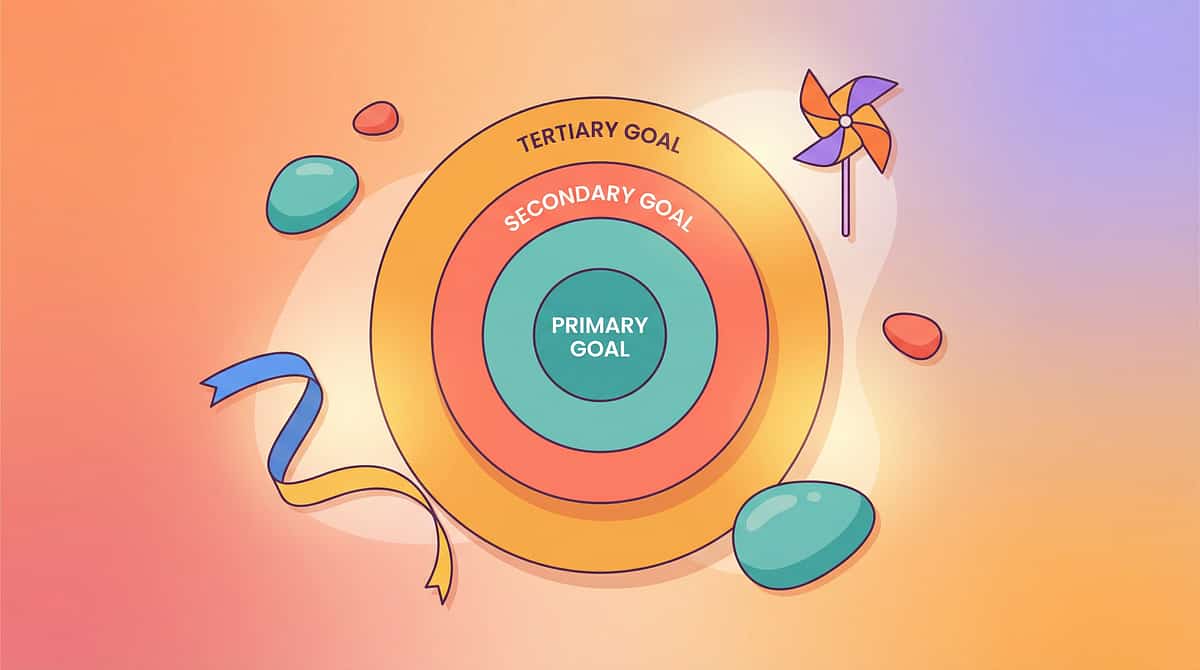
🎯 What This Technique Targets
This isn't a random play activity — it's a precision therapeutic tool with clearly defined primary, secondary, and long-term developmental targets.
🎯 Primary Target
Initiating the showing gesture — child spontaneously extends or holds up an object toward a caregiver with the intent to share interest (protodeclarative communication).
- Child holds object toward you
- Looks between object and your face (triadic gaze)
- Vocalizes while showing
- Waits for your reaction
🔵 Secondary Targets
The joint attention cluster — skills that emerge alongside and support the showing gesture:
- Triadic attention (self → object → person)
- Social referencing — looking to caregiver's face
- Turn-taking rhythm in social exchanges
- Intentional gesture communication
🌟 Long-Term Gains
Tertiary developmental outcomes — what grows when showing is established:
- Expressive language (showing predicts vocabulary at age 2–3)
- Theory of mind precursors
- Social reciprocity and motivation
- Peer interaction and academic readiness
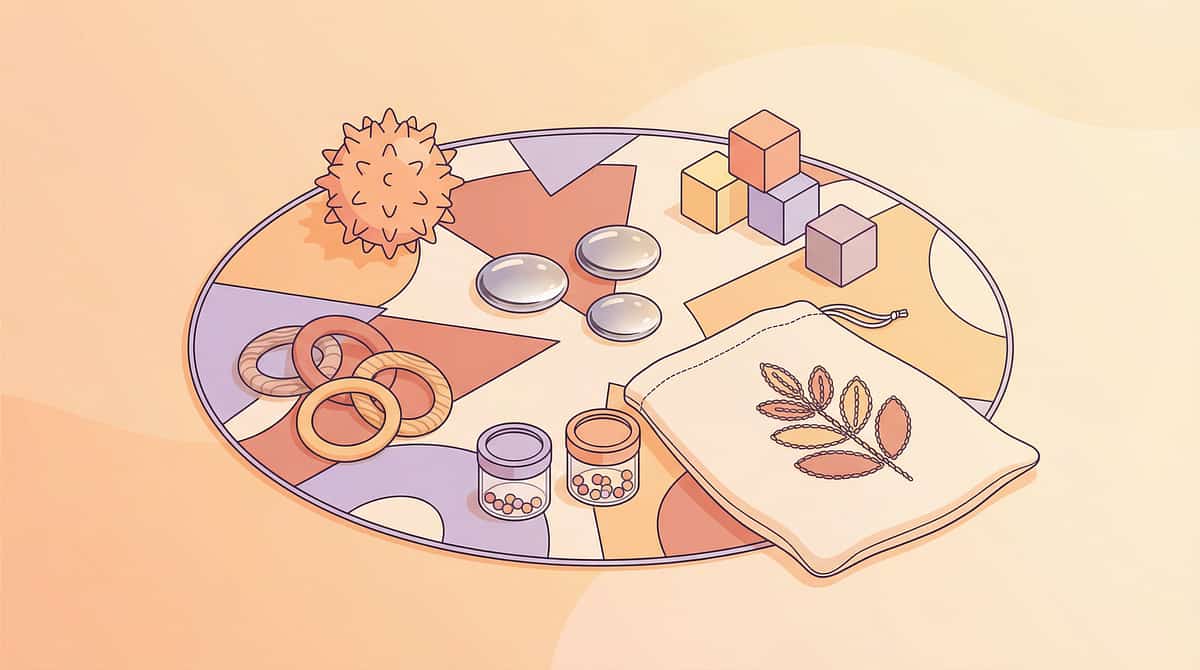
Your 9 Therapeutic Materials
Purchase or Make Today
Each material category is chosen for its power to create the specific emotional state — excitement, wonder, pride, curiosity — that drives a child to share. Here are your 9 evidence-informed categories, with accessible options for every budget.
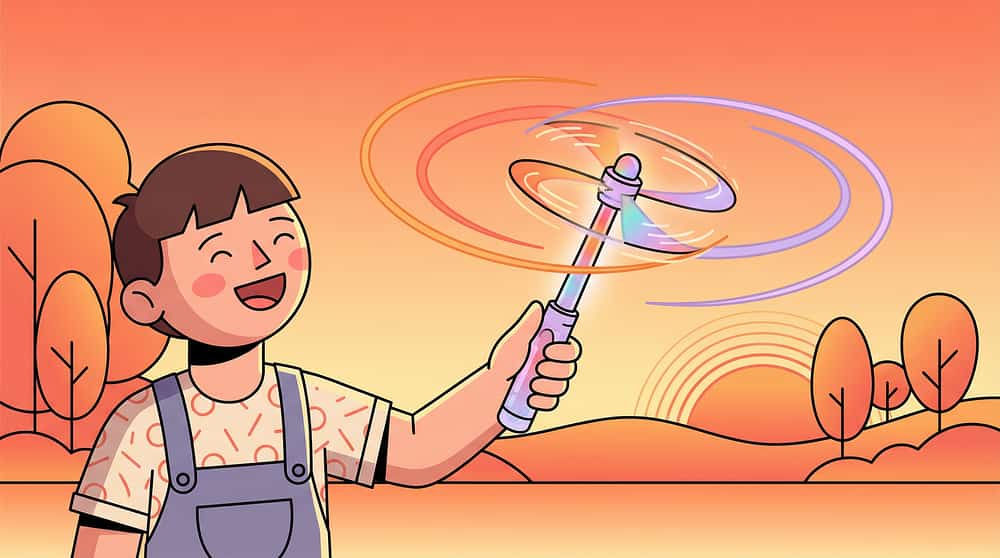
1. Light-Up & Surprise Toys
Light-up wands, jack-in-the-box, glow-in-the-dark items, LED spinning toys. ₹200–800 | Buy on Amazon.in
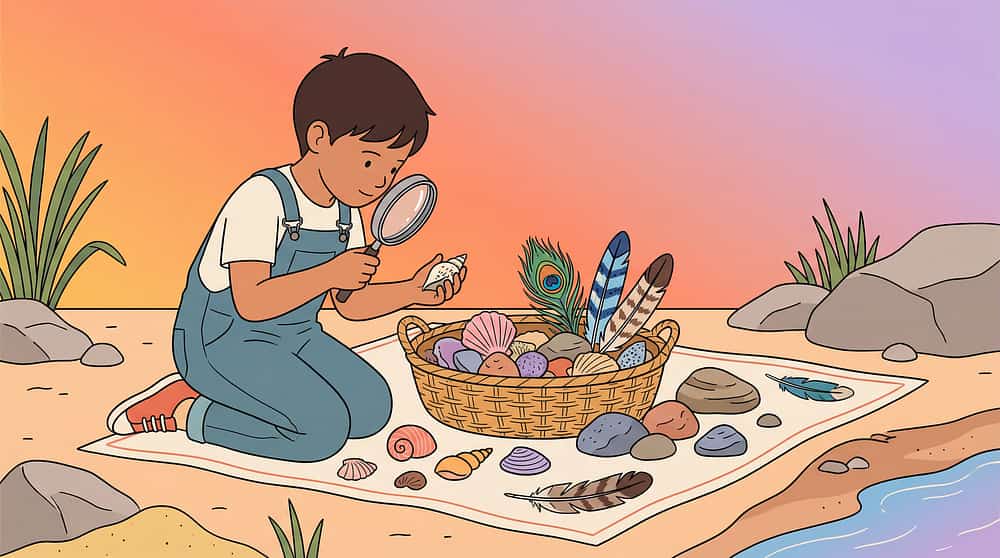
2. Discovery & Nature Items
Shells, colorful rocks, pressed leaves, feathers, bug observation containers, magnifying glasses. ₹0–300 — Available in nature, FREE
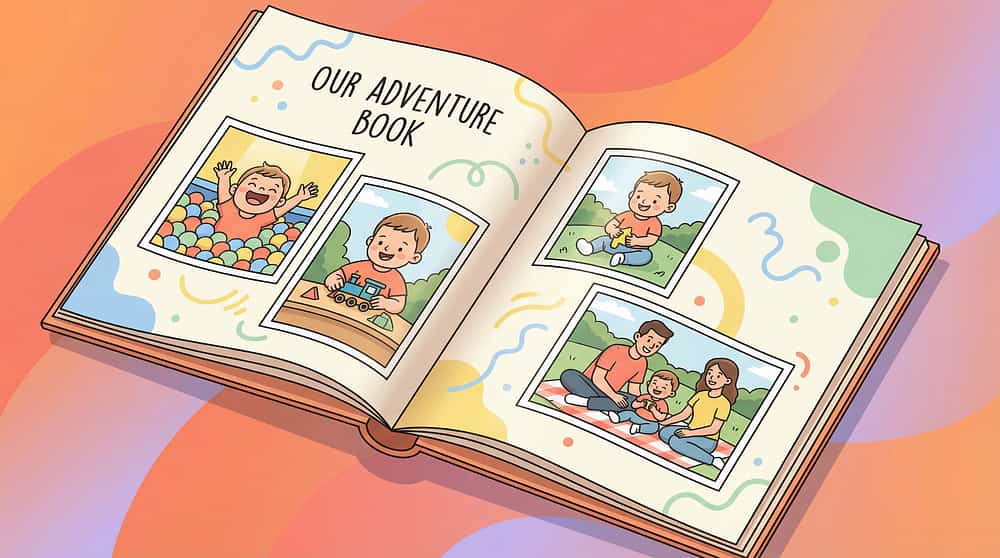
3. Personalized Photo Books
Custom photo books of child's interests, board books with inserted photos, laminated photo cards. ₹300–800 | Buy on Amazon.in
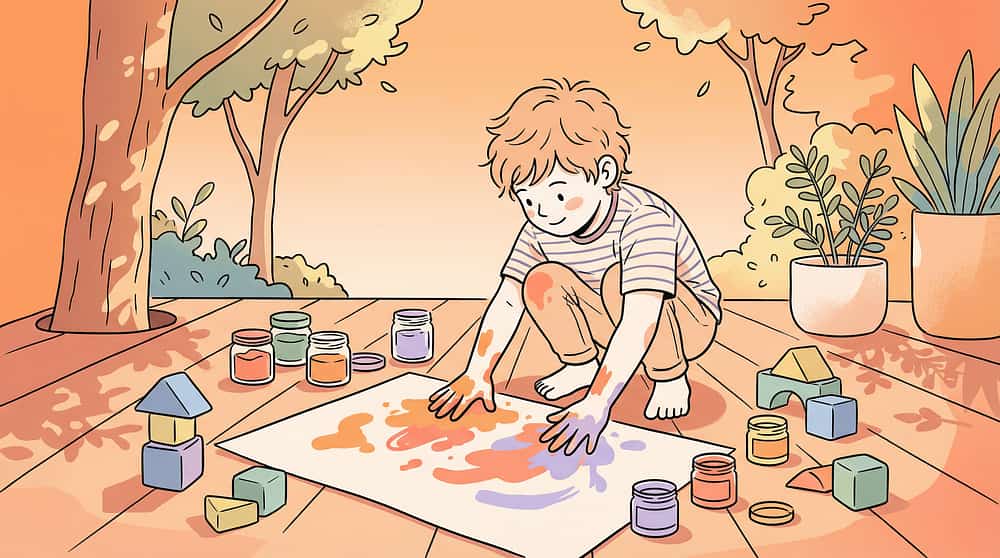
4. Creation & Art Materials
Finger paints, playdough, building blocks/LEGO, craft supplies, crayons, sticker sheets. ₹200–600 | Buy on Amazon.in
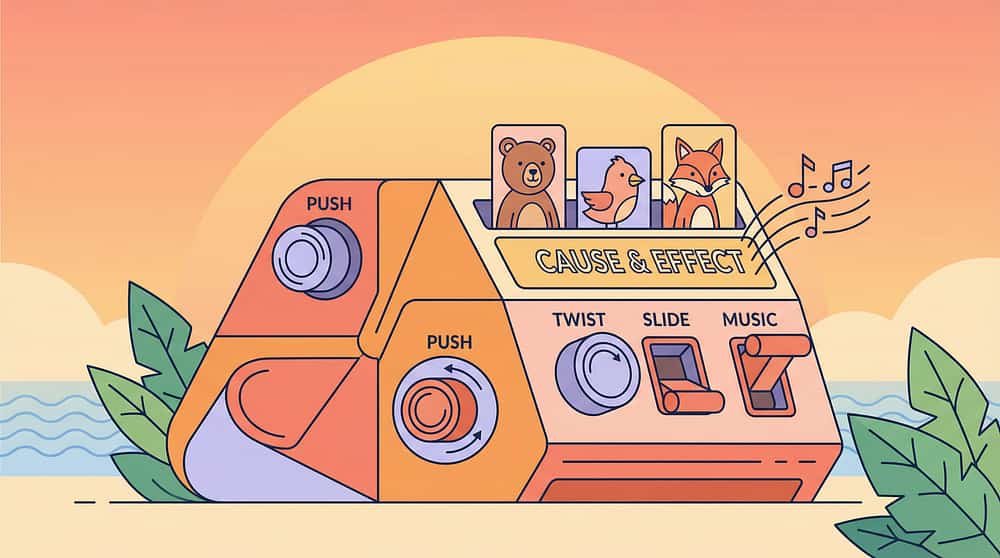
5. Interactive Cause-Effect Toys
Pop-up button toys, musical activity centers, light-up cause-effect toys, busy boxes. ₹300–900 | Buy on Amazon.in
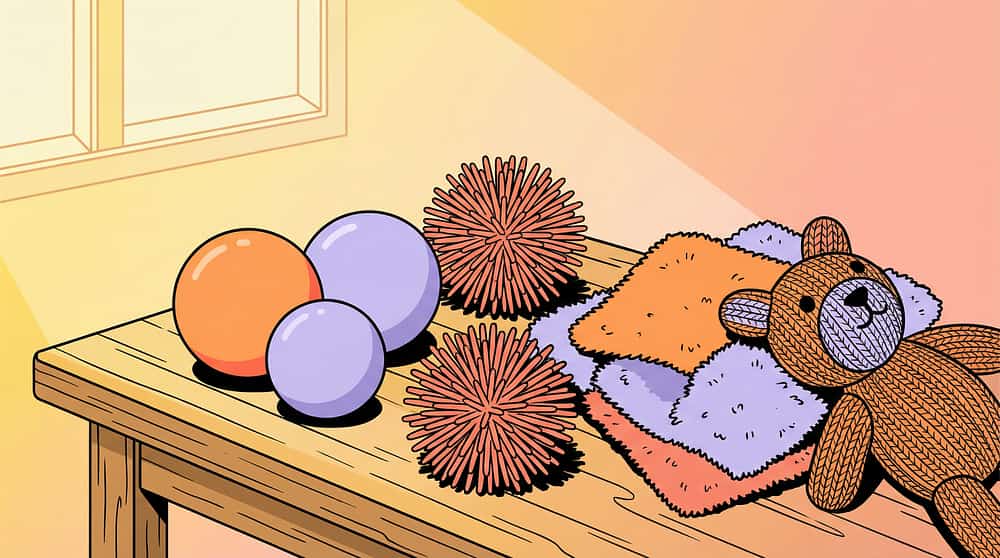
6. Texture & Sensory Objects
Squishy stress balls, textured sensory balls, fuzzy fabric items, Koosh balls, sensory fidgets. ₹150–500 | Buy on Amazon.in
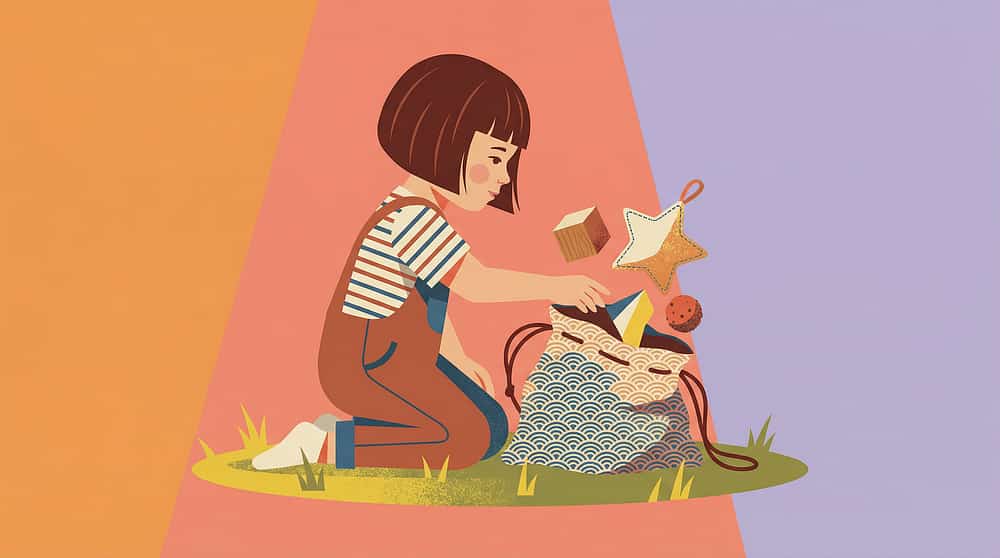
7. Treasure Bags & Mystery Containers
Drawstring mystery bags, treasure chests, feely boxes, sensory bins, surprise boxes. ₹100–400 | Buy on Amazon.in
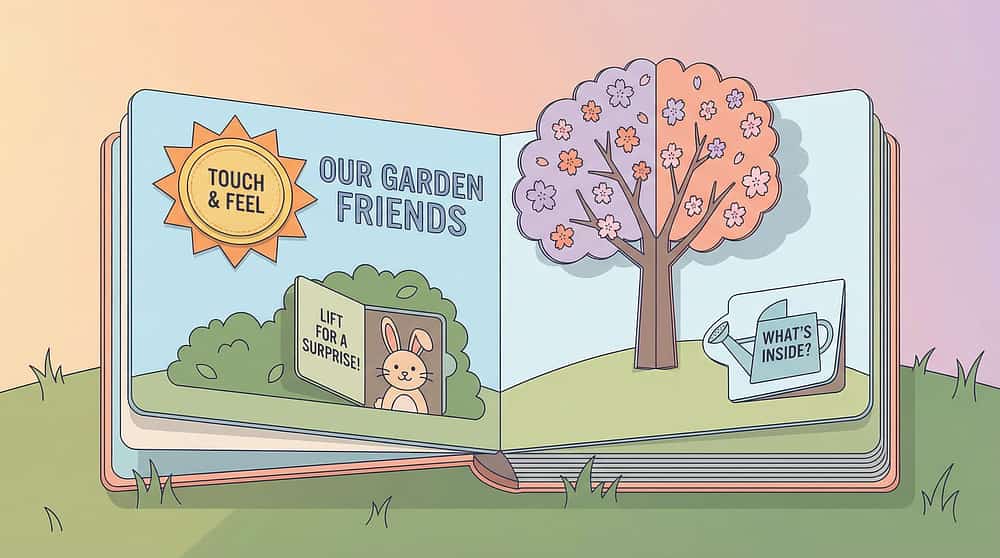
8. Interactive Books
Lift-the-flap board books, touch-and-feel books, pop-up books, slider/pull-tab books. ₹200–600 | Buy on Amazon.in
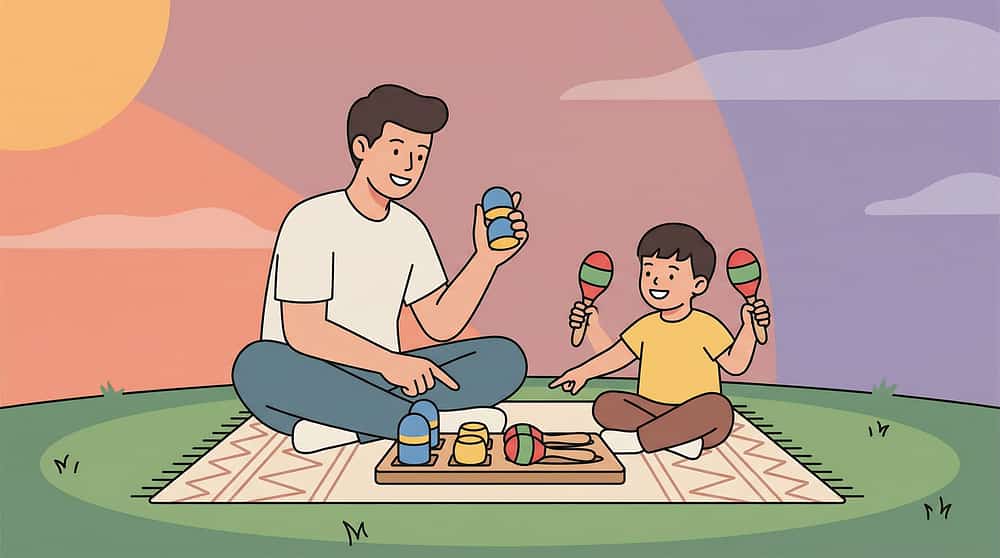
9. Matching Parent-Child Items
Duplicate block sets, matching figurines, matching musical instruments (maracas, drums). ₹200–600 | Buy on Amazon.in
💰 Total Setup Range: ₹1,400–₹5,400 for comprehensive kit | 🌟 Essential Starters under ₹500: Nature items (free) + DIY treasure bag + any lift-the-flap book
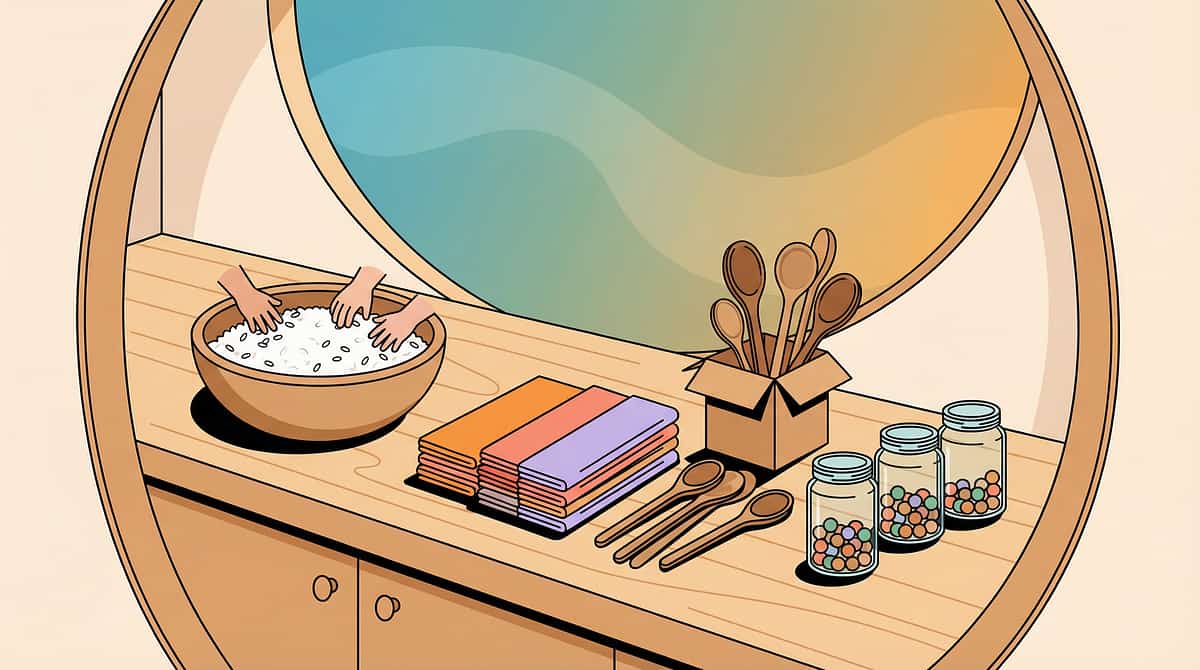
DIY & Substitute Options — Every Parent Can Start TODAY
The WHO Nurturing Care Framework emphasizes that effective interventions must work with locally available, affordable materials. The Care for Child Development Package has been implemented across 54 low- and middle-income countries using household items. Not one of these 9 materials requires a clinical-grade version.
Buy This | Make This (₹0) | Why It Works the Same | |
Light-up wand (₹400) | Flashlight in dim room + aluminum foil stars | Creates same "wow" moment that triggers the sharing urge | |
Nature exploration kit (₹300) | Garden walk + paper bag for collections | Real discoveries create real showing — nature is free | |
Custom photo book (₹500) | Printed photos in a ziplock bag album | Child's own interests create motivation to share | |
Art supplies kit (₹400) | Rice flour + turmeric water "paint" + cardboard | Creation pride drives showing regardless of material cost | |
Cause-effect toy (₹600) | Light switches, doorbells, squeezable bottles | Any action → visible result creates shareable moments | |
Sensory textures (₹300) | Ice cubes, cotton balls, sandpaper, smooth stones | Interesting feel = interesting to share | |
Treasure bag (₹200) | Paper bag + 5 small household objects | Find it → show it game works with anything | |
Lift-the-flap book (₹350) | Paper with Post-its covering hidden stickers | Discover → reveal → show pattern is identical | |
Matching items (₹400) | Two identical spoons, two same cups, two socks | Parallel play works with any matching pair |
Zero cost is zero barrier. The technique's power lies in your responsive presence — not in the price of the materials.
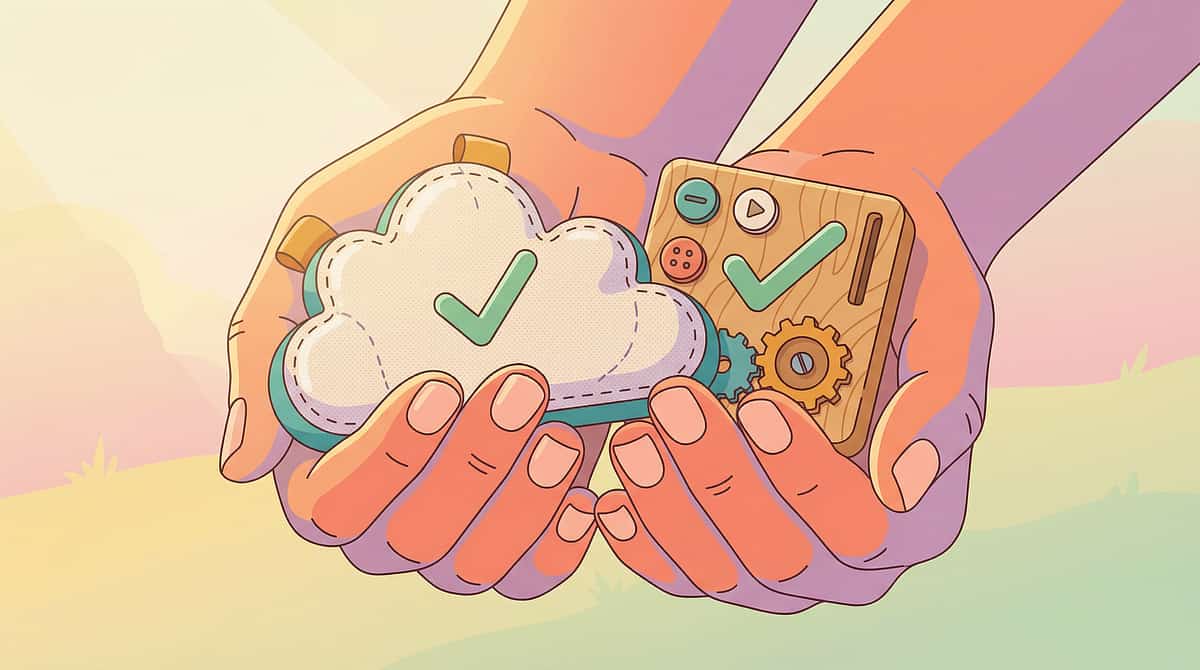
🚦 Safety First: Before You Begin
Your child's safety and emotional wellbeing are the foundation every session is built on. Read this traffic-light safety gate before every session — it takes 60 seconds and protects both your child and the integrity of the intervention.
🟢 GREEN — Proceed
- Child is fed, rested, and in a calm-alert state
- Materials are age-appropriate (no choking hazards — nothing smaller than a toilet paper roll for children under 3)
- Environment is distraction-free (TV off, competing toys stored away)
- You have 15 uninterrupted minutes available
- Child has not had a meltdown in the past 30 minutes
🟡 AMBER — Modify
- Child is slightly fussy but not distressed — use only 1–2 materials, shorter session (5 min)
- Sibling present — include sibling as showing partner
- Unfamiliar environment — use only highly preferred items
🔴 RED — Postpone
- Child is ill, in pain, or significantly distressed
- Child has had a seizure in the past 24 hours
- You are feeling frustrated or impatient (your state matters equally)
- Child shows signs of sensory overload (covering ears, eyes, fleeing)
Material-Specific Safety Notes
Nature items: Supervise for mouthing. No toxic plants, sharp shells, or live insects. Wash all found items before use.
Light-up toys: Assess sensory tolerance — some children are overwhelmed by flashing lights. Avoid strobe effects entirely.
Small parts: All items must pass the choke tube test for children under 36 months. No exceptions.
Art materials: Non-toxic certified only. Supervise scissors if used.
🛑 Stop the session immediately if: Child shows acute distress, has an allergic reaction, puts unsafe items in mouth despite redirection, or you feel your own frustration escalating.
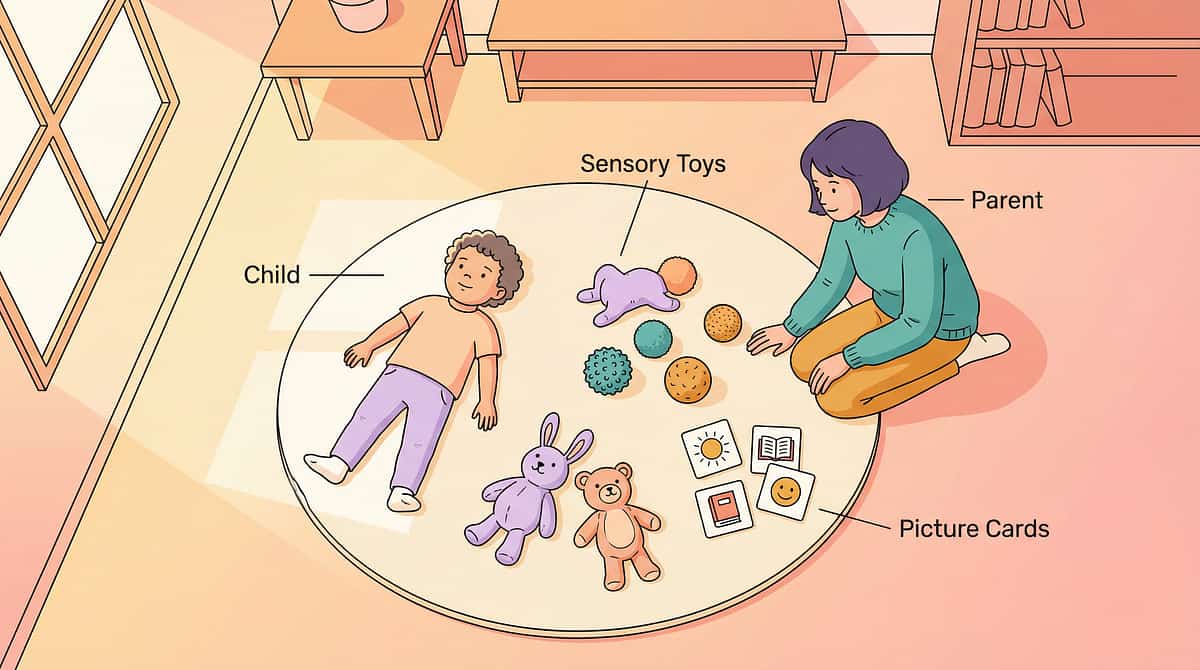
🏠 Set Up Your Space: The Physical Stage
The environment is not a backdrop — it is an active component of the intervention. The right physical setup makes the showing gesture possible. The wrong setup — a standing adult towering over a floor-playing child — makes it nearly impossible.
Spatial Setup
Child Position
On floor or low chair, at eye level with you
Parent Position
2–3 feet away, facing child, AT or BELOW child's eye level — this is critical
Materials
Behind you or beside you in a covered container — child should NOT see all items at once. Novelty drives showing.
The "Show Zone"
Clear space between you and child — this is where objects travel during showing
Remove from Space
- Television, tablets, phones (all screens)
- Competing toys not part of the session
- Clutter on the floor between you and child
- Pets (unless child is consistently calm around them)
Environmental Settings
- 🔇 Sound: Quiet — no background music or TV
- 💡 Light: Natural daylight preferred; slightly dim room enhances the wow factor of light-up toys
- 🌡️ Temperature: Comfortable — child should not be overheated or cold
- 🪑 Surface: Clean floor with mat, or low table
The Triangle of Attention: You ↔ Child ↔ Object. The physical space must support the child looking between you and the object. If you're standing while they're on the floor, the distance breaks the triangle.
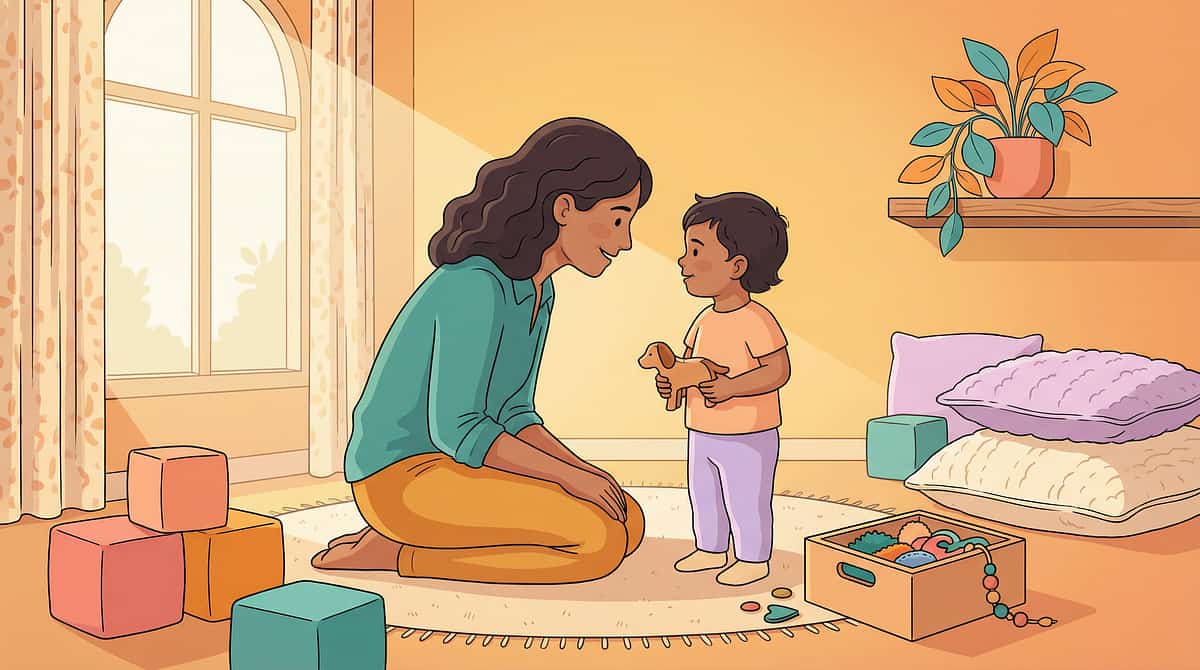
Act III — The Execution
✈️ Pre-Flight Checklist — Is Your Child Ready?
A 60-second readiness assessment before every session protects both your child's experience and your investment of time and energy. The best session is one that starts right.
1
Fed & Rested
Last meal/snack within 2 hours. Not approaching nap time.
2
Comfortable
Diaper is dry or recently changed. No physical discomfort.
3
Calm-Alert State
Eyes open, body relaxed, not crying or overtired. Shows mild interest in the environment.
4
Post-Meltdown Window
No meltdown in the past 30 minutes. Nervous system has had time to reset.
5
YOU Are Ready
You are calm, patient, and fully present. Your readiness matters equally to your child's.
✅ All 7 Checked → GO
Begin The Show Me! Game — proceed to Step 1
🟡 5–6 Checked → MODIFY
Use shortened version (5 min), 1 material only, extra calming start
🔴 Fewer Than 5 → POSTPONE
Try gentle rocking, soft music, quiet cuddle. Attempt again in 1–2 hours.
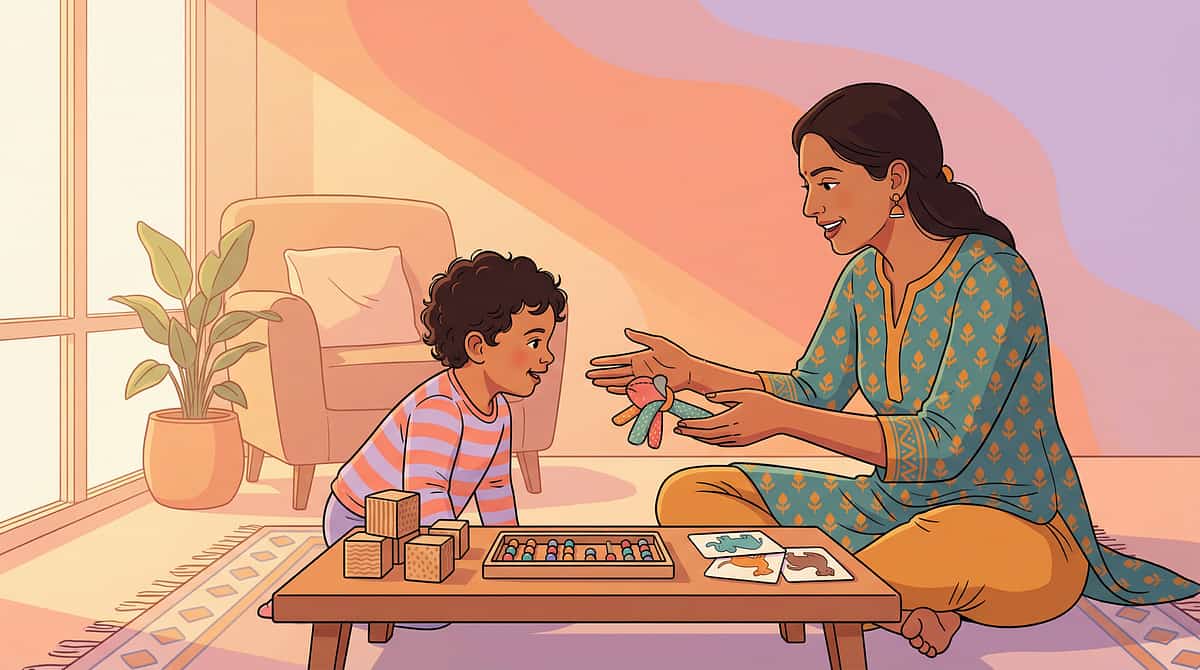
Step 1: The Invitation
Duration: 30–60 Seconds
Every powerful session begins with a moment of genuine wonder. Your job is not to teach yet — it's to become the most interesting thing in the room. You are the gateway to the exciting object.
Your Script
Sit at child's level. Have ONE surprise item hidden in your hands or behind your back. Use a warm, wondering voice:"Hey [child's name]... I found something... something really COOL... 👀"Pause. Wait for child to look at you. When they do — even a brief glance — slowly reveal the item with a "WOW" expression."LOOK at this! ✨ Wooooow!"
Body Language
- Lean slightly forward with eyes wide
- Hold the item at the child's eye level
- Exaggerate your facial expression — this is theater
- Pause between sentences — give them time to process
Reading the Response
Acceptance looks like:
- ✅ Child looks at you when you speak
- ✅ Child reaches for the object
- ✅ Child's body orients toward you
- ✅ Any vocalization or smile
Resistance looks like:
- ⚠️ Child turns away — pause, try gentler voice, move closer to their interest
- ⚠️ Child is focused elsewhere — bring the item into their visual field without forcing
- ⚠️ Child cries — stop, comfort, try later
ABA Pairing Principle: Establish yourself as a source of positive experiences before any expectation. OT Just-Right Challenge: Match demand precisely to current capacity.
Step 2: The Engagement
Duration: 1–3 Minutes
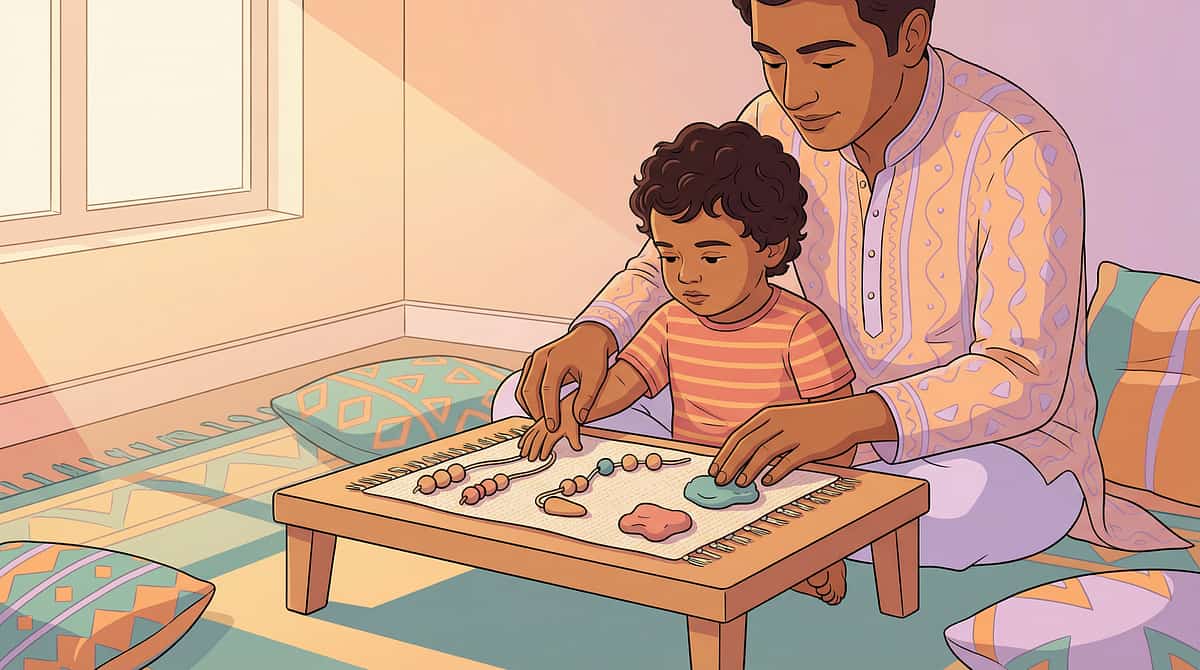
Once the child has shown interest, your goal shifts: let them hold the experience. Genuine curiosity cannot be rushed. Explore the item together, then model showing so they see exactly what you're inviting them to do.
Your Script
Once child shows interest in the first item, interact together. Then introduce the showing model:"Look! Look at THIS! 🌟"Then offer it to them:"Here — YOU hold it. Wow, YOU have it now!"Wait. Watch. Does the child explore alone, or glance at you?
Material Introduction Rules
- Present ONE item at a time — novelty is key
- Let the child hold and explore freely for 20–30 seconds
- Don't immediately ask them to show — let genuine interest build
- Model showing YOURSELF first: hold up something interesting and say "LOOK!" to them
Child Response Spectrum
✅ Engaged
Holding item, exploring, occasionally glancing at you → proceed to Step 3
🟡 Tolerating
Holding item but ignoring you → gently enter their attention: "Ohhh what do you have?"
🔴 Avoiding
Drops item and moves away → try a different, more motivating item from your kit
Reinforcement Cue: If the child looks at you AT ALL while holding the object — even a brief glance — respond with big excitement: "Oh! You FOUND something! Show me!"

Step 3: The Therapeutic Action — Eliciting the Showing Gesture
Duration: 3–5 Minutes
The Active Ingredient
This is where the intervention lives. Three strategies are used in sequence, matching the child's motivation and the material's properties. The goal: the child extends an object toward you — not to give it away, but to share the experience of it.
1
Strategy A: The "Wow" Trigger
Activate a light-up toy, reveal a nature treasure, or pull a surprise from the treasure bag. React with exaggerated wonder: "WHOA! What IS that?! Show me! Show Mama/Papa!"
Extend your open hand toward the child, palm up — the universal "show me" gesture.
2
Strategy B: The Creation Prompt
After child makes something — a block tower, a playdough shape, a scribble: "WOW you MADE that! Show me! Hold it up! Let me SEE!"
Point to the creation, then to your eyes, then back to the creation.
3
Strategy C: The Matching Game
You and child each have identical items. You hold yours up: "Look! I have a blue one! 🔵 Show me YOURS! Where's YOUR blue one?"
Wait expectantly with an encouraging smile and open body language.
✅ Correct Execution Looks Like
- Child extends arm holding object toward you (even partially)
- Child looks at your face while holding object
- Child vocalizes while extending object
- Child holds object still (not throwing or giving)
❌ Common Execution Errors
- Asking too quickly before interest builds — wait for genuine excitement
- Taking the object from the child — showing means holding up, NOT giving
- Not being at eye level — stand up and the triangle breaks
- Too many items at once — overwhelm kills the sharing urge
Step 4: Repeat & Vary
Duration: 3–5 Minutes
Target: 3–5 Showing Attempts
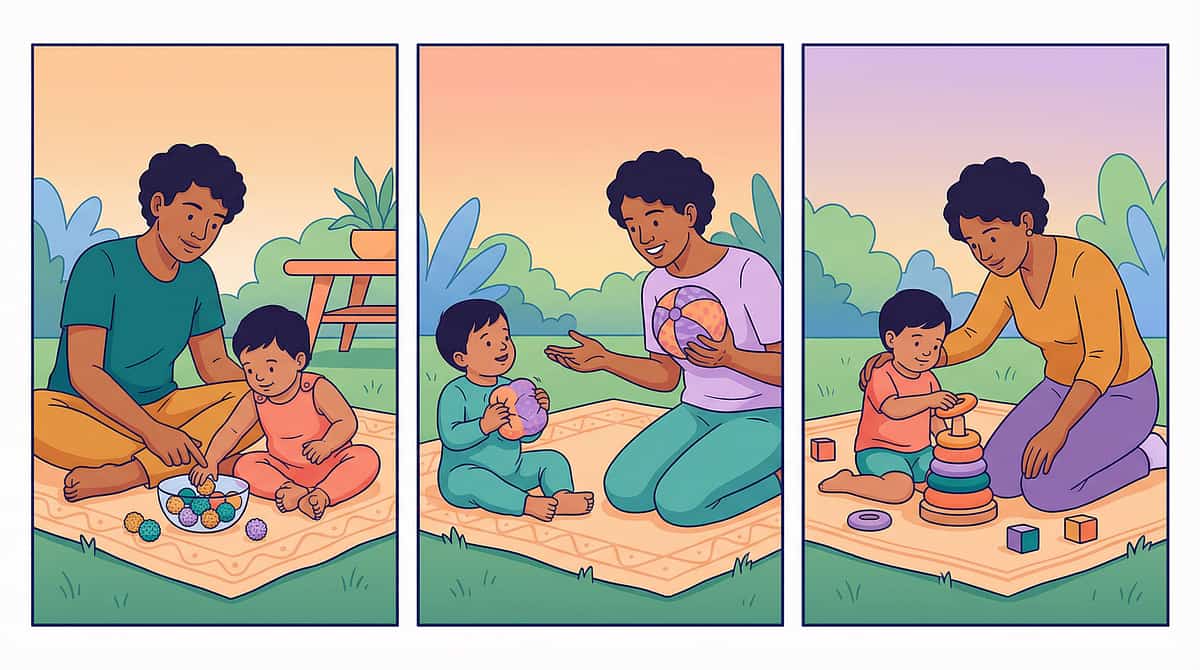
"3 good reps > 10 forced reps." Quality of engagement always trumps quantity of attempts. Vary the item, your position, and who's present — the showing behavior must generalize beyond one specific object or one specific context.
Round 1
Wow item (light-up or surprise) → "Show me!"
Round 2
Discovery item (nature or treasure bag) → "What did you find? Show me!"
Round 3
Creation (block tower or art) → "You made it! Show me!"
Round 4
Matching game → "Show me yours!"
Round 5
Child's choice — which item do they naturally gravitate toward?
Variation Within Rounds
Change the Item
Keep the strategy the same — rotate materials to maintain novelty
Change Position
Sit on other side, sit farther away — vary the spatial relationship
Change the Person
Invite sibling, other parent, grandparent as the "audience"
Change the Setting
Move from floor to table, from indoor to outdoor when ready
Satiation Indicators: If the child pushes materials away or becomes fussy, end the session immediately. One calm round, then celebrate what happened — never end on distress.

Step 5: Reinforce & Celebrate Every "Show Me!" Moment
The Reinforcement Rule: Within 3 Seconds. Specific. Enthusiastic.
Your response to showing is the entire reward system. The natural reinforcer for showing IS your enthusiastic, genuine reaction. Over time, this social reward becomes more powerful than any toy or snack.
When Your Child Shows — Any Approximation — Say This:"YES! You're SHOWING me! 🎉 That is SO COOL! Thank you for showing me!"Touch the item gently while child holds it — acknowledging their show without taking it. Match their energy but slightly bigger.
🌟 Social Reinforcement
Big smile + specific praise: "I love when you show me things!" This is the primary and most powerful reinforcer — it builds the social motivation that sustains showing.
🎵 Sensory Reinforcement
Tickle, bounce, their favorite physical play paired immediately with the showing moment. Connect body joy to social sharing.
🎁 Natural Consequence
The genuine shared attention moment itself — YOU looking at what they showed you — is the biggest reward. This is the goal made real.
🍪 Tangible (If Needed Initially)
Small preferred snack paired with social praise, used only to establish the behavior early. Fade gradually as social reinforcement takes hold.
"Celebrate the attempt, not just the success." If the child glances at you while holding an object — that's a showing seed. Celebrate it every single time.
Step 6: The Cool-Down
Duration: 1–2 Minutes
How a session ends shapes how the next session begins. A predictable, calming close builds positive associations with the entire protocol — making your child more likely to engage enthusiastically next time.
Transition Warning
"Two more, then all done with Show Me Game! 🌙" — giving advance notice reduces resistance
Final Round
One more showing attempt. "One more, then all done!" Keep it light and celebratory.
Closing Phrase
"All done! Great showing today! 🌟" — consistent closing phrase signals session end
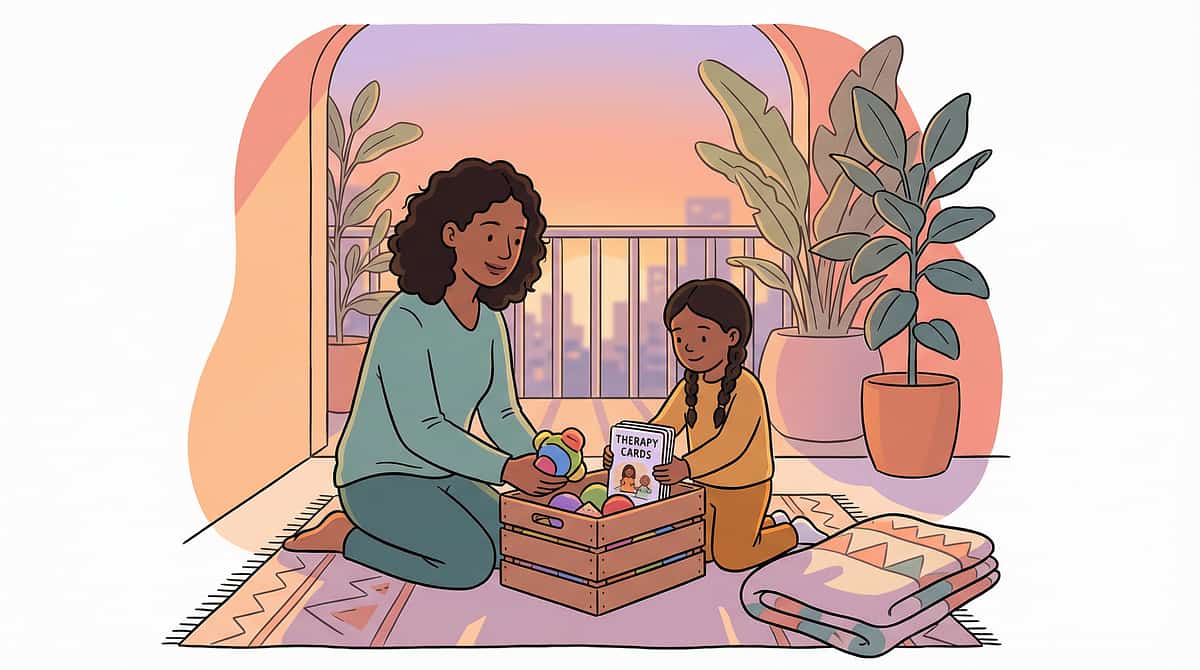
Put-Away Ritual
"Let's put the show-me toys to sleep! 😴 Night-night, light-up wand." Materials go away between sessions to preserve novelty.
Cool-Down Activities
- Gentle shared book reading (not interactive — calming)
- Soft music or humming together
- Child helps put materials in the container (participation builds routine)
- Quiet cuddle with one preferred item
If child resists ending: Offer a preferred transition activity. Use a visual timer for the last 2 minutes if the child responds to visual cues. Never end on distress — one more calm round, then gentle transition.
📊 Capture the Data: Right Now
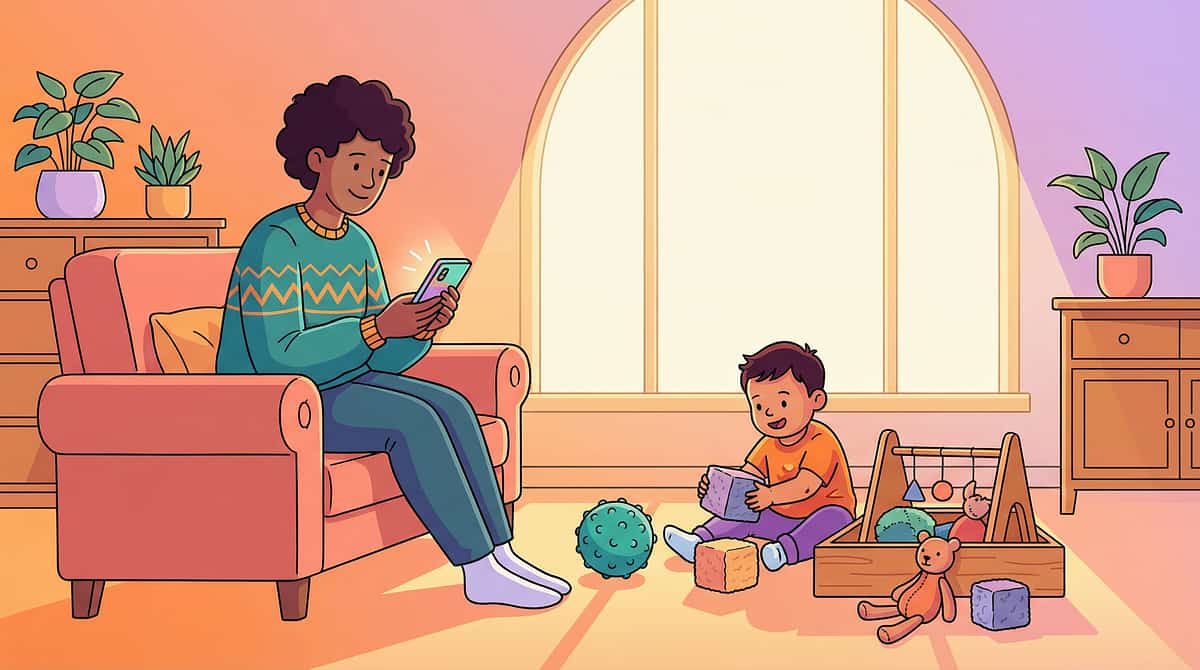
60 seconds of data collection immediately after the session saves hours of guessing later. This is the information your therapist needs to calibrate the protocol, and the data that GPT-OS® uses to personalize future recommendations.
1
Showing Attempts — Frequency Count
How many times did your child extend or hold up an object toward you? Count every approximation. Glances while holding an object count as 0.5.
Count: _____ (record within 60 seconds of session end)
2
Best Show Quality — Rating 1–5
- 1 = Brief glance toward you while holding object
- 2 = Held object slightly toward you
- 3 = Extended object toward you with eye contact
- 4 = Extended object + vocalized + waited for response
- 5 = Spontaneous showing without any prompting
3
Session Mood
😊 Happy/Engaged | 😐 Neutral/Tolerating | 😟 Fussy/Resistant | 😢 Distressed (session stopped)
Circle one and note any observations about what helped or didn't.
Weekly Summary Goal
At the end of each week, note total showing attempts across all sessions and the highest quality rating achieved. Track the trend — is the frequency increasing? Is the quality score improving? This trajectory is your evidence of progress.
Download & Digital Tools
📱 Log in GPT-OS® App — GPT-OS® analyzes your data and generates personalized protocol recommendations.
What If It Didn't Go as Planned?
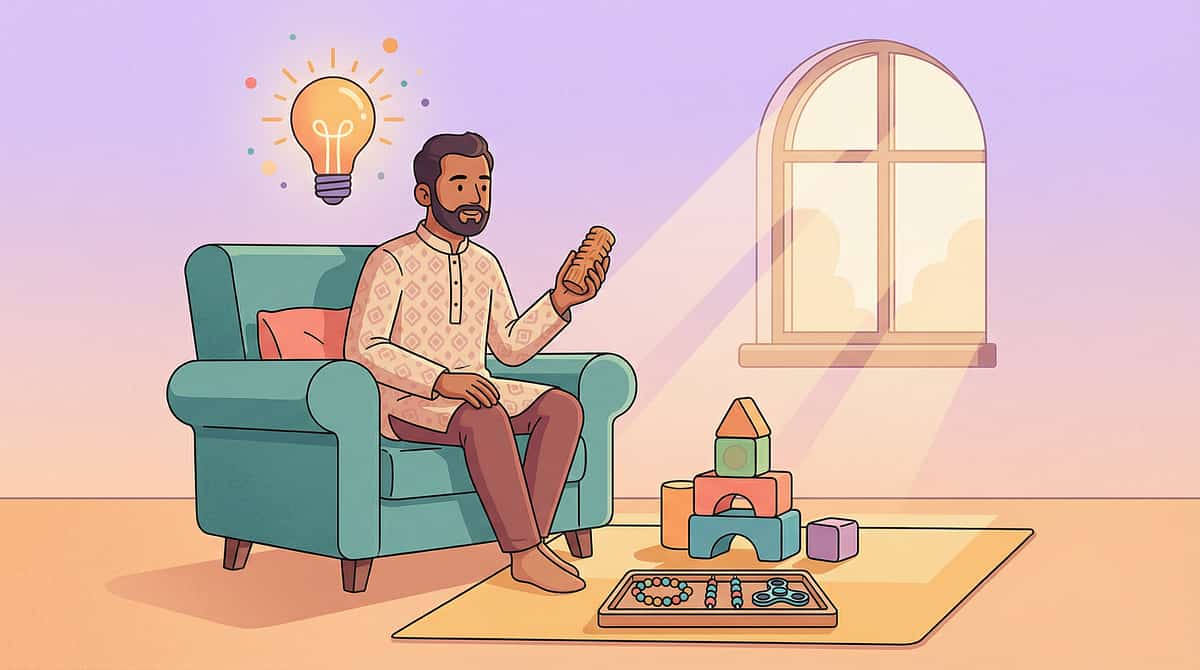
Session abandonment is not failure — it's data. Every challenging session tells you something precise about what your child needs. The technique needs adjustment, not the parent. Here are the most common problems and their targeted solutions.
Problem 1: "My child never looked at me the entire session"
You may be too far away. Move closer. Get lower. Place the interesting item BETWEEN your face and their gaze line so they must look near you to see the item.
Problem 2: "My child grabs the item and walks away"
This is interest without social motivation — yet. Hold the item while activating it. Don't release it fully. They must stay near you to experience the effect.
Problem 3: "My child gives me the item but doesn't show it"
Giving is a related skill — celebrate it! Then model showing: take the item, hold it UP toward them (not into their hands), say "LOOK!" — then offer it back. Show → give → show.
Problem 4: "My child only wants cause-effect toys"
Start with what works. Use the cause-effect toy for 3–4 rounds, then introduce ONE new item. Pair the new item with the preferred one to transfer motivation.
Problem 5: "My child got upset when I tried to get them to show"
Reduce demand immediately. Return to just playing together with no showing expectation. When they look at you during play — even by accident — say "Oh! You found something! Cool!" Build the association first.
Problem 6: "My child showed once but never repeated it"
One show is a breakthrough. Write down EXACTLY what item triggered it, what time of day, what you were doing. Replicate those conditions. That single show is the seed — treat it with reverence.
Problem 7: "I didn't feel comfortable doing this"
This is valid and important. Watch the demonstration Reel (Card 36). Call the FREE National Autism Helpline (9100 181 181) for guided support. Consider booking a parent coaching session.

Adapt & Personalize: No Two Children Are Identical
The protocol is a starting point, not a fixed script. Adjust the difficulty, the materials, and your approach to match your child's profile today — not the child described in a textbook.
← Easier Version
For first sessions or challenging days:
- Use only 1 material (the most motivating one)
- Session length: 5 minutes
- Accept ANY glance toward you as a "show"
- You model showing; don't expect child to reciprocate yet
- Play side by side (parallel), not face to face
Standard Version
The protocol as written:
- 3–4 materials per session
- Session length: 10–15 minutes
- Expect child to extend object with prompting
- Mix Strategies A, B, and C across rounds
Harder Version →
For children making consistent progress:
- Introduce new, unfamiliar items
- Increase distance between you and child
- Reduce prompting — wait longer before saying "show me"
- Introduce a third person (show Dada, show Didi)
- Move to new settings (park, relative's house)
Sensory Profile & Age-Based Modifications
🔊 Sensory Seeker
Use more cause-effect toys, light-up items, textured objects — more sensory input drives more motivation to share
🤫 Sensory Avoider
Use nature treasures, soft photo books, quiet matching games. Dim lights. Reduce your volume.
👶 9–14 Months
Focus on any arm extension toward you. Use mainly wow and surprise items. Expect gross motor showing.
👧 21–30 Months
Expect showing with vocalization. Add "tell me about it" after they show. Introduce new settings.
Act IV — The Progress Arc
📈 Week 1–2: Tolerance and Seeds
You are laying the first brick of a road. You won't see the road for weeks — but without this brick, the road cannot exist. What matters in Week 1–2 is not perfection; it is the first tiny signals of connection.
What "Progress" Looks Like at This Stage
- ✅ Child tolerates you sitting nearby during play (doesn't move away)
- ✅ Child accepts materials you offer (takes them, even briefly)
- ✅ Child glances at you 1–2 times during a session — even accidentally
- ✅ Child shows more interest in session materials over non-session days
What Is Not Progress Yet — And That's Okay
- ❌ Child is not yet showing objects spontaneously
- ❌ Child may still walk away with interesting items
- ❌ Child may show inconsistently — one good show followed by three blank sessions
If your child glances at you even once more than they did last week while holding something interesting — that is real, measurable, meaningful progress.
15%
Week 1–2 Progress
Tolerance and seeds — the neural pathway is being introduced for the first time
📈 Week 3–4: Recognition and Anticipation
Something shifts in Week 3–4. The sessions are becoming familiar. Your child's nervous system is beginning to recognize the pattern — and beginning to expect the social reward. Watch for these consolidation indicators carefully.
Anticipation Behavior
Child anticipates the "Show Me" game — reaches for material container when they see it being brought out
Check-In Glances
Child looks at you more frequently during play — not yet showing, but checking in. The social radar is activating.
Giving Emerges
Child may hand you items (giving, not showing yet) — this is progress! The social bridge is opening from both directions.
Material Preference
Child shows preference for specific materials — social motivation is building around particular items
Increased Vocalizations
Child vocalizes more during sessions — social engagement is spreading across communication channels
40%
Week 3–4 Progress
Consolidation — the neural pathway is strengthening and showing itself in new behaviors
Parent Milestone: "You may notice you're more confident too. You're reading your child's cues faster. You're adjusting in real-time. You are becoming their therapist."

📈 Week 5–8: Showing Emerges
This is the moment you've been building toward. Showing is emerging when it happens consistently, intentionally, and with the social awareness that makes it real communication — not just a motor action.
✅ Child holds up object toward you at least 2–3 times per session without prompting
✅ Child looks between object and your face — triadic gaze is present
✅ Child vocalizes or smiles while showing
✅ Child waits for your response after showing — social expectation has formed
✅ Child shows to different people, not just one caregiver
🌟 Generalization Indicators
Spontaneous Showing
Shows objects during non-session times without any prompting or setup
New Settings
Shows in different environments — outside, at grandparent's house, at the park
New Items
Shows a variety of items beyond the session materials — any interesting discovery
Peers
Shows to older siblings and other children — the behavior has become a social instinct
75%
Week 5–8 Progress
Mastery emerging — the behavior is internalizing and generalizing across people and settings
🏆 Mastery Unlocked Criteria: Child spontaneously shows objects 5+ times per day across settings and people, with triadic gaze and vocalization, without any prompting.
🎉 You Did This. Your Child Grew Because of Your Commitment.
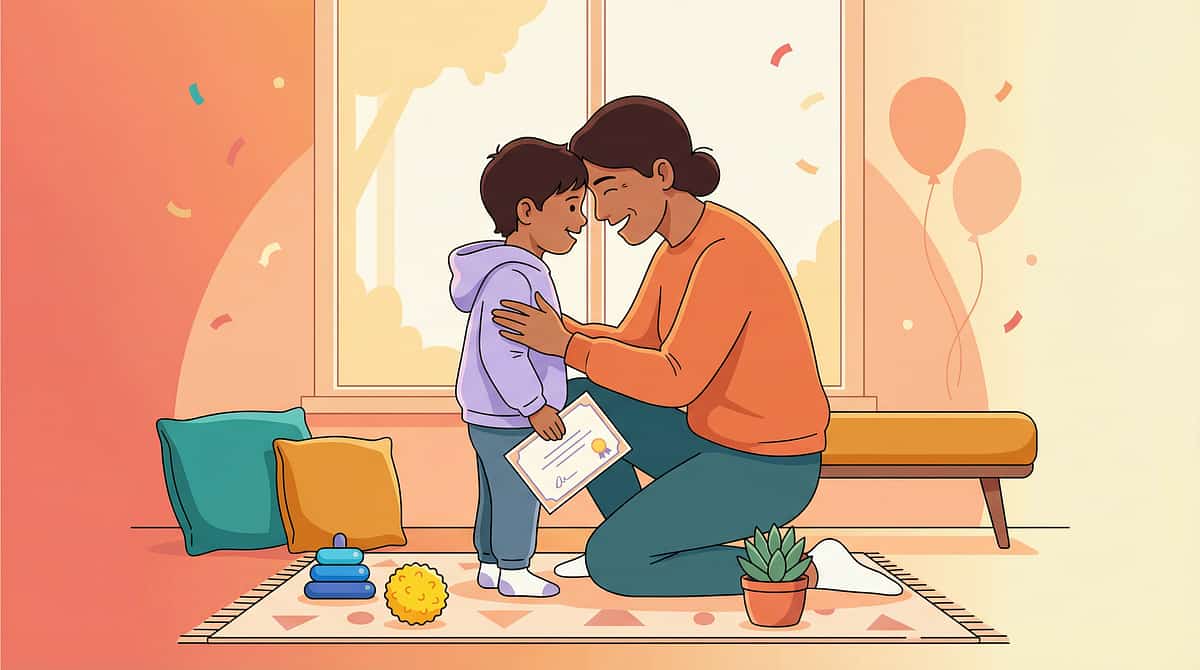
Remember that moment on the patio with the beetle? Your child exploring alone while you watched, invisible, aching to be invited?Look at where you are now.Your child found something today — and they ran to you. They held it up. They looked at your face. They waited. And when you said "WOW!" — they smiled. Not because they wanted something from you. But because they wanted you to SEE what they saw. To feel what they felt.That is the showing gesture. That is the bridge between two minds. YOU built that bridge.
📸 Document This Milestone
Take a photo of your child showing you something. Date it. You'll want to remember the first time "Look at this!" entered your world.
👨👩👧 Celebrate as a Family
Tell your partner, your parents, your child's therapist. This is a developmental milestone worth marking, sharing, and honoring.
📊 Share With Your Therapist
Bring your tracking data to your next session. Your therapist can use it to calibrate next steps on your child's development pathway.

🚩 Red Flags: When to Pause and Seek Professional Consultation
This protocol is designed for home use with ongoing professional support. Knowing when to pause — and how to escalate — is as important as knowing how to proceed. Trust your instincts: if something feels wrong, pause and ask.
🚩 No Change After 4 Weeks
If consistent daily sessions (5+ sessions/week) produce no measurable change in glancing, tolerance, or showing — this doesn't mean failure. It means the approach may need professional calibration.
🚩 Showing Decreases or Disappears
If showing initially emerged and then regressed, this warrants professional evaluation. Skill regression is always a clinical signal worth investigating.
🚩 Increasing Distress During Sessions
If the child shows increasing distress despite all modifications, the technique may need to be delivered differently by a trained therapist.
🚩 Shows to Objects, Never to People
Holding items toward toys, mirrors, or screens but never toward humans may indicate deeper social communication differences requiring comprehensive assessment.
🚩 Combined Absence by 14 Months
Absent showing + absent pointing + absent eye contact + no name response as a constellation warrants urgent developmental evaluation — not watchful waiting.
🚩 Skill Loss
Any loss of previously acquired skills — including showing that was present and stopped — warrants immediate professional evaluation. Skill loss is always a priority concern.
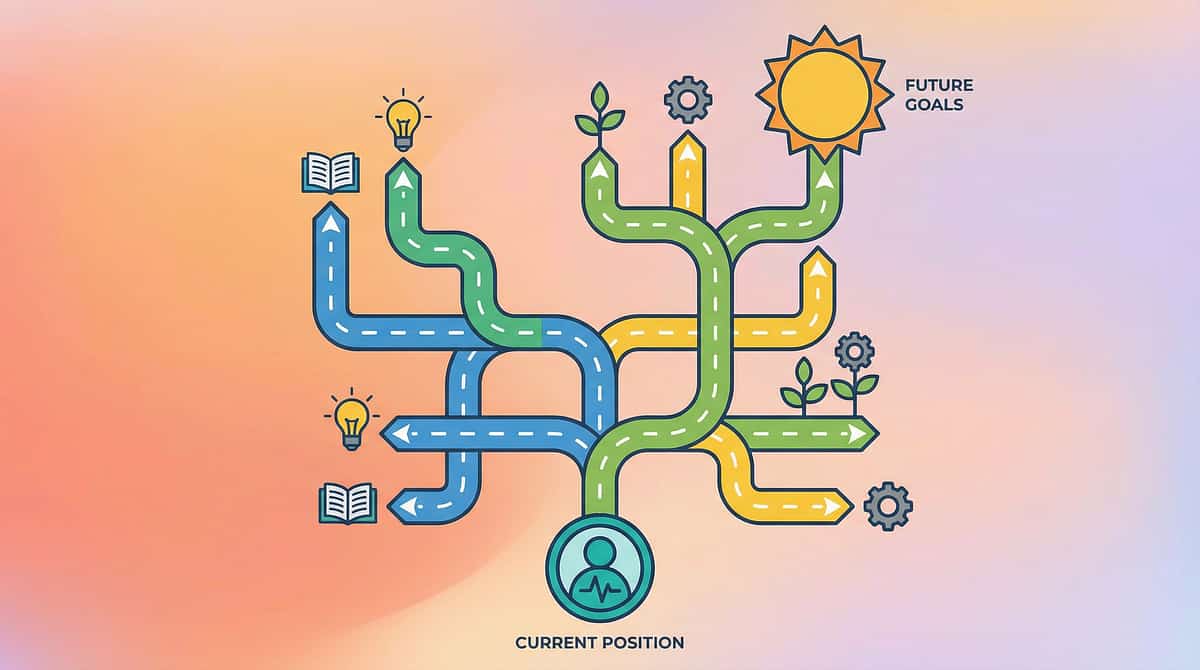
🗺️ The Progression Pathway: Your Developmental GPS
Every technique in the Pinnacle Blooms library sits within a carefully structured developmental progression. Knowing where you were, where you are, and where you're heading transforms a single technique into a navigated journey.
B-123: Doesn't Point
Protoimperative and protodeclarative pointing — gestural foundations. View Technique
B-124 & B-125: Wave & Gesture Foundations
Broader gesture absence and the wave gesture — establishing gestural communication. View Technique
⭐ B-126: Doesn't Show Objects
Protodeclarative showing gesture — material-mediated joint attention. YOU ARE HERE.
B-127: Doesn't Bring Objects to Share
If showing is emerging, progress to bringing — the mobile version of shared attention. View Technique
B-128: Limited Shared Enjoyment + Advanced JA
Showing + words, broadening social motivation, peer-directed joint attention. View Technique
Lateral alternatives if this approach didn't resonate: Video modeling approach for joint attention (NCAEP evidence-based) | Pivotal Response Treatment (PRT) for motivation-based social communication.
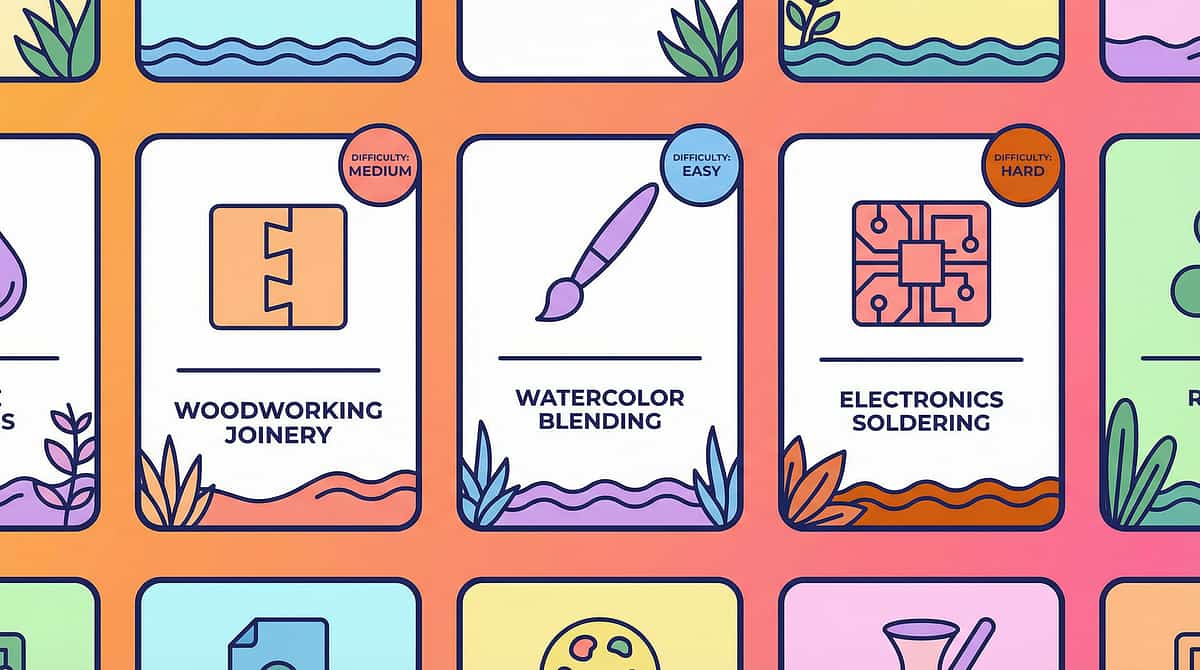
🧩 Related Techniques in the Joint Attention Domain
The showing gesture is one node in an interconnected skill network. All the materials from your B-126 kit transfer directly to these related techniques — your investment goes further than you think.
Technique | Difficulty | Materials You Already Have | |
Intro | Light-up toys, Nature items ✅ | ||
Intro | Matching items ✅ | ||
Intro | All materials ✅ | ||
Core | Treasure bags, Nature items ✅ | ||
Core | Cause-effect toys, Art materials ✅ | ||
Core | Photo books, Interactive books ✅ |
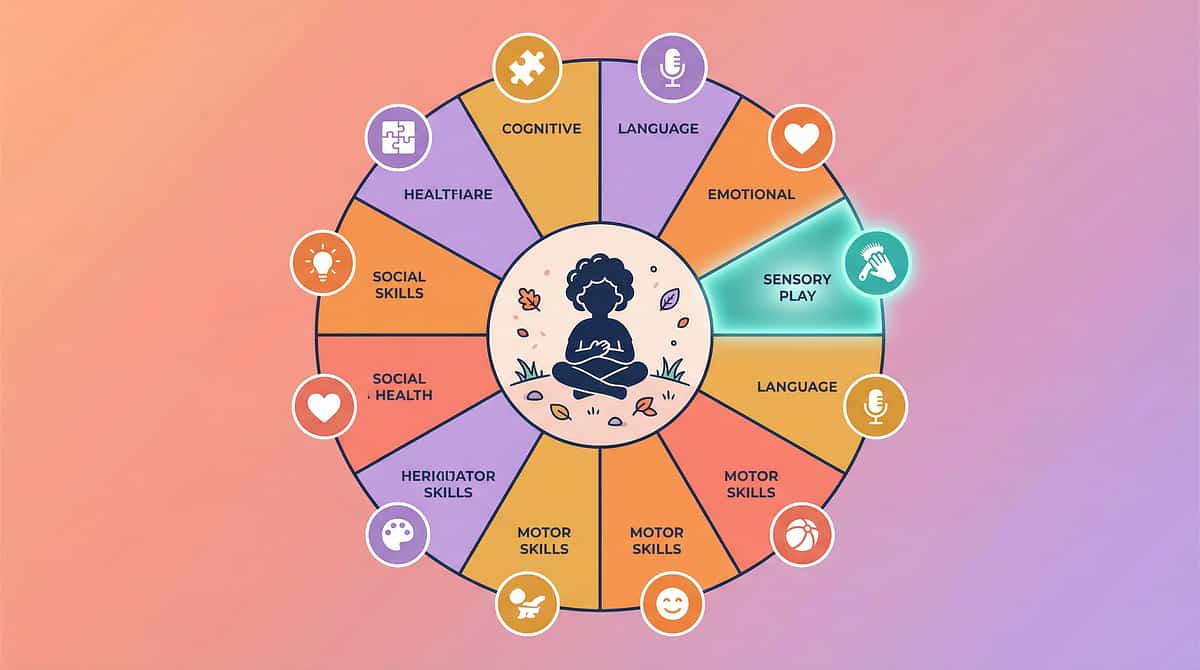
🌐 Your Child's Full Developmental Map
The showing gesture is one piece of a larger developmental puzzle. Understanding where it sits within the 12-domain map helps you see how every gain in this technique radiates outward into your child's broader development.
How Showing Feeds Other Domains
Domain C — Communication: Showing is proto-language — it precedes and predicts spoken words by 6–12 months
Domain I — Play: Shared play requires joint attention as its foundation
Domain K — Social Participation: Peer interaction depends on the ability to share attention with others
See Your Child's Full Profile
The AbilityScore® Assessment maps your child across all 12 domains, identifying where to focus intervention energy for maximum developmental return.
Act V — Community & Ecosystem
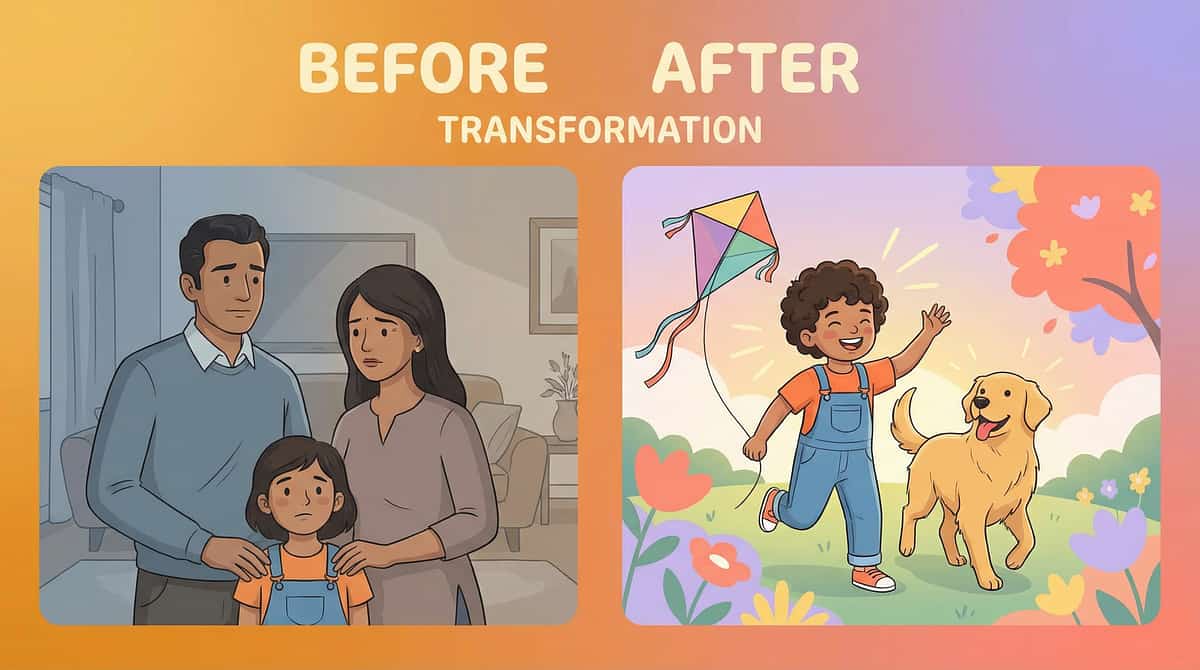
Real Families. Real Journeys. Real Showing.
From Invisible to Invited — Hyderabad
Before: "Aarav would find the most amazing things — bugs, shiny wrappers, interesting rocks — and never once look at me. He lived in his own discovery world. I felt like a ghost in my own house."
After 8 weeks: "He ran to me yesterday with a leaf. A LEAF. He held it up to my face and said 'Ah!' and waited for me to react. I cried. My husband cried. The leaf is now framed on our wall."
— Mother, Pinnacle Blooms Network, Hyderabad
Two Spoons Changed Everything — Bangalore
Before: "Meera played alone. Completely alone. She didn't seem to notice we were in the room."
After 6 weeks: "The matching spoons activity cracked it open. When I held my spoon up and she held hers up — and we BOTH looked at each other and laughed — that was the first real shared moment we'd had. Now she shows me everything."
— Father, Pinnacle Blooms Network, Bangalore
Illustrative cases; identifying details changed to protect privacy. Outcomes vary by child profile, intervention consistency, and individual developmental factors.
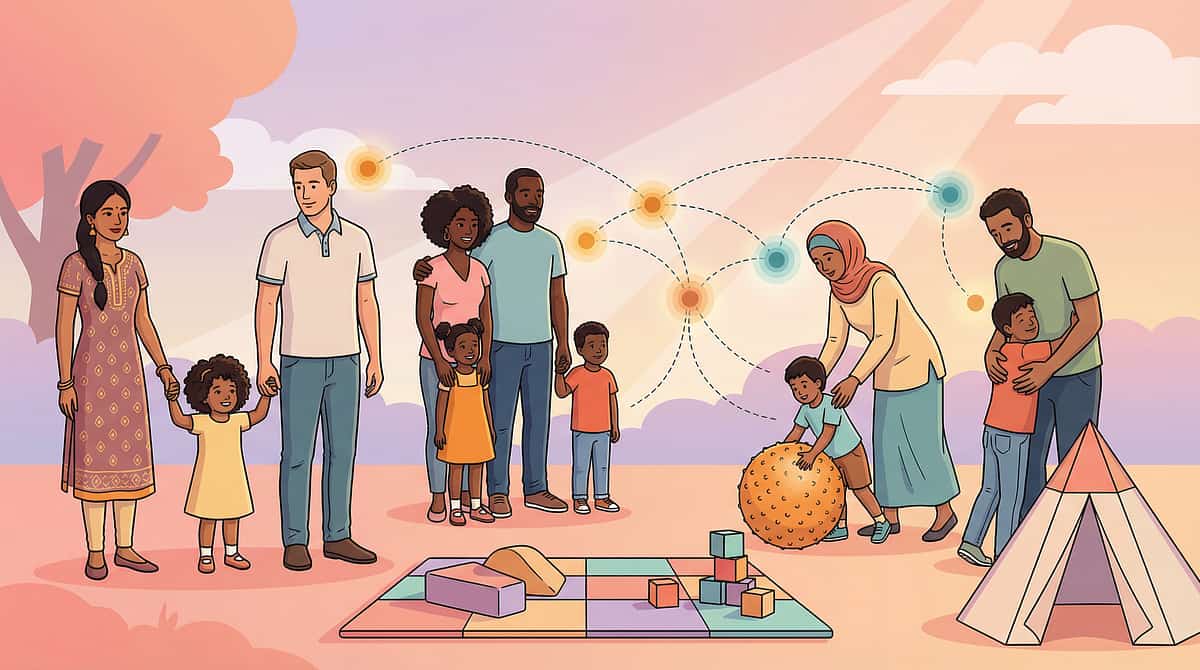
Connect With Other Parents: You Are Not a Solo Operator
The research is clear: parent community and peer mentoring significantly improve intervention consistency and parental wellbeing. Other families who've navigated this exact journey are your most powerful resource — and they're waiting to connect with you.
Joint Attention Parent Community
Connect with other parents working on showing, pointing, and shared attention. Share wins, ask questions, and find encouragement from families who understand exactly what you're navigating. 💬 Join the WhatsApp Group
Peer Mentoring Program
Connect with a parent who has already navigated this journey. A peer mentor offers something no professional can — lived experience with the same daily challenges and breakthroughs. Request through your Pinnacle center or the helpline.
Local Parent Meetups
Pinnacle centers organize monthly parent meetups — a space to meet, learn, and support each other in person. Find yours: Pinnacle Center Locator
"Your experience helps others — consider sharing your journey. The parent who felt hopeless in Week 1 and is celebrating spontaneous showing in Week 8 is the most powerful advocate another family can find."
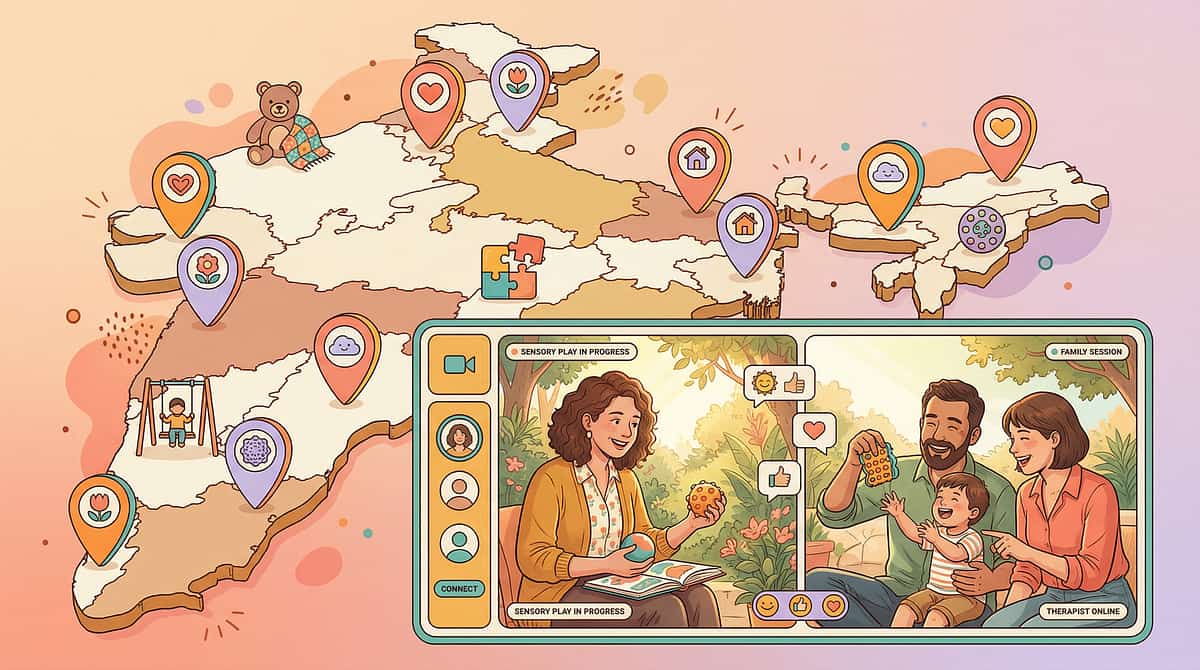
Your Professional Support Team: Home + Clinic = Maximum Impact
Home practice is where generalization happens. Clinic sessions are where precision calibration happens. The two together produce outcomes neither can achieve alone.
Find Your Nearest Center
Your Primary Specialist for B-126
A Speech-Language Pathologist (SLP) with joint attention intervention training, supported by a BCBA for reinforcement optimization.
Teleconsultation
Can't visit in person? Book a teleconsultation for guided parent coaching on the showing protocol. Book Teleconsultation
Contact Pinnacle Blooms Network
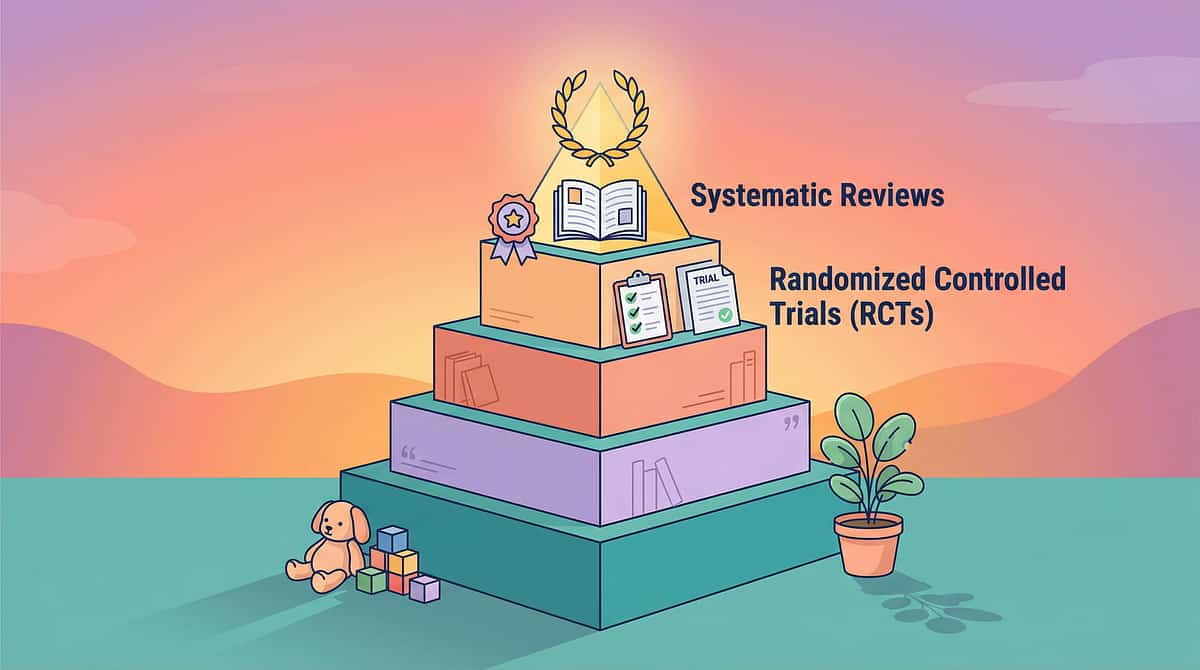
📚 The Research Library: Deeper Reading
Every recommendation in this protocol rests on a foundation of peer-reviewed science. For clinicians and curious parents who want to go deeper, here is the primary evidence base organized by study type.
Level I — Systematic Reviews & Meta-Analyses
NCAEP (2020). Evidence-Based Practices for Children, Youth, and Young Adults with Autism. Joint attention intervention classified as evidence-based across 14+ studies. → NCAEP Report
Level II — Randomized Controlled Trials
Kasari C, et al. (2006). Joint attention and symbolic play in young children with autism: A randomized controlled intervention study. JCPP.→ PubMed
Kasari C, et al. (2012). Longitudinal follow-up of children with autism receiving targeted interventions on joint attention and play. JAACAP.→ PubMed
International Frameworks
WHO Nurturing Care Framework (2018).→ nurturing-care.org
WHO/UNICEF Care for Child Development Package (2023).→ WHO Publications
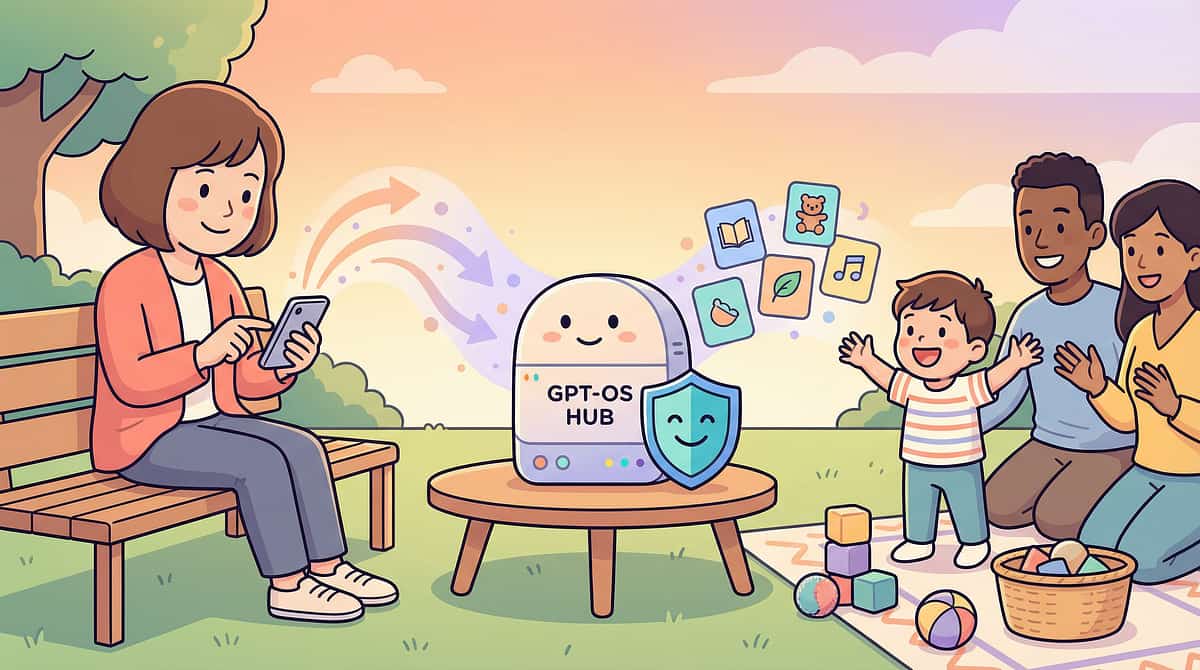
🔒 How GPT-OS® Uses Your Data
When you log your child's session data, you're not just tracking progress — you're contributing to a growing intelligence that helps every child like yours. Here's exactly how your data flows and how it's protected.
What GPT-OS® Learns From Your Data
- Which materials trigger showing most effectively for your child's specific profile
- Optimal session timing and duration for your child
- When to progress to the next technique level
- Population-level patterns: which material combinations work best for children with similar AbilityScore® profiles
Privacy Protections
- 🔒 All data encrypted at rest and in transit
- 🔒 No child identified in population-level analytics
- 🔒 Data never sold or shared with third parties
- 🔒 Parents can request data deletion at any time
- 🔒 Compliant with India's Digital Personal Data Protection Act (DPDPA, 2023)
"Your data helps every child like yours." Population-level intelligence improves recommendations for all families navigating the same developmental journey.
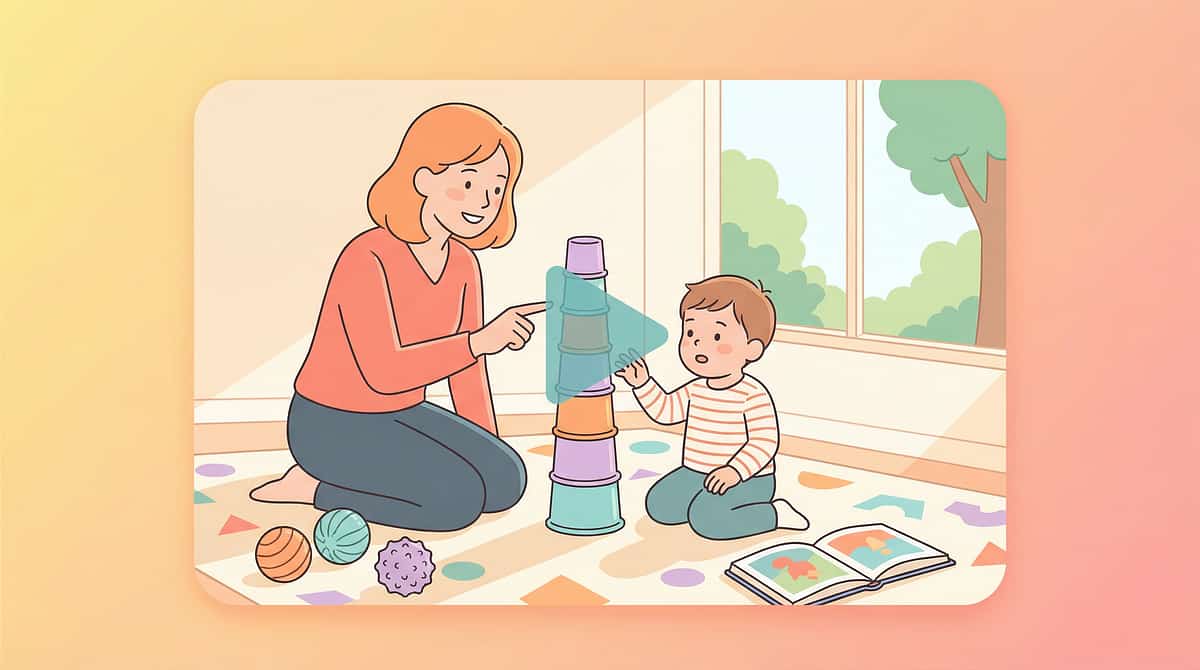
🎬 Watch: "9 Materials That Help When a Child Doesn't Show Objects"
Reel ID: B-126
Joint Attention Series — Episode 126
Duration: 75 Seconds
A Pinnacle Blooms therapist demonstrates each of the 9 materials in action — showing exactly how to use them to elicit the showing gesture. See real parent-child interactions, correct positioning, and the moment a child holds something up for the first time.
1
← B-125
"When Your Child Doesn't Use Gestures"
2
▶ B-126 (This Reel)
"9 Materials for the Showing Gesture"
3
B-127 →
"When Your Child Doesn't Bring Objects to Share"
📤 Share This With Your Family
The WHO Care for Child Development Package emphasizes that multi-caregiver training is critical for intervention generalization and maintenance. Consistency across all caregivers in a child's life multiplies the impact of every session you've already done.
Share This Page
Download Family Resources
📥 Family Guide — 1-Page PDF: "Building Showing Skills at Home"
📄 Teacher Communication Letter Template
For Grandparents — Simplified Version
"We are working on helping [child's name] SHOW us things they find interesting. When they hold something up toward you — react with BIG excitement. Say 'WOW! Show me more!' Don't take the object — let them hold it. Your reaction is the reward."
For School/Daycare Teachers
The template communication letter explains joint attention goals and requests showing opportunities during school activities. Your child's teacher is a powerful showing partner — 6+ hours a day of natural opportunity.

Act VI — The Close & Loop
❓ Frequently Asked Questions About Showing
What's the difference between showing and giving?
Showing = child holds up the object while keeping it, looks at your face, shares the experience — "look at this with me!" Giving = child releases the object to you — transfers possession. Showing specifically reflects protodeclarative communication: sharing interest, not transferring ownership.
My child is 18 months and doesn't show. Is it too late?
No. The developmental window for building showing skills extends well beyond 18 months. Early intervention is always beneficial, but the brain remains plastic. Many children build robust showing skills through targeted intervention at 18–30 months and beyond.
Should I only do this technique, or work on pointing too?
Joint attention is an interconnected skill set. Showing, pointing, following gaze, and shared enjoyment all support each other. You can work on B-126 alongside B-123 (pointing). Your therapist can coordinate the sequence for maximum efficiency.
My child shows to me but not to their father or grandmother. Why?
This is common and actually good news — showing HAS emerged with one person. Generalization is the next step. Have the other person spend time as the "wow audience" during sessions. Gradually transfer the role across people.
How long should I continue this technique?
Until showing is spontaneous, frequent (5+ times daily), generalized across people and settings, and combined with vocalization. Then maintain with occasional "checking" sessions monthly to confirm the skill is stable.
Does absence of showing definitely mean autism?
No. Absent showing by 12–14 months is one indicator that warrants attention, especially when combined with limited pointing and reduced response to joint attention. It can also be associated with language delay or limited responsive partners. Comprehensive evaluation looks at the full picture.
Can I use screen-based materials?
Physical objects are preferred because showing requires the motor act of extending an object. However, tablet-based content can serve as a bridge — help the child "show" it by turning the screen toward you while you react enthusiastically.

Your Child's Next "Look at This!" Starts Today
You arrived on this page with a concern. You leave with the neuroscience, the materials, the protocol, the tracking system, the troubleshooting guide, the community, and the professional backup to build the showing gesture — one session at a time. The only thing left to do is begin.
🟢 Start This Technique Today
GPT-OS® walks you through your first session step by step, adapting to your child's specific profile.
🔵 Book a Consultation
Schedule with a Joint Attention Specialist at any of 70+ Pinnacle Blooms centers. Free initial consultation available.
⚪ Explore the Next Technique
Continue the joint attention development pathway when your child is ready for the next level.
🛡️ Validated by the Pinnacle Blooms Consortium — OT • SLP • ABA • SpEd • NeuroDev — Multidisciplinary clinical expertise governing every recommendation on this page.
📞 FREE National Autism Helpline: 9100 181 181 | 16+ languages | 24x7 | No appointment needed
Preview of 9 materials that help when child doesnt show objects Therapy Material
Below is a visual preview of 9 materials that help when child doesnt show objects therapy material. The pages shown help educators, therapists, and caregivers understand the structure and content of the resource before use. Materials should be used under appropriate professional guidance.


Link copied!
🏛️ The Pinnacle Promise
Pinnacle Blooms Consortium
OT • SLP • BCBA • SpEd • NeuroDev
"From fear to mastery. One technique at a time."
You arrived on this page concerned that your child doesn't show you things. You leave with the neuroscience, the materials, the protocol, the tracking system, the troubleshooting guide, the community, and the professional backup to build that showing gesture — one session at a time.
Every child finds their way to say "Look at this!"
21M+
Exclusive 1:1 therapy sessions delivered
97%+
Measured improvement rate
70+
Centers across India
160+
Countries with patents filed
MEDICAL DISCLAIMER: This content is educational and informational. It does not constitute medical advice and does not replace assessment by a licensed developmental specialist. Limited or absent showing gesture, especially when combined with limited pointing and reduced response to joint attention bids, is a significant developmental concern that warrants comprehensive evaluation. Individual results vary. Statistics represent aggregate outcomes across the Pinnacle Blooms Network. Consult qualified healthcare professionals, including developmental pediatricians, psychologists, and speech-language pathologists, before implementing any strategies.
© 2026 Pinnacle Blooms Network®, unit of Bharath Healthcare Laboratories Pvt. Ltd. All rights reserved. CIN: U74999TG2016PTC113063 | DPIIT: DIPP8651 (Govt. of India) | MSME: Udyog Aadhaar TS20F0009606 | GSTIN: 36AAGCB9722P1Z2 | Powered by GPT-OS® — Global Pediatric Therapeutic Operating System