
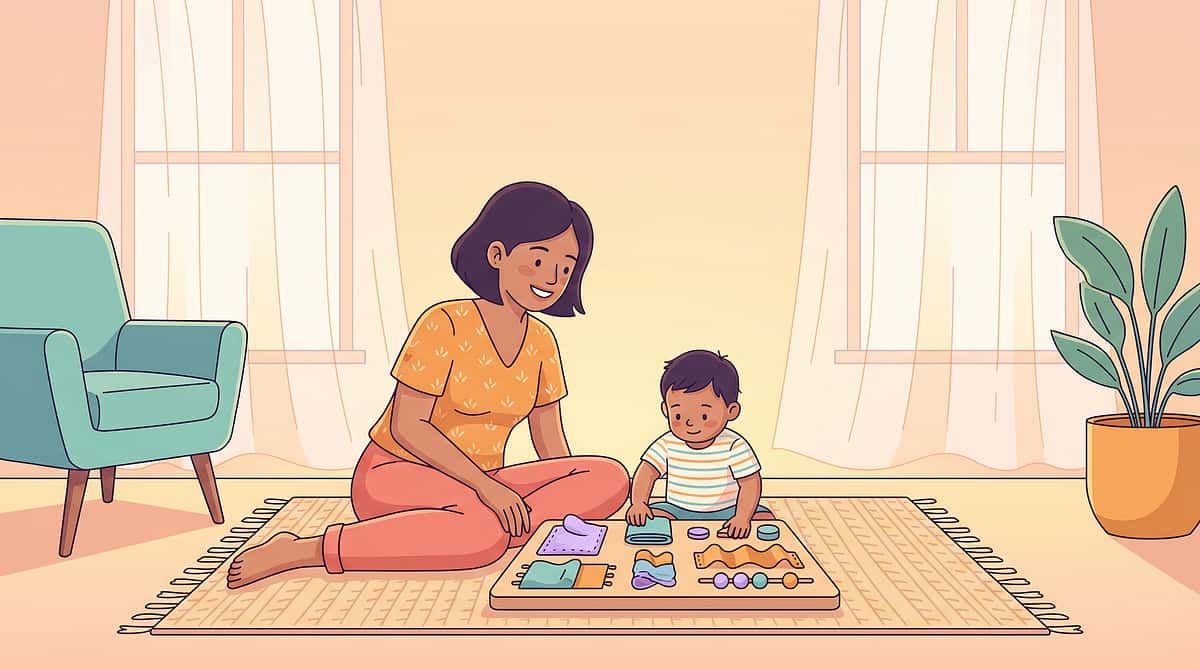
Teaching Object Permanence: The Cognitive Foundation That Changes Everything
"When I leave the room, she cries like I've vanished from existence."
You are not failing. Your child's cognitive system is developing — and you are about to learn exactly how to help.
Pinnacle Blooms Network® Consortium
Cognitive Development Solutions — Episode 11
Technique B-146
You Are Not Alone in This
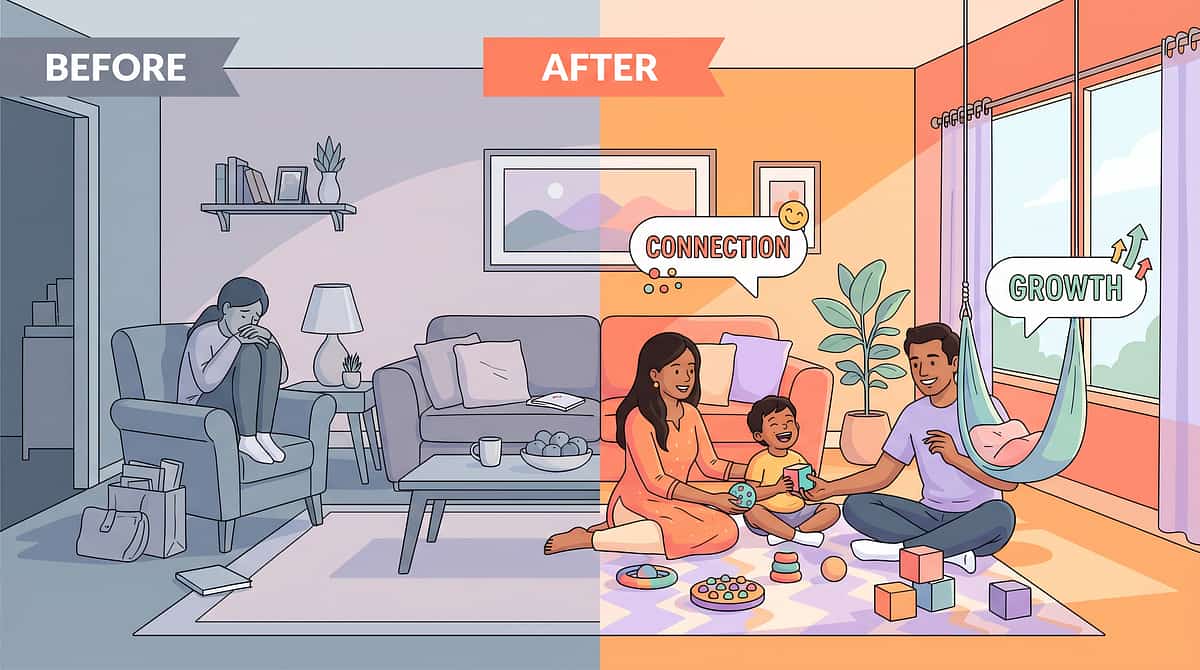
The toy rolled under the couch. Your child looked at the space where it was — confused, maybe upset — and then simply moved on. As if the toy ceased to exist the moment it left their sight. And when you step out to the kitchen for thirty seconds, the wailing begins — not frustration, but genuine terror. As if you've disappeared from the face of the earth.
You are not imagining this. Your child's brain hasn't yet built the neural architecture to understand that things — and people — continue to exist when they can't be seen. This is called object permanence, and it is one of the most foundational cognitive leaps a human being makes.
This is not a behaviour problem. This is a wiring stage. And wiring responds to the right input.

The Numbers — You Are Among Millions
Object permanence delays affect families across every country, every language, every socioeconomic level. The data makes this unmistakably clear.
1 in 36
Children with ASD (USA)
CDC, 2024. Object permanence delays are among the earliest cognitive markers observed in autism spectrum disorder.
65%
Cognitive Delays Identified
Across Pinnacle Blooms Network's 20M+ exclusive 1:1 therapy sessions, foundational cognitive delays — including object permanence — are identified in approximately 65% of children presenting with ASD features before age 3.
250M
Children at Risk (WHO)
The WHO estimates 250 million children under 5 in low- and middle-income countries are at risk of not reaching their developmental potential. Object permanence is a critical milestone in the developmental cascade.
In India, where Pinnacle Blooms operates 70+ centres, early cognitive intervention during the 4-month to 3-year window has shown the highest impact on long-term developmental trajectories. References: PMC11506176 | PMC10955541 | CDC MMWR 2024 | WHO Nurturing Care Framework (2018)
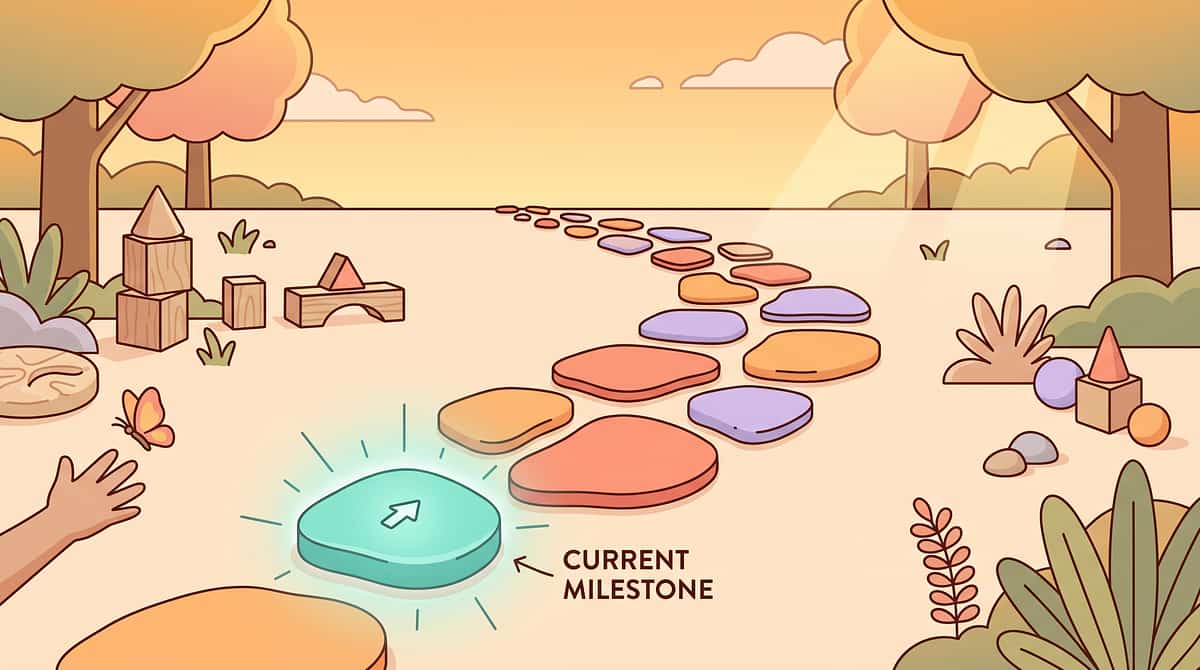
What's Happening in Your Child's Brain
The Neural Architecture
Three brain regions work together to build object permanence:
- Prefrontal Cortex — working memory centre; holds the mental image of an object no longer visible
- Hippocampus — stores the memory of where the object was last seen
- Parietal Lobe — tracks spatial location and object trajectories
For typically developing infants, these neural pathways begin forming between 4–8 months and consolidate by 18–24 months. For children with ASD or developmental delays, this process may follow a different timeline — but the neural architecture can absolutely be built through structured, repeated, joyful practice.
Piaget's Stages of Development
Jean Piaget identified object permanence as a defining milestone of the sensorimotor stage (birth to 24 months):
- Stage 1 (0–4 months): No permanence — object gone = object doesn't exist
- Stage 2 (4–8 months): Partial permanence — searches for partially hidden objects
- Stage 3 (8–12 months): Visible displacement — finds objects hidden while watching
- Stage 4 (12–18 months): Invisible displacement — understands hidden movement
- Stage 5 (18–24 months): Full representational permanence — complete mental models
References: Piaget J. (1954) | Baillargeon R. (1987) | DOI: 10.3389/fnint.2020.556660

Where This Sits in Development
Understanding where object permanence falls on the developmental trajectory helps you see exactly where your child is — and where you're headed together.
1
2–4 Months
Follows moving objects with eyes; shows interest in faces
2
4–6 Months
Reaches for partially hidden objects; responds to peek-a-boo
3
6–9 Months
Searches for completely hidden objects (visible displacement)
4
9–12 Months
Finds objects hidden under multiple covers (A-not-B task)
5
12–18 Months
Follows invisible displacement; understands object trajectories
6
18–36 Months
Full representational permanence; separation tolerance established; pretend play emerges
Object permanence development window: 4 months – 24 months (with extension to 36 months for therapeutic intervention). Delays commonly co-occur with language delays, play skill delays, and attachment/separation challenges. References: PMC9978394 | WHO/UNICEF CCD Package (2023)
The Evidence Behind This Technique
Evidence Grade: Level II
Supported by foundational developmental research, systematic reviews of related cognitive interventions, controlled studies, and extensive clinical practice data. Every claim on this page is traceable to peer-reviewed evidence.
Piaget (1954)
Foundational research establishing the stages of object permanence development and their role in cognitive architecture. Replicated across thousands of studies over 70 years.
Baillargeon (1987)
Demonstrated that object permanence begins developing as early as 3.5 months — earlier than Piaget proposed — suggesting even greater neuroplasticity windows for early intervention.
PRISMA Systematic Review (Children, 2024)
16 articles from 2013–2023 confirm structured developmental interventions meeting evidence-based practice criteria for children with ASD produce measurable cognitive outcomes. PMC11506176
Meta-Analysis (World J Clin Cases, 2024)
24 studies demonstrate that structured developmental therapy effectively promotes cognitive skills, adaptive behaviour, and motor skills in paediatric populations. PMC10955541
Padmanabha et al. (Indian J Pediatr, 2019)
Indian RCT demonstrating significant outcomes from home-based developmental interventions administered by trained parents. DOI: 10.1007/s12098-018-2747-4
"Clinically validated. Home-applicable. Parent-proven." Across 20M+ exclusive 1:1 therapy sessions, object permanence interventions show measurable progression across Piaget's stages within 8–12 weeks of consistent daily practice.
The Technique — What It Is
COG-FND
Age: 4 months – 3 years
5–15 min per session
3–5 sessions daily
Object Permanence Training Through Structured Material Interaction
Parent-Friendly Alias: "Now You See It, Now You Don't — Teaching Hidden Doesn't Mean Gone"
Object permanence training is a structured, play-based cognitive intervention that uses carefully selected materials to help children develop the understanding that objects and people continue to exist even when they cannot be directly perceived. Through graduated hiding and finding activities — from partial concealment to invisible displacement — the child's brain builds the neural connections required for mental representation, working memory, language development, and separation tolerance.
Domain
Cognitive — Foundational Cognitive Skills (COG-FND)
Age Range
4 months – 3 years
Session Duration
5–15 minutes (multiple sessions daily)
Frequency
3–5 times daily, embedded in natural routines

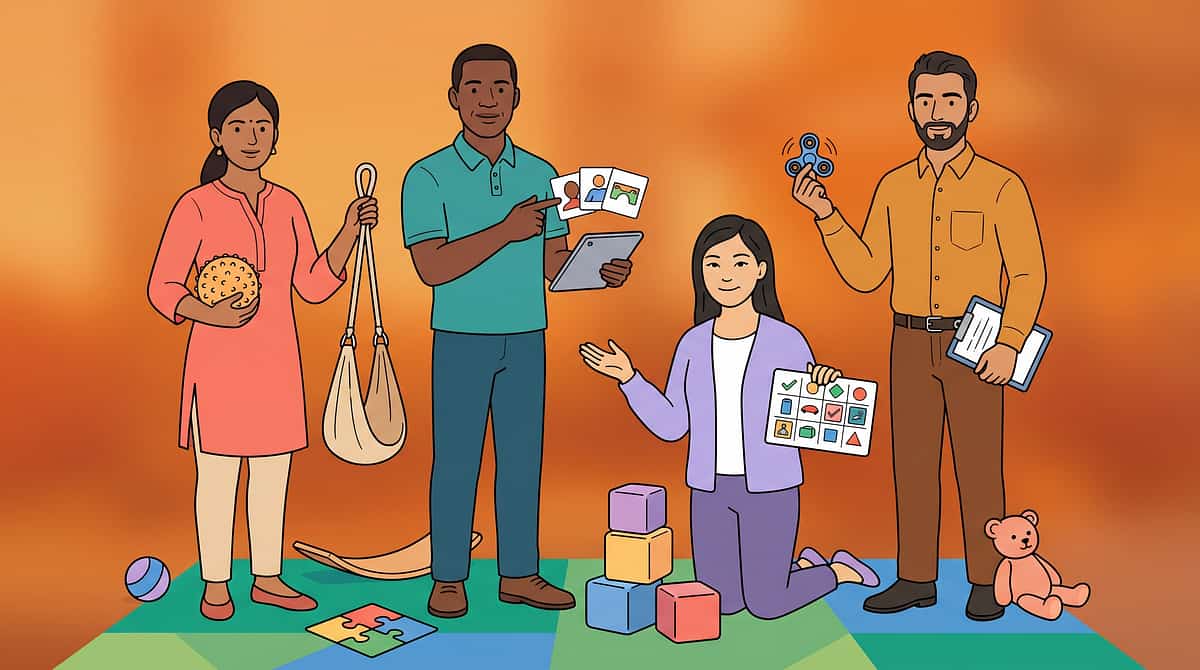
Who Uses This Technique
"This technique crosses therapy boundaries because the brain doesn't organise by therapy type." Every discipline brings a unique lens — together they form a comprehensive support system for your child.
Occupational Therapist (OT) — Primary Lead
Uses object permanence activities to develop visual-motor integration, spatial awareness, and cognitive processing within a sensory-motor framework. Designs graduated complexity sequences matched to developmental stage.
Special Educator (SpEd) — Secondary
Embeds object permanence in structured learning contexts, connecting to pre-academic skills like classification, sequencing, and early numeracy concepts.
BCBA / ABA Therapist — Secondary
Applies discrete trial teaching and naturalistic teaching strategies to systematically build search behaviours, with reinforcement schedules that shape active seeking.
Speech-Language Pathologist (SLP) — Tertiary
Uses object permanence as a precursor to symbolic language development. "Words represent absent things" — you need permanence before symbolic communication. Integrates hiding games with vocabulary building. DOI: 10.1080/17549507.2022.2141327
NeuroDevelopmental Paediatrician — Supporting
Monitors cognitive milestone progression, differentiates developmental delay from regression, and adjusts intervention intensity based on neurological assessment.

What You Need — The 9 Materials
Canon Materials
All 9 materials have zero-cost DIY alternatives
These nine materials form the complete object permanence toolkit, validated across Pinnacle Blooms Network's clinical practice. Each has been selected for its specific cognitive mechanism — not just because it's a popular toy.
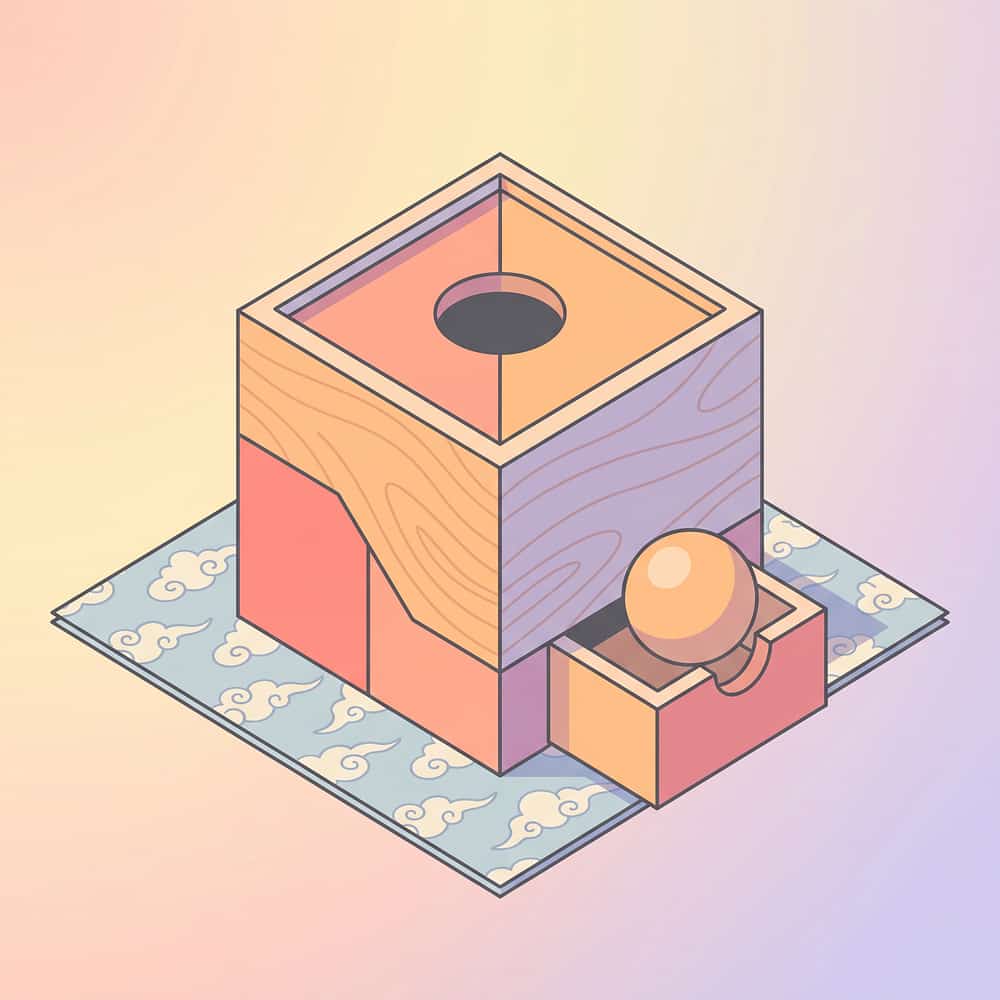
1. Object Permanence Box (Montessori)
Price Range: ₹800–1,500
Classic design — ball drops in, disappears, then emerges from drawer — teaching that objects take journeys we can't see but always arrive somewhere. Look for: Montessori ball drop box, object permanence box with drawer, coin drop box variations.
Classic design — ball drops in, disappears, then emerges from drawer — teaching that objects take journeys we can't see but always arrive somewhere. Look for: Montessori ball drop box, object permanence box with drawer, coin drop box variations.
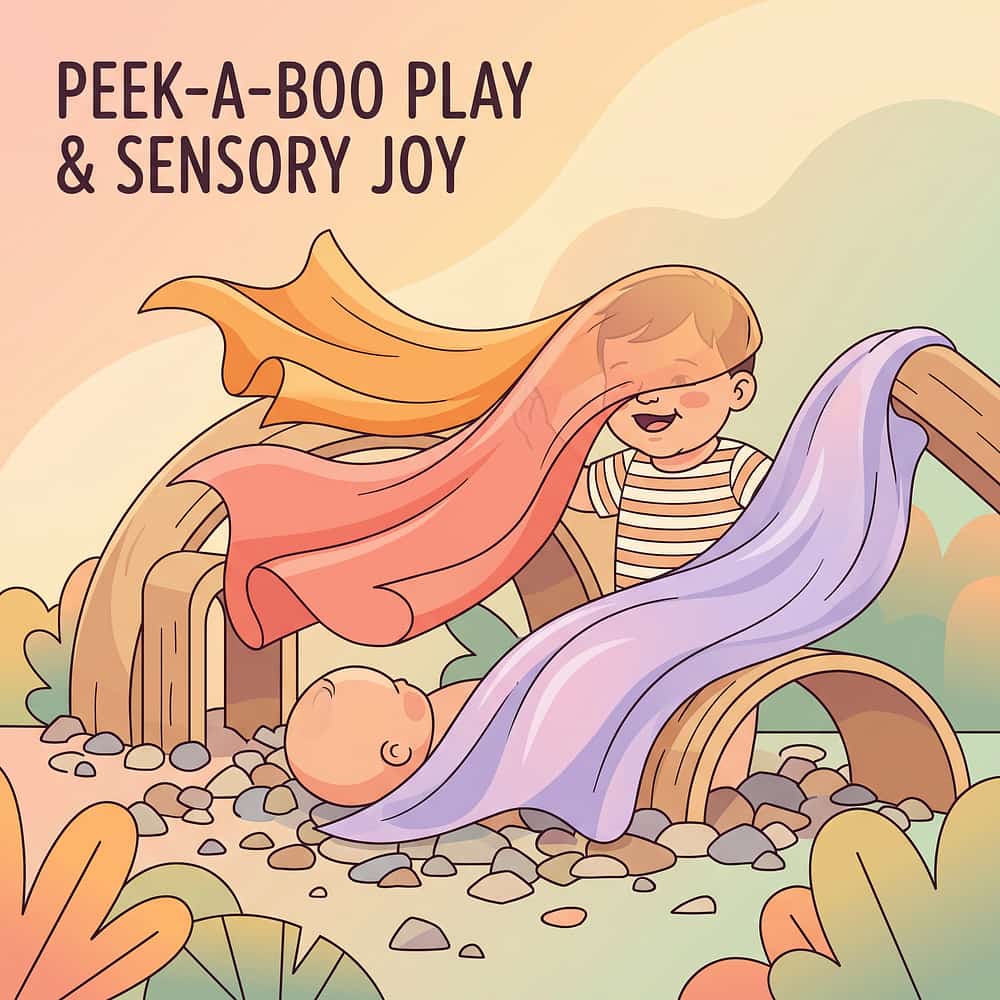
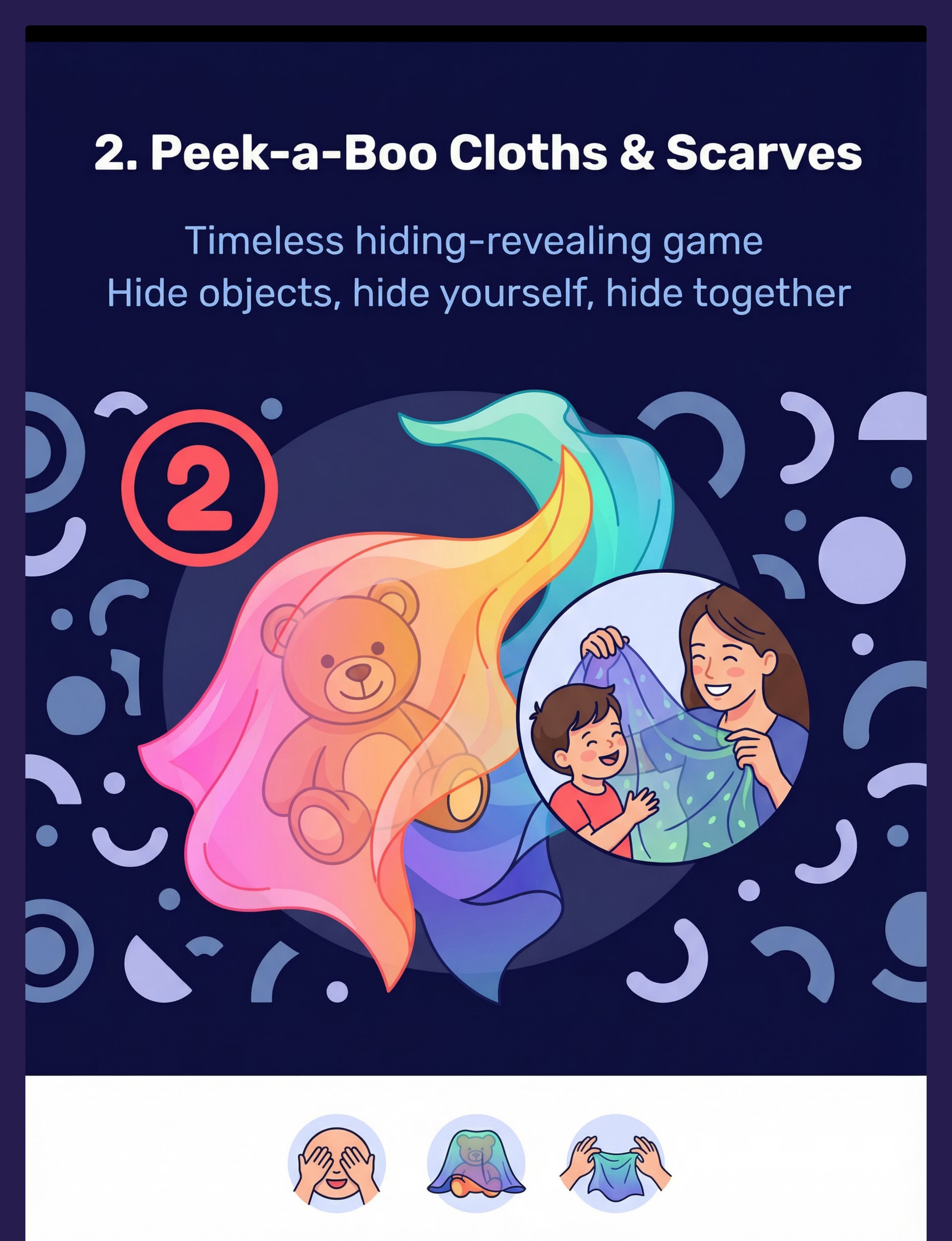
2. Peek-a-Boo Cloths and Scarves
Price Range: ₹150–400
The oldest game in human history provides repeated, emotionally engaging practice with disappearance and return in a safe, playful context. Play silks, sensory scarves, transparent chiffon scarves, textured fabric squares.
The oldest game in human history provides repeated, emotionally engaging practice with disappearance and return in a safe, playful context. Play silks, sensory scarves, transparent chiffon scarves, textured fabric squares.

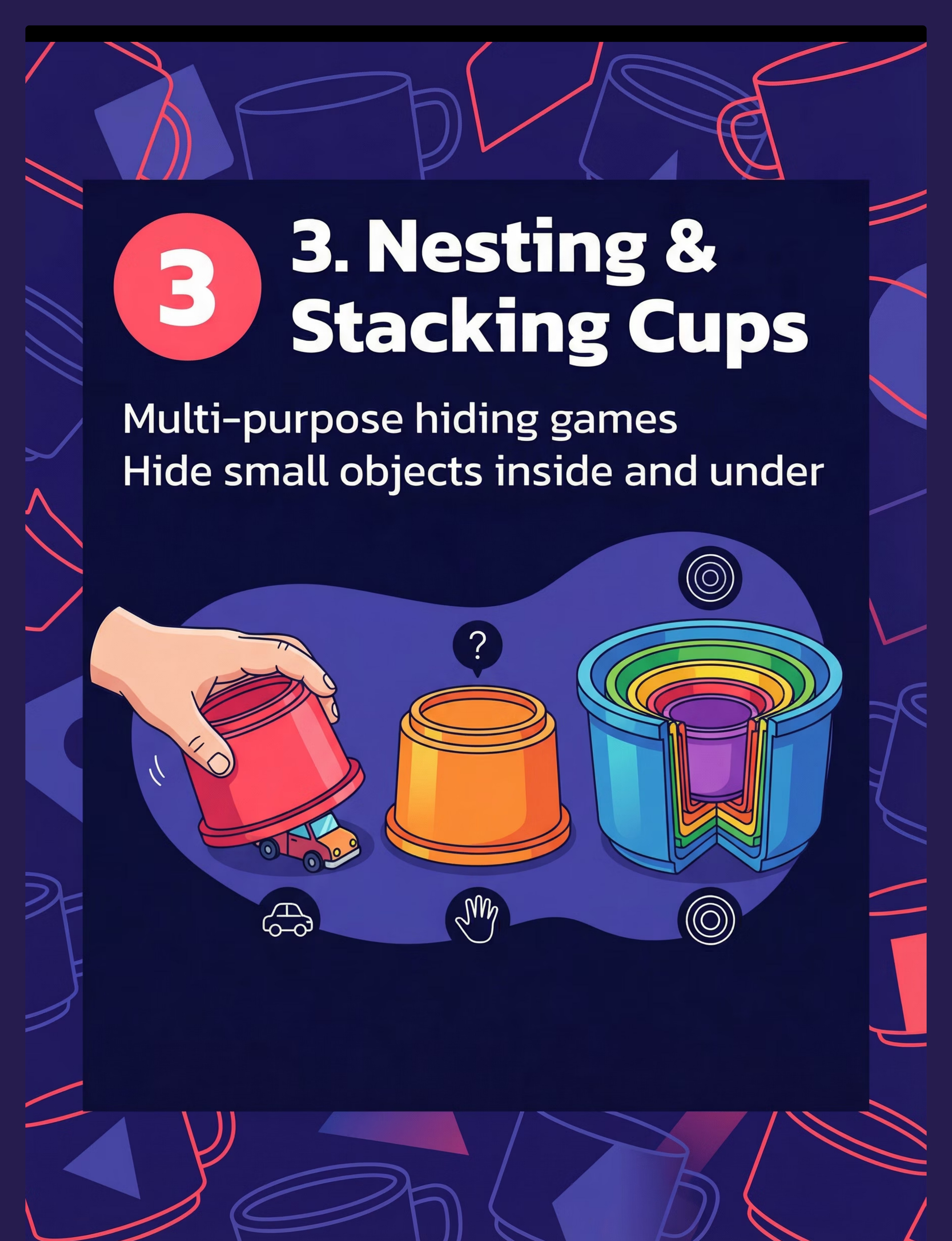
3. Nesting and Stacking Cups
Price Range: ₹200–500
Cups become hiding places, teaching that objects exist beneath, inside, and behind even when we can't see them. Graduated complexity for growing skills. Stacking/nesting cup sets, coloured nesting cups, silicone stacking cups.
Cups become hiding places, teaching that objects exist beneath, inside, and behind even when we can't see them. Graduated complexity for growing skills. Stacking/nesting cup sets, coloured nesting cups, silicone stacking cups.

Materials 4–6: Activity, Sorting & Tunnels
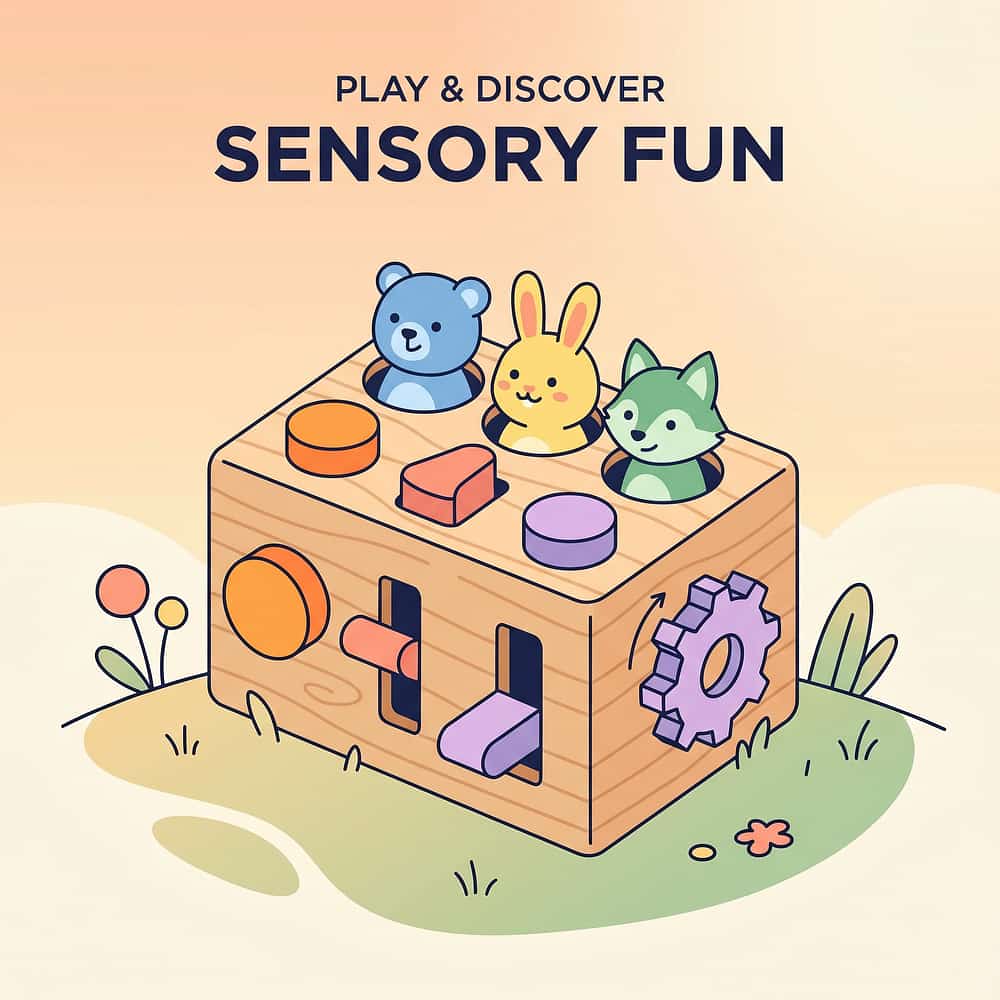
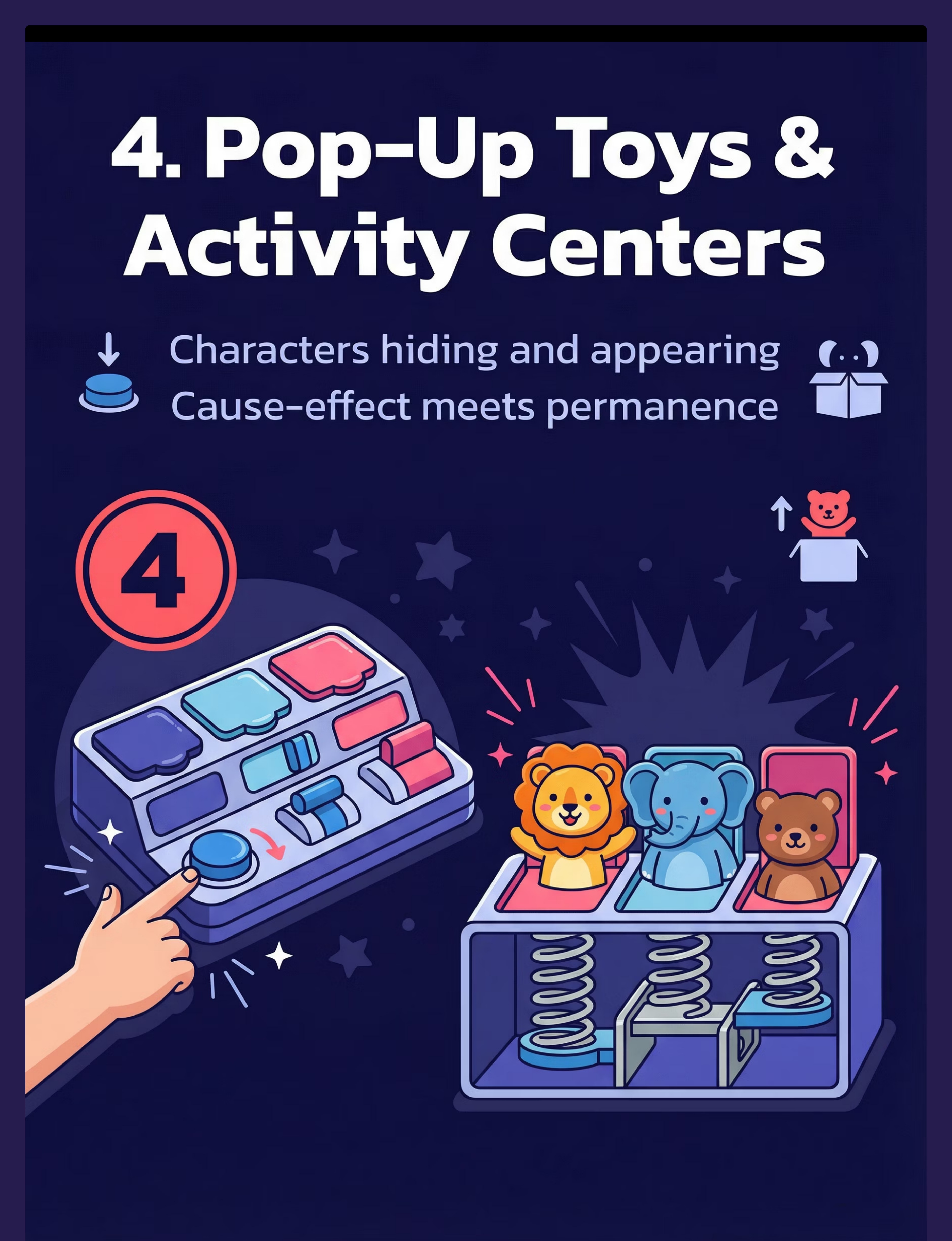
4. Pop-Up Toys and Activity Centres
Price Range: ₹500–1,200
Characters exist inside the toy, hidden from view, but can be revealed through appropriate action — teaching that hidden doesn't mean gone. Classic pop-up activity toys, animal pop-up farms/zoos, pop-up pals with buttons/levers.
Characters exist inside the toy, hidden from view, but can be revealed through appropriate action — teaching that hidden doesn't mean gone. Classic pop-up activity toys, animal pop-up farms/zoos, pop-up pals with buttons/levers.
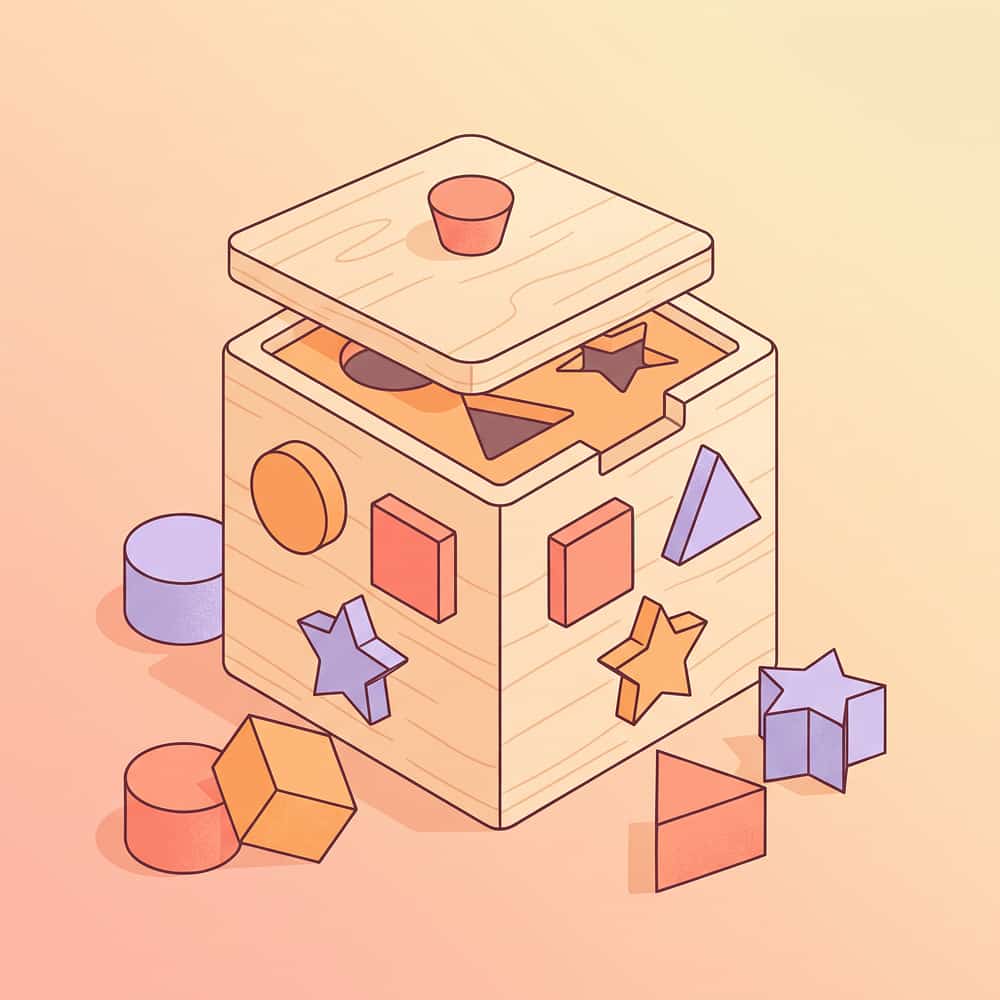
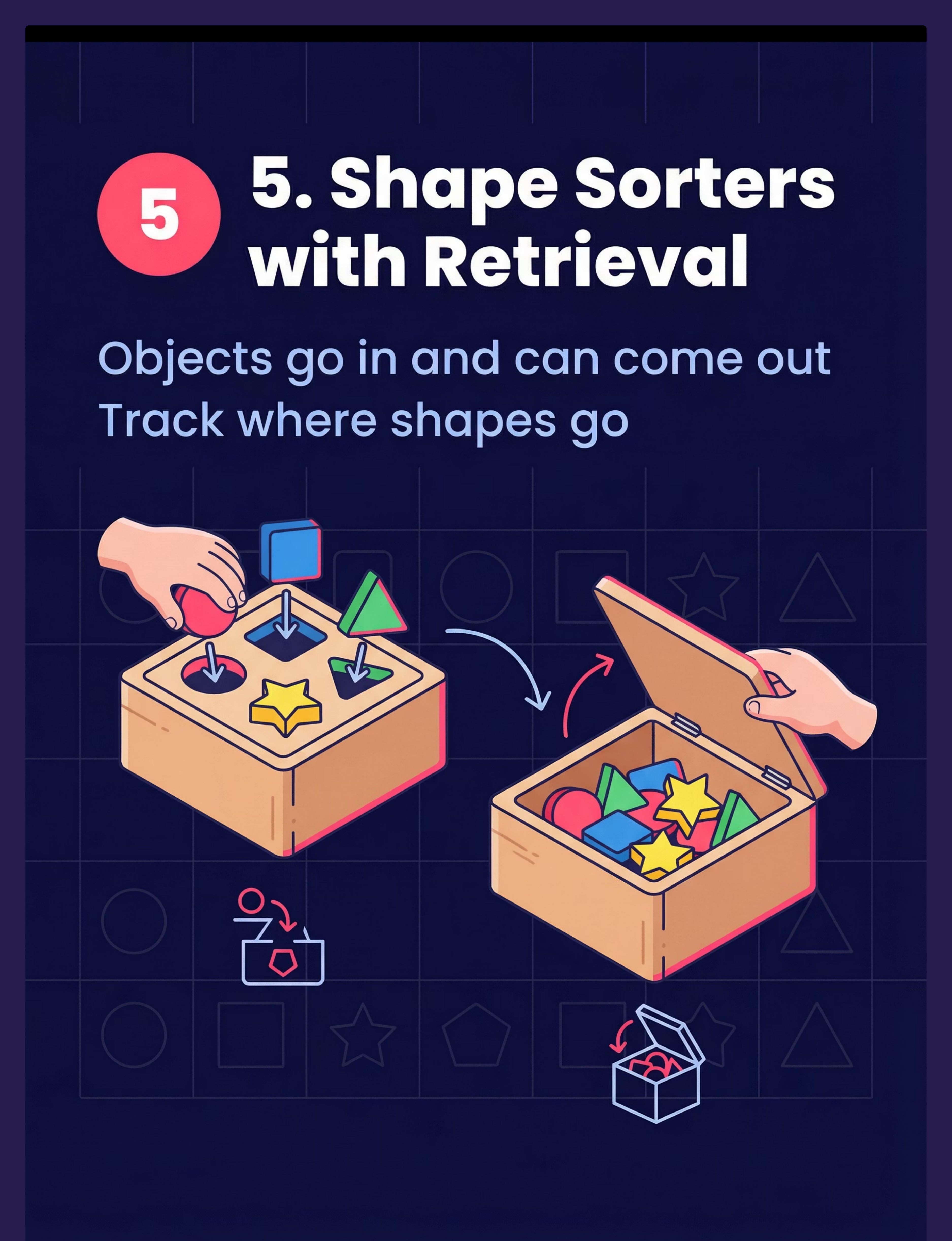
5. Shape Sorters with Retrieval
Price Range: ₹400–900
Objects go somewhere and accumulate, even when we can't see them entering the hidden space. Opening reveals all shapes persisted inside. Classic shape sorters with lids, soft shape sorters, wooden shape sorting boxes.
Objects go somewhere and accumulate, even when we can't see them entering the hidden space. Opening reveals all shapes persisted inside. Classic shape sorters with lids, soft shape sorters, wooden shape sorting boxes.
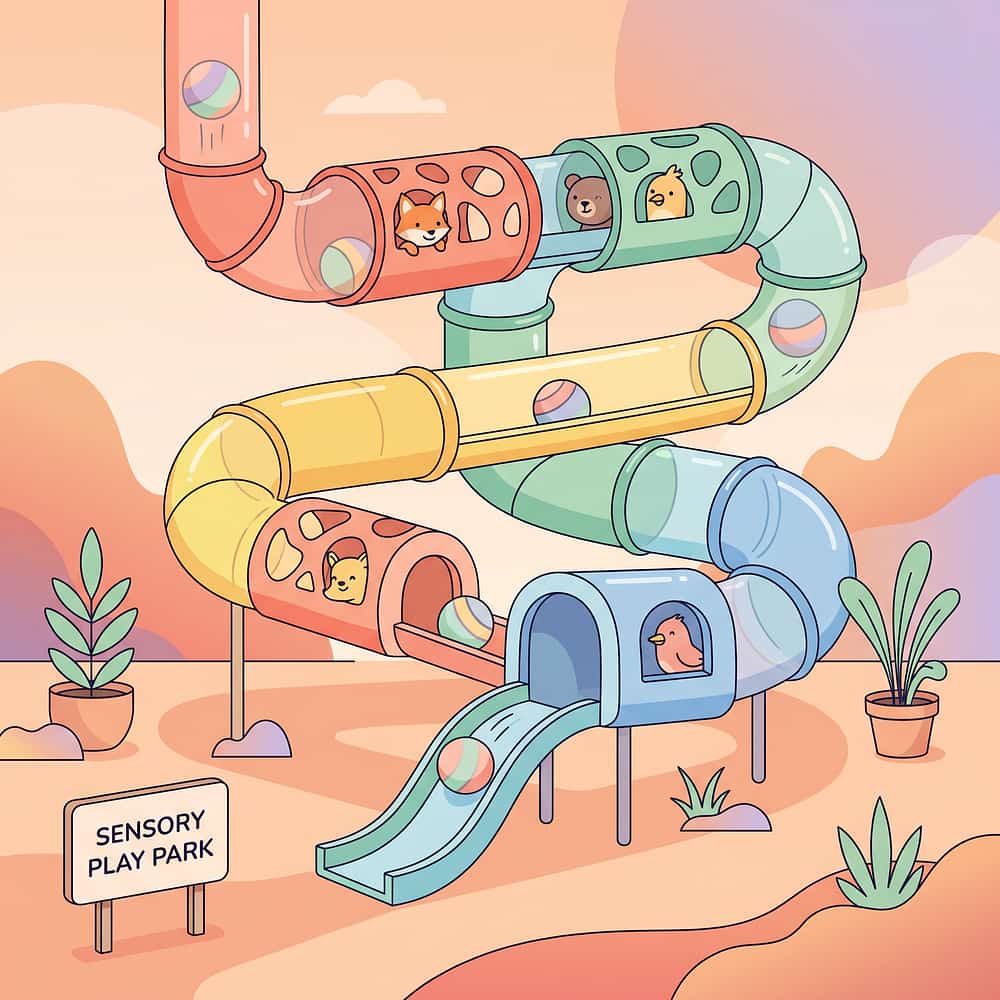
6. Tunnel Toys and Ball Runs
Price Range: ₹600–1,500
Objects continue travelling while hidden — more complex than static hiding. The child must track not just existence but location change during invisible transit. Ball runs with tunnels, marble runs with covered sections, car ramps with tunnels.
Objects continue travelling while hidden — more complex than static hiding. The child must track not just existence but location change during invisible transit. Ball runs with tunnels, marble runs with covered sections, car ramps with tunnels.

Materials 7–9: Books, Containers & Photos
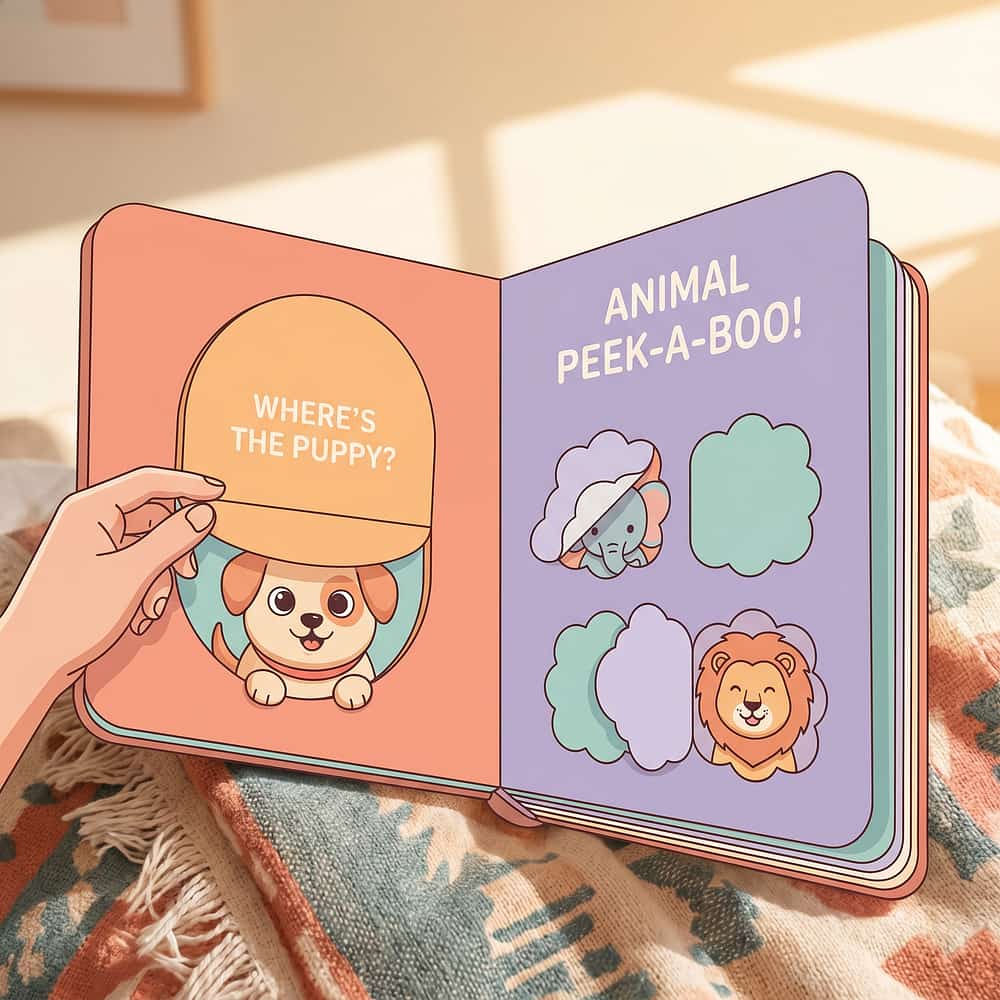
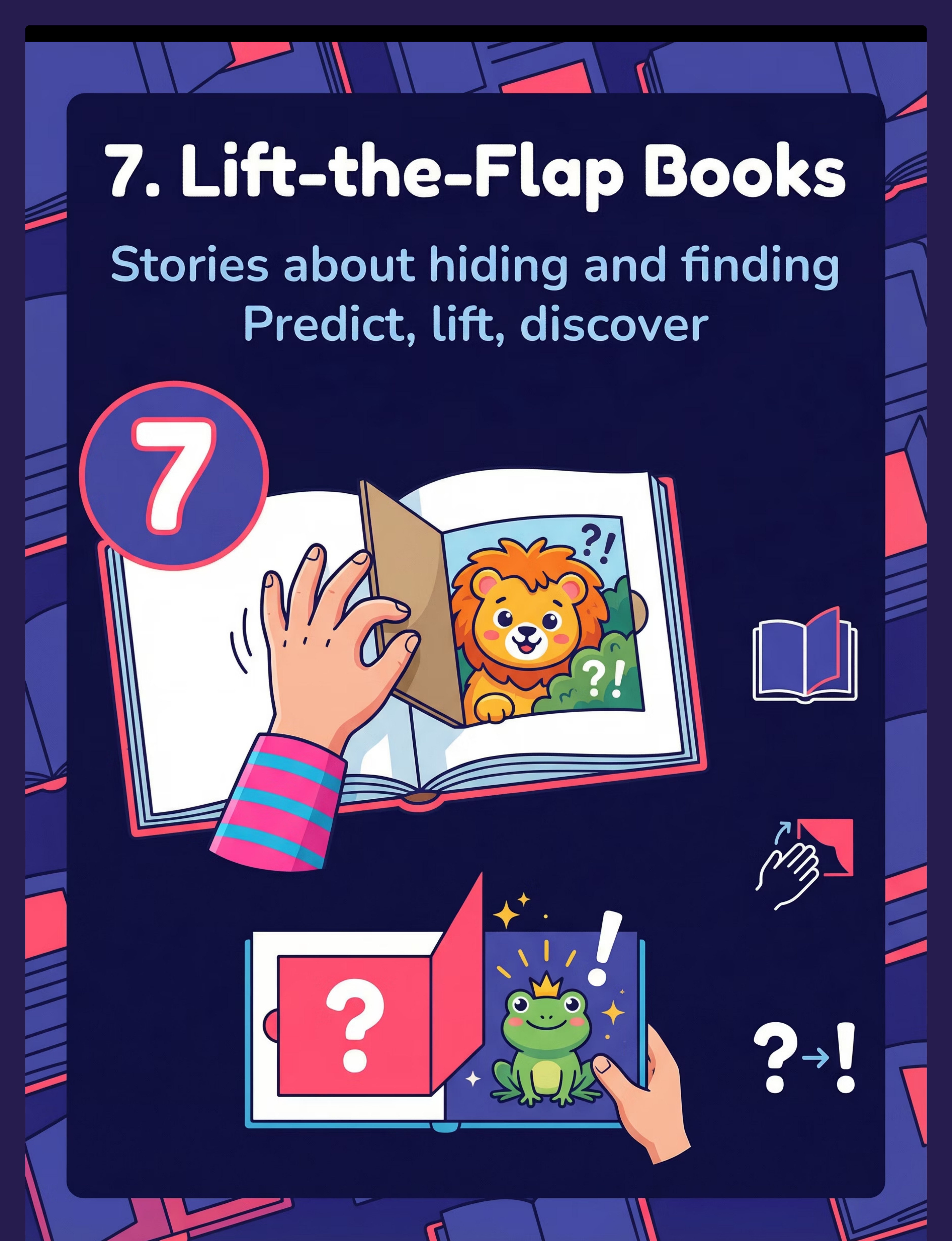
7. Lift-the-Flap and Hide-and-Find Books
Price Range: ₹250–600
Embeds object permanence in narrative context, adding language and social dimensions. Each flap creates a micro-permanence trial with prediction and discovery. Dear Zoo, Where's Spot?, That's Not My… series, Where is Baby's Belly Button?
Embeds object permanence in narrative context, adding language and social dimensions. Each flap creates a micro-permanence trial with prediction and discovery. Dear Zoo, Where's Spot?, That's Not My… series, Where is Baby's Belly Button?

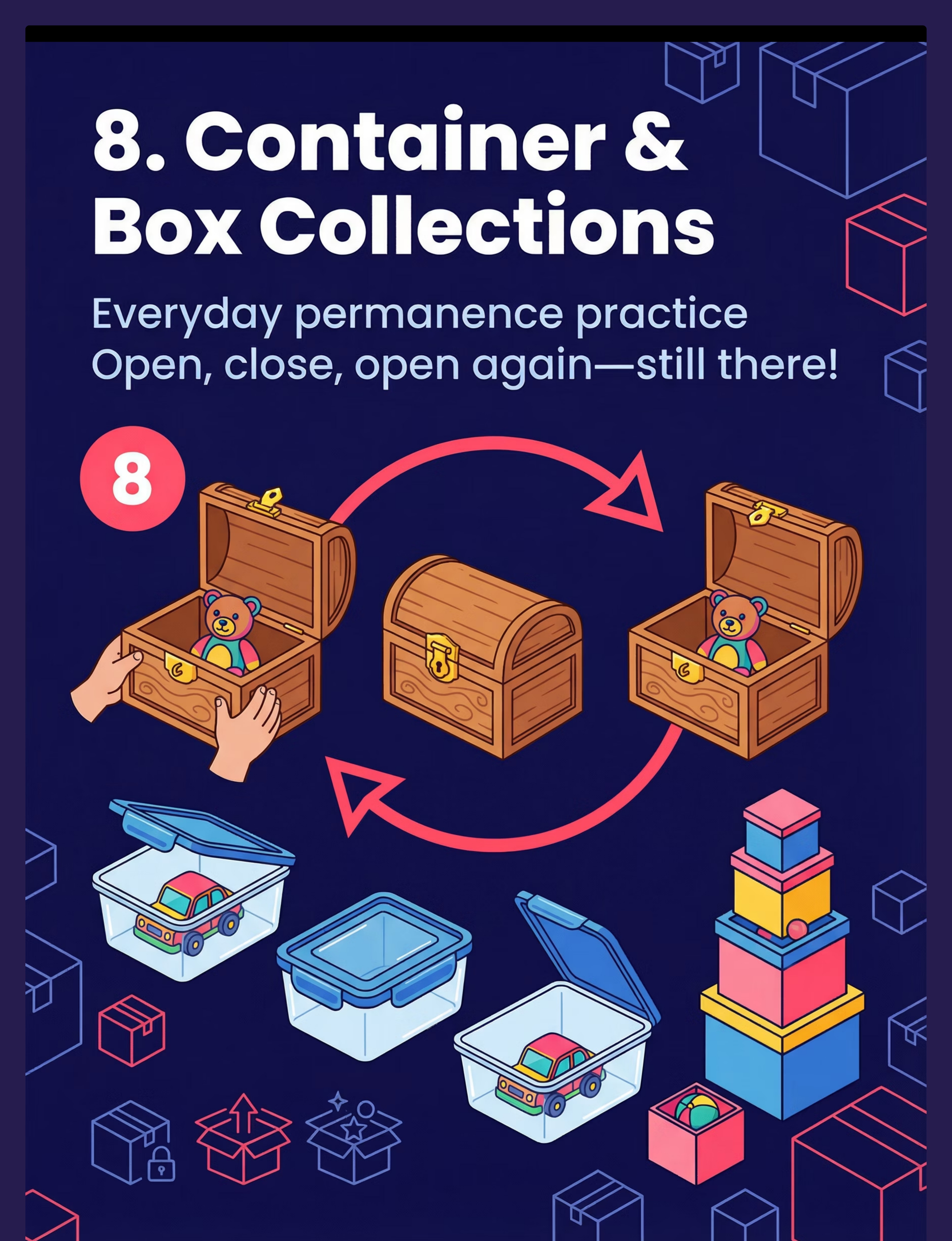
8. Container and Box Collections
Price Range: ₹100–400
Real-world, functional practice with permanence. Containers are everywhere — making this highly generalisable. Closing doesn't make contents disappear. Nesting box sets, wooden treasure boxes, clear containers with lids.
Real-world, functional practice with permanence. Containers are everywhere — making this highly generalisable. Closing doesn't make contents disappear. Nesting box sets, wooden treasure boxes, clear containers with lids.

9. Family Photo Albums and Picture Cards
Price Range: ₹200–500
Extends object permanence to person permanence — understanding that people continue to exist when not present. Critical for attachment and separation tolerance. Board book photo albums, laminated photo cards, photo key rings, custom photo board books.
Extends object permanence to person permanence — understanding that people continue to exist when not present. Critical for attachment and separation tolerance. Board book photo albums, laminated photo cards, photo key rings, custom photo board books.
Total Comprehensive Setup: ₹3,200–7,000 | Essential Starters (Top 3): Peek-a-Boo Cloths + Nesting Cups + Object Permanence Box
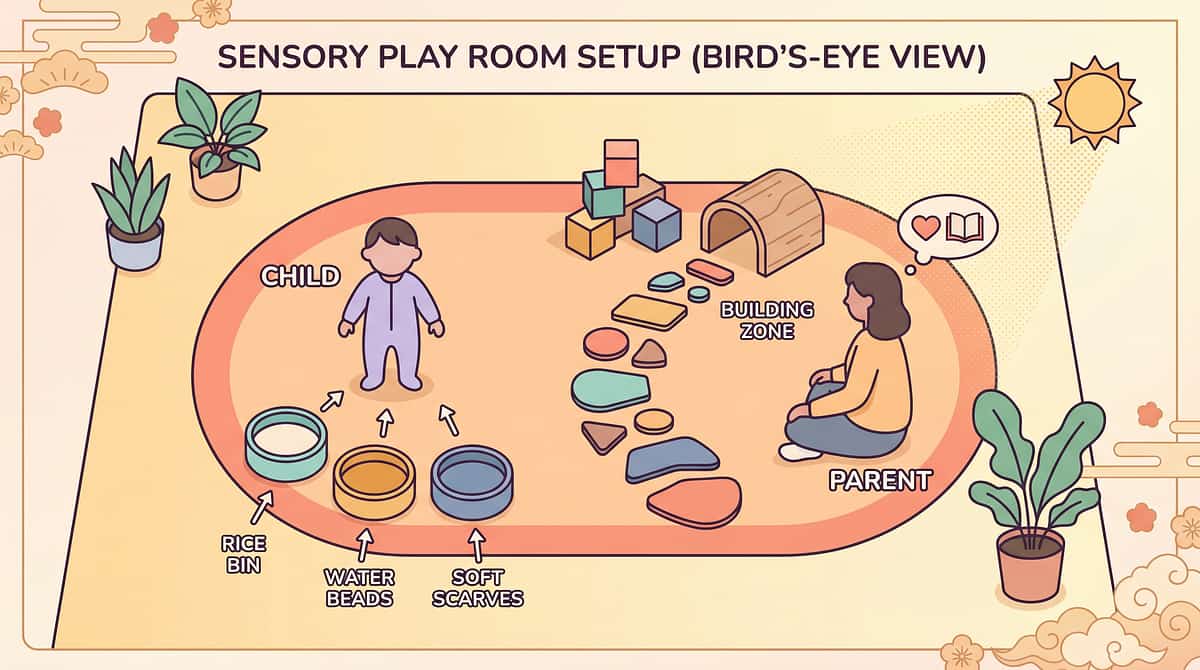
DIY & Zero-Cost Alternatives
"Not every family can order from Amazon. Not every village has same-day delivery. This ensures every parent, regardless of economic status, can execute this technique today with household items. This is the WHO/UNICEF inclusion principle in action."
The Principle
Every single one of the 9 canon materials has a household equivalent. The cognitive mechanism is identical — your child's brain doesn't know the difference between a ₹1,500 Montessori box and a shoebox with a hole cut in the lid.
Zero-cost version: Cloths + household cups + shoebox + family photos = complete object permanence toolkit for ₹0.
References: PMC9978394 | WHO NCF Handbook (2022) — household-material-based intervention efficacy across 54 LMICs
Your DIY Toolkit
- DIY OPB: Shoebox with hole in lid + drawer at bottom. Use any ball larger than 4cm.
- DIY Cloths: Muslin, dupatta, old t-shirt fabric, lightweight towels. Use sheer fabric for early stages.
- DIY Nesting Cups: Steel katoris, yogurt containers, cups and bowls of different sizes.
- DIY Pop-Up: Paper towel roll with a sock puppet that pops out — jack-in-the-box principle.
- DIY Shape Sorter: Any container with a cut-out hole in the lid. Cardboard or foam shapes.
- DIY Tunnel: Connected paper towel tubes on a cardboard ramp. Short to long progression.
- DIY Flap Books: Paper with folded sections, family photos underneath. Laminate with clear tape.
- DIY Containers: Food storage containers, shoe boxes, tins, dabbas — vary sizes and mechanisms.
- DIY Photo Album: Print photos, laminate with clear tape, bind with a simple ring.
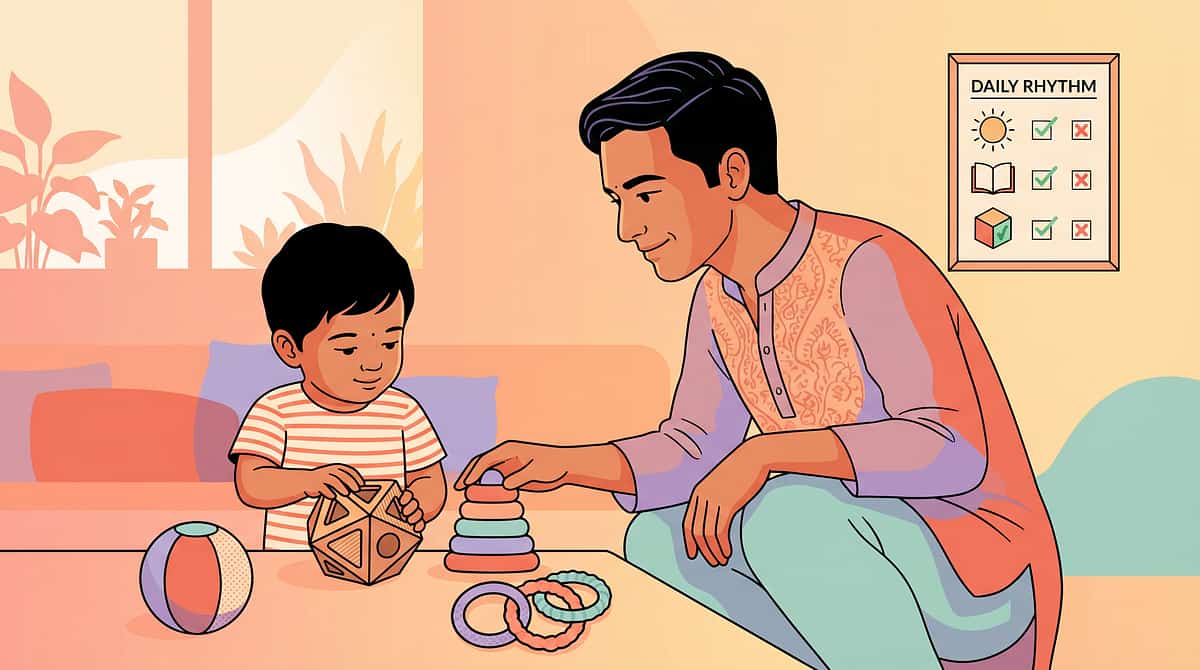
Safety First — Before You Begin
Read this card fully before starting any session.
🔴 Contraindications — Do NOT Proceed
- Do not use hiding games if your child shows extreme, inconsolable distress that does not reduce across sessions. Some children need preliminary attachment work first.
- Do not use face-hiding (peek-a-boo with faces) if your child finds face disappearance genuinely frightening — start with objects only.
- Do not attempt invisible displacement activities before visible displacement is solidly established.
🟡 Material Safety
- Ensure ALL balls and small objects are larger than a toilet paper roll diameter (approximately 4cm) to prevent choking. The choke tube test: if it fits through, it's too small.
- Supervise ALL play with cloths and scarves to prevent wrapping around neck or face.
- Pop-up toys may produce loud sounds — preview and test for sound-sensitive children before introducing.
🟢 Proceed When
- Quiet, low-distraction room with TV off and visual clutter reduced in the play area.
- Soft surface — play mat or carpet preferred. Child is comfortable sitting.
- Well-lit space. Child is calm, alert, and fed — not tired, hungry, or overstimulated.
- Best windows: mid-morning after breakfast, mid-afternoon after nap.
STOP IMMEDIATELY IF YOU SEE: Self-biting, head-banging, extreme screaming lasting more than 2 minutes, dissociative staring, or any physical signs of acute distress. These require professional consultation. Call 9100 181 181 (Free National Autism Helpline, 24×7, 16+ languages). References: Padmanabha et al., Indian J Pediatr, 2019 | WHO NCF safety monitoring guidelines
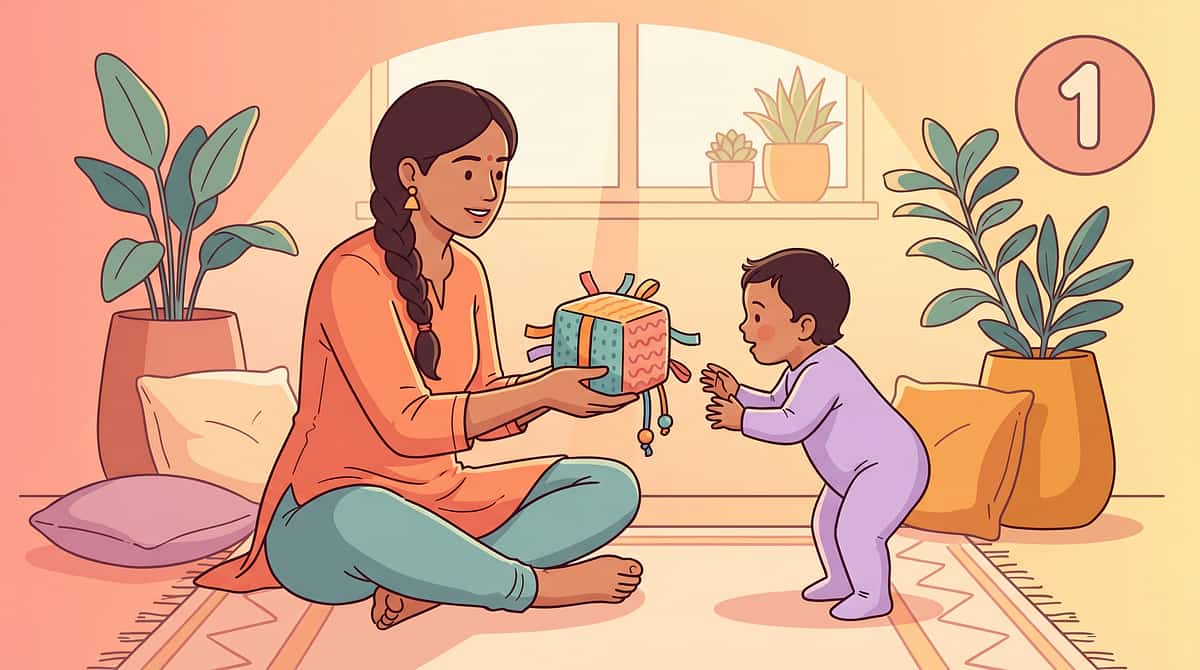
Setting Up Your Space
"Before your first session, prepare your space. This takes 5 minutes and transforms any room into a cognitive development station."
1
Clear the Zone
Select a 4×4 foot area on the floor. Remove all toys and objects except the ones you'll use. Object permanence practice requires focused attention — competing toys dilute the learning.
2
Position Correctly
Sit facing your child at their eye level. For infants (4–8 months), use a supported sitting position or place child in a high chair/Bumbo seat. For toddlers, sit cross-legged across from each other.
3
Prepare Materials
Have 2–3 materials ready but only ONE visible at a time. Start with the simplest (peek-a-boo cloth) and progress to more complex (object permanence box) as the session allows.
4
Select Hiding Objects
Pre-select 3–4 high-interest objects your child already loves — a favourite small toy, a colourful ball, a beloved figure. Familiar objects create stronger motivation to search.
5
Check Lighting
Ensure the hiding action is clearly visible to your child. The child must see the object being hidden (visible displacement) before you progress to hidden displacement.
6
Set a Gentle Timer
Set a timer for 5–10 minutes. Short, joyful sessions are more effective than long, forced ones. End BEFORE the child loses interest — always leave them wanting more.
"Your space is ready. Your materials are ready. Let's begin."
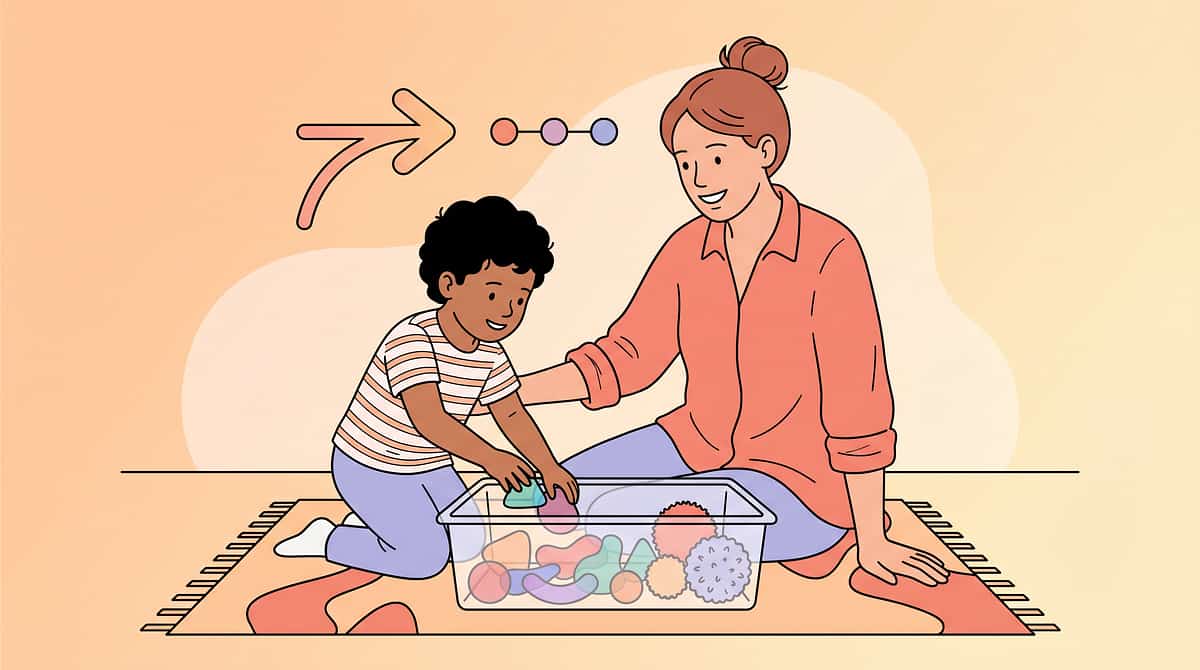
Is Your Child Ready?
Before beginning every session, take 60 seconds to assess your child's readiness state. This quick check prevents frustrating sessions and ensures the learning actually lands.
🟢 Ready to Start
- Child is calm, alert, and making eye contact or orienting toward you
- Child shows interest in a toy you're holding (reaches, looks, vocalises)
- Child is in a comfortable, supported position
- At least 30 minutes since last feeding
- Not within 30 minutes of naptime
🟡 Proceed with Caution
- Child is slightly fussy but can be soothed with a song or gentle bounce
- Child has been playing for a while — may have a shorter attention window
- Environment is somewhat noisy — reduce distractions if possible
🔴 Not Now — Try Later
- Child is crying, screaming, or in distress
- Child is drowsy or rubbing eyes
- Child just ate a large meal (digestion discomfort)
- Child is ill, teething in acute phase, or recently vaccinated
- Caregiver is stressed, rushed, or frustrated — your emotional state matters
"The right moment is when both you and your child are present, calm, and curious. There is no wrong day to skip if the readiness isn't there."

Step 1 — The Invitation
Session Start
Duration: ~2 minutes
"Start with connection, not instruction."
Sit at your child's level. Hold a high-interest object (favourite toy, colourful ball) and engage their attention. Let them reach for it, hold it, mouth it. Establish that this object exists and is desirable. The motivation to find must come from desire, not instruction.
Warm-Up Sequence
1
Show the Object
Let child touch and explore it. Name it: "Look! It's the red ball!" Allow 20–30 seconds of interaction.
2
Track It
Move the object slowly left and right within their visual field. Does the child track it with their eyes? This confirms visual engagement.
3
Partial Hide
Partially hide it behind your hand — just a little obscured. Reveal immediately. Watch your child's response: Do they look? Reach? Seem curious? If yes — you've established the invitation.
Age Variations: 4–6 months: bright, high-contrast objects, slow movements, partial hiding only. | 6–12 months: move to full hiding with cloth. | 12–24 months: highly motivating items, multiple hiding locations. | 24–36 months: person permanence games alongside object games.
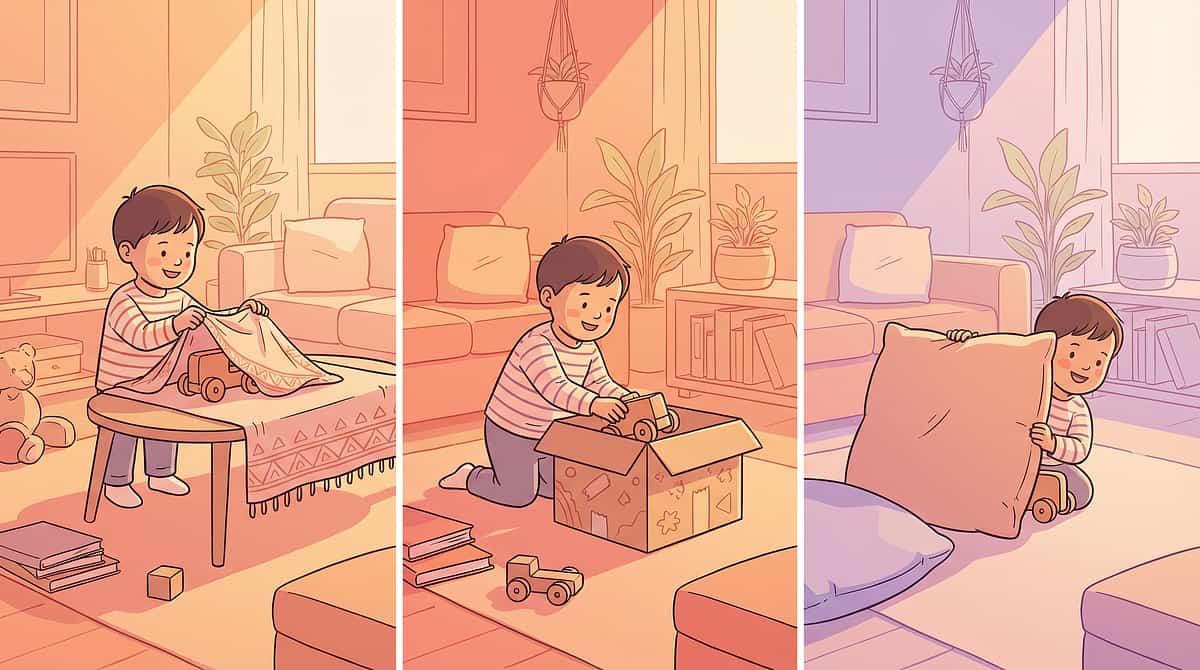
Step 2 — The Engagement
Core Skill Building
"Now we introduce the magic of disappearance." Choose your engagement protocol based on your child's current developmental stage — not their age. Some 18-month-olds need Stage A. Some 10-month-olds are ready for Stage B. Follow the child.
Stage A
Partial Hiding (4–8 months or any child new to permanence work)
Partially cover with cloth — leave a visible portion. "Oh! Where did it go? Part of it is still there! Can you find it?" Wait 3–5 seconds. Guide hand if needed.
Partially cover with cloth — leave a visible portion. "Oh! Where did it go? Part of it is still there! Can you find it?" Wait 3–5 seconds. Guide hand if needed.
Stage B
Complete Hiding (8–14 months)
Completely cover the object. "Where did the ball go? It was RIGHT HERE. Can you find it?" Wait 5–10 seconds. Watch for looking at the hiding spot, reaching toward the cloth.
Completely cover the object. "Where did the ball go? It was RIGHT HERE. Can you find it?" Wait 5–10 seconds. Watch for looking at the hiding spot, reaching toward the cloth.
Stage C
Object Permanence Box (10–18 months)
"The ball went IN! Where did it go? Can you find it?" Guide them toward the drawer. The ball emerges — this is the magic moment!
"The ball went IN! Where did it go? Can you find it?" Guide them toward the drawer. The ball emerges — this is the magic moment!
Stage D
Invisible Displacement (18–30 months)
Hide object in your hand, move hand under cloth, leave object there, show empty hand. "Where is it? It's not in my hand anymore! Where could it be?"
Hide object in your hand, move hand under cloth, leave object there, show empty hand. "Where is it? It's not in my hand anymore! Where could it be?"

Step 3 — The Therapeutic Action
The Heart of the Intervention
"You are about to create the cognitive event that builds object permanence." Each hide-wait-discover cycle takes 30–60 seconds. Repeat 5–8 cycles per session (5–10 minutes total).
1
The Hide
With your child watching and engaged, HIDE the object using the appropriate stage method. This must be deliberate, dramatic, and clearly observable. Never hide faster than the child can follow.
2
The Pause
Wait. This pause is where the cognitive work happens. The child's prefrontal cortex is attempting to hold the mental representation of the object. Count silently: 3 seconds for beginners, up to 10 seconds for advanced.
3
The Prompt
If the child does not search independently, provide graduated prompts: Point toward the hiding location → Tap the cloth/container → Partially reveal the object → Guide the child's hand to pull the cloth.
4
The Discovery
The moment of revelation. When the child uncovers the object — with or without help — CREATE A CELEBRATION. Big eyes, excited voice: "YOU FOUND IT! It was there the WHOLE TIME! You're amazing!"
Common Execution Errors: Hiding too quickly | Waiting too long (frustration replaces curiosity) | Revealing without letting child search | Monotone delivery (enthusiasm drives engagement). References: PMC10955541
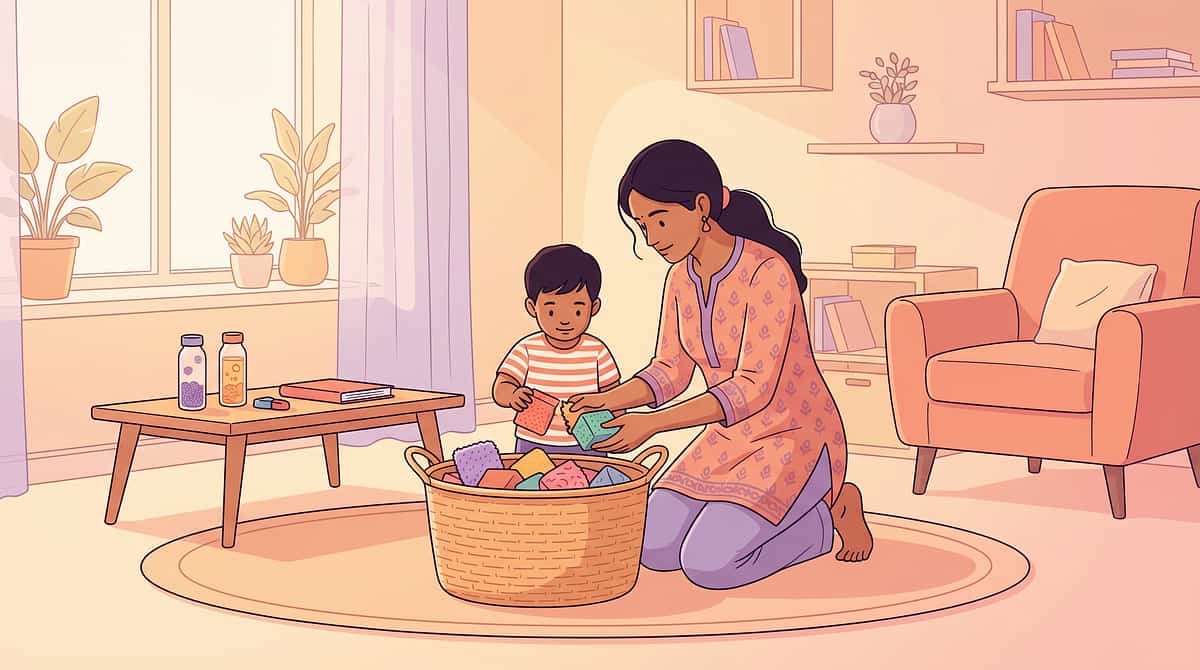
Step 4 — Repeat & Vary
Target: 5–8 cycles per session
"Three good discoveries are worth more than ten forced ones."
Stop BEFORE the child loses interest. Variation maintains engagement and accelerates generalisation — the ability to use this skill in new settings with new objects.
Vary the Object
Rotate through 3–4 different hiding objects across the session to maintain novelty and motivation.
Vary the Location
Use cloth, then cup, then behind your back, then under a cushion. Teaches that hiding is a principle, not a place.
Vary the Material
Start with cloth hiding, move to object permanence box, then nesting cups. Different materials activate different neural connections.
Vary the Difficulty
Within one session, start with partial hiding and progress to complete hiding if child is succeeding. Always follow the child's lead.
Vary Socially
Hide yourself (peek-a-boo), then hide the toy, then hide together with the child. Bridges object and person permanence.
Satiation Indicators — When to Stop: Child turns away | Becomes fussy or whiny | Searches become mechanical | Starts throwing materials | Attention wanders. Always end on a success — do one final easy hide so they 'find' it triumphantly.

Step 5 — Reinforce & Celebrate
"The moment your child finds the hidden object is the most important moment in the entire session. What you do in this 3-second window shapes whether they'll want to search again."
Verbal Praise
Within 1 second of discovery, name what they did: "YOU FOUND THE BALL! It was hiding and YOU found it! You're SO smart!" Use 200% of your normal conversation voice. Exaggerate joy.
Physical Celebration
Clapping, high-five, tickle, hug — whatever your child responds to most enthusiastically. Make it unmistakably joyful.
Natural Reinforcement
Let the child PLAY with the discovered object for 15–30 seconds before the next trial. The object itself is the reward — and the most powerful one available.
Social Reinforcement
Animated facial expressions, excited eye contact, shared laughter. For children who don't respond to social reinforcement, pair with a small preferred item initially, then gradually fade tangible rewards.
"Timing matters more than magnitude. An immediate 'YAY!' is more powerful than a delayed toy reward." References: PMC11506176 | BACB reinforcement scheduling standards

Step 6 — Cool-Down & Close
Session Wind-Down
Duration: ~2–3 minutes
"Every good session has a gentle ending." The emotional experience of the session is as important as the cognitive content. A warm close builds positive associations with the activity, ensuring your child looks forward to the next session.
1
Final Easy Discovery
Do one last hide at the simplest level the child can independently complete. Let them succeed without help. Celebrate generously.
2
Transition Object
Offer the child a comfort item or preferred toy that signals "we're done with this activity now." This creates a clear, predictable boundary.
3
Verbal Closure
"We played the hiding game! You found SO many things today! The ball was hiding and you found it every time!" Narrate their success back to them.
4
Physical Comfort
A gentle hug, back rub, or calming touch that transitions the child from the engaged state to the resting state.
5
Environment Reset — Together
Put materials away together. This itself is a permanence lesson: "The toys go IN the box and they'll be there next time — because things don't disappear when we put them away."
"Same time tomorrow? We'll play the hiding game again. And the toys will be RIGHT HERE waiting for us."
Track Your Session
"What gets measured gets mastered." Recording each session takes less than 2 minutes and transforms your intuitions into data. Over weeks, patterns emerge that tell you exactly where your child is growing and what needs more practice.
Session Log
Date: _____________ Session #: _____________
Duration: _____ minutes
Duration: _____ minutes
Child's Mood (start): Happy / Calm / Neutral / Fussy / Distressed
Child's Mood (end): Happy / Calm / Neutral / Fussy / Distressed
Child's Mood (end): Happy / Calm / Neutral / Fussy / Distressed
Stage Attempted:
- Partial Hiding
- Complete Hiding
- OPB Box
- Invisible Displacement
- Person Permanence
Number of Trials: _____ Independent Searches: _____ Prompted Searches: _____
Breakthrough Moment: _________________________________
Concerns: ___________________________________________
Materials Used
- Peek-a-Boo Cloth
- Nesting Cups
- OPB Box
- Pop-Up Toy
- Shape Sorter
- Tunnel Toy
- Lift-the-Flap Book
- Containers
- Family Photos
Your session data flows into GPT-OS® to personalise your child's therapeutic journey. Every data point makes the recommendations smarter.

Troubleshooting — When It's Not Working
Every child's path through object permanence is unique. These are the six most common challenges families encounter — and exactly what to do about each one.
Problem 1: No Interest in the Hidden Object
Solution: The object isn't motivating enough. Switch to something your child is obsessed with — a favourite food item, a phone (turned off), their absolute favourite toy. The desire to find must exceed the tolerance for effort.
Problem 2: Child Gets Upset When Object Is Hidden
Solution: You've progressed too fast. Go back to partial hiding (object mostly visible). The child needs to succeed many, many times at the easier level before you increase difficulty. Build confidence, not frustration.
Problem 3: Finds Object but Shows No Excitement
Solution: Increase your celebration energy dramatically. Or the child may be habituated — switch to a new object. Some children need tangible reinforcement (snack) paired with the discovery initially.
Problem 4: Always Looks in the Last Hiding Place (A-not-B Error)
Solution: This is a classic, well-documented developmental stage. It means your child HAS object permanence but hasn't yet developed working memory to update location. Keep practising with two locations, emphasising the NEW hiding spot.
Problem 5: Searches for Objects but Still Screams When You Leave
Solution: Object permanence and person permanence develop separately. Use Material 9 (Family Photos) and practise brief, predictable separations: "Mama is going to the kitchen. Mama will be RIGHT BACK."
Problem 6: Sessions Last Only 2 Minutes
Solution: Two minutes IS a session. Short, frequent sessions (2 minutes × 5 times daily) often outperform one long session. Embed hiding games into daily routines — hide a spoon during feeding, peek-a-boo during nappy changes.
Didn't find your problem? Call Pinnacle's FREE National Autism Helpline: 9100 181 181 (16+ languages, 24×7)

Personalise — Make It Your Own
One protocol does not fit all children. Use this card to dial the difficulty up or down, and to adapt for your child's unique sensory profile and age. The goal is always the same: joyful, successful practice at the right challenge level.
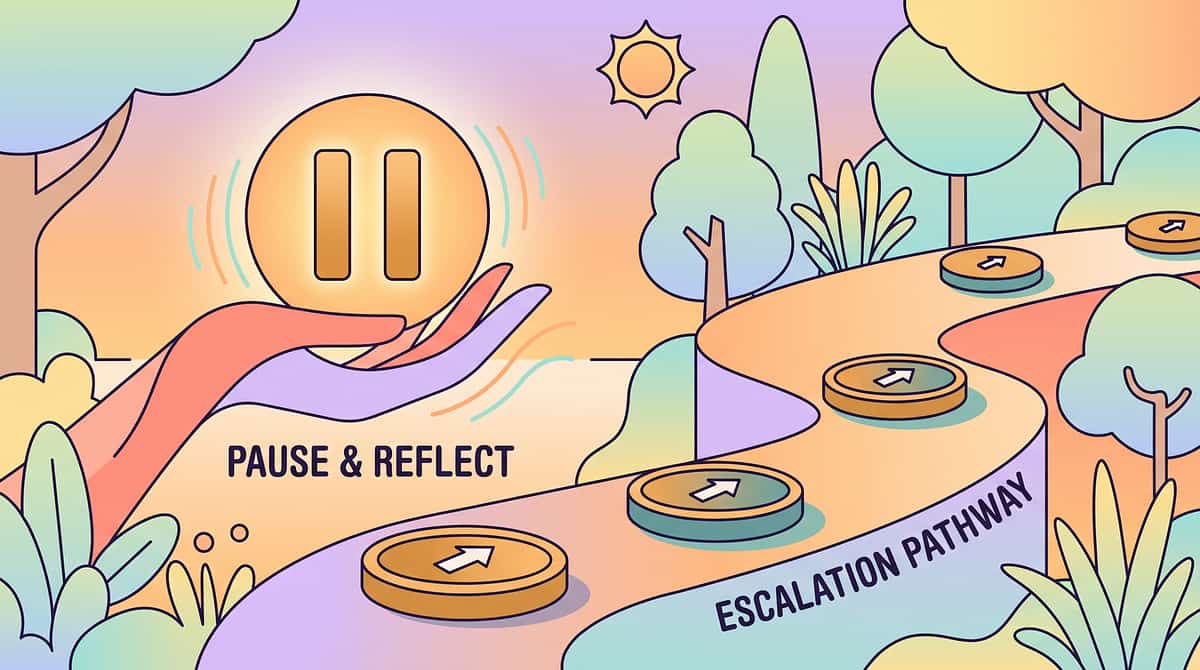
Easier Version
For challenging days or early starters: partial hiding only (object always partially visible), 3-second pause maximum, 1 hiding location, use transparent/sheer fabric, offer physical prompts immediately.
Standard Version
Complete hiding with visible displacement, 5–10 second pause, 2 hiding locations, opaque cloth/cup, wait for independent search before prompting.
Advanced Version
For breakthroughs: invisible displacement, 10–15 second pause, 3+ hiding locations, multiple displacement steps, minimal prompting — expecting independent search.
Age-Based Modifications
- 4–6 months: Tracking and partial hiding, high-contrast objects, supported sitting, 2–3 minute sessions
- 6–12 months: Full hiding, single location, OPB introduction, 5-minute sessions
- 12–24 months: Multiple locations, displacement tasks, person permanence, 10-minute sessions
- 24–36 months: Invisible displacement, delayed finding, person permanence generalisation, 10–15 minute sessions
Sensory Profile Variations
- Sensory Seekers: Objects with sound, texture, or movement reward upon discovery. Bright colours. More dramatic hiding and revealing.
- Sensory Avoiders: Soft, familiar objects. Gentle, quiet sessions. Reduce visual clutter. Avoid sudden reveals — slow unveiling instead.

Week 1–2: What to Expect
Progress Arc — Phase 1
"Most parents expect dramatic change immediately. Let us calibrate." The first two weeks are about establishing the routine and building your child's comfort with the activity. Your patience IS the intervention.
Observable Indicators — Weeks 1–2
Increased Tolerance
Your child tolerates the hiding activity without distress — even if they don't yet search actively.
Visual Tracking
Eyes follow the object as it moves toward the hiding location. This is the first neural signal.
Emerging Interest
Child looks at the hiding spot after the object disappears — even briefly. This is real neural growth.
Partial Search
Child reaches toward the cloth/cup, even if they don't complete the uncovering. Celebrate this immediately.
"If your child looks at the spot where the object disappeared for even 2 seconds longer than last week — that's real neural growth. Celebrate it." References: PMC11506176
Week 3–4: Consolidation Signs
Progress Arc — Phase 2
This is when you start to see the technique working. The changes are behavioural signals of neural pathway formation — your child's brain is literally rewiring.
Anticipation
Child shows excitement when they see the hiding materials come out. They know what's coming — and they want it.
Active Search
Child reaches for the cloth/cup without prompting. This is the hallmark consolidation indicator.
Speed Increase
Time from hiding to search attempt decreases. The neural pathway is becoming more efficient.
Generalisation Seeds
Child starts looking for dropped objects during daily routines — not just during practice sessions. This is the most exciting sign.
Emotional Shift
Reduced distress during brief caregiver separations. Early person permanence building is beginning.
When to increase difficulty: If child consistently finds objects at current stage with minimal prompting across 3 consecutive sessions, introduce the next level.
Week 5–8: Mastery Indicators
Progress Arc — Phase 3
Mastery Criteria — Specific, Observable, Measurable
1
Independent Search
Child consistently searches for completely hidden objects without any prompting across 5 consecutive sessions.
2
Multiple Locations
Child can find objects hidden in 2–3 different locations within one session. Successful search across 3+ different materials.
3
A-not-B Resolution
Child searches in the NEW hiding location, not the previous one. Working memory is updating correctly.
4
Generalisation
Search behaviour appears in new settings — grandparent's house, park, car. At least 2 novel environments.
5
Person Permanence Emerging
Child tolerates brief (30–60 second) caregiver departures with measurable decrease in crying duration.
References: PMC10955541 | BACB mastery criteria standards

Celebrate This Win
You did this. Your child grew because of your commitment.
Five to eight weeks ago, you were a parent watching your child forget that a toy existed the moment it disappeared. Today, your child searches. Today, your child knows that hidden doesn't mean gone. That is one of the most fundamental cognitive shifts a human being makes — and you guided your child through it with patience, persistence, and love.
Language
Your child can now begin to understand that words represent things that aren't visible. Symbolic language becomes possible.
Play
Pretend play becomes possible because your child can imagine absent objects. Creative, imaginative play is now within reach.
Attachment
Separation tolerance is building. Your child is learning that you continue to exist — and that is the foundation of secure attachment.
Academic Readiness
Every academic skill from counting to reading builds on mental representation. You have given your child the foundation for everything that comes next.
Celebration Suggestion: Document this milestone. Take a photo or video of your child successfully finding a hidden object. Save it. On difficult days ahead, watch it. This is proof of what's possible.
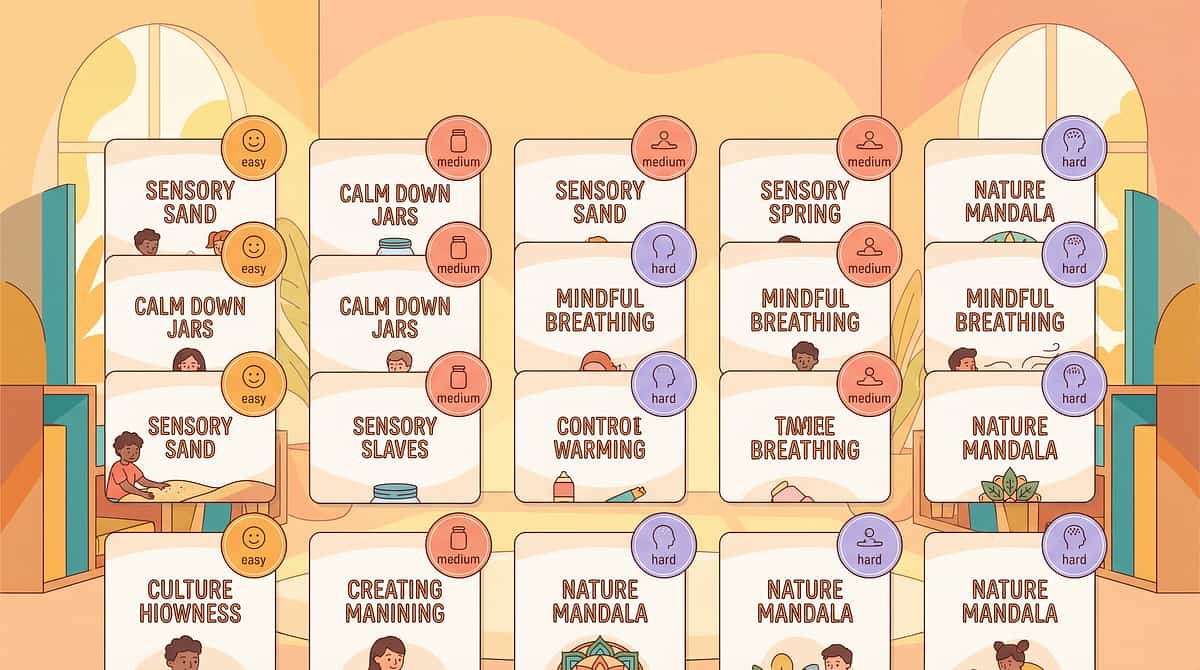
Red Flags — When to Pause
"Trust your instincts — if something feels wrong, pause and ask."
🚩 Flag 1: No Search by 12 Months
No search behaviour for completely hidden objects by 12 months, despite 4+ weeks of daily practice. Child shows zero interest in finding hidden objects, doesn't even look at the hiding spot. Action: Request developmental assessment.
🚩 Flag 2: Extreme Separation Distress Beyond 18 Months
Screaming for 15+ minutes after parent leaves the room, even with familiar caregiver present. Action: Consult developmental paediatrician — may indicate attachment disorder requiring specialised intervention.
🚩 Flag 3: Regression in Established Permanence
Child who previously searched for hidden objects stops searching. Action: Seek immediate professional consultation — regression can indicate neurological changes.
🚩 Flag 4: Complete Absence of Peek-a-Boo Interest
Child does not respond to face hiding/revealing, no social smile during games. Action: Comprehensive developmental evaluation recommended.
🚩 Flag 5: No Progress After 8+ Weeks
Child remains at Stage A (partial hiding) without advancement despite consistent daily practice. Action: Professional team assessment to identify underlying factors.
Escalation Pathway: Try troubleshooting (Card 24) → Teleconsultation: 9100 181 181 → Centre visit: pinnacleblooms.org/centres References: WHO NCF Progress Report 2018–2023

The Progression Pathway
Object permanence doesn't exist in isolation. It sits within a carefully mapped sequence of cognitive skill development. Knowing where you've been — and where you're headed — helps you see the bigger picture of your child's growth.
Next-Level Options
- Strong object permanence + emerging language: Symbolic Thinking Development (A-012)
- Strong object permanence + separation challenges: Person Permanence & Separation Tolerance Protocol
- Strong object permanence + play delays: Pretend Play Development
Lateral Alternatives
- Structured Cause-Effect Activities — different pathway to the same cognitive foundation
- Sensory-Based Cognitive Games — for children who need sensory input paired with cognitive challenge
Long-term goal: Full representational thinking → Symbolic language → Academic readiness → Life independence
Related Techniques in This Domain
The materials you've already gathered for object permanence work appear across multiple cognitive techniques — maximising the value of every purchase or DIY creation.
1
Visual Attention Development (A-001)
Level: Intro | Materials: Visual tracking toys. The prerequisite to all object permanence work.
2
Cause and Effect Understanding (A-003)
Level: Intro | Materials: Cause-effect toys. Builds the "I can make things happen" understanding essential for searching.
3
Memory Development (A-006)
Level: Core | Materials: Memory games, matching. Directly extends object permanence into broader memory architecture.
4
Attention and Focus Training (A-007)
Level: Core | Materials: Sorting, sequencing. Extends the focused attention skills built during hiding games.
5
Sequencing Understanding (A-010)
Level: Core | Materials: Picture sequences. Builds on the temporal understanding developed through hiding and finding.
6
Symbolic Thinking Development (A-012)
Level: Advanced | Materials: Pretend play materials. The natural next step once object permanence is mastered.

Parent Stories — You're Not the First
These are the voices of families who walked this path before you. Their journeys are unique — and yet, their moments of breakthrough sound remarkably familiar.
"The first time she looked for me when I stepped out of the room instead of crying — that was everything. Six weeks ago, every time I left her field of vision, she screamed as if I'd ceased to exist. Now she calls out 'Mama?' and waits. She knows I'm coming back."
— Parent, Pinnacle Blooms Network. Illustrative case; outcomes vary by child profile.
"We started with a shoebox and a ball. I couldn't afford the Montessori box. My husband cut a hole in a cardboard box and we used the ball from his cricket kit. Four weeks later, our son was pulling cloths off toys, looking under cushions, opening every container in the kitchen. The materials don't have to be expensive — the practice has to be consistent."
— Parent, Pinnacle Blooms Network. Illustrative case; outcomes vary by child profile.
"Object permanence training changed our mornings. Daycare drop-off used to be a 20-minute screaming session. After we focused on person permanence — using family photos, practising short separations at home, always saying 'Mama goes, Mama comes back' — he started waving goodbye instead of clinging. Not every day. But most days. And most days is a miracle."
— Parent, Pinnacle Blooms Network. Illustrative case; outcomes vary by child profile.
"Your story could be here too. Every journey begins with one hide-and-find."

Connect with Other Families
"Consistency across caregivers multiplies impact. Share this page with everyone who spends time with your child." You don't have to navigate this alone — a global community of families is walking this same path.
Pinnacle Parent Community
Join thousands of parents practising home-based interventions guided by GPT-OS®. Share successes, ask questions, find encouragement from families who truly understand.
pinnacleblooms.org/community
Local Support Centres
Pinnacle Blooms Centres — 70+ locations across India offering in-person therapy, parent training, and assessment services.
pinnacleblooms.org/centres
National Resources (India)
National Trust for the Welfare of Persons with Autism, Cerebral Palsy, Mental Retardation and Multiple Disabilities. Government-supported resources across all Indian states.
International Resources
Autism Speaks Resource Guide (International): autismspeaks.org/resource-guide | WHO Nurturing Care: nurturing-care.org | Zero to Three (USA): zerotothree.org
Professional Support — When to Get Help
When to Seek Professional Support
- Your child shows red flags described in Card 30
- You've been practising consistently for 8+ weeks without observable progress
- You want a professional assessment of your child's cognitive developmental stage
- You want a personalised intervention plan beyond this general protocol
- You have questions that this page doesn't answer
FREE National Autism Helpline
9100 181 181
Available 24×7 | 16+ languages | No referral needed
9100 181 181
Available 24×7 | 16+ languages | No referral needed
Pinnacle Blooms Network — Professional Services
- AbilityScore® Assessment: Comprehensive developmental scoring across 349 skills and 79 abilities
- Occupational Therapy: Cognitive-sensory integration for foundational skill building
- Special Education: Structured learning and cognitive development programming
- ABA Therapy: Systematic behaviour-based skill acquisition
- Speech-Language Pathology: Language development connected to cognitive foundations
- Developmental Paediatrics: Medical assessment and monitoring

The Research — For the Curious Parent
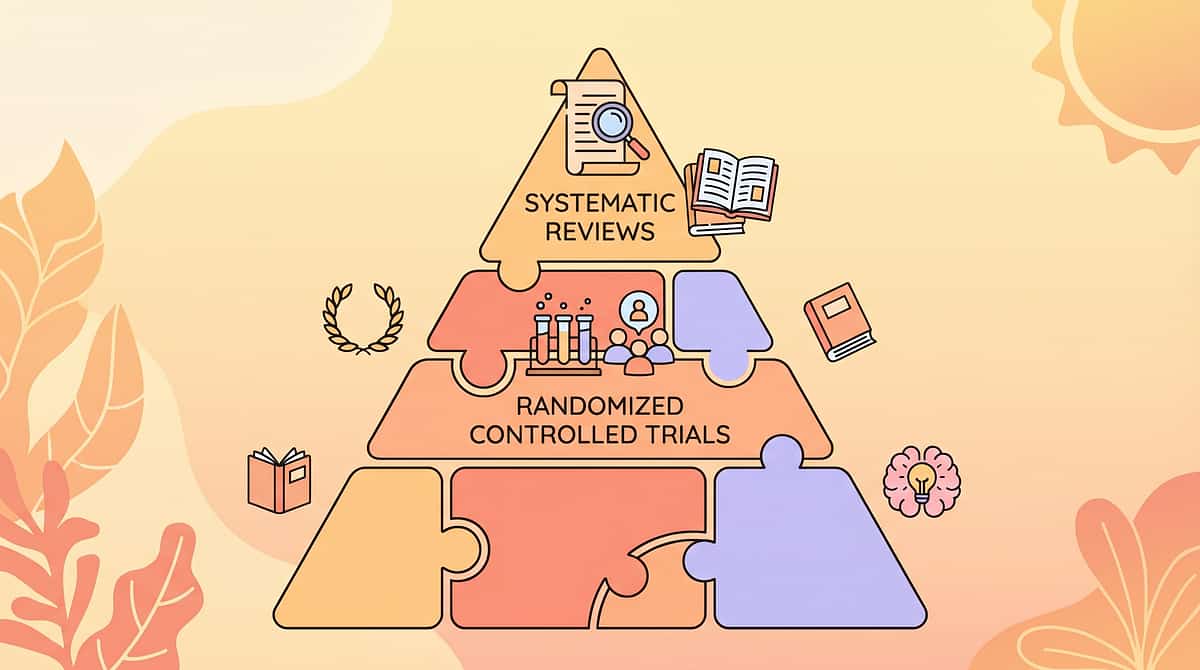
"Deeper reading for the curious parent." Every recommendation on this page is traceable to peer-reviewed evidence. Here is the evidence pyramid that underpins this technique.
Piaget, J. (1954) — Foundational
The Construction of Reality in the Child. Basic Books. Foundational research establishing 6 stages of object permanence development. Replicated globally across 70+ years of subsequent research.
Baillargeon, R. (1987) — Early Permanence
Object permanence in 3.5 and 4.5-month-old infants. Developmental Psychology, 23(5), 655-664. Demonstrated that permanence awareness begins earlier than Piaget proposed — suggesting wider intervention windows.
PRISMA Systematic Review (Children, 2024) — PMC11506176
16 articles from 2013–2023 confirm structured developmental interventions meet evidence-based practice criteria for children with ASD and produce measurable cognitive outcomes.
Meta-Analysis (World J Clin Cases, 2024) — PMC10955541
DOI: 10.12998/wjcc.v12.i7.1260. 24 studies demonstrate structured therapy effectively promotes cognitive skills, adaptive behaviour, and motor skills in paediatric populations.
WHO Care for Child Development Package — PMC9978394
Parent-delivered developmental interventions across 54 LMICs demonstrate efficacy when structured and supported. Underpins the home-based approach of this entire protocol.
Padmanabha et al. (Indian J Pediatr, 2019) — Indian Evidence
DOI: 10.1007/s12098-018-2747-4. Indian RCT demonstrating significant outcomes from parent-administered home interventions. Validates the home-based approach specifically for Indian families.
Montessori, M. (1967) — Absorbent Mind Approach
The Absorbent Mind. Foundation for object permanence box design and self-directed discovery learning. Validates child-led, materials-based cognitive intervention.

Watch the Technique in Action
Reel B-146
Cognitive Development Solutions — Episode 11
"Watch our therapist demonstrate each of the 9 materials in action. See exactly how to present, hide, prompt, and celebrate. This 75-second Reel shows you the technique in motion — because sometimes seeing is better than reading."
REEL: "9 Materials That Help Teaching Object Permanence"
Pinnacle Blooms Network clinical team demonstrating object permanence activities across all 9 materials in both clinical and home settings. View at pinnacleblooms.org or search #ObjectPermanence #PinnacleBlooms on your preferred platform.
Pinnacle Blooms Network clinical team demonstrating object permanence activities across all 9 materials in both clinical and home settings. View at pinnacleblooms.org or search #ObjectPermanence #PinnacleBlooms on your preferred platform.
What You'll See
Live demonstration of all 9 materials, including DIY versions, across Piaget's Stages A–D in real home and clinic settings.
Therapist Narration
Step-by-step commentary on hiding technique, pause timing, prompt delivery, and celebration moments — exactly as described in this guide.
Child Responses
Real child reactions across age groups — from first partial hiding attempts to mastery-level invisible displacement searches.
Video modelling is classified as an evidence-based practice for autism spectrum disorder. NCAEP Evidence-Based Practices Report (2020).

Share This with Your Family
"If only one caregiver practises this technique, it's limited. When everyone around your child understands object permanence — grandparents, nanny, daycare teacher, spouse — every interaction becomes a learning opportunity."
"Explain to Grandparents" Version
"We're working on teaching [child's name] that things and people don't disappear when they can't be seen. When you play peek-a-boo, when you hide a toy under a cloth, when you step out and say 'I'll be right back' — you're helping build this understanding. Simple version: Hide something while they watch. Wait. Help them find it. Celebrate. Repeat."
Teacher/School Template
"Dear [teacher], [child's name] is currently working on developing object permanence — the understanding that objects and people continue to exist when not visible. At home, we practise hiding games with specific materials. It would support [child's name]'s progress if similar activities could be incorporated during free play time. Here's a simple guide..."
"Consistency across caregivers multiplies impact." References: PMC9978394 — WHO CCD Package emphasises multi-caregiver training

Frequently Asked Questions
At what age should my child develop object permanence?
Most typically developing children show emerging object permanence between 4–8 months and consolidate it by 18–24 months. Children with ASD or developmental delays may follow a different timeline. If your child shows no search for completely hidden objects by 12 months, seek professional assessment.
How long should I practise each day?
5–15 minutes per session, 3–5 times daily, embedded in natural routines. Short, frequent, joyful sessions dramatically outperform long, infrequent ones. Even 2 minutes of hide-and-find during a nappy change counts as a valid session.
Do I need to buy all 9 materials?
No. Start with just 3: Peek-a-boo cloths (or any fabric), nesting cups (or household cups), and any small container. All 9 materials have zero-cost DIY alternatives — see Card 13 for the complete zero-budget guide.
My child finds toys but still screams when I leave. Why?
Object permanence (things persist) and person permanence (people persist) develop as related but separate skills. Your child may master object permanence first. Dedicated person permanence work with family photos and structured, predictable short separations helps bridge this gap.
Is peek-a-boo really therapy?
Yes. Peek-a-boo is one of the most researched developmental activities in cognitive science. Every game is a controlled permanence trial: face disappears, face returns, child learns that disappearance is temporary. When done systematically, it is legitimate cognitive intervention.

More Frequently Asked Questions
Can too much practice be harmful?
Forced, distressing practice can be counterproductive. Always follow your child's lead. If they're done, you're done. The rule: always end on a success, always stop before the child is frustrated. There's no such thing as too much joyful, willing practice.
Will my child "catch up" to their peers?
Every child's developmental trajectory is unique. With consistent, evidence-based intervention, children can make significant progress through Piaget's stages. The goal isn't "catching up" to an arbitrary benchmark — it's building functional cognitive architecture at your child's pace.
Should I do this instead of professional therapy?
This technique is designed to complement, not replace, professional therapy. Home practice extends the therapeutic benefit of clinical sessions. If your child is receiving professional therapy, share this protocol with their therapist for alignment. Clinical and home practice together produce the strongest outcomes.
What if my child has sensory sensitivities to the materials?
Always introduce materials slowly, one at a time. For sound-sensitive children, test pop-up toys privately first. For tactile-sensitive children, begin with familiar fabrics. The cognitive mechanism is in the hide-and-find sequence — the specific material is secondary. Substitute freely.
Didn't find your answer? Call Pinnacle's FREE National Autism Helpline: 9100 181 181 (24×7, 16+ languages) | Book a teleconsultation: pinnacleblooms.org/teleconsult
Preview of 9 materials that help teaching object permanence Therapy Material
Below is a visual preview of 9 materials that help teaching object permanence therapy material. The pages shown help educators, therapists, and caregivers understand the structure and content of the resource before use. Materials should be used under appropriate professional guidance.











Link copied!

The Pinnacle Promise
From fear to mastery. One technique at a time.
You arrived on this page concerned that your child might not understand that the world continues to exist when they close their eyes. You now have the science, the materials, the protocol, the progress tracking, and the community to guide your child through one of the most foundational cognitive leaps a human being makes.
Object permanence is just the beginning. Every technique in the Pinnacle GPT-OS® library is built with the same rigour: evidence-linked, home-executable, consortium-validated, parent-empowering. Your child's developmental journey continues — and you are their most powerful therapist.
Medical Disclaimer: This content is educational. It does not replace assessment by a licensed developmental specialist, occupational therapist, or early intervention professional. If you are concerned about your child's cognitive development, please consult a qualified professional. Individual results vary. Statistics represent aggregate outcomes across the Pinnacle Blooms Network.
© 2026 Pinnacle Blooms Network®, a unit of Bharath Healthcare Laboratories Pvt. Ltd. All rights reserved.
CIN: U74999TG2016PTC113063 | DPIIT: DIPP8651 (Govt. of India) | MSME: Udyog Aadhaar TS20F0009606 | GSTIN: 36AAGCB9722P1Z2
ISO 13485: Medical Device QMS | ISO/IEC 27001: Information Security | Patents filed across 160+ countries via WIPO PCT
Powered by GPT-OS® — Global Paediatric Therapeutic Operating System
techniques.pinnacleblooms.org | pinnacleblooms.org | 9100 181 181
CIN: U74999TG2016PTC113063 | DPIIT: DIPP8651 (Govt. of India) | MSME: Udyog Aadhaar TS20F0009606 | GSTIN: 36AAGCB9722P1Z2
ISO 13485: Medical Device QMS | ISO/IEC 27001: Information Security | Patents filed across 160+ countries via WIPO PCT
Powered by GPT-OS® — Global Paediatric Therapeutic Operating System
techniques.pinnacleblooms.org | pinnacleblooms.org | 9100 181 181