9 Materials That Help When Child Doesn't Understand
When words go in but meaning doesn't land — a clinically validated home intervention protocol for receptive language impairment. Pinnacle Blooms Network® | Technique B-152 | Domain B: Language & Communication
Domain B · Language & Communication · Episode 152
← B-151 | B-153 →

When Words Go In. Meaning Doesn't Land.
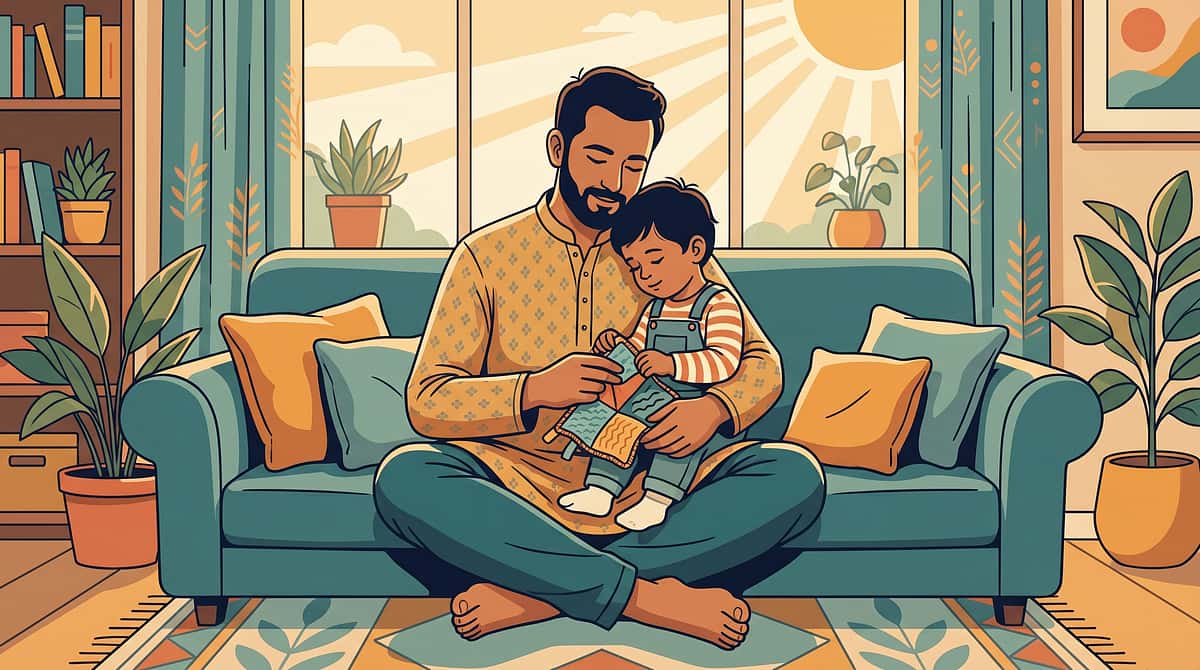
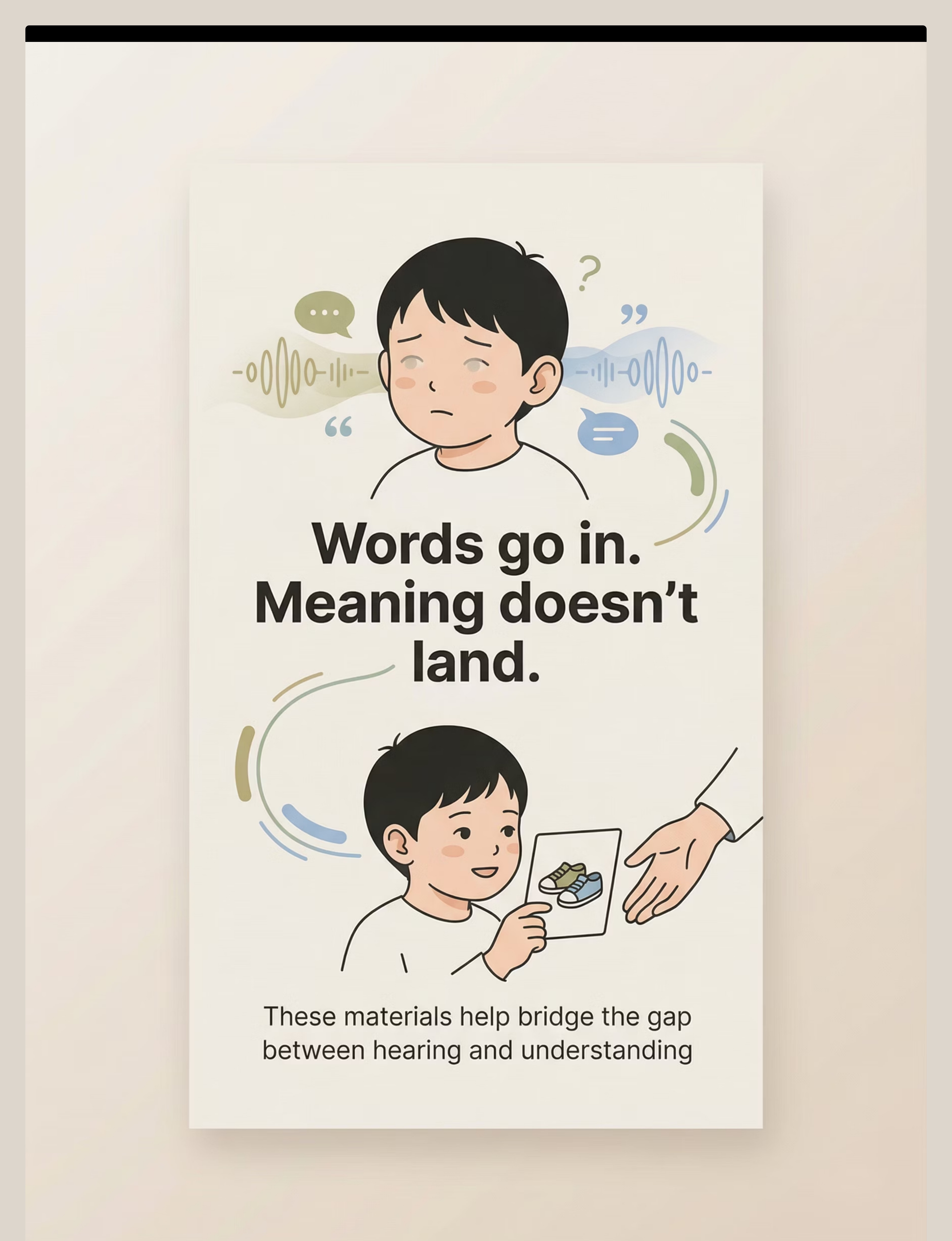
You said "Put your shoes on" — five times. He looked right at you. Nodded, even. And then stood completely still, as if the words dissolved in the air before reaching him. You're not being ignored. He's not being stubborn. The words are arriving. The meaning isn't.
Your child can hear every word you say — and still not understand a single one of them. This is receptive language impairment. It has a name. It has a neuroscience. And it has 9 specific materials that build the bridge from hearing to understanding.
You are not failing as a parent. Your child's language processing system is asking for a different kind of input.
Validated By
OT • SLP • ABA • SpEd • NeuroDev — Full Pinnacle Blooms Consortium
Domain B
Language & Communication Solutions | Episode 152 of 999
FREE Helpline
📞 9100 181 181 | 16 Languages | 70+ Centers Nationwide
Millions of Families. One Shared Confusion.
Receptive language disorder — the gap between hearing words and understanding them — is one of the most common and most misunderstood challenges in pediatric speech development. When a child appears to ignore instructions, gives blank stares at questions, or responds inconsistently to their own name, this is the clinical mechanism at work. Not defiance. Not hearing loss. A processing gap.
Children with Delays
Show significant receptive language delays before age 5 (ASHA, 2023)
ASD Co-occurrence
Of children with ASD have measurable receptive language difficulties (PMC11506176, 2024)
Indian Families
Navigating this exact challenge today (India NSSO + ASHA estimates)
"He heard the words but didn't understand them... Around month eight, he was following directions without pictures. The words aren't just sounds anymore — they're meaning." — Parent, Pinnacle Network
This Is Not a Behavior Problem. This Is a Wiring Difference.
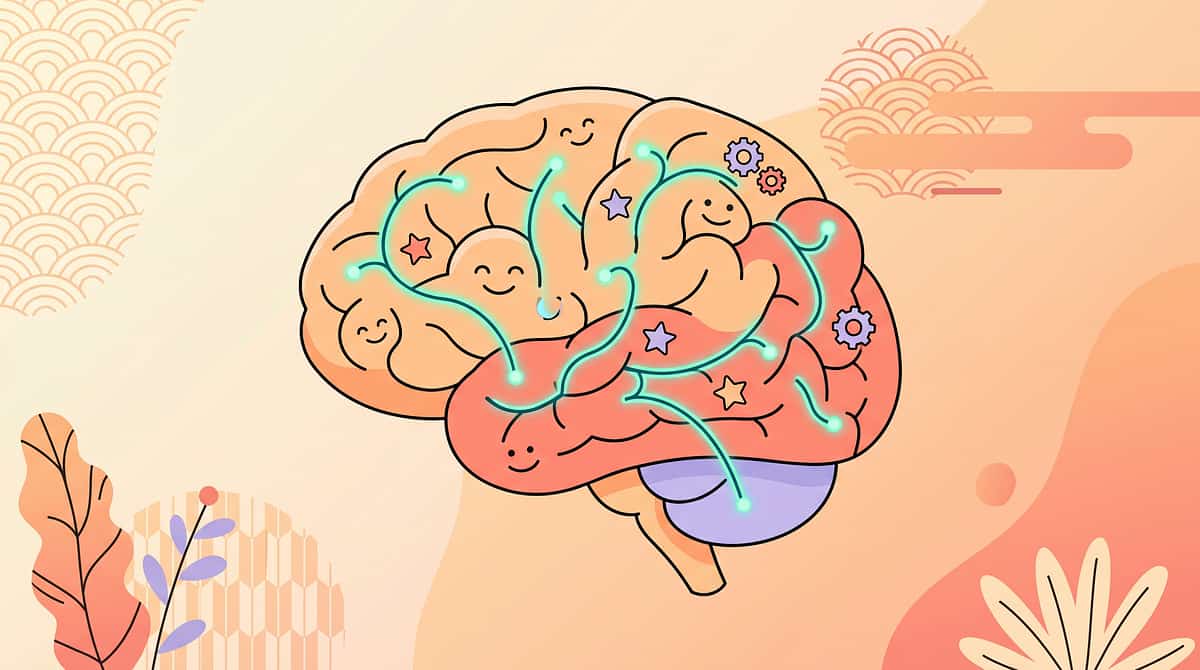
Understanding why your child struggles to decode spoken language is the first step toward helping them effectively. The neuroscience is clear: this is a connection problem, not an intelligence problem, not a hearing problem, and not a motivation problem.
The Brain Pathway
Sound enters auditory cortex
Hearing — fully intact in most children
Signal reaches Wernicke's area
Language decoding — delayed or disrupted
Semantic association network
Meaning assignment — underdeveloped
Motor/response output
Action — absent without complete meaning
Your child hears at Step 1. The gap is at Steps 2–3.
What's Different in Your Child
In neurotypical development: Sounds become phonemes, phonemes become words, words trigger meaning, meaning triggers response — all in under 500 milliseconds.
In receptive language challenges (ASD, auditory processing disorder, language processing disorder): Wernicke's area processing and the semantic association network are slower, less organized, or differently wired. The word "shoes" arrives as sound — but the bridge connecting that sound to the concept hasn't been built yet.
The critical insight: The materials in this technique build those missing connections through multi-sensory, repetitive, structured input.
Frontiers in Integrative Neuroscience (2020): Receptive language processing involves distributed cortical networks — differences in ASD represent wiring variation, not damage. DOI: 10.3389/fnint.2020.556660

Your Child Is Here. Here Is Where We're Heading.
Understanding where your child sits on the developmental timeline — and what the next milestone looks like — transforms anxiety into direction. The WHO milestones below are guideposts, not judgments.
Age | WHO Milestone | What to Watch | |
6–9 months | Turns to name, responds to "no" | Foundation receptive responses | |
12 months | Understands 10+ words, follows 1-step gesture | First semantic links forming | |
18 months | Follows 2-step commands with gesture | Auditory + visual integration | |
24 months | Follows 2-step commands WITHOUT gesture | Pure auditory receptive processing | |
3 years | Understands most sentences, grasps concepts | Conceptual language processing | |
4–5 years | Understands complex narratives and abstract language | Higher-order receptive skills |
"Your child is not behind. Your child is on a different developmental path — and this technique is a proven step on that path."
Intervention window: Children identified with receptive delays at 18–36 months show the highest neuroplasticity response window for structured language input. Common co-occurrences: ASD (70–80%), ADHD (35–40%), DLD, APD, Down Syndrome. Source: WHO CCD Package | PMC9978394
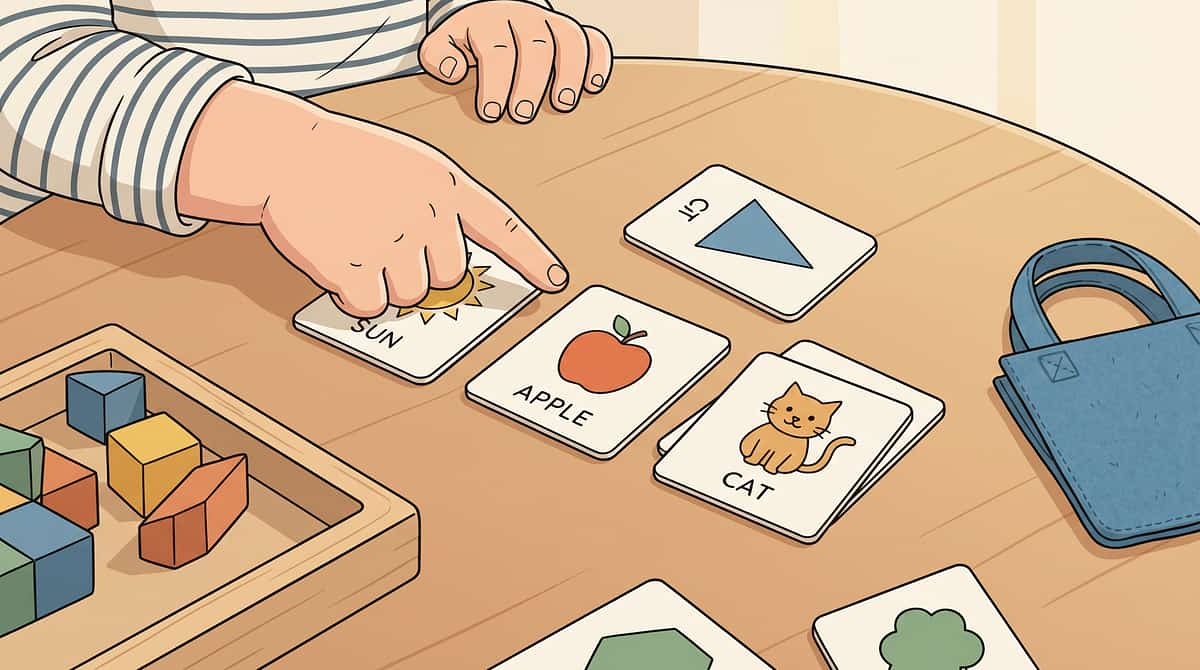
Clinically Validated. Home-Applicable. Parent-Proven.
Every recommendation on this page is grounded in peer-reviewed evidence. The following four pillars form the research foundation of Technique B-152 — from systematic reviews to Indian RCT data to national clearinghouse classifications.
⬡ LEVEL I — PRISMA Systematic Review (2024)
16 studies (2013–2023) confirm sensory-integrated language intervention is evidence-based practice for children with ASD. PMC11506176 | Children, 2024
⬡ LEVEL I — Meta-Analysis (2024)
Visual support + object-based language teaching produces statistically significant improvements in receptive vocabulary — effect size d=0.72. World J Clin Cases | PMC10955541
⬡ LEVEL II — Indian RCT (2019)
Home-based structured language material interventions demonstrated significant receptive language gains in Indian pediatric ASD population. Indian J Pediatr | DOI: 10.1007/s12098-018-2747-4 | Padmanabha et al.
⬡ NCAEP (2020)
Visual supports, naturalistic developmental behavioral interventions, and AAC all classified as evidence-based for receptive language in autism. National Clearinghouse on Autism Evidence and Practice
82%
Evidence Confidence
For home implementation of B-152 materials protocol
Need expert guidance? 9100 181 181 — FREE National Autism Helpline
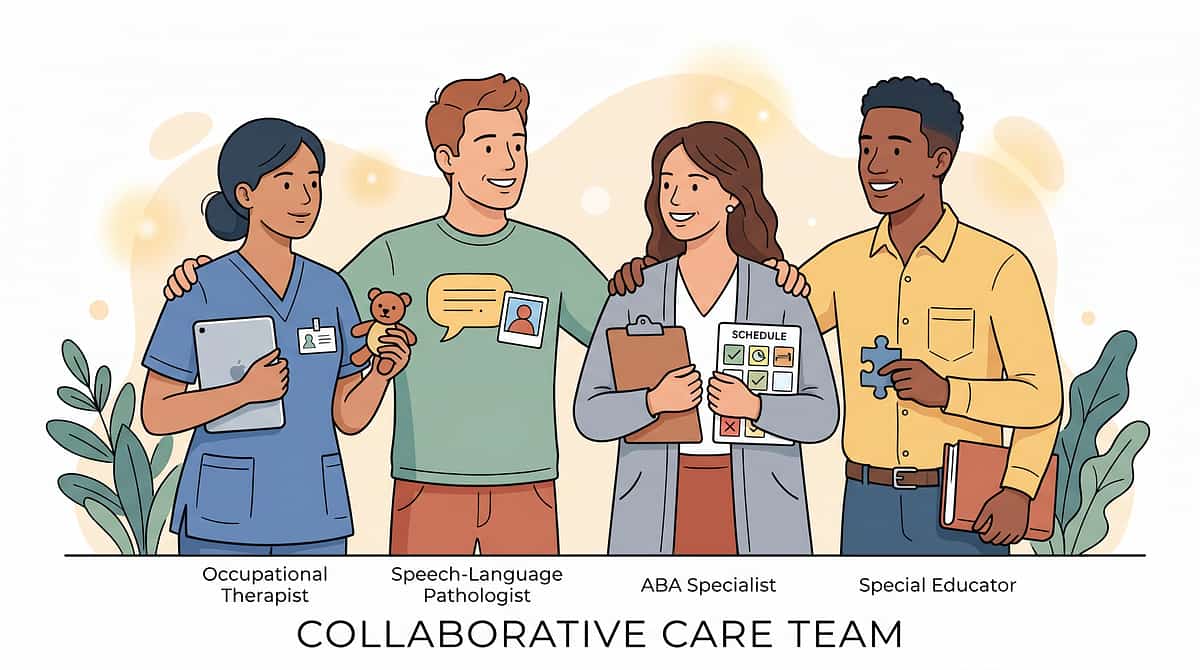
Multi-Modal Receptive Language Input
The Bridge-Builder
Domain B — Language & Communication
Definition: Multi-Modal Receptive Language Input is a structured, home-executable intervention that addresses receptive language impairment by pairing spoken words with simultaneous visual, tactile, and contextual cues. Instead of relying on auditory-only input, this technique builds word-meaning associations by activating multiple sensory channels at once. The child hears "shoe" while simultaneously seeing a shoe image, touching a real shoe, and experiencing the action of putting a shoe on.
Age Range
18 months – 8 years
Peak window: 2–5 years
Peak window: 2–5 years
Session Duration
10–20 minutes per session
2–3 sessions daily in natural routines
2–3 sessions daily in natural routines
Primary Discipline
Speech-Language Pathology (SLP)
Secondary: OT, ABA, SpEd, NeuroDev
Secondary: OT, ABA, SpEd, NeuroDev
Canon Material Categories: Visual Supports | Real Objects / Miniatures | Vocabulary Materials | Concept Materials | Story Materials | Directions Games | Auditory Memory Materials | Adapted Books | Question Materials
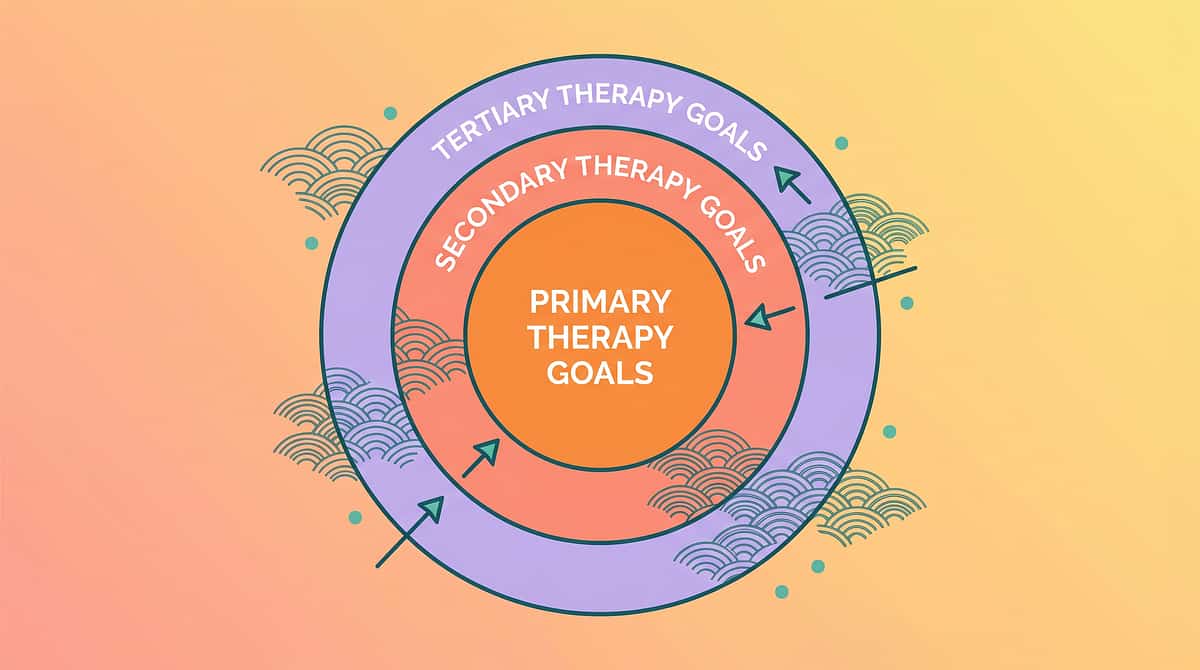
This Technique Crosses Therapy Boundaries
Because the brain doesn't organize by therapy type. Each discipline brings a unique and necessary layer to the B-152 protocol — and at Pinnacle, all five disciplines review your child's data simultaneously through GPT-OS®.
Speech-Language Pathologist (SLP) — Primary Lead
Designs the vocabulary hierarchy, selects target words by semantic category, sequences material complexity. Monitors comprehension milestones. This is the clinical heart of the technique.
Occupational Therapist (OT) — Sensory Integration
Ensures tactile and proprioceptive components of object-based learning are regulated. Addresses sensory processing barriers such as tactile defensiveness that prevent engagement with materials.
ABA / BCBA — Behavior Layer
Structures reinforcement schedules, tracks data, manages prompt hierarchy (full physical → gestural → verbal → independent), and ensures stimulus generalization across environments.
Special Educator (SpEd) — Curriculum Integration
Maps vocabulary targets to school curriculum demands. Ensures home intervention generalizes to classroom following-directions requirements. Creates school-home consistency.
NeuroDevelopmental Pediatrician — Medical Oversight
Monitors neurodevelopmental trajectory, rules out audiological or neurological contributors, coordinates with SLP/OT, and adjusts management if language gains plateau.
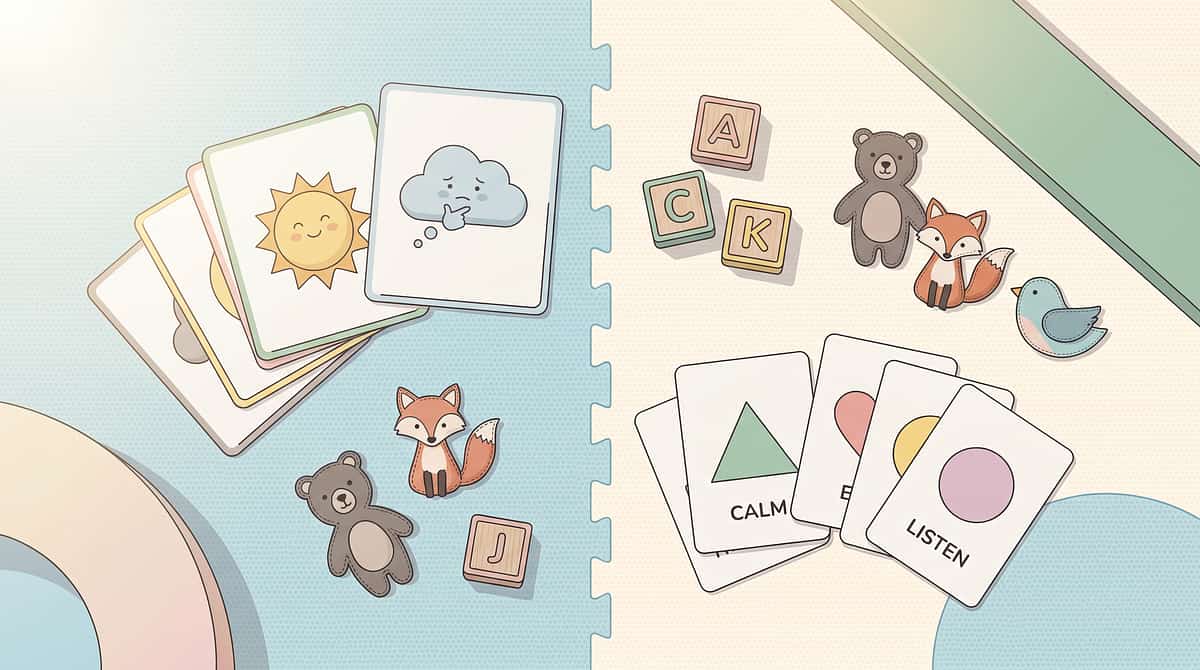
Nine Specific Skills This Technique Builds
B-152 targets a progressive hierarchy of receptive language skills — from foundational word recognition through complex narrative comprehension. Each tier builds on the last, creating a durable word-meaning architecture in your child's brain.
Tier 1 — Immediate Targets (Weeks 1–4)
- Single word object identification — matching heard word to correct object or picture
- Body part identification — pointing to named body part on command
- Following 1-step commands — "Give me the cup" responded to without gesture
Tier 2 — Intermediate Targets (Weeks 5–12)
- Two-step command following — "Pick up the ball and put it in the box"
- Category sorting by heard label — "Show me all the animals"
- Yes/No comprehension — responding accurately to "Is this a dog?"
- Preposition comprehension — "Put it IN/ON/UNDER the box"
Tier 3 — Long-Term Targets (Months 3–6+)
- Narrative comprehension — answering "what happened?" after a story
- Question word understanding — correctly interpreting WHO/WHAT/WHERE
These targets map to the Pinnacle AbilityScore® Receptive Language Domain indicators. Assessment available at all 70+ Pinnacle centers and via GPT-OS® teleassessment.
9 Materials. One Bridge. From Hearing to Understanding.
The nine Canon materials below address different dimensions of the word-meaning gap. Each is clinically validated, home-applicable, and available as a purchase, a budget option, or a zero-cost DIY equivalent.
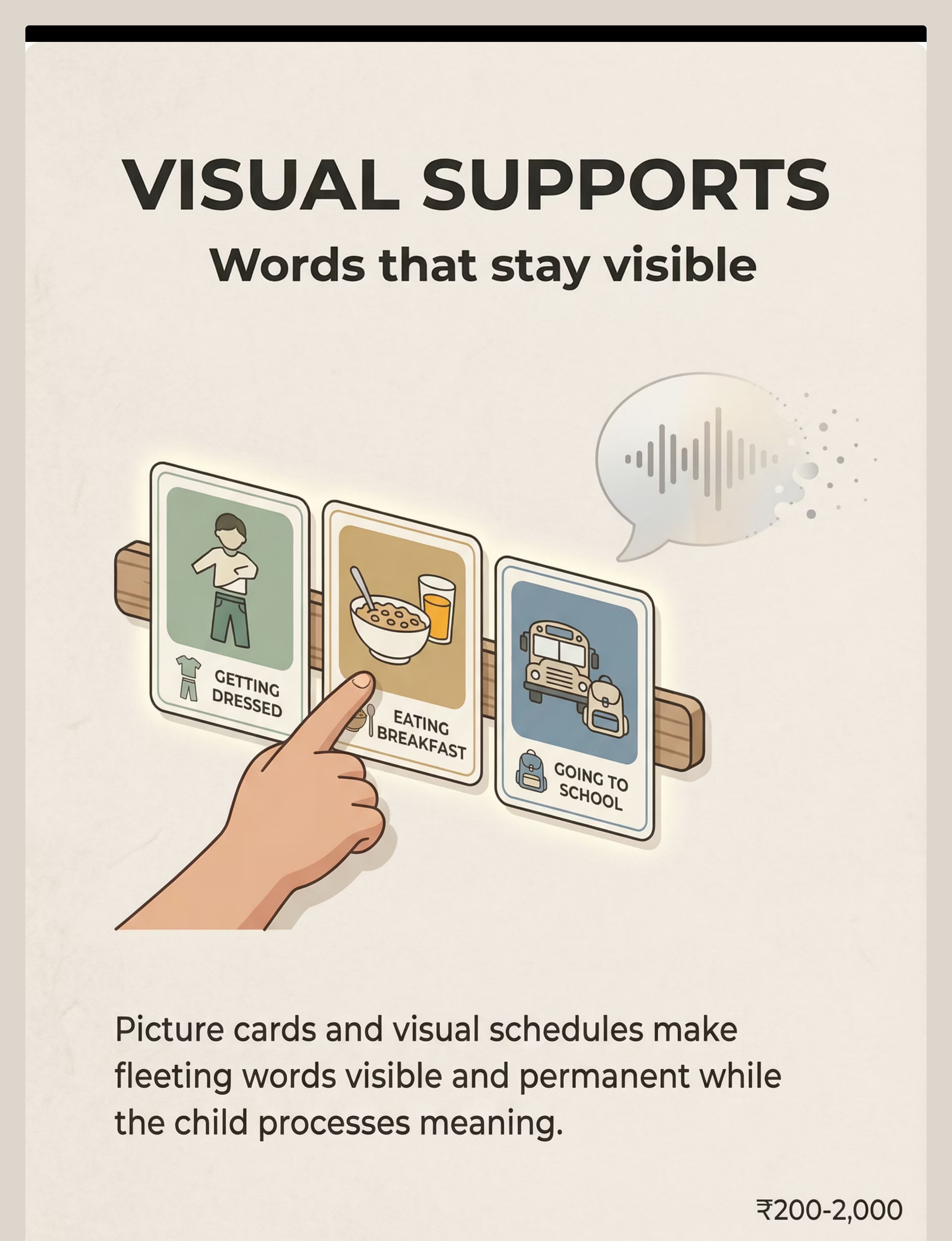
Material 1 — Visual Supports
Canon: Visual Supports
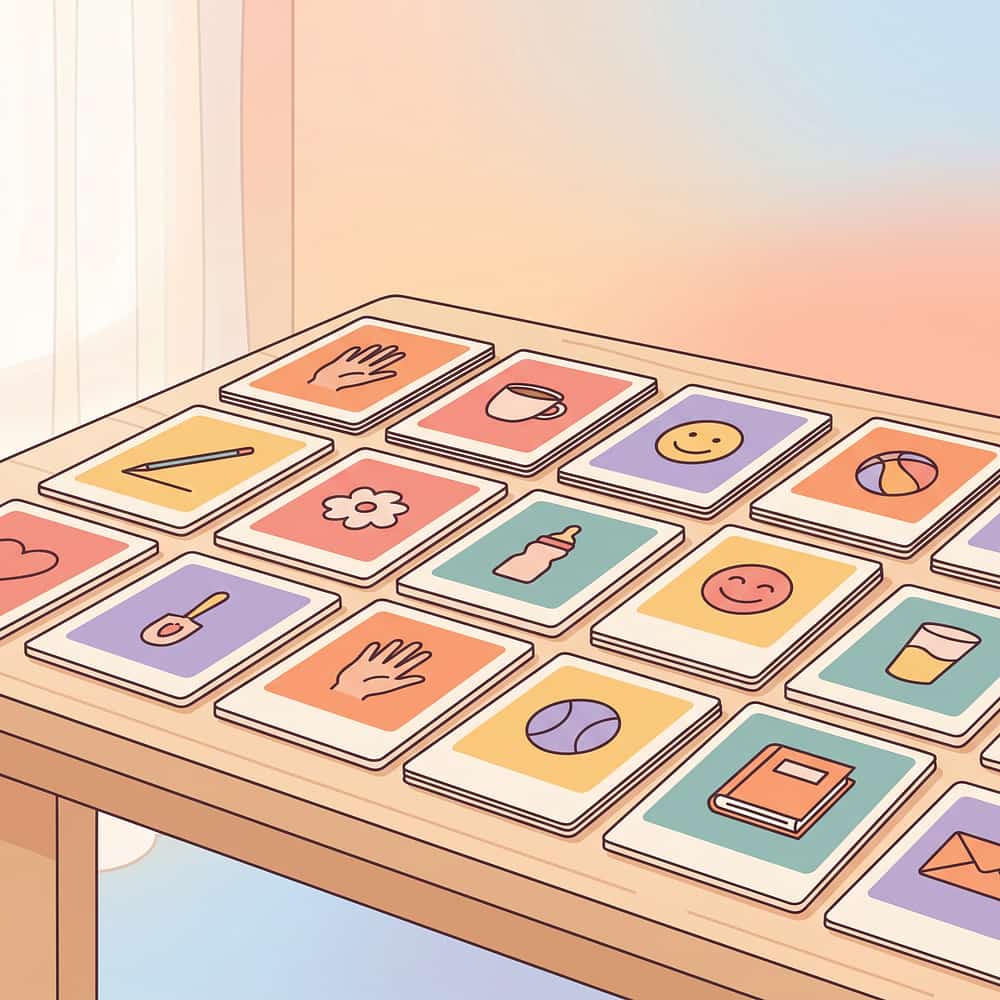
Picture cards and visual schedules make fleeting words visible and permanent while the child processes meaning. Words that stay visible give extra processing time.
Picture cards and visual schedules make fleeting words visible and permanent while the child processes meaning. Words that stay visible give extra processing time.
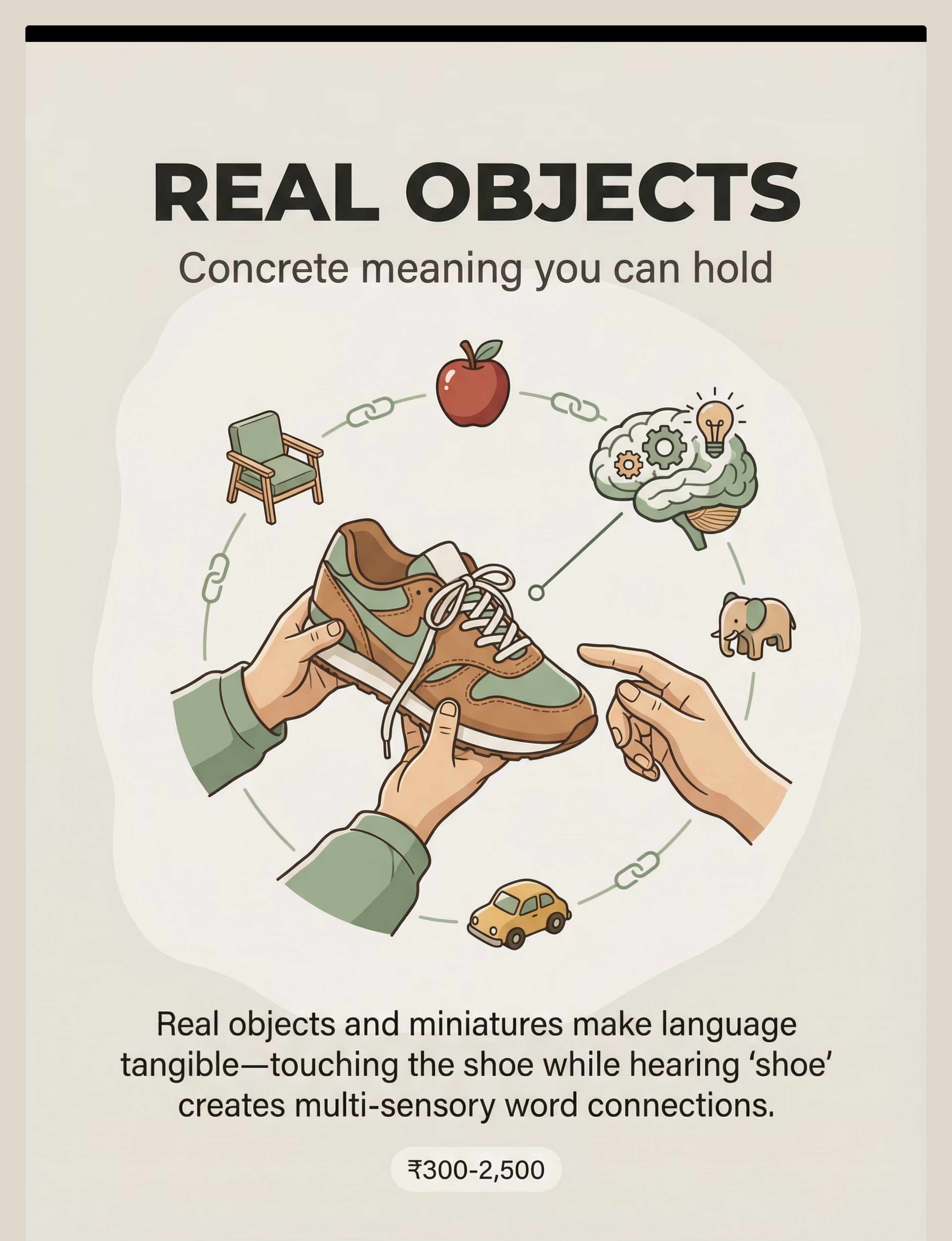
Material 2 — Real Objects & Miniatures
Canon: Real Objects / Miniatures
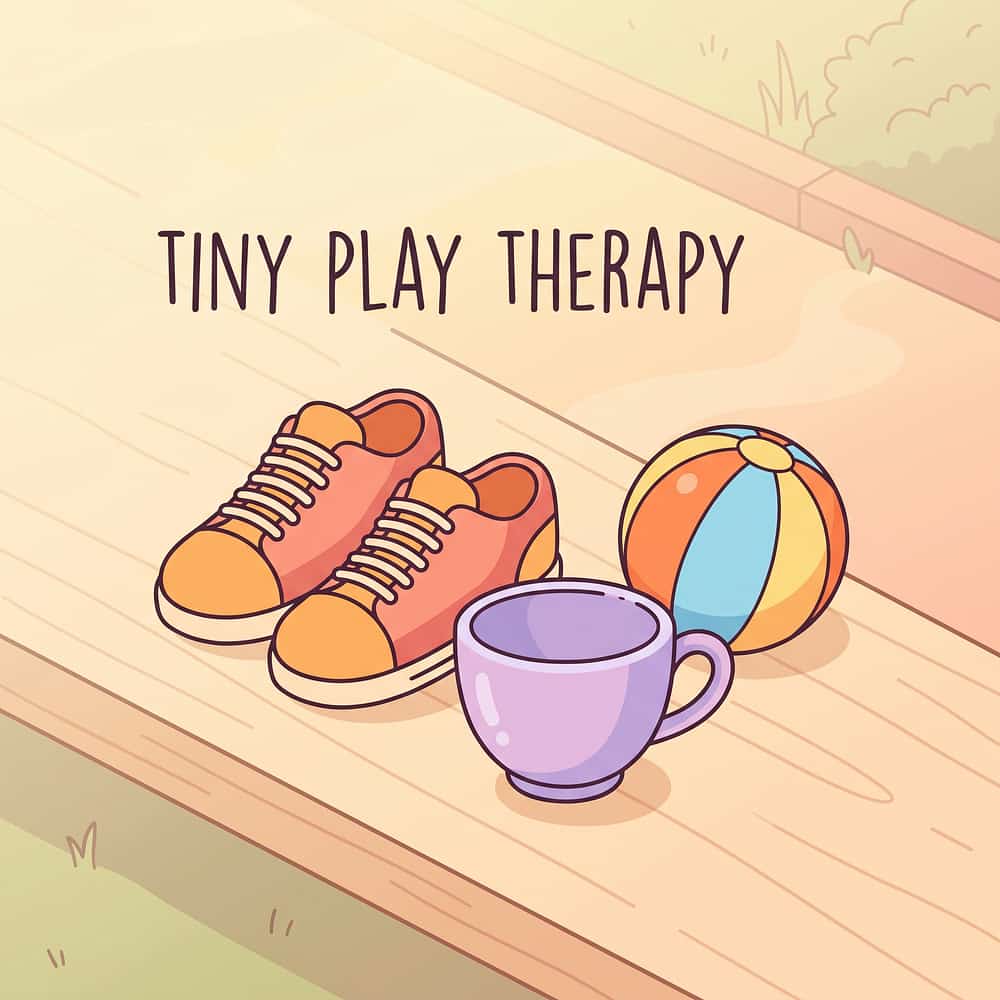
Real objects make language tangible. Touching the shoe while hearing "shoe" creates multi-sensory word connections that auditory input alone cannot build.
Real objects make language tangible. Touching the shoe while hearing "shoe" creates multi-sensory word connections that auditory input alone cannot build.
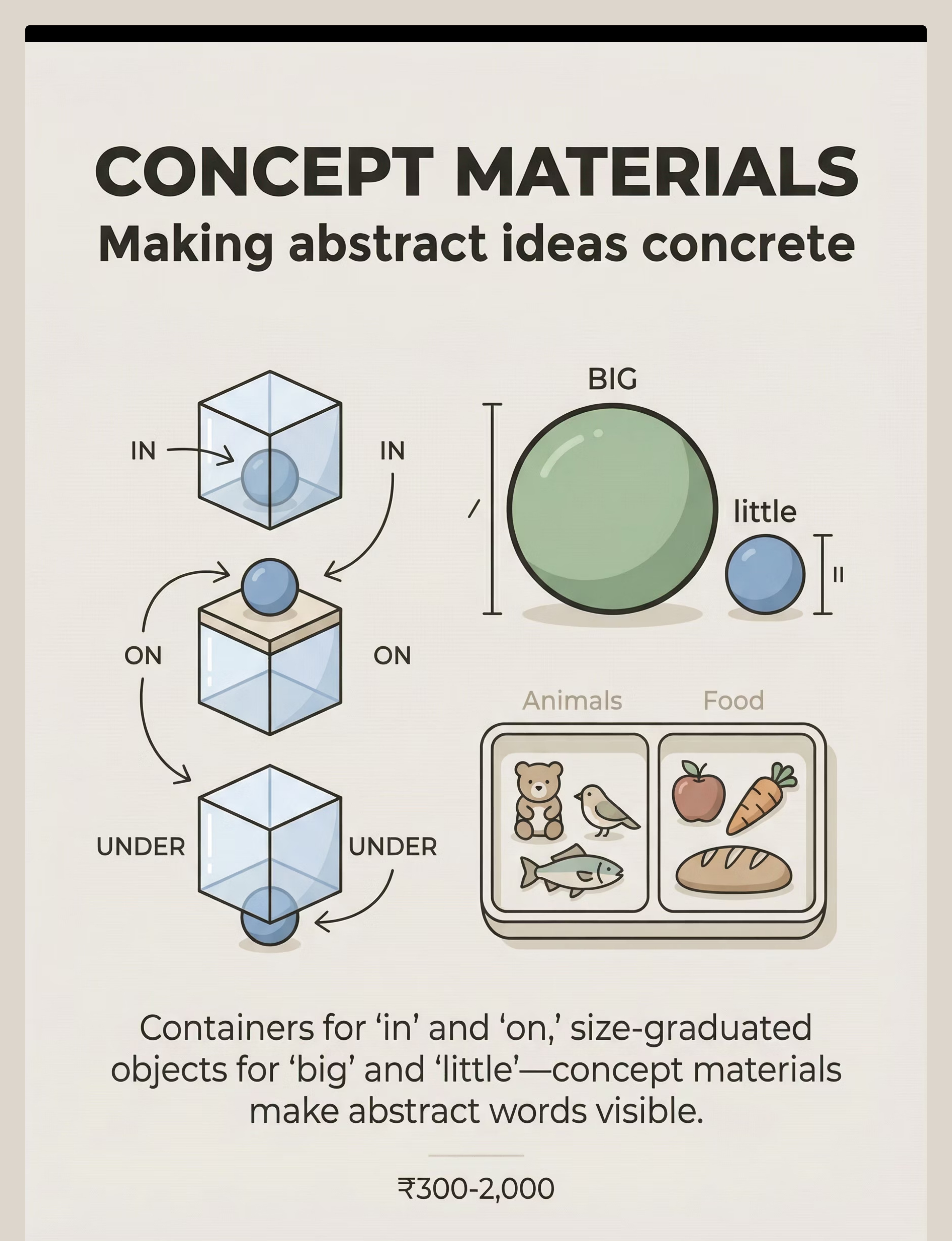
Material 3 — Concept Materials
Canon: Concept Materials
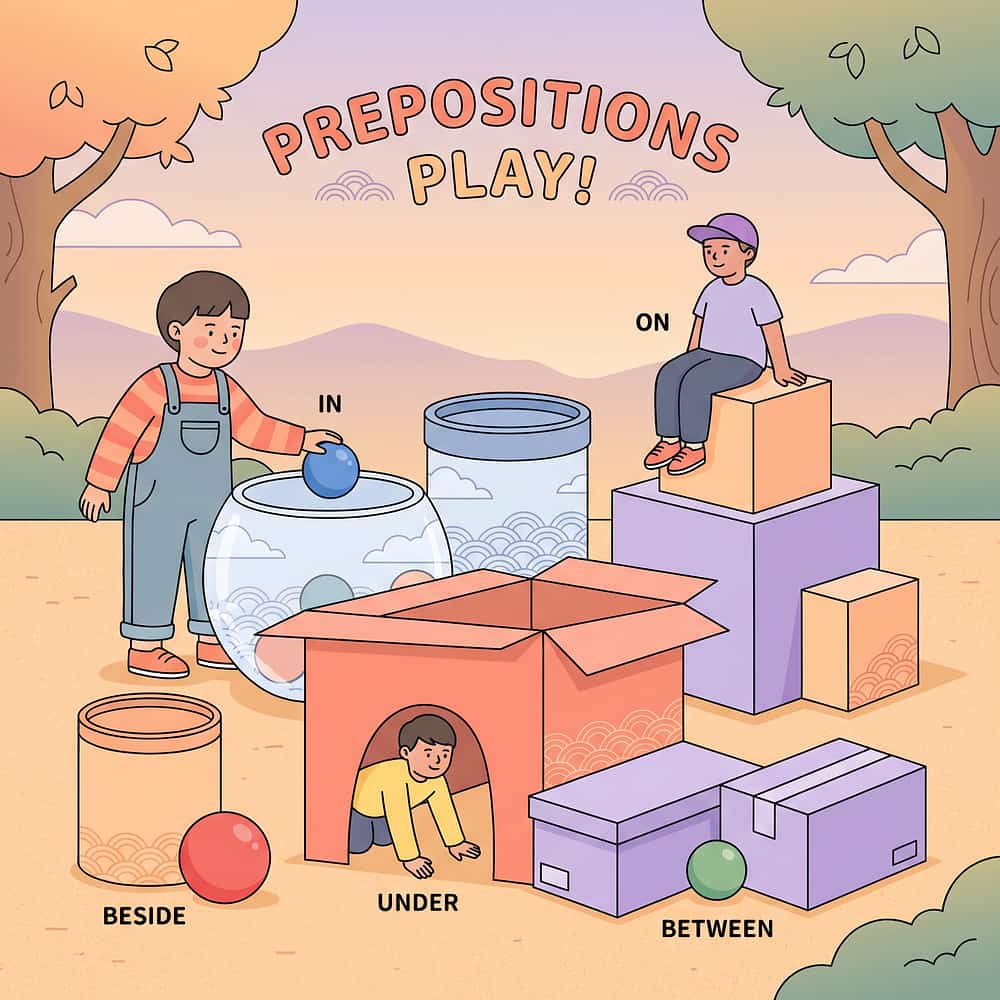
Containers for "in" and "on," size-graduated objects for "big" and "little" — concept materials make abstract words visible and manipulable.
Containers for "in" and "on," size-graduated objects for "big" and "little" — concept materials make abstract words visible and manipulable.

9 Materials — Continued
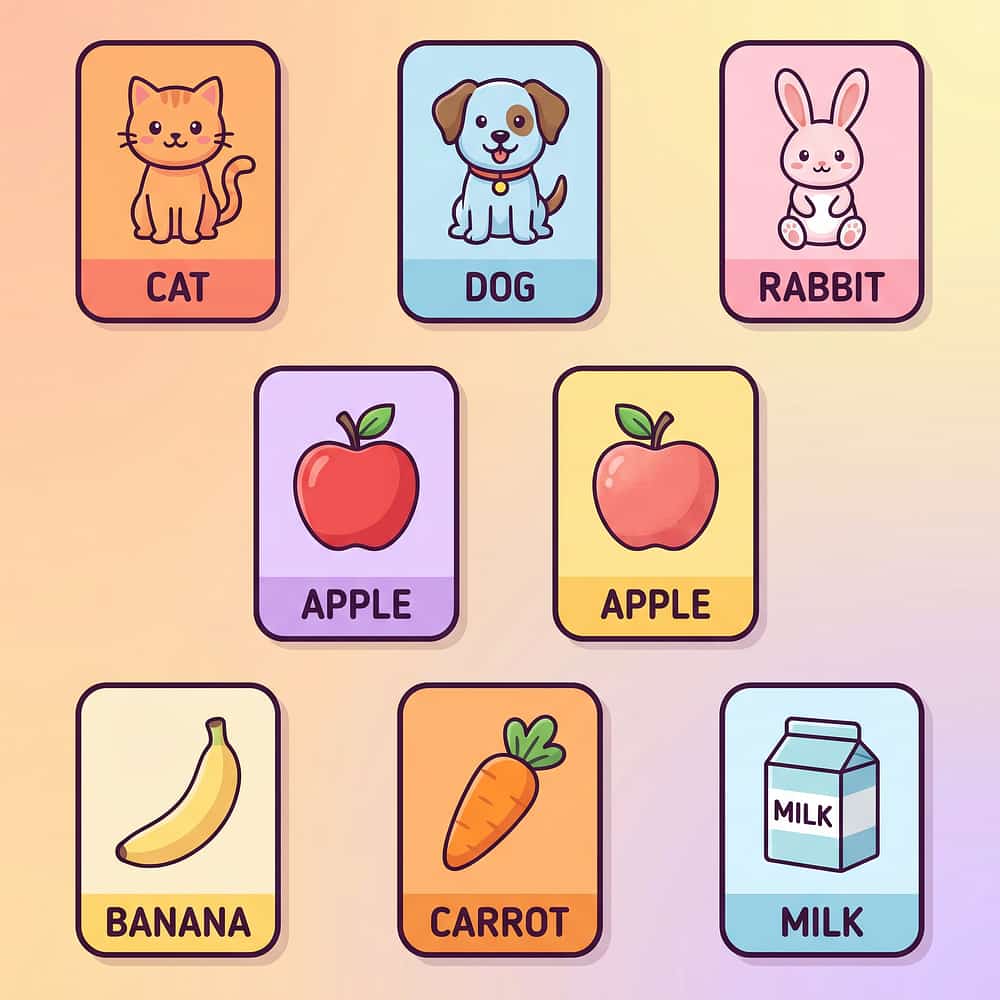
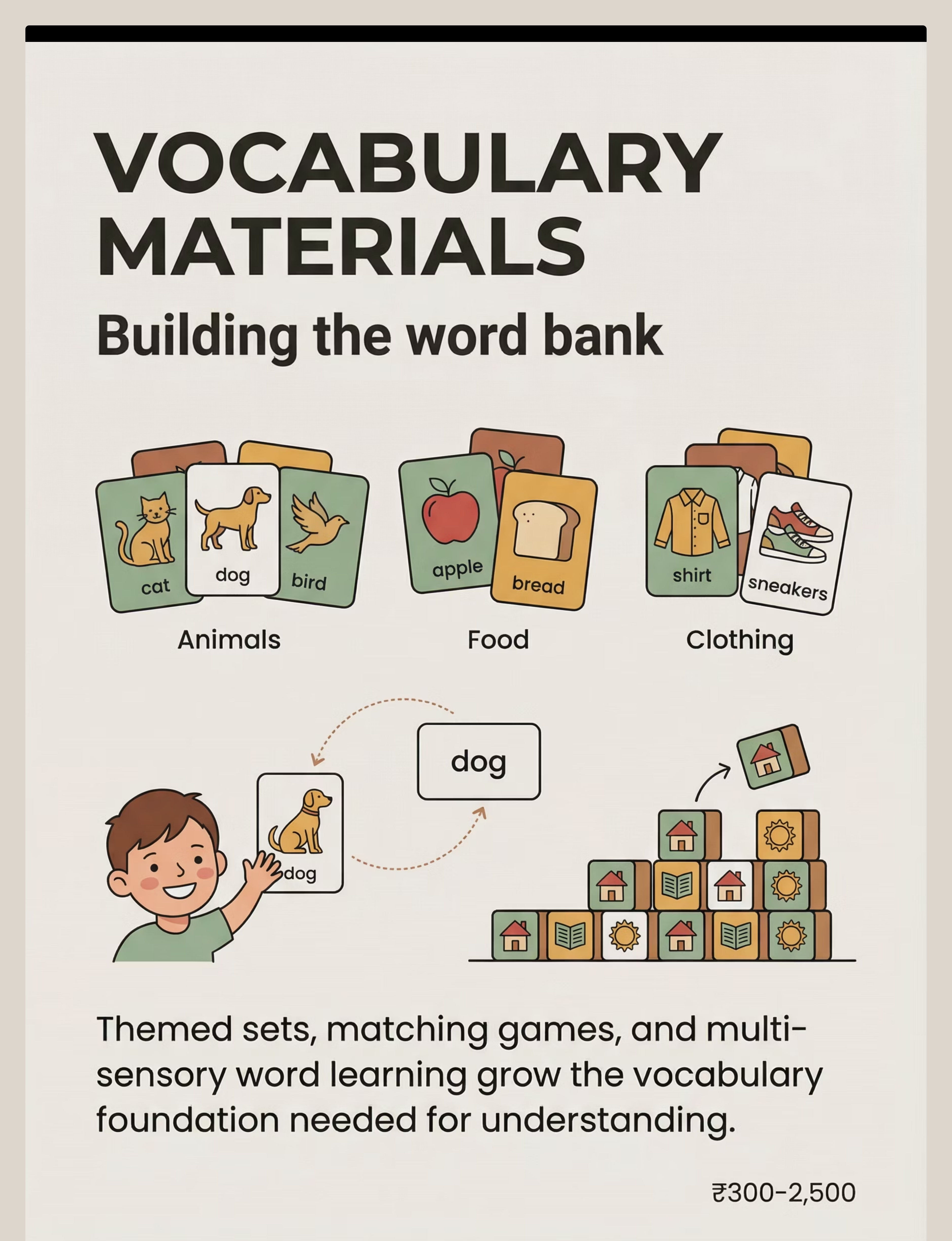
Material 4 — Vocabulary Flashcards
Canon: Vocabulary Materials
Themed sets — animals, food, clothing, body parts — build the word bank foundation. Multi-sensory matching games grow receptive vocabulary systematically.
Themed sets — animals, food, clothing, body parts — build the word bank foundation. Multi-sensory matching games grow receptive vocabulary systematically.
💰 ₹300–2,500 | ✅ DIY with printed or drawn cards
🛒 Brainy Bug Flashcards with Audio — ₹305 | 🛒 Sorting Activity Set — ₹628
🛒 Brainy Bug Flashcards with Audio — ₹305 | 🛒 Sorting Activity Set — ₹628
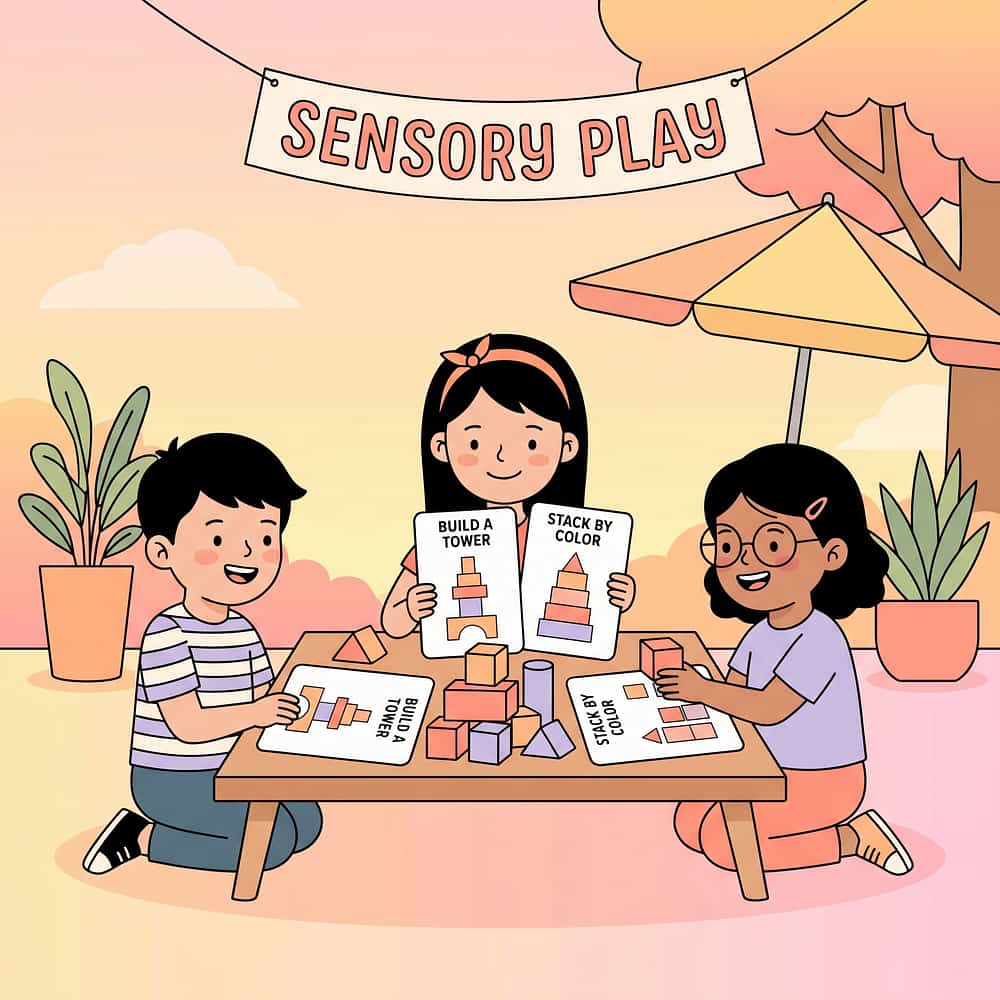
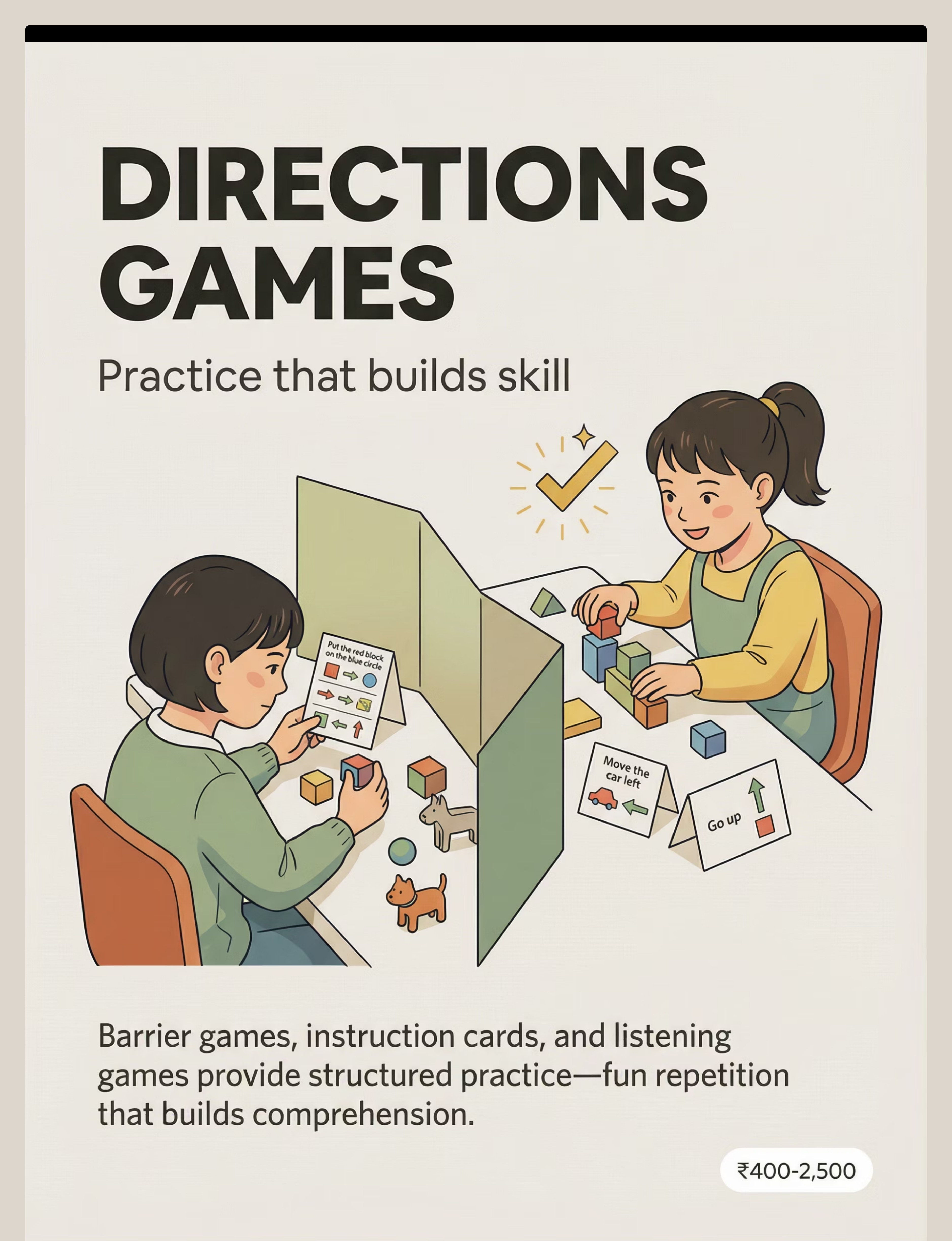
Material 5 — Directions Games
Canon: Directions Games
Barrier games, instruction cards, and listening games provide structured practice in following directions. Fun repetition that builds comprehension without clinical pressure.
Barrier games, instruction cards, and listening games provide structured practice in following directions. Fun repetition that builds comprehension without clinical pressure.
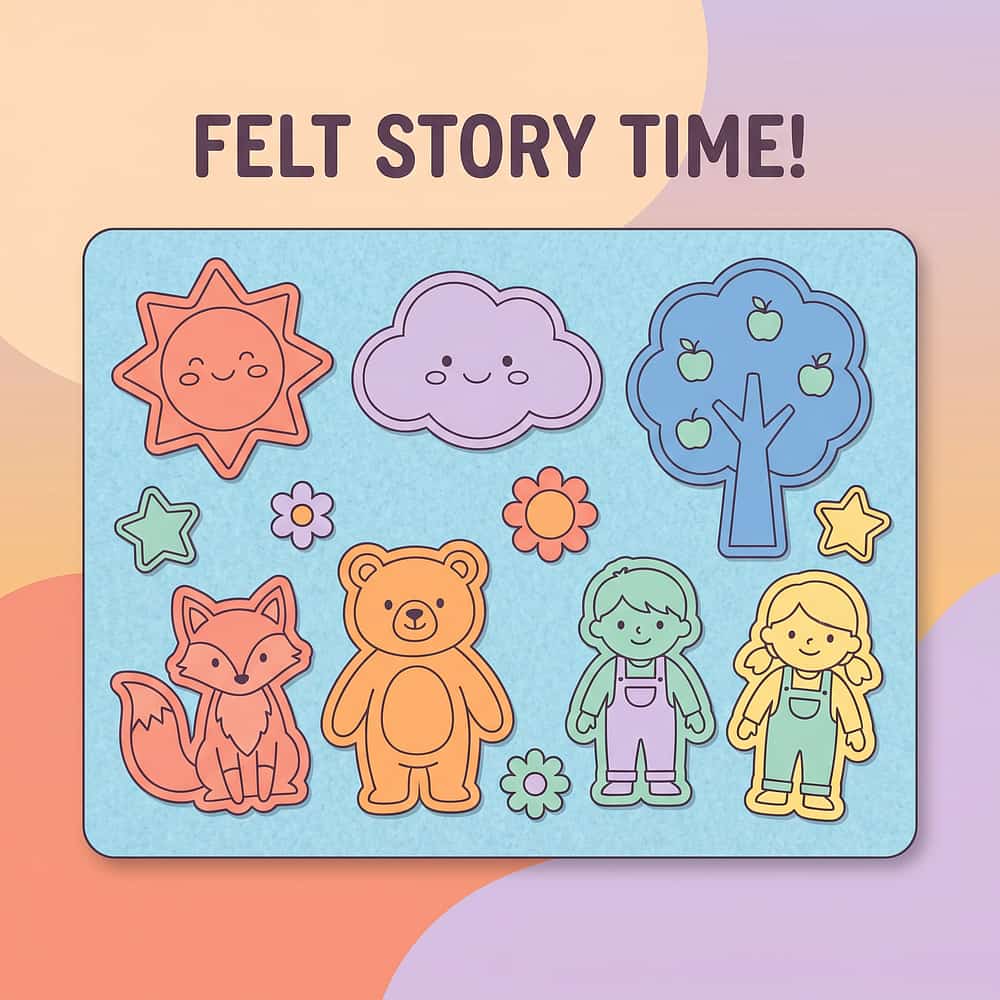
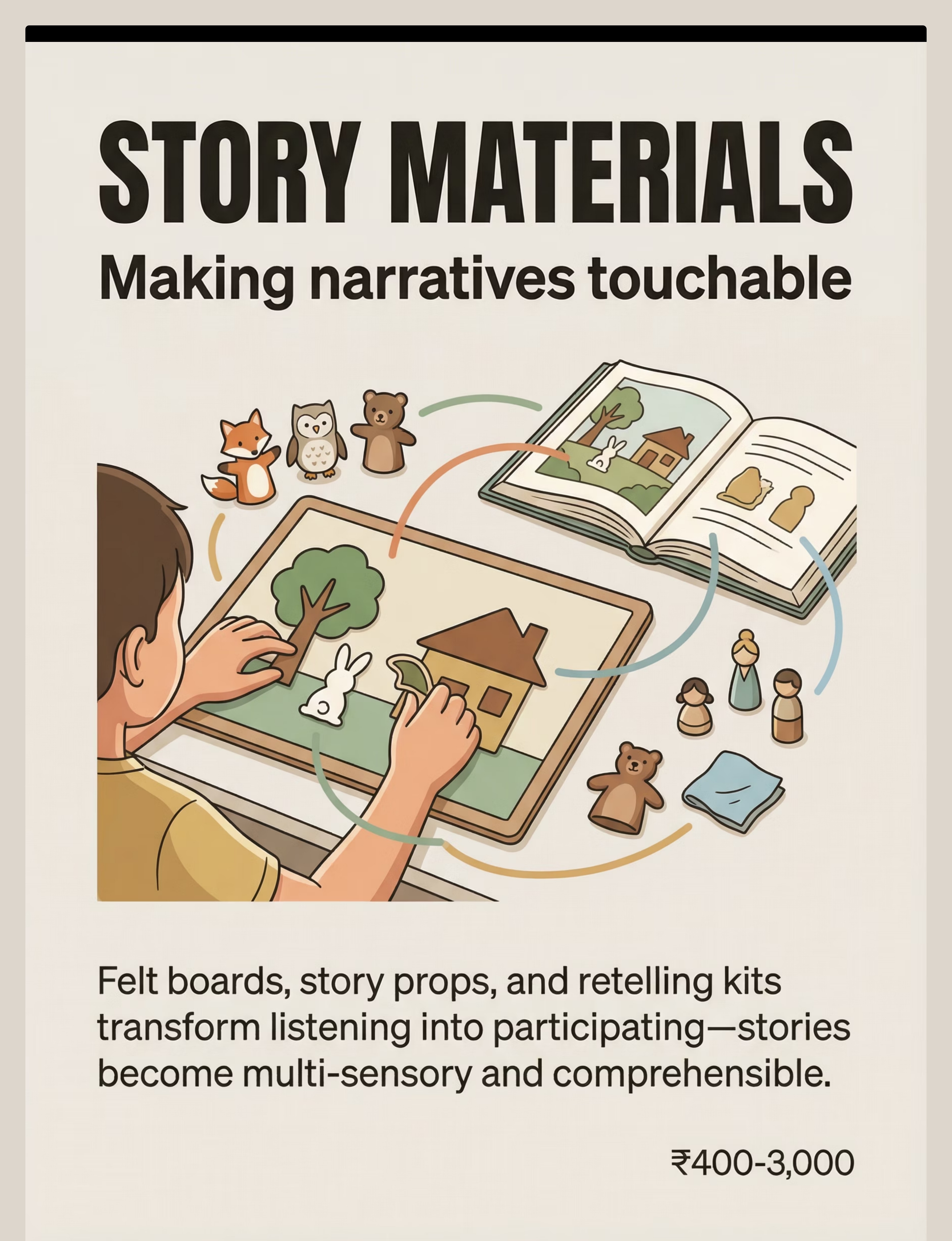
Material 6 — Story Materials
Canon: Story Materials
Felt boards, story props, and retelling kits transform listening into participating — stories become multi-sensory and comprehensible. Narratives become touchable.
Felt boards, story props, and retelling kits transform listening into participating — stories become multi-sensory and comprehensible. Narratives become touchable.
9 Materials — Completed
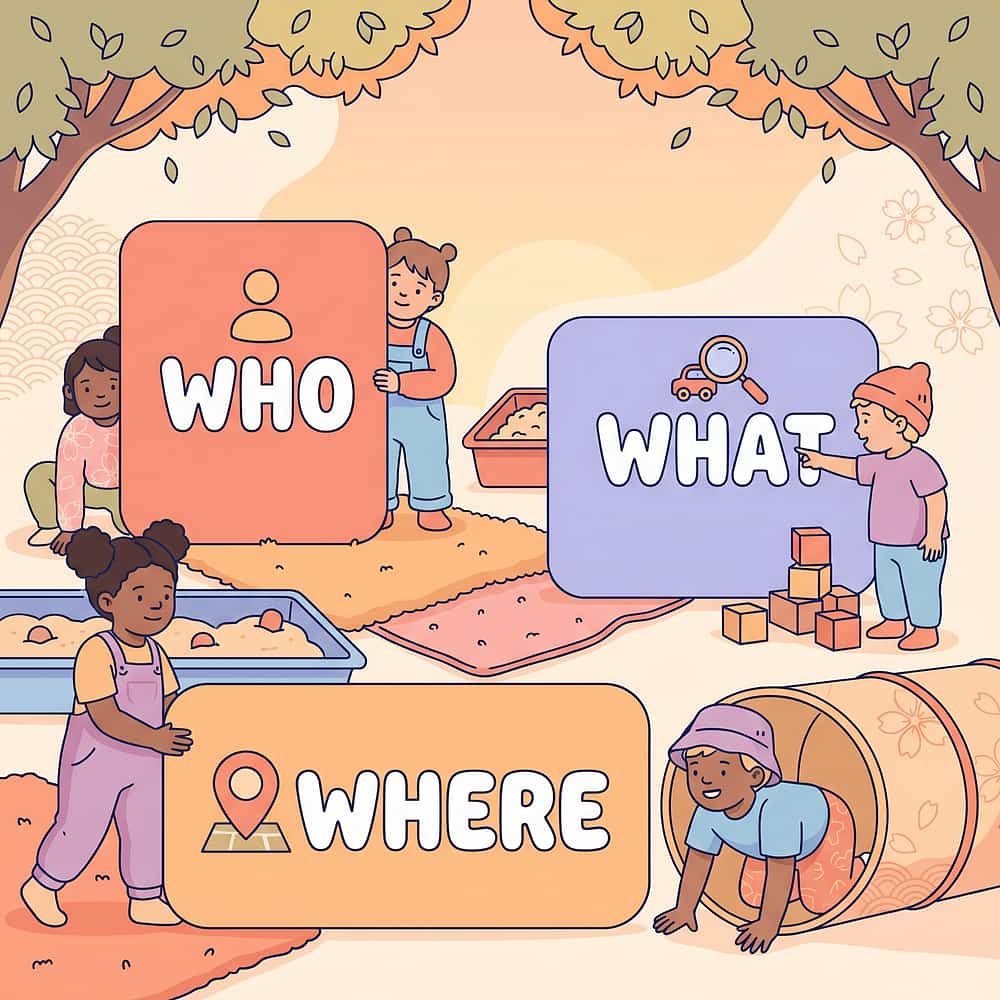
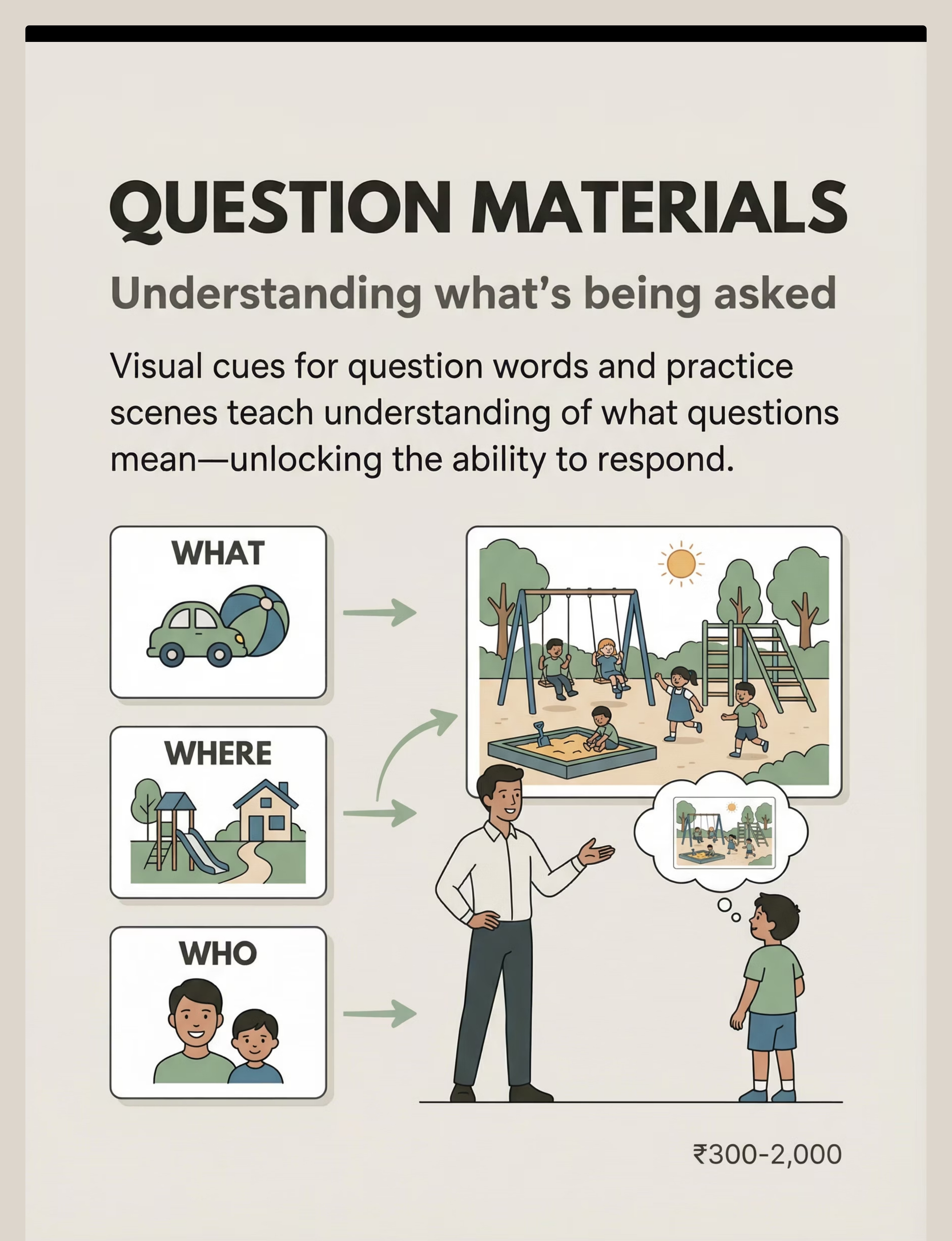
Material 7 — Question Materials
Canon: Question Materials
Visual cues for question words (WHO/WHAT/WHERE) and practice scenes teach understanding of what questions mean — unlocking the ability to respond.
Visual cues for question words (WHO/WHAT/WHERE) and practice scenes teach understanding of what questions mean — unlocking the ability to respond.

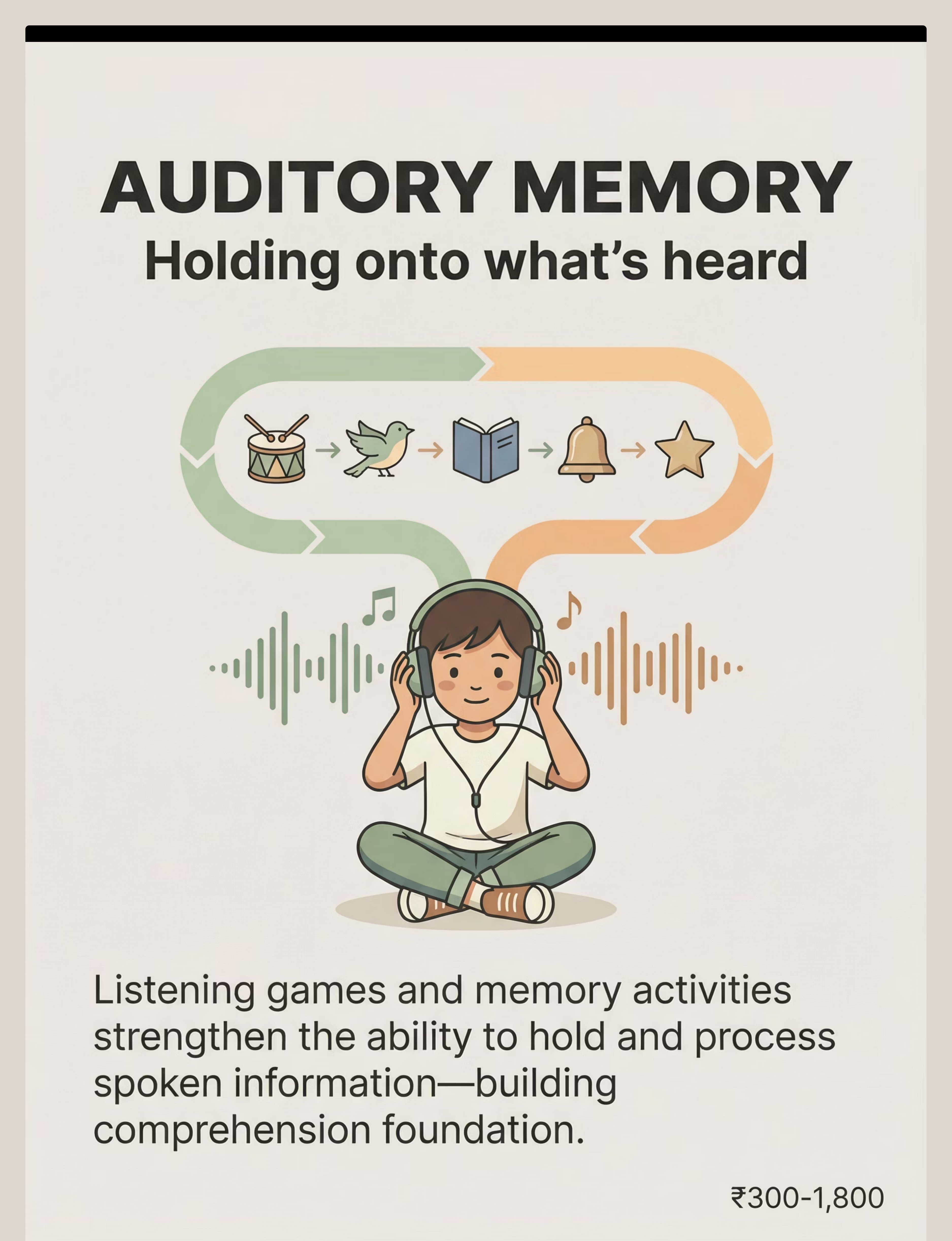
Material 8 — Auditory Memory Materials
Canon: Auditory Memory Materials
Listening games and memory activities strengthen the ability to hold and process spoken information — building the working memory foundation that comprehension requires.
Listening games and memory activities strengthen the ability to hold and process spoken information — building the working memory foundation that comprehension requires.
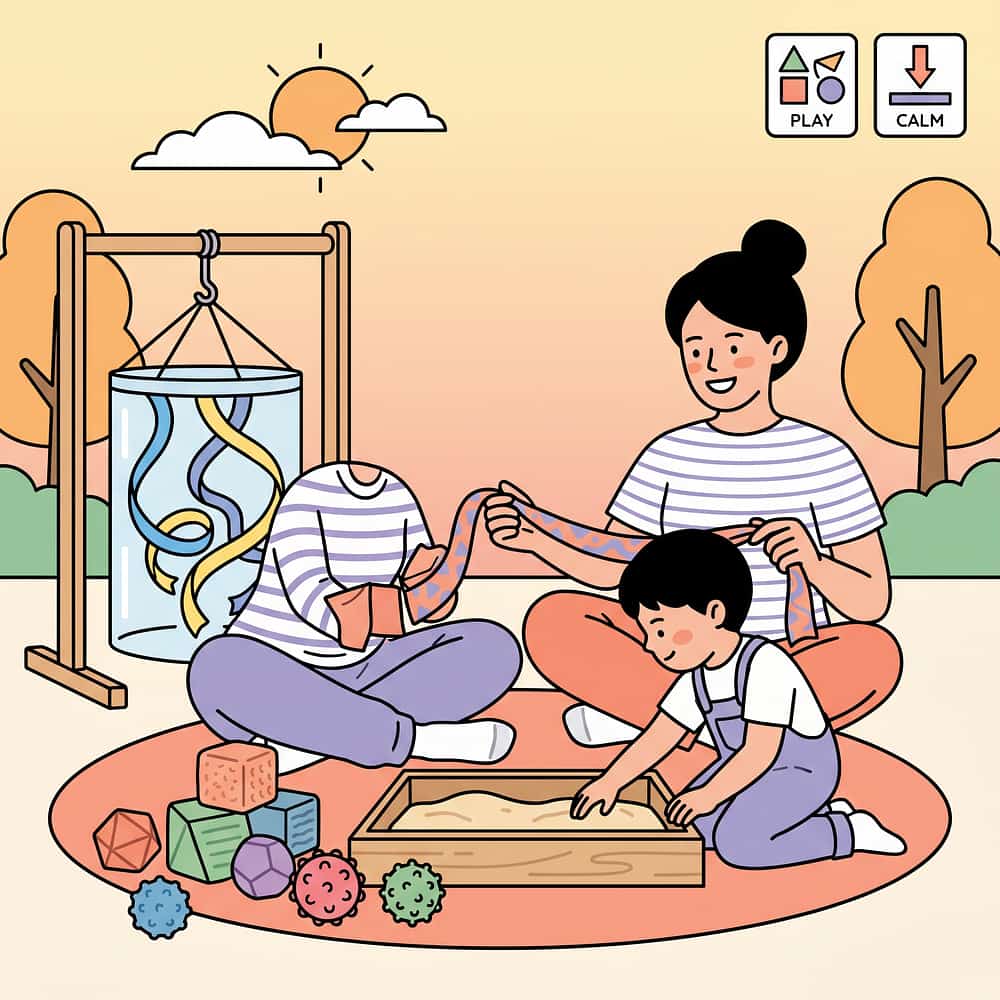
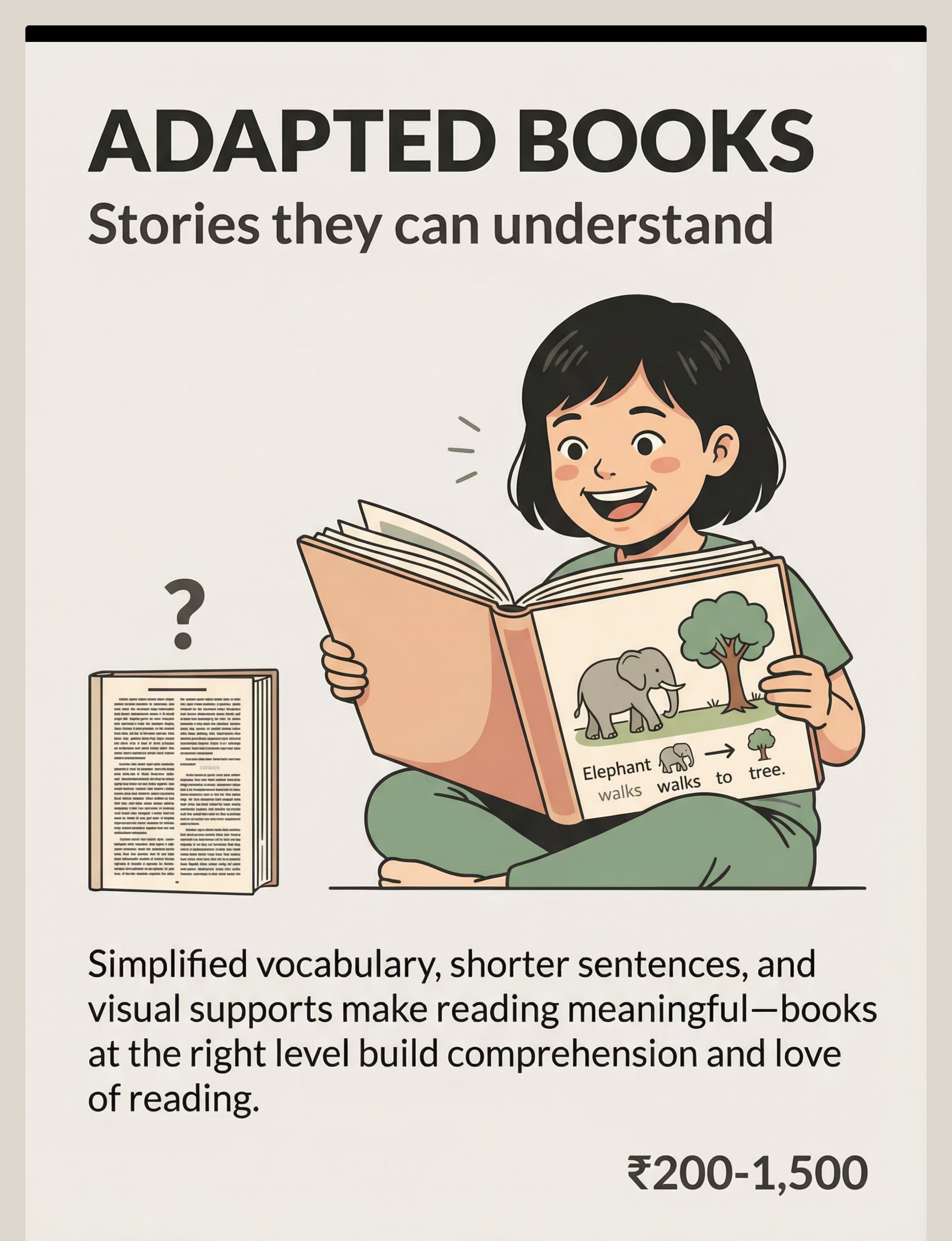
Material 9 — Adapted Books
Canon: Adapted Books
Simplified vocabulary, shorter sentences, and visual supports make reading meaningful. Books at the right level build comprehension and love of language simultaneously.
Simplified vocabulary, shorter sentences, and visual supports make reading meaningful. Books at the right level build comprehension and love of language simultaneously.
📞 Confused about which materials to start with? 9100 181 181 — FREE guidance in 16 languages
Complete Set
₹2,500–16,300 (commercial)
Budget Version
₹1,000–4,000
DIY / Zero-Cost
₹0 — see next card
Every Child Deserves These Interventions. Regardless of Budget.
This card exists because the WHO Nurturing Care Framework (2018) establishes that evidence-based early intervention must be equity-accessible. Every material below has a zero-cost household equivalent that preserves the core therapeutic mechanism — the science works the same way.
Buy This | Make This Instead | Why It Works | |
Picture communication cards (₹200–2,000) | Printed photos from phone / drawn cards | Same visual processing activation | |
Vocabulary flashcards (₹300–2,500) | Old magazines — cut out images, glue to card | Same semantic category training | |
Miniature toys (₹300–2,500) | Real household objects collected in a bag | Real objects > miniatures for tactile input | |
Concept material set (₹300–2,000) | Empty boxes, cups, balls from home | Identical spatial concept teaching | |
Felt board story kit (₹400–3,000) | Cardboard + cloth scraps + safety pins | Same narrative interaction structure | |
Adapted book (₹200–1,500) | Take existing book, add sticky note picture labels | Visual support principle preserved | |
Directions game cards (₹400–2,500) | Handwritten instruction cards + toy set | Same following-directions practice | |
Auditory memory game (₹300–1,800) | Clapping sequences, household sound hunt | Same working memory building | |
Question word cards (₹300–2,000) | Written/drawn on index cards | Same question comprehension cueing |
Non-negotiable note: Clinical-grade materials are recommended when: (1) child is tactile-defensive to rough DIY materials, (2) therapist has prescribed a specific item for precise therapeutic input, (3) child is older and finds DIY materials "babyish."
Read This Before Your First Session. Every Time.
🔴 RED — Do NOT Proceed If
- Child has unmanaged ear infection, audiological condition, or head injury
- Child is mid-meltdown or showing signs of acute distress
- Child has NOT been assessed by a licensed SLP
- Any material presents a choking hazard for children under 3 years
- Child shows severe allergic reaction to any material texture
🟡 AMBER — Modify Before Proceeding If
- Child is overtired, hungry, or post-illness
- Child has sensory aversions to certain materials (consult OT first)
- Session environment is noisy or overstimulating
- Child recently had a difficult day at school — shorten to 5 minutes maximum
🟢 GREEN — Proceed When
- Child is fed, rested, and in a calm-alert state
- Environment is quiet and distraction-free
- Materials are age-appropriate, intact, and sanitized
- You have 15–20 uninterrupted minutes
- Your own emotional state is regulated (co-regulation is real)
STOP immediately if you see: Signs of acute distress (hitting, biting, self-injury escalation) | Child becomes non-responsive or dissociated | Any allergic reaction to materials | Session exceeds tolerance without natural pause
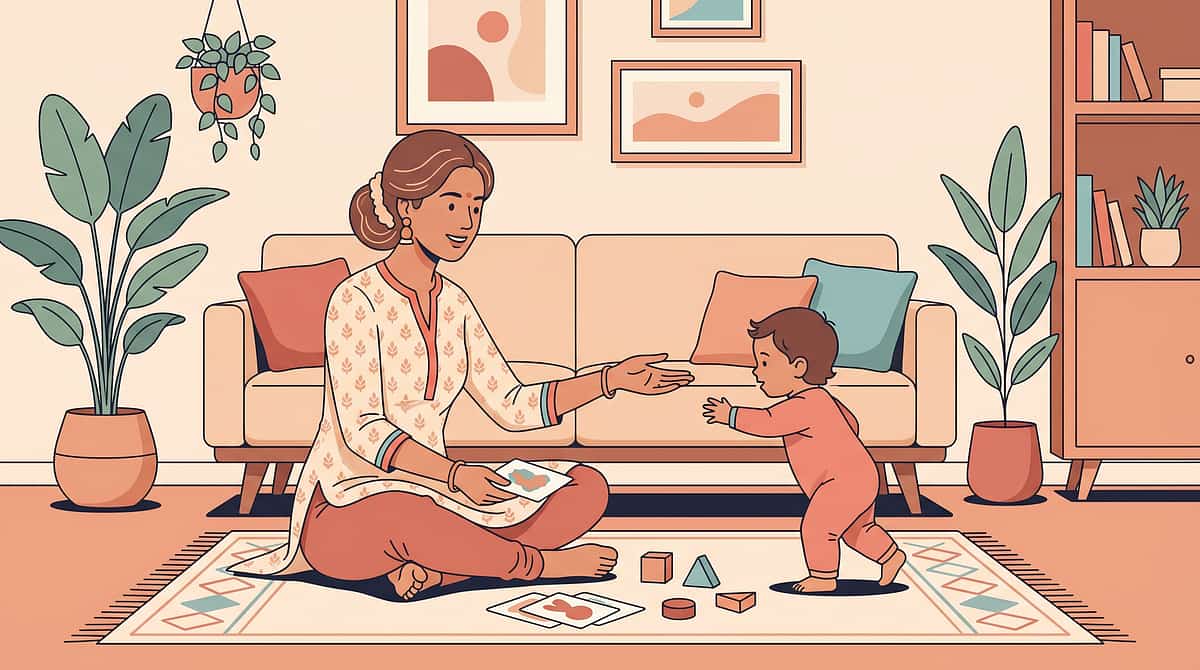
The Right Space Makes This 3× More Effective.
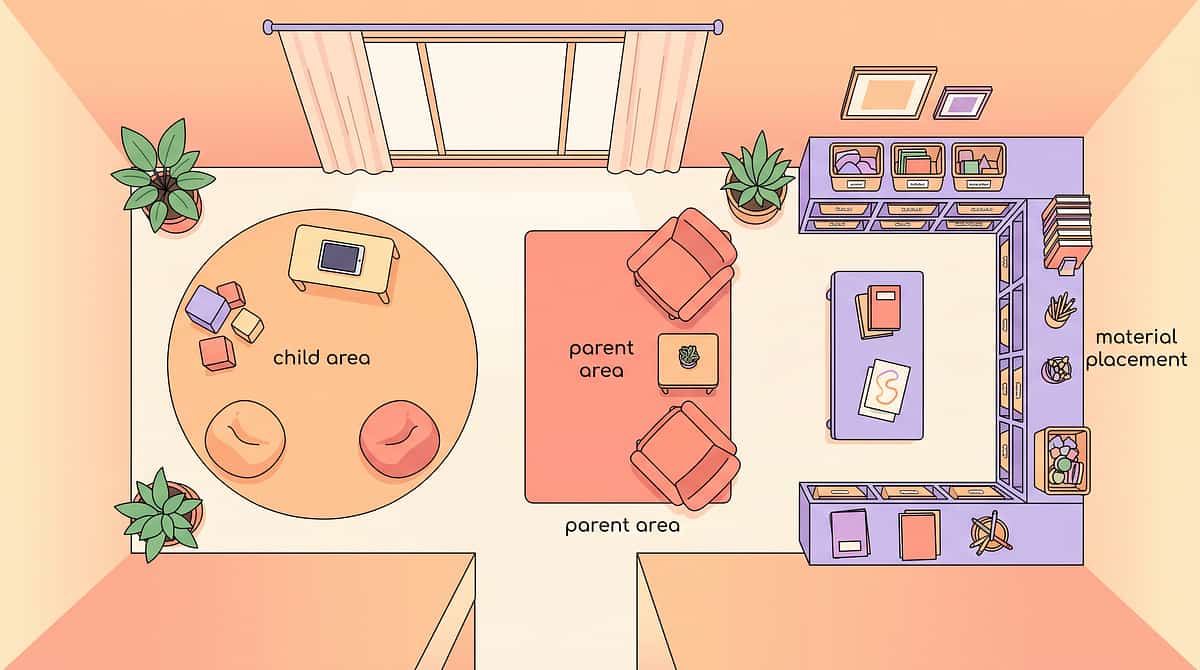
Environmental setup is not a nicety — it is a clinical variable. Research confirms that a structured 1:1 environment produces maximum receptive language intervention outcomes. Spend 5 minutes setting up your space before every session. (Meta-analysis PMC10955541)
Room Setup Positions
Child Position
Small chair or floor mat, facing parent directly
Parent Position
At child's eye level, 60–90 cm away
Materials Table
To parent's right — child can reach from seated position
Reinforcement Items
Behind parent, fully out of child's view
Remove
TV, screens, distracting toys, pets from the room
Setup Checklist
- Quiet room — TV off, phones silenced, siblings elsewhere
- Natural or warm lighting — avoid fluorescent flicker
- Child at eye level with parent
- Materials arranged left to right in session sequence
- Reinforcers ready but not visible
- Visual schedule on wall showing session structure
- Visual timer visible to child
- Session data sheet and pencil within reach
Temperature: 23–26°C | Background noise below 45dB | No competing language (no TV speech)
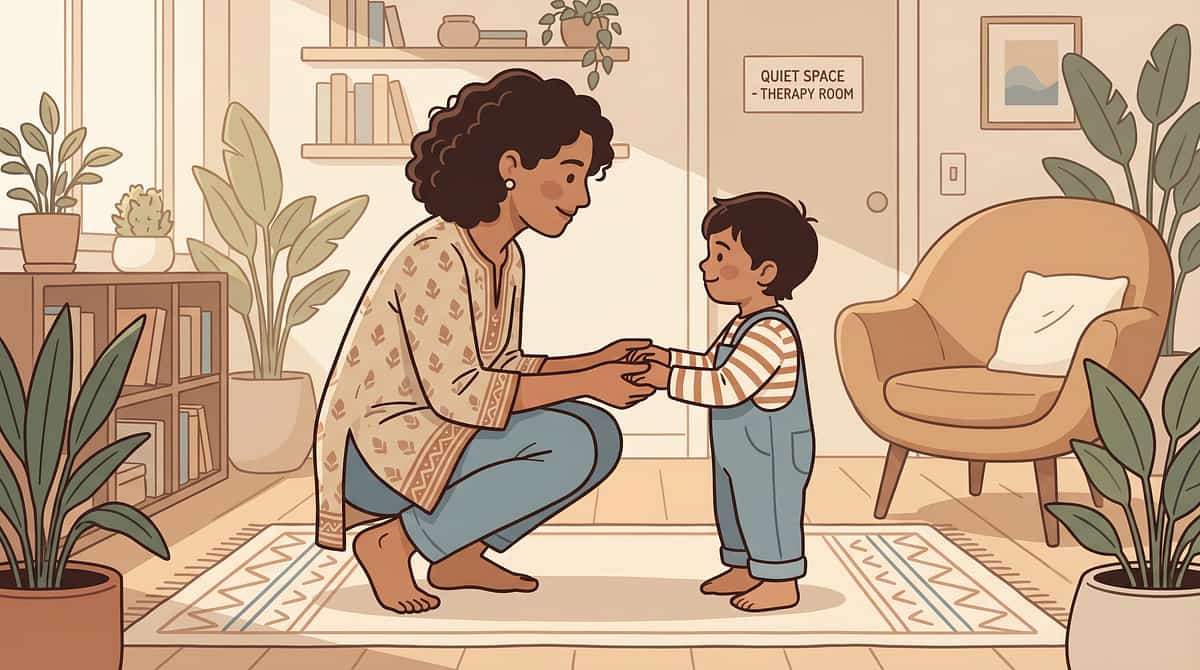
60 Seconds. 7 Checks. Go or Pause?
This readiness check takes one minute and determines whether your session will be productive or counterproductive. A child who is not ready to learn will not benefit — and a difficult session can make the next one harder. Always check before you begin.
Check | ✅ Green | 🟡 Amber | 🔴 Red | |
Fed within last 2 hours? | Full meal | Light snack | Hungry | |
Rested? | Slept well | Slightly tired | Overtired | |
Physical comfort? | All good | Minor discomfort | Sick/pain | |
Emotional state? | Calm-alert | Slightly dysregulated | Meltdown/crying | |
Last difficult event? | 2+ hours ago | 30–60 min ago | Within 30 min | |
Sensory state? | Regulated | Mildly seeking | Overloaded | |
Environment ready? | ✅ Done | Partial | Not ready |
6–7 Green ✅
GO — Proceed to Step 1: The Invitation
4–5 Green, 1–2 Amber
MODIFY — Shorten to 5–8 minutes, reduce material complexity
3 or More Red 🔴
POSTPONE — Do a regulation activity instead, retry later
"The best session is one that starts right." — Pinnacle Blooms ABA Consortium
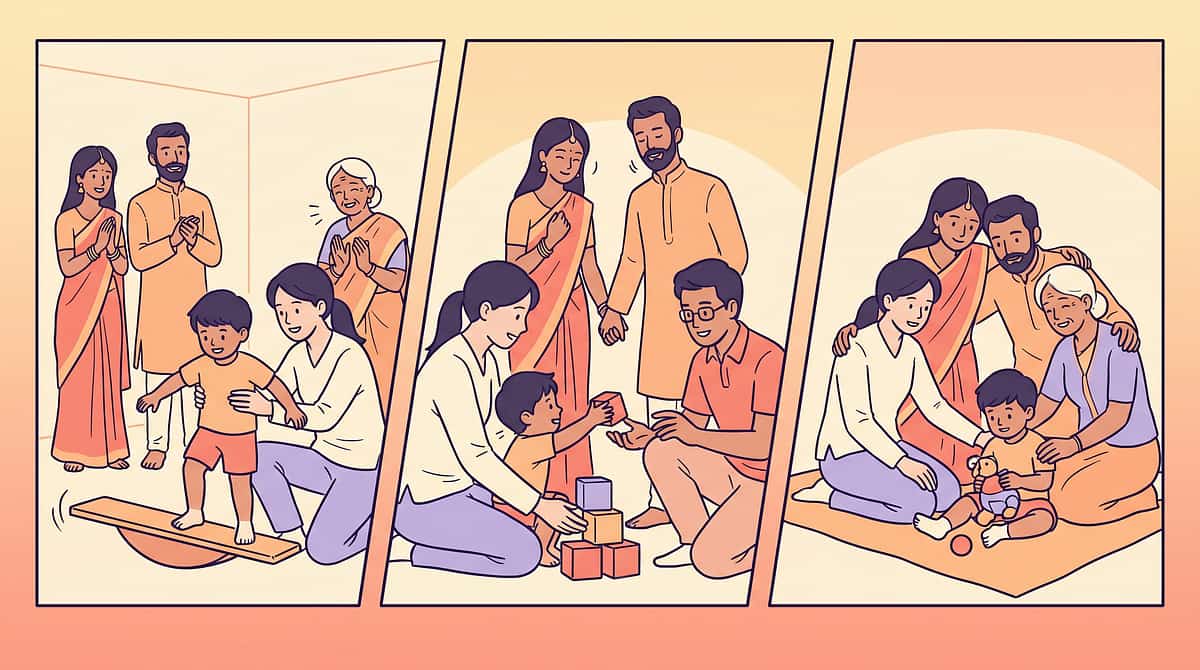
Step 1. Invite. Don't Instruct.
⏱ Timing: 30–60 seconds
ABA Pairing Phase
The Script
"Hey [child's name], want to play the picture game with me? Look what I have…"
[Slowly reveal first material with curiosity, not command]
Body Language
- Get to child's eye level before speaking
- Slow, warm voice — not louder than normal
- Hold material in your hands, not thrust toward child
- Face open, no crossed arms, slight forward lean
- Pause after invitation — wait 5–10 seconds for response
Acceptance Cues — Child Is Ready
- Makes eye contact with material
- Moves toward you or material
- Vocalizes (even non-verbally)
- Smiles or shows body calm
Resistance Cues — Modify Approach
- Turns body away
- Pushes material away
- Increases self-stimulatory behavior
- No acknowledgment after 15 seconds
If resistance: Don't repeat the instruction. Reduce demand further ("just look for a second"), use a preferred item as bridge, or postpone 10 minutes.
ABA Principle — Pairing: Establish yourself and the materials as positive before placing any demand. Step 1 IS the pairing phase.
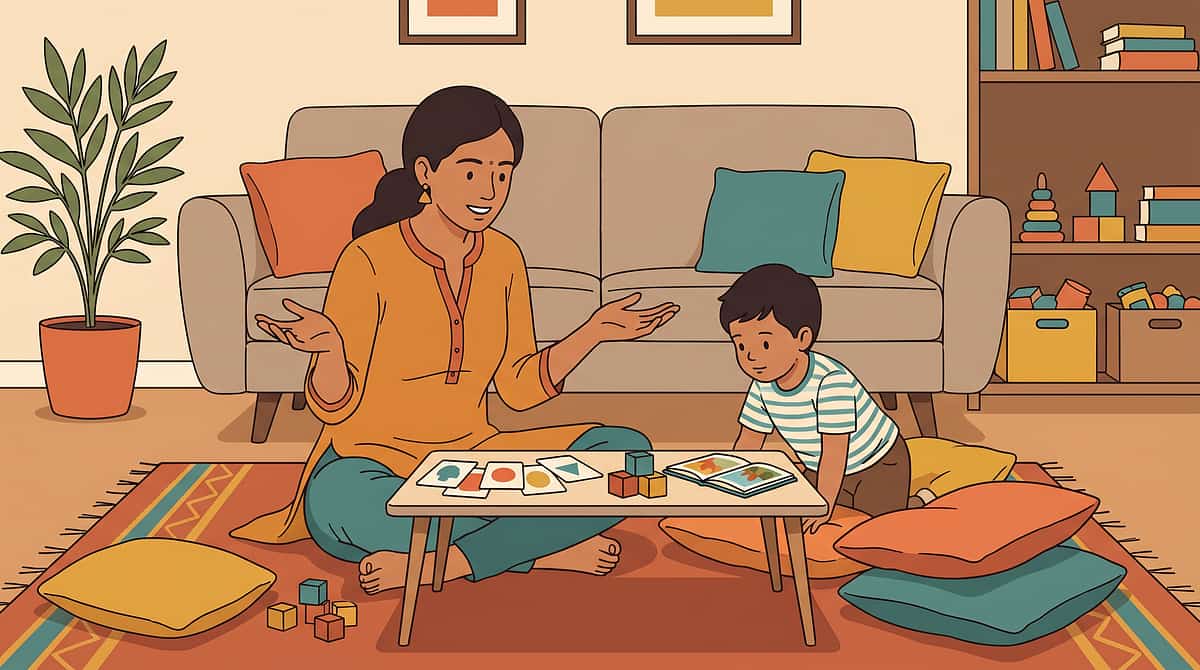
Step 2. Introduce the Material. Watch What Happens.
⏱ Timing: 1–3 minutes
Material introduction is a precise clinical act. The speed, distance, angle, and simultaneous word-pairing all influence whether the child's brain receives the multi-modal input needed to begin building the word-meaning connection.
Material Introduction Sequence
Hold up first item
e.g., real apple OR apple picture card
Say the target word ONCE
Clearly: "Apple." — not a question, a clear label
Pause 3–5 seconds
Let the child process — silence is therapeutic here
If no response
Point to item, say word again. If still no response: physically help child touch item while saying word
Any engagement → immediate warm praise
"You touched the apple! Great looking!"
Presentation Technique
- Speed: Slow deliberate placement — not quick flash
- Distance: Within reach — 30–45 cm from child
- Angle: Face of card/object facing child directly
- Pairing: Always say the word AT THE SAME MOMENT as visual/tactile contact
Child Response Spectrum
Response | Meaning | What to Do | |
Reaches for object | Strong engagement | Proceed with target | |
Eyes move to object | Partial engagement | Maintain, build | |
No response | Processing time | Wait 5 sec, then prompt | |
Pushes away | Aversion | Change material, reduce demand |
Step 3. This Is Where Understanding Gets Built.
⏱ Timing: 5–10 minutes — Core of Session
Choose your primary protocol based on the target skills identified in Card 9. All three protocols share one core mechanism: the same message is delivered through multiple sensory pathways simultaneously, increasing the probability that at least one pathway completes the circuit from sound to meaning.
🖼️ Protocol A — Visual Supports (Vocabulary Building)
- Show picture card, say target word: "Dog"
- Child looks/touches → reinforce immediately
- Add real object: place toy dog next to card, say "Dog" again
- Hide card. Ask: "Where's the dog?" — wait 5 seconds
- Child points/touches correct item → specific praise: "You found the dog!"
- Record: word identified ✅ or prompted 🔸
🧸 Protocol B — Real Objects (Concrete Word Anchoring)
- Place 2 objects in front of child (e.g., cup and ball)
- Say: "Give me the cup" — no pointing, auditory-only first
- Wait 5 seconds. If no response → add pointing gesture
- Child gives correct item → reinforce: "You gave me the cup! Yes!"
- Rotate objects, randomize, repeat 3 times each
- Record accuracy per trial
📦 Protocol C — Concept Materials (Relational Language)
- Place box and small ball on table
- Say: "Put the ball IN the box" — gesture as needed
- Child completes → reinforce + narrate: "In! The ball is in the box!"
- Try "ON top" next — then "UNDER"
- 3 preposition concepts per session maximum
- Record: concept responded to correctly ✅ or with prompt 🔸
Common Execution Errors:❌ Saying target word more than twice without tactile help ❌ Moving too fast between targets (give 5 seconds per presentation) ❌ Mixing comprehension with expression demands ❌ Inconsistent word use — always use the exact same label
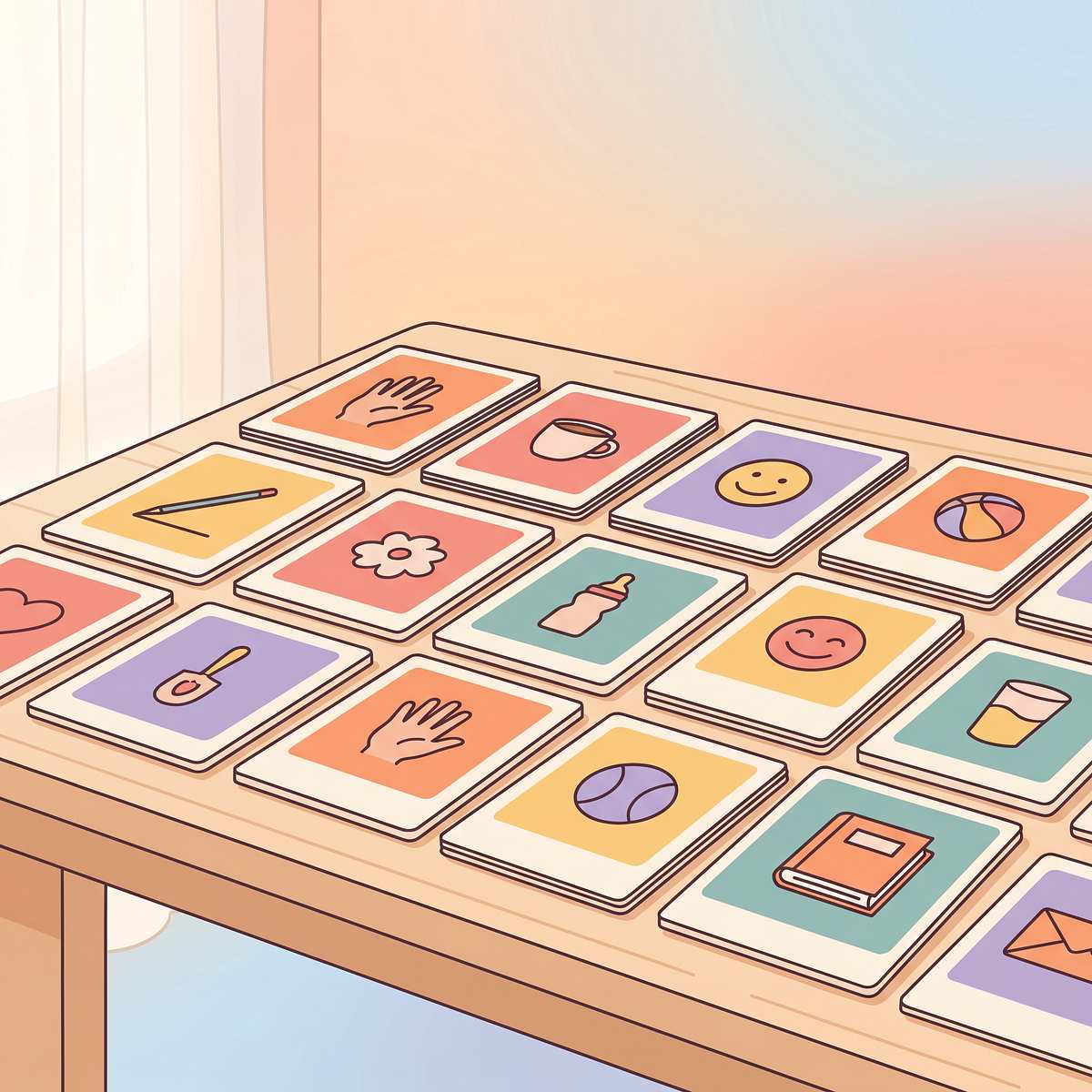
Step 4. Repeat the Right Way. Vary the Right Amount.
⏱ Timing: 3–5 minutes
Therapeutic Repetition Targets
- Per target word per session: 5–8 trials (not more — avoid satiation)
- Across 2–3 target words: 15–20 total trials in a 10-minute session
"3 good reps > 10 forced reps"
Satiation Indicators — Stop This Target
- Child stops looking at materials
- Increased escape behaviors (body turning, pushing)
- Response accuracy drops after being correct (cognitive fatigue)
- Yawning, reduced body alertness
Novelty reset: If child saturates, introduce a new target word for 2 trials, then return.
Variation Menu — Keep Engagement Without Losing the Target
Vary the presentation:
Card → real object → picture in book → miniature toy
All different representations, same word target
Card → real object → picture in book → miniature toy
All different representations, same word target
Vary the demand level:
"Point to the dog" → "Give me the dog" → "Where did the dog go?" (hide + locate)
"Point to the dog" → "Give me the dog" → "Where did the dog go?" (hide + locate)
Vary the context:
Table play → embedded in snack routine → bathroom routine
Generalization across contexts is the ultimate receptive goal
Table play → embedded in snack routine → bathroom routine
Generalization across contexts is the ultimate receptive goal

Step 5. The Timing Matters More Than the Reward.
⏱ Within 3 seconds of correct response — every time
The brain needs to connect "I correctly identified the shoe" with "something good happened" — and this connection degrades rapidly after just 3 seconds. Reinforcement is not optional. It is the mechanism by which the neural pathway becomes durable.
Reinforcement Scripts
✅ "You FOUND the shoe! Yes! That's the shoe!" (specific + enthusiastic)
✅ "Amazing — you gave me the apple! You understood apple!" (names the achievement)
❌ "Good job" — too generic, doesn't reinforce the specific language act
❌ Delayed praise 10 seconds later — connection window missed
Reinforcement Menu
Type | Example | When to Use | |
Verbal praise | "Yes! That's the dog!" | Always — every correct response | |
Physical celebration | High five, hug, tickle | Socially motivated child | |
Token economy | Star on chart | Building toward larger reward | |
Preferred item access | 30 sec with favorite toy | High-demand tasks | |
Natural reinforcement | Use the named object | Generalizes the word naturally |
"Celebrate the attempt, not just the success." — Pinnacle Blooms ABA Consortium
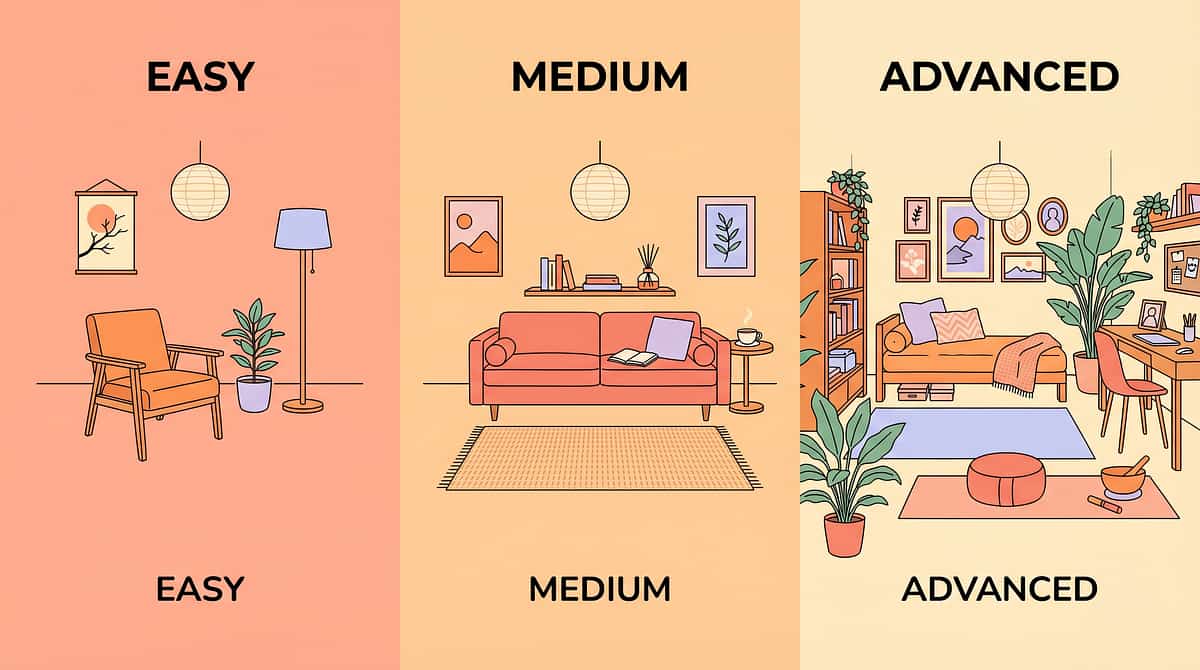
Step 6. No Session Ends Abruptly. Ever.
⏱ Timing: 2–3 minutes
Abrupt endings after therapeutic intensity frequently trigger post-session dysregulation. The cool-down is a neurological deceleration — not optional, not a nicety. It also embeds language naturally into the session closure itself. (NCAEP 2020: Visual supports for transition are evidence-based practice for autism)
Transition Warning
2 minutes before ending: "Two more, then we're all done." Give the brain time to prepare for the shift.
Visual Timer Cue
Show timer at 2 minutes. Let child see the countdown — visual predictability reduces transition distress.
Final 2 Easy Trials
Keep them mastered items — guaranteed wins that close the session on success, not struggle.
Celebration Close
"We did it! Great work today with [target words]." Name the accomplishment specifically.
Material Put-Away Ritual
Child helps put cards/objects into box ("in the box — good listening!") — embeds language in closure.
Transition to Next Activity
"Now we're going to [snack/outside/screen time]." Use visual schedule to show what's next.
📞 Transitions still difficult? 9100 181 181 — Pinnacle SLP can consult on transition strategies FREE

60 Seconds of Data Now Saves Hours of Guessing Later.
Session data is what transforms home therapy from "something I try" into "something that works." Your SLP uses this data to adjust target complexity. GPT-OS® uses it to detect plateau patterns. And collectively, data from 21 million sessions powers recommendations for children worldwide.
📋 Field 1 — Target Words
Checkboxes: 10 most common B-152 target words practiced today
📊 Field 2 — Response Level
Per word: correct independently / with gesture prompt / with physical prompt / no response
⭐ Field 3 — Session Quality
1–5 stars overall + free text notes on observations
What this data does: Your SLP reviews it at next session → adjusts target word complexity | GPT-OS® detects plateau patterns → triggers clinical review alert | Aggregate data across 70+ centers → improves recommendations for all children. Source: BACB Guidelines + Cooper, Heron & Heward, Applied Behavior Analysis 8th ed.

Most Sessions Don't Go Perfectly. That's Not Failure — That's Data.
Every difficult session teaches you something precise about your child's current state, threshold, and needs. The seven problems below cover the most common challenges parents encounter — and each has a clinically grounded solution.
Child not responding to any target words
Why: Targets may be above current receptive level. Fix: Drop to single-word body-part identification ("touch nose") — the child's most consistent comprehension level. Rebuild from there.
Child responds correctly in session but not in real life
Why: Generalization hasn't occurred yet — therapy room ≠ kitchen. Fix: Embed same target words in 3 different natural routines (bath, meal, dressing) — same word, different context, every day.
Child loses interest after 3–4 minutes
Why: Session too long, material not motivating, or cognitive demand too high. Fix: Shorten to 5 minutes. Use highest-preference objects as targets. Alternate 1 demand trial with 1 free play minute.
Child seems to understand sometimes but not others
Why: Inconsistency is a diagnostic feature, not evidence of "can but won't." Fix: Document patterns — is inconsistency linked to time of day, noise level, or emotional state? Share data with SLP.
Child gets frustrated and melts down mid-session
Why: Demand exceeds current threshold. Fix: Stop all language demands immediately. Go to regulation strategy. Do NOT attempt to "finish" the session. Tomorrow: reduce complexity by 50%.
Parent feels overwhelmed and inconsistent
Why: Normal — you are the therapist AND the parent simultaneously. Fix: 3 excellent sessions per week beats 7 mediocre ones. Aim for quality over quantity.
No progress after 4 weeks
Why: Targets may be too hard, frequency insufficient, or there's a co-occurring factor not addressed. Fix: Book SLP teleconsultation → 9100 181 181
Emergency guidance: If child becomes severely distressed (self-injury, inconsolable): stop session entirely. Provide comfort and regulation support. Contact Pinnacle at 9100 181 181 if distress is atypical or escalating.
📞 FREE guidance on session troubleshooting: 9100 181 181

No Two Children Are Identical. Here's How to Adjust.
The standard B-152 protocol is calibrated for the developing receptive language learner. But every child brings a unique sensory profile, attention window, and learning style. Use these adaptations to personalize the protocol for your child — without losing its clinical integrity.
⬇ EASIER — Emerging Skills
- 1 target word per session
- Real object only (no picture cards yet)
- Full physical prompt acceptable as starting point
- 3-second window extended to 10 seconds
- Success: any orientation to correct item
➡ STANDARD — Developing Skills
- 2–3 target words per session
- Picture card + real object pairing
- Gestural prompt as primary support
- 5-second response window
- Success: independent correct pointing/giving
⬆ HARDER — Consolidating Skills
- 4–5 target words per session
- Picture card only (no real object)
- Verbal prompt only (no gesture)
- 2-second response window
- Success: independent + generalized to new contexts
Profile-Based Variations
- Language seeker: Use books and stories as primary vehicle — quality of engagement over trial count
- Language avoider: Embed targets in physical play — "Throw the red block" (receptive language inside preferred activity)
- Strong visual learner: Maximize picture cards, label objects throughout home
- Tactile dominant: Real objects over pictures — textured objects, sorting by touch with word labeling
Age Modifications
- Under 2 years: Object permanence + single body parts only
- 2–4 years: Full B-152 protocol as described
- 4–6 years: Add category + preposition + question comprehension
- 6–8 years: Narrative comprehension + multi-step directions

In Weeks 1–2, You May See Tolerance — Not Mastery. That IS Progress.
██░░░░░░░░ 15% — Foundation Building
Week 1–2 is the hardest. Progress is invisible to the untrained eye. Your job during this phase is consistency, not perfection. The receptive language system is calibrating — trust the process and document what you observe.
✅ Observable Progress
- Child tolerates sitting for 5–7 minutes (was 2–3)
- Child orients to materials when presented
- 1–2 words show recognition with gestural prompt
- Reduced escape behaviors at session start
- Child begins to anticipate session materials
⏳ Not Yet Progress
- Independent identification without any prompt
- Spontaneous use of target words in conversation
- Generalization to different rooms or people
These come later — and they will come.
"If your child sits 3 minutes longer than last week — that's real progress. The receptive language system is calibrating. Patience now creates mastery later." (Systematic review PMC11506176: Early-phase receptive intervention outcomes focus on tolerance and participation before skill mastery)
Weeks 3–4: The Neural Pathways Are Forming.
████░░░░░░ 40% — Consolidation Phase
Something is happening in your child's brain — even when you can't see it in behavior yet. By weeks 3–4, most children begin to show external signs that the word-meaning connections established in the first two weeks are becoming more reliable.
Consolidation Indicators
- ✅ Child identifies 3–5 words consistently with gesture prompt
- ✅ Child identifies 1–2 words independently (no prompt)
- ✅ Reduced processing latency — response faster than week 1
- ✅ Child looks at correct item when word is said
- ✅ Child shows anticipation cues before you complete the word
Spontaneous Generalization Seeds — Watch for These
- Child spontaneously points to something when you say its name in daily life
- Child follows 1-step command in a new room (kitchen, not just therapy space)
- Child responds to name + instruction simultaneously
When to increase intensity: If child shows 80%+ accuracy on 3+ target words across 3 consecutive sessions → add 2 new words, advance to gestural-prompt reduction.
"You may notice you're more confident too. Your ability to read your child's comprehension cues has been developing alongside theirs."

Weeks 5–8: This Is Where It Gets Real.
██████░░░░ 65% — Breakthrough Zone
This is the phase parents describe as transformational. The incremental gains of weeks 1–4 begin to compound. Words that required gesture support now arrive without it. Comprehension that was locked to the therapy table begins to appear in the kitchen, the car, the classroom.
✅ Breakthrough Indicators
- 8–12 words identified independently
- 2-step commands followed in natural settings
- Category understanding emerging ("show me all the animals")
- Responds to name + instruction across 3+ environments
- Other caregivers independently reporting comprehension improvements
🎯 The Generalization Milestone
When comprehension occurs in a new place with a new person without prior practice — the intervention has embedded into the child's receptive language architecture. This is the ultimate goal.
➡ What to Do Now
- Maintain current targets (over-learn to automaticity)
- Begin introducing Tier 2 targets from Card 9
- Schedule SLP review to update therapy goals
- Consider advancing to B-153 if gesture dependence persists
Celebrate Every Milestone. They Are Hard-Won Neuroscience.
Positive emotional tagging of progress events activates dopaminergic reward pathways — strengthening the parent's motivation AND, when the child participates in celebration, the child's associative learning. Celebration is not indulgence. It is clinical strategy.
🏅 First Word Identified Independently
Take a video. Save the date. This is the moment the bridge first carried weight.
🏅 First 2-Step Command Followed
Family celebration ritual — this is a Tier 2 milestone achieved.
🏅 First Generalization to New Person
Share with your SLP immediately — this is clinically significant data.
🏅 First School Report of Improvement
This is population-level impact. Your home sessions reached the classroom.
Family Ritual Ideas: Create a "Wall of Words" — add each mastered word on a sticky note | Document a weekly "best moment" video (10 seconds) | Share to the Pinnacle Parent Community
These Signs Mean It's Time to Call. Today, Not Tomorrow.
Progress monitoring is inseparable from safety. The following thresholds are not causes for alarm — they are clear signals that professional input will unlock what home practice cannot. Knowing when to call is a sign of clinical literacy, not failure.
🔴 Immediate Evaluation Required
- No receptive language improvement after 8 weeks of consistent home intervention
- New regression — words previously understood are no longer recognized
- Child appears to not hear (audiological evaluation urgently required)
- Any signs of neurological change (seizure activity, behavioral regression)
🟡 SLP Review Recommended
- Progress plateaued at week 4 with no advancement
- Child improving in session but no generalization to daily life after 6 weeks
- Other caregivers reporting no comprehension at school despite home progress
- Parent unable to implement protocol consistently (need adapted approach)
🟢 Expected Trajectory — These Are Normal
- Slow progress in weeks 1–2
- Variable day-to-day performance
- Some targets harder than others
- Needing 3+ weeks to master a single complex word
📞9100 181 181 — FREE National Autism Helpline | SLP consultation within 24 hours | 16 languages | 9 AM – 9 PM daily
B-152 Is One Step on a Mapped Journey. Here's the Full Staircase.
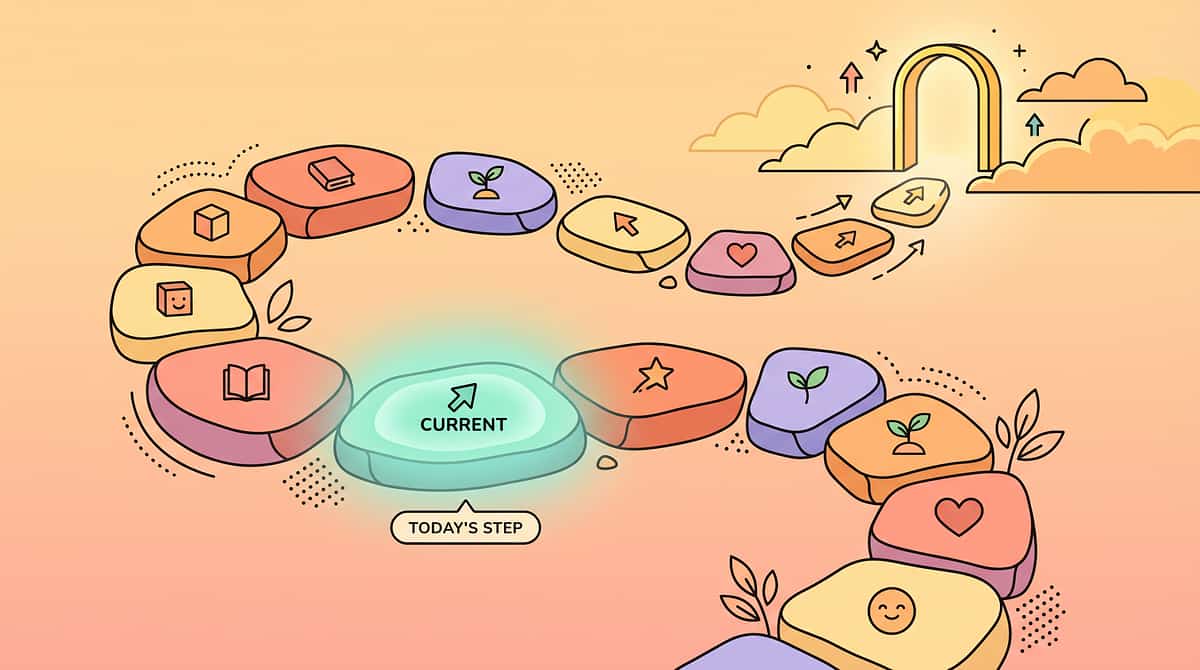
B-152 is the foundational receptive language technique — the entry point. It establishes the basic word-meaning bridge that all subsequent receptive techniques depend on. Your child's unique progression through the B-series is calculated by GPT-OS® based on AbilityScore® assessment.
Technique | Focus | When to Advance | |
B-151 | Understanding Single Words in Context | Prerequisite to B-152 | |
B-152 ★ | Multi-Modal Receptive Language Input (current) | 15+ words independent, 2-step at 80% | |
B-153 | When Child Needs Gestures to Understand | After B-152 mastery | |
B-157 | Literal Understanding | After gesture independence | |
B-160 | Preposition Understanding | Concept material mastery | |
B-163 | Story Sequence Understanding | B-152 full mastery required |
4 Techniques That Work Best Alongside B-152
Receptive language development is not a straight line through a single technique. These four adjacent protocols address overlapping and sequential skill areas — each one extending or complementing what B-152 builds.
B-153 — When Child Needs Gestures to Understand
Bridges pure auditory comprehension to gesture-supported comprehension. Natural next step after B-152 word-meaning anchoring is established. → Explore B-153
B-157 — Literal Understanding
When child interprets language too literally. Overlaps with receptive and pragmatic language domains — addresses the next layer of comprehension complexity. → Explore B-157
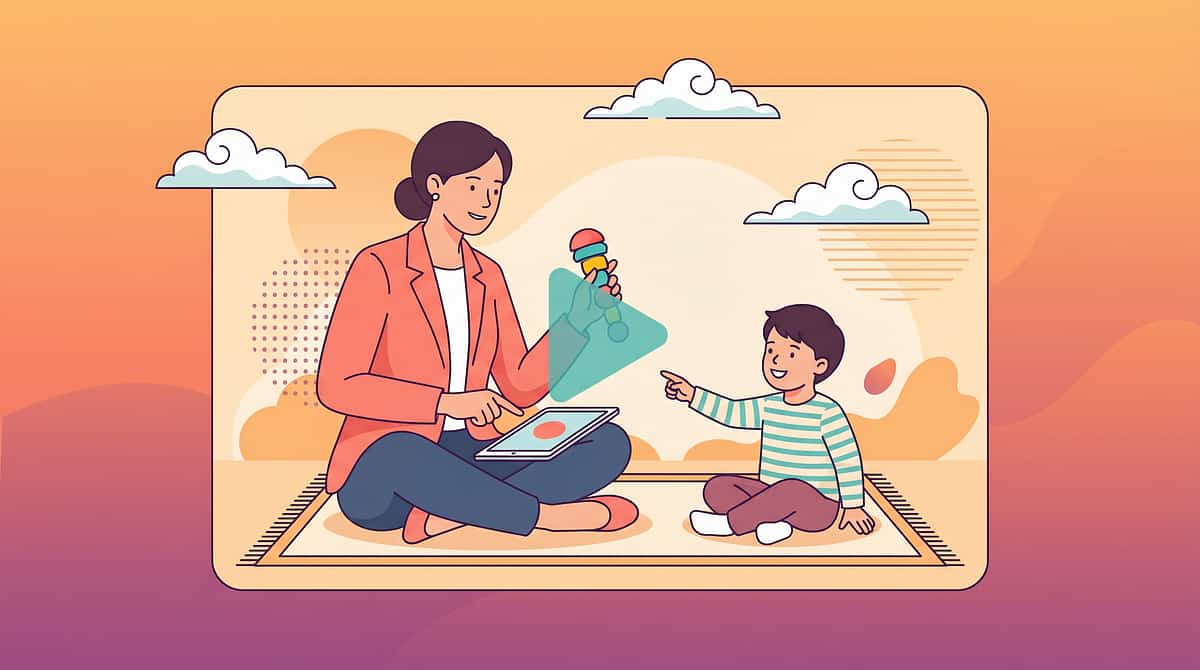
B-160 — Preposition Understanding
Specifically targets spatial language — "in, on, under, behind." Direct extension of B-152 concept materials into systematic preposition mastery. → Explore B-160
B-163 — Story Sequence Understanding
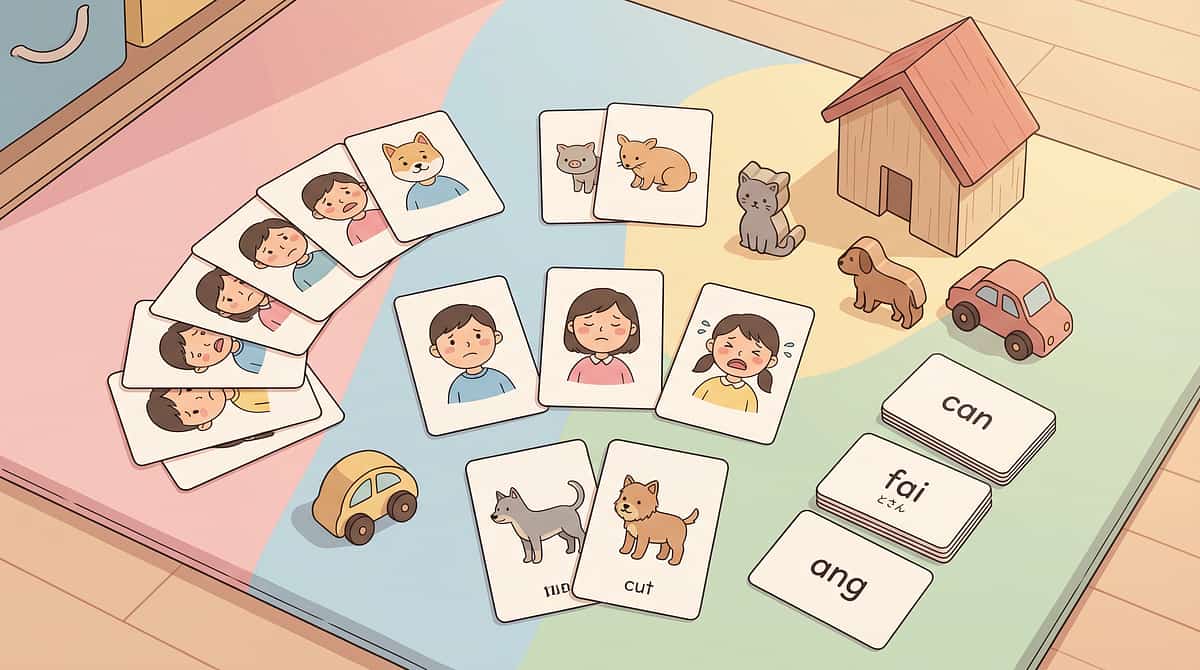
Higher-order receptive skill — narrative comprehension and sequence recall. B-152 mastery is a clinical prerequisite for this advanced technique. → Explore B-163
25 Receptive Language Techniques. Mapped. Sequenced. Waiting.
B-152 is your current location in a comprehensive, sequenced library of 25 Receptive Language techniques spanning B-151 to B-175 — part of the broader Domain B Language & Communication library of 250 techniques. Every technique is clinically sequenced, evidence-grounded, and home-applicable.
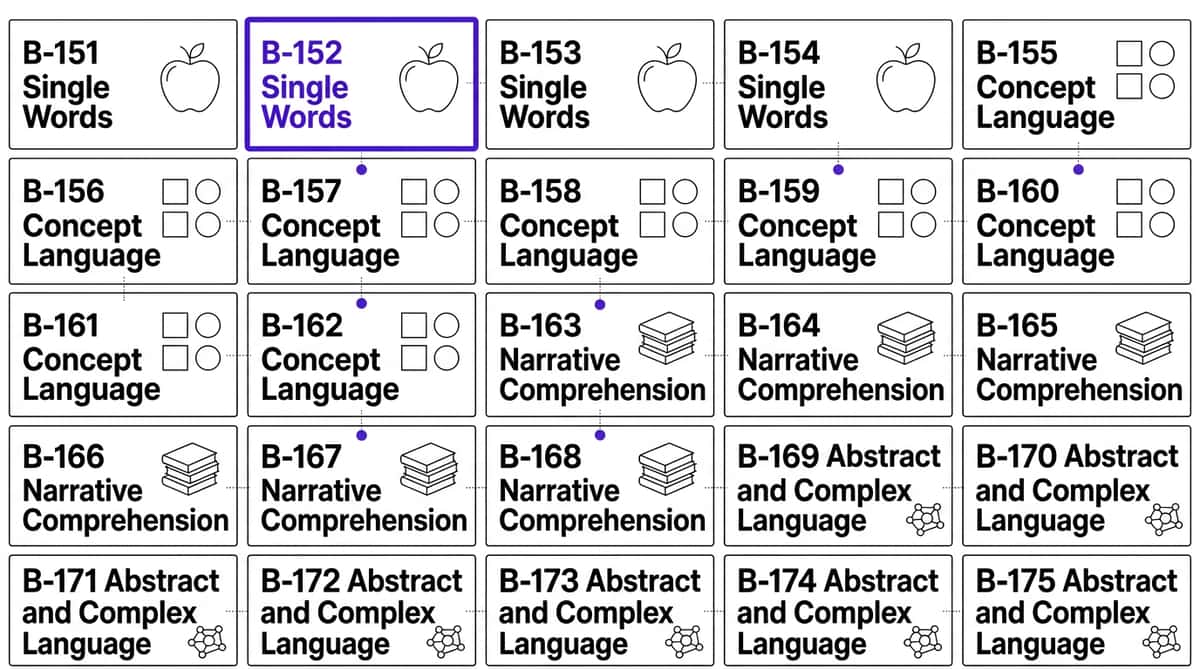
Expressive Language
B-1 to B-100
Social Communication
B-101 to B-150
Receptive Language
B-151 to B-175 ← You Are Here
Pragmatics
B-176 to B-200
AAC & Assistive Communication
B-201 to B-250
Real Families. Real Progress. Measured by Real Data.
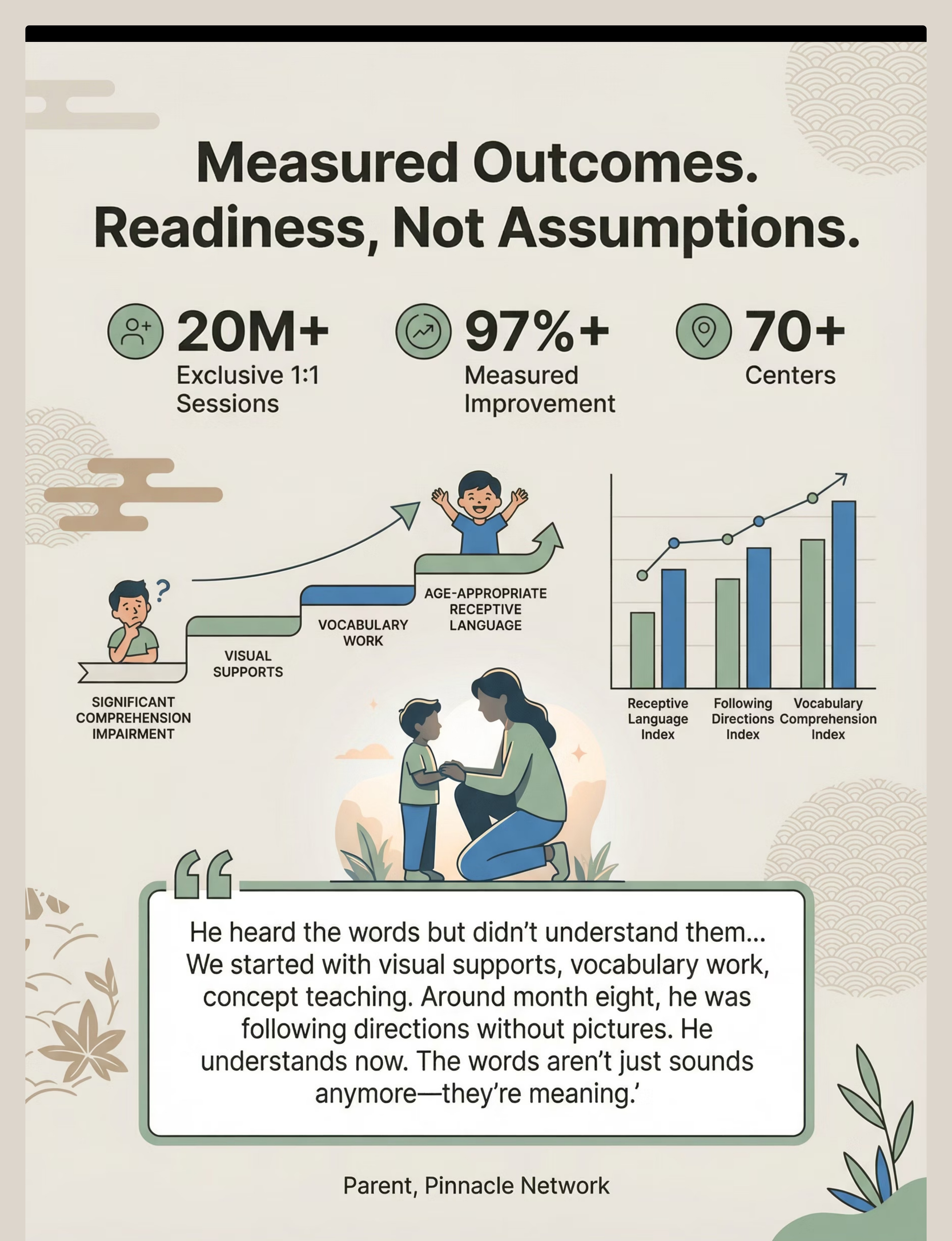
"He heard the words but didn't understand them... We started with visual supports, vocabulary work, concept teaching. Around month eight, he was following directions without pictures. He understands now. The words aren't just sounds anymore — they're meaning."
— Parent, Pinnacle Network | B-152 Protocol, Receptive Language Index +2.3 levels
"I used to think he was ignoring me. Turns out he genuinely couldn't decode what I was saying. Three months of B-152 at home plus SLP sessions — he now follows 3-step instructions. His teacher called me last week to ask what we changed."
— Parent, Hyderabad Center | B-152 + B-153 combined protocol, 14 weeks
+1.8
Average Developmental Levels Gained
Receptive Language Index improvement in 12 weeks (Pinnacle 2024 outcomes, n=847)
97%+
Families Report Measurable Improvement
Across Pinnacle therapeutic programs — 20M+ sessions, 70+ centers
Individual results vary. Testimonials reflect real parent experiences. Outcomes depend on consistency, starting profile, and co-occurring conditions.
21 Million Sessions. One Community. You Belong Here.
You are not navigating this alone. The Pinnacle Parent Network connects thousands of families implementing B-series receptive language techniques across India and 70+ countries. Share progress, troubleshoot challenges, and celebrate milestones together.
📱 Pinnacle Parent WhatsApp Community
Connect with thousands of families implementing B-series receptive language techniques. Real support from parents who understand exactly what you're going through.
🏢 Find Your Nearest Pinnacle Center
70+ centers across India. In-person AbilityScore® assessment, SLP-led sessions, GPT-OS® individualization. Find Center Near You →
📞 Free National Autism Helpline
9100 181 181 | 16 languages | Staffed by trained SLP-support counselors | 9 AM – 9 PM daily
🌍 Global Scale, Personal Care
70+ countries | 16 languages | 21 million sessions — powered by collective intelligence, delivered with individual attention

When Home Therapy Needs Expert Eyes Behind It.
Home therapy and professional support are not alternatives — they are partners. The three service tiers below create a complete therapeutic ecosystem, with your home sessions at the center and expert clinical support surrounding them.
🖥️ Tier 1 — Teleconsultation
SLP review of your B-152 session data. 30-minute video session. ₹0 first consultation via helpline.
Your SLP reviews your data sheet, watches a session clip if available, and adjusts your target word list and prompt hierarchy.
🏢 Tier 2 — In-Center Assessment
Comprehensive AbilityScore® Receptive Language assessment. SLP designs individualized B-152 + adjacent technique sequence. Available at all 70+ Pinnacle centers.
🤖 Tier 3 — GPT-OS® Guided Home Program
Full AI-assisted home therapy program. Session planning, data analysis, auto-progression, weekly SLP review. Integrated across all Pinnacle devices.

The Science Behind Every Card on This Page. Click to Read.
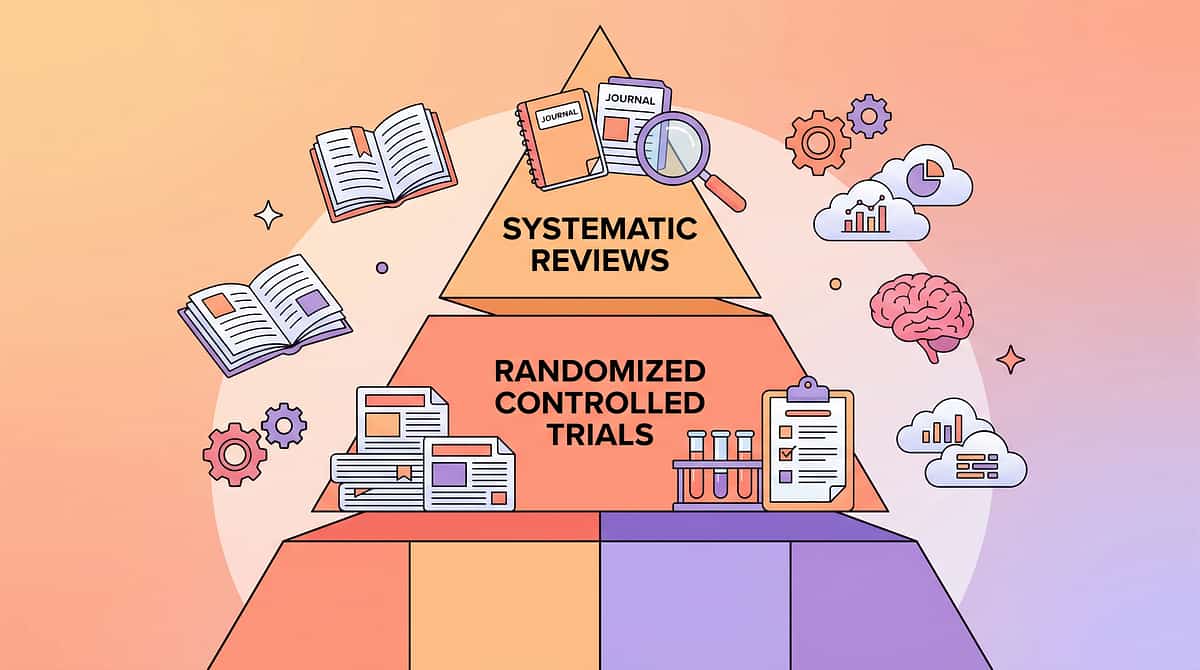
This page is grounded in the highest available levels of clinical evidence — systematic reviews, meta-analyses, randomized controlled trials, and WHO-level frameworks. The evidence pyramid below shows where each citation sits.
Level I — PRISMA Systematic Review (2024)
16 studies confirm sensory-integrated language intervention is evidence-based for ASD children. PMC11506176
Level I — Meta-Analysis (2024)
Multi-sensory vocabulary intervention: d=0.72 effect for receptive vocabulary gains. PMC10955541
Level II — Indian RCT (2019)
Home-based structured language material interventions in Indian ASD population. DOI: 10.1007/s12098-018-2747-4
WHO — Nurturing Care Framework (2018)
Equity-focused, multi-sensory early language intervention across 54 LMICs. nurturing-care.org/ncf-for-ecd
NCAEP (2020)
Visual supports + naturalistic language intervention classified evidence-based for receptive language in autism. NCAEP Report 2020

Your Data Helps Your Child — And Every Child Like Yours.
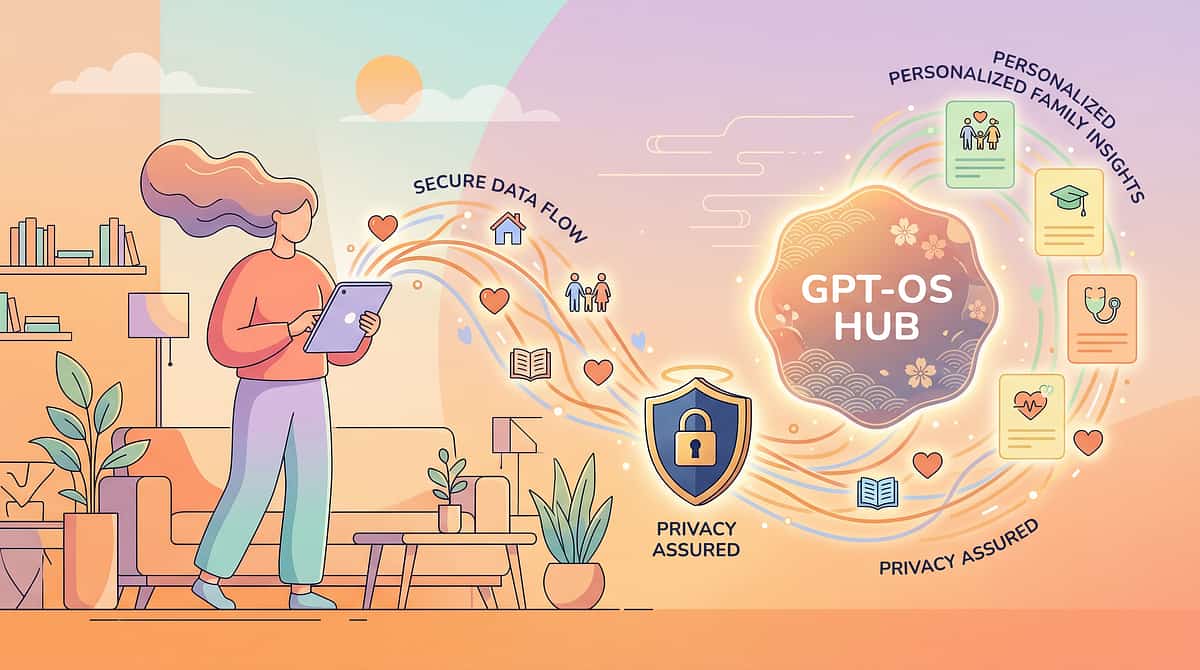
GPT-OS® is the clinical intelligence engine behind every Pinnacle recommendation. It learns from your child's session data to make the home program continuously more precise — and contributes to population-level learning that benefits millions of children globally.
What GPT-OS® Learns from B-152
- Which target words your child masters fastest (lexical learning profile)
- Optimal session length for your child's attention window
- Prompt hierarchy level — whether to advance or maintain
- Generalization rate — when home progress transfers to school
Privacy & Impact
- All data processed under Pinnacle Data Protection Framework (India PDPB 2023 aligned)
- No data shared with third parties
- De-identified aggregate data used for consortium-wide learning only
- Data from 21 million sessions powers GPT-OS® recommendations
GPT-OS® is proprietary technology of Pinnacle Blooms Network® (DPIIT DIPP8651). Protected under international IP framework.

Your Questions. Answered by the Consortium.
These are the most common questions from parents and caregivers implementing B-152 at home. Every answer reflects the collective clinical expertise of the Pinnacle Blooms SLP-OT-ABA-SpEd Consortium.
My child is 4 years old and still doesn't follow basic instructions. Is it too late?
Absolutely not. Neuroplasticity remains highly active through age 7–8, and structured intervention shows measurable outcomes at any age within this window. The B-152 protocol has been implemented successfully with children from 18 months to 8 years. Start now.
How do I know if it's receptive language disorder versus hearing loss?
These require different evaluations. Audiological assessment (ENT or audiologist) rules out hearing loss. Receptive language disorder is assessed by a licensed SLP. A child can pass audiological tests and still have receptive language processing difficulties. Book both assessments if unsure. 9100 181 181
My child sometimes understands and sometimes doesn't. Is the inconsistency normal?
Yes — variable comprehension is a hallmark feature of receptive language processing challenges, not evidence of "can but won't." Fatigue, noise, emotional state, and processing load all affect performance. Track patterns over time (Card 23) — you'll begin to see what conditions optimize your child's comprehension.
We've been doing this for 3 weeks and I see no change. Should I stop?
Not yet. Receptive language rewiring happens in the neuroscience before it appears in observable behavior. Meaningful changes typically emerge in weeks 4–8. Ensure session quality, frequency (3+ per week), and correct target level. If still no change at 6 weeks → call 9100 181 181 for SLP review.
Is this technique different from what the SLP does at the center?
This is the home implementation of the same clinical protocol. Center sessions establish and calibrate the technique. Home sessions provide the dosage volume — 3 sessions per week at home + 1 center session creates more therapeutic input than center-only therapy. The two are designed to work together.
Can this be done in Indian languages other than English?
Yes — and it should be. The vocabulary targets should match the child's home language. All materials should use words in the language the child hears most at home. Pinnacle's helpline operates in 16 languages. 9100 181 181
My child is autistic and non-speaking. Does this technique apply?
Yes — receptive language can be built even before expressive language develops, and this is critical for non-speaking children. Understanding what is being said reduces behavioral challenges that arise from comprehension failure. Use gesture + picture pairing as the primary modality.
How do I know when my child is ready to move to B-153?
When your child identifies 15+ words independently, follows 2-step instructions without gesture at least 80% of the time across 3 consecutive sessions in at least 2 different environments — they are ready to progress. GPT-OS® automates this assessment from your session data.
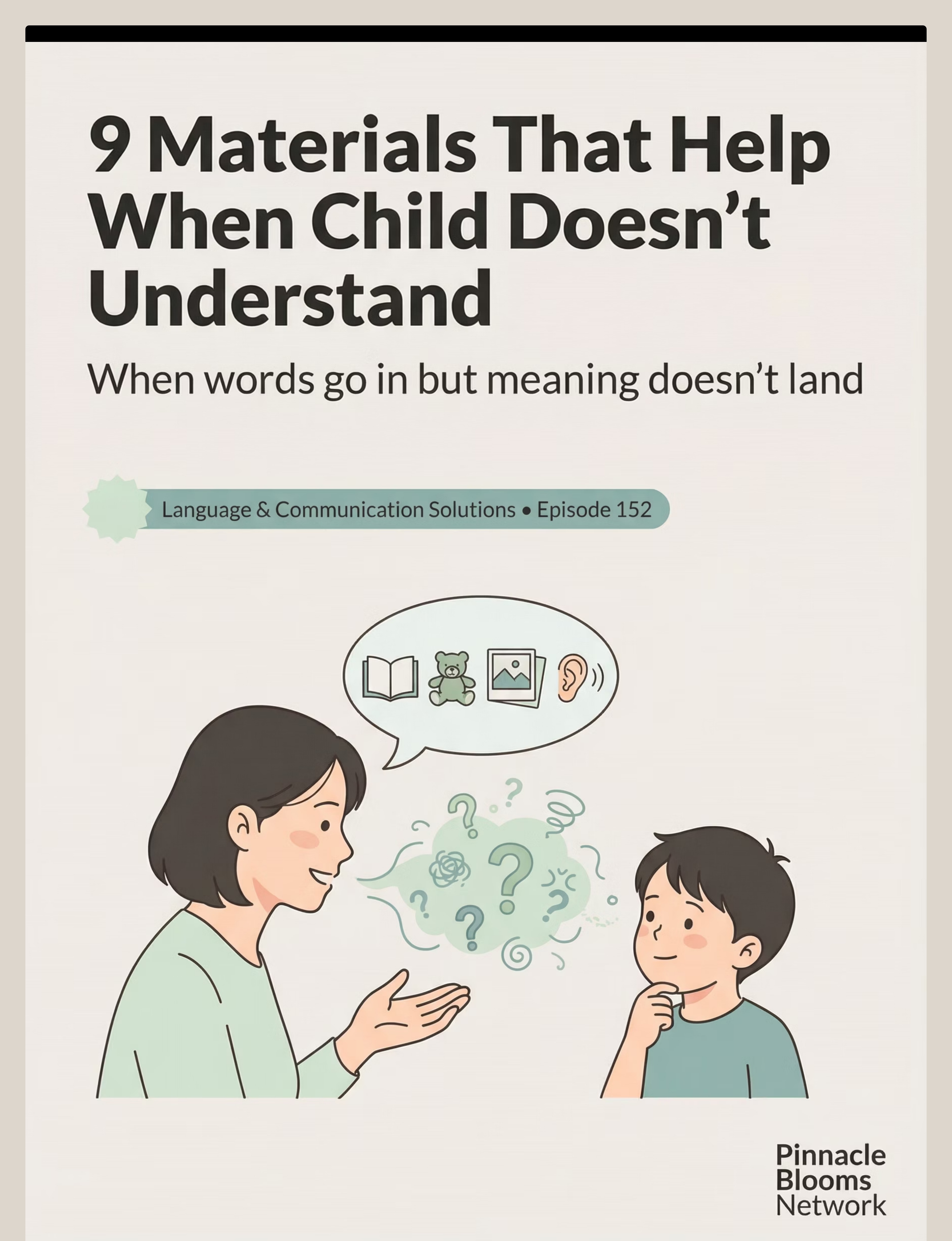
Preview of 9 materials that help when child doesnt understand Therapy Material
Below is a visual preview of 9 materials that help when child doesnt understand therapy material. The pages shown help educators, therapists, and caregivers understand the structure and content of the resource before use. Materials should be used under appropriate professional guidance.


Link copied!

One Parent Knowing This Is Good. Every Caregiver Knowing This Is Transformative.
WHO CCD Package evidence confirms multi-caregiver training is critical for generalization. When grandma, the school teacher, AND both parents all use the same word-presentation technique — progress accelerates by an estimated 2–3×. Share this page today.
📱 WhatsApp
Share this page with family members who care for your child → forward the link and the grandparent guide
📧 Email
Send to school teacher → copy-paste the school communication template requesting classroom consistency support
🔗 Copy Link
techniques.pinnacleblooms.org/language-communication/materials-when-child-doesnt-understand-B-152
"When [child's name] doesn't respond to what you say, it's not stubbornness. Here's the one thing you can do that helps: show them a picture at the same time as saying the word. That's it. That one thing makes a measurable difference." — Message for grandparents
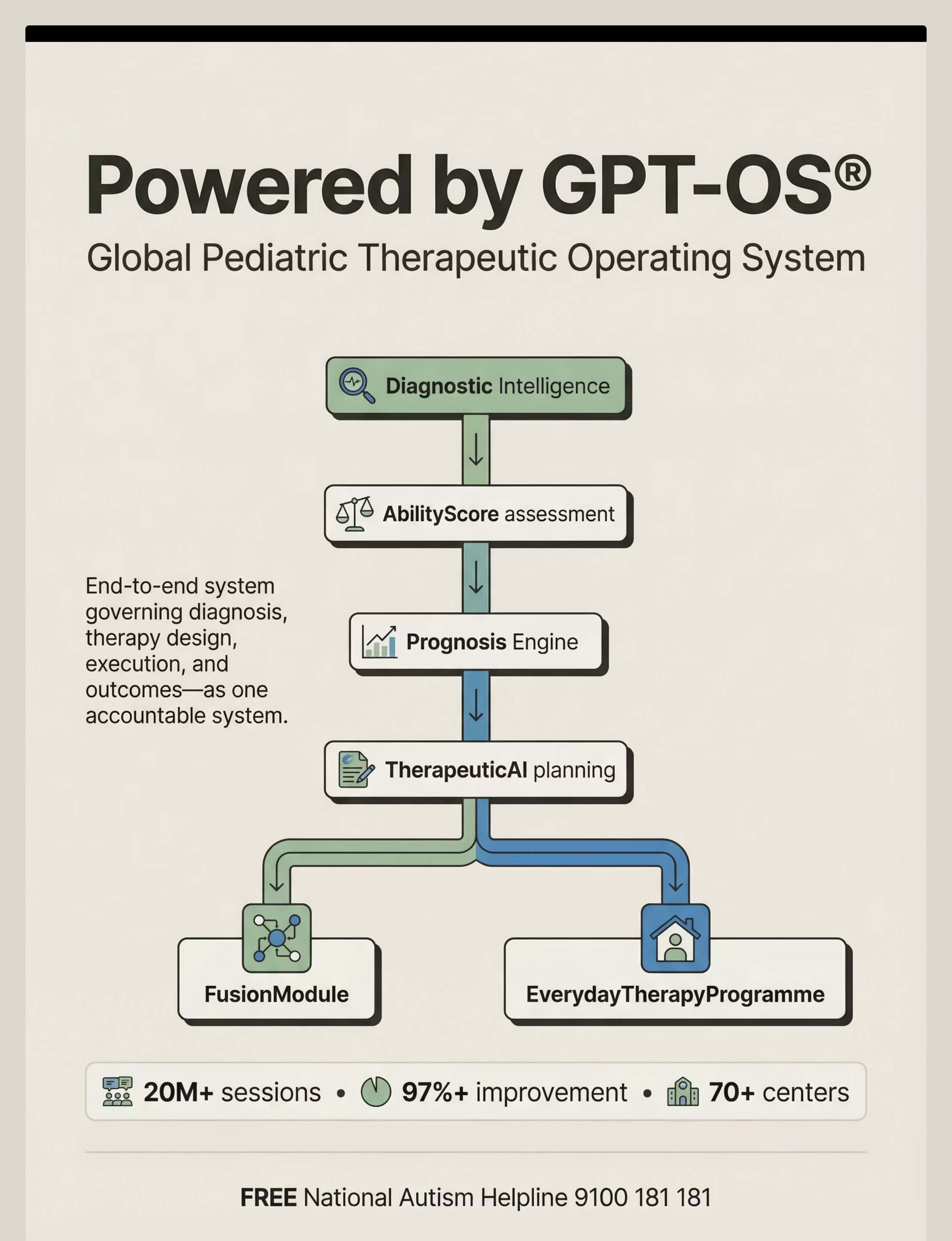
PINNACLE BLOOMS NETWORK® | Global Pediatric Therapeutic Operating System (GPT-OS®) | Built by Mothers. Engineered as a System.
🗣️ SLP | 🖐️ OT | 📊 ABA/BCBA | 📚 SpEd | 🧠 NeuroDev | 👩⚕️ Pediatrics
20M+ Sessions | 97%+ Improvement | 70+ Centers | 70+ Countries
20M+ Sessions | 97%+ Improvement | 70+ Centers | 70+ Countries
Medical Disclaimer: This content is educational. It does not replace assessment by a licensed speech-language pathologist. Significant difficulty understanding language should be comprehensively evaluated. Individual results vary. © 2025 Pinnacle Blooms Network®.
CIN: U74999TG2016PTC113063 | DPIIT: DIPP8651 | MSME Registered | ISO 13485 | GSTIN: [current GSTIN]
contact@pinnacleblooms.org | pinnacleblooms.org | 9100 181 181
contact@pinnacleblooms.org | pinnacleblooms.org | 9100 181 181
→ Continue to B-153: When Child Needs Gestures to Understand