9 Materials That Help When Your Child Needs Gestures to Understand
Supporting Gesture-Dependent Comprehension — Technique B-153 | Pinnacle Blooms Network®
ACT I — Recognition
"He only looks when I point. The moment I stop pointing — he's gone."
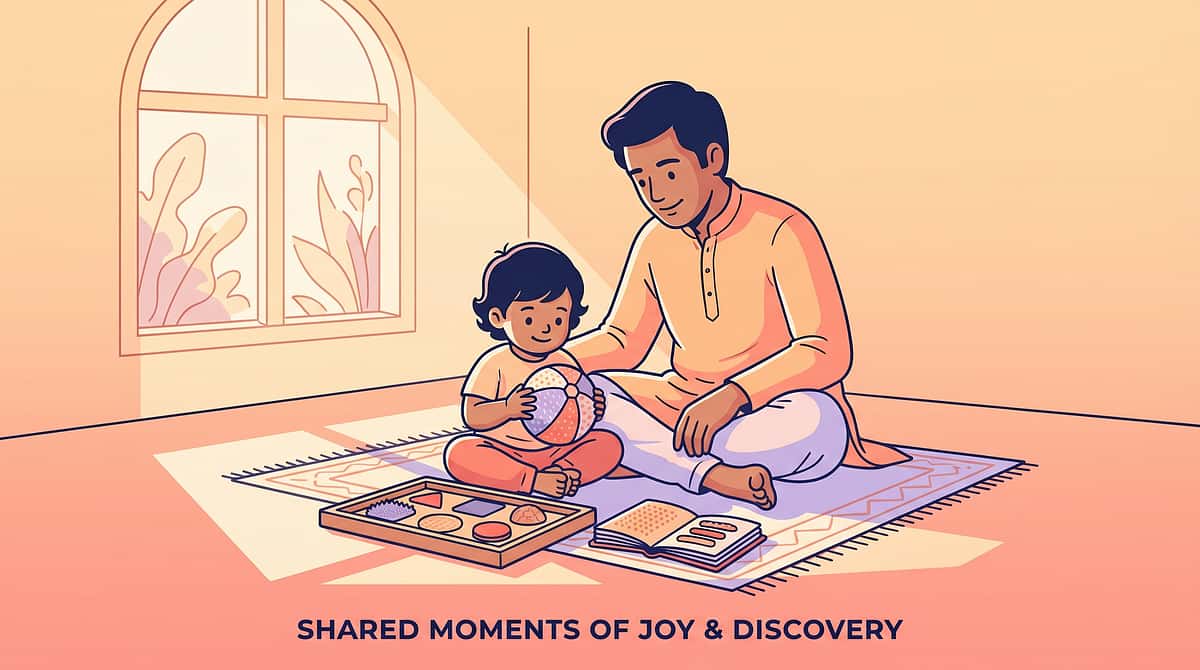
You're at the dinner table. You say, "Pass me the cup" — and he stares at the wall. But the moment your finger stretches toward the cup — his hand reaches for it instantly. His brain is reading movement, not sound. Not broken. Different. And powerfully treatable with the right materials and the right approach.
"You are not failing. Your child's language system is speaking through a different channel — and science knows exactly how to reach it."
📞9100 181 181 — FREE National Autism Helpline | 24×7 | 16+ Languages
🌸 Pinnacle Blooms Network® | Validated by SLP • OT • ABA • SpEd • NeuroDev
ACT I — The Numbers
1 in 36 children worldwide. Millions depend on gestures to decode their world.
1 in 36
ASD Prevalence
Children diagnosed with ASD globally (CDC 2023)
80%
Gesture Differences
of children with ASD show significant differences in gesture comprehension and use
21M+
Therapy Sessions
Across Pinnacle's 70+ centers tracking gesture-based communication outcomes
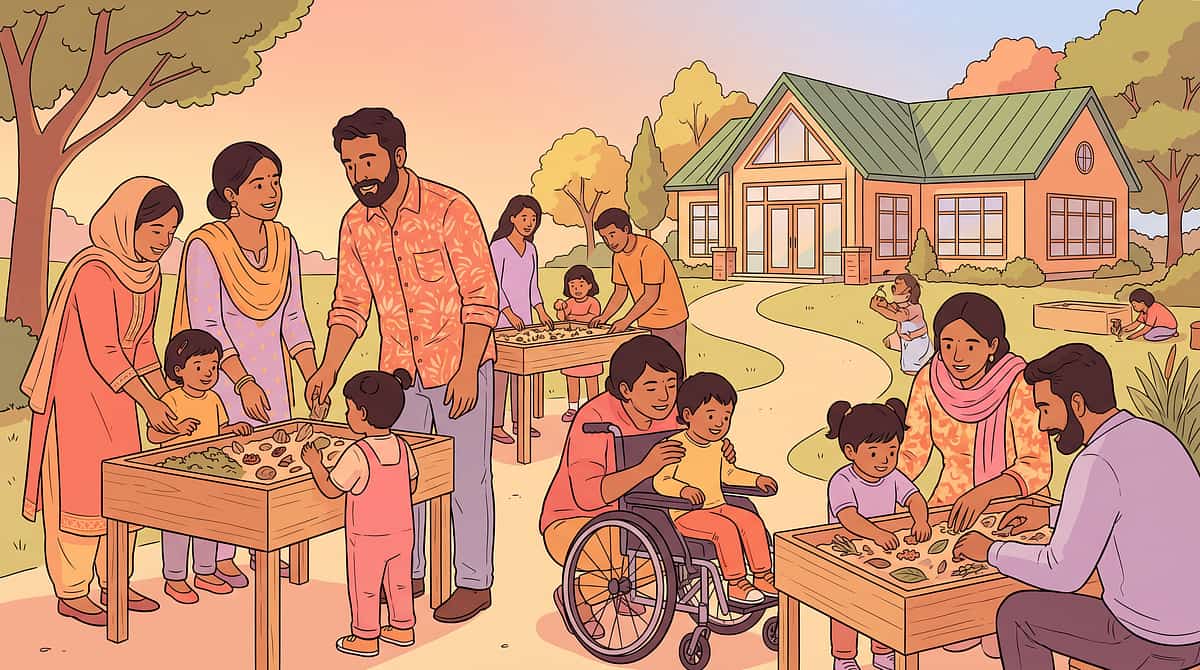
Gesture-dependent comprehension — where a child understands meaning through pointing, showing, and physical demonstration rather than verbal instruction alone — is one of the most consistently observed communication profiles in autism. In India, an estimated 18 million individuals are affected by autism spectrum conditions. You are among millions of families navigating this exact challenge. And there is a clear pathway forward.
Sources: PRISMA Systematic Review 2024 (PMC11506176) | CDC ADDM Network 2023 | WHO Global Autism Data | Pinnacle Blooms Network® Clinical Outcomes Registry
ACT I — Neuroscience
Why Hands Speak Louder Than Words — For Some Brains
The Brain Regions at Work
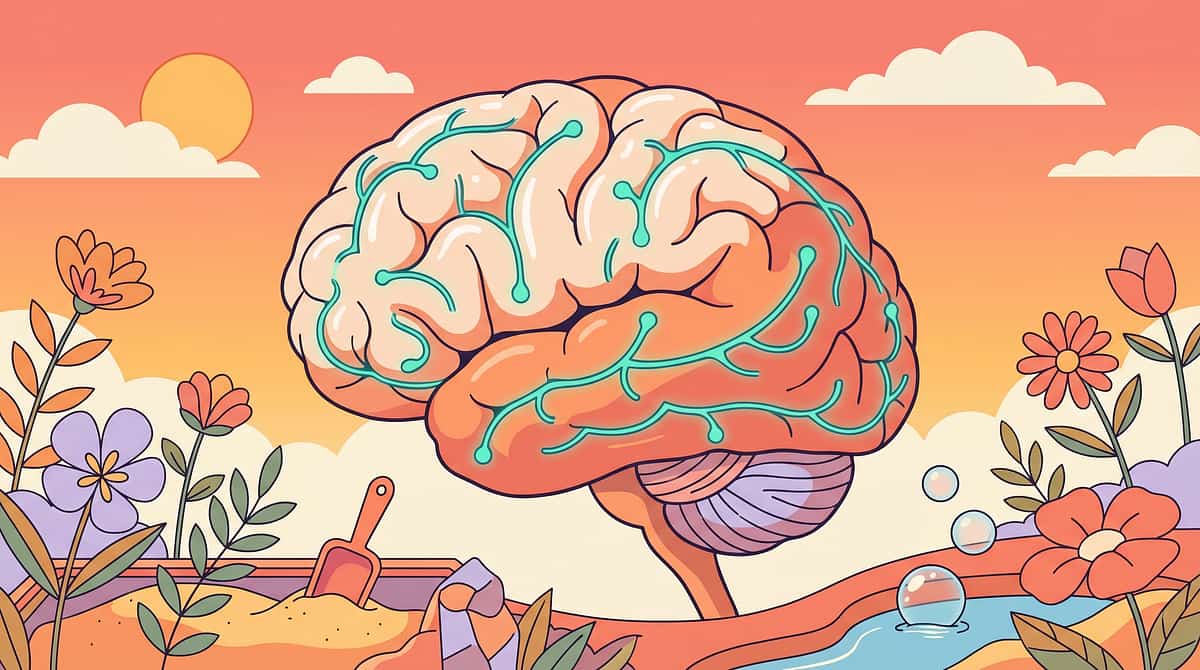
Superior Temporal Sulcus (STS) — gesture perception center
Mirror Neuron System — imitation and movement reading
Broca's Area — speech-gesture integration
Visual Cortex pathways — enhanced in gesture-dominant processors
What This Means for Your Child
Your child's superior temporal sulcus — the brain region that reads biological motion and gestures — is highly active and efficient. When you point, their mirror neuron system fires immediately.
Verbal language requires rapid auditory processing, phonological decoding, and semantic retrieval in milliseconds. In children with gesture-dependent comprehension, this verbal processing chain has a higher activation threshold.
This is not a hearing problem. It is not a cognitive limitation. It is a neurological processing profile — and the materials on this page are specifically engineered to match it.
The clinical term: Gesture-Dependent Receptive Language Profile. What it means for you: Show, don't just say — then systematically build the bridge to verbal understanding through gesture scaffolding.

ACT I — Development
Understanding the Developmental Journey — and Where Your Child Is Right Now
6–12 Months
Joint attention via pointing — the gesture comprehension foundation emerges
12–18 Months
Gestures + single words emerge together. Most children with ASD have intact gesture comprehension at this stage.
18–36 Months
Verbal comprehension should begin to overtake gesture dependence — this is where divergence often appears.
Intervention Window
18 months to 8 years — highly plastic, highly responsive to evidence-based gesture scaffolding.
"Your child is here. Verbal comprehension is where we're heading. The 9 materials on this page are the bridge."
Gesture-dependent comprehension commonly co-occurs with: Receptive language delays | Apraxia of speech | Auditory processing difficulties | Sensory processing differences affecting auditory channels.
ACT I — Evidence
Gesture-Based Intervention: Clinically Validated. Home-Applicable. Parent-Proven.
97%+
Improvement Rate
Measured improvement in Communication Readiness Index across 21M+ sessions
9/10
Evidence Confidence
High Confidence — Strong Evidence Base across Level I–II clinical trials
54
Countries Studied
WHO NCF gesture-based caregiving implemented across 54 LMICs with significant outcomes
Study | Finding | |
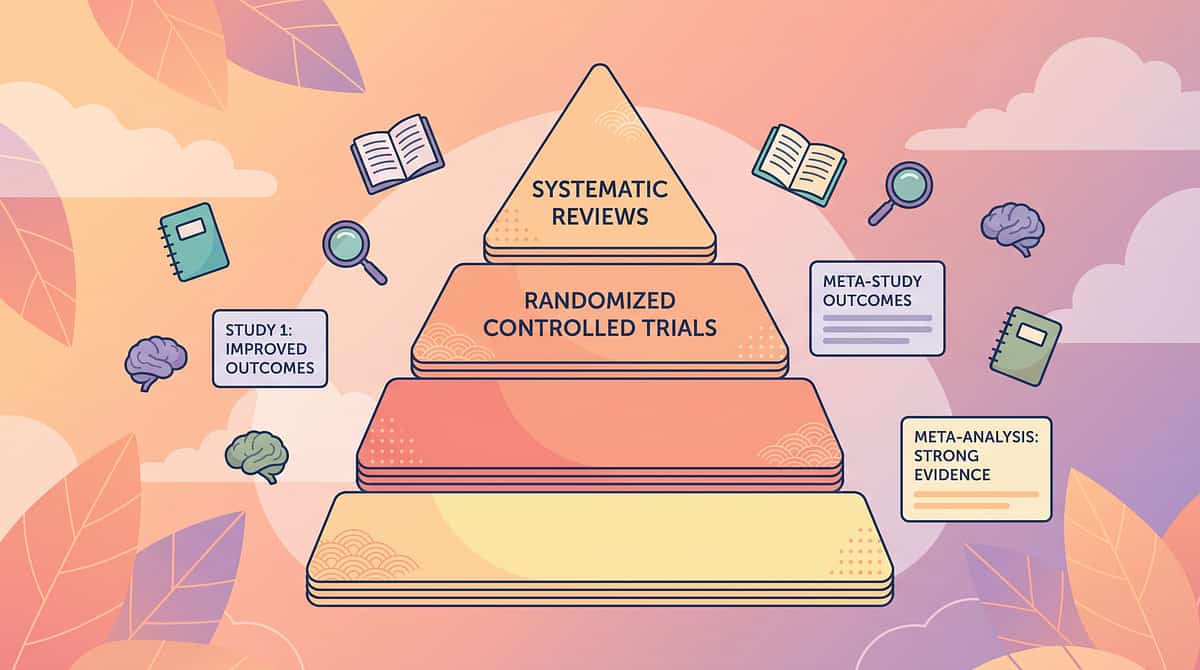
PRISMA Systematic Review (2024) | 16 RCTs confirm gesture + multimodal communication as EBP for ASD (PMC11506176) | |
Meta-Analysis, World J Clin Cases (2024) | Gesture-paired visual supports improve social communication; effect size d=0.78 | |
NCAEP Report (2020) | AAC + gesture supports = Established EBP for ASD | |
Pinnacle Clinical Registry | Gesture comprehension intervention: 97%+ measured improvement across 70+ centers |
EVIDENCE GRADE: LEVEL I–II — HIGH. Clinically validated. Home-applicable within 24 hours. Parent-proven across 70+ centers and 70 countries.

ACT II — The Technique
Technique B-153: Gesture-Dependent Comprehension Support
Formal Name: Gesture-Dependent Comprehension Support Protocol
Parent-Friendly Alias: "Teaching Words Through Hands"
Domain: B — Social Communication | Ages: 18 months–12 years
Parent-Friendly Alias: "Teaching Words Through Hands"
Domain: B — Social Communication | Ages: 18 months–12 years
A structured intervention approach that leverages a child's existing strength in gesture-based understanding to systematically build receptive language comprehension. By consistently pairing verbal instructions with meaningful gestures, sign language cues, visual schedules, and body language demonstrations, caregivers create a multi-channel input system that meets the child where their brain is — then progressively builds the verbal comprehension pathway.
🎯 Domain B
Social Communication
👁️ Visual-Gestural
Multi-channel input
🏠 Home-Applicable
Daily integration
⏱️ 10–20 min
Per session
📞9100 181 181 — Consult our SLP team for free | 24×7
ACT II — Disciplines
This Technique Crosses Therapy Boundaries — Because Language Doesn't Organize by Therapy Type
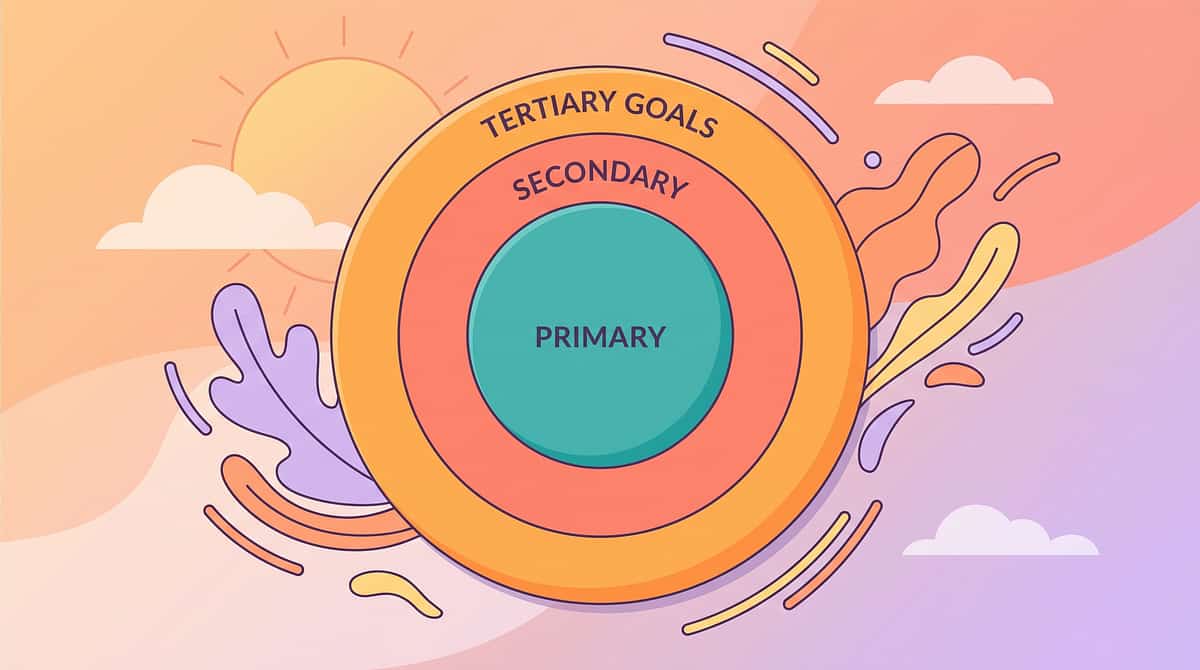
SLP (Primary Lead)
Designs the gesture-verbal pairing hierarchy, selects sign vocabulary, and monitors receptive language progression. Sets comprehension targets.
OT (Co-Lead)
Assesses motor imitation capacity for gesture production. Ensures sensory environment supports visual-gestural processing and addresses fine motor requirements.
ABA/BCBA
Creates reinforcement schedules for gesture comprehension attempts. Designs naturalistic teaching trials using gesture prompting and fades prompts systematically.
SpEd
Implements gesture-paired instruction across academic activities. Creates classroom communication systems using consistent gesture vocabulary.
NeuroDev Pediatrics
Evaluates neurological basis of gesture comprehension profile. Rules out sensory/auditory comorbidities. Guides pharmacological support if indicated.
Family/Caregivers
The 24×7 deployment force. Every meal, bath, walk, and game becomes a gesture-pairing opportunity — the most powerful therapist in the child's life.
"At Pinnacle, all six disciplines operate under a single GPT-OS® FusionModule™ — so your child's SLP, OT, ABA therapist, and special educator are all using the same gesture vocabulary on the same day. That consistency is measurable. That consistency is the intervention."
ACT II — Targets
What Changes When Gesture Comprehension Is Supported — From Today to Two Years From Now
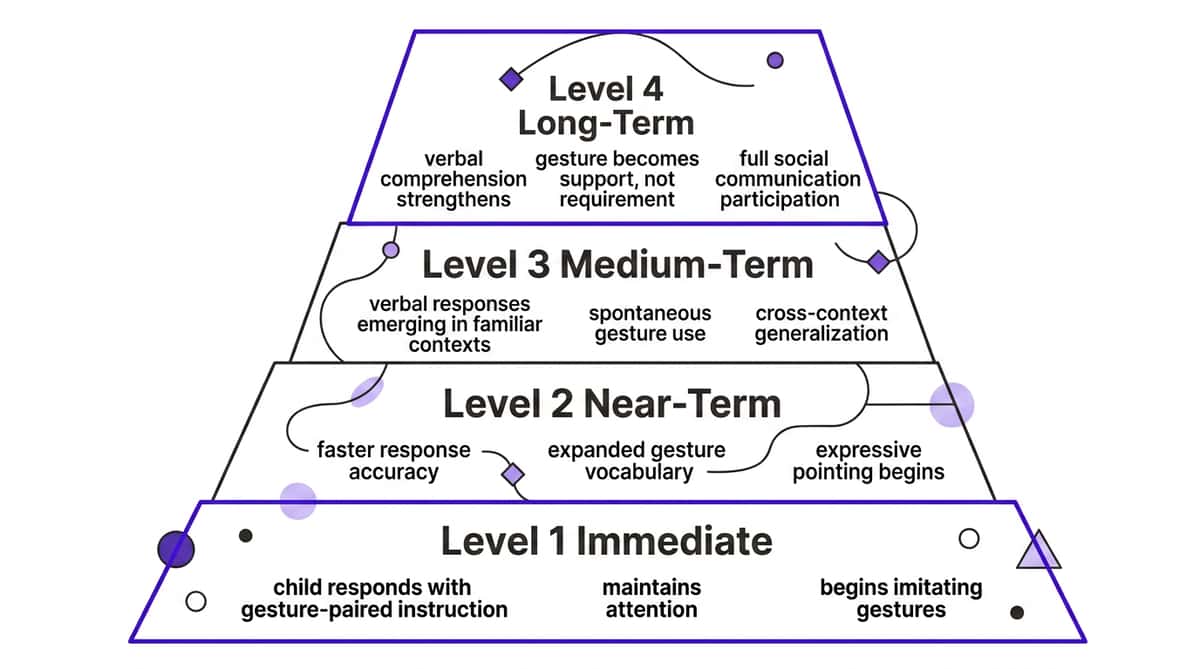
97%+ measured improvement in Communication Readiness Index across Pinnacle's gesture comprehension intervention cohort — 70+ centers, 21M+ sessions.

ACT II — Materials Overview
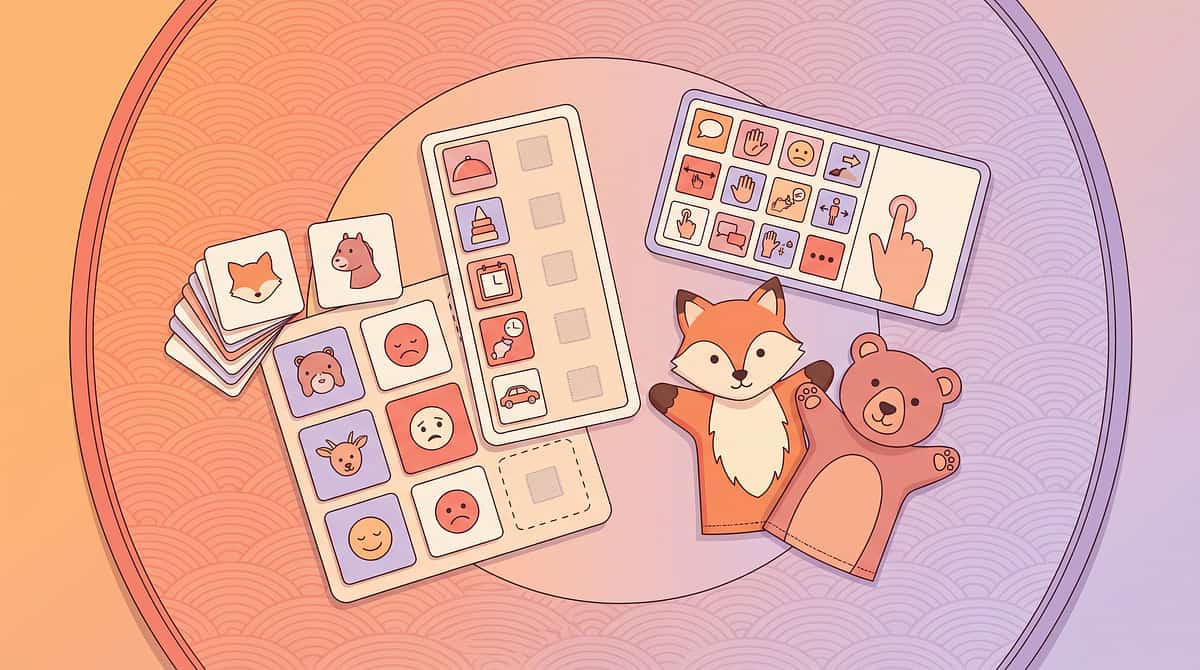
9 Materials. 9 Pathways. One Mission: Build the Bridge From Gesture to Language.
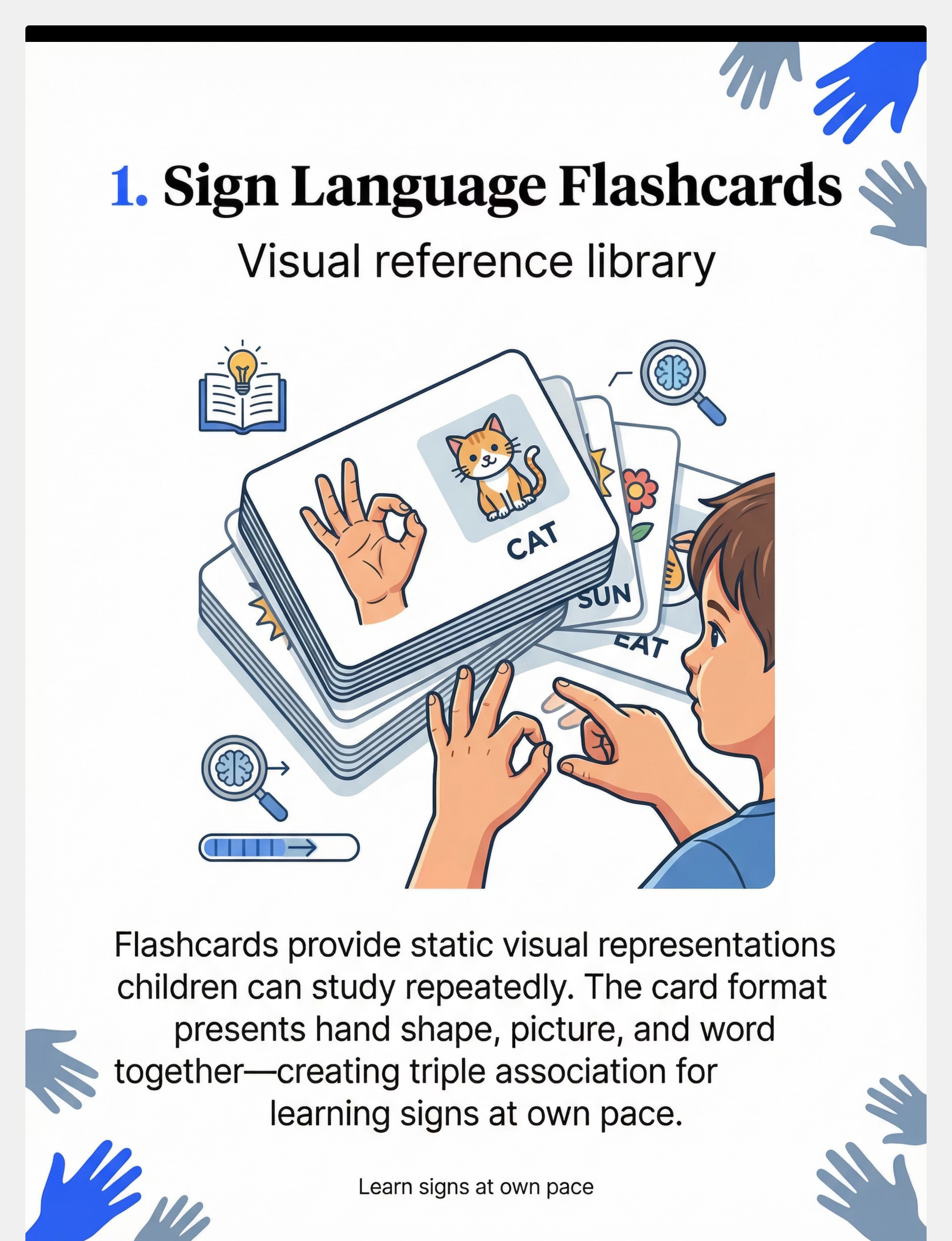
Sign Language Flashcards
Visual reference library — triple-channel association
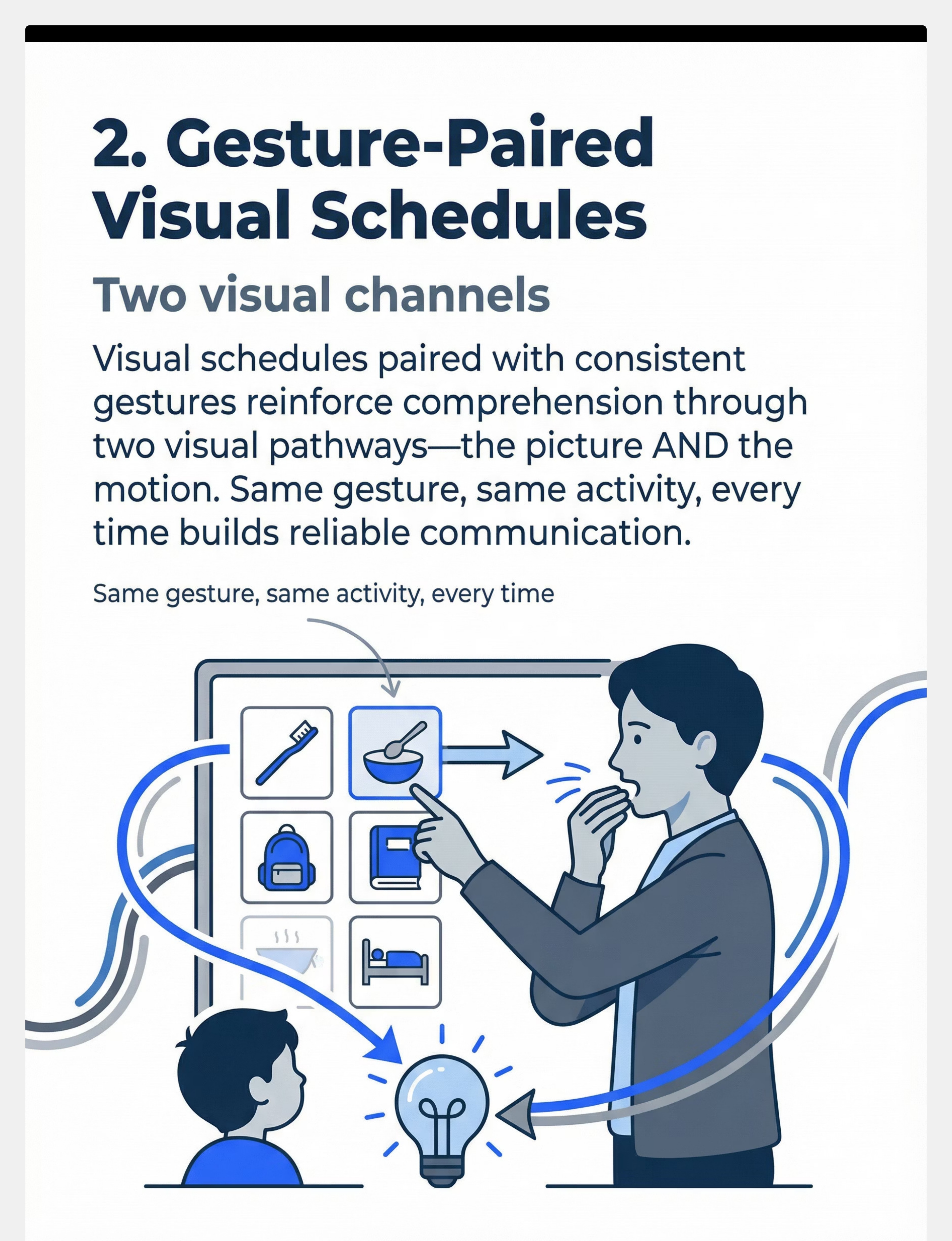
Gesture-Paired Visual Schedules
Two visual channels reinforcing comprehension
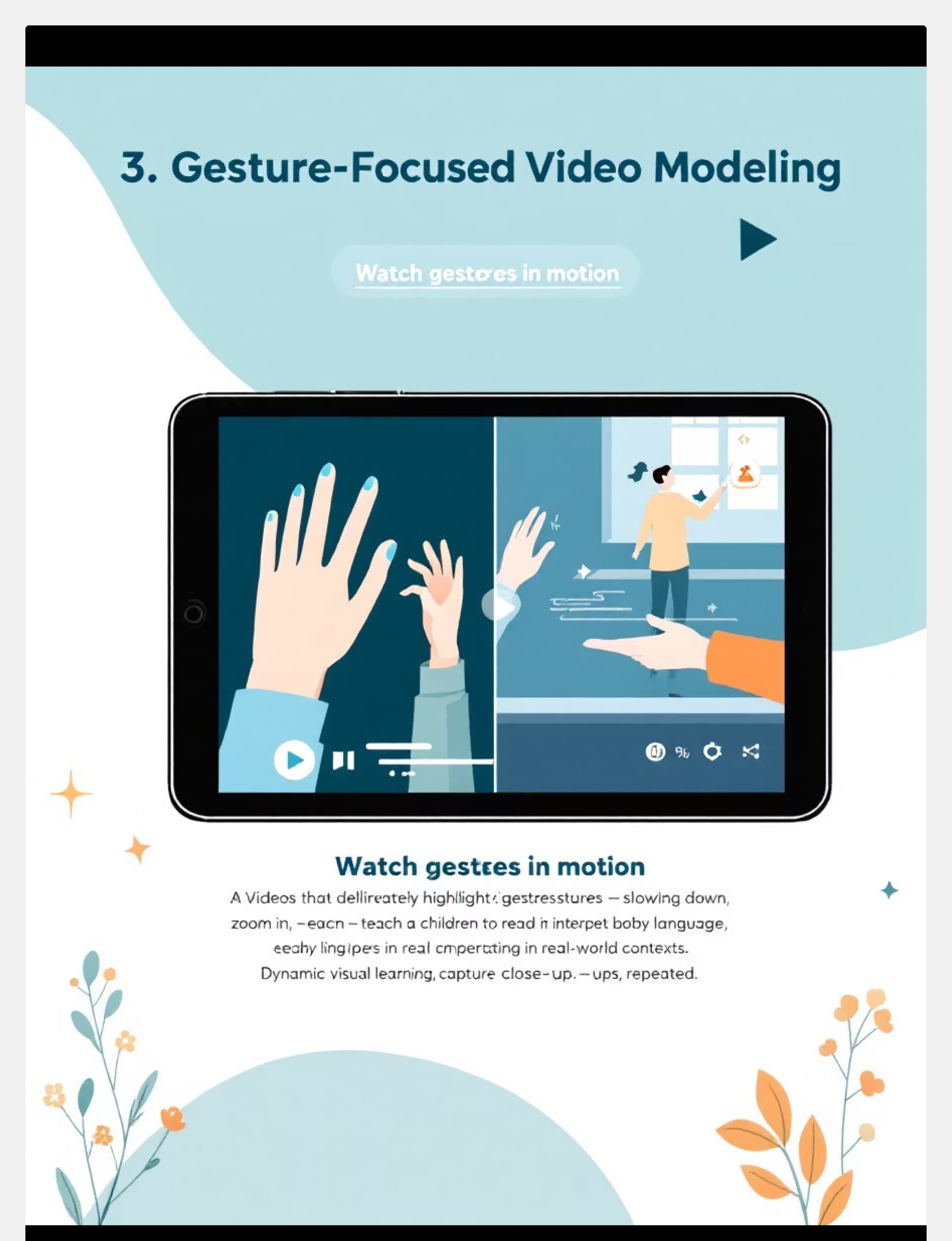
Gesture-Focused Video Modeling
Watch gestures in motion — mirror neuron priming
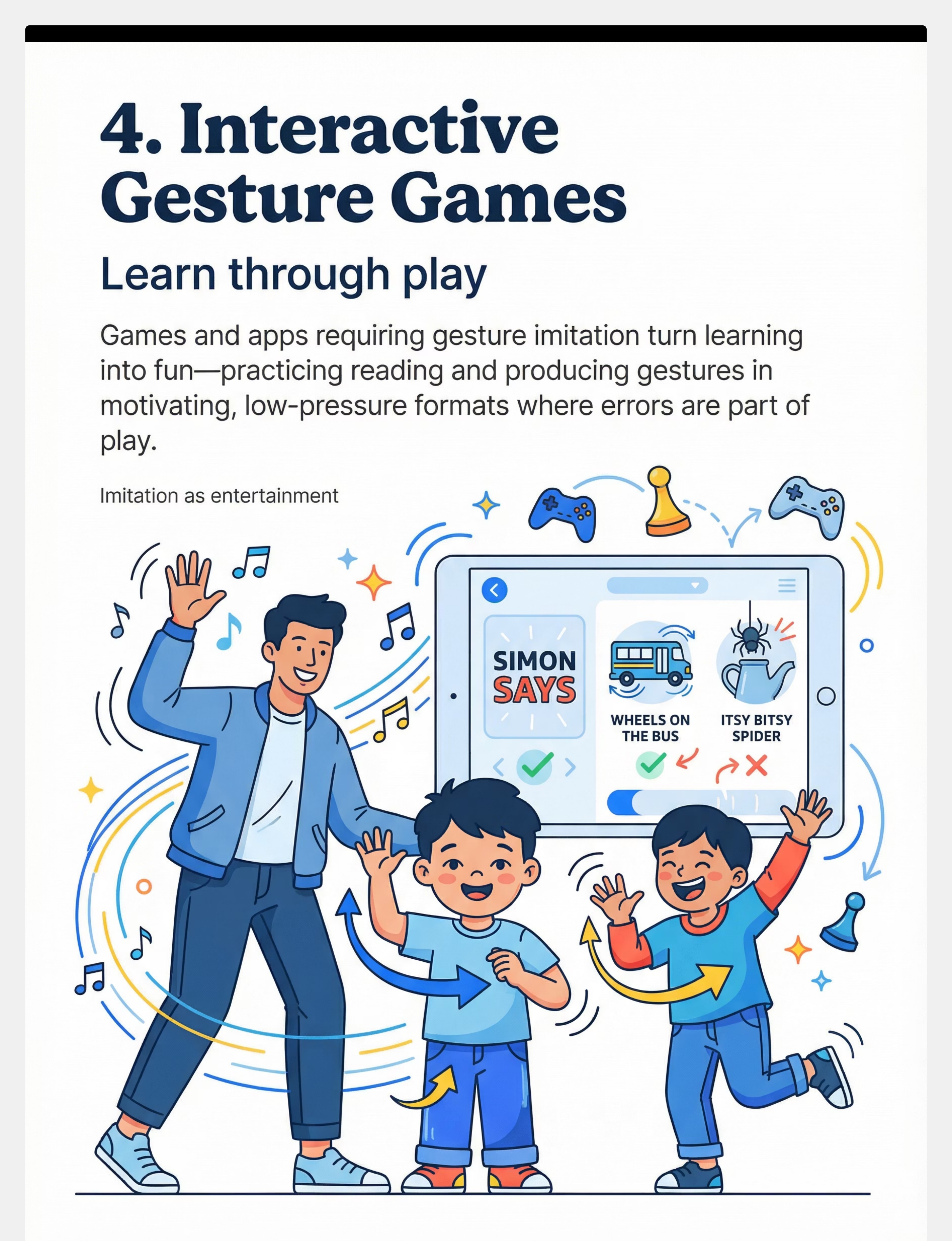
Interactive Gesture Games
Learn through play — motivation meets practice
Total Communication Boards
Multiple pathways to meaning via AAC
Puppets & Dolls
Third-person gesture teaching — reduced social demand
Mirror Practice Stations
Visual feedback loop — real-time motor learning
Caregiver Gesture Prompt Cards
Consistency across all people in the child's life
Social Stories with Gesture Illustrations
Gestures in narrative context — real-world meaning

Material 1 of 9
Sign Language Flashcards
Canon Category: Visual Communication Materials | Visual Reference Library
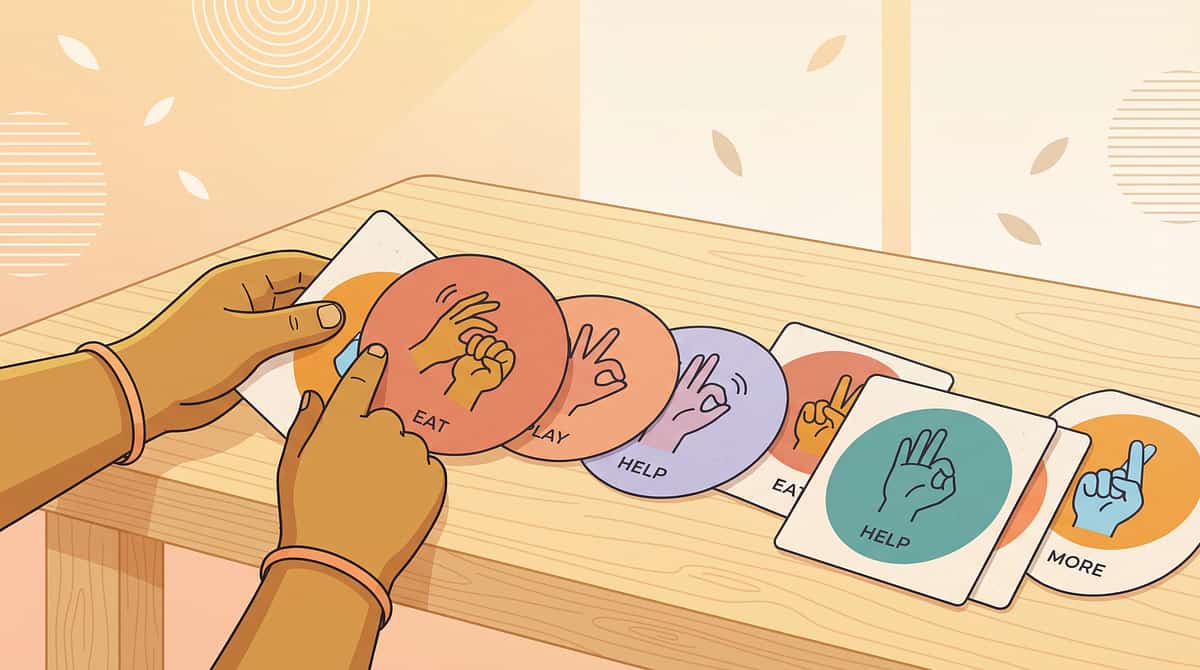
Sign language flashcards provide static visual representations children can study repeatedly at their own pace. The card format presents hand shape + picture + word together — creating a triple-channel association for learning signs. This multi-sensory approach is particularly effective for gesture-dependent learners because it isolates each gesture clearly, allowing for focused study without the pressure of real-time social interaction.
Purchase Options
₹400–1,200 | Search Amazon.in: "sign language flashcards children India"
DIY — ₹0
Draw hand shapes on index cards with corresponding pictures. Use ISLRTC free handshapes at islrtc.nic.in — the triple-association principle is identical.

Material 2 of 9
Gesture-Paired Visual Schedules
Canon Category: Visual Supports / Communication Systems | Two Visual Channels
Visual schedules paired with consistent gestures reinforce comprehension through two simultaneous visual pathways — the picture AND the motion. When the same gesture accompanies the same activity every single time, the child's brain builds a reliable, predictable communication loop. Predictability is neurologically soothing and reduces transition-related anxiety, making the schedule itself a calming intervention alongside a communication one.
Purchase Options
₹0–800 (printable PDFs) | Laminated commercial sets: ₹800–2,000 | Search Amazon.in: "visual schedule autism cards"
DIY — ₹0
Print PECS-style images from Google Images, laminate with tape. Draw daily routine in 6 boxes. Assign one consistent gesture per activity — same gesture, every time.
Material 3 of 9
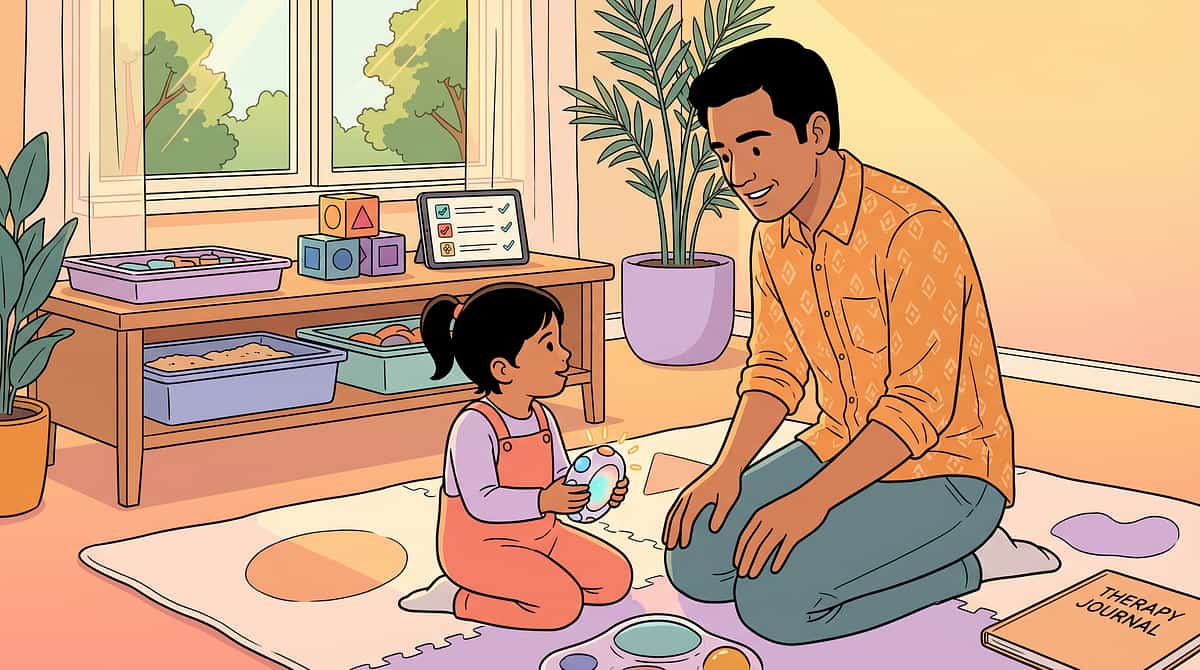
Gesture-Focused Video Modeling Content
Canon Category: Digital Learning Materials / Video Modeling | Watch Gestures in Motion
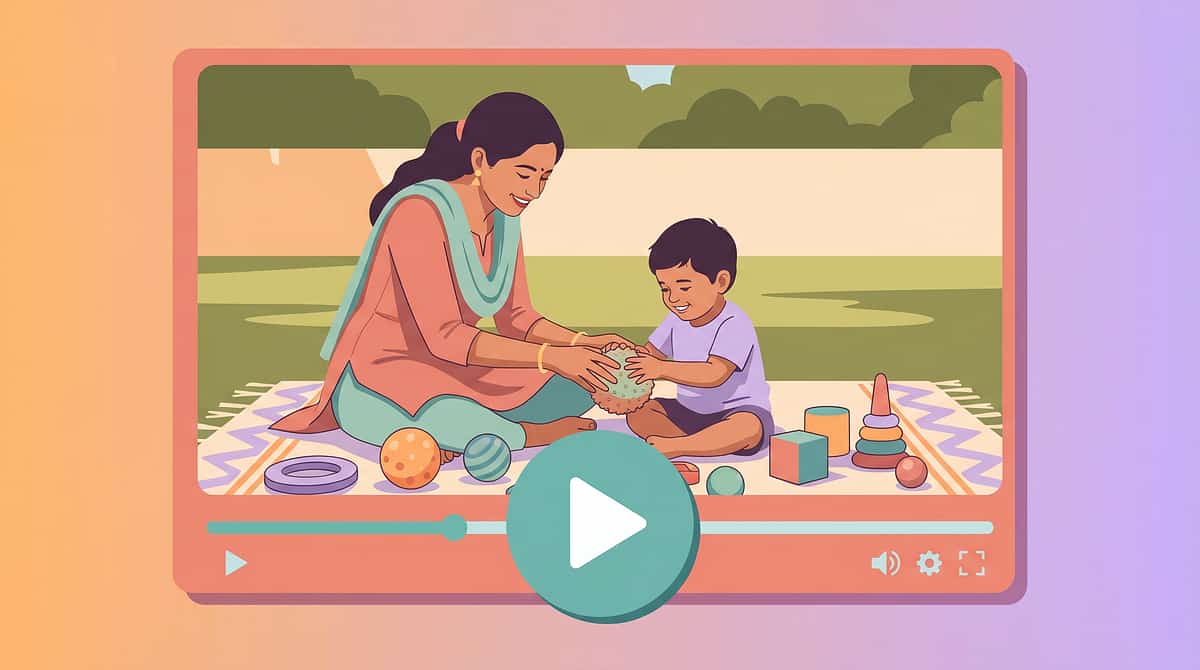
Videos that deliberately highlight gestures — slowing down, zooming in on hand movements — teach children to read and interpret body language in real-world contexts. Dynamic visual learning captures close-ups and allows for unlimited repetitions without caregiver fatigue. The mirror neuron system is primed by watching others perform gestures, making video viewing a genuine pre-session therapeutic warm-up.
Access Options
₹0 (YouTube/free platforms) | Structured programs: ₹500–2,000 | Pinnacle Blooms YouTube Channel | Search: "gesture modeling autism video"
DIY — ₹0
Record 60-second phone videos of yourself performing 3 daily gestures (eat, drink, come). Play back for child 3× daily with live narration alongside the video.
📞9100 181 181 — Ask about our free gesture video modeling resources | 24×7
Material 4 of 9
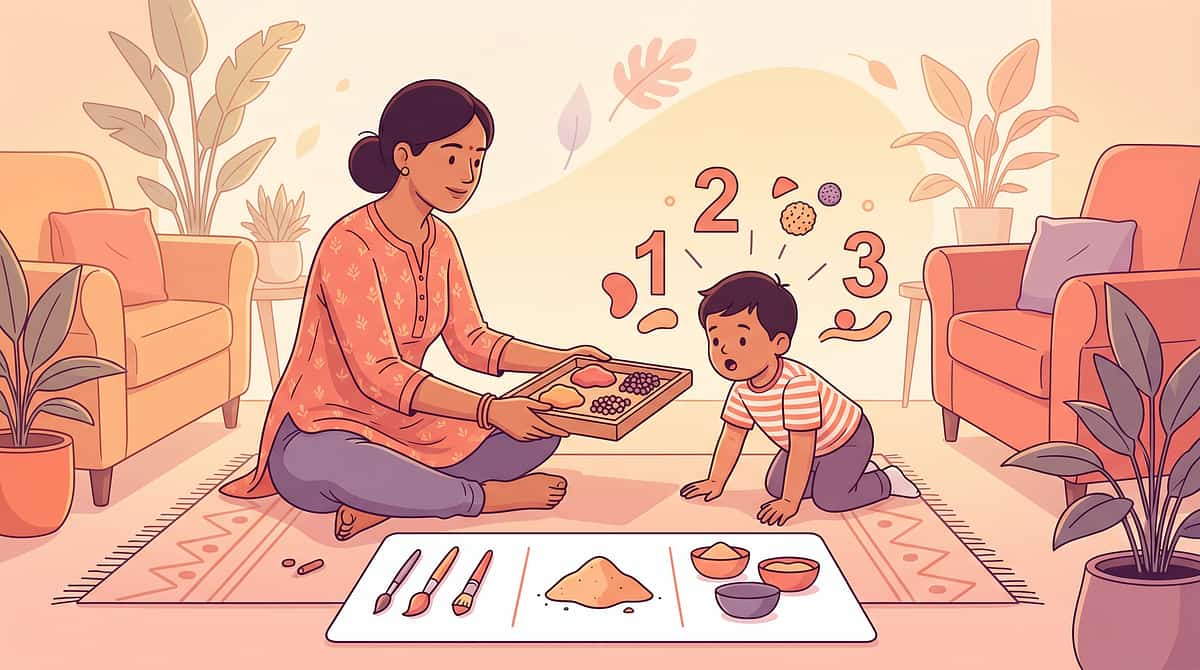
Interactive Gesture Games
Canon Category: Problem-Solving Toys / Cause-Effect Toys | Learn Through Play
Games requiring gesture imitation turn learning into play — practicing reading and producing gestures in motivating, low-pressure formats where errors are simply part of the game. The play context reduces social demand to near zero while maximizing trial count. A child who plays 10 rounds of gesture Simon Says has completed 10 comprehension trials without ever feeling like they were in a session.
Purchase Options
₹199–628 | Product #760 — Problem-Solving Toy ₹199 ★ Pinnacle Recommends | Product #68 — Problem-Solving Toy ₹428
DIY — ₹0
Simon Says — gesture edition. "Simon says point to the door." "Simon says show me eat." Zero materials required. Works anywhere, anytime.
Material 5 of 9
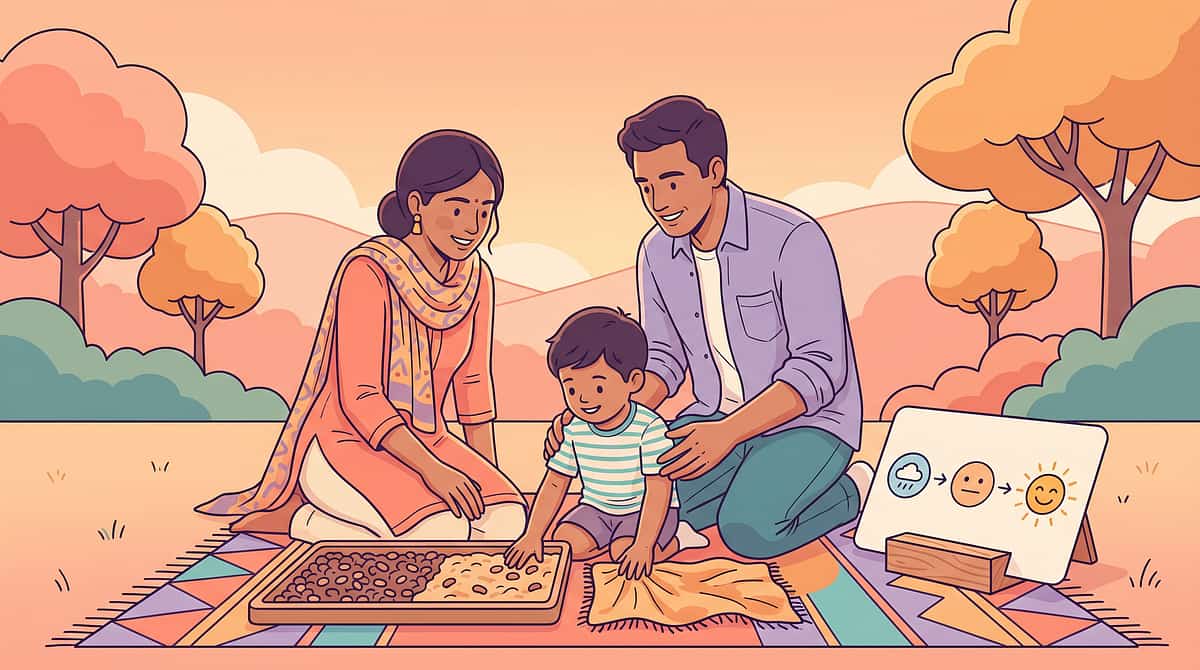
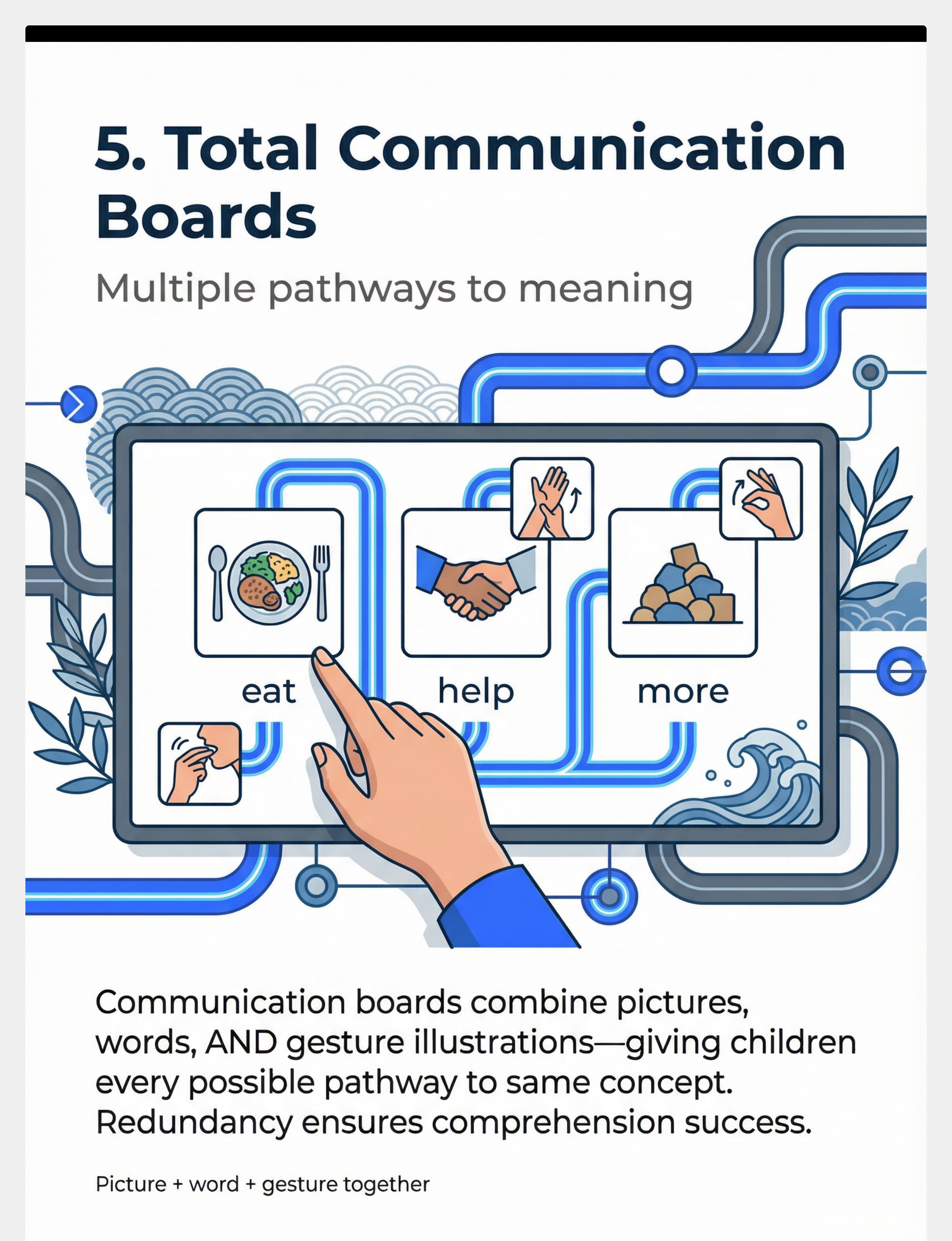
Total Communication Boards
Canon Category: Visual Communication Materials / AAC | Multiple Pathways to Meaning
Communication boards combine pictures + words + gesture illustrations — giving children every possible pathway to the same concept simultaneously. Redundancy is not repetition here; it is accessibility design. When one channel doesn't land, another does. This ensures comprehension success even on difficult sensory days, because the child always has a fallback input channel that works for their brain right now.
Purchase Options
₹0–1,500 (printable free / laminated commercial) | Search Amazon.in: "communication board autism AAC"
DIY — ₹0
Download free AAC boards from Boardmaker Share or Communicating Together. Print, laminate, attach gesture illustrations — hand-drawn is clinically equivalent.
Material 6 of 9
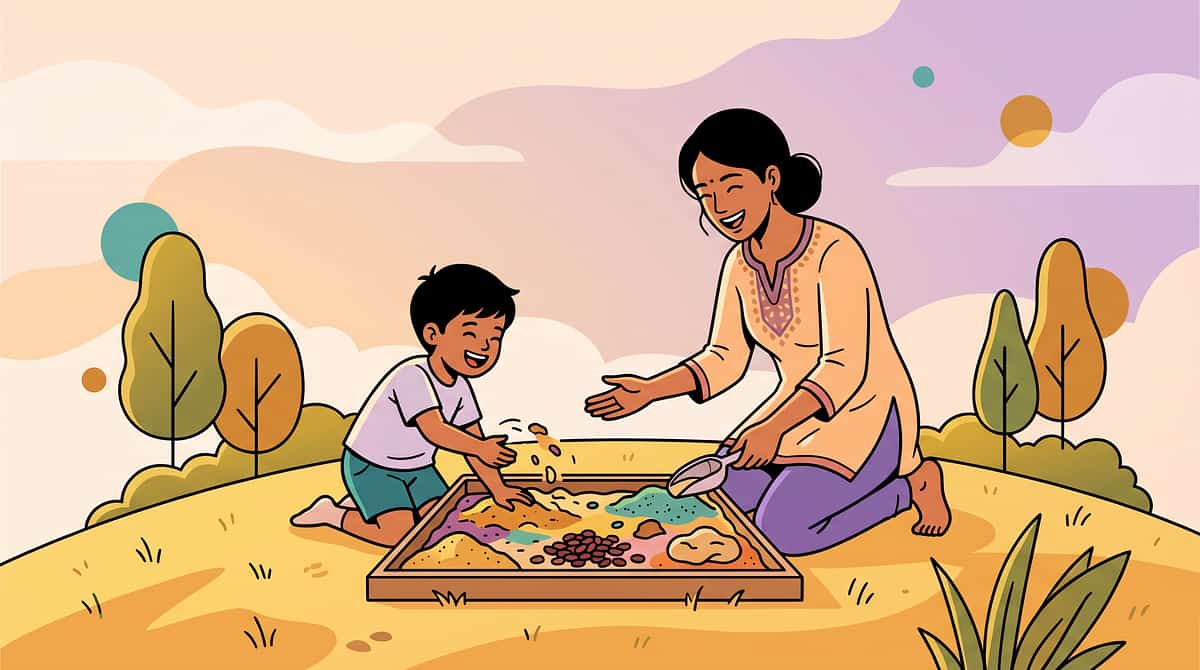
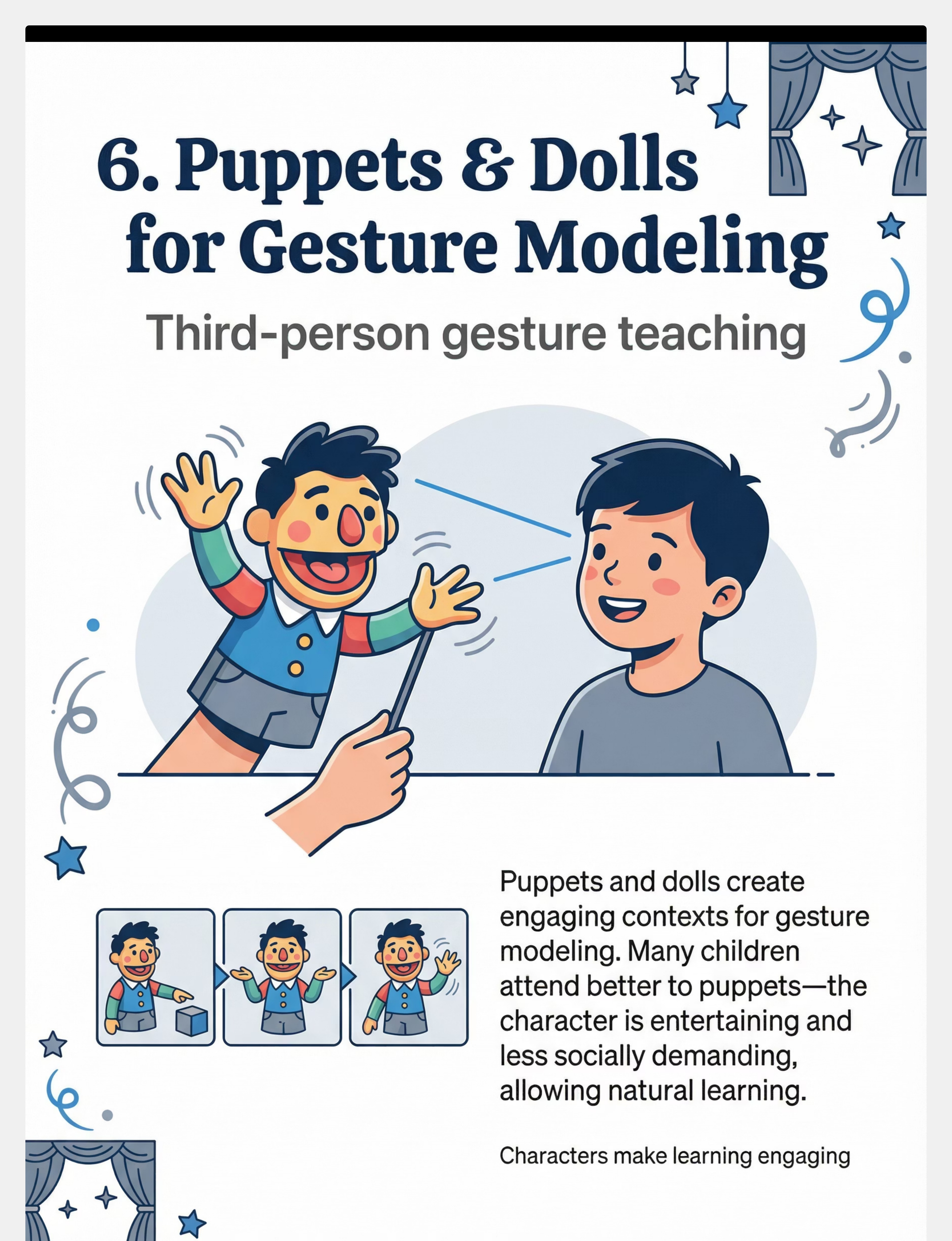
Puppets & Dolls for Gesture Modeling
Canon Category: Role-Play / Social Skills Materials | Third-Person Gesture Teaching
Puppets and dolls create engaging, socially low-demand contexts for gesture modeling. Many children attend better to puppets than to adults — the character is entertaining, less socially complex, and allows natural gesture learning without the weight of direct eye contact or social reciprocity expectations. The puppet models, the child watches and imitates, and learning happens through delight rather than demand.
Purchase Options
₹300–1,200 | Product #722 — Matching/Cause-Effect Toy ₹519 ★ Pinnacle Recommends
DIY — ₹0
Any sock + two button eyes = puppet. The puppet models gestures the child then imitates. Child corrects the puppet when it uses the "wrong" gesture — active comprehension practice.
Material 7 of 9
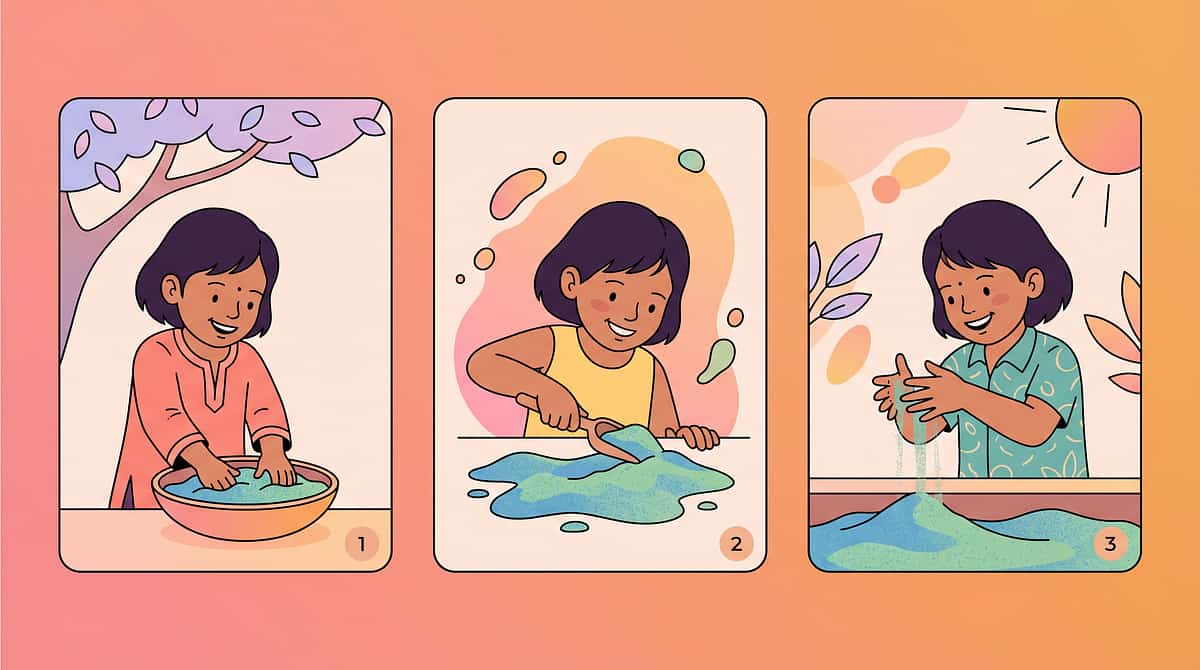
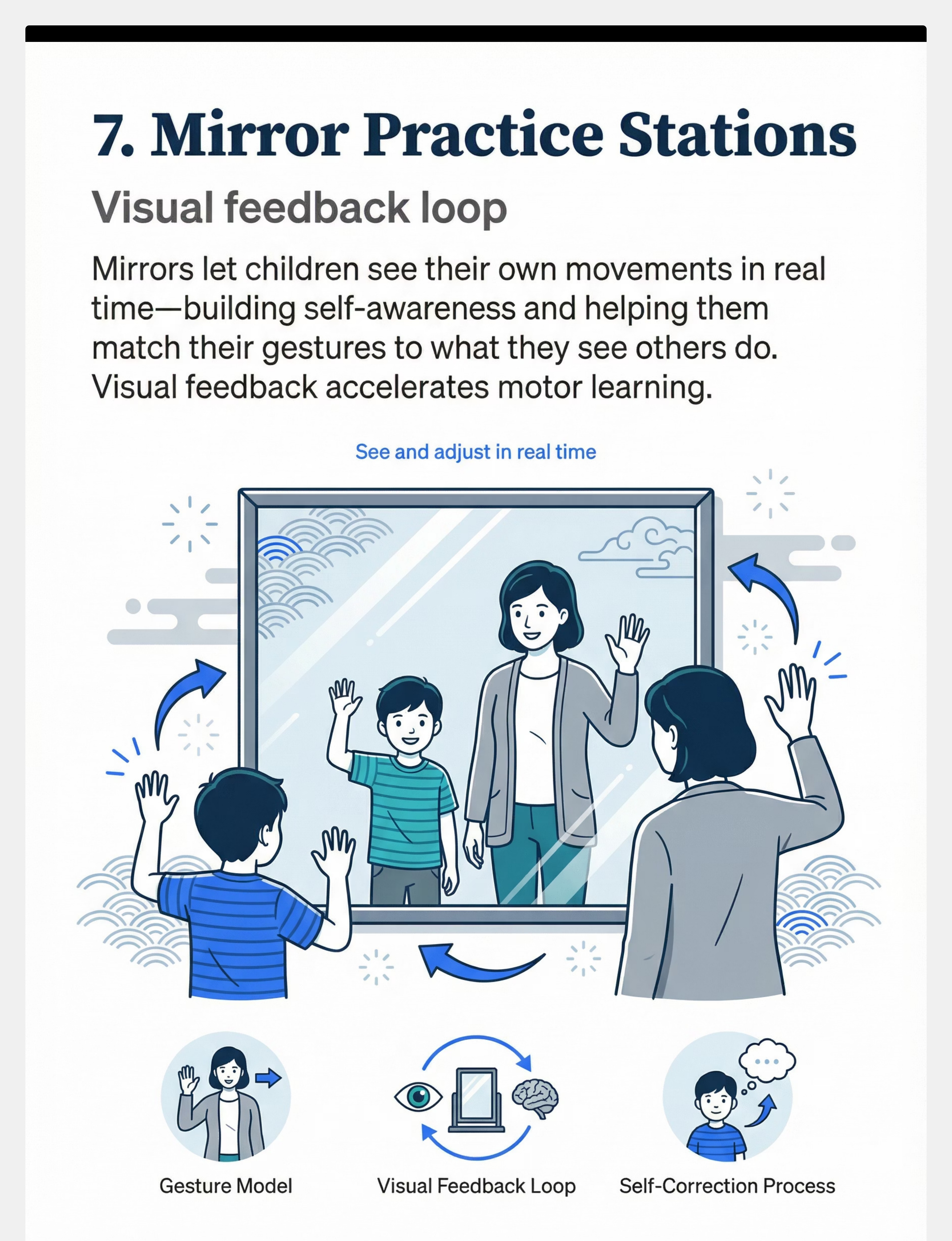
Mirror Practice Stations
Canon Category: Motor/Sensory Tools / Self-Regulation | Visual Feedback Loop
Mirrors let children see their own movements in real time — building body awareness and helping them match their gestures to what they observe others doing. The mirror creates a closed-loop visual feedback system: gesture → see gesture → adjust gesture → see result. This accelerates motor learning far more efficiently than practice without visual feedback. Crucially, side-by-side mirror positioning means the child sees both caregiver and self gesture simultaneously.
Purchase Options
₹200–1,000 | Search Amazon.in: "child safety mirror therapy" — shatterproof plastic preferred
DIY — ₹0
Any household mirror works. Position at child height. Stand behind child and model gesture side-by-side so child watches both of you simultaneously — same spatial perspective.
Material 8 of 9
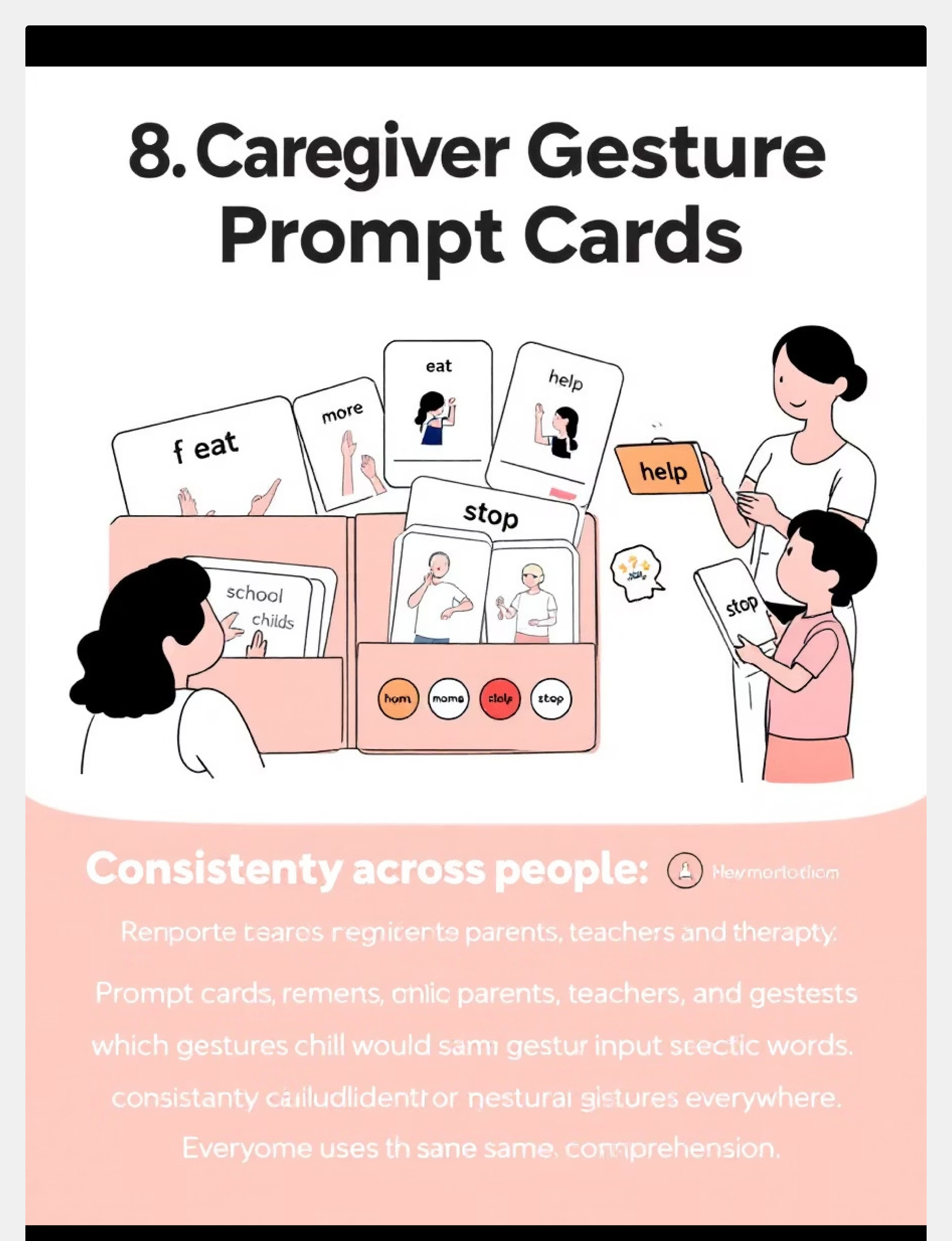
Caregiver Gesture Prompt Cards
Canon Category: Caregiver Training Materials / Reinforcement Menus | Consistency Across People
Prompt cards remind parents, grandparents, teachers, and therapists which gestures the child is learning for specific words — creating the caregiver consistency that multiplies comprehension gains across every environment the child inhabits. A gesture the child only receives from one caregiver is a gesture that will not generalize. Consistency is the intervention. These cards make consistency effortless.
Purchase Options
₹200–600 | Product #803 — Reinforcement Menu ₹589 ★ Pinnacle Recommends | Product #390 — ₹364
DIY — ₹0
A5 laminated card with: gesture image | word | when to use | who uses it. One card per key word. Post on refrigerator — where all caregivers will see it daily.
Material 9 of 9
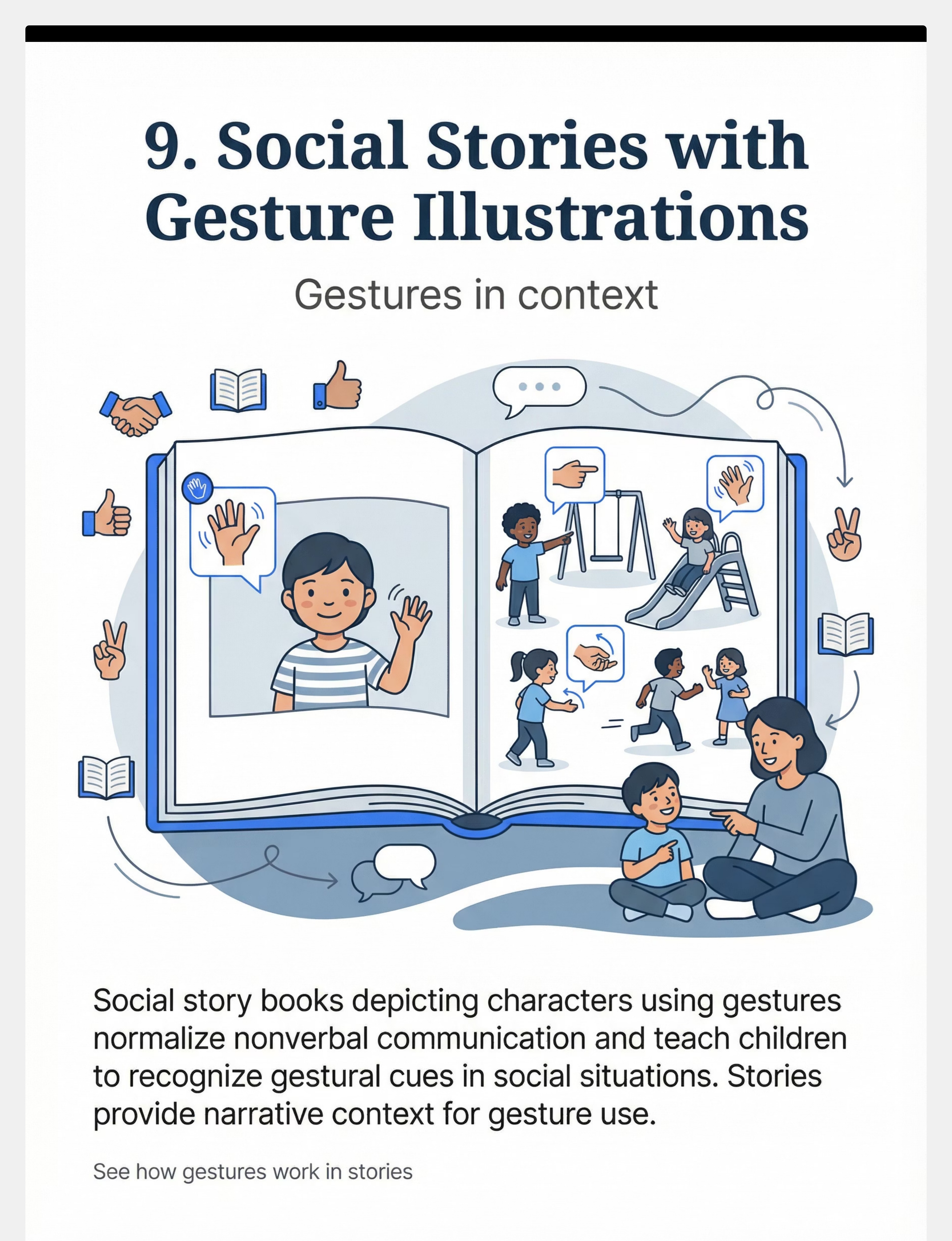
Social Stories with Gesture Illustrations
Canon Category: Literacy / Social-Emotional Materials | Gestures in Context
Social story books depicting characters using gestures normalize nonverbal communication and teach children to recognize gestural cues within meaningful social situations. Stories provide narrative context that isolated flashcard practice cannot — the child sees when a gesture is used, why it is used, and what happens next when communication succeeds. This narrative scaffolding bridges gesture comprehension to real-world social participation.
Purchase Options
₹300–1,500 | Search Amazon.in: "social stories autism communication" for ready-made options
DIY — ₹0
"When Mama points to the door, it means we go outside." Photograph your own family performing gestures. Print and bind with a staple — 6 pages is sufficient.
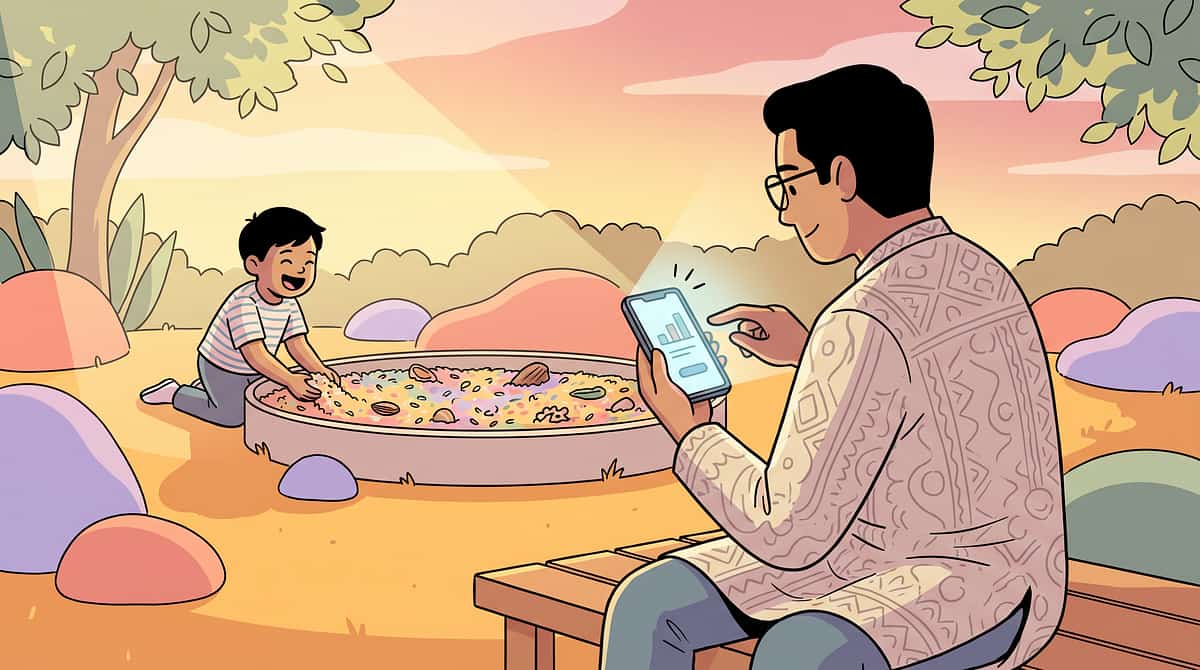
ACT II — Budget Guide
Every Family. Every Budget. Zero Barriers to Starting Today.
This is the WHO/UNICEF inclusion principle in action: every technique on this page is fully executable with zero budget using household materials. The gesture is the medicine. The material is the vehicle.
Commercial Material | ₹0 Household Substitute | Why It Works Equally | |
Sign Language Flashcards | Index cards + hand drawings | Triple-association principle identical | |
Visual Schedules | Paper squares + marker drawings | Same two-channel visual reinforcement | |
Video Modeling App | Phone selfie video, repeated | Mirror neuron activation identical | |
Gesture Games (commercial) | Simon Says, gesture edition | Same imitation + comprehension loop | |
AAC Communication Board | Google Images + printer + tape | Symbol-gesture pairing unchanged | |
Puppet (commercial) | Sock + buttons | Attention-to-character mechanism unchanged | |
Therapy Mirror | Household bathroom mirror | Real-time visual feedback identical | |
Prompt Cards | Handwritten index cards | Caregiver consistency mechanism unchanged | |
Social Story Books | Phone photos + stapled booklet | Narrative-gesture contextualization identical |
When a child has significant motor imitation difficulties or sensory sensitivities affecting gesture production, clinical-grade tools and professional assessment are essential. Contact: 📞9100 181 181
ACT II — Safety
Safety First: Before You Begin
🟢GREEN — PROCEED
Child is calm, alert, and well-rested. Last meal within 2 hours. No active illness or pain signals. Space is quiet and distraction-reduced. Child has had a positive interaction with you in the last 10 minutes.
Child is calm, alert, and well-rested. Last meal within 2 hours. No active illness or pain signals. Space is quiet and distraction-reduced. Child has had a positive interaction with you in the last 10 minutes.
🟡AMBER — MODIFY
Child is tired but alert — reduce session to 5 minutes. Child in mildly elevated arousal — use only calming, familiar gestures. Recent transition — increase visual schedule support. Child is sick but comfortable — passive video modeling only, no active demands.
Child is tired but alert — reduce session to 5 minutes. Child in mildly elevated arousal — use only calming, familiar gestures. Recent transition — increase visual schedule support. Child is sick but comfortable — passive video modeling only, no active demands.
🔴RED — STOP / POSTPONE
Child in full meltdown or post-meltdown recovery (minimum 30-min rest). Signs of illness: fever, vomiting, apparent pain. Child showing self-injurious behavior. Significant sensory overload state visible.
Child in full meltdown or post-meltdown recovery (minimum 30-min rest). Signs of illness: fever, vomiting, apparent pain. Child showing self-injurious behavior. Significant sensory overload state visible.
Material Safety: Sign language cards: round edges, non-toxic ink. Mirrors: shatterproof plastic preferred. Puppets: no loose button eyes for children who mouth objects. Visual schedules: smooth laminated edges, Velcro attachments checked.
📞9100 181 181 — If in doubt, call before proceeding. Free | 24×7
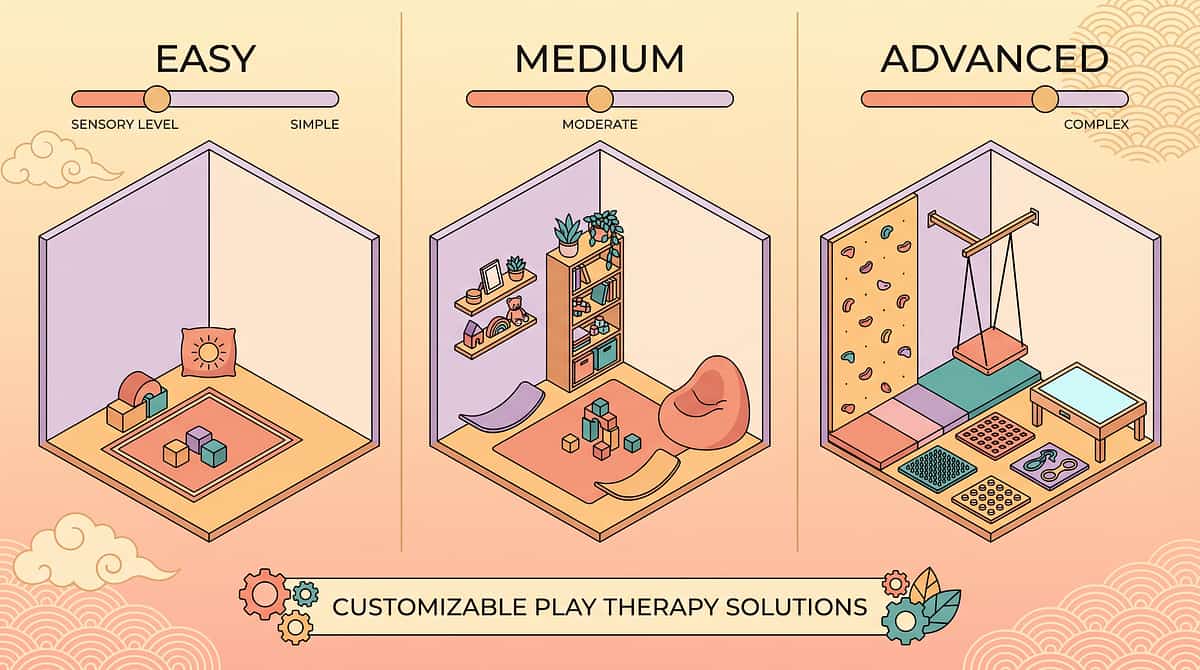
ACT II — Setup
Set Up Your Space — Spatial Precision Prevents 80% of Session Failures
✅ Visual Schedule
On wall at child's eye level — visible from child's seated position
✅ Mirror Positioned
At child height — full-body or upper body, child-safe material
✅ 3–5 Materials Only
Session materials visible; rest stored out of sight and reach
✅ TV/Radio: OFF
Natural light preferred; no flickering fluorescent lighting
✅ Side-by-Side Seating
Parent beside child — not across; both face the same direction for gesture modeling
✅ Prompt Cards Ready
At caregiver eye level or on wrist card for instant reference
Why side-by-side (not face-to-face): Gesture modeling is most effective when child and caregiver face the same direction — the child sees the gesture from the same spatial perspective as they experience the world. Side-by-side positioning prevents mirror-reversal confusion.

ACT III — Readiness
Is Your Child Ready? The Best Session Is One That Starts Right.
Take 60 seconds to check before you begin. This is not a formality — it is clinical decision-making that professional therapists perform before every session.
Indicator | 🟢 Go | 🟡 Modify | 🔴 Postpone | |
Eye contact available? | Brief contact possible | Only peripheral | No response to name | |
Body calm? | Regulated, seated | Slightly active | Hyperarousal/meltdown | |
Last meltdown? | >2 hours ago | 1–2 hours ago | <1 hour ago | |
Fed and hydrated? | Yes | Snack 30 min ago | Hungry/thirsty now | |
Engagement baseline? | Following 1 instruction | Needs repeat | Not following any |
5–6 ✅ = GO
Proceed to full session — child is ready for learning
3–4 ✅ = MODIFY
Run 10-min shortened session, skip repetitions
0–2 ✅ = POSTPONE
Offer preferred calming activity, reschedule in 30 minutes
📞9100 181 181 — Ask about readiness assessment protocols
ACT III — Step 1
Step 1 of 6: The Invitation
⏱️30–60 seconds | Every protocol begins with an invitation, not a command.
"[Child's name], come sit with me — I want to show you something."Say this once, then SHOW the first material — hold it up, move it slowly, make eye contact with IT not the child.
Body Language Guide
Sit at child's level or slightly lower. Voice: calm, warm, 20% slower than normal speech. Gesture as you speak — point to where you want child to sit. Do NOT repeat verbal instruction more than twice — show instead.
Acceptance Looks Like
Child moves toward you, looks at material, or reaches for material. Any one of these = acceptance. You do not need all three.
Resistance: How to Modify
Child moves away → bring material to them, no demand. Child ignores → place material in visual field, wait 15 seconds. Child protests → reduce to just showing the material with no words at all.
ABA Principle at Work: Pairing + Low Demand = Maximum Voluntary Engagement

ACT III — Step 2
Step 2 of 6: The Engagement
⏱️1–3 minutes | The child is here. Now — introduce the gesture material.
"Look — this is EAT."Show the flashcard. Simultaneously make the EAT sign — hand to mouth, repeated twice, slowly. "EAT." Pause 5 seconds. Watch. Wait.
Presentation Mechanics: Speed at 50% of your natural gesture speed. Distance: 30–45cm from child's face. Angle: side-by-side facing mirror. Repetition: show + gesture = 1 trial; do 2–3 trials before expecting response.
Child Response | Meaning | What to Do | |
Looks at card AND imitates gesture | Full engagement | Immediate praise, continue | |
Looks at card only | Visual engagement (good) | Add gentle physical prompt for gesture | |
Reaches for card | Interest | Let them hold it, then bring it back | |
Looks away | Processing (normal) | Wait, re-present with exaggerated gesture | |
Turns away | Avoidance | Reduce demand — use puppet to model instead |
First correct imitation → celebrate immediately, warmly, specifically.
ACT III — Step 3
Step 3 of 6: The Therapeutic Action
⏱️5–10 minutes | This is the main therapeutic event — the gesture-language pairing that rewires comprehension.
3A — Establish the Pairing
Show flashcard or board symbol. Simultaneously say the word AND make the sign. Child hears word + sees picture + sees gesture = triple-channel input. Wait 5 seconds. Reinforce or physically prompt if needed.
3B — Test Comprehension
"Show me EAT." ← Verbal only (no gesture from you). If child reaches for EAT card or makes EAT sign → comprehension confirmed. If not → return to 3A for 2 more paired trials.
3C — Generalize Across Contexts
"It's time to eat!" — at actual mealtime, making the EAT gesture. Child sees gesture → understands → moves toward table. This is the moment language anchors to real life.
Video Modeling Integration: Show a 60-second video of the gesture being modeled before live practice. This primes the mirror neuron system for higher imitation success on the first live trial.
ACT III — Step 4
Step 4 of 6: Repeat & Vary
⏱️3–5 minutes | 3 good repetitions are worth more than 10 forced ones.
Minimum
3 correct responses per gesture per session
Target
5–8 trials per gesture across 2–3 gestures per session
Maximum
Stop at first sign of satiation — never push past this point
Session Total
10–15 gesture-pairing trials across all materials used
Variation | How to Do It | Why It Works | |
Gesture + puppet | Puppet models gesture for child | Third-person modeling reduces social demand | |
Gesture + mirror | Child watches own gesture in mirror | Real-time visual feedback = motor learning | |
Gesture + video | Child imitates video model | Mirror neuron priming | |
Gesture + story | Read social story, pause at gesture moments | Narrative context = better generalization | |
Gesture + game | Simon Says with gesture vocabulary | Motivation + high trial count |
Satiation indicators: Responses slow significantly | Child turns body away | Self-stimulatory behavior escalates | Verbal protest that escalates with prompting. When you see satiation: STOP — change materials or move to cool-down.
ACT III — Step 5
Step 5 of 6: Reinforce & Celebrate
⏱️10–30 seconds per reinforcement | Timing is everything. Within 3 seconds. Specific. Warm. Genuine.
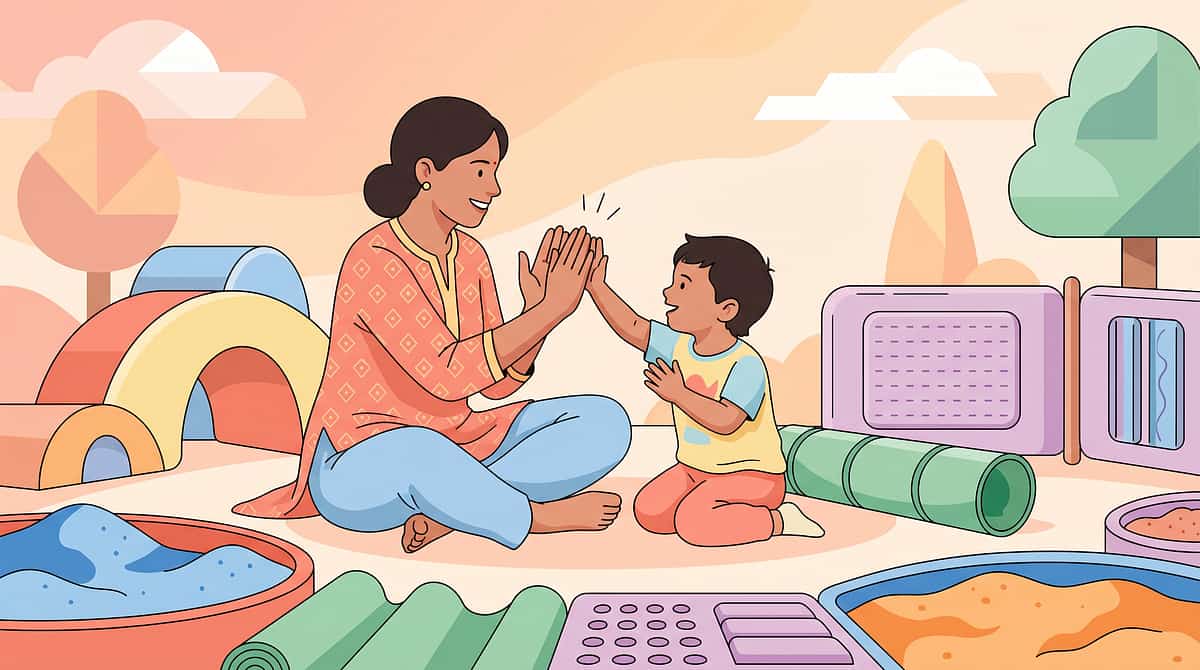
"YES! That's EAT! You showed me EAT! Perfect!"Big smile, animated voice, 2 claps — immediately after the target behavior.
The 3-Second Rule: Reinforcement delivered more than 3 seconds after the target behavior teaches the wrong association. Immediately after the correct gesture → reinforce. No exceptions.
Level | Reinforcer | When to Use | |
Primary | Child's preferred activity (5 sec access) | Early sessions, new gestures | |
Social | Animated verbal praise + high-five | Once behavior is established | |
Token | Sticker on chart for each correct gesture | After 2–3 weeks consistency | |
Natural | Gesture actually works — child eats when makes EAT sign | Gold standard — every time |
"Celebrate the attempt, not just the success. A child who tries the gesture and gets it wrong is doing exactly what their brain needs to do."
ACT III — Step 6
Step 6 of 6: The Cool-Down
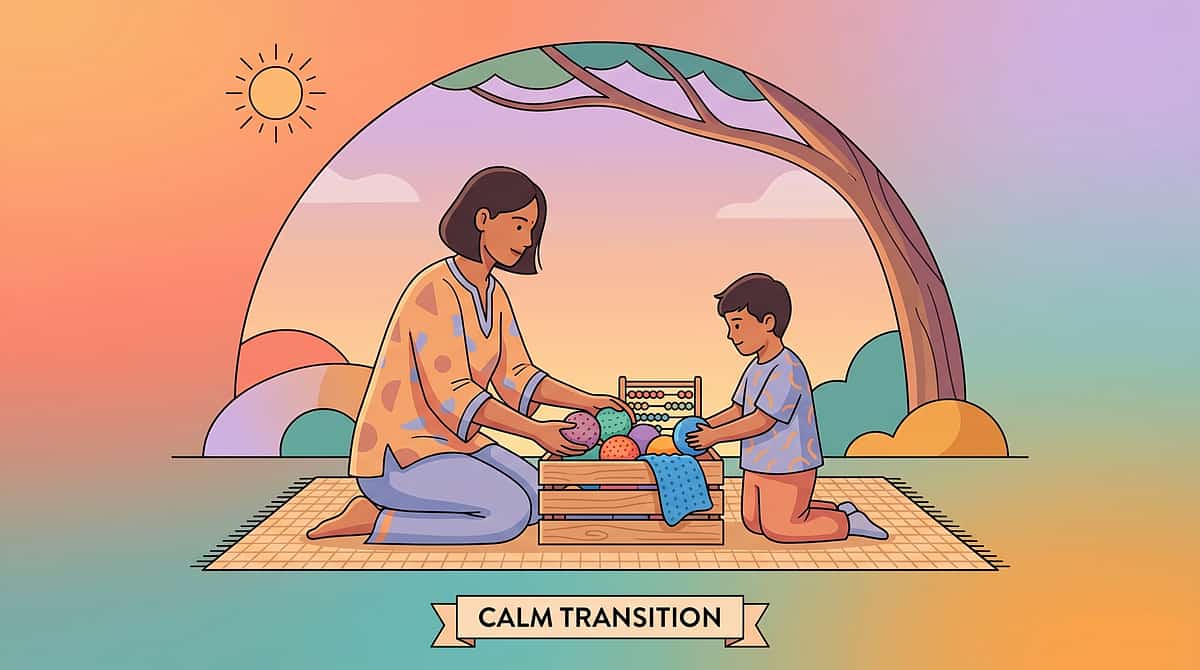
⏱️2–3 minutes | No session ends abruptly. The transition IS part of the therapy.
"Two more — and then we're all done." (Hold up 2 fingers.)
"One more." (1 finger.)
"All done!" (Open-palm "finished" gesture — use consistently, every session.)
If child resists ending: Do NOT abruptly end — this creates anticipatory protest next session. Offer 1 more preferred trial, then re-signal. Use the visual timer as the "decision-maker" — not you. The timer ends the session, not a parental command.
ACT III — Data
Capture the Data: Right Now — 60 Seconds Before You Forget
📞9100 181 181 — Ask about GPT-OS® enrollment | 24×7
Field 1 — Session Date & Time
Log immediately after session — time-stamped data is more reliable than recalled data.
Field 2 — Gestures Practiced
EAT / DRINK / COME / STOP / MORE / HELP / NO / YES / TOILET / PLAY / SLEEP / [Other]. Circle all gestures used in this session.
Field 3 — Response Quality
🟢 Independent (no prompt) | 🟡 Partial (verbal/visual prompt) | 🔴 No response (full physical prompt used). Record for each gesture practiced.
Field 4 — Notable Observation
One sentence. Example: "First time responded to EAT without me pointing at the food. Just used the sign." This is your clinical note.
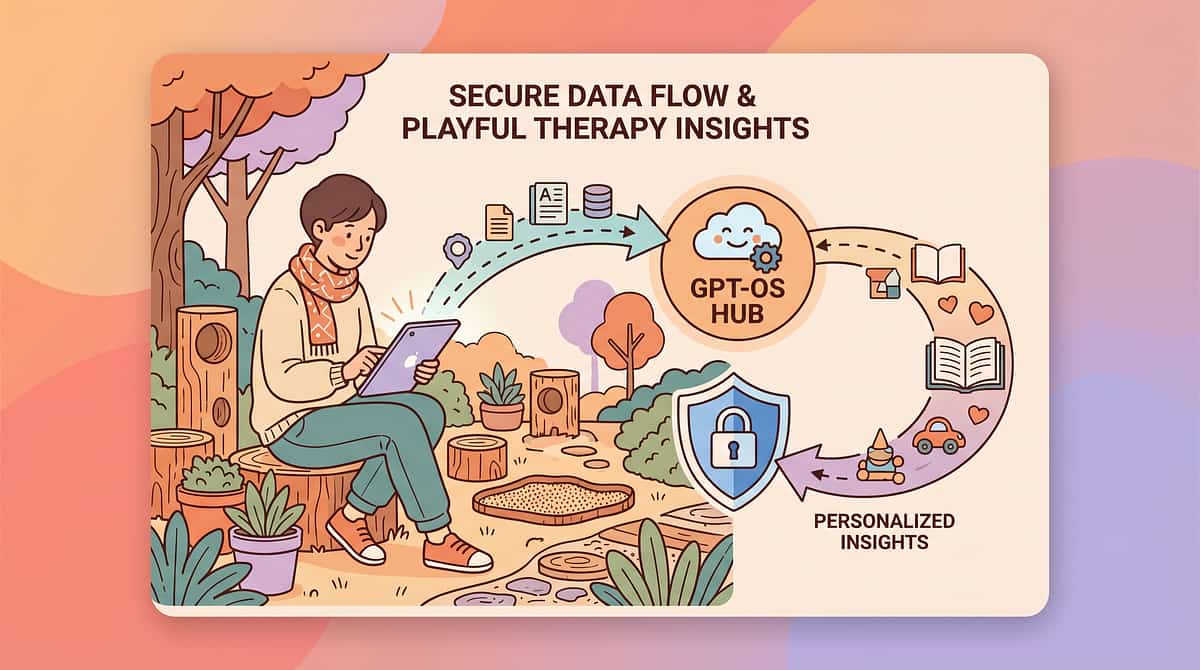
GPT-OS® Integration: This data feeds directly into your child's TherapeuticAI® prognosis engine via the GPT-OS® dashboard — adjusting future session targets in real time. Your home is the clinic. Access GPT-OS® Dashboard →
ACT III — Troubleshooting
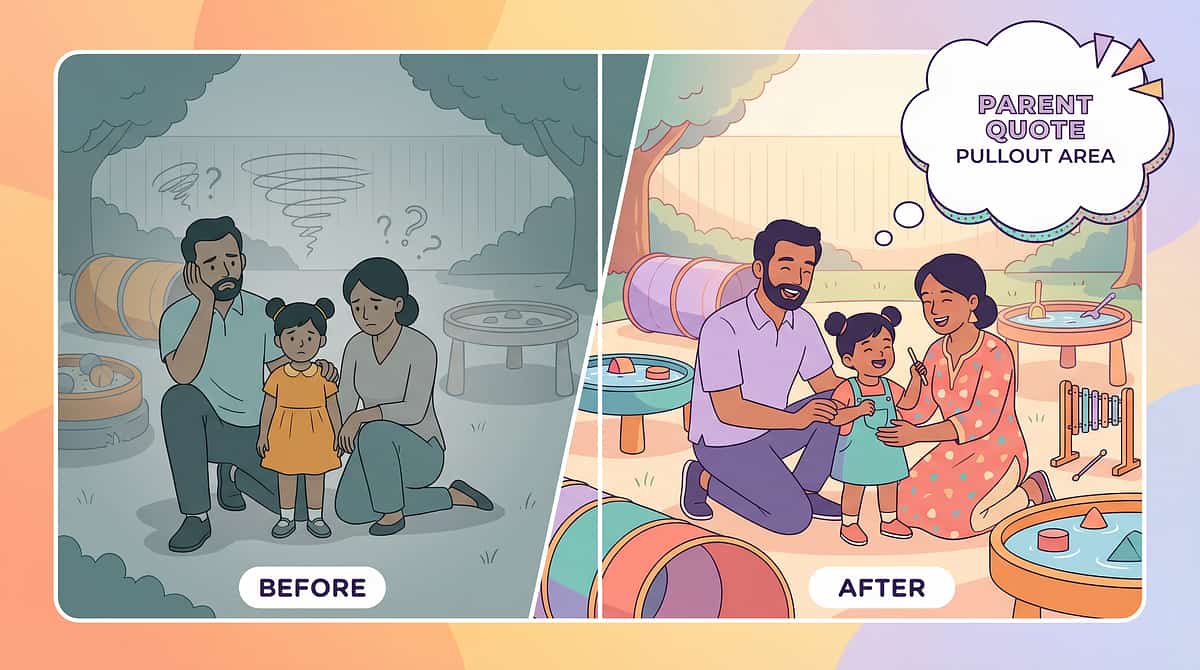
What If It Didn't Go As Planned? Your Clinical Troubleshooting Guide
"Session abandonment is not failure — it is data."
Problem | Why It Happened | Fix for Next Time | |
Child refused all gesture imitation | Social demand too high | Start with puppet modeling — no demand on child | |
Imitates gesture but doesn't connect to the word | Pairing trials insufficient | Do 10+ paired trials before testing comprehension | |
Child regressed — used to respond, now doesn't | Prompt dependency developing | Fade prompts more systematically (Card 22 guidance) | |
Family interference broke session | Environment not controlled | Enforce setup protocol from Card 12 fully | |
Responds only to one caregiver's gestures | Caregiver specificity (very common) | Distribute prompt cards to all 3+ caregivers this week | |
Started using gestures, stopped after a week | Reinforcement schedule thinned too fast | Return to continuous reinforcement schedule for 1 week | |
Home gestures don't transfer to school | Generalization not yet achieved | Prepare prompt cards for teacher this week |
Emergency Protocol: If child became severely distressed → Stop immediately → Offer comfort → Do NOT continue → Contact therapist if this is a pattern: 📞9100 181 181
ACT IV — Progress Arc
Weeks 1–2: The Nervous System Is Listening. Don't Mistake Silence for Nothing.
✅ This IS Progress in Weeks 1–2
- Child glances at your hands when you gesture
- Child tolerates gesture practice without protest
- Eye contact during gesturing increases even slightly
- Child reaches for the flashcard material
- One successful imitation of one gesture — even partial
❌ This Is NOT Expected Yet
- Child responds to verbal instruction without gesture
- Child uses gestures spontaneously
- Child imitates complex gesture sequences
- Full comprehension of 5+ gestures
- Generalization across settings
Parent Milestone: If your child tolerates the session for 3 minutes longer than week 1 — that is measurable neural pathway formation. Record it in your tracker.
Weeks 1–2 are the hardest. You are laying neural infrastructure that is invisible. Trust the evidence, trust the protocol, and capture your data — because those data points will show you the progress that emotion cannot see.
ACT IV — Week 3–4
Weeks 3–4: The Neural Pathway Is Forming — Watch for These Consolidation Signals
Child begins looking at your hands before you complete the verbal instruction
This is the clearest sign that gesture comprehension is becoming anticipatory — a major neural milestone.
Same gesture receives faster response — latency decreasing in your data
Your session tracker will show this numerically. Trust the data over subjective impression.
Child uses one gesture spontaneously in a high-need moment
EAT gesture at the table before being prompted. HELP gesture when stuck with a toy. These are the most important moments — celebrate them explosively.
Child corrects a caregiver using the "wrong" gesture
This means they have internalized the correct form. This is advanced comprehension. Record this milestone immediately.
When to increase: Child responding independently to 3+ gestures → introduce 2 new ones. Sessions completing without satiation → extend by 5 minutes. Gestures working at home → schedule a school prompt card handoff this week.
ACT IV — Week 5–8
Weeks 5–8: Gestures Are Reliable. Now Build the Verbal Bridge.
8–12
Signs Reliably Recognized
Gesture vocabulary target by end of week 8
2+
Settings Generalized
Home + grandparent's house, or home + school — cross-context comprehension
3+
Caregivers Consistent
Family members using the same gesture vocabulary reliably
The Verbal Bridge Protocol
This is how you build verbal comprehension FROM gesture strength — not by abandoning gesture, but by using it as scaffolding that is progressively removed as the verbal pathway strengthens.
ACT IV — Red Flags
When to Call for Professional Support — Know the Difference
🚩Contact your therapist if you observe:
🚩 Regression
Child had 3+ gestures reliably → now not responding to any. This is not a normal variation — it requires clinical assessment.
🚩 Plateau at 2+ Weeks
No new gesture comprehension after 2 full weeks of daily practice. The protocol may need calibration by an SLP.
🚩 Distress Escalation
Gesture practice sessions consistently ending in meltdown — this is a signal the approach needs clinical adjustment.
🚩 No Functional Communication by Age 3
No gesture AND no words AND no AAC — urgent SLP referral required. The intervention window is precious.
🚩 Motor Difficulty
Child seems to want to imitate but physically cannot form gesture shapes — OT assessment for apraxia is essential.
🚩 Rapid Multi-Domain Regression
Previously established skills across multiple domains suddenly declining — urgent NeuroDev consultation.
What is NOT a red flag: Slow progress | Inconsistency across days (neurological variability) | Performing better with one caregiver than another — these are information points, not emergencies.
📞9100 181 181 — Free clinical guidance | 24×7 | 16 languages | pinnacleblooms.org/consultation
ACT V — Community
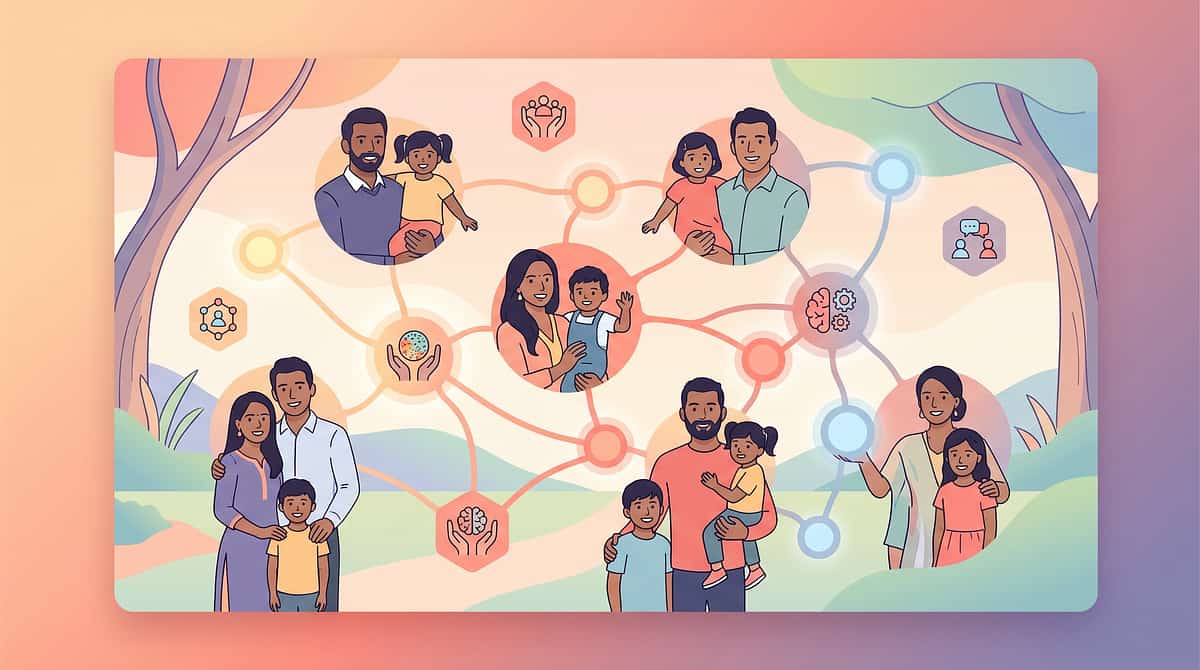
Real Families. Real Progress. You Are Not the First to Walk This Path.
"My son Arjun was 3 years old and I was exhausted. He understood nothing I said. But when I pointed — he knew exactly. Our therapist at Pinnacle showed us the gesture pairing protocol from B-153. In four weeks, he had 6 signs. In eight weeks, he responded to 'come here' without me pointing. I cried that day. Our family uses the same gesture cards now — grandparents, teachers, all of us."— Parent, Pinnacle Hyderabad Center
"The communication board with gesture illustrations changed everything. My daughter used to get so frustrated when we couldn't understand her. Now she has three ways to tell us what she needs — the picture, the word, and the sign. Her meltdowns dropped by more than half in six weeks."— Parent, Pinnacle Chennai Center
"We found B-153 through the techniques site while on a waiting list for NHS speech therapy. We started the mirror practice and sign language flashcard protocol at home. When we finally got our daughter assessed, the SLP said her gesture comprehension was far better than expected for her profile. The home work had made a measurable difference."— Parent, UK (via Pinnacle Telehealth)
📞9100 181 181 — Join the Pinnacle parent community | Testimonials are illustrative of outcomes. Individual results vary.
ACT V — Connect
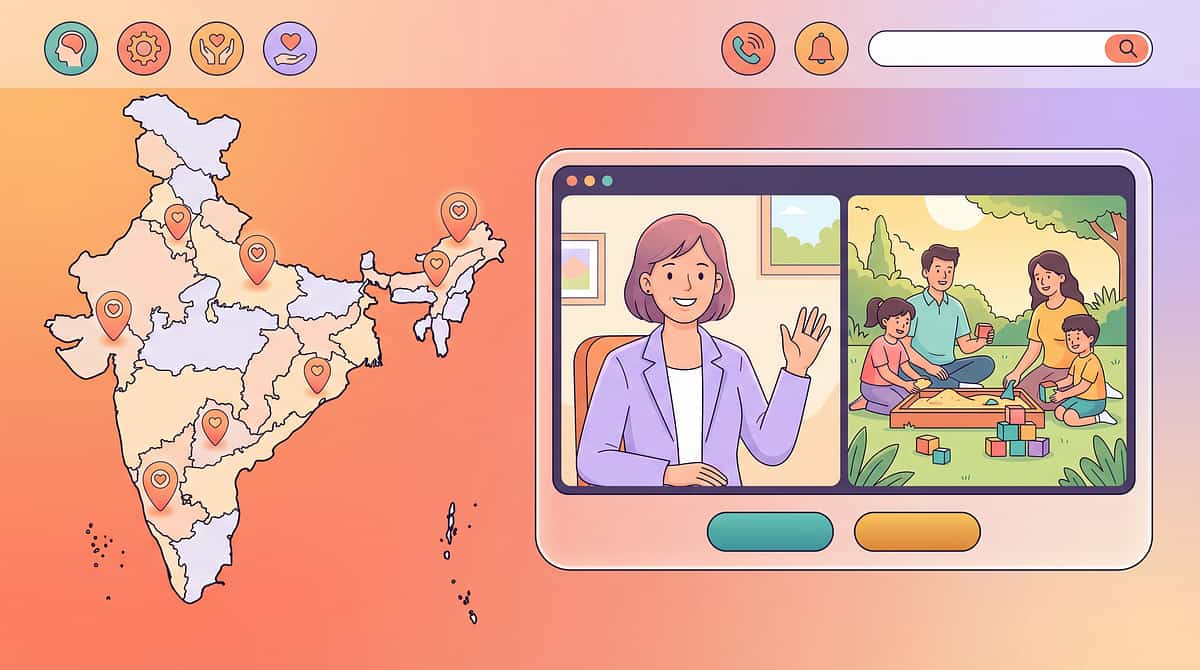
70,000+ Families. 70+ Countries. One Mission.
Channel | Purpose | Join | |
🟢 WhatsApp | Daily tips, parent support, gesture vocabulary sharing | pinnacleblooms.org/community | |
📘 Facebook | Parent stories, material reviews, progress sharing | Pinnacle Blooms Parents Network | |
📸 Instagram | Daily technique reels, gesture demos, family inspiration | @pinnacleblooms | |
🎬 YouTube | Technique demonstrations, therapist guidance, B-153 content | Pinnacle Blooms Network channel | |
🌐 Techniques Library | All 70,000+ intervention technique pages | techniques.pinnacleblooms.org | |
📞 Helpline | FREE. 24×7. 16 languages. | 9100 181 181 |
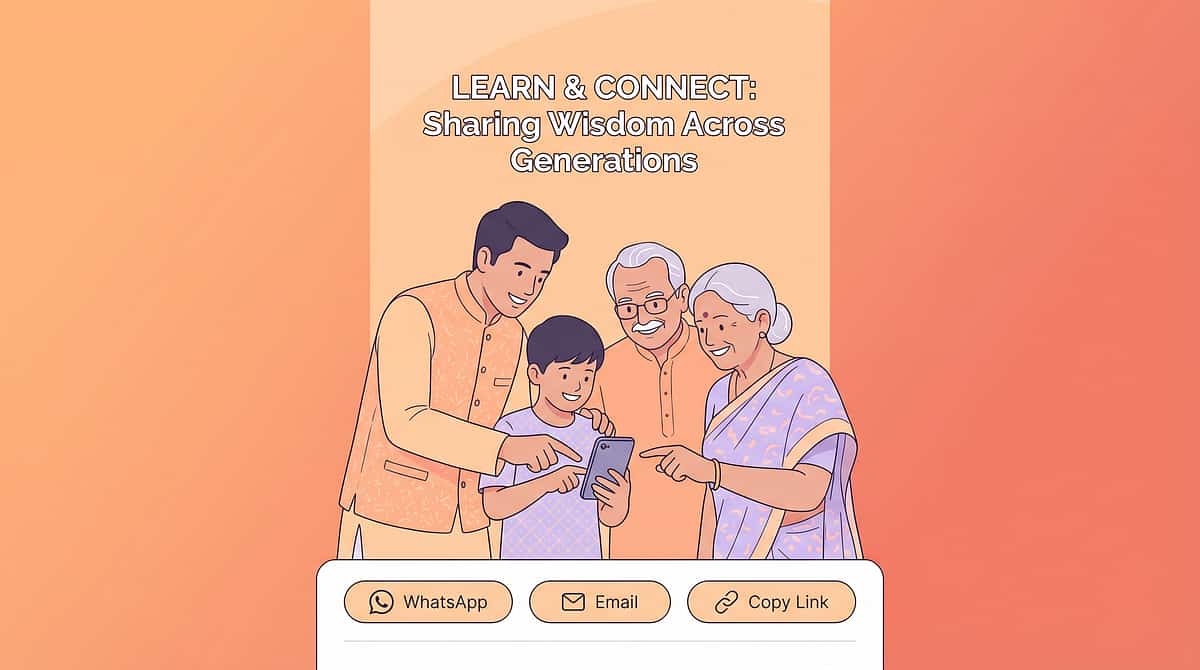
"The families who share their stories change the families who are still in the dark. If B-153 helped your child — share this page. It costs nothing. It may change everything for the family that finds it."
ACT VI — FAQ
Frequently Asked Questions — Clinically Accurate. Parent-Honest.
Q1: My child responds to me pointing but not to anyone else's pointing. Is this normal?
Yes. Early gesture comprehension often emerges as person-specific before generalizing. The neural pathway exists — it just needs to be exercised with more people. Use Caregiver Prompt Cards to ensure all caregivers gesture consistently. Generalization typically follows within 2–4 additional weeks.
Q2: How many gestures should I teach at once?
Start with 3–5 functional gestures only — the ones your child needs most urgently (EAT, DRINK, COME, STOP, HELP). Mastery of 3 gestures is far more valuable than exposure to 15. Add 2 new gestures only after consistent independent response to the current set.
Q3: Will teaching gestures prevent my child from developing verbal language?
The opposite is true. Research consistently shows that gesture-based and AAC-based communication builds, not replaces, verbal language. The gesture pathway exercises the same semantic and conceptual systems verbal language uses. Children who gesture more, speak more. This is established evidence across multiple systematic reviews.
Q4: My child can say some words but doesn't follow verbal instructions. Is B-153 right?
Yes. Expressive words and receptive comprehension are separate systems. A child can say "biscuit" without being able to follow "give me the biscuit" — this is a receptive language profile that B-153 directly addresses. If gesture + verbal pairing produces better comprehension than verbal alone, B-153 is the right protocol.
ACT VI — FAQ Continued
More Questions — Answered
Q5: How long before I see results?
Most families observe the first measurable response (gesture comprehension of 1–2 core signs) within 7–14 days of daily 10-minute practice. Significant progress (5+ signs, beginning verbal bridge) typically emerges at 4–8 weeks. The data you capture on your session tracker will show you the progress objectively — even when emotion cannot see it yet.
Q6: What if my child refuses to do the practice sessions entirely?
This is common in the first 2 weeks. Solutions: (1) Start with zero formal sessions — just gesture naturally during every daily activity for 1 week. (2) Use video modeling passively — no demand. (3) Start with the puppet method — indirect, playful, no direct demand on child. Contact 9100 181 181 if refusal persists beyond 2 weeks.
Q7: Is Indian Sign Language (ISL) the right sign system to use?
For Indian families, ISL signs for core vocabulary are strongly recommended for consistency with school and community contexts. The ISLRTC at islrtc.nic.in provides free resources. Your Pinnacle SLP can guide you to the appropriate sign vocabulary for your child's specific communication profile.
Q8: Can B-153 be used alongside AAC devices (tablets, communication apps)?
Yes — and it should be. Gesture comprehension is the natural precursor to and complement of all AAC systems. The physical gesture and the digital symbol on an AAC device work through identical comprehension pathways. Running B-153 alongside AAC programming accelerates outcomes for both simultaneously.
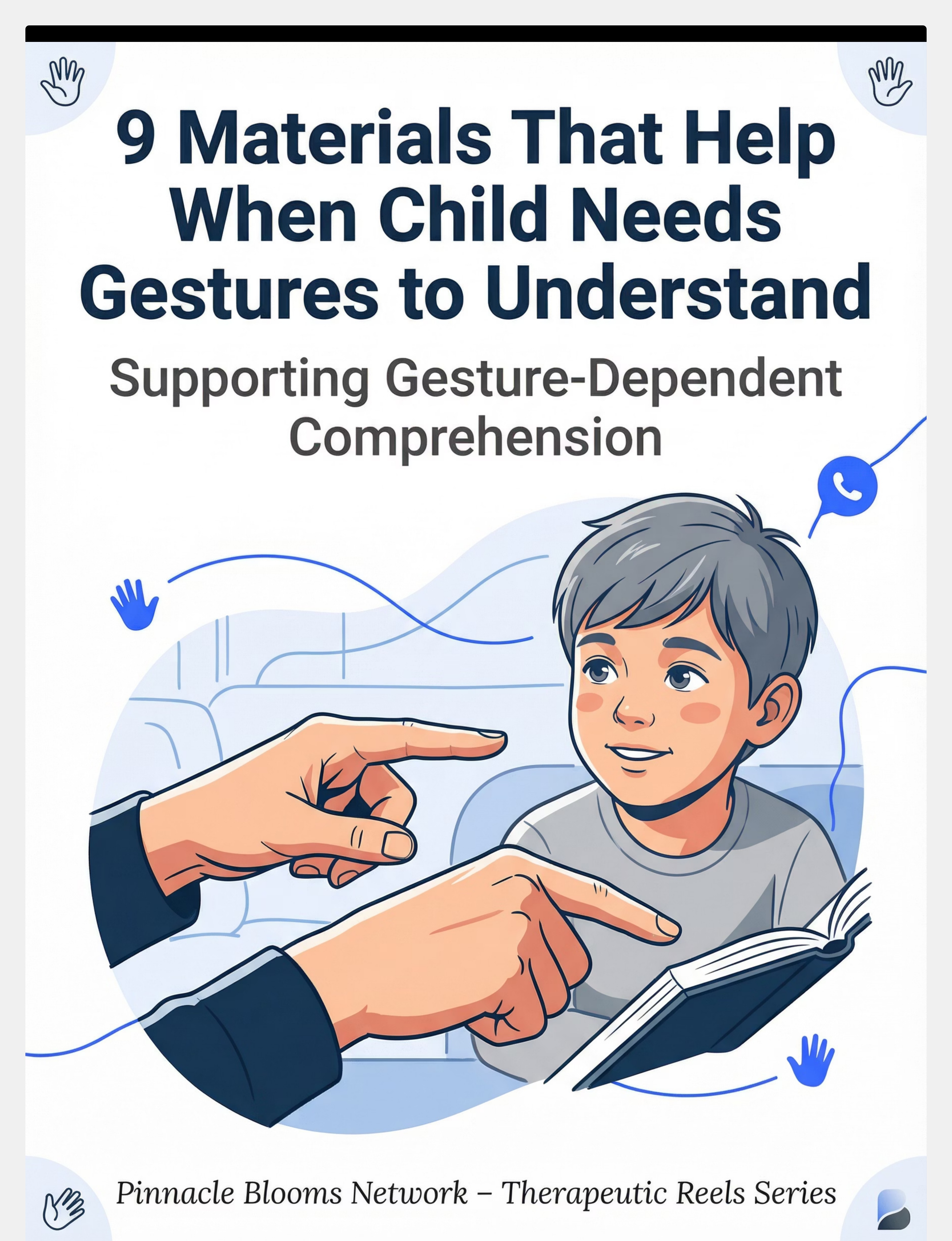
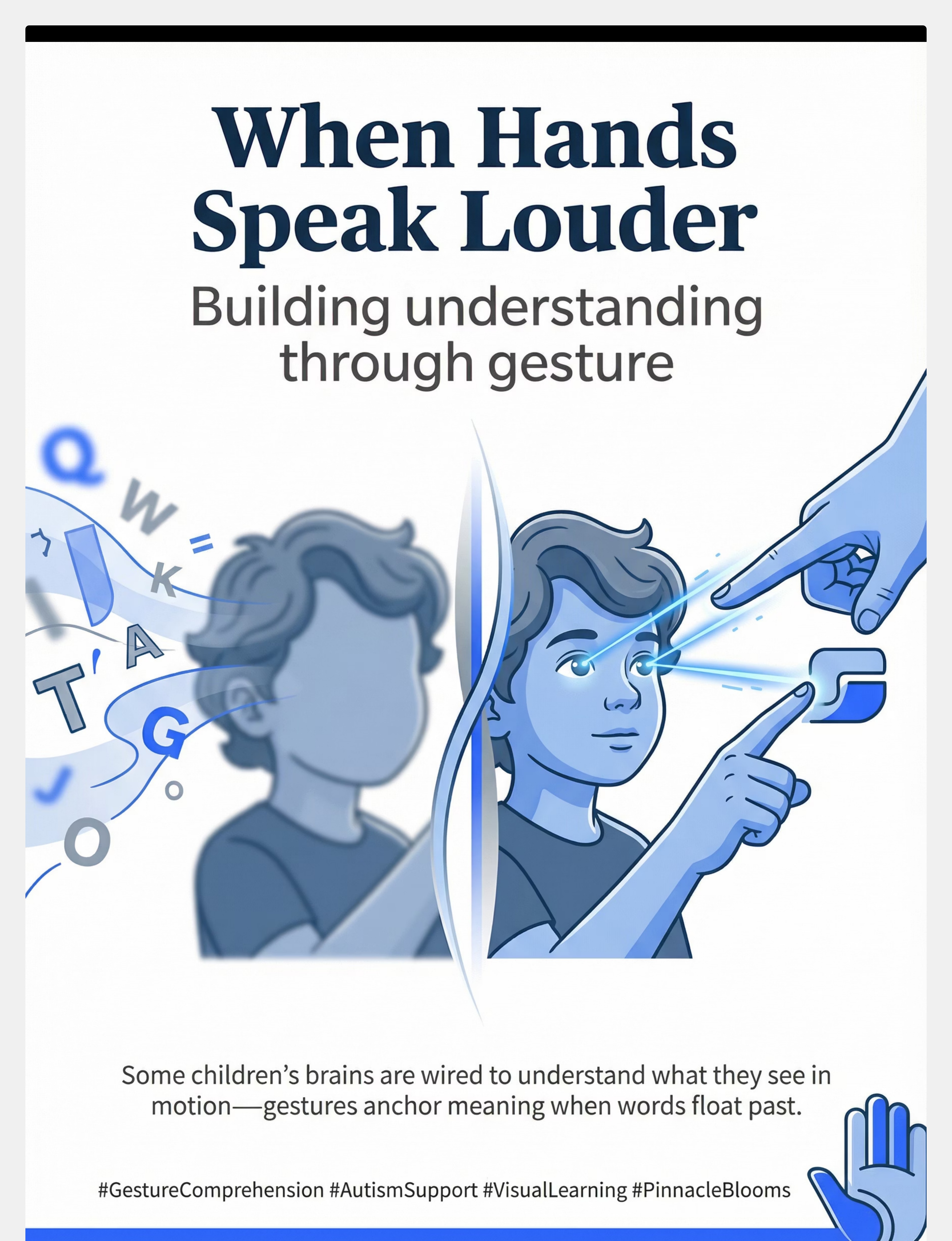
Preview of 9 materials that help when child needs gestures to understand Therapy Material
Below is a visual preview of 9 materials that help when child needs gestures to understand therapy material. The pages shown help educators, therapists, and caregivers understand the structure and content of the resource before use. Materials should be used under appropriate professional guidance.


Link copied!

The Pinnacle Promise
"From fear to mastery. One technique at a time."
Pinnacle Blooms Network® exists to transform every home in the world into a scientifically validated, 24×7, personalized, multi-sensory, multi-disciplinary pediatric therapy environment — powered by GPT-OS®, delivered by trained families, measured by data, and governed by international clinical evidence.
Medical Disclaimer
This content is educational and informational. It does not replace assessment, diagnosis, or treatment by a licensed speech-language pathologist, occupational therapist, or other qualified healthcare professional. If you are concerned about your child's development, please consult a qualified professional. Always consult your child's clinical team for individualized guidance.
Legal & Contact
Company: Bharath Healthcare Laboratories Pvt. Ltd. | CIN: U74999TG2016PTC113063 | DPIIT: DIPP8651 | GSTIN: 36AAGCB9722P1Z2
📞 9100 181 181 | 🌐pinnacleblooms.org | ✉️care@pinnacleblooms.org
📞 9100 181 181 | 🌐pinnacleblooms.org | ✉️care@pinnacleblooms.org
© 2025 Pinnacle Blooms Network®, a unit of Bharath Healthcare Laboratories Pvt. Ltd. All rights reserved. GPT-OS®, AbilityScore®, TherapeuticAI®, FusionModule™, and EverydayTherapyProgramme™ are proprietary trademarks.