

When Time Is Invisible to Your Child — And Every Transition Becomes a War
It's 8:47 AM. School starts in 13 minutes. You said "five more minutes" eleven minutes ago, and your daughter is still in her pyjamas, completely absorbed in her Lego, as if time itself does not exist for her. Because for her — it genuinely doesn't.
Visual Timers: Making the Invisible Visible — So Your Child Can Finally Prepare for What's Coming
"You are not failing. Your child's nervous system processes time differently. This is neuroscience, not defiance." — Pinnacle Blooms Consortium, OT + ABA + NeuroDev + SLP + SpEd
🏛️ Pinnacle Blooms Network®
Validated by Multi-Disciplinary Consortium
20M+ Therapy Sessions
📞FREE National Autism Helpline: 9100 181 181 | Available 24×7 | 16+ Languages
WHO Nurturing Care Framework (2018) | Early identification and parental awareness directly impacts developmental outcomes.

The Scale of Time Perception Challenges in Children
If your child cannot feel time passing — if "five more minutes" is genuinely meaningless to them — they are not being manipulative. Research from Frontiers in Integrative Neuroscience and the World Journal of Clinical Cases (2024) confirms that children with ADHD and autism experience a measurably different internal clock. Transitions feel like ambushes because they are. The end of an activity is a surprise every single time.
1 in 5
Executive Function Deficits
Children globally show significant executive function deficits affecting time management
80%+
Time Blindness in ADHD
Of children with ADHD experience clinically significant time blindness — their internal clock runs unreliably
3.2Cr
Children in India
Estimated children in India currently navigating time perception, transition, and routine challenges
India Context: NIMHANS and multiple state-level surveys indicate that executive function challenges — including time perception difficulties — are among the most commonly reported concerns by families of children with developmental differences. Pinnacle Blooms Network® serves families from 70+ countries navigating exactly this challenge.
You are among millions of families navigating this exact challenge. You are not alone. And this is solvable.
PMC11506176 | PMC10955541 | DOI: 10.12998/wjcc.v12.i7.1260 | NIMHANS Annual Report 2023 | WHO Global Status Report on NCDs

The Neuroscience of Time Blindness: A Wiring Difference, Not a Behavior Problem
The Internal Clock
Your child's brain has a biological timer that creates the feeling of time passing. In ADHD and autism, this clock runs inconsistently — sometimes fast, sometimes slow, often unpredictable.
Prefrontal Cortex
Executive planning and time estimation — shows reduced activation in ADHD and autism profiles.
Basal Ganglia
The brain's internal clock mechanism — produces irregular timing signals, making duration estimation unreliable.
Cerebellum
Temporal processing center — exhibits delayed calibration, disrupting the child's sense of elapsed time.
What This Means in Practice
When you say "five more minutes," your child isn't ignoring you. They genuinely cannot feel the difference between five minutes and five seconds when absorbed in a preferred activity. Their brain has not received the signal that time is moving.
Why Transitions Feel Like Ambushes
Without a reliable internal clock, the end of an activity arrives suddenly — not gradually. There is no internal "winding down" signal. This is why the meltdown happens at the transition, not during the countdown.
The Solution Pathway
Visual timers bypass the unreliable internal clock entirely. Instead of asking the brain to feel time, we let the child see time. The red disk shrinking. The sand flowing. The countdown strip getting shorter. External, visible, real.
"This is a wiring difference, not a behavior choice." — Pinnacle Blooms Consortium | OT + ABA + NeuroDev
DOI: 10.3389/fnint.2020.556660 — Frontiers in Integrative Neuroscience (2020) | Barkley, R.A.: ADHD and the Nature of Self-Control | PMC10955541
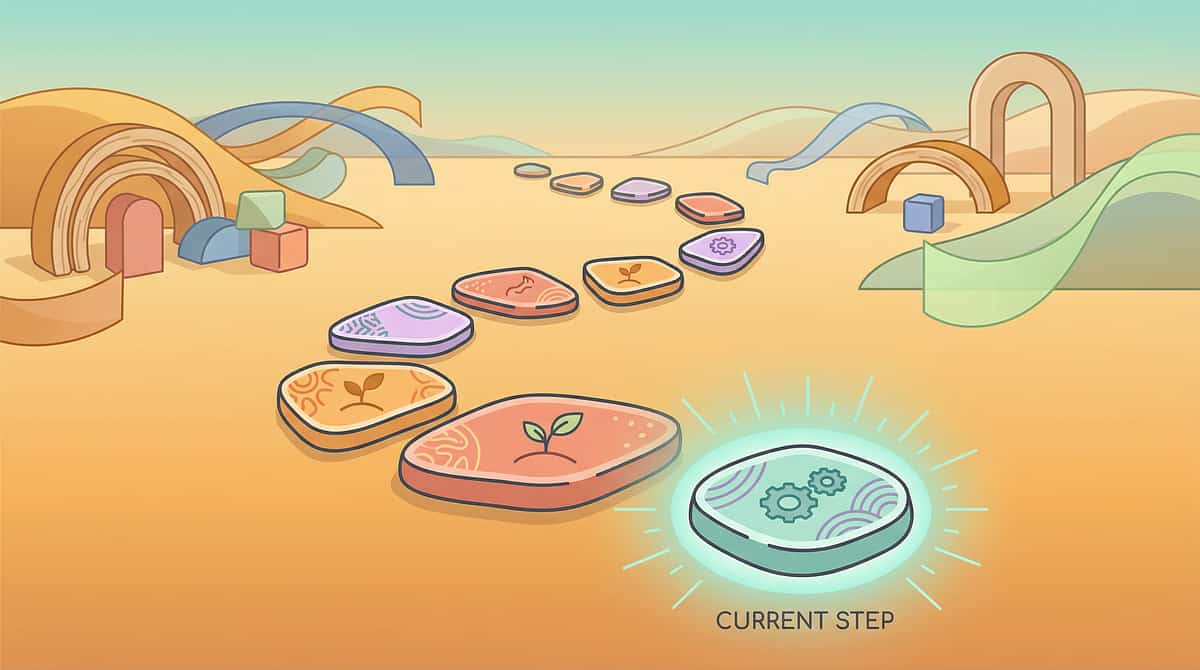
Time Perception Development: Where Your Child Is, and Where They're Heading
Ages 2–3
Sequence understanding — "First, Then" vocabulary begins
Ages 4–5
Time words emerge — "Wait a minute," "a long time" concept developing
Ages 6–8
Clock reading — minutes and hours become meaningful
Ages 9–12
Estimation — moderate accuracy in time planning tasks
Adolescence
Multi-step planning — complex time management develops
For Children with ADHD, Autism, or EF Challenges: Time perception development may be significantly delayed or may follow a different trajectory entirely. Research shows the ADHD/autism brain experiences time differently — and may always benefit from visual time scaffolding. This is not failure; it is accommodation, exactly as glasses accommodate vision differences.
Current Stage | Next Milestone | Visual Timer's Role | |
No awareness time is passing | Beginning to notice timer as relevant | Timer becomes meaningful external reference | |
Surprise at all transitions | Anticipating timer ending | Developing preparatory response | |
Cannot wait for any duration | Short timed waits with timer support | Building tolerance through visible countdown | |
Dependent on adult prompts | Child checking timer independently | Transfer of time ownership |
Time perception challenges commonly co-occur with: ADHD (most common association), Autism Spectrum Disorder, Anxiety Disorders, Sensory Processing Differences, and Executive Function Disorder. Professional evaluation guides appropriate support design.
WHO Care for Child Development (CCD) Package | UNICEF MICS Developmental Indicators | PMC9978394

Clinical Evidence Grade: Visual Timers & Time Externalisation
⭐ LEVEL I EVIDENCESystematic Review + RCT Confirmation — NCAEP Evidence-Based Practice Classification (2020)
Study | Finding | Source | |
PRISMA Systematic Review (2024) | 16 studies (2013–2023) confirm visual supports meet evidence-based practice criteria for ASD | PMC11506176 | |
Meta-Analysis, World J Clin Cases (2024) | Visual timer + structured transitions improve task completion, reduce meltdowns across 24 studies | PMC10955541 | |
Indian RCT — Padmanabha et al. (2019) | Home-based visual supports showed significant outcomes in Indian pediatric population | DOI: 10.1007/s12098-018-2747-4 | |
NCAEP (2020) | Visual Supports classified as established evidence-based practice for autism | ncaep.fpg.unc.edu | |
Barkley Time Perception Research | Time blindness in ADHD: measurable neurological difference, not behavioral | Multiple peer-reviewed publications |
"Clinically Validated. Home-Applicable. Parent-Proven."
⏱️ Fewer Meltdowns
Children using visual timers show measurably fewer transition meltdowns
📊 Better Completion
Task completion rates improve when time is made visible
🏠 Home Equivalent
Home-administered visual timer protocols show equivalent outcomes to clinic-based delivery
PMC11506176 | PMC10955541 | PMC9978394 | NCAEP 2020 | DOI:10.1007/s12098-018-2747-4
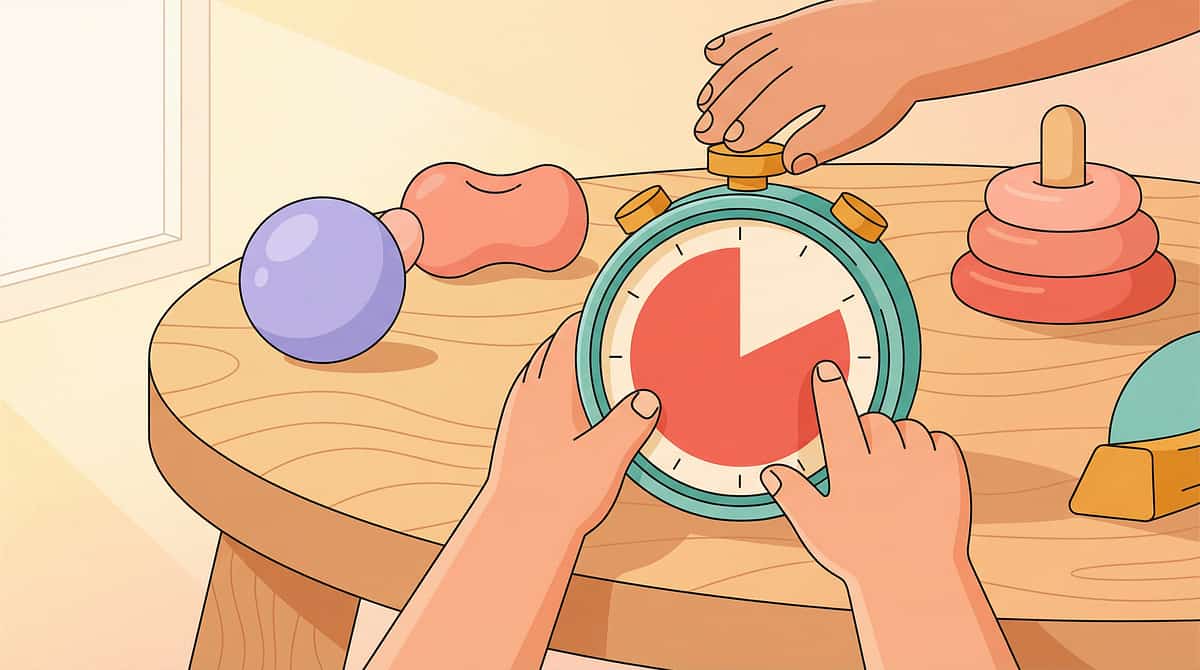
Visual Timer Use: The Complete Definition
EF-TIM Domain
Ages 2–16
Daily Use
Home Executable
NCAEP Evidence-Based
Formal Name | Visual Timer Externalisation Protocol | |
Parent-Friendly Name | "Making Time Visible" | |
Core Principle | Bypass the unreliable internal clock by providing external, visible representation of time passing | |
Domain | Executive Function / Time Management / Transition Support (EF-TIM) | |
Age Range | 2–16 years (timer type adapted to developmental level) | |
Session Duration | Ongoing throughout daily routines — not a single session activity | |
Frequency | Daily, across all applicable transitions and timed activities |
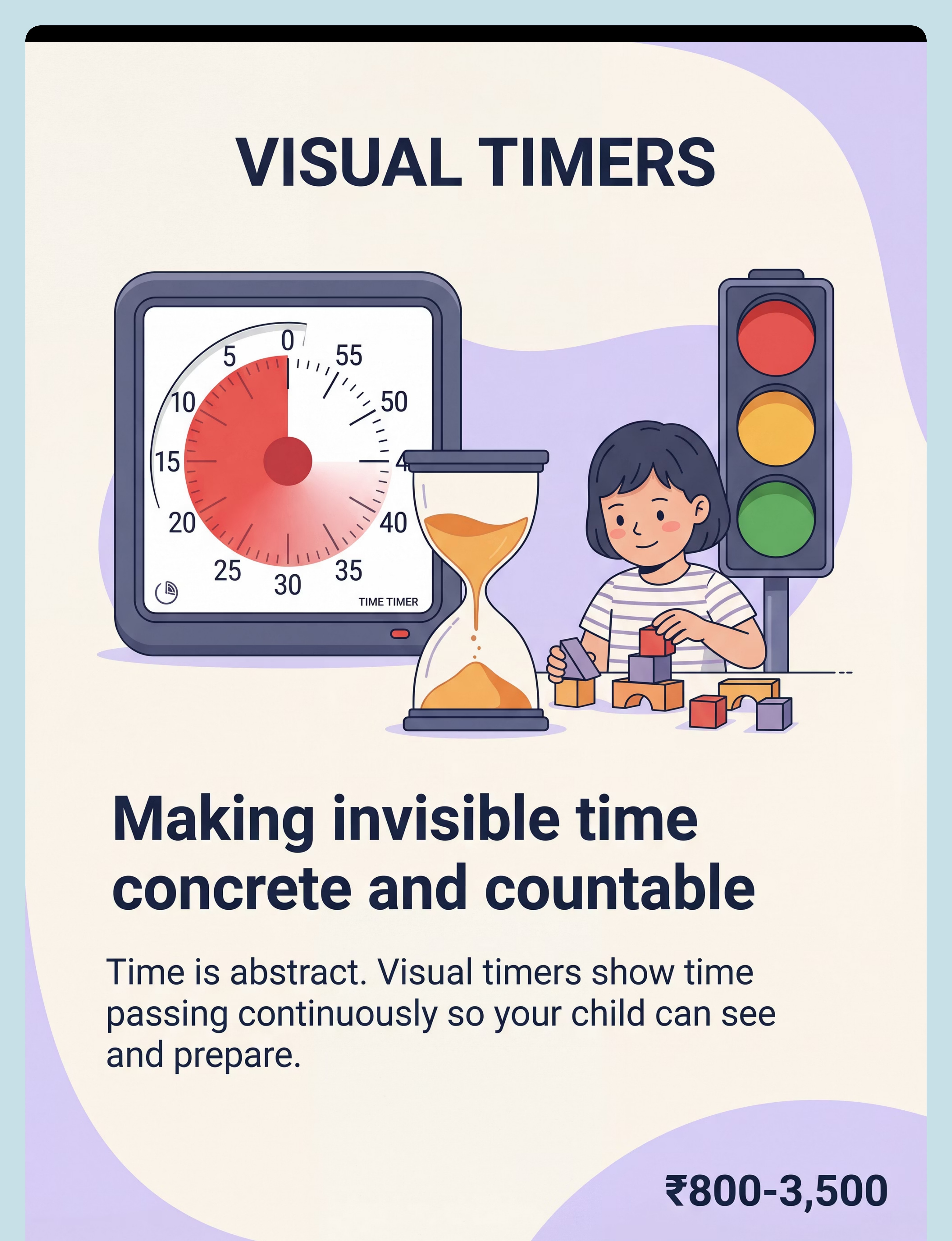
Visual timers are therapeutic tools that convert the abstract, invisible experience of time passing into something concrete and visible — a shrinking red disk, flowing sand, a countdown strip, or colour-changing lights. For children whose internal clock does not operate reliably (ADHD, autism, executive function challenges), visual timers provide the external temporal scaffolding that allows them to see how much time remains, prepare for what comes next, and participate in transitions rather than being ambushed by them. This is among the most evidence-supported, least invasive, and most immediately impactful accommodations available to families.
Canon Material Categories this technique uses: Visual Timers | Sand Timers | Countdown Boards | Transition Objects/Comfort Items | Reinforcement Menus

Multi-Disciplinary Application: Every Therapist on Your Child's Team Uses This
This technique crosses therapy boundaries because the brain doesn't organise by therapy type. Time blindness affects everything — and every therapist knows it. Here is how each professional on your child's team applies visual timer support.
Occupational Therapist (Primary Lead)
Uses visual timers to scaffold executive function, self-regulation during sensory activities, task completion pacing, and ADL routines. Selects timer type based on sensory profile.
ABA/BCBA Behavioral Therapist
Integrates visual timers as antecedent manipulation — setting up the environment before demands to reduce transition resistance. Pairs with reinforcement schedules and token economies.
Speech-Language Pathologist
Uses timers for structured turn-taking in communication activities, timed language samples, waiting for communication partner, and pacing multi-step verbal instructions.
Special Educator
Implements visual timers for classroom task completion, homework pacing, test-taking, independent work periods, and transition between school activities.
NeuroDevelopmental Paediatrician
Recommends visual timers as first-line environmental intervention for ADHD, autism, and executive function differences. Coordinates with all disciplines on implementation.
DOI: 10.1080/17549507.2022.2141327 (Int J Speech-Lang Pathol, 2022) | NCAEP 2020 | WHO/UNICEF NCF Adapted Framework
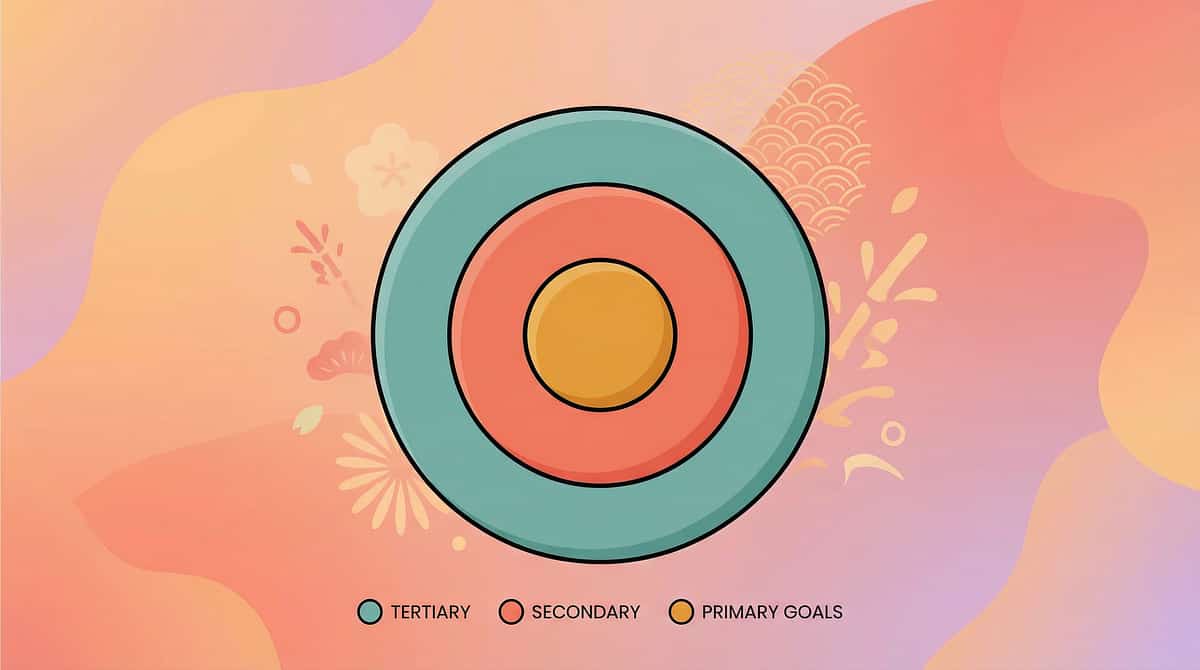
Precision Targets: What Visual Timers Actually Change
Domain | Before Visual Timers | With Visual Timers | |
Transitions | Surprise → meltdown at every ending | Watches timer, begins preparing, smoother ending | |
Task Pacing | 45 min on one homework problem | Distributes time across tasks | |
Waiting | Cannot wait 2 minutes without distress | Watches sand fall, tolerates short waits | |
Morning Routines | Chaos, always late | Timer for each step, predictable pace | |
Screen Time Endings | Meltdown every time | Watches red disk, expects the ending |
📞 Questions about targets for your child? 9100 181 181 — Free, 16+ languages
PMC10955541 (Meta-analysis: 24 studies on SI + transition outcomes) | General ABA Antecedent Intervention Literature
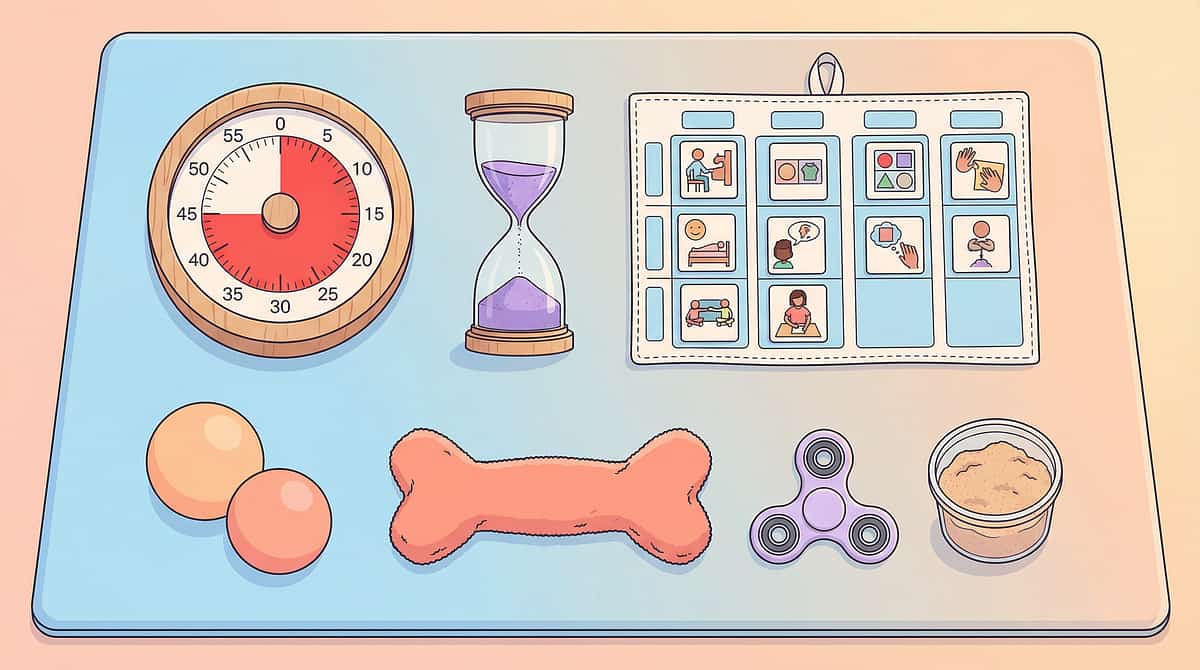
9 Materials That Make Time Visible — The Complete Arsenal
TIME TIMER® (Visual Countdown Timer)
Why It Works: The red disk disappears as time elapses — no numbers required. Children literally watch time shrink. Eliminates the "surprise attack" of sudden transition demands.
Models: Original (8"), MOD (portable), PLUS (digital+visual), Pocket, Watch (wrist)
Price Range: ₹2,500–5,500 | 🏅Pinnacle Recommends — Most evidence-supported format
Sand Timers / Hourglasses
Why It Works: Mesmerising flowing sand = calming visual timer. Silent. Battery-free. Tactile — child can pick up and flip. Color-coded sets teach different durations by color.
Types: 30sec, 1min, 2min, 3min, 5min, 10min, 30min sets | Price: ₹300–1,500
Safety Note: Choose plastic/acrylic for young children. Verify non-toxic contents.
Visual Timer Apps (Phone/Tablet)
Why It Works: Always available on device families already own. Customisable visuals, sounds, multiple presets. Some specifically designed for autism/ADHD.
Recommended Apps: Time Timer® app, Tico Timer, Brili (routines), Choiceworks
Price: ₹0–500 | 💡Zero-Cost Option Available
Traffic Light Timers
Why It Works: Green = plenty of time. Yellow = warning, start preparing. Red = time's up. The yellow phase is the breakthrough — a visible preparation window.
Types: Time Tracker Visual Timer, OK-to-Wake clocks, programmable traffic light devices
Price: ₹1,500–4,000
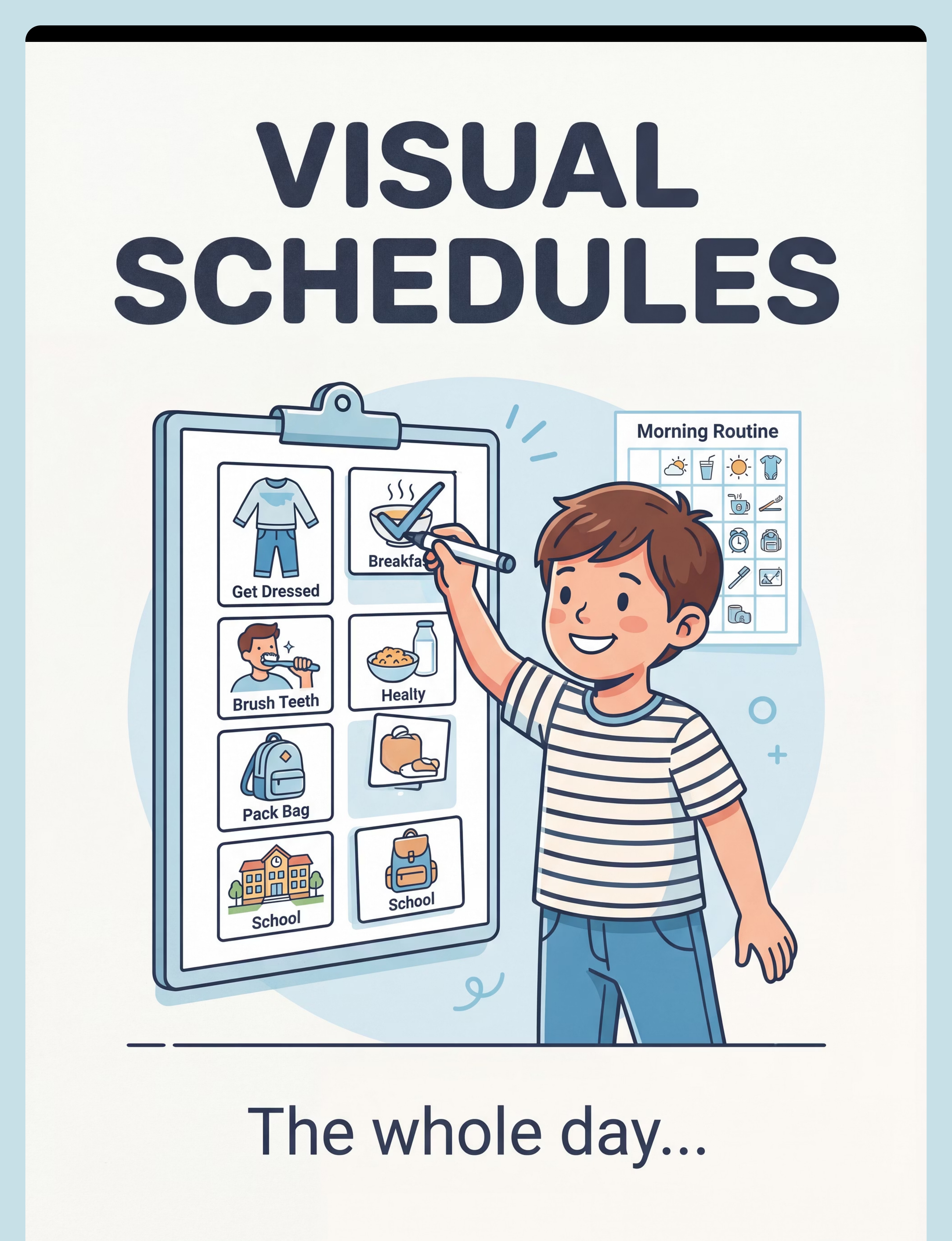
Visual Routine Charts with Time Indicators
Why It Works: Combines WHAT comes next (sequence) with HOW LONG each step takes (duration). Addresses both challenges simultaneously.
Types: Laminated chart boards, Brili app, Choiceworks app, Tiimo (ADHD-designed)
Price: ₹500–2,000 (charts); ₹0–1,500 (apps)
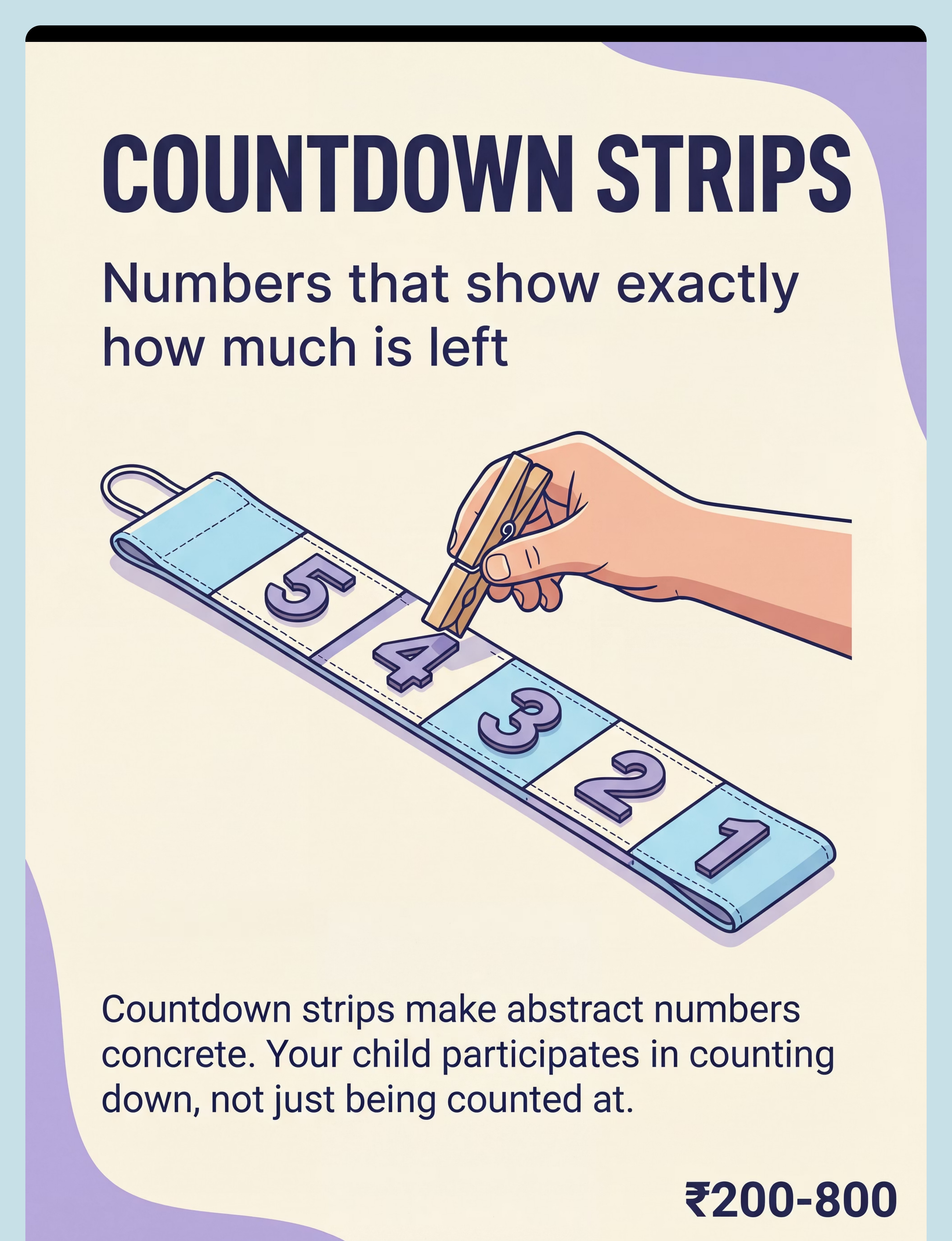
Countdown Visual Strips and Boards
Why It Works: Time shown as discrete countable units — blocks removed/flipped as time passes. Child physically participates in the countdown. Combines visual + tactile time representation.
Types: Velcro countdown boards, laminated strips, magnetic boards
Price: ₹200–1,200 | 💡DIY Possible — Cardstock + velcro dots (₹50–100)
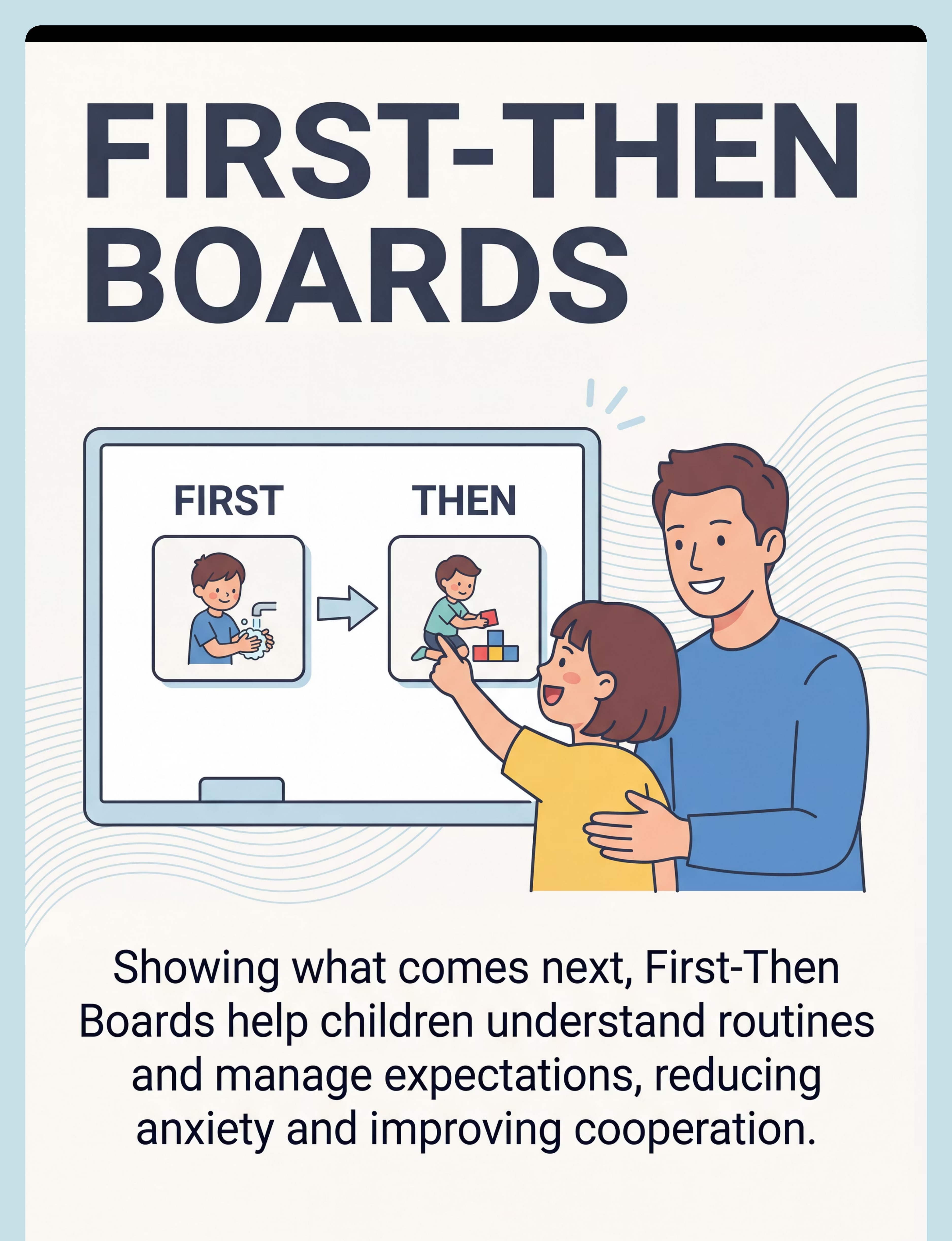
Transition Warning Cards and First-Then Boards
Why It Works: Timers answer "How much longer?" — Transition cards answer "Then what?" Both questions must be answered for smooth transitions. First-Then boards reduce anxiety about the unknown.
Types: Laminated warning card sets (5min→2min→done), First-Then boards, PECS-style icons
Price: ₹200–1,000 | 💡DIY Possible — Print and laminate (₹0–200)
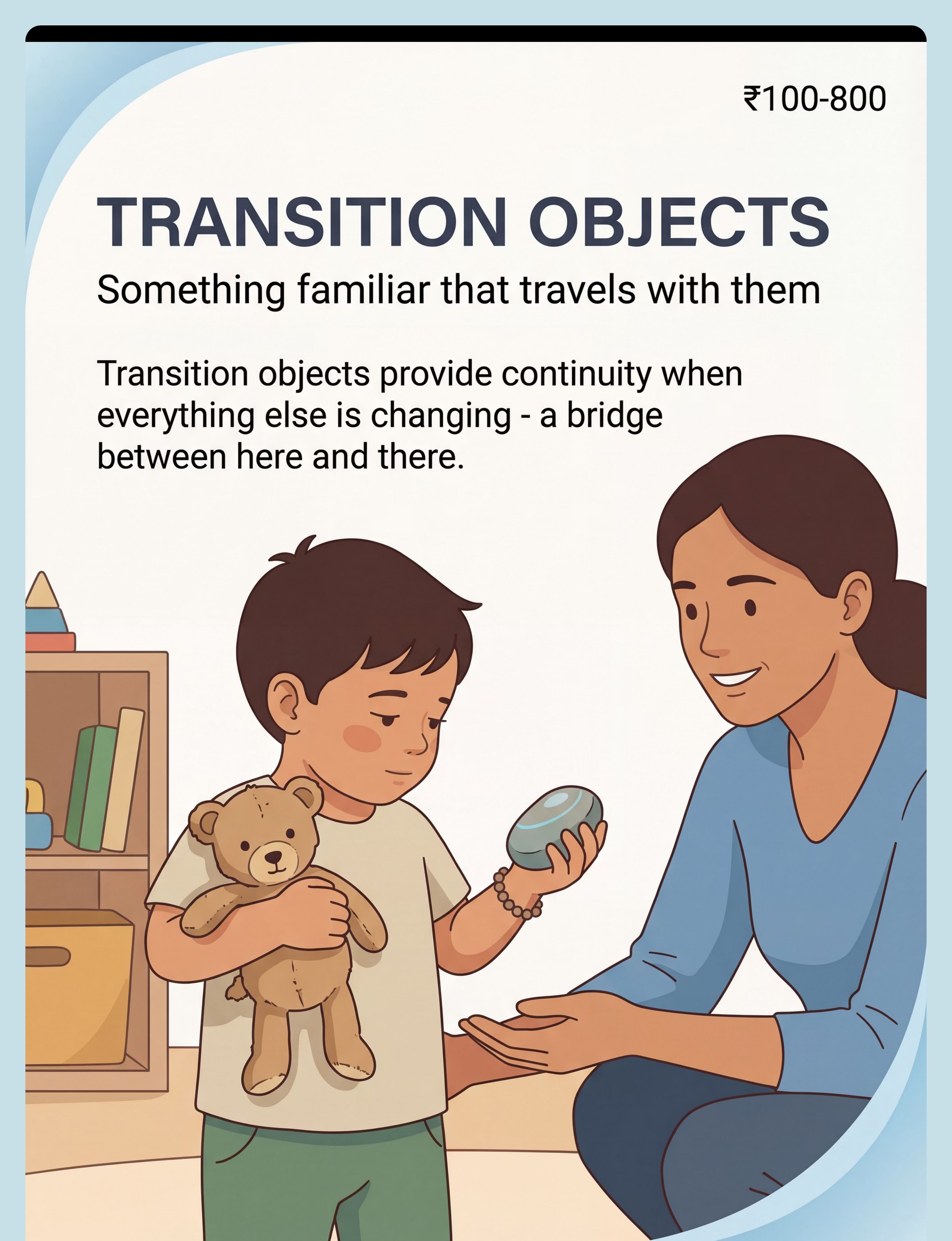
🛒Animal Soft Toys (Transition Comfort Object) — ₹425 → Buy on Amazon →
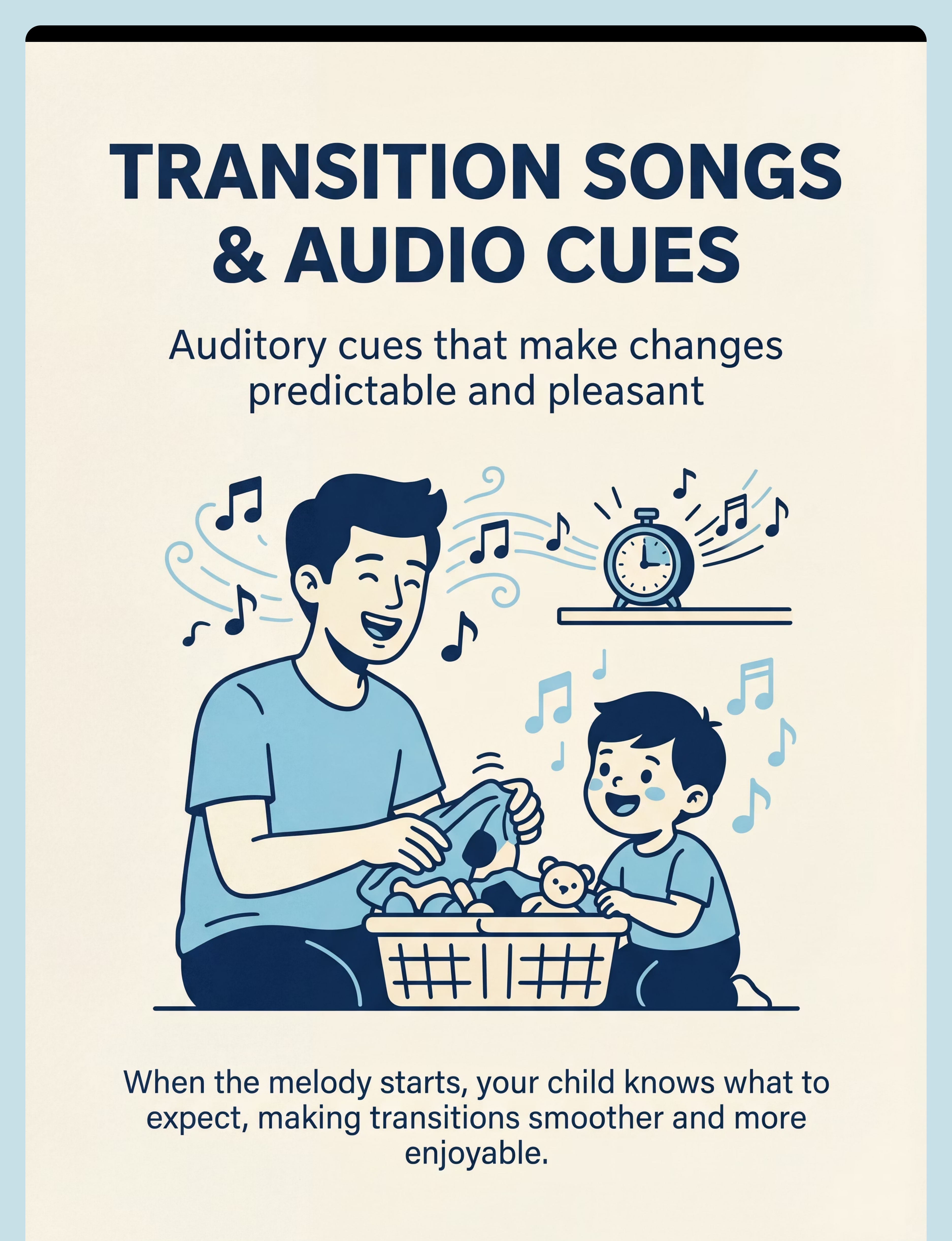
Auditory Timer Signals and Chimes
Why It Works: Catches attention when child isn't watching the visual timer. Gentle chimes are non-jarring, signal-clear, positive-feeling. Graduated sounds add auditory countdown layer.
Types: Meditation chimes, singing bowls, timer apps with custom sounds, gentle alarm clocks
Price: ₹300–1,500 | ⚠️Sound Sensitivity Check Required — Test sounds when child is calm first
Wearable Timers and Vibrating Alerts
Why It Works: Discreet, private, always with the child. Vibrating alerts provide tactile time cues only the wearer feels — ideal for school settings and older children who resist visible timer tools.
Types: Time Timer Watch, WatchMinder, smartwatch with timer apps, vibrating bracelet timers
Price: ₹2,000–8,000 | Ideal For: Ages 10+, school settings, independence-building
Budget Range Summary: Starter Kit (1 visual timer + 1 sand timer + free app) = ₹800–2,000 | Complete Arsenal = ₹7,500–25,000

Every Material Has a ₹0 Version — WHO Equity Principle in Action
The Pinnacle Consortium is committed to ensuring every family — regardless of geography, income, or access — can execute evidence-based interventions today. No child should wait for therapy materials to arrive.
Commercial Option | ₹0 Household Alternative | Why It Works the Same | |
Time Timer® (₹2,500–5,500) | Paper plate with a removable "red sector" of cardstock, pinned at center; rotate to show remaining time | Same shrinking-red-sector visual principle | |
Sand Timer (₹300–1,500) | Two plastic water bottles connected at neck with tape, filled with coloured salt or fine sand | Identical visual of material flowing from one chamber to another | |
Visual Timer App (₹0–500) | Phone clock app with largest display, countdown timer, placed visible to child | Same function — always in pocket | |
Countdown Strip (₹200–1,200) | Paper strip divided into squares; cross off or fold back each square per time unit | Same discrete countdown, same tactile participation | |
Transition Warning Cards (₹200–1,000) | Index cards with "5 min" / "2 min" / "All Done" written in bold marker | Same visual signal function | |
Traffic Light Timer (₹1,500–4,000) | Three paper circles (green, yellow, red) flipped sequentially; or phone camera light changed | Same color-signal principle | |
First-Then Board (₹200–800) | Folded cardboard with "FIRST" / "THEN" written, photos/drawings of activities attached | Same predictability function |
"Every family deserves access. The science does not require expensive equipment — it requires consistent, visible, meaningful time representation. A paper plate timer, used consistently and lovingly, is clinically equivalent to a ₹5,000 Time Timer." — Pinnacle Blooms OT + ABA Consortium
📞 Need personalised DIY guidance? 9100 181 181 — Free, 24×7
WHO Nurturing Care Framework (2018): Context-specific, equity-focused interventions | PMC9978394 | CCD Package: 54 LMICs household-material efficacy

Pre-Session Safety Gate — Read Before Every Session
🔴 RED — Do NOT Proceed If:
- Child is in active meltdown or escalated state
- Child is unwell, feverish, or in physical pain
- Child shows signs of acute anxiety when near timer
- Sand timer is broken/leaking (glass/broken acrylic pieces risk)
- Timer sounds cause immediate sensory distress (cover ears, crying)
- Any signs of self-harm related to time/transition demands
🟡 AMBER — Modify Approach If:
- Child is tired or hungry (feed/rest first, then timer introduction)
- Transition is to an anxiety-provoking activity (pair with extra First-Then predictability)
- First time using a new timer type (introduce during neutral, low-stakes activity first)
- Child has had a difficult day at school (reduce demands, use timer for enjoyable activities only)
- Child is becoming fixated on timer in an anxious way (shorten durations, add reassurance)
🟢 GREEN — Proceed When:
- Child is fed, rested, regulated
- Starting with an easy, familiar transition
- Timer type has been introduced and is familiar
- "Then" activity is acceptable or preferred
- Parent/caregiver is calm and consistent
Material Safety Specifics
- 🔒 Glass sand timers: Only with children who won't throw/break; choose plastic for ages under 6
- 🔊 Audio timers: Test all sounds when child is calm BEFORE using in real transition context
- ⌚ Wearable timers: Check for comfort, skin sensitivity, ensure school permission obtained
- 📱 App timers: Enable guided access to prevent app-switching; monitor screen time implications
🛑 Red Line — STOP and Call 9100 181 181 If:
- Aggression, self-injury, or severe behavioral escalation related to timer/transition demands
- Timer increases rather than decreases distress over repeated uses
- Complete inability to wait for any duration despite consistent support
- Time anxiety generalises to constant distressing clock-watching
DOI: 10.1007/s12098-018-2747-4 (Padmanabha et al., Indian J Pediatr, 2019) | ABA Safety Guidelines | BACB Ethical Code

The Therapeutic Environment Setup — Spatial Precision Prevents 80% of Session Failures
Timer Placement
- Timer at child's eye level — not on high shelf; they must be able to glance naturally
- Timer positioned within child's natural field of view during activity
- If using app: screen brightness adjusted, sound tested, guided access enabled
- Multiple timers placed in relevant rooms if needed (bedroom, kitchen, homework area)
Parent/Caregiver Positioning
- Close enough to coach and prompt, not so close as to create pressure
- Calm, regulated state — child co-regulates from adult nervous system
- Transition destination prepared before timer is set
Environmental Preparation
- Background noise reduced (TV off, siblings managed)
- Natural lighting preferred over harsh overhead lighting
- "Then" activity/destination visible or clearly indicated
- Transition object accessible if child uses comfort item
Remove or Minimise
- Competing visual distractions near timer position
- Access to new preferred activities during timed period (reduces timer-defeating requests)
"The right environment is part of the intervention. A timer no one can see is a timer that doesn't work." — Pinnacle Blooms Consortium
PMC10955541 (Meta-analysis: 1:1 structured environment maximises SI efficacy) | Ayres Sensory Integration Theory: Environmental setup principles

60-Second Pre-Session Readiness Assessment
"The best session is the one that starts right." — Pinnacle ABA + OT Consortium
Indicator | ✅ Yes — Proceed | ⚠️ Partial — Modify | 🔴 No — Postpone | |
Recently fed? | Full meal within 2 hrs | Light snack offered | Hungry — feed first | |
Rested? | Slept adequately | Tired but manageable | Overtired — rest first | |
Currently regulated? | Calm or mildly active | Slightly elevated | Meltdown/escalated — wait | |
Recent meltdown (<30 min)? | No | >30 min ago | <30 min ago — wait | |
Physical health? | Healthy | Mild sniffles | Unwell — skip today | |
Familiar with this timer? | Yes, used before | New timer — low-stakes intro first | Never seen — introduce without demand | |
Your own state (parent)? | Calm | Slightly stressed | Very stressed — regulate first |
✅ GO (5+ Yes)
Proceed with full protocol
⚠️ MODIFY (3–4 Yes)
Simplified version only — shorter duration, preferred transition only
🔴 POSTPONE (<3 Yes)
Alternative calming activity today; try tomorrow
If Postponed — Alternative Today: Try a completely pressure-free timer exposure: "Let's just watch the sand fall for fun" — no transition demand attached.

Step 1 of 6
The Invitation — Every Protocol Begins With Consent, Not Command
"[Child's name], look what I have. [Show timer.] This is our timer. When I set it, you can watch the [red / sand / squares] disappear. When it's all gone, we'll [go to dinner / put shoes on / pack away]. You want to set it? Here — you do it."
Body Language Guidance
- 🙂 Get down to child's eye level — don't tower
- 🤲 Timer in both hands, held toward child — offering, not imposing
- 🗣️ Warm, matter-of-fact tone — same as announcing something neutral
- 👁️ Watch for acceptance or resistance before proceeding
- ⏱️ Allow 30–60 seconds for child to orient to timer
✅ Acceptance Signals (proceed)
- Child looks at timer
- Child reaches for timer
- Child begins setting dial
- Child asks about it or nods
⚠️ Resistance Signals (modify)
- Child ignores timer or moves away
- Child protests verbally
Modification: Set timer without demand. "We'll just watch it for now. No stopping yet." Remove the transition demand temporarily.
ABA Note — Pairing First: Before using timers for hard transitions, associate them with good things. "When the timer ends, you get [preferred activity/snack]" for the first 5–10 uses.
ABA Pairing Procedures (Establishing motivating operations) | OT Just-Right Challenge Principle | Clinical practice integration guidelines

Step 2 of 6
The Engagement — Child Meets Timer; Timer Becomes Meaningful
"[Name], I'm setting this for [X] minutes. [Set timer demonstratively, let child see.] When the [red is all gone / sand is all down / all squares are off], we'll [activity transition]. Look — you can watch it the whole time you're playing. How much [red/sand] do we have?"
Material Introduction Guidance
- Present timer at child's natural eye level during their activity
- Invite child to CHECK the timer naturally during play — "How much red is left?"
- First engagement should be SHORT (2–3 minutes maximum)
- "Then" activity should be positive or neutral — never the hardest transition first
🏆 Reinforcement Cues — When to Praise
- Any independent glance at timer = "Good checking! How much [red/sand] is left?"
- Any reference to time ("almost done") = "Exactly! You're watching it!"
Ideal | Acceptable | Concerning | |
Child checks timer periodically | Child glances once, continues play | Child fixates anxiously on timer | |
Child references time remaining | Child ignores timer but doesn't resist | Child becomes immediately distressed | |
Child begins showing preparatory behaviour | Child proceeds with reminder | Child escalates as timer proceeds |
PMC11506176 | ABA Reinforcement Scheduling | NCAEP Visual Supports Evidence Base

Step 3 of 6
The Therapeutic Action — The Timer Does Its Work
The child is engaged with their activity. The timer is visible and ticking. The therapeutic work is happening passively — the child's visual cortex is processing time passing through the shrinking visual representation. Your role now is low-demand facilitation.
Prompt 1 (halfway through)
"Quick look — how much [red/sand] do we have left?"
Prompt 2 (75% elapsed)
"Getting closer! When it's done, we'll [transition activity]. You all ready?"
Final Prompt (90% elapsed)
"Almost time! Start thinking about [wrapping up / putting on shoes / etc.]"
Common Error | What It Looks Like | Correction | |
Timer invisible | Child can't see timer during activity | Reposition timer at eye level, closer to activity | |
Ignoring timer end | Timer finishes; parent doesn't end activity | Activity MUST end at timer — every time | |
Setting too long | Child becomes distressed watching countdown | Start 2–3 minutes, build gradually | |
Verbal override | "Just 2 more minutes" after timer ends | Honour the timer — no extensions | |
Only for negative transitions | Timer only signals bad endings | Time to good things too — snack, preferred activity |
Duration Guidelines: Ages 2–4: 1–3 minutes | Ages 4–7: 3–10 minutes | Ages 7–12: 5–20 minutes | Ages 12+: Any duration with appropriate timer type
PMC10955541 (40-minute therapy sessions; home sessions 10–20 minutes optimal) | Barkley EF Intervention Principles
Step 4 of 6
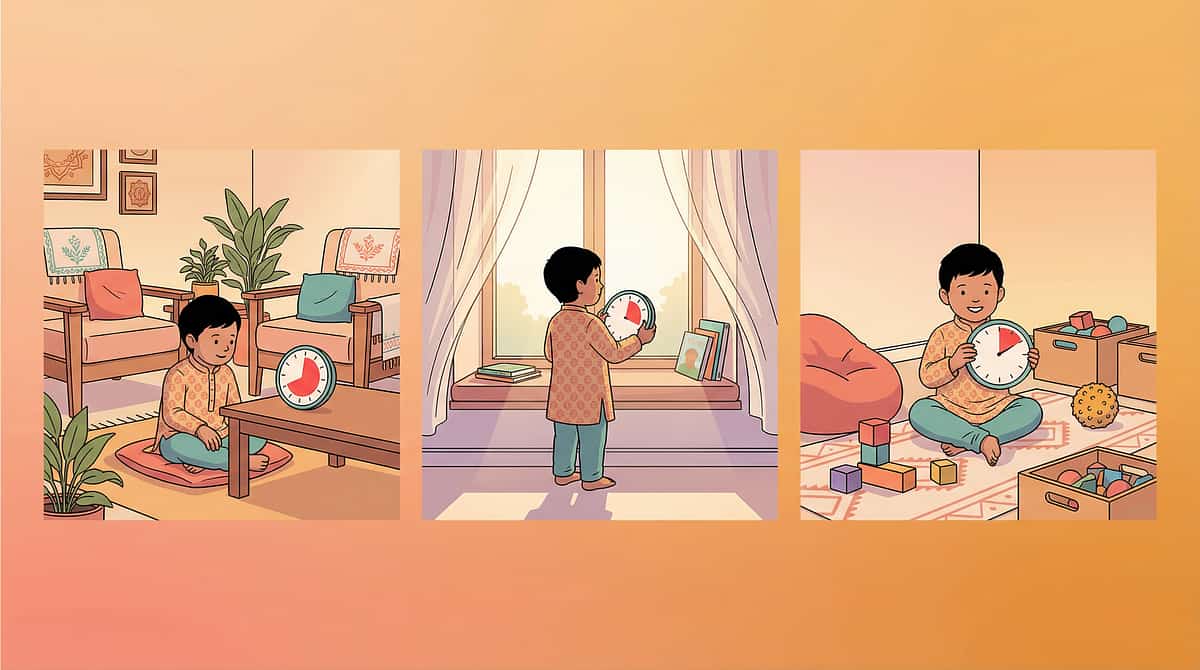
Dosage and Variation — 3 Good Uses Beat 10 Forced Ones
Per Day
Use timers for ALL applicable transitions — not just selected ones
Consistency
Same timer type, same approach, across ALL caregivers in the home
Duration Progression
Start short, add 1–2 minutes per week as tolerance builds
Timer Variety
After initial mastery of one timer type, introduce others for different contexts
▶ For Different Activities
🕐 Sand timer for tooth brushing (2 min), countdown strip for homework, Time Timer for screen time, traffic light for morning routine.
▶ For Sensory Profile
- 👁️ Visual-dominant: Time Timer disk
- 👂 Auditory-tolerant: add chime
- 🤚 Tactile-seeker: countdown board with removable pieces
- 👃 Scent-sensitive: avoid timers with plastic smell
▶ For Difficulty Level
📉Easier (hard days): Shorter duration, positive "then" only, parent close by, more prompts.
📈Harder (breakthroughs): Longer duration, less preferred transitions, increasing independence.
"3 Good Repetitions > 10 Forced Ones" — If child resists in session 3: step back to easier version. Build the win. Progress resumes.
General SI dosage literature | Pinnacle clinical protocols | ABA gradient approach to demand fading

Step 5 of 6
Reinforcement — The ABA Principle That Multiplies Everything Else
⚡ The Non-Negotiable Timing Rule: Reinforce within 3 seconds of successful timer response
Behaviour | Reinforcement Script | |
Child glances at timer independently | "I saw you checking! How much is left?" | |
Child anticipates ending before timer | "You're watching! You knew it was coming!" | |
Child transitions without protest | "[Name]! You watched the timer and you DID IT. That was amazing." | |
Child sets timer themselves | "You set your OWN timer. That's huge." | |
Child waits using countdown strip | "You watched every square come off. Incredible patience." |
💡 DIY Reinforcement (₹0)
- Verbal praise — most powerful: specific, enthusiastic, immediate
- Extra 5 minutes of preferred activity
- Choice of next activity
- High-five + celebration dance
"Celebrate the ATTEMPT, not just the success. A child who looked at the timer once — and still protested — made progress." — Pinnacle Blooms Consortium

Step 6 of 6
The Cool-Down — No Session Ends Abruptly
"[Name], the timer is almost at zero. [Point to timer.] TWO more [seconds/pieces/minutes]. Then we put the [toys/iPad/book] away together. You can carry [transition object] to [next location]."
Warning Signal
30–60 seconds before timer ends: Name the ending + name what's next
Timer Reaches Zero
Acknowledge warmly — "It ended! You saw it coming!"
Child-Participates Close-Down
Child puts item away if able — agency in the ending
Transition Object
Familiar comfort item travels with child to new activity — 🧸Animal Soft Toys — ₹425 → Amazon
Bridge Statement + Preview
"When we get to [next place], you can [mini-preferred activity]." Show what's coming with First-Then board if available.
If Child Resists Ending: Do NOT remove timer or give extra time — this breaks the system. DO: stay calm, acknowledge feelings, remind of "then" activity. Script: "I know. It's hard to stop. The timer says we're done. And then — [preferred next]. You can bring [transition object] with you."
NCAEP (2020) — Visual supports + transition support as evidence-based practice | General sensory calming literature

Record Within 60 Seconds — Data Captured Now Drives Progress Tomorrow
⚡Do this immediately after the session — before you do anything else.
3-Field Quick Tracker
Date: ___________
Activity/Transition: ___________
Timer Type Used: ___________
1. Did child look at timer independently? YES / SOMETIMES / NO
2. Transition intensity at timer end: 1 (Smooth) to 5 (Meltdown)
3. Total session duration (minutes): _______
Notes (optional): ___________________________
Why This Matters
Data captured over 8 weeks reveals: which timer types work best for your child; which transition contexts remain hardest; whether improvement is real or felt; and when to progress to the next level. Your therapist needs this data to calibrate your child's intervention.
Digital Options
- Download Visual Timer Weekly Tracker PDF
- Google Form: Record Date | Timer type | Transition | Rating 1–5 | Duration | Notes
📞 Share your tracking data at your next Pinnacle session or call 9100 181 181 for interpretation guidance.

When Timers Don't Work — Diagnosis and Fix
🔴 Timer INCREASES Distress
Cause: Anticipatory anxiety dominates — child focuses on loss rather than preparation.
Fix: Switch to shorter durations, emphasise "then" activity heavily, try countdown strips (discrete units less anxiety-provoking than continuous shrink), consult OT or psychologist about underlying anxiety.
🟡 Child Ignores Timer Completely
Cause: Timer not yet meaningful / too abstract / not at eye level.
Fix: Reposition timer (must be in natural field of view), pair with verbal prompt to check, reward any glance, use more salient timer (sand timer's movement is hard to ignore), introduce at lower stakes.
🟡 Child Protests Anyway When Timer Ends
Cause: Timer is necessary but not sufficient — underlying transition difficulty remains.
Fix: Don't abandon the timer. Add: stronger "then" motivation, transition object, transition card, and allow a 30-second processing window before expecting compliance.
🟡 Timer Works at Home, Not at School
Cause: Consistency gap between settings.
Fix: Communicate timer system to teacher, provide same timer type at school, use consistent language across all settings.
🟢 Child Becoming Dependent on Timer for Everything
Cause: That's actually the goal for now — don't rush independence.
Fix: Celebrate current functioning. Gradual independence-building is appropriate. Timer support may be needed long-term — this is accommodation, not failure.
🚨When to Escalate to Professional: Aggression or self-harm related to time/transition demands → Call 9100 181 181 immediately. Timer anxiety that generalises beyond transitions → Request OT + psychology evaluation.
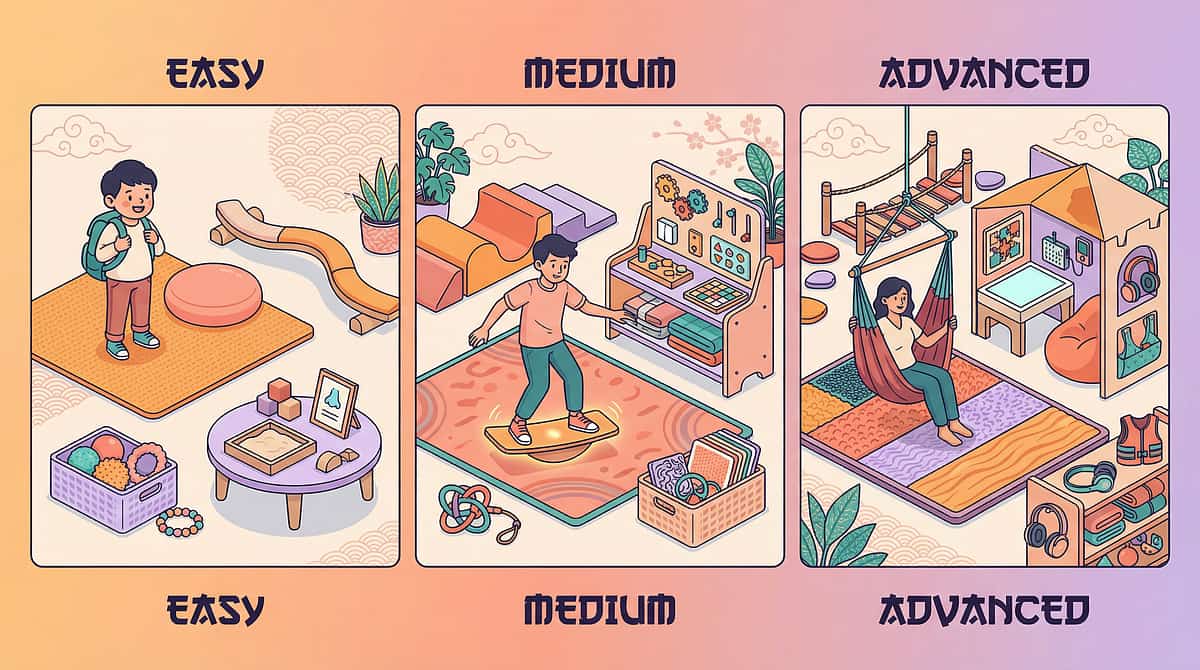
Every Child Is Different — Adapt the System to Yours
Setting | 📉 Easier (hard days) | 📊 Standard | 📈 Advanced | |
Timer duration | 1–2 minutes | 5–10 minutes | 15–30 minutes | |
Transition type | Preferred to preferred | Neutral to preferred | Non-preferred to neutral | |
Timer type | Sand (calming) | Time Timer (familiar) | Wearable (independent) | |
Parent proximity | Very close | Adjacent | Across room | |
Prompts | Every minute | Halfway + final | Child-initiated only |
Sensory Profile Modifications
Profile | Recommended Timer | Avoid | |
Visual processor | Time Timer disk | Purely auditory signals | |
Auditory processor | Chime + verbal countdown | Silent-only timers | |
Tactile seeker | Countdown board (physical pieces) | Screen-only timers | |
Sound sensitive | Sand timer (silent) | Beeping/buzzing timers | |
Motion attracted | Sand timer (flowing) | Static display timers |
Age Adaptations
Age | Primary Timer | Key Adaptation | |
2–4 yrs | Sand timer, simple shapes | 1–3 min max; count down together | |
4–7 yrs | Time Timer + sand set | Introduce color coding; child sets timer | |
7–12 yrs | Time Timer + apps + boards | Multiple contexts; self-monitoring begins | |
12–16 yrs | Wearable + smartwatch | Discreet, independence-building focus |

Weeks 1–2: Familiarisation Phase — The Foundation Is Being Built
Progress: ~15%
Most parents expect dramatic change immediately. The first two weeks are about the brain learning that timers are meaningful — not yet acting on them smoothly.
✅ What You WILL See
- Child looks at timer at least occasionally — even once = progress
- Child may start commenting on the timer ("It's almost done")
- Slightly less severe transition protests — same frequency but less intensity
- Child begins to associate timer end with activity end — the concept is landing
❌ What Is NOT Progress Yet
- Smooth transitions — not yet; that comes weeks 3–8
- Child-initiated timer use — not yet; that comes later
- Generalisation to school — not yet; focus on home first
"If your child tolerates the visual timer for 10 seconds longer before protesting compared to last week — that is real, measurable neurological progress."
⚡Consistency Reminder: These two weeks establish the neural association between timer and transition. Missing days breaks the conditioning. Daily use matters most right now.
PMC11506176 | Systematic review: SI outcomes emerge across 8–12 week timelines; early phase = tolerance building

Weeks 3–4: The Neural Pathways Are Forming
Progress: ~40%
🧠 Anticipates Endings
Child anticipates timer ending BEFORE it reaches zero
🧠 Prepares Without Prompting
Child begins closing book, wrapping up play without being asked
🧠 Spontaneous Timer Reference
Child references timer during activity ("I still have some red left")
🧠 Requests to Set Timer
Child asks for the timer to be set themselves
🧠 Decreasing Protest Frequency
Transition protests decreasing — even if still occurring, the trend is downward
"You may notice you're more confident too. The consistent daily use is building YOUR skills as much as your child's."
When to Increase Demand: If 3+ consolidation indicators are visible, you may increase timer duration by 2–3 minutes, introduce a slightly harder transition context, and reduce verbal prompts to check timer — let child initiate.
PMC11506176 | General SI consolidation literature | Pinnacle clinical outcome data

Weeks 5–8: The Tool Becomes Part of Your Family's Language
Progress: ~70%
Multiple Contexts
Child uses timer across multiple contexts with decreasing support from caregivers
Sets Timer Independently
Child sets timer independently for familiar activities — ownership is transferring
Rare Protests
Transition protests rare or significantly reduced in intensity and duration
Self-Monitoring
Child checks timer without prompting throughout activities — habit is formed
Generalising
Child begins generalising to school or community settings
Independence Building Protocol: Week 5–6: Reduce parent proximity during timed activities. Week 7: Introduce wearable timer option for older children. Week 8: Child manages at least 2 transitions per day with self-managed timer.
This is when 8 weeks of tracking data from Card 20 becomes invaluable. You can visually see the trend line. Share with your Pinnacle therapist for formal readiness re-assessment.

Every Smooth Transition Is a Neurological Achievement — Celebrate It
🥉 First Look at the Timer
Your child's brain registered the visual time tool as meaningful
🥈 First Self-Check
Your child chose to look at the timer independently
🥇 First Smooth Transition
Time visible + preparation + transition completed without meltdown
🏆 Timer Request
Your child asked for the timer to be set
🌟 Timer Independence
Your child set the timer themselves — time ownership achieved
Establishing a consistent visual timer system across a household is a therapeutic achievement requiring patience, consistency, skill, and love. You did this. Your child's nervous system changed because of your daily commitment.
📸 Document the milestones. A video of your child calmly watching the Time Timer and transitioning peacefully is 8 weeks of work made visible.
📞9100 181 181 — Tell us your milestone. Our team celebrates every one.

When to Seek Professional Support — Specific Observable Signs
🔴 Escalate Immediately — Call 9100 181 181 Now
- Any self-harm, aggression, or property destruction related to time/transition demands
- Timer use correlating with increased (not decreased) anxiety over 4+ weeks
- Complete inability to wait for any duration despite 8 weeks of consistent support
- Signs of broader anxiety disorder: constant clock-watching, panic, avoidance
🟡 Request Professional Evaluation Within 2 Weeks
- Timer reduces protests but child still cannot function in school due to time/transition difficulties
- Child has not been formally assessed for ADHD or ASD despite clear indicators
- Sleep disruption: wakes to check time, cannot settle without visual timer assurance at bedtime
- Social/peer impact: child unable to participate in activities due to transition difficulties
📋 Share With Your Child's Therapist
- 8 weeks of tracking data from Card 20
- Which timer types worked and which didn't
- Specific contexts remaining highly resistant
I-794 in the Journey — Where You Came From and Where You're Headed
I-792
Understanding Time Perception Challenges
I-793
Transition Strategies Overview
► I-794 ◄
Visual Timers — YOU ARE HERE
I-795
Waiting Tolerance Tools
I-796 →
Routine Support Systems → EF Materials → Morning Mastery → Homework Time
Lateral Alternatives (if visual timers aren't resonating)
- I-793: Transition Strategies (no timer required)
- I-800: Executive Function through movement-based strategies
- Sensory Domain techniques if sensory dysregulation underlies time difficulties
Long-Term Goal
Age-appropriate time management with compensatory strategies — a young person who knows their brain processes time differently, has their own toolkit, and can navigate daily life with confidence.
Related Techniques You May Need Next
Technique | Difficulty | Key Material | Access | |
I-793: Transition Strategies Overview | 🟡 Core | First-Then Boards | Immediate | |
I-795: Waiting Tolerance Tools | 🟡 Core | Sand Timers | Immediate | |
I-796: Routine Support Systems | 🟡 Core | Visual Schedule Boards | Immediate | |
I-810: Morning Routine Mastery | 🔴 Advanced | Routine Charts + Timers | After 8 weeks | |
I-820: Homework Time Management | 🔴 Advanced | Wearable + App Timers | After 8 weeks | |
A-series Sensory Techniques | 🟢 Intro | Sensory Materials | Any time |
You Already Have Materials For:
If you purchased Sand Timers → I-795 Waiting Tolerance is immediately accessible.
If you purchased Transition Cards → I-793 Transition Strategies is immediately accessible.
If you purchased Sand Timers → I-795 Waiting Tolerance is immediately accessible.
If you purchased Transition Cards → I-793 Transition Strategies is immediately accessible.

This Is One Piece — See the Full Picture
"Visual timers are one technique in a comprehensive developmental programme. Your child's growth across all 12 domains is tracked, guided, and optimised by GPT-OS®."

From Transition Battles to Peaceful Endings — Real Families, Real Outcomes
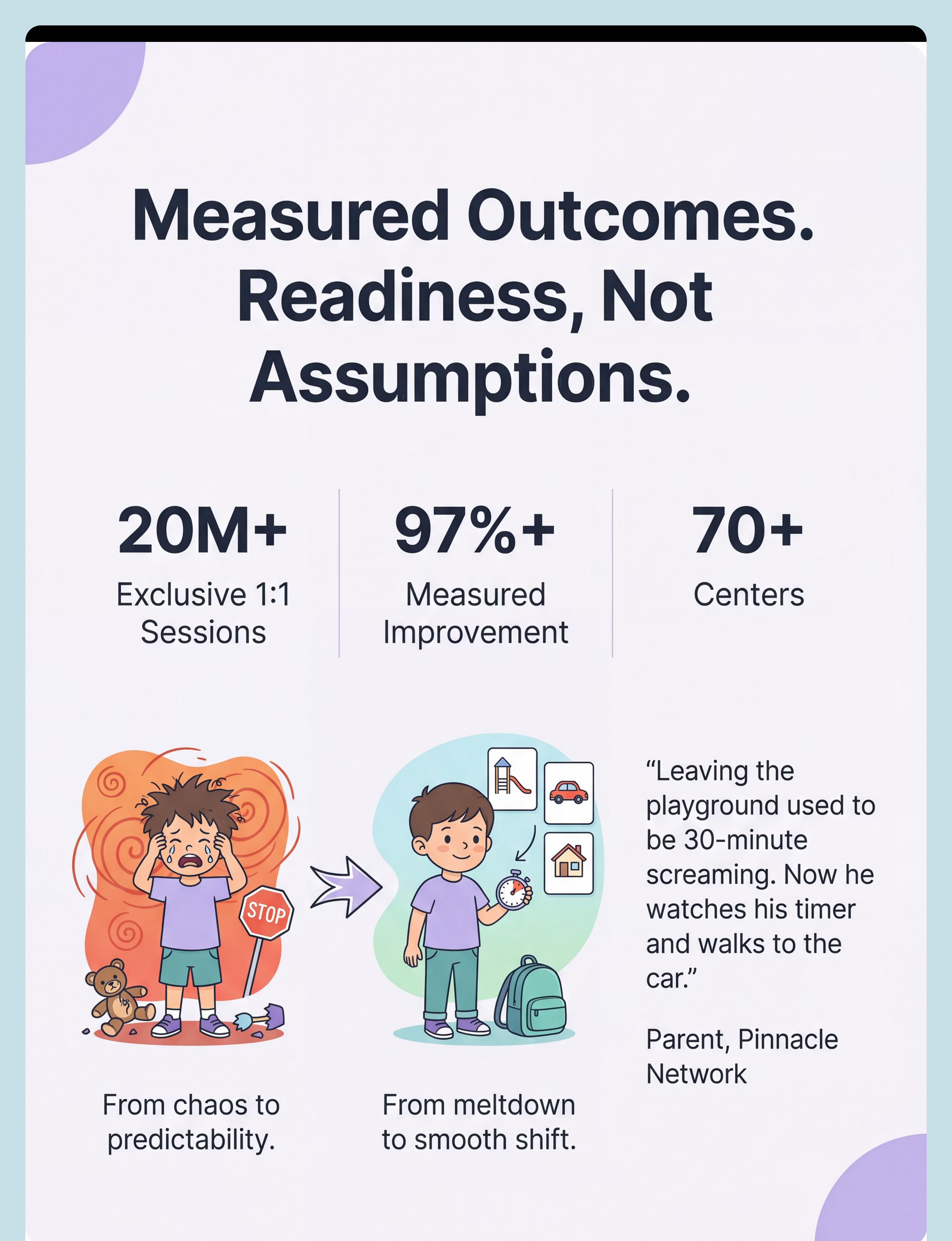
"Every transition was World War III. Leaving the park, turning off the iPad, stopping a game — my daughter would completely meltdown, screaming that she didn't know time was up. Verbal warnings meant nothing. We tried the Time Timer first — watching the red disk disappear was something she could actually understand. Within a few months, she was checking the timer herself and saying 'I have 2 minutes left.' She started transitioning without meltdowns most of the time. The battles have turned into smooth transitions. I wish I'd known about visual timers years ago." — Parent, Pinnacle Network
BEFORE
- Daily meltdowns at every transition
- 45-minute getting-ready chaos
- School mornings impossible
AFTER
- Child checks timer independently
- Transitions with occasional support
- Mornings predictable and peaceful
Individual results may vary. Outcomes depend on underlying condition, severity, and intervention consistency.
Pinnacle Blooms Network®
20M+ Sessions
97%+ Measured Improvement

You Shouldn't Have to Navigate This Alone
Pinnacle Parent Community
👥 Join the Pinnacle Parent WhatsApp Community → pinnacleblooms.org/community — Parents sharing timer strategies, successes, and support across India and internationally.
International Communities
- CHADD (ADHD support) — chadd.org
- Autism Society of India — autismsocietyindia.org
- ASAN (Autistic Self Advocacy Network) — autisticadvocacy.org
- ADHD Europe — adhdeurope.eu
Professional Networks
🩺Find a Pinnacle Therapist Near You →
📍 70+ centers across India | Teleconsultation available globally
📍 70+ centers across India | Teleconsultation available globally
📞9100 181 181 — Free | 24×7 | 16+ Languages | Call for support, guidance, or to connect with your nearest center

The Professional Support Ecosystem — Who Helps With What
Need | Who to See | What They Do | |
Formal ADHD/ASD diagnosis | NeuroDevelopmental Paediatrician | AbilityScore® assessment, diagnostic workup | |
Timer implementation guidance | Occupational Therapist | Sensory profile, EF intervention plan | |
Behaviour & transition support | ABA/BCBA Therapist | Antecedent intervention, reinforcement planning | |
Routine & language-based support | Speech-Language Pathologist | Verbal schedule systems, language-based transition strategies | |
School coordination | Special Educator | IEP, accommodation plans, teacher training | |
Broader EF programme | Pinnacle FusionModule™ | All disciplines coordinated in single plan |
AbilityScore® Assessment: The starting point for every child at Pinnacle. 591+ observations across 349 skills → standardised developmental baseline → personalised therapy plan.
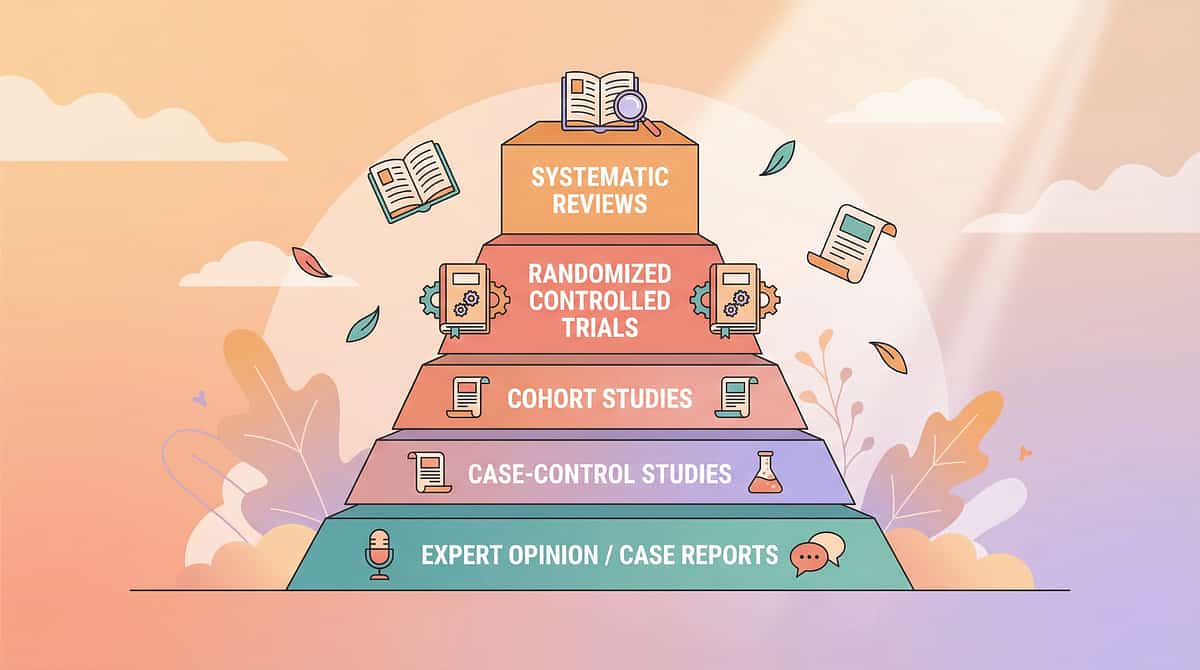
The Science Behind I-794 — For the Curious Parent
PRISMA Systematic Review (2024) — PMC11506176
16 studies (2013–2023) confirm visual supports and transition interventions meet evidence-based practice criteria for ASD. Effect sizes significant across home and school settings.
Meta-Analysis, World J Clin Cases (2024) — PMC10955541
24 studies: structured visual intervention improves task completion, social participation, and transition tolerance. Individual 1:1 sessions most effective format.
Padmanabha et al., Indian J Pediatr (2019) — DOI:10.1007/s12098-018-2747-4
Indian RCT confirming home-based visual support interventions produce significant outcomes in Indian pediatric population. Validates applicability in Indian home context.
NCAEP Evidence-Based Practices (2020)
National Clearinghouse on Autism Evidence and Practice classifies Visual Supports as established evidence-based practice. Transition support systems classified separately as evidence-based.
WHO Nurturing Care Framework (2018) — PMC9978394
Validates caregiver-delivered, home-based interventions as primary delivery model for developmental support. External scaffolding approach validated across 54 LMICs.

Your Data Makes Your Child's Programme Smarter — And Helps Every Child Like Yours
Every session recorded through the GPT-OS® platform feeds a learning loop that makes your child's programme more precise over time. The system learns which timer type produces least transition resistance, whether time perception is improving or plateauing, and when to sequence in I-795 Waiting Tolerance or I-796 Routine Support.
What GPT-OS® Learns From I-794 Data
- Which timer type produces least transition resistance for this child
- Whether time perception is improving or plateauing
- When to sequence in I-795 (Waiting Tolerance) or I-796 (Routine Support)
- Whether underlying ADHD/ASD evaluation is indicated
🔒 Privacy Assurance
All data governed under Indian DPDP Act and Pinnacle's clinical data governance framework. CIN: U74999TG2016PTC113063.
"Your data helps every child like yours. Population-level patterns from 20M+ sessions drive recommendations for families navigating this challenge for the first time."

Watch: 9 Materials That Help With Visual Timers — I-794
Reel ID | I-794 (also referenced as L-941) | |
Series | Time Management and Transition Support — Episode 794 | |
Domain | Executive Function / EF-TIM | |
Duration | 60–85 seconds |
"Time blindness is real. When your child can't feel time passing, verbal warnings like 'five more minutes' are meaningless — just words. Visual timers make the invisible visible. This isn't a crutch. It's an accommodation for a real neurological difference in how their brain processes time." — Pinnacle Blooms Consortium Therapist
Multi-Modal Learning Note: Video modeling is classified as an evidence-based practice for autism (NCAEP, 2020). Watching a therapist demonstrate correct timer use in a real child context accelerates home implementation.
📞9100 181 181 | pinnacleblooms.org

Consistency Across Every Caregiver Multiplies Impact
📱 WhatsApp-Ready Summary
Visual timers help children who struggle with time & transitions. Instead of verbal warnings, the child SEES time disappearing. 9 materials: Time Timer, sand timers, timer apps, traffic light timers, routine charts, countdown strips, transition cards, chimes, wearable timers.
Full guide: techniques.pinnacleblooms.org/executive-function/visual-timers-I-794
Helpline: 9100 181 181
Helpline: 9100 181 181
Explain to Grandparents
"When we say 'five more minutes,' [child's name] genuinely cannot feel what five minutes means. Their brain works differently — not wrong, just different. We use a special timer that shows them time disappearing so they can SEE when activities will end. When the red (or sand) is gone, we move to the next activity. Please use the timer instead of verbal warnings when you're with them. Consistency helps."
School Communication Template: "[Child's name] uses visual timers to support time perception and transitions. We would appreciate: visual timer placed visibly during independent work, 5-minute visual warning before activity changes, First-Then visual board for activity sequencing. Please call 9100 181 181 if you have questions about implementation."
"Consistency across caregivers multiplies impact. Every adult in a child's life who uses the timer system adds to its power." — Pinnacle Blooms Consortium

Your Questions — Answered by the Pinnacle Consortium
Q1: My child is 10 and seems "too old" for a visual timer. Is that true?
No. Many adults with ADHD use visual timers throughout their lives. Age appropriateness is about choice — wearable timers (smartwatches) and phone apps are discreet and age-appropriate for older children and teens. The goal is finding a format that works without embarrassment. The need itself doesn't age out.
Q2: We tried a timer once and it made things worse. Should I give up?
A single attempt rarely shows true potential. Key questions: Was the timer visible? Was the first use for a hard transition? Was there a clear "then" activity? Was the timer type appropriate for the child's sensory profile? Most "timer failures" are implementation issues, not timer issues. Try: shorter duration, easier transition, different timer type, and associate timer with positive outcomes first.
Q3: How many timers do we need? This seems complicated.
Start with one. A single sand timer or the free Time Timer app is enough to begin. Complexity builds over time. The complete 9-material system is an eventual toolkit, not a Day 1 requirement.
Q4: Will my child ever not need visual timers?
Some children internalise time awareness through years of visual timer use and eventually need much less external support. Others — particularly those with ADHD — may benefit from some form of visual time support indefinitely. Both outcomes are successful. Timers are accommodation, not training wheels to be removed.
Q5: My child pre-meltdowns — cries before the timer even ends. What do I do?
This is anticipatory anxiety. Strategies: extend green/play time, heavily emphasise what comes AFTER (the "then"), use a traffic light timer (yellow phase reduces the cliff-edge feeling), pair with a therapist for anxiety management. Don't abandon the timer — address the anxiety directly.
Q6: How do I handle screen time transitions? The timer ends and they still won't stop.
Start timer BEFORE screen time begins, use traffic light timer (yellow = start winding down — save progress, finish level), pair with physical handover (child puts device in designated spot), and have "then" be a preferred non-screen activity.
Q7: The school won't allow timers in class. What can I do?
Wearable vibrating timers (WatchMinder, smartwatch) are often permitted where visible timers are not — they don't disrupt other students. Also: share the NCAEP evidence base with the school, request accommodation through the IEP/support plan process, and contact Pinnacle for school communication support at 9100 181 181.
Q8: How long before we see results?
Most families see reduced protest intensity (not frequency) within 2 weeks of consistent use. Reduced protest frequency by weeks 3–4. Clear improvement pattern by weeks 6–8. Research consensus: 8–12 weeks of consistent implementation for measurable outcomes. Irregular use stretches this timeline significantly.

You Have Everything You Need — Start Today
✅ Why My Child Struggles
I understand the neuroscience behind time blindness (Cards 01–05)
✅ Which Timer to Start With
I know which of the 9 materials fits my child (Card 09)
✅ Environment Ready
I have set up the space for success (Card 12)
✅ Safety Checklist
I have the pre-session safety gate in mind (Card 11)
✅ Invite, Not Command
I know how to offer the timer with warmth (Card 14)
🏛️ Pinnacle Blooms Consortium
OT • SLP • ABA • SpEd • NeuroDev • CRO
Serving 70+ Countries
📞 FREE National Autism Helpline: 9100 181 181 | 16+ Languages | Available 24×7
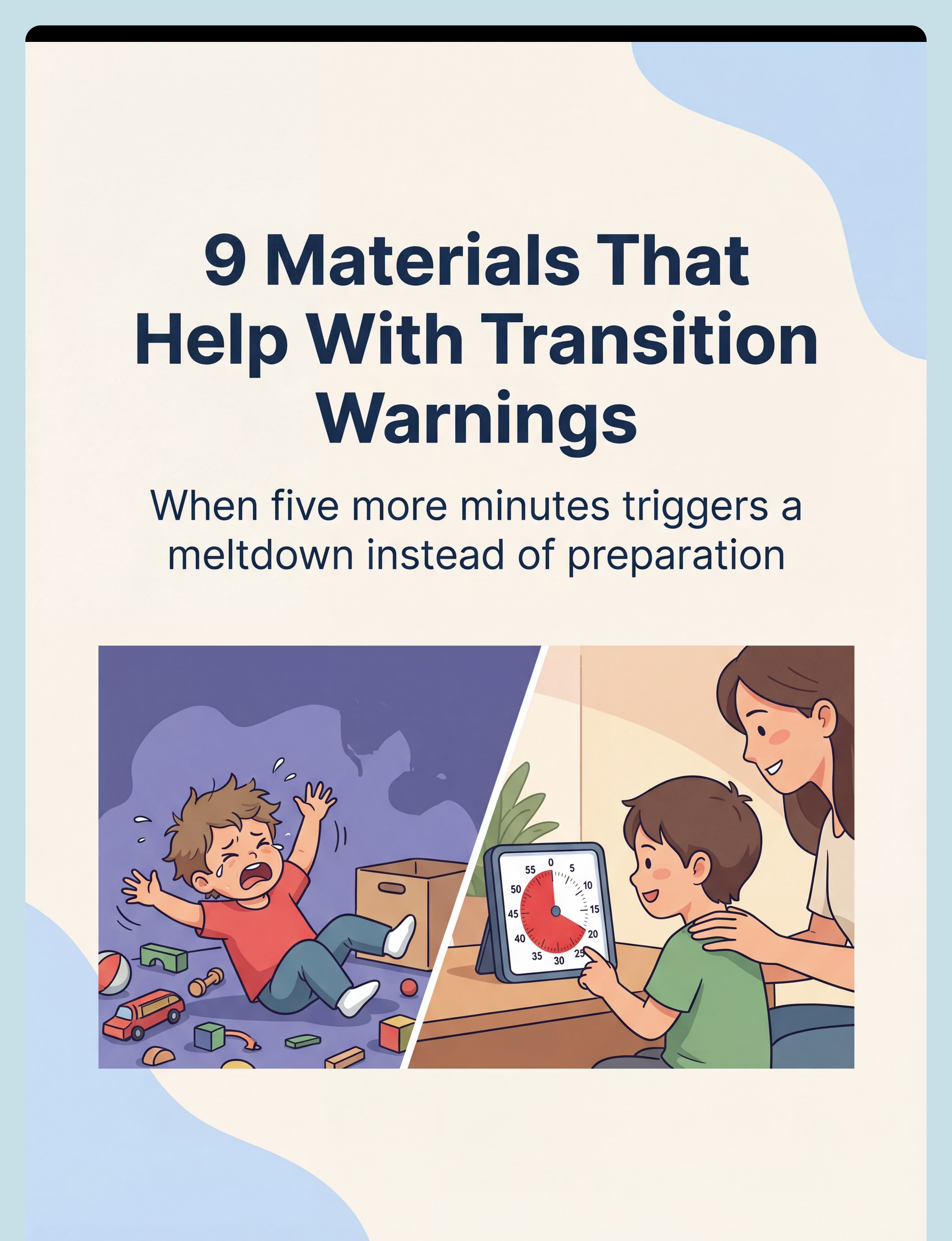
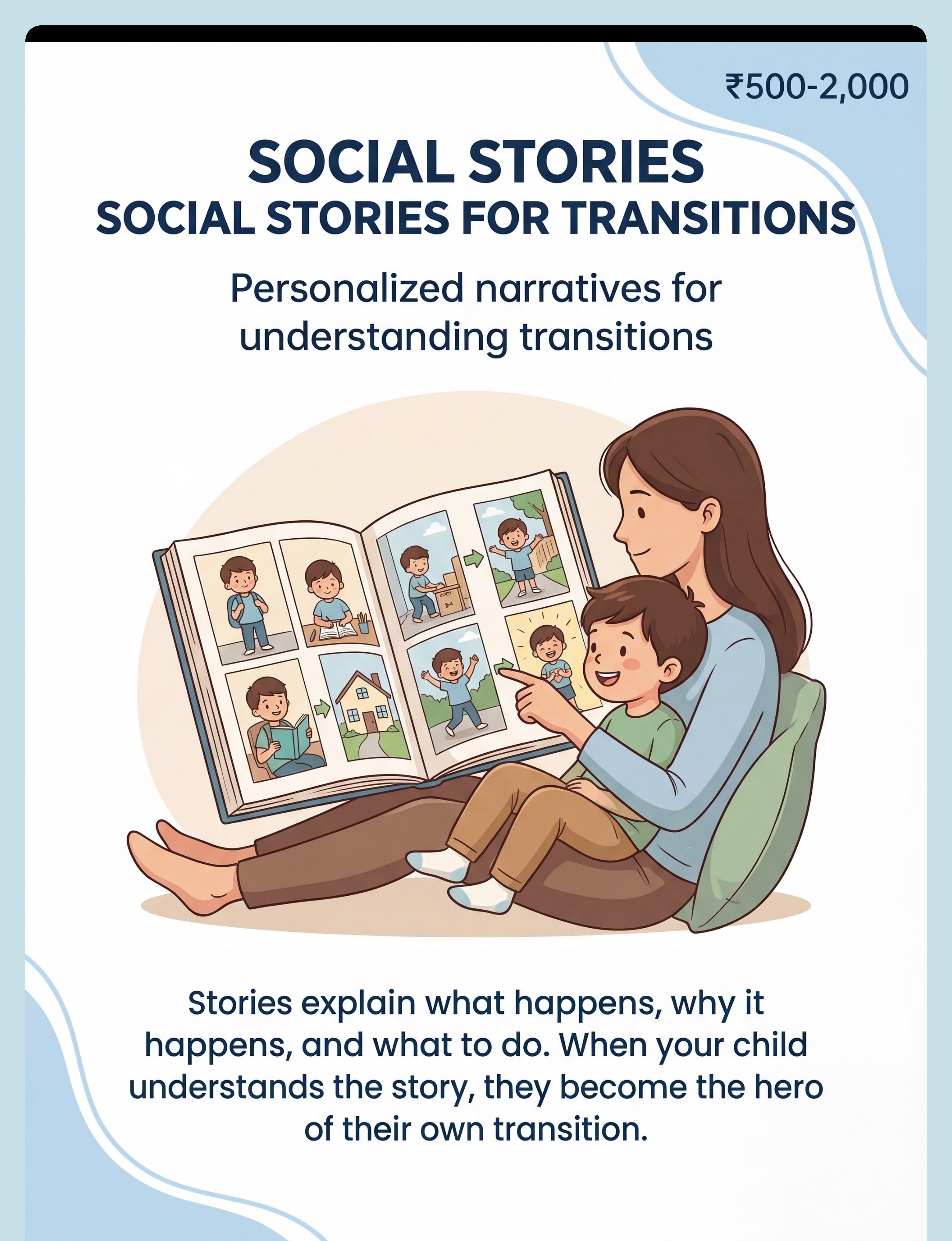
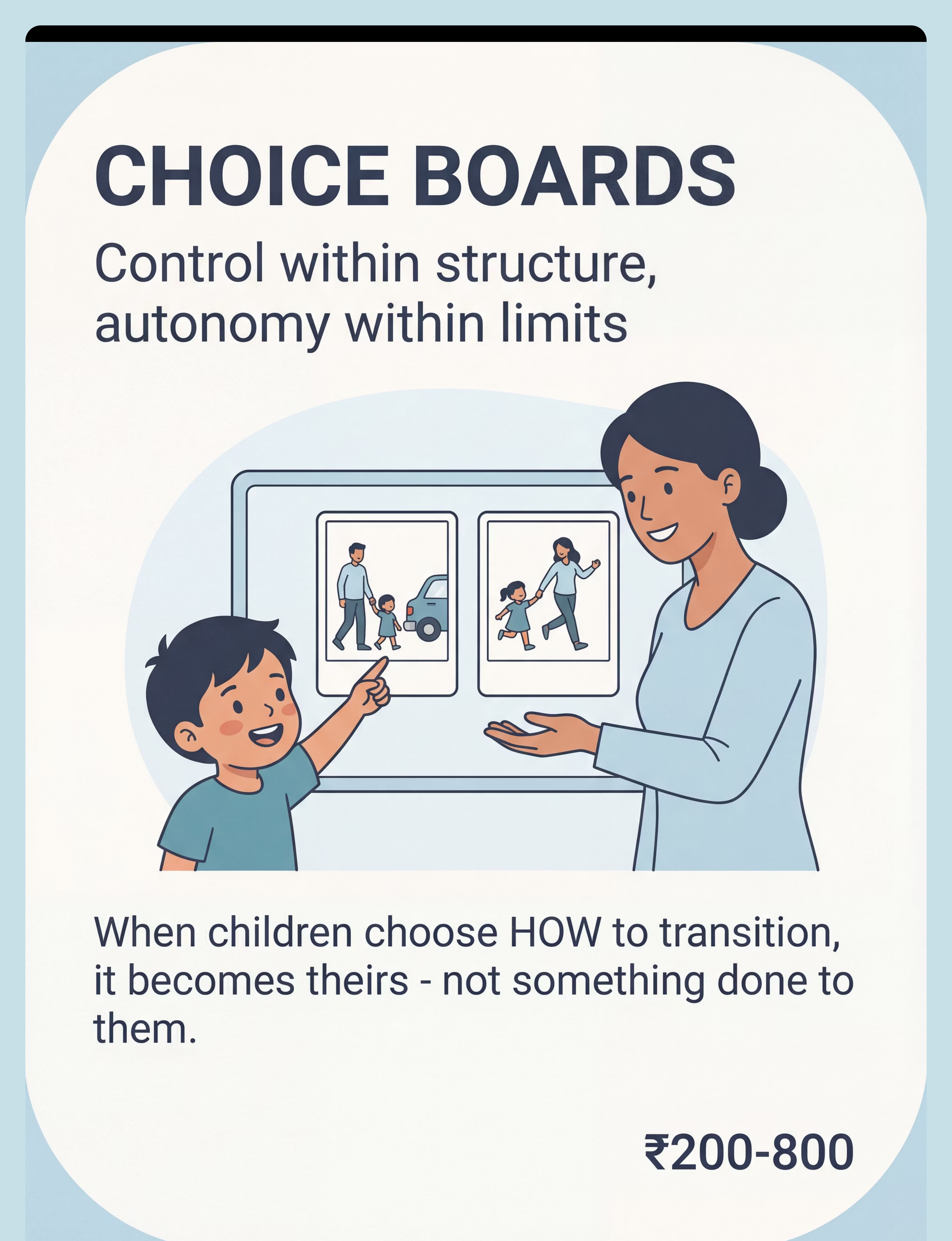
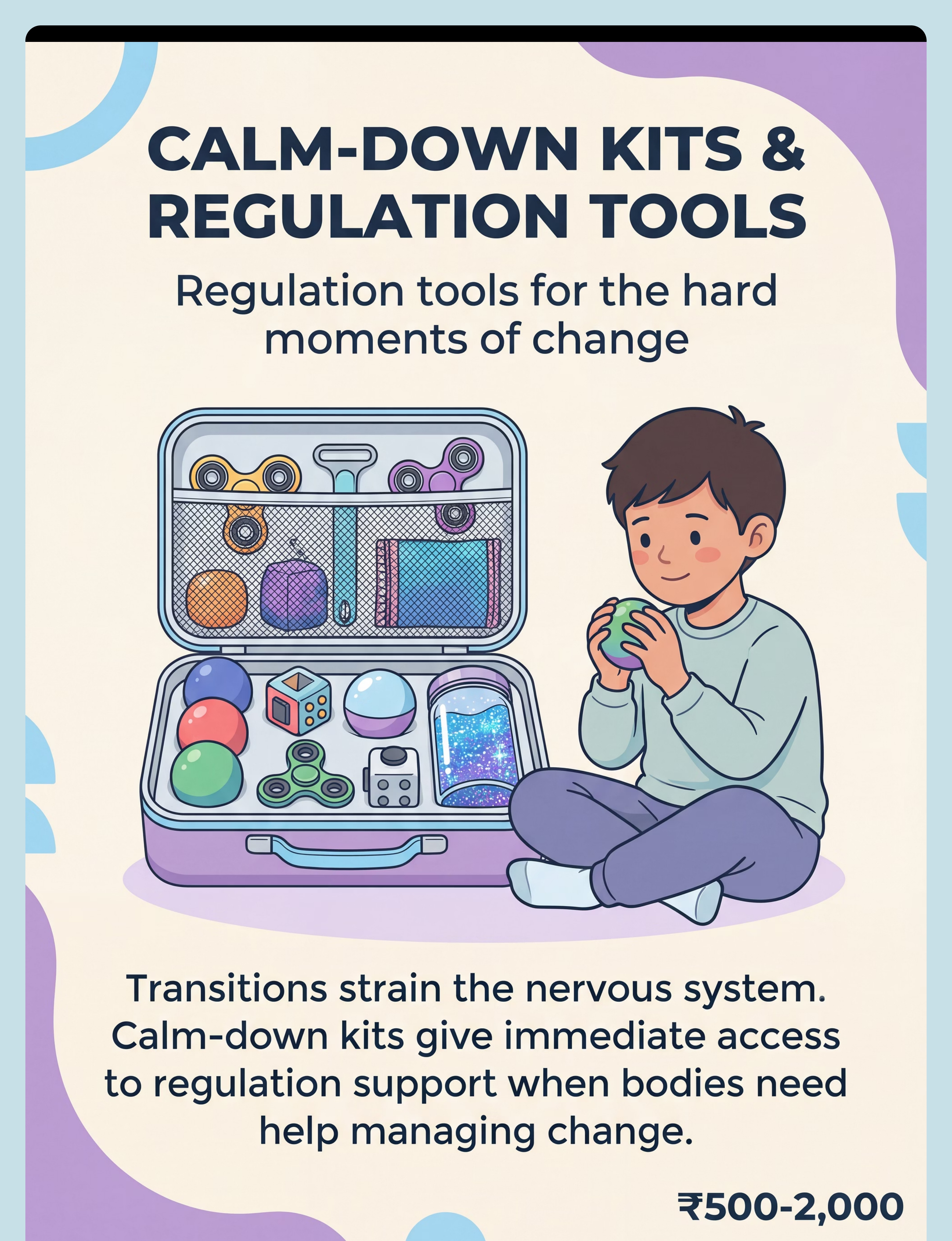
Preview of 9 materials that help with visual timers Therapy Material
Below is a visual preview of 9 materials that help with visual timers therapy material. The pages shown help educators, therapists, and caregivers understand the structure and content of the resource before use. Materials should be used under appropriate professional guidance.




Link copied!

From Fear to Mastery — One Technique at a Time
"We exist to transform every home into a proven, scientific, personalised, multi-sensory therapy centre — available 24×7 for every child, regardless of geography, income, or access."— Pinnacle Blooms Network® | Founded by families. Engineered as a system.
🏛️ Pinnacle Blooms Network®
OT • SLP • ABA/BCBA • SpEd • NeuroDev Paediatrics • CRO
⚙️ GPT-OS® Platform
AbilityScore® | TherapeuticAI® | FusionModule™ | EverydayTherapyProgramme™
📊 Outcomes
20M+ exclusive 1:1 therapy sessions • 97%+ measured improvement • 70+ centers across India • Empowering children from 70+ countries
📞FREE National Autism Helpline: 9100 181 181 | 16+ languages | Available 24×7 | pinnacleblooms.org
This content is educational. It does not replace individualised assessment and intervention from qualified professionals. Time perception difficulties and transition challenges can be associated with ADHD, autism spectrum disorder, anxiety disorders, and other conditions requiring professional evaluation. Persistent, severe difficulties should be assessed by qualified developmental specialists, psychologists, or occupational therapists. Individual results may vary.
© 2025 Pinnacle Blooms Network®, a unit of Bharath Healthcare Laboratories Pvt. Ltd. CIN: U74999TG2016PTC113063 | DPIIT: DIPP8651 (Government of India) | MSME: TS20F0009606 | GSTIN: 36AAGCB9722P1Z2
Standard Citations: PMC11506176 | PMC10955541 | PMC9978394 | WHO NCF 2018 | NCAEP 2020 | DOI:10.1007/s12098-018-2747-4