

When the Pool Feels Like a Battlefield — and Your Child's Scream Breaks Your Heart
You've tried four swim schools. You've spent the money. You've found the "patient" instructor. And yet — the moment their feet leave the pool floor, everything falls apart.

Act I — Recognition
The Moment Only You Understand
It's a Tuesday afternoon. Every child in the pool is splashing, laughing, dunking their heads. Your child is frozen at the edge, fingers white from gripping the rail, eyes locked in a panic that no amount of coaxing dissolves. You watch the instructor's face. You watch the other parents watching you. And you feel that familiar mix of fear, guilt, and exhaustion that no parenting book ever warned you about.
What is your child experiencing that no one else seems to see?
"You are not failing as a parent. Your child's nervous system is speaking a language that most swim schools don't understand yet. We do."
🏊 F-584
Swimming Readiness: 9 Materials That Build Water Comfort
Gross Motor & Physical Development Series — Episode 584
🏆 Pinnacle Blooms Consortium
OT • SLP • ABA • SpEd • NeuroDev • Aquatic Therapy
India's largest autism therapy network

Act I — The Numbers
This Is Not Rare. You Are Among Millions.
Globally, an estimated 2.3 million children under 12 have significant aquatic skill acquisition challenges linked to sensory, vestibular, or proprioceptive differences. In India alone, across Pinnacle's 70+ center network, water fear and swimming readiness challenges represent one of the top 5 requests from families in the gross motor domain.
This is not your child's failure. This is not your failure. This is a nervous system response — documented, studied, addressable.
1 in 44
ASD Prevalence
Children in India diagnosed with ASD
80%
Sensory Differences
Of children with autism experience sensory processing differences affecting water comfort
3×
More Likely
Children with sensory processing challenges are more likely to have significant water fear than neurotypical peers
"You are among millions of families navigating this exact challenge — and thousands have arrived at the other side. This page shows you the path."
📞 FREE National Autism Helpline (16+ languages): 9100 181 181 | pinnacleblooms.org
Act I — The Neuroscience
Why the Pool Feels Catastrophic: The Neuroscience
The Aquatic Sensory Storm
The pool environment simultaneously challenges four sensory processing systems that many children with developmental differences find difficult to integrate:
Vestibular System
Buoyancy removes the gravity anchor. The brain can't orient "up" and "down" reliably. Floating feels like falling.
Proprioceptive System
Water pressure changes body-awareness signals. The brain loses the map of where limbs are in space. Movements become uncontrolled, frightening.
Tactile System
Wetness, temperature change, water pressure on skin, water on face — all at once. For a tactile-defensive nervous system, this is overload, not refreshment.
Auditory System
Pool echo is amplified, unpredictable, overwhelming. Children with auditory sensitivity experience the pool as genuinely painful.
What Your Child Is Experiencing
Imagine someone blindfolded you, placed you in a rapidly spinning chair while spraying cold water on your face in a room full of echoing alarms — and then asked you to relax and learn.
That is, neurologically, what an unprepared child with sensory differences experiences at a pool.
The critical insight: Their swimming-ready nervous system has not yet been built. It can be built. It takes specific materials, a specific sequence, and patience that matches the pace of neurological change.
"This is a wiring difference, not a behavior choice. It can be rewired with the right approach." — Pinnacle OT Consortium

Act I — Developmental Map
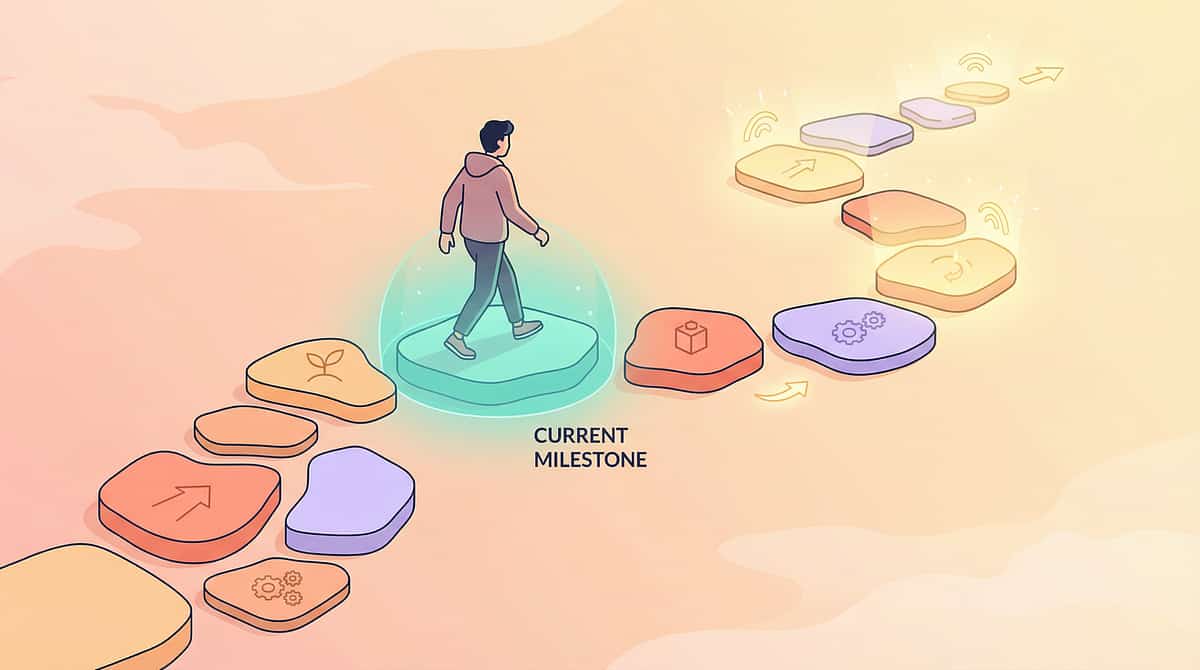
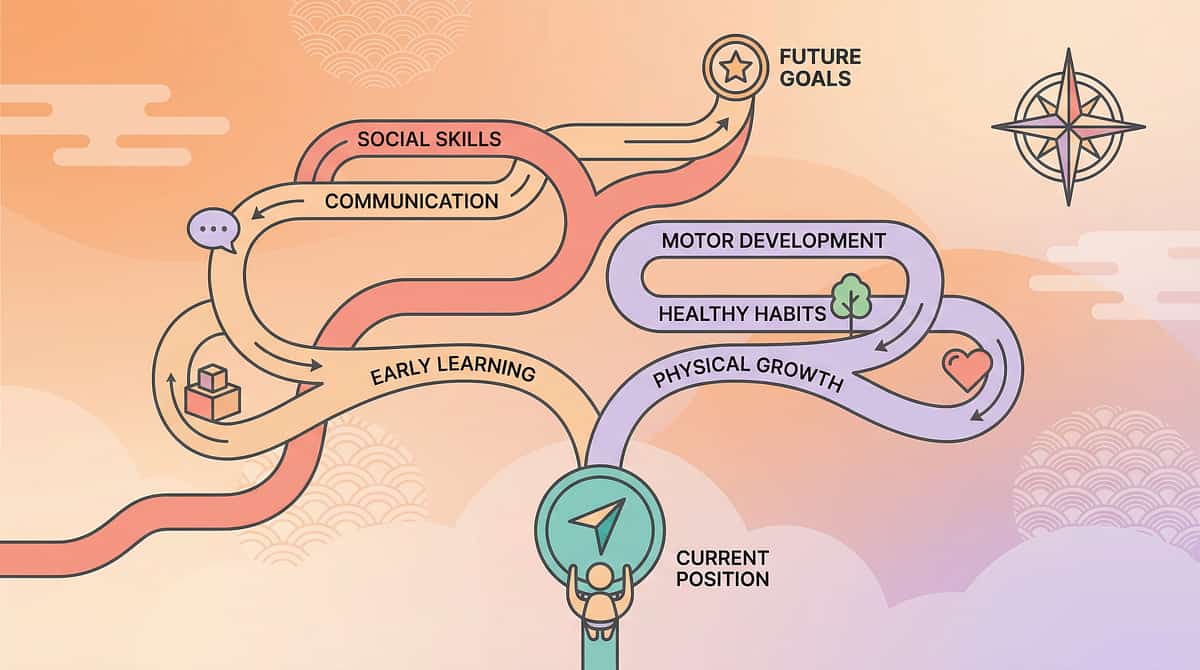
Swimming Readiness on the Developmental Map
Children with sensory processing differences may reach each milestone later — but the pathway is the same. F-584 addresses the foundation layer before stroke instruction begins.
Birth – Age 1
Water comfort (innate) & bath comfort develops
Age 2
Water play & splashing typical
Age 3–4
Typical water comfort builds
Age 5–6
Swimming readiness — F-584 Foundation Zone
Age 7–9
Stroke confidence & advanced skills
Age 10–12
Water safety mastery
What commonly co-occurs with swimming readiness challenges: Tactile defensiveness (bath/shower avoidance) • Vestibular processing differences (fear of swings, heights) • Oral motor challenges (breath control) • Anxiety (generalized or specific) • Proprioceptive differences (poor body awareness)
"Your child is here. Here is where we're heading. Every step on this page moves the arrow forward."
Act I — The Evidence
This Is Not Guesswork. This Is Evidence.
🛡️LEVEL II EVIDENCE — Systematic Review + RCT Grade — Clinically Validated | Home-Applicable | Parent-Proven
Study | Finding | Source | |
PRISMA Systematic Review (2024) | Sensory integration intervention meets evidence-based practice criteria for children with ASD across 16 studies | PMC11506176 | |
Meta-Analysis — 24 Studies (2024) | SI therapy effectively promotes gross motor skills, social participation, and adaptive behavior | PMC10955541 | |
Indian Home-Based RCT (2019) | Home-administered sensory interventions showed significant outcomes vs. control | Padmanabha, Indian J Pediatr | |
NCAEP Report (2020) | Visual supports and graduated exposure are evidence-based practices for autism | NCAEP 2020 | |
Aquatic Therapy Literature | Structured material-based programs show significant water comfort improvements in 8–12 week programs | AOTA Guidelines |
"The 9 materials on this page are not random suggestions. They are the clinical consensus of occupational therapists, aquatic therapy specialists, behavioral analysts, and developmental pediatricians — validated across 20 million+ therapy sessions in the Pinnacle network."

Act II — What It Is
🏊 F-584: Swimming Readiness — Material-Based Aquatic Comfort Building
Parent-Friendly Alias:"Building the Foundation Before the First Stroke"
Definition: Swimming readiness is the systematic development of water comfort, breath control, body awareness, and emotional regulation in aquatic environments — before any formal stroke instruction begins. It addresses the sensory, vestibular, proprioceptive, oral motor, and anxiety barriers that prevent children from benefiting from traditional swimming lessons.
Gross Motor & Physical
Core movement, balance, and coordination in aquatic environments
Aquatic Therapy
Water safety and structured comfort-building from bathtub to pool
Sensory Processing
Integration of vestibular, proprioceptive, tactile, and auditory systems
Oral Motor & Breath
Exhalation patterning and breath control as the foundation of water safety
Age Band | Duration | Frequency | Setting | |
2–12 years | 10–20 min | Daily preferred, 3×/week minimum | Bathtub → Home pool → Center pool |
Act II — Who Uses This
5 Disciplines. One Unified Goal.
"The brain doesn't organize by therapy type. That's why this technique lives in all five disciplines simultaneously." — GPT-OS® FusionModule™ Clinical Protocol
🦾 Occupational Therapist (Primary Lead)
Addresses sensory processing, tactile defensiveness, proprioceptive awareness, vestibular tolerance, and body-in-water awareness. Designs the desensitization progression.
🗣️ Speech-Language Pathologist
Targets breath control (oral motor foundation for swimming), exhalation patterning, and the connection between oral motor development and water-face tolerance. Bubble blowing is a core SLP tool.
📊 Behavior Analyst (BCBA/ABA)
Designs graduated exposure protocols, reinforcement schedules, motivating operations, and data collection systems. Manages avoidance behaviors and builds approach responses.
📚 Special Educator
Creates visual supports, social stories, and predictability structures. Sequences the cognitive understanding of "what will happen at the pool" through pre-teaching.
🧠 NeuroDevelopmental Pediatrician
Assesses underlying vestibular, proprioceptive, and sensory processing differences. Determines whether co-occurring conditions require parallel clinical treatment.

Act II — Precision Targets
Precision Targeting: What Each Session Builds
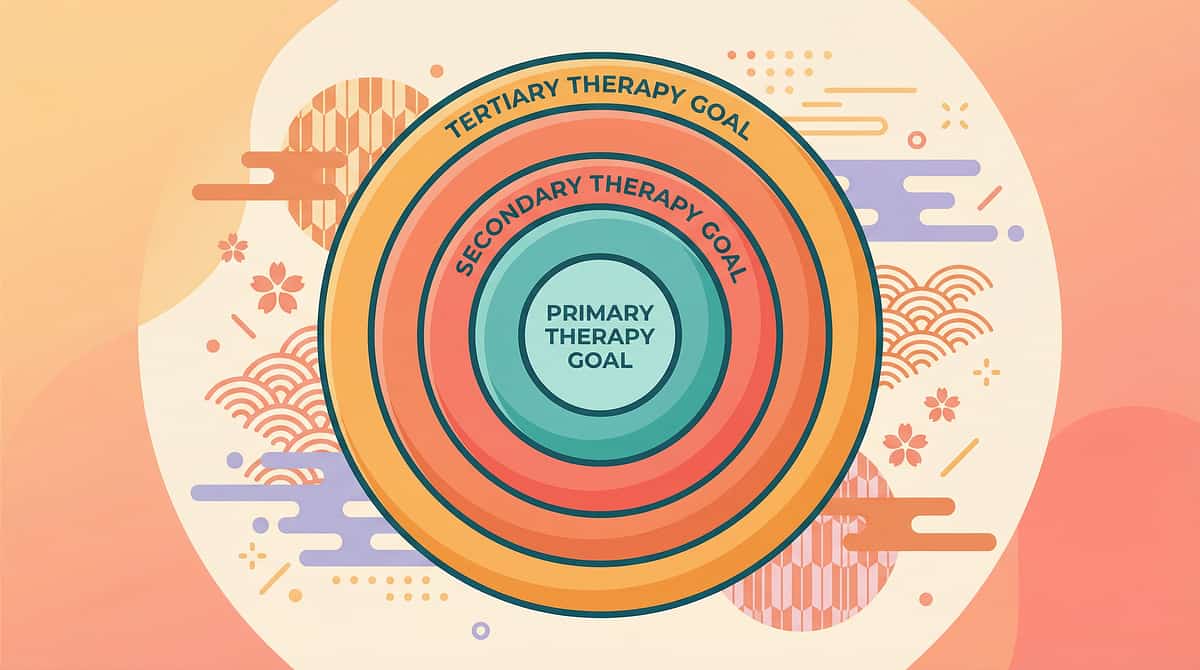
🎯 PRIMARY TARGET
Aquatic Sensory Tolerance & Water Comfort
Observable indicator: Child voluntarily enters water, tolerates face water contact, demonstrates relaxed (not rigid) body posture.
🎯 SECONDARY TARGETS
Breath control and exhalation patterning • Body position awareness in buoyant environments • Emotional regulation in novel/challenging settings • Vestibular processing tolerance (floating, balance changes)
🎯 TERTIARY TARGETS
Water safety competency (float, reach, call for help) • Readiness for formal swimming instruction • Confidence generalization to other physical challenges • Community participation with peers
Target | "Starting Here" | "Arriving Here" | |
Water tolerance | Screams at pool edge | Enters voluntarily, stays calm | |
Face water | Panics with single drop | Blows bubbles face-submerged | |
Body awareness | Rigid, sinking | Relaxed, floatable | |
Breath control | Gasps/chokes | Controlled exhale underwater | |
Emotional regulation | Fight-or-flight at pool | Anticipates pool with readiness |
Material 1 of 9
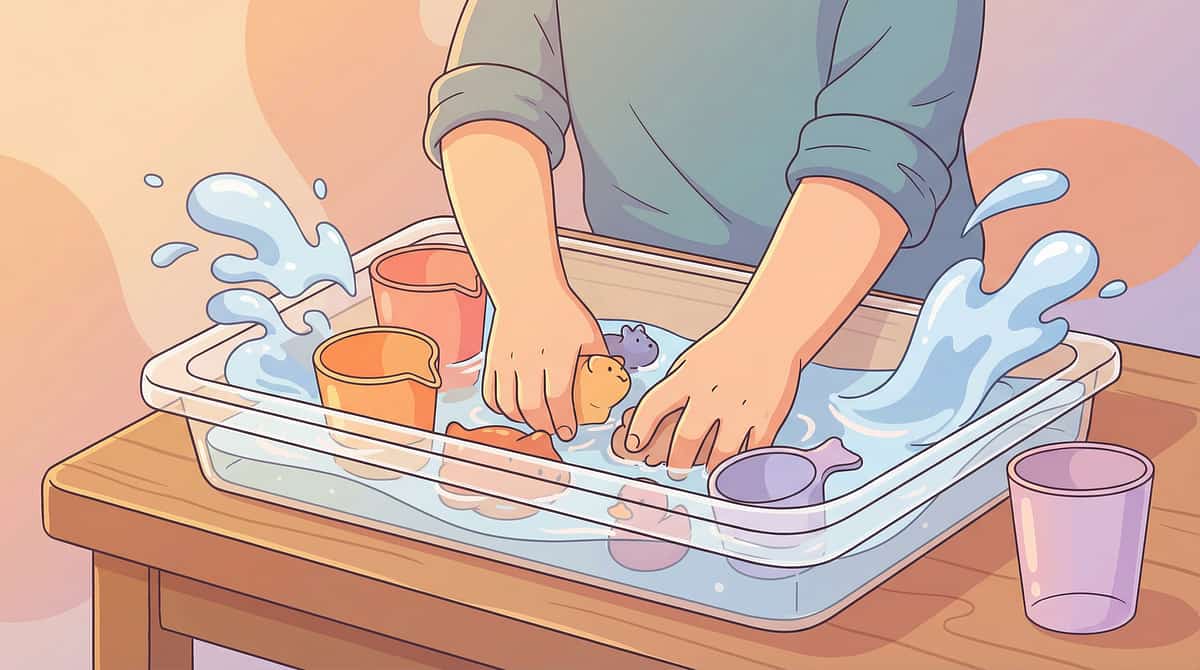
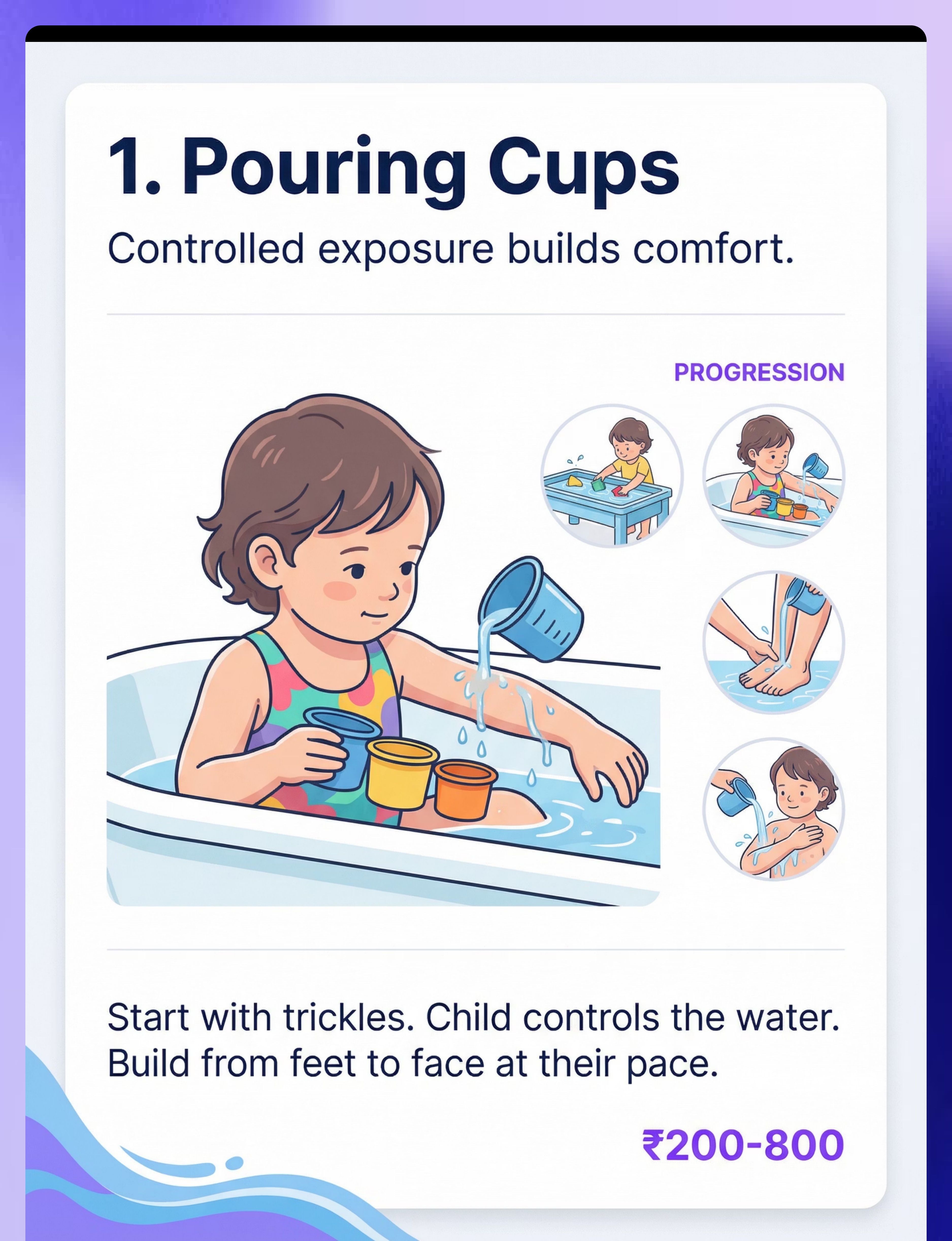
Graduated Pouring Cups & Water Play Sets
Material Details
📂Canon: Water Play & Exposure Tools
💰Price: ₹200–800
🏥Pinnacle Recommends: Child-controlled pour spouts, various sizes, squeeze bottles included
Why This Works
Control reduces fear. When a child holds the pouring cup, they decide how much water, where it goes, and when it stops. That sense of agency is the therapeutic mechanism — not the water itself.
Child-controlled water exposure builds comfort that transfers directly to the pool environment. Starting with pouring water on their own hand, then wrist, then arm builds a graduated sensory ladder the nervous system can climb.
This is Material #1 because the principle of child control underpins every subsequent material in the protocol.
Material 2 of 9
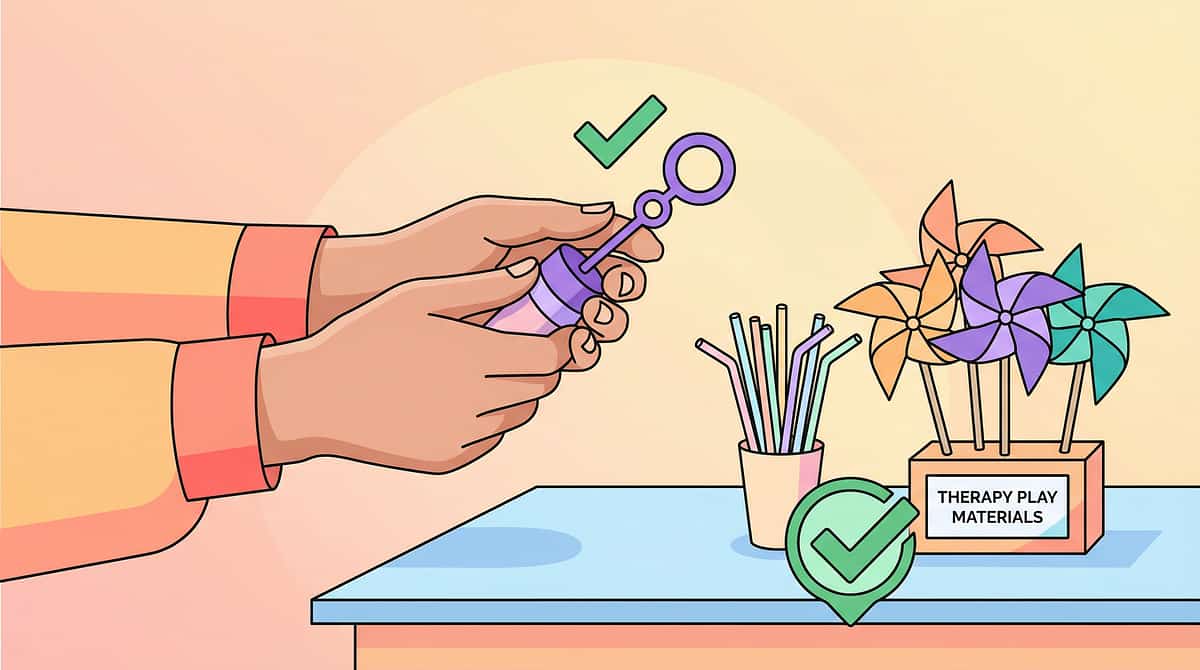
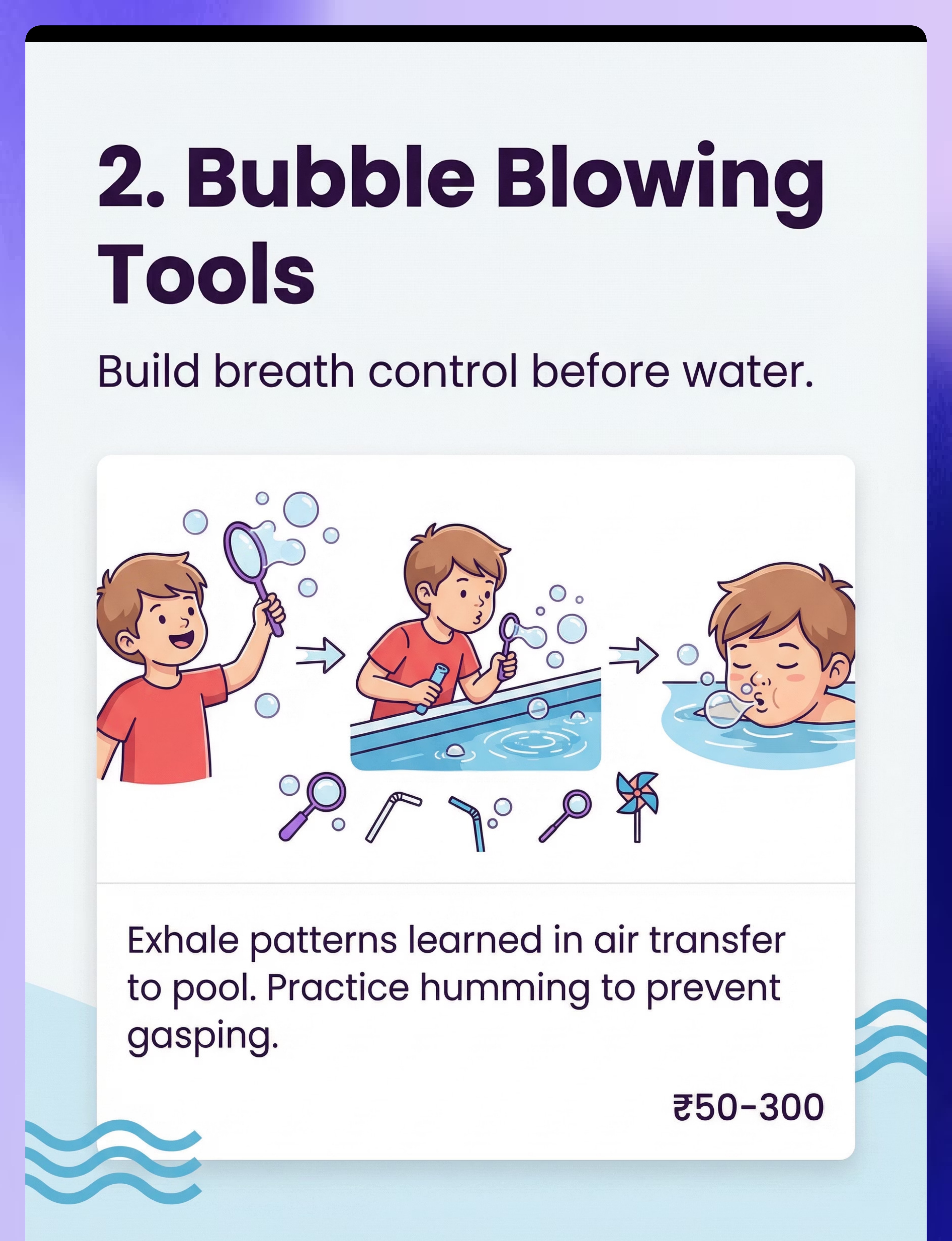
Bubble Blowing Tools (Wands, Straws, Pinwheels)
Material Details
📂Canon: Oral Motor / Breath Control Tools
💰Price: ₹50–300
Why This Works
Exhalation practice on land transfers directly to water breath control. This is how you prevent choking. The oral motor pattern of a sustained, controlled exhale — practiced through bubble wands, straws, and pinwheels — is the same motor pattern the brain activates when a child submerges their face in water.
Many children who panic when water touches their face are actually panicking because they do not yet have automatic exhale control. Bubble blowing builds that automaticity safely, playfully, and on dry land — before the stakes are high.
Material 3 of 9
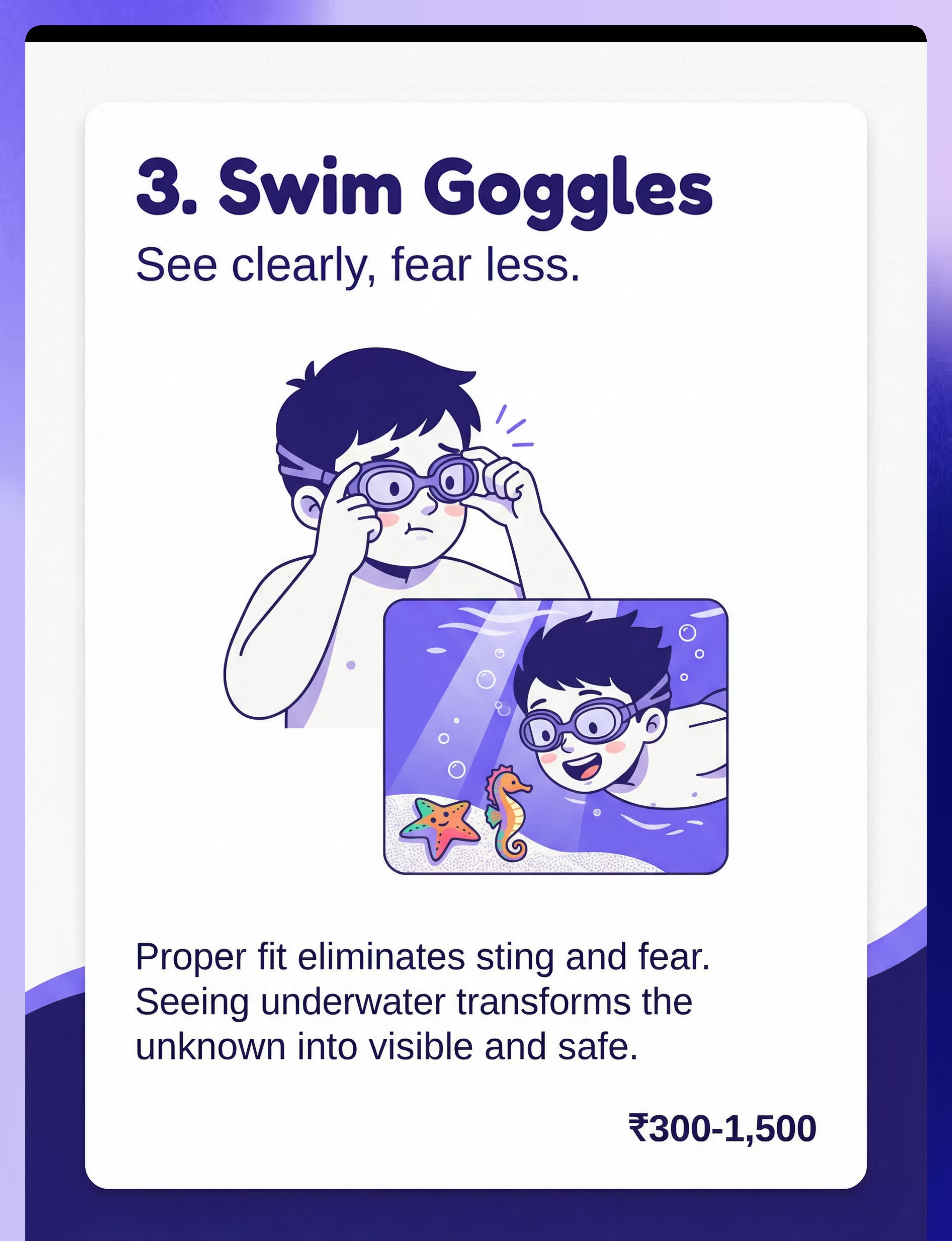
Swim Goggles (Properly Fitted)
Material Details
📂Canon: Sensory Protection Equipment
💰Price: ₹300–1,500
Why This Works
Eliminates water-in-eyes fear. Underwater visibility transforms the unknown into safe.
For many children, the prospect of water entering the eyes is the single greatest barrier to face submersion. Properly fitted silicone goggles with anti-fog lenses completely remove this sensory threat. Once a child can see clearly underwater, their relationship with that space changes entirely — curiosity replaces fear.
Fit matters critically. Goggles that leak are worse than no goggles. Test the seal weekly and replace cracked gaskets immediately.
Material 4 of 9
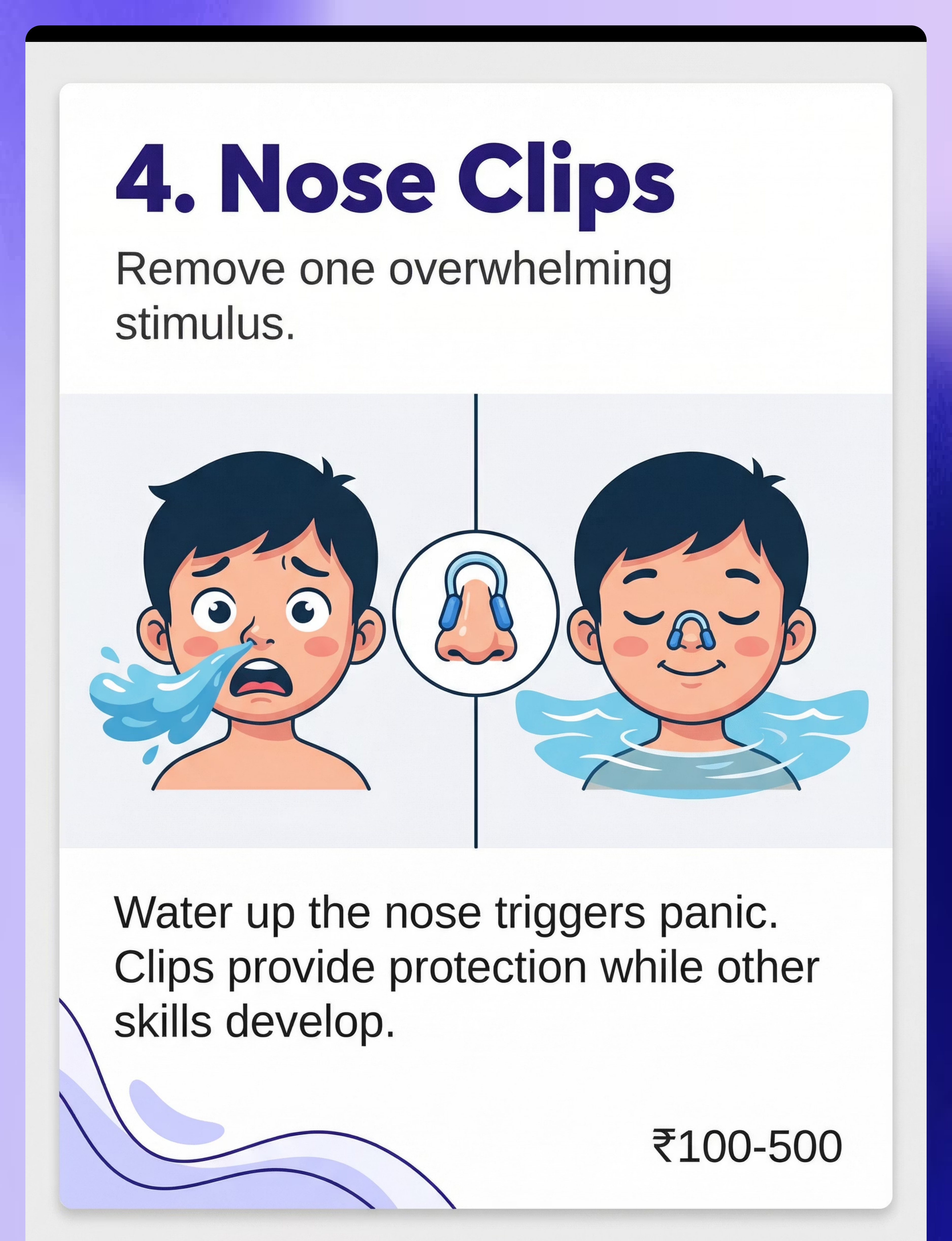
Nose Clips (Child-Sized)
Material Details
📂Canon: Sensory Protection Equipment
💰Price: ₹100–500
Why This Works
Removes nasal water entry — a major panic trigger — while other skills develop.
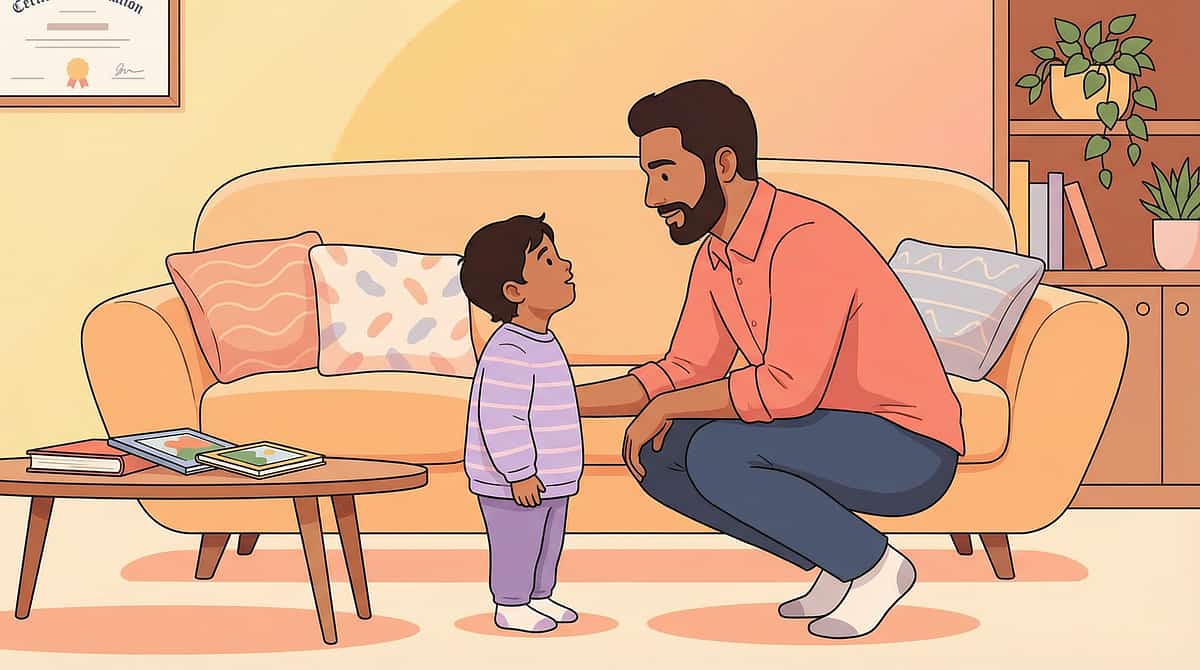
For children with sensory processing differences, the sensation of water entering the nasal passage triggers an immediate panic reflex. A properly fitted child-sized silicone nose clip eliminates this trigger entirely, allowing the child's nervous system to focus on building water tolerance without being derailed by nasal sensation.
As comfort builds over weeks, the clip can be gradually phased out — replaced by the natural nasal exhale the child will have learned through humming and bubble practice.

Material 5 of 9
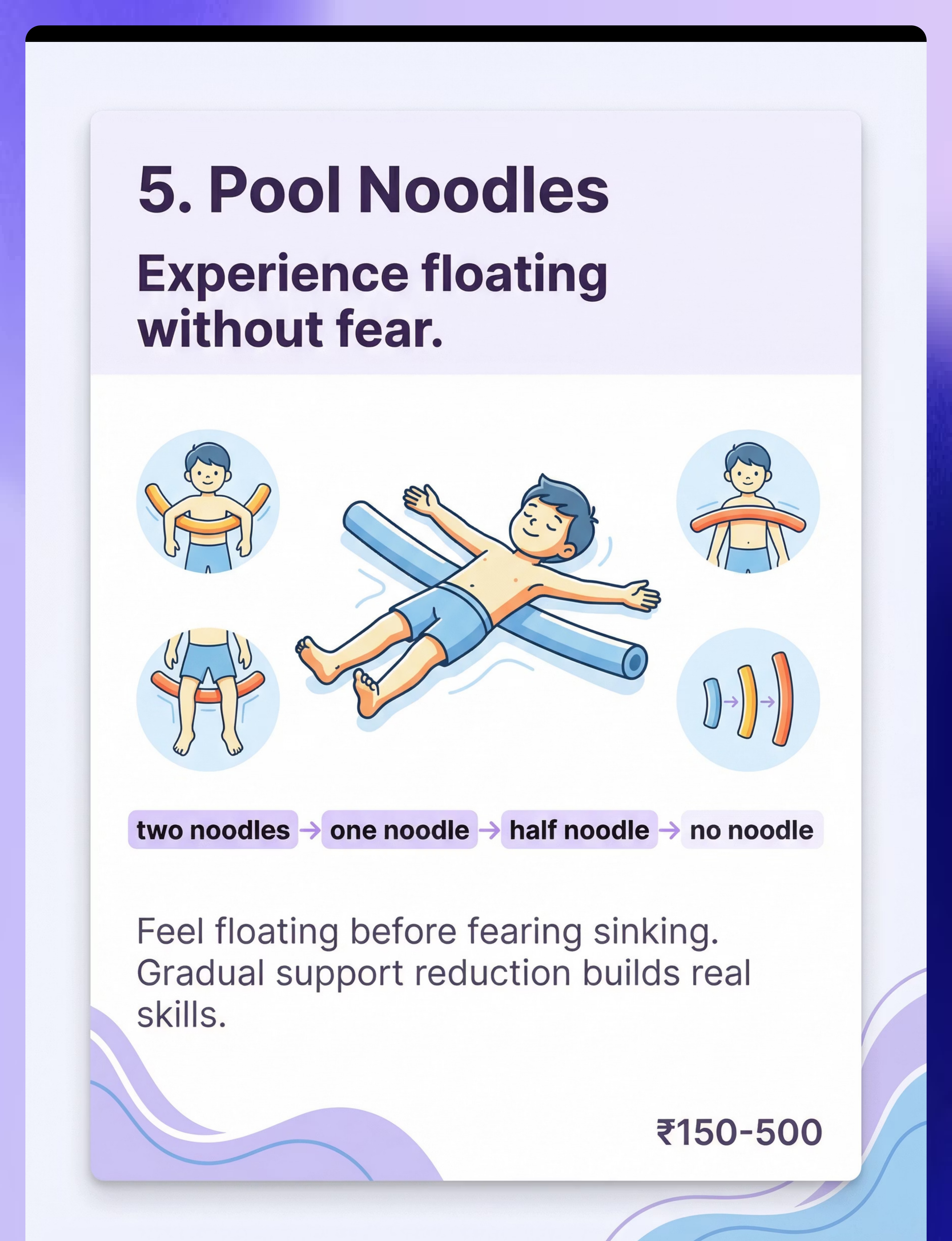
Pool Noodles & Flotation Supports
Material Details
📂Canon: Motor Support / Flotation Tools
💰Price: ₹150–500
Why This Works
Experiencing floating before fearing sinking builds the neurological foundation for water safety.
The vestibular system's primary terror in water is the absence of the gravity anchor. Pool noodles give the brain the support it needs to experience buoyancy as safe rather than threatening. Starting with two noodles (one under each arm), the child can experience horizontal floating — the body position their nervous system has never felt as safe before.
Pool noodles are never a substitute for supervision. Adult hands remain within 30cm of the child at all times in deep water.

Material 6 of 9
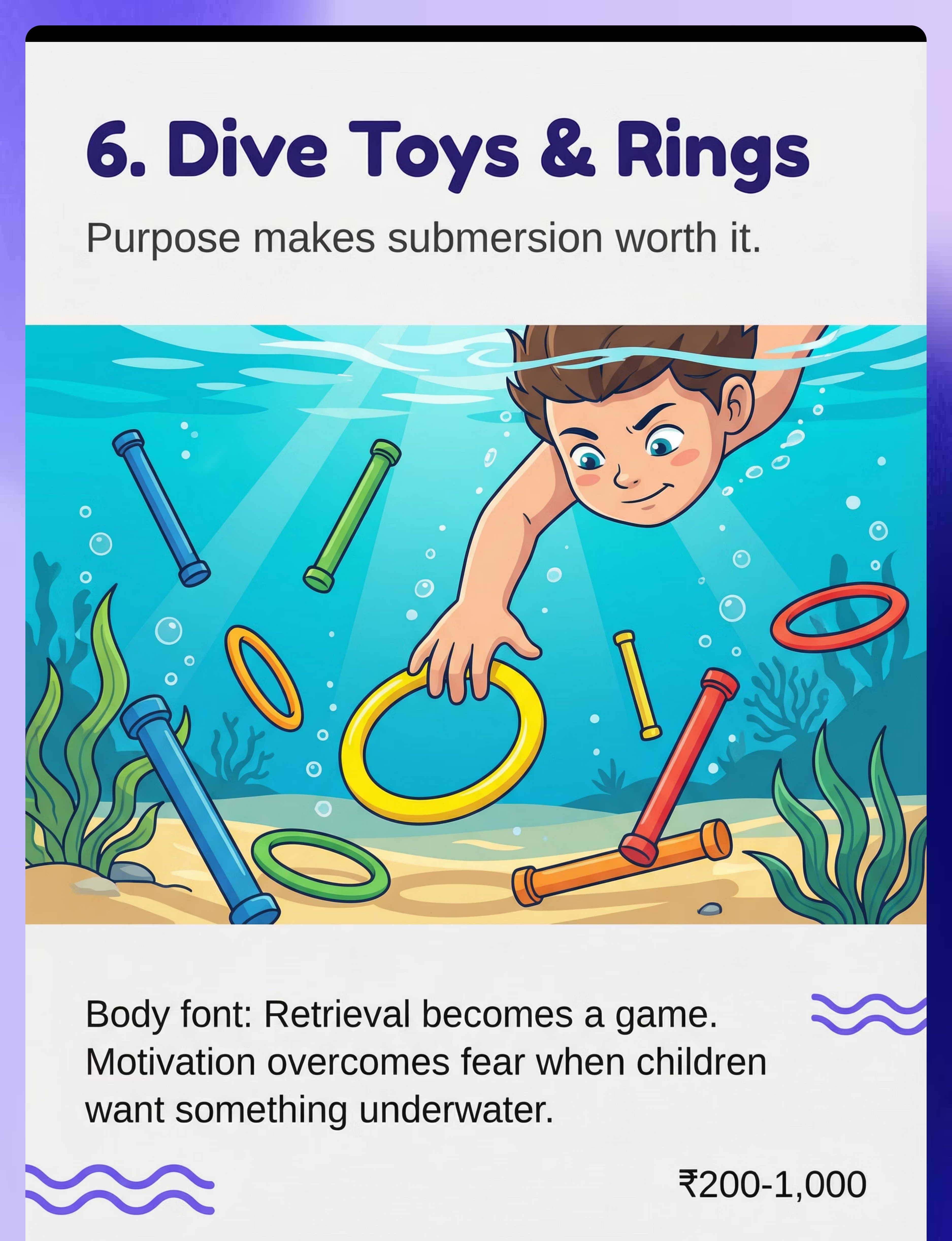
Submersible Dive Toys & Rings
Material Details
📂Canon: Motivational Aquatic Tools
💰Price: ₹200–1,000
Why This Works
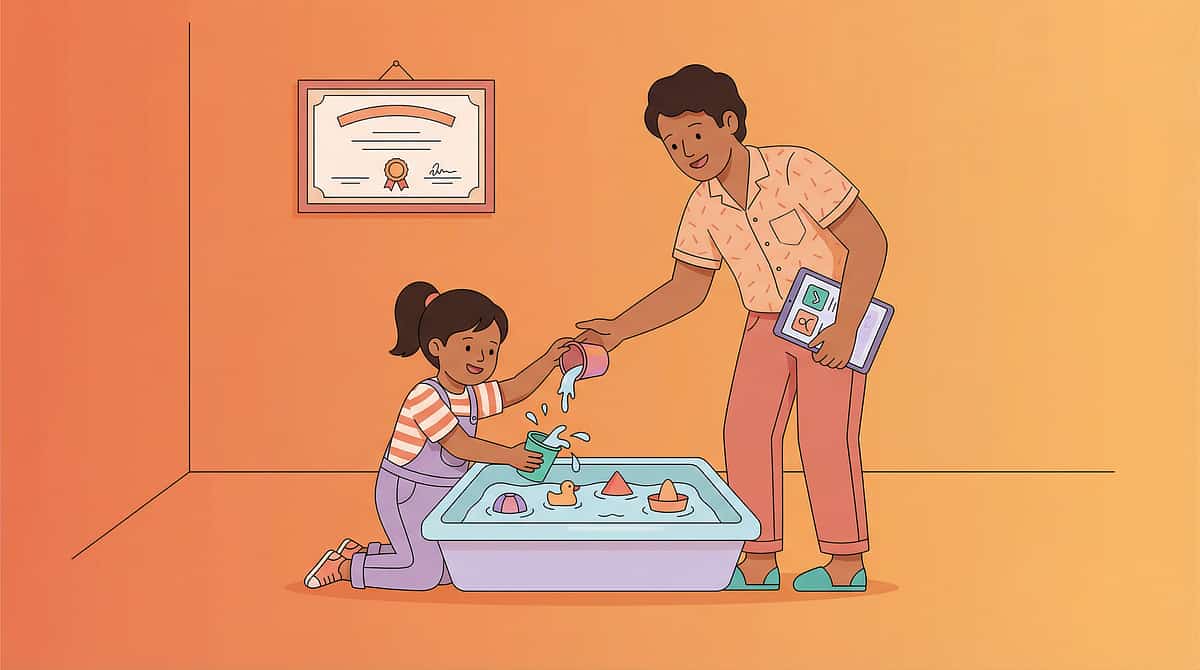
Motivation overcomes fear. When a child wants the toy, they find the courage to submerge.
Motivation is a neurological force. A highly preferred object just below the water surface creates a motivating operation powerful enough to override avoidance. The child who will not submerge for instruction will submerge for a beloved toy. This is not bribery — it is skilled therapeutic use of reinforcement contingency.
Begin with toys placed at 5cm depth. As confidence builds, increase to 10cm, then 20cm. Each successful retrieval is a submersion exposure trial with built-in reinforcement.
Material 7 of 9
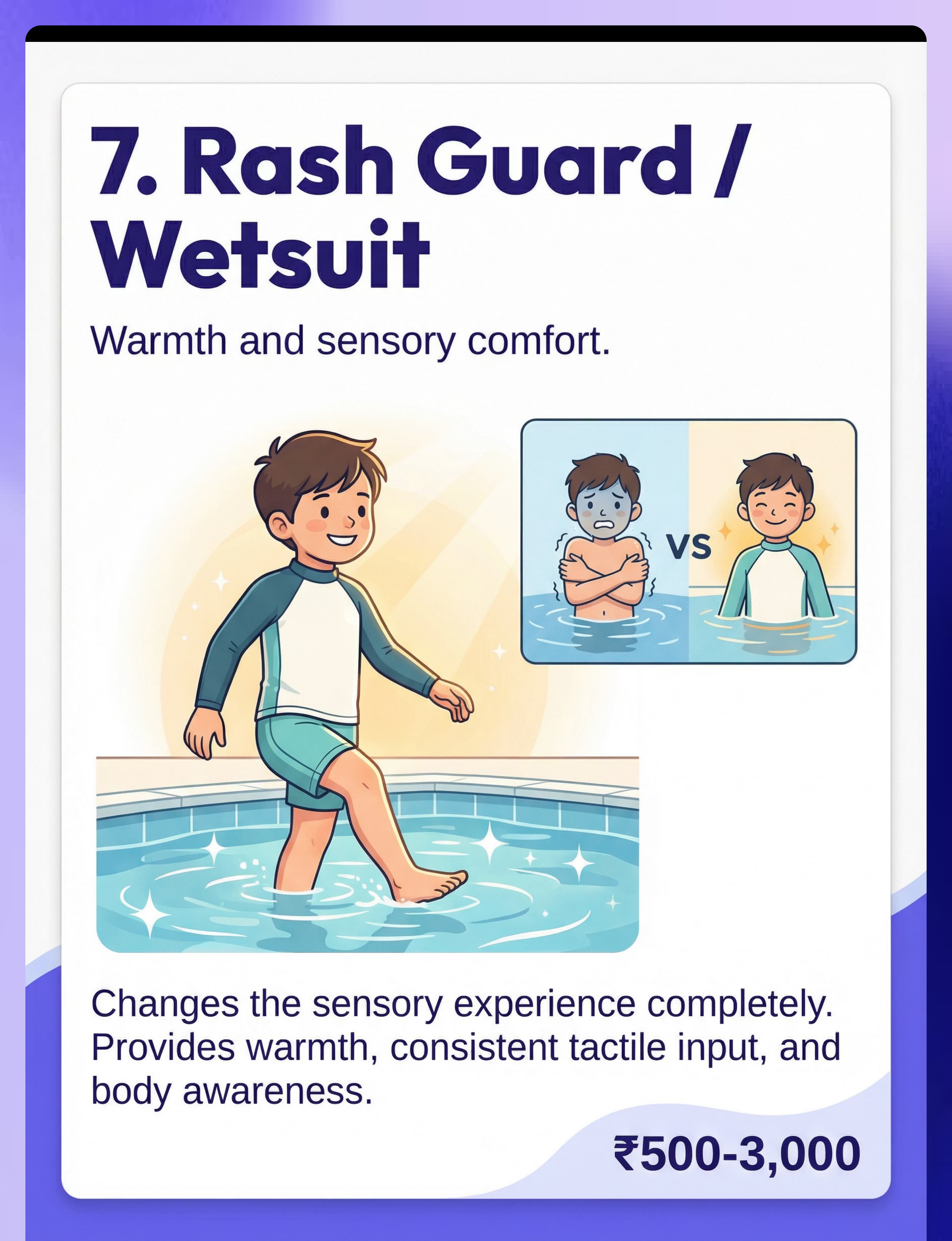
Thermal Rash Guard / Wetsuit
Material Details
📂Canon: Sensory Comfort / Tactile Equipment
💰Price: ₹500–3,000
Why This Works
Changes the entire sensory experience. Familiar tactile input (fabric) replaces threatening input (water).
For a child with tactile defensiveness, bare skin in water is an overwhelming full-body sensory assault. A long-sleeve thermal rash guard provides consistent proprioceptive pressure across the body surface — familiar, predictable, and calming — while the child begins to tolerate the water environment around them.
For children with severe tactile defensiveness, the rash guard is non-negotiable. Begin bath sessions with the rash guard on. It is not a crutch — it is a therapeutic bridge.
Material 8 of 9
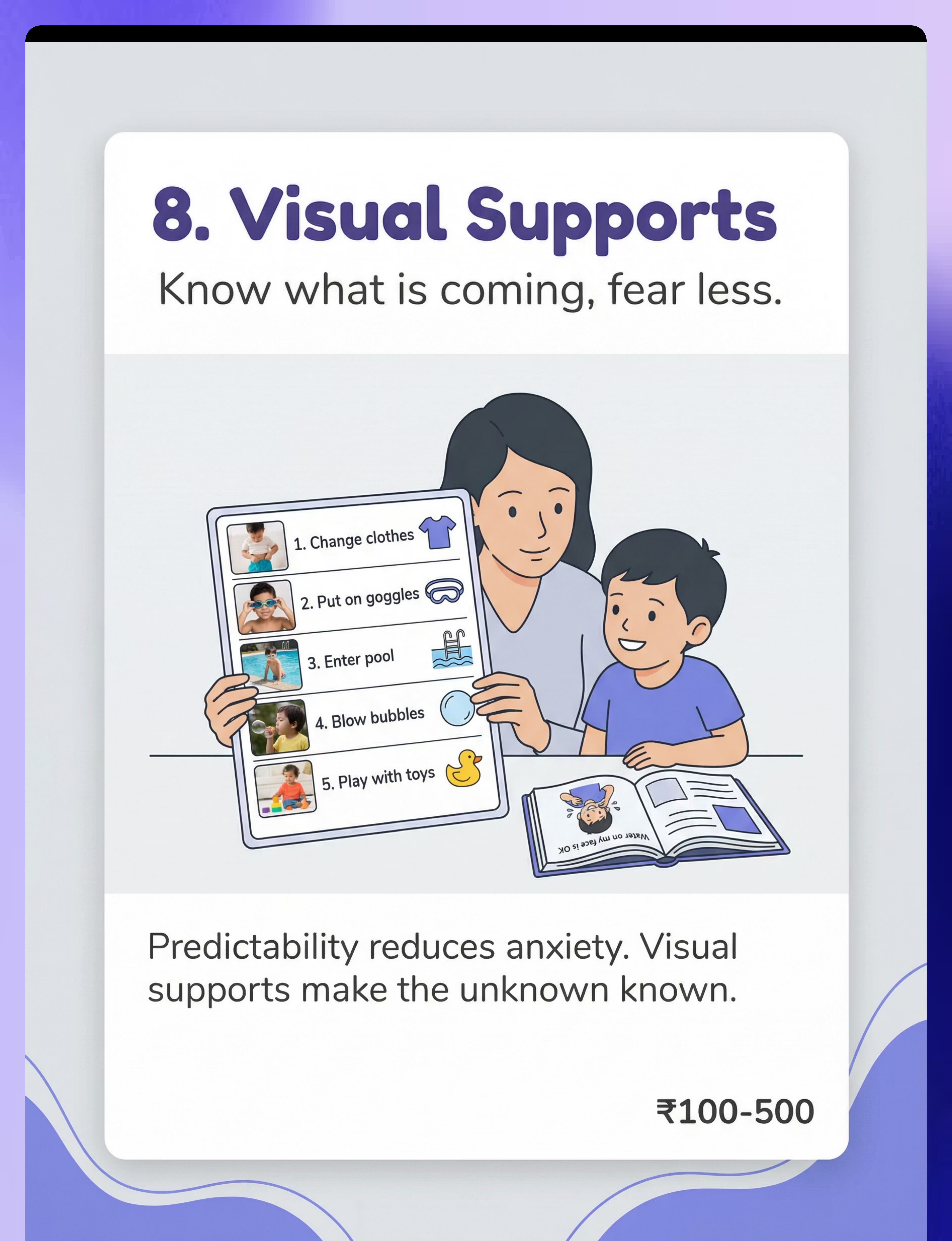
Waterproof Visual Supports & Social Stories
Material Details
📂Canon: Visual Schedules / Social Stories
💰Price: ₹100–500
Why This Works
Anxiety feeds on uncertainty. Visual predictability of the pool routine eliminates the fear of the unknown.
A waterproof visual schedule held in the parent's hand throughout the session answers the child's nervous system's core question: What happens next? When a child can see the sequence — arrive, sit, feet in, play, finish, wrap, snack — the pool stops being an unpredictable threat and becomes a predictable sequence of manageable steps.
Social stories reviewed the night before and morning of each session prime the child's prefrontal cortex to regulate, rather than react.
Material 9 of 9
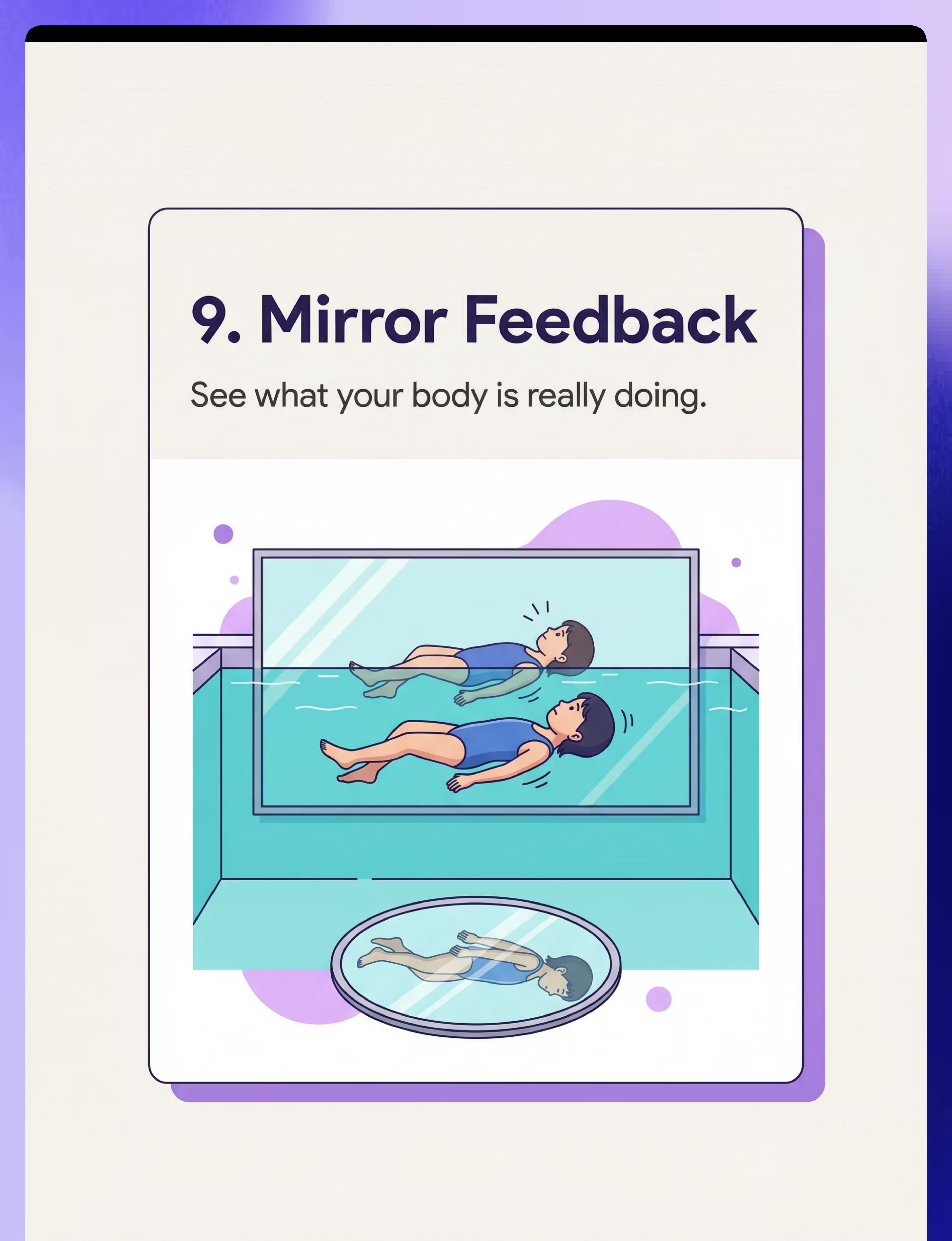
Shatterproof Mirror for Body Position Feedback
Material Details
📂Canon: Proprioceptive Feedback Tools
💰Price: ₹500–2,000
Why This Works
Bridges proprioceptive confusion. Seeing what the body is doing helps calibrate feeling what the body is doing.
The proprioceptive system's job is to know where the body is in space without looking. In water, this system is dramatically disrupted for children with processing differences. A poolside or submerged mirror gives the child visual proprioceptive feedback — closing the gap between what the nervous system feels and what is actually happening.
Safety is absolute: Must be shatterproof acrylic only. Zero glass in pool areas. No exceptions.
Reinforcement Support
Complete the Toolkit: Reinforcement Materials
Immediate, specific reinforcement that locks in the neural gain. From the Pinnacle Canon Reinforcement Menu:
🌟 Rosette Imprint Reward Jar
Token economy jar for post-session celebration protocol. Each successful exposure trial earns a token. Agreed number of tokens unlocks larger rewards.
🌟 1800+ Reward Stickers Set
Token economy stickers for pool session milestones. Celebrate the attempt, not just the success. Immediate, specific, and joyful.
Building the reinforcement system before the first session is essential. When a child knows what they are working toward, motivation is pre-loaded. The reward is not a bribe — it is the therapeutic motivating operation that makes approach behavior more powerful than avoidance.

Equity Principle
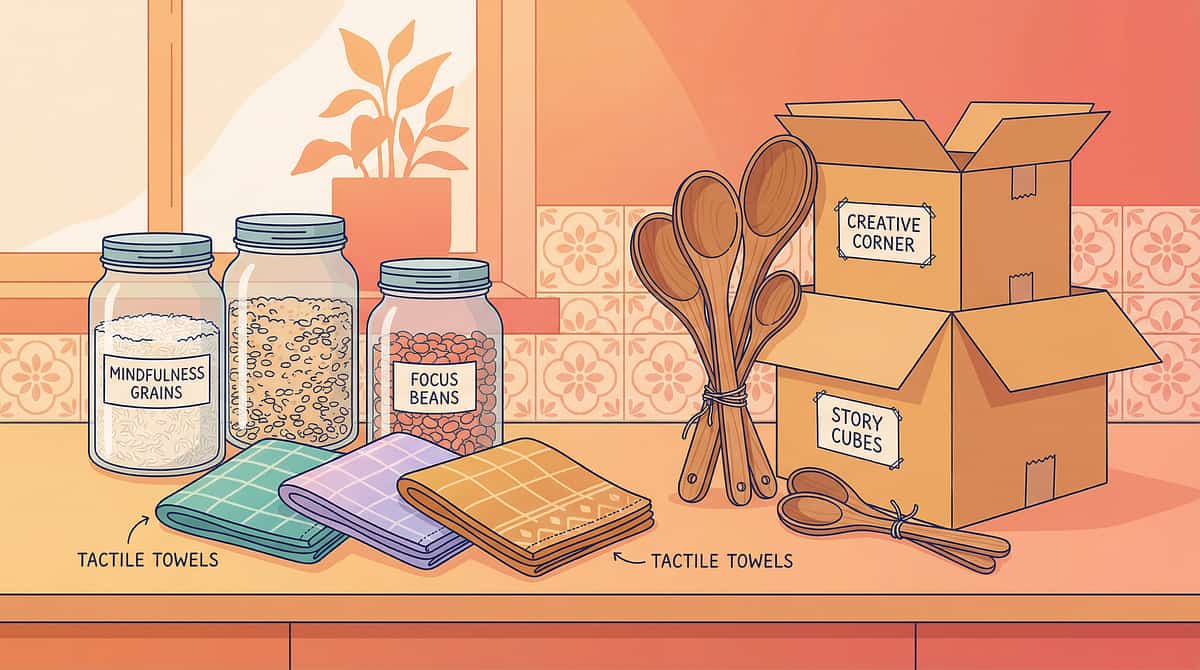
Zero-Cost Version: Start Today With What You Have
WHO Nurturing Care Principle: Effective intervention is context-specific and equity-focused. Every parent can start TODAY regardless of budget.
Material | Buy Version | ₹0 DIY Version | Works Because | |
Pouring Cups | Commercial water play set | Kitchen cups, medicine cups, squeeze bottles | Same principle: child controls water flow | |
Bubble Tools | Bubble wands + solution | Dish soap + water + kitchen straws | Same oral motor pattern | |
Swim Goggles | Commercial goggles | Begin with face-in-basin practice first | Build tolerance before need for protection | |
Nose Clips | Commercial silicone clips | Teach nose-exhale humming (no clip needed) | Humming prevents inhalation naturally | |
Pool Noodles | Commercial foam noodles | Rolled towels in bathtub, pool edge rail | Same floating-with-support experience | |
Dive Toys | Commercial rings | Coins, kitchen items in bathtub | Motivation is the mechanism — any preferred toy works | |
Rash Guard | Commercial thermal wear | Thin cotton long-sleeve t-shirt in bathtub | Consistent tactile coverage is the therapeutic principle | |
Visual Supports | Laminated cards | Phone photos of pool + handwritten sequence | Predictability is the mechanism | |
Mirror | Shatterproof poolside mirror | Smartphone video review after session | Delayed feedback still calibrates body awareness |
Important Note: Clinical-grade materials are non-negotiable ONLY when: the child has severe tactile defensiveness (rash guard is essential), significant water entry panic (goggles are essential), or nasal water phobia (nose clips are essential). Start with what you have; upgrade as the journey progresses.
🛑 Safety First
Water Safety Is Absolute. Read This First.
🔴 ABSOLUTE RULES — No Exceptions
NEVER leave your child unattended near water — not for 30 seconds. Drowning is the leading cause of accidental death in children under 14 in India (WHO Global Status Report). This is not a caution — it is an absolute rule.
NEVER force face submersion before the child is ready. Forced exposure in water creates trauma, not learning. Every forced step may require weeks to undo.
NEVER use flotation devices as substitutes for supervision. Pool noodles can slip. Your hand must be within 30cm of the child in deep water.
🟡 MATERIAL SAFETY CHECKS
Goggles: Check seal weekly. Replace cracked gaskets immediately. | Nose clips: Must not restrict breathing — test on land first. | Dive toys: No sharp edges, no detachable small parts. No glass. | Rash guard: Check for chafing after each use. | Mirror: Must be shatterproof acrylic — zero glass in pool areas. | Bubble solution: Non-toxic only.
🟢 PROCEED WHEN
Child is fed, rested, not ill • Water temperature is comfortable (28–32°C) • Environment is calm (no crowds, low noise) • You are in regulated emotional state — children co-regulate • All materials are checked and ready • Direct supervision by capable adult throughout
STOP THE SESSION if you observe: Choking or significant water ingestion • Child becomes severely distressed and cannot be co-regulated • Any signs of illness (fever, ear pain) • Skin reactions to water or materials • Behavioral regression beyond normal resistance
Emergency: If a child is submerged and unresponsive → Call 112 immediately.
Emergency: If a child is submerged and unresponsive → Call 112 immediately.
Act III — Setup
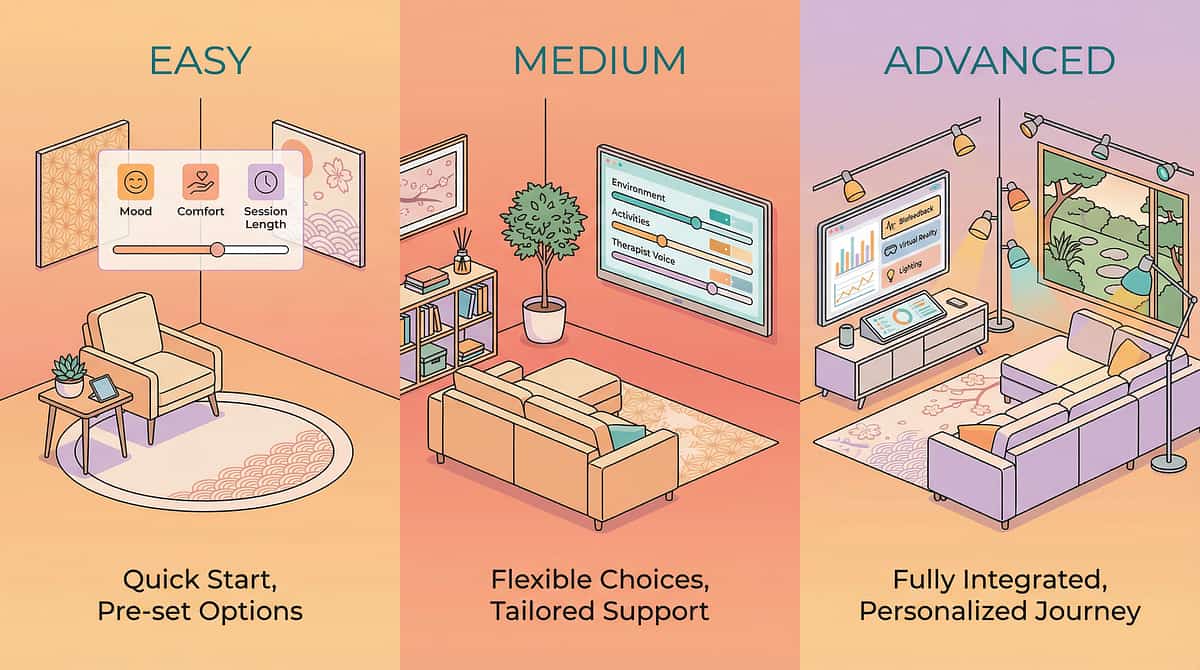
Stage the Environment Before You Invite the Child
"The environment is 50% of the therapy. Set it correctly before you set foot near the water."
Phase 1: BATHTUB SESSIONS (Weeks 1–4)
- Water level: start at 5cm, increase gradually
- Temperature: 30–32°C (warmer = less sensory threat)
- Pouring cups: arranged at tub edge within child's reach
- Bubble tools: ready beside tub
- Visual schedule: laminated, on bathroom wall or door
- Towel: warm, ready for wrap immediately after
- Remove: loud fans, harsh lighting, distracting unrelated toys
- Parent position: seated on bath stool at child's eye level
- Distance: within arm's reach at all times
Phase 2: POOL SESSIONS (After Home Readiness)
- Arrive at quiet time (early morning / weekday preferred)
- Sit at pool edge, feet only in first 3+ sessions
- Visual schedule: in waterproof sleeve, in parent's hand
- Goggles + nose clips: on child BEFORE entry
- Rash guard: on child BEFORE entry
- Pool noodle: pre-positioned in water within arm's reach
- Dive toys: visible but not yet deployed until child is settled
- Mirror: positioned at pool edge or submerged at shallow end
✅ Minimal crowd / quiet time slot booked
✅ Water temperature confirmed comfortable
✅ Parent phone silent — you are fully present
✅ All materials checked and accessible
✅ Reward ready for post-session (sticker, toy, preferred snack)
✅ No time pressure — 45 minutes minimum allocated

Act III — Pre-Flight Check
60-Second Readiness Check Before Every Session
Check | 🟢 GREEN (Proceed) | 🟡 AMBER (Modify) | 🔴 RED (Postpone) | |
Fed & hydrated | Ate ≥1hr ago | Hungry but not emergency | Refused to eat, very hungry | |
Sleep | Normal sleep last night | Slightly tired | Overtired, major meltdown | |
Illness | No symptoms | Minor sniffles | Fever, ear pain, sick | |
Emotional state | Calm or engaged | Slightly dysregulated | Full meltdown in last 2 hrs | |
Sensory state | Regulated | Mildly aroused | Significantly over/under-aroused | |
Motivation | Interested or neutral | Needs gentle coaxing | Active refusal |
🟢 ALL GREEN
Proceed with full protocol (Steps 1–6)
🟡 ANY AMBER
Shorten to 10 minutes • Start with easiest material only • Skip pool — bathtub only
🔴 ANY RED
Do not approach water today • Replace with preferred calming activity • Tomorrow is another opportunity
"The best session is one that starts right. Session abandonment is not failure — it's excellent clinical judgment."
Step 1 of 6
The Invitation
Purpose: Create safety and voluntary engagement. The child chooses to participate.
"Hey [name], I found something cool for you. Want to see? No pressure — you can just watch if you want."
Body Language
- Kneel or sit at child's level
- Relaxed posture — no urgency in your face
- Present the first material (pouring cup or bubble wand) casually
- Do NOT orient body toward water yet
What Acceptance Looks Like
- Child looks at the material with interest
- Child approaches or reaches
- Child asks "what is it?"
- Child copies your demonstration
If Resistance
Back away from the water entirely. Bring the material to a neutral space (floor, table). Play with the material there. Zero water pressure. This session is just about the material, not the water.
"You are not teaching swimming. You are building safety. Safety comes first, every single session." | Timing: 30–60 seconds

Step 2 of 6
The Engagement
Purpose: Introduce the therapeutic material in a play-based, low-demand context.
For Bathtub Sessions
"Watch this — I'm going to make the water do something fun."
[Pour a cup of water in the tub. Watch child's reaction. Do NOT prompt child to touch water yet.]
For Pool Sessions
"Let's sit here and put just our feet in. That's it — just feet. See how it feels."
Material Introduction Sequence
1
Pouring cups at water table — no immersion (Stage 1: Water Avoidant)
2
Pouring cups in bathtub with 5cm water (Stage 2)
3
Bubble blowing at water surface (Stage 3)
4
Goggles + face near water (Stage 4)
5
Pool feet-in with noodle nearby (Stage 5)
🟢 Engagement
Reaches for material, initiates action, smiles
🟡 Tolerance
Neutral, watches, doesn't retreat
🔴 Avoidance
Backs away, cries, shuts down
The moment child touches the material or water voluntarily → Immediate specific praise: "You touched the water! That was brave!" | Timing: 1–3 minutes

Step 3 of 6
The Therapeutic Action
Purpose: Deliver the specific sensory input that builds neural tolerance and skill. Duration: 5–10 minutes (core action)
🟦 Water Comfort Building (Stages 1–2)
Child CONTROLS water exposure through pouring cups. Action: Child pours water on their own hand → wrist → arm → shoulder. Parent pours on their OWN arm first to demonstrate safety. Child pours at their own pace.
🟦 Breath Control Building (Stage 2–3)
Bubble blowing progression. Action: Child blows bubbles in air → at water surface (chin contact) → with lips at water → with face partially submerged. Use humming between attempts to reset exhale pattern.
🟦 Face Tolerance (Stage 3–4)
Goggles + nose clips + dive toy. Action: Child wears full protection gear. Present dive toy 15cm below surface. Child attempts to retrieve. Each retrieval attempt = one exposure trial.
🟦 Float Building (Stage 4–5)
Pool noodle horizontal position. Action: Begin with TWO noodles (one under each arm). Adult supports head. Child experiences floating for 5–10 seconds. Celebrate. Remove one noodle when child requests.
Common Execution Errors:❌ Moving too fast between stages → Back up one stage | ❌ Constant verbal commentary → Less talking, more space | ❌ Showing anxiety in your own body → Regulate yourself first | ❌ Adding water pressure when child is exploring the material → Let exploration be enough
Step 4 of 6
Repeat & Vary
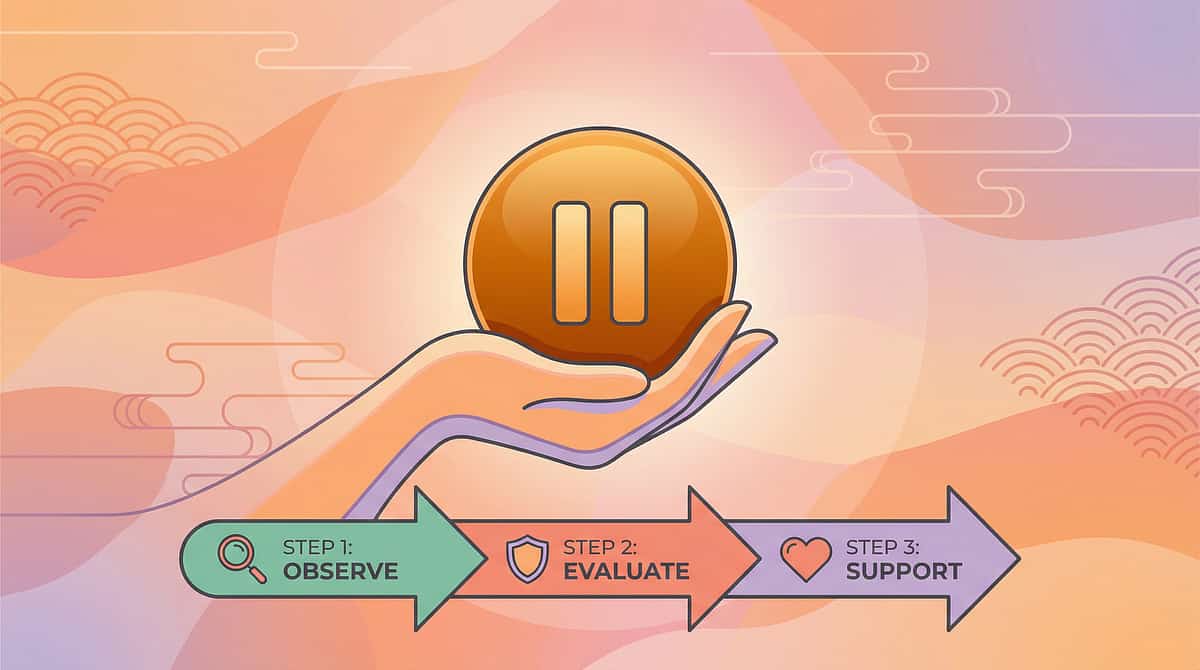
Purpose: Therapeutic dosage through structured repetition with variation. Timing: 3–5 minutes
Stage | Target Reps | Variation | |
Water contact | 5–8 pours | Vary cup size, pour location (arm → shoulder → head) | |
Bubble blowing | 3–5 sequences | Air → surface → shallow → face in | |
Face tolerance | 3 dive retrievals | Vary toy, depth (5cm → 10cm → 20cm) | |
Float practice | 3–5 periods | Duration 5s → 10s → 20s → 30s |
The Satiation Signals — Stop When You See:
Child turns away from material
Energy drops significantly
Engagement quality decreases
Child requests a different activity
Variation Options (keep the principle, vary the experience):
Change water temperature slightly
Change the preferred toy for retrieval
Change float position (back float vs. front)
Add a social element (parent blows bubbles too)
Add music or counting ("blow until I count to 5")
"3 good repetitions where the child is engaged and successful build more neural pathways than 10 repetitions through resistance. Quality over quantity, every time."
Step 5 of 6
Reinforce & Celebrate
Purpose: Immediate, specific reinforcement that locks in the neural gain.
The 3-Second Rule: Within 3 seconds of the desired behavior → deliver reinforcement.
"You put your FACE in the water! That was incredible! I am SO proud of you!" [Specific + enthusiastic + immediate]
🌟 Social Reinforcement
Cheer, high-five, hug, victory dance together — powerful and free
🌟 Tangible Reward
1800+ Stickers Set — ₹364 | Reward sticker per milestone achieved
🌟 Token Economy
Rosette Reward Jar — ₹589 | Tokens accumulate toward bigger reward
🌟 Sensory Reward
Warm towel wrap — deeply calming proprioceptive input after water work
"Celebrate the ATTEMPT, not just the success. A child who tried and didn't manage deserves more celebration than a child who succeeded easily."
Step 6 of 6
The Cool-Down
Purpose: Transition from therapeutic engagement back to regulated baseline. No session ends abruptly — this prevents post-session dysregulation.
"Two more, and then we're all done for today. You've done so well."
1
One Final Enjoyable Activity
Child's choice — free play with bath toys, splashing
2
"Time to Come Out"
Visual timer showing 60 seconds remaining — the timer decides, not the parent
3
Warm Towel Wrap
Immediately on exit — deep pressure is calming proprioceptive input
4
Material Put-Away Ritual
Child helps gather cups/toys — builds closure and ownership
5
Verbal Anchor
"We did swimming readiness today. Same time [tomorrow/next session]."
If Child Resists Ending: Use visual timer (showing it's not your decision) • Offer transition object from water to next activity • Never forcibly remove — wait it out with consistent calm language
Transition to Next Activity: Ideal post-session: 10 minutes of preferred calming activity. Avoid highly stimulating activities immediately after.
Transition to Next Activity: Ideal post-session: 10 minutes of preferred calming activity. Avoid highly stimulating activities immediately after.
Act IV — Track Progress
Track It While It's Fresh — 60 Seconds
"60 seconds of data now prevents 60 minutes of confusion next week. Your observations are clinical intelligence."
📊 Today's Session Log
1. Which stage were we at?
Circle: 1-Avoidant / 2-Bathtub / 3-Face Contact / 4-Float / 5-Pool
Circle: 1-Avoidant / 2-Bathtub / 3-Face Contact / 4-Float / 5-Pool
2. Best moment today: (1 sentence) _______________
3. What was hard today: (1 sentence) _______________
4. Duration child tolerated core activity: ___ minutes
5. Stars today (circle): ⭐⭐⭐⭐⭐⭐
📥 Download Tracking PDF
Daily log, stage tracker, milestone chart — all in one A4 page
📱 GPT-OS® In-App Tracker
Log session in the Pinnacle app → your data shapes tomorrow's recommendation
Troubleshooting
Session Didn't Go Perfectly? Here's Why — and What to Do
Session abandonment is not failure. It's data.
❓ Problem 1: Child panicked approaching the water
Why: The pool triggered fight-or-flight before the session began. Fix: Don't approach the pool. Spend 3 sessions just visiting — sit in the spectator area, then on dry pool deck, then pool edge. Environmental desensitization first.
❓ Problem 2: Fine in bathtub but fell apart at pool
Why: Pool environment is sensory overwhelming — echoes, crowds, size, chlorine. Fix: Go to pool at quietest possible time. Sit at pool edge with feet out for 5 sessions before entering. Build pool-environment tolerance separately from water-skill tolerance.
❓ Problem 3: Child choked/gagged trying to blow bubbles
Why: They inhaled instead of exhaled. The exhale pattern is not automatic yet. Fix: More land-based bubble work before water. Practice humming (forces exhale). Try nose clips. Reduce depth to zero — just lips on water surface.
❓ Problem 4: Child was doing well but suddenly regressed
Why: Illness, sleep disruption, school stress, or a frightening water experience elsewhere. Fix: Normal and expected. Go back 1–2 stages. The rebuilding is faster the second time.
❓ Problem 5: Child can't relax enough to float — body is rigid
Why: Muscle tension is the physical expression of fear. Fix: More proprioceptive input before water (wheelbarrow walks, wall push-ups). Warmer water. Maximum noodle support. Let floating happen TO the child, not BY the child.
❓ Problem 6: Child screamed and cannot be comforted — session over
Why: The session went past the child's threshold. This is data. Fix: Warm towel, preferred comfort item, full stop. Review what triggered escalation. Back up several steps. Consider professional OT aquatic therapy assessment.
"Every failed session tells you something about your child's nervous system. Listen to what it's saying."
📞 If challenges persist: Call 9100 181 181 — FREE National Helpline

Personalization
Tune This Technique to Your Unique Child
No two children are identical. Use these profile-based variations to tune the protocol to your child's specific sensory signature.
🔴 Sensory Avoider / Tactile Defensive
- Rash guard is non-negotiable
- Warmer water always
- Child controls all water contact — zero adult-imposed splashing
- Quieter pool times, indoor pools with less echo if available
- Add heavy work (joint compression, pushing against water) before sessions
🟢 Sensory Seeker / Under-Responsive
- Can move faster through stages
- Cold water splash might actually be exciting (test)
- More submersion games, vigorous water play
- Deeper dive toys to increase proprioceptive challenge
- Increase session duration
🔵 Anxiety-Primary
- Visual schedule is non-negotiable — review before every session
- Social story about pool reviewed 3× before going
- Identical routine every session — zero surprises
- Let child hold a comfort item during pool-edge sitting
- Consider short-term clinical anxiety support alongside home program
Under 3 | Everything in bathtub; pool only with pediatric aquatic therapist | |
4–6 years | Home program + structured pool sessions; simple 3-step visual schedules | |
7–12 years | Add self-monitoring ("rate how you feel 1–5"), goal-setting, peer involvement |
Act IV — Week 1–2
Weeks 1–2: The Trust-Building Phase
████░░░░░░░░░░░░░░░░ 15% Progress
✅ What You Will Likely See
- Child tolerates being in the bathroom with filled bathtub (even if not yet in)
- Pouring cups engaged with positively — water play is fun now
- Bubble blowing improving — longer sustained exhalation
- Goggles tolerated on face (even outside water)
- Slight reduction in resistance to water play in general
❌ What You Will NOT See Yet (and that's normal)
- Face submersion (probably weeks away)
- Pool entry without anxiety
- Floating without maximum support
- Independent breath control
Parent Emotional Check-In: You may be thinking Is this actually working? — Yes. The visible changes at this stage are small. The neural changes are significant. Trust the process for 8 weeks before evaluating.
"If your child tolerates the bathtub for 3 minutes longer than last week — that is measurable neurological progress. Celebrate it with the same energy you'd use for a first word."
Act IV — Week 3–4
Weeks 3–4: Neural Pathways Are Forming
████████░░░░░░░░░░░░ 40% Progress
✅ Child anticipates bath/water session positively ("is it water time?")
✅ Starts initiating water play independently
✅ Goggles worn without prompting before bathtub
✅ Face partial contact (chin in water) attempted voluntarily
✅ Bubble blowing at water surface achieved consistently
✅ Pool visit: feet in water for 5+ minutes without distress
The "Generalization Seeds" — What the Child May Do Spontaneously:
Blow bubbles into a cup of water at mealtime (unprompted)
Ask to go to the pool
Demonstrate new bath comfort to a sibling or toy
When to Increase Frequency/Intensity: If child is requesting more water time → honor it • If child breezes through current stage → introduce next stage • If child plateaus (no change for 5+ sessions) → vary the material OR consult OT
"You may notice you're more confident too. Parent confidence is measurable and it directly affects outcomes."

Act IV — Week 5–8
Weeks 5–8: Mastery Window Opens
███████████████░░░░░ 75% Progress
🏆MASTERY CRITERIA FOR F-584: A child is ready for formal swimming instruction when they demonstrate ALL of the following:
✅Water Entry: Voluntary, without distress, within 2 minutes
✅Face Submersion: 3+ seconds face in water, blowing bubbles, without panic
✅Breath Control: Can exhale underwater, surface for air, repeat 3 times
✅Float: Maintains floating position with single noodle support for 15+ seconds
✅Emotional Regulation: Returns to calm within 60 seconds after minor distress
✅Pool Comfort: 30+ minute pool session without significant dysregulation
Generalization Check — Does the skill persist in:
A Different Pool?
With a Different Adult?
After a 2-Week Break?
If yes — mastery is genuine, not just performance.
🏆 MASTERY UNLOCKED — "Your child is ready for formal swimming instruction. The foundation is built. The house can now be constructed."
🎉 You Did This. Stop and Feel This Moment.
This is not a small thing.
Eight weeks ago, your child could not be within 10 meters of a pool without a meltdown. Today, they blew bubbles underwater.
56
Sessions Executed
40–56 sessions of courageous commitment
600
Minutes of Effort
Yours and theirs — together
1
Nervous System
Rewired, one session at a time
"You chose science over force. It worked." — Pinnacle Parent Network
🎊 Family Celebration
Do the thing they couldn't do before — together. A pool visit, just for joy. No therapy. Just swimming.
📸 Document This Milestone
Take a video of your child in water today. Send it to the grandparents. You've earned this.
📤 Share Your Story
Your story is someone else's hope. Share in the Pinnacle Parent Community.

⚠️ Red Flags
🚨 Even Progress Has Warning Signs. Know These.
PAUSE and consult a professional if you observe any of the following:
🔴 No progress after 10–12 weeks of consistent daily practice
What it means: There may be an underlying sensory processing disorder, vestibular processing difference, or anxiety disorder requiring clinical assessment — not more home practice.
What to do: Request OT evaluation specifically for aquatic tolerance.
What to do: Request OT evaluation specifically for aquatic tolerance.
🔴 Child is getting WORSE over time, not better
What it means: The sessions may be inadvertently traumatizing rather than desensitizing. Stop all water therapy immediately.
What to do: Consult a trauma-informed child therapist or OT.
What to do: Consult a trauma-informed child therapist or OT.
🔴 Child shows physiological distress signs during sessions
What it means: Session intensity is exceeding the nervous system's tolerance.
What to do: Immediately reduce intensity. Consult OT before continuing.
What to do: Immediately reduce intensity. Consult OT before continuing.
🔴 Water avoidance affects all of daily life
What it means: May be part of broader anxiety disorder requiring specialist treatment.
What to do: Pediatric psychologist + OT jointly.
What to do: Pediatric psychologist + OT jointly.
🔴 History of near-drowning experience not yet addressed clinically
What it means: Trauma treatment must precede desensitization work.
What to do: Child psychologist for trauma processing first.
What to do: Child psychologist for trauma processing first.
Escalation Pathway: Self-resolve → Teleconsultation (48hrs) → Pinnacle Center Visit → Specialist Referral
📞FREE 24×7 Helpline: 9100 181 181

Gross Motor Domain
More Techniques in Your Child's Gross Motor Journey
Gross Motor & Physical Development Domain — 600+ Techniques
Technique | Difficulty | Materials Available? | Link | |
🏃 F-570: Bike Riding Readiness | Core | Partially ✓ | View → | |
🤸 F-575: Balance & Coordination | Intro | ✓ You have these | View → | |
🏋️ F-580: Core Strength & Stability | Core | Partially ✓ | View → | |
🤼 F-582: Playground Navigation Skills | Intro | ✓ You have these | View → | |
🧘 F-590: Body Awareness in Movement | Advanced | ✓ You have these | View → | |
🦶 F-595: Motor Planning Foundations | Intro | Partially ✓ | View → |
"You Already Own Materials For:" F-575, F-582, F-590 — your bubble tools, visual supports, and reward system all transfer directly to these techniques. You are further along than you think.
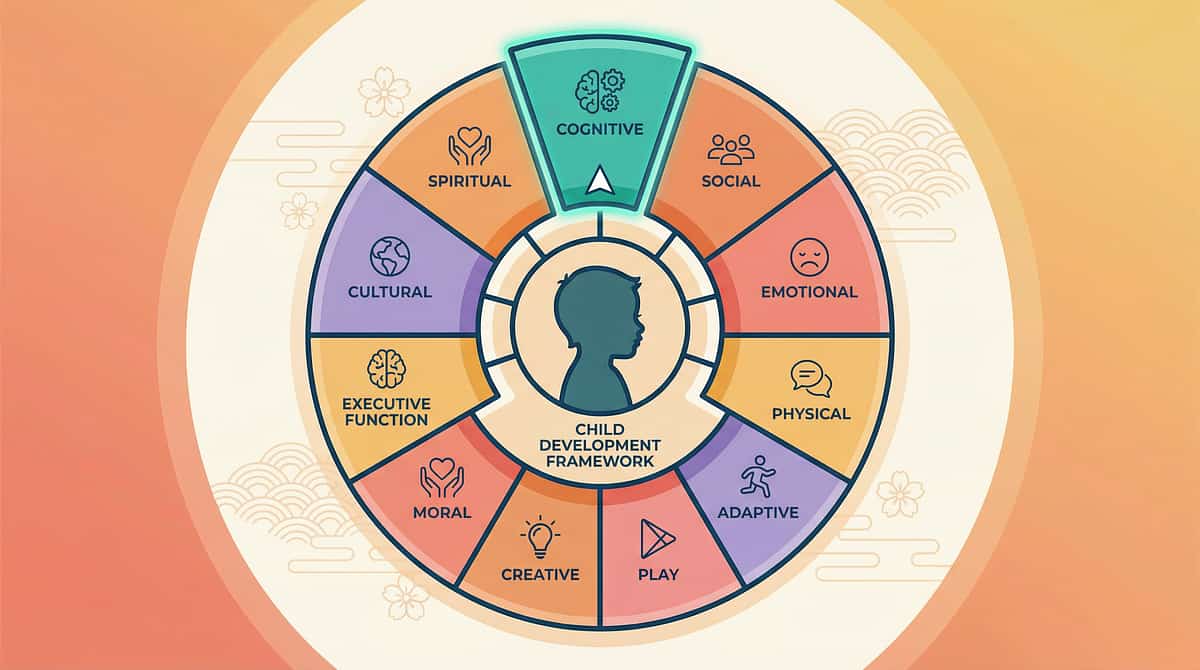
12 Domains
Swimming Readiness Is One Piece of a Larger Journey
The GPT-OS® Framework maps your child's development across 12 interconnected domains. Progress in one domain accelerates progress in others.
Domain A: Sensory
Swimming readiness directly requires sensory regulation ←→ F-584
Domain C: Emotional
Fear management is core to water tolerance ←→ F-584
Domain I: Play
Swimming is ultimately a play and social activity ←→ F-584
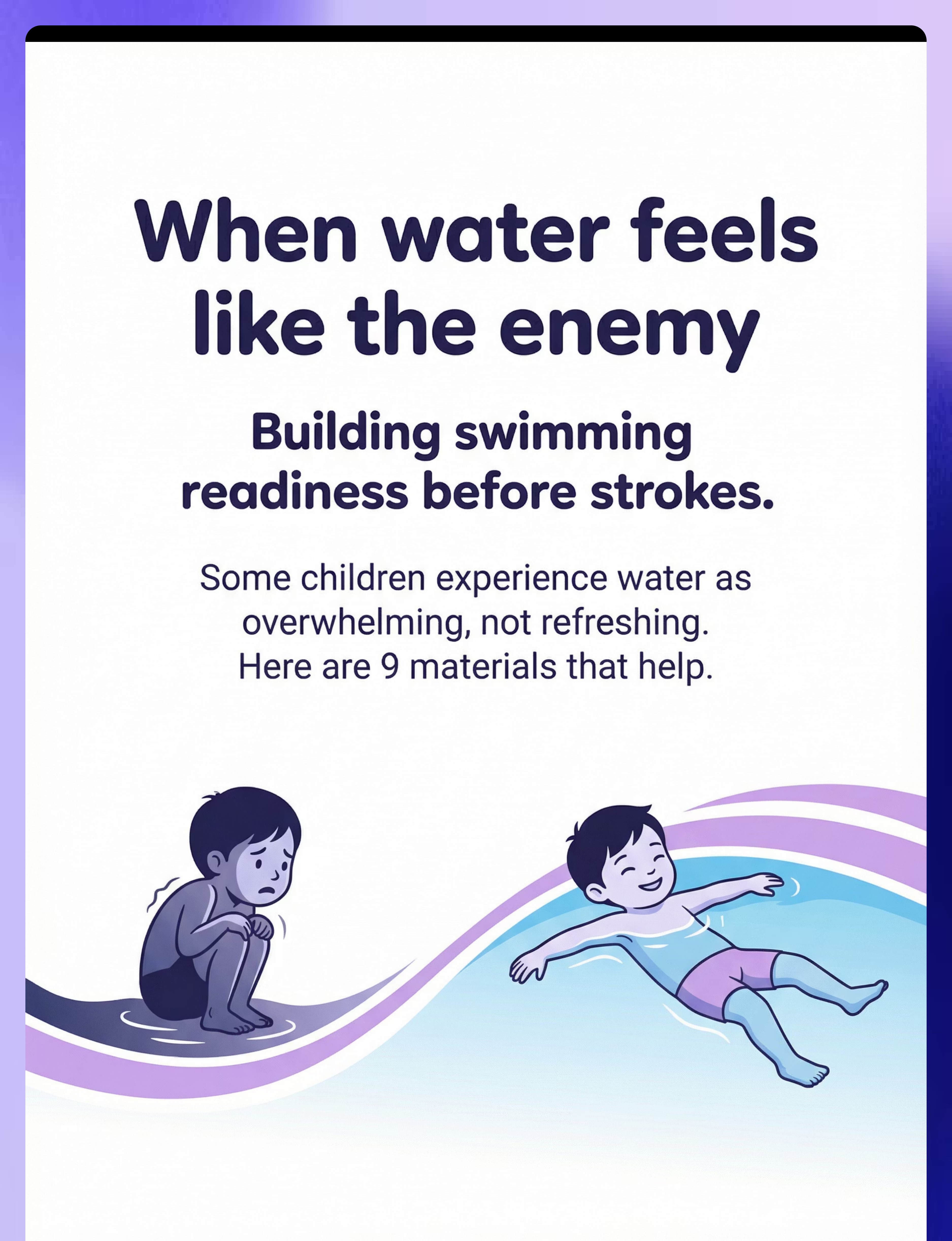
Preview of 9 materials that help with movement breaks Therapy Material
Below is a visual preview of 9 materials that help with movement breaks therapy material. The pages shown help educators, therapists, and caregivers understand the structure and content of the resource before use. Materials should be used under appropriate professional guidance.


Link copied!

Act VI — The Promise
🌸 The Pinnacle Promise
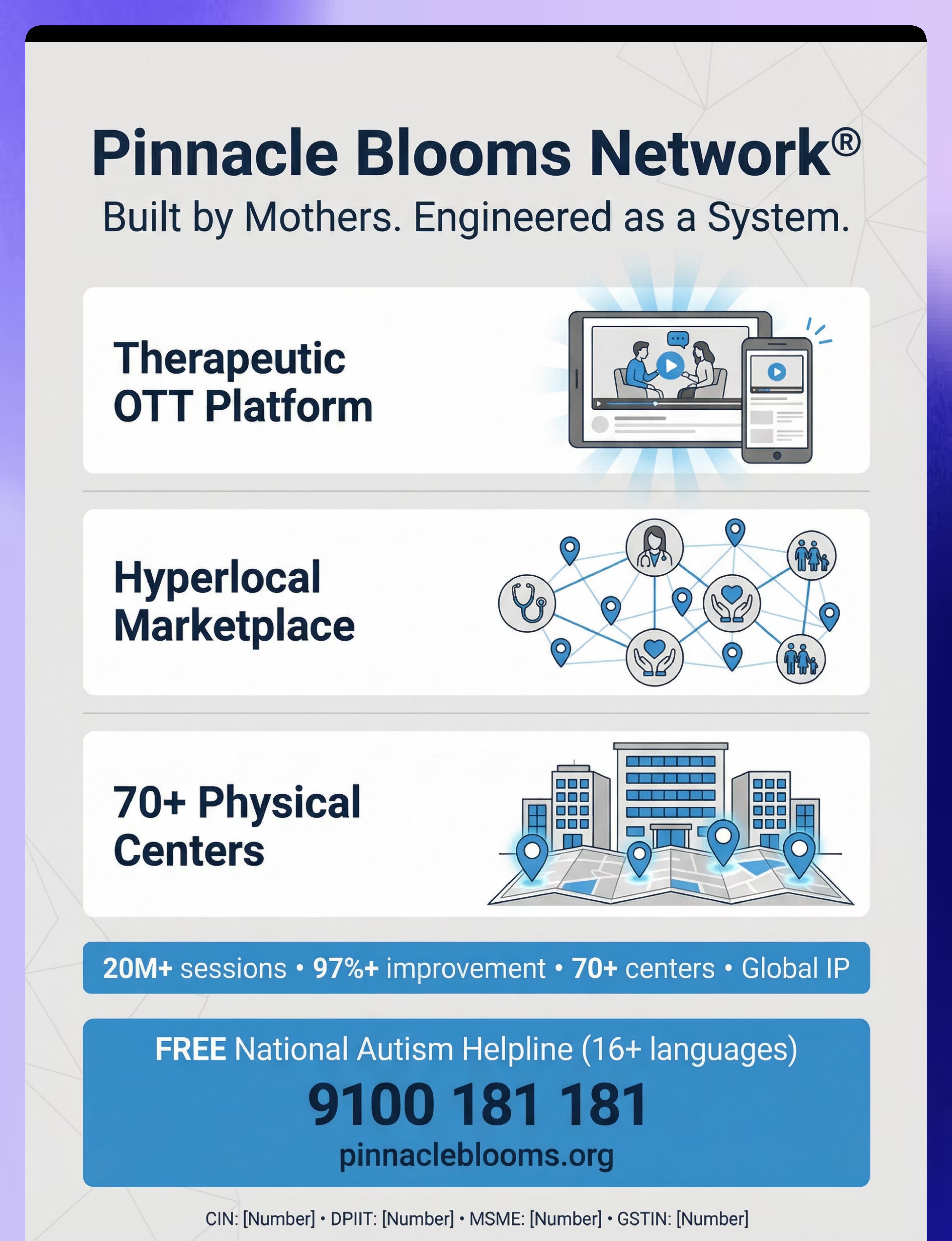
Built by Mothers. Engineered as a System.
"From fear to mastery. One technique at a time."
Every card on this page was written by a consortium of occupational therapists, speech-language pathologists, behavior analysts, special educators, neurodevelopmental pediatricians, aquatic therapy specialists, regulatory experts, and — most importantly, parents who have been where you are.
The 9 materials on this page, the 6-step protocol, the progress arc, the red flags — none of this is guesswork. It is 20 million therapy sessions, distilled into a page your child needs you to read.
Go. Build the foundation. The pool is waiting.
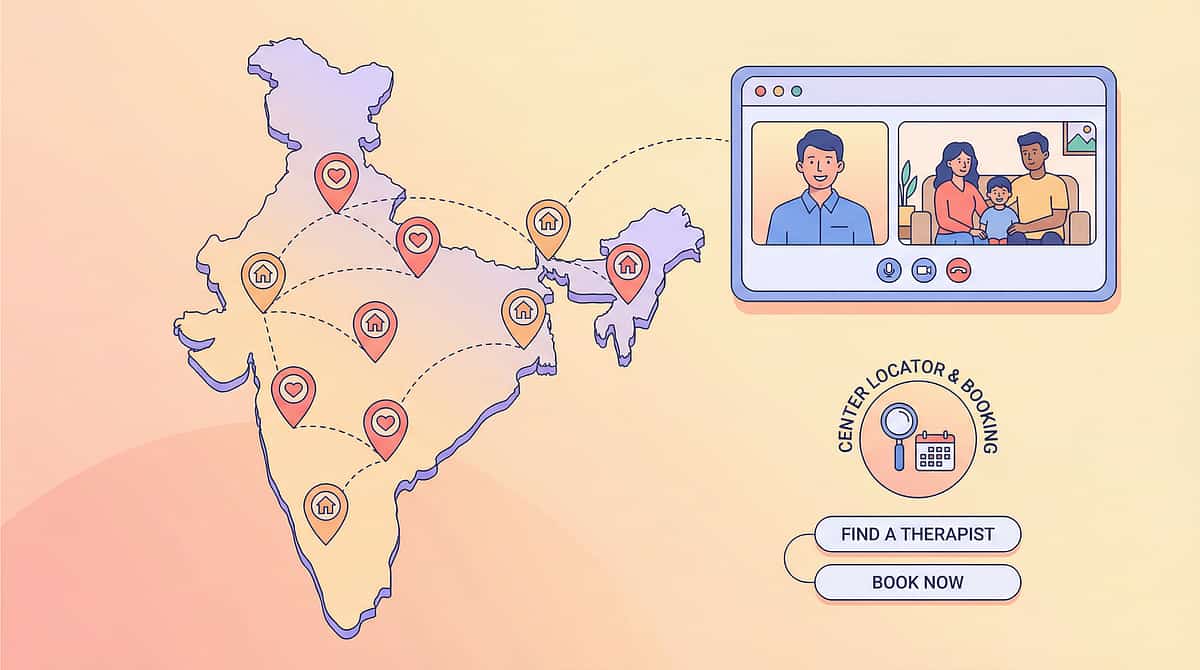
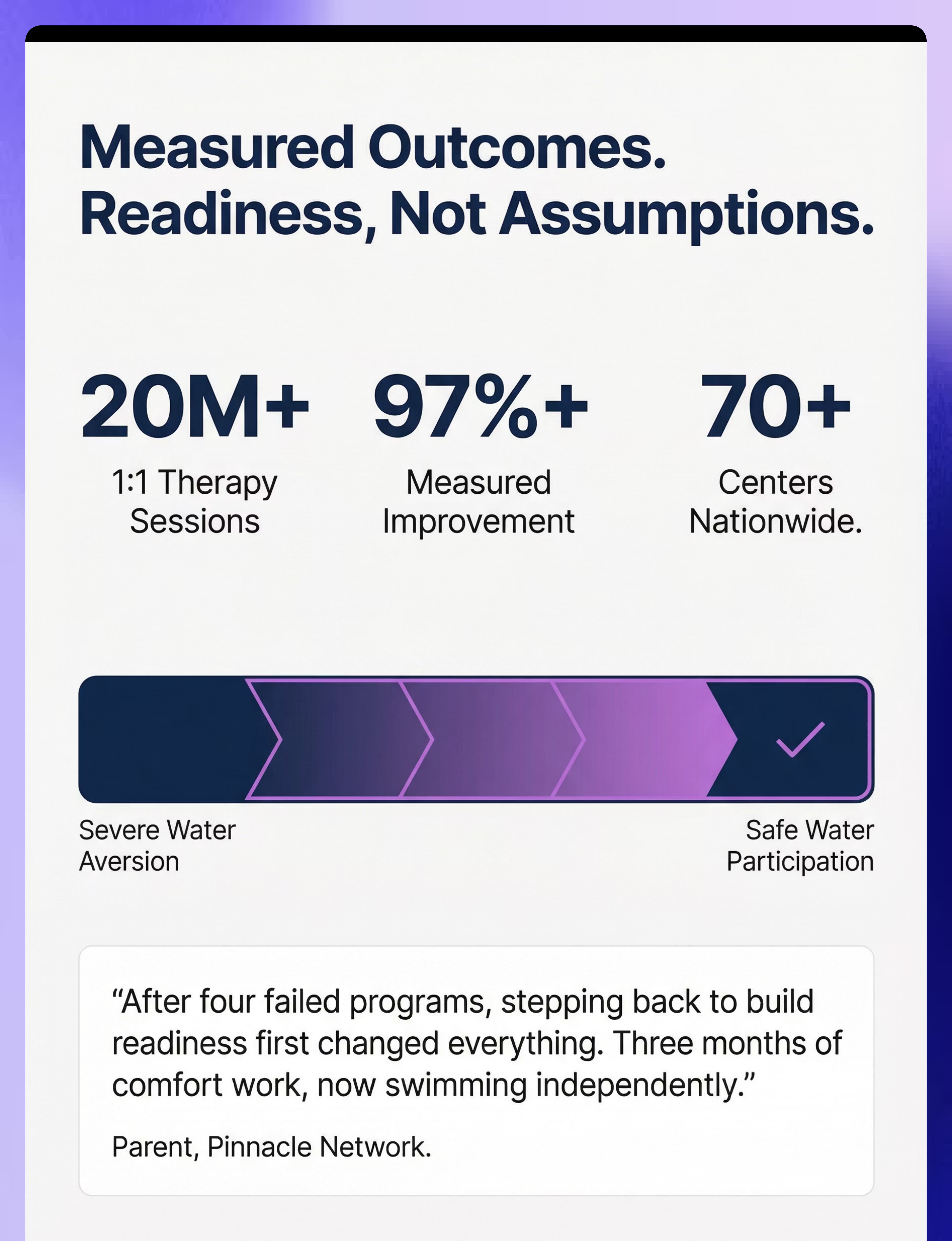
70+
Centers Across India
20M+
Sessions Delivered
97%+
Improvement Measured
70+
Countries Served
16+
Languages Supported
This content is educational and does not replace individualized assessment and intervention from licensed occupational therapists, aquatic therapists, or developmental specialists. Water safety is critical — never leave children unattended near water. Drowning is a leading cause of accidental death in children. If your child has significant water fear or sensory challenges, seek professional evaluation. Individual results vary. Statistics represent aggregate outcomes across the Pinnacle Blooms Network. Consult a licensed therapist before modifying clinical protocols.
CIN: U74999TG2016PTC113063 | DPIIT: DIPP8651 | MSME: TS20F0009606 | GSTIN: 36AAGCB9722P1Z2
© 2025–2026 Pinnacle Blooms Network®, a unit of Bharath Healthcare Laboratories Pvt. Ltd. All rights reserved. GPT-OS® | TherapeuticAI® | AbilityScore® | FusionModule™ | EverydayTherapyProgramme™ are registered trademarks.
techniques.pinnacleblooms.org