
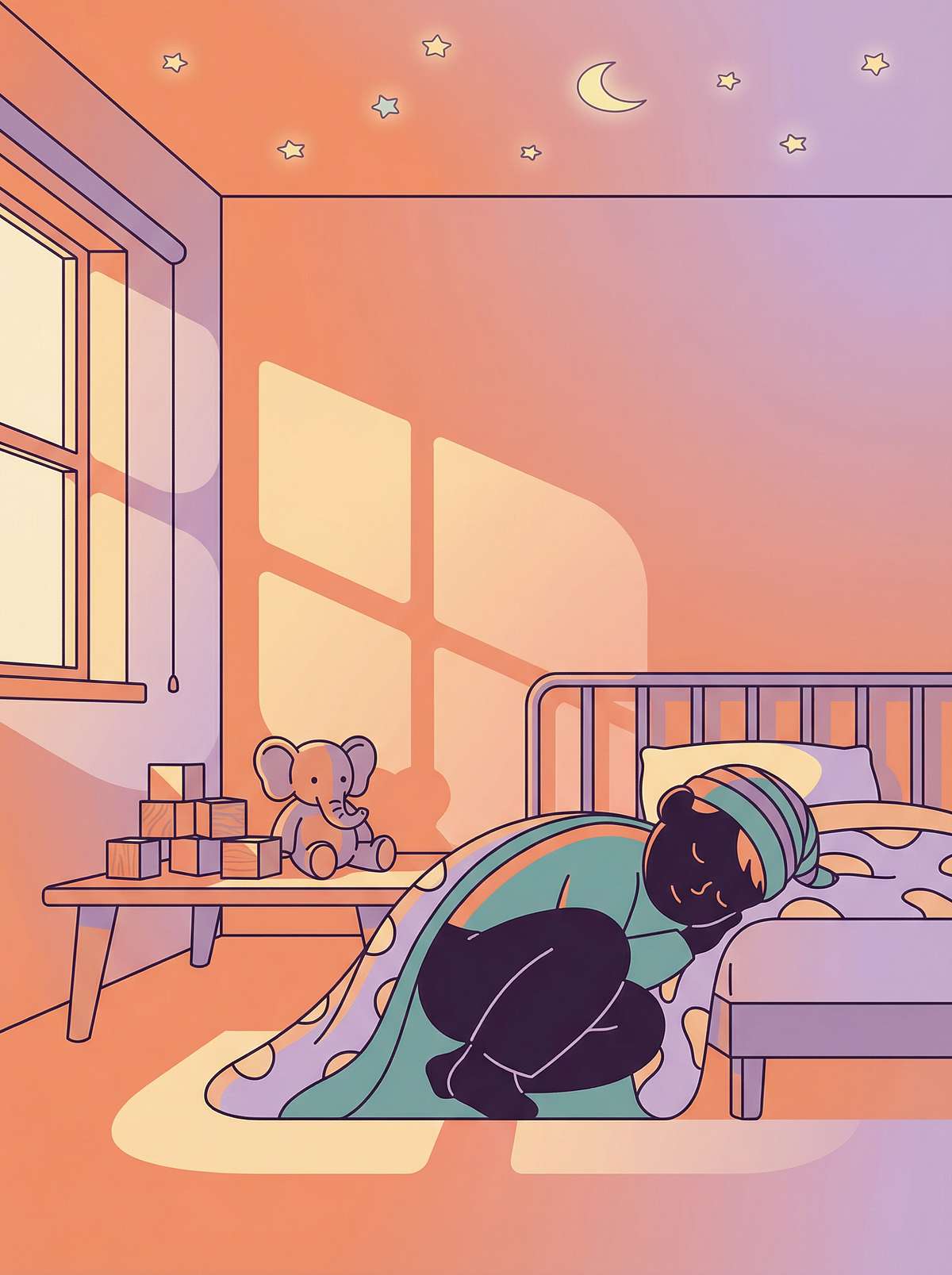
"Bedtime in our house is a warzone."
Every night. The screaming. The stalling. The child who is clearly exhausted but cannot — will not — sleep. You say the words 'time for bed' and something in your child switches. Forty minutes later you are still in the hallway, negotiating.
BEDTIME TRANSITION SUPPORT
9 Evidence-Based Materials
You are not failing as a parent. Your child's nervous system is speaking. There is a language it understands — and these 9 materials speak it.
🏛️Pinnacle Blooms Network® Consortium | OT · SLP · ABA/BCBA · SpEd · NeuroDev · Pediatrics
Validated across 20M+ therapy sessions · 70+ centers · 70+ countries
📞 FREE National Autism Helpline: 9100 181 181 | Available 24x7 in 16+ languages
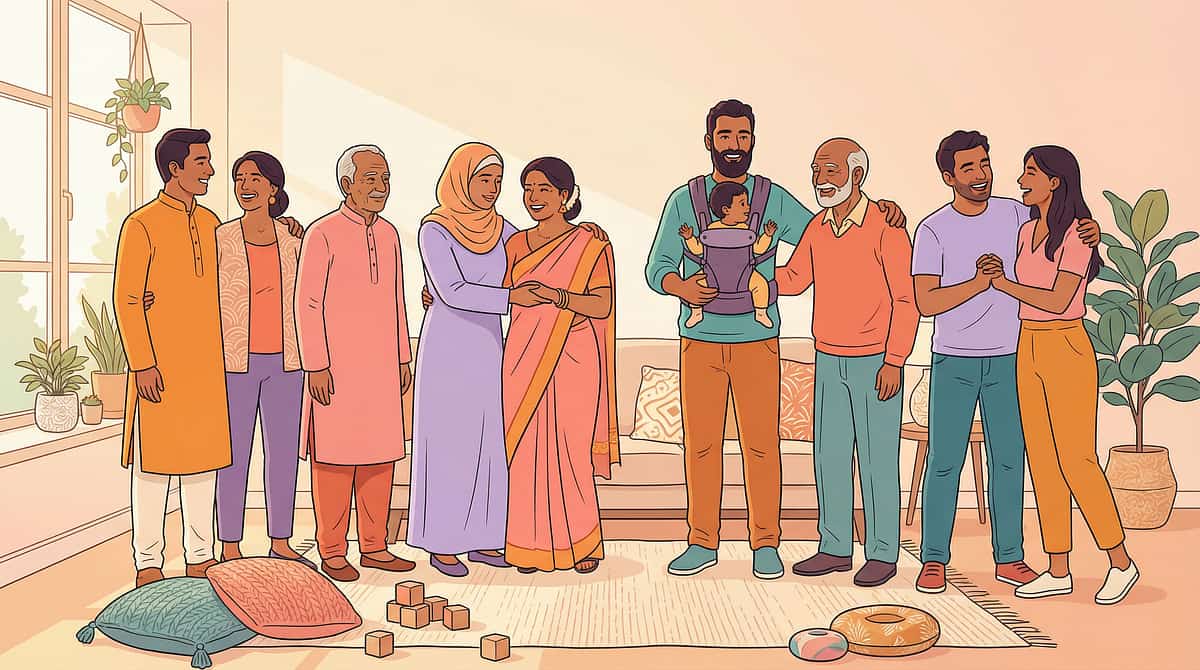
This Is Not a Parenting Problem. It Is a Population-Level Challenge.
50–80%
Children with Autism
Experience significant sleep difficulties — a documented clinical challenge, not willful defiance.
25–40%
Neurotypical Children
Also struggle with sleep onset and bedtime transitions across all populations.
21M+
Therapy Sessions
Sleep and routine challenges rank among the top 3 referral reasons at Pinnacle centers worldwide.
"You are among millions of families navigating this exact challenge — and evidence-based tools exist that work."
India is home to an estimated 18 million children on the autism spectrum (WHO, 2023). Sleep disturbances are documented in over 70% of these children. You are not alone. You are among millions navigating the same night.
📞9100 181 181 | FREE | 24x7 | 16+ Languages
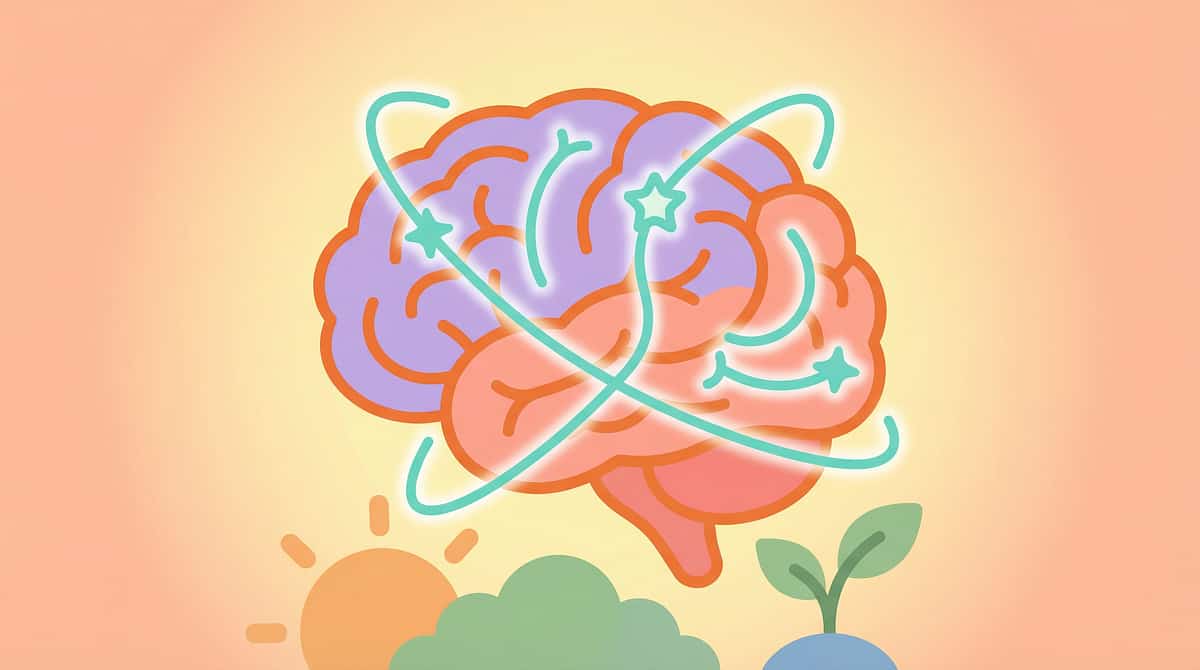
This Is Not Defiance. This Is Dysregulation. Here Is the Neuroscience.
What's Happening in the Brain
At bedtime, the brain must perform a complex physiological shift — from high arousal (active, alert, engaged) to low arousal (quiet, still, surrendering conscious control). For children with sensory processing differences, anxiety, ADHD, or autism, this shift is genuinely, neurologically difficult.
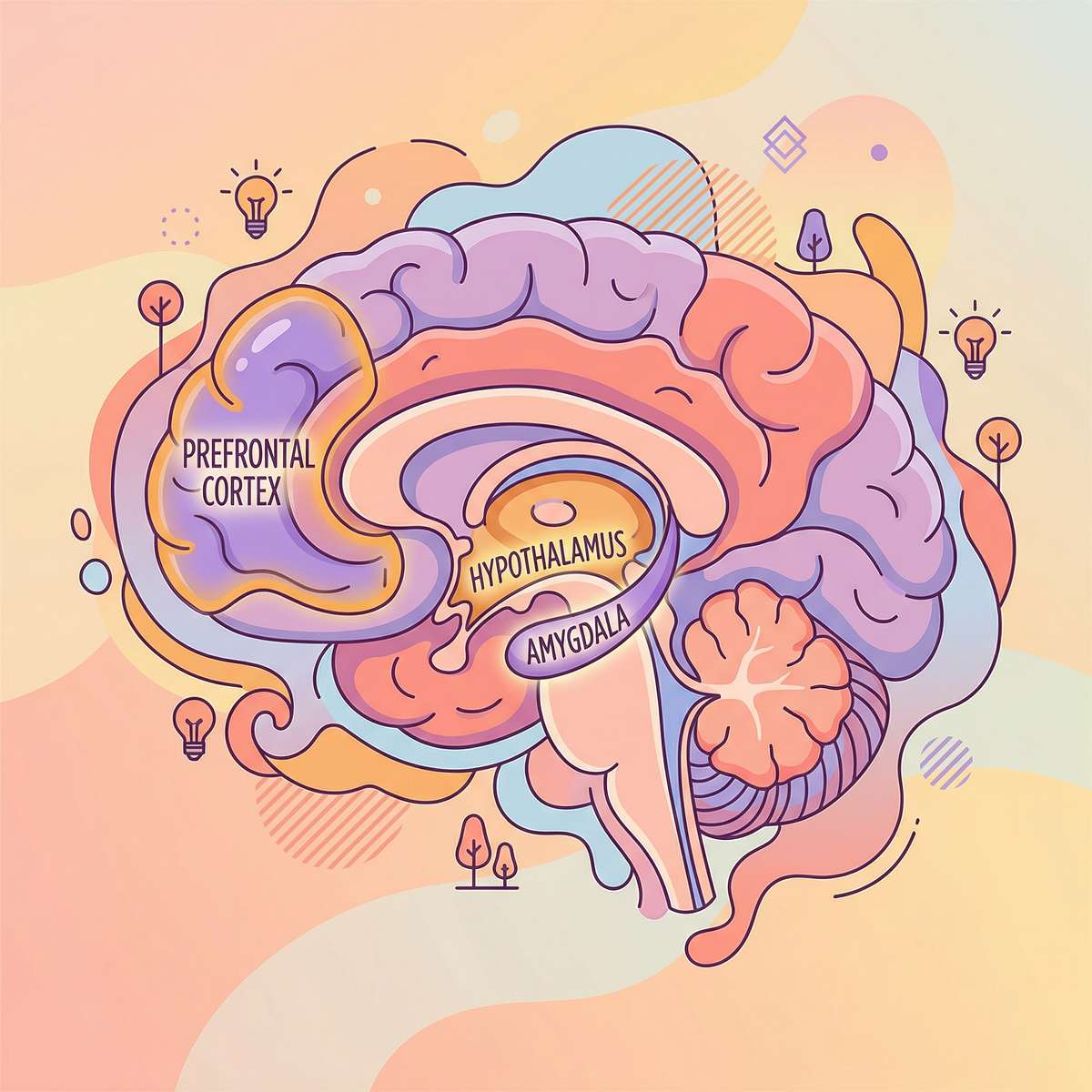
- Amygdala: Scans for threat. Darkness and silence can register as danger, triggering fight-or-flight precisely when the body needs rest.
- Reticular Activating System: Governs the brain's alertness dial. In many neurodivergent children, this dial is stuck at "high."
- Sensory Cortex: May be amplifying every input — the pajama seam, the distant dog bark, the light under the door.
- Prefrontal Cortex: Immature; cannot override arousal states without external support.
🧠"The child who screams at bedtime is not manipulating you. Their nervous system is in genuine distress. Understanding this changes everything about how we respond." — Pinnacle NeuroDev Consortium
This is a wiring difference, not a behavior choice. These 9 materials are calibrated to speak directly to the nervous system — bypassing the behavior and addressing the biology.
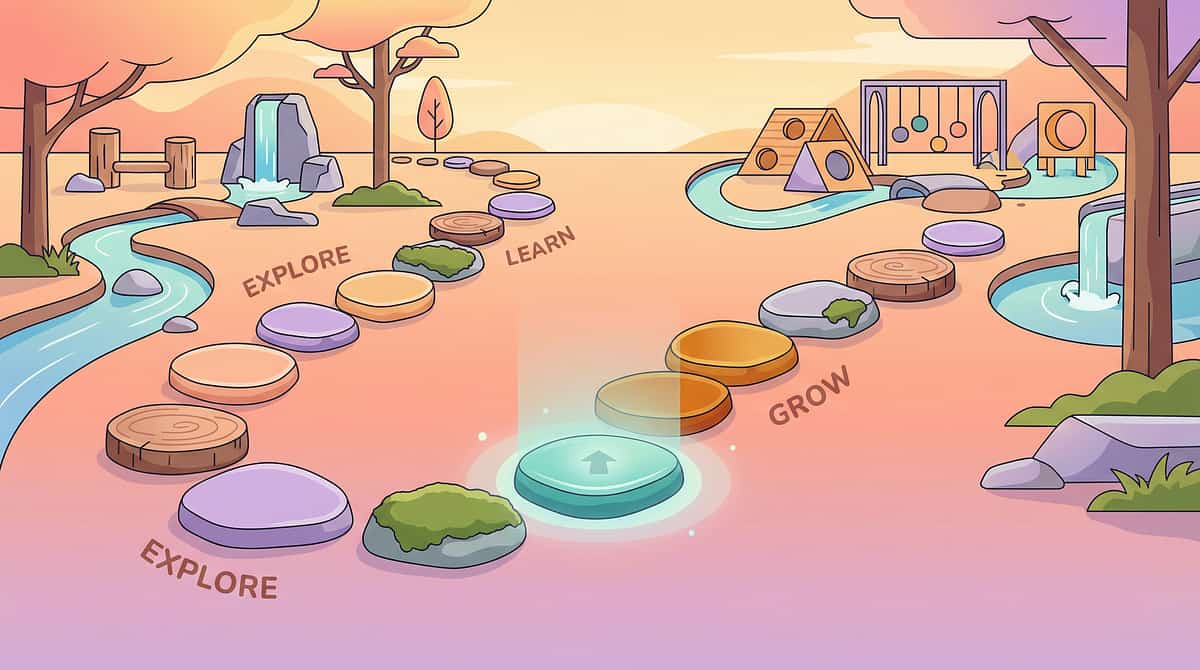
Your Child Is Not Behind. They Are on a Different Trajectory — With a Clear Forward Path.
0–12 Months
Typical: Sleep associations forming; multiple wakings normal.
Neurodevelopmental: Sensory sensitivities emerge; irregular sleep architecture begins.
1–3 Years
Typical: Separation anxiety peaks; resistance emerges; 11–14 hrs needed.
Neurodevelopmental: Transitions extremely difficult; routine dependency high.
3–5 Years
Typical: Imagination and fear emerge; stalling behaviors common.
Neurodevelopmental: Anxiety amplified; sensory environment becomes critical.
6–8 Years
Typical: Beginning self-regulation capacity; 9–12 hrs needed.
Neurodevelopmental: Sleep onset delays; racing thoughts; ADHD sleep impacts emerge.
9–12 Years
Typical: Growing independence; academic stress enters the picture.
Neurodevelopmental: Circadian shifts may begin; anxiety peaks; screen exposure adds complexity.
Co-occurring Conditions: Sensory Processing Disorder · Autism Spectrum · ADHD · Separation Anxiety · Generalized Anxiety · Night Terrors · Circadian Rhythm Differences

Not Opinion. Not Trend. Peer-Reviewed Evidence for What Works.
LEVEL I — SYSTEMATIC REVIEW + RCT EVIDENCE
Behavioral sleep interventions, sensory-based approaches, and environmental modifications for pediatric bedtime difficulties are supported by multiple systematic reviews and randomized controlled trials.
Study | Key Finding | Level | |
Systematic Review, Children 2024 — PMC11506176 | Sensory integration intervention meets evidence-based practice criteria across 16 studies (2013–2023) for children with ASD | Level I | |
Meta-analysis, World J Clin Cases 2024 — PMC10955541 | SI therapy effectively promotes adaptive behavior and self-regulation across 24 studies | Level I | |
WHO/UNICEF CCD Package 2023 — PMC9978394 | Caregiver-implemented home interventions demonstrate measurable outcomes across 54 countries | Level II | |
Padmanabha et al., Indian RCT 2019 | Home-based sensory interventions in Indian pediatric population: significant outcomes | Level II | |
NCAEP Evidence-Based Practices Report 2020 | Visual schedules, structured routines, parent training: evidence-based practices for autism | Level I |
"Clinically validated. Home-applicable. Parent-proven. The materials on this page are not suggestions — they are precision tools backed by global research."
BEDTIME TRANSITION SUPPORT
Parent Alias: "Making bedtime work — finally"
Formal Definition
Bedtime Transition Support refers to the structured, multi-modal application of environmental, sensory, visual, and behavioral tools to facilitate a child's neurological and psychological shift from waking activity to restful sleep. It is an evidence-based intervention domain spanning Occupational Therapy, Applied Behavior Analysis, Child Psychology, and NeuroDevelopmental Pediatrics — designed for home delivery by trained caregivers.
In Plain Terms
Bedtime is hard because your child's brain and body need specific inputs to downshift. These 9 materials provide those inputs — turning the transition from chaos to calm, one consistent night at a time.
Specification Badges
Age Range
2–12 years
Duration
20–60 min/night
Frequency
Every night — consistency is critical
Setting
Home / Bedroom
Canon Materials
📦 Visual Schedules · Weighted Items · Sound Tools · Light Regulation · Time Visualization · Sensory Calm-Down · Social Narratives · Comfort Objects · Relaxation Tools
🎬 See the original Reel: I-792 — 9 Materials That Help With Bedtime Transition | Domain I — Sleep & Daily Living | Episode 792 of 999
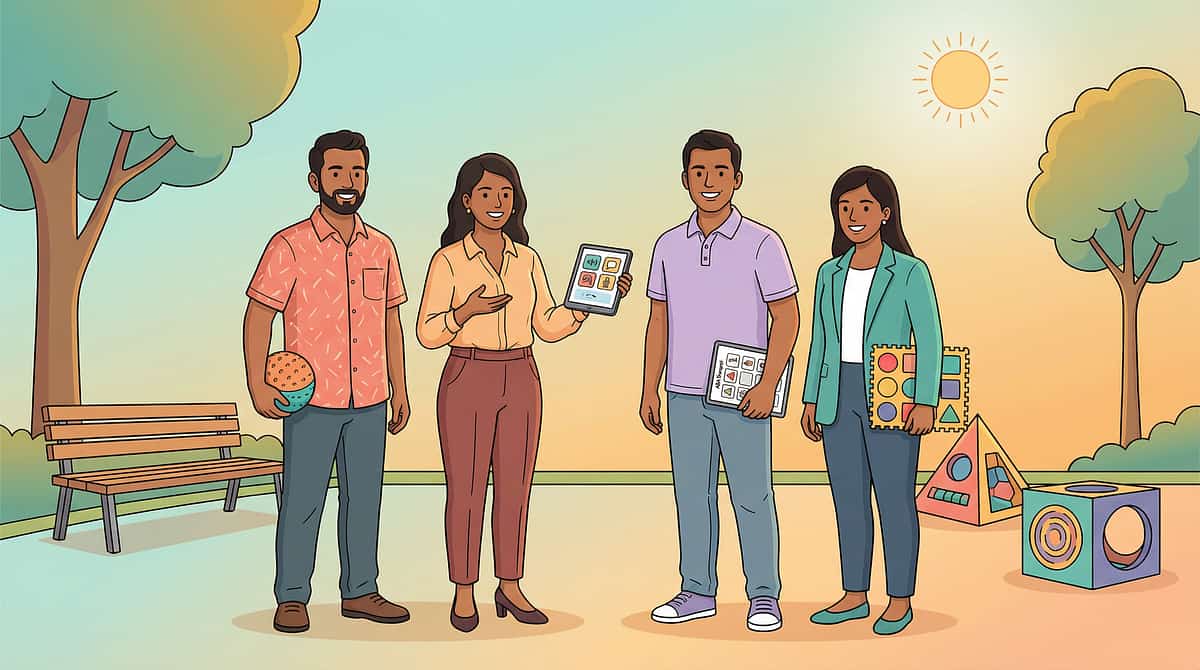
Five Disciplines. One Converged System. All Working for the Same Child.
Occupational Therapy (OT)
Assesses sensory processing profile; selects weighted, textural, and proprioceptive tools; designs the sensory environment; leads weighted blanket protocols.
Applied Behavior Analysis (ABA/BCBA)
Designs the visual schedule architecture; establishes reinforcement protocols for routine compliance; shapes behavior using antecedent modification and positive reinforcement.
Speech-Language Pathology (SLP)
Creates Social Narratives and personalized bedtime stories; develops communication supports for pre-sleep anxiety expression; scripts parent language for transitions.
Special Education (SpEd)
Transfers routine structure across home and school environments; trains teaching assistants on consistency protocols.
NeuroDevelopmental Pediatrics
Rules out medical contributors (sleep apnea, circadian disorders); guides melatonin consultation; monitors developmental trajectory.
"This technique crosses therapy boundaries because the brain doesn't organize by therapy type. The same child who needs OT for sensory regulation needs ABA for routine structure needs SLP for anxiety communication — all at bedtime, every night." — Pinnacle Blooms Consortium

This Is a Precision Intervention Targeting Specific Neural and Behavioral Outcomes.
Primary Targets
- Reducing time to fall asleep (sleep onset latency)
- Reducing bedtime resistance behaviors
- Establishing a predictable, consistent bedtime routine
- Building the child's capacity to self-soothe for sleep
Secondary & Tertiary Outcomes
- Improved daytime attention and impulse control
- Reduced anxiety through predictability
- Stronger immune function (sleep is the primary immune restoration window)
- School performance and memory consolidation
- Family wellbeing and parental mental health
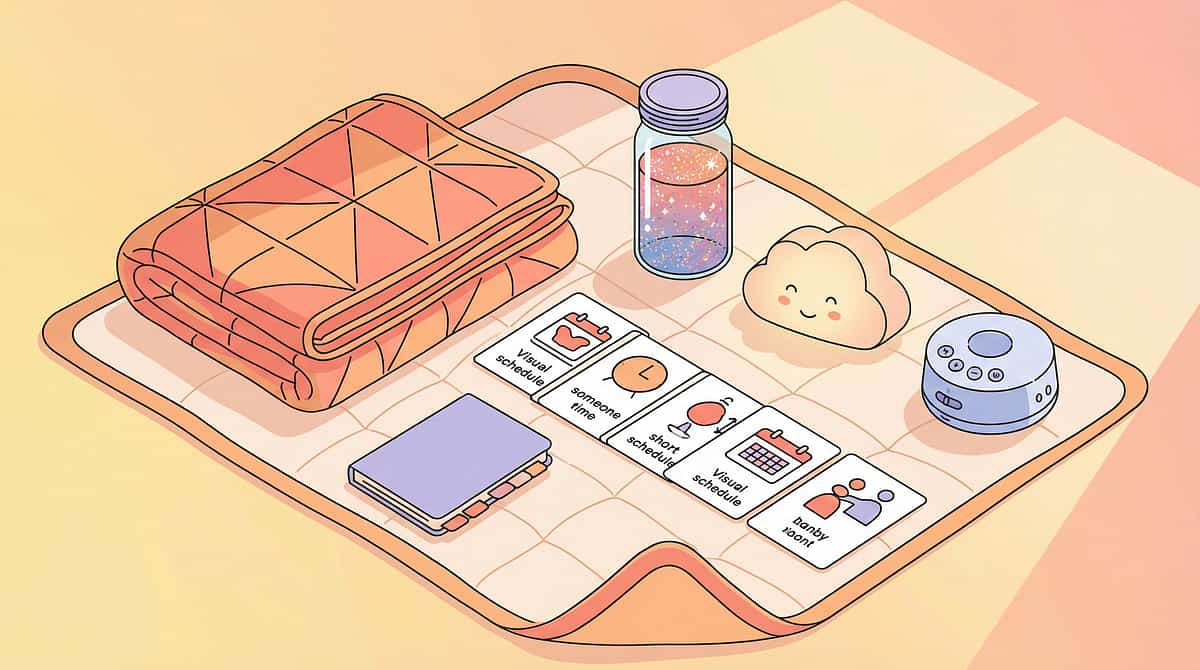
9 Materials. 9 Mechanisms. One Complete Bedtime System.
MATERIALS 1–5
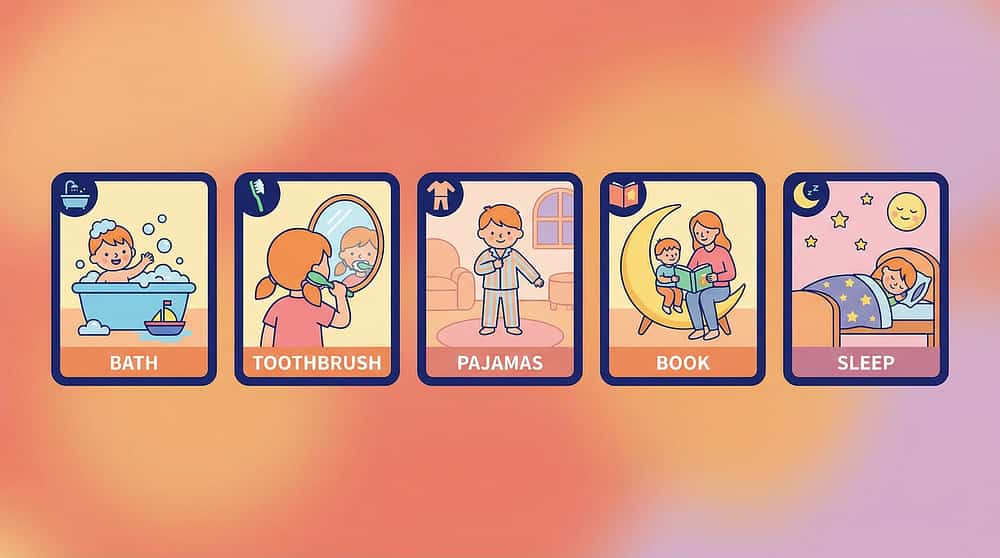
Material 01 — Visual Bedtime Routine Charts
📋Canon Category: Visual Schedules / Routine Boards
Why It Works: Transforms the abstract concept of "bedtime" into a concrete, predictable visual sequence. The chart becomes the authority — not the parent — dramatically reducing power struggles.
Price: ₹300–1,500
Why It Works: Transforms the abstract concept of "bedtime" into a concrete, predictable visual sequence. The chart becomes the authority — not the parent — dramatically reducing power struggles.
Price: ₹300–1,500

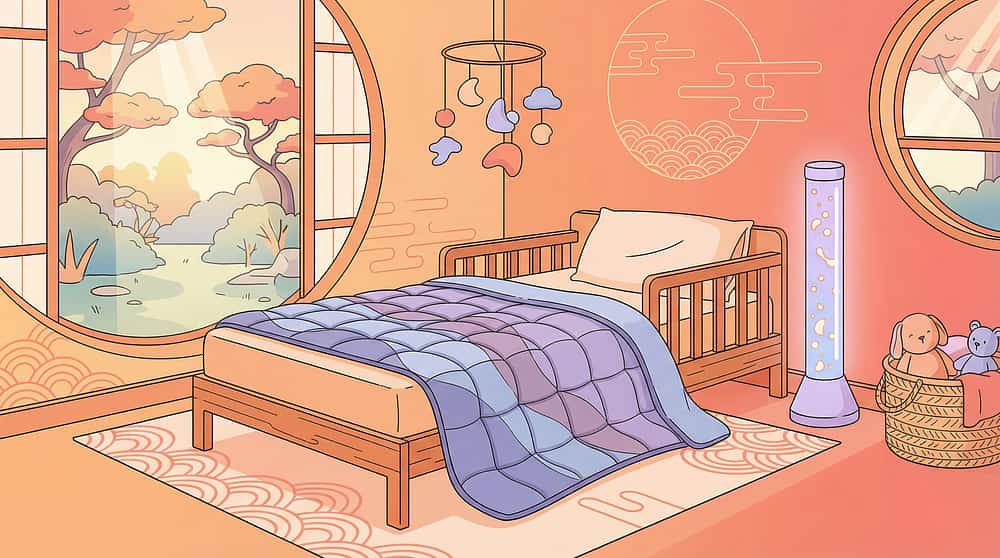
Material 02 — Weighted Blankets & Compression Items
🛏️Canon Category: Weighted / Deep Pressure Items
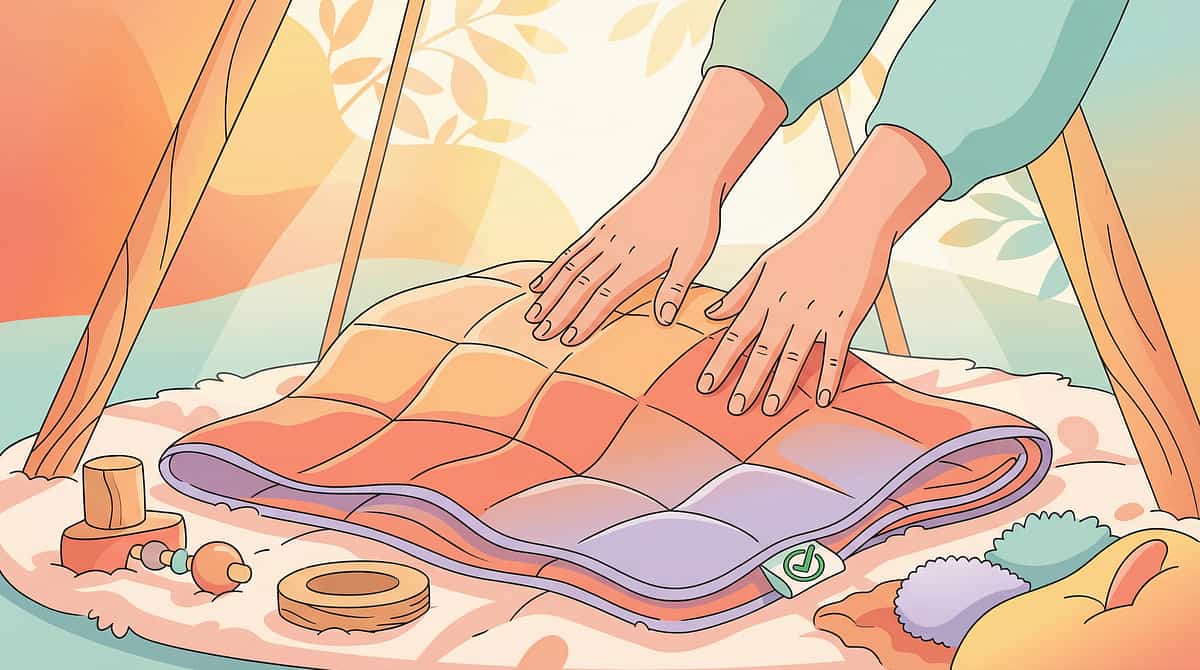
Why It Works: Deep pressure input activates the proprioceptive system and triggers the parasympathetic nervous system — the neurological "rest and digest" state. 10% of child's body weight is the evidence-based guideline.
Price: ₹2,000–6,000
Why It Works: Deep pressure input activates the proprioceptive system and triggers the parasympathetic nervous system — the neurological "rest and digest" state. 10% of child's body weight is the evidence-based guideline.
Price: ₹2,000–6,000

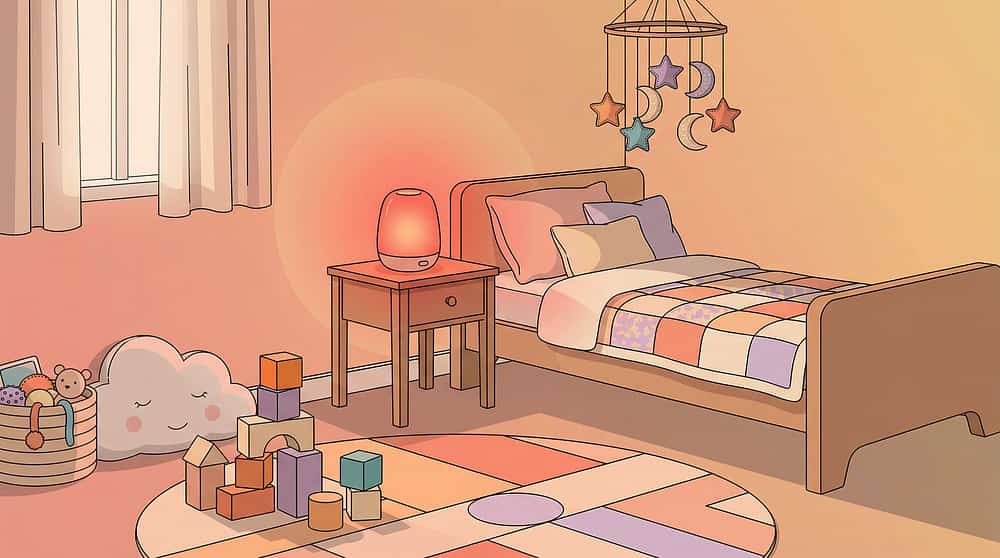
Material 03 — Nightlights & Light Control Systems
💡Canon Category: Environmental Regulation / Light Tools
Why It Works: Red/amber spectrum light minimally suppresses melatonin production. Correct lighting eliminates fear of darkness while supporting sleep chemistry.
Price: ₹300–2,500
Why It Works: Red/amber spectrum light minimally suppresses melatonin production. Correct lighting eliminates fear of darkness while supporting sleep chemistry.
Price: ₹300–2,500

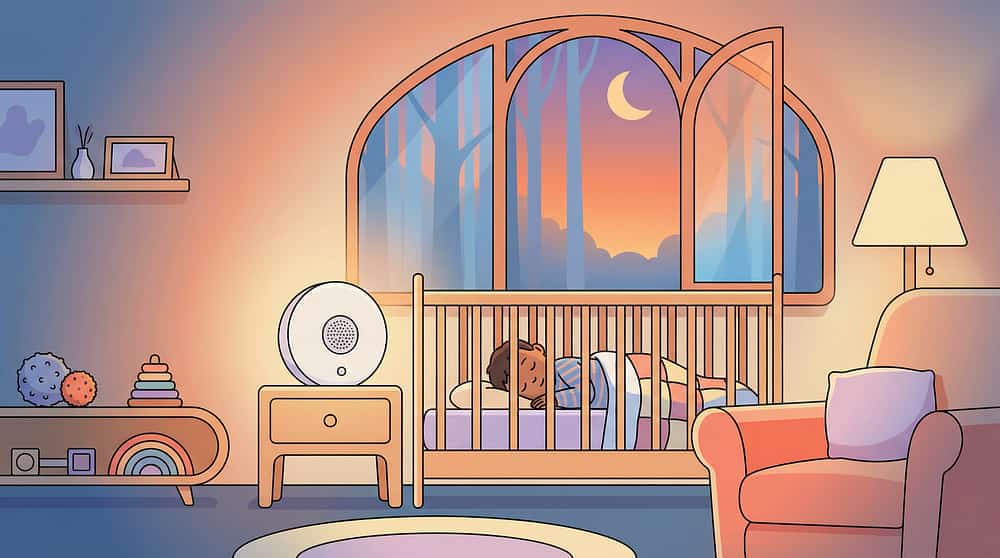
Material 04 — White Noise Machines & Sound Systems
🔊Canon Category: Auditory Regulation / Sound Masking
Why It Works: Consistent sound provides "auditory cover" — the brain stops scanning for novel threats and can disengage the vigilance system that prevents sleep.
Price: ₹800–3,500
Why It Works: Consistent sound provides "auditory cover" — the brain stops scanning for novel threats and can disengage the vigilance system that prevents sleep.
Price: ₹800–3,500

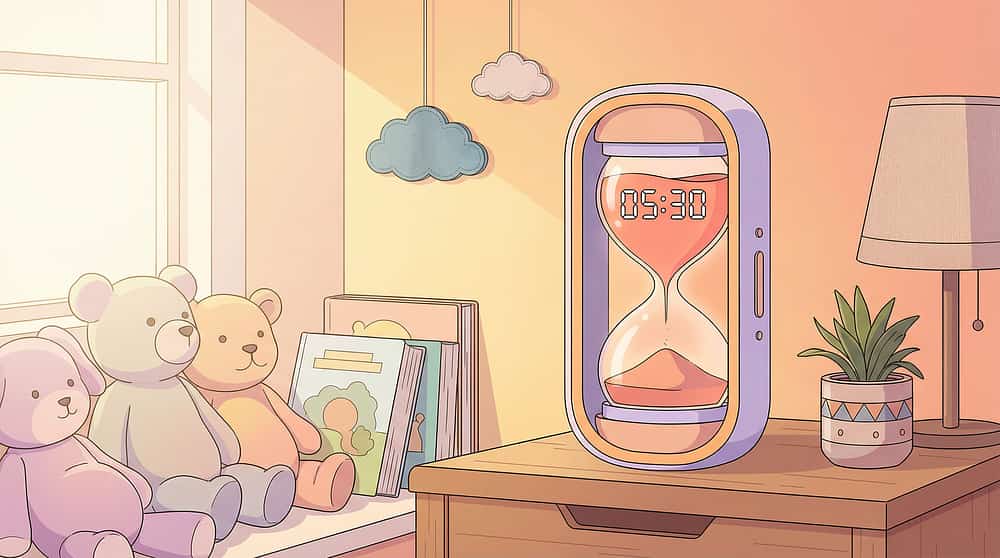
Material 05 — Visual Timers & Time-to-Sleep Clocks
⏱️Canon Category: Time Visualization / Routine Cueing
Why It Works: Makes the invisible concept of time concrete and visual. Time-to-sleep clocks become non-negotiable authority ("the clock isn't showing morning yet") — removing the parent from the enforcement role.
Price: ₹1,500–4,000
Why It Works: Makes the invisible concept of time concrete and visual. Time-to-sleep clocks become non-negotiable authority ("the clock isn't showing morning yet") — removing the parent from the enforcement role.
Price: ₹1,500–4,000

9 Materials — Complete System
MATERIALS 6–9
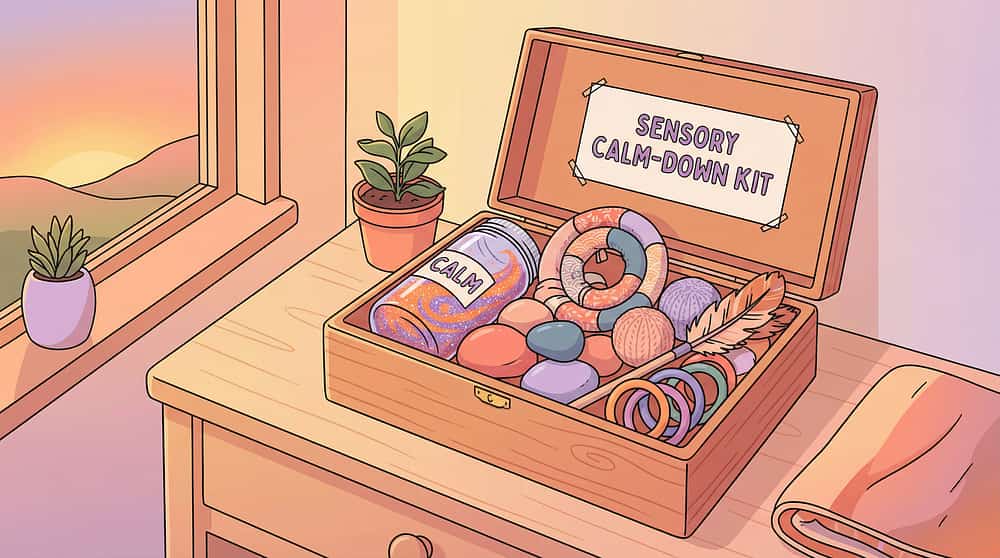
Material 06 — Calm-Down Kits & Sensory Boxes
🧘Canon Category: Sensory Regulation / Self-Soothing Toolkits
Why It Works: Bridges the physiological gap between active wakefulness and sleep readiness. Gives the child something constructive to DO with their body and mind during the transition.
Price: ₹500–2,000
Why It Works: Bridges the physiological gap between active wakefulness and sleep readiness. Gives the child something constructive to DO with their body and mind during the transition.
Price: ₹500–2,000

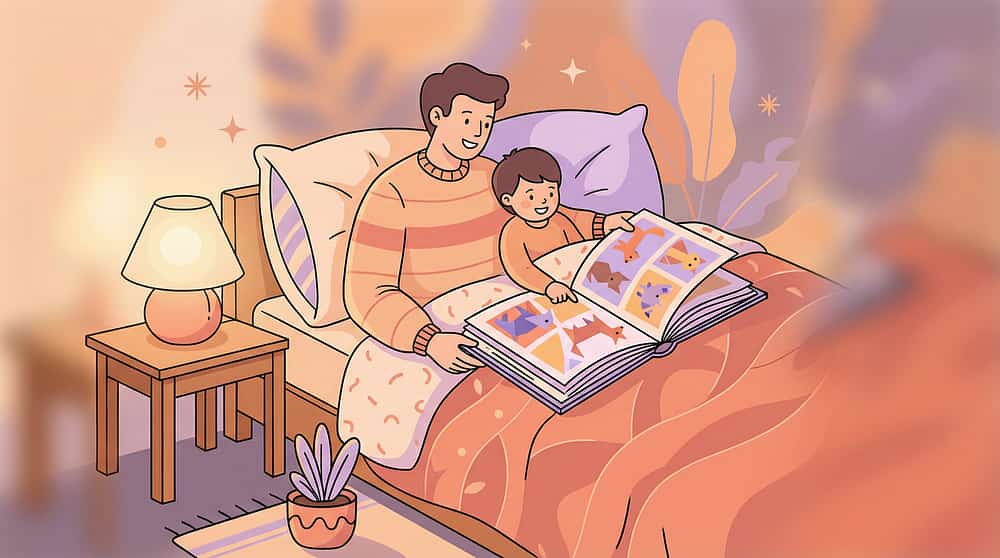
Material 07 — Bedtime Stories & Social Narratives
📚Canon Category: Social Narratives / Language Tools
Why It Works: Stories normalize the bedtime experience, address specific fears, build positive associations with sleep, and provide the connection the child needs before separation.
Price: ₹200–1,500 (or DIY free)
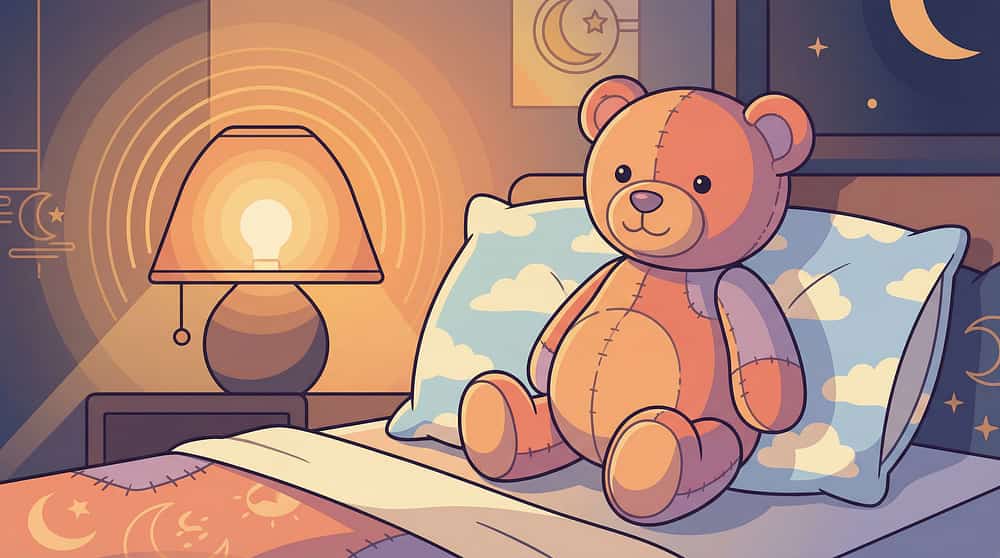
Why It Works: Stories normalize the bedtime experience, address specific fears, build positive associations with sleep, and provide the connection the child needs before separation.
Price: ₹200–1,500 (or DIY free)

Material 08 — Comfort Objects & Transitional Items
🧸Canon Category: Transition Objects / Comfort Items | Pinnacle Canon SKU: Product #118 | ₹425 | ✅ Active
Why It Works: Donald Winnicott's transitional object theory: the comfort object represents the caregiver's presence, allowing the child to self-soothe through the separation that sleep requires.
Price: ₹425–2,500 | View on Amazon.in
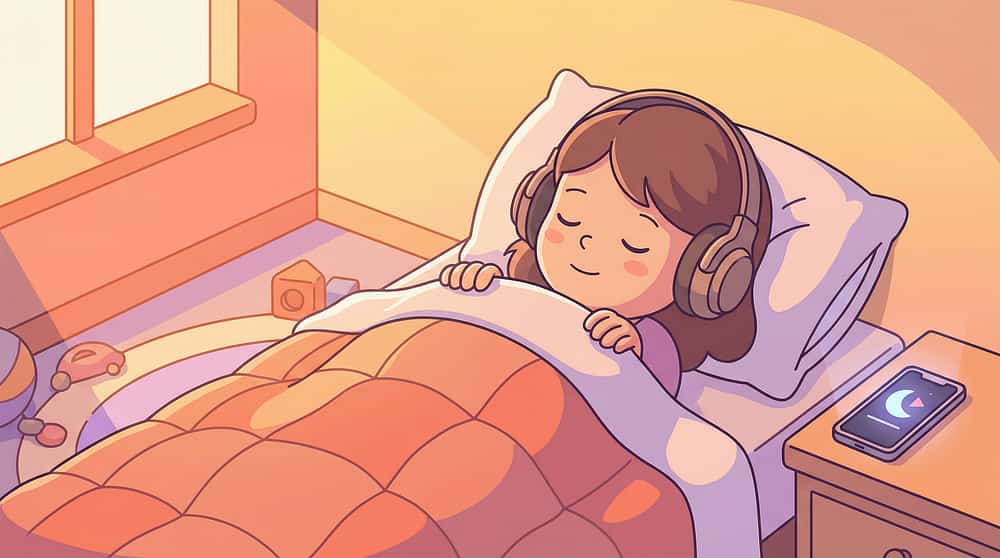
Why It Works: Donald Winnicott's transitional object theory: the comfort object represents the caregiver's presence, allowing the child to self-soothe through the separation that sleep requires.
Price: ₹425–2,500 | View on Amazon.in

Material 09 — Relaxation Scripts & Guided Meditation
🎧Canon Category: Relaxation / Mind-Calming Tools
Why It Works: Provides the mind with structured content to follow, interrupting the racing-thought cycle. Progressive muscle relaxation activates the parasympathetic nervous system directly.
Price: ₹0–2,000 (apps + audio) | Headspace Kids · Calm Kids · Moshi Sleep App
Why It Works: Provides the mind with structured content to follow, interrupting the racing-thought cycle. Progressive muscle relaxation activates the parasympathetic nervous system directly.
Price: ₹0–2,000 (apps + audio) | Headspace Kids · Calm Kids · Moshi Sleep App
🏆Reinforcement Menus — Product #803 | ₹589 | For rewarding bedtime routine compliance | View on Amazon.in
Every Material Has a Zero-Cost Version. Geography and Budget Are Not Barriers to Therapy.
WHO/UNICEF Equity Principle in Action.
Material | Clinical Version | DIY / Household Alternative | |
Visual Schedule | Velcro schedule board ₹300–1,500 | Printed A4 photos laminated, stuck with tape — photos of YOUR child are actually more powerful | |
Weighted Blanket | Commercial weighted blanket ₹2,000–6,000 | Extra quilt layers + small sand-filled pouches sewn in; or simply layer 2 thick blankets (monitor at 10% body weight) | |
Nightlight | Red-spectrum LED nightlight ₹300–2,500 | Torch with red cellophane; salt lamp; string fairy lights on lowest setting — red spectrum preserved | |
White Noise Machine | Dedicated device ₹800–3,500 | Free apps: myNoise, Insight Timer, YouTube white noise on airplane mode; fan in another room | |
Visual Timer | Time Timer or Sand Timer ₹1,500–4,000 | Sand in a plastic bottle (DIY sand timer); drawing shrinking countdown on paper | |
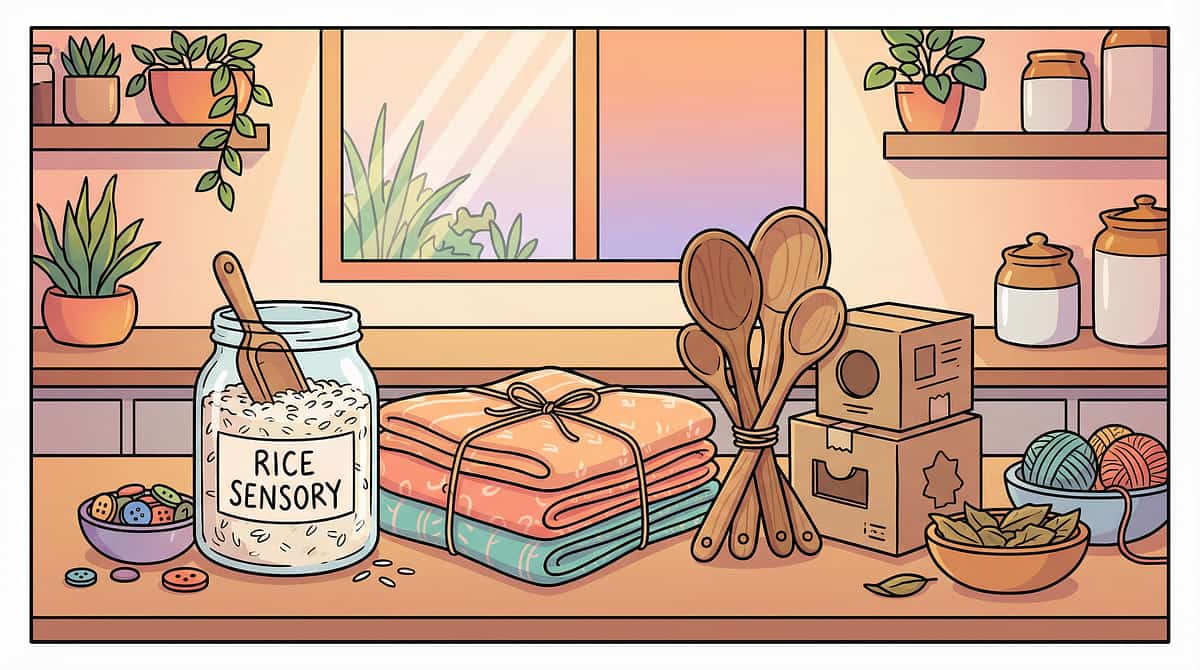
Calm-Down Kit | Commercial sensory kit ₹500–2,000 | Smooth garden stones · fabric scraps · DIY glitter jar (jar + water + glitter glue) · pinwheels ₹20 | |
Bedtime Stories | Published books ₹200–1,500 | Printed social narrative you write about YOUR child's bedtime (free); record yourself reading on phone | |
Comfort Object | Weighted stuffed animal ₹500–2,500 | Child's own chosen toy; a piece of parent's worn clothing; smooth stone — the attachment is to the specific object | |
Relaxation Scripts | Apps ₹0–2,000 | Parent reads a simple body-scan script: "Notice your toes... let them go heavy..." — parent voice has added attachment benefit |
💛Complete Zero-Cost Bedtime Transition Kit: Printed photo schedule ✓ · Free white noise app ✓ · Child's own comfort toy ✓ · Extra layers for deep pressure ✓ · Parent-read relaxation script ✓ · DIY glitter calm jar (jar + water + glitter glue = ₹50) ✓
Total investment: ₹0–100. Total clinical equivalence: Complete.
Read This Before Every Session. Safety Is Not Optional.
🔴 RED — Absolute Contraindications
- Weighted blankets on any child under 2 years, or any child who cannot independently remove the blanket
- Weighted blankets on children with respiratory, cardiac, or circulatory conditions without physician clearance
- Any technique when the child is acutely unwell, feverish, in active meltdown/crisis, or severely distressed
- Sound machines above 65dB — risk of hearing damage; always use "conversation level" as maximum
- Any unsupervised sensory item with infants or children with swallowing/mouthing concerns
🟡 AMBER — Modify With Caution
- Child had a particularly difficult day, trauma trigger, or unusual anxiety event → simplify routine
- First introduction of any new material → present during daytime calm first; never introduce at bedtime crisis
- Child demonstrates increased distress with a specific material → that material is not right; do not force
- Different caregiver implementing for first time → walk through visual schedule together before bedtime begins
🟢 GREEN — Proceed With Confidence
- Child is fed (not hungry), not overtired, in regulated state
- Routine materials are laid out before child arrives at bedroom
- Both/all caregivers present tonight have been briefed on the routine
- You have reviewed tonight's visual schedule and it reflects tonight's actual plan
🛑STOP IMMEDIATELY IF: Child shows breathing difficulty under weighted item · Severe escalation with genuine safety risk · Signs of genuine fear or trauma response · Any allergic reaction to new material
📞 Pinnacle Free Helpline: 9100 181 181 | Available 24x7 | Clinical guidance available
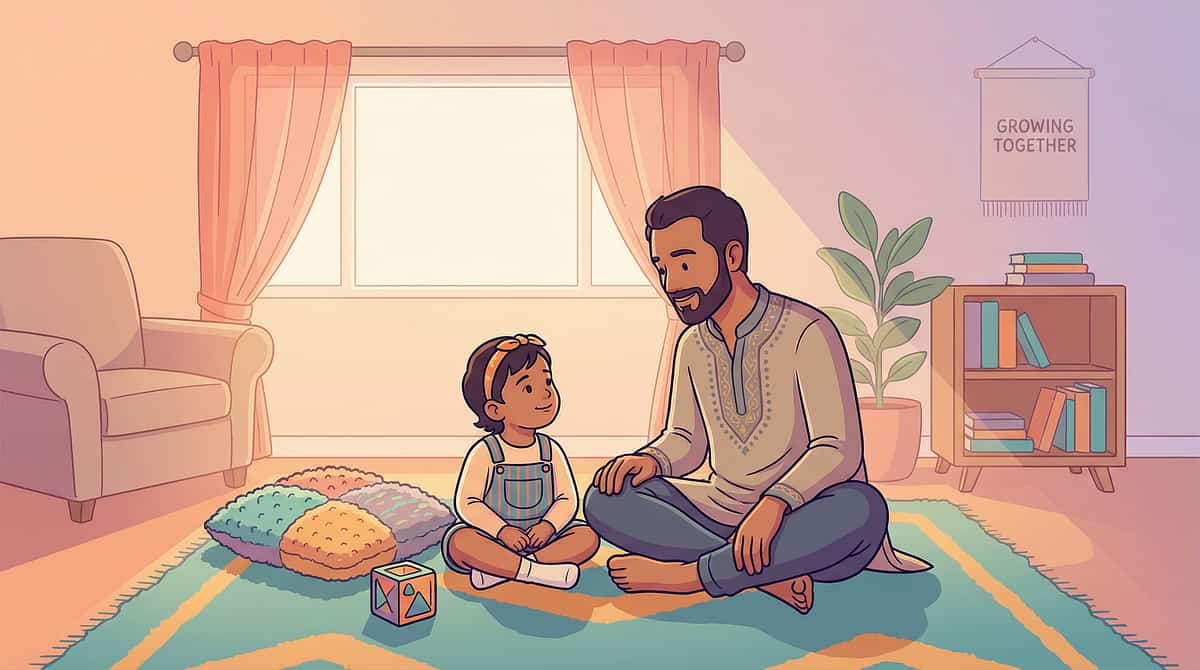
Spatial Precision Prevents 80% of Session Failures. Set Up Before the Child Arrives.

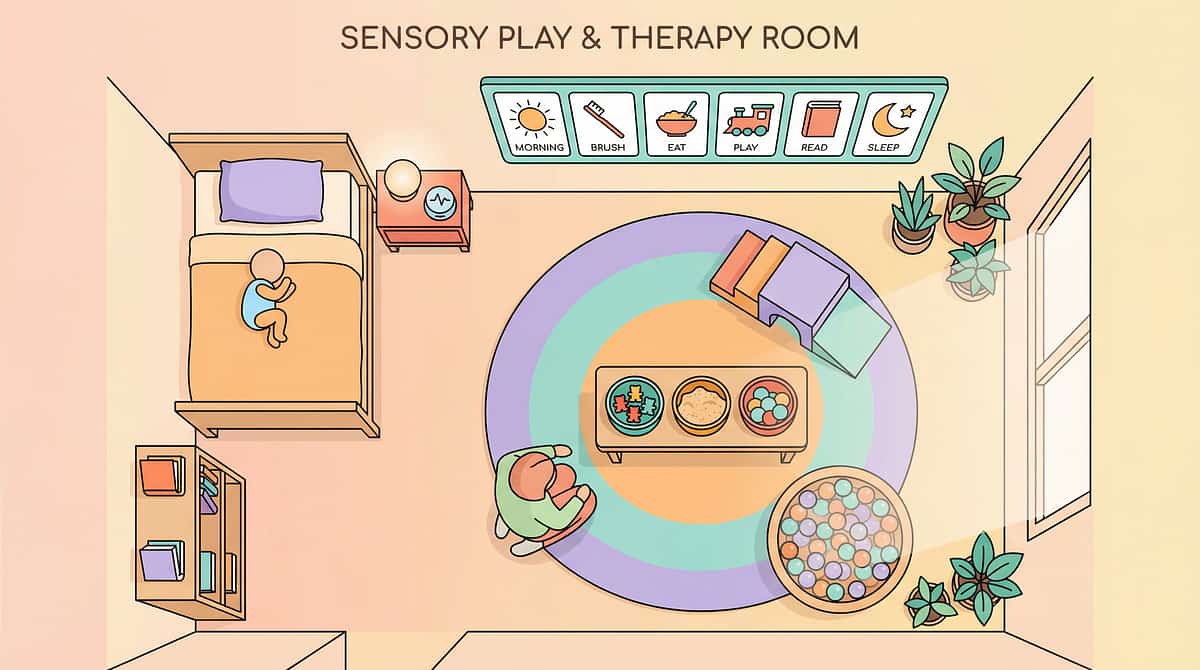
Every element of the room should be in position before your child enters. The environment itself communicates: This space is safe. This space is for sleep.
Setup Checklist
- ☐ Visual schedule at child's eye level — reviewed and ready
- ☐ Sound machine on and running (10 minutes before routine begins)
- ☐ Nightlight on (red/amber spectrum)
- ☐ Visual timer set and visible from bed
- ☐ Weighted blanket laid open at foot of bed
- ☐ Calm-down kit on bedside — only bedtime-specific items, closed box
- ☐ Comfort object in bed, where child will find it
- ☐ Tonight's stories selected and stacked (maximum: 2–3)
- ☐ Relaxation audio queued on device (airplane mode, screen facing down)
- ☐ Room temperature: 18–22°C (65–72°F)
Remove From Space
❌ Screens/tablets/phones · ❌ Stimulating toys · ❌ Bright overhead lighting · ❌ Unrelated visual clutter

60 Seconds That Determine the Entire Night. Run This Check First.
Check | ✅ GO | ⚠️ MODIFY | ❌ POSTPONE | |
Child had dinner / not hungry | Ate well | Light appetite | Hasn't eaten — feed first | |
Time since last major screen | 60+ min | 30–60 min | Less than 30 min — extend wind-down | |
Physical energy level | Moderate / winding down | Still highly activated | Full energy / second wind — add 15 min physical wind-down | |
Emotional state | Regulated / calm | Mildly upset | Active meltdown or extreme distress | |
Physical health | Well | Slight fatigue | Unwell / feverish | |
Communication cues | Responsive | Minimal response | Non-responsive / shut-down |
✅ GO
5–6 checks green → Proceed to Step 1: The Invitation
⚠️ MODIFY
3–4 checks green → Run simplified 5-step routine; skip new elements
❌ POSTPONE
2 or fewer checks green → 15-minute floor-based calming activity first; then re-run check
📞 If bedtime consistently feels unsafe or unmanageable: 9100 181 181 — Free clinical consultation available tonight.

STEP 1 OF 6
⏱️ 30–60 seconds
Every Bedtime Routine Begins With an Invitation, Not a Command.
The Science of This Step
ABA's Pairing Principle: Before any demand is placed, pair yourself and the routine with reinforcement. The child should associate the beginning of the bedtime routine with safety, warmth, and low demand — not threat.
Exact Parent Script
"Hey love — I can see you're winding down. I have something to show you in your room. Come with me?"
Alternative for resistant child:"Can I show you something cool before bedtime? It's in your room."
For nonverbal child: Offer hand + show visual schedule card as a physical invitation.
Body Language Guidance
- Position: Kneel or sit at child's level — never stand over them
- Tone: Warm, calm, unhurried — avoid urgency (urgency creates panic)
- Energy: Slightly below the child's current level — co-regulate DOWN, not up
Acceptance Cues (What "Yes" Looks Like)
- Moving toward bedroom, even reluctantly ✓
- Looking at visual schedule card ✓
- Reduced body tension ✓
- Any verbal or nonverbal acknowledgment ✓
If Child Resists
Wait 30 seconds; offer schedule card physically; try again with lower demand. Playful compliance is still compliance — move with them toward the bedroom.

STEP 2 OF 6
⏱️ 1–3 minutes
Walk Through the Schedule Together. The Chart Leads. You Follow.
The Science of This Step
The visual schedule externalizes the routine. When the chart shows what comes next, the parent is no longer the enforcer — the schedule is. This shifts the dynamic from parent vs. child to parent + child vs. the schedule together.
Script
"Okay, let's look at our bedtime chart. What's first? Can you find it? Yes — that's right. Bath first. You show me."
- Point to each step together — let child touch or move the piece
- Use "First-Then" language: "First we brush teeth, THEN we get to choose which story"
- Let the child mark off or move each completed step — agency reduces resistance
Introducing the Sound Machine
It should already be running before child entered the room. Comment warmly: "Your sleep sounds are already on — they're waiting for you." This creates a Pavlovian cue: sound = sleep time is safe.
Introducing the Nightlight
"I left the sleep light on for you. See how soft it is? The light is right there. It stays on all night. You won't be in the dark."
Child Response Indicators
- ✅Engagement: Moving through schedule steps, touching materials
- ✅Tolerance: Not actively engaged but not resisting — proceed gently
- ⚠️Avoidance: Leaving room, physical resistance → Return to Step 1; re-invite

STEP 3 OF 6
⏱️ 10–20 minutes
This Is Where the Nervous System Shifts. These Are the Active Ingredients.
A. Sensory Input Phase (5–8 min)
- Pajamas on → tactile reset from activewear
- Weighted blanket pulled up → deep pressure input begins
- Calm-down kit: 3–5 minutes of child-led sensory exploration
- "You can spend a few minutes with your calm box while I sit here with you."
B. Connection Phase (5–10 min)
- Stories (2 maximum; agreed on in advance): parent reads slowly, calmly, warmly
- Bedtime Social Narrative read last, before lights out
- Relaxation audio begins while last story is finishing (seamless transition)
C. Sensory Closure Phase (2–3 min)
Weighted blanket fully on · Comfort object in child's arms · Sound machine audible · Nightlight on
"Everything is here for you. The sound is on. Your [comfort object name] is here. I'm going to sit here quietly for a few minutes."
Common Execution Errors
- ❌Rushing through the schedule → creates anxiety rather than calm; slow down — the pacing IS the therapy
- ❌Introducing new material at crisis point → introduce during daytime first
- ❌Abandoning the script mid-routine → improvising undoes predictability; stick to script even on hard nights
- ❌Parent on phone during connection phase → full presence during stories is non-negotiable


STEP 4 OF 6
⏱️ Nightly — Ongoing
The Power Is in the Repetition. Every Night Builds the Neural Pathway.
Dosage Guidance
Unlike single-session techniques, Bedtime Transition Support is measured in weeks, not reps:
- Minimum: 5 nights per week (consistency)
- Target: 7 nights per week — every night including weekends for weeks 1–4
- Duration: 4–8 weeks for measurable behavior change; 8–12 weeks for internalization
Healthy Variation — What to Keep Constant vs. Variable
Element | Constant (Never Change) | Variable (Safe to Vary) | |
Schedule sequence | ✅ Always the same steps, same order | Stories chosen can rotate nightly | |
Sound machine | ✅ Always on, same sound, same volume | Try pink vs. white noise after week 2 | |
Weighted blanket | ✅ Always available | Child can choose whether to use it | |
Comfort object | ✅ Always present in bed | Secondary toy is optional | |
Parent script | ✅ Same key phrases | Tone can warm as child relaxes |
"3 Good Nights > 10 Forced Nights" Principle: A 15-minute calm routine completed without battle has more therapeutic value than a 2-hour forced routine that ends in meltdown. Track quality, not duration.

STEP 5 OF 6
⏱️ Within 3 seconds of target behavior
The Timing of Praise Matters More Than The Size of the Reward.
Reinforcement Science
ABA research is unambiguous: reinforcement delivered within 3 seconds of a desired behavior has 3–5× the strength of reinforcement delivered 30 seconds later. At bedtime, the target behavior is completing each routine step without resistance.
Immediate Praise Scripts
- After completing a schedule step: "YES! You did the [step]. That's exactly it."
- After accepting weighted blanket: "I love how calm your body feels under your blanket."
- After staying in room: "I noticed you stayed right here. That was brilliant."
- After falling asleep independently: (at morning) "You did it all yourself last night. I'm so proud of you."
Reinforcement Menu (Pinnacle Canon — Product #803 | ₹589)
- 🏆 Visual reward chart with sticker → one sticker for completing full routine without resistance
- 🌟 Star chart → 5 stars = special activity choice (not screen time)
- 📖 Extra 5 minutes of story → earned for settling quickly; given the following night
- 👏 Physical celebration → high-five, fist bump, or hug at morning after a good night
Celebrate the Attempt, Not Just the Success
- Child stayed in room 3 minutes longer than last week → that's a win
- Child used glitter jar without prompting → celebrate it
- Child completed 4 of 5 routine steps → "4 steps tonight! Yesterday it was 3. You're building."

STEP 6 OF 6
⏱️ 2–3 minutes
No Session Ends Abruptly. The Cool-Down Is the Bridge to Sleep.
The Science
The transition from "routine active" to "eyes closed, falling asleep" is itself a transition — and transitions are where children with sensory or regulatory differences struggle most. The cool-down script manages this micro-transition explicitly.
Cool-Down Sequence
- Last story ends → close the book gently
- Relaxation audio playing softly (or parent begins verbal relaxation script)
- Weighted blanket fully on; comfort object in arms
- Parent script (whispered, slow, warm): "Your sound is on. Your light is on. Your [comfort object] is right here. Your body can rest now. I love you. I'm going to sit here quietly while you breathe."
- Parent reduces verbal interaction — become a calm presence, not active participant
- [If child asks questions] One-word reassurance: "Yes." "Safe." "Here." — do not re-engage with conversation
Transition Warning Script
"One more page... and that's our last story for tonight. You did so well."
Material Put-Away Ritual
- Calm-down kit lid closed → child participates if able
- Timer set to "stay in bed" display
- Visual schedule turned to "all done — sleep" card
If Child Resists Ending
"I hear you. You want more. Tomorrow night we'll have stories again. It's sleep time now."
Then: calm, warm, low-affect presence. Silence is more powerful than re-engagement.

60 Seconds of Data Now Saves Hours of Guessing Later.
Tonight's Bedtime Tracker — I-792
Fill within 60 seconds of leaving the room:
- ⏱️Routine duration (minutes): _____ (from "invitation" to "lights out")
- ⭐Resistance level (1–5): 1=None → 5=Full meltdown _____
- ✅Steps completed: ☐ Schedule ☐ PJs ☐ Teeth ☐ Calm Kit ☐ Stories ☐ Blanket ☐ Object ☐ Audio ☐ Lights out
Quick-Log Format (for phones)
Type 3 numbers: "22 min / 2 resistance / 8 steps" → Send to your therapy team WhatsApp
Why Data Matters
Capture data 5 nights per week. After 2 weeks: look for any single metric improving — even slightly. That is your evidence that the intervention is working.
Data = Personalization
Every data point you record feeds the GPT-OS® system (if enrolled), which uses real-world session data from 20M+ sessions to refine your child's personalized therapy plan.
📋 Download the printable PDF tracker → techniques.pinnacleblooms.org/trackers/bedtime-I-792
📞 Questions about tracking? Call 9100 181 181 — free clinical guidance available

Most Sessions Don't Go Perfectly. Here Is Your Troubleshooting Guide.
"Session abandonment is not failure — it is data."
❓ Child refuses to come to bedroom at all
This is a transition problem before a sleep problem. Bring ONE element of the routine to them: carry the visual schedule to where they are; bring the glitter jar to the living room. Begin the routine where they are, walk toward bedroom together.
❓ Child completes the routine but keeps getting out of bed
The time-to-sleep clock is the primary tool here. Implement a "bedtime pass" system: one pass per night to come out; using it means it's gone.
❓ Child removes the weighted blanket immediately
The blanket is not right for this child yet — don't force it. Try a lighter option (single extra layer) or weighted stuffed animal instead. Some children need weeks of daytime exposure before accepting weighted items at night.
❓ Child is too activated by the calm-down kit
Remove stimulating items; keep only glitter jar + one smooth stone + one soft fabric square. If still activating, remove kit and replace with 5 minutes of parent-read relaxation script only.
❓ Stories generate more questions and prolong bedtime
Limit to 2 books, established in advance and shown on visual schedule. If child asks questions: "That's a great question — let's think about it tomorrow." Do not re-engage. The schedule shows "stories" as finite.
❓ Child cries when parent leaves the room
This is separation anxiety, not manipulation. Begin with parent sitting by door (not in bed with child). Gradually move chair toward door over 2 weeks. Duration of crying typically decreases with consistent response.
❓ Nothing is working after 3 weeks of consistent effort
This is a clinical signal. Request an OT assessment for sensory processing profile; discuss melatonin with pediatrician; consider psychology input for anxiety. Call 9100 181 181.

No Two Children Have the Same Bedtime Brain. Here Is How to Calibrate for Yours.
🔵 Sensory Seeker
(Needs more input to settle) Heavier weighted blanket; proprioceptive activity before routine (wall push-ups, bear hug from parent); fidget tools in calm-down kit; stronger white noise.
🟢 Sensory Avoider
(Overwhelmed by stimulation) Lighter covers; very minimal light; very low volume sound or no sound; remove calm-down kit; stories replaced by parent humming quietly.
🟡 Anxious Child
Extra parent proximity; more time on comfort object; personalized social narrative specifically about their fears; worry station (small notebook by bed for writing/drawing worries).
🔴 ADHD / High Energy
20-minute physical wind-down before routine begins; movement before calm (jumping, rolling, bear walks); shorter routine with more frequent praise points.
🟣 Nonverbal / Minimal Language
Schedule uses real photographs; transition object approach primary; weighted input emphasized; relaxation is physical (parent gentle massage, deep pressure); sound cue is primary routine marker.
Age | Adaptation | |
2–3 yrs | 3–5 step schedule only; parent stays in room; white noise primary; comfort object essential | |
4–6 yrs | Full 5–7 step schedule; introduce timer; time-to-sleep clock; calm-down kit age-appropriate | |
7–9 yrs | Child marks off schedule independently; earns story choices; begins using relaxation app independently | |
10–12 yrs | Checklist replaces picture schedule; self-managed calm-down; relaxation app autonomy |

ACT IV: THE PROGRESS ARC
Progress in Weeks 1–2 Looks Like Tolerance, Not Mastery.
Do Not Expect Drama. Watch for Micro-Shifts.
15%
Week 1–2 Progress
Tolerance phase — early neural foundations being laid
✅ Observable Wins — Weeks 1–2
- Child protests bedtime for 10 minutes instead of 40
- Child follows 2 of 5 schedule steps without resistance
- Child stays in room for 3 minutes longer than before
- White noise accepted without objection
- Weighted blanket touched / tried for even 30 seconds
- Any engagement with visual schedule (pointing, touching)
❌ Don't Look for These Yet
- Sleeping independently through the night
- Following the full routine without resistance
- Falling asleep quickly
- Not calling out for parent after lights out
The Extinction Burst
The hardest part of weeks 1–2 is trusting the process. Research shows an initial increase in resistant behavior before it decreases is normal. If week 1 is harder than before you started: that is likely the extinction burst. Stay consistent.

Week 3–4: The Neural Pathways Are Forming. Watch for These Consolidation Signals.
40%
Week 3–4 Progress
Consolidation phase — automatic responses beginning to form
Consolidation Indicators
- ✅ Child moves toward bedroom when routine signal begins (without being told twice)
- ✅ Child touches or moves visual schedule pieces independently
- ✅ Time-to-sleep clock is accepted as authority ("it's not green yet")
- ✅ Weighted blanket requested by child (not just parent-offered)
- ✅ Routine duration decreasing — even by 5 minutes
- ✅ Parent's anxiety about bedtime decreasing (this is a real milestone)
What's Happening Neurologically
Synaptic connections used consistently strengthen through long-term potentiation. By week 3–4, the brain has begun to associate the routine with sleep — the child begins to feel sleepy when the routine begins. This is Pavlovian conditioning at the neurological level.
When to Increase Intensity
If child is consistently completing 4+ of 5 routine steps without resistance → add one additional step or element (e.g., introduce relaxation audio if not yet using).
Parent Milestone
"You may notice that you feel more confident entering bedtime. Your regulated nervous system co-regulates your child's. Your calm is therapeutic."

Mastery Is Not Perfection. It Is Consistent, Functional Independence With the Routine.
75%
Week 5–8 Progress
Mastery phase — functional independence with the routine
Mastery Criteria
- ✅ Child initiates or assists with visual schedule without prompting
- ✅ Falls asleep within 30–45 minutes of routine beginning
- ✅ Routine completed in 25–35 minutes (vs. original 60–120 minutes)
- ✅ Parent can leave room before child is fully asleep
- ✅ Comfort object used for active self-soothing
- ✅ Night wakings decreased in frequency
Generalization Indicators
- Child begins using calming strategies (deep breathing, fidget) in other anxiety contexts
- Visual schedule concept transferring — child expects visual supports for other routines
- Child discusses bedtime without distress during daytime
🏆 Mastery Badge Criteria
BEDTIME TRANSITION — LEVEL 1 MASTERED when: Routine completed without meltdown × 5 consecutive nights; total routine under 35 minutes; parent not required in room for sleep onset on at least 2 nights per week.

You Earned This. Your Child Grew Because You Refused to Give Up.
You took a warzone and turned it into a routine. You learned the neuroscience when you were exhausted. You executed a multi-step protocol on hard nights and easy nights. You stayed consistent when the early weeks showed no progress. You gave your child what no amount of willpower or punishment could give them: a nervous system that has learned to trust the transition to sleep.
🌙 Your Child Can Fall Asleep
That sentence once felt impossible. It is now measurable reality.
⭐ Your Evenings Exist Again
The hours after bedtime belong to you.
🧠 Better Sleep, Better Days
Your child's daytime brain is sharper, calmer, and more available for learning.
📸Photo/Journal Prompt: Take a photo tonight of your child sleeping peacefully. Save it. On hard future nights, look at it. This is possible. You know it now.
📞 Ready to assess the next step in your child's journey? 9100 181 181 — Free AbilityScore® consultation available

Even in Progress, Stay Vigilant. These Are the Signs That Require Professional Consultation.
🚨 1. Insufficient Total Sleep Despite Consistent Intervention
Under 9 hrs for ages 6–12; under 11 hrs for ages 3–5 → Rule out sleep disorder, melatonin deficit, or medical cause
🚨 2. Loud Snoring, Gasping, or Breathing Pauses
Urgent pediatrician referral; potential obstructive sleep apnea — behavioral intervention alone cannot address this.
🚨 3. Night Terrors
Child wakes screaming, inconsolable, with no memory next morning — distinct from nightmares; requires specialist assessment; different protocol entirely.
🚨 4. Zero Progress After 6+ Weeks of Consistent Implementation
Clinical assessment needed; possible undiscovered comorbidity, sensory processing assessment, or melatonin evaluation.
🚨 5. Significant Daytime Functional Impairment
Chronic exhaustion, classroom performance collapse, behavioral dysregulation throughout day → Sleep deprivation at this level requires urgent clinical response.
🚨 6. Parent Exhaustion Reaching Crisis Level
Your wellbeing matters. A depleted parent cannot implement these protocols effectively. Seek respite and professional support.
Mild Concerns
Continue home protocol + call 9100 181 181 for teleconsultation guidance
Moderate Concerns
Book OT/Pediatric assessment at nearest Pinnacle center
Urgent Concerns
Breathing issues, severe regression → Pediatrician immediately + 9100 181 181
📞9100 181 181 | 24x7 | Free | Clinical guidance available now

You Are Not Done. You Are at a Milestone on a Longer Journey.
Morning Routines
Night Wakings
Bedtime Transition
Sleep Environments
Sleep Difficulties
If your child achieved mastery AND... | Go next to | |
Still waking multiple times per night | → I-793: Night Wakings | |
Morning routines are the new battle | → I-794: Morning Routines | |
Nap transition is still challenging | → I-795: Nap Transitions | |
Anxiety is the primary driver | → Domain C: Emotional Regulation (C-254 series) | |
Sensory regulation is the primary driver | → Domain A: Sensory Processing techniques | |
Lateral alternative approach needed | → D-448: 9 Materials for Bedtime Resistance |
"A child who can independently transition to sleep has developed one of the foundational self-regulation skills that supports lifetime executive function, emotional regulation, and wellbeing."

You Already Know the Materials. Here Are More Techniques That Use Them.
Technique | Difficulty | Shared Materials | |
9 Materials That Help With Bedtime Resistance (D-448) | 🟡 Core | Visual Schedule, Weighted Blanket, Timer | |
9 Materials That Help With Bedtime Routine (E-541) | 🟢 Intro | Visual Schedule, Stories, Comfort Object | |
9 Materials That Help With Night Wakings (I-793) | 🟡 Core | Sound Machine, Nightlight, Comfort Object | |
9 Materials That Help With Morning Routines (I-794) | 🟢 Intro | Visual Schedule, Timer | |
9 Materials That Help With Transition Difficulties (I-800) | 🔴 Advanced | Visual Schedule, Timer, Social Narratives |
✅ Your visual schedule → works for D-448, E-541, I-793, I-794, I-800
✅ Your weighted blanket → works for D-448, I-793
✅ Your sound machine → works for I-793
✅ Your timer → works for D-448, I-794, I-800
✅ Your weighted blanket → works for D-448, I-793
✅ Your sound machine → works for I-793
✅ Your timer → works for D-448, I-794, I-800
🏷️ Domain I — Sleep & Daily Living | Series: Sleep and Bedtime Routines | Episodes 790–800
→ techniques.pinnacleblooms.org/sleep-daily-living | Browse all 50+ Sleep Domain techniques

This Technique Is One Piece of Your Child's Complete Developmental Architecture.
Domain I — Sleep & Daily Living
Covers: Sleep Transitions · Morning Routines · Dressing · Toileting · Eating · Personal Hygiene · Household Participation — all the daily living skills that form the functional backbone of a child's life.
GPT-OS® Integration
When your bedtime tracking data enters GPT-OS®, it automatically correlates with:
- Domain C (Emotional Regulation) → anxiety patterns
- Domain A (Sensory Processing) → sensory drivers of sleep difficulty
- Domain D (Behavior) → behavioral function of resistance
🔗See your child's full developmental profile
📞 Request a complete AbilityScore® assessment: 9100 181 181

ACT V: COMMUNITY & ECOSYSTEM
From Warzone to Routine. Real Families. Real Outcomes.
Arjun, Age 7 (ASD, Level 2) — Hyderabad
"Bedtime took three hours minimum. Our son would scream, run away, need us lying with him until he fell asleep. We were zombies. Our marriage was suffering."
Intervention: Visual schedule (week 1) + weighted blanket (week 2) + white noise (week 1) + time-to-sleep clock (week 3)
"He follows his chart. He pulls his blanket up himself. He checks the clock. He usually falls asleep within 30 minutes. Most nights we have our evenings back. It took two months of consistency. But now we sleep." — Parent, Pinnacle Hyderabad Network
"Arjun's primary driver was transition anxiety compounded by sensory hyper-arousal. The visual schedule eliminated transition anxiety; the weighted blanket addressed the sensory arousal; the clock gave him predictability over timing. Three materials, one converged solution." — OT Specialist, Pinnacle Blooms Network
Kavya, Age 5 (Anxiety + Sensory Processing Differences) — Bengaluru
"Every night she was scared. Scared of the dark, scared of sounds, scared of being alone. We would lie with her for two hours. She couldn't tell us what was wrong. We couldn't fix what we couldn't name."
Intervention: Red-spectrum nightlight (immediate relief) + DIY calm-down kit + personalized social narrative + comfort object protocol
"She goes to bed with her light on, her blanket, her elephant, and the sound machine. She's not 'fixed.' She still has hard nights. But she has tools now. She reaches for them herself." — Parent, Pinnacle Bengaluru Network
Illustrative cases reflecting clinical patterns across the Pinnacle Network. Individual outcomes vary by condition, severity, and intervention consistency.

Isolation Is the Enemy of Adherence. You Don't Have to Navigate This Alone.
Pinnacle Sleep & Bedtime Parent WhatsApp Group
Request your join link via 9100 181 181 or pinnacleblooms.org/community
Pinnacle Online Parent Forum
pinnacleblooms.org/forum — Sleep & Daily Living section — share what worked, ask what hasn't.
Local Pinnacle Parent Meetup
Find your nearest center: pinnacleblooms.org/centers
Peer Mentoring
"I've been where you are. Here's what worked for us." — Connect via 9100 181 181
"Your experience — the hard nights, the breakthroughs, the specific hacks that worked for your child — can be the lifeline that another parent is searching for tonight."
📞9100 181 181 | 24x7 | Free | 16+ Languages | "Our sleep specialists receive this call every night. You are not the only one calling at 11pm."

Home Execution + Professional Guidance = Maximum Impact.
70+ Centers. One National System. Your Child's Therapy, Wherever You Are.
Therapist Matching for This Technique
- OT (Occupational Therapy): Sensory assessment, weighted tools protocol, environment design
- ABA/BCBA: Routine structure, reinforcement system, data-based decision making
- NeuroDev Pediatrics: Medical rule-out, melatonin evaluation, circadian assessment
Contact Options
- 📞Call FREE: 9100 181 181 (immediate clinical guidance)
- 📱 WhatsApp consultation via 9100 181 181
- 💻 Book teleconsultation: pinnacleblooms.org/teleconsult
- 🏥 Book in-center assessment: pinnacleblooms.org/book
Services Relevant to Bedtime Transition
- AbilityScore® Assessment (baseline measurement across all domains)
- Sensory Processing Evaluation (OT)
- Behavioral Sleep Assessment (ABA/BCBA)
- EverydayTherapyProgramme™ (home execution with weekly supervision)
- FusionModule™ (integrated OT + ABA + Pediatrics for complex sleep cases)
"Home + clinic = maximum impact. The parent executing at home and the therapist supervising in clinic create a closed loop that produces the 97%+ outcomes we measure."
📍 Find your nearest center → pinnacleblooms.org/centers
📞9100 181 181 | FREE | 24x7 | Clinical guidance available now

For the Parent Who Wants to Go Deeper. The Evidence Behind Every Card on This Page.
Key Studies Supporting I-792
- PRISMA Systematic Review, Children 2024 (PMC11506176): 16 studies (2013–2023): Sensory integration is evidence-based practice for ASD — Level I
- Meta-analysis, World J Clin Cases 2024 (PMC10955541): 24 studies: SI therapy promotes adaptive behavior and self-regulation — Level I
- WHO/UNICEF CCD Package 2023 (PMC9978394): Home-based caregiver interventions: measurable outcomes across 54 LMICs — Level II
- Padmanabha et al., Indian J Pediatr 2019: Indian RCT: home-based sensory interventions demonstrate significant outcomes — Level II
- NCAEP Evidence-Based Practices Report 2020: Visual schedules, structured routines, parent training: evidence-based for autism — Level I
- Frontiers in Integrative Neuroscience 2020: Neurological basis for sensory-based interventions in ASD established — Level II
"Deeper reading for the curious parent and the clinician verifying our work. We cite our sources because we stand behind every recommendation on this page."

Your Data Helps Your Child. And Every Child Like Yours.
GPT-OS® System Overview
GPT-OS® (Global Pediatric Therapeutic Operating System) is the world's first sovereign, multi-disciplinary pediatric therapy operating system — governing diagnosis, prognosis, therapy design, execution, and outcome measurement as one closed, accountable, data-driven system.
What GPT-OS® Learns From Your I-792 Data
- Rate of routine duration reduction → pace of neural pathway formation
- Resistance level trend → whether sensory, behavioral, or anxiety is the primary driver
- Which materials the child responds to → personalizing the toolkit
- Correlation with other domain data → revealing hidden connections
Data Flow for I-792
Closed-Loop Adaptation
Diagnostic Update
Data Ingestion
Privacy Assurance
All data is encrypted, anonymized for population-level analysis, and governed under DPIIT-registered IP protocols. Individual data belongs to the family.
20M+ exclusive 1:1 sessions · 97%+ measured improvement · 70+ centers · Patents filed globally · CIN: U74999TG2016PTC113063
📞9100 181 181 | Ask about enrolling in the GPT-OS® programme

See the Materials in Action. Watch I-792 — The Reel That Brings This Page to Life.
Reel Details
- 🎬Reel Title: 9 Materials That Help With Bedtime Transition
- ID: I-792
- Domain: I — Sleep & Daily Living
- Series: Sleep and Bedtime Routines
- Episode: 792 of 999
Therapist Introduction
Presented by the Pinnacle Blooms Consortium OT & ABA Clinical Team — the same specialists whose combined 20M+ sessions produced the protocols on this page.
What the Reel Demonstrates
In this 60-second reel, a Pinnacle Blooms OT Consortium specialist walks through all 9 materials — demonstrating the visual schedule in use, showing correct weighted blanket positioning, demonstrating the glitter calm-down jar, and modelling the parent script for the cool-down transition.
Video Modeling Statement
Seeing is therapeutic. If your child watches this reel with you, they are already beginning the cognitive preparation for the bedtime routine changes ahead. Video modeling is itself an evidence-based intervention (NCAEP, 2020).
Multi-modal learning (visual + text + demonstration) improves parent skill acquisition across all intervention types.

Consistency Across Every Caregiver Multiplies Impact. Share This Tonight.
The Consistency Science
If one parent implements the routine and the other doesn't, the child's nervous system doesn't build the predictability pathway. Both parents, grandparents, and regular caregivers must be aligned. This card makes that easy.
Share Options
- 📱 WhatsApp: Share this page link
- 📧 Email: Email this page link
📄Download: "Bedtime Transition — Family Quick Guide" (1-page PDF)
techniques.pinnacleblooms.org/downloads/bedtime-transition-I-792-family-guide.pdf
Explain to Grandparents Version
"We're working on making bedtime predictable for [child]. There's a chart on the wall that shows what happens in order. Please follow it exactly — even if [child] doesn't need reminding some nights. The consistency is the medicine."
School / Teacher Communication Template
"Dear [Teacher name], We're implementing a structured bedtime routine at home using visual schedules and sensory supports. We're seeing improvements in [child]'s morning regulation. We'd like to share the visual schedule approach — consistent structure at school would reinforce the same neural pathways we're building at home. Can we speak briefly this week?"

Every Question Parents Have Asked at Pinnacle Centers — Answered.
❓ How long before I see results?
Real change takes 4–8 weeks of consistent implementation. Micro-improvements begin in weeks 1–2. Full routine mastery typically 6–8 weeks. If no change at 6 weeks despite consistent effort, seek clinical assessment.
❓ Do I need all 9 materials?
No. Start with 2–3 that address your child's specific drivers. Visual schedule + nightlight + comfort object is a powerful minimum starter kit. Add materials gradually as those are established.
❓ My child pulls off the weighted blanket immediately. Is it wrong for them?
Possibly. Introduce it during daytime play first. If your child consistently rejects it, move to compression sheet or extra layers instead. Never force it.
❓ We travel frequently. Does this routine need to stay exactly the same?
The core structure should travel with you. Pack: the visual schedule (laminated, portable), the comfort object, a white noise app (airplane mode), and a portable nightlight. These 4 items are your portable bedtime system.
❓ My partner doesn't believe in all these "tools." How do I get them on board?
Share the neuroscience (Card 03). Show them the outcome data: 97%+ improvement across 20M+ sessions. Then ask them to commit to 2 weeks of the system — not because they believe it, but because you do.
❓ Is melatonin an option?
Melatonin has good evidence for specific populations (autism in particular). However, it requires physician oversight — dosing, timing, and formulation are individualized. Call 9100 181 181 for a NeuroDev consultation. It is a tool, not a substitute for routine.
❓ My child wakes up at 4am every morning. Is this covered here?
The time-to-sleep clock (Material 05) directly addresses early morning waking. Set "okay to wake" to 30 minutes after their current natural wake, not your ideal wake time. I-793 (Night Wakings) is the dedicated technique for this challenge.
❓ I didn't find my answer here.
Ask GPT-OS®: pinnacleblooms.org/ask | Book teleconsultation: pinnacleblooms.org/teleconsult | Call: 9100 181 181
📞9100 181 181 | 24x7 | Free | Our clinicians receive these questions every night.
Preview of 9 materials that help with bedtime transition Therapy Material
Below is a visual preview of 9 materials that help with bedtime transition therapy material. The pages shown help educators, therapists, and caregivers understand the structure and content of the resource before use. Materials should be used under appropriate professional guidance.


Share this resource
Help others discover thisLink copied!

You Have Everything You Need. Your Child Is Ready. Tonight Can Be Different.
🏛️ Validated by the Pinnacle Blooms Consortium
OT · SLP · ABA/BCBA · SpEd · NeuroDev Pediatrics · CRO
20M+ Sessions · 97%+ Improvement · 70+ Centers · 70+ Countries
From Fear to Mastery
A parent arrived on Card 01 — exhausted, dreading 7pm. By Card 40 — they act. And the loop restarts with the next technique. One technique at a time. — The Pinnacle Blooms Consortium
📞FREE National Autism Helpline: 9100 181 181 | 24x7 · 16+ Languages · Free · pinnacleblooms.org · care@pinnacleblooms.org
© 2025 Pinnacle Blooms Network®, unit of Bharath Healthcare Laboratories Pvt. Ltd. All rights reserved. Technique ID: I-792. CIN: U74999TG2016PTC113063 | DPIIT: DIPP8651 | MSME: TS20F0009606 | GSTIN: 36AAGCB9722P1Z2
This content is educational and informational. It does not replace individualized assessment and intervention from qualified professionals. Persistent sleep difficulties may indicate underlying medical, developmental, or psychological conditions requiring professional evaluation. Individual results may vary.
© 2025 Pinnacle Blooms Network®, unit of Bharath Healthcare Laboratories Pvt. Ltd. All rights reserved. Technique ID: I-792. CIN: U74999TG2016PTC113063 | DPIIT: DIPP8651 | MSME: TS20F0009606 | GSTIN: 36AAGCB9722P1Z2
This content is educational and informational. It does not replace individualized assessment and intervention from qualified professionals. Persistent sleep difficulties may indicate underlying medical, developmental, or psychological conditions requiring professional evaluation. Individual results may vary.