

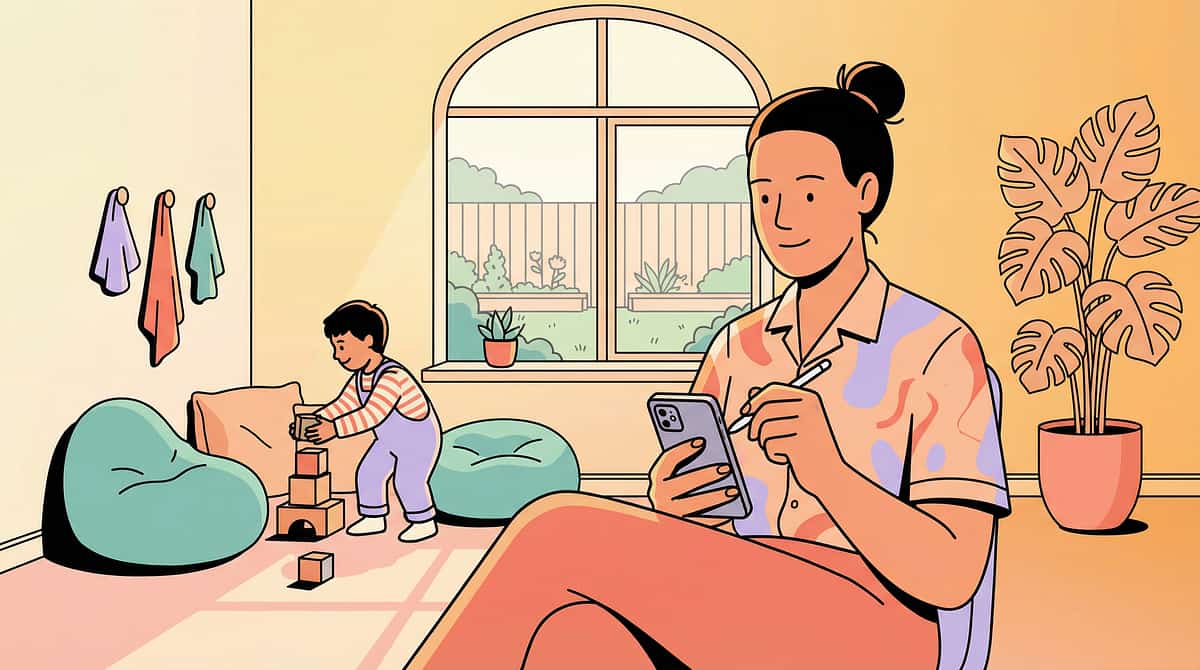
It's the night before the first day of swim lessons — the ones he begged to do for three months. He's been crying for two hours, asking questions you can't answer. By morning, he refuses to get dressed. You never even make it to the pool.
First Day Preparation — the system that makes the unknown known before your child has to face it.
First-day fear is not a character flaw or a parenting failure. Children with autism, sensory processing differences, anxiety disorders, and ADHD experience transitions as neurological threat responses — disproportionately intense, neurologically driven, and very real.
Diagnosed with neurodevelopmental differences
Experience difficulty with novel situations and transitions
Affected by childhood anxiety, ASD, and sensory differences
India's NIMHANS surveys estimate over 7 million children on the autism spectrum. Transition anxiety is reported as one of the top three daily challenges by caregivers across Pinnacle's network of 70+ centres. Every parent on this page is part of a global community that understands exactly what it feels like to carry your child through a doorway while other parents wave goodbye.

- Amygdala (threat detector): Flags novel environments as potentially dangerous, triggering cortisol and adrenaline release
- Prefrontal Cortex (reasoning centre): In children under 12 — especially with ASD/anxiety — cannot override the amygdala signal fast enough
- Somatosensory Cortex: In sensory-different children, amplifies novel inputs beyond typical thresholds
- Hippocampus (memory anchor): Without prior experience stored, finds no "this is safe" reference to calm the threat response
Your child's brain isn't being dramatic. It's doing exactly what it's programmed to do: protect against the unknown. The prefrontal cortex — the "it'll be fine" brain — hasn't finished developing until age 25.
Your child is working with a threat-detection system that's fully powered and a reasoning system that's still under construction.
The preparation materials in this protocol work because they give the hippocampus reference memories before the experience happens. Social stories, photo previews, and practice visits create neural previews that reduce the threat signal when the real event occurs.
"This is a wiring difference, not a behaviour choice."

Understanding where your child sits developmentally helps calibrate both your expectations and your approach. First-day preparation challenges are not random — they follow a predictable developmental arc.
Object Permanence & Separation Anxiety emerge
School Anxiety Peak — neurologically amplified in ASD/anxiety profiles
Novel Transitions — highest density of "first days" in childhood
Generalised Flexibility begins developing with support
Mastery Path — preparation strategies internalised
First-day preparation challenges commonly co-occur with Sensory Processing Differences, Generalised Anxiety Disorder, Separation Anxiety Disorder, ADHD, and Social Communication Difficulties. "Your child is here. This is where we're heading — toward first days that are challenging but not catastrophic."
Every material in this protocol is grounded in peer-reviewed evidence. Here is the evidence base at a glance:
Intervention | Evidence Base | Key Finding |
Social Stories for Transitions | Carol Gray (1991) + 30+ peer-reviewed replications | Significant reduction in transition distress (Effect size: moderate-strong) |
Visual Supports & Schedules | NCAEP 2020 Evidence-Based Practice | Classified as established EBP for autism; 20+ qualifying studies |
Preview Visits & Preparation | Cognitive-behavioural exposure research | Pre-exposure reduces amygdala reactivity; measurably reduced first-day distress |
Practice / Role-Play | ABA behavioural rehearsal literature | Reduces performance anxiety; increases first-day functional participation |
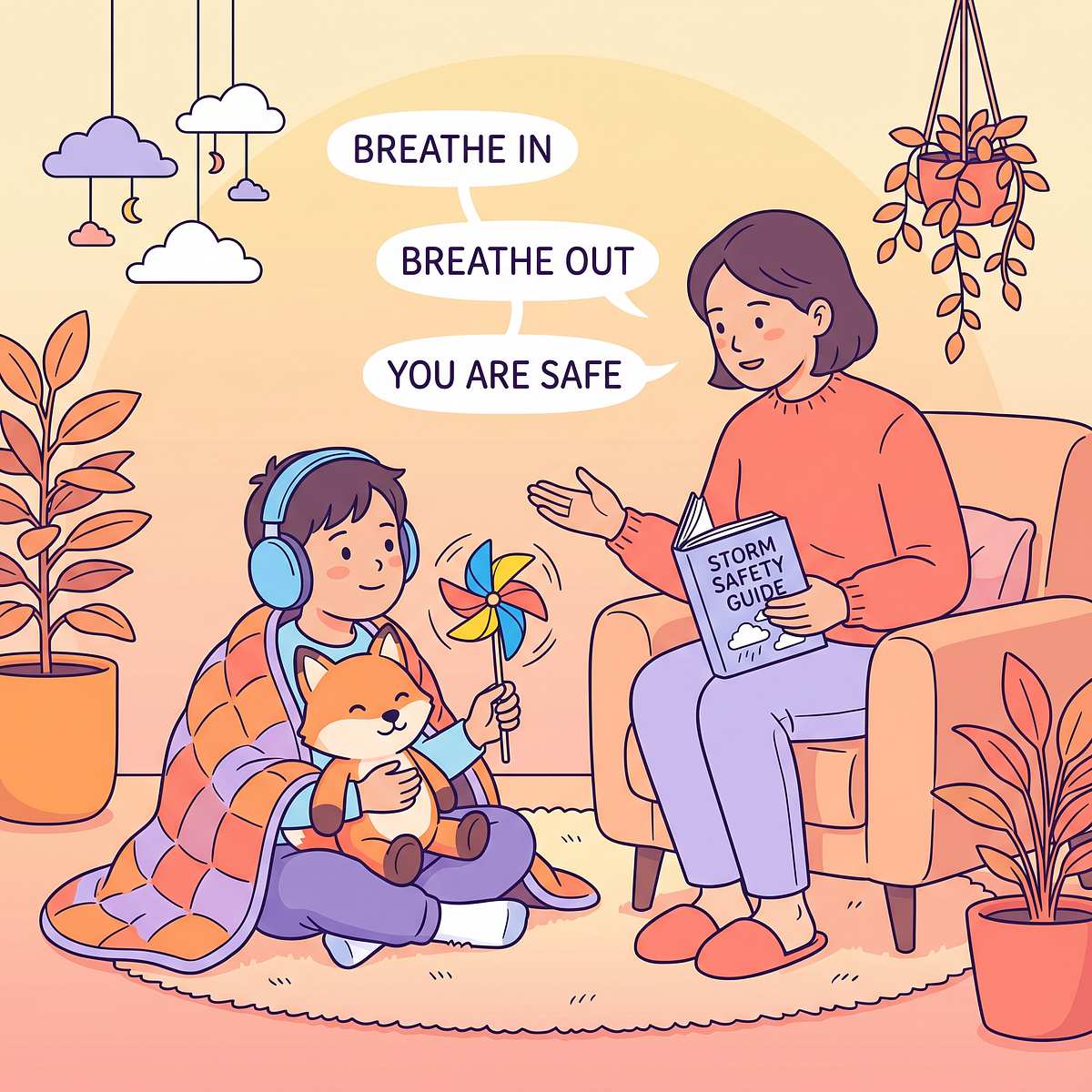
Formal name: First Day Preparation Protocol — Multi-Material Approach. Parent-friendly alias: "The Preview System" — making the unknown known before your child has to face it.
First Day Preparation is a structured, multi-material intervention system that systematically reduces a child's anticipatory anxiety about new experiences by providing concrete visual, narrative, and experiential previews before the event occurs. Rather than relying on verbal reassurance alone — which rarely penetrates neurological threat responses — the Preview System uses tangible tools to encode the upcoming experience as familiar rather than threatening.
Transition Preparation | Anxiety Management | School Readiness
3–12 years
5–14 days pre-event; 10–20 min daily sessions
Daily in the week before each first-day event

This technique crosses therapy boundaries because the brain doesn't organise by therapy type. Anxiety lives in psychology; sensory overwhelm lives in OT; social scripts live in SLP; reinforcement lives in ABA. All must converge for first-day preparation to be complete.
Designs the preparation system, writes social stories, addresses anxiety disorders, conducts exposure therapy sequencing.
Addresses sensory components of new environments, creates visual schedules, adapts materials for sensory profiles.
Simplifies language in social stories, creates communication scripts for first-day interactions.
Designs reinforcement structures, builds countdown behaviour plans, creates reward systems for preparation compliance.
Coordinates with school environments, creates teacher communication templates, builds IEP-aligned preparation protocols.
Identifies co-occurring conditions; medication and neurology considerations; medical clearance for school programmes.
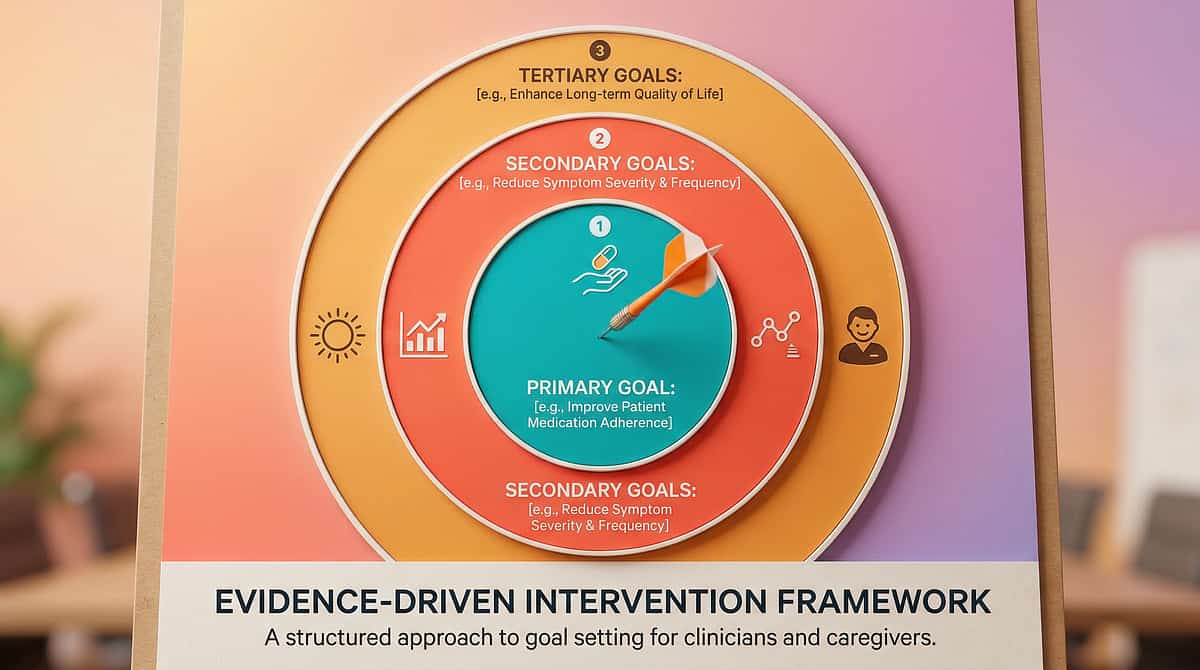
Every material targets a specific outcome. Understanding what this protocol targets helps you apply it with intention and measure progress accurately.
Anticipatory anxiety before novel first-day experiences. Observable indicators: reduced pre-event crying and meltdowns, improved sleep the night before, ability to discuss upcoming events without escalation, and successful entry into new environments.
Secondary benefits include flexible thinking, emotional regulation, social confidence, and separation tolerance. Long-term tertiary gains include generalised novelty tolerance, metacognitive awareness ("I felt nervous AND I was okay"), and neuroplastic reduction in amygdala threat-tagging.
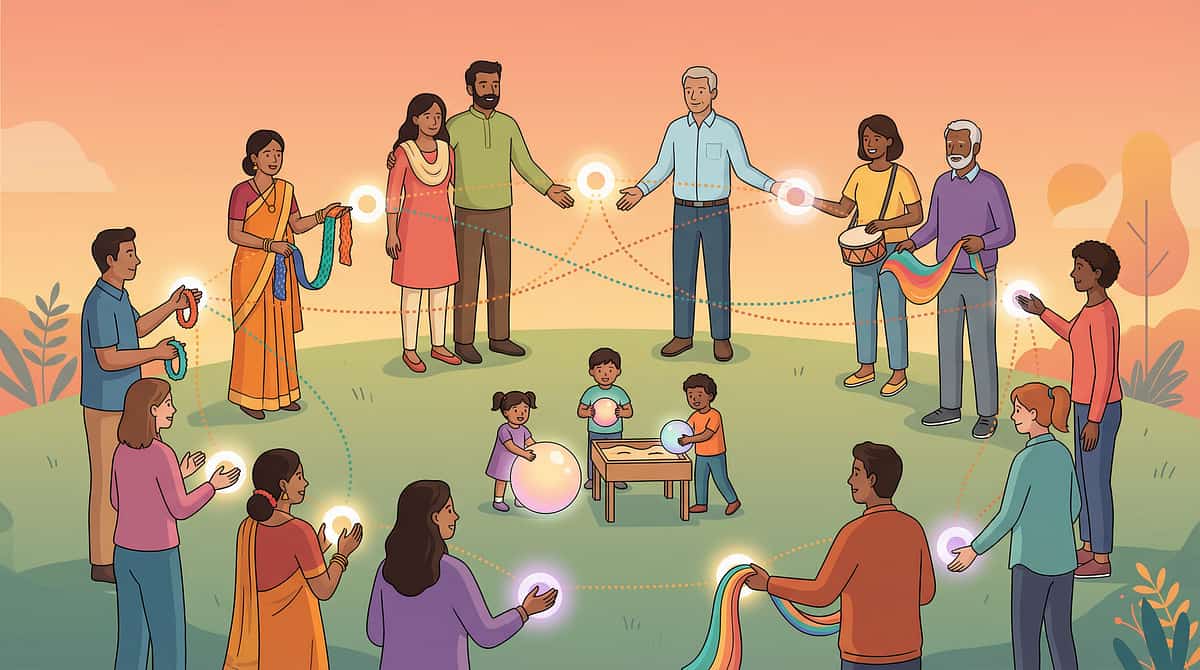
These nine materials form a complete preparation system. Used together across a preparation week, they systematically reduce anticipatory anxiety by encoding the upcoming experience as familiar. Each material is available commercially or as a free DIY version.
A short narrative describing the upcoming experience step by step, using the child's name, photos, and specific details about the actual place and people.
Actual photographs of the new location — exterior, entrance, key rooms, key people — organised in the sequence the child will experience them.
A picture-by-picture schedule showing the entire first-day sequence from waking up through returning home.
A small, meaningful object — stuffed animal, smooth stone, parent's belonging, laminated family photo — that carries the comfort of home into the unfamiliar environment.
A 5–14 day countdown where each day includes a specific preparation activity, transforming anxious waiting into purposeful action.
A ring-bound set of laminated cards, each showing one coping strategy with a picture and simple instruction: deep breaths, touch comfort object, count to 10, find the helper.
A checklist, camera, and consolidation protocol for conducting a low-stakes preview visit to the new location before the actual first day.
Props, scripts, and structured scenarios for practising the first-day experience at home — entering the building, greeting the teacher, hanging up the bag, asking for the bathroom.
Physical evidence of the "after" — photo of parent at pickup, planned celebration activity, physical reward waiting at home, reunion ritual the child knows about before they go in.
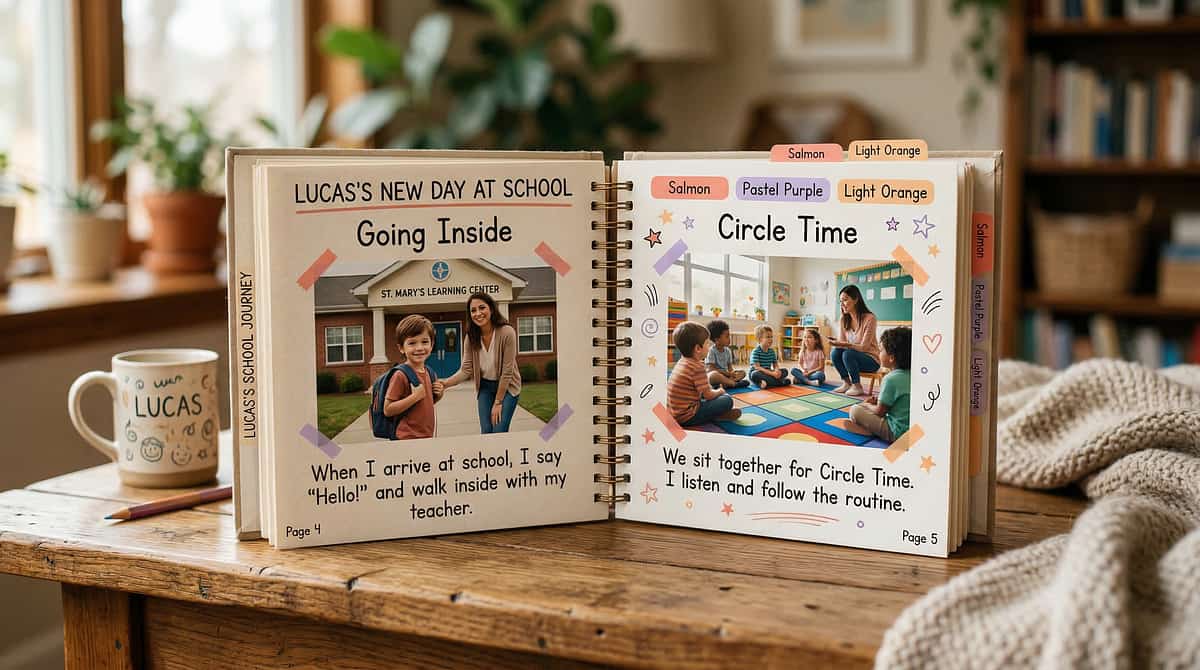
"Read the day before you live it."
A short, personalised narrative book describing the upcoming first-day experience step by step, using the child's name, photos, and specific details about the actual place and people. Each reading creates a hippocampal preview that reduces amygdala threat-tagging when the real experience occurs. The story answers every question before it can spiral.
Each reading creates a neural preview — the hippocampus encodes "I know this place" before the child ever arrives. The amygdala's "unknown = danger" signal is progressively replaced with familiarity.
Canon Category: Social Narrative Tools
Price: ₹100–500 (fully DIY)
DIY Version: Hand-drawn pages stapled together; photos printed at a local shop
Search on Amazon.in → "personalised social story book autism children"

"Every photo studied is one fewer surprise on arrival day."

Canon Category: Visual Supports
Price: ₹100–500 (DIY with phone camera + printing)
DIY Version: Photos on phone shown to child on screen
A collection of actual photographs of the new location — exterior, entrance, key rooms, key people — organised in the sequence the child will experience them on the day.
Visual recognition reduces threat response. When children recognise what they see, the amygdala's "unknown = danger" signal is replaced with "I know this place." Unlike verbal description, photographs bypass language processing and speak directly to the brain's visual recognition centres.
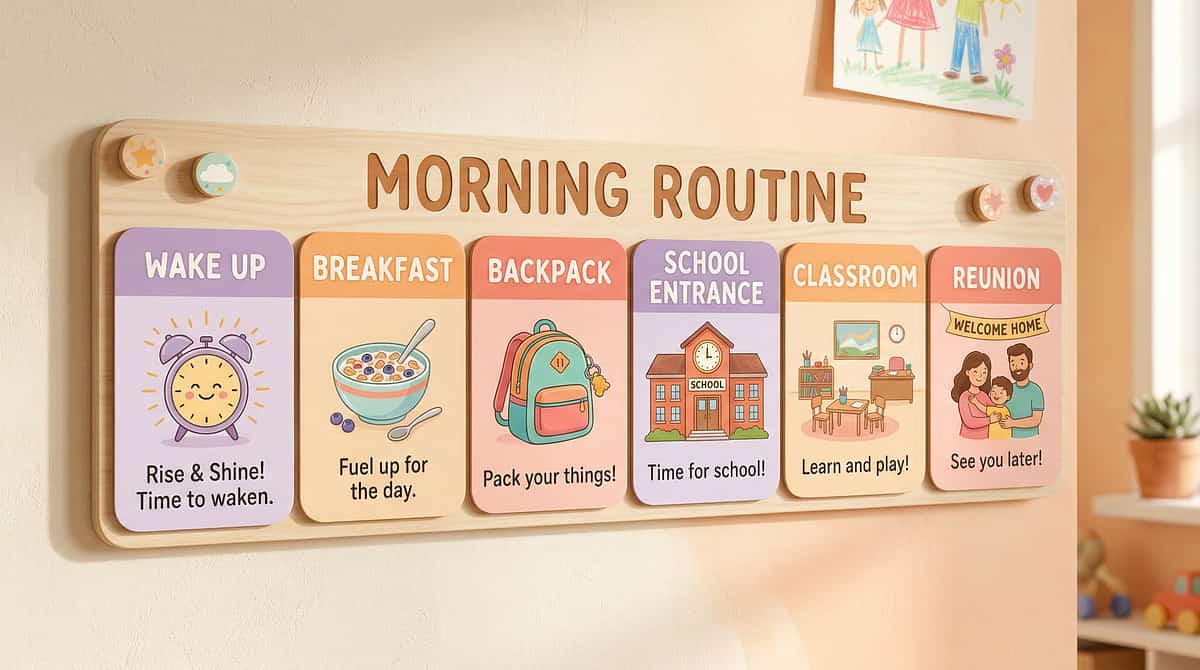
"When children can see the whole sequence, the unknown becomes a checklist."
A picture-by-picture schedule showing the entire first-day sequence from waking up through returning home, with each step represented by an icon or photo the child recognises. Anxiety asks "what happens next?" A visual schedule always has the answer. Predictability calms the nervous system in a way that verbal explanation cannot.
Special morning routine begins
Ritual packing together
Walk in — just like practice
Activities as previewed in story
Parent waiting at pickup
Canon Category: Visual Schedules | Price: ₹100–400 (DIY) | Search → "visual schedule cards children autism"

"Home in your pocket."
A small, meaningful object — stuffed animal, smooth stone, parent's belonging, laminated family photo — that carries the comfort of home into the unfamiliar environment. Prepared with meaning and ritual, the object becomes a coping tool, not just a toy.
Comfort objects maintain the felt sense of parental connection across separation. They function through parental-connection encoding — attachment research (Bowlby) confirms that transitional objects reduce separation anxiety by extending the psychological presence of the caregiver into the new space.
Once daily during preparation week:
- Parent holds comfort object
- Parent says: "I'm putting a hug in here for you. It will hold it until we're back together."
- Child receives object
- Practice: "Where will you keep it?" — child shows pocket or bag
Canon Product: Animal Soft Toys — ₹425
amzn.in/d/022Lj6Fr ← Pinnacle Canon Active SKU
DIY Version: Existing beloved toy repurposed with preparation ritual
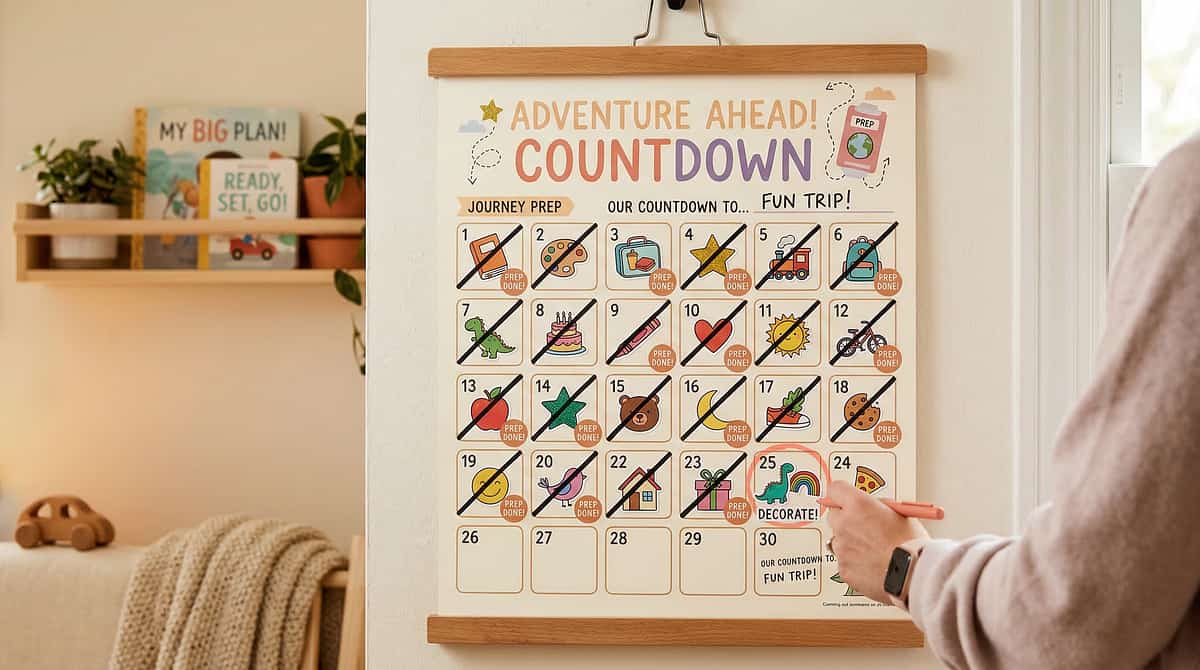
"Each day has a purpose. Preparation is progress."
A 5–14 day countdown calendar where each day includes a specific preparation activity, transforming anxious waiting into purposeful action. Structure defeats dread. When waiting has a plan, anxiety has less room to spiral. Children can see time passing and progress accumulating.
First reading of social story. Introduce photo preview book. Begin talking about the upcoming event in positive, concrete terms.
Daily story readings. Visual schedule introduction. Comfort object selection and loading ritual begins. Preview visit if possible.
Role-play practice sessions. Coping cards review. Pack bag together. Confirm reunion plan aloud with child.
Final story reading. Pack comfort object. Review visual schedule. Confirm reunion promise: exactly when, exactly where.
Special breakfast. Brief schedule review. Comfort object ritual. Brief confident goodbye. Reunion and celebration!
Canon Category: Visual Schedules / Structured Support Tools | Price: ₹100–500 (DIY: paper grid drawn by hand, stickers from stationery shop) | Search → "countdown calendar kids visual autism"
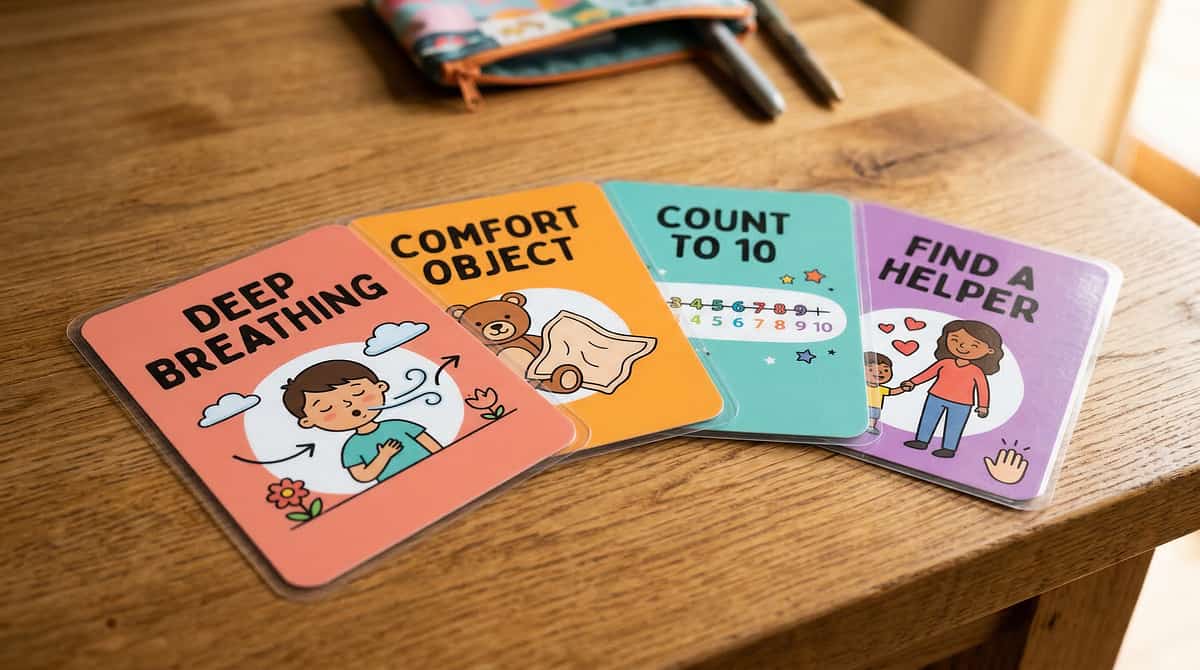
"Strategies in your pocket."
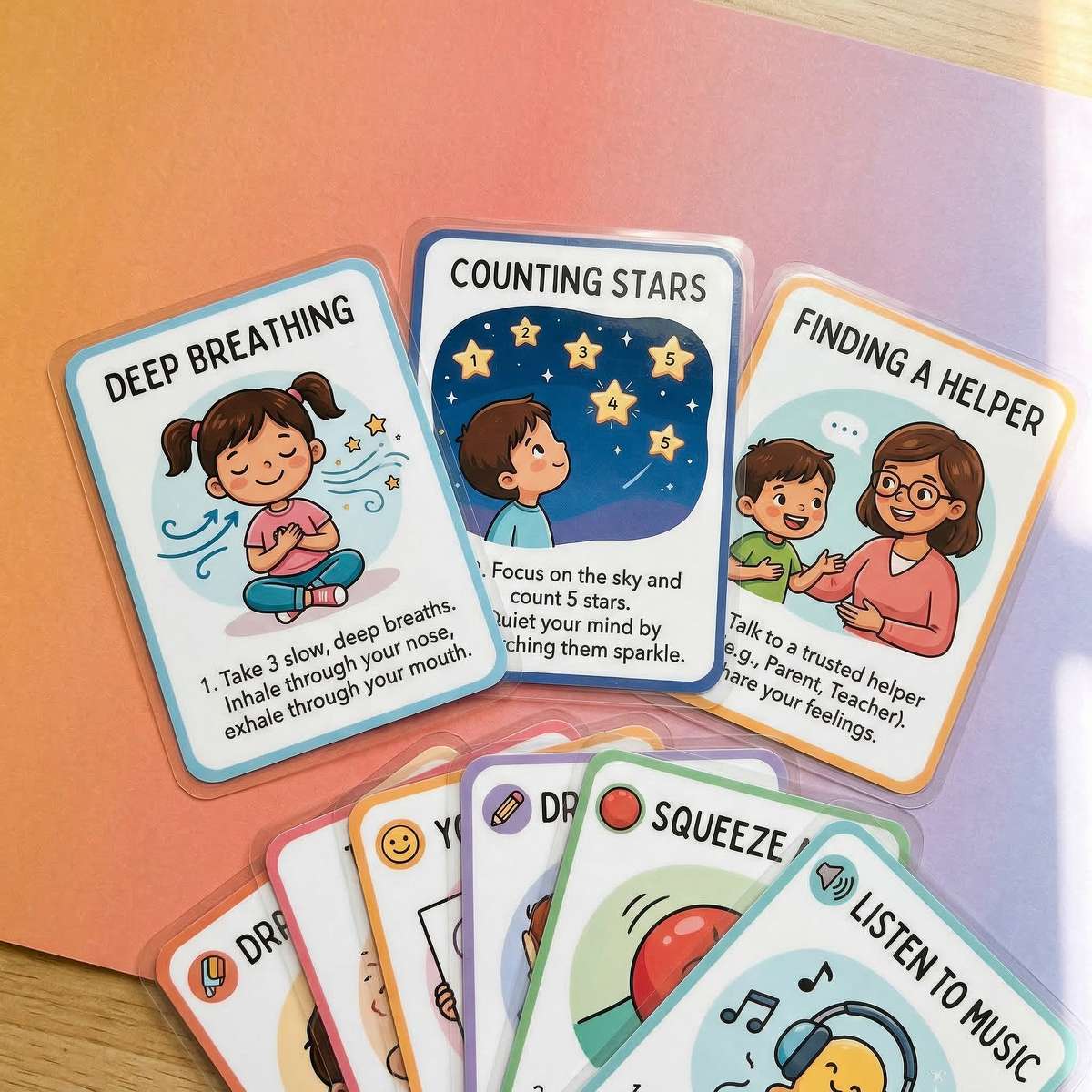
A ring-bound set of laminated cards, each showing one coping strategy with a picture and simple instruction: deep breaths, touch comfort object, count to 10, find the helper.
You can't think clearly when anxious. The card thinks for you. Externalised coping strategies are accessible even in moments of overwhelm, when the prefrontal cortex is offline and the amygdala is in full alarm mode.
- Take 3 deep breaths — picture of lungs
- Hold your comfort object — picture of the object
- Count to 10 slowly — numbers with fingers
- Find your helper — picture of the teacher/helper
- Remember: Mum/Dad is coming at [time] — photo of parent
Price: ₹50–300 (DIY: index cards with hand-drawn icons) | Search → "coping cards children anxiety laminated"
"Reconnaissance reduces fear."
A checklist, camera, and consolidation protocol for conducting a low-stakes preview visit to the new location before the actual first day. The second time somewhere never feels as scary as the first. A preview visit makes the first day technically the second visit.
Contact the school/centre/camp: "Transitions are challenging for my child. Could we visit briefly before the first day? Even 15 minutes would help significantly."
- Follow child's pace — no rushing
- Take photos of everything for the photo preview book
- Introduce child to at least one key person
- Let child explore without demands
- Identify "safe anchor points" — bag hook, bathroom, parent waiting area
When in-person isn't possible:
- Request a video walkthrough from the centre
- Use Google Maps Street View for the exterior
- Video call with key staff so child sees their face
- Review centre's website photos together
Canon Category: Environmental Preparation Tools
Price: ₹0–500 (mostly time investment)

"Rehearse at home. Perform with confidence."
Props, scripts, and structured scenarios for practising the first-day experience at home — entering the building, greeting the teacher, hanging up the bag, asking for the bathroom. By the real first day, the child has already "lived" the experience in practice. Rehearsal reduces cognitive load and builds competence that travels to the real event.
Use household furniture to recreate the classroom or centre layout. Parent wears a paper name-tag as "Teacher"/"Coach"/Instructor.
"Good morning! I'm [name]. Can you find your spot?" Child enters, finds designated spot. "You did it! Put your bag on the hook just like this."
Entering the building, greeting the teacher, sitting in assigned spot, unpacking bag, asking for the bathroom, using coping strategy cards.
For highly anxious children: use stuffed animals to act out the story first. Child controls the narrative from a safe distance before embodying it directly.
Canon Category: Social Skills Practice Tools | Price: ₹0–500 (creative household setup)
"The 'after' that makes 'during' possible."
Physical evidence of the "after" — a photo of the parent at pickup, a planned celebration activity, a physical reward waiting at home, and a reunion ritual the child knows about before they go in.
Children survive the hard middle by holding onto the positive ending. When children can see the reunion, they can endure the anxious entry. The reunion kit transforms the narrative from "I'm being left" to "I'm going on a journey that ends in something wonderful."
"After [swim lessons], we're going to [planned celebration]. I have something special waiting for you at home. You're going to walk out and I'll be right there. Want to see what we're doing after?"
Canon Product: The Rosette Imprint Reward Jar — ₹589
amzn.in/d/02C5R9Jn ← Pinnacle Canon Active SKU

The therapeutic principle is not in the material itself — it's in the preparation process. A hand-drawn social story read daily is as neurologically effective as a printed one. What matters is the ritual, repetition, and relationship.
Material | Commercial Version | ₹0 Home Version |
Social Story Book | Printed & bound (₹200–500) | Hand-drawn pages stapled; photos printed at local shop |
Photo Preview | Laminated album (₹200) | Photos on phone shown on screen |
Visual Schedule | Laminated card set with Velcro (₹200–400) | Drawn icons on paper squares, sticky-taped to wall |
Comfort Object | Animal soft toy ₹425 | Existing beloved toy repurposed with ritual |
Countdown Calendar | Printed & decorated (₹100–200) | Paper grid drawn by hand; stickers from stationery |
Coping Cards | Laminated ring cards (₹100–300) | Index cards with hand-drawn icons |
Preview Visit | Transportation cost only | Video call tour; Google Maps Street View |
Role-Play | Props and costumes (₹200–500) | Household chairs; parent wears paper name-tag |
Reunion Kit | Reward jar + items (₹500+) | Verbal promise + child's favourite simple treat |
Safety-first is a core principle of home-based intervention. Use the traffic-light system below before starting any preparation sessions.
- Child has a diagnosed anxiety disorder with current clinical treatment — coordinate first
- Child shows extreme avoidance of ALL preparation materials (refusing to look, destroying story books)
- First-day failures have resulted in physical safety incidents
- Child has been recently traumatised in a new environment — trauma-sensitive approach required
- Child becomes more anxious after viewing photo previews — start with 1 photo at a time
- Countdown calendar increases rather than decreases anxiety — reduce window to 2 days
- Role-play practice causes distress — switch to indirect play with stuffed animals
- Child is medically well (no fever, not overtired, not hungry)
- Child is in a regulated, calm state for preparation sessions
- Preparation is happening days before the event, not the morning of
- You have a plan if the actual first day is still difficult
The environment in which you prepare is as important as the materials you use. Sensory integration theory and clinical evidence both confirm that environmental setup is a core variable in intervention effectiveness.
Warm and soft — avoid harsh overhead fluorescents that increase sensory arousal. Natural light preferred.
Quiet. No TV or background noise. Some children benefit from very soft instrumental music — test beforehand.
When the child is most regulated — typically mid-morning or mid-afternoon. NOT immediately after school or during other transitions.
10–20 minutes maximum per session. Quality over quantity. Always end on success, not exhaustion.
Comfortable seating in a familiar corner — bean bag, floor cushion, or preferred chair. Consistent setup signals "this is preparation time."
Adjacent, not across. Side-by-side signals collaboration, not evaluation. This is a discovery session, not an assessment.
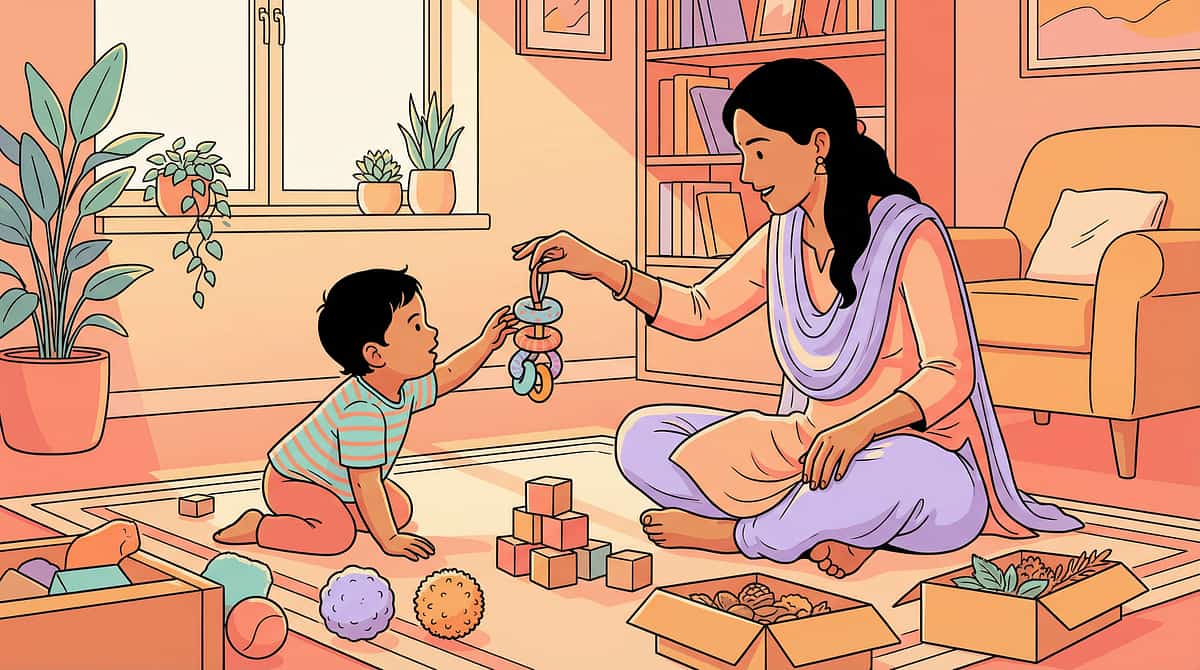
The best preparation session is one that starts right. A shortened session on a good day outperforms a full session on a hard day. Run this quick check before every session.
Indicator | ✅ Go | ⚠️ Modify | 🛑 Postpone |
Hunger / Thirst | Fed within 2 hours | Mildly hungry — quick snack first | Very hungry — meet need first |
Sleep | Well-rested | Slightly tired — shorten session | Overtired — skip today |
Physical State | Healthy, no complaints | Mild cold — brief session | Fever, illness — postpone |
Emotional State | Calm, neutral, or curious | Mildly upset — start with comfort | Actively distressed — regulate first |
Recent Meltdown | None in last 2 hours | Mild upset that resolved | Recent severe meltdown — skip today |
Begin preparation session as planned
Shorter session (5 mins), single material only, no demands
Alternative calm activity today; preparation continues tomorrow

The social story should be the first material introduced. It provides the narrative framework that all other materials support.
"I want to show you something special about [swim lessons / school / camp]. Can we sit together for a few minutes and look at this together?"
- Sit beside the child, not across — collaborative, not instructional
- Hold the material loosely — don't push it toward the child
- Warm tone, moderate volume — not artificially excited
Timing: 2–5 minutes for first introduction. End before child disengages.
Acceptance cues: Eye contact or glance at materials; questions about content; neutral tolerance (looking away but not leaving); physical movement toward materials.
Resistance cues:
- Trying to leave the space: Pause, don't pursue — try again tomorrow
- Covering eyes or ears: Reduce scope; start with single page
- Crying: Stop session, provide comfort, reassess tomorrow
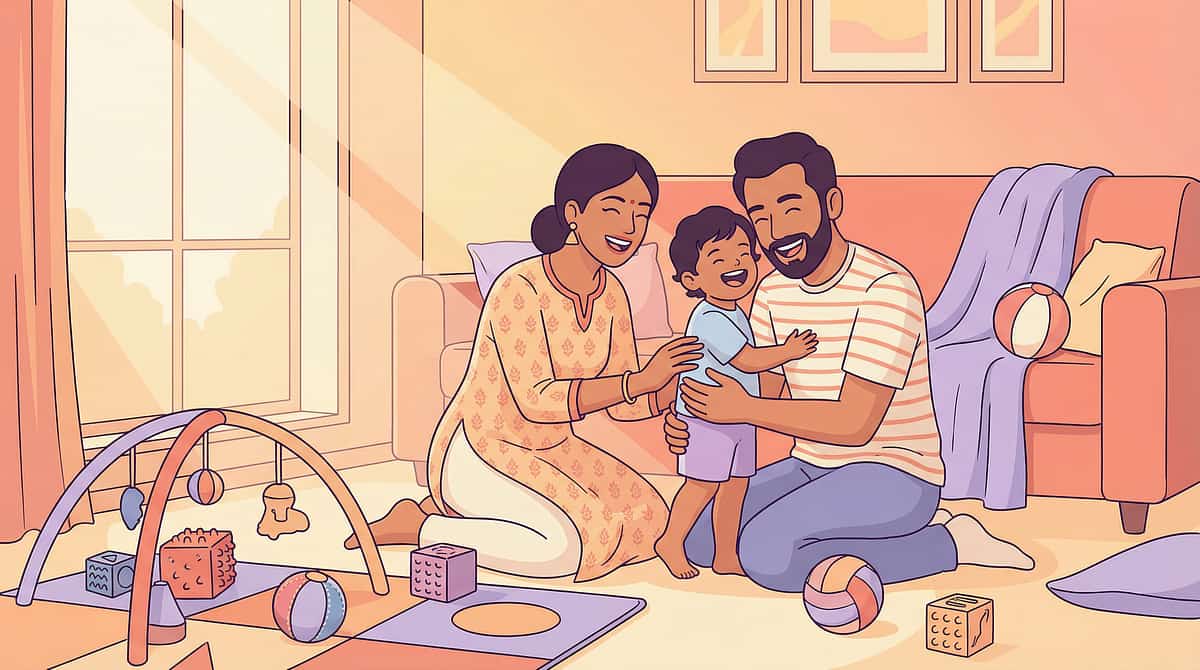
Over days 2–4, progressively introduce all 9 materials. Any engagement with preparation materials deserves immediate, specific praise: "I love that you read that page. You're getting ready like a pro."
Social story (second reading) + Photo preview book introduced: "This is the building you'll walk into. Here's the door. Here's where you'll put your bag."
Visual first-day schedule + Countdown calendar check-off: "This is your day, step by step. See? School, then home, then dinner with us."
Comfort object selection + Coping strategy cards practised together: "This is your brave buddy. When you feel nervous, hold it and remember I'm waiting for you."
Child's Response | Meaning | Action |
Requesting to see materials again | Strong engagement, building familiarity | Allow repeat readings freely |
Adding to or correcting the story | Active cognitive engagement | Celebrate and incorporate their additions |
Quiet tolerance | Passive engagement — neural preview still occurring | Continue; don't demand active response |
"What if" questions about the event | Anxiety processing — important, not problematic | Answer concretely from the story; add worries to the social story |
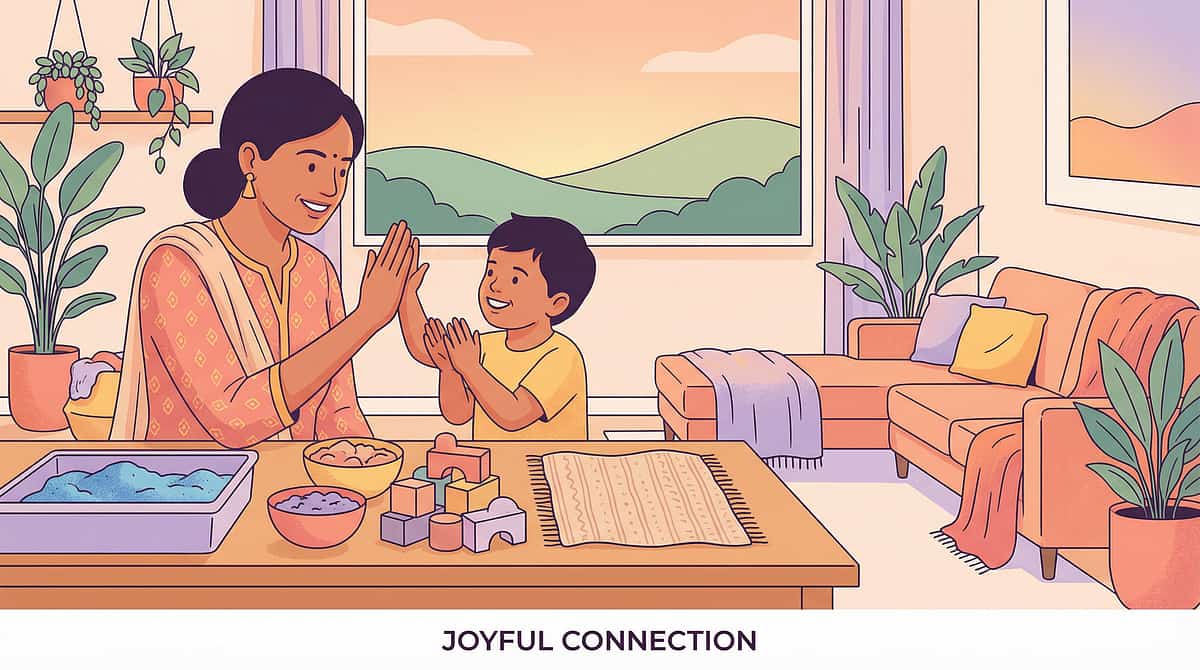

"Transitions are challenging for my child. Could we visit briefly before the first day? Even 15 minutes would help significantly."
- Follow child's pace — no rushing
- Take photos of everything for the photo preview book
- Introduce child to at least one key person
- Let child explore without demands
- Identify "safe anchor points" — bag hook, bathroom, parent waiting area
Set up a home version of the first-day location using available furniture. Parent wears a paper name-tag. Child practises: entering, greeting, sitting, unpacking bag, asking for the bathroom using actual items from the first day (real backpack, lunchbox, comfort object).
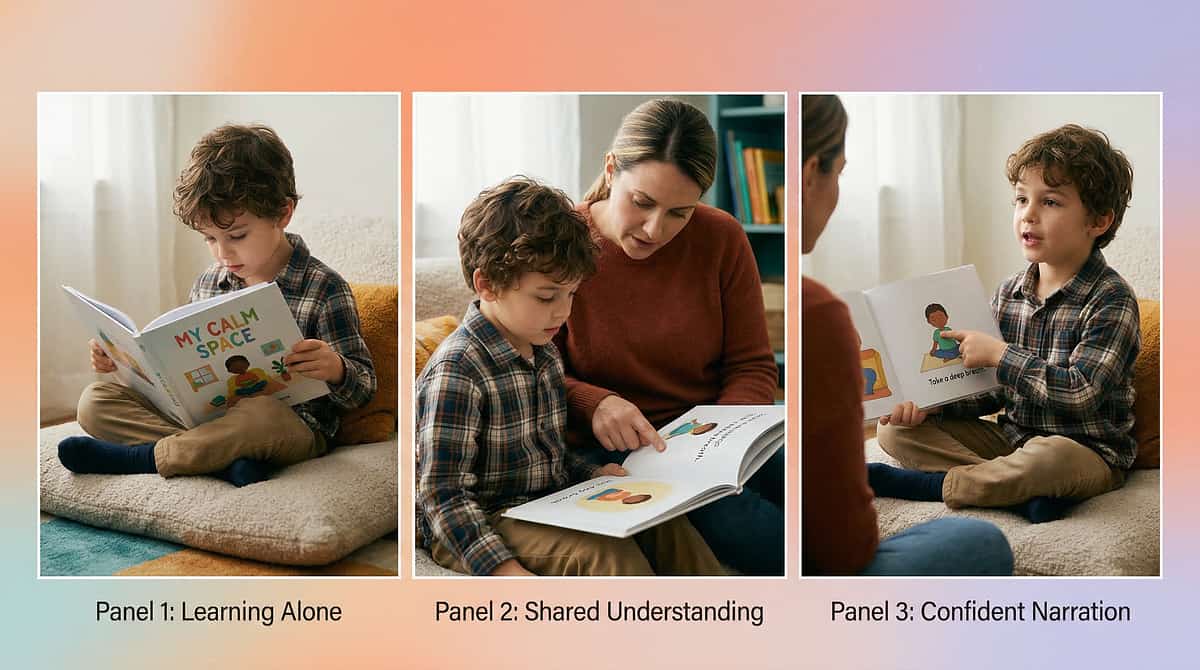
"3 engaged readings are worth more than 10 forced ones."
2–3 readings per day in the week before the event
1 review per day — can be child-initiated, not parent-forced
Visible daily — child checks it independently when they want
- Ask the child to predict the next page before turning
- Let the child point out details they notice in photos
- Role-play variations: "What if you feel nervous when you arrive? What does the story say to do?"
- Ask the child to teach a stuffed animal the story: "Show teddy what to do on first day"
- Finishing materials independently without engagement
- Requesting to do something else
- Sighing, yawning, or drifting attention
- Successfully narrating the event from memory (mastery achieved for that element)
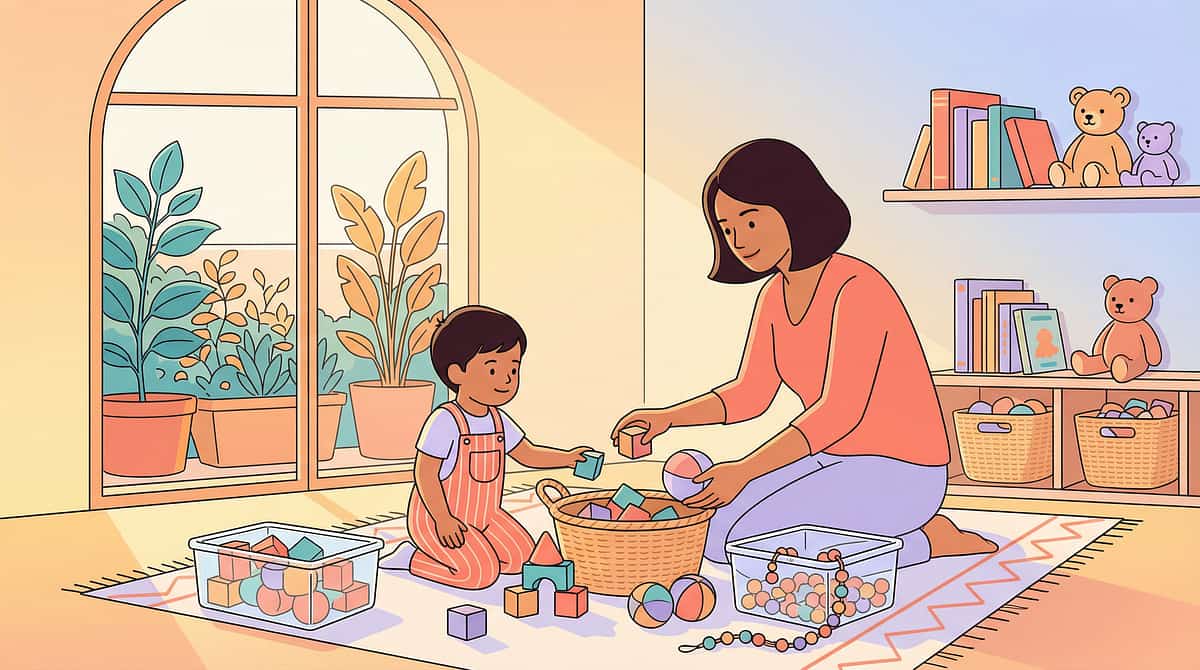
The goal is to build a child who engages willingly with preparation materials — today, and for every future first day. That requires reinforcing the preparation process itself, not just the eventual first-day outcome.
Behaviour | Reinforcement Script |
Sat down for preparation session | "I noticed you came right over. That shows you're getting ready. That's brave." |
Read the social story page | "You read that! You know exactly where the bag goes now." |
Practised comfort object retrieval | "You found it so fast! You're going to be able to do that on the first day." |
Role-played entering the building | "You walked right in! That's exactly what you'll do." |
Added comfort object to their bag | "It's packed. You're ready." |
Specific, immediate, genuine
One per preparation day completed
Small reward after each practice role-play
10 minutes preferred activity following session
High-five, special handshake, or hug
The Rosette Imprint Reward Jar (₹589):amzn.in/d/02C5R9Jn — Use as the visual holding place for preparation achievement tokens, one token per session completed.
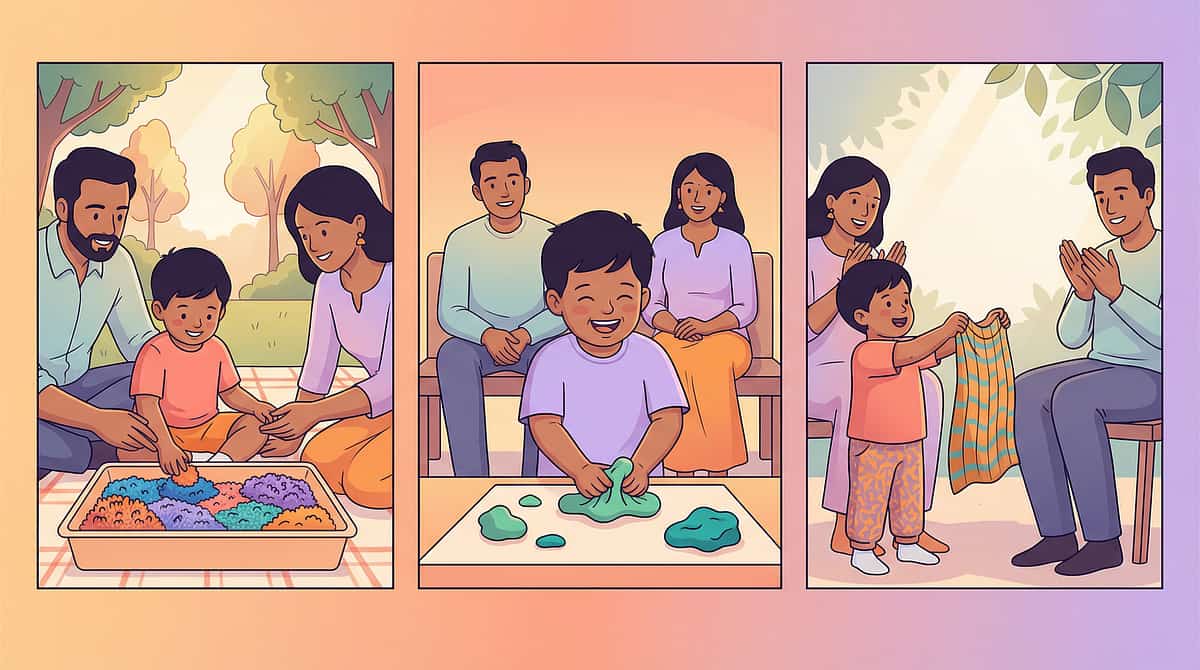
How you end the preparation session determines how the next one begins.
This consistent 2-minute closing ritual signals the end of preparation time and gives the child agency in the transition out of the session.
- Special breakfast (something child loves — signals this day matters)
- Brief review of visual schedule (2 minutes, not a full session)
- Comfort object ritual: loading and packing together
- Review coping cards: "Which one will you use if you feel nervous?"
- Review reunion promise: "I will be right at [location] at [time]."
- Confident, warm, BRIEF goodbye: "I'll see you at [time]. You're ready."
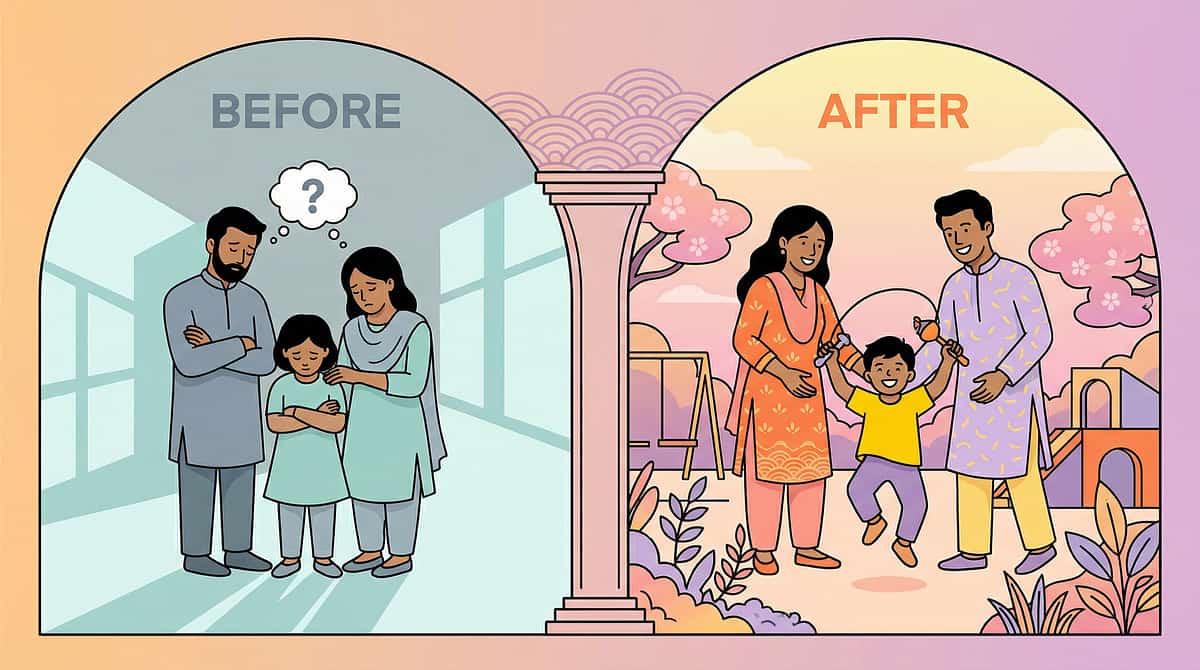
Record these four data points after each first-day event. This data teaches GPT-OS® to give your child better recommendations with every iteration.
How consistently and willingly did your child engage with preparation materials this week? 1 = Refused most sessions | 3 = Tolerated with support | 5 = Engaged willingly, used independently
How was the actual first-day entry moment? 1 = Could not enter / required physical carry | 3 = Entered with support and tears | 5 = Entered with manageable nervousness
How long did it take the child to settle after arrival? <5 min | 5–15 min | 15–30 min | >30 min | Did not settle
Social Story | Photo Preview | Visual Schedule | Comfort Object | Countdown Calendar | Coping Cards | Preview Visit | Role-Play | Reunion Kit

Troubleshooting is a normal part of the preparation process. Use this guide when sessions or first days don't go as planned.
Why: Story may be too text-heavy or introduced too close to the event. Fix: Reduce to 3–5 pages. Use only photos. Read the final "I came home safe" page FIRST.
Why: Photos surfaced unknown fears — information is dose-dependent. Fix: Start with one photo per day. Begin with the most comforting photo (reunion/home image).
Why: Direct role-play may be too close to the feared experience. Fix: Switch to indirect role-play — use stuffed animals to act out the experience. Child controls narrative from a distance.
Why: Preparation reduces distress — it may not eliminate it on the first iteration. Fix: This is a partial success. How long did the meltdown last? Was entry possible? Compare to unprepared first days. Preparation is a trajectory, not a single event.
Why: Some children have heightened time awareness — countdowns feel like a ticking threat. Fix: Remove time-awareness element. Switch to "soon" without numbers. Focus on preparation activities only.
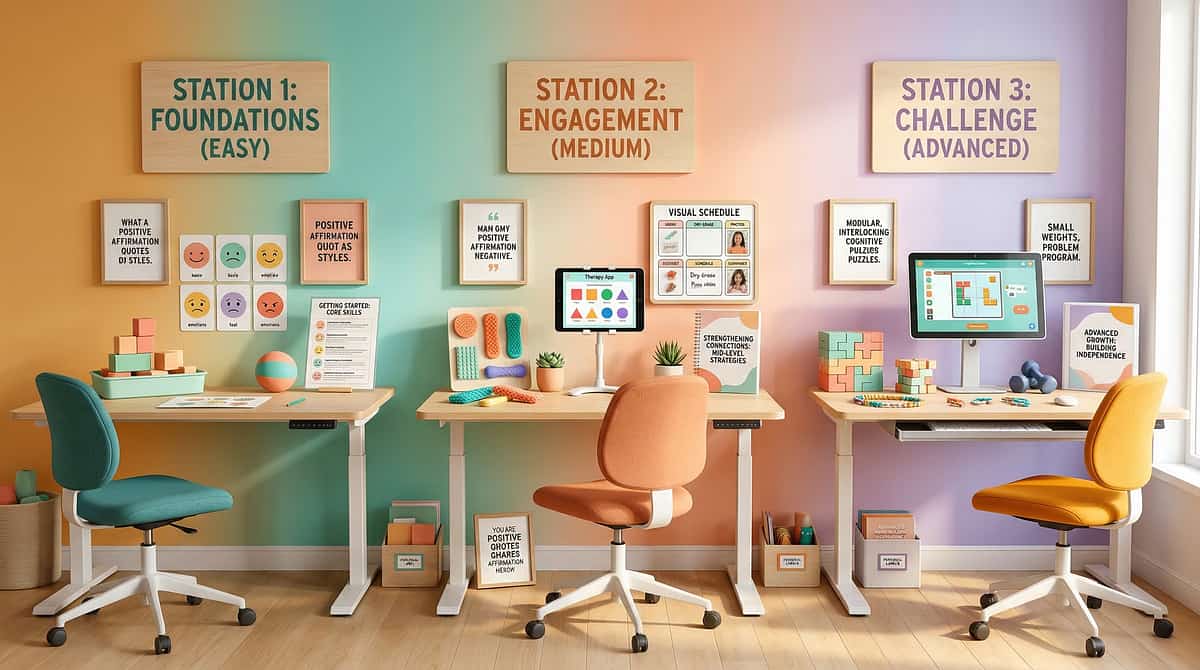
One-size-fits-all preparation protocols demonstrate lower effectiveness than profiled approaches. Use this guide to calibrate the system to your child's specific profile.
Highly detailed stories with specific information. Use actual photos, not clip art. Extended preparation timeline. Consistent format across ALL future first days — build a preparation ritual that itself becomes familiar. Address sensory specifics in the story (sounds, smells, textures of the new space).
Emphasise coping strategies and the reunion ending more than environment details. Include explicit acknowledgment of nervousness: "I might feel nervous. That's okay. Nervous feelings don't last forever." Gradual exposure sequencing recommended — review with treating psychologist.
Prioritise sensory preview information — what will the space FEEL like (sounds, lighting, smell, crowd level). Coping tools should include sensory-specific strategies: earplugs, sunglasses, or a small sensory tool in pocket.
Simpler language (3-word sentences). More photos, fewer words. Shorter sessions (5–7 minutes). More repetitions over more days. Comfort object is essential, not optional.
More autonomy — let them choose which materials to use. Discrete comfort items (bracelet, key chain) rather than visible stuffed animals. Let them write/draw their own coping cards. Preview visit independently photographed by child.

Week 1–2 is the hardest for parents. You've done all the preparation work and the first day was still difficult. This is not a failure of the preparation — it's the first data point. The comparison is not with neurotypical peers; it's with your child's previous unprepared first days.
Child engages with social story for 3 minutes (was refusing before) | Child can name 2 details about the upcoming event | Child sleeps through the night before the event | First-day entry happens, even if difficult | Meltdown on first day was shorter than previous unprepared first days | Child used one coping strategy independently
Child walking in happily and effortlessly | Nervousness eliminated (some is healthy) | Generalisation to all new first days without preparation | Independence from preparation materials
"If your child entered the building — that may already be progress over last time. That counts."

You may notice that you are more confident, too. Parents who have implemented one full preparation week report increased efficacy and reduced anticipatory anxiety about their child's first days. Your preparation confidence transmits to your child.
Child asks for the social story independently, without being prompted. This is neural encoding working.
Fewer "what if" questions. The unknown has been sufficiently previewed and the hippocampus has its reference memories.
Child retrieves comfort object during preparation without being reminded — it's become a self-initiated coping tool.
Child begins to add creative elements, correct "mistakes" in parent's performance, or request to do it again.
Night-before sleep disruption reduces — the nervous system is less flooded by the unknown.
Even if distress at entry is similar, the child regulates faster after arrival. Duration of distress is a key metric.

Child asks to "do the story" before an upcoming first day without parent prompting.
Child decides when to use it and when they don't need it — autonomous coping.
Child enters independently with verbal support only, or less.
Even with nervousness, child settles significantly faster than baseline.
Child can identify something that went well on the first day.
Preparation system begins applying to contexts other than the originally trained event.
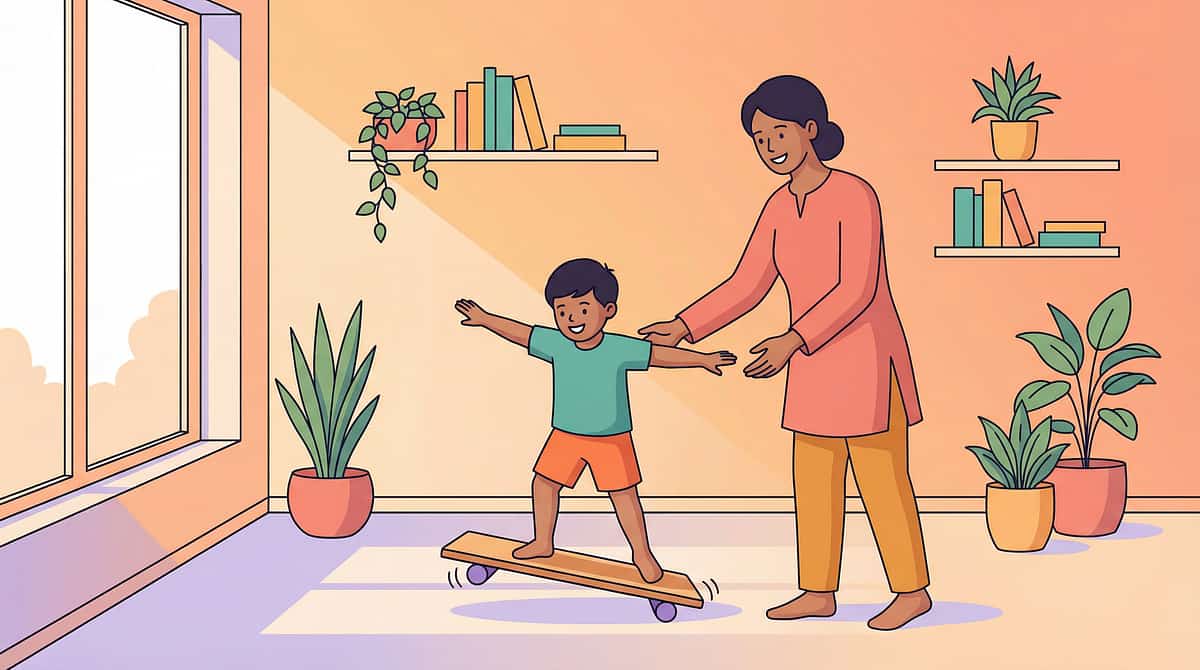
You spent one to eight weeks learning, creating, practising, and showing up — for a child who couldn't tell you in words how much your preparation meant. You translated their fear into your action. You turned "I can't go in there" into "I know this place." That is clinical-grade parenting.
Through the First Day Preparation Protocol (H-702), your child acquired a system for approaching new experiences rather than only fearing them, built a library of preparation tools they will use for the rest of their life, and gained one memory of managed nervousness — the foundation of resilience.
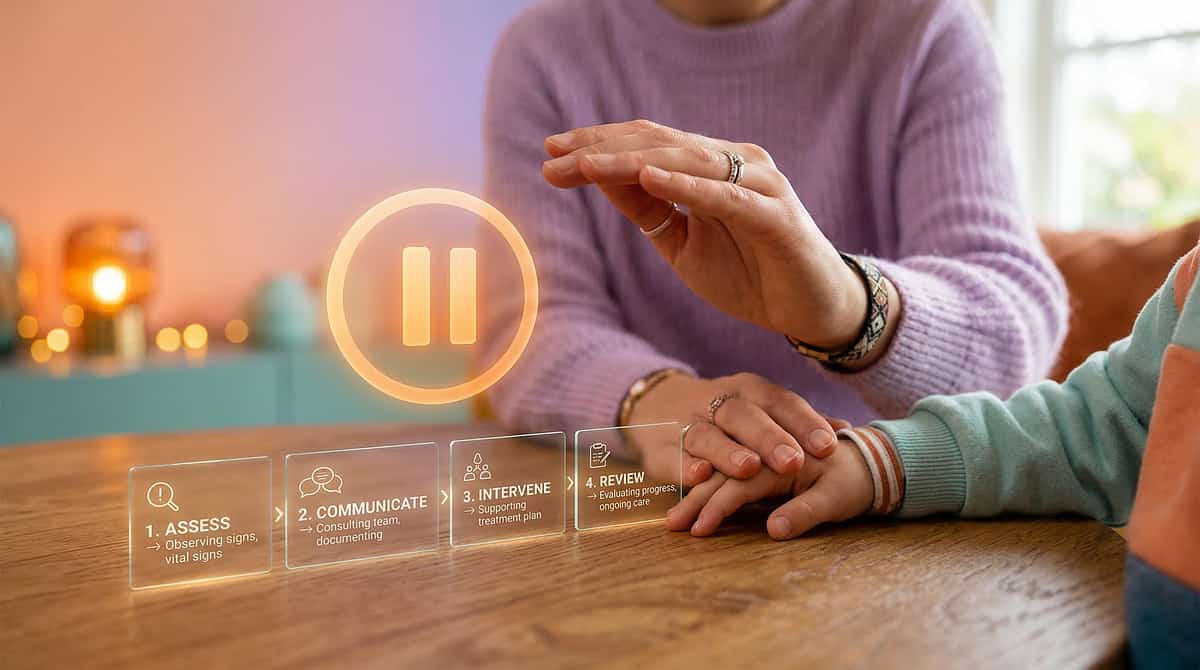
Red flags can emerge even after successful early progress. Knowing when to pause and seek professional support is a sign of good clinical judgment, not failure.
- Preparation materials are now triggering MORE distress than before
- No improvement trajectory after multiple weeks of thorough preparation
- Child developing new avoidance (refusing to leave the house, refusing all new activities)
- Anxiety expanding beyond first days into daily functioning (school refusal, constant separation distress)
- Vomiting, severe stomach aches, or headaches consistently before anticipated events
- Sleep disruption lasting more than 3 weeks despite preparation
- Parent is exhausted or experiencing secondary anxiety and unable to sustain protocol
- Siblings are being significantly impacted by anxiety focus in the household
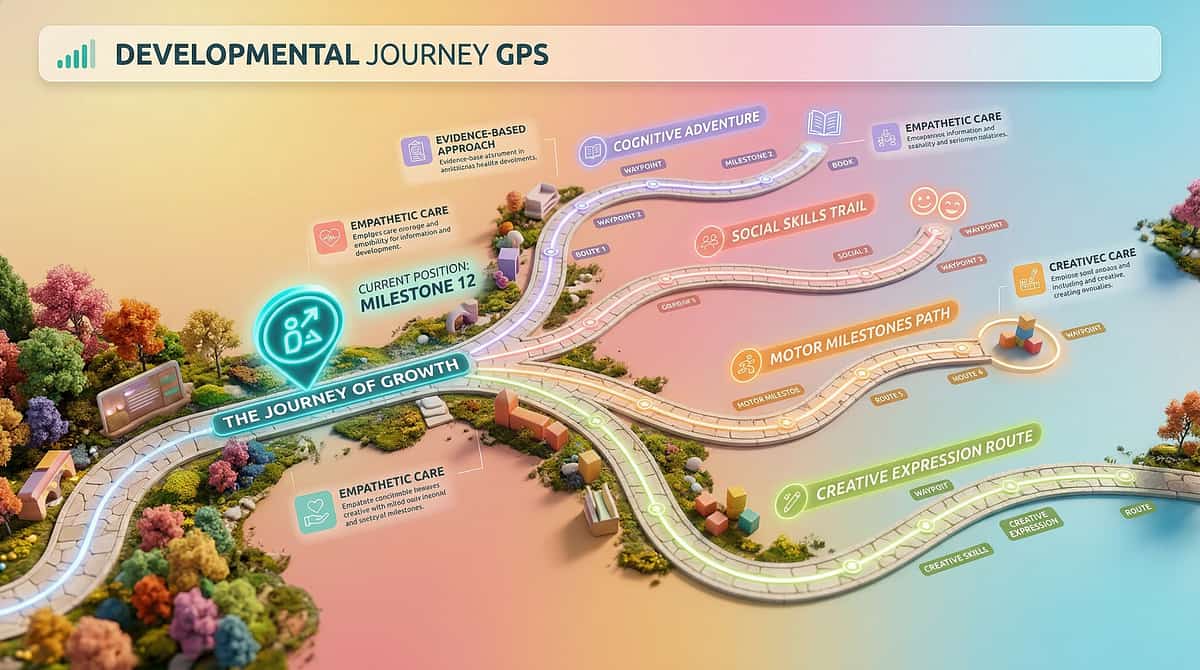
H-702 is one technique in a structured pathway. Your child's response profile determines which path to take next.
Understanding Transition Anxiety — the neurological foundation
Building Flexibility Skills — tolerance for change in controlled contexts
First Day Preparation Protocol — systematic preparation for novel first-day experiences
Daily Routine Transitions — for children who've mastered first-day preparation
Advance to H-703: Daily Routine Transitions — for children who've generalised across multiple first-day contexts
Repeat H-702 across 3 different first-day contexts before progressing — for children showing improvement but not yet generalised
H-710: School Morning Routines — if the primary challenge is the home-to-school transition specifically
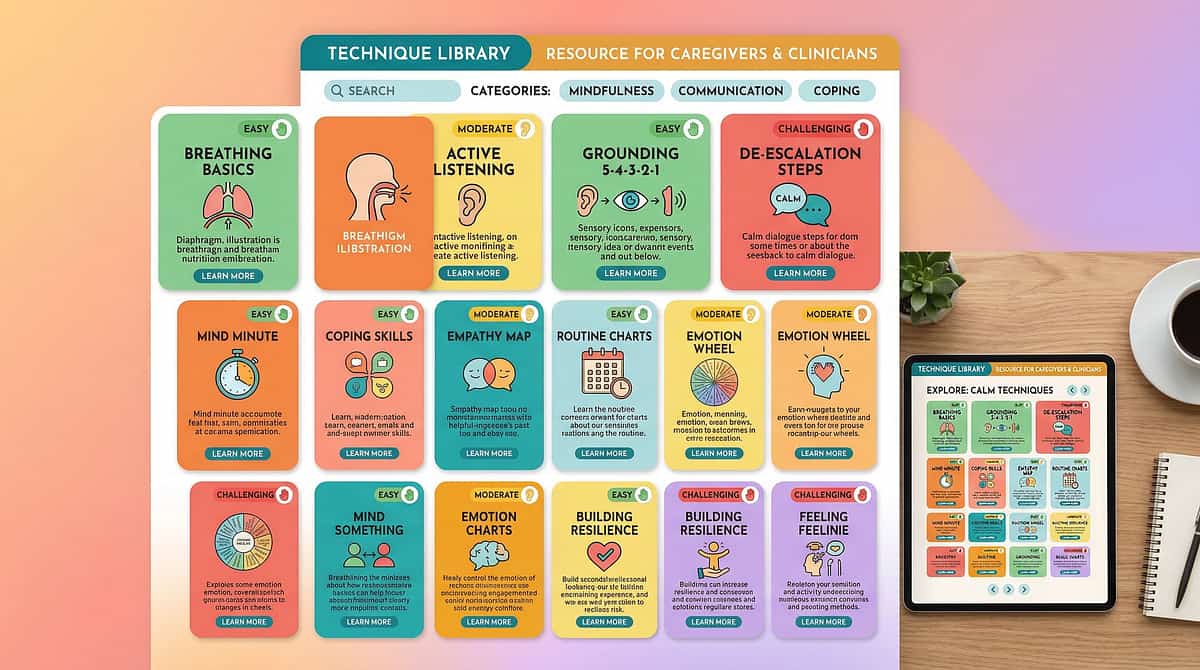
"You already own materials for 4 of 6 related techniques." Your H-702 investment multiplies across the entire domain.
Technique | Level | Domain | Materials You Already Have |
H-700: Understanding Transition Anxiety | 🟢 Intro | Anxiety Education | ✅ None needed |
H-701: Building Flexibility Skills | 🟡 Core | Transition Tolerance | ✅ Most from H-702 |
H-703: Daily Routine Transitions | 🟡 Core | Daily Structure | ✅ Visual schedules |
H-710: School Morning Routines | 🟡 Core | School Readiness | ✅ Most from H-702 |
H-720: Separation Anxiety Management | 🔴 Advanced | Attachment/Anxiety | ✅ Comfort object |
H-730: Adaptability & Flexibility | 🔴 Advanced | Cognitive Flexibility | ✅ Coping cards |
Preview of 9 materials that help with first day preparation Therapy Material
Below is a visual preview of 9 materials that help with first day preparation therapy material. The pages shown help educators, therapists, and caregivers understand the structure and content of the resource before use. Materials should be used under appropriate professional guidance.


These vignettes reflect aggregate clinical outcomes from the Pinnacle Blooms Network®. Individual results vary by child profile, preparation consistency, and environmental cooperation.
"For his new school this year, we spent a week preparing with the actual materials. Social story, photo preview, practice routine at home, coping cards — the whole system. He still had butterflies on the first morning, but he walked in holding his comfort object, knew exactly where to go, and made it through the day. He came out tired but not traumatised. He said: 'It was just like the story.' That one sentence — after years of first-day disasters — that was everything."
"She screamed for 45 minutes at the entrance to her first swimming lesson. We never made it to the pool. The second swimming class — first one with preparation — she walked in. Not happily, but she walked in. She held her bracelet during the water entry. By the third class, she was in the pool. I can't describe what it feels like to watch her swim now."
The child's sentence "It was just like the story" reflects successful hippocampal encoding: the preview had become a memory reference. — Behavioural Therapist, Pinnacle Network
Child Psychologist: Primary for anxiety disorders and protocol design
OT: When sensory environment factors are primary
ABA/Behaviour Analyst: When compliance with preparation is the barrier
Special Educator: When school-specific coordination is needed
📞In-Person:pinnacleblooms.org/centres
📱Teleconsult:pinnacleblooms.org/
🆓FREE Helpline: 9100 181 181 | 16+ languages | 24×7
Your child's next first day is coming. The preparation window opens now. Every day of preparation before that event is a day of neural preview your child's brain will use on the day.
From fear to mastery. One technique at a time.
— The Pinnacle Blooms Consortium
© 2025–2026 Pinnacle Blooms Network® | Unit of Bharath Healthcare Laboratories Pvt. Ltd. | CIN: U74999TG2016PTC113063 | DPIIT: DIPP8651 | GSTIN: 36AAGCB9722P1Z2 | care@pinnacleblooms.org
This content is educational in nature. It does not replace individualised assessment and intervention from licensed professionals. Severe transition anxiety may indicate underlying conditions requiring comprehensive evaluation.
Evidence-based tools for children with autism, anxiety, and sensory differences — making the unknown known before your child has to face it. Powered by GPT-OS® | Pinnacle Blooms Network®