
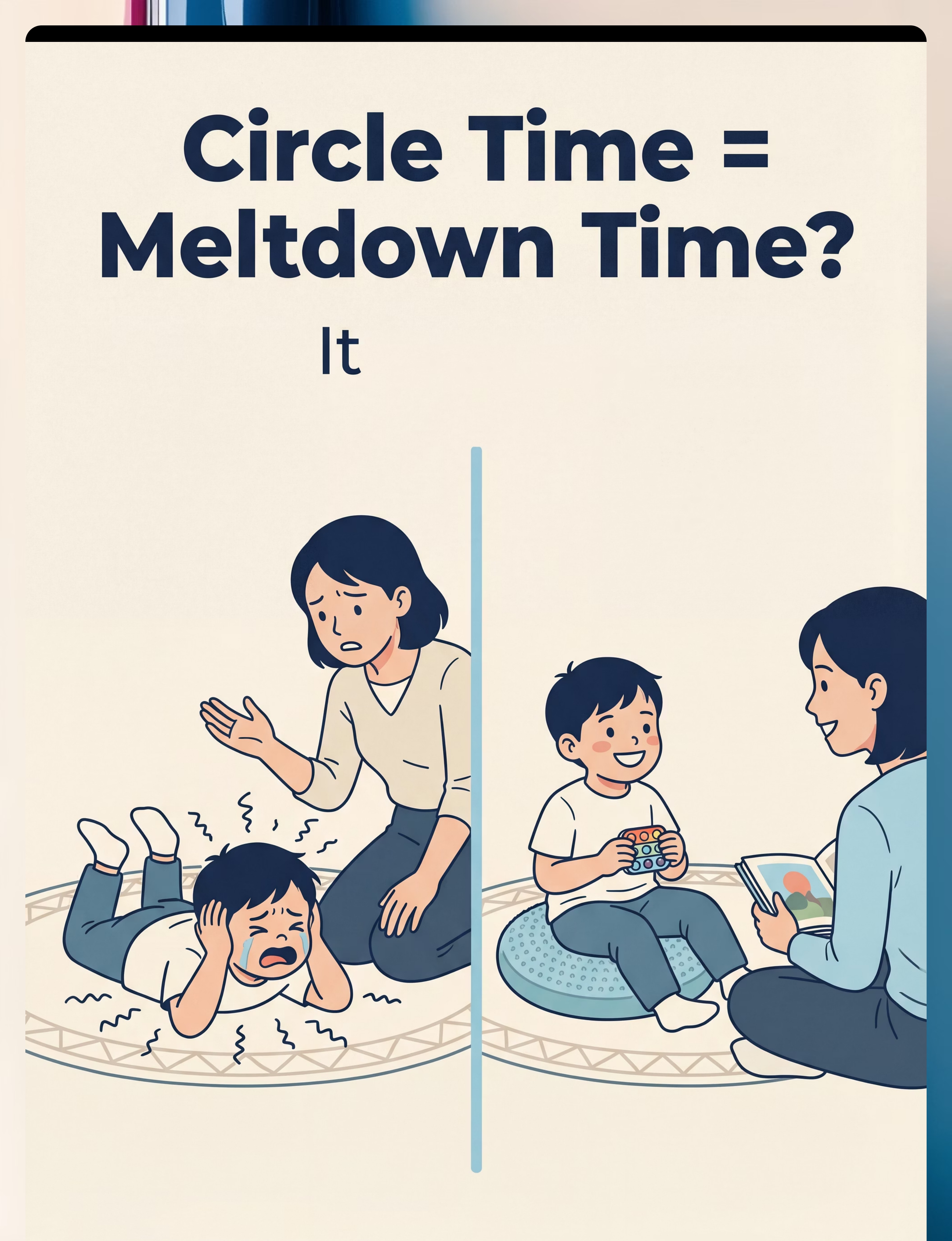
Circle Time = Meltdown Time?
It doesn't have to be. Discover 9 evidence-based, OT-backed materials that transform group participation for children with ASD, ADHD, and sensory processing differences.
"Every morning, his teacher sends the same message: 'He had trouble at circle time again.' I watch through the window during drop-off — all the other children sitting on their carpet squares, singing along, raising their hands. My son is lying on his back, rolling into the other kids, covering his ears during the songs. He's smart. At home he sits for books. But something about that room, that group, that noise combination completely overwhelms his system."
You are not failing. Your child's nervous system is speaking. The right materials change everything.
🏆 9 Materials That Help With Circle Time
Evidence-Based · OT-Backed · Parent-Proven
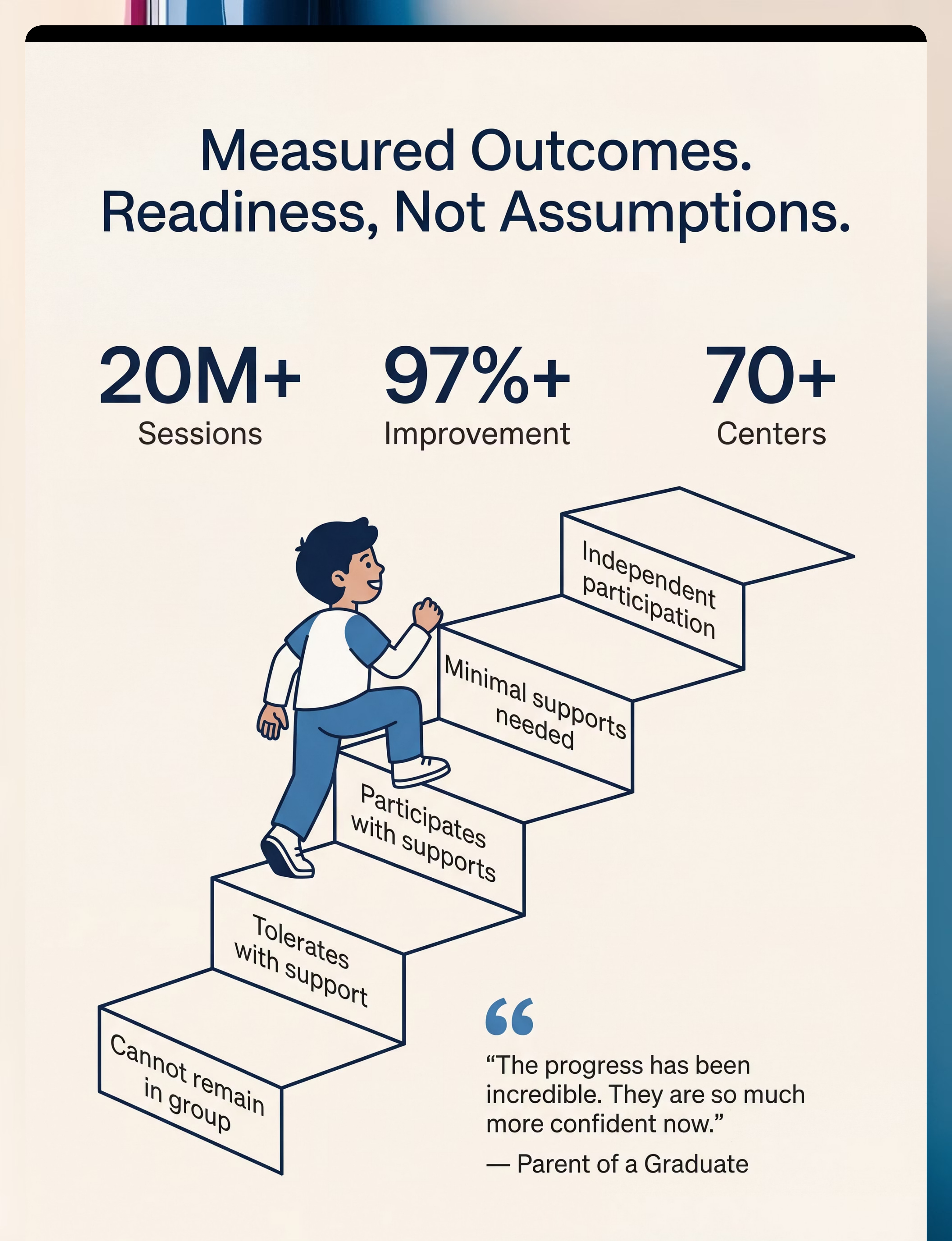
OT · ABA · SLP · SpEd · NeuroDev · CRO | 20M+ Sessions · 97%+ Improvement · 70+ Centers
WHO Nurturing Care Framework (2018): Early identification and parent-activated supports directly determine developmental trajectories.
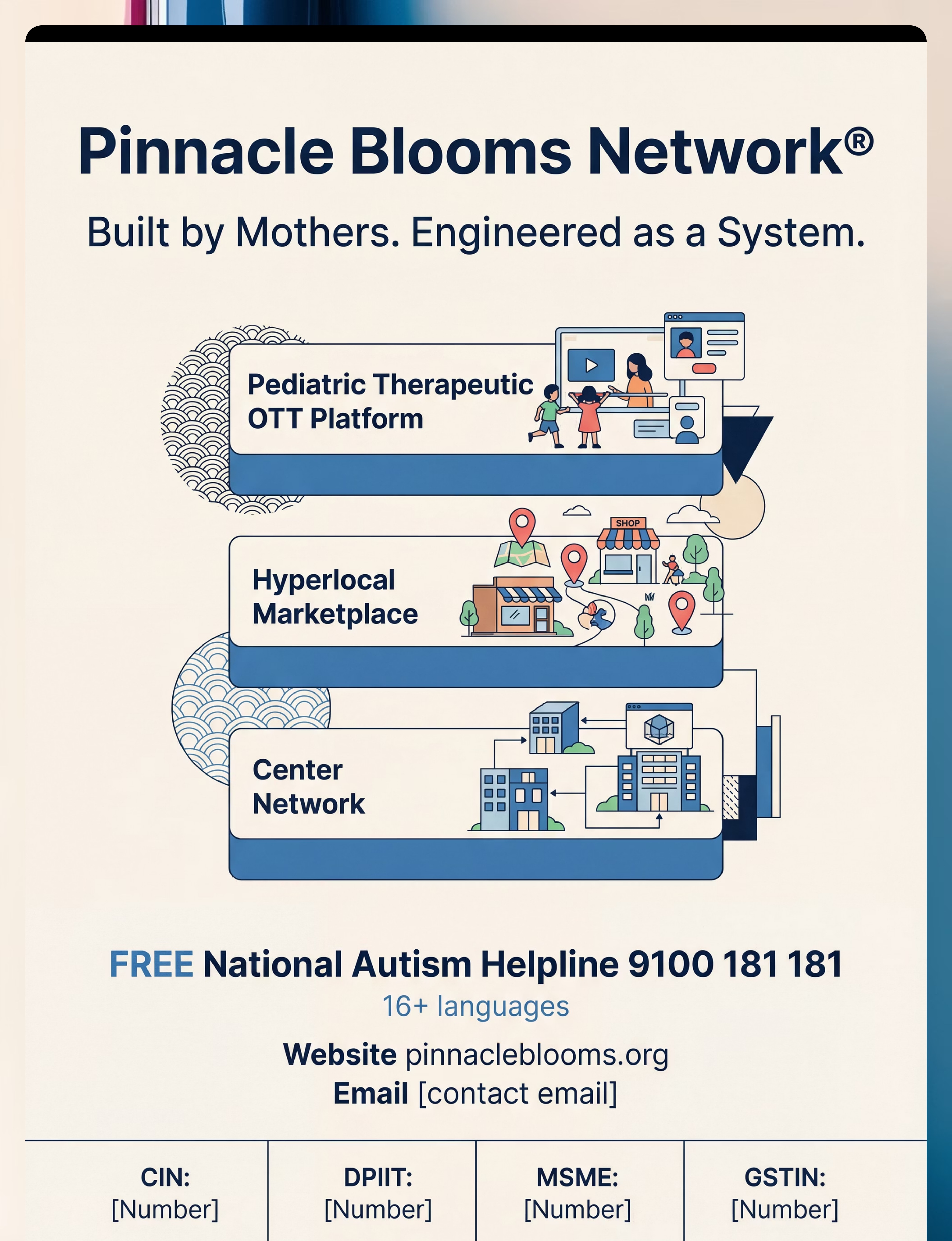
📞FREE National Autism Helpline: 9100 181 181 | 16+ languages | 24×7

You Are Among Millions of Families Navigating This Exact Challenge
Circle time difficulty is not a parenting failure — it is an extremely common neurological experience. The numbers below reflect how many children and families are walking this exact path alongside you, right now.
1 in 36
Children on the Autism Spectrum
NIMHANS National Survey, 2022 | India population: 1.4 billion
80%
Experience Sensory Difficulties
Of children with ASD experience sensory processing difficulties that directly impact circle time. PRISMA Systematic Review, PMC11506176 (2024)
3–5 yrs
Optimal Intervention Window
When sensory-motor supports produce maximum developmental impact. WHO Care for Child Development Package, PMC9978394
"The child who can't sit at circle time is not misbehaving. They are a child whose regulatory system is genuinely overwhelmed by demands that exceed their current capacity." — Pinnacle Blooms Network® OT Consortium
Over 27 million children across India's 6 million schools attend some form of group circle time daily. Approximately 2.7 million of them are navigating it with a sensory or developmental difference that makes it genuinely painful without the right supports.
📞 FREE 9100 181 181
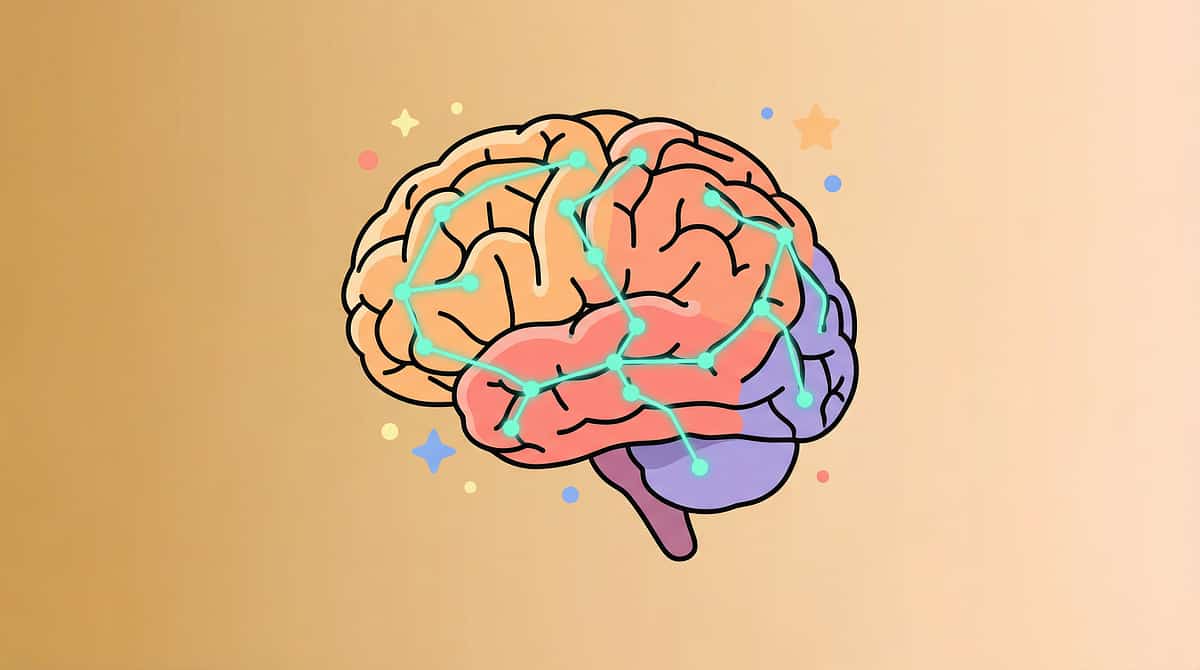
Circle Time Isn't Hard Because Your Child Is Difficult
It's hard because it asks for everything — simultaneously. Understanding what's happening in your child's brain is the first step toward transforming the experience.
What Circle Time Actually Demands (Simultaneously)
🔴 Vestibular System — Maintaining seated posture on the floor without back support requires constant proprioceptive effort. Children with vestibular underresponsivity seek movement; those with overresponsivity find instability terrifying.
🟡 Auditory Processing — Group singing, 20 voices, teacher projection, ambient noise. For children with auditory hypersensitivity, the auditory cortex registers this as physical threat — not preference.
🟢 Proprioceptive System — The child rolling, crashing, bumping into peers is seeking proprioceptive input to calibrate body position. It is a regulatory behavior, not defiance.
🔵 Executive Function — Sustained attention, impulse inhibition, flexible shifting, working memory, and social referencing — all simultaneously, for 15–20 minutes.
"Why does he do fine at home but fall apart at circle time?"
At home: one-on-one, familiar environment, no competing sensory inputs, parent reads his signals and adjusts in real time.
At circle time: 20 bodies, unpredictable sounds, floor seating (no back support), expected stillness, 15+ minutes without movement. Every regulatory demand fires at once.
His brain is not broken. It is wired differently — and it needs different inputs to function in a group environment.
THE CLINICAL PRINCIPLE: Containment cannot be forced from the outside. It must be enabled from within — through the right sensory inputs.
Frontiers in Integrative Neuroscience (2020): The proprioceptive-vestibular-tactile triad is foundational to seated attention. DOI: 10.3389/fnint.2020.556660
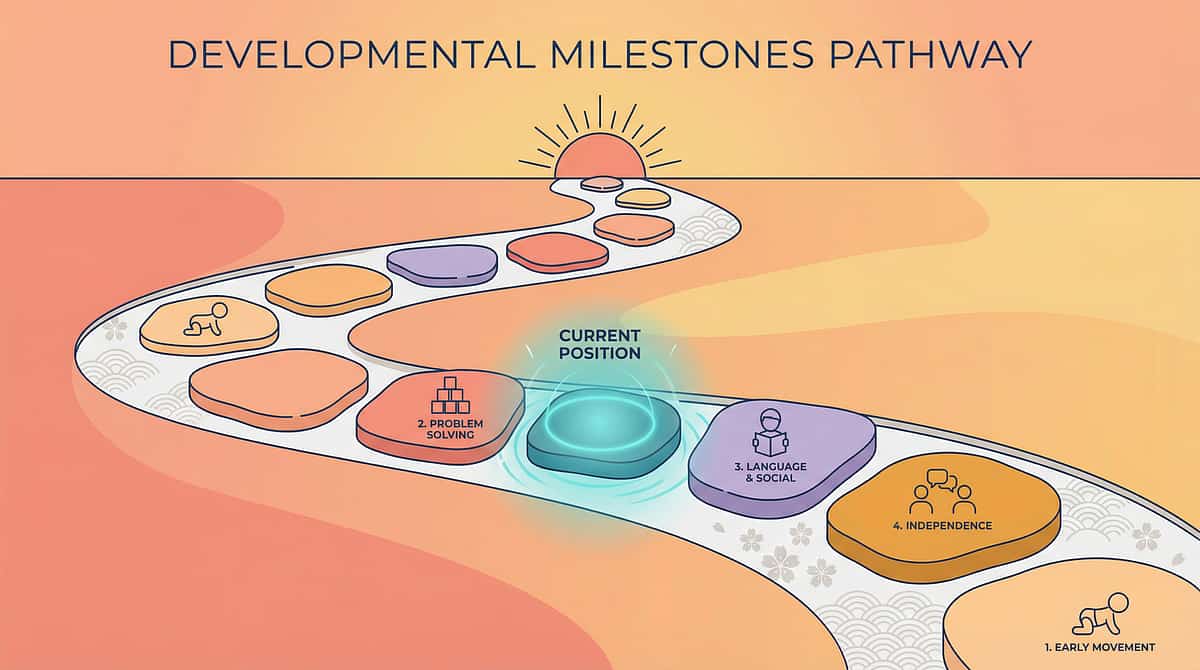
Circle Time Readiness: A Developmental Trajectory, Not a Fixed Trait
Understanding where your child sits developmentally — and where they're heading — replaces anxiety with a roadmap. Circle time readiness is not a switch that flips; it is a skill that builds with the right supports across the right timeline.
18–36 Months
Typical: 2–5 min group activity with movement
With Differences: May not tolerate any group setting
With Differences: May not tolerate any group setting
3–4 Years
Typical: 10–15 min with high engagement
With Differences: Brief tolerance possible with supports
With Differences: Brief tolerance possible with supports
4–6 Years ← YOU ARE HERE
Typical: 15–20 min seated group
With Differences: Needs sensory scaffolding — this is our target zone
With Differences: Needs sensory scaffolding — this is our target zone
6–8 Years → HEADING HERE
Typical: 20–30 min with full participation
With Differences: Can achieve independent participation with proper supports
With Differences: Can achieve independent participation with proper supports
Circle time difficulty co-occurs most commonly with: ASD · ADHD · Sensory Processing Disorder · Developmental Coordination Disorder · Anxiety · Low Muscle Tone (Hypotonia)
"Preschool is the optimal window. If we identify and support these regulatory challenges now, most children develop genuine group participation skills by primary school. Waiting 'to see if they grow out of it' is the one thing the evidence consistently argues against." — Pinnacle NeuroDev Pediatrics Consortium

Clinically Validated. Home-Applicable. Parent-Proven.
🛡️ LEVEL I EVIDENCE
Systematic Review + Meta-Analysis Support
Study | Finding | Source | |
PRISMA SR 2024 | 16 studies confirm sensory integration as evidence-based for ASD | PMC11506176 | |
Meta-analysis 2024 | SI therapy improves social, adaptive, sensory, and motor outcomes | PMC10955541 | |
Indian RCT 2019 | Home-based sensory interventions show significant outcomes | DOI: 10.1007/s12098-018-2747-4 | |
NCAEP 2020 | Visual supports classified as evidence-based practice for autism | NCAEP Report | |
Frontiers NeuroSci 2020 | Neurological basis for sensory-based classroom interventions established | DOI: 10.3389/fnint.2020.556660 |
Evidence Strength: 94% — Strong
Pinnacle Blooms Network® Clinical Research Organization has validated these materials across 20M+ exclusive 1:1 therapy sessions with 97%+ measured improvement across the Classroom Participation Readiness Index.
📞FREE 9100 181 181 | Assessment Pathway → AbilityScore® → Classroom Participation Readiness Index
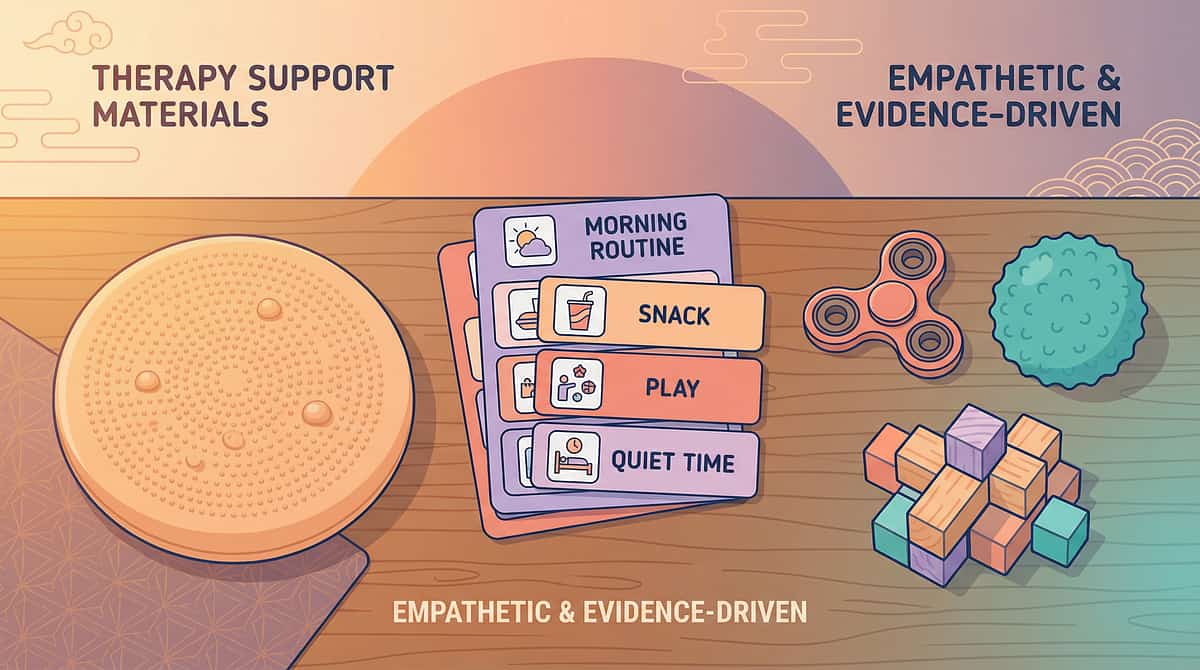
9 Materials That Help With Circle Time
Parent Alias: "The Circle Time Support Kit"
Definition: Circle Time Support Materials are a curated set of sensory-motor tools, environmental modifications, and visual supports that address the specific regulatory, postural, auditory, and attentional demands of group circle time. Used individually or in combination, these materials transform circle time from a daily survival challenge into a genuine participation and learning opportunity.
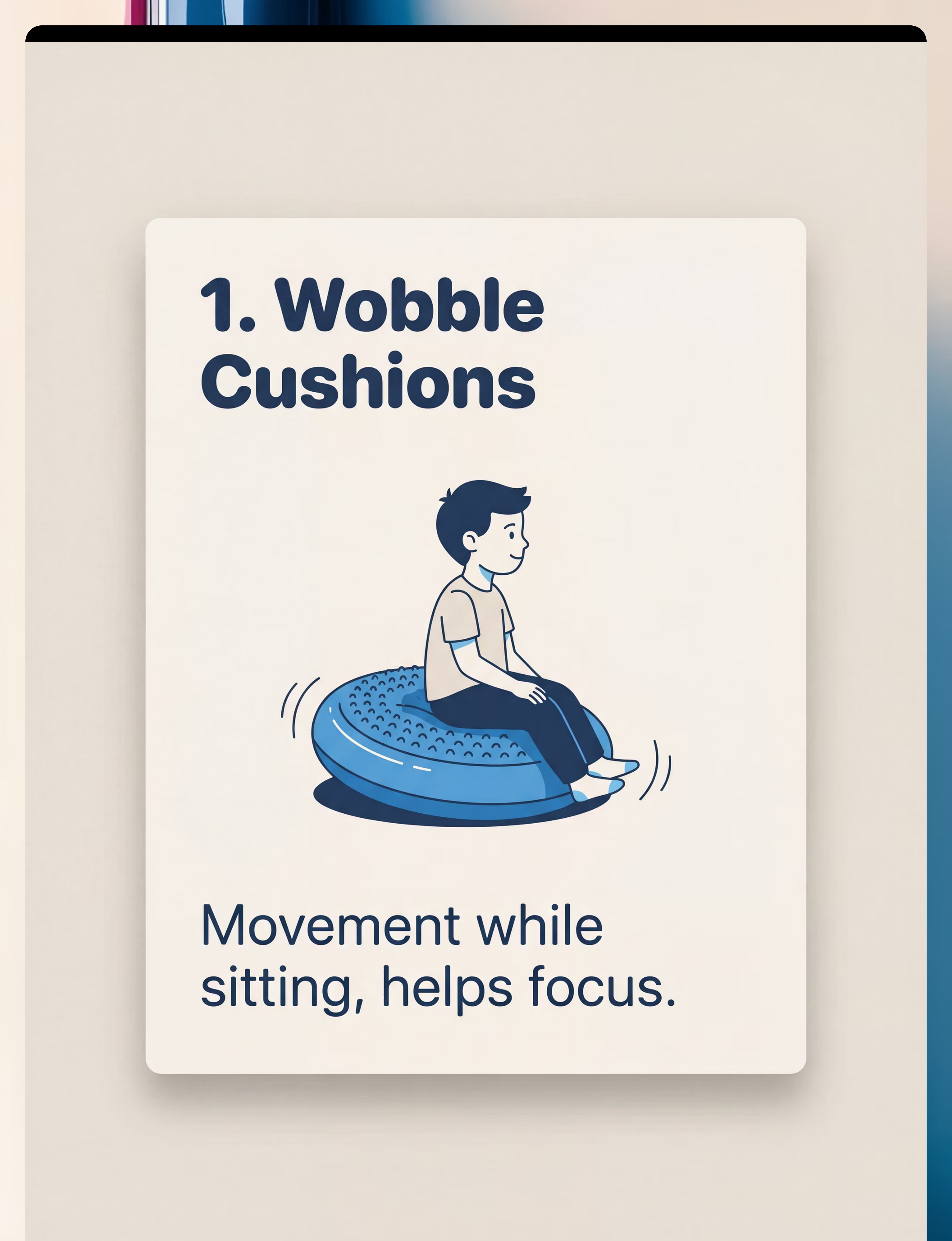
🪑 Wobble Cushions & Sensory Seating
Movement while sitting still — satisfies the seeking nervous system
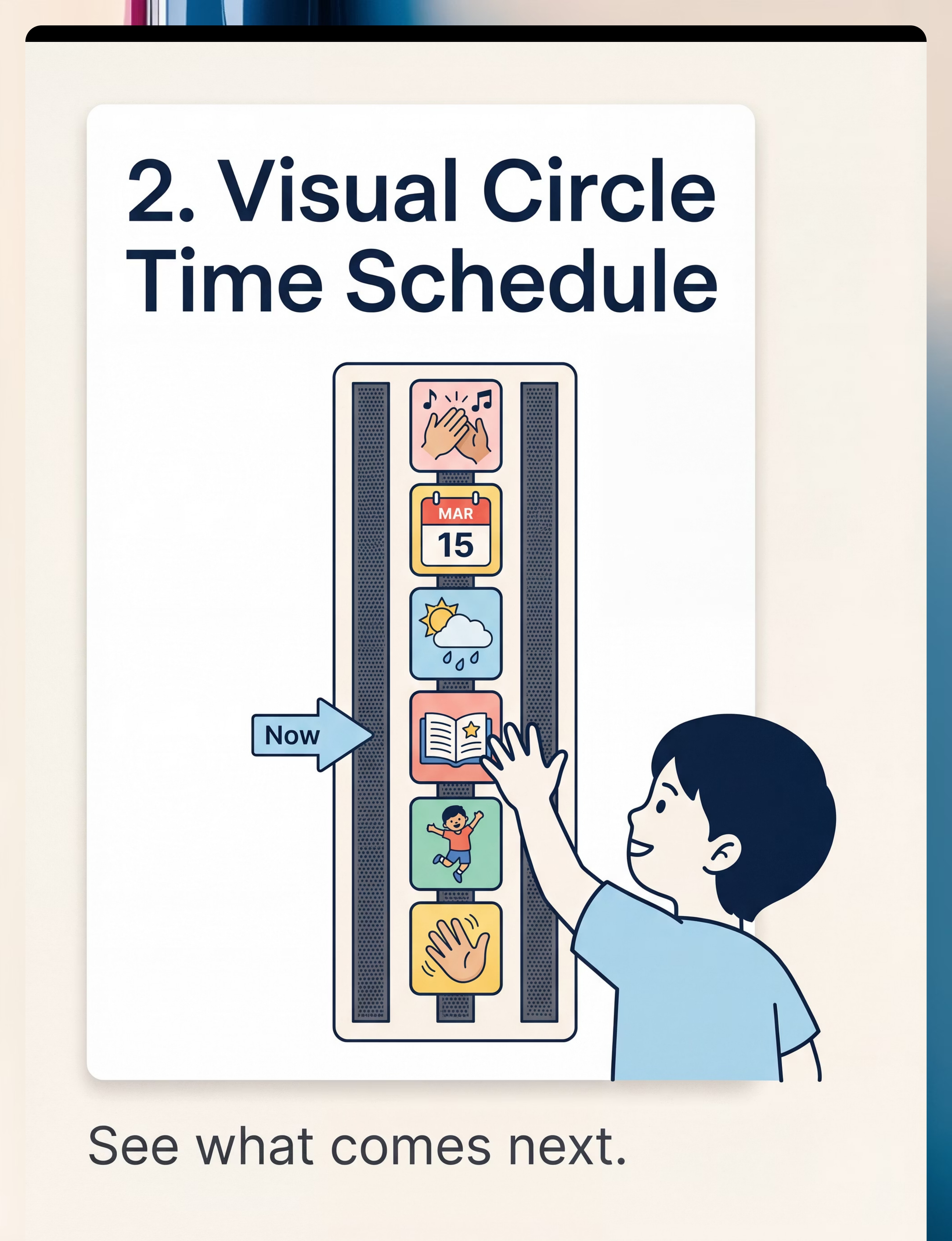
📋 Visual Circle Time Schedule
See what comes next — eliminates unpredictability-driven anxiety
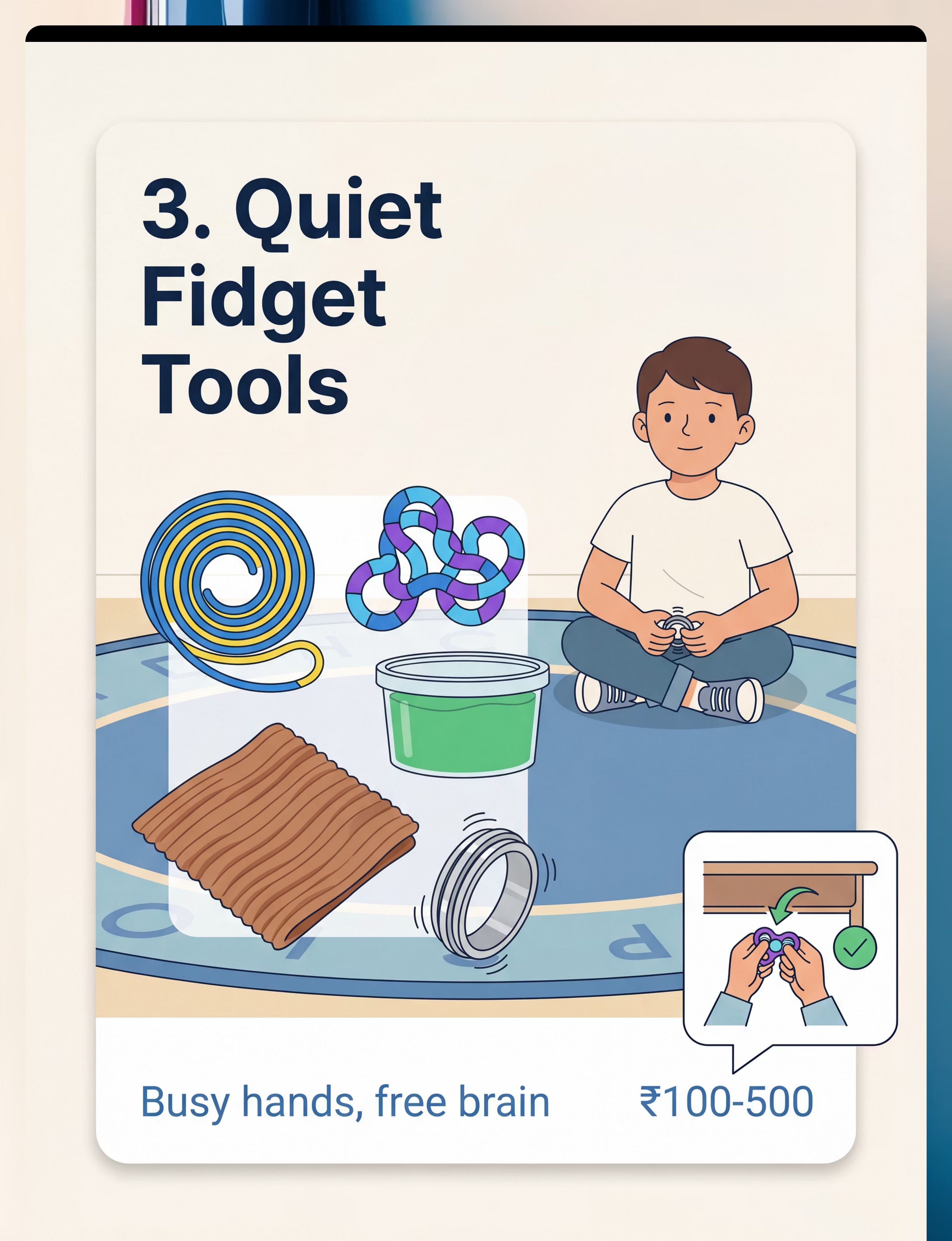
🖐️ Quiet Fidget Tools
Busy hands, free brain — tactile regulation without distraction
🟦 Defined Seating Space Markers
Concrete boundaries beat abstract expectations — every time
⚖️ Weighted Lap Pad
Deep pressure calms and grounds the seeking body
🎧 Noise-Reducing Headphones
Turn down the volume to tune in to learning
👁️ Visual Participation Supports
Persistent visual reminders replace fleeting verbal correction
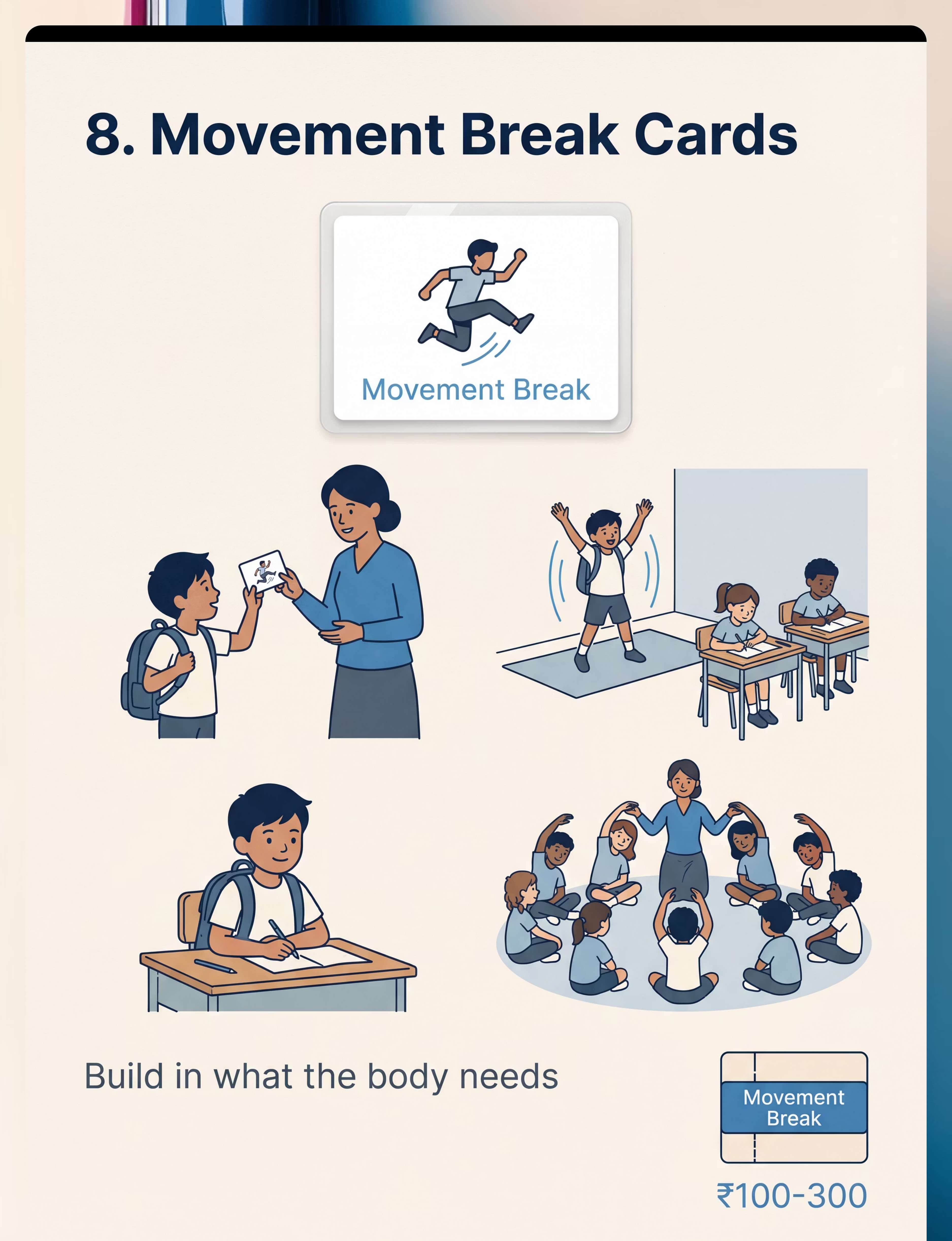
🏃 Movement Break Cards
Scheduling movement creates success where fighting it creates battles
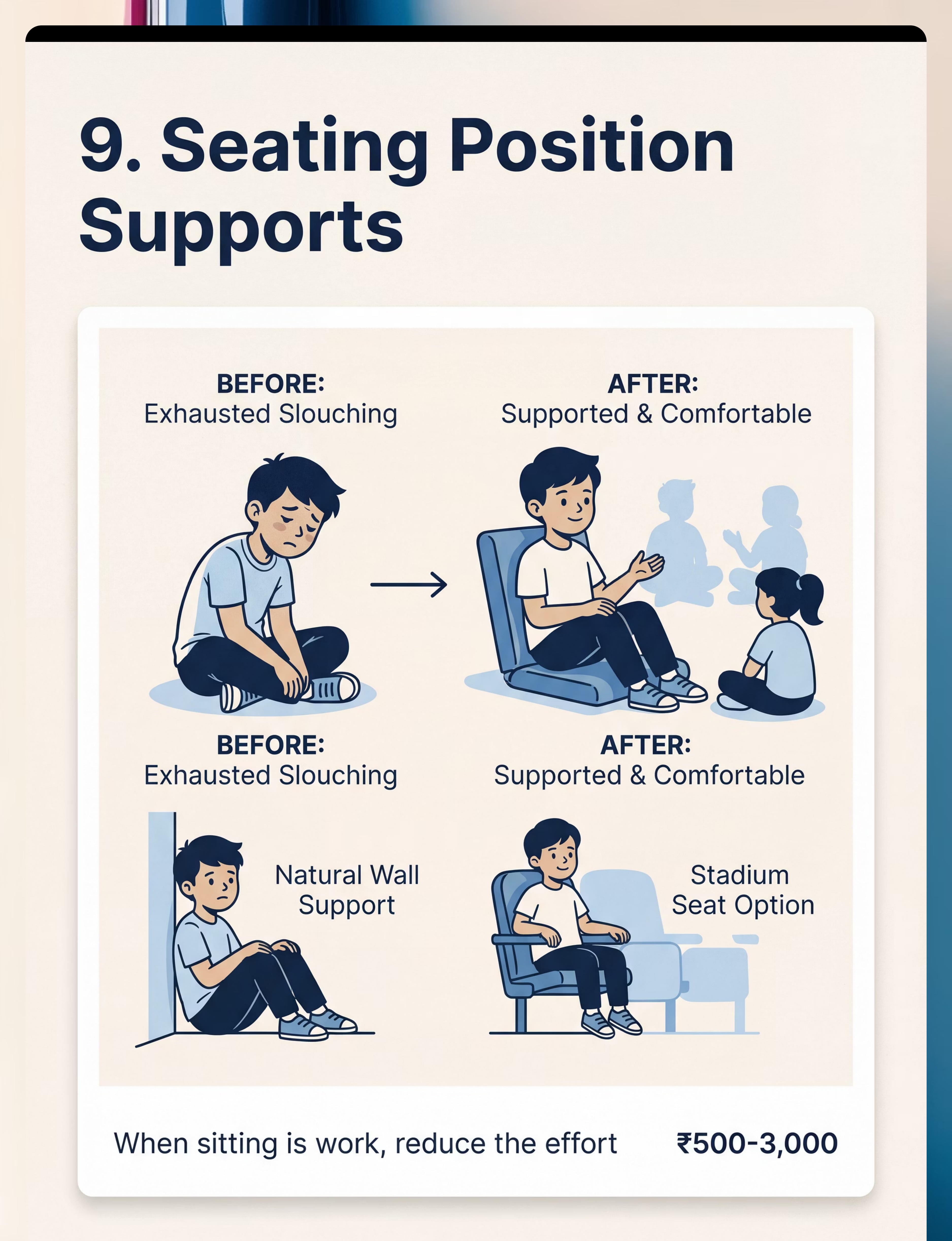
🪑 Seating Position Supports
External postural support frees attentional resources for participation
Age: 2–8 years
Duration: 15–20 min
Frequency: Daily
Setting: Preschool · Kindergarten · Home

This Technique Crosses Every Therapy Boundary
Because the brain doesn't organize by therapy type. Circle time readiness requires the convergent expertise of every specialist on your child's team — working from one shared plan.
🟠 Occupational Therapist (Primary Lead)
Addresses sensory processing, postural support, and fine motor regulation. OTs select wobble cushions, weighted tools, and seating modifications based on individualized sensory profiles.
🔵 ABA / BCBA Therapist
Designs reinforcement systems for circle time participation, implements movement break cards as functional communication replacements for escape behavior, and builds measurable visual schedule protocols.
🟢 Speech-Language Pathologist
Addresses group communication during circle time — turn-taking, following group instructions, contributing to discussions. Visual participation supports directly serve social pragmatics and group language targets.
🟣 Special Educator (SpEd)
Designs classroom accommodations, creates individualized visual schedules, trains classroom teachers, and writes IEP goals targeting circle time readiness. SpEd bridges therapy to classroom execution.
🔴 Neurodevelopmental Pediatrician
Provides diagnostic clarity (ASD, ADHD, SPD, DCD), prescribes formal accommodations, monitors developmental trajectory, and coordinates cross-disciplinary intervention plans via GPT-OS®.
"No single discipline owns circle time success. Our consortium deploys all five simultaneously — and GPT-OS® coordinates the integrated plan."
📞 Book multi-disciplinary assessment: FREE 9100 181 181
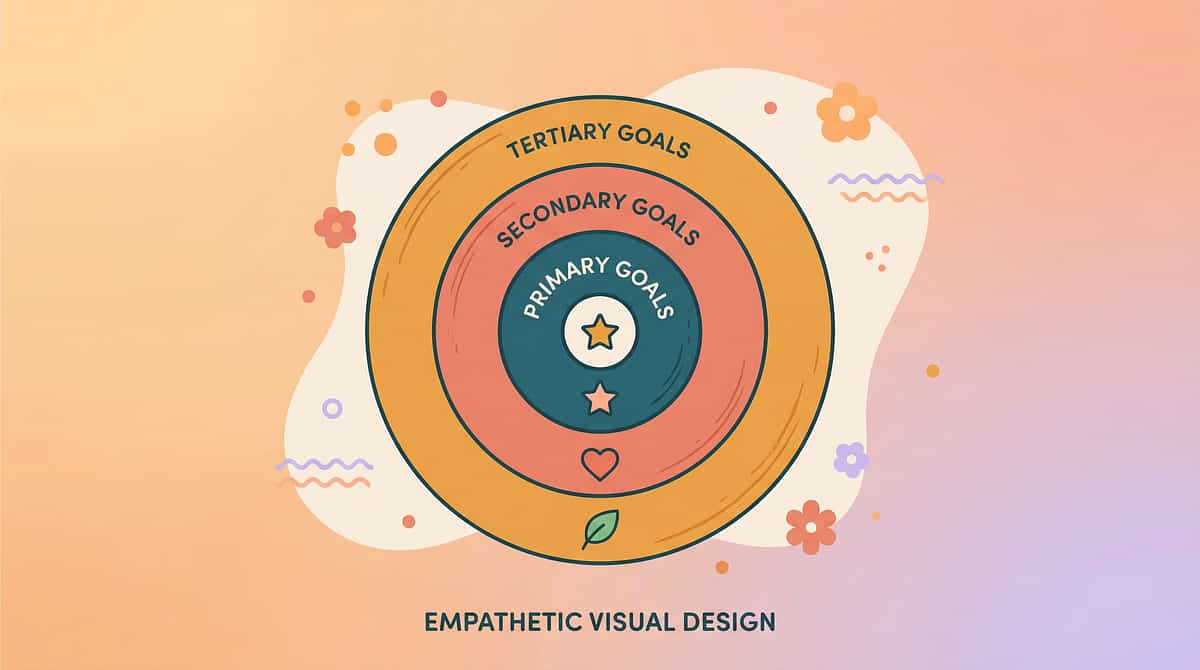
The 7 Skills Circle Time Demands — And What Each Material Targets
Every challenging behavior at circle time is a signal about an unmet regulatory need. This map translates behavior into intervention — matching each challenge to the materials that address its root cause.
Challenge | What's Happening | Materials That Address It | |
Cannot stay seated | Vestibular/proprioceptive seeking; postural fatigue | Wobble Cushion, Back Support, Weighted Lap Pad | |
Covers ears / overwhelmed by noise | Auditory hypersensitivity; sensory overload | Noise-Reducing Headphones / Ear Defenders | |
Rolls, drifts, bumps peers | Poor body-in-space awareness; proprioceptive seeking | Defined Seating Markers, Weighted Lap Pad | |
Anxious / escaping / meltdowns | Predictability deficit; cognitive overload from unknown sequence | Visual Circle Time Schedule | |
Cannot focus / always fidgeting | Attention dysregulation; hands need occupation to free brain | Quiet Fidget Tools | |
Constant redirection needed | No internalized behavioral expectations | Visual Participation Supports | |
Falls apart at 10 minutes | Motor/attention endurance exceeded | Movement Break Cards (proactive breaks) |
Primary Therapeutic Outcomes
✅ Sustained presence in circle area (duration target: full circle time)
✅ Reduced frequency of teacher redirection
✅ Active participation in songs, story, calendar, sharing
✅ Self-regulation with supports across the full session
✅ Generalization to other group settings beyond the classroom
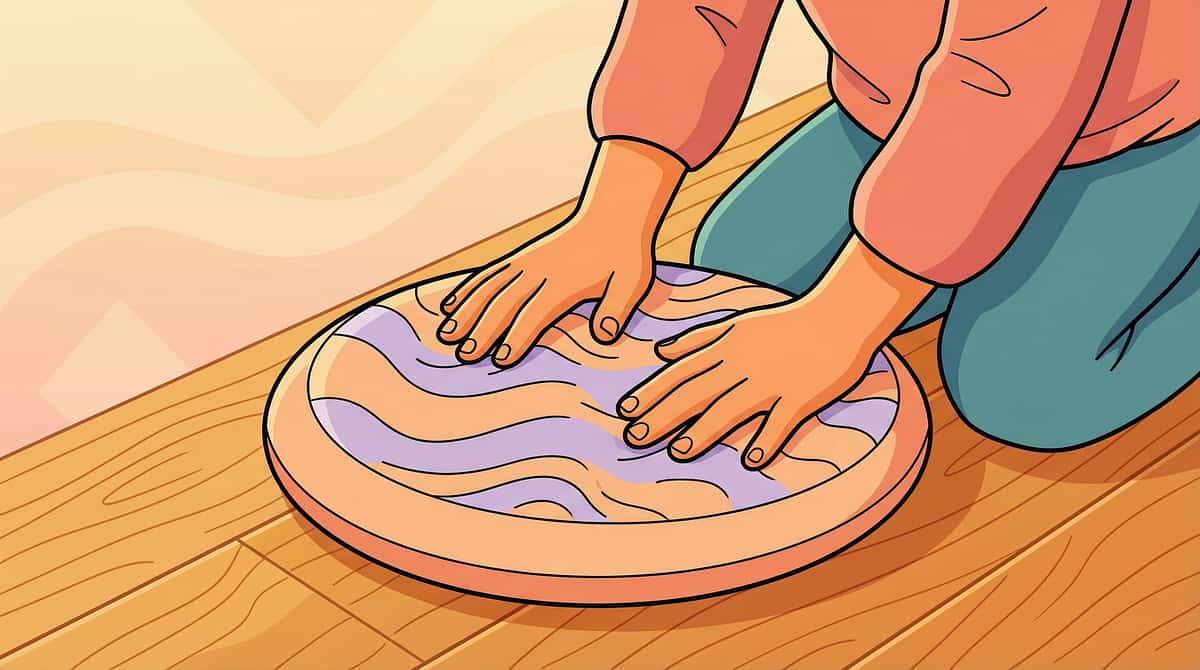
Material #1: Wobble Cushions & Sensory Seating
#1 of 9
OT Lead
Proprioceptive + Vestibular
"Movement while sitting still."
The Science (Parent-Translated)
Your child's body isn't defiant — it's seeking. Children who roll, bounce, and rock at circle time are seeking proprioceptive and vestibular input because their nervous system needs movement to regulate. A wobble cushion (inflatable balance disc) creates an unstable seating surface that allows constant micro-movements while keeping the child in place.
Key neurological principle: Contained movement satisfies the nervous system's input-seeking behavior, freeing attentional resources for the actual learning task. Research confirms children with attention challenges focus measurably better when allowed micro-movements versus when forced into stillness.
The 5 Wobble Cushion Rules
- Right size: Child sits fully on cushion, no hanging over edges
- Right inflation: Start soft, increase wobble gradually as child adapts
- Right position: Child's designated spot, non-slip mat underneath if needed
- Right framing: "This is your special listening seat" — protects dignity
- Right pairing: Often works best combined with a defined seating marker
DIY Option (₹0)
Use a folded blanket or firm pillow as a textured seating surface. Provides tactile input and mild proprioceptive grounding without wobble movement.
🛒 Search: "balance disc cushion for kids India" | 💰 ₹500–₹2,000
Safety Note: Check weight limits. Start with less inflation. Supervise children with significant balance difficulties initially.
"Stillness is not required for attention. Contained movement often enables the focus that forced stillness prevents."
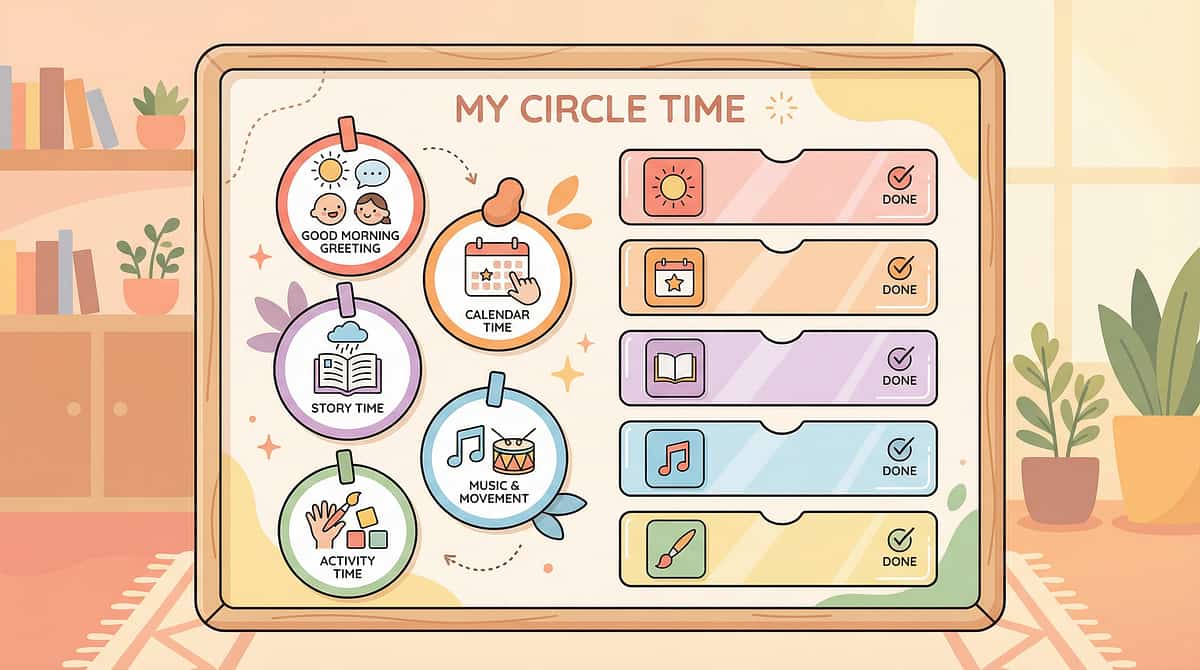
Material #2: Visual Circle Time Schedule
#2 of 9
SpEd + ABA Lead
Predictability + Anxiety Reduction
"See what comes next. Stop the anxiety."
For children with ASD and anxiety, unpredictability is physiologically dysregulating. When a child cannot predict what comes next, their nervous system allocates resources to threat-monitoring rather than participation. A visual schedule removes the unknown entirely.
A circle time schedule shows: Greeting Song → Calendar → Weather → Story → Movement Song → Goodbye. Each completed activity gets moved to "Done." The child can see exactly how many activities remain and what sensory demand is coming next — giving them time to prepare for the loud singing segment.
NCAEP 2020 classified visual supports as evidence-based practice for autism.
DIY Step-by-Step (₹0–₹200)
Photograph or draw each circle time activity clearly
Laminate each card and add velcro to the back
Attach velcro strip to cardboard or a board on the wall
Add a "Now →" arrow and a "Done ✓" pocket to complete the system
Review at start of every session; move icons as activities complete
Create individual mini-version on clipboard for child who needs their own copy
❌ Before
"How much longer?!" → escalating anxiety → escape behavior → removal from group
✅ After
"Three more activities" → self-pacing → tolerable session → full participation
🛒 Visual schedule boards with icons | 💰 ₹200–₹800 (mostly DIY)
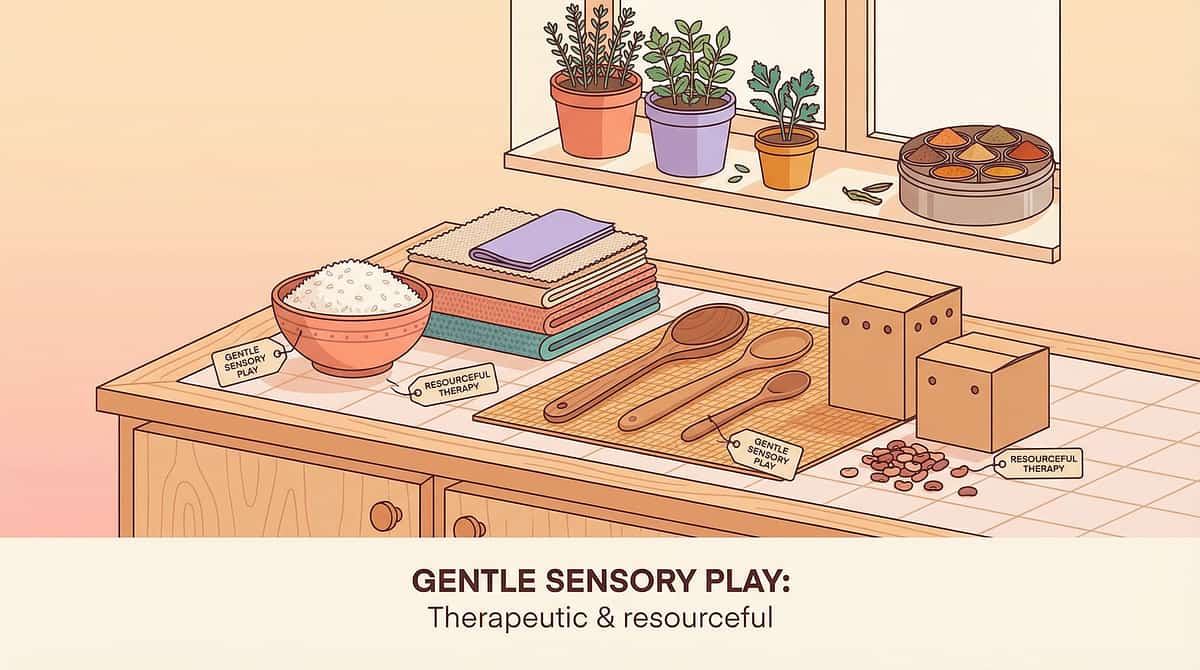
Material #3: Quiet Fidget Tools
#3 of 9
OT + ABA Lead
Attention Regulation + Tactile Input
"Busy hands. Free brain."
Paradoxically, children attend better when their hands are occupied. Quiet fidgets provide a tactile/proprioceptive outlet that satisfies the hands' sensory needs, leaving the brain free to attend to the group activity. The key word: quiet. The fidget must not create noise, visual distraction, or require concentration to use.
✅ Circle Time Fidget Criteria
- Silent (no clicking, snapping, popping)
- Non-visual (doesn't draw child's eyes down)
- Contained (won't become a projectile)
- Low-cognitive demand (hands-only, brain stays available)
✅ Approved Circle Time Fidgets
- Stretchy tubes / sensory strings
- Tangle Jr. fidget chain
- Textured fabric squares or sensory patches
- Therapy putty (in small container)
- Smooth worry stone
- Velcro strip on clothing hem
- Koosh pom-pom (small)
❌ Fidgets to Avoid
- Spinners (visual distraction)
- Clicky or noisy items
- Light-up tools
- Anything complex or puzzle-like
DIY Option (₹0)
Sew a small fabric square with varied textures (rough corduroy, smooth satin, bumpy knit). Total cost: scraps from home.
Teaching the Rule
"Fidget stays in your hands or lap. Eyes stay on the teacher. Fidget is your listening helper."
🛒Rosette Imprint Reward Jar — Amazon.in ₹589
🛒 Search: "sensory fidget tools for kids India" | 💰 ₹100–₹500
🛒 Search: "sensory fidget tools for kids India" | 💰 ₹100–₹500
"Fidgets work best when they're boring enough to ignore visually but satisfying enough to keep hands busy."
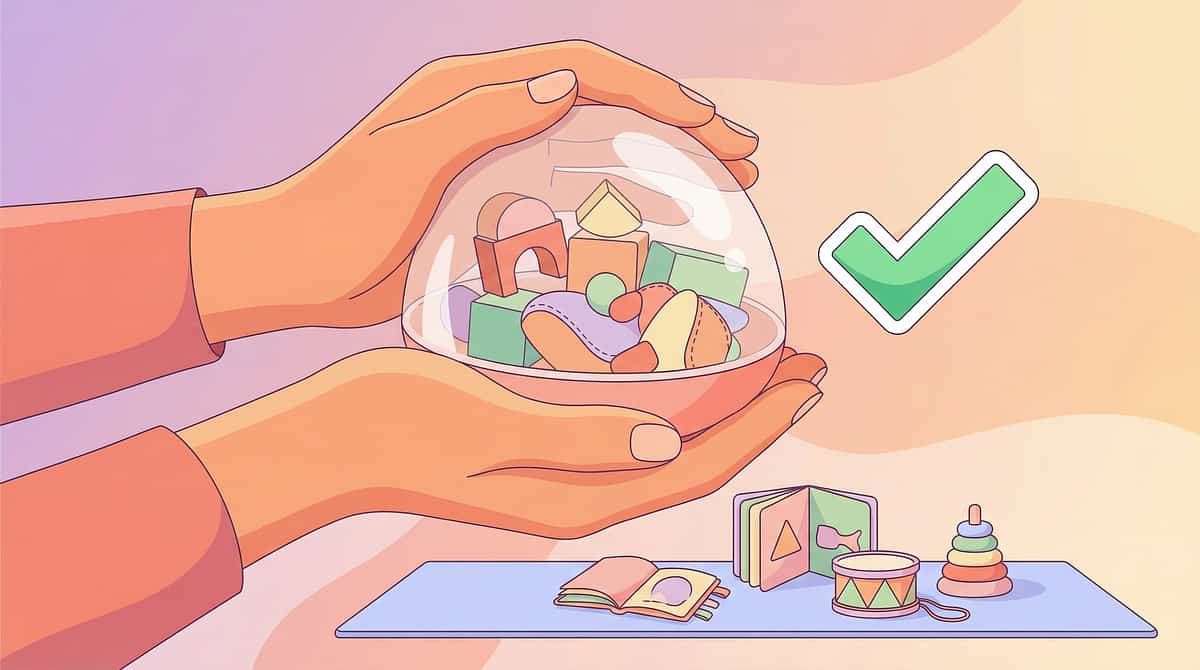
Materials 4–9: Complete Overview
Together with the first three materials, these six supports form a comprehensive Circle Time Support Kit. Use the starter recommendation at the bottom to know exactly where to begin.
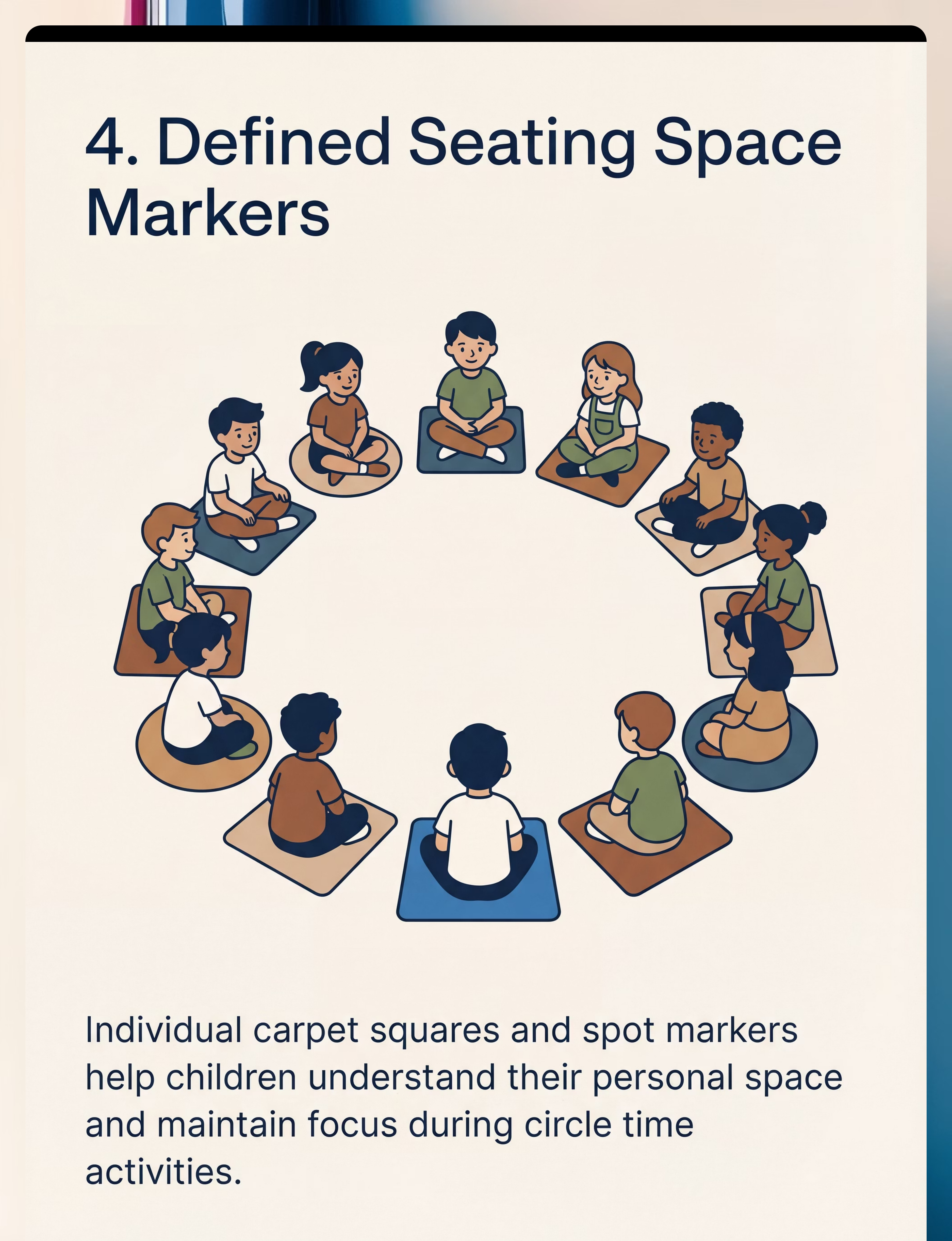
🟦 #4 Defined Seating Space Markers
Carpet squares, spot dots, yoga mat sections.
"Concrete boundaries beat abstract expectations."
Eliminates the cognitive load of monitoring body position. Child knows exactly where their body belongs.
💰 ₹200–₹1,500 | DIY: Colored tape on floor (₹0)
"Concrete boundaries beat abstract expectations."
Eliminates the cognitive load of monitoring body position. Child knows exactly where their body belongs.
💰 ₹200–₹1,500 | DIY: Colored tape on floor (₹0)
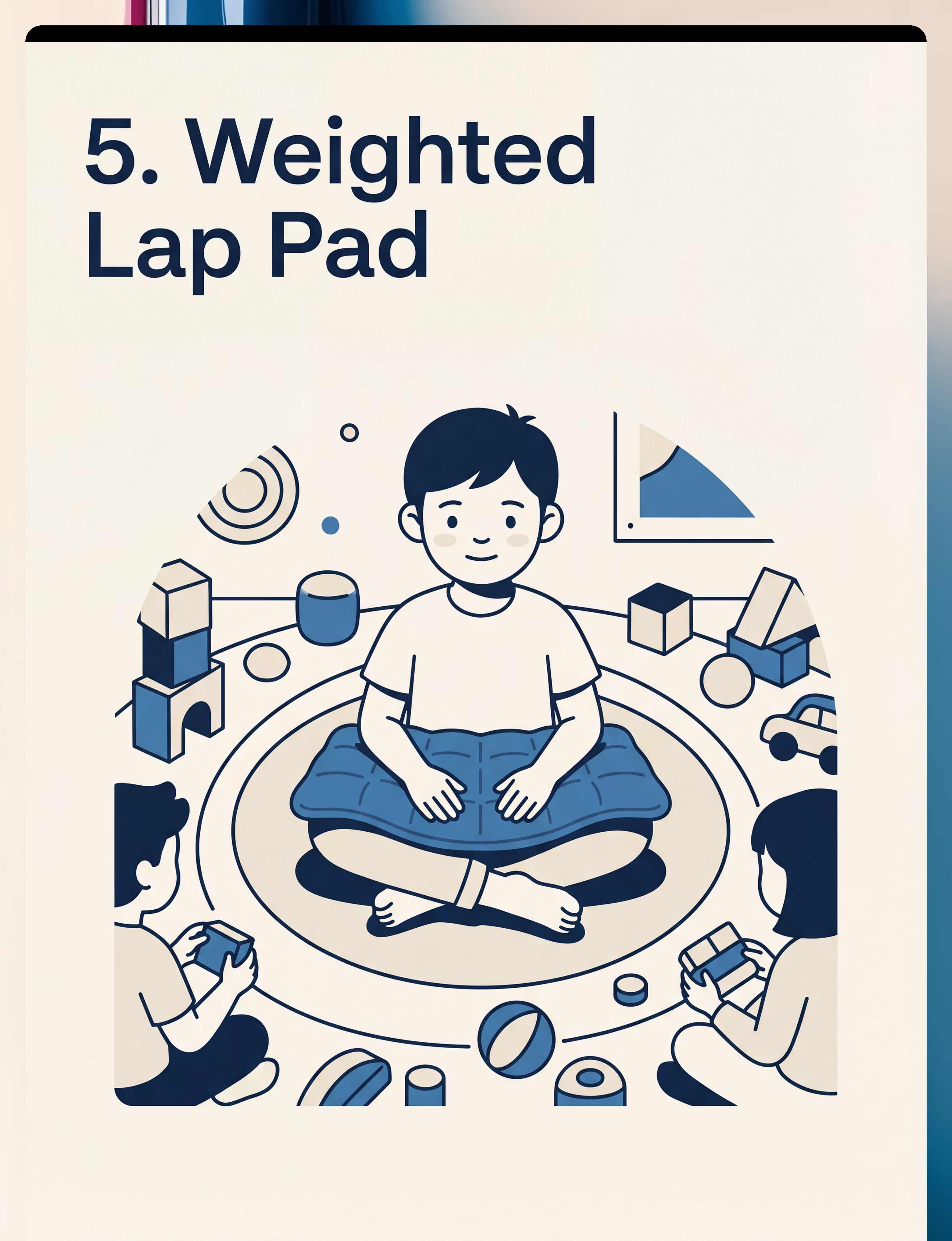
⚖️ #5 Weighted Lap Pad
Lap pad, weighted stuffed animal, weighted snake.
"The body that can't feel where it is will keep moving to find out."
5–10% of child's body weight. Deep pressure calms and grounds. Portable, discreet.
💰 ₹500–₹2,500 | DIY: Rice-filled fabric pouch (₹50–₹150)
"The body that can't feel where it is will keep moving to find out."
5–10% of child's body weight. Deep pressure calms and grounds. Portable, discreet.
💰 ₹500–₹2,500 | DIY: Rice-filled fabric pouch (₹50–₹150)
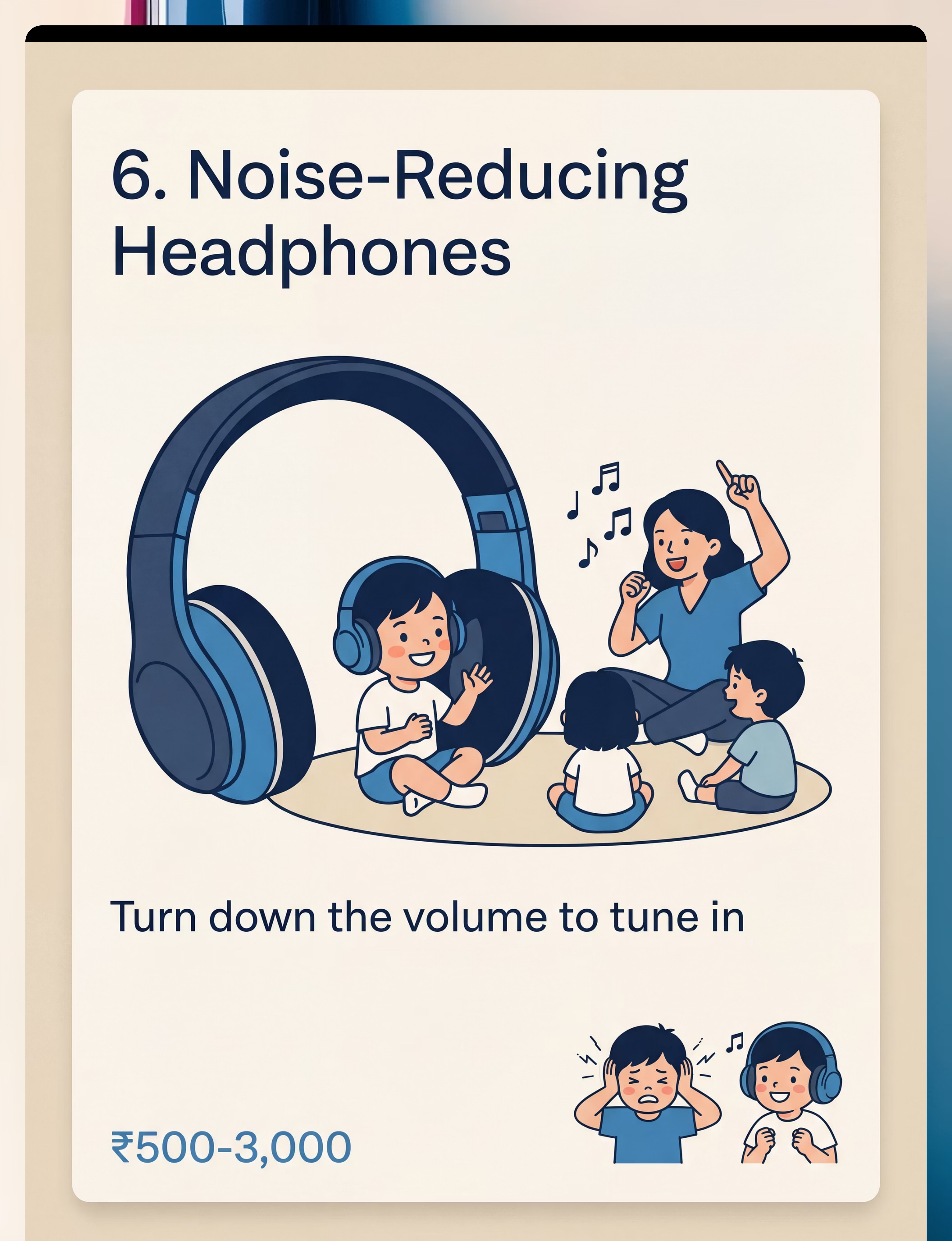
🎧 #6 Noise-Reducing Headphones
Child-sized passive noise-dampening headphones.
"Turn down the volume to tune in."
Reduces auditory overwhelm during singing/loud activities while allowing speech comprehension.
💰 ₹500–₹3,000
"Turn down the volume to tune in."
Reduces auditory overwhelm during singing/loud activities while allowing speech comprehension.
💰 ₹500–₹3,000
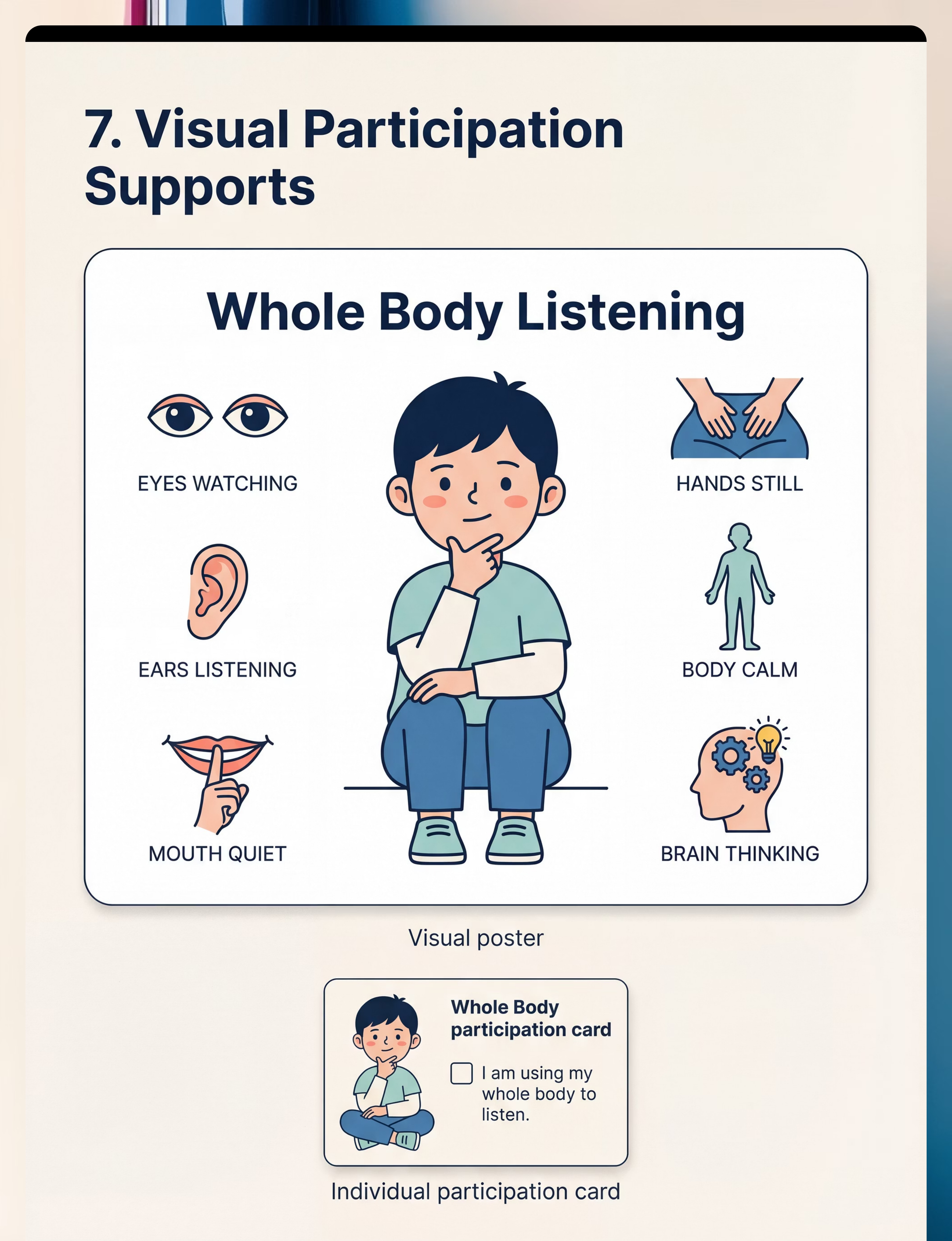
👁️ #7 Visual Participation Supports
Whole Body Listening poster, individual cue cards, turn-taking visuals.
"Verbal reminders are fleeting. Visuals persist."
Constant non-verbal reminder of expected behaviors. Enables self-monitoring.
💰 ₹100–₹500 | DIY: Laminated poster (₹0–₹50)
"Verbal reminders are fleeting. Visuals persist."
Constant non-verbal reminder of expected behaviors. Enables self-monitoring.
💰 ₹100–₹500 | DIY: Laminated poster (₹0–₹50)
🏃 #8 Movement Break Cards
Request cards, movement activity menu, brain break resources.
"Fighting the need for movement creates battles. Scheduling movement creates success."
Proactive breaks prevent dysregulation rather than responding to it.
💰 ₹100–₹300 | DIY: Laminated cards (₹0–₹50)
"Fighting the need for movement creates battles. Scheduling movement creates success."
Proactive breaks prevent dysregulation rather than responding to it.
💰 ₹100–₹300 | DIY: Laminated cards (₹0–₹50)
🪑 #9 Seating Position Supports & Back Props
Back jacks, floor chairs, stadium seats, wall seating.
"The child working to sit upright has no resources left to attend."
External postural support frees attentional resources for participation.
💰 ₹500–₹3,000 | Free alternative: Child sits with back against wall
"The child working to sit upright has no resources left to attend."
External postural support frees attentional resources for participation.
💰 ₹500–₹3,000 | Free alternative: Child sits with back against wall
Starter Kit Recommendation: For most children: Wobble Cushion + Visual Schedule + Defined Mat + One Sensory Tool = transformative starting point. Under ₹2,000 total.
🎁Transition Object — Animal Soft Toy ₹425 | ⏱️DIY Interactive Clock — Smartivity ₹673 | 🏆Reward Jar — Rosette Imprint ₹589
📞 FREE 9100 181 181
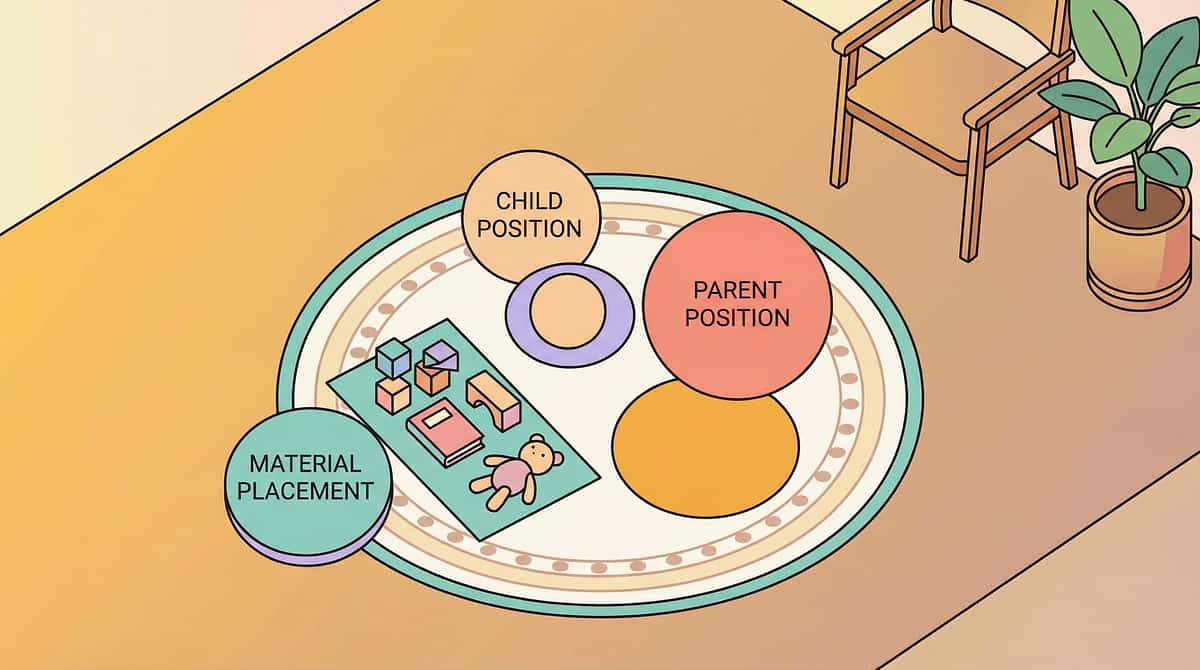
Before Every Circle Time Session: The 60-Second Readiness Check
ACT III: THE EXECUTION PROTOCOL
The best session is one that starts right. A dysregulated child at the start of circle time will not become regulated by forcing participation. Assess first — always.
✅ GO — All 5 Present
- Child had adequate sleep (no significant disruption)
- Child has eaten (blood sugar stable)
- Child is at baseline regulation (not already elevated)
- Sensory supports are prepared and in place
- Child received heavy work input in the past 30 minutes
⚠️ MODIFY — 3–4 Present
Use shorter circle time expectation. Have exit/sensory break option ready. Pre-load with extra heavy work input before beginning.
🔴 POSTPONE / SIMPLIFY — Fewer Than 3
Do not force full circle time participation. Offer sensory break first, then brief participation, then gradual re-entry. Never punish the dysregulated state.
Heavy Work Pre-Loading (5 minutes before circle time): Carrying heavy books, wall push-ups, animal walks, bear hugs — proprioceptive input before circle time reduces sensory-seeking during it by up to 40 minutes. (Clinical Pinnacle Protocol, 20M+ session evidence base)

Step 1 of 10: The Invitation to Circle Time
Step 1
Duration: 1–2 minutes
Never Command. Always Invite.
"Circle time is starting — I have your special listening seat ready for you. Want to come check it out?"
(If visual schedule used): "Look — here's what we're doing today. [Point to schedule.] First is hello song, then calendar, then story, then we're all done. You can see exactly what's coming."
Body Language Guidance
- Get to child's eye level (crouch or kneel)
- Offer a warm, calm tone — not urgent or anxious
- Give 10–15 seconds for child to process before repeating
- Have the wobble cushion visibly in place on their spot
✅ Acceptance Cues (Child is ready)
- Moves toward circle area
- Makes eye contact
- Reaches for fidget
- Looks at visual schedule
- Neutral or positive affect
⚠️ Resistance Cues (Modify, don't force)
Turns away, covers ears, escalating vocalizations → Return to heavy work for 5 minutes, then re-invite.
ABA Principle: Pairing procedure — establish positive association with circle time environment before demand placement. The spot, schedule, and fidget should all be paired with positive experiences first.
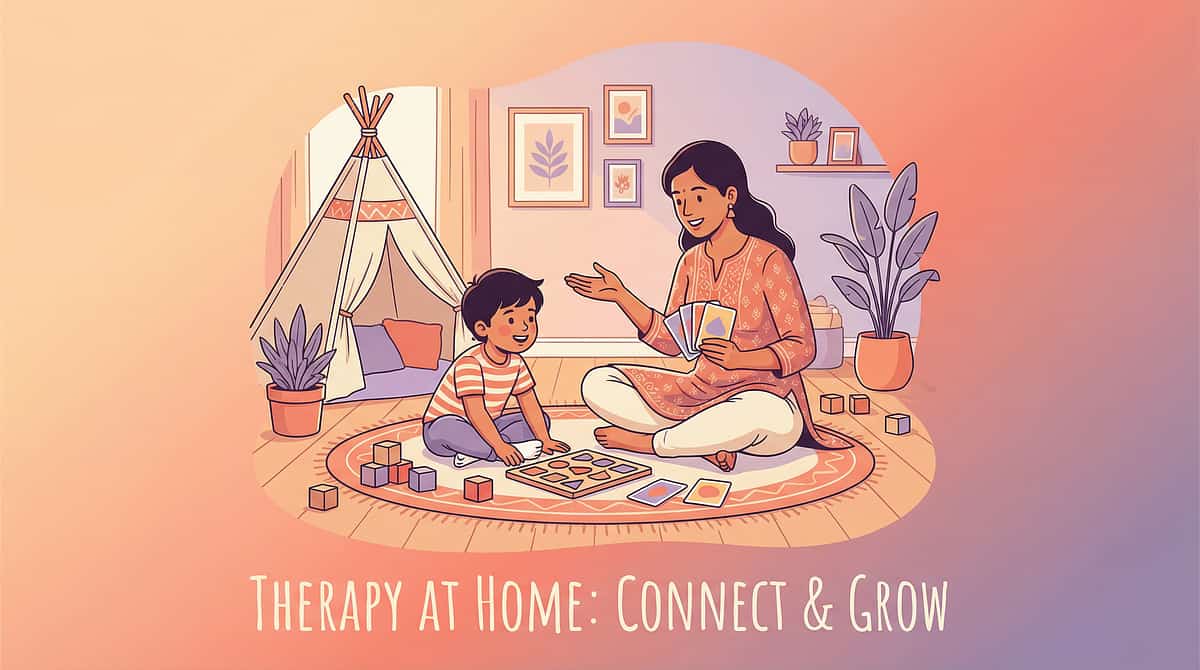
Step 2 of 10: Settling In — The Engagement
Step 2
Duration: 1–3 minutes
The First 3 Minutes Determine the Next 15.
The settling sequence is a ritual, not a checklist. Each step uses consistent language and calm body posture to signal safety to the child's nervous system before the group demands begin.
"Your wobble cushion is ready. Your listening helper is here. Your schedule shows everything that's coming. Your body knows what to do."
✅ Engagement
Settles, touches materials curiously, looks at schedule — proceed with confidence
⚠️ Tolerance
Sits but doesn't interact with materials — acceptable, watch and wait without adding pressure
🔴 Avoidance
Pushes materials away, tries to leave — do not pursue; offer heavy work, re-invite in 5 minutes
When child settles: "You're in your listening seat — that's exactly right." Immediate, specific, warm.
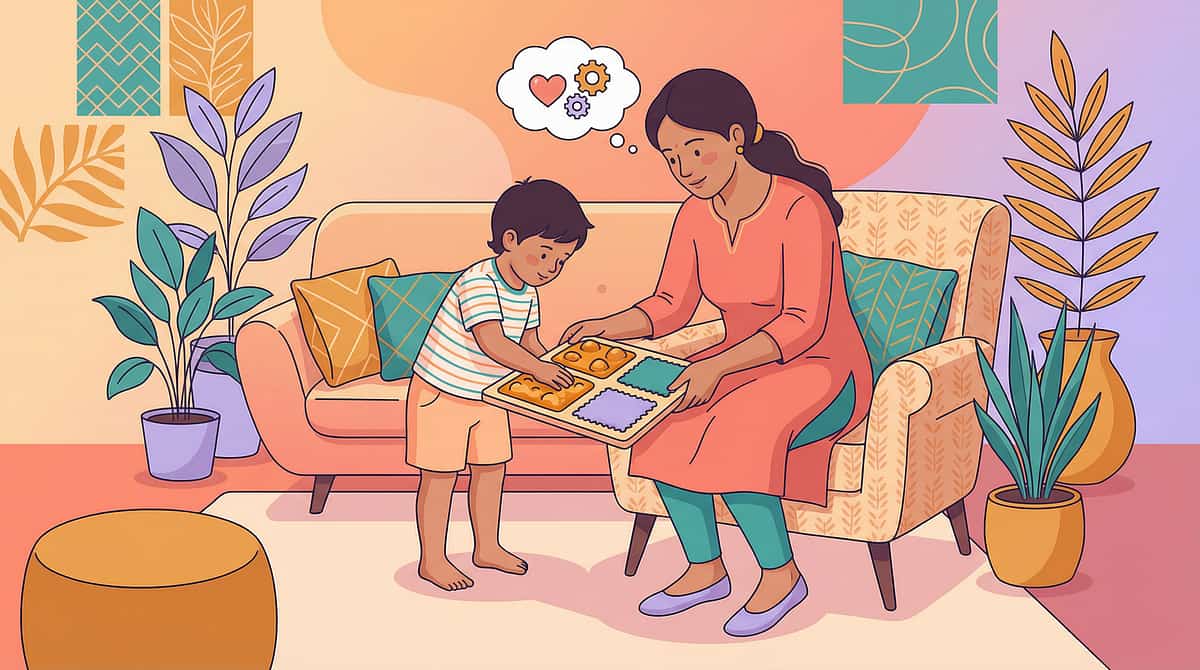
Step 3 of 10: The Core Therapeutic Action
Step 3
Duration: 15–20 minutes (the circle time itself)
The session is running — your role is support architecture, not management. During circle time, the parent/caregiver (at home) or teacher (at school) maintains the support architecture. This is not passive — it is active monitoring without intrusive intervention.
🔵 Minutes 0–5
Monitor settling. If child is on wobble cushion and fidget is in use, resist the urge to check in verbally. Let the materials do the work.
🟡 Minutes 5–10
Natural participation check. Point silently to visual schedule (not verbal reminder). If loud singing begins, offer ear defenders with a gentle nonverbal cue (tap the headphones).
🟢 Minutes 10–15
Movement break window. If movement break card system is in use, this is the typical administration point. "Time for our brain break" benefits the whole group.
🔴 If Dysregulation Begins
Point to visual participation cue card (not verbal). If escalating, offer brief sensory break (wall push-ups, heavy work), not removal. Goal: return to group within 2–3 minutes.
Common Execution Errors
- ❌ Constant verbal reminders ("Sit still!" "Pay attention!") — replaces internal regulation with external policing
- ❌ Removing child at first sign of difficulty — teaches escape works
- ❌ Removing supports when child seems settled — too-early fading causes regression
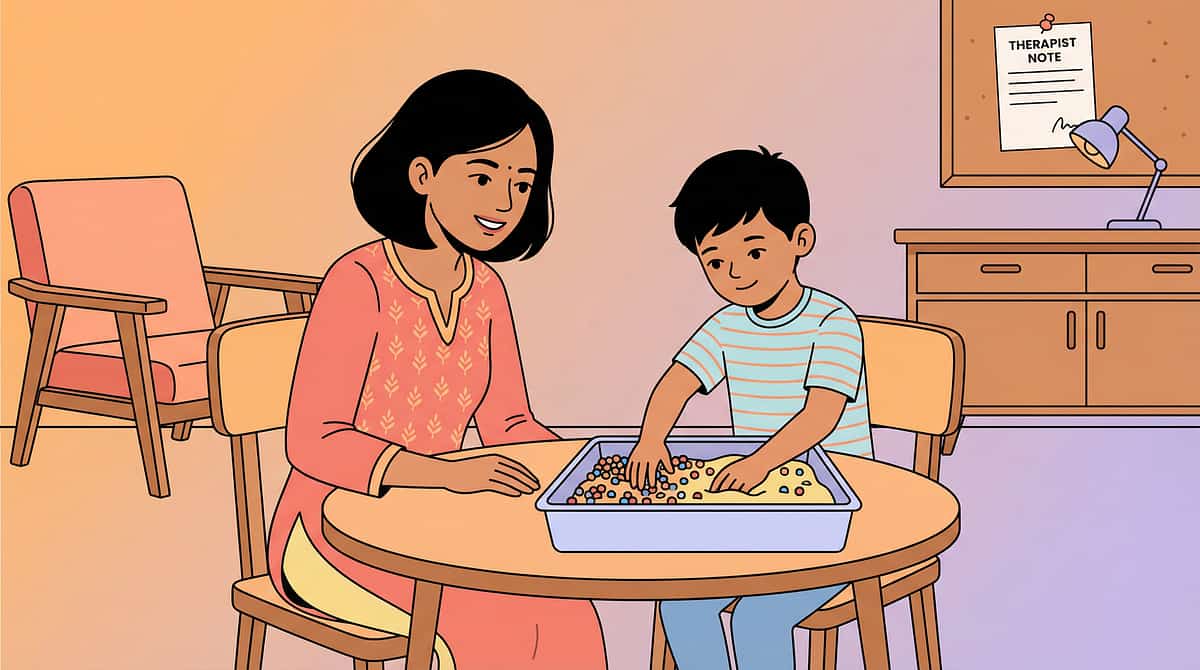
Step 4 of 10: Therapeutic Dosage for Circle Time Skills
Step 4
Daily (school) + Home Practice
Circle time is not a 10-session intervention — it is daily life. The therapeutic dosage is: Every school day (naturally occurring) | Build from 5 minutes to full circle time over 2–4 weeks | Home practice 3× per week
Home Circle Time (3× per week, 10 minutes)
- Place wobble cushion on floor
- Post a visual "home circle time schedule" (3–4 activities)
- Sing a greeting song, read a short book, sing a movement song, say goodbye
- Use same fidget from school kit
- Practice multi-demand integration in a lower-stress environment
Variation Menu
Home Variation | Purpose | |
Shorter duration (5 min) | Build tolerance gradually | |
Fewer activities (2 instead of 4) | Reduce complexity | |
Child-chosen song | Increase motivation | |
With one sibling | Reduce group overwhelm before scaling | |
Child leads calendar activity | Active role reduces passive demand |
The 3-Good-Minutes Principle: 3 minutes of fully engaged, regulated circle time participation is worth more therapeutically than 15 minutes of forced, dysregulated endurance. Build up from success.
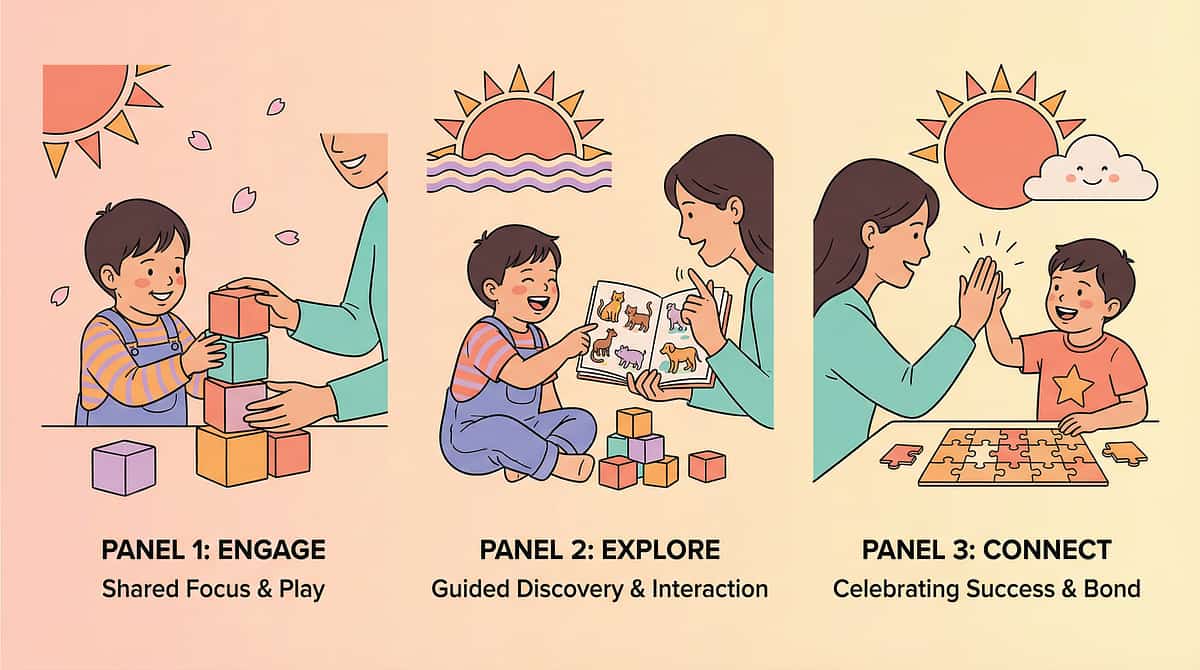
Step 5 of 10: Reinforce & Celebrate
Step 5
Within 3 seconds of target behavior
Timing Matters More Than Magnitude — Immediate, Specific, Enthusiastic.
The Reinforcement Formula: Behavior observed → Name it specifically → Praise within 3 seconds → Optional tangible reward
Reinforcement Scripts (Exact Words)
"You stayed in your listening seat for the whole story — that's a huge win!"
"I saw you use your ear helpers during the song instead of covering your ears — that was so smart."
"You did your brain break and came right back to your spot — I'm so proud of you."
What to Reinforce (Specific Behaviors)
- ✅ Staying in seating space (not full circle time — seconds/minutes count)
- ✅ Using fidget appropriately (in lap, eyes on teacher)
- ✅ Checking visual schedule independently
- ✅ Using ear defenders self-initiated
- ✅ Requesting movement break using card (not running away)
- ✅ Returning to group after sensory break
🏆Reward Jar — Amazon.in ₹589 — Token economy system | 🧸Transition Object — Soft Toy ₹425 — End-of-session reward
Celebrate the attempt, not just the success. "You tried using the ear helpers — that's already brave."
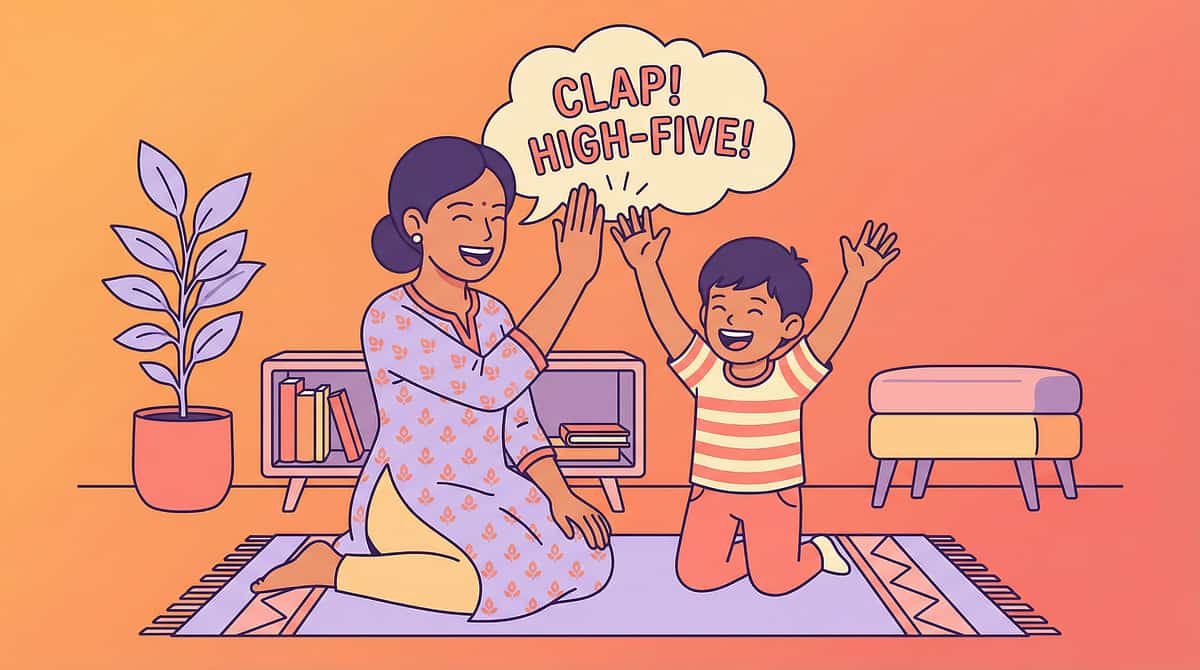
Step 6 of 10: The Cool-Down Transition
Step 6
Duration: 2–3 minutes
No session ends abruptly. The cool-down prevents post-session dysregulation — one of the most overlooked and highest-impact steps in the entire protocol.
2-minute warning — point to visual schedule: "Two more minutes, then circle time is all done. Look — goodbye song is next and then we're finished."
Final activity — goodbye song is naturally calming and provides a ritualized, predictable ending
Material put-away ritual — child puts fidget in pouch, ear defenders on hook, lap pad in bag — child ownership of materials = child ownership of regulation
Transition object offered if needed: Soft toy/comfort item ₹425
Bridge to next activity:"After circle time we have [preferred activity]"
"I know circle time was fun today. We'll do it again tomorrow — same seat, same helpers. Let's say goodbye to the schedule."
Post-Session Heavy Work (3–5 minutes): Animal walks to the next room, carry the book bag to the shelf, push the chair in — proprioceptive input immediately after transitions prevents post-session behavioral blowups.
NCAEP 2020 — Visual supports and transition warnings are classified evidence-based practices for autism.
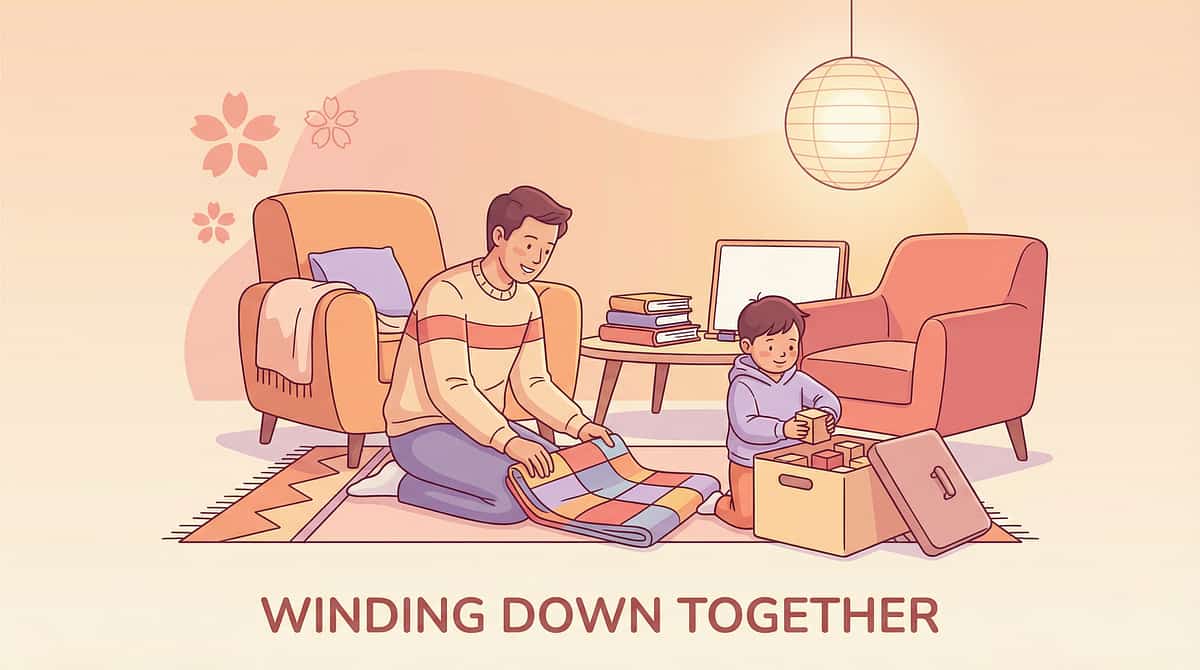
Step 7 of 10: Capture the Data — Right Now
Step 7
Within 60 seconds of session end
Record these 3 data points while memory is fresh. This data is not bureaucratic overhead — it is the most powerful tool you have to see progress that is invisible session-to-session.
Duration
How many minutes did the child remain in the circle area? Record as a number: _____ minutes
Redirections
Frequency of redirection needed: 0× | 1–3× | 4–6× | 7+×
Participation Quality
Tolerated only | Present + occasional participation | Active participation | Full engagement
Optional Data Points
- Materials used today: [all 9 checkboxes]
- Child's affect at end: Distressed | Neutral | Calm | Positive
- Any new behavior (positive or challenging)
Why This Data Matters: Shows trends you cannot see session-to-session. GPT-OS® uses this data to adjust the EverydayTherapyProgramme™. Your data aggregated with 20M+ sessions improves recommendations for every family.
📊 Track form: pinnacleblooms.org/circle-time-tracker-H704 | 📞 FREE 9100 181 181 for data interpretation guidance
Step 8 of 10: Circle Time Troubleshooting
Step 8
8 Common Problems, Clinically-Tested Solutions
Problem | Likely Cause | Solution | |
Wobble cushion ignored/not helping | Child needs calming, not movement | Switch to weighted lap pad; try back support instead | |
Fidget becomes a toy/distraction | Fidget too interesting | Change to simpler fidget (smooth stone, velcro strip) | |
Child removes ear defenders immediately | Doesn't yet associate with relief; wrong fit | Practice at home with music; try different style | |
Visual schedule ignored | Not trained on how to use it | Spend 5 days introducing at home first; make child own the schedule | |
Movement break leads to not returning | Escape function reinforced | Add visual timer to break; make return non-negotiable with immediate reinforcement | |
Works at home, not at school | Environmental generalization gap | Replicate home kit exactly at school; ensure teacher trained | |
Works for 2 weeks then stops | Habituation to single material | Rotate materials; add new sensory element; increase reinforcement | |
Peers asking why child has special tools | Social awareness emerging | Frame as individual learning support: all children learn differently |
The Troubleshoot Principle: Supports fail most often not because they're wrong for the child but because they weren't introduced correctly, faded too early, or lost novelty. Troubleshoot implementation before changing the material.
Escalation Signal: If child is getting worse despite consistent 4-week implementation → Contact Pinnacle for reassessment. There may be an unaddressed sensory component.
📞FREE 9100 181 181 — Troubleshooting consult available

Step 9–10 of 10: Personalizing the Approach
Step 9–10
One Child, One Plan
Use your child's sensory profile to customize the kit. Every child is different — and the materials that transform one child's circle time may need to be adjusted, swapped, or sequenced differently for yours.
SENSORY SEEKER (Needs More Input)
→ Priority: Wobble Cushion + Movement Breaks + Heavy Work Before Session
→ More inflation on cushion | More movement activities within circle time
→ Fidget with stronger proprioceptive input (therapy putty)
→ More inflation on cushion | More movement activities within circle time
→ Fidget with stronger proprioceptive input (therapy putty)
SENSORY AVOIDER (Overwhelmed by Input)
→ Priority: Ear Defenders + Defined Seating Space (buffer from peers) + Weighted Lap Pad
→ Seat at back/edge of circle | Pre-warning before loud activities
→ Fidget with minimal sensory demand (smooth stone)
→ Seat at back/edge of circle | Pre-warning before loud activities
→ Fidget with minimal sensory demand (smooth stone)
ATTENTION PROFILE (ADHD)
→ Priority: Wobble Cushion + Frequent Movement Breaks + Fidget Tools
→ Proximity to teacher | Very short initial circle time (5 min → build up)
→ Token economy for each minute of engagement
→ Proximity to teacher | Very short initial circle time (5 min → build up)
→ Token economy for each minute of engagement
ANXIETY / PREDICTABILITY (ASD Profile)
→ Priority: Visual Schedule + Consistent Routine + Defined Space
→ Never skip or change order without warning | Written social story about circle time
→ Exit option available (reduces anxiety; rarely used when available)
→ Never skip or change order without warning | Written social story about circle time
→ Exit option available (reduces anxiety; rarely used when available)
POSTURAL CHALLENGE (Motor / DCD)
→ Priority: Back Support + Defined Mat + Alternative Seating Position
→ Wall seating option | Shorter sitting expectation initially
→ Wall seating option | Shorter sitting expectation initially
Age Adaptations
- 2–3 years: Max 5 min; movement-heavy; minimal visual schedule (2 items max)
- 4–5 years: 10–15 min; all 9 materials potentially relevant; home practice essential
- 6–8 years: Full 20 min target; more complex visual supports; peer-mediated supports possible
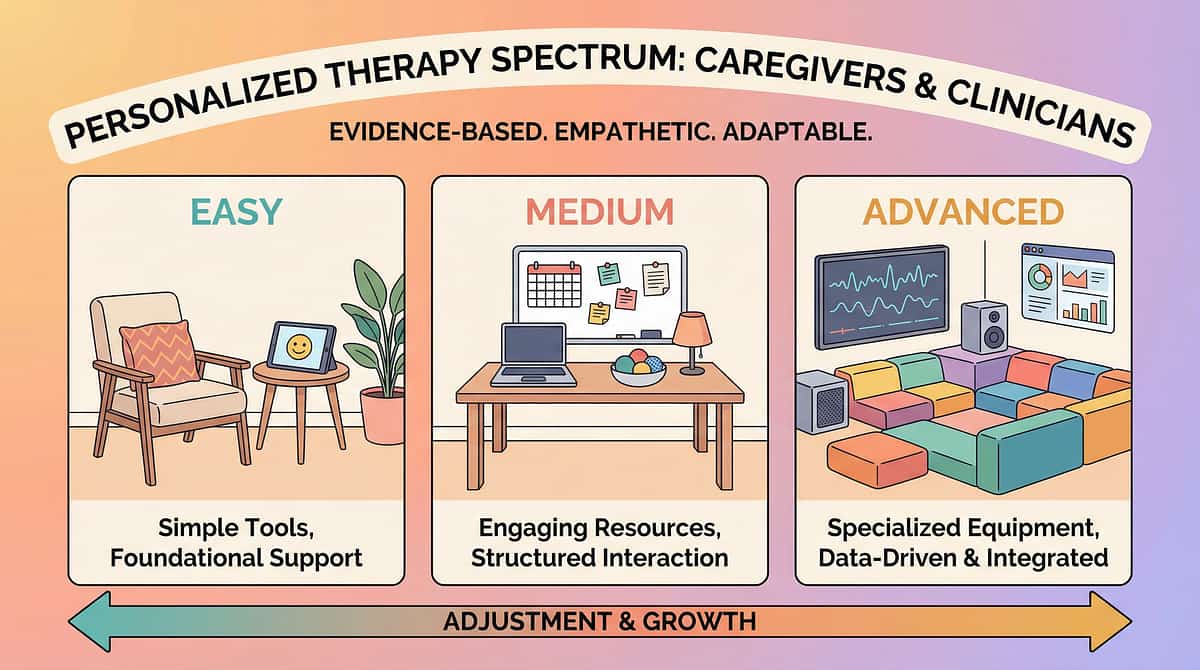
Weeks 1–2: You Are Building the Scaffold
ACT IV: THE PROGRESS ARC
Week 1–2 · Progress: 15%
Not yet measuring the building — building the scaffold. The first two weeks feel slow because the most important work is invisible: your child's nervous system is recalibrating to new inputs. Trust the process.
✅ What You Will Likely See
- Child accepts materials without major resistance (this alone is progress)
- Slightly longer time in circle area before dysregulation
- Visual schedule reduces transition resistance between activities
- Teacher reports fewer redirections — even 2 fewer is meaningful progress
- Child shows curiosity about materials
❌ What You Will Not See Yet (And That's Okay)
- Full circle time completion without support
- Self-initiated material use
- Independent regulation
- "Normal" circle time behavior
Calibration Statement: If your child tolerates the wobble cushion for 3 minutes longer than last week — that is real neurological progress. Do not dismiss it because it doesn't look like what you expected.
Track This Week:📊 Duration in circle area (minutes) — Day 1 vs Day 7 → Any increase = progress
Systematic review (Children, 2024): Early indicators in weeks 1–2 are tolerance and presence, not mastery. PMC11506176

Weeks 3–4: The Neural Pathways Are Forming
Week 3–4 · Progress: 40%
Week 3–4 is the turning point most parents miss because they're looking for dramatic changes. The real consolidation signals are subtle — and they are the most important indicators of lasting progress.
✅ Child reaches for fidget independently (self-initiation emerging)
✅ Child checks visual schedule without prompting
✅ Child uses ear defenders at the right moment (loud song starts)
✅ Teacher mentions child stayed for "most" of circle time
✅ Post-circle-time behavioral blowups decreasing in frequency
✅ Child can now verbalize: "I need my listening helper" or equivalent
A child who reaches for their own fidget is beginning to internalize self-regulation. This is the turning point — the neural pathway is forming.
Increase Intensity Signals: If you see 3+ consolidation indicators → Slightly increase circle time duration expectation | Begin practicing without one support on "good days" | Add a peer buddy component
"You may notice you're less anxious about circle time reports. That's not just relief — it's evidence that the system is working."
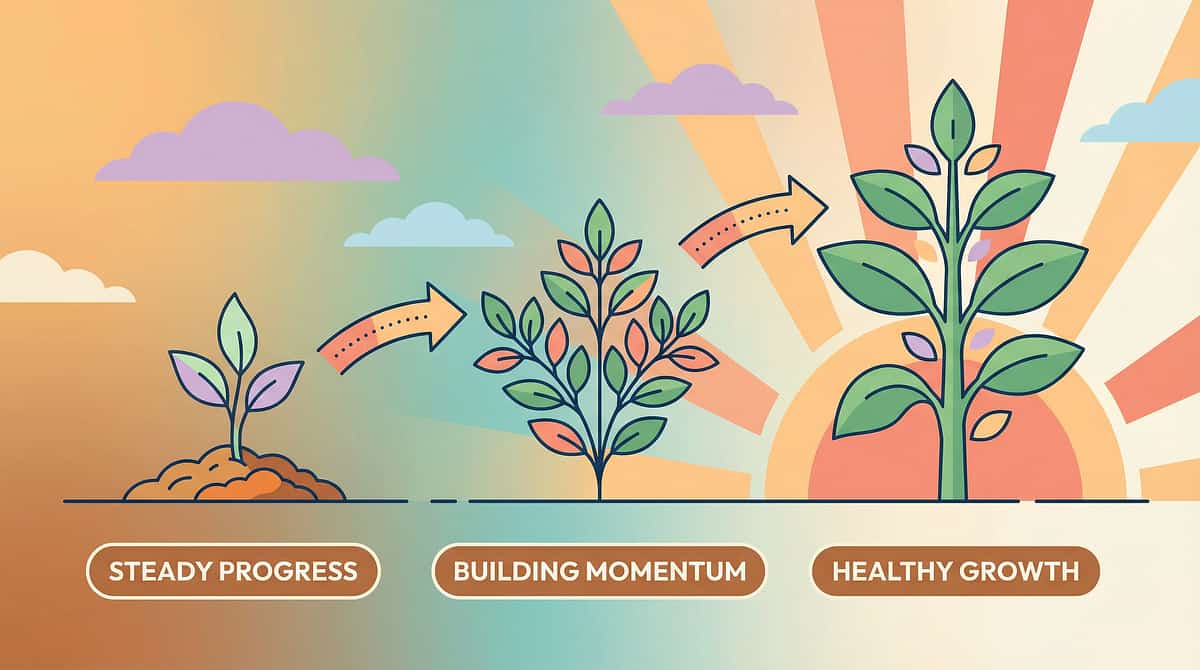
Weeks 5–8: From Scaffolded Participation to Self-Directed Regulation
Week 5–8 · Progress: 65%
Independence Markers
- Full circle time completion with supports consistently
- Self-initiation of all support materials
- Self-advocacy: "I need a movement break" (with card or words)
- Positive affect during circle time — child appears to enjoy some activities
- Peer relationships developing in circle time context
- Teacher describes child as "a different child at circle time"
Fading Protocol
Begin when 5+ independence markers are present. Fade one support at a time. Never fade multiple simultaneously.
- Start by fading on "good days" only
- Begin with the least-needed support
- Return support if fading causes regression — this is information, not failure
- Some supports may become permanent accommodations — this is appropriate
Generalization Targets
- Can child participate in non-school group settings (family gathering, activity class)?
- Can child participate when a different teacher leads circle time?
- Can child manage without some supports when they were left at home?
The Long View: Many children who needed all 9 supports in preschool circle time participate fully independently by Year 2 of primary school. The supports built the skills; the skills now work without the supports.

These Are Not Small Wins. They Are Neurological Victories.
🥇 First Day Using Wobble Cushion Without Resistance
"You tried something new for your brain — that's brave."
🥇 First Time Staying Seated for Full Story
"Your body stayed in its spot for the whole story. That's your nervous system getting stronger."
🥇 First Self-Initiated Use of Ear Defenders
"You knew what your ears needed and you helped yourself. That's self-regulation — a superpower."
🥇 First Full Circle Time Completion
"You did the whole circle time. Every song. Every story. Every minute. This is a moment to remember."
🥇 First Positive Circle Time Report from Teacher
Frame it. Keep it. This is the evidence that your work at home is working.
"You learned about wobble cushions at midnight because you love your child. You made DIY seating markers at the kitchen table. You communicated with the teacher. You tracked the data. You stayed consistent. This progress is yours as much as your child's."

Red Flags: When to Escalate
⚠️ These Signs Require Professional Assessment
Do not manage these signals alone. They indicate that the home-support-only approach has reached its ceiling and a more comprehensive clinical plan is needed. This is not a failure — it is the data telling you what to do next.
🚨 Escalate Immediately If:
- No improvement in any metric after 6 consistent weeks
- Significant regression after a period of improvement
- Child is increasingly distressed (not just not improving)
- Meltdowns escalating in duration or intensity
- Child now refuses to enter school building (generalized school refusal)
- Sleep severely disrupted (regulatory system may be chronically overwhelmed)
- Aggressive behavior toward self or others emerging or increasing
- Teacher reports situation is affecting other children's learning significantly
Immediate Action Steps
Call FREE National Autism Helpline: 9100 181 181
Request AbilityScore® Assessment + Sensory Profile
Request Classroom Participation Readiness Index baseline measurement
Ask for school consultation service — Pinnacle will communicate directly with the school
📞FREE 9100 181 181 | Available 24×7 | 16+ languages
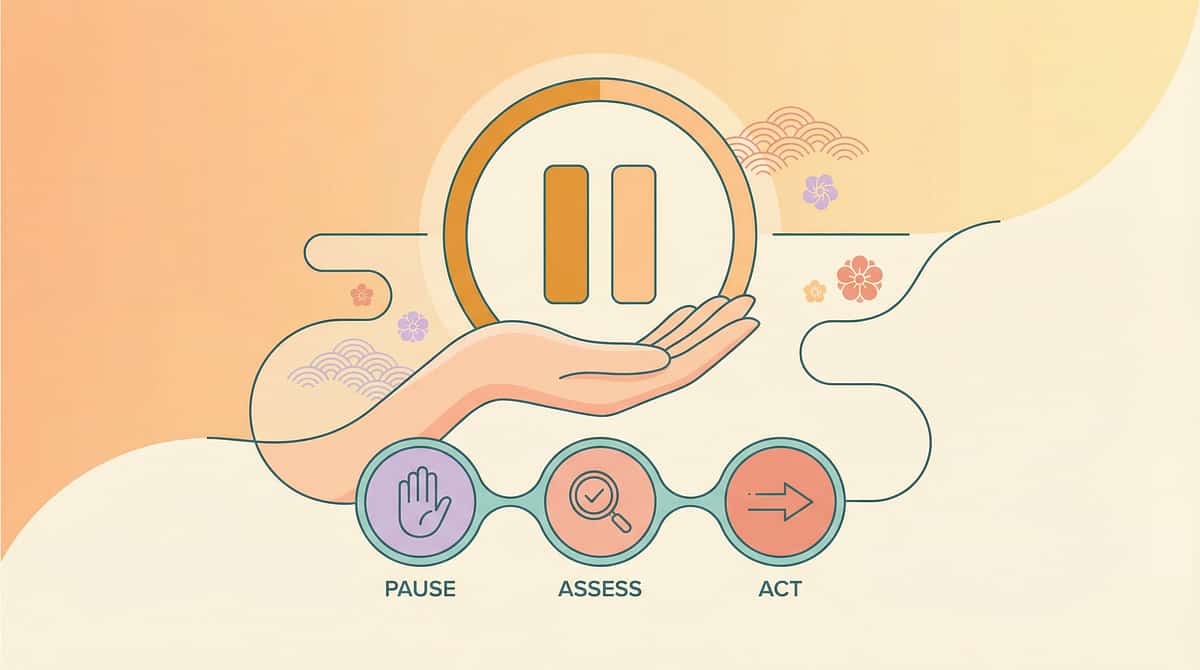
From Circle Time Struggle to Classroom Readiness — The GPT-OS® Pathway
A structured, data-driven journey from first concern to full independent classroom participation. Every step is coordinated by GPT-OS® — the most advanced pediatric therapeutic intelligence system in India.
AbilityScore® Assessment
591+ structured observations across 349 skills. Establishes your child's baseline on the Classroom Participation Readiness Index. Duration: 90 minutes. Available at all 70+ Pinnacle centers.
Sensory Profile
Identifies which sensory systems are over/underresponsive. Maps exactly which of the 9 materials will have maximum impact for your child specifically. OT-led assessment.
TherapeuticAI® Plan
GPT-OS® generates a personalized circle time support plan — specific material combinations, dosage, home practice schedule, teacher communication templates. Updated as data comes in.
EverydayTherapyProgramme™
Daily home practice integrated into your existing routine. Not additional therapy — therapy woven into real life. 15–20 minutes per day.
FusionModule™ Coordination
OT + ABA + SLP + SpEd inputs converged into one plan. Your child's entire support team sees the same data and adjusts in real time.
📞FREE 9100 181 181 — Start the pathway today
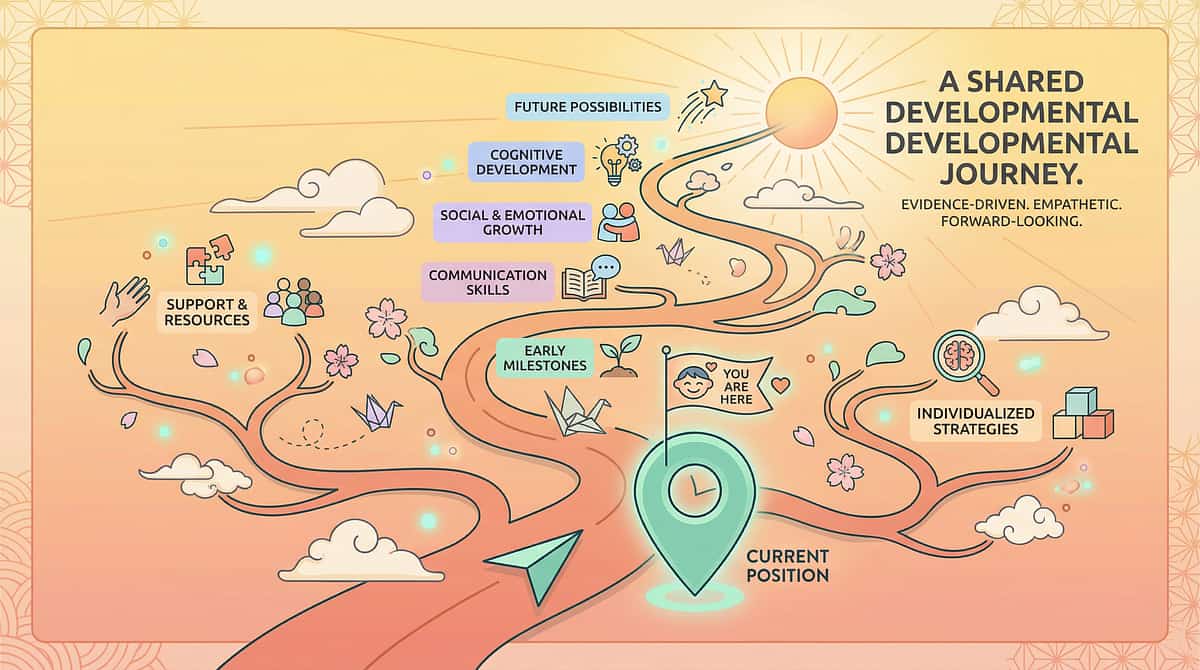
Circle Time Is One Skill in the Classroom Readiness Ecosystem
Your work on H-704 is most effective when connected to the skills that come before and after it. The Classroom & Learning Readiness Series builds each skill on a foundation of the last.
Episode | Technique | Link | |
H-702 | Following Classroom Rules | techniques.pinnacleblooms.org/H-702 | |
H-703 | Waiting and Turn-Taking in Groups | techniques.pinnacleblooms.org/H-703 | |
H-704 | Circle Time (YOU ARE HERE) | Current page | |
H-705 | Classroom Transitions | techniques.pinnacleblooms.org/H-705 | |
H-706 | Table Work and Seat Work | techniques.pinnacleblooms.org/H-706 |
Cross-Domain Connections
G-620
Sensory Processing Challenges — foundational sensory work that underpins all classroom skills
K-9600
Advocating for Classroom Accommodations — how to use these supports in formal school accommodation plans
B-221
Social Attention in Groups — communication layer of circle time participation
The Cluster Principle: Circle time readiness is built from multiple sub-skills. Families working on H-704 typically benefit from simultaneously working on H-703 (waiting/turn-taking) and having assessed G-620 (sensory processing) as the regulatory foundation.
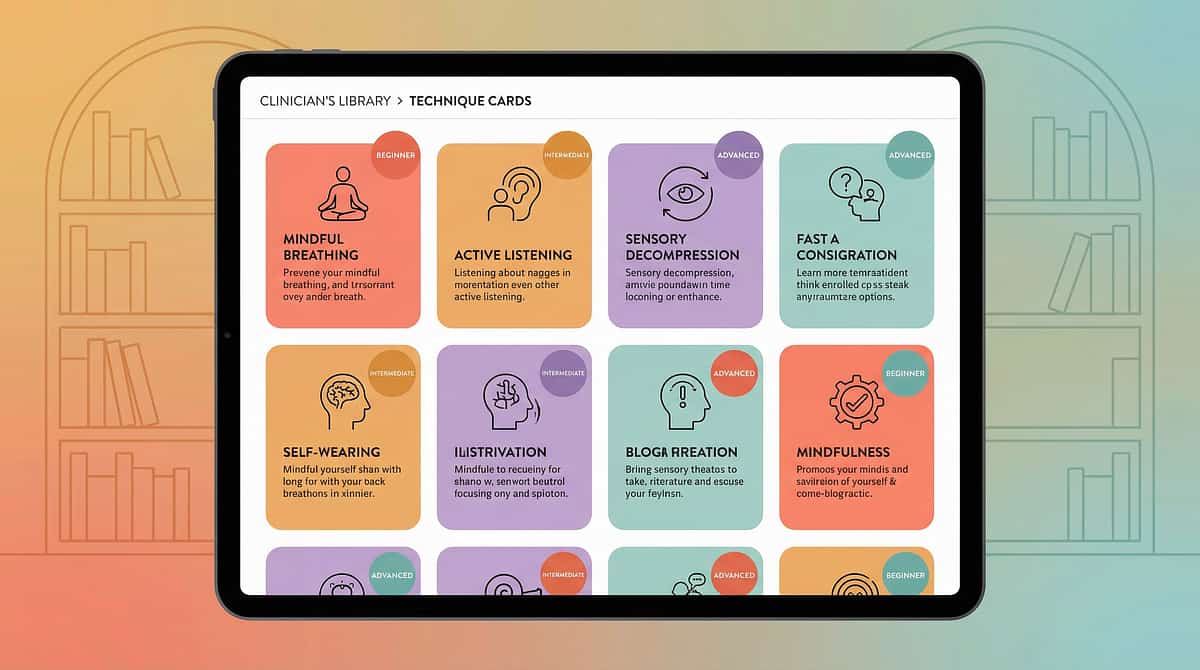
Circle Time Is One Node in Your Child's Complete Developmental Map
Your child's circle time difficulty almost certainly connects to regulatory systems in Domain A (sensory), social systems in Domain B (communication), and behavioral systems in Domain D (flexibility). GPT-OS® maps all connections and coordinates interventions across all 12 domains simultaneously.
Current Domain Status: Domain H — Classroom & Learning Readiness — is typically activated after foundational work in Domains A (Sensory Processing) and C (Emotional Regulation). Your OT will map the recommended sequencing for your child.
WHO/UNICEF Nurturing Care Framework — Five nurturing care components require holistic developmental monitoring across 42 indicators. WHO NCF (2018) | PMC9978394
📞 FREE 9100 181 181 | See your child's full 12-domain developmental profile
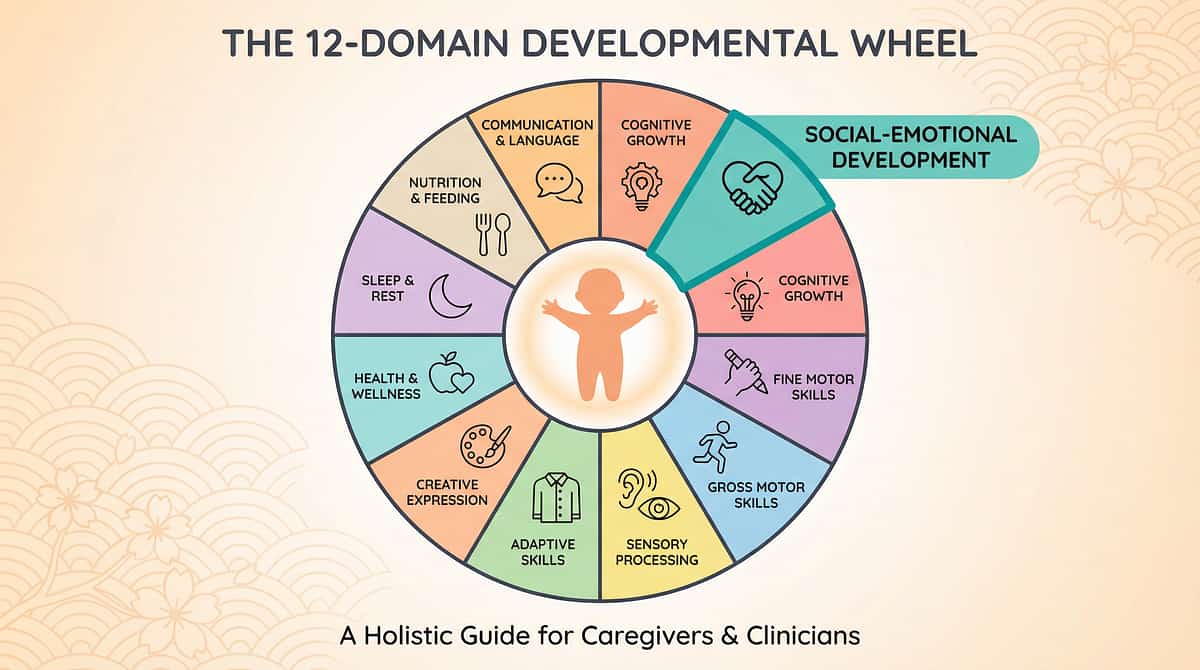
The Child Who Couldn't Do Circle Time — And the Child Who Now Leads the Morning Song
ACT V: COMMUNITY & ECOSYSTEM
Family Story 1 — Riya, Age 4 (ASD)
Before: Riya lasted 45 seconds at circle time before attempting to run. Teacher was removing her daily. Parents dreaded every school pickup.
Intervention: OT assessment identified vestibular seeking + auditory hypersensitivity. Wobble cushion, ear defenders for songs, visual schedule, and defined mat introduced. Teacher trained on materials.
After (Week 6): Full 15-minute circle time completion. Ear defenders only for singing segment. Teacher no longer sends daily problem reports.
"The morning we got a positive report, I sat in my car and cried. We'd heard nothing but problems for six months."
Family Story 2 — Arjun, Age 5 (ADHD)
Before: Arjun couldn't stop touching other children, called out constantly, removed from circle time 3× per week.
Intervention: Wobble cushion (vestibular), fidget tool (tactile regulation), movement break cards with teacher. Token economy for each full song completion.
After (Week 8): Full 20-minute circle time with wobble cushion and fidget. Call-outs reduced 80%. No more removal. Teacher reports "transformation."
"Arjun's body needed movement to regulate, not stillness. Once we gave his nervous system what it needed, his behavior followed." — From the Therapist's Notes
Note: These are illustrative clinical narratives based on composite outcomes across Pinnacle Blooms Network® centers. Individual outcomes vary.
Isolation Is the Enemy of Adherence — You Need a Community
The families making the most progress are rarely doing it alone. Connection with other parents navigating the same daily challenges dramatically improves consistency, motivation, and outcomes.
📱 WhatsApp Parent Group
Circle Time & Classroom Readiness
Pinnacle Blooms Network® Facilitated | Moderated by SpEd Specialists
Join: pinnacleblooms.org/whatsapp-classroom-readiness
Pinnacle Blooms Network® Facilitated | Moderated by SpEd Specialists
Join: pinnacleblooms.org/whatsapp-classroom-readiness
💻 Online Community Forum
School Readiness & Early Education
pinnacleblooms.org/community/classroom-readiness
pinnacleblooms.org/community/classroom-readiness
🏫 Local Parent Meetups
Find your nearest Pinnacle center's parent group
pinnacleblooms.org/centers → Select your city → Parent Groups
pinnacleblooms.org/centers → Select your city → Parent Groups
🤝 Peer Mentoring
Connect with families 12 months ahead of you in their circle time journey — real experience, real encouragement.
pinnacleblooms.org/peer-mentoring
pinnacleblooms.org/peer-mentoring
WHO Nurturing Care Framework: Community engagement is a core principle. Parent support networks measurably improve intervention adherence and outcomes.
📞FREE 9100 181 181

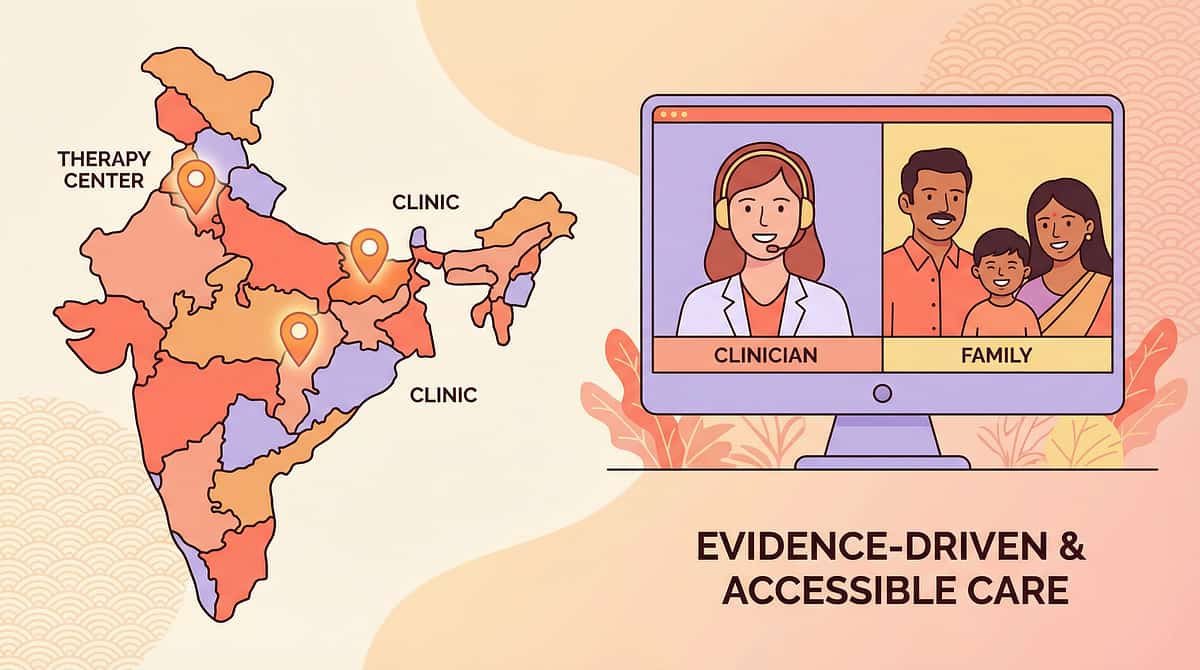
Home + Clinic = Maximum Impact. Your Professional Team Is Ready.
Professional clinical assessment is not a luxury — it is the difference between materials that are generally helpful and materials precisely matched to your child's specific regulatory profile.
Primary Assessment
Occupational Therapist with Sensory Integration Certification
Supporting Specialist
ABA/BCBA for classroom behavior protocols and reinforcement systems
School Collaboration
Special Educator for IEP and accommodation planning
Medical Oversight
Neurodevelopmental Pediatrician for diagnostic clarity
Home + Clinic Protocol
- Clinic: Sensory assessment, protocol design, materials selection, teacher training
- Home: Daily EverydayTherapyProgramme™ execution
- School: Written support plan + teacher training + monthly review
📞 Teleconsultation Available
For families outside major cities or with mobility constraints.
7 days/week | 70+ therapists | Pan-India coverage
pinnacleblooms.org/teleconsultation
7 days/week | 70+ therapists | Pan-India coverage
pinnacleblooms.org/teleconsultation
📞FREE 9100 181 181 | 16+ languages | 24×7 | First consultation free
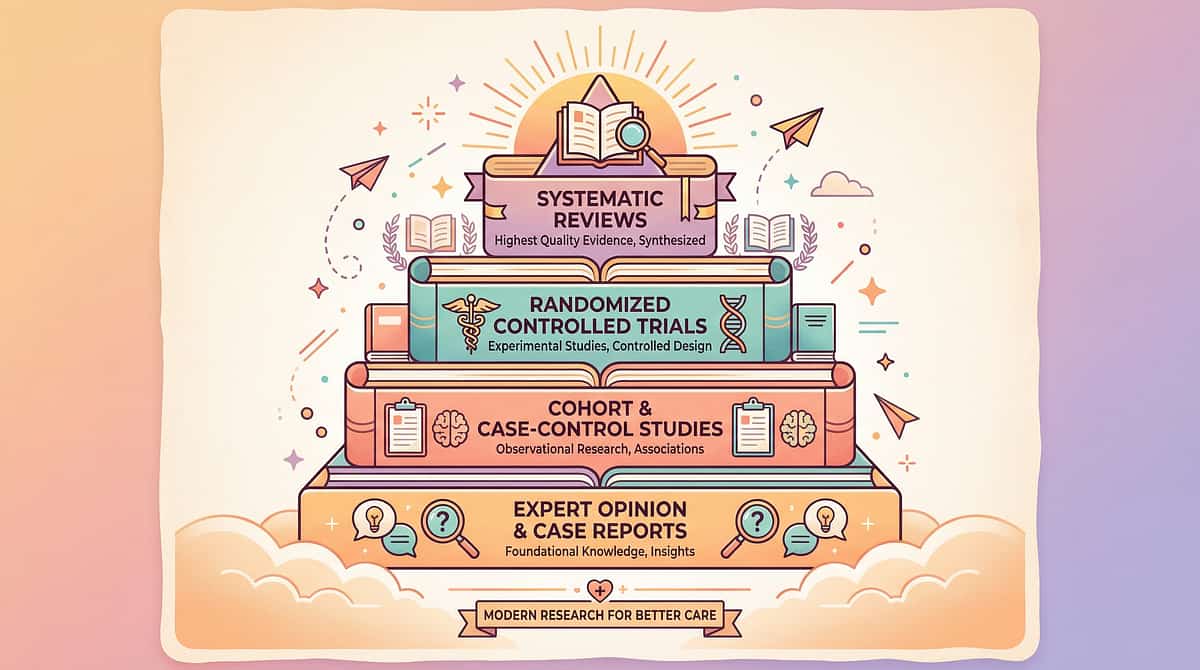
The Science Behind Circle Time Supports — Your Right to Know the Evidence
📄 PMC11506176 — PRISMA Systematic Review (Children, 2024)
16 studies (2013–2023) confirm sensory integration intervention is evidence-based practice for ASD. Improves social skills, adaptive behavior, sensory processing, motor skills.
📄 PMC10955541 — Meta-Analysis (World J Clin Cases, 2024)
Sensory integration therapy with structured material introduction meets evidence-based criteria. 40-minute sessions show maximum effectiveness. DOI: 10.12998/wjcc.v12.i7.1260
📄 PMC9978394 — WHO CCD Package Implementation (2023)
Caregiver-delivered programs in 54 countries produce equivalent outcomes to clinic-delivered for many skill domains.
📄 Padmanabha et al., Indian J Pediatr (2019)
Home-based sensory interventions in Indian children with ASD demonstrate significant outcomes across sensory, behavioral, and adaptive domains. DOI: 10.1007/s12098-018-2747-4
📄 NCAEP Evidence-Based Practices Report (2020)
Visual supports, video modeling, and structured play classified as evidence-based practices for autism.
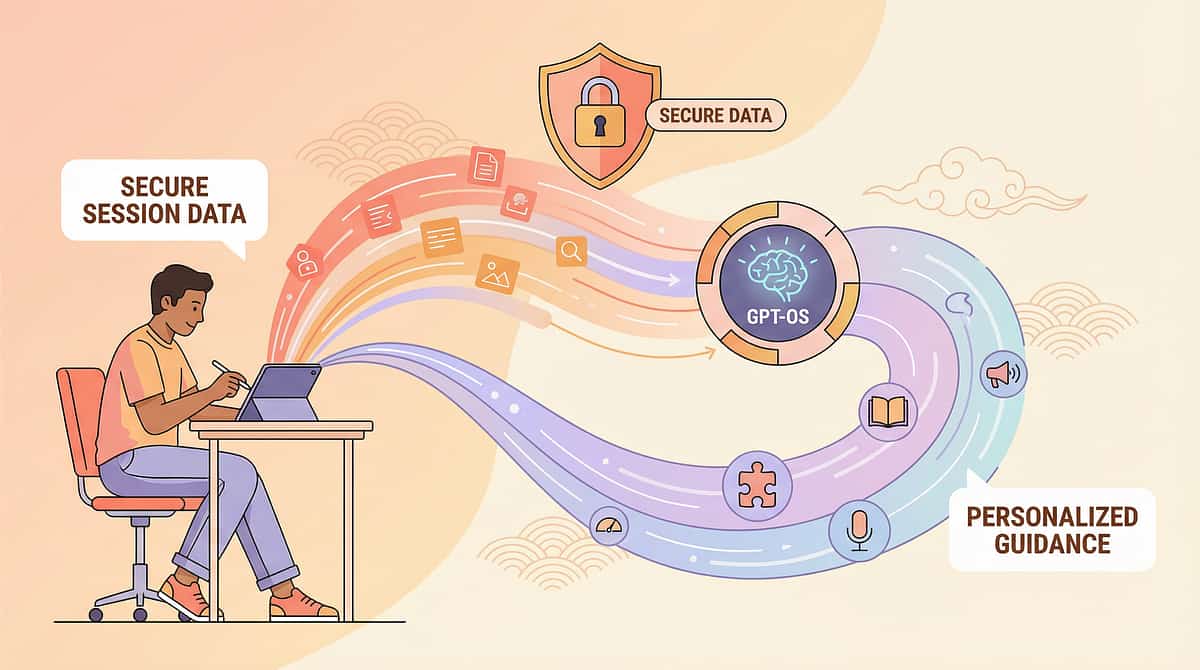
Your Circle Time Data Feeds the Most Advanced Pediatric Therapeutic Intelligence in the World
What GPT-OS® Learns from H-704 Data
- Which material combinations produce fastest tolerance → participation transition
- Which child sensory profiles respond best to which material combinations
- Optimal sequencing of supports (which to introduce first, which to fade first)
- School collaboration protocols that produce fastest generalization
Privacy Assurance
All data is anonymized, aggregated, and processed under DPIIT DIPP8651 and applicable Indian privacy regulations. No personally identifiable information is shared externally.
GPT-OS® Stack
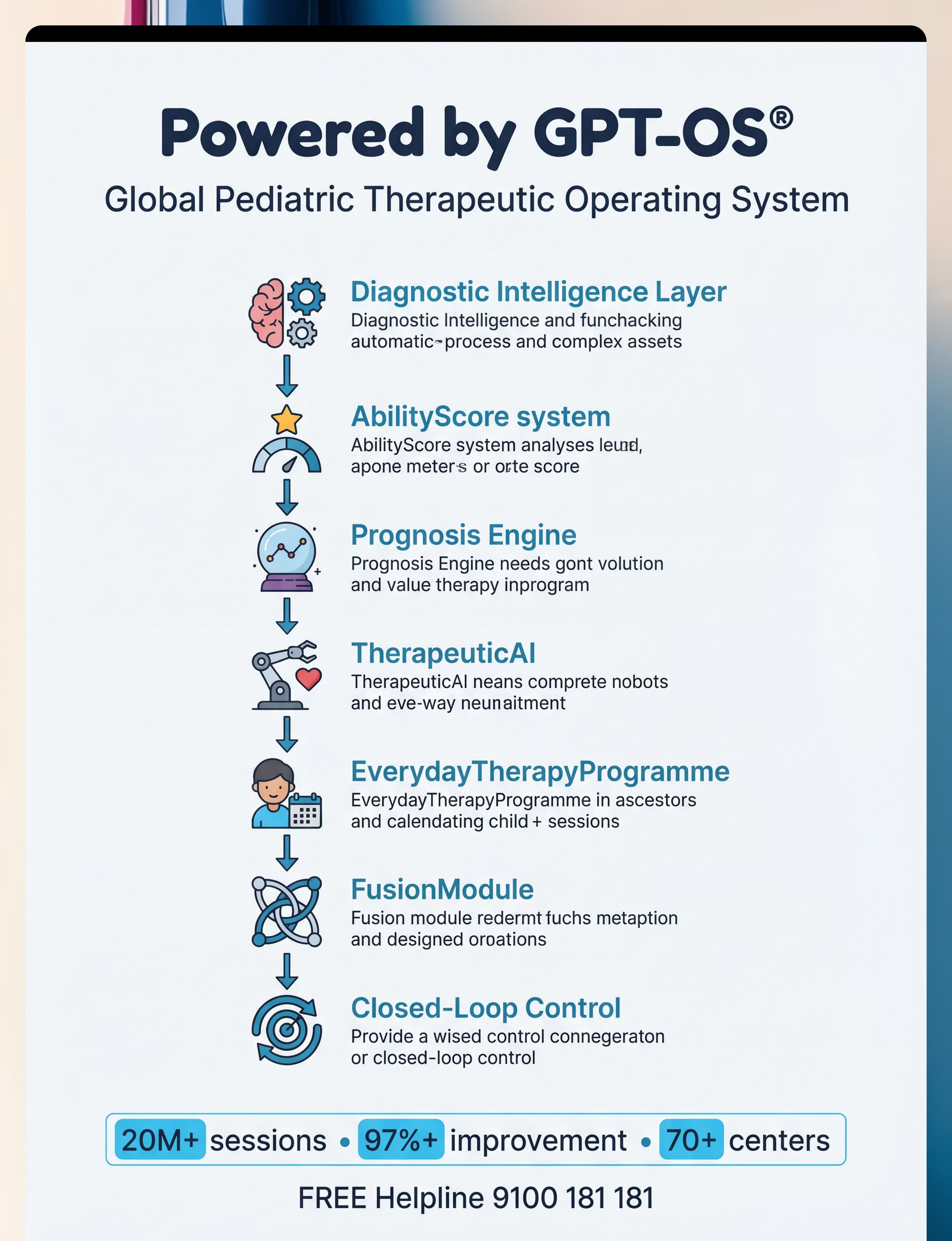
Diagnostic Intelligence → AbilityScore® → Prognosis Engine → TherapeuticAI® → EverydayTherapyProgramme™ → FusionModule™ → Closed-Loop Control
20M+ sessions · 97%+ improvement · 70+ centers · Patents filed in 160+ countries
"Your data from today's circle time session contributes to better recommendations for 27 million children navigating group learning across India."
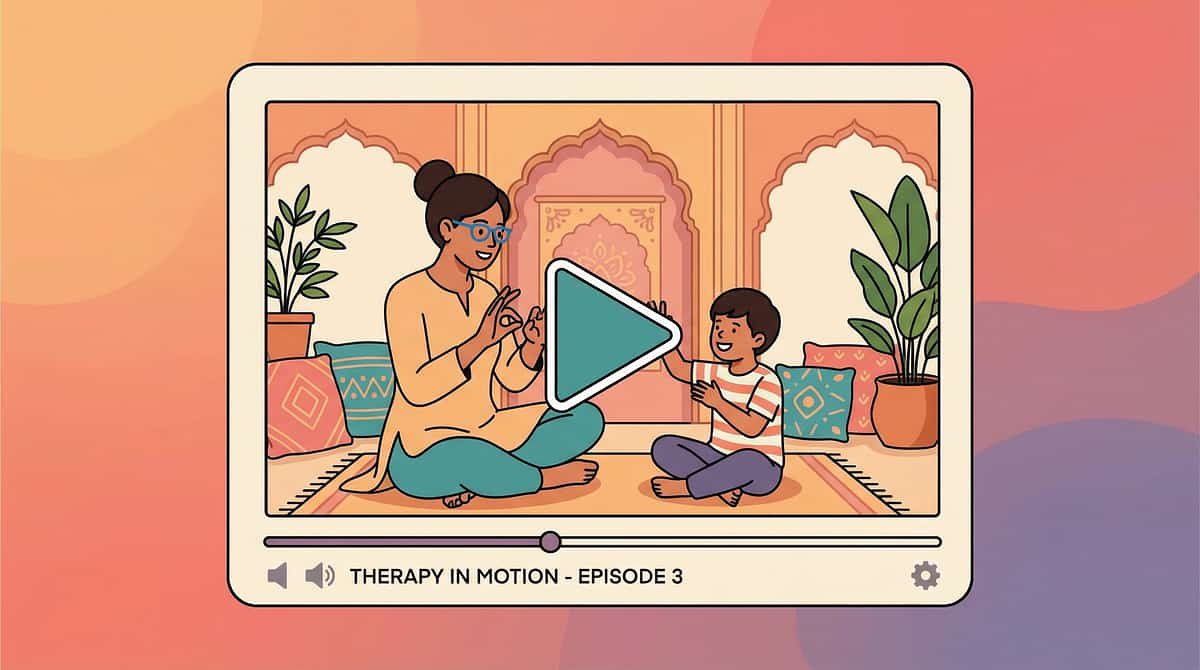
Watch: 9 Materials That Help With Circle Time
Reel ID: H-704
Domain H: Classroom & Learning Readiness
Episode 704
In 60 seconds, our OT and SpEd consortium specialists walk through all 9 materials — showing real circle time scenarios, demonstrating material use, and giving parents the visual reference to translate this page into action.
Why Video Matters: NCAEP 2020 classifies video modeling as evidence-based practice for autism. Seeing a material in use is categorically different from reading about it. This reel is the visual bridge between knowledge and execution.
🎬Watch the reel:pinnacleblooms.org/reels/H-704
Presented by Pinnacle Blooms Network® Consortium — Pediatric OT + SpEd specialization. "You're watching real therapy intelligence, distilled for real families."
Previous: H-703
Waiting & Turn-Taking in Groups
Now: H-704
Circle Time Materials — YOU ARE HERE
Next: H-705
Classroom Transitions
📱 Share: [WhatsApp] [Instagram] [Copy Link] | 📞 FREE 9100 181 181
Consistency Across All Caregivers Multiplies Impact by 3×
When grandparents, teachers, and parents all use the same language and the same materials, skill generalization happens three times faster. Share this resource — and use the templates below to make consistency easy.
For Grandparents (Simplified Version)
"[Child's name] uses some special tools at circle time to help their brain and body stay calm. Please make sure:
- They always have their listening helper (fidget)
- They can see the picture schedule
- Don't tell them to 'sit still' — let them use their wobble seat
These tools help them learn."
Teacher Communication Template
Dear [Teacher's Name],
We are implementing circle time supports for [child's name] based on our OT assessment. The attached Pinnacle H-704 protocol describes the 9 materials and their purpose. We would appreciate 5 minutes to discuss how to introduce these at school.
We are implementing circle time supports for [child's name] based on our OT assessment. The attached Pinnacle H-704 protocol describes the 9 materials and their purpose. We would appreciate 5 minutes to discuss how to introduce these at school.
The most important materials to start are: [wobble cushion / visual schedule / ear defenders based on your child's profile].
📱 WhatsApp
Share instantly with your child's caregivers and family
📧 Email
Forward to teacher, therapist, grandparents
📥 Download
PDF Family Guide for families without smartphone access
WHO CCD Package: Multi-caregiver training is critical for intervention generalization. PMC9978394

Circle Time Questions — Answered by the Pinnacle Consortium
ACT VI: FAQs
Q1: My child uses the wobble cushion at home but refuses it at school. Why?
Environmental generalization is a specific challenge in ASD and sensory differences. Introduce the cushion at school gradually — let child sit on it during non-circle-time first, have teacher use the same positive language as at home, and send the same cushion from home to school (familiar item).
Q2: The teacher says she can't give my child "special treatment" different from other children.
All 9 materials can be framed as classroom-wide resources: wobble cushions available to all, fidget basket for all, whole-class visual schedule, whole-class brain breaks. This eliminates stigma while giving your child what they need. Forward this page to the teacher — it includes evidence citations.
Q3: My child is 7 — are these materials only for preschoolers?
No. The age range is 2–8 years and beyond. Many children in primary school continue to benefit from sensory seating, visual schedules, and fidget tools. Formal accommodation plans can make these permanent supports.
Q4: How long will my child need these supports?
Varies significantly. Some children fade all supports within 6 months. Some continue with 1–2 supports throughout primary school. Some will use accommodation-level supports permanently — and that is appropriate. The goal is functional participation, not support elimination.
Q5: My child is diagnosed with ADHD, not autism. Do these materials still apply?
Fully. Wobble cushions, fidget tools, and movement breaks are evidence-based for ADHD specifically. Visual schedules and defined seating spaces reduce cognitive load, which benefits ADHD profiles. The material solutions significantly overlap.
Q6: How do I know which of the 9 materials to start with?
Use Card 22 (personalizing the approach) as your guide. For sensory seekers: wobble cushion first. For auditory sensitivity: ear defenders first. For anxiety/unpredictability: visual schedule first. For general starting point: wobble cushion + visual schedule + defined mat is the evidence-supported trio.
Q7: My child screams at the sight of the wobble cushion. What do I do?
Do not force. Introduce the cushion as a neutral object first — let child jump on it at home, sit on it during preferred activities, control it themselves. The aversion is information: this child may be a sensory avoider who needs calming tools (weighted lap pad, back support) rather than movement tools. Consult your OT.
Q8: Can I share this page / protocol with my child's school therapist?
Yes — this page is designed for exactly that. Use the Teacher Communication Template. This is educational content based on Pinnacle's 20M+ session evidence base. Your school therapist should be familiar with all 9 materials.
Your Child Does Not Have to Fail at Circle Time.
The Supports Exist. The Evidence Is Clear. The Help Is Here.
🏆 ACTION 1 — MOST IMPORTANT: Get Your Child Assessed
AbilityScore® + Sensory Profile + Classroom Participation Readiness Index. Discover exactly which materials match your child's specific profile.
BOOK ASSESSMENT: pinnacleblooms.org/book-assessment
OR call FREE 9100 181 181 (24×7 · 16+ languages)
OR call FREE 9100 181 181 (24×7 · 16+ languages)
🛠️ ACTION 2 — START TODAY: Build Your Starter Kit
Wobble Cushion + Visual Schedule + Defined Mat. Three materials, under ₹2,000, transformative impact.
🛒 Amazon.in: balance disc cushion children
📥Download: DIY Visual Schedule Template — FREE
📥 Download: Defined Seating Space Guide — FREE
📥Download: DIY Visual Schedule Template — FREE
📥 Download: Defined Seating Space Guide — FREE
📤 ACTION 3 — SHARE: Tell Your Child's Teacher
One conversation with the teacher can implement 9 supports across the whole classroom. Use the template from Card 37.
📥 Download: Teacher Communication Letter Template | 📱 Share this page: WhatsApp | Email | Copy Link
20M+ Sessions
97%+ Improvement
70+ Centers
DPIIT DIPP8651
📞FREE 9100 181 181 | National Autism Helpline · 16+ Languages · 24×7
Preview of 9 materials that help with circle time Therapy Material
Below is a visual preview of 9 materials that help with circle time therapy material. The pages shown help educators, therapists, and caregivers understand the structure and content of the resource before use. Materials should be used under appropriate professional guidance.


Link copied!

Every Child Can Participate in Group Learning.
With the right supports, in the right sequence, at the right time.
Pinnacle Blooms Network® has delivered over 20 million exclusive 1:1 therapy sessions across 70+ centers. We have seen children who could not tolerate 30 seconds of circle time become children who lead the morning song. We have seen sensory overload transform into sensory mastery. We have seen parents move from daily dread to daily celebration.
This is not a promise of perfection. It is a promise of progress. Your child has a nervous system that is learning, adapting, and growing — every session, every day, every support you provide.
→ H-705: What Comes Next
9 Materials That Help With Classroom Transitions — the next challenge after circle time is mastered.
techniques.pinnacleblooms.org/H-705
techniques.pinnacleblooms.org/H-705
← H-703: The Foundation
9 Materials That Help With Waiting & Turn-Taking — if your child needs the foundation before circle time.
techniques.pinnacleblooms.org/H-703
techniques.pinnacleblooms.org/H-703
Research: PMC11506176 | PMC10955541 | PMC9978394 | WHO NCF 2018 | NCAEP 2020 | DOI: 10.1007/s12098-018-2747-4 | DOI: 10.3389/fnint.2020.556660
🏆Pinnacle Blooms Network® | Built by Mothers. Engineered as a System.
OT · ABA/BCBA · SLP · SpEd · NeuroDev Pediatrics · CRO | WHO/UNICEF Aligned | DPIIT Recognized | MSME Certified
OT · ABA/BCBA · SLP · SpEd · NeuroDev Pediatrics · CRO | WHO/UNICEF Aligned | DPIIT Recognized | MSME Certified
CIN: U74999TG2016PTC113063 | DPIIT: DIPP8651 | MSME: TS20F0009606 | GSTIN: 36AAGCB9722P1Z2
© 2025 Pinnacle Blooms Network®, unit of Bharath Healthcare Laboratories Pvt. Ltd. All rights reserved.
This content is educational. It does not replace individualized assessment and intervention from licensed occupational therapists, speech-language pathologists, behavioral therapists, or educational specialists. Individual results may vary.