
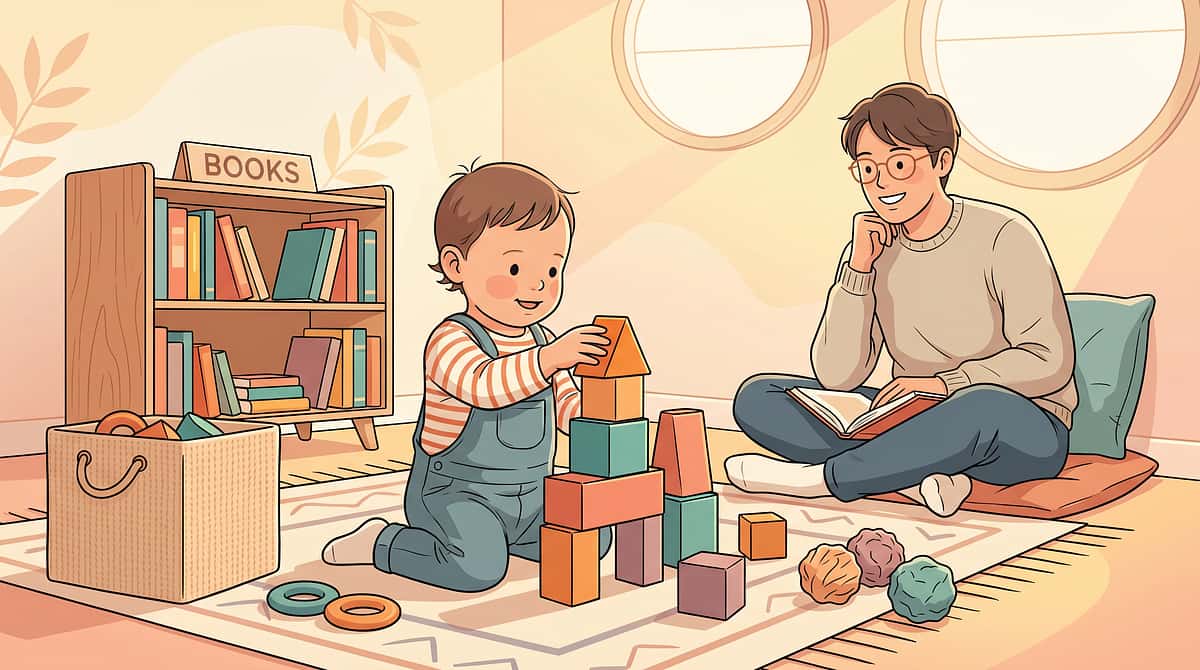
"Four therapists. Four homework lists. Four separate skill boxes. But your child is one whole person."
"It's Wednesday afternoon. The speech therapist sent exercises for sounds. The OT sent a fine motor worksheet. The developmental therapist said to work on matching. And you're standing in your kitchen, holding four different lists, looking at your three-year-old who just wants to stack cups and laugh — wondering why none of this feels like it belongs together."
9 Materials That Help With Development Overall
Ages 0–8 Years
DEV-GLOBAL | Episode L-999
"You are not failing. Child development is not a checklist of separate skills. It is one integrated, joyful, unstoppable process."
WHO Nurturing Care Framework (2018): "The period from pregnancy to age 8 requires nurturing care that addresses all developmental domains as interconnected."
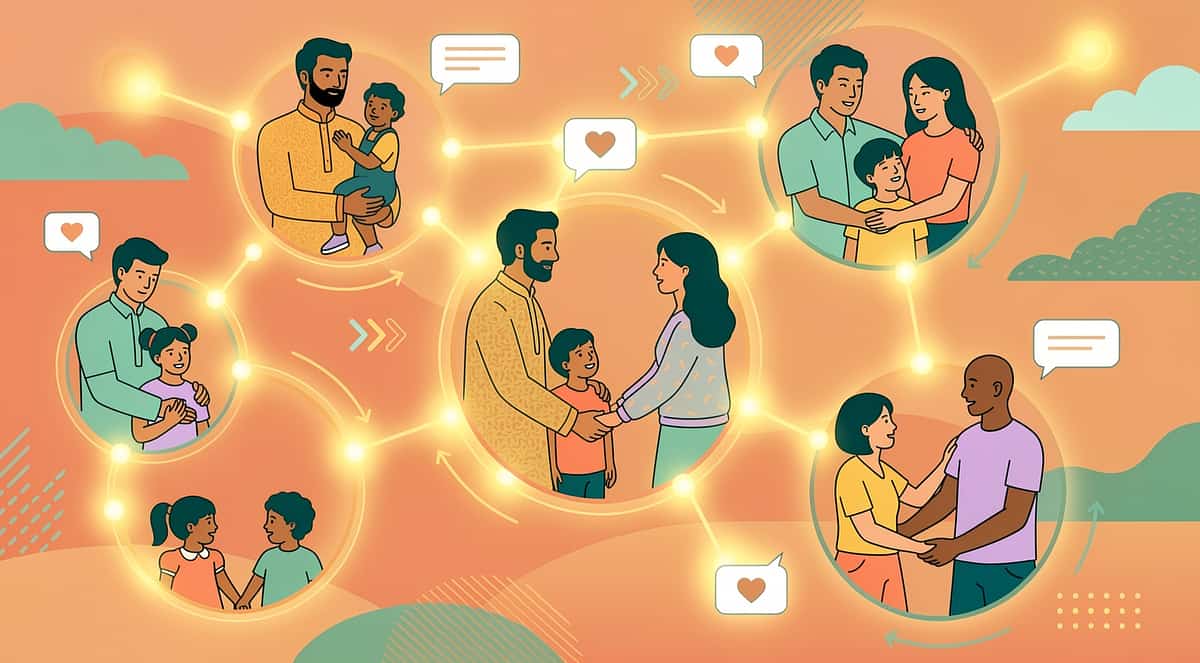
You Are Among Millions of Families Navigating This Exact Terrain
Global developmental delay — delays across multiple domains simultaneously — affects millions of families worldwide. Every one of those families is asking your exact question: What can I do at home that helps everything, not just one skill at a time? You are not an outlier. You are part of a generation of parents who deserve answers grounded in science, not guesswork.
1 in 6
Children Globally
show developmental delays in at least one domain
43%
Children Under 5
in low-and-middle income countries at risk of developmental delays
21M+
Children in India
estimated to have some form of developmental need requiring intervention
PRISMA Systematic Review (2024): Children with ASD show developmental differences across motor, communication, cognitive, and social domains simultaneously — PMC11506176 | Meta-analysis (World J Clin Cases, 2024): Multi-domain intervention approaches show effectiveness across sensory processing, adaptive behavior, social skills, and motor development — PMC10955541

Development Is One Brain Event — Not Many Separate Ones
When your child reaches for a block (motor cortex fires), examines its color (visual cortex), mouths it (somatosensory feedback), knocks a tower down (motor + cause-effect learning), and looks to you laughing (social brain, limbic reward system) — six developmental domains just activated simultaneously from one two-second moment of play.
This is not accidental. This is how the developing brain is architecturally designed to learn: through integrated, multi-sensory, socially-anchored experience. When development is fragmented into isolated drills for isolated skills, the brain misses the integration signal that makes learning stick.
"A wiring difference in one domain creates ripples across all domains. The most powerful intervention addresses the whole neural ecosystem, not isolated circuits." — Pinnacle NeuroDev Consortium
Frontiers in Integrative Neuroscience (2020): Comprehensive framework for sensory integration and sensory processing treatment in ASD, establishing neurological basis for integrated multi-domain intervention — DOI: 10.3389/fnint.2020.556660
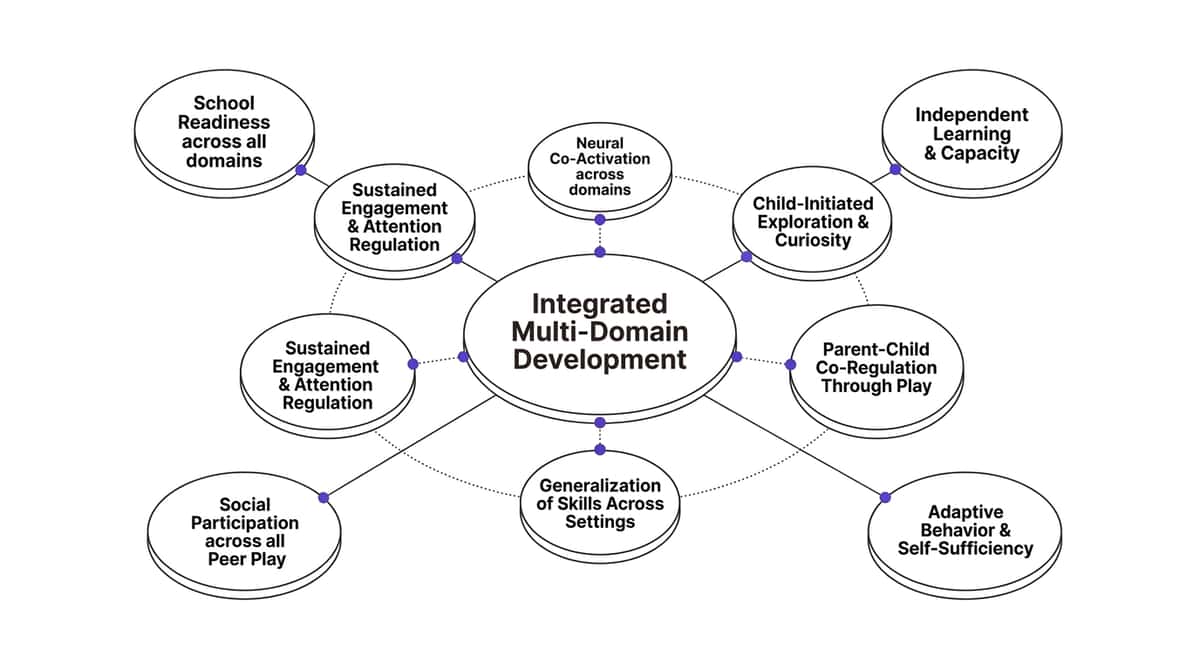
All Developmental Domains Share One Neural Infrastructure
Prefrontal Cortex
Executive function, planning, self-regulation
Motor Cortex
Movement initiation, motor learning, coordination
Broca's Area
Language production, communication, narrative
Limbic System
Social emotion, reward, motivation, attachment
Somatosensory Cortex
Touch, proprioception, sensory integration

The Developmental Map: Where Your Child Is, Where the Journey Goes
Global developmental support is most impactful in the 0–5 window — but intervention across all domains remains effective through age 8 and beyond. Understanding where your child stands on this continuum helps you target the materials most likely to yield visible growth right now.
0–12 Months
Sensory exploration, cause-effect toys, responsive caregiving, shared books
12–36 Months
Blocks, sensory bins, balls, simple puzzles, pretend play beginning
3–5 Years
Complex construction, dramatic play, art, outdoor exploration, peer interaction
5–8 Years
Strategy building, project creation, sport, reading, collaborative making
Holistic developmental delay commonly co-occurs with: ASD, Developmental Language Disorder, Sensory Processing Disorder, Developmental Coordination Disorder, Intellectual Disability. These materials support development across all presentations.
WHO Care for Child Development (CCD) Package — implemented across 54 low- and middle-income countries | UNICEF MICS indicators for developmental monitoring across 197 countries — PMC9978394

Clinically Validated. Home-Applicable. Parent-Proven.
These are not "helpful toys." These are clinically studied developmental intervention materials with published evidence supporting their use across motor, language, cognitive, social, and sensory domains in pediatric populations. The evidence base meets the highest international standards for clinical practice.
📚 PRISMA Systematic Review (2024)
16 studies (2013–2023) confirm integrated sensory-motor intervention as evidence-based practice for children with ASD. Material-based multi-domain interventions meet full EBP criteria.
📊 Meta-Analysis (2024)
24 studies confirm sensory integration therapy effectively promotes social skills, adaptive behavior, sensory processing, and motor skills — the exact domains these 9 materials target.
🏥 Indian RCT (2019)
Home-based material interventions with parent delivery demonstrated significant developmental outcomes in Indian pediatric populations.
LEVEL I — SYSTEMATIC REVIEW + META-ANALYSIS
★★★★★ Highest Evidence Grade
📞Questions? Call the FREE National Autism Helpline: 9100 181 181
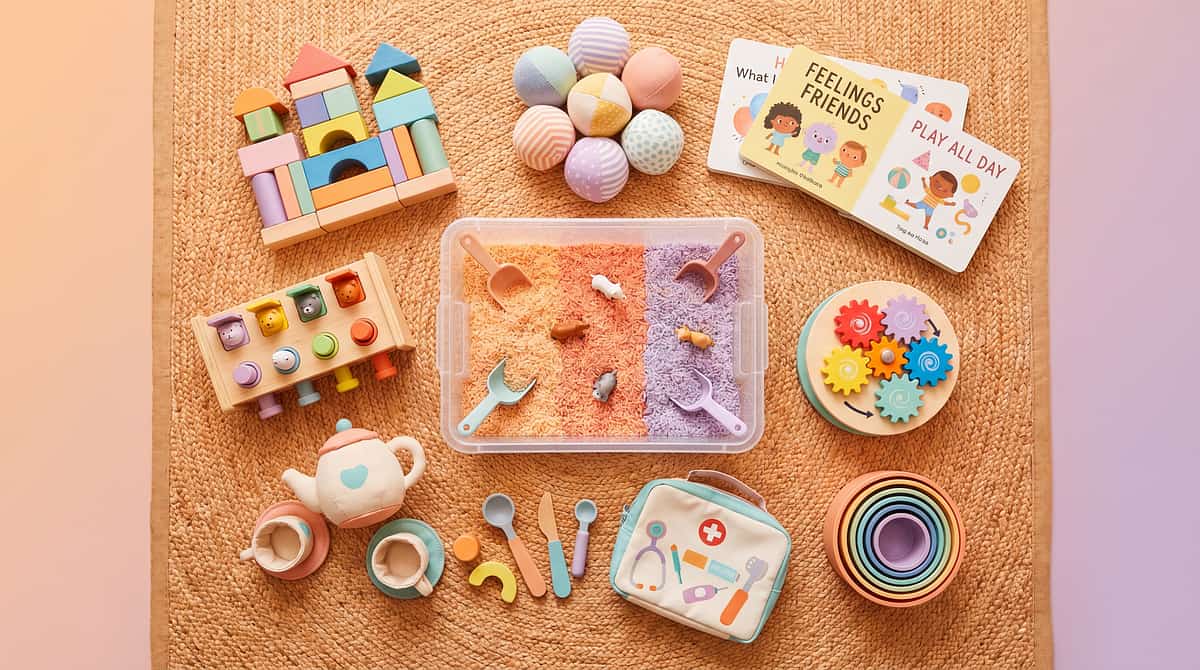
9 Materials That Help With Development Overall
Formal Name: Global Developmental Stimulation via Multi-Domain Material Engagement
Parent Alias: "The Whole-Child Play Protocol"
Global developmental support involves surrounding a child with rich, open-ended materials that naturally stimulate growth across motor, language, cognitive, social, and sensory domains simultaneously — rather than targeting isolated skills in isolation. Unlike domain-specific interventions that train one skill at a time, this approach creates an integrated developmental environment where all domains grow together through meaningful, child-led, parent-supported engagement. This is how brains are designed to develop.
🟢 Gross Motor
🔵 Fine Motor
🟣 Language
🟡 Cognitive
🔴 Social-Emotional
🟠 Sensory
⚪ Self-Regulation
👶 Age Range: 0–8 Years
⏱ 20–45 min daily
🔁 Daily frequency
📍 Home + Outdoor + School

The Entire Pinnacle Consortium Uses These Materials — Differently
The brain doesn't organize development by therapy type. An OT uses blocks for motor precision. An SLP uses blocks for language. An ABA therapist uses blocks for behavioral engagement. The material is the same. The therapeutic lens is different. This is the power of materials that cross discipline boundaries.
Occupational Therapist
Uses sensory materials, blocks, and outdoor movement to build sensory processing, fine and gross motor integration.
Speech-Language Pathologist
Uses books, pretend play, and cause-effect toys as language scaffolding contexts — vocabulary, narrative, joint attention.
ABA / BCBA
Uses cause-effect toys, reinforcement during block/puzzle play, and art as structured behavioral engagement platforms.
Special Educator
Uses puzzles, art, and construction materials for pre-academic cognitive foundations — categorization, sequencing, problem-solving.
NeuroDev Pediatrician
Uses the complete material set to assess and monitor global developmental progression, recommending domain-specific adjustments.
Adapted UNICEF/WHO Nurturing Care Framework for SLPs (2022): Multi-disciplinary contributions to nurturing care demonstrated across responsive caregiving, early learning, and health domains — DOI: 10.1080/17549507.2022.2141327

Precision Targets: What These 9 Materials Build
Domain | Observable Progress | Timeline | |
Gross Motor | More confident movement, balance on varied surfaces | Weeks 2–4 | |
Fine Motor | Improved grip, more deliberate hand placement | Weeks 3–6 | |
Language | More spontaneous naming, commenting, requesting | Weeks 4–8 | |
Cognitive | Increased problem-solving attempts, cause-effect understanding | Weeks 3–6 | |
Social | More joint attention moments, shared engagement | Weeks 4–8 | |
Sensory | Expanded material tolerance, reduced avoidance | Weeks 2–5 |
The 9 Developmental Materials — Clinician-Curated, Parent-Ready
These are not arbitrary toys. Each material was selected by Pinnacle's multi-disciplinary consortium for its documented ability to activate multiple developmental domains simultaneously. Below are all nine, with clinical rationale, price ranges, and free alternatives for every budget.
🧱 Material 1
Building Blocks & Construction Sets
🌊 Material 2
Sensory Play Materials
⚽ Material 3
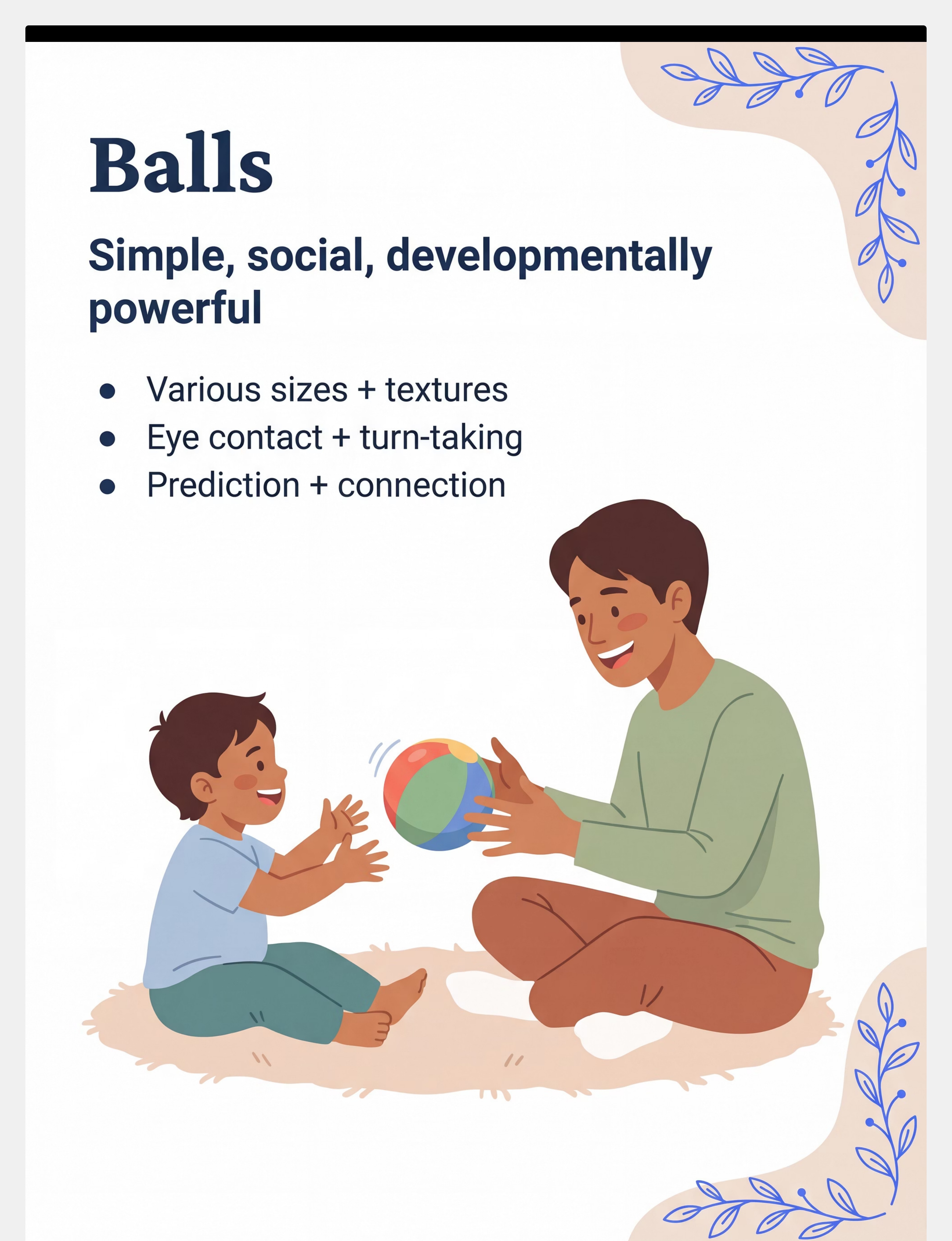
Balls of Various Sizes & Textures
🔴 Material 4
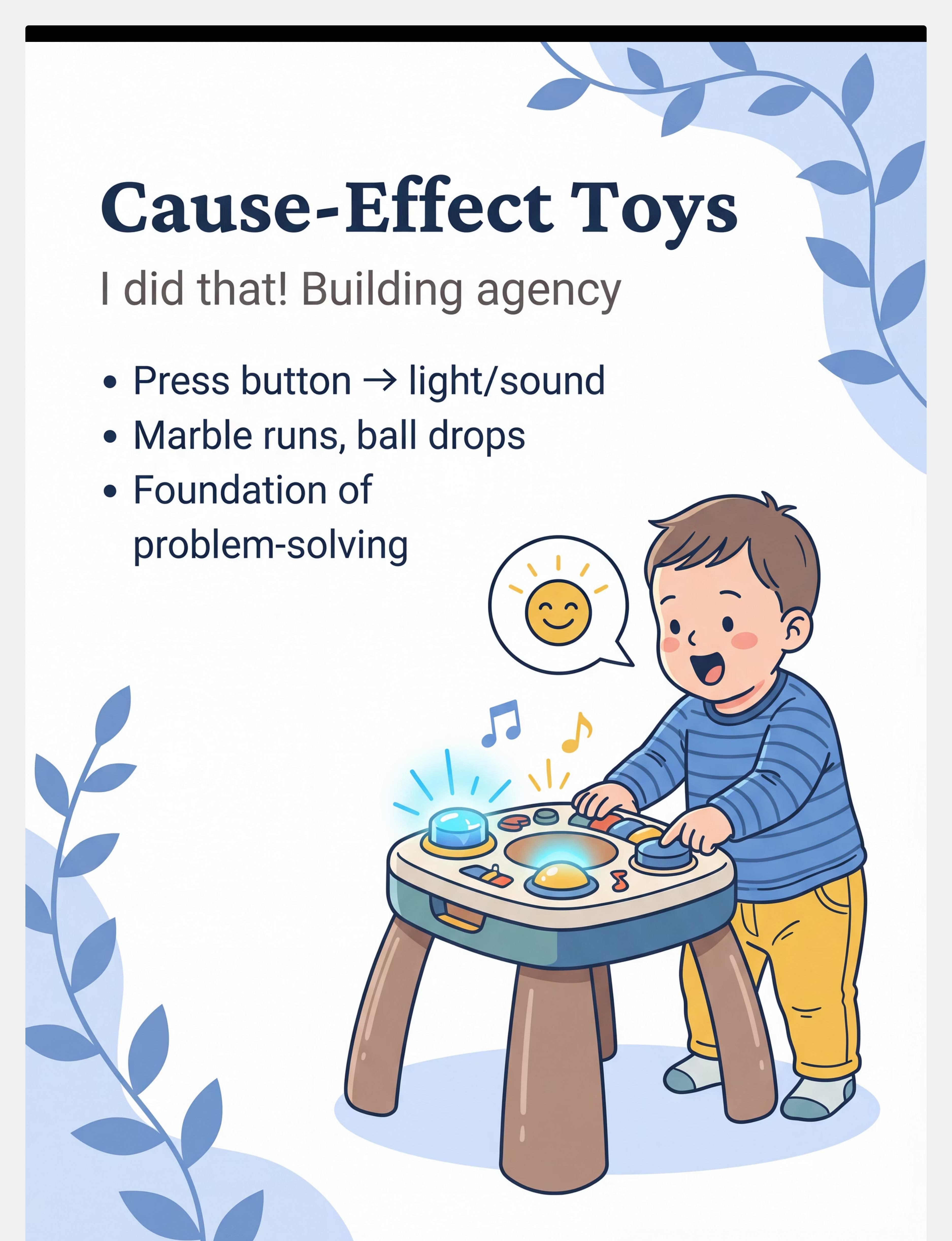
Cause-Effect Toys & Simple Machines
📚 Material 5
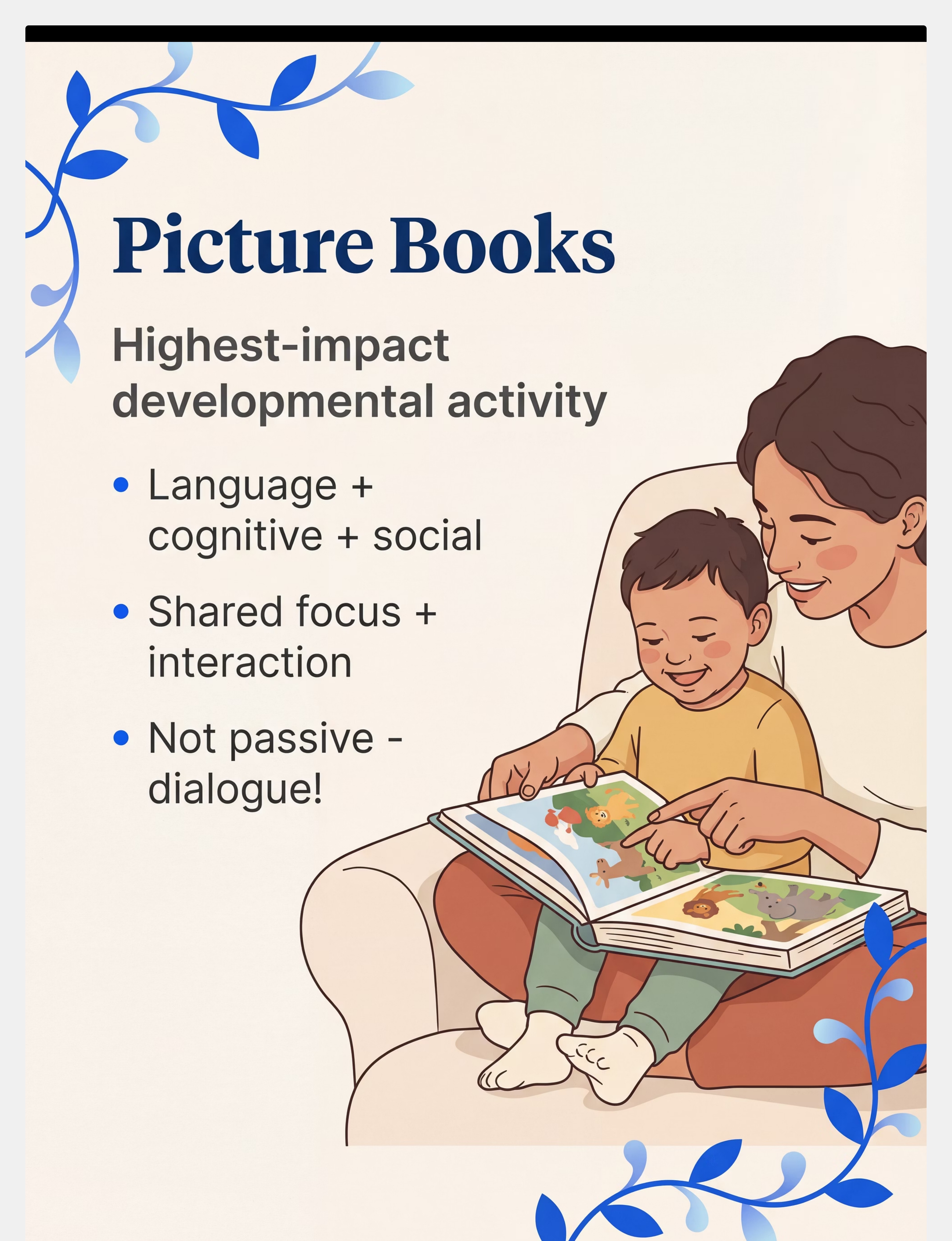
Picture Books & Interactive Books
🎭 Material 6
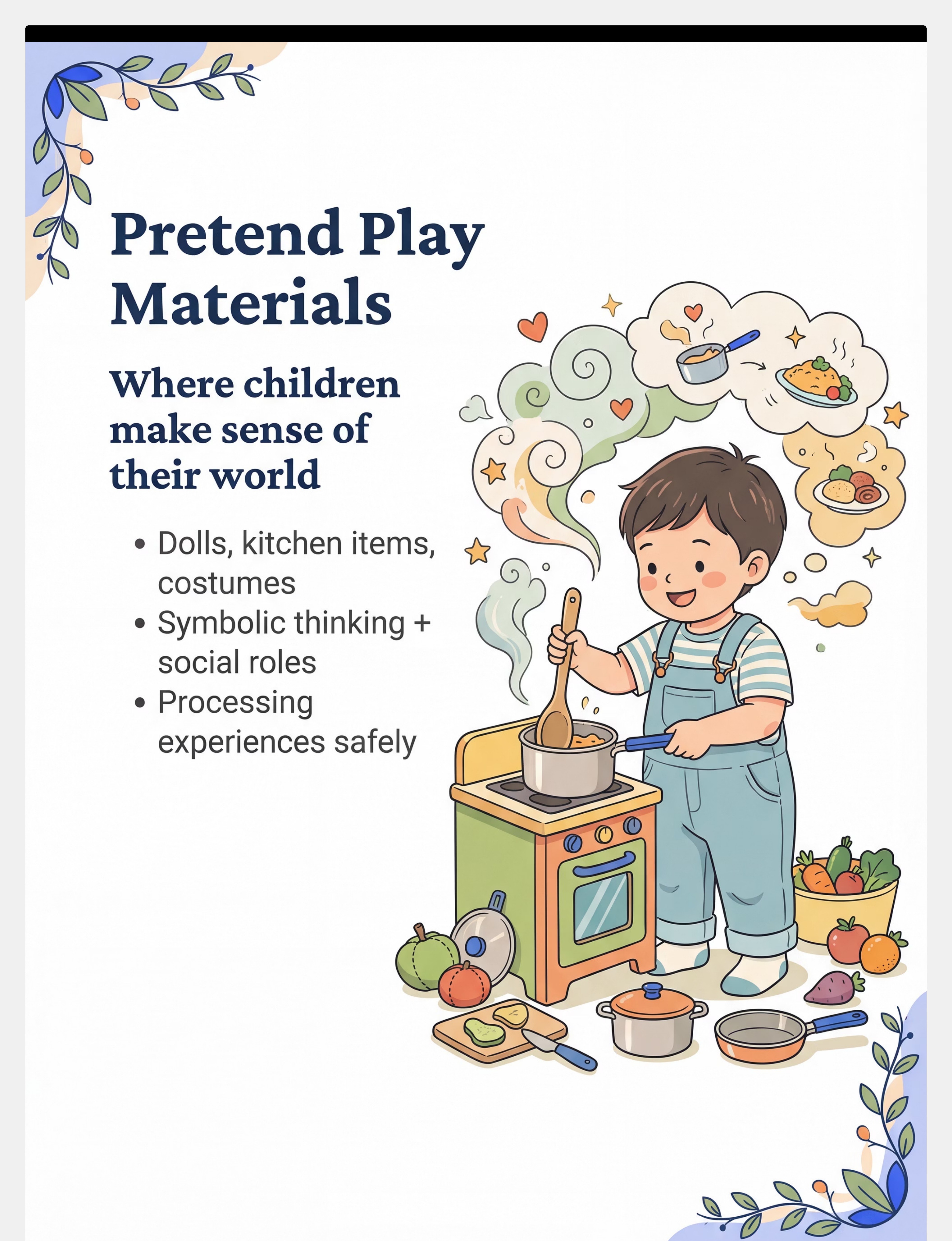
Pretend Play & Dramatic Play
🧩 Material 7
Puzzles & Shape Sorters
🎨 Material 8
Art & Creative Materials
🌿 Material 9
Outdoor & Nature Materials
Complete starter kit estimate: ₹1,900–₹15,500 (nature exploration free)
📞Need help choosing? Call 9100 181 181 — FREE National Autism Helpline
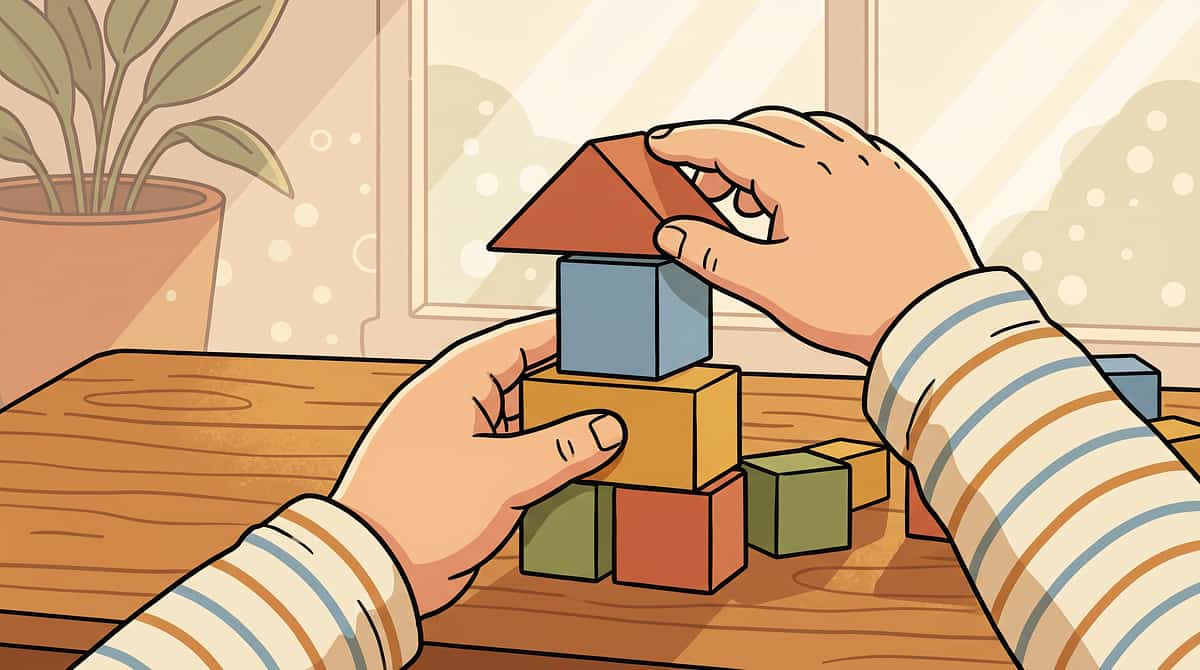
🧱 Material 1: Building Blocks & Construction Sets
Construction / Cognitive Development
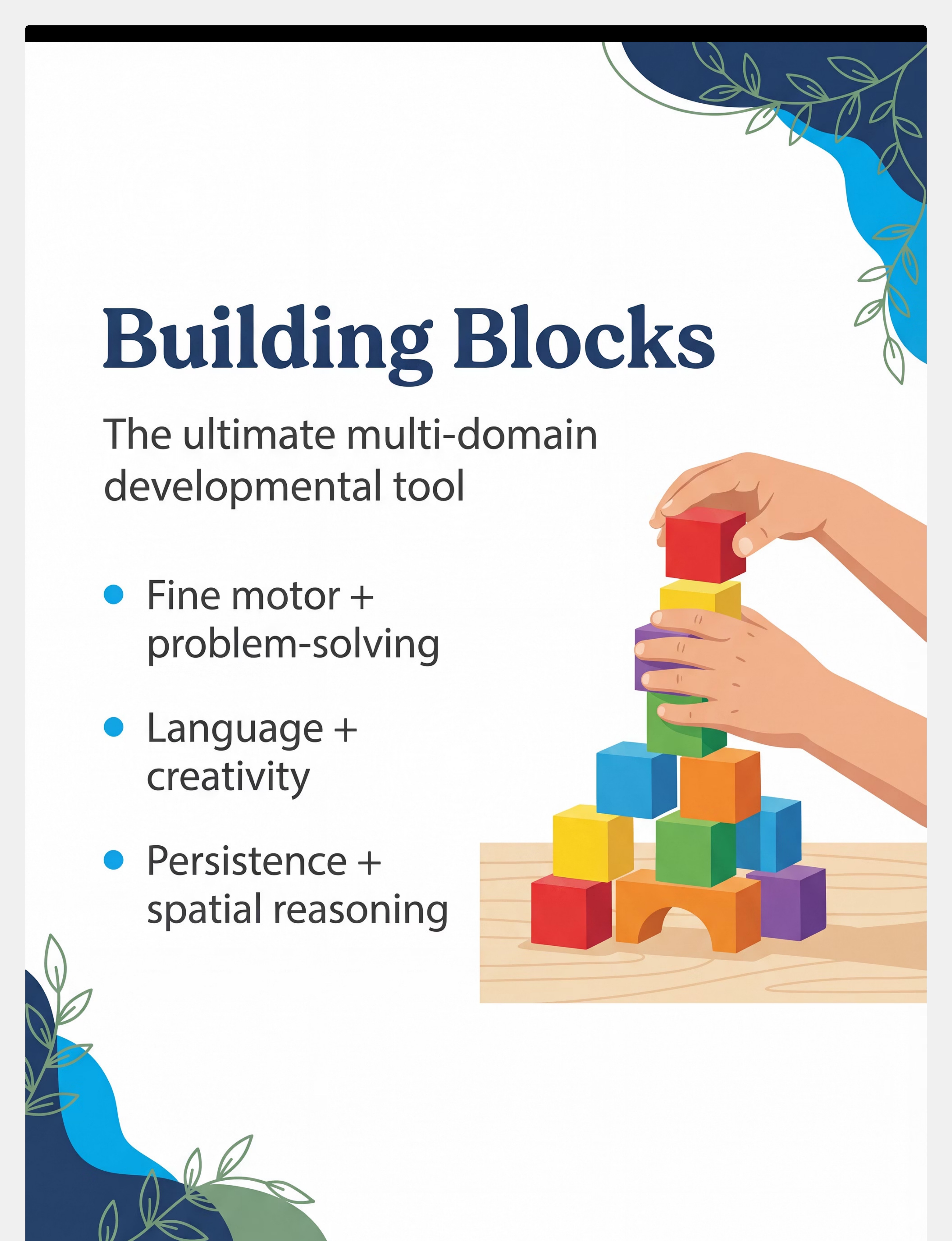
Building blocks are the single most comprehensively studied developmental material in pediatric research. When a child stacks, arranges, and knocks down blocks, they simultaneously engage fine motor precision, spatial cognition, cause-effect understanding, language narration, and — with a play partner — social turn-taking and self-regulation.
Why it matters: Fine motor + gross motor + spatial cognition + language + social play + self-regulation — all from one material.
- Fine motor grip and pincer precision
- Spatial reasoning and visual-motor planning
- Cause-effect understanding (tower falls = I caused that)
- Language: naming colors, sizes, actions
- Social reciprocity when played with others
Price Range: ₹500–₹5,000 | Search on Amazon.in →
🏠 DIY Alternative
Cardboard boxes, empty food containers, smooth stones, toilet paper rolls stacked and arranged — same spatial reasoning, stacking, and cause-effect principles apply. Zero rupees needed.
Clinician Note
Start with large, easy-grip blocks for younger children. Escalate to smaller, more complex sets as fine motor precision develops. The material scales with the child.
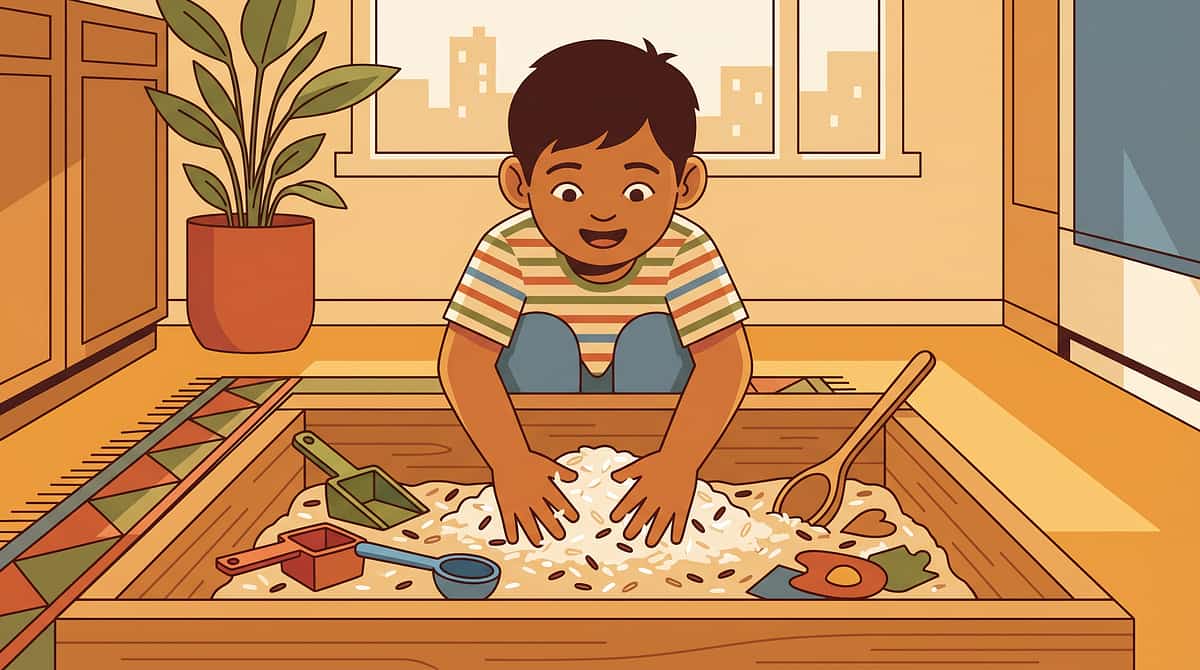
🌊 Material 2 & ⚽ Material 3: Sensory Play + Balls
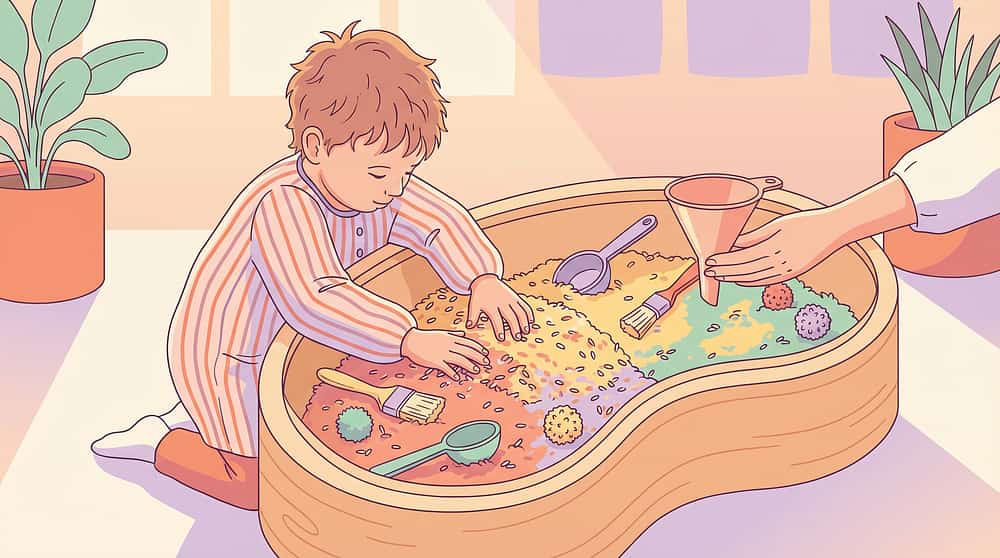
🌊 Sensory Play Materials
Sand, Water, Playdough, Rice, Beans
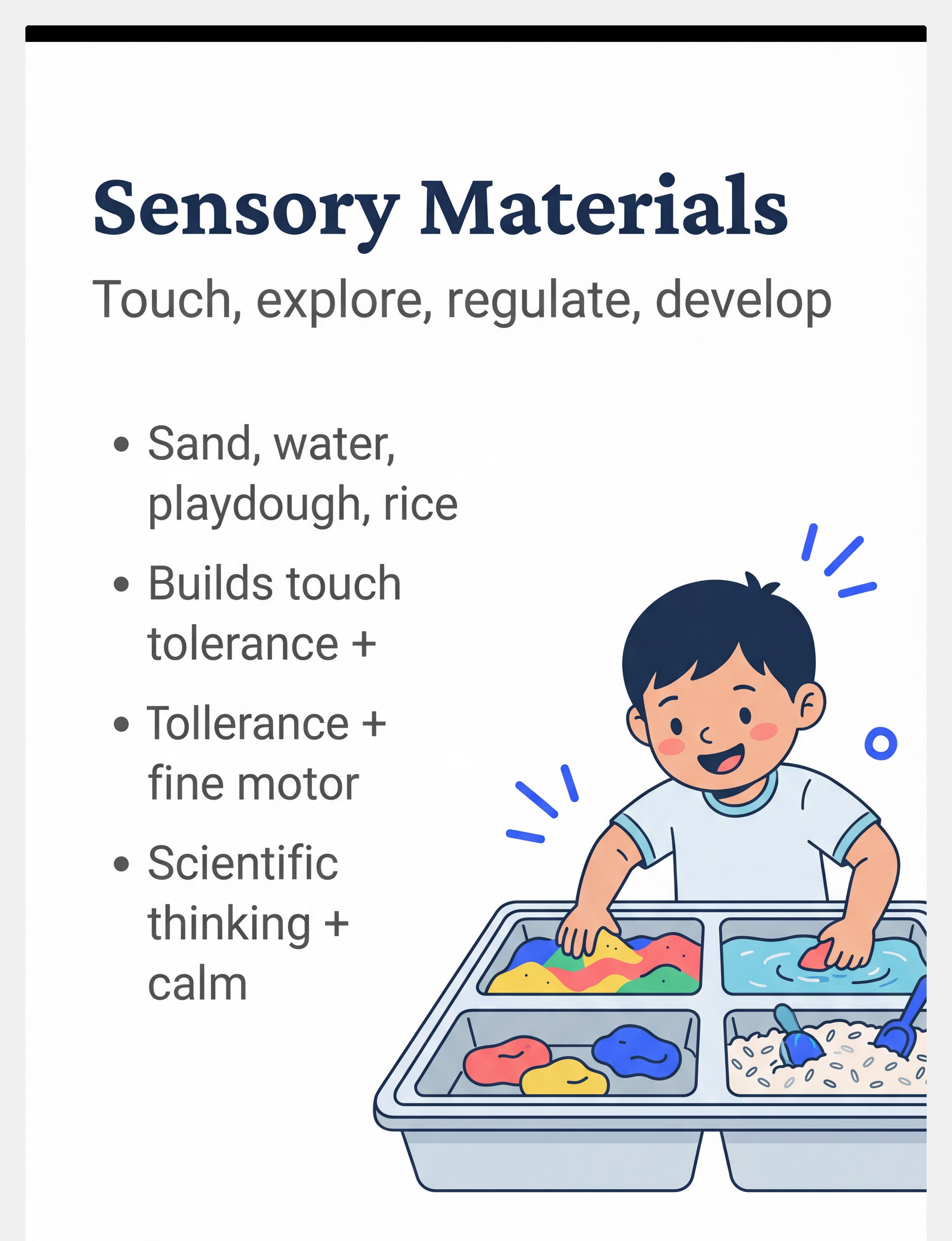
Tactile tolerance + proprioceptive input + fine motor + emotional regulation + vocabulary building. The sensory bin is an OT clinic in a container.
Price: ₹200–₹1,500 | Amazon.in →
DIY: Homemade playdough (flour + salt + water + oil), rice in a tub, cornstarch + water = oobleck
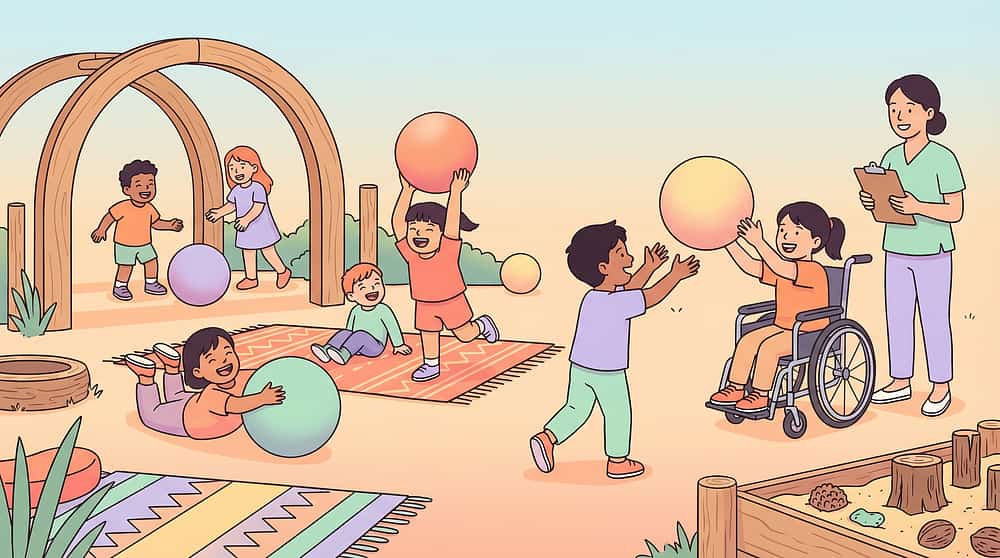
⚽ Balls of Various Sizes & Textures
Gross Motor / Social
Throwing + catching + eye-hand coordination + turn-taking + prediction + social reciprocity. The ball is the simplest, most universally accessible social communication tool in existence.
Price: ₹100–₹1,000 | Amazon.in →
DIY: Rolled socks, crumpled newspaper balls, any round object that rolls

🔴 Material 4 & 📚 Material 5: Cause-Effect Toys + Picture Books

🔴 Cause-Effect Toys & Simple Machines
Matching Games | Shape Sorters | Switch Toys
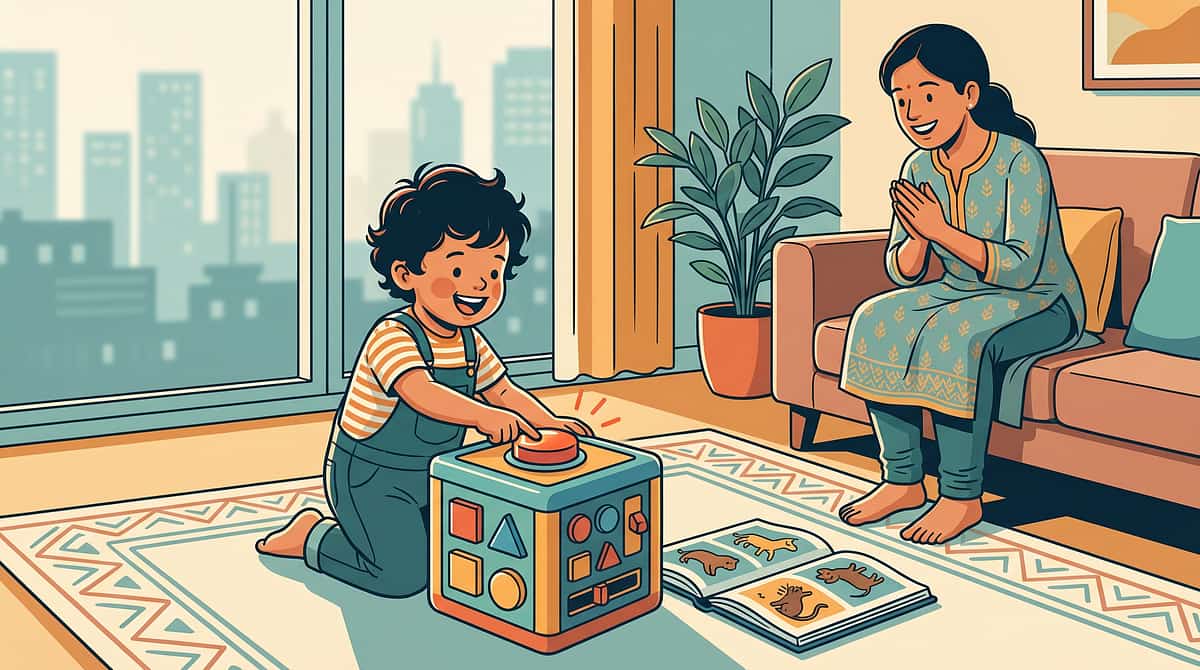
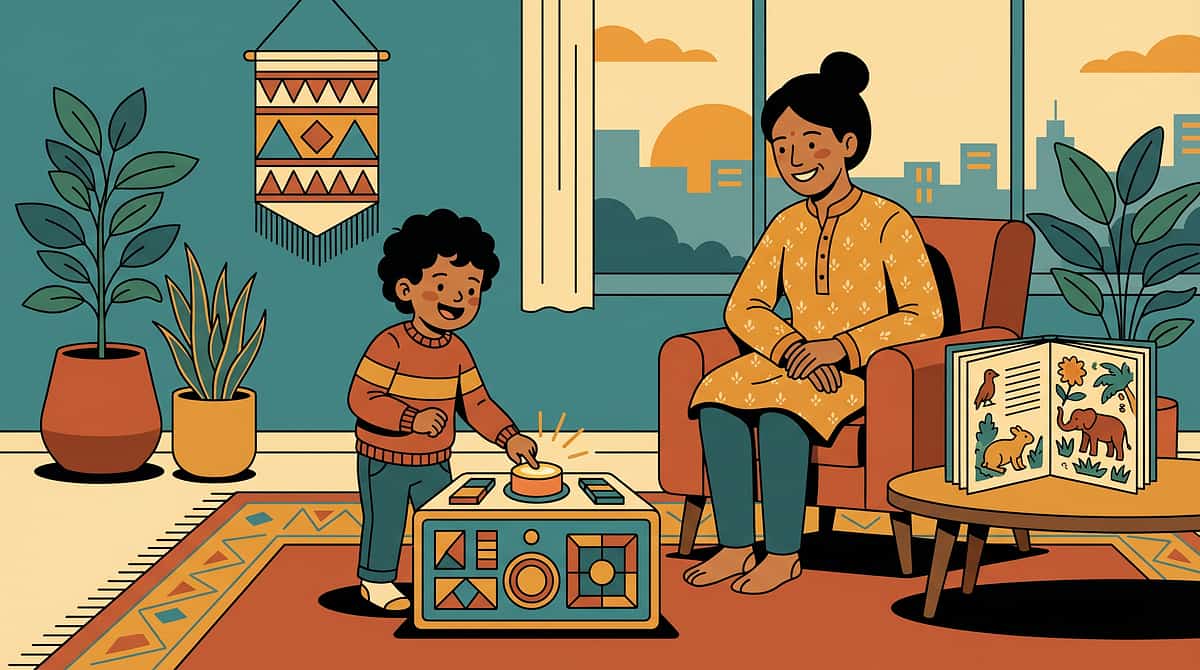
Agency + prediction + fine motor + cognitive causality + attention + motivation. When a child presses a button and something happens, the brain registers: I caused that. This is the foundation of all learning.
✅ Pinnacle Recommends: Dyomnizy Educational Memory Game (₹519) | Kidology Spike Toy (₹380)
DIY: Light switches, water faucets, knocking tower down, cardboard marble run
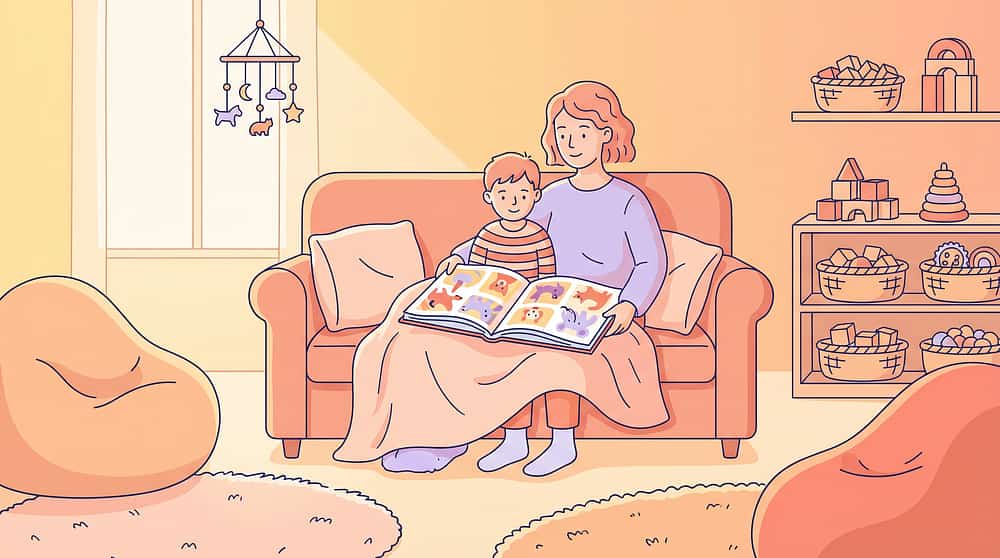
📚 Picture Books & Interactive Books
Language / Literacy
Vocabulary + narrative + joint attention + print awareness + theory of mind + emotional vocabulary. Books are not just reading — they are structured joint attention sessions in disguise.
Price: ₹100–₹2,000 | Amazon.in →
DIY: Family photo books, library books (free), personalized picture books from home photos
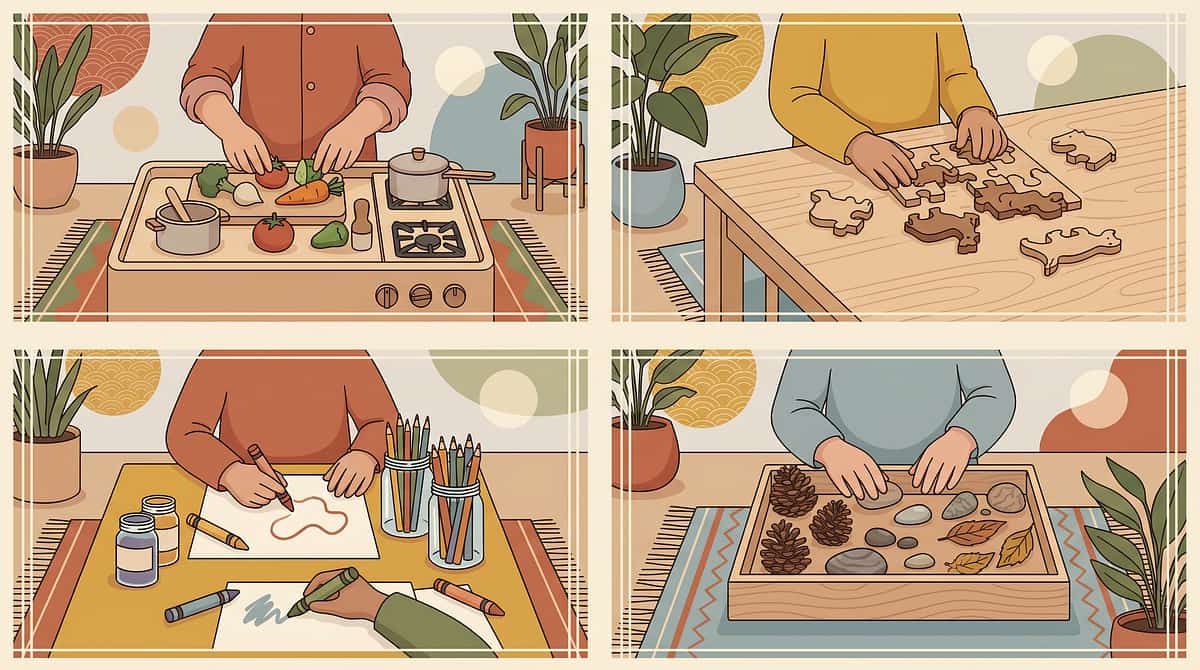
🎭 Material 6, 🧩 Material 7, 🎨 Material 8, 🌿 Material 9
🎭 Pretend Play & Dramatic Play Materials
Social-Cognitive Development | Symbolic thinking + social roles + perspective-taking + emotional processing + self-regulation + theory of mind. Price: ₹300–₹3,000 | Amazon.in → | DIY: Old clothes as costumes, empty containers as kitchen items, cardboard box as car or house.
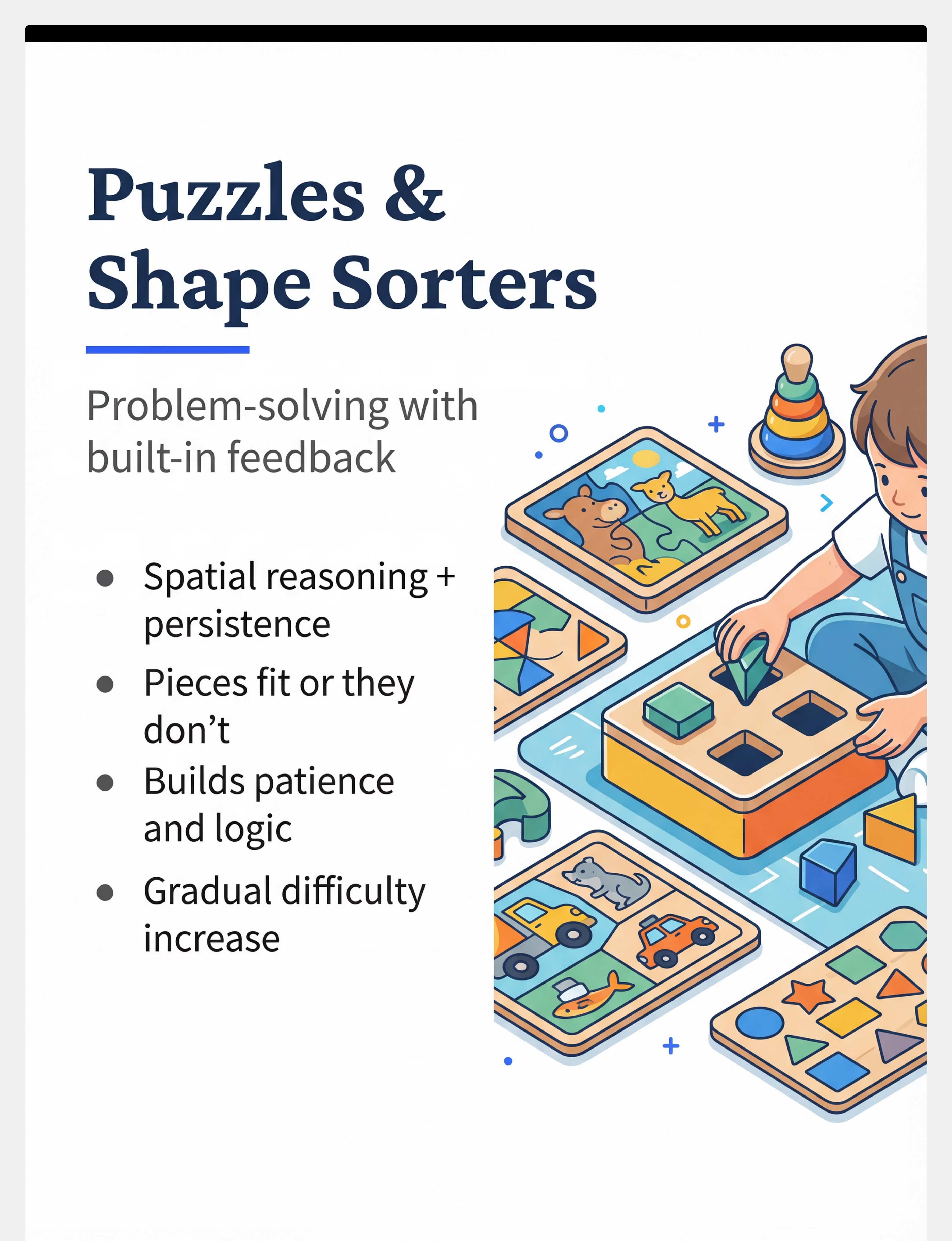
🧩 Puzzles & Shape Sorters
Problem-Solving / Sorting | Spatial reasoning + problem-solving + fine motor + frustration tolerance + self-correction. ✅ Recommends: Lattooland Rainbow Sorting (₹628) | SHINETOY Shut The Box (₹428) | Monkey Minds Rhyming (₹296) | DIY: Cut pictures into 2–4 pieces, muffin tin matching.
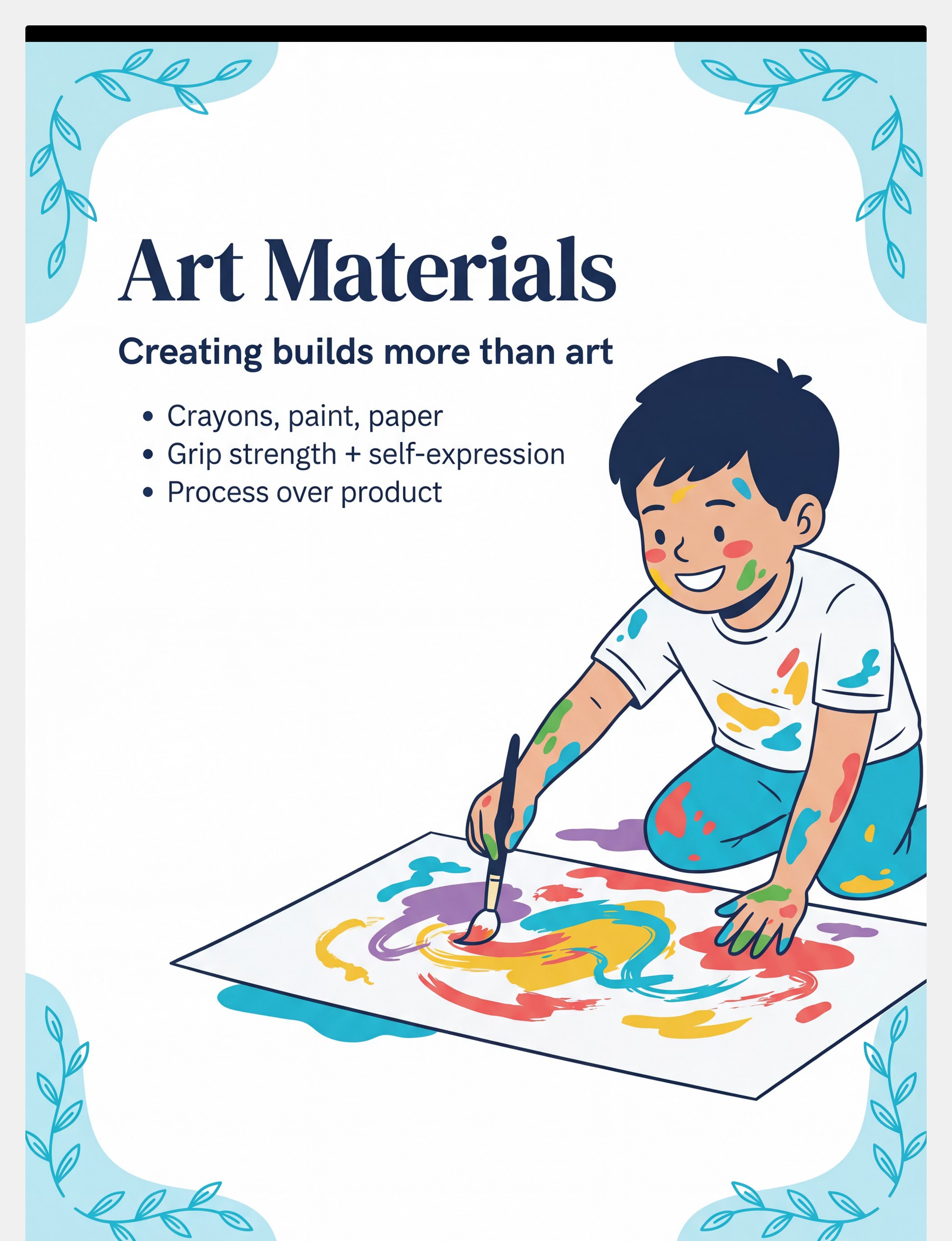
🎨 Art & Creative Materials
Creative Development / Fine Motor | Grip + pressure control + self-expression + emotional processing + agency + creative divergent thinking. Price: ₹200–₹1,500 | Amazon.in → | DIY: Crayon + paper, drawing in sand, nature art with leaves and sticks.
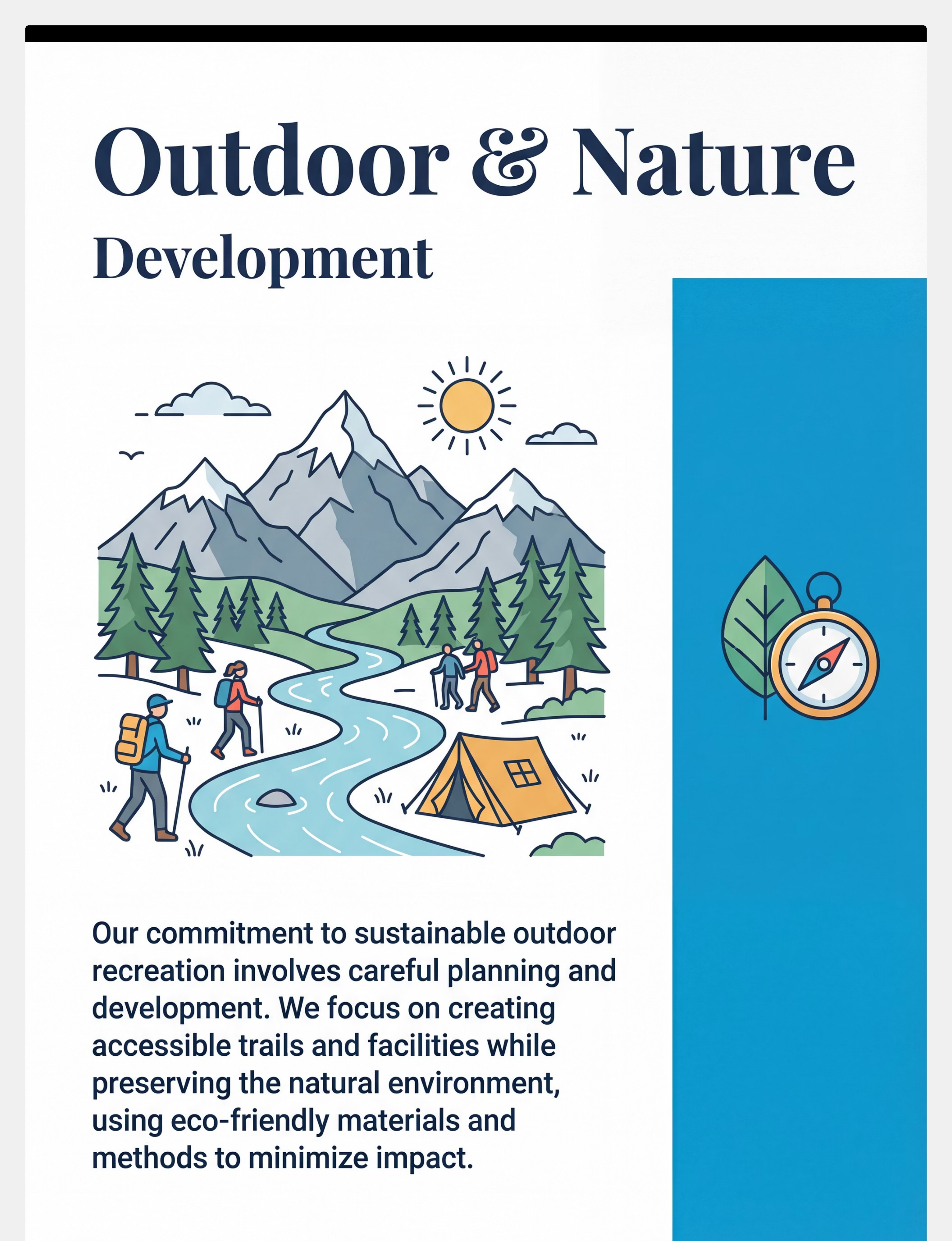
🌿 Outdoor & Nature Materials
Nature / Gross Motor / Sensory | Gross motor + sensory integration + emotional regulation + cognitive flexibility + vocabulary + physical health. Price: ₹0–₹1,000 (mostly FREE) | DIY: Sticks, stones, leaves, water, dirt — nature IS the material.
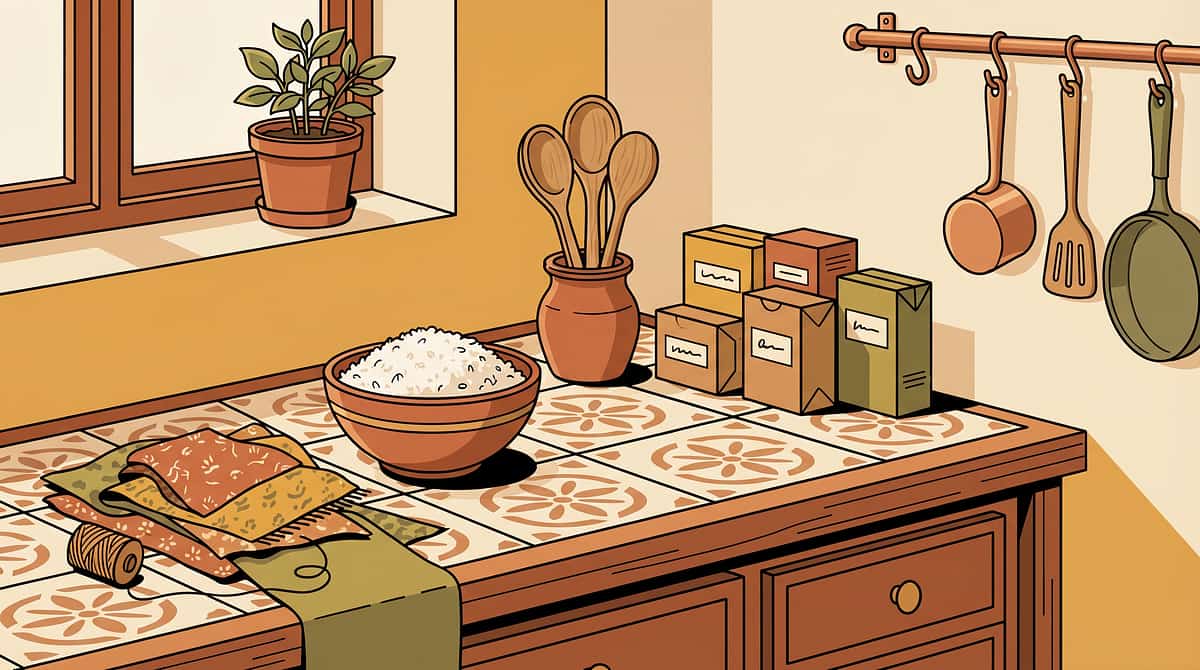
Every Family. Every Budget. Zero Barriers.
"Per WHO Nurturing Care Framework principles: every child on Earth — regardless of geography, income, or access — has the right to a developmentally rich environment. These zero-cost substitutes work on the same therapeutic principles as purchased materials."
🛒 Commercial Option | 🏠 Household Substitute | 🧠 Why It Works | |
Wooden unit blocks | Cardboard boxes, food containers, toilet rolls | Same spatial reasoning, stacking, cause-effect principles | |
Playdough / sensory bin | Rice in a container, homemade flour dough, cornstarch water | Same tactile input, fine motor engagement, exploratory principle | |
Therapy balls (various) | Rolled socks, crumpled newspaper, oranges | Same reciprocal exchange, tracking, motor planning | |
Cause-effect toys | Light switches, water faucet, knocking a cup tower | Same agency, prediction, motivation principles | |
Board books | Library books (free), family photo albums | Same joint attention, vocabulary, narrative scaffolding | |
Pretend play sets | Old clothes, empty containers, cardboard box as car | Same symbolic thinking, social role-learning, sequence practice | |
Wooden puzzles | Cut magazine pictures into 2–4 pieces, match lids to containers | Same spatial reasoning, problem-solving, self-correction | |
Crayons + paper | Stick in dirt, chalk on pavement, finger in yogurt on tray | Same grip development, mark-making, creative expression | |
Nature play kit | Parks, gardens, footpaths, puddles, stones, sticks | Same sensory integration, gross motor, cognitive flexibility |
Zero-cost complete kit: Cardboard + socks + rice + light switches + library + old clothes + cut pictures + dirt + outdoor park = Full developmental environment. Zero rupees.

Read Before Every Session. Non-Negotiable.
🔴 RED — Do NOT Proceed If:
- Child has fever, is unwell, or in pain
- Child is in active distress or post-meltdown (within 30 min)
- Any material has small parts accessible to a child who mouths
- Allergies to wheat/legumes/latex not accounted for
- Child is severely food-restricted and edible sensory alternatives not available
- Outdoor play in hazardous environment
🟡 AMBER — Modify If:
- Child is tired but not exhausted — shorten to 10 min, single material
- Child shows mild avoidance — start with preferred material
- Sensory sensitivity is high — avoid wet/sticky; use dry materials only
- Post-therapy session — allow 30-minute rest before home session
🟢 GREEN — Proceed When:
- Child is alert, rested, recently fed (30+ minutes after eating)
- Child is in a calm, regulated baseline state
- Materials are prepared and space is cleared
- Parent is present, calm, and not rushed
- Safety check passes for all materials selected
STOP IMMEDIATELY if: Child shows self-injurious behavior | Severe respiratory distress with sensory material | Complete shutdown/dissociation | Loss of previously acquired skill (regression) — seek professional consultation immediately.
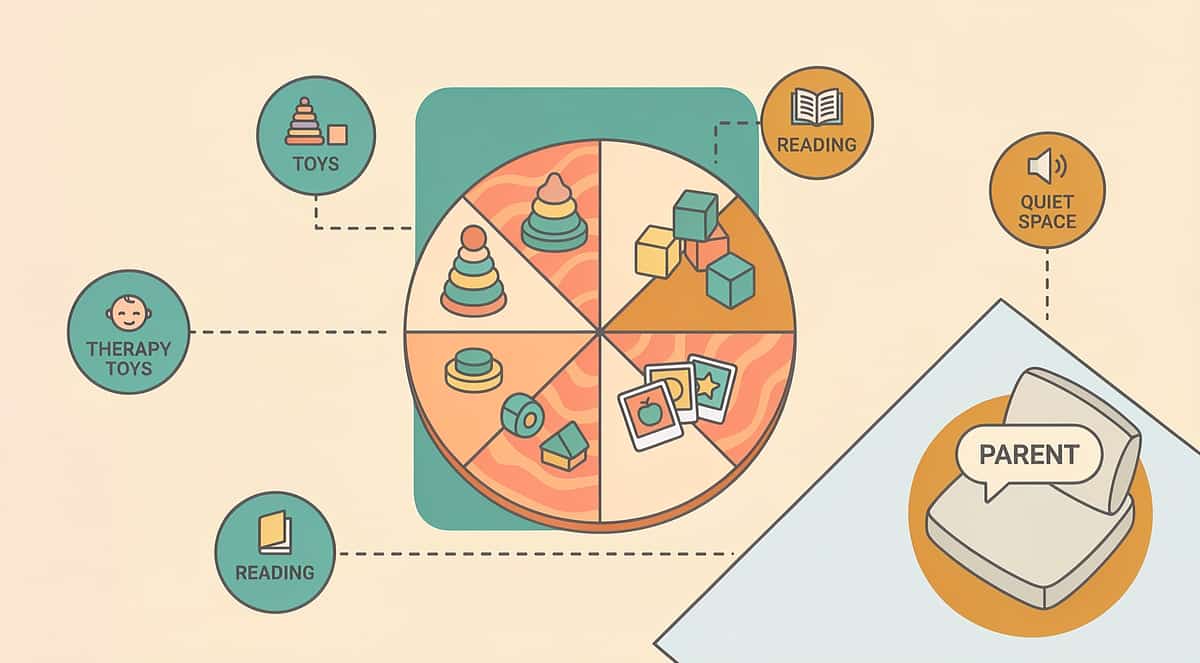
Your Home Is a Therapy Space. Set It Like One.
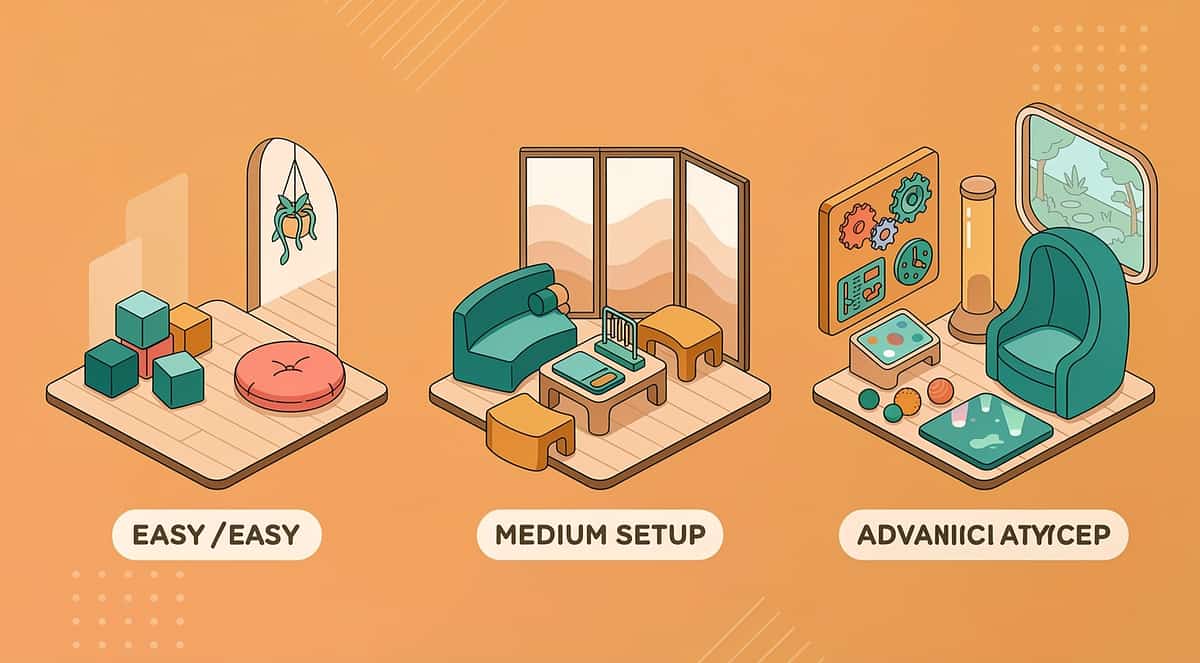
Setup Checklist
Remove from space:
- Screens / TV (off and ideally covered)
- Distracting toys not being used today
- Other noise sources if possible
- Parent phone (silent, face down, away)
Prepare in space:
- Soft mat or rug on floor for floor play
- Low shelf or tray with today's 2–3 chosen materials
- Small container for sensory filler if using sensory bin
- Parent's notebook or phone for data capture
- Transition timer (visual timer or phone timer)
Environment Settings
💡 Lighting
Natural daylight preferred; warm indirect if artificial
🔊 Sound
Quiet or soft instrumental music — no high stimulation
🌡 Temperature
Comfortable, not too warm (affects regulation)
📐 Space
Minimum 2m × 2m clear floor area
"Present only 2–3 materials at a time. Too many choices overwhelm the system. Rotation keeps novelty fresh without sensory overload." — Pinnacle OT
The 60-Second Pre-Flight Check — Do This Every Time
Before every session, spend 60 seconds assessing your child's readiness. This single habit is the most important predictor of session success. A session delivered at the wrong moment can set back willingness. A session delivered at the right moment accelerates development.
Check | ✅ Go | ⚠️ Modify | 🔴 Postpone | |
Fed? | 30+ min after last meal | Light snack 15 min ago | Hungry / just ate | |
Rested? | Alert, energetic | Mild tiredness | Just woke / very tired | |
Regulated? | Calm, content | Mildly dysregulated | Meltdown in last hour | |
Healthy? | No signs of illness | Mild, stable cold | Active fever / unwell | |
Engaged? | Responding to name, making eye contact | Focused elsewhere | Completely shut down | |
Motivated? | Shows interest in material or play | Neutral | Active avoidance |
All ✅
FULL SESSION (20–45 min, 2–3 materials)
3+ ✅, some ⚠️
MODIFIED SESSION (10–15 min, 1 material, child-led)
Any 🔴
POSTPONE — try again in 30–60 min, or tomorrow
"Postpone" is not failure. It is expert judgment. On postpone days: offer 10 minutes of unstructured sensory exposure only — outdoor time, bath play, book in lap. Low demand. Connection maintained.
🟢 STEP 1
Duration: 30–60 seconds
Begin With an Invitation, Never a Command
Parent Scripts
"Look what I found!" [Hold out one material with genuine curiosity in your voice]
"Come see this with me" [Sit near the material yourself, begin exploring it]
"Your blocks are right here" [Gesture calmly, no demand, no eye contact pressure]
Body Language
- Get to child's level — sit or kneel, not stand
- Open posture — no crossed arms, no hovering
- Relaxed face — genuine curiosity, not forced enthusiasm
- Slow movements — deliberate, calm, inviting
Acceptance Cues — What to Look For
- Moves toward material or looks at it with interest
- Reaches for material
- Any vocalization of interest
- Settling of body posture near the material
Resistance Cues & What to Do
- Moves away → Follow gently, don't insist. Try different material.
- Ignores → Sit with material yourself, explore it with apparent enjoyment. Wait.
- Protests → Validate. "You're not ready right now. That's okay." Move to modified session.
ABA Pairing Procedures: Establishing motivating operations before demand placement. OT "Just-Right Challenge": matching task demand to child's current regulatory capacity.
🔵 STEP 2
Duration: 1–3 minutes
Follow Their Lead. Language Is the Layer.
Parent Action: Join the child's play. Do not redirect. Do not correct. Do not suggest a "better way." Parallel play first — pick up your own blocks or your own sensory material, explore alongside. The moment you impose direction, you lose the developmental opportunity.
Parallel Play First
Pick up your own blocks / sensory material, explore alongside without commenting on the child's actions.
Narrate Without Demand
"You put the blue block on top. Now it's really tall." Label actions and objects with no expectation of response.
Expand Without Redirecting
If child stacks, add one block to the side of theirs. Match and slightly extend — never redirect.
Create Interaction Opportunities
Hold a piece, wait 5 seconds, see if they gesture or reach. Pause-and-wait is the most powerful SLP tool.
Blocks | "Up it goes! Now another one. Whoah — tall!" | |
Sensory bin | "Squish, squish. How does it feel? Cold!" | |
Ball | "Ready? Here it comes. Your turn. Roll it back!" | |
Books | "Dog! Point to the dog. Where's the dog?" | |
Pretend play | "Oh no, the baby is hungry. What should we give her?" |

🟡 STEP 3
Duration: 5–15 minutes
The Developmental Work Happens Here
This is the heart of every session. The specific therapeutic action varies by material — but the parent's role is consistent across all nine: follow, narrate, expand, celebrate. Never direct. Never correct. Never impose a "right way."
🧱 Blocks / Construction
Stack → knock down → rebuild → vary structure → narrate → problem-solve when it falls. Spatial motor planning + cause-effect + persistence + language narration
🌊 Sensory Materials
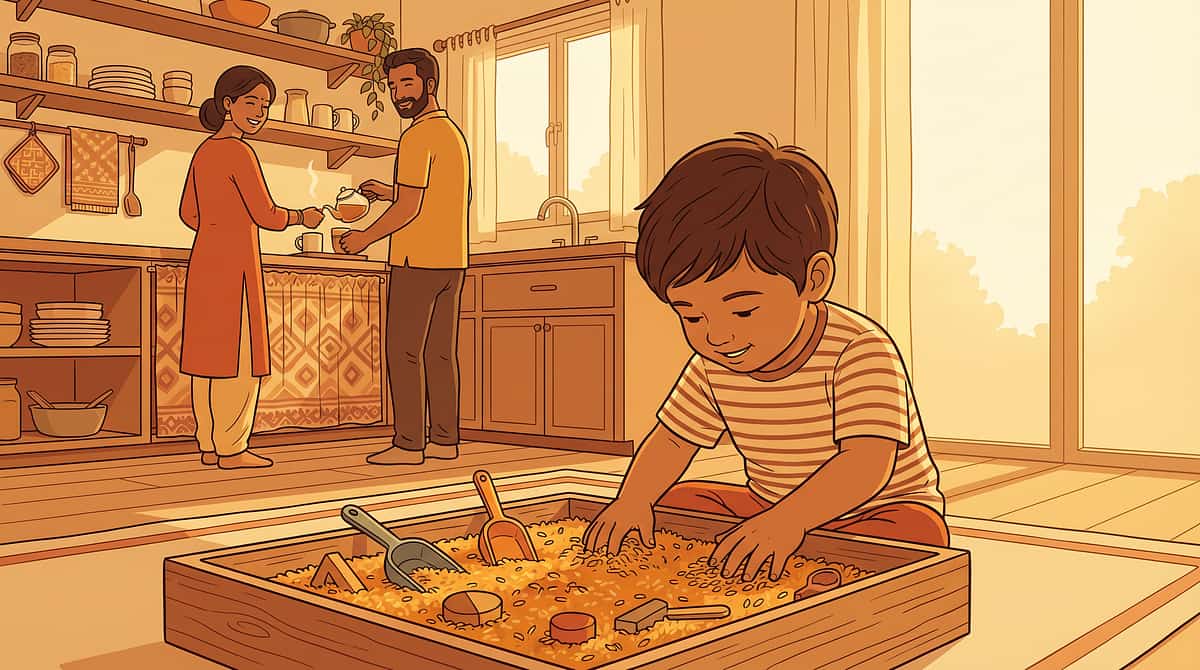
Introduce gradually → allow free exploration → introduce tools (scoop, pour, mold) → describe sensory properties together. Tactile tolerance + proprioceptive processing + fine motor + vocabulary
⚽ Balls
Sit face-to-face → roll back and forth → build to throw-catch-kick → celebrate every exchange → extend the chain. Reciprocal social exchange + motor planning + eye-hand coordination + joint attention
🔴 Cause-Effect Toys
Allow child to discover → resist explaining — let them press, pull, turn → when result occurs, share the excitement → repeat. Agency + prediction + intrinsic motivation + problem-solving
📚 Books
Read interactively — not start to finish, but dialogically. Point, ask, label, imitate sounds, follow child's finger. Joint attention + vocabulary + narrative + print awareness
🎭 Pretend Play
Enter the play as a participant, not a director → follow the script they create → expand one step: "And then what happens?" Symbolic thinking + social role + perspective-taking + emotional processing
🧩 Puzzles
Resist helping → wait → offer a hint only when frustration exceeds productive challenge → celebrate completion. Problem-solving + self-regulation + spatial reasoning + persistence
🎨 Art
Focus on process: "Tell me about this" not "What is it?" Provide materials and step back → narrate as they work. Fine motor + creativity + self-expression + emotional vocabulary
🌿 Outdoor / Nature
Get out. Let them lead. Collect things, climb on things, touch things, look at things. Narrate, expand, wonder aloud. Gross motor integration + sensory regulation + cognitive flexibility + emotional regulation
Common execution errors:❌ Directing the play ("Build a house like this") | ❌ Correcting without positive framing | ❌ Checking phone during session | ❌ Comparing to "what they should be able to do" | ✅ Following. Narrating. Expanding. Celebrating.
🟠 STEP 4
Duration: 3–5 additional minutes
Three Good Reps Beat Ten Forced Ones. Every Time.
Session Type | Repetitions | Duration | |
Engagement learning (blocks, pretend, art) | Open-ended — follow child's lead until natural satiation | 5–20 min | |
Targeted skill practice (cause-effect, puzzles, ball) | 3–8 quality repetitions | 3–8 min | |
Sensory exposure (sensory bin, outdoor) | Duration-based — not repetition-based | 5–15 min |
Vary the Materials
Day 2: switch from sand to rice. Next week: playdough. Same therapeutic principle, new sensory input.
Vary the Complexity
Blocks: 4-piece tower → bridge → enclosure. Same material, escalating spatial challenge.
Vary the Social Context
Week 1: solo + parent. Week 3: add sibling. Week 6: neighbor child. Expanding social context.
Vary the Setting
Indoor blocks → outdoor nature construction with sticks and stones. Same principle, new environment for generalization.
"When a child repeats the same action 40 times, they are not stuck. They are a developmental scientist confirming their hypothesis with rigorous replication. Celebrate the repetition — it's the neural pathway hardening." — Pinnacle ABA Principle
⭐ STEP 5
Timing: Within 3 seconds of desired behavior
Celebrate the Attempt, Not Just the Success
Within 3 seconds. Not "good job" later. Specific, immediate, enthusiastic — within 3 seconds of the target behavior. This is the single most important technical element of effective behavioral reinforcement.
Behavior ✅ | What to Say | |
Child touches new sensory material | "You touched it! That's brave!" | |
Child completes puzzle piece | "You figured it out! You problem-solved!" | |
Child rolls ball back | "You gave it to me! Our turn! Thank you!" | |
Child names picture in book | "Yes! Dog! You know that one!" | |
Child builds and knocks down | "Crash! You made that happen! Again?" | |
Child uses art material independently | "You're making something! I love watching you create." |
✅ Canon Reinforcement Products
The Rosette Imprint Reward Jar — ₹589 | Use for token system: 5 tokens = chosen reward
1800+ Reward Stickers Book — ₹364 | Sticker on hand or chart immediately after target behavior
🏠 Natural Reinforcement (Zero Cost)
High five / fist bump | "More?" (child controls continuation) | Silly dance together | Parent copies child's action | Access to the next material

60 Seconds of Data Now. Hours of Clarity Later.
Your observations are clinically valuable data. Recording just three things per session — materials used, duration, and child response — creates a longitudinal picture that guides everything: which materials to escalate, which domains need more focus, when to involve your therapist team.
What to Record: Material(s) Used
Name or tick the materials: "Blocks + Sensory bin"
Duration of Engagement
Minutes per material: "Blocks: 8 min, Sensory: 5 min"
Child's Response Rating
1–5 scale (1=avoided, 5=led independently): "Blocks: 4/5, Sensory: 2/5"
"60 seconds of data now saves hours of guessing later." Your data joins Pinnacle's 20M+ session dataset. Aggregated (never individual), it improves recommendations for every family like yours. ABA Data Collection Standards: Frequency, duration, and interval measurement — BACB Guidelines + Cooper, Heron & Heward

Session Abandonment Is Not Failure. It's Data.
Every difficult session tells you something clinically useful about your child's current state, sensory profile, or motivation hierarchy. The goal is not to complete a perfect session — it's to gather information that makes the next session better. Here are the seven most common problems and exactly what to do about each.
Problem 1: Child refused all materials
Why: Dysregulation, illness, wrong time of day, or insufficient motivation. Next time: Use readiness check (Card 13) more rigorously. Try the 1 most preferred material only, zero demand.
Problem 2: Child played with one material only, ignored others
Why: Normal! Children self-select optimal challenge. Next time: Honor the interest. Use it as the anchor and introduce a second alongside it gradually.
Problem 3: Child became aggressive or self-injurious during sensory exposure
Why: Sensory threshold exceeded. Next time: Move to dry, less-intense sensory alternatives. Reduce exposure duration by 50%.
Problem 4: Child played for 2 minutes then lost interest completely
Why: Normal for many children at early intervention stage — attention regulation is developing. Next time: 2 minutes is a success. Build from there: 2 → 3 → 4.
Problem 5: Parent couldn't stay focused / distracted by phone
Why: Sessions require full parent presence — this is the hardest part. Next time: Phone in another room. 15 minutes of undivided presence is more powerful than 45 minutes of distracted togetherness.
Problem 6: Sibling disrupted the session
Next time: Schedule during nap time, after school pickup, or enlist sibling as play partner.
Problem 7: Child seemed bored
Why: Progress! This is mastery emerging. Next time: Escalate challenge level. Move up the difficulty arc.
No Two Children Develop Identically. Neither Should Their Protocol.
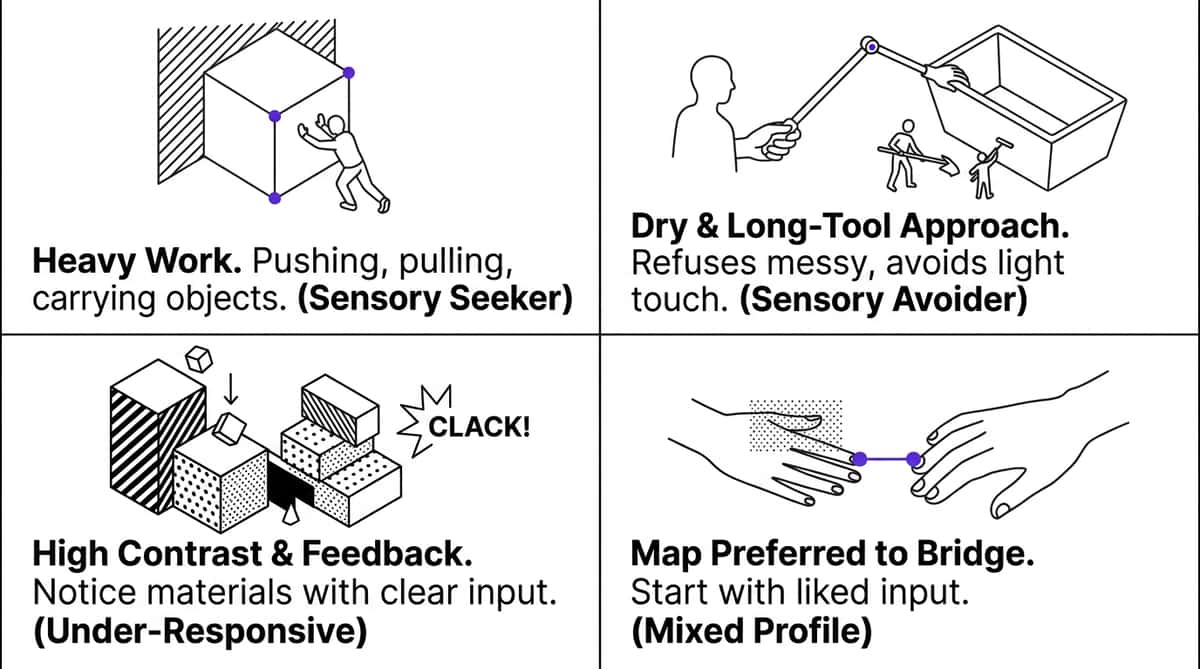
Age | Modification | |
0–18 months | All materials need adult scaffolding. Very short sessions (5–8 min). Mouthing expected — ensure safety. | |
18m–3 years | Parallel play with occasional interaction. Simple cause-effect, large blocks, sensory bins. | |
3–5 years | Begin cooperative play. Add peer. Increase complexity. Begin books with narrative discussion. | |
5–8 years | Add strategy. Introduce collaborative construction, more complex art, sports-based outdoor play. |

Progress in Week 1 Looks Like Tolerance, Not Mastery
Week 1–2 often feels like nothing is happening. You are laying the neural groundwork. The brain is learning "this is safe, this is interesting, this is worth engaging with." That is the most important thing that can happen — and it is invisible to the eye. Trust the process.
15%
Week 1–2 Progress
Tolerance and initial engagement — the foundation being laid
Domain | Week 1–2 Progress Signal | |
Sensory | Child tolerates 30 seconds MORE contact with avoided material than day one | |
Motor | Child initiates reaching for material independently | |
Social | 1–2 moments of joint attention per session | |
Language | One spontaneous vocalization or approximation during material engagement | |
Cognitive | Child repeats same action 3+ times = hypothesis testing (this is development) | |
Regulation | Slightly easier transition away from material at session end |
📞Week 1 feel overwhelming? Call 9100 181 181 for free parent coaching

Week 3–4: The Neural Pathways Are Hardening
40%
Week 3–4 Progress
Consolidation — anticipation, sustained engagement, first generalization seeds
These are not "wow" moments yet. They are quiet shifts. The child who took 5 minutes to approach the sensory bin now approaches in 30 seconds. That is a week-3 win. Celebrate the quiet shift as much as the dramatic breakthrough.
Child anticipates the session — moves toward materials when setup begins
Child sustains engagement for noticeably longer before self-interrupting
Reduced protest at material introduction (sensory materials especially)
First generalization seeds — using ball at playground in ways practiced at home
Parent reports more confidence in delivery — feels less scripted
Child begins combining materials in same session spontaneously
First unprompted imitation of adult language during play ("crash!" when blocks fall)
"By Week 3–4, most parents tell us: 'I've stopped dreading the session.' That's the data we care about most. Parent enjoyment is the strongest predictor of long-term delivery consistency."

Week 5–8: Mastery Unlocked — Watch for These Badges
75%
Week 5–8 Progress
Mastery emerging — badge criteria met, generalization visible
🧱 Block Master
Builds structures with 5+ pieces independently, narrates action spontaneously
🌊 Sensory Explorer
Approaches all 5 sensory materials without avoidance; initiates sensory play
⚽ Social Turn-Taker
Sustains 5+ ball exchange rounds; looks to partner after each exchange
🔴 Cause-Effect Scientist
Tests new cause-effect relationships spontaneously; predicts outcomes
📚 Joint Attention Reader
Sustains shared book engagement 10+ min; comments on pictures unprompted
🎭 Symbolic Thinker
Initiates pretend play narrative spontaneously; assigns roles to toys
🧩 Problem Solver
Completes age-appropriate puzzles with minimal support; retries when first attempt fails
🎨 Creative Expresser
Chooses art materials independently; describes own work verbally
🌿 Nature Explorer
Seeks outdoor exploration; collects, examines, narrates outdoor experience
When 3+ mastery badges achieved + generalization visible in 2+ settings → advance to deeper technique in same domain or expand to new domain.

You Did This. Your Child Grew Because of Your Commitment.
Over 5–8 weeks, you have done something extraordinary. You created a developmentally rich home environment and showed up — consistently, warmly, intentionally. That is not a small thing.
✅ Created a Rich Environment
A home that builds every developmental domain simultaneously
✅ Delivered Daily Sessions
Multi-domain engagement with consistency and care
✅ Followed Your Child's Lead
Instead of imposing a curriculum — the hardest and most important shift
✅ Collected Real Data
That will guide every next step with precision
✅ Built Neural Foundations
Across motor, language, cognitive, social, and sensory domains
That is extraordinary. That is therapy. That is love made systematic.
Photo/Journal Prompt: Take a photo of your child engaged with their favorite material today. Write one sentence about where they were 8 weeks ago and where they are now. That sentence is the most important progress note you'll ever write.
📞Share your progress with a Pinnacle therapist: 9100 181 181

Trust Your Instincts. If Something Feels Wrong — Pause and Ask.
These 5 red flags require pausing the home protocol and seeking professional consultation. Your instincts as a caregiver are clinically valid data. Do not second-guess them.
🔴 Red Flag 1: Significant Regression in Acquired Skills
What it looks like: Child who was using words stops. Child who was engaging with materials suddenly refuses all. What to do: Stop protocol. Contact Pinnacle center or helpline within 48 hours.
🔴 Red Flag 2: Persistent Self-Injurious Behavior During Sessions
What it looks like: Head-banging, biting self, or skin-picking increases during or after sessions. What to do: Stop immediately. Sensory load requires professional recalibration. Teleconsult within 24 hours.
🔴 Red Flag 3: Complete Absence of Any Pretend Play by Age 3
What it looks like: No spontaneous symbolic use of objects at all despite 6+ weeks of pretend play exposure. What to do: Developmental evaluation recommended. This is a significant milestone flag.
🔴 Red Flag 4: No Words by 16 Months, No Phrases by 24 Months
What it looks like: Despite daily book reading and play, no language development visible. What to do: SLP evaluation urgently. Language milestones require professional assessment.
🔴 Red Flag 5: Child Seems to Be Getting Worse Across All Materials
What it looks like: Increasing avoidance, more meltdowns, shorter engagement windows despite 4+ weeks of consistent protocol. What to do: Technique adjustment needed. Approach may need professional calibration.

You Are Not Done. You Are on a Journey. Here Is What Comes Next.
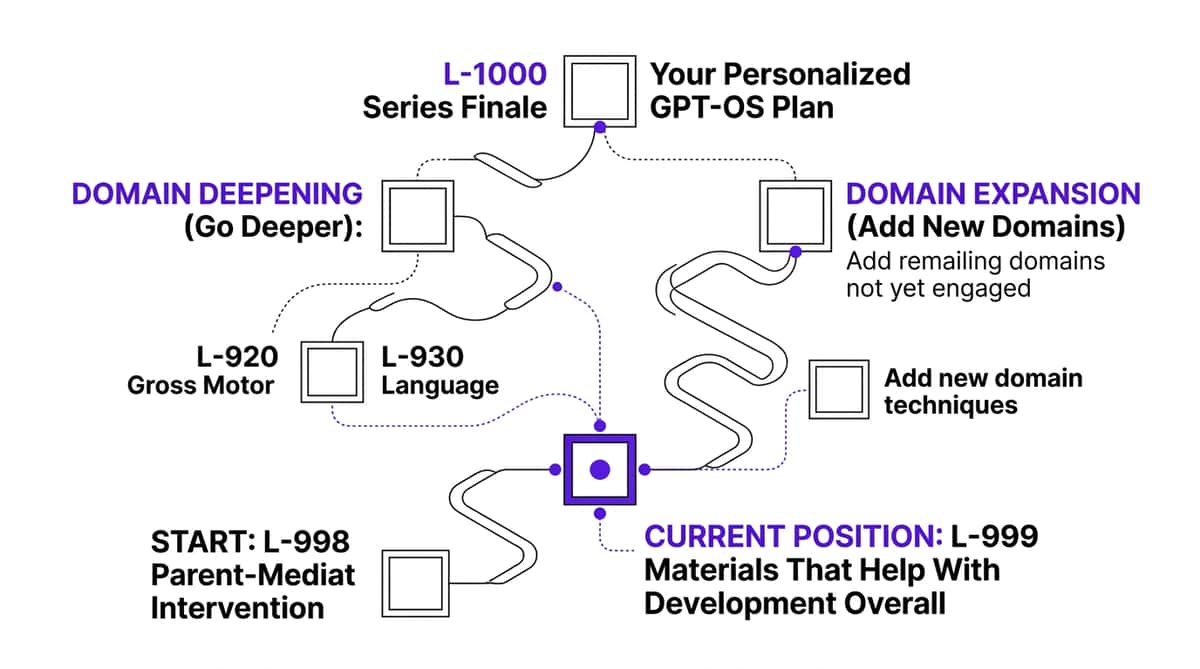
🟢 Strongest: Sensory Materials
🔵 Strongest: Books + Pretend Play
🟡 Strongest: Puzzles + Cause-Effect
🔴 Strongest: Outdoor + Balls
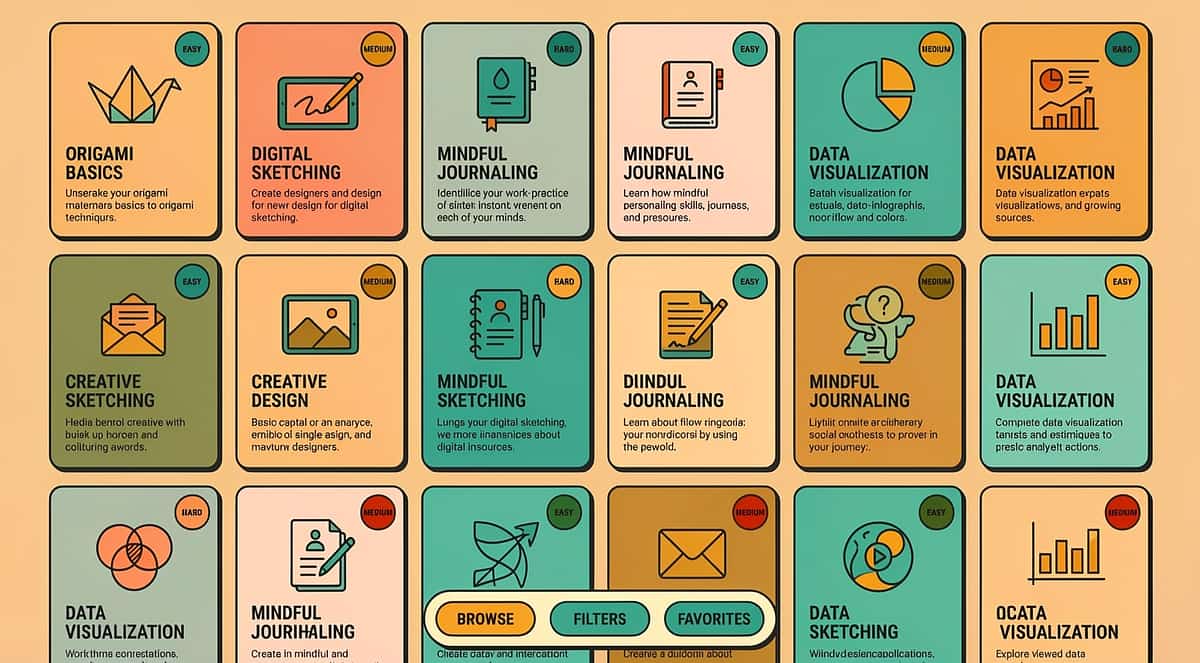
Other Techniques in the Holistic Development Series
All 6 of these techniques use materials you already have from this L-999 protocol. Zero additional cost. Each builds directly on the foundation you've established over the last 5–8 weeks.
L-996: Early Intervention Foundations
🟢 Intro | 🌿 Nature + Books
L-997: Home Environment Optimization
🔵 Core | 🏠 All 9 Materials
L-998: Parent-Mediated Intervention
🔵 Core | 👩👦 Parent + All Materials
L-940: Social Development Through Play
🔵 Core | 🎭 Pretend Play
L-930: Language Development at Home
🟡 Advanced | 📚 Books + Pretend
L-920: Gross Motor Milestones
🟢 Intro | ⚽ Balls + Outdoor
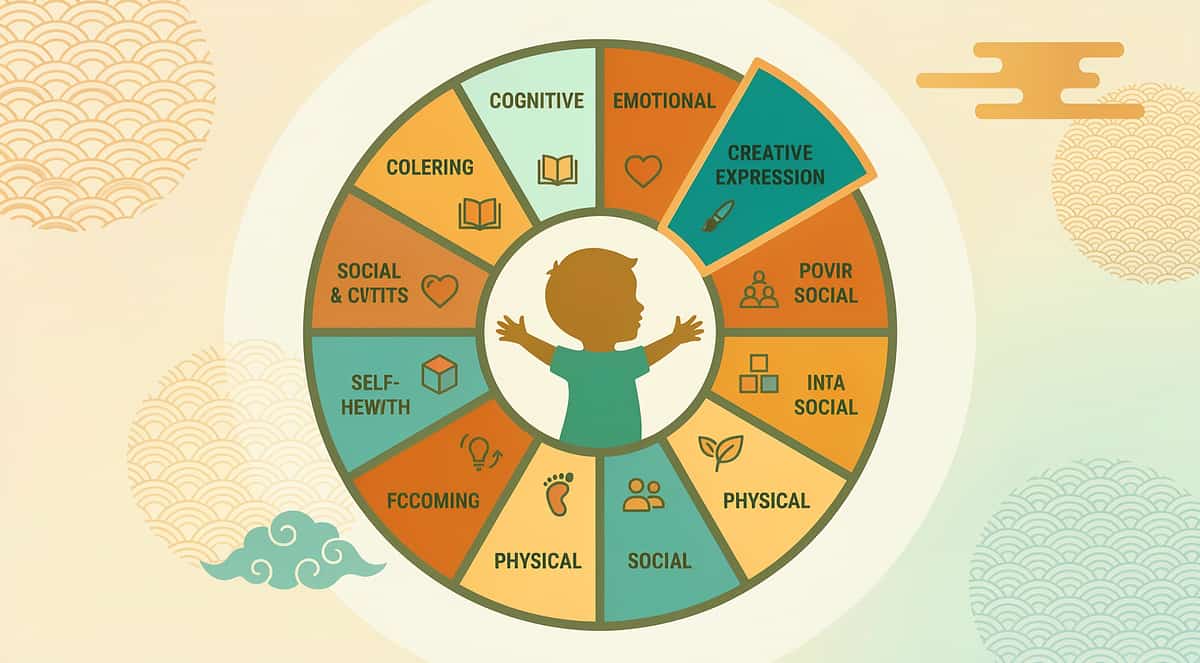
This Technique Is One Piece of a Larger Plan
The 12-domain developmental wheel shows every area of your child's growth. Domain L — Holistic Development is the integration layer. Every other domain (A–K) feeds into and from L. Mastery here unlocks richer engagement with every domain-specific technique in the 999 Reels library.
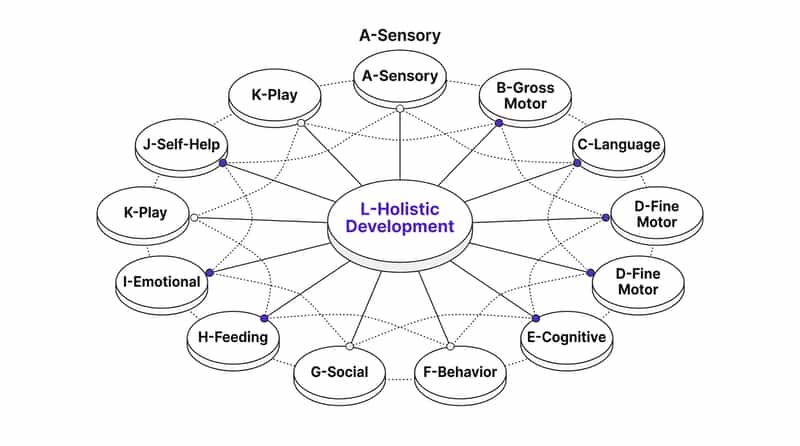
WHO/UNICEF Nurturing Care Framework: Five components of nurturing care (health, nutrition, responsive caregiving, security, early learning) require holistic developmental monitoring — WHO NCF (2018) | UNICEF 2025 Country Profiles
From the Field: Real Families, Real Outcomes
Family Story 1 — Anonymized
Child: 3.5 years, global developmental delay, 4 concurrent therapists
"We had four different homework sheets. Every therapist said their domain was the priority. We tried to fit everything in and succeeded at nothing. Our son seemed to feel the fragmentation. He'd resist all the 'therapy time' activities."
After 8 weeks: "He started asking for 'block time.' He's using 3-word sentences during play that he never used in speech therapy drills. His OT said his fine motor progress in 8 weeks exceeded the previous 6 months. We think it's because everything was connected instead of isolated."
Parent, Pinnacle Network | Outcomes vary by child profile and intervention consistency
Family Story 2 — Anonymized
Child: 5 years, ASD, sensory avoidance across multiple modalities
"She refused to touch anything wet, sticky, or unknown. We couldn't go to parks. Family meals were battles. The OT gave us sensory bin exercises but she screamed every time."
After 8 weeks: "She dug her hands into the garden last Tuesday. Voluntarily. And looked at me laughing. I stood there and cried. That's the whole journey right there."
Parent, Pinnacle Network | Outcomes vary by child profile and intervention consistency
"The shift I see in families who commit to integrated material engagement versus isolated skill drills is profound. The home environment, done with these materials and this approach, is the most powerful therapy room we have." — Pinnacle OT, Lead Consortium Therapist
📞Share your story: 9100 181 181 |care@pinnacleblooms.org
Isolation Is the Enemy of Consistency. Join Your Community.
"In our parent communities, you will find families 2 weeks ahead of you who remember your confusion. Families 6 months ahead who remember your fear. And families 2 years ahead who will show you what you're working toward. That is the real curriculum." — Pinnacle Blooms Consortium
💬 WhatsApp Group
unknown link
🌐 Online Forum
📍 Local Meetup
🤝 Peer Mentor
📞FREE National Autism Helpline: 9100 181 181 | 16+ languages | 24×7
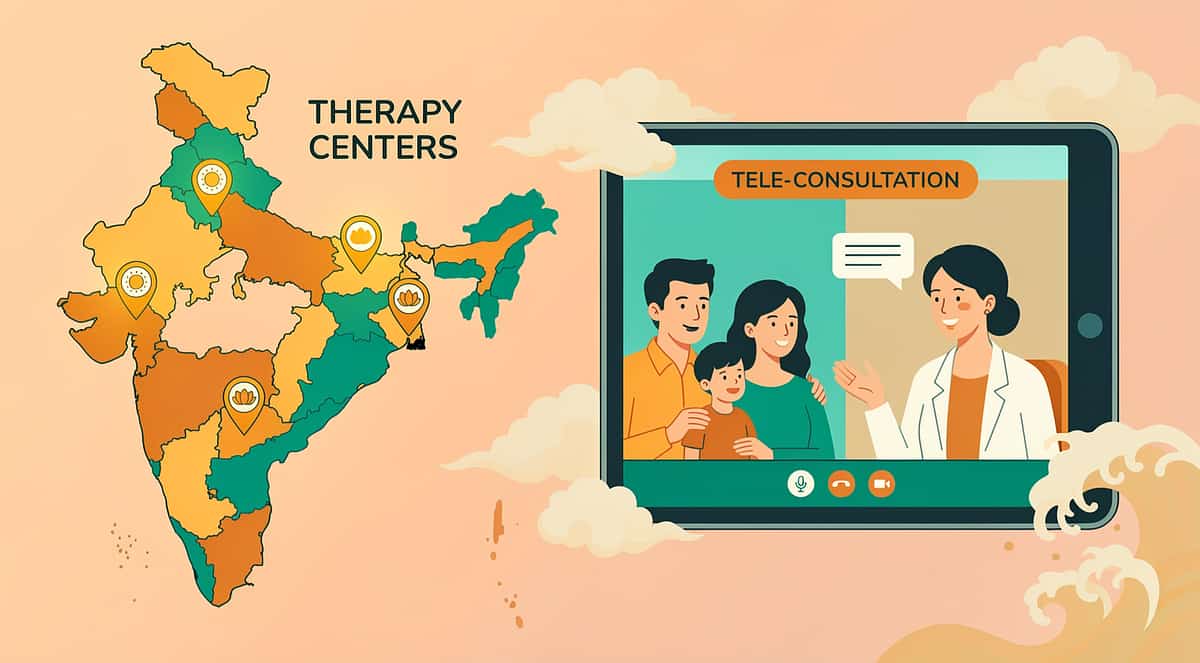
Home + Clinic = Maximum Impact
Home-based intervention doubles its impact when supported by periodic professional guidance. Your daily sessions build the foundation; clinic sessions calibrate the approach and accelerate domain-specific gains. Together, they form a closed therapeutic loop that produces results neither achieves alone.
Therapist matching for this technique: Primary: Occupational Therapist | Secondary: Speech-Language Pathologist | Tertiary: ABA/BCBA
📞Call FREE: 9100 181 181 | Available in 16+ languages | 24×7
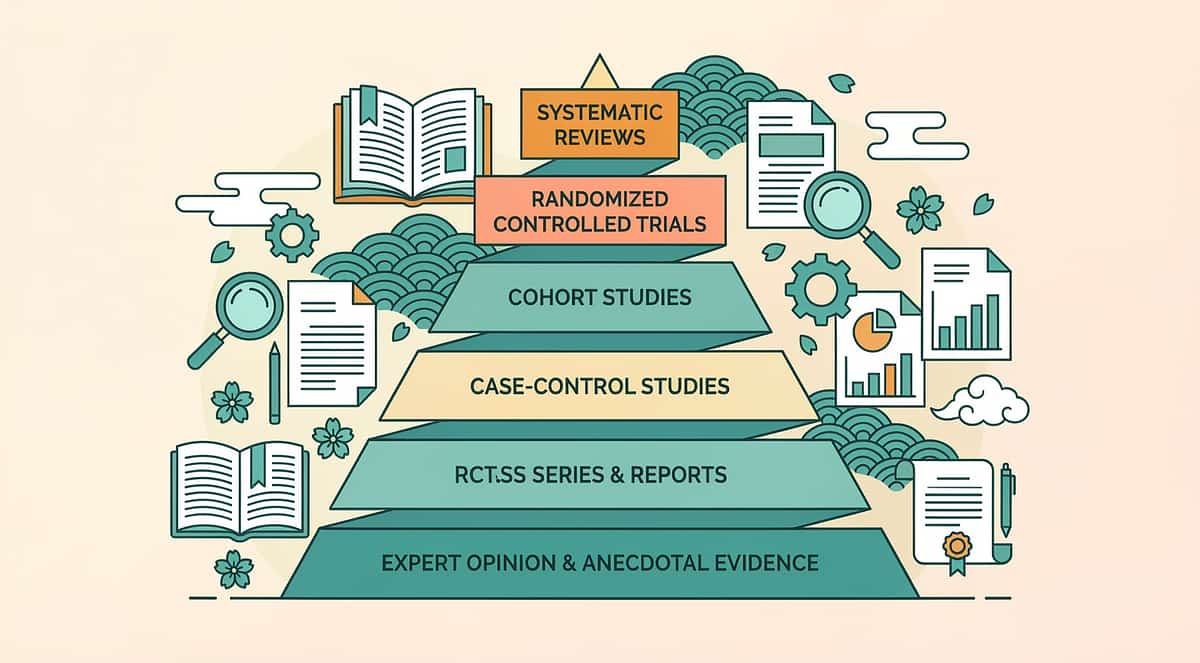
The Science Behind This Protocol: Deeper Reading
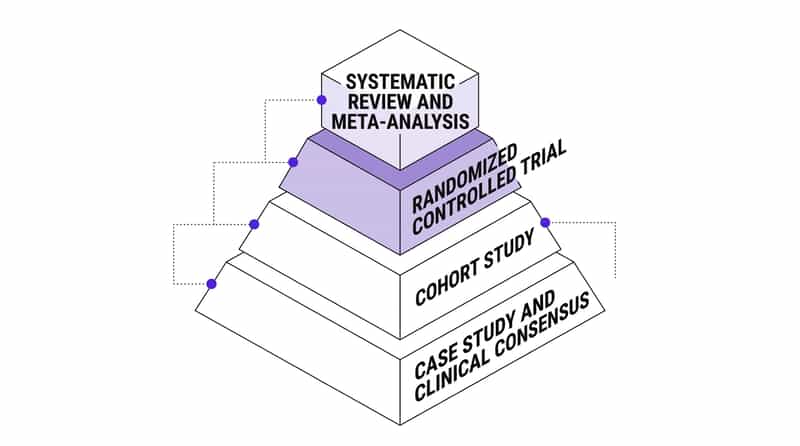
PMC11506176 — PRISMA Systematic Review (Children, 2024)
16 studies (2013–2023): Integrated sensory-motor material interventions meet evidence-based practice criteria for ASD. Multi-domain material engagement confirmed as Level I evidence.
PMC10955541 — Meta-Analysis (World J Clin Cases, 2024)
24 studies: Sensory integration and material-based intervention effectively promotes social skills, adaptive behavior, sensory processing, and motor skills across ASD and developmental delay populations.
PMC9978394 — WHO/UNICEF CCD Package
Care for Child Development package, implemented across 54 LMICs, demonstrates household-material-based multi-domain intervention efficacy across all developmental domains.
DOI: 10.1007/s12098-018-2747-4 — Indian RCT (2019)
Padmanabha et al.: Home-based material interventions with parent delivery showed significant developmental outcomes in Indian pediatric populations.
NCAEP Evidence-Based Practices Report (2020)
National Clearinghouse: Multiple material-based interventions (visual supports, video modeling, sensory integration) classified as evidence-based practices for autism.
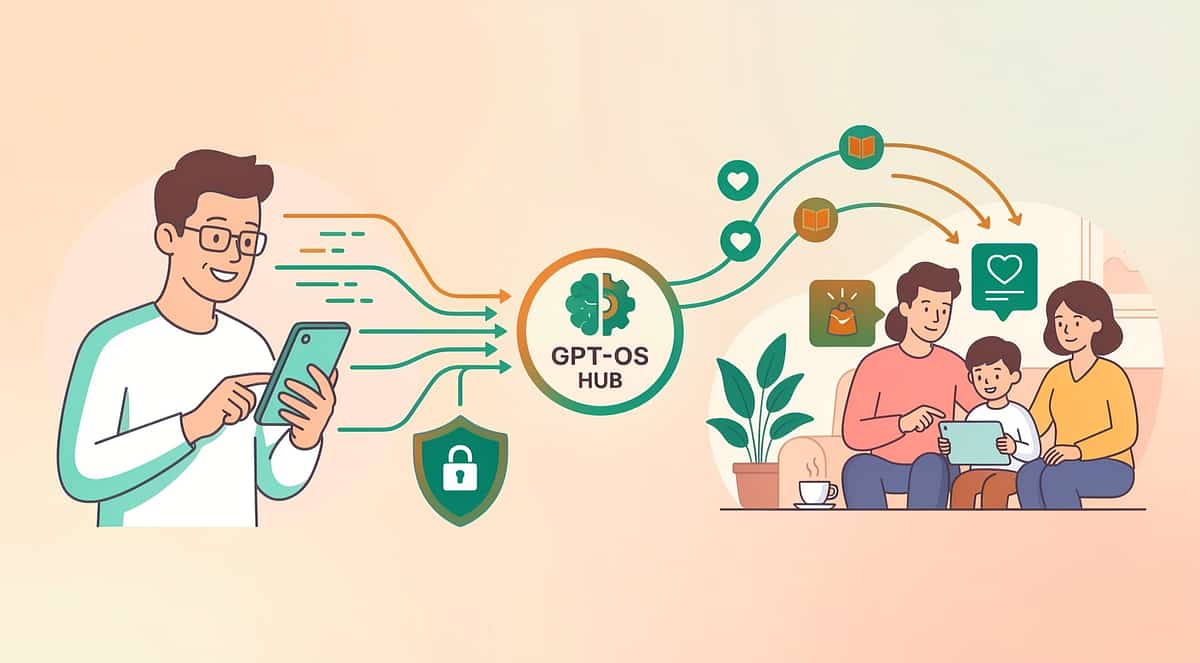
Your Sessions Power a Global Therapeutic Intelligence
What GPT-OS® Learns from L-999 Data
- Which materials your child engages with longest
- Which domains show fastest progress
- What time-of-day shows best engagement
- How your child's sensory profile is evolving
- When to escalate to domain-specific techniques
Privacy Assurance
All data is anonymized, encrypted, and governed by Indian data protection standards. Individual child data is never shared. Population-level aggregate intelligence only.
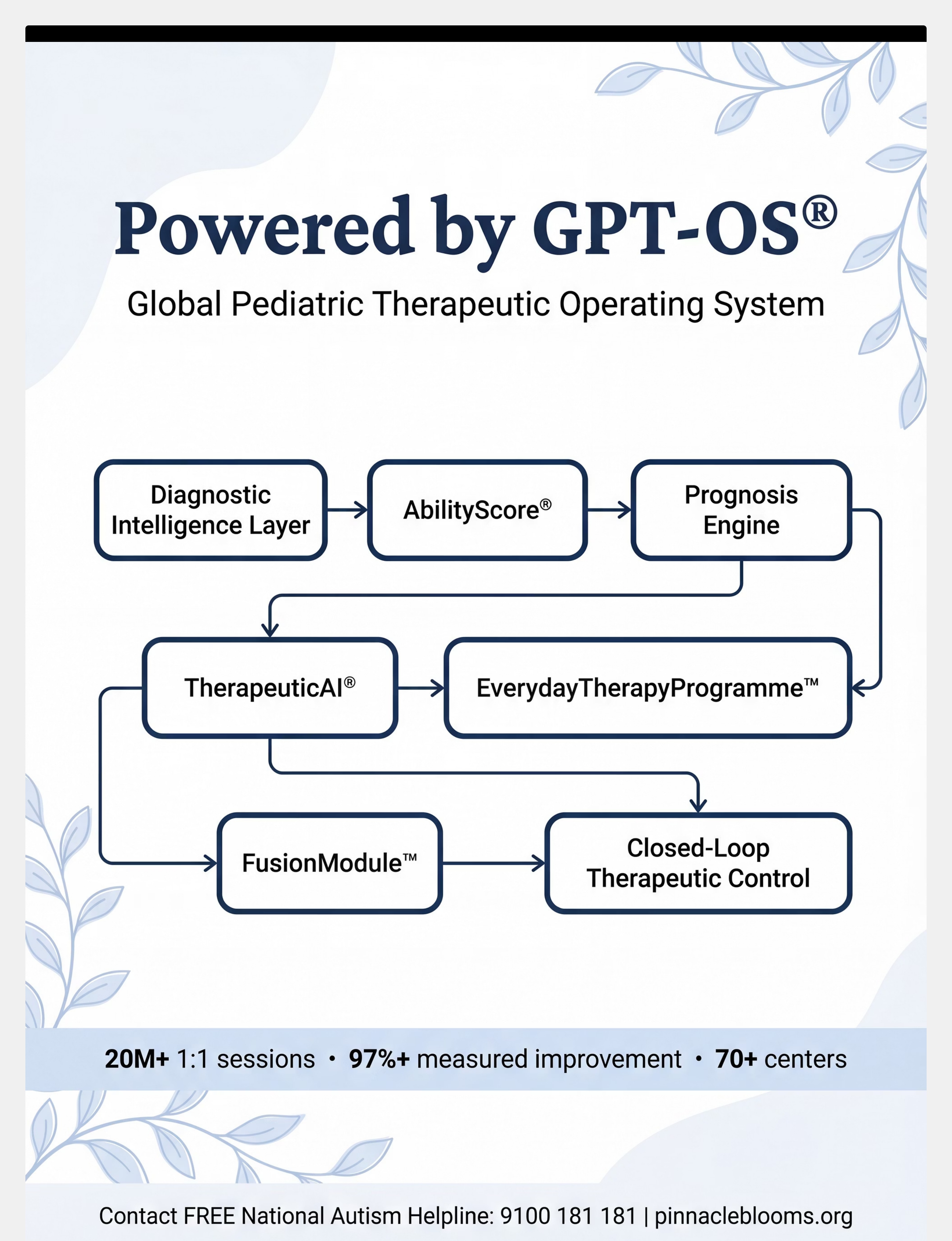
The GPT-OS® Stack
Diagnostic Intelligence → AbilityScore® → Prognosis Engine → TherapeuticAI® → EverydayTherapyProgramme™ → FusionModule™ → Closed-Loop Therapeutic Control
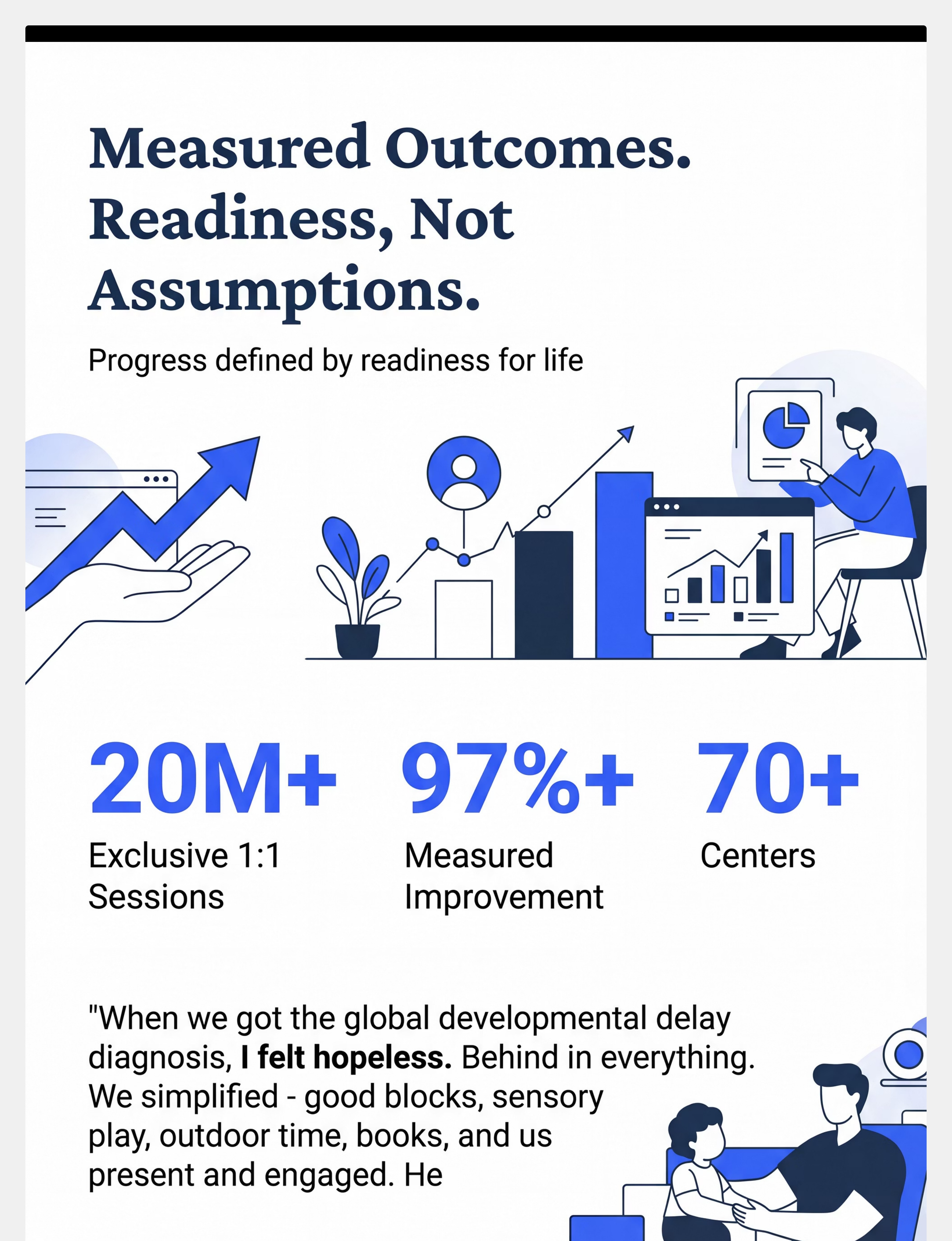
20M+
Exclusive 1:1 Sessions
97%+
Measured Improvement
70+
Centers Worldwide
160+
Countries (Patents Filed)
Your Questions, Answered
These are the questions Pinnacle families ask most often — gathered from community forums, helpline calls, and clinic consultations. If your question isn't here, GPT-OS® and our teleconsultation team are ready to help.
How many materials should I use in one session?
Start with 2–3 per session. Rotation and simplicity prevent overwhelm. As your child's engagement develops, you can expand. More is not better in early stages.
My child will only play with one material. Is that okay?
Completely normal and clinically appropriate. Honor the preference. Use it as the anchor material and introduce new ones alongside it gradually. Forced variety reduces engagement.
How is this different from regular play?
The difference is parental intentionality. These specific materials + active parent engagement + consistent daily exposure + data tracking = therapeutic play. Random play has developmental value. Structured material-based play with a present caregiver has more.
Do I need to do all 9 materials every day?
No. Rotate across the week. Monday: blocks + sensory. Tuesday: outdoor + books. Wednesday: pretend play + art. Thursday: balls + cause-effect + puzzles. Every material gets regular exposure without overwhelming any single session.
Can I use these materials with my neurotypical child too?
Absolutely. These are foundational developmental materials for all children. Their developmental power is universal — the evidence base simply addresses delay and neurodivergence specifically.
Should I stop if my child has a bad day?
If a meltdown or severe distress occurs: yes, stop. The art is reading the child. Consistent low-demand exposure on difficult days is better than skipping entirely — but safety and regulation always take priority.
At what age is it too late to start?
Research supports developmental intervention benefit through childhood and into adolescence. There is no "too late." Earlier is better, but later is still valid.
How do I know if it's working?
Use the Week 1–2, 3–4, and 5–8 indicators in this guide. Trust small, specific changes — 3 more seconds of tolerance, one new word during play, one more turn in ball exchange. These are the data that matter.
📞9100 181 181 | FREE | 16+ languages | 24×7
Preview of 9 materials that help with development overall Therapy Material
Below is a visual preview of 9 materials that help with development overall therapy material. The pages shown help educators, therapists, and caregivers understand the structure and content of the resource before use. Materials should be used under appropriate professional guidance.


Link copied!
You Have Everything You Need. One Step Remains.
🟢 Start This Technique Today
→ GPT-OS® Session Launcher
Takes you to your first personalized L-999 session, guided by GPT-OS®
🔵 Book a Consultation
→ Speak with a Pinnacle Consortium Therapist
In-center, teleconsultation, or home visit available
⚪ Explore Your Next Technique
→ Progression Pathway
Browse techniques in this domain and beyond
✅ Validated by the Pinnacle Blooms Consortium
OT • SLP • ABA/BCBA • SpEd • NeuroDev Pediatrics • CRO • Developmental Pediatrics
OT • SLP • ABA/BCBA • SpEd • NeuroDev Pediatrics • CRO • Developmental Pediatrics
📞 FREE National Autism Helpline: 9100 181 181 | Available in 16+ languages | 24×7 | India's largest pediatric therapy consortium
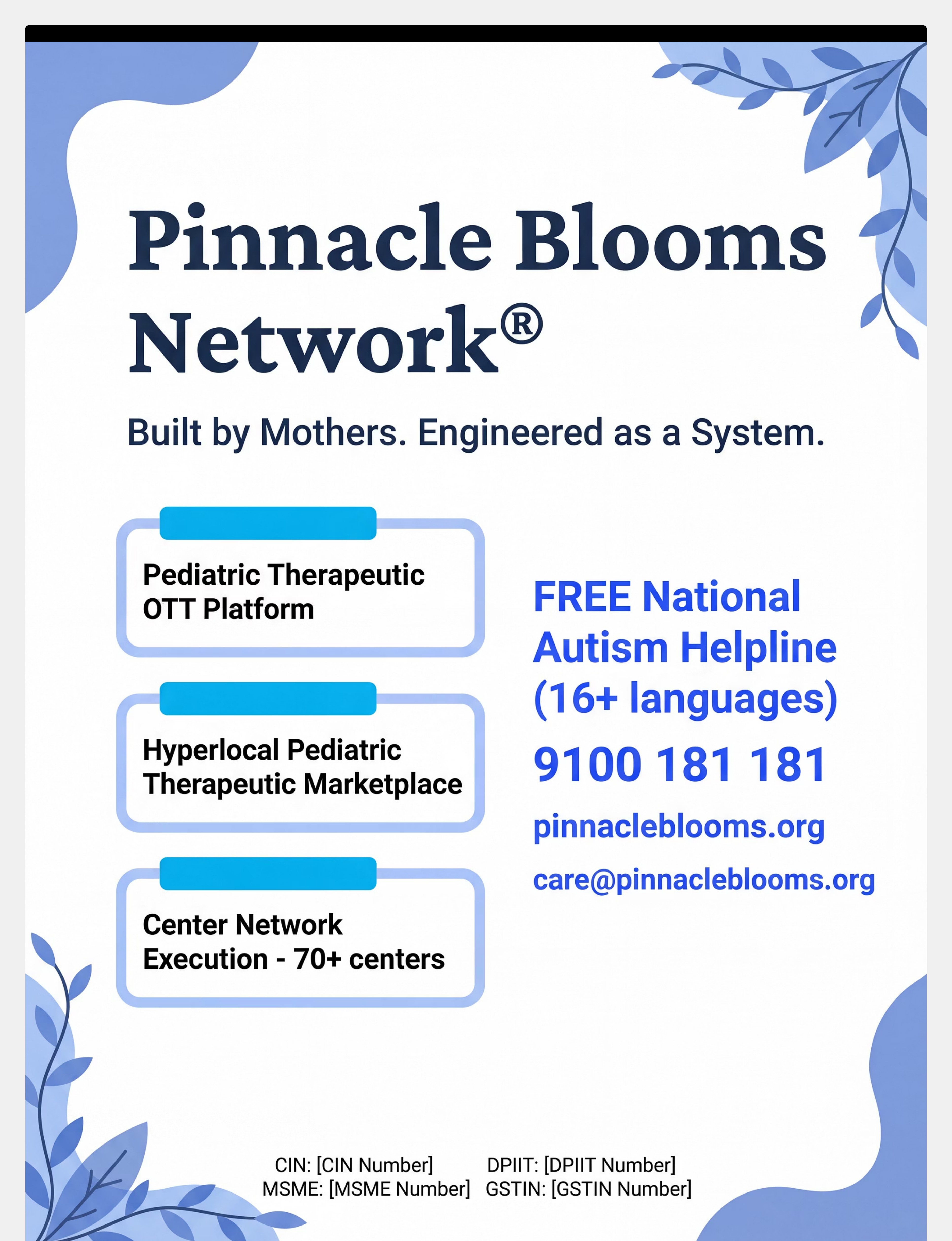
PINNACLE BLOOMS NETWORK®
Built by Mothers. Engineered as a System.
"From fear to mastery. One technique at a time."
20M+ exclusive 1:1 sessions | 97%+ measured improvement | 70+ centers | 70+ countries served
This content is educational. It does not replace individualized assessment and intervention from qualified developmental pediatricians, occupational therapists, speech-language pathologists, or early intervention specialists. Developmental needs vary significantly based on individual profile and diagnosis. Always consult your child's therapy team for personalized developmental recommendations.
© 2026 Pinnacle Blooms Network®, unit of Bharath Healthcare Laboratories Pvt. Ltd. All rights reserved.
CIN U74999TG2016PTC113063 | DPIIT DIPP8651 (Govt. of India) | MSME TS20F0009606 | GSTIN 36AAGCB9722P1Z2
CIN U74999TG2016PTC113063 | DPIIT DIPP8651 (Govt. of India) | MSME TS20F0009606 | GSTIN 36AAGCB9722P1Z2