
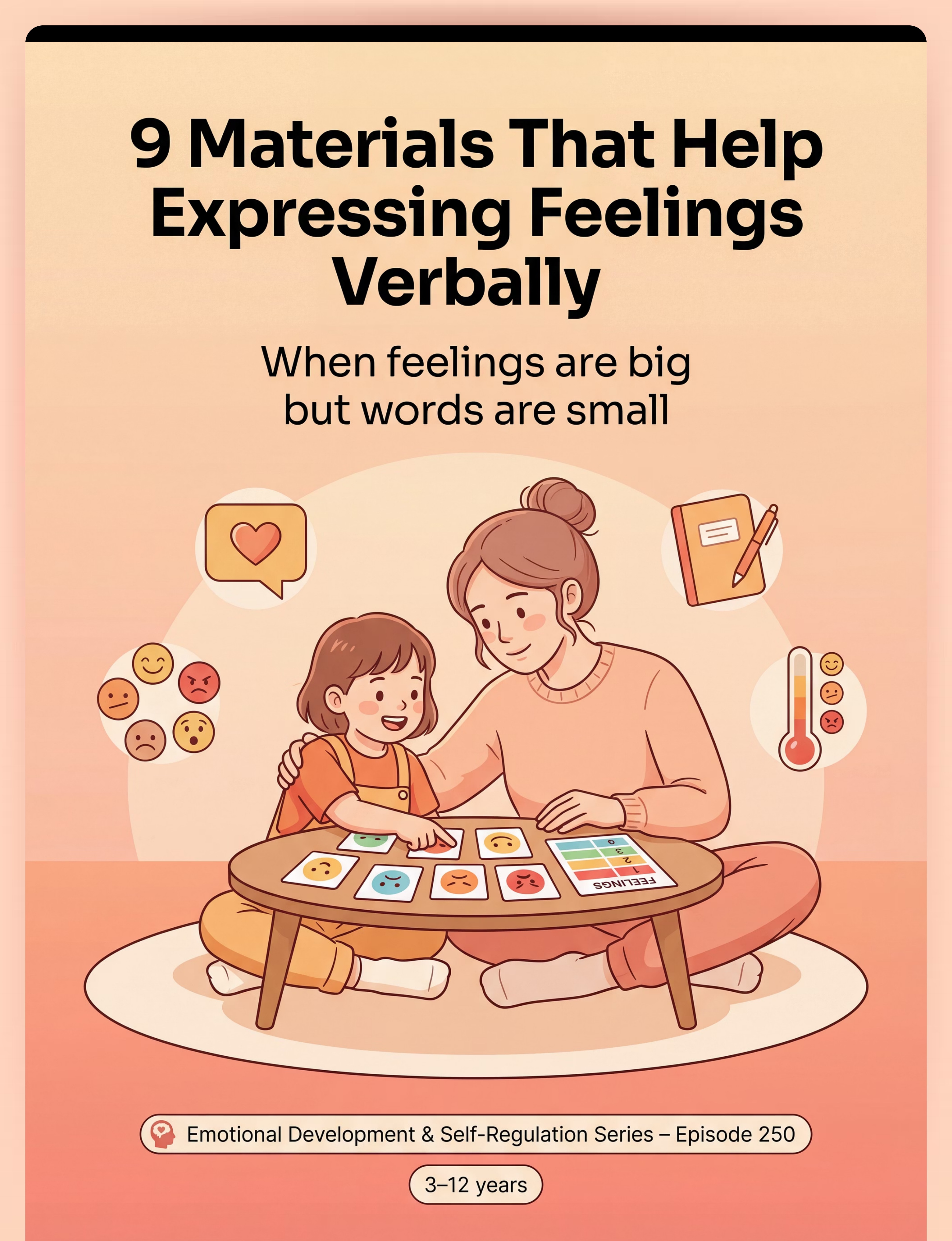
9 Materials That Help Expressing Feelings Verbally
Technique C-250 | Emotional Development & Self-Regulation Series
Clinically validated materials for children aged 3–12 who feel everything deeply — but struggle to find the words.
Clinically validated materials for children aged 3–12 who feel everything deeply — but struggle to find the words.
Pinnacle Blooms Network®
OT • SLP • ABA • SpEd • NeuroDev • Psychology

ACT I — THE EMOTIONAL ENTRY
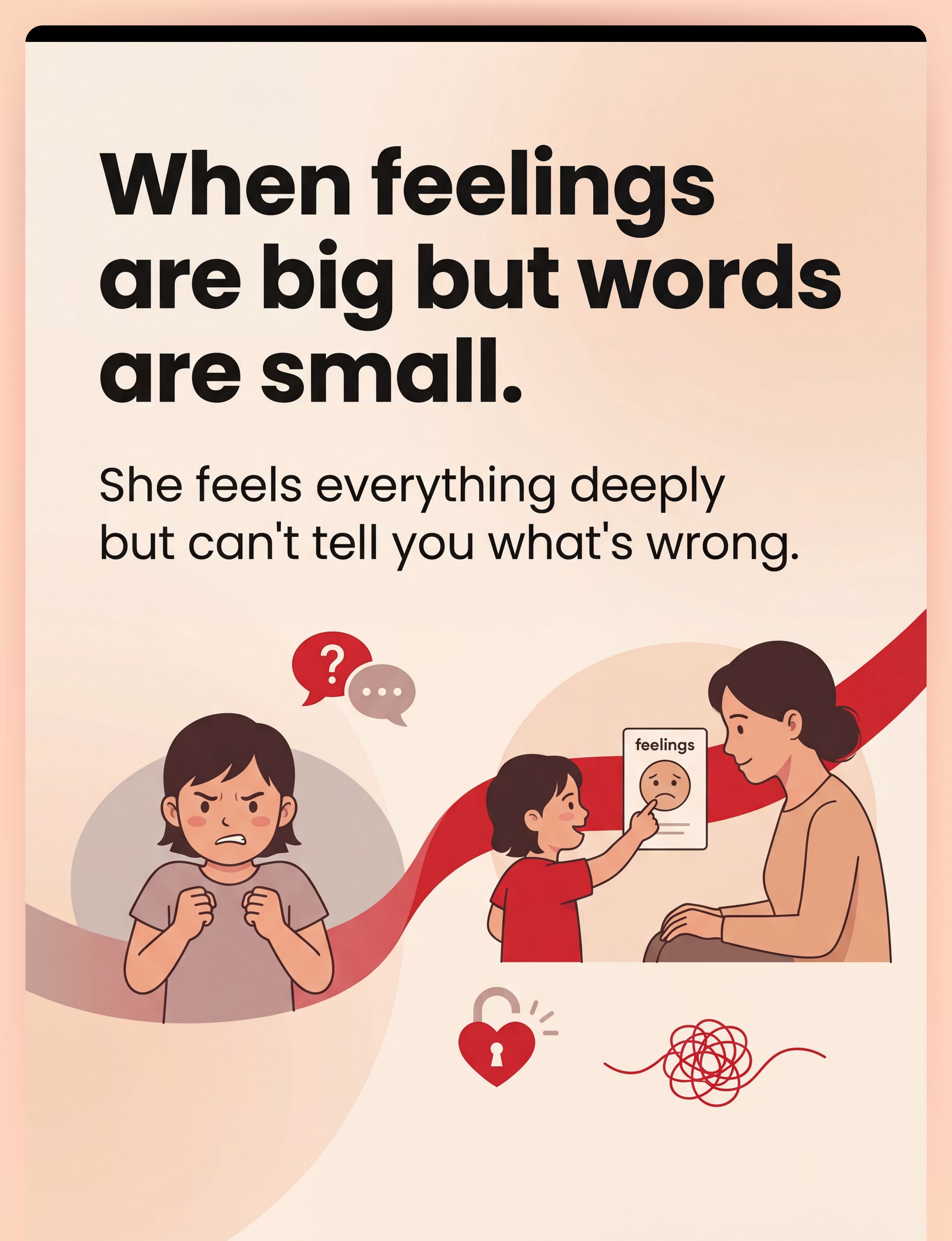
"She feels everything deeply. But she can't tell me what's wrong."
She comes home from school and something is clearly wrong. Her face is twisted. Her body is a coiled spring. You ask: "What happened?" She says: "I don't know." You try again: "Are you sad? Angry? Frustrated?" She looks at you with genuine confusion and says: "I don't know, Mama. I just feel bad."
And then the meltdown comes. Forty-five minutes of overwhelm that neither of you can explain. Afterward — after the calm, the snack, the quiet — you ask again. "What happened at school?" She says: "My chest felt weird. My head was loud." That's as close as she can get.
She is drowning in feelings she cannot name. And you are standing on the shore, desperate to reach her — but there is no bridge of words between you.
You are not failing. Your child's emotional nervous system is asking for vocabulary it hasn't yet been given.
💛"This is not a behaviour problem. This is a language gap — and language gaps can be closed." — Pinnacle Blooms Consortium | SLP + Psychology
📞FREE National Autism Helpline: 9100 181 181 | Available 24×7 | 16+ Languages

Card 02 — You Are Not Alone
You Are Among Millions of Families Navigating This
Alexithymia — difficulty identifying and describing feelings — affects an estimated 50% of autistic individuals and a significant proportion of children with sensory processing differences, anxiety, and language delays. This is not a character flaw. It is a documented developmental profile that responds to systematic, materials-based intervention.
30–50%
Children with Autism
experience significant difficulties expressing emotions verbally
1 in 5
Children Globally
show limited emotional vocabulary relative to age-expected norms
3–12
Years
the critical window when emotional vocabulary foundation is built — and intervention has maximum impact
"Emotional vocabulary breadth directly predicts emotional regulation capacity. Teaching children words for feelings isn't soft skill work — it is neurological infrastructure." — Pinnacle Consortium, SLP + Psychology Division
📚Research: PMC11506176 | PMC10955541 | WHO/UNICEF CCD Package | Padmanabha et al., Indian J Pediatr 2019
Card 03 — The Neuroscience
The Neuroscience of "I Don't Know"
When your child says "I don't know" — she genuinely doesn't know. Her interoceptive system may not be clearly signalling what she's feeling. Her brain hasn't yet built the pathway from body sensation → emotion concept → language. This is a wiring difference, not a choice.
The Chain That Must Fire
01
Interoception
The insula cortex detects internal body signals — racing heart, tight chest, stomach flutter
02
Emotional Recognition
The prefrontal cortex + amygdala interpret those signals as emotional states
03
Vocabulary Access
Broca's area retrieves the linguistic label for the emotion
04
Expressive Language
The child formulates and produces a sentence to express the feeling
What This Means for YOUR Child
In children with autism, sensory processing differences, or language delays — any link in this chain may be underperforming. The emotion is fully real. The pipeline to words is interrupted.
The good news: every link in this chain can be trained with the right materials and consistent practice. The brain retains neuroplasticity well into childhood — which is precisely why early intervention produces such durable results.
📚 Frontiers in Integrative Neuroscience (2020): DOI 10.3389/fnint.2020.556660 | Affect Labeling research: PMC5862594
📞9100 181 181 — Speak with a Specialist Today

Card 04 — Developmental Context
Your Child's Emotional Vocabulary Timeline
Emotional expression develops in predictable stages. If your child is using only "good/bad/fine" or "I don't know" beyond age 5 — they are in the intervention window. This is when systematic teaching has maximum impact.
Age 2–3
Basic words: happy, sad, mad (with adult modelling)
Age 3–5
Spontaneous use of basic emotion words; expanding to scared, surprised, excited
Age 5–6
Beginning cause-effect: "I'm sad because…"
Age 6–8
Nuanced vocabulary: frustrated, disappointed, nervous, proud
Age 8–10
Mixed emotions: "excited AND scared at the same time"
Age 10+
Sophisticated, context-adapted emotional communication
What Commonly Co-Occurs
Emotional expression difficulties frequently accompany: Autism Spectrum Condition • Sensory Processing Differences • Language Delays • Anxiety • ADHD • Alexithymia • Trauma History. This is why a multi-disciplinary approach (SLP + OT + Psychology) is recommended. The Pinnacle FusionModule™ coordinates all disciplines under a single plan.
📚 WHO Care for Child Development (CCD) Package identifies emotional communication as a core developmental domain — implemented across 54 low- and middle-income countries. PMC9978394 | WHO/UNICEF CCD Package (2023)
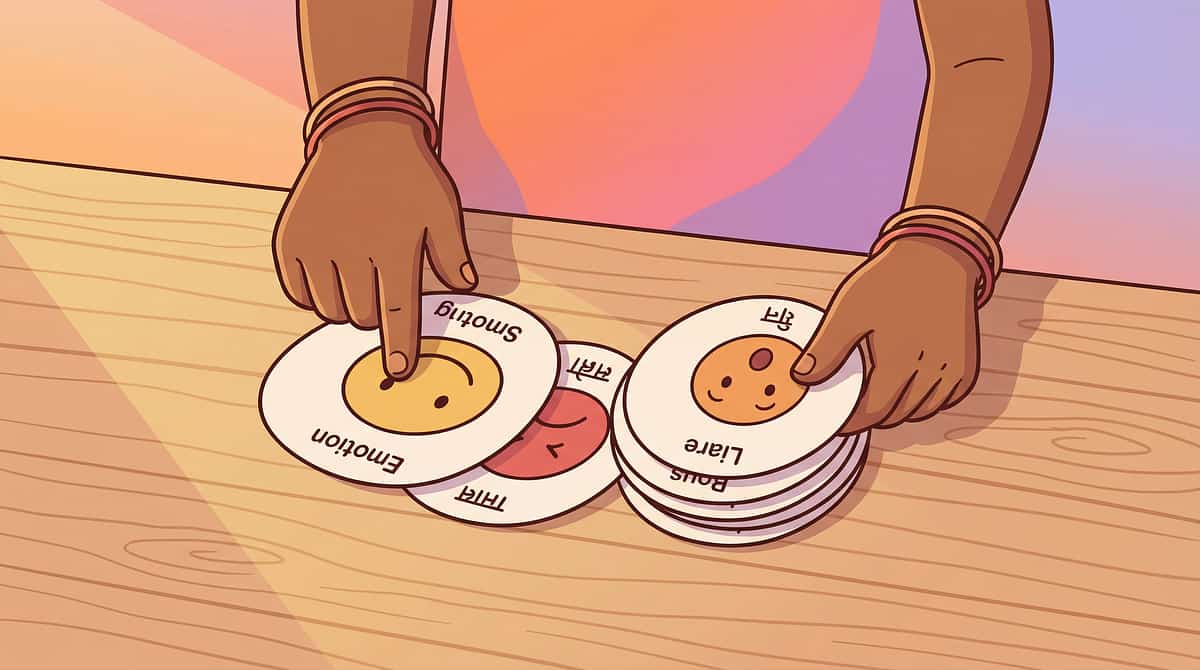
Card 05 — The Evidence
Clinically Validated. Home-Applicable. Parent-Proven.
C-250 is not built on intuition. Every component of this technique is grounded in peer-reviewed research across multiple disciplines — from neuroscience to behavioural intervention to international public health frameworks.
⭐⭐⭐⭐ Level II Evidence
CASEL Framework (2020): Children with explicit emotional vocabulary instruction show 11-point percentile improvement in academic outcomes — across 213 school-based studies.
Affect Labelling Research
Lieberman et al.: Putting feelings into words activates prefrontal regulatory circuits and reduces amygdala reactivity. Naming emotions literally reduces their intensity at the neural level. (PMC5862594)
Interoception in ASD (2020)
Systematic interoception training significantly improves emotion identification and regulation in autistic children. (Frontiers in Integrative Neuroscience, DOI: 10.3389/fnint.2020.556660)
Home-Based RCT — India (2019)
Parent-administered emotion-focused interventions demonstrated significant measurable outcomes. (Padmanabha et al., Indian J Pediatr, DOI: 10.1007/s12098-018-2747-4)
Zones of Regulation
Kuypers' widely validated curriculum shows that systematic visual + scaffolded emotional vocabulary instruction produces measurable improvements across emotional regulation, self-awareness, and social communication.
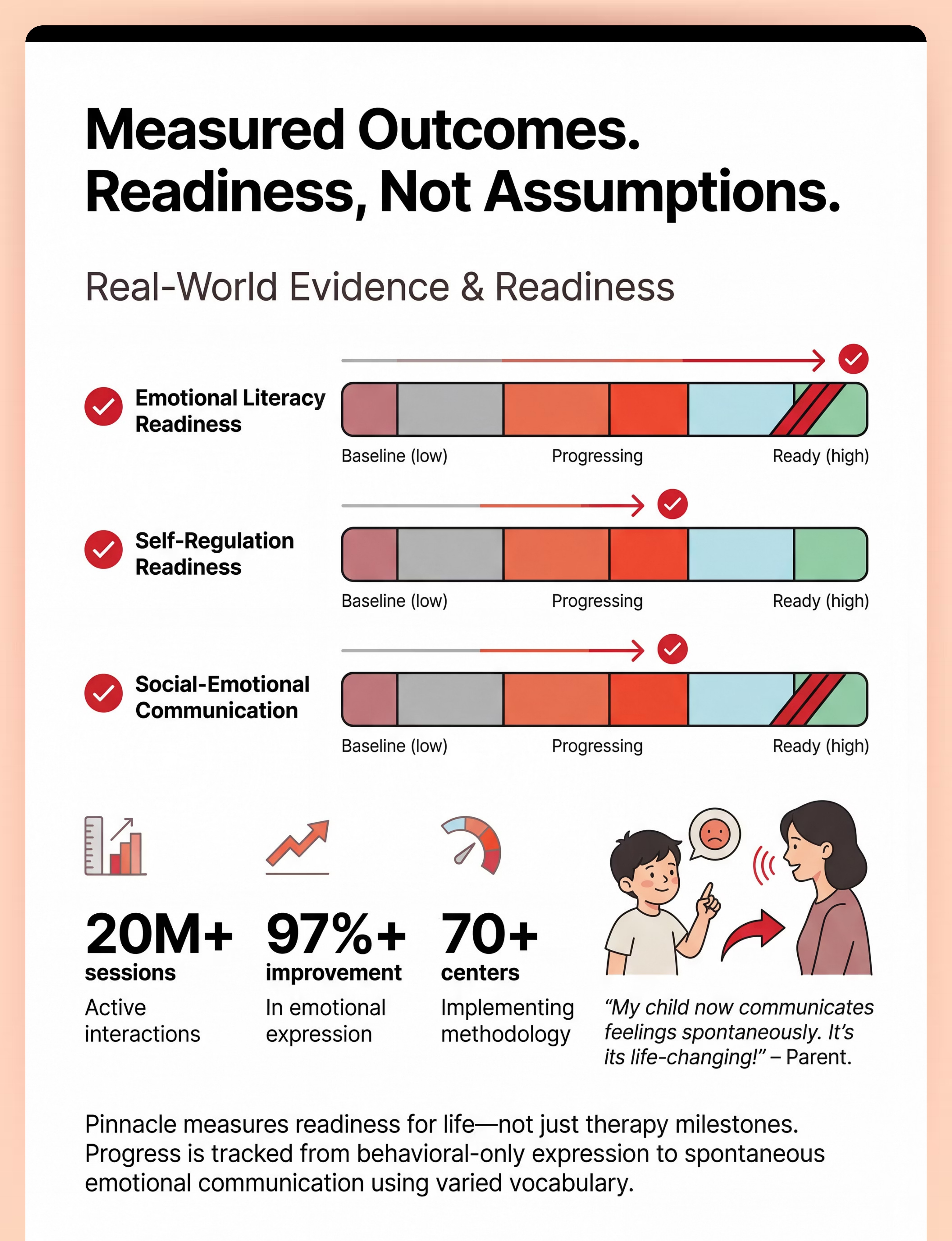
20M+
Therapy Sessions
Across 70+ Pinnacle centres
97%+
Measured Improvement
Across Emotional Literacy Readiness Index
80%
Confidence Level
Multiple convergent evidence sources
OT • SLP • ABA • SpEd • NeuroDev • Psychology
ACT II — THE KNOWLEDGE TRANSFER
Technique C-250 — What It Is
Formal Name
Systematic Emotional Vocabulary and Expression Training with Multi-Modal Scaffolding
Parent-Friendly Alias: Building the Bridge Between Feelings and Words
Parent-Friendly Alias: Building the Bridge Between Feelings and Words
This intervention teaches children aged 3–12 to identify, name, and verbally communicate their internal emotional states using a sequence of nine interconnected material categories — spanning interoceptive body awareness, emotional recognition, vocabulary expansion, cause-effect understanding, and scaffolded expressive language.
Unlike behaviour management approaches that address what the child does when overwhelmed, this technique addresses why behavioural expressions happen — because the child lacks the verbal pathway to express what they're experiencing. By systematically building each component skill (body awareness → emotion recognition → vocabulary → causation → expression), this technique creates a durable neural infrastructure for emotional communication that reduces behavioural crises while building the child's capacity for genuine interpersonal connection.
Domain
Emotional Development & Self-Regulation
Age Range
3–12 years
Session Frequency
Daily micro-practice 5–10 min + formal sessions 3–5×/week
Outcome Timeline
8–12 weeks for observable change; 6 months for consolidation
Cluster Position
C-248 (Identifying Emotions in Self) → C-249 (Understanding Others' Emotions) → C-250 (Expressing Feelings Verbally — THIS PAGE) → C-251 (Managing Big Emotions) → C-252 (Emotional Flexibility)

Card 07 — Who Uses This Technique
This Technique Crosses Every Therapy Boundary — Because Emotions Don't Belong to One Discipline
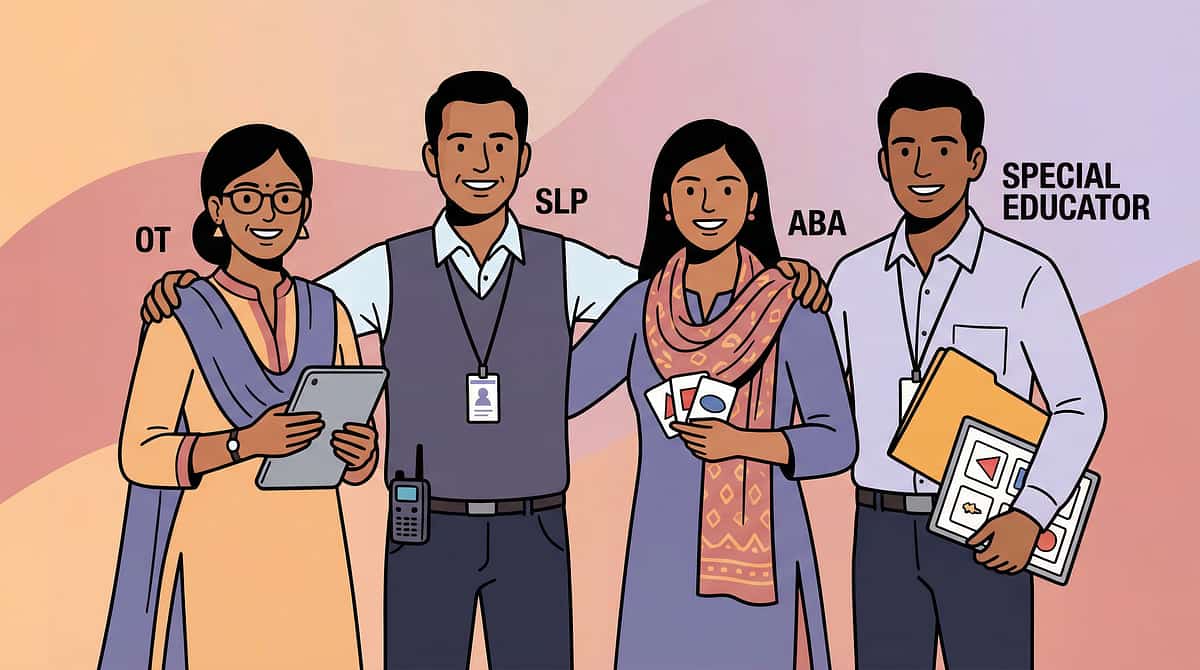
The brain doesn't organise emotional processing by therapy type. When a child learns to say "I feel frustrated," that single sentence required interoception (OT), vocabulary (SLP), behavioural practice (ABA), and cognitive processing (Psychology). This is why the Pinnacle FusionModule™ coordinates all disciplines under one unified plan.
SLP (Speech-Language Pathology)
Primary lead. Builds vocabulary systematically, teaches sentence structures for emotional expression, targets expressive language scaffolding.
OT (Occupational Therapy)
Interoception focus — teaches the child to notice and interpret body sensations that underlie emotions; sensory regulation integration.
ABA / BCBA
Reinforcement of emotional expression attempts; data collection on expression frequency/complexity; systematic vocabulary teaching protocols.
SpEd (Special Education)
Classroom integration; visual supports; curriculum alignment; generalisation across school settings.
NeuroDev Pediatrics + Psychology
Assessment of alexithymia, anxiety, and developmental profile; therapy coordination; parent guidance.
📚 WHO/UNICEF Nurturing Care Framework (2022): Multi-disciplinary contributions to responsive caregiving | DOI: 10.1080/17549507.2022.2141327
📞9100 181 181 — Get a FusionModule™ Assessment Today

Card 08 — What This Targets
What Emotional Expression Training Actually Changes
C-250 doesn't merely teach children to name feelings on demand — it systematically builds the full cognitive and neurological architecture for genuine emotional communication, with measurable effects across behaviour, relationships, and long-term mental health.
1
Primary Target — Core
Verbal emotional expression — the child's ability to produce sentences communicating internal emotional states: "I feel [emotion] because [trigger]." Measured via Emotional Literacy Readiness Index.
2
Secondary Targets — Ring 2
Interoceptive awareness • Emotional vocabulary breadth • Emotional cause-effect understanding • Meltdown frequency and duration — reduced as verbal pathway opens.
3
Tertiary Targets — Long-Term
Peer relationship quality • Academic performance • Family connection quality • Mental health trajectory — unexpressed emotions become internalised distress.
Observable Behaviour Indicators — You Know It's Working When:
✅ Child volunteers an emotion word without prompting
✅ Child says "I feel ___ because ___" in real situations
✅ Meltdown replaced by "I'm at a 7 on my feelings thermometer"
✅ Child initiates a feelings check-in
✅ Child identifies body signals before emotions escalate
📚 CASEL (2020): 213-study meta-analysis confirms emotional vocabulary instruction improves social-emotional outcomes | PMC10955541
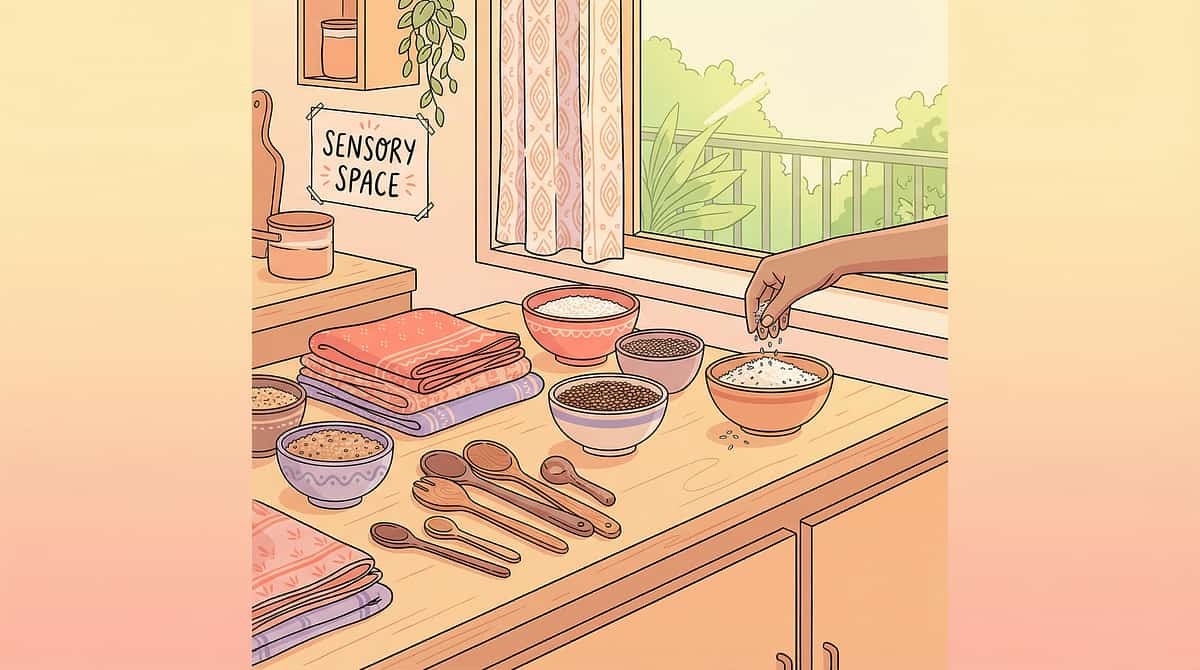
Card 09 — The 9 Materials
9 Materials That Build the Bridge Between Feelings and Words
Each material targets a specific link in the emotion-to-expression chain. Together they build the complete pathway.
Material 1
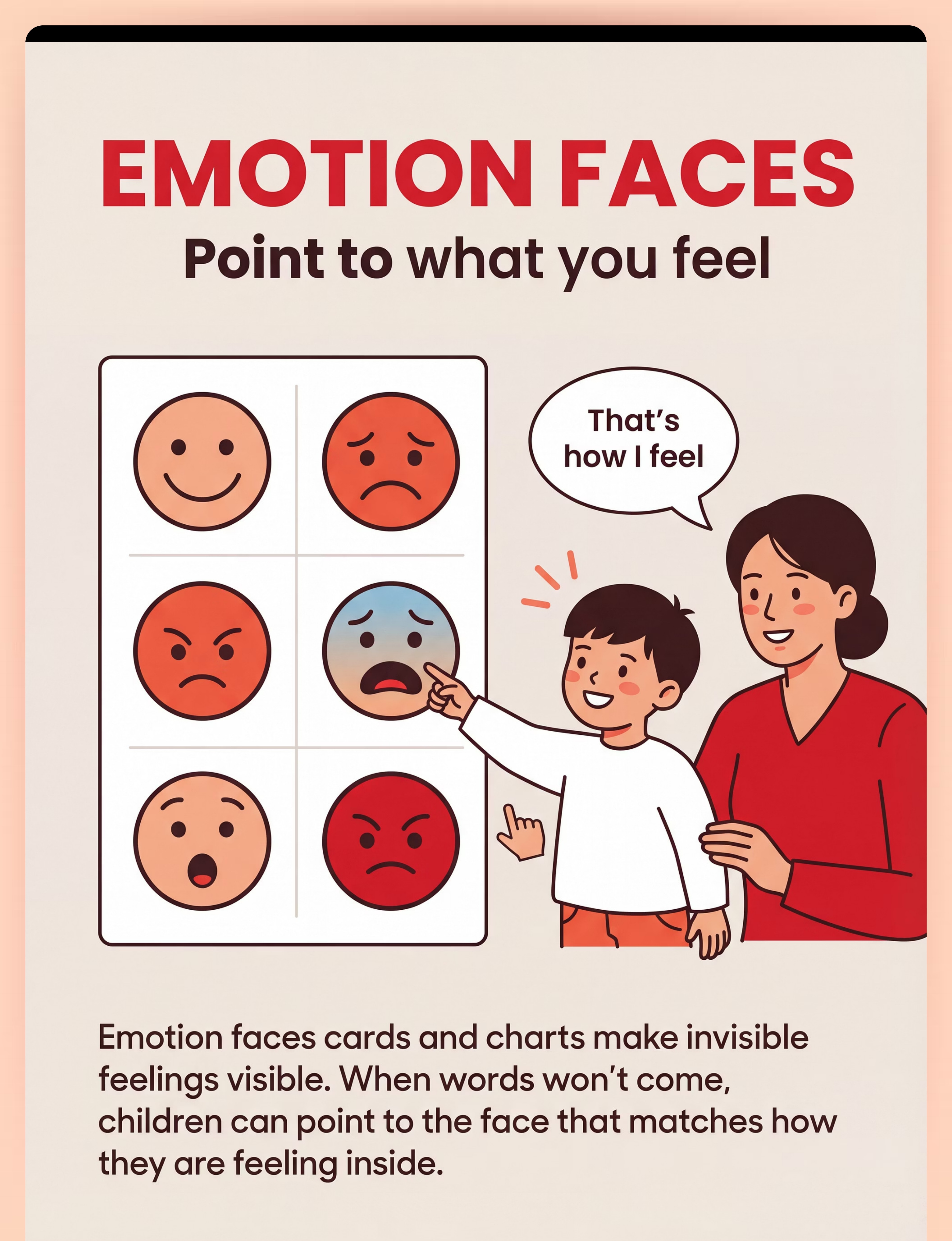
Emotion Faces Cards and Charts
₹200–1,500 | DIY: ✅
"Point to what you feel — when words won't come, recognition comes first"
₹200–1,500 | DIY: ✅
"Point to what you feel — when words won't come, recognition comes first"
Material 2
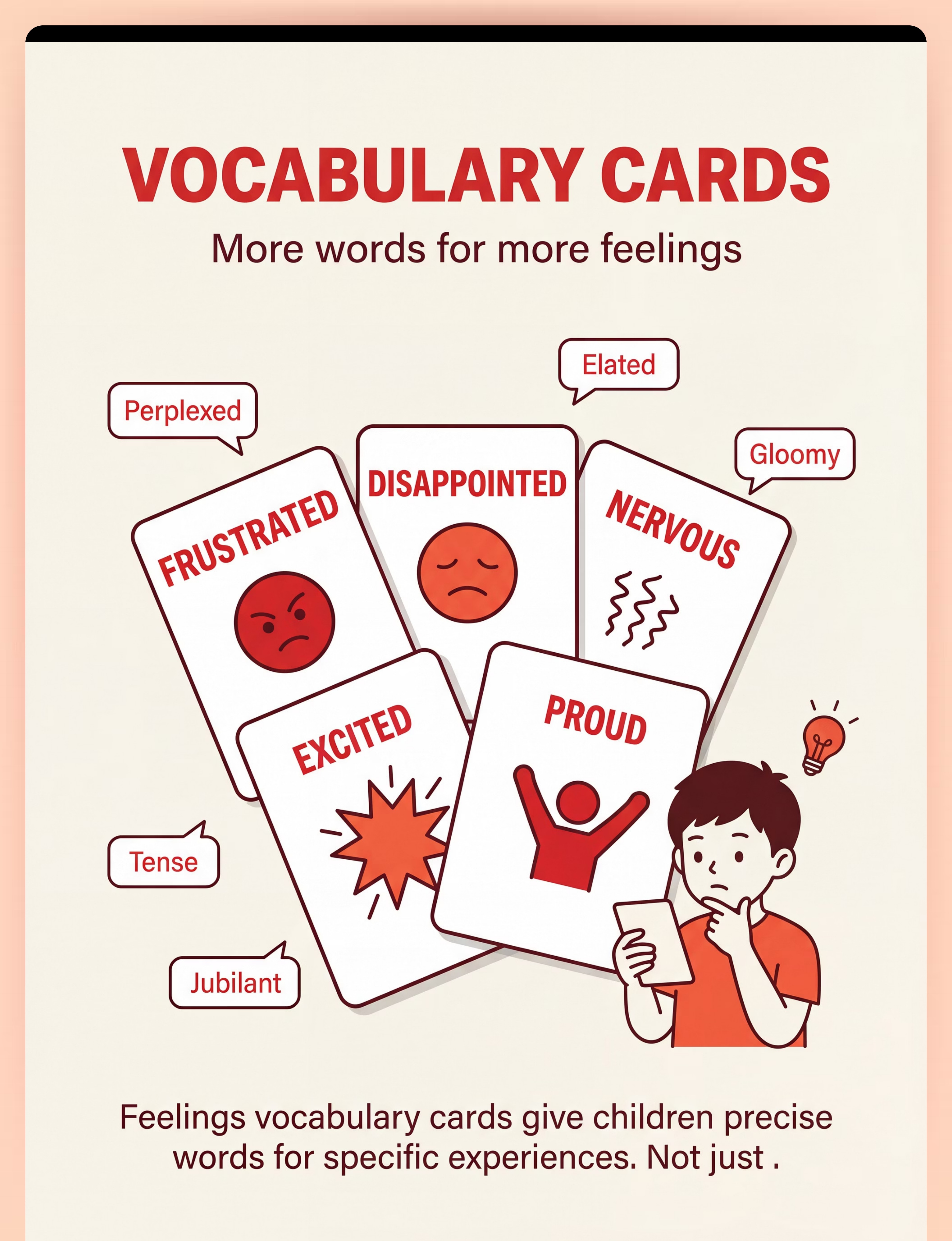
Feelings Vocabulary Expansion Cards
₹300–1,200 | DIY: ✅
"More words for more feelings — beyond happy/sad/mad"
₹300–1,200 | DIY: ✅
"More words for more feelings — beyond happy/sad/mad"
Material 3
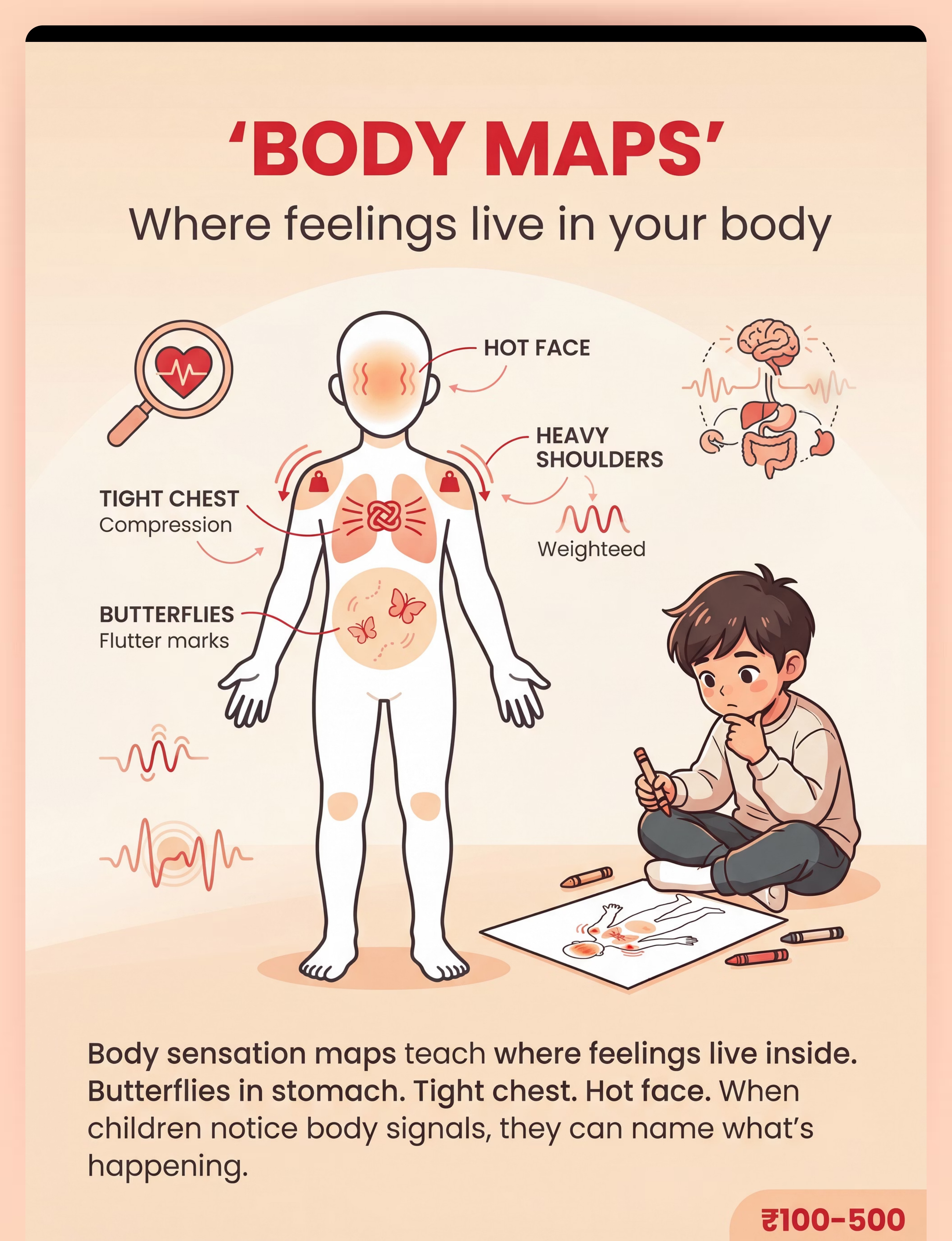
Body Sensation & Interoception Maps
₹100–500 | DIY: ✅
"Where feelings live in your body — butterflies, tight chest, hot face"
₹100–500 | DIY: ✅
"Where feelings live in your body — butterflies, tight chest, hot face"
Material 4
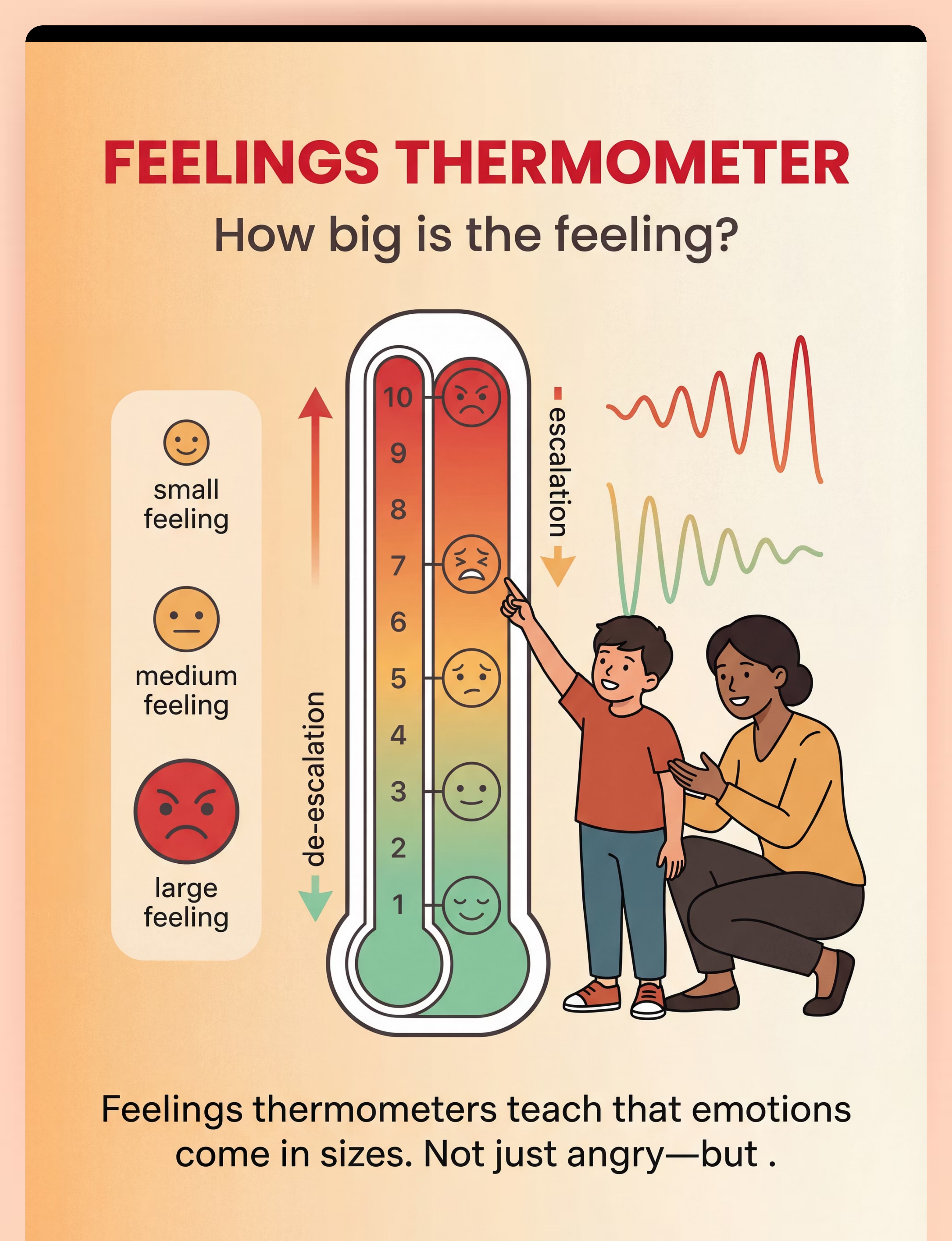
Feelings Thermometers & Intensity Scales
₹100–600 | DIY: ✅
"How big is the feeling? Sometimes 'I'm at a 7' is easier than finding words"
₹100–600 | DIY: ✅
"How big is the feeling? Sometimes 'I'm at a 7' is easier than finding words"
Material 5
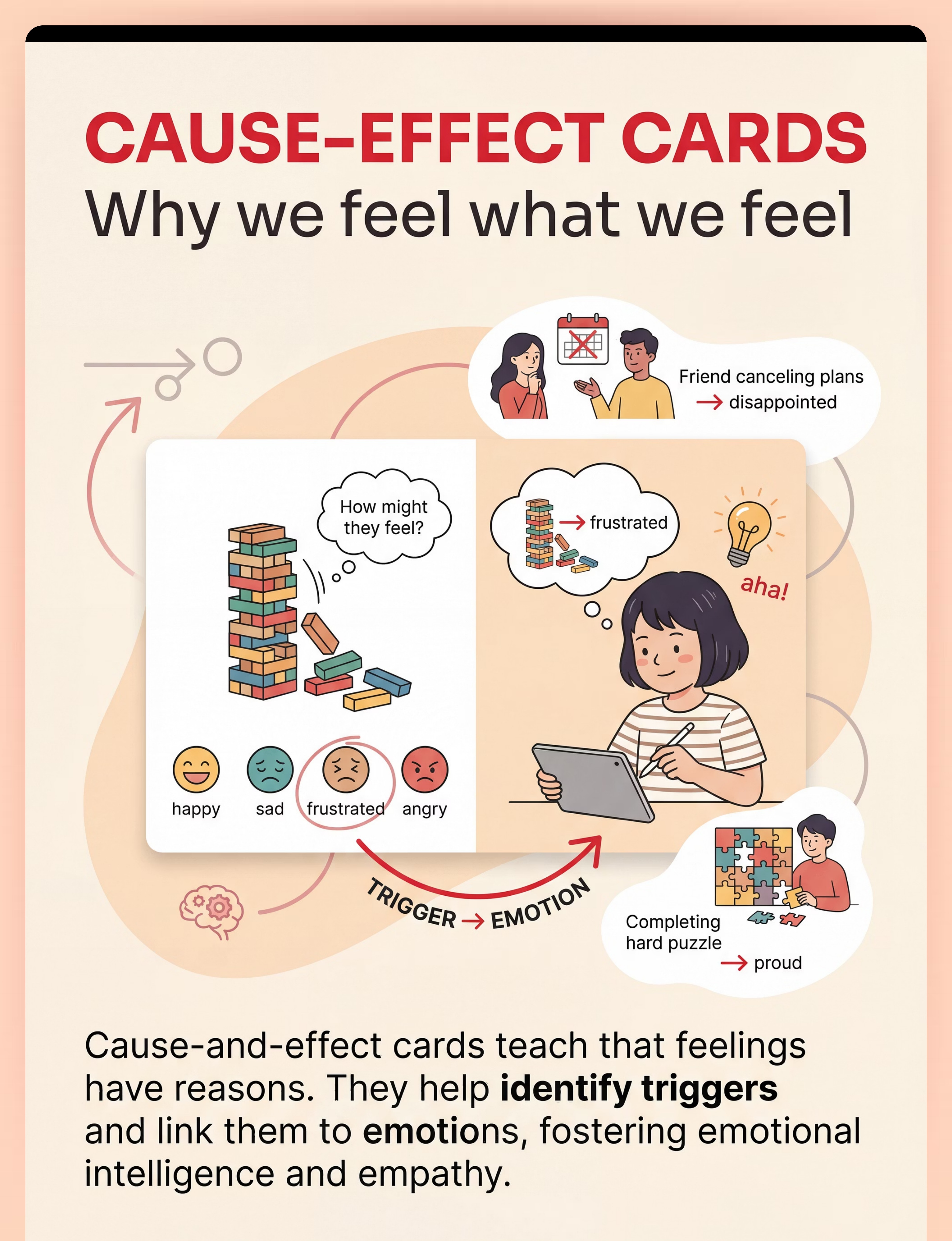
Emotion Cause-and-Effect Cards
₹300–1,000 | DIY: ✅
"Why we feel what we feel — feelings have reasons"
₹300–1,000 | DIY: ✅
"Why we feel what we feel — feelings have reasons"
Material 6
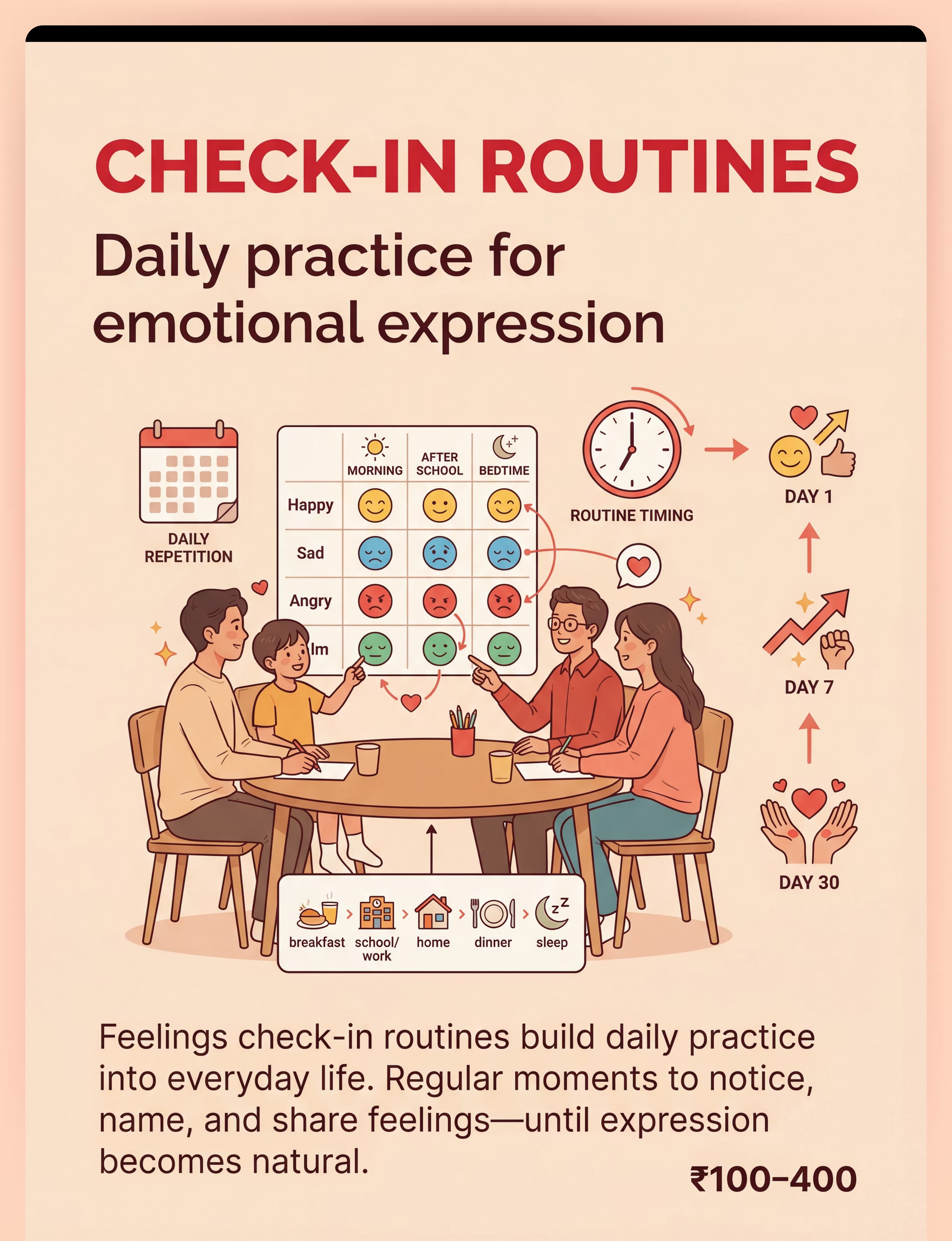
Feelings Check-In Routines & Visual Schedules
₹100–400 | DIY: ✅
"Daily practice for emotional expression — until it becomes natural"
₹100–400 | DIY: ✅
"Daily practice for emotional expression — until it becomes natural"
Material 7
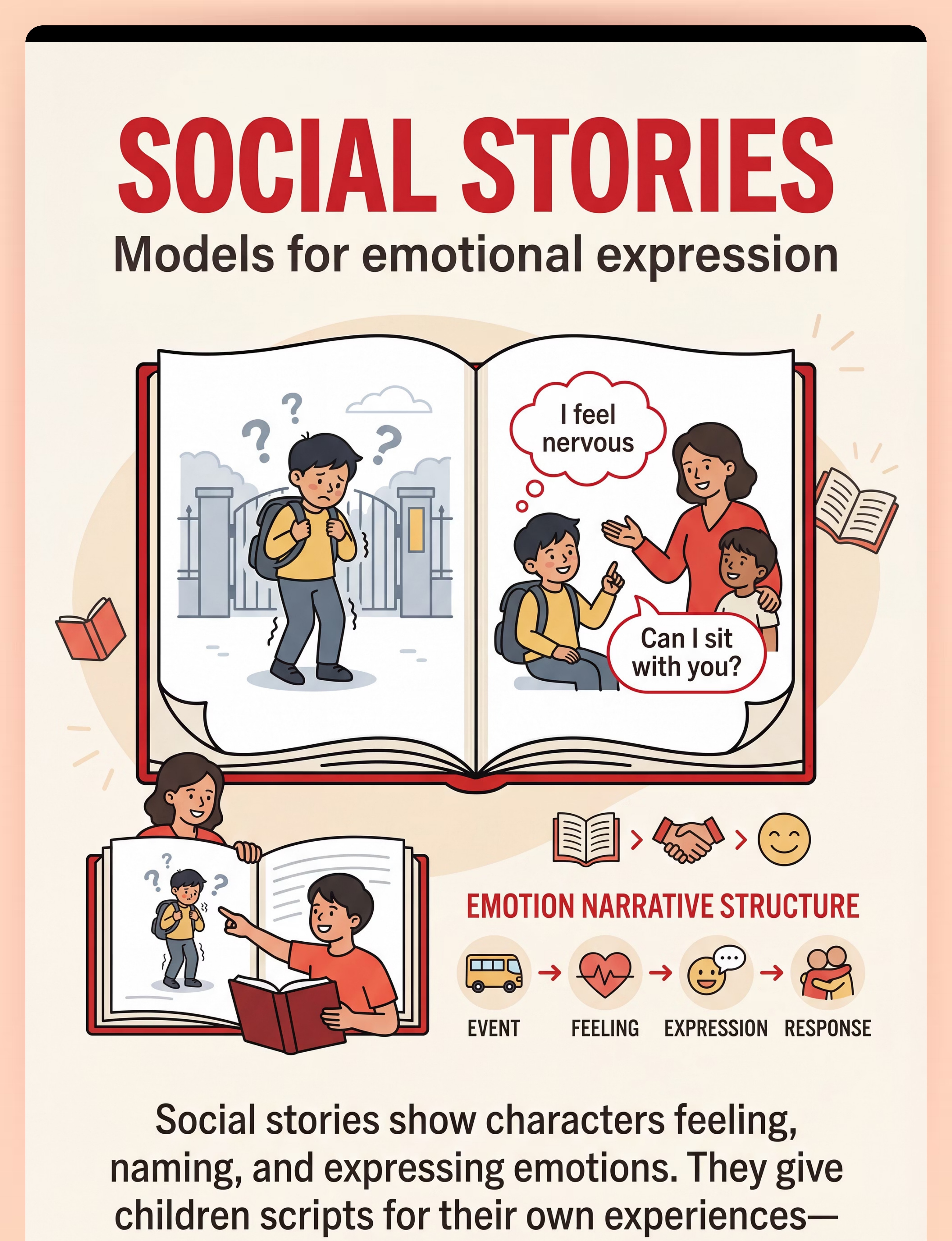
Social Stories & Emotion Narratives
₹200–800 | DIY: ✅
"Models for emotional expression — scripts for the child's own experiences"
₹200–800 | DIY: ✅
"Models for emotional expression — scripts for the child's own experiences"
Material 8
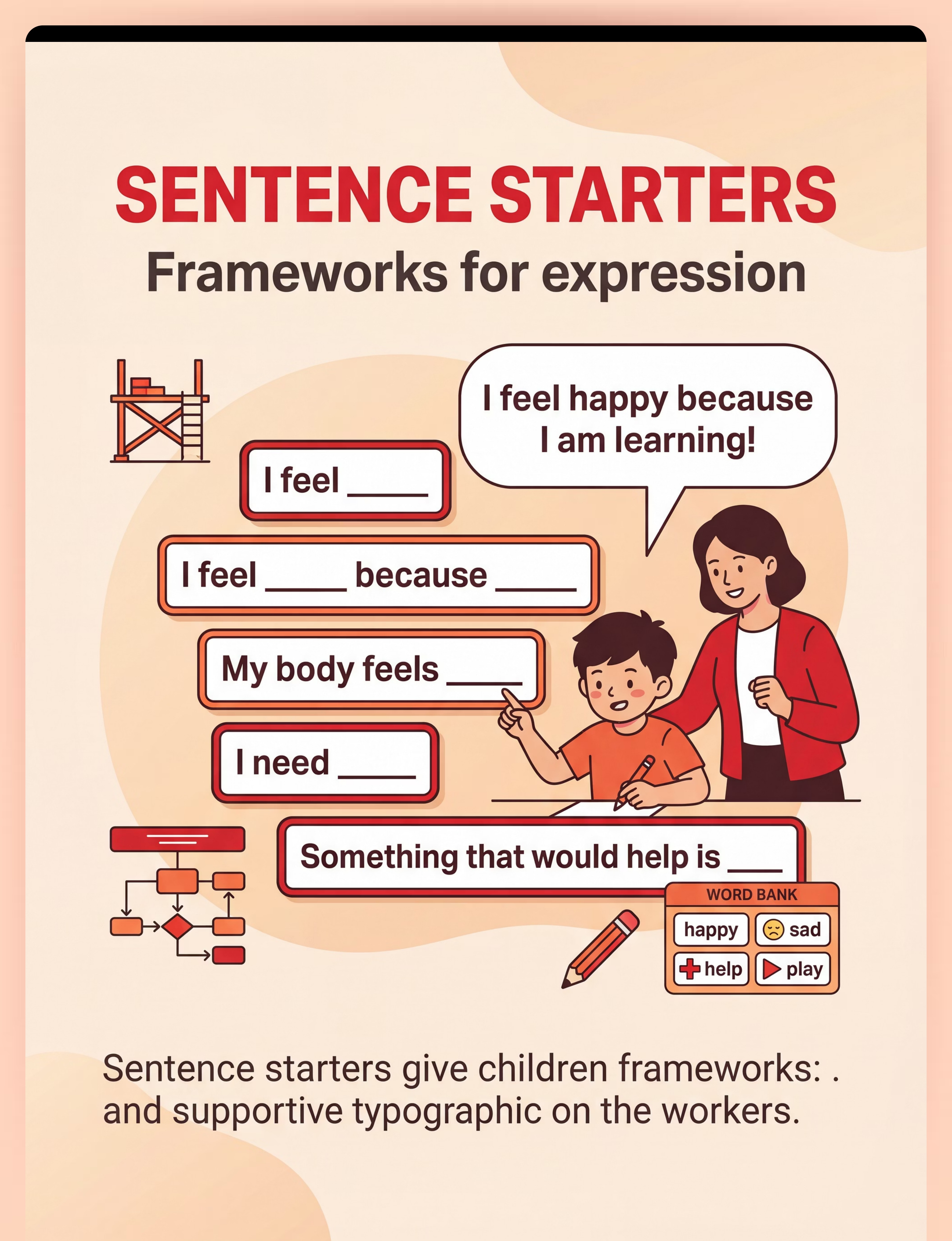
Emotion Expression Sentence Starters
₹100–300 | DIY: ✅
"Frameworks for expression — 'I feel ___ because ___'"
₹100–300 | DIY: ✅
"Frameworks for expression — 'I feel ___ because ___'"
Material 9
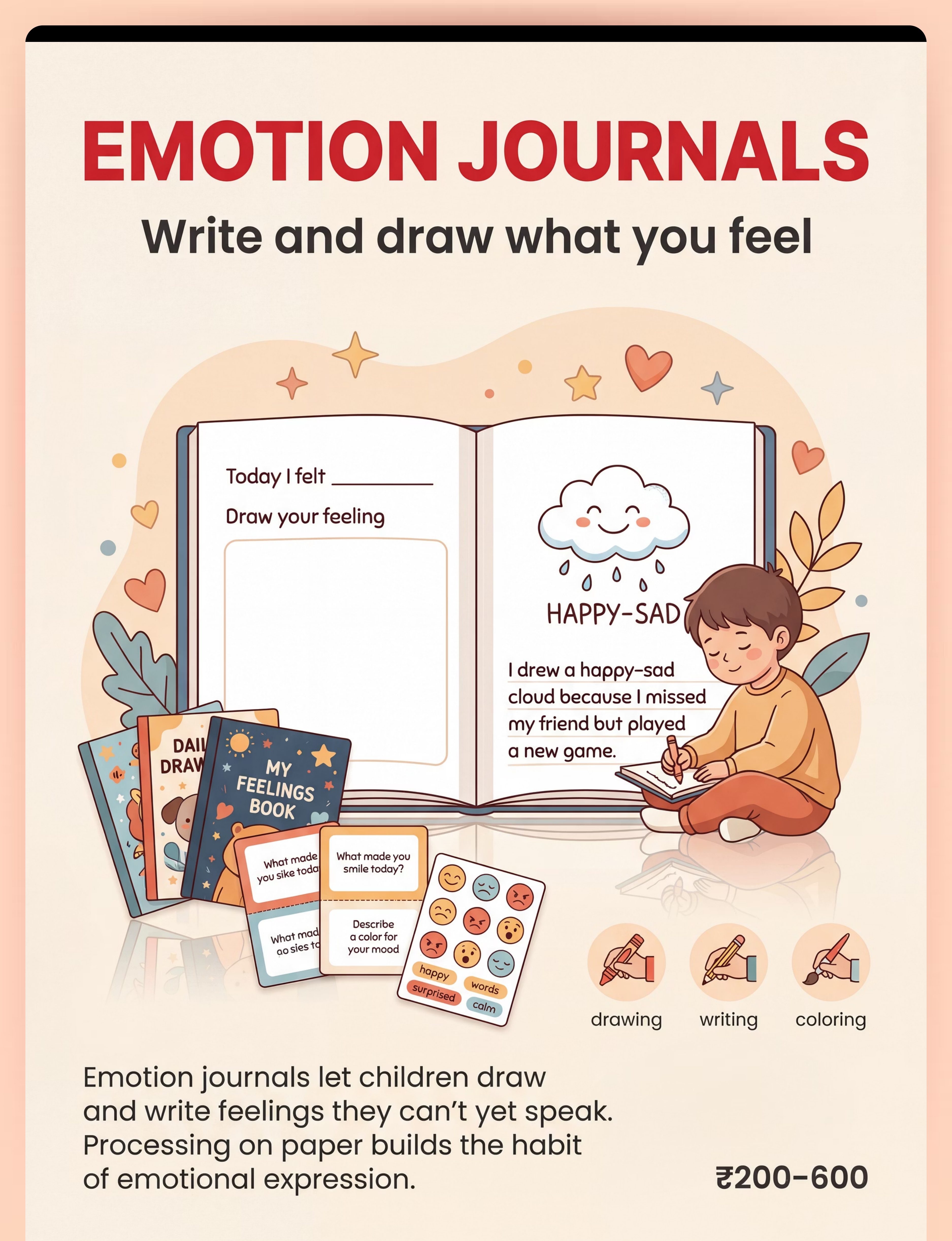
Emotion Journals & Processing Workbooks
₹200–600 | DIY: ✅
"Write and draw what you feel — processing on paper builds the habit"
₹200–600 | DIY: ✅
"Write and draw what you feel — processing on paper builds the habit"
Card 09 — Canon Products
Pinnacle Canon Cross-Reference — Active Products
These clinically selected products integrate seamlessly with the 9 materials. All INR-priced with Amazon.in delivery. Full database: 128 categories | 687 products.
🏷️ Reinforcement Menus
Rosette Reward Jar — ₹589 | amazon.in
For celebrating emotional expression attempts during sessions.
For celebrating emotional expression attempts during sessions.
🏷️ Reward Stickers
1800+ Teacher/Parent Sticker Set — ₹364 | amazon.in
For token economy during feelings practice.
For token economy during feelings practice.
🏷️ Comfort/Transition Objects
Soft Animal Toys — ₹425 | amazon.in
For regulation support during check-ins.
For regulation support during check-ins.
🏷️ Flashcards with Audio
Brainy Bug Resources — ₹305 | amazon.in
Adaptable for emotion vocabulary teaching.
Adaptable for emotion vocabulary teaching.
Card 10 — DIY & Substitute Options
Every Child Deserves These Materials — Starting Today
Whether you spend ₹0 or ₹1,500 — here is how to make each material work with what you have right now.
📌 The WHO/UNICEF Nurturing Care Framework emphasises context-specific, equity-focused interventions. Effective therapy should not depend on purchasing power.
Material | Commercial Option | DIY Version (Zero Cost) | |
Emotion Faces | Printed chart set ₹200–500 | Print from Google Images; photograph your child's own face expressions | |
Vocabulary Cards | Commercial flashcard set ₹300–1,200 | Write 15 emotion words on index cards with drawings | |
Body Maps | Printed interoception chart ₹100–300 | Draw a body outline on A4 paper; colour in during calm moments | |
Feelings Thermometer | Commercial poster ₹200–500 | Draw a 1–10 scale on cardboard; colour green→yellow→red | |
Cause-Effect Cards | Commercial scenario set ₹300–1,000 | Write 10 scenarios from your child's real life on paper | |
Check-In Chart | Commercial daily chart ₹200–400 | Draw a simple face grid on paper; laminate if possible | |
Social Stories | Commercial book ₹200–500 | Write a simple 6-sentence story in a notebook | |
Sentence Starters | Commercial card set ₹200–300 | Write 5 sentence frames on strips; stick on the fridge | |
Emotion Journal | Commercial workbook ₹300–600 | Any blank notebook + 3 daily prompts |
"DIY materials created WITH the child during calm, engaged moments have higher therapeutic value than purchased materials introduced during crisis. The process of making is part of the therapy." — Pinnacle Clinical Note
Card 11 — Safety First
Read This Before You Start Any Session
🔴 RED — Do NOT Proceed If:
- Child is currently in active emotional flooding / meltdown state
- Child shows signs of acute distress (self-harm, severe aggression, extreme dissociation)
- Child has significant trauma history — consult trauma-informed professional first
- You have not yet established a calm, trusting relationship context for this work
🟡 AMBER — Proceed with Modification If:
- Child is mildly dysregulated — use a calm-first strategy for 5 minutes
- Child has significant expressive language delays — focus only on visual pointing; no verbal demand
- Child resists the specific material — never force; try a different material from the 9
- You are exhausted or highly stressed — your emotional state transmits; postpone to tomorrow
🟢 GREEN — Proceed When:
- Child is calm, fed, rested (not within 1 hour of nap/sleep)
- You have 10–15 quiet, uninterrupted minutes
- The environment is low-stimulus (TV off, minimal noise)
- Both you and your child are in a connected, relaxed state
🚨THE ABSOLUTE RED LINE — Stop immediately if: Child becomes acutely distressed and cannot de-escalate within 5 minutes • Child uses emotional expression materials to re-escalate • Child expresses themes of hopelessness, self-harm, or harm to others through materials.
📞When to Call for Professional Support: 9100 181 181 — FREE National Autism Helpline | 24×7
📚 DOI: 10.1007/s12098-018-2747-4 — Home-based intervention safety protocols | NCAEP 2020 evidence-based practice guidelines
Card 12 — Set Up Your Space
The Right Environment Multiplies the Impact of Every Material
The physical and sensory environment is not a background detail — it is a therapeutic variable. Research confirms that structured, low-stimulus environments with intentional material placement produce measurably better session outcomes.
Environment Checklist
- Soft, warm lighting (overhead fluorescent is dysregulating for many children)
- Background noise minimal — no TV, minimal music
- Temperature comfortable (18–24°C ideal)
- Screens/devices removed — including your phone (face down)
- Siblings absent where possible for initial sessions
Materials Placement
- Set out only 1–2 materials at a time
- Place at child's eye level when seated
- Have water available — emotional work is physically regulating
Parent Positioning
- Sit BESIDE your child, not across — parallel positioning reduces performance pressure
- Get to eye level — floor sitting is fine
- Put your phone face-down
- A calm, open expression on your face is itself a therapeutic tool
Have Ready
- Chosen materials for today (start with Emotion Faces or Body Map)
- Gentle visual timer if useful
🤲OT Note: For children with sensory sensitivities, ensure the chair provides good postural support. Consider a wiggle cushion or weighted lap pad if sensory seeking is present. A child who is physically uncomfortable cannot access emotional learning.
📚 PMC10955541 — 1:1 structured environment confirms maximum session effectiveness | Sensory Integration Theory (Ayres): environmental setup is a core therapeutic principle
ACT III — THE EXECUTION
60-Second Pre-Session Readiness Check
The best session is one that starts right. A modified 5-minute session in the right state is worth more than a forced 20-minute session in the wrong state.
Readiness Indicators — Check YES/NO:
✅ Is your child calm — heart rate normal, breathing regular?
✅ Has your child eaten in the last 2 hours?
✅ Has your child had adequate sleep (not overtired)?
✅ Is your child showing interest in interacting with you?
✅ Has it been at least 2 hours since the last major meltdown or dysregulation episode?
✅ Is the child's sensory state regulated (not over- or under-stimulated)?
🟢 GO — 5 or more YES
Proceed to Step 1. Today is a good session day.
🟡 MODIFY — 3–4 YES
Shorten to 5 minutes. Use only the most familiar material. No new vocabulary today. Focus on connection, not learning.
🔴 POSTPONE — 2 or fewer YES
Do something connecting and pleasant together instead. Come back tomorrow. A missed session is far less damaging than one that creates negative associations.
📚 ABA Principle: Setting events and antecedent conditions determine intervention effectiveness. Proceed only when conditions is optimal. BACB Standards | Cooper, Heron & Heward, Applied Behavior Analysis
📞9100 181 181 — Get professional readiness guidance
STEP 1 of 6
Step 1 — The Warm-Up Invitation
Begin With Connection — Not Instruction
Before any material is introduced, spend 3 minutes in pure connection activity of the child's choice — without agenda. Let them lead. This signals: This time is safe. I'm here for you, not for a task.
Invitation Script (SLP-approved language):
For Ages 3–6
"I've got something really interesting for us to look at together. Want to see? [Show emotion faces chart or body map.] Let's find out what feelings look like."
For Ages 7–12
"I want to try something with you. You know how sometimes it's hard to find words for how we feel? I've got some things that might make that easier. Want to try?"
What TO Do
Use a warm, curious tone — not instructional. Show the material first without verbal explanation. Let the child's curiosity lead. Model first: "I'm going to look at these feelings cards... I think I feel this one today. What about you?"
What NOT To Do
Don't begin with "We're going to practise emotions today" — this creates performance pressure. Don't start with a demand — start with modelling. Don't rush to the material if the child needs more warm-up time.
📚 PMC11506176 — Warm-up and relationship context predict session engagement in paediatric intervention | ABA reinforcement scheduling literature
STEP 2 of 6
Step 2 — Engagement with the First Material
The Entry Material: Start Where the Child Can Win
1
Level 1 — No Emotion Words Yet
Start with Emotion Faces Cards — pointing only, no verbal demand. "Can you find the face that looks like how you feel right now?"
2
Level 2 — Basic Words with Prompting
Start with Feelings Thermometer. "Where are you on the thermometer right now?"
3
Level 3 — Has Basic Vocabulary, Needs Expansion
Start with Vocabulary Cards — introduce one new word per session.
4
Level 4 — Names Emotions, Needs Cause-Effect
Start with Cause-Effect Cards. "What made this character feel that way?"
The First 2 Minutes — The Engagement Window: This is where the child's nervous system decides: Is this safe? Is this interesting? Keep your energy curious and light. Match the child's pace. If they look away — don't redirect immediately; give 10 seconds. If they point to something — celebrate it warmly: "Yes! That's exactly right." The goal of Step 2 is engagement — not accuracy, not learning.
🤲OT Sensory Access Note: For children with tactile sensitivities, allow them to handle the materials before the activity begins — "Just hold this for a moment." This sensory exploration reduces the novelty stress of the material.
📚 PMC10955541 — Engagement quality predicts intervention outcome across sensory integration and social-emotional interventions
STEP 3 of 6
Step 3 — The Therapeutic Action
The Core Practice — Building the Bridge
This is the active ingredient of the session — the 5–8 minute therapeutic window. Use ONE of the following material protocols per session.
🔷 Material 1 — Emotion Faces Protocol
- Spread 6–8 emotion face cards on the table
- Ask: "Can you show me a face that looks like how you feel right now?" (Do not offer word choices yet)
- When child points — name it warmly: "You picked frustrated. What does frustrated feel like in your body?"
- Model your own: "When I look at this face, I think of when I feel worried."
Goal: Recognition → Naming chain activated
🔷 Material 3 — Body Map Protocol
- Place blank body outline between you and child
- Name an emotion: "Let's look at what nervousness feels like."
- Ask: "Where do you feel nervous in your body?" (Model first: "I feel nervous in my stomach — it feels tight and fluttery")
- Child marks or points. Accept all responses. Validate: "Butterflies! Yes — that's a real feeling."
Goal: Interoception → emotion label connection built
🔷 Material 8 — Sentence Starters Protocol
- Show the sentence starter card: "I feel ___ because ___."
- Complete it yourself first: "I feel happy today because we're spending time together."
- Offer the frame: "Your turn — 'I feel ___' ... Can you fill it in?"
- Accept ANY response — even "I feel okay" is a sentence. Celebrate it.
Goal: Expressive language scaffold activated
Common Execution Adjustments:
⚠️Child says "I don't know": Never push. Offer 3 options: "Do you think it might be happy, sad, or frustrated?"
⚠️Child picks randomly: Accept it. Validate. Build the habit. Accuracy comes later.
⚠️Child uses body language instead of words: Excellent! Name what you observe: "I can see your shoulders are tight. That might be frustration?" Then model the sentence for them.
📚 PMC10955541 — 40-minute sessions: maximum effectiveness; home sessions 10–20 min with core action 40–60% of session time
STEP 4 of 6
Step 4 — Repeat and Vary
3 Good Repetitions Are Worth More Than 10 Forced Ones
Dosage Guidance
3–6
Exchanges
Meaningful exchanges per session
3–5
Minutes
Total time at this step
3–5×
Per Week
Session frequency (daily check-ins regardless)
Satiation Signals — Stop When:
- Child looks away repeatedly and doesn't re-engage within 15 seconds
- Child begins playing with the material rather than using it
- Child explicitly says "I'm done" or "No more"
- Energy drops significantly — responses become rote
"Three genuine, engaged responses with emotional authenticity are the goal. Not ten correct answers under pressure. Neural pathways build from quality engagement, not quantity compliance."
Variation Menu — To Prevent Satiation:
🔄Emotion Faces: Move from static identification → emotion of the day → emotion of a storybook character → child's own emotion right now
🔄Body Maps: Try different emotions each session — "Last time we did nervous. Today let's map excited. Where do YOU feel excited?"
🔄Thermometer: Move from current state rating → historical rating → fictional character rating
🔄Sentence Starters: Progress: "I feel ___" → "I feel ___ because ___" → "When ___ happens, I feel ___" → "I feel ___ and I need ___"
📚 SI therapy dosage research: 2–3 sessions/week for 8–12 weeks | PMC11506176 | Pinnacle EverydayTherapyProgramme™ protocols
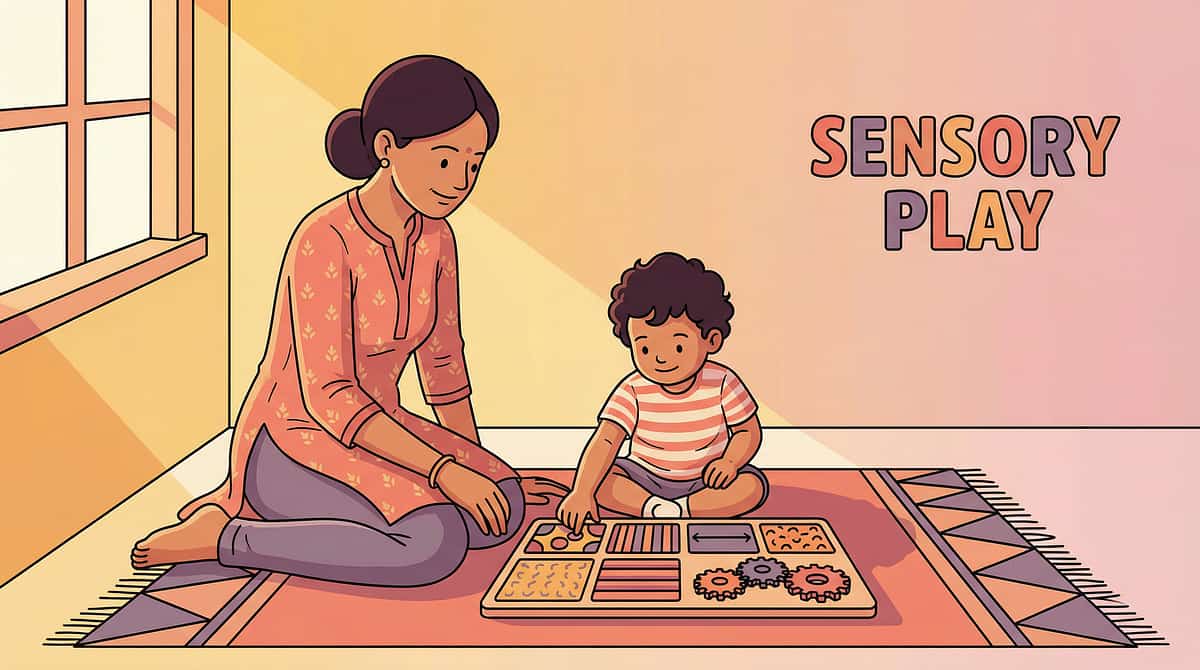
STEP 5 of 6
Step 5 — Reinforce and Celebrate
Celebrate the Attempt — Not Just the Accuracy
The ABA Reinforcement Principle: Timing matters more than magnitude. Immediate (within 3 seconds), specific, genuine praise strengthens the neural pathway between emotional awareness and verbal expression.
For First Attempts
"You just told me how you feel! That is AMAZING. Thank you for sharing that with me."
For Vocabulary Expansion
"You said FRUSTRATED instead of just 'bad' — that is a powerful word. Frustrated is exactly right."
For Cause-Effect Sentences
"You just said 'I feel sad because...' — do you know how hard that is? You did something really difficult just now."
For Body Awareness
"You noticed your tummy felt tight. Your body is SO SMART — it was telling you something."
Reinforcement Menu (Pinnacle Canon):
🎖️ Verbal praise (always the primary reinforcer)
🌟 Sticker on feelings chart (visual progress tracking) — 1800+ Sticker Set: ₹364
🏺 Token toward preferred activity — Rosette Reward Jar: ₹589
📊 Progress graph update — child sees their own growth
🤗 Physical affection (if preferred by child — always child-initiated)
Even "I don't know" said while pointing at a face is a valid attempt. Reinforce the engagement, not just the accuracy. The child who tries is building the same neural pathway as the child who succeeds.
📚 ABA Reinforcement Principles: Immediate, specific reinforcement increases behaviour occurrence | BACB Ethical Guidelines for Reinforcement

STEP 6 of 6
Step 6 — The Cool-Down
No Session Ends Abruptly — The Cool-Down Is Part of the Therapy
Predictability is regulating. Using a consistent transition script every session teaches the child's nervous system that endings are safe — and that something pleasant always follows emotional work.
"We've got time for 2 more, and then we'll be all done for today." [2 more exchanges] "We're all done! You worked so hard on your feelings today. I'm so proud of you."
Cool-Down Activity — Choose ONE (1–2 minutes):
Material Clean-Up
Together put the materials away — child participates in clean-up. Ownership of the process builds investment in the next session.
Breathing Together
3 deep breaths: "Let's breathe in for 4 counts and out for 4..."
Sensory Regulation
30 seconds of gentle hand pressure or lap weight if needed (OT).
Pleasant Transition
One favourite book page or song — the signal that the session is over and enjoyable time follows.
If the Child Resists Ending:
This is positive data — the child enjoyed the session. Don't force abrupt ending. "I can see you want to keep going! We'll do this again [tomorrow / on Wednesday]. That's something to look forward to." Then gently begin the transition.
State the next activity clearly: "After we put these away, we're going to have [snack / outdoor play / your choice]."
📚 NCAEP 2020: Visual supports and transition strategies classified as evidence-based practice for autism
📞9100 181 181 — Support for session challenges

Card 20 — Data Capture
60 Seconds of Data Now Saves Hours of Guessing Later
Record immediately after each session — while detail is fresh. Three data points is all it takes to build a personalised picture of your child's progress over time.
1
Session Quality (1–5)
How engaged was the child overall?
1 = Refused/disengaged | 3 = Moderate participation | 5 = Enthusiastic engagement
1 = Refused/disengaged | 3 = Moderate participation | 5 = Enthusiastic engagement
2
Today's Emotional Expression Moment
Write ONE sentence: What did the child say or do that showed emotional awareness today?
Example: "She pointed to the frustrated face and said 'that's me'"
Example: "She pointed to the frustrated face and said 'that's me'"
3
Material Used + Response
Which material? What worked? What didn't?
Example: "Body map — she enjoyed colouring, but resisted naming the emotion verbally. Pointed instead."
Example: "Body map — she enjoyed colouring, but resisted naming the emotion verbally. Pointed instead."
How to Record:
📱GPT-OS® App: Log directly into your child's Emotional Literacy Readiness Index dashboard
📄Downloadable PDF Tracker: Simple 3-field paper log for C-250 sessions
📊Google Form: [Log This Session] — embeds into GPT-OS® database for progress visualisation
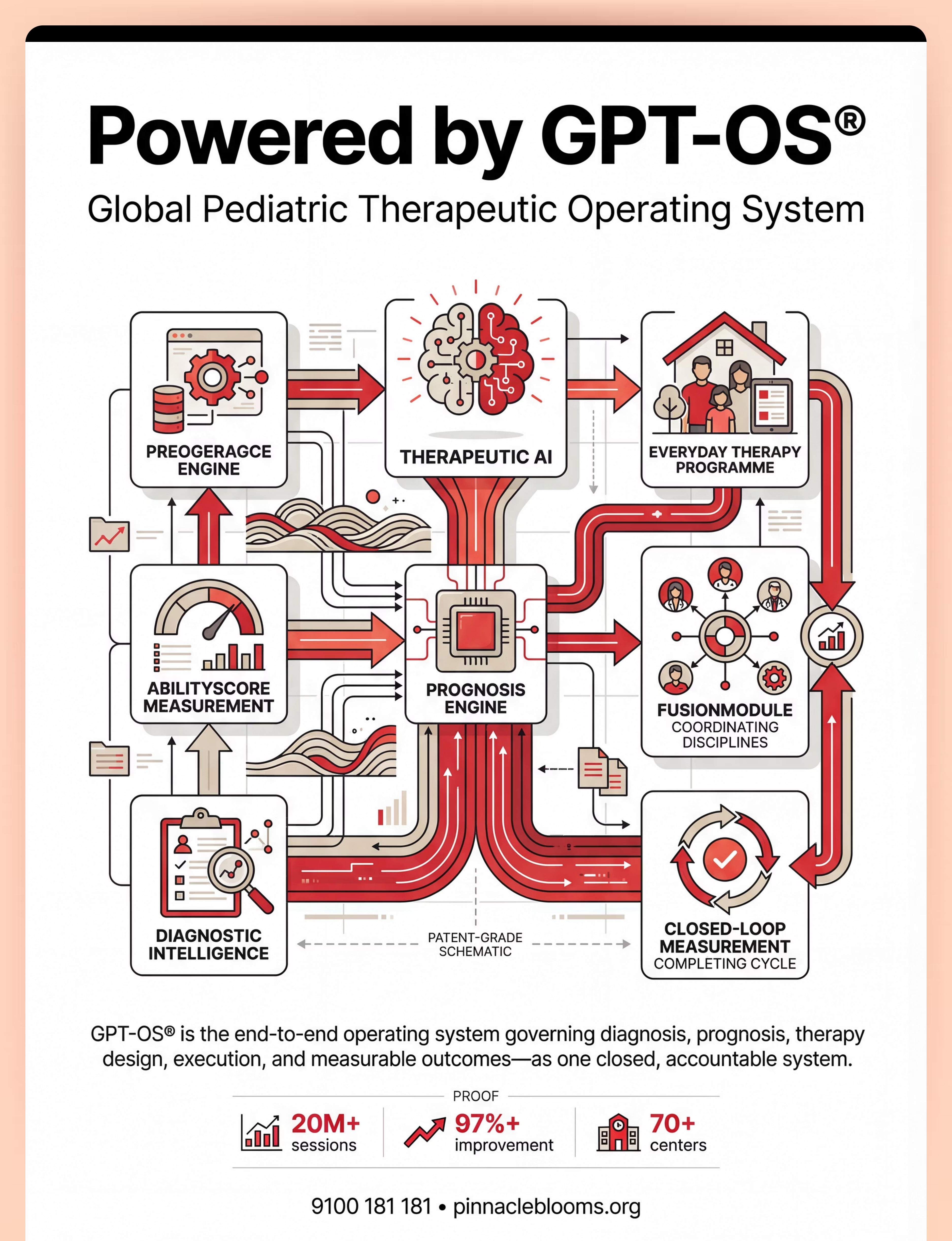
What GPT-OS® Does With Your Data: Each session record feeds the AbilityScore® recalculation. Over 4–8 weeks, the TherapeuticAI® engine identifies which materials produce the highest engagement, what time of day generates best responses, and when your child is ready to advance to C-251.
✅ All session data stored under ISO/IEC 27001 security standards. Your child's data is yours — never shared without explicit consent.
📚 ABA Data Collection Standards: BACB Guidelines + Cooper, Heron & Heward, Applied Behavior Analysis (8th ed.)
📚 ABA Data Collection Standards: BACB Guidelines + Cooper, Heron & Heward, Applied Behavior Analysis (8th ed.)

Card 21 — Troubleshooting
Session Struggles Are Data — Not Failure
Every session challenge is information about your child's nervous system, the antecedent conditions, and the material fit. Use this guide to adjust tomorrow's approach based on today's data.
❓ My child refused to engage at all.
Most common in first 3 sessions. The material is unfamiliar. Try a completely different entry point next session. Reduce the session to just 2 minutes of holding the materials together with no demands. Novelty stress diminishes with repeated exposure.
❓ My child kept saying "I don't know" to everything.
Reduce verbal demand immediately. Use only pointing. Offer 3 choices maximum. Model MORE — your own feelings, your own responses. "I don't know" is data: the vocabulary isn't accessible yet. Emotion faces + body maps are the priority.
❓ The session became a meltdown.
The material may have surfaced an emotion that was already present. Log: what was the preceding context? Practise the cool-down protocol to restore regulation. For next session, reduce demand significantly and increase warm-up time.
❓ My child used the materials to play, not for the purpose intended.
This is developmentally appropriate and therapeutically valid — exploratory play builds familiarity. Follow the child's lead for this session. Introduce the emotional content in next session once the material is familiar.
❓ My child said the "wrong" emotion — clearly not what they were feeling.
Accept and reflect: "You said happy! I notice your shoulders look a bit tight — sometimes our body and our words don't match yet. That's okay." Never correct aggressively. Build awareness gently.
❓ We only got through 2 minutes before they wanted to stop.
2 minutes is a valid session. Celebrate it. Log it. Add 1 minute next session. Consistency of brief sessions beats occasional forced long sessions.
❓ My child became distressed when asked about a specific emotion.
The emotion may be connected to something difficult. Don't push. Move to a neutral emotion. Note what emotion caused distress — this is clinical information. Consult your SLP or psychologist.
"Session abandonment is not failure — it is data about the antecedent conditions. Adjust tomorrow's antecedents based on today's data." — ABA Troubleshooting Principle
📞9100 181 181 — Get real-time troubleshooting support from a specialist
Card 22 — Adapt and Personalise
No Two Children Are Identical. Here Is How to Make This Technique Yours.
1
← EASIER
Bad days / early stages
Pointing only, zero verbal demand. Start with emotions already known (happy/sad). Use photos of the child's own face. Session: 3 minutes maximum.
Pointing only, zero verbal demand. Start with emotions already known (happy/sad). Use photos of the child's own face. Session: 3 minutes maximum.
2
STANDARD
Regular sessions
Mix of pointing and single-word responses. 4–6 emotion options. Body map + thermometer combination. Session: 5–10 minutes.
Mix of pointing and single-word responses. 4–6 emotion options. Body map + thermometer combination. Session: 5–10 minutes.
3
→ HARDER
Breakthrough days / later stages
Full "I feel ___ because ___" sentences. Nuanced vocabulary (disappointed, embarrassed, jealous). Spontaneous application throughout the day. Session: 10–15 minutes.
Full "I feel ___ because ___" sentences. Nuanced vocabulary (disappointed, embarrassed, jealous). Spontaneous application throughout the day. Session: 10–15 minutes.
Child Profile Modifications:
1
Autistic Children with Alexithymia
Extra emphasis on interoception FIRST. No vocabulary until body awareness is established. Patience with slower timeline. Accept that some emotional recognition may remain partially challenging — this is neurologically grounded.
2
Children with Expressive Language Delays
Reduce all verbal demand. Use AAC (communication boards) alongside emotion materials. Accept pointing, gesture, eye gaze as valid expression. Work with SLP in parallel.
3
Anxious Children
Begin with fictional characters' emotions — never personal emotion demands initially. Build safety before personal application.
4
Sensory Seekers
Allow movement during check-ins. Bounce on therapy ball while using thermometer. Fidget during card discussion.
📚 Individualised intervention planning: OT (sensory profile-based), ABA (function-based), SLP (communication profile-based) clinical practice guidelines
ACT IV — THE PROGRESS ARC
Weeks 1–2: Familiarity, Not Mastery
What You WILL Likely See
- Child engages with materials for at least 2–3 minutes without resistance
- Child can point to 2–3 emotion faces when asked
- Child tolerates the session (even if not enthusiastic yet)
- One or two spontaneous interactions with a material outside the session
What You Will NOT See Yet (and that's fine)
- Spontaneous emotional expression in daily life
- Complete "I feel ___ because ___" sentences
- Correct identification of nuanced emotions
- Significant meltdown reduction
"If your child tolerates engagement with the emotion faces for 3 seconds longer this week than last week — that is real progress. Neural pathways are forming. You cannot see them. They are there."
This phase feels slow. It is not slow — it is foundational. Resist the urge to push harder or introduce more materials. Repetition of the familiar is building the automatic accessibility of these concepts.
📚 PMC11506176 — SI intervention outcomes emerge across 8–12 week timelines; early-phase indicators focus on tolerance and participation, not skill mastery
Card 24 — Weeks 3–4
Weeks 3–4: The Neural Pathways Are Forming
40%
Consolidation Phase
Progress milestone at weeks 3–4
Consolidation Indicators:
✅ Child recognises 5–8 emotion faces reliably
✅ Child initiates the feelings check-in sometimes (without being asked)
✅ Child uses a sentence starter spontaneously at least once outside a formal session
✅ Child notices body sensations (even if they can't yet name the emotion)
✅ Meltdowns may begin decreasing in duration (not necessarily frequency)
The Generalisation Seeds — Look For:
Using a thermometer number in daily conversation: "I'm at a 6 right now"
Pointing to the feelings chart in the kitchen spontaneously
Describing a character in a TV show using a new emotion word
Coming to you with an emotion-adjacent physical description: "My tummy is doing the butterfly thing"
You may notice you are more confident too. You know which material to use, which time of day works, how to read your child's readiness. This is therapeutic co-regulation — you are becoming part of your child's emotional regulation system.
📚 Neuroplasticity evidence: Synaptic strengthening through repeated structured input follows predictable timelines in paediatric populations
Card 25 — Weeks 5–8
Weeks 5–8: The Bridge Extends Into Daily Life
65%
Application Phase
Progress milestone at weeks 5–8
Application Indicators:
✅ Child uses emotion words spontaneously in daily conversation
✅ "I feel ___ because ___" appearing in real interactions
✅ Child uses feelings thermometer to self-report during mild distress
✅ Meltdown frequency measurably reduced compared to Week 1 baseline
✅ Child begins correcting their own emotion labels: "Actually not sad — disappointed"
The Generalisation Shift — Create Opportunities:
Dinner Check-Ins
Emotion check-ins at dinner: "Worst feeling of the day / Best feeling of the day"
Narrate YOUR Emotions
All day, every day: "I feel really grateful right now because..."
Media Moments
Respond to media together: "What do you think this character is feeling? What would YOU feel?"
Consider advancing to more nuanced vocabulary: disappointed, embarrassed, jealous, proud, relieved, overwhelmed. The child's brain is ready for precision.
📚 PMC11506176 — Generalisation phase markers in emotional literacy intervention: 5–8 week window shows transfer to naturalistic contexts
Card 26 — Mastery Celebration
Celebrate Every Milestone — Your Child Is Doing Something Hard
Each milestone represents real neurological work — new connections forged through effort and consistent practice. These moments deserve to be witnessed and named.
🥇 First Spontaneous "I Feel ___" Statement
Without prompting, in real life
🥇 First "Because" Sentence
"I feel frustrated because..."
🥇 First Body Awareness Self-Report
"My chest is tight, I think I'm worried"
🥇 First Thermometer Self-Check During Distress
Before it became a meltdown
🥇 First Request for Help Using Emotion Language
"I need a hug. I feel sad."
🥇 First Discussion of a Past Feeling
Retrospective emotional processing
How to Celebrate:
✨Specific verbal acknowledgment:"You just did something your brain worked REALLY hard to do."
✨Document it — write it in a feelings journal together: "The day [Name] said 'I feel disappointed'"
✨Tell them why it matters:"When you tell me how you feel, I can help you. That's the most important thing."
✨Small meaningful celebration of their choice — a calm, warm moment, not an overwhelming party
📚 Psychological research on achievement recognition: Effort-focused praise (not outcome-focused) builds intrinsic motivation and resilience
Card 27 — Red Flags
Knowing When to Call for Backup Is Strength — Not Failure
Monitoring for escalation signals is not alarmism — it is responsible caregiving. Use this guide to calibrate when to continue, consult, or escalate urgently.
🔴 Seek Professional Support Immediately If:
- Child expresses through materials or words that they want to hurt themselves or others
- Emotional intensity is escalating across weeks, not stabilising
- Child develops new fears or phobias related to emotions or expression
- Child shows signs of depression: prolonged withdrawal, sleep changes, appetite loss, loss of interest in activities
- Child expresses feelings of hopelessness or worthlessness
- Meltdowns are increasing in severity or include self-injury
🟡 Consult Your Specialist Within 2 Weeks If:
- After 8 weeks of consistent practice, no change in any expression indicator
- Child's emotional expression appears completely disconnected from actual emotional state
- You suspect significant alexithymia or autism-related interoceptive differences
- Family stress is severely impacting your ability to maintain practice
🟢 On Track — Continue If:
- Progress is slow but present (even 3-second improvements count)
- Child tolerates sessions even without dramatic enthusiasm
- At least one new emotion word has been used in context in 8 weeks
📞FREE Specialist Access: 9100 181 181 — National Autism Helpline | 16+ Languages | 24×7
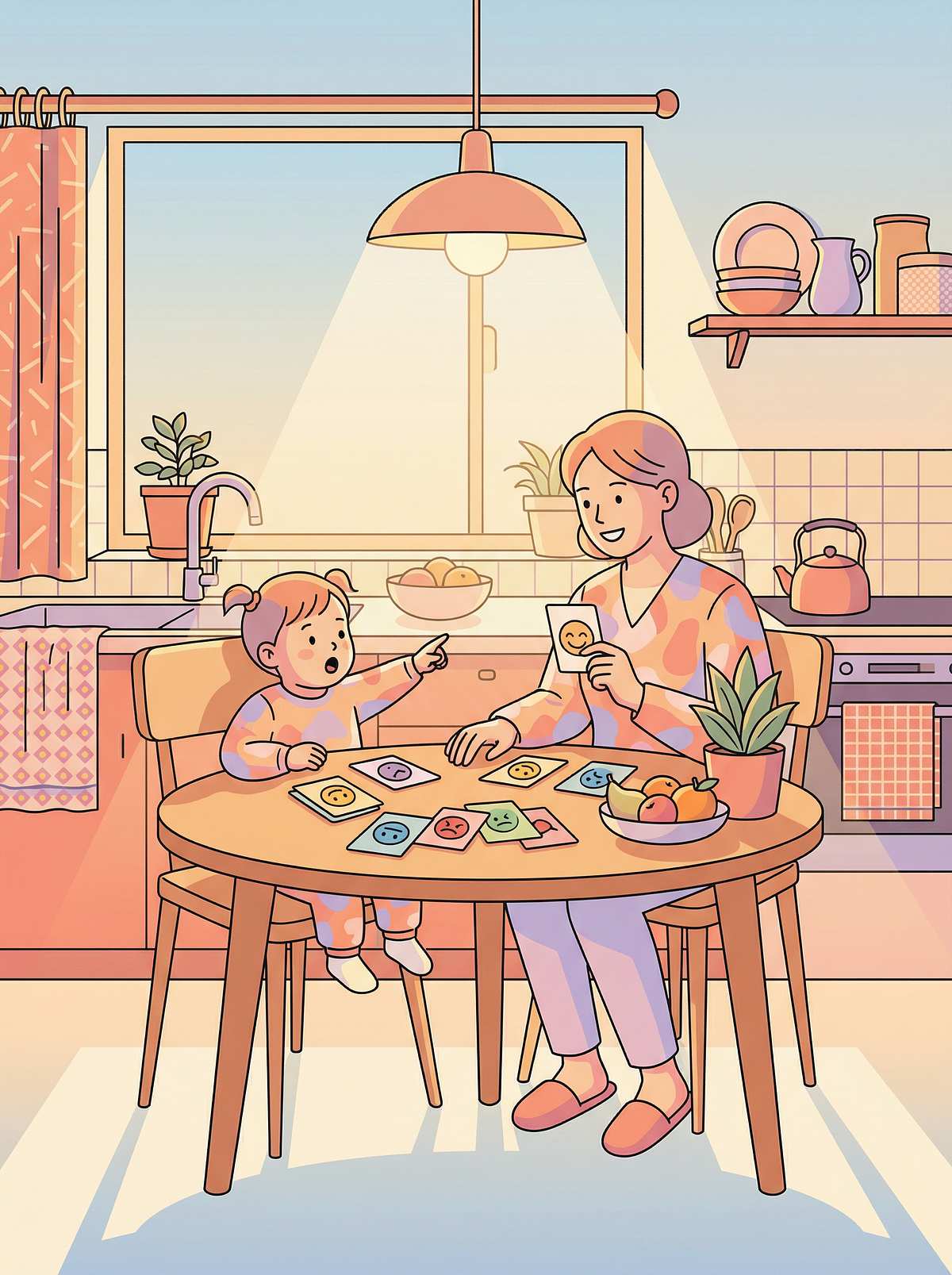
Card 28 — Your Pathway Map
You Are Here → Here Is Where You're Heading
Each technique in the Emotional Development cluster builds sequentially on the last — each stage deepens the child's capacity for emotional communication, regulation, and social connection.
Prerequisites — Strengthen First if Needed
← C-248: Identifying Emotions in Self — If your child cannot yet identify their own emotions at all, begin there.
← C-249: Understanding Others' Emotions — If perspective-taking is a gap, build this alongside C-250.
Lateral Techniques — Same Materials, Different Application
↔ B-207: Requesting Help Using Emotional Language
↔ B-195: Social Communication — Sharing Feelings with Peers
GPT-OS® Readiness Gate
Your child is ready for C-251 when: Spontaneous "I feel ___ because ___" appears at least 3 times per week in real life contexts across 2 weeks. GPT-OS® TherapeuticAI® will flag this readiness automatically.
Card 29 — Related Techniques
Other Techniques in the Emotional Development Domain
C-250 sits within a rich cluster of 300+ techniques in the Emotional Development domain. These six are the most closely related — and the most commonly used alongside C-250 in clinical practice.

C-248 — Identifying Emotions in Self

C-249 — Understanding Others' Emotions
C-251 — Managing Big Emotions
C-252 — Emotional Flexibility & Recovery
C-260 — Anxiety Expression & Communication
B-195 — Sharing Feelings with Peers
Card 30 — Your Child's Full Developmental Map
C-250 Is One Piece of a 12-Domain Developmental Journey
Current Technique Position
You are working in Domain C — Emotional Regulation
Subdomain: Emotional Literacy / Expressive Language
Subdomain: Emotional Literacy / Expressive Language
This technique feeds directly into Domains B (Social Communication) and K (Executive Function).
GPT-OS® Full Profile
Every session you log contributes to your child's AbilityScore® — the universal developmental score that maps progress across all 12 domains, enables cross-centre consistency, and drives TherapeuticAI® personalisation.
📚 WHO/UNICEF Nurturing Care Framework: Five components of nurturing care require holistic developmental monitoring across all domains
📞9100 181 181 | pinnacleblooms.org
ACT V — THE COMMUNITY & ECOSYSTEM
From "I Don't Know" to "I Feel Proud Because I Did It"
These are illustrative stories from families in the Pinnacle Network — real patterns of progress that emerge when consistent practice meets the right materials. Individual results may vary. Statistics represent aggregate outcomes across the Pinnacle Blooms Network.
"My son was 8 years old and his emotional vocabulary was 'good,' 'bad,' and 'I don't know.' After 6 weeks of using the emotion faces chart and sentence starters every morning at breakfast, he said — unprompted — 'I feel nervous about the school test, Amma.' I cried. Six words changed everything about how I understood him."
— Parent, Pinnacle Network, Bengaluru(Illustrative case; outcomes vary)
"The body map was the turning point for my daughter. She couldn't say what she was feeling, but she could colour her tummy orange when she was worried. That orange became our communication code — 'Are you orange today?' 'Yes, Mama.' From there, the words came."
— Parent, Pinnacle Network, Hyderabad(Illustrative case; outcomes vary)
"She used to only say 'I feel bad.' Now she comes home and says 'I felt frustrated during maths because I couldn't understand the problem, but then I felt proud when I figured it out.' The vocabulary is there, but more importantly, she wants to share. She's not drowning anymore — she has words for the waves."
— Parent, Pinnacle Network(Illustrative case; outcomes vary)
Card 32 — Join the Community
70,000+ Families Building Emotional Vocabulary Together
The Pinnacle community multiplies impact. When one parent learns a technique, their child benefits. When they share it — ten children benefit.
Pinnacle Parent Community
Share progress, ask questions, find accountability partners using the same techniques.
Join the Community →
Join the Community →
WhatsApp Support Groups
Technique-specific groups — join the C-Series Emotional Regulation group for daily support.
Request to Join →
Request to Join →
EverydayTherapyProgramme™ Channel
Weekly demonstrations of C-series techniques. Free to watch, free to practise.
Subscribe →
Subscribe →
Pinnacle Parent Letter
Weekly evidence summary + technique tips in your language. Available in 16+ languages.
Subscribe →
Subscribe →
📞9100 181 181 — 24×7 | 16+ Languages | FREE
Card 33 — Find Your Pinnacle Centre
70+ Centres. Expert Therapists. One Unified System.
Every Pinnacle centre uses the same AbilityScore® baseline, the same FusionModule™ therapy framework, and the same EverydayTherapyProgramme™ — so your child receives consistent, coordinated care regardless of where they are seen.
AbilityScore® Assessment
Comprehensive baseline across all 12 developmental domains
FusionModule™ Therapy
SLP + OT + ABA + SpEd coordinated under one unified plan
EverydayTherapyProgramme™
Home practice protocol synced to your centre plan — so sessions never stop
Parent Coaching
Weekly sessions to support exactly what you're doing at home — aligned to your child's plan
For Families Outside India
GPT-OS® operates digitally across 70+ countries. Teleconsultation available from anywhere in the world.
FREE National Autism Helpline
📞9100 181 181
Available 24×7 | 16+ Languages | Completely FREE
Available 24×7 | 16+ Languages | Completely FREE
Card 34 — The Research Library
Deeper Reading for the Curious Parent
Every element of C-250 is grounded in peer-reviewed evidence. This is not a collection of tips — it is a clinically validated protocol. Here is the evidence that supports it.
📄 Affect Labelling (Lieberman et al.)
Putting feelings into words reduces amygdala reactivity — naming emotions literally reduces their intensity at the neural level. PMC5862594
📄 Sensory Integration + ASD — Systematic Review (2024)
PRISMA review: evidence-based practice status confirmed across multiple domains. PMC11506176
📄 Sensory Integration Therapy Meta-Analysis (2024)
Social skills, adaptive behaviour, motor skills across 24 studies. PMC10955541
📄 Home-Based Intervention RCT — India (2019)
Padmanabha et al., Indian J Pediatr. DOI: 10.1007/s12098-018-2747-4
📄 Interoception in ASD (2020)
Frontiers in Integrative Neuroscience. DOI: 10.3389/fnint.2020.556660
📄 WHO Care for Child Development Package (2023)
📄 CASEL SEL Framework
213-study meta-analysis on emotional vocabulary instruction. casel.org
📄 NCAEP 2020 — Evidence-Based Practices for Autism
Card 35 — GPT-OS® Technology
Your Data Helps Your Child AND Every Child Like Yours
Every family that logs sessions contributes to the largest paediatric emotional literacy dataset in India. Your child's progress pattern helps TherapeuticAI® personalise interventions for the next family navigating the same challenges.
What GPT-OS® Learns from C-250 Sessions
- Which of the 9 materials produces highest engagement for this child's profile
- Optimal session time of day for emotional receptivity
- Pace of vocabulary acquisition relative to AbilityScore® baseline
- Readiness indicators for C-251 advancement
- Cross-domain effects: emotional literacy gains feeding social communication (Domain B)
Privacy Protections
✅ ISO/IEC 27001 Information Security Standard
✅ Data stored in India (DPDP Act compliance)
✅ No third-party sharing without explicit consent
✅ Your data is yours — export or delete at any time
📚 Digital health interventions for ASD: 21 RCTs, 1,050 participants — 2024 meta-analysis supports technology-assisted tracking
Card 36 — Watch the Reel
Episode 250 — Emotional Development & Self-Regulation Series
9 Materials That Help Expressing Feelings Verbally | C-250 | Duration: 75–85 seconds
"When feelings are big but words are small — these 9 materials build the bridge. Emotion faces for recognition, vocabulary cards for precision, body maps for awareness, thermometers for intensity, cause-effect cards for understanding, check-in routines for practice, social stories for modelling, sentence starters for scaffolding, and emotion journals for processing. Every feeling deserves words."
Reel Transcript Summary: Therapist-led demonstration showing all 9 materials in home setting — emotion faces, body map, thermometer, vocabulary cards, cause-effect cards, check-in routine, social story, sentence starters, emotion journal — with parent-child interactions showing real engagement. Warm, documentary style. Voiceover narration.
📚 NCAEP 2020: Video modelling is classified as evidence-based practice for autism. Multi-modal learning (visual + text + demonstration) improves parent skill acquisition.
Card 37 — Share With Your Family
Consistency Across Caregivers Multiplies Impact
The more consistently emotional vocabulary is modelled and encouraged across all of a child's environments — home, school, extended family — the faster generalisation occurs. Share this guide with everyone who cares for your child.
💬 Share on WhatsApp
Pre-written message ready to send to family members, teachers, and caregivers
📧 Share via Email
Full technique overview with all 9 materials and step-by-step protocol
🔗 Copy Link
techniques.pinnacleblooms.org/emotional-regulation/expressing-feelings-verbally-c250
📥 Download Family Guide PDF
Simplified 1-page version for grandparents, school teachers, and after-school caregivers
"I found this technique that's helping [child's name] learn to express feelings. It's backed by real research and completely free to use at home. 9 simple materials, step-by-step guide. Check it out: techniques.pinnacleblooms.org/emotional-regulation/expressing-feelings-verbally-c250 — FREE helpline: 9100 181 181"
Teacher / School Template
"[Child's name] is currently working on expressing feelings verbally. The materials we use at home include emotion faces charts and sentence starters ('I feel ___ because ___'). Consistent use of these materials in the classroom will significantly support generalisation. Happy to share the technique guide."
📚 PMC9978394 — WHO CCD Package: Multi-caregiver training is critical for intervention generalisation and maintenance
📞9100 181 181 — Family coordination support available
Preview of 9 materials that help expressing feelings verbally Therapy Material
Below is a visual preview of 9 materials that help expressing feelings verbally therapy material. The pages shown help educators, therapists, and caregivers understand the structure and content of the resource before use. Materials should be used under appropriate professional guidance.


Link copied!
ACT VI — THE CLOSE & LOOP
Frequently Asked Questions
Your questions, answered by the Pinnacle Consortium's clinical team. These are the most common questions from parents in our network — asked after beginning C-250 and after sharing it with others.
1
Q: How long before I see results?
Observable change in session engagement typically appears within 1–2 weeks. Spontaneous use of new vocabulary in daily life: 4–8 weeks with consistent practice. Significant reduction in meltdown frequency: 8–12 weeks. Every child's timeline differs — GPT-OS® tracks your child's specific pace.
2
Q: My child is non-speaking. Can these materials still help?
Yes. These materials are designed to build emotional expression capacity — verbal production is the end goal, but the intermediate steps (pointing, recognition, body awareness) are valuable for all children including those using AAC. Work with your SLP to integrate emotion vocabulary into your child's AAC system.
3
Q: My child gets upset when I bring out the emotion faces. What do I do?
This often means the material is surfacing emotions that feel threatening. Start with fictional characters' emotions only — "How does this person in the picture feel?" Never personal demands initially. Build safety first. Usually after 3–5 sessions the material becomes familiar and less threatening.
4
Q: Is this different from what happens in therapy sessions?
Your child's clinic sessions (SLP/OT/psychology) provide the professional assessment and clinical protocol. These home sessions extend the intervention — same materials, consistent practice between appointments. The EverydayTherapyProgramme™ ensures home practice is aligned with your child's clinical plan.
5
Q: At what age should I start these materials?
Basic emotion faces can begin with toddlers (18–24 months). The full protocol works for ages 3–12. Earlier is better — the brain is most plastic in the early years. Adults and adolescents also benefit, though with adapted approaches.
6
Q: What if my child refuses to engage at all?
Never force. Introduce materials during child-led play initially — "I'm going to look at these cards while you play." Casual exposure without demand builds familiarity. Try a completely different material if one is refused. Some children need 2–3 weeks of mere material presence before engaging.
7
Q: Can we use these materials during a meltdown?
No — and this is critical. During emotional flooding, the prefrontal cortex (where language lives) is offline. No emotional expression is possible during a meltdown. Wait for complete calm before attempting any materials. Practise the materials BETWEEN episodes, not during them.
8
Q: Do I need to do all 9 materials?
No. Start with 1–2 that match your child's current level. Many families find emotion faces + sentence starters form the most powerful starting pair. Add materials as mastery grows.