
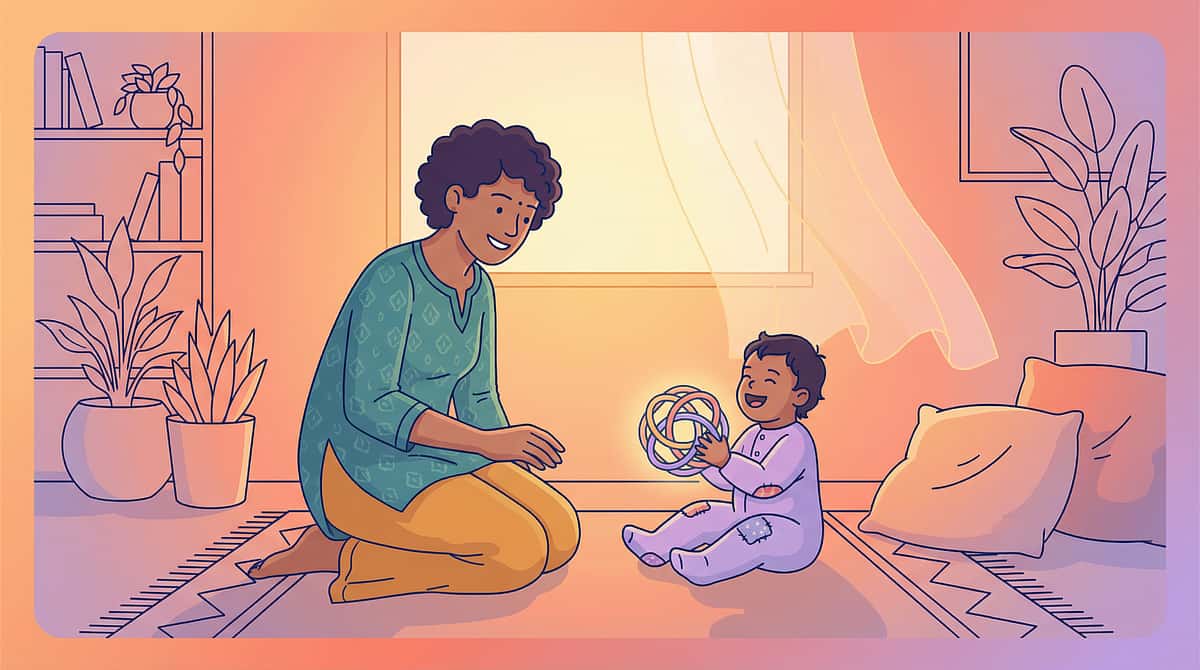
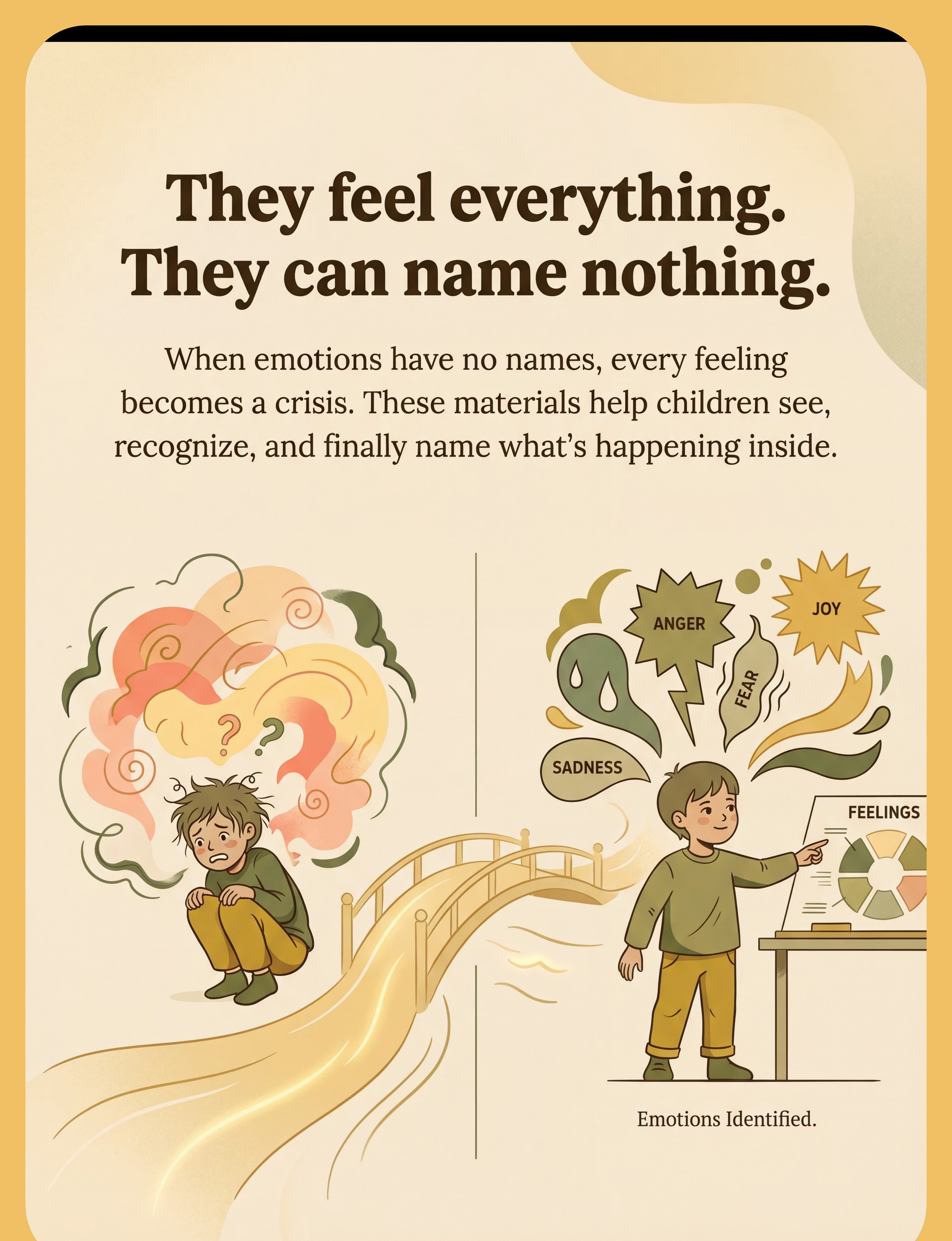
They feel everything. They can name nothing.
One moment she's fine — playing, laughing, seemingly happy. The next moment she's on the floor screaming and she doesn't know why. This is not a behaviour problem. This is neuroscience. And it is about to change.
Technique C-249
Emotional Regulation Domain C
EverydayTherapyProgramme™
Act I — Emotional Entry
You Are Not Alone: The Numbers
Your child is among millions navigating this exact challenge. When a child says "I don't know" to "How are you feeling?" — they mean it literally. Many children, particularly those with autism, ADHD, or sensory processing differences, experience emotions as undifferentiated distress: everything is just bad until it explodes into crisis. This isn't defiance. This isn't manipulation. This is a brain that hasn't yet built the bridge between sensation and language.
40–65%
Alexithymia Features
of children with autism show difficulty recognising their own emotions
1 in 36
Diagnosed with Autism
in the US (CDC 2023) — globally, hundreds of millions of families
80%
Sensory Differences
of children with autism display sensory processing difficulties affecting emotion identification (PRISMA 2024)
📚Research Citation: PRISMA Systematic Review (2024): 80% of children diagnosed with autism display sensory processing difficulties — including interoceptive awareness differences that directly affect emotion identification. Source: PMC11506176 | PMC10955541
The Science
This Is Not a Behaviour Problem. This Is Neuroscience.
The Interoceptive Processing Pathway
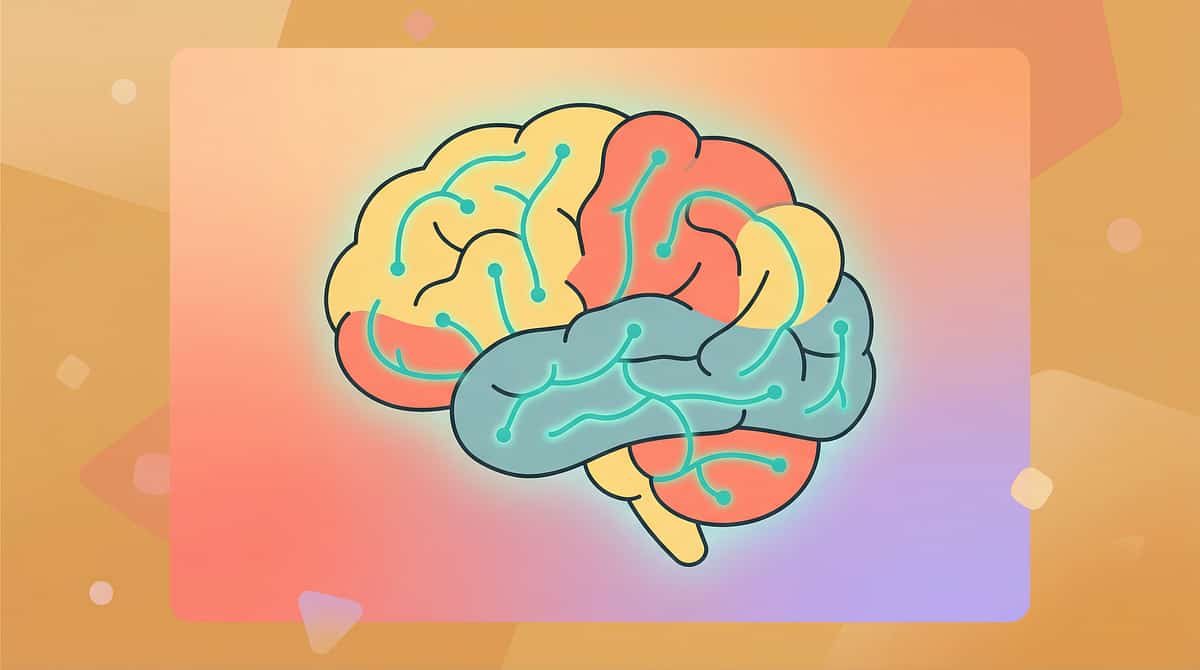
Emotions begin as body sensations — a racing heart, tightening muscles, a churning stomach. These signals travel from the body to the insular cortex (interoceptive hub) and then to the prefrontal cortex (the "naming" brain) for labelling. In many children with autism and ADHD, interoceptive signal transmission is different — they may not perceive internal body signals clearly, may receive them at unusually high intensity only at crisis point, or may perceive them in unexpected body locations. The result: emotions go from zero to explosion with no discernible middle stage.
In Plain Language for Parents
🧠 Think of your child's emotional awareness as a smoke detector that only triggers at full fire — there's no "smoke" warning. The early signals that would normally alert them are either not perceived or not recognised as meaningful.
The brain needs to be explicitly taught to notice and name these signals. This is not a flaw — it is a wiring difference that responds beautifully to the right materials and consistent practice.
"This is a wiring difference — not a behaviour choice."
Research: Frontiers in Integrative Neuroscience (2020) — Comprehensive framework for evaluating interoception-based interventions in ASD. DOI: 10.3389/fnint.2020.556660

Developmental Context
Your Child Is Here. Here Is Where We're Heading.
Emotion identification develops along a predictable arc — and every child's starting point is valid. Understanding where your child sits on this timeline helps set realistic expectations and celebrate the right milestones.
🔵 Infancy (0–12m)
Caregiver labels emotions: "You're upset. You seem tired." The vocabulary is being planted.
🟡 Toddlerhood (1–3y)
Basic words emerge: happy, sad, mad, scared. Beginning recognition of obvious emotions.
🟠 Preschool (3–5y)
Expanding vocabulary. Beginning to self-label with support. Understanding emotions have causes.
🟢 Early School (5–8y)
Nuanced vocabulary: frustrated, disappointed, nervous. Beginning real-time identification. ← Most C-249 children are here or earlier.
🌟 Target Zone (8–12y+)
Independent identification. Body signal awareness. Proactive communication: "I'm at yellow."
Comorbidity Awareness: Emotion identification challenges commonly co-occur with Autism Spectrum Disorder | ADHD | Anxiety | Sensory Processing Differences | Developmental Language Disorder. Sources: PMC9978394 | WHO/UNICEF CCD Package (2023)

Evidence Grade
Clinically Validated. Home-Applicable. Parent-Proven.
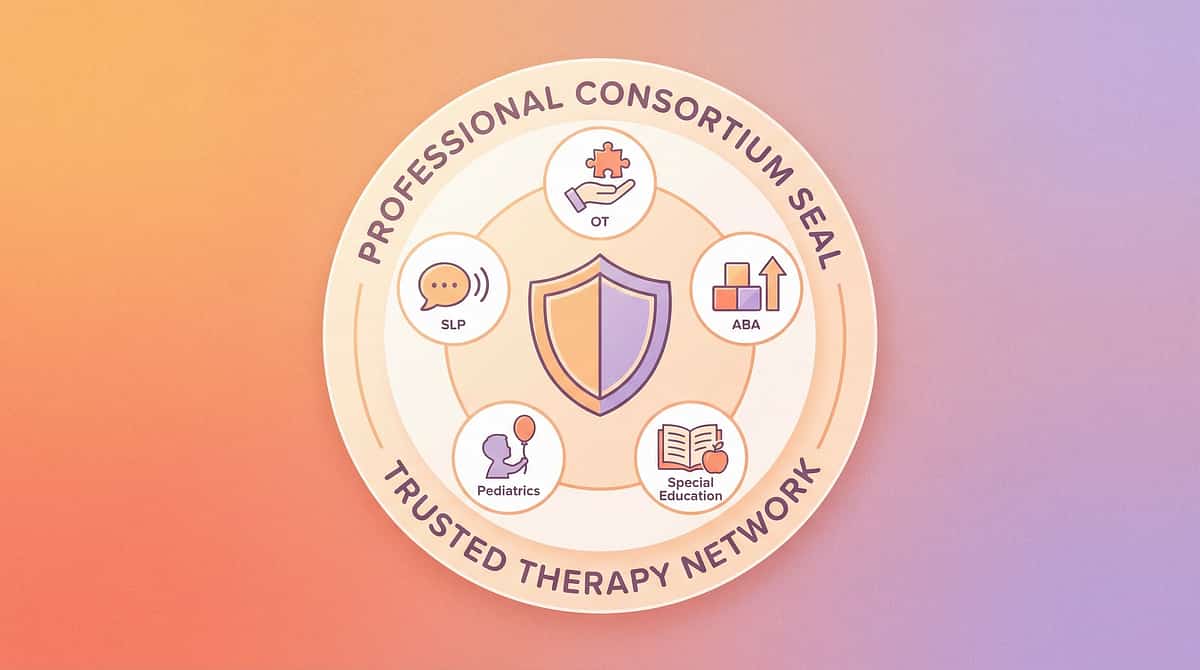
Every technique in the Pinnacle ecosystem is grounded in evidence reviewed by a full clinical consortium — OT, SLP, BCBA, SpEd, and NeuroDevelopmental Pediatrics. C-249 meets the highest standards for evidence-based practice.
Study | Finding | Reference | |
PRISMA Systematic Review, 16 articles (2013–2023) | Emotion identification training meets criteria as evidence-based practice for children with ASD. | PMC11506176 | |
Meta-analysis, World J Clin Cases (2024), 24 studies | Visual emotion supports improve social skills, adaptive behaviour, and emotional processing across autism populations. | PMC10955541 | |
Indian RCT, Padmanabha et al., Indian J Pediatr (2019) | Home-based structured interventions demonstrate significant developmental outcomes with parental delivery. | DOI: 10.1007/s12098-018-2747-4 |
🔬Key Neuroscience Insight: "Affect labelling" — putting feelings into words — has been shown to reduce the intensity of the emotion itself by engaging prefrontal cortex processing. Naming is not just diagnostic. Naming is therapeutic.
✦ Consortium Seal: Reviewed and validated by the Pinnacle Blooms Consortium — OT, SLP, BCBA/ABA, SpEd, NeuroDevelopmental Pediatrics, CRO
Act II — Knowledge Transfer
The Technique: Emotion Identification Training
Parent-friendly alias: "Naming the Feeling"
Emotion identification is the ability to recognise, differentiate, and label one's own emotional states — a foundational skill that must precede emotion regulation. Children who struggle with emotion identification experience feelings as undifferentiated distress. They cannot distinguish angry from frustrated, nervous from excited. They lack vocabulary for internal states and may not notice emotional shifts until they reach crisis intensity.
🧠 Domain
Emotional Regulation (Domain C) — Sub-domains: Emotion Identification, Emotional Literacy, Interoception
👶 Age Range
2–12 years
⏱️ Session Duration
5–15 minutes daily + 3 daily check-ins
🏠 Setting
Home + School + Daily Life Moments
"Before regulation comes recognition. You cannot manage what you cannot name."
🔗 Related technique: C-248 Building Emotional Vocabulary | 🔗 Next technique: C-250 Emotion Regulation After Identification. GPT-OS® integration available for enrolled families.
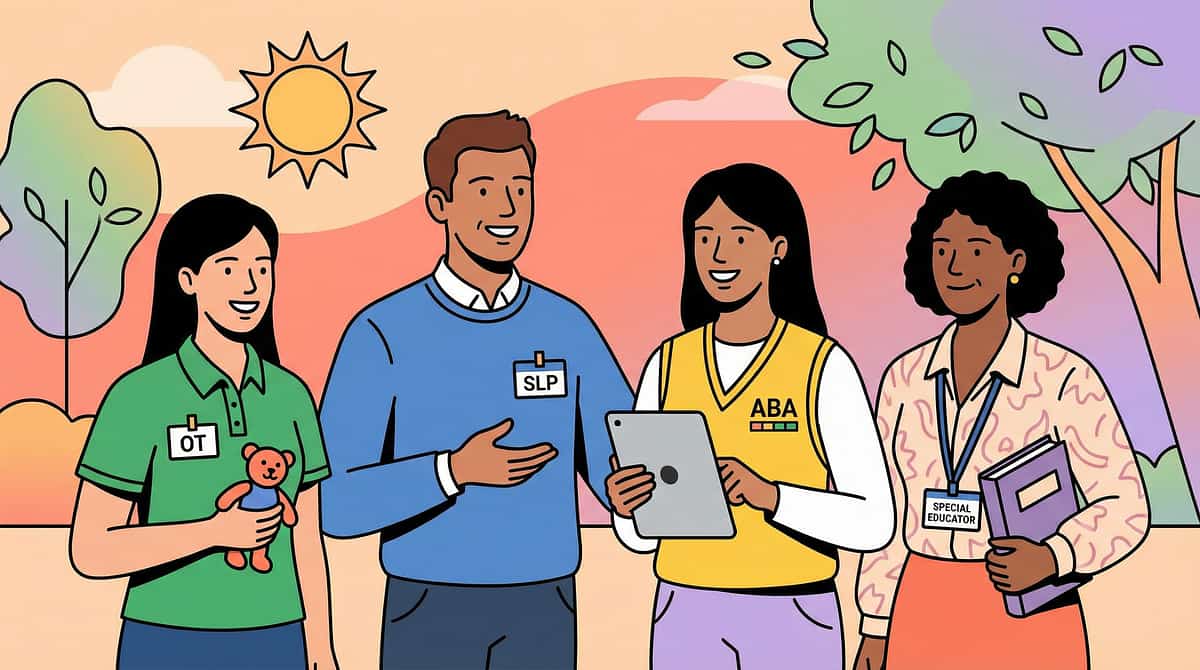
The Interdisciplinary Team
Who Uses This Technique
This technique crosses therapy boundaries — because the brain doesn't organise by therapy type. The most effective emotion identification programmes integrate all five disciplines, each contributing a distinct and non-duplicated layer of expertise.
🟠 Occupational Therapist (OT) — Primary Lead
Addresses interoceptive processing differences through body awareness training, sensory-emotional connection work, and structured emotion identification protocols using body maps and tactile engagement.
🔵 Speech-Language Pathologist (SLP)
Builds the emotional vocabulary itself — teaching nuanced emotion words, context-based language, and the language of the inner world. Ensures emotion identification connects to communication.
🟢 BCBA / ABA Therapist
Designs systematic reinforcement for emotion labelling behaviours, creates data collection for identification accuracy, and structures daily identification practice opportunities.
🟡 Special Educator (SpEd)
Integrates emotion identification across academic and social contexts, implements classroom check-in systems, and builds consistency between school and home approaches.
🔴 NeuroDevelopmental Pediatrician
Screens for alexithymia, rules out medical contributors to emotion identification difficulties, and provides diagnostic framework for the intervention team.
✦ Consortium Seal | Research: WHO/UNICEF Nurturing Care Framework — multi-disciplinary responsive caregiving model implemented across 111 countries. DOI: 10.1080/17549507.2022.2141327
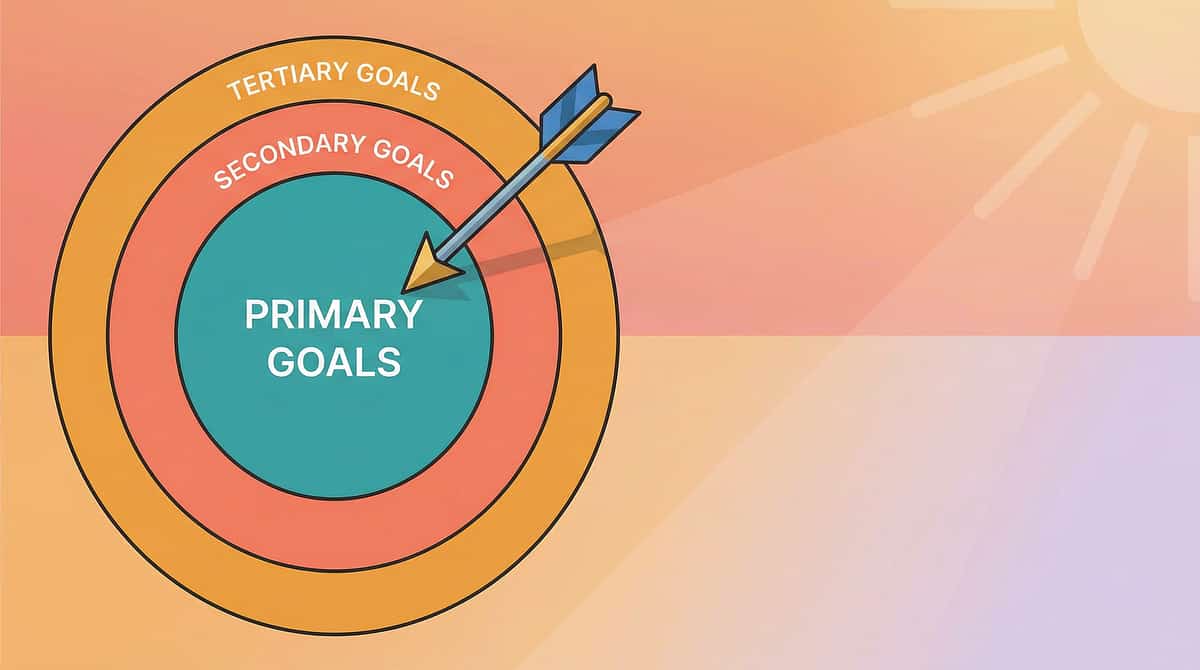
Therapeutic Targets
This Is Not a Random Activity. This Is a Precision Therapeutic Tool.
Every element of C-249 targets a specific developmental outcome. Understanding the layered target structure helps parents and therapists track the right indicators at the right time.
🎯 Primary Target
Emotion Identification Accuracy — ability to correctly name current emotional state using vocabulary, visual supports, or zone system
🎯 Secondary Targets
Interoceptive awareness — noticing body signals before emotional crisis. Emotional vocabulary expansion — from 3 words to 15+ nuanced emotions. Early warning recognition — catching "yellow" before reaching "red." Spontaneous emotional communication — coming to you before the meltdown.
🎯 Tertiary Developmental Gains
Emotion regulation capacity (identification is prerequisite). Social connection and empathy development. Reduced meltdown frequency and intensity. Academic readiness and social participation. Self-advocacy skills: knowing and expressing your own needs.
Target | What You'll See | |
Identification accuracy | Child points to correct emotion face or names emotion with 70%+ accuracy | |
Body awareness | Child says "my heart is going fast" before crisis | |
Vocabulary | Uses 10+ emotion words spontaneously | |
Early warning | Uses check-in tools at transitions without prompting |
Research: PMC10955541 — Meta-analysis confirms emotion-focused interventions effectively promote social skills (primary), adaptive behaviour (secondary), and broad developmental gains (tertiary).
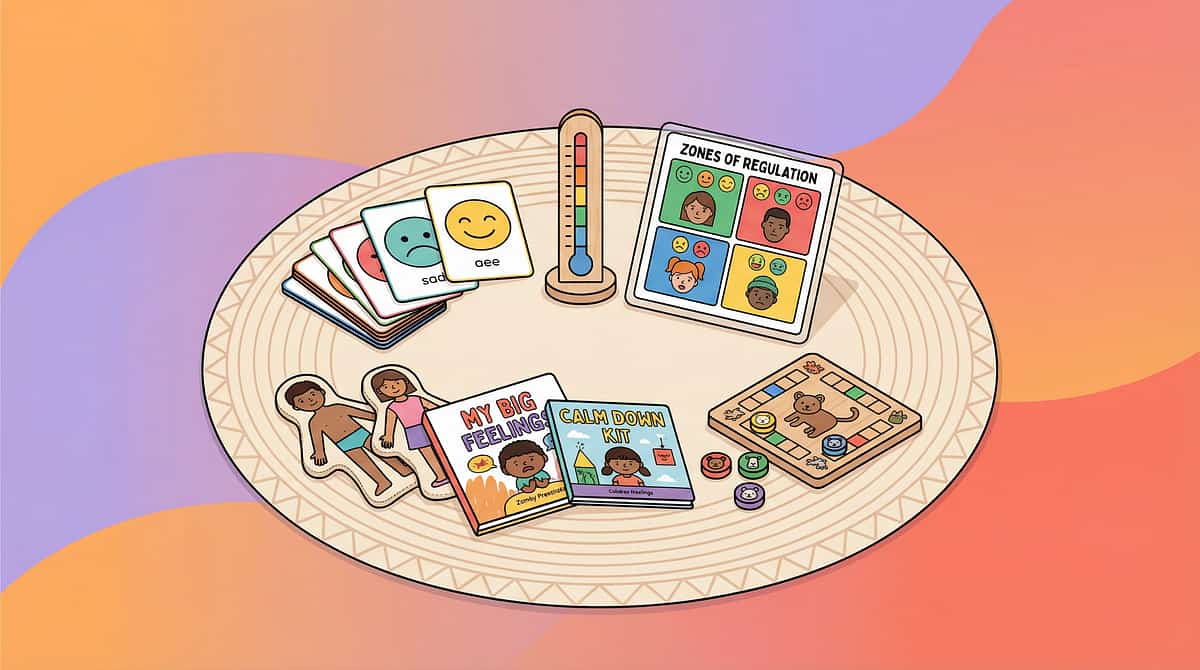
The 9 Materials
9 Materials. One Mission: Make the Invisible Visible.
These are the materials your Pinnacle Consortium — OT, SLP, BCBA, SpEd, and NeuroDevelopmental Pediatrician — uses to build emotion identification skills. Every material has a commercial option (Amazon.in) and a zero-cost DIY alternative. Total investment: ₹100 (single DIY material) to ₹2,000 (full set). Zero-cost version: 100% possible.
# | Material | Commercial Price | DIY Option | |
1 | 😊 Emotion Faces Cards & Posters | ₹200–1,500 | ✅ Yes — free printables | |
2 | 🌡️ Feelings Thermometer & Intensity Scales | ₹150–800 | ✅ Yes — hand-drawn | |
3 | 🟡 Zones of Regulation Visual Systems | ₹300–2,000 | ✅ Yes — 4-colour chart | |
4 | 🫀 Body Maps & Interoception Cards | ₹100–600 | ✅ Yes — body outline print | |
5 | 📚 Emotion Vocabulary Books & Stories | ₹200–1,000 | ✅ Yes — library + PDF | |
6 | ⭕ Emotion Check-In Wheels & Charts | ₹150–800 | ✅ Yes — hand-drawn wheel | |
7 | 📖 Social Stories & Scenarios | ₹200–1,000 | ✅ Yes — Carol Gray templates | |
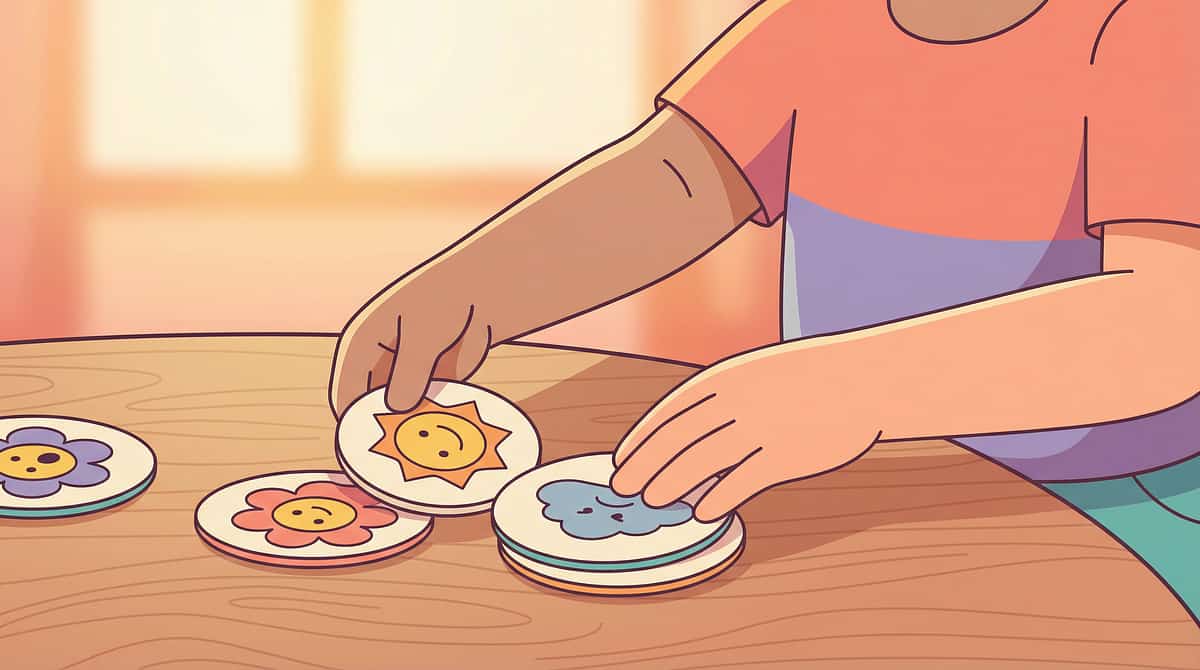
8 | 🎮 Emotion Matching & Sorting Games | ₹200–1,200 | ✅ Yes — printed pairs | |
9 | 🪞 Mirror & Video Self-Observation Tools | ₹100–500 | ✅ Yes — any household mirror |
📞FREE National Autism Helpline: 9100 181 181 — Get personalised material guidance from our consortium team. 16+ languages | 24×7 | Always free.
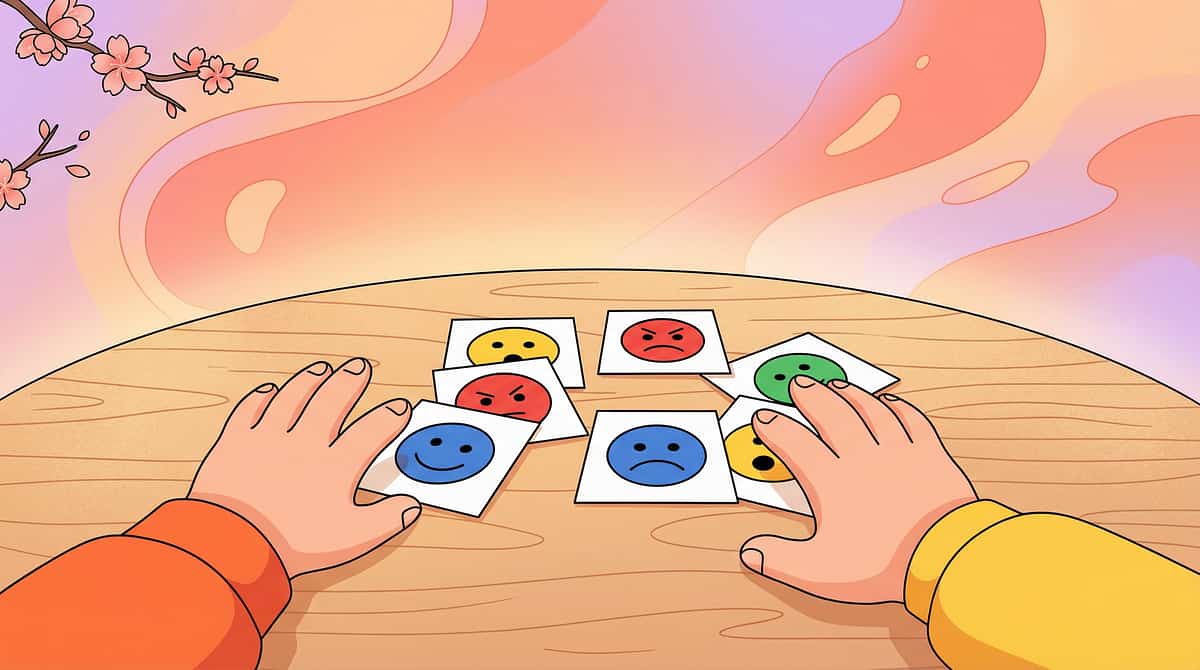
Material 1 of 9
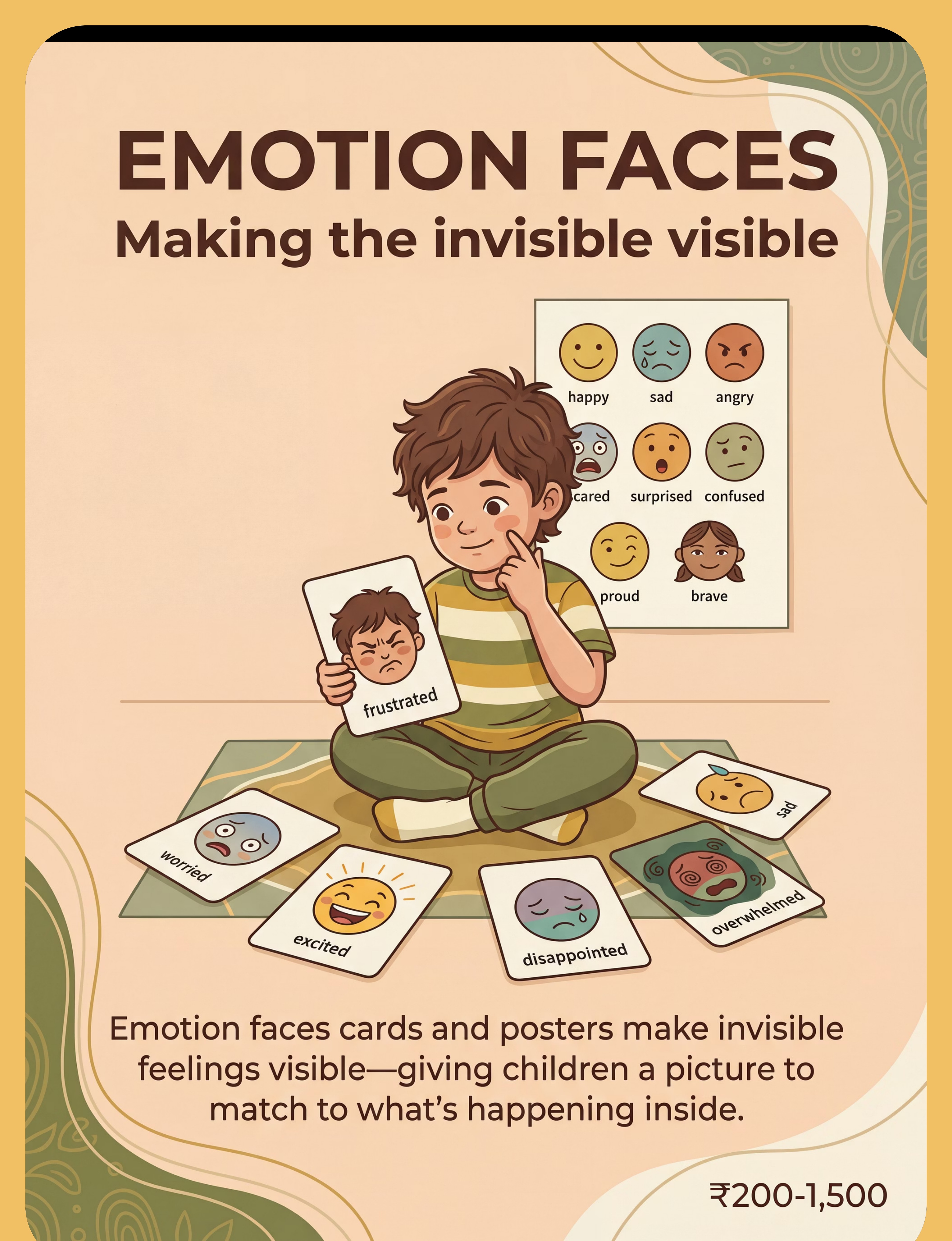
😊 Emotion Faces Cards & Posters
Making the invisible visible
Emotions are invisible — they happen inside. Emotion faces cards and posters make the invisible visible by providing external representations of internal states. When a child sees a card showing "frustrated" or "worried" or "overwhelmed," they have a visual reference point for matching their inner experience. High-quality emotion cards show nuanced expressions — not just the basic five emotions. Look for cards that include: overwhelmed, disappointed, nervous, embarrassed, proud, confused, surprised, and calm. The key is moving beyond recognising emotions in pictures to connecting those pictures to felt experience: "This is what MY face might look like when I feel this way."
Start with 4–6 cards
Happy, sad, angry, scared, excited, calm — the foundation set
Practise during calm moments
"This face is happy. Can you make a happy face?" Make it playful, not a test.
Use at transitions
"Look at our cards. Which one matches how you feel right now?"
Build to non-verbal communication
Pointing during difficult moments — a powerful tool when words fail
✅ Commercial Option
Emotion Faces Flash Cards (diverse expressions)
Amazon.in: search "emotion faces cards children therapy"
Price: ₹200–1,500
Pinnacle Recommends: Choose sets with 15+ emotions, not just basic 5
Amazon.in: search "emotion faces cards children therapy"
Price: ₹200–1,500
Pinnacle Recommends: Choose sets with 15+ emotions, not just basic 5
🔨 DIY Alternative (Zero Cost)
Print emotion faces from free online resources (search: "emotion faces printable therapy"). Include 15–20 emotions. Add the emotion word below each face. Laminate for durability (₹30/sheet at local print shop). Create small card sets for portability + A4 poster for environmental reference.
"Children can't identify what they can't see. Faces make the internal external."
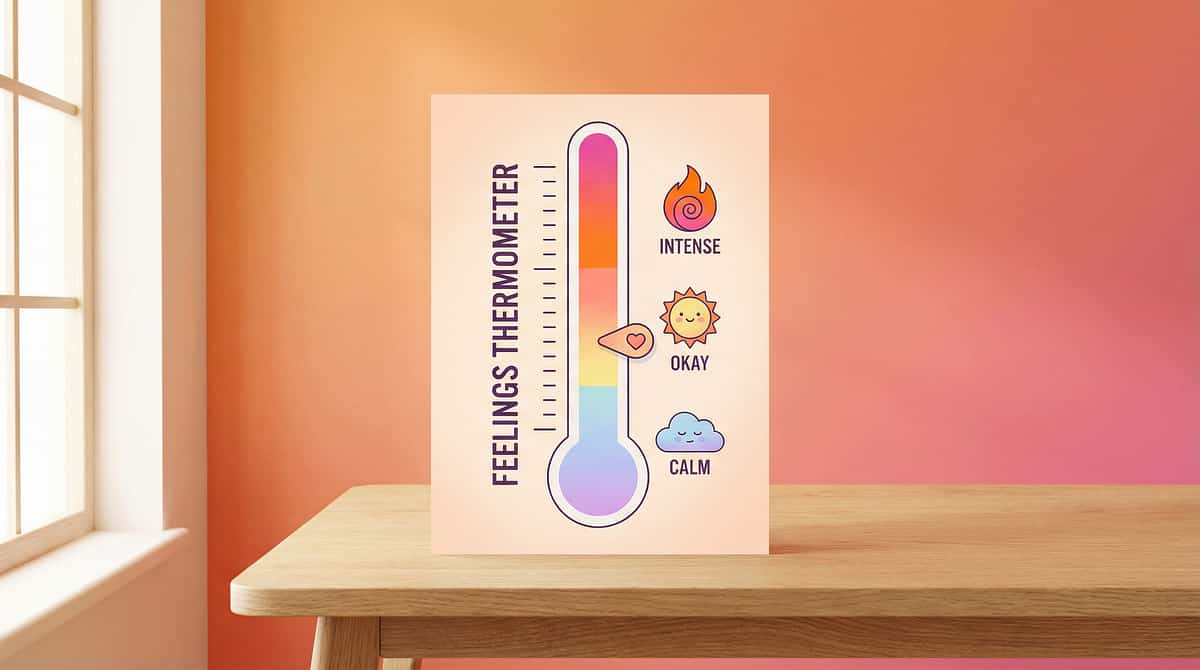
Material 2 of 9
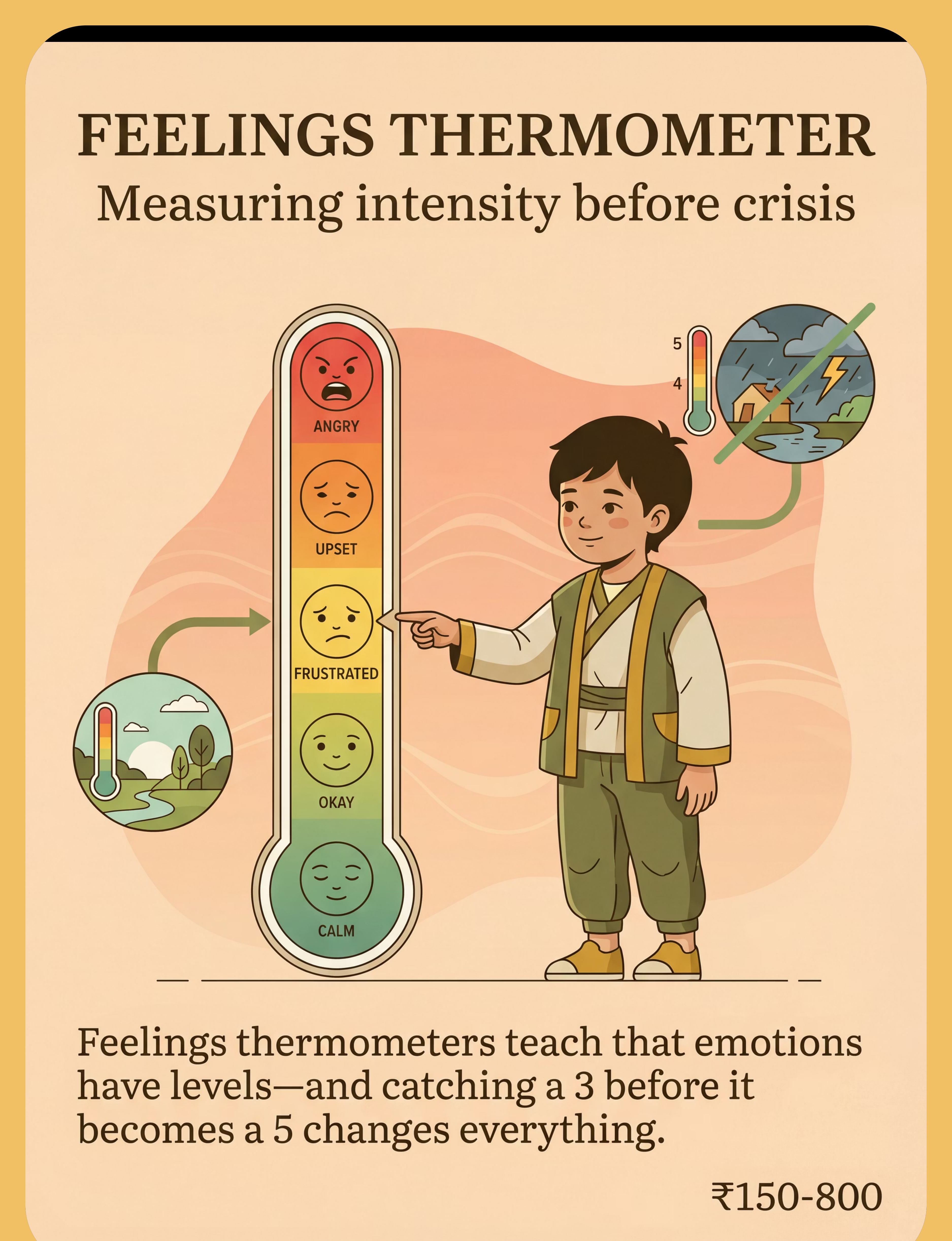
🌡️ Feelings Thermometer & Intensity Scales
Measuring intensity before crisis
One of the hardest aspects of emotion identification is recognising intensity — understanding the difference between "a little annoyed" and "furious," between "slightly nervous" and "terrified." Feelings thermometers provide visual representation of emotional gradations. A thermometer might show levels 1–5 with colours from cool to hot, with corresponding emotion words and faces at each level. Children learn that emotions exist on a continuum, that there are warning signs before crisis level, and that the same emotion can be experienced at different intensities.
The transformative insight:"I'm at a 3" can be caught and supported. A 5 is already a crisis. The thermometer creates that vital window of opportunity.
1
Introduce during calm time
"Emotions are like a thermometer — they have levels"
2
Practise with low-stakes scenarios
"When you had to wait for your snack, what level were you?"
3
Post at child's eye level
Thermometer on wall — visible, accessible, normalised
4
Use during mild emotional moments
"Show me on the thermometer where you are right now"
5
Celebrate early identification
"You noticed you were at a 3! That's amazing!" Reinforce the noticing, not just the accuracy.
✅ Commercial Option
Printable Feelings Thermometer Set
Amazon.in: search "feelings thermometer children emotions"
Price: ₹150–800
Amazon.in: search "feelings thermometer children emotions"
Price: ₹150–800
🔨 DIY Alternative
Draw a thermometer with 5 levels. Add colours (green=1, yellow=2, orange=3, red=4, dark red=5). Include faces and body language at each level. Add intensity words. Laminate for repeated dry-erase use.
Safety Note: Avoid making high-intensity emotions seem "bad." All levels are valid. The goal is awareness, not shame.
"The crisis isn't the first sign — it's the last. Thermometers reveal what comes before."
Material 3 of 9
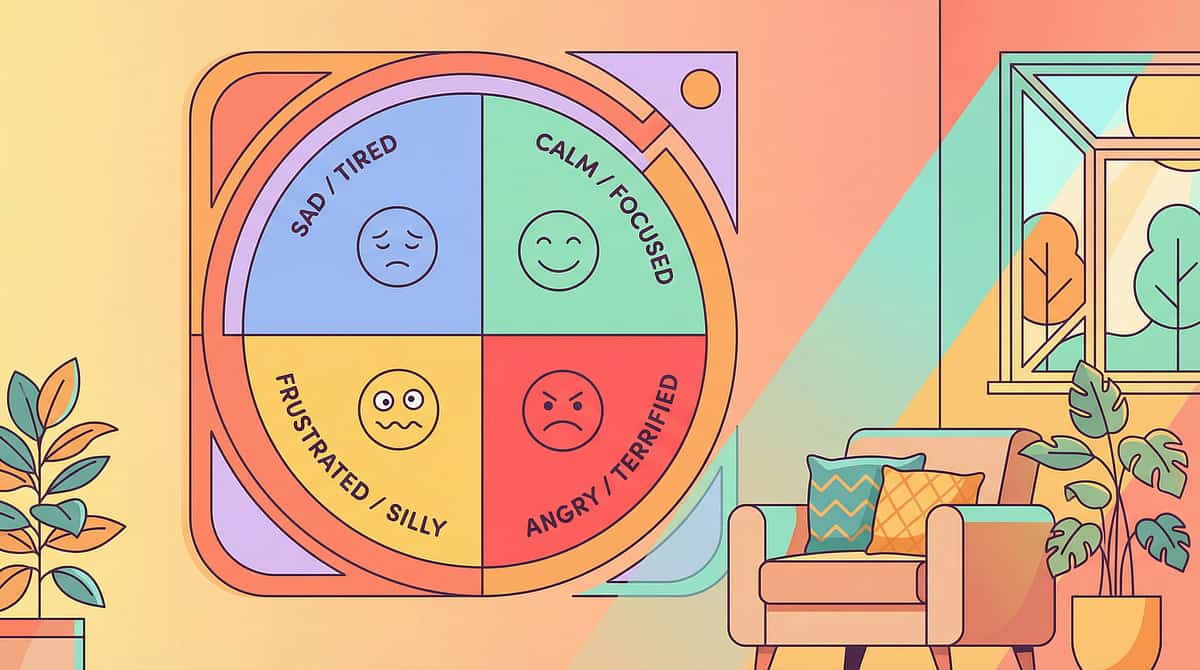
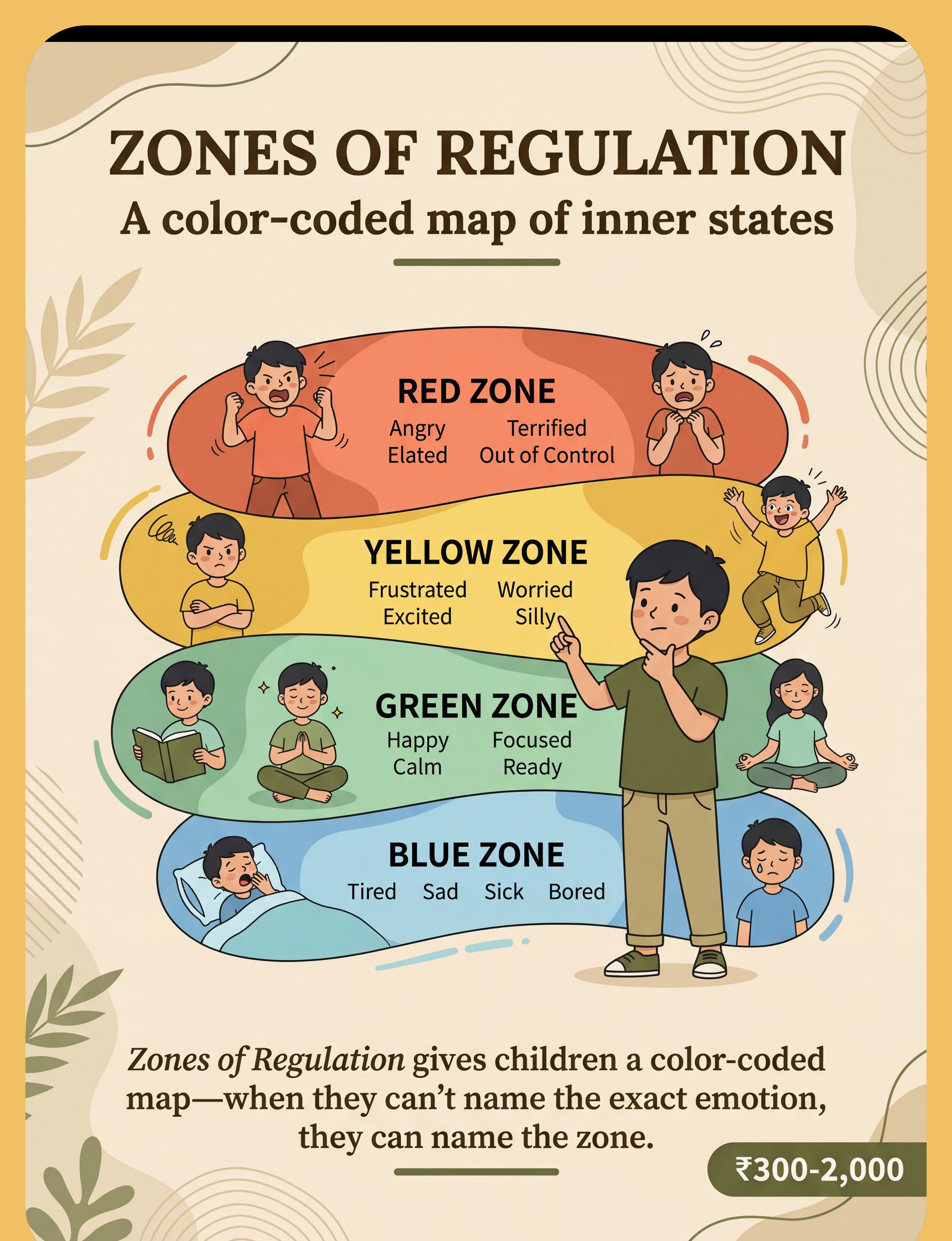
🟦🟢🟡🔴 Zones of Regulation
A colour-coded map of inner states
The Zones of Regulation framework provides a comprehensive, colour-coded system for categorising emotional and alertness states. When exact emotion words are too hard, children can identify their zone — reducing the complexity from 30+ possible emotions to 4 manageable categories. When a child says "I'm in yellow" — that's enough. That's the bridge. That's where help begins.
🔵 BLUE ZONE — Low Energy
Sad • Tired • Sick • Bored • Exhausted
Body signals: Moving slowly, droopy, low motivation
Body signals: Moving slowly, droopy, low motivation
🟢 GREEN ZONE — Just Right
Calm • Happy • Focused • Ready to Learn • Content
Body signals: Relaxed, steady breathing, able to focus
Body signals: Relaxed, steady breathing, able to focus
🟡 YELLOW ZONE — Heightened
Frustrated • Anxious • Excited • Worried • Silly • Wiggly
Body signals: Energy rising, harder to focus, starting to speed up
Body signals: Energy rising, harder to focus, starting to speed up
🔴 RED ZONE — Extremely Heightened
Angry • Terrified • Out of Control • Furious • Panicked
Body signals: Heart pounding, body very tense, hard to think
Body signals: Heart pounding, body very tense, hard to think
Post Zones chart at child's eye level
Make it part of the environment — not just a tool brought out during practice
Daily check-ins: "Which zone are you in right now?"
Validate all zones: "Blue is okay. Red is hard. All zones are normal."
Connect zones to strategies
"When you're in yellow, we can try..." — bridging identification to regulation
✅ Commercial
Official Zones of Regulation curriculum book + cards
Amazon.in: search "Zones of Regulation Leah Kuypers"
Price: ₹300–2,000
Amazon.in: search "Zones of Regulation Leah Kuypers"
Price: ₹300–2,000
🔨 DIY
Create 4-colour chart (blue/green/yellow/red) with states and body signals for each. Laminate. Make portable card version for school bag.
Material 4 of 9
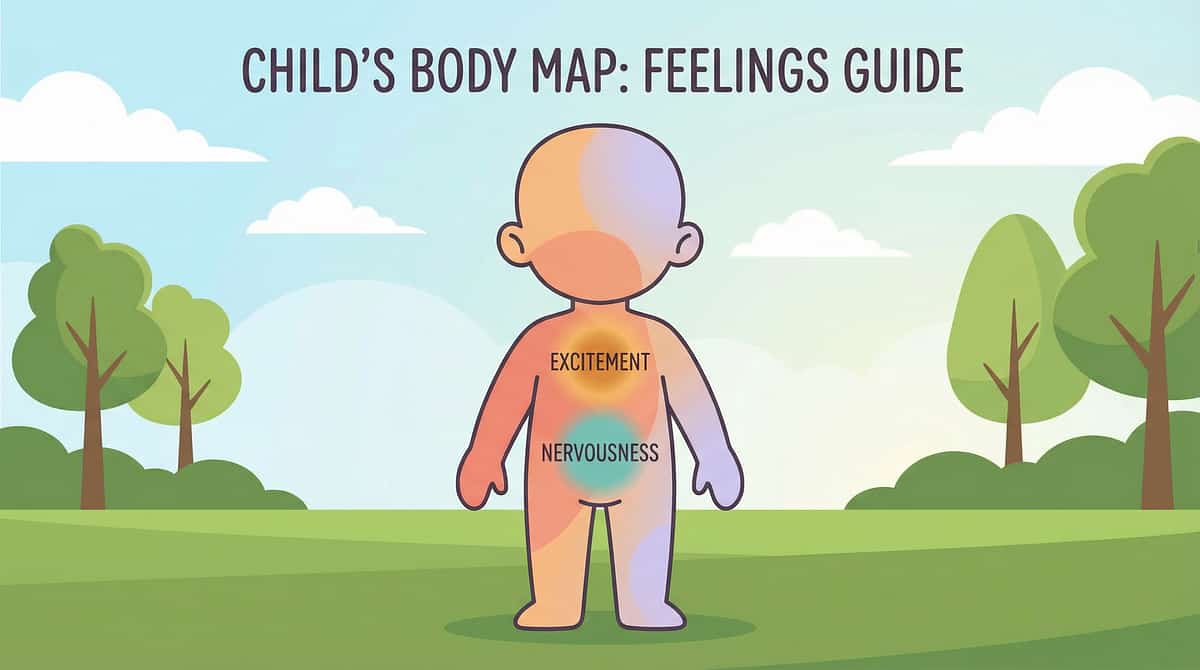
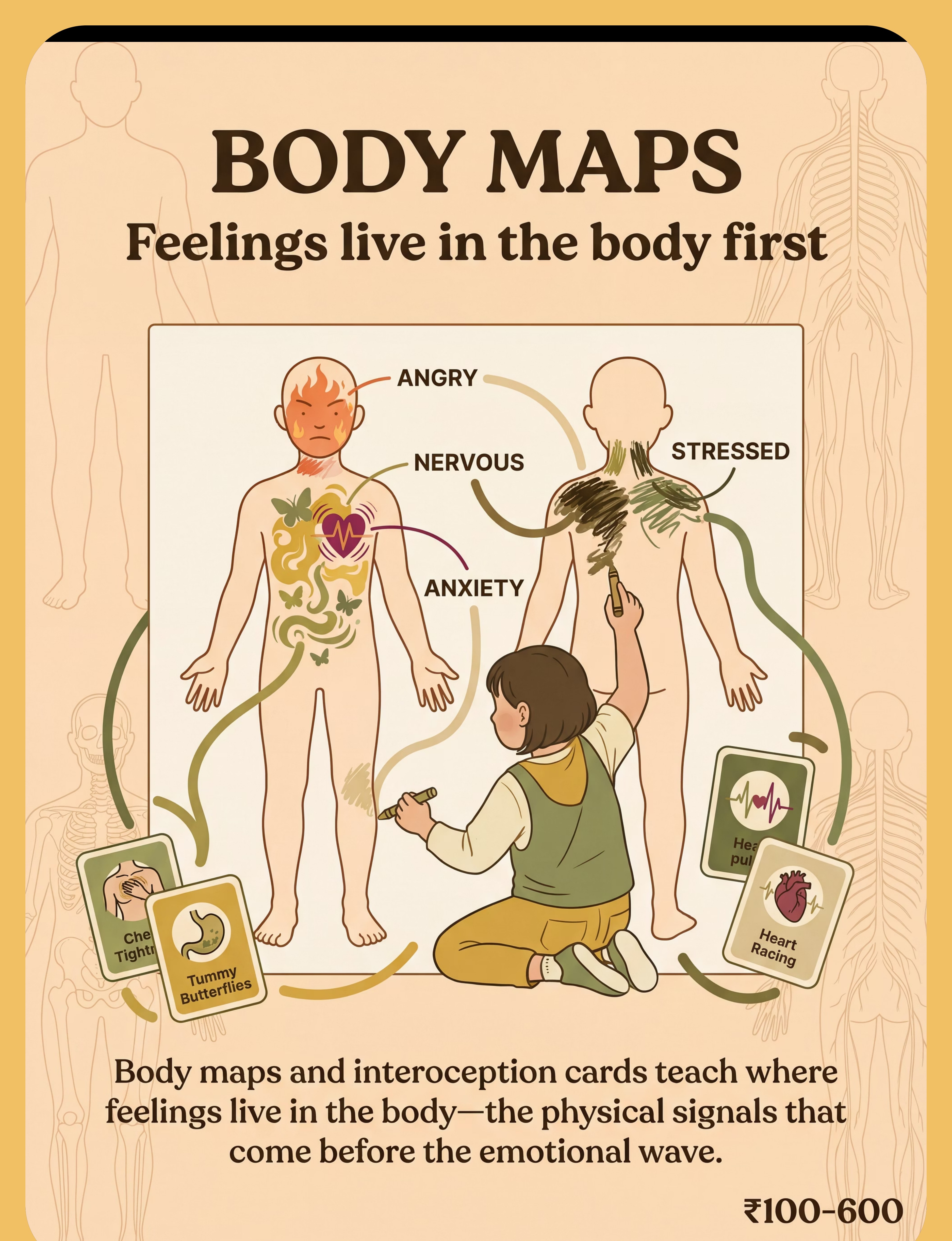
🫀 Body Maps & Interoception Cards
Feelings live in the body first
Emotions live in the body before they live in words. Anger might be a tight jaw and hot face. Anxiety might be a churning stomach and racing heart. Excitement might be bouncy legs and wide eyes. Body maps and interoception cards help children connect physical sensations to emotional states — building the foundational awareness that precedes emotion identification. This is the most critical skill for children who seem to have "no warning" before meltdowns: they don't lack emotions, they lack the interoceptive awareness to notice them coming.
📞FREE Helpline: 9100 181 181 — Ask about interoception assessment for your child. Available 24×7 in 16+ languages.
Body Signal | Possible Emotion | |
Heart beating fast | Excited, Scared, Anxious | |
Stomach feels funny / "butterflies" | Nervous, Excited | |
Face feels hot | Angry, Embarrassed | |
Muscles feel tight / "hard" | Frustrated, Angry | |
Throat feels tight | Sad, About to cry | |
Legs want to run / bounce | Excited, Anxious |
1
Print body outline (front + back)
Use during calm practice to map sensation locations
2
Practise during calm
"Where do you feel it when you're nervous? When you're angry?"
3
Colour-code
Warm colours for arousal, cool colours for calm — visual and intuitive
4
Create sensation cards
"My heart is beating fast → I might be feeling ___"
5
Review AFTER emotional episodes
"Where did you feel that in your body?" — building retrospective awareness
✅ Commercial
Interoception curriculum cards
Amazon.in: search "interoception cards children body map"
Price: ₹100–600
Amazon.in: search "interoception cards children body map"
Price: ₹100–600
🔨 DIY
Print body outline images free online. Create 10 sensation cards with text + body illustration. Ask child to complete: "When I'm angry, I feel it in my ___."
Safety Note: Some children have very different interoceptive experiences. Never insist emotions "should" feel a certain way. Explore what this child feels in their body.
Material 5 of 9
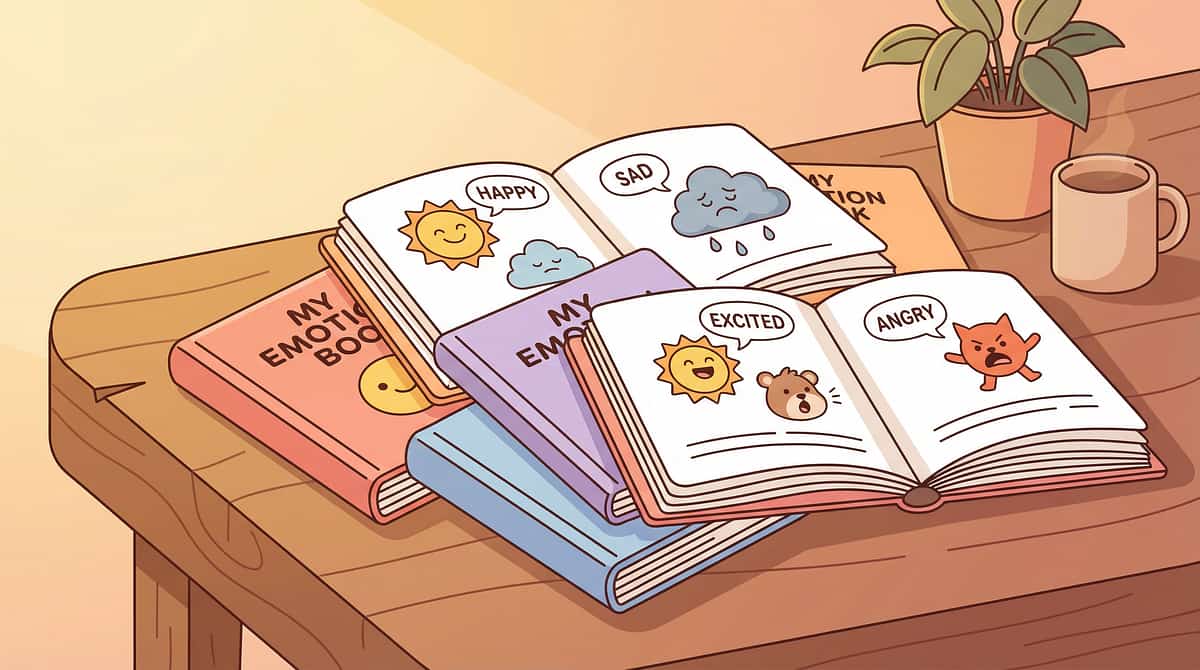
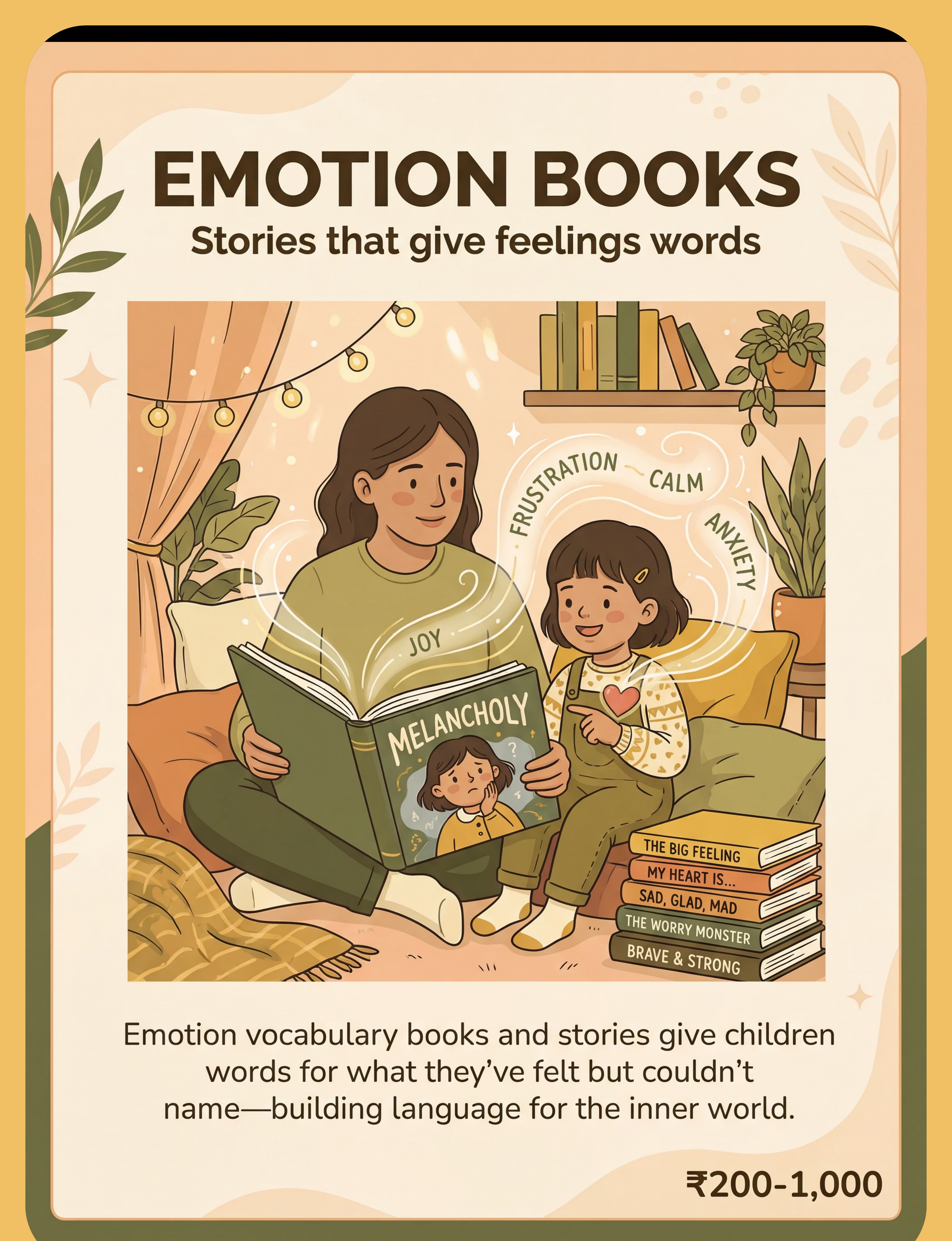
📚 Emotion Vocabulary Books & Stories
Stories that give feelings words
Emotional vocabulary is learned through exposure — hearing emotion words used in context, seeing characters experience and name feelings, having language modelled for internal states. Children cannot identify emotions they have no words for. Emotion-focused books and stories provide rich vocabulary exposure in engaging, memorable formats. When a child sees a character feel "disappointed" and hears that word connected to an experience they recognise, a bridge forms between wordless feeling and named experience.
📗 Recommended Books
The Feelings Book — Todd Parr
In My Heart: A Book of Feelings
The Colour Monster — Anna Llenas (highly visual, ideal for autism)
My Many Coloured Days — Dr. Seuss
Glad Monster, Sad Monster
Visiting Feelings
In My Heart: A Book of Feelings
The Colour Monster — Anna Llenas (highly visual, ideal for autism)
My Many Coloured Days — Dr. Seuss
Glad Monster, Sad Monster
Visiting Feelings
📖 How to Read Together
While reading: "The character feels disappointed. Have you ever felt disappointed?"
Pause to connect: "What does disappointed feel like in YOUR body?"
After reading: Start a "Feelings Words We Learned" list.
Create a feelings vocabulary wall in child's room.
Pause to connect: "What does disappointed feel like in YOUR body?"
After reading: Start a "Feelings Words We Learned" list.
Create a feelings vocabulary wall in child's room.
✅ Commercial
Emotion books
Amazon.in: search "feelings books children autism"
Price: ₹200–1,000
Amazon.in: search "feelings books children autism"
Price: ₹200–1,000
🔨 DIY
Use your local library. Free PDF emotion books are available online. Create your own personalised emotion book with child's photos + felt experiences — the most powerful option of all.
"Vocabulary for the invisible is learned from stories that name it."
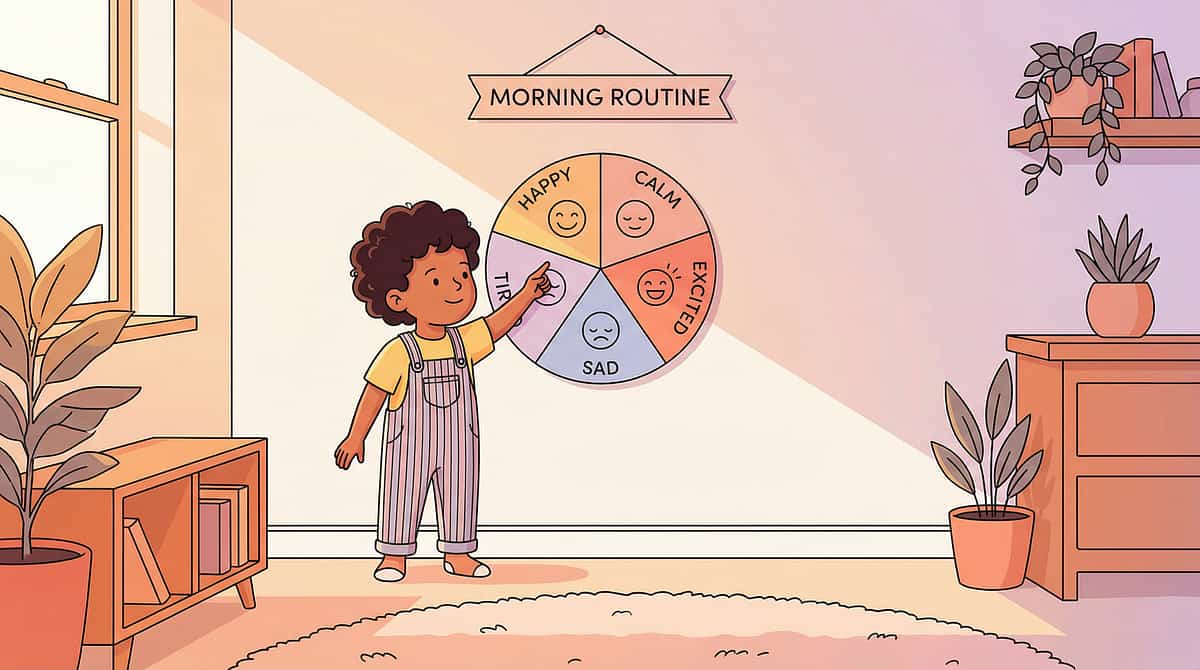
Material 6 of 9
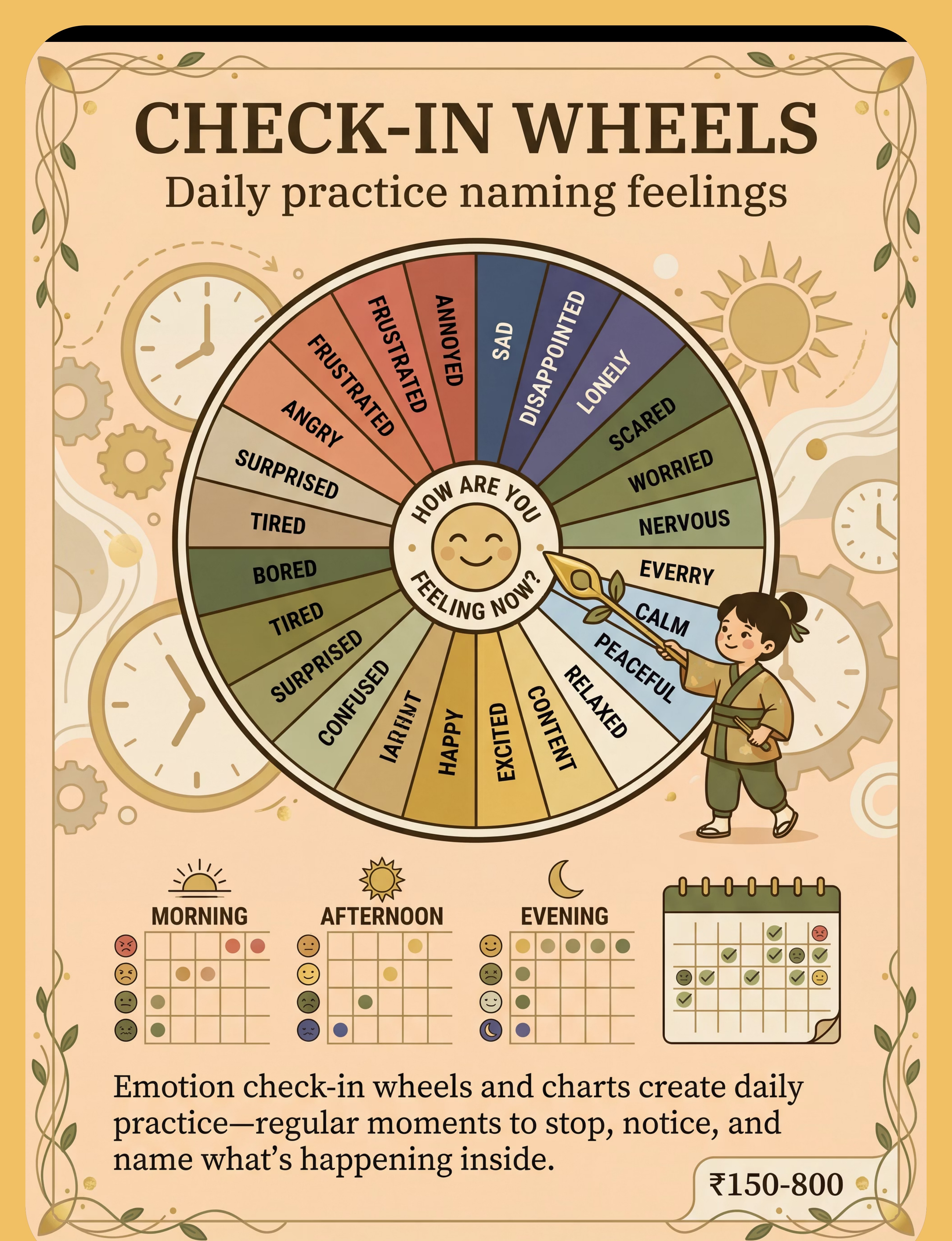
⭕ Emotion Check-In Wheels & Charts
Daily practice naming feelings
Emotion identification is not automatic — it's built through consistent daily practice. Emotion wheels and check-in charts provide structure for multiple-times-daily identification practice, building the habit of noticing and naming internal states. The regularity of check-ins matters as much as the materials. A child who checks in 3 times daily gets 1,095 emotion identification practice opportunities per year. That repetition builds automatic awareness.
✦ Consortium Seal: Clinically validated by OT, BCBA, SpEd disciplines
☀️ Morning
"Which zone are you waking up in?"
🌤️ After School / Lunch
"How is your body feeling after the morning?"
🌙 Bedtime
"What feelings did you have today? Name one."
Post emotion wheel at child's eye level
Kitchen, bedroom, bathroom — make it part of the environment
Make check-in a non-negotiable routine
Same as brushing teeth — expected, regular, non-pressured
Never pressure or interrogate
Offer choices: "Are you closer to happy or worried?" — binary choices reduce cognitive load
Celebrate naming
"You told me you felt nervous! That's amazing self-awareness!"
✅ Commercial
Emotion check-in wheel + chart set
Amazon.in: search "feelings wheel children check in chart"
Price: ₹150–800
Amazon.in: search "feelings wheel children check in chart"
Price: ₹150–800
🔨 DIY
Create a wheel with 12–20 emotions. Add spinner or movable arrow. Print morning/afternoon/evening columns chart. Laminate entire set for dry-erase use.

Material 7 of 9
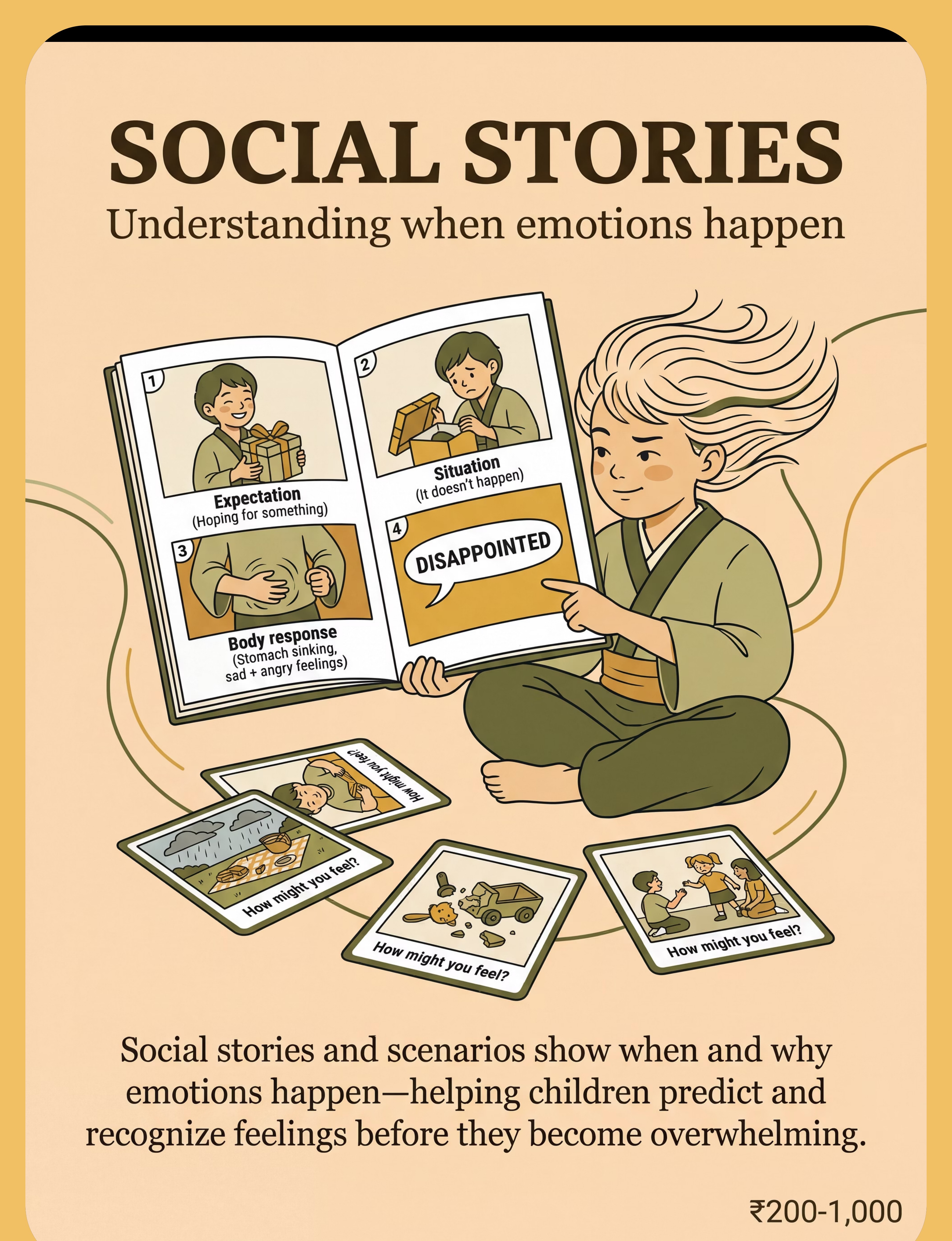
📖 Social Stories & Scenarios for Emotions
Understanding when emotions happen
For children who experience emotions as random and overwhelming, understanding emotional cause-and-effect is transformative. Social stories and scenario cards help children understand when and why different emotions occur — building the cognitive framework for identification. A social story about "feeling disappointed" describes: a situation → the internal experience → the body signals → and names the emotion. This creates emotional prediction capability: "When my plans change, I might feel disappointed. Disappointed feels like my stomach sinking."
Sample Social Story Structure:
"Sometimes things don't happen the way I expect."
"When I hope for something and it doesn't happen, I might feel disappointed."
"Disappointed might feel like my stomach sinking and a sad, heavy feeling."
"Feeling disappointed is okay. It's a real feeling that makes sense."
"Sometimes things don't happen the way I expect."
"When I hope for something and it doesn't happen, I might feel disappointed."
"Disappointed might feel like my stomach sinking and a sad, heavy feeling."
"Feeling disappointed is okay. It's a real feeling that makes sense."
1
Read during calm, not during crisis
Social stories are pre-teaching tools — not in-the-moment management strategies
2
Create personalised stories
Using the child's actual experiences makes them significantly more effective
3
Use scenario cards
"What might someone feel if their toy broke?" — practise perspective-taking
4
Connect to real life
"Remember yesterday when your friend couldn't come? That feeling had a name — disappointed."
✅ Commercial
Pre-made emotion social stories
Amazon.in: search "social stories emotions autism children"
Price: ₹200–1,000
Amazon.in: search "social stories emotions autism children"
Price: ₹200–1,000
🔨 DIY
Use Carol Gray's free Social Story templates. Create 5 stories for the emotions most relevant to your child. One story per week. Safety Note: Social stories describe feelings — they do not prescribe emotional responses. All feelings are valid.
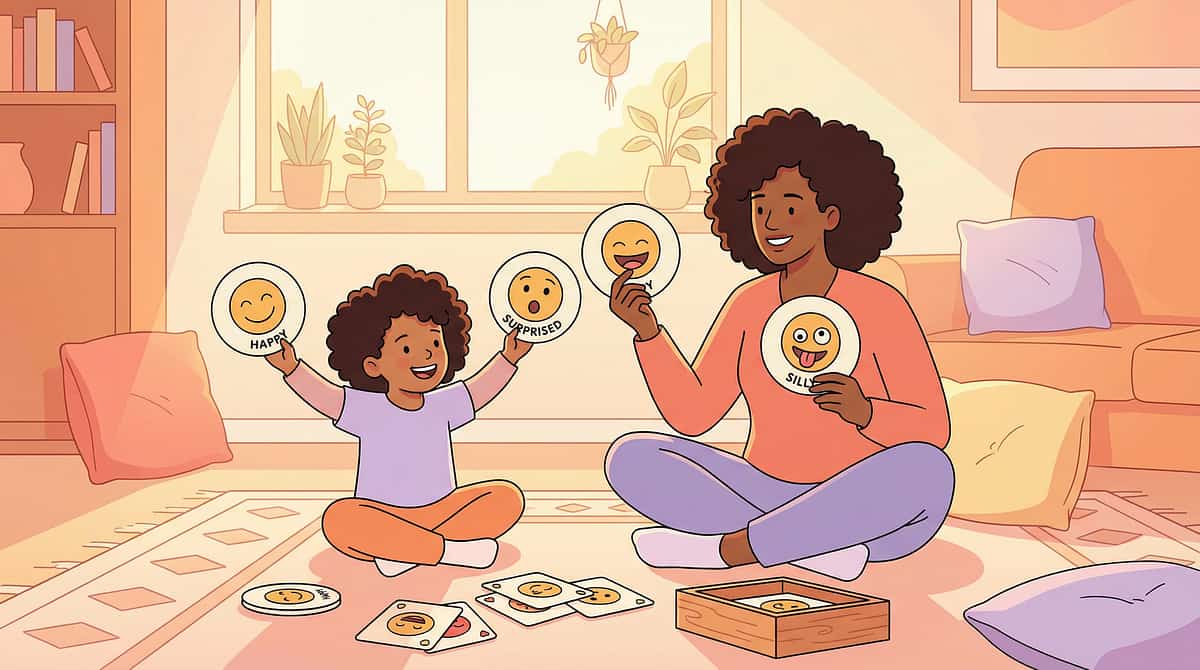
Material 8 of 9
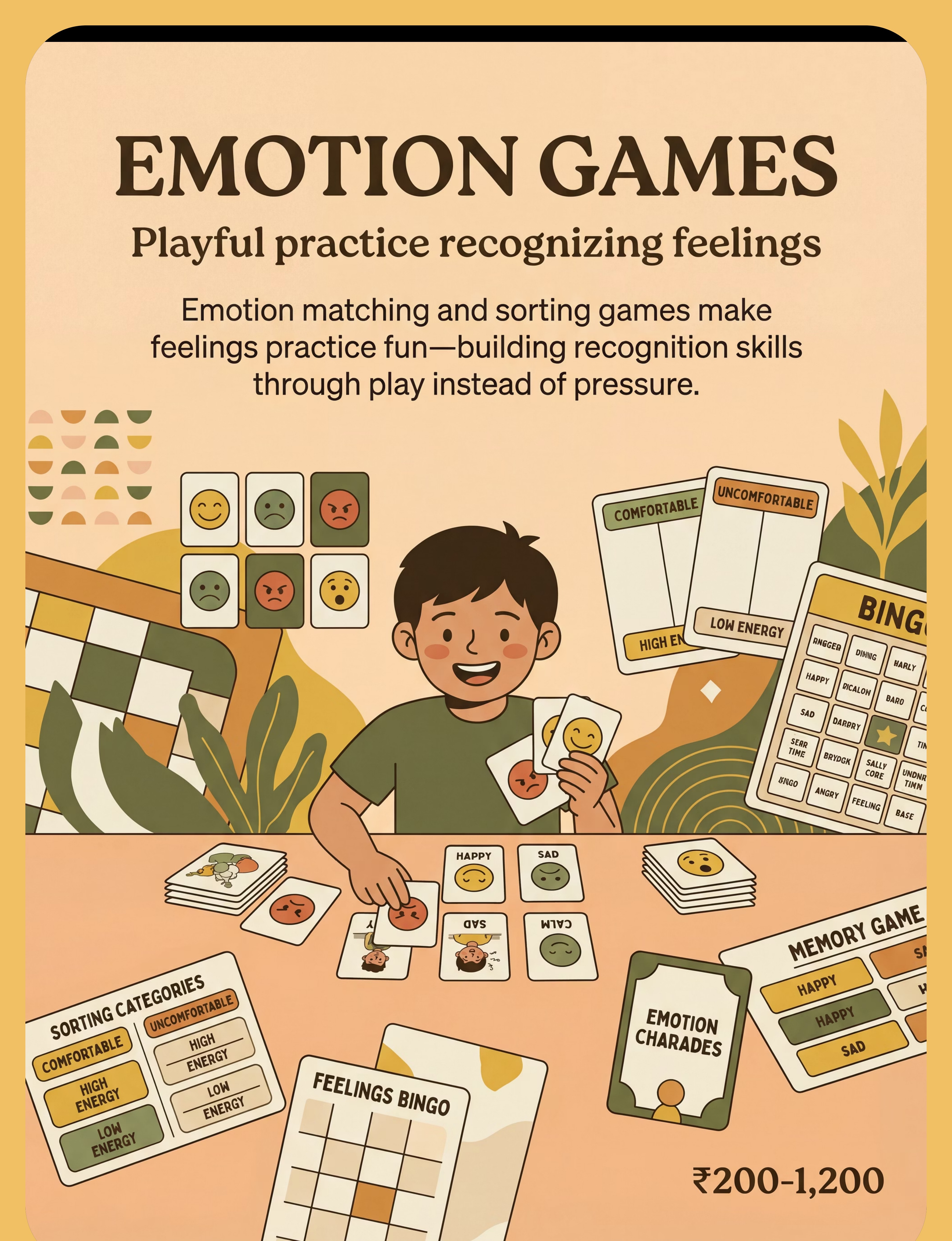
🎮 Emotion Matching & Sorting Games
Playful practice recognising feelings
Games make emotion learning engaging and create low-pressure practice opportunities. Many children who resist direct emotion work engage willingly through games. The game format removes performance pressure, increases engagement, and creates the repetition that builds automatic recognition. Learning through play bypasses resistance — and repetition through games builds recognition faster than direct instruction alone.
Matching
Face-to-word, situation-to-feeling, body sensation-to-emotion — multiple connection types
Sorting
Comfortable vs. uncomfortable | High energy vs. low energy — categorical thinking
Memory
Emotion face pairs build familiarity with expressions through repeated exposure
Bingo
Emotion word exposure with excitement element — motivation built in
Charades
Body-based emotion expression and recognition — advanced, multi-sensory
✅ Commercial
Emotion matching games
Amazon.in: search "emotion matching game children"
Price: ₹200–1,200
Dyomnizy Educational Memory Game | ₹519 | amzn.in/d/0iwJwOiH
Amazon.in: search "emotion matching game children"
Price: ₹200–1,200
Dyomnizy Educational Memory Game | ₹519 | amzn.in/d/0iwJwOiH
🔨 DIY
Print emotion face cards in pairs for memory game. Create feelings bingo board (5×5 grid of emotion words). Make sorting cards (comfortable/uncomfortable, high/low energy). Use cooperative formats — no winners and losers.

Material 9 of 9
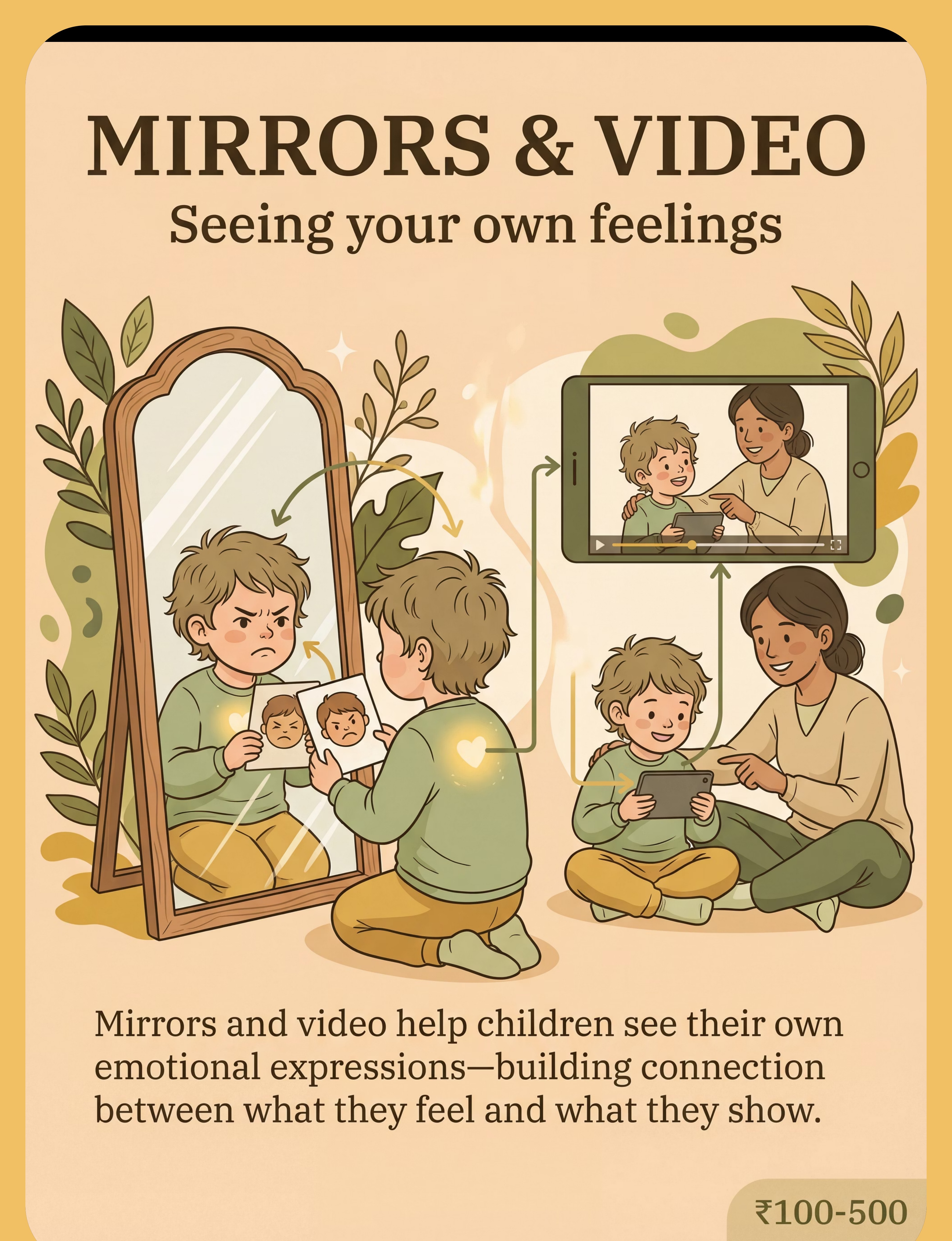
🪞 Mirrors & Video Self-Observation Tools
Seeing your own feelings
Some children are surprised when told they look angry — they don't realise their face shows worry. They are disconnected from their own external expression. Mirror work and video self-observation build the self-awareness bridge between inner experience and outer expression. Mirrors allow children to see their own faces while practising emotions during calm times. Video recording (with consent and therapeutic framing) lets children see themselves in neutral situations and identify what they were feeling — some children can identify emotions in playback that they couldn't identify in the moment.
🪞 Mirror Practice (Daily, 3–5 Minutes)
Sit together at the mirror
"Let's make faces together!" — keep it playful
Practise named emotions
"Show me your happy face. What does your body do when you're happy?"
Explore nuance
"Show me your worried face. Does it look different from scared?"
Practise 6–8 emotions
Laugh and make it playful — performance pressure kills engagement
📹 Video Practice (Weekly, With Consent)
Record 2–3 minutes
Calm, positive interaction only
Watch together
"What do you think you were feeling here?"
Connect expression to internal state
Build the bridge between outer and inner
NEVER record during genuine distress
Safety rule — non-negotiable
✅ Commercial
Basic mirror — any household mirror | ₹0
Tablet for video — existing device | ₹0
Emotion face practice mirror cards
Amazon.in: search "emotion faces mirror practice"
Price: ₹100–500
Tablet for video — existing device | ₹0
Emotion face practice mirror cards
Amazon.in: search "emotion faces mirror practice"
Price: ₹100–500
🔨 DIY
Any mirror + any phone camera. Free video. The tool is in your pocket. Self-observation should feel empowering, not exposing. Always frame as discovery, never as "look at how you were behaving."
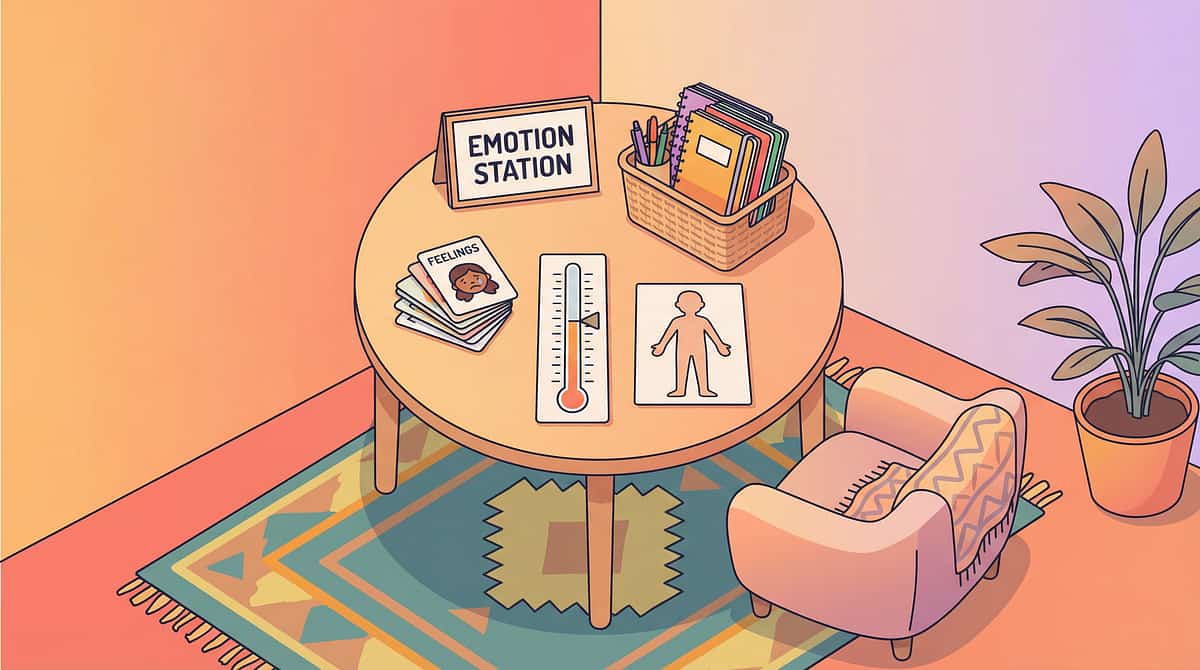
Environment Setup
Set Up Your Emotion Identification Station in 15 Minutes
A dedicated, consistently organised Emotion Station removes friction from daily practice. When everything is in its place, the ritual becomes automatic — for both parent and child.
📌 Wall Station (Child's Eye Level — 90–100cm)
Position 1: Zones of Regulation chart (A3 size)
Position 2: Emotion faces poster (12+ emotions)
Position 3: Feelings thermometer (laminated, dry-erase marker attached)
Position 4: "How am I feeling?" check-in wheel (with movable pointer)
Position 2: Emotion faces poster (12+ emotions)
Position 3: Feelings thermometer (laminated, dry-erase marker attached)
Position 4: "How am I feeling?" check-in wheel (with movable pointer)
🎒 Portable Kit (School / Outings)
6-card emotion starter set (laminated, clip-ring)
Small thermometer card
Zone colour wristband or keychain
Small thermometer card
Zone colour wristband or keychain
🪑 Session Table Setup
Body map outline (fresh each session, or laminated)
2–3 storybooks within reach
Emotion sorting/matching game
Mirror (handheld or freestanding)
Coloured pens/stickers for body map marking
2–3 storybooks within reach
Emotion sorting/matching game
Mirror (handheld or freestanding)
Coloured pens/stickers for body map marking
✅ Environmental Requirements
Quiet — no background TV/music during check-in
Child fed and rested before practice sessions
Consistent location — same spot each day builds ritual
Remove visual distractions from immediate practice area
Child fed and rested before practice sessions
Consistent location — same spot each day builds ritual
Remove visual distractions from immediate practice area
Time Investment: 5–15 minutes per formal session + 3 daily check-ins (1–2 minutes each). Total daily commitment: under 25 minutes — with life-changing potential return.
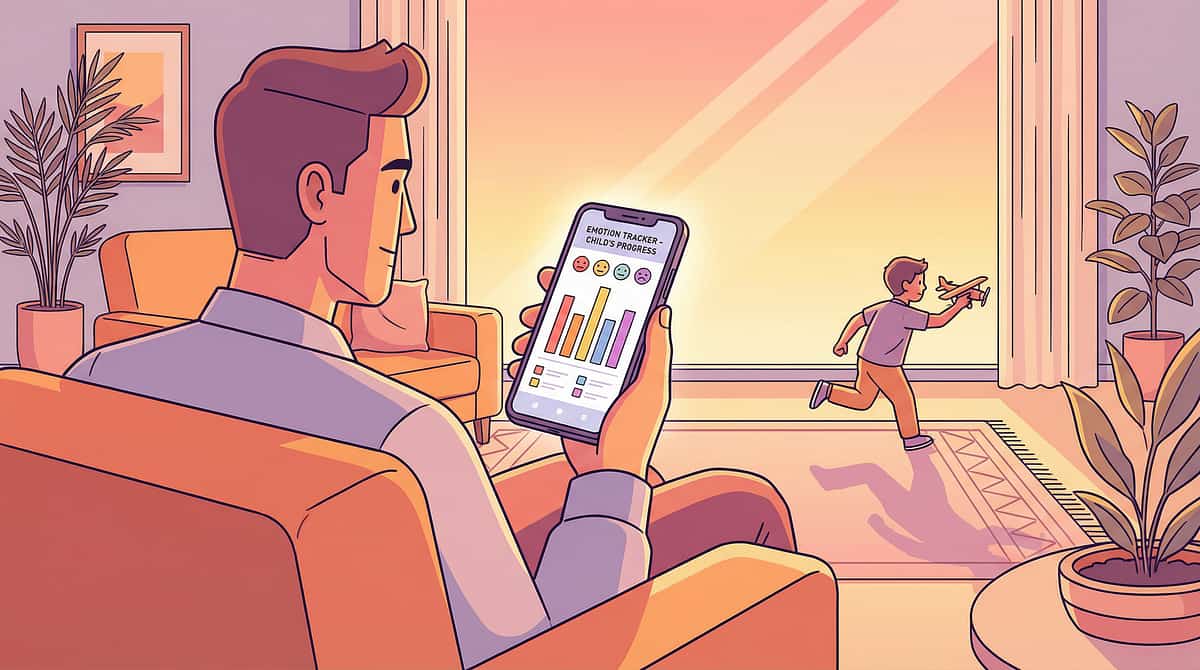
Progress Tracking
What Gets Measured, Gets Developed.
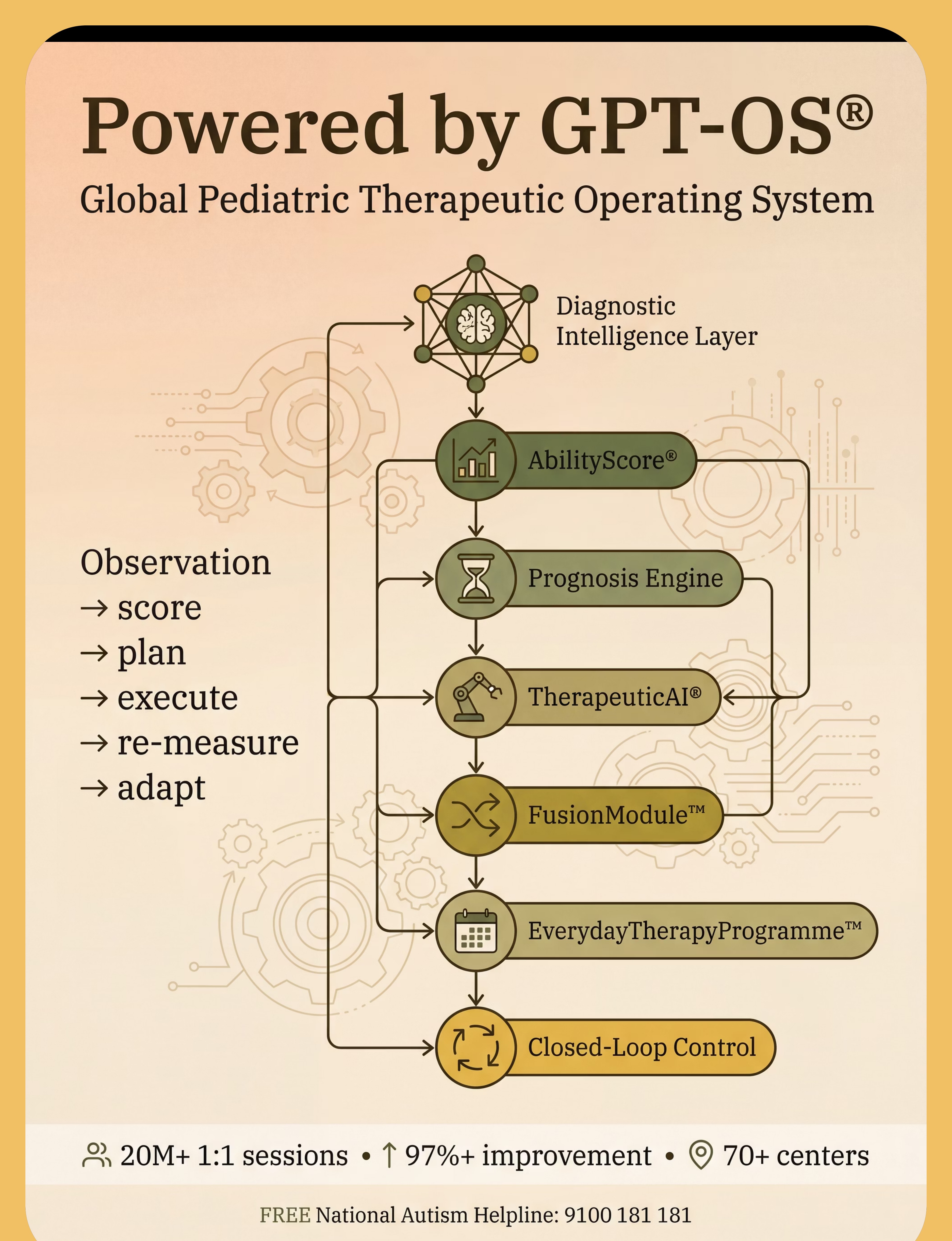
Track your child's emotion identification progress daily. This data flows into GPT-OS® AbilityScore® tracking when enrolled, enabling TherapeuticAI® to adjust your child's programme based on real-world practice patterns from 20M+ sessions.
Date | Material Used | Emotion Named | Support Level | Notes | |
___ | ___ | ___ | Independent / Prompted / Cued | ___ | |
___ | ___ | ___ | Independent / Prompted / Cued | ___ |
🌱 Weeks 1–2
Child tolerates emotion check-in without resistance
🌿 Weeks 3–4
Child points to 2–3 emotion faces with prompting
🌲 Weeks 5–8
Child independently names current emotion using materials
🌳 Weeks 9–12
Child begins identifying emotions in real-time situations
What to track: Which emotion was identified | Which material supported identification | Level of prompting needed | Time elapsed between emotion onset and identification | Child's response to being labelled
📞Need help interpreting your tracking data?
FREE National Autism Helpline: 9100 181 181
Our consortium team reviews your progress data and adjusts the plan — 16+ languages, 24×7
FREE National Autism Helpline: 9100 181 181
Our consortium team reviews your progress data and adjusts the plan — 16+ languages, 24×7

Act III — Execution
Before You Begin Each Session — 60-Second Readiness Check
The readiness check is not optional — it is the first therapeutic decision of every session. A session begun when a child is not ready is unlikely to build skill, and may create negative associations with emotion practice.
✅ GO — All Green
☑ Child has eaten in last 2 hours
☑ Child has slept adequately
☑ Child is NOT currently in crisis
☑ No major transitions in last 30 minutes
☑ Environment is quiet and prepared
☑ Child is showing some interest or willingness
☑ Child has slept adequately
☑ Child is NOT currently in crisis
☑ No major transitions in last 30 minutes
☑ Environment is quiet and prepared
☑ Child is showing some interest or willingness
⚡ MODIFY — Mixed Signals
🔄 Mildly resistant → Use game format instead
🔄 Slightly dysregulated → Start with body scan only (2 min)
🔄 Tired → Shorten to single check-in wheel use
🔄 Very high energy → Begin with physical movement, then check-in
🔄 Slightly dysregulated → Start with body scan only (2 min)
🔄 Tired → Shorten to single check-in wheel use
🔄 Very high energy → Begin with physical movement, then check-in
🛑 POSTPONE — Do Not Proceed
❌ Child currently in meltdown or recovery (within 1 hour)
❌ Child is ill or in pain
❌ Major environmental disruption occurring
❌ Child explicitly refuses — never force emotion work
❌ Family is in crisis or high-stress mode
❌ Child is ill or in pain
❌ Major environmental disruption occurring
❌ Child explicitly refuses — never force emotion work
❌ Family is in crisis or high-stress mode
"Today is a hard day. We'll try our feelings practice tomorrow. Right now, let's just be together."
The best session is one that starts right. A well-prepared 5-minute session far outperforms a forced 15-minute one.

The Home Protocol
The Pinnacle Consortium Home Emotion Identification Protocol
6 steps. 10–15 minutes. Daily. This protocol was designed by the Pinnacle Clinical Consortium drawing on ABA session structure principles, occupational therapy interoception protocols, and the WHO CCD Package home-based structured daily practice model.
STEP 1 — Create the Moment (1 min)
Gather at your Emotion Station. Sit at child's level. No screens. Make this a ritual: "Time for our feelings practice!"
STEP 2 — Body Scan First (2 min)
"Let's notice our bodies. Put your hand on your heart. Is it fast or slow? Is your tummy calm or jumpy? Are your muscles tight or loose?" This activates interoceptive awareness before vocabulary work.
STEP 3 — Check-In (2 min)
Use the emotion wheel or thermometer: "Show me where you are right now." Accept any identification — don't correct. "You said anxious. Tell me more about that."
STEP 4 — Practise With Materials (5 min)
Mon/Wed/Fri: Emotion faces matching + social story. Tue/Thu: Emotion game + mirror practice. Weekend: Body map + check-in wheel + book reading.
STEP 5 — Connect to Real Life (2 min)
"Remember when [recent event]? What zone were you in? What did your body feel like?" This builds generalisation from practice to real emotional experiences.
STEP 6 — Celebrate & Close (1 min)
"You did amazing feelings work today! You named [emotion] — that's your superpower growing." Small sticker or high-five. Make the close warm.
Research basis: ABA session structure principles | OT interoception protocols | WHO CCD Package — PMC9978394 | NCAEP 2020 Evidence-Based Practices

Act IV — Progress Arc
Weeks 1–2: Building the Habit
This phase is about foundation, not performance. You are not yet measuring accuracy — you are measuring engagement, tolerance, and willingness. Every moment your child sits with emotion materials without resistance is a genuine therapeutic win.
15%
Progress Milestone
Weeks 1–2 represent approximately 15% of the journey to independent emotion identification
✅ What Progress Looks Like
Child tolerates check-in without refusal
Child looks at emotion faces cards when presented
Points to any card when asked — even if not accurate
Sits for 5 minutes of emotion practice
One spontaneous mention of a body sensation
Child looks at emotion faces cards when presented
Points to any card when asked — even if not accurate
Sits for 5 minutes of emotion practice
One spontaneous mention of a body sensation
❌ Not Expected Yet (And That's Fine)
Accurate independent emotion identification (this takes weeks)
Real-time identification during actual emotional moments
Using vocabulary spontaneously without prompting
Real-time identification during actual emotional moments
Using vocabulary spontaneously without prompting
"If your child tolerates looking at the emotion faces card for 30 seconds without resisting — that is real, measurable progress. You are building the foundation."
Keep sessions short
5–7 minutes maximum. End before resistance, not after.
Focus on exposure — not accuracy
Familiarity precedes precision. Don't test; practise together.
Use game formats primarily
Lower pressure, higher engagement
This phase can feel slow. Trust the process. You are building neural pathways that cannot be rushed — only practised. Research: PMC11506176 — early-phase indicators focus on tolerance and participation, not skill mastery.

Progress Arc
Weeks 3–4: The Bridge Forms
Something begins to shift in weeks 3 and 4. The habit is forming. The vocabulary is becoming familiar. Parents often notice subtle changes they almost miss — because they're looking for the big breakthrough rather than the quiet emergence of a bridge being built.
40%
Progress Milestone
Consolidation phase — the neural pathways are forming and vocabulary is beginning to anchor
🌿 Consolidation Indicators — What to Watch For
Child begins to anticipate the check-in routine
Correctly identifies 2–3 emotions in pictures with prompting
Uses zone vocabulary occasionally: "I'm yellow" (even without full understanding yet)
Notices ONE body signal spontaneously: "My tummy feels funny"
Parent begins feeling more confident and skillful in the process
Correctly identifies 2–3 emotions in pictures with prompting
Uses zone vocabulary occasionally: "I'm yellow" (even without full understanding yet)
Notices ONE body signal spontaneously: "My tummy feels funny"
Parent begins feeling more confident and skillful in the process
🧠 Subtle Neural Pathway Formation Signs
Child looks at emotion chart during a non-practice moment
Child references a feeling word from a book in conversation
Child seems calmer during emotional episodes
Child can name how a character in a book or TV show is feeling
Child references a feeling word from a book in conversation
Child seems calmer during emotional episodes
Child can name how a character in a book or TV show is feeling
📈 When to Increase Intensity
If child is matching 4+ emotions with prompting → add 2 new emotion words
If child tolerates 10-minute sessions → extend to 12–15 minutes
If child is zone-naming → begin teaching zone-specific strategies
If child tolerates 10-minute sessions → extend to 12–15 minutes
If child is zone-naming → begin teaching zone-specific strategies
"You may notice you've become more emotionally articulate yourself. This practice changes parents too."

Progress Arc
Weeks 5–8: Language Begins to Flow
This is the phase most parents describe as "life-changing." The vocabulary has accumulated. The body awareness is developing. And then — in an ordinary moment, during real emotional experience — your child says something they've never said before.
70%
Progress Milestone
Expansion phase — vocabulary, real-time identification, and generalisation all accelerate
🌲 Vocabulary of 8–12 Emotions
Up from 3–4 at baseline — the vocabulary is genuinely expanding
🌲 Zones System With Minimal Prompting
Can use zone vocabulary more independently across contexts
🌲 Beginning Real-Time Identification
"I'm getting mad" — before the meltdown. That four-second warning changes everything.
🌲 Spontaneous Emotion Words in Conversation
Using emotional vocabulary without being prompted — the skill is generalising
The Real-Time Identification Breakthrough: Around weeks 5–8, many children begin identifying emotions while experiencing them rather than only in retrospect. The child says "I'm frustrated" before the meltdown. That is the moment that changes the entire trajectory of intervention.
Generalisation Targets — Now Introduce: Identify emotions in others (film characters, family members) | Name emotions from memory | Use emotion vocabulary in writing or drawing | Begin "mixed emotions" concept: "Sometimes I feel two things at once."

Celebrating Progress
🌟 Your Child Is Building Something Remarkable.
When your child achieves these mastery milestones, celebrate significantly. Not with excessive pressure or high expectations — but with the kind of warm, specific recognition that tells your child exactly what they have achieved and why it matters.
⭐ First Spontaneous ID
Child names a feeling without being asked → CELEBRATE
⭐ Body Signal Recognition
Child notices body warning before meltdown → CELEBRATE
⭐ Zone Vocabulary
Child says "I'm in yellow" during actual frustration → CELEBRATE
⭐ Vocabulary of 10+
Child uses 10 or more distinct emotion words → CELEBRATE
⭐ Words Instead of Meltdown
Child comes to you and says words instead of escalating → CELEBRATE ENORMOUSLY
"Before, her meltdowns seemed to come from nowhere. After three months of working with emotion faces, body maps, and the feelings thermometer, she came to me and said, 'Mom, I'm at yellow. I'm feeling frustrated and a little bit worried.' Those words — specific, accurate, BEFORE the meltdown — I nearly cried. She could see what was happening inside her."
— Parent, Pinnacle Blooms Network
How to celebrate: Verbal praise naming the specific skill | Document it: photo, journal entry, call a grandparent | Small reward tied to the milestone | Share with the therapy team so they can reinforce it at sessions.
Red Flags & Escalation
These Signs Mean It's Time to Seek Professional Assessment.
Home practice is powerful — and it has limits. Knowing when to escalate is as important as knowing how to practise. These indicators help you make that call confidently.
🔴 Red Flags — Contact Specialist Immediately
Complete inability to identify any internal state after 12+ weeks of consistent practice
Meltdown frequency increasing despite intervention
Signs of significant emotional distress or self-harm linked to emotional overwhelm
Completely non-verbal regarding emotions with regression in communication
Suspected clinical alexithymia, trauma response, or medical contributor
Meltdown frequency increasing despite intervention
Signs of significant emotional distress or self-harm linked to emotional overwhelm
Completely non-verbal regarding emotions with regression in communication
Suspected clinical alexithymia, trauma response, or medical contributor
🟡 Amber Flags — Book a Review Appointment
No progress after 8 weeks of daily practice
Child consistently avoids or refuses emotion identification activities
Existing therapy team is not aligned on the emotion identification approach
School reporting escalating behavioural incidents
Child consistently avoids or refuses emotion identification activities
Existing therapy team is not aligned on the emotion identification approach
School reporting escalating behavioural incidents
🟢 Normal & Expected
Some days worse than others → Normal
Child refuses occasional sessions → Normal, don't force
Progress feels slow → Normal, timeline varies by child
Child refuses occasional sessions → Normal, don't force
Progress feels slow → Normal, timeline varies by child
Pinnacle Assessment Path: AbilityScore® Assessment → Emotional Awareness Readiness Index → Interoception Evaluation → Personalised GPT-OS® EverydayTherapyProgramme™ integration
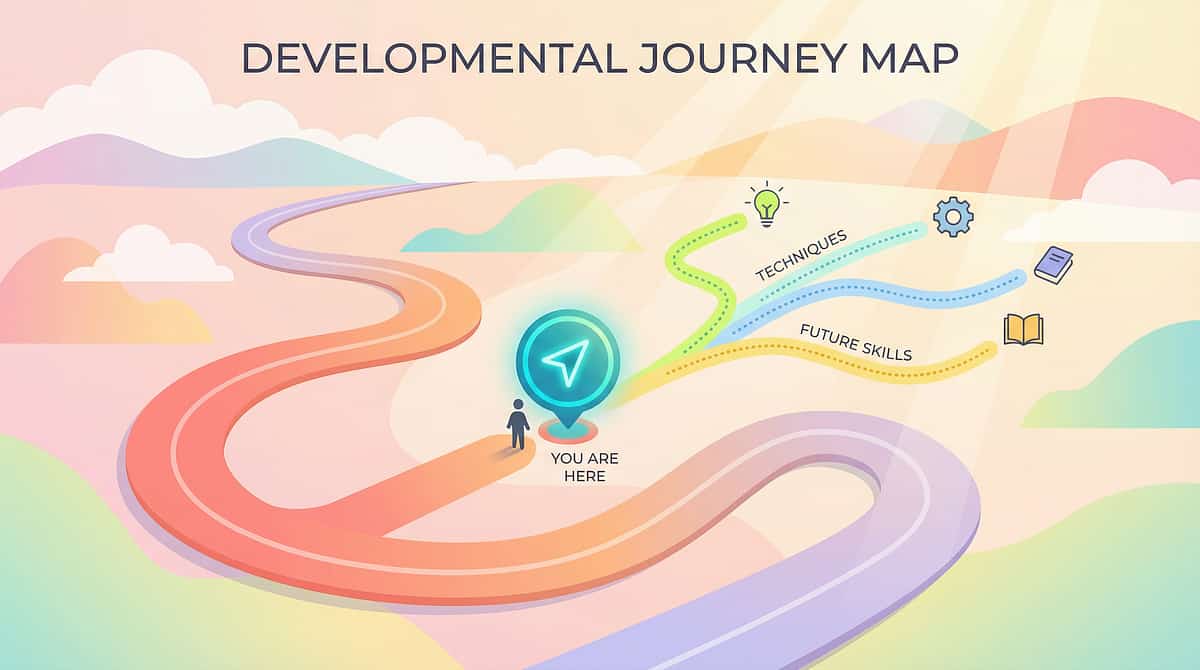
Your Journey Map
This Technique Is One Step in a Larger Journey.
C-249 does not stand alone. It sits within a carefully sequenced progression of emotional development techniques — each building on the one before, each preparing the ground for what comes next. GPT-OS® TherapeuticAI® determines your child's specific sequencing based on their AbilityScore® profile.
🔵 C-247
Understanding Big Emotions
🔵 C-248
Building Emotional Vocabulary
📍 C-249
Identifying Emotions
(YOU ARE HERE)
(YOU ARE HERE)
🟢 C-250
Emotion Regulation After Identification
🟢 C-251
Teaching Coping Strategies
🟢 C-250 — If Identification Is Emerging
Emotion Regulation After Identification — building on what C-249 has established
🟢 C-251 — If Zones Awareness Is Established
Teaching Coping Strategies — the regulation toolkit
🟢 C-252 — If Crisis Management Is Priority
Managing Meltdowns — advanced intervention protocol
🔄 Lateral Alternatives
C-255 Anxiety Recognition (anxiety-primary profile) | C-248 Emotional Vocabulary Deep Dive (vocabulary bottleneck)
Domain C Techniques
More Techniques From the Emotional Regulation Domain
C-249 sits within Domain C of the EverydayTherapyProgramme™. The materials you have already gathered for this technique carry forward into adjacent techniques — your investment compounds across the domain.
Code | Technique | Level | Key Material | |
C-247 | Understanding Big Emotions | 🟢 Intro | Emotion faces | |
C-248 | Building Emotional Vocabulary | 🟢 Intro | Emotion books | |
C-249 | → Identifying Emotions (THIS PAGE) | 🟡 Core | All 9 materials | |
C-250 | Emotion Regulation After Identification | 🟡 Core | Zones + breathing tools | |
C-251 | Teaching Coping Strategies | 🟡 Core | Calming kit | |
C-252 | Managing Meltdowns | 🔴 Advanced | Crisis protocol |
Canon Material Crossover: If you own Emotion Faces Cards and Feelings Thermometer from C-249, you already have core materials for C-247, C-248, and C-250. Your investment in this technique powers the entire domain cluster. 🔗 Browse all Emotional Regulation techniques →
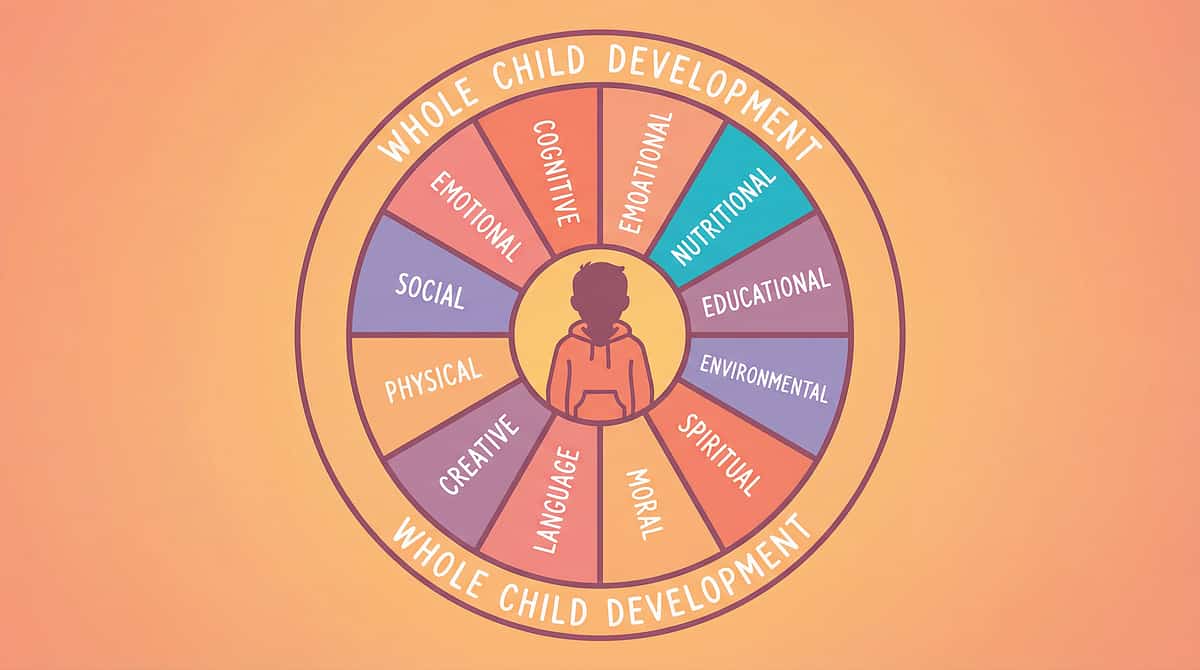
The Complete Developmental Map
C-249 Is One P
iece of Your Child's Complete Developmental Plan.
The EverydayTherapyProgramme™ covers 12 developmental domains, 999 techniques, and every dimension of your child's growth. When enrolled in GPT-OS®, your emotion identification data from C-249 practice sessions integrates with the AbilityScore® Emotional Awareness Readiness Index to coordinate care across your full team.
Domain | Area | Status | |
A | Sensory Processing | — | |
B | Social Communication & Pragmatic Language | — | |
C | Emotional Regulation | ← C-249 (YOU ARE HERE) | |
D | Autism & Behavioural Development | — | |
E | Executive Function | — | |
F | Motor Development | — | |
G | Cognitive & Learning | — | |
H | Communication & Language | — | |
I | Play & Social Interaction | — | |
J | Self-Care & Adaptive Living | — | |
K | Family & Caregiver Support | — | |
L | Transition & Life Readiness | — |
GPT-OS® Integration: FusionModule™ coordinates your OT (body awareness data), SLP (vocabulary data), and BCBA (behavioural data) from a single shared dataset — ensuring your child's full team works from the same evidence.
🔗Request your child's full AbilityScore® assessment → | 📞9100 181 181 — 16+ languages, FREE
Research: WHO/UNICEF Nurturing Care Framework: Five components of nurturing care require holistic developmental monitoring. WHO NCF (2018)
🔗Request your child's full AbilityScore® assessment → | 📞9100 181 181 — 16+ languages, FREE
Research: WHO/UNICEF Nurturing Care Framework: Five components of nurturing care require holistic developmental monitoring. WHO NCF (2018)
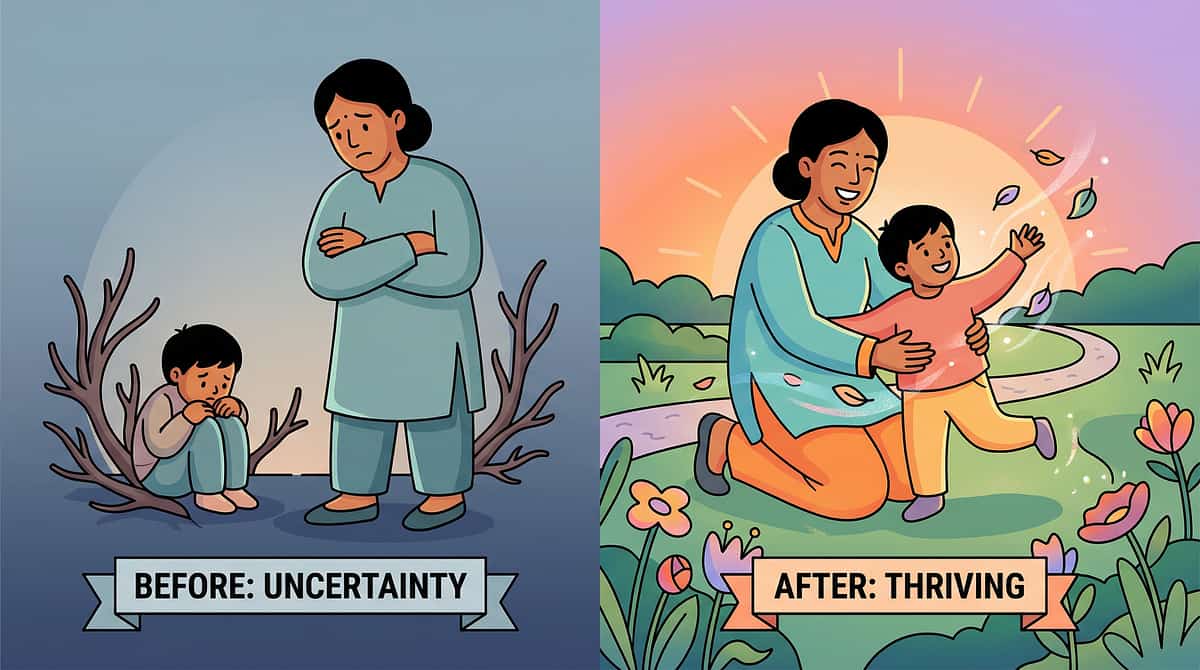
Act V — Community & Ecosystem
Families Who've Been Here.
Illustrative outcomes. Behavioural descriptions based on documented clinical patterns. Individual results vary.
✦ Consortium Seal — all family outcomes reviewed within the Pinnacle clinical governance framework.
Family Vignette 1 — Hyderabad
Before: "Every day started with meltdowns I couldn't predict or prevent. My son could go from playing contentedly to screaming in 90 seconds. When I asked what happened, he said 'I don't know' every single time."
After (12 weeks, all 9 C-249 materials): "He now uses the feelings thermometer every morning. He's started saying 'I'm at a 3, Amma' — which means he's frustrated and building. When he says that, we have a window to intervene. The meltdowns haven't disappeared, but we see them coming now."
After (12 weeks, all 9 C-249 materials): "He now uses the feelings thermometer every morning. He's started saying 'I'm at a 3, Amma' — which means he's frustrated and building. When he says that, we have a window to intervene. The meltdowns haven't disappeared, but we see them coming now."
Family Vignette 2 — Bengaluru
Before: "She pointed randomly at emotion charts — always picking happy even during obvious distress. We couldn't tell if she understood emotions at all."
After (8 weeks of body map practice): "She started saying 'My stomach hurts' and 'My heart is going fast.' She still can't always name the emotion, but she knows something is happening. That body awareness was the missing piece."
After (8 weeks of body map practice): "She started saying 'My stomach hurts' and 'My heart is going fast.' She still can't always name the emotion, but she knows something is happening. That body awareness was the missing piece."
"The moment a child says 'I'm in yellow' — even with no additional words — is a clinical milestone. They have identified their state. They can now receive support. That one sentence changes the entire session dynamic."
— Occupational Therapist, Pinnacle Consortium

Community
Isolation Is the Enemy of Progress. Join the Community.
The families making the fastest progress are not the ones with the most resources — they are the ones who are connected. Connection with other parents who understand reduces isolation, shares strategies, and sustains motivation through the slower phases.
🟢 Pinnacle Parent WhatsApp Community
Join 50,000+ parents navigating emotion identification and emotional development challenges → pinnacleblooms.org/community
📱 Emotion Identification Parent Group
Domain C parents specifically — share strategies, get peer support, celebrate milestones together → Join via Helpline: 9100 181 181
🏠 Local Pinnacle Parent Meetups
In-person parent groups at 70+ Pinnacle centres across India → Find your centre: pinnacleblooms.org/centers
🤝 Peer Mentoring Programme
Connect with an experienced parent who has completed the emotion identification journey — someone who started exactly where you are → Request via helpline: 9100 181 181
"Your experience — every hard day, every breakthrough, every 'I don't know' answered with a feelings card — helps the next family find their way. Consider sharing your journey."
📞9100 181 181 | FREE | 24×7 | 16+ Languages
Research: WHO NCF Community Engagement Principle — parent support networks improve intervention adherence and outcomes. Over 1,000 contributors from 111 countries shaped the Nurturing Care Framework.
Research: WHO NCF Community Engagement Principle — parent support networks improve intervention adherence and outcomes. Over 1,000 contributors from 111 countries shaped the Nurturing Care Framework.
Professional Support
Home Practice Works Best When Professional Therapy Runs Alongside It.
The research is clear: home practice combined with professional therapeutic input produces significantly better outcomes than either alone. Here is who to see, and what to request at your first appointment.
🟠 Occupational Therapist (OT)
For interoception assessment and body-emotion connection training
🔵 Speech-Language Pathologist (SLP)
For emotional vocabulary development and communication support
🟢 BCBA / ABA Therapist
For structured emotion identification practice protocols and data collection
🟡 Special Educator
For classroom integration and school-home consistency in approach
🔴 NeuroDevelopmental Pediatrician
For diagnostic assessment including alexithymia screening and medical contributors
📋 What to Request at First Appointment
• AbilityScore® assessment
• Emotional Awareness Readiness Index baseline
• Interoceptive awareness evaluation
• C-249 home programme integration guidance
• Emotional Awareness Readiness Index baseline
• Interoceptive awareness evaluation
• C-249 home programme integration guidance
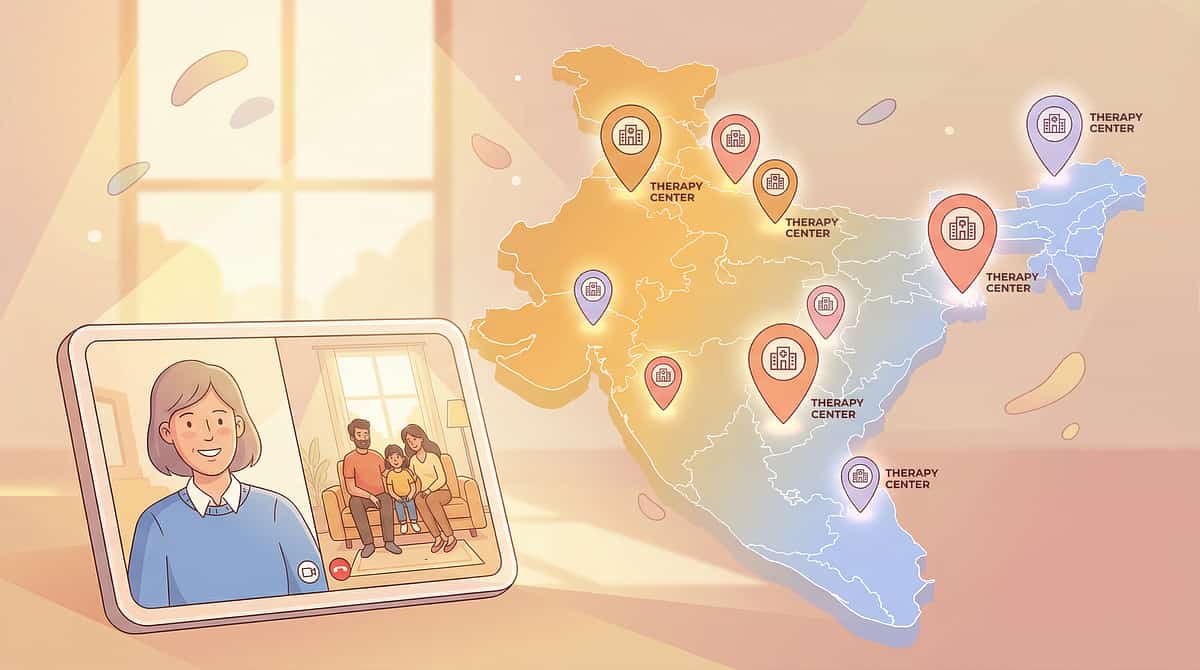
📍 Find Your Nearest Centre
70+ centres across India — Andhra Pradesh, Telangana, Karnataka, Tamil Nadu, Maharashtra, and more.
Teleconsultation available for families not near a Pinnacle centre. 📞9100 181 181 | Book via helpline
Teleconsultation available for families not near a Pinnacle centre. 📞9100 181 181 | Book via helpline
Research: Meta-analysis confirms 1:1 individual treatment sessions are most effective. Professional + home combination maximises outcomes. PMC10955541
Research Library
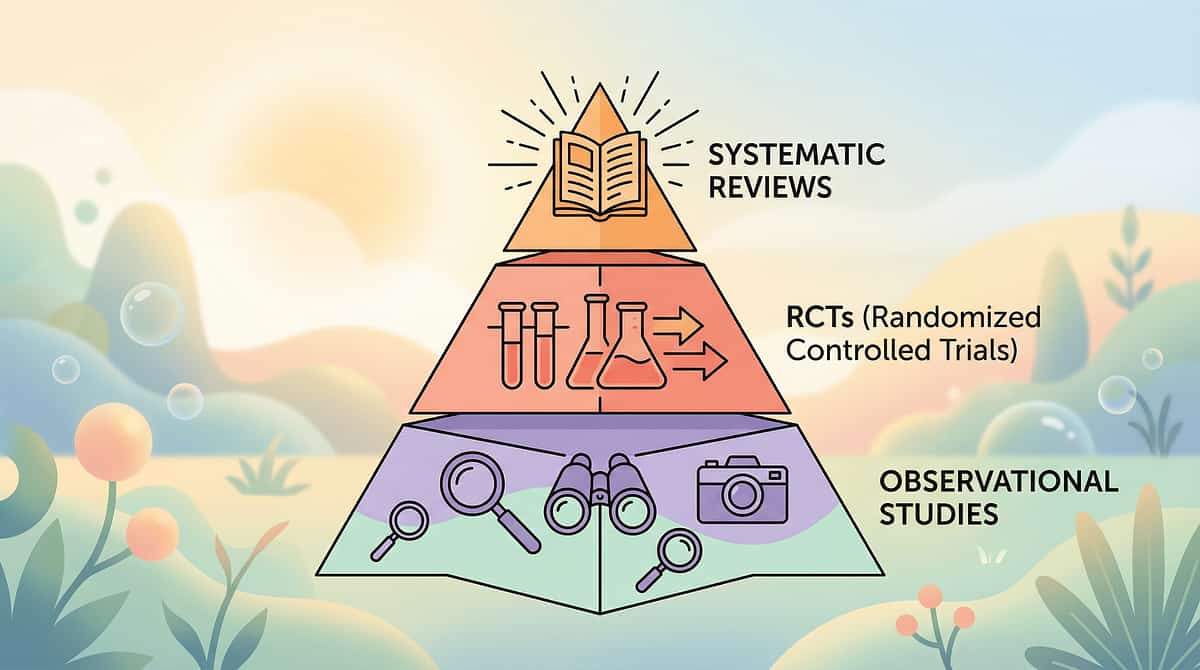
The Science Behind C-249.
For the curious parent and the referring professional. Every technique page in the Pinnacle ecosystem is built on peer-reviewed evidence, systematically reviewed by the clinical consortium.
🔬 Systematic Review — Highest Evidence
PRISMA Systematic Review (2024) — 16 articles, 2013–2023
"Sensory integration and emotion-based interventions meet criteria as evidence-based practice for children with ASD."
📎 PMC11506176
"Sensory integration and emotion-based interventions meet criteria as evidence-based practice for children with ASD."
📎 PMC11506176
🔬 Meta-Analysis
World Journal of Clinical Cases (2024) — 24 studies
"Emotion-focused therapy promotes social skills, adaptive behaviour, sensory processing, and motor skills."
📎 PMC10955541
"Emotion-focused therapy promotes social skills, adaptive behaviour, sensory processing, and motor skills."
📎 PMC10955541
🔬 RCT — Indian Context
Padmanabha et al., Indian Journal of Pediatrics (2019)
"Home-based parent-delivered structured interventions demonstrate significant outcomes for Indian children."
📎 DOI: 10.1007/s12098-018-2747-4
"Home-based parent-delivered structured interventions demonstrate significant outcomes for Indian children."
📎 DOI: 10.1007/s12098-018-2747-4
🔬 International Framework
WHO Care for Child Development (CCD) Package (2023)
Implemented in 54 low- and middle-income countries. Age-specific parent-delivered developmental interventions.
📎 PMC9978394
Implemented in 54 low- and middle-income countries. Age-specific parent-delivered developmental interventions.
📎 PMC9978394
🔬 Consensus Guidelines
NCAEP Evidence-Based Practices Report (2020)
Video modelling and social narrative-based approaches classified as evidence-based for autism.
📎 ncaep.fpg.unc.edu | CASEL: casel.org | Zones of Regulation: Leah Kuypers
Video modelling and social narrative-based approaches classified as evidence-based for autism.
📎 ncaep.fpg.unc.edu | CASEL: casel.org | Zones of Regulation: Leah Kuypers
GPT-OS® Technology
Your Home Practice Generates Intelligence. That Intelligence Improves Your Child's Plan.
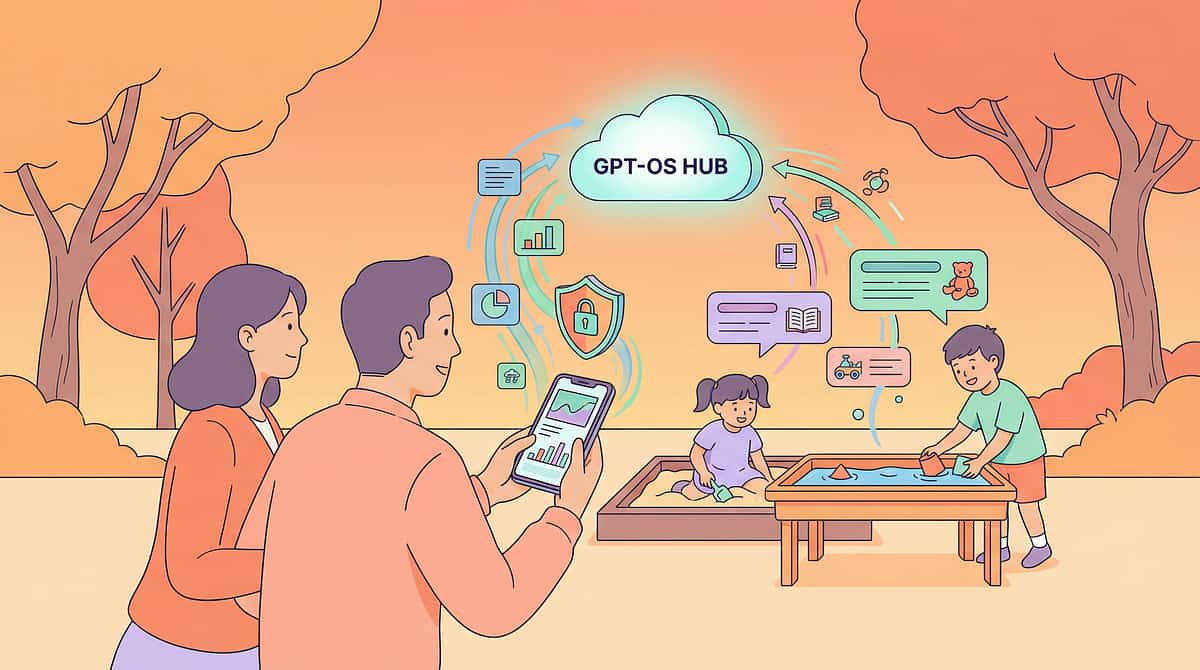
GPT-OS® — the Global Pediatric Therapeutic Operating System — is the engine that connects your daily home practice data to your child's professional therapy team, enabling a level of personalisation previously available only to families with direct access to large multi-disciplinary teams. AbilityScore® profiles from 20M+ sessions power every recommendation.
What GPT-OS® Learns From C-249 Data
Which of the 9 materials is most effective for this specific child
Emotion identification accuracy trajectory
Interoceptive awareness development rate
Optimal check-in timing for this child's schedule
When to advance to emotion regulation techniques (C-250)
Emotion identification accuracy trajectory
Interoceptive awareness development rate
Optimal check-in timing for this child's schedule
When to advance to emotion regulation techniques (C-250)
Privacy & Security
All data processed under ISO/IEC 27001 Information Security standards. Parent data never sold. Child data used only to improve that child's plan.
"Your data helps every child like yours — as population-level patterns inform TherapeuticAI® recommendations for families across 70+ countries."

Episode 249 — Video
Watch: 9 Materials That Help Identifying Emotions
Episode 249 | Emotional Development & Regulation Series
This Reel is part of the 999 Reels Master — the Pinnacle Blooms content system covering all 999 intervention techniques across 12 developmental domains. Each Reel surfaces one specific challenge and its 9 most effective materials.
📹 Emotion Faces Cards — The Recognition Moment
Watch a child encounter a card that matches exactly how they feel — and see it dawn on their face
📹 Feelings Thermometer in Use
A child pointing to their current level — catching themselves at a 3 before reaching a 5
📹 Zones of Regulation — Identifying a Zone
The moment a child says "I'm in yellow" for the first time, unprompted
📹 Body Map Practice
Marking where feelings are felt in the body — building the interoceptive bridge
📹 Emotion Vocabulary Book Reading
Parent and child reading together — the vocabulary being gently absorbed through story
Multi-Modal Learning: Research confirms that multi-modal content (video + text + demonstration) improves parent skill acquisition. Watch the Reel, then use this web guide for deeper implementation support. NCAEP (2020): Video modelling is evidence-based practice for autism.
🔗 View Reel: pinnacleblooms.org/reels/C-249 | → Share on WhatsApp | Instagram | Facebook
🔗 View Reel: pinnacleblooms.org/reels/C-249 | → Share on WhatsApp | Instagram | Facebook

Share With Your Family
Consistency Across Caregivers Multiplies Impact.
If only one person executes this technique, you get partial results. When everyone — both parents, grandparents, school teacher — uses the same language and the same tools, the child's nervous system receives consistent signals and learns faster. Consistency is not a nice-to-have. It is a therapeutic requirement.
For Grandparents — 3 Simple Points
1. When [child's name] seems upset and can't say why — that's normal. They genuinely don't know yet.
2. Show them the feelings card or thermometer: "Which one looks like how you feel?"
3. Accept whatever they say. Don't correct. Say: "Thank you for telling me."
2. Show them the feelings card or thermometer: "Which one looks like how you feel?"
3. Accept whatever they say. Don't correct. Say: "Thank you for telling me."
School Teacher Communication Template
"[Child's name] is currently working on emotion identification skills using the Zones of Regulation system. Please use zone vocabulary ('which zone are you in?') rather than 'how are you feeling?' during the school day. Daily check-in at morning arrival would be greatly appreciated. Please contact us if you'd like more information."
Research: WHO CCD Package — multi-caregiver training is critical for intervention generalisation and maintenance. PMC9978394

Act VI — Close & Loop
Frequently Asked Questions
Your questions, answered by the Pinnacle Consortium — drawing on 20M+ therapy sessions and the expertise of OT, SLP, BCBA, SpEd, and NeuroDevelopmental Pediatrics specialists.
Why can't my child just tell me how they feel?
Many children, especially those with autism or ADHD, have interoceptive processing differences — they don't perceive the early stages of emotional arousal. They genuinely don't know. Emotion identification is a teachable skill, not an innate ability. The materials on this page build it systematically.
My child points randomly at emotion cards — are they learning anything?
Yes. Random pointing is engagement, which is the first step. Over weeks of practice, accuracy improves. Never correct random pointing — accept it and gently say "You chose worried. Tell me about that." Accuracy follows exposure.
We've been practising for 4 weeks with no progress. Is this working?
Four weeks is early. If you see (a) less resistance to practice, (b) any spontaneous emotion-related comment, or (c) any body sensation mention — progress is happening. If zero change after 8–10 weeks, contact 9100 181 181 for a review.
Which material should we start with?
Start with Emotion Faces Cards + daily check-in routine. These two together are the foundation. Add one new material every 1–2 weeks.
Can these materials work for non-verbal children?
Yes — all 9 materials are accessible to non-verbal children through pointing, gesturing, or alternative communication supports. Body maps and zone identification work without verbal output.
My child knows emotion words but can't identify them in real-time. Is this the right technique?
Yes. Knowing words and identifying in real-time are different skills. This technique builds the real-time identification pathway through body awareness training and consistent check-in practice.
How long until I see results?
Most families report first spontaneous emotion identification (with support) at 4–6 weeks. Real-time identification often emerges at 8–12 weeks of daily practice.
My child's school doesn't use these approaches. What do I do?
Use the teacher communication template on the previous card. Request a meeting. Connect via 9100 181 181 for a school consultation letter from the Pinnacle Consortium.
📞Didn't find your answer? Ask GPT-OS®: pinnacleblooms.org/ask | Book a teleconsultation: 9100 181 181

Your Next Step
You Now Know Everything You Need to Begin.
The only thing between your child and the ability to name their feelings is consistent daily practice — starting today. Every day without these tools is a day your child experiences emotions they cannot name. You have found the path. The first step is the check-in wheel on the wall — it takes 10 minutes and costs ₹0.
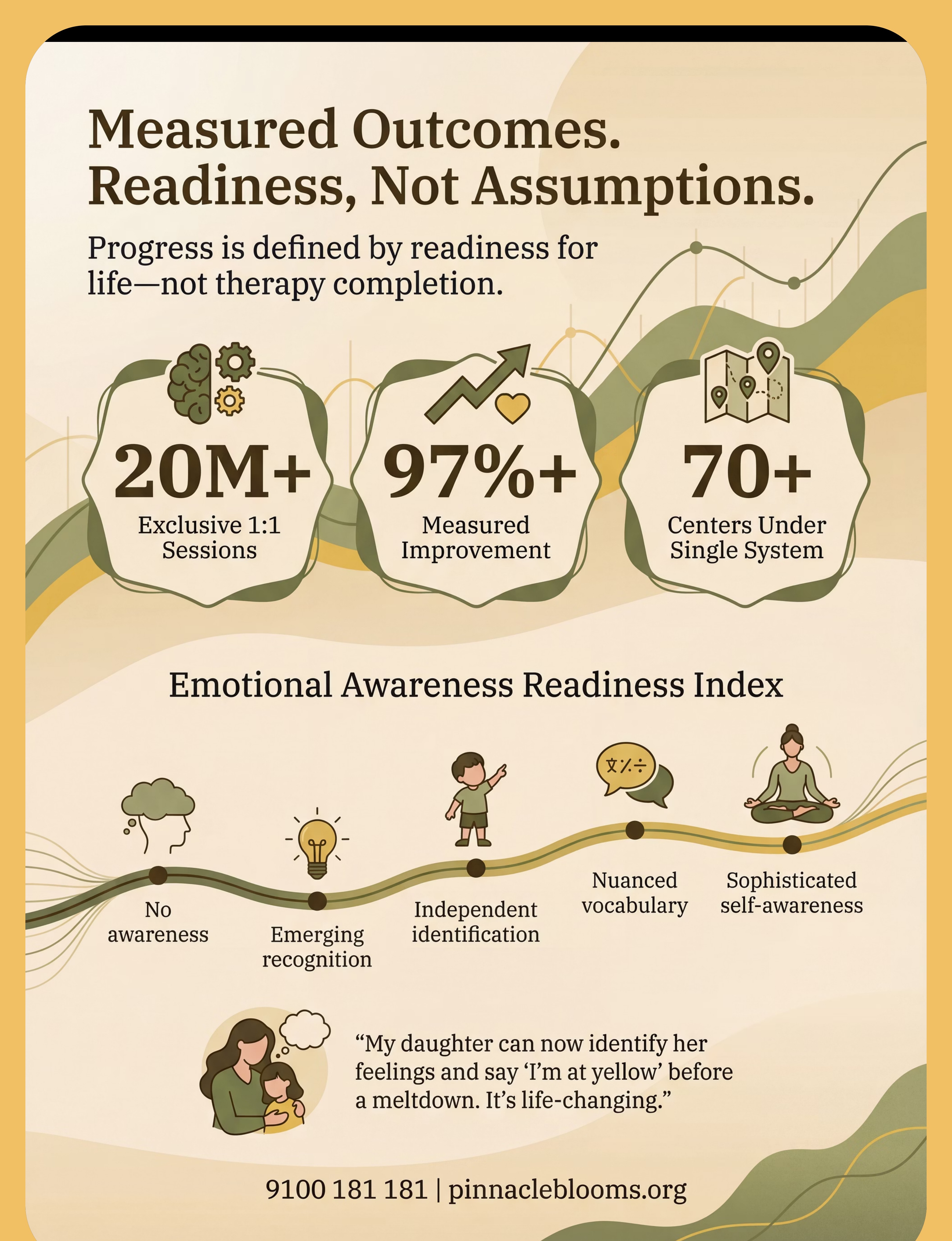
20M+
Therapy Sessions
Powering GPT-OS® recommendations
97%+
Measured Improvement
Across the Pinnacle Network
70+
Centres
Across India | 70+ countries served
✦ Consortium Promise: Every resource on this page is reviewed by our clinical consortium — OT, SLP, BCBA, SpEd, and NeuroDevelopmental Pediatrics. This is not generic parenting advice. This is therapeutic infrastructure, delivered to your home.
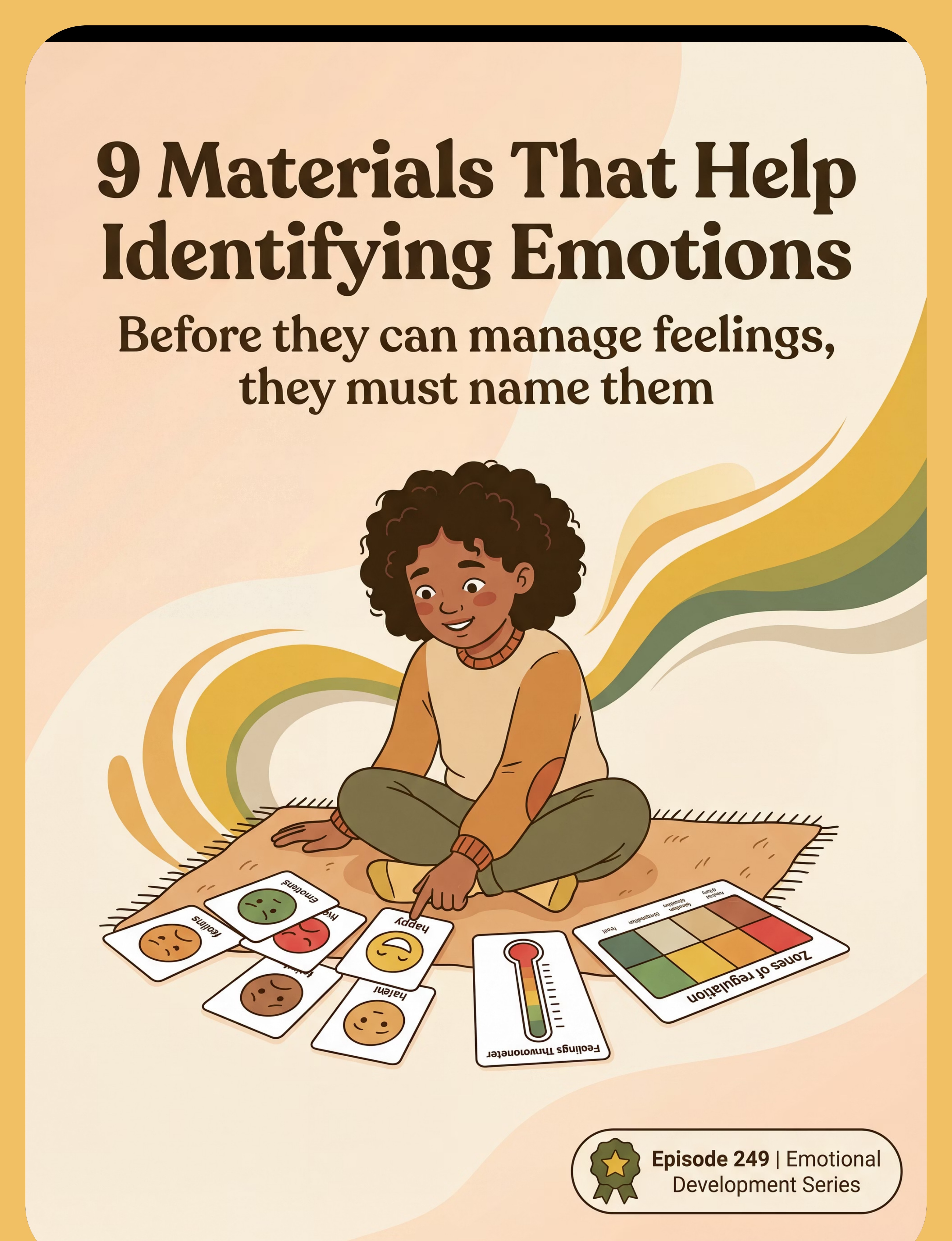
Preview of 9 materials that help identifying emotions Therapy Material
Below is a visual preview of 9 materials that help identifying emotions therapy material. The pages shown help educators, therapists, and caregivers understand the structure and content of the resource before use. Materials should be used under appropriate professional guidance.


Link copied!
Pinnacle Blooms Network®
Built by Mothers. Engineered as a System.
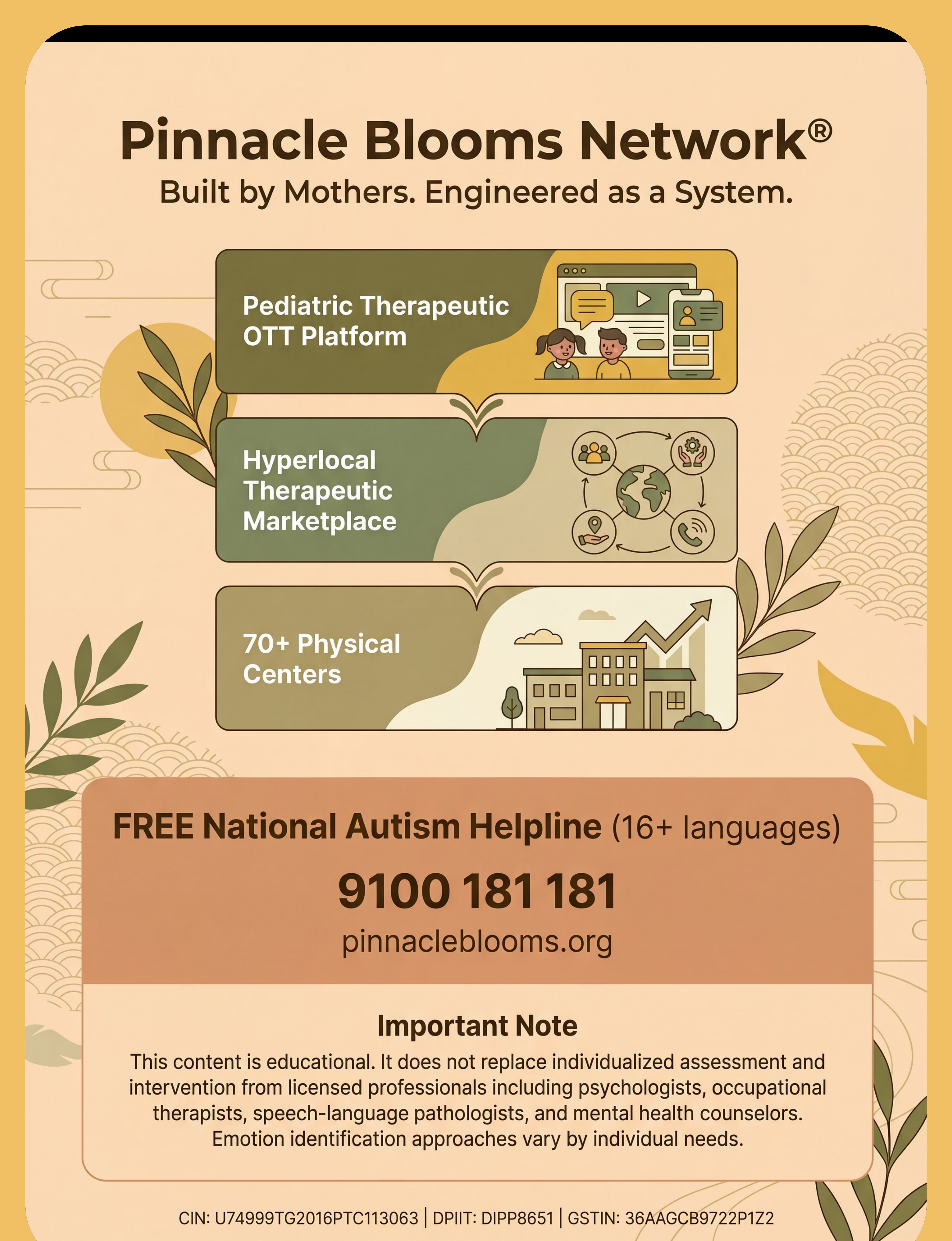
Every technique page in the Pinnacle ecosystem — all 70,000+ of them — is built on the same foundation: the conviction that every child, regardless of diagnosis, geography, or economic status, deserves access to the same evidence-based therapeutic expertise that reaches children at India's premier autism centres. This page was reviewed by our full clinical Consortium. It is connected to 20 million real therapy sessions. It is powered by GPT-OS® — the Global Pediatric Therapeutic Operating System. It was made for your child.
🖥️ Pediatric Therapeutic OTT Platform
On-demand therapy guidance — accessible anywhere, any time
🛒 Hyperlocal Therapeutic Marketplace
Verified therapists, materials, and programmes
🏠 70+ Physical Centres
Operating under GPT-OS® standards across India
FREE National Autism Helpline: 9100 181 181
16+ Languages | Available 24×7 | Always Free
pinnacleblooms.org | care@pinnacleblooms.org
16+ Languages | Available 24×7 | Always Free
pinnacleblooms.org | care@pinnacleblooms.org
→ Continue the emotional development journey:
C-250: Emotion Regulation After Identification
"You've learned to name the feeling. Now learn to work with it."
C-250: Emotion Regulation After Identification
"You've learned to name the feeling. Now learn to work with it."
This content is educational. It does not replace individualised assessment and intervention from licensed professionals including psychologists, occupational therapists, speech-language pathologists, and mental health counsellors. Emotion identification approaches vary by individual needs. Individual results may vary. Statistics represent aggregate outcomes across the Pinnacle Blooms Network.
Statutory Identifiers: CIN: U74999TG2016PTC113063 | DPIIT: DIPP8651 | MSME: TS20F0009606 | GSTIN: 36AAGCB9722P1Z2
© 2025 Pinnacle Blooms Network®, unit of Bharath Healthcare Laboratories Pvt. Ltd. All rights reserved. GPT-OS®, AbilityScore®, TherapeuticAI®, FusionModule™, EverydayTherapyProgramme™ are proprietary marks of Pinnacle Blooms Network®.
#EmotionIdentification
#FeelingsVocabulary
#EmotionalLiteracy
#ZonesOfRegulation
#Interoception
#AutismEmotions
#NameItToTameIt
#PinnacleBlooms