

She knows what Yellow Zone means. But she can't feel it coming.
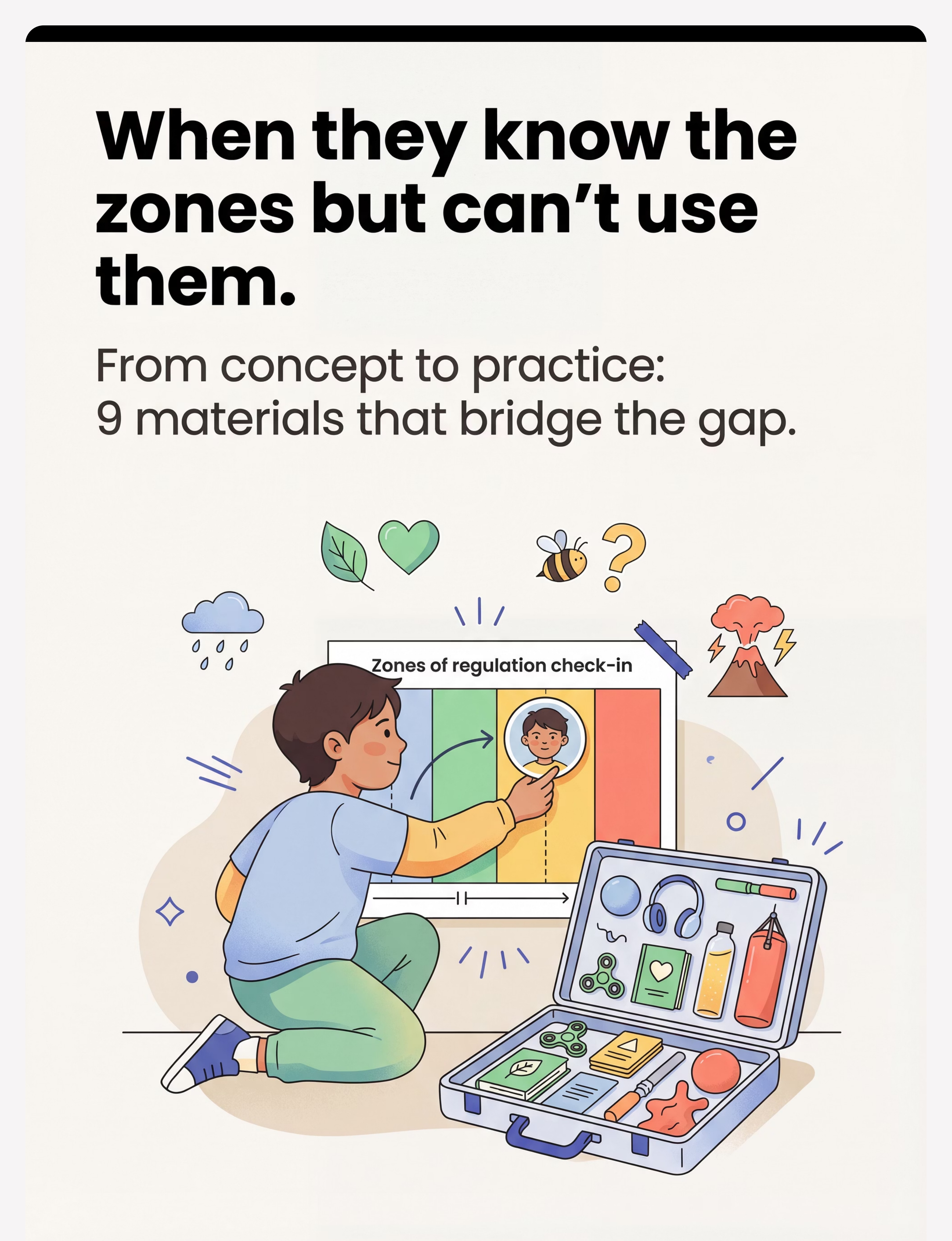
Your daughter can recite every zone color. She cannot stop herself from exploding. This is not a knowledge problem — it's a body-awareness problem. These 9 materials fix exactly that.

YOU ARE NOT ALONE
This is not rare. This is not your parenting. These are the global numbers.
80%
Interoceptive Gap
Of children with autism experience difficulty connecting conceptual emotional knowledge to felt body experience — PRISMA Systematic Review, 2024 (PMC11506176)
1 in 36
Children in India
Meet diagnostic criteria for autism spectrum disorder — emotional regulation difficulties present in the majority (WHO Global Burden of Disease | INCLEN India Prevalence Data)
21M+
Therapy Sessions
Delivered across the Pinnacle Network have shown Zones of Regulation materials are among the top 5 most requested by families navigating emotional dysregulation (Pinnacle GPT-OS® Real-World Evidence, 2024)
💡The Core Insight: Zones of Regulation is a conceptual framework that works brilliantly — but only when a child can connect the color categories to their actual internal body signals. That connection is called interoception. These 9 materials build that connection.

The zone framework lives in the prefrontal cortex. The body signals live in the insula. For many children, these two regions aren't talking to each other.
The Prefrontal Cortex
This is where your child stored the zone definitions. Blue = tired. Green = calm. Yellow = anxious. Red = explosive. This learning is intact. She knows this.
The Insular Cortex
This is where the body's internal signals are processed — heart rate, muscle tension, stomach butterflies, face heat. In many children with autism, ADHD, and sensory processing differences, this pathway is underactive or poorly calibrated.
The Result
A child can be moving from Green to Yellow — heart rate climbing, shoulders tensing — and the insular cortex never sends that signal to the prefrontal cortex. There is no internal alarm. Red Zone arrives without announcement.
What these 9 materials do
They create external versions of the signals the insular cortex is missing. They make the invisible visible — building the bridge between body and zone language until the internal pathway strengthens.
⚡This is a wiring difference, not a behavior choice. Your child is not choosing to ignore early warning signs. She genuinely cannot feel them. Yet. Interoception is trainable. These materials are the training equipment.
Mahler, K. (2017). Interoception: The Eighth Sensory System. AAPC Publishing. Frontiers in Integrative Neuroscience (2020): DOI: 10.3389/fnint.2020.556660

DEVELOPMENTAL CONTEXT
Interoceptive awareness develops across childhood. Your child is not behind — she is at a specific waypoint. Here's the map.
Age 2–3
First body signal awareness: hunger, pain, basic tiredness
Age 3–5
Emotion-body connection begins: "I feel butterflies when scared"
Age 5–7
Zone identification in others: "That character looks angry"
Age 6–8 ← Most children with interoceptive differences are here
Self-identification with adult prompting
Age 8–10
Visual-supported self-identification; strategies with reminders
Age 10–12
Automatic zone awareness; self-initiated strategy use
Age 12+
Proactive self-regulation; anticipates zone changes
📍Your child may be here: Knows zones conceptually but cannot self-identify in the moment. This is a well-mapped developmental position with a clear pathway forward. These materials move her along the timeline.
Common co-occurring challenges at this waypoint: Alexithymia (difficulty identifying emotions in self) — present in ~50% of autistic individuals; sensory processing differences; executive function gaps; anxiety that is not yet named but is physiologically active. WHO CCD Package references: PMC9978394 | WHO/UNICEF CCD Package (2023)

EVIDENCE GRADE
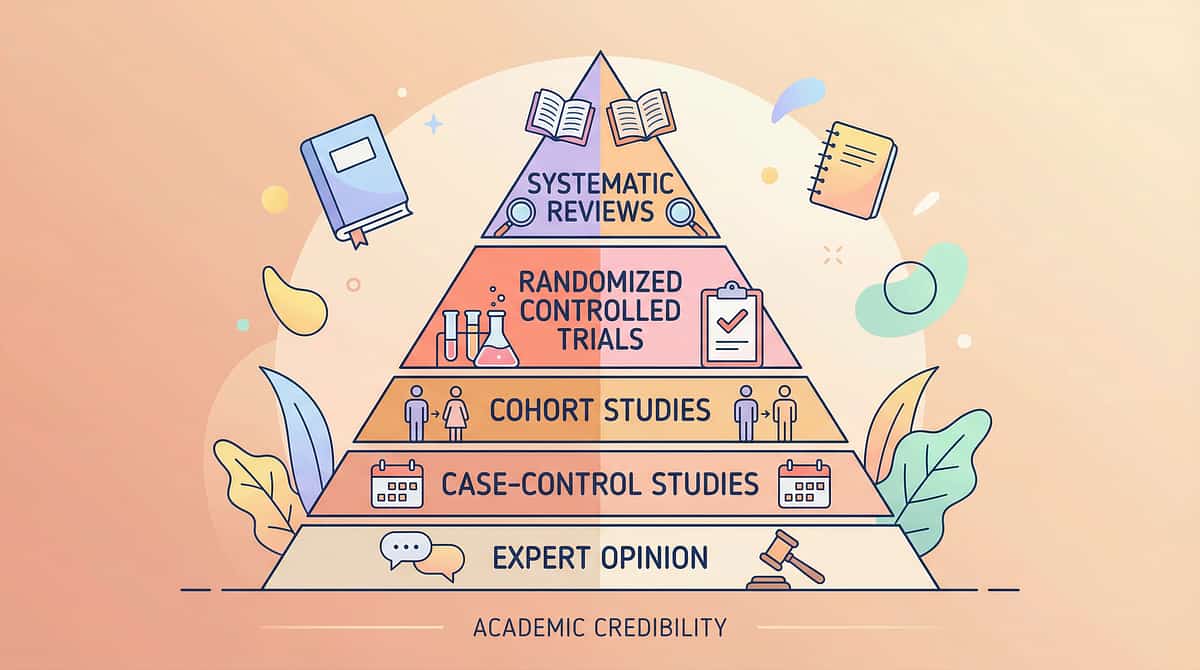
🏆 Level I — Systematic Review Evidence
Zones of Regulation + Interoception Intervention for Pediatric Emotional Regulation
Study | Finding | Source | |
PRISMA Systematic Review (2024) | Sensory integration and emotional regulation interventions meet evidence-based practice criteria for ASD | ||
Meta-analysis, World J Clin Cases (2024) | 24 studies confirm effective promotion of social skills, adaptive behavior, and emotional regulation | ||
Mahler Interoception Research (2017–2023) | Interoception training measurably improves emotional self-awareness and zone identification | AAPC Publishing | |
Indian RCT, Indian J Pediatr (2019) | Home-based sensory/regulatory interventions demonstrated significant outcomes in Indian pediatric population | ||
NCAEP Evidence-Based Practices (2020) | Visual supports + structured regulation curricula classified as evidence-based practice for autism |
Evidence Confidence
Clinically validated. Home-applicable. Parent-proven.
"Children who could not self-identify their emotional state with only verbal prompting showed measurable improvement in zone awareness when supported by concrete visual and sensory materials." — Consolidated from Pinnacle GPT-OS® Clinical Evidence Base
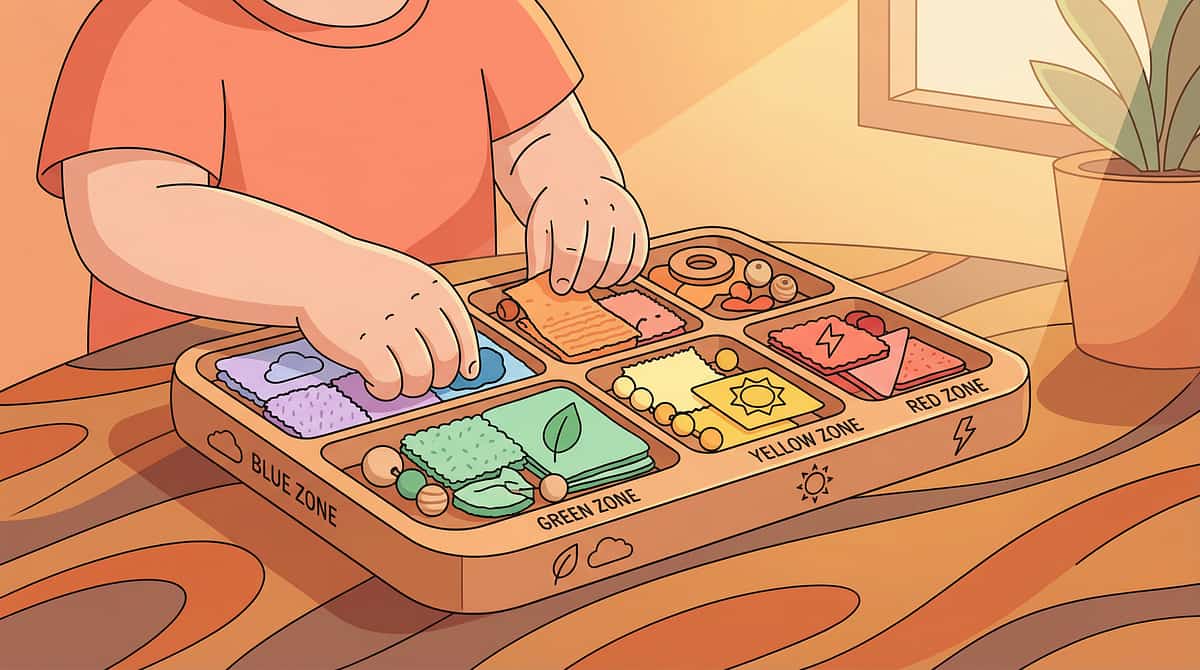
TECHNIQUE C-272
Zones of Regulation — Material-Supported Implementation
"Making feelings visible so your child can finally use what they know"
Definition: The Zones of Regulation (Kuypers, 2011, OTR/L) organizes emotional and physiological states into four color-coded categories: Blue (low energy: tired, sad, sick, bored), Green (regulated: calm, focused, ready to learn), Yellow (heightened: anxious, frustrated, excited, silly), and Red (extreme: angry, terrified, out of control). This technique bridges the space between knowing the zones and feeling them in the body in real time — making zone identification concrete, strategy access physical, and self-regulation genuinely achievable.
Domain C
Emotional Regulation
Interoception
Body awareness training
Executive Function
Self-monitoring skills
Age Range
4–14 years
Session Duration
10–20 min
Frequency
Daily check-ins + as needed

THE CONSORTIUM AT WORK
Five disciplines. One unified framework. Because your child's emotional regulation doesn't respect therapy boundaries.
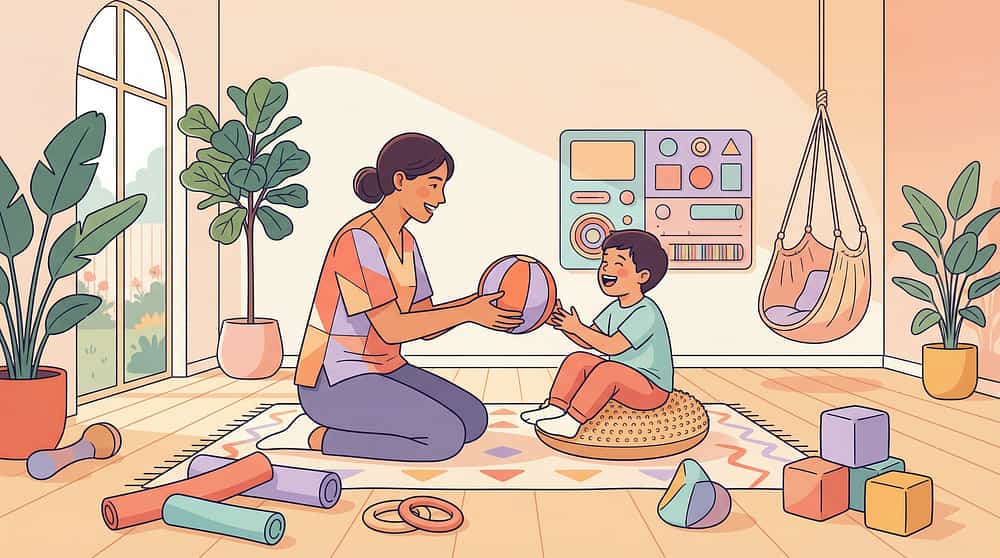
🔷 Occupational Therapist (OT) — Primary Lead
Assesses interoceptive processing, develops individualized body awareness activities, designs zone-organized toolkit with sensory tools matched to the child's sensory profile. Manages the calm-down corner environment.
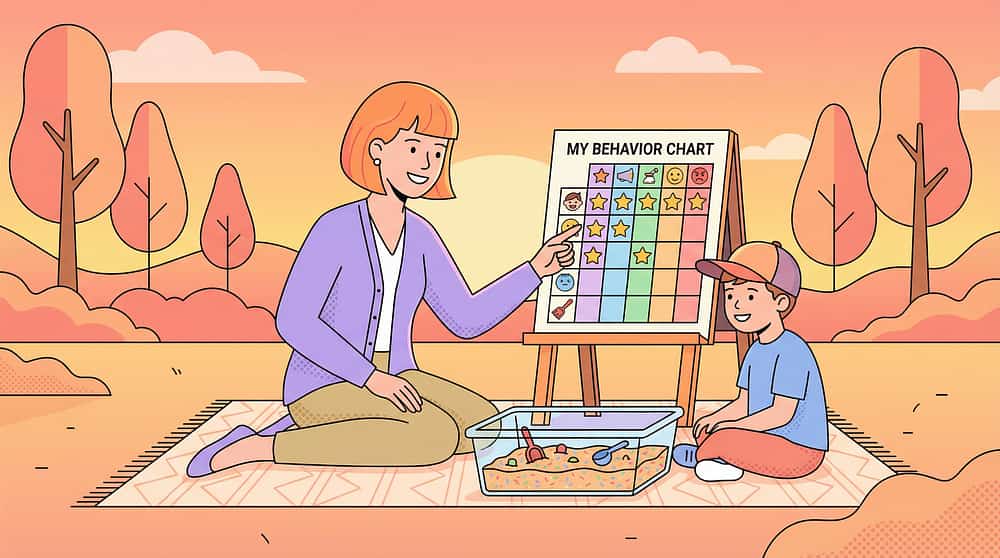
🟢 ABA/BCBA Therapist — Behavior Architecture
Designs reinforcement schedules to reward zone check-in behavior, tracks escalation data, builds antecedent modifications, and programs self-management routines for strategy access.

🔵 Speech-Language Pathologist (SLP) — Language of Emotions
Builds the emotional vocabulary that zone identification requires — sensation words, body signal language, and communication strategies for expressing zone state ("I need a break," "I'm in yellow").
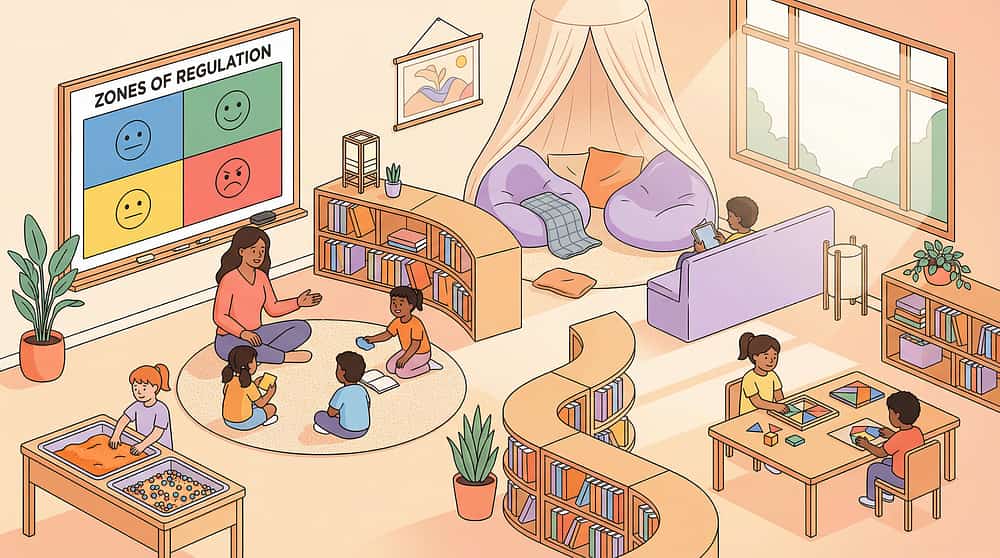
🟡 Special Educator (SpEd) — Classroom Integration
Implements zone check-in boards in learning environments, adapts academic demands to zone state, creates school-home consistency, and trains all educational staff in zone language.

🔴 NeuroDevelopmental Pediatrician — Clinical Oversight
Monitors for alexithymia, assesses autonomic nervous system function, rules out medical contributors, coordinates with mental health professionals when anxiety or trauma are co-occurring.
"This technique crosses therapy boundaries because the brain doesn't organize by therapy type. OT, ABA, SLP, SpEd, and NeuroDev all converge here — under GPT-OS® FusionModule™ coordination."

THERAPEUTIC TARGETS
What C-272 is designed to build — from the inside out.
Target | What You'll See | Indicator | |
Zone self-identification | Child moves check-in marker independently | ✅ Observable | |
Interoception developing | Child says "my tummy feels tight" before meltdown | ✅ Observable | |
Strategy access | Child reaches for toolkit without being told | ✅ Observable | |
Early warning | Meltdowns begin to have observable precursors | ✅ Observable | |
Emotional vocabulary | Child uses more words than "fine" or "bad" | ✅ Observable |
Meta-analysis (PMC10955541): Emotional regulation interventions effectively promote adaptive behavior, social skills, and self-regulation across 24 studies.
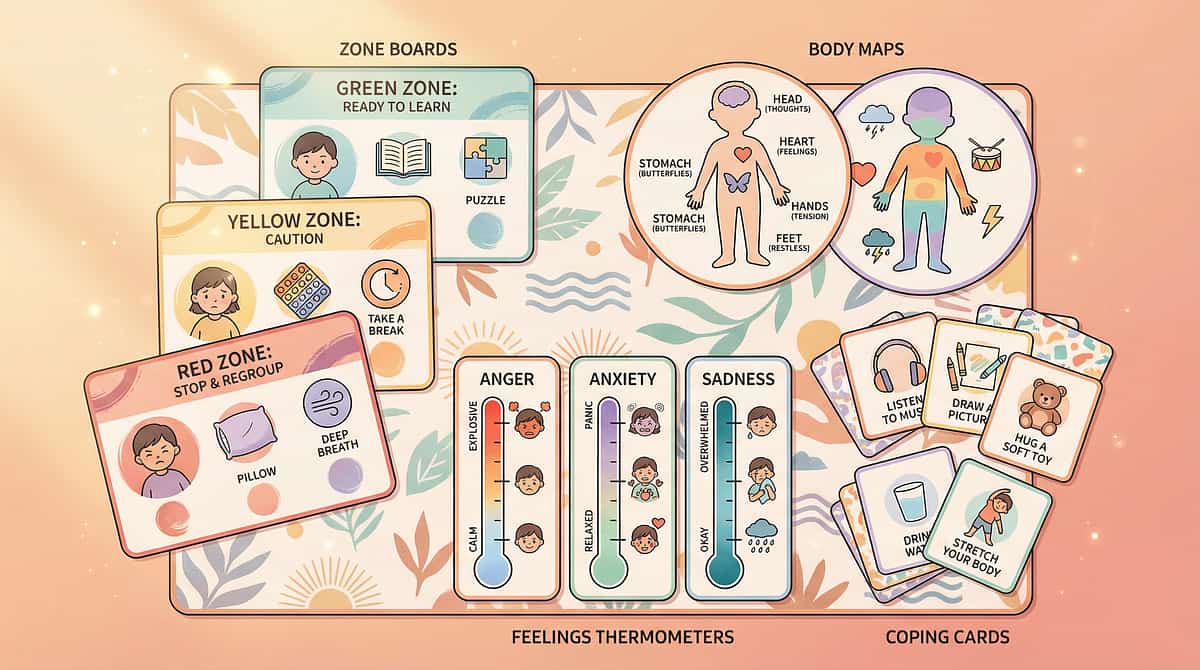
9 CLINICAL MATERIALS
From concept to practice. Each material builds a different piece of the bridge between knowing zones and living them.
Material 1
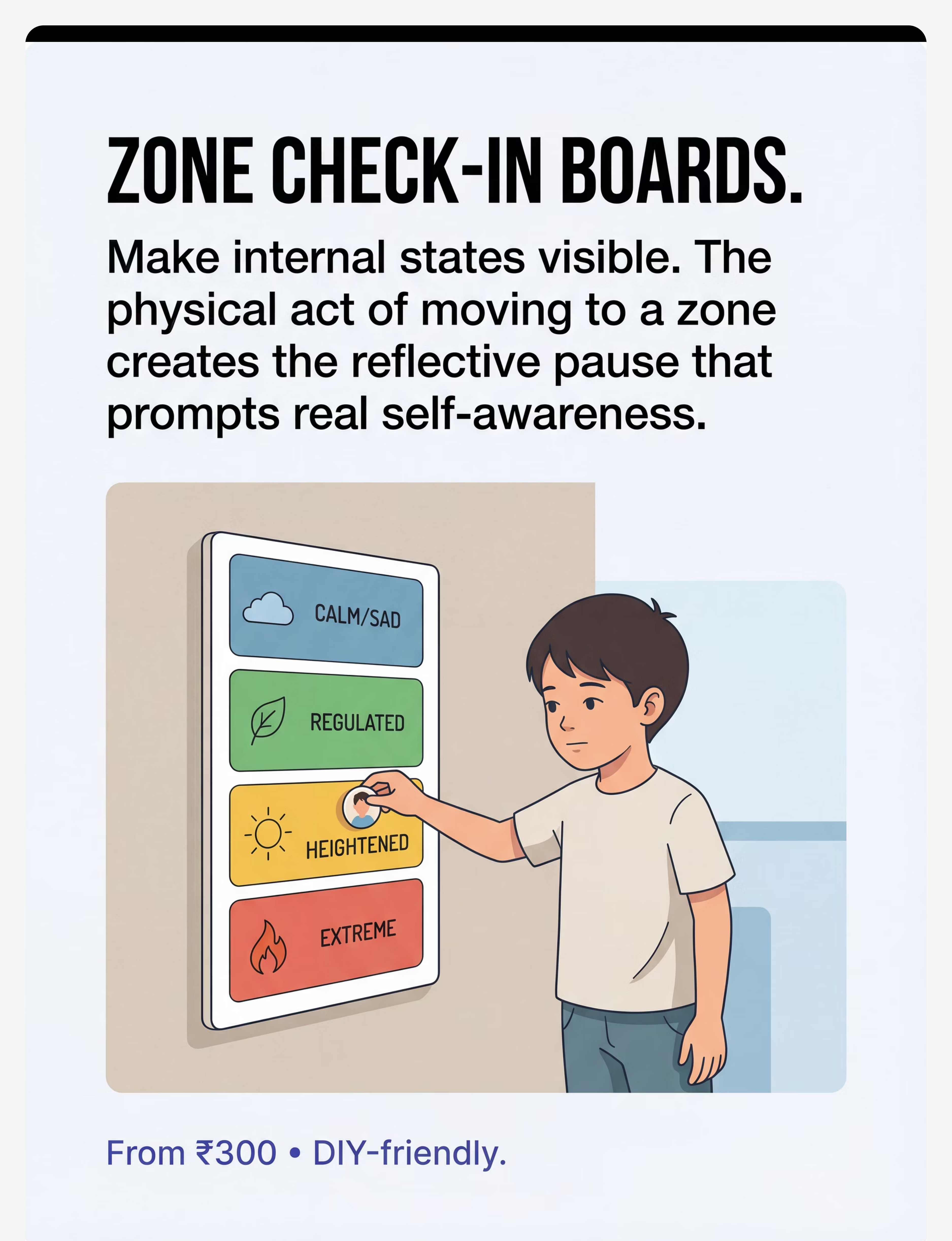
Zone Check-In Boards with Movable Indicators
Material 2
Body Maps and Sensation Cards
Material 3
Zone-Organized Coping Toolkits
Material 4
Feelings Thermometers and Escalation Scales
Material 5
Social Stories and Zone Scenario Books
Material 6
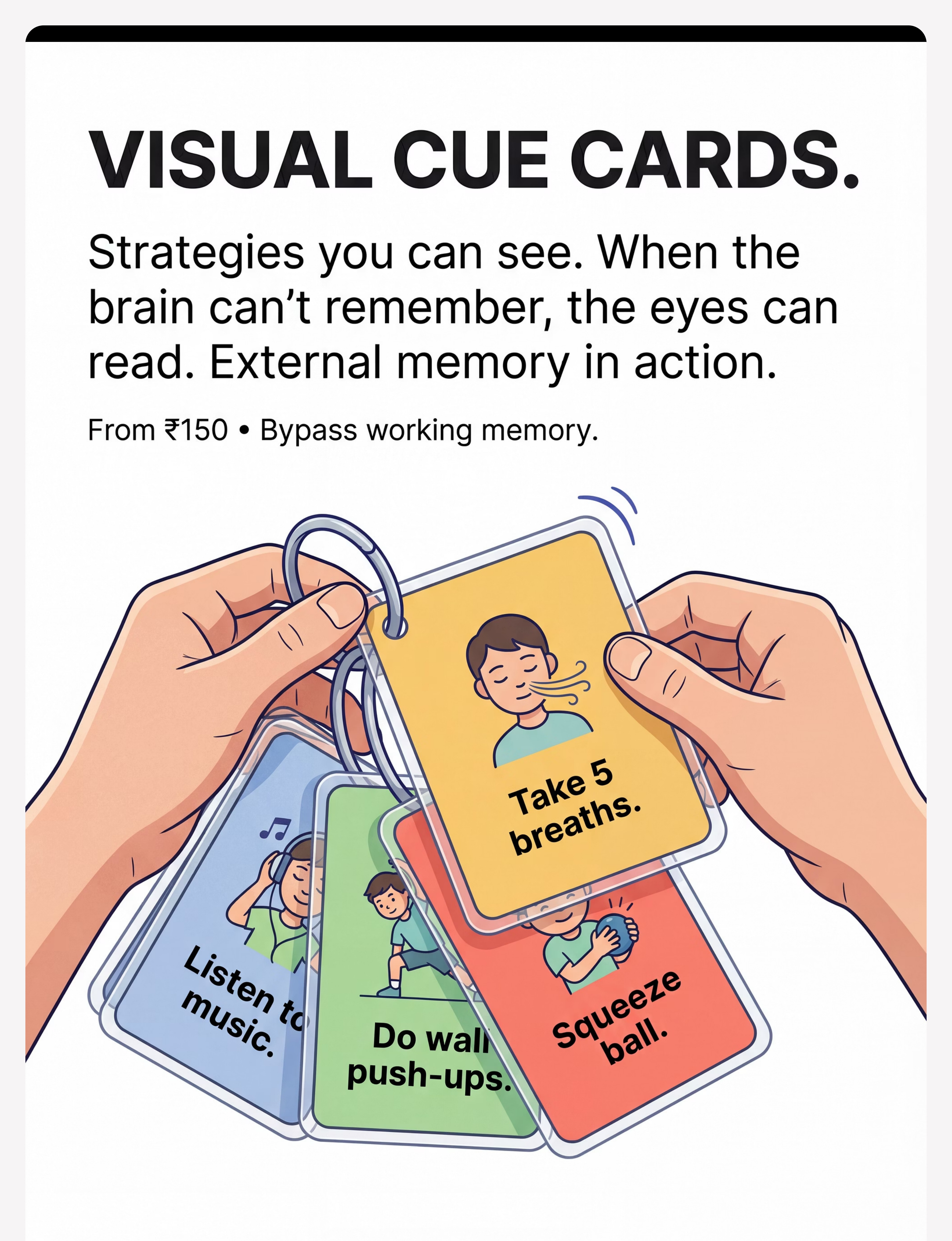
Visual Cue Cards and Strategy Prompt Cards
Material 7
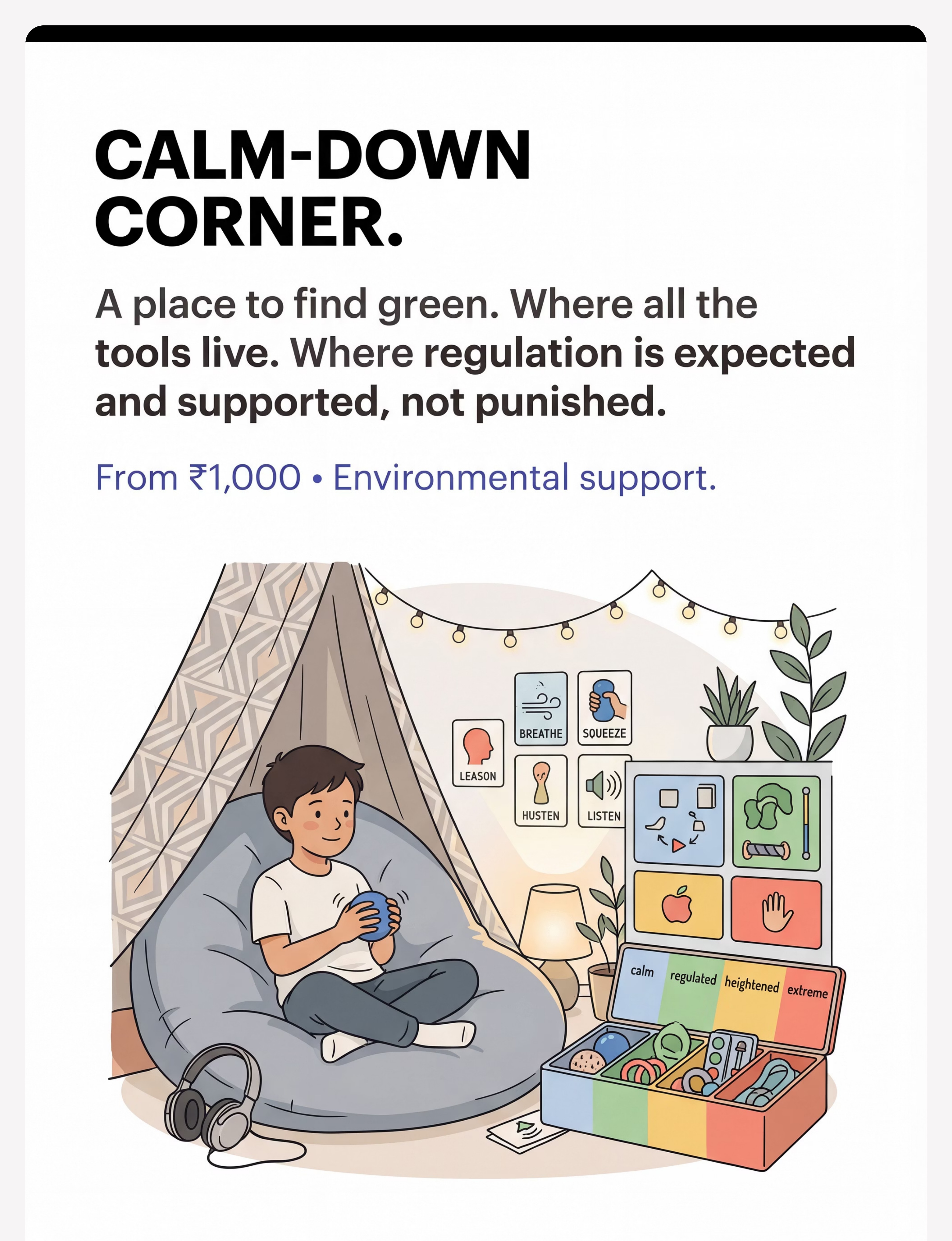
Calm-Down Corner / Regulation Station Materials
Material 8
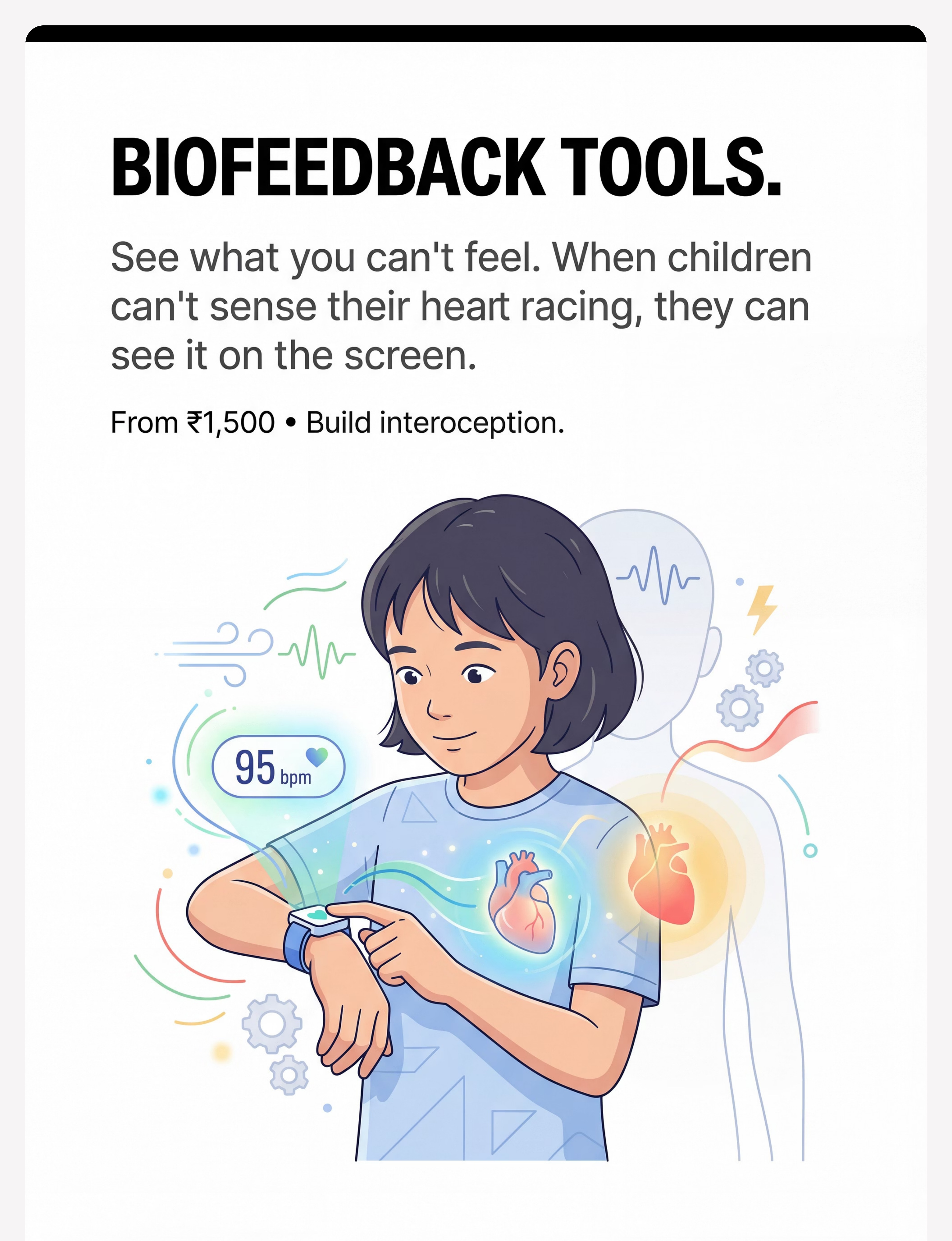
Heart Rate Monitors and Biofeedback Tools
Material 9
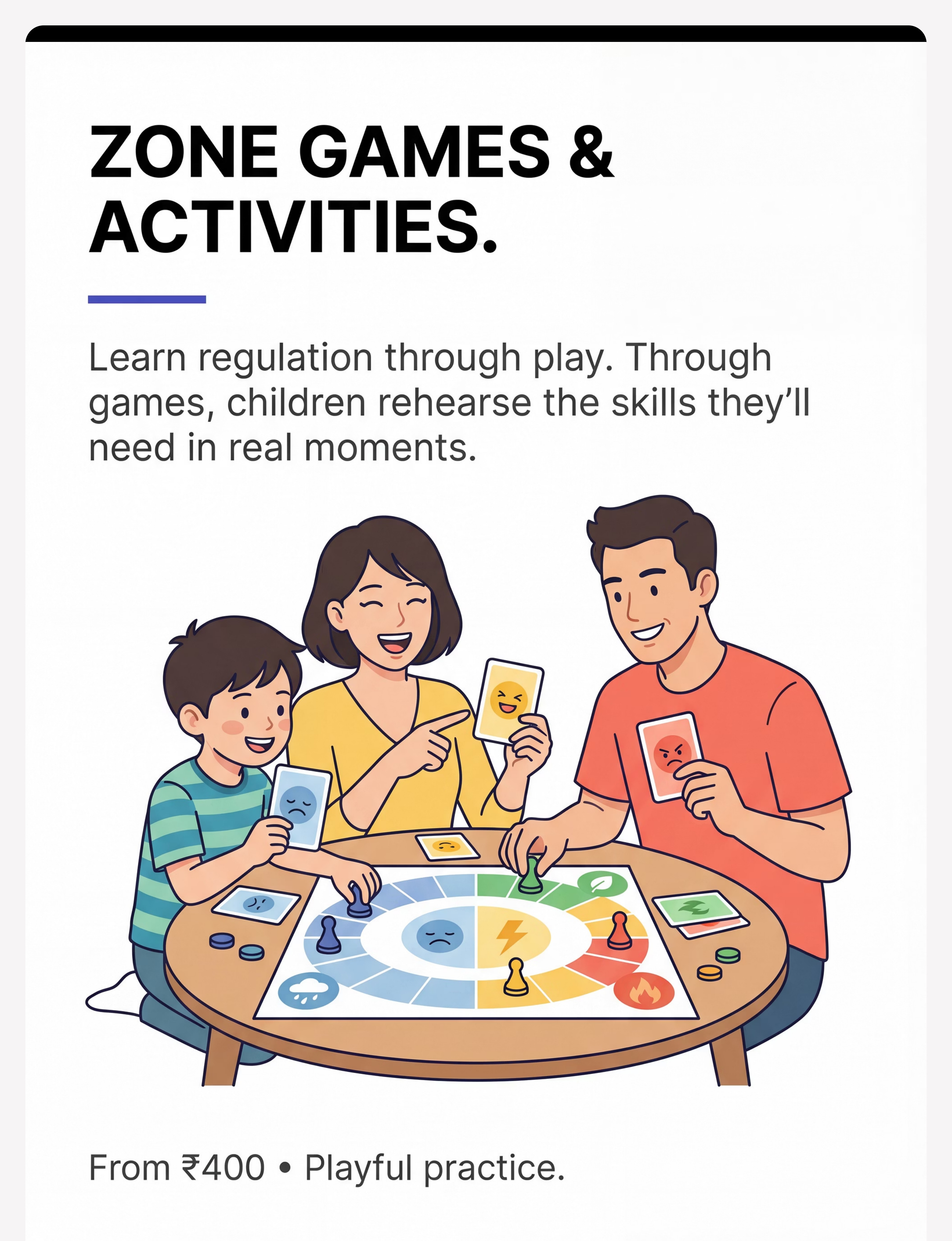
Zone Games and Interactive Activities
Essential Minimum
₹1,350–2,800 (Materials 1, 2, 4, 6)
Full Implementation
₹4,600–13,800 (all 9 materials)
DIY Version
₹0–500 (see Card 10)
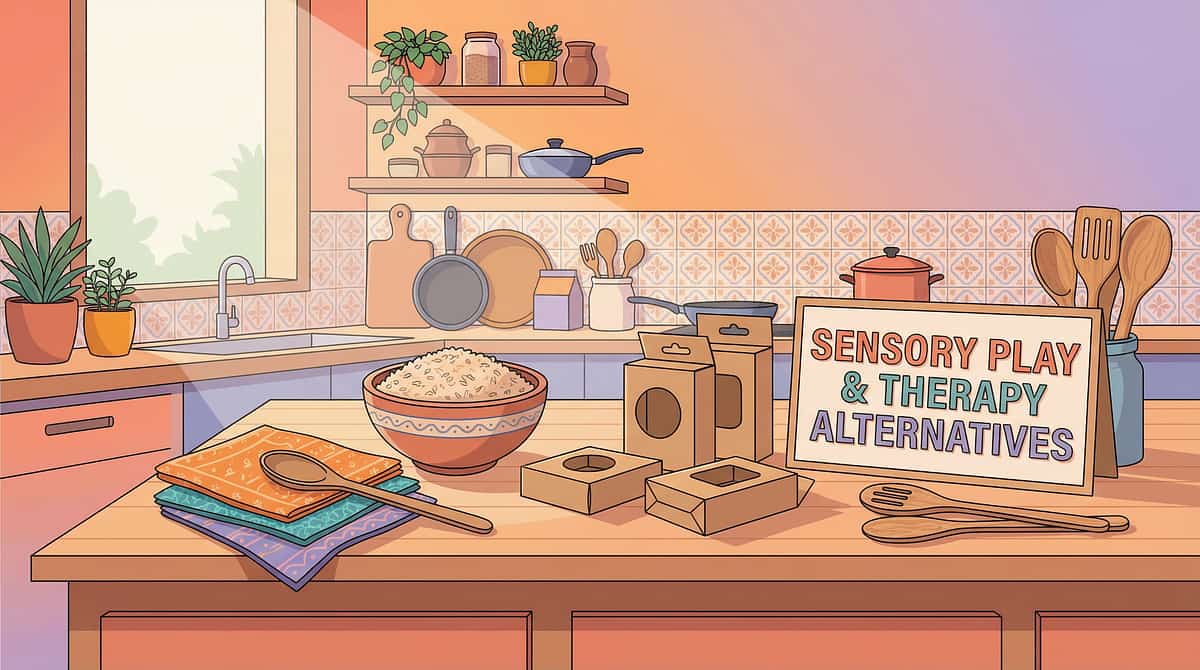
MATERIALS 1–4 IN DETAIL
Zone Check-In Boards · Body Maps · Coping Toolkits · Feelings Thermometers
Material 1: Zone Check-In Boards with Movable Indicators
Function: Externalizes zone identification — physical movement to a zone creates the reflective pause that triggers self-awareness. Four-zone board (Blue/Green/Yellow/Red) with velcro-attached movable markers (photo, name card, or character).
Price: ₹300–1,500 | Amazon.in — Zone Check-In Board | Canon: Visual Supports
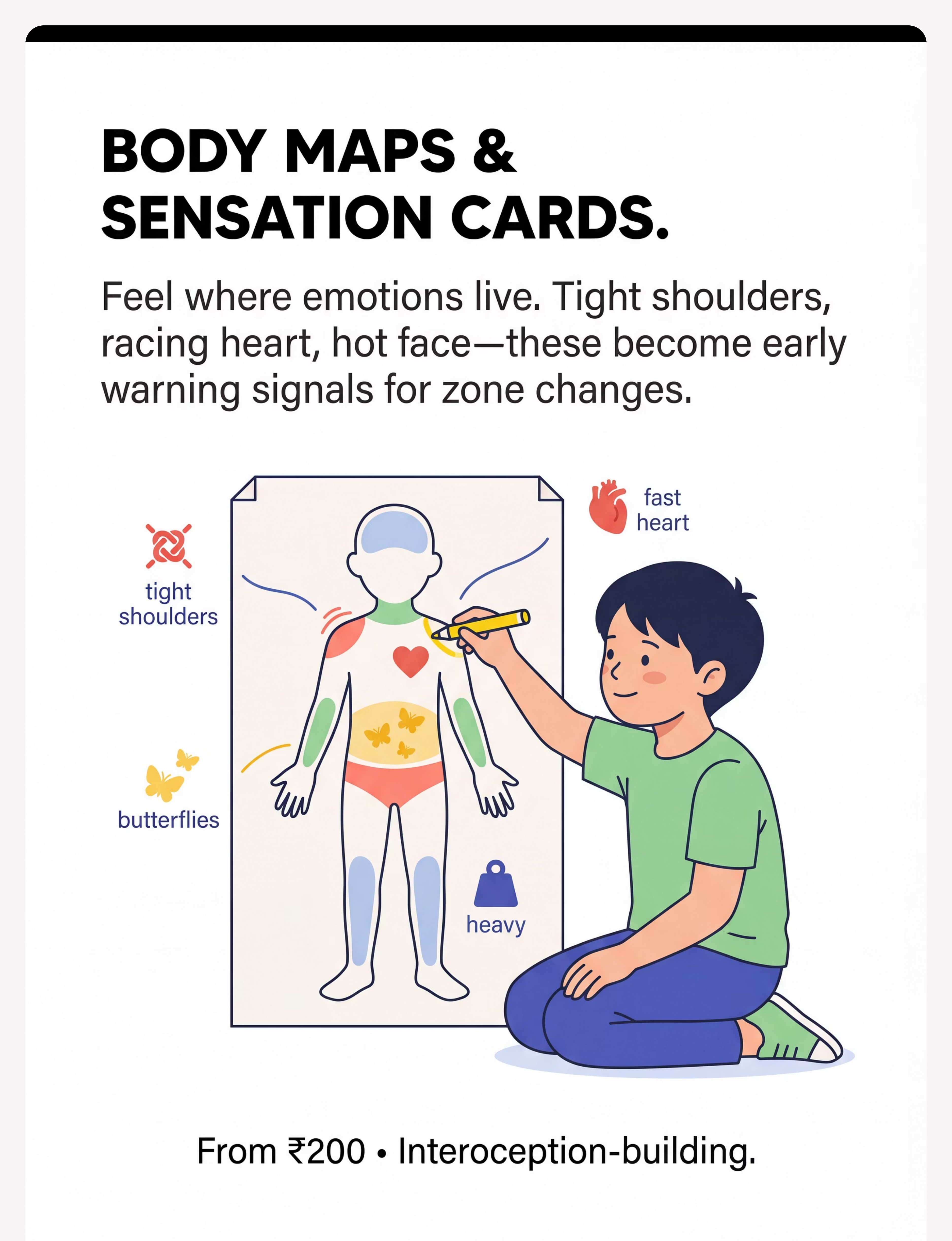
Material 2: Body Maps and Sensation Cards
Function: Builds interoception by mapping where emotions live in the body — tight shoulders, fast heart, hot face become early warning signals. Sensation vocabulary cards: tingly, heavy, buzzy, tight, floaty, racing.
Price: ₹200–800 | Amazon.in — Body Map Feelings Chart | Source: interoception.com.au (Kelly Mahler)
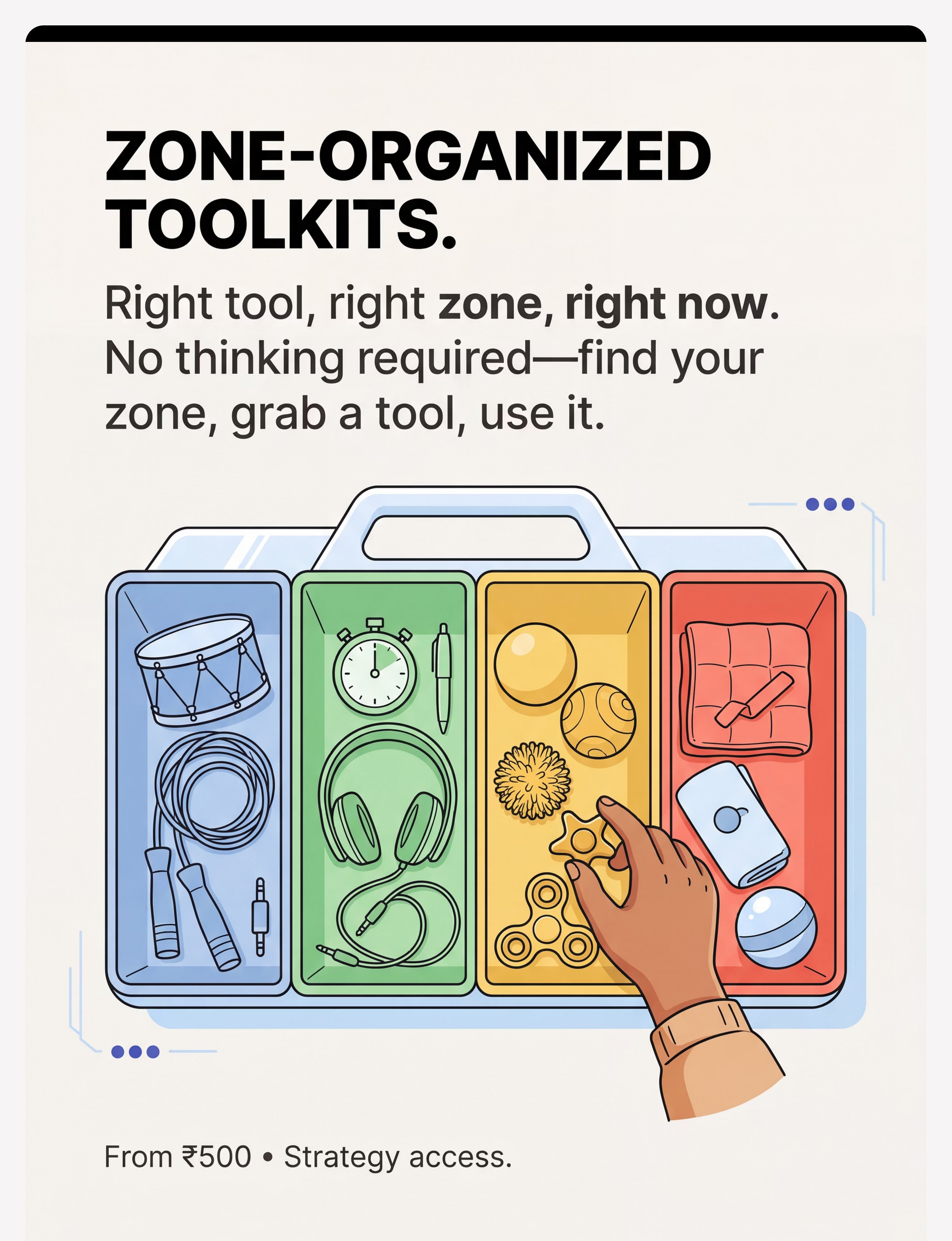
Material 3: Zone-Organized Coping Toolkits
Function: Makes strategies physically accessible by zone — no cognitive search required during dysregulation. Four-section toolkit with zone-appropriate tools: stress balls, fidgets, breathing cards, chew items, heavy work cards.
Price: ₹500–2,500 | Amazon.in — Sensory Toolkit Children | Canon: Sensory Regulation Tools
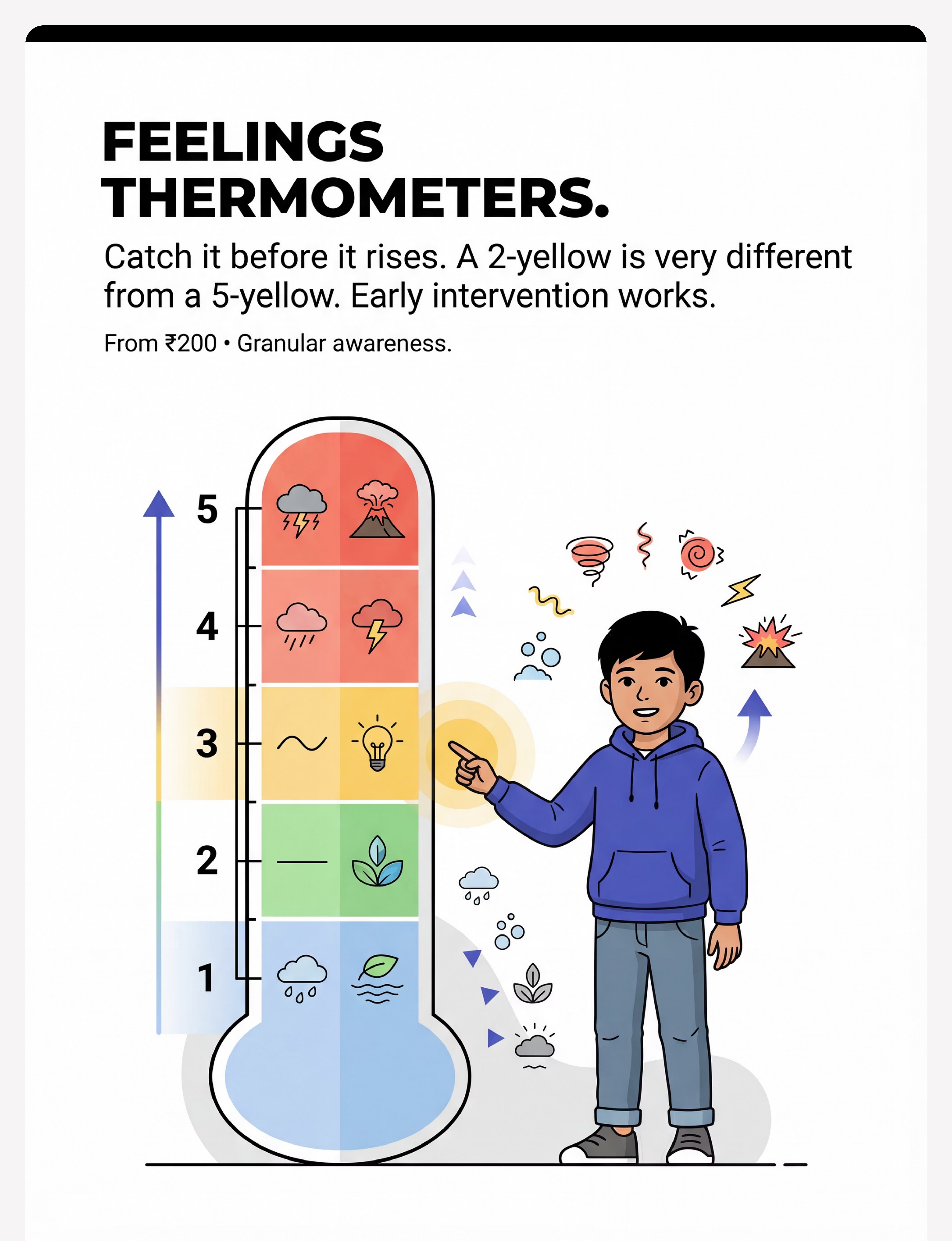
Material 4: Feelings Thermometers and Escalation Scales
Function: Adds granularity within zones — a 2-Yellow is very different from a 4-Yellow; teaches early intervention before the thermometer hits red. 1–5 scale thermometer with zone colors; slider or printable card format.
Price: ₹200–700 | Printable + laminate, or purchase from therapy supply stores | Canon: Emotional Literacy Tools
MATERIALS 5–7 IN DETAIL
Social Stories · Visual Cue Cards · Calm-Down Corner
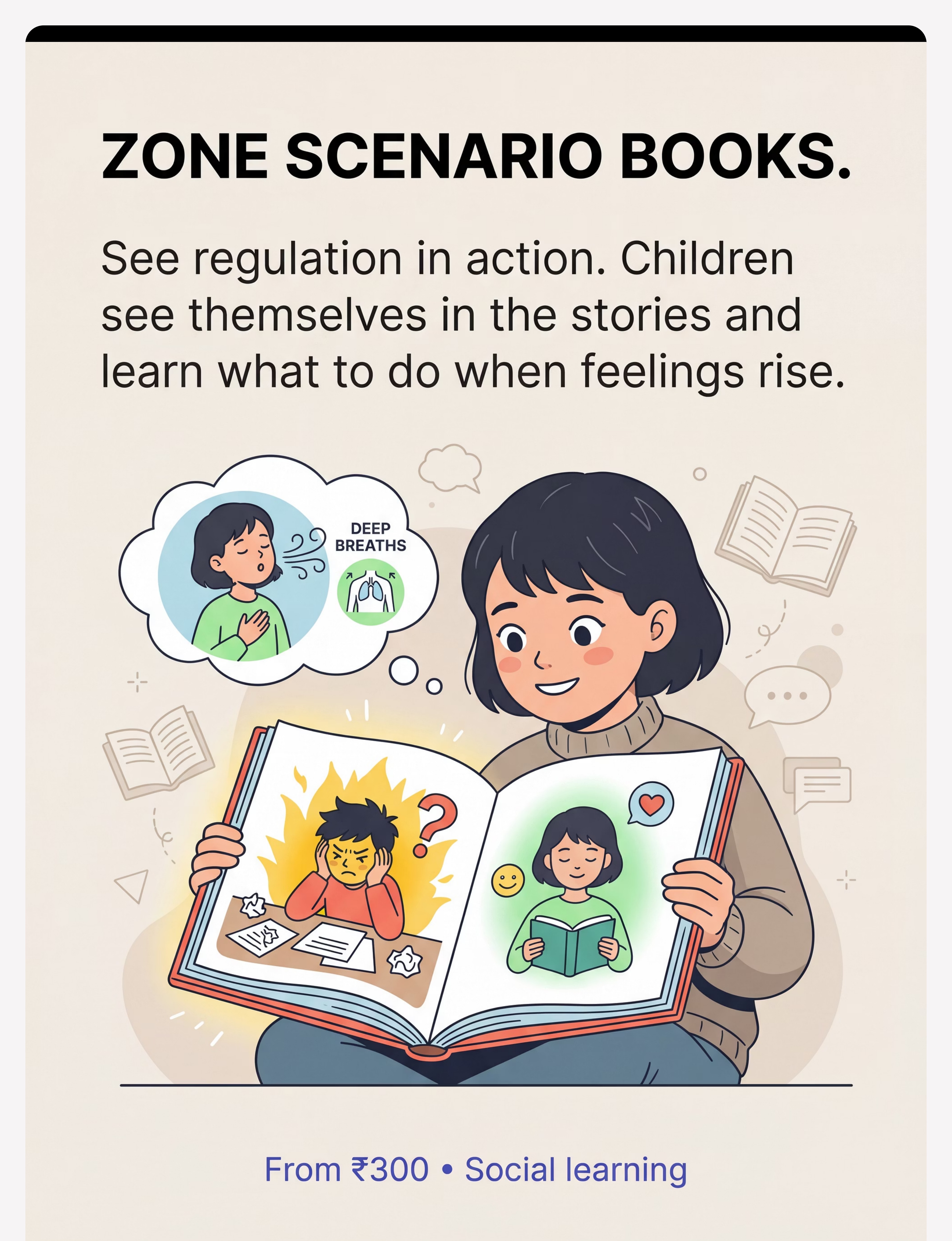
Material 5: Social Stories and Zone Scenario Books
Function: Provides regulation models through narrative — children see characters navigate zone changes and learn vicarious strategy use. Illustrated books showing characters in different zones using strategies; custom social stories for child's specific triggers.
Price: ₹300–1,200 | Zones of Regulation official books (Kuypers, 2011) | Custom printable social stories | Canon: Social Stories / Narrative Support
Material 6: Visual Cue Cards and Strategy Prompt Cards
Function: Bypasses working memory failure during dysregulation — external visual prompts provide strategy access when internal memory is offline. Laminated card ring, zone-coded by color; one strategy per card with image (Take 5 Breaths, Wall Push-Ups, Squeeze Ball).
Price: ₹150–600 | Print-laminate-hole punch; keep sets in 3+ locations | Canon: Visual Supports / Cue Cards
Material 7: Calm-Down Corner / Regulation Station Materials
Function: Provides a designated physical environment associated with regulation — just entering the space activates calming. Beanbag + tent/canopy + sensory tool basket + zone board + cue card display + timer + noise-reducing headphones.
Price: ₹1,000–5,000 | Animal Soft Toys — Transition/Comfort Object ₹425 | Reward Jar for Zone Strategy Celebration ₹589 | Canon: Calm Space Materials + Reinforcement Menus + Transition Objects
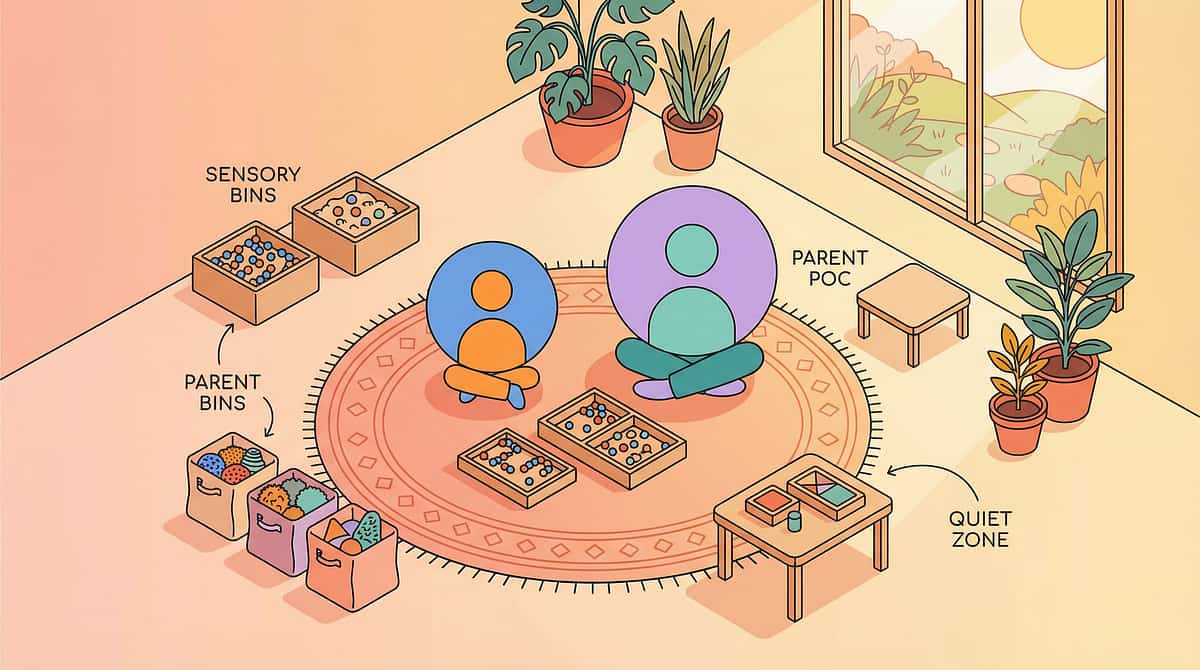
MATERIALS 8–9 IN DETAIL
Heart Rate Monitors · Zone Games — Making the Invisible Visible Through Play
Material 8: Heart Rate Monitors and Biofeedback Tools
Function: Makes invisible physiological states visible — children with low interoception who can't feel their heart racing can see the number climbing; bridges external data to internal felt sense.
Visual: Finger pulse oximeter, kids' fitness tracker, or breathing biofeedback toy.
Price: ₹1,500–8,000 | Finger pulse oximeters from medical/pharmacy supplies; fitness trackers from electronics retailers
Canon Category: Biofeedback / Physiological Monitoring Tools
Material 9: Zone Games and Interactive Activities
Function: Provides repeated low-stakes practice — children rehearse zone identification, strategy selection, and regulation skills through play, building neural pathways accessible in real moments.
Visual: Board games with zone themes, card games, movement games, role-play scenario cards, Zone Bingo, Zone Charades.
Price: ₹400–2,000 | 1800+ Reward Stickers — Motivation & Behavioral Support ₹364 — use as Zone Game tokens, progress markers, and celebration stickers
Canon Category: Games / Interactive Learning + Reinforcement Menus
Pinnacle Canon Materials Database | 128-category clinical material taxonomy | GPT-OS® sourcing intelligence

Every family on Earth can do this. Here is how to make every material with household items — today.
"Evidence-based doesn't mean expensive. The therapeutic principle is what matters — not the packaging." — Pinnacle Consortium OT Team
Material | Buy Version | DIY Version (₹0) | |
Zone Check-In Board | ₹300–1,500 | Draw four colored sections on cardboard. Write zone names. Attach child's photo with tape. Mount at child height. | |
Body Map | ₹200–800 | Trace child's body outline on newspaper/craft paper. Color with zone-colored pencils where each emotion is felt. | |
Coping Toolkit | ₹500–2,500 | Four small boxes painted Blue/Green/Yellow/Red. Fill with household items: rubber band, cold water bottle, deep breath reminder card. | |
Feelings Thermometer | ₹200–700 | Draw a thermometer on cardstock, 1–5 scale. Color bottom green, middle yellow, top red. Laminate with sticky tape. | |
Zone Scenario Book | ₹300–1,200 | Write a personal social story using your child's name and real triggers. Draw or print stick figures. Staple into a booklet. | |
Visual Cue Cards | ₹150–600 | Index cards with hand-drawn pictures + simple words. Punch hole, attach with metal ring. Zone-code with colored marker dot. | |
Calm-Down Corner | ₹1,000–5,000 | Drape a bedsheet over two chairs to make a tent. Add a cushion, a fidget from around the house, and a handmade cue card display. | |
Biofeedback Tool | ₹1,500–8,000 | Teach manual pulse check: two fingers on inner wrist, count 15 seconds × 4. Practice during calm, excited, and stressed moments. | |
Zone Games | ₹400–2,000 | Zone Charades (act out a scenario, family guesses the zone). Zone Bingo (hand-drawn bingo cards with zone states). |
WHO Nurturing Care Framework: Context-specific, equity-focused interventions. CCD Package implemented across 54 LMICs using household-material-based protocols demonstrates equivalent efficacy to clinic materials when implementation quality is maintained. PMC9978394

SAFETY PROTOCOL
Safety First: Before You Begin
✅ Safe to Proceed When:
- Child is fed, rested, and not already in Yellow or Red Zone
- Zone materials are introduced during calm, not during dysregulation
- The calm-down corner is framed as a resource, never punishment
- All family/home members use consistent zone language
- Zone check-ins are done without judgment — all zones are valid
⚠️ Modify Your Approach When:
- Child had a severe dysregulation episode within the past 2 hours → Use gentler, lower-demand zone activities only
- Child shows resistance to check-in boards → Reduce to verbal check-ins without moving markers
- Child becomes anxious watching themselves approach Red → Remove thermometer; use simpler "calm/not-calm" framework
- Child uses calm-down corner as avoidance → Time the corner, track what precedes requests
🚨 Do Not Proceed When:
- Child is currently in Red Zone — ensure safety and wait
- Biofeedback causes significant anxiety or heart-rate fixation — discontinue; consult OT
- Child has known trauma history — body awareness activities must be introduced by a trauma-informed professional
- Zone language is being weaponized against the child — halt all zone activities immediately
🛑STOP if you see: Severe self-injurious behavior | Uncontrolled aggression lasting >20 minutes | Complete dissociation from environment | Child's explicit refusal combined with physical distress. Call FREE: 9100 181 181
This content is educational and does not replace individualized assessment with licensed professionals. The Zones of Regulation® is a curriculum by Leah Kuypers, OTR/L. Indian Journal of Pediatrics RCT (2019): DOI: 10.1007/s12098-018-2747-4

ENVIRONMENT SETUP
The right space does 30% of the therapeutic work before your child enters it.
Room Setup Positions
Zone Check-In Board
At child's eye level on wall near entrance
Calm-Down Corner
Defined corner with cushion/beanbag; tent/canopy optional
Zone-Organized Toolkit
On low shelf within arm's reach of calm-down corner
Visual Cue Cards
Displayed on wall inside/near calm-down corner
Timer + Body Map
Timer visible from anywhere; body map on wall or in folder near toolkit
Setup Checklist
- ✅ Zone Check-In Board installed at child's eye height
- ✅ Calm-Down Corner established; practiced during calm times
- ✅ Toolkit stocked with at least 2 tools per zone
- ✅ Visual Cue Cards accessible without adult help
- ✅ Distractions removed from the calm-down corner area
- ✅ Lighting softened in the calm-down area (natural or warm lamp)
- ✅ All zone language consistent across all family members
Environmental Parameters
Noise: Quiet background preferred | Lighting: Natural or warm; avoid fluorescent | Temperature: Comfortable; cool is slightly alerting (useful for Blue), warm is calming (useful for Yellow/Red) | Scent: Optional lavender or neutral
"The zone board on the wall is doing zone work 24 hours a day. Every time your child walks past it, the neural association between color and internal state strengthens — even without a formal session."
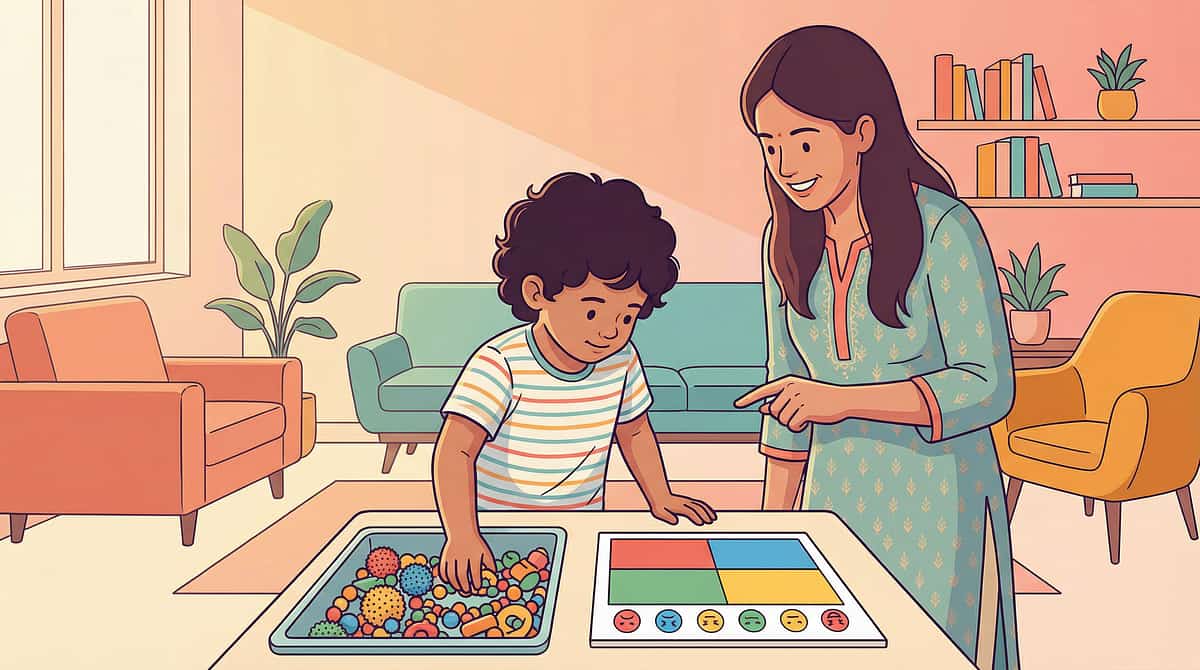
60-SECOND READINESS CHECK
Is Your Child Ready? — The Go / No-Go Gate
Before any zone session, check all that apply:
☐ Child has been fed within the past 2 hours
☐ Child has slept adequately in the past 24 hours
☐ No significant meltdown in the past 2 hours
☐ Child is not currently showing signs of illness
☐ Child is in Green or mildly Yellow zone right now
☐ Parent is calm, regulated, and has 20 undivided minutes
☐ Environment setup is complete (Card 12 checklist passed)
✅ All 7 Checked
FULL SESSION — proceed to Step 1 (The Invitation)
⚠️ 5–6 Checked
MODIFIED SESSION — do only zone check-in + one material; skip full protocol
❌ Fewer than 5
POSTPONE — use a calming paired activity instead. Session postponement is not failure — it is good clinical judgment.
"The best zone session is one that starts right. A perfect readiness check is more valuable than any forced session."
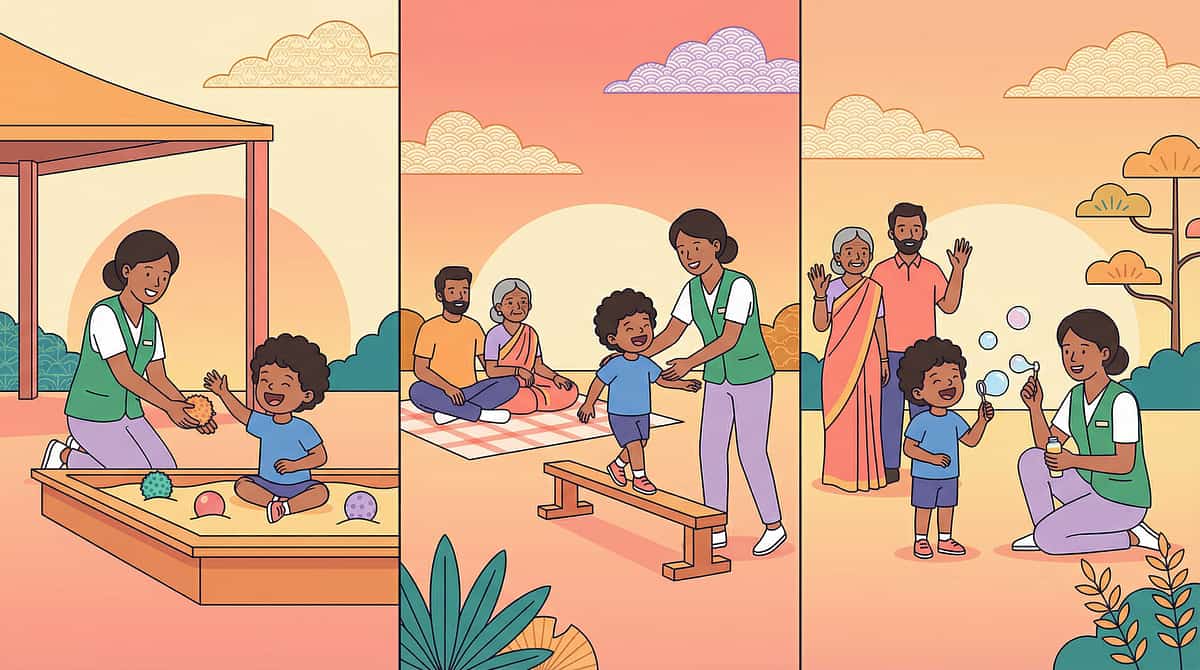
STEP 1 OF 6
The Invitation — Low Demand, High Discovery
"Hey — I've got something kind of cool to show you. It's about feelings and what happens inside your body. You don't have to do anything — just come check it out with me."
Parent Guidance
Body language: Relaxed posture, sitting at or below child's eye level. No urgency.
Tone: Curious and light. This is not therapy time — this is discovery time.
Location: Near the Zone Check-In Board or the calm-down corner. Let the materials be visible but not yet introduced formally.
Timing: 30–60 seconds. No longer. Low demand is the principle.
Acceptance Cues — What to Look For
- ✅ Child moves toward you or the materials
- ✅ Child makes eye contact or orients body toward you
- ✅ Child does not protest or redirect immediately
If Child Resists
"No worries — it's here whenever you want to look. I'm going to check mine." Then check in your own marker on the zone board. Modeling is the intervention. Do not force.

STEP 2 OF 6
The Engagement — Introducing the Materials
Open with the Zone Board
"These are the four zones. I'm going to put myself in [Green] right now because I'm feeling calm. Where do you think you might be?" Present the movable marker toward the child. Let them place it. Do not correct. Even an inaccurate placement is golden — it begins the internal search.
Introduce the Body Map (Second Session or if Engaged)
"Can I show you something cool about where feelings live in the body? Like, when I'm nervous, I feel it right here [point to stomach]. Can you show me where you feel [name a zone]?"
Child Response | What It Means | Your Move | |
Engages immediately | Ready for full session | Continue to Step 3 | |
Tolerates but passive | Mild resistance; observation mode | Stay at Step 2; don't push deeper | |
Redirects after 1 minute | Limited window today | Celebrate the 1 minute; close warmly | |
Refuses entirely | Not the day | Back to invitation; no zone content today |
The moment the child places their marker anywhere on the board: "Great — you just did a check-in. That's something really important to know about yourself."
Timing: 1–3 minutes. PMC11506176: Structured material introduction in emotional regulation intervention meets evidence-based practice criteria.

STEP 3 OF 6
The Therapeutic Action — The Active Ingredient
Choose ONE of the following based on where the child is in their zone awareness development:
🟢 Beginner Level — Zone Board Check-In
"Every time we pass by the board today, we're going to check in. Just move your marker to where you are. That's it." Practice this at meal transitions, before/after activities, and at any visible zone change. 3–5 check-ins in a day. No analysis required.
🟡 Intermediate Level — Body Map Investigation
"You're in Yellow right now. Can you show me on the body map where you feel it? Is anything tight? Is your heart faster than usual?" Guide a body scan: head → shoulders → chest → stomach → legs. Name sensations without judgment.
🔴 Advanced Level — Thermometer + Strategy Bridge
"You're at about a 3-yellow. That means we've got time to use a tool before it gets higher. Which section of your toolkit feels right?" Guide child to the zone toolkit. Let them choose a tool. Watch them use it. Track whether the thermometer number moves.
Common Error | Correction | |
Using zone language during Red Zone | Stop — safety only during Red. Wait for Green/Yellow. | |
Correcting child's zone placement | Never. The search is more important than accuracy. | |
Using zones as labels/punishment | Zones describe states, never define character. | |
Expecting instant generalization | 4–8 weeks of daily practice before internal awareness emerges. |
Duration: 5–10 minutes per session. Daily brief check-ins count as sessions. PMC10955541: Home-based sessions 10–20 min with core action occupying 40–60% of session time.

STEP 4 OF 6
Therapeutic Dosage — Repeat & Vary
Zone awareness is not built in one session. It is built in 847 small moments across months. Each check-in is one brick.
Activity | Frequency | Duration | |
Zone Board Check-In | 3–5 times per day | 30 seconds each | |
Body Map Scan | Once per day | 3–5 minutes | |
Toolkit practice (during calm) | 2–3 times per week | 5 minutes | |
Zone game or story | 3–4 times per week | 10–15 minutes | |
Biofeedback check (if using) | Once per day | 2 minutes |
Satiation Indicators — Stop the current activity when you see:
- Child becomes mechanical/rote (placing marker without internal search)
- Child physically withdraws or verbally protests
- Engagement quality drops below 50%
3 quality check-ins > 10 rote ones.
Variation Options to Maintain Freshness Across Weeks
- Rotate which zone material is the focus each week
- Add new items to the coping toolkit based on what the child discovers works
- Create personalized body map additions: "You told me your neck gets tight in yellow — let's add that"
- Introduce zone games after 2–3 weeks of successful check-in practice
- Add biofeedback tools after child can reliably use the zone board

STEP 5 OF 6
Reinforce & Celebrate — Awareness Is the Skill
The Critical Insight: You are not reinforcing the child for being in Green Zone. You are reinforcing the child for noticing what zone they are in. Awareness is the skill. Zone state is just information.
For successful zone board check-in:
"You just did a check-in. That's a really important thing to know about yourself. High five."
For body map completion:
"You just figured out where Yellow lives in your body. That's something most people never know about themselves."
For toolkit use:
"You went into Yellow and you got yourself a tool. That's exactly what the toolkit is for. You did that yourself."
For catching escalation early:
"Wait — you caught it before it got to Red? That's incredible. Your early warning system is working."
Reinforcement Timing: Within 3 seconds of the target behavior. Specific. Warm. Never conditional on zone state.
🛒Rosette Imprint Reward Jar — ₹589
Visual token economy jar — child sees their zone-awareness tokens accumulate. Tangible evidence of growing skill.
🛒1800+ Reward Stickers — ₹364
Zone check-in sticker chart: one sticker per successful check-in. Weekly milestone when chart fills.
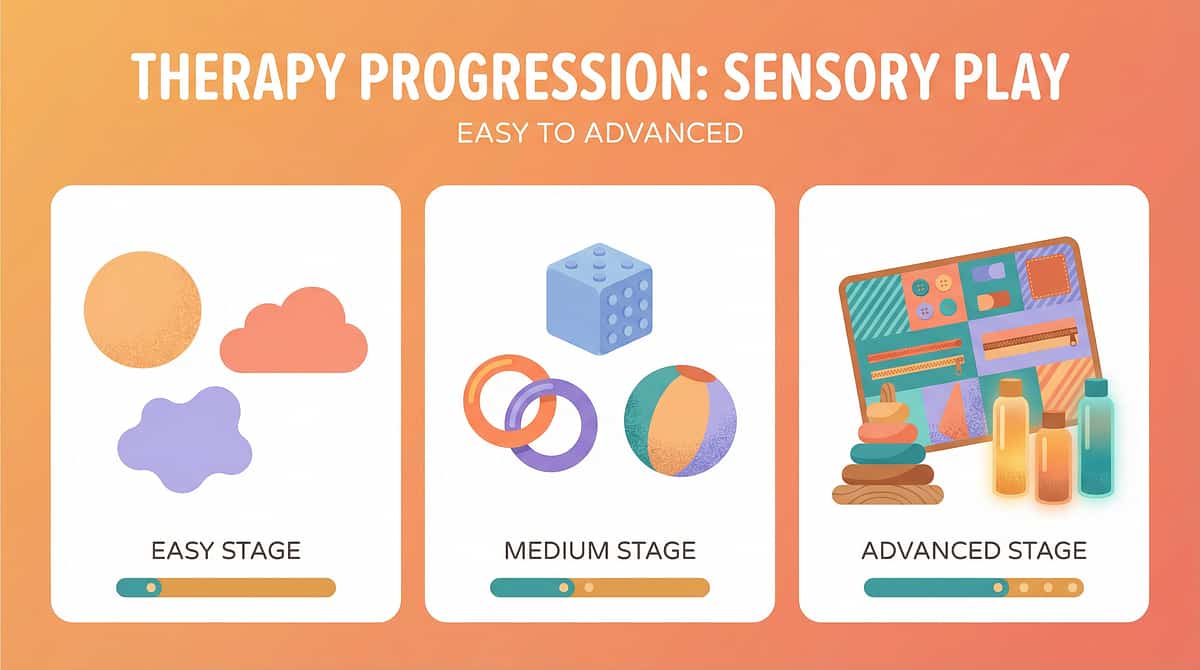
STEP 6 OF 6
The Cool-Down — Predictability Is the Regulation
Transition Principle: No session ends without a deliberate transition. The cool-down teaches the nervous system that zone work has a beginning, middle, and end — building predictability and safety.
If child resists ending: "I know — let's finish this one thing, and then it will be here for you tomorrow." Do not extend past the natural close. A visual timer (sand timer or Time Timer) makes the ending predictable and removes the surprise of "done." This alone reduces ending-resistance by approximately 60% in clinical settings.
NCAEP Evidence-Based Practices Report (2020): Visual timer and transition support are classified evidence-based practices for autism.

60-SECOND DATA CAPTURE
What you record right now shapes every recommendation your child gets tomorrow.
Today's Zone Session — Quick Entry
1. Session Date & Time: _______________
2. Child's starting zone: ☐ Blue ☐ Green ☐ Yellow ☐ Red ☐ Could not identify
3. Materials used: ☐ Check-in Board ☐ Body Map ☐ Toolkit ☐ Thermometer ☐ Cue Cards ☐ Biofeedback ☐ Game ☐ Story
4. Strategy accessed: _______________
5. Child-initiated any zone behavior without prompting: ☐ Yes ☐ No
6. Session quality (1–5): 1 (very difficult) → 5 (excellent)
7. One observation worth noting: _______________
Data Resources
"60 seconds of data right now saves hours of guessing later. Patterns across 30 sessions are what drive clinical decisions — not individual session impressions."
BACB Data Collection Standards: Continuous and discontinuous measurement as standard practice for behavior-analytic intervention tracking.

TROUBLESHOOTING
Most sessions don't go perfectly. Here are the 7 most common problems — and exactly what to do.
Problem 1: Child refuses to place marker on zone board
Why: The board feels evaluative — child fears placing themselves in a "bad" zone. Fix: Place your own marker first. Wait. Never place theirs for them. Reduce to verbal-only check-in: "Hey, how are you feeling right now?" Board use will return when shame is removed.
Problem 2: Child always says "Green" regardless of visible dysregulation
Why: Green = "correct answer"; child has learned to perform regulation rather than report it. Fix: Remove all praise for Green placement. Praise Blue and Yellow equally. Reinforce honesty, not color.
Problem 3: Child reaches Red Zone despite check-in routine
Why: Interoception still developing; early signals not yet accessible to consciousness. Fix: Do not address zone during Red. Wait. Then build retrospective awareness: "Can you show me on your body map where you felt something right before that?"
Problem 4: Child uses toolkit as avoidance
Why: The toolkit is more comfortable than the triggering demand. Fix: Time-limit toolkit use (visual timer: 5 minutes). Return to demand with reduced difficulty. Track when toolkit requests cluster — they may be pointing to specific triggers.
Problem 5: Child can't name sensations on body map
Why: Interoceptive vocabulary not yet developed. Fix: Start with binary (does this area feel anything? Yes/No). Heavy-input activities temporarily amplify body signals and make them more noticeable.
Problem 6: Check-in boards work at home but not at school
Why: Different environmental cues; school staff may not use consistent language. Fix: Download the Teacher Communication Template from Card 37. Request school OT or teacher orientation. Same language, same colors, same check-in timing.
Problem 7: Biofeedback causes anxiety about heart rate numbers
Why: Child is monitoring numbers rather than building felt sense. Fix: Remove device. Return to manual pulse-counting. Reframe: "The number is just information — it's not danger."
"Session abandonment is not failure — it is data. Every session that doesn't work tells you something precise about what your child needs next."

PERSONALIZATION
No two children have the same interoceptive landscape. Here is how to tune this protocol for your child's specific profile.
← Easier
One check-in per day during predictable routine. Two zones only (Calm / Not Calm). Parent models all check-ins; child observes only. No strategy work yet — pure awareness building.
Standard (Week 2+)
3–5 check-ins per day. All four zones. Toolkit accessible; child chooses tools. Body map during weekly review. Brief family zone check-in at dinner.
Harder →
Child leads family check-in. Thermometer + number notation. Biofeedback integration. Retroactive zone mapping. School generalization and self-referral to classroom calm-down corner.
Sensory Profile Variations
Sensory Seeker
Emphasize high-input tools (chewy items, crash pad, heavy work). Body map will show lots of physical sensation awareness — channel this into zone signals.
Sensory Avoider
Softer toolkit items (smooth fabrics, gentle pressure). Check-ins during highly predictable, low-demand moments only. Biofeedback may overwhelm — use sparingly.
Alexithymic Profile
Heavy focus on body maps and biofeedback before zone labeling. Build body-sensation vocabulary before attaching zone colors to sensations.
ADHD Profile
Rapid check-ins (15 seconds). Movement-based zone games. Toolkit must include high-energy tools for Yellow/Red, not only calming tools.

WEEKS 1–2: THE FOUNDATIONS
Week 1–2: What to Expect
Progress Arc
Weeks 1–2 feel slow. That is correct. You are building the neural foundation.
You Will Likely See ✓
- Child tolerates zone check-in board being in the environment
- Zone language enters family vocabulary — adults and siblings using zone words naturally
- One or two moments of child's spontaneous zone reference ("I don't know, maybe yellow?")
- Child watches parent do check-ins with curiosity
- Reduced resistance to calm-down corner as punishment fear fades
You Will NOT Yet See ✗
- Spontaneous self-initiated check-ins by child
- Accurate zone identification during peak dysregulation
- Strategy use without prompting
- Generalization to school or other environments
"If your child tolerates the zone board for 3 seconds longer than last week — that is real, measurable, neurological progress."
Tracking Focus: Number of times zone language is heard from child (even incorrectly used) | Any spontaneous reference to a body sensation (even unrelated to zones). PMC11506176: Early-phase indicators are tolerance and participation.

WEEKS 3–4: NEURAL CONSOLIDATION
Week 3–4: Consolidation Signs
Progress Arc
Synapse strengthening is underway. Each check-in myelinates the pathway between body signal → zone color → word → action.
You May See:
Reduced resistance to check-in boards
Child begins placing their marker with less hesitation — the fear of "wrong answers" is fading.
Zone language in reporting
Child uses zone language spontaneously: "I think I'm Yellow" — rather than only responding when asked.
Visible early awareness emerging
"I'm getting weird" — this IS Yellow self-identification even if not labeled correctly. Celebrate this moment.
Parent reads zone-change signals earlier
Your nervous system is also learning this language. That's co-regulation — and it multiplies the effect.
When to Deepen: If Week 3 check-ins are easy and accurate → Add the body map and body-sensation questions. If Week 3 check-ins are still challenging → Stay at check-in board only. Do not advance.
🌱 "You may notice you're more confident too. You're reading your child's zone-change signals earlier. Your nervous system is also learning this language. That's co-regulation — and it multiplies the effect."
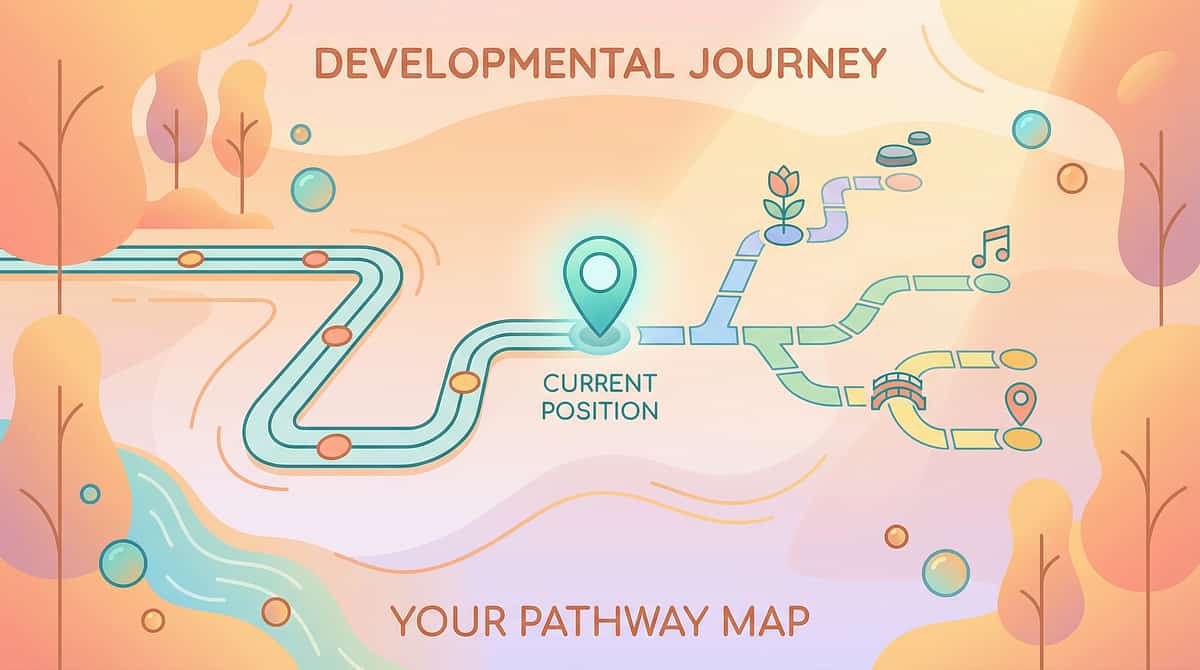
WEEKS 5–8: MASTERY UNLOCKING
Week 5–8: Mastery Indicators
Progress Arc
🏆 Zone Awareness Mastery — Unlocking. Observable, measurable criteria now within reach.
Criterion | Observable Evidence | |
Zone self-identification | Child places check-in marker accurately 7/10 times without prompting | |
Interoceptive awareness | Child names at least 2 body sensations reliably linked to their zone | |
Strategy access | Child reaches for toolkit without being prompted at least 2× per week | |
Early escalation detection | Child or parent catches Yellow Zone at least 50% of the time before Red | |
Vocabulary use | Child uses zone language spontaneously in conversation |
Generalization Indicators
- Zone language appears at school (teacher reports)
- Child refers to zones in describing other people's behavior ("He was in Red")
- Child requests the calm-down corner proactively
- Body sensation vocabulary is used outside of formal zone sessions
Mastery Unlocked → Next Level: When 4 of 5 criteria are met consistently for 2 weeks, child is ready for C-273: Impulse Control Materials. BACB mastery criteria: 80%+ accuracy across 3 consecutive sessions and 2 different environments before advancing.
Your child can now feel what they're feeling. That sentence contains more transformation than you know.
Eight weeks ago, your child knew what Yellow Zone meant on a poster. Today, they feel Yellow Zone in their shoulders and stomach. They reach for a strategy before you suggest it. They have caught themselves at a 2 before it became a 5.
You did this. Your consistency, your patience, your daily check-ins built the neural infrastructure your child's interoceptive system needed.
Family Celebration
Create a "Zone Awareness Certificate" for your child. Their name. The date. "You learned to feel your own feelings." Frame it near the zone board.
📸 Photo Prompt
Take a photo of your child doing a check-in today. Write one sentence below it: what this journey has looked like. This is a family milestone.
📤 Share Your Journey
Share your family's zone milestone with the Pinnacle parent community → WhatsApp Group
"Every parent who reached Week 8 with this protocol was afraid at Week 1 that it wouldn't work. The children who got there got there because their parent stayed. You stayed."
CLINICAL GUARDRAILS
Trust your instincts. If something feels wrong, pause and ask a professional.
🚨 Red Flag 1: Dysregulation is intensifying, not stabilizing
What it looks like: Meltdowns more frequent or more severe after 4+ weeks of zone work. What to do: Pause protocol. Book OT assessment. Do not continue zone material work without clinical guidance.
🚨 Red Flag 2: Child becomes obsessively anxious about zone states
What it looks like: Child repeatedly asks "What zone am I in?" with anxiety; refuses to be in any zone but Green. What to do: Remove prescriptive zone language. Shift to body sensation work only. Consult psychologist.
🚨 Red Flag 3: Child uses zone language to shame others
What it looks like: "You're in Red Zone, that's wrong" directed at siblings as a weapon. What to do: Pause all formal zone sessions. Reset: zones describe, never judge.
🚨 Red Flag 4: Body map work triggers significant distress
What it looks like: Child becomes highly agitated, dissociates, or cries during body awareness activities. What to do: Stop body map work immediately. Consult trauma-informed OT or psychologist.
🚨 Red Flag 5: Complete regression after previous mastery
What it looks like: Child who was checking in independently stops entirely; all progress appears lost. What to do: Assess for life changes. Reduce to bare minimum zone exposure. Seek professional support.
🚨 Red Flag 6: Physical symptoms during zone work
What it looks like: Headaches, stomachaches, or vomiting consistently appearing during or after zone sessions. What to do: Pause. Document. Consult NeuroDevelopmental Pediatrician.
📞 Escalation Pathway: Self-resolve → FREE: 9100 181 181 → nearest Pinnacle center → specialist referral

YOUR DEVELOPMENTAL GPS
C-272 is not the destination. It is a waypoint. Here is where you came from and where you're going.
→ C-273: Impulse Control
If child mastered zone identification. The child can now feel their zone. Next: what to do in the 3-second window between impulse and action.
→ C-275: Emotional Vocabulary
If child excelled at body map work. Body awareness is strong; the next layer is linguistic precision for communicating internal state to others.
→ Domain A: Sensory Processing
If zones work revealed sensory processing needs. An OT assessment may reveal a parallel intervention pathway.
Long-Term Goal: This technique feeds into Executive Function Development → Social-Emotional Learning → Self-Advocacy → School Readiness → Peer Relationship Navigation → Lifelong Emotional Regulation Competence.

DOMAIN C: EMOTIONAL REGULATION
Other techniques in this domain that complement what you've built here.

[C-270] Public Meltdowns — Emergency De-escalation
Difficulty: CORE | Materials: Comfort objects, visual timers, sensory tools. For when dysregulation happens in community settings. Prerequisite understanding for C-272.
→ unknown link

[C-271] Meltdown Recovery Strategies
Difficulty: CORE | Materials: Sensory calming items, transition objects. The post-Red Zone protocol. Works alongside zone awareness — what happens after the storm.

[C-273] Impulse Control Materials
Difficulty: ADVANCED | Materials: Stop-think cards, choice boards, delay tokens. The next step after zone mastery: acting on zone awareness in the critical 3-second window.

[C-274] Frustration Tolerance Building
Difficulty: ADVANCED | Materials: Regulation ladders, coping menus, frustration journals. Builds the capacity to stay in Yellow without tipping to Red — the resilience layer.
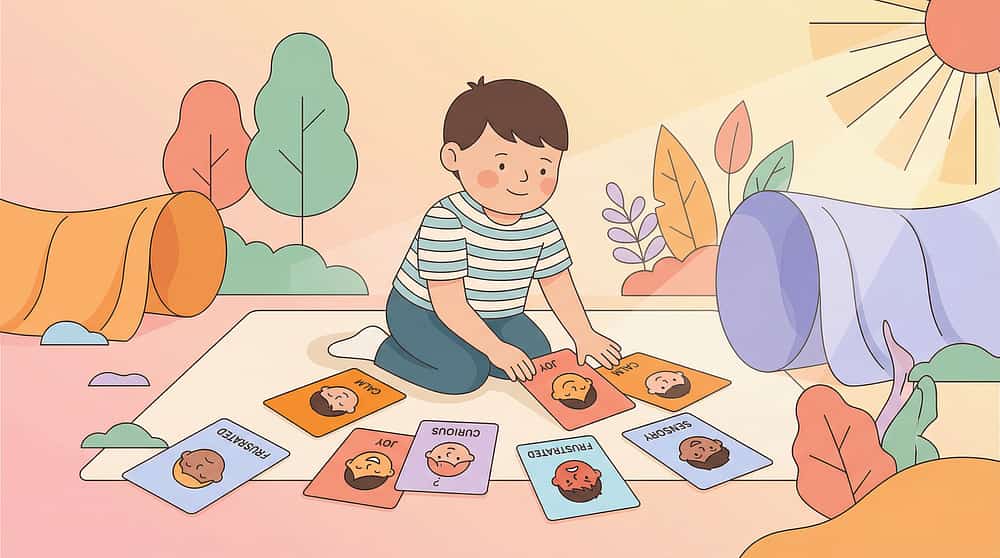
[C-275] Emotional Vocabulary Development
Difficulty: CORE | Materials: Feeling cards, emotion dictionaries, expression journals. Gives language to the body sensations that C-272 makes noticeable.
✅ If you built the C-272 Zone Toolkit → you already have materials for C-273 and C-274. ✅ If you created the C-272 body map → you have the foundation for C-275.
THE BIG PICTURE
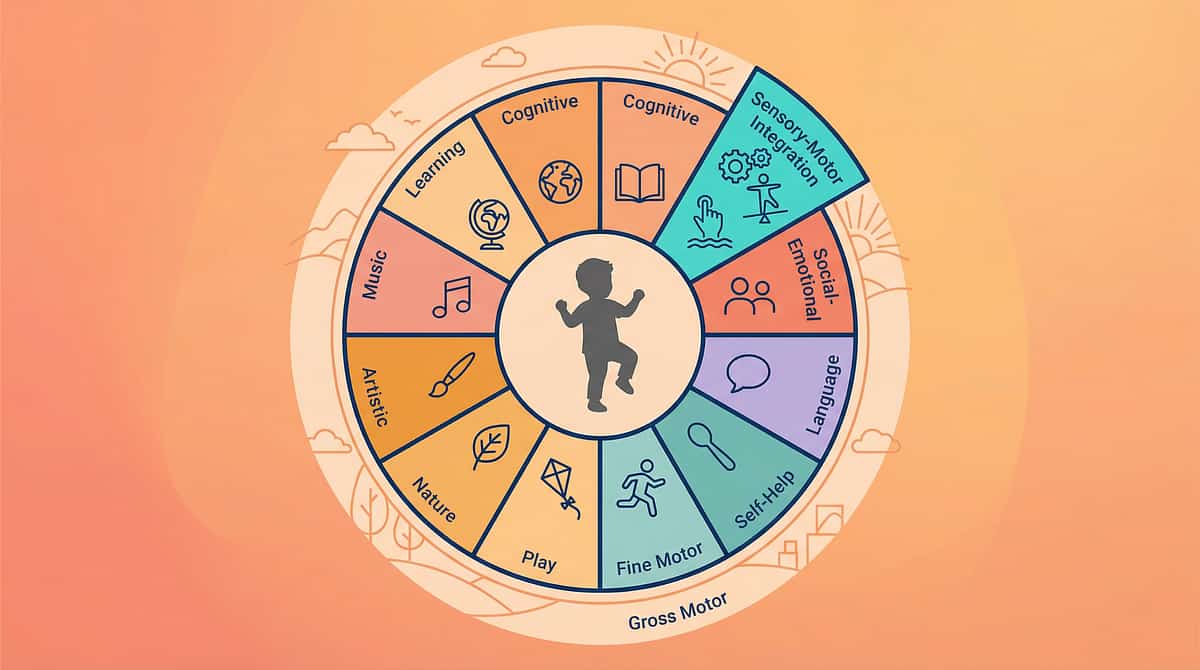
C-272 is one piece of your child's developmental mosaic. Here is the full map.
This Technique's Place in the Whole-Child Picture
Domain B: Social Communication
How can a child connect with others if they can't manage their internal state?
Domain D: Behavior & Flexibility
Zone awareness is a prerequisite for behavioral self-management.
Domain H: Cognitive Function
A regulated nervous system learns exponentially more effectively than a dysregulated one.
Domain I: Daily Living Skills
Dressing, eating, transitions all require emotional regulation as a foundation.
"Every technique in every domain is ultimately in service of one goal: a child who can navigate their own life with confidence, connection, and competence. Domain C is the heart of that ecosystem." — Pinnacle Blooms Consortium Clinical Team
FROM THE FAMILIES
Three families. Three different starting points. One shared breakthrough moment.
Parent, Hyderabad | 9 Weeks | Zone Check-In Board + Toolkit
Before: "My son went from normal to screaming in seconds. No warning. He couldn't tell us what was wrong. The zones poster on his wall was just wallpaper."
After: "He called me from the hallway at school last Tuesday. He said, 'Mom, I'm at a 3-yellow and I'm going to my calm corner.' He self-referred. He used the language. He got back to green in 8 minutes. I sat in my car and cried."
(Illustrative case; outcomes vary by child profile.)
OT Clinical Note, Pinnacle Consortium | 6 Weeks | Body Map + Visual Cue Cards
Before: Child could identify zones in cartoon characters with 100% accuracy. Could not identify own zone in any session observation.
After: "During a session where frustration was building, she stopped mid-activity and said, 'My shoulders are doing the tight thing.' I asked what zone. She said, 'Yellow?' and reached for her breathing card. Spontaneous. Unprompted. The first time in 4 years of therapy."
Parent, Chennai | GPT-OS® EverydayTherapyProgramme™ User
Before: "We did the zones at home for 2 weeks and I was about to give up. Nothing seemed to be sticking."
After, Week 4: "My daughter saw her little brother upset and said to him, 'You're in Yellow. Do you want to pick a tool from the kit?' She was teaching him. That's when I knew it had worked. It wasn't on the poster anymore — it was in her."

COMMUNITY
Isolation is the enemy of adherence. Every parent on this journey is stronger with others who are on it too.
🟢 Zones of Regulation Parent WhatsApp Group
Join 2,000+ Indian families specifically navigating zone implementation challenges. Peer support, shared wins, and real-time troubleshooting.
🔵 Pinnacle Parent Forum — Emotional Regulation Thread
Post questions, share wins, and get answers from Pinnacle clinical team members. → pinnacleblooms.org/community
🟡 Local Parent Meetups
Pinnacle center-hosted monthly parent groups, organized by zone of implementation challenge. → Find your nearest meetup
🔴 Peer Mentoring Program
Connect with a parent who was exactly where you are 3 months ago. → Request a Peer Mentor at pinnacleblooms.org/peer-mentor
"Your experience with C-272 — your specific troubleshooting discoveries, your Week 4 breakthrough, your adapted DIY toolkit — is exactly what another parent somewhere needs to hear. Consider sharing your journey."
📞 FREE National Autism Helpline: 9100 181 181 | 16+ Languages | 24×7 | WHO NCF: Community engagement is a core principle of the Nurturing Care Framework.
PROFESSIONAL SUPPORT
Home + clinic = maximum impact. Your zone work at home is exponentially more powerful with professional calibration.
Therapist Matching for C-272
Primary: Occupational Therapist with Zones of Regulation training + interoception assessment capability
Support: ABA/BCBA for behavioral reinforcement architecture
School Liaison: SpEd consultant for classroom generalization plan
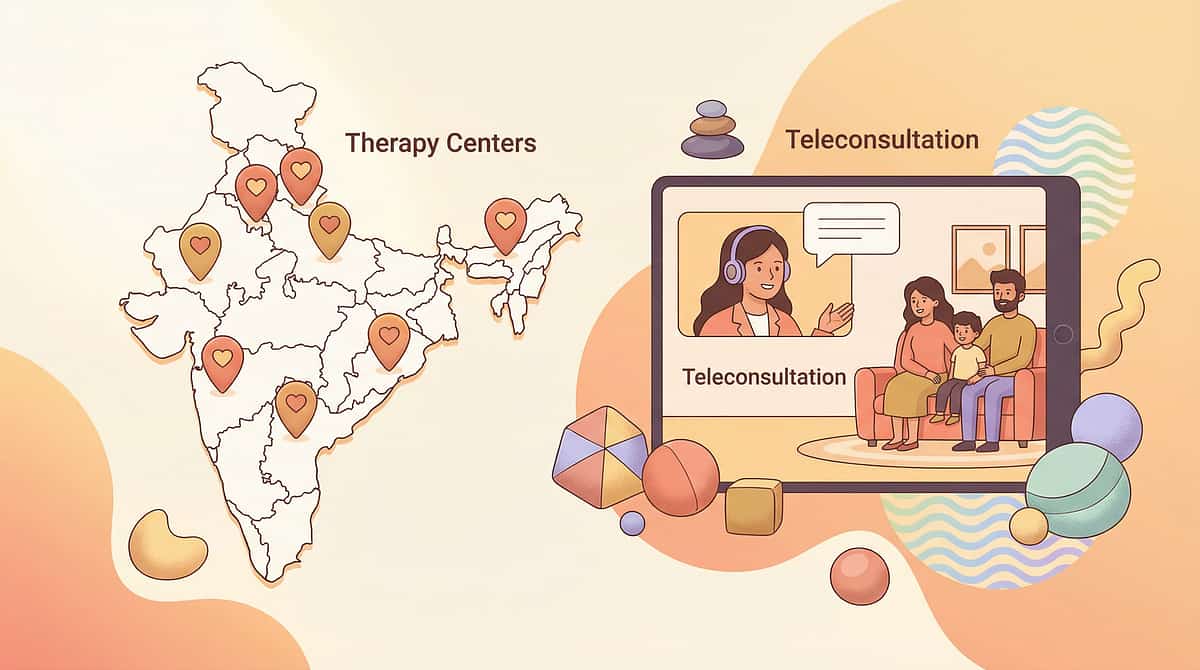
📱 GPT-OS® Teleconsultation
Remote families can access Pinnacle clinical expertise from anywhere in India. 30-minute session includes zone implementation review and personalized protocol adjustment.
→ Book: 9100 181 181
🗺️ Find Your Nearest Pinnacle Blooms Center
"Home-based intervention is not lesser than clinic-based intervention. It is different. The clinic provides clinical calibration. The home provides the 8,760 hours per year where real generalization happens. Both are essential."
Insurance / Funding
Ask your nearest Pinnacle center about Ayushman Bharat coverage, state government scheme eligibility, and corporate insurance coverage for autism therapy services.
WHO NCF Progress Report (2023): Primary healthcare as key platform for reaching all families with essential developmental interventions.

EVIDENCE BASE
The science behind C-272. For the parent who wants to go deeper.
📚 Study 1 — Systematic Review (2024) | Evidence Tier: 1
PRISMA review of 16 studies (2013–2023): Sensory integration and emotional regulation intervention meets criteria for evidence-based practice for children with ASD. → PMC11506176
📚 Study 2 — Meta-Analysis (2024) | Evidence Tier: 1
24 studies confirm sensory integration therapy effectively promotes social skills, adaptive behavior, sensory processing, and motor skills in pediatric ASD populations. → PMC10955541
📚 Study 3 — Indian RCT (2019) | Evidence Tier: 2
Home-based sensory and self-regulation interventions demonstrated significant outcomes in Indian pediatric population. First Indian RCT on home-based protocol efficacy. → Padmanabha et al., Indian J Pediatr
📚 Study 4 — NCAEP Evidence-Based Practices (2020) | Evidence Tier: 1
Visual supports, structured regulation curricula, and video modeling classified as evidence-based practices for autism across the lifespan. → NCAEP 2020 Full Report
📚 Study 5 — Mahler Interoception Research (2017–2023) | Evidence Tier: 2–3
Interoception training measurably improves emotional self-awareness and zone identification in children with autism, ADHD, and sensory processing differences. Body awareness is trainable. → unknown link

FREQUENTLY ASKED QUESTIONS
Frequently Asked Questions About C-272
Q: My child is 4 years old. Is she too young for Zones of Regulation?
The full four-zone framework is typically introduced between ages 5–7. For children aged 3–5, use a simplified version: "Calm body" (Green) and "Big feelings" (Yellow/Red). The check-in board can show two states rather than four. All materials are appropriate from age 4 — the language is adjusted, not the tools.
Q: We've been doing zones for a year and my son still can't identify his zone in real time. Is this normal?
Yes. Interoceptive development can take 12–36 months of consistent practice for children with significant deficits. Check: Is the body map included? If not, begin there. If you have, request an OT interoception assessment — there may be a sensory processing component requiring direct clinical intervention.
Q: The zones seem to be causing more anxiety in my daughter, not less. What's happening?
Zone perfectionism is real. If zone language is being used evaluatively ("You're being Yellow again"), it creates anxiety about zone states. Reset: 2 weeks of zero zone language. Then reintroduce with heavy emphasis on "All zones are okay. Zones are information." Also assess: is Yellow zone being treated as bad in your household?
Q: How long should each zone check-in session be?
Zone check-ins are 30-second micro-practices done 3–5 times per day. Formal zone work (body map, toolkit practice, zone games) takes 10–20 minutes and is done 3–4 times per week. Check-ins are not sessions — they are the daily practice that makes sessions matter.
Q: Should I use zones with my child's neurotypical sibling too?
Yes — absolutely. Making zones a family framework removes stigma, provides regulation models, and builds your autistic child's zone practice through family interaction. Zone dinner check-ins with all family members normalize the framework and provide extraordinary social learning opportunities.
Q: The biofeedback tools are too expensive. Can I skip them?
Yes. Biofeedback is an optional advanced tool, not a requirement. Begin with check-in board + body map + toolkit. A simple manual pulse check achieves 80% of the benefit at zero cost.
Q: My child's school doesn't use zones. Should I still do them at home?
Yes — home implementation is valuable independent of school. However, home gains are more likely to generalize when school uses consistent language. Download the Teacher Communication Template (Card 37) and request a brief meeting with your child's class teacher or school OT.
Q: How do I know when my child is ready to stop using the zone board?
The zone board becomes optional when your child demonstrates spontaneous, accurate zone self-identification without visual support for 4+ consecutive weeks across multiple environments. Many children retain the board as a comfort anchor even after internalization. There is no pressure to remove it.
Didn't find your answer? → Ask GPT-OS® | Still need help? → Book teleconsultation: 9100 181 181

You've read the science. You understand the materials. You know your child. Start today.
📞 Book a Consultation
Speak with a Zones of Regulation OT at your nearest Pinnacle center. Call FREE: 9100 181 181
🏛️ Pinnacle Blooms Consortium
Validated by OT • SLP • ABA/BCBA • SpEd • NeuroDev Pediatrics across 70+ centers and 20M+ sessions
📞 FREE Helpline
9100 181 181 | 16+ Languages | 24×7 | National Autism Helpline
Preview of 9 materials that help with zones of regulation Therapy Material
Below is a visual preview of 9 materials that help with zones of regulation therapy material. The pages shown help educators, therapists, and caregivers understand the structure and content of the resource before use. Materials should be used under appropriate professional guidance.



Link copied!

THE PINNACLE PROMISE
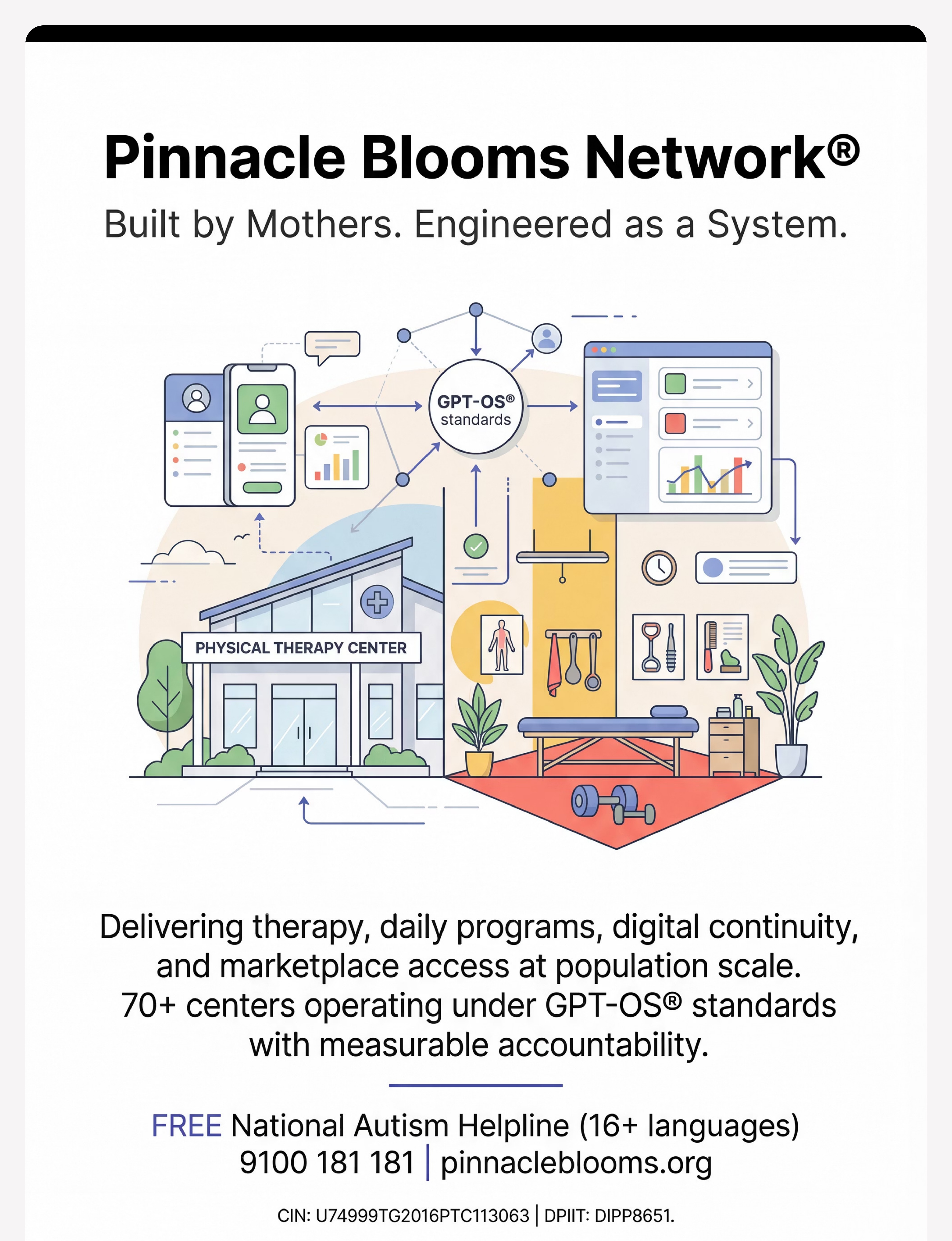
🏛️ Pinnacle Blooms Network®
CRO • Pediatric OT • Pediatric SLP • ABA/BCBA • Special Education • NeuroDevelopmental Pediatrics
"From fear to mastery. One technique at a time."
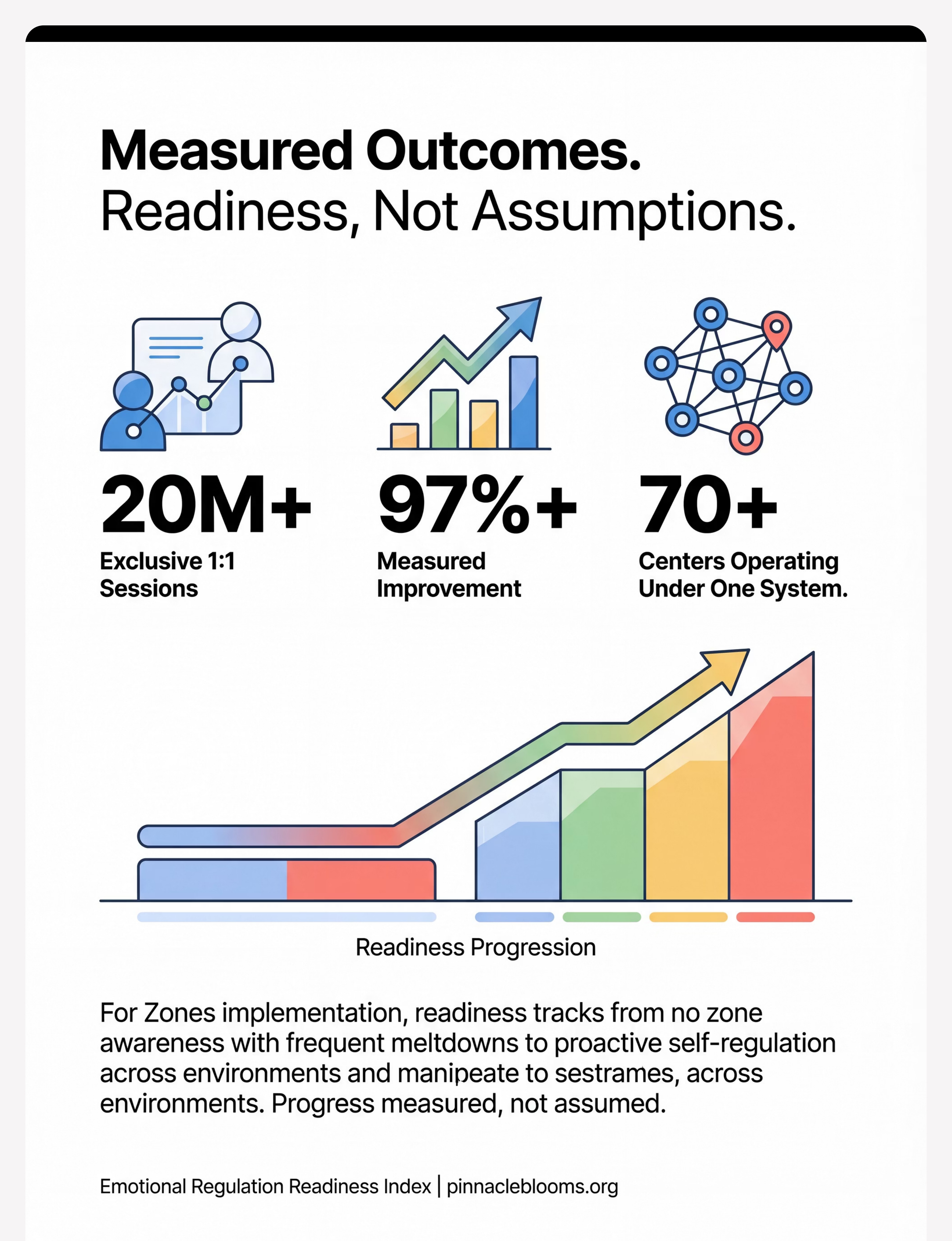
20M+
Exclusive 1:1 Sessions
Delivered across the Pinnacle Blooms Network
97%+
Measured Improvement
Across families using the full Pinnacle protocol
70+
Centers
Operating under one unified clinical system
ISO 13485
Medical Device Quality Management System
ISO/IEC 27001
Information Security Management
DPIIT: DIPP8651
Startup India Recognition
This content is educational and does not replace individualized assessment and intervention with licensed professionals. The Zones of Regulation® is a curriculum developed by Leah Kuypers, OTR/L. Zones of Regulation® is a registered trademark of Leah Kuypers. Individual results may vary. Statistics represent aggregate outcomes across the Pinnacle Blooms Network.
© 2025–2026 Pinnacle Blooms Network®, unit of Bharath Healthcare Laboratories Pvt. Ltd. All rights reserved. CIN: U74999TG2016PTC113063 | DPIIT: DIPP8651 | MSME: TS20F0009606 | GSTIN: 36AAGCB9722P1Z2
pinnacleblooms.org | care@pinnacleblooms.org | 9100 181 181