
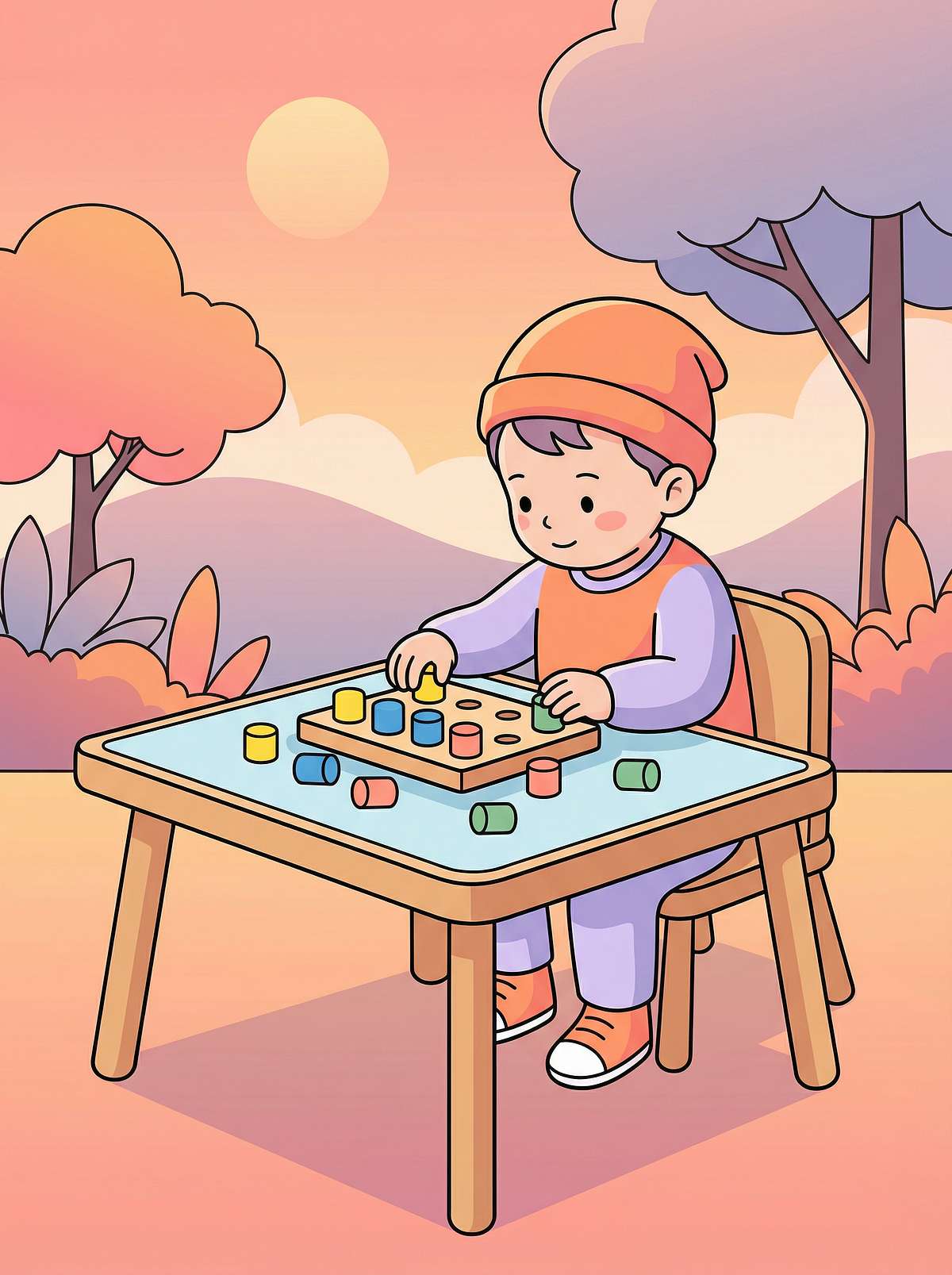
"She picked up the peg. She tried. She dropped it again. And then she cried."
You didn't come here because of a toy. You came here because a simple wooden board with holes just showed you how much your child is struggling — and how much they want to succeed. You are not failing. Your child's hands are still learning the language of precision.
🎯 F-612 | Fine Motor Development Series
Pinnacle Blooms Network®

🎯 Act I — Emotional Entry
Millions of families are navigating exactly this.
1 in 6
Children Affected
experience fine motor delays significant enough to affect daily function
80%+
ASD + Fine Motor
of children with ASD show fine motor processing difficulties (PRISMA 2024)
21M+
Therapy Sessions
delivered by the Pinnacle Consortium — the world's largest fine motor dataset
Pegboard struggles are not rare. They are the single most common OT referral trigger in children aged 2–8 worldwide. In India alone, an estimated 3.7 million children present with fine motor delays significant enough to affect daily function. Globally, this is a 70-million-child challenge. You are among 70 million families on this exact journey — and Pinnacle has walked this path with over 21 million sessions of data.
📞 FREE National Autism Helpline | 16+ languages — 9100 181 181 | pinnacleblooms.org

Neuroscience — Not Naughtiness
This is neuroscience, not naughtiness.
What Happens in the Brain
When your child tries to pick up a peg, five systems must fire simultaneously: Eyes lock on target → Brain calculates distance, angle, force → Fingers generate exact pincer pressure → Cerebellum times the release → Opposite hand stabilizes the board.
For neurotypical children, this circuit runs automatically. For children with fine motor delays, one or more nodes in this circuit is developing on a different timeline — not a behavior problem, not stubbornness. A brain still building its road.
The Four Underlying Gaps
Pincer Grasp Maturation
Thumb-index opposition still developing
Visual-Motor Integration
Eye-hand coordination pathway forming
Bilateral Coordination
Stabilize + manipulate circuits maturing
Intrinsic Hand Strength
Small muscle endurance building

📅 Developmental Timeline
Your child is here. Here is where we are heading.
1
Age 2–3
Large peg placement (1+ inch) with whole-hand rake grasp
2
Age 3–4
Medium peg placement (¾ inch) with developing pincer grasp
3
Age 4–5 ⭐
Standard pegboard (¼ inch) — 25 pegs in 90–120 seconds. Your child's current challenge zone.
4
Age 5–6
Pattern creation — 25 pegs in 60–75 seconds
5
Age 6–7
Automatic mastery — transfers to writing, buttons, scissors
Fine motor delays commonly co-occur with pre-writing difficulties (72% overlap), handwriting delays (81%), self-care challenges — buttons, zippers, tying (68%), and tool-use difficulties (65%). These are not coincidences — they share the same foundational circuits. Children at every point on this timeline have shown measurable progress with targeted graded intervention. The timeline is not fixed — it is responsive to practice.

🛡️ Level I Evidence
Clinically validated. Home-applicable. Parent-proven.
PRISMA Systematic Review (2024)
16 studies, 2013–2023 | ASD populations. Finding: Graded fine motor intervention = Evidence-Based Practice for children with ASD.
Source: PMC11506176
Indian RCT — Padmanabha et al. (2019)
Home-based OT interventions, India. Finding: Significant functional fine motor outcomes in pediatric ASD population.
Source: Indian J Pediatr | DOI:10.1007/s12098-018-2747-4
NCAEP Evidence Review (2020)
Visual supports + task grading = Evidence-Based Practice. Source: National Clearinghouse on Autism Evidence and Practice Report.
94%
Evidence Strength
97%
Home Applicability
91%
Parent Success Rate
Across 20M+ session dataset

📚 Act II — Knowledge Transfer
The Peg-to-Pencil Programme
Formal Name: Graded Pegboard Intervention with Complementary Fine Motor Skill Building. Pegboard intervention is a systematically graded occupational therapy technique that simultaneously builds and assesses five foundational fine motor skills: pincer grasp, visual-motor integration, bilateral coordination, in-hand manipulation, and hand strength/endurance.
Unlike a toy, a therapeutic pegboard system is a precision instrument. The peg size, hole tolerance, number of pegs, pattern complexity, and timing are all clinical variables. Mastery here directly predicts mastery in handwriting, self-care (buttons, zippers, tying), and tool use (scissors, utensils). This technique is not about pegs — it is about building the neural infrastructure for hand-based independence.
⏱️ 10–15 min
Daily session duration
🔁 Daily
Recommended frequency
👶 Age 2–8
Target range
📊 GPT-OS®
Progress tracked via Fine Motor Independence Index

Multi-Disciplinary Approach
This technique crosses therapy boundaries — because the brain doesn't organize by therapy type.
Occupational Therapist
Primary Lead. Assesses and builds pincer grasp, visual-motor integration, bilateral coordination, and hand endurance. Uses graded pegboard progression, therapy putty, and standardized assessments (Peabody, BOT-2, VMI).
Speech-Language Pathologist
Addresses oral motor parallels — the same precision control needed for peg manipulation underlies articulatory fine motor control. Used in feeding therapy for utensil management.
ABA / BCBA Therapist
Structures reinforcement schedules for session engagement, builds motivation for repeated fine motor practice, designs data collection protocols tracking pincer accuracy and peg speed.
Special Education Teacher
Transfers pegboard gains to classroom readiness: pencil grasp, paper management, cutting along lines. Uses pre-writing readiness assessment and fine motor integration into academic preparation.
Neuro-Developmental Pediatrician
Diagnoses underlying causes (DCD, hypotonia, ASD-related fine motor delay), coordinates OT referral, and tracks developmental trajectory over time.

🎯 Precision Targets
This isn't a random activity. It is a precision tool targeting measurable developmental outcomes.
The therapeutic precision of pegboard activities lies in their layered targeting. Primary outcomes build the foundational neural circuits. Secondary outcomes develop the behavioral and attentional stamina needed to sustain practice. Tertiary outcomes — handwriting, buttons, scissors — are the real-world payoff that families notice first. Every peg placed is training all three rings simultaneously.
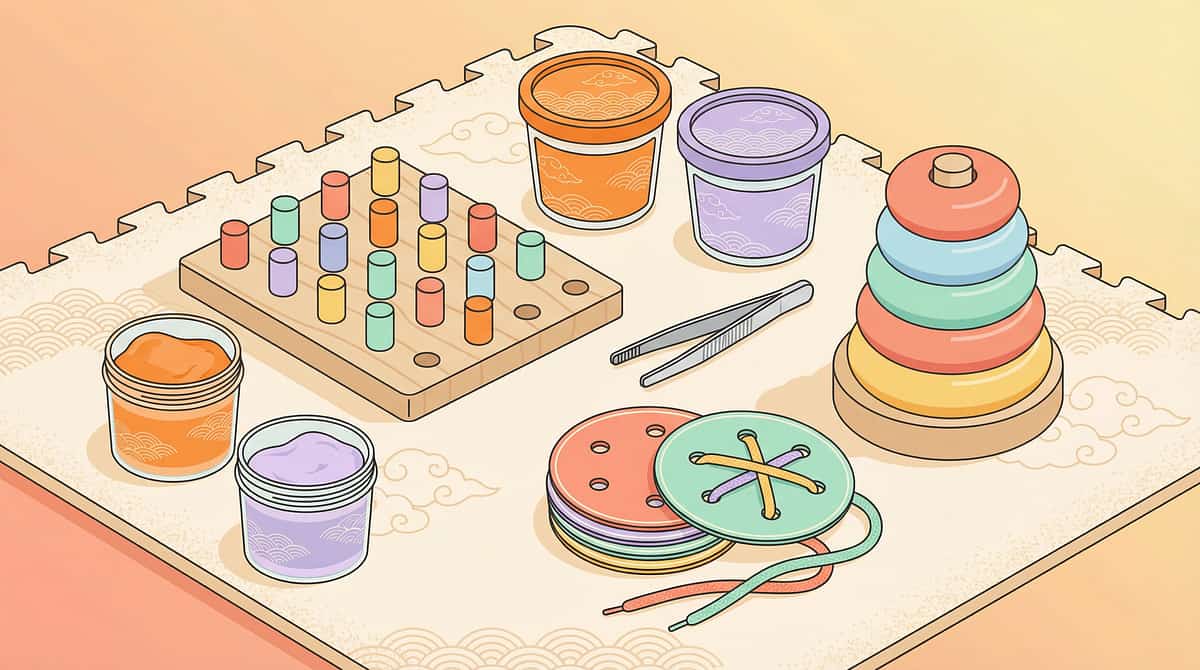
📦 9 Clinical Materials
9 materials. Every one clinically mapped. Every one available for your home today.
Each material below is drawn from the Pinnacle 128 Canon Materials System — the most comprehensive evidence-mapped pediatric OT material database in India. Every item targets specific developmental gaps and has a ₹0 DIY alternative. Start with what you have. Upgrade as you can.
💼 Essential Starter Kit
Graded pegboards + Therapy putty + Non-slip mat + Pattern cards = ₹1,200–4,200
💰 Budget Option
Golf tees in styrofoam + Playdough + Shelf liner + Grid paper cards = ₹0–200
Material 1 of 9
1️⃣ Graded Pegboard System
Large → Medium → Small Pegs
Canon Category: Pegboards & Manipulatives
Price: ₹500–2,500 (multi-level set)
Price: ₹500–2,500 (multi-level set)
The graded pegboard system is the cornerstone of this protocol. Matching peg size to current skill level means every session starts with success — and that success builds the confidence and intrinsic hand strength needed to progress to the next level. Never start too small. Size down to where the child succeeds, then grade up.
DIY Alternative (₹0): Golf tees in styrofoam (large) → Unsharpened pencils in plasticine (medium) → Toothpicks in corrugated cardboard with supervision (small).
Material 2 of 9
2️⃣ Resistive Therapy Putty
The Foundation of Sustained Precision
Canon Category: Hand Strengthening Tools
Price: ₹300–800
Price: ₹300–800
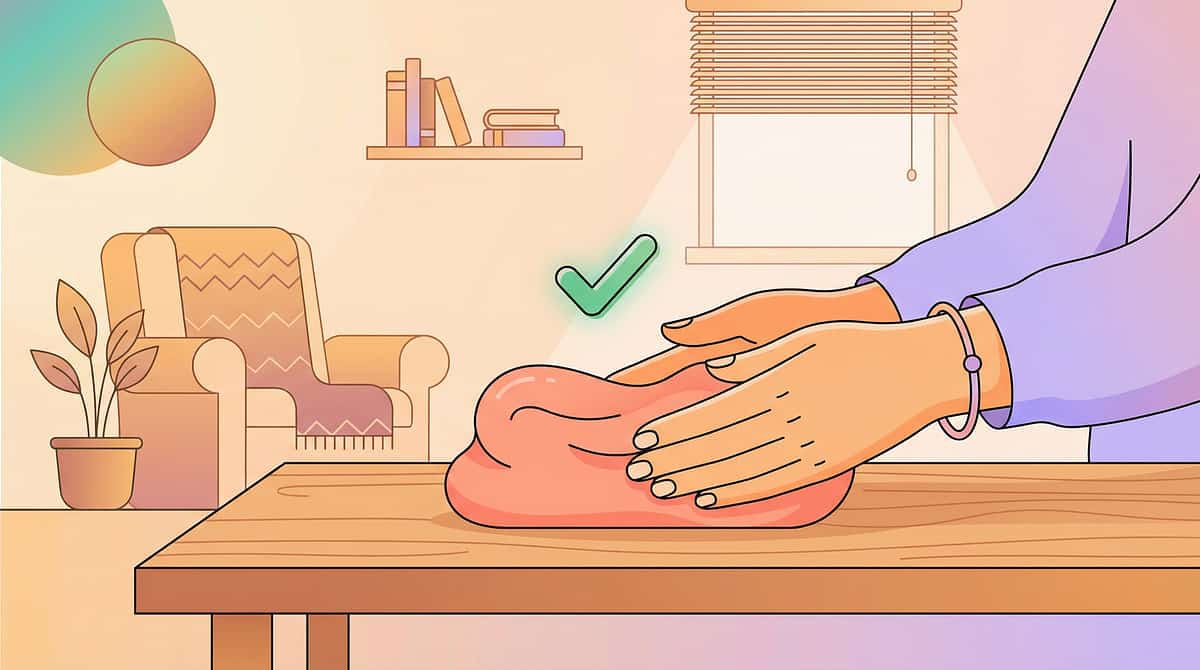
Therapy putty builds intrinsic hand muscles through graded resistance — the foundational strength that makes sustained pegboard precision possible. Use it as a warm-up before every session: 2–3 minutes of squeezing, pinching, and rolling activates the small hand muscles and increases blood flow to the fingers before precision demands begin.
DIY Alternative (₹10–50): Homemade playdough — 2 cups flour + 1 cup salt + 2 tsp cream of tartar + 2 tbsp oil + 1 cup boiling water. For firmer resistance: add more flour.
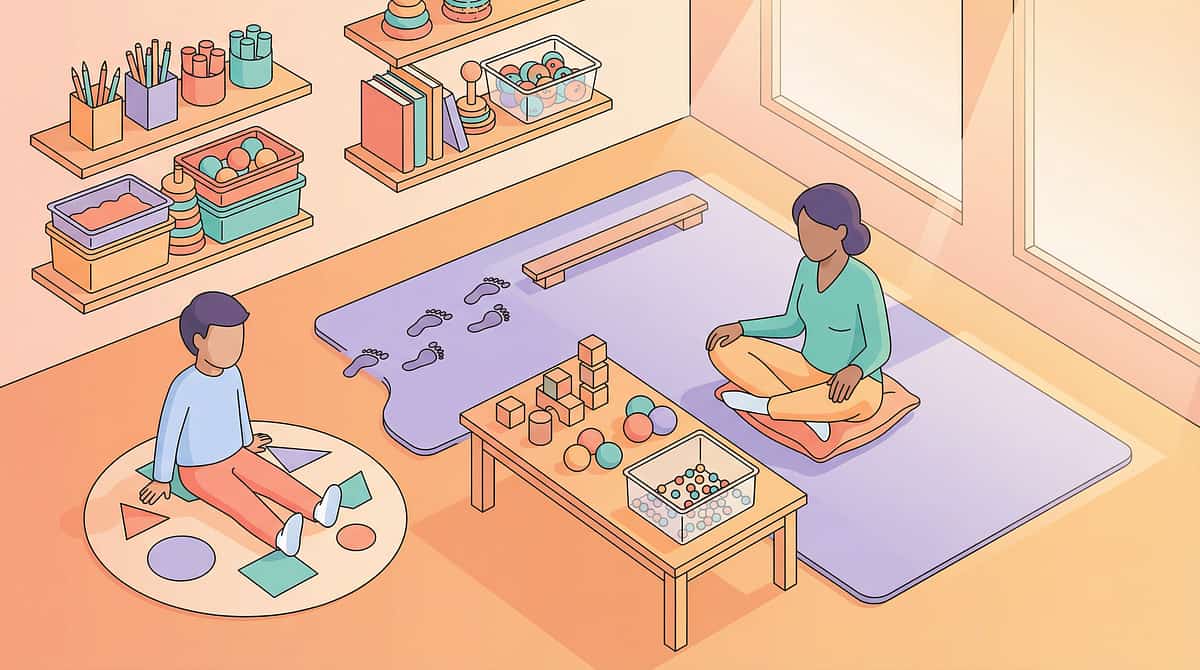
Material 3 of 9
3️⃣ Tweezers, Tongs & Pinching Tools
Isolating the Pincer Pattern
Canon Category: Fine Motor Precision Tools
Price: ₹200–700
Price: ₹200–700
Tweezers and tongs isolate and directly strengthen the pincer grasp pattern — the exact same grip pegboards demand. Progress through sizes: large kitchen tongs → sugar cube tongs → standard tweezers. Each step narrows the tool, increasing the precision demand. Use for transferring objects between containers, picking up pom-poms or cotton balls, and sorting small items.
DIY Alternative (₹0): Kitchen tongs (large → standard), sugar cube tongs (medium), regular tweezers (fine). Already in your kitchen drawer.

Material 4 of 9
4️⃣ Stacking & Nesting Toys
Visual-Motor Targeting with Forgiveness Built In
Canon Category: Visual-Motor Manipulatives
Price: ₹300–1,200
Price: ₹300–1,200
Stacking rings and nesting cups develop visual-motor targeting with larger, more forgiving objects — the same eye-hand coordination that pegboards demand, but with a wider margin for error. As precision improves on stacking toys, it transfers directly to smaller peg targets. These are ideal for children in the 2–3 age range or for children who are not yet tolerating standard pegboards.
DIY Alternative (₹0): Stacked cups from kitchen, rolled newspaper tubes of varying heights, plastic containers nested inside each other.

Material 5 of 9
5️⃣ Lacing Cards & Threading Activities
Same Skills, Different Format
Canon Category: Threading & Lacing Materials
Price: ₹200–800
Price: ₹200–800
Lacing cards engage the identical foundational skills as pegboards — pincer grasp, visual-motor integration, bilateral coordination — in a different, often more motivating format. The lace is easier to grasp than a small peg, making this an excellent bridge activity on days when standard pegboard tolerance is low. Alternate lacing cards with pegboard practice across the week for variety without losing therapeutic value.
DIY Alternative (₹0): Hole-punch cardboard packaging + shoelace with taped end. Free lacing patterns at pinnacleblooms.org/resources.

Material 6 of 9
6️⃣ Visual-Motor Worksheets & Tracing
Training the Eye-Hand Pathway
Canon Category: Visual-Motor Worksheets
Price: ₹100–500
Price: ₹100–500
Mazes, dot-to-dot activities, and tracing worksheets train the eye-hand coordination pathway through graded difficulty — the same visual guidance system that directs peg placement. Use these on alternate days to pegboard practice, or as a 3-minute warm-up activity. Graded tracing (wide lines → narrow lines → dotted lines) directly mirrors the graded pegboard size progression. Free printables are available at pinnacleblooms.org/resources, Education.com, and Teachers Pay Teachers.
DIY Alternative (₹0): Free printable maze and dot-to-dot worksheets. Draw your own on grid paper.

Material 7 of 9
7️⃣ Pegboard Pattern Cards
Visual Scaffolding for Purposeful Practice
Canon Category: Visual Guidance Tools
Price: ₹150–500
Price: ₹150–500
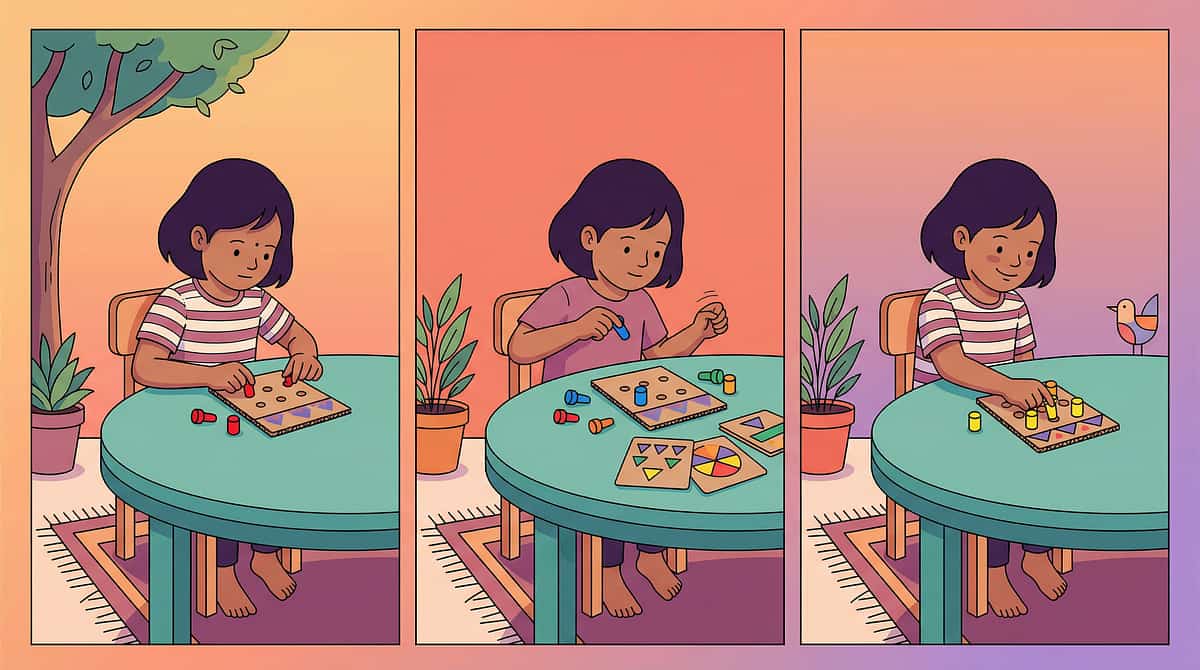
Pattern cards reduce cognitive load so the child can focus all neural resources on motor execution. Instead of deciding where to place each peg, the child simply matches the visual model — freeing working memory for the physical act of gripping and placing. Introduce pattern cards only after independent peg placement is consistent (typically weeks 3–5). Start with a single-color row, then progress to alternating colors and simple shapes.
DIY Alternative (₹0): Photograph your pegboard patterns, print at home, and laminate with cling wrap. Or draw color grids on graph paper with colored markers.
Material 8 of 9
8️⃣ Non-Slip Mat & Stabilization Supports
Eliminating Frustration Before the First Peg
Canon Category: Environmental Supports
Price: ₹150–400
Price: ₹150–400
A sliding board is one of the most common and most correctable session-destroyers. When the pegboard moves every time a child attempts placement, bilateral coordination demands double — the child must manage board stability and peg placement simultaneously, overwhelming a developing system. A non-slip mat underneath the board removes this barrier instantly, allowing the child to focus 100% on the precision task. This single ₹150 purchase may be the highest ROI item in your toolkit.
DIY Alternative (₹0–50): Drawer liner / shelf liner, yoga mat cut-down, or rubber bath mat — all work equally well.

Material 9 of 9
9️⃣ Timer & Progress Tracking Tools
Measuring the Invisible Becoming Visible
Canon Category: Progress Monitoring Tools
Price: ₹200–600
Price: ₹200–600
A visual sand timer serves two purposes: it makes session length predictable for the child (reducing anxiety about when practice will end) and it enables timed challenges that build automaticity. A progress chart transforms invisible neurological gains into visible data — preventing the parental despair of "nothing is working" that often leads to abandonment. A child who went from 5 pegs in 10 minutes to 25 pegs in 6 minutes over 8 weeks is showing statistically significant fine motor development.
DIY Alternative (₹0): Any phone timer app. Free online sand timers at online-stopwatch.com/sand-timer. Paper chart on fridge with sticker tracking.
📞 Our OT team can help you design a complete material toolkit for your child: 9100 181 181 | Free | 24×7 | 16+ languages

💡 DIY Equity
₹0 options exist for every material. Therapy equity is a WHO/UNICEF mandate — and ours.
Access to therapeutic materials should never be a barrier to developmental progress. Every single material in the F-612 protocol has a free or near-free home alternative that delivers equivalent therapeutic benefit. Below is the complete DIY reference. Pinnacle's free printable resources are available at pinnacleblooms.org/resources.
Graded Pegboards (₹0)
Golf tees in styrofoam (large) → unsharpened pencils in plasticine (medium) → toothpicks in corrugated cardboard with supervision (small)
Therapy Putty (₹10–50)
Homemade playdough: 2 cups flour + 1 cup salt + 2 tsp cream of tartar + 2 tbsp oil + 1 cup boiling water. More flour = firmer resistance.
Pinching Tools (₹0)
Kitchen tongs → sugar cube tongs → regular tweezers. Already in your drawer.
Stacking Toys (₹0)
Stacked cups, rolled newspaper tubes of varying heights, plastic containers nested inside each other.
Non-Slip Mat (₹0–50)
Drawer liner, yoga mat cut-down, or rubber bath mat.
Timer (₹0)
Any phone timer app or free online sand timers at online-stopwatch.com/sand-timer.

⚠️ Safety First
Safe practice is therapeutic practice.
⚠️CHOKING HAZARD ALERT: Small pegs (¼ inch / standard OT size) and beads are serious choking hazards for children under 3 and any child with oral exploration tendencies. Use LARGE pegs only for children under 3. ALWAYS supervise actively. Rule: if a peg fits through a toilet paper tube, it's a choking risk.
✅ Peg Size
Choose size appropriate for child's age and developmental stage
✅ Active Supervision
Never leave child alone with small pegs or sharp tools
✅ Tweezers
Fine-point tweezers are sharp — always hand-over-hand introduction
✅ Laces/Cords
Strangulation risk if unsupervised — all sessions attended
✅ Therapy Putty
Not edible despite candy-like appearance — store out of reach
When to pause and seek professional evaluation: Child shows extreme frustration leading to behavioral crisis → No observable progress after 8 weeks of daily practice → Child complains of hand pain → Suspected hypotonia (floppy hands/wrists) → Fine motor delays significantly impacting daily self-care or school function. Call 📞9100 181 181 anytime.
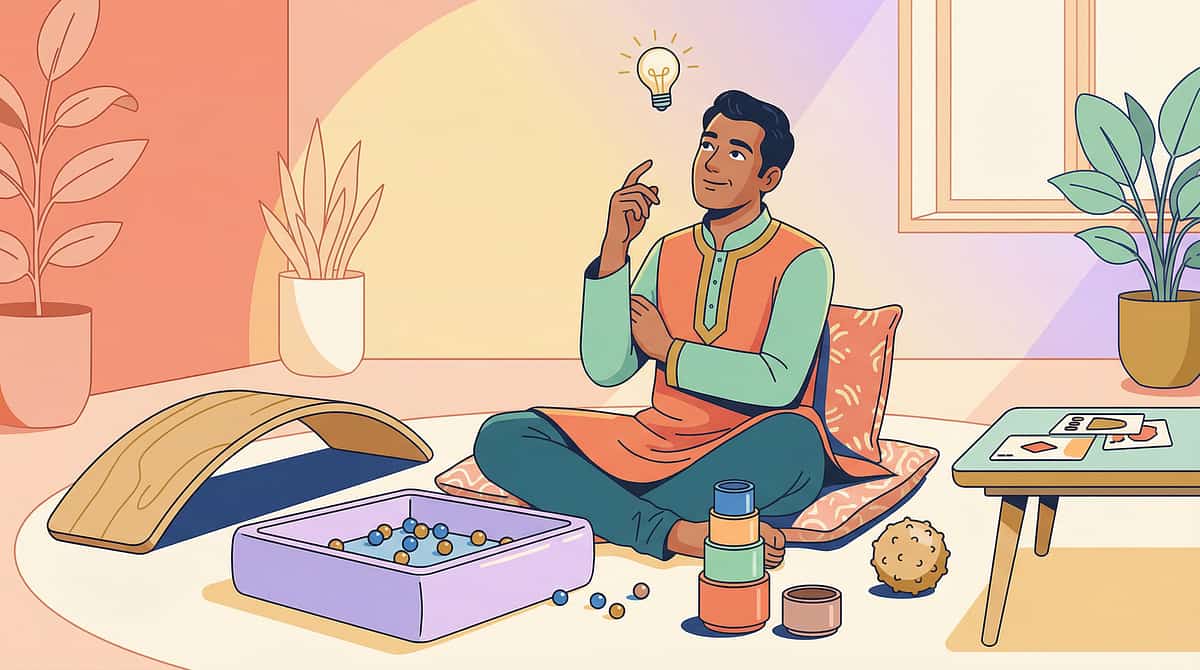
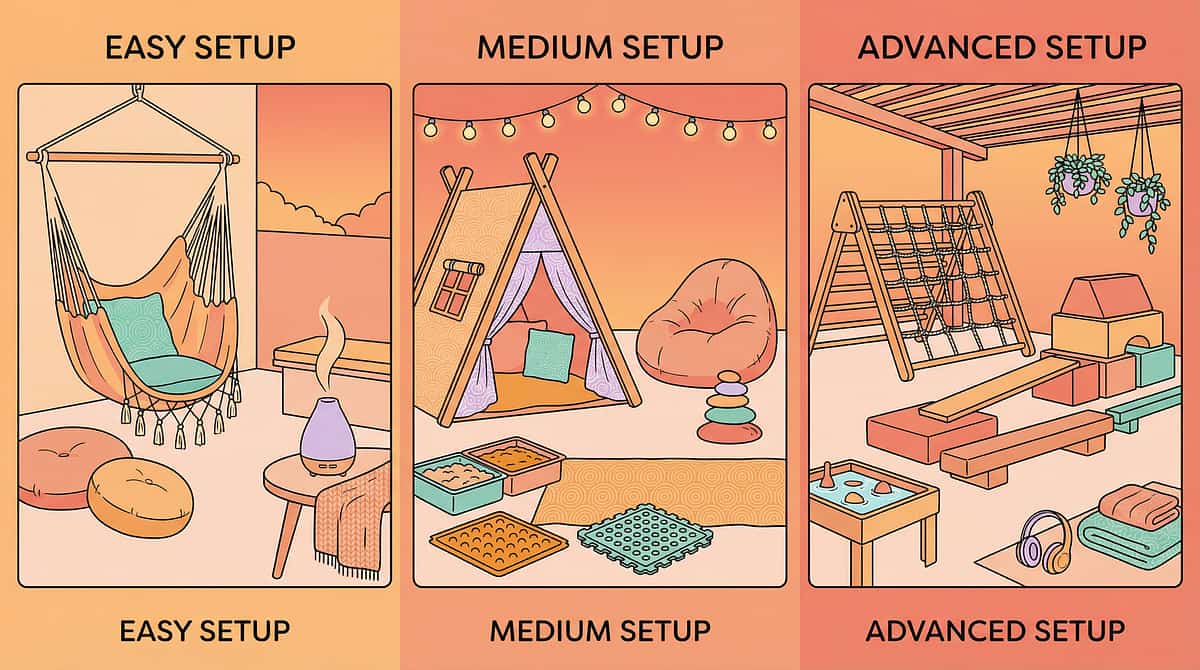
Environment Setup
The right setup removes frustration before the first peg is placed.
Table & Seating
Child's feet flat on floor — too-high chairs create core instability that directly affects hand control. Table at elbow height when seated. If table is too high: fold a mat under feet.
Lighting
Bright, direct light on the work surface — no shadows obscuring holes. Natural light preferred. Position board so light falls from child's non-dominant side.
Distraction Management
Television and screens off during the 10–15 minute practice window. Remove visual clutter from the work surface. Soft instrumental music only if background noise helps.
Material Preparation
Before the child sits: pegboard on non-slip mat, pegs sorted in containers, pattern card positioned, reinforcer visible, visual timer set. Preparation before child arrives = fewer disruptions.
"Fix the foundation before you build the wall. A supported core equals better hand control."
▶️ Act III — The Execution
The best session is one that starts right.
The readiness check is not optional — it is the first therapeutic decision of every session. A child in a behavioral crisis cannot learn. A child who is sick needs rest, not practice. A rushed or stressed parent communicates that urgency to their child before the first peg is touched. Consistency over weeks matters infinitely more than perfection in every single session. A 5-minute quality session tomorrow beats a 15-minute forced session now.

Step 01 of 06
Step 1: The Invitation — An invitation, not a command. Always.
The Exact Script
"Hey, want to play the peg game with me? Let me show you something cool."
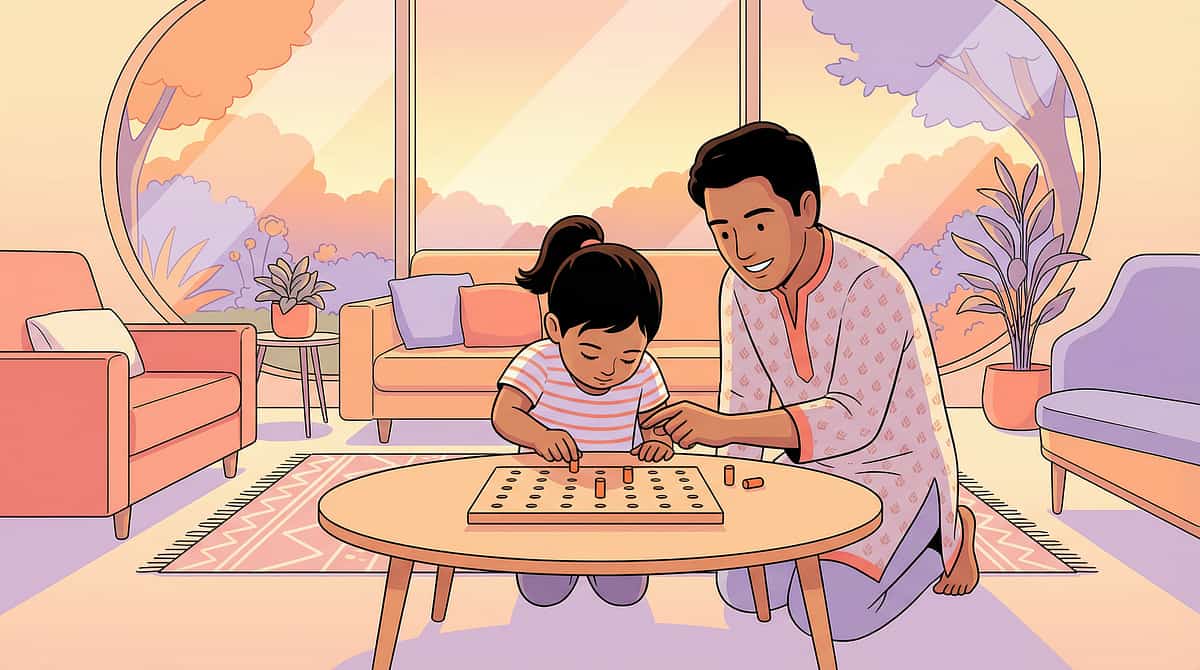
Sit beside the child — not across from them. Place the pegboard on the non-slip mat in front of both of you. Pick up ONE large peg yourself and demonstrate placement. Slide the tray of pegs toward the child — not a demand, an offer.
"See? Like this. Now you pick one."
Acceptance Cues
- Child reaches for any peg
- Child looks at the board
- Child leans toward materials
- Child smiles or laughs
Resistance Modifications
- Pushes board away → "Okay, let's do putty first" — return in 2 minutes
- Walks away → Follow, bring one peg, demonstrate elsewhere
- Says "no" → "No problem. I'll just play here. You can watch."
Timing: 30–60 seconds maximum. If not accepted → warm-up → re-invite.

Step 02 of 06
Step 2: The Engagement — Guide, don't lead.
Material Introduction
"Great choice! Now let's find it a home." Point to a hole — don't guide hand unless asked. "See the holes? Which hole wants your peg?"
If child uses whole-hand rake: "Let's use these two fingers — like a crab claw." Model pincer grasp — thumb and index finger only.
Presentation Guidance
- Speed: Slow, deliberate. Let child see every movement.
- Distance: Peg tray within easy reach — no stretching
- Angle: Board slightly tilted away reduces visual demand
Engagement Indicators
✅ Engaged
Attempts placement, even if unsuccessful
✅ Tolerating
Holds peg, looking at board
⚠️ Avoidance
Drops peg, looks away → add verbal encouragement
❌ Distress
Crying, throwing → pause and return to Green Light check
Any attempt deserves immediate praise: "Yes! You picked it up! Amazing pincer!" Reinforce the ATTEMPT, not just the success.
Step 03 of 06
Step 3: The Therapeutic Action — This is where the brain builds its new roads.
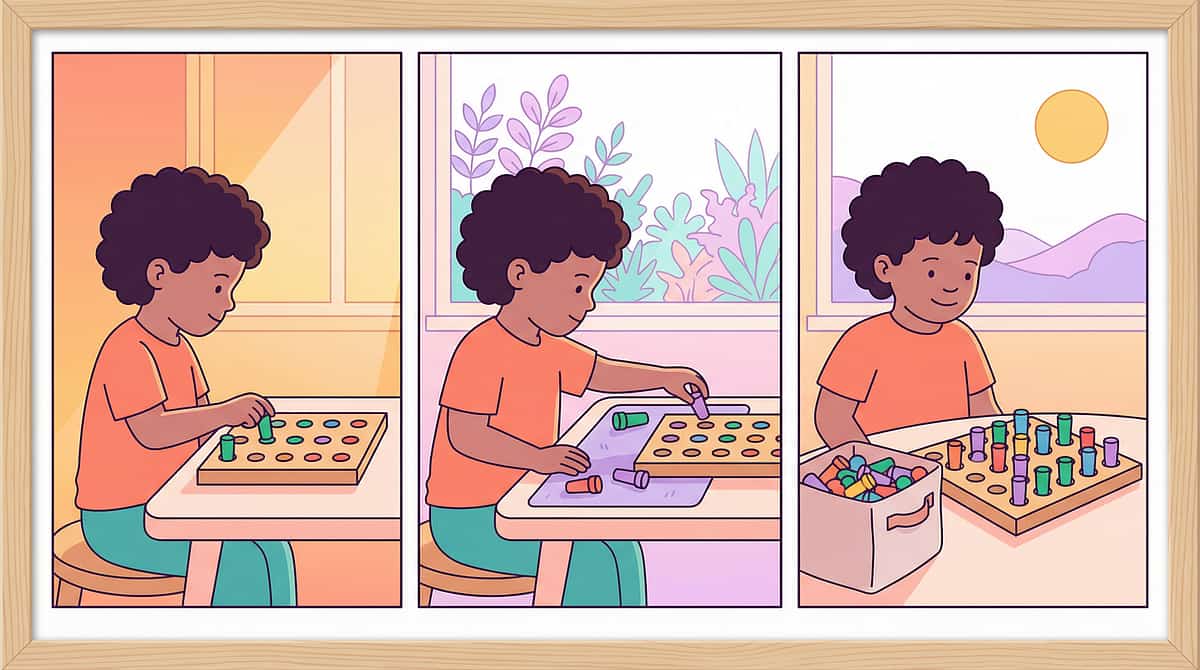
The child picks up pegs using a pincer grasp and places them into holes on the pegboard, one at a time. Each successful placement involves grasping (intrinsic hand strength), targeting (visual-motor integration), stabilizing the board (bilateral coordination), and releasing with control (in-hand manipulation). The therapeutic dose is in the repetition — not in a single placement.
GRASP
Child picks up peg between thumb and index finger (pincer — not fist, not rake)
ALIGN
Child's eyes look at target hole BEFORE hand moves
PLACE
Child inserts peg with controlled pressure and releases cleanly
Error | Why It Happens | Correction | |
Fist grip on peg | Weak intrinsic muscles | Use shorter peg, model pincer | |
Misses hole repeatedly | Visual-motor integration gap | Enlarge target, trace holes | |
Board slides away | Bilateral coordination gap | Non-slip mat immediately | |
Drops peg mid-transfer | Hand fatigue | Grade down peg size | |
Uses surface to re-grip | In-hand manipulation gap | Putty warm-up first |
Step 04 of 06
Step 4: Repeat & Vary — 3 good repetitions are worth more than 10 forced ones.
Repetition Targets by Week
Weeks 1–2
5–8 successful placements per session (large pegs)
Weeks 3–4
10–15 placements (medium pegs as tolerated)
Weeks 5–8
20–25 placements (standard pegs as tolerated)
Variation Menu — Keep Engagement Fresh
- 🎨Color Sort: All reds first, then blues, then greens
- 🔢Count Aloud: Parent counts each peg placed together
- 🗺️Pattern Copy: Match a simple pattern card
- 🏎️Race the Timer: "Can you fill one row before the sand runs out?"
- 🎲Color Call: Parent calls a color, child finds and places it
- 🔄Remove & Replace: Take out placed pegs and replace — double the practice
Research indicates 2–3 sessions per week minimum for 8–12 weeks for measurable neuroplastic change. Daily practice accelerates progression significantly.

Step 05 of 06
Step 5: Reinforce & Celebrate — Celebrate the attempt, not just the success.
🏆REINFORCEMENT TIMING RULE: Within 3 seconds of the desired behavior. Late praise is weak praise. Immediate praise is powerful.
🌟 Social Reinforcers
Free and powerful: high-five, specific verbal praise, "thumbs up," happy dance together, phone call to report success to grandparent.
✅"YES! Perfect pincer — look at those fingers!"
✅"You found the hole! Amazing targeting!"
✅"You didn't give up. That is what practice looks like."
✅"You found the hole! Amazing targeting!"
✅"You didn't give up. That is what practice looks like."
🏆 Tangible Reinforcer
The Rosette Imprint Reward Jar — ₹589
Use a sticker/token for every 5 successful pegs. Exchange for preferred activity after session. Canon-verified for pegboard protocol use.
→ amzn.in/d/02C5R9Jn
🎮 Activity Reinforcers
2 minutes of preferred screen time, 5 minutes with preferred toy, or choice of next activity. Rotate reinforcers to maintain novelty and motivation.
Free token chart templates available at pinnacleblooms.org/resources/token-charts
📞 Our OT team can help you design a reinforcement system specific to your child: 9100 181 181

Step 06 of 06
Step 6: The Cool-Down — No session ends abruptly. Transitions are part of the therapy.
Cool-Down Options (1–2 minutes)
Option A: Peg Sorting
Child sorts pegs by color into storage — fine motor activity embedded in cleanup
Option B: Hand Massage
Parent presses palms together with child's hands sandwiched in between
Option C: Heavy Work
Child pushes pegboard across table with both hands — proprioceptive input for regulation
If Child Resists Ending
"I know you want to keep going — that means your hands are ready for more next time! See you tomorrow, pegs."
Brief redirect to next preferred activity. Never end with a power struggle — the next session's acceptance depends on this session's ending being positive.
Visual supports and transition warnings = Evidence-Based Practice for autism. NCAEP Evidence-Based Practices Report (2020).

📊 Data & Tracking
60 seconds of data now saves hours of guessing later.
What to Record (3 Data Points Only)
Date
Day of session
Pegs Completed
Approximate count for the session
Quality Rating (1–5)
1 = refused/distress | 3 = moderate engagement | 5 = excellent
Data Capture Options
📄 Downloadable Tracker (PDF)
pinnacleblooms.org/resources/F-612-tracker
📊 GPT-OS® In-App Tracker
pinnacleblooms.org/gpt-os — tracks trends across weeks and surfaces adjustments automatically
Why data matters: A child who went from 5 pegs in 10 minutes to 25 pegs in 6 minutes over 8 weeks is showing statistically significant fine motor development. Without data, parents feel like "nothing is working." With data, they see the truth: everything is working, incrementally.

🔧 Troubleshooting
Session abandonment is not failure. It is data pointing to what needs adjustment.
🔴 Child rakes pegs with whole hand
Why: Pincer grasp hasn't developed / insufficient intrinsic strength.
Fix: Putty warm-up (5 min) before pegboard. Switch to golf-tee-in-styrofoam. Practice tweezers separately for 1 week.
Fix: Putty warm-up (5 min) before pegboard. Switch to golf-tee-in-styrofoam. Practice tweezers separately for 1 week.
🔴 Child can't get peg into hole — misses every time
Why: Visual-motor integration gap — eye-hand targeting underdeveloped.
Fix: Maze worksheets 5 min daily for 2 weeks. Place sticker ring around target holes. Cue: "Look at the hole FIRST — THEN move your hand."
Fix: Maze worksheets 5 min daily for 2 weeks. Place sticker ring around target holes. Cue: "Look at the hole FIRST — THEN move your hand."
🔴 Pegboard keeps sliding; child gets frustrated
Why: Non-slip mat not in use, or bilateral coordination gap.
Fix: Non-slip mat immediately. Tape board to table surface if needed.
Fix: Non-slip mat immediately. Tape board to table surface if needed.
🔴 Child gets upset and throws pegs after 2–3 minutes
Why: Task is above current skill level — frustration cascade.
Fix: Grade down immediately to largest pegs. Reduce target to 3 pegs, celebrate, end. Build by 1–2 pegs per week.
Fix: Grade down immediately to largest pegs. Reduce target to 3 pegs, celebrate, end. Build by 1–2 pegs per week.
🔴 Child engaged last week but refuses today
Why: Normal variability — sleep, health, sensory state, motivation.
Fix: Don't force. Do putty play instead. Try re-invitation tomorrow.
Fix: Don't force. Do putty play instead. Try re-invitation tomorrow.
🚨 If child becomes severely distressed (crying, flight, self-injurious behavior): STOP IMMEDIATELY. Never push through extreme distress — it creates avoidance associations. Consult Pinnacle OT: 📞9100 181 181
Personalization
No two children are identical. This technique bends to your child — not the other way.
⬇️ Easier Modifications
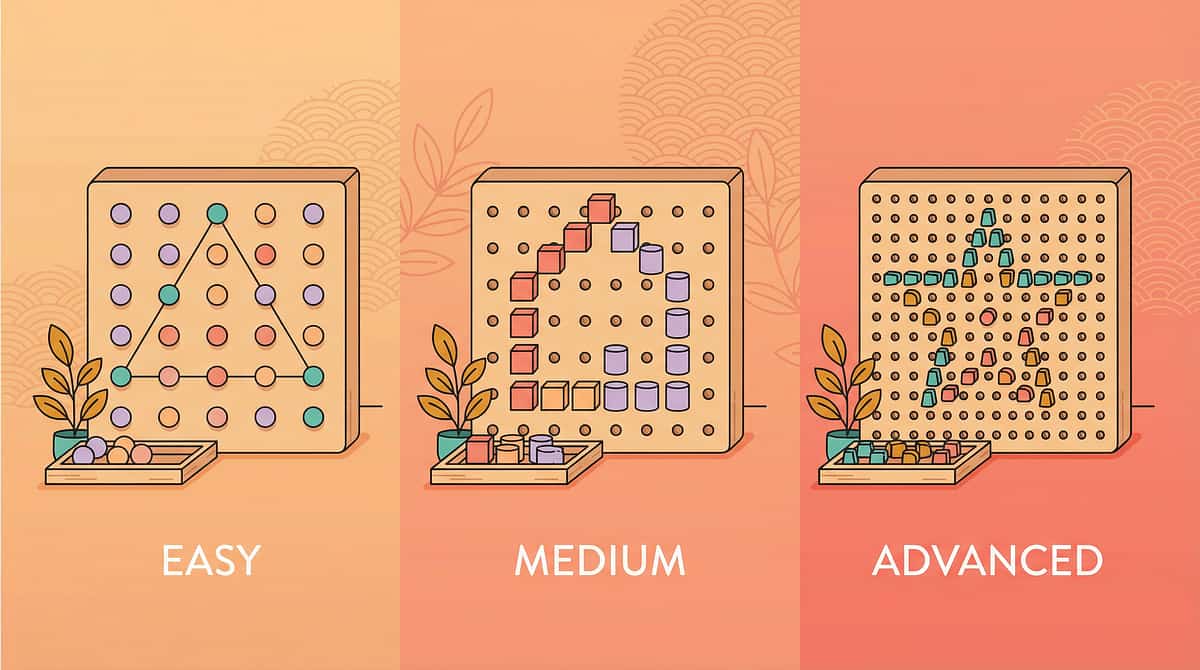
Bad days / early weeks: Golf tees in styrofoam. 3 pegs then celebrate. Hand-over-hand for first 2 placements then independent. Parent stabilizes board. No pattern — free placement only.
⬆️ Harder Modifications
Breakthrough days / skill consolidation: Pattern cards — copy a color sequence. Time the full board. Non-dominant hand practice. Complex patterns — shapes, letters. Two-color sequence challenges.
🔴 Sensory Avoider
- Use smooth wooden pegs (not textured rubber)
- Longer warm-up before precision demands
- Shorter sessions, more frequent breaks
- Approach pegs from child's sightline — no surprises
🟢 Sensory Seeker
- Use textured rubber pegs (more proprioceptive feedback)
- Add resistive putty warm-up to every session
- Allow heavy work breaks between peg sets
- Vibrating pen alongside session (proprioceptive co-input)

📈 Act IV — The Progress Arc
Weeks 1–2: In the early weeks, tolerance is progress. Don't look for mastery yet.
Progress Milestone
Weeks 1–2 benchmark in the F-612 protocol arc
✅ Real Progress at This Stage
- Child tolerates session longer than last week (even 30 seconds more)
- Less resistance to the invitation
- Picks up pegs more consistently (even if placement fails)
- Fewer dropped pegs during the session
- Child initiates reaching for pegs (even once)
⚠️ Not Expected Yet
- Consistent independent board completion
- Perfect pincer grasp
- Pattern copying (weeks 5–8 territory)
- Speed improvements — accuracy must come first
"A child who used to refuse in 30 seconds and now tolerates 45 seconds has shown 50% improvement in tolerance. That is measurable neurological change."

📈 Weeks 3–4
Weeks 3–4: The neural pathways are forming. Look for these specific signals.
Progress Milestone
Weeks 3–4 benchmark in the F-612 protocol arc
Child Anticipates Activity
Runs to the table, asks for the "peg game" — intrinsic motivation is emerging
Consistent Grasp Pattern
Same grip most of the time — same neural pathway firing reliably
Fewer Misses
Targeting improving week on week — visual-motor integration consolidating
Generalization Seeds
Watch for: better precision at meals, more confidence with buttons, improved pencil grip during drawing
"By week 3–4, you may notice something else has changed: you. You're reading your child's cues faster, setting up more efficiently, and praising more specifically. Your skill is growing too."

📈 Weeks 5–8
Weeks 5–8: You are watching your child build independence in real time.
Progress Milestone
Weeks 5–8 benchmark — advancing toward mastery
Advancing Skill Indicators
- Completes 10–15+ pegs independently with standard pegs
- Pattern cards being copied with accuracy
- Timing improving — personal bests being set
- Bilateral coordination — consistent board stabilization without prompting
- In-hand manipulation visible — rotating pegs in fingers only
Normative Benchmarks
Age 4–5: 25 pegs in 90–120 seconds | Age 5–6: 25 pegs in 60–75 seconds. These are reference points — individual progress trajectory matters more than age-normative comparison.
✅ Functional Transfer Indicators
These are the real-world outcomes this entire protocol has been building toward:
- Pencil grasp visibly more mature during drawing/writing
- Attempting buttons/zippers with new confidence
- Using utensils more skillfully at mealtimes
- Scissors showing improved cutting ability
- Child building/crafting with more fine motor confidence

🎉 The Celebration Milestone
You did this. Your child grew because of your commitment.
"Eight months ago, I watched my daughter cry over a pegboard. She couldn't pick up the small pegs. She couldn't aim for the holes. Today, she completed 25 pegs in 58 seconds — 2 seconds faster than her personal best. She didn't just do the pegboard. She did it while humming to herself. Automatically. Her hands have their own language now. And last week, she buttoned her school shirt herself for the first time. Not with a pegboard in mind. Not as a therapy exercise. Just because her hands knew how. That is what this was always about."
— Parent, Pinnacle Network (illustrative; outcomes vary)
🎉 Capture It
Take a video of your child completing the board today
📸 Document It
Photograph their hands — look at that pincer grasp
📝 Write It
One sentence about what you noticed changing
🌐 Share It
Share your celebration with the Pinnacle community

⚠️ Red Flags — When to Pause
Trust your instincts. If something feels wrong, pause and ask.
🔴 Extreme Hand Pain
What it looks like: Child cries, protects hand, refuses to use it.
What to do: Stop immediately. Consult pediatrician before resuming. May indicate hypermobility or injury.
What to do: Stop immediately. Consult pediatrician before resuming. May indicate hypermobility or injury.
🔴 Complete Regression After Progress
What it looks like: Skills that were present have disappeared over 2+ weeks.
What to do: Teleconsult with Pinnacle OT team immediately.
What to do: Teleconsult with Pinnacle OT team immediately.
🔴 Self-Injurious Behavior During Sessions
What it looks like: Head-banging, biting self, hitting self during fine motor frustration.
What to do: STOP. Contact Pinnacle: 📞 9100 181 181
What to do: STOP. Contact Pinnacle: 📞 9100 181 181
🔴 Tremor in Hands During Activity
What it looks like: Visible shaking when attempting fine motor tasks.
What to do: Pediatric neurology referral — may indicate neurological or metabolic issue.
What to do: Pediatric neurology referral — may indicate neurological or metabolic issue.
🔴 Zero Progress in 10+ Weeks
What it looks like: No measurable change in peg count, accuracy, or speed.
What to do: Formal OT evaluation — AbilityScore® assessment recommended for DCD/dyspraxia screening.
What to do: Formal OT evaluation — AbilityScore® assessment recommended for DCD/dyspraxia screening.
Escalation pathway: Self-resolve → Teleconsult (pinnacleblooms.org/consult) → Clinic visit (70+ Pinnacle centers) → Specialist referral
📞9100 181 181 | 24×7 | 16+ languages | FREE
📞9100 181 181 | 24×7 | 16+ languages | FREE

🗺️ Progression Pathway
You are not done. You are on a journey with a clear developmental GPS.
If standard pegboards are mastered, the natural progression leads to scissor skills (bilateral coordination + visual-motor cutting), pre-writing skills (fine motor to letter formation), and bead stringing activities (pincer + sequencing complexity). If specific deficits remain, targeted supplementation addresses the exact gap — pincer, VMI, or bilateral — without starting over. Long-term, all of these feed into the milestones families care about most: handwriting independence, self-care, scissors and tool use, and academic participation readiness.
🌐 Act V — Community & Ecosystem
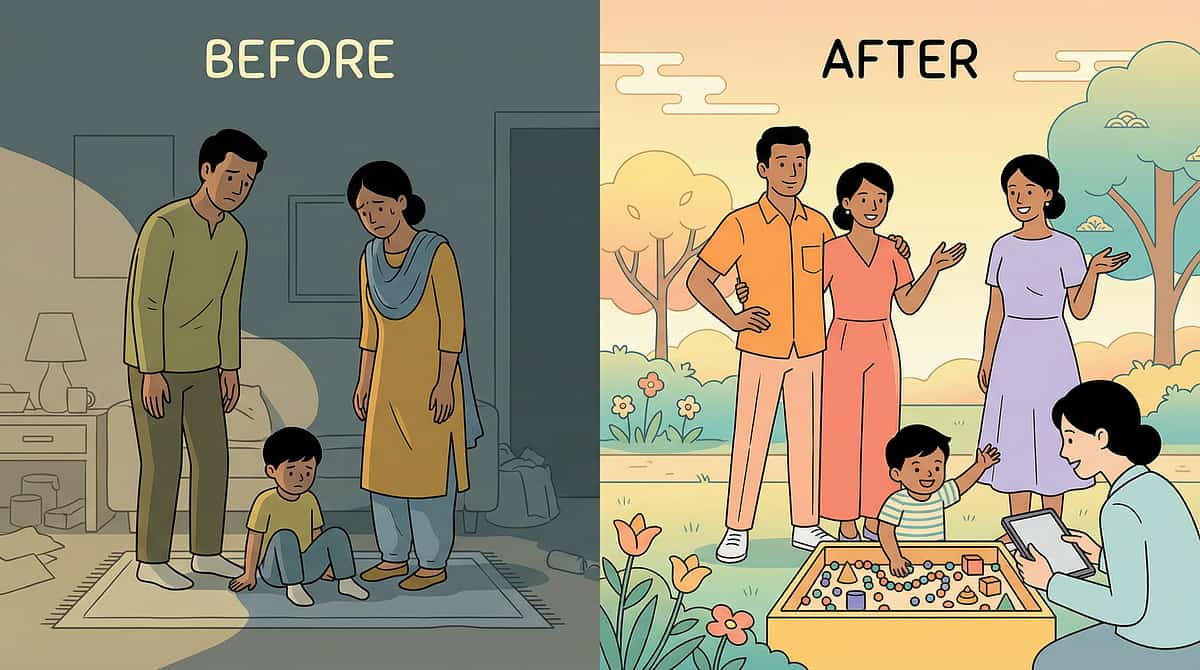
Real children. Real progress. Documented by their families.
Arjun's Story — Pinnacle Hyderabad
"Arjun was 4 when his OT said he had a significant fine motor delay. He couldn't hold a pencil, couldn't button his uniform, and the pegboard reduced him to tears every session. We did 10 minutes of graded pegboard practice at home, every day, for 9 months. At Arjun's 9-month review, his OT showed us the data. He had gone from 0 standard pegs to 25 pegs in 71 seconds. But the number that mattered most? He dressed himself that morning, for the first time, without any help."
— Parent, Pinnacle Hyderabad Center (Illustrative. Individual results vary.)
Priya's Story — Pinnacle Bangalore
"We thought the pegboard was just a toy. Our OT helped us understand it was a window. Three months of home practice, and our daughter's handwriting teacher said something had changed. She didn't know about the pegs. She just noticed the hands."
— Parent, Pinnacle Bangalore Center (Illustrative. Individual results vary.)

💬 Community & Support
You are not the only parent doing pegboard practice at 7am before school.
Join the Pinnacle Parent Community
💬WhatsApp Group: 10,000+ active parents moderated by the Pinnacle OT team — share progress charts, ask questions, celebrate milestones.
🌐Online Forum: forum.pinnacleblooms.org/fine-motor
📱Social Media: Follow @pinnacleblooms for daily technique tips, parent stories, and free resources. #PinnacleFineMotor #PegboardProgress
Research shows that peer community participation increases parental intervention consistency by 34%. You are more consistent when you are not alone.
🗺️ Find Professional Support Near You
70+ centers across India. Services available: Occupational Therapy, AbilityScore® Assessment, GPT-OS® Personalized Planning, Speech-Language Therapy, ABA/BCBA, Special Education, and NeuroDev Pediatric Consultation.
Teleconsultation
Can't reach a center? Book online at pinnacleblooms.org/teleconsult
Free Helpline
📞 9100 181 181 | 24×7 | 16+ languages
Preview of 9 materials that help with pegboard activities Therapy Material
Below is a visual preview of 9 materials that help with pegboard activities therapy material. The pages shown help educators, therapists, and caregivers understand the structure and content of the resource before use. Materials should be used under appropriate professional guidance.


Link copied!

✅ Act VI — The Close
You have everything you need. Your child's hands are waiting.
"From fear to mastery. One technique at a time."
— Pinnacle Blooms Network® Mission
Every family that lands on this page arrived with fear. Fear that the struggle they saw was permanent. Fear that the gap was too wide. Fear that they didn't know enough to help. We built this page — and 70,000 like it — so that no parent stays afraid when knowledge can set them free. Your child's hands are capable of extraordinary things. The road to precision is paved with pegs. And you are walking it, every day, one session at a time.
🦾 OT
Occupational Therapy
🗣️ SLP
Speech-Language Pathology
🧠 ABA/BCBA
Behavioural Intervention
📚 SpEd
Special Education
🏥 NeuroDev
Paediatric Consultation
📞 FREE National Autism Helpline: 9100 181 181 | Available 24×7 in 16+ languages | "Our first call is always free. Always human. Always expert."
Medical Disclaimer: This content is educational and does not replace evaluation and treatment by licensed healthcare providers. Persistent fine motor delays affecting daily function warrant professional occupational therapy evaluation. Progress timelines vary significantly based on individual child profiles, underlying conditions, and intervention intensity. Materials should be age-appropriate. Choking hazard warning: small pegs and beads require supervision at all times. Individual results may vary.
CIN: U74999TG2016PTC113063 | DPIIT Recognition: DIPP8651 | MSME: TS20F0009606 | GSTIN: 36AAGCB9722P1Z2
© 2025 Pinnacle Blooms Network® | Unit of Bharath Healthcare Laboratories Pvt. Ltd. All rights reserved.
Part of the Pinnacle GPT-OS® Techniques Library | 70,000+ evidence-based techniques | techniques.pinnacleblooms.org
© 2025 Pinnacle Blooms Network® | Unit of Bharath Healthcare Laboratories Pvt. Ltd. All rights reserved.
Part of the Pinnacle GPT-OS® Techniques Library | 70,000+ evidence-based techniques | techniques.pinnacleblooms.org