
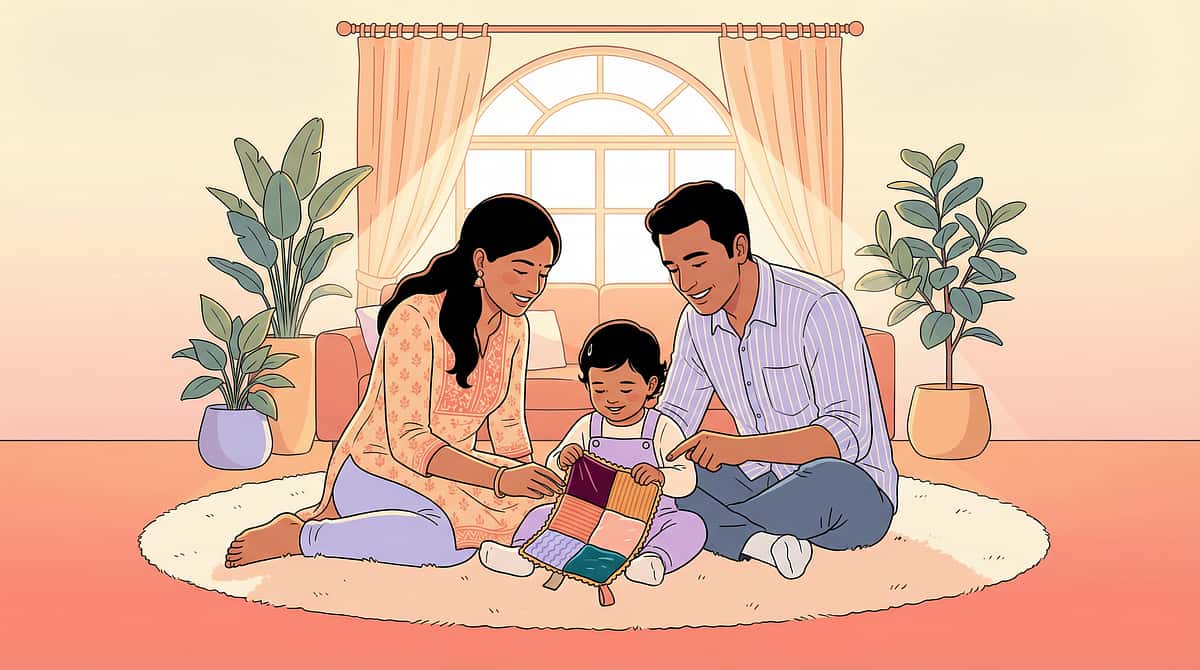
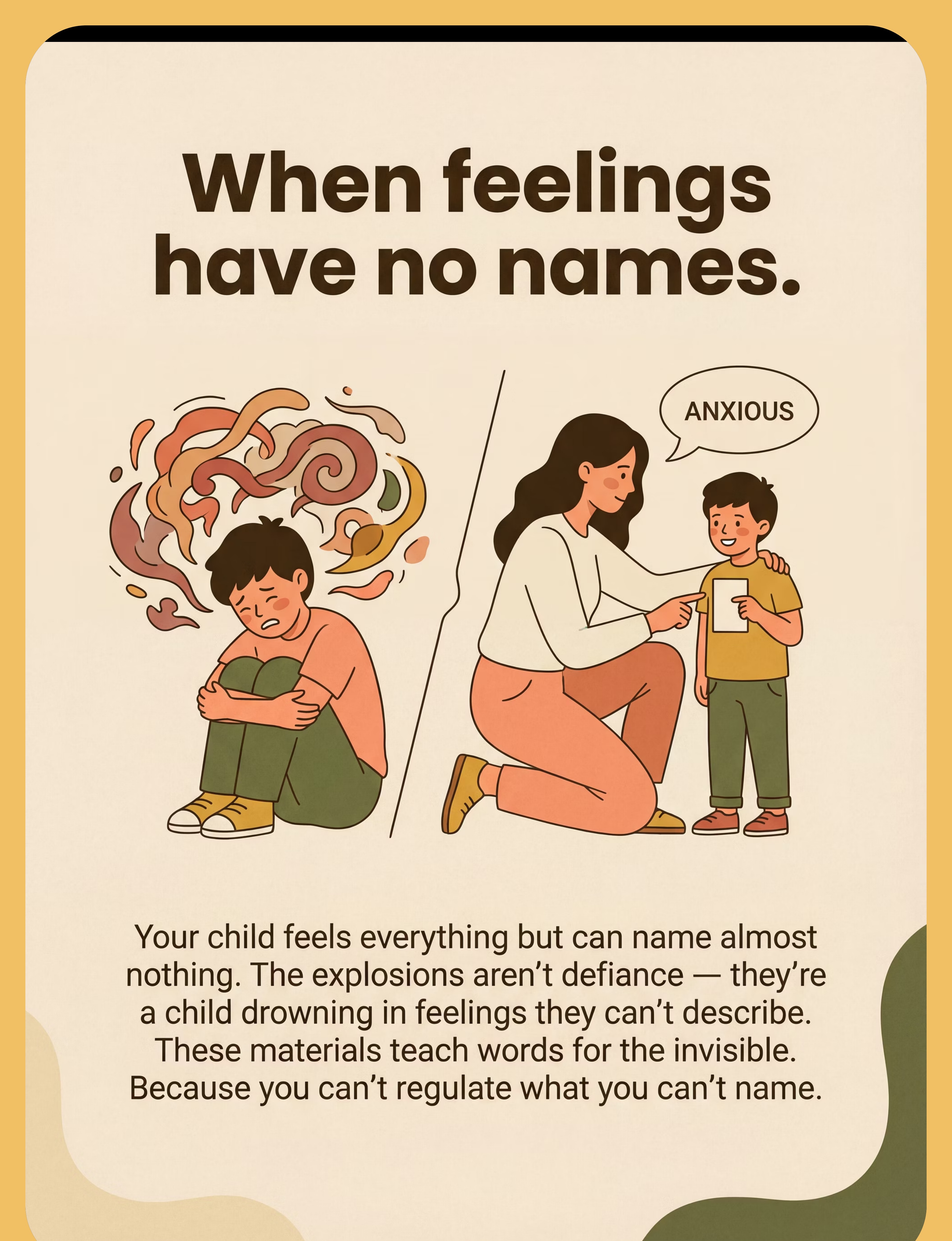
When Feelings Have No Names.
She throws herself on the floor. She screams until she's hoarse. And afterward, when she's finally calm — she just stares at you. Not defiant. Confused. These 9 materials teach children the language of the inside.
C-271 | Social-Emotional Development
EMO-VOC Domain | Age 2–12
Act I — The Emotional Entry
You Are Not Failing.
Her vocabulary for the inside of her has three words: happy, sad, mad. Everything else — the tight chest when plans change, the buzzing overwhelm when a room is too loud, the desperate frustration when her hands won't do what her brain wants — all of it gets expressed the only way she can: behavior. Volume. Collision.
"You are not failing. Your child is drowning in feelings she cannot name. These 9 materials teach her the language of the inside." — Pinnacle Blooms Consortium
The therapist says she needs emotional vocabulary. Words for the invisible things. And you keep asking: how do you teach someone to name something they don't know exists? This page answers that question — step by step, material by material.
WHO Nurturing Care Framework (2018): Responsive caregiving and early language development are foundational to lifelong emotional health. nurturing-care.org
Millions of Children Feel Everything — and Can Name Almost Nothing.
40–65%
Show Alexithymia
Children with autism show significant difficulty identifying and describing their own emotions (AIMS, 2020)
1 in 36
ASD Diagnosis (US)
Children diagnosed with ASD in the US (CDC, 2023) — emotional vocabulary deficits are near-universal across this population
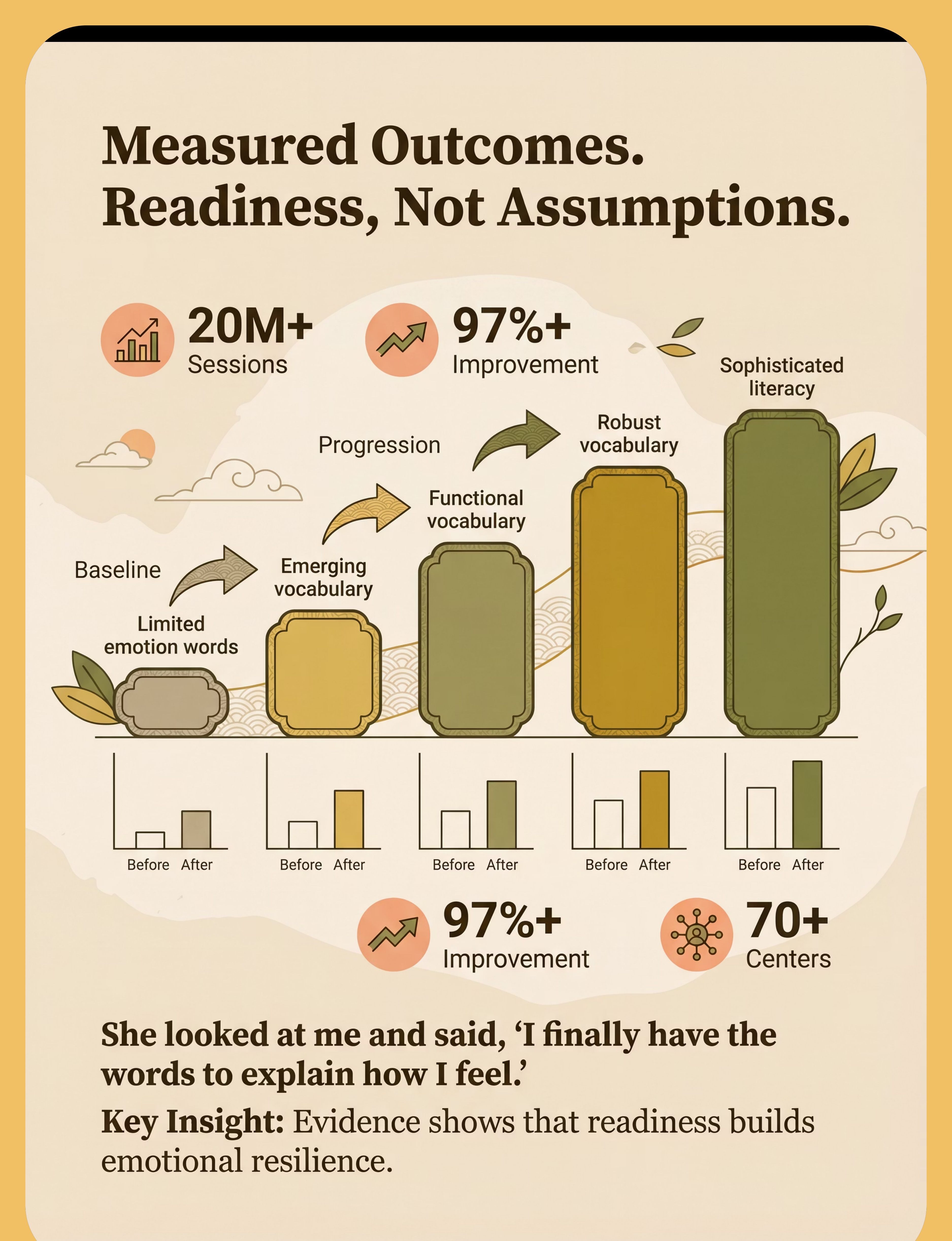
20M+
GPT-OS® Sessions
Therapy sessions on the Pinnacle GPT-OS® platform — emotional literacy tracked as a core readiness index
Across India alone, conservative estimates place the number of children under 12 with significant emotional vocabulary deficits — children who cannot differentiate between anxious and scared, frustrated and angry, disappointed and sad — at over 8 million families. This is not a niche challenge. It is the single most common barrier between a child's internal experience and their ability to communicate, regulate, and connect.
You are among millions of families navigating this exact terrain. The isolation you feel is a lie told by exhaustion.
Research: PMC11506176 (Children, 2024) | PMC10955541 (World J Clin Cases, 2024) | CDC Autism Data (2023)

This Is a Wiring Difference. Not a Behavior Choice.
What's Happening in the Brain
The amygdala detects emotional arousal instantly — the tight chest, the racing heart, the body shift. But translating that body signal into a named emotion requires a four-step neural chain:
Sensation
Amygdala detects emotional arousal in the body
Interoception
Anterior insula relays body signals to conscious awareness
Prefrontal Labeling
Prefrontal cortex matches sensation to a stored vocabulary word
Verbal Output
Broca's area generates the spoken emotional label
Why the Chain Breaks
In many children with autism and developmental differences, this chain is disrupted at multiple points:
Interoception
Body signals don't reach awareness clearly — atypical processing means the sensation never becomes a feeling
Prefrontal Labeling
Requires explicit teaching — it is NOT automatic for these children
Missing Vocabulary
The emotion word simply may not exist in memory — you can't retrieve what was never stored

Emotion Vocabulary Is a Developmental Curriculum.
Your child is at a specific point on this map — and knowing where they are is the first step to closing the gap.
18–24 Months
2 words: happy, sad. Emotional world is binary — good or not good.
2–4 Years
4 words: + mad, scared. World expands to include threat and anger.
4–6 Years
6–8 words: + excited, worried, proud, surprised. Positive emotions diversify.
6–9 Years
15–20 words: + frustrated, embarrassed, jealous, anxious. Social emotions emerge.
9–12 Years
40+ words: + guilt, shame, overwhelmed, nostalgic. Full emotional literacy.
Current Challenge Zone: Many children with autism or developmental differences remain at the 2–4 word level well into middle childhood. A child with three emotion words is trying to describe the full spectrum of human inner experience with three crayons.
What commonly co-occurs: interoceptive processing differences, expressive language delays, alexithymia, sensory processing challenges, and anxiety presentations driven by unnamed feelings. Emotional vocabulary is not learned passively — it requires explicit, systematic, multi-modal teaching. The window for rapid acquisition is widest in the 3–10 year range. Every week of explicit teaching at this stage has compounding developmental returns.
Research: PMC9978394 | WHO/UNICEF Care for Child Development Package (2023) | UNICEF MICS 2024 developmental indicators
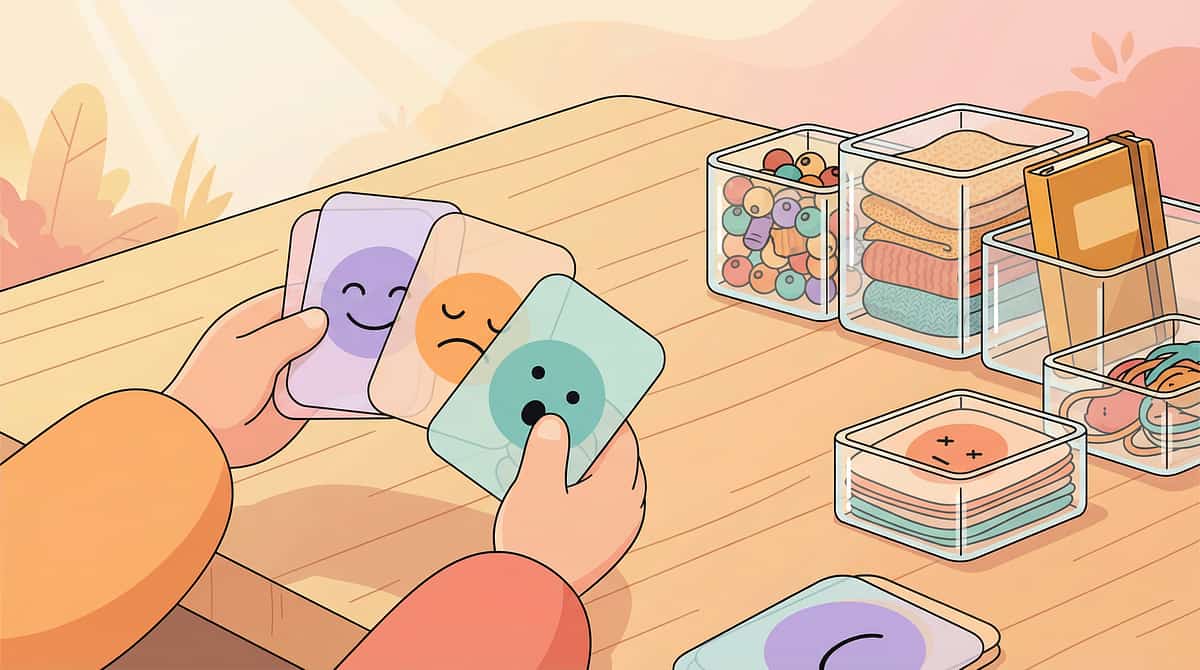
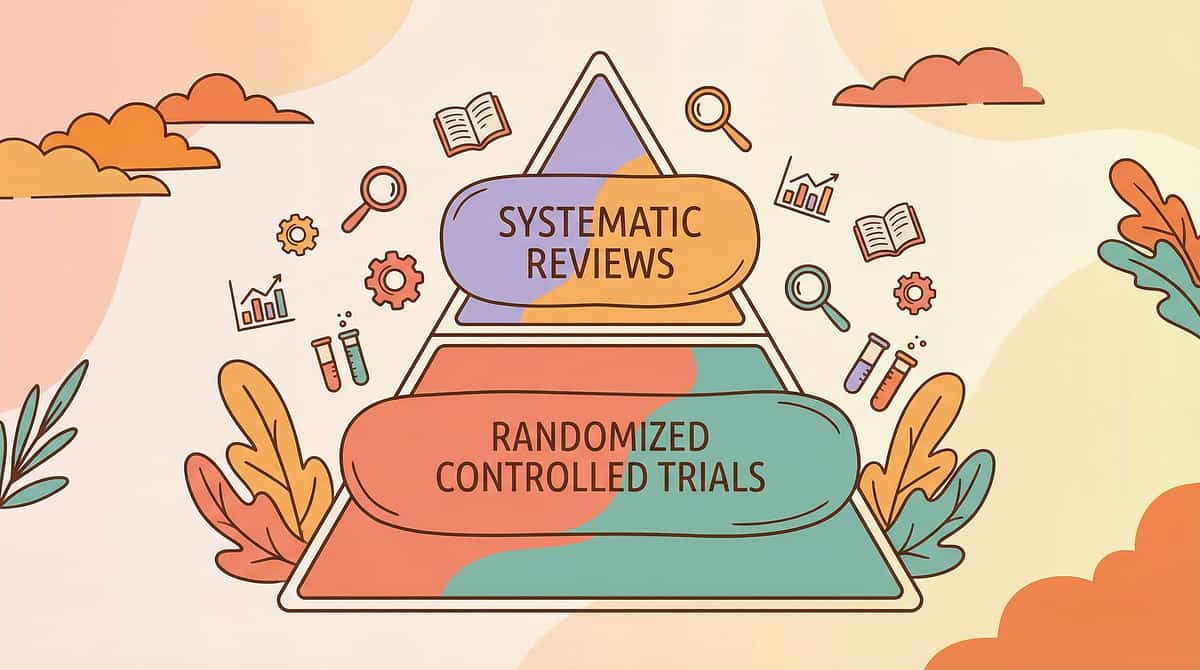
Evidence Level I
Systematic Review + RCT Support
Clinically Validated. Home-Applicable. Parent-Proven.
Affect Labeling — PMC3285747
Lieberman et al. (2007) — Putting feelings into words reduces amygdala activation and emotional arousal. The act of naming a feeling is itself a regulation intervention — not just a vocabulary exercise.
Explicit Emotion Teaching — NCAEP 2020
NCAEP Evidence-Based Practices Report (2020) — Social skills training and emotional literacy instruction meet criteria for evidence-based practice in autism. Visual supports, social stories, and structured teaching are classified as EBPs.
Indian RCT Context — Indian J Pediatr 2019
Padmanabha et al. (2019) — Home-based structured interventions with parent implementation demonstrated significant developmental outcomes in Indian pediatric population, validating the home execution model.
Research Confidence
Systematic reviews and RCTs confirm the efficacy of explicit emotion vocabulary instruction
Parent Implementation
High evidence for home-based delivery with trained caregivers across populations
Indian Context Evidence
Moderate-high evidence from Indian pediatric RCT and clinical cohort studies
References: PMC11506176 | PMC10955541 | PMC9978394 | NCAEP 2020 | DOI:10.1007/s12098-018-2747-4
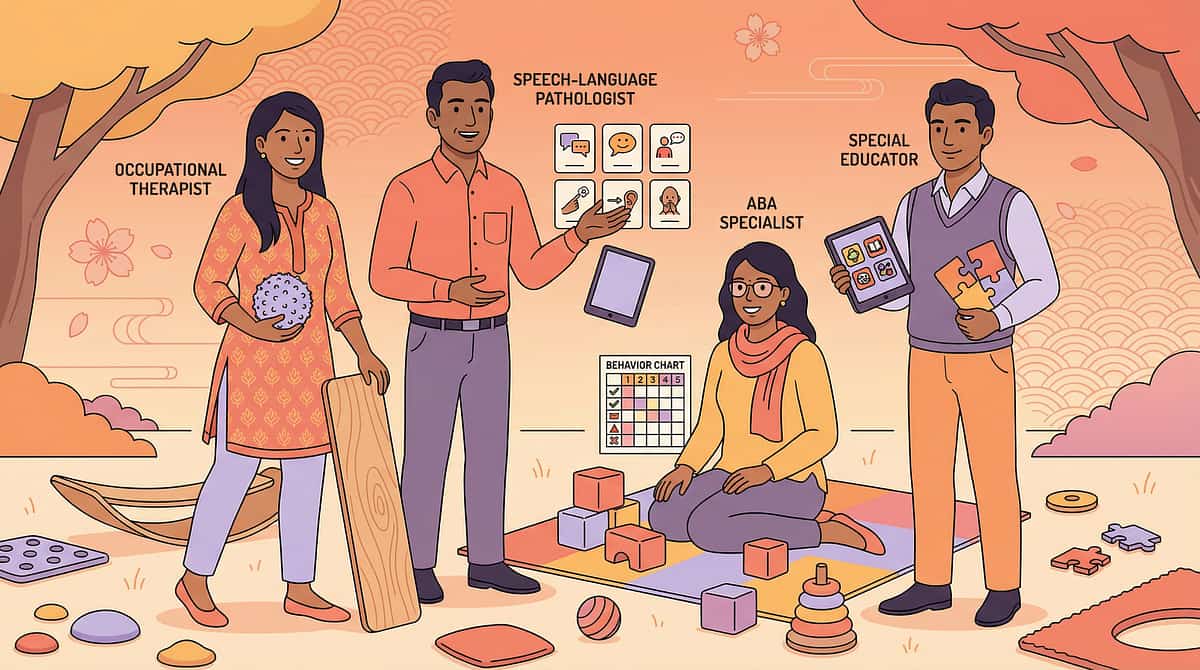
Act II — The Knowledge Transfer
Teaching Emotion Words — What It Is
Alias: "Building the Language of the Inside"
For children who feel everything but can name almost nothing, this is not vocabulary drill — it is the construction of an internal emotional operating language. The 9 materials in this technique page are the tools through which this language is built: visually, experientially, narratively, kinesthetically, and through daily routine.
Emotional Vocabulary Instruction is the systematic, explicit teaching of words that describe internal emotional states — their names, definitions, intensities, body signals, and contextual triggers. It transforms abstract internal experiences into named, communicable, and therefore regulatable concepts.
Domain Badges
Social-Emotional Development
Emotional Literacy
Communication — Expressive
Interoceptive Awareness
Self-Regulation Foundation
Specification
Age Range | 2–12 years | |
Session Duration | 5–20 minutes | |
Frequency | Daily routine integration | |
Setting | Home + School + Therapy |
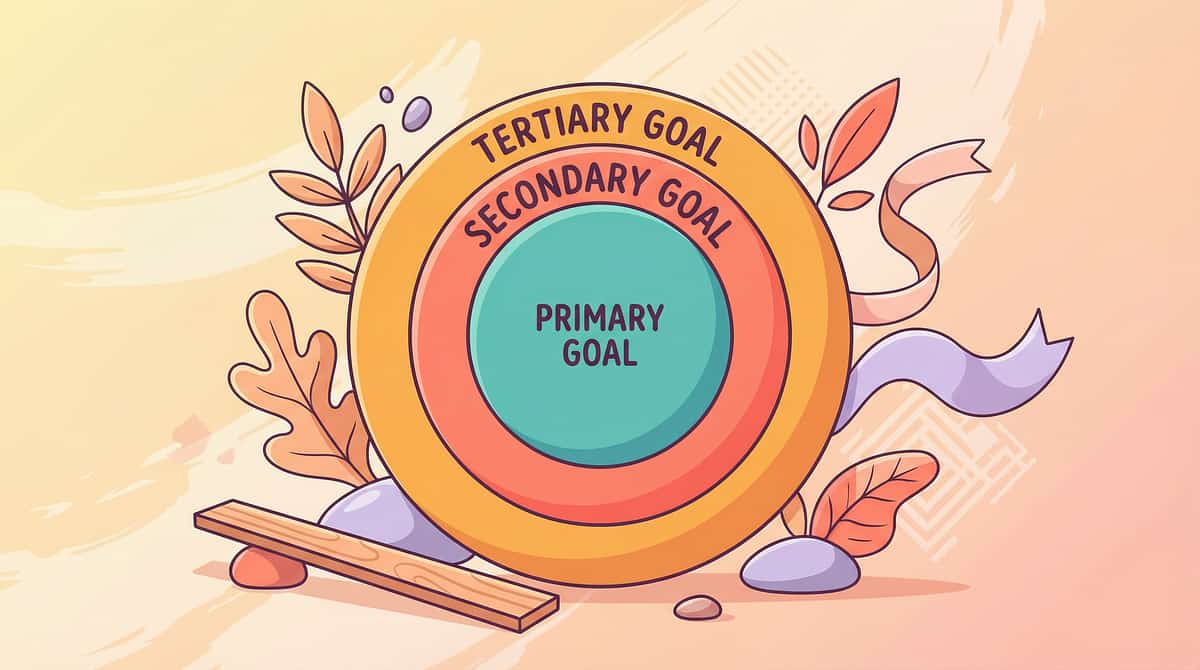
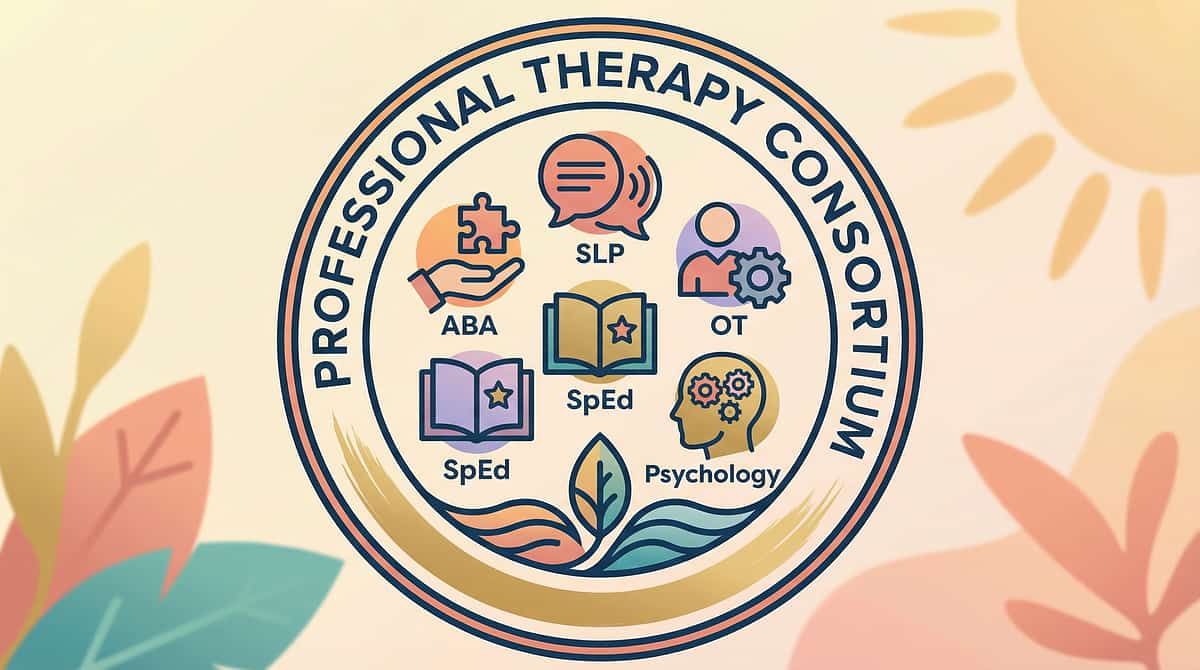
The Pinnacle Consortium Deploys This Technique Across 5 Disciplines.
Because the brain doesn't organize by therapy type — emotional experience is not siloed. All five disciplines must align.
"This technique crosses therapy boundaries because emotional experience is not siloed. The body signals it (OT), the language names it (SLP), the behavior reflects it (ABA), the cognition processes it (Psychology), and school generalizes it (SpEd)." — Pinnacle Consortium
Speech-Language Pathologist (Primary Lead)
Teaches emotion words as expressive vocabulary. Builds definitions, contextual use, nuanced differentiation. Connects emotion vocabulary to narrative language. Addresses alexithymia through structured verbal training.
Psychologist / Developmental Paediatrician
Assesses alexithymia and emotional literacy baseline. Provides therapeutic context for trauma-sensitive emotion work. Integrates with CBT-based emotion awareness approaches.
Occupational Therapist
Leads the interoceptive awareness component — teaching children to notice and interpret body signals. Without interoception, emotion words have no grounding in body experience.
ABA / BCBA Specialist
Structures discrete trial teaching of emotion identification. Designs reinforcement schedules. Tracks data on emotion word acquisition and generalization across settings.
Special Educator
Integrates emotion vocabulary into academic routines. Morning check-ins, classroom emotion boards, reading comprehension through emotional perspective-taking. Generalizes to school setting.
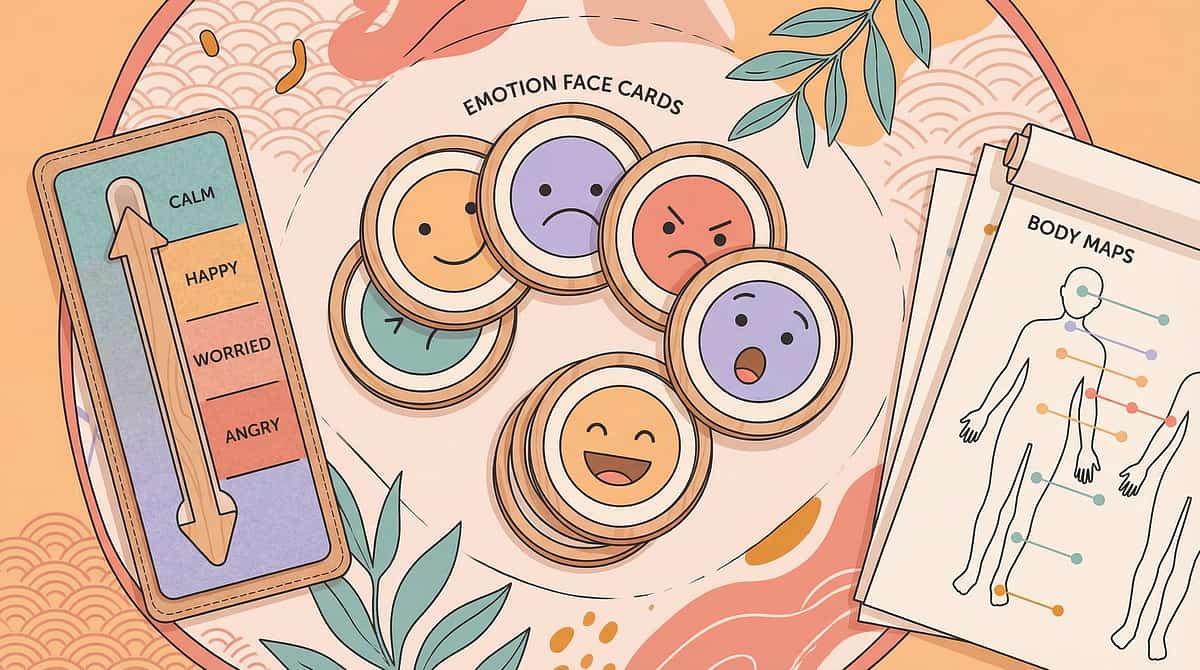
This Is a Precision Tool. Here Is What It Targets — Specifically.
Primary Target
The ability to identify and verbally label distinct emotional states — differentiating between happy/excited/proud, between sad/disappointed/lonely, between angry/frustrated/annoyed — with increasing nuance, intensity awareness, and spontaneous application.
Secondary Targets
Emotional regulation: You cannot regulate what you cannot name. Vocabulary is pre-regulation infrastructure. Behavioral communication reduction: Every new emotion word is a replacement for a behavior (meltdown, aggression, withdrawal). Empathy foundations: The child who learns "I feel disappointed" can begin to recognize "my friend looks disappointed."
Observable Indicators
Primary
Child uses 5+ new emotion words correctly within 8 weeks
Secondary
Frequency of behavioral meltdowns decreases as verbal alternatives increase
Tertiary
Child begins commenting on characters' emotions in stories unprompted
PMC10955541 (Meta-analysis, 2024) | PMC3285747 (Affect labeling reduces amygdala, 2007)

Material 1 of 9
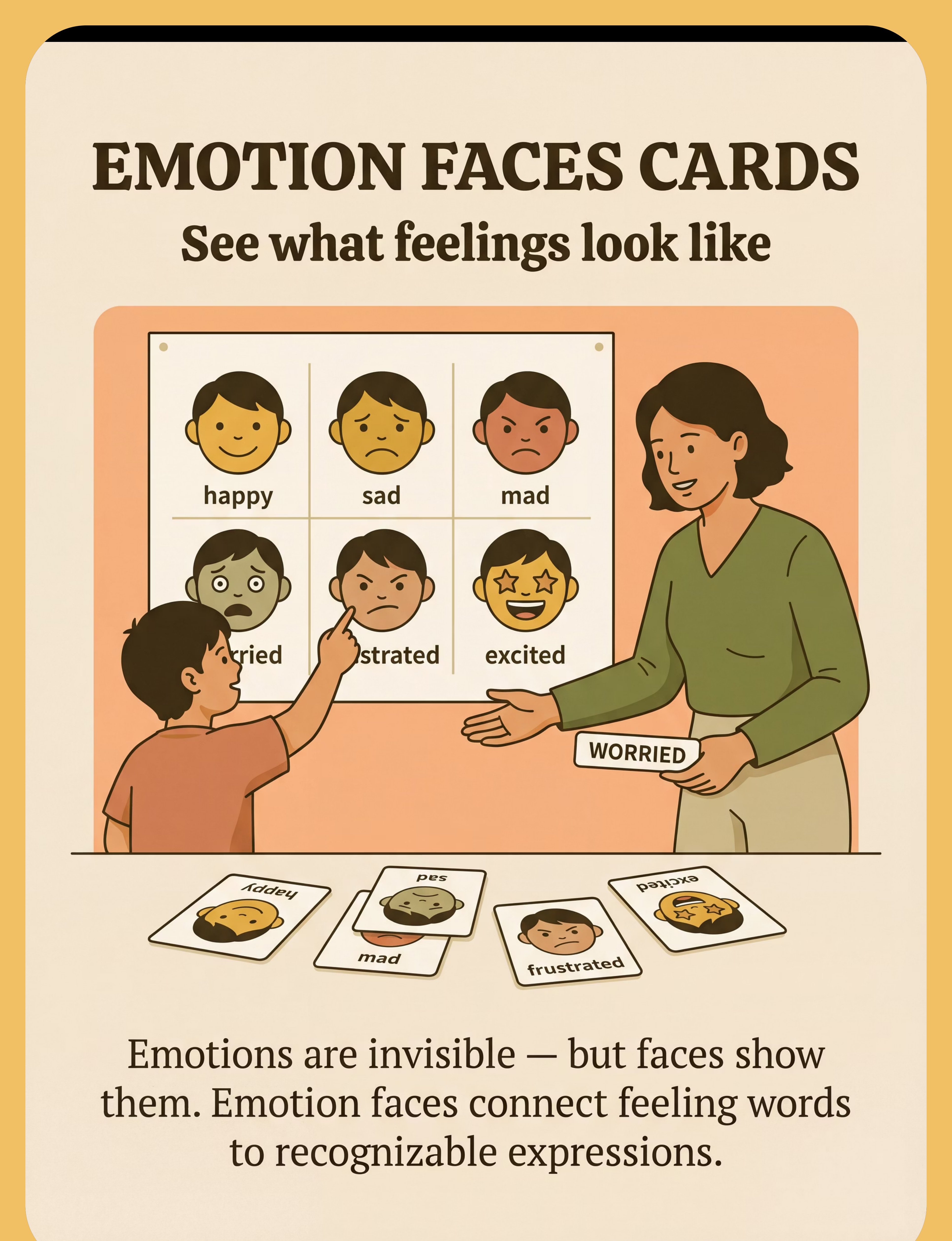
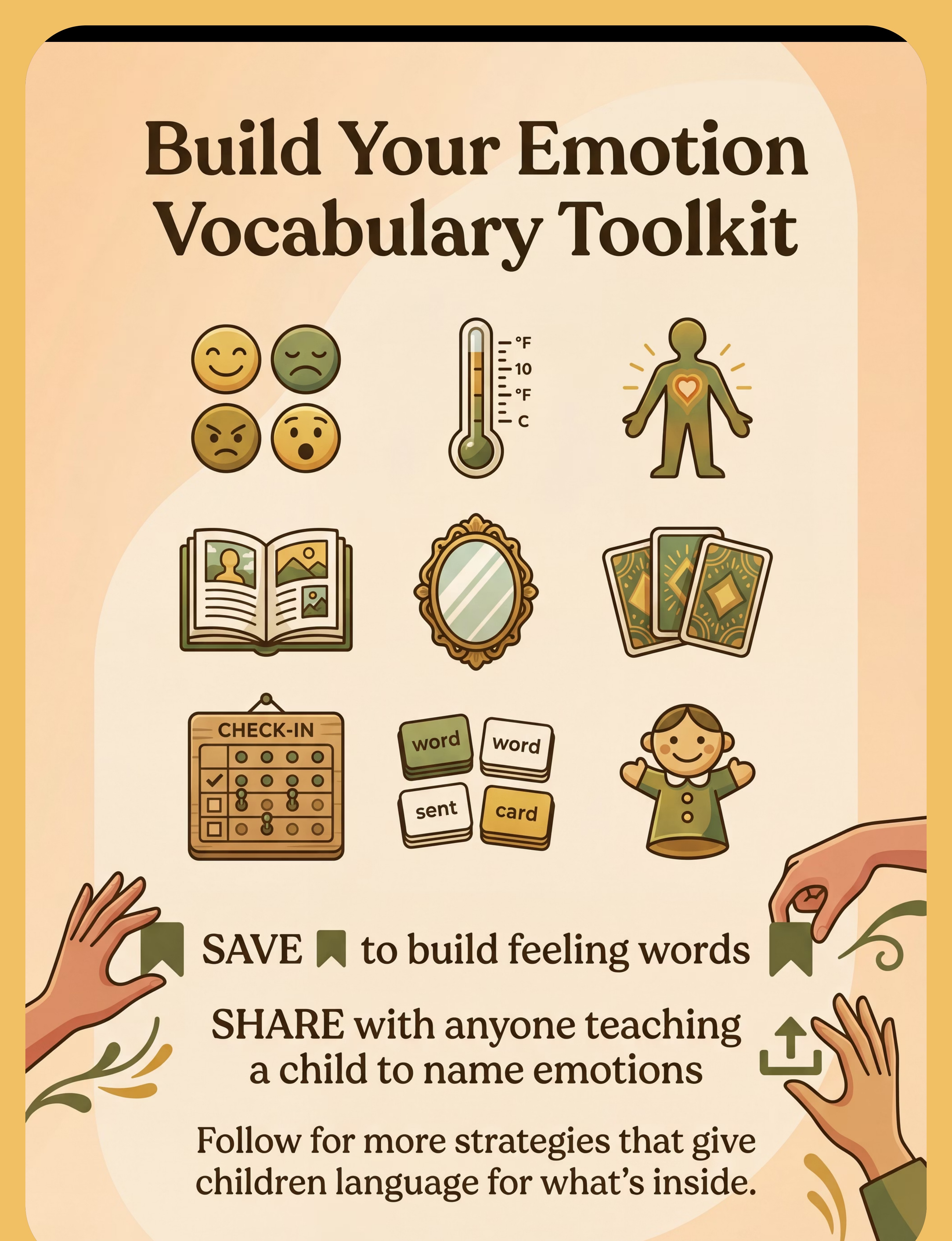
Emotion Faces Cards & Charts
Canon Category: Emotion Cards / Feelings Faces
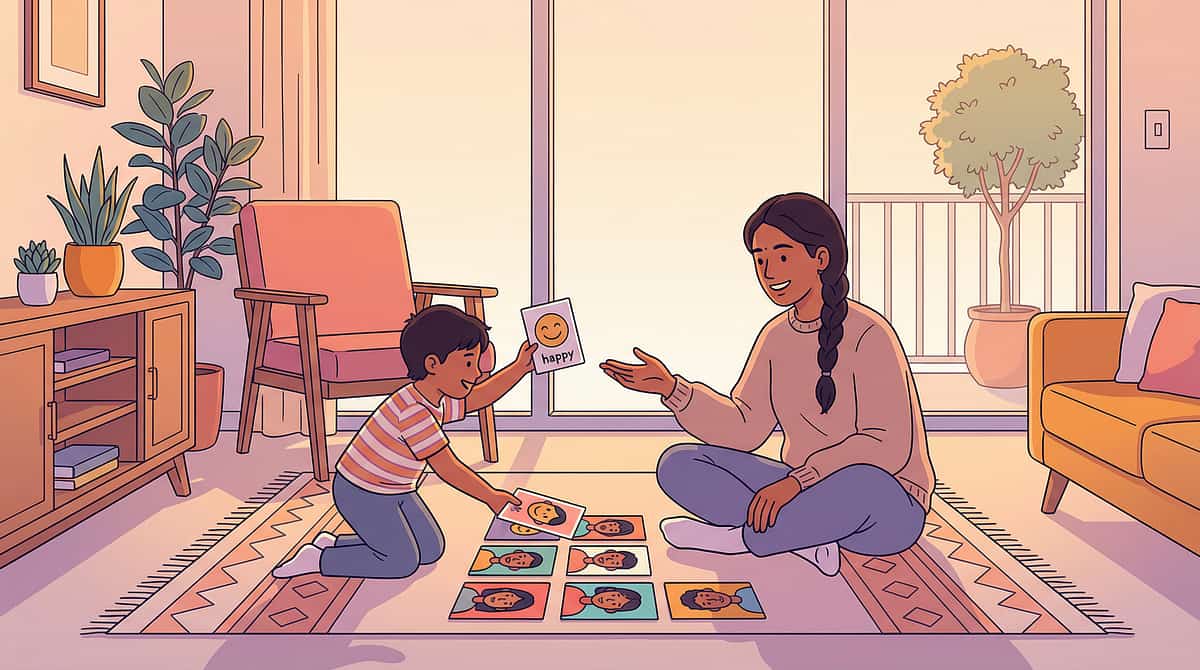
Emotions are invisible — faces make them visible. Emotion faces charts connect feeling words to recognizable facial expressions. Children see what "worried" looks like (furrowed brow, tense mouth, wide eyes) and begin connecting that external image to internal experience. This is the most fundamental bridge in emotion vocabulary instruction: the outside face that teaches the inside feeling.
Why It Works
Visual recognition of facial expressions activates the mirror neuron system. When a child sees a worried face, their brain begins to simulate the feeling — creating a neural link between image and internal state that supports labeling.
Getting This Material
Buy
DIY (₹0)
Print emotion faces free from Do2Learn.com. Photograph family members making different emotion faces for personalized cards.
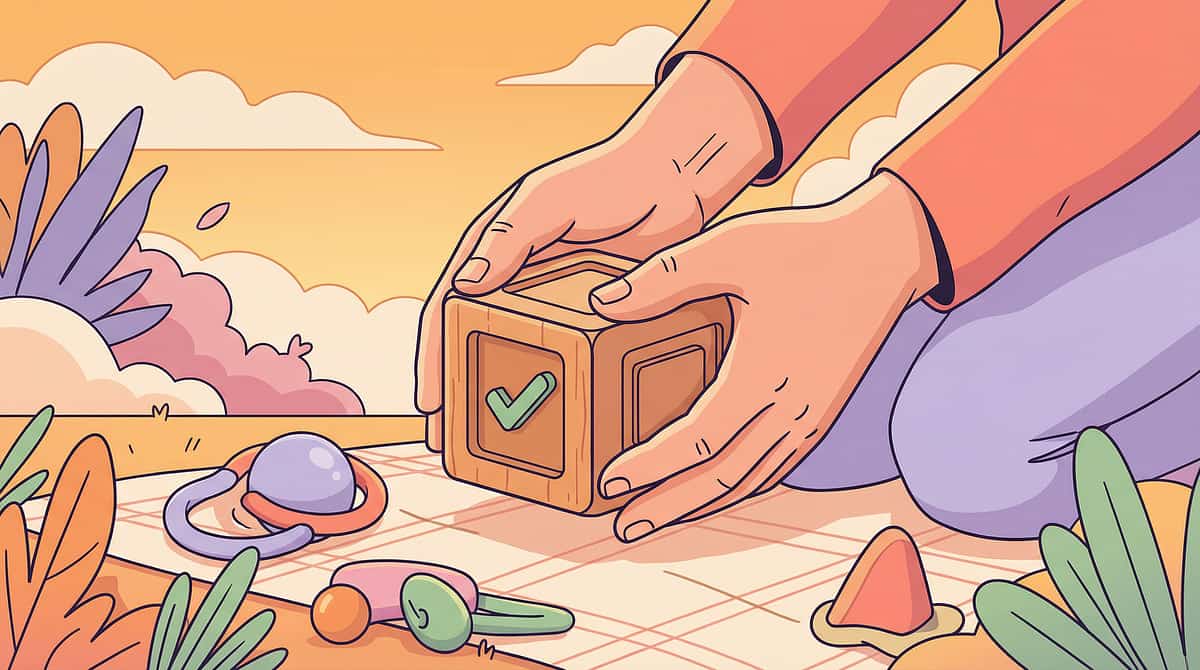
Material 2 of 9
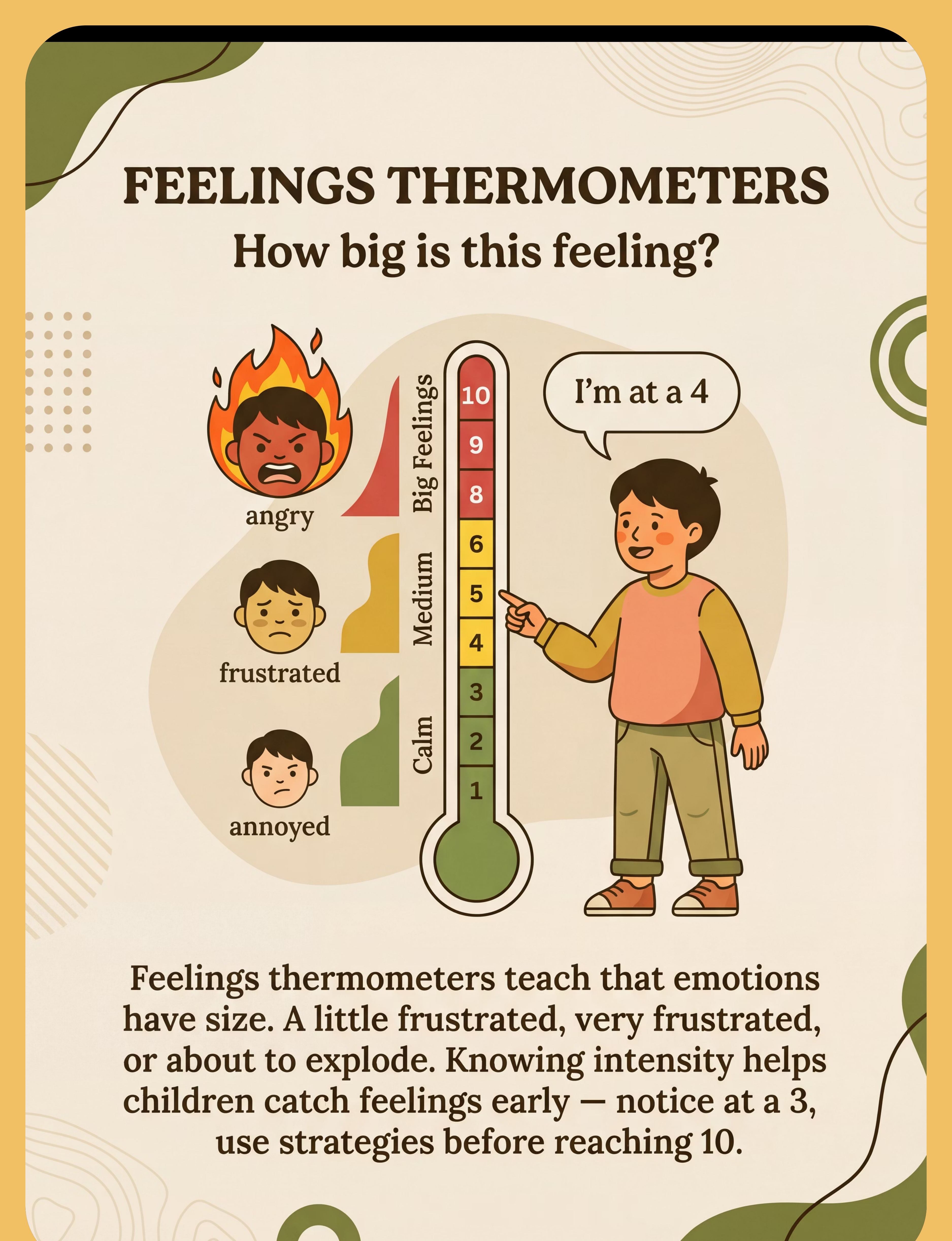
Feelings Thermometers & Intensity Scales
Why It Works
Emotions have size. "A little annoyed" and "about to explode" are both angry — but they need completely different responses. Intensity scales teach emotion vocabulary depth: irritated → annoyed → frustrated → angry → furious → enraged. Six words, not one. This single tool multiplies your child's emotion vocabulary sixfold while simultaneously teaching self-monitoring.
Getting This Material
Buy
DIY (₹0)
Draw a thermometer with green/yellow/red zones. Use a clothespin slider. Practice "I'm at a 3" language daily.
Intensity awareness is the foundation of self-regulation. A child who can say "I'm at a 3" can interrupt an escalation before it becomes a 10. The thermometer turns an invisible internal scale into a visible, nameable number.
Material 3 of 9
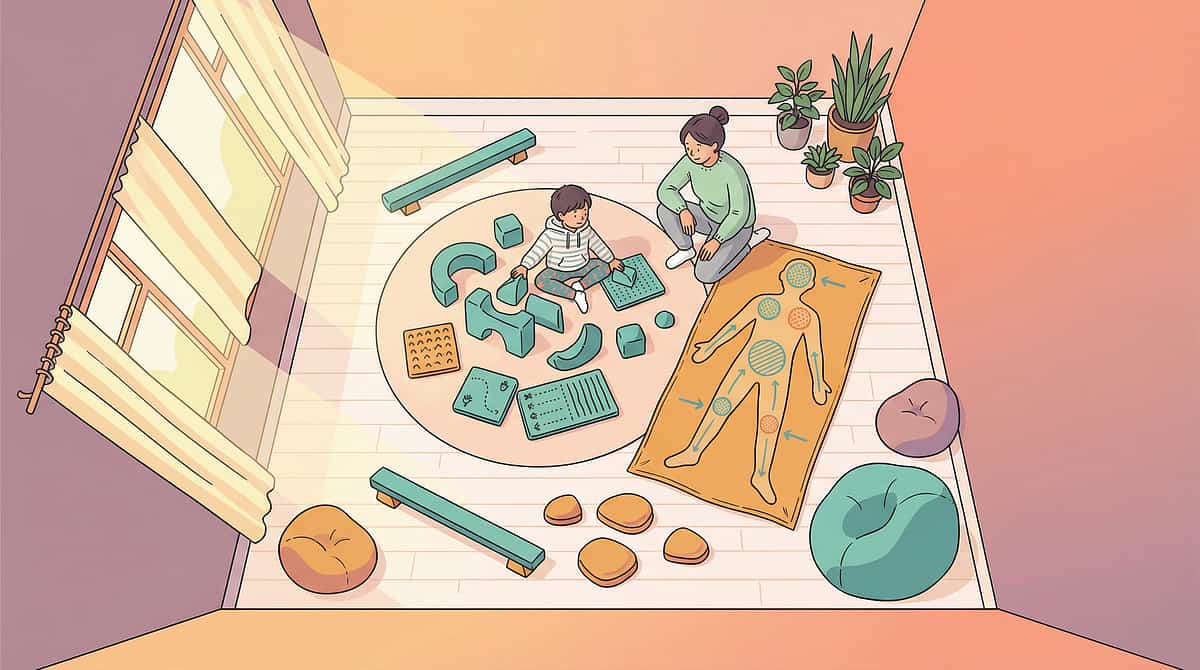
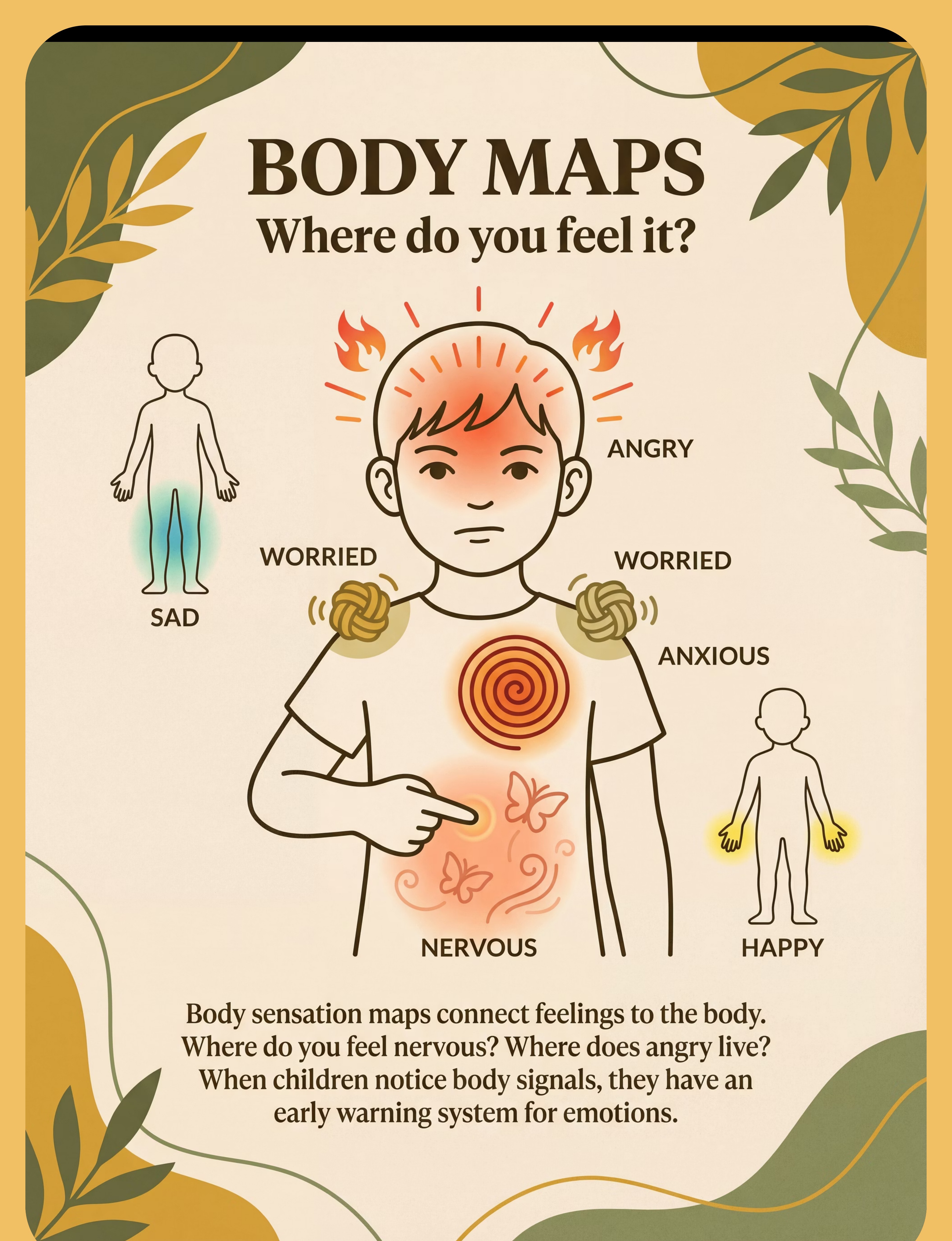
Body Sensation Maps & Interoception Tools
Canon Category: Tactile Sensory Kit / Interoception
Emotions live in the body before they reach awareness. Anger is hot face and clenched fists. Anxiety is tight chest and butterflies in the stomach. Body maps teach children: where do you feel this? — giving emotion words a physical address. Without this somatic anchoring, emotion words remain abstract labels. With it, they become retrievable experiences.
Why It Works
Interoceptive awareness is the OT domain's core contribution to emotion vocabulary. When a child can feel anxiety in their chest AND name it "anxious," the word gains real-world grounding. This is the bridge from intellectual knowledge to lived experience.
Getting This Material
Buy
DIY (₹0)
Draw a body outline together. Have child color where different emotions live. "Red for angry, blue for sad, yellow for nervous."

Material 4 of 9
Emotion Storybooks & Social Stories
Canon Category: Social Stories / Narrative Supports
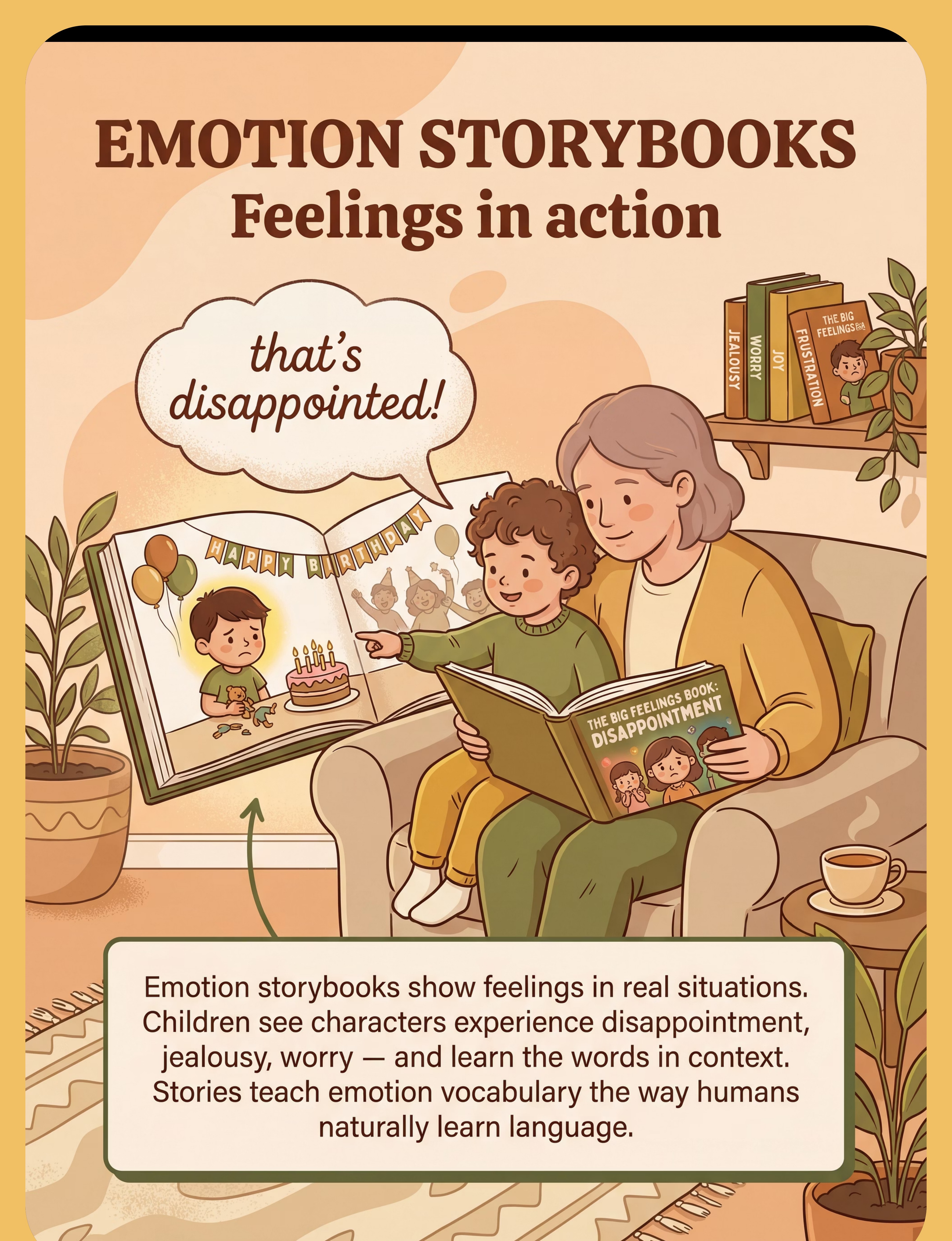
Stories show emotions in context. When a child reads about a character feeling disappointed because a birthday party was canceled, they learn: this is what disappointment is, when it happens, how it feels, and what to do about it. Narrative is the most natural way humans learn language — and the most powerful way to make abstract emotions concrete.
Why It Works
Social stories provide the contextual scaffolding that emotion word cards alone cannot. They show the emotion embedded in a situation, a body response, and a resolution — giving the word a full narrative home in the child's memory.
Getting This Material
Buy
DIY (₹0)
Create personalized social stories using your child's name, photos, and specific situations: "When Arjun's plans change, he sometimes feels..."

Material 5 of 9
Emotion Mirrors & Video Modeling
Canon Category: Video Modeling Resources
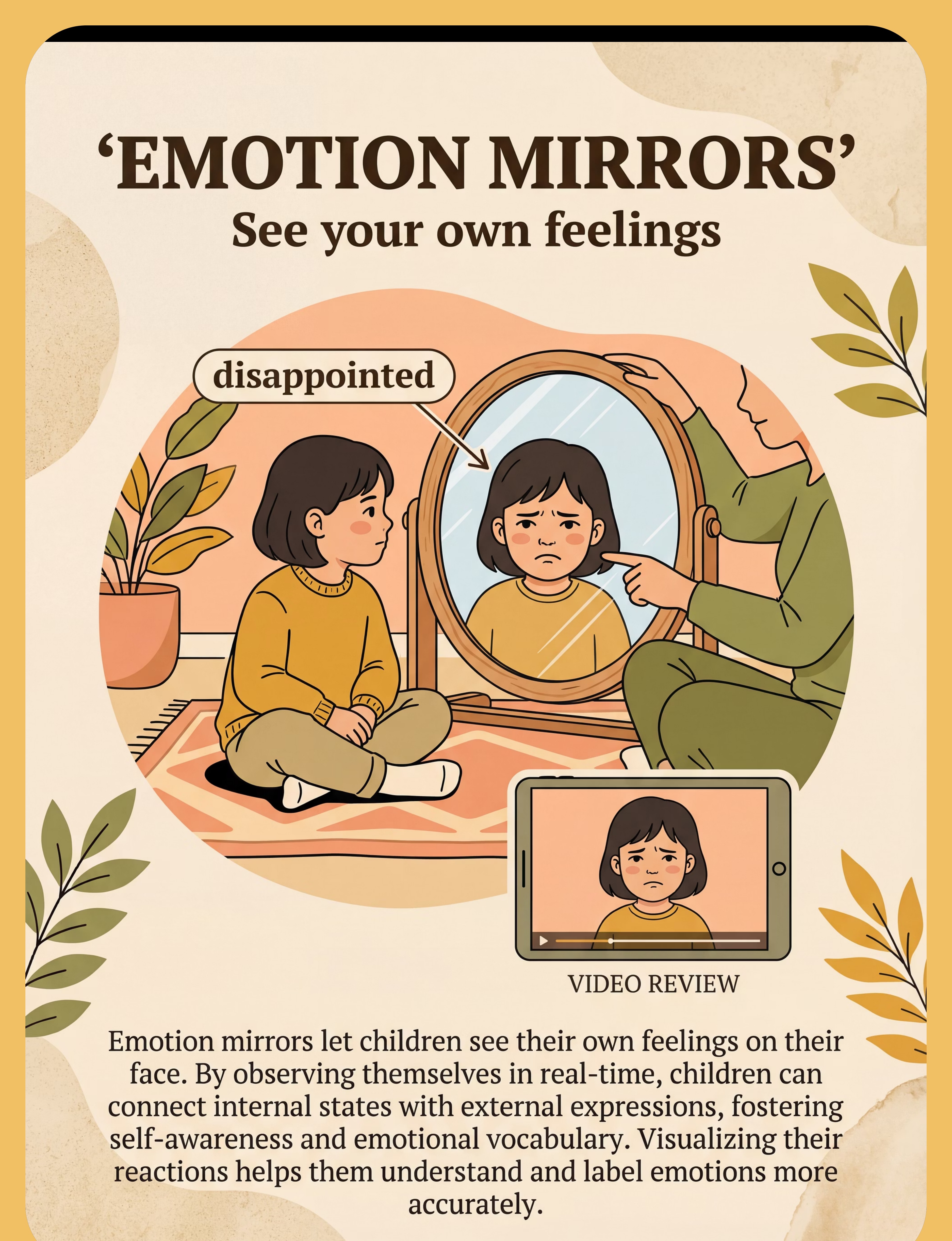
Seeing yourself feel something helps you name it. Mirrors and recorded video let children observe their own facial expressions during emotional moments — connecting the internal state to the external visible face. "Look — that's what frustrated looks like. That's you right now." This creates the crucial link between how an emotion feels from the inside and how it looks from the outside.
Why It Works
Video modeling is classified as an evidence-based practice for autism (NCAEP, 2020). Watching oneself or a model demonstrate an emotional state reinforces learning through visual-motor integration — a learning channel often stronger than verbal instruction alone.
Getting This Material
Buy
DIY (₹0)
Any mirror. Photograph your child during various emotional states (with their comfort) for later review and labeling.
Material 6 of 9
Emotion Sorting & Categorization Games
Canon Category: Sorting Activities / Categorization
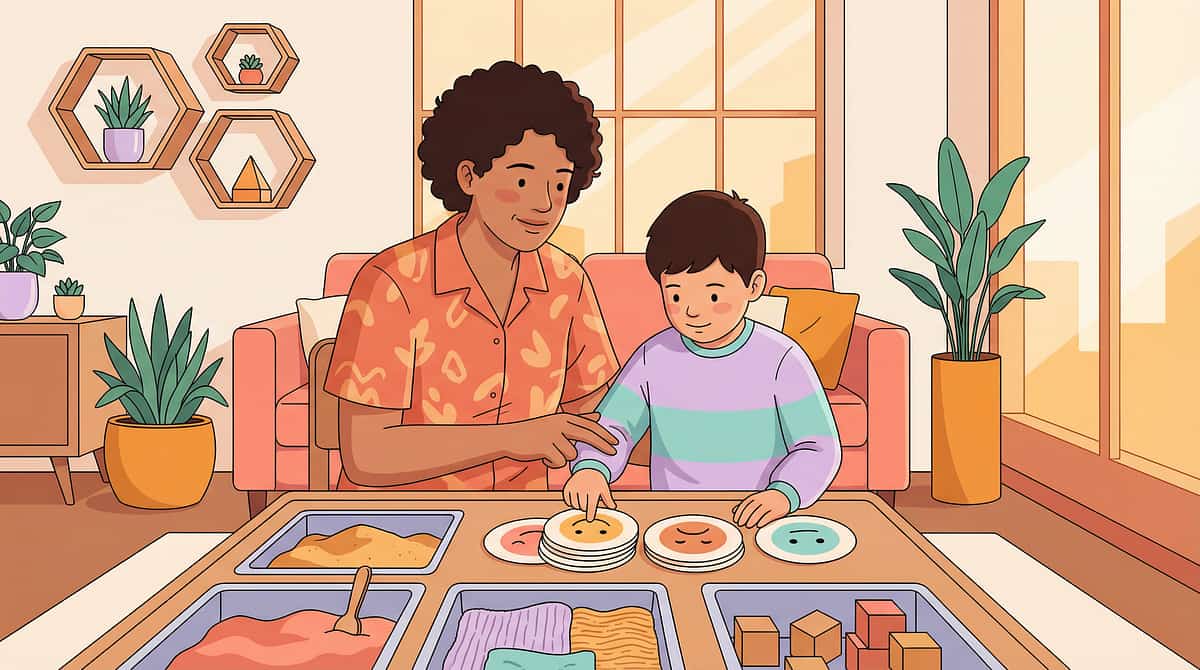
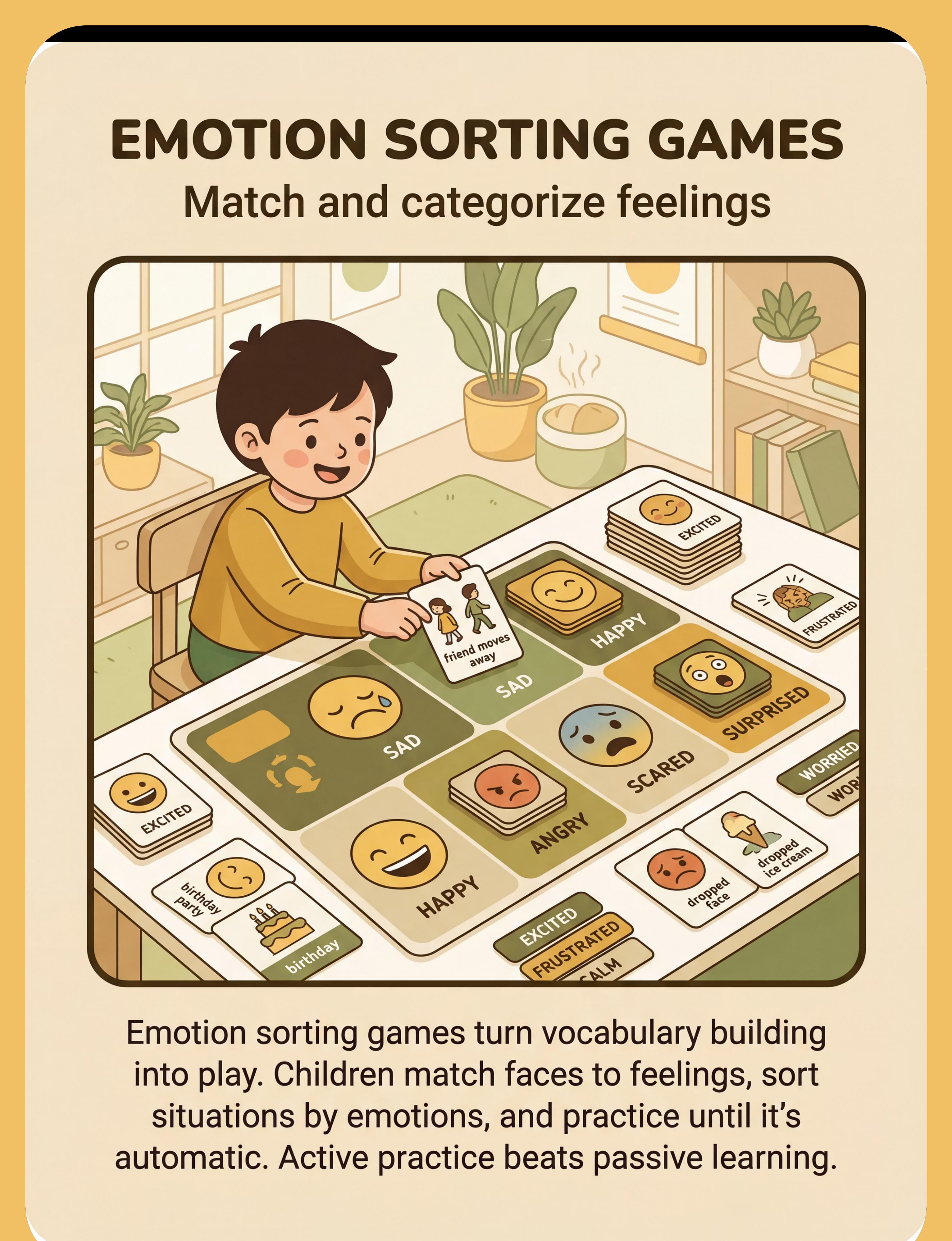
Active practice beats passive learning. Sorting games ask: "Which of these situations would make someone feel embarrassed?" Children categorize, match faces to words, sort situations by feelings — building flexible understanding through play. The act of making a decision about an emotion deepens encoding far more than simply seeing a card.
Why It Works
Categorization activities require the child to apply their emotion vocabulary, not merely recognize it — moving from receptive to expressive use. Each sorting decision strengthens the neural connection between the word and its meaning.
Getting This Material
Buy (Canon Verified)
DIY (₹0)
Emotion situation cards: write scenarios on index cards, sort into "feeling buckets." Play "guess the feeling" with acted-out scenarios.
Material 7 of 9
Emotion Check-In Boards & Daily Trackers
Canon Category: Visual Schedule System / Daily Routine Supports
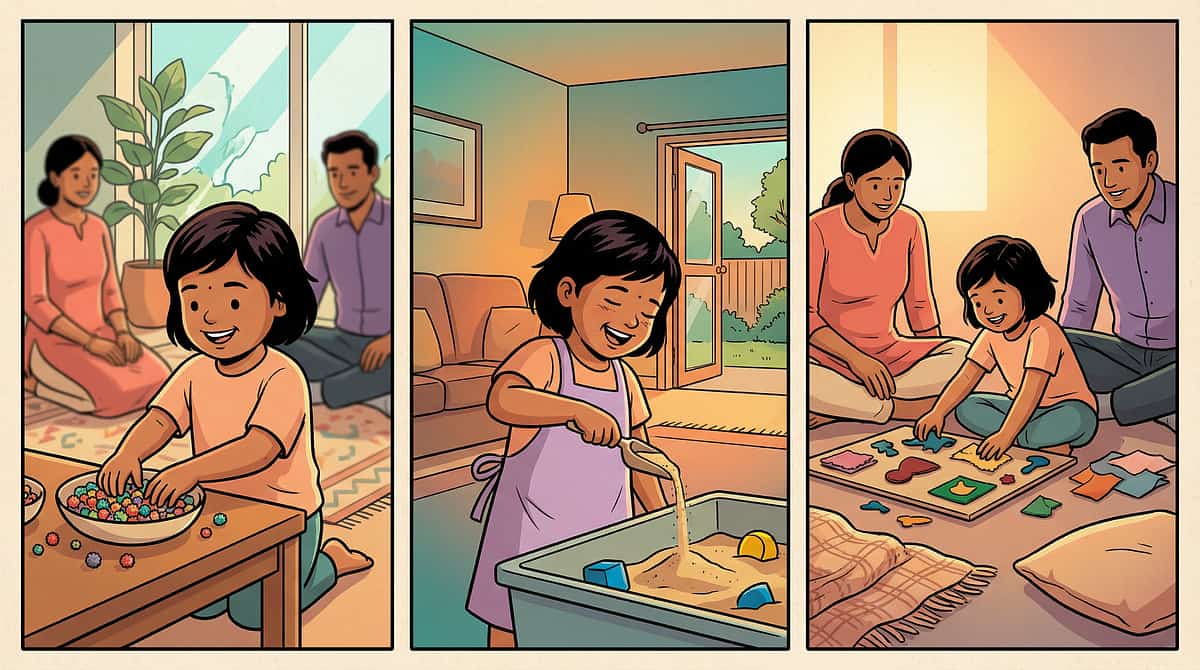
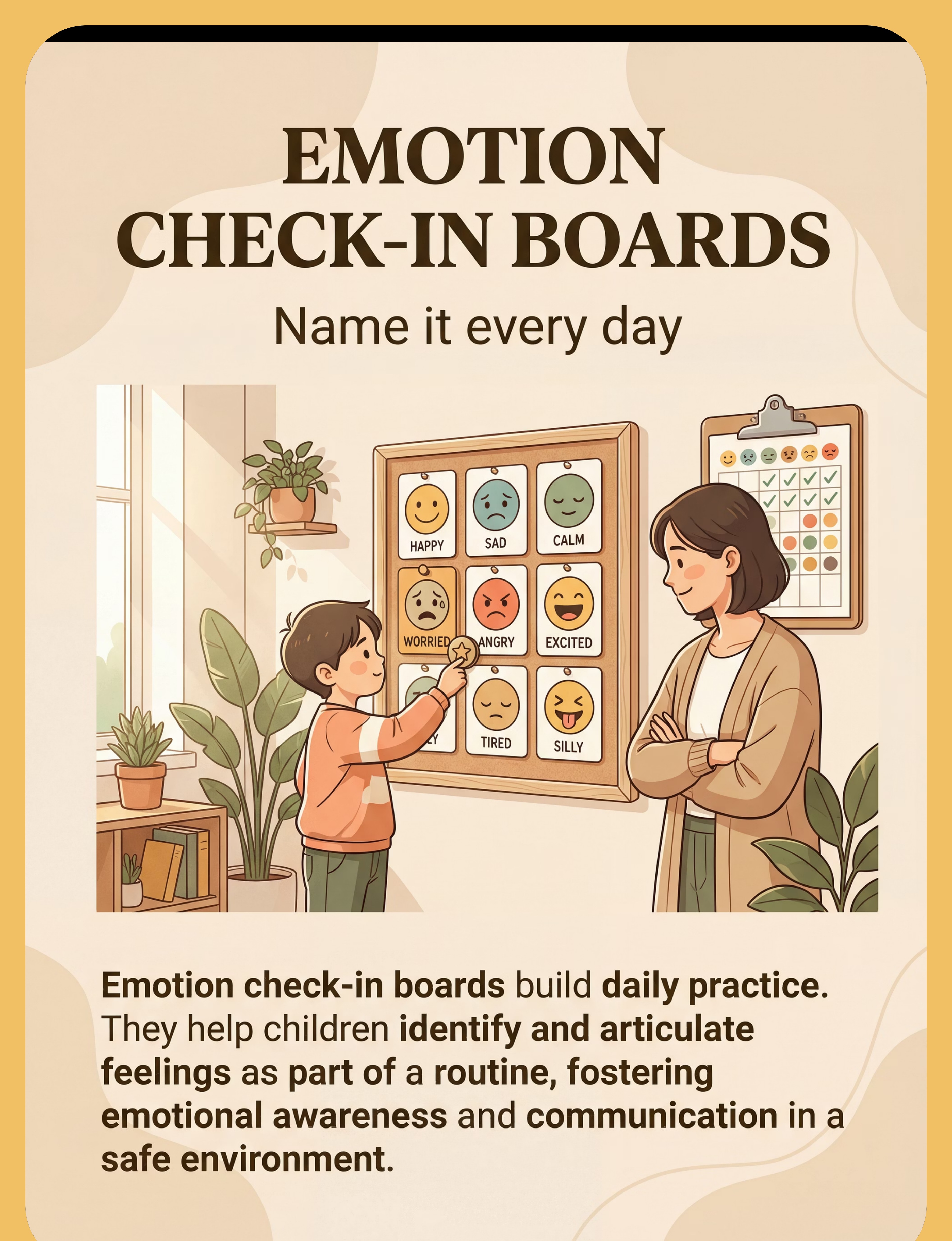
Frequency beats intensity. Brief daily check-ins ("How are you feeling this morning? Point to your feeling") build vocabulary faster than occasional deep teaching. Daily trackers reveal patterns: "You've felt worried every Sunday night — let's think about why." Consistency of routine is what moves an emotion word from learned to owned.
Why It Works
The check-in board creates a daily practice ritual that embeds emotion vocabulary into the child's predictable routine. Predictability reduces anxiety; reduced anxiety increases emotional openness; emotional openness accelerates vocabulary acquisition.
Getting This Material
Buy
DIY (₹50)
Poster board + printed emotion faces + Velcro or magnets. Place at child's eye level. Use morning, after-school, bedtime.
Material 8 of 9
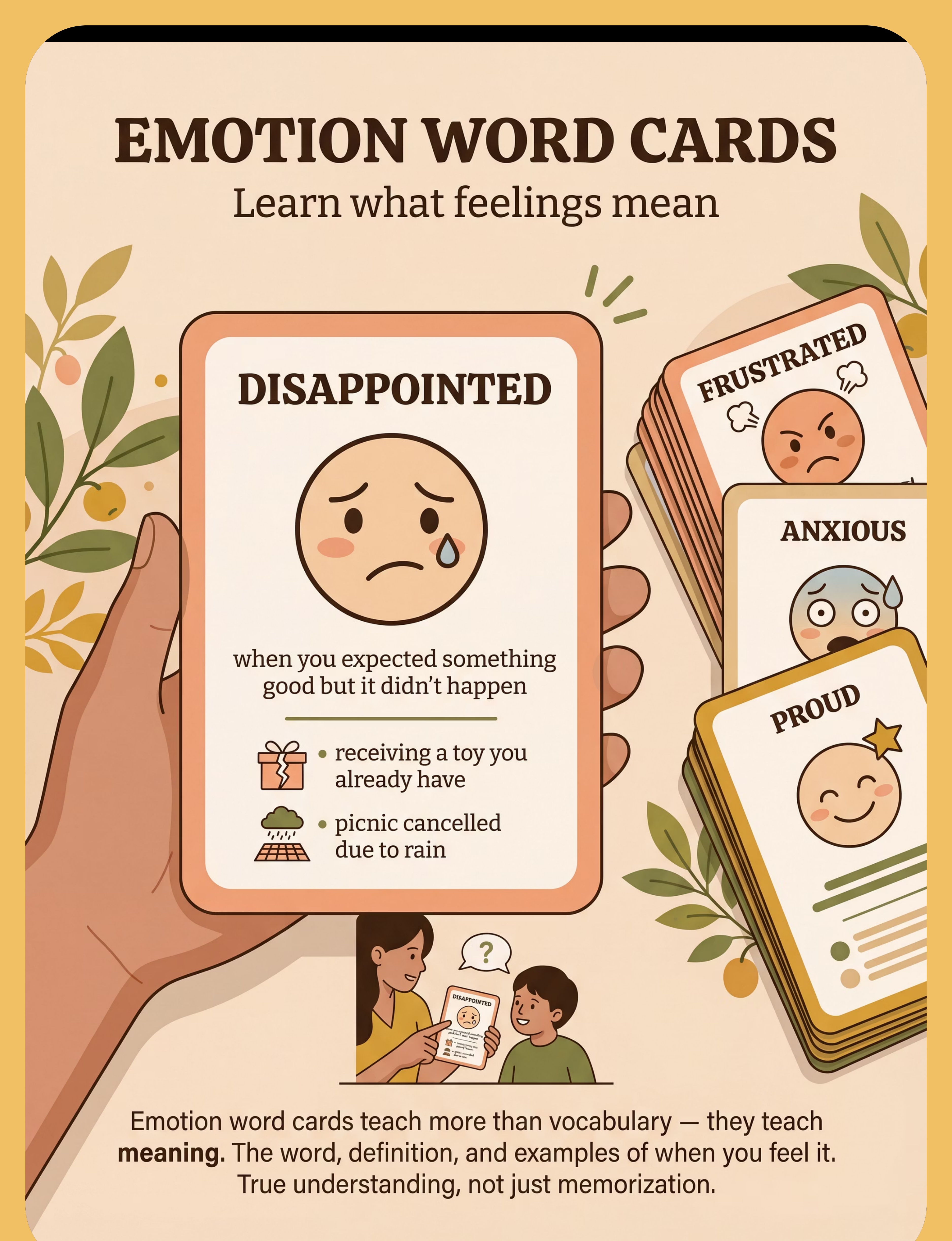
Emotion Word Cards with Definitions & Examples
Canon Category: Language Expansion / Vocabulary Building Tools
Children need more than just the word — they need the meaning. Emotion word cards include: the word, a simple definition, and 2–3 examples of when you feel it. "Disappointed: when you expected something good but it didn't happen. Like when a picnic gets cancelled due to rain." The definition plus the example is what makes the word usable, not just recognizable.
Why It Works
Definitional knowledge — understanding when and why an emotion occurs — is what separates rote labeling from genuine emotional literacy. Examples ground the word in lived experience, making it retrievable in real-life emotional moments.
Getting This Material
Buy
DIY (₹20)
Index card pack ₹20. One emotion per card: Word + emoji face + "when you feel it" + 2 real-life examples. Build 5 cards at a time.

Material 9 of 9
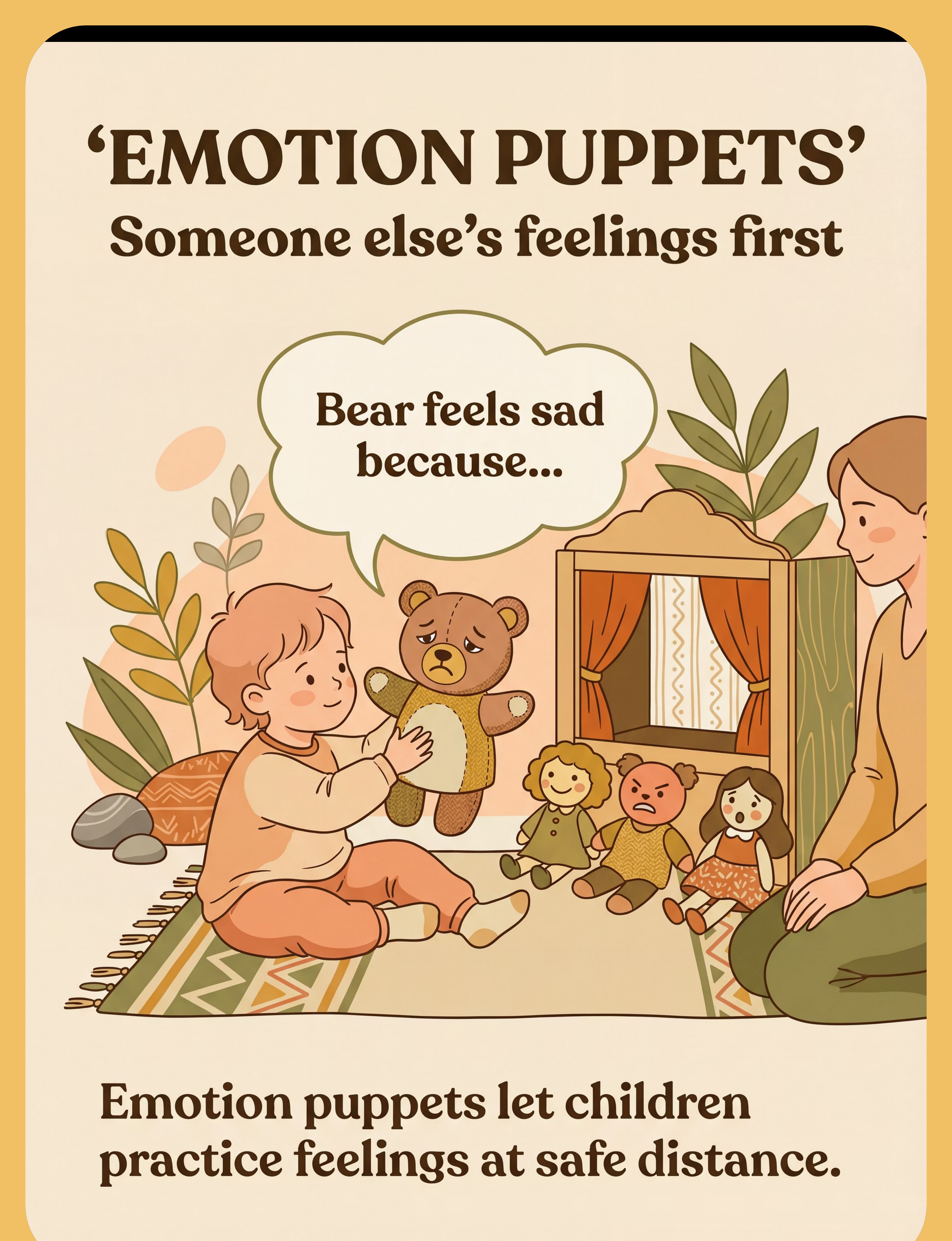
Emotion Puppets, Dolls & Figurines
Canon Category: Role-Play / Pretend Play Props
Children who cannot talk about their own feelings can often talk about someone else's. Puppets create emotional distance that makes feelings safer to explore. "How does Bear feel?" is easier than "How do you feel?" — and the learning transfers. Projective play is one of the oldest and most reliable pathways into a child's emotional world.
Why It Works
Third-person emotional exploration through puppets and dolls reduces the vulnerability of direct self-disclosure. Children practice applying emotion words safely — and the neural learning is identical whether the emotion is attributed to the child or to Bear.
Getting This Material
Buy
DIY (₹0)
Any stuffed animal or doll. Add facial expression variations with paper and tape. Paper bag puppets with drawn emotion faces.
🎯 Pinnacle Recommends — Starter Kit (₹0–₹800 total): Body map (DIY ₹0) | Feelings thermometer (DIY ₹0) | Emotion faces chart (print free ₹0) | Check-in board (DIY ₹50) | One sorting game (₹305–628)

Every Family — Every Income Level — Can Execute This Technique Today.
WHO/UNICEF Equity Principle: Household-based intervention works.
Material | Buy This | Make This (₹0) | |
Emotion Faces | Pre-printed cards ₹200–800 | Print from Do2Learn.com or draw together — "what does worried look like?" is itself a teaching moment | |
Feelings Thermometer | Commercial scale ₹150–600 | Paper thermometer + clothespin slider + green/yellow/red marker zones | |
Body Map | Printed outline ₹100–500 | Trace your child's body on paper. Decorate over time. | |
Emotion Storybooks | Published books ₹200–1,000 | Write personalized stories with your child's name and photos — often MORE effective | |
Emotion Mirror | Child-safe mirror ₹200–800 | Any household mirror. Photograph/video with phone — free | |
Sorting Games | Card sets ₹300–1,200 | Index cards with drawn faces + scenarios. Works identically. | |
Check-In Board | Magnetic boards ₹150–600 | Poster + printed faces + Velcro dots (₹30) | |
Word Cards | Printed sets ₹200–700 | Index card pack ₹20. One emotion per card, written by hand. | |
Puppets | Therapy puppets ₹300–1,500 | Any stuffed animal + paper emotion faces |
A mirror, a piece of paper, a pen, and a child. That is enough to begin. The sophistication of the material is not what creates the learning — the consistency and intentionality of the teaching does.
WHO NCF (2018) | PMC9978394 — CCD Package implemented across 54 LMICs with household materials demonstrating equivalent efficacy

Clinical Guardrails. Read Before You Execute.
🔴 RED — STOP. Do Not Proceed If:
- Child is currently in a meltdown or severe emotional escalation — wait until fully regulated
- Child has a known trauma history involving emotional expression being punished or suppressed — consult a psychologist first
- Child is non-verbal and has not had an AAC assessment — emotion vocabulary work should integrate with AAC system
- You are attempting to teach emotion words during an emotional crisis — vocabulary is taught during CALM
🟡 AMBER — MODIFY. Proceed With Caution If:
- Child has significant interoceptive processing differences — start with visual emotion identification before body sensation work
- Child is very young (under 3) — start with 2–3 basic emotions only: happy, sad, mad
- Child shows distress when attention is drawn to their emotional state — use third-person/puppet approach first
- Child has anxiety that intensifies when they name anxiety — pair labeling with immediate de-escalation tools
🟢 GREEN — GO. Optimal Conditions:
- Child is calm, rested, and fed
- You have 5–20 uninterrupted minutes
- Environment is quiet and low-distraction
- You are in a playful, patient mindset — not problem-solving mode
- Materials are already prepared
🛑 Red Line — Stop Immediately If: Child becomes severely distressed when emotion is named (shame response) | Child begins self-injuring during any emotion identification activity | Child shows signs of dissociation (blank stare, unresponsiveness)
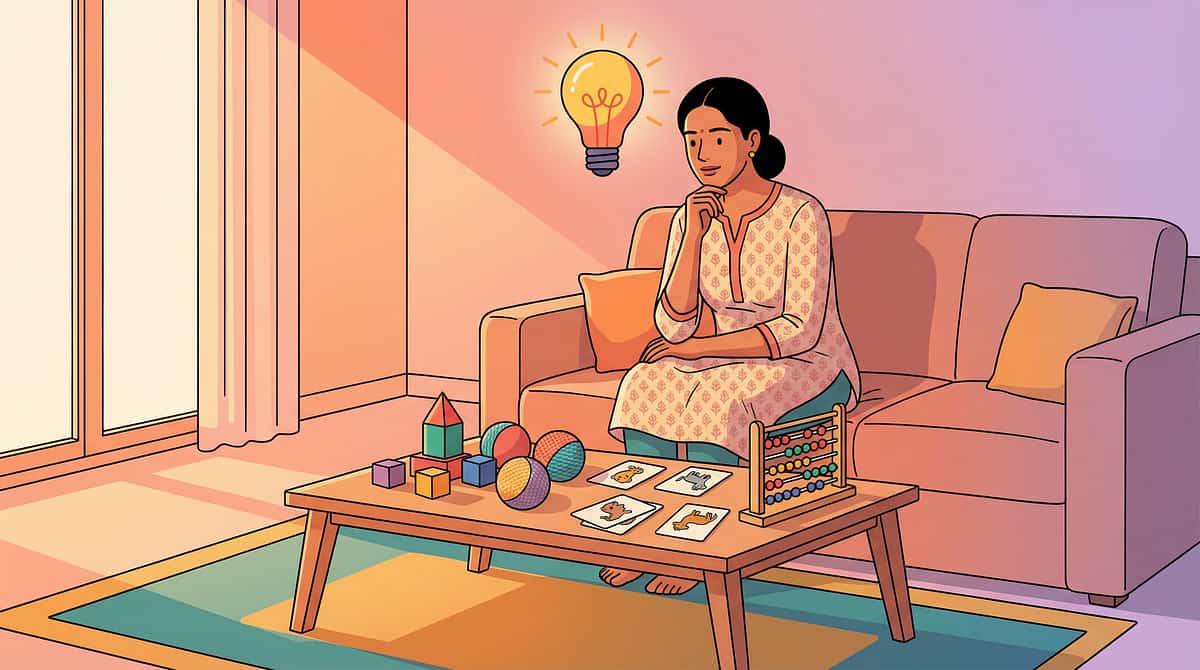
The Right Environment Turns 5 Minutes Into a Breakthrough.
The wrong environment wastes an hour. Here is your setup checklist — eight steps, two minutes of preparation, maximum teaching impact.
Position
Side-by-side at child's eye level. Floor or low cushion preferred. NOT opposite sides of a table — that creates a test-and-answer dynamic that shuts down emotional openness.
Materials Out
Only the materials for THIS session (1–2 items). Remove everything else. Clutter = distraction = no learning.
One Chart on Wall
Permanent, at child's eye level, 5–8 emotions maximum. Always visible — your daily reference point.
Screen-Free
TV, tablet, phone notifications off. Emotion vocabulary teaching requires full mutual attention.
Lighting & Sound
Natural or soft light. Quiet to soft wordless background music. No competing sound sources.
Visual Timer Visible
"We're going to do this for [10 minutes]." Predictability reduces anxiety about when it ends.
Regulate Yourself First
Your emotional state transmits. Thirty seconds of conscious breathing before you begin.
Ayres Sensory Integration Theory | PMC10955541 — Structured individual session environment confirms efficacy

Act III — The Execution
60-Second Pre-Flight Check. The Best Session Starts Right.
Check | ✅ GO | 🟡 MODIFY | ❌ POSTPONE |
All ✅ → GO
Begin Step 1 — The Invitation
Any 🟡 → MODIFY
Shorten session, use simpler emotion only, lower demand. Just one emotion. Just 3–5 minutes. That counts.
Any ❌ → POSTPONE
Different time, different day. This is not failure. This is reading your child.

Step 1 of 6
Step 1 — The Invitation
"Hey, I found something. Come look at this with me." [Hold up the emotion faces chart or a single emotion card.] "Look at this face. Doesn't it look like someone's feeling something?"
Body Language Guidance
- Get to the child's physical level — sit, kneel, or lie on floor if needed
- Relaxed posture — no urgency, no intensity
- Genuine curiosity in your voice, not a teaching tone
- Hold the material, don't demand attention — let curiosity pull them
What Acceptance Looks Like
Child looks at the material, moves closer, reaches for it, asks "what is that?" — any orientation toward the material is acceptance.
What Resistance Looks Like (and What to Do)
Child ignores, walks away, pushes the material — do not pursue. Put it down casually. Say "okay" in a neutral tone. Try again 20 minutes later or a different day. A forced invitation is not an invitation.
Pairing Principle (ABA)
You are pairing yourself + the material with positive, low-demand experience before any learning is requested. This session is about building the association: emotion materials = safe, fun, interesting.
Timing: 30–60 seconds.

Step 2 of 6
Step 2 — The Engagement
"Look at this face — see the eyebrows? They're going down. And the mouth is kind of tight. What do you think this person is feeling?" [Wait. Genuinely wait. Silence is allowed.] "This face is called... FRUSTRATED. Frustrated is when you're trying really hard but something isn't working."
How to Present the Material
- Hold the emotion card at child's eye level — don't hover, place it between you both
- Speak at 80% of your normal speed — emotion vocabulary needs processing time
- Pair the word with your own face making the expression simultaneously
Reinforcement Cue
Any correct attempt — praise immediately and specifically: "Yes! That's exactly right — that IS worried. You just read that face perfectly."
Child Response Indicators
Full Engagement
Child imitates the face, asks questions, points — increase complexity
Partial Engagement
Child watches but doesn't respond — keep going, lower demand
Tolerance
Child near you but not focused — use the material on yourself, narrate, don't demand

Step 3 of 6
Step 3 — The Therapeutic Action
The core 5-phase sequence for emotion faces and word cards. Each phase builds on the last — from visual recognition to embodied, personal understanding.
Phase A — See It
Show emotion face. State the word. State the definition. "This is DISAPPOINTED. Disappointed is when you expected something good but it didn't happen."
Phase B — Situate It
Give 2–3 examples. "You might feel disappointed when: a playdate gets cancelled, it rains on a picnic day, you get a gift you already have."
Phase C — Find It In the Body
"When someone is disappointed, where might they feel it? Maybe heavy arms? A sinking feeling in the chest?" Point to body map if available.
Phase D — Connect It
"Have you ever felt like this? When?" Accept any answer, including "I don't know." Do not push.
Phase E — Practice It
Play a quick game: "Show me your disappointed face" or "If I said the park trip is cancelled — which face would you choose?"
Session Parameters
Duration: 3–5 minutes per emotion. Emotions per session: 1 new + 1–2 previously learned emotions reviewed.
Common Execution Errors
- Teaching too many emotions at once → stick to 1 new + 2 review
- Asking "how do you feel right now?" during teaching → keep in third person initially
- Moving on before child demonstrates understanding
- Correcting wrong answers harshly → redirect warmly: "Almost! Let's look again..."
Response Guide
✅ Ideal
Child correctly identifies emotion, uses word to describe situation, or makes facial expression
✔️ Acceptable
Child engages with material without labeling — proximity and attention are valid early responses
⚠️ Concerning
Child becomes distressed when emotion is named — stop, consult, don't force
PMC11506176 | NCAEP 2020 — Evidence-based practice for explicit social-emotional instruction in autism

Step 4 of 6
Step 4 — Repeat & Vary
The Dosage Principle: 3 good repetitions are worth more than 10 forced ones. Every time. Target 3–5 correct identifications or productions per emotion per session.
Change the Format
Card → chart → body map → puppet → sorting game — same emotion word, different vehicle. The learning deepens with each modality.
Change the Presenter
Parent labels, then child labels, then puppet "labels" — shifting the role shifts engagement.
Change the Context
"Frustrated at a puzzle" → "Frustrated in traffic" → "Frustrated when shoes won't go on" — same word, new situations.
Change the Intensity
Start with "a little frustrated" → "very frustrated" — same word, different size. Intensity nuance builds vocabulary depth.
Change to Third-Person
Child's toy feels the emotion — name it for the toy first. Emotional distance makes exploration safer.
Satiation Indicators — The Child Has Had Enough
Dropping materials or pushing them away | Leaving the area | Distracted, scanning elsewhere | Stiff, decreased responsiveness | Vocal protest. When you see satiation: Stop. Even 2 minutes of quality teaching is a successful session.
Parent Milestone: "You will notice that by week 3, the variations start to feel natural. That's your own emotional vocabulary for teaching growing alongside your child's."
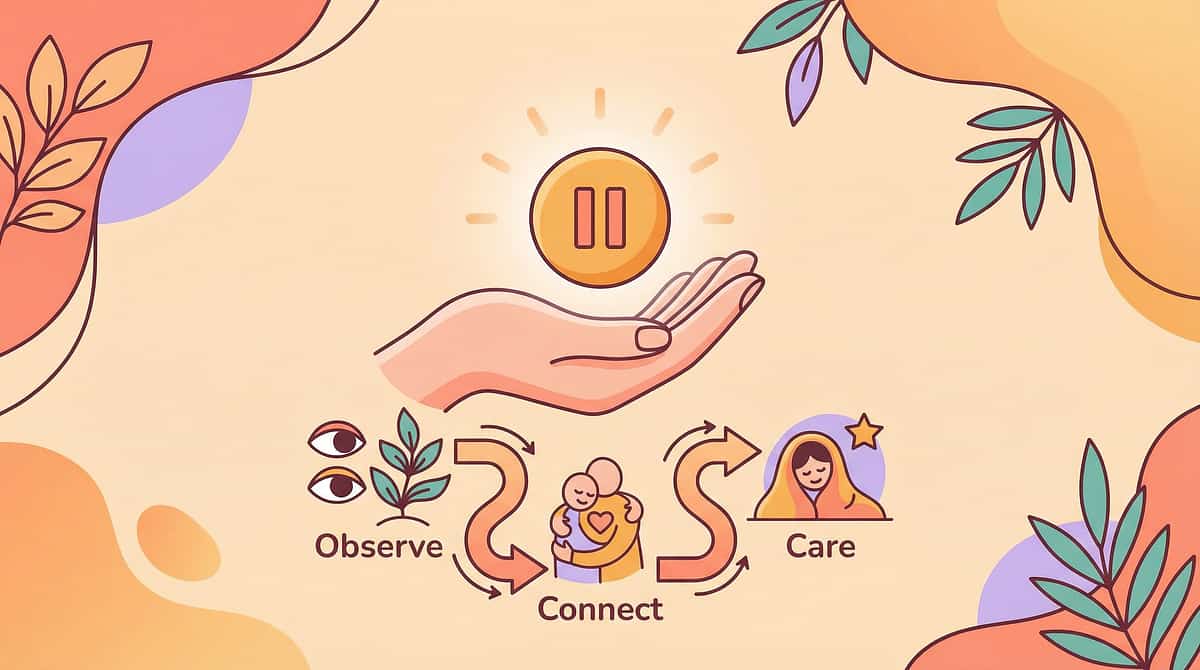
Step 5 of 6
Step 5 — Reinforce & Celebrate
"Yes! That's WORRIED! You just named that feeling! That is such important work."
Timing Law: Deliver reinforcement within 3 seconds of the correct response. After 5 seconds, the connection between the behavior and the reward is lost.
Verbal Praise (Always)
Be specific. NOT "good job" → YES: "You just named three feelings in a row!" Specific praise tells the child exactly what skill they demonstrated.
Natural Reinforcement
The child feels understood: "Wow, you told me you're worried. That helps me SO much." Apply the learned word to real life immediately.
Token / Visual Reinforcement
Emotion word sticker chart — each new word mastered earns one sticker. "Feeling Words I Know" personal booklet — child adds each mastered word.
Tangible (Sparingly)
Small preferred item, presented immediately, paired with verbal praise. For children who need higher reinforcement density. Use to establish the behavior, then fade.
Celebrate the attempt, not just success. A child who tries to name an emotion and gets it wrong deserves as much encouragement as one who gets it right. The attempt is the skill. The accuracy comes with repetition.
🛒Reinforcement Menu Materials — ₹589 (Canon Verified) | 🛒Reward/Token System — ₹364 (Canon Verified)
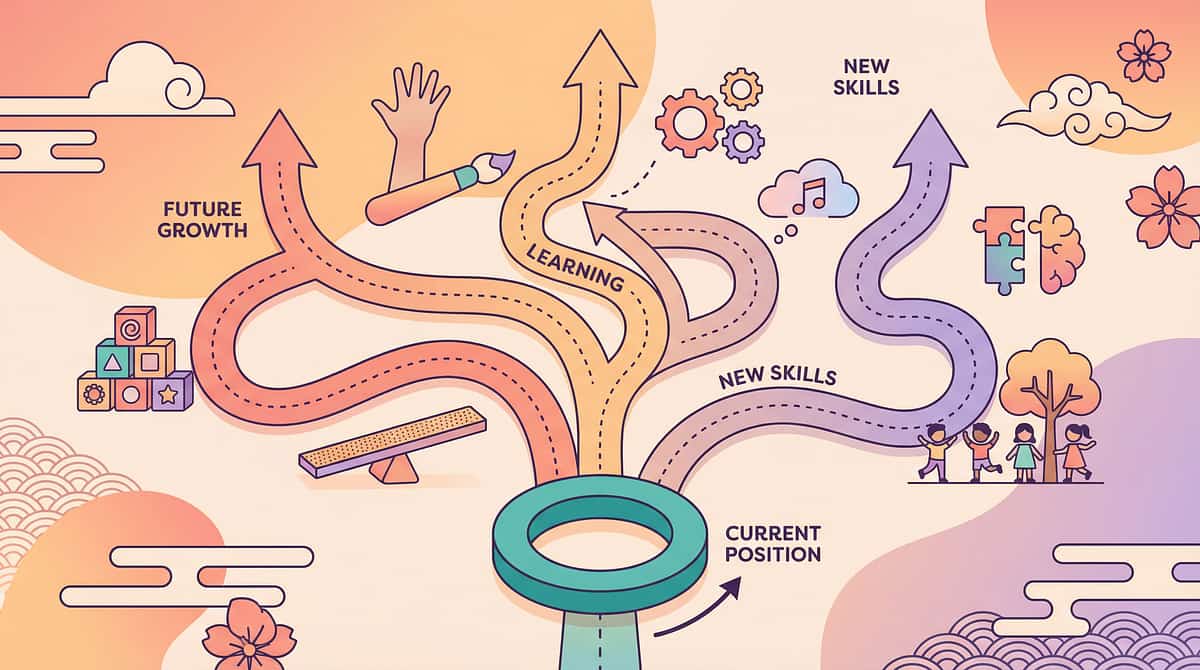
Step 6 of 6
Step 6 — The Cool-Down
No session ends abruptly. The transition is part of the technique. How you end a session shapes how willingly the child enters the next one.
Transition Warning Script
"We're going to do two more, then we're all done for today." [Show remaining time on visual timer.]
Cool-Down Activity (1–2 min)
Return to the "feeling good" emotion — end every session on a positive emotion word. "Before we're done — what's one feeling that feels good? Show me on the chart." Close on happy, excited, or proud — positive emotional association with the activity.
If Child Resists Ending
Don't power struggle. Say: "Okay — one more, then all done."
Use the visual timer as the authority, not yourself: "The timer says we're done."
Name the feeling: "You look disappointed it's ending. Disappointed! That's one of your new feeling words."
NCAEP 2020 — Visual supports and transition warnings are evidence-based practices for autism
60 Seconds of Data Now Saves Hours of Guessing Later.
📊 C-271 Session Tracker
Date: _______________
New emotion word taught: _______________
Child's response level:
□ Full engagement □ Partial □ Tolerance only
Emotion words mastered to date (total): ___
Notes (optional): _______________
New emotion word taught: _______________
Child's response level:
□ Full engagement □ Partial □ Tolerance only
Emotion words mastered to date (total): ___
Notes (optional): _______________
Why This Data Matters
5 Words
Something shifts neurologically — vocabulary begins to feel retrievable to the child
10–12 Words
Caregivers typically report the first spontaneous self-labeling moment
20+ Words
Behavioral meltdown frequency measurably decreases — vocabulary is replacing behavior
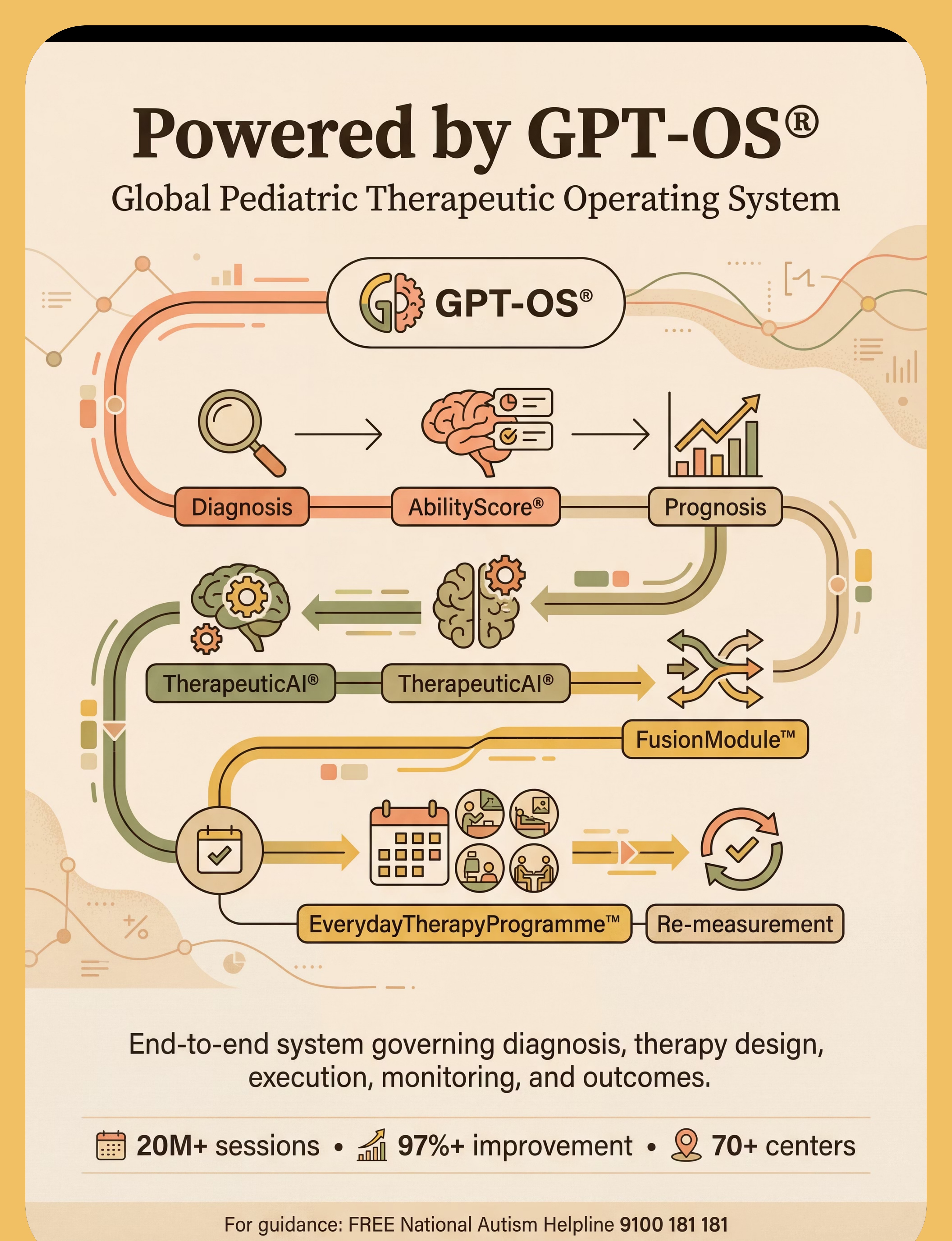
You are recording a developmental arc, not just a lesson. GPT-OS® in-app tracker auto-syncs to the AbilityScore® Emotional Literacy Index.
BACB Data Collection Standards | Cooper, Heron & Heward (Applied Behavior Analysis, 8th ed.)
Session Abandonment Is Not Failure. It's Data.
Seven of the most common session challenges — with exactly what to do about each.
"My child refused to engage at all"
Why: Demand perception — emotion teaching can feel like a test. What to do: Remove all demand. Play with the emotion materials yourself, narrating. "I'm looking at this face... it looks worried to me." No expectation of child response. Curiosity without demand.
"My child pointed to wrong emotions every time"
Why: Vocabulary not yet established. What to do: Go back to 2–3 most basic emotions. Wrong answers are diagnostic — they tell you exactly what to teach next.
"My child can do it with cards but not in real life"
Why: Generalization gap — skill hasn't transferred. What to do: Begin real-time labeling: "You look frustrated right now — see your fists? That's frustrated."
"My child got upset when I named their emotion"
Why: Shame, vulnerability, or trauma response. What to do: Stop immediately. Use only third-person/puppet approach for now. Consult psychologist. Safety first.
"My child memorizes the words but doesn't seem to feel them"
Why: Rote verbal behavior vs. genuine labeling. What to do: Add body sensation work (Material 3). "Say frustrated while making fists and a tight face — feel it in your body."
"I don't have time for daily teaching"
Why: Real life constraint. What to do: Daily check-in board = 60 seconds. "How are you feeling? Point." That's your minimum viable dose. Build from there.
"My child learned the word but uses it for everything"
Why: Overgeneralization. What to do: Differentiation teaching — "Is this frustrated or disappointed? Let's check: did you expect something good and it didn't happen? Then it's disappointed."
No Two Children Are Identical. Here's How to Calibrate This Technique.
Difficulty Calibration
Sensory Profile Variations
Sensory Seeker
Emotion charades, movement-based sorting, loud energetic celebration for correct answers
Sensory Avoider
Quiet one-to-one setting, one card at a time, soft voice, longer processing time given silently
Age-Based Modifications
Age 2–4 | Age 4–7 | Age 7–12 | |
3 emotions max: happy, sad, mad | 5–8 emotions including worried, excited, frustrated | 15–25 emotions including embarrassed, jealous, proud, anxious, disappointed | |
Faces only, no definitions | Word + face + 1 example | Word + face + definition + examples + intensity scale | |
Parent labels, child points | Child labels with prompting | Child labels, defines, and situates spontaneously | |
Daily 3-min check-in | Daily 5–10 min structured session | Integrated throughout the day |
Communication Profile Variations
Pre-verbal / AAC Users
Integrate emotion symbols into AAC device first. Point → AAC symbol → verbal label comes later. Never require verbal production before AAC symbol use.
High Verbal / ASD
May know definitions but not experience them. Add body sensation work and real-time labeling — intellectual knowledge must be grounded in physical reality.

Act IV — The Progress Arc
Weeks 1–2: Laying the Neural Foundation. Invisible but Essential.
Foundation Phase
Weeks 1–2 progress is below the surface — neural pathways forming, not yet visible as behavior change
What Progress Actually Looks Like
Child tolerates emotion material being present (doesn't push it away)
Child can point to 1–2 emotion faces with adult labeling (receptive identification)
Child begins using one new emotion word — even just once, even with prompting
Morning check-in routine begins to feel predictable — child moves toward board without being told
Parent feels more purposeful and less reactive during emotional moments
What Is Not Progress Yet (Managing Expectations)
Not Yet
Spontaneous labeling during distress — weeks away
Not Yet
Applying words to real-time situations independently — weeks away
Not Yet
Reduction in meltdown frequency — 8+ weeks away
"If your child can correctly identify one new emotion word on a card today that they couldn't last week — that is a measurable neurological change. That is progress." Weeks 1–2 will feel slow. Trust the architecture.
Week 3–4: The Neural Pathways Are Forming. Watch for These Signals.
Consolidation Phase
The architecture built in weeks 1–2 is now expressing itself as observable behavior and spontaneous use
These are the consolidation indicators most parents miss — because they're subtle and appear outside of formal teaching sessions:
Anticipation
Child begins moving toward the check-in board before being asked — routine is internalized
Spontaneous Mention
Child uses a new emotion word outside of teaching sessions — even once, this is consolidation
Other-Labeling
Child comments on a TV character's or family member's emotion using a learned word — the word is now generalized to others
Intensity Exploration
Child begins to differentiate "a little worried" vs. "very worried" — intensity concept is activating
Behavioral Shift
One instance where child said a word instead of having a behavioral episode — vocabulary is starting to do its job
What to Do at Week 3–4: Add 2–3 new emotion words | Begin real-time labeling | Introduce body map work | Begin connecting emotions to situations: "What usually makes you feel worried?"
"By week 4, most parents report feeling their child is slightly more legible to them. You start to see the emotional weather approaching rather than being surprised by the storm." — Pinnacle Clinical Team
Neuroplasticity evidence: Synaptic strengthening follows predictable timelines in pediatric populations. PMC11506176
Week 5–8: Mastery Is Not a Finish Line. It's a Launch Pad.
🏅 Mastery Unlocking
Mastery Phase
Vocabulary is now available for the next layer — emotional regulation, empathy, and social connection
Criterion | What It Looks Like | |
Expressive Labeling | Child spontaneously says an emotion word to describe their current state without prompting | |
Receptive Mastery | Child correctly identifies 15+ emotions across varied faces and situations | |
Intensity Awareness | Child uses "a little ___" and "very ___" distinctions consistently | |
Generalization | Emotion words appear at school, in play, in conversation with others | |
Self-Regulation Bridge | Child begins using "I need to calm down because I'm feeling ___" or similar | |
Other-Awareness | Child notices and correctly names emotions in family members or characters |
Generalization Check
Does the skill appear without structured materials? Without prompting? In different settings? If yes — you have generalized mastery.
Maintenance Check
Take a 3-day break from formal teaching. If words persist — the learning is neural, not dependent on external cues.
Badge Unlocked When
Child uses 15+ emotion words correctly across at least 3 different settings over 2 consecutive weeks. → Proceed to C-272.

You Did This. Your Child Has Words Now. That Changes Everything.
Your child began this journey with three feeling words — happy, sad, mad — and used behavior to express everything else. After 6–8 weeks of consistent, intentional work with these 9 materials, your child has a growing vocabulary for the inside. They can name what they feel. They can tell you where they are. They are no longer drowning in nameless experiences.
"Every morning check-in you ran when you didn't feel like it. Every card you held up while the child walked away and you kept going. Every patient repetition. You built this. Not the materials. You."
Family Celebration Suggestion
Create a "Feeling Words I Know" poster together — list every emotion word your child has mastered. Hang it where they can see it. Let them look at what they've built.
Photo / Journal Prompt
Write down the first time your child spontaneously used a new emotion word — the exact word, the moment, what happened after. That moment is a developmental milestone. It deserves to be recorded.
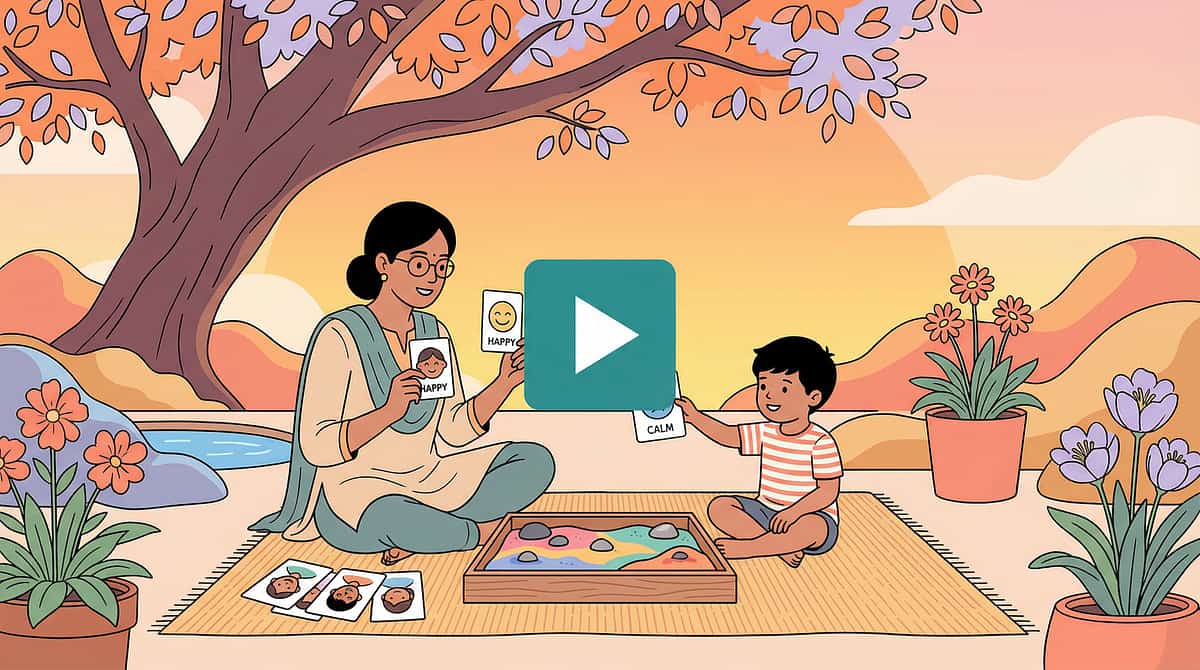
Trust Your Instincts. If Something Feels Wrong, Pause and Ask.
🚩 Shame Responses to Emotion Labeling
What it looks like: Child becomes extremely distressed, covers face, says "stop," tries to leave when emotion is named. Why it matters: May indicate shame conditioning — the child has learned that having feelings is dangerous. What to do: Stop immediately. Consult psychologist. Trauma-sensitive approach required.
🚩 Increased Distress Without Improvement
What it looks like: After 4+ weeks of consistent teaching, meltdown frequency has increased, not decreased. Why it matters: Vocabulary without regulation tools can temporarily increase distress. What to do: Add regulation strategies from C-272. Consult SLP/psychologist. Pace vocabulary and regulation together.
🚩 Complete Absence of Progress After 6 Weeks
What it looks like: No new emotion words, no recognition improvement, no engagement. Why it matters: May indicate AAC need, deeper processing difference, or interoceptive challenge requiring OT assessment. What to do: Request formal assessment. Don't force.
🚩 Child Uses Emotion Words Manipulatively Only
What it looks like: "I'm sad" only when wanting something, not connected to genuine internal state. Why it matters: Rote verbal behavior, not genuine labeling. What to do: Consult BCBA. Adjust reinforcement contingencies.
Escalation Pathway: Self-resolve → Teleconsultation → Clinic visit → Comprehensive reassessment
📞Find your nearest Pinnacle center | Helpline: 9100 181 181
WHO NCF Progress Report 2018–2023 | Pinnacle clinical escalation protocols
Isolation Is the Enemy of Adherence. You Belong to a Community.
WhatsApp Support Group
Join thousands of parents navigating emotion vocabulary challenges. Share wins, ask questions, share what's working. Active moderation by Pinnacle therapists.
Online Parent Forum
Discussion threads specific to C-271, emotion vocabulary, alexithymia, and interoception — with moderating therapists available to answer questions.
Peer Mentoring
Connect with a parent who has completed this journey with their child. Real experience. Practical wisdom. Same road — they know the terrain.
Local Parent Meetup
Pinnacle centers across India host monthly parent groups by challenge area. Find your nearest group and meet families on the same path.
"Your child's breakthrough is another family's hope. When you're ready — consider sharing your journey."
Act VI — The Close & Loop
The Questions Every Parent Asks. Answered by the Consortium.
How many emotion words should my child know at their age?
By age 3–4: happy, sad, mad, scared (4 words). By age 5–6: add excited, worried, surprised, proud (8 words). By age 7–9: add frustrated, embarrassed, jealous, disappointed, anxious, lonely, relieved, confused (15–20 words). By age 10–12: 25–40+ words including guilt, shame, overwhelmed, content. If your child is significantly behind these milestones, formal assessment is recommended.
My child is 10. Is it too late to teach emotion vocabulary?
Not at all. While the window of fastest acquisition is 3–8 years, the brain's capacity to learn emotional vocabulary continues throughout life. Many adolescents and adults with autism benefit from explicit emotion vocabulary instruction. Start where your child is, not where they "should" be.
My child can name emotions on cards but never uses the words during real situations. Why?
This is the generalization gap — a skill learned in controlled conditions that hasn't transferred. The bridge is real-time labeling: when you see the emotion happening, name it for them in the moment. "You look frustrated right now." Over weeks, the in-context labeling transfers.
What's the difference between emotion vocabulary and emotional regulation?
Vocabulary is the prerequisite; regulation is the application. A child needs to be able to name a feeling before they can apply a strategy to manage it. C-271 builds the vocabulary. C-272 uses that vocabulary to build regulation. They are sequential, not simultaneous.
My child says they're sad/mad/happy but I'm not sure they actually feel it. Is this a problem?
This is rote verbal behavior — saying the word without genuine internal connection. It's common in early stages. The solution: connect words to body sensations (Material 3 — body maps) and real-time experiences. The goal is for the word to be grounded in actual experience.
How do I know if my child needs professional support rather than home teaching?
Indicators for professional referral: No progress after 6 weeks of consistent home teaching | Signs of alexithymia | Trauma history affecting emotional expression | Severe interoceptive differences | Non-verbal or AAC-dependent. Helpline: 9100 181 181
Can I do this alongside other therapies?
Yes — and ideally you should. Emotion vocabulary teaching integrates with ABA, SLP, OT, and psychology. Inform all of your child's therapists that you are working on C-271 at home and share which emotion words you're targeting — consistency across settings accelerates acquisition significantly.
How long does the full emotion vocabulary curriculum take?
Building a functional vocabulary (15–20 words) through consistent daily practice typically takes 6–12 weeks for children without significant language delays. Building a robust vocabulary (25+ words) with nuanced use may take 6–12 months. This is not a finite course — it's an ongoing enrichment that continues for years.

The Time for Reading Is Done. Your Child Is Waiting for the Words.
Every day without emotion vocabulary is another day your child uses behavior to say what they cannot yet name. You now have the knowledge, the materials, and the system. Begin today.
🎯 Start This Technique Today
Launch your first emotion vocabulary session with GPT-OS® guidance — step-by-step, material by material
📞 Book an Assessment
AbilityScore® assessment + personalized emotion vocabulary plan matched to your child's exact developmental profile
→ Explore Next Technique
C-272: Building Emotional Regulation Skills — the next step in the journey. Your child has words now. Let's teach them how to use those words to regulate.
📞FREE NATIONAL AUTISM HELPLINE: 9100 181 181 — 16 languages | 24×7 | No charge | pinnacleblooms.org
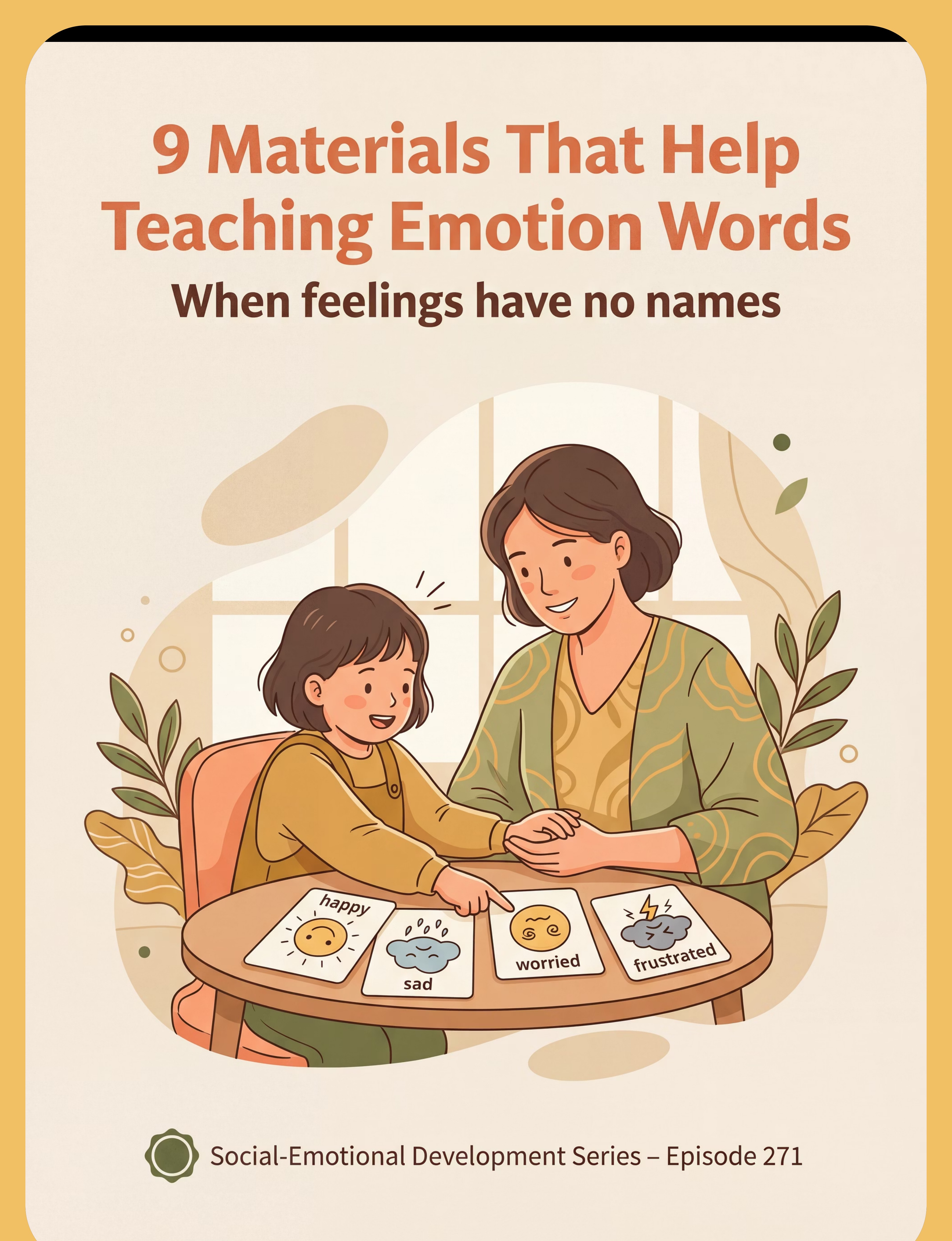
Preview of 9 materials that help teaching emotion words Therapy Material
Below is a visual preview of 9 materials that help teaching emotion words therapy material. The pages shown help educators, therapists, and caregivers understand the structure and content of the resource before use. Materials should be used under appropriate professional guidance.


Link copied!
✦ PINNACLE BLOOMS NETWORK®
Built by Mothers. Engineered as a System.
🩺 NeuroDev | 🗣️ SLP | 🖐️ OT | 📋 ABA | 📚 SpEd | 🧠 Psychology | 🔬 CRO | 🌍 WHO/UNICEF-Aligned
"From fear to mastery. One technique at a time."
Pinnacle Blooms Network® exists to transform every home into a 24×7, evidence-based, multi-disciplinary therapeutic environment — so that geography, economics, and access barriers never determine a child's developmental destiny.
70+
Centers
Across India, delivering multi-disciplinary therapeutic care
20M+
Sessions
On the GPT-OS® platform — the world's largest pediatric therapeutic operating system
97%+
Improvement
Measured improvement rate across GPT-OS® tracked interventions
70
Countries
Families reached globally through the Pinnacle GPT-OS® system
This content is educational and informational. It does not replace individualized assessment and intervention planning with licensed professionals including speech-language pathologists, psychologists, and occupational therapists. Emotional development varies significantly by individual. Individual results may vary. If your child shows signs of significant developmental delay or clinical-level emotional dysregulation, please seek professional assessment.
📞FREE NATIONAL AUTISM HELPLINE: 9100 181 181 | techniques.pinnacleblooms.org | C-271 | EMO-VOC Domain | Social-Emotional Development Series
CIN: U74999TG2016PTC113063 | DPIIT: DIPP8651 (Govt. of India) | MSME: Udyog Aadhaar TS20F0009606 | GSTIN: 36AAGCB9722P1Z2 | © 2025 Pinnacle Blooms Network®, unit of Bharath Healthcare Laboratories Pvt. Ltd. All rights reserved.