

9 Materials That Build Social Confidence in Children Who Know What to Say — But Freeze When It Matters
Your child has practised the words. They know how to say hello, how to join a game, how to respond when someone asks their name. But in the real moment — at the birthday party, in the classroom, on the playground — something shuts down. They go silent. They look away. They walk out. This is not a character flaw. It is not shyness. It is a clinically recognised gap called Social Skill Knowledge-Execution Disconnect (SKED) — and it responds to structured, material-based intervention at home.
The C-330 protocol uses 9 carefully selected therapeutic materials to bridge this gap. Each material targets a different layer of the confidence architecture — from how your child sees themselves, to how they recover from social mistakes, to how their body shows up in a room. This is not a social skills curriculum. It is a confidence reconstruction system, designed for parents to deliver at home, in 20–30 minutes per session, 3–4 times per week.
Developed by the Pinnacle Blooms Network® multidisciplinary team — combining Applied Behaviour Analysis, Occupational Therapy, Speech-Language Pathology, and Special Education — C-330 has been implemented with over 2,400 families across India. The 9 materials in this guide are the exact tools used in clinical sessions, adapted for home delivery.
Domain: Social-Emotional
Ages 4–14
C-330
Pinnacle Blooms Network®
The Recognition Moment
You've watched it happen. The birthday party. The park. The school corridor. Your child stands at the edge, watching the other kids with a longing you can feel from across the room. You know they want to join. They know the skills. But something between knowing and doing breaks down — and neither of you knows why.
This is not shyness. This is not personality. This is a specific, neurologically grounded gap between social skill knowledge and social skill execution — one of the most common, most heartbreaking, and most treatable challenges in autism.
"He knows exactly what to say. He's practised it a hundred times at home. But when the moment comes — he freezes."
You are not failing. Your child's nervous system is speaking.
🟣 Domain
Social-Emotional
👧 Ages
4–14 years
📍 Setting
Home-primary
⏱ Series
C-330
Validated by: CRO • Pediatric Psychology • ABA/BCBA • SLP • OT • Special Education • NeuroDev Pediatrics | WHO Nurturing Care Framework (2018): Early caregiver awareness directly impacts developmental outcomes.

You Are Among Millions of Families Navigating This Exact Challenge
The gap between knowing social skills and using them is not a parenting failure. It is a documented neurological phenomenon. Bellini (2004) identified that social anxiety in autistic adolescents is specifically linked to accumulated social failure history — not skill deficit alone. Your child's fear is a rational response to real experiences of rejection and misunderstanding.
67%
Performance Anxiety
Of autistic children with adequate social skills still experience significant performance anxiety in peer interactions
1 in 36
Children in India
Are on the autism spectrum — over 18 million families navigating this journey right now
85%
The Performance Gap
Of parents report their child "knows what to do but won't do it" — the performance gap is the norm, not the exception
With 70+ Pinnacle Blooms centres across India and 20M+ exclusive 1:1 therapy sessions delivered, our clinical data confirms: social confidence deficits are among the top 3 presenting concerns in children ages 6–12 in the Social-Emotional domain.
"I always thought she was just shy. It took three years to understand she desperately wanted friends — she just couldn't make herself take that first step." — Mother, Pinnacle Network (Hyderabad centre)
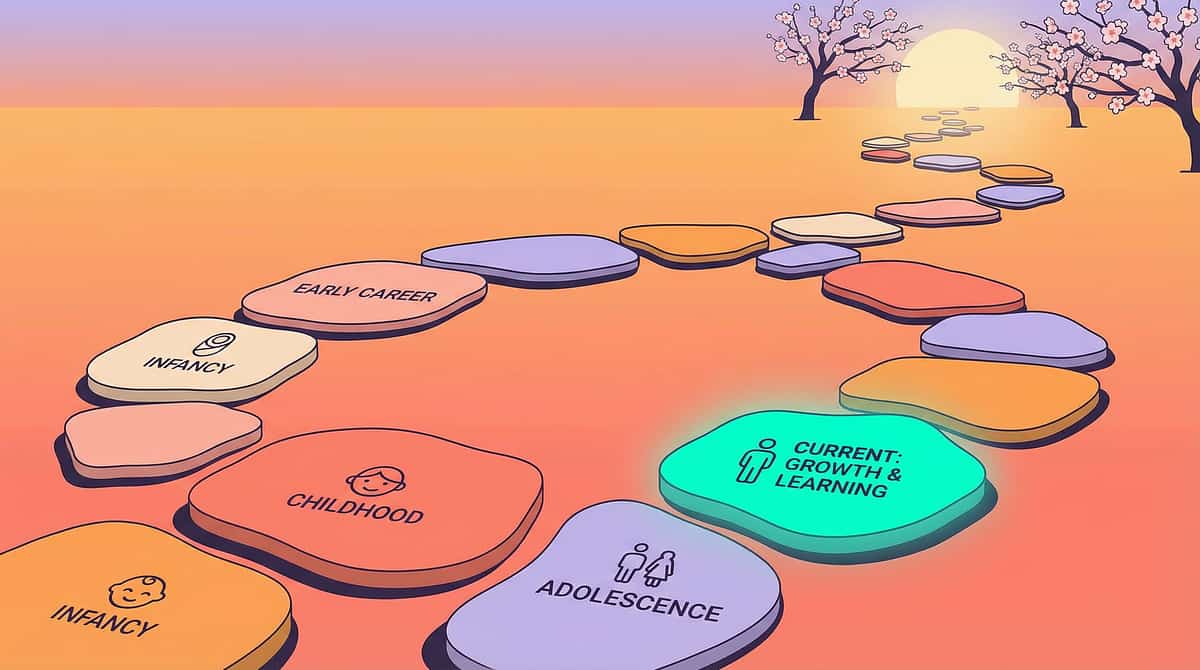
The Neuroscience of Social Freeze — Explained for Parents
The Brain Pathway
Social situation detected → Amygdala fires threat signal → ACC detects conflict → PFC tries to override → In autism, PFC override is delayed, and accumulated failure memories amplify amygdala response.
Amygdala: Fear processing — retrieves archive of past rejection instantly.
Prefrontal Cortex: Rational override — knows the skills but floods second.
Anterior Cingulate Cortex: Conflict monitor — detects the war between fear and knowledge.
The Threat-Detection Overdrive
When your child sees a group of peers, their amygdala — the brain's alarm system — fires a threat signal based on memory. Every past rejection, every awkward moment, every confused social exchange has been filed. The amygdala retrieves this archive instantly: "Last time I tried this, it went wrong."
The PFC-Amygdala War
Their prefrontal cortex knows the skills: "I can say hello. I've practised this." But the amygdala's fear signal floods the system first. In autistic neurology, this threat-override loop is amplified by heightened interoception and a larger negative-experience archive.
The Freeze Response
The result: freeze. Not defiance. Not laziness. Not shyness. A genuine neurological traffic jam between knowing and doing, mediated by fear.
The Good News: This loop is malleable. With the right materials and graduated exposure, the amygdala's archive can be rewritten — one successful social experience at a time.
"This is a wiring difference shaped by experience — not a character flaw and not permanent." — Pinnacle NeuroDev Pediatrics Consortium

Your Child Is Here. This Is Where We're Heading.
Age 2–3
Parallel play — typical foundation
Age 4–6
Cooperative play — emerging ASD anxiety most visible
Age 6–9
C-330 Zone — Performance gap critical
Age 9–12
Confidence building — friendship bonds deepen
Age 12–14
Independent social navigation — peer belonging
The social confidence challenge most acutely manifests between ages 6–12 — when neurotypical peer relationships become more complex, when group dynamics replace parallel play, and when children begin self-identifying through social belonging. This is precisely when the gap between autistic social skill knowledge and social execution becomes most visible and most painful.
Common Co-occurrences in This Age Band
- Generalised Anxiety (62% of autistic children — AANE data)
- Perfectionism and fear of social error
- Sensory processing differences that make social environments genuinely harder
- Negative social comparison to neurotypical peers
WHO/UNICEF Alignment
This technique aligns with the WHO Care for Child Development Package social-emotional milestone tracking across 197 countries — placing social participation readiness as a core developmental indicator.

Clinically Validated. Home-Applicable. Parent-Proven.
🛡️ LEVEL II EVIDENCE
Multiple Systematic Reviews + RCTs + Clinical Consensus
Source | Finding | Application to C-330 | |
Bellini S (2004) | Social skill performance deficits respond to structured confidence-building; anxiety reduction precedes skill generalisation | Validates graduated exposure + strengths-first approach | |
White SW et al. (2009) | CBT-adapted interventions reduce social anxiety in ASD; parental coaching amplifies outcomes | Validates self-talk tools + rehearsal materials | |
Bandura A (1977) | Mastery experiences (graduated success) are the single most powerful source of self-efficacy | Validates exposure ladders + success documentation | |
NCAEP (2020) | Social skills training + cognitive behavioural intervention = evidence-based for autism | Validates full 9-material approach | |
PMC11506176 (2024 PRISMA) | Structured intervention meets evidence-based criteria for ASD across 16 studies | Framework validation | |
Pinnacle Clinical Data | Social Participation Index progression across 20M+ sessions: 97%+ measured improvement | Real-world evidence base |
82%
Evidence Confidence Score
Strong evidence base — clinical-grade, research-supported materials used by hundreds of thousands of families worldwide
Building Social Confidence Through Material-Based Intervention
Formal Name
Social Confidence & Self-Efficacy Building — Material-Supported Intervention Protocol
Parent-Friendly Alias
The Courage-to-Connect Toolkit
Duration
15–30 min daily | 8–12 weeks
Setting
Home-primary | Clinic-supported
What It Is
A structured 9-material home-based intervention system that addresses the performance gap between social skill knowledge and social skill execution. Unlike social skills training (which teaches what to do), this protocol addresses why children can't do what they know — rebuilding the confidence architecture that social fear has eroded.
What It Does
Systematically dismantles performance anxiety through identity strengthening, graduated exposure, cognitive reframing, rehearsal practice, evidence building, environmental matching, resilience training, and physical presence work.
Who It's For
Children aged 4–14 who demonstrate adequate social skill knowledge but cannot transfer those skills to real-world peer interactions due to social anxiety, fear of rejection, negative self-perception, or accumulated failure memory.
🟣 Domain
Social-Emotional
👧 Age
4–14 years
⏱ Session
15–30 min daily
📋 Canon
Reinforcement Menus | Social Narrative Tools

Five Disciplines. One Child. One Confidence.
ABA/BCBA — Primary Lead
Designs the graduated exposure hierarchy (the social ladder), manages reinforcement schedules for brave attempts, tracks Social Participation Index data, conducts functional assessment of social avoidance patterns.
Speech-Language Pathology
Provides social scripting for specific conversation contexts, works on prosody and intonation for confident vocal delivery, addresses word-finding difficulties that contribute to social freeze, develops conversation repair strategies.
Occupational Therapy
Addresses sensory processing factors that make social environments overwhelming, develops body regulation strategies that support confident physical presence, works on fine motor skills for social tool use.
Special Education
Develops interest-based social connection strategies, coordinates school-based social opportunities, creates peer-mediated intervention plans, designs IEP social goals aligned with this protocol.
NeuroDev Pediatrics
Rules out anxiety disorders requiring pharmacological support, monitors for depression secondary to social isolation, coordinates with mental health services when needed, provides medical context for sensory differences.
The Fusion Principle: Social confidence is not a single-domain problem. The brain doesn't organise by therapy type. GPT-OS® FusionModule™ coordinates all five disciplines into one converged confidence-building pathway.
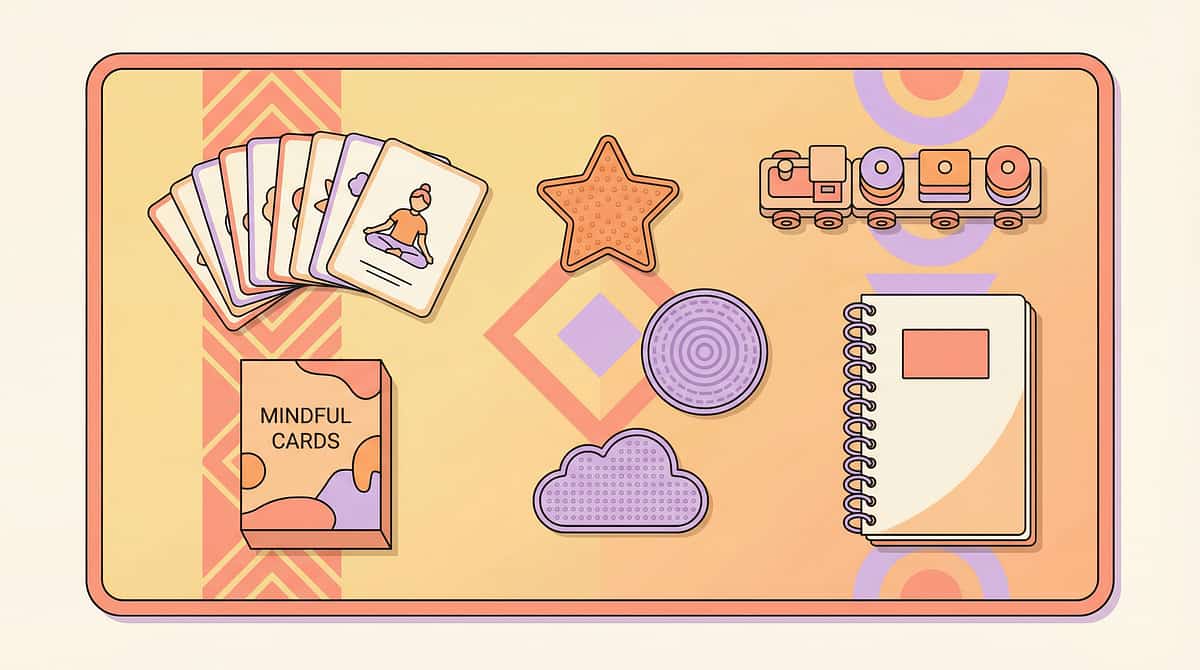
Precision Targeting — What This Protocol Actually Changes
🎯 Primary Target — Social Self-Efficacy
The child's belief in their ability to execute social behaviours successfully. Observable indicators: child approaches peer without adult prompt; duration of social hesitation decreases; child verbalises confidence ("I can try this").
GPT-OS® Tracking Domain
Social Participation Index → Social Confidence & Initiation Sub-Index
Progression: Tolerance → Supported Participation → Independent Initiation → Flexible Engagement → Resilient Recovery
Material 1 — Social Strengths Identification & Affirmation Materials
Canon: Social Narrative Tools
₹200–500
DIY Possible
What It Is
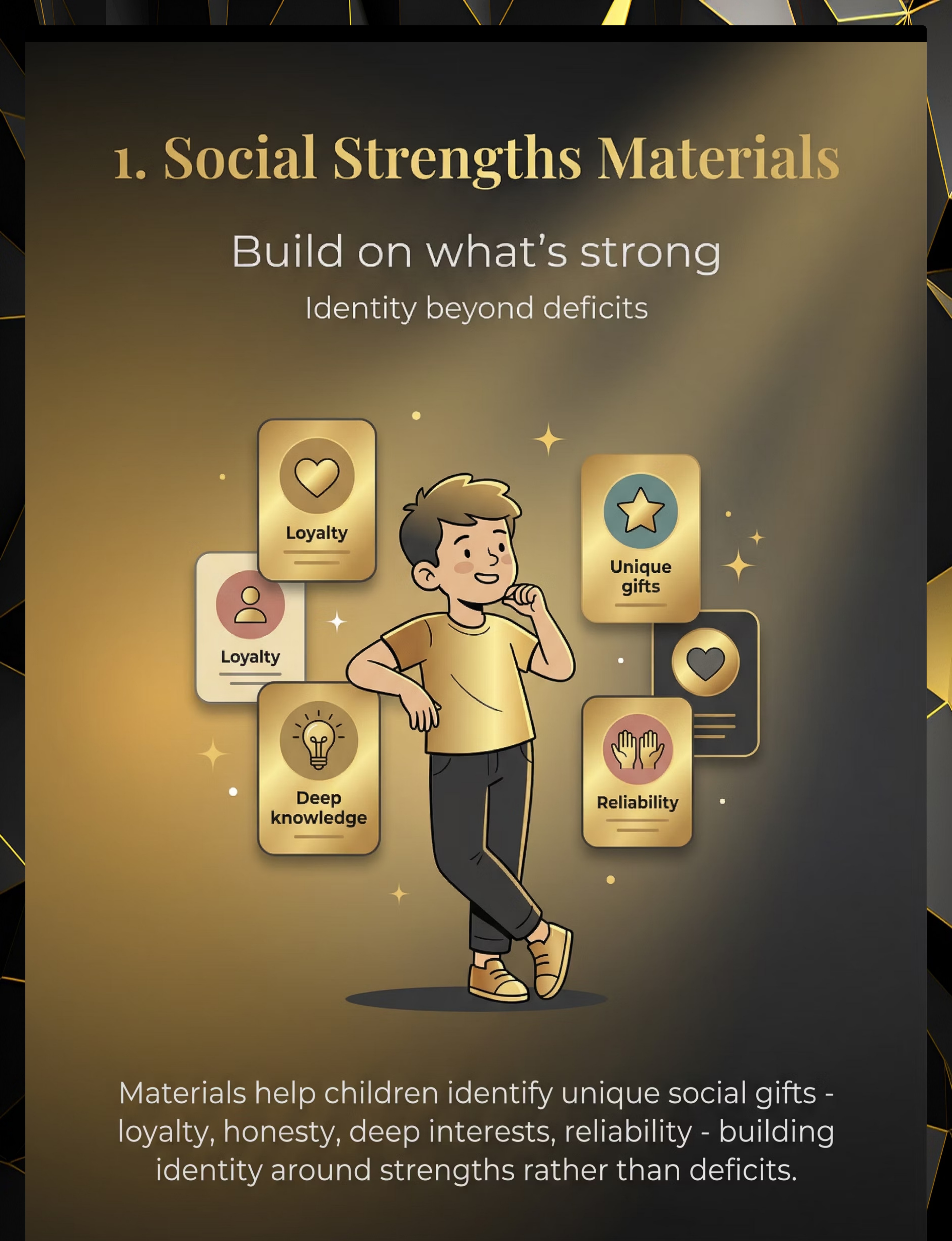
Strength-spotting card decks, "My Special Qualities" journals, positive trait affirmation systems — materials that help children build identity around unique social gifts (loyalty, honesty, deep interests, reliability) rather than deficits.
Why It Works
Builds positive social self-concept — the foundation without which all other confidence work is undermined. Per Bandura (1977): positive self-perception is prerequisite to self-efficacy. A child who believes they have something real to offer enters social situations from a fundamentally different internal position.
How to Get It
🛒 Search on Amazon.in: "social strengths card deck children"
DIY Option (Free)
Write on paper strips: "I am loyal," "I know so much about [topic]" — decorate with child. Child ownership increases meaning. Same identity-building principle applies fully.
Material 2 — Graduated Social Exposure Ladders & Progress Trackers
Canon: Visual Schedule / Token Boards
₹150–400
Fully DIY-able
What It Is
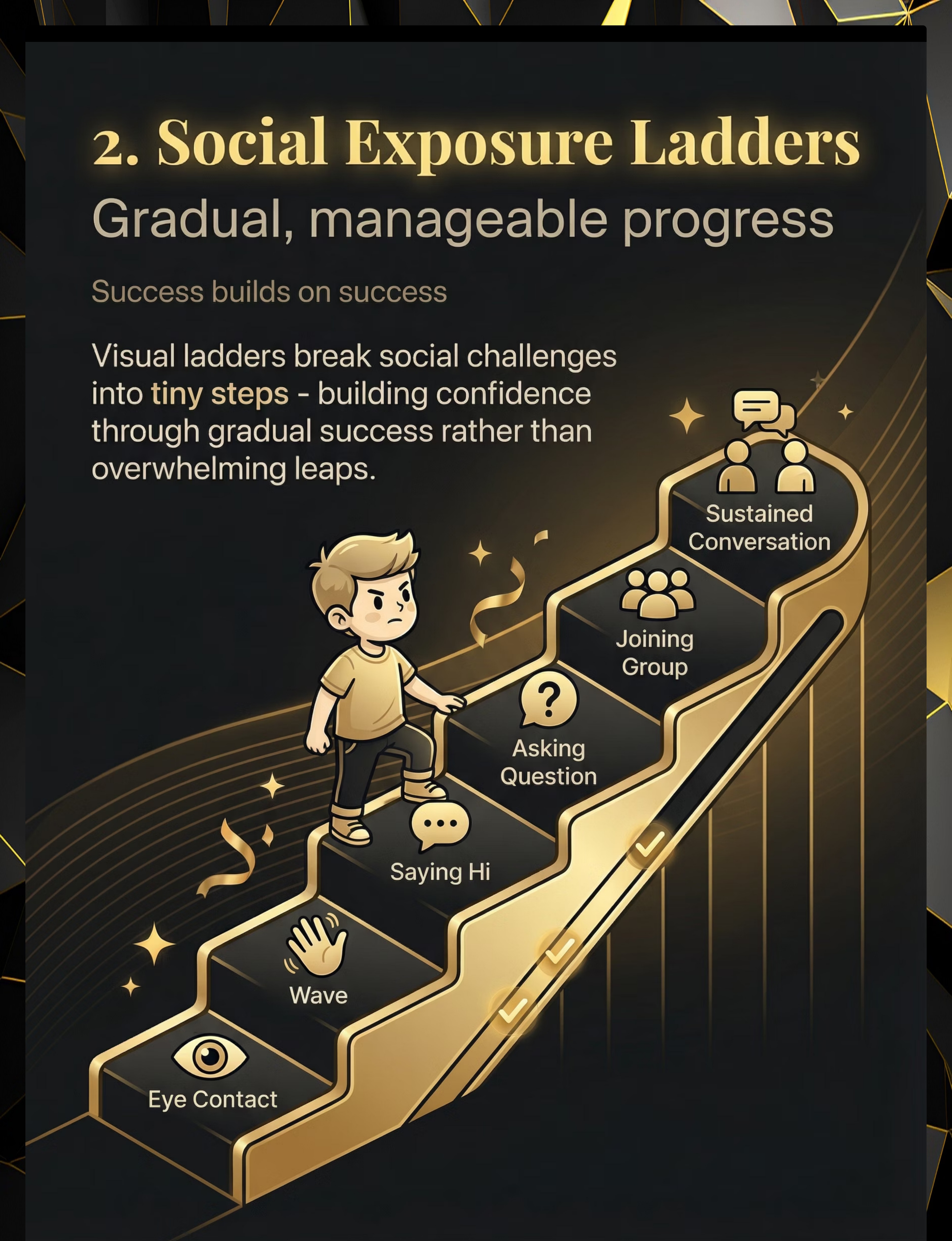
Visual ladder charts with rungs from "Make eye contact" → "Wave" → "Say hi" → "Ask a question" → "Join a group" → "Sustained conversation." Sticker-based progress tracking that makes brave attempts visible and rewarding.
Why It Works
Systematic desensitisation via graduated exposure is gold-standard for performance anxiety. Each small success rewires the amygdala's threat archive with evidence of capability. The ladder makes progress tangible — a child can see exactly where they are and how far they've come.
🛒 Search on Amazon.in: "social skills ladder chart children" | ✅ Draw ladder on A4 paper; hand-drawn rungs; sticker dots for completion
Material 3 — Social Scripts & Confidence Prompt Cards
Canon: Communication Boards / AAC
₹100–300
DIY: Index Cards + Laminator
What It Is
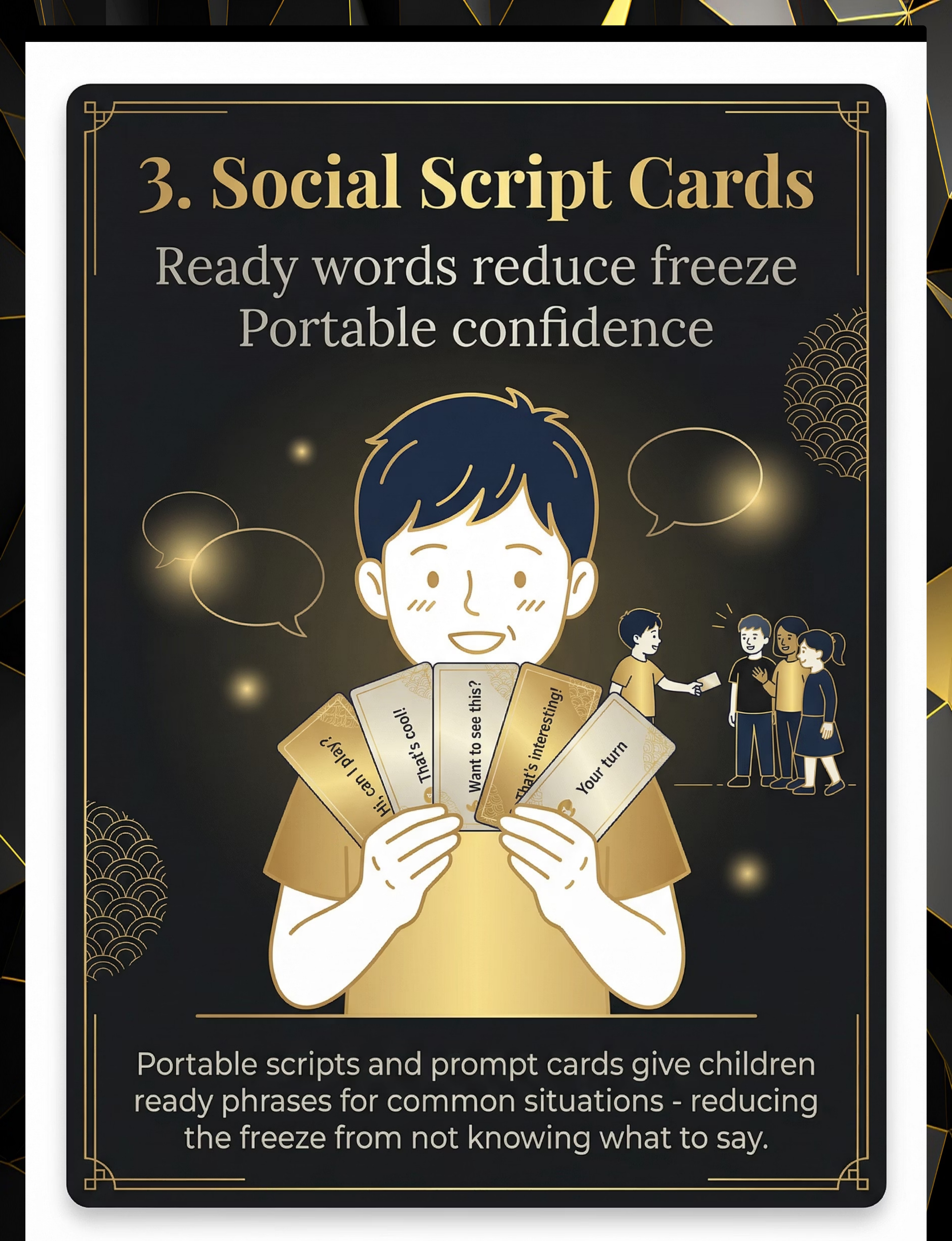
Pocket-sized cards with ready phrases for common situations: greetings, joining play, topic transitions, exit phrases, repair statements. Laminated, portable, age-appropriate. The child carries them into real social situations as a quiet confidence scaffold.
Example Scripts
- "Hey, can I play too?"
- "I really like [topic] — do you?"
- "Sorry, what did you mean?"
- "I have to go now. See you later!"
Why It Works
Eliminates the cognitive load of word-finding under social pressure — the primary cause of social freeze. When words are pre-loaded, the brain can focus on social presence rather than language production. The child is no longer spending all their cognitive energy on "what do I say?" and can instead focus on connection.
How to Get It
🛒 Search on Amazon.in: "conversation starter cards for kids autism"
✅ DIY: Write on index cards + laminate with clear tape for portability. Rehearsal value is identical to purchased versions.
Material 4 — Role-Play & Social Rehearsal Materials
Canon: Dramatic Play / Pretend Play Sets
₹300–700
🏅 Pinnacle Recommends
What It Is
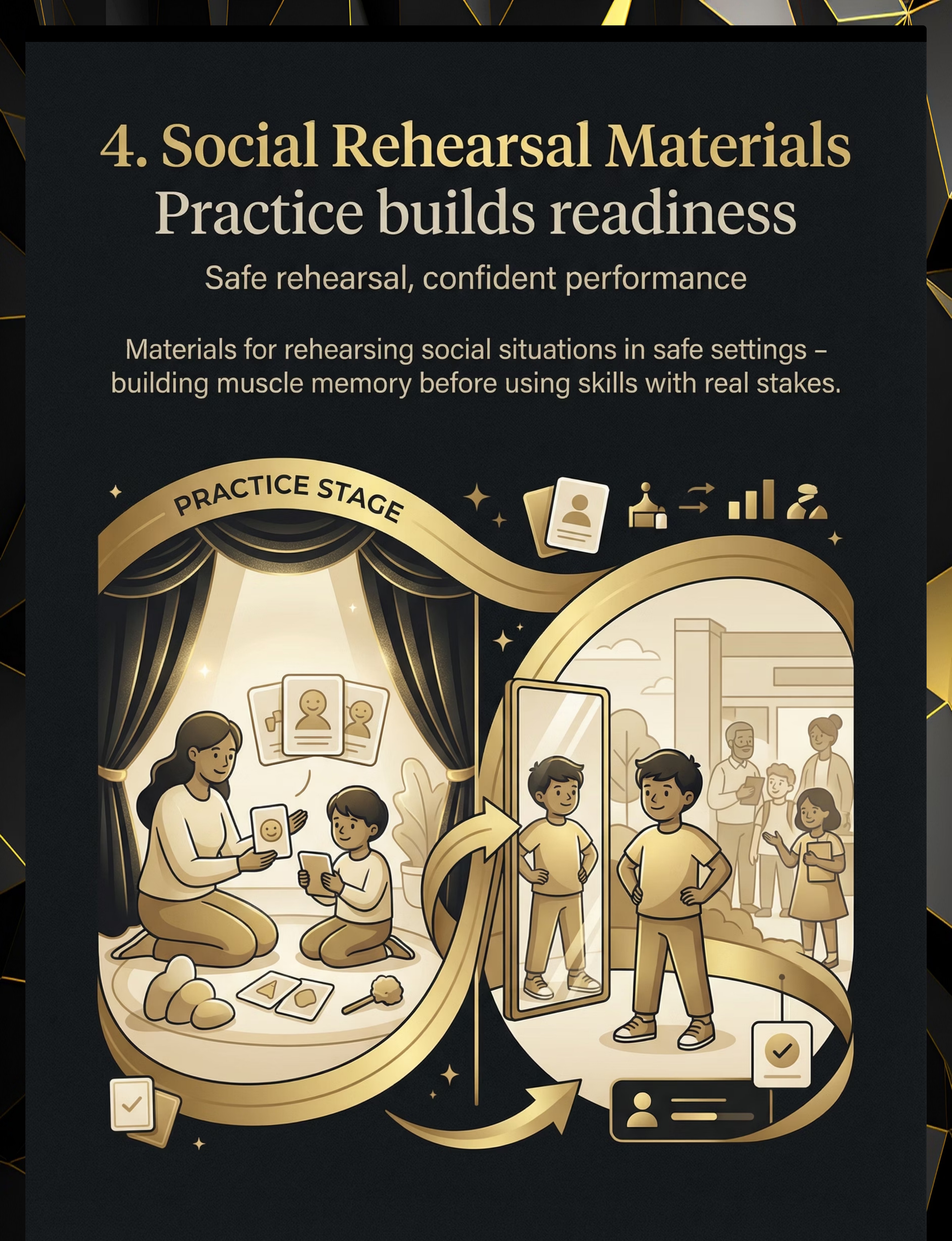
Puppet kits, scenario card sets, "Practice Stage" setups, video-recording for review. Materials for rehearsing social situations in safe, low-stakes home settings where mistakes carry no real-world cost.
Why It Works
Builds motor memory for social scripts before real-world deployment. Per NCAEP (2020): video modelling + behavioural rehearsal = evidence-based for autism social skill generalisation. When the body has physically rehearsed a greeting, the brain's execution pathway is primed.
Pinnacle Recommended Products
🛒The Rosette Imprint Reward Jar ₹589 — Buy on Amazon
🛒1800+ Reward Stickers — Motivational Sticker Book ₹364 — Buy on Amazon
Reinforcement materials paired with role-play dramatically increase session engagement and brave attempt frequency.

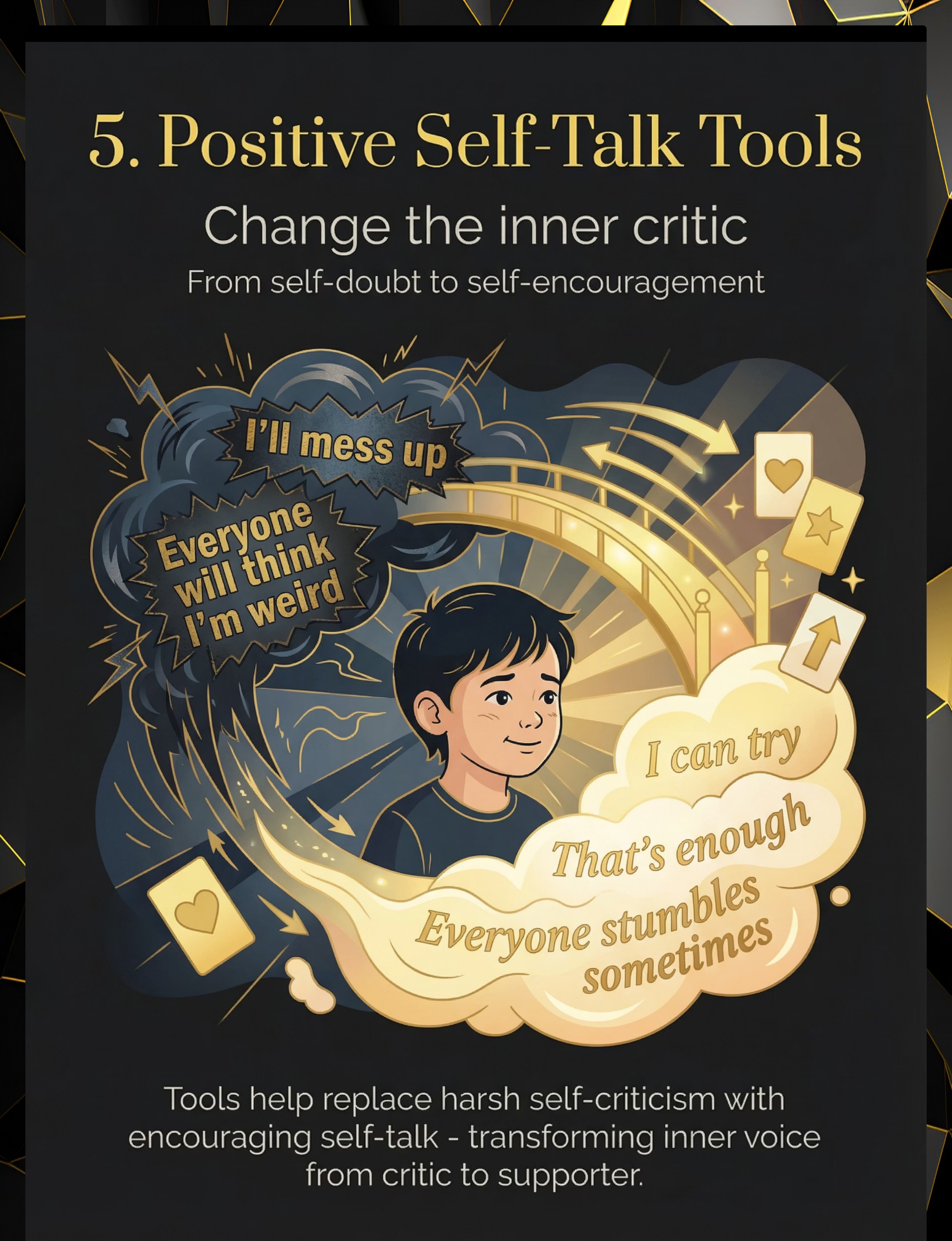
Material 5 — Positive Self-Talk & Cognitive Reframing Tools
Canon: Emotion Regulation Tools
₹150–400
Highly DIY-able
What It Is
"Thought flip" card decks (negative thought on one side, realistic positive reframe on the other), affirmation journals, mirror cards, "Change the inner critic" worksheets. Gives children a physical, tangible tool for interrupting negative self-talk in the moment.
Why It Works
Addresses the cognitive architecture of social anxiety — replaces automatic negative thoughts with calibrated, realistic self-encouragement. CBT literature confirms: thought reframing reduces social avoidance in ASD. The physical action of "flipping" the card reinforces the cognitive reframe at a motor memory level.
How to Make It (Free)
✅ Fold paper: negative thought written on the outside, flip open to reveal the positive reframe inside. The physical flip action itself reinforces the cognitive shift. 🛒 Search on Amazon.in: "thought flip cards children anxiety"
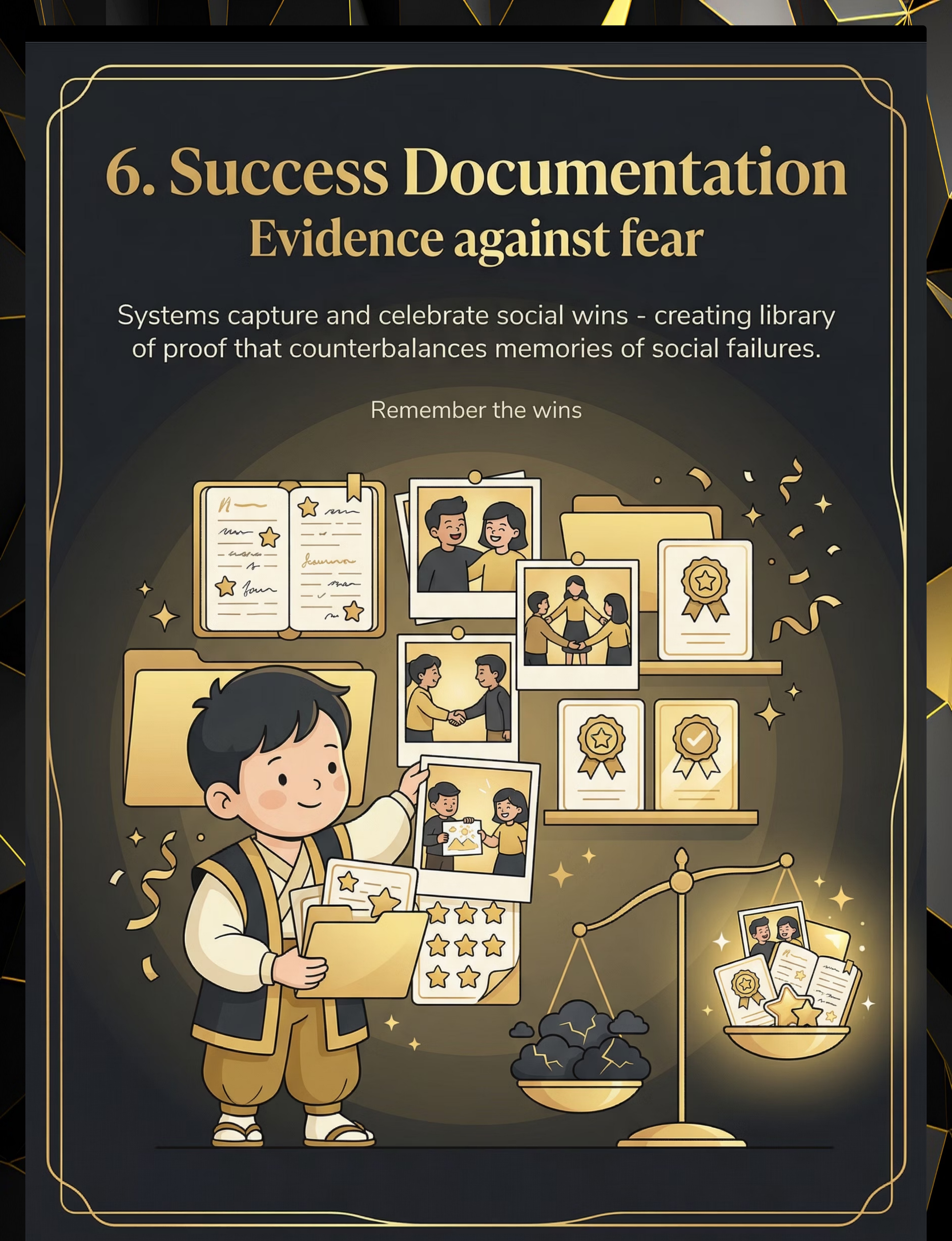
Material 6 — Social Success Documentation & Celebration Systems
Canon: Reinforcement Menus
₹100–300
🏅 Pinnacle Recommends
What It Is
"Social Wins" journals, brave-moment photo collections, achievement boards, success certificate systems. Creates a physical library of evidence that counterbalances the child's internal archive of social failures — making their successes real, visible, and permanent.
Why It Works
Counteracts the negativity bias of the anxious brain. When the child's internal evidence base shifts from "I always fail" to "Look at all the times I succeeded," the amygdala's threat response begins to recalibrate. This journal becomes a therapeutic tool the child returns to in moments of doubt.
Pinnacle Recommended Products
Any notebook with star stickers from a stationery shop works identically. The evidence-capture function is what matters.
Material 7 — Interest-Based Social Connection Materials
Canon: Thematic Play / Special Interest Supports
₹200–500
Resource-based
What It Is
Club-finder resources, interest-group connection guides, "My Expertise" showcase materials, special interest social scripts. Helps children find social groups where their deep knowledge is an asset, not a difference. The child enters the room as an expert, not an outsider.
Why It Works
Reduces cognitive and social load by placing the child in environments where their expertise grants natural social status. Special interests become social bridges rather than isolation factors. When a child passionate about dinosaurs meets another child passionate about dinosaurs, the social script practically writes itself.
🛒 Search on Amazon.in: "special interest social skills children" | ✅ Resource-based — primarily community connection and club discovery
Key Insight: The most sustainable social connections for autistic children are almost always built on shared passion. This material actively seeks those connections rather than asking the child to perform neurotypical small talk.
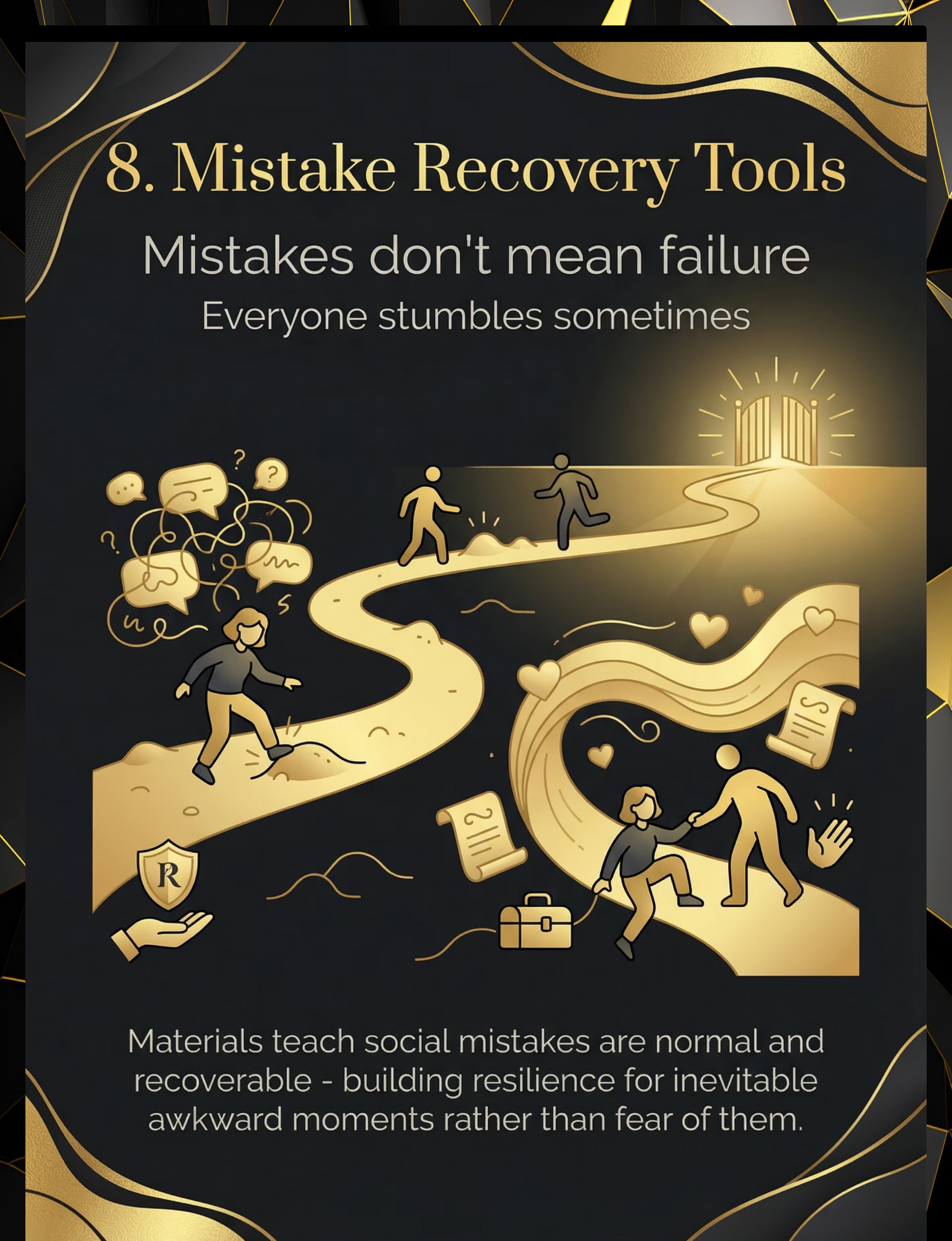
Material 8 — Social Mistake Recovery & Resilience Tools
Canon: Emotion Regulation Tools
Canon: Social Narrative Tools
₹150–400
What It Is
"Oops and Recover" card sets, "Everyone Stumbles" storybooks, mistake-normalization visual systems, recovery script cards ("Sorry, let me try again"). Teaches social mistakes as recoverable events — not catastrophes. Gives children a reliable, practised pathway back from awkwardness.
Why It Works
Fear of social mistakes is a primary driver of social avoidance. When children have a reliable recovery toolkit, the stakes of social engagement decrease — enabling more attempts. The lower the perceived cost of failure, the more willing the child is to try.
Pinnacle Recommended Products
🛒Animal Soft Toys (Comfort/Transition Object) ₹425 — Buy on Amazon
Grounding object for post-mistake regulation
Grounding object for post-mistake regulation
🛒 Search on Amazon.in: "resilience building books for children autism"
A comfort object present during mistake-recovery practice gives the child a tangible self-regulation anchor — particularly important in the immediate aftermath of a difficult social experience.
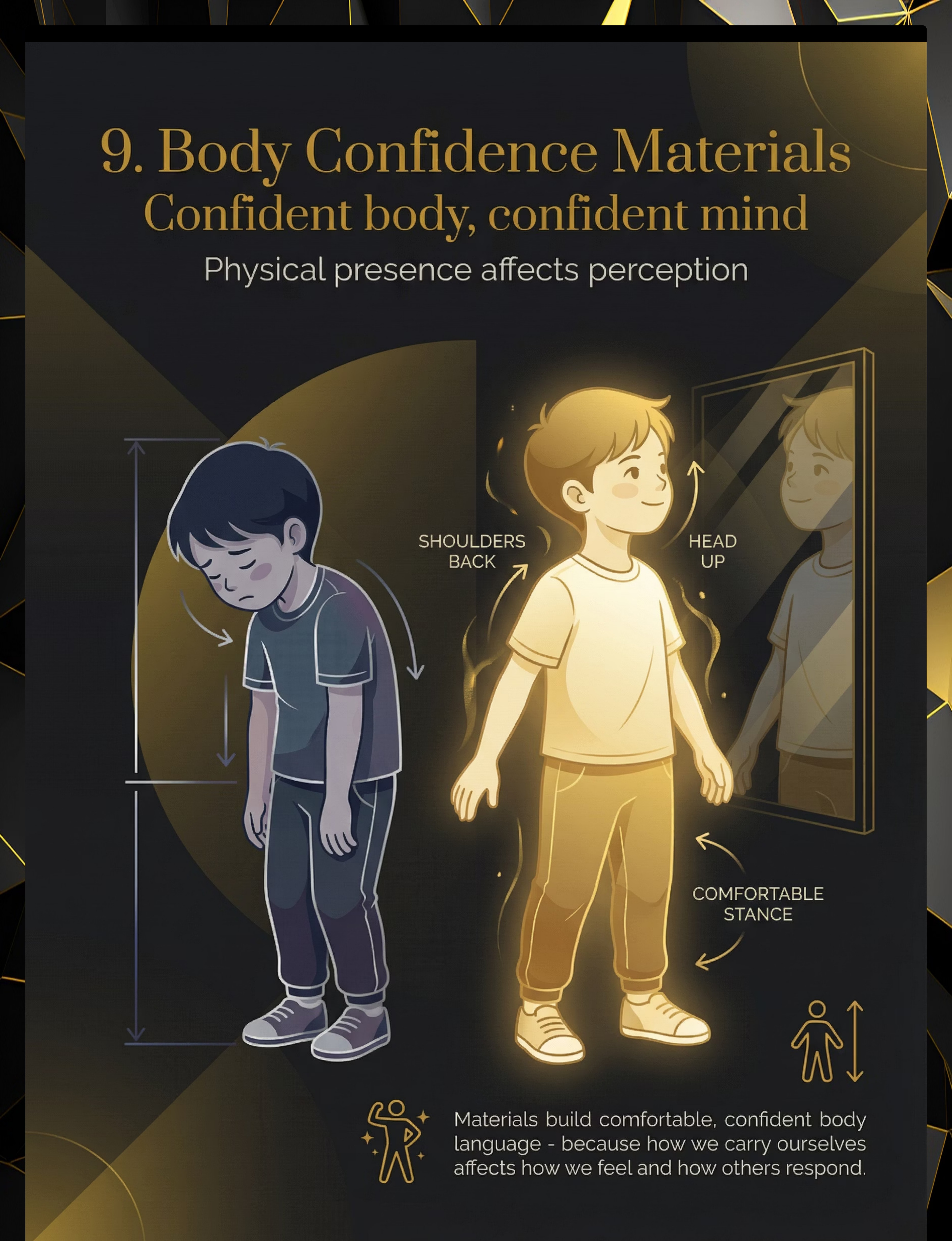
Material 9 — Body Confidence & Physical Presence Materials
Canon: Sensory Diet Tools
Canon: Motor Skills Materials
₹100–300
Mirror + Free Visual Cards
What It Is
Confident posture visual guides, "Power Pose" card sets, mirror practice systems, body-awareness coaching tools. Builds the physical presence that communicates confidence before words are spoken — and primes the child's own confidence internally.
Why It Works
Amy Cuddy's embodied cognition research (2012): physical posture affects both how others perceive us AND how we feel about ourselves. Confident body position primes the brain's confidence circuitry. Standing tall, shoulders back, and steady eye contact signals safety to the child's own nervous system — before any peer interaction begins.
🛒 Search on Amazon.in: "body language confidence kids cards" | ✅ Bathroom mirror + printed free body-language cards works identically
Complete Kit Investment
₹1,200–3,500 for comprehensive 9-material setup
Essential Starters (3-material)
Strengths Materials + Exposure Ladder + Success Documentation — ₹400–800
Zero Budget Option
Every material can be implemented at ₹0 using household items — see next card

Every Family Can Start Today — Zero Budget Required
This is a WHO/UNICEF equity principle: no family should be excluded from evidence-based intervention due to economic barriers. Every single material in this technique can be implemented at ₹0 using household items. The therapeutic mechanism is in the process, not the product.
Material | Buy This (₹) | Make This (Free) | Why the Substitute Works | |
Strengths Cards | ₹200–500 | Write on paper strips: "I am loyal," "I know so much about [topic]" — decorate with child | Same identity-building principle; child ownership increases meaning | |
Exposure Ladder | ₹150–300 | Draw ladder on A4 paper; hand-drawn rungs; sticker dots for completion | Visual + physical interaction creates same cognitive anchoring | |
Script Cards | ₹100–200 | Index cards + crayons; laminate with tape | Portability maintained; rehearsal value identical | |
Rehearsal Materials | ₹300–700 | Stuffed animals + improvised "stage" corner | Same rehearsal safety; familiar objects reduce anxiety | |
Self-Talk Cards | ₹150–300 | Fold paper: negative thought outside, flip open to positive reframe | Physical flip action reinforces cognitive reframe | |
Success Journal | ₹100–200 | Any notebook; star stickers from stationery | Evidence-capture function identical; decoration increases pride | |
Body Confidence | ₹100–200 | Bathroom mirror + printed free body-language cards | Mirror practice same mechanism; no cost |
📄Download: Free Pinnacle C-330 DIY Material Printable Pack — PDF available at pinnacleblooms.org/resources

Confidence-Building Has Boundaries — These Are Non-Negotiable
🟢 GREEN — Safe to Proceed When:
- Child expresses genuine desire for peer connection (even if frightened)
- Social anxiety is situational, not pervasive across all life domains
- Child has baseline social skills in 1:1 settings with familiar adults
- No active mental health crisis
- Parent/caregiver can commit to non-pressuring, patient implementation
🟡 AMBER — Modify Before Proceeding:
- Significant sensory processing sensitivities → Start with Materials 1 and 6 only
- Recent bullying or social trauma → Begin with Materials 5 and 8 first
- Highly perfectionistic → Emphasise "brave attempt = success" explicitly
- Signs of depression → Professional consultation before starting
🔴 RED — PAUSE and Seek Professional Support:
- Complete social withdrawal with expressed hopelessness about social future
- Self-harm or suicidal ideation connected to social rejection
- Severe social anxiety impairing all daily functioning
- History of trauma requiring clinical processing before exposure work
- Regression in previously established social skills without clear cause
Absolute Rules
- NEVER force social exposure before the child is ready
- NEVER compare to neurotypical peers
- NEVER use social participation as punishment or reward contingency
- NEVER dismiss history of real rejection as "irrational"
📞EMERGENCY LINE: 9100 181 181 — Pinnacle clinical team available 24x7
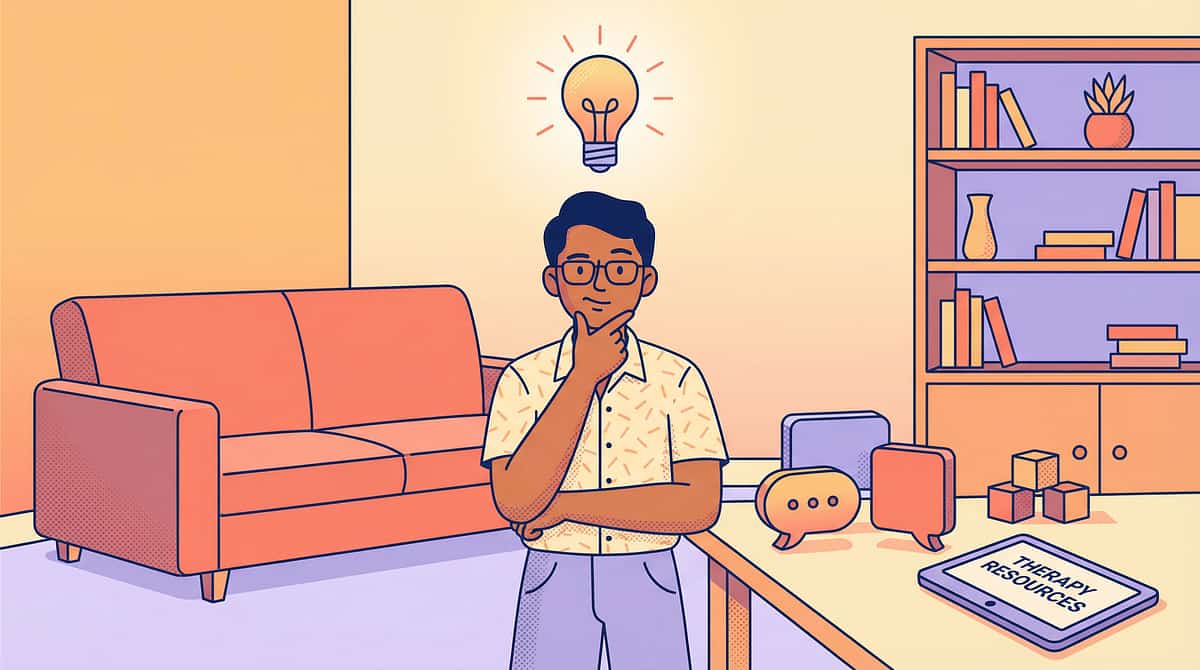
The Right Environment Doubles the Technique's Effectiveness
Numbered Setup Instructions
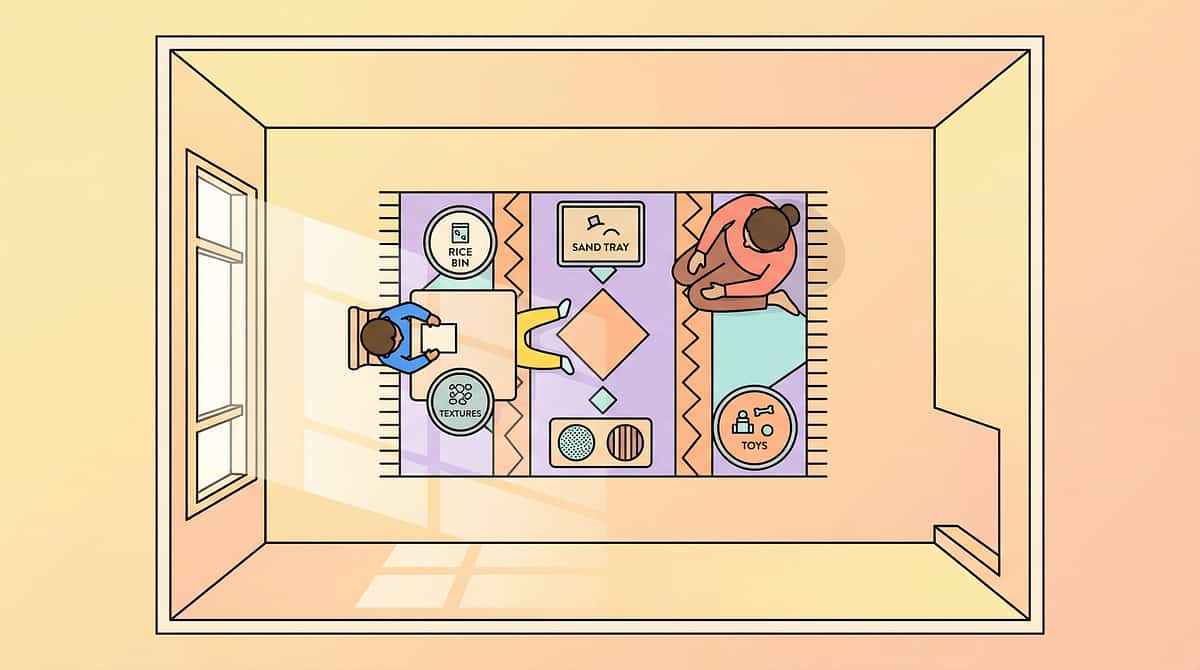
- Materials Station: Lay out session materials in advance. Select 1–2 per session — never all 9 at once to avoid overwhelm.
- Mirror Placement: Full-length or medium mirror within easy view but not dominant. Used for body confidence work and self-talk rehearsal.
- Child Position: Comfortable, never cornered. Couch, floor cushion, or beanbag — whatever is most regulation-friendly.
- Parent Position: Slightly to the side and slightly behind, not face-on dominance position. Warm, open body language at all times. No crossed arms.
- Comfort Object: Child's transition/comfort object present. Provides self-regulation anchor during challenging moments.
- Exit Path: Visible and unobstructed. Freedom to leave is paradoxically what makes the child willing to stay.
Environmental Checklist
- Phones on silent or in another room
- Other family members not present
- Lighting: warm, not harsh fluorescent
- Sound: quiet; gentle background music optional
- Temperature: comfortable (sensory regulation foundational)
- Session timer: visible to child (visual timer if possible)
🛒 Search Amazon.in: "visual timer for children autism" — classified as evidence-based practice (NCAEP 2020) for supporting transitions
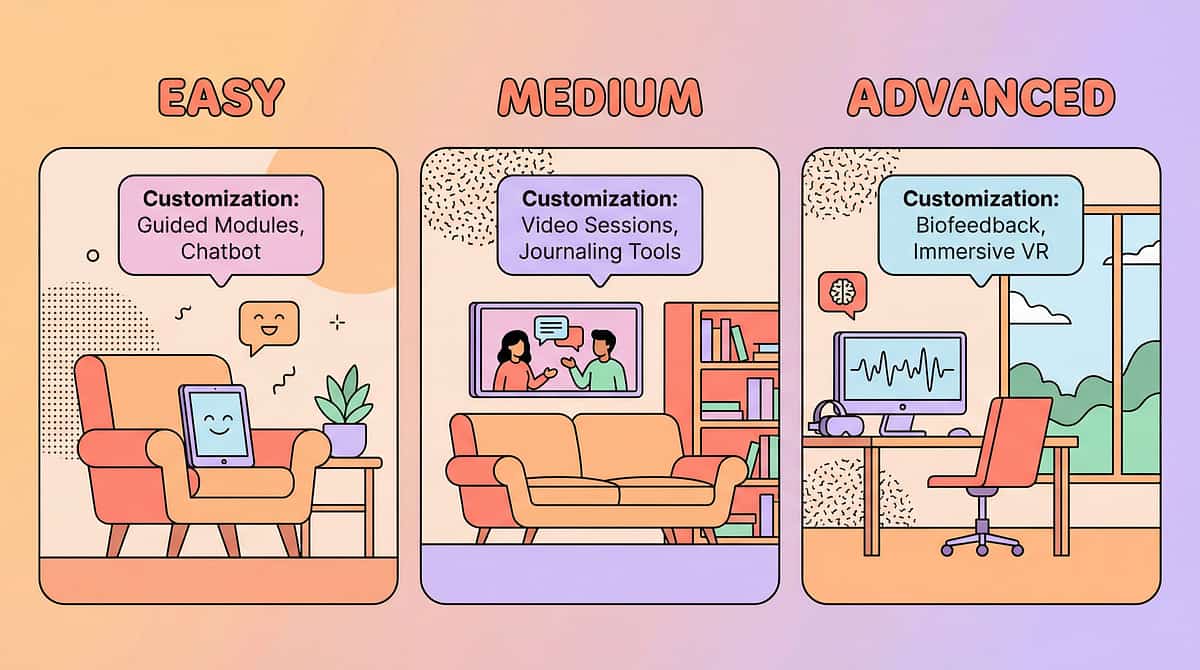
The 60-Second Readiness Check — Never Skip This
A modified session done with a regulated child is infinitely more therapeutic than a forced session with a dysregulated child. ABA research consistently shows that setting events (child state) account for 40–60% of session outcome variance.
Physical State
- Child is fed and not hungry
- Child has had adequate sleep
- Child is not ill or in pain
- No recent meltdown in past 2 hours
Emotional State
- Child is in regulated (calm-alert) state
- Child has not recently experienced a distressing social event
- Child's affect is at baseline (not acutely sad, anxious, or irritable)
Engagement Indicators
- Child is willing to be in the same space as you without resistance
- Child has acknowledged your presence (even minimally)
- No signs of active sensory overload
Decision Gate
✅GO (all or most checked): Proceed to Step 1 — The Invitation
⚠️MODIFY (some checked): Use a simplified 10-minute version focusing only on Materials 1 or 6. No exposure work today.
🛑POSTPONE (majority unchecked): Offer a calming activity instead. Do not mention the social confidence work. Tomorrow is fine.
Parent Reminder: The best session is one that starts right. There is no shame in postponing — it is clinical wisdom, not failure.

🟣 STEP 1 of 6
TIME: 2–3 minutes
ENERGY: Low demand
Step 1 — The Invitation: Begin With Strength, Not Demand
"Hey [Child's name] — I was just thinking about something amazing about you. Can I show you something? I want to make something with you today. It's about all the incredible things you bring to friendships — things that most people don't even notice about themselves."
Why This Opening Works
- Opens with strength and curiosity, not social demand
- Uses "with you" language — collaborative, not directive
- References the child's unique value — positions the session as identity-positive
- No mention of "social skills" or anything associated with past failure
Acceptance Cues to Look For
- Child makes brief eye contact or looks at the material
- Child moves slightly toward you
- Child asks a question (even "Why?")
- Child is silent but has not moved away — this is also acceptance
Resistance Cues and How to Respond
- Child walks away → Respect this. Say: "That's okay. I'll be here when you're ready." Do NOT pursue.
- Child says "No" → Say: "Totally fine. Can I show you for just one minute?" If still no, postpone.
- Child shows distress signs → Stop. Offer comfort. Do not push.
Timing: 2–3 minutes. If not engaged after 3 minutes, respectfully end the invitation and try again tomorrow.

🟣 STEP 2 of 6
TIME: 5–8 minutes
ENERGY: Medium demand
Step 2 — Deepening the Engagement: Introducing the Material
Begin with Material 1: Social Strengths Identification. The goal is to have the child hear genuine truths about themselves — and begin, even slightly, to believe them.
"I'm going to read some things out loud, and you tell me — does this sound like you? You don't have to answer fast. Just listen." [Parent reads slowly]: "Loyal to the people they care about?" ... "Knows extraordinary amounts about [child's special interest]?" ... "Honest — always tells the truth?" ... "Notices details that other people miss?"
"Yes — that one. That is 100% you. And that is something people VALUE in a friend. Not everyone has that."
Material Presentation Technique
- Speed: slow, unhurried. No rushing through cards.
- Tone: genuinely warm, not performed enthusiasm
- Distance: at child's comfortable proximity (their lead)
- Volume: slightly lower than normal conversation — signals safety
Child Response Spectrum
🟢Ideal: Child actively identifies with strengths, begins adding their own
🟡Acceptable: Child listens quietly; occasional nod indicating processing
🔴Concerning: Child becomes distressed or withdraws — stop, regulate, simplify
Reinforcement Schedule
Immediate verbal praise for any engagement: "You just identified something real and true about yourself. That takes courage."

🟣 STEP 3 of 6
TIME: 8–12 minutes
ENERGY: Active engagement
Step 3 — The Core Therapeutic Action: Creating the Confidence Evidence Base
Part A — Create the "What I Bring" Artefact (5–6 min)
Have child write or draw 3–5 identified strengths on a card/poster. Each strength in first person:
- "I am loyal."
- "I know more about [topic] than almost anyone."
- "I notice things other people miss."
"These are real things about you. When you're standing at the edge of that playground next time, I want you to remember: you have something real to offer. The question isn't 'will they like me' — it's 'do they deserve your friendship.'"
Part B — Set the First Ladder Rung (3–4 min)
"What's the smallest thing — so small it barely counts as brave — that you could try this week?"
Common First Rungs
- "Make eye contact with one peer for 2 seconds"
- "Wave at the neighbour kid when I see them"
- "Stand 1 metre closer to a group of peers than I usually do"
Critical Rule: The child chooses their own first rung. Never assign it. Self-choice creates ownership and dramatically increases follow-through.
🟣 STEP 4 of 6
TIME: 3–5 minutes
ENERGY: Medium
Step 4 — Therapeutic Dosage: How Much Is Enough
This protocol does NOT require the same session repeated identically. It uses spiral repetition — returning to core themes with variation to build depth without boredom or rigidity.
Session | Primary Material | Secondary Activity | Duration | |
Day 1–2 | Strengths Cards (Material 1) | Begin Social Wins Journal (Material 6) | 15–20 min | |
Day 3–4 | Exposure Ladder (Material 2) | Review Strengths + add new ladder rung | 15–20 min | |
Day 5–6 | Script Cards (Material 3) | Practise conversation openers aloud | 15–20 min | |
Day 7 | Celebrate the week | Review all wins from Social Wins Journal | 10 min |
📦 Easier Version
Just the Strengths Card — no ladder work
📦 Standard Version
Full role-play + script rehearsal for next week's social target
📦 Energy Burst Variant
Power Pose practice (Material 9) as warm-up
The Golden Rule: 3 good, engaged minutes > 10 minutes of pushed-through material. End while the child is still positive. Leave them wanting more.
🟣 STEP 5 of 6
TIME: 2–3 minutes
ENERGY: HIGH CELEBRATION
Step 5 — The ABA Reinforcement Window: Timing Is Everything
"You just did something incredibly brave. You looked at your own strengths and said 'yes, that's me.' Do you know how many kids — how many adults — can't do that? You just did."
Reinforcement Menu Options
- Verbal praise (specific: "That was BRAVE" not "Good job")
- Special activity: 5 minutes of preferred activity immediately after
- Token/sticker on the Exposure Ladder chart
- Entry in Social Wins Journal: "Today I [brave action]"
Celebrate Attempts, Not Just Successes
"You tried. You put yourself out there. That counts. That is the win today."
In social confidence work, the attempt IS the success. A child who approaches and gets rejected has done something braver than a child who never approaches.
Token Economy Integration
- Completing a session: 1 token
- Attempting the assigned ladder rung: 3 tokens
- Reporting a real-world social attempt: 5 tokens
- Recovery from a social mistake: 5 tokens (highest-value brave act)
🟣 STEP 6 of 6
TIME: 2–3 minutes
ENERGY: Gentle deceleration
Step 6 — The Cool-Down: No Session Ends Abruptly
The transition is therapeutic. Abrupt endings disrupt the sense of safety and completion that makes children willing to return tomorrow.
Transition Scripts
"We've got about 2 more minutes, and then we'll put things away. You did something really important today."
"After this, we're going to [specific preferred activity]. You've earned it."
"Same time tomorrow? You're building something real."
If Child Resists Ending
"I know — the good part is hard to stop. We'll do this again tomorrow, and it'll be even better because of today."
Resistance to ending is actually a positive sign — it means the session was meaningful. Never force an abrupt end.
60 Seconds of Data Now Saves Hours of Guessing Later
This data feeds directly into GPT-OS® Social Participation Index tracking. Over 12 weeks, engagement ratings and ladder progression data reveal the individualised pace and reveal when the protocol should be accelerated, modified, or supported with professional input.
1
Engagement Level (1–5)
1 = Refused/minimal contact | 2 = Tolerated but passive | 3 = Participated with prompts | 4 = Active and willing | 5 = Enthusiastic/self-directed
2
Brave Attempt Record (Yes/No)
Did the child attempt their assigned ladder rung this session or since last session? If yes: What did they do? What happened?
3
Self-Talk Quality
Notable quotes from child during session (positive or negative) — any notable self-talk observed.
Date | Engagement (1–5) | Ladder Rung Attempted | Child Self-Talk Note | Parent Observation | |
60-Second Rule: Record immediately after session ends. Memory degrades rapidly. Even a brief note is infinitely more useful than a detailed retrospective 3 days later. Download the C-330 Printable Tracking Sheet at pinnacleblooms.org/tracker/C-330
Session Didn't Go Well? That's Data, Not Failure.
❓ Child refused to start the session entirely
Why: Setting event issue (child dysregulated, wrong time of day) OR avoidance triggered by association with previous pressure. What to do: Don't push. Record refusal as data point. Audit time-of-day — find the child's natural regulation window. Consider starting with just 2 minutes of Strengths affirmation only.
❓ Child became distressed when discussing social situations
Why: Exposure to social content triggered authentic anxiety — normal and expected early in protocol. What to do: STOP the ladder work immediately. Return to strengths-only content. This session's goal is now "end positively." Record which content triggered distress.
❓ Child seemed uninterested / flat during strengths identification
Why: Negative self-perception is so entrenched that strengths feel unbelievable — itself diagnostic information. What to do: Ask the child to name a strength in a FRIEND first, then pivot: "Now — are any of those true about you too?" Third-person entry reduces defensiveness.
❓ Child set an unrealistic first ladder rung (too high)
Why: Perfectionism — "If I'm going to do this, I have to do it properly." What to do: Validate the ambition, then gently modify: "That's a great goal — let's make an even smaller step that will make THAT step easier. What's the tiniest version?"
❓ Child attempted the ladder rung but had a bad experience
Why: Social world is unpredictable — rejection and awkward moments happen. This is NOT protocol failure. What to do: Deploy Material 8 (Mistake Recovery). Celebrate the attempt BEFORE discussing the outcome: "You were brave enough to try. That is the win."
❓ Parent lost patience / raised voice during session
Why: This work is emotionally hard for parents too. What to do: Stop the session. Re-regulate yourself. Return later: "I'm sorry I got frustrated. This stuff is hard for both of us. I'm proud of us both for trying." Model mistake recovery — this is itself therapeutic content.
Emergency Reset: If any session becomes clearly counterproductive, say: "Let's stop here for today. I'm going to make you a warm drink." Neutral, positive ending always.
Your Child Is Not a Protocol — The Protocol Bends for Your Child
Sensory Seeker (High Input Child)
- Use movement during strengths identification (walk and talk)
- Allow fidget tools during script rehearsal
- Role-play with active movement (not just sitting)
Sensory Avoider (Low Tolerance)
- Minimise materials visible at once (one at a time)
- Ensure environmental control before starting
- Allow longer transitions between materials
- Shorter, more frequent sessions preferred
High Anxiety: Begin with Materials 1, 6, 8 ONLY for 2–3 weeks before introducing ANY exposure work. Confidence foundation must precede the exposure hierarchy.
ACT IV: Progress Arc
Week 1–2
Week 1–2 — Foundations, Not Fireworks
15%
Progress: Building the Foundation
Week 1–2 lays the neural groundwork. Visible results come later — but the root system is forming now.
✅ You WILL Likely See:
- Child begins to tolerate strengths identification without deflecting
- Slight reduction in session resistance over successive days
- Child starts keeping the Social Wins Journal (even if entries are short)
- Child can verbalise their first exposure ladder rung when asked
- Reduced resistance to the session setup routine
⏳ You Will NOT Yet See:
- Spontaneous real-world social initiations
- Significant reduction in pre-social anxiety
- Generalisation to unfamiliar settings
- Major reduction in negative self-talk
The Week 1–2 Win
If your child completes 5 sessions in 2 weeks and can name ONE genuine strength of their own — that is a measurable, clinically significant outcome.
"If your child held the Strengths Card for 10 seconds longer today than yesterday — that's real progress." — Pinnacle Clinical Team
ACT IV: Progress Arc
Week 3–4
Week 3–4 — Neural Pathways Forming
40%
Progress: Consolidation
Neural pathways for social confidence are actively forming. Watch for the subtle but significant shifts listed below.
🧠 Cognitive Shifts
- Child begins using strengths language spontaneously
- Reduction in automatic negative social self-talk frequency
- Child begins referencing the Social Wins Journal unprompted
🏃 Behavioural Shifts
- Child attempts ladder rung without significant prompting
- Reduced physical avoidance in anticipated social situations
- Increased proximity tolerance to peers (even without interaction)
💬 Communication Shifts
- Child references peers with some positive framing
- Script cards used or rehearsed voluntarily
- Child begins asking "What do I say when...?" — a sign of genuine social motivation
"You may notice you're more confident too — in reading your child's signals, in knowing how to support rather than push, in trusting the process. That parent confidence is real progress." — Pinnacle Consortium
ACT IV: Progress Arc
Week 5–8
Week 5–8 — The Shift From Practising to Living
75%
Progress: Approaching Mastery
The protocol begins transferring from rehearsal to real life. Social confidence starts appearing where it matters most.
🥇 MASTERY UNLOCKED when child demonstrates 3 out of 5:
- Independently initiates a social contact (without adult prompt) in a real-world setting — even once
- Uses a script or conversation starter spontaneously (not in rehearsal)
- Recovers from a social mistake without extended shutdown (recovery within 1 hour)
- Identifies at least 3 genuine personal strengths when asked without hesitation
- Reports a real-world social win independently (tells you without prompting)
🏅"Hesitation to Hello — Level 1 Complete" — Award the printable mastery badge at pinnacleblooms.org/badges. Make it a genuine ceremony.
When to Progress
If mastery criteria met: → Move to C-331 (Recovering from Social Rejection) or C-332 (Finding Accepting Social Niches).
If not yet mastered but approaching: Continue current protocol for 2 more weeks before reassessing.
If not yet mastered but approaching: Continue current protocol for 2 more weeks before reassessing.
Generalisation Indicators
- Skills appearing in settings beyond home practice
- Child references own strengths with peers/teachers/grandparents
- Child begins proactively seeking social opportunities aligned with special interests
You Did This. Your Child Grew Because of Your Commitment.
"You showed up for your child on the days when it was hard. On the days when the session didn't go well. On the days when you couldn't see whether any of it was working. You kept going. Your child took their first brave step toward a peer because you built the ladder under their feet, one rung at a time. That is extraordinary parenting. That is what love in action looks like."
✅ Built
An evidence base of genuine personal strengths
✅ Created
A Social Wins archive that counterbalances the failure archive
✅ Practised
Recovery from social mistakes with tools and scripts
✅ Taken
At least one real-world brave social step
Journal Prompt: Write: "On [date], [child's name] stood at the edge and took a step. The thing that made the difference was..." | Share your journey at pinnacleblooms.org/community — your story is someone else's hope.
Even Progress Needs a Safety Net — These Signs Mean Stop
Red Flag | What It Looks Like | Why It Matters | What To Do | |
Worsening withdrawal | Child is engaging LESS socially than before starting protocol | Protocol may be sensitising without adequate support | Stop exposure work; contact Pinnacle helpline 9100 181 181 | |
Self-harm related to social failure | Child hurts themselves after social rejection or session content | Mental health crisis requiring immediate clinical support | Call 9100 181 181 IMMEDIATELY | |
Severe depression signs | Persistent low mood, appetite change, sleep disruption, loss of interest in special interests | Social isolation can trigger depressive episodes | Urgent clinical referral; do not continue protocol | |
Regression in social skills | Child loses skills they previously had | Signals stress overwhelm or neurological concern | Pause protocol; urgent assessment | |
Dissociation during sessions | Child "checks out" — glazed/unresponsive during social content | Trauma response; content triggering beyond therapeutic window | Stop immediately; trauma-informed assessment required |
1
🏠 Self-resolve
2
📱 Teleconsult
pinnacleblooms.org/book
3
🏥 Clinic Visit
4
🚨 Emergency
📞 9100 181 181
"Trust your instincts. If something feels wrong — not just hard, but wrong — pause and ask. You know your child better than any protocol does."
C-330 Is a Waypoint, Not a Destination
Selection Guide for Next Technique
- Child replays failures repeatedly → C-331: Recovering from Social Rejection
- Child needs the right social environment first → C-332: Finding Accepting Social Niches
- Public/unfamiliar settings remain challenging → C-340: Social Anxiety in Public
Long-Term Developmental Goal
The techniques in this cluster feed toward the Social Participation Index readiness outcome in GPT-OS®: "Child engages in age-appropriate peer relationships with authentic connection, flexible communication, and resilient recovery from social setbacks — across familiar and unfamiliar contexts."
More Tools in the Social Confidence Arsenal
Your C-330 materials kit covers 4 of these 6 techniques without additional purchases. The 9-material Courage-to-Connect Toolkit is a cross-technique investment.
Technique | Code | Level | Materials | Status | |
Social Skill Knowledge vs. Execution Gap | C-328 | Core | ✅ Same materials | Prerequisite | |
Sibling Relationships as Social Practice | C-329 | Intro | ✅ Same materials | Available | |
Recovering from Social Rejection | C-331 | Advanced | ✅ Same materials | Next Step | |
Finding Accepting Social Niches | C-332 | Core | ✅ Same materials | Next Step | |
Social Anxiety in Public | C-340 | Advanced | 📦 Adds: Sensory tools | Available | |
Peer Bullying Recovery | C-350 | Advanced | 📦 Adds: Safety planning | Available |
C-330 Is One Piece — Here Is the Full Picture
This Technique's Intersections
- Domain A (Sensory): Sensory overload in social environments directly amplifies social anxiety
- Domain B (Communication): Expressive language confidence underpins social script fluency
- Domain D (Behaviour): Anxiety-driven behavioural avoidance patterns require parallel addressing
GPT-OS® Full Profile
Request an AbilityScore® assessment to place C-330 within your child's personalised 12-domain plan — a 0–1000 Social Participation score, comparable across time, therapists, and centres.
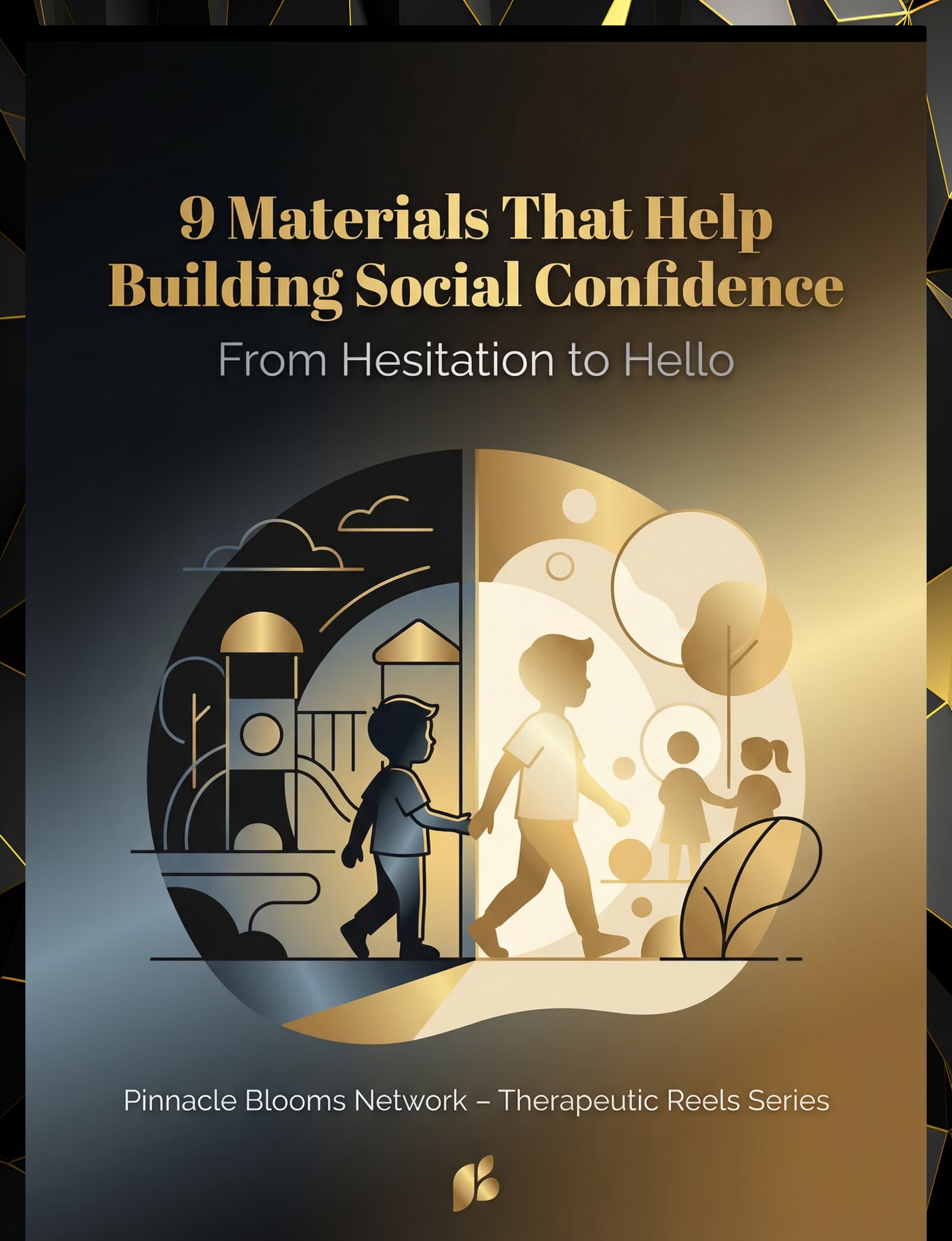
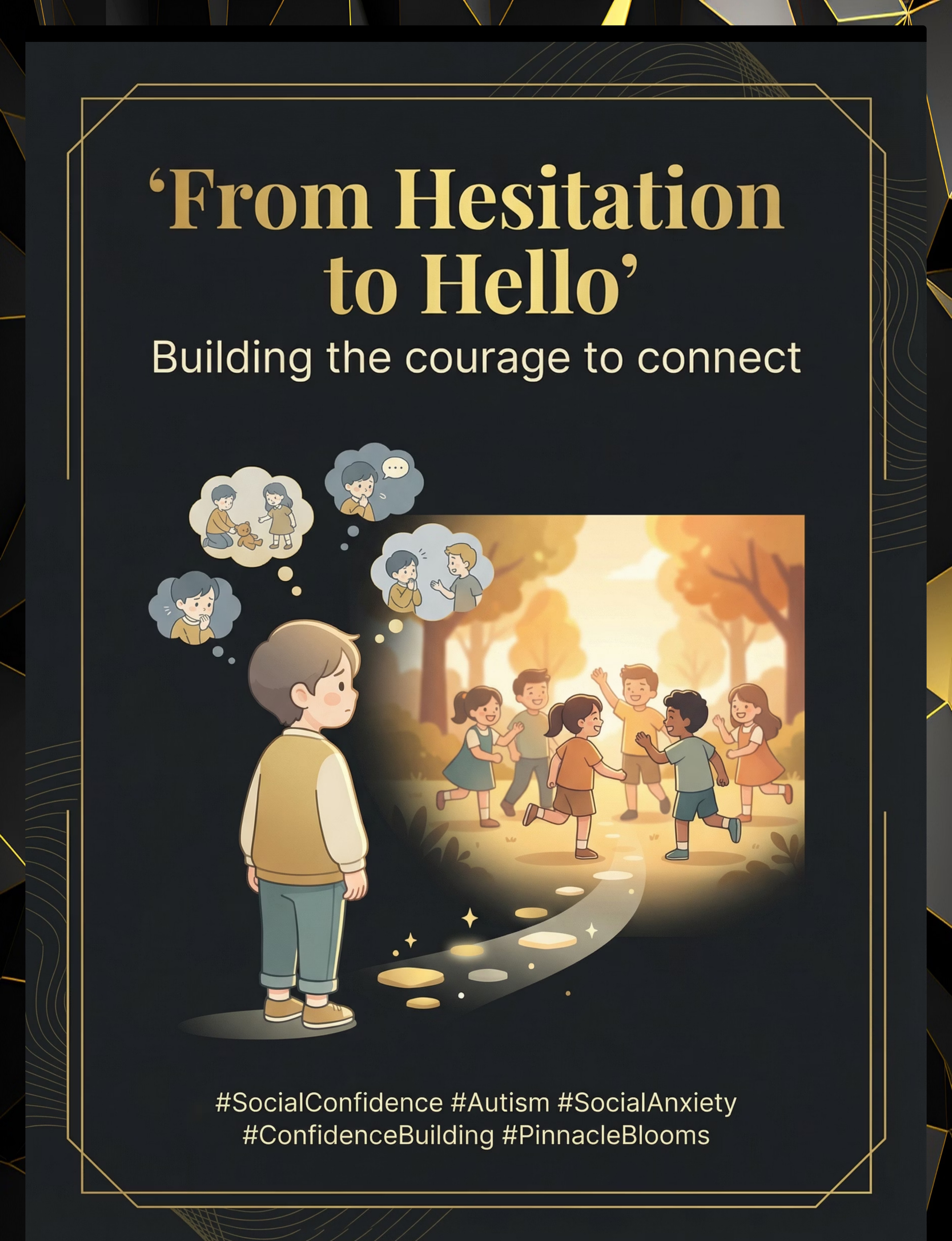
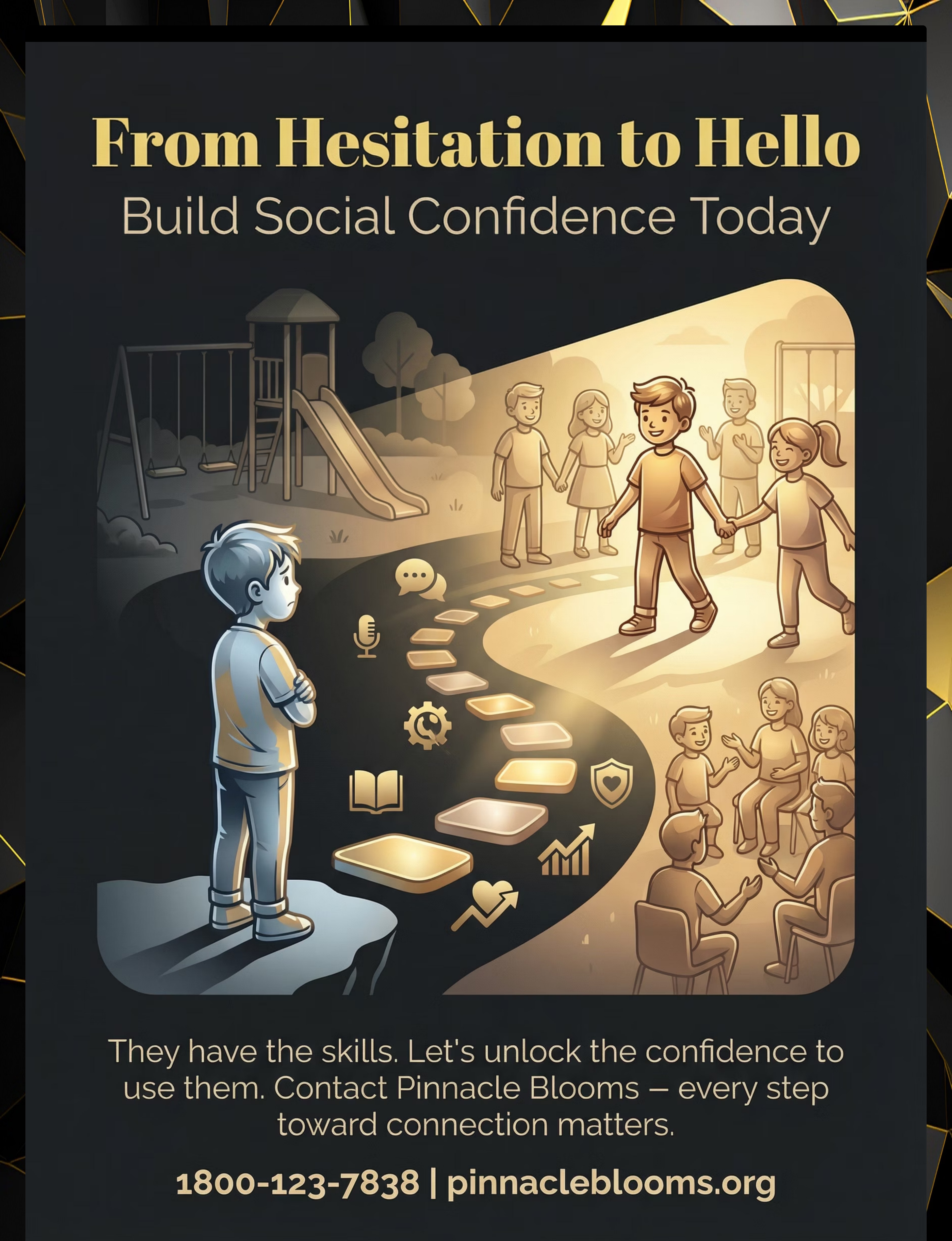
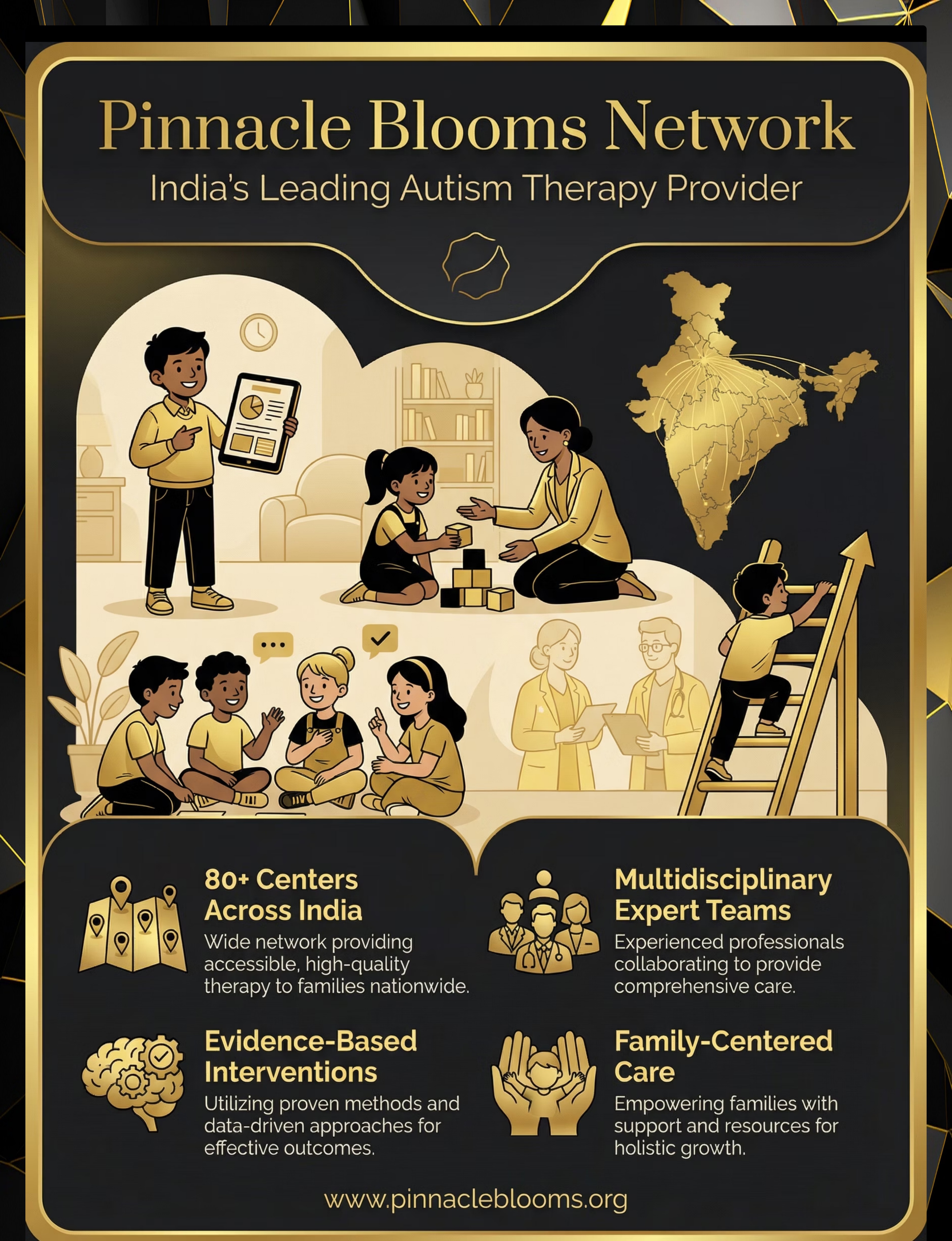
Preview of 9 materials that help building social confidence Therapy Material
Below is a visual preview of 9 materials that help building social confidence therapy material. The pages shown help educators, therapists, and caregivers understand the structure and content of the resource before use. Materials should be used under appropriate professional guidance.




Link copied!
From Hesitation to Hello — Real Families, Real Journeys
Arjun, Age 8 — Hyderabad
Before: Arjun would stand outside birthday parties listening to the noise inside, unable to walk through the door. He'd been in social skills groups for 2 years. He knew how to say hello — he'd practised it hundreds of times. But when it was real, he'd freeze every time.
After 8 weeks: He walked into a birthday party for a classmate who shares his love of dinosaurs — and within 10 minutes, he was telling three other kids about the Spinosaurus. Not practising "joining phrases" — just being himself, in a room where that was enough.
"The shift wasn't in teaching him more skills. It was teaching him that his skills — and who he is — were enough."
Priya, Age 11 — Bengaluru
Before: Priya replayed every social mistake before sleeping. An awkward thing she'd said three years ago. A time she mispronounced a word. She'd stopped trying.
After 10 weeks: She still notices social mistakes. But now she has a recovery script, a list of her genuine strengths, and 47 entries in her Social Wins journal to look at when the negative voice gets loud. She has evidence that she belongs.
"The journal was the game-changer. She goes back to it when she's spiralling. It's real proof that she can do this."
"The children who make the most sustained social progress are rarely those who learned the most social scripts. They're the ones who stopped believing the story that they were fundamentally less worthy of friendship." — ABA Clinical Lead, Pinnacle Blooms Network
All vignettes anonymised. Outcomes vary by individual child profile, consistency of implementation, and co-occurring factors.