

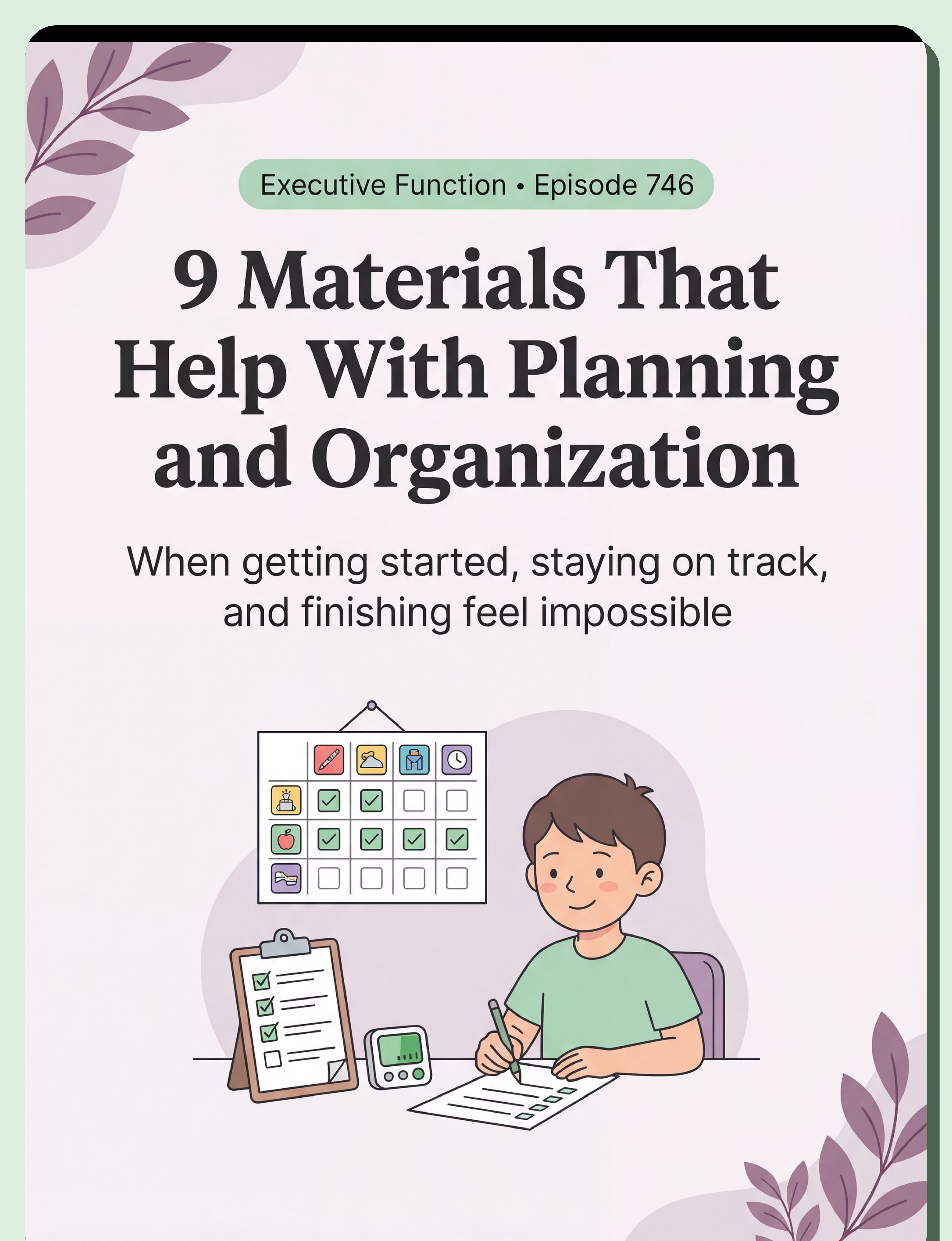
9 Materials That Help With Planning and Organization
Executive Function Series · H-746 · Pinnacle Blooms Network® · Ages 4–12 · Home-Executable · GPT-OS® Validated
"Every morning ends in tears. Every homework session ends in chaos. You've tried everything — and nothing sticks." This page has the science, the tools, and the step-by-step system to change that.
📞FREE National Autism Helpline: 9100 181 181 | 16+ languages | 24×7

ACT I · Why This Matters
You Are Not Alone: The Numbers
Executive function difficulties — including planning, organization, task sequencing, and time management — are among the most frequently reported challenges in pediatric neurodevelopmental conditions. The prefrontal cortex continues maturing until the mid-twenties. Children with ADHD, autism, learning disabilities, and anxiety commonly show executive function delays of 2–4 years behind same-age peers. This is not a character flaw. It is a developmental timeline difference — one that responds powerfully to structured, material-based intervention.
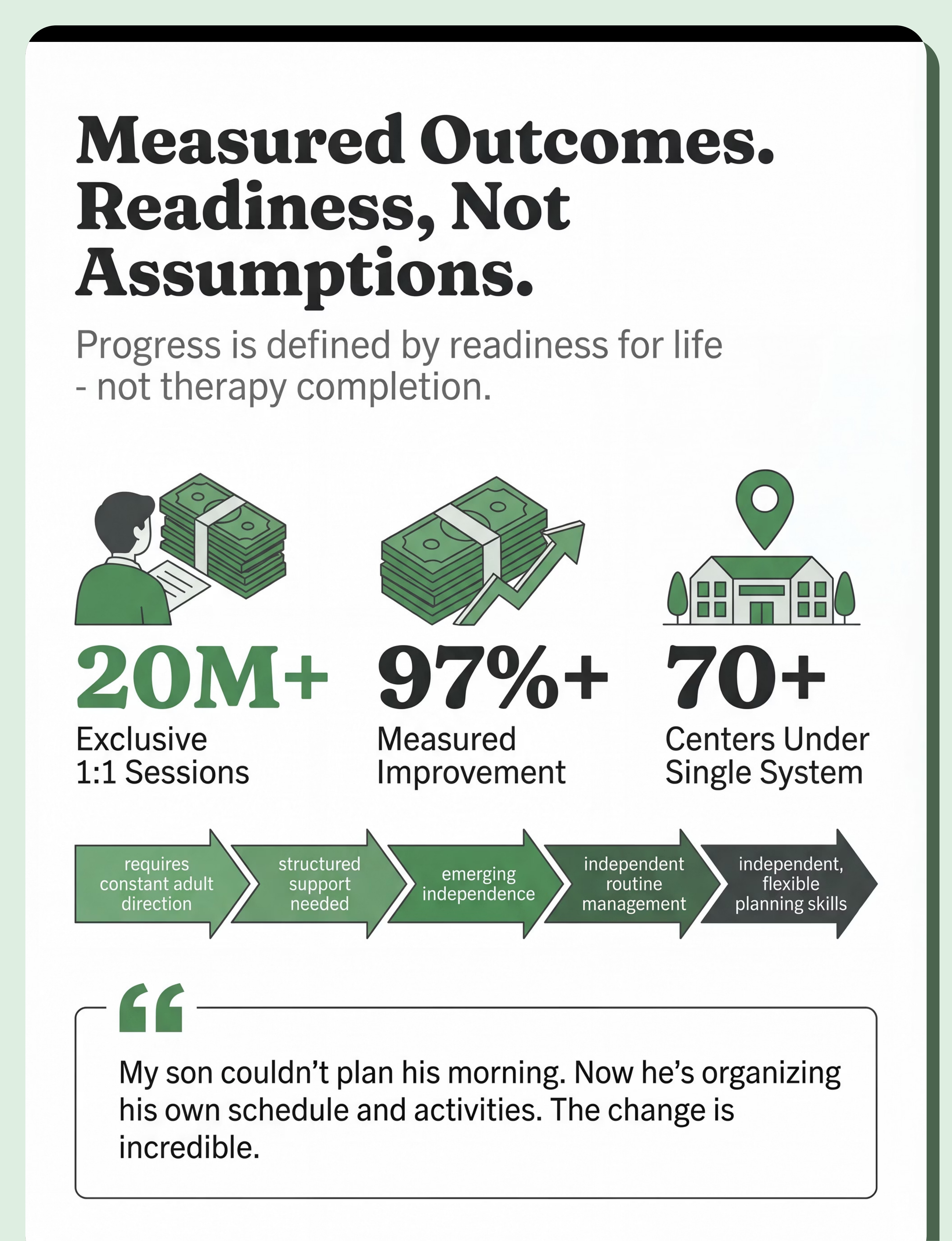
In India, an estimated 18 million children live with a neurodevelopmental condition. Across Pinnacle's 70+ centers, executive function support is among the top 5 most-requested intervention domains from families.
30–50%
Children Affected
Children with ASD or ADHD showing significant planning and organization deficits
1 in 10
Mainstream Classrooms
Children in mainstream classrooms who struggle with executive function daily
21M+
Sessions Tracked
Therapy sessions delivered by Pinnacle Network, tracking EF readiness outcomes
"You are among millions of families who got up, showed up, and searched for answers. You found the right page."
PubMed Reference: PRISMA Systematic Review (2024) — Executive function deficits prevalence across ASD, ADHD, and learning disability populations. | PMC11506176 | PMC10955541

ACT I · The Neuroscience
What's Happening in Your Child's Brain
The Brain Science
The Prefrontal Cortex (PFC) is the brain's command center — the CEO of executive function. It handles:
- Working Memory: Holding the plan in mind while executing it
- Inhibitory Control: Staying on task despite distractions
- Cognitive Flexibility: Adapting when the plan changes
- Task Initiation: Getting started without getting stuck
- Goal-Directed Behavior: Keeping the endpoint in view across multiple steps
In children with ADHD, autism, and related conditions, the PFC matures more slowly and communicates less efficiently with downstream brain regions.
Plain English: What You See at Home
A child who stares at homework as if paralyzed. Who starts tasks and never finishes. Who loses everything. Who says "I know, I know" — but still doesn't do it.
What's actually happening: The brain's planning circuitry isn't generating the internal script fast enough, or holding the steps long enough, for action to follow intention.
Why reminders don't work: Reminding adds a demand to an already overwhelmed working memory. Visual, physical, environmental scaffolding — like the 9 materials on this page — replace memory rather than challenging it.
"This is a wiring difference, not a discipline problem. The materials on this page are neurological scaffolding."
PubMed Reference: Frontiers in Integrative Neuroscience (2020) — Comprehensive neurological framework for executive function intervention in ASD. | DOI: 10.3389/fnint.2020.556660
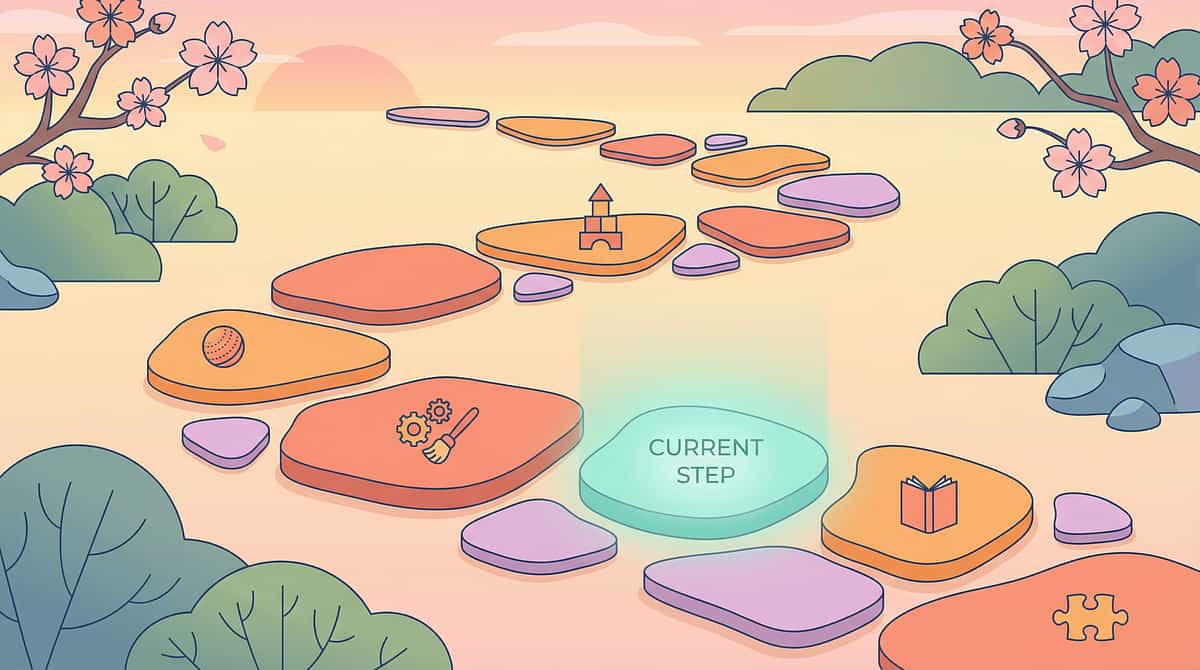
ACT I · Developmental Timeline
Where This Sits in Development
Executive functions develop gradually from birth through the mid-twenties, with the most rapid growth occurring between ages 5–12. This is precisely the window when structured, consistent external supports have the greatest neuroplasticity impact.
Ages 3–5
Basic sequencing (first-then), simple routine following, beginning categorization
Ages 5–7
Following multi-step routines with visual support, basic time awareness emerging
Ages 8–10
Managing school materials, planning multi-step assignments, time estimation
Ages 10–12
Long-term project management, multi-demand management, increasing independence
For children with ADHD, autism, or learning differences: Developmental EF milestones may run 2–4 years behind chronological age. The correct approach is to provide supports matched to developmental level, not birth age. "Your child is here on this timeline. The 9 materials on this page are the next steps forward."
Common Co-occurrences: ADHD · Autism Spectrum · Dyslexia · Anxiety · Developmental Coordination Disorder · Slow Processing Speed
PubMed Reference: WHO Care for Child Development Package (CCD) — Age-specific evidence-based recommendations implemented across 54 LMICs. | PMC9978394

ACT I · Evidence Grade
The Evidence Behind This Technique
Clinically Validated. Home-Applicable. Parent-Proven.
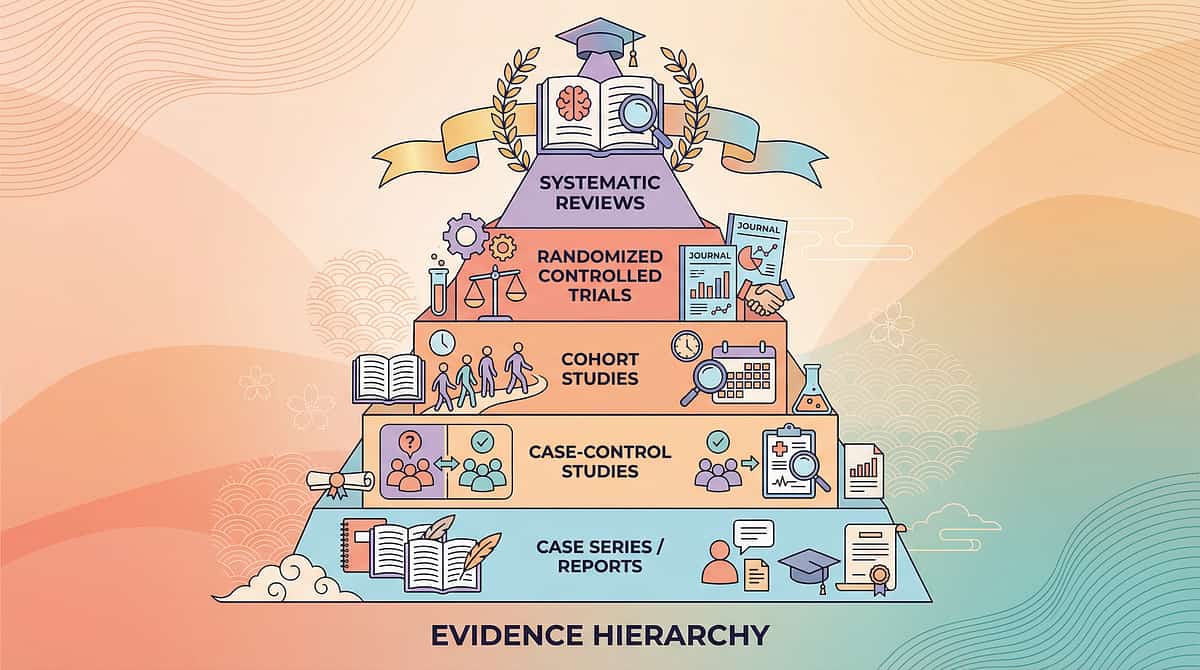
Evidence Grade: I–II
Systematic Reviews + RCT Supported
LEVEL: ESTABLISHED
Confidence Strip
Visual Schedules ●●●●●
Checklists ●●●●●
Visual Timers ●●●●○
Task Cards ●●●●●
Color-Coding ●●●●○
Key Evidence Summary
Study 1 — PRISMA Systematic Review (2024): 16 studies (2013–2023) confirm structured visual-organizational interventions meet evidence-based practice criteria. Outcomes: improved task completion, routine adherence, and planning skill acquisition. | PMC11506176
Study 2 — World J Clin Cases Meta-Analysis (2024): 24 studies confirm structured material-based interventions effectively promote executive function and daily living independence in pediatric populations. | PMC10955541
Study 3 — Indian RCT (2019): Home-based structured visual supports demonstrated significant improvements in routine adherence and task completion in Indian pediatric populations. | DOI: 10.1007/s12098-018-2747-4
Study 4 — NCAEP (2020): Visual supports including schedules, timers, and checklists classified as established evidence-based practice for autism across multiple age groups.
Study 5 — WHO Nurturing Care Framework (2018): Structured environmental support is a core WHO/UNICEF-endorsed early childhood intervention component.
"Across 21 million therapy sessions, GPT-OS® has tracked executive function readiness improvement as one of the most consistently achievable intervention outcomes when structured visual supports are applied consistently at home." — Pinnacle Blooms Network® Clinical Data, 2025
📞Helpline: 9100 181 181 | For personalized EF assessment guidance
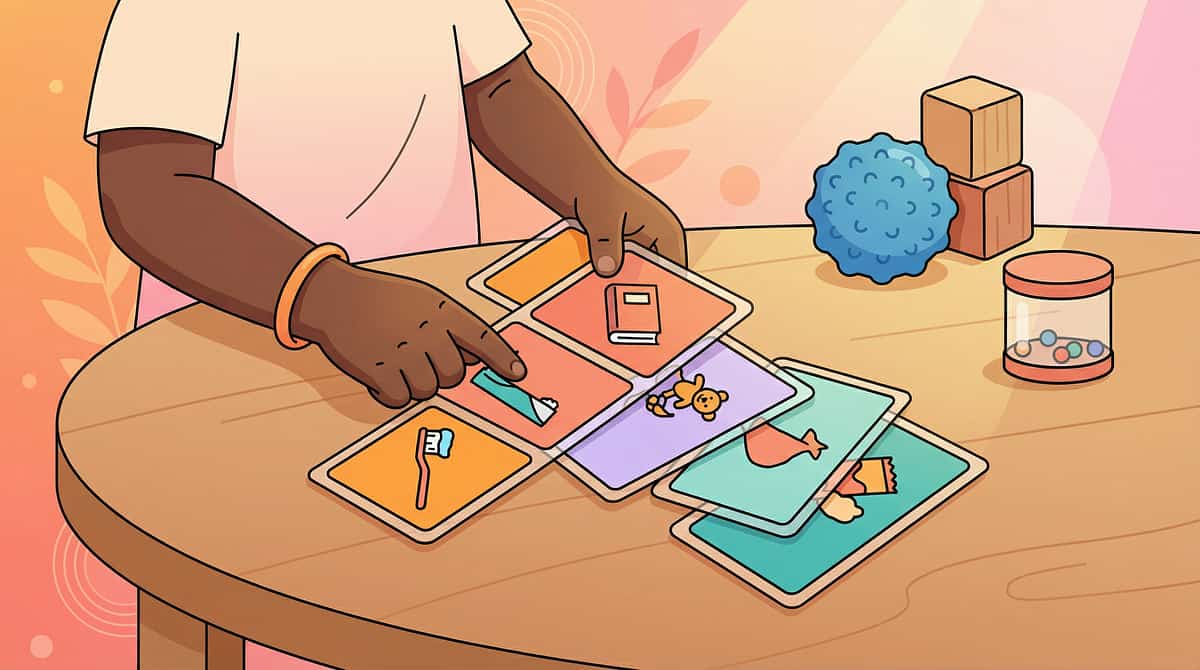
ACT II · The Technique
The Technique: What It Is
Formal Name: Executive Function Support via Structured Visual-Organizational Systems
Parent-Friendly Name: "The 9 Planning and Organization Materials"
Reel ID: H-746 | Series: Executive Function | Domain: EF-PLAN | Ages 4–12
Parent-Friendly Name: "The 9 Planning and Organization Materials"
Reel ID: H-746 | Series: Executive Function | Domain: EF-PLAN | Ages 4–12
Planning and organization support involves providing external, visual, physical structures that scaffold the executive function capacities the child's brain has not yet reliably developed internally. These 9 materials function as an external prefrontal cortex — holding sequences, managing time, tracking completion, and organizing space — until the child's own neural architecture matures to internalize these functions.
The core principle: External systems become internal skills through consistent, repeated use. Every time a child follows a visual schedule, their brain is rehearsing the planning sequence. Every time they check off a checklist, they're building the neurological habit of step-by-step completion. The scaffold is not permanent — it is the bridge to independence.
Domain
Executive Function / Cognitive Development
Age Range
4–12 years
Session Length
5–30 min per use
Frequency
Daily — embedded in routine
Setting
Home / School / Clinic

ACT II · Who Uses This
Who Uses This Technique
"Planning and Organization Crosses Every Therapy Boundary — Because the Brain Doesn't Organize by Discipline"
Occupational Therapist (Primary Lead)
OTs lead executive function intervention through environmental restructuring, task analysis, and sensory-motor foundations. They assess EF profiles using tools like the BRIEF-2 and design individualized organizational systems — visual schedules, color-coding, workspace setup — matched to the child's sensory and motor profile.
Special Educator (Co-Lead)
SpEd specialists apply planning and organizational supports in academic contexts — homework systems, study planning templates, project planners, and classroom organizational strategies. They coordinate home-school consistency for maximum generalization.
ABA/BCBA Therapist
Behavior analysts apply task analysis, chaining, and reinforcement to build organizational routines step by step. First-then boards, checklists, and reward-based systems are core ABA tools. Data tracking and mastery criteria are ABA's contribution to the EF support system.
Speech-Language Pathologist
SLPs address the executive function-language interface — narrative planning, verbal sequencing, story grammar, and the language of planning ("first… then… next… finally"). Planning templates support SLPs' work on discourse organization and written language.
"A child who struggles to organize their backpack also struggles to organize their thoughts, their words, and their actions. Planning and organization intervention is foundational to all other therapeutic work." — Pinnacle Blooms Consortium, OT + SpEd + ABA Clinical Council
📞Helpline: 9100 181 181 | Connect with the right discipline for your child
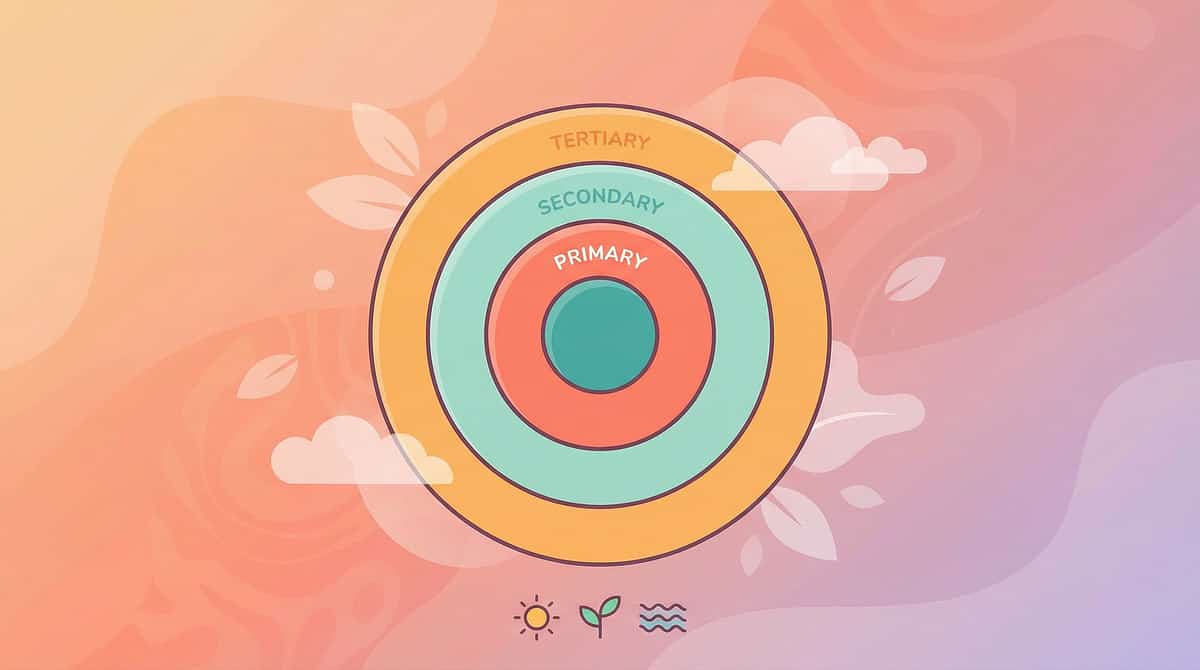
ACT II · What It Targets
What This Technique Targets
"This Is Not a Random Activity. This Is a Precision Intervention."
🎯 Primary Targets — Core Skills Addressed Directly
- Task Initiation — Getting started on tasks without paralysis or avoidance
- Task Completion — Following through from start to finish without abandonment
- Sequential Planning — Breaking goals into ordered, executable steps
- Material Organization — Keeping track of belongings, assignments, and supplies
- Time Awareness — Understanding and managing the passage of time
⭕ Secondary Targets
- Working Memory Offloading — External systems reduce internal memory burden
- Emotional Regulation — Organized environments reduce anxiety and meltdowns
- Homework Adherence — Systematic supports improve assignment completion
- Morning Routine Independence — Sequenced support enables independent morning execution
◯ Tertiary Targets — Long-Term Gains
- Academic Self-Management — Foundation for independent study and project management
- Daily Living Independence — Self-care, household tasks, and life skills organization
- Metacognition — Awareness of one's own planning needs and strategy use
- Self-Advocacy — Ability to identify and request organizational supports
- Vocational Readiness — Long-term workplace organization and productivity skills
Observable Progress Indicators
"Your child is making progress when you notice:"
- They look at the schedule before being prompted
- They check off items without reminders
- They pack their backpack the night before (with system support)
- They can tell you what comes next in their routine
- Meltdowns around tasks decrease in frequency or intensity
PubMed Reference: World J Clin Cases Meta-Analysis (2024) — EF intervention promotes adaptive behavior, social participation, and long-term independence. | PMC10955541
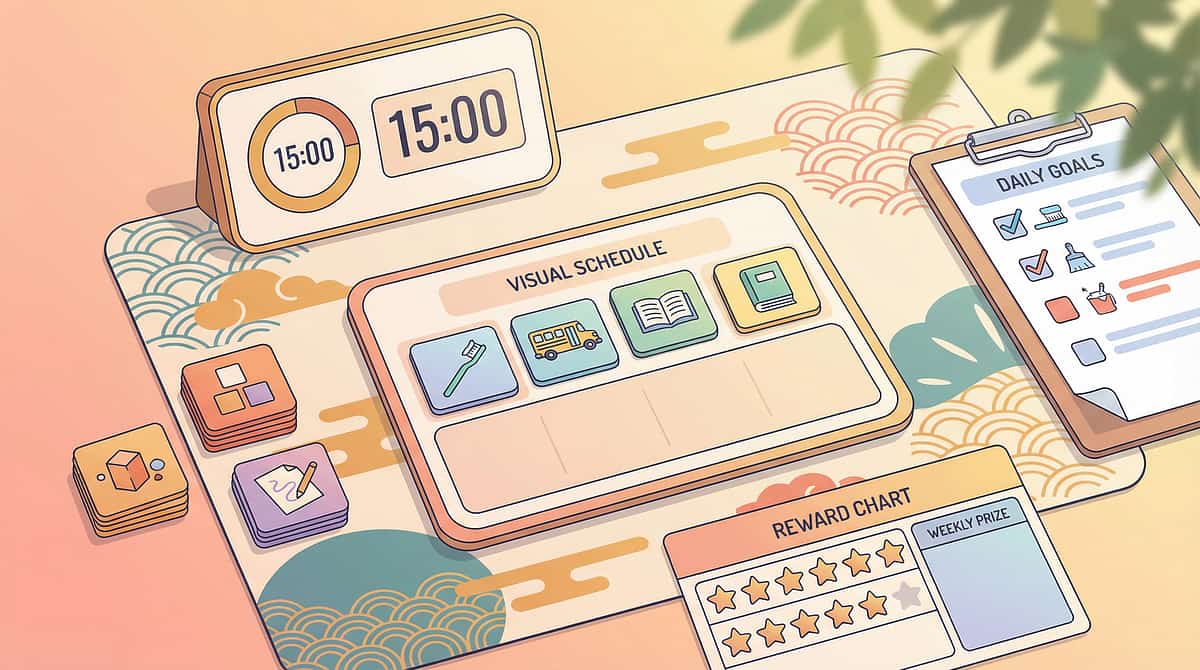
ACT II · The 9 Materials
What You Need: The 9 Primary Materials
"9 Materials. One for Every Planning Challenge Your Child Faces."
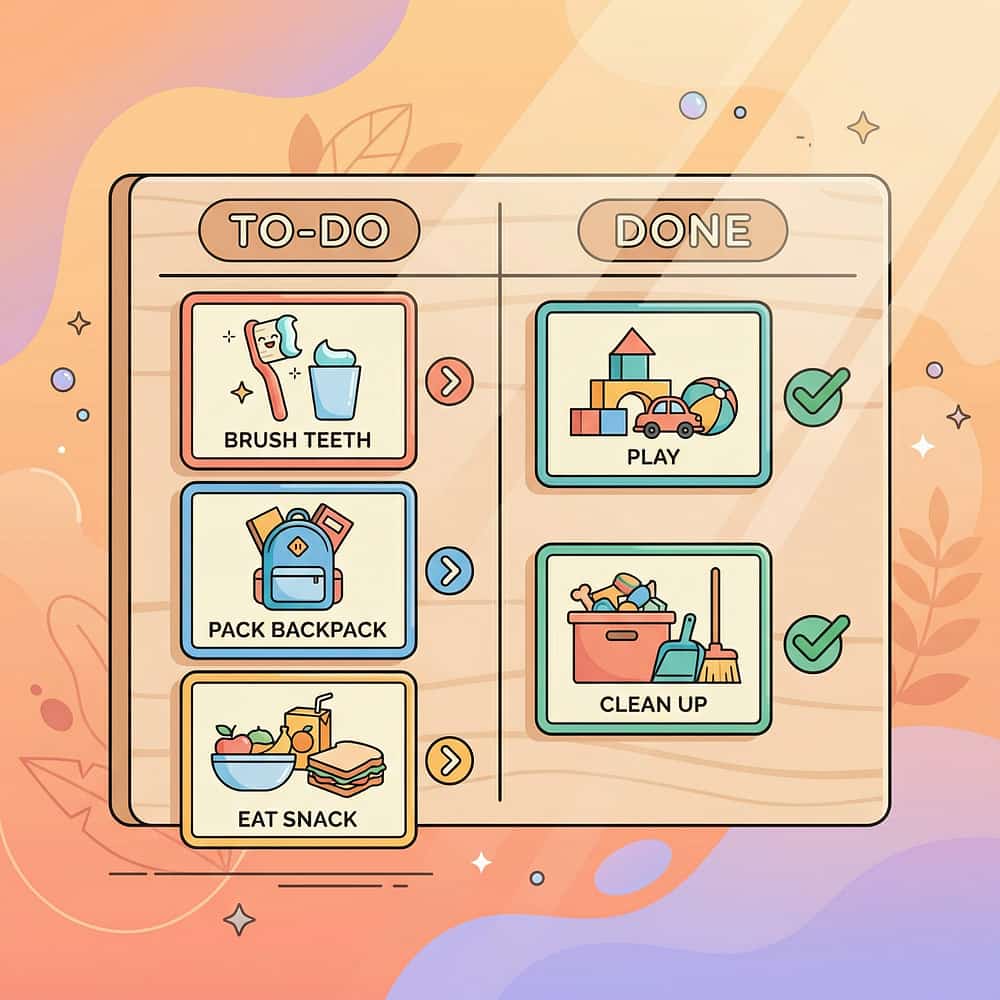
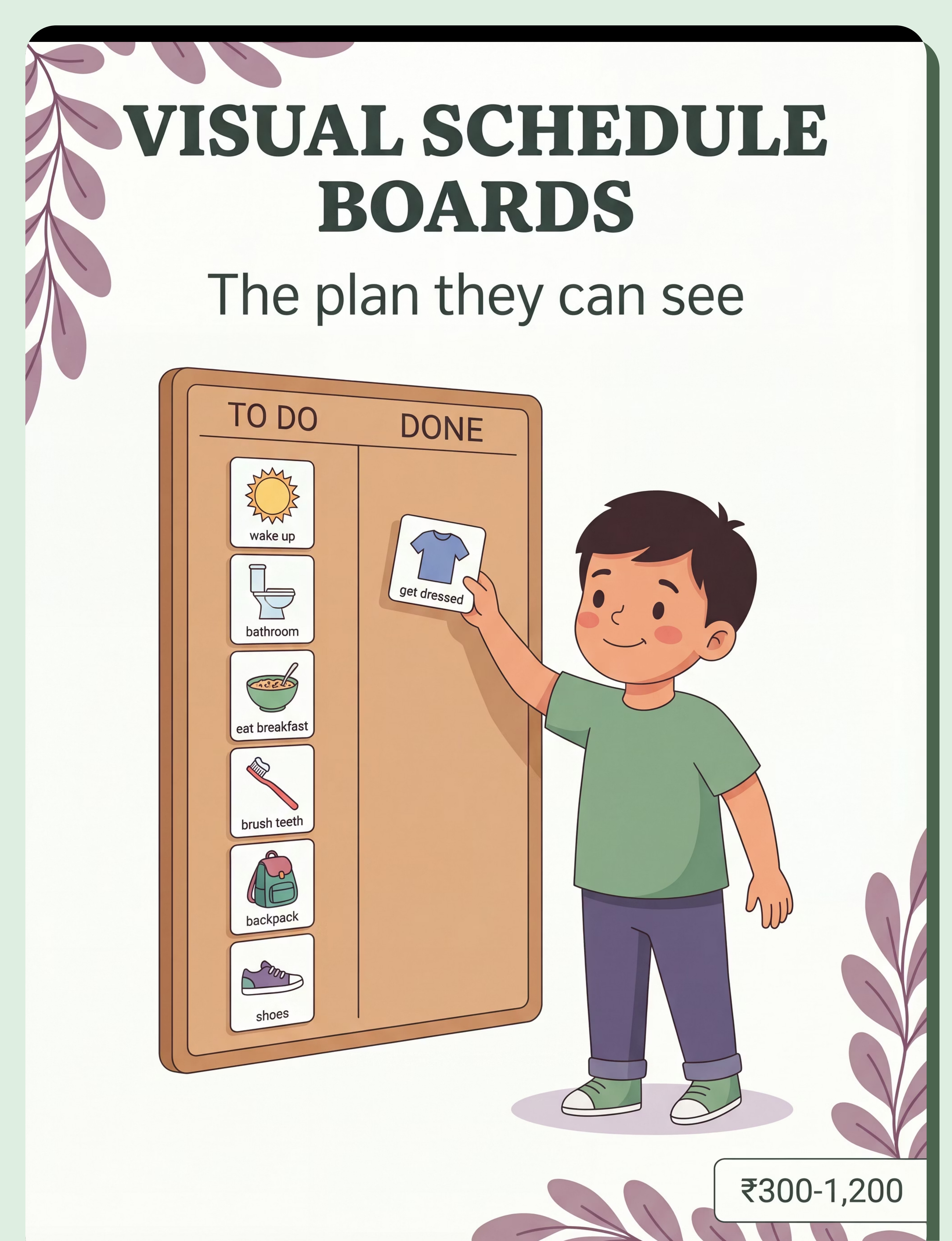
1. Visual Schedule Boards
Canon Category: Problem-Solving Toys / Organizational Systems
Picture or word cards in a "To Do → Done" board format. Externalizes the morning or daily sequence so the child doesn't have to remember it — the schedule does. Price Range: ₹300–1,200
🛒 Search on Amazon.in: "Visual Schedule Board Children" | DIY available — see Card 10
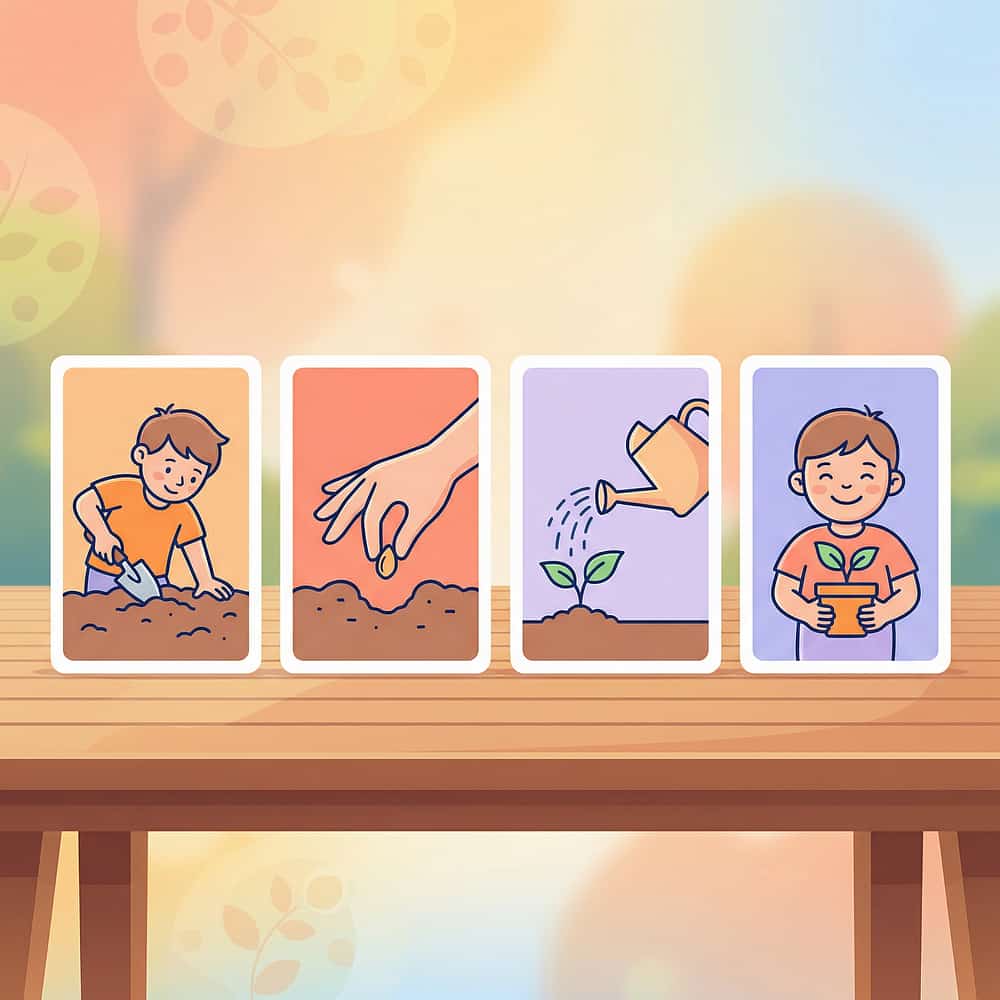
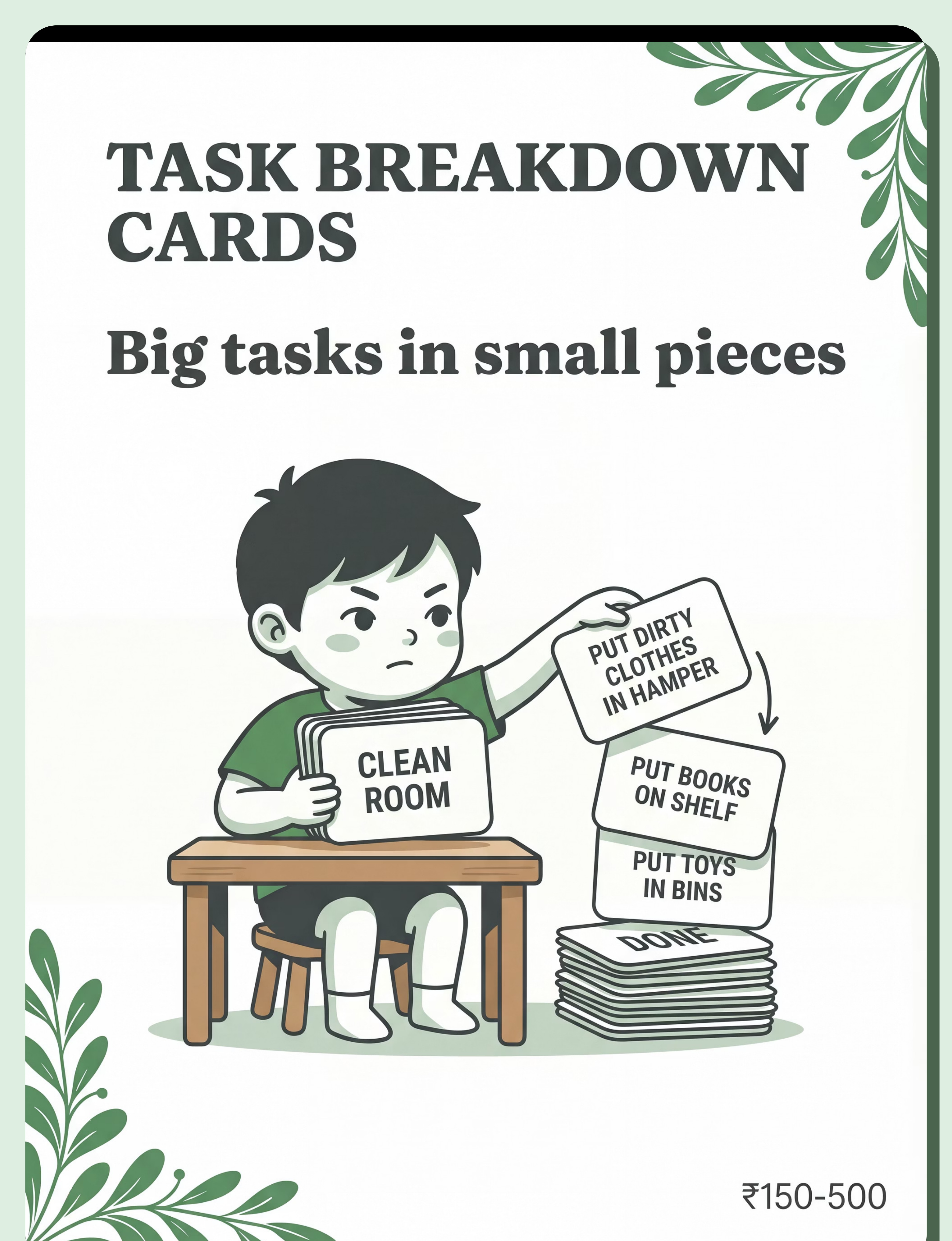
2. Task Breakdown Cards
Canon Category: Problem-Solving Toys / Sequencing Cards
Sets of sequenced cards that chunk overwhelming tasks (Clean Room, Do Homework, Get Ready for School) into specific, achievable micro-steps. Price Range: ₹150–500
🛒 Search on Amazon.in: "Task Sequencing Cards Children" | DIY available — see Card 10
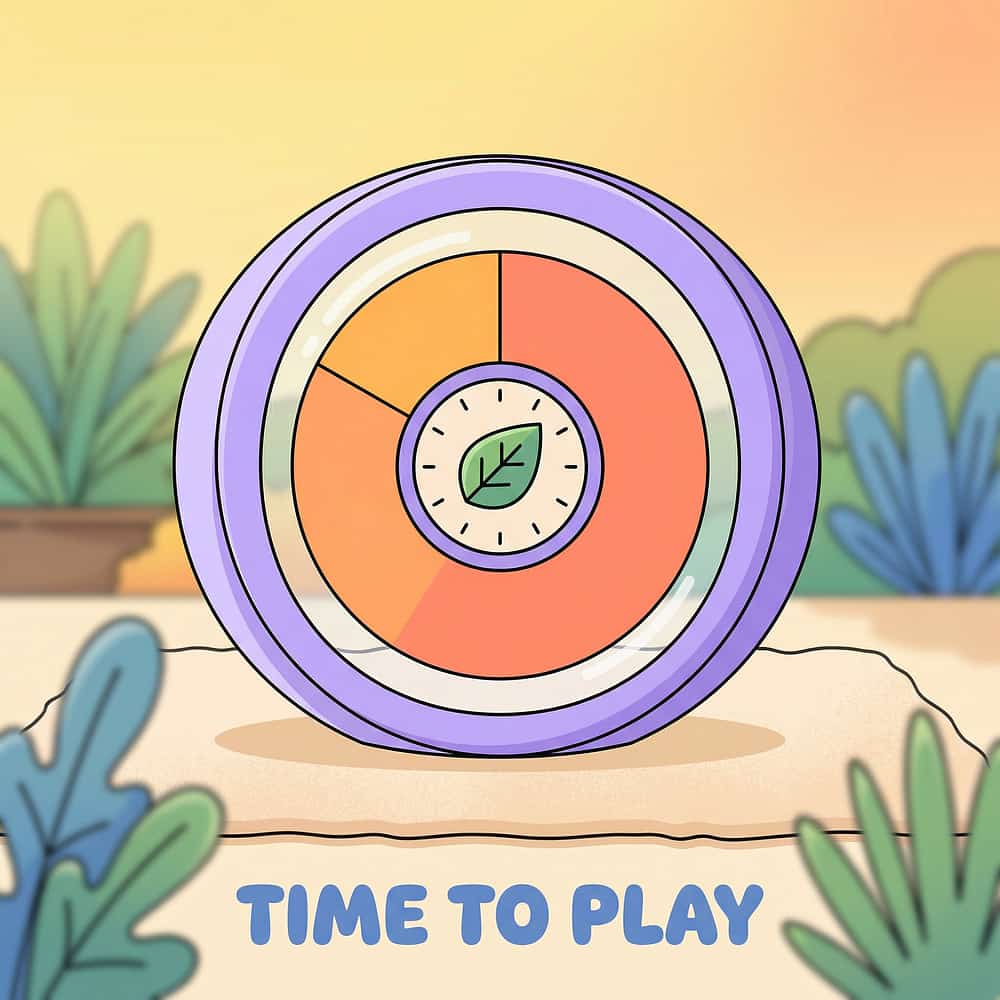
3. Visual Timers
Canon Category: Problem-Solving Toys / Time Management Tools
The colored shrinking disk makes abstract time concrete and visible. Essential for time-blind children who cannot feel duration. Price Range: ₹400–1,500
🛒 Search on Amazon.in: "Visual Timer Children Time Management" | DIY: Sand timers or clock-face tape — see Card 10
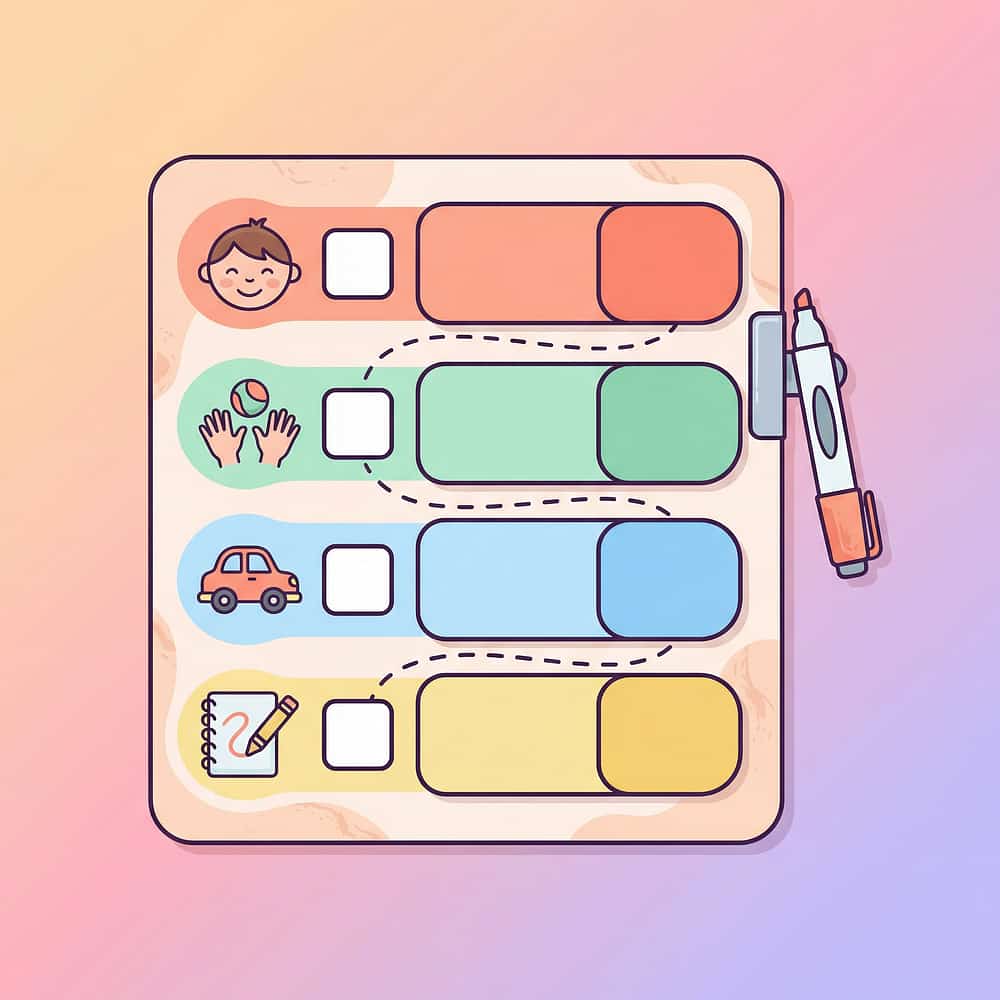
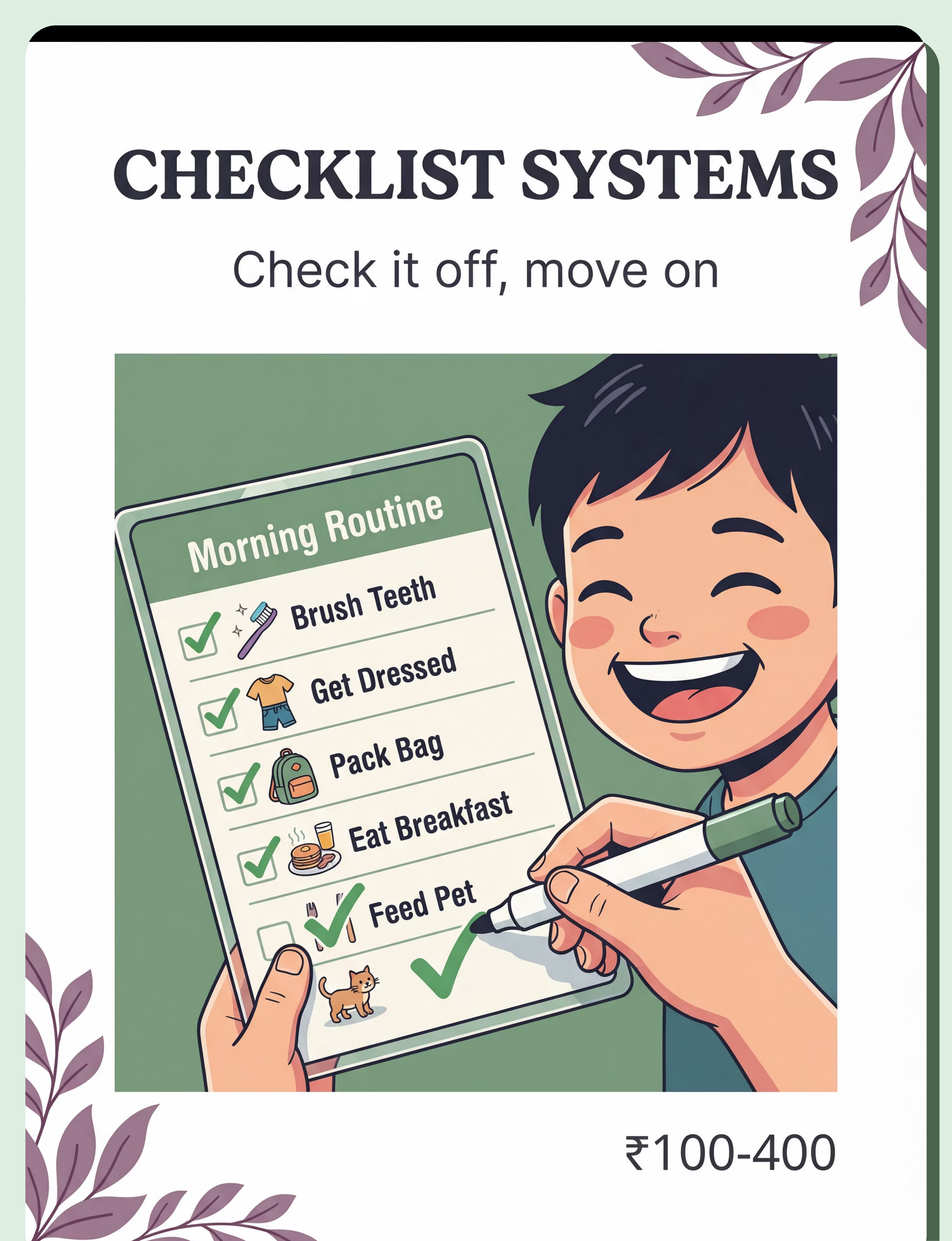
4. Checklist Systems
Canon Category: Sorting Activities / Categorization
Reusable dry-erase checklists, clip systems, or flip cards that offload working memory while delivering the satisfaction of visible progress. Price Range: ₹100–400
🛒 Search on Amazon.in: "Children Checklist Dry Erase Board" | Pinnacle Recommends: ₹305–628

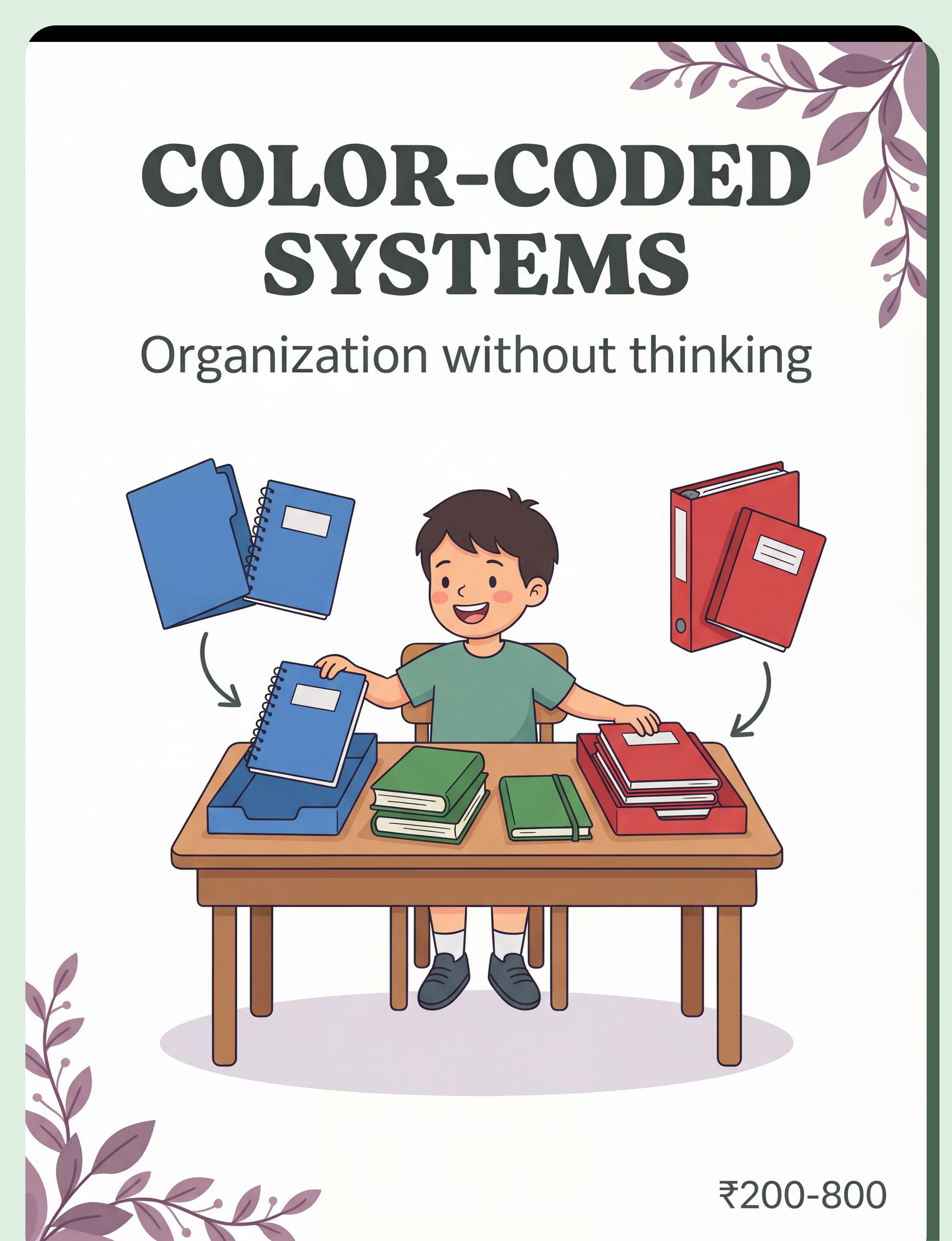
5. Color-Coded Organization Systems
Canon Category: Matching Games / Memory Games | Color Recognition
Colored folders, binders, bins, and labels eliminate the cognitive load of "where does this go?" — matching colors replaces effortful retrieval. Price Range: ₹200–800
Active Canon Product Available: ₹519 | 🛒 Amazon.in

ACT II · Materials 6–9
Materials 6–9: Planning, Launch, First-Then & Project
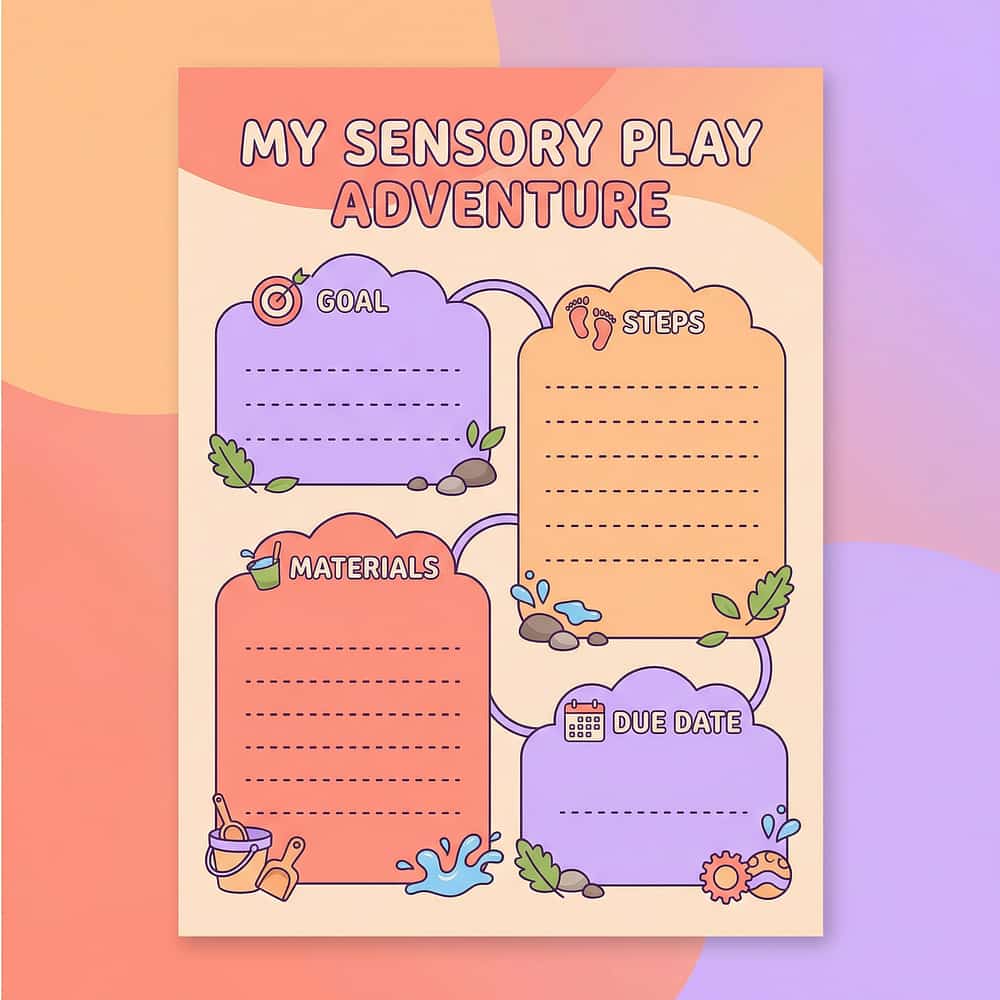
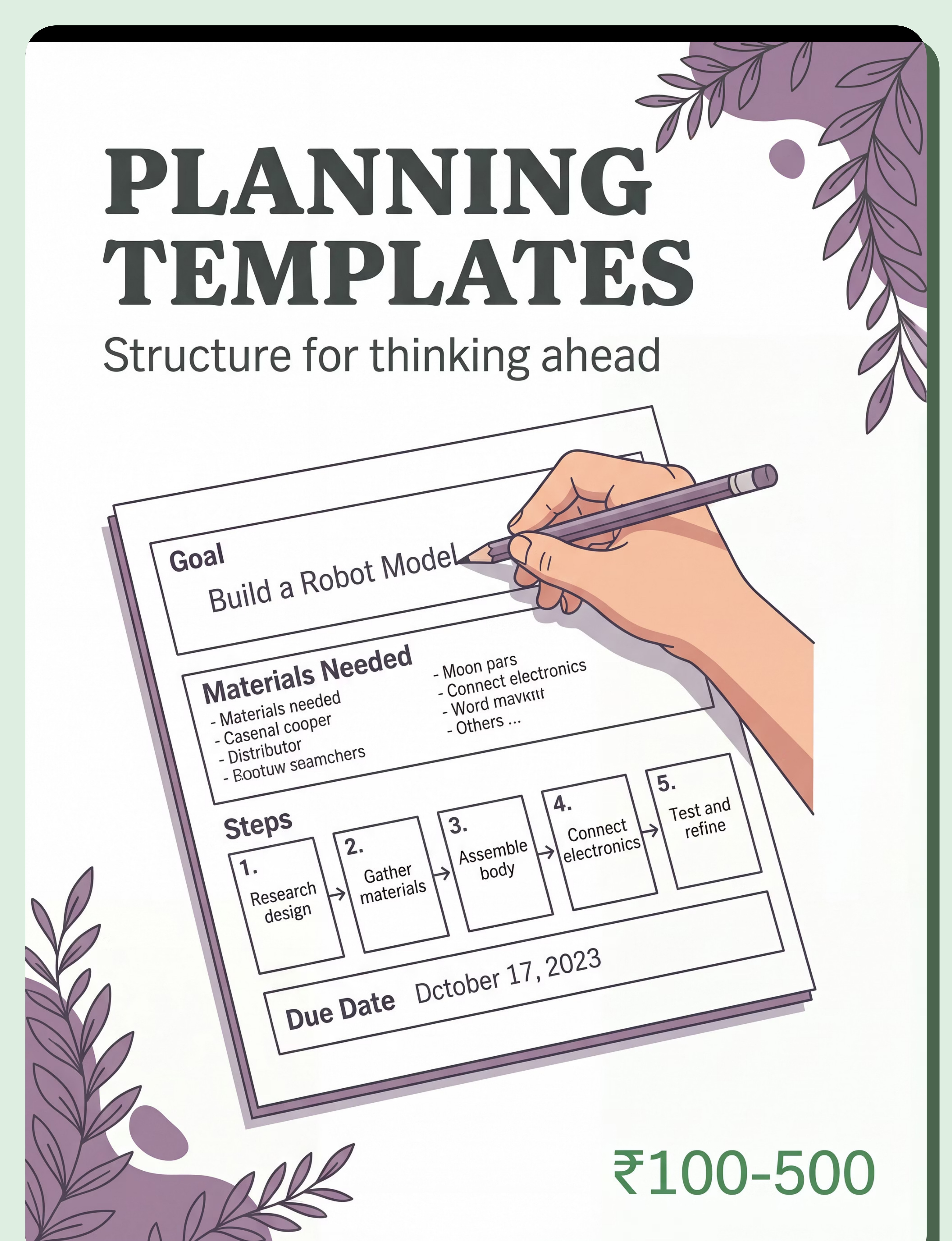
6. Planning Templates & Graphic Organizers
Canon Category: Problem-Solving Toys / Planning Tools
Printed or dry-erase templates with goal/steps/materials/due-date boxes externalize the metacognitive planning process. Price Range: ₹100–500
🛒 Search on Amazon.in: "Graphic Organizer Planning Template Children" | DIY: Printable templates — see Card 10
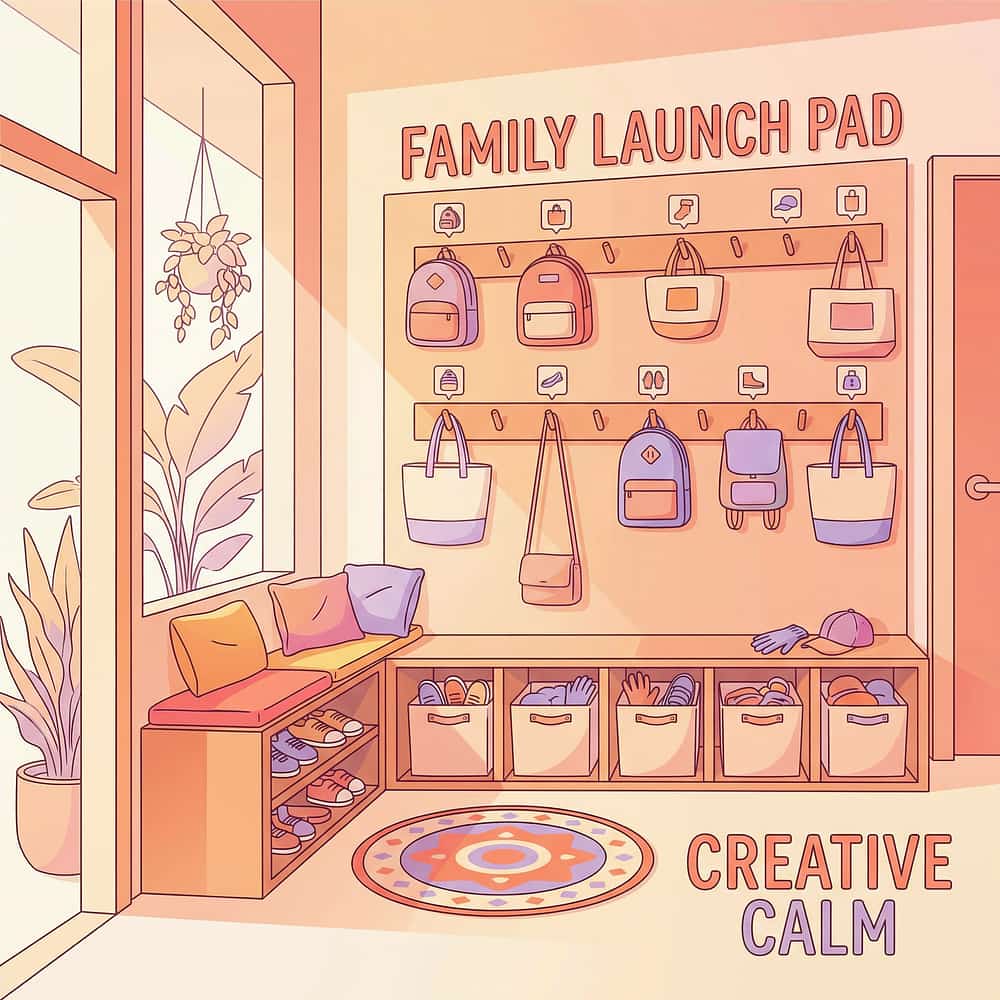
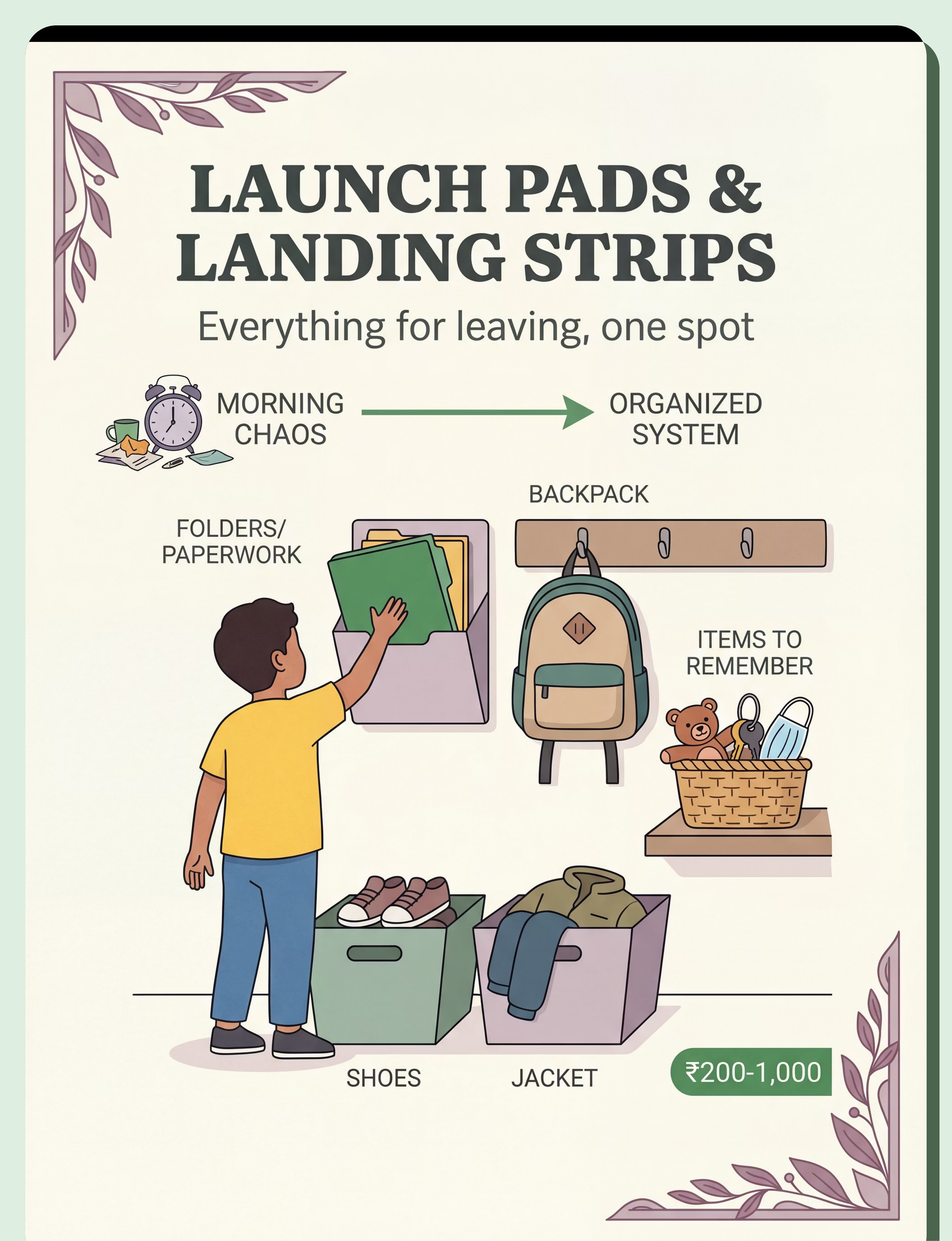
7. Launch Pads & Landing Strips
Canon Category: Transition Objects / Organizational Systems
A designated physical station by the exit door with hooks, bins, and pockets for every item that must leave with the child — eliminating morning hunts. Price Range: ₹200–1,000
Active Canon Product Available: ₹425 | 🛒 Amazon.in
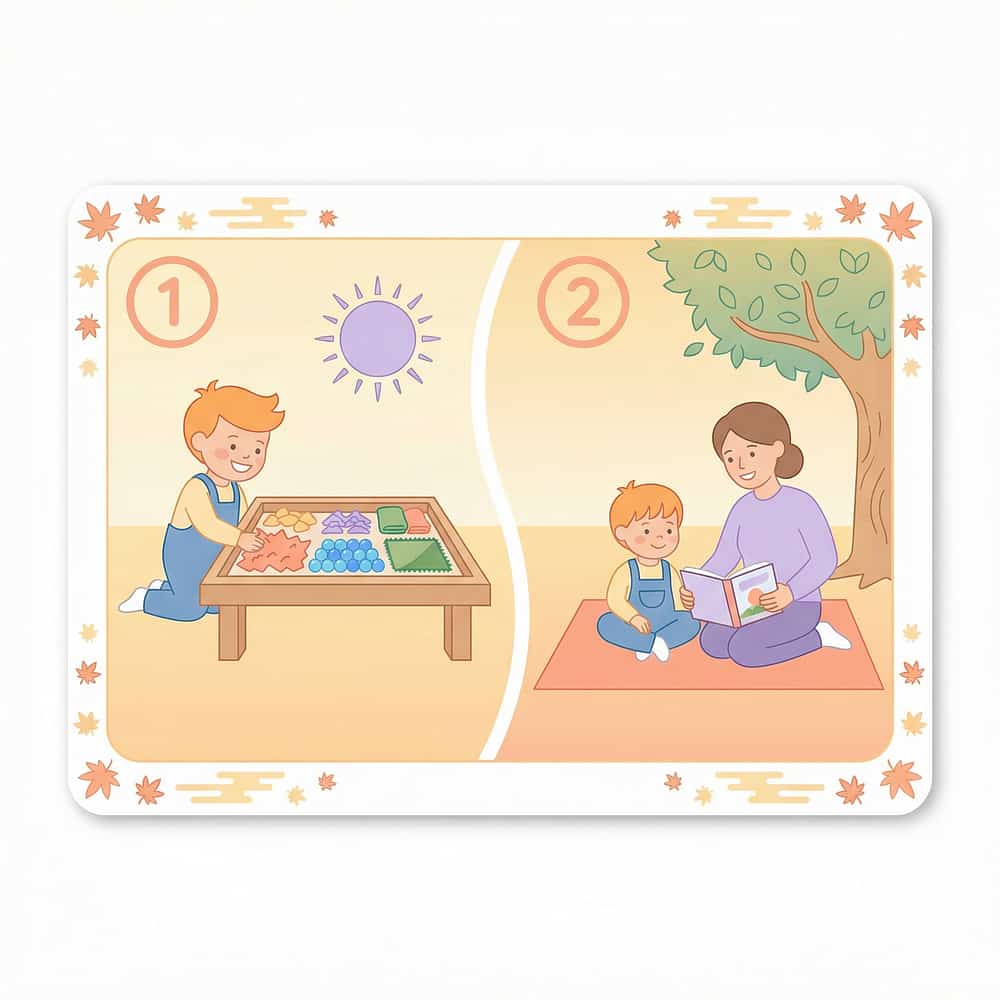
8. First-Then Boards
Canon Category: Problem-Solving Toys / Behavior Support Tools
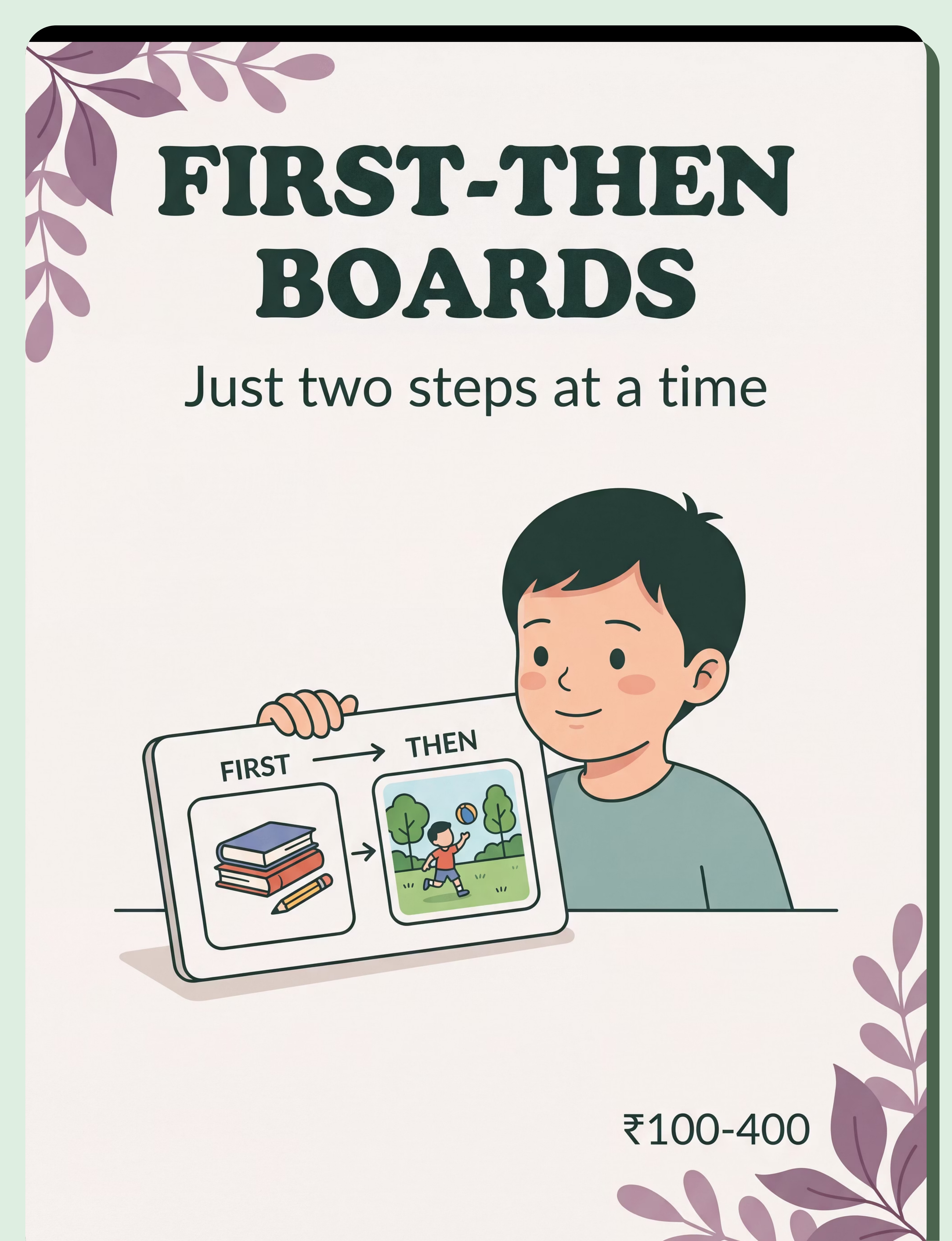
The simplest planning scaffold — "First [task], Then [reward]." The entry point for children not yet ready for full visual schedules. Price Range: ₹100–400
Active Canon Product — Reinforcement Menus: ₹364 | 🛒 Amazon.in
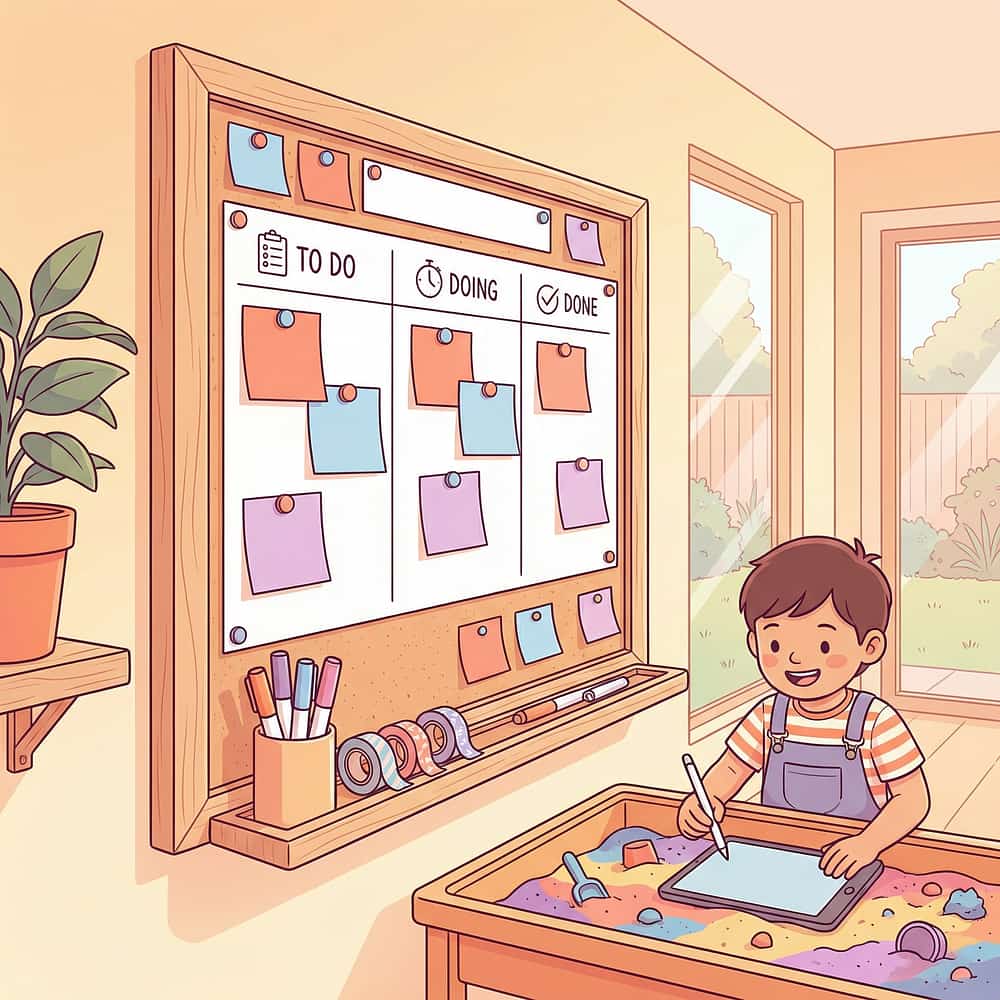
9. Visual Project Planners
Canon Category: Problem-Solving Toys / Long-Term Planning Tools
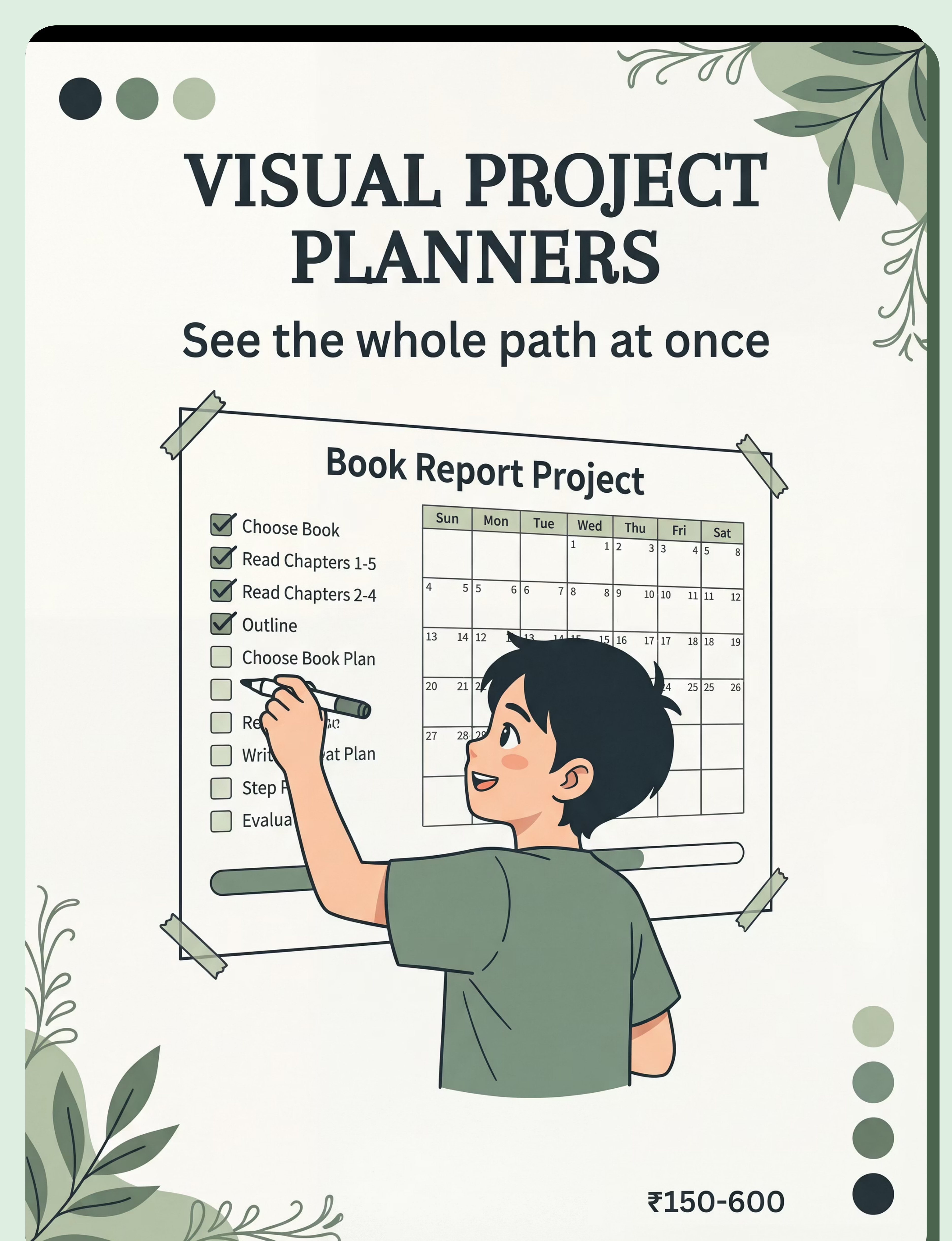
Poster-sized or wall-mounted planners that make multi-week projects (book reports, science fair, long assignments) visible, trackable, and manageable. Price Range: ₹150–600
🛒 Search on Amazon.in: "Project Planning Board Children Poster" | DIY: Poster board + sticky notes — see Card 10
Total Starter Kit Cost: ₹1,500–6,400 (full kit) | ₹0–800 (DIY/budget version)
📞Helpline: 9100 181 181 | Ask about material subsidy and center-loan programs

ACT II · DIY Options
DIY & Substitute Options
"Every Child Deserves These Tools. Regardless of Budget."
WHO/UNICEF Equity Principle: Access to developmental support is a universal right, not a privilege.
WHO/UNICEF Equity Principle: Access to developmental support is a universal right, not a privilege.
Material | ₹0 DIY Version | Why It Works | |
Visual Schedule Board | Poster board + Velcro strips + printed/drawn picture cards, laminated with contact paper | Same externalizing principle — the medium doesn't change the scaffolding function | |
Task Breakdown Cards | Index cards + simple drawings or printed images + binder ring | Physical card-by-card completion delivers the same dopamine sequence | |
Visual Timer | Sand timer + phone timer with visual display + analog clock with colored tape marking end-time | Visualizing remaining time is the key principle, not the device | |
Checklist System | Laminated paper checklist + dry-erase marker (₹30) + clothespin moving down as items complete | The physical check-off action is neurologically equivalent | |
Color-Coded System | Colored tape (₹50 a roll) on existing folders, binders, and bins | Brain recognizes color identity independent of material quality | |
Planning Template | Free printable from pinnacleblooms.org + laminate for reuse | Template structure is the active ingredient, not the paper it's on | |
Launch Pad | Designated hooks + labeled baskets (repurposed containers) + printed picture labels | Physical location certainty is the entire mechanism | |
First-Then Board | Two sticky notes on the refrigerator: "FIRST" and "THEN" + drawn pictures | Two-step structure works in any format — simplicity is the point | |
Visual Project Planner | A2 poster paper + sticky notes + colored markers | Wall-scale visibility drives the benefit |
Zero-Cost Total System: Complete planning and organization support can be built for under ₹200 using household materials and free printable templates from pinnacleblooms.org.
"The principle is the therapy. The material is the vehicle. Use whatever vehicle your family has." — Pinnacle Blooms Consortium, WHO/UNICEF Equity Framework

ACT II · Safety
Safety First: Before You Begin
"Read This Before Your First Session. Safety Is the Foundation of Every Effective Session."
🔴 RED — STOP: Do Not Proceed If:
- Child is in active meltdown or severe dysregulation — wait for full return to baseline (typically 20–40 minutes post-meltdown)
- Child shows signs of illness (fever, ear infection, illness-related fatigue)
- Material choking hazard for children under 3 or those with oral-motor sensory seeking — substitute larger-format cards
- Child has severe anxiety around schedules or timers — consult therapist before introducing
- Any recent traumatic event (loss, major change, family crisis)
🟡 AMBER — MODIFY: Adjust Before Proceeding If:
- Child is moderately dysregulated — simplify to first-then board only
- Child has limited literacy — ensure all materials use pictures, not text
- Child is highly rigid — introduce one new material at a time
- Sibling presence is causing distraction — establish quiet space first
- Child has color vision differences — verify color-coding choices are distinguishable
🟢 GREEN — PROCEED: All Clear When:
- Child is fed, rested, and in a calm-alert state
- Environment is prepared (see Card 12)
- One or two materials are ready (start small)
- You have 10–15 minutes of unhurried time
- You are calm and prepared (parental regulated state transfers to child)
RED LINE — Stop the Session Immediately If:
- Acute self-injury or aggression occurs
- Child shows signs of panic response (hyperventilation, dissociation, severe trembling)
- Environmental safety hazard arises
Post-Stop Protocol: Offer calming physical input → return to baseline → record what triggered the stop in your session log → consult with therapist before next attempt.
📞Helpline: 9100 181 181 | Safety concern? Call immediately — 24×7

ACT II · Space Setup
Set Up Your Space
"The Right Environment Does 40% of the Work. Set It Up Once. Use It Every Day."
Position 1 — Child's Primary Workspace
Clear surface, minimal visual clutter, facing away from high-traffic areas. Natural light from the side (not behind or in front).
Position 2 — Visual Schedule Board
At child's eye level on the wall nearest their primary activity location. Morning routine board → near the bathroom or bedroom door. Homework board → at the desk.
Position 3 — Materials Station
All 9 materials accessible but organized — a designated tray, shelf, or box that is the child's "planning toolkit." Child knows exactly where to reach.
Position 4 — Parent Position
Beside and slightly behind the child (not hovering directly over). Close enough for prompting; far enough for independence rehearsal.
Position 5 — Launch Pad
By the exit door. Fixed location. Never moved.
What to Remove from the Space
- ❌ Screens and devices (unless used as timer)
- ❌ Toys that compete for attention during task time
- ❌ Incomplete tasks from previous sessions
- ❌ Other children's materials mixed in
Environmental Parameters
- Lighting: Bright, natural where possible
- Sound: Quiet or low, consistent background (white noise acceptable)
- Temperature: Comfortable — overheating increases restlessness significantly
- Duration of setup: 3–5 minutes
"An organized environment organizes the child. When the space has structure, the brain borrows it."

ACT III · Readiness Check
Is Your Child Ready? Readiness Check
"60 Seconds Before You Begin. The Best Session Starts Right."
Indicator | ✅ GO | ⚠️ MODIFY | 🛑 POSTPONE | |
Fed and hydrated? | Last meal <2 hours ago | Hungry but will eat briefly | Hasn't eaten, upset about food | |
Rested? | Slept well, alert | Slightly tired | Overtired, yawning repeatedly | |
Emotionally regulated? | Calm, content | Mild frustration, manageable | Crying, distressed, post-meltdown | |
Physically settled? | Still, engaged | Fidgety but responsive | Cannot stop moving/stimming intensely | |
Time available? | 15+ min uninterrupted | 8–10 min (use shortened version) | Under 5 min before disruption | |
Your own state? | Calm, patient | Slightly stressed but managing | Overwhelmed, reactive | |
Recent illness/pain? | None | Mild, improving | Active illness or pain |
All GREEN
→ PROCEED to Step 1 (full protocol)
Mostly GREEN, 1–2 AMBER
→ MODIFY — Use first-then board only, 5 minutes
Any RED or 3+ AMBER
→ POSTPONE — Offer preferred calming activity, reattempt later
"Postponing is not failure. Postponing is clinical judgment. Every good therapist knows when to step back."

ACT III · Step 1 of 6
Step 1: The Invitation
⏱ 30–60 seconds
"Hey, let's set up your plan for [morning/homework/the project]. You want to be the one to put the cards on the board today?"
What You're Doing
Offering the child agency and ownership from the first moment. This is not a command — it's an invitation. The child who chooses to engage sustains engagement. The child who is directed resists.
Body Language Guidance
- Get to the child's physical level (sit, kneel, or crouch — not tower)
- Use a warm, matter-of-fact tone (not urgent, not sing-songy)
- Hold the first material casually — showing interest, not demand
- Wait up to 30 seconds for a response before a gentle second offer
Reading Acceptance Cues
- ✅Accepts: Makes eye contact, moves toward material, says yes, picks up a card
- ⚠️Tolerating: No objection, quiet compliance, passive engagement — proceed gently
- 🔄Resistant: Active refusal, pushes material away — apply choice offer: "Do you want to start with the timer or the board?"
ABA Pairing Principle: This opening establishes you — and the materials — as associated with positive, low-demand interaction. Every session that begins well makes the next session easier to begin.

Step 2: The Engagement
ACT III · Step 2 of 6
⏱ 1–3 minutes
Introduce the first material relevant to the current challenge. For morning routines: the visual schedule board. For homework: the task breakdown cards. For a multi-day project: the visual project planner.
For Visual Schedule Boards
"Here are your cards for this morning. Let's put them in order — what comes first?" Let the child sequence the cards. Prompt minimally. Celebrate the attempt even if the order is imperfect — correct gently: "Where does 'brush teeth' go? After getting dressed or before?"
For Task Breakdown Cards
"This is your 'Clean Room' set. Here are all the steps. Let's count them — 1, 2, 3… 6! Six steps. First card: 'Put clothes in hamper.' Can you find the hamper?"
For First-Then Boards
"First [task], then [preferred activity]. See? First this, then that. That's it. Ready to do 'first'?"
Child Response Indicators
- ✅Engagement: Touches cards, asks questions, participates in sequencing
- ✅Tolerance: Watches you set up, allows the materials to be present
- ⚠️Avoidance: Looks away, tries to introduce different activity — offer choice between two options within the system
Reinforcement Cue: The moment the child correctly sequences even ONE card: "Yes! Exactly right. Breakfast goes there. You've got this." Immediate, specific, warm.

ACT III · Step 3 of 6
Step 3: The Therapeutic Action
⏱ 5–20 minutes (embedded in actual routine or task)
The Core Therapeutic Action: The child uses the organizational system to actually execute the task or routine. This is not a tabletop exercise — it is live performance in context. The visual schedule is used during the actual morning routine. Task breakdown cards are used while actually cleaning the room.
For Visual Schedules
- Child moves each card from "To Do" to "Done" upon completion of each step
- Parent provides minimal verbal prompting — point to the board instead of speaking
- The board answers "what's next?" so the parent does not have to
For Checklist Systems
- Child physically checks off each item (clothespin, dry-erase mark, sticker)
- The physical check-off action provides the neurological satisfaction signal
- Progress is visible — child can see how much is done and how much remains
For Visual Timers
- Set timer for the duration of the current task
- Child can see time shrinking — provides pacing information without adult prompting
- "Work until the red is gone" is a complete instruction
Common Execution Errors
- ❌ Parent talks more than necessary — let the materials speak
- ❌ Correcting every imperfect attempt — accept 80% accuracy to build fluency
- ❌ Removing materials when child seems to know the routine — premature fading
- ❌ Multiple systems introduced simultaneously — one at a time until mastered
"The materials are the therapist in the room. Your job is to stay warm, stay close, and mostly stay quiet."

ACT III · Step 4 of 6
Step 4: Repeat & Vary
⏱ Daily repetition across 5–8 weeks
Executive function skills develop through consistent daily use, not intensive but irregular sessions. These materials are not "therapy exercises" separate from life — they ARE the daily routine.
Week 1–2: Observation
Child watches you use the materials; participates minimally. You model consistently every day.
Week 3–4: Participation
Child participates with your prompting; you do less each day. Begin deliberate prompt fading.
Week 5–6: Initiation
Child initiates use with a single prompt ("What do we do first?"). Celebrate every independent reach.
Week 7–8: Independence
Child initiates independently; you observe and celebrate. Prompt only when genuinely needed.
Target Frequency by Material
- Visual schedule: Every morning, every day (7 days/week)
- Checklist: Every homework session, every routine
- Visual timer: Multiple times daily — homework, transitions, preferred activities
- First-then board: As needed for transitions and task initiation throughout the day
"3 independent uses of the visual schedule > 10 adult-directed walkthroughs. Fade your prompts deliberately."

ACT III · Step 5 of 6
Step 5: Reinforce & Celebrate
⏱ Within 3 seconds of completed behavior
"Immediate. Specific. Enthusiastic. The Three Laws of Effective Reinforcement."
Completed Behavior | ✅ Say This | ❌ Not This | |
Child moves first card to "Done" | "You did it — breakfast card in 'Done.' Perfect." | "Good job." (too generic) | |
Child completes checklist independently | "You got yourself ready this morning without me reminding you. That's massive." | "Finally." | |
Child sets up timer before homework | "You remembered the timer yourself. Your brain is building that habit." | "Why didn't you do that yesterday?" | |
Child packs backpack using launch pad | "Backpack on the hook, shoes in the bin. Tomorrow morning will be easy." | Nothing (missed reinforcement window) |
Reinforcement Menu Options
Verbal Praise
Always available, always effective when specific
Physical Affection
If preferred by the child
Earned Screen Time
Paired with visual timer for end-time clarity
Token Economy
Stars/points toward larger reward
"Celebrate the attempt, not just the success. A child who tried the checklist and partially completed it is closer to independence than a child who skipped it."

ACT III · Step 6 of 6
Step 6: The Cool-Down
⏱ 1–2 minutes
"No Session Ends Abruptly. Every Good Session Has a Closing Ritual."
Announce the End
Use verbal + timer combination (not surprise): "Two more minutes, then we're done with [activity] for today." Then: "One more. Then we're finished." Then: "All done! Time to put away."
Child Participates in Put-Away
If able — placing cards back, stacking items, closing folders. This encodes the organizational behavior and prepares for the next session.
Deliver Final Reinforcement
For the completed session: "You used your schedule this morning. That's a win."
Bridge to Next Activity
"Now it's [breakfast / play / school]. What's the plan?" — using the language of planning even in transition.
If the Child Resists Ending: Offer one more item: "One more card, then done." Use first-then: "First we finish, then [preferred activity]." Engage the child in planning the next preferred activity using their first-then board — ending the session WITH a planning tool reinforces the tools' positive associations.
PubMed Reference: NCAEP Evidence-Based Practices Report (2020) — Visual supports and transition supports are classified as established evidence-based practice for autism. | NCAEP 2020
ACT III · Data Capture
Capture the Data: Right Now
"60 Seconds of Data Now Saves Hours of Guessing Later."
Data Point | How to Record | Example | |
1. Material Used Today | Circle/check which of the 9 materials were used | "Visual schedule + timer" | |
2. Initiation Score | 1 (full prompt needed) → 3 (independent) | "2 — needed one verbal prompt" | |
3. Completion Outcome | Complete / Partial / Incomplete + one-word reason | "Partial — got distracted at step 4" |
Optional 4th Data Point — Behavior/Emotion Observation: Any notable behavior (positive or challenging) during the session — one sentence maximum.
Download Tracking Sheet
H-746 Tracking Sheet PDF — print, laminate, and reuse with dry-erase marker
GPT-OS® Digital Tracker
Digital log that generates progress graphs automatically — pinnacleblooms.org/gpt-os
Notebook Log
Write date, 3 data points, 1 observation. Simple, effective, no technology required.
"You are not just a parent. You are a co-researcher. Your daily data is clinical gold."

ACT III · Troubleshooting
What If It Didn't Go as Planned?
"Session Didn't Go Perfectly? That's Normal. Here's the Fix."
"Session abandonment is not failure — it's data. Every imperfect session teaches you something the perfect session can't."
❓ Child refused the visual schedule entirely
Why: New material, low familiarity, or schedule was introduced as a demand rather than an invitation.
Fix: Do not require use. Set up the schedule and let the child observe you use it for something fun. Pair the tool with pleasure before pairing it with work.
Fix: Do not require use. Set up the schedule and let the child observe you use it for something fun. Pair the tool with pleasure before pairing it with work.
❓ Child used schedule once, then refused the next day
Why: Novelty wore off; reinforcement was insufficient; the task itself was aversive.
Fix: Review reinforcement — was it immediate and specific? Pair schedule use directly with a high-value reward for 5 consecutive uses to build the habit loop.
Fix: Review reinforcement — was it immediate and specific? Pair schedule use directly with a high-value reward for 5 consecutive uses to build the habit loop.
❓ Child forgets to check off items even with checklist visible
Why: The physical checking action hasn't been established as a habit yet.
Fix: Prompt with gesture only (point to the checklist, say nothing). Physical pointing creates an independent habit faster than verbal reminding.
Fix: Prompt with gesture only (point to the checklist, say nothing). Physical pointing creates an independent habit faster than verbal reminding.
❓ Timer creates anxiety — child watches it obsessively and escalates
Why: Timer is experienced as a countdown to something negative (end of preferred activity, demand beginning).
Fix: Introduce timer ONLY for preferred activities first (screen time, play) until it's positively conditioned. Then generalize to work tasks.
Fix: Introduce timer ONLY for preferred activities first (screen time, play) until it's positively conditioned. Then generalize to work tasks.
❓ Color-coding system keeps getting ignored
Why: Color-matching takes effortful attention the child is directing elsewhere.
Fix: Reduce to 2 colors only (not 5+). Rebuild from simpler. Complexity is introduced AFTER the habit of "look for the color" is established.
Fix: Reduce to 2 colors only (not 5+). Rebuild from simpler. Complexity is introduced AFTER the habit of "look for the color" is established.
❓ Launch pad works for a week, then falls apart
Why: Routine was not built into an existing habit anchor.
Fix: Attach launch pad loading to a non-negotiable routine event (after dinner, before brushing teeth). Make it the last step of dinner or first step of bedtime — not floating.
Fix: Attach launch pad loading to a non-negotiable routine event (after dinner, before brushing teeth). Make it the last step of dinner or first step of bedtime — not floating.
❓ Child gets overwhelmed by task breakdown cards (too many steps)
Why: Number of steps exceeds current working memory and planning capacity.
Fix: Show only 1–2 cards at a time. Cover remaining cards with a blank card. Reveal next step only when current step is done.
Fix: Show only 1–2 cards at a time. Cover remaining cards with a blank card. Reveal next step only when current step is done.

ACT III · Adapt & Personalize
Adapt & Personalize
"One Child's Structure Is Another Child's Cage. Adapt Until It Fits."
Age-Based Modifications
Age Group | Recommended Entry Point | Progression Target | |
4–5 years | First-then board only; picture-only cards; single routine | Visual schedule (4–5 steps) with pictures | |
6–8 years | Visual schedule (5–7 steps); simple checklist; sand timer | Full daily schedule + checklist + visual timer | |
9–10 years | Checklist + timer + color-coding | Planning templates + project planner | |
11–12 years | Planning templates + project planner | Self-directed multi-system use |
Visual Learner
Text-heavy materials are acceptable; organization through reading works well for most children with EF challenges.
Low Literacy / Preschool
All picture-based materials. No written text until reading is established.
Sensory Avoider
Introduce one material at a time over 1-week intervals. Never overhaul the environment suddenly.
High Demand Avoidance (PDA)
Frame every system as the child's OWN choice: "Your schedule says…" not "You have to…" The schedule becomes an external authority, not the parent.

ACT IV · Progress Arc
Week 1–2: What to Expect
"Weeks 1–2: You Are Planting. Not Yet Harvesting."
Progress: ▓▓░░░░░░░░░░░░░ 15%
What You Will Likely See ✅
- Child tolerates the materials being present (does not reject them outright)
- Some participation with adult prompting on most attempts
- One routine (e.g., morning) showing slight improvement in initiation time
- Child begins to predict what comes next on the schedule (even if not independently)
What You Will NOT See Yet ❌ — And That's Normal
- Independent unprompted use of materials
- Generalization to new settings (school, grandparents' home)
- Significant reduction in morning battles
- Homework completion without at least some adult support
"If your child tolerates the visual schedule for one full morning routine this week — that is real, measurable progress. The neural pathway is being built. You just can't see it yet."
Patience Metric: Most parents want to quit at Day 4 when the novelty wears off. Day 4 is exactly when you must persist. The resistance at Day 4 is the brain's old pathway fighting the new one. The new one wins through repetition.
PubMed Reference: PMC11506176 — EF intervention outcomes emerge across 8–12 week timelines. Early indicators are tolerance and participation, not mastery.

ACT IV · Week 3–4
Week 3–4: Consolidation Signs
"Weeks 3–4: The Neural Pathway Is Forming. Watch for These Signs."
Progress: ▓▓▓▓▓▓░░░░░░░░░ 40%
Child looks at the schedule without being prompted
The external system is beginning to create internal representations. The child's brain is no longer just responding to the visual — it is beginning to predict and seek it.
Child objects to a missing material
"Where's my timer?" — This spontaneous request is a landmark sign. The child has internalized the material as part of their routine architecture.
Child begins the checklist from memory
Before even seeing the list. This is early internalization — the external sequence is becoming an internal script.
Morning routine time decreases
By 5–10 minutes with fewer battles. Measurable, observable, quantifiable progress.
Child talks about the system
To siblings, friends, or teachers — social generalization of the organizational habit is beginning.
Parent Milestone:"You may notice you've become more confident. You know which material to reach for in which situation. You're building your own parenting toolkit. That matters too."
When to Increase Complexity: When 3 out of 5 sessions show independent initiation → add one additional step to the routine OR introduce one additional material from the 9.
ACT IV · Week 5–8
Week 5–8: Mastery Indicators
"Weeks 5–8: Mastery Is Visible. You'll Know It When You See It."
Progress: ▓▓▓▓▓▓▓▓▓▓▓░░░░ 75%
Mastery Level 1: Functional Independence
Child uses visual schedule with zero verbal prompts ≥4 of 5 days. Completes target routine independently ≥80% of steps. Materials used without adult initiation ≥3 of 5 sessions.
Mastery Level 2: Generalization
Child spontaneously uses organizational strategy in a NEW routine or setting not explicitly practiced. Asks for organizational tools when they're missing: "I need my timer for homework."
Mastery Level 3: Internalization
Child can explain WHY they use the tools: "The schedule helps me remember what's next." Child adapts a tool independently (creates own checklist, adjusts schedule). Flexibility is emerging.
Next Steps at Mastery
- ✅Stay and strengthen — run 4 more weeks at mastery level before adding complexity
- ✅Progress to next technique — see Card 28 for the next technique in the progression pathway
- ✅Consult your therapist — review AbilityScore® update and update the EF readiness profile
📞Helpline: 9100 181 181 | Update AbilityScore® when mastery is achieved
ACT IV · Celebrate This Win
Celebrate This Win
"You Did This. Your Child Grew Because of What You Showed Up to Do Every Single Day."
This is not a small thing. You woke up tired. You implemented systems when everything in you wanted to just do it for your child because that was easier. You resisted the rescue reflex. You prompted once, then stepped back. You celebrated the half-done checklist with the same enthusiasm as the perfect one.
You taught your child that their brain can be scaffolded. That organization is learnable. That the chaos of this morning doesn't have to be the chaos of every morning.
Your Child Went From:
Needing step-by-step adult direction for every routine task. Losing materials daily. Unable to initiate tasks without significant support.
To:
Using visual organizational systems with emerging independence. Completing target routines with minimal prompting. Beginning to self-advocate for the tools they need.
Family Celebration Suggestion: Let your child choose a celebration activity. Frame it as: "You learned how to use your planning brain. That is worth celebrating."
Documentation Prompt:📸 Take a photo of your child using their favorite organizational tool independently. Write one sentence about what changed. This is their developmental story — document it.
"From fear to mastery. One technique at a time." — The Pinnacle Blooms Consortium
ACT IV · Red Flags
Red Flags: When to Pause
"Trust Your Instincts. These Signs Mean Pause and Ask."
🔴 Increasing rigidity around the systems
Child becomes severely distressed if any element of the schedule is missing or changed; rigidity is escalating, not decreasing, across weeks. Pause and consult your therapist.
🔴 Emotional dysregulation is worsening
Meltdown frequency or intensity is increasing despite consistent system use. Organizational support alone may be insufficient for the emotional regulation layer.
🔴 No progress after 8 weeks of consistent daily use
No observable change in initiation, completion, or organization. Evaluation of underlying EF profile and possible ADHD/autism assessment is recommended.
🔴 Child is avoiding all planning tools
Generalized refusal may indicate task avoidance driven by anxiety, shame, or a sensory/motor component not addressed by these materials. Professional assessment needed.
🔴 School reporting escalating academic concerns
If academic performance is declining despite home system improvement, a school-based EF evaluation and accommodation plan may be needed.
🔴 Parent burnout
If you are unable to maintain consistent daily system use due to your own overwhelm, the solution is professional co-implementation support — not parental self-criticism.
Escalation Pathway: Self-observe → Teleconsult with Pinnacle therapist → Center visit → Comprehensive EF evaluation
📞FREE Helpline: 9100 181 181 | 24×7 | 16+ languages | Find nearest Pinnacle center
ACT IV · Progression Pathway
The Progression Pathway
"You Are Here. Here Is Where the Journey Goes."
Based on Your Child's Response:
Visual schedules mastered
→ H-747 Working Memory (next in EF sequence)
Time management remains the challenge
→ H-750 Time Management deep-dive
Homework is the primary battleground
→ H-755 Homework Completion Strategies
Flexibility around plans remains challenging
→ H-748 Cognitive Flexibility
Lateral Alternatives
- If organizational approach not resonating → G-693 Executive Function Materials (broader EF material set)
- If school/academic context is primary → H-745 Executive Function School
- If motor-based planning is a component → F-574 Motor Planning Materials
"You are not done. You are in motion. Every technique mastered is a rung on the ladder."

ACT IV · Related Techniques
Related Techniques in This Domain
"More Executive Function Support. You May Already Have the Materials."
Technique | Code | Difficulty | Materials You Already Have | |
9 Materials for Executive Function | G-693 | ⭐ Core | Problem-Solving Toys ✓ | |
9 Materials for Planning Skills | G-694 | ⭐ Core | Visual Schedules ✓ | |
9 Materials for Organization Skills | G-695 | ⭐ Core | Checklists ✓ | |
9 Materials for Working Memory | H-747 | ⭐⭐ Intermediate | Timer ✓ | |
9 Materials for Desk Organization | H-721 | ⭐ Core | Color-Coding ✓ | |
9 Materials for Backpack Organization | H-722 | ⭐ Core | Launch Pad ✓ |

ACT IV · Developmental Map
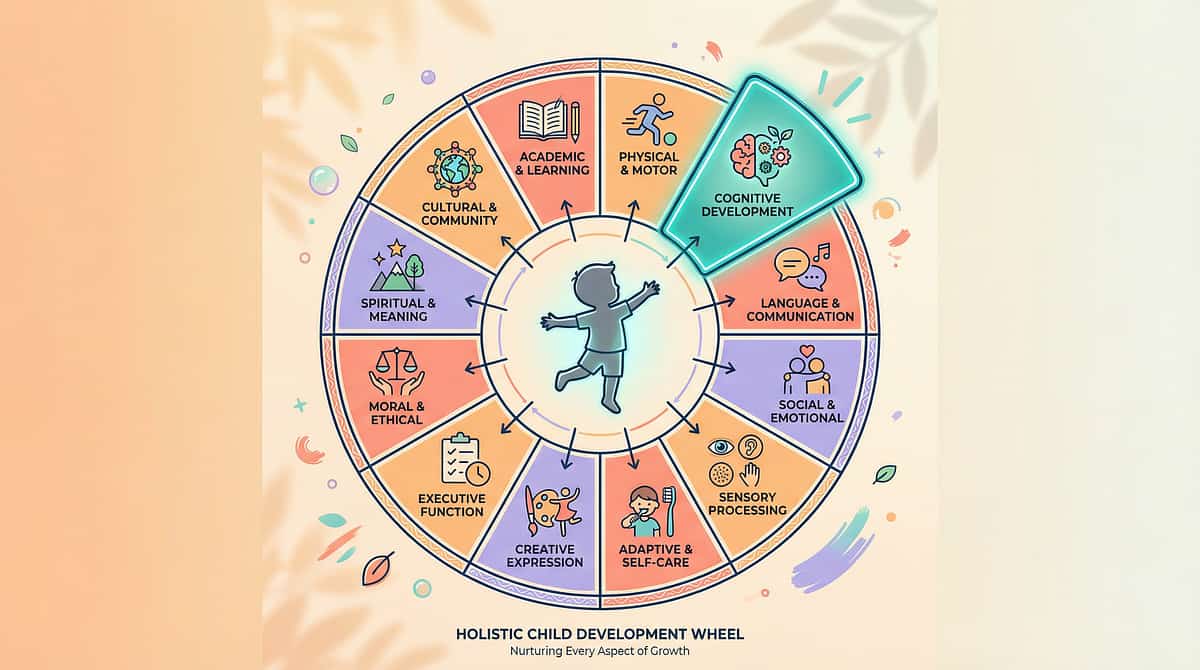
Your Child's Full Developmental Map
"Planning and Organization Is One Domain. Your Child's Development Has Twelve."
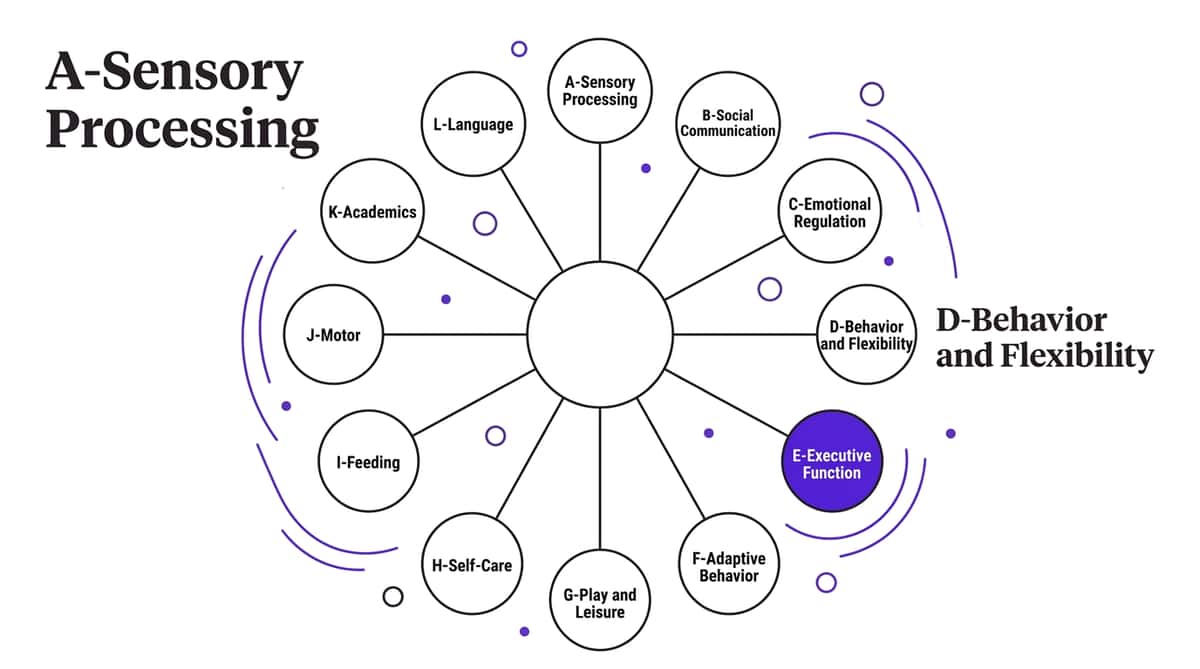
This Technique's Position
Domain E (Executive Function) — foundational to academic performance, daily living independence, emotional regulation, and long-term vocational readiness. Improvements in executive function cascade positively across all 12 developmental domains.
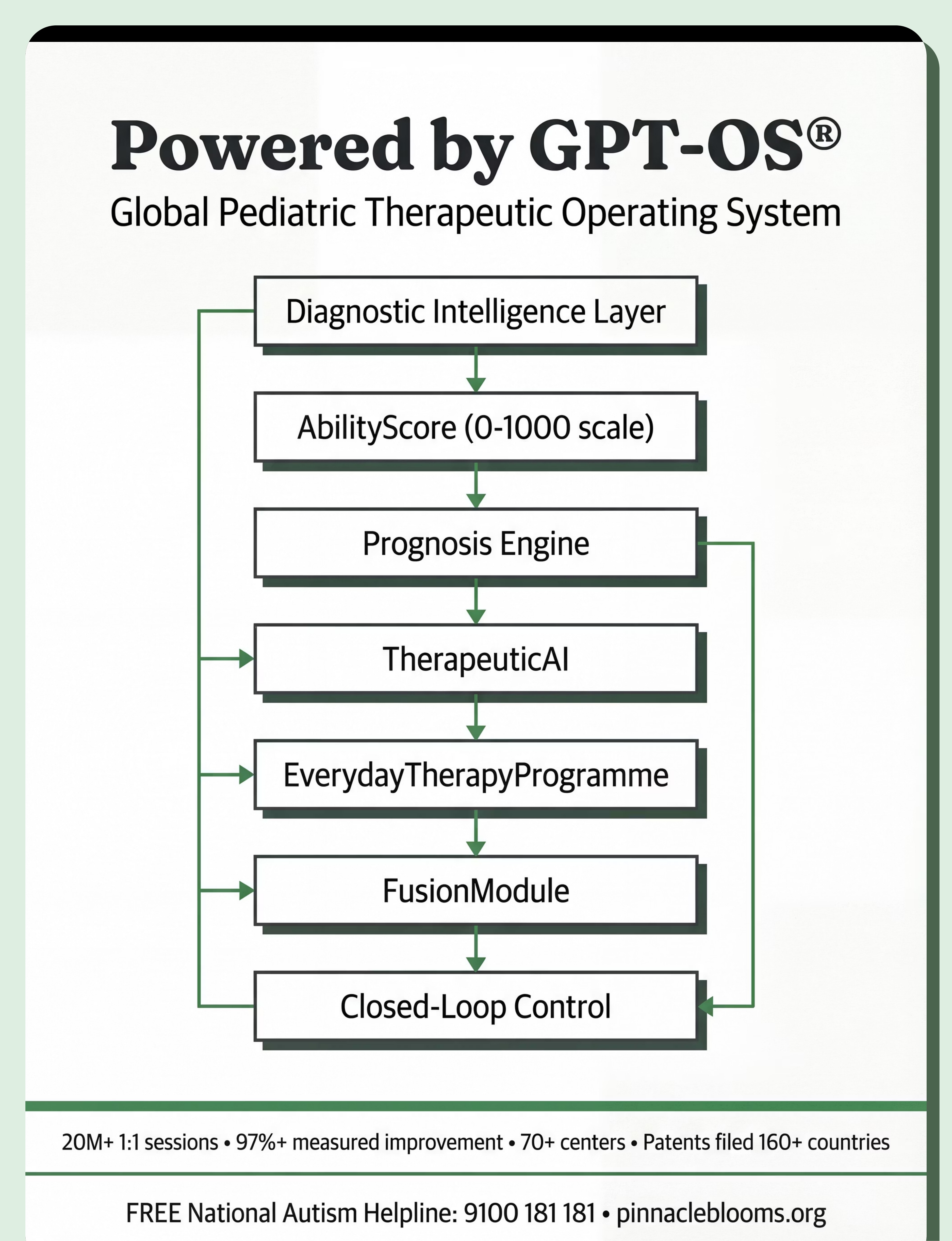
GPT-OS® Integration
Your session data from H-746 feeds into:
- Executive Function Readiness Index (real-time tracking)
- AbilityScore® EF Subdomain (baseline to mastery measurement)
- FusionModule™ (cross-discipline coordination)
- EverydayTherapyProgramme™ (daily routine integration)
📞Helpline: 9100 181 181

ACT V · Community
Families Who've Been Here
"They Started Exactly Where You Are."
Arjun, Age 8, Hyderabad
Before: Every morning was a 90-minute battle. Arjun knew the routine perfectly — he could recite every step. But knowing and doing were completely disconnected. He'd get distracted between "brush teeth" and "put on shoes." His parents had tried printed schedules, alarms, and constant reminders. Nothing held.
After: After 6 weeks of consistent visual schedule use combined with task breakdown cards for homework, Arjun was getting himself ready in 25 minutes — independently. His mother reported: "He woke up on Saturday and walked to his schedule board without me saying a word. I cried."
Timeline: 6 weeks | Materials: Visual schedule board + task breakdown cards + visual timer
Priya, Age 6, Bengaluru
Before: Priya's backpack was described by her teacher as "a black hole." Permission slips disappeared. Pencils were lost daily. Getting dressed required her father to physically direct each step every morning.
After: A launch pad by the front door and a first-then board for morning dressing reduced "lost items per week" from 7+ to 1–2. At week 4, Priya began reminding her younger brother: "First your shoes, then we go."
Timeline: 4 weeks | Materials: Launch pad + first-then board + checklist
"The moment parents stop trying to fix the child's memory and start engineering the environment, everything changes. These families didn't change their children. They changed the world around their children — and their children rose to meet it." — Occupational Therapist, Pinnacle Blooms Network® Hyderabad
Illustrative cases. Individual outcomes vary by child profile and implementation consistency.
ACT V · Connect
Connect With Other Parents
"Isolation Is the Enemy of Consistency. Join the Community That Gets It."
WhatsApp: Executive Function Support Group
Parents navigating the same journey — sharing what works, what doesn't, and celebrating the wins. Moderated by Pinnacle therapists. Join Group →
Online Forum
Discussion threads on visual schedules, checklist systems, homework battles, morning routines — organized by material and age group. pinnacleblooms.org/community
Local Parent Support Groups
Pinnacle centers host monthly parent meetups organized by challenge domain. Executive Function sessions run in most centers. Find your nearest center →
Peer Mentoring Program
Connect with a parent who has successfully implemented these systems with a child at a similar developmental level. Not advice-giving — experience-sharing.
"Your experience — even 2 weeks in, even imperfectly — helps another parent who is at Day 1. Consider sharing your journey."
📞Helpline: 9100 181 181

ACT V · Professional Support
Your Professional Support Team
"Home + Clinic = Maximum Impact. Your Professional Team Is Closer Than You Think."
📍70+ Centers Across India | Hyderabad · Bengaluru · Chennai · Mumbai · Delhi · Pune · Kolkata · and 60+ more locations
What the Clinic Adds That Home Cannot
- Formal EF Assessment (BRIEF-2, Conners, comprehensive developmental evaluation)
- AbilityScore® Baseline (your child's EF domain score on the 0–1000 GPT-OS® scale)
- OT-Led System Design (therapist designs the specific visual system for your child's sensory-motor profile)
- Cross-Discipline Integration (OT + SpEd + ABA working from one coordinated EF plan)
- School Liaison (Pinnacle therapists communicate directly with teachers for home-school consistency)
Teleconsultation
For families outside the 70-center network — teleconsultation available in 16+ languages for system design, troubleshooting, and progress review.
Insurance & Funding
Pinnacle therapists assist with disability certification, government scheme access, and insurance navigation for eligible families.
📞FREE National Autism Helpline: 9100 181 181 | 24×7 | 16+ languages
ACT V · Research Library
The Research Library
"For the Curious Parent Who Wants to Understand the Full Science."
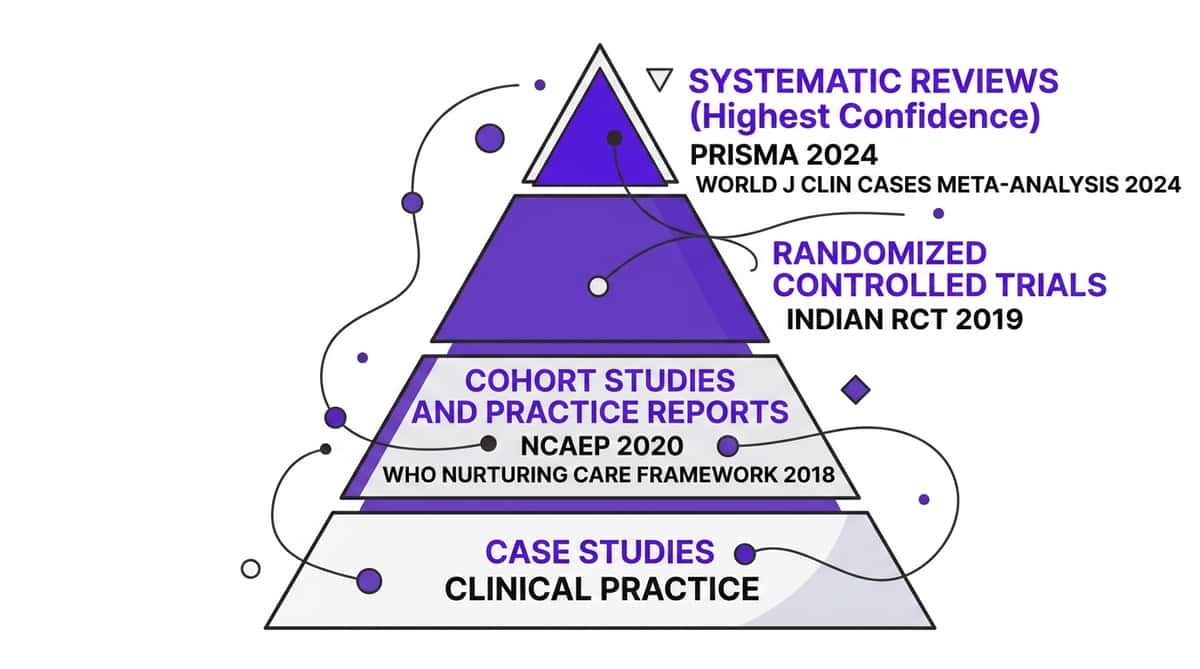
1. PRISMA Systematic Review (2024) — Level I
16 studies (2013–2023) confirm structured visual-organizational interventions as evidence-based practice for executive function support in children with ASD and ADHD. | PMC11506176 → PubMed
2. World J Clin Cases Meta-Analysis (2024) — Level I
24 studies — structured material-based EF interventions effectively promote adaptive behavior, task completion, and planning skill acquisition in pediatric populations. | PMC10955541 → PubMed
3. Indian Journal of Pediatrics RCT (2019) — Level II
Padmanabha et al. — Home-based structured visual supports demonstrate significant outcomes in Indian pediatric populations. Establishes home-based feasibility. | DOI: 10.1007/s12098-018-2747-4
4. NCAEP Evidence-Based Practices Report (2020)
Visual supports, task analysis, and reinforcement-based systems classified as established evidence-based practice for autism. | NCAEP 2020 Report
5. WHO Nurturing Care Framework (2018)
Universal framework for early childhood development — structured environmental support is a core WHO/UNICEF-endorsed intervention component. | WHO NCF
6. Harvard Center on the Developing Child
Executive Function and Self-Regulation — foundational science on EF development and the evidence base for scaffolded support. | developingchild.harvard.edu

ACT V · GPT-OS® Technology
How GPT-OS® Uses Your Data
"Your 60-Second Daily Log Shapes Personalized Therapy for Your Child. Here's How."
What GPT-OS® Learns from H-746 Data
- Which of the 9 materials shows fastest acquisition for your child's profile
- Whether initiation or completion is the primary barrier
- Optimal session frequency and duration for this child
- Which co-intervention (OT? ABA? SpEd?) should be prioritized
Privacy Assurance
All data is encrypted, anonymized for population-level analysis, and never sold or shared with third parties. Your child's data belongs to your family and your therapist.
"Your data helps every child like yours. Population-level patterns from 21M sessions identify what works for children with your child's exact profile."
📞Helpline: 9100 181 181

ACT V · Watch the Reel
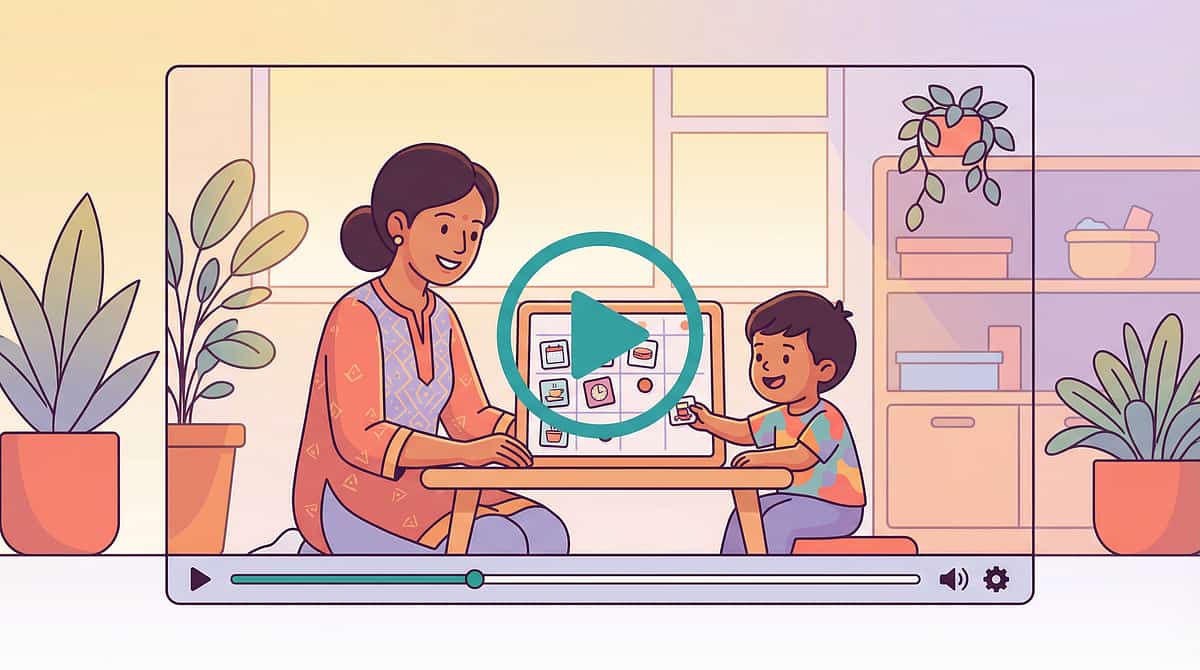
Watch the Reel
"See These Materials in Action. 60 Seconds. Everything You Need to Know."
H-746 · Executive Function Series · Episode 746 · Pinnacle Blooms Network®
Duration: 60–75 seconds | techniques.pinnacleblooms.org/reels/H-746
Duration: 60–75 seconds | techniques.pinnacleblooms.org/reels/H-746
Related Reels in This Series
Presented by the Pinnacle Blooms Consortium — Occupational Therapy + Special Education leads
PubMed Reference: NCAEP 2020 — Video modeling is an established evidence-based practice for autism. Multi-modal learning improves parent skill acquisition.

ACT V · Share
Share This With Your Family
"Consistency Across Caregivers Multiplies Impact. Share This Page."
A child who uses a visual schedule with Mum but not Dad, at home but not at school, will make slower progress than a child surrounded by consistent organizational systems everywhere. This page contains everything any caregiver needs to use these tools correctly.
WhatsApp (Instant Share)
Pre-written message: "I've been using these 9 materials to help [child's name] with planning and organization. Here's the page with all the details and how-to instructions: techniques.pinnacleblooms.org/executive-function/planning-organization-H-746"
Email (For Grandparents & Teachers)
Full-format share including all 6 Acts of this guide. Ideal for caregivers who need the complete picture.
Downloadable Resources
📋 H-746 One-Page Family Guide PDF — simplified for grandparents and domestic helpers
👨🏫 Teacher Communication Template — requesting school-side consistency
📝 H-746 Tracking Sheet PDF — daily 3-data-point log
👨🏫 Teacher Communication Template — requesting school-side consistency
📝 H-746 Tracking Sheet PDF — daily 3-data-point log
For Grandparents:"Simple version: Your grandchild uses a schedule board and a checklist. When you're with them, please check: 'Did you look at your board?' That one question, asked consistently, is all you need to do."
PubMed Reference: WHO CCD Package — Multi-caregiver training is critical for intervention generalization and maintenance. | PMC9978394

ACT VI · FAQ
Frequently Asked Questions
"The Questions Every Parent Has. Answered Honestly."
My child knows the routine perfectly — why won't they just do it?
Knowing is a function of long-term memory. Doing — initiating and sequencing in real-time — is a function of executive function, specifically working memory and task initiation. These are separate brain systems. Visual systems externalize the working memory demand, allowing the child to do what they already know.
Won't my child become dependent on these tools and never organize independently?
No — this is the most important question parents ask. External organizational supports are the training ground for internal organizational skills. Every time a child uses a visual schedule, their brain is rehearsing the planning sequence. Independence develops through consistent tool use, not in spite of it. Adults use calendars, checklists, and reminders — we are building the same capacity in children.
My child used the visual schedule for 3 days and then ignored it. What do I do?
This is Week 1 normal. The novelty effect lasts 2–4 days. After Day 4, the behavior you see reflects the real work of habit-building — not failure. Attach renewed reinforcement to schedule use and reduce verbal prompting. Every time you answer verbally, you reduce the child's need to look at the board.
How do I get the school to use these same systems?
Download the Teacher Communication Template from Card 37. It outlines the specific systems your child uses, the language to use, and simple school-side consistency requests. Most teachers are receptive when parents provide clear, practical information. Pinnacle also offers school liaison services — see Card 33.
My child has ADHD — is medication better than these tools?
This is a question for your child's NeuroDev pediatrician. What research clearly shows is that behavioral supports (like these 9 materials) and medical management (where indicated) are most effective in combination, not in isolation. These tools are evidence-based independent of any medication decision.
My child is 4 years old. Is this too young?
No. Start with first-then boards only — two pictures, two steps. "First shoes, then we go to the park." This is developmentally appropriate for 4-year-olds with planning challenges and builds the foundation for more complex systems. Visual schedules for preschoolers should be entirely picture-based.
Can I use all 9 materials at the same time?
Not immediately. Start with the simplest (first-then board) and add materials one at a time as each becomes part of routine. Introducing all 9 simultaneously creates its own organizational demand and usually results in none being used consistently. See Card 23 for the recommended implementation sequence.
How do I know if my child needs professional evaluation vs. just using these materials?
Use these materials first — they're appropriate for all children with planning and organization challenges regardless of diagnosis. Pursue professional evaluation if: no progress after 8 weeks of consistent use; challenges significantly impact school functioning or family wellbeing; you suspect ADHD, autism, or a learning disability; or your therapist recommends formal assessment. Call 9100 181 181 to discuss.
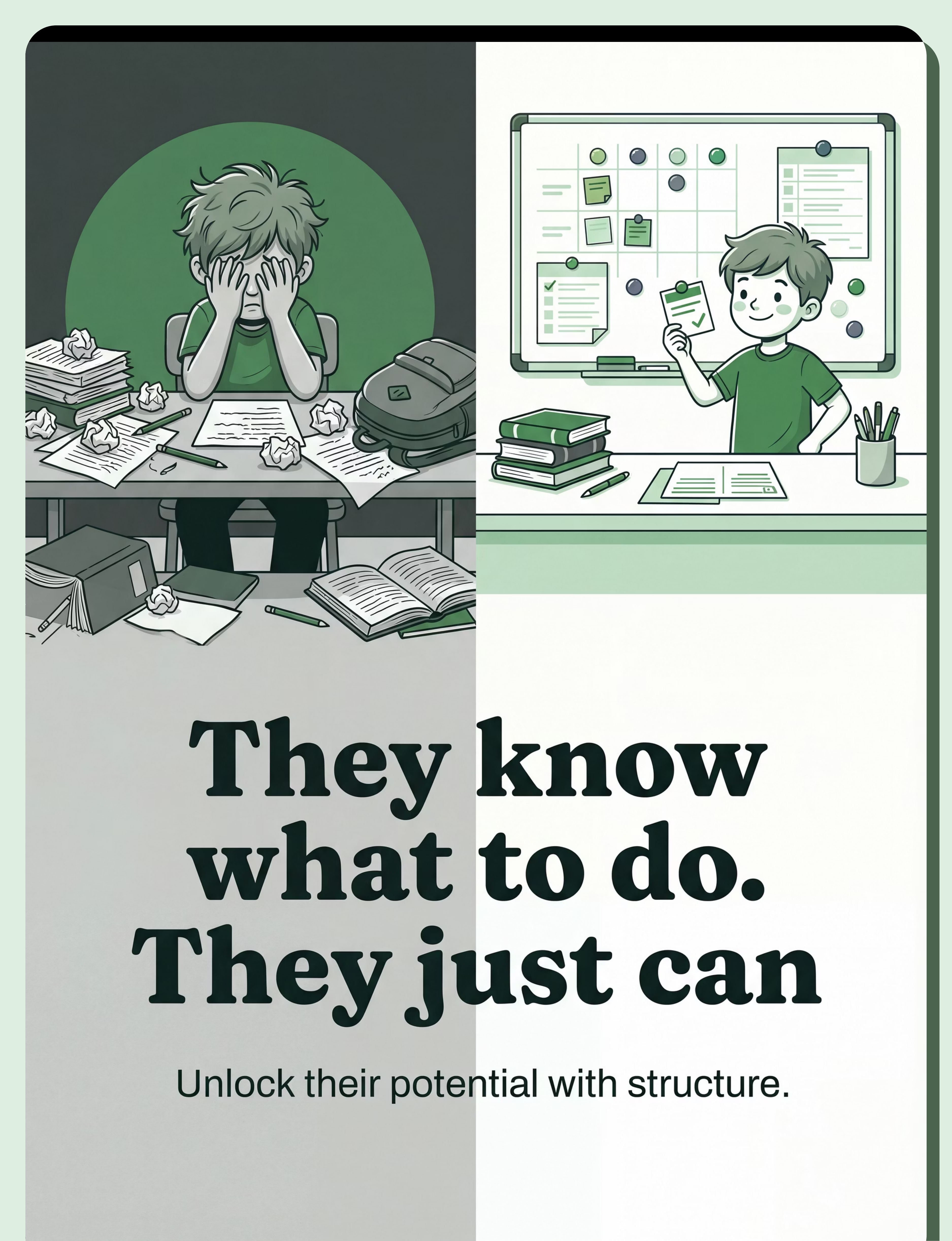
Preview of 9 materials that help with planning and organization Therapy Material
Below is a visual preview of 9 materials that help with planning and organization therapy material. The pages shown help educators, therapists, and caregivers understand the structure and content of the resource before use. Materials should be used under appropriate professional guidance.



Link copied!

ACT VI · Start Now
Your Next Step: Start Now
"You've Read the Science. You Have the Materials. One Thing Remains."
Start today. Not when you have the perfect setup. Not when you've bought all 9 materials. Start with a piece of paper and a pen. Write "FIRST: ___ THEN: ___". That's the first step.
✓ Evidence-Linked
PubMed-referenced, WHO/UNICEF-aligned
✓ Clinically Validated
By the multi-disciplinary Pinnacle Consortium
✓ Home-Executable
Designed for parents and caregivers, not only for clinics
✓ Equity-Focused
DIY alternatives ensure access regardless of economic status
✓ Sequenced
Part of a 70,000+ technique developmental library
This content is educational and does not replace individualized assessment and intervention from qualified occupational therapists, psychologists, special educators, or developmental specialists. Planning and organization difficulties may be part of ADHD, autism, learning disabilities, or other conditions requiring comprehensive evaluation. Consult your child's therapist or specialist for personalized guidance. Individual outcomes vary by child profile, underlying condition, and intervention consistency.
CIN U74999TG2016PTC113063 | DPIIT DIPP8651 | MSME TS20F0009606 | GSTIN 36AAGCB9722P1Z2
© 2025 Pinnacle Blooms Network®, unit of Bharath Healthcare Laboratories Pvt. Ltd. All rights reserved. | 📞FREE National Autism Helpline: 9100 181 181 | pinnacleblooms.org | care@pinnacleblooms.org
"From fear to mastery. One technique at a time." — The Pinnacle Blooms Consortium