9 Materials That Help With Face Washing
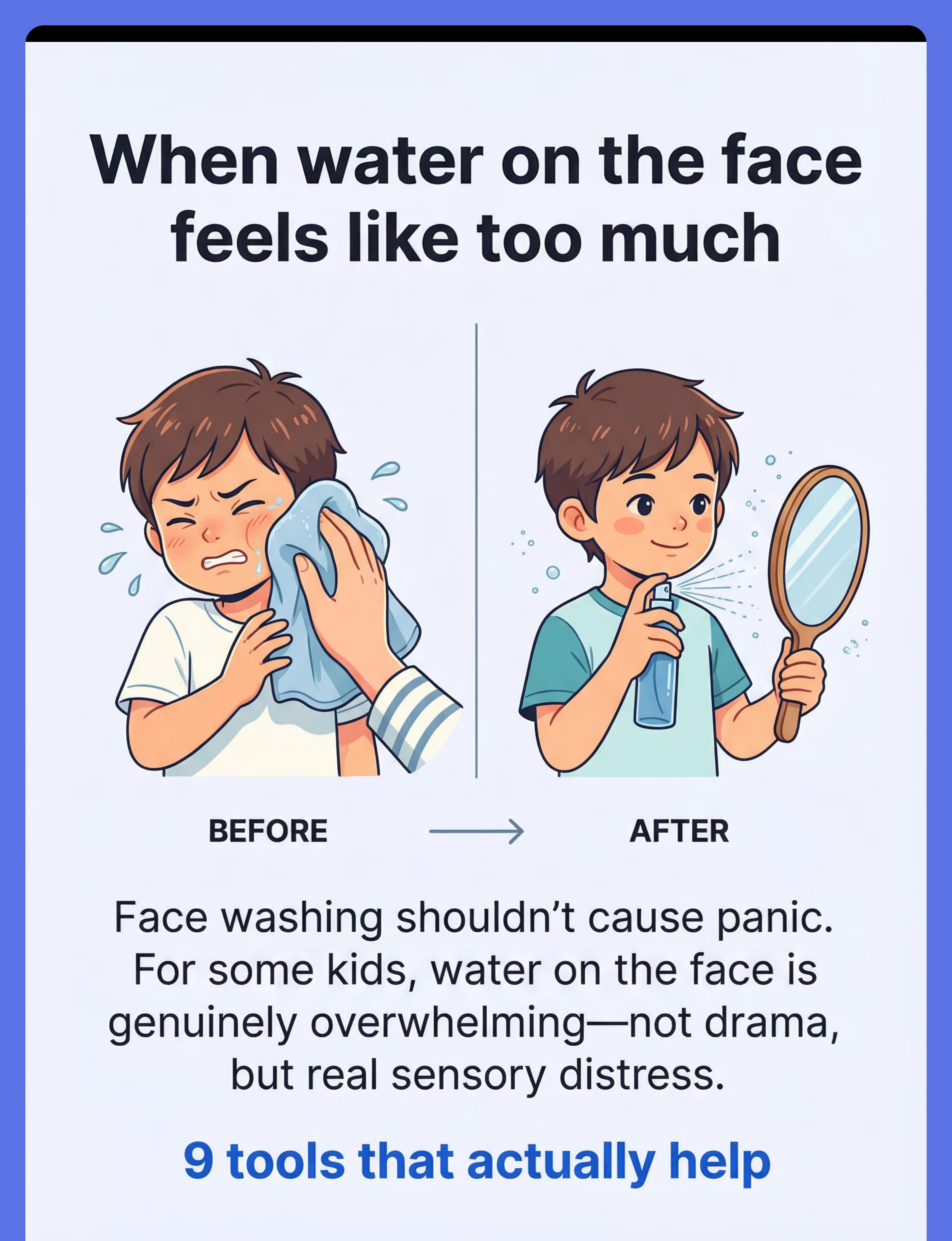
When Water on the Face Feels Like Too Much — there are tools that change everything. OT-validated, home-ready, and built for families like yours.
Self-Care Independence Series
Episode E-533
Ages 2–12 Years
OT-Validated

Every Morning. Same Battle.
Water touches her face — and the panic starts. She turns away. She flinches. Sometimes she screams. You've tried gentle. You've tried fast. You've tried games and songs. Nothing works. And you're out of ideas.
Face washing shouldn't be this hard. But for your child, water on the face isn't just unpleasant — it's genuinely overwhelming. The sensation of droplets running from forehead to eyes, the unpredictable splash, the wet washcloth scraping against sensitive skin — for some children, this is experienced as intense alarm, not just mild discomfort.
You are not failing. Your child's nervous system is speaking. The 9 materials on this page are clinically assembled tools that transform face washing from a daily battle into a manageable routine — and eventually, an independent skill.
Clinically assembled by Pinnacle Blooms Network® — India's largest pediatric therapy consortium. OT • SLP • ABA/BCBA • SpEd • NeuroDev Pediatrics • CRO
WHO Nurturing Care Framework (2018): Early caregiver awareness directly shapes developmental outcomes. nurturing-care.org

You Are Among Millions of Families Navigating This Exact Challenge
80%
Sensory Difficulties
of children with ASD experience sensory processing difficulties affecting daily hygiene routines
1 in 36
On the Spectrum
children in India are on the autism spectrum — sensory challenges affect grooming for most
21M+
Therapy Sessions
delivered by Pinnacle centers — hygiene tolerance is among the top 5 challenges families report
Face washing difficulty is not rare. It is one of the most commonly reported daily care challenges for children with sensory processing differences, autism, ADHD, and anxiety. The face — with its extraordinary density of nerve endings — is the most sensory-intense area of the human body. When your child panics at water on their face, they are not being dramatic. They are processing an overwhelming signal that their nervous system has flagged as threatening.
India Data: India has an estimated 10+ million children with autism spectrum disorder. Facial tactile sensitivity is reported as a significant daily challenge in over 70% of OT intake assessments at Pinnacle centers. Across Pinnacle's 70+ centers, families just like yours have transformed this. The materials exist. The strategies work.
PMC11506176 — PRISMA Systematic Review (2024): 80% of children with ASD display sensory processing difficulties. PMC10955541 — Meta-analysis (World J Clin Cases, 2024): Sensory integration therapy demonstrates measurable outcomes across 24 studies.

This Is a Wiring Difference. Not a Behavior Choice.
The Face Is Neurologically Unique
Your child's face is covered in a dense network of nerve fibers — far denser than any other body surface. The trigeminal nerve (the largest cranial nerve) covers the entire face and connects directly to the brain's emotional processing centers.
When water touches the face, that signal is processed more intensely than the same sensation elsewhere on the body. For children with sensory over-responsivity, the brain's somatosensory cortex amplifies that signal — turning what should be a neutral sensation into an alarm.
The dive reflex adds another layer. Water near the nose and eyes can trigger the mammalian dive reflex — a primitive survival response that literally slows the heart rate and affects breathing. Your child isn't imagining the feeling that water is threatening. Their nervous system is responding as designed — just with a much lower threshold.
"Tactile defensiveness occurs when the somatosensory cortex over-amplifies tactile input — the child experiences ordinary touch as threatening. This is a real neurological difference, measurable on sensory processing assessments." — Pinnacle NeuroDev Pediatrics Consortium
Frontiers in Integrative Neuroscience (2020): Neurological basis for sensory-based interventions in ASD. DOI: 10.3389/fnint.2020.556660

Your Child Is Here. Here Is Where We're Heading.
Ages 1–2
Tactile sensitivity emerges
Ages 2–4 ← YOU ARE HERE
Challenge Zone: Face washing battles peak
Ages 4–7
With the right tools, water tolerance builds
Ages 7–10
Tolerance building, self-washing emerges
Ages 10–12+
Independent face washing with minimal support
Children with sensory processing differences typically do not outgrow facial water sensitivity without targeted intervention. The challenge zone (ages 2–7) is the most common presentation period — not because children are more difficult, but because hygiene requirements increase precisely when sensory processing differences are most pronounced.
Commonly Co-Occurs With
- Autism Spectrum Disorder (ASD) — sensory processing differences in 80%+ of cases
- Sensory Processing Disorder (SPD) — tactile defensiveness as primary presentation
- ADHD — combined sensory and attention challenges affecting grooming routines
- Anxiety Disorders — water/grooming-specific phobia component
- Developmental Coordination Disorder — grooming motor planning challenges
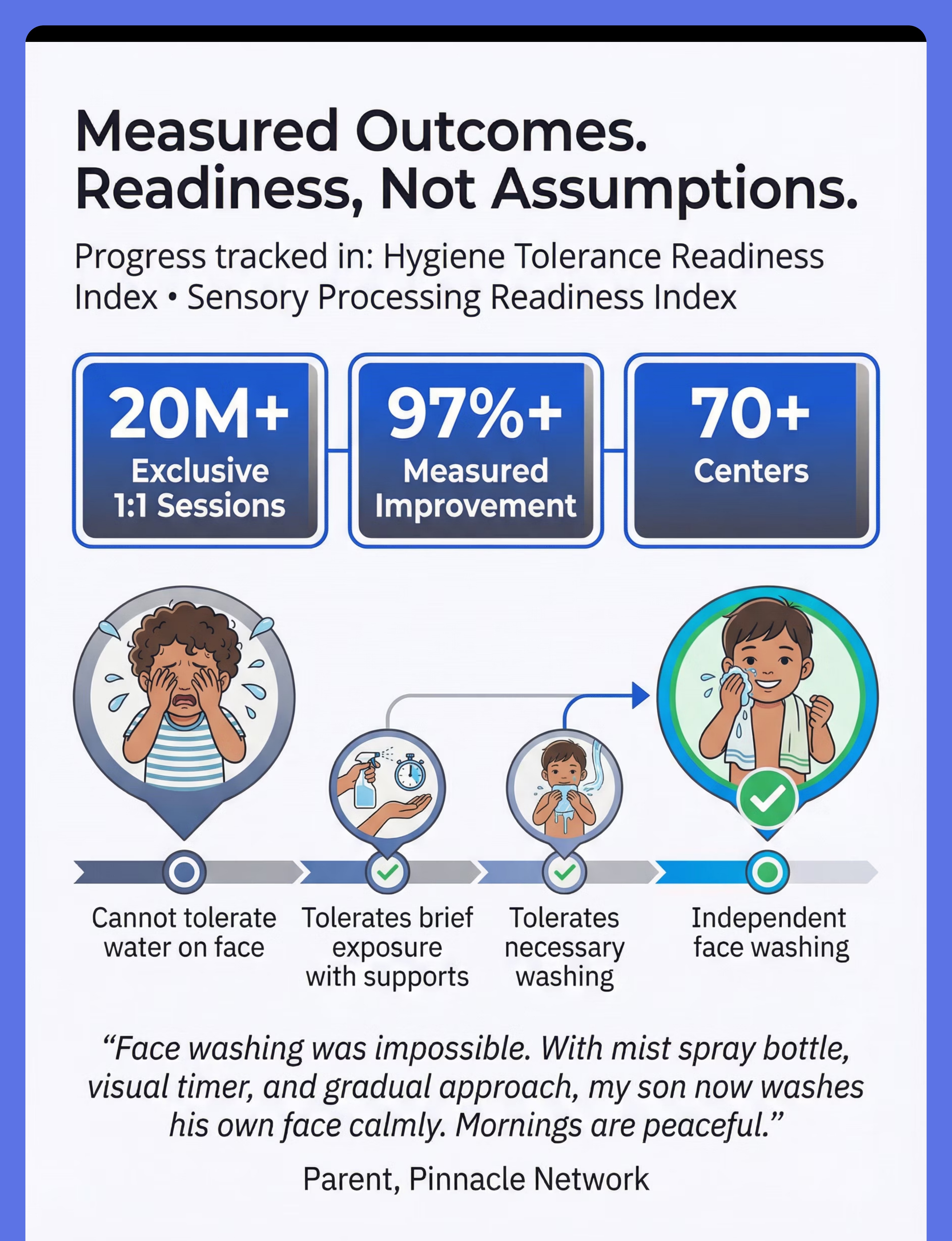
Forward-Looking: Children who receive appropriate sensory support and use the right materials typically progress from "cannot tolerate face washing" to "tolerates it with supports" within 4–8 weeks. Many achieve independent face washing within 3–6 months.
Clinically Validated. Home-Applicable. Parent-Proven.
Systematic Review
16 studies (2013–2023) confirm sensory integration intervention meets criteria as evidence-based practice for children with ASD. PMC11506176 (PRISMA, 2024)
Meta-Analysis
24 studies confirm sensory integration therapy promotes adaptive behavior, sensory processing, and self-care skills. PMC10955541 (World J Clin Cases, 2024)
Indian RCT
Home-based sensory interventions by trained parents demonstrated significant improvement in Indian children with autism. Padmanabha et al., Indian J Pediatr, 2019
Clinical Consensus
Control, predictability, and sensory modification strategies are validated across OT, ABA, and behavioral science literature. NCAEP EBP Report (2020)
The 9 materials on this page are drawn from Pinnacle's clinical practice database of 20M+ therapy sessions across 70+ centers, cross-referenced against international OT and ABA literature. Evidence Grade: Level II — Systematic Review Grade (Multiple RCTs + Meta-analyses).
Have questions about your child's sensory profile? FREE National Autism Helpline: 9100 181 181 — 16+ languages, 24×7

Making Face Washing Bearable — With the Right Tools
Formal Name
Tactile Desensitization & Sensory Modification for Facial Hygiene
Definition
Face washing sensory support is the systematic use of modified materials, environmental adaptations, and graduated exposure strategies to reduce the tactile defensiveness response during facial hygiene routines. Rather than forcing a child to tolerate overwhelming sensation, this approach modifies the sensory experience itself — making it genuinely less intense — while simultaneously building tolerance through controlled, positive exposure.
The Core Principle
Reduce sensory intensity → Increase predictability and control → Build tolerance gradually → Achieve hygiene independence.
Domain Badges
Self-Care / Grooming
Tactile Sensory Processing
Occupational Therapy
Water Tolerance
Hygiene Independence
Ages & Frequency
- Ages: 2–12 years
- Frequency: Daily (with hygiene routine)
- Session: 30–120 seconds initially
- Timeline: 4–8 weeks for measurable change
Canon Materials
- Grooming Tools (Adapted)
- Tactile Sensory Kit
- Visual Timer
- Social Stories / Narrative Supports
- Transition Objects / Comfort Items
This Crosses Every Therapy Boundary
Because the brain doesn't organize by discipline — face washing sensory support is a cross-disciplinary challenge that requires a coordinated team approach.
Occupational Therapy — Primary Lead
Sensory processing assessment, tactile desensitization protocols, material selection, environmental modification, self-care skill building. OTs design the graduated exposure hierarchy and select specific materials based on the child's sensory profile.
Applied Behavior Analysis / BCBA
Reinforcement scheduling, compliance training with positive reinforcement, data collection on tolerance duration, antecedent modification to prevent meltdowns before they start.
Special Education
Visual schedule integration, social narrative creation, classroom grooming routine generalization. SpEd teachers extend face-washing tolerance to school and public bathroom contexts.
Speech-Language Pathology
Oral motor component: when face washing involves mouth area cleaning, SLPs address hypersensitivity around the lips and chin. Communication strategies for children who cannot verbalize sensory distress.
NeuroDev Pediatrics / CRO
Diagnostic assessment for underlying sensory processing disorder, sensory profile evaluation, co-occurring condition management, medical clearance for sensory intervention protocols.
When your child's face washing is managed as a cross-disciplinary challenge — not just "a behavior problem" — outcomes improve dramatically. This is the Pinnacle FusionModule™ in action.
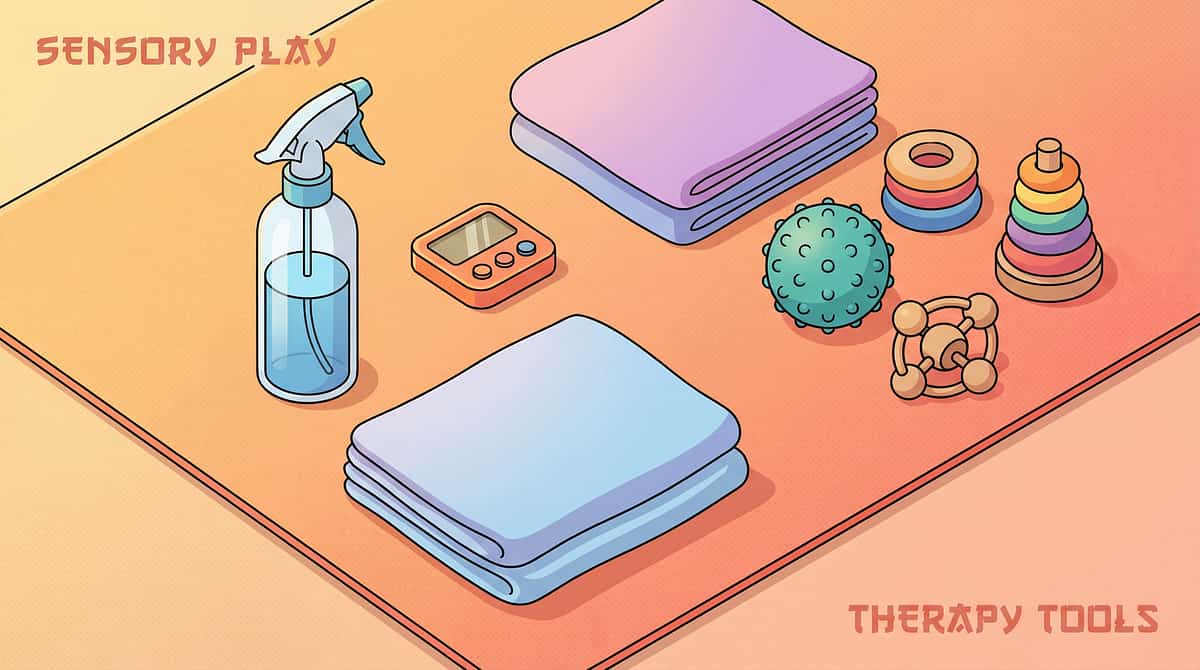
Precision Tools. Not Random Objects.
Each of the 9 materials targets a specific layer of the face-washing challenge. Understanding what they target helps you choose the right starting point for your child.
Before Materials | During Transition | After Mastery | |
Screams/cries at water contact | Tolerates brief exposure with support | Washes face independently | |
Turns head away from cloth | Accepts mist spray with timer visible | Chooses preferred materials | |
Panic at bath time face rinsing | Completes 30-second session calmly | Adapts to different environments | |
Face often visibly dirty | Uses visor, shows reduced distress | Maintains hygiene without prompting |
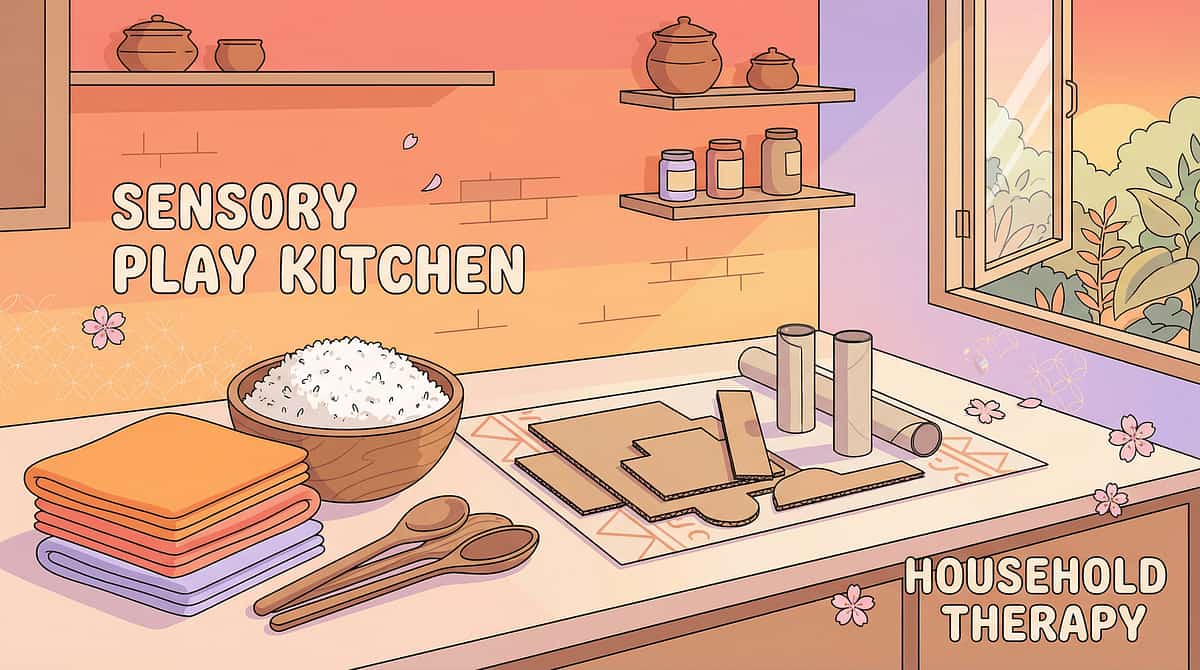
9 Materials. Each With a Different Job.
Together, they transform face washing. Browse the complete overview — detailed guides with DIY alternatives follow in the next card.
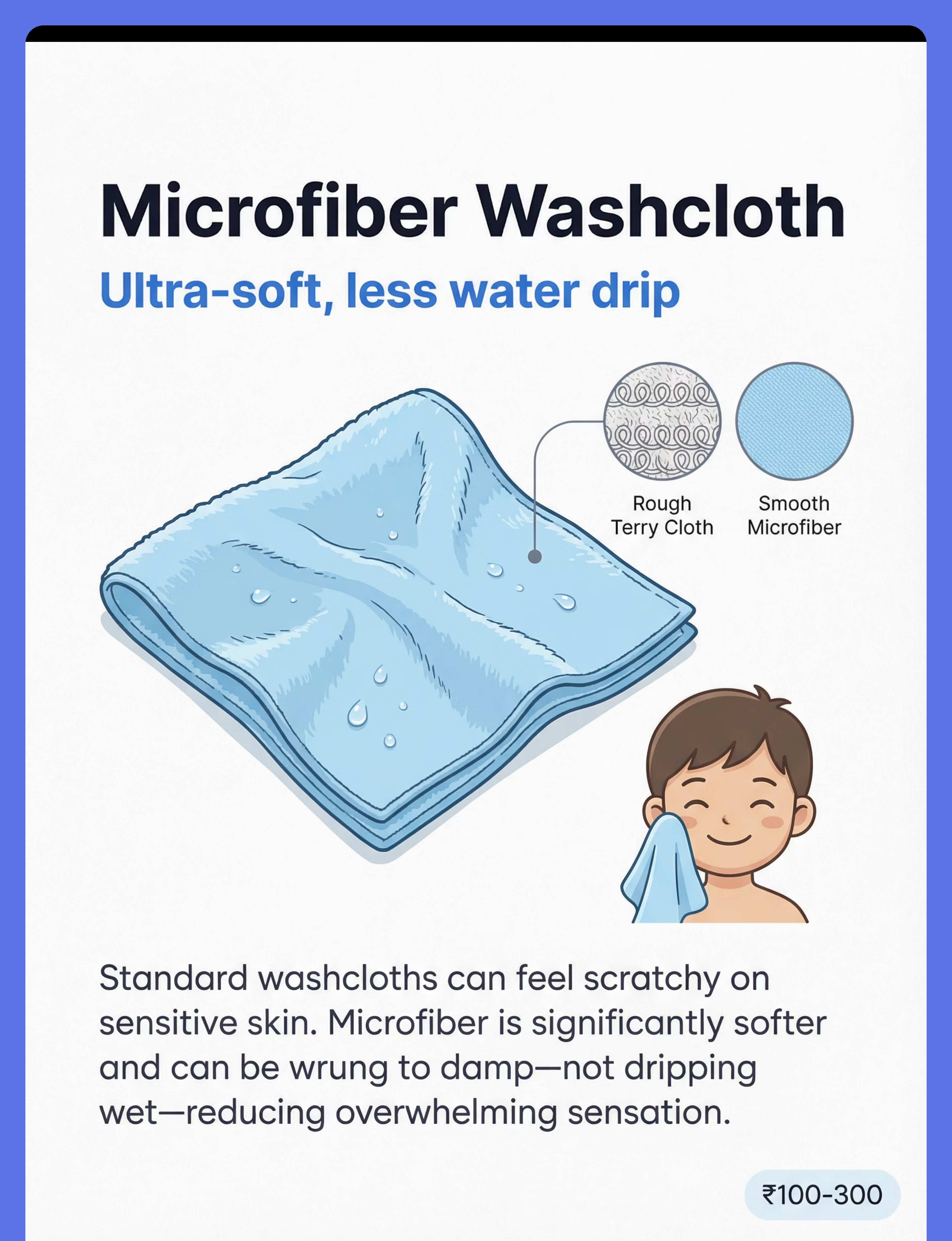
Microfiber Washcloth — ₹100–300
"Softer touch" — Ultra-fine fibers deliver a single, low-intensity tactile signal instead of the harsh multi-point contact of terry cloth.
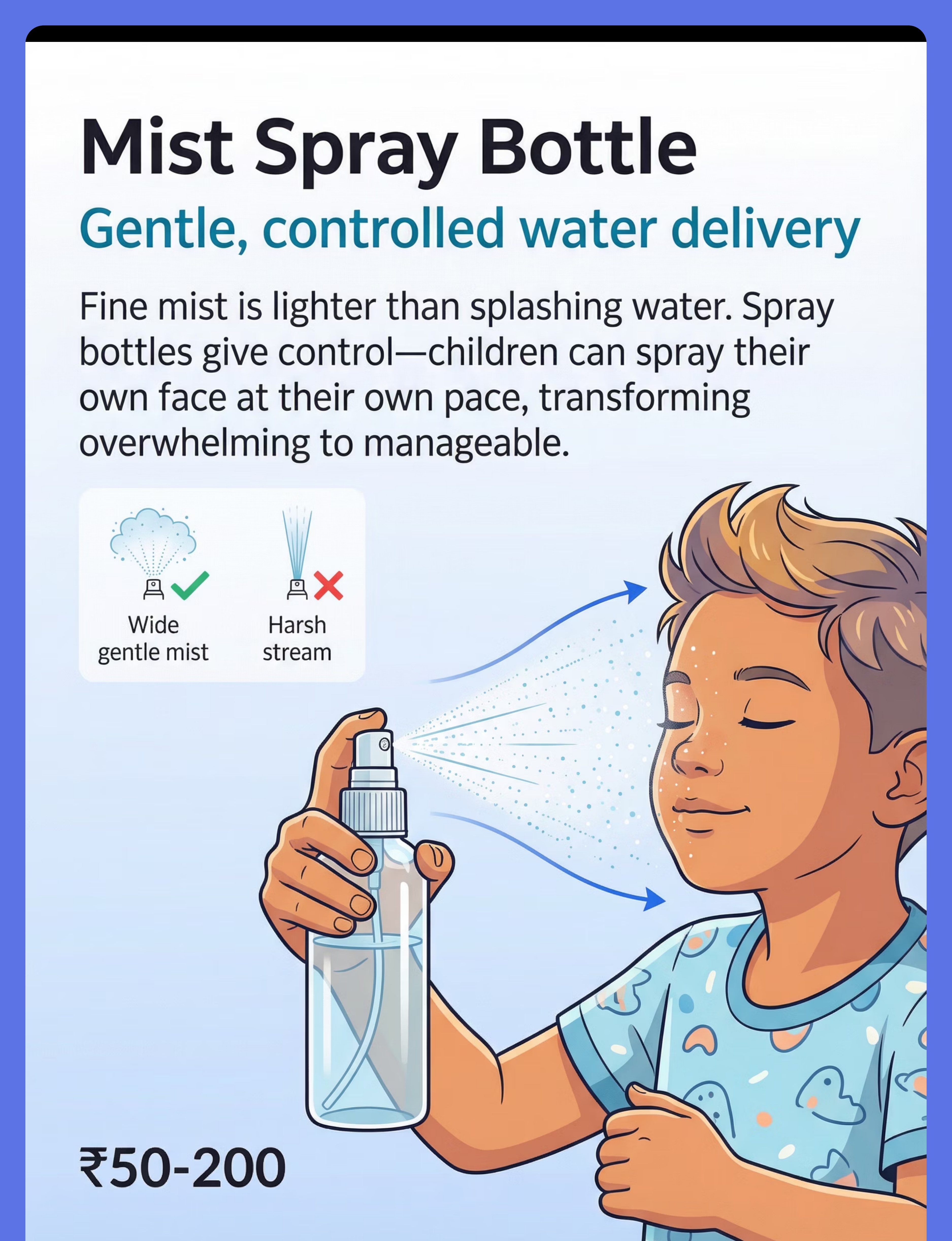
Mist Spray Bottle — ₹50–200
"Child's control" — Fine mist replaces overwhelming splash; child holds and controls the bottle for maximum agency.
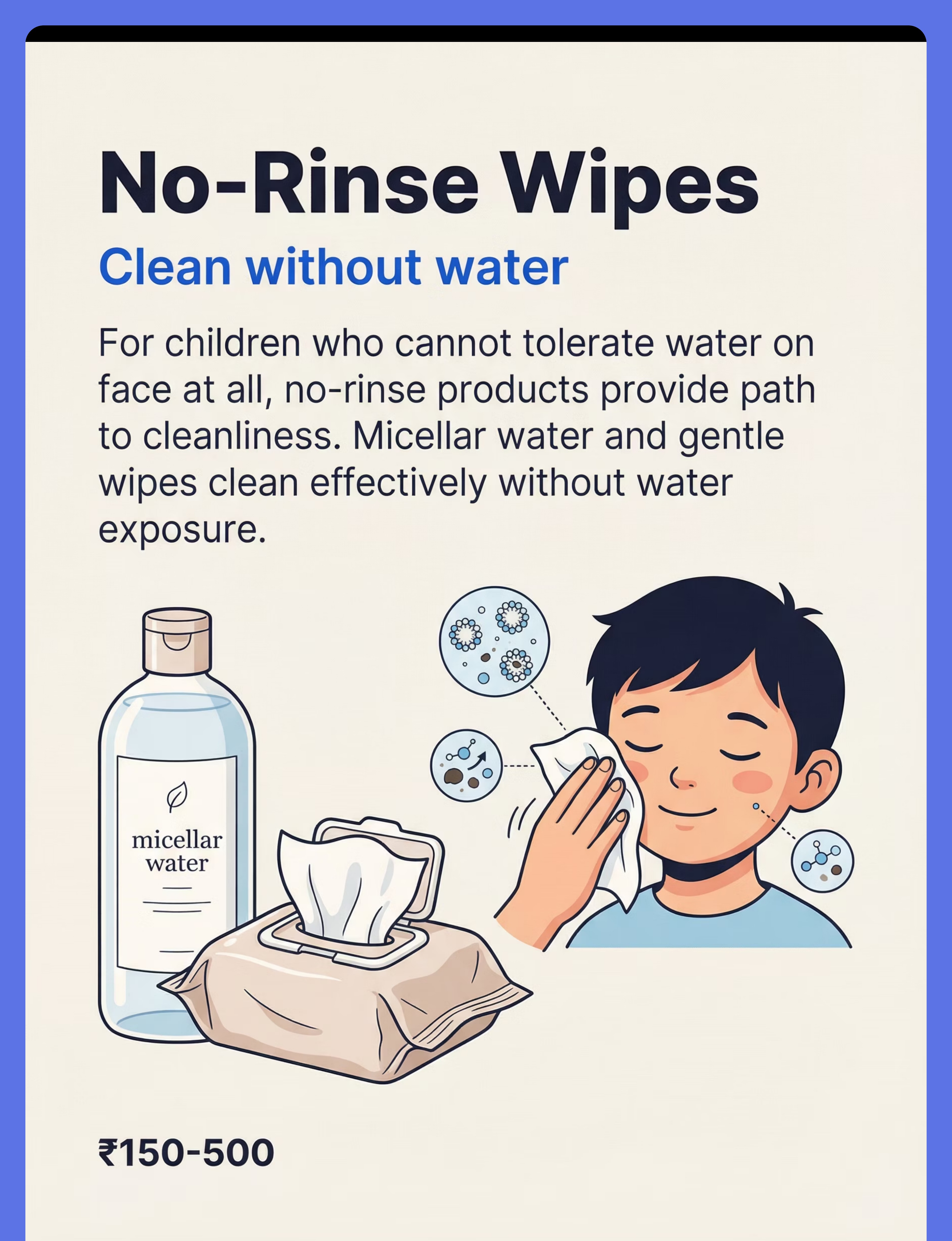
No-Rinse Wipes — ₹150–500
"No water needed" — Hygiene without water contact; the bridge strategy for high-distress days.
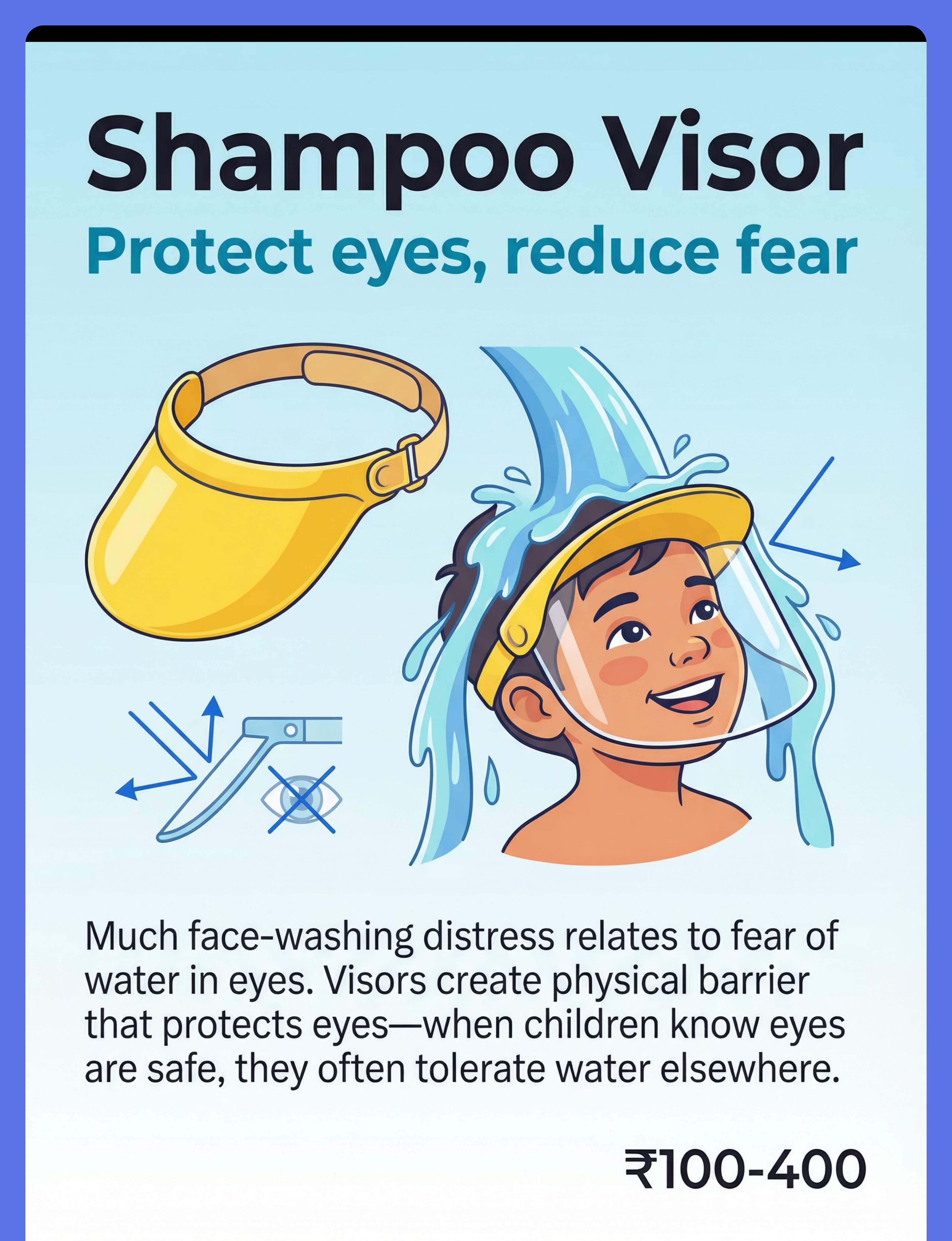
Shampoo Visor — ₹100–400
"Eye protection" — Physically prevents water from entering eyes, removing the #1 fear driver.
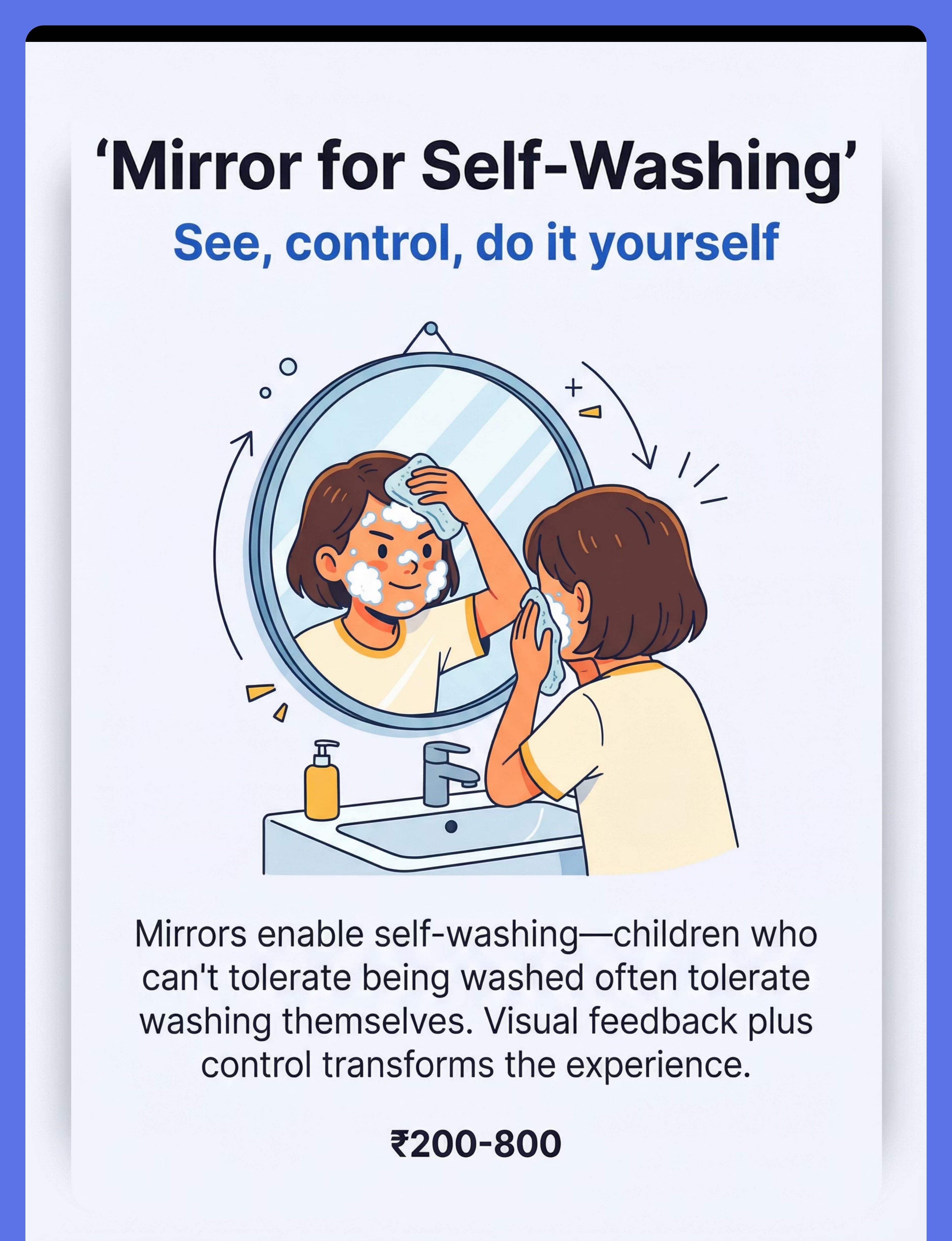
Mirror for Self-Washing — ₹200–800
"Self-washing" — Visual feedback gives child complete control over every variable.
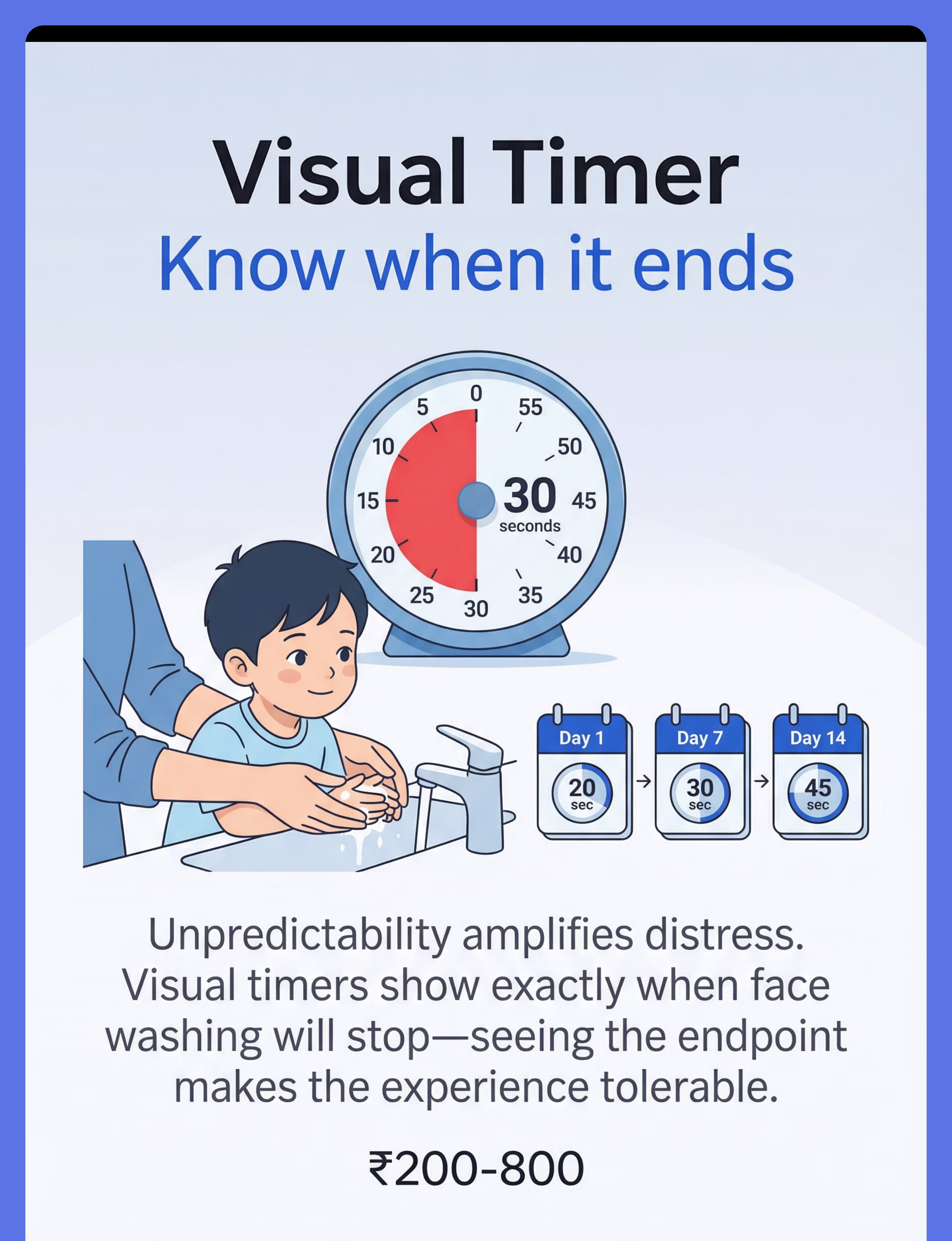
Visual Timer — ₹200–800
"Predictable end" — Shows exactly when the experience ends, eliminating infinite-duration fear.
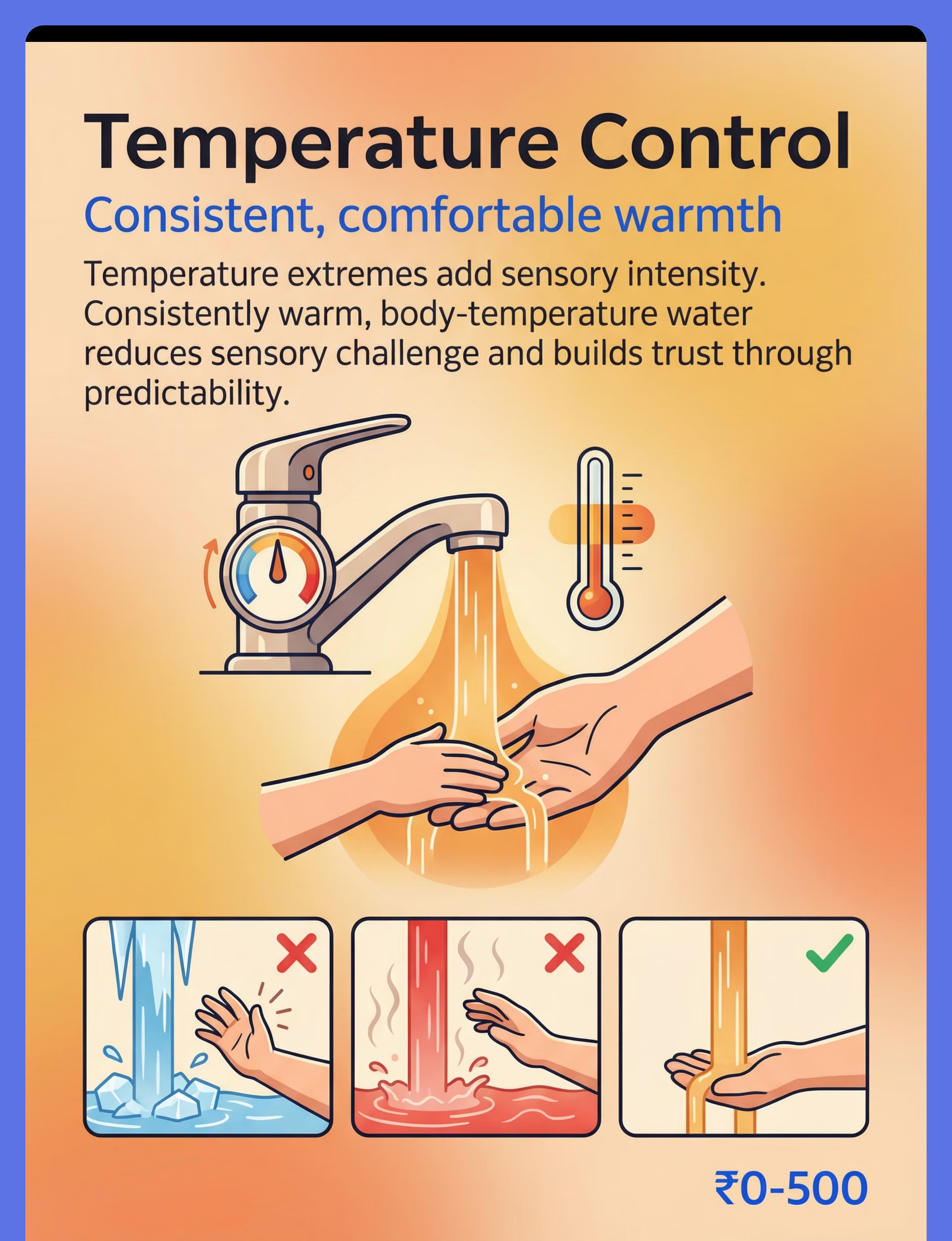
Warm Water Temperature Control — ₹0–500
"Comfort warmth" — Consistent, comfortable temperature removes one unpredictable variable.
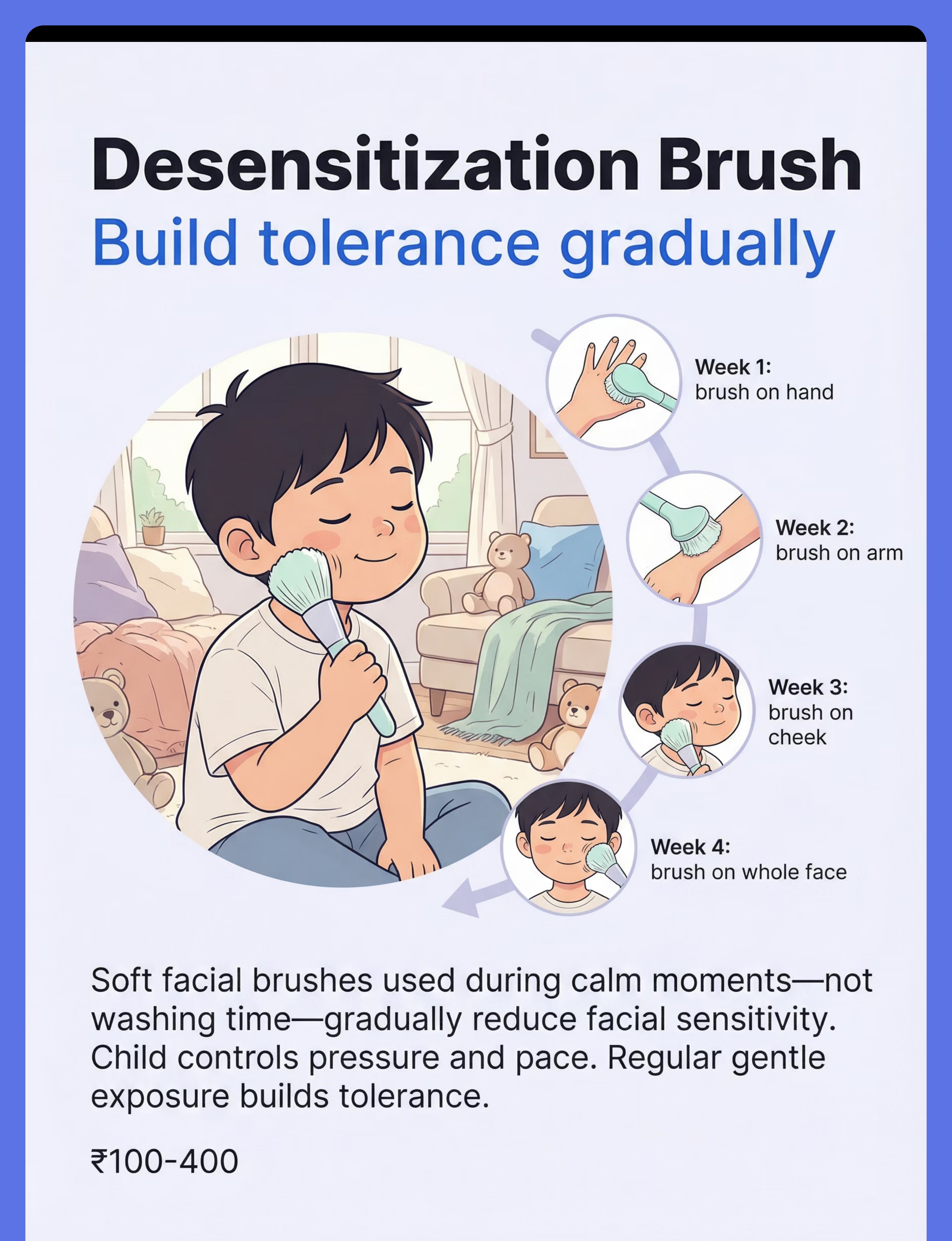
Desensitization Brush — ₹100–400
"Build tolerance" — Off-session tactile exposure builds threshold away from the sink.
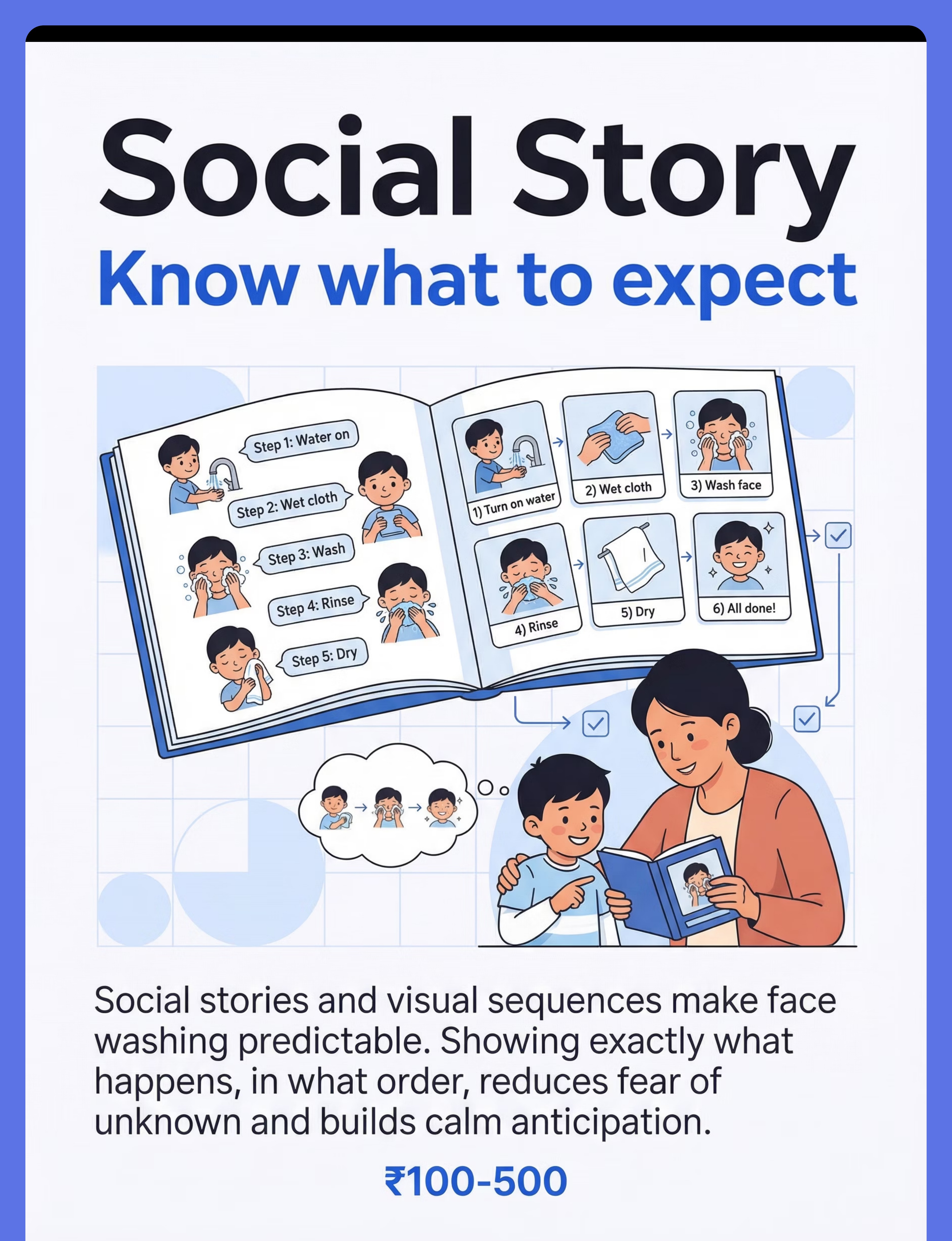
Social Story / Visual Sequence — ₹100–500
"Know what's coming" — Eliminates the unknown; the child arrives at the sink already knowing every step.
Complete starter kit (Materials 1, 2, 6): ₹350–1,300 | Full kit (all 9): ₹1,050–3,300 | For zero-budget approach, DIY alternatives for every material are provided in Card 11.
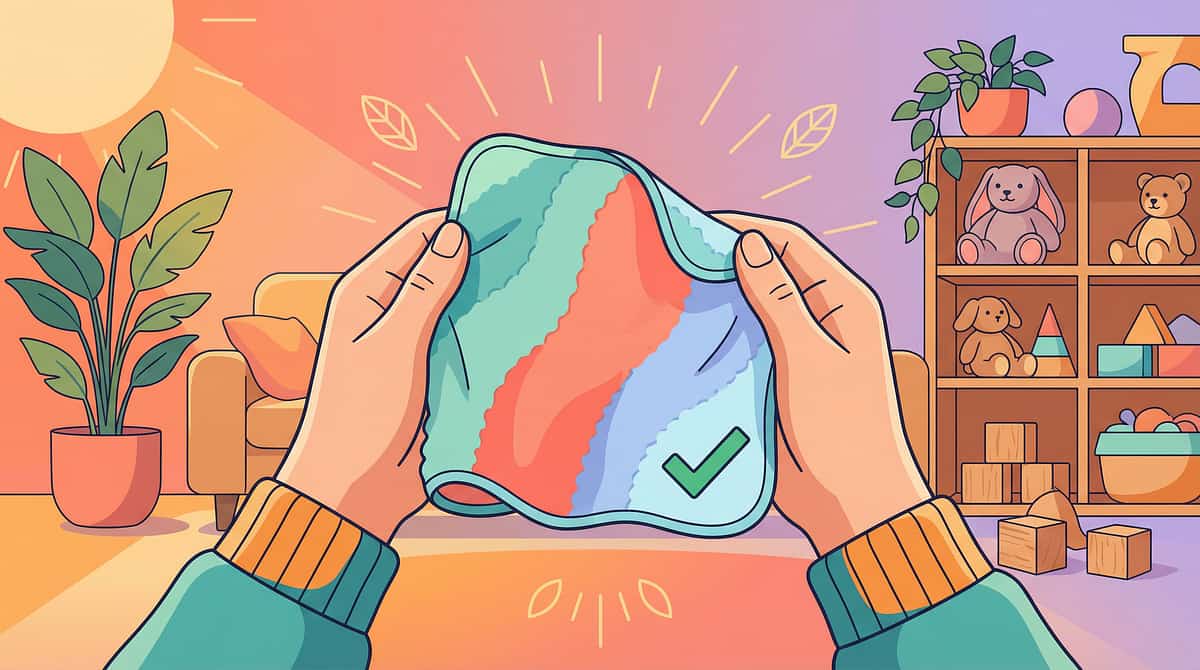
Every Material Explained. Every Alternative Provided.
Materials 1–4 of 9
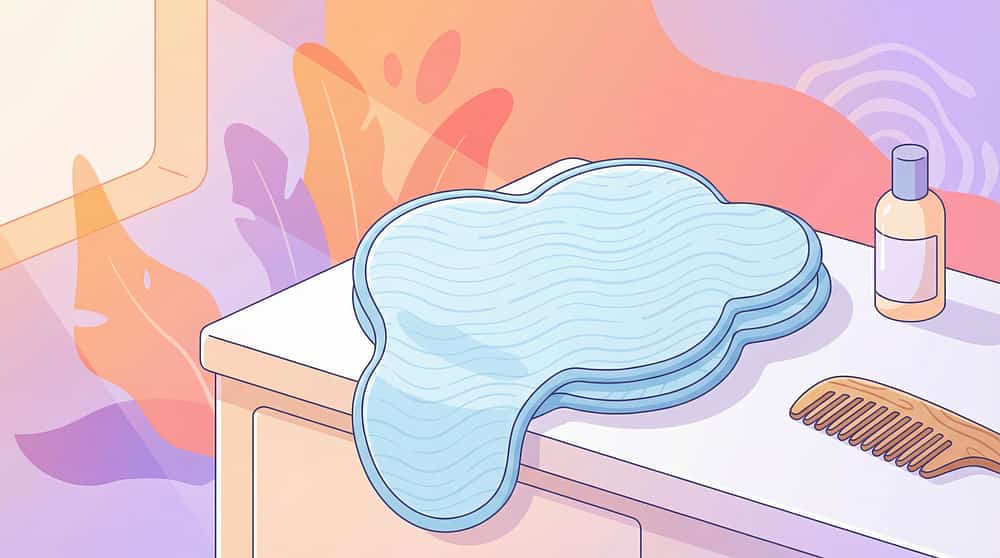
🌊 Material 1: Soft Microfiber Washcloth — ₹100–300
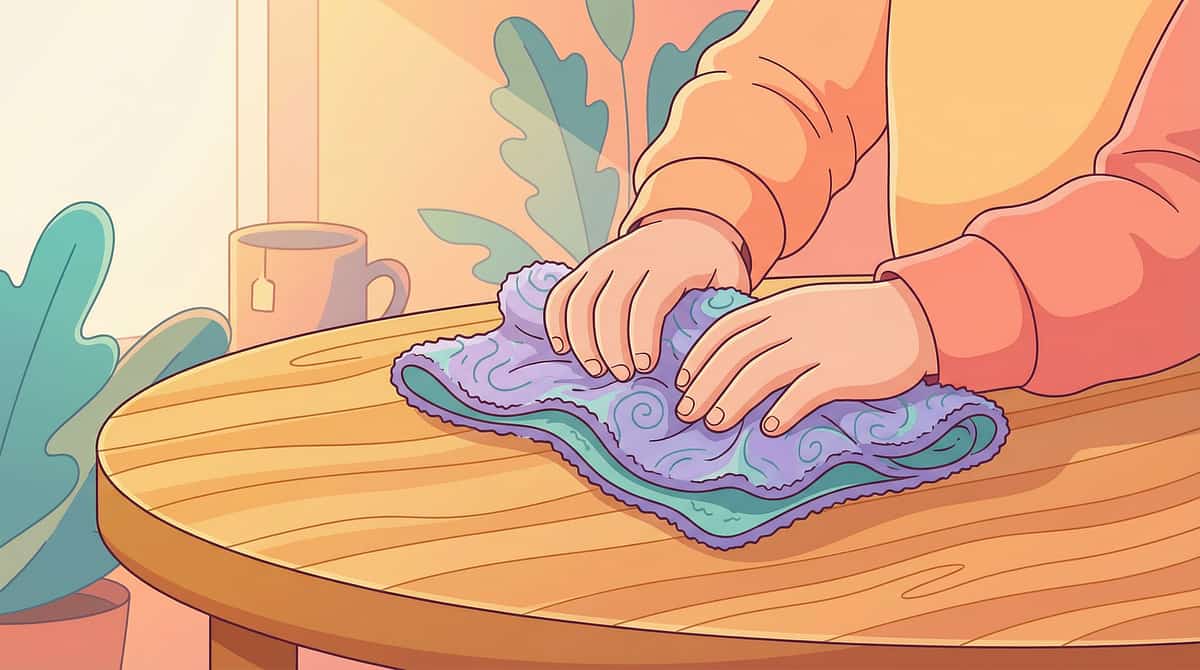
Microfiber washcloths are made of ultra-fine synthetic fibers woven into a fabric significantly softer than standard terry cloth. Terry cloth loops snag against sensitive facial skin and deliver multiple micro-contact points simultaneously — intensifying the tactile signal. Microfiber's smooth, uniform texture delivers a single, consistent, low-intensity signal. It can also be wrung to damp (not dripping wet), eliminating the overwhelming sensation of water running freely down the face.
How to use: Select face-specific microfiber. Wring thoroughly until damp, not wet. Warm slightly under tap. Dab — don't wipe — initially. Progress from dabbing cheeks to full face as tolerance builds. Let child feel it on their hand first.
DIY (₹0): Use the softest worn cotton cloth you own. Old muslin dupattas or soft cotton dusters cut to washcloth size. Search Amazon.in →
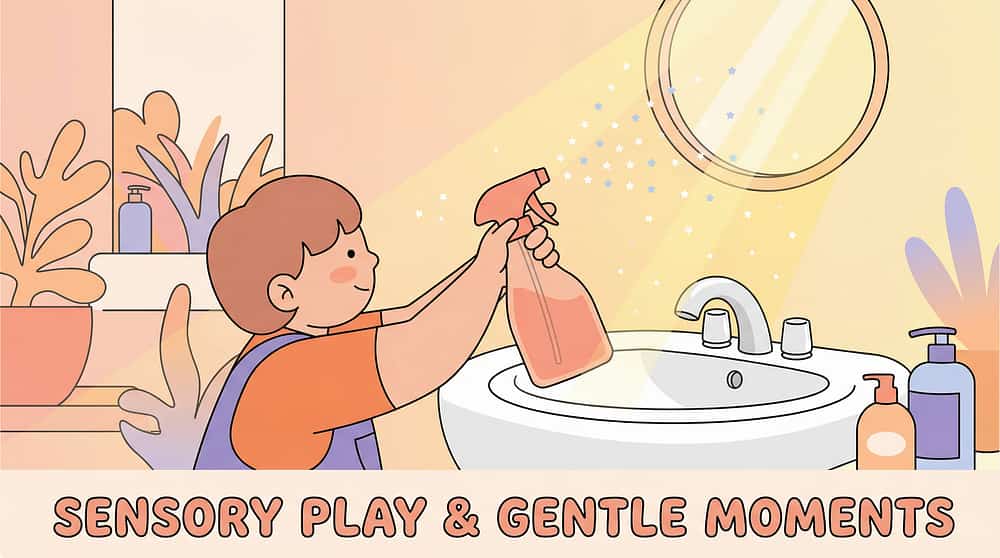
💦 Material 2: Mist Spray Bottle — ₹50–200
A small spray bottle with a fine-mist nozzle that delivers water as a light, dispersed spray rather than a heavy stream or splash. Splashing water delivers an unpredictable, high-volume, multi-directional sensory hit — the worst combination for a tactile-defensive child. Fine mist delivers predictable, low-volume, controllable water. The child can see where it's going. They can stop it at any moment. Agency is the most powerful sensory regulation tool.
How to use: Let child practice spraying into sink first. Progress: hand → wrist → neck → cheeks → full face. Child holds and controls the bottle. Use lukewarm water.
Key insight: When the child controls the bottle, session tolerance typically doubles in the first week. Search Amazon.in →
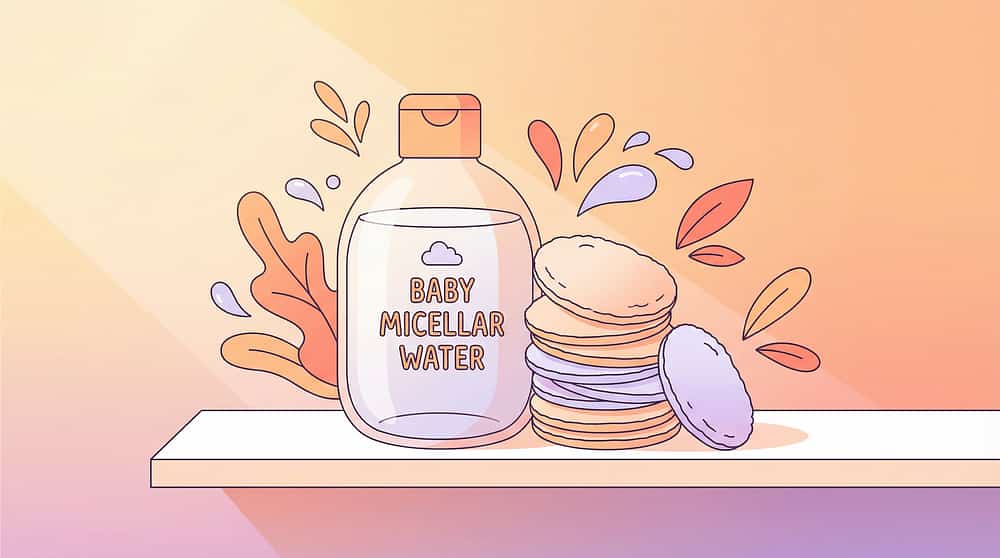
🧴 Material 3: No-Rinse Wipes / Micellar Water — ₹150–500
Fragrance-free gentle cleansing wipes or micellar water that achieve facial cleanliness without any water contact. For children with severe water sensitivity, insisting on water-based face washing every day creates daily trauma that increases resistance over time. No-rinse alternatives achieve the hygiene goal while completely removing the most challenging element. Critically, using these on high-distress days reduces the total aversive experience — which actually accelerates water tolerance building on lower-distress days.
How to use: Use fragrance-free, hypoallergenic formula (test on forearm 24hrs before face). Pat — don't wipe — gently. Use as primary method for severe water sensitivity days. Maintain alongside gradual water tolerance building as parallel tracks.
Key insight: The goal on any given day is a clean face — not necessarily water. Search Amazon.in →
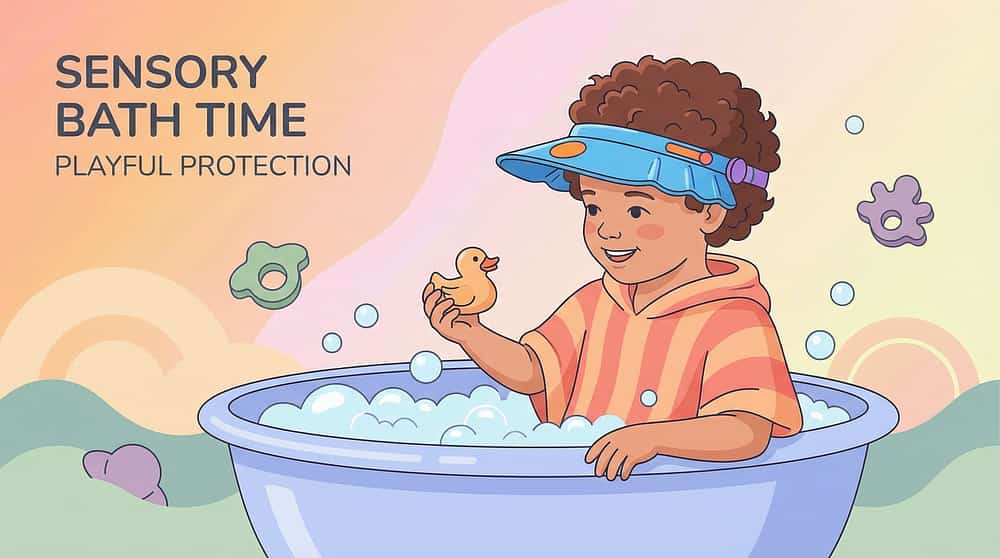
🛡️ Material 4: Shampoo Visor / Eye Shield — ₹100–400
An adjustable plastic shield worn around the head during face washing that creates a waterproof barrier preventing water from running into the eyes. In Pinnacle OT assessments, fear of water entering the eyes is the primary driver of face washing resistance in 60%+ of cases. When this fear is physically removed — not just verbally reassured, but actually blocked by a barrier — children often tolerate water on the rest of the face far more easily.
How to use: Let child wear it dry first. Adjust strap: snug but not pressing on forehead. Show them in the mirror: "See? Your eyes are completely protected." Use for hair washing first, then face washing.
DIY (₹0): A dry soft washcloth held over the eyes by the child themselves. Search Amazon.in →
Materials 5–9: Complete Guides & DIY Alternatives
Materials 5–9 of 9
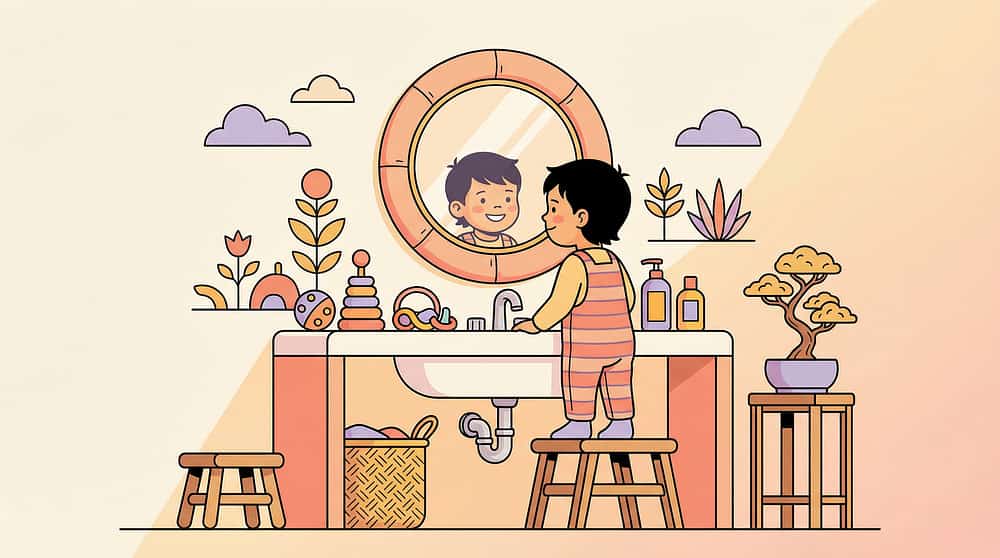
🪞 Material 5: Mirror for Self-Washing — ₹200–800
A shatterproof, child-safe mirror at the child's eye level that enables self-washing with visual feedback. Children who cannot tolerate being washed by another person often tolerate washing themselves because the control variable is completely different. When a parent washes the child's face, the child experiences unpredictable touch from an external source. When the child washes their own face with a mirror, they control every variable — the pressure, the speed, the location, the duration.
Key insight: Many parents report their first successful face washing happened the day they handed the child the cloth and stepped back. Search Amazon.in →
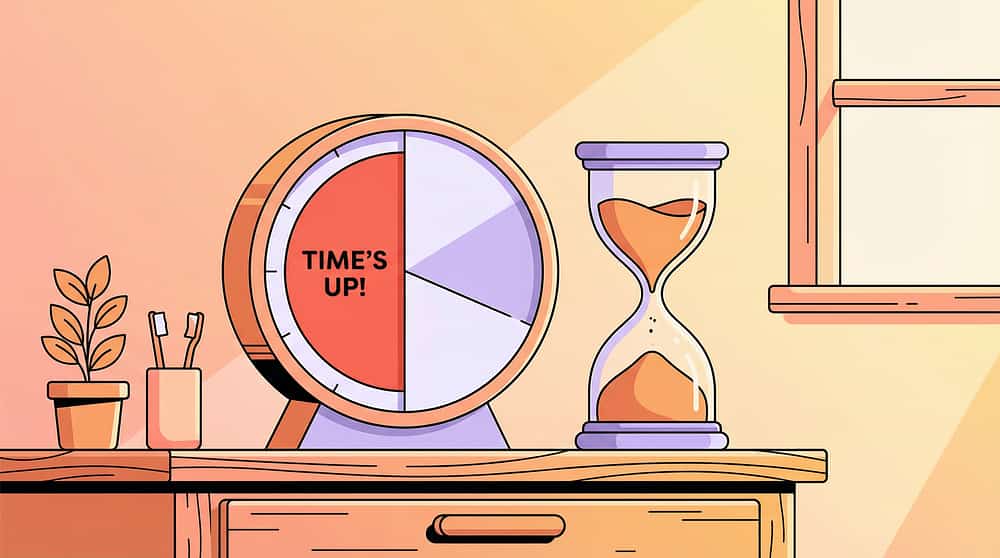
⏱️ Material 6: Visual Timer — ₹200–800
A countdown timer with a visual display that shows exactly how much time remains during face washing. Uncertainty amplifies sensory distress. A child who doesn't know how long face washing will last experiences the discomfort as potentially infinite. Verbal reassurances ("almost done") don't work because children learn they are unreliable. A visual timer is self-evidently truthful — the child can verify it themselves.
Critical rule: Honor the timer EVERY time. When timer ends, washing ends, even if not perfect. Progression: Day 1=20sec → Day 7=30sec → Day 14=45sec → Day 30=60sec+. Search Amazon.in →
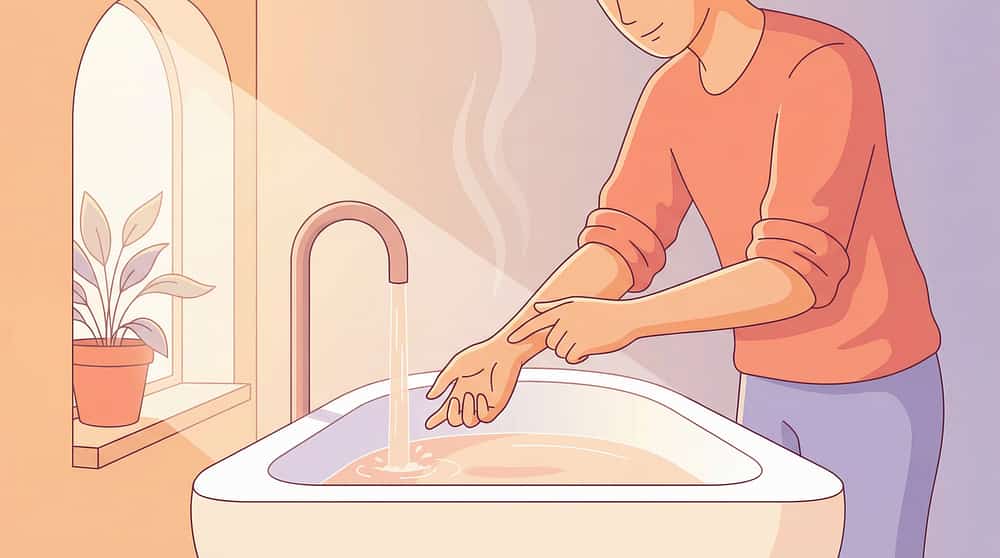
🌡️ Material 7: Consistent Warm Water Temperature — ₹0–500
Deliberate, consistent management of water temperature — testing before each use, ensuring the temperature is comfortably warm every time, without variation. Temperature extremes are additional sensory stressors layered on top of the already-challenging experience. But beyond comfort — inconsistency itself is stressful for sensory-sensitive children. When water temperature is reliably the same every session, it removes one unpredictable variable from the equation. Predictability = safety.
Key insight: Children learn: "Face washing water is always comfortable." This predictability reduces anticipatory anxiety significantly. No purchase required — this is a practice, not a product.

🖌️ Material 8: Facial Desensitization Brush — ₹100–400
A very soft facial brush or silicone face pad used during calm, non-washing moments to gently introduce controlled tactile input to the face — building tolerance outside of the high-stress hygiene context. The most effective sensory desensitization happens away from the aversive activity. Regular gentle exposure during relaxed states progressively raises the sensory threshold — making the same tactile input feel less intense during actual face washing.
4-week progression: Hand → Arm → Cheek → Whole face. 2–3 minutes daily during calm bedtime routine. Never force. Key insight: 5 minutes with a desensitization brush at bedtime changes face washing at 8am. Search Amazon.in →
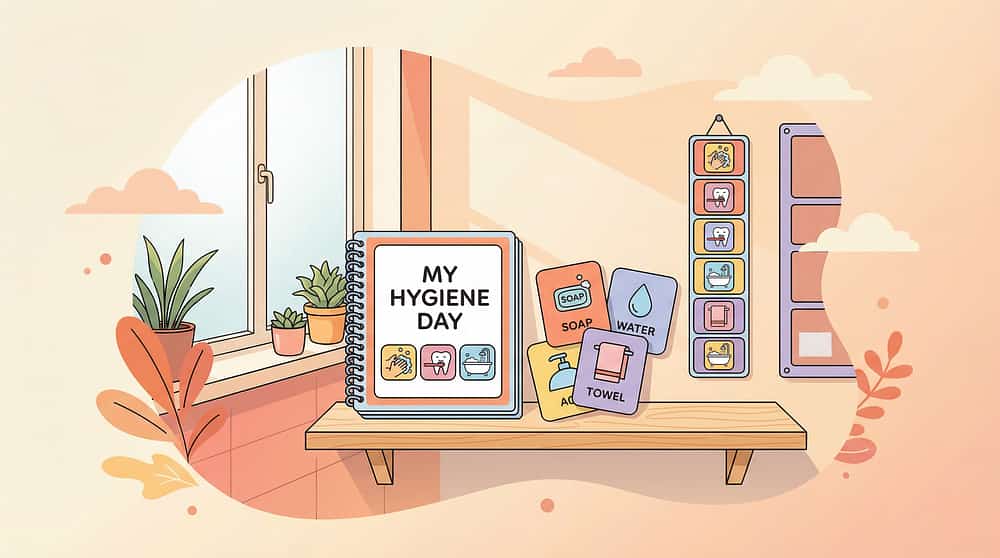
📖 Material 9: Social Story / Visual Sequence — ₹100–500
A personalized short story or picture-based step sequence that shows exactly what face washing involves — each step, in order, with coping strategies and a positive ending. Read together with the child before washing begins. For children with autism and anxiety, the unknown amplifies every other stressor. A social story eliminates the unknown entirely — the child knows exactly what will happen, in what order, for how long, and what the positive outcome will be.
Create yours: Use photos of YOUR child, YOUR bathroom, YOUR materials. Laminate for water resistance. Read before every session. DIY (₹0): Hand-drawn stick figures work. Free templates at autism.org. Search Amazon.in →
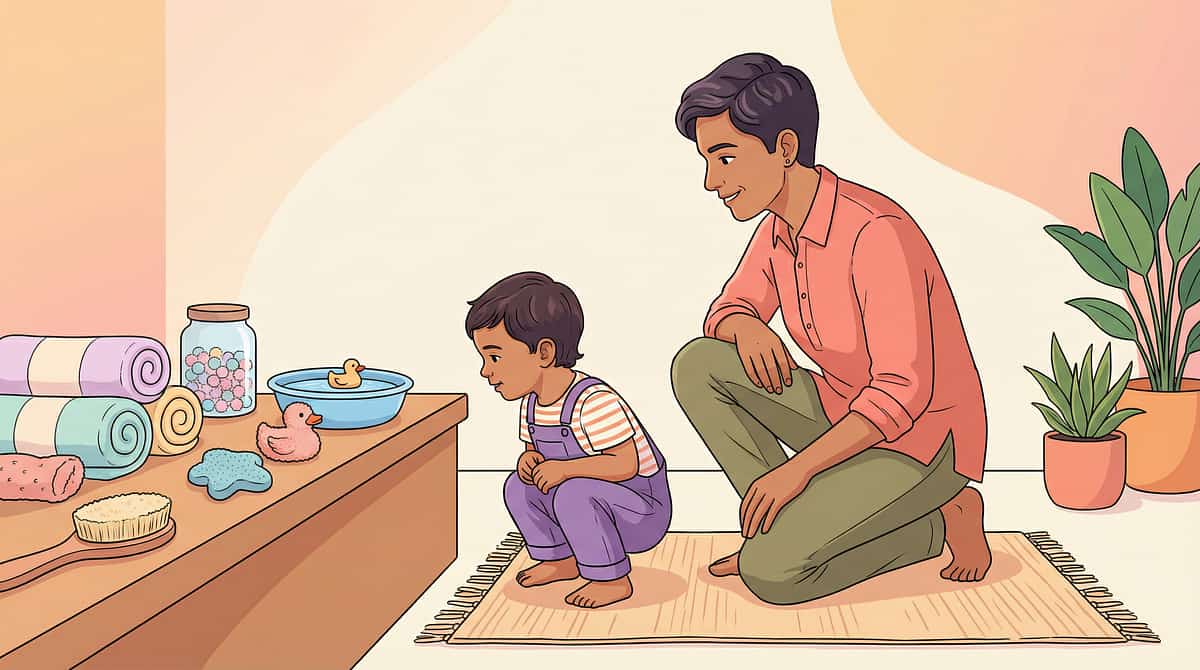
Before Every Session: A 60-Second Safety Gate
🔴 DO NOT PROCEED IF
- Child has active skin condition, rash, or wound on face
- Child is sick, feverish, or in acute distress unrelated to face washing
- Child had a significant meltdown in the last 30 minutes
- New materials have not been tested on forearm 24hrs first
- Child shows signs of eye infection or conjunctivitis
🟡 MODIFY TODAY IF
- Child is more dysregulated than usual (difficult day, poor sleep)
- Morning is rushed — use no-rinse wipes instead
- Preferred materials are not available — substitute before skipping
- Child verbally protests but is not in acute distress — offer extra control today
🟢 PROCEED WHEN
- Child has had food and water in last 2 hours
- Child is in a regulated, reasonably calm baseline state
- Preferred materials are ready and set up
- You have 3–5 unrushed minutes
- Visual timer is charged/ready
🚨STOP IMMEDIATELY IF: Child becomes severely distressed (screaming, hitting, self-injuring), gags or has breathing difficulty, or develops a skin reaction. Contact Pinnacle Helpline: 9100 181 181

The Right Environment Is Half the Session
Staged Materials (Left of Sink)
- Soft microfiber cloth (wrung out and ready)
- Spray bottle (filled, set to finest mist)
- Visual timer (visible from sink position)
- Shampoo visor (hanging, accessible)
Pre-Session Ritual (4 Steps)
- Child reviews social story (30 seconds)
- Child sees and touches their chosen materials
- Timer shown and agreed on
- Parent: "You choose — spray bottle or cloth today?"
Environmental Checklist
- ☐ Lighting: Soft, not harsh overhead — side lighting preferred
- ☐ Temperature: Bathroom warm — cold rooms increase sensory reactivity
- ☐ Sound: Background noise minimized — no TV or loud music
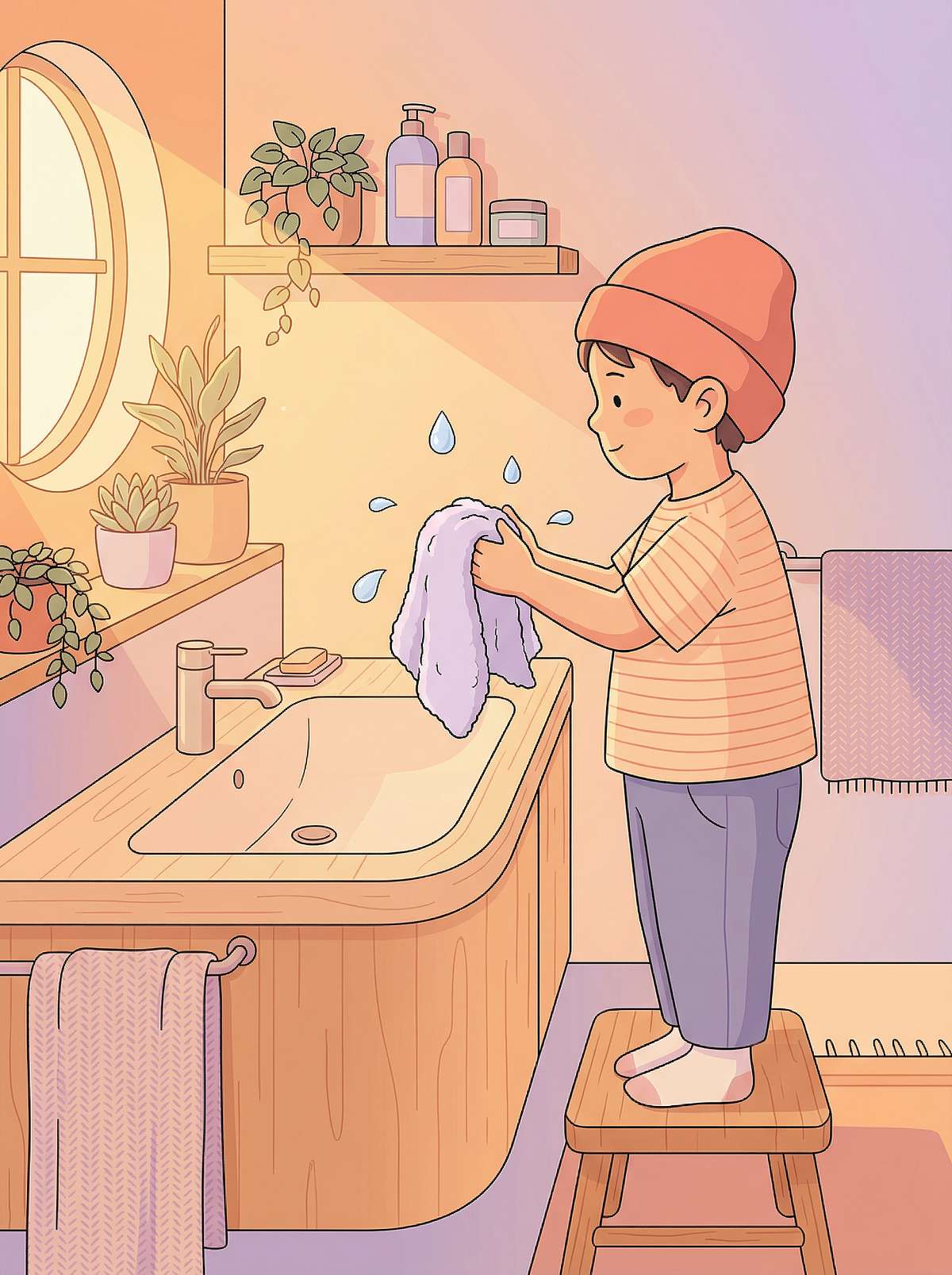
- ☐ Stool: Child's feet flat on surface — proprioceptive grounding reduces anxiety
- ☐ Social story: On hook near mirror for pre-session reading
- ☐ Reward: Preferred item/activity visible nearby
Mirror position: Child should see their face clearly. Parent position: Behind and slightly to one side — never blocking mirror view. Key principle: Spatial preparation prevents 80% of session failures.
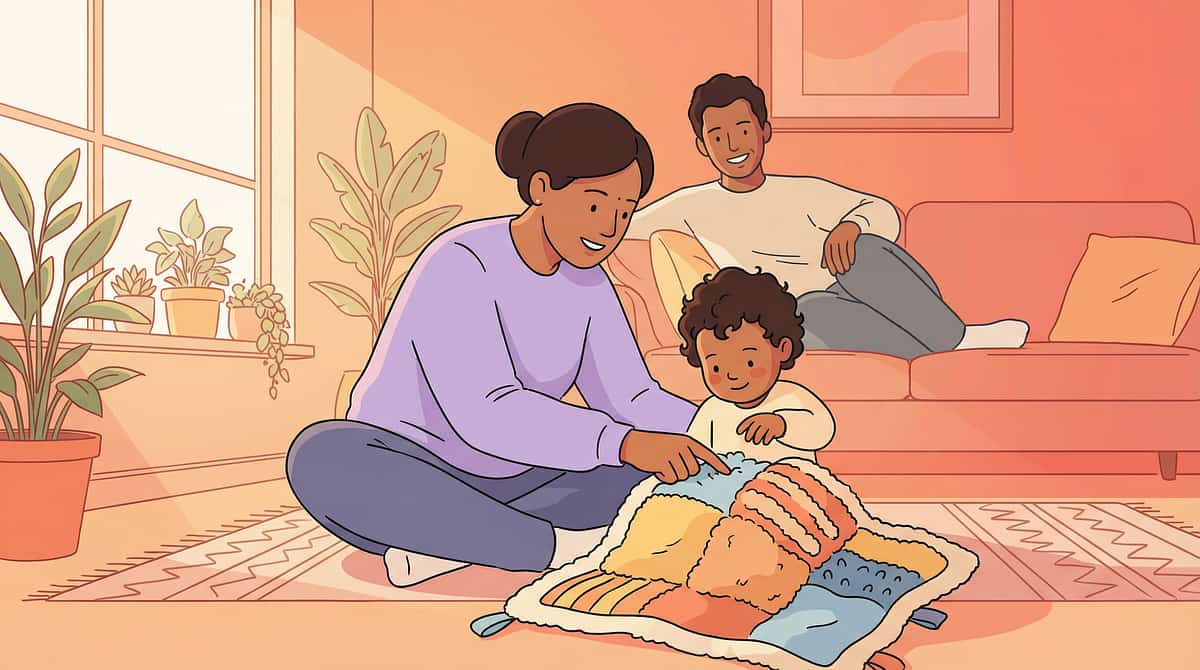
60-Second Check. The Best Session Starts Right.
Check | ✅ Go | 🟡 Modify | 🔴 Postpone | |
Emotional state | Calm/content | Mildly irritable | Crying/meltdown | |
Last meal | Within 2 hours | 2–4 hours ago | Hungry/thirsty now | |
Sleep | Normal night | Some disruption | Significantly overtired | |
Recent meltdown | None in 2hrs | 1hr ago | Just happened | |
Illness signs | None | Mild (runny nose) | Fever/active illness | |
Time available | 5+ minutes | 3 minutes | Rushed (<2 min) | |
Materials ready | All available | Most available | Key item missing |
🟢 GO (5+ green)
Proceed with full session as planned.
🟡 MODIFY (2–4 amber)
Shorten timer by 50%. Use spray mist only, or no-rinse wipes. High reinforcement at end.
🔴 POSTPONE (any red)
Use no-rinse wipes for hygiene. Do 2 min desensitization brush on hands only. Note reason in data tracker.
Session abandonment is not failure — it is clinical wisdom. The child's state is data that shapes tomorrow's session.
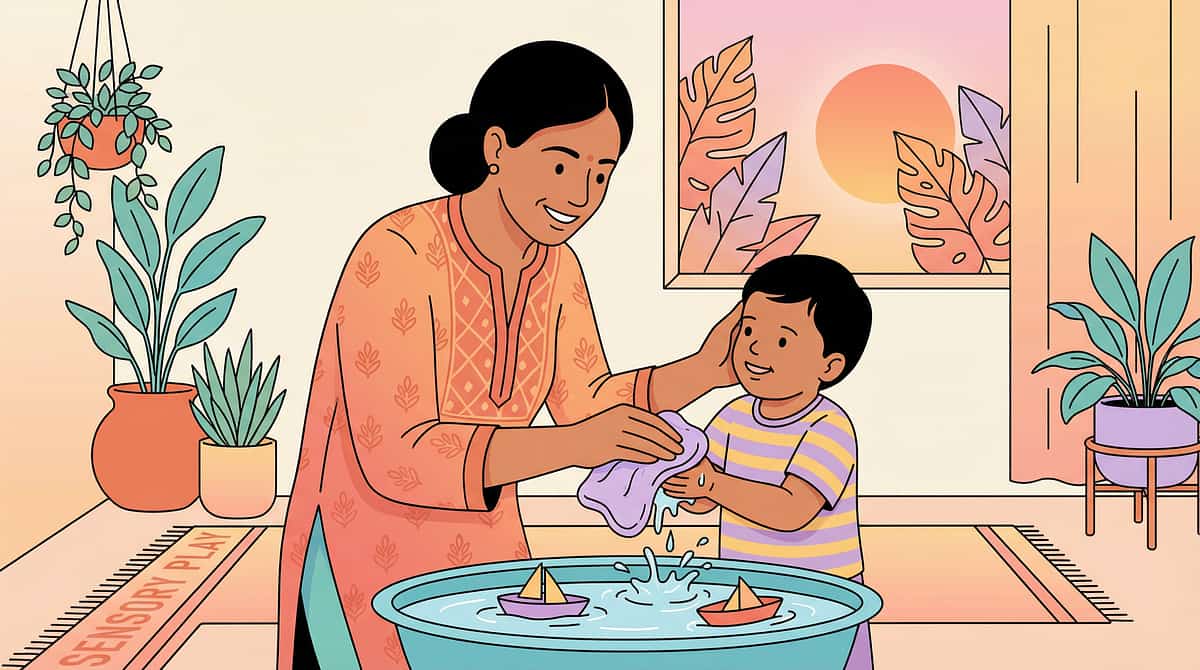
Step 1 of 6
The Session Begins With an Invitation. Never a Command.
"Hey — it's face washing time. Which do you want today — the spray or the soft cloth?"
Why an Invitation Works
Giving two acceptable options immediately shifts the child from "something is happening to me" to "I am making a choice." This is the ABA pairing principle: before any demand, establish motivation and buy-in. The child's choice doesn't change the outcome (face gets washed) — but it transforms the experience from coercive to collaborative.
Parent Body Language
- Crouch to child's eye level — don't stand over them
- Neutral, calm voice — not overly cheerful
- Wait for response — up to 30 seconds — before gently re-offering
- Have materials visible but not thrust toward child
✅ Acceptance Cues — Proceed to Step 2
- Child picks up or points to a material
- Child approaches the sink
- Child says "okay," "spray," "cloth," or any affirmative
⚠️ Resistance Cues — Modify, Don't Force
- Child moves away from sink — ask again in 2 minutes with smaller offer
- Child says "no" firmly — offer no-rinse wipe as alternative today
- Child shows significant distress — check readiness gate again
Timing: 30–60 seconds
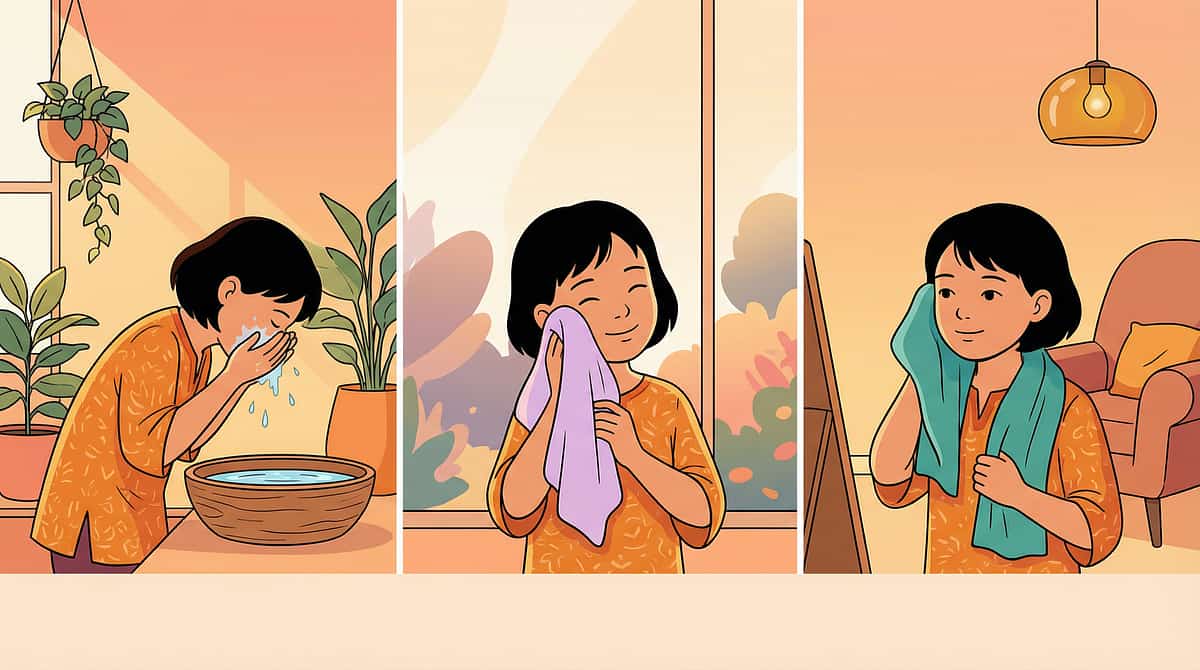
Step 2 of 6
The Child Is Engaged. Now Introduce the Material.
"Okay, let's check the water temperature first — can you feel? Is that okay? Great. And here's your timer — we're going for [chosen duration]. Watch the red part."
Material Introduction
- Hand child their chosen material (spray bottle or cloth)
- Let them hold it before any water touches their face
- "This is YOUR [spray bottle / soft cloth]. You're in charge of it."
- Show them the timer: "When this finishes — done. I promise."
Engagement Indicators
- Child examines/holds the material with curiosity → proceed to Step 3
- Child is willing but nervous → narrate the timer, remind them of control
- Child gives material back → reduce scope today (hands, not face yet)
Reinforcement Begins Here
Begin verbal praise for any engagement — deliver within 3 seconds of each positive interaction:
- "Good — you held the cloth. That's brave."
- "Yes — you tested the water. Perfect."
Timing: 30–90 seconds

Step 3 of 6
The Washing Happens Now. Child-Led. Timer Running.
Spray Bottle Approach
- Child sprays mist onto own face at own pace
- Parent narrates: "The mist is soft. Watch the timer."
- Focus areas: cheeks first → forehead → around mouth (hardest — save for last)
- One spray at a time initially
Cloth Approach
- Child holds cloth to own cheek → gentle dabbing
- Parent: "Dab — like patting a puppy gently"
- Start with cheeks → work toward chin and forehead
- Visor in place if eye fear is present
Child Response Spectrum
- Ideal: Child washes independently, tolerates fully, timer is fine
- Acceptable: Child washes some areas, parent assists others, mild protest
- Concerning: Child becomes acutely distressed mid-session → honor timer early or switch to wipes
Common Errors to Avoid
- ❌ Parent holds child's head still — DO NOT DO THIS
- ❌ Parent rushes through before timer ends — destroys timer trust
- ❌ Parent adds soap before water tolerance is established
Timing: 20–90 seconds (duration of timer). Child leads. Parent guides only.
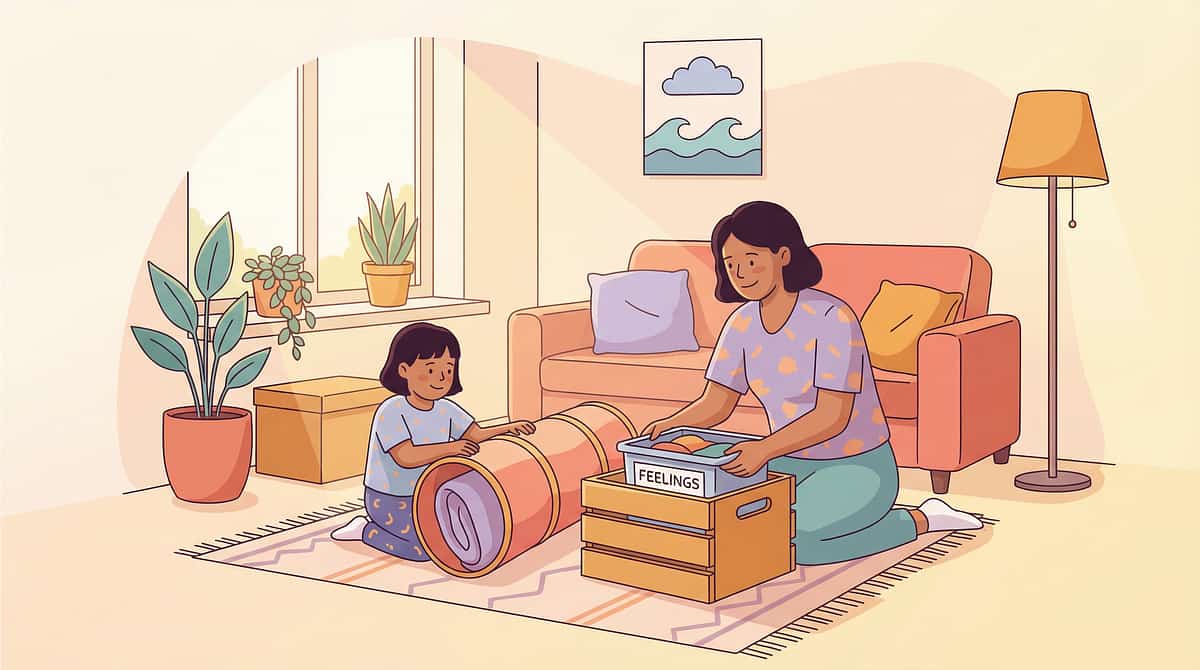
Step 4 of 6
3 Good Reps Beat 10 Forced Ones
Daily Repetition Guidance
- Week 1–2: Single brief session daily with maximum supports
- Week 3–4: Same session, slight duration increase
- Week 5–8: Add one "practice wash" mid-day with less support (e.g., after outdoor play)
Within-Session Variation
- Alternate: spray bottle day / cloth day
- Alternate: warm cloth / cool cloth (as tolerance grows)
- "Wash teddy's face first, then yours" — parallel play desensitization
Satiation Indicators — Stop Adding When You See
- Increasing irritability mid-session
- Child starts refusing mid-session after previously accepting
- Physical resistance increases rather than decreases
Progress Indicator
Keep a simple tally: days where timer was honored with minimal resistance. If 5 out of 7 days in any week are "minimal resistance," increase duration by 5 seconds next week.
Timing: Ongoing daily, 20–90 seconds per session.

Step 5 of 6
Celebrate the Attempt. Not Just the Success.
Reinforcement Timing: Within 3 seconds of timer ending — always.
"You did it! That was hard and you did it anyway. I'm so proud of you."
"You used the soft cloth all the way to the end. That's amazing."
"The timer finished and you kept going. Your brain is getting stronger every day."
Social Praise
Immediate, specific, enthusiastic verbal praise — always available, always powerful.
Token / Sticker Chart
Canon Reinforcement Menu: sticker chart available at Amazon.in ₹364
Preferred Activity
Brief access to a preferred activity (1 minute of preferred video or toy) immediately after session.
Critical: Never withdraw reinforcement if the wash was imperfect. Celebrate any genuine effort. Perfectionism at this stage destroys the reinforcement contingency.
Also reinforce the parent: "You held steady. You honored the timer. You gave them control. That's professional-grade parenting."
Also reinforce the parent: "You held steady. You honored the timer. You gave them control. That's professional-grade parenting."

Step 6 of 6
No Session Ends Abruptly.
"That's done! Excellent. Now — let's dry your face gently. Pat pat pat — all dry. Well done. What would you like to do now?"
If Child Resists Ending
Paradoxical resistance is common in children who've had previous negative experiences. Honor the timer regardless:
- "The timer said done. We did a great job. I'm keeping my promise."
- Maintain calm authority — the promise is inviolable
Visual Support for Transition
Use a visual schedule where the face washing card physically turns over to the next activity card. The physical act of flipping the card marks the transition clearly and concretely.
Visual supports are classified as evidence-based practice for autism. NCAEP 2020. Transition objects available: animal soft toys ₹425
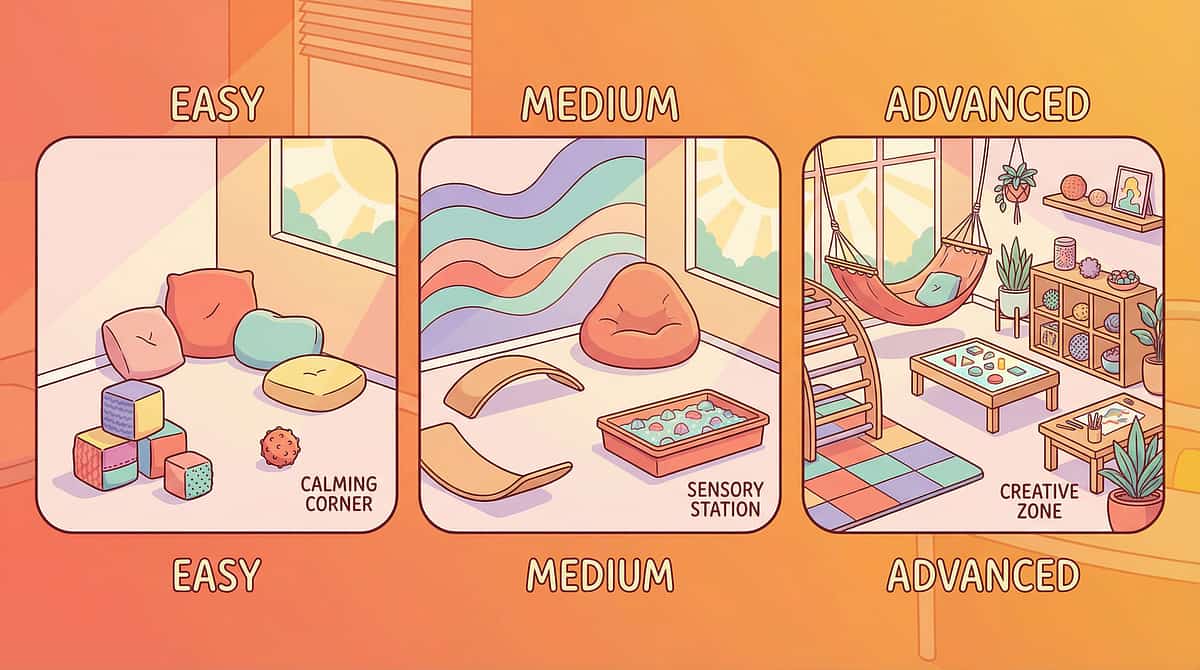
60 Seconds of Data Now Saves Hours of Guessing Later.
⏱️ Duration Tolerated
Timer duration that was honored without crisis. Example: 30 seconds ✅
😟 Distress Level (1–5)
1=calm, 2=mild protest, 3=significant protest, 4=meltdown, 5=session abandoned. Example: Level 2
🧴 Material Used
Which material(s) were most effective today. Example: Spray bottle + visor
Quick Log Format
After face washing, mark on bathroom mirror whiteboard:
[date] [duration] [✅😐😟] — a 5-second record that builds a week of actionable data.GPT-OS® Integration
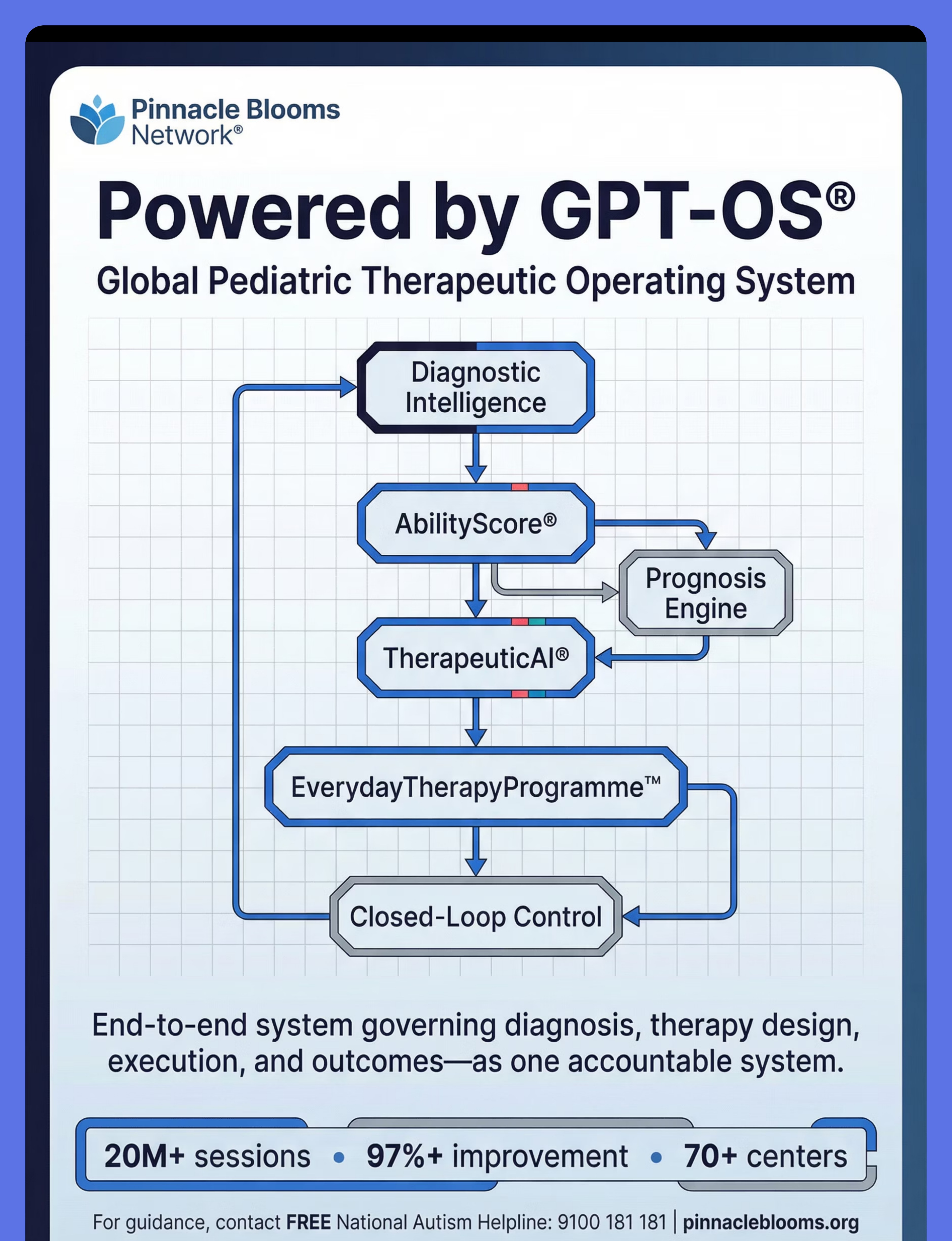
When you log this data in GPT-OS®, TherapeuticAI® adjusts your child's EverydayTherapyProgramme™ recommendations in real-time — what to try tomorrow, when to extend duration, when to add complexity.

Session Abandonment Is Not Failure — It's Data.
Problem 1: Child refuses from the start today
Fix: Offer no-rinse wipe instead. Do 2 minutes of desensitization brush on hands only. No face washing pressure today. Child's regulatory state may be lower than assessment indicated.
Problem 2: Child was fine then suddenly panicked mid-session
Fix: Honor timer early. Ensure visor was positioned correctly. Next session: shorten timer to last successful duration. Water may have entered eye or nose unexpectedly.
Problem 3: Timer works but child still protests verbally
Fix: Continue. Narrate the timer. Celebrate completion more enthusiastically. Do NOT shorten session for verbal protest alone — protest without behavioral crisis is normal early-stage tolerance.
Problem 4: Child accepts spray but refuses cloth completely
Fix: Stay with spray bottle for 2–3 more weeks. Try a different microfiber brand. Test various textures on child's hand. Tactile sensitivity to cloth texture is higher than water sensitivity.
Problem 5: Regression — child was improving but suddenly worse
Fix: Step back 1 week in the progression. Rebuild trust. External stressors (school change, illness, schedule disruption) lower sensory threshold. Temporary regression is expected and normal.
Problem 6: Child gets clean but screams throughout
Fix: This is the initial stage of compliance building — not yet desensitization. Continue consistently. Increase reinforcer value post-session. Distress should decrease by week 3–4.
Problem 7: Parent is burning out from daily battles
Fix: Three no-rinse wipe days per week are acceptable. Perfect hygiene every day is NOT the goal — sustainable progress is. Call 9100 181 181 for parent support guidance.

No Two Children Are Identical. Your Version of This Is Right.
Sensory Avoider
Maximum no-rinse days (3–4/week). Desensitization brush is highest priority. Longest social story preparation. Progress measured in seconds, not minutes.
Sensory Seeker
Use preferred whole-body input before face session (jumping, squeezing). Face washing tolerance often higher when child is "sensory full." Can progress faster.
Anxious Child
Social story is #1 priority — read multiple times per day. Start with chin only. Visor is critical. Extended timeline: 12–16 weeks of gradual systematic desensitization.
Age Adaptations
- Ages 2–4: No-rinse primary, mist secondary, 15-second timer, extensive reinforcement
- Ages 5–8: Spray bottle + mirror focus, 30–60 second timer, social story nightly
- Ages 9–12: Self-washing independence priority, mirror + desensitization brush, reduced parent involvement

Weeks 1–2: Reducing the Fight, Not Achieving the Goal
Initial Tolerance Phase
15% Progress
What You Will See
- ✅ Child accepts the visual timer being set without protest
- ✅ Child makes a choice between materials without meltdown
- ✅ Child tolerates 15–30 seconds with supports in place
- ✅ Resistance before session may remain high — protest at the bathroom door
- ✅ During session, visible stress but not acute crisis
What You Will NOT See Yet
- ❌ Enthusiastic acceptance of face washing
- ❌ Complete absence of protest
- ❌ Child asking to wash their own face independently
What Real Progress Looks Like
- "The meltdown lasted 8 minutes last week. This week, 4 minutes." → Real progress
- "She still cries but she let me finish the 30 seconds." → Real progress
- "He picked the spray bottle himself today." → Real progress
"If your child tolerates the material for 3 seconds longer than last week — that is genuine neurological change. The neural pathway is forming. You are doing this right."

Week 3–4: The Brain Is Filing This as "Safe"
Neural Consolidation Phase
40% Progress
Consolidation Indicators
- ✅ Child begins to anticipate face washing without escalation
- ✅ Preferred material preference becomes consistent ("the spray")
- ✅ Timer is now accepted as reliable — less pre-session anxiety
- ✅ Eye contact with parent during session (previously avoided)
- ✅ Child begins spontaneous approximation behaviors: "washing" toys' faces
What's Happening in the Brain
"The hippocampus is no longer filing face washing under 'threat.' The neural pathway that connects face washing sensation to the amygdala's alarm response is weakening with every successful, non-threatening session. You're literally rewiring the threat-detection system." — Pinnacle NeuroDev Pediatrics
When to Increase Duration
If the child completes 5 out of 7 sessions without crisis at the current timer setting, add 5 seconds next week.
Parent milestone: You may notice that you're approaching the bathroom with less dread. Your nervous system is also recalibrating. You are both getting better at this together.
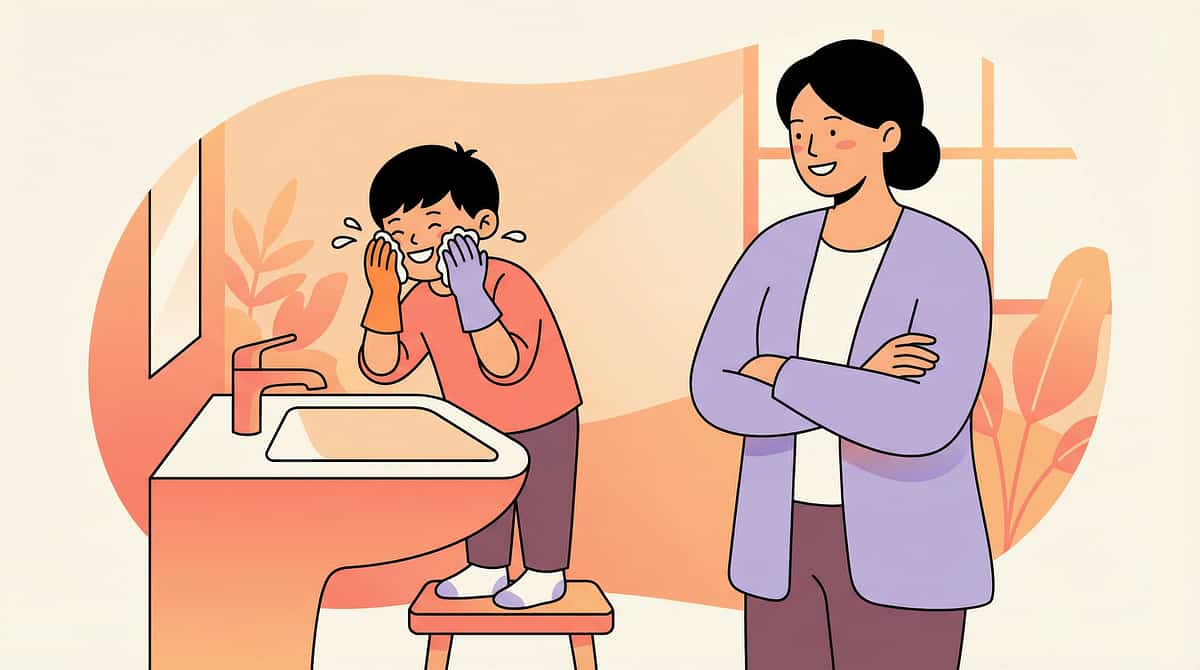
Week 5–8: Mastery Approaching
Mastery Approaching
75% Progress
Session Completion
Child completes face washing with minimal distress (Level 1–2) on 5+/7 days
Independent Initiation
Child reaches for preferred material independently at washing time
Duration Growth
Child tolerates 45–90+ second sessions consistently
Generalization
Child wipes own face after meals, tolerates sunscreen, tolerates rain splash without panic
When to move forward: When mastery criteria are met on 5+/7 days for 2 consecutive weeks, begin removing supports systematically — one less support item per 2-week block. Target: full routine without supports.
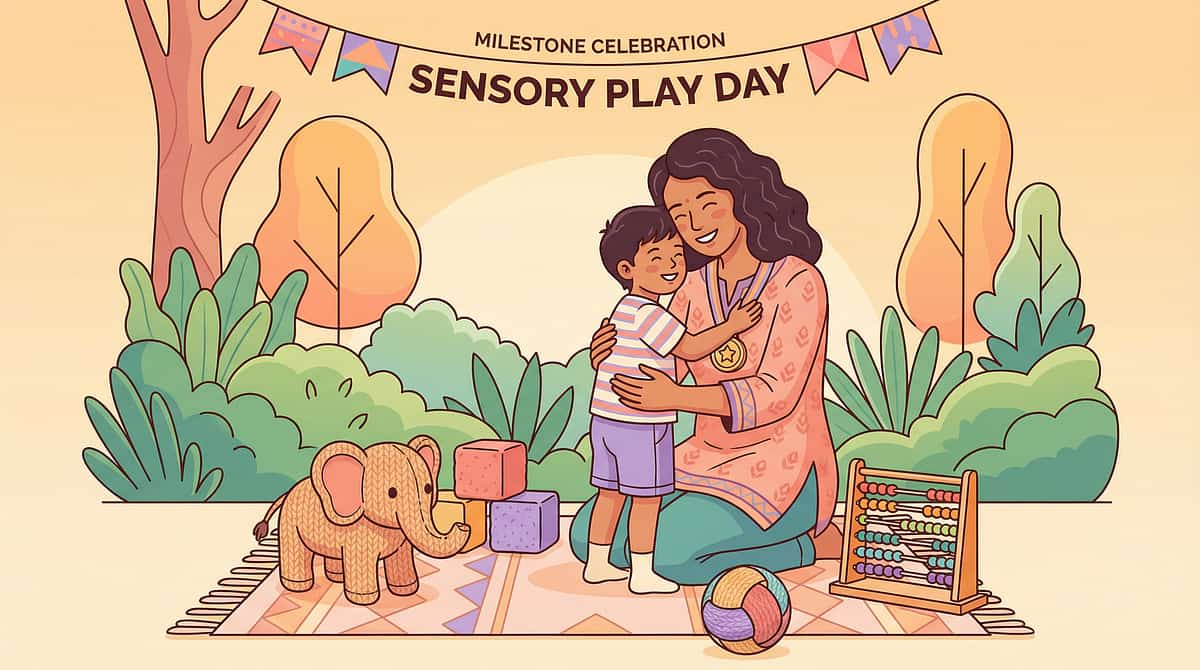
You Did This. Your Child Grew Because of Your Commitment.
You started with a daily battle at the bathroom sink. You had tried gentle, fast, playful, distracting — and nothing worked. You didn't know that the problem was neurological, not behavioral. You didn't know that the right material and the right approach could change everything.
Now you know. And you did the work. Your child's face is clean. Your mornings are calmer. And somewhere in your child's brain, the neural pathway that filed water on the face as "danger" is quieter than it was 8 weeks ago.
That is real. That is measurable. That is yours.
📸 Capture It
Take a photo of your child calmly completing face washing. Keep it — you'll want to remember this moment.
📓 Record It
Write: "Week 8 — [child's name] can now [describe specific achievement]." This is clinical documentation of growth.
🎉 Mark It
Mark this date. Share your journey with the Pinnacle Parent Community. Your story becomes another family's hope.
Trust Your Instincts. If Something Feels Wrong, Pause and Ask.
🔴 No progress after 8+ weeks of consistent application
Sensory processing may need professional OT assessment to identify specific sensory modulation subtype requiring adapted protocol.
🔴 Escalating, not improving, distress
Daily sessions may be increasing trauma rather than building tolerance. Needs OT case review immediately.
🔴 Self-injurious behavior during face washing
Head banging, self-hitting — requires immediate professional assessment. Do not continue protocol independently.
🔴 Significant breathing changes during water exposure
Choking or gasping beyond brief reflex requires medical clearance before any sensory protocol continues.
🔴 Hygiene compromise affecting health
Repeated eye infections or skin conditions from inadequate cleaning needs medical management alongside sensory support.
🔴 Parent-child relationship significantly strained
Family support and respite planning needed alongside clinical intervention. You cannot pour from an empty cup.
Find your nearest Pinnacle center: 📍 Find Pinnacle Center Near Me | FREE Helpline: 9100 181 181 — 24×7
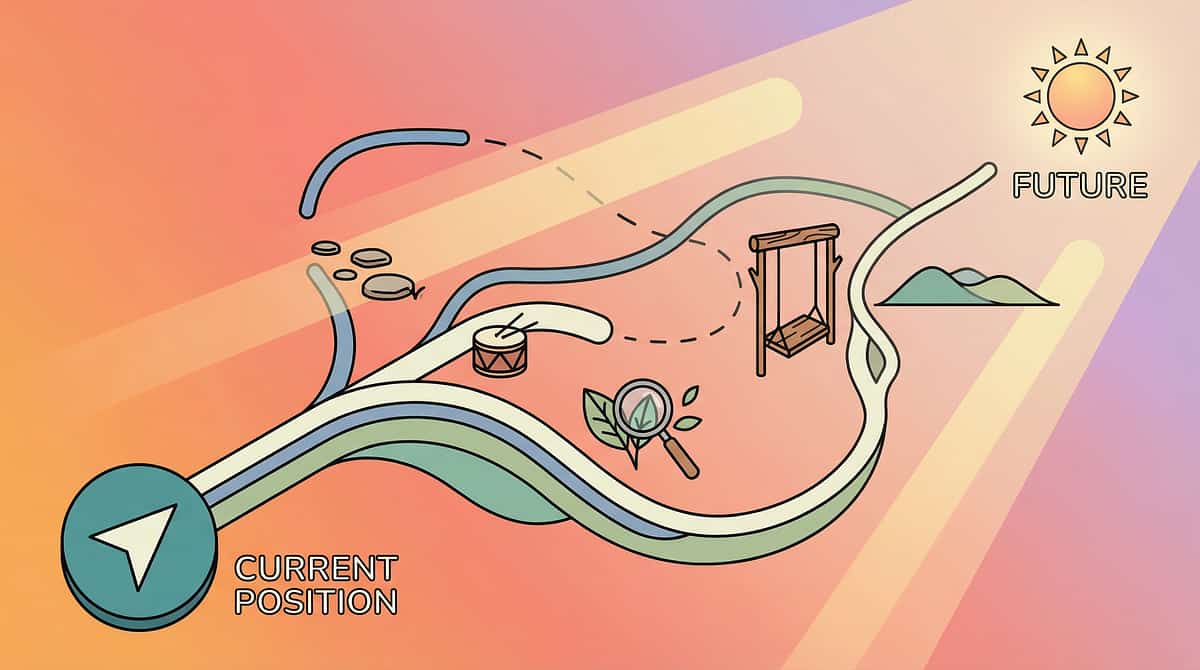
You Are Here. Here Is Where You're Heading.
Progression Principles
- Vertical: Remove one support every 2 weeks as mastery sustains
- Lateral: Apply tolerance skills to adjacent hygiene challenges
- Generalization: Transfer home tolerance to school and community contexts
You Already Have the Foundation. These Techniques Build on It.
Technique | Code | Difficulty | Materials Overlap | |
Hair Brushing Tolerance | E-530 | 🟢 Intro | Soft brush, visual timer | |
Nail Trimming Tolerance | E-531 | 🟡 Core | Visual timer, social story | |
Haircut Tolerance | E-532 | 🟡 Core | Timer, visor, social story | |
Face Washing (THIS) | E-533 | 🟡 Core | All 9 materials | |
Nose Blowing/Wiping | E-534 | 🟡 Core | Soft cloth, social story | |
Bath/Shower Tolerance | E-536 | 🔴 Advanced | Spray, visor, timer |
Materials you already own (for E-533 graduates): Your microfiber cloth works for E-530 | Your visual timer works for E-531, E-532, E-534, E-536 | Your social story skills transfer to all grooming challenges.

Face Washing Is One Piece of Your Child's Developmental Journey
Your Domain E Position
Domain E: Self-Care / Grooming Independence
E-530 → E-531 → E-532 → E-533 → E-534 → E-535 → E-536
E-530 → E-531 → E-532 → E-533 → E-534 → E-535 → E-536
Connecting Domains
Face washing tolerance feeds directly into:
- Domain A (Sensory Processing): Core sensory modulation skills
- Domain J (Adaptive Behavior): Functional daily living independence
- Domain C (Emotional Regulation): Managing distress in demanding situations
This technique supports WHO Nurturing Care Framework Component 5: Early Learning through functional daily living skills. WHO NCF Resource
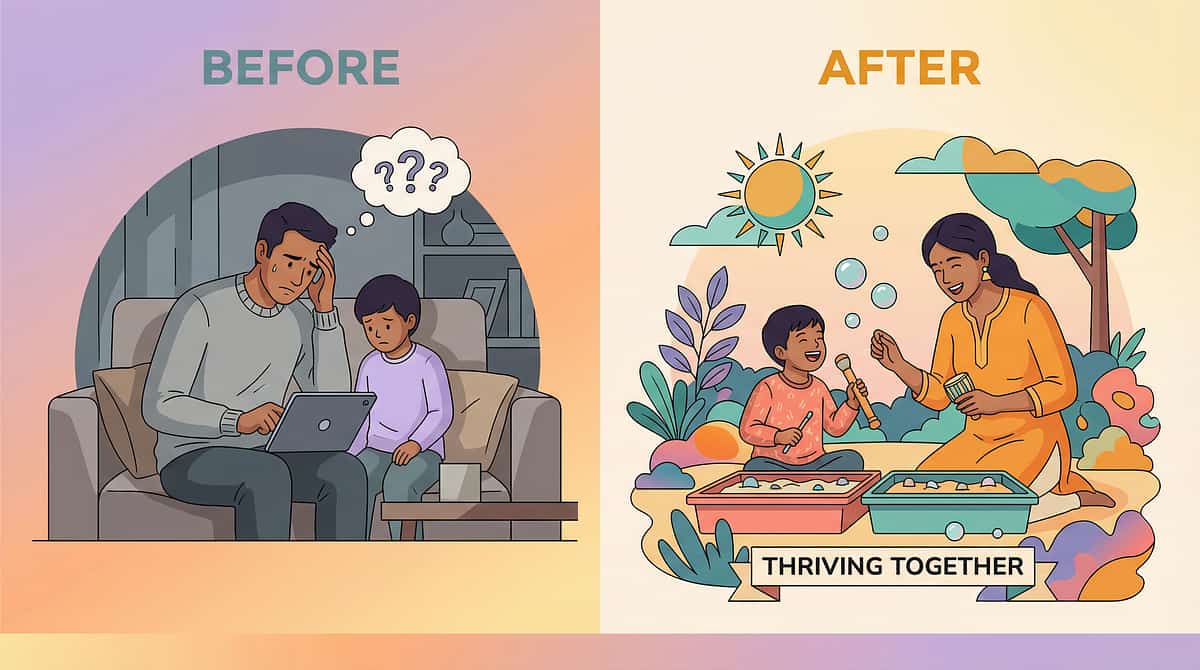
From Impossible to Independent: Three Family Journeys
Hyderabad — 8 Weeks
"Every morning was a battle. My 6-year-old would run to her room when she saw the washcloth. Week 3, she started reaching for the spray bottle herself. Now she washes her own face. Every morning."
OT Note: The child-held spray bottle was the pivotal change. Her distress wasn't about water — it was about loss of control. Returning control returned tolerance.
Bengaluru — 6 Weeks
"He's 4. Can't tolerate anything near his face. We skipped water for 2 weeks — only no-rinse wipes. Week 4, he sprayed his own cheek. Week 6, full face mist with the visor on. Progress is real."
OT Note: Starting without water was the key. Achieve hygiene first, build tolerance second. Don't sacrifice both goals by insisting on only one path.
Chennai — 10 Weeks
"My daughter is 9 and still panicked. The mirror changed everything. When I handed her the cloth and stepped back — she did it herself. She washes her own face every morning now."
OT Note: Self-washing with visual feedback is a fundamentally different sensory experience. The control variable changes everything.

You Are Not Solving This Alone
WhatsApp Parent Group
Face Washing & Grooming Sensory Challenges — connect with parents navigating the same specific challenge. Join Pinnacle Grooming Independence Parent Group →
Online Community Forum
Pinnacle Parent Network — ask questions, share wins, get advice from experienced parents navigating the same journey. Join Pinnacle Parent Network →
Local Parent Meetups
Hyderabad • Bengaluru • Chennai • Mumbai • Delhi • Pune • Kochi + 60 more cities. Find a Parent Meetup Near You →
Peer Mentoring
"My experience helps your journey — your experience helps the next family." Connect with a parent who has navigated this exact challenge successfully. Request a Peer Mentor →
FREE Helpline: 9100 181 181 — 16 languages, 24×7, always free. "Over 1,000 individuals from 111 countries contributed to the WHO Nurturing Care Framework — because community knowledge is clinical knowledge."
Home + Clinic = Maximum Impact
Therapist Matching for Face Washing Support
- Primary: Occupational Therapist (sensory processing specialist)
- Supporting: Behavioral Analyst / BCBA (compliance + reinforcement design)
- If needed: NeuroDev Pediatrician (full sensory profile assessment)
What Professional OT Adds
- Standardized sensory processing assessment (not available from this page alone)
- Individualized sensory diet incorporating face washing within full sensory program
- Access to clinical-grade desensitization tools and protocols
- FusionModule™: coordinated OT + ABA + home program
Access Your Team
Find your nearest Pinnacle center with OT services: 📍 Find Pinnacle Center Near Me
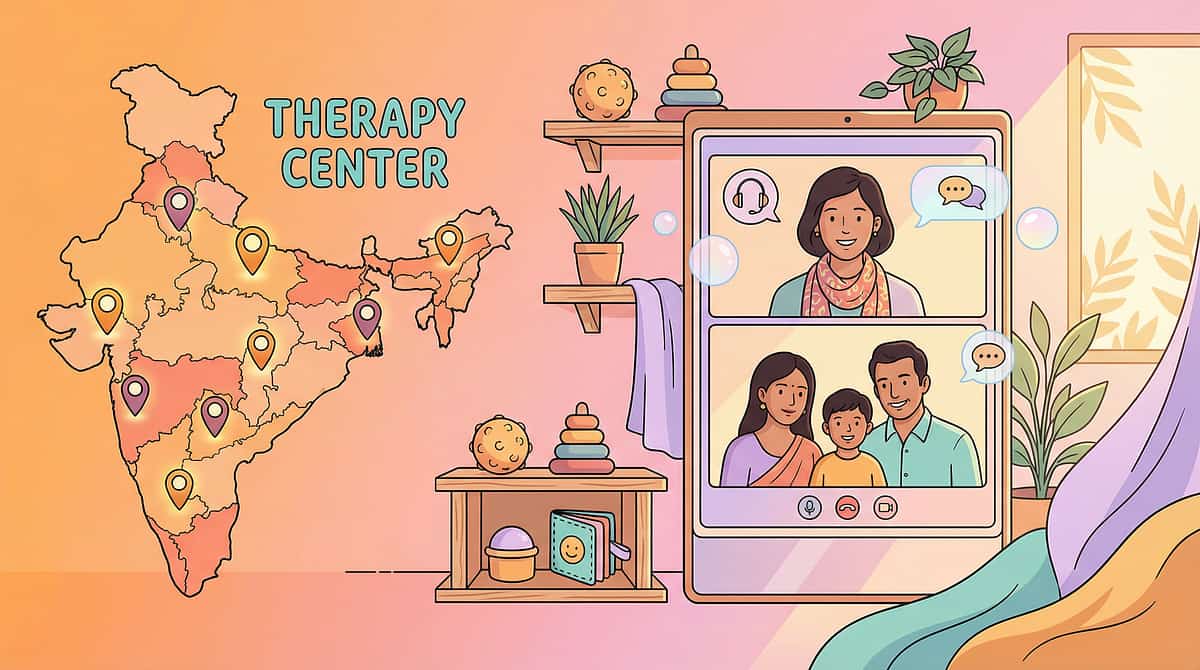
Teleconsultation
Can't visit a center? Teleconsultation is available in your language. 📱 Book Teleconsultation Now
FREE Helpline
9100 181 181 — first call is always free, in your language, 24×7. → See all Pinnacle OT Techniques

Deeper Reading for the Curious Parent and the Referring Clinician
PRISMA Systematic Review (2024)
16 articles (2013–2023): Sensory integration intervention meets evidence-based practice criteria for children with ASD. Supports material-based tactile desensitization approaches. PubMed PMC11506176
World J Clin Cases Meta-Analysis (2024)
24 studies: SI therapy promotes social skills, adaptive behavior, sensory processing, and motor skills. Self-care and grooming tolerance are primary adaptive behavior outcomes. PubMed PMC10955541
WHO Care for Child Development Package (2023)
Implemented across 54 LMICs. Caregiver-delivered interventions using household and simple therapeutic materials demonstrate efficacy for developmental support. PMC9978394
Indian RCT — Padmanabha et al. (2019)
Home-based sensory interventions with parent training demonstrate significant outcomes in Indian children with autism. Context-appropriate materials guidance included. DOI: 10.1007/s12098-018-2747-4
NCAEP Evidence-Based Practices Report (2020)
Visual supports (timers, schedules, social stories) classified as evidence-based practice for autism. Video modeling for parent training also classified as EBP. NCAEP 2020 Report
Your Data Helps Every Child Like Yours
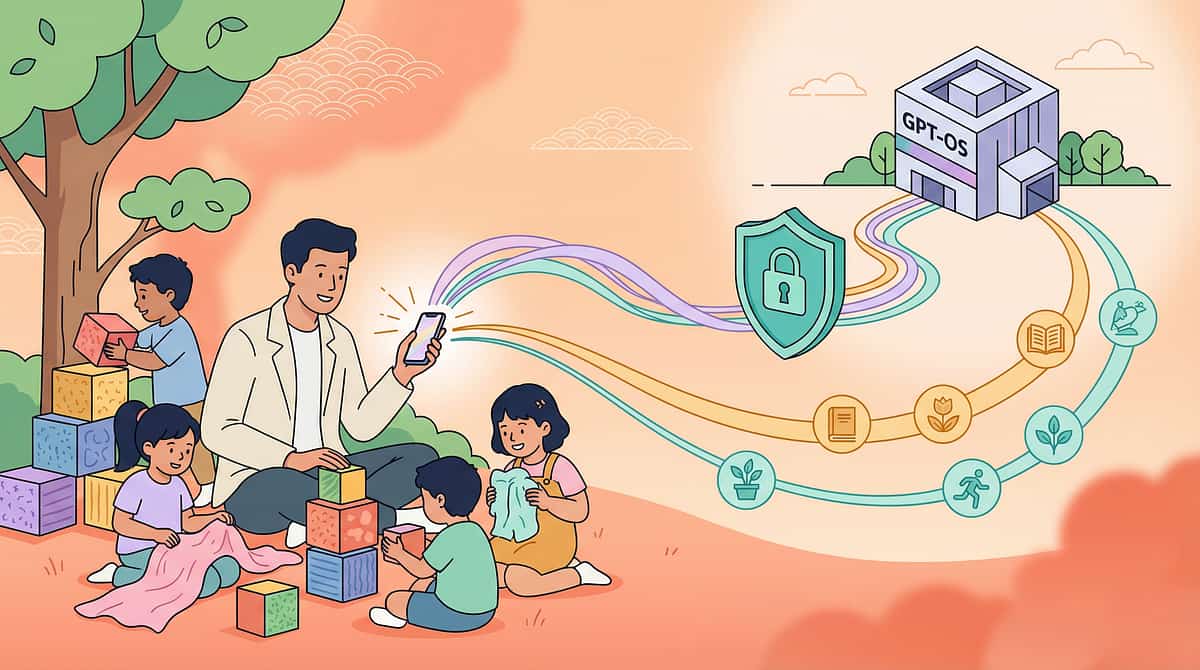
GPT-OS® Data Flow
- Your session data → Face Washing Tracker Input
- → GPT-OS® TherapeuticAI® analysis
- → Adjusts tomorrow's session goal
- → Identifies tolerance inflection points
- → Triggers next technique readiness signals
- → Updates your child's AbilityScore®
- → EverydayTherapyProgramme™ Update
- → Better sessions for YOUR child
What GPT-OS® Learns
- Sensory processing modulation patterns (duration-distress relationship)
- Material preference profiles (what works for which child profile)
- Tolerance trajectory curves (predicts when next level will be reached)
- Family adherence patterns (what level of support yields best compliance)
Privacy Assurance
- All data anonymized under Indian Data Protection Standards
- Never shared with third parties
- Used only for YOUR child's clinical improvement and de-identified population research
The Collective Intelligence: 20M+ sessions from 70+ centers across India have trained the GPT-OS® model. When you add your data, you improve recommendations for every child with a profile similar to yours.
Questions Parents Actually Ask
Is face washing sensitivity always autism-related?
No. Tactile defensiveness on the face occurs across neurotypes — in children with SPD, ADHD, anxiety disorders, developmental coordination disorder, and also in neurotypical children who have had negative early experiences with water on the face. The materials and strategies here work for all these profiles. That said, if facial sensitivity is one of multiple sensory challenges, a developmental assessment is worth pursuing.
How long before I see real improvement?
Most families see measurable reduction in distress within 2–3 weeks of consistent application. Significant improvement typically occurs by weeks 4–8. Full self-washing independence: 8–16 weeks depending on starting point and consistency. Some children with severe tactile defensiveness require 6+ months.
Should I push through resistance or always stop?
Stop at acute crisis (screaming, self-injury, vomiting). Continue through mild-moderate verbal protest if the timer is running and the child is safe. Distress level 1–3: continue. Levels 4–5: stop. When in doubt, use the distress scale from the data tracking card.
My child does fine with the spray but refuses the cloth — is that okay?
Yes, absolutely. Material preference is clinically meaningful information — it tells you the texture component is more aversive than the water component for your child. Continue with spray bottle as primary tool. Gradually introduce softer cloth textures on the hand, not face, over weeks.
Can I use these materials without professional OT first?
These materials are appropriate for home use by caregivers without prior professional assessment. If you see no improvement after 6 weeks of consistent application, or if distress is severe (crisis-level), seek OT assessment. These materials do not replace clinical OT — but they are safe to begin now.
My child wears the visor but still panics — why?
The visor addresses eye-fear specifically. If your child panics with the visor on, the primary driver is likely tactile intensity of water (not eye fear). The mist spray bottle, microfiber cloth, or no-rinse options become the higher-priority materials. Identify the specific trigger: is it the water itself, the rundown sensation, or fear of eye contact?
Are these materials available across India?
Yes. All 9 materials are available at Amazon.in, local pharmacy chains, and baby specialty stores (Mothercare, FirstCry). For cost-sensitive families, DIY alternatives for all 9 materials are provided — some require no purchase at all.
Can I use these for a child under 2?
With modifications, yes. For ages 12–24 months: microfiber cloth only (no spray), 10–15 second exposures, no-rinse wipes as primary, maximum reinforcement. Avoid social stories (require comprehension above age 2). The primary goal at this age is minimizing aversive association through gentle, brief, heavily reinforced encounters.

The Materials Are Clear. The Steps Are Clear. Your Child Is Ready.
🟢 Start This Technique Today
Launch your first face washing session with GPT-OS® guidance
📞 Speak With an OT Specialist
Book a teleconsultation or call FREE Helpline: 9100 181 181
→ Explore Next Technique: E-534
Nose Blowing/Wiping — the next step in self-care independence
20M+
Sessions Delivered
97%+
Measured Improvement
70+
Centers Across India
70+
Countries Reached
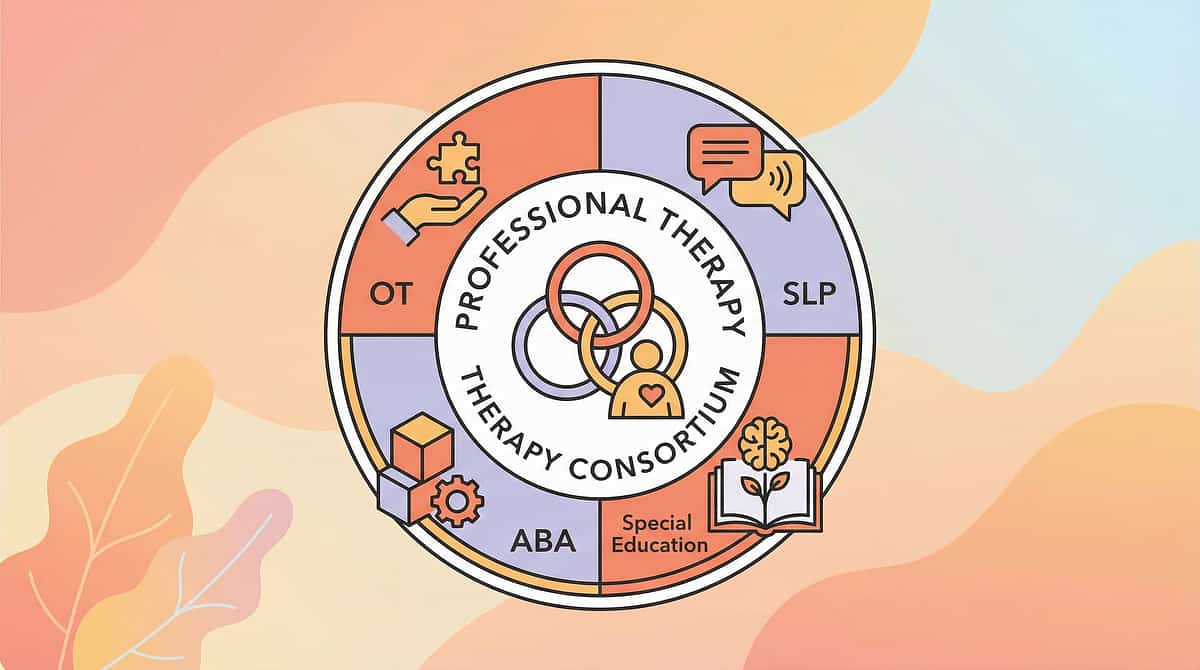
Validated by the Pinnacle Blooms Consortium: Occupational Therapy • ABA/BCBA • Speech-Language Pathology • Special Education • NeuroDev Pediatrics • Clinical Research
FREE National Autism Helpline: 9100 181 181 | 16+ languages | 24×7 | pinnacleblooms.org
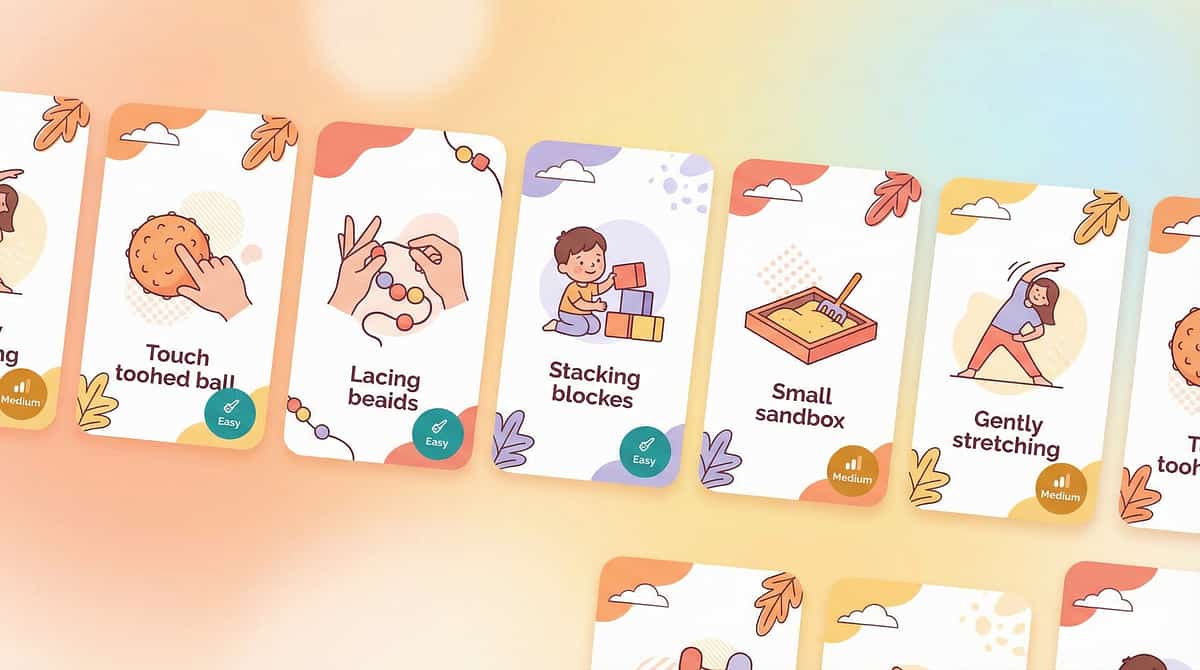
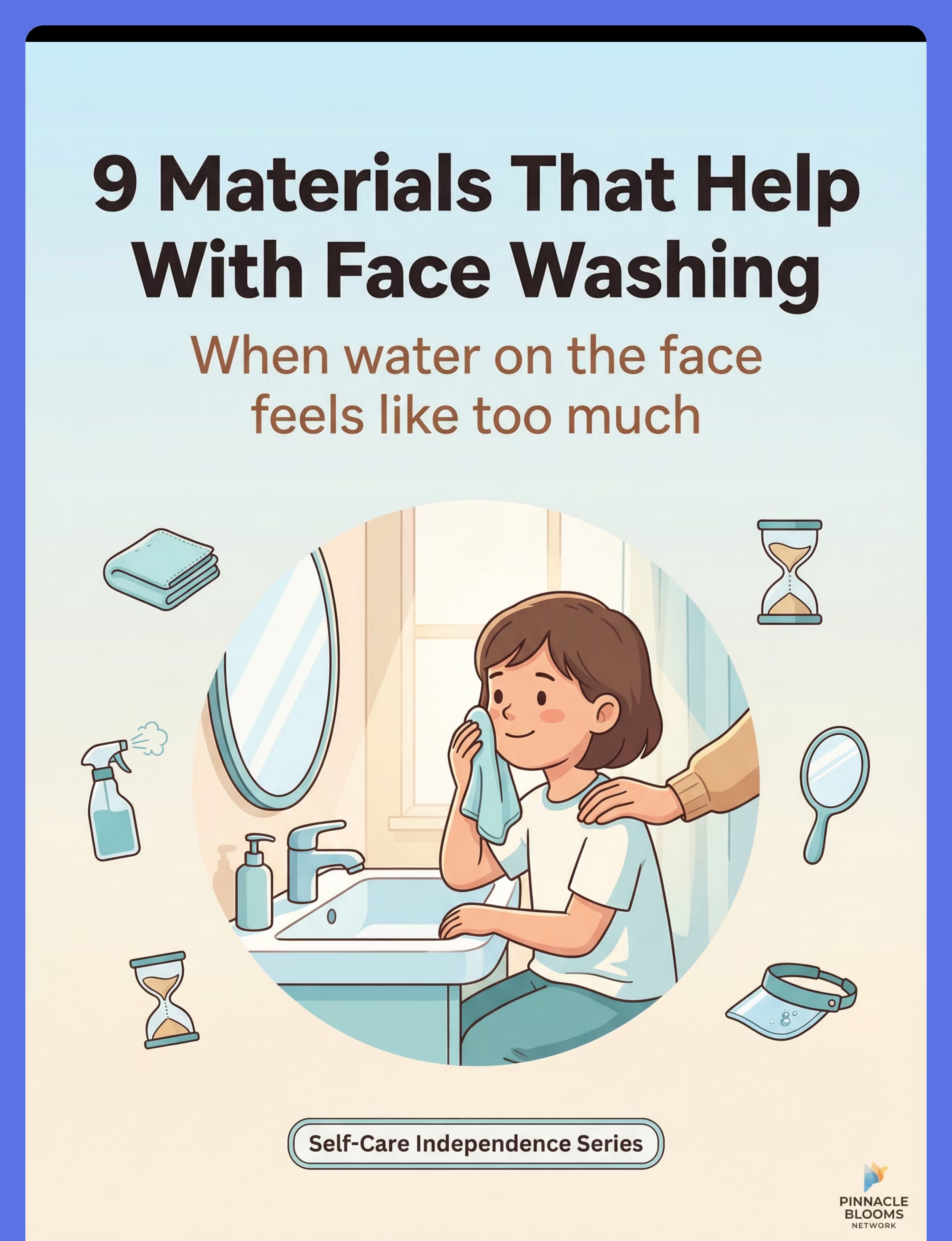
Preview of 9 materials that help with face washing Therapy Material
Below is a visual preview of 9 materials that help with face washing therapy material. The pages shown help educators, therapists, and caregivers understand the structure and content of the resource before use. Materials should be used under appropriate professional guidance.


Link copied!
From Fear to Mastery. One Technique at a Time.
— The Pinnacle Blooms Consortium
Our Mission
Pinnacle Blooms Network® exists to transform the home into a proven, scientific, 24×7, personalized, multi-sensory, multi-disciplinary integrated therapy environment — for every child, in every family, across every economic circumstance.
GPT-OS® is the infrastructure that makes this possible. 70,000+ techniques. 20M+ data points. 97%+ measured improvement. And one unwavering commitment: every child's potential, actualized.
Navigation
Contact
Statutory Identifiers
CIN: U74999TG2016PTC113063 | DPIIT: DIPP8651 | MSME: Udyog Aadhaar TS20F0009606 | GSTIN: 36AAGCB9722P1Z2
Medical Disclaimer: This content is educational. It does not replace individualized assessment and intervention planning with licensed occupational therapists and healthcare professionals. Persistent sensory sensitivities affecting daily functioning may indicate underlying conditions requiring professional evaluation. Individual results vary.
© 2025 Pinnacle Blooms Network®, unit of Bharath Healthcare Laboratories Pvt. Ltd. All rights reserved. GPT-OS® is a registered trademark. Unauthorized reproduction of clinical protocols is prohibited. Generated by GPT-OS® Content Engine | Technique E-533 | Domain E: Self-Care Independence | Reel Master Row 651