

"His brain says 'too loud.' The room says nothing."
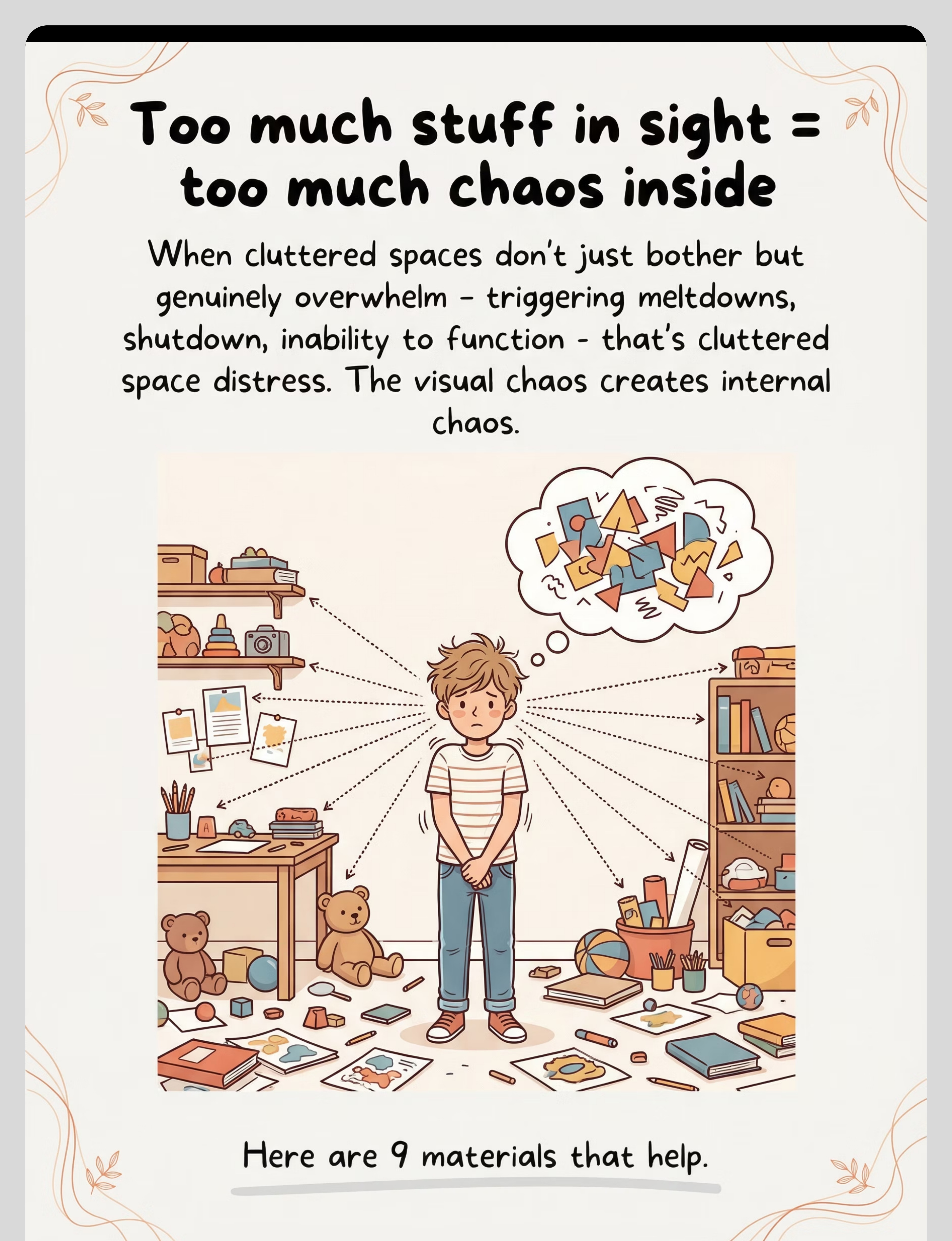
When cluttered spaces don't just bother your child but genuinely overwhelm them — triggering meltdowns, shutdown, complete inability to think or act — that's Cluttered Space Distress. The visual chaos creates internal chaos. The good news: there are 9 specific materials that change this.
Technique A-063
Sensory Processing
Domain A
🏛️Validated by the Pinnacle Blooms Consortium — OT • SLP • ABA • SpEd • NeuroDev Pediatrics

ACT I — THE EMOTIONAL ENTRY
You Are Not Alone: The Numbers
A 2024 PRISMA Systematic Review of 16 studies confirms that sensory processing difficulties — including visual overwhelm triggered by cluttered environments — represent one of the most prevalent and functionally significant challenges in autism spectrum conditions. Your child's response to visual clutter is not personality. It is neurology.
80%
Sensory Difficulties
Of children diagnosed with autism display sensory processing difficulties — including visual overwhelm
1 in 36
Diagnosed in India
Children in India now diagnosed on the autism spectrum — the majority have sensory sensitivities
3–12
Peak Age Window
Years when cluttered space distress typically becomes most functionally impairing
The Indian Journal of Pediatrics (Padmanabha et al., 2019) — India's first major home-based sensory RCT — demonstrated that parent-administered sensory programmes produce significant improvement in regulated behaviour, directly applicable to environmental sensitivities like cluttered space distress. 📞 9100 181 181 — Free. Confidential. Now.
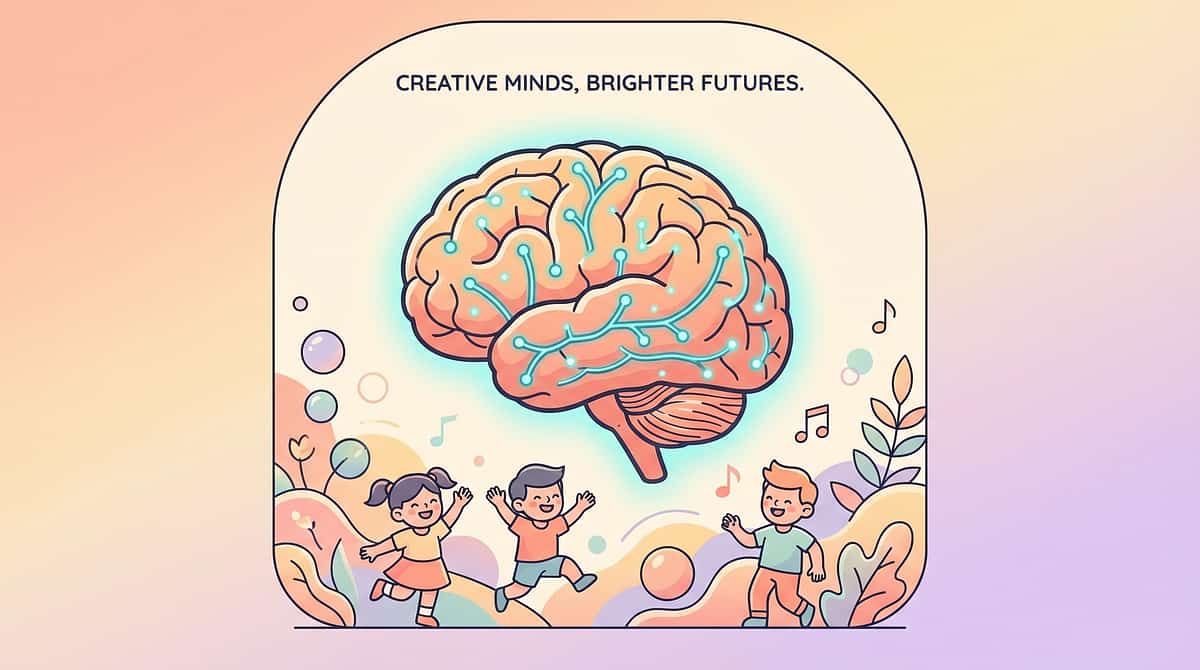
What's Happening in Your Child's Brain
This is a wiring difference, not a behaviour choice. In a typical nervous system, the prefrontal cortex automatically suppresses irrelevant visual information — clutter "fades to background." In children with visual sensory over-responsivity, this filtering is impaired.
The Science
Visual Filtering System (Ventral Attention Network)
Every visible item in a cluttered room registers as a separate attention demand that the brain actively processes rather than ignores.
A room with 40 visible items = 40 simultaneous attention demands → Cognitive overload → Stress response (HPA axis) → Behavioural dysregulation
Parent Translation
Where your visual system quietly filters out background chaos, their visual system logs every single object. When 40 objects demand attention simultaneously, the brain floods. This explains:
- Eyes that dart everywhere, unable to rest
- Inability to start tasks in cluttered spaces
- Physical tension visible in their body
- Meltdowns that seem disproportionate — they're proportional to their experience
"He describes it as 'my brain is too loud.' That's neurologically accurate. His visual system is generating too much input for his regulatory systems to manage." — Pinnacle Consortium Occupational Therapist

Where This Sits in Development
Your child is at a specific developmental moment. Understanding the arc helps you calibrate your expectations — and your hope. The WHO Care for Child Development Package emphasises that environmental factors are modifiable at every stage.
Age 2–3
Basic visual filtering develops. Clutter sensitivity may first appear as heightened irritability in busy environments.
Age 3–5
Environmental demands increase (preschool, playrooms). Cluttered space responses intensify. Your child may be here.
Age 5–8
School entry creates maximum exposure to uncontrolled environments — desk clutter, classroom visual load, transitions.
Age 8–12
Self-advocacy begins to develop. Child can learn to communicate needs and use portable strategies independently.
Age 12+
With systematic intervention, most children develop functional tolerance and self-management strategies.
Cluttered space distress commonly co-occurs with ADHD, anxiety disorders, autism spectrum conditions, and broader sensory processing disorder profiles. Each co-occurrence requires adapted strategy layering — covered in Act III.

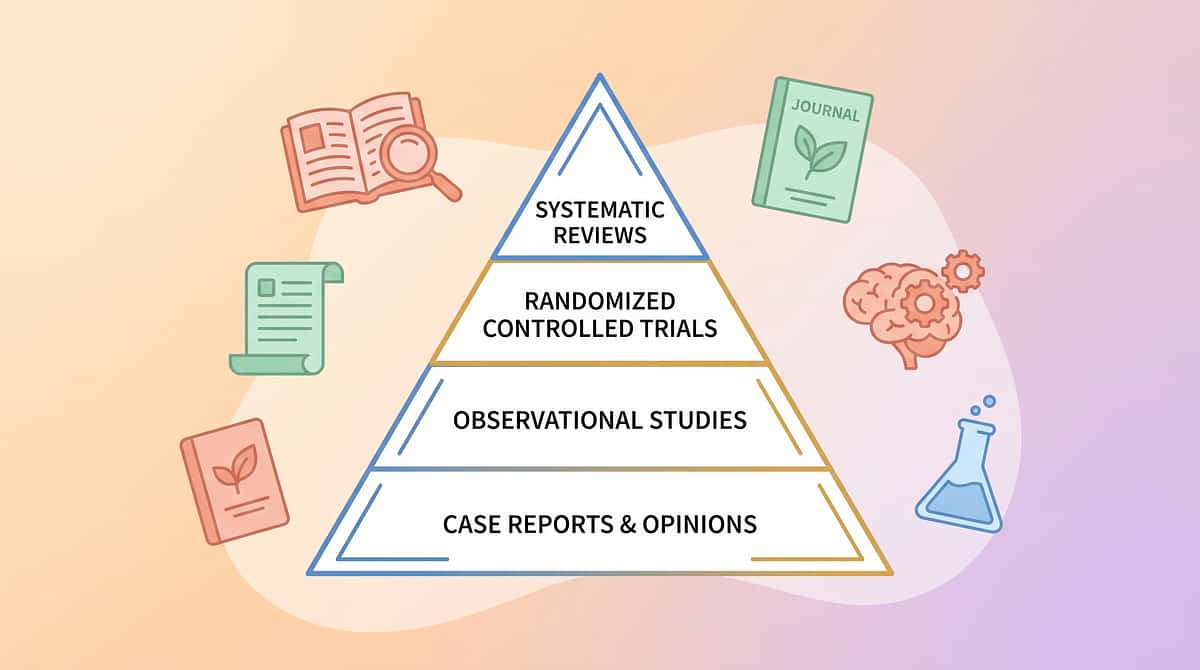
The Evidence Behind This Technique
🛡️ Level I Evidence
Systematic Review + RCT Support
Clinically validated. Home-applicable. Parent-proven. Every strategy on this page is anchored in peer-reviewed research — here is the evidence base you can share with your child's school, specialist, or sceptical family member.
Study | Finding | Relevance | |
PRISMA Systematic Review, Children (2024) — PMC11506176 | Sensory integration is evidence-based for ASD across 16 studies (2013–2023) | Validates the entire intervention approach | |
Meta-analysis, World J Clin Cases (2024) — PMC10955541 | SI therapy significantly promotes adaptive behaviour across 24 studies | Confirms multi-domain benefit | |
Indian RCT, Padmanabha et al. (2019) — DOI:10.1007/s12098-018-2747-4 | India's first home-based sensory RCT: parent-administered programmes produce significant outcomes | Validates home delivery — you can do this | |
WHO Nurturing Care Framework (2018) | Environment modification by caregivers produces measurable outcomes in 54+ countries | Global evidence for parent-led intervention |
The research is clear: modifying the visual environment, equipping children with regulation tools, and building gradual tolerance produces real, measurable, lasting improvement. This is not experimental. This is the standard of care.
ACT II — KNOWLEDGE TRANSFER
Cluttered Space Distress Management: What It Is
Parent-Friendly Alias: "Visual Calm Engineering™"
Cluttered Space Distress Management is a multi-strategy occupational therapy–led intervention that addresses visual overwhelm triggered by disorganised, cluttered, or visually busy environments in children with sensory processing differences. The approach combines four core pillars:
1. Environmental Modification
Reducing the child's visual load through organisation and containment of physical space
2. Visual Management
Controlling what the child sees when full clearing isn't possible — carrels, drapes, positioning
3. Portable Regulation
Equipping the child with tools for environments they cannot control — school, grandma's, public spaces
4. Gradual Tolerance Building
Gently expanding the window of what the child can functionally manage over 8–12 weeks
🎯Ages: 3–12 years | ⏱️Session: 15–20 minutes | Frequency: Daily (environmental maintenance); 2–3×/week (active sessions) | 📍Setting: Home, classroom, any indoor environment

Who Uses This Technique
This technique crosses therapy boundaries — because the brain doesn't organise by therapy type. Each discipline brings a distinct and essential contribution to Visual Calm Engineering™.
Occupational Therapist (OT) — Primary
Leads sensory evaluation, environmental assessment, workspace design, gradual exposure protocols, and regulation tool selection. The master architect of visual environment strategy.
Special Educator (SpEd)
Implements classroom accommodations: study carrel placement, desk organisation systems, visual simplification of learning materials, and accommodation plans.
ABA Therapist / BCBA
Designs antecedent modification strategies, reinforcement systems for tolerance-building, self-advocacy skill training, and data collection on environmental response patterns.
Pediatric SLP
Develops the child's language for self-advocacy — communication cards, scripts for requesting clear space, vocabulary for describing sensory experience to teachers and peers.
NeuroDev Paediatrician
Differential diagnosis, medication considerations if anxiety is significant, medical clearance for intervention, and coordination of multi-specialist care.

What This Technique Targets
This isn't a random activity. It's a precision tool with defined primary, secondary, and tertiary targets — each measurable over your 8–12 week intervention arc.
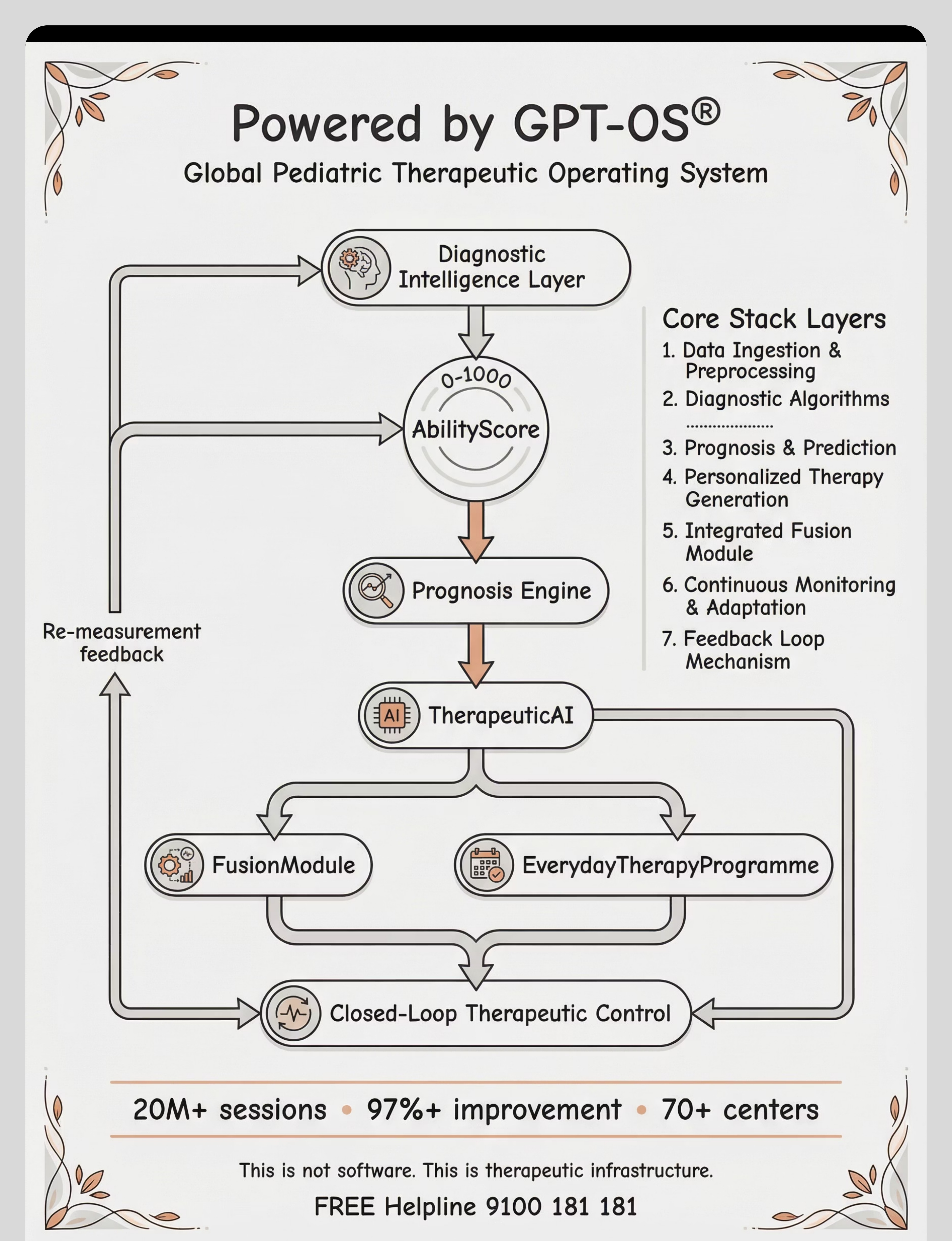
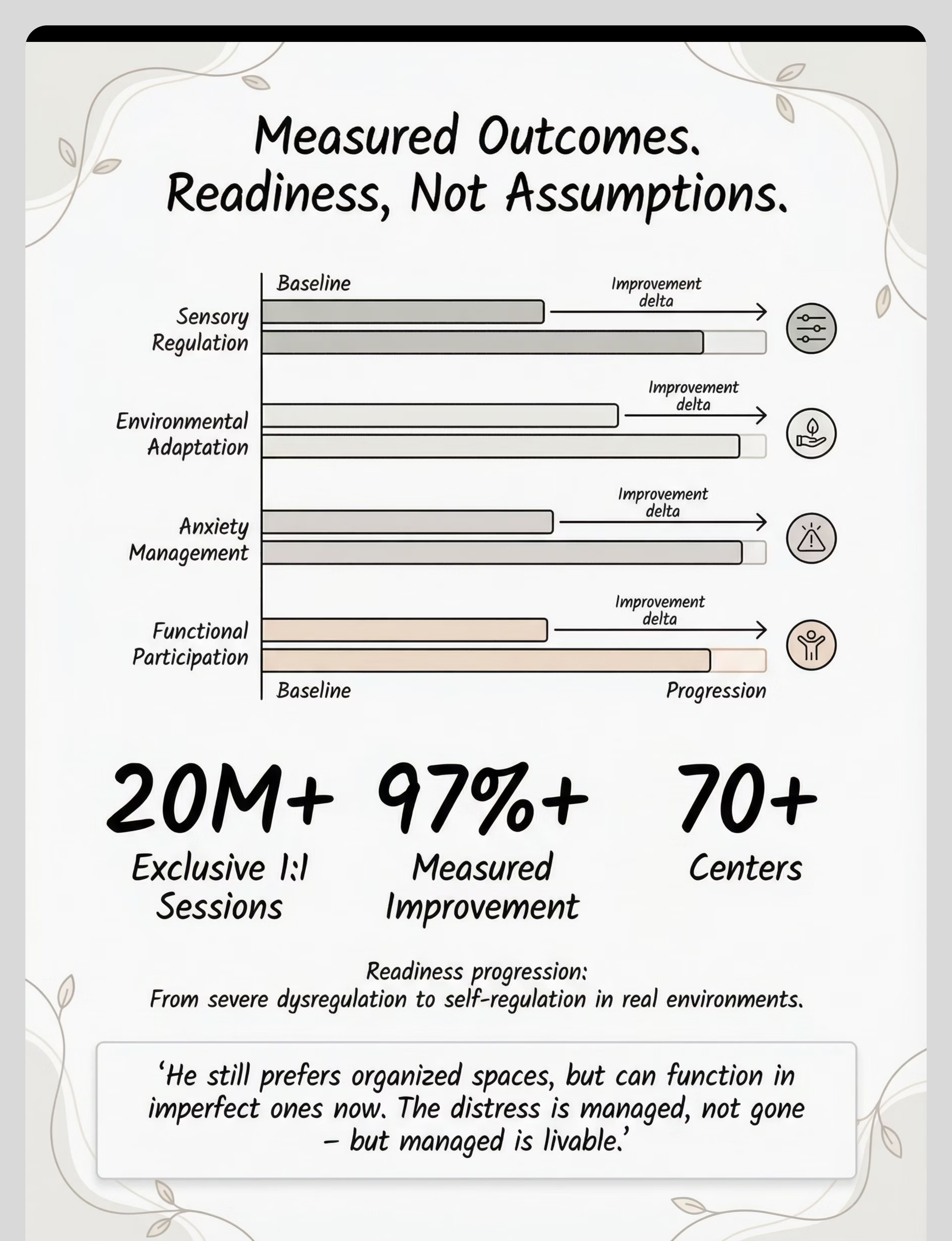
GPT-OS® AbilityScore® tracks five domains: Sensory Regulation Index | Environmental Adaptation Index | Anxiety Management Index | Functional Participation Index | Self-Advocacy Index. Together, these indices give you a precise picture of your child's progress — not a feeling, but a data point.
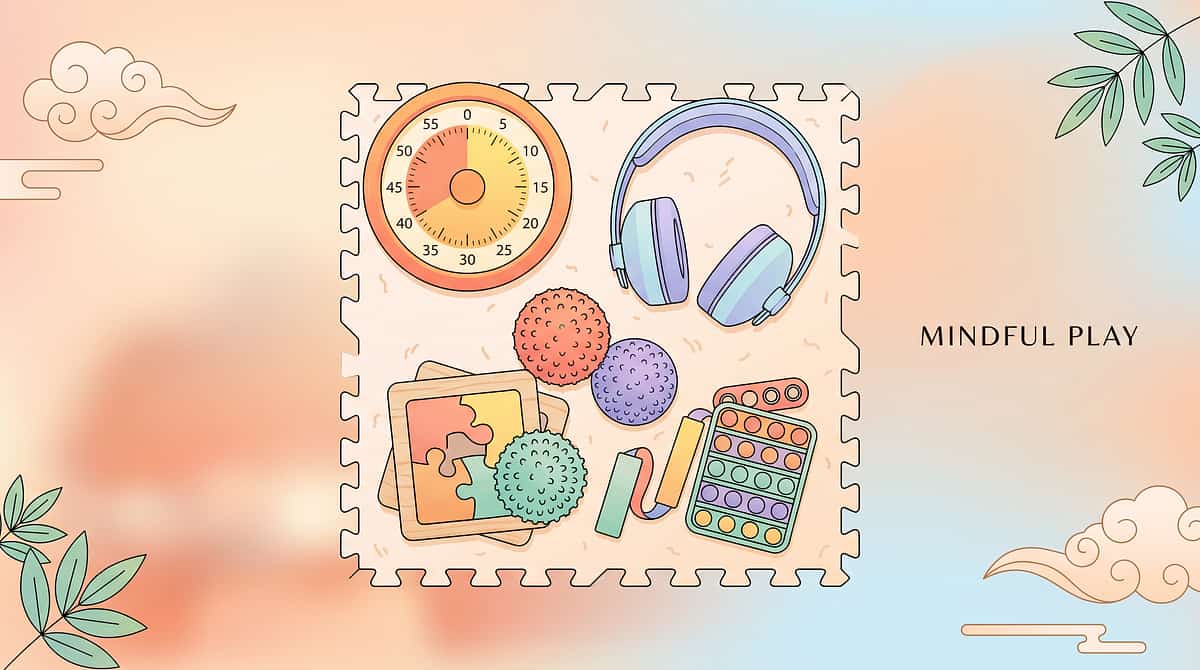
What You Need: The 9 Materials
9 materials. Ranging from ₹0 to ₹10,000. Every family can start today — including families who need to start with zero budget.
# | Material | Canon Category | Price Range | |
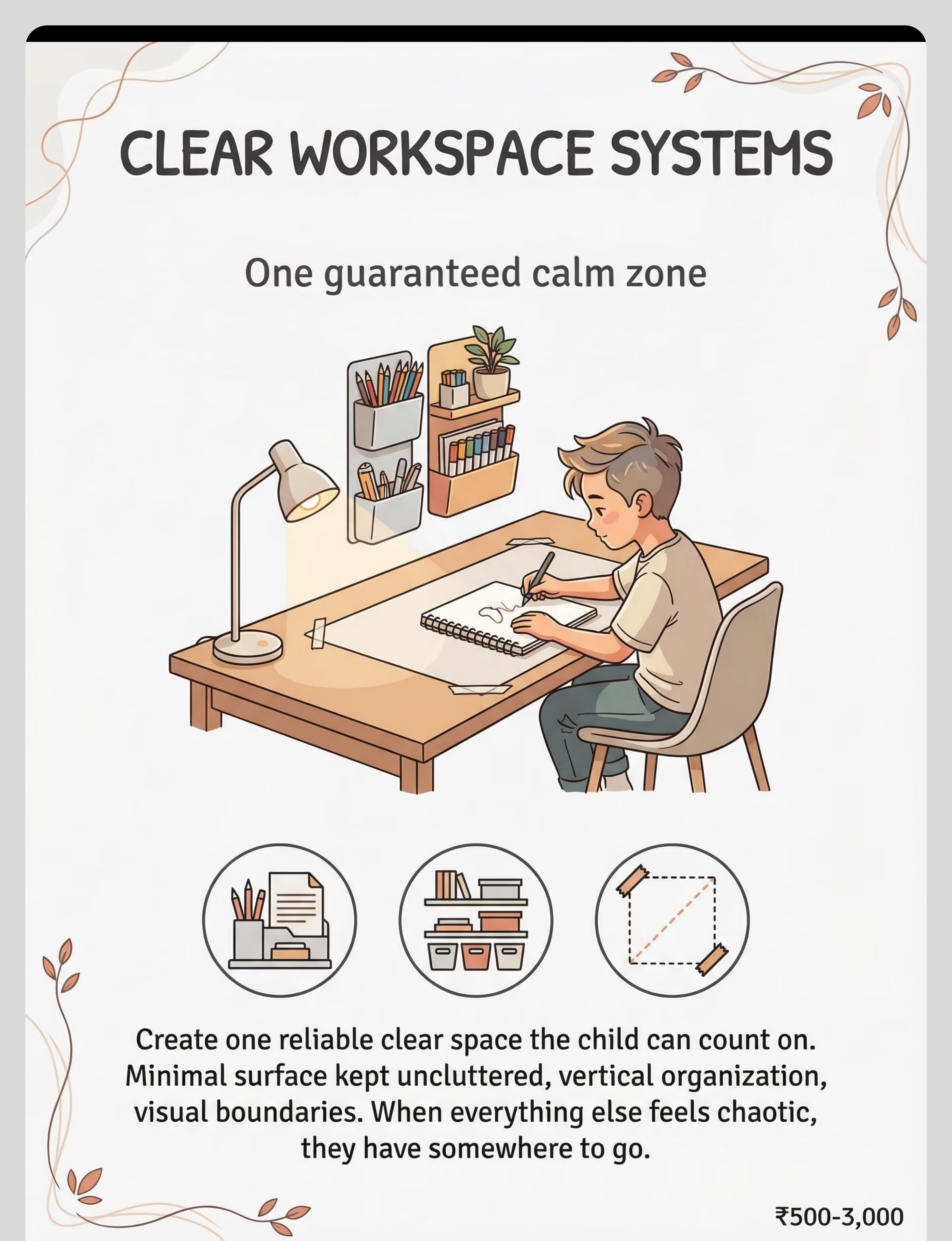
1 | Clear Workspace Systems | Desk & Writing Accommodations | ₹500–3,000 | |
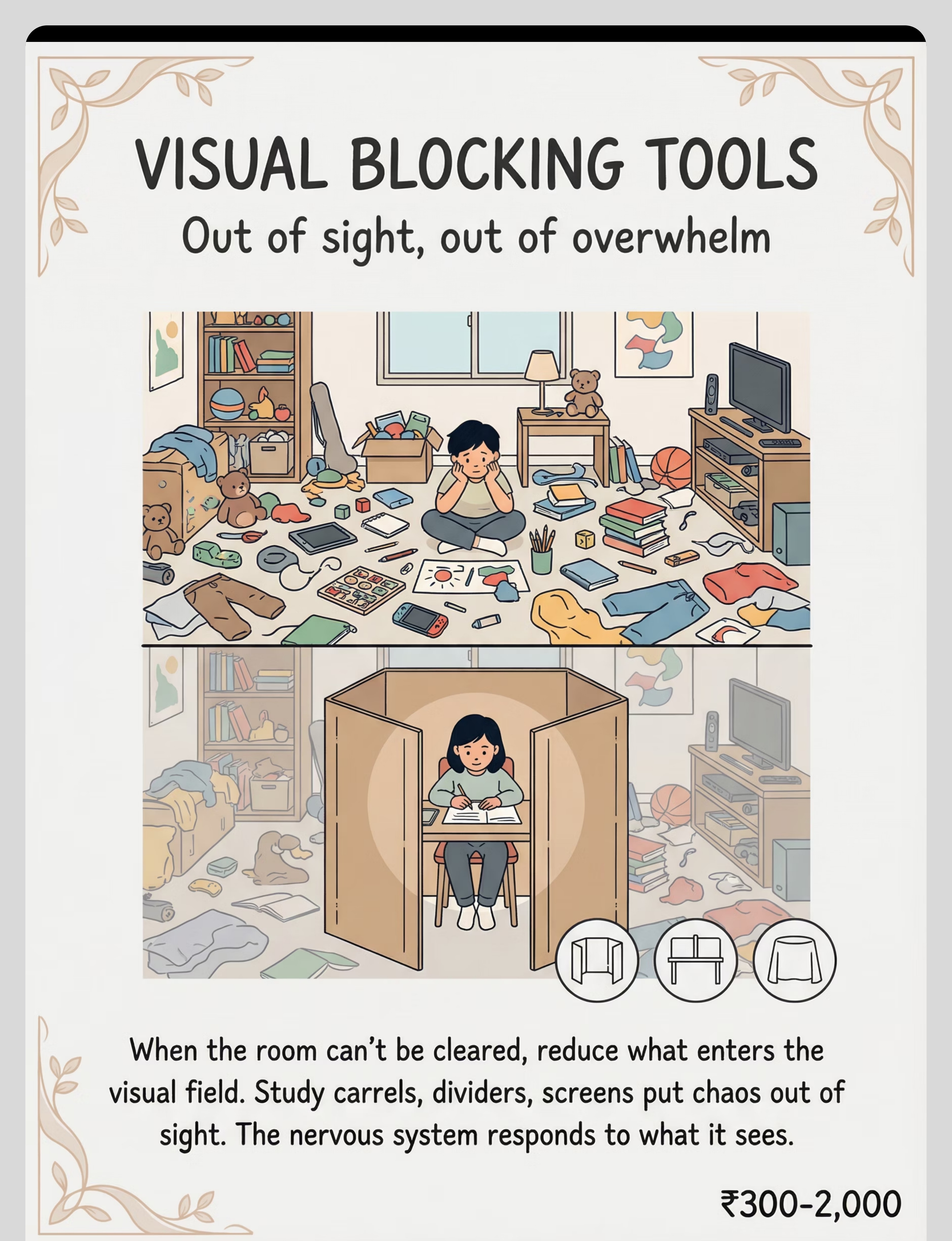
2 | Visual Blocking Tools | Desk / Chair Modifications | ₹300–2,000 | |
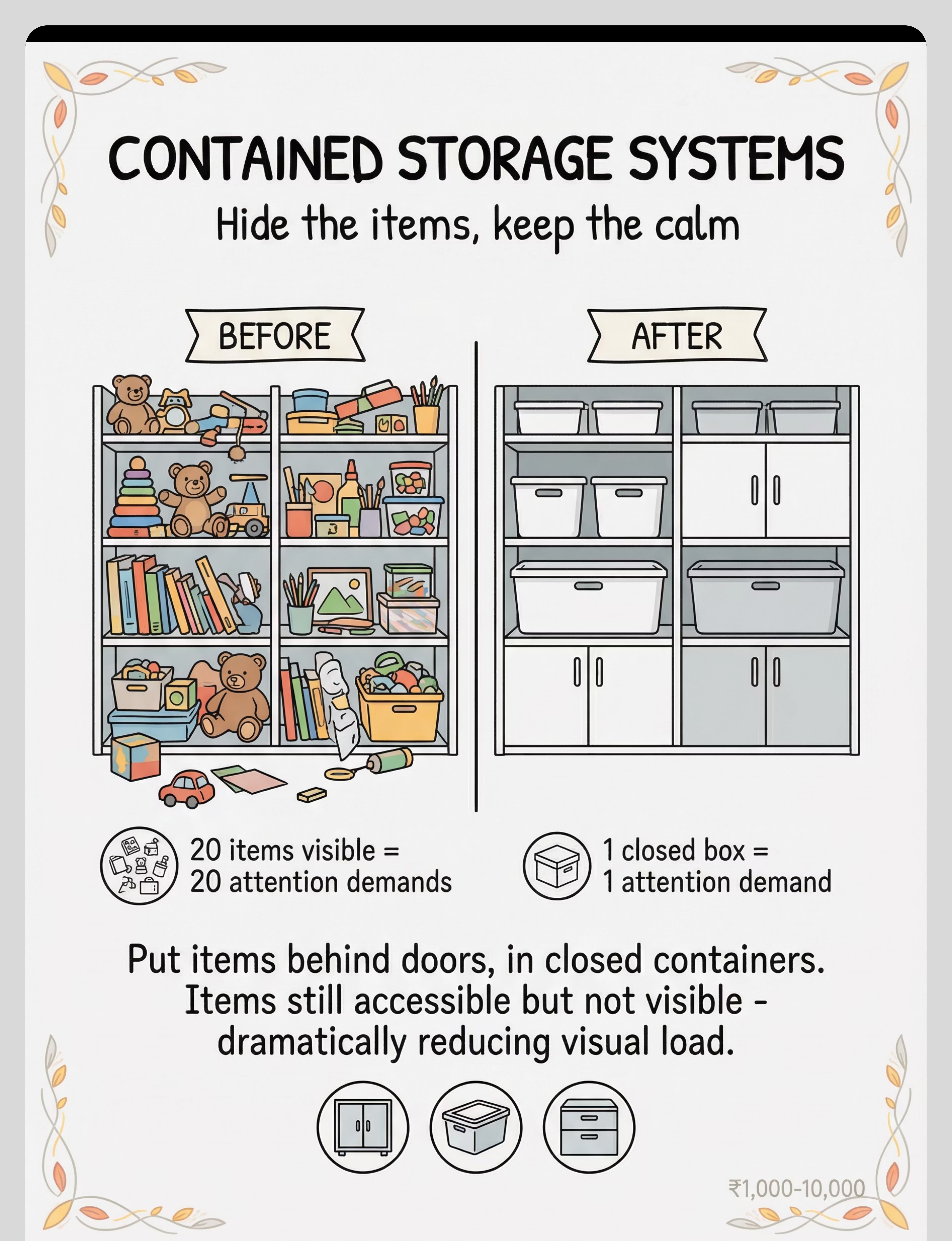
3 | Contained Storage Systems | Calm-Down Kit / Self-Regulation Toolbox | ₹1,000–10,000 | |
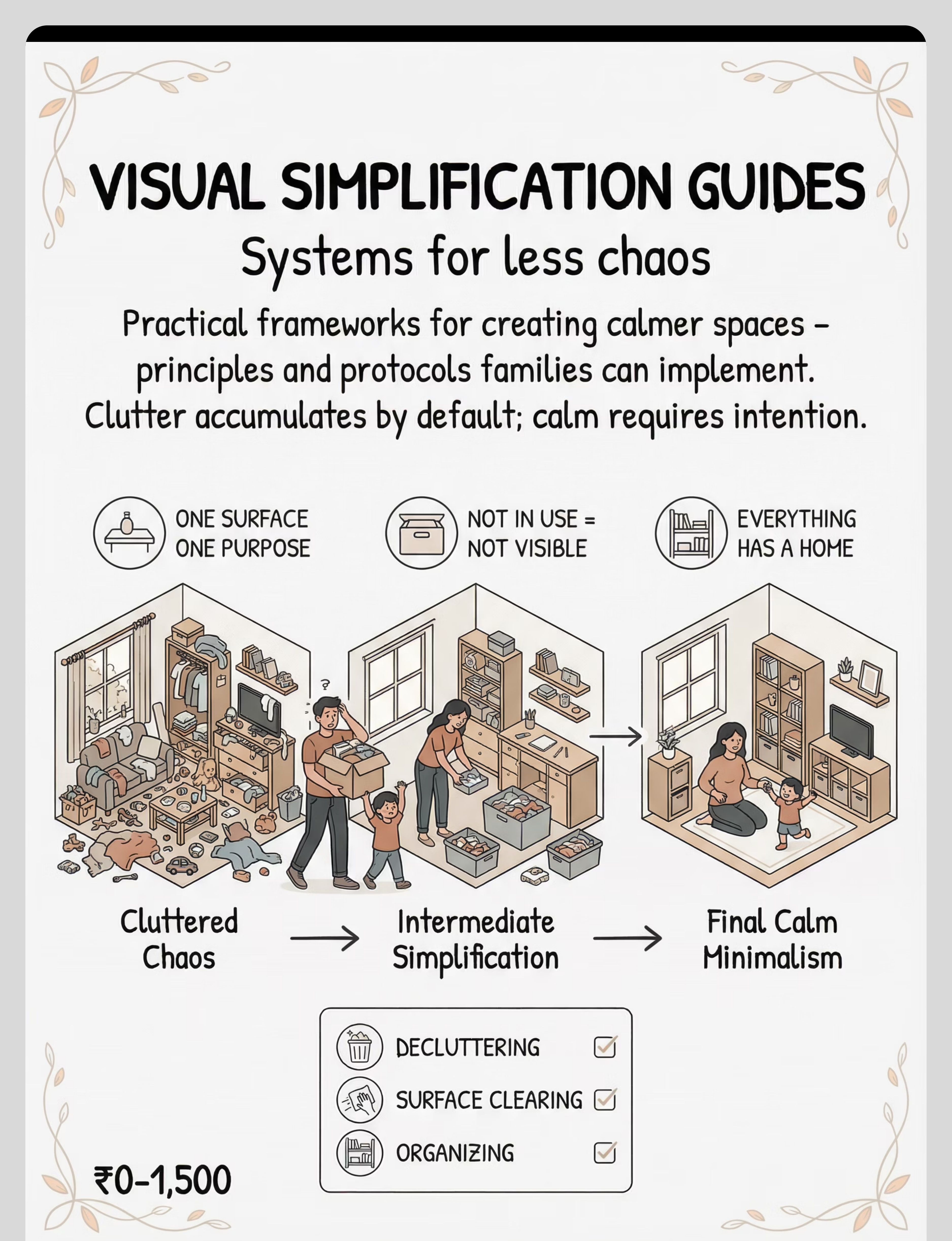
4 | Visual Simplification Guides | Social Stories / Narrative Supports | ₹0–1,500 | |
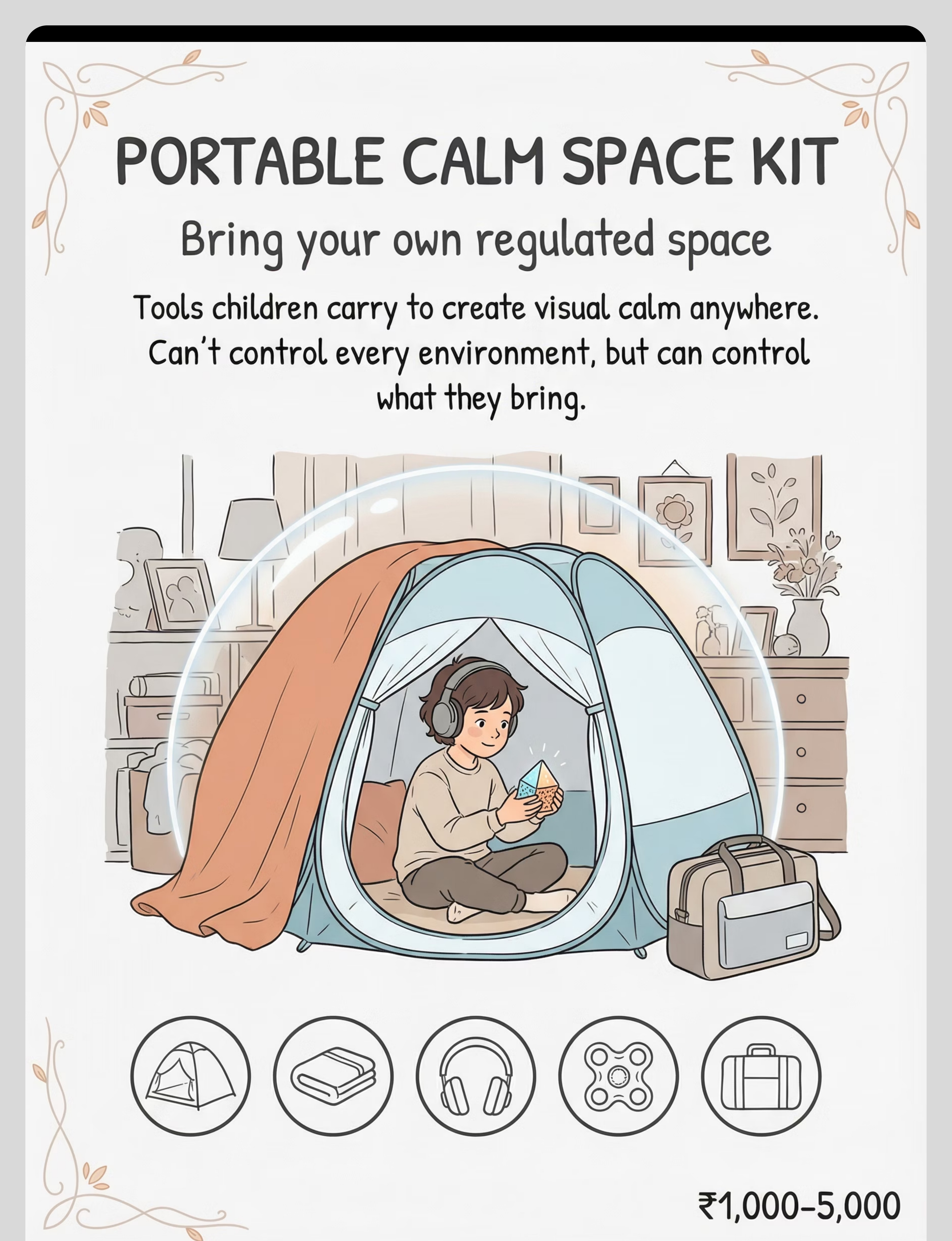
5 | Portable Calm Space Kit | Sensory Tent / Hideaway / Calm-Down Space | ₹1,000–5,000 | |
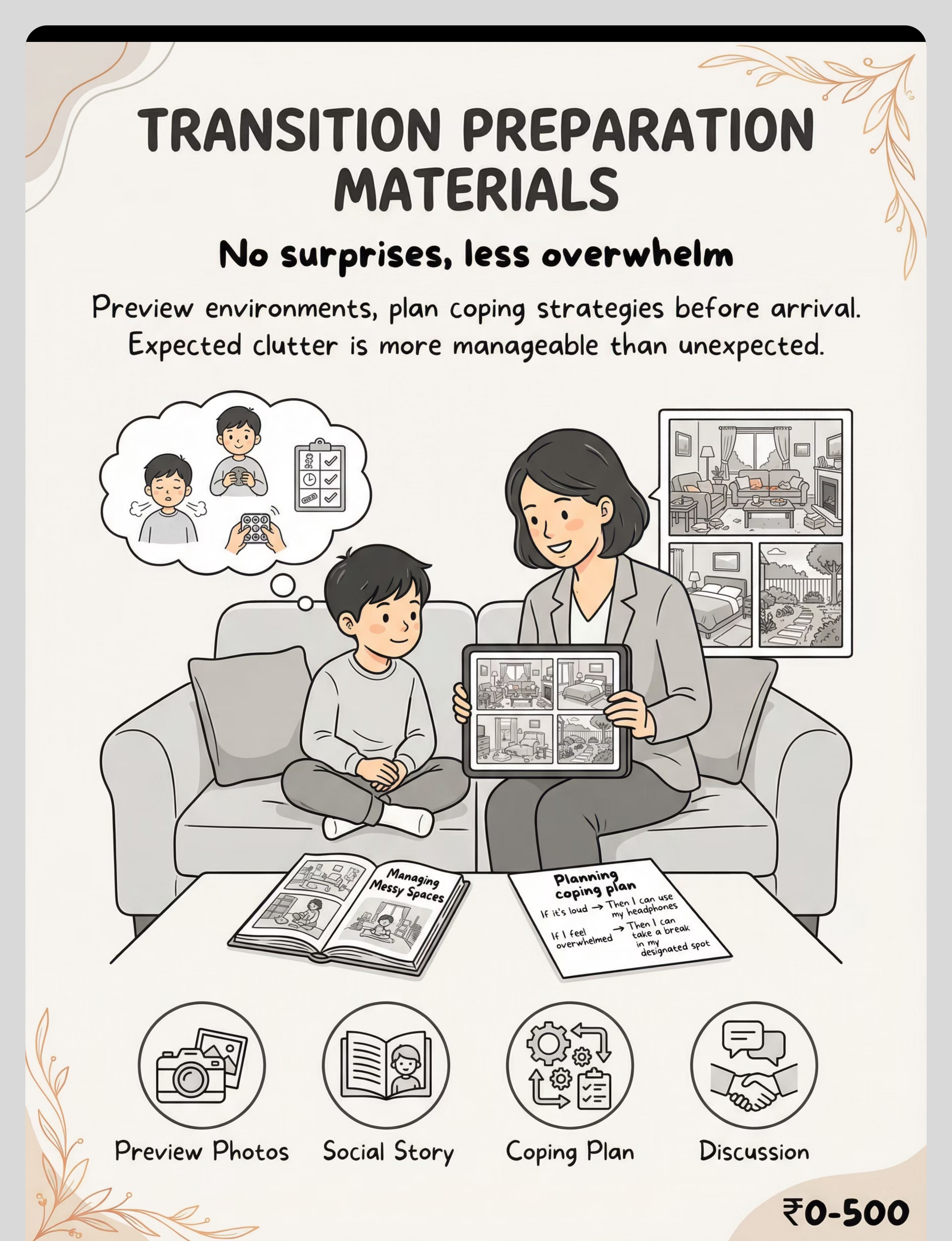
6 | Transition Preparation Materials | Visual Schedule System | ₹0–500 | |
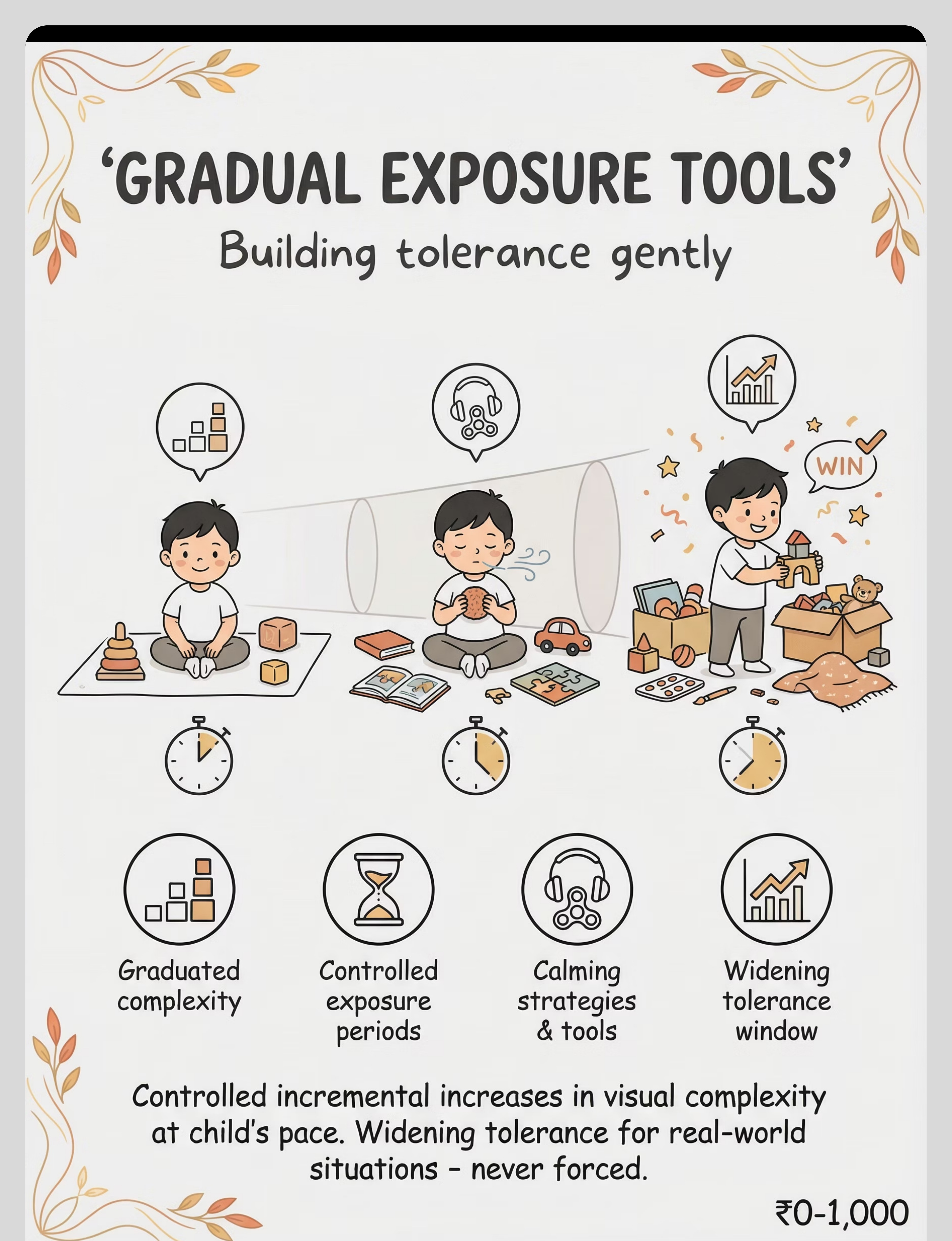
7 | Gradual Exposure Tools | Visual Timer | ₹0–1,000 | |
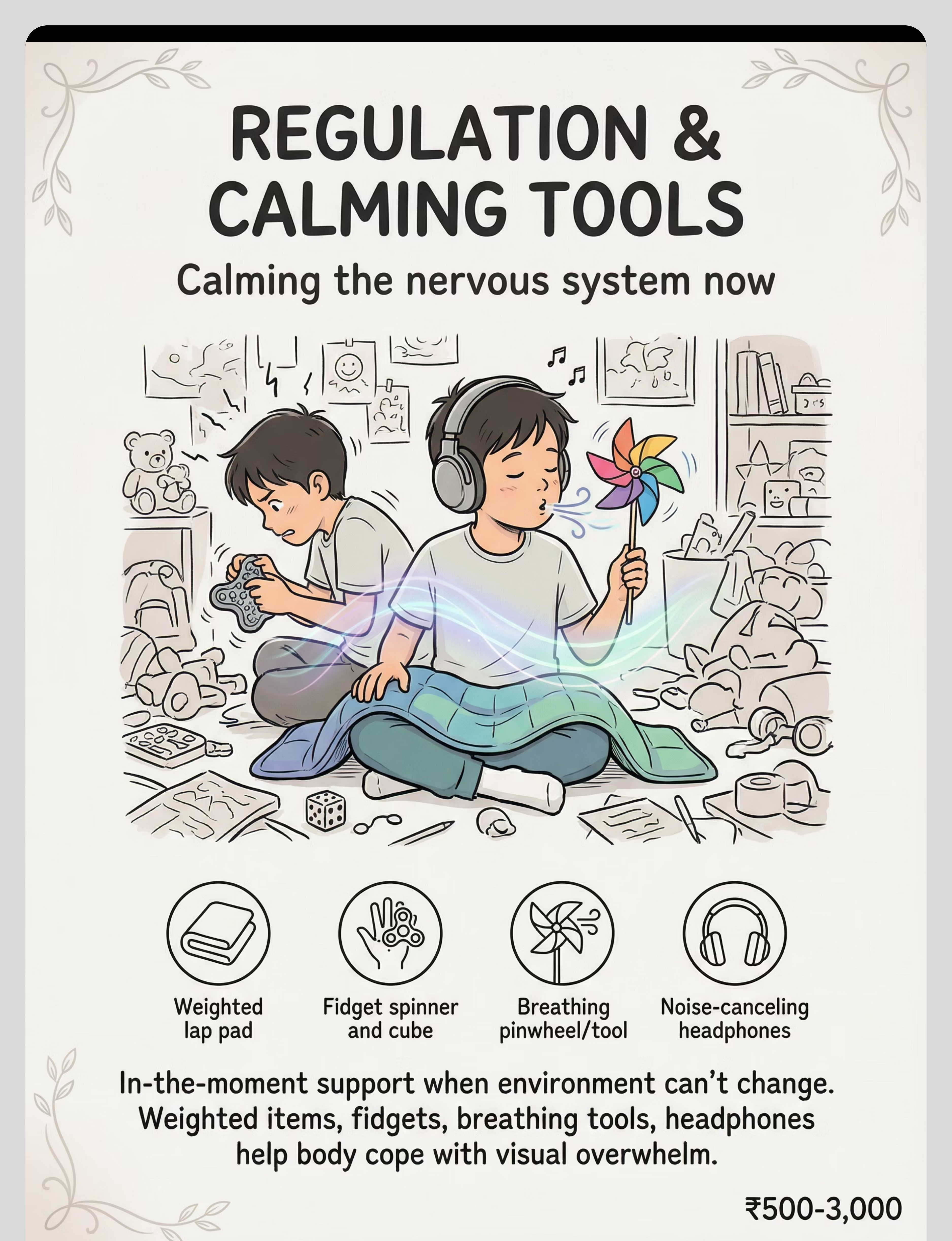
8 | Regulation & Calming Tools | Fidget Tool Set + Noise-Reducing Headphones | ₹500–3,000 | |
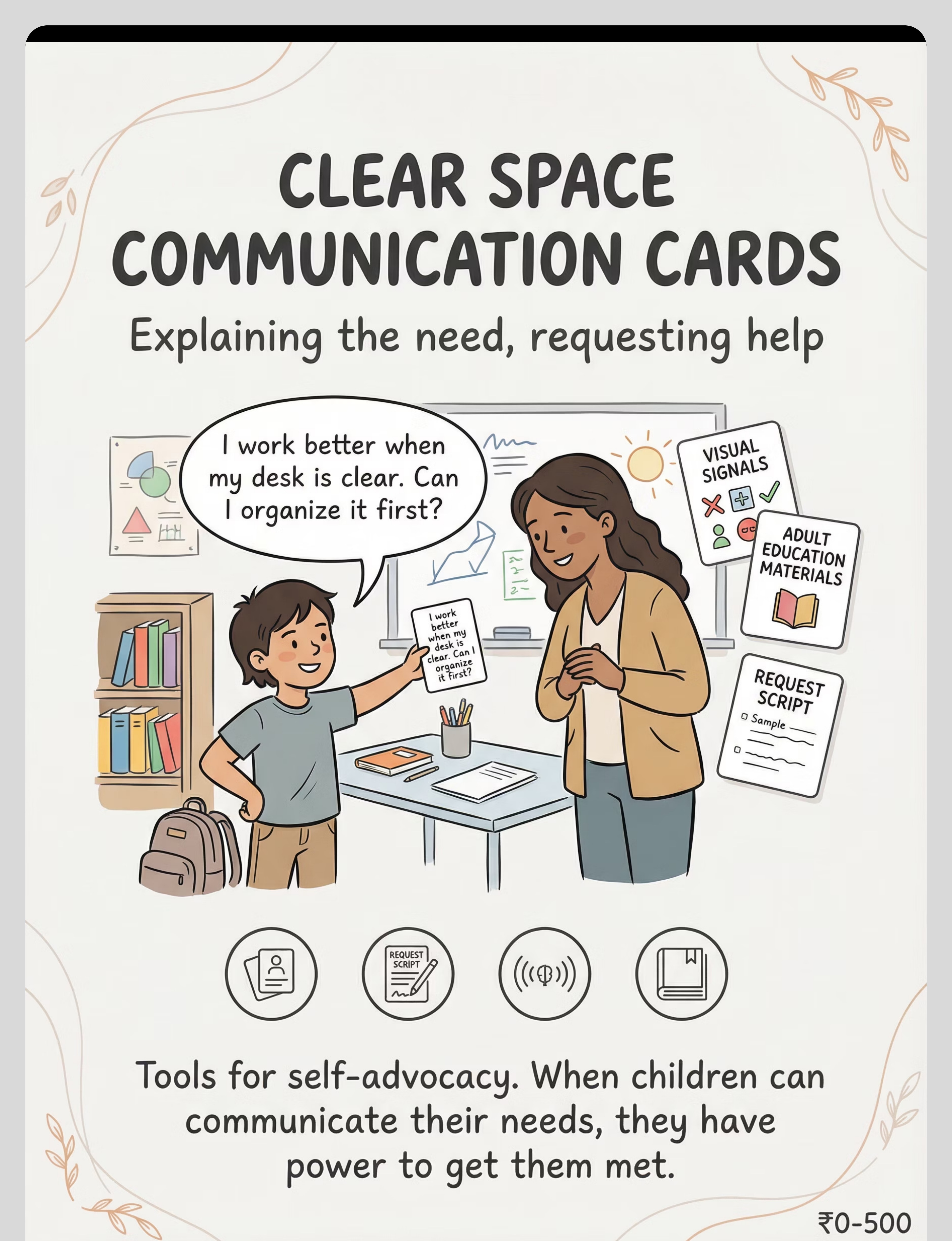
9 | Clear Space Communication Cards | Visual Rules / Expectations Cards | ₹0–500 |
🏅 Pinnacle-Recommended products include: Toyshine Foldable Play Tent | SNOWIE SOFT Noise Cancellation Ear Muffs | ANAB GI Fidget Cube | Sand Timers / Digital Stopwatch | Animal Soft Toys (Comfort Object, ₹425)

DIY & Substitute Options
Every parent can start today. Zero budget required. The WHO Nurturing Care Framework is implemented across 54 low- and middle-income countries precisely because environmental modification using household materials produces real outcomes. Your household already contains many of the tools needed.
Material | Clinical Version | Zero-Cost DIY | |
Clear Workspace | Desk organiser set (₹500–2,000) | Designate ONE surface as "clear zone." Tape boundary with masking tape. Nothing lives here permanently. | |
Visual Blocking | Study carrel (₹500–2,000) | 3 pieces of cardboard folded into U-shape. Blocks 80% of visual field. | |
Contained Storage | Closed storage bins (₹1,000+) | Old cardboard boxes with lids. Brown paper bags rolled down. Any opaque container with a flap. | |
Visual Simplification | Professional organising guide (₹500) | Walk the room as your child. Remove anything not daily-use from visible surfaces. Done. | |
Portable Calm Kit | Pop-up tent (₹1,000–3,000) | Large scarf or sheet draped over a chair creates an enclosed "calm corner." | |
Regulation Tools | Fidget cube (₹300+) | Smooth river stone in pocket. Rubber band on wrist. DIY stress ball (balloon + flour). | |
Transition Preparation | Printed social story | Photograph the destination on your phone. Review before arrival. Free. | |
Communication Cards | Printed card set | Write on index card: "I work better when my desk is clear." Laminate with tape. | |
Gradual Exposure | Professional protocol | Timer on phone. Start at current tolerance level. Add 5 minutes per week. Celebrate each win. |
Unsure which to start with? 📞9100 181 181 — Our OTs guide you free of charge.

Safety First: Before You Begin
Read this before you begin. Clinical precision, parental empathy. The following guidance ensures you begin from the right starting point — protecting your child and maximising the effectiveness of every session.
🔴 DO NOT PROCEED — Seek professional evaluation first
- Child is showing signs of OCD (compulsive rituals, not just environmental preference)
- Child has experienced trauma involving chaotic/unsafe environments
- Severe anxiety disorder not yet assessed
- Child's distress is escalating despite environmental modification
🟡 AMBER — MODIFY before proceeding
- Child is currently in acute meltdown state — wait for regulated window
- Space modification has caused family conflict not yet resolved
- Child has never experienced ANY clutter tolerance — begin with environmental modification only
🟢 GREEN — PROCEED with confidence
- Child is currently in a regulated state
- Family understands this is a genuine sensory need (not willfulness)
- At least one "clear zone" has been established as safe baseline
- Child has been briefed on what the session involves
⛔ ABSOLUTE STOP SIGNS during any session: Signs of acute distress escalating (hyperventilating, hitting, self-injurious behaviour) | Child explicitly communicating "stop" in any form | Child's body showing freeze/dissociation response
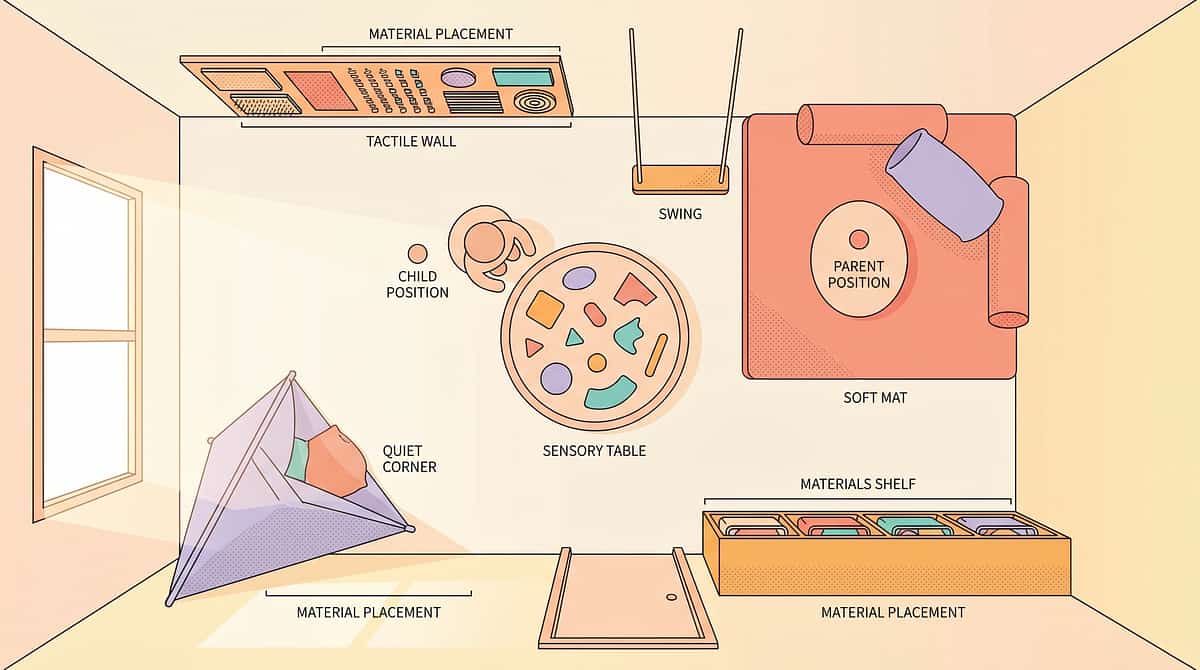
Set Up Your Space
Spatial precision prevents 80% of session failures. The visual field within 2 feet of the child should contain fewer than 5 items. This is the minimum viable calm zone from which regulation can begin.
Use this checklist every time before beginning a session:
- Clear the session surface completely — nothing on it
- Position visual blocking tool (carrel/cardboard) around workspace
- Place regulation tools within reach but slightly to side (not on workspace)
- Remove or cover visually busy items within 3 feet of child
- Lighting: soft, natural — avoid fluorescent if possible
- Sound: quiet background — TV off, notifications silenced
- Temperature: comfortable — sensory regulation depletes more when cold
- Child's comfort object available but not prominent

ACT III — THE EXECUTION
Is Your Child Ready? The Readiness Check
The best session is one that starts right. A 60-second pre-flight check prevents session failures before they happen — and protects your child's experience of the clear zone as a positive, safe space.
Pre-Flight Checklist — 60 seconds:
- Child is fed and not hungry
- Child has had adequate sleep (not overtired)
- No recent meltdown in past 2 hours
- Child is not showing signs of illness
- Child's body language shows receptivity (not already tense/dysregulated)
- No major environmental disruption in past 30 minutes
- You (parent/caregiver) are in a calm state yourself
Score | Action | |
✅ 6–7 checks | GO — Proceed with full session | |
✅ 4–5 checks | MODIFY — Shorten to 10 minutes, simplify activity, increase support | |
⛔ 3 or fewer | POSTPONE — Do a calming activity instead. Try again in 90 minutes. |
Postpone Activity: Lay a weighted lap pad on the child, put on soft music, and sit quietly together for 10 minutes. No agenda. This IS therapeutic.

Step 1: The Invitation
You are not beginning a therapy session. You are beginning an adventure. ABA research is clear: voluntary engagement produces vastly superior outcomes to mandated compliance. A child who willingly enters their clear workspace is already demonstrating regulatory capacity.
"Hey, I set up our special workspace. It's your clear zone — nothing extra, just what you need. Want to come try it?"
If Child Resists
- Do NOT force or coax with urgency
- Offer a low-demand bridge: "Want to just stand near it for a second?"
- Use a preferred item to draw child naturally toward the clear zone
- Accept "no" gracefully — try again in 20 minutes
The Child's Language
Teach the child to say:
"I need my clear space."
This three-word sentence is a self-advocacy milestone. It gives the child agency, vocabulary, and a pathway to communicate their needs to teachers, family members, and peers.
Step 2: Establishing Engagement
Watch for the moment the body settles. That's your signal. The session has not truly begun until the child's nervous system has arrived in the space. Proceeding before engagement is established is the #1 cause of session failure.
Engagement Indicators — watch for these:
Shoulders drop slightly — the first physical sign of decompression
Breathing slows or deepens — the parasympathetic system is activating
Eyes stop darting — gaze settles on the workspace or a single point
Body shifts forward toward the workspace — approach rather than avoidance
Child picks up a material — initiated engagement without prompting
Child Response | What It Means | Your Action | |
Immediate calm + engagement | Regulation response to clear space — optimal | Proceed quietly, don't over-praise yet | |
Slow to settle (2–3 min) | Still decompressing from environmental load | Wait with presence. Don't prompt. Let the body arrive. | |
Still tense after 5 min | May need regulation tool first | Offer fidget tool or weighted lap pad before beginning task | |
Refuses workspace | Not yet regulated | Postpone 20 min. Implement calming protocol. |
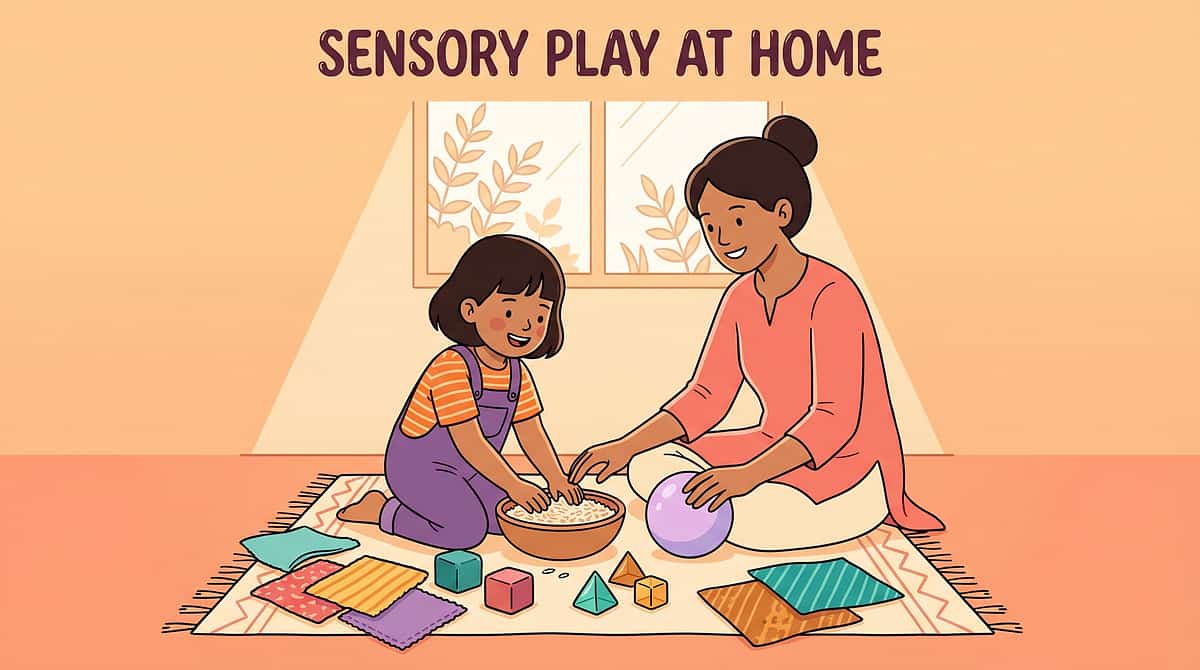
Step 3: The Therapeutic Action
The active ingredient. Precise. Flexible. Powerful. The Core Protocol — "Visual Environment Calibration" — is structured in three phases that build sequentially within each session.
1
Phase A: Environmental Control (5–7 min)
Child and parent work together to assess and modify the immediate visual environment. Child identifies items that feel "loud," removes or covers them, creates their clear zone, physically defines their calm boundary, and declares: "Ready."
2
Phase B: Functional Engagement (5–10 min)
Child completes a preferred or required activity IN the cleared space — homework, drawing, building, reading, or free play. The goal is experiencing successful function in a controlled environment. This is the therapeutic active ingredient.
3
Phase C: Regulation Tool Practice (3–5 min)
If environment cannot be fully cleared: child uses visual blocking tool (carrel/cardboard) and/or regulation tool (fidget, lap pad, headphones) while in a partially cluttered space. Brief, supported — never forced.
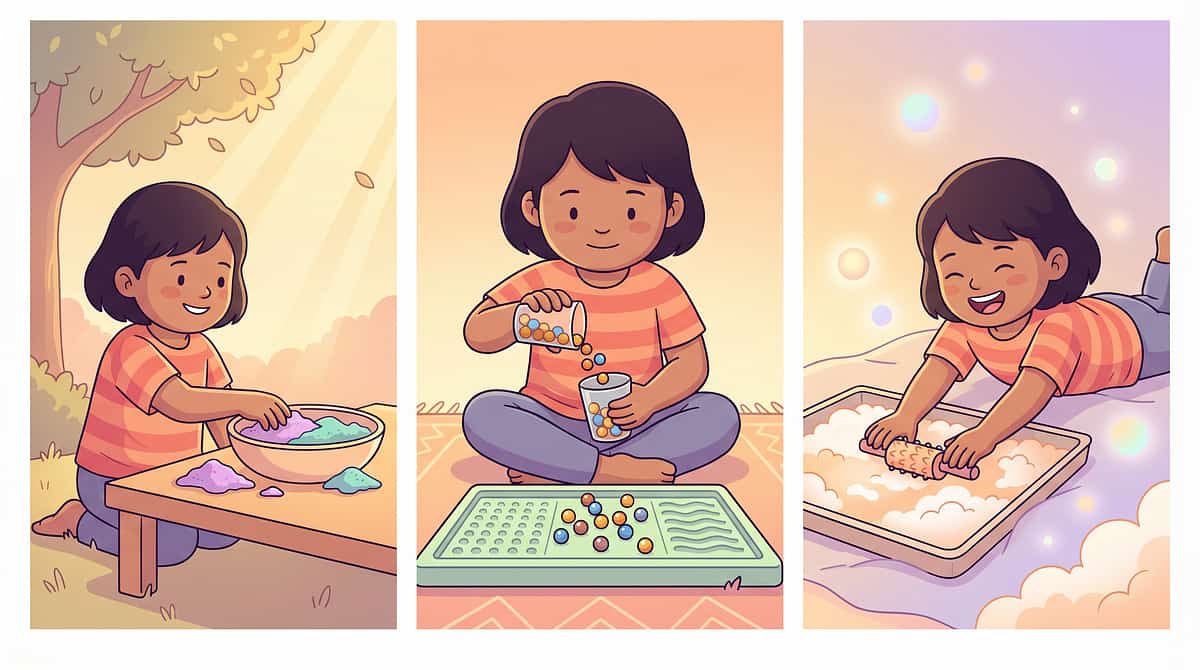
Step 4: Repeat & Vary
3 good reps are worth more than 10 forced ones. Always. Dosage and variation are calibrated to build genuine tolerance — not temporary compliance. Introducing variation at the right time is how the nervous system generalises learning beyond the clear zone.
Target Dosage
- Daily: Environmental maintenance — clear workspace preserved
- Active sessions: 2–3× per week, 15–20 minutes each
- Duration: 8–12 weeks for measurable tolerance improvement
Satiation Indicators — Stop Before Here
- Body tension returning
- Task disengagement (looking away repeatedly)
- Verbal signals: "done," "too much," "stop"
- Restlessness, fidgeting with non-regulation purpose
Variation | Purpose | When to Use | |
Add ONE item to workspace, see if regulation holds | Tolerance building | After 2 weeks of stable clear-space function | |
Practice in different room | Generalisation | Week 3–4 | |
Deploy portable kit in slightly cluttered area | Real-world extension | Week 4–6 | |
Pre-visit preparation for cluttered destination | Transition management | As needed from Week 1 | |
Reduce visual blocking by 25% | Gradual fading | Week 6–8 |

Step 5: Reinforce & Celebrate
Celebrate the attempt, not just the success. Reinforcement delivered within 3 seconds of desired behaviour is 400% more effective than delayed praise. Don't wait until the session ends — celebrate the micro-wins as they happen.
🗣️ Verbal (immediate, specific)
- "I noticed you sat down at your clear space. That was so brave."
- "You used your fidget and your body stayed calm. That's your superpower working."
- "You told me your brain needed quiet. That's incredible self-awareness."
⭐ Token / Visual
For children who respond to tangible markers:
- Star chart with visual progress toward a preferred activity
- Sticker on a "calm wins" tracker
🎮 Natural Reinforcer (most powerful)
- 5 minutes of preferred screen time after successful session
- Choice of snack
- A story together immediately after
NEVER use: ❌ Non-specific praise ("good job" without naming the behaviour) ❌ Comparisons to siblings or other children ❌ Food as primary reinforcer in ways that could create dependency
Step 6: The Cool-Down
No session ends abruptly. The transition IS the therapy. A structured cool-down teaches the child that the clear zone is a safe space they will return to — not a place that ends unpredictably.
Step 1 — Warning Script
"Two more minutes, then we're all done. You did amazing."
Use a visual timer — the child sees the time remaining. Visual timers are NCAEP-classified as evidence-based practice for autism.
If Child Resists Ending
- Offer one more minute (only once)
- Use the visual timer visibly
- Never force immediate transition
- Brief protest at session end often signals the child valued the experience

Capture the Data — Right Now
60 seconds of data now saves hours of guessing later. Consistent data collection transforms your observations into evidence — evidence you can share with your OT, your child's school, and your GPT-OS® AbilityScore® dashboard.
🗓️ Date: _________ | 📍 Environment: [ ] Home-clear zone [ ] Home-partial clutter [ ] Classroom [ ] Other's home [ ] Public space
Indicator | Score (1–5) | |
Child entered clear zone willingly | 1 — 2 — 3 — 4 — 5 | |
Body settled within 5 minutes | 1 — 2 — 3 — 4 — 5 | |
Functional task completed successfully | 1 — 2 — 3 — 4 — 5 | |
Regulation tool needed? | Y / N | |
Session ended without distress | 1 — 2 — 3 — 4 — 5 |
📝 Today's observation (one sentence): _______________________________________________
GPT-OS® AbilityScore® Dashboard automatically tracks your Sensory Regulation Index + Environmental Adaptation Index from session data. Connect at pinnacleblooms.org | 📥 Download A-063 Session Tracker PDF: 📞 9100 181 181

What If It Didn't Go As Planned?
Session abandonment is not failure. It's data. Every difficult session gives you information about your child's threshold, triggers, and needs. Use this troubleshooting guide to diagnose and adjust — then try again.
1
❓ Child refused to enter the clear zone
Why: Space may not feel safe yet, or child was not in a regulated starting state.
Fix: Sit near the zone yourself engaging in a quiet preferred activity. Let the child approach on their own terms over 2–3 sessions.
Fix: Sit near the zone yourself engaging in a quiet preferred activity. Let the child approach on their own terms over 2–3 sessions.
2
❓ Cleared workspace but child still couldn't focus
Why: Clutter elsewhere in the room is still in the visual field, or baseline clearing wasn't sufficient.
Fix: Add visual blocking (carrel/fabric). Include walls and windows in your visual audit.
Fix: Add visual blocking (carrel/fabric). Include walls and windows in your visual audit.
3
❓ Child used clear zone but had meltdown anyway
Why: Another trigger (sound, smell, emotional state) compounded with residual visual load.
Fix: Add noise-cancelling headphones. Reduce session demands. Investigate layered sensory triggers.
Fix: Add noise-cancelling headphones. Reduce session demands. Investigate layered sensory triggers.
4
❓ Strategy worked at home but failed at school
Why: School has far more uncontrolled visual stimuli.
Fix: Activate school accommodation plan. Request study carrel. Engage SpEd coordinator.
Fix: Activate school accommodation plan. Request study carrel. Engage SpEd coordinator.
5
❓ Child became extremely distressed during gradual exposure
Why: Exposure was too fast, visual complexity exceeded tolerance threshold.
Fix: STOP immediately. Return to minimum tolerable clutter level. Consult OT before resuming.
Fix: STOP immediately. Return to minimum tolerable clutter level. Consult OT before resuming.
6
❓ Child can clear space but can't maintain it
Why: Executive function challenges (common in ADHD + autism) make maintaining organisation difficult.
Fix: Maintenance systems — visual checklists, "before you start" rituals — are the intervention, not willpower.
Fix: Maintenance systems — visual checklists, "before you start" rituals — are the intervention, not willpower.
A Pinnacle OT can troubleshoot your specific situation. 📞9100 181 181
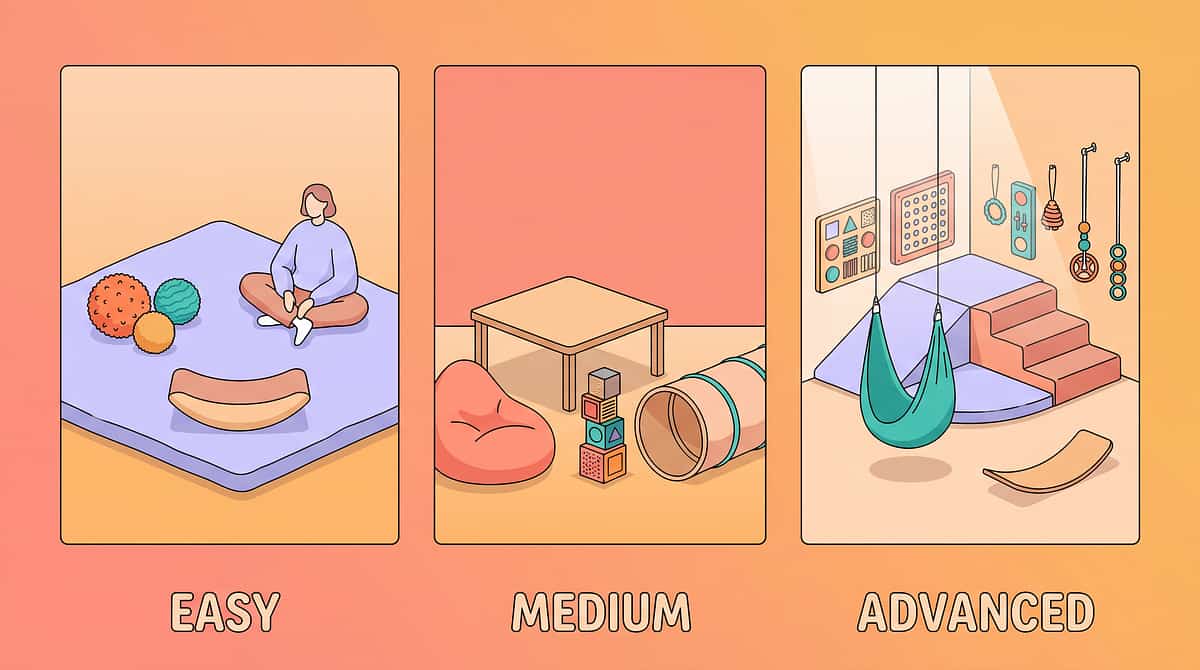
Adapt & Personalise
No two children are identical. Neither are their environments. This card gives you the tools to calibrate the technique precisely to your child's profile — sensory type, age, and co-occurring needs.
Completely Cleared Room
Easiest starting point — full environmental control, no competing items visible
Workspace Clear + Carrel
Desk is cleared, visual blocking tool in place around workspace perimeter
Workspace Clear + Headphones
Cleared desk plus noise-cancelling headphones to reduce compound sensory load
Regulation Tools Only
Child uses portable regulation tools in environment with visual blocking fading
Tolerate Full Clutter with Self-Management
Mastery level — child self-manages in real-world environments independently
Age | Adaptation | |
3–5 years | Focus entirely on environmental modification — parent creates the calm space | |
5–8 years | Introduce child's participation in "clear the deck" ritual | |
8–12 years | Self-advocacy training, portable kit deployment, gradual tolerance building |
Autism-Specific Adaptation: Strong interest objects strategically placed WITHIN the clear zone serve as visual anchors — the child's gaze rests on the preferred item rather than scanning. This leverages restricted interests as regulation tools.
ACT IV — THE PROGRESS ARC
Week 1–2: What to Expect
If your child enters the clear zone without protest — that's already progress. The nervous system is forming new associations this week: "clear space = regulated state." That neural pathway is being laid down. You won't see it yet, but it's happening.
✅ Observable Progress
- Child enters clear workspace with less resistance than baseline
- Body settles faster in cleared space (even 30 seconds faster counts)
- Eyes stop darting more quickly once in clear zone
- Child uses regulation tool independently at least once
- One session where functional task was completed without distress
❌ Not Expected Yet
- Tolerance of cluttered spaces without intervention
- Spontaneous self-advocacy
- Generalisation to new environments
- Maintenance of clear zone without adult support
"This is the hardest week. The newness wears off. Stay consistent. Two to three sessions this week is enough. Quality over quantity." — Pinnacle Blooms Consortium

Week 3–4: Consolidation Signs
The neural pathway is consolidating. Watch for these. The most powerful indicator at this stage is anticipatory behaviour — the child begins to know what they need BEFORE dysregulation. This predictive capacity represents genuine neural pathway strengthening.
Child asks for or goes to their clear zone independently (at least once)
Voluntary use is the clearest sign of neural association forming
Child participates in "clear the deck" ritual before starting work
Ritual ownership signals internalisation of the strategy
Slightly longer functional task completion before distress onset
Measurable extension of the regulated window — even 2 minutes more matters
Child begins naming what helps: "I need my carrel" / "I need my headphones"
Language for self-advocacy is emerging — a major developmental milestone
When to increase intensity: If child is tolerating clear-zone function with ease for 3 consecutive sessions, introduce Variation 1 from Card 17 — add one item and observe response.
"You may notice you're clearer and more confident this week. That's because the routine is forming for both of you. You're becoming an environmental therapist for your child — one of the most powerful things a parent can do."
Week 5–8: Mastery Indicators
From accommodation to independence. Watch your child become their own environmental manager. Mastery is NOT the absence of sensitivity — it's the presence of capability: tools, self-awareness, and communication.
1
Self-initiates clear zone use without prompting
The strategy belongs to the child now — not to the session
2
Portable calm kit used in 1+ external environment
Generalisation has begun — the tools travel with the child
3
Requests accommodation from teacher using communication card
Self-advocacy has reached the school setting — a landmark milestone
4
Visible reduction in meltdown frequency in common environments
Observable family-level change — the intervention is working systemically
5
Child can explain their need in 1–2 sentences
Language for self-advocacy is fully operational
"He still prefers organised spaces. But he can function in imperfect ones now. The distress is managed, not gone — but managed is livable." — Parent, Pinnacle Network

Celebrate the Wins
You have restructured your child's nervous system. That is worth celebrating. Every milestone below represents a genuine neurological achievement — acknowledge it with the weight it deserves.
🌟 Child Milestones
- First time child asked for clear space independently → Special recognition moment
- First time child used portable kit at someone else's home → Certificate of bravery
- First time child advocated to teacher with communication card → Major family celebration
🫂 Parent Milestones
- 14 consecutive days of environmental maintenance → You've built a system
- First family outing where child self-managed with portable kit → Freedom milestone
- First time school called to say desk management has improved → Systemic change achieved
Pinnacle Progress Badge: When AbilityScore® data shows measurable improvement in your Sensory Regulation Index, GPT-OS® generates a Progress Certificate for your child. Request yours: 📞9100 181 181
Red Flags: When to Escalate
You are not failing. These are signals to get more specialised support. Knowing when to escalate is a clinical skill — and recognising these signs early protects your child from unnecessary distress.
🔴 Immediate Professional Consultation
- Environmental distress WORSENING despite 4+ weeks of consistent intervention
- Child's self-injurious behaviour during environmental overwhelm
- Child cannot function in ANY space regardless of clearing level
- Refusal to leave home due to environmental fear
- Sleep severely impacted by environmental anxiety
🟡 Specialist Evaluation Within 2–4 Weeks
- OCD features emerging (rituals around organisation, not just preference)
- Anxiety component appears to drive distress more than sensory sensitivity
- ADHD executive function means child cannot maintain any organisational system
- School accommodation requests not being honoured
🟢 Review With Your Pinnacle OT
- Child's tolerance threshold appears to be shrinking over time
- Strategies that worked initially are losing effectiveness
- New environments (school change, home renovation) have created regression
FREE Assessment: 📞9100 181 181 | AbilityScore® evaluation identifies the precise intervention calibration your child needs.

Your Pathway Map
You are here. Here is where we're heading. A-063 sits within a structured cluster of visual environmental sensitivity techniques — each building on the last. The long-term developmental goal is independent environmental regulation over an 18–24 month arc.
Prerequisite Techniques (recommended first)
- A-061: Bright Light Sensitivity — shares core visual over-responsivity management framework
- A-062: Visual Motion Sensitivity — addresses related environmental visual challenge
Next-Level Options (after mastering A-063)
- A-064: Pattern and Texture Sensitivities — extends visual regulation to specific surface qualities
- A-070: Environmental Transition Difficulties — addresses transitions between spaces
Related Techniques in This Domain
You already have the materials for several of these. Start there. The portable calm kit, noise-cancelling headphones, and visual timer you've built for A-063 give you a head start on multiple related techniques.
A-061 — Bright Light Sensitivity | INTRO
Light filtering glasses, blackout curtains, and environmental light control. Shares the core visual over-responsivity management framework with A-063.

A-062 — Visual Motion Sensitivity | CORE
Visual anchoring techniques and limited-field environments. Directly related to the visual regulation skills practised in A-063.
A-064 — Pattern & Texture Sensitivities | CORE
Surface adaptation and transition tools. The natural next step after mastering cluttered space distress management.

A-075 — Noise Sensitivity Regulation | INTRO
Noise-cancelling headphones — the same ones you already own for A-063 make you immediately ready to begin A-075.
Your Child's Full Developmental Map
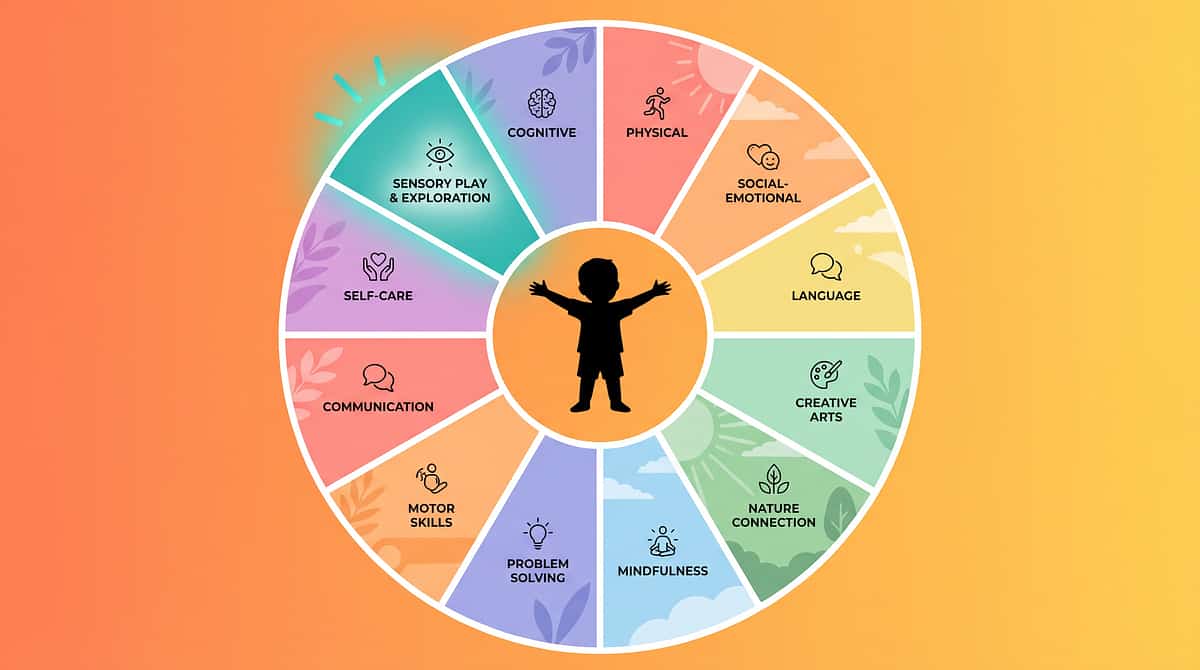
This technique is one piece of a larger plan. A-063 targets Domain A (Sensory Processing), but your child's data may reveal priority needs in other domains that compound the environmental sensitivity. The GPT-OS® FusionModule™ coordinates multi-domain intervention — so OT, ABA, SLP, and SpEd aren't working in silos.
GPT-OS® AbilityScore® maps your child's current capability across all 12 domains. Request a full assessment: 📞9100 181 181 | pinnacleblooms.org

ACT V — COMMUNITY & ECOSYSTEM
A Family's Story
"We used to think Arjun was being dramatic or controlling about mess. He's a child who doesn't organise his own toys — so why would someone else's clutter bother him so much? But once we understood it as a genuine sensory issue — that his nervous system genuinely couldn't filter out visual clutter the way ours can — everything changed.
We created a clear workspace that's protected. No one puts anything on his desk, ever. We use a cardboard carrel at his study space and at school — his teacher was sceptical at first, but agreed when she saw the difference. We have a portable calm kit for grandma's house — a small bag with a pop-up tent, his headphones, and a fidget cube. He deploys it himself now.
He doesn't meltdown at grandma's house anymore. He can do homework even if his siblings' stuff is visible nearby. The distress is managed, not gone — but managed is livable."
— Parent of Arjun, age 9 | Pinnacle Blooms Network | Hyderabad
Illustrative case. Outcomes vary by child profile and intervention consistency.
Illustrative case. Outcomes vary by child profile and intervention consistency.
📞9100 181 181 — Share your story. Connect with other families navigating this exact journey.

Connect With Your Community
You are not navigating this alone. 70+ centres. Millions of families. The Pinnacle parent community brings together caregivers who are 12 months ahead of you on this journey — and who remember exactly where you are right now.
WhatsApp Groups
Domain A Sensory Support — families navigating visual sensitivities together. Moderated by Pinnacle clinical team members. No unverified treatment claims.
Monthly Parent Sessions
Free, facilitated by Pinnacle OTs. Virtual + in-centre options. Real clinical guidance delivered in a community format.
Peer Mentorship
Matched with parents 12 months ahead on the same journey. The most honest, practical support available.
Upcoming Community Event: "Creating Calming Spaces at Home" — Free parent workshop with OT demonstration
📞 Register: 9100 181 181 | 📧care@pinnacleblooms.org
📞 Register: 9100 181 181 | 📧care@pinnacleblooms.org
Find Your Nearest Pinnacle Centre
70+ centres. Every one powered by the same GPT-OS® clinical system. Whether you're in Hyderabad, Mumbai, Delhi, or accessing support internationally — the same evidence-based standard of care is available to your family.
AbilityScore® Baseline
Comprehensive sensory domain assessment by certified OT — your starting map
Personalised Plan
Environmental modification plan for your specific home and school setting
GPT-OS® Dashboard
Ongoing data-driven tracking — your sessions become measurable evidence
FusionModule™ Coordination
Multi-domain support if other developmental areas need simultaneous attention
FREE Services: 📞 National Autism Helpline: 9100 181 181 — Initial consultation, resource guidance, centre referral. Always free. 24×7. 16+ languages. Teleconsultation available globally for families in 70+ countries.
The Research Library
Every strategy on this page is evidence-anchored. Here's your deeper reading — for the curious parent, and the clinician who wants the science behind every card.
Reference | Key Finding | |
PMC11506176 — PRISMA SR (2024) | 16 studies confirm sensory integration as evidence-based for ASD | |
PMC10955541 — Meta-analysis (2024) | SI therapy promotes adaptive behaviour, sensory processing across 24 studies | |
PMC9978394 — WHO/UNICEF CCD | Environmental modification at home produces outcomes across 54 LMICs | |
DOI:10.1007/s12098-018-2747-4 — Padmanabha (2019) | India's first home-based sensory RCT — parent-administered, significant outcomes | |
WHO Nurturing Care Framework (2018) | Global standard for caregiver-administered environmental intervention | |
NCAEP Evidence-Based Practices (2020) | Visual supports and video modelling classified as evidence-based for autism | |
DOI:10.3389/fnint.2020.556660 | Neurological basis for sensory-based interventions in ASD |
How GPT-OS® Uses Your Data
Your data helps every child like yours. And it gives your child something invaluable: a clinical system that learns from every session and continuously recalibrates to match exactly where they are in their developmental arc.
What GPT-OS® Learns from YOUR Data
- Your child's specific clutter threshold level
- Which materials produce the fastest regulation response
- Optimal session frequency for your child's profile
- Generalisation patterns — which environments transfer first
- Early warning indicators before distress becomes meltdown
Privacy Assurance
All data governed under India's DPDP Act 2023. Your child's data is never sold, never shared without consent, never used for advertising.
Data is used exclusively to improve clinical outcomes for your child and, in anonymised aggregate, to improve recommendations for all children.
GPT-OS® architecture protected across 160+ countries.

Watch the Reel
Watch our Pinnacle OT demonstrate every material in 60 seconds. Episode 63 of the Sensory Solutions Series shows the before (child distressed in clutter) and after (child regulated in clear space) — all 9 materials shown in real environments.
"What you're about to see is not staged. This is what cluttered space distress looks like — and what environmental modification does to the nervous system in real time." — Pinnacle OT, Sensory Solutions Series
📺Reel A-063 | Sensory Solutions Series | Episode 63
All materials shown available on Amazon.in or as zero-cost DIY alternatives.
Why video matters: Video modelling is classified as evidence-based practice for autism by NCAEP (2020). Watching correct execution before attempting at home increases parental confidence and accuracy significantly.
All materials shown available on Amazon.in or as zero-cost DIY alternatives.
Why video matters: Video modelling is classified as evidence-based practice for autism by NCAEP (2020). Watching correct execution before attempting at home increases parental confidence and accuracy significantly.
Follow for more: 999 Reels across 12 domains — new content weekly. 📱 @pinnacleblooms | 🌐pinnacleblooms.org
Share This With Your Family
Consistency across caregivers multiplies impact 4×. The WHO CCD Package demonstrates that interventions delivered consistently across multiple caregivers produce 3–4× better outcomes than single-caregiver implementation alone. Your child needs everyone in their world to understand this.
Share This Page
📱 WhatsApp | 📧 Email | 🔗 Copy Link
techniques.pinnacleblooms.org/sensory-processing/cluttered-space-distress-a063
📥 Downloadable Family Guide: "Understanding Your Child's Clutter Sensitivity — A Guide for Grandparents, Teachers, and Extended Family"
Content: What cluttered space distress is | Why it's not dramatic | 3 things you can do right now | What NOT to say
Content: What cluttered space distress is | Why it's not dramatic | 3 things you can do right now | What NOT to say
Teacher Communication Template
"Dear [Teacher], our child [Name] has a diagnosed sensory processing difference that causes significant distress in visually cluttered environments. This is neurological, not behavioural, and is supported by our occupational therapist.
Accommodations that would help: [1] A clear desk policy before starting work [2] Access to a study carrel or visual divider [3] Permission to use noise-reducing headphones during independent work. I'm happy to discuss this further. Thank you for your partnership."
ACT VI — THE CLOSE & LOOP
Frequently Asked Questions
Every question you didn't want to ask out loud — answered with clinical precision and parental empathy.
Q: Is this a real condition or are we just raising a neat-freak?
Cluttered space distress is a genuine sensory processing pattern, not a personality preference. The key difference: people with preferences can function in clutter even if they dislike it. Children with cluttered space distress experience genuine regulatory impairment. Their own room being messy while being unable to handle others' clutter is a classic pattern — self-generated mess is predictable and controllable; others' mess is chaotic and uncontrollable.
Q: Will he always need a perfectly clean space?
With intervention, most children's tolerance window expands significantly. The goal is not a life requirement for perfect environments — it's functional management: knowing what you need, having tools that travel with you, and being able to advocate for accommodation when needed.
Q: I have other kids. I can't keep the whole house minimalist.
You don't need to. Create ONE protected clear space for the sensitive child. Use visual blocking elsewhere. Contained storage dramatically reduces visual load without requiring whole-house minimalism. Many families do this successfully while fully respecting siblings' living space.
Q: Should I seek professional diagnosis first?
If the distress is significantly impairing school function, family life, or the child's wellbeing — yes, a professional evaluation is important. Our FREE helpline (9100 181 181) can guide you. For mild-to-moderate distress, environmental modification can begin immediately.
Q: My child's teacher says they're fine at school — so why are they like this at home?
Some children suppress sensory distress at school (masking) and release it at home — resulting in post-school meltdowns that seem disproportionate. Home safety allows full expression. Additionally, home environments are often less structured than school environments.
Q: How long before we see real improvement?
Environmental modifications can produce visible improvement within 24–48 hours (the nervous system responds to the cleared space immediately). Sustainable tolerance-building takes 8–12 weeks of consistent practice per the systematic review evidence base.
Q: Is this related to OCD?
They can co-occur but are distinct. OCD involves obsessions and compulsions tied to specific fears. Cluttered space distress is primarily a sensory processing/cognitive load issue — the brain cannot filter visual input. If OCD is suspected, psychological evaluation is important. Our OTs can help distinguish the presentations.
Q: What if gradual exposure makes it worse?
Forced or too-rapid exposure can worsen sensitivity and create trauma responses. Our protocol begins with environmental modification — NOT exposure. Exposure is introduced only after a stable regulated baseline is established, always at the child's pace, always with regulation tools available. If any worsening occurs, stop and consult: 📞 9100 181 181.
Your Next Step: Start Now
You've read the science. You have the tools. Your child needs you to begin.
🏛️Validated by the Pinnacle Blooms Consortium
Disciplines: OT • SLP • ABA/BCBA • SpEd • NeuroDev Pediatrics • CRO
Disciplines: OT • SLP • ABA/BCBA • SpEd • NeuroDev Pediatrics • CRO
📞 FREE National Autism Helpline: 9100 181 181 | care@pinnacleblooms.org | Available 24×7 | 16+ Languages
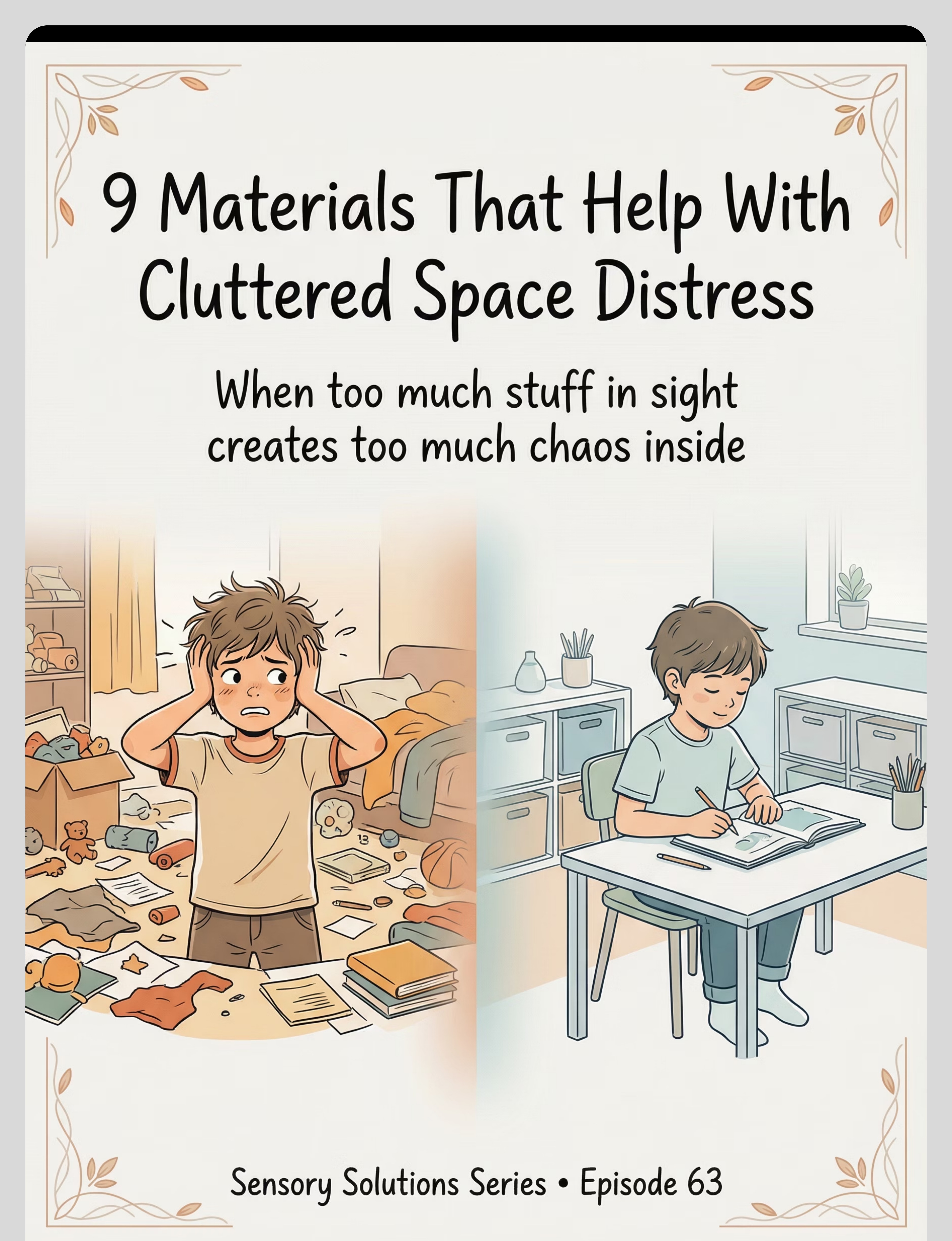
Preview of 9 materials that help with cluttered space distress Therapy Material
Below is a visual preview of 9 materials that help with cluttered space distress therapy material. The pages shown help educators, therapists, and caregivers understand the structure and content of the resource before use. Materials should be used under appropriate professional guidance.


Link copied!
The Pinnacle Promise
From fear to mastery. One technique at a time.
Pinnacle Blooms Network® exists to transform every home into a proven, scientific, 24×7, personalised, multi-sensory, multi-disciplinary integrated therapy environment — empowering parents and caregivers across the world to deliver evidence-based intervention right where their child lives, learns, and loves.
✅ Evidence-Anchored
Level I–IV research cited on every card. No strategy without a citation.
✅ Parent-Executable
Designed for home delivery without clinical training. Built by mothers. Engineered as a system.
✅ Equity-Accessible
Zero-cost DIY for every material. No family is excluded by budget.
✅ Consortium-Validated
OT + SLP + ABA + SpEd + NeuroDev + CRO — not a single perspective.
Medical Disclaimer: This content is educational. It does not replace assessment by a licensed occupational therapist, psychologist, or healthcare provider. Persistent environmental sensitivities significantly impacting function should be evaluated through comprehensive sensory and developmental assessment. Individual results may vary. Always consult your child's healthcare team before implementing new therapeutic strategies.
CIN: U74999TG2016PTC113063 | DPIIT: DIPP8651 | MSME: TS20F0009606 | GSTIN: 36AAGCB9722P1Z2
© 2025 Pinnacle Blooms Network®, unit of Bharath Healthcare Laboratories Pvt. Ltd. All rights reserved.
Built by Mothers. Engineered as a System. 🌸
Built by Mothers. Engineered as a System. 🌸