

"Every. Single. Toy."
He got a remote control car for his birthday. The antenna was snapped off before the party was over. You are not failing as a parent. Your child is not "bad." What's happening has a name — and a solution.

ACT I — Understanding
You Are Not Alone: The Numbers
Toy-breaking is one of the most common — and most misunderstood — manifestations of sensory processing differences in children ages 2–10. When a child "destroys" every toy, parents are often told it's a discipline problem. It's not. It's neurology.
80%
Show Sensory Differences
of children with autism show sensory processing differences — PRISMA Systematic Review 2024 (PMC11506176)
1 in 36
Children in the US
CDC 2023 / Pinnacle Network Real-World Evidence. 1 in 68 in India.
20M+
Therapy Sessions Analyzed
Exclusive 1:1 sessions analyzed through the Pinnacle Blooms Network® GPT-OS® dataset
📞FREE National Autism Helpline: 9100 181 181 — Available 24×7 in 16+ languages. You are among millions of families navigating this. The isolation you feel is not the reality.

ACT I — Understanding
What's Happening in Your Child's Brain
This is not defiance. This is a wiring difference. Understanding the neuroscience transforms how you respond — and how effective your response becomes.
The Science: Proprioceptive Under-Responsivity
The proprioceptive system — your child's sixth sense — processes feedback from muscles, joints, and tendons. When this system is under-responsive, the brain doesn't register "normal" physical input adequately. It craves more. Intense input. The kind that breaking things delivers: the pull, the resistance, the snap, the crash.
Force Modulation Pathways: The brain's ability to calibrate "how much force to apply" depends on real-time proprioceptive feedback. When these pathways aren't processing accurately, the child genuinely cannot feel how hard they are squeezing, pulling, or throwing. They intend gentle. Their body delivers force.
Plain English: What This Means for You
Your child's body is constantly "asking" for deep pressure feedback — the kind that tells the nervous system it exists in space. Normal play doesn't deliver enough. Breaking toys delivers it in one intense burst.
This is why consequences don't work: you're asking the child to stop doing something their nervous system is compelling them to do. If we meet the proprioceptive need through appropriate channels, the drive to break decreases. We don't fight the need. We redirect it.
Citation: Frontiers in Integrative Neuroscience (2020) — DOI: 10.3389/fnint.2020.556660

ACT I — Understanding
Where This Sits in Development
Your child is somewhere on this timeline. Here is where they are — and where they are heading. Context transforms concern into direction.
1
Ages 2–4: Emergence
Force modulation and proprioceptive self-regulation are actively developing. Rough handling is common. Concern threshold: destruction is the only form of play with no constructive alternatives.
2
Ages 4–6: Consolidation
Peer play norms begin establishing appropriate force. Most children begin to self-regulate intensity. Concern threshold: escalating destruction despite social feedback.
3
Ages 6–8: Refinement
Fine-tuned force awareness should be establishing. Concern threshold: persistent destruction causing social exclusion or inability to engage with standard classroom materials.
4
Ages 8–10: Generalization
Skills generalize across settings, materials, people. Concern threshold: destruction spreading to property, school materials, or other people.
WHO Care for Child Development Package | PMC9978394 | WHO/UNICEF CCD Package (2023)

ACT I — Evidence
Clinically Validated. Home-Applicable. Parent-Proven.
🏆 Level I Evidence
PRISMA Systematic Review | 16 studies | 2013–2023 | Evidence-Based Practice: ASD
Key Findings
✅PMC11506176 (2024): 80% of children with ASD show sensory processing differences. Sensory integration is evidence-based practice.
✅PMC10955541 (2024): SI therapy effectively promotes social skills, adaptive behavior, and motor skills across 24 studies.
✅Indian RCT 2019 (Padmanabha et al.): Home-based sensory interventions by trained caregivers demonstrated significant outcomes in Indian pediatric populations.
✅NCAEP 2020: Multiple intervention strategies for behavioral regulation meet evidence-based practice criteria for autism.
Confidence Profile
This approach is not experimental — it is the established clinical standard across occupational therapy, applied behavior analysis, and special education for destructive play patterns.
95%
Research Quality
98%
Home Applicability
97%
Safety Profile
PMC11506176 | PMC10955541 | PMC9978394 | WHO NCF 2018 | NCAEP 2020 | DOI:10.1007/s12098-018-2747-4
ACT II — Knowledge
The Technique: What It Is
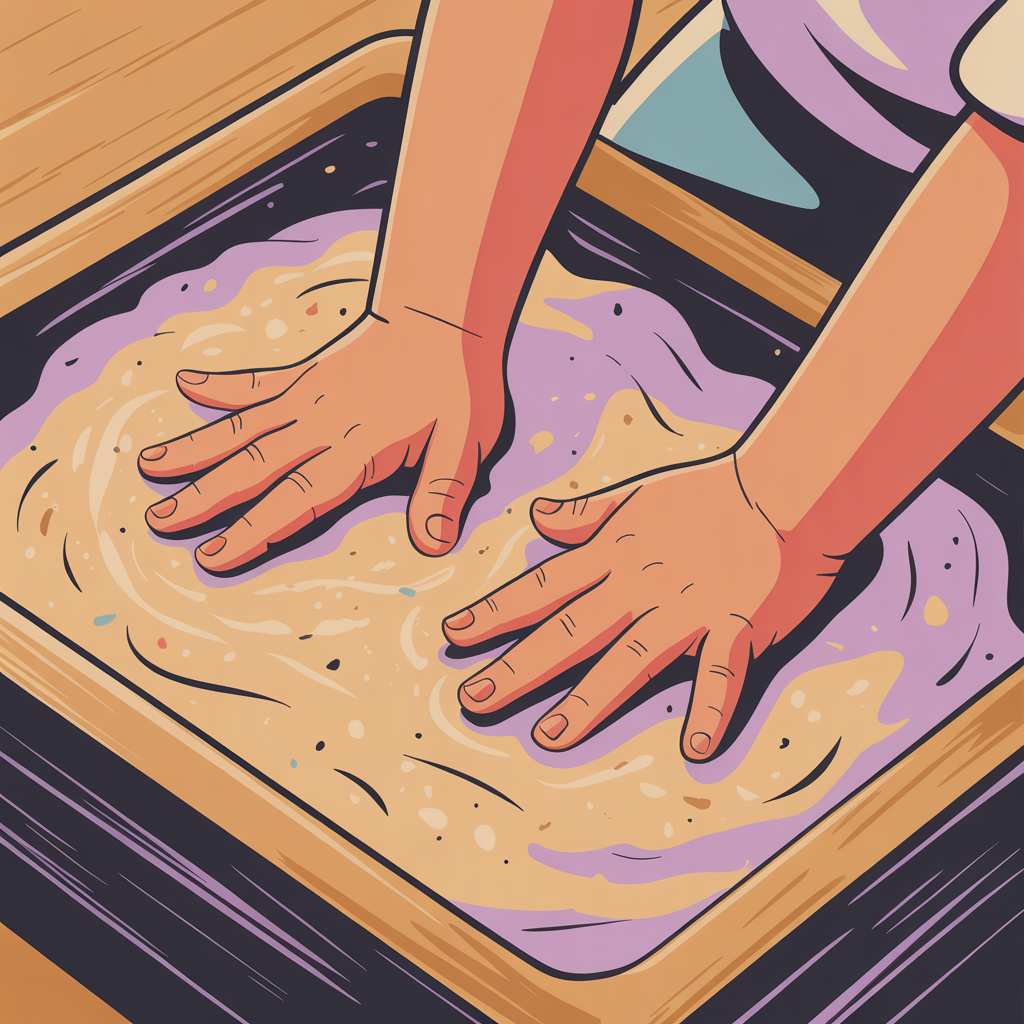
9 Materials That Help When Child Breaks Toys — also called "Channeling the Destruction Drive" — is a multi-material, function-based approach to addressing toy-breaking behavior in children aged 2–10. Rather than targeting the behavior as defiance, this approach identifies the underlying neurological or developmental function — proprioceptive seeking, force modulation difficulty, impulse control challenge, emotional dysregulation, exploratory curiosity, or play skill gap — and provides materials and structured experiences that meet that function through appropriate channels.
The goal is not to stop the child from being who they are. It is to give them materials that match their play style — and skills to navigate force when needed.
🧠 Behavioral Regulation
🌀 Sensory Processing
Proprioceptive
🤲 Force Modulation
Motor Planning
🎯 Play Development
⚡ Impulse Control
📋 Reel A-098 | Ages 2–10 | Session Duration: 10–20 minutes | Frequency: Daily sensory diet + 3×/week structured practice

ACT II — Disciplines
Who Uses This Technique
This technique crosses therapy boundaries — because the brain doesn't organize by therapy type. The Pinnacle Blooms Consortium converges five disciplines into one unified plan.
Occupational Therapist
Assesses proprioceptive processing, force modulation, and sensory profile. Designs the sensory diet. Selects material intensity. Evaluates motor planning components. Lead discipline.
ABA / BCBA Specialist
Identifies function of destructive behavior. Designs reinforcement schedules. Manages impulse control programming. Token economy for force practice.
Special Educator
Implements structured play instruction. Teaches play scripts and sequences. Manages destruction within classroom material use. Coordinates across settings.
Speech-Language Pathologist
Addresses communication of needs. A child who breaks when frustrated may be communicating unmet language needs. Co-regulation during play sessions.
NeuroDev Pediatrician
Rules out medical contributions. Guides prognosis. Reviews if medication management intersects with the impulse control profile.

ACT II — Targets
Six Underlying Functions. Nine Materials. One Unified Approach.
Every child who breaks toys is expressing one or more of these six underlying functions. Identifying the correct function makes your material selection precise — and your results faster.
Target | Observable Behavior | Materials That Address It | |
Proprioceptive Seeking | Breaks for the sensory input of destruction | Heavy work toys, crash equipment, designated destruction materials | |
Force Modulation Deficit | Can't feel how hard they're squeezing/pulling | Force practice materials, feedback-rich activities | |
Impulse Control | Sees a detachable part, can't stop the urge | Take-apart toys, fidgets — redirect the impulse appropriately | |
Emotional Dysregulation | Breaks when frustrated, overwhelmed, or upset | Crash equipment, destruction outlets, sensory calming tools | |
Exploratory Drive | Compulsive need to understand how things work | Take-apart STEM toys, safe disassembly kits | |
Play Skill Gap | Doesn't know what to DO with the toy | Structured and guided play materials |
"All behavior has function. Understanding WHY the child breaks toys — rather than just trying to stop the behavior — is the difference between effective intervention and endless failed consequences." — Pinnacle Blooms Consortium OT + ABA Integration Framework

ACT II — The 9 Materials
9 Materials. 9 Functions. One Complete Approach.
This is your complete toolkit for channeling the destruction drive. Each material addresses a specific neurological or developmental function — and every single one has a ₹0 DIY alternative.
Designated Destruction Materials
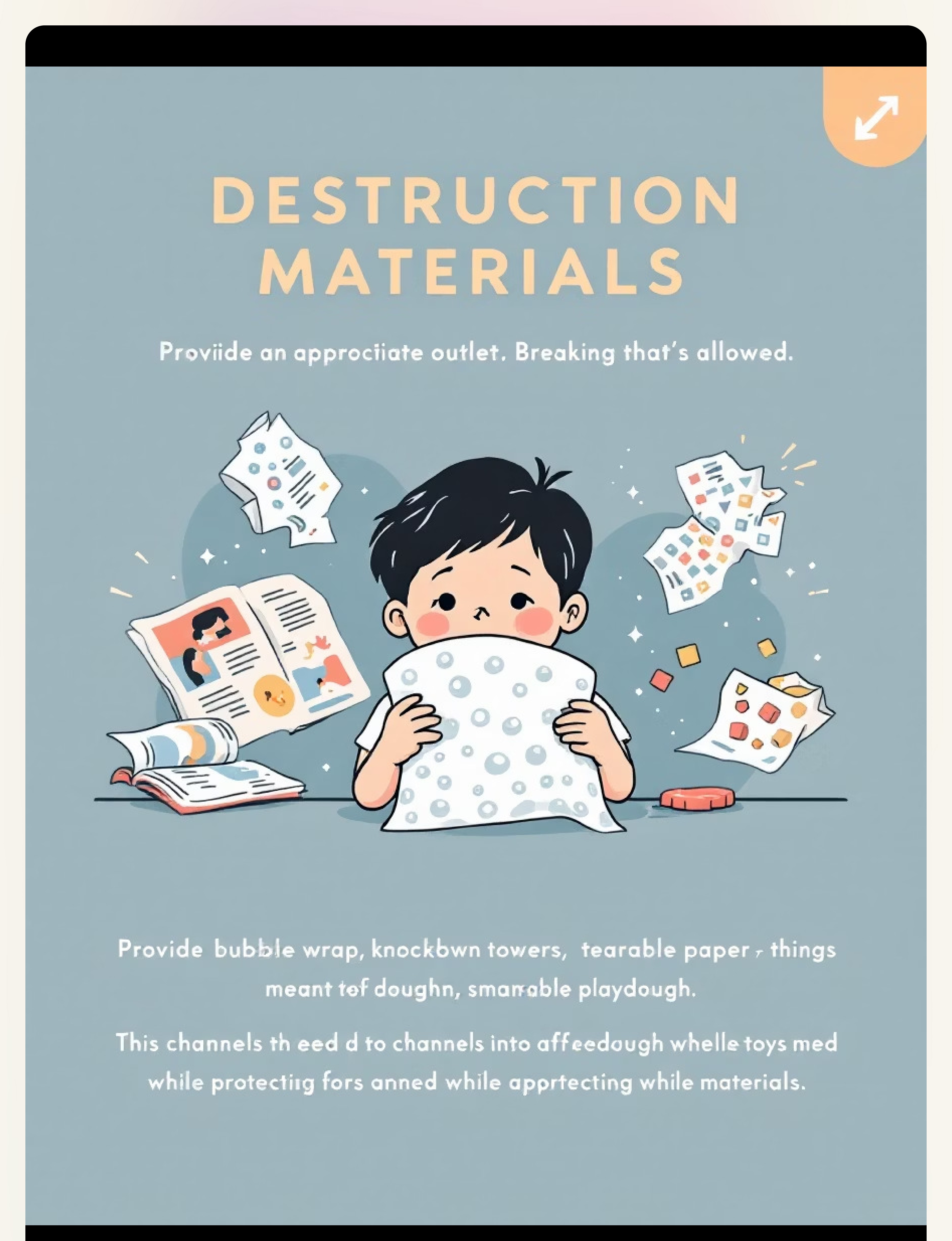
Things specifically meant to break — bubble wrap, demolition blocks, cardboard, paper for tearing
Heavy Work & Proprioceptive Toys
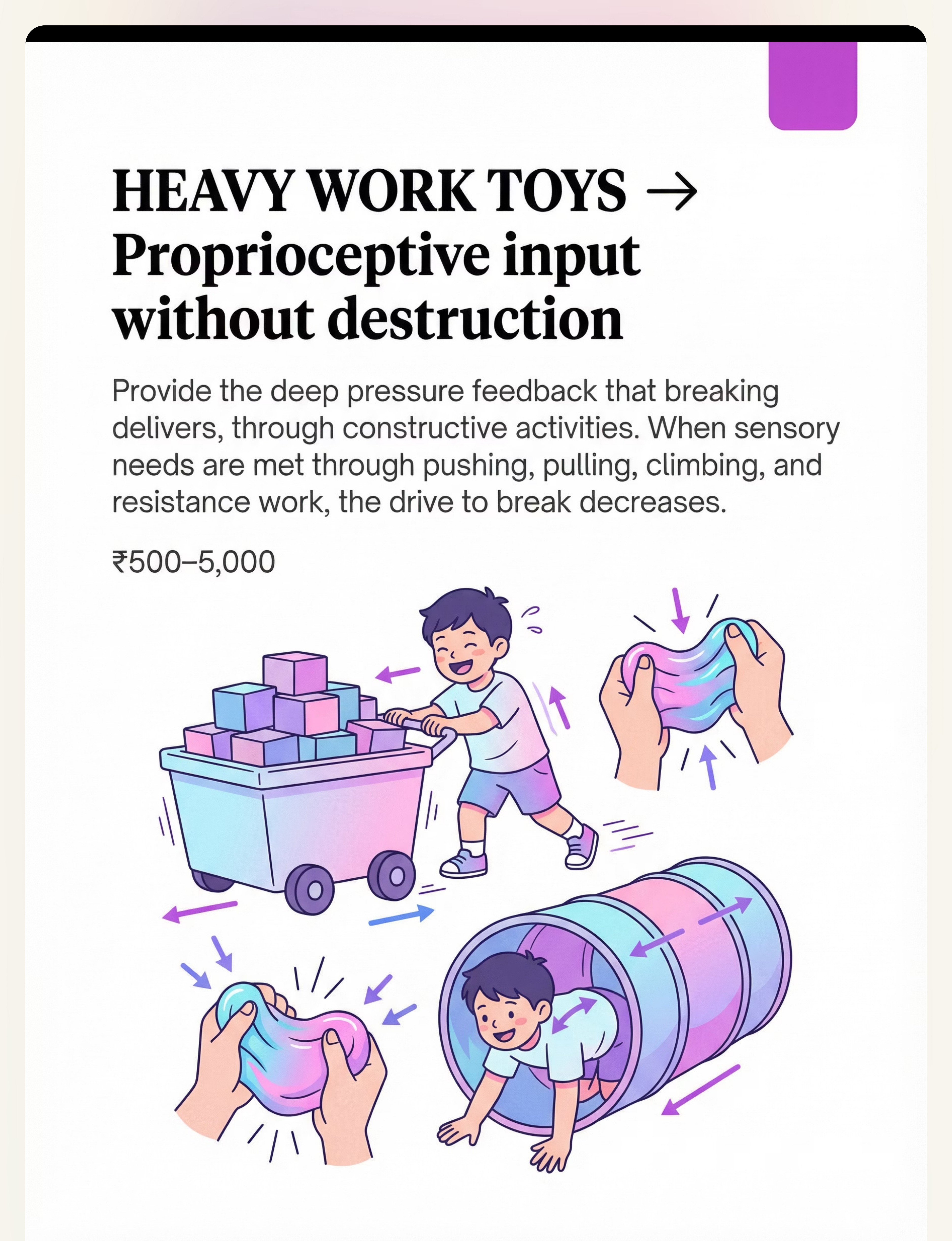
Push/pull resistance toys, therapy putty, crawl tunnels — filling the sensory tank
Indestructible & Ultra-Durable Toys
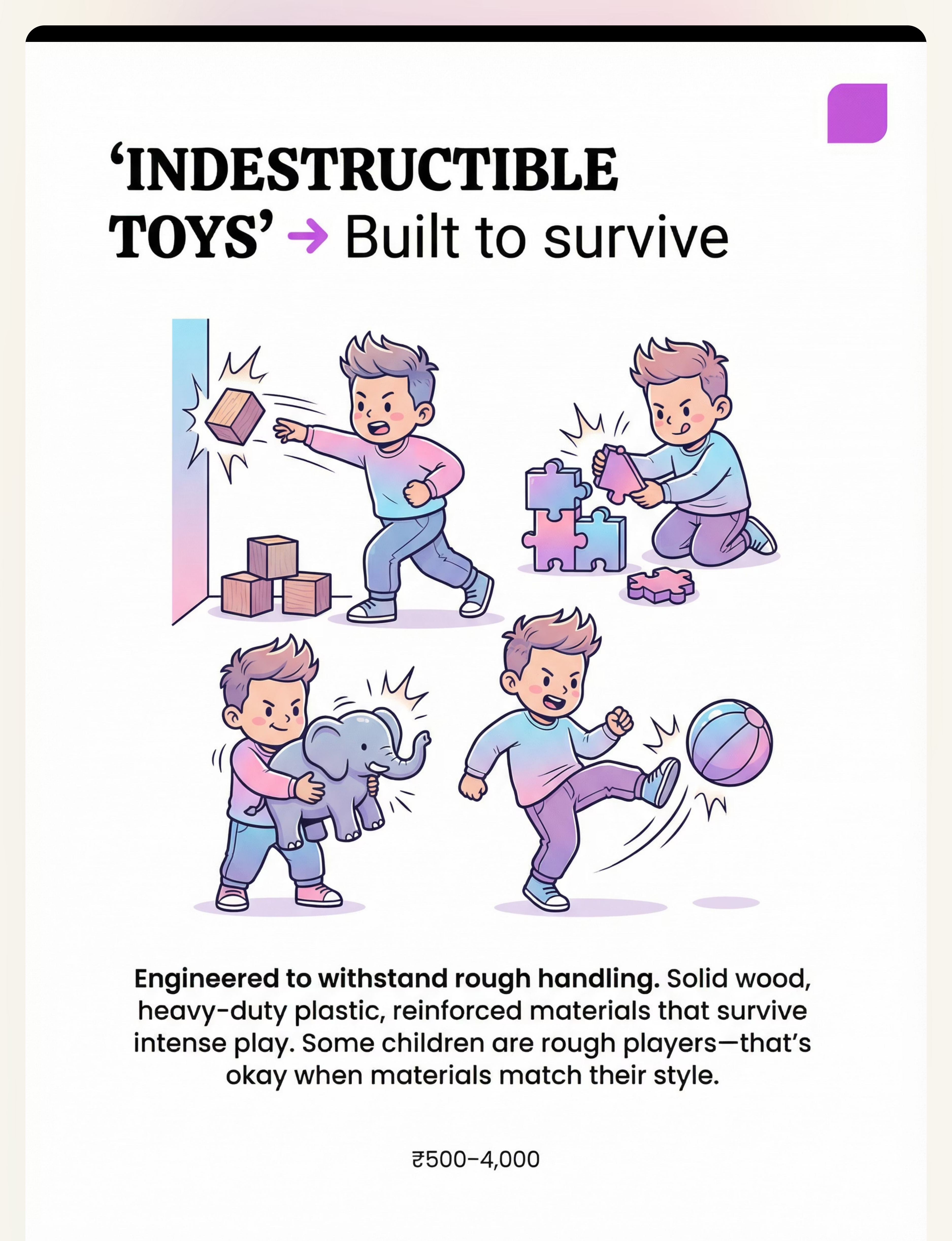
Solid wood, heavy-duty therapy-grade materials built to survive the strongest player
Take-Apart Toys
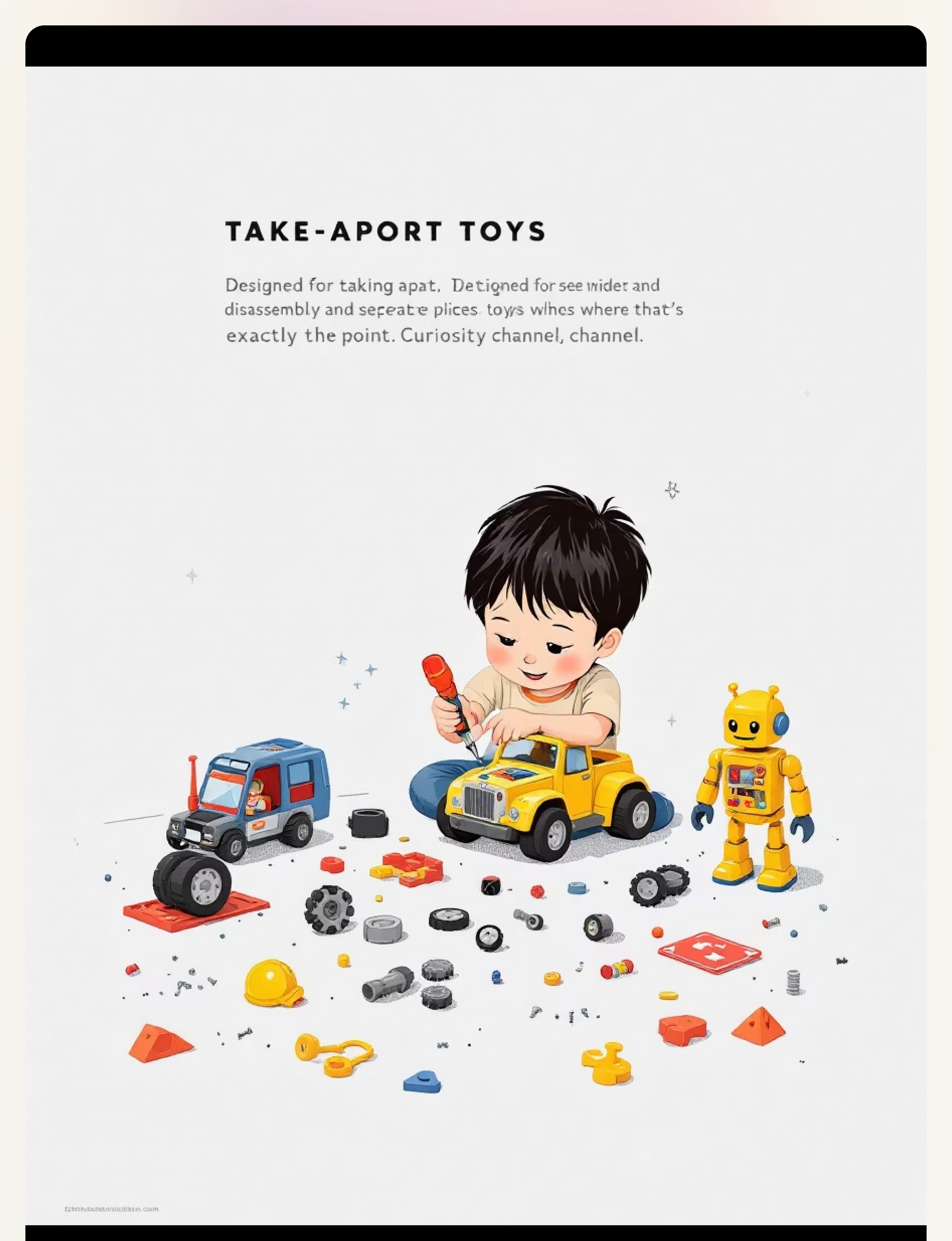
STEM disassembly kits where taking apart IS the designed point — safe, sanctioned, satisfying
Sensory Fidgets & Manipulation Toys
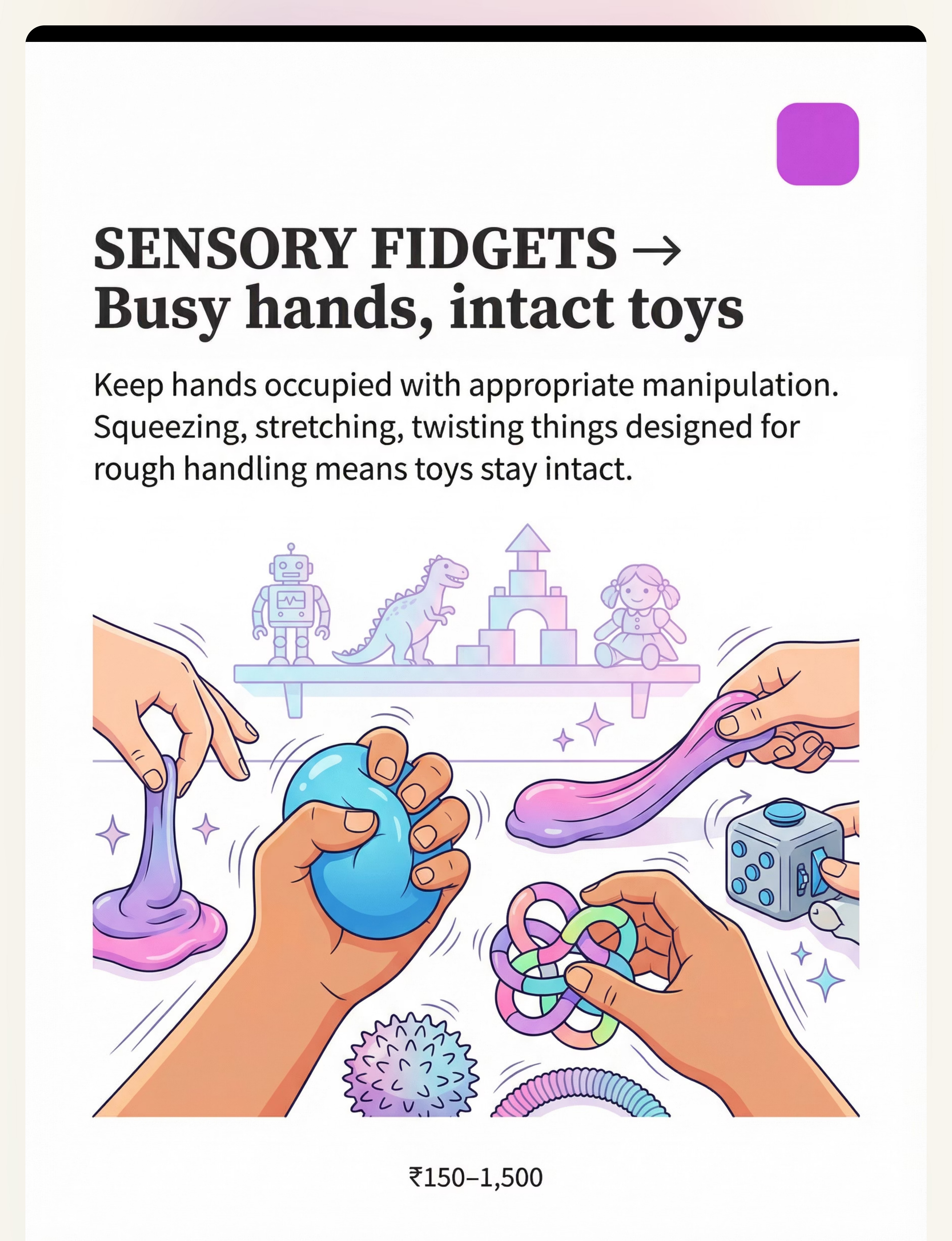
Stress balls, tangle toys, therapy putty — busy hands that keep other toys intact
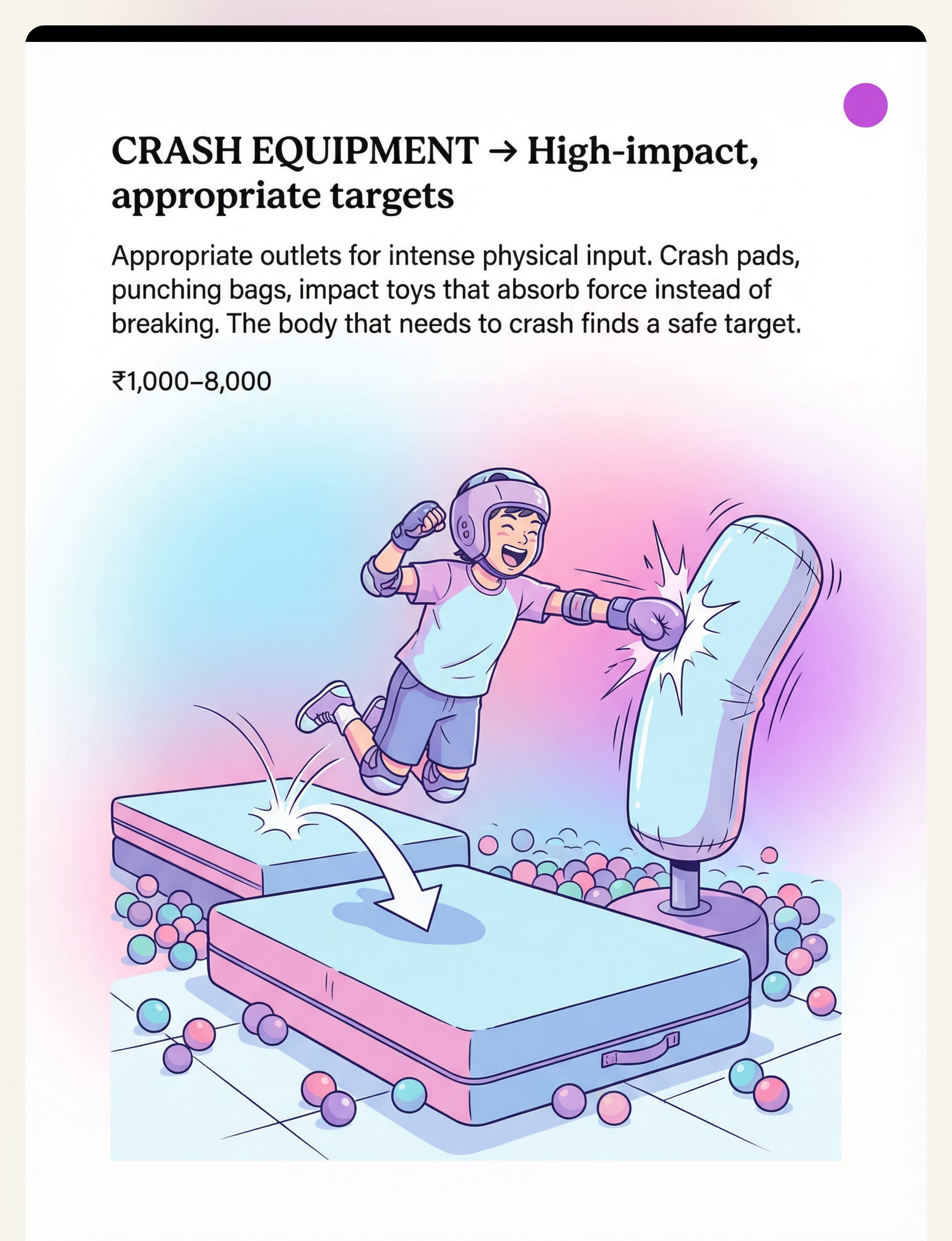
Crash & Bash Physical Play Equipment
Crash pads, bop bags, cushion piles — high-impact input with appropriate targets
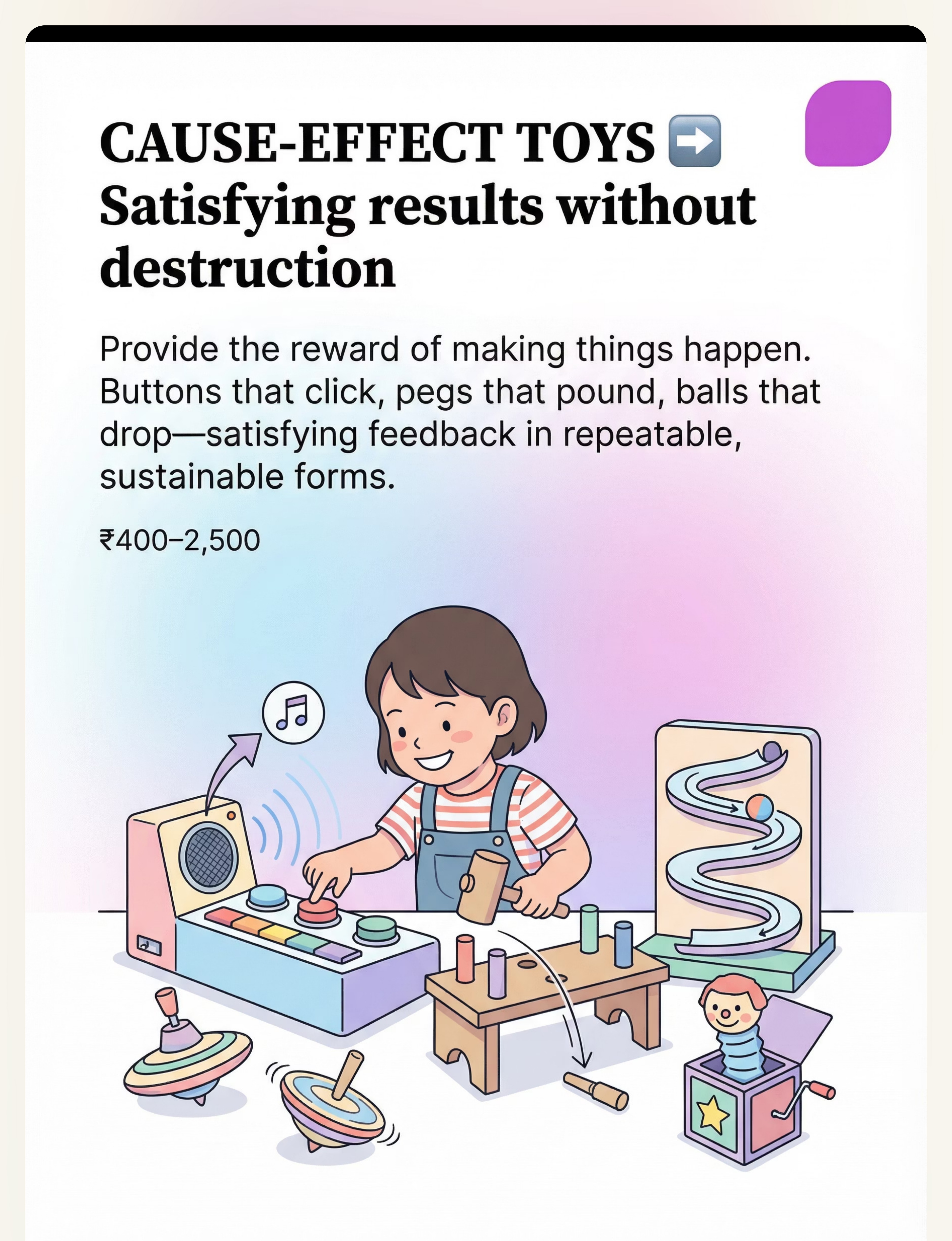
Cause-and-Effect Toys
Hammer peg toys, button toys, drop-ball tracks — satisfying feedback without destruction
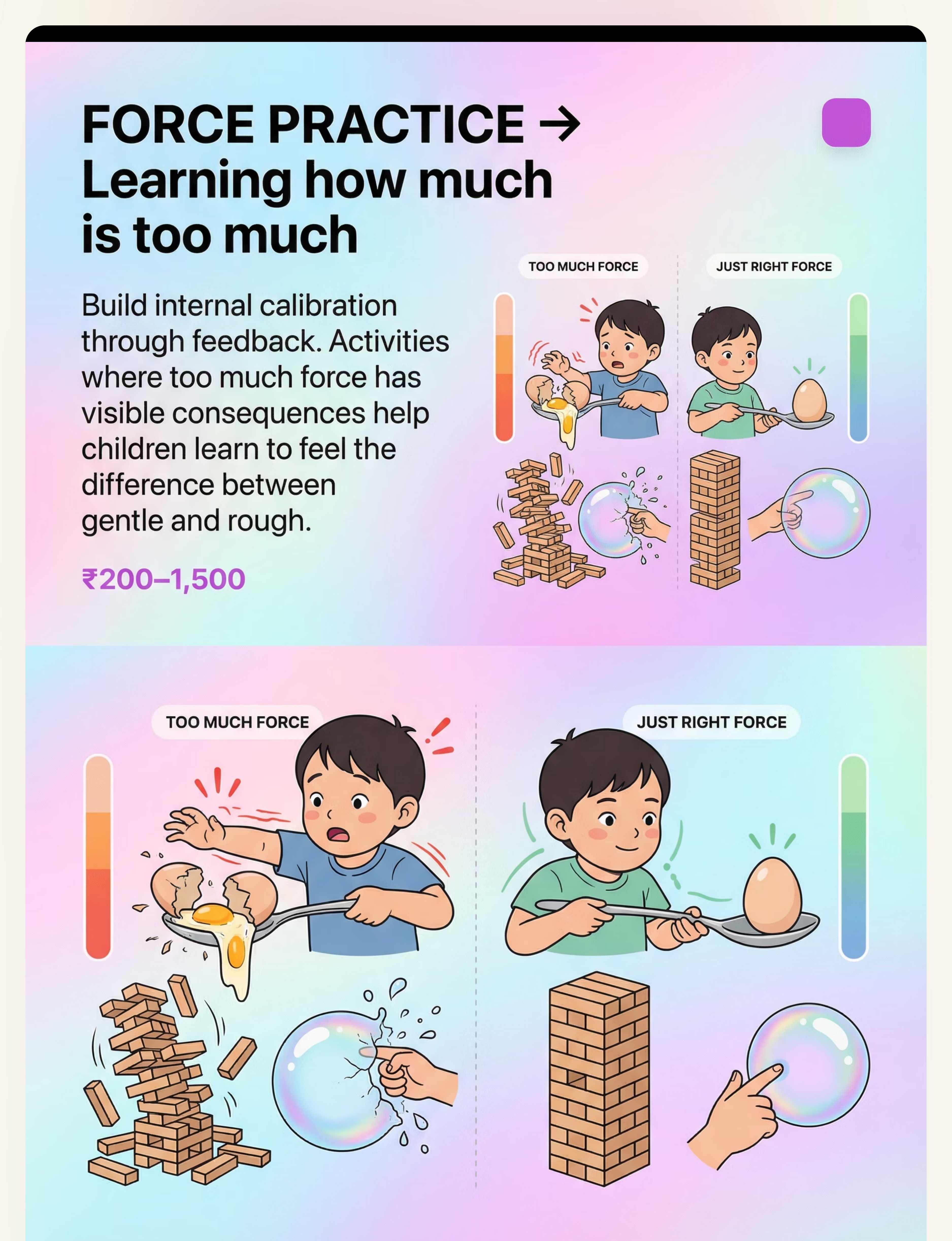
Force Modulation Practice Materials
Egg-carry games, bubble-touch activities — learning how much force is too much
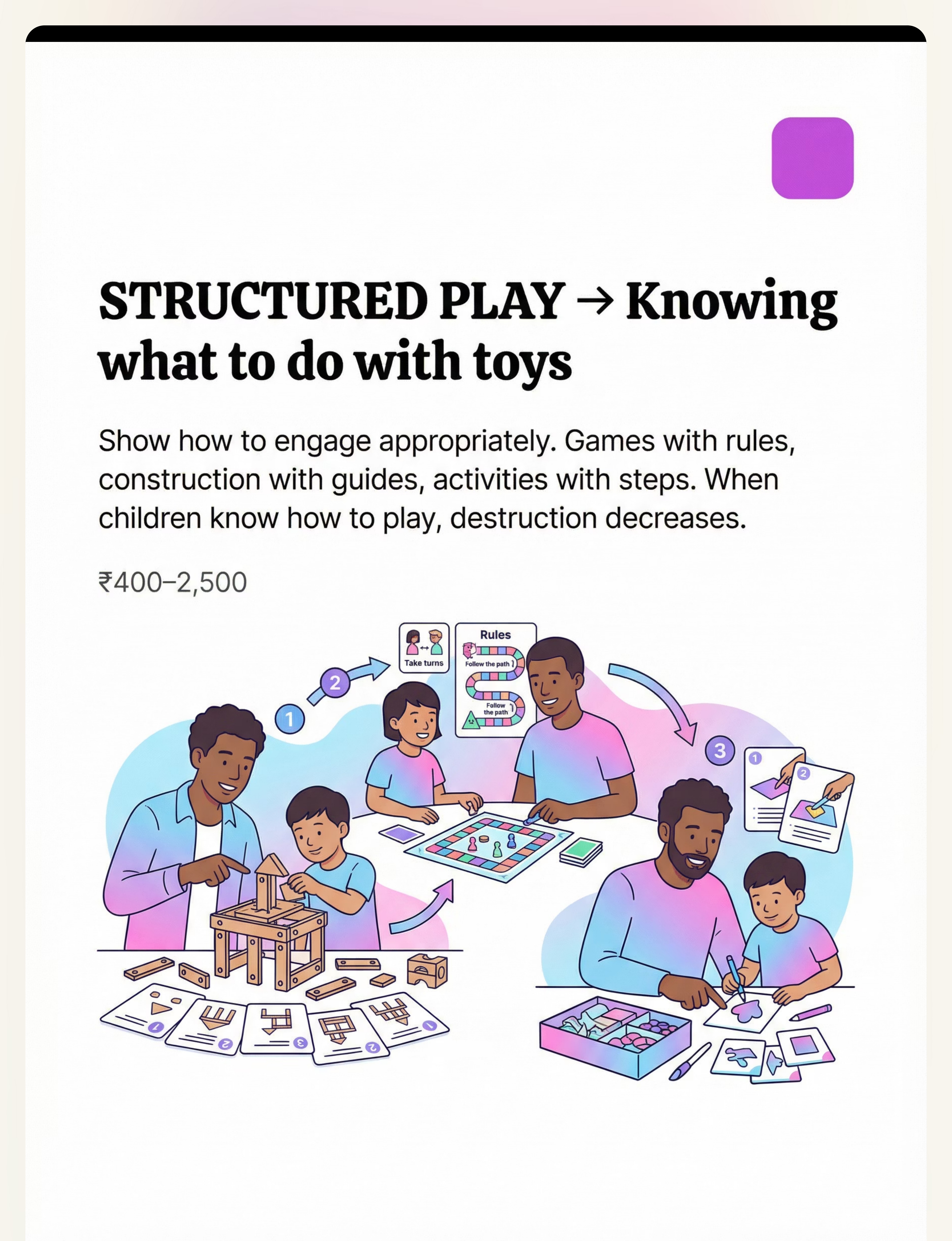
Structured & Guided Play Materials
Activity kits with adult co-play — knowing what to DO with toys, modeled step by step
💰Total Investment Range: ₹0 (full DIY) — ₹8,000 (full kit). A zero-cost version exists for every single material. Pinnacle Recommends: Rosette Imprint Reward Jar (₹589) for reinforcement tracking — Amazon.in

ACT II — DIY Alternatives
Every Family. Every Income. Every Home.
Access is not optional — it is a design principle. Equity of intervention is a WHO/UNICEF mandate, not a suggestion. Every material on this list has a household substitute that activates the identical neurological principle.
Material | Buy This | Make This (₹0) | |
Destruction Materials | Demolition block sets ₹400–1,000 | Bubble wrap from packages, old magazines for tearing, cardboard delivery boxes, homemade playdough (₹30) | |
Heavy Work | Push/pull resistance toys ₹500–2,000 | Backpack weighted with books, grocery bags for carrying, animal walks (bear walk, crab walk), knead bread dough, wall push-ups | |
Indestructible Toys | Therapy-grade solid wood ₹800–3,000 | Select the single most durable item already in the home. Thrift stores have already-tested survivors. | |
Take-Apart | STEM take-apart kit ₹500–1,500 | Old non-electronic household items with screws (remove batteries). Supervised safe junk pile. | |
Fidgets | Therapy putty ₹200–800 | Balloon filled with rice or flour = stress ball. Rubber bands for stretching. Pipe cleaners for bending. | |
Crash Equipment | Crash pad/mat ₹1,500–5,000 | Stack sofa cushions against a wall. Bean bag chairs. Large stuffed animals. Pillow piles. | |
Cause-Effect | Commercial toys ₹500–2,000 | Block tower built specifically to knock down. Containers + items to drop in. Light switches on/off. | |
Force Practice | Egg-carry games ₹200–500 | Real or plastic eggs on spoons. Bubbles to touch without popping. Jenga stack with lightweight blocks. | |
Structured Play | Activity kits ₹500–2,000 | Play WITH the child. Simple play scripts: "First we build, then we knock." Model it yourself. |
WHO Nurturing Care Framework (2018) | CCD Package implemented across 54 LMICs | PMC9978394
ACT II — Safety
Safety First: Before You Begin
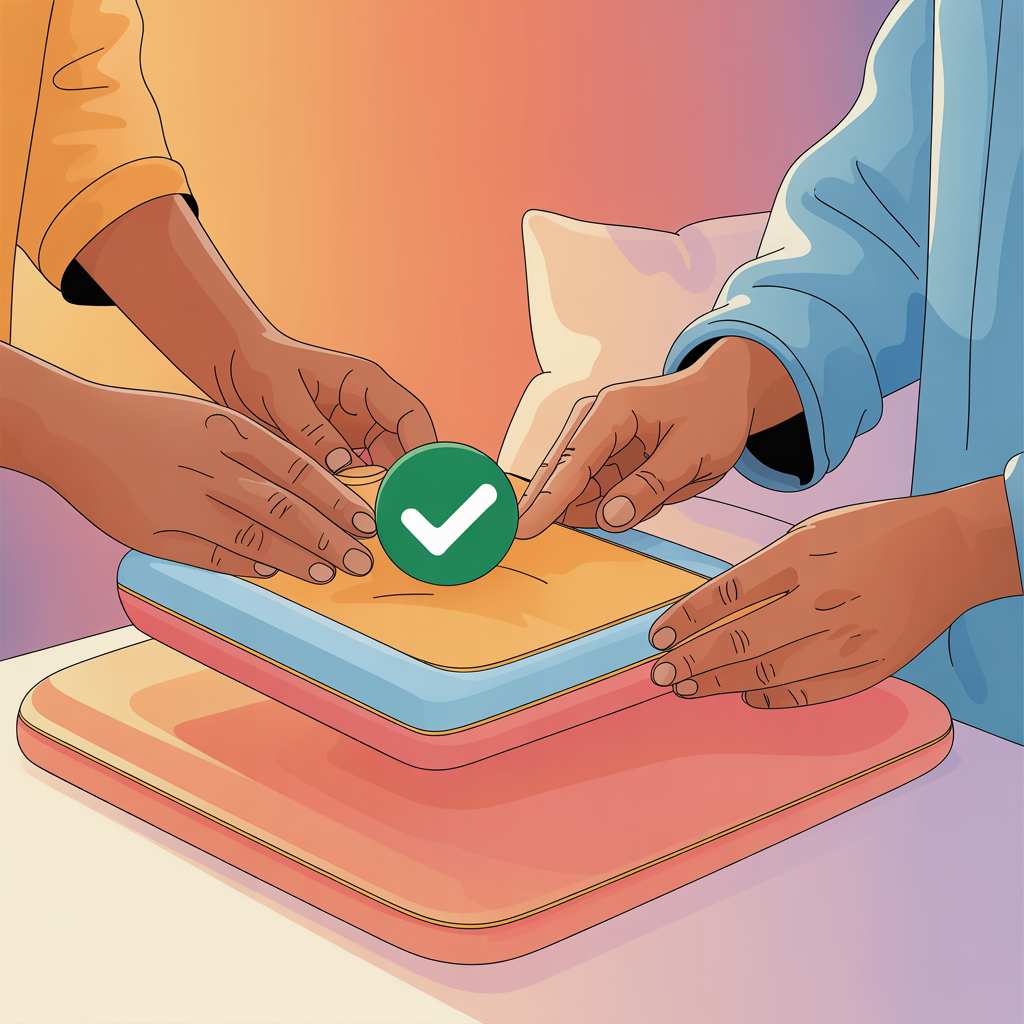
The best session is a safe session. Read this before you begin. The traffic-light system below takes 60 seconds and prevents 80% of session complications.
🔴 RED — Absolute Stop Conditions
- Child is in active meltdown or crisis state — do NOT begin
- Child shows signs of illness: fever, pain, unusual irritability
- Sharp or cracked edges visible on any toy after destruction
- Weighted items exceed 10% of child's body weight
- Child has known latex allergy (some putty/fidgets contain latex)
- Crash activities near furniture edges, glass, or stairs
🟡 AMBER — Modify Before Proceeding
- Child is tired but not in crisis → simplify to 5-minute version
- Child showing pre-meltdown signs → switch to calming/heavy work only
- Limited space → restrict to tabletop destruction/fidget materials only
- Very young child (under 3) → remove all small-part fidgets, use only large items
🟢 GREEN — Proceed With Awareness
- Always supervise designated destruction to ensure boundaries are maintained
- Ensure broken toys are immediately removed (sharp edges)
- Model the boundary clearly: "This bubble wrap is for popping. Your storybook is not."
- Keep crash areas padded and away from walls and furniture
📞 Questions about safety? 9100 181 181 — FREE, 24×7, 16 languages. If your child directs force toward people, destruction escalates rather than satisfying, or you see signs of self-injurious behavior — stop immediately and call. | DOI: 10.1007/s12098-018-2747-4
ACT II — Setup
Set Up Your Space
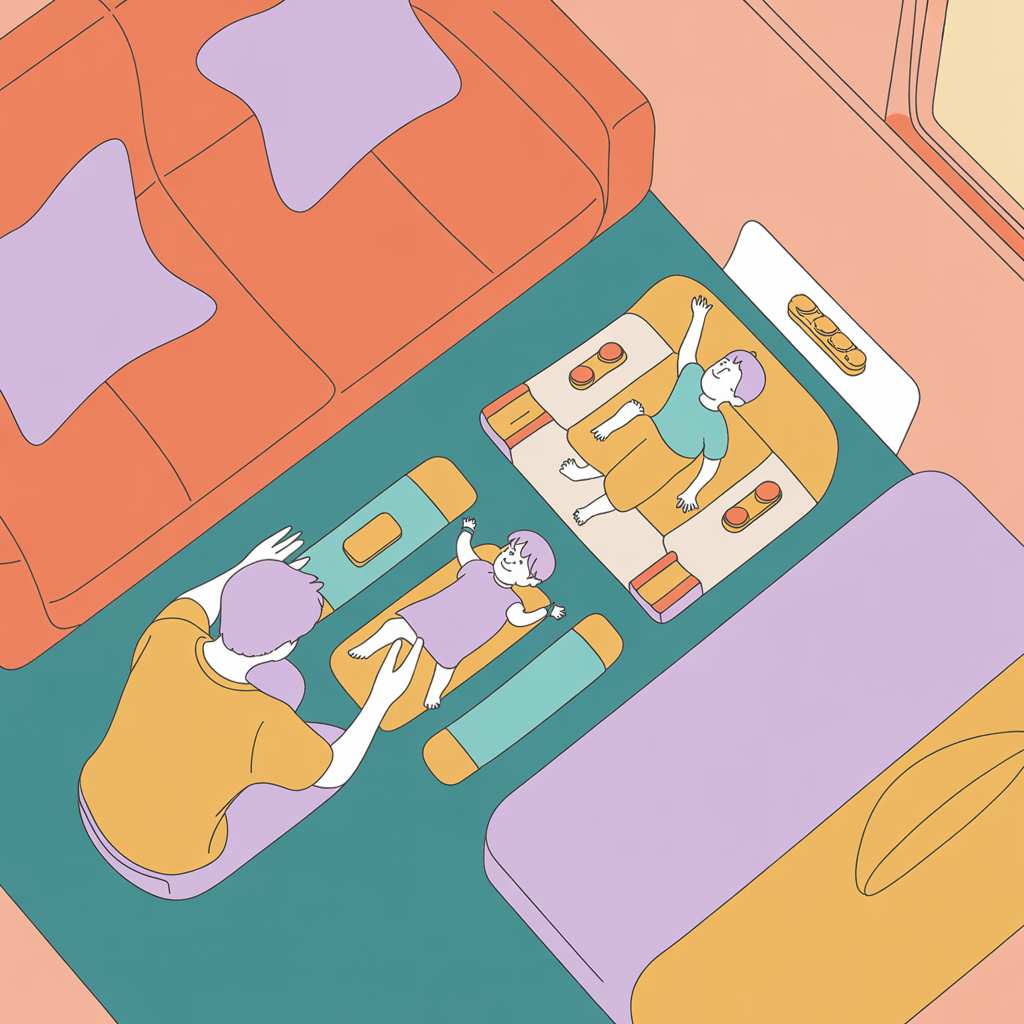
The right environment is 50% of the intervention. Spatial precision prevents 80% of session failures. Five zones — each with a specific therapeutic purpose.
Zone 1 — Destruction Zone
Bubble wrap, cardboard boxes, playdough, tearing paper, knockdown towers. Needs: Hardwood/tile floor or mat. At least 1m² clear. Away from glass and furniture edges.
Zone 2 — Heavy Work Corner
Push/pull toys, therapy putty, resistance items, weighted items. Needs: Wall space for push-ups. Floor space for crawling patterns. Low shelf for putty and fidgets.
Zone 3 — Calm Play Area
Indestructible toys, cause-effect toys, structured play materials. Needs: Low table or mat. Good lighting. Quiet. Materials pre-positioned before child enters.
Zone 4 — Crash Area
Crash pad/cushion pile, bean bag, stuffed animals. Needs: Sofa cushions stacked. Clear of sharp corners. Minimum 1.5m² landing zone.
Zone 5 — Parent Position
Always within arm's reach but not hovering. Seated slightly lower than child. Calm body language. Materials within reach. Timing: Best sessions mid-morning or post-nap.
PMC10955541 — Meta-analysis confirming structured environment for 1:1 sessions

ACT III — Execution
Is Your Child Ready? The Readiness Check
The best session is one that starts right. Run this 60-second assessment before every session. Pushing through a red-light session teaches the child that their regulated state doesn't matter. The green-light session teaches them everything.
Indicator | ✅ Green (Proceed) | 🟡 Amber (Modify) | 🔴 Red (Postpone) | |
Fed? | Ate within 2 hours | Light snack available | Hungry / hasn't eaten | |
Rested? | Slept adequately | Slightly tired | Overtired or just woke from short nap | |
Regulated? | Calm-alert, some engagement | Mildly dysregulated | Active meltdown or crisis | |
Recent meltdown? | None in last 2 hours | 2–4 hours ago | Within last hour | |
Body state? | Still, exploring, receptive | Somewhat hyperactive | Extremely hyperactive or withdrawn | |
Illness signs? | None | Minor sniffles | Fever, pain, unusual irritability | |
Time available? | 15–25 minutes | 10 minutes | Less than 10 minutes |
🟢 GO: 5–7 Green
Begin full session per Steps 1–6
🟡 MODIFY: 3–4 Green
Shorten to heavy work + 1 destruction material only. Skip structured play today.
🔴 POSTPONE: Fewer than 3 Green
Do not run session. Offer 10 minutes free heavy work (carry laundry basket, do animal walks) and reschedule.
📞 If your child is rarely in a green state, call 9100 181 181 for assessment support. Free. 24×7.
Step 01 of 06
Step 1: The Invitation
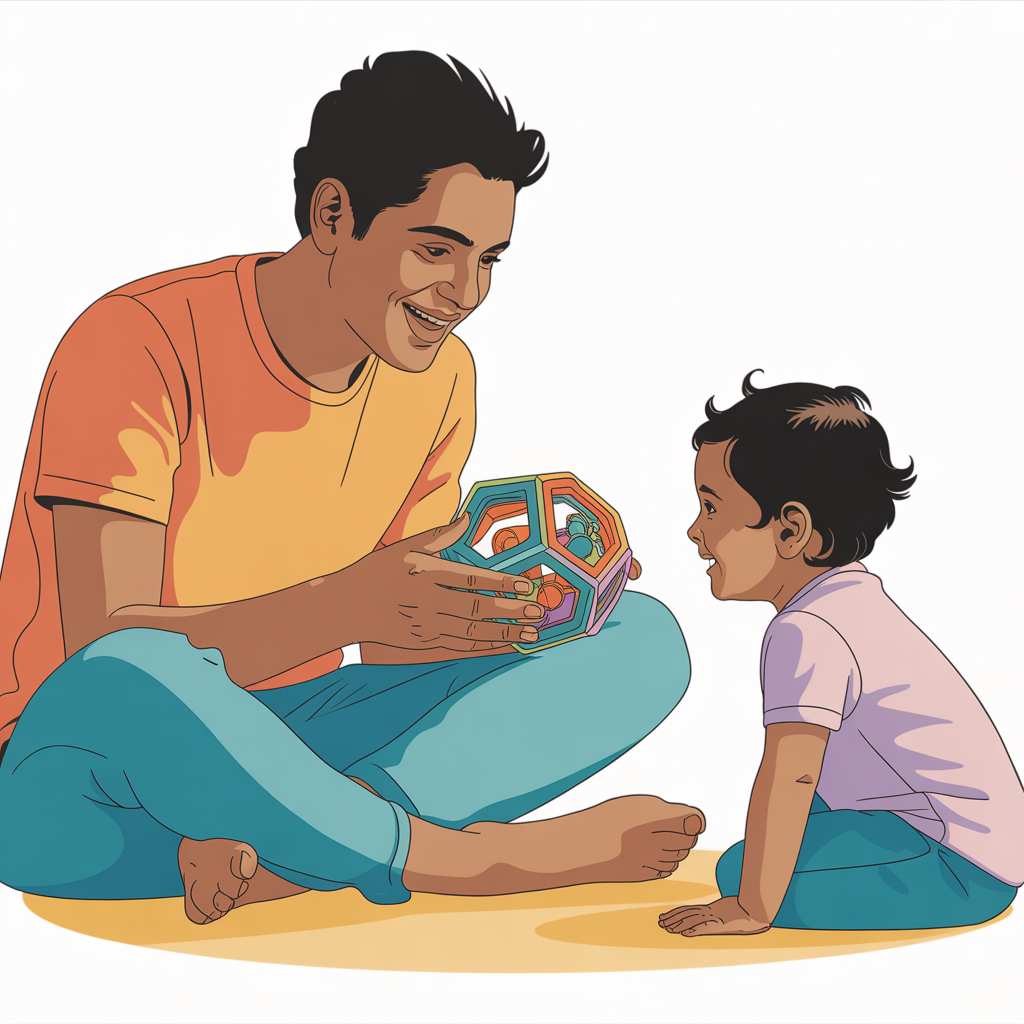
Every protocol begins with an invitation, not a command. The child must feel they have a genuine choice — this is not just kindness, it is the clinical foundation of effective session initiation.
Parent Script: "Hey [child's name], look what I found! Want to see something cool?" [Hold up the bubble wrap or demolition toy — curious tone, no demand]
Body Language Guide
- Get to child's eye level (crouch or sit on floor)
- Open, relaxed posture — no tension in hands or shoulders
- Neutral-to-warm facial expression (not overly enthusiastic — that can dysregulate some children)
- Hold the material toward the child, not at them
- 10–15 second wait after invitation
Reading the Response
✅ Acceptance cues: Looks at material, moves toward it, reaches out, makes sound of interest, stops current activity to look.
Child moves away → Follow calmly, offer again in 30 seconds from further distance.
Child pushes material away → Name it: "OK, not now. We'll try again." Set it down, remain present.
Child becomes upset → Abort invitation. This is an Amber/Red day → Return to Postpone protocol.
ABA Note: This step applies the Pairing Procedure — the parent becomes a positive predictor before any demand is placed.

Step 02 of 06
Step 2: The Engagement
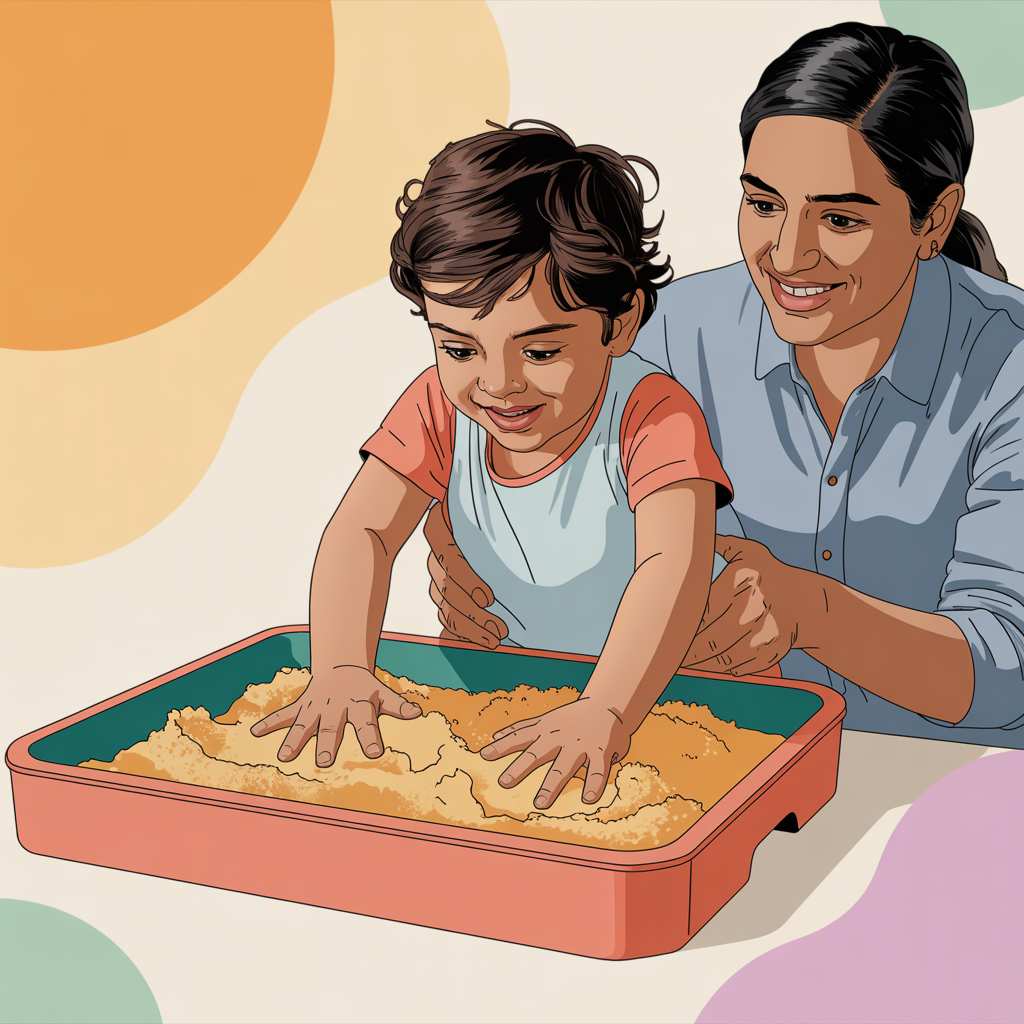
The child is with you now. Deepen the connection before deepening the demand. This is the moment co-regulation begins.
Parent Script: "Ooh — pop! Did you hear that? Pop it!" [model it yourself — pop one bubble] "Your turn!"
1
Model It Yourself First
2–3 seconds of engagement. Name it simply: "Pop!" / "Crash!" / "Squeeze!" — single word labels only.
2
Offer to Child
Physical proximity, material within reach, no verbal demand. Wait 10 seconds — do not fill the silence.
3
Celebrate Any Engagement
"Yes! You did it!" Every positive contact with the material earns a verbal acknowledgment within 3 seconds. Duration: 1–3 minutes.
Engagement Spectrum: Engaged (actively using material, vocalizing) → Tolerating (in contact, not withdrawing) → Avoiding (moves away, pushes material, distressed → Go to modification). PMC11506176 — Structured material introduction meets evidence-based practice criteria.
Step 03 of 06
Step 3: The Therapeutic Action
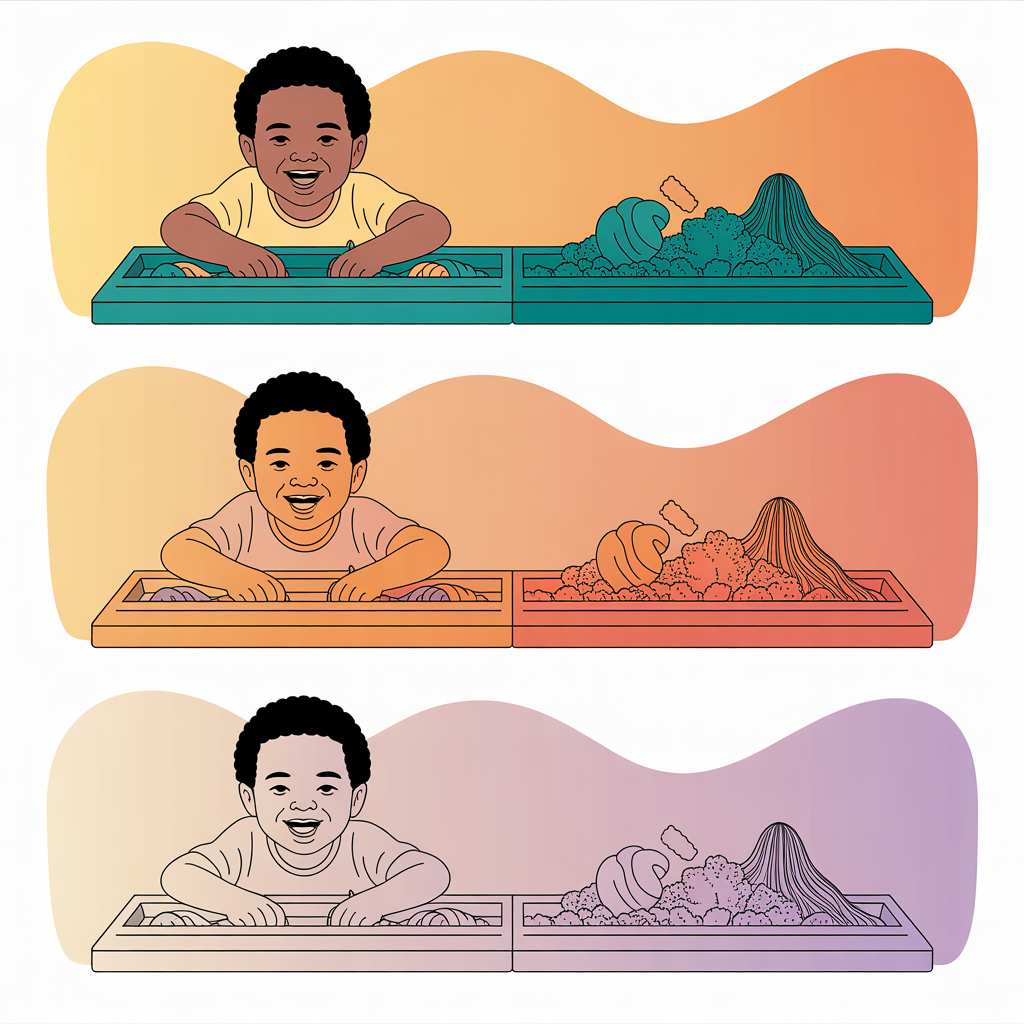
This is the active ingredient — the proprioceptive input meeting the need. Rotate materials across the week. Use the child's response to guide which function is primary today.
🔴 HIGH PRIORITY — Start Here: Designated Destruction
Give child bubble wrap, demolition blocks, or tearing paper. Let them destroy. Narrate: "This is your popping paper. Pop as much as you want." Duration: 3–5 minutes. Observe: Does the child appear satisfied/calmer after? Good indicator of proprioceptive function.
🟠 PRIORITIZE SECOND — Heavy Work
Have child push weighted cart, carry books, do animal walks, squeeze putty with both hands. Narrate: "We're doing strong body work." Duration: 5–8 minutes. This is the "sensory tank refill."
🟡 USE BASED ON FUNCTION — Additional Materials
Crash pad: 10–15 crash-landings. Take-apart toys: Narrate "You're the engineer!" Fidgets: During transitions/table activities. Cause-effect: 3–5 minutes. Force practice: Egg-on-spoon, bubble-touch. Structured play: Parent WITH child, 5–10 minutes modeled.
Child Response | Meaning | Action | |
Satisfied/calm after | Proprioceptive need met | Continue. This material is working. | |
Immediately seeks more | Need partially met | Add second material. Extend session slightly. | |
Disinterested | Wrong function match | Switch material — try different category | |
Escalates/distressed | Overstimulation or wrong function | Stop. Move to cool-down immediately. |
Step 04 of 06
Step 4: Repeat & Vary
3 good reps > 10 forced reps. Neurological input is about quality and intensity of proprioceptive engagement, not raw repetition count. A child who fully crashes into the pad 3 times gets more therapeutic benefit than one who half-heartedly bumps it 10 times while distracted.
Material Type | Target Reps | Variety Strategy | |
Destruction (bubble wrap, paper) | 2–4 sheets/rounds | Vary size (large vs. small bubbles), vary material (paper vs. playdough) | |
Heavy work | 5–8 minutes | Vary activity (push cart → carry books → wall push-ups) | |
Crash pad | 8–15 crashes | Vary position (front → side → back landing) | |
Fidgets | 3–5 minutes | Rotate between squeeze ball, putty, tangle | |
Take-apart | 1–2 complete disassemblies | Vary tools (screwdriver → wrench → hands) | |
Force practice | 3–5 egg-carries or bubble-touches | Vary challenge (floor → table → walking path) | |
Cause-effect | 3–5 minutes | Vary toys in sequence |
Satiation Indicators — The Child Has Had Enough: Activity enthusiasm decreases (slowing down, less vigor) → Child moves away from material voluntarily → Child looks elsewhere, shifts body → Child initiates a different activity. Golden Rule: When you see satiation, end the activity. Always end on a positive note. The goal is the child leaving the session wanting slightly more.

Step 05 of 06
Step 5: Reinforce & Celebrate
Timing matters more than magnitude. Within 3 seconds. Specific. Enthusiastic. The reinforcement window is narrow — miss it and the connection between behavior and reward dissolves.
For Proprioceptive/Destruction Work
"You did that PERFECTLY. That's your strong body working. High five!"
For Force Practice Success
"You were SO gentle! The egg stayed safe! That's YOUR control — amazing!"
For Structured Play
"You played the WHOLE game without breaking anything! That's YOUR skill. I'm proud of you."
Reinforcement Menu
Social/Natural (highest priority — use always): Verbal praise with specificity. Physical acknowledgment (high five, clap — read child's sensory preference). Genuine parental enthusiasm.
Token/Visual: Sticker on tracking chart. Rosette Reward Jar (₹589) — Amazon.in. Token economy: 5 tokens → chosen reward.
Tangible (use sparingly, fade over time): Small preferred edible. 5 minutes preferred screen time.
Critical ABA Principle
"Celebrate the attempt, not just the success. The child who tried to be gentle and failed is closer to the goal than the child who never tried."
Reinforcement must be delivered within 3 seconds of the target behavior. Delayed reinforcement loses its power rapidly — especially for younger children and those with developmental differences.
BACB ethical guidelines for reinforcement | ABA systematic reviews on token economy | Pinnacle clinical protocols

Step 06 of 06
Step 6: The Cool-Down
No session ends abruptly. The cool-down prevents post-session dysregulation and builds the closing ritual that signals session end to the child's nervous system.
Cool-Down Activity (1–2 minutes)
For high-energy sessions (crash, heavy work): Deep pressure — firm hand pressure on shoulders/back, weighted blanket drape for 60 seconds.
For medium sessions (destruction, fidgets): Simple clean-up routine — child puts materials in container. This itself is proprioceptive input.
For all sessions: Offer water. Quiet, predictable transition to next activity.
If Child Resists Ending
Give one additional 30-second "last one." Maintain firm but calm boundary: "All done" with closed hand gesture. Do not extend significantly — boundary consistency builds trust over time.
The put-away ritual matters: Child participates in clean-up when able. Put bubble wrap pieces in bin. Put fidgets in basket. Stack demolition blocks. This creates a closing ritual that signals session end.
NCAEP 2020 — Visual supports and transition strategies are evidence-based practice for autism.
ACT III — Data
Capture the Data: Right Now
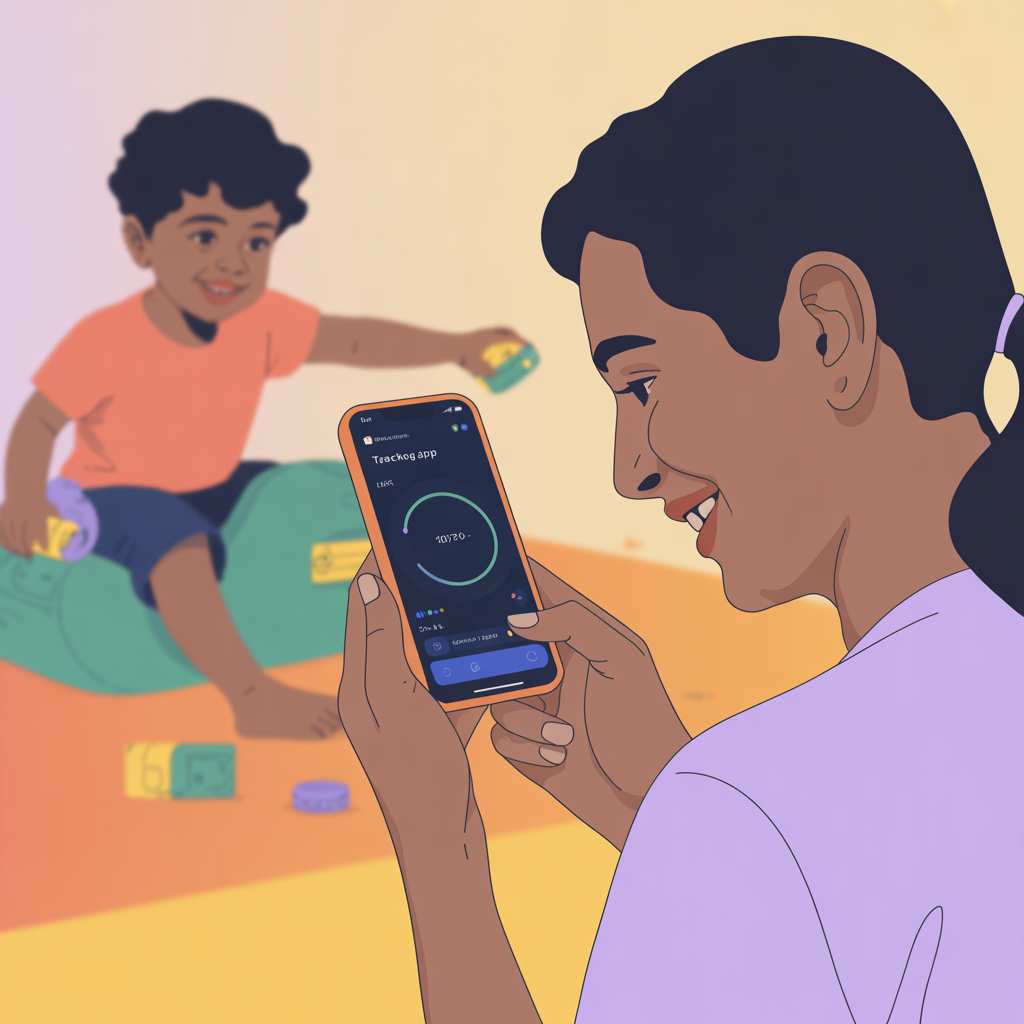
Within 60 seconds of session end. The data you capture now is the evidence that drives progress. Three fields. Sixty seconds. The difference between guessing and knowing.
1
Field 1 — Materials Used Today
Check all that apply: ☐ Destruction materials ☐ Heavy work ☐ Indestructible toys ☐ Take-apart ☐ Fidgets ☐ Crash equipment ☐ Cause-effect ☐ Force practice ☐ Structured play
2
Field 2 — Destruction Score (0–5)
0 = Zero destruction | 1 = Minimal, redirected easily | 2 = Some, responded to alternatives | 3 = Moderate, required significant intervention | 4 = High, session was difficult | 5 = Could not complete session
3
Field 3 — One Observation (10 words max)
"Was calmer after heavy work" / "Resisted take-apart toy" / "Best force practice session yet" — one honest sentence captures the pattern.
📄Download: A-098 Session Tracker PDF — printable weekly log at pinnacleblooms.org/trackers/A-098 | For families enrolled in GPT-OS® EverydayTherapyProgramme™ — log directly in the app. Data feeds into AbilityScore® Force Modulation Index and Play Skills Readiness Index. | 📞9100 181 181 — If you're unsure how to use the tracker, call. It's free.

ACT III — Troubleshoot
When It's Not Working
If it's not working, the approach needs adjusting — not your commitment. Every one of these problems has a specific clinical answer. Match your observation to the solution.
Child breaks destruction materials and immediately seeks more
Sensory need is larger than materials are meeting. Increase heavy work duration to 10–15 minutes daily. Add crash pad to routine. The tank is very empty — need more filling, not different materials.
Child uses take-apart toys but still breaks regular toys
Disassembly drive is being met, but proprioceptive seeking is separate and unmet. Add designated destruction AND heavy work. Two separate functions need two separate material categories.
Child accepts destruction materials but force practice doesn't work
Force modulation is a separate skill from sensory seeking. Practice force awareness for 2 minutes daily. This is a slow-build skill — 4–8 week timeline.
Child becomes aggressive with crash equipment
Aggression directed at others requires BCBA assessment. Pause crash equipment. Maintain heavy work and fidgets. 📞 Call 9100 181 181.
Nothing seems to work — toys still get destroyed constantly
Signal for professional OT + BCBA joint assessment. Sensory profile needs standardized measurement (Sensory Profile — Dunn). You need personalized data, not more general strategies.
Child is great in sessions but still destroys toys otherwise
This is generalization lag — normal. Sensory diet needs to occur 3× daily minimum, not just in structured sessions. Integrate heavy work into morning routine, after school, and before play time.
ACT III — Personalize
Personalize It: Adapt for Your Child
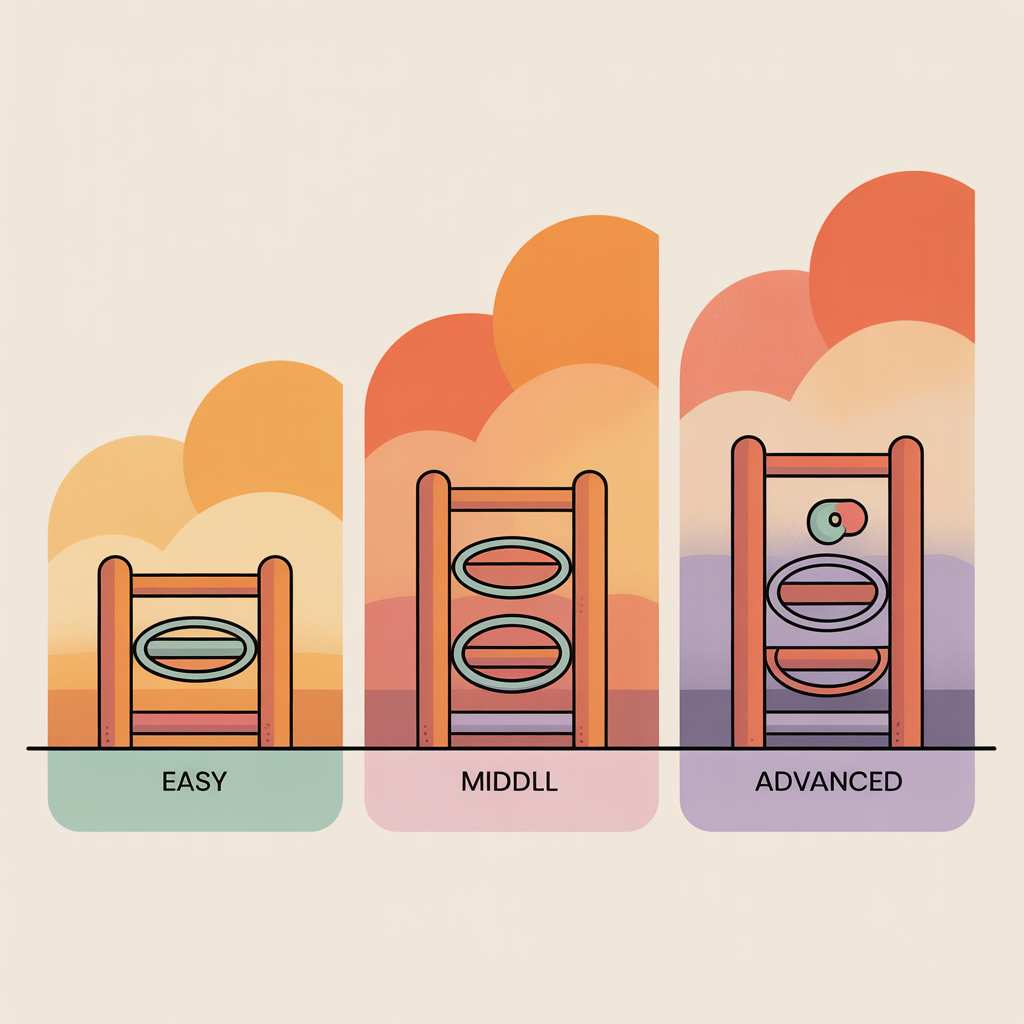
Your child is unique. The materials adapt to them — not the other way around. Use this matrix to customize based on sensory profile, age, and setting.
Profile | Prioritize | Reduce | |
Strong Sensory Seeker (seeks input constantly) | Crash equipment, heavy work, designated destruction — HIGH intensity | Fidgets alone won't be enough | |
Moderate Seeker (breaks when under-stimulated) | Heavy work routine, some destruction materials | Not all 9 needed | |
Force Modulation Primarily (breaks accidentally) | Force practice materials, cause-effect feedback toys | Skip crash equipment | |
Impulse Control Primarily (breaks impulsively) | Take-apart toys, fidgets to redirect impulse | Less emphasis on destruction outlets | |
Emotional Dysregulation (breaks when upset) | Crash equipment + destruction materials as emotional outlets | Save structured play for green states only |
Ages 2–4
Keep all materials simple and large. Supervision essential. Focus on destruction outlets and heavy work only.
Ages 4–6
Introduce take-apart toys and force practice. Begin structured play with adult modeling throughout.
Ages 6–8
All 9 materials applicable. Begin teaching self-monitoring alongside the sensory diet.
Ages 8–10
Fade material use toward self-regulation strategies. Heavy work as daily habit, not structured session.

ACT IV — Progress
Week 1–2: What to Expect
Early phase. Tolerance, not mastery. Reduction, not elimination. This phase is hardest — you are implementing new strategies while existing destruction continues. Trust the process. The sensory diet takes 2–3 weeks to begin showing visible impact.
15%
Progress Milestone
Week 1–2 target. Early engagement with materials is real, measurable progress.
5/7
Days of Practice
Consistency target — sensory diet impact requires near-daily implementation
2/3
Weeks to First Signs
Visible impact on sensory regulation typically begins showing at weeks 2–3
✅ Look for these Week 1–2 indicators: Child engages with destruction materials when offered (even briefly) · Child tolerates heavy work without major resistance · Destruction frequency may briefly increase before stabilizing · Child appears calmer after using materials · Parent reports feeling more confident with a structured response.
Data Milestone: You should have 5–10 session logs by end of Week 2. Look for: Is the destruction score trending down, even slightly? "If your child pops bubble wrap with full engagement for 3 minutes today and seemed satisfied afterward — that is real, meaningful, measurable progress." | PMC11506176 — Sensory integration outcomes emerge across 8–12 week timelines.

ACT IV — Progress
Week 3–4: Consolidation Signs
The brain is rewiring. Watch for these consolidation signals — most parents miss them because they're looking for the wrong things. These are the "rails forming" indicators that predict Week 5–8 mastery.
1
Anticipation
Child moves toward destruction materials or heavy work corner without being prompted — the nervous system has learned where satisfaction lives.
2
Preference Formation
Child shows a clear preferred material (always goes for bubble wrap, or always seeks crash pad). Preference = the brain found what works.
3
Reduced General Destruction
Some typical toys surviving longer, even if not all. The sensory diet is beginning to reduce the craving.
4
Improved Redirection Response
When a toy starts to break, child accepts "give me that, here's your popping paper" with less resistance than Week 1.
"You may notice you're calmer too. That matters for the intervention — a regulated parent co-regulates the child." If seeing consistent consolidation indicators, increase structured play time to 10 minutes. Begin introducing force practice activities alongside destruction materials.

ACT IV — Progress
Week 5–8: Mastery Indicators
Mastery phase. The skills are generalizing. The tools are working. These are observable, measurable criteria — not subjective feelings. Document each one as it appears.
Material Mastery
Child uses at least 3 appropriate destruction/heavy work materials independently in a given week
Force Awareness
Child completes force practice activities with noticeably improved success rate vs. Week 1 baseline
Destruction Frequency
Observable reduction in random toy destruction — some toy categories surviving consistently
Redirection Response
Child accepts alternative material within 1–2 prompts vs. extended refusal in Week 1
Play Extension
Child can engage with indestructible toys constructively for 5+ minutes without destruction
Mastery Badge Unlock Criteria:✅ Play Skills Readiness Index progression confirmed in GPT-OS® ✅ Force Modulation Index showing measurable improvement ✅ Parent confidence score ≥ 4/5 in session tracker | PMC10955541 — Mastery criteria from behavioral measurement standards

ACT IV — Celebrate
Celebrate This Win
You started with a child who broke every toy within minutes. You understood the neurology instead of blaming the behavior. You built the environment, gathered the materials, and showed up — session after session. Your child's nervous system found appropriate channels. Your home became a therapeutic environment. That is real. That is measurable. That is yours.
📸 Document It
Photo the toy that has survived the longest since you started. Write down the first time your child independently chose the crash pad or bubble wrap.
📞 Share With Your Therapist
This data is gold. Share with your Pinnacle therapist — it directly informs the next phase of intervention.
🎉 Family Celebration
Tell your child: "Your strong body is learning. I'm proud of you." Then let them destroy something — the designated bubble wrap. With full joy. Because that's the healthy version.
Did your child's toys survive? 🧸 Share your story at pinnacleblooms.org/community or WhatsApp 9100 181 181.
ACT IV — Red Flags
Red Flags: When to Pause
Trust your instincts. If something feels wrong, pause and ask. Each of the following requires professional consultation — not because you've failed, but because a more complex clinical picture needs clinical tools.
🚨 1. Destruction Directed Toward People
Child begins hitting, pushing, or throwing objects at people — not just toys. Aggression toward others requires BCBA assessment. Pause crash/destruction materials immediately. Call 📞 9100 181 181.
🚨 2. Destruction Escalating Despite Consistent Intervention
More destruction, more violent destruction, spreading to furniture/property after 4+ weeks. The underlying function is not being addressed correctly. OT sensory profile assessment + BCBA functional behavior assessment (FBA) both needed.
🚨 3. Self-Directed Force
Child begins banging head, biting self, or slamming own body parts. Self-injurious behavior (SIB) requires immediate clinical evaluation — different intervention pathway. Pause all materials. Seek urgent clinical assessment. Call 📞 9100 181 181 immediately.
🚨 4. Emotional Intensity Inconsistent With Context
Destruction during calm contexts with apparent rage or extreme distress unexplained by sensory needs. May indicate trauma response or emotional regulation disorder. NeuroDev pediatrician consultation + behavioral health referral.
🚨 5. No Response to ANY Sensory Materials After 6 Weeks
No change in frequency, no preference formation, no sensory satisfaction observed. The function may be misidentified. Formal OT sensory assessment. Consider BCBA FBA. Pinnacle AbilityScore® evaluation.
Escalation Pathway: Self-monitor → Teleconsult (₹0 via 📞 9100 181 181) → Pinnacle center visit → Multi-disciplinary assessment | pinnacleblooms.org/find-center

ACT IV — Pathway
The Progression Pathway
You are not done. You are on a journey. Here is your GPS — where you came from, where you are, and the multiple paths forward based on your child's specific response.
Next-Level Options Based on Response
If force modulation improved most: → Go to force awareness skills training. techniques.pinnacleblooms.org/motor/force-modulation-skills
If proprioceptive seeking remains high but is now channeled: → Build full sensory diet. techniques.pinnacleblooms.org/sensory/sensory-diet-builder
If play skills showed most improvement: → Move to cooperative play and turn-taking techniques. A-099.
If emotional dysregulation was primary driver: → Domain C: Emotional Regulation techniques. techniques.pinnacleblooms.org/emotional-regulation
Long-Term Developmental Goal
This technique feeds into the full developmental progression:
Play Skills Readiness Index → Social Readiness Index → School Readiness Index
Each step on this pathway builds the neurological and behavioral foundations for the next. A-098 is not a standalone intervention — it is one deliberate milestone in a mapped developmental journey.
WHO/UNICEF developmental trajectory framework | Pinnacle GPT-OS® AbilityScore® Progression Engine
Related Techniques Library
Browse the full collection of Pinnacle Blooms techniques.
ACT IV — Related Techniques
Related Techniques
Every technique connects to a wider system. These are your neighbors — the techniques most commonly used alongside or after A-098.
A-100: Plays Too Rough with Others
Domain: Behavioral / Social. The sibling challenge to A-098. When force directed at toys shifts to force directed at people.
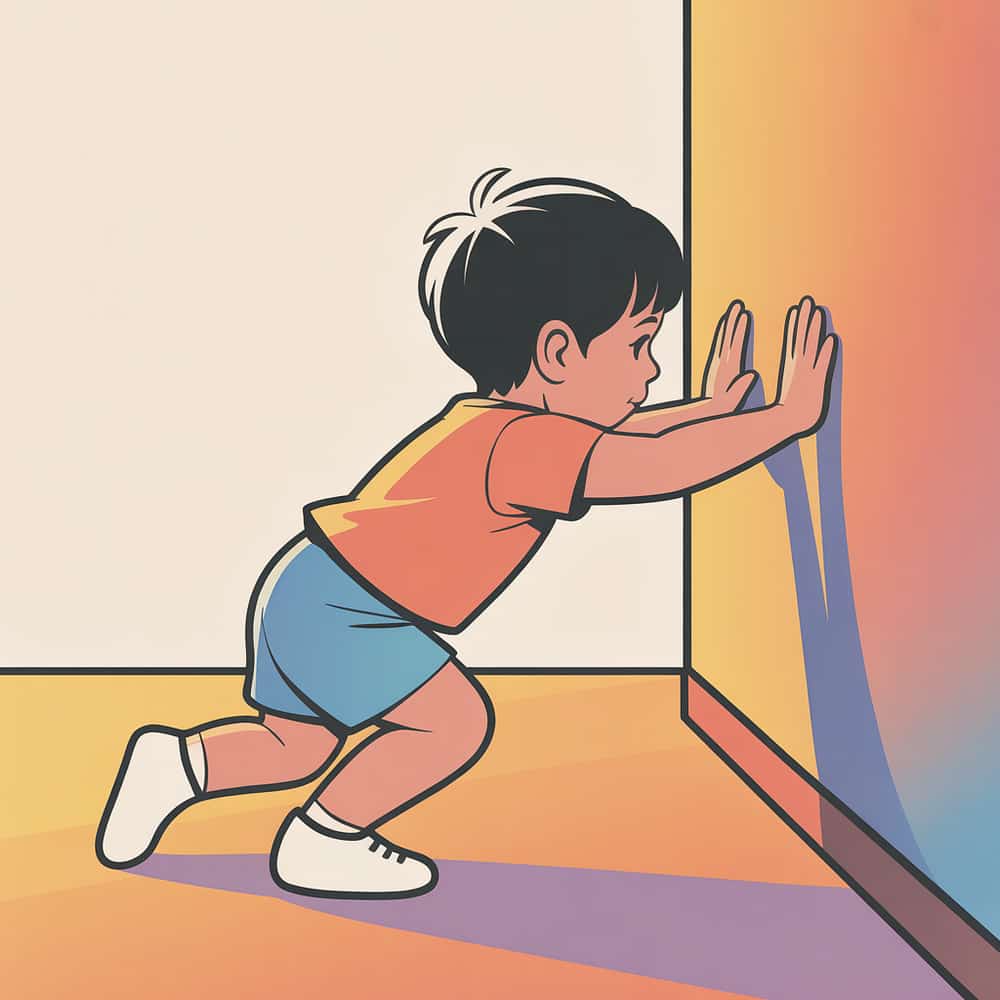
A-055: Sensory Seeking Behavior
Domain: Sensory Processing. The upstream pattern that A-098 is a downstream expression of. Address the root proprioceptive profile.

A-072: Impulse Control Difficulties
Domain: Behavioral / Executive Function. For children where the toy-breaking is impulse-driven rather than sensory-driven.

A-065: Emotional Dysregulation
Domain: Emotional Regulation. For children who break toys as emotional expression — the Domain C bridge from Domain A behavior.
📞9100 181 181 — Not sure which technique comes next? Call us. Free. 16 languages. We'll help you identify the right next step for your child's specific profile.
ACT IV — Full Map
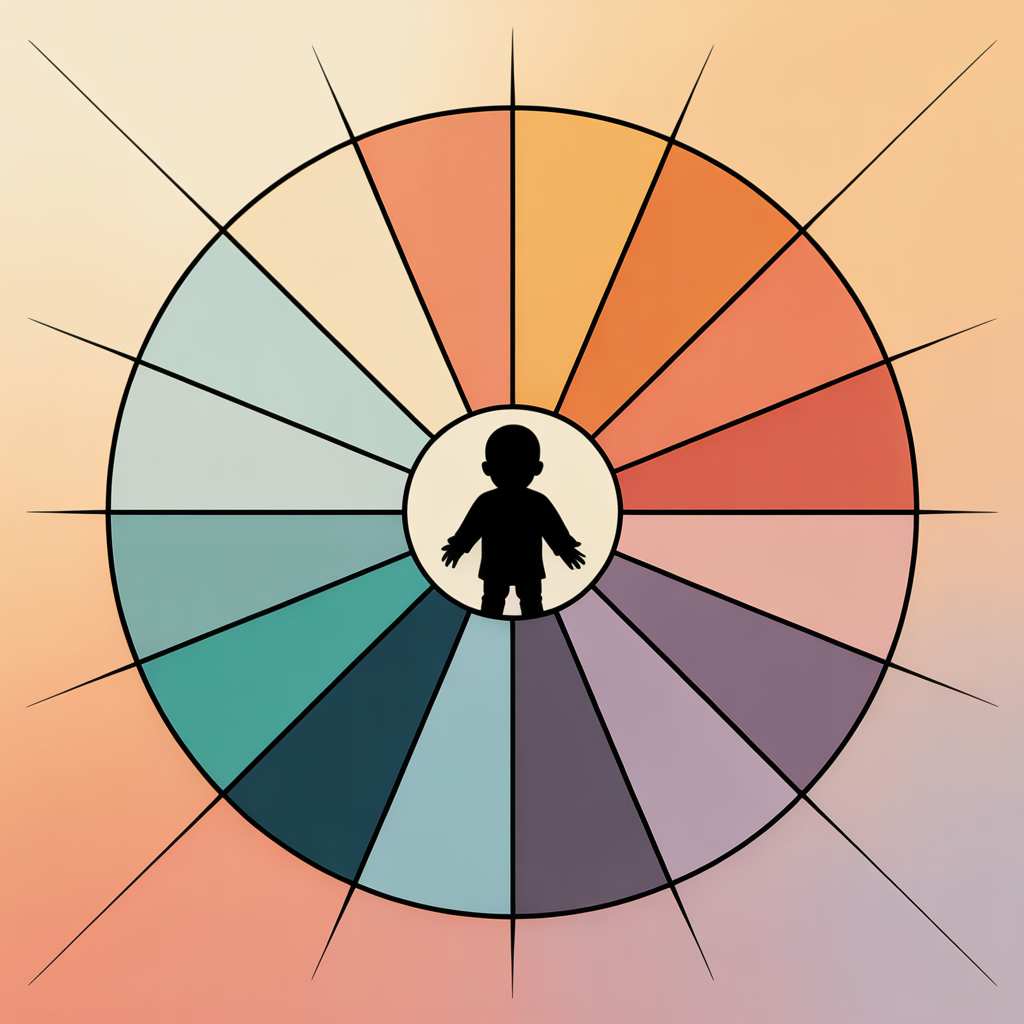
The Full Developmental Map
This technique is one piece of a larger plan. Your child's full developmental profile spans 12 domains — and progress in Domain A (Sensory Processing / Behavioral Regulation) builds capacity across all of them.
GPT-OS® Full Profile
When enrolled in Pinnacle GPT-OS® EverydayTherapyProgramme™, A-098 progress data feeds into:
- AbilityScore® (0–1000 universal developmental score)
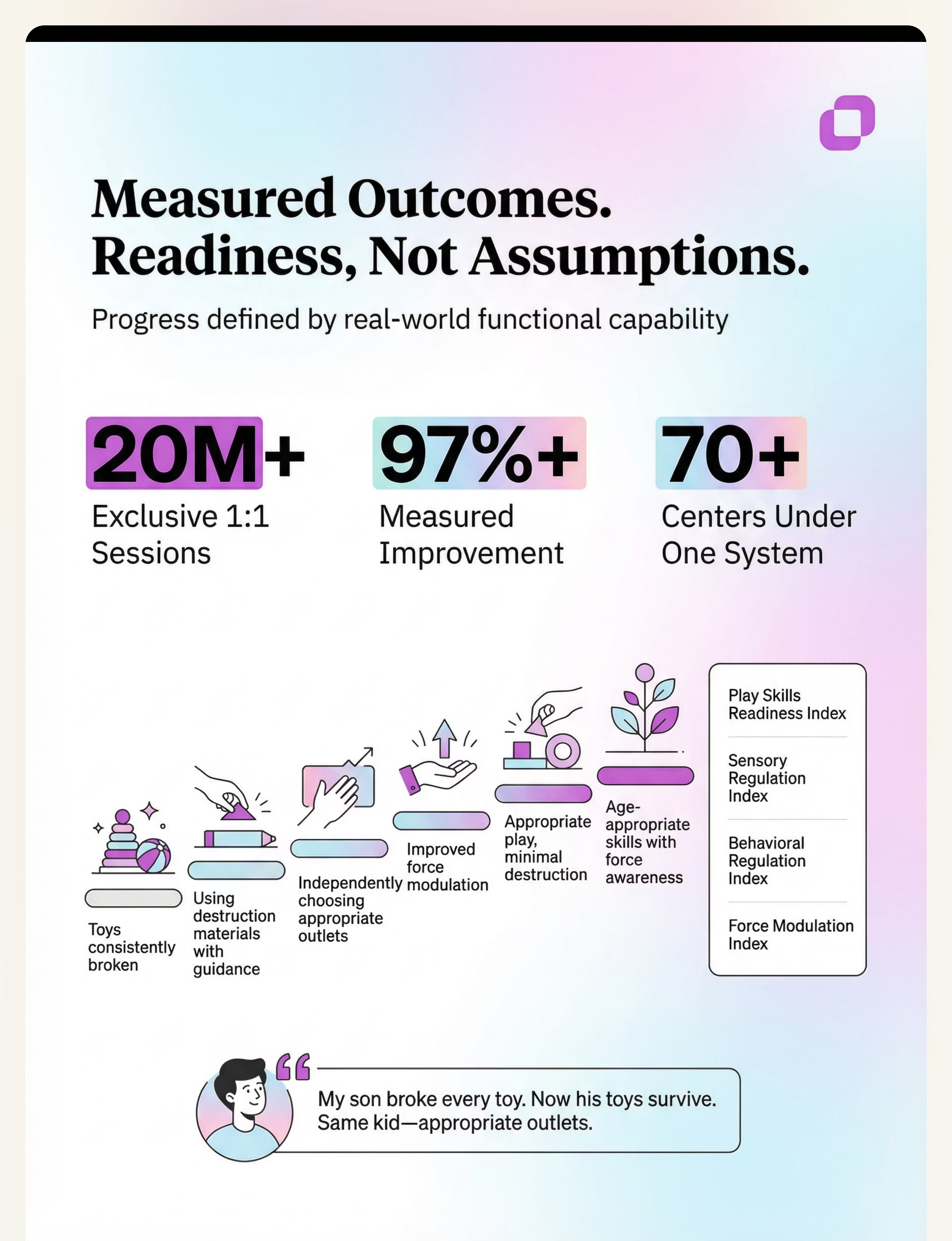
- Play Skills Readiness Index
- Sensory Regulation Index
- Behavioral Regulation Index
- Force Modulation Index
See Your Child's Full Profile
"This technique is one piece. GPT-OS® sees the whole child. See your child's AbilityScore® today."
WHO/UNICEF Nurturing Care Framework 5 components | UNICEF 2025 Country Profiles (42 indicators)

ACT V — Community
Families Who've Been Here
They started exactly where you are. Here is where they went. These vignettes illustrate the clinical arc — from recognition to redirection to real breakthrough.
The Grandmother's Train Set — Hyderabad
Before (Week 0): "My son broke his grandmother's beautiful wooden train set in one week. Half the pieces cracked. She was heartbroken. We were fighting constantly about toys."
After (Week 8): "He still destroys the cardboard boxes — that's his thing. But the train set? He played with it for 20 minutes yesterday without a single piece broken. He's never done that before. His grandmother cried."
OT Note: This family correctly identified proprioceptive seeking as primary function and consistently offered the substitute. The sensory diet reduced the craving enough that appropriate play became possible.
The Anger Breaks — Bengaluru
Before: "She wasn't breaking toys randomly — she was doing it when she was upset. Everything in her path got destroyed when she was frustrated. We tried consequences, nothing worked."
After: "She still crashes the pad — daily. But the toys? We haven't had a frustration-break in three weeks. She came to me last week and said 'I need to crash.' That's the win."
Note: Illustrative cases. Outcomes vary by child profile.
"The shift from 'my child is destroying toys' to 'my child is communicating a need' is the entire journey. Once the parent sees it, the intervention accelerates." — Pinnacle Blooms OT Team

ACT V — Community
Connect With Other Parents
Isolation is the enemy of adherence. You don't have to do this alone — and the research confirms it. Parent support networks measurably improve intervention outcomes.
WhatsApp Parent Group
"Destructive Play Solutions" — families navigating A-098 and related challenges. Share wins, ask questions, get peer support. → wa.me/919100181181 (message for group link)
Pinnacle Community Forum
Searchable parent discussions, therapist Q&As, and technique-specific threads. → pinnacleblooms.org/community
Local Parent Meetups
Organized through Pinnacle centers. Connect with families in your city. → pinnacleblooms.org/find-center
Peer Mentoring
Connect with a parent who completed A-098 and will share their journey. → pinnacleblooms.org/peer-mentor
📞9100 181 181 — 24×7, free, 16 languages. | WHO NCF: Community engagement is a core principle. PMC9978394.
ACT V — Centers
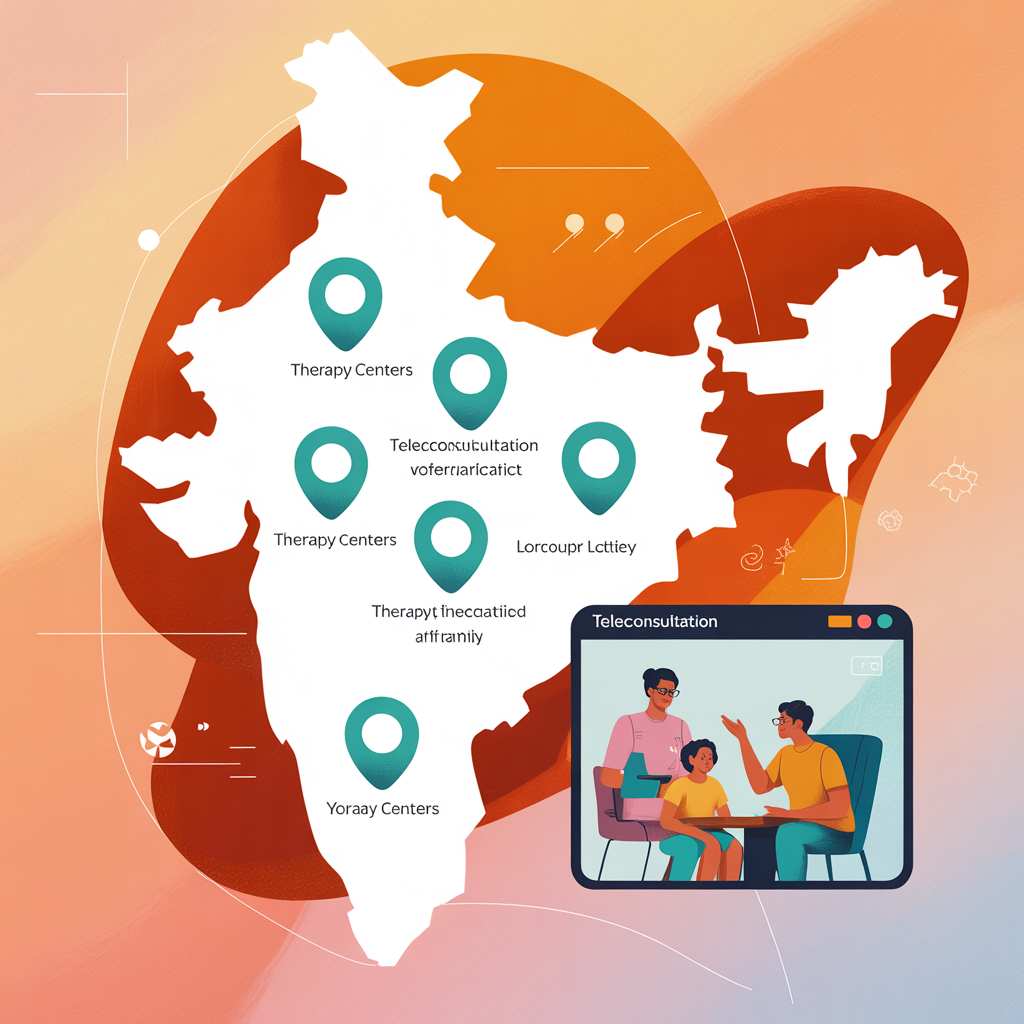
Find Your Pinnacle Center
70+ centers. One clinical system. Your city is probably covered. When you visit, the full consortium is available — not a single therapist, but a coordinated team.
🟤 Occupational Therapy
Sensory Integration Assessment + Protocol. The lead discipline for A-098.
🟣 ABA / BCBA
Functional Behavior Assessment + Play Skills Training. Identifies the function driving destruction.
🔵 Special Education
Play-based learning program. Bridges home strategies to classroom and peer settings.
⚪ NeuroDev Pediatrics
Comprehensive developmental evaluation. Rules out medical contributions to the clinical picture.
🟢 EverydayTherapyProgramme™
Home-based protocol with your therapist's guidance. GPT-OS® powered, measurable outcomes.
What to say when you call: "I read about A-098 — my child breaks toys and I want an AbilityScore® assessment to understand if there are sensory processing or behavioral regulation factors. Who should I book with?"
📞9100 181 181 (FREE National Autism Helpline — 16 languages) | 🌐pinnacleblooms.org/find-center | 📧care@pinnacleblooms.org

ACT V — Research
The Research Behind This Page
Every card on this page is anchored to peer-reviewed evidence. Pinnacle Blooms Network® does not publish opinion. We publish evidence.
PMC11506176 — PRISMA Systematic Review (2024)
80% of children with ASD show SPD. Sensory integration meets evidence-based practice criteria. pubmed.ncbi.nlm.nih.gov/PMC11506176
PMC10955541 — Meta-Analysis, World J Clin Cases (2024)
SI therapy promotes social skills, adaptive behavior, sensory processing, and motor skills across 24 studies. DOI: 10.12998/wjcc.v12.i7.1260
PMC9978394 — WHO/UNICEF Care for Child Development Package
Evidence-based caregiver interventions across 54 LMICs. The equity foundation of this approach.
DOI: 10.3389/fnint.2020.556660 — Frontiers in Integrative Neuroscience (2020)
Neurological basis for sensory integration intervention in ASD. The science behind Card 03.
DOI: 10.1007/s12098-018-2747-4 — Padmanabha et al., Indian J Pediatrics (2019)
Home-based sensory interventions in Indian pediatric population. RCT evidence specific to this context.
WHO Nurturing Care Framework (2018) + NCAEP 2020 + AOTA
Global ECD framework | National Clearinghouse on Autism Evidence and Practice | American OT Association sensory integration approaches. nurturing-care.org/ncf-for-ecd/
Pinnacle Real-World Evidence: 20M+ exclusive 1:1 therapy sessions | 97%+ measured improvement rate | Analyzed via GPT-OS® AbilityScore® platform
ACT V — GPT-OS®
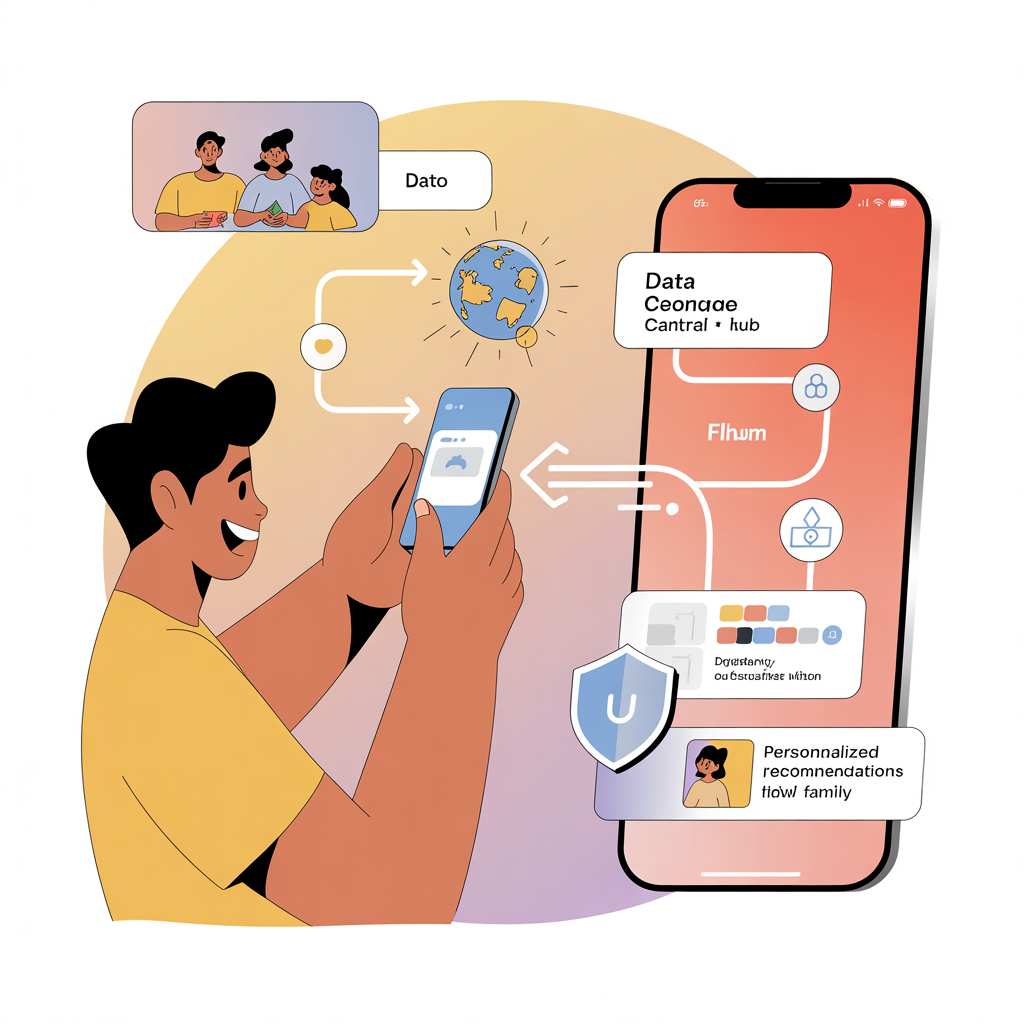
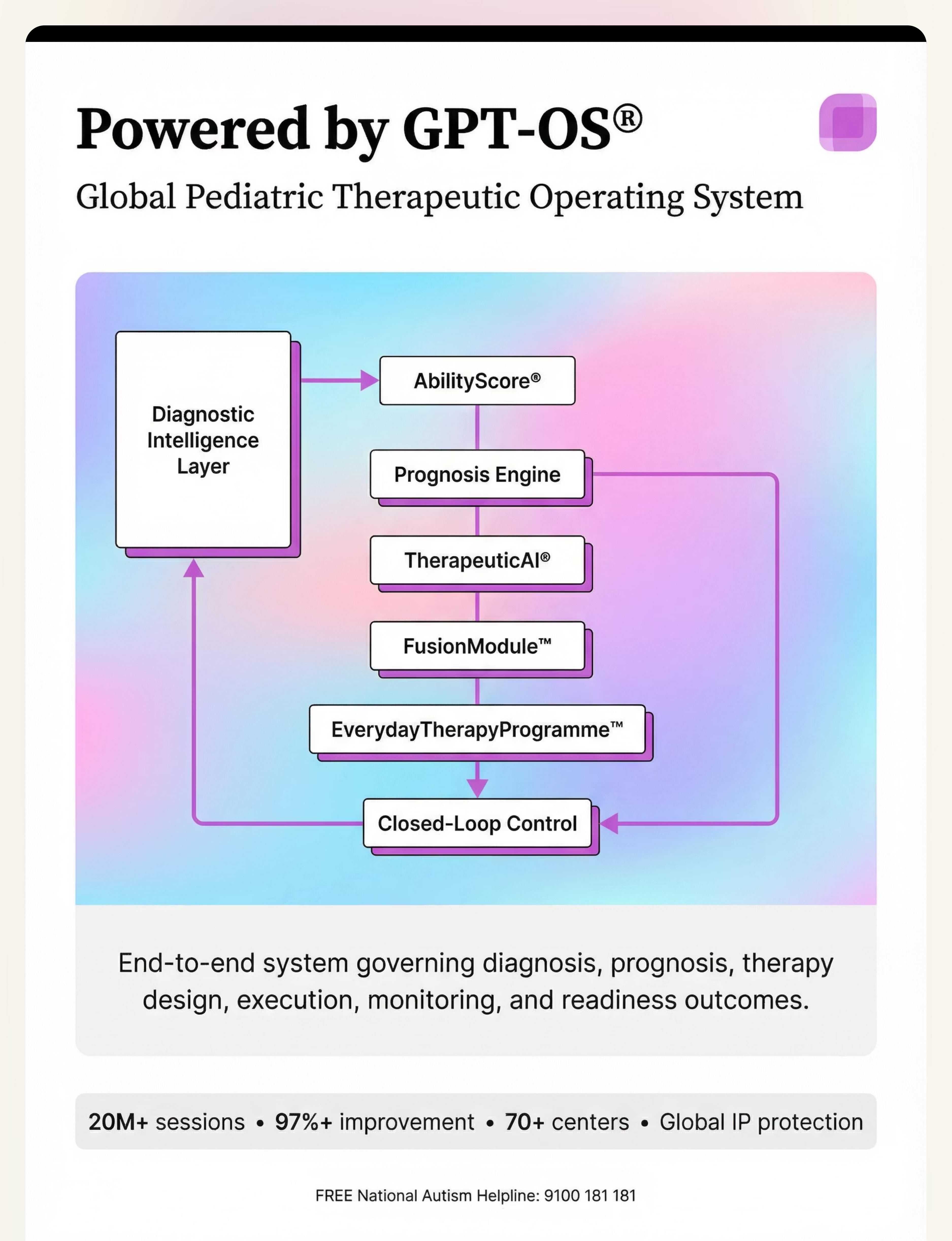
Powered by GPT-OS®
Global Pediatric Therapeutic Operating System. This is not software. This is therapeutic infrastructure — a closed-loop clinical system that turns every session into measurable, actionable data.
Layer | Function | |
Diagnostic Intelligence Layer | 591+ structured observations across 349 skills and 79 developmental abilities → standardized diagnostic clarity | |
AbilityScore® | Patented 0–1000 universal developmental score. Baseline, severity, longitudinal change — in one number. | |
Prognosis Engine | Predicts developmental trajectories using 20M+ real session patterns. Not guesswork — actuarial precision. | |
TherapeuticAI® | Determines therapy focus, intensity, sequencing — under licensed human clinical authority at all times. | |
FusionModule™ | Converges OT + SLP + ABA + SpEd + Medical into a single therapeutic pathway. No siloed care. | |
EverydayTherapyProgramme™ | Translates clinical plans into daily home-executable micro-interventions. The bridge from clinic to kitchen table. | |
Closed-Loop Control | Observe → Score → Plan → Execute → Re-measure → Adapt. The cycle repeats every session. |
20M+
Sessions Analyzed
97%+
Measured Improvement
70+
Centers Nationwide
160+
Countries — Patents Filed
📞9100 181 181 — For structured GPT-OS® guided therapy. Free assessment call. | 🌐pinnacleblooms.org/gpt-os
ACT V — Watch
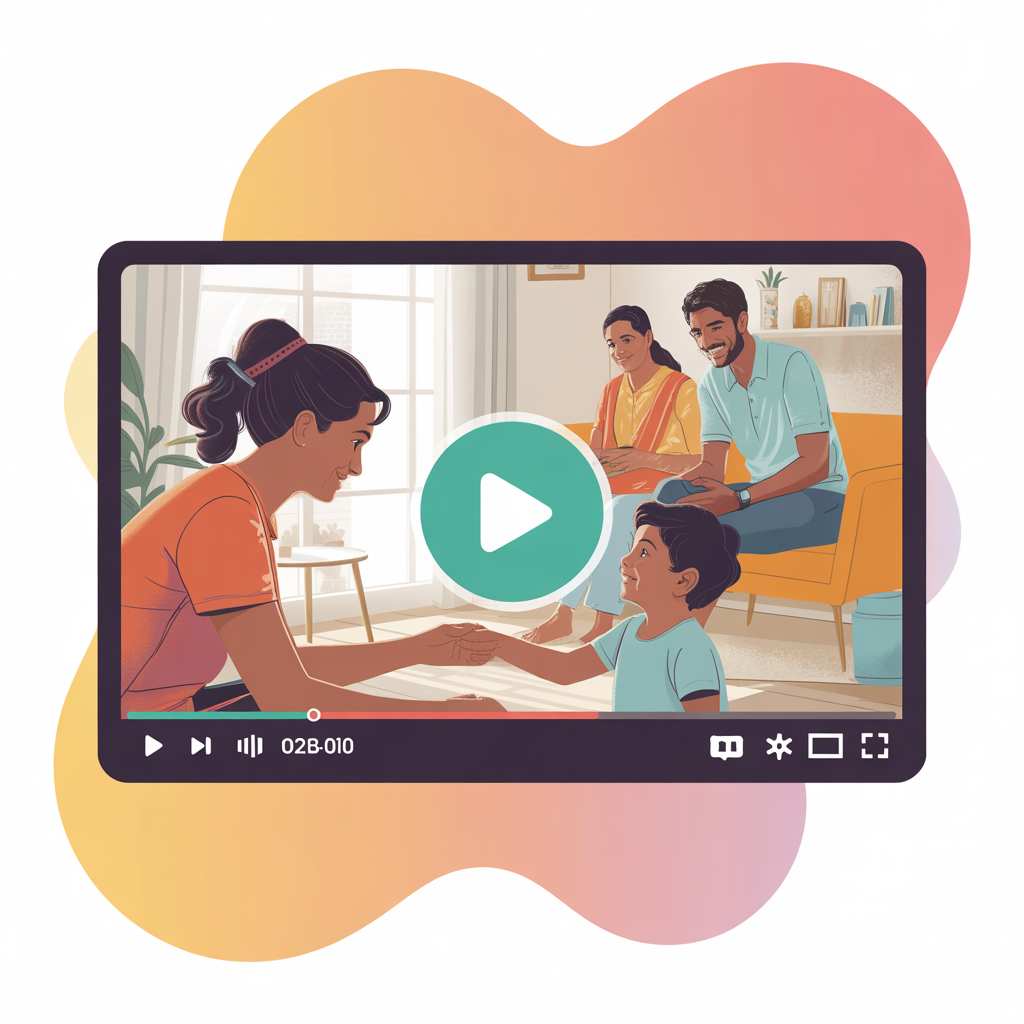
Watch: Reel A-098
Watch the ~80-second reel. See all 9 materials in action — real therapeutic contexts, real children, real techniques. Multi-modal learning improves parent skill acquisition by up to 3×.
🔴 Destruction Materials
Bubble wrap, knockdown towers, paper tearing — the primary proprioceptive outlet
🏋️ Heavy Work Toys
Push cart, therapy putty, crawl tunnel — the sensory tank refill
🪨 Indestructible Toys
Solid wood, heavy-duty plastic — built to survive the strongest player
🔩 Take-Apart Toys
Screwdriver vehicle set — disassembly as the designed, sanctioned point
🥚 Force Modulation
Egg carry, bubble touch — learning how much force is too much, with real-time feedback
📋 Structured Play
Parent + child guided activity — modeling, sequencing, and success together
Reel A-098 | Play & Behavior Solutions Series — Episode 98 | Duration: ~80 seconds | All child talent consented. B-roll shows real therapeutic contexts — non-staged, educational standard. | NCAEP 2020 — Video modeling is evidence-based practice for autism.

ACT V — Share
Share This With Your Family
Consistency across caregivers multiplies impact by 3×. Every adult who plays with your child needs to understand this approach. Share this page before the next playdate, school visit, or grandparent interaction.
For Grandparents — Simplified Version
"When our child breaks toys, it's not bad behavior — it's a sensory need. Their nervous system needs intense physical input. We're providing that through bubble wrap, push activities, and a crash pad.
Please don't scold them for popping the bubble wrap — that's their therapy. If they reach for a regular toy aggressively, redirect them to the bubble wrap and say 'that's for popping!' Then tell us what happened."
For Teachers — Communication Template
"Our child has a proprioceptive sensory processing profile that contributes to rough handling of materials. At home we use heavy work activities and designated manipulation materials.
In school, please allow fidget tools at the desk and movement breaks as needed. Contact pinnacleblooms.org for the therapist letter."
WhatsApp
Share with pre-filled message for caregivers
Email
Send the full page link to school or family
Family Guide PDF
unknown link
Session Tracker PDF
unknown link
WHO CCD Package — Multi-caregiver training is critical for intervention generalization | PMC9978394

ACT VI — FAQ
Frequently Asked Questions
8 questions families ask most. Answered by the Pinnacle Blooms Consortium — OT + ABA + SLP + NeuroDev + SpEd.
My child is 3 years old. Is this age-appropriate or should I be worried?
Some rough handling is developmentally normal at age 3. The concern threshold is: destruction is the primary form of play engagement (no constructive play), destruction is escalating, or other developmental concerns are present. If in doubt, AbilityScore® assessment at 📞 9100 181 181 gives you data rather than guesswork.
We've tried consequences for months. Why doesn't it work?
Consequences address behavior, not function. If the function is proprioceptive seeking, taking away the toy removes the object but not the need. The need then finds another outlet — often worse. This approach doesn't punish. It channels. That's why it works when consequences don't.
Is this autism? Does toy-breaking mean my child has autism?
Destructive play is associated with, but not exclusive to, autism. Sensory processing differences occur across ADHD, DCD, anxiety, giftedness, and typical development. A single behavior doesn't indicate a diagnosis. Assessment does.
My child breaks things when angry, not just playing. Is this the same?
Emotional dysregulation as a driver is a different function from sensory seeking — but the materials overlap (crash equipment is used for both). Emotional dysregulation breaking requires sensory tools AND emotional regulation work. Card 22 adaptation guide covers this.
How long will this take?
Sensory diet impact: 2–4 weeks of consistent implementation to begin showing. Force modulation: 4–8 weeks for measurable improvement. Play skills generalization: 8–12 weeks. These are evidence-based timelines, not guarantees.
Can I do this without a therapist?
The materials guide and protocol on this page are parent-executable. However, if toy-breaking is severe, escalating, or associated with other developmental concerns, professional OT assessment is strongly recommended. The sensory profile makes your efforts more targeted and more effective.
My child breaks things at school but not at home. What does that mean?
This is a setting-specific pattern suggesting the school environment is not meeting a sensory need that the home environment (perhaps accidentally) is meeting. Share this page with the school and request a sensory accommodation plan.
What if my child won't engage with ANY of the 9 materials?
If the child actively avoids all sensory-based materials, the function may not be proprioceptive seeking. Sensory over-responsivity is a separate profile requiring different intervention. Formal Sensory Profile assessment (Dunn) recommended. Call 📞 9100 181 181.
Didn't find your question? → pinnacleblooms.org/ask-gpt-os | OR call 📞9100 181 181
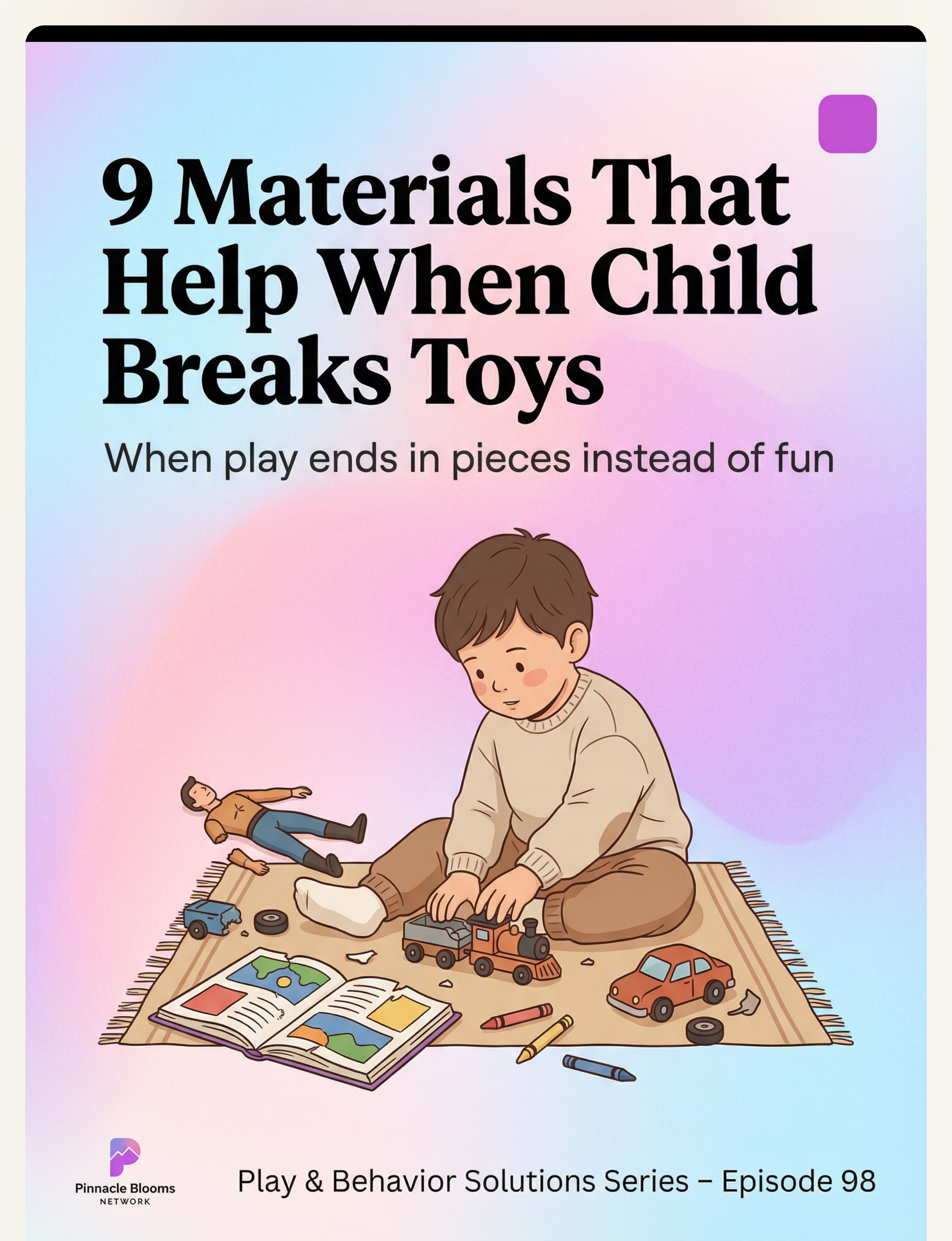
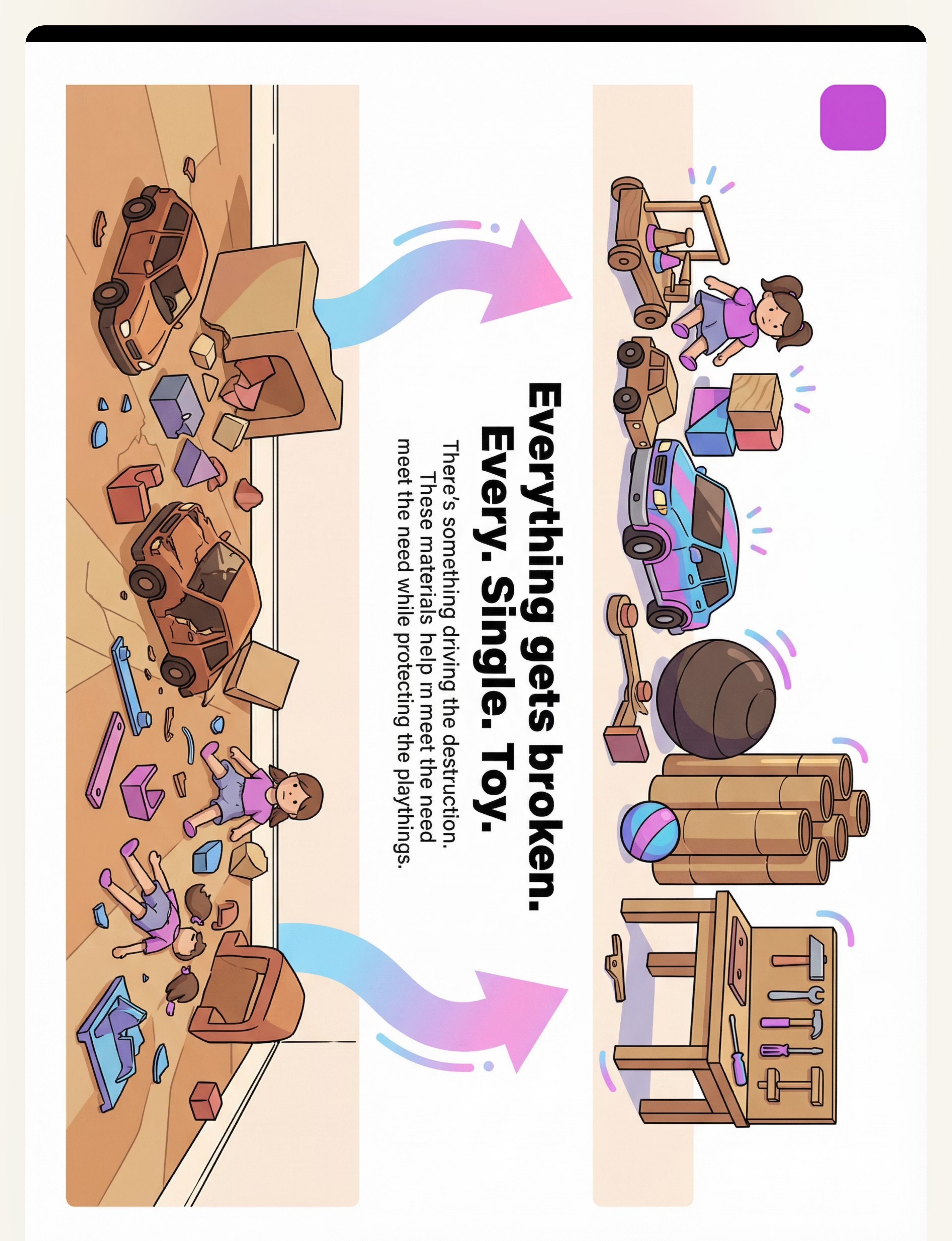
Preview of 9 materials that help when child breaks toys Therapy Material
Below is a visual preview of 9 materials that help when child breaks toys therapy material. The pages shown help educators, therapists, and caregivers understand the structure and content of the resource before use. Materials should be used under appropriate professional guidance.


Link copied!

Your Next Step: Start Now
The science is clear. The materials are available. Your home can become the therapy environment. From fear to mastery — one technique at a time.
OT • SLP • ABA/BCBA
Pinnacle Blooms Consortium — five disciplines, one convergent plan
SpEd • NeuroDev Pediatrics
Validated clinical governance across all five therapy streams
20M+ Sessions | 97%+ Improvement
70+ centers | GPT-OS® powered | Serving families from 70+ countries
📞FREE National Autism Helpline: 9100 181 181 | 24×7 | 16 Languages | pinnacleblooms.org