
"It's January. They came downstairs in shorts. Again."
You explained the weather. You showed the thermometer. You pointed out the window at the fog. They looked at you — and chose the same summer t-shirt anyway. This is not defiance. This is a skill gap — and it has a name, a neuroscience, and a proven set of solutions.
☁️ Weather-Appropriate Clothes — Intervention E-529
You are not failing as a parent. Your child's brain is missing a bridge — between what's happening outside and what goes on their body. We're about to build that bridge together.
🏥 Pinnacle Blooms Network® | OT • ABA • SpEd • NeuroDev | GPT-OS® Validated — WHO Nurturing Care Framework (2018): Early caregiver identification of developmental challenges directly impacts long-term outcomes.
This Happens in Millions of Homes. Every Morning.
1 in 36
Children in India
meet diagnostic criteria for ASD
80%
Sensory Challenges
of children with autism experience sensory or executive function challenges affecting dressing
21M+
Therapy Sessions
across Pinnacle's 70+ centers confirm dressing independence as a primary intervention target
Weather-appropriate dressing is not a simple task. It requires abstract reasoning (understanding temperature numbers), executive function (checking conditions before choosing), cognitive flexibility (adjusting preferences), sensory tolerance (wearing what's needed), and interoception (feeling your own body temperature). When any of these systems is different — as in autism, ADHD, or sensory processing disorder — the morning battle isn't stubbornness. It's a multi-system challenge.
"You are among millions of families navigating this exact challenge. The research exists. The solutions exist. You found the right page."
Sources: PRISMA Systematic Review (2024) PMC11506176 | Meta-analysis, World J Clin Cases (2024) PMC10955541
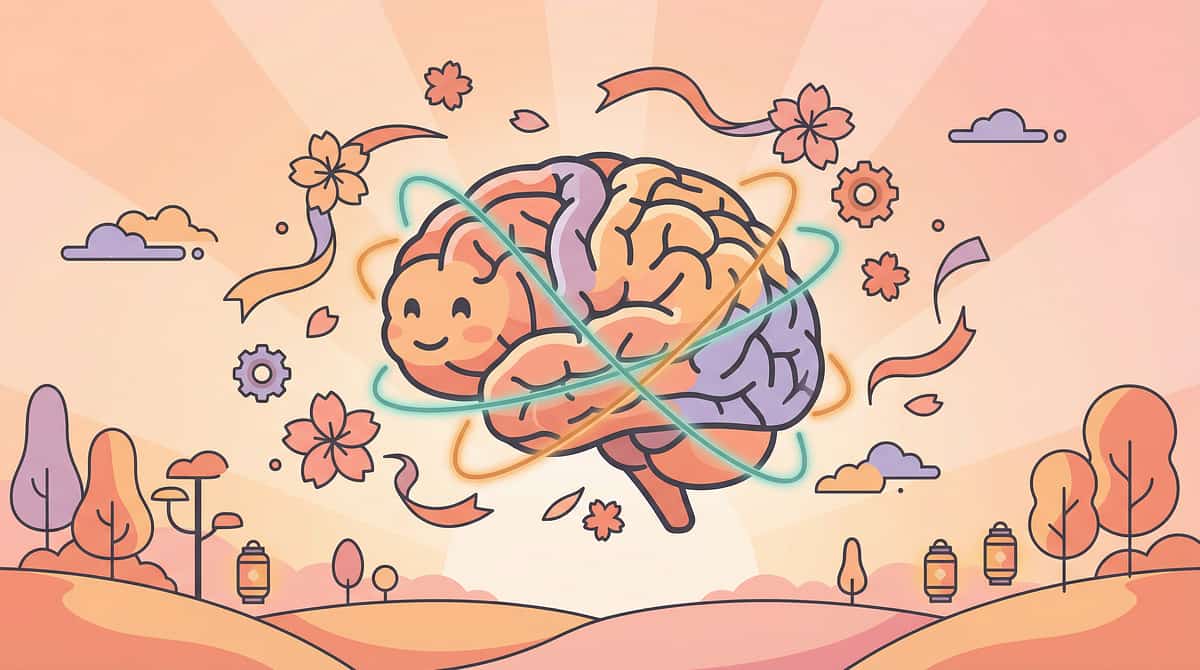
The Neuroscience of "But I'm Not Cold"
What typically developing children do: When they see rain → prefrontal cortex activates → recalls "rain = raincoat" → selects accordingly.
What's different for your child:
- 🔵 Executive Function Difference — The prefrontal cortex doesn't automatically trigger "check weather before choosing." The child goes straight to preference without the planning step.
- 🟠 Interoceptive Difference — The insula may not clearly signal "I am cold." The child genuinely may not feel temperature the same way.
- 🟣 Cognitive Flexibility Difference — The basal ganglia resists deviation from established routines. "I always wear this shirt" is not a choice — it's a neural groove.
- 🔴 Sensory Processing Difference — The somatosensory cortex over-amplifies the weight, texture, or restriction of a winter coat. The coat feels worse than the cold.
"This is a wiring difference, not a behavior choice."
Source: Frontiers in Integrative Neuroscience (2020). DOI: 10.3389/fnint.2020.556660

The Developmental Roadmap: Where Your Child Is, Where They're Going
1
Age 3–4
Adult selects clothing with full support
2
Age 4–5
Matches basic weather with adult guidance
3
Age 5–6
Uses visual supports to choose with prompting
4
Age 6–7
Independent weather check with reinforcement
5
Age 8+
Mastery across all settings ✓ GOAL
Commonly co-occurring with weather-clothing difficulty: Autism Spectrum Disorder (executive function + sensory profile) • ADHD (planning deficits, impulsivity) • Sensory Processing Disorder (gear intolerance) • Developmental Coordination Disorder (dressing sequencing) • Anxiety (rigidity around familiar clothing as a safety anchor)
Your child is here. The techniques on this page — systematically applied — create a clear forward path. Independence in weather-appropriate dressing is achievable.
Sources: WHO Care for Child Development Package PMC9978394 | UNICEF MICS developmental monitoring indicators

Clinically Validated. Home-Applicable. Parent-Proven.
🏅 Evidence Grade: I–II | Systematic Review + RCT Level Convergent Evidence
Study | Finding | Source | |
PRISMA Systematic Review, 2024 | Sensory integration meets evidence-based practice criteria for ASD across 16 studies (2013–2023) | PMC11506176 | |
Meta-analysis, 24 studies, 2024 | SI therapy effectively promotes adaptive behavior, social skills, sensory processing, and daily living skills | PMC10955541 | |
Indian RCT, 2019 (Padmanabha et al.) | Home-based sensory interventions demonstrated significant outcomes for Indian pediatric populations | DOI: 10.1007/s12098-018-2747-4 | |
WHO NCF (2018) + CCD Package | Parent-administered structured interventions produce measurable developmental gains in 54 LMICs | PMC9978394 | |
NCAEP (2020) | Visual supports and video modeling are classified evidence-based practices for autism | NCAEP 2020 Report |
Evidence Strength
Home Applicability
Parent Execution Feasibility
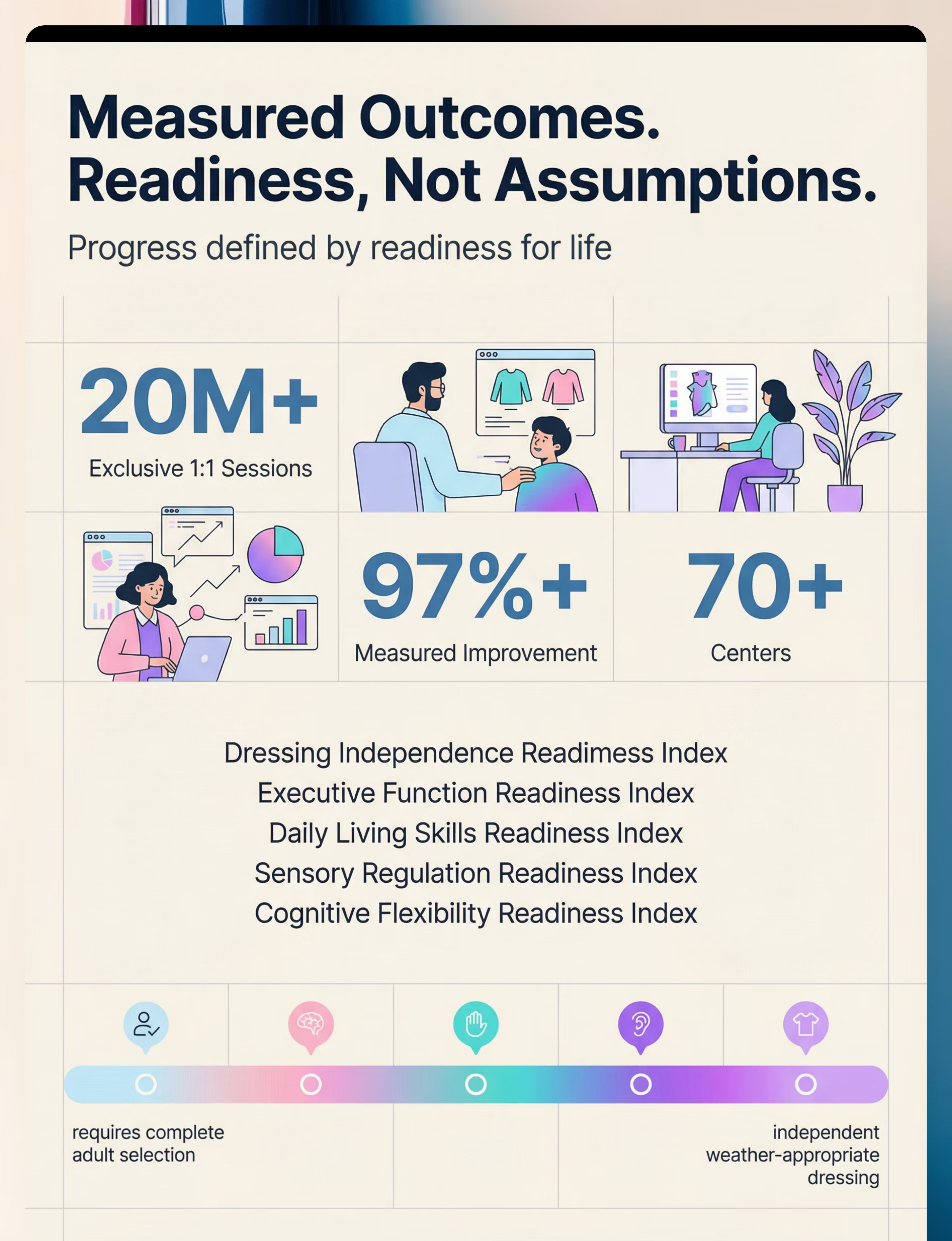
97%+ measured improvement across 21M+ sessions under GPT-OS® — including dressing independence as a tracked readiness index.
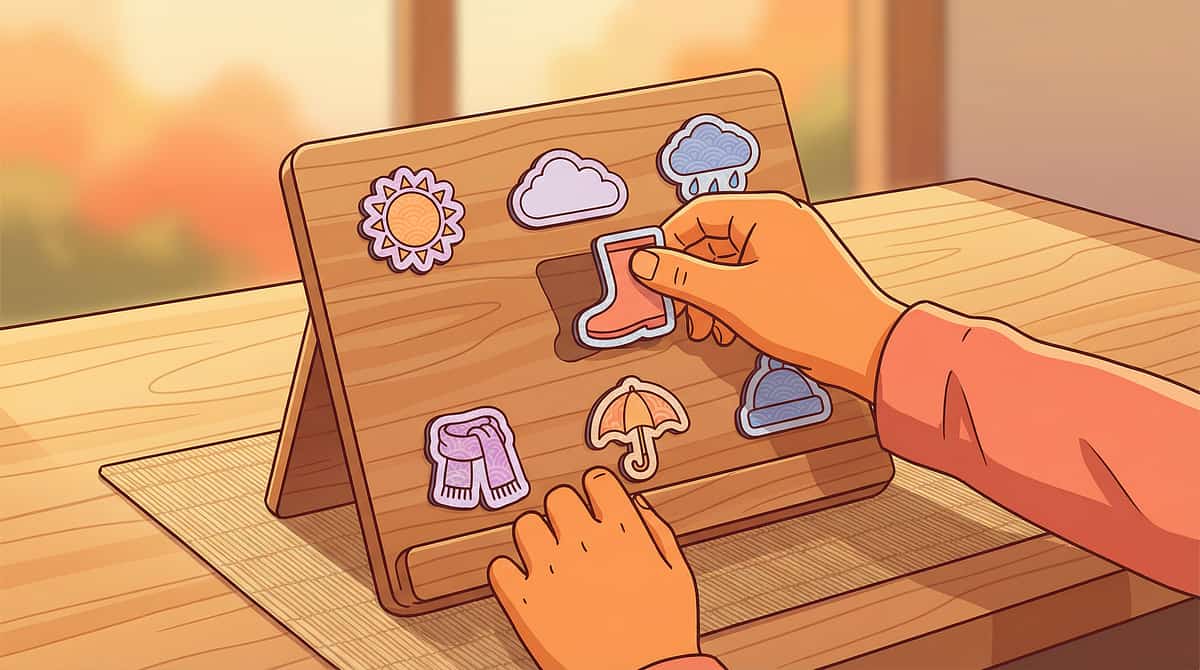
The Technique: What It Is
☀️🌧️❄️ Weather-Appropriate Clothes Intervention
Formal: Weather-Clothing Correspondence Training
Parent Name: "The Weather-Wardrobe Bridge"
Series: Toileting & Self-Care Independence — Episode 529 of 540
Weather-Appropriate Clothes Intervention is a multi-modal, home-executable intervention that builds a child's ability to independently connect current weather conditions to appropriate clothing selection. It addresses five underlying systems simultaneously: cognitive understanding of weather concepts, executive function for weather checking, cognitive flexibility for preference adjustment, sensory tolerance for weather gear, and interoception for body temperature awareness.
🏠 Self-Care
🧠 Executive Function
👁️ Visual Processing
🤸 Occupational Therapy
❄️ Sensory Processing
🔄 Cognitive Flexibility
Age Range: 3–12 years | Duration: 5–15 min daily | Frequency: Daily (morning routine) | Setting: Home + School + Community
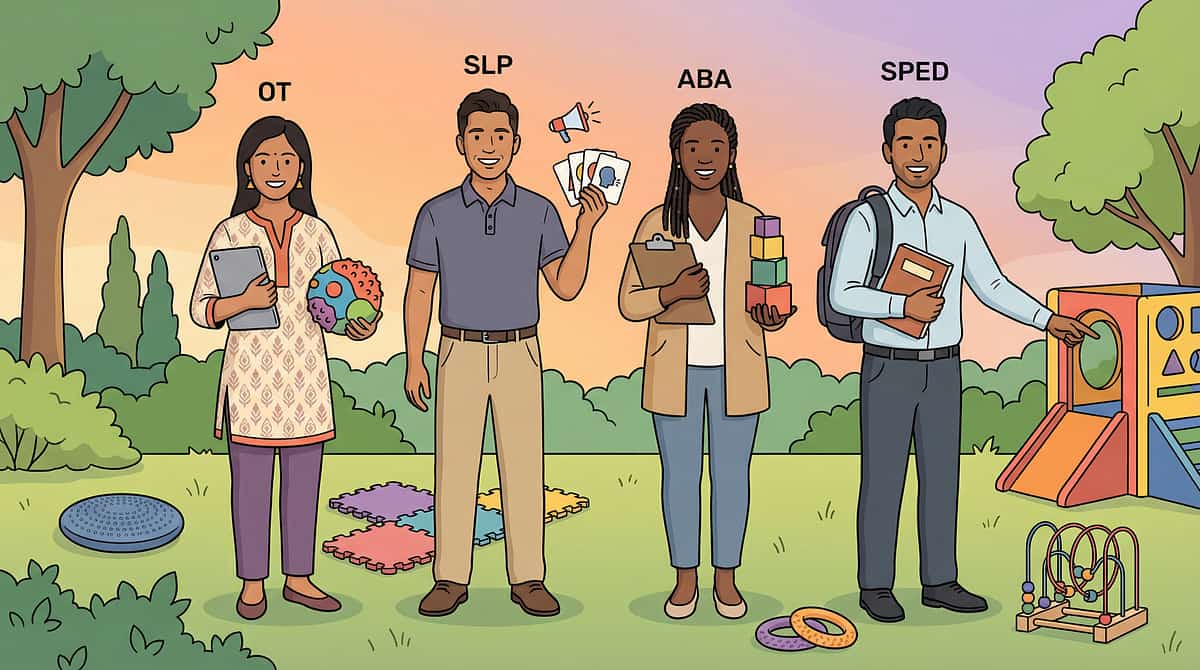
This Technique Crosses Every Therapy Boundary
Occupational Therapist
Primary Lead. OT addresses sensory processing differences affecting clothing tolerance, builds executive function for morning routines, and designs environmental modifications — closet organization and visual supports.
ABA/BCBA Specialist
Cognitive Flexibility & Reinforcement. BCBA targets rigid clothing preference patterns using systematic desensitization, choice frameworks, and reinforcement for weather-appropriate selection attempts.
Special Educator
Visual Supports & Academic Transfer. SpEd builds weather literacy, integrates weather-dressing into classroom science curriculum, and creates portable visual support systems.
Speech-Language Pathologist
Language & Comprehension. SLP addresses weather vocabulary, abstract temperature concepts, and the language comprehension needed to understand and follow weather-clothing instructions.
NeuroDev Pediatrician
Diagnostic Foundation. Evaluates interoceptive differences, executive function profiles, and sensory processing disorders. Guides medication review if ADHD affects morning routine functioning.
Parent / Caregiver
The Daily Executor. You are the therapist every morning. This page equips you with the exact protocol, scripts, and materials to make every morning a therapeutic micro-session.
"The brain doesn't organize by therapy type. Weather-appropriate dressing spans OT, ABA, SpEd, SLP, and medical domains simultaneously. The Pinnacle FusionModule™ coordinates all five."
Precision Tool. Not a Random Activity.
Target | "Not There Yet" | "Emerging" | "Achieved" | |
Weather check | Never looks outside before dressing | Looks when prompted | Checks independently | |
Temperature concept | Cannot connect numbers to clothing | Recognizes hot/cold zones | Uses thermometer to decide | |
Gear tolerance | Refuses all weather gear | Tolerates sensory-friendly alternatives | Wears appropriate gear consistently | |
Flexibility | Rigid preferred outfit regardless | Accepts one alternative option | Selects from weather-appropriate category |
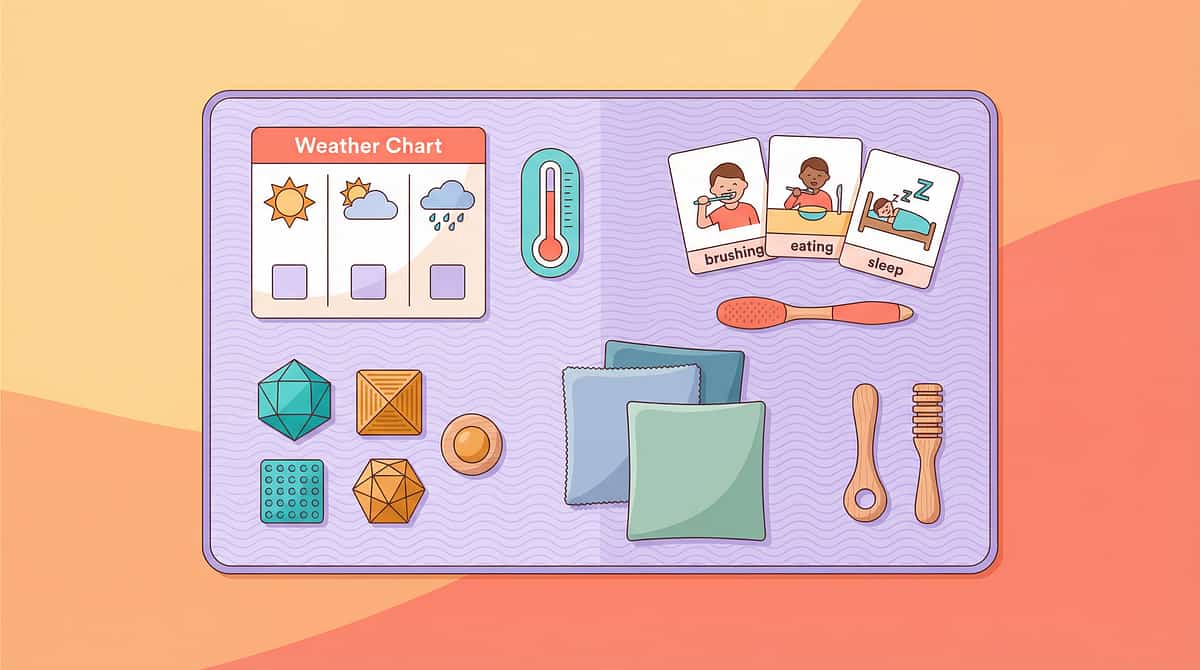
9 Materials. Every One Evidence-Based. Every One Home-Executable.
Below you will find every material you need — organized, explained, and linked. Total investment ranges from ₹0 (full DIY) to ₹3,000 (full commercial kit). The essential starter requires nothing more than a poster board, index cards, and a labeled closet.
Material 1
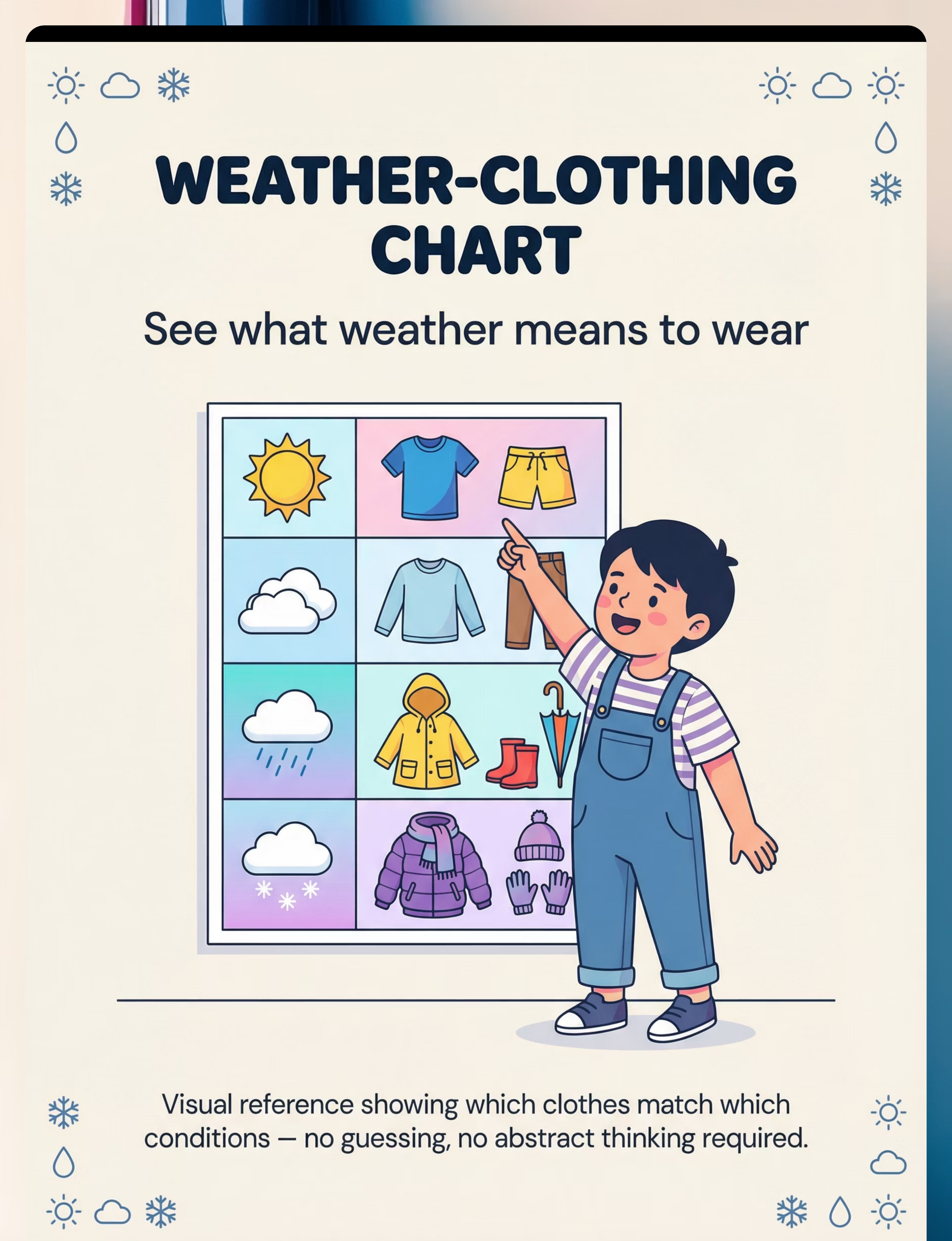
Weather-Clothing Match Chart
Material 2
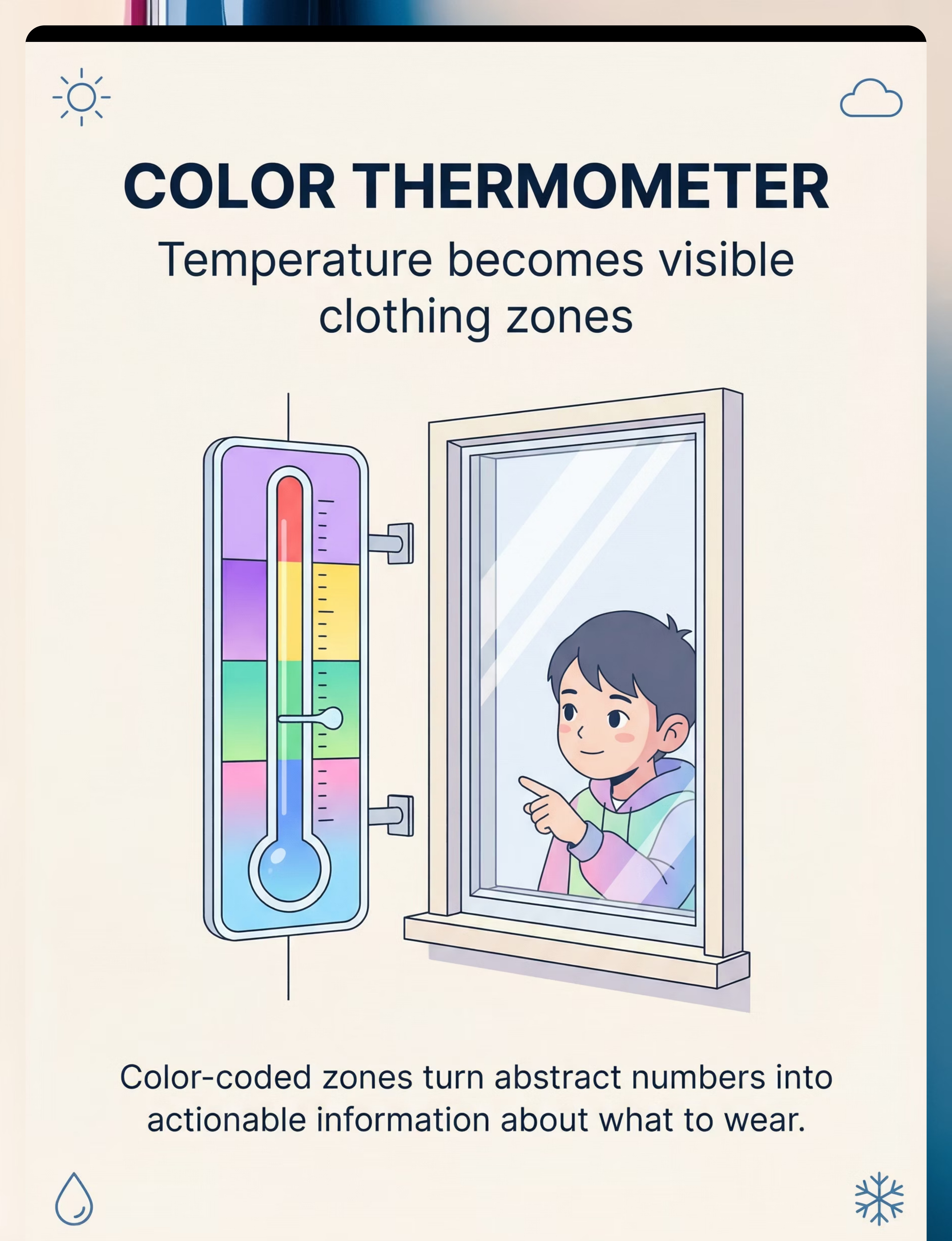
Color-Coded Thermometer
Material 3
Morning Routine Cards
Material 4
Sensory-Friendly Weather Gear
Material 5
Weather Sorting Games
Material 6
Weather-Organized Closet System
Material 7
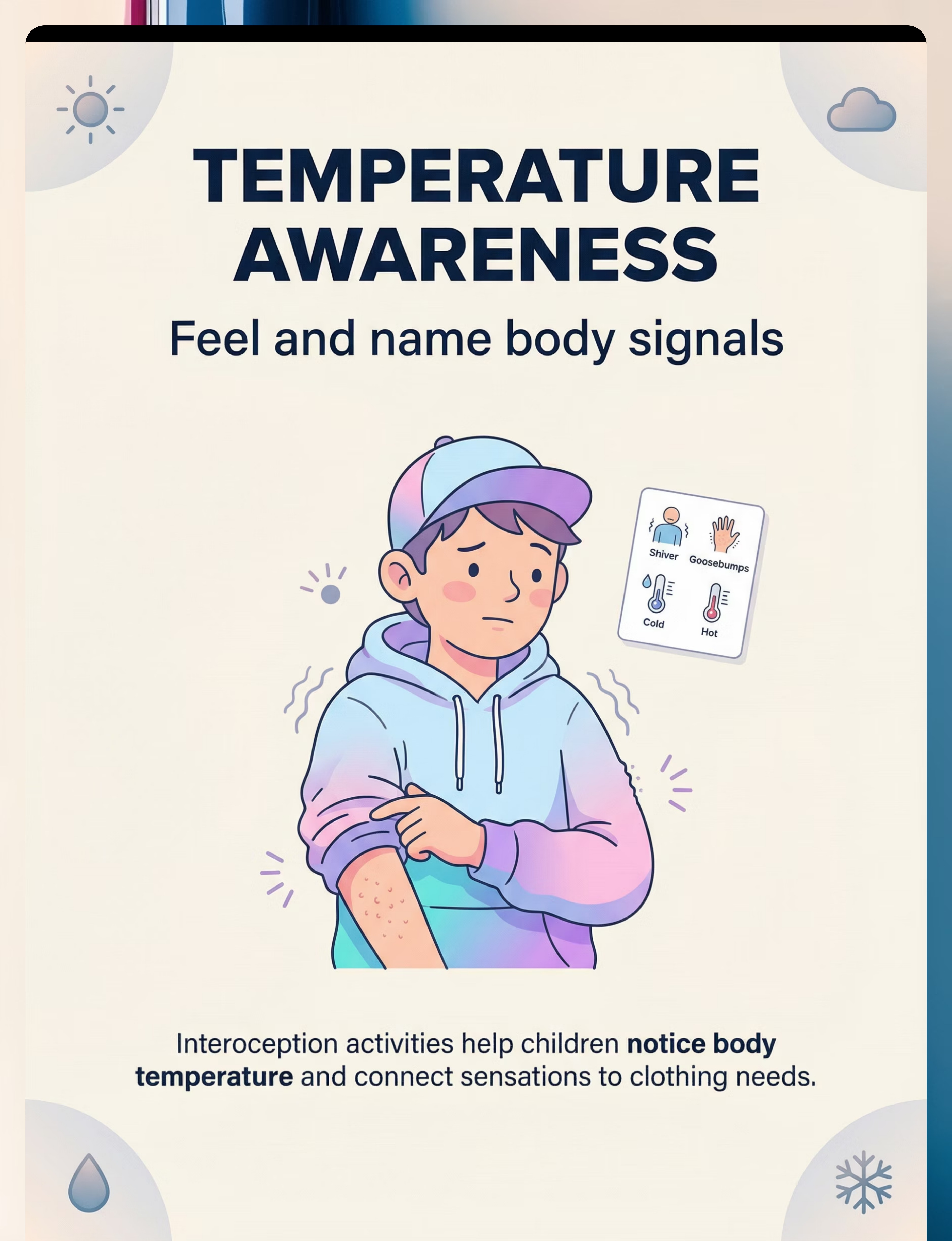
Body Temperature Awareness Cards
Material 8
Social Story: "Weather and My Clothes"
Material 9
Weather Choice Board
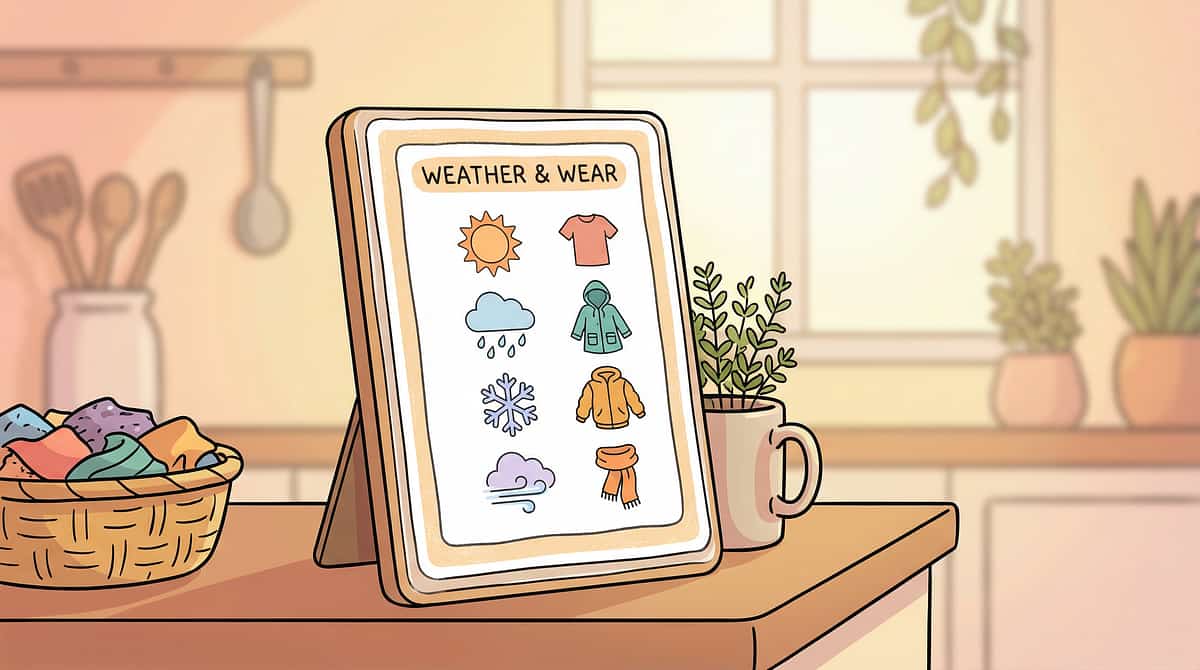
Material 1: Weather-Clothing Match Chart
Canon: Visual Schedules / Routine Support
₹100–500
🏅 Pinnacle Recommends
A laminated chart showing weather conditions (sun, cloud, rain, cold) paired with corresponding clothing categories. This single material eliminates abstract reasoning — the chart does the cognitive translation for the child. Mount at child's eye level where they dress.
Why It Works
Visual-spatial matching bypasses the abstract reasoning deficit. The chart creates a direct perceptual link from weather icon to clothing image — no internal translation required.
How to Get It
🔨DIY (₹0): Poster board + weather icons + photos of child's actual clothes → laminate → mount at eye level. The zero-cost version works just as well as any commercial version.
Material 2: Outdoor Color-Coded Thermometer
Canon: Visual Supports / Environmental Modification
₹200–800
🏅 Pinnacle Recommends
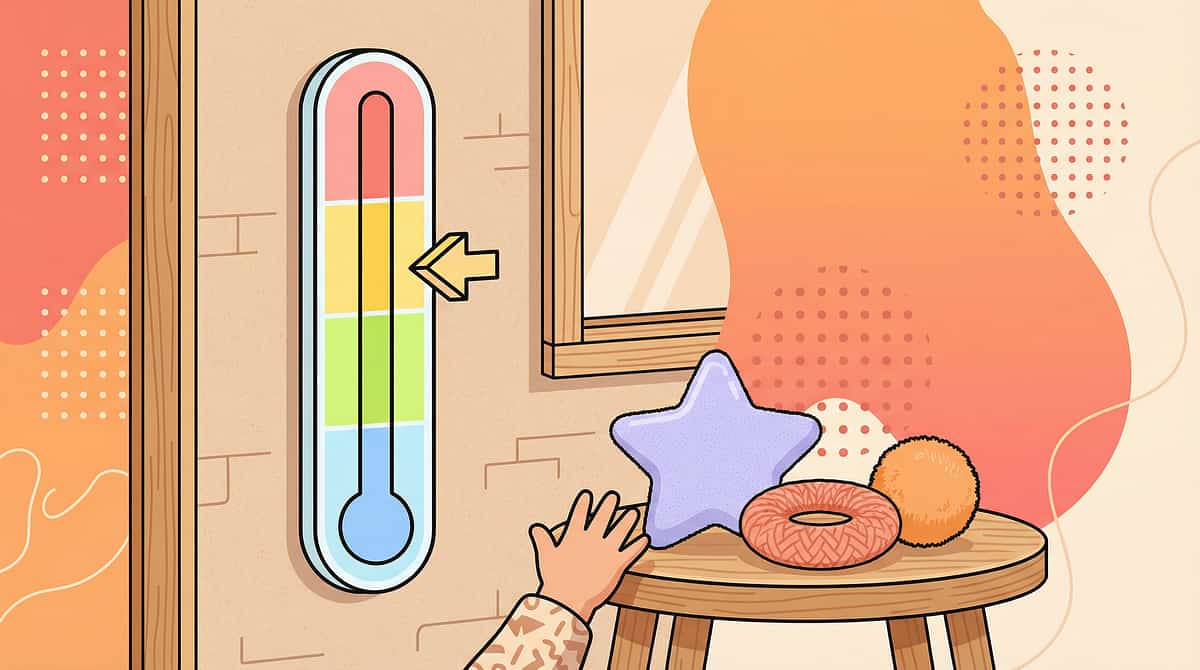
A large outdoor thermometer with color zones: Blue = cold/heavy clothes, Green = cool/layers, Yellow = warm/light, Red = hot/minimal. Mount outside a window visible from the dressing area. Temperature becomes a color — a color the child can act on immediately and confidently.
Why It Works
Abstract temperature numbers mean nothing to many children with executive function or interoceptive differences. Color zones create a concrete, visual, actionable category system that requires zero arithmetic or inference.
How to Get It
🔨DIY (₹50–100): Standard thermometer + colored tape in zones. Mark with a black pen: "BLUE = Warm layers." Laminate a color key and tape it beside.
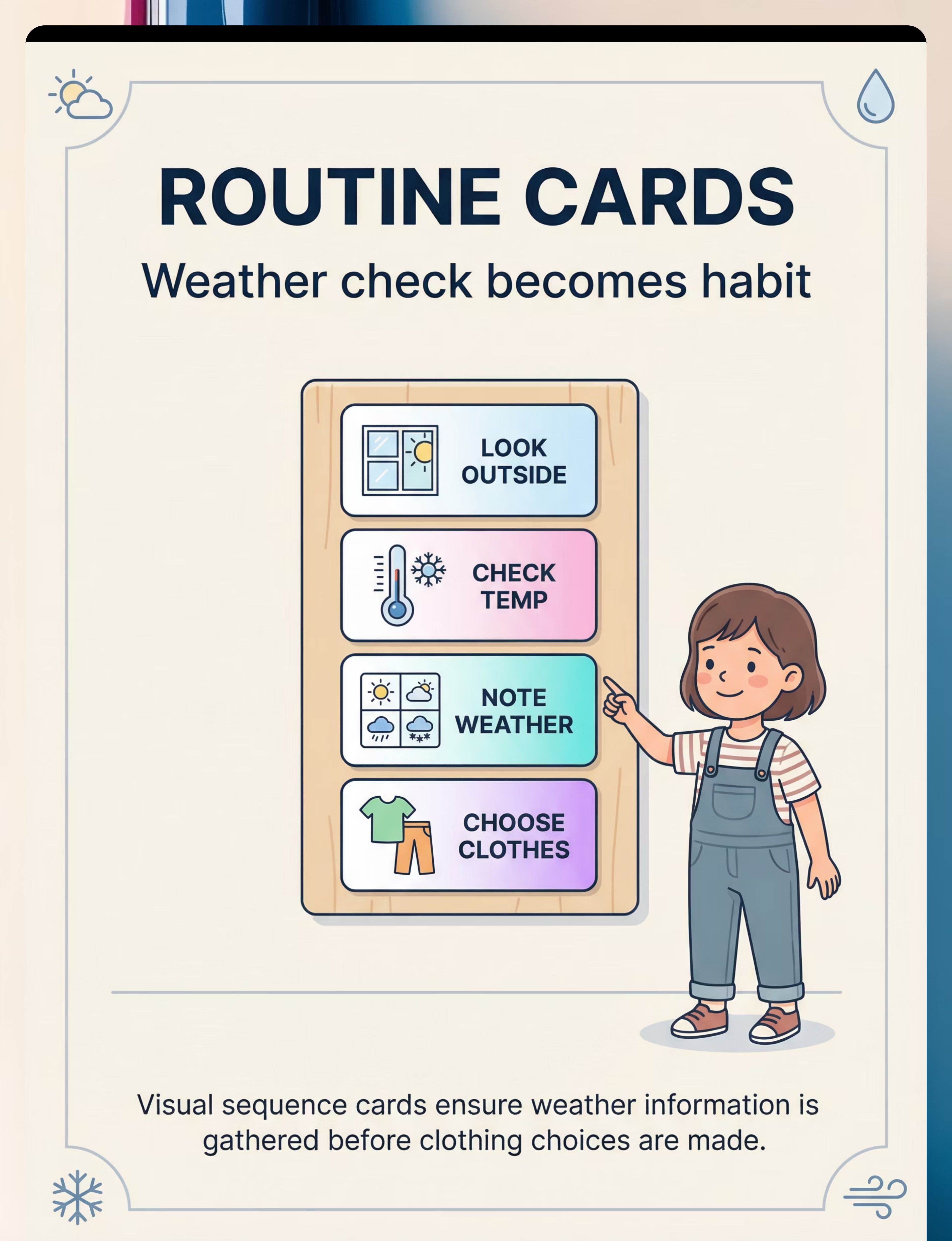
Material 3: Morning Routine Cards (Weather-Check Sequence)
Canon: Visual Schedules / Routine Support
₹50–200
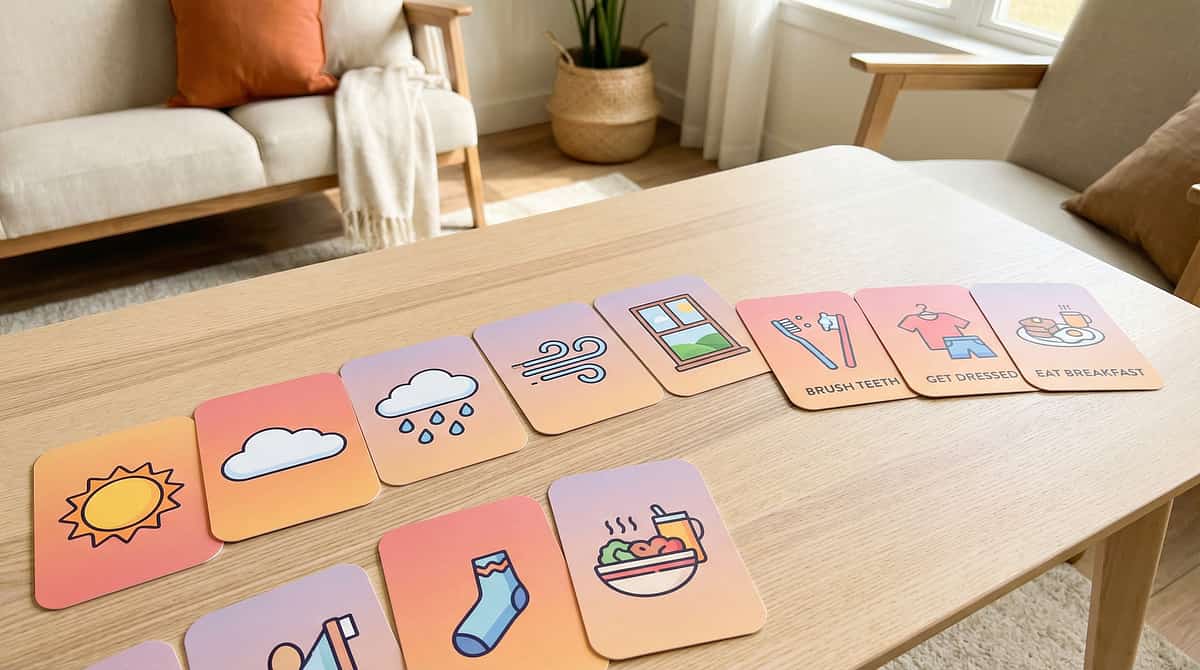
Look out window
Observe actual conditions — sunny, cloudy, raining, foggy
Check thermometer color
Blue / Green / Yellow / Red — identify today's zone
Find weather on chart
Match thermometer color to the correct clothing category
Go to correct closet section
Move to the pre-organized weather section of the closet
Choose outfit
Select from 2–3 pre-approved options in that section
Why it works: The core problem is often not understanding weather — it's never checking it. Routine cards build the checking habit by making it a visible, sequential, non-negotiable first step. 🛒Search on Amazon.in: Visual Routine Cards Children | 🔨DIY (₹30): Index cards + drawings or printed icons. Laminate with contact paper.
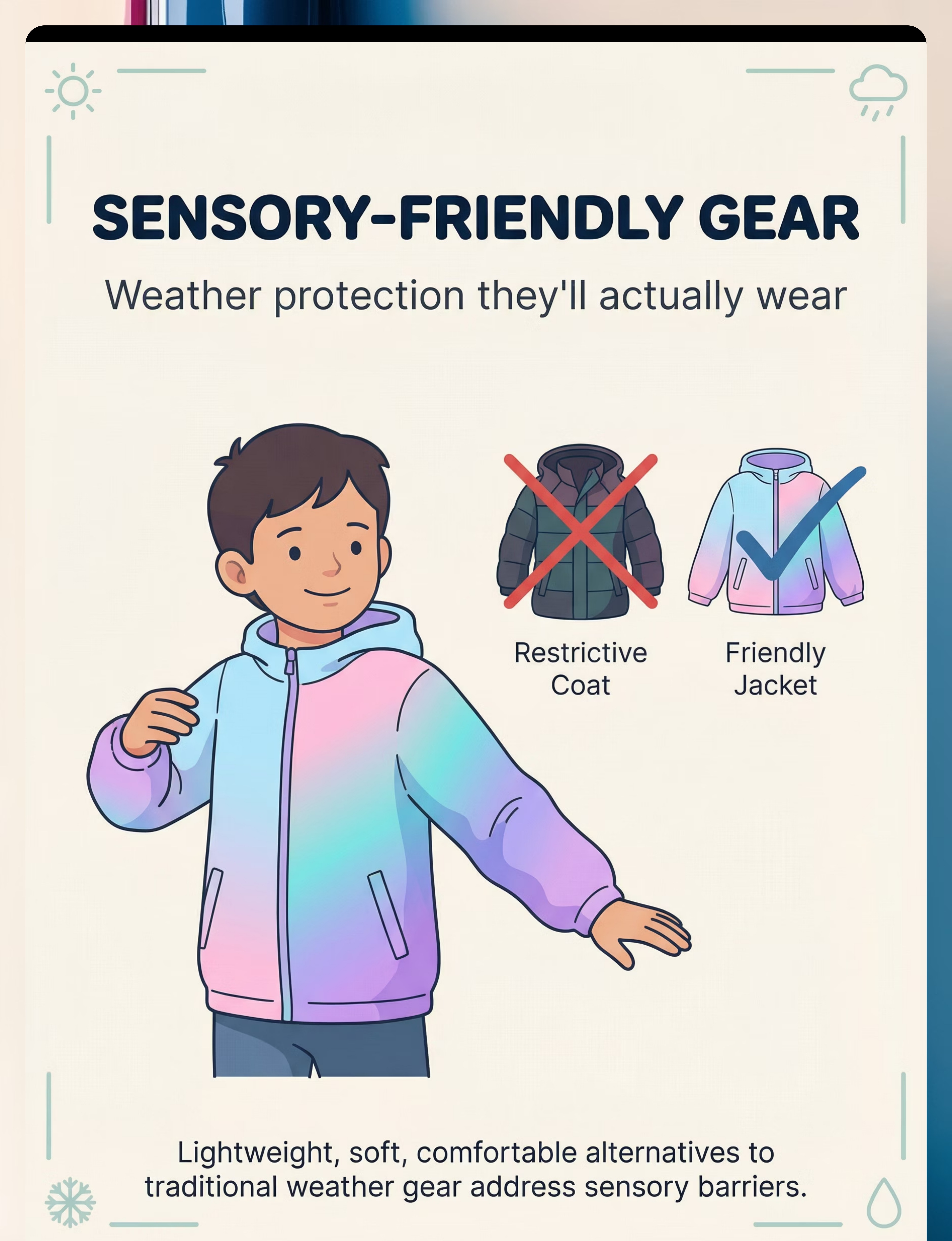
Material 4: Sensory-Friendly Weather Gear
Canon: Sensory Accommodation
₹500–3,000
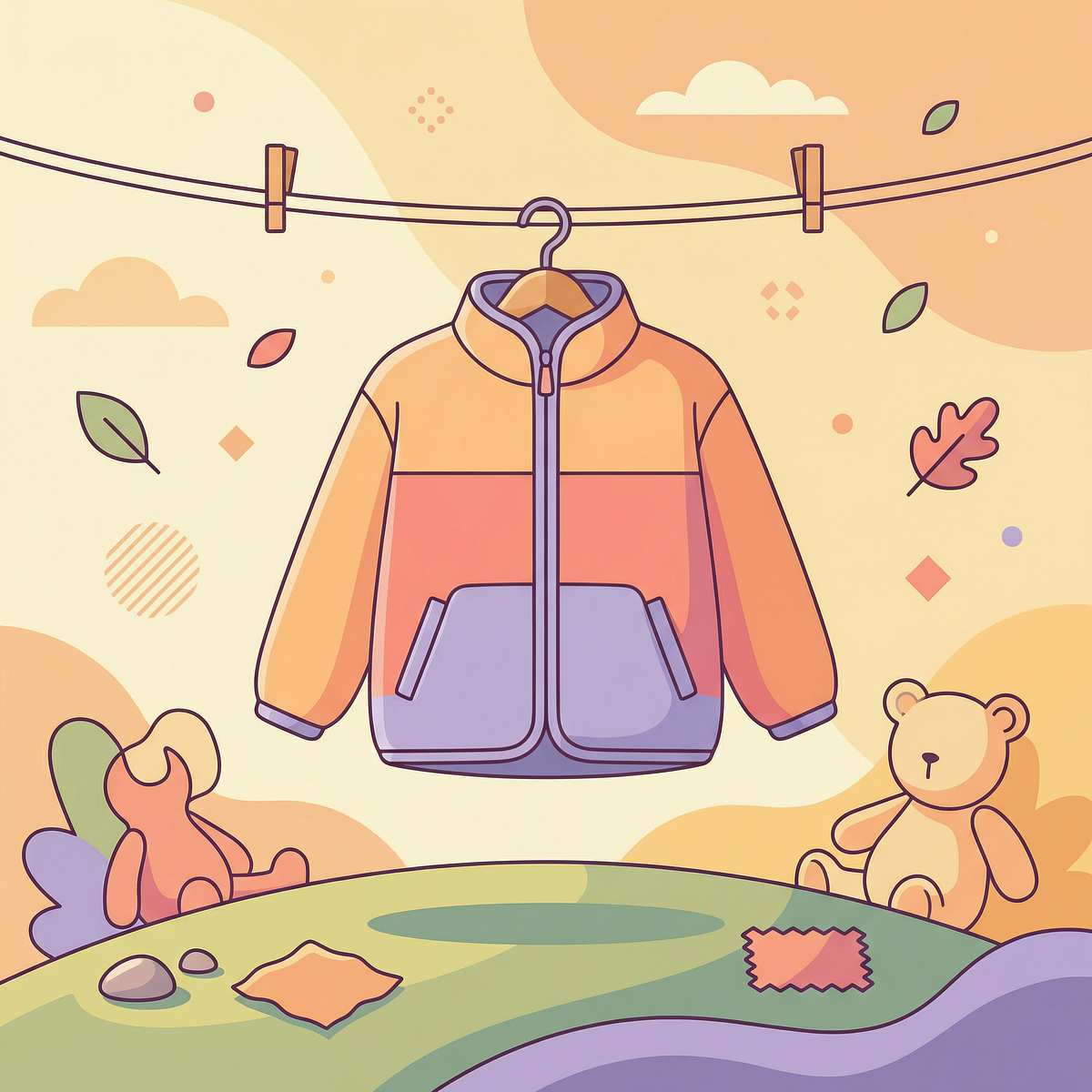
The best protection is the protection they'll actually wear. Look for: lightweight insulated jackets (not heavy coats), soft fleece layers (not scratchy wool), tagless seamless items, soft rain gear or large umbrella alternatives, and flexible waterproof shoes.
Why it works: When sensory cost exceeds temperature discomfort, children choose discomfort over intolerable gear. Sensory-friendly alternatives remove that barrier entirely.
🔨DIY Audit: Review existing wardrobe for sensory-tolerable items. Remove tags. Layer thin familiar items instead of one heavy coat. Familiar textures are always preferred over new ones during transitions.
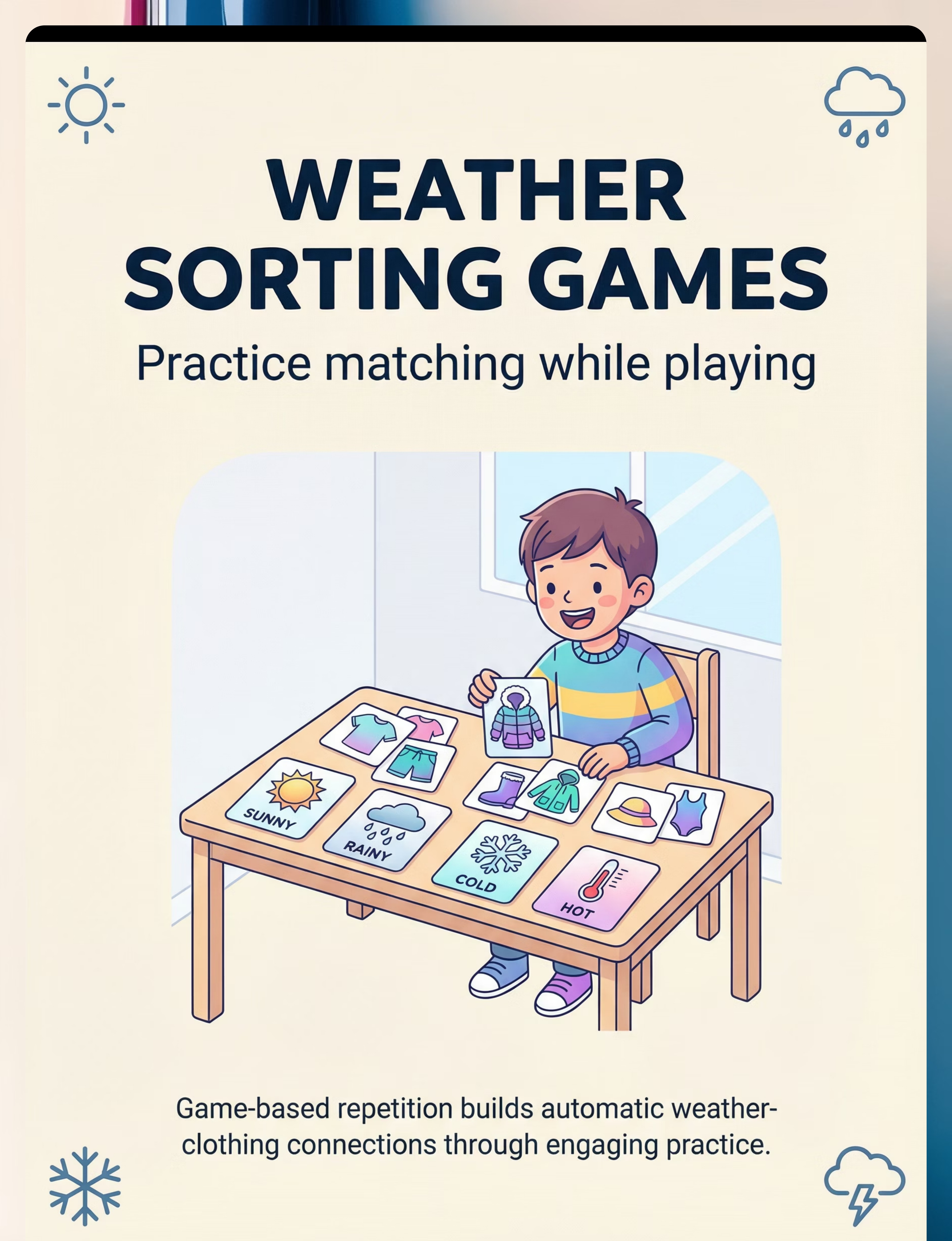
Material 5: Weather Sorting Games & Cards
Canon: Sorting Activities / Categorization
₹100–628
Why It Works
Repeated matching practice builds neural pathways. What becomes automatic in play becomes effortless in real life. The play context removes the emotional charge of the morning routine — children learn the skill without the stakes.
How to Use It
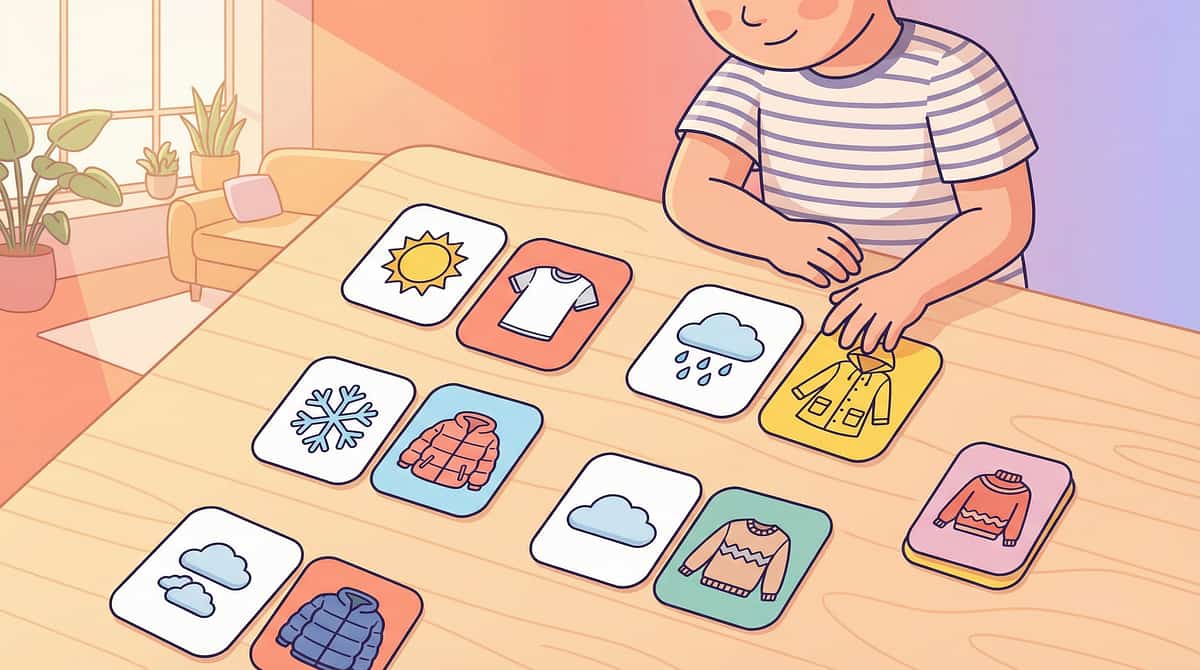
Weather sorting games let children practice matching clothing to weather conditions repeatedly in a play context. Sort clothing picture cards into weather categories. "Dress the paper doll for cold weather." Play builds automatic connections that transfer to real mornings — without the pressure of actually having to get dressed.
🔨DIY (₹0): Draw weather icons on cards (sun, rain, snow, clouds). Photograph or draw clothing items. Child sorts clothing into weather piles. The physical act of sorting is the therapeutic mechanism — cost is irrelevant.
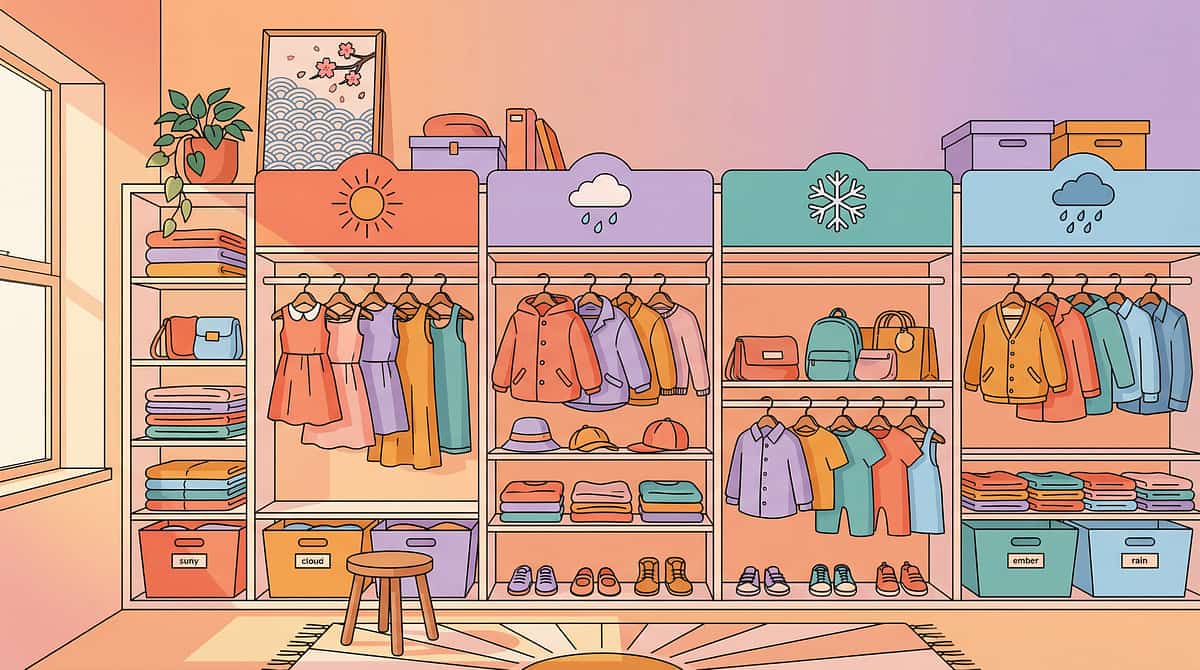
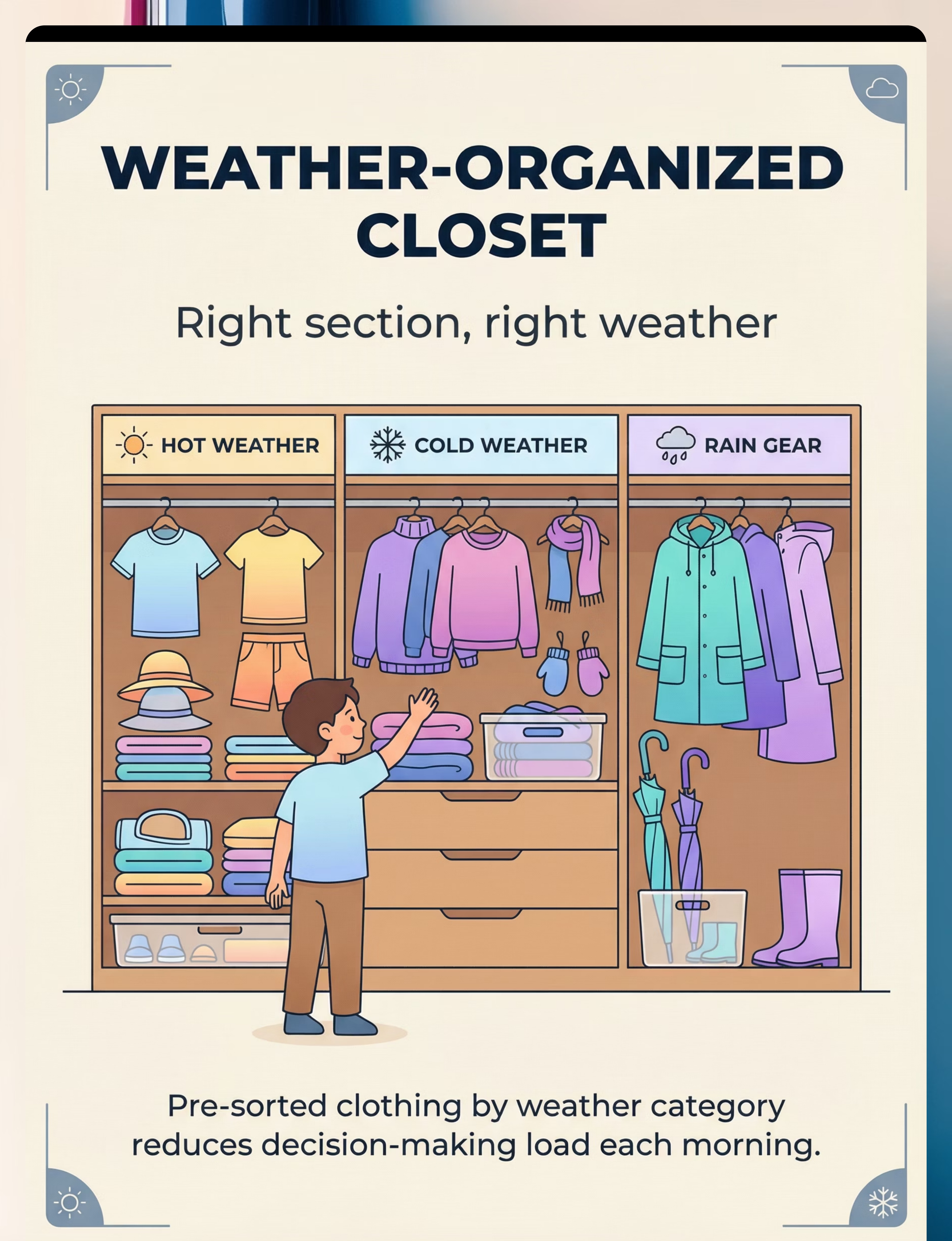
Material 6: Weather-Organized Closet System
Canon: Environmental Modification / Organization
₹200–1,000
Closet sections or labeled bins organized by weather: ☀️ Hot Weather | 🌤️ Cool/Layering | ❄️ Cold Weather | 🌧️ Rain Gear. Pre-sorted by weather category, not clothing type. Child identifies today's weather, goes to that section, and chooses from there. Cognitive load is reduced from "entire wardrobe" to "this section."
Why It Works
Environmental design is intervention. Pre-organization eliminates the cognitive sorting work from the morning decision — the environment does the executive function work so the child's brain doesn't have to.
How to Set It Up
🔨DIY (₹20): Cardboard section dividers + hand-written weather icon labels. Tape weather icons cut from magazines. The organization matters; the materials do not.
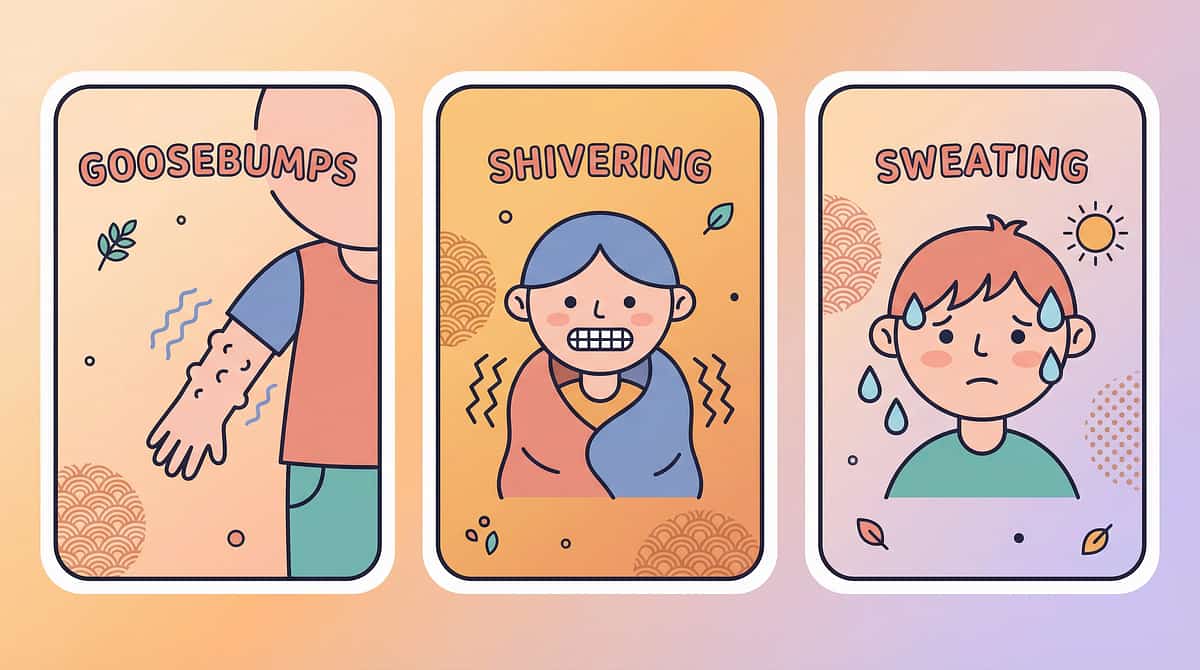
Material 7: Body Temperature Awareness Cards
Canon: Interoception / Body Awareness
₹0–200
Cards showing body temperature signals: Goosebumps = cold. Shivering = cold. Sweating = hot. Red face = hot. Child practices identifying signals on themselves after going outside briefly. This builds the interoceptive awareness that motivates appropriate clothing from the inside out — the internal sense that sustains the skill after external visual supports are faded.
🔨DIY (₹0): Draw simple body outline. Add signal icons — goosebumps, sweat drops, shivering lines. Label with temperature words. Laminate for durability.
Why It Works
External visual supports (charts, thermometers) do the work early in the process. But the long-term goal is for the child to feel and name their own temperature — and want to address it. Interoception awareness cards build the internal foundation that makes the skill truly independent over time.
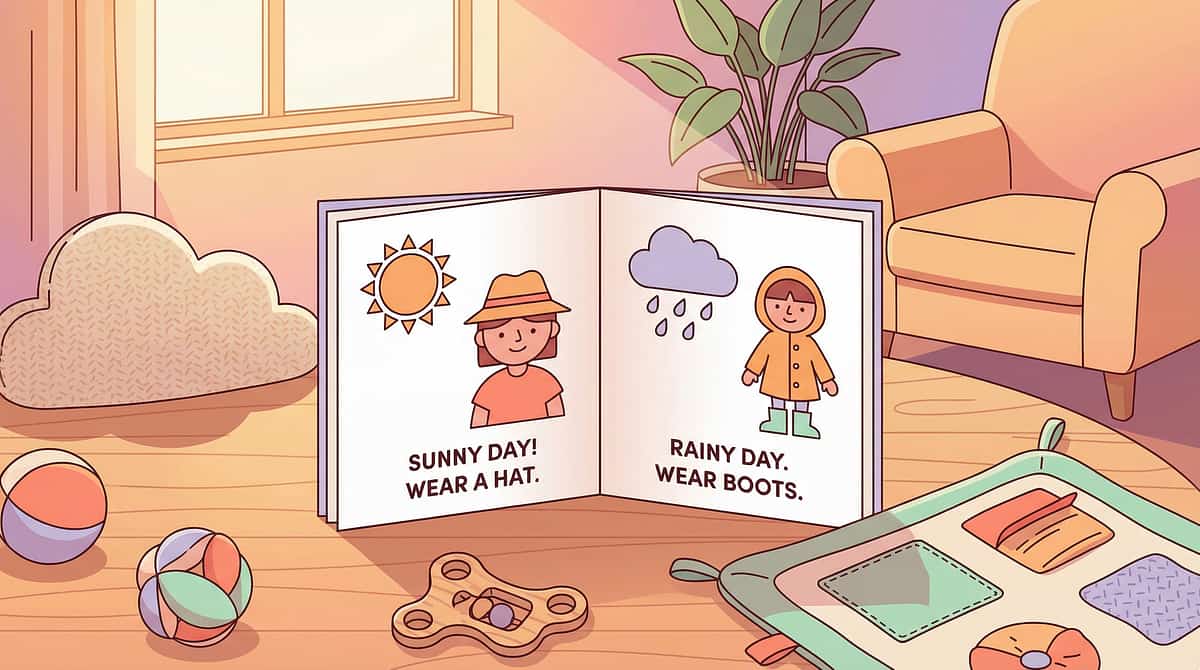
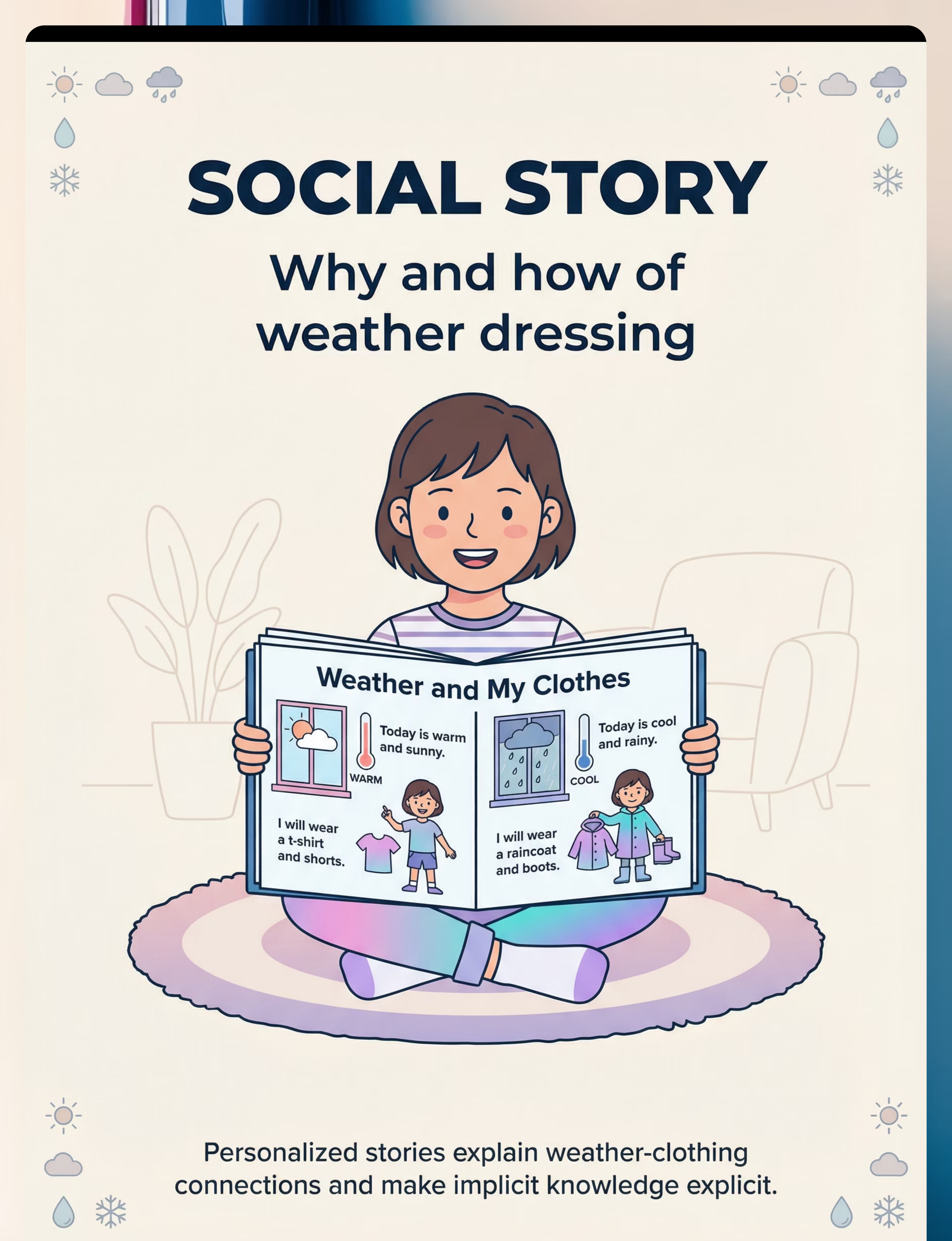
Material 8: Social Story — "Weather and My Clothes"
Canon: Social Stories / Narrative Supports
₹100–400
A personalized booklet explaining why weather-appropriate clothing matters, what body signals mean, and the morning checking sequence — with the child's name and photos of their actual clothes. Read nightly or before dressing. Social stories make implicit social knowledge explicit — giving children with autism the "unspoken rules" in plain, visual language.
Why It Works
Children with autism need the unspoken rules made explicit. A social story provides the "why" that motivates the "what" — and repeated nightly reading builds familiarity before the high-stakes morning moment.
How to Get It
🔨DIY (₹0–50): Create a 6-page booklet with child's photos, their actual clothes, and simple text. Laminate for durability. Personalization is what makes social stories effective — a booklet featuring the child's own name, face, and closet is always more powerful than a generic version.
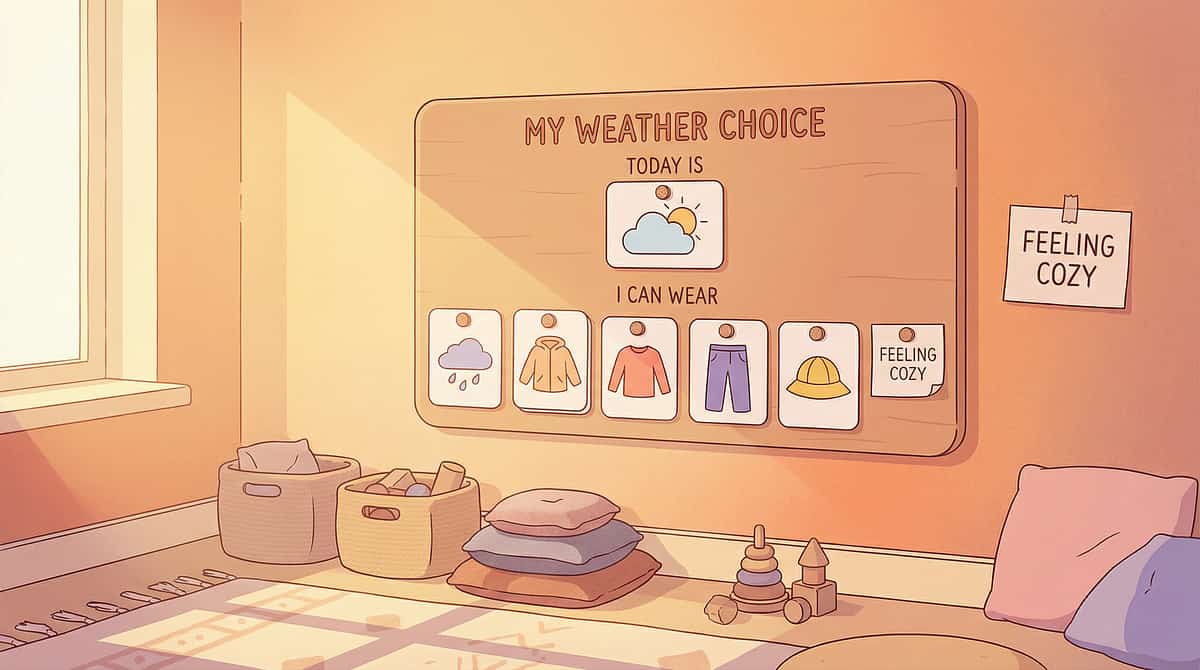
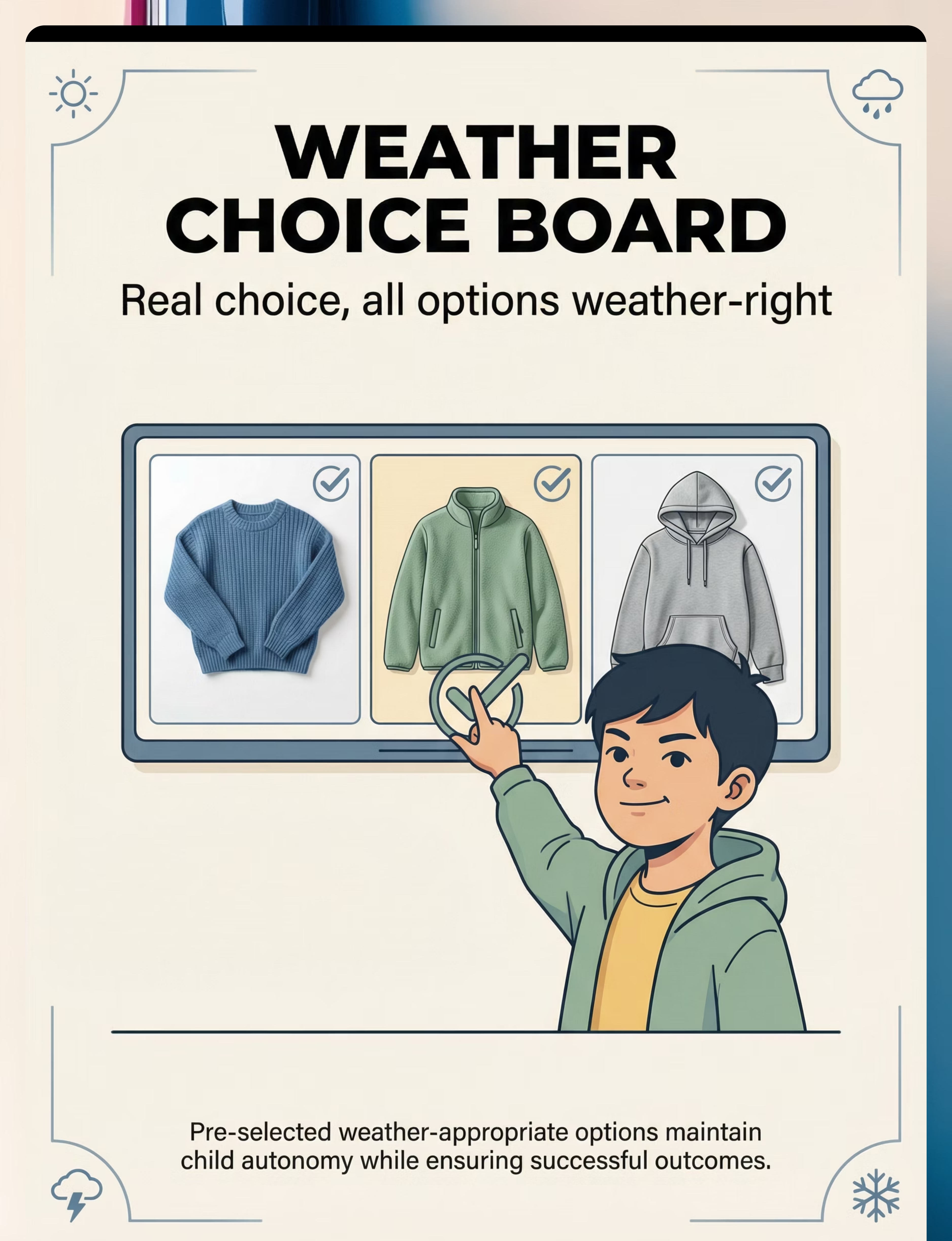
Material 9: Weather Choice Board
Canon: Choice / Communication Supports
₹100–519
A velcro or magnetic board where the parent pre-selects 2–4 weather-appropriate options each morning. Child chooses from those options. All choices are appropriate — child autonomy is preserved, successful outcomes are guaranteed. This scaffolds toward full independence by removing overwhelm while maintaining agency.
Why it works: Overwhelm drives rigid preference. Pre-limiting choices to all-appropriate options removes the overwhelm while maintaining the child's sense of control — the key to reducing rigid behavior.
🔨DIY (₹0): Lay out 2–3 weather-appropriate items on child's bed each morning. "Pick one of these." Zero cost, maximum effectiveness.
BONUS — Reinforcement Materials:🛒Reward Sticker Set — ₹589 | 🛒Reward Chart — ₹364 | 🛒Transition Comfort Item — ₹425
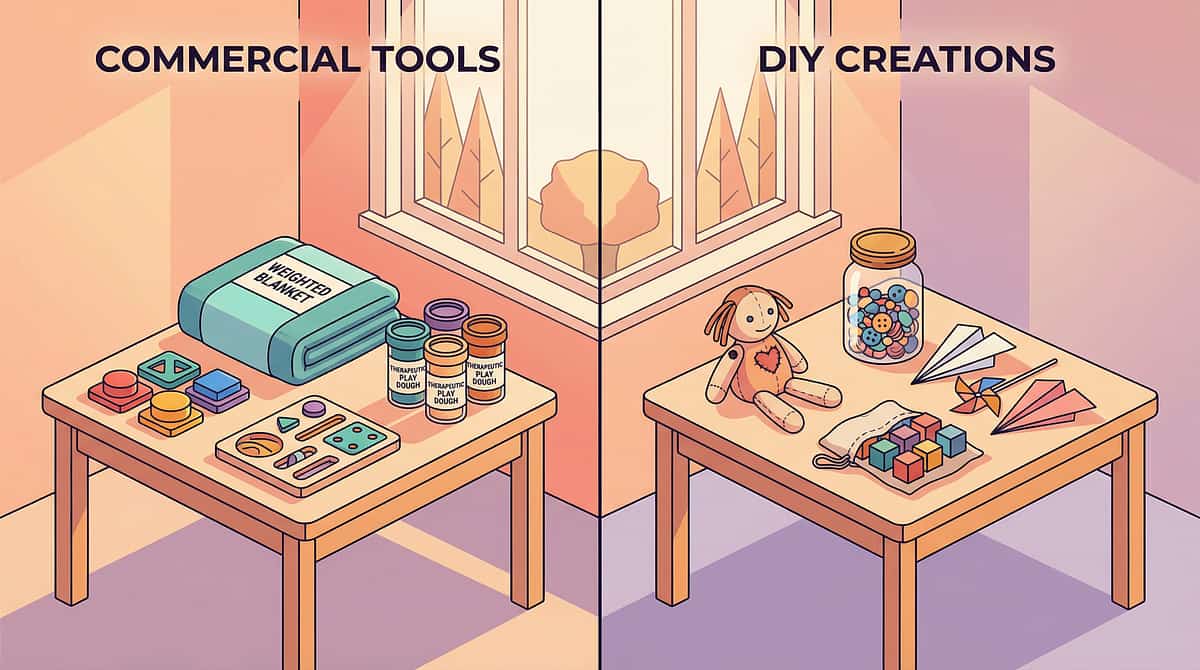
Every Material Has a Zero-Cost Version
WHO/UNICEF Equity Principle: No family should be excluded from evidence-based intervention by economic barriers.
💰 Commercial Version | 🔨 DIY Zero-Cost Version | Same Principle | |
Laminated weather-clothing chart (₹100–500) | Poster board + drawn icons + clothing photos from magazines | Visual matching bypasses abstract reasoning | |
Color-coded outdoor thermometer (₹200–800) | Any thermometer + colored tape zones | Temperature → color → action | |
Printed routine card sets (₹50–200) | Index cards + pencil drawings | Sequential cueing for habit formation | |
Sensory-friendly commercial jacket (₹500–3,000) | Child's softest existing clothing layered | Sensory tolerance through familiar textures | |
Commercial sorting game (₹100–600) | Hand-drawn weather + clothing cards | Repetitive matching builds neural pathways | |
Closet organizer system (₹200–1,000) | Cardboard dividers + written labels | Environmental pre-organization | |
Social story booklet (₹100–400) | Hand-written booklet with child's photos | Explicit knowledge transfer | |
Choice board (₹100–400) | Laying 2–3 items on bed each morning | Constrained choice preserves agency |
⚠️When commercial-grade is non-negotiable: When sensory intolerance to clothing is severe, a professional sensory evaluation by an OT may be required before material selection. The wrong texture can undo months of progress. Source: WHO NCF Handbook (2022) PMC9978394
Read This Before Your First Session
🔴 DO NOT PROCEED IF:
- Child is in acute distress, meltdown, or severely dysregulated
- Child has fever or illness affecting sensory sensitivity
- Morning is already a crisis — today is not the day
- Child has severe clothing phobia without OT support
- Parent is also dysregulated — calm parent is prerequisite
🟡 MODIFY WITH CAUTION IF:
- Child is slightly tired or hungry (ensure fed and rested first)
- New clothing items have not been pre-washed and softened
- Weather is extreme — may amplify sensory resistance
- Child has had recent illness affecting tactile sensitivity
- School rush is imminent — simplified version only
🟢 PROCEED WHEN:
- Child is regulated, fed, and rested
- Materials are ready and accessible before child wakes
- Parent has reviewed the protocol
- Weather chart and thermometer are visible
- Reinforcement items are ready
⛔STOP IMMEDIATELY IF: Child begins self-injurious behavior related to clothing | Child's distress escalates beyond manageable levels | Forced dressing is occurring — this is not the intervention | Child develops skin reaction to new clothing material. Safety note: Laminate all visual materials for young children. Choose digital or protected plastic thermometers. Ensure no allergens in edible reinforcers.
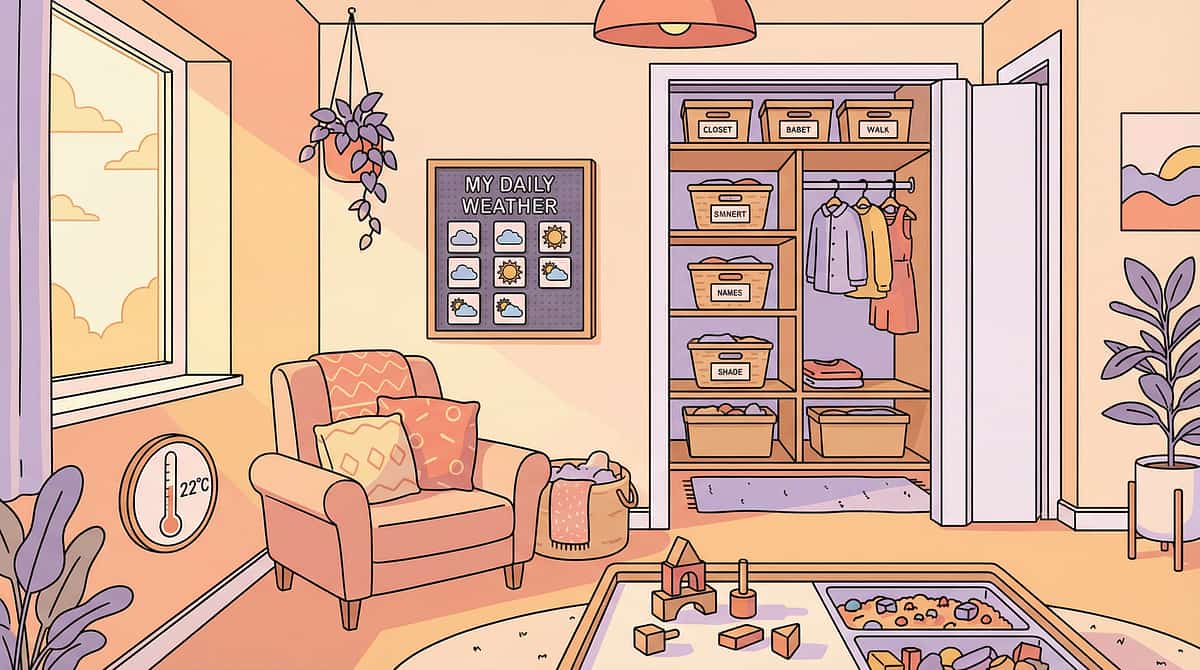
The Right Environment Makes the Protocol 80% Easier
The right physical setup reduces friction, increases compliance, and sets both parent and child up for success before the session even begins.
Pre-Session Checklist
- Weather chart mounted at child eye level
- Thermometer visible from dressing area
- Routine cards posted in sequence
- Closet sections labeled and pre-organized
- Today's 2–3 appropriate options identified
- Reinforcement items ready
- Distracting screens off during routine
- 15+ minutes available — no rush this morning
Sensory Environment
- Lighting: Bright but not harsh (natural light preferred)
- Sound: Quiet — no TV during protocol
- Temperature: Room temp moderate
- Scent: Avoid strong detergent on new clothes
Source: Meta-analysis (PMC10955541): 1:1 structured environment sessions showed maximum therapy effectiveness.
60 Seconds. The Best Session Starts Right.
Before beginning the protocol each morning, run through this quick readiness check. It takes one minute and prevents a frustrated session from eroding weeks of progress.
✅ Readiness Indicators
- Child is awake and alert (not groggy)
- Child has eaten or is not hungry
- No meltdown in past 30 minutes
- Child is in a calm sensory state
- No fever or illness present
- Sufficient time available (not rushed)
- Parent is calm and regulated
🟢 ALL ✓ → GO
Full protocol. All six steps. Proceed with confidence.
🟡 5–6 ✓ → MODIFY
Simplified version only: Choice board with 2 appropriate options. "Blue sweater or red fleece today?" Reinforcement for choosing and wearing. 2 minutes total.
🔴 Fewer than 5 ✓ → POSTPONE
Pre-lay clothes tonight instead. Try again tomorrow. "Today isn't our day. That's data, not failure."
Step 1 of 6
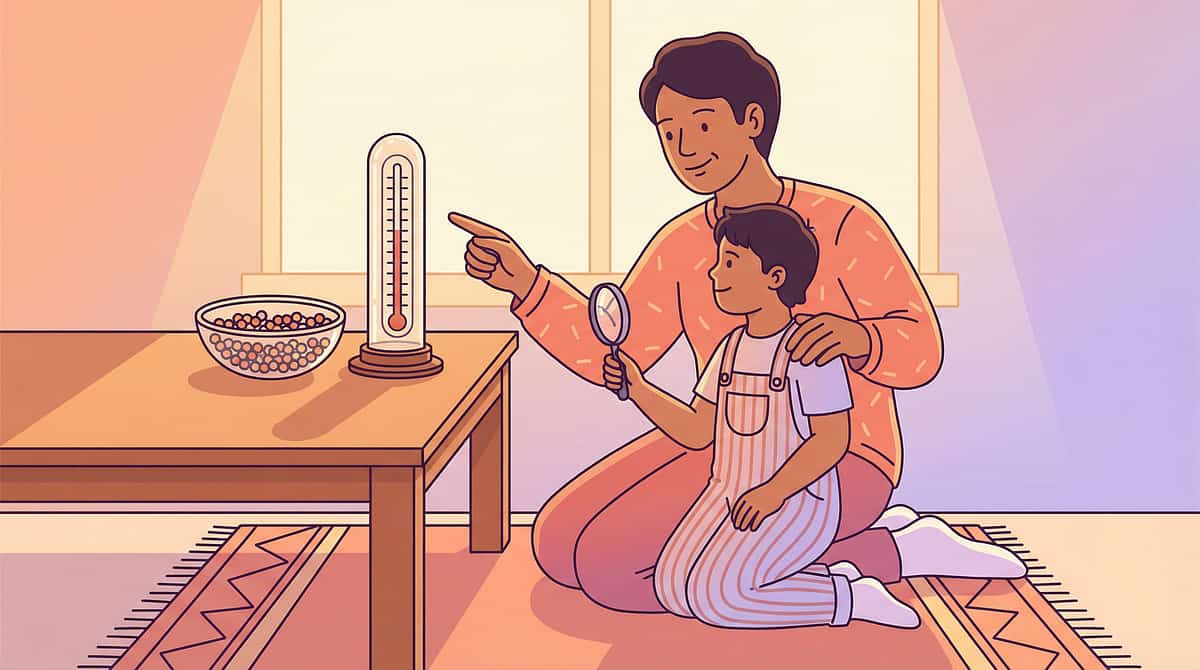
The Invitation
🕐 Timing: 30–60 seconds
Goal: Child accepts the weather-checking invitation
"Good morning! Before we choose clothes today, let's do our weather check. Want to come check the thermometer with me?"
Body Language Guidance
- Side-by-side, not face-to-face (less confrontational)
- Warm, curious tone — NOT an instruction tone
- Point toward the window or thermometer (concrete, visual anchor)
- No eye contact pressure
Resistance Cues & Responses
- "I already know what to wear" → "Maybe! Let's check to confirm."
- Moves toward closet → "Come look at this first, then you can choose."
- Ignores you → Give 10 seconds processing time, then gesture toward chart.
- Firm refusal → Move to Modify protocol (Card 13).
Acceptance cues: Moves toward thermometer, looks where you point, says "okay," or engages with any aspect of the invitation.
Source: ABA Pairing Principles: Low-demand engagement before instruction placement increases compliance rates. OT "Just-Right Challenge": Entry point matches current capacity.
Step 2 of 6
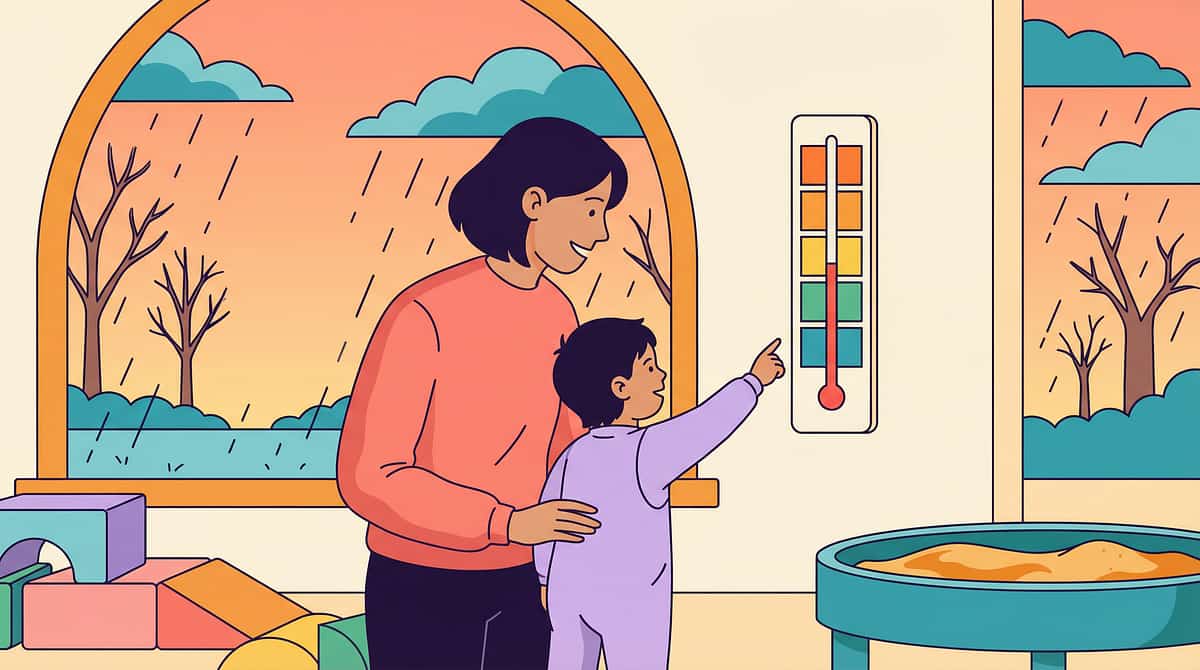
The Weather Check
🕑 Timing: 1–2 minutes
Goal: Child identifies today's weather condition
Look outside together
"What do you see out there? Sunny? Cloudy? Raining?" Wait for response. Label together: "I see clouds — what do you think, warm or cool day?"
Check the thermometer
"What color is the thermometer today? Blue zone! What does blue mean?" Child references color chart if needed. Accept pointing as a valid response.
Find it on the weather chart
"Blue zone means cold. Let's find cold weather on our chart — cold means we need warm layers." Point together. Confirm the match visually.
This sequence builds the executive function habit of: Observe → Assess → Connect → Plan. Every repetition strengthens this neural pathway. After 4–6 weeks, the child begins doing this automatically — even before being prompted.
Step 3 of 6
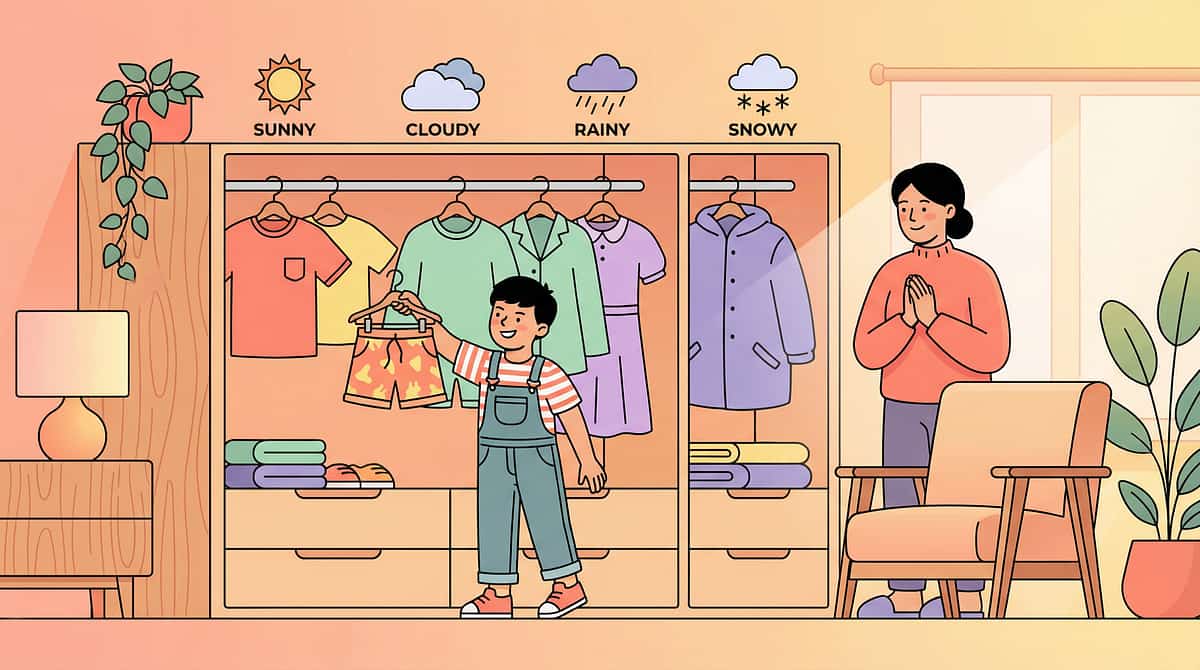
The Therapeutic Action — Clothing Selection
🕒 Timing: 2–4 minutes
Goal: Child selects from the correct weather-category closet section
"Today is [cold/warm/rainy]. Let's go to the [cold/warm/rain] section of your closet. Which one of these do you want to wear?"
Error | What Happened | Correction | |
Child runs to preferred (wrong) item | Habit overrides new system | Gently redirect: "That's our summer section — today is cold, let's check the cold section" | |
Child can't choose between options | Too many or too similar | Reduce to 2 clear options with visual difference | |
Child accepts but refuses to wear | Sensory barrier to specific item | Remove that item from options. Find sensory-friendly alternative | |
Child loses interest mid-step | Engagement faded | Use reinforcement preview: "One more step, then sticker!" |
Emerging Stage
4–5 minutes with significant guidance
Consolidating Stage
2–3 minutes with prompts
Mastery Stage
60–90 seconds independently
Step 4 of 6
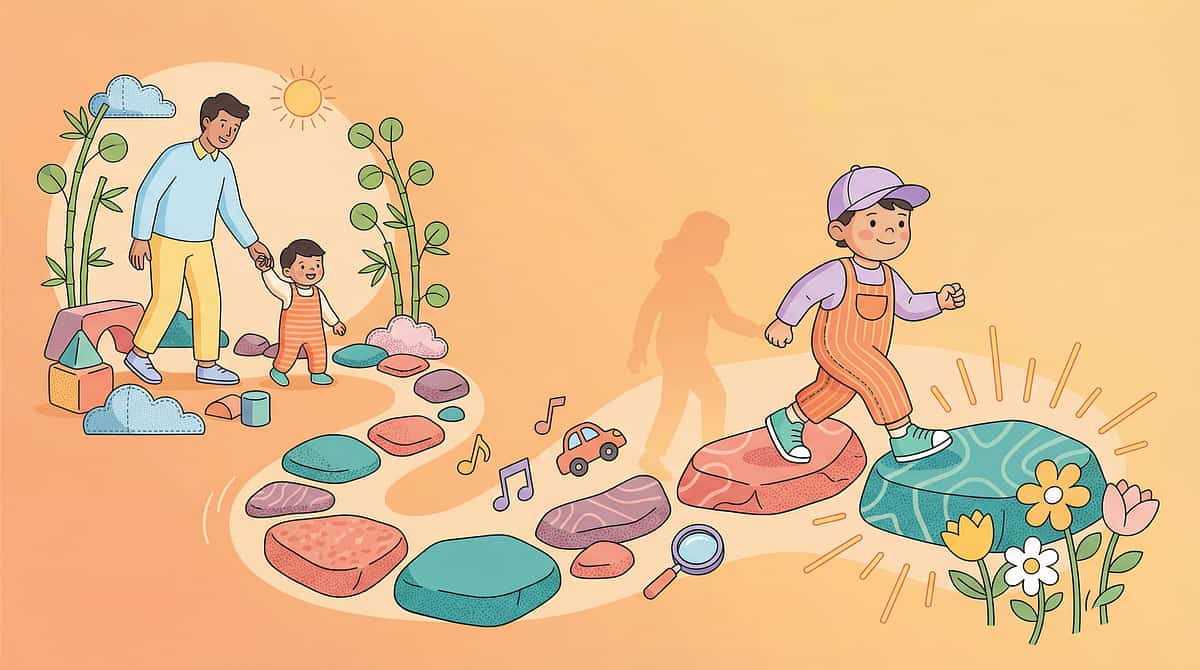
Repeat & Vary: Building Automaticity
🕓 Timing: Across consecutive mornings
Goal: Build automaticity through daily repetition
This is a daily morning protocol — not a once-weekly therapy session. Repetition every morning for 4–8 weeks builds the weather-checking habit into the neural default. The dosage is the therapy.
Variation to Maintain Engagement
- Change the chart format (icons → words → photos → app screenshot)
- Let child be "the weather expert" who teaches a sibling or stuffed animal
- Use a physical weather wheel child turns each morning
- Play "what would this character wear today?" with a favorite toy
- Photograph child in correctly-matched outfit — build a weather-outfit photo book
Satiation indicator: If child shows visible boredom, rushes through without looking, or complains "I already know this" — this means it's working. Reduce scaffolding and test independence.
Step 5 of 6
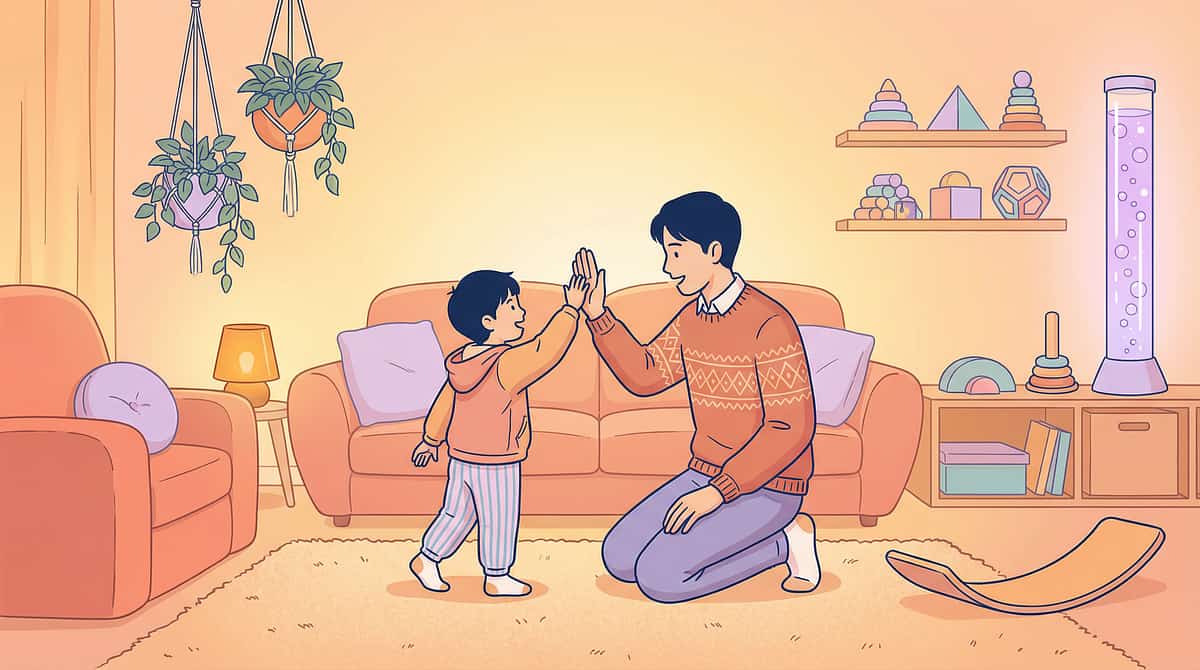
Reinforce & Celebrate
🕔 Timing: Within 3 seconds
Goal: Cement the behavior with immediate reinforcement
"You checked the weather AND picked the right clothes! That is exactly right. You're a weather expert!"
Reinforcement Type | Examples | Use When | |
Verbal praise | "Amazing weather check!" "You got it exactly right!" | Always — pair with everything | |
Token / sticker | Weather sticker on chart, star token | Habit-building phase (Weeks 1–4) | |
Social | High-five, thumbs up, celebration dance | Child is socially motivated | |
Activity access | 5 minutes of preferred activity for completing | Needs stronger motivation | |
Natural reinforcement | "You're going to be SO comfortable today" | As skills generalize |
⚡Critical Timing Rule: Reinforcement delivered within 3 seconds of the target behavior is 4× more effective than reinforcement delivered after 30 seconds. React immediately. Celebrate the attempt, not just the success: Child checked the thermometer but chose wrong clothes → reinforce the check. Child chose from correct section but not preferred → reinforce the flexibility.
Step 6 of 6
The Cool-Down: Completing the Transition
🕕 Timing: 1–2 minutes
Goal: Complete transition to rest of morning without regression
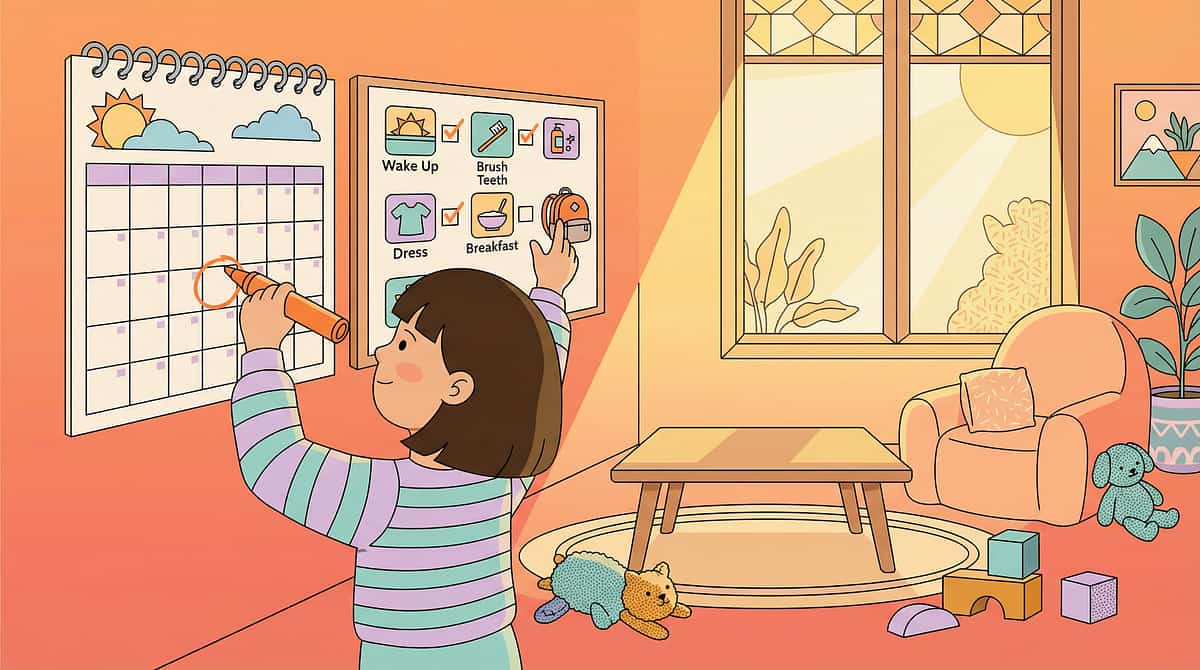
"You did your weather check, you picked your clothes, you're all dressed. Morning routine: DONE. Now let's [next activity — breakfast, school bag, etc.]."
The Closing Ritual (choose one)
- Child marks today's date on a weather calendar
- Child checks off "weather check ✓" on visual schedule
- High-five and then move on together
- Photo: "Let's take a weather-outfit selfie for today"
If Child Resists Ending
"I know. That's your favorite shirt. It'll be here for a warm day. Today the thermometer says [color zone] so we're wearing the [chosen item]. Tomorrow might be warmer — let's check!"
Do not negotiate after this. Maintain calm, move toward next activity. 🛒Comfort Transition Item — ₹425 for children who struggle with leaving preferred clothing.
Source: NCAEP (2020): Visual supports and transition cues are evidence-based practices for autism.
60 Seconds of Data Now. Months of Clarity Later.
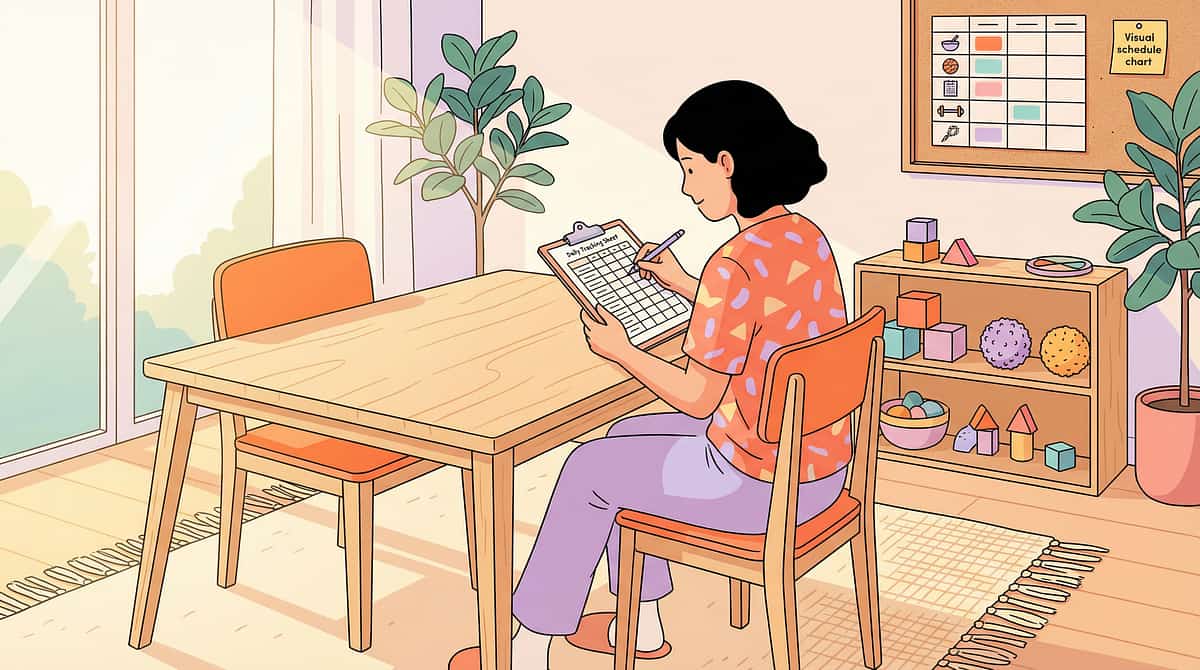
Track These 3 Data Points Today
DATE: ___________
WEATHER TODAY:☀️🌤️❄️🌧️
1. Did child check weather?
□ Independently □ With prompt □ With full guidance □ No
□ Independently □ With prompt □ With full guidance □ No
2. Did child select from correct category?
□ Independently □ With prompt □ With guidance □ No
□ Independently □ With prompt □ With guidance □ No
3. Did child wear weather-appropriate outfit?
□ Yes, comfortably □ Yes, with protest □ Partially □ No
□ Yes, comfortably □ Yes, with protest □ Partially □ No
NOTES: ___________________________
Why This Data Matters
After 2 weeks of daily tracking, you will clearly see:
- Which step breaks down most consistently → tells you where to intensify
- Weather conditions that trigger refusal → reveals sensory vs. cognitive vs. flexibility barrier
- Progress trajectory → tells you when to fade scaffolding
"Your data joins 21M+ sessions in GPT-OS® — improving recommendations for every child like yours."
Download PDF Tracker: techniques.pinnacleblooms.org/e529-tracker.pdf
Source: Cooper, Heron & Heward (Applied Behavior Analysis, 8th ed.): Data collection standards for behavior-analytic interventions.

Session Abandonment Is Not Failure. It's Data.
❓ Child refused to look at the chart or thermometer
Why: New routine resistance. Executive rigidity around morning sequence.
Next time: Introduce chart and thermometer as a bedtime activity first — lower stakes environment builds familiarity before the high-pressure morning.
Next time: Introduce chart and thermometer as a bedtime activity first — lower stakes environment builds familiarity before the high-pressure morning.
❓ Child checked the weather but still chose wrong clothes
Why: Understanding weather is a separate skill from translating it to clothing. The bridge hasn't formed yet.
Next time: After weather check, physically walk to the correct closet section. Make the physical path as clear as the cognitive one.
Next time: After weather check, physically walk to the correct closet section. Make the physical path as clear as the cognitive one.
❓ Child chose correct clothes but refused to wear the item (sensory)
Why: Sensory barrier is the primary driver — not cognitive or executive.
Next time: Remove that specific item from options. OT sensory evaluation recommended if this affects multiple items.
Next time: Remove that specific item from options. OT sensory evaluation recommended if this affects multiple items.
❓ Child wore right clothes but removed them at school
Why: Home habit hasn't generalized to school. Different context triggers different routine.
Next time: Share this page with the class teacher. Create a matching visual system at school.
Next time: Share this page with the class teacher. Create a matching visual system at school.
❓ Morning is always too rushed to do the protocol
Why: Time constraint is the real barrier.
Next time: Parent checks weather the night before and pre-lays 1 appropriate option. Gradually add the checking step as mornings allow.
Next time: Parent checks weather the night before and pre-lays 1 appropriate option. Gradually add the checking step as mornings allow.
❓ Child became severely distressed about clothing changes
Why: May indicate clothing anxiety beyond typical rigidity.
Action: Do not force. Contact Pinnacle Helpline 9100 181 181. OT + behavioral evaluation recommended.
Action: Do not force. Contact Pinnacle Helpline 9100 181 181. OT + behavioral evaluation recommended.
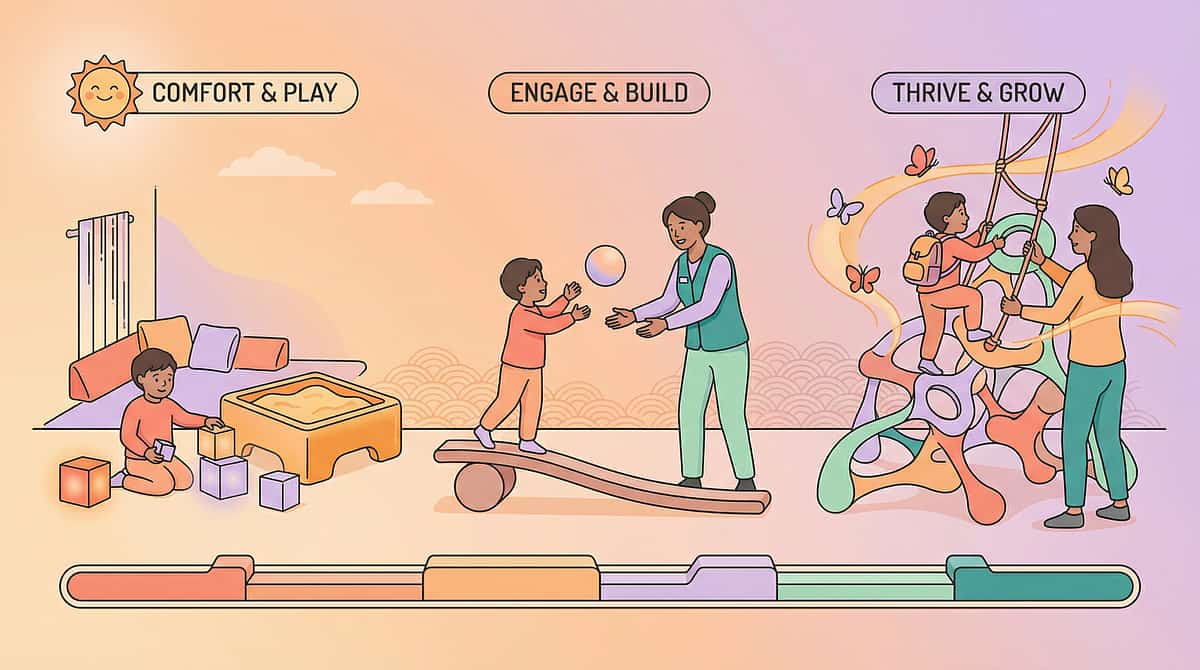
Your Child Is Unique. The Protocol Is Flexible.
← EASIER (Start Here If Significant Resistance)
- Parent checks weather, reports to child: "Today is cold — I found your jacket"
- Child only chooses between 2 options (already appropriate)
- Reinforcement for wearing, not for checking
- Visual supports do all the cognitive work
→ HARDER (When Ready to Fade Scaffolding)
- Child checks weather independently and reports to parent
- Child selects from entire correct section without guidance
- Child explains their reasoning: "I chose this because the thermometer was blue"
- Child helps organize the closet by season
Profile Variations
🔵 Sensory Avoider: Find sensory-tolerable gear FIRST. Cognitive supports second. A child who won't wear a coat because it hurts them needs a different coat, not a different chart.
🟠 Sensory Seeker: May prefer heavy/textured clothing — use this. Heavy fleece or weighted vest as cold-weather gear might be preferred. Work with the preference.
🟡 ADHD Profile: Prioritize environmental automation. Closet pre-organized. Routine cards with moveable marker. Make the protocol require minimum steps.
🟣 Rigidity Profile: Start with adding ONE weather-appropriate layer to preferred outfit. Cold day? "Wear your favorite shirt AND this fleece over it." Build flexibility incrementally.
Ages 3–5: Adult selects. Child's job: wear it.
Ages 6–8: Child selects from pre-organized section.
Ages 9–12: Child checks and selects independently.
Ages 6–8: Child selects from pre-organized section.
Ages 9–12: Child checks and selects independently.

Week 1–2: You're Planting Seeds, Not Harvesting
Progress Milestone
Weeks 1–2 progress level — tolerance and participation, not yet skill mastery
✅ This IS Progress
- Child tolerates the weather check routine (doesn't run away)
- Child looks at the thermometer when pointed to it
- Child chooses from the pre-selected options without significant protest
- Dressing battle time reduced by even 2 minutes
- Child uses any weather vocabulary at all (hot, cold, rain)
❌ This Is NOT Expected Yet
- Independent weather checking
- Voluntary gear wearing without any resistance
- Understanding WHY certain clothes go with certain weather
- Generalization to other settings (school, grandparents' house)
Weeks 1–2 often feel like nothing is working. The child seems to "not get it." This is normal. Neural pathways are forming below the surface of visible behavior. If your child tolerated the weather chart for 30 seconds more than yesterday — that is real, measurable progress.
Source: PMC11506176: Sensory integration intervention outcomes emerge across 8–12 week timelines. Early phase: tolerance and participation, not skill mastery.
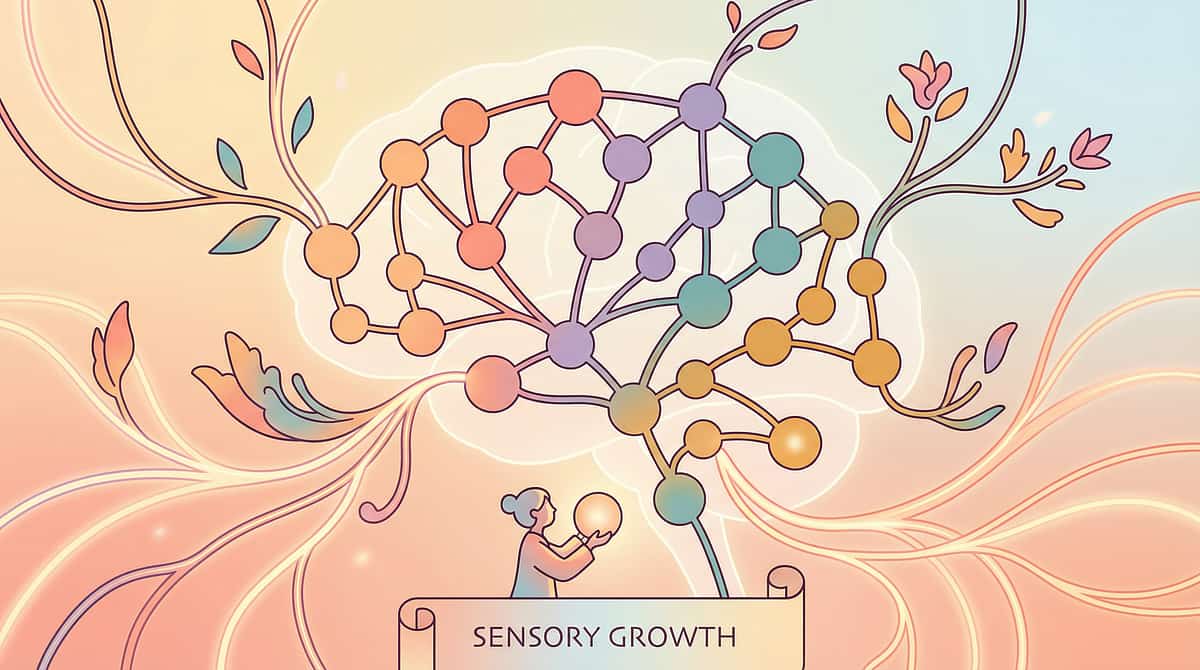
Week 3–4: The Neural Pathways Are Forming
Consolidation Progress
Weeks 3–4 milestone — behavioral and cognitive consolidation emerging
🧠 Cognitive Signs
- Child anticipates the weather check ("Are we going to check the thermometer?")
- Child uses weather vocabulary spontaneously
- Child can match weather to clothing in a game context
🔄 Behavioral Signs
- Resistance to weather check routine decreasing
- Child moves toward correct closet section when weather is named
- Protests about weather gear decreasing in duration or intensity
👁️ Generalization Seeds
- Child notices weather before you prompt ("It's raining today")
- Child mentions inappropriate clothing on characters in books/TV
If consolidation signs are present, this is the time to: fade one prompt from the sequence, expand the choice within the correct section (3 options instead of 2), and ask child to explain their choice: "Why did you pick that one?"
"You may notice YOU'RE more confident too. The routine is becoming second nature for both of you."

Week 5–8: The Badge Unlocks
Mastery Progress
Weeks 5–8 milestone — core mastery criteria emerging or achieved
🏅 Mastery Criteria — Observable, Specific, Measurable
Core Mastery (Required for Badge)
- Child independently checks weather without prompting ≥4/5 mornings
- Child selects from correct weather category without guidance ≥4/5 mornings
- Child wears weather-appropriate outfit with no more than brief verbal protest ≥4/5 mornings
Generalization Mastery (Elevated Badge)
- Child demonstrates weather-appropriate selection at grandparents' house
- Child mentions needing to check weather before choosing at school
- Child corrects weather-inappropriate choices independently ("Wait, it's cold, I need layers")
When to Move to Next Technique
Core mastery achieved → Explore: E-530 (Matching Outfits Independently). Core mastery with sensory barriers remaining → Extend with OT sensory sessions at Pinnacle.
"Mastery means the bridge is built. The child's brain now has a reliable pathway from weather to wardrobe."
You Did This. 🎉
Five to eight weeks ago, every morning was a battle. You explained, you showed, you pleaded — and every day your child came downstairs in the wrong clothes. You didn't give up. You found the science. You built the system. You showed up every morning with the chart, the thermometer, the routine. And your child's brain responded — as brains do when given the right scaffolding, applied consistently, with love.
Your child now knows something they didn't know before. Not because you forced them — because you built a bridge and walked across it with them, every day, until they could walk it alone.
🌟 Weather Wall of Fame
Create a photo display of your child in their best weather-appropriate outfits across the seasons. A visual celebration of the journey.
📓 Milestone Journal Prompt
"Write down the first morning your child checked the thermometer without being asked. The date. What they were wearing. What they said. You'll want to remember this."

You Already Have the Materials for These
The visual chart, routine cards, and closet organization system from E-529 form the foundational material set for three adjacent techniques. You're already equipped.
Technique | Code | Difficulty | Shared Materials | |
Selecting Outfit Independently | E-527 | 🟡 Core | Visual charts, closet org | |
Dressing Time Management | E-528 | 🟡 Core | Routine cards, timer | |
Weather-Appropriate Clothes ← You are here | E-529 | 🟡 Core | All 9 materials | |
Matching Outfits Independently | E-530 | 🟠 Advanced | Sorting cards, choice board | |
Sensory Issues in Dressing | E-535 | 🔴 Specialized | Sensory gear, OT consult | |
Clothing Care Basics | E-531 | 🟢 Intro | Organizational supports |
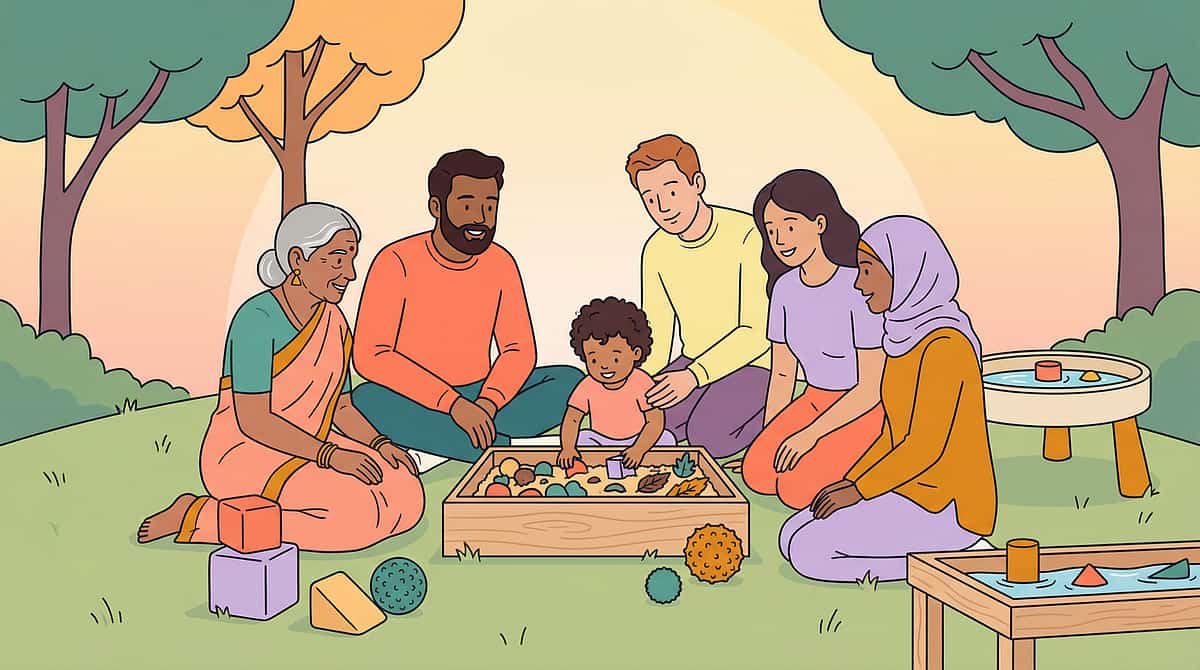
Consistency Across Caregivers Multiplies Impact
A child who checks the weather at home but encounters chaos at school, grandparents' house, or during school holidays loses half the benefit. Every consistent caregiver doubles the protocol's effectiveness. The more adults who speak the same language — thermometer colors, closet sections, weather vocabulary — the faster and more durably the skill develops.
"Explain to Grandparents" Version
"[Child's name] is learning to dress for the weather. Every morning, they check the color on the thermometer and choose from the correct closet section. Please follow the same steps when they stay with you — it takes 2 minutes and makes a huge difference. The chart is on the wall beside their closet."
Share This Page
📱 Share on WhatsApp | 📧 Email this page | 🔗 Copy Link
📄Download 1-Page Family Guide (PDF) — Simple summary for grandparents, aunts, uncles, and other caregivers. Print and place on fridge.
📧Email Template for Class Teacher — Explains E-529 approach, requests parallel visual supports in school.
Source: PMC9978394 (WHO CCD Package): Multi-caregiver training critical for intervention generalization and maintenance.
Every Question Parents Ask About Weather-Appropriate Dressing
❓ My child physically can dress themselves. Why can't they just choose appropriate clothes?
Dressing and choosing-appropriately are entirely different skills. Physical dressing uses motor sequences. Weather-appropriate selection requires abstract reasoning, executive function, cognitive flexibility, sensory tolerance, and interoception. Having one does not mean having the other.
❓ How long before I see results?
Observable tolerance improvements: Week 1–2. Behavioral consolidation: Week 3–4. Emerging independence: Week 5–6. Full mastery: Week 8–12 for most children. Significant sensory barriers may extend this timeline and benefit from OT support.
❓ My child says they're "not cold" while visibly shivering. Are they lying?
No. Interoceptive differences mean some children genuinely do not feel temperature the same way neurotypical children do. Do not argue with their perception. Instead, use external references: "The thermometer says blue/cold zone, so our rule is warm layers today." Build body awareness slowly through Material 7.
❓ Should I force the weather-appropriate clothes if they refuse?
No. Forced dressing is not the intervention and creates negative associations that undermine all future progress. Use the Modify protocol. Pre-lay clothes the night before. Build the habit over weeks, not mornings.
❓ The school says my child removes their jacket as soon as they arrive.
This is a generalization gap — the home habit hasn't transferred to school yet. Share this page with the teacher. Ask them to implement a parallel weather-check routine at school. Vests and zip-up layers are harder to casually remove than jackets.
❓ Does this work for children who aren't autistic?
Yes. Weather-appropriate dressing difficulty appears across ADHD, sensory processing disorder, developmental coordination disorder, and typically developing children with executive function immaturity. The same materials and protocol work across profiles, with profile-specific adaptations.
❓ My child is 10 — is it too late to start?
No. Neuroplasticity supports skill acquisition well beyond early childhood, particularly for executive function and habit formation. The protocol adapts for older children. Mastery may take slightly longer but is fully achievable.
❓ I've been doing this for 8 weeks with no progress. What's wrong?
Please book a consultation. 8 weeks of consistent implementation without observable progress signals an unidentified sensory barrier, an executive function deficit requiring professional support, or a needed protocol adaptation. Call 9100 181 181. Book at pinnacleblooms.org/book.
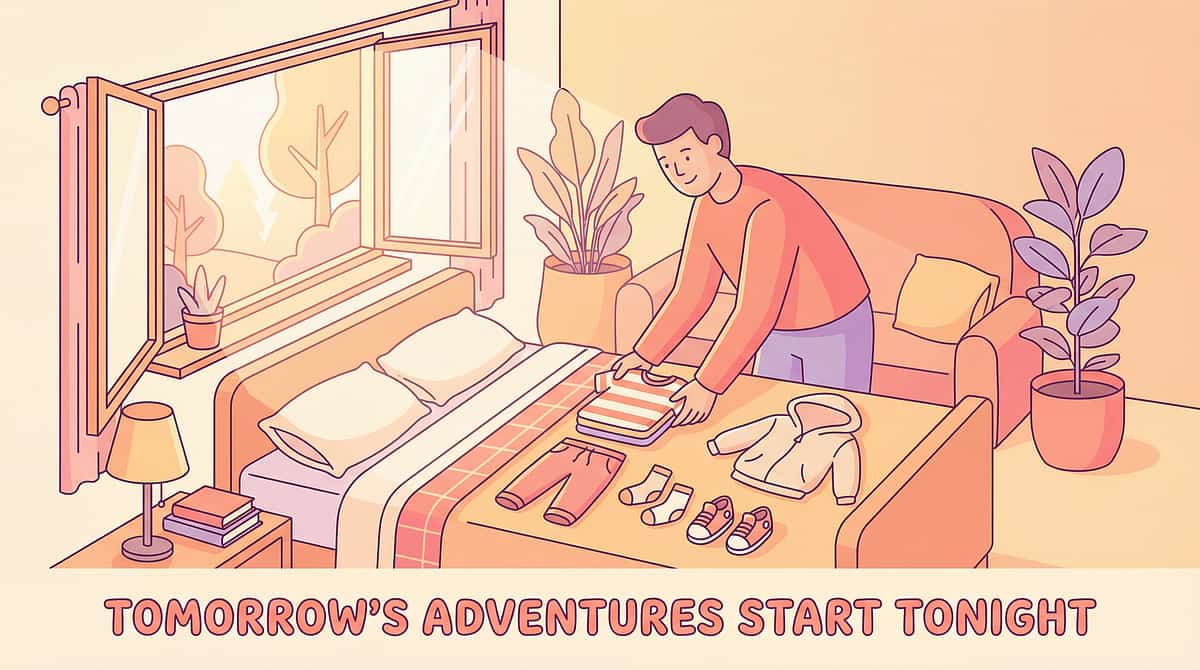
You Have Everything You Need to Start Tomorrow Morning.
Look at your child's closet tonight. Find the clearest weather-appropriate item for tomorrow's forecast. Lay it out. That's your first session. Zero materials required.
🏅Validated by the Pinnacle Blooms Consortium | OT • ABA/BCBA • SpEd • SLP • NeuroDev | GPT-OS® Evidence Grade: I–II | 21M+ Sessions | 97%+ Measured Improvement Across Network
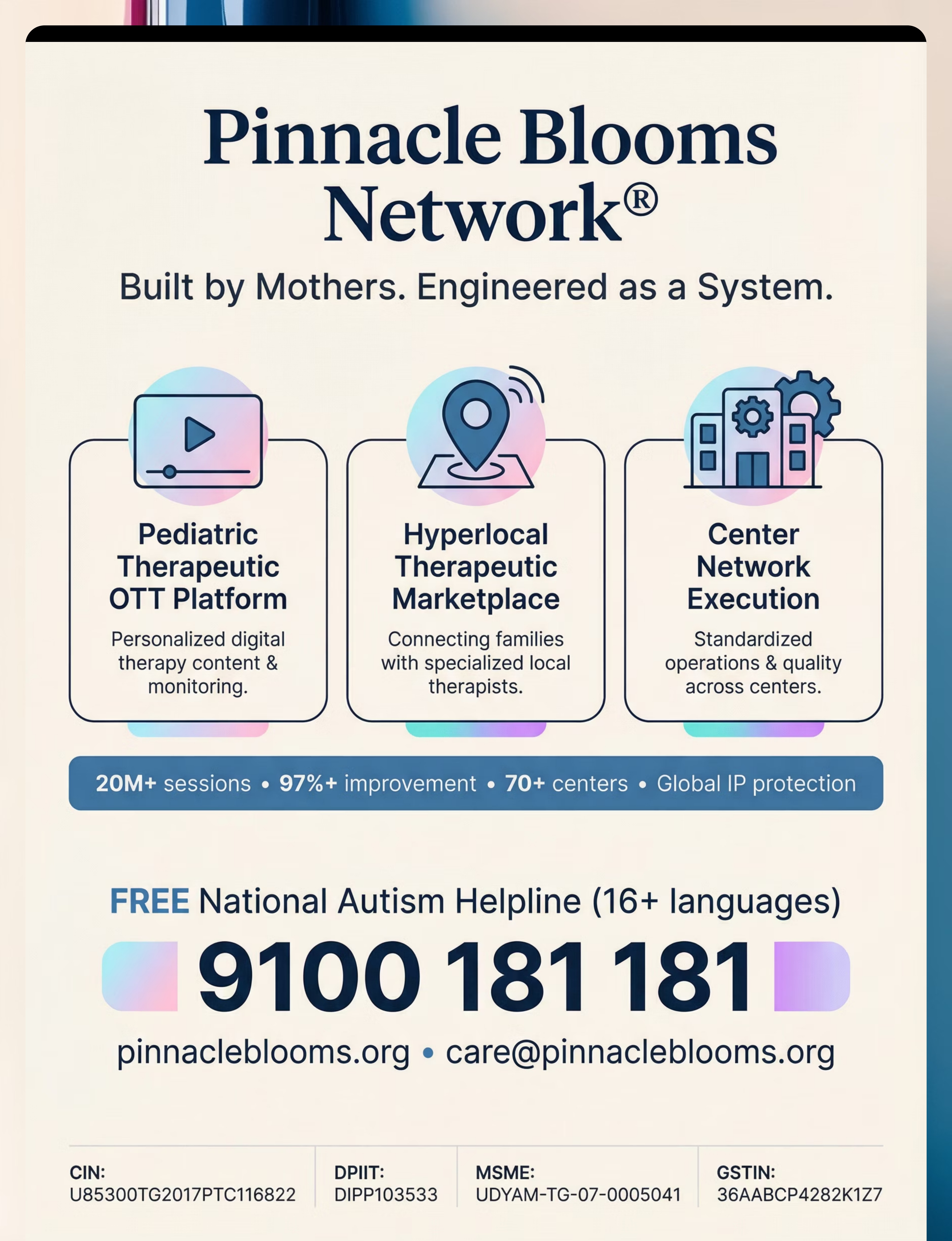
Built by Mothers. Engineered as a System. Serving 70+ Countries.
Built by Mothers. Engineered as a System. Serving 70+ Countries.
Preview of 9 materials that help with weather appropriate clothes Therapy Material
Below is a visual preview of 9 materials that help with weather appropriate clothes therapy material. The pages shown help educators, therapists, and caregivers understand the structure and content of the resource before use. Materials should be used under appropriate professional guidance.



Link copied!

From Fear to Mastery. One Technique at a Time.
Pinnacle Blooms Network®
GPT-OS® Consortium Seal
OT | ABA/BCBA | SpEd | SLP
NeuroDev | CRO | WHO-Aligned
NeuroDev | CRO | WHO-Aligned
20M+ therapy sessions. 97%+ measured improvement. 70+ centers. 70+ countries.
📞 9100 181 181
FREE | 16+ Languages | 24×7
Our Mission
Pinnacle Blooms Network® exists to transform every home into a proven, scientific, 24×7, personalized, multi-sensory, multi-disciplinary pediatric therapy environment — powered by GPT-OS® and operated by the parents and families who love their children most.
This content is educational. It does not replace individualized assessment and intervention planning with licensed occupational therapists and healthcare professionals. Persistent difficulty with weather-appropriate dressing may indicate underlying sensory processing, executive function, or developmental conditions requiring professional evaluation. Individual results may vary. Statistics represent aggregate outcomes across the Pinnacle Blooms Network.
CIN U74999TG2016PTC113063 | DPIIT DIPP8651 | MSME TS20F0009606 | GSTIN 36AAGCB9722P1Z2
© 2025–2026 Pinnacle Blooms Network®, unit of Bharath Healthcare Laboratories Pvt. Ltd. All rights reserved. Powered by GPT-OS® | The Global Pediatric Therapeutic Operating System.