

9 Materials That Help With Waiting Skills
From "I want it NOW!" to patient, regulated waiting — concrete tools that make the invisible visible and the unbearable manageable.
Self-Regulation & Adaptive Behavior — Episode 976
Ages 2–10
The Problem
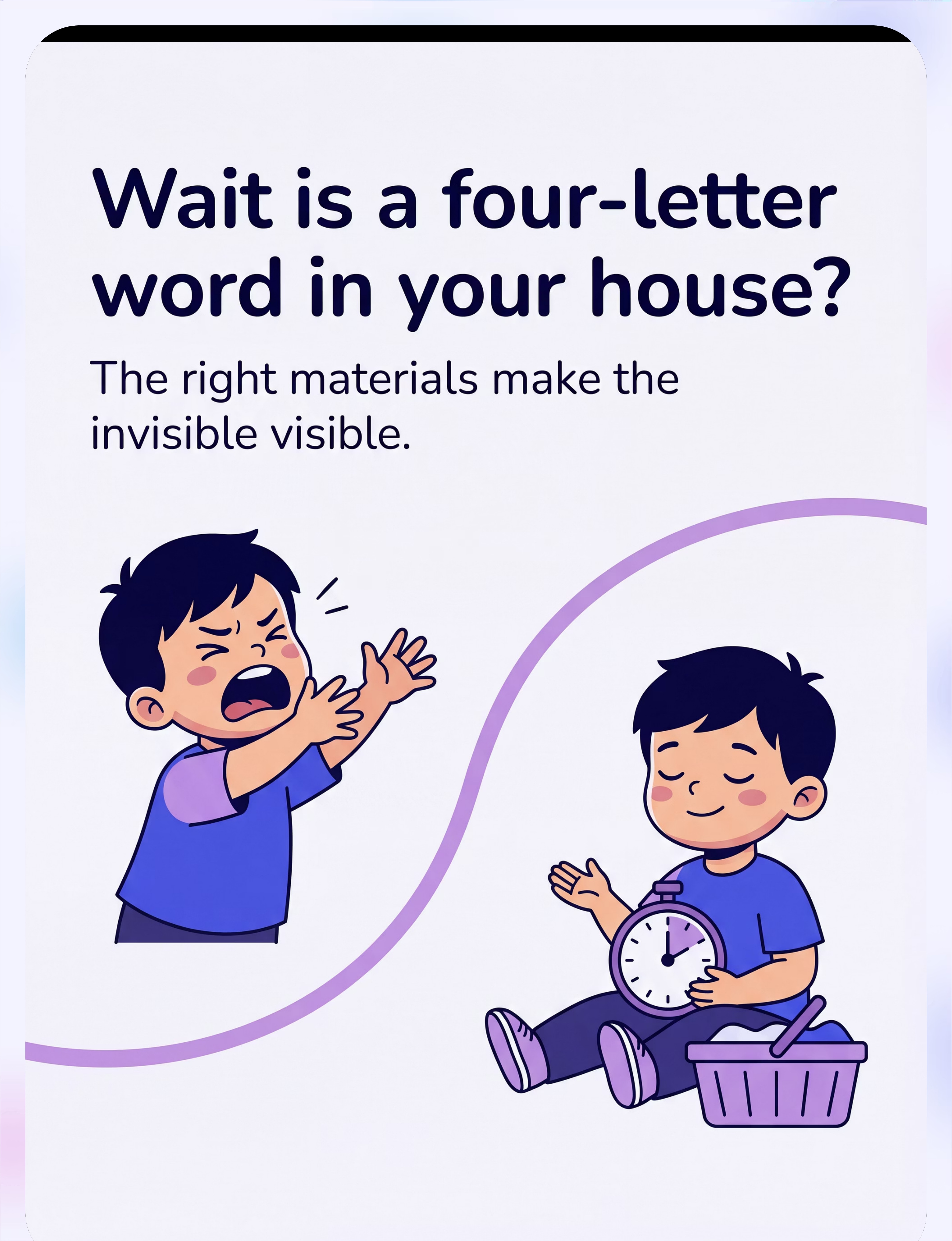
When "Wait" Is a Four-Letter Word
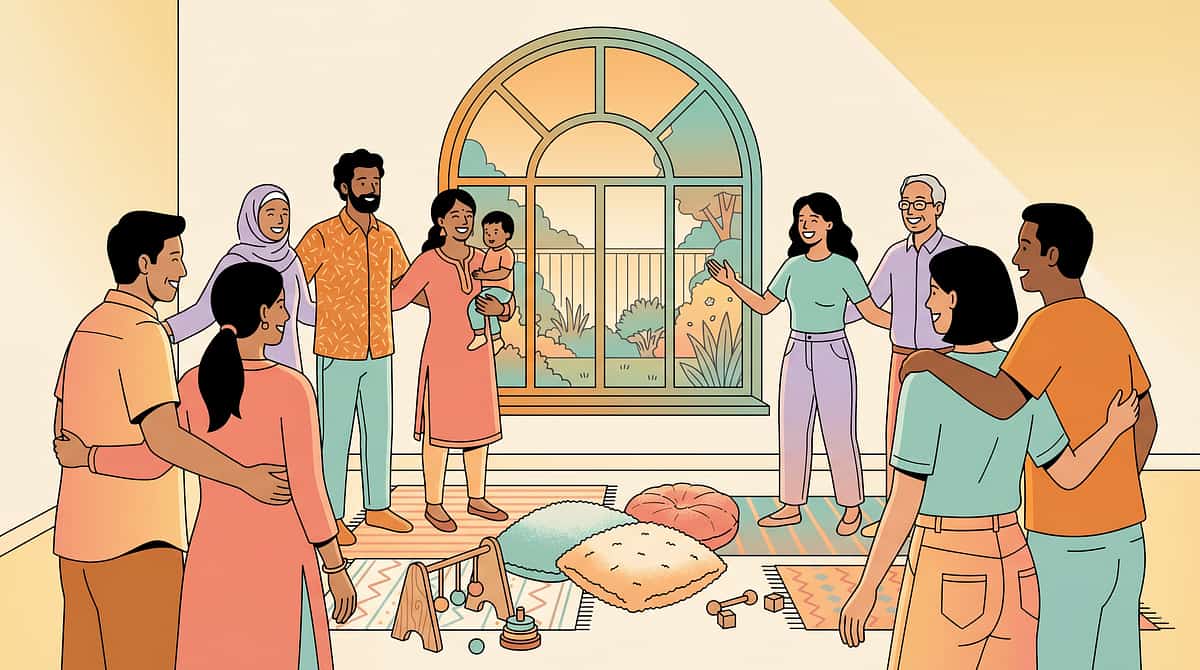
"I can't make him wait for anything. Not for food, not for his turn, not for five seconds while I tie my shoe. The moment he wants something, he needs it IMMEDIATELY — and if there's any delay at all, he completely falls apart. Screaming, hitting, throwing himself on the floor. It's like the concept of 'in a minute' doesn't exist in his brain."
This isn't defiance. It's not a parenting failure. For many children — especially those with autism, ADHD, or developmental differences — waiting causes genuine, visceral distress. The "now" is so overwhelming that "later" doesn't feel real.
What Parents Report
- Meltdowns the moment any delay is introduced
- Constant "Is it time yet?" every few seconds
- Grabbing toys instead of waiting for a turn
- Impossible experiences in lines, restaurants, waiting rooms
- Teacher feedback: can't wait to be called on, can't wait for materials
- Other kids avoiding a child who pushes and grabs
Why Waiting Feels Like Pain
Adults wait constantly — in traffic, for coffee, for the right moment — without a second thought. But for children whose brains process time and reward differently, the gap between wanting and having can feel physically unbearable.
Time Is Invisible
Children with executive function differences have no internal clock for "how much longer." A minute feels like forever with no visible endpoint in sight.
Dopamine & Reward
ADHD and autism often involve differences in dopamine processing — the "now" reward signal overwhelms any sense that "later" will actually arrive.
Emotional Flooding
The urgency of wanting floods the regulatory system. Logic doesn't reach a dysregulated child — and distraction rarely breaks through the intensity.
Abstract Concepts
"In a minute" and "later" are abstract — meaningless to a child who lives entirely in the present moment without visual or sensory anchors.
Clinical Context
What Are Waiting Skills, Clinically?
Waiting skills encompass the cognitive, emotional, and behavioral capacities required to tolerate delays between wanting something and receiving it. This involves multiple developmental domains working in concert.
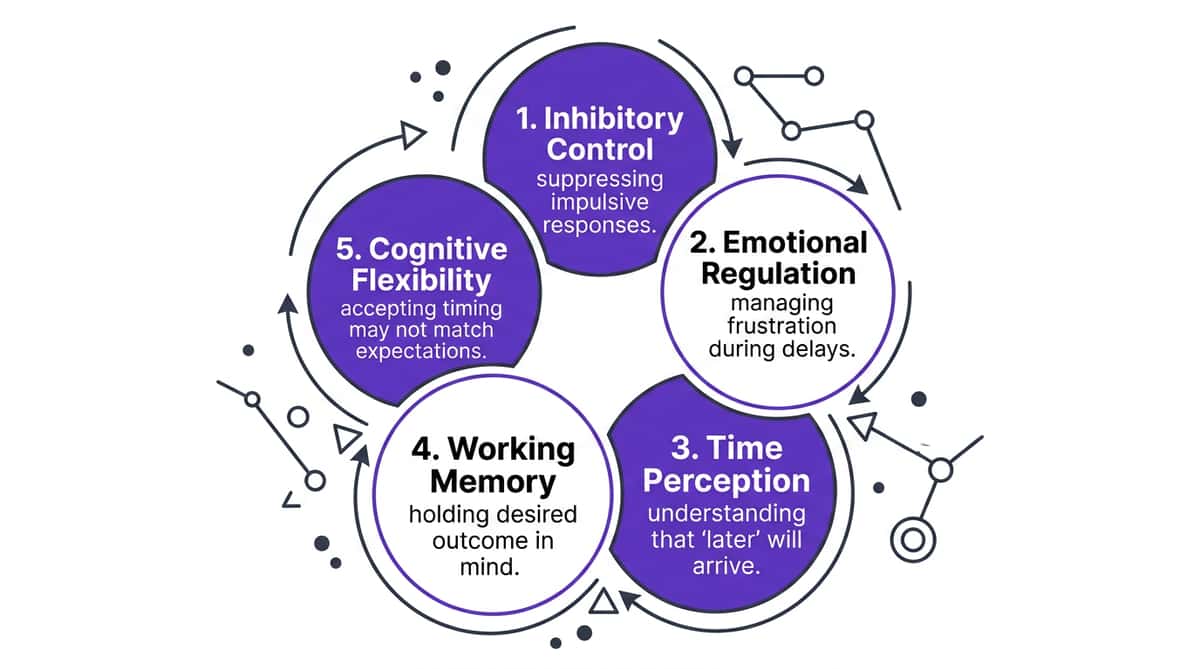
For typically developing children, waiting skills emerge gradually between ages 2–6. Children with autism, ADHD, or developmental delays often show delays of 2–4 years in this development — and may need explicit instruction in skills that typically emerge naturally.

The Developmental Window for Waiting
Waiting ability grows in predictable stages — and knowing where your child is helps set realistic, achievable expectations for intervention.
1
12–18 Months
Object permanence emerging. Virtually zero waiting tolerance — "out of sight" truly means gone.
2
2–3 Years
Can wait seconds with high adult support. "Later" remains abstract and largely meaningless.
3
3–4 Years
Brief 1–2 minute waits become possible with visual support and distraction strategies.
4
4–5 Years
Tolerance grows to 3–5 minutes with support. "First this, then that" sequences begin to click.
5
5–6 Years
Can typically wait 5–10 minutes independently. Basic time concepts are understood.
6
7–8 Years
Waiting skills largely in place for age-typical situations in most typically developing children.
Children with developmental differences may operate 2–4 years behind this timeline — and that's exactly why explicit teaching with the right materials makes such a difference.
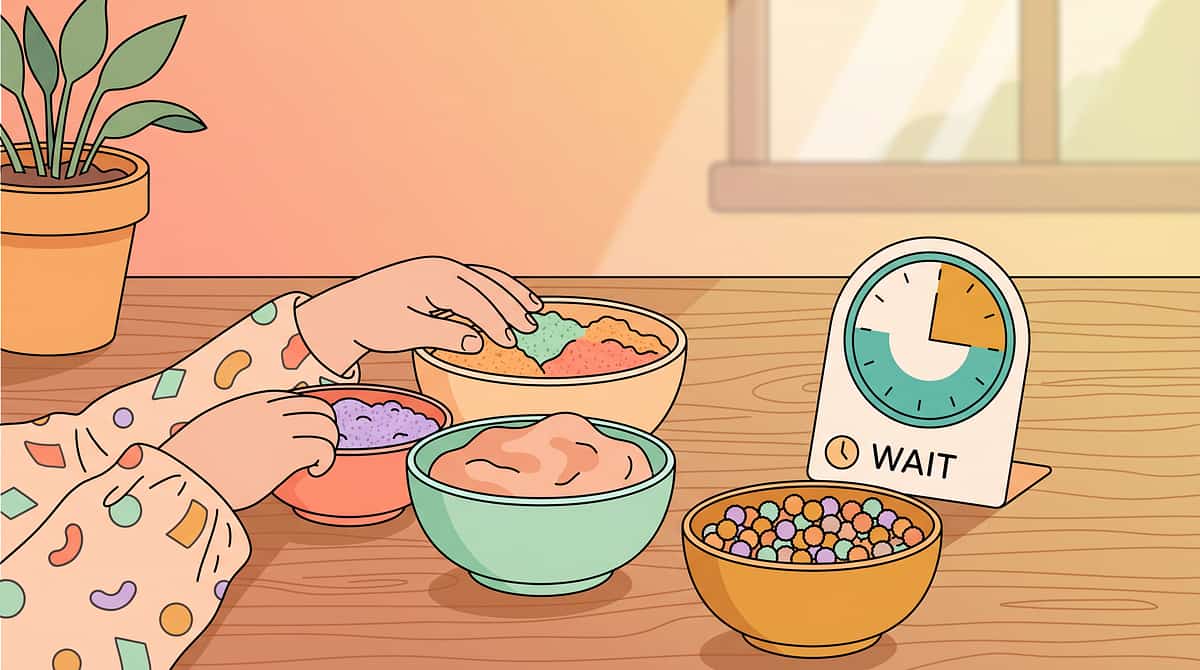
Common Signs of Waiting Skill Challenges
These behaviors aren't manipulation or defiance — they're signals that a child's brain needs concrete support to develop the skill of tolerating delay.
Immediate meltdowns when told to wait
Grabbing desired items rather than waiting for a turn
Constant "Is it time yet?" during short waits
Interrupting conversations to have needs met immediately
Hitting, screaming, or other behaviors when required to wait
Difficulty waiting for food preparation or activity setup
Seeming physical discomfort during waiting periods
Inability to wait in line or for group activities
Leaving activities before completion to get something else
Tantrums in waiting rooms or queues
Difficulty with turn-taking games — grabbing and pushing
Appearing not to understand "wait" or "later" at all
Extreme distress when preferred activities must end
Teacher reports inability to wait to be called on in class
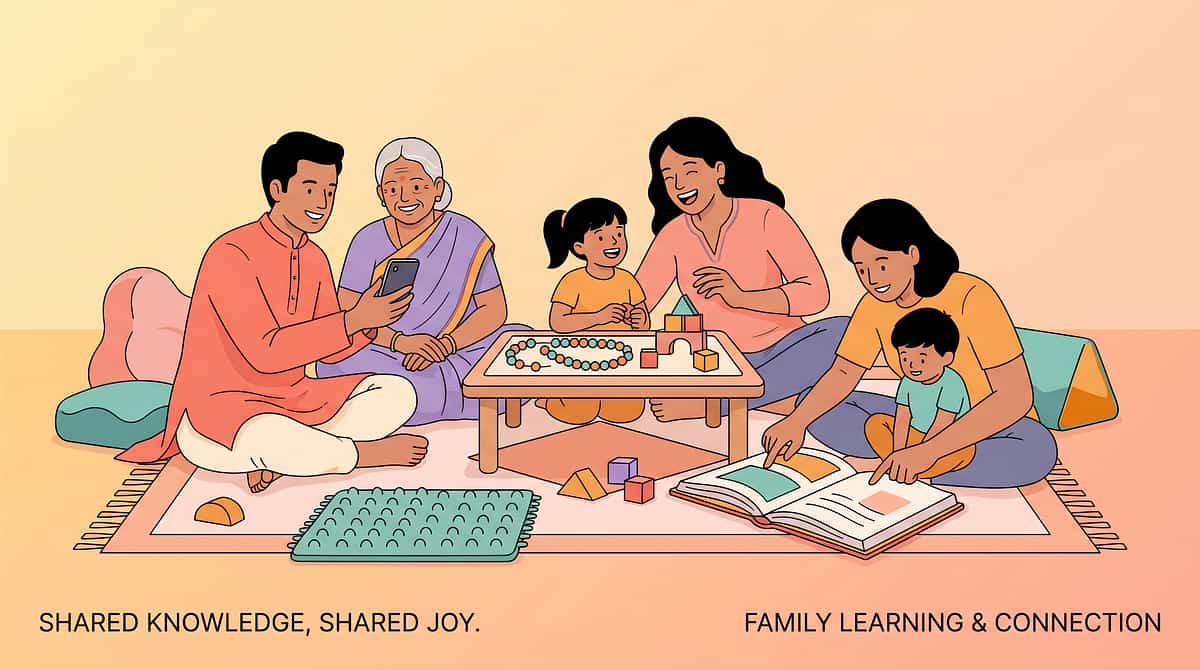
The Promise: Making Waiting Manageable
"You can't remove waiting from your child's world — but you can make it survivable. The right materials make the invisible visible and the abstract concrete."
The nine materials in this guide don't create patience from nowhere. They create the scaffolding that makes patience possible. They externalize time, clarify expectations, give the body something to do, and recognize the genuine effort that waiting requires.
1
Start Small
Seconds of waiting — not minutes. Build from success, never from failure.
2
Stay Consistent
Same cues, same tools, across every context — home, school, and community.
3
Celebrate Effort
Waiting is work. Recognize and reward the genuine effort it takes.

Overview
9 Materials at a Glance
Each material targets a specific aspect of why waiting is hard — together, they form a complete support system.
Visual Timer
Makes invisible time visible and finite
Wait Card
Clear, consistent visual cue for "wait"
First-Then Board
Makes sequences and promises concrete
Waiting Basket
Something to DO while waiting
Token Economy
Visible reward for the work of waiting
Social Story
Builds the framework for understanding waiting
Sensory/Fidget Kit
Keeps the body regulated during waits
Waiting Practice Games
Builds skills through play, not just endurance
Calming Strategy Cards
What to do when waiting feels too hard
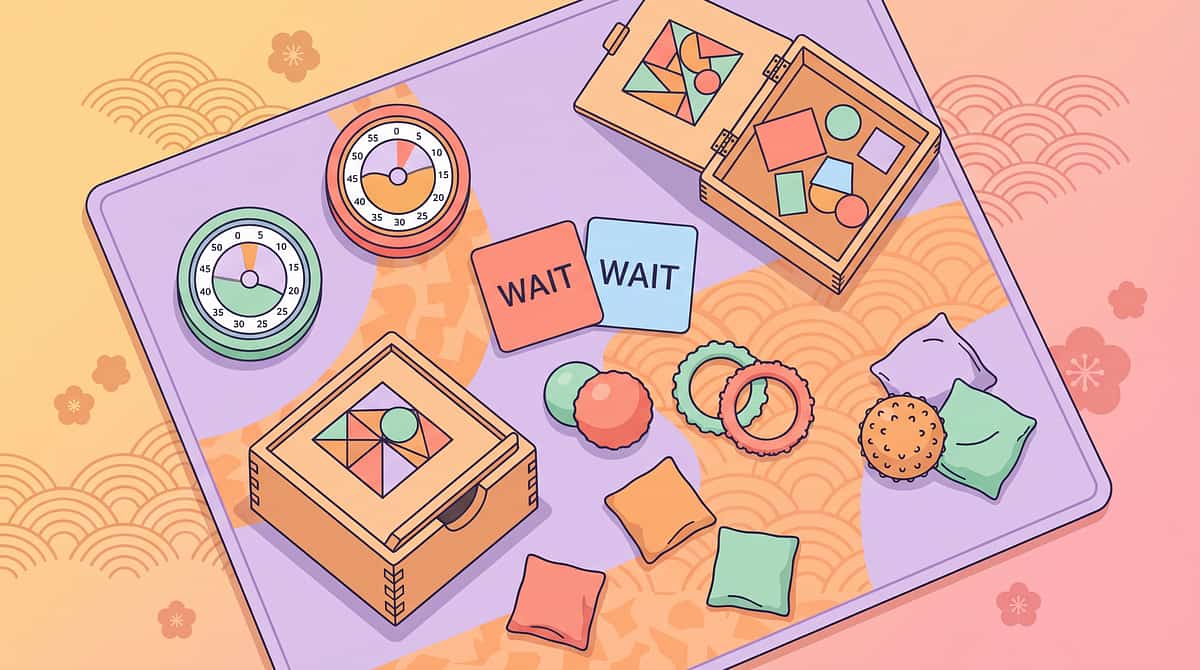
Material 1 of 9
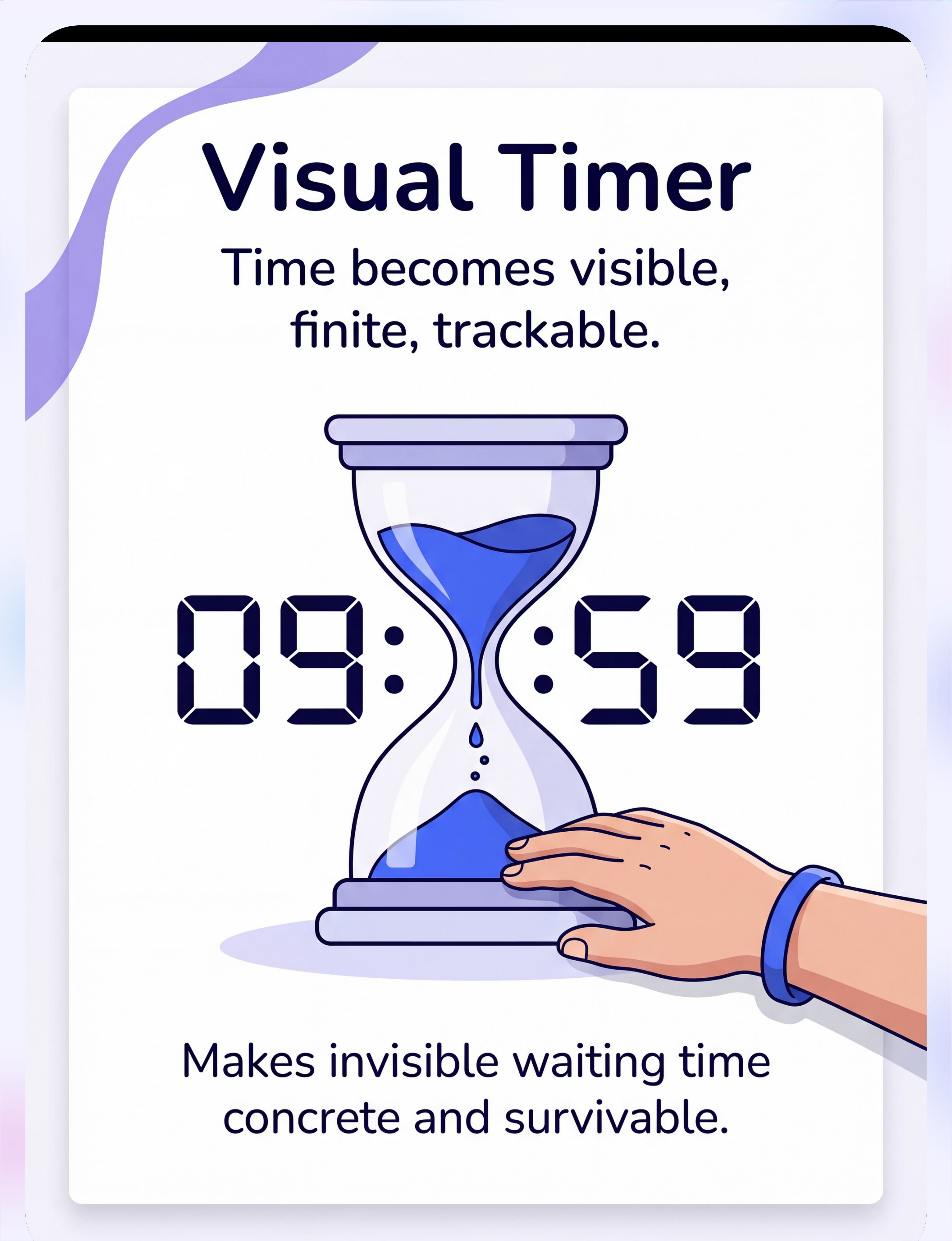
Visual Timer (Sand Timer or Digital Countdown)
The core insight: Waiting is hard partly because time is invisible. Children who struggle with waiting cannot perceive how long they must wait or track the passage of time. A visual timer makes time concrete, visible, and finite.
Why It Works
Sand timers show time as a physical substance flowing between chambers — the child can see that the wait is finite and track progress toward the end. Digital visual timers show time as a shrinking colored segment. This externalization of time serves multiple functions:
- Answers "How much longer?" visually — reducing constant verbal demands
- Shows that time is actually passing (countering "this will last forever")
- Provides a clear, objective endpoint rather than a subjective adult judgment
- Allows the child to self-monitor rather than depending on adult announcements
Key Insight
Time is invisible. Making it visible transforms "wait forever" into "wait until the sand runs out" — finite, trackable, survivable.
Evidence Base
Visual timers are evidence-based supports for children with autism, ADHD, and executive function challenges. Research consistently shows visual time representations improve waiting tolerance and reduce challenging behaviors during transitions.

Material 1 — Implementation
Visual Timer: How to Use It
Choose Your Timer
Sand timers: Purchase multiple durations (30 seconds, 1 minute, 2 minutes, 5 minutes). Start with the shortest. Large sand timers are more visible. Digital options: Time Timer is the gold standard, but phone/tablet apps with visual countdowns work well. The key feature is a visual representation of remaining time — not just numbers.
Introduce During Calm
Introduce the timer during neutral activities first — never during a crisis. "Let's see how long 1 minute is!" Watch together. "Look, the red part gets smaller! When all the sand is down, the minute is done!"
Start Absurdly Small
First uses should be very short — 30 seconds of waiting for something the child genuinely wants. Success builds tolerance. Do not jump from 1 minute to 10 minutes. Master each level before extending.
Give Child Control
When possible, let your child flip the sand timer or start the countdown. This increases investment and reduces the power struggle dynamic significantly.
Pair & Generalize
Pair the timer with an activity during the wait — timer shows "how long," activity gives "what to do." Have timers available in multiple locations. The timer should always be a neutral tool, never a punishment.
Glass sand timers can break — choose plastic for young children or those who throw when frustrated. Supervise use during early learning.

Material 2 of 9
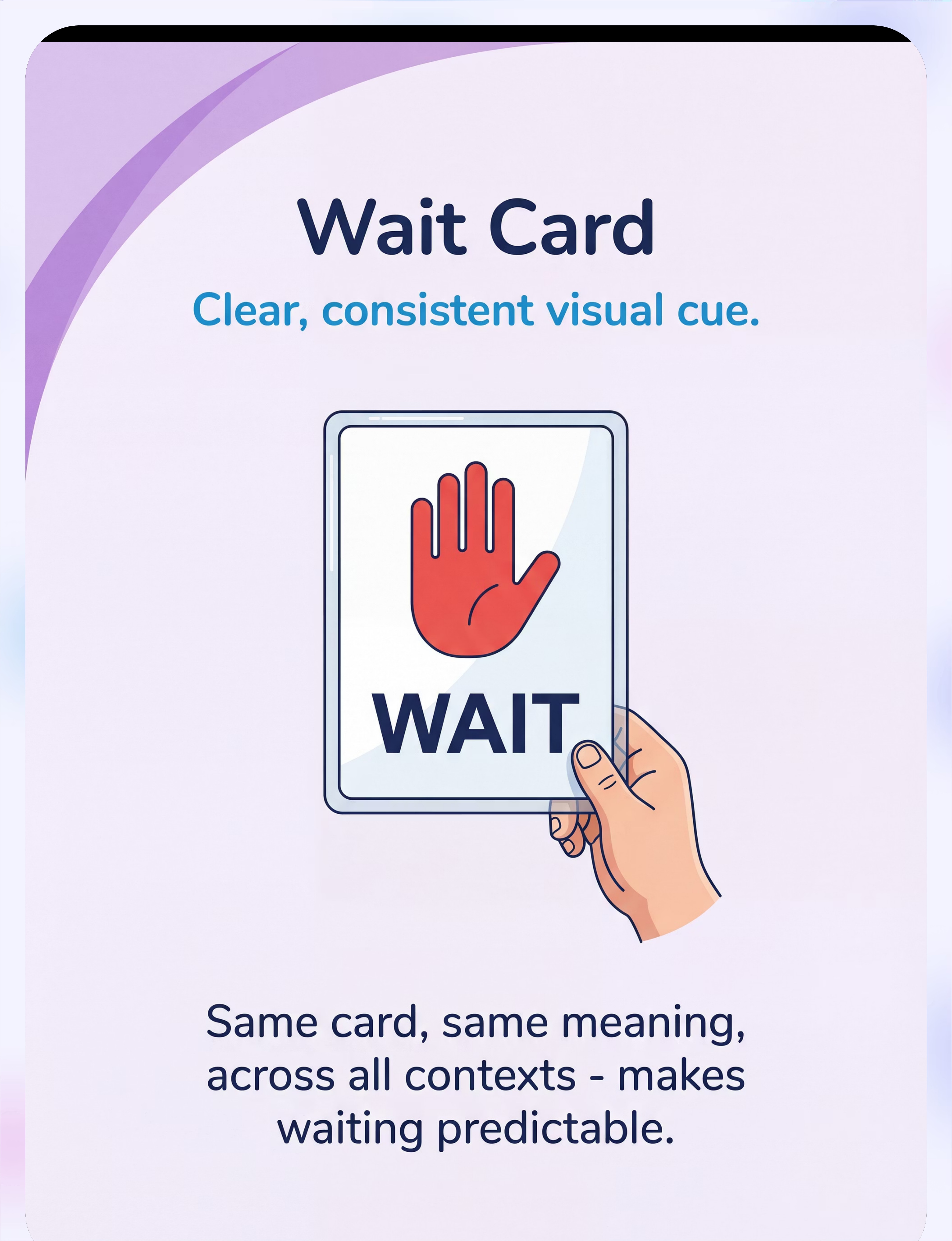
Wait Card or Visual Wait Cue
The core insight: The word "wait" is abstract and inconsistently interpreted. A visual wait card makes the expectation concrete, unmistakable, and consistent — the same signal, the same meaning, every single time and every single place.
Why It Works
A visual wait card might show a stop hand, the word "WAIT," a waiting icon, or a combination. When presented, it clearly communicates "this is a waiting moment" in a way that transcends verbal instruction. The visual cue:
- Provides a consistent signal across all environments — home, school, therapy, community
- Reduces the need for repeated verbal reminders that escalate frustration
- Gives the child something to hold or look at — a concrete focus object during an abstract experience
- Pairs naturally with timer and fidget supports as part of a complete waiting system
For some children, the card becomes a transitional object — something concrete to hold onto while navigating the abstract discomfort of waiting.
Key Insight
Consistency is power. The same visual cue across all contexts teaches "wait" as a predictable, survivable category of experience.
Materials Needed
- Laminated wait card (index card size)
- Backup copies for each location
- Portable keyring version for outings
- Velcro for posting on surfaces
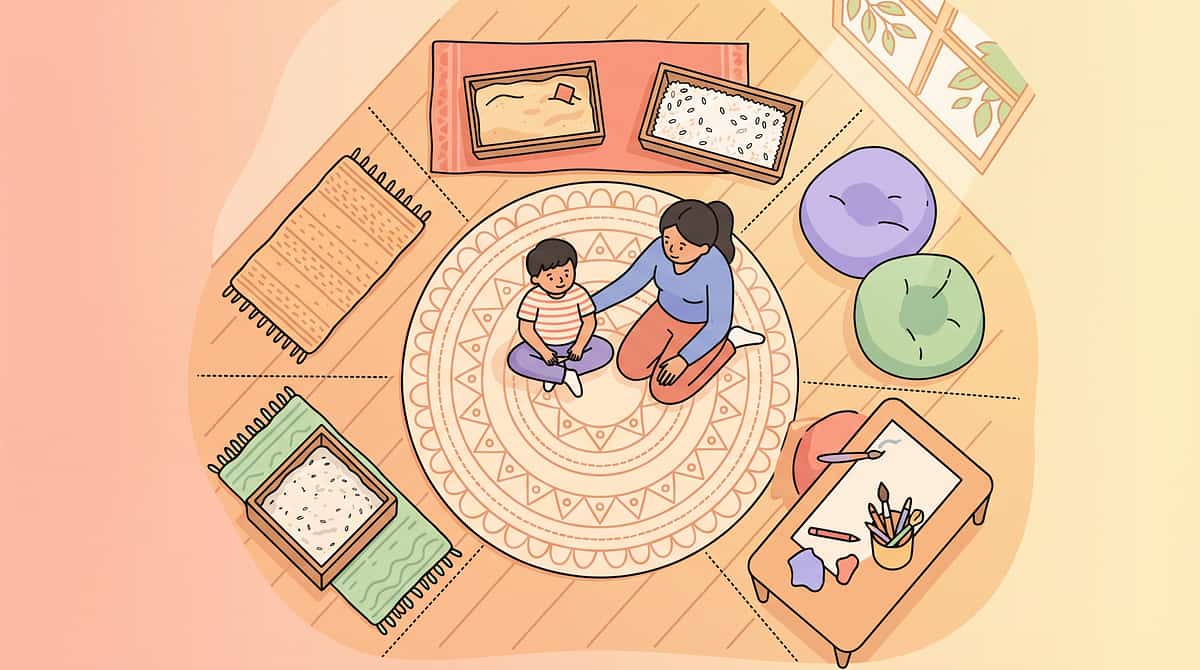
Material 2 — Implementation
Wait Card: How to Create and Use It
Design Options
Choose what resonates: (1) Stop hand/palm facing out, (2) Word "WAIT" in clear font, (3) Icon of person waiting — standing figure, hands at sides, (4) Combination of word and image. Some children respond best to a photo of themselves waiting successfully.
Introduce With Success
First uses: 5–10 seconds with immediate reward. "Here's your wait card. Look at it." [5 seconds] "Good waiting! Here's your snack!" Pair tiny waits with big reinforcement at first.
Go Consistent + Portable
Use the same card across all contexts. Give identical copies to school, therapy, and all caregivers. Have a pocket-sized laminated version on a lanyard for community outings.
Pair With Timer
Wait card shows you're waiting; timer shows how long. Together, they answer both questions a child has when told to wait. As the card becomes established, reduce verbal "wait" — the card alone becomes the cue.
Ensure the card is large enough not to be a choking hazard for children who mouth objects. Laminate to protect against frustrated grabbing or tearing.
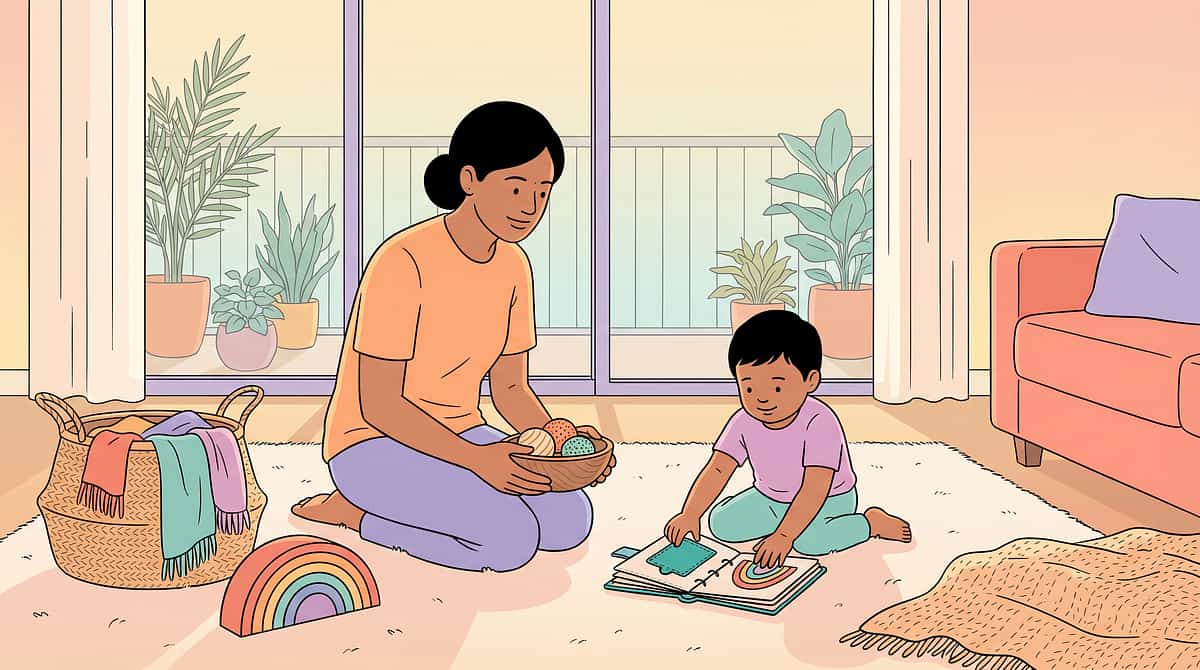
Material 3 of 9
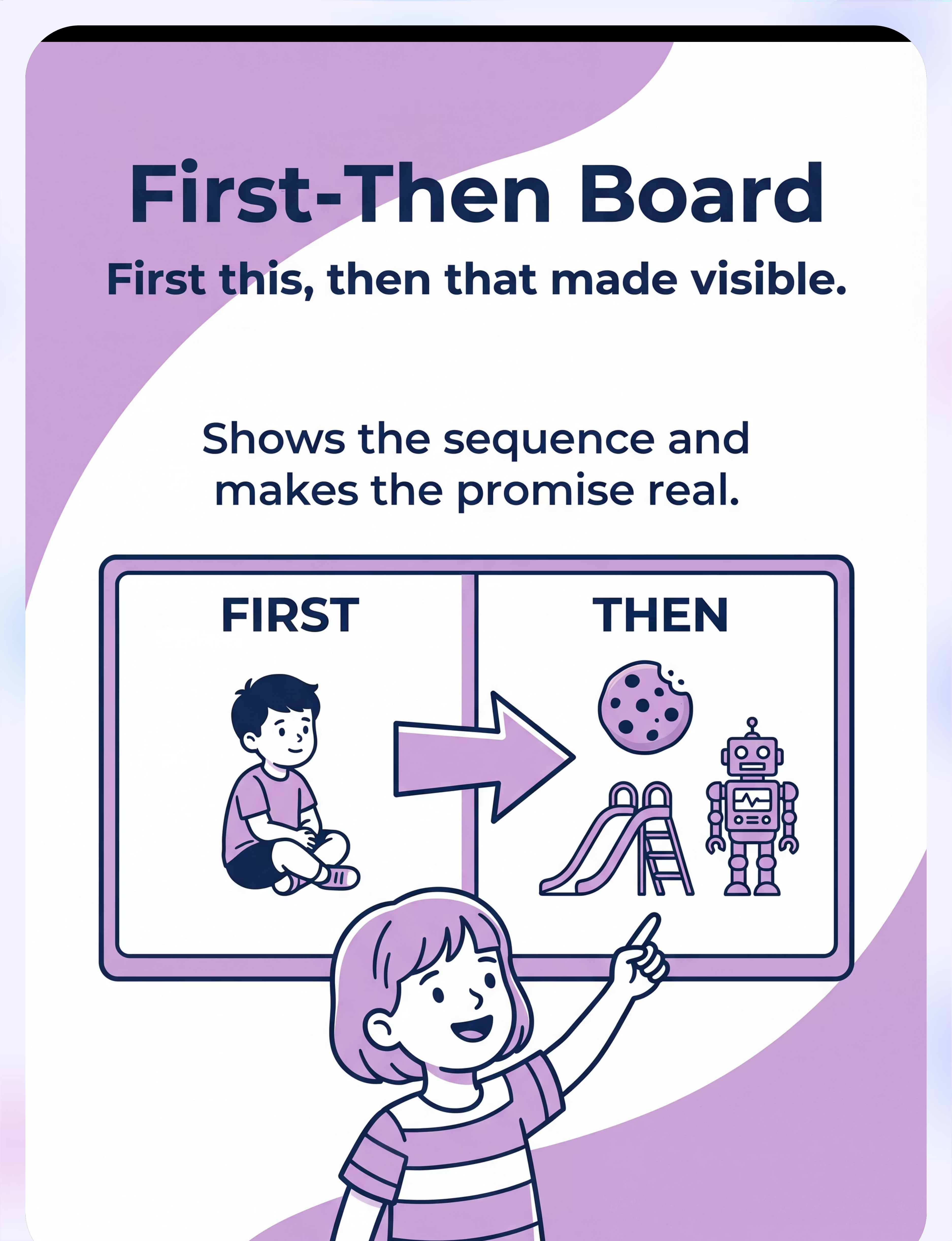
First-Then Board (Visual Sequence Board)
The core insight: Children who struggle with waiting often cannot grasp sequence — that one thing happens before another, and that the desired thing come. A First-Then board makes this relationship concrete, visible, and trustworthy.
Why It Works
"FIRST wait, THEN cookie." "FIRST circle time, THEN playground." The board shows the current expectation and the outcome — making the relationship between effort and reward tangible rather than verbal. This addresses several layers of waiting difficulty simultaneously:
- Answers "what do I have to do?" (first) and "what do I get?" (then)
- Makes the promised reward visible and real, not an uncertain verbal promise
- Breaks waiting into the simplest possible frame: something, then something else
- Provides visual reference to return to when frustration builds mid-wait
For children who struggle with trust that rewards will actually materialize, seeing the reward visible on the board provides concrete reassurance — "it's right there, I just have to get through this part."
Key Insight
Sequence makes waiting meaningful. "First this, then that" is the simplest promise structure, and visual representation makes it trustworthy.
The power of First-Then is its radical simplicity — it reduces complex waiting situations to the most basic sequence structure any child can understand.
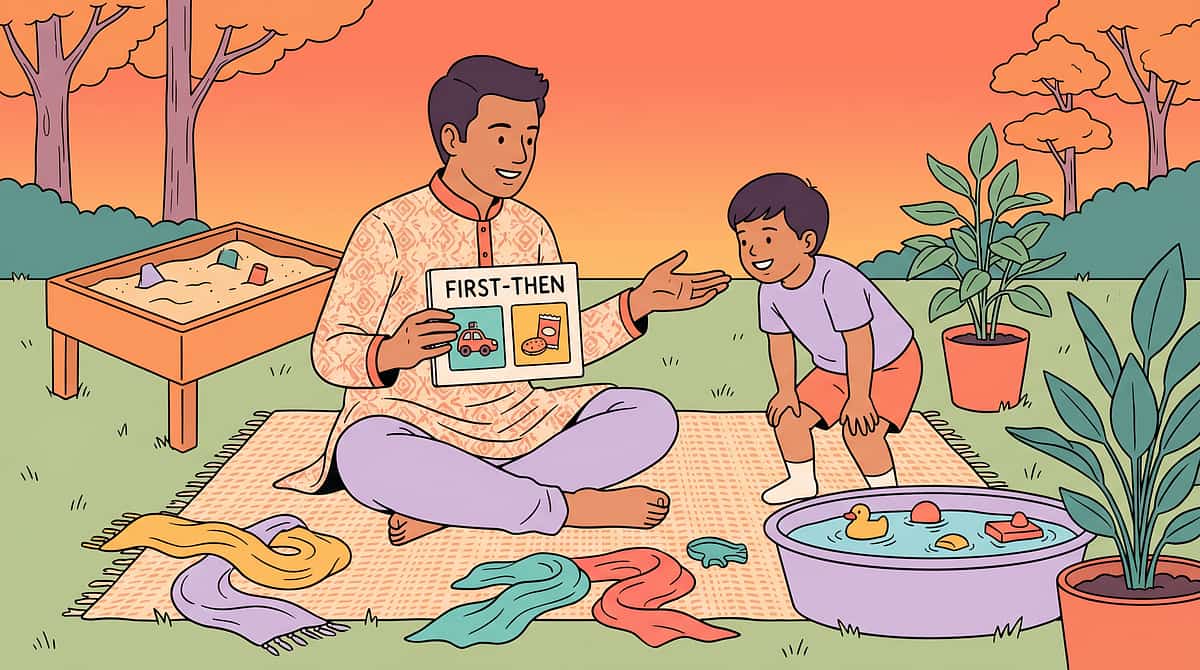
Material 3 — Implementation
First-Then Board: How to Build and Use It
Build the Structure
Two boxes side-by-side or top-to-bottom. Clear labels: "FIRST" and "THEN" with visual distinction between boxes. Use velcro to allow image changes — you need flexibility across different waits and different rewards.
Choose the Right Images
Photos work best for concrete thinkers. Picture symbols, drawings, or even actual small objects in clear pockets also work. Match to the child's comprehension level. The "THEN" must be genuinely motivating — this isn't a trick, the reward must be real and valued.
Honor the Promise — Always
If you place something in "THEN," it must happen. Trust is everything. Breaking First-Then promises destroys the tool's effectiveness. If the reward must change, show a new image and explain simply before the wait begins.
Introduce and Practice
"Look at your board. FIRST we do [this]. THEN you get [that]." Point to each section. For new users, the FIRST should be very brief and the THEN should follow immediately — build trust before extending wait duration.
Build a Portable Version
Create an index-card-sized laminated version for outings, school, and appointments. Let your child place the "THEN" picture when possible — their involvement increases investment and reduces resistance.
Ensure small picture symbols or velcro pieces are not choking hazards. Supervise young children's use of portable versions.

Material 4 of 9
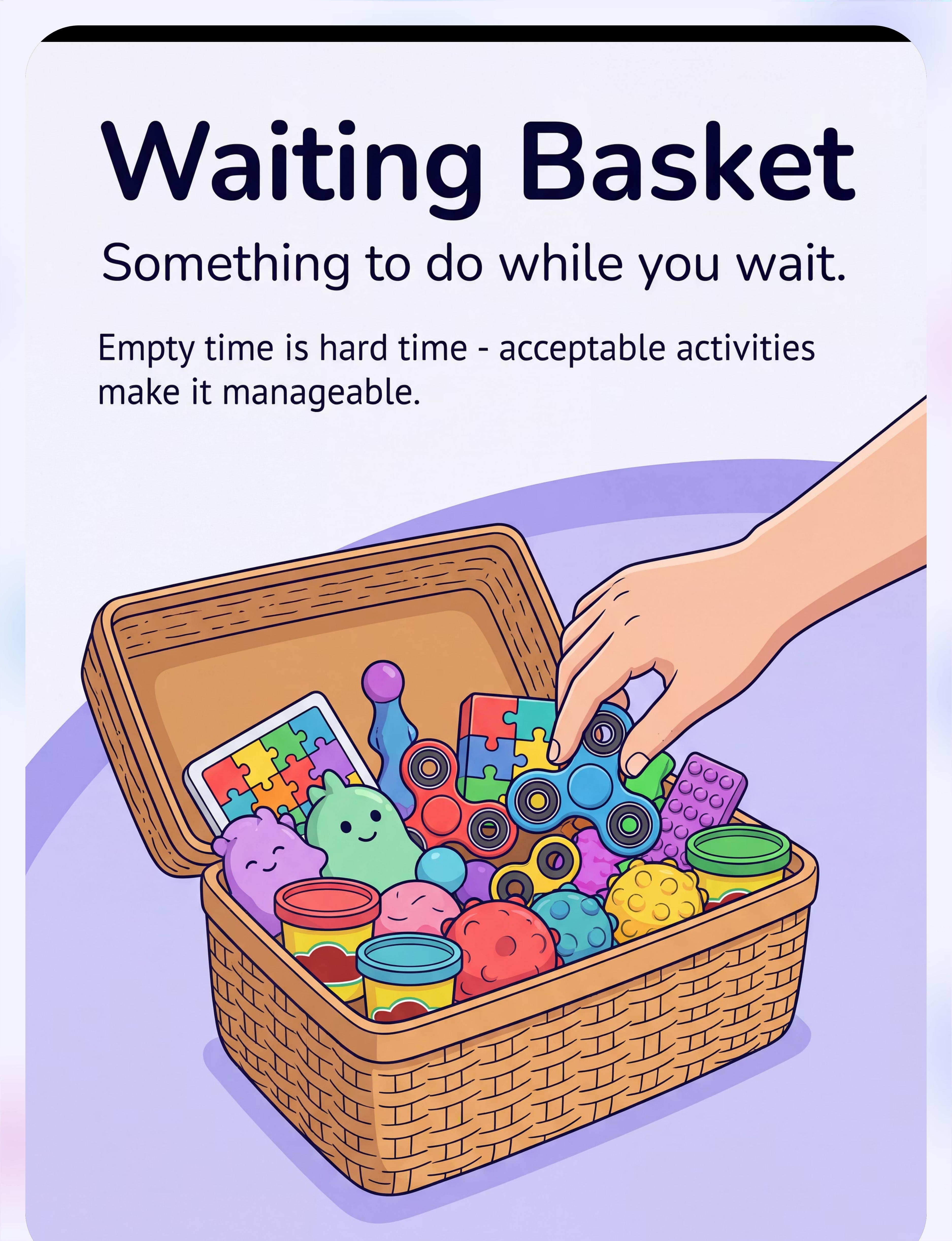
Waiting Basket or Activity Box
The core insight: Waiting is harder when there is absolutely nothing to do. The emptiness of waiting time amplifies the frustration of not having the desired thing. A waiting basket gives hands and minds something acceptable to engage with — transforming dead time into manageable time.
Why It Works
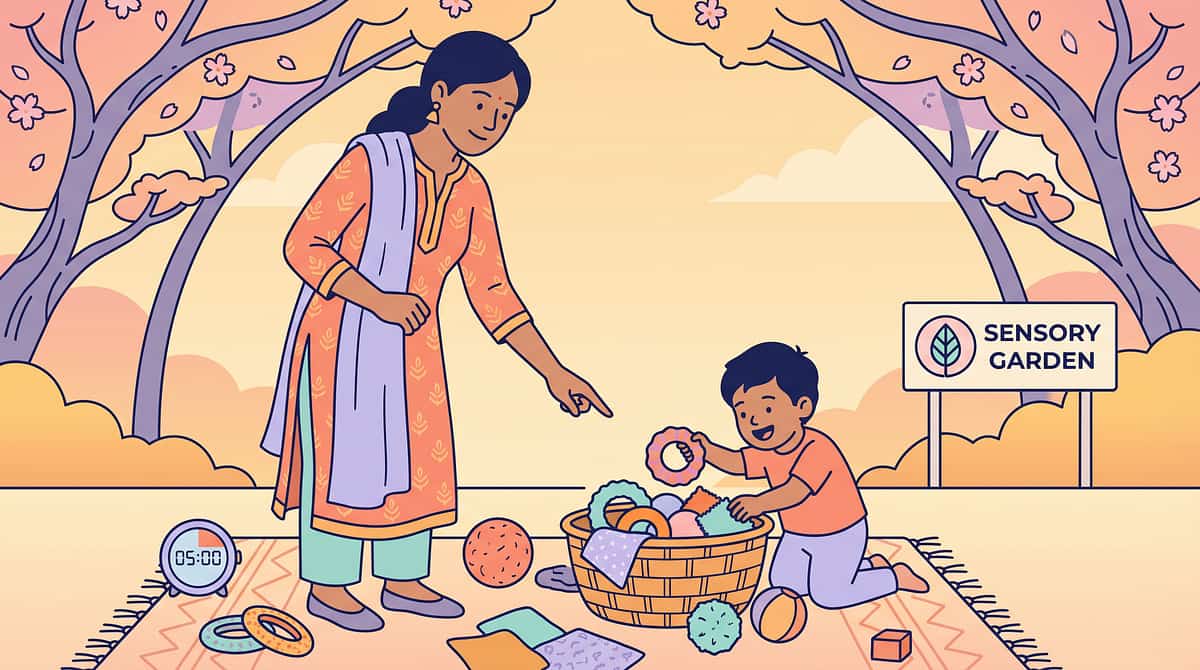
The basket answers the embodied question: "What do I do with my body and attention while I wait?" — a question that verbal instructions like "just wait" utterly fail to address. Contents should be:
- Genuinely engaging — motivating enough that the child actually uses them
- Self-contained — don't require setup or adult assistance
- Quiet — appropriate for waiting contexts like stores and offices
- Not the preferred item itself — that's what they're waiting for
The waiting basket is exclusively for waiting. This special status makes it more appealing. "You can play with the special waiting toys while we wait!" The scarcity and novelty increase its value.
Activity Ideas
Fidget toys
Playdough or putty
Small coloring kit
Sticker activities
Small puzzles
Sensory bottles
Wikki Stix
Magna-Doodle
Empty time is hard time. Providing acceptable activities transforms waiting from an endurance test to a manageable activity.
Material 4 — Implementation
Waiting Basket: How to Build and Use It
Create Multiple Baskets
Consider separate baskets for different contexts — one for home, one for the car, one for appointments and waiting rooms. Waiting support should always be where waiting happens.
Protect Its Special Status
The waiting basket is ONLY for waiting. When the child is not waiting, the basket is put away. Scarcity maintains value — if basket items are always available, they lose their power as waiting supports.
Rotate for Novelty
Rotate some items to maintain interest. Keep core favorites; add new items periodically. Too easy is boring; too difficult is frustrating — both undermine the basket's purpose.
Give Child Choice
Let the child choose which item from the basket to use — not dictate which one. Autonomy within the structure of the waiting basket increases cooperation and engagement.
Pair With System
Pair the basket with wait card and timer: card shows "you're waiting," timer shows "how long," basket shows "what to do." This trio forms the core of a complete waiting support system.
All basket items must be safe for the child's developmental level — no choking hazards, no items that could become projectiles if frustration peaks. Supervise young children throughout.
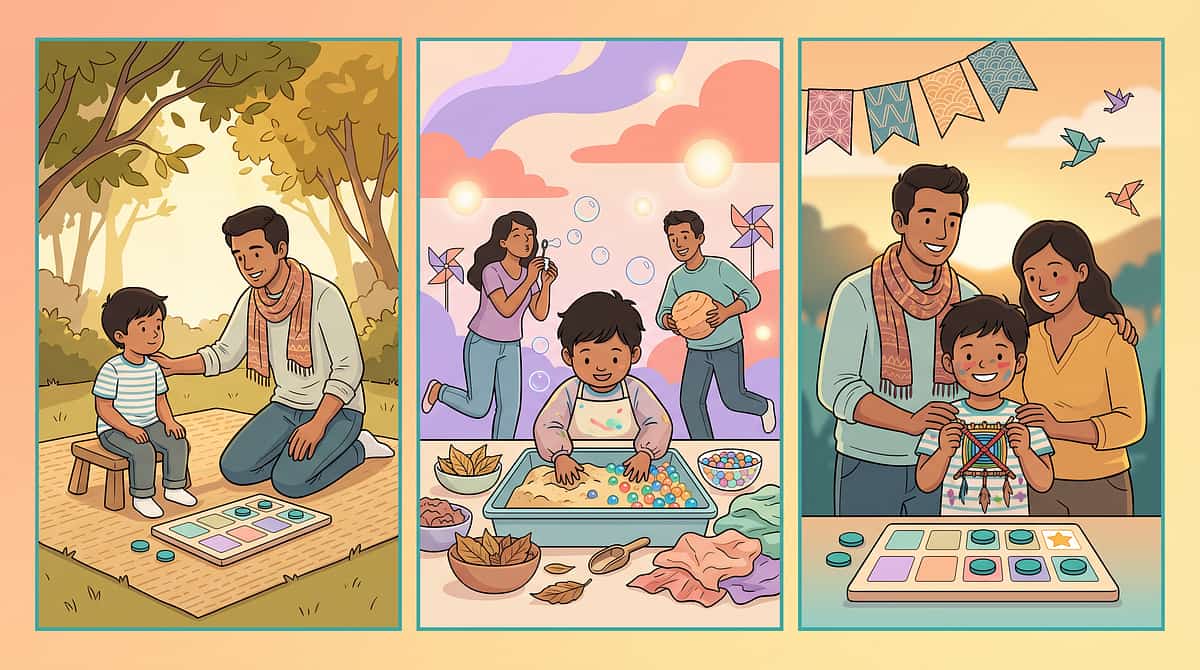
Material 5 of 9
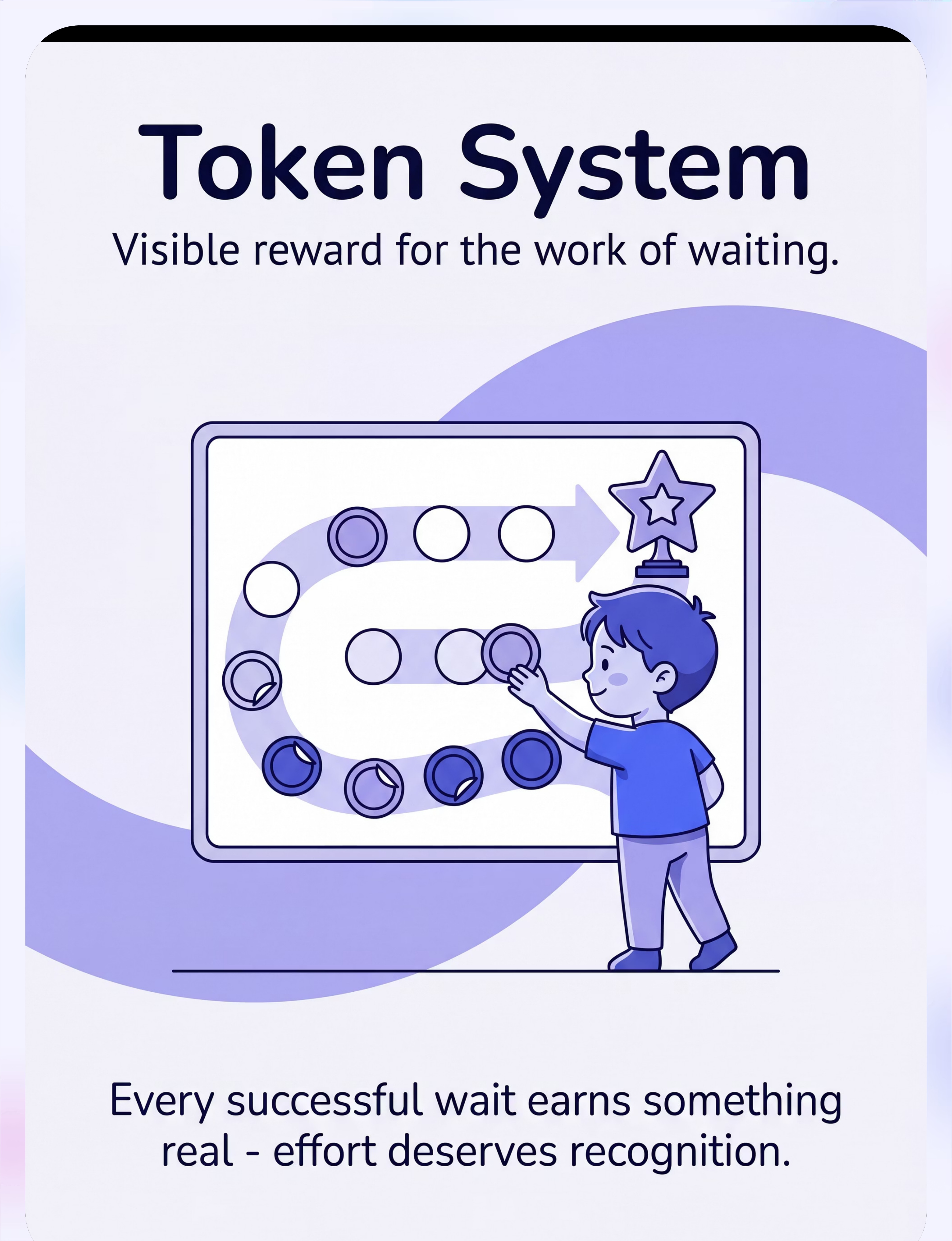
Token Economy / Reward Chart for Waiting
The core insight: Waiting requires genuine effort and self-regulation. It's work — and work deserves recognition. A token economy makes the abstract benefit of "being patient" concrete, visible, and immediately rewarding.
Why It Works
Each successful wait earns a token; accumulated tokens earn a bigger reward. This addresses waiting from a motivation angle — it answers "why should I wait?" with tangible, visible benefits. For children who struggle with delayed gratification, tokens serve as intermediate reinforcement: instead of waiting for the delayed item AND waiting for recognition, they receive immediate reinforcement (the token) while still learning to wait for the larger goal.
The system also makes successful waits memorable and countable — the token marks the accomplishment. "Look, you've waited well three times today!" This builds identity as someone who can wait.
Key Insight
Effort deserves recognition. Visible, immediate tokens acknowledge the work of waiting while the larger reward remains appropriately delayed.
Token Options
- Poker chips on a velcro board
- Stickers on a visible chart
- Coins accumulating in a clear jar
- Velcro tokens moved to a "done" section
Never remove earned tokens for other behaviors. Earned is earned — the system only works if it's trustworthy.

Material 5 — Implementation
Token System: How to Set It Up
Define the System Simply
Three decisions: how many tokens for the reward (start with 3–5), what counts as earning a token (a successful waiting instance), and what the reward is (something genuinely motivating — not a lecture).
Make Tokens Visible and Tangible
Tokens should be physical and visible. The child watches them accumulate — this visual progress is itself motivating. Avoid purely digital token tracking for young children who need concrete objects.
Deliver Tokens Immediately
The token is given immediately after a successful wait — no delay in the reinforcement even though the final reward is delayed. Token delivery also includes explicit acknowledgment: "You waited so well! Here's your token!"
Start Achievable, Fade Gradually
Begin with small token requirements (3 tokens for reward). As waiting improves, require slightly longer or harder waits for tokens. Never jump too far ahead — gradual progression maintains success and confidence.
Celebrate Every Goal
When the token goal is reached, celebrate! Make the accomplishment feel significant. Positive emotional associations with successful waiting are part of what builds lasting tolerance.
Tokens must be large enough not to be choking hazards. Avoid small items for children who mouth objects.
Material 6 of 9
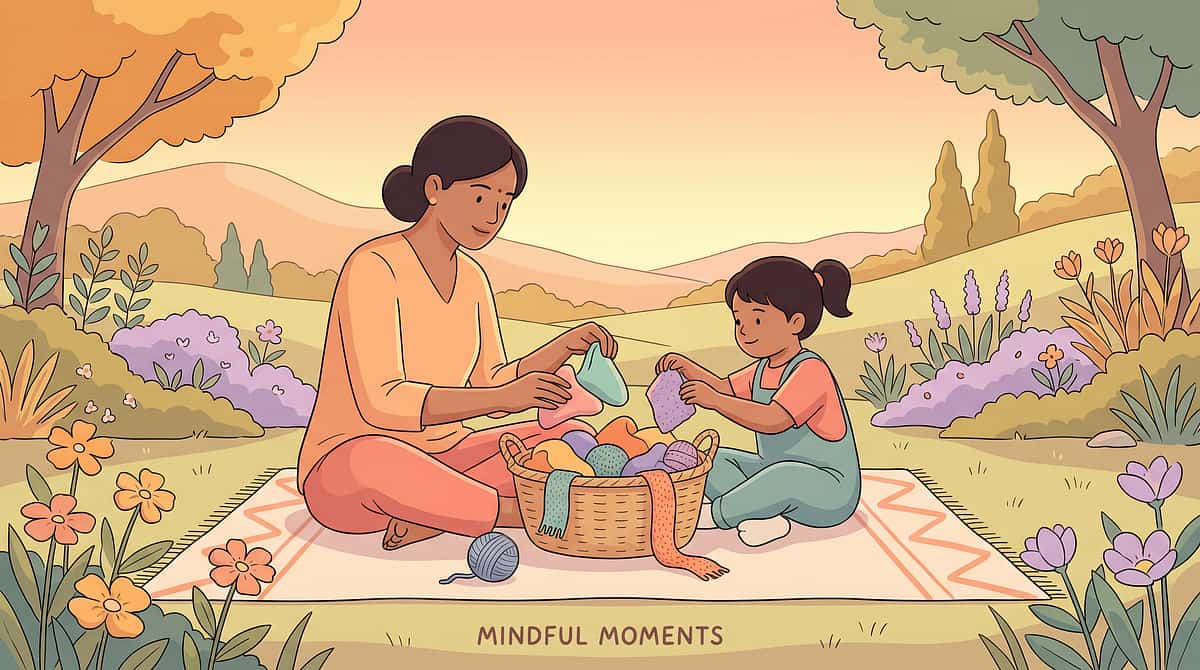
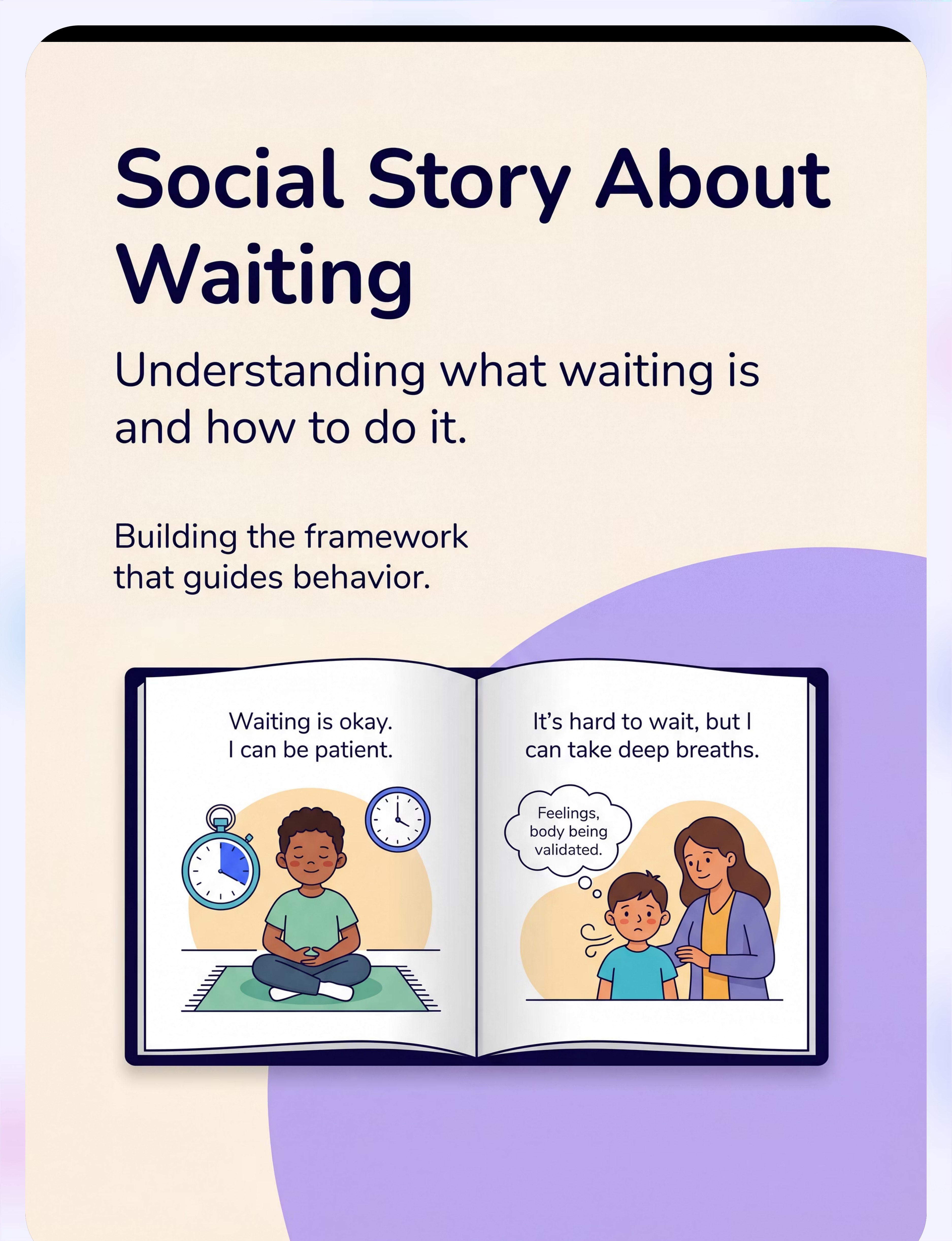
Social Story About Waiting
The core insight: Children who struggle with waiting often lack an internal framework for understanding what waiting is, why it happens, and how to survive it. A social story provides this framework in accessible, child-friendly terms — before the moment of crisis arrives.
Why It Works
A well-crafted social story tells your child that waiting is normal (everyone waits sometimes), that feelings during waiting are valid (frustration is okay), that waiting ends (it doesn't last forever), and that there are concrete things to do while waiting.
Social stories build cognitive understanding that can guide behavior. Instead of just being told "wait," the child has context: "This is waiting. I've read about this. The story says I can play with my waiting toys and the timer will tell me when it's done." Reading the story repeatedly during calm moments creates familiarity accessible even during challenging ones.
Key Concepts to Include
- Sometimes I have to wait
- Waiting means I don't get something right away
- Waiting can feel hard or frustrating
- It's okay to feel that way
- Waiting doesn't last forever
- I can do things while I wait
- When waiting is done, I get what I was waiting for
- I can be a good waiter — I'm practicing!
Understanding precedes coping. When children have a framework for "what waiting is," they can apply strategies for "how to wait."
Material 6 — Implementation
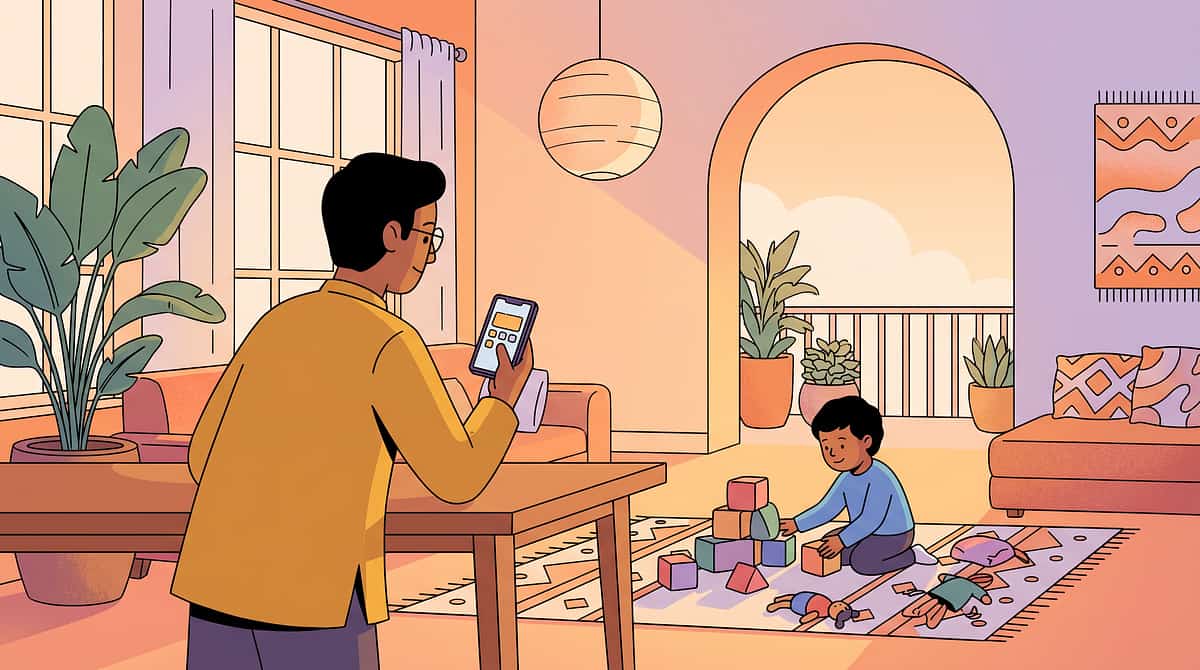
Social Story: How to Create One That Works
Personalize Deeply
Use the child's name, their real waiting situations, and the actual coping tools they'll use. Generic stories are far less effective than stories about this child in their specific contexts.
Keep Language Simple
Match the child's comprehension level. Short sentences, concrete concepts, no abstractions. Each page should carry one clear idea with a supporting visual.
Frame Positively
Focus on what TO do, not what not to do. "I can play with my waiting toys" — not "I shouldn't scream." The story builds a positive identity: "I can be a good waiter."
Add Visual Support
Include photos or illustrations for each page. Pair the story with images of the actual materials your child uses — their wait card, their timer, their basket. Make it immediately recognizable and real.
Read Often — Not Just During Waits
Read the story frequently when calm. Proactive, repeated reading builds familiarity. During real waits, reference the story: "Remember your waiting story? What does it say you can do?"
Revise as Skills Grow
As your child's waiting improves, revise the story to reflect new challenges or higher expectations. The story should grow with the child — a living document, not a static one.
A digital version on a tablet can be useful for children who prefer screen-based materials or for easy portability to school and appointments.
Material 7 of 9
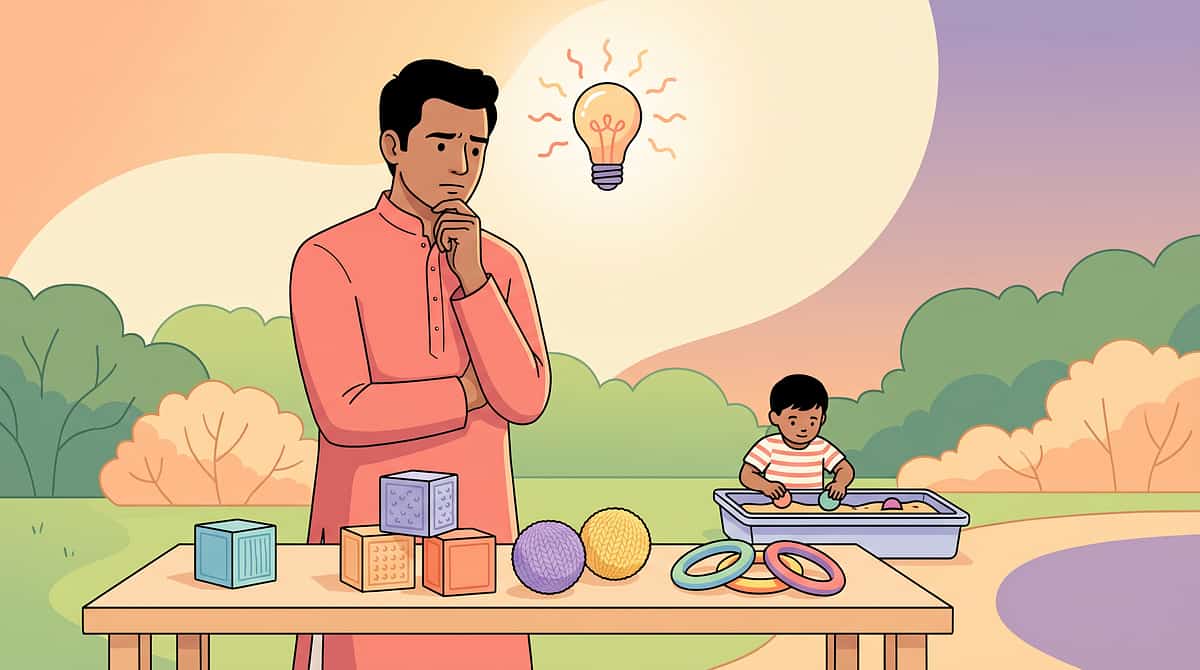
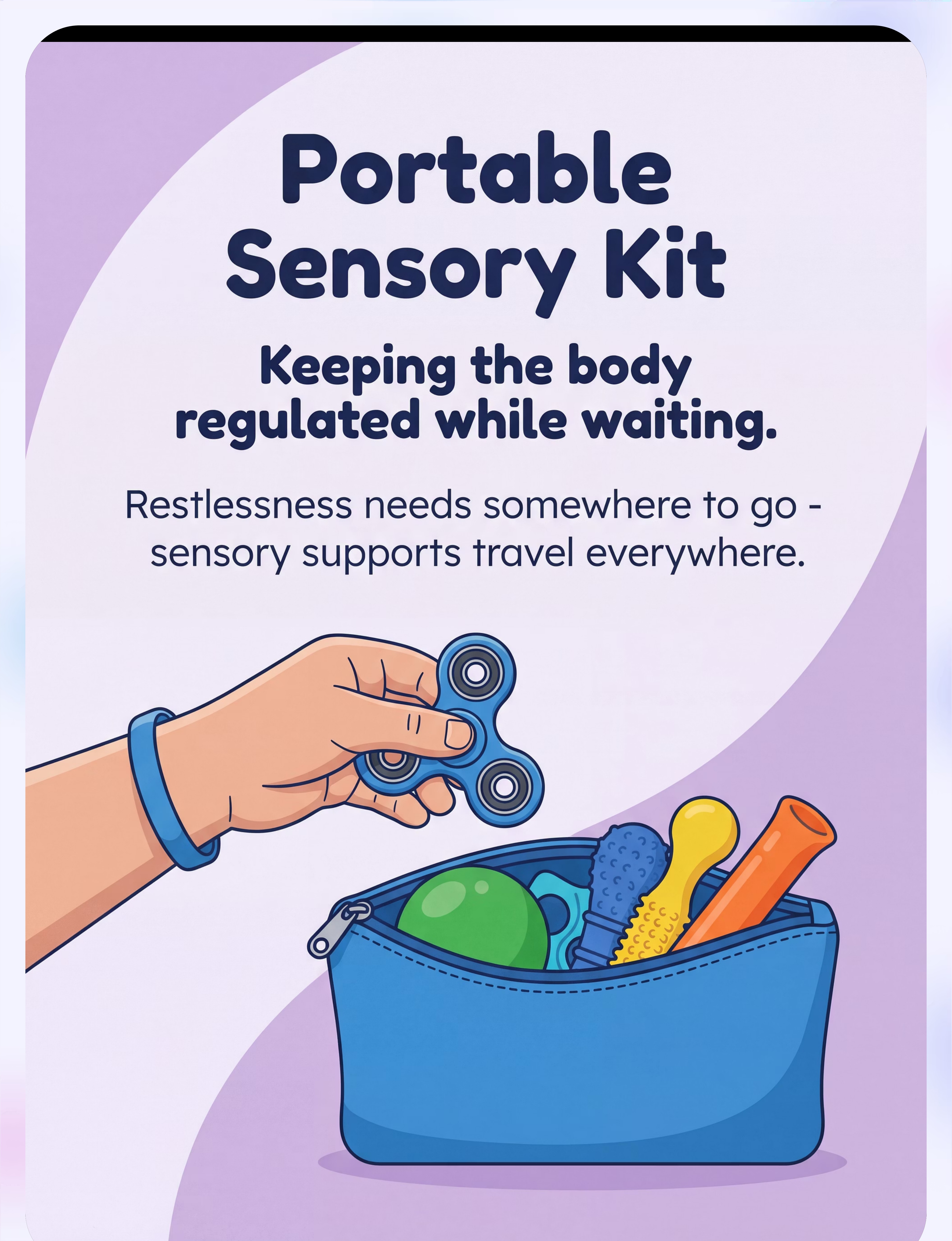
Portable Sensory / Fidget Kit for Waiting
The core insight: Waiting doesn't just challenge the mind — it challenges the body. The restlessness, the energy with nowhere to go, the sensory discomfort of "nothing happening" — these physical experiences drive much waiting-related behavior.
Why It Works
A portable sensory/fidget kit gives the body something appropriate to do during waits. Fidget toys keep hands busy. Sensory items — putty, textured objects, chewables — provide input that regulates the nervous system. The kit transforms waiting from a full-body challenge to a manageable moment with appropriate sensory engagement.
The kit must be small enough to carry everywhere — waiting happens in lines, cars, waiting rooms, and countless unpredictable situations. Having sensory supports always available means waiting support is always available.
Contents should match your child's specific sensory profile:
- Proprioceptive needs: squeeze balls, resistance putty
- Tactile preference: textured objects, koosh balls
- Oral sensory needs: chewable jewelry, chewy tubes
Key Insight
Waiting is a body experience, not just a mind challenge. When the body has appropriate input, the mind can wait more easily.
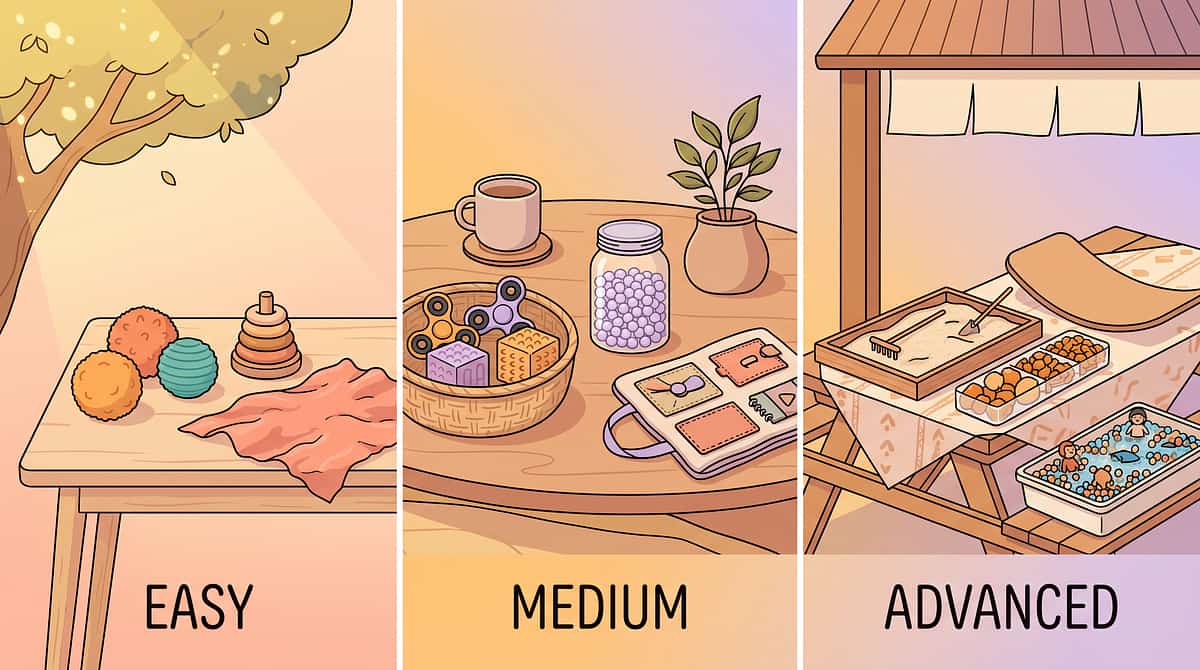
Kit Essentials
Fidget spinners or cubes
Tangle toys or pop-its
Squeeze ball or putty
Textured tactile item
Chewable (if needed)
Material 7 — Implementation
Sensory Kit: How to Build and Use It
Choose the Right Container
A small pouch, zippered bag, or case that travels easily and can attach to a belt, bag, or stroller. Always accessible — the kit only works if it's there when waiting happens unexpectedly.
Prioritize Quiet Items
For public waiting, all items should be quiet — no clicking, no loud sounds. Socially appropriate items for waiting rooms, stores, and restaurants. Quiet fidgets are usable in far more contexts.
Match Kit to Child's Profile
Observe what sensory input your child naturally seeks. Build the kit around their preferences, not generic recommendations. A kit that matches their profile will actually be used.
Introduce Items During Calm
Before using the kit during waiting situations, let your child explore items during calm, playful times. Familiar items are far more effective in the moment of need than brand-new ones.
Label, Replenish, Maintain
Label the kit clearly as "Waiting Kit" or "Fidget Bag." Check it regularly — replace lost or broken items. Pair with timer for time awareness and wait card for expectation clarity.
All items must be safe for the child's developmental level — no choking hazards, no sharp edges, no items that could break into dangerous pieces. Supervise chewables for wear and replace regularly.

Material 8 of 9
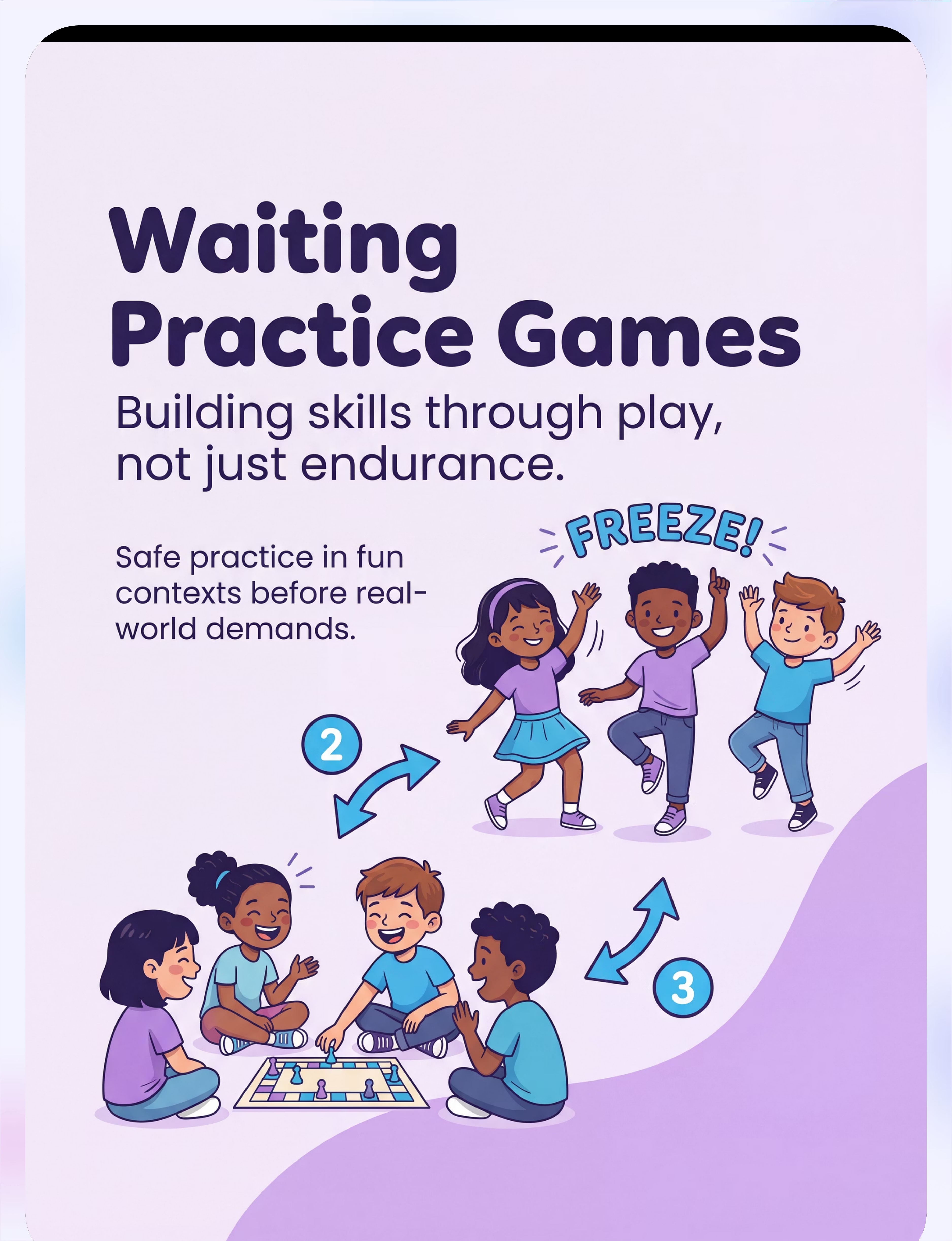
Waiting Practice Games & Structured Activities
The core insight: Waiting skills improve with practice — but practice must happen in controlled, supportive, fun conditions before real-world demands arrive. Games reframe waiting from punishment to skill-building.
Why It Works
Games like "Red Light / Green Light," "Freeze Dance," waiting-based card games, or turn-taking board games all require waiting as part of play. When waiting is embedded in enjoyable activities, children practice without the emotional loading of "real" waiting situations. They build tolerance, experience success, and develop a waiting identity — "I'm good at waiting in this game!"
The transfer isn't automatic — skills built in games must be explicitly connected to real-world waiting — but games provide the safest, most motivating practice ground available. Structured activities with gradually increasing waits build tolerance systematically.
Key Insight
Skills build through practice. Games provide low-stakes repetition that builds the capacity needed for high-stakes real-world waits.
Great Waiting Games
- Freeze Dance — wait for the music to restart
- Red Light / Green Light — built-in waiting for the "go" signal
- Ready, Set... WAIT... Go! — insert pause before "go"
- Simple board games — roll-and-move, Uno, Go Fish
- Hide and Seek — natural waiting on both sides
- Microwave/Toaster games — wait for a natural timed event

Material 8 — Implementation
Waiting Games: How to Practice Purposefully
Set Up Structured Practice
Create intentional practice sessions: "We're going to practice waiting! First I'll ask you to wait for 10 seconds, then you get a marble. Let's try!" Short, clear, rewarded. The explicit frame of "practice" makes it a skill activity rather than a demand.
Start With Seconds
Initial waits in games should be very brief — 5 to 10 seconds. Success at each level builds capacity for the next. Extend gradually: 10 seconds → 30 seconds → 1 minute. Never skip levels.
Make the Connection Explicit
After game practice, connect to real-world waiting. "You waited so well for your turn in the game! You can wait like that when we're in line, too." Children don't automatically transfer skills — the bridge must be built verbally.
Celebrate Waiting Wins
Make practice feel like achievement. Celebrate waiting wins with enthusiasm, tokens, and genuine acknowledgment. Positive associations with successful waiting are what drive motivation to keep building the skill.
Adapt rules of existing games to shorten waits initially. As tolerance builds, standard rules can be introduced. The goal is success before challenge.

Material 9 of 9
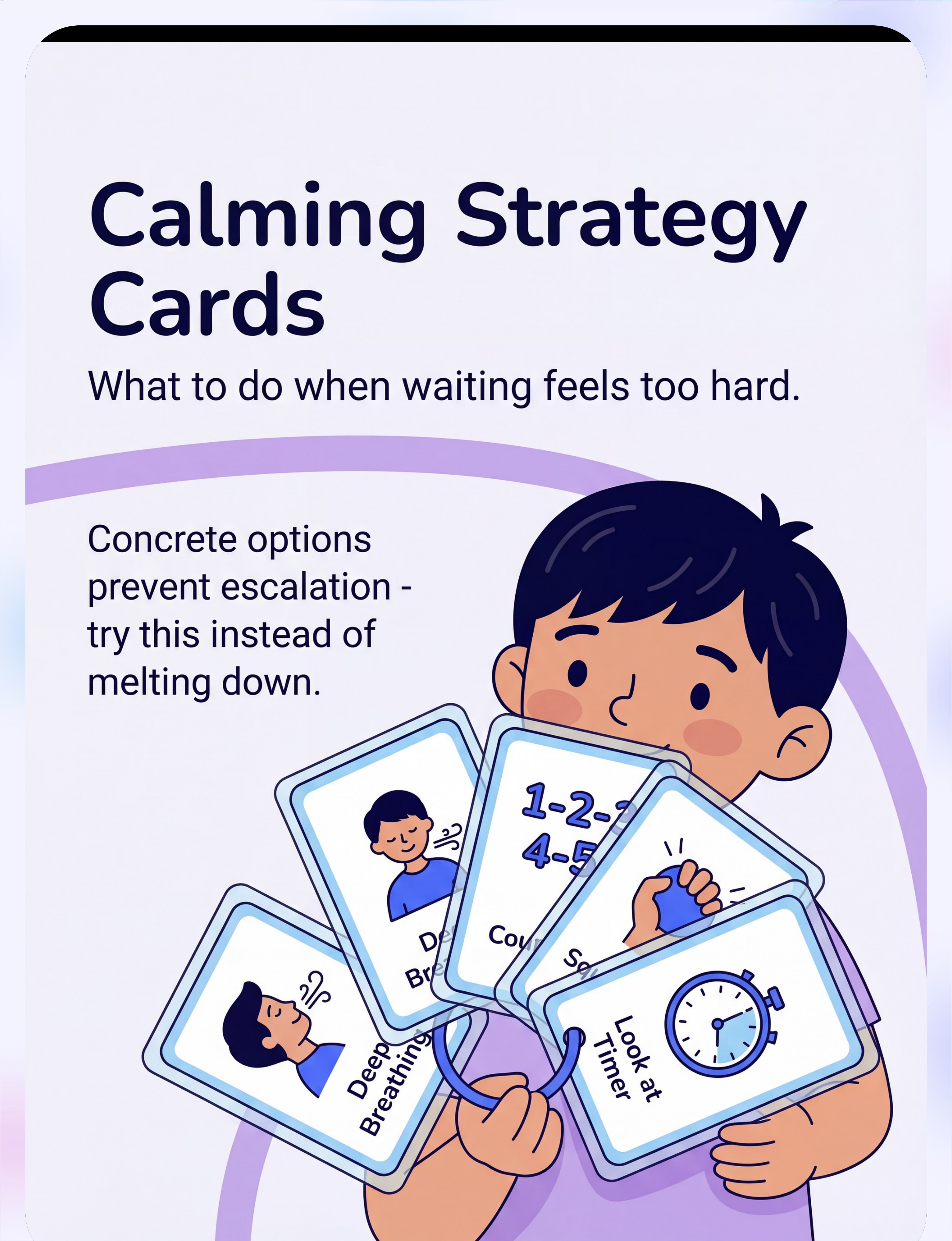
Calming / Coping Strategy Cards for Waiting
The core insight: Even with all supports in place, waiting can still trigger big feelings. Calming strategy cards provide concrete options for what to do when frustration builds — preventing escalation by offering alternatives before meltdown becomes the only apparent option.
Why It Works
Children who struggle with waiting often struggle with emotional regulation more broadly — they don't automatically access coping strategies when distressed. Cards make strategies visible and external, reminding the child of options they would never think of independently in the moment.
Instead of dysregulation escalating because the child doesn't know what else to do, cards offer concrete alternatives: "Take deep breaths," "Squeeze your stress ball," "Count to 10," "Look at your timer," "Think about what you're getting."
Cards must be personalized to strategies your child has actually practiced and found helpful. Generic calm-down cards are far less effective than cards showing strategies that genuinely work for this specific child.
Key Insight
Options prevent escalation. When frustration builds, having concrete alternatives breaks the "only option is meltdown" pattern.
Strategy Options
- Deep breathing (show how with visual)
- Counting to 10
- Squeezing a fidget
- Looking at the timer
- Thinking about the reward
- Asking for a short break
- Hugging yourself
- Getting a drink of water
Material 9 — Implementation
Calming Cards: How to Create and Use Them
Personalize to What Works
Include only strategies your child actually uses and that actually help them. Not a generic list — a personal toolkit of proven strategies. Fewer, better cards beat many unused ones.
One Strategy Per Card
Each card equals one strategy. No complex multi-step instructions. Simple, immediate, do-able. A photo or picture of the strategy, not just words. One card = one clear action.
Practice When Calm
Children must practice strategies when calm before using them during distress. Introduce during neutral moments: "These are your calming cards. When waiting feels hard, you can try one of these. Let's practice deep breathing right now!"
Prompt Early — Before Meltdown
During waits, when frustration is just beginning to build, prompt strategy use. "You look frustrated. Let's look at your cards. What can you try?" Intervene before the window closes.
Offer, Don't Demand
Present cards as options: "Would you like to try one?" rather than "You have to calm down right now." Choice increases buy-in. Model the strategies yourself — "Waiting is hard! I'm going to take some deep breaths."
Keep Them Portable
A ring of laminated cards on a keyring, or small cards in the waiting kit. Calming cards for regulation, timer for time awareness, waiting basket for activity — the complete support system, always available.
Calming strategies should be genuinely calming for your specific child. Some strategies (like deep breathing) may not work for all children — match strategies to your child's individual regulation profile.

The Complete Waiting Support System
Each material targets a specific aspect of why waiting is hard. Together, they form a layered system that addresses time perception, expectation clarity, body regulation, motivation, and emotional coping — all at once.
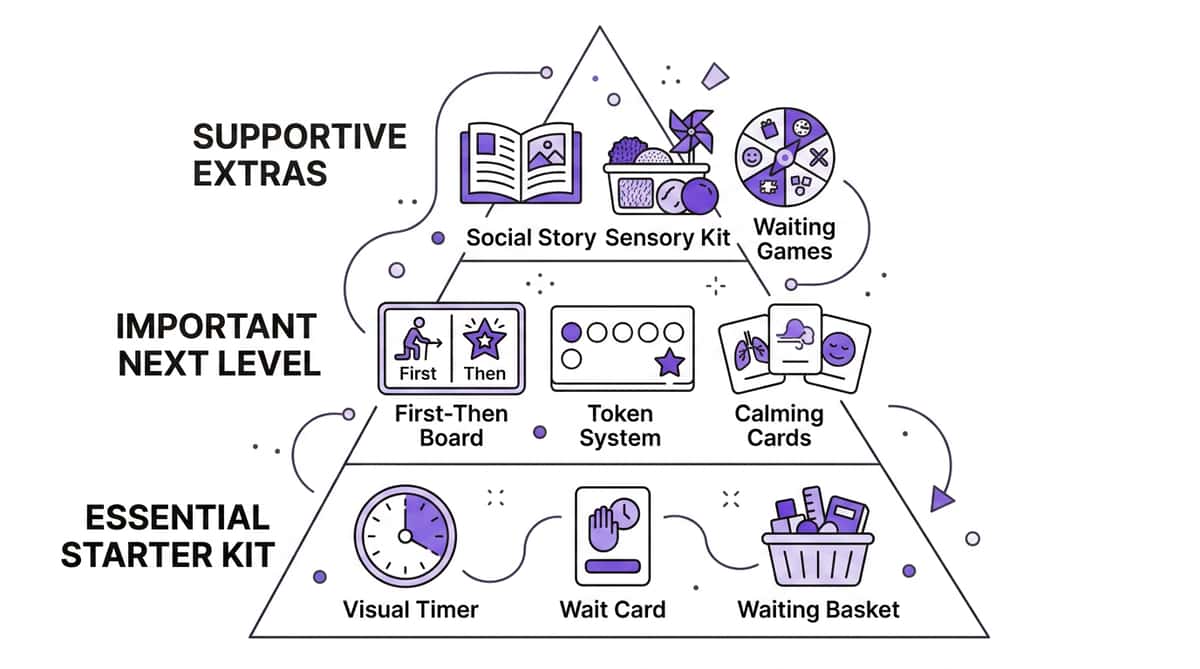
Start with the essentials (timer + wait card + basket), establish consistency, then layer in additional supports based on what your child needs most. A complete toolkit costs approximately ₹1,200–5,300 — or start free with a phone timer app, a hand-drawn card, and a small bag of preferred quiet activities.
How the Materials Work Together
The nine materials are not competing — they're complementary. Each answers a different question a child has during a waiting moment.
"How long do I have to wait?"
Visual Timer — makes the duration visible, finite, and trackable. The sand runs out; the color shrinks. Time is no longer invisible or eternal.
"Is this actually a waiting moment?"
Wait Card — the consistent, unmistakable visual signal that means "this is waiting." Same card, same meaning, every context.
"Will I actually get what I want?"
First-Then Board — the reward is visible and promised. Trust is built through consistency. The sequence is concrete, not just verbal.
"What do I do with my body right now?"
Waiting Basket + Sensory Kit — hands and body have something appropriate and engaging to do. Empty time becomes filled time.
"Why is it worth trying to wait?"
Token Economy — the effort of waiting is immediately recognized and visibly rewarded. Waiting becomes worthwhile.
"What do I do when it feels too hard?"
Calming Cards — concrete alternatives to escalation. Options prevent the "only option is meltdown" pattern from taking hold.
Getting Started: A Step-by-Step Guide
The biggest mistake families make is introducing too many tools at once, or introducing them during a meltdown. Start small, start calm, start with success.
Step 1: Observe First
Watch your child's current waiting ability. How long can they wait? Under what conditions? What triggers failure? You need a baseline before you can build.
Step 2: Choose 2–3 Starting Materials
Begin with the essential trio: visual timer + wait card + one activity option from a waiting basket. Don't introduce all nine at once.
Step 3: Introduce During Calm
Introduce tools during neutral, low-stakes moments — never during a crisis. "This is your wait card. When you see this, it means we're waiting. Let's practice!" Familiarity must come before need.
Step 4: Practice Very Short Waits
Start with 10–30 seconds of waiting with high reinforcement. Success builds the tolerance that makes longer waits possible. Never start with a wait that exceeds current capacity.
Steps 5–7: Build, Add, Generalize
Increase duration gradually. Add new materials as needed based on what helps. Once skills are established in one context, systematically generalize across home, school, and community.
Common Mistakes to Avoid
Starting With Waits That Are Too Long
Beginning with a 5-minute wait for a child who can barely manage 30 seconds sets up failure. Build from achievable success — always. Even 10 seconds counts as practice.
Introducing Tools During Meltdown
Crisis is too late for learning. Tools must be learned when calm so they can be accessed when distressed. The social story, the wait card, the calming cards — all must be familiar before the moment of need.
Inconsistent Use
Materials only work with consistent application. Using the wait card sometimes but not others — or using different cards in different contexts — undermines the predictability that makes the tool powerful.
Removing Supports Too Quickly
When waiting seems to improve, it's tempting to pull away supports immediately. Fade gradually when clearly ready — keep materials available for challenging situations even after regular use becomes unnecessary.
Punishment for Waiting Failure
Punishing a child for failing to wait is counterproductive — it increases anxiety around waiting, which makes waiting harder. Waiting skills are built through support and practice, not threatened into existence.
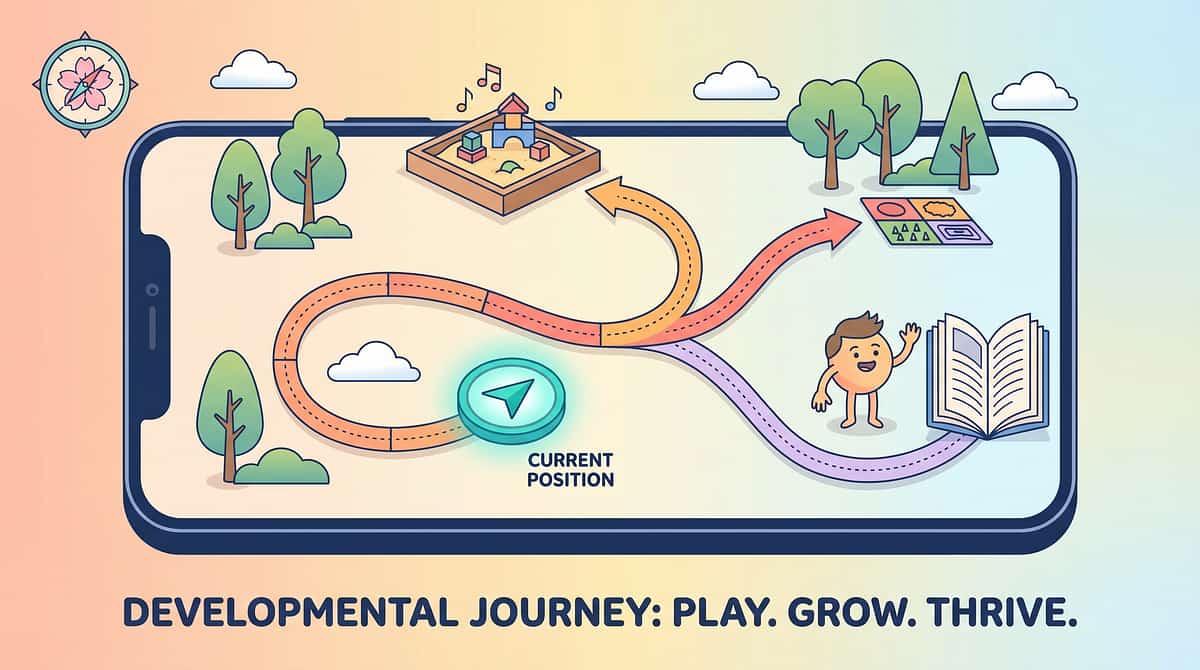
Developmental Progression: Tracking Progress
Waiting skills develop in stages. Knowing which stage your child is in helps you choose appropriately calibrated supports and expectations.
Emerging
Cannot tolerate any delay without behavioral episode. "Wait" has no meaning. Needs waits of 5–10 seconds with immediate, high reinforcement and full visual support.
Developing
Tolerates 1–2 minutes with support. Uses timer and activity; frequently checks in; needs regular reminders. Token system for each successful wait is essential.
Established
Waits 3–5 minutes with minimal support. Begins using strategies more independently. Timer available but not always needed. Self-selects waiting activities.
Generalized
Age-appropriate waiting across multiple contexts — lines, turns, transitions — without significant distress. Internal strategies emerging. Handles novel waiting situations with minimal external support.
Children with developmental differences may move through these stages more slowly — and that's expected. Each stage represents genuine neurological growth. Progress is progress, regardless of pace.
Waiting Across Contexts
Skills built in one context must be intentionally transferred to others. Here's how to apply waiting supports across the four key environments where children wait most.
🏠 Home
Situations: Waiting for meals, preferred activities, parent attention.
Setup: Kitchen timer visible, waiting basket accessible, First-Then board posted.
Practice: Daily practice opportunities with immediate reinforcement embedded in routine.
Setup: Kitchen timer visible, waiting basket accessible, First-Then board posted.
Practice: Daily practice opportunities with immediate reinforcement embedded in routine.
🏫 School
Situations: Waiting to be called on, for materials, during transitions, for turns.
Setup: Classroom visual timer, wait card in desk, fidget option, token system.
Key: Teacher and parent using identical cues and strategies — consistency across environments.
Setup: Classroom visual timer, wait card in desk, fidget option, token system.
Key: Teacher and parent using identical cues and strategies — consistency across environments.
🌆 Community
Situations: Store lines, restaurants, waiting rooms, public transportation.
Setup: Portable timer, waiting kit with fidgets, calming cards, review social story before outings.
Preparation: Prepare the child verbally before entering a waiting situation.
Setup: Portable timer, waiting kit with fidgets, calming cards, review social story before outings.
Preparation: Prepare the child verbally before entering a waiting situation.
⚡ Unexpected Waits
Situations: Traffic delays, schedule changes, longer-than-expected waits.
Setup: Portable supports always available; calming strategies practiced and familiar.
Language: "Sometimes we might have to wait" — building tolerance for uncertainty itself.
Setup: Portable supports always available; calming strategies practiced and familiar.
Language: "Sometimes we might have to wait" — building tolerance for uncertainty itself.
A Note for Parents: You Are Not Failing
"I see your exhaustion. The constant demands, the immediate needs, the inability to complete any task without interruption. The embarrassment in public when your child can't wait like others. The confusion about why such a simple thing is so hard."
Waiting IS simple for some children — their brains naturally process time, manage impulse, and tolerate frustration. But your child's brain works differently. This is not a parenting failure. It is not a character flaw. It is a neurodevelopmental difference that requires neurodevelopmental support.
These materials don't magically create patience overnight. They create the scaffolding that makes patience possible — one small, successful wait at a time. Your child can learn to wait. It just takes the right support, consistent practice, and a parent who refuses to give up.
The fact that you are reading this, learning these tools, and advocating for your child IS the intervention. You are doing it right.
Save This
Save This for Your Next Waiting Moment
Share with parents who hear "I want it NOW!" every day. Follow for more support strategies from the Self-Regulation & Adaptive Behavior series.
🔖 Save
Bookmark this for the next time a waiting challenge arrives — it will be here when you need it.
📤 Share
Share with parents, teachers, and caregivers who need to make waiting survivable for the children they love.
▶️ What's Next
Coming next in the series: 9 Materials That Help With Emotional Regulation — Episode L-977.

Powered by
Powered by GPT-OS®
Global Pediatric Therapeutic Operating System — the end-to-end operating system that governs diagnosis, prognosis, therapy design, execution, monitoring, and readiness outcomes in child development as one closed, accountable system.
Diagnostic Intelligence Layer
Converts 591+ structured observations across 349 skills and 79 developmental abilities into standardized diagnostic clarity.
AbilityScore®
A patented universal developmental score (0–1000) establishing baseline, severity, and longitudinal change across domains.
Prognosis Engine
Predicts developmental trajectories and risk windows using historical response patterns from 20M+ real therapy sessions.
TherapeuticAI®
Determines therapy focus, intensity, sequencing, reinforcement logic, and escalation thresholds for each child.
EverydayTherapyProgramme™
Translates clinical plans into daily, home-executable micro-interventions — making therapy happen between sessions.
FusionModule™
Coordinates speech, OT, behavior, special education, and medical inputs into a single converged therapeutic pathway.
Closed-Loop Therapeutic Control: Observation → Score → Plan → Execute → Re-measure → Adapt. This is not software. This is therapeutic infrastructure.
GPT-OS® Proof
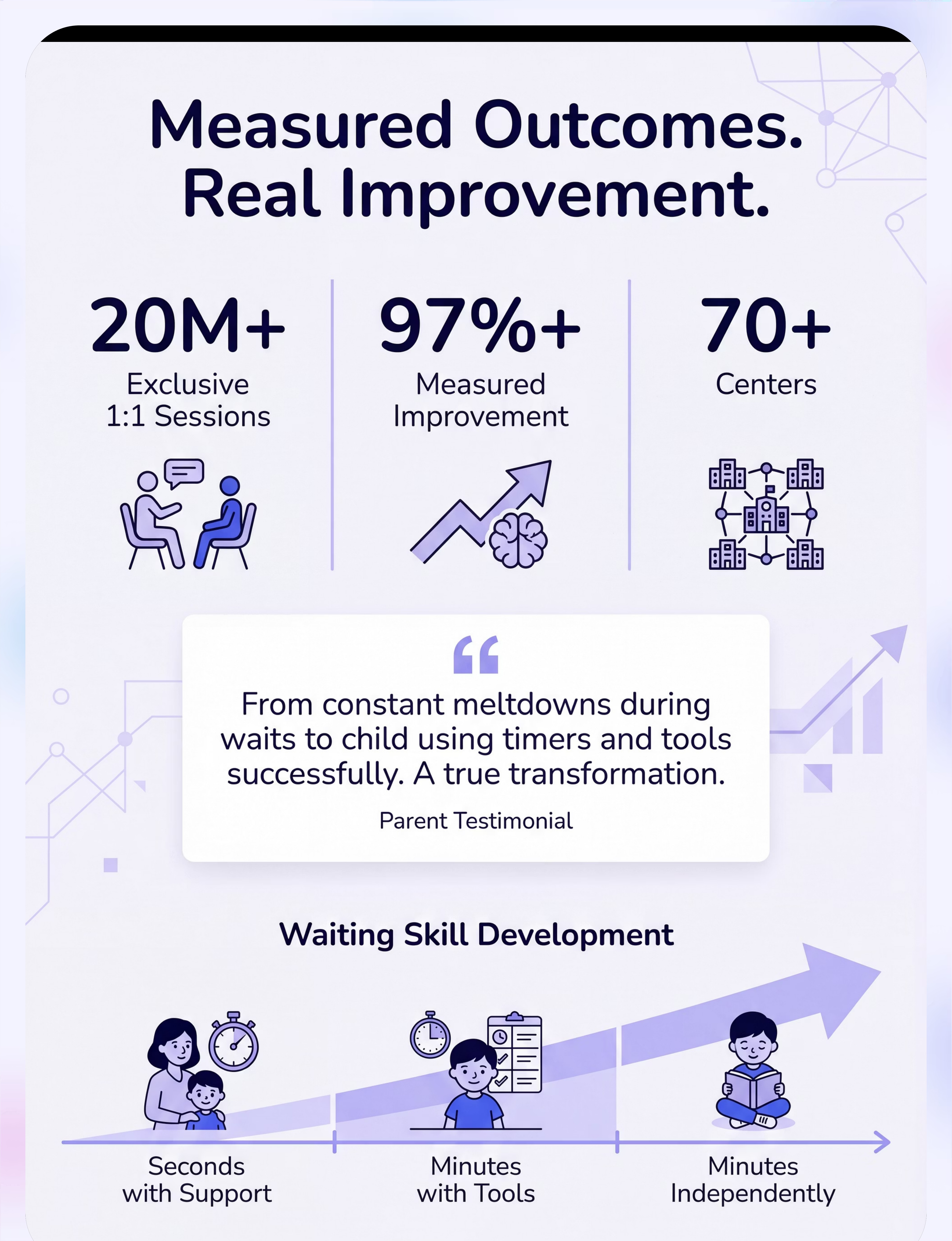
Measured Outcomes. Real Improvement.
Self-regulation progress — including waiting, impulse control, and frustration tolerance — is tracked systematically using standardized readiness indexes that reflect real-world functional capability.
20M+
Exclusive 1:1 Sessions
Across converged therapy disciplines under the GPT-OS® system
97%+
Measured Improvement
Across one or more readiness indexes per child
70+
Centers
Operating under a single unified clinical system
Readiness Indexes Tracked
- Self-Regulation Readiness Index
- Executive Function Readiness Index
- Adaptive Behavior Readiness Index
- Social Participation Readiness Index
- School Readiness Index
Waiting Skills Functional Progression
Cannot tolerate any delay → tolerates brief delays (seconds) with full support → waits 1–2 minutes with visual timer and activity → waits 3–5 minutes with minimal support → independently uses waiting strategies → generalized waiting skills across contexts and durations.
A Parent's Journey: Real-World Evidence
"Every time I said 'wait a minute,' it was a guaranteed meltdown. Grocery store lines were nightmares. Waiting for food at restaurants was impossible. His teacher said he couldn't wait for anything at school — couldn't wait to be called on, couldn't wait for materials, couldn't wait for his turn. We started with visual timers at home — just 30 seconds at first, with his waiting basket. He could see the time passing, and he had something to do. We used the wait card consistently — same card at home, school, and therapy. First-Then board so he could SEE what he was waiting for. The calming cards gave him something to try instead of screaming. After six months of consistent practice, he can now wait 5 minutes with minimal support. He uses his fidget in lines. He looks at his timer during transitions at school. His teacher says it's transformed his classroom experience. He's not perfect — long waits are still hard — but he has tools now. And so do we."
— Parent, Pinnacle Blooms Network
Illustrative case; individual results vary based on child's profile and consistency of intervention.
About Pinnacle
Pinnacle Blooms Network®
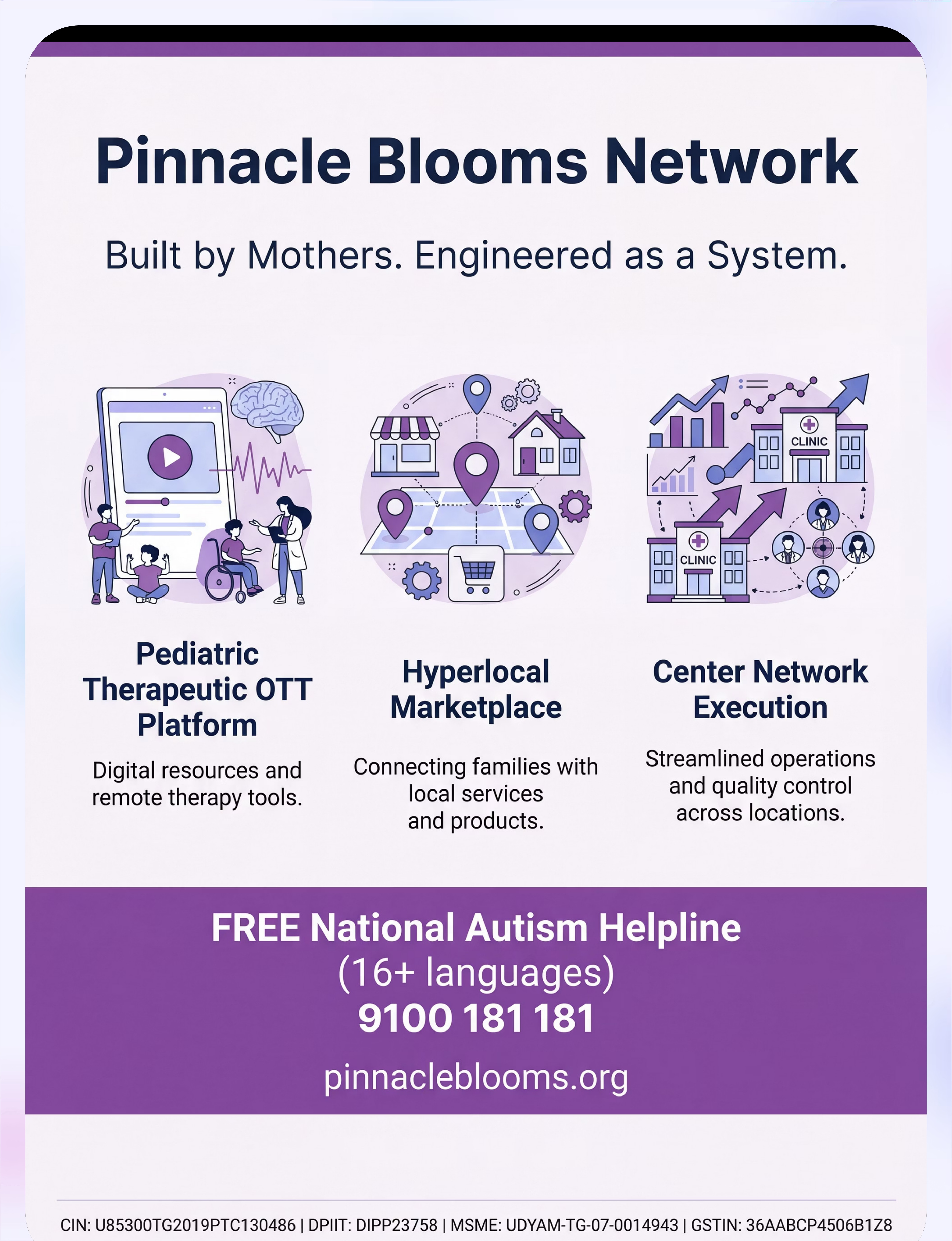
Built by Mothers. Engineered as a System. Pinnacle is the execution layer of GPT-OS® — delivering therapy, daily programs, and digital continuity at population scale.
Pediatric Therapeutic OTT Platform
On-demand therapy guidance, parent education, and EverydayTherapyProgramme™ delivery — accessible anywhere, anytime.
Hyperlocal Marketplace
Connects families to verified therapists, centers, programs, and assessments — matched to your child's specific profile.
Center Network Execution
70+ physical centers across India operating under unified GPT-OS® clinical standards — one system, consistent outcomes.
Contact Us
FREE National Autism Helpline (16+ languages)
📞 9100 181 181
🌐 pinnacleblooms.org
✉️ care@pinnacleblooms.org
📞 9100 181 181
🌐 pinnacleblooms.org
✉️ care@pinnacleblooms.org
Statutory Identifiers
CIN: U74999TG2016PTC113063
DPIIT: DIPP8651 (Govt. of India)
MSME: Udyog Aadhaar: TS20F0009606
GSTIN: 36AAGCB9722P1Z2
DPIIT: DIPP8651 (Govt. of India)
MSME: Udyog Aadhaar: TS20F0009606
GSTIN: 36AAGCB9722P1Z2
Patents filed across 160+ countries. 20M+ sessions. 97%+ measured improvement.

Related Support in This Series
Waiting skills don't exist in isolation — they connect deeply to a cluster of self-regulation and executive function skills your child may be building simultaneously.
L-974
Impulse Control
L-975
Frustration Tolerance
L-976
Waiting Skills ← You are here
L-977
Emotional Regulation
L-978
Flexibility & Transitions
Ask your therapist about L-512: Turn-Taking Skills and Executive Function Deep-Dives — planned follow-ups including detailed guides on using visual timers effectively and First-Then boards across all contexts.
#WaitingSkills
#SelfRegulation
#AutismSupport
#ADHDStrategies
#PinnacleBlooms
#ExecutiveFunction
Preview of 9 materials that help with waiting skills Therapy Material
Below is a visual preview of 9 materials that help with waiting skills therapy material. The pages shown help educators, therapists, and caregivers understand the structure and content of the resource before use. Materials should be used under appropriate professional guidance.




Link copied!

Disclaimer
This content is educational. Individual children's waiting skill development varies based on developmental profile, diagnosis, and intervention consistency. Persistent challenges with impulse control or frustration tolerance should be evaluated by qualified professionals.
Individual results may vary. Statistics represent aggregate outcomes across the Pinnacle Blooms Network. Evidence base includes autism and ADHD research from the National Professional Development Center on ASD, CHADD executive function resources, and foundational marshmallow test research on delayed gratification in child development.
Visual supports, token economies, social narratives, and antecedent-based interventions cited are supported by peer-reviewed research on autism spectrum disorder and ADHD. See: autismpdc.fpg.unc.edu and pinnacleblooms.org for full citations.
© 2025 Pinnacle Blooms Network®, a unit of Bharath Healthcare Laboratories Pvt. Ltd. All rights reserved.
GPT-OS® | TherapeuticAI® | AbilityScore® | EverydayTherapyProgramme™ | FusionModule™ are proprietary marks of Pinnacle Blooms Network®.
GPT-OS® | TherapeuticAI® | AbilityScore® | EverydayTherapyProgramme™ | FusionModule™ are proprietary marks of Pinnacle Blooms Network®.