
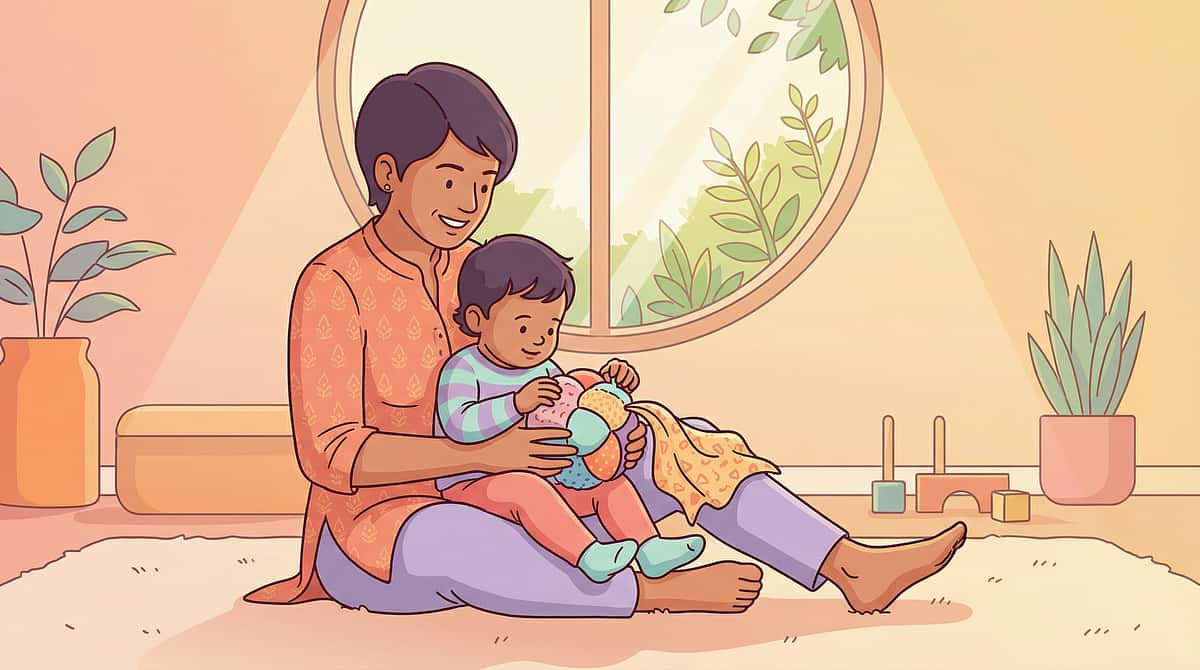
9 Materials That Help With Throwing at People
Throwing at People — Redirection & Impulse Control | D-389 | Pinnacle Blooms Network®
The arm wants to release. Let's teach it where and how. Science-backed. Home-ready. Built for families like yours.

The arm went back. Something flew. Someone got hurt.
You've been watching his face change — the jaw sets, the hand reaches for the nearest object, and before you can move, it's in the air. You've gotten calls from school. You've split your lip. You've hidden the hard toys. You're not imagining this. And you are absolutely not alone.
"You are not a bad parent. Your child is not dangerous. They are a young child with a strong arm, big feelings, and a nervous system that moves faster than words. This is behavior — and behavior can change."
🧠 ABA/BCBA Led
Functional behavior assessment and replacement training.
🤸 OT Integrated
Sensory-motor protocols that satisfy the proprioceptive need.
💬 SLP Supported
Communication alternatives so words replace the arm.
Pinnacle Blooms Network® — ABA/BCBA + OT + SLP + SpEd + NeuroDev + CRO Consortium | Serving 70+ Countries | 20M+ Sessions | 97%+ Measured Improvement
1 in 3 Children Ages 2–5 Exhibit Throwing Behavior. You Are Not Raising a Problem Child.
If your child is throwing objects at people, you are navigating one of the most reported — and most solvable — behavioral challenges in early childhood. The families sitting in Pinnacle centers across 70+ cities came in with exactly this fear. You are among an estimated 8–12 million families in India whose children show throwing behavior in the 2–5 year developmental window. The science to address it is well-established. The materials are available. The path is clear.
30–40%
Children Ages 2–5
Show throwing behavior during frustration or conflict. Source: American Academy of Pediatrics
1/54
ASD Diagnosis Rate
Children diagnosed with ASD in India, where motor impulse dysregulation affects behavioral expression. Source: Indian J Pediatr (2019)
80%
Sensory Differences
Of children with ASD show sensory-motor processing differences that can drive throwing behavior. Source: PRISMA Review, PMC11506176

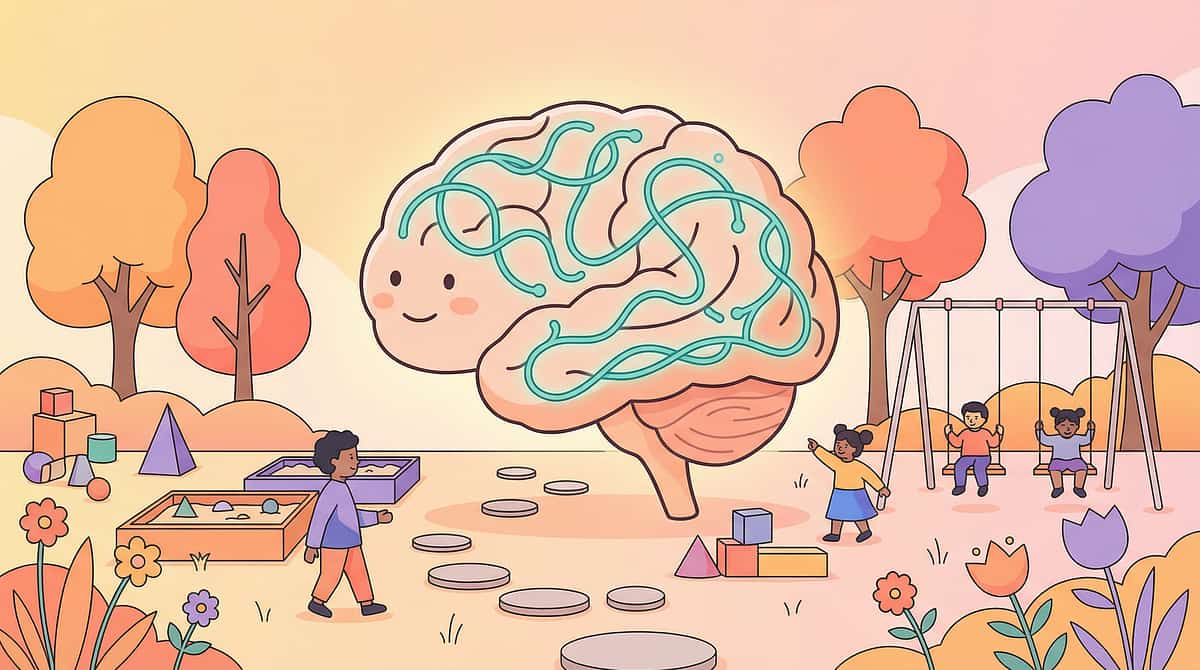
The Prefrontal Cortex — "The Brake"
Still under construction in children under 6. The neural pathway that says "stop, think, choose" is literally not yet wired to full function.
The Amygdala — "The Trigger"
Fires immediately at frustration, conflict, or threat. In children with ASD or sensory-motor differences, this fire is faster and more intense.
The Motor Cortex
The body has learned that throwing releases tension — the arm, shoulder, and core receive deep proprioceptive feedback that is genuinely satisfying to the nervous system.
The Impulse Is Faster Than the Words. Here's the Neuroscience.
In children ages 2–5, the amygdala fires → the motor cortex responds → the arm moves. The prefrontal brake hasn't arrived yet. This is not defiance. This is developmental neurology.
"Your child's brain is not broken. The 'stop and think' part of their brain is still being built — neuroscience tells us it completes construction around age 25. At 3 years old, they have a powerful engine and no braking system yet. Our job is to give them external brakes — materials, environments, and practiced pauses — until their internal brake matures."— Pinnacle BCBA / ABA Clinical Team
Level I Evidence
Peer-Reviewed
Frontiers in Integrative Neuroscience (2020): DOI: 10.3389/fnint.2020.556660 | NCAEP Evidence-Based Practices Report (2020)

Throwing Peaks at 2.5–5 Years. Here's What the WHO Developmental Map Shows.
Understanding where your child sits in the developmental arc is the first step to realistic expectations — and effective action.
12–24 Months
Throwing is exploration — objects, gravity, cause-and-effect. Normal and expected.
2–3 Years
Throwing emerges as frustration release. Language is limited; motor strength is surging. Peak onset.
3–5 Years ← YOU ARE HERE
Strong arm, limited verbal expression, immature impulse control, expanding social conflicts. Peak risk window.
5–6 Years
Most children reduce throwing significantly as language expands and impulse control matures.
6+ Years
Persistent throwing past this point indicates impulse control difficulties or reinforced behavioral patterns requiring professional assessment.
Throwing at people commonly co-occurs with: Limited verbal expression, sensory-motor seeking, impulse control challenges, emotional dysregulation, ASD, ADHD, and developmental delays. Source: WHO Care for Child Development Package (2023) | UNICEF MICS indicators | PMC9978394
Not Intuition. Not Advice. Peer-Reviewed Evidence for Behavior Replacement.
🛡️ Level I Evidence
Systematic Review + RCT
Finding 1 — Functional Behavior Analysis Works
NCAEP 2020 Review: FCT and Differential Reinforcement are evidence-based practices for reducing object aggression in ASD. Across 28 studies, replacement behavior training reduced target behaviors by 60–85%.
Finding 2 — Proprioceptive Input Reduces Motor-Driven Aggression
PRISMA Systematic Review (PMC11506176, 2024): 16 studies confirm sensory-motor integration as evidence-based practice. Heavy work and proprioceptive input reduce sensory-seeking aggressive behaviors.
Finding 3 — Impulse Control Is Trainable
Frontiers Neuroscience (2020): Structured practice in stop-and-go activities measurably strengthens prefrontal inhibitory control in children 3–6.
Finding 4 — Home-Based Intervention Produces Clinical Outcomes
Indian RCT (Padmanabha, Indian J Pediatr, 2019): Home-based behavioral interventions demonstrate outcomes statistically equivalent to clinic-based programs when parent training is provided.
References: PMC11506176 | PMC10955541 | PMC9978394 | NCAEP 2020 | DOI: 10.1007/s12098-018-2747-4 | DOI: 10.3389/fnint.2020.556660

Throwing at People: Redirection, Replacement & Impulse Control
Technique D-389
Age 2–7 Years
Daily Practice
Parent-Friendly Alias: "Give the Arm a Safe Target"
Throwing objects at people is a functional behavior — it serves a specific purpose for your child: releasing frustration, seeking proprioceptive input, communicating a need they can't express in words, or getting a reaction. It is not violence. It is not a character flaw. It is a behavior with a function.
The goal is never to eliminate the child's need to release energy or express frustration. The goal is to teach the arm WHERE and the brain WHEN.
🧠 ABA/BCBA
Primary lead
🤸 OT
Sensory-motor
💬 SLP
Communication
📚 SpEd
Impulse control
Five Disciplines. One Integrated Response.
Throwing at people is rarely one-dimensional. It involves motor systems, emotional regulation, communication ability, behavioral learning, and neurological development — each governed by a different specialty. The Pinnacle FusionModule™ converges all five into one home-executable plan.
ABA / BCBA (Primary Lead)
Conducts Functional Behavior Assessment (FBA) to identify WHY throwing is happening. Designs replacement behavior training, reinforcement schedules, and consequence protocols. Measures frequency, duration, intensity.
Occupational Therapist
Assesses whether throwing is sensory-motor driven. Designs heavy work protocols, throwing targets, and sensory regulation strategies that satisfy the motor need safely.
Speech-Language Pathologist
Assesses whether throwing is a communication substitute. Builds functional communication alternatives using AAC, PECS, communication cards, or verbal scripts.
Special Educator
Implements impulse control curriculum, social stories, and self-regulation teaching in structured learning contexts. Manages school-based accommodation plans.
NeuroDev Pediatrician
Rules out neurological, metabolic, or pharmacological factors in severe or persistent throwing. Coordinates medical management where indicated.
"The brain doesn't organize behavior by therapy type. Your child's throwing doesn't care whether it's an OT problem or an ABA problem — it's a whole-child problem. That's why FusionModule™ converges all five disciplines into one plan." — Pinnacle Blooms Network® Consortium
Three Parallel Targets. Three Simultaneous Outcomes.
Effective throwing intervention works on three fronts at the same time — not sequentially. Safety comes first, but all three targets are pursued together from day one.
Immediate Safety
Goal: Reduce injury risk to siblings, peers, and caregivers within the first 2 weeks.
How: Designated throwing stations + removal of dangerous objects from conflict zones + trigger identification.
Measure: Zero thrown objects striking people per day.
How: Designated throwing stations + removal of dangerous objects from conflict zones + trigger identification.
Measure: Zero thrown objects striking people per day.
Behavioral Replacement
Goal: Establish a functional alternative that serves the SAME purpose as throwing — but safely.
How: The alternative must be equally satisfying, equally accessible, equally fast.
Measure: Child uses safe alternative in ≥3 of 5 observed frustration moments.
How: The alternative must be equally satisfying, equally accessible, equally fast.
Measure: Child uses safe alternative in ≥3 of 5 observed frustration moments.
Impulse Control Development
Goal: Build the neural pause between "want to throw" and "arm moves."
How: Daily impulse control games that literally strengthen prefrontal inhibitory circuits through repeated practice.
Measure: Child can stop mid-action in game context; begins transferring to real situations.
How: Daily impulse control games that literally strengthen prefrontal inhibitory circuits through repeated practice.
Measure: Child can stop mid-action in game context; begins transferring to real situations.

9 Materials. Each One Serves a Specific Function. Together They Transform the Pattern.
Every material below addresses a specific mechanism of throwing behavior. Use them in the priority order shown — sensory-motor needs first, then communication, then impulse control, then prevention, then reinforcement.
# | Material | Function | Budget | |
1 | Throwing Targets & Safe Stations | Motor Outlet | ₹200–800 | |
2 | Heavy Work & Proprioceptive Activities | Sensory-Motor Input | ₹200–600 | |
3 | Communication Cards & Frustration Tools | Communication Replacement | ₹100–400 | |
4 | Calm-Down Kits & Regulation Tools | Early Escalation Prevention | ₹300–800 | |
5 | Social Stories: Hands & Safe Choices | Neural Script Building | ₹150–500 | |
6 | Visual Cues & Hands-Down Reminders | Environmental Interruption | ₹100–300 | |
7 | Trigger Identification & Prevention Charts | Pattern Prevention | ₹100–300 | |
8 | Reinforcement Systems for Safe Choices | Behavior Motivation | ₹150–500 | |
9 | Impulse Control Games & Stop-Think Practice | Brake Building | ₹100–400 |
Starter Kit (₹500–1,200 total): Soft balls + basket | Stress ball | Basic communication cards (I'm angry / help / break) | Safe hands visual | Sticker chart

Before You Begin: What the Consortium Needs You to Know
Most Important Principle: "Don't try to eliminate throwing. Redirect it." A child with a motor need to throw who is only told "NO" will escalate. The alternative must be provided immediately and made more satisfying than the original behavior.
✅ Safety DO List
- Remove hard, heavy, and sharp objects from active conflict zones
- Create a designated throwing station with ONLY soft, safe objects
- Never leave throwing child unsupervised with infants or toddlers
- Shadow during known high-risk situations until behavior reduces
- Attend to the victim first — thrower gets less attention, not more
- Keep response brief, calm, and neutral: "No throwing at people. Throw at your target."
❌ Safety DON'T List
- Never throw objects back — this models the behavior
- Never use lengthy explanations mid-escalation — the dysregulated brain cannot process them
- Never use physical force to stop the arm — this escalates and models aggression
- Never ignore the behavior entirely if someone is being hurt
- Never remove the throwing target as punishment — this removes the safe outlet
Seek Professional Assessment If:
- Throwing persists beyond age 5–6 despite consistent intervention
- Frequency or intensity is increasing
- Throwing causes significant injury
- Other aggressive behaviors co-occur
#1 of 9
Motor Outlet
Primary Priority
₹200–800
Material 1: Throwing Targets & Safe Throwing Stations
"Give the arm somewhere to go."
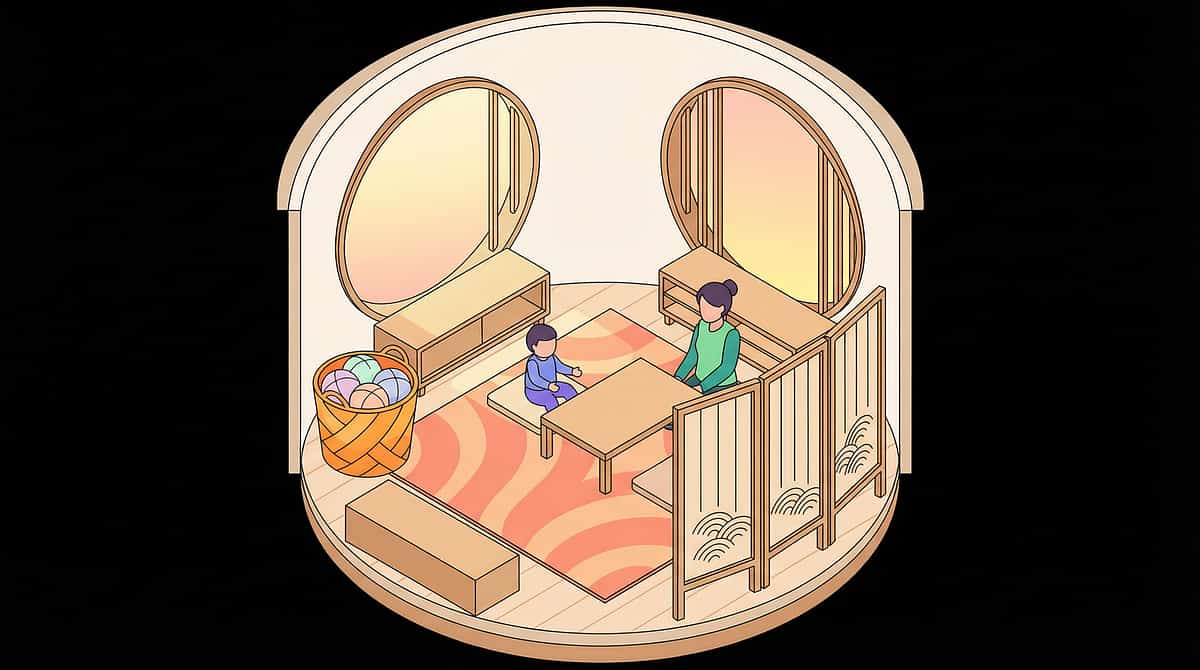
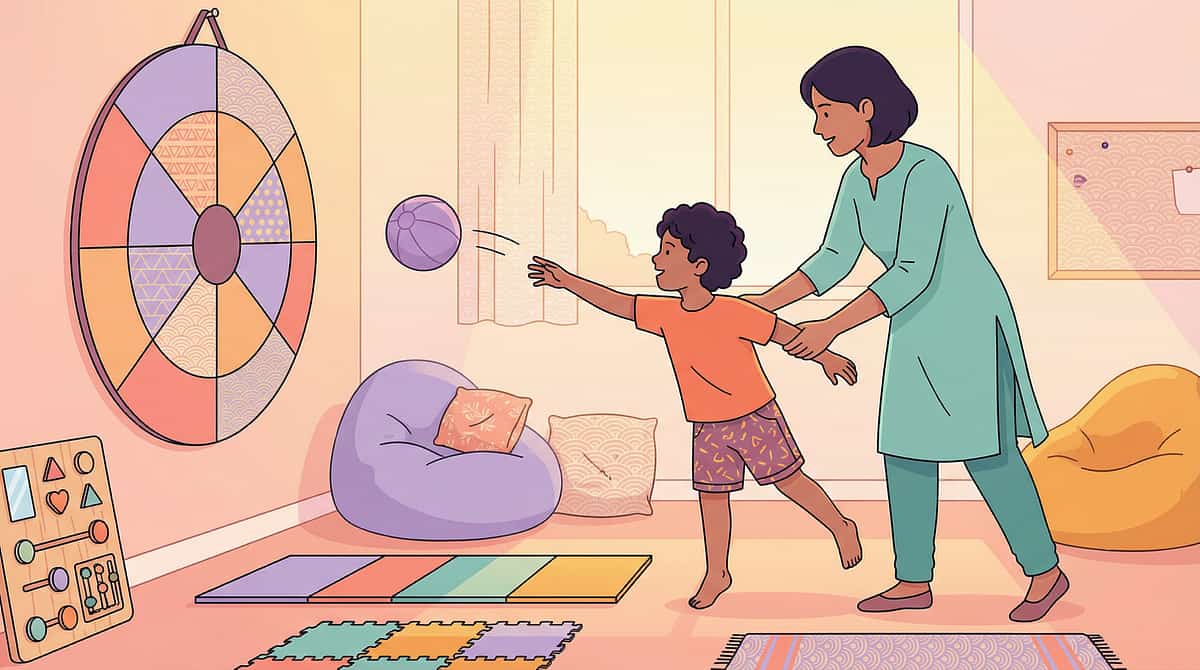
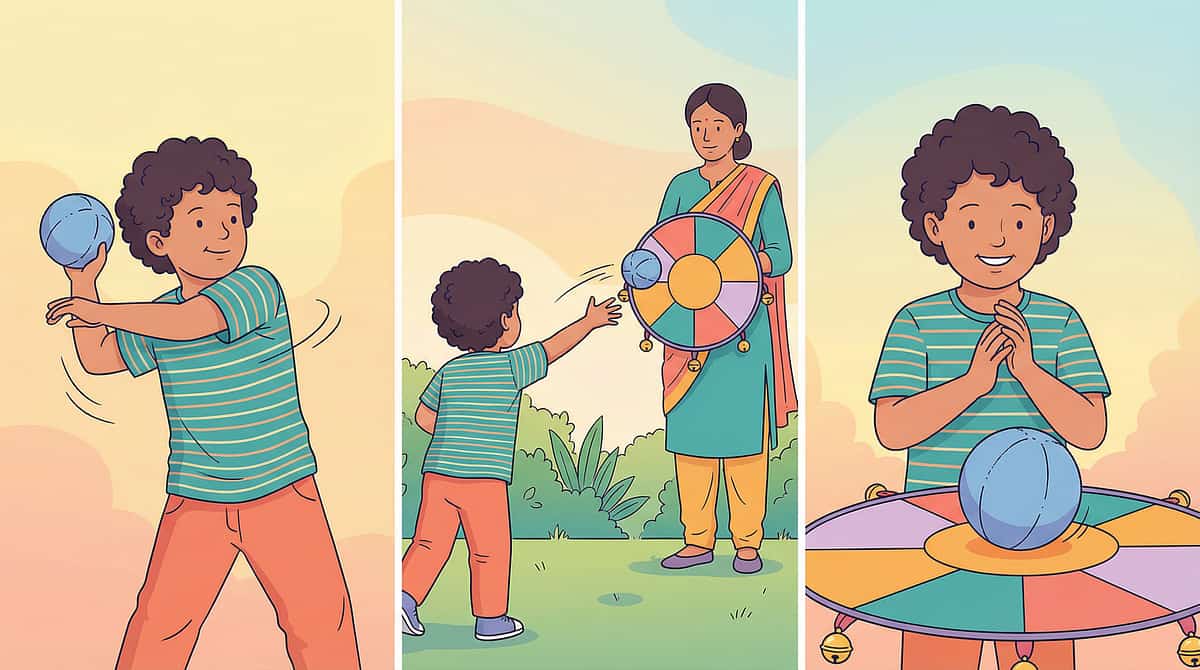
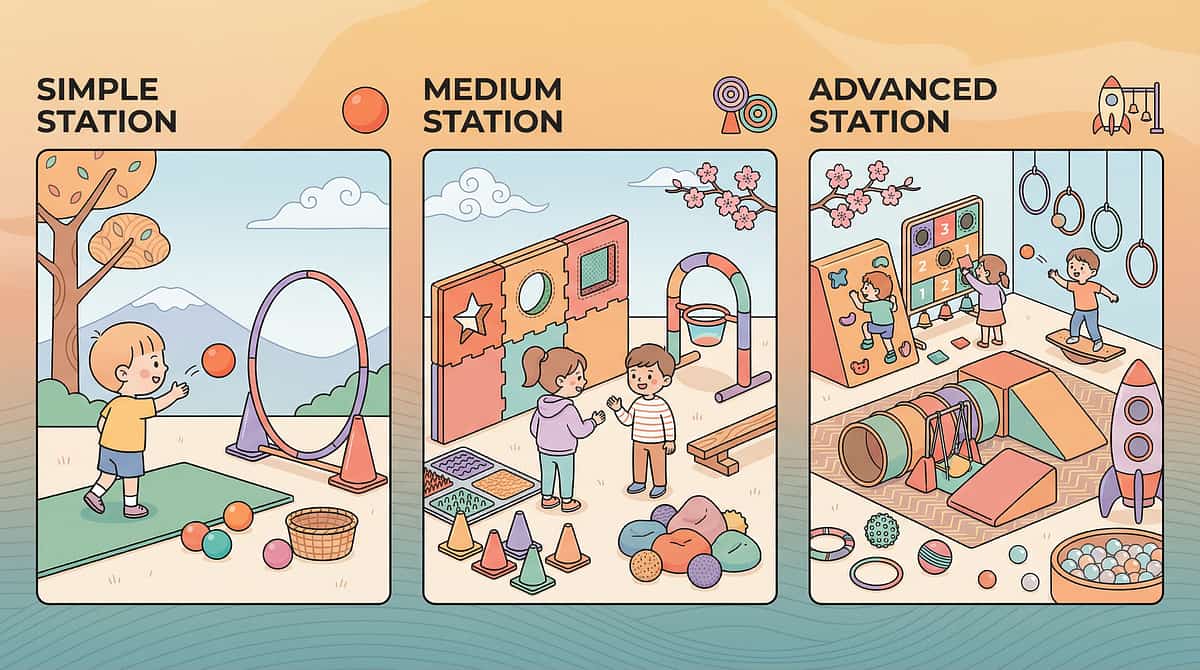
Children who throw at people often have a genuine motor need to throw. The release motion — arm back, shoulder loading, full-body core engagement, projectile release — provides intense proprioceptive feedback that the nervous system finds deeply satisfying. Trying to stop all throwing ignores this motor need and creates a behavioral vacuum. A designated throwing station says "YES, you CAN throw — throw HERE."
WHAT
A designated physical space where throwing soft objects is always allowed and celebrated.
WHY
Satisfies the proprioceptive release need; gives the impulse a sanctioned outlet.
WHEN
Available 24/7; actively directed to at first signs of frustration.
HOW
Child throws soft balls at target; caregiver celebrates. Rule: "Throwing happens HERE, not at people."
DIY Protocol (₹0 Version)
- Choose a wall space or corner — designate it the "Throwing Zone"
- Use a laundry basket or cardboard box as the target
- Collect soft objects: rolled socks, soft balls, beanbags made from fabric scraps, foam blocks
- Mark the throwing line with tape on the floor (1–2 meters from target)
- Practice together daily — make it fun, not therapeutic
- At first sign of frustration, redirect: "Time for your throwing station!"
The throwing station becomes a celebrated part of the home. The child runs to it when frustrated. The need is met. The people are safe. The child is proud.

#2 of 9
Sensory-Motor Input
OT Lead
₹200–600
Material 2: Heavy Work & Proprioceptive Activities
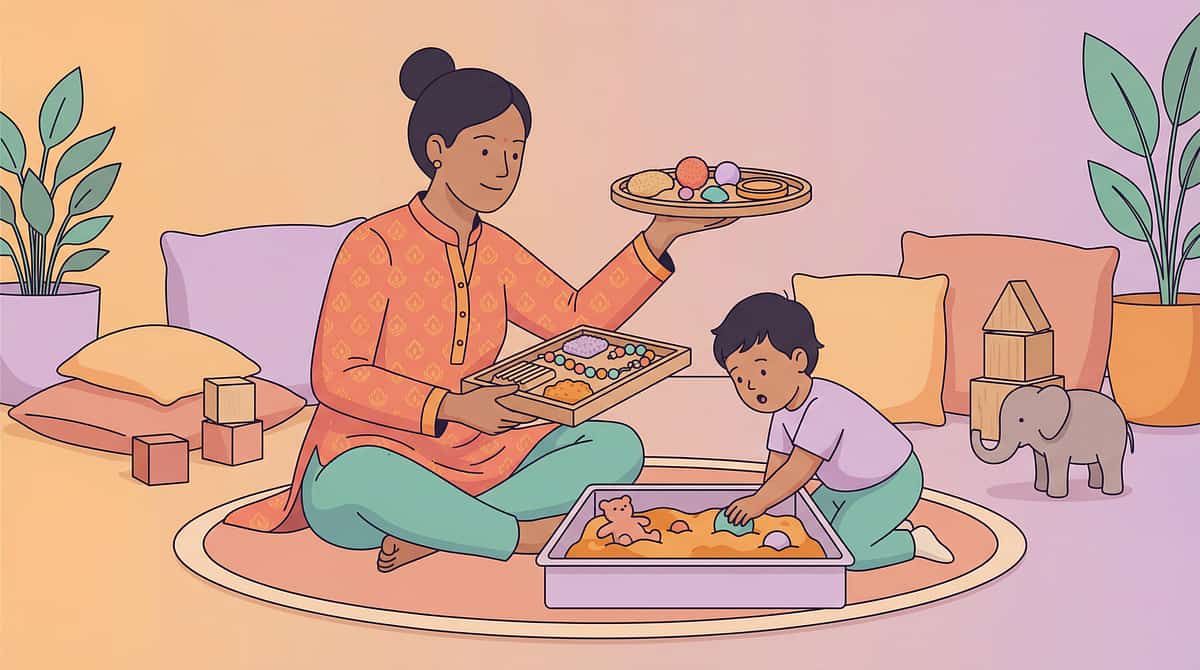
Throwing provides intense proprioceptive input — deep pressure and resistance through the shoulder, arm, and core. Heavy work activities provide the same neurological input without danger. Pushing, pulling, carrying, wall push-ups, and resistance work give the nervous system what it's seeking. When proprioceptive needs are met proactively, sensory-driven throwing decreases.
Wall Push-Ups
When frustrated: 10 slow reps against wall. Delivers deep shoulder and core proprioceptive input equivalent to throwing.
Weighted Transitions
Carrying a weighted backpack during transitions proactively fills sensory-seeking needs before frustration peaks.
Heavy Chores
Carrying grocery bags, stacking books, pushing heavy boxes — real work that delivers real sensory satisfaction.
Bear Hug Compression
Firm 10-second hold from caregiver delivers full-body proprioceptive input. Free, immediate, and powerful.
Pulling & Wagon Activities
Pulling sibling in wagon or resistance band pulling engages the same muscle chains as throwing — safely.
DIY ₹0 Version: Wall push-ups + carrying books + bear hugs = free proprioceptive input. Purchase option: Weighted lap pad (₹500–1,200 | Search: Amazon.in weighted lap pad for kids)
#3 of 9
Communication Replacement
SLP Lead
₹100–400
Material 3: Communication Cards & Frustration Expression Tools
Throwing often happens when words fail. The child cannot say "I'm furious," "that's not fair," "I need help," or "STOP" fast enough — so the arm acts instead. Communication cards are pre-made, pictured messages that the child can grab and hand to an adult in 1 second. When communication becomes easier and faster than throwing, throwing becomes unnecessary.
Critical Rule: Cards must be honored immediately and enthusiastically. If throwing gets a faster response than a card, throwing will persist.
The 5 Core Cards
I'M ANGRY
THAT'S NOT FAIR
I NEED HELP
I NEED A BREAK
STOP
How to Do It at Home
- Print or hand-draw cards; laminate with tape
- Attach to child's shirt pocket, backpack, or velcro strip on wall
- Teach card use when calm — practice 5x per day during neutral moments
- When card is used, respond immediately: "You showed me your angry card. I hear you. Let's fix this together."
DIY ₹0 Version: Hand-drawn on index cards, laminated with tape. Takes 20 minutes.

#4 of 9
Early Escalation Interception
OT + ABA Lead
₹300–800
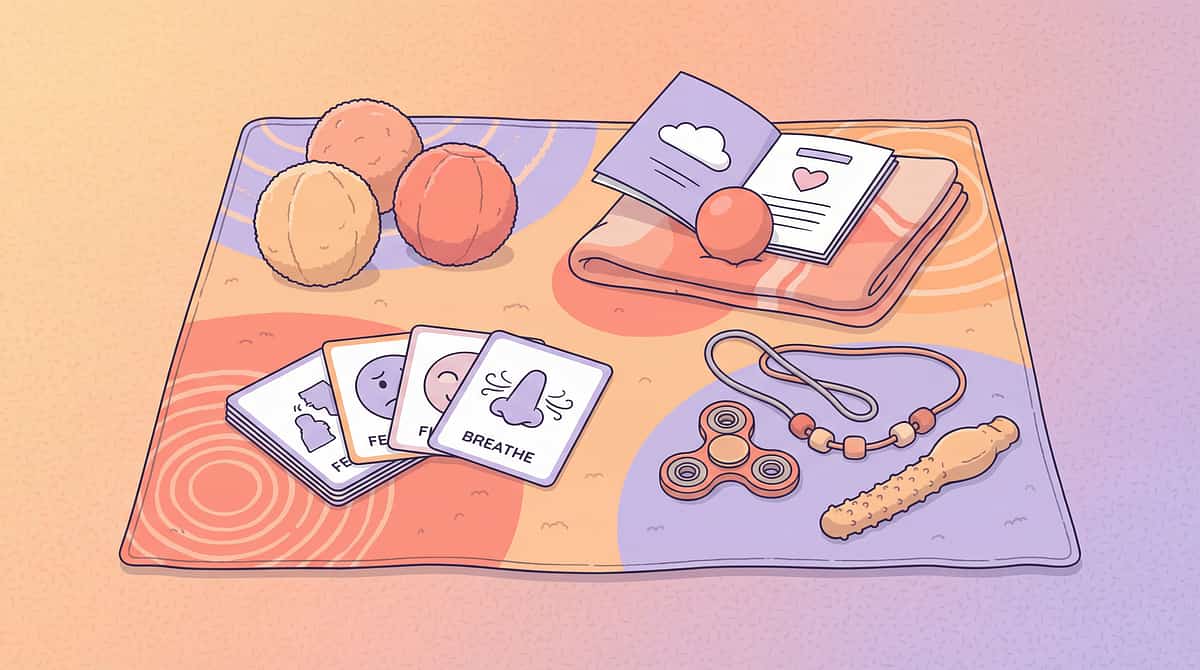
Material 4: Calm-Down Kits & Regulation Tools
Throwing happens at peak arousal — when the child's regulatory system is overwhelmed. Calm-down kits provide tools to regulate BEFORE the throwing threshold is reached. Used at the first signs of escalation — face tightening, voice raising, body tensing — they interrupt the arousal pathway before it reaches the arm.
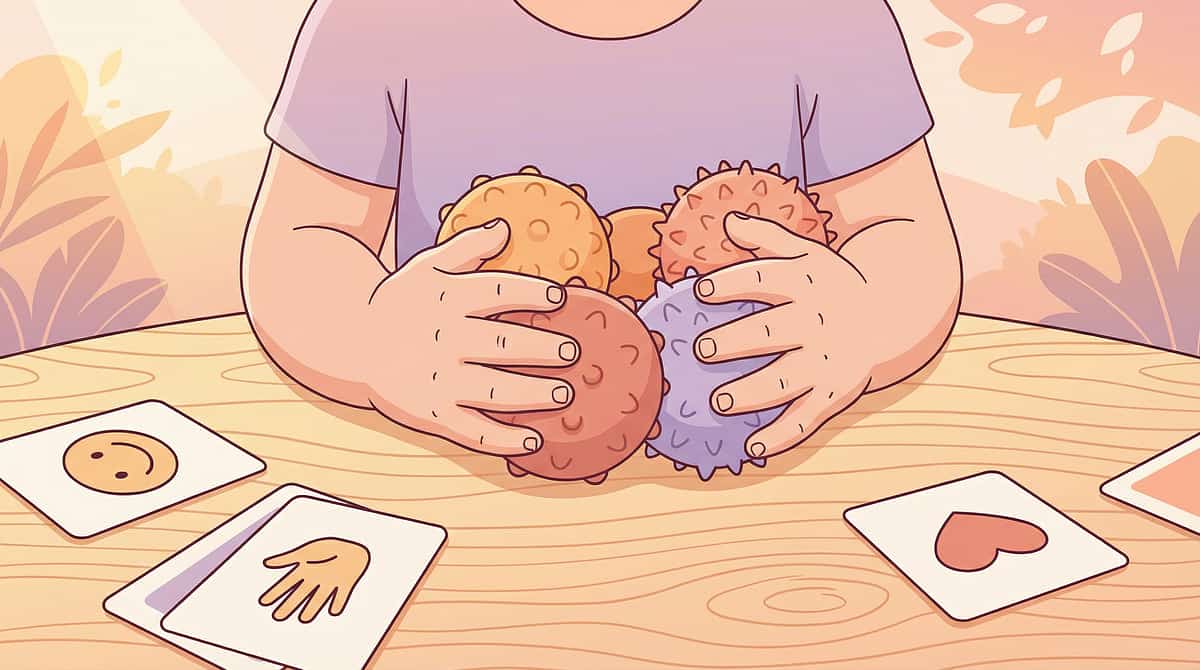
🟠 Stress Ball / Squeeze Toy
Deep pressure for hands — a proprioceptive outlet the moment frustration begins.
🟠 Resistance Band
Pulling provides proprioceptive input to the same arm and shoulder muscles used for throwing.
🟠 Breathing Pinwheel / Bubbles
Breath regulation activates the parasympathetic nervous system — the body's own calming response.
🟠 Calming Photo Card
Child's safe person, pet, or happy place. Visual grounding during emotional flooding.
🟠 Timer Visual
Shows how long to use kit. Predictability reduces anxiety and supports self-regulation.
🟠 Fidget / Sensory Item
Tactile engagement redirects sensory-seeking hands from throwing to safe exploration.
DIY ₹0 Version: Sock filled with rice (squeeze toy) + rubber band (resistance) + hand-drawn timer = complete starter kit.
#5 of 9
Neural Script Building
SpEd + SLP Lead
₹150–500
Material 5: Social Stories About Hands & Safe Choices
Social stories create cognitive scripts for what to do instead of throwing. The brain needs to have a "movie" of the alternative already loaded — so when the trigger hits, the script plays. Daily reading when calm (NOT during incidents) builds neural pathways for "When I'm angry, I can..." — so the brain has an answer before the arm asks the question.
How to Do It at Home
- Create or print a 5–8 page story: "My name is [child]. When I'm angry, my arm wants to throw. But I can throw at my target. Or I can squeeze my stress ball. My hands are for helping and playing."
- Read EVERY morning and EVERY night — repetition builds the neural pathway
- Use child's actual photos if possible for maximum personalization
- Include all four narrative elements: feeling → old behavior → new behavior → outcome
DIY ₹0 Version: Staple 8 index cards + child's drawings = personalized social story book. Takes 30 minutes to create. Lasts a lifetime.
#6 of 9
Environmental Interruption
ABA + SpEd Lead
₹100–300
Material 6: Visual Cues & 'Hands Down' Reminders
In the moment of impulse, verbal warnings don't penetrate fast enough. The brain is moving at impulse speed. A visual cue posted at child's eye level — "SAFE HANDS" picture, STOP sign, or throwing-station arrow — can catch visual attention and trigger the pause in 0.5 seconds. Eyes catch what ears miss.
Where to Post
- Entry to every room at child's eye level
- Above the toy storage area
- Next to the child's seat at meals
- On the back of the front door
- In the backpack and school bag
What to Post
- Large red STOP hand image
- Arrow pointing to throwing station
- "SAFE HANDS" with picture of open palms
- Photo of child successfully using throwing station
DIY ₹0 Version: Print or hand-draw a large red STOP hand image + arrow pointing to throwing station. Laminate with tape. Post everywhere. Takes 15 minutes. Works immediately.

#7 of 9
Pattern Prevention
ABA/BCBA Lead
₹100–300
Material 7: Trigger Identification & Prevention Charts
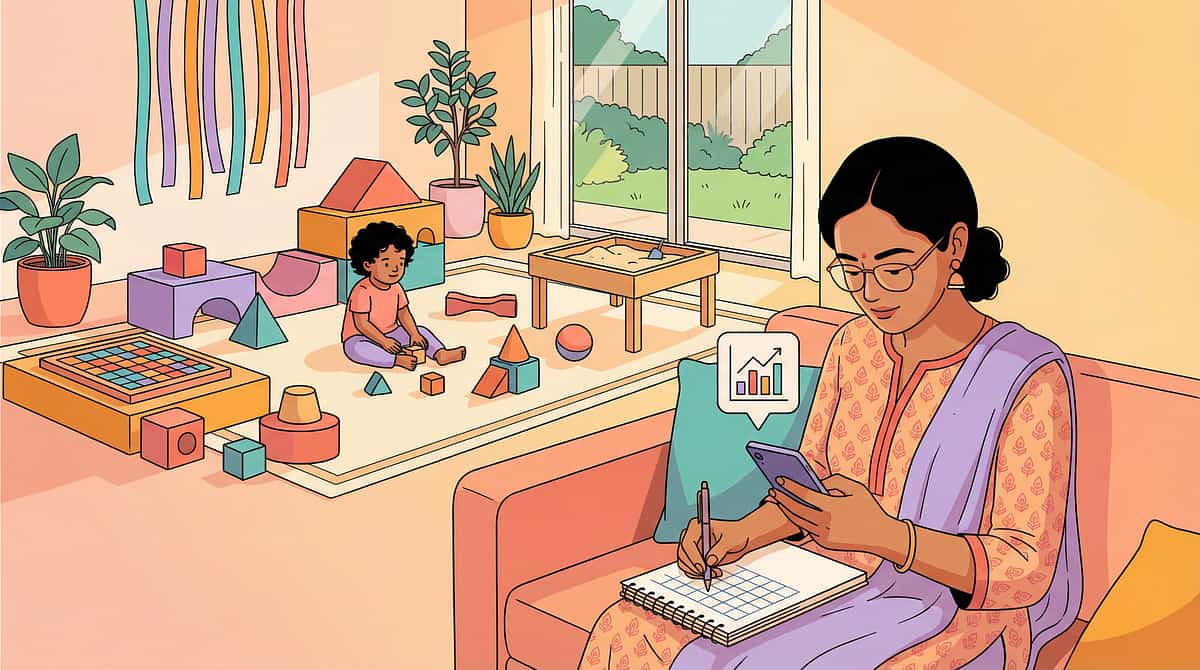
Most throwing behavior is predictable before it is preventable. When you know that sharing toys with a specific sibling, ending screen time, being told "no," or being tired past 7pm triggers throwing — you can intervene before the trigger activates. Prevention is always more effective than reaction. Two weeks of tracking transforms your response from reactive to proactive.
How to Build Your Trigger Map
Track for 2 Weeks
Record: What was happening just before each throwing incident? Activity | Person | Time | Environment
Identify Patterns
Does throwing happen more with a specific sibling? At meals? When tired? During transitions? At the end of screen time?
Create Your Prevention Plan
Extra support during high-risk windows. Modify trigger situations. Proactive regulation input before known triggers.
DIY ₹0 Version — Your Trigger Log: Simple notebook with columns: TIME | WHAT WAS HAPPENING | WHO WAS THERE | WHAT WAS THROWN | AT WHOM. Review weekly. Patterns emerge within days.

#8 of 9
Behavioral Motivation
ABA/BCBA Lead
₹150–500
Material 8: Reinforcement Systems for Safe Choices
Behavior increases when it is reinforced. Safe choices need to pay off visibly, immediately, and meaningfully. When using words, walking away, or throwing at the target earns a real, tangible, celebrated reward — the brain learns that the alternative is MORE rewarding than throwing ever was.
This is not bribery — it is learning. ABA research across 40+ years: immediate, specific, positive reinforcement is the most powerful behavioral change tool available. The "reward" is temporary — the behavior pattern becomes permanent.
Praise Scripts — Say Exactly This
"You were so angry, and you threw at your TARGET. That took SO much control. I am so proud of you."
"You used your words instead of throwing. Do you know how hard that is? I am beyond proud."
"You started to throw and you STOPPED YOURSELF. That's the strongest thing I've ever seen you do."
Reinforcement Menu
- High-five + verbal celebration (always; costs ₹0)
- Reward sticker on chart
- Token in reward jar
- 5 minutes of preferred activity
- Child chooses next game
ABA Principle: Immediate reinforcement > Delayed reinforcement. Specific reinforcement > Generic praise. Celebrate the attempt, not just the success.
#9 of 9
Brake Building
ABA + OT + NeuroDev Lead
₹100–400
Material 9: Impulse Control Games & Stop-and-Think Practice
The ability to stop a movement mid-action is trainable through repeated practice. Freeze dance, red light/green light, Simon Says, and ready-set-GO games all exercise the same prefrontal inhibitory circuits that would stop a throw mid-motion. Playing 10 minutes of freeze games daily is literally strengthening the neural brake that will eventually interrupt throwing.
Freeze Dance
Music stops → body freezes immediately (even mid-throw motion). Direct training of the inhibitory pause.
Red Light / Green Light
Running → stop on command. Builds rapid motor inhibition in a joyful, low-stakes context.
Simon Says
Only obey "Simon says" commands. Builds inhibitory control through selective listening.
Balloon Tap
Keep balloon in air without it touching the floor. Sustained gentle control — the opposite of explosive throwing.
Slow Motion Walking
Cross the room as slowly as possible. Maximum inhibitory control through every step.
DIY ₹0 Version: All games require zero materials. 10 minutes daily. Maximum neural impact. Research: Frontiers in Integrative Neuroscience (2020): DOI: 10.3389/fnint.2020.556660

Before Every Session: The 90-Second Readiness Check
A throwing behavior intervention session started when the child is already dysregulated will worsen behavior, not improve it. The best session is one that starts right. Check these indicators before every active session — this 90-second habit protects your progress.
✅ GO — 5 to 7 Checks Met
Child is at baseline regulation (not currently distressed) | Basic needs met: not hungry, not tired, not ill | At least 30 minutes since last throwing incident | Adult is regulated and calm | Throwing station is set up | Communication cards are accessible | 15–20 minutes of uninterrupted time available. → Proceed to Step 1: The Invitation.
⚠️ MODIFY — 3 to 4 Checks Met
Use a shorter, simpler version. Skip structured practice — focus on gentle proactive input. Offer heavy work or throwing station play without therapeutic structure.
🔴 POSTPONE — 0 to 2 Checks Met
Meet immediate needs first. Use calm-down kit. Allow 20-minute reset. Do not push through — there are no extra points for starting when conditions are wrong.
"The best intervention session is one that begins with a regulated child and a regulated caregiver." — Pinnacle ABA Clinical Protocol
Step 1 of 6
The Invitation
Step 1: The Invitation — Every Protocol Begins With Choice, Not Command
The child is brought into the activity through choice and play — never coercion. This is where ABA's pairing principle meets OT's just-right challenge. An invited child is an engaged child.
"Hey [Name], I set up your throwing station — want to come try it with me? I made it really good today."Or during early frustration: "I can see you're getting frustrated. Do you want to throw some balls at your target?"
Body Language
- Crouch to child's eye level
- Open, relaxed posture — no tensed shoulders
- Gentle, warm tone — inviting, not testing
- Pause and wait 5–10 seconds for response
Reading the Response
Acceptance Cues: Moving toward station | Eye contact | Body orienting | "Yeah" or nodding | Taking your hand
Resistance Cues: Turning away | "No" or ignoring | Body tensing | Escalating distress
If Resistance: Don't force. Say: "No problem — your station is ready when you want it." Walk away. Try again in 10 minutes.
Timing: 30–60 seconds | Research Basis: ABA Pairing Procedures: Motivating operations must be established before demand placement. Forced compliance increases avoidance.

Step 2 of 6
The Engagement
Step 2: The Engagement — Deepening Involvement and Starting Reinforcement
The child is now moving toward the activity. This step deepens their involvement by introducing the throwing station or communication material. Reinforcement schedule begins here — every positive approach is celebrated immediately and warmly.
For Throwing Station
"Here are your throwing balls. The basket is your target. Every time you hit it, I want to hear about it! Ready — you go first." Present balls at arm height, step back to give space, model once if needed.
For Communication Cards
"I see your angry face. Here is your angry card — can you hand it to me?" Hold card toward child, wait 5 seconds, guide hand to card if needed, accept any approximation.
Response Indicators
- Engagement: Child picks up ball, looks at target, tries to throw
- Tolerance: Child near station but not fully engaged — acceptable, continue gently
- Avoidance: Child moves away or protests — scale back, offer free play near station
Reinforcement Cue: Any approach → immediate warm praise: "YES! You came to your station!" | Timing: 1–3 minutes

Step 3 of 6
The Therapeutic Action
Step 3: The Therapeutic Action — The Core Active Ingredient
This is the specific motor practice, communication replacement, or impulse control activity that constitutes the active ingredient of the intervention. This step should occupy 40–60% of total session time — 5 to 10 minutes of focused therapeutic exposure.
Throwing Station Practice
Child throws 5–10 soft objects at target. Adult: counts aloud each successful throw, provides enthusiastic celebration for target hits, redirects missed throws calmly ("Almost! Try again"), introduces body awareness ("Feel your shoulder? That's the throw energy going into the basket!"), and after 5–10 throws asks: "How does your body feel? Less full?"
Communication Card Practice
Set up low-stakes frustration scenario (take a toy away briefly). Wait. When frustration cue appears: point to card, accept card use or pointing with full celebration, immediately resolve frustration ("You used your card — I'll give it back right now"), label the success: "THAT is what we do instead of throwing!"
Impulse Games
5 rounds of freeze dance or red light/green light. Each successful FREEZE is celebrated as directly as a throwing station success — equal energy, equal enthusiasm.
✅ Ideal
Full engagement + safe alternative used
⚠️ Acceptable
Partial engagement + adult-assisted use
🔴 Concerning
Complete refusal + escalating distress → end session, re-read the Readiness Check

Step 4 of 6
Repeat & Vary
Step 4: Repeat & Vary — Therapeutic Dosage and Engagement
The brain learns through repetition — but engagement requires variation. 3 excellent repetitions build more neural pathway than 10 forced ones. End before satiation. Leave them wanting more.
Target Repetitions Per Session
- Throwing station practice: 3–5 rounds
- Communication card practice: 3–5 frustration scenarios
- Impulse control games: 5–8 stop-and-start cycles
Satiation Indicators
- Looking away, body turning away
- Throwing softening (losing force)
- Increased distraction
- Seeking to move to another activity
Variation Options
- Change throwing distance (closer = easier, farther = harder)
- Change target size (larger basket = easier, smaller = harder)
- Change throwing object (lighter vs. weighted for different input levels)
- Change frustration scenario for communication cards
- Change freeze-game music style to maintain interest
Weekly Dose
3–5 structured sessions per week | Daily environmental embedding — station always available, cards always accessible.
"3 good reps > 10 forced reps." — Pinnacle Clinical Dosage Principle

Step 5 of 6
Reinforce & Celebrate
Step 5: Reinforce & Celebrate — The Most Critical Step
Behavior that is reinforced increases. This is the most critical step in the protocol — and the most frequently underdelivered. Reinforcement must be immediate (within 3 seconds), specific (name the exact behavior), and enthusiastic (match the energy to the achievement).
"You were so angry, and you threw at your TARGET. That took SO much control. I am so proud of you."
"You used your words instead of throwing. Do you know how hard that is? I am beyond proud."
"You froze perfectly. Your brain is getting so strong at stopping. This is training your throwing brake!"
High-Five + Verbal Celebration
Always. Immediate. Costs ₹0. Never skip this — it is the most powerful reinforcer available.
Sticker on Reward Chart
Visual progress tracking that the child can see and feel proud of. Tangible evidence of growth.
Token in Reward Jar
Accumulate tokens toward a preferred reward. Teaches delayed gratification while maintaining motivation.
Preferred Activity Choice
5 minutes of preferred activity, or child chooses the next game. Autonomy as reinforcement.
Step 6 of 6
The Cool-Down
Step 6: The Cool-Down — No Session Ends Abruptly
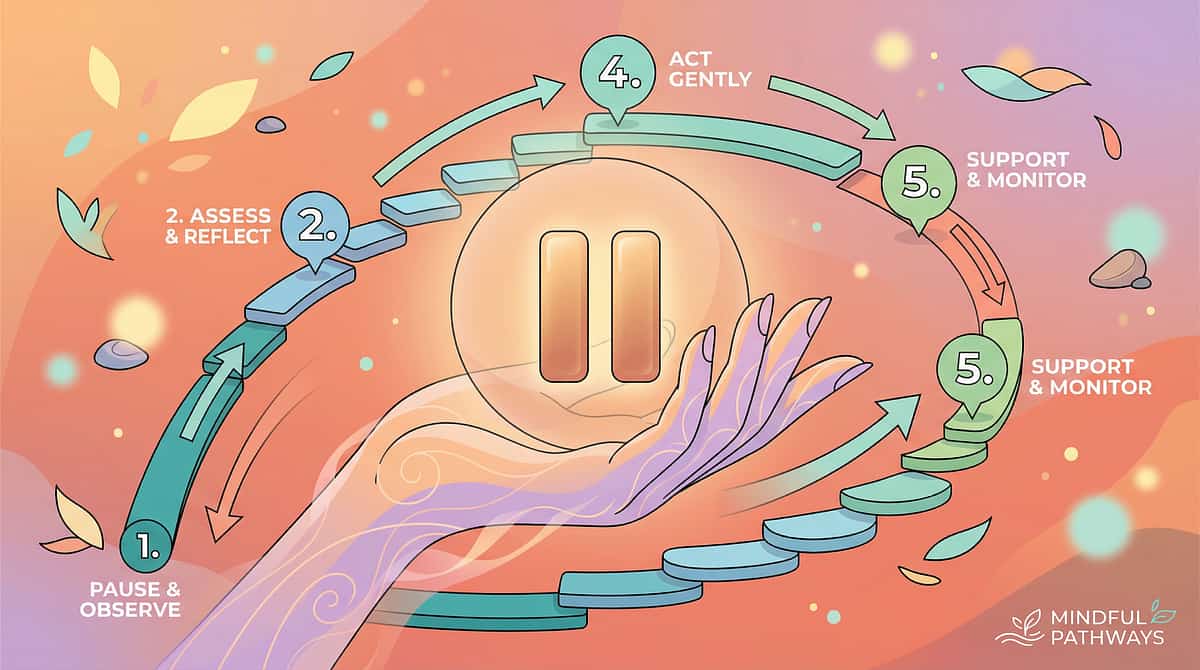
The cool-down transitions the child from therapeutic engagement back to baseline. This prevents post-session dysregulation and creates a positive association with the entire protocol. A child who ends a session feeling good will approach the next one with less resistance.
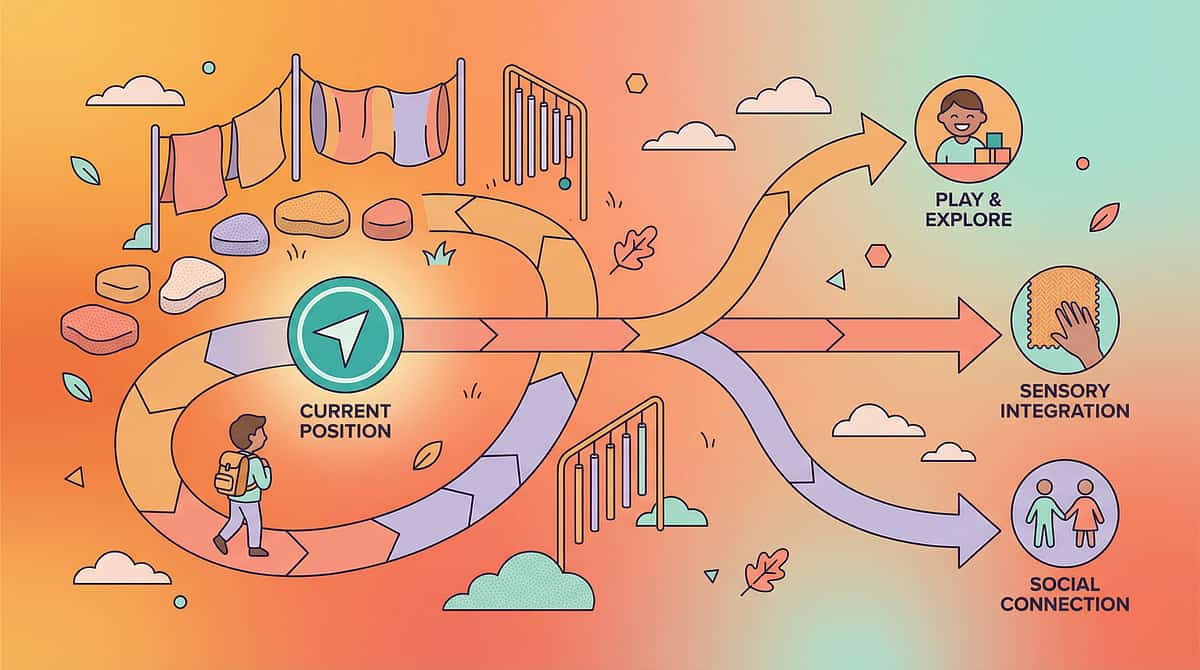
60 Seconds. 3 Data Points. This Is How Progress Gets Measured.
Without data, you're guessing. With 2 weeks of data, patterns emerge. With 4 weeks, trends are clear. With 8 weeks, you have evidence of what is working — and GPT-OS® can adapt your plan accordingly. Record today's session right now while it's fresh.
Field 1: Throwing Incidents
How many throwing incidents at people occurred today? Track the number. Even "zero" is data worth recording.
Field 2: Safe Alternative Use
Did the child use a safe alternative (station / card / heavy work) when frustrated? Record: independently | with prompt | not yet
Field 3: Best Material Today
Which material worked best? Throwing station | Heavy work | Communication card | Calm-down kit | Other
What Good Data Looks Like at Week 2: Throwing incidents trending down from baseline | Safe alternative used at least occasionally with prompting | Child showing any awareness of throwing station as an option
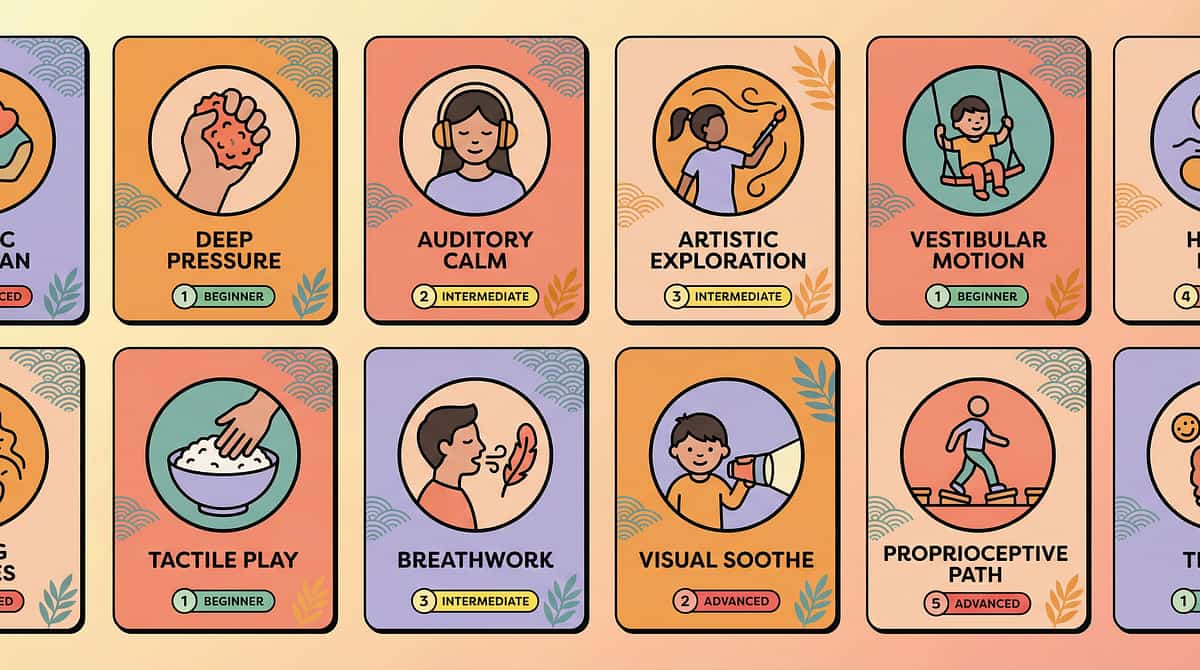
Week 1–2: Safety Improves First. Behavior Changes Second.
Progress: ~15%
Awareness Phase
This week will feel like it's not working. It is. The brain is taking inventory. The neural pathways are being surveyed. Hold the protocol. Track the data. Call if needed.
✅ What You WILL Likely See
- Throwing station being used occasionally (with prompting)
- Communication cards being explored (not yet reliable)
- Heavy work beginning to reduce pre-throw tension
- Child showing some awareness of the station as an option
- Throwing incidents may temporarily increase — this is an extinction burst. It means the intervention is being noticed.
❌ What Is NOT Progress Yet — And That's Okay
- Child independently choosing safe alternative without prompt (weeks 4–6)
- Communication cards replacing throwing in real frustration moments (weeks 3–5)
- Impulse control transferring to real situations (weeks 6–10)
Measure of Real Progress at Week 2: If your child looks at the throwing station when frustrated — even without going to it — that is the beginning of the neural pathway forming.

Week 3–4: The Neural Pathways Are Forming. Here's How to See Them.
Progress: ~40%
Consolidation Phase
Consolidation is the most hopeful phase of the protocol — the phase where the invisible becomes visible. You won't see a complete behavior change yet, but you will see the beginning of intentionality. The brain is building. Watch for these specific signs.
Child moves toward throwing station WITHOUT prompting on some occasions
This is the single most important early indicator. The neural pathway exists when the child reaches for it independently.
Communication cards being picked up when frustrated
Even if not handed correctly yet — any card-reaching behavior counts. The communication channel is opening.
Vocabulary emerging: "I need to throw"
Language appearing before the action means the prefrontal brake has arrived in the circuit. This is enormous.
Throwing incidents decreasing in frequency
Not eliminated — but trending downward. The trend matters more than any single day's count.
Parent feeling more confident
"You may notice you are not dreading every social situation anymore. That is progress too."
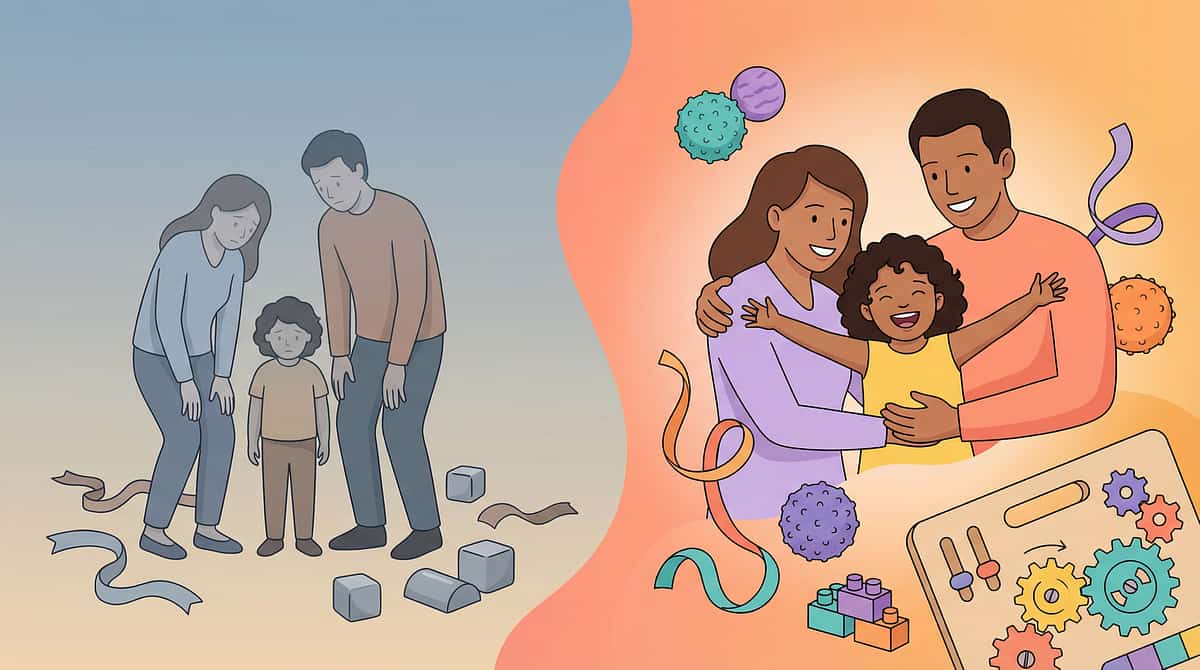
Week 5–8: The Safe Choice Becomes a Real Choice.
Progress: ~65%
Mastery Emergence
This is the window where the alternative stops being a therapeutic exercise and starts being a real behavioral option. The child begins to experience themselves as capable of self-control — and that identity shift accelerates everything.
Independent Station Use
Child uses throwing station independently in 3+ of 5 frustration moments. The external prompt has become internal.
Communication Cards Reliable
Cards being used reliably in some contexts. The verbal channel is now competing with the motor channel.
40–60% Reduction from Baseline
Throwing incidents measurably reduced. This is the outcome range predicted by the NCAEP 2020 evidence base.
Self-Awareness of Triggers
Child can name their own trigger: "I get mad when my sibling takes my toy." Metacognition emerging.
Generalization Begins
Safe choice appearing in a new setting — grandparents' home, school. The behavior is no longer tied to one environment.
Intrinsic Pride Emerges
Child helps set up throwing station, may remind others of rules. Ownership and identity shift underway.
Frequency Adjustment: Formal sessions can reduce to 2–3x per week. Environmental materials remain in place 24/7. Data collection continues — this is where the trend line becomes visible. Source: NCAEP 2020: FBA-based replacement behavior training produces 60–85% reduction across 8–12 weeks.

Your Child Made a Safe Choice When Every Instinct Said Throw. That Is Extraordinary.
When your child is frustrated, has a throwing object in their hand, is looking at a person — and chooses the throwing station, the communication card, or the heavy work instead — that is the most sophisticated neural achievement of their developmental life to this point.
Celebrate It — Specifically and Memorably
Name It Specifically
"You wanted to throw at me. You chose your basket. That was your brain being STRONG." Naming the exact choice makes it real and repeatable.
Create a Milestone Marker
Let them put a special sticker on the wall. Frame it. This moment deserves a physical anchor in the environment.
Tell the Family Story
"This child learned to redirect their arm." Tell it to siblings, grandparents, teachers. Social recognition accelerates maintenance.
Connect to Their Future
"When you're big, you'll still feel angry sometimes. You already know what to do." Plant the identity that lasts.

These Signs Mean It's Time to Call: Free Assessment Available Now.
Home-based intervention is powerful — and most families succeed with it. But there are specific indicators that mean a professional Functional Behavior Assessment is needed. Don't wait past these signals.
🚩 Behavior Escalating
Throwing frequency or intensity is INCREASING after 4+ weeks of consistent intervention. The protocol is not matching the function.
🚩 Significant Injury
Throwing causes significant injury — head injury, bleeding, black eyes. Immediate professional assessment required.
🚩 Persistent Past Age 5–6
Despite consistent protocol. Age-inappropriate persistence signals impulse control or neurological factors requiring evaluation.
🚩 Co-occurring Aggression
Biting, hitting, spitting, or property destruction co-occur. Multi-behavior aggression requires comprehensive FBA.
🚩 Zero Empathy Awareness
Child shows no awareness of impact on thrown-at person after weeks of intervention. Requires specialized evaluation.
🚩 School Safety Risk
School has indicated the child is a safety risk to others. Professional coordination with school is urgent.
Free Assessment Path:📞 9100 181 181 | AbilityScore® Assessment | Functional Behavior Assessment (FBA) | 70+ Pinnacle centers across India | pinnacleblooms.org
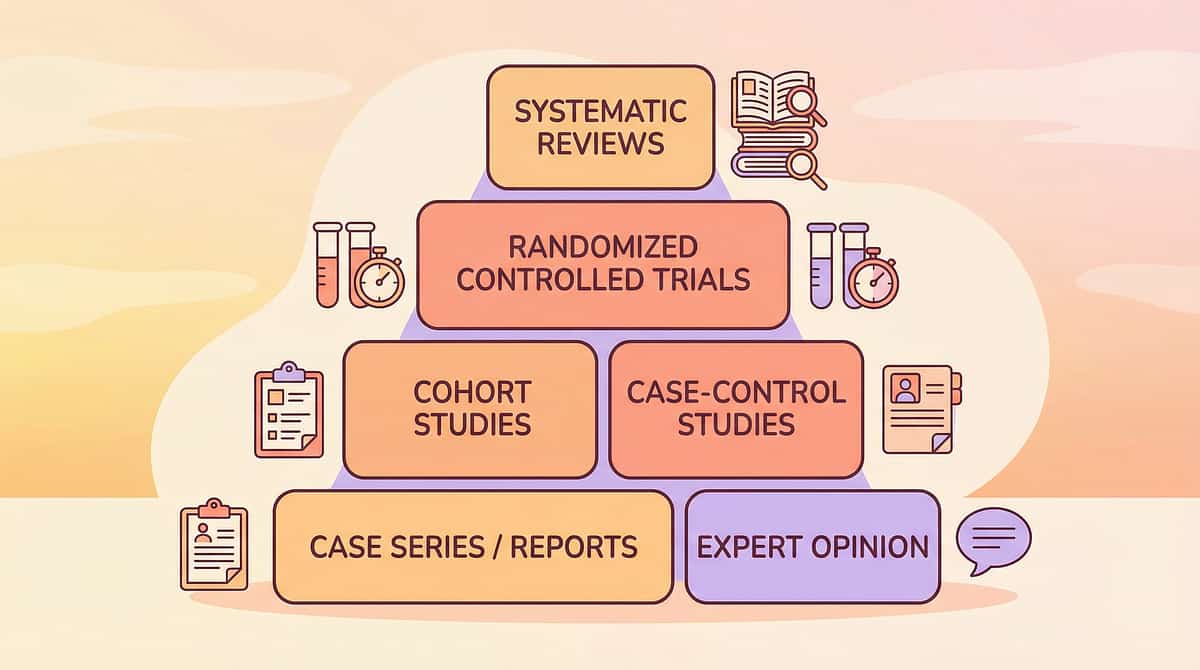
Throwing at People Is One Behavior. Impulse Control Is the Whole System.
Every family who completes D-389 is not just addressing throwing — they are building the foundational capacity for self-regulation that determines academic outcomes, peer relationships, and long-term mental health. This is the larger arc.
Stage 1 — Where You Started
Frequent throwing at people | No safe alternatives | Arm acts faster than brain
Stage 2 — Where You Are
Beginning to redirect | Some safe alternative use | Building awareness
Stage 3 — Ahead
Consistent safe alternative | Decreasing throwing incidents | Self-awareness of triggers
Stage 4 — The Target
Generalized impulse control | Safe choices across all settings | Behavioral readiness for school, peers, community
Stage 5 — What This Unlocks
Children who master impulse control by age 6 show measurably better academic outcomes, social integration, and lifetime mental health. This is not about stopping throwing. It is about building the human.
Related Techniques in This Cluster
Domain D: Behavior Analysis & Positive Behavior Support
Domain D contains 500+ techniques addressing the full spectrum of behavioral challenges in pediatric development. D-389 sits within the Motor Aggression sub-cluster alongside kicking (D-387), hair pulling (D-388), property destruction (D-390), and spitting (D-391).
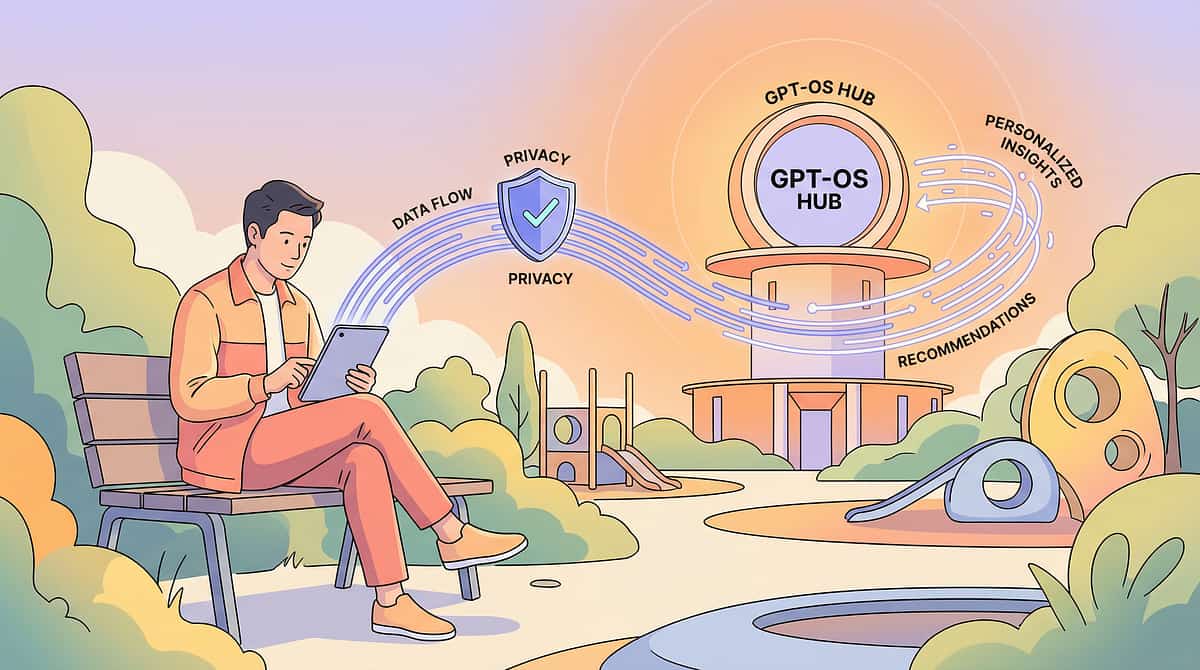
Your session data from D-389 flows into the Behavioral Readiness Index and Impulse Control Readiness Index. As these indexes improve, GPT-OS® TherapeuticAI® automatically adjusts the recommended next techniques and intensity levels — so your plan evolves with your child.
Your Child's Development: 12 Domains. One Converged Plan.
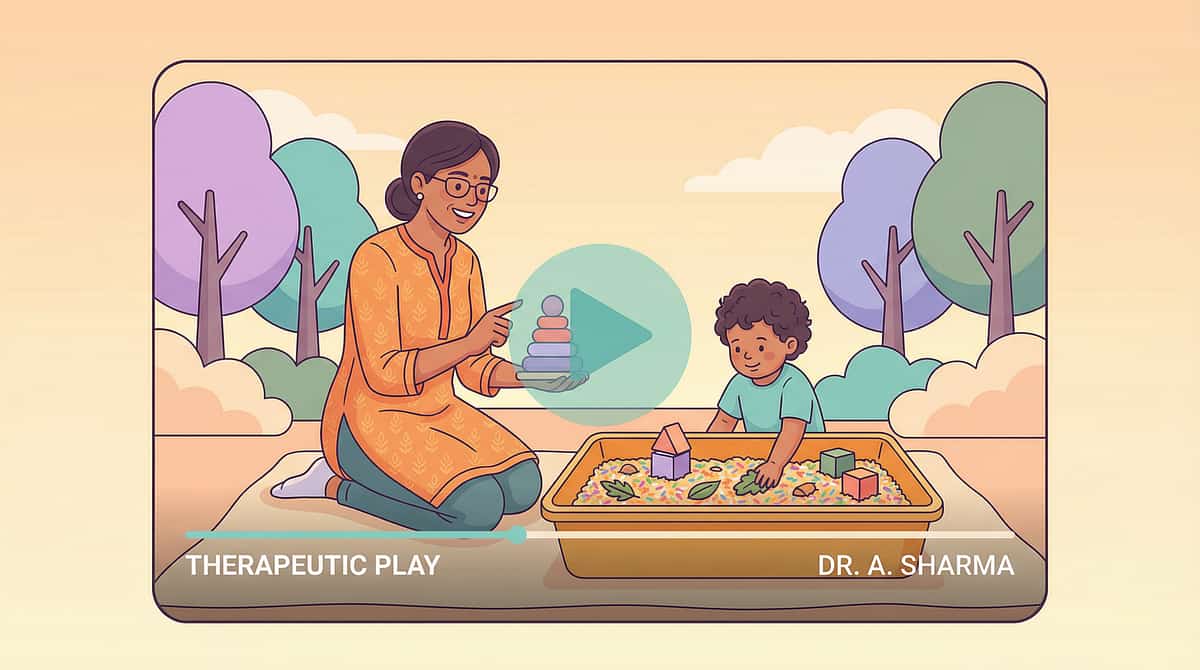
Throwing at people engages Domains A (sensory), B (communication), C (emotional), and D (behavior) simultaneously. This is why FusionModule™ converges all four domains into one plan. D-389 is one coordinate on a whole-child developmental map.
Domain | Focus | Relationship to D-389 | Status | |
A | Sensory Processing | Often co-active — proprioceptive needs drive throwing | Co-active | |
B | Social Communication | Communication deficits → throwing as expression | Co-active | |
C | Emotional Regulation | Dysregulation is the trigger for the throw | Co-active | |
D | Behavior Analysis | Primary intervention domain — YOU ARE HERE | Active | |
E | Feeding & Oral Motor | Occasionally co-occurring in complex profiles | Monitor | |
F | Motor Development | Motor planning and coordination factors | Monitor | |
G | Cognitive Development | Problem-solving and self-awareness building | Monitor | |
J | Play & Leisure | Throwing station IS a play-based intervention | Active | |
K | Family & Caregiver | Caregiver training is the delivery mechanism | Active |
"Therapy is not a list of problems to fix. It is a map of a human being becoming. Every technique is a coordinate on that map." — Pinnacle Blooms Network® Clinical Philosophy

They Were Exactly Where You Are.
Every family in the Pinnacle network arrived with the same fear. These anonymized accounts — drawn from real clinical journeys — show what the protocol looks like from the inside.
Arjun's Story — Age 3.5
Before: Called "the thrower" at nursery school. Hit a teacher with a wooden block and split her forehead. At home he had broken two lamps, a window, and given his baby sister a black eye. "We were terrified to have anyone visit. I would scan every room for throwable objects before anyone came in."
What happened: Throwing baskets in every room. Only soft balls. Heavy work before every high-risk situation — pushing his cart around the block, wall push-ups before school. His OT identified proprioceptive seeking. They learned his triggers and started intercepting at the trigger, not the throw.
After (8 months): "He uses his throwing basket every day. He hasn't thrown at a person in over a year. His teachers say they forget he ever had a throwing problem." — Anonymized | Pinnacle Network Parent
From the Therapist's Notes
"Arjun's throwing was proprioceptively driven — classic sensory-motor seeking. The basket wasn't a reward; it was a sensory match. Once his body had somewhere equally satisfying to throw, the people-throwing became unnecessary. The heavy work was the other half — it reduced the sensory pressure that was building up and seeking release." — Pinnacle BCBA + OT Team
Join the Community
You are not solving this alone. 8 million families are on this path with you. The Pinnacle Parent Network connects families navigating the same challenge — moderated by BCBAs, available 24 hours, real strategies that have been tried in real homes.
- WhatsApp Parent Group — D-389 Throwing Behavior | Moderated by Pinnacle BCBA
- Online Forum — Behavior & Impulse Control | 6,000+ parents
- Monthly local meetups → pinnacleblooms.org/centers
Peer Mentoring: Connect with a parent who has walked this exact path and arrived at a place of safety. Available through the helpline: 9100 181 181
Every Question Parents Ask — Answered.
These are the questions that come up most consistently in Pinnacle helpline calls, assessment intakes, and parent forums. If yours isn't here, call 9100 181 181 — free, 24x7, 16+ languages.
Will the throwing station teach my child that throwing is okay?
No. The station teaches that throwing is okay in ONE specific place — at safe objects, at a target. This is the same principle as teaching that running is okay outside but not in the house. The rule is crystal clear: people are never targets. Objects are only thrown at the designated target. This specificity, when taught consistently, actually reduces indiscriminate throwing.
My child is 6 — is it too late?
No. Children up to 7–8 respond well to this protocol. Children older than that may need a more formal FBA and structured ABA program, but the same principles apply. Call 9100 181 181 for age-specific guidance.
How long until the throwing stops?
For sensory-motor driven throwing with consistent protocol execution: 6–8 weeks for significant reduction (40–60%). For frustration-driven throwing with communication replacement: 4–6 weeks. For impulse-control-driven throwing: 8–12 weeks. Individual variation is significant — FBA removes the guesswork.
My child throws at school but not at home (or vice versa). Why?
The function of throwing may differ across environments. At home, throwing may be attention-maintained. At school, it may be escape-maintained (to end demands). This is exactly why FBA is so powerful — it identifies the function in EACH setting. Call for assessment if this pattern is present.
Should I punish the throwing?
Brief, calm natural consequences (end the activity for 2 minutes) are appropriate. Harsh punishment, yelling, or physical intervention are not — they increase arousal and therefore increase the risk of throwing. The most powerful response: attend to victim warmly, give thrower 1 sentence of neutral redirection, redirect to safe alternative.
What if siblings are terrified of my throwing child?
This is real and important. Teach the sibling to say "STOP" and move away immediately — then get an adult. Never leave the throwing child unsupervised with younger siblings. Create physical separation systems if needed. The sibling also needs support and acknowledgment of their fear. This is a whole-family challenge.
Is my child autistic if they throw?
Throwing is not diagnostic of autism. It is common in the 2–5 year developmental window for all children. However, if throwing is particularly frequent, intense, or resistant to intervention — AND if other developmental differences are present — a developmental evaluation may be warranted. Call 9100 181 181 for free guidance.
Can we do this at the same time as clinic therapy?
Absolutely yes — this protocol is designed to extend and reinforce what clinic therapists are doing. Share this page with your therapist. Ask them to align the throwing station setup and communication cards with their clinic protocol. Consistency between home and clinic doubles effectiveness.

The Throwing Station Can Be Set Up in the Next 20 Minutes.
One laundry basket. A bag of soft balls. A sign that says "THROW HERE." That is enough to begin today.
Action 1 — Start Today (Free)
Set Up Your Throwing Station Guide — download the 5-step setup checklist.
unknown link
unknown link
Action 2 — Free Personalized Assessment
📞 Call FREE Helpline: 9100 181 181
Available 24x7 | 16+ Languages | No cost | No obligation. Our team will tell you within 15 minutes whether an FBA is needed and what the next step should be for YOUR child.
Available 24x7 | 16+ Languages | No cost | No obligation. Our team will tell you within 15 minutes whether an FBA is needed and what the next step should be for YOUR child.
Action 3 — Book an AbilityScore® Assessment
India's most comprehensive pediatric developmental baseline — 349 skills, 79 developmental abilities, one clarity-giving score.
pinnacleblooms.org/abilityscore
pinnacleblooms.org/abilityscore
"Eight months from now, you will not remember the last throwing incident. You will remember the throwing basket. You will remember the morning you stopped being afraid of your child's arm. That day is coming. Start the basket today."
20M+
Sessions
97%+
Measured Improvement
70+
Centers & Countries
Preview of 9 materials that help with throwing at people Therapy Material
Below is a visual preview of 9 materials that help with throwing at people therapy material. The pages shown help educators, therapists, and caregivers understand the structure and content of the resource before use. Materials should be used under appropriate professional guidance.


Link copied!

You Came Here Looking for Help With Throwing. You Found a System.
This page contains the full clinical evidence, the complete 9-material toolkit, the step-by-step protocol, the progress arc, and the professional support path for throwing behavior in children 2–7. More than that — it contains the scientific understanding that your child is not a thrower. They are a child whose nervous system needs help expressing what it feels, releasing what it holds, and learning the pause between impulse and action.
✅ Consortium-Reviewed
Reviewed by Pinnacle's ABA/BCBA, OT, SLP, SpEd, and NeuroDev clinical consortium
✅ Evidence-Validated
Validated against peer-reviewed evidence — full references on the Research page
✅ Field-Tested
Implemented across 20M+ therapy sessions in 70+ centers and 70+ countries
✅ WHO/UNICEF Aligned
Aligned with WHO Nurturing Care Framework and UNICEF developmental standards
Continue the Journey
← Previous Technique:
D-388: Hair Pulling and Grabbing
D-388: Hair Pulling and Grabbing
→ Next Technique:
D-390: Property Destruction
D-390: Property Destruction
Pinnacle Blooms Network® | Built by Mothers. Engineered as a System. | ABA/BCBA + OT + SLP + SpEd + NeuroDev + CRO | 70+ Centers | 20M+ Sessions | 70+ Countries
Powered by GPT-OS® — Global Pediatric Therapeutic Operating System | AbilityScore® | TherapeuticAI® | EverydayTherapyProgramme™ | FusionModule™
Powered by GPT-OS® — Global Pediatric Therapeutic Operating System | AbilityScore® | TherapeuticAI® | EverydayTherapyProgramme™ | FusionModule™
CIN: U74999TG2016PTC113063 | DPIIT: DIPP8651 (Govt. of India) | MSME: Udyog Aadhaar TS20F0009606 | GSTIN: 36AAGCB9722P1Z2
📞9100 181 181 — FREE National Autism Helpline | 16+ Languages | 24x7 | 🌐pinnacleblooms.org | 📧care@pinnacleblooms.org
Disclaimer: This content is educational and produced by the Pinnacle Blooms Network® clinical consortium. It does not replace professional functional behavior assessment or behavior intervention planning by qualified professionals. Persistent, escalating, or injurious throwing behavior requires comprehensive professional evaluation. Behavior intervention must be individualized based on functional assessment. Individual outcomes vary by child, function of behavior, and intervention consistency.
© 2025 Pinnacle Blooms Network®, unit of Bharath Healthcare Laboratories Pvt. Ltd. All rights reserved. GPT-OS®, AbilityScore®, TherapeuticAI®, EverydayTherapyProgramme™, FusionModule™ are proprietary to Pinnacle Blooms Network®. Unauthorized reproduction prohibited.