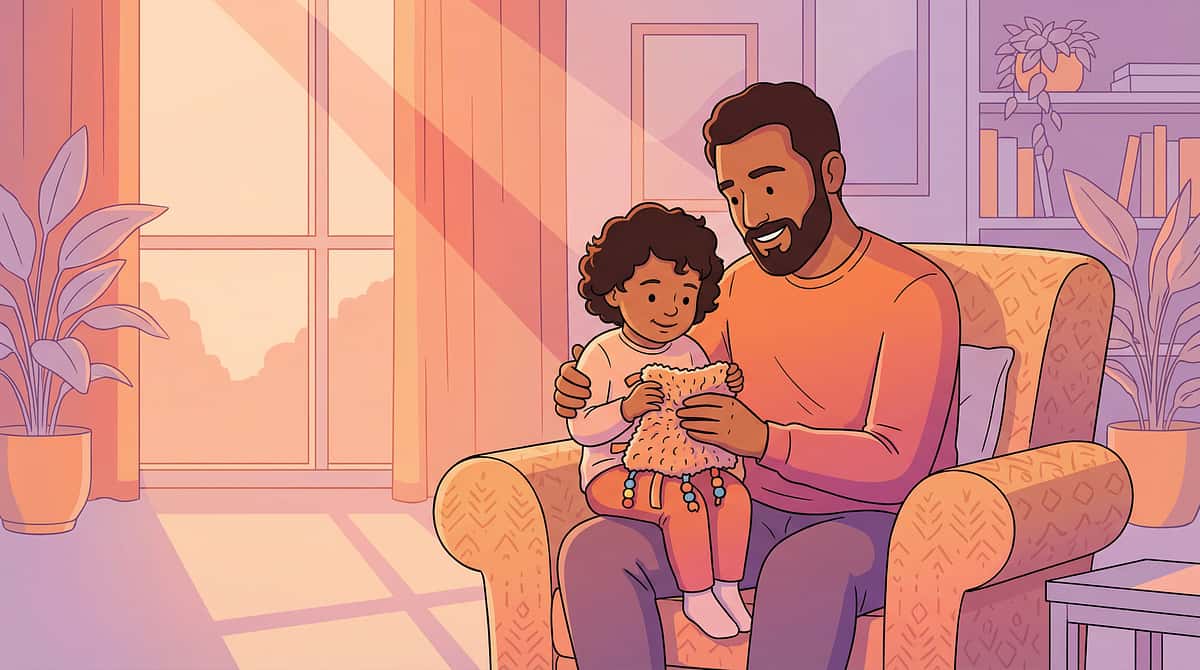
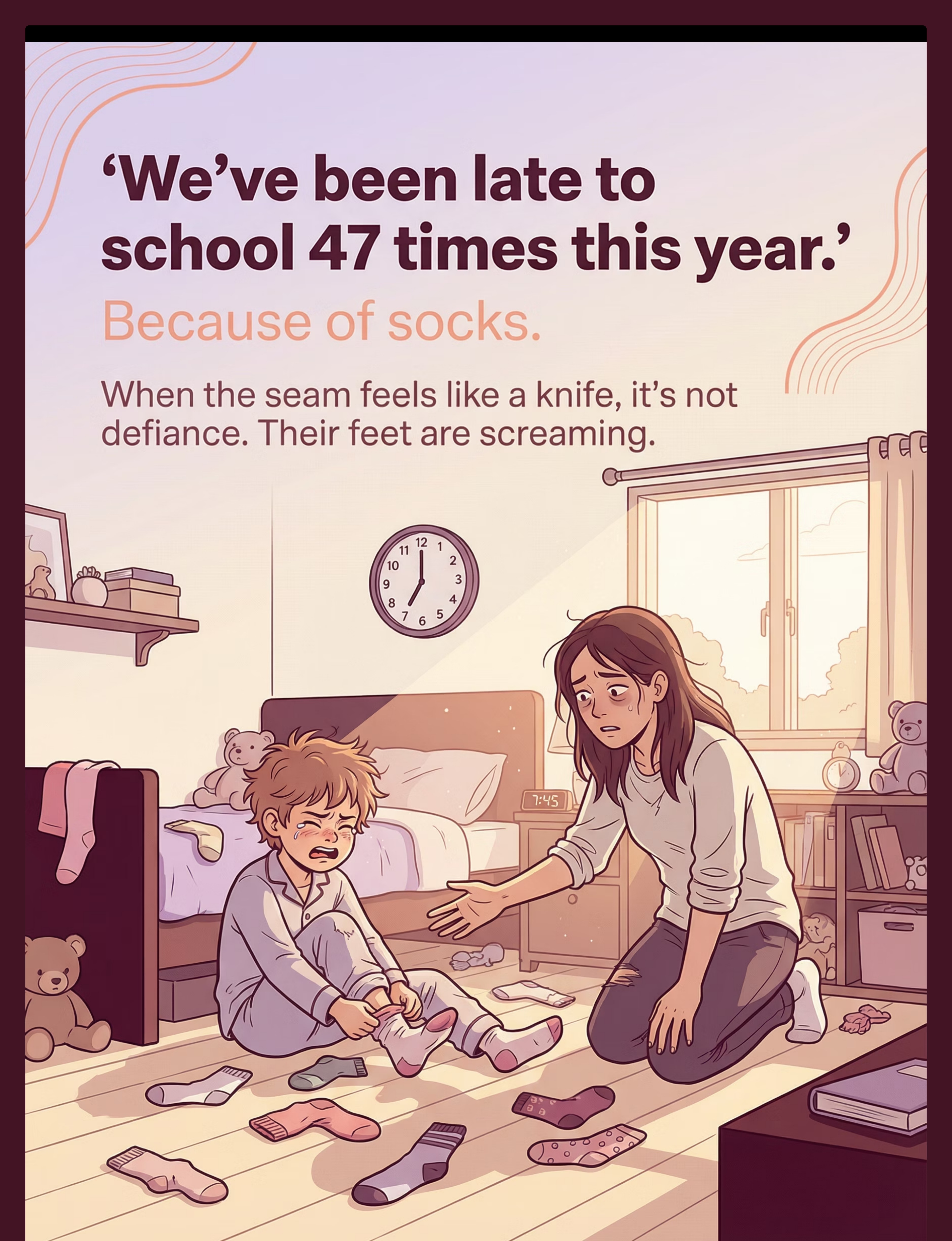
'We've been late to school 47 times this year.' Because of socks.
When the seam across the toes feels like a knife pressing into skin, it is not defiance. It is not attention-seeking. It is not a phase. Their feet are screaming.
Every morning, the same battle. She puts them on, rips them off, puts them on again, cries that the seam is wrong, that there is a bump, that it just feels bad. You have bought every brand. Tried inside-out. Tried folding the seam. Some days she goes to school in sandals — in winter — because you could not get socks on.
People do not understand how something so small can derail your entire morning. But for her, that seam feels like a rock inside her shoe that she cannot escape.
You are not failing. Your child's nervous system is speaking.
This page gives you 9 clinically validated materials and strategies that help — starting today.
OT
SLP
ABA
SpEd
NeuroDev
CRO
You Are Not Alone: The Numbers
Sock-related tactile defensiveness is one of the most commonly reported daily living challenges in pediatric sensory processing. The data confirms what you already know: this morning battle is shared by millions of families worldwide.
80%
ASD + Sensory Challenges
Of children diagnosed with autism spectrum disorder experience sensory processing difficulties — this is the majority experience, not a fringe problem.
1 in 6
All Children Affected
Children exhibit clinically significant sensory processing challenges affecting daily routines — dressing, feeding, hygiene, and more.
200K
Receptors in Each Foot
Sensory receptors in the human foot — one of the densest concentrations in the body. When these over-amplify signals, a simple seam becomes inescapable distress.

Research: PRISMA Systematic Review (2024): PMC11506176 | Meta-analysis: World J Clin Cases, 2024: PMC10955541 | DOI: 10.12998/wjcc.v12.i7.1260
What's Happening in Your Child's Brain
The Neurological Pathway
The feet have approximately 200,000 nerve endings detecting pressure, texture, temperature, and moisture — among the highest densities anywhere in the body.
In a neurotypical brain, the sensation of a sock seam is detected, briefly registered, and filtered out within seconds. The brain decides: "This is not important. Ignore it."
In your child's brain, that filtering system works differently. The somatosensory cortex over-amplifies the signal. Instead of filtering it out, the brain keeps it in conscious awareness — persistently intrusive, competing with attention, and triggering the body's alarm system.
The Plain-Language Explanation
This is a wiring difference, not a behavior choice. Your child is not being difficult. Their brain is registering that seam the way your brain might register a sharp pebble in your shoe — except they cannot habituate to it.
The somatosensory cortex, thalamus, and peripheral tactile receptors in the foot form a pathway that, in some children, amplifies rather than filters tactile signals. The sensation remains persistently in conscious awareness, activating anxiety and the body's protective alarm system.
"Their feet are telling them the truth — the signal is real. It just isn't being filtered the way most brains filter it."

Reference: Frontiers in Integrative Neuroscience (2020) — DOI: 10.3389/fnint.2020.556660
Where This Sits in Development
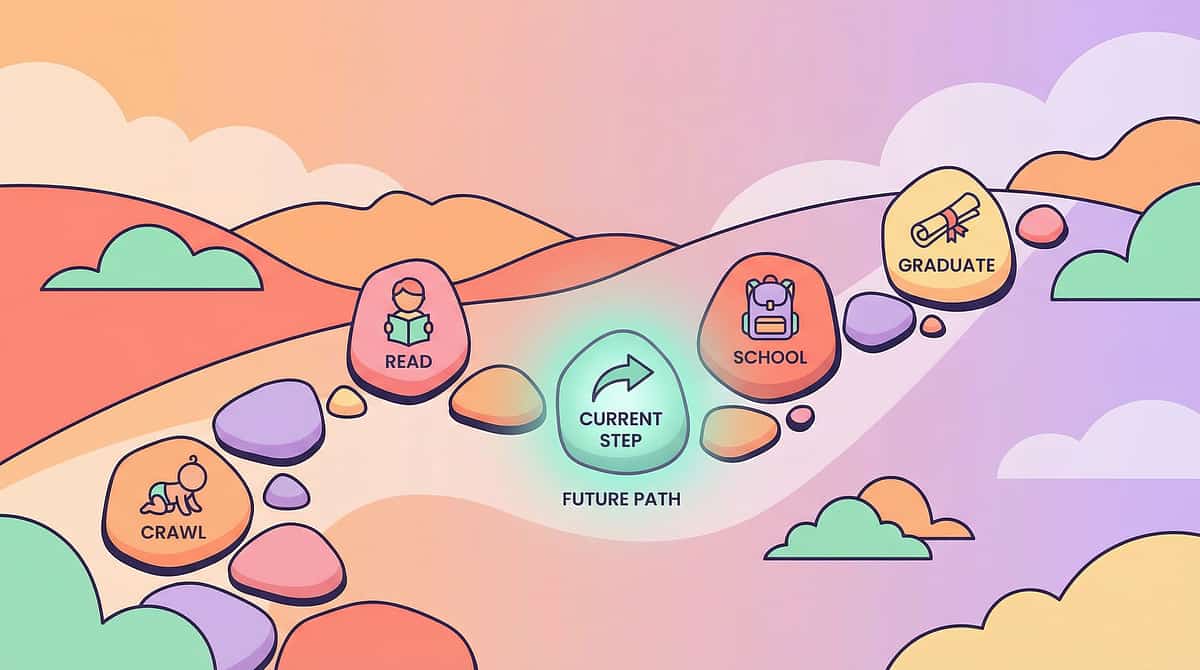
Tactile sensitivity patterns typically emerge between ages 18 months and 4 years, as sensory systems mature and environmental demands increase. Sock refusal peaks during the transition to structured environments — preschool and primary school — when children face inflexible clothing requirements for the first time.
Age 2–4
Sensitivity emerging. Morning distress beginning. Preference patterns forming.
Age 4–7 ← Peak Zone
School demands vs. sensory tolerance. Daily living independence expected but sensory barriers persist. Highest conflict frequency.
Age 7–12
Either resolving through maturation and intervention, or entrenching into rigid avoidance patterns requiring escalated support.
Co-occurring patterns: Sock refusal frequently co-occurs with clothing tag sensitivity (A-028), shoe struggles (A-027), one-outfit rigidity (A-023), and broader light touch defensiveness (A-024). If your child has multiple clothing-related challenges, a comprehensive sensory processing evaluation is strongly recommended.

Reference: WHO CCD Package (2023): PMC9978394 | UNICEF MICS developmental indicators
The Evidence Behind This Technique
Evidence Grade: Level I–II
Systematic Reviews + Randomized Controlled Trials
75%
Confidence Rating
What the Research Shows
16 studies (2013–2023) included in a PRISMA systematic review confirm that sensory integration interventions meet criteria to be considered evidence-based practice for children with ASD.
Key finding: Sensory integration therapy effectively promotes adaptive behavior, sensory processing, social skills, and motor skills across multiple study populations. Home-based sensory interventions demonstrated significant outcomes in Indian pediatric populations.
What this means for you: The materials and strategies on this page are not guesswork. They emerge from decades of clinical research, validated across multiple countries, reviewed by systematic methodology, and implemented by thousands of occupational therapists worldwide.
Clinically validated. Home-applicable. Parent-proven.

References: PMC11506176 | Padmanabha et al., Indian J Pediatr, 2019: DOI: 10.1007/s12098-018-2747-4 | NCAEP Evidence-Based Practices Report (2020)
Technique A-026
Domain A — Sensory Processing
The Technique: What It Is
"The Sock Solutions Protocol" — A multi-material approach to resolving sock-related distress in children with tactile over-responsivity. Combines sensory-friendly sock alternatives (eliminating triggers), foot desensitization strategies (building tolerance), and structured dressing routines (building predictability and independence).
The protocol addresses the immediate crisis (getting socks on today) while building long-term sensory tolerance and daily living independence. It is not a one-size solution — it is a layered system.
Domain
A — Sensory Processing | Tactile Processing | Clothing Sensitivity
Age Range
2–12 years
Setting
Home + Therapy
Duration
5–15 minutes per session, embedded in morning routine
Frequency
Daily
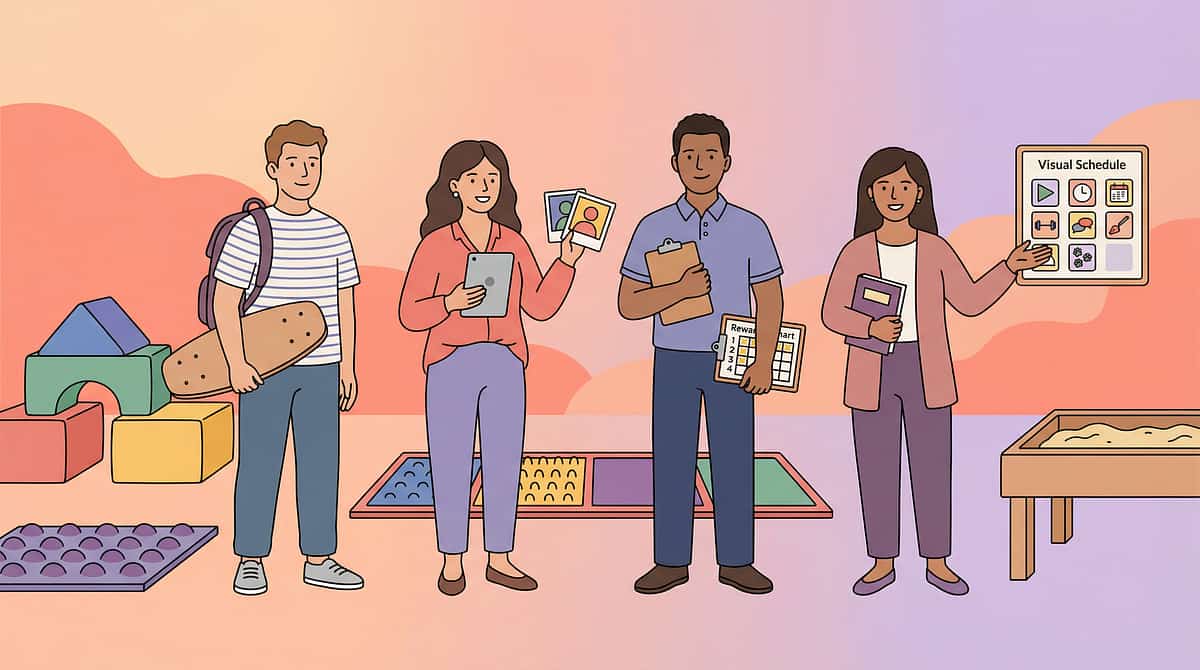
Who Uses This Technique
"This technique crosses therapy boundaries because the brain does not organize by therapy type."
Occupational Therapist (Sensory Integration) — Primary Lead
Designs the sensory accommodation plan, selects materials based on sensory profile, develops the desensitization protocol, and establishes the sock routine structure.
Board Certified Behavior Analyst (ABA)
Implements reinforcement schedules for sock-wearing tolerance, manages antecedent strategies for morning routines, develops choice-making protocols, and tracks behavioral data.
Special Educator
Integrates sock independence into daily living skills curriculum, coordinates with schools on dress code accommodations, and supports generalization across settings.
NeuroDevelopmental Pediatrician
Evaluates underlying sensory processing patterns, rules out medical contributors (dermatological, neurological), and monitors developmental trajectory over time.

Reference: Adapted UNICEF/WHO Nurturing Care Framework for SLPs (2022) — DOI: 10.1080/17549507.2022.2141327
What This Targets
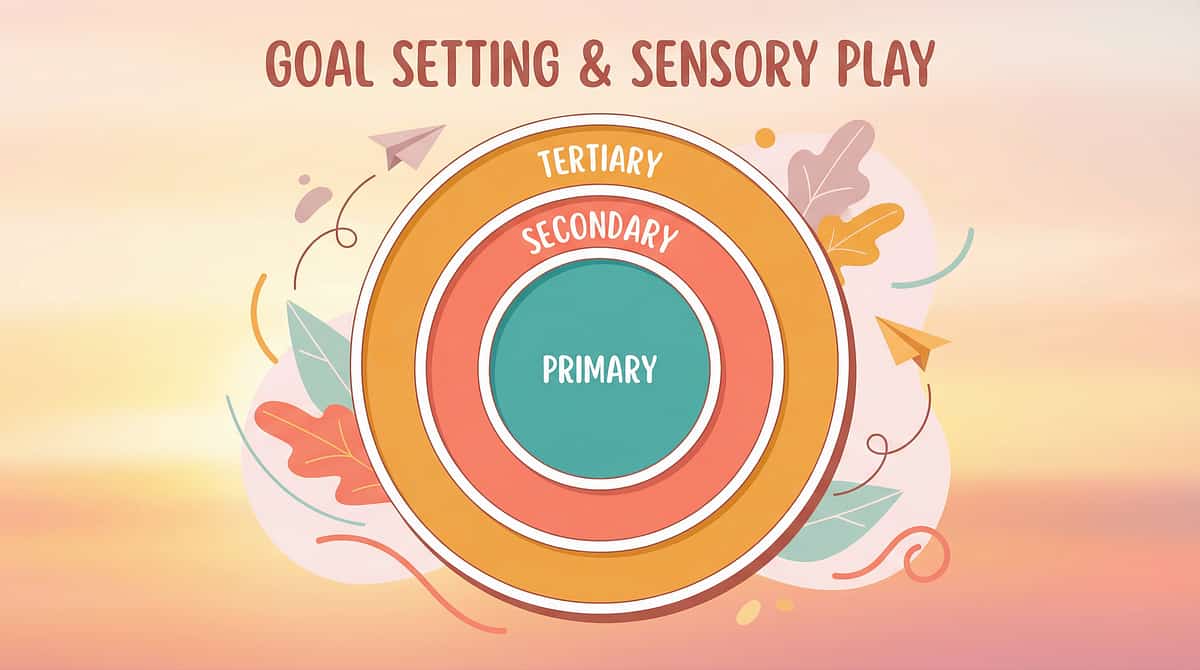
Primary Target
Tactile tolerance for sock wearing — reducing distress, refusal, and meltdowns during sock application. This is the immediate measurable outcome of every session.
Observable Indicators
  • Reduced crying/distress during sock application
  • Decreased time from sock presentation to wearing
  • Increased number of tolerated sock types
  • Independent sock selection and application
  • Spontaneous sock wearing without prompting
Secondary Targets
  • Morning routine completion and time efficiency
  • Dressing independence (self-application of socks)
  • Self-advocacy skills (communicating sensory needs)
  • Anxiety reduction around clothing and dressing
Tertiary Targets — Long-Term Developmental Gains
  • Broader tactile tolerance expansion across clothing and textures
  • Daily living independence across self-care domains
  • School readiness and attendance improvement
  • Social participation in activities requiring specific footwear
  • Sensory self-management and self-regulation
Reference: PMC10955541 — Meta-analysis: Sensory integration therapy across 24 studies
9 Materials: The Complete Overview
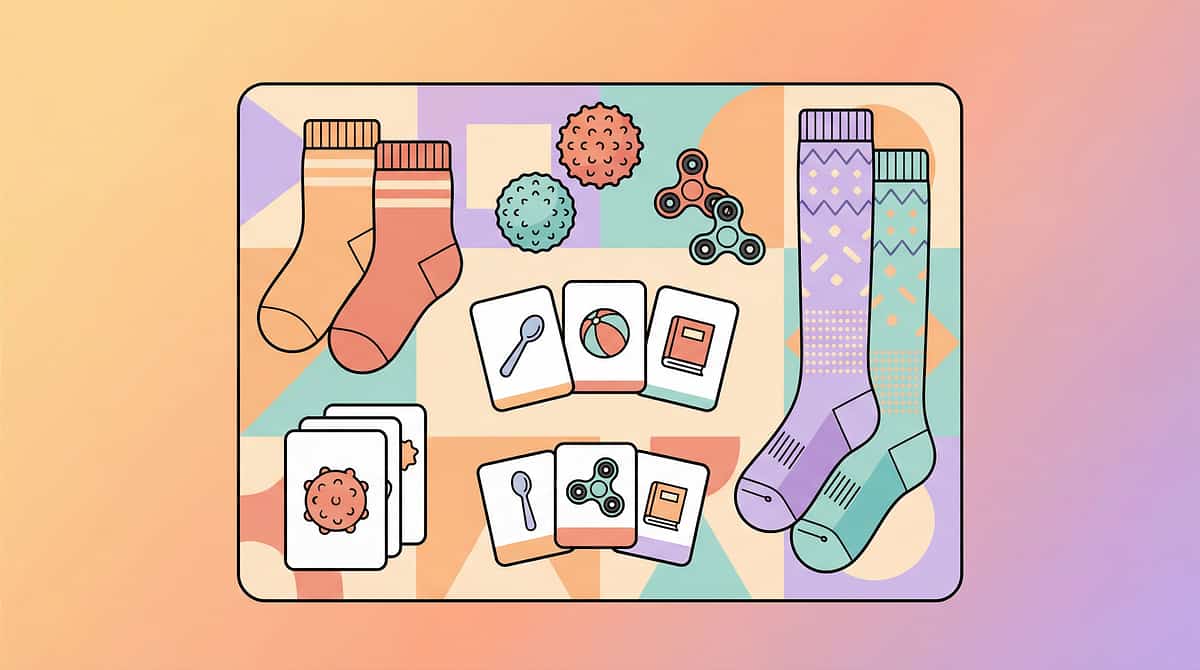
These 9 materials address the full spectrum of sock-related sensory triggers. Start here: Seamless socks + Visual selection system + Consistent routine. Two of these cost nothing.
#
Material
Price Range
Impact
1
Seamless Socks
₹400–1,200/pair
★★★★★ Highest single-intervention success rate
2
Compression Socks
₹500–1,500/pair
★★★★ Deep pressure calming
3
Moisture-Wicking Fabrics
₹300–1,000/pair
★★★★ Consistent sensation all day
4
Sock Liners / Toe Caps
₹200–600/pair
★★★★ Buffer layer for dress codes
5
Foot Desensitization Tools
₹300–1,500
★★★ Builds long-term tolerance
6
Visual Sock Selection System
₹0–500
★★★★ Reduces anxiety through choice
7
Pre-Sock Foot Preparation
₹100–500
★★★★ Calms nervous system first
8
Ankle/No-Show Socks
₹200–800/pair
★★★ Less fabric = Less sensory load
9
Sock-Putting-On Routine
₹0
★★★★★ Predictable process = Predictable outcome

Pinnacle Recommends: Begin with materials 1, 6, and 9. These address the primary trigger (seam), reduce anxiety (predictability), and build independence (routine) — with two of them costing nothing. → Purchase links: materials.pinnacleblooms.org
Material #1: Seamless Socks
Why It Works
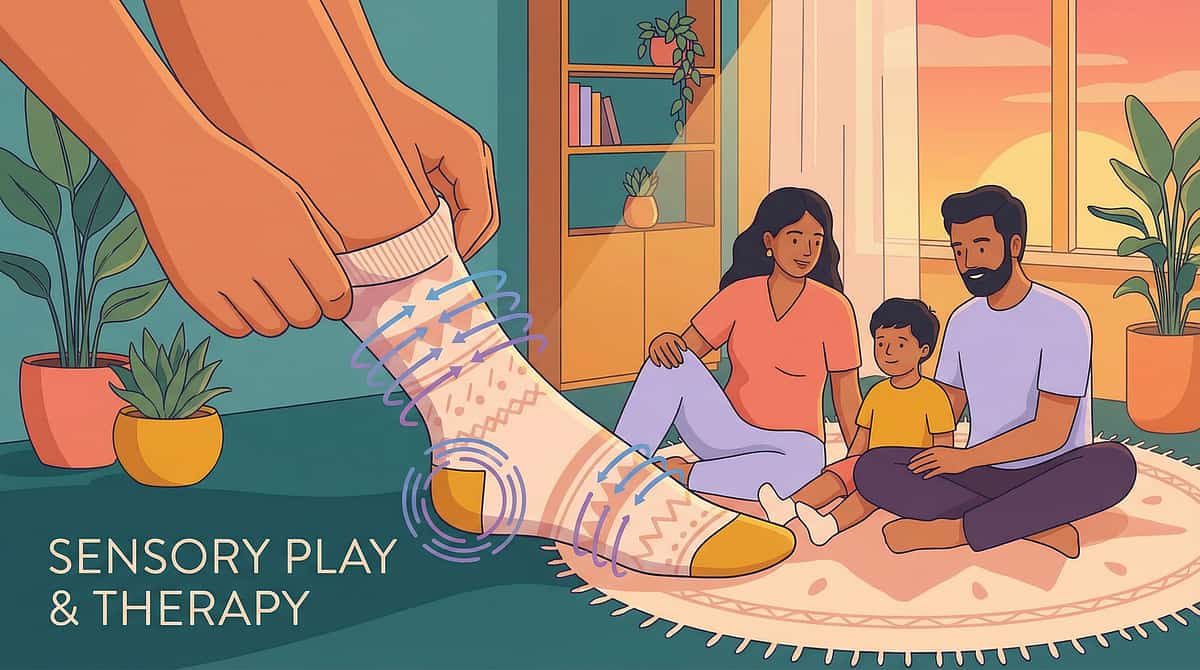
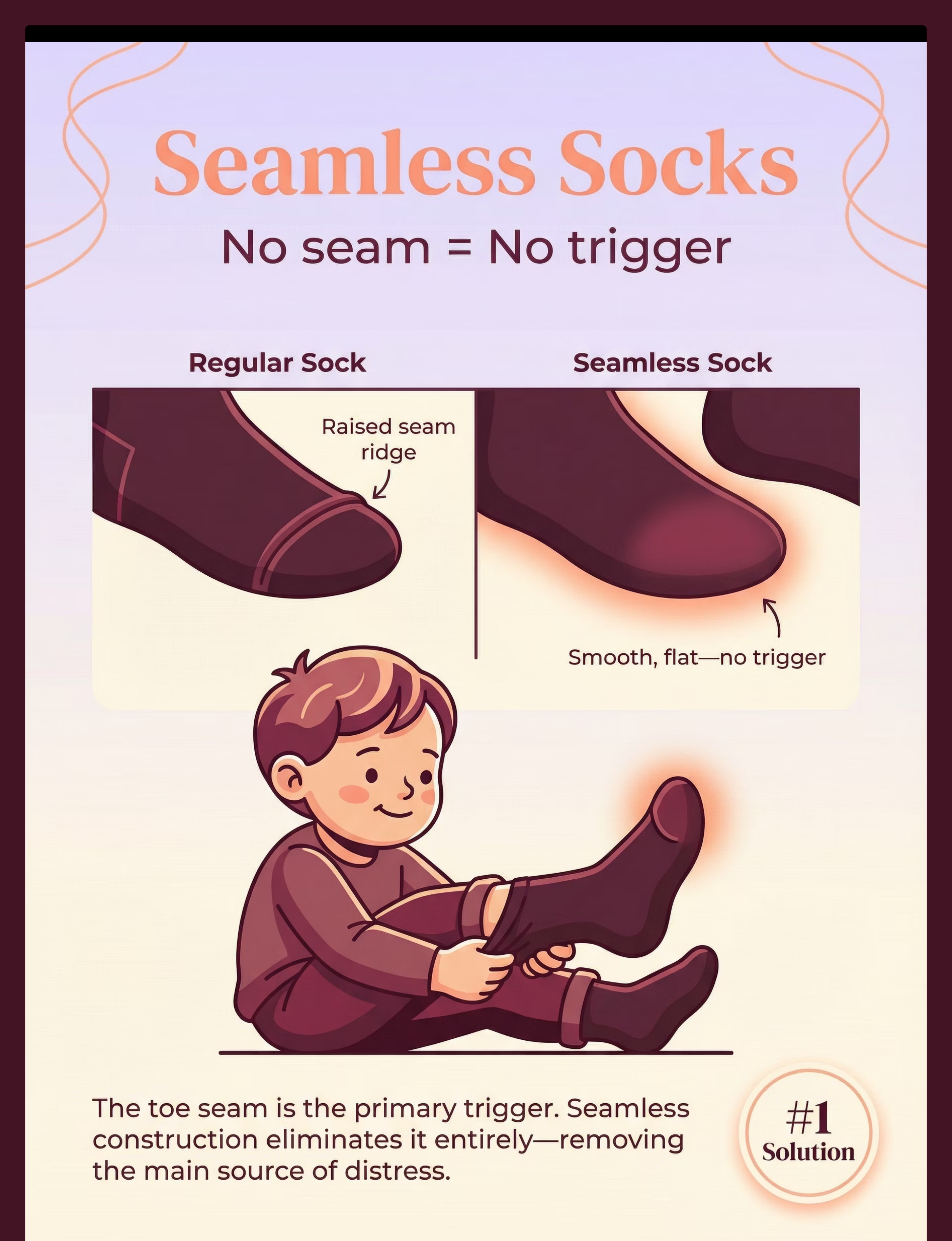
The toe seam is the primary tactile trigger in the majority of sock-refusing children. Seamless socks are manufactured without a stitched seam at the toe box — the sensation simply does not exist. For children whose trigger is seam-related (the most common presentation), this single material change can produce immediate, dramatic improvement.
Clinical Notes
  • Highest single-intervention success rate of all 9 materials
  • Works immediately — no desensitization period required
  • Available in bamboo, modal, cotton-blend, and wool variants
  • Clinical brands: SmartKnitKIDS, Jefferies, Hanes ComfortSoft seamless
Try This First
If your child has never worn seamless socks — this is your starting point. Order one pair, test in a calm, pressure-free setting (not a school morning). Observe for 30 minutes of wearing.
Home Alternative
Turn regular socks inside-out so the seam ridge faces outward. This reduces but does not eliminate the seam sensation — it is a bridge solution, not a permanent fix.
Watch For
Seamless socks may still have ankle or heel seams. Check the full sock before purchasing. True seamless = zero seams anywhere.
Material #2: Compression Socks
The Pressure Principle
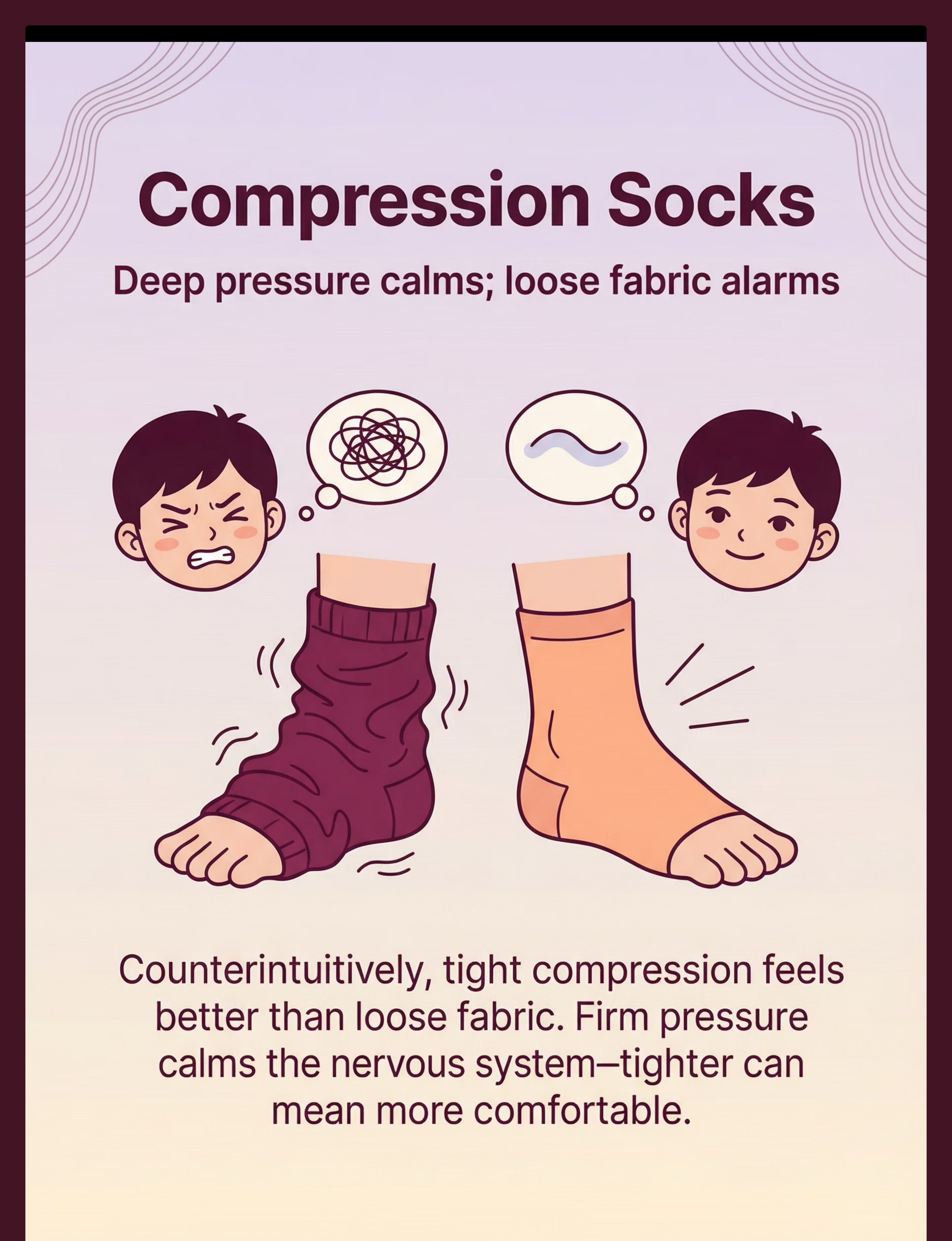
For some children, the issue is not the seam — it is the lack of deep, consistent pressure. Compression socks provide graduated, firm pressure across the entire foot and ankle, activating the proprioceptive system and calming tactile defensiveness through deep pressure input.
This works on the same neurological principle as weighted vests and compression vests — deep pressure inhibits the hypersensitive tactile response.
Who This Is For
Children who tolerate firm hugs and firm touch better than light touch. Children who press their feet against surfaces. Children who seem to seek heavy input.
Clinical Notes
  • Graduated compression socks: strongest at the toe, decreasing toward the ankle
  • Must be correctly sized — too tight causes pain; too loose loses therapeutic effect
  • Watch for circulation signs: cold toes, color changes, marks that don't fade
  • Consult physician before using compression socks in children with circulatory conditions
Home Alternative
Snug-fitting athletic socks or dance socks — size down slightly for additional compression. This is an approximation, not a clinical-grade substitute.
Price Range
₹500–1,500/pair | ★★★★ Deep pressure calming
Material #3: Moisture-Wicking Fabrics
Why Moisture Matters
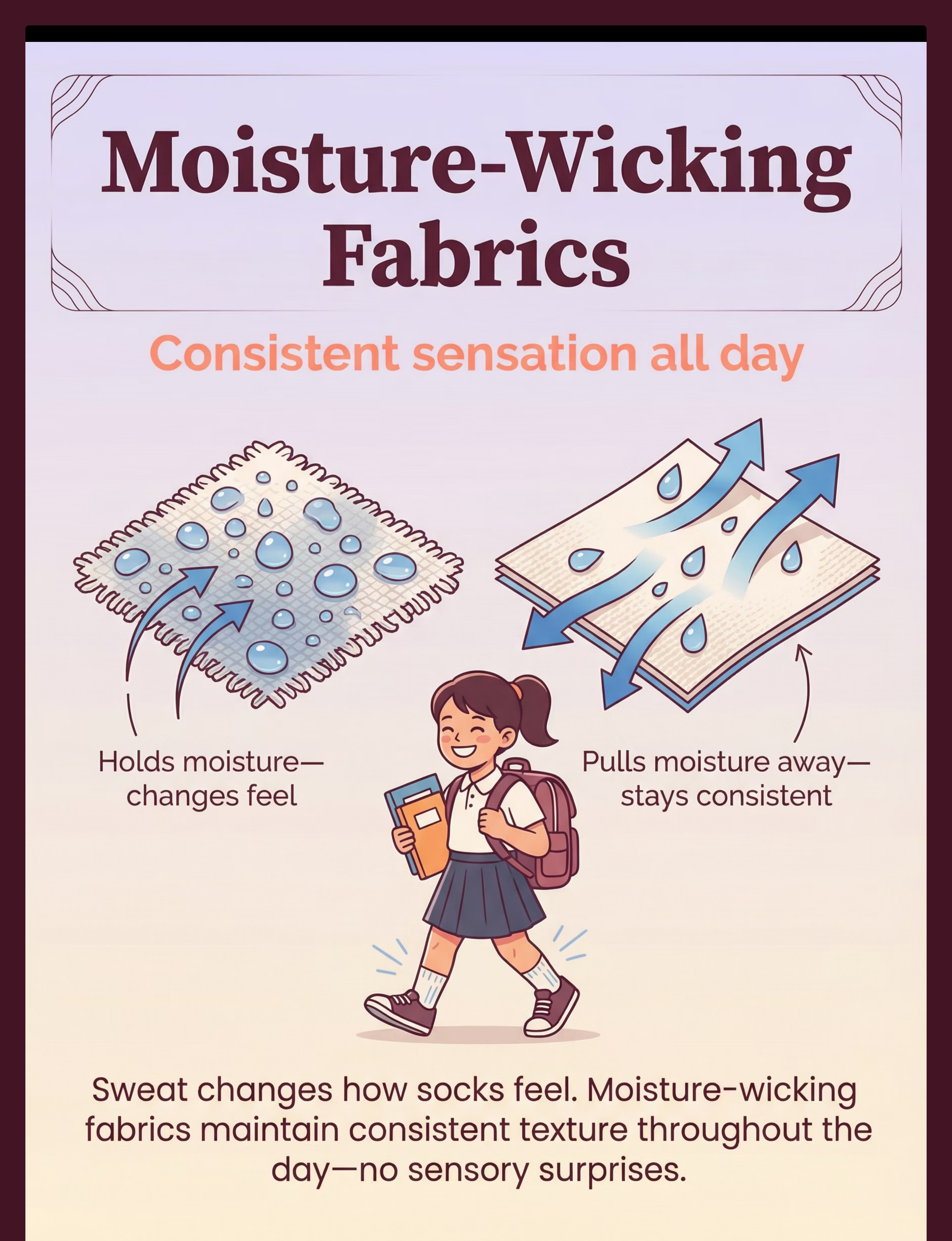
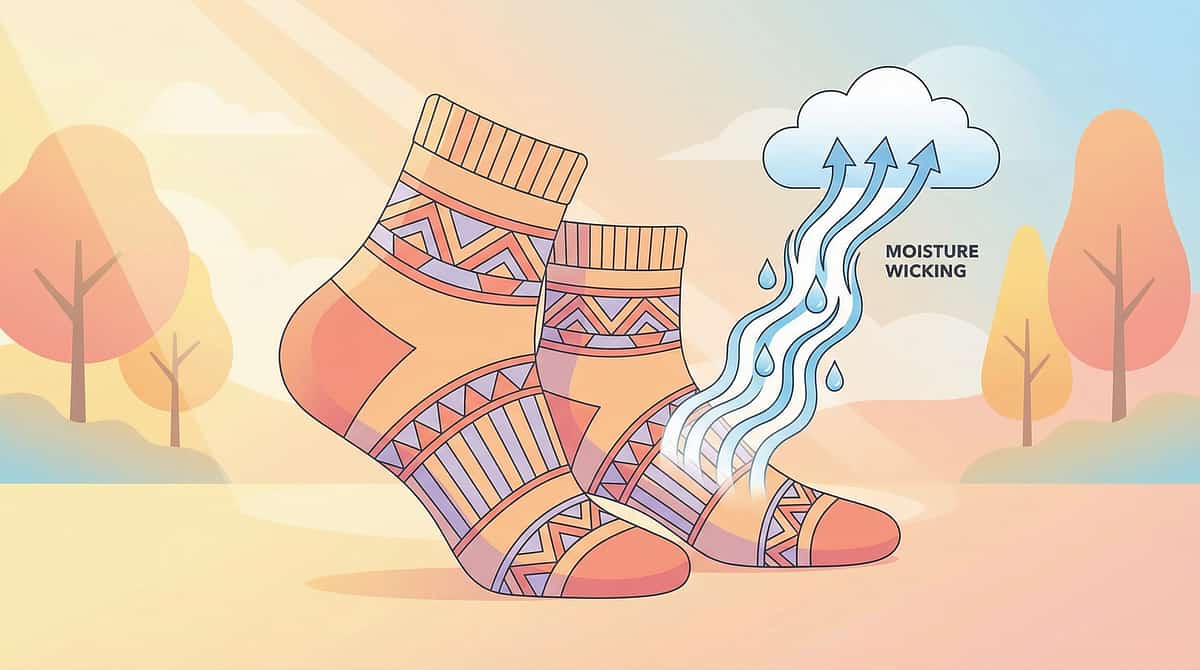
Moisture sensation is a frequently overlooked trigger. As feet warm and perspire throughout the day, cotton socks absorb and hold moisture — creating a changing, unpredictable tactile environment. For children with tactile over-responsivity, this shifting sensation (dry to damp to wet) can escalate discomfort significantly over the course of a school day.
Moisture-wicking fabrics (bamboo, modal, polyester microfiber, merino wool) pull moisture away from the skin surface, maintaining a consistent dry sensation. This eliminates the changing-wetness trigger entirely.
Best Fabric Choices
  • Bamboo fiber: soft, naturally moisture-wicking, temperature-regulating
  • Modal: ultra-soft, stays dry, excellent for texture-sensitive children
  • Merino wool: surprisingly soft for a wool fiber, outstanding moisture management
  • Polyester microfiber: wicks efficiently, less soft than bamboo/modal
Avoid These
100% cotton socks are the worst choice for moisture-sensitive children. Cotton absorbs and holds moisture against the skin.
Home Alternative
Choose any synthetic blend over pure cotton. Even a 50/50 cotton-polyester blend performs meaningfully better than 100% cotton for moisture management.
Clinical Note
This material is especially important for children who show increased distress as the school day progresses — a hallmark sign that moisture sensation, not just the sock-application moment, is a trigger.
Price Range
₹300–1,000/pair | ★★★★ Consistent sensation all day
Material #4: Sock Liners & Toe Caps
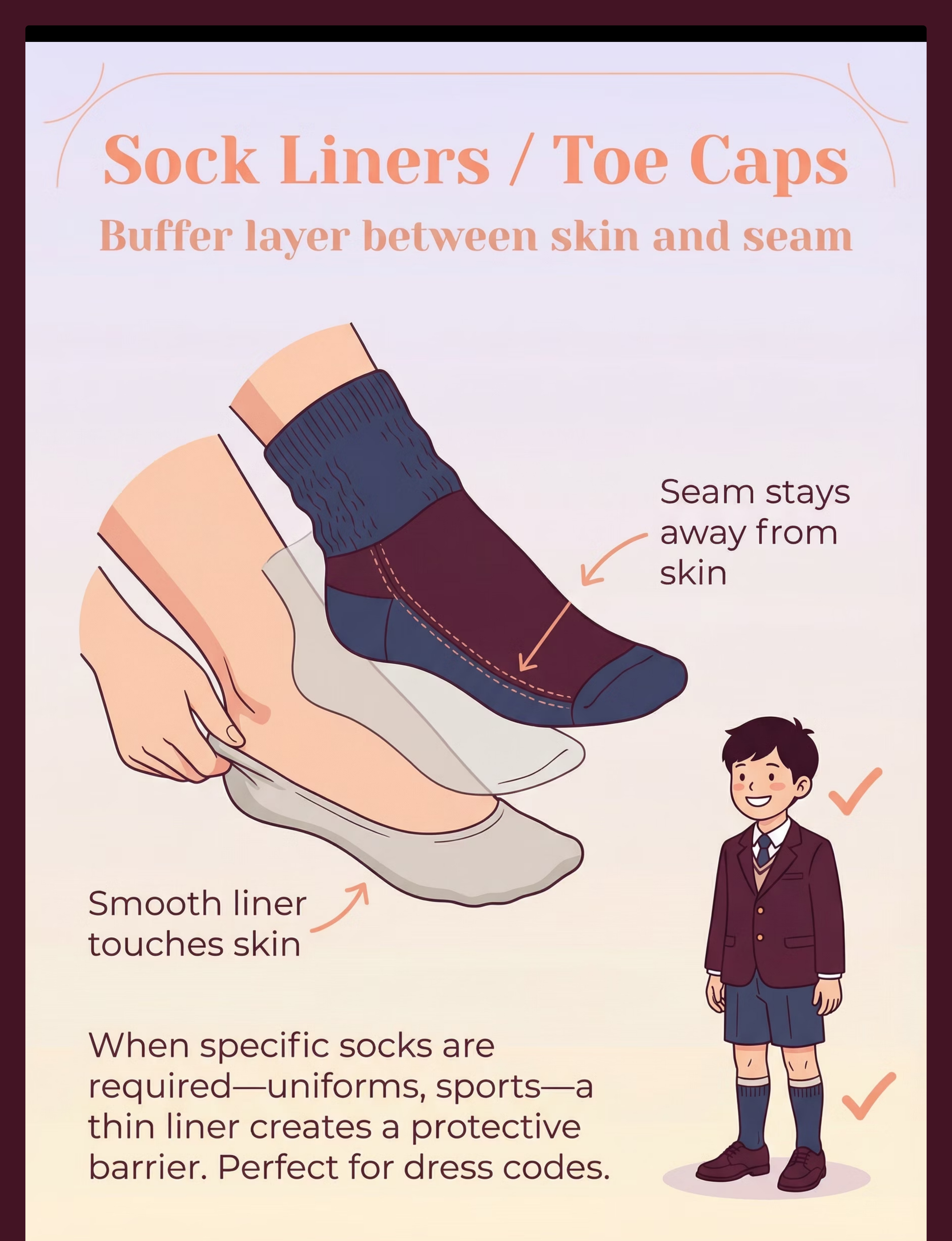
The School Dress Code Solution. Many families achieve sock success at home with seamless or compression options — only to face an immovable obstacle: the school requires a specific sock type (white ankle socks, navy knee-highs) that the child cannot tolerate. Sock liners solve this problem elegantly.
How It Works
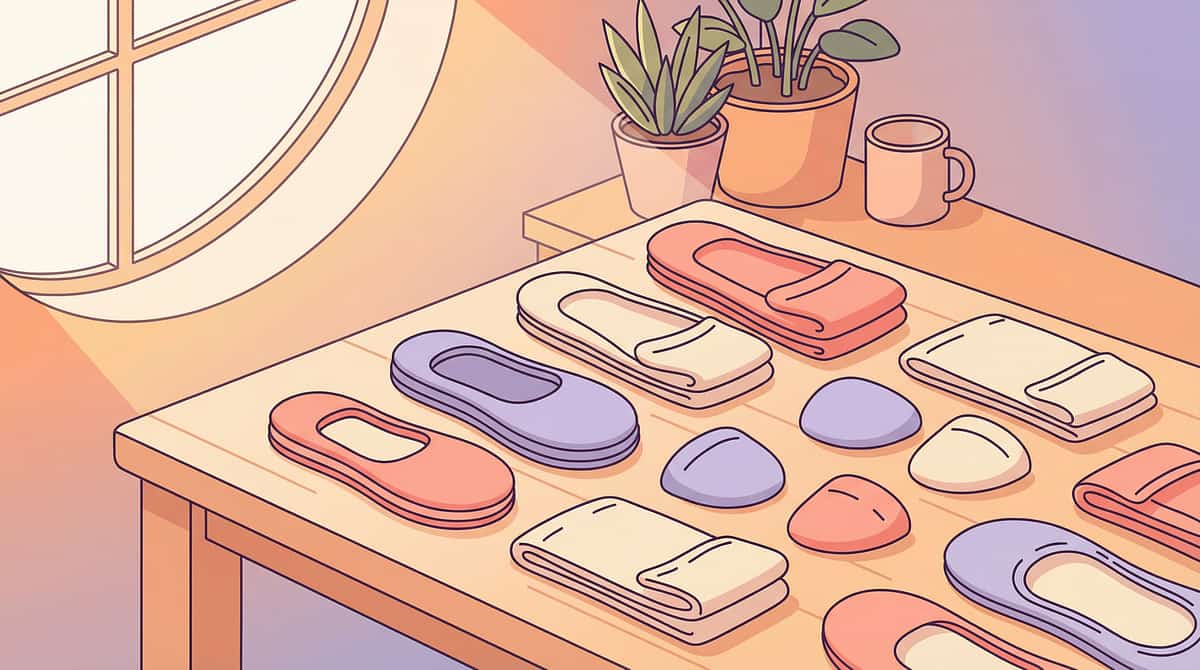
A thin, soft liner sock is worn directly against the skin. The required school sock goes over the top. The liner creates a sensory-friendly buffer layer between the child's sensitive skin and the triggering outer sock. The child feels the liner; the school sees the dress code compliant sock.
  • Available as full liner socks or toe-only caps
  • Choose seamless liner for maximum benefit
  • Must be very thin to prevent shoe fit issues
  • Clinical brands: HJ Hall, Sockwell liner socks
Home Alternative
Cut the toes from old, soft socks to create a DIY toe cap. Thin trouser socks worn underneath school socks. The mechanism is identical — the brand is irrelevant.
Important Note
Communicate with the school about this accommodation strategy. Most schools readily accept sock liners once a sensory need is explained. Use the school communication template in Card 37.
Price Range
₹200–600/pair | ★★★★ Buffer layer for dress codes
Material #5: Foot Desensitization Tools
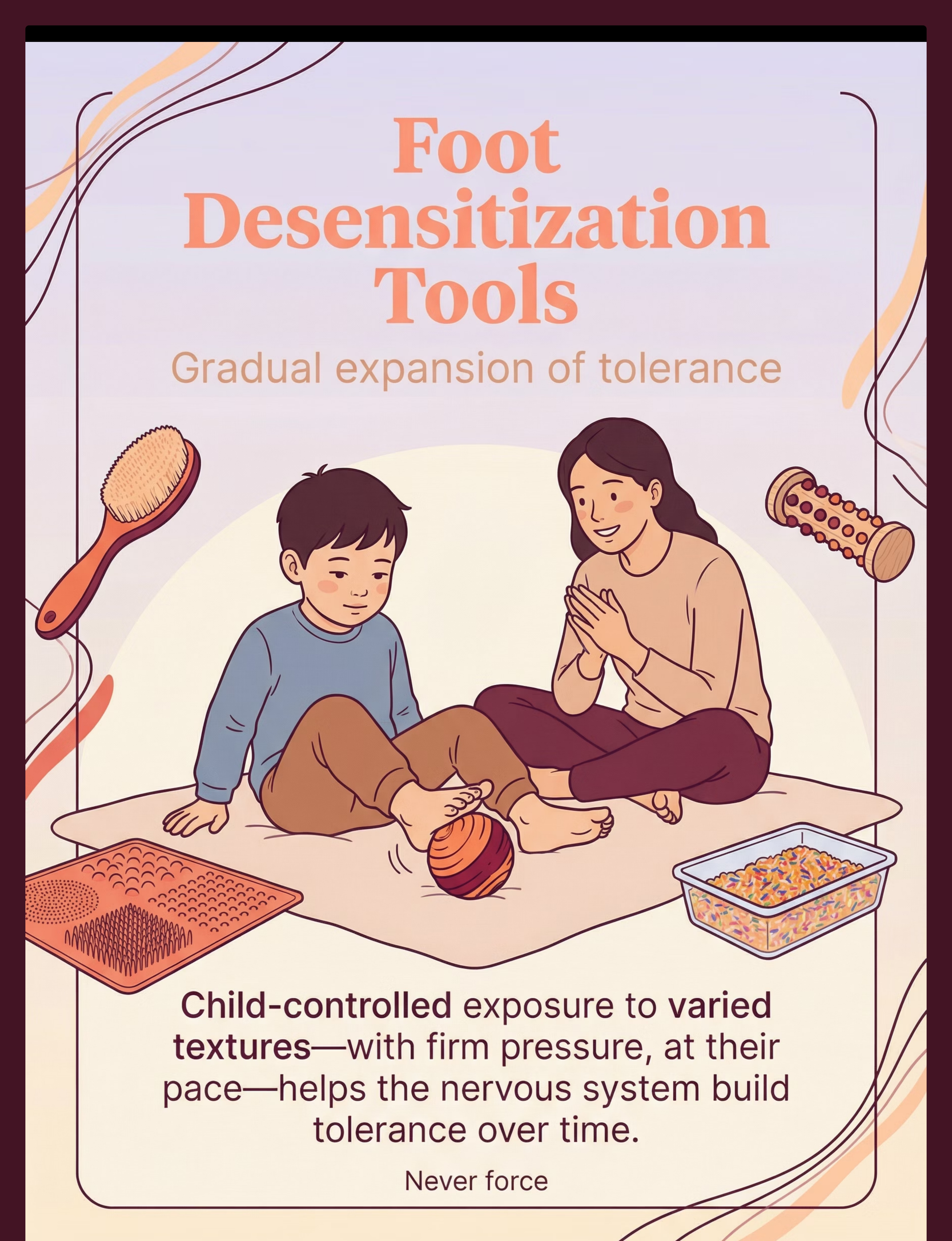
While materials 1–4 accommodate the sensitivity, Material #5 addresses it at the neurological source. Foot desensitization tools are used to systematically habituate the foot's tactile receptors to a variety of textures and pressures — building tolerance over time so the nervous system learns to filter, not amplify, sock-related sensations.
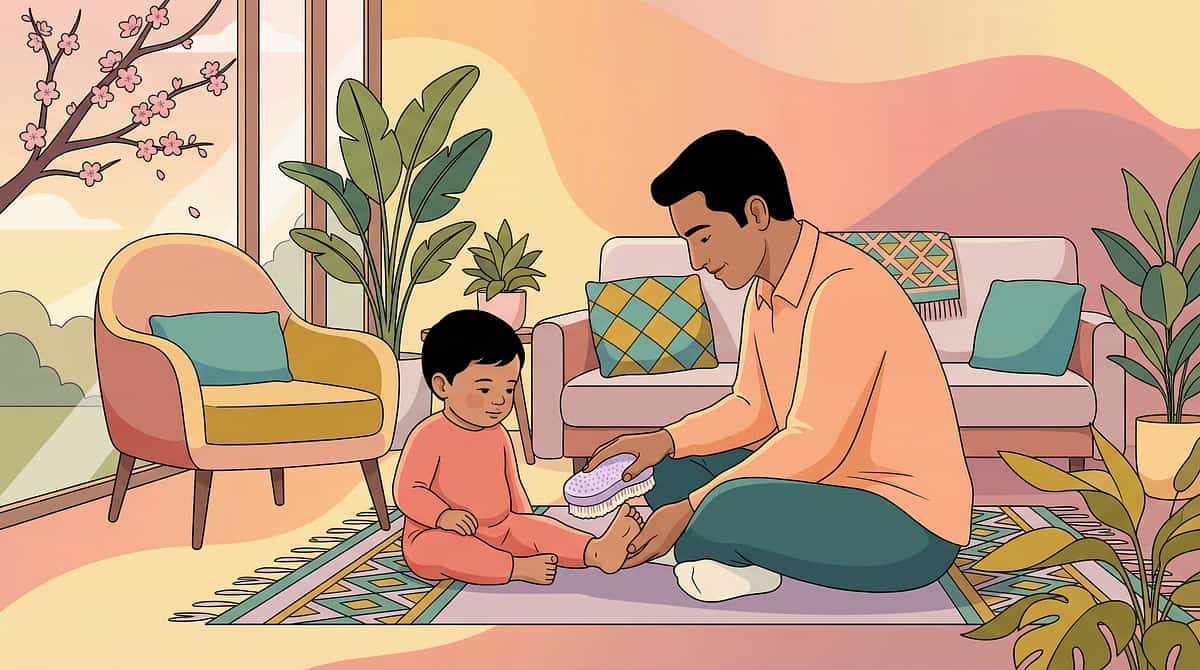
Therapy Brushes (Wilbarger Protocol)
Firm-bristle sensory brushes applied using deep, even pressure across the soles and tops of feet. MUST be taught by a trained OT — incorrect technique increases defensiveness rather than reducing it. Never use light, ticklish pressure.
Sensory Mats & Textured Surfaces
Child walks barefoot on progressively varied textures — carpet, grass, sand, pebble mats. Graduated exposure across many sessions builds neurological tolerance across texture types.
Massage Tools — Balls & Rollers
Golf balls, tennis balls, or dedicated foot rollers used for firm foot massage. Child rolls foot over the ball with their own body weight, maintaining child-controlled pressure at all times.
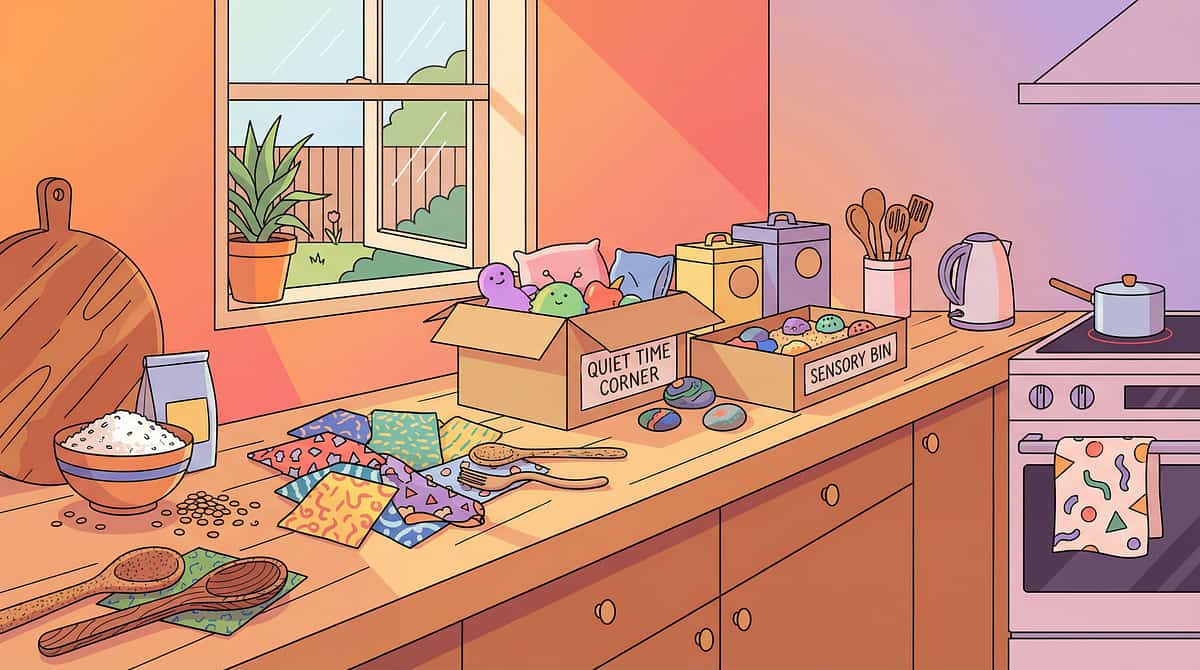
Sensory Bins — Rice, Sand, Beans
Child explores bins of dry rice, sand, or dried lentils with their feet during play. Low-demand, child-directed exposure that builds positive associations with foot texture exploration.

CRITICAL: Desensitization MUST be child-controlled. Never force exposure. Pressure should be FIRM — light touch triggers more defensiveness, not less. Price range: ₹300–1,500 | ★★★ Builds long-term tolerance
Material #6: Visual Sock Selection System
Why Choice Changes Everything
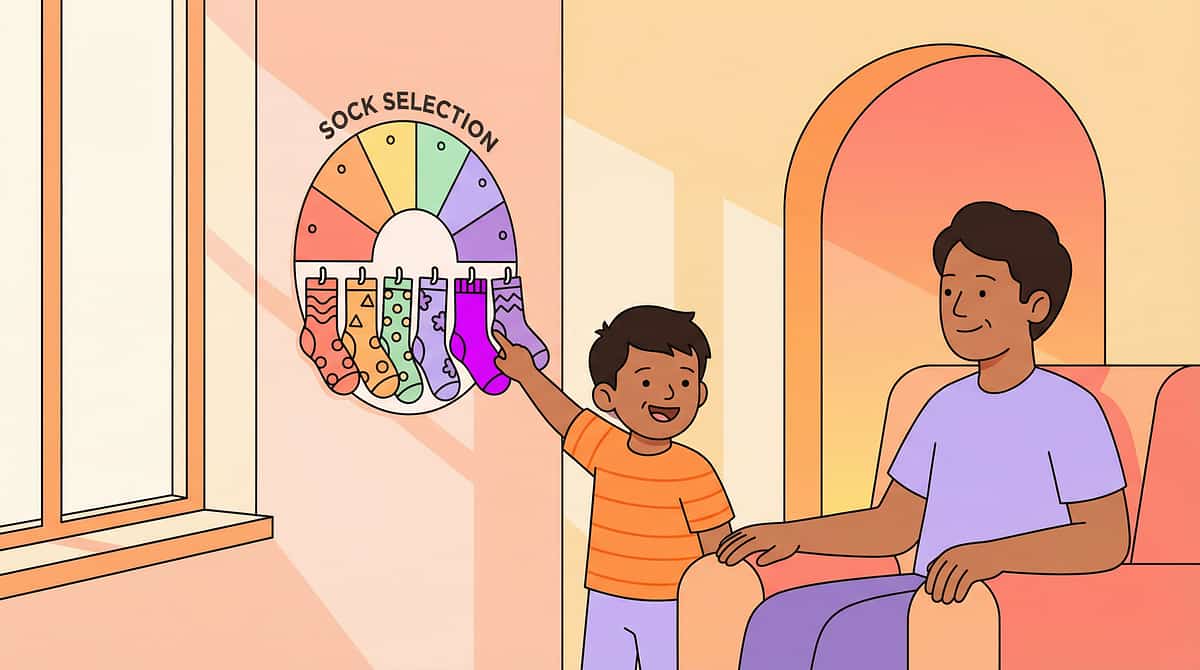
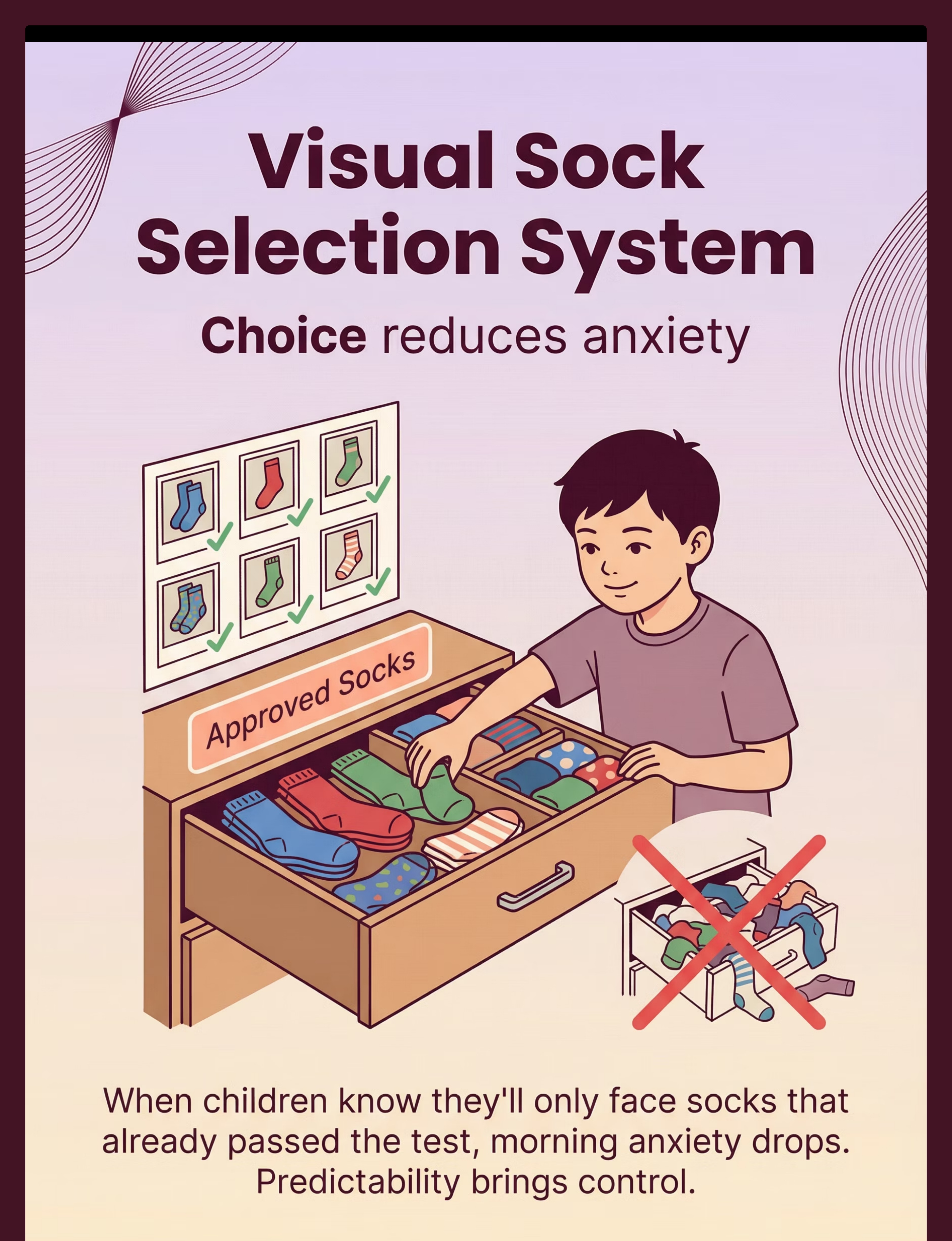
A significant portion of sock-related distress is anxiety-driven — not purely tactile. When children have no agency over what goes on their feet, the entire interaction becomes threatening. A visual selection system transforms the sock moment from "something done to me" to "something I choose."
This shift in perceived control reduces anticipatory anxiety before any sock touches any foot. Research in pediatric ABA consistently demonstrates that choice-making reduces challenging behavior, increases compliance, and accelerates skill acquisition.
How to Build One
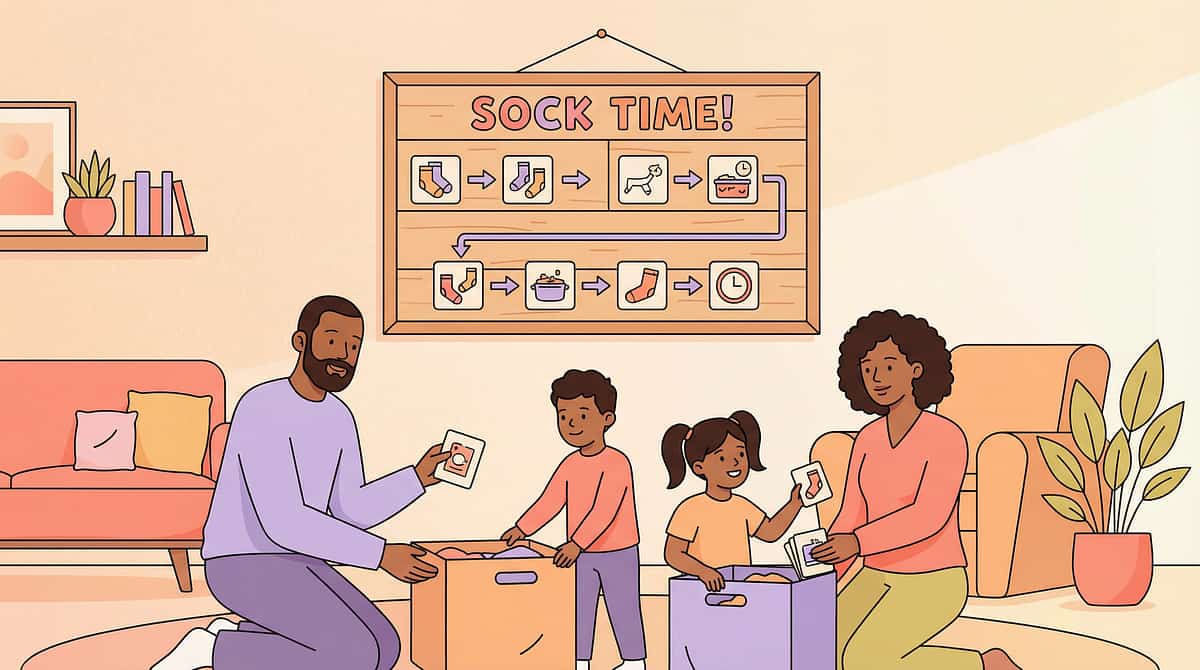
  • Photograph all approved socks against a white background
  • Print or display on a laminated card, tablet, or in a drawer organizer
  • Only approved socks appear on the system — no rejected options
  • Child points to or names their choice before socks are retrieved
Cost: ₹0
This material costs nothing. Photographs taken on a phone. Printed at home or at a copy shop. The mechanism is purely psychological and behavioral.
Home Alternative
Hand-drawn sock pictures on paper. Labeled bags or drawer dividers with sock pairs sorted inside. The child opens the correct drawer or bag — the choice is built into the physical organization.
Clinical Note
Keep only 2–4 options on the system at any time. Too many choices recreates anxiety. Choice-making should feel easy and empowering, not overwhelming.
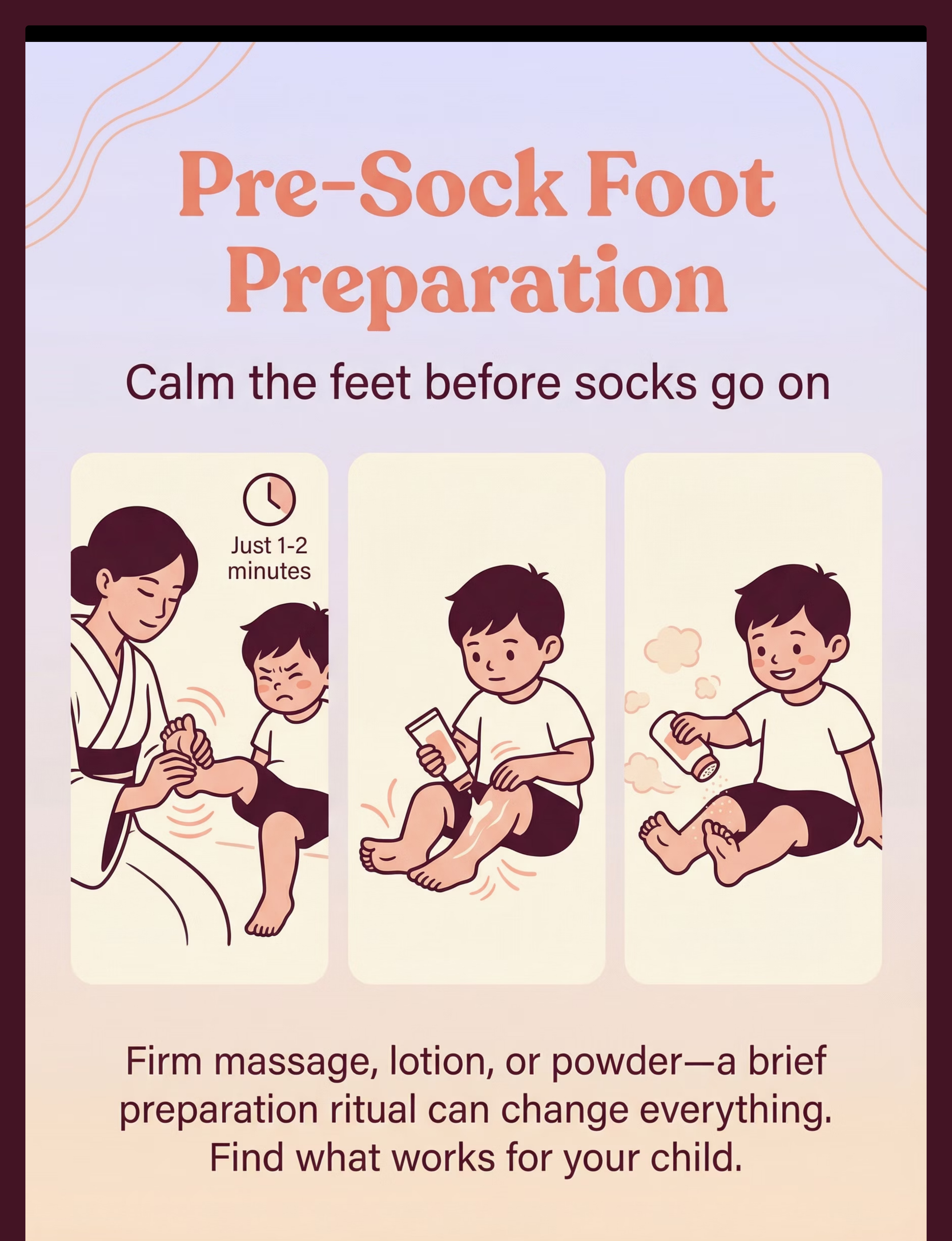
Material #7: Pre-Sock Foot Preparation
Foot preparation is a sensory priming strategy — it activates and organizes the tactile system before the sock is introduced, reducing the contrast between "bare foot" and "sock on foot." A prepared nervous system tolerates the transition far better than an unprepared one.
Firm Foot Massage
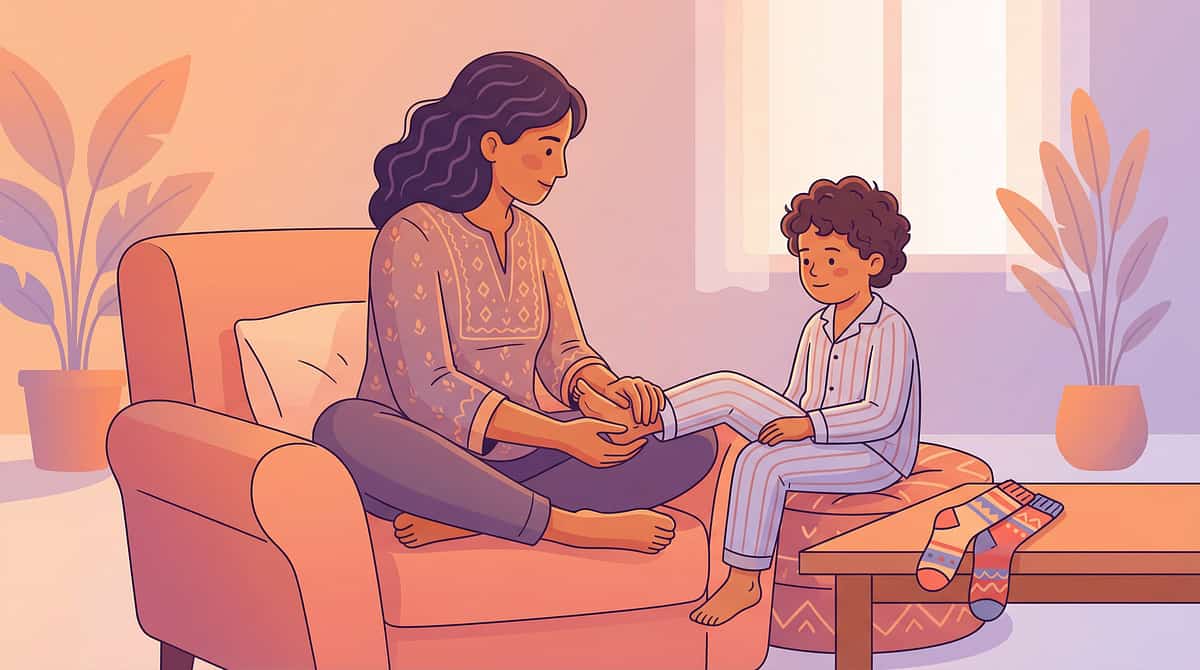
1–2 minutes of firm, even pressure massage across the entire foot — heel, arch, ball, toes, and top. Use firm palms and thumbs, not fingertips. Child can request pressure level. This is the single most effective preparation strategy.
Unscented Lotion Application
Apply a small amount of unscented lotion with firm strokes. Allow to fully absorb before socks go on — lotion residue creates a tactile layer that can become its own trigger. Ensures consistent skin sensation before sock contact.
Cornstarch / Foot Powder
Light application of unscented cornstarch for children who are moisture-sensitive. Reduces friction, ensures consistent dry sensation from the first moment of sock contact. Test for skin sensitivity before routine use.
Joint Compression
Firm joint compression of the toe joints — parent gently squeezes each toe at the base with steady pressure for 5–10 seconds. Proprioceptive input that organizes the sensory system and calms tactile receptors before sock application.

Price Range: ₹100–500 | ★★★★ Calms the nervous system first. Important: Test all lotions and powders for allergies. Always use unscented products — fragrance is an additional sensory variable that can escalate distress.
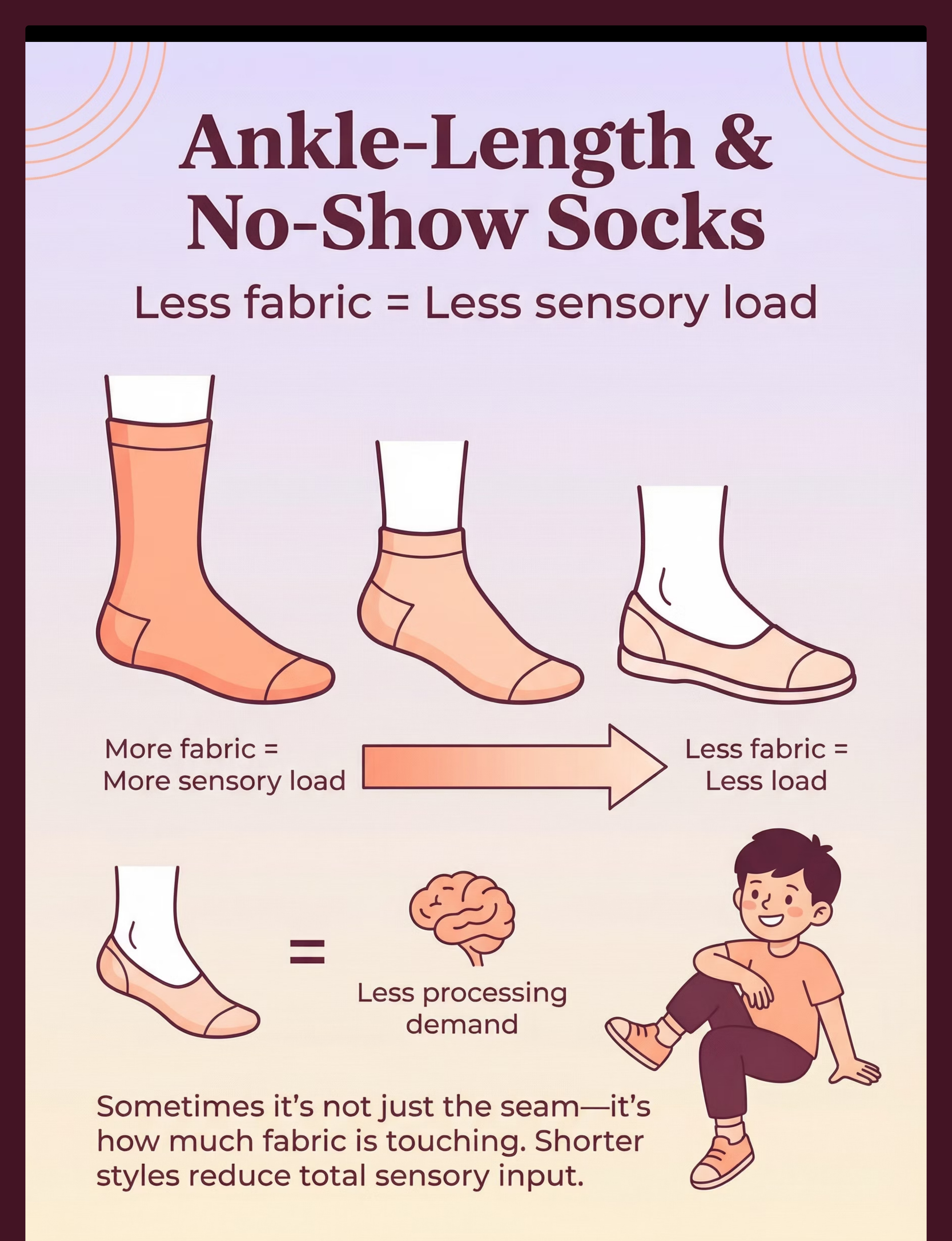
Material #8: Ankle & No-Show Socks
Less Fabric = Less Sensory Load
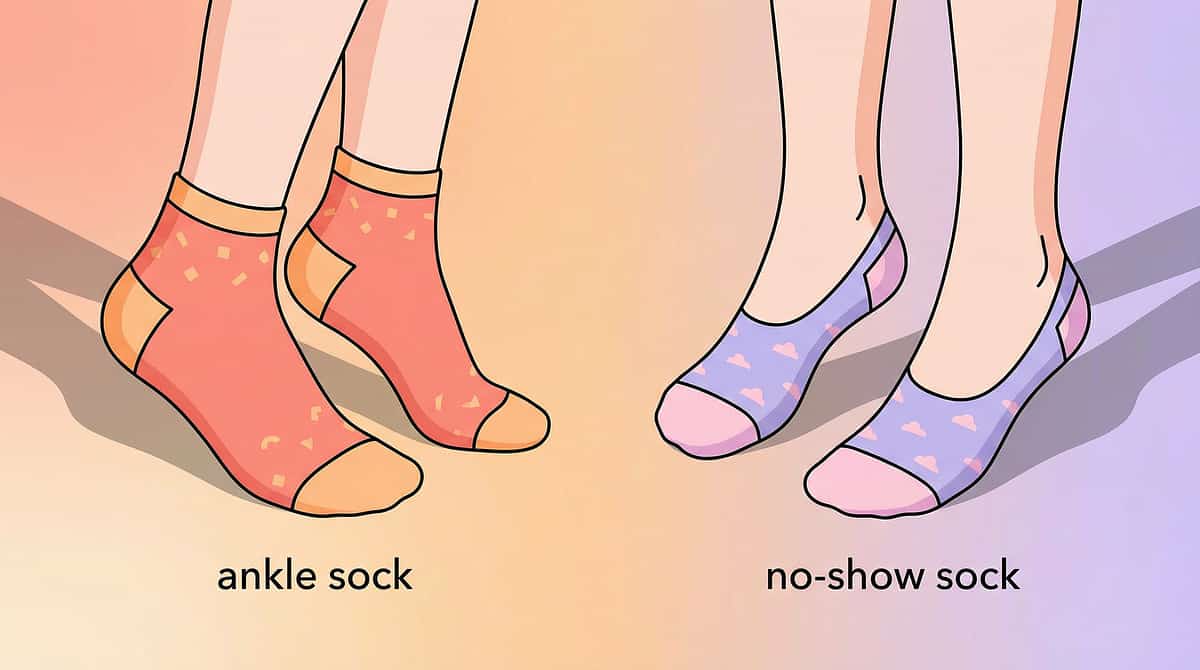
Simple and effective: the less sock there is, the fewer sensory inputs the nervous system must process. Ankle socks cover the foot and ankle only. No-show socks sit below the ankle, covering only the foot itself. For children who find full crew socks or knee-highs intolerable, reducing the fabric coverage area can make the difference between acceptance and refusal.
Who This Is For
Children who rip socks down to the ankle immediately after application. Children who tolerate socks in shoes but not visible on their legs. Children who describe the leg portion of the sock as "itchy" or "too much."
Implementation Notes
  • Try ankle-length before no-show — no-show socks can shift inside shoes, creating bunching triggers
  • Choose ankle socks with a soft, non-binding cuff — rigid elastic cuffs create their own pressure trigger at the ankle
  • No-show socks must fit precisely to prevent heel slippage inside the shoe
  • Consider no-show in warmer months when knee-highs are especially intolerable
Home Alternative
Roll crew socks down to the ankle after application — gives the "ankle sock effect" while using socks already owned. Alternatively, cut down longer socks to ankle height and hem or iron the edge.
Price Range
₹200–800/pair | ★★★ Less fabric = less sensory load
Material #9: The Sock-Putting-On Routine
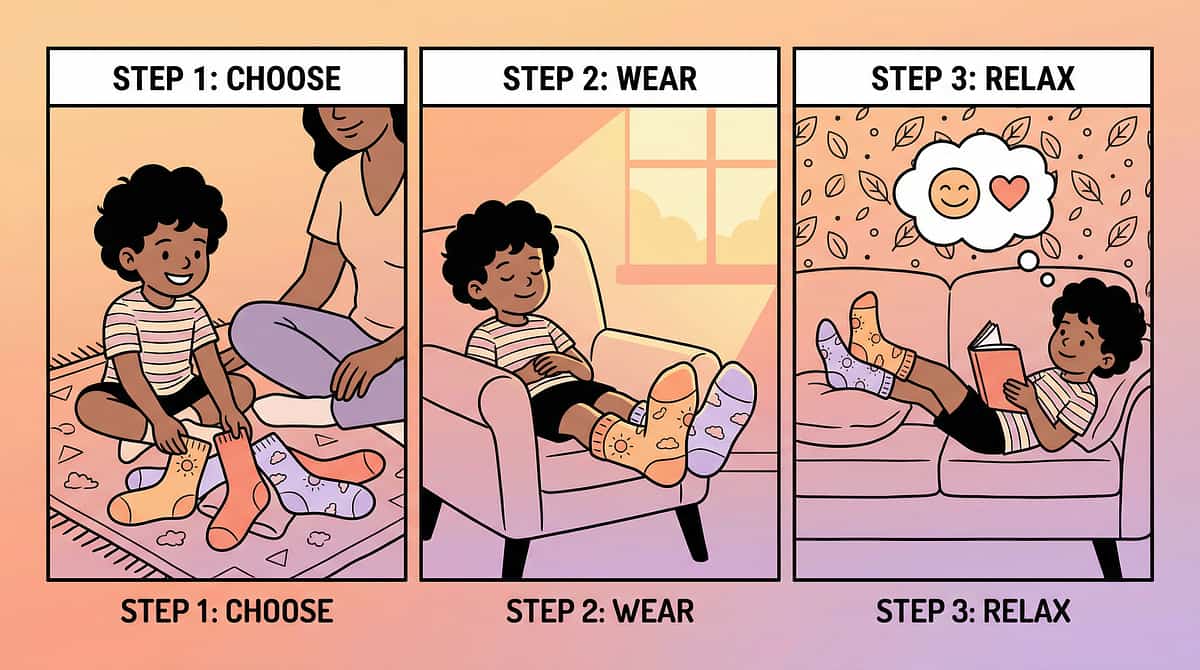
Cost: ₹0. Impact: ★★★★★. The most powerful material on this list is not a product — it is a predictable, repeatable process. The nervous system that cannot predict what is coming next is always on high alert. A consistent routine transforms the unknown into the known, and known becomes safe.
The Preparation Ritual
Foot massage, lotion, or joint compression — always first, always the same. Child comes to expect and eventually request this step.
The Choice Moment
Visual selection system — child chooses their approved sock. Same board, same options (rotating slowly over weeks). Predictable choice structure.
The Application
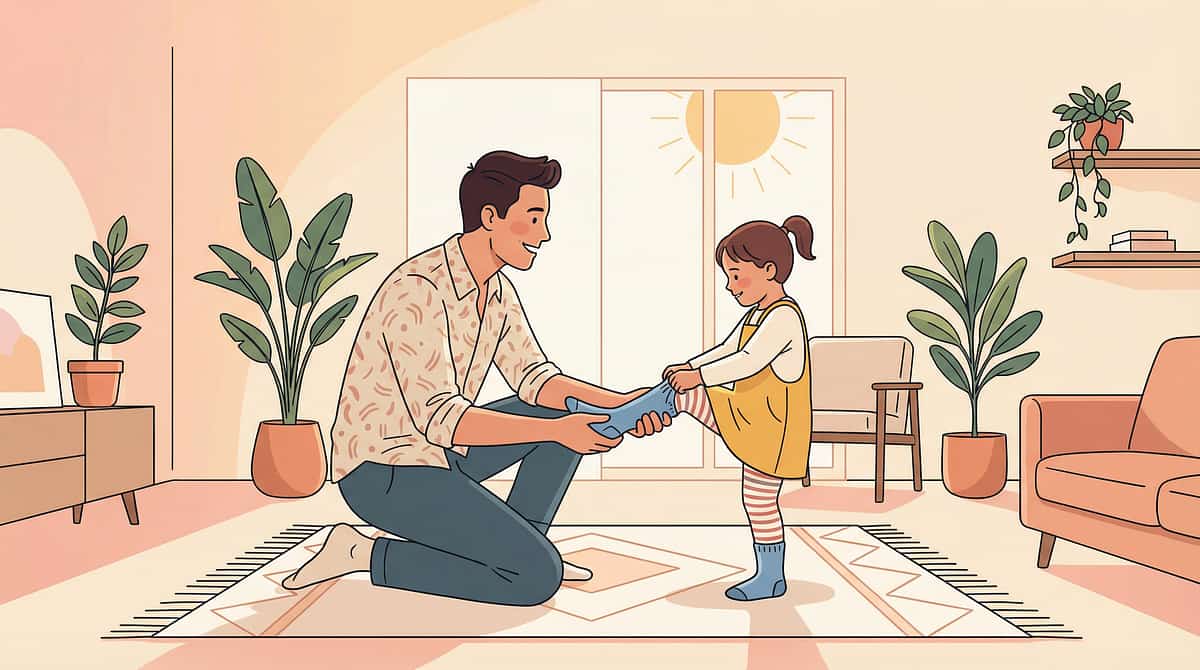
4-point technique — same order, same technique, every time. Verbal narration if child is learning self-application. No surprises.
The Confirmation
"How do those feel?" — same question, every time. Child checks, communicates, adjusts if needed within defined limits.
The Reinforcement
Specific praise within 3 seconds. Same energy, genuine celebration. The routine ends with success, every time.
"Predictable process = predictable outcome. The routine is the therapy."
DIY & Home Alternatives: Every Family Can Start Today
Not every family can order specialized socks online. Not every village has same-day delivery. The WHO/UNICEF Nurturing Care Framework demands context-specific, equity-focused interventions. The substitute works because the underlying sensory principle is the same. The brand does not matter — the mechanism does.
Material
Clinical Grade
Home Alternative
Seamless Socks
SmartKnitKIDS, Jefferies
Turn regular socks inside-out (seam ridge faces outward)
Compression
Graduated compression socks
Snug athletic or dance socks; size down slightly
Moisture-Wicking
Bamboo/modal fiber socks
Avoid 100% cotton; choose synthetic blends
Sock Liners
Dedicated liner socks
Cut toes from old soft socks; thin trouser socks underneath
Desensitization
Therapy brushes, sensory mats
Textured doormats, golf/tennis balls, rice bins, firm parent massage
Visual System
Commercial choice boards
Hand-drawn sock photos on paper, drawer dividers, labeled bags
Foot Preparation
Therapy-grade lotions
Unscented lotion, cornstarch, firm foot massage by parent
Short Socks
Specialized no-show
Cut down longer socks, roll crew socks to ankle
Routine
Video modeling systems
Written step chart, practice on calm days

Reference: WHO NCF (2018): PMC9978394 | WHO NCF Handbook (2022)
Safety First: Before You Begin
🔴 RED — Do Not Proceed If:
  • Child has open wounds, blisters, or skin irritation on feet
  • Child is in active meltdown or severe dysregulation (wait for calm)
  • Child has circulatory conditions (consult physician before compression socks)
  • You are in a time-pressured rush — practice on calm days, not school mornings
🟡 AMBER — Proceed With Modification If:
  • Child is mildly resistant but not distressed (use simplified protocol)
  • Child is tired or unwell (reduce expectations, use most tolerated sock only)
  • New sock type being tried for the first time (test in calm, low-demand setting first)
🟢 GREEN — Proceed When:
  • Child is fed, rested, and in a regulated state
  • You have 10–15 unhurried minutes
  • Pre-approved socks are clean and available
  • Environment is calm, familiar, and free from time pressure
🔴 STOP IMMEDIATELY IF: Child shows signs of genuine panic, pain beyond normal discomfort, skin color changes in feet, or persistent distress exceeding 5 minutes. Compression socks: watch for cold toes, color changes, or marks that do not fade. Desensitization MUST be child-controlled — never force exposure. Lotions: test for allergies, use unscented, allow full absorption before socks go on.

Reference: Padmanabha et al., Indian J Pediatr (2019): DOI: 10.1007/s12098-018-2747-4
Set Up Your Space: The Physical Stage
Position the Child
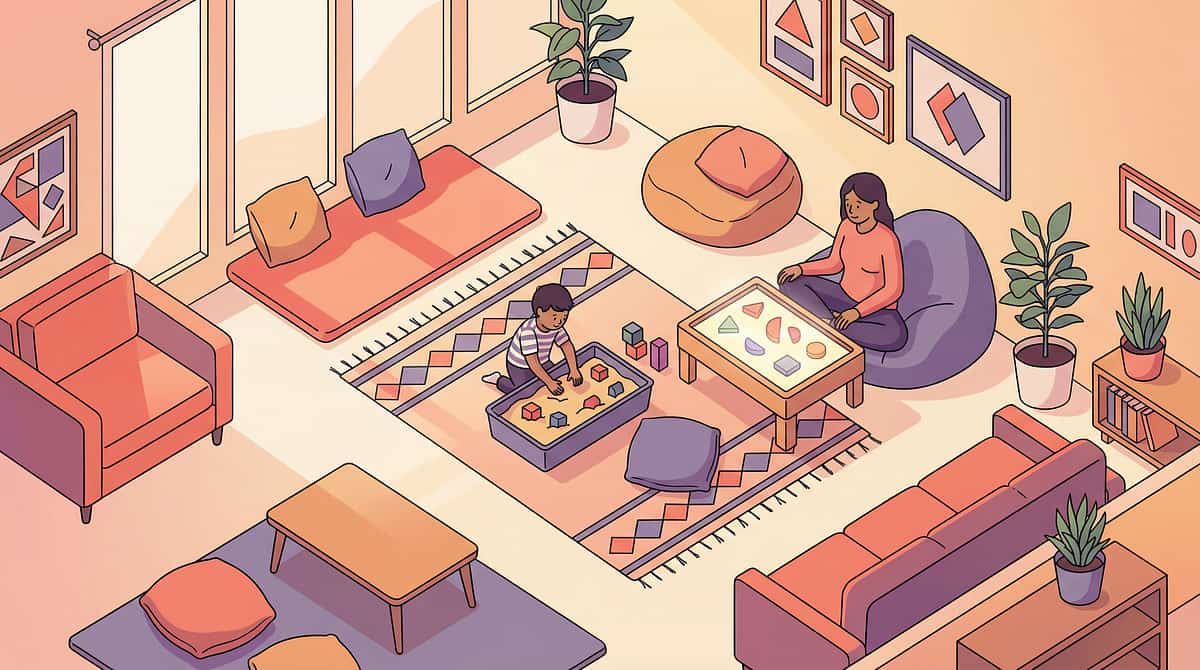
Seated comfortably with feet accessible. Floor, low chair, or bed edge work well. Child should be stable and relaxed — not standing or rushing. Eye level with materials is ideal.
Position the Materials
Approved socks visible and within child's reach. Only approved socks — remove or hide rejected socks entirely. Seeing rejected socks creates anticipatory anxiety before the routine even begins.
Position the Routine
Visual routine chart at child's eye level if used. Timer visible if timing the routine. Preparation materials (lotion, massage tools) in their designated spot — same place, every day.
Remove From the Space
  • All rejected or untested socks
  • Time pressure cues (rushing parent, ticking clock anxiety)
  • Distractions (screens, siblings, pets during initial practice)
  • Shoes — shoes come AFTER socks succeed
Environment
Calm lighting. Reduced noise. Comfortable temperature — cold feet are significantly more sensitive than warm feet.
"Spatial precision prevents 80% of session failures. Five minutes of setup saves forty-five minutes of battle."
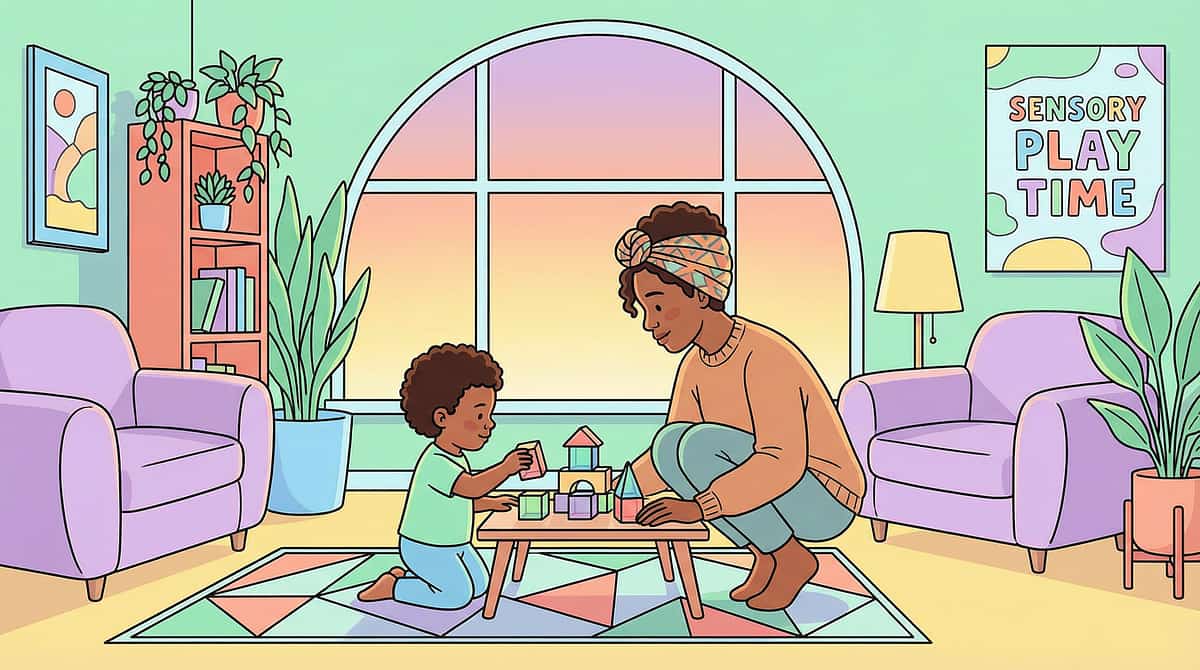
Is Your Child Ready? 60-Second Readiness Check
The best session is one that starts right. This pre-session assessment takes under one minute and prevents the majority of protocol failures before they happen.
Go Checklist
Child has eaten recently (not hungry) | Child is rested (not overtired) | Child is in a calm/regulated state | No recent illness or foot discomfort | Approved socks are clean and available | You have at least 10 unhurried minutes | Environment is set up per Card 12
Decision Gate
All green → GO. Proceed to Step 1.
1–2 amber → MODIFY. Use the most tolerated sock only. Skip desensitization. Keep it short.
Any red → POSTPONE. Offer a calming activity instead. Try again later today or tomorrow.
"The best session is one that starts right. A skipped session is always better than a forced one."
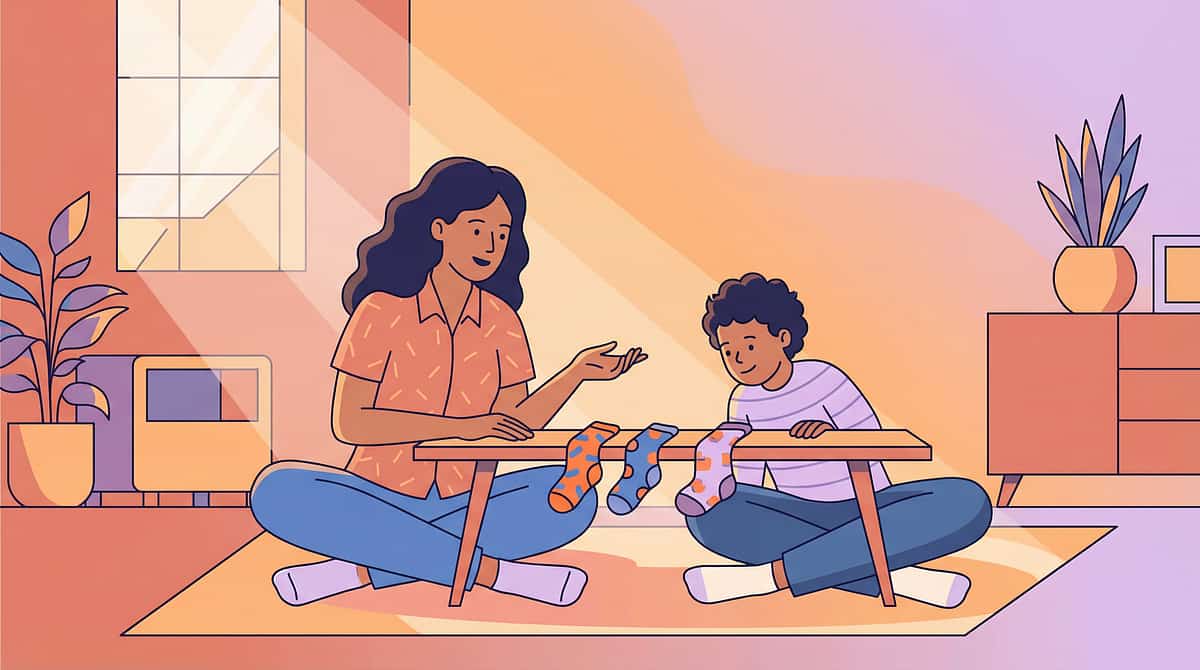
Reference: ABA readiness assessment protocols + Pinnacle clinical standards
Step 1: The Invitation
30–60 seconds
Every protocol begins with an invitation, not a command. The child is brought into the activity through playful, low-demand engagement. The difference in language is the difference between cooperation and escalation.
Say This
"Hey [child's name], it's sock time. Want to pick your socks today? Your favorites are right here."
Body Language
Calm. Seated at their level. No urgency in voice or posture. Gesture toward the approved sock drawer — not toward the child's feet.
What Acceptance Looks Like
Child approaches the drawer. Looks at options. Touches or picks up a pair. May not smile — neutral tolerance is acceptance at this stage.
What Resistance Looks Like
Turns away. Says "no." Covers feet. Begins to escalate.
If Resistance Occurs
"That's okay. Your socks will be here when you're ready. Want to look at them in a minute?"
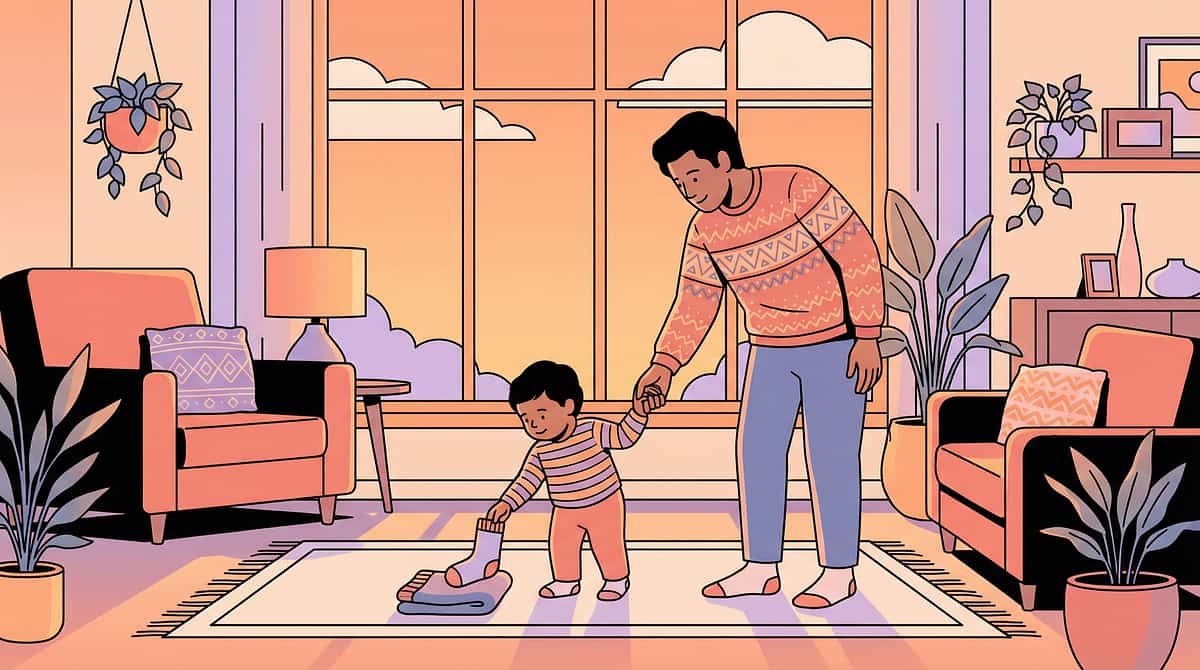
Withdraw pressure completely. Re-invite in 2–3 minutes. Maximum 3 invitations before postponing the session entirely.
The Principle
Never begin with "just put your socks on." The invitation IS the therapeutic moment.

Reference: ABA pairing procedures + OT "just-right challenge" principle
Step 2: Sock Selection & Engagement
1–3 minutes
The child is now at the drawer. This step deepens the interaction by activating their choice and agency before any sock touches their foot.
If Using Visual Selection System
Child looks at the approved options chart. Points to or names their choice. You retrieve the selected pair. The child's decision is honored — no substitutions.
If Using Pre-Sock Preparation
Before the selected socks go on: "Let's get your feet ready first." Begin the preparation ritual — massage, lotion, or powder per child's preference. 1–2 minutes of firm foot massage or preparation.
Present the Sock
Hold the selected sock where the child can see it. Do not rush toward the foot. Let the child touch it first if they choose. The sock comes to them — they do not reach for it under pressure.
Child Response Spectrum:Engagement — touches sock, holds it, attempts to put it on → Proceed to Step 3. Tolerance — watches passively, does not resist → Proceed to Step 3 with parent assistance. Avoidance — pushes sock away → return to invitation, offer different approved sock, consider preparation step if skipped. Reinforce engagement immediately: "Great choice! Those are your blue ones."

Reference: PMC11506176 — Structured material introduction meets EBP criteria
Step 3: The 4-Point Application Technique
1–2 minutes per sock
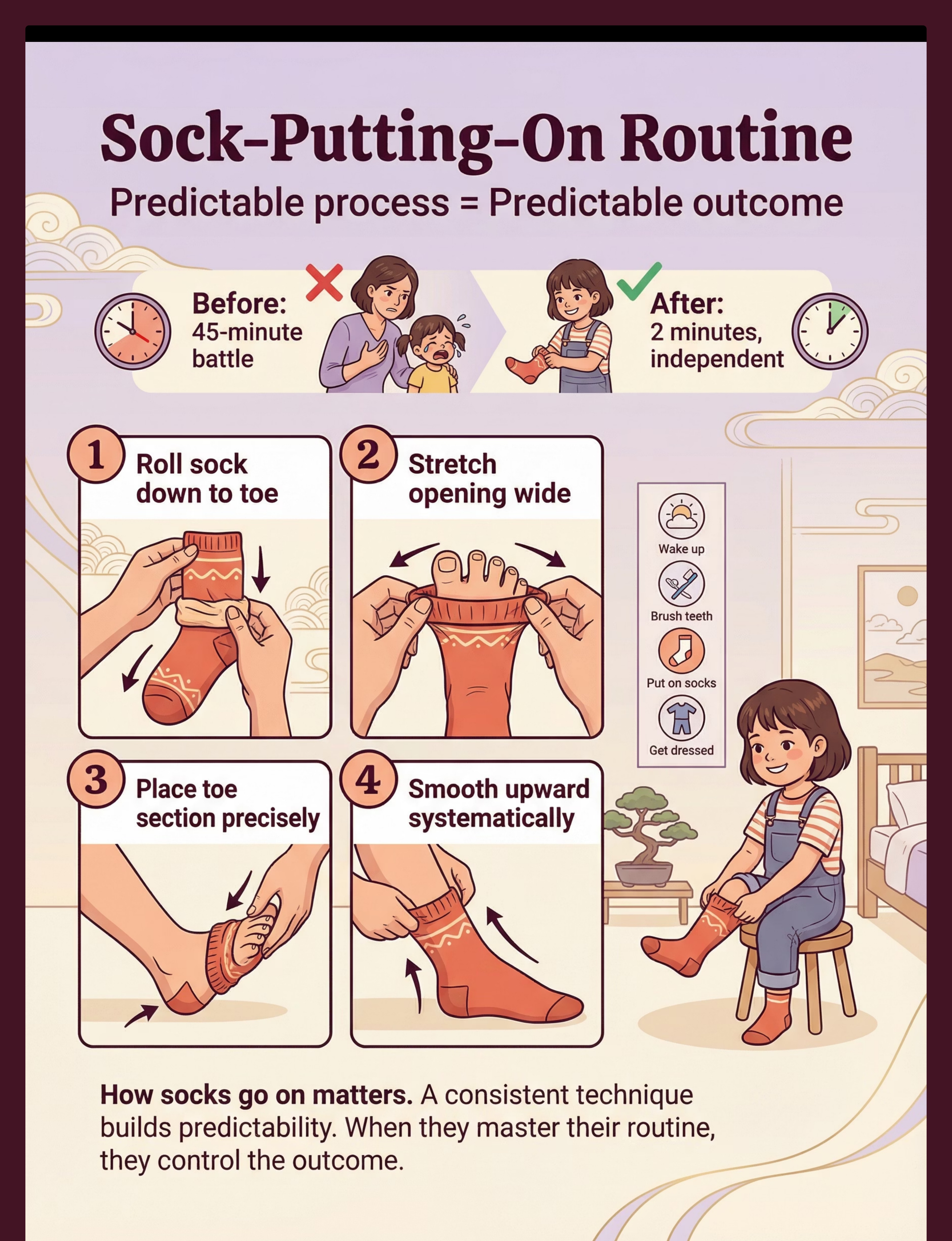
This is the core therapeutic moment. HOW the sock goes on matters as much as WHICH sock is used.
ROLL
Roll the sock down so only the toe pocket is accessible. This prevents bunching during application — the single most common cause of session failure.
STRETCH
Stretch the opening wide with both thumbs inside. Maximum opening = minimum contact during entry. The foot slides in cleanly.
PLACE
Place the toe section precisely onto the toes. Alignment here prevents seam misposition — the most common complaint after application.
SMOOTH
Smooth from toe to ankle in one firm, continuous motion. Firm pressure — not light touch. Systematically check for bunching, wrinkles, or seam misalignment.

Common errors: Rushing (creates bunching) | Light touch during smoothing (triggers defensiveness — use firm pressure) | Not checking seam alignment before shoe goes on. Reference: PMC10955541
Step 4: Check, Adjust & Confirm
1–2 minutes
The Confirmation Ritual
"How do those feel? Anything weird?"
Child checks by wiggling toes, walking a few steps, pressing on the toe area.
  • Comfortable → Move to reinforcement (Step 5)
  • "Something's wrong" → One adjustment cycle: remove, re-apply using 4-point technique, re-check
  • Maximum 2 adjustment cycles. If still uncomfortable → switch to a different approved sock or postpone
Variation Across Days
Rotate through approved socks to prevent rigidity around a single pair. Gradually introduce new socks during calm testing sessions — NOT rushed mornings. Track which socks succeed and which fail — patterns reveal the specific trigger: seam, fabric, compression, or moisture.
The Clinical Rule
"3 good applications are worth more than 10 forced ones."
If the child is escalating — stop. Today's data informs tomorrow's approach. A session that ends before completion is not failure. It is information.
What the Data Tells You
  • Which socks consistently pass confirmation
  • Which part of the sock (toe, heel, cuff) triggers complaint
  • Whether distress occurs at application or emerges after wearing begins
  • Whether the trigger is seam, pressure, moisture, or enclosure

Step 5: Reinforce & Celebrate
Within 3 seconds
The ABA reinforcement moment. Timing matters more than magnitude. Immediate, specific, enthusiastic — within 3 seconds of successful sock wearing.
Verbal Praise
Specific, not generic. "Your socks are on and you're ready for school!" beats "Good job." Name what they did: "You picked them yourself AND put them on!"
Physical Celebration
High-five, fist bump, or celebratory squeeze — only if child enjoys physical interaction. Match the celebration to the child's preference, not yours.
Token Economy
If using a reward chart — add a token or sticker immediately for successful sock-wearing. Visual progress motivates continued effort across days.
Natural Consequence
The reward IS the outcome — getting to school on time, going to the park, wearing cool shoes. Make the connection explicit: "Socks done! Now we can do the fun part."
Activity Reward
"Socks done! That means we have time for 5 minutes of [preferred activity] before we leave." Time-bound, predictable, worth working toward.
"Celebrate the attempt, not just the success. Even tolerating the sock for 30 seconds longer than yesterday is real neurological progress worth marking."
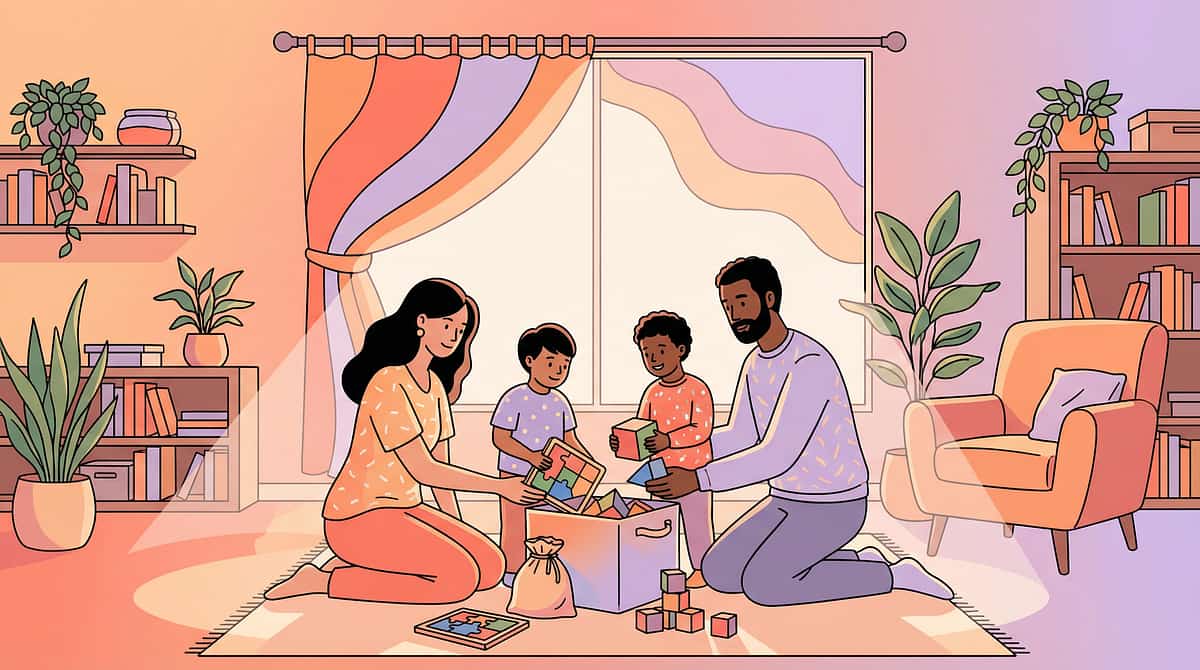
Step 6: Transition to Morning Flow
1–2 minutes
No session ends abruptly. The cool-down transitions the child from the focused sock activity back into the morning flow. Predictable endings matter as much as predictable beginnings.
To Breakfast
Final step before starting the day.
Add Shoes
Next, put on your footwear.
Socks Done
First step in getting ready.
Transition Sequence
"Socks are done! Two more things — shoes, then breakfast." Preview what comes next. Present shoes. Allow a moment of "just socks" before adding shoes if anxiety was high. Confirm comfort in socks + shoes combined. Check: Is the shoe pressing on the sock seam? Is the sock shifting inside the shoe?
If Child Resists Ending
Set a boundary: "One more check, then socks are done for now." Use a visual timer. Redirect to next activity: "Let's go see what's for breakfast."
Material Put-Away
Child returns unused socks to the approved drawer. This is part of the routine — it signals completion and builds independence in the full dressing sequence.

Reference: NCAEP Evidence-Based Practices Report (2020) — Visual supports for transition

Capture the Data: Track Right Now

"60 seconds of data now saves hours of guessing later." Within 60 seconds of socks going on — record these three data points. Your tracking feeds the GPT-OS® personalization engine. Data Point How to Record Example Distress level (0–5) Quick rating: 0 = calm, 3 = moderate fuss, 5 = meltdown Score: 2 Time from start to socks on Stopwatch or estimate "4 minutes" Which sock type succeeded Name or code "Seamless blue pair" Optional but valuable: Did child self-apply or need assistance? | Number of adjustment attempts before acceptance | Did preparation ritual (massage/lotion) happen? GPT-OS® In-App Tracker Automatic pattern recognition and weekly recommendations based on your data. Downloadable PDF Printable tracking sheet — date, distress level, time, sock type. Download at materials.pinnacleblooms.org Simple Notebook Date | Distress (0–5) | Time | Sock type | Notes. No technology required. Same data value. Reference: BACB data collection standards | Cooper, Heron & Heward — Applied Behavior Analysis
What If It Didn't Go As Planned? 7 Common Failure Modes
"Session abandonment is not failure — it is data." Here are the seven most common reasons sock interventions stall, and exactly how to fix each one.
"She put them on and ripped them off within 30 seconds"
Why: Seam alignment was off, or the sock shifted after application. Fix: Re-apply using 4-point technique with extra attention to seam position. If seamless socks, check for ankle or heel seams you may have missed.
"He won't even touch the socks"
Why: Anticipatory anxiety from past negative experiences. Fix: Start with non-demanding exposure. Leave approved socks out for voluntary touching — no expectation to wear. Build positive association over days before attempting wearing.
"Seamless socks don't work either"
Why: The trigger may not be the seam — could be compression, fabric type, moisture, or foot enclosure itself. Fix: Systematically test each variable in isolation. Test compression socks, moisture-wicking, ankle-length, with/without preparation ritual.
"It works at home but not at school"
Why: School socks differ; school stress lowers tolerance threshold. Fix: Sock liners under school socks. Practice school socks at home in calm settings. Communicate with school about accommodation needs.
"She'll only wear one specific pair"
Why: Rigidity is a sensory safety strategy — it works, so the brain holds on. Fix: Respect the safe pair. Buy multiples. Expand options very slowly during calm testing sessions, never under pressure.
"Morning is too rushed for this whole process"
Why: Time pressure escalates anxiety for both parent and child. Fix: Wake 15 minutes earlier during the training phase. Move sock routine earlier in the morning sequence. Practice on weekends without time pressure.
"My partner/grandparent forces the socks and undoes the progress"
Why: Inconsistent approaches confuse the child's expectations and increase defensiveness. Fix: Share Card 37 (Family Guide) with all caregivers. Explain: forcing socks increases defensiveness — it does not build tolerance. Consistency multiplies impact.
Adapt & Personalize: No Two Children Are Identical
This protocol is a framework, not a script. Here is how to adjust for your child's specific sensory profile, current difficulty level, and developmental stage.
← Easier: Bad Days, Early Weeks, High Anxiety
  • Use only the single most tolerated sock pair
  • Skip routine steps — just get socks on with minimal distress
  • Parent applies socks entirely
  • Preparation ritual extended to 3–5 minutes
  • No expectation of independence
→ Harder: Breakthrough Days, Week 5+, Building Independence
  • Rotate through 3–4 approved options
  • Full routine with self-application
  • Child manages their own preparation
  • Introduce one new sock type for calm testing
  • Reduce preparation time gradually
Sensory Profile Variations
Sensory Avoider: Prioritize seamless, soft fabrics, minimal fabric coverage. Always start with preparation. Never surprise with new socks.
Sensory Seeker: May prefer compression socks. May want textured or patterned socks. Channel seeking behavior into the routine (squishing socks, stretching fabric).
Age Modifications
Ages 2–4: Entirely parent-led. Focus on finding the right material. Routine is simple: "massage, sock on, done."
Ages 5–8: Shared execution. Child begins learning the 4-point technique. Visual choice system is central.
Ages 9–12: Independence-focused. Child manages entire routine. Parent role shifts to "available if needed."
Weeks 1–2: Establishing the Foundation
Progress: 15%
What You Will Likely See
  • Reduced duration of sock battles (from 45 minutes to 20 minutes — that IS progress)
  • Child begins to accept one specific sock type with less distress
  • Preparation ritual becomes tolerated (may not be welcomed yet)
  • Routine steps start to feel familiar to both parent and child
What You Will Not See Yet
  • Complete elimination of distress
  • Independent sock wearing
  • Acceptance of multiple sock types
  • Morning routine running smoothly
"If your child tolerates the approved socks for even 30 seconds longer this week than last week — that is real neurological progress. The nervous system is learning."

Parent preparation: This is the hardest phase. You are building infrastructure. The payoff comes later. Trust the process. Track the data. Every session counts even when it does not feel like it.

Reference: PMC11506176 — SI intervention timeline evidence
Weeks 3–4: Neural Pathways Forming
Progress: 40%
Something is shifting. The routine is becoming familiar. The nervous system is beginning to predict — and prediction is the foundation of tolerance.
1
Consolidation Indicators
  • Child begins to anticipate the routine (approaches the sock drawer without invitation)
  • Distress drops from acute (crying, panic) to mild (brief fussing, one adjustment)
  • Preparation ritual may become requested by the child ("do my feet first")
  • One or two sock types become reliably successful
  • Morning routine time decreasing measurably
2
What the Child May Start Doing Spontaneously
  • Touching socks in stores or laundry without prompting
  • Commenting on how socks feel ("these are the good ones")
  • Self-correcting seam position without asking for help
  • Showing sock preference with confidence rather than anxiety
"You may notice you're more confident too. Parental self-efficacy grows alongside the child's tolerance. Your data confirms the pattern. Your technique improves with practice. This is working."

When to increase: If distress is consistently below 2/5 with current approach, begin rotating a second approved sock into the routine.
Weeks 5–8: Mastery Emerging
Progress: 75%
Your child is approaching something that felt impossible eight weeks ago. Here is how to know when mastery is real — not just a good day.
Mastery Criteria
  • Independently selects socks from approved options
  • Self-applies socks using learned technique
  • Completes sock routine in under 5 minutes without distress
  • Tolerates 3+ approved sock types
  • Can communicate sock discomfort without meltdown
  • Morning routine is no longer dominated by sock anxiety
Generalization Indicators
  • Tolerates socks in school setting
  • Accepts socks for sports and activities that require them
  • Beginning to tolerate new, untested sock types
  • Transferring self-advocacy skills to other clothing challenges
Maintenance check: Skip the routine for one day. Does the child manage independently? If yes — mastery is real. If regression occurs — continue the routine for 2 more weeks before testing again.
🏆"Mastery unlocked: From 45-minute battles to 2-minute independence."

Reference: PMC10955541 | BACB mastery criteria standards
You Did This.
Eight weeks ago, socks ruined your mornings. Your child cried. You were exhausted. You felt alone in a battle that nobody else could see or understand. Today, your child picks their socks, puts them on, and moves to breakfast. The morning is yours again.

This happened because you showed up — every single morning — with patience, with the right materials, with a plan, and with love that looks like firm foot massage at 7:15 AM.
Your child grew because of your commitment. The nervous system that once screamed at a sock seam has learned to process that input. The brain rewired — because you gave it the right conditions, consistently, over time.
Take a Photo
Your child putting on their own socks. Frame it. This moment is real and it is yours.
Note Today's Date
This is the day the morning battle ended. Remember it. Share it.
Tell Your Family
"Remember when socks took 45 minutes? Today it took 2." Let everyone celebrate this win.
🚨 Red Flags: When to Pause and Seek Help
Trust your instincts. If something feels wrong, pause and ask. These six signs indicate that professional guidance is needed before continuing the protocol independently.
Distress Is Increasing Despite 4+ Weeks of Consistent Protocol
Tolerance should improve, not worsen. If it is worsening, the trigger may not be what was assumed. A comprehensive sensory evaluation can identify the actual variable.
Skin Irritation, Redness, or Blisters on Feet
This may indicate a material allergy, fit issue, or dermatological condition unrelated to sensory processing. Consult a pediatrician before continuing.
Refusal Extends to ALL Foot Covering Including Shoes and Sandals
This may indicate broader tactile defensiveness or an emerging anxiety pattern requiring professional OT intervention beyond this protocol.
Distress Includes Hitting, Biting, or Self-Injury
The behavioral response has exceeded sensory accommodation. ABA and/or psychological support is needed in addition to OT strategies.
Previously Achieved Tolerance Regresses Suddenly
Sudden regression can indicate illness, new stressor, medication change, or developmental shift. Evaluate the context before assuming protocol failure.
You as the Parent Feel Overwhelmed or Unable to Continue
Parental wellbeing is not secondary. If the sock battle is affecting your mental health, seek professional support for BOTH of you. You cannot pour from an empty cup.
Escalation Pathway: Protocol modifications (Card 22) → Teleconsultation with Pinnacle OT → In-person comprehensive sensory evaluation → Center-based intervention program
The Progression Pathway: Where You're Going
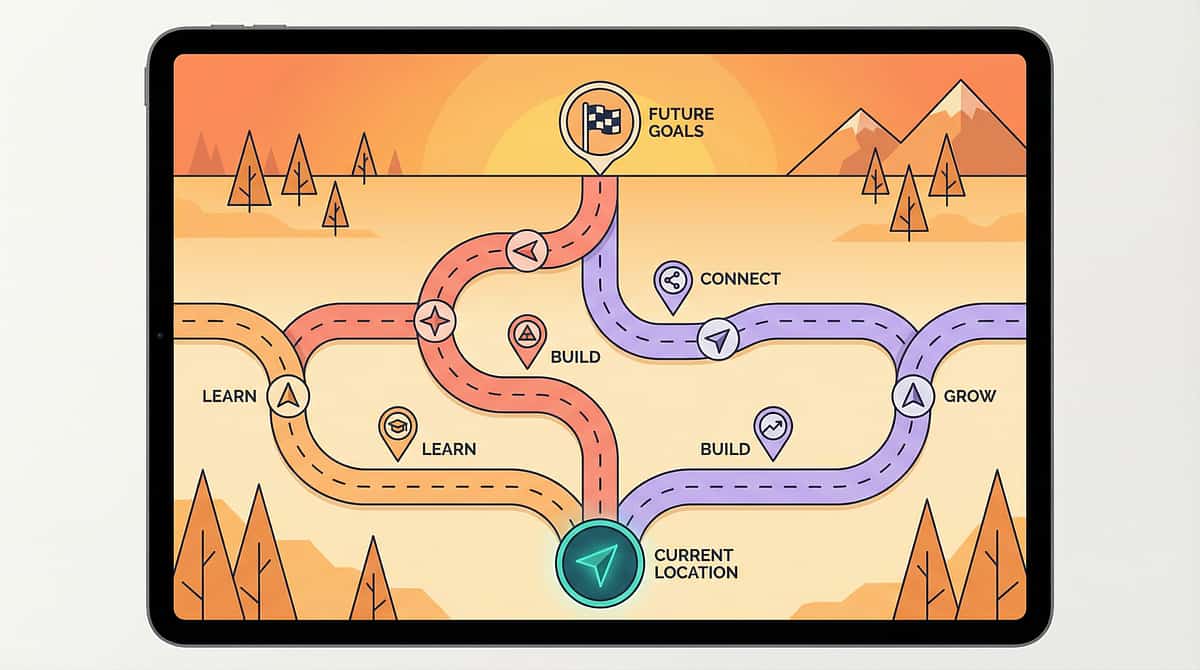
Sock refusal is one point on a broader sensory processing map. Here is where A-026 sits in the complete developmental journey — and where to go next.
A-030 Getting Dressed Battles
A-028 Clothing Tag Sensitivity
A-027 Shoe Struggles
A-026 Sock Refusal
Current: A-026 ← YOU ARE HERE
Sock Refusal — 9 Materials Protocol. The foundation of tactile tolerance for lower-body dressing.
Next-Level Options
  • A-027: 9 Materials for Shoe Struggles — next barrier after sock success
  • A-028: Clothing Tag Sensitivity — same mechanism, different trigger
  • A-030: Getting Dressed Battles — broader dressing independence
Lateral Alternative
A-024: 9 Materials for Light Touch Defensiveness — addresses the broader tactile pattern underlying all clothing challenges.
Long-Term Goal
Full dressing independence with self-advocacy for sensory accommodations. Child manages their own clothing sensory needs across home, school, and community settings — without parent intervention.
Related Techniques in This Domain
You already own materials for A-027 and A-028 — the sock liners, visual system, and preparation routine transfer directly. Your investment in A-026 pays forward into the entire tactile domain.
A-024: Light Touch Defensiveness
Difficulty: Intro | Materials You Already Own: Tactile kit, therapy brush. The foundational technique for all tactile sensitivity.
A-027: Shoe Struggles
Difficulty: Core | Materials You Already Own: Sock liners, visual system. The natural next step after sock mastery.
A-028: Clothing Tag Sensitivity
Difficulty: Core | Materials You Already Own: Seamless garments, scissors. Same underlying mechanism as sock sensitivity.
A-023: One-Outfit Rigidity
Difficulty: Core | Materials You Already Own: Visual selection system. Addresses rigid clothing preferences that develop as sensory safety strategies.
A-030: Getting Dressed Battles
Difficulty: Advanced | Materials You Already Own: Full dressing routine materials. Comprehensive dressing independence when multiple clothing challenges persist.
A-001: Touch Sensitivity — 9 Materials
Difficulty: Intro | Materials You Already Own: Tactile sensory kit. The broadest entry point into tactile processing intervention.
Real Families. Real Progress. Real Mornings.
Family A — Age 5, Hyderabad
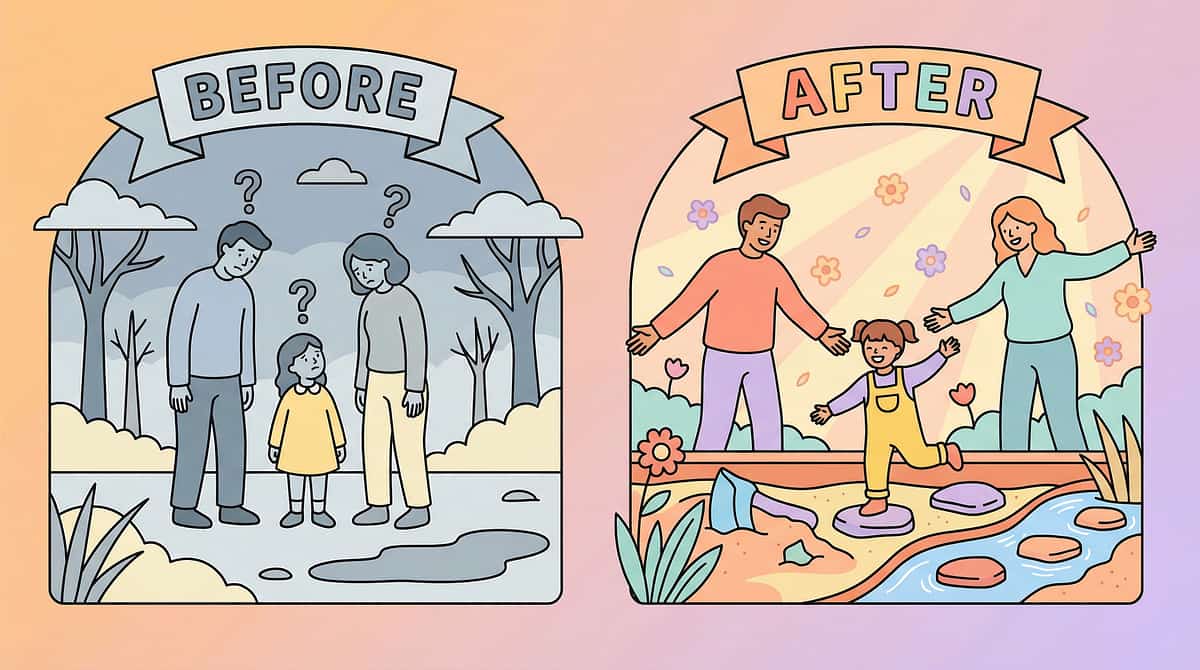
Before: 45-minute sock battles every morning. Late to school 3–4 times per week. Only one pair of socks tolerated. Meltdowns escalating to the point of the child refusing to leave the house.
After (12 weeks): Seamless socks + visual selection system + consistent routine. Morning sock time: under 3 minutes. Four approved sock types. Child self-selects and self-applies. School attendance: normal.
Family B — Age 7, Bengaluru
Before: Refused all socks for 2 years. Wore sandals year-round. Excluded from sports activities. Extreme distress when sock-wearing was attempted.
After (16 weeks): Compression socks were the breakthrough — not seamless. The child needed firm pressure, not seam elimination. Combined with foot desensitization and routine training. Now wears socks for school and selected activities.
From a Parent in the Pinnacle Network
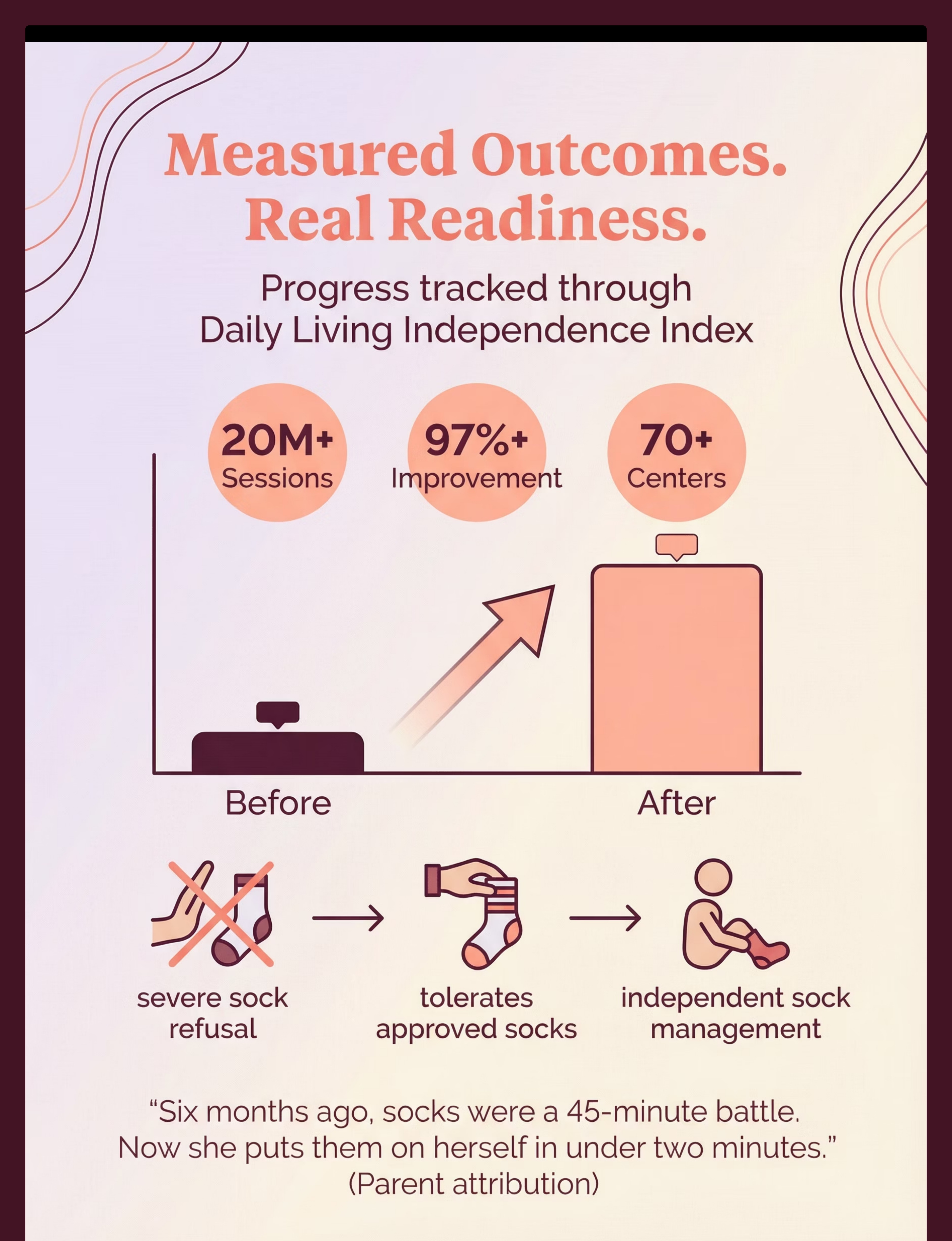
"Six months ago, socks were a 45-minute battle every single morning. Now she puts them on herself in under two minutes. We found the right socks, built the right routine, and mornings are ours again."
From the Therapist's Notes:"The key with sock refusal is identifying whether the primary trigger is seam-related, pressure-related, moisture-related, or anxiety-related. Once you isolate the variable, the right material is usually obvious. The routine does the rest."
Illustrative cases; individual outcomes vary by child profile. Statistics represent aggregate outcomes across Pinnacle Blooms Network.

Preview of 9 materials that help with sock refusal Therapy Material

Below is a visual preview of 9 materials that help with sock refusal therapy material. The pages shown help educators, therapists, and caregivers understand the structure and content of the resource before use. Materials should be used under appropriate professional guidance.
Page 1
Page 2
Page 3
Page 4
Page 5
Page 6
Page 7
Page 8
Page 9
Page 10
Page 11
Page 12
Page 13
Page 14
Page 15
Page 16
Page 17
Page 18
Page 19
Page 20
Link copied!
Frequently Asked Questions: Sock Refusal
What is the single best first thing to try?
Seamless socks. They have the highest single-intervention success rate because the toe seam is the primary trigger for most children. If seamless alone doesn't work, add the routine and preparation ritual.
How long until we see improvement?
Most families report noticeable reduction in distress within 2–3 weeks of consistent protocol use. Meaningful independence typically emerges by weeks 5–8. Some children respond faster, some slower — track your data to see your child's personal trajectory.
My child will only wear ONE pair of socks. Is that okay?
Yes, initially. Rigidity around a "safe" sock is a normal sensory safety strategy. Respect it. Buy duplicates immediately. Gradually expand options from a position of success, never from pressure.
Can I just let my child go barefoot or wear sandals?
In the short term, if it reduces distress, yes. Barefoot time is actually therapeutic — natural foot desensitization. However, building sock tolerance is important for school attendance, weather protection, and full social participation.
My child's school requires specific socks. What do I do?
Sock liners (Material #4) worn under school socks create a sensory-friendly buffer while meeting dress code requirements. Communicate with the school about sensory accommodations — most schools readily accept once needs are explained.
Does sock refusal mean my child has autism?
Sock refusal alone does not indicate autism. However, if it co-occurs with multiple sensory sensitivities, communication differences, and social interaction patterns, a comprehensive developmental evaluation is recommended. Contact the Pinnacle helpline for guidance.
The inside-out trick doesn't work. Now what?
Inside-out is a limited fix — it reduces but doesn't eliminate the seam. Move to truly seamless socks (zero seams anywhere). If those also fail, the trigger may not be seam-related. Systematically test compression, moisture-wicking, and foot preparation.
When should I seek professional help?
If 4+ weeks of consistent protocol use shows no improvement, if distress is escalating, if refusal extends to all foot covering, or if you feel overwhelmed. The Pinnacle helpline (9100 181 181) is free and available 24/7 in 16+ languages.

🟢 Start Today
Seamless socks + visual selection system + consistent routine. Total cost: ₹400–1,200 for socks. Visual system and routine are free.
🔵 Book a Consultation
Speak with a Pinnacle OT who specializes in sensory processing and daily living skills.
🟡 Explore Next
A-027: Shoe Struggles | A-024: Light Touch Defensiveness | Browse all techniques at techniques.pinnacleblooms.org

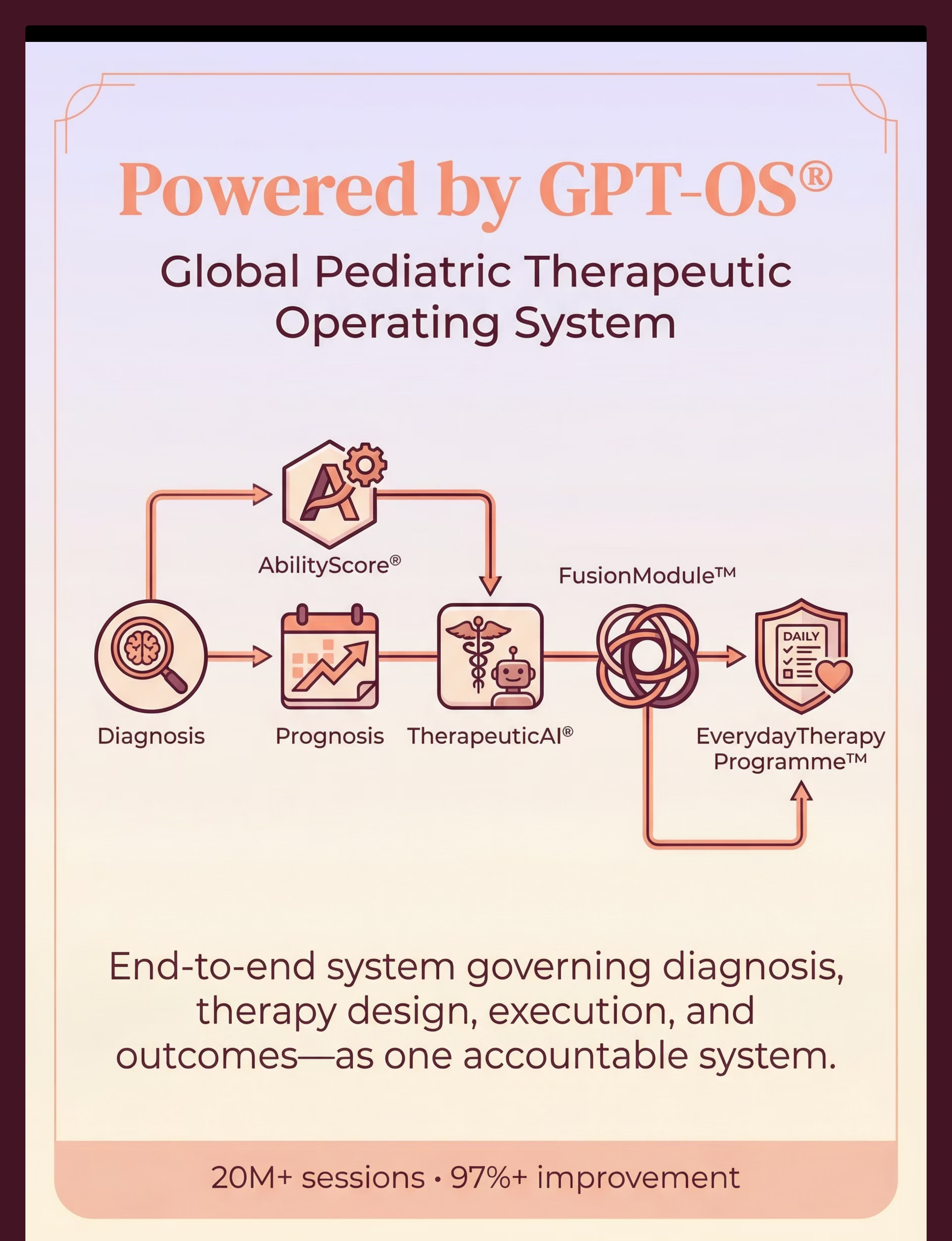
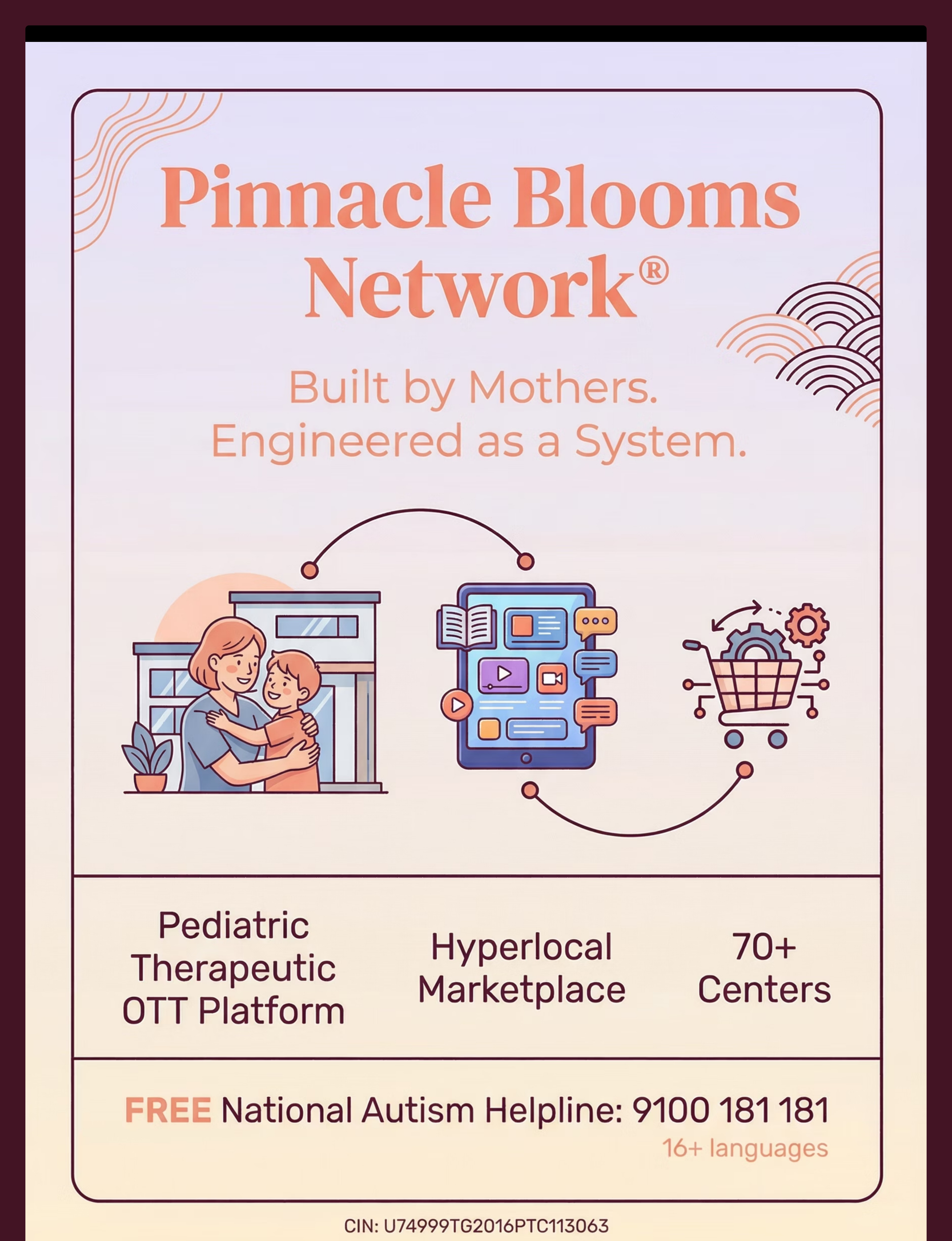
Pinnacle Blooms Network® — Built by Mothers. Engineered as a System. India's largest autism therapy chain — 70+ centers — 20M+ therapy sessions — 97%+ measured improvement. Powered by GPT-OS®. Patents filed across 160+ countries.
Medical Disclaimer: This content is educational. It does not replace assessment by a licensed occupational therapist or developmental specialist. Persistent sock refusal may be part of broader sensory processing patterns requiring comprehensive evaluation. Individual results vary. Statistics represent aggregate outcomes across Pinnacle Blooms Network. Always consult a qualified healthcare professional for personalized guidance.
© 2025 Pinnacle Blooms Network®, unit of All Bharath Healthcare Laboratories Pvt. Ltd. All rights reserved. CIN: U74999TG2016PTC113063 | DPIIT: DIPP8651 | GSTIN: 36AAGCB9722P1Z2