

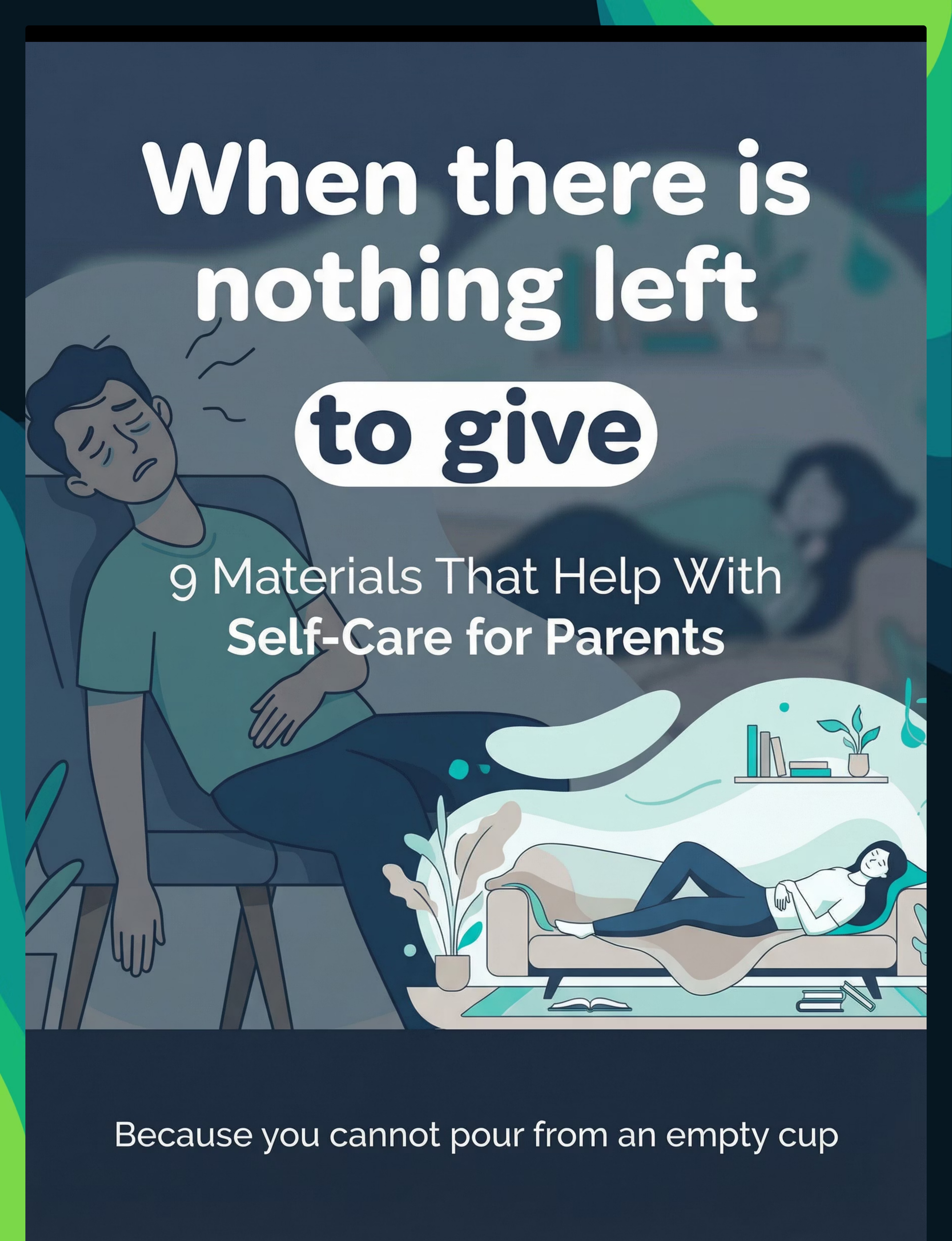
9 Materials That Help With Self-Care for Parents
Because you cannot pour from an empty cup.
Caregiver Wellness & Sustainability — Episode 885
Parent Voice
"I know I should take care of myself. Everyone tells me to."
"Between the 5 AM wake-up and the therapy appointments, the school meetings, the meltdowns, the medications, the endless advocacy calls, the meal prep for a child who eats five foods, the bedtime battles that stretch past midnight — when exactly am I supposed to do this self-care? My husband works. My parents don't understand. My friends have stopped calling. I am alone with this, every single day."
The last time you took a bath without a child screaming outside the door was… you can't remember. The last time you finished a cup of coffee while it was still hot was months ago. Somewhere inside all of this, you've lost yourself. Not a person, not a woman — just "mom of a special needs child." And every time someone tells you to practice self-care, you want to laugh. Or cry. Or both.
This resource is for you. Not advice from someone who doesn't understand — but a real set of tools designed for the margins you actually have.

Understanding the Problem
What Caregiver Burnout Actually Looks Like
Caregiver burnout is a state of physical, emotional, and mental exhaustion that occurs when caregivers don't get the help they need, or try to do more than they are able — physically, emotionally, or financially. Parents of children with special needs are at significantly elevated risk due to the intensity, duration, and complexity of caregiving demands.
Research consistently shows that parents of children with autism experience stress levels comparable to combat soldiers — with higher rates of depression, anxiety, and physical health problems than the general population. Critically, this is not a personal failing or a lack of love. It is a predictable consequence of unsustainable demands without adequate support.
Clinical Term: Caregiver Burnout / Caregiver Fatigue / Compassion Fatigue / Parental Exhaustion Syndrome

Recognizing the Signs
Common Signs of Caregiver Burnout
Emotional & Mental
- Emotional numbness or detachment
- Increased irritability, shorter fuse
- Loss of interest in previously enjoyed activities
- Difficulty making decisions
- Crying episodes and emotional breakdowns
- Compassion fatigue — difficulty empathizing
- Guilt about having any needs at all
- Fantasies about escape or disappearance
Physical & Behavioral
- Constant exhaustion that sleep doesn't fix
- Headaches, GI issues, chronic pain, hair loss
- Sleep disturbances even when able to sleep
- Neglecting own health appointments and medications
- Social isolation and withdrawal
- Resentment toward child, partner, or others
- Feeling trapped with no way out
- Loss of sense of self outside caregiving role
If you are experiencing severe depression, suicidal thoughts, or inability to function, please seek immediate professional help. These materials supplement — they do not replace — clinical care.

A Day in the Life
"Let me tell you what my days look like."
"I wake up before dawn — not by choice, but because my son does. From the moment my feet hit the floor, I'm in motion. Managing his morning routine. Preventing meltdowns over socks, breakfast foods, the wrong cup, the tag in his shirt. Getting him on the school bus while neighbors watch and I pretend I don't see their judgment. Then I collapse for exactly twelve minutes before the phone calls start — to insurance, to school, to therapists, to specialists with six-month waitlists. Every interaction requires me to advocate, explain, defend, fight. By noon, I'm already exhausted. But there's no rest."
By evening, after therapy appointments, homework battles, dinner negotiations, and a bedtime that takes two hours on a good night — there is nothing left. No patience for a partner who wants to connect. No quiet words for another child who needs help. The dishes are in the sink. The bills are unpaid. Your own doctor's appointment was missed because something came up. It always comes up.
This is not a character flaw. This is a circumstance. And there are tools that can help you survive it — not fix it, but survive it — with more of yourself intact.
Overview
9 Materials. Real Margins. Real Relief.
These are not luxury spa suggestions. These are survival tools designed for parents who have no time, limited energy, and a life that leaves almost no margin. Each material works in the gaps you actually have — not the idealized gaps self-care articles assume you have.
1
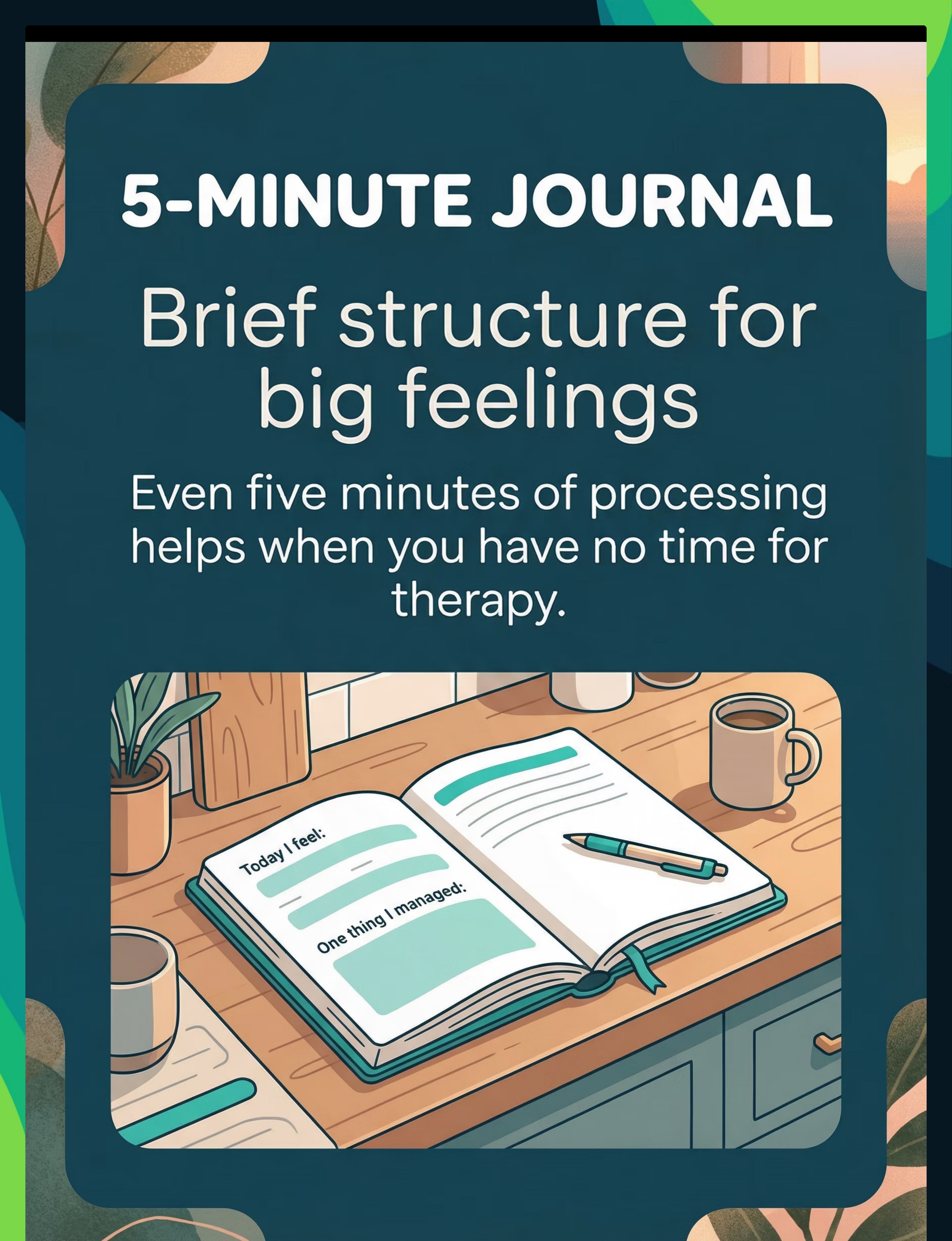
Five-Minute Journal
Brief structure for big feelings
2
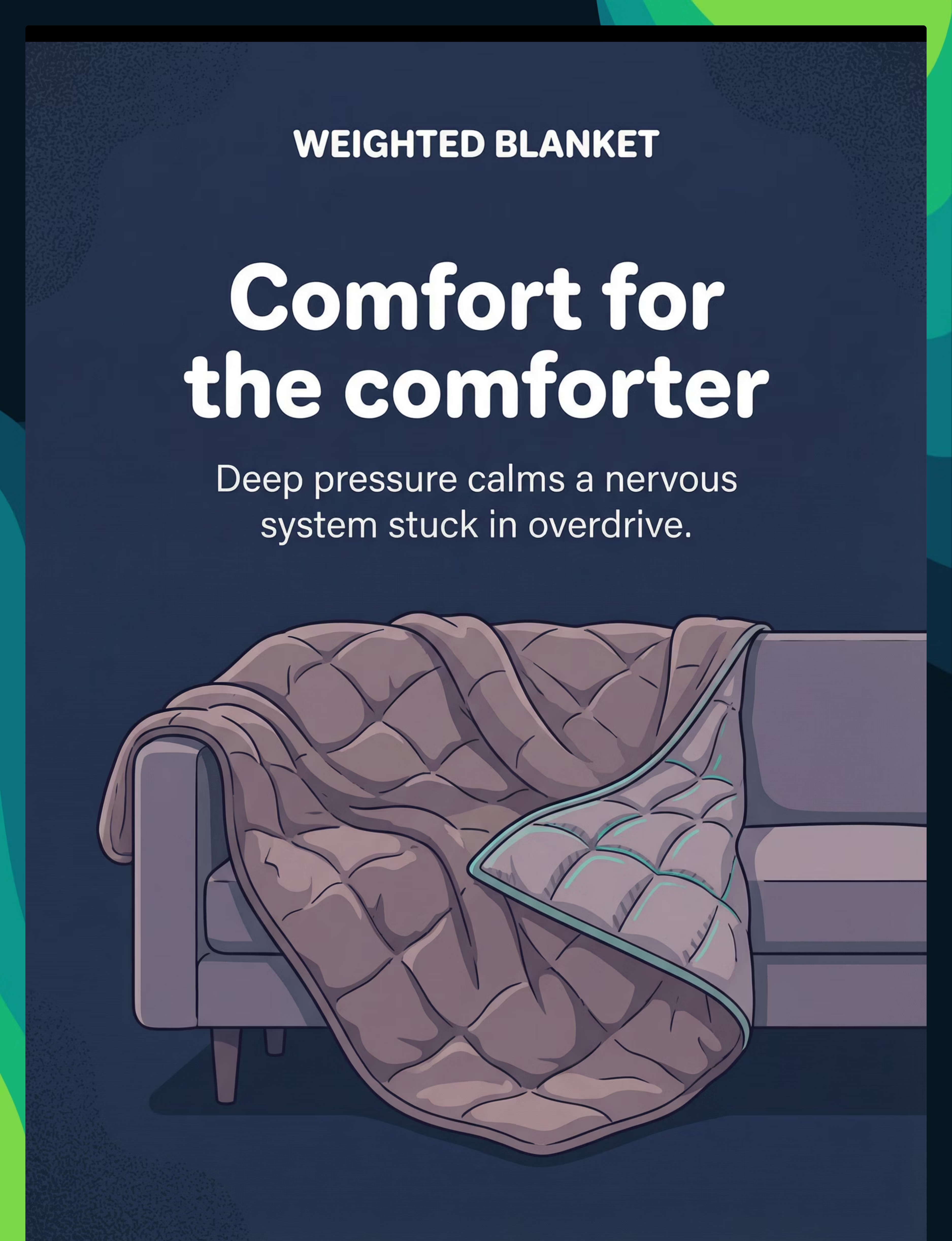
Weighted Blanket
Comfort for the comforter
3
Noise-Canceling Headphones
Protecting your nervous system
4
Visual Respite Timer
Permission to pause
5
Caregiver Support Group
Finding your "me too" people
6
Respite Care Kit
Making help possible
7
Movement Tools
Release stress from the body
8
Self-Compassion Cards
Words you need to hear
9
Identity Preservation Box
Remembering who you are

Material 1 of 9
Five-Minute Journal for Depleted Parents
Brief structure for big feelings
Traditional journaling asks for time and energy that burned-out parents simply don't have. A five-minute journal is designed specifically for the margins — brief, structured prompts that provide emotional processing without requiring extensive writing. The structure is the point. Rather than a blank page demanding creative energy, structured prompts guide you: "One thing I did well today." "One thing I'm feeling." "One thing I need." "One person who helped." "One thing I'm looking forward to."
The benefits are significant despite the brevity. Journaling externalizes internal chaos, making overwhelming feelings more manageable. It creates a record of progress that combats the feeling that nothing ever changes. It builds awareness of emotional states, needs, and patterns — and provides a private space for feelings that can't be expressed elsewhere: resentment, grief, anger, hopelessness. Over time, even five minutes daily becomes a ritual of self-attention — a message to yourself that your inner life matters.

Material 1 — DIY Guide
How to Build Your Five-Minute Journal System
Daily Check-In (2–3 min)
- Today I feel: ___ (one word or emoji)
- One thing that was hard: ___
- One thing I managed: ___
- What I need right now: ___
Evening Release (3–5 min)
- Three things that happened (neutral listing)
- One thing I'm grateful for (even tiny)
- One thing I'm releasing — not carrying to tomorrow
- How my body feels: ___
Weekly Reflection (5–10 min, once per week)
- This week I survived: ___
- This week I'm proud of: ___
- One thing I need more of: ___
- One thing I need less of: ___
- Someone I could reach out to: ___
Prompts for Hard Days
- I am so tired of: ___
- What I wish someone understood: ___
- If I could have one free hour, I would: ___
- The hardest part of today was: ___
Key Insight: Processing doesn't require hours. Five structured minutes can externalize chaos and rebuild awareness of self.
Safety Note: If journaling surfaces intense distress or suicidal thoughts, this signals that professional support is needed. Journaling complements therapy — it does not replace clinical care.

Material 2 of 9
Weighted Blanket or Comfort Object
Comfort for the comforter
Caregivers spend their days providing comfort to others — being the calm in someone else's storm, the soft place for someone else to land. A weighted blanket is about receiving comfort rather than giving it. Weighted blankets provide deep pressure stimulation that activates the parasympathetic nervous system, reducing cortisol and increasing serotonin. The physical sensation of being "held" can be profoundly calming for a nervous system in chronic hypervigilance.
For burned-out parents whose touch experiences are dominated by caregiving — being grabbed, climbed on, physically intervened — a weighted blanket provides non-demanding, restorative physical comfort. Beyond weighted blankets, any personal comfort object works: a soft throw, a specific pillow, a heated neck wrap, a particular robe. The key is that it's YOURS. Not shared, not multipurpose. Something that signals to your nervous system: "This is rest. This is for me. I am allowed to receive comfort." Even ten minutes can shift the body out of fight-or-flight.
Material 2 — DIY Guide
Creating Personal Comfort Tools
1
Selecting the Right Weight
Typically 10% of your body weight. A 50 kg person would use a 5 kg blanket. Start lighter if unsure — too heavy can feel restrictive.
2
Alternatives to a Weighted Blanket
- Weighted lap pad (smaller, portable)
- Heavy quilt or multiple blankets layered
- Body pillow to hug
- Heated blanket or heating pad
3
Creating a Personal Comfort Ritual
- Use the item only during rest times
- Same time each day builds a body cue
- Five slow breaths; notice weight, warmth, softness
- Let your body receive without doing anything
4
Permission Work
Many caregivers feel guilt about receiving comfort. Practice the thought: "I deserve comfort too. Caring for myself helps me care for my child. This is maintenance, not indulgence."
Key Insight: Caregivers give comfort all day. Receiving physical comfort resets a depleted nervous system.
Safety Note: Not recommended for people with certain respiratory conditions, circulation problems, or claustrophobia. Do not use weighted blankets on children without professional guidance.

Material 3 of 9
Noise-Canceling Headphones or Ear Protection
Protecting your nervous system
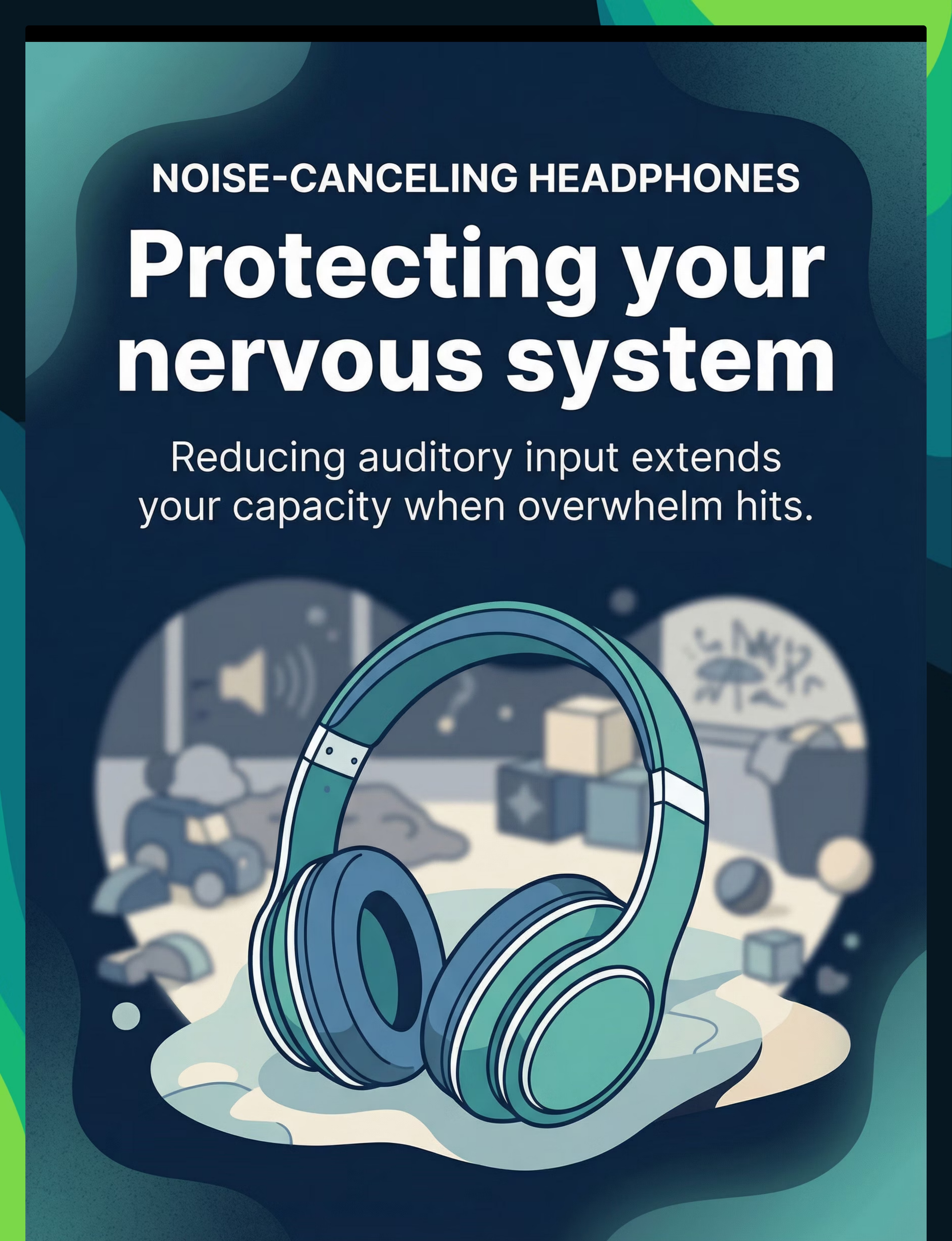
Caregiver burnout often includes sensory overload. Parents of children with special needs are frequently exposed to intense auditory input — screaming during meltdowns, repetitive sounds or questions, the constant noise of a household in chaos. Over time, the nervous system becomes hyperreactive; even moderate noise feels overwhelming.
Noise-canceling headphones or ear protection provide a portable, immediate sensory break. During a meltdown, the parent can stay present and safe while protecting their own nervous system from auditory overload. After the child is settled, even five minutes of silence or calming music allows the auditory system to reset. This isn't about ignoring the child — it's about protecting the caregiver's nervous system so they can continue to function. A parent who can regulate their own auditory overwhelm is more patient, more present, and more sustainable.
Material 3 — DIY Guide
Using Auditory Protection for Caregiver Wellness
Options by Situation
During Meltdowns: Loop earplugs or discreet noise-reducing earbuds — reduce volume while staying present and aware.
During Designated Breaks: Over-ear noise-canceling headphones for full quiet or calming music. Maximum restoration in limited time.
Throughout Day (Subtle): Small in-ear noise reducers worn continuously. Reduces overall auditory load so you're less depleted by end of day.
Budget-Friendly Options
- Foam earplugs (very inexpensive)
- Musician's earplugs (reusable, reduce without distorting)
- Second-hand noise-canceling headphones
What to Listen To
- Nothing — pure quiet is often most restorative
- Nature sounds: rain, ocean, forest
- Calming music without lyrics
- Favorite music that energizes or soothes
- Podcasts or audiobooks for distraction/escape
- Guided meditations if helpful
Setting Boundaries with Headphones
Communicate to family: "When I have headphones on, I am taking a sensory break. I can be interrupted for emergencies, but otherwise I need this time." This also models healthy boundaries for your children.
Key Insight: Constant noise depletes. Protecting your auditory system preserves capacity for connection and patience.
Safety Note: Ensure you can still hear safety-critical sounds when using noise reduction. Noise-reducing (not fully canceling) options are often better for caregiving contexts. Never leave a child unsupervised in a dangerous situation.

Material 4 of 9
Visual Respite Timer and Break System
Permission to pause
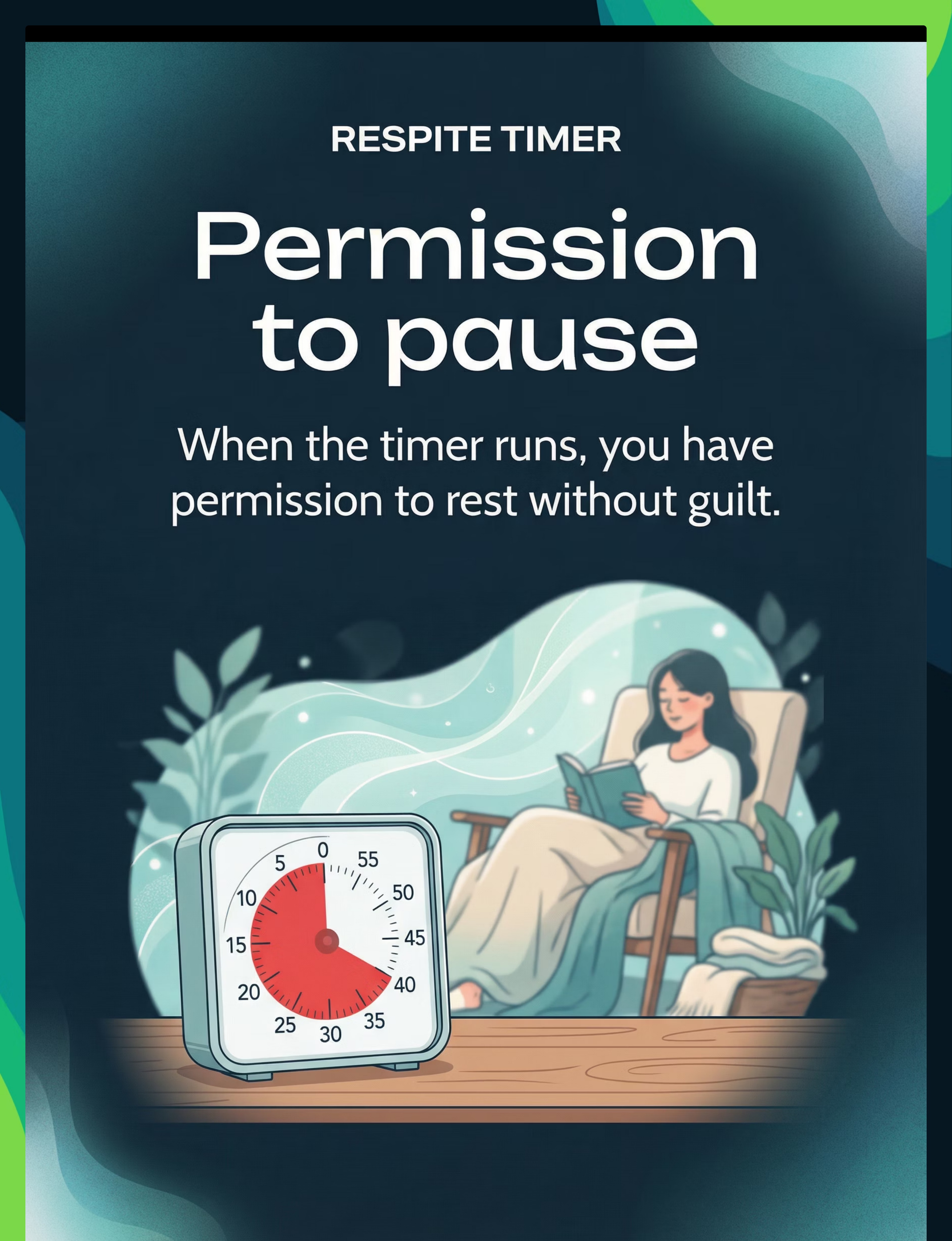
Burned-out parents often feel guilty about any moment of rest — unable to truly relax because they feel they should be doing something. A visual respite timer creates bounded, guilt-free break time. When the timer is running, you have permission to rest. The boundary is external and visible — not reliant on your own depleted willpower to set and maintain limits.
For the whole family, a visual timer (like a Time Timer where they can see the red disappear) communicates: "Mom/Dad is taking a break until the red is gone." This teaches boundaries, models self-care, and reduces interruptions because the expectation is visible and clear. Knowing the break has a defined end actually allows deeper rest — you're not watching the clock or wondering if you've taken too long. The timer becomes a self-care ally: permission made visible.

Material 4 — DIY Guide
Implementing a Respite Timer System
1
Timer Options
- Time Timer (visual — see red disk disappear)
- Sand timer (visual — watch sand fall)
- Phone timer with visual countdown app
- Kitchen timer (auditory)
2
Break Duration Guide
- Micro-breaks: 5 minutes — even this helps
- Short breaks: 10–15 minutes — sustainable daily
- Longer breaks: 30–60 minutes — when coverage available
3
What to Do During Timed Breaks
- Nothing — staring at a wall counts
- Sit with comfort items
- Listen to music with headphones
- Drink something hot while it's still hot
- Scroll phone mindlessly — rest, not productivity
- Brief walk outside
4
Using with a Partner
"I need 15 minutes. Setting the timer now. You're in charge until it ends. I'll be in the bedroom." Partner knows exactly when coverage ends — reduces resentment and confusion.
Permission Reminder: Breaks are not earned — they are required. You do not have to accomplish anything first.
Key Insight: Boundaries are easier when visible. A timer externalizes permission and creates guilt-free rest.

Material 5 of 9
Caregiver Support Group Access
Finding your "me too" people
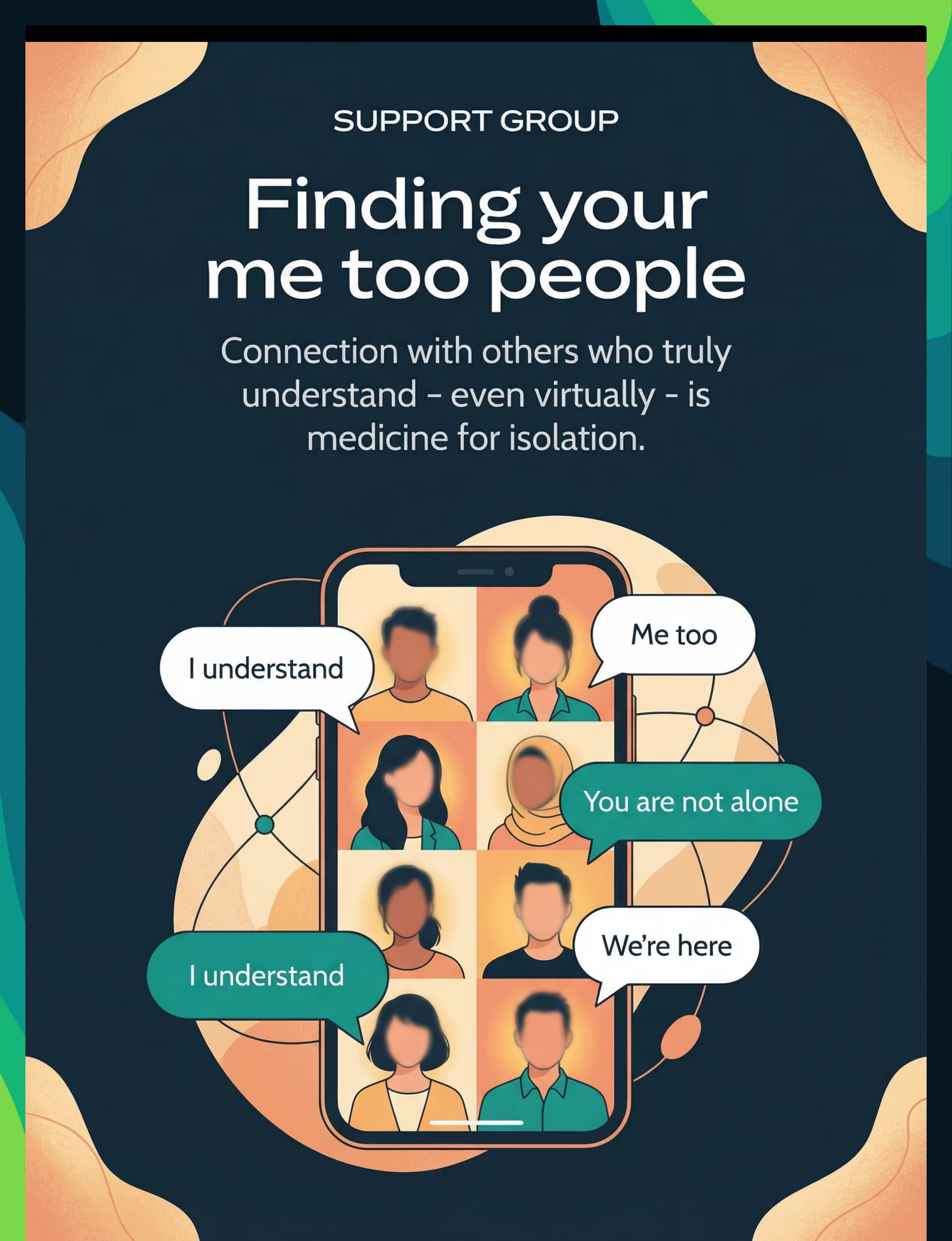
Isolation is one of the most destructive aspects of caregiver burnout. Parents of children with special needs often feel profoundly alone — their friends with typical children don't understand, their family doesn't get it, and there's no time for traditional social connection. A caregiver support group provides connection with people who truly understand without explanation.
The power of "me too" cannot be overstated. When a parent shares the unsharable — "Sometimes I wish I'd never had children" or "I don't know if I can keep doing this" — and another parent nods and says "I feel that too," something profound happens. The shame decreases. The isolation cracks. The feeling of being broken dissolves. Support groups also provide practical resources — who is the best therapist, how to handle IEP battles, what respite options exist — that would take individual parents hours to research. Even lurking in a support group (reading without posting) can reduce isolation.

Material 5 — Finding Your Group
How to Find and Use Caregiver Support
Where to Find Groups
- Hospital or therapy center parent groups
- Disability-specific organizations (autism societies, etc.)
- Facebook groups: search child's condition + "parents" + your location
- WhatsApp groups — ask other parents or therapists
- Pinnacle Blooms family network
- Local parent training and information centers
- Reddit communities (r/autism_parenting, etc.)
Modes of Participation
- Active: sharing, responding, building relationships
- Quiet: reading, learning, feeling less alone
- Occasional: checking in during the hardest times
Any level counts. There is no participation requirement.
What to Share (or Not)
Whatever you're comfortable with. Groups often welcome the "unsayable" — the thoughts you can't tell anyone else. "I'm having a really hard day" is enough to start.
Safety Note: Online groups can sometimes spread misinformation. Verify medical information with professionals. If a group increases distress rather than decreasing it, find another.
Key Insight: Isolation kills. Connection with people who understand — even virtually — is medicine for burnout.
Material 6 of 9
Respite Care Coordination Kit
Making help possible
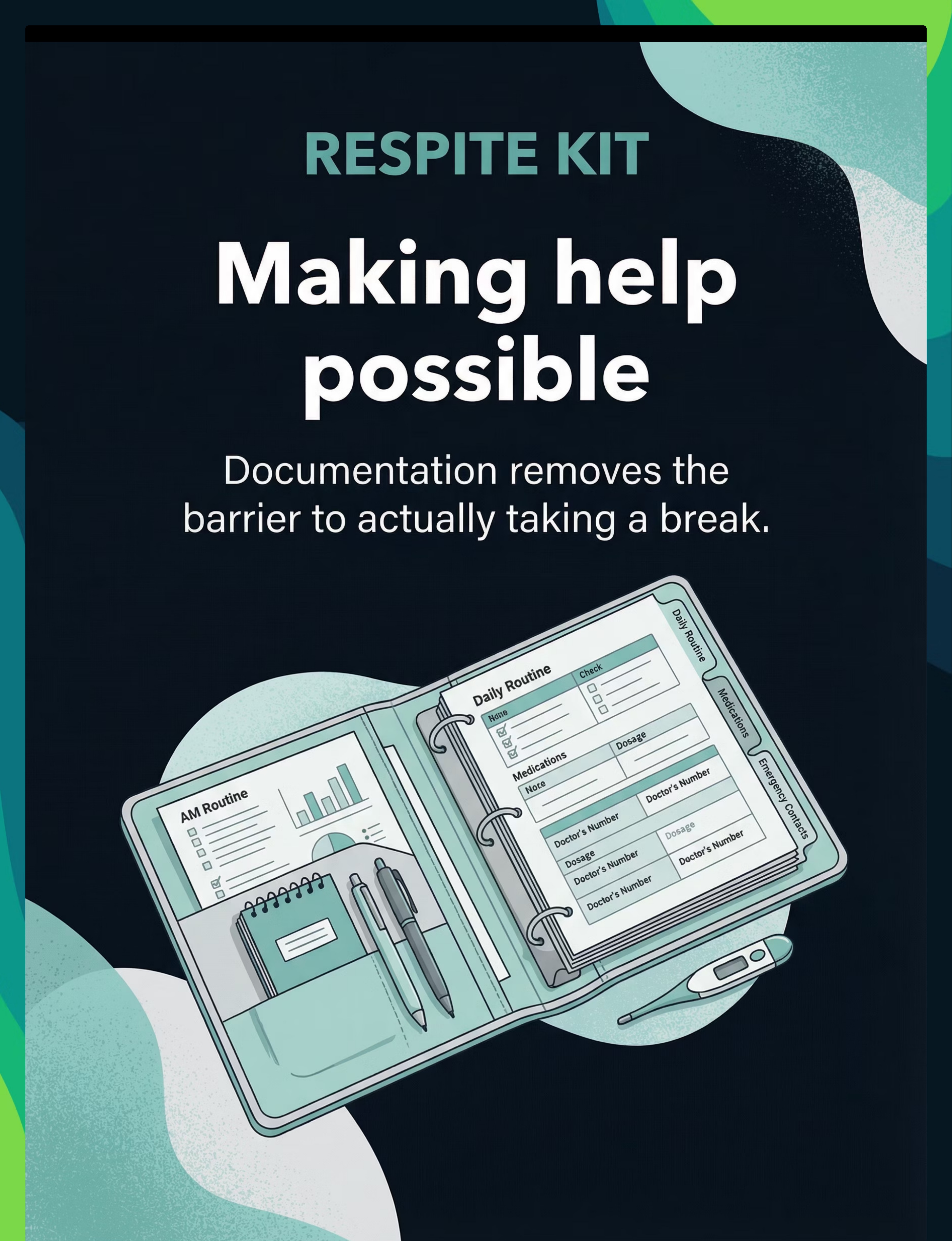
Many burned-out parents know they need respite — time away from caregiving — but can't access it because the barrier to entry is too high. Who can they trust? How do they explain the child's needs? What if something goes wrong? A respite care coordination kit systematizes everything a substitute caregiver needs to know, removing the friction that prevents parents from actually taking breaks.
With a kit prepared, training a new caregiver becomes manageable. Handing over care becomes possible. The mental load of "explaining everything" is reduced because it's documented. Even if respite care isn't currently available, creating the kit is an act of hope — preparing for the day when help arrives. It can be used immediately for informal respite: giving the kit to grandparents for an afternoon, to a friend who offers, to a partner who takes over while you leave the house.

Material 6 — Kit Contents
Building Your Respite Care Kit
Overview & Emergency Info
Child's name, age, photo. Primary diagnoses (brief, functional description). Emergency contacts. What constitutes an emergency. When to call parents vs. handle independently.
Daily Routines & Schedules
Morning, mealtimes, nap/rest, afternoon, evening, and bedtime routines — detailed, step-by-step. Visual schedules if used.
Medical & Medications
Current medications (name, dose, time, how to give). Allergies. Medical equipment. Seizure protocol if applicable. Signs of illness to watch for.
Behavior & Calming Strategies
Common triggers (what to avoid). Early warning signs of distress. Calming strategies that work. What to say and not say. Meltdown protocol.
Key Insight: Help is only possible when handover is possible. Documentation reduces the barrier to actually taking a break.

Material 7 of 9
Body Movement and Release Tools
Release stress from the body
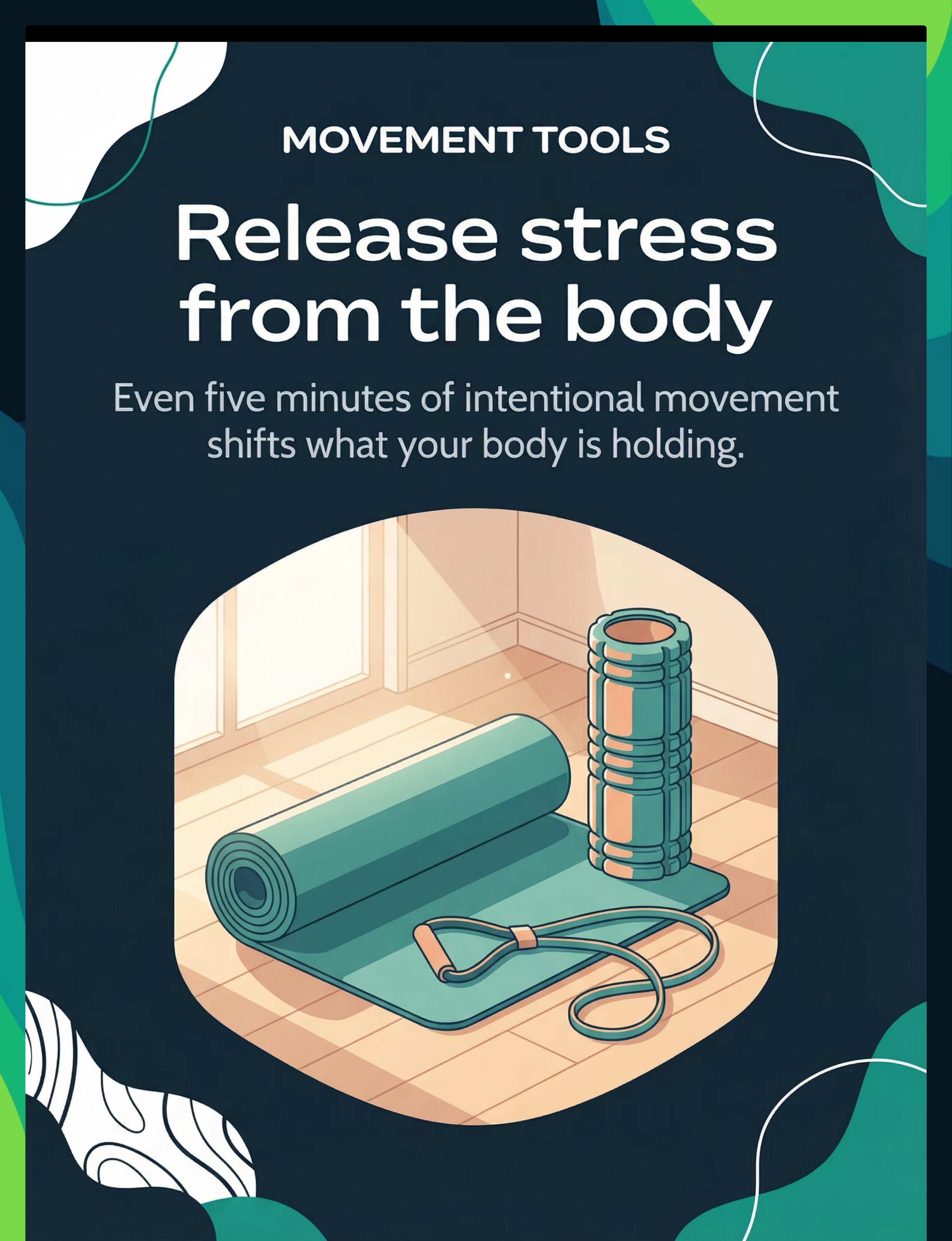
Caregiver stress lives in the body — tension in shoulders, clenching in jaw, tightness in chest. Exercise helps, but burned-out parents often can't access traditional exercise: no time for the gym, can't leave the child, too exhausted for an intense workout. Body movement and release tools provide brief, accessible physical release that can happen in home margins.
A yoga mat rolled out for five minutes of stretching while the child watches a show. A foam roller for releasing tension after the child is in bed. The goal isn't fitness — it's release. Physical movement metabolizes stress hormones, releases muscle tension, shifts stuck energy, and reconnects a dissociated caregiver with their body. For caregivers whose bodies are touched all day in caregiving ways — lifting, being grabbed, physically intervening in meltdowns — intentional movement is reclaiming the body for the self. Even five minutes can shift the nervous system more effectively than an hour of sitting and "relaxing."

Material 7 — Movement Routines
Accessible Body Movement for Burned-Out Parents
Minimal Equipment Options
- Yoga mat (stretching, yoga, floor work)
- Foam roller (tension release, muscle recovery)
- Resistance band (strength without weights)
- Mini trampoline/rebounder (low impact)
- None needed — bodyweight requires nothing
5-Minute Tension Release (Daytime)
- Neck rolls and shoulder shrugs
- Chest opener — clasp hands behind back, lift
- Hip circles
- Forward fold — hang head and arms
- Child's pose on floor
Evening Decompression (After Bedtime)
- Foam rolling major muscle groups
- Legs up the wall (lying, legs vertical)
- Gentle twists lying on back
- Progressive muscle relaxation (tense and release)
Micro-Movements (1 Minute, Anytime)
- Stretch arms overhead and yawn
- Roll shoulders 10 times
- March in place for 60 seconds
- Bounce on toes
- Shake hands vigorously
Barrier Removal
Keep yoga mat visible and unrolled. Have one 5-minute routine memorized. Lower the bar — 1 minute counts.
Key Insight: Stress is physical. Movement releases what the body is holding without requiring time you don't have.

Material 8 of 9
Guilt Release and Self-Compassion Cards
Words you need to hear
Parental guilt is one of the most corrosive aspects of caregiver burnout. Parents feel guilty for feeling resentful, wanting time away, not doing enough therapy, not being patient enough, having any needs at all. This guilt drives self-denial and prevents self-care — and it accelerates burnout.
Guilt release and self-compassion cards provide immediate cognitive intervention when guilt spirals begin. Each card contains a reframe, a permission statement, or a self-compassion prompt: "Your feelings are not your failures." "Needing rest doesn't mean you're weak." "You're doing something hard, and struggling with hard things is normal." "Your child needs you well, not depleted." When guilt thoughts arise, the parent pulls a card and reads it — an external voice offering the compassion they cannot give themselves. Over time, these messages begin to internalize.
Material 8 — Card Messages
Creating Your Self-Compassion Card Set
Permission Statements
- "You are allowed to rest."
- "Your needs matter too."
- "Asking for help is strength, not weakness."
- "You don't have to earn rest by suffering first."
- "Taking care of yourself IS taking care of your family."
- "You're doing enough, even when it doesn't feel like it."
Guilt Reframes
- "Feeling frustrated doesn't mean you're a bad parent."
- "Wanting time away is healthy, not abandonment."
- "You didn't cause your child's challenges."
- "Missing the parent you thought you'd be is grief, not failure."
- "Having bad days doesn't erase the good you do."
Self-Compassion Prompts
- "What would you say to a friend feeling this way?"
- "You're doing something hard. Go gently on yourself."
- "Your feelings are valid, even the ugly ones."
- "Struggling doesn't mean failing."
- "This is hard. And you're still here."
Hope Messages
- "This season won't last forever."
- "You've survived 100% of your hardest days so far."
- "There are people who understand. You're not alone."
- "Today is not the whole story."
Key Insight: Guilt erodes survival. Self-compassion cards provide the words you can't yet give yourself.
Safety Note: Self-compassion cards are not a substitute for mental health treatment if depression, anxiety, or severe burnout is present. They complement therapy — they do not replace it.

Material 9 of 9
Identity Preservation Box
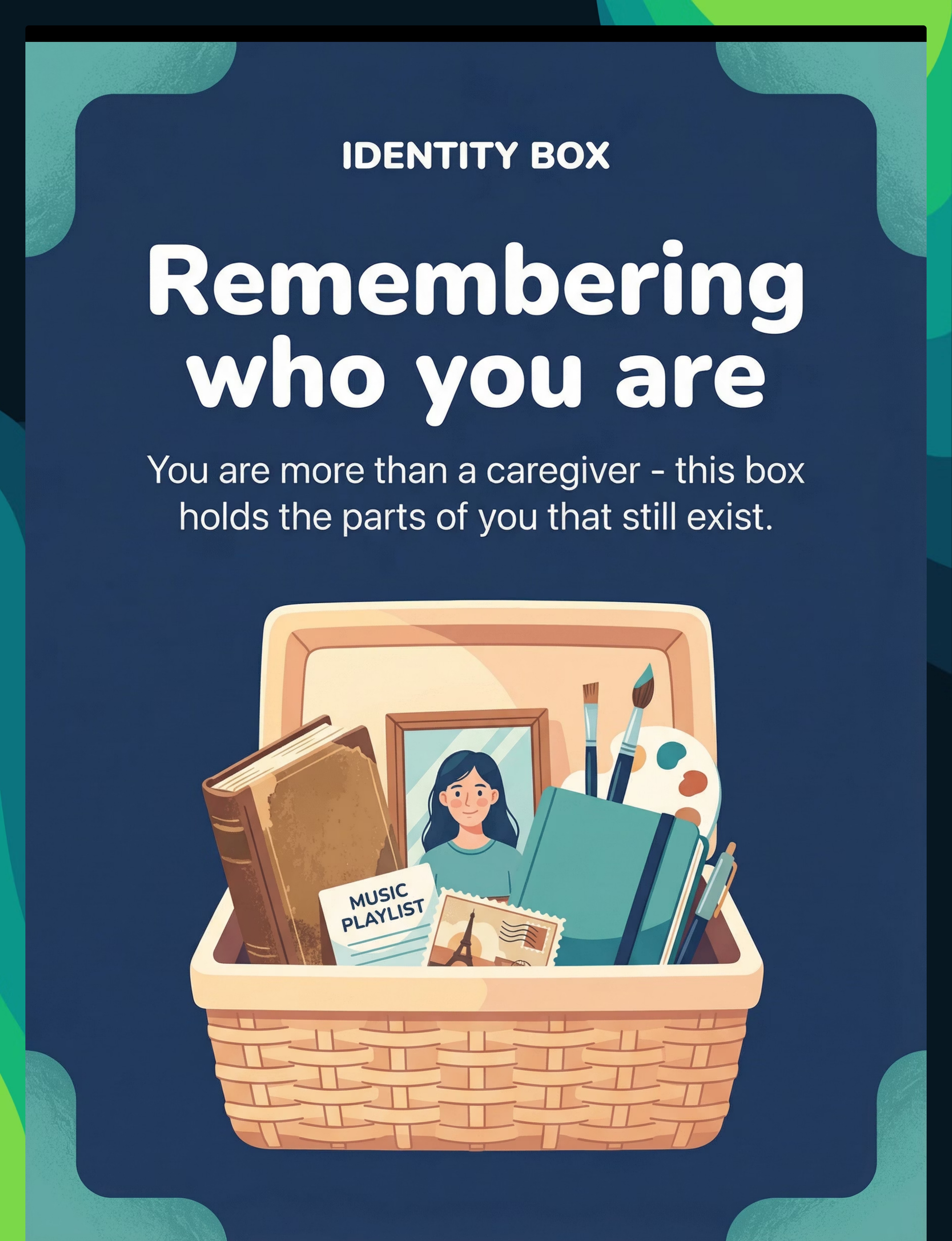
Remembering who you are
One of the most painful aspects of caregiver burnout is the loss of self. Before becoming a full-time caregiver, you had an identity — interests, hobbies, dreams, friendships, aspects of self that had nothing to do with your child. These often disappear entirely under the weight of caregiving demands. Parents forget who they were before.
An identity preservation box is a deliberate practice of maintaining connection to the self beyond caregiving. The box contains items connected to your pre-parenting identity — a book from a favorite author, supplies for a hobby, a photo from a meaningful experience — alongside aspirations for the future. The box isn't about having time for these things now. It's about remembering that you are more than a caregiver. Even looking at the items periodically reconnects with a larger identity. Even five minutes engaging with something from the box is an act of identity preservation. The message to yourself: "I still exist. I am more than this role. Someday, I will have space for these parts of me again."

Material 9 — Building Your Box
Creating an Identity Preservation Box
What to Include
Pre-Parenting Items: Photos from before children. Items from hobbies you used to do. Books by authors you loved. Music from that era. Mementos from experiences — concerts, travel, achievements. Awards and certificates.
Current Interests (Even Without Time): Supplies for a hobby you wish you could do. Books you want to read someday. Articles saved about topics that interest you. A list of shows, podcasts, or music you'd enjoy.
Future Aspirations: Places you want to travel. Skills you want to learn. Goals that feel impossible now but still matter.
Self-Descriptor List
Write words that describe you beyond "parent." Place the list in the box.
Creative. Funny. Adventurous. Thoughtful. Musical. Athletic. Smart. Curious. Passionate. Resilient.
Using the Box
- Weekly practice: open for 10 minutes
- Hold items. Remember.
- Maybe engage briefly — two pages, 5 minutes of sketching
- When burned out: open as a reminder that you exist beyond this
- Add to the box when you notice a new spark of interest
This is not frivolous. Preserving identity prevents complete dissolution into the caregiver role.

Implementation Guide
Where to Start: A Four-Week Rollout
You don't need all nine materials at once. Start small. Build gradually. Even one tool used consistently is better than nine tools abandoned.
1
Week 1
Processing your current state
Journal + Self-Compassion Cards
Journal + Self-Compassion Cards
2
Week 2
Physical restoration
Comfort Items + Noise Protection
Comfort Items + Noise Protection
3
Week 3
Structure and release
Timer System + Movement Tools
Timer System + Movement Tools
4
Week 4
Breaking isolation
Support Group Connection
Support Group Connection
5
Ongoing
Building toward sustainability
Respite Kit + Identity Box
Respite Kit + Identity Box
Essential Starter Kit (Budget-Friendly): A notebook for journaling • An existing blanket designated as your comfort item • Free online support groups • Index cards with compassion messages • The timer app already on your phone

Understanding Barriers
Why Self-Care Feels Impossible — And What Actually Helps
Understanding the real barriers to self-care is the first step to addressing them. Most standard advice fails because it ignores these barriers entirely.
"I have no time."
Reframe: Self-care can happen in margins — 5 minutes counts.
Try: Focus on micro-practices, not ideal scenarios.
Try: Focus on micro-practices, not ideal scenarios.
"I have no coverage for my child."
Reframe: Build toward respite while doing what's possible now.
Try: Respite kit, training informal supports, advocating for services.
Try: Respite kit, training informal supports, advocating for services.
"I feel guilty having needs."
Reframe: Your needs are valid; care for you enables care for your child.
Try: Self-compassion work and permission statements.
Try: Self-compassion work and permission statements.
"I've lost what used to restore me."
Reframe: Identity can be rediscovered; start with memories.
Try: Identity preservation box and journaling about past interests.
Try: Identity preservation box and journaling about past interests.
"I'm too exhausted to do self-care."
Reframe: Passive restoration counts — receiving, not doing.
Try: Weighted blanket, music, reading a support group without posting.
Try: Weighted blanket, music, reading a support group without posting.

Clinical Perspective
Burnout vs. Depression: Knowing the Difference
These often co-occur. Burnout can trigger depression, and depression can intensify burnout. Both may need treatment. When in doubt, err toward professional assessment.
Burnout Indicators
- Exhaustion specifically related to caregiving role
- Improves with breaks, respite, and support
- Still able to experience pleasure in non-caregiving contexts
- Frustration focused on situation, not self
- Physical symptoms linked to stress (resolve with rest)
Depression Indicators
- Pervasive low mood across all contexts
- Doesn't improve with rest or breaks
- Anhedonia — cannot experience pleasure even when opportunities exist
- Feelings of worthlessness and guilt about existence (not just situation)
- Changes in appetite and sleep beyond stress-related
- Suicidal ideation
When to Seek Professional Help Immediately: Symptoms of depression • Suicidal thoughts or thoughts of self-harm • Unable to provide basic care for your child • Complete emotional numbness • Using substances to cope • Physical health significantly declining

Readiness Journey
The Path from Depletion to Sustainability
Recovery from caregiver burnout is not linear — but it is possible. The Caregiver Sustainability Index within GPT-OS® tracks family wellness alongside child progress, because sustainable families create sustainable outcomes.
Every small practice you implement — even imperfectly, even inconsistently — moves you along this progression. You don't need to reach the final stage today. You need to take one step from wherever you are.

A Message to You
"I want to tell you something you already know but maybe haven't let yourself fully accept."
"You are drowning. And that's not a moral failure or a lack of love or a sign that you're doing something wrong. It's the inevitable result of unsustainable demand without adequate support. You are doing the work of multiple people, often alone, without the resources, recognition, or rest that any human would need to sustain this level of caregiving. Burnout isn't weakness. It's physics. You cannot indefinitely output more than you input without depletion."
The 9 materials in this resource are not solutions to burnout — they're survival tools. They're small interventions that can make unsustainable slightly more survivable. None of them require time you don't have, money you can't spend, or support that isn't available. They work in the margins. They're small enough to be real.
And one more thing: You matter. Not just as your child's caregiver. Not just as the linchpin holding your family together. You matter as a person, with needs and feelings and an identity beyond caregiving. Taking care of yourself is not taking from your child. It's adding to both of you.

What Would Actually Help
Small Tools Help — But They Don't Fix Systemic Problems
Individual self-care cannot fully compensate for systemic inadequacy. These tools can help you carry the weight slightly longer. They cannot make the weight less. What would actually help — and what should exist — includes:
Adequate Respite Care
Accessible, affordable, trained respite care that allows parents to step away without the mental load of extensive preparation or risk.
Real Community Support
Neighbors, schools, and organizations that show up — not just in theory but in practice. A community that recognizes and supports caregivers.
Healthcare for the Caregiver
Covered, accessible, tailored mental and physical healthcare for the parent — not just the child.
Partner Equity and Family Involvement
A truly shared caregiving load, extended family involvement that is informed and helpful rather than judgmental.
Until these things exist — and they should exist — these materials are what you have. Something is better than nothing when nothing is what you have.

Crisis Resources
When You Need More Than These Tools
If you are in crisis, please reach out. These services exist for exactly this moment.
1
Vandrevala Foundation
1860-2662-345
24/7 mental health support. Available when you need it most.
24/7 mental health support. Available when you need it most.
2
iCall
9152987821
Professional counseling support. Trained counselors ready to help.
Professional counseling support. Trained counselors ready to help.
3
Pinnacle Blooms Helpline
9100 181 181
FREE National Autism Helpline. Family support and resources in 16+ languages. Available 24x7.
FREE National Autism Helpline. Family support and resources in 16+ languages. Available 24x7.
Please reach out if you experience: Suicidal thoughts or thoughts of self-harm • Inability to provide basic care for your child • Severe depression that doesn't lift • Complete emotional detachment from your family • Using substances to cope. You do not have to be in this alone.

Save & Share
This Resource Is for Your Hardest Days
Bookmark this page. Share it with a parent who's drowning. Return to it when the weight feels unbearable. You are not alone, and these tools are here whenever you need them.
1
Practical Materials
Each designed for real margins, not imagined ones
2
Where to Start
The minimum investment for any single tool
3
Essential Starter Kit
The core four tools can be entirely free or DIY
Coming next in this series: 9 Materials That Help With Couples Communication for Special Needs Parents
Powered By
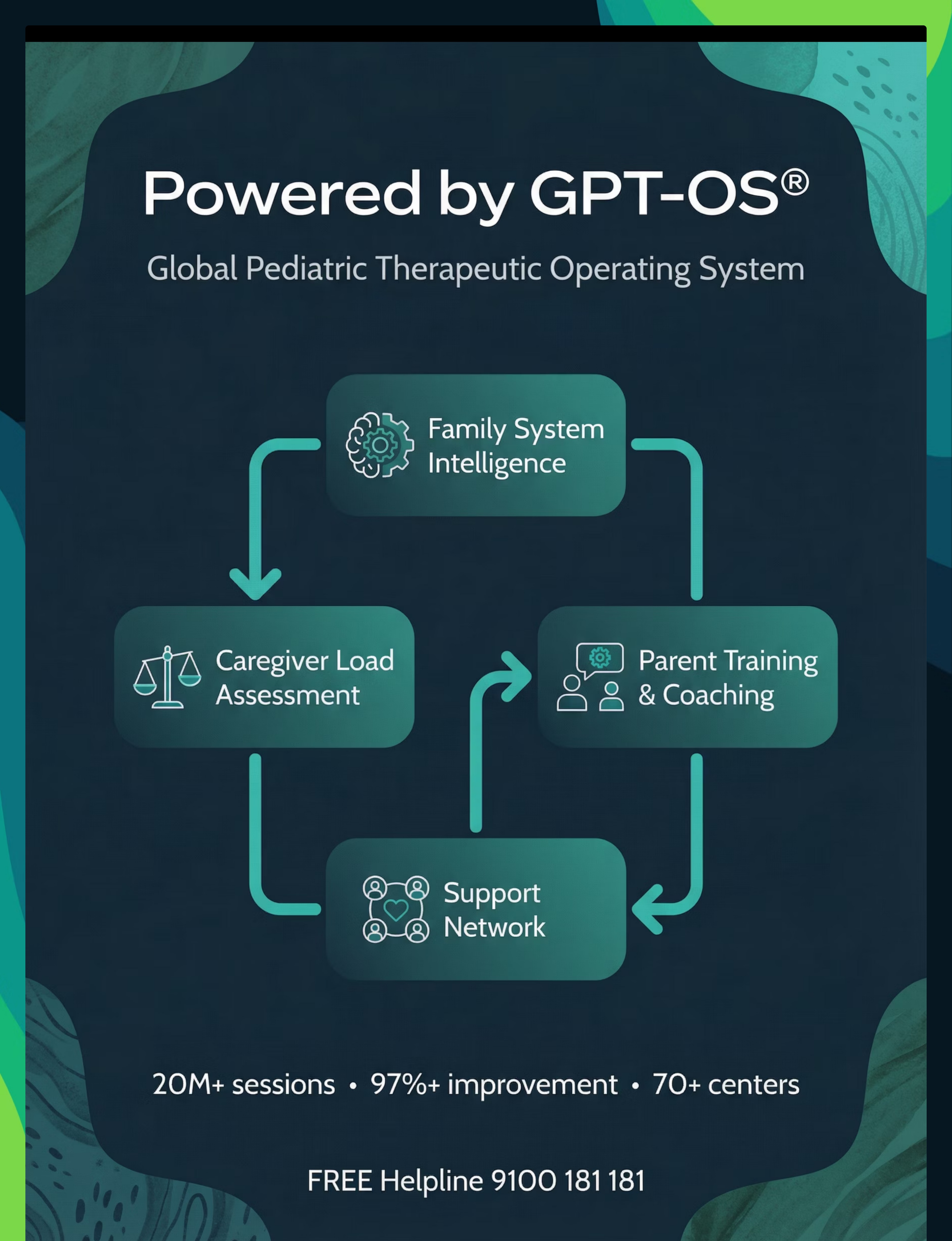
Powered by GPT-OS®
Global Pediatric Therapeutic Operating System
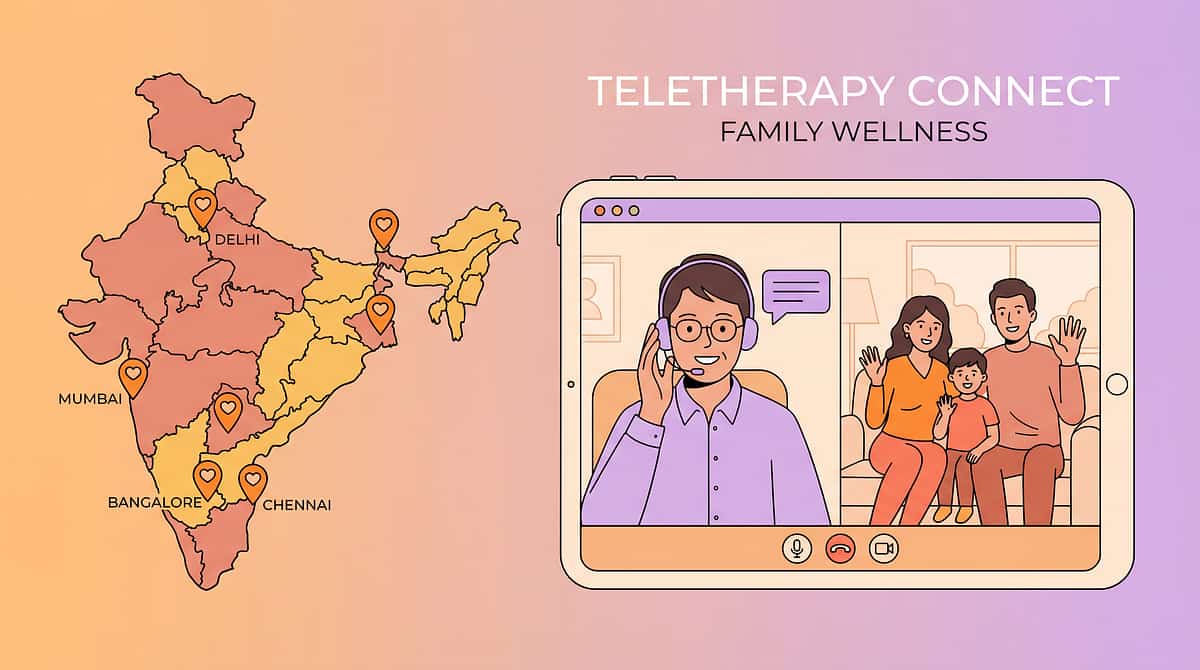
GPT-OS® is the end-to-end operating system that governs diagnosis, prognosis, therapy design, execution, monitoring, and readiness outcomes in child development — as one closed, accountable system. Critically, GPT-OS® recognizes that child outcomes depend fundamentally on caregiver sustainability and family wellness.
Family System Intelligence
Recognizes that child outcomes depend on caregiver sustainability and family wellness.
Caregiver Load Assessment
Evaluates burnout risk, support needs, and intervention requirements for the whole family system.
EverydayTherapyProgramme™
Includes caregiver support components, not just child interventions.
Parent Training & Coaching
Practical skills AND emotional support for sustainable caregiving.
Family Support Network
Connects families with peers, resources, and community.
Closed-Loop Therapeutic Control
Monitors caregiver wellness as part of child progress tracking.
20M+
1:1 Sessions
Family-inclusive therapeutic approach
97%+
Measured Improvement
Child and family outcomes
70+
Centers
With parent support programs
160+
Countries
Patents filed internationally
Child outcomes are family outcomes. • For structured support, contact the FREE National Autism Helpline: 9100 181 181 • pinnacleblooms.org
Real-World Evidence
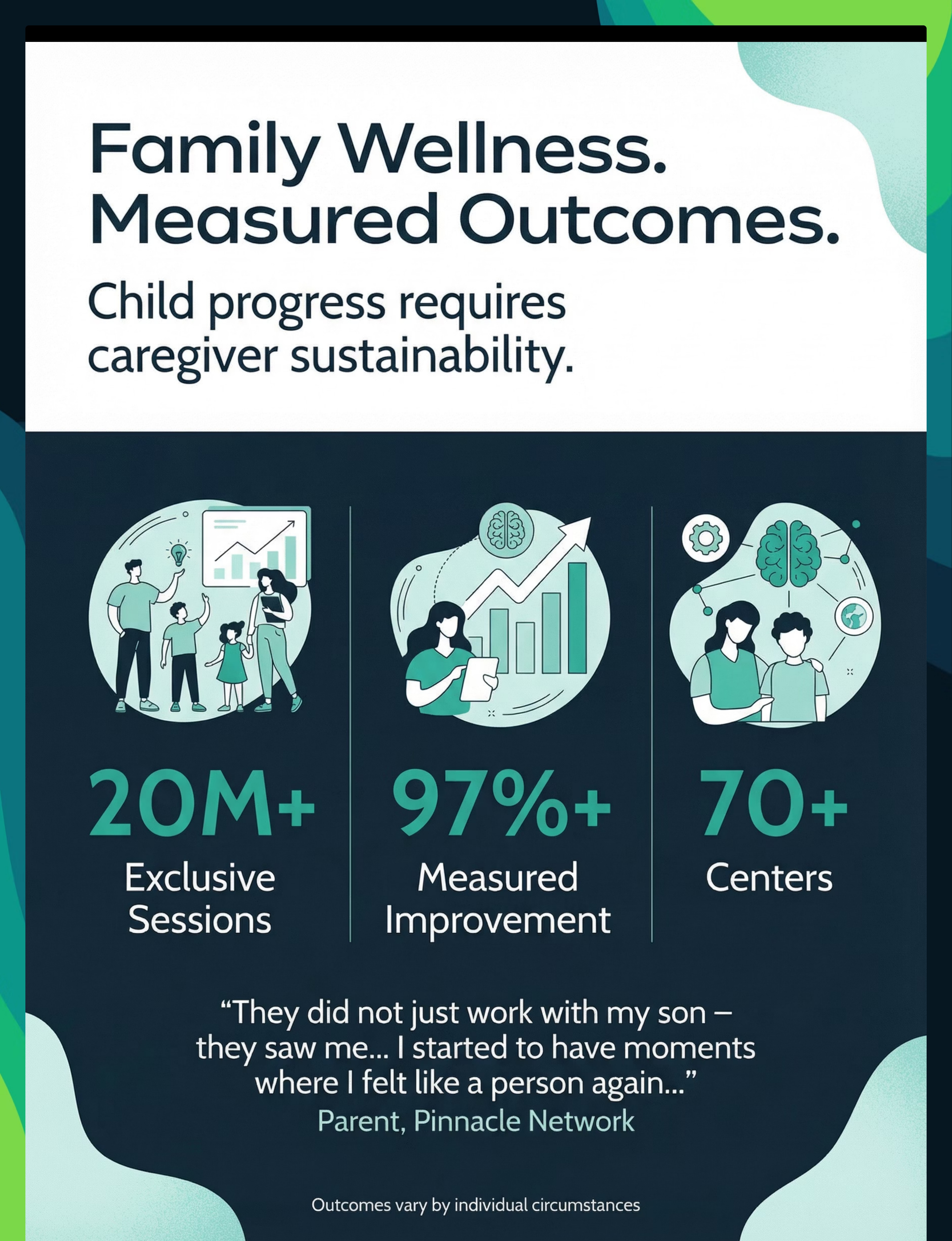
Family Wellness. Measured Outcomes.
Child progress requires caregiver sustainability.
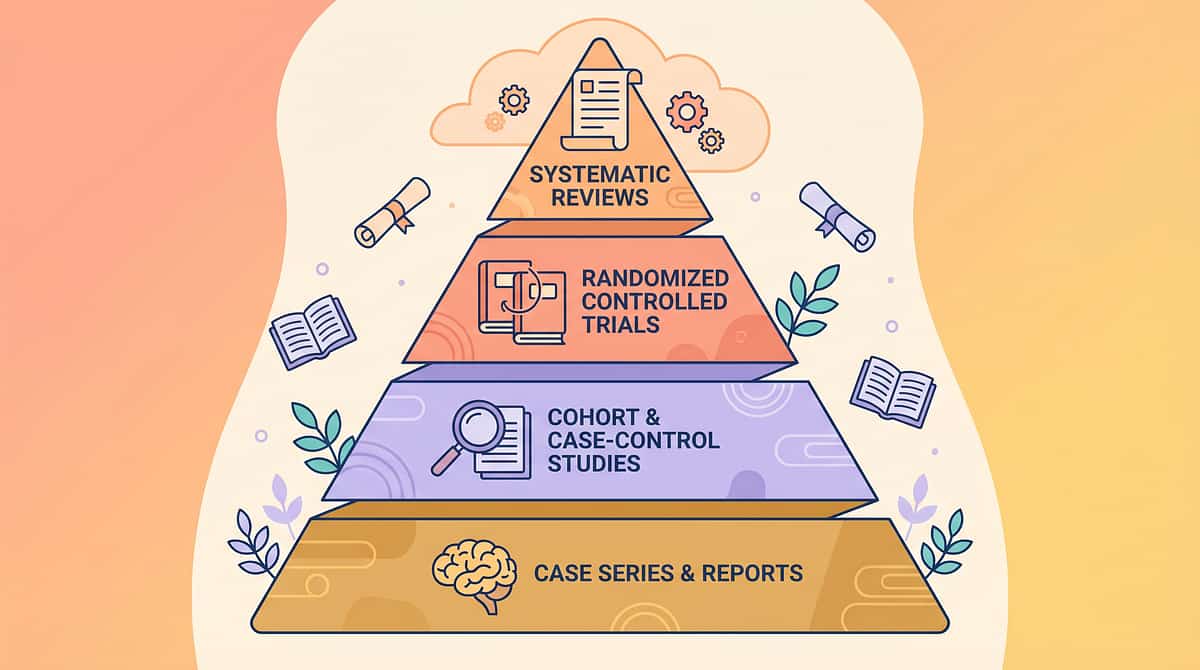
GPT-OS® recognizes that child therapeutic outcomes depend fundamentally on caregiver capacity and wellness. Readiness progression is tracked from: severe burnout with no self-care → recognition of need for self-care → implementing micro-practices → consistent self-care routines → sustainable caregiving with identity preservation → thriving family system with distributed support.
"Three years ago, I was in the darkest place of my life. My son's diagnosis had consumed everything — my marriage was struggling, I had no friends left, I hadn't done anything for myself in years. When I started working with Pinnacle, something surprising happened. They didn't just work with my son — they saw me. The parent coaching included my wellness. Slowly, I started implementing tiny things: a five-minute journal, a support group on WhatsApp, a box with things from my 'before' life. None of it was dramatic, but all of it accumulated. I'm still his primary caregiver, but I'm also a person again. And ironically, I'm a better parent now that I'm taking care of myself."
— Parent, Pinnacle Network
Illustrative case; outcomes vary by individual circumstances, support availability, and intervention consistency.

About
Pinnacle Blooms Network®
Built by Mothers. Engineered as a System.
Pinnacle is the execution layer of GPT-OS® — delivering therapy, daily programs, digital continuity, and support at population scale. Every service is built with the understanding that child outcomes are inseparable from family outcomes.
1
Family-Centered Care
Child therapy embedded in family support — parents are partners, not bystanders.
2
Parent Training & Coaching
Skills, strategies, and emotional support for sustainable caregiving. Wellness is included, not optional.
3
Community Connection
Peer support, group programs, and family network — because isolation is a clinical problem, not a personal one.
Contact & Support
FREE National Autism Helpline
16+ languages • 24x7 availability
9100 181 181
16+ languages • 24x7 availability
9100 181 181
Statutory Identifiers
CIN: U74999TG2016PTC113063
DPIIT: DIPP8651 (Govt. of India)
MSME: Udyog Aadhaar: TS20F0009606
GSTIN: 36AAGCB9722P1Z2
DPIIT: DIPP8651 (Govt. of India)
MSME: Udyog Aadhaar: TS20F0009606
GSTIN: 36AAGCB9722P1Z2
20M+ sessions • 97%+ measured improvement • 70+ centers • Global IP protection
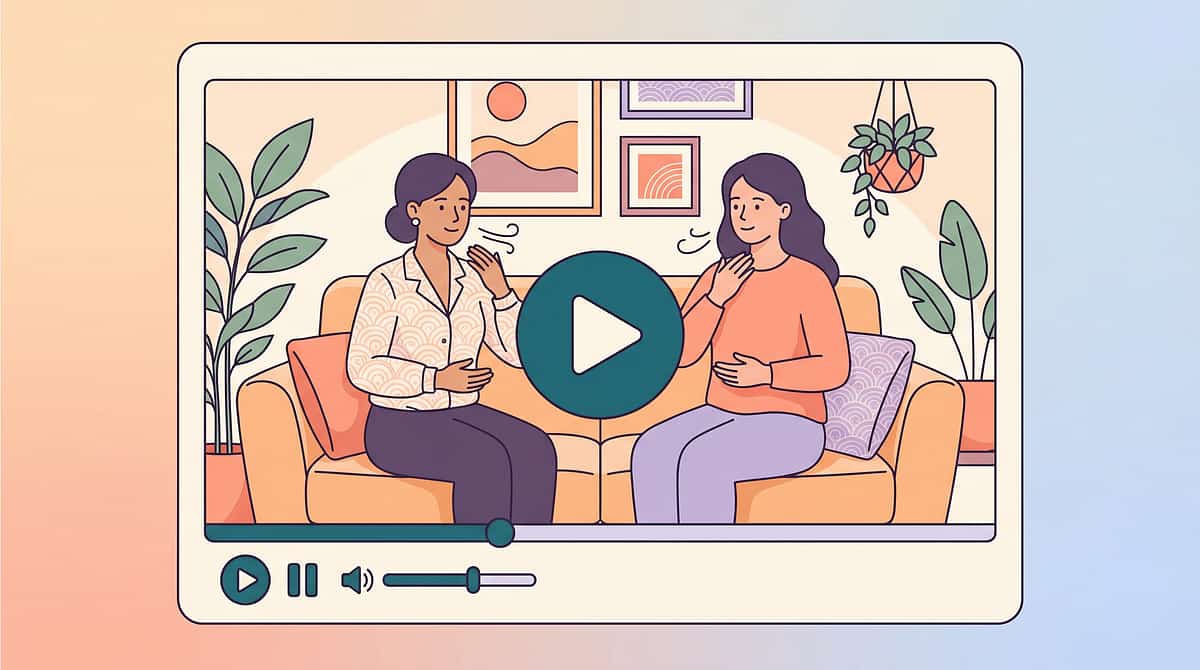
Going Deeper | Material 10 of 12
Breathwork and Nervous System Reset
Regulate from the inside out
Chronic caregiving stress can profoundly dysregulate the autonomic nervous system, keeping parents trapped in a constant state of fight-or-flight. This sustained sympathetic activation leads to exhaustion, anxiety, and burnout, making it incredibly challenging to show up with patience and presence. Breathwork offers one of the fastest, most accessible tools to intentionally shift your nervous system from this stress response to a parasympathetic state of rest and repair. It requires no equipment, can be done almost anywhere, and takes as little as 60 seconds.
Why It Works
- Vagus nerve activation: Stimulates the main nerve responsible for calming the body.
- CO2 regulation: Balances blood pH, signaling safety to the brain.
- Heart rate variability (HRV): Improves the healthy rhythm of your heart, a key marker of resilience.
When to Use It
- Before a child's meltdown escalates, to anchor yourself.
- Immediately after a challenging therapy session or difficult conversation.
- As a mini-reset during a bathroom break or while waiting in line.
- To down-regulate before bed, improving sleep quality.

Going Deeper | Material 11 of 12
Sleep Hygiene Kit for Caregivers
Rest is not a reward — it's a requirement
For parents navigating the unique challenges of special needs, sleep deprivation isn't a minor inconvenience; it's one of the most underestimated threats to their physical and mental health. Chronically disrupted sleep — due to night wakings, anxiety, or hypervigilance — is a medical reality, not a sign of weakness. This constant state of exhaustion erodes resilience, dulls emotional regulation, and impacts the capacity to provide consistent, patient care. Prioritizing sleep is foundational to caregiver sustainability.
Sleep Environment Audit
Optimize your bedroom for optimal rest: ensure it's dark (blackout curtains), cool (60-67°F or 15-19°C), and quiet. Even minor light or temperature fluctuations can disrupt deep sleep cycles.
Wind-Down Ritual
Create a consistent 20-minute screen-free routine before bed. This could include reading a physical book, gentle stretching, listening to calming music, or journaling. Signal to your body that it's time to transition to rest.
Worry Dump Journal
If your mind races with tomorrow's tasks or anxieties, dedicate 5-10 minutes to writing everything down before bed. Transfer worries from your head to paper, clearing your mental space for sleep.
White Noise or Sound Masking
Use a white noise machine, fan, or dedicated app to create a consistent ambient sound. This helps mask sudden noises (like a child's night waking or outdoor sounds) that can pull you out of sleep.
Sleep Boundary Script
If you have a partner or co-parent, communicate your need for uninterrupted sleep. Develop a clear "sleep boundary script" and a plan for who handles night duties on specific nights, allowing for restorative blocks of rest.
Even 20 extra minutes of sleep has a measurable impact on emotional regulation and patience the next day.

Going Deeper | Material 12 of 12
Micro-Joy Tracking Practice
Training your brain to notice what's still good
In the relentless world of caregiving, the brain often becomes wired to scan for threats and problems – a survival mechanism known as negativity bias. This constant vigilance, while protective, can make it nearly impossible to register positive moments, even when they occur. Micro-joy tracking is a deliberate, science-backed practice designed to gently rewire your attention, shifting focus from a perpetual state of problem-solving to an acknowledgment of the tiny moments of good that still exist, cultivating a more balanced emotional landscape.
What Counts as a Micro-Joy
- Your child laughed unexpectedly.
- Your coffee was perfectly hot.
- Five quiet minutes to yourself.
- A kind text message from a friend.
- A moment of sunshine on your face.
- A favorite song playing on the radio.
- The smell of fresh laundry.
How to Track It
- Sticky note on the fridge: Jot down one micro-joy each day.
- Phone note/app: Keep a running list of small delights.
- Joy Jar: Write each joy on a slip of paper and add it to a jar.
- End-of-day voice memo: Quickly record positive moments before bed.
- Dedicated journal: A small notebook just for micro-joys.

Reflection | Material 39 of 40
A Letter to the Parent Who Made It This Far
Dear incredible caregiver,If you’ve reached this point, please pause for a moment and truly acknowledge the monumental effort that represents. Navigating the unique landscape of special needs parenting is a journey of relentless love, profound challenges, and often, quiet sacrifice. The weight you carry daily – the endless decisions, the therapies, the advocacy, the emotional resilience required – is immense. Just by reading these materials, you've engaged in an act of profound self-care, a testament to your dedication not just to your child, but to your own well-being.Please know, there is no expectation to implement every single tool or strategy discussed. These are offerings, not obligations. Take what resonates, leave what doesn't, and remember that progress, however small, is still progress. Your child is incredibly fortunate to have you – someone who cares enough to constantly seek knowledge, explore new paths, and strive for understanding. That in itself is a gift beyond measure.True sustainability in this lifelong journey begins not with superhuman strength, but with intentional moments of replenishment. To care for yourself is not selfish; it is the most profound way you care for your child. It is the foundation of your unwavering presence, your boundless patience, and your enduring hope.
Preview of 9 materials that help with self care for parents Therapy Material
Below is a visual preview of 9 materials that help with self care for parents therapy material. The pages shown help educators, therapists, and caregivers understand the structure and content of the resource before use. Materials should be used under appropriate professional guidance.




Link copied!

Final Card
You Are the Most Important Tool in Your Child's Life
Take care of the caregiver. Everything else follows.
This entire resource – all 12 materials, every strategy, and each tool – exists for one foundational reason: to keep you, the caregiver, functional, present, and sustainable. The journey of special needs parenting is relentless, and a depleted parent cannot pour from an empty cup. Your well-being is not a luxury; it is the essential bedrock upon which your child's progress and your family's resilience are built. Prioritizing your own needs ensures you can show up with the patience, energy, and love your child deserves.
40%
Caregiver burnout affects up to 40% of parents of children with special needs.
30%
Children with regulated caregivers show 30% better therapeutic outcomes.
50%
Self-care reduces caregiver depression risk by up to 50%.
Your sustainability is your child's greatest therapeutic advantage.