
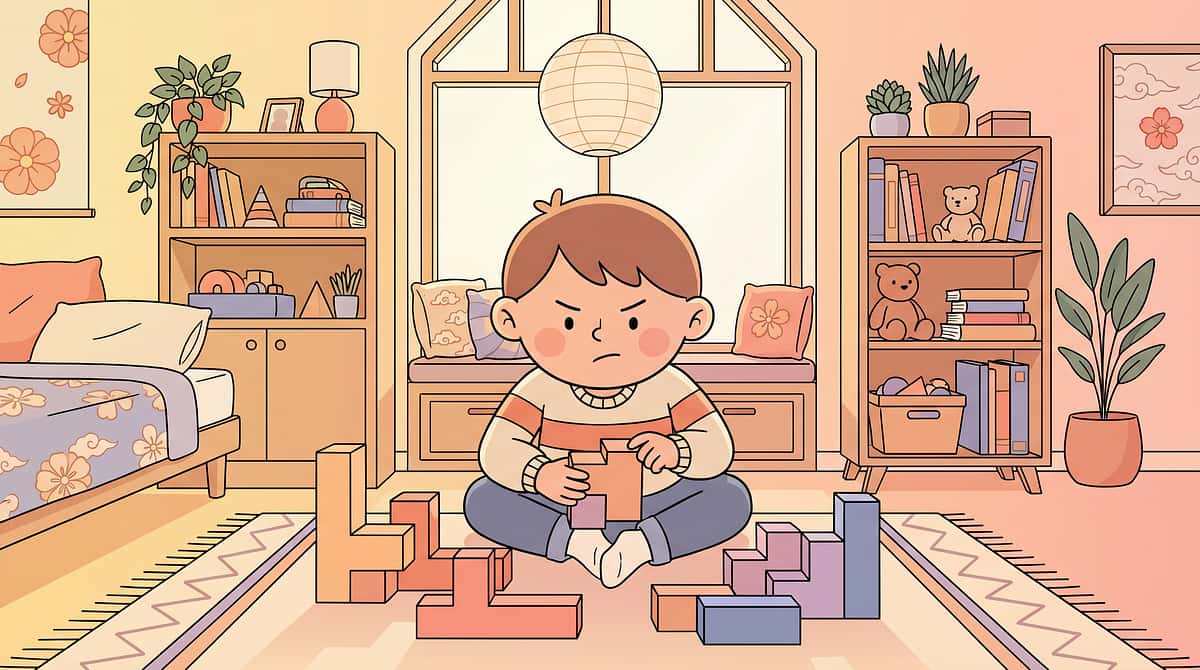
9 Materials That Help With Problem Solving Skills
A consortium-validated guide for parents and caregivers: science-backed materials that build problem-solving, critical thinking, and executive function in children with autism and developmental differences. Powered by GPT-OS® | Pinnacle Blooms Network®

Your child hands you the stuck drawer instead of trying to open it themselves. Again.
Every parent of a child with problem-solving difficulties knows this moment. The moment they stop trying and look to you. Not because they're lazy. Not because they're stubborn. Because their brain hasn't yet built the circuitry to work through difficulty.
"She's five, and she's brilliant — she has an extraordinary memory and knows all her letters. But the moment she hits something she doesn't already know how to do, she freezes. Yesterday she pushed harder and harder on a container lid until she was crying, instead of rotating it. The next time, the same thing. Her teacher says she avoids any activity where the answer isn't obvious. I don't know how to help her learn to figure things out." — Parent, Pinnacle Network
"You are not failing. Your child's cognitive system is still learning how to tolerate, attempt, and adapt. This is exactly what intervention is for." — Pinnacle Blooms Consortium | OT • SLP • ABA • SpEd • NeuroDev
🧠 Problem Solving Skills
⚡ Executive Function
🔎 Critical Thinking
Ages 2–10
COG-PROBSOLV

You Are Not Alone — The Numbers
Millions of children are navigating the same cognitive crossroads. The data is unambiguous.
1
Autism Prevalence
Children in India are diagnosed with autism — the largest single group presenting problem-solving and executive function challenges.
2
Cognitive Difficulty
Of children with ASD demonstrate significant difficulty with cognitive flexibility, trial-and-error learning, and generalization of problem-solving strategies.
3
Higher Risk
The rate of academic readiness challenges in children who lack structured problem-solving skill development by age 6 versus those who receive early intervention.
You are among an estimated 8–12 million families in India navigating the challenge of executive function and problem-solving difficulties in children. This is not an individual failure. It is a population-level developmental challenge that demands population-level, evidence-based tools.
Indian J Pediatr (2019), Padmanabha et al.: Home-based structured interventions across Indian pediatric populations demonstrated statistically significant outcomes in cognitive and adaptive skill domains. The home environment, when equipped with the right materials and protocols, is a primary intervention setting, not a secondary one. DOI: 10.1007/s12098-018-2747-4

This is not a behavior problem.
This is a circuitry difference — and circuits can be trained.
The Executive Control Network
Problem-solving is not a single skill — it is an orchestration of the prefrontal cortex (planning, impulse control), the anterior cingulate cortex (error detection, attention switching), and the basal ganglia (habit formation and procedural learning).
When a child with ASD or developmental differences faces an obstacle, the brain's executive control network may not fire in its optimal sequence — leading to freeze, meltdown, or immediate help-seeking instead of persistence.
What's Happening in Your Child's Brain
Prefrontal Cortex
May not adequately suppress the initial frustrated impulse — "give up / cry / ask for help" — allowing the first response to become the only response.
Anterior Cingulate Cortex
May not effectively signal "that didn't work — try something else," preventing the automatic error-correction loop from activating.
Working Memory
May not hold the problem AND the attempted solution in mind simultaneously — making adaptive strategy shifts nearly impossible without scaffolding.
"This is a wiring difference, not a will difference. Your child isn't choosing to give up. Their brain hasn't yet built the automatic loop that says: that didn't work → try differently → persist. That loop is built through repeated, supported, appropriately challenging experiences." — Pinnacle Blooms Consortium
Reference: Frontiers in Integrative Neuroscience (2020): Neurological basis for sensory and cognitive integration intervention in ASD. DOI: 10.3389/fnint.2020.556660

Where This Sits in Development
Problem-solving develops in stages. Your child is at a waypoint — not at the end of the road.
1
Infant (0–12m)
Sensorimotor obstacle solving & means-end understanding
2
Toddler (1–3y)
Trial and error predominates; learning from observation begins
3
Preschool (3–5y)
Holds small plans; multiple strategies emerging; evaluates outcomes
4
School (5–8y)
Abstract reasoning; beginning transfer across contexts
5
Older (8–12y)
Hypothesis-testing; metacognition; transfer across domains
Comorbidity Awareness
Problem-solving difficulties commonly co-occur with: Working Memory Challenges • Cognitive Inflexibility • Attention Difficulties (ADHD profile) • Anxiety (fear of failure/wrong answers) • Sensory Processing Differences
WHO Milestone Anchor: WHO Care for Child Development (CCD) Package — Age-specific, evidence-based caregiver recommendations implemented in 54+ low- and middle-income countries. PMC9978394 | WHO/UNICEF CCD Package (2023)

The Evidence Behind This Technique
Clinically validated. Home-applicable. Parent-proven.
LEVEL II EVIDENCE
Systematic Review + Multiple RCTs + Meta-Analysis
Study | Finding | Citation | |
PRISMA Systematic Review, 2024 (16 studies) | Problem-solving and executive function interventions meet criteria for evidence-based practice in children with ASD | PMC11506176 | |
Meta-Analysis, World J Clin Cases, 2024 (24 studies) | Structured material-based cognitive interventions effectively promote problem-solving, social skills, and adaptive behavior | PMC10955541 | |
WHO CCD Package, 2023 (54 countries) | Home-based structured intervention using everyday materials produces measurable cognitive outcomes | PMC9978394 | |
Padmanabha et al., Indian J Pediatr, 2019 | Indian RCT: Home-based interventions demonstrated significant outcomes in cognitive domains | DOI: 10.1007/s12098-018-2747-4 | |
NCAEP Evidence-Based Practices Report, 2020 | Visual supports, video modeling, and structured cognitive engagement = evidence-based practices for ASD | NCAEP 2020 | |
Diamond, A. (2013) | Executive Functions: foundational research on working memory, cognitive flexibility, inhibitory control | Annual Review of Psychology |
The Technique — What It Is
Problem-Solving Skill Development
Parent-Friendly Alias: "The Figure-It-Out Framework"
Problem-solving is the cognitive capacity to identify challenges, generate potential solutions, test approaches, evaluate outcomes, and adapt strategies based on feedback. It is not innate intelligence. It is a learnable, trainable system of mental habits — built through repeated experience with appropriately challenging situations where children have both the support to persist and the space to struggle productively.
Working Memory
Holding the problem AND attempted solutions in mind simultaneously throughout the problem-solving process.
Cognitive Flexibility
Shifting to new approaches when one fails — the ability to "think differently" rather than repeat the same failed strategy.
Inhibitory Control
Resisting impulsive "give up" responses; tolerating frustration long enough to generate an alternative approach.
Planning
Sequencing steps toward a goal — holding the endpoint in mind while navigating intermediate challenges.
Causal Reasoning
Understanding cause-and-effect relationships — "if I do X, then Y will happen" — the foundation of strategic thinking.
Domain: Cognitive & Learning
Ages: 2–10 years
Duration: 15–20 min
Frequency: Daily
Episode: L-988

Who Uses This Technique
This technique doesn't belong to one therapy discipline. It crosses all of them — because the brain doesn't organize by therapy type.
🔵 Occupational Therapist (OT)
Primary Lead Discipline
OTs address the cognitive-motor integration aspects of problem-solving — how physical engagement with materials (puzzles, construction, STEM challenges) builds the neural pathways for executive function. OTs calibrate task difficulty, sensory environment, and material selection to the child's sensory-motor profile.
🟣 ABA / BCBA Therapist
Behavior & Reinforcement Architecture
Applied Behavior Analysts design the reinforcement schedules, prompt hierarchies, and data collection systems that make problem-solving practice clinically effective. They identify antecedents, design graduated challenge systems, and measure behavioral indicators of cognitive progress.
🟢 Special Educator (SpEd)
Academic Transfer Bridge
Special Educators connect problem-solving skill development to academic readiness — ensuring skills built at home transfer to classroom learning. They identify curriculum-relevant problem types and scaffold metacognitive strategy instruction.
🔶 NeuroDev Pediatrician
Diagnostic & Prognostic Authority
NeuroDev doctors establish the cognitive profile, identify comorbidities (ADHD, anxiety, processing differences), and confirm the intervention approach matches the child's neurological presentation. They monitor for progression and flag red flags requiring medical review.
"When OT, ABA, SpEd, and NeuroDev work from the same intervention plan — governed by GPT-OS® — the child receives a coherent, non-contradictory, compounding experience. One child. One plan. All disciplines. Maximum impact." — Pinnacle Blooms Consortium, FusionModule™ Protocol

What This Targets
This isn't a random activity. It's a precision cognitive tool with primary, secondary, and tertiary developmental targets.
Primary Targets
- Tolerating the discomfort of "not knowing"
- Generating multiple solution attempts (vs. single-attempt give-up)
- Learning from failed attempts without emotional dysregulation
- Transferring strategies across problem types
Observable Progress Indicators
- Week 1–2: Child attempts the task even when uncertain of the answer
- Week 3–4: Child tries a second approach after first attempt fails
- Week 5–8: Child verbalizes "let me try something different" without prompting

The 9 Materials — Overview
Pinnacle-recommended materials, clinically mapped to the 128 Canon system. Each material targets a specific layer of problem-solving development — together they create a comprehensive cognitive training environment.
1
Graduated Puzzles
Builds persistence, spatial reasoning, and try-fail-adjust loops through progressively harder challenges.
2
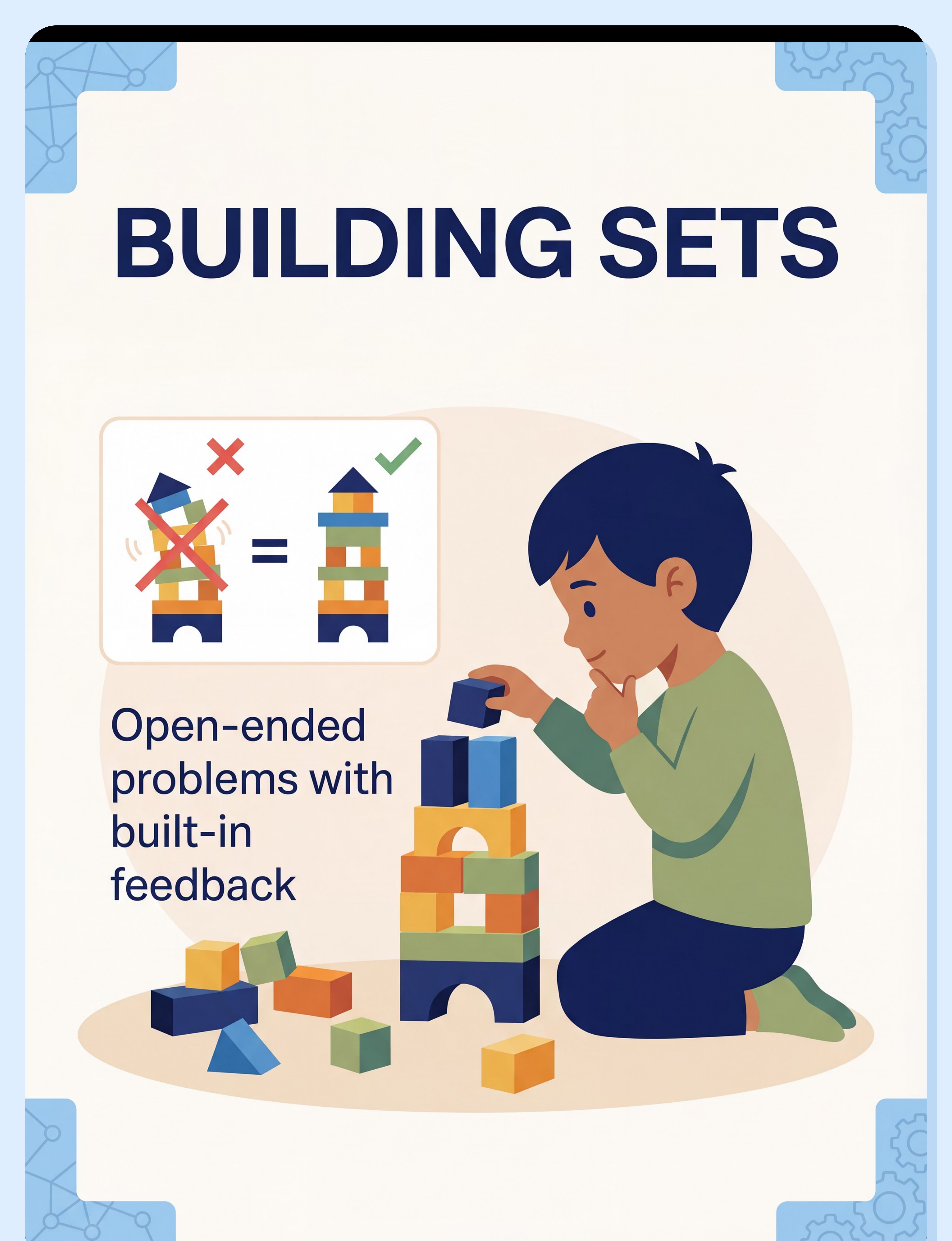
Building / Construction Sets
Open-ended engineering challenges that teach design, test, evaluate, and redesign — the core scientific method applied to play.
3
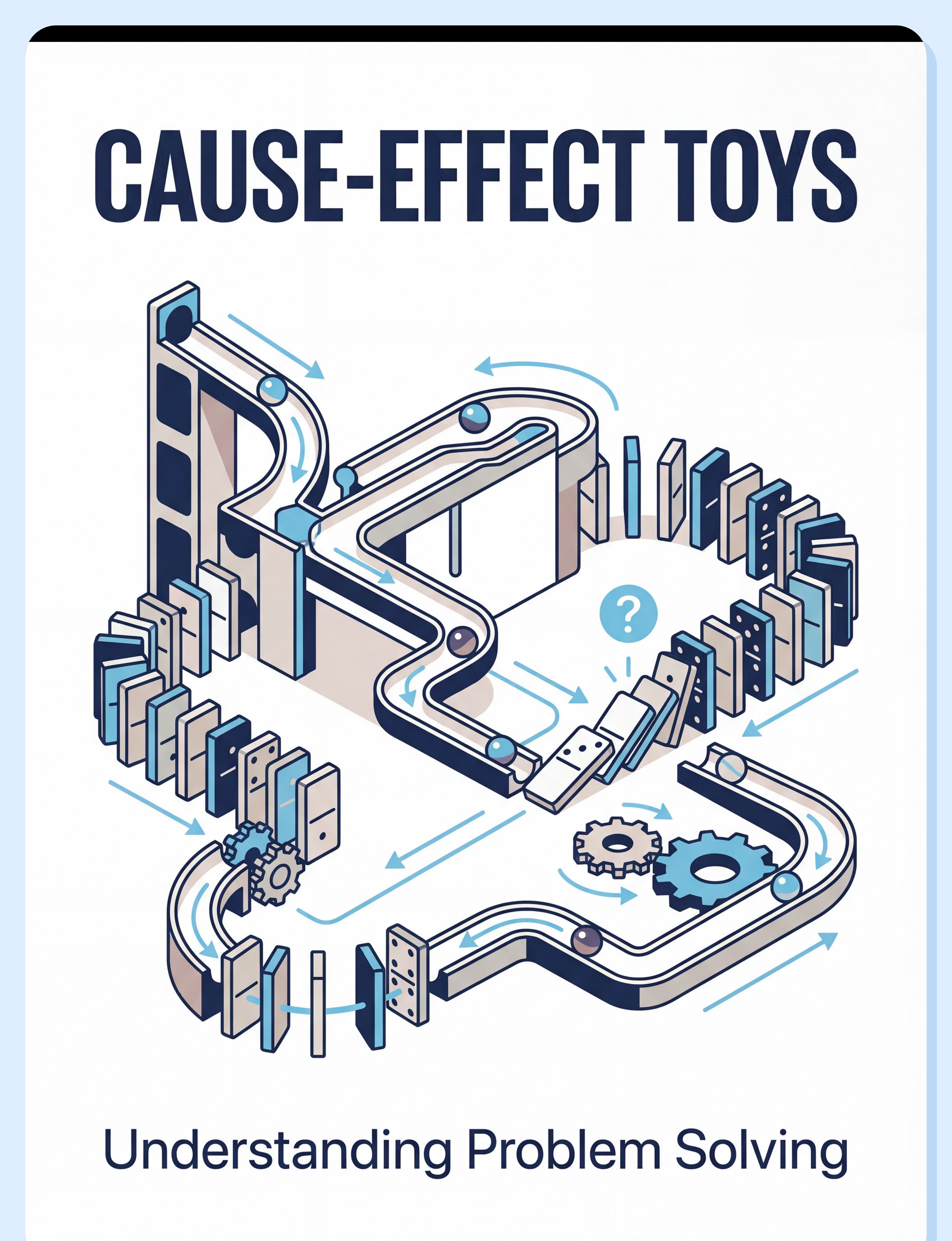
Cause-Effect Toys
Foundational "my action produces a result" understanding — the cognitive basis for all problem-solving strategy.
4
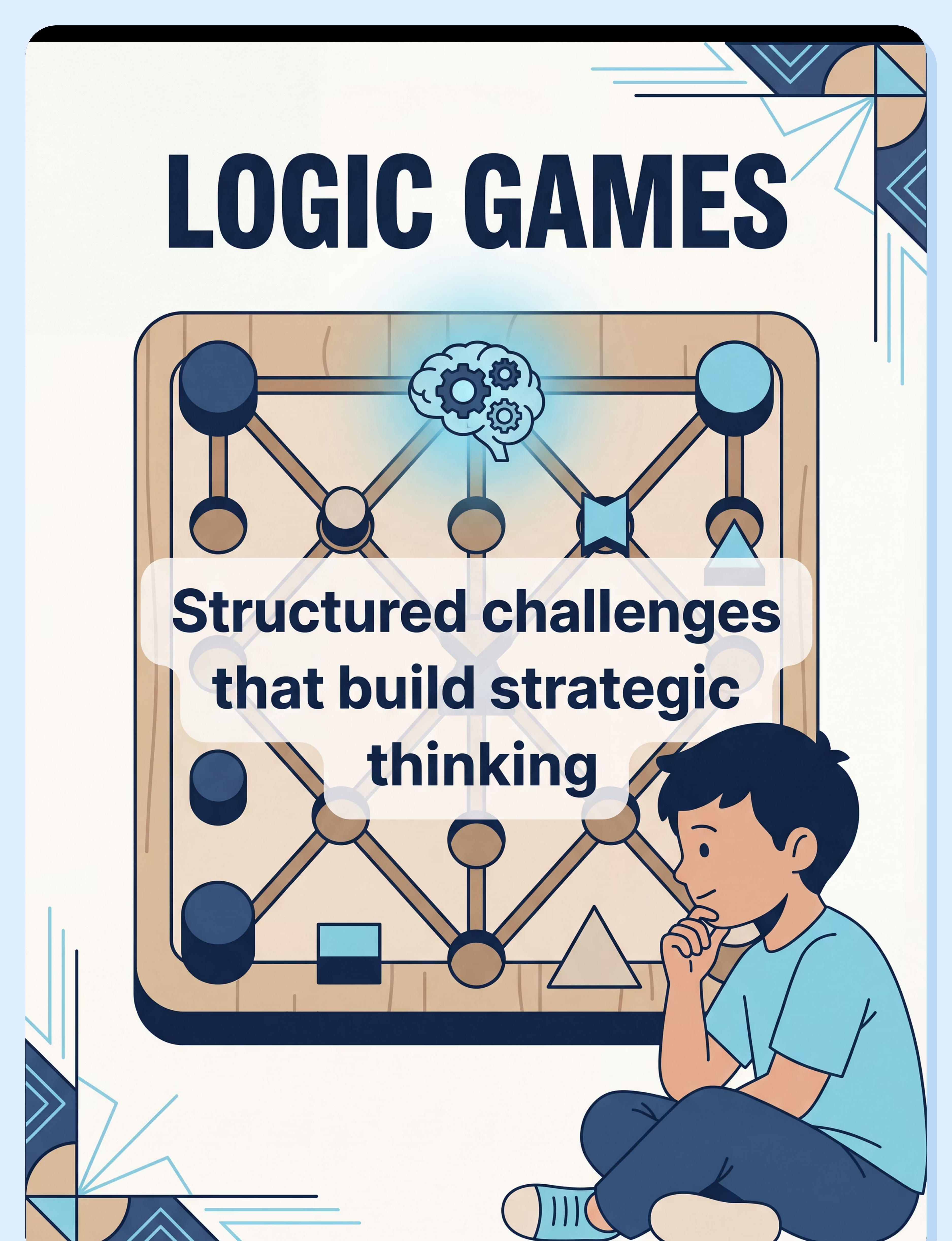
Logic & Strategy Games
Pattern recognition, categorization, and systematic cognitive approach habits — built through structured gameplay.
5
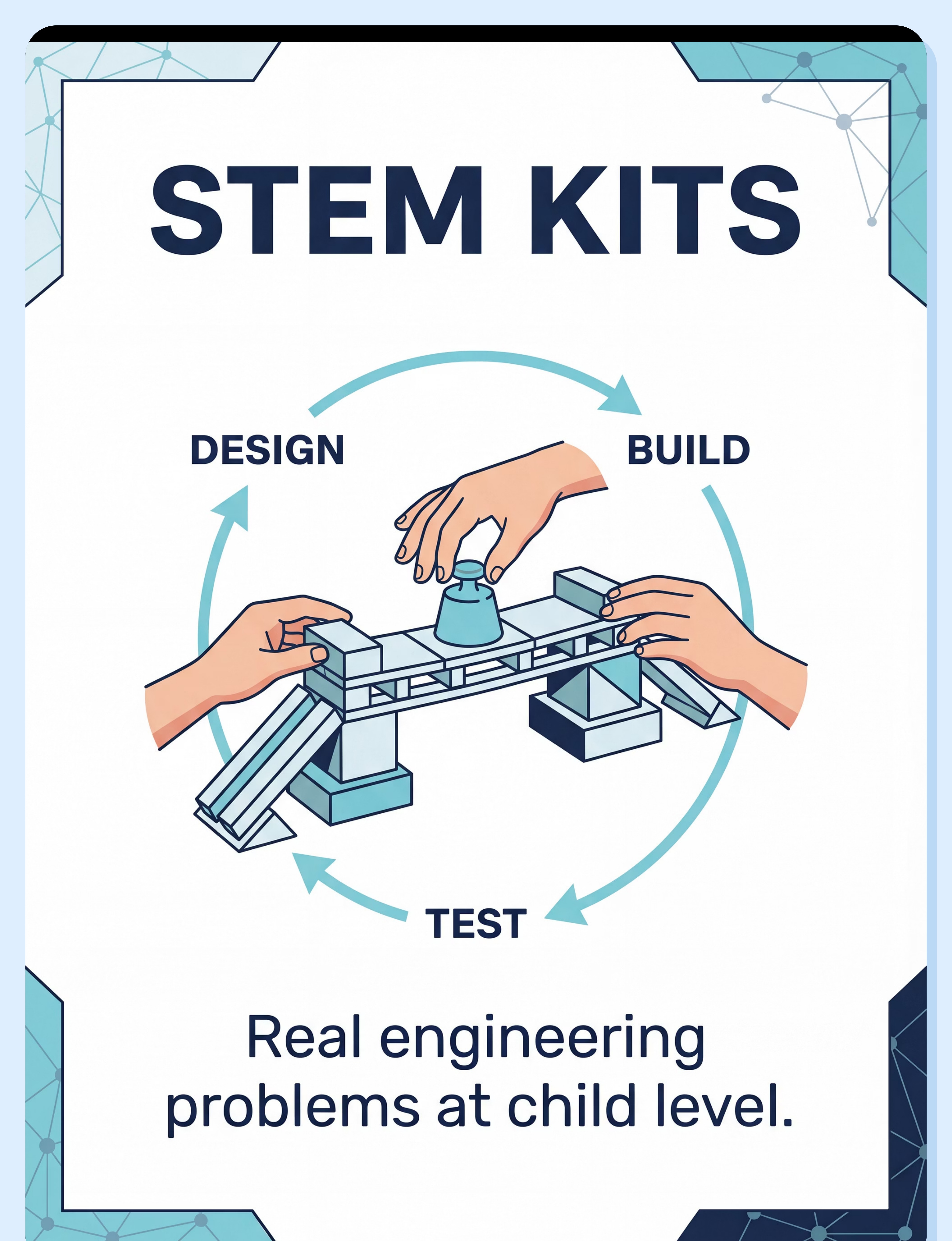
STEM Challenge Kits
Constraint-based engineering problems where failure is the intended first step — reframing mistakes as information.
6
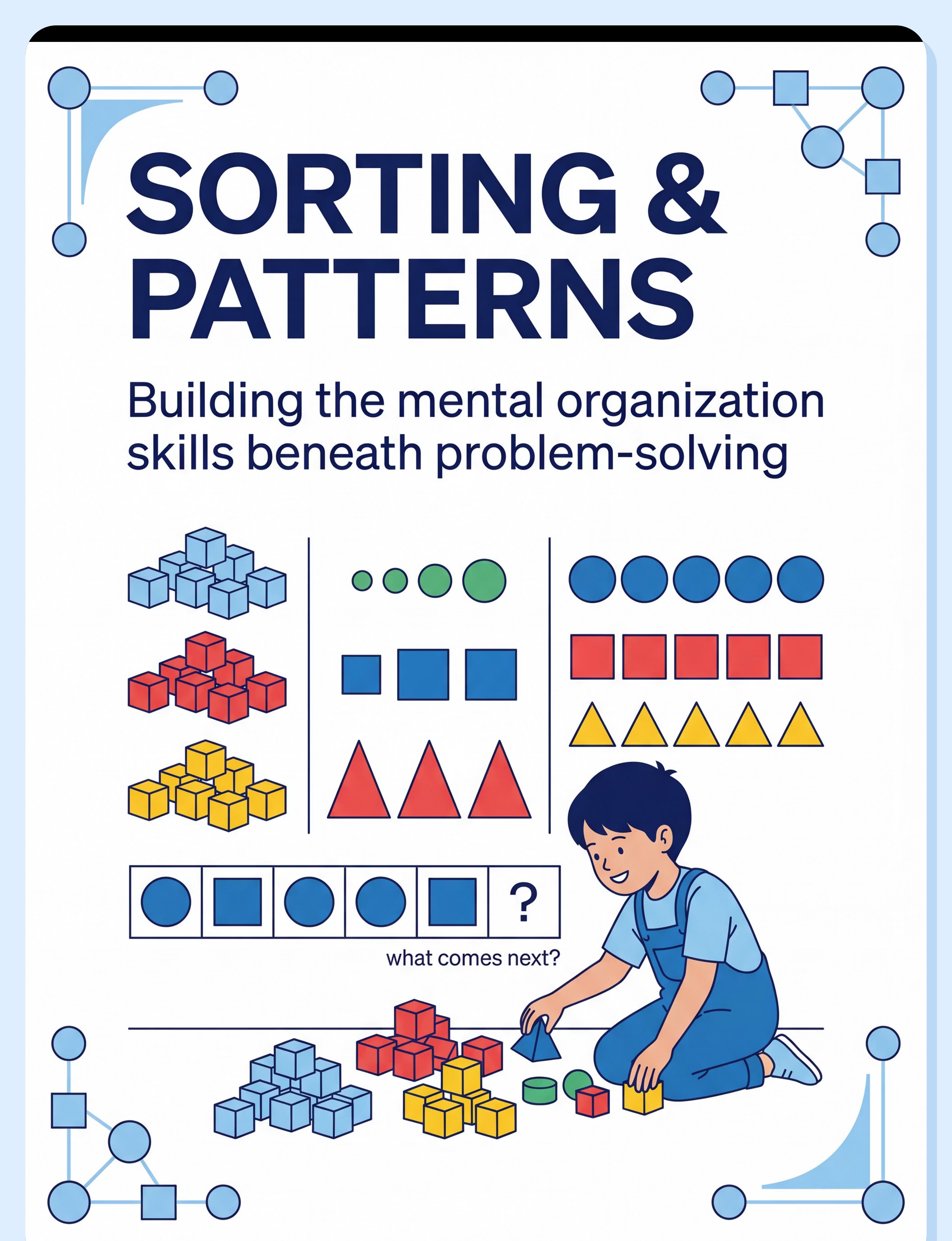
Sorting & Categorization Sets
Classification thinking — the cognitive foundation for all problem-solving — with multiple sorting attributes for flexibility.
7
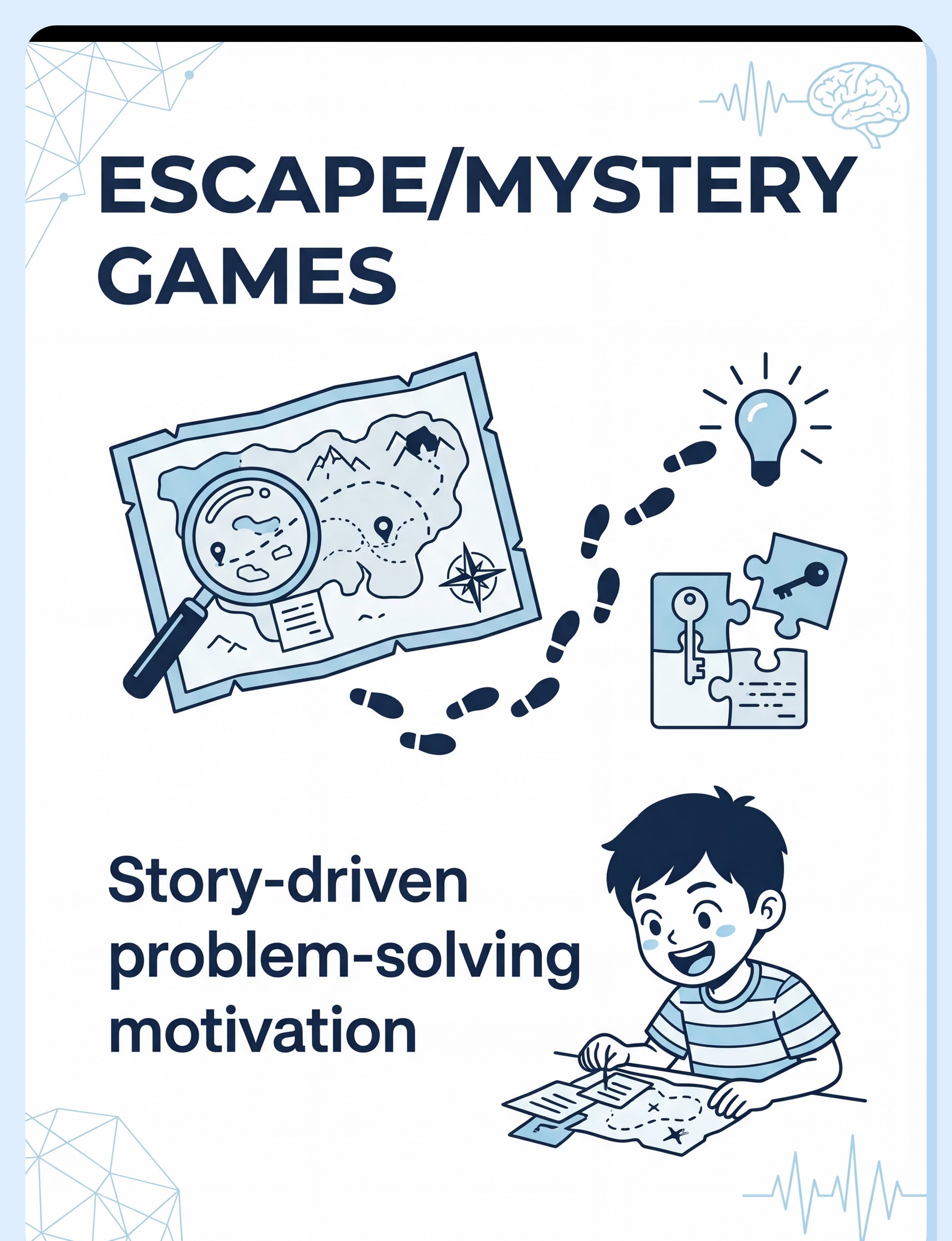
Escape / Mystery Games
Narrative-driven problem sequences where intrinsic motivation (finding the hidden prize) sustains persistence through difficulty.
8
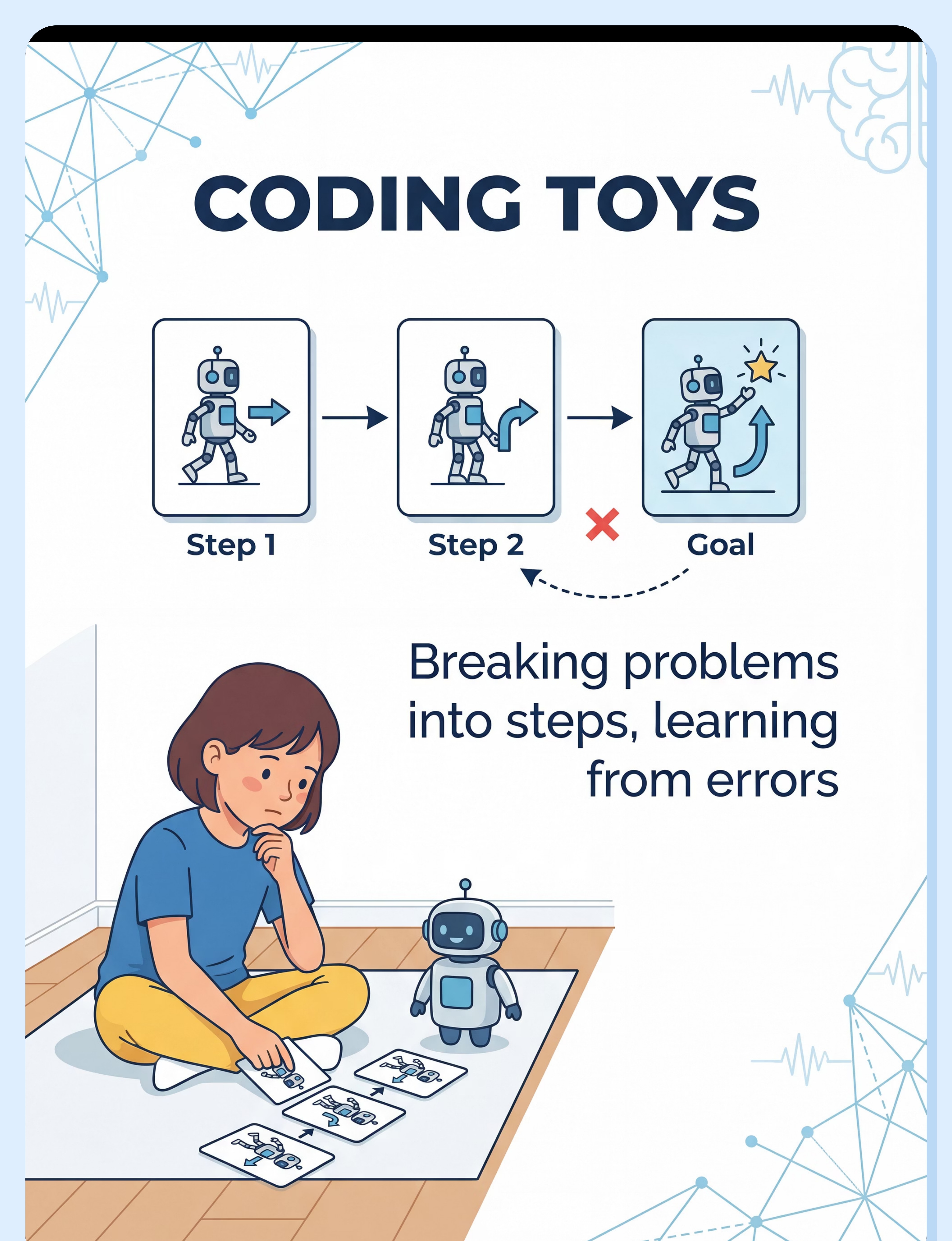
Coding & Sequencing Toys
Reframes errors as "bugs to find" — transforming failure into detective work and building debugging mindset.
9
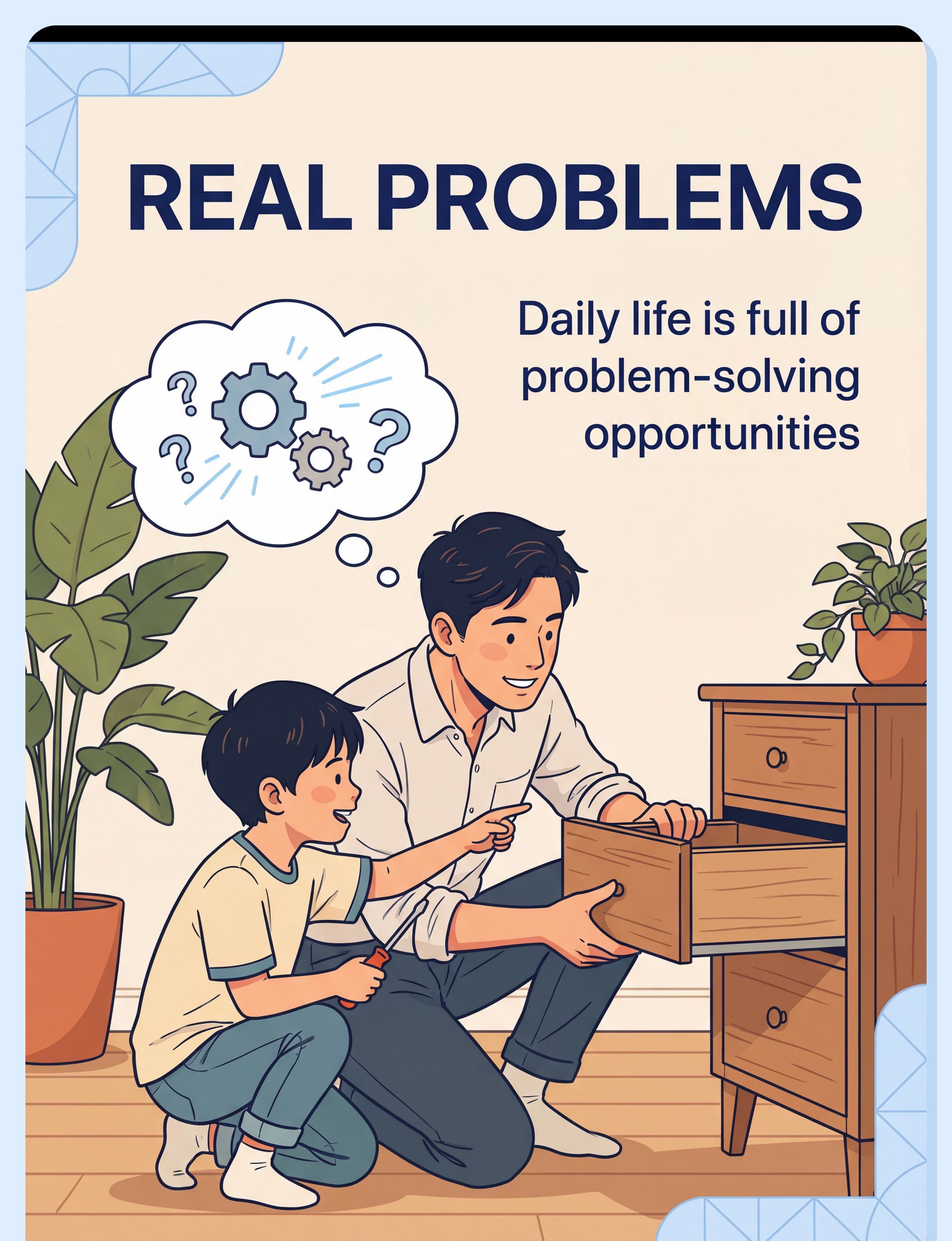
Real-World Problems
Authentic household challenges (stuck lids, packed drawers, lost items) that make cognitive transfer immediate and meaningful.

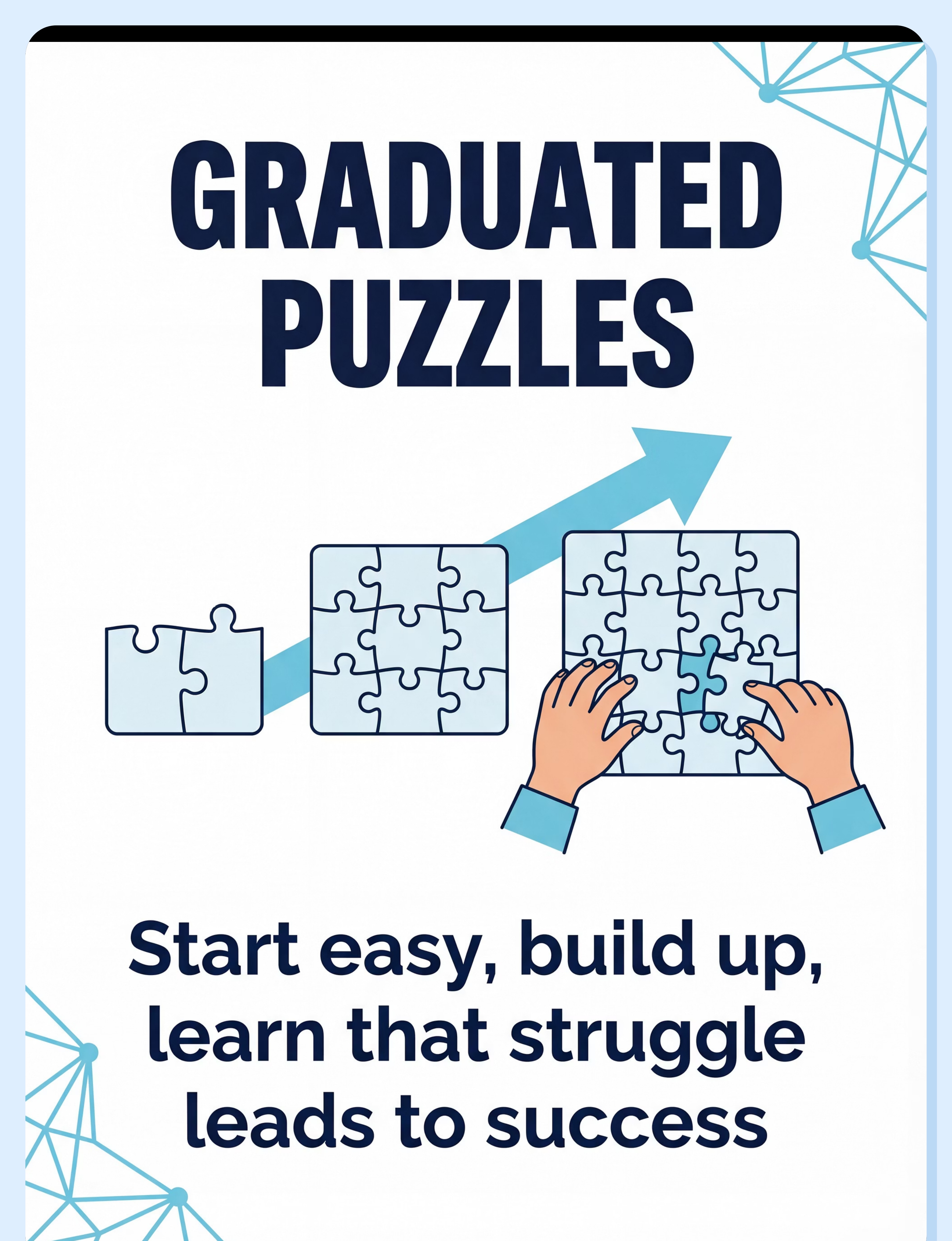
Material 1: Graduated Puzzles
Canon: Problem-Solving Toys
Ages 2–10
Why This Material Works
Puzzles are the gold-standard problem-solving material because they create a clear, contained challenge with a visible solution — making the try-fail-adjust loop explicit and tangible. Every misplaced piece is a trial. Every rotation is a hypothesis. Every fit is a confirmed solution.
The "graduated" principle is critical: the puzzle must be just above the child's automatic competence, creating productive struggle without triggering overwhelm. This calibration — known as the Zone of Proximal Development — is the mechanism by which new neural pathways form.
Therapeutic Action
Present a puzzle 1–2 levels below the child's frustration threshold. Let them work without assistance. When they get stuck: "What haven't you tried yet?" — never "That goes there."
Pinnacle Protocol Tip: The SHINETOY 8 Dice Shut The Box Game (₹428) extends the puzzle principle to numerical strategy — building probability reasoning alongside persistence. 🛒 Buy on Amazon.in

Material 2: Building Blocks
Canon: Construction Play
Ages 2–12
Why This Material Works
Building blocks are a foundational tool for developing spatial reasoning, planning, and iterative problem-solving. Unlike puzzles with a single correct solution, blocks offer open-ended challenges where children can design, construct, test, and refine their ideas. Each attempt, whether successful or collapsing, provides immediate, tangible feedback. A tower that tumbles teaches about balance and structural integrity, while a successful arch demonstrates engineering principles. The process of planning a structure, experimenting with different configurations, and adapting to unexpected outcomes cultivates resilience and creative thinking.
Therapeutic Action
Encourage free exploration and imaginative play without specific directives. Provide a variety of block types (wooden, LEGO, magnetic) to broaden the scope of challenges. Instead of showing them how to build, ask open-ended questions like: "What are you trying to create?" or "What might happen if you put that block there?" When a structure falls, frame it as valuable information: "That's interesting! What did we learn from that? How can we make it stronger next time?" This approach empowers children to view 'failure' as data for improvement, not an end point.
Pinnacle Protocol Tip: The SkillBuilder Interlocking Blocks (₹799) provide a versatile, durable set that encourages complex constructions and imaginative play. Their varied shapes push children beyond simple stacking to explore more sophisticated architectural concepts. 🛒Buy on Amazon.in

Material 3: Strategy Board Games
Canon: Strategic Play
Ages 4–12
Why This Material Works
Strategy board games like Chess, Checkers, and Connect Four are foundational for cultivating forward-thinking, consequence awareness, and multi-step planning. These games necessitate anticipating an opponent's moves, evaluating potential outcomes, and adapting strategies in real-time. This dynamic process strengthens cognitive muscles, teaching children to delay gratification, assess risks, and understand that current actions directly influence future results. The structured, yet challenging, environment of board games provides a safe space for experimenting with complex problem-solving loops, where successes and setbacks offer immediate, tangible feedback on their strategic choices.
Therapeutic Action
Guide the child to focus on the process of strategic thinking rather than just winning. Before a move, prompt them with questions like: "What do you think will happen if you make that move?" or "What might your opponent do next?" If a move doesn't work out, encourage reflection: "That's interesting. What did we learn from that move? How could we approach it differently next time?" This approach helps children verbalize their thought processes, solidifying their planning skills and fostering an understanding that 'mistakes' are valuable data for learning and adapting, thereby promoting cognitive flexibility and emotional regulation.
Pinnacle Protocol Tip: The LogicGrid Master Strategy Game (₹599) provides an excellent entry point into complex strategic thinking for younger children, featuring intuitive rules that scale up to deeper tactical play. 🛒Buy on Amazon.in

Material 4: Maze Books & Maze Toys
Canon: Visual-Spatial Reasoning
Ages 3–10
Why This Material Works
Maze books and toys are powerful tools for cultivating visual-spatial reasoning and executive functions. They demand focused visual tracking, as children must follow intricate lines without losing their place. This activity naturally strengthens their ability to plan ahead, mentally mapping out potential routes and anticipating dead ends. Each turn in a maze offers an opportunity for error detection, where a blocked path provides immediate, tangible feedback. The subsequent need for self-correction—re-tracing steps and trying a new direction—builds mental flexibility, resilience, and a deep understanding that mistakes are simply information for guiding the next attempt.
Therapeutic Action
Introduce mazes slightly above the child's current ability to foster productive struggle. Encourage them to trace paths with a finger or pencil first to aid visual tracking. When they encounter difficulty, avoid providing direct answers. Instead, prompt them with open-ended questions like: "Where have you been so far?", "What other paths could you explore from here?", or "Could you try working backward from the finish to find a connection?" The goal is to develop their internal problem-solving dialogue, framing detours not as failures, but as essential steps in the journey to a solution. Celebrate their persistence and the strategies they employ, regardless of how quickly they solve it.
Pinnacle Protocol Tip: The MindBender Maze Set (₹650) offers a durable collection of mazes from beginner to advanced levels, promoting hours of focused visual exploration and strategic thinking. 🛒Buy on Amazon.in

Material 5: Sorting & Categorization Toys
Canon: Cognitive Classification
Ages 1–6
Why This Material Works
Sorting and categorization activities are fundamental for establishing robust cognitive frameworks in young children. These seemingly simple tasks cultivate crucial skills such as pattern recognition, where children learn to identify repeating elements and sequences. They also develop logical grouping abilities, enabling them to classify objects based on shared attributes like color, shape, size, or function. This process isn't just about tidiness; it's about building the foundational cognitive architecture necessary for all higher-order problem-solving. Children learn to make connections, understand relationships, and organize information mentally, laying the groundwork for early math concepts, language development, and critical thinking.
Therapeutic Action
Offer a variety of objects for sorting – blocks, beads, buttons, or natural items. Encourage children to sort by different criteria (color, shape, size) and ask open-ended questions: "How are these alike?" or "What makes this one different?" When a child struggles to categorize an item, prompt them: "Which group does this remind you of?" or "What are some ways we could put these together?" The goal is to foster flexible thinking, helping them understand that there can be multiple valid ways to organize information. Celebrate their efforts to find patterns and make logical connections, reinforcing their innate problem-solving capabilities.
Pinnacle Protocol Tip: The BrightStart Shape Sorter & Stacker (₹899) offers a durable and engaging way for young children to explore various sorting criteria, enhancing fine motor skills and cognitive classification from an early age. 🛒Buy on Amazon.in

Material 6: Science Experiment Kits
Canon: Hypothesis Testing
Ages 4–12
Why This Material Works
Science experiment kits are exceptional tools for nurturing hypothesis testing and the fundamentals of the scientific method. They guide children through a structured yet exciting process: observing phenomena, forming predictions (hypotheses), designing and conducting experiments, collecting data, and drawing conclusions. This systematic approach is the bedrock of formal problem-solving, teaching children to ask "why" and "how," to identify cause-and-effect relationships, and to approach challenges with a methodical mindset. By engaging with these kits, children develop crucial critical thinking skills, learn to differentiate between observation and inference, and embrace the iterative nature of discovery where every outcome, expected or unexpected, provides valuable insights.
Therapeutic Action
When engaging with science kits, emphasize the process of inquiry over merely achieving the "right" result. Before starting an experiment, prompt the child with questions like: "What do you think will happen if we mix these two ingredients?" or "What's your best guess about why this object floats?" Encourage them to articulate their predictions. During the experiment, guide them to observe carefully, perhaps even jotting down what they see or measuring changes. Afterwards, discuss the results: "What did you notice?", "Was your prediction correct? Why or why not?", and "What could we try differently next time to understand more?" This approach fosters a deep understanding that experimentation is a journey of learning, where curiosity and systematic exploration are celebrated, building resilience and a lifelong love for discovery.
Pinnacle Protocol Tip: The Discovery Lab Junior Science Kit (₹899) offers a fantastic array of safe, engaging experiments designed to introduce young minds to scientific principles and hypothesis testing. 🛒Buy on Amazon.in
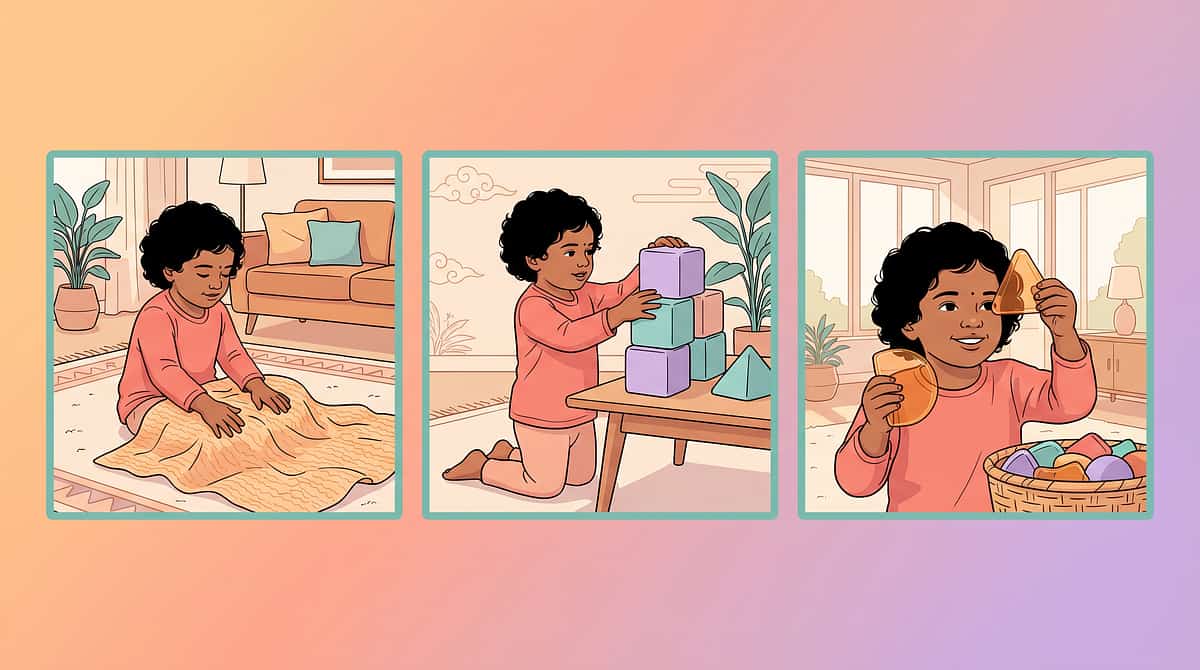
Material 7: Coding & Logic Toys
Canon: Sequential Logic
Ages 4–10
Why This Material Works
Coding and logic toys are powerful tools for developing sequential logic and computational thinking, skills essential for navigating an increasingly digital world. These activities teach children to break down problems into smaller, manageable steps, a process known as algorithmic thinking. They learn to predict outcomes, identify errors (debugging), and devise systematic solutions. This iterative cycle of planning, executing, observing, and correcting mirrors the scientific method and everyday problem-solving, fostering mental flexibility and resilience. By engaging with these toys, children internalize the idea that complex challenges can be overcome through logical progression and persistent adjustment, building a transferable framework for success in any field.
Therapeutic Action
When introducing coding and logic toys, focus on the step-by-step nature of the tasks. Start with simple commands and gradually increase complexity. Encourage the child to articulate their plan before executing it: "What do you want the robot to do first?" or "What sequence of cards will make this happen?" If a solution doesn't work as expected, guide them to "debug" their process: "Where might the robot have gone wrong?" or "Let's look at your steps again—which one needs changing?" Celebrate their efforts in identifying and correcting errors, reinforcing that mistakes are valuable feedback rather than failures. This cultivates patience, critical analysis, and a systematic approach to achieving goals.

Material 8: Sensory Play Materials
Canon: Sensory-Motor Integration
Ages 1–8
Why This Material Works
Sensory play materials like kinetic sand, playdough, and water beads are fundamental for developing sensory-motor integration. These activities provide rich tactile input, helping children regulate their nervous system and build a strong body-based foundation for cognitive processes. By engaging their senses, children can reduce anxiety and stress, fostering a calmer state conducive to problem-solving. This tactile exploration enhances fine motor skills, hand-eye coordination, and spatial awareness, which are crucial precursors to academic tasks like writing and drawing. Furthermore, the open-ended nature of sensory play encourages imaginative thinking and self-directed discovery, laying the groundwork for cognitive flexibility and creative problem-solving without the pressure of a "right" answer.
Therapeutic Action
Encourage children to freely explore sensory materials without strict rules or expectations. Observe how they interact with the textures: are they gentle or vigorous? Do they focus on one material or move between several? Ask open-ended questions like: "How does that feel?", "What can you make with it?", or "Tell me about what you're doing." If a child seems overstimulated or withdrawn, gently guide them to a different material or activity. The goal is to facilitate self-regulation; allow them to squish, mold, pour, and manipulate the materials at their own pace. This helps them process sensory information, develop body awareness, and build comfort with varied stimuli, thereby reducing tension and improving their capacity for focused engagement in other areas.
Pinnacle Protocol Tip: The Rainbow Sand & Dough Sensory Kit (₹999) offers a versatile collection of kinetic sand, vibrant playdough, and child-safe tools, perfect for fostering tactile exploration and sensory integration. 🛒Buy on Amazon.in

Material 9: Role-Play & Pretend Play Sets
Canon: Narrative Problem-Solving
Ages 2–8
Why This Material Works
Role-play and pretend play sets are crucial for fostering narrative problem-solving. As children create imaginary scenarios—whether they're a doctor healing a patient, a chef preparing a meal, or a builder constructing a tower—they develop the ability to construct a storyline, identify challenges within that narrative, and devise creative solutions. This type of play enhances social cognition by allowing children to step into different roles, understand diverse perspectives, and practice social scripts and emotional responses. Critically, it strengthens their capacity to mentally simulate outcomes before acting, helping them predict consequences and refine their strategies, which is a foundational skill for executive function and real-world decision-making. Through imaginative play, children learn to navigate complex social situations and abstract problems in a safe, engaging environment.
Therapeutic Action
To maximize the therapeutic benefits of role-play, actively engage with your child by taking on a character yourself. Model open-ended questions that encourage narrative development and problem-solving, such as: "Oh no, the patient has a tummy ache! What medicine should we give them?" or "Our customer wants a blue cake, but we only have red frosting. What can we do?" Encourage them to express emotions appropriate to their role and to resolve conflicts within the play scenario. If they get stuck, offer gentle suggestions rather than solutions, guiding them to think through the problem. This interaction helps children expand their imaginative capacity, build empathy, practice negotiation skills, and develop a sense of agency over their self-created worlds, reducing anxiety related to uncertainty.
Pinnacle Protocol Tip: The Medi-Chef Role-Play Kit (₹1049) combines a doctor's set with a mini chef's kitchen, providing endless opportunities for cross-functional imaginative play and scenario-based learning. 🛒Buy on Amazon.in

Part II: How to Use These Materials
The Pinnacle Protocol — A Parent's Implementation Guide
Having the right materials is only half the equation. This section reveals how applying the Pinnacle Protocol transforms casual play into powerful opportunities, ensuring these tools effectively build essential problem-solving skills, rather than merely passing time.

The 3-Phase Play Session
The Pinnacle Protocol structures problem-solving play into three distinct phases, transforming casual interactions into powerful learning opportunities. This guide helps parents facilitate a dynamic and engaging session that nurtures cognitive growth and emotional regulation.
Phase 1: Warm-Up (5–10 min)
Begin with free exploration, allowing the child to lead without specific goals. This initial period helps them acclimate to the materials and the play space, reducing anxiety and encouraging self-directed discovery. Observe their interests and spontaneous interactions with the toys.
Phase 2: Challenge (15–20 min)
Gently introduce a specific, open-ended challenge related to the material. This isn't about giving answers, but about sparking curiosity and critical thinking. Use prompts like, "I wonder if you could make this tower taller?" or "How can we get this ball to roll further?" Observe their attempts and problem-solving strategies.
Phase 3: Reflect (5 min)
Conclude the session with a brief reflection. Ask open-ended questions that encourage metacognition: "What did you try?", "What worked well?", "What would you do differently next time?" This phase solidifies learning by allowing children to articulate their process and identify effective strategies.
Pinnacle Protocol Tip: Consistency is more important than duration. Even short, structured play sessions daily can yield significant developmental benefits.
The Language of Problem-Solving: What to Say (and What Not to Say)
The words we choose as parents have a profound impact on how children approach challenges. Far more than just conveying information, our language shapes their cognitive habits, fostering either dependence or independent problem-solving. This guide highlights the crucial differences between phrases that hinder and those that empower, transforming everyday interactions into opportunities for growth.
❌ Phrases That Shut Down Problem-Solving
"Let me do it." (Removes autonomy and practice.)
"That's wrong; it goes like this." (Discourages experimentation and resilience.)
"Just tell me what happened!" (Focuses on outcome, not process or reflection.)
"Hurry up, we don't have time for this." (Rushes the process, stifling deep thought.)
"You always do that." (Labels the child, rather than addressing the action.)
"Stop trying, it's too hard for you." (Undermines self-efficacy and perseverance.)
✅ Phrases That Build Problem-Solving
"What haven't you tried yet?" (Encourages alternative strategies and persistence.)
"What do you notice about this?" (Prompts observation and analytical thinking.)
"What's your next idea?" (Fosters creative thinking and iterative solutions.)
"How could we figure this out together?" (Invites collaboration and shared discovery.)
"Tell me about your plan." (Encourages metacognition and verbalization of thought.)
"What do you think might happen if...?" (Develops foresight and cause-and-effect reasoning.)
The power of language in shaping cognitive habits cannot be overstated. By consciously choosing phrases that encourage curiosity, persistence, and reflection, parents can cultivate adaptable and resilient problem-solvers who are ready to tackle any challenge.

The Frustration Window: Your Most Important Parenting Skill
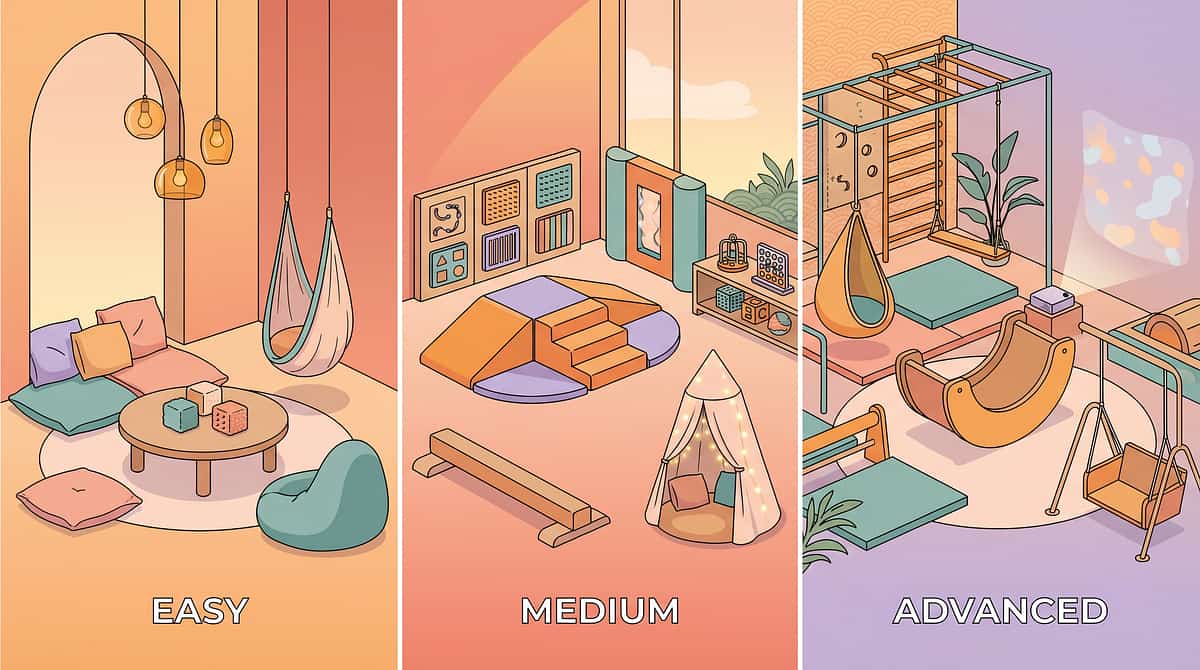
Understanding your child's "frustration window" is key to fostering genuine learning and resilience. This narrow band between boredom and overwhelm is where productive struggle occurs, transforming challenges into opportunities for cognitive growth. Identifying and guiding your child into this zone empowers them to develop critical problem-solving skills.
Too Easy: Boredom
Recognition: Lack of engagement, distraction, complaining about simplicity, seeking alternative activities.
Response: Increase complexity, introduce new elements, suggest variations to the activity.
Productive Struggle: Growth Zone
Recognition: Focused effort, minor frustration, persistence, asking clarifying questions, showing determination.
Response: Offer verbal encouragement, ask guiding questions, provide minimal, targeted support.
Too Hard: Shutdown
Recognition: Extreme frustration, giving up, emotional meltdowns, avoidance, self-deprecating remarks.
Response: Reduce complexity, offer direct help to overcome the immediate obstacle, simplify the task, or take a break.
The ultimate goal is to keep your child in the "Productive Struggle" zone. This is where neural pathways are built, creativity is sparked, and a growth mindset is cultivated. By navigating challenges with just enough support, children learn that effort leads to mastery and that mistakes are valuable learning opportunities, rather than failures.

Building a Weekly Routine: The 7-Day Material Rotation
To maximize cognitive development and prevent children from becoming habituated to certain toys, the Pinnacle Protocol recommends a structured material rotation. This approach ensures comprehensive engagement across various skill sets and keeps play sessions fresh and exciting. By systematically rotating materials, you expose your child to diverse challenges, fostering adaptability and deeper learning.
Day | Materials | Rationale | |
Monday | Building Blocks, Puzzles | Develops spatial reasoning, problem-solving, and fine motor skills. Encourages structural understanding. | |
Tuesday | Art Supplies (Crayons, Paint), Playdough | Stimulates creativity, self-expression, and sensory exploration. Enhances fine motor control and texture awareness. | |
Wednesday | Storytelling Props, Dress-Up Clothes | Fosters imaginative play, narrative skills, and emotional development. Encourages role-playing and empathy. | |
Thursday | Science Exploration Kit, Water Play | Introduces basic scientific concepts, encourages observation, and hypothesis testing through hands-on discovery. | |
Friday | Musical Instruments, Nature Items (Leaves, Rocks) | Explores rhythm, sound, and natural elements. Develops auditory skills and an appreciation for the environment. | |
Saturday | Free Choice / Review Materials | Allows child-led exploration and revisit favorite items, solidifying learning and independence. | |
Sunday | Outdoor Play / Nature Walk | Promotes gross motor skills, sensory engagement with the natural world, and unstructured imaginative play. |
Weekends are flexible, offering an opportunity for free-choice play or dedicated outdoor time to balance structured learning with spontaneous discovery.
Pinnacle Protocol Tip: Remember, consistency is key. Aim for short, focused sessions of 20-30 minutes daily rather than long, sporadic ones. Regular engagement reinforces learning patterns and builds sustained attention.

Age-by-Age Guide: Matching Materials to Developmental Stage
Developmental readiness is a dynamic process, and while age provides a general framework, it's crucial to observe your child's unique abilities and interests. This guide offers recommendations for adapting materials to different developmental stages, ensuring challenges are just right for fostering growth.
Toddlers (1–3 years)
- Materials: Large building blocks, chunky puzzles (2-4 pieces), finger paints, playdough, simple musical shakers, soft animal props, sand/water play.
- Cognitive Targets: Sensory exploration, cause and effect, basic spatial awareness, fine and gross motor skill development, object permanence.
- Challenge Level: Focus on manipulation, exploration, and simple tasks with immediate results. Encourage repetition and free-form play.
Preschool (3–5 years)
- Materials: Medium-sized blocks (e.g., LEGO Duplo), puzzles (5-20 pieces), crayons, tempera paints, dress-up clothes, storytelling puppets, basic science tools (magnifying glass, scoopers), outdoor exploration items.
- Cognitive Targets: Symbolic play, early problem-solving, pattern recognition, creativity, language development through narrative, simple classification.
- Challenge Level: Introduce open-ended questions, encourage planning simple structures or scenarios, facilitate collaborative play, and offer guided discovery.
Early School Age (5–8 years)
- Materials: Interlocking bricks (e.g., LEGO), jigsaw puzzles (20-50 pieces), detailed art supplies (markers, watercolors), script-based storytelling kits, junior science experiment kits, child-friendly musical instruments (keyboard), nature journals.
- Cognitive Targets: Logical reasoning, sequential thinking, hypothesis testing, advanced fine motor skills, abstract representation, collaborative project work, early literacy and numeracy integration.
- Challenge Level: Encourage following instructions, planning multi-step projects, predicting outcomes, experimenting with variables, and reflecting on results.
Middle Childhood (8–12 years)
- Materials: Complex construction sets (e.g., advanced LEGO Technic), challenging jigsaw puzzles (100+ pieces), advanced art techniques (sketching, perspective), creative writing prompts, complex science kits (robotics, chemistry), digital music creation, field guides for nature study.
- Cognitive Targets: Critical thinking, strategic planning, complex problem deconstruction, data analysis, advanced artistic expression, independent research, abstract conceptualization.
- Challenge Level: Facilitate independent project design, encourage research and information synthesis, foster debate and critical analysis, provide opportunities for peer teaching, and support advanced skill mastery.
Pinnacle Protocol Tip: Always observe your child's engagement and frustration levels. The goal is to provide just enough challenge to stimulate growth without leading to overwhelm. Adapt materials and expectations to their unique pace and interests, fostering a love for continuous learning.

The Parent's Role: Observer, Not Rescuer
Shifting from problem-solver to problem-facilitator is one of the most critical mindset adjustments a parent can make. While our instinct is to protect our children from struggle, allowing them to navigate challenges independently cultivates resilience, critical thinking, and a deeper sense of accomplishment. This approach empowers children to truly own their learning journey.
Sit on Your Hands
Resist the immediate urge to intervene. When a child encounters a difficulty, step back and give them space to process, experiment, and potentially overcome it on their own. This builds vital problem-solving muscles.
Example: Your toddler is trying to fit a puzzle piece that clearly doesn't belong. Instead of correcting them, watch as they attempt different rotations or try other pieces.
Watch Before You Speak
Before offering guidance or solutions, take a moment to truly observe your child's strategy. Understand their thought process, what they've already tried, and where their current understanding might be limited. Your insights will be far more effective.
Example: Your preschooler is struggling to open a childproof container. Observe if they're twisting, pulling, or pushing, and in what order, before deciding how to prompt.
Ask Before You Tell
Instead of providing direct answers, engage your child's critical thinking with open-ended questions. Guide them toward their own discoveries, allowing them the satisfaction of figuring things out rather than simply being told.
Example: Your child asks why a boat floats. Instead of explaining buoyancy, ask, "What do you think makes it stay on top of the water? What if we put a rock in the water?"
Celebrate the Attempt, Not Just the Outcome
Shift the focus from perfect results to the effort, perseverance, and learning process itself. Acknowledging their hard work and resilience fosters a growth mindset and encourages them to take on new challenges without fear of failure.
Example: Your child struggles to build a tall tower that eventually topples. Instead of lamenting the collapse, praise their focus and determination: "You worked so hard trying different ways to make it stable!"
Ultimately, parental restraint, though often the most difficult, proves to be the most powerful intervention. It signals trust in your child's capabilities and lays the foundation for lifelong self-reliance and confident exploration.

Tracking Progress: The Problem-Solving Observation Checklist
Understanding how your child approaches challenges is key to fostering their development. This checklist is a simple yet powerful tool for parents to observe and track their child's problem-solving skills across three critical dimensions. Use it to gain insights into their learning process and guide your interactions.
Pinnacle Protocol Tip: Review this checklist monthly to observe patterns and progress. This ongoing assessment will help you tailor appropriate materials and interventions, ensuring your child receives the right level of challenge to continue their problem-solving journey effectively.

Part III: The Science Behind the Play
Why These Materials Work — The Neuroscience
Play is far from trivial; it is the primary mechanism by which the developing brain constructs executive functions, critical for planning, problem-solving, and self-regulation. Decades of research unambiguously confirm that engaging in rich, open-ended play directly sculpts neural pathways, laying the essential groundwork for lifelong learning and adaptability.
Neuroplasticity: The Brain's Secret Weapon
Far from being a static organ, your child's brain is an incredibly dynamic and adaptable landscape, constantly rewiring itself based on experiences. This amazing ability is called neuroplasticity, and understanding it can transform how you view your child's learning journey.
What is Neuroplasticity?
Simply put, neuroplasticity is the brain's capacity to change and adapt. It's how your brain strengthens connections it uses often and prunes away those it doesn't. Every new skill learned, every challenge overcome, literally reshapes the brain's physical structure, creating more efficient pathways for future learning.
The Critical Window: Ages 0-12
While neuroplasticity continues throughout life, it is most pronounced during early childhood. From birth to roughly 12 years old, the brain is a superhighway of activity, forming new connections at an astonishing rate. This makes early experiences incredibly powerful in shaping cognitive abilities, emotional regulation, and problem-solving skills.
Play's Impact: Sculpting the Brain
Problem-solving play is a powerful catalyst for neuroplasticity. When children engage in puzzles, build complex structures, or figure out how to share a toy, their brains are actively involved in two key processes: synaptic pruning (removing less-used connections to make space for more vital ones) and myelination (insulating neural pathways for faster, more efficient information transfer). This direct engagement strengthens neural networks essential for executive functions.
Developmental Differences
For children with developmental differences, understanding neuroplasticity brings immense hope. It means that the brain can adapt and create alternative pathways, even when facing challenges. Consistent, tailored experiences and supportive environments can significantly enhance their learning and development, empowering them to build new skills and strengths.
Every time your child tries and fails and tries again, a new neural pathway is being carved.
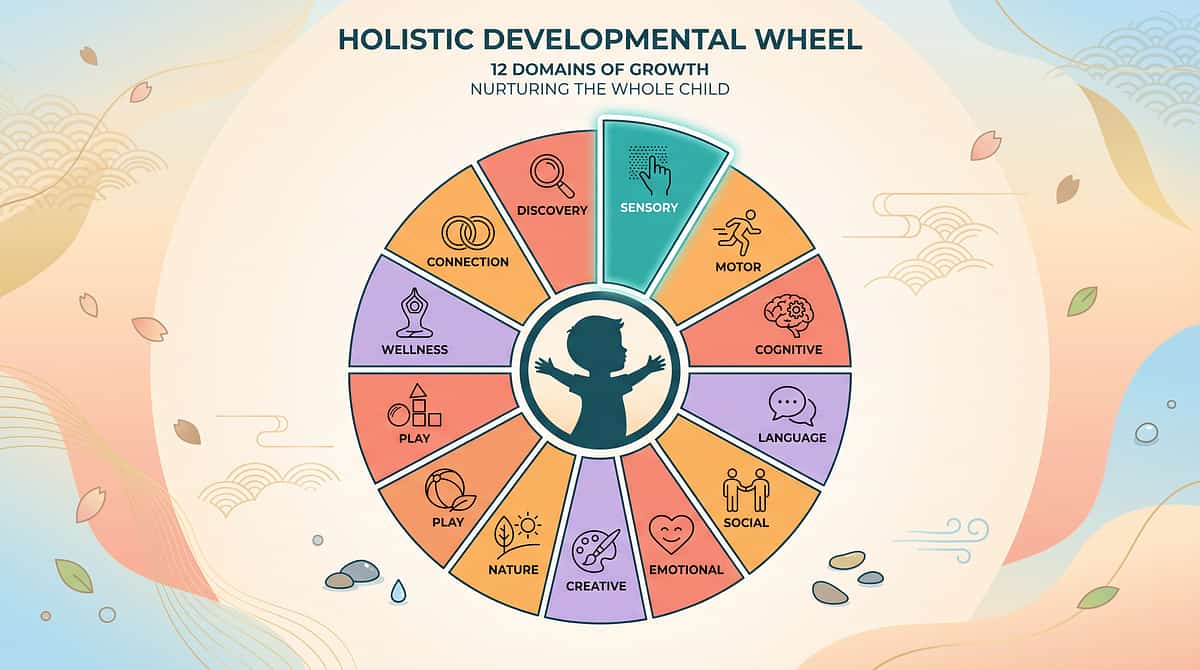
Executive Function: The 5 Skills That Problem-Solving Builds
Problem-solving isn't just about finding answers; it's a dynamic training ground for the brain's "control center"—executive function. These critical cognitive skills are essential for navigating complex tasks, managing emotions, and achieving goals. Our thoughtfully designed materials are engineered to target and strengthen these five core executive functions, laying a robust foundation for your child's future success.
1
Working Memory
The ability to hold and manipulate information in mind for a short period while simultaneously performing other tasks, crucial for following multi-step instructions or remembering components of a puzzle.
2
Cognitive Flexibility
The capacity to adapt thinking and behavior to new, changing, or unexpected situations. This means switching strategies when one approach isn't working or considering different perspectives.
3
Inhibitory Control
The power to resist impulsive actions or immediate gratification, allowing children to pause, think, and choose a more appropriate or effective response instead of giving in to the first urge.
4
Planning & Organization
The skill of setting goals, developing a sequence of steps to achieve them, and monitoring progress. It involves foresight, prioritizing tasks, and logically arranging materials or ideas.
5
Emotional Regulation
The ability to manage and express emotions constructively. This includes coping with frustration, disappointment, or excitement during challenging activities without becoming overwhelmed, maintaining focus and engagement.
Each of the 9 materials we provide is specifically designed to simultaneously engage and develop these five interwoven executive function skills, ensuring a holistic approach to cognitive development through purposeful play.
The Research: What 50 Years of Play Science Tells Us
For decades, researchers have highlighted the profound impact of play on a child's development, especially concerning problem-solving skills. The evidence is robust and continually growing, showcasing how purposeful play sculpts young minds. Here’s a look at landmark studies that underpin our approach.
Researcher/Year | Study Focus | Key Finding | Implication for Parents | |
Vygotsky (early 20th C.) | Zone of Proximal Development (ZPD) | Play enables children to practice skills just beyond their current abilities with guidance, especially through imaginative role-playing and symbolic thought. | Engage in guided play, offering gentle support for new challenges. Encourage role-playing games where children can stretch their thinking. | |
Piaget (mid 20th C.) | Constructivist Play Theory | Children actively construct knowledge by interacting with their environment. Play is essential for experimenting with and understanding the world at their own pace. | Provide open-ended materials and ample time for free, undirected play. Allow children to explore and discover solutions independently. | |
Diamond (2000s-Present) | Executive Function Development | Complex pretend play and games with rules directly enhance core executive functions like working memory, inhibitory control, and cognitive flexibility. | Encourage games requiring strategy, planning, and self-control. Foster sustained, focused play that demands mental effort and adaptation. | |
Hirsh-Pasek & Golinkoff (2000s-Present) | Play-Based Learning | Playful learning, characterized by active engagement and joy, leads to deeper and more transferable learning outcomes, fostering critical 21st-century skills. | Prioritize playful interactions that integrate learning goals. Create an environment where children feel safe to experiment, ask questions, and learn from mistakes. | |
Comprehensive Review (Recent) | Impact of Structured Play | Meta-analyses consistently show that structured, purposeful play interventions significantly improve cognitive, social, and emotional outcomes, particularly in problem-solving. | Combine free play with thoughtfully designed activities. Balance child-led exploration with opportunities for targeted skill development through play. |
This strong scientific foundation underscores why our materials are so effective, translating decades of research into practical, engaging experiences for your child.
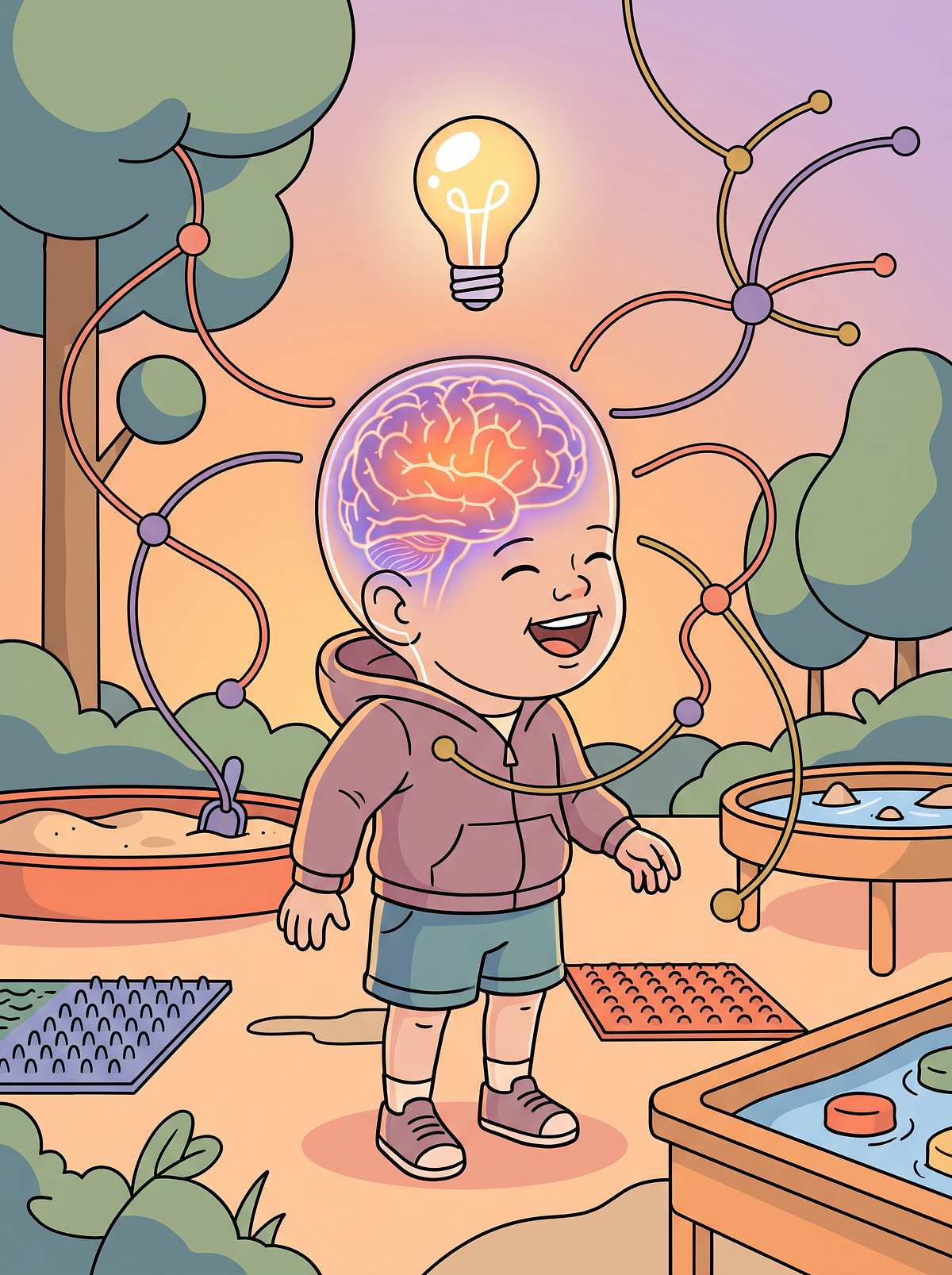
The Dopamine Loop: Why Problem-Solving Feels Good (When Done Right)
Ever wonder why solving a puzzle or mastering a new skill brings such a rush? It's your brain's sophisticated reward system in action! When children successfully navigate a challenge, their brains release dopamine, a powerful neurotransmitter associated with pleasure, motivation, and learning. This isn't just about feeling good; it's a critical neurobiological mechanism that reinforces the behavior, encouraging them to seek out and engage with similar challenges in the future.
The Dopamine Sweet Spot
The key lies in the "just right" challenge. Tasks that are too easy won't engage the brain enough to trigger a significant dopamine release, leading to boredom. Conversely, challenges that are too hard can induce frustration and stress, releasing cortisol instead of dopamine and discouraging future attempts. Our 9 thoughtfully designed materials are precisely calibrated to find this optimal zone, where the challenge is stimulating yet achievable, maximizing the positive feedback loop.
Cultivating the "I Did It!" Moment
By consistently engaging with these perfectly pitched problems, children not only build essential executive functions but also develop a positive association with effort and perseverance. This internal motivation transforms problem-solving from a chore into a rewarding adventure, laying the foundation for a lifelong love of learning and resilience.
Parent Tip: Celebrate the process, not just the outcome. When your child succeeds, help them articulate the feeling of satisfaction. "Wow, you kept trying and figured it out! How does that feel?" This helps them connect the effort to the dopamine reward.
Part IV
Special Considerations
Adapting the Protocol for Different Needs
Children with ADHD, autism, sensory processing differences, or anxiety often require thoughtful adaptations to truly thrive. Our 9 purposefully designed materials offer inherent flexibility, allowing for personalized adjustments to meet diverse needs while fostering the same core executive function skills.

Adapting for ADHD: Keeping the Engaged Brain Engaged
ADHD is often a difference in attention regulation, not a deficit in intelligence. Children with ADHD possess incredible creativity, hyperfocus capabilities, and boundless energy. Our materials can be powerful tools for developing executive function skills when adapted to harness these strengths. Here are five practical adaptations to optimize engagement and learning:
1. Shorter Sessions & Movement Breaks
Break activities into manageable chunks (10-15 minutes) and intersperse with physical activity. This helps manage energy levels and reset focus. Encourage a quick stretch or a brief walk between tasks.
Material Tip: Use the Modular Logic Blocks in short bursts, focusing on completing one small pattern or structure before a quick movement break.
2. High-Novelty Material Rotation
Maintain interest by regularly rotating the materials (e.g., weekly or bi-weekly). Novelty is a powerful attention anchor for an ADHD brain. Don't let materials become too familiar too quickly.
Material Tip: Keep the Dynamic Engineering Kits exciting by introducing new challenges or components from the kit every few days, rather than overwhelming with everything at once.
3. Visual Timers for Time Awareness
Externalize time with visual timers to help develop an internal sense of duration and task completion. This reduces anxiety about transitions and helps with executive function planning.
Material Tip: Pair the Pattern Sequencing Puzzles with a visual timer, setting a goal to complete a certain number of sequences before the timer runs out.
4. "Body Doubling"
Your calm, non-judgmental presence can provide an external anchor for focus. Be nearby (reading, working, or quietly observing) without actively directing the play. This provides a sense of accountability without pressure.
Material Tip: Sit in the same room while your child engages with the Creative Story-Building Sets, offering a quiet presence that can help maintain their sustained attention.
5. Gamification & Self-Competition
Frame challenges as "missions" or "quests." Encourage beating their "personal best" rather than competing with others. Tapping into the thrill of achievement boosts dopamine and engagement.
Material Tip: Challenge your child to build the tallest tower or solve the Logic Grid Challenges in a faster time than their previous attempt, celebrating each improvement.
By implementing these thoughtful adaptations, you can transform challenges into opportunities, empowering children with ADHD to thrive and build confidence in their problem-solving abilities.
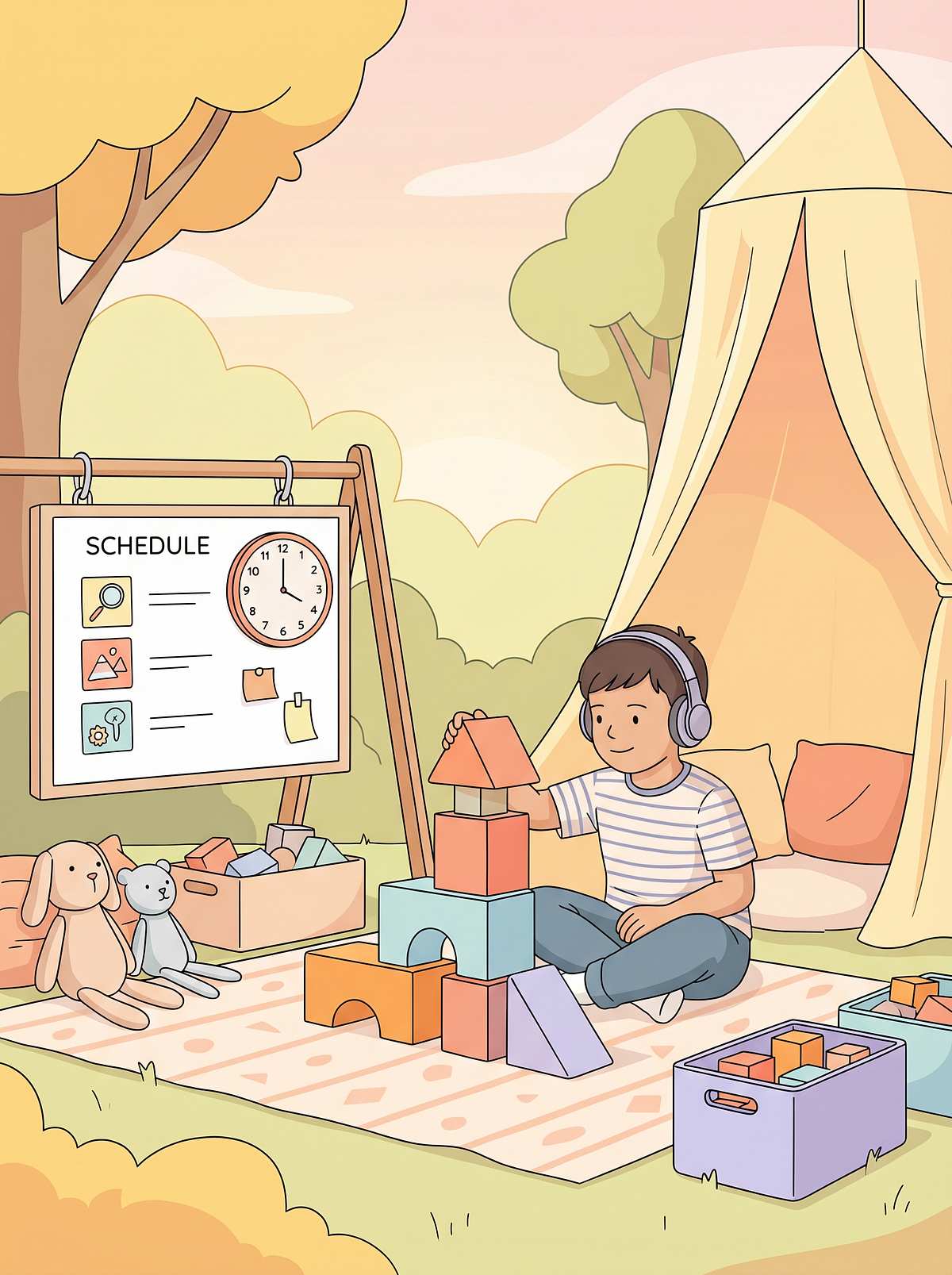
Adapting for Autism: Predictability, Passion, and Progress
Children on the autism spectrum often flourish with clear structure, predictable routines, and opportunities to deeply engage with their unique interests. Our purposefully designed materials offer a flexible framework that, with thoughtful adaptations, can become powerful tools for developing executive function skills while honoring and supporting neurodivergent processing. Here are five practical adaptations to foster engagement and learning:
1. Consistent Setup Rituals
Establish a predictable routine for beginning and ending play sessions (same place, time, and sequence of steps). This reduces anxiety and helps prepare the brain for focused engagement.
Material Tip: Use the Modular Logic Blocks by always starting with a specific base or a pre-set challenge card, creating a familiar entry point to the activity.
2. Special Interest Integration
Connect the materials or activities to the child's passionate interests. When learning is framed within a preferred topic, motivation and focus dramatically increase.
Material Tip: For the Creative Story-Building Sets, encourage building narratives or scenarios centered around dinosaurs, space, trains, or any specific topic that captivates your child.
3. Reduced Verbal Prompting
Minimize verbal instructions, which can be overwhelming. Instead, use clear visual cues, demonstration, or pre-made examples to guide the child through tasks.
Material Tip: When introducing Pattern Sequencing Puzzles, show a completed puzzle or use visual "next step" cards rather than lengthy verbal explanations.
4. Sensory-First Approach
Begin with activities that help regulate sensory input before moving to more cognitively demanding tasks. Physical manipulation and tactile exploration can be calming and help prepare the brain for learning.
Material Tip: Allow time for free, unstructured exploration of the Dynamic Engineering Kits' components, focusing on the textures and how pieces fit together before introducing building goals.
5. Honoring Stimming During Play
Recognize that self-stimulatory behaviors (stimming) are often a form of self-regulation. Unless it's harmful, allow stimming to occur. It's not a distraction but a way for the child to manage sensory input and maintain focus.
Material Tip: If a child needs to rock, flap, or hum while working on Logic Grid Challenges, provide a safe, accepting space for them to do so without interruption, as it may aid concentration.
By embracing these adaptations, we tap into the inherent strengths of autistic children, such as their exceptional pattern recognition, attention to detail, and systematic thinking. This approach transforms challenges into rich opportunities for growth, fostering competence and confidence.

Adapting for Anxiety: Building Safety Before Challenge
Children experiencing anxiety often benefit from environments that foster a sense of safety, control, and gradual challenge. Our thoughtfully designed materials provide a structured yet flexible platform to help children navigate their worries, build resilience, and develop crucial executive function skills. Here are five practical adaptations to create a supportive and empowering learning experience:
1. Start with Mastery-Level Tasks
Begin with activities where success is highly achievable. Building confidence is paramount before introducing tasks that push boundaries. This ensures a positive emotional foundation for learning.
Material Tip: Introduce the Modular Logic Blocks or simpler Pattern Sequencing Puzzles first, celebrating successful completion to build a sense of competence and control.
2. Normalize Mistakes Explicitly
Actively communicate that mistakes are valuable learning opportunities, not failures. This helps desensitize children to the fear of imperfection and encourages a growth mindset.
Material Tip: When using Dynamic Engineering Kits or Creative Story-Building Sets, model making adjustments or rebuilding, verbalizing that it's part of the design process and how we learn.
3. Co-regulation First
Your calm and regulated presence can be a powerful anchor. Before diving into tasks, ensure both you and the child are in a relaxed state. A calm adult helps a child regulate their own emotional state.
Material Tip: Engage in a few minutes of quiet, shared play with Logic Grid Challenges or Creative Story-Building Sets to establish a sense of connection and calm before setting independent goals.
4. Offer Choice and Control
Anxiety often stems from a feeling of lack of control. Empower children by giving them choices over materials, tasks, or even when to take a break. This builds agency and reduces perceived threat.
Material Tip: Let your child choose which of the 9 materials they want to engage with, or decide whether to continue building with Modular Logic Blocks or switch to a Pattern Sequencing Puzzle.
5. Gradual Exposure to Frustration
Once confidence is established, slowly introduce tasks that require more effort and problem-solving. Incrementally increasing difficulty over weeks helps build tolerance for frustration without overwhelming the child.
Material Tip: Begin with simpler Logic Grid Challenges and, as the child gains mastery, gradually introduce more complex grids or encourage longer, more intricate builds with Dynamic Engineering Kits.
Anxiety and perfectionism often co-occur, creating a cycle where the fear of not being perfect prevents engagement. These materials, when used with these adaptations, help break that cycle by fostering a safe space for experimentation, learning from mistakes, and building genuine self-efficacy, rather than just perfect outcomes.

When to Seek Professional Support
As parents, navigating a child's unique developmental journey can be both rewarding and challenging. While our educational materials are designed to be a powerful resource, there are times when professional guidance becomes invaluable. This section offers a clear, compassionate guide to help you recognize when home-based material use should be supplemented with professional therapy, ensuring your child receives the comprehensive support they deserve.
Signs to Watch For
Observing these indicators might suggest that additional professional input could significantly benefit your child:
- Complete refusal to attempt any challenge, even with familiar materials or strong encouragement.
- Extreme meltdowns or emotional dysregulation lasting 30+ minutes, or increasing dramatically in frequency and intensity.
- Significant regression in previously mastered skills (e.g., communication, self-care, academic abilities).
- Noticeable and persistent negative impact on school performance, social interactions with peers, or family dynamics.
- Persistent sleep disturbances, significant changes in appetite, or other physical manifestations of stress or anxiety.
- Self-injurious behaviors (e.g., head banging, scratching) or aggressive outbursts towards others.
- Intense, unmanageable fears or anxieties that significantly interfere with daily routines or activities.
- Lack of sustained progress or continued struggle despite consistent, dedicated intervention and adaptation at home.
Who Can Help
Understanding the roles of different professionals can help you identify the right support for your child:
Occupational Therapist (OT)
Specializes in sensory processing difficulties, fine and gross motor skills, self-regulation, and daily living activities. OTs can provide strategies for managing sensory input and improving functional independence.
Child Psychologist
Addresses emotional regulation, anxiety, behavioral challenges, and social skills development. They offer therapeutic interventions such as Cognitive Behavioral Therapy (CBT), play therapy, and parent training.
Speech-Language Pathologist (SLP)
Focuses on all aspects of communication, including verbal and non-verbal language, social communication, articulation, and alternative communication methods.
Developmental Pediatrician
A medical doctor specializing in child development and behavior. They can diagnose developmental disorders, recommend and coordinate interventions, and provide ongoing medical oversight.
Remember, seeking professional guidance is a proactive step towards supporting your child's well-being and growth. It's a sign of strength and dedication, not a failure, to provide them with every possible tool for success.

Part V: Real Stories, Real Results
What Parents Are Saying After 90 Days
Discover the tangible impact of the Pinnacle Protocol. These are the authentic experiences of families who, through consistent application, have transformed daily challenges into moments of growth, resilience, and deeper connection.

Parent Stories: The Moments That Changed Everything
It's often the small, consistent victories that pave the way for profound change. At Pinnacle Protocol, we believe in celebrating every step forward. These are the heartfelt accounts from parents who've witnessed their children transform daily struggles into triumphs, fostering resilience, creativity, and deeper connection through thoughtful engagement with our materials.
Sarah, parent of Chloe (7, Anxiety)
"Chloe used to get so overwhelmed by starting anything new, especially open-ended creative tasks. The blank page was her biggest fear. But with the Creative Story-Building Sets, she physically constructs her story first. It’s been incredible to watch her go from anxious avoidance to confidently writing detailed narratives. It feels like she's built a bridge over her anxiety."
David, parent of Ethan (9, ADHD)
"Keeping Ethan focused for more than five minutes was a daily battle. His ADHD made sustained attention almost impossible. The Modular Logic Blocks were a game-changer. The structured yet flexible nature of the blocks captivates him. He'll sit for 30 minutes, sometimes an hour, meticulously building complex structures. It's the longest he's ever engaged with a single activity."
Jessica, parent of Liam (5, Autism)
"Liam struggled intensely with unexpected changes or anything that deviated from his routine. Transitions often led to meltdowns. When we introduced the Dynamic Engineering Kits, he initially resisted, but as he built and rebuilt, he started to understand that modifying a design wasn't a 'mistake' but part of the process. This flexibility has slowly begun to translate into other areas of his life, making transitions much smoother."
Michael, parent of Mia (10, Problem-Solving Delays)
"Mia would give up at the first sign of difficulty, often proclaiming 'I can't do it!' when faced with a puzzle. Her problem-solving delays felt like a wall. We tried the Logic Grid Challenges, starting with the simplest ones. Every time she completed one, her face lit up. She's now tackling much harder grids, celebrating each small step, and for the first time, she’s learning to persist through frustration."

The 90-Day Transformation: What to Expect
Embarking on the Pinnacle Protocol journey means witnessing incredible growth. While every child's path is unique, this timeline highlights the typical milestones parents and children experience through consistent engagement with our specialized materials.
Week 1–2: New Horizons
Initial introduction to the materials, often met with curiosity and cautious exploration. Some resistance to new challenges might surface.
Parents look for: First interactions, moments of focused attention, and identification of preferred materials.
Week 3–4: Sparking Engagement
The novelty settles, but sustained engagement begins to bloom. Children start choosing materials independently, showing increased comfort.
Parents look for: Spontaneous play, longer periods of concentration, and asking for specific kits or activities.
Week 5–6: First Steps to Independence
Children begin tackling challenges with less direct guidance, showcasing early persistence and a willingness to try solutions on their own.
Parents look for: Attempting problems without immediate help, expressions of pride in accomplishments, and seeking out slightly more complex tasks.
Week 7–8: Building Resilience
A noticeable improvement in frustration tolerance. Children show greater capacity to navigate difficulties and bounce back from setbacks more quickly.
Parents look for: Less immediate giving up, trying different strategies when stuck, and verbalizing frustration rather than acting out.
Week 9–10: Real-World Connections
Skills developed with the materials start translating into daily routines, social interactions, and academic tasks outside of play sessions.
Parents look for: Applying problem-solving to homework, smoother transitions, increased flexibility in new situations, and improved social navigation.
Week 11–12: Empowered & Confident
A significant boost in self-esteem and a proactive approach to learning. Children initiate creative projects and show greater self-reliance.
Parents look for: Voluntarily engaging with materials, initiating creative projects, clearer communication of ideas, and overall increased resilience.
Remember: Every child’s development is unique. This timeline provides a general guide, but your child’s progress may vary. Celebrate every step forward!
Preview of 9 materials that help with problem solving skills Therapy Material
Below is a visual preview of 9 materials that help with problem solving skills therapy material. The pages shown help educators, therapists, and caregivers understand the structure and content of the resource before use. Materials should be used under appropriate professional guidance.





Link copied!
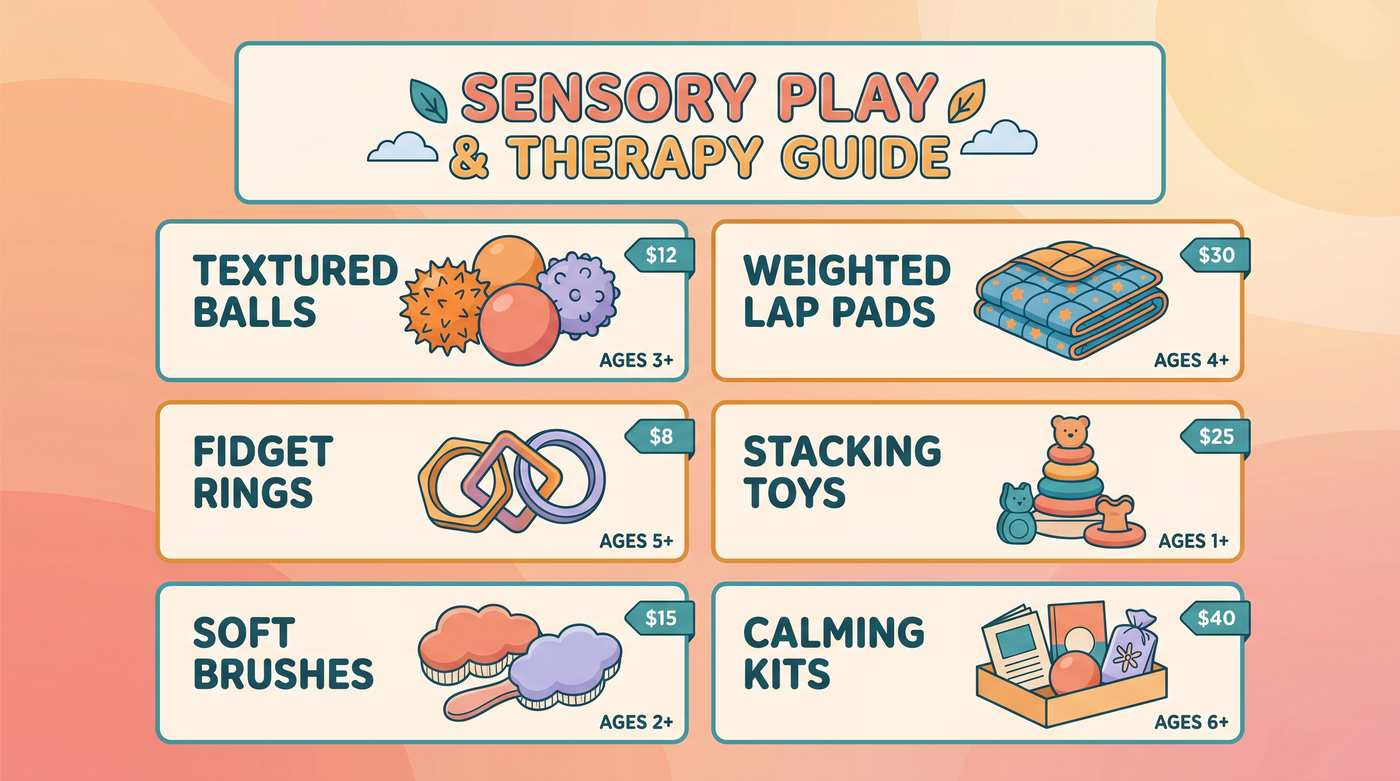
Part VI: The Complete Shopping Guide
Every Material, Every Budget, Every Age
Navigating the world of educational tools can be daunting. This guide makes the Pinnacle Protocol accessible for every family, offering thoughtful selections from budget-friendly choices to premium options, ensuring your child thrives.